
Recent Articles:

HIStalk Interviews Eric Widen, CEO, HBI Solutions

January 21, 2019 Interviews Comments Off on HIStalk Interviews Eric Widen, CEO, HBI Solutions

Eric Widen is co-founder and CEO of HBI Solutions of Palo Alto, CA.

image

Tell me about yourself and the company.

I have a long background in healthcare, over 25 years now. I’ve worked and focused on solving problems in healthcare, typically using data. We started HBI Solutions with a more sophisticated bent on using data and data science techniques to solve problems in healthcare. That focus has been on predictive insights on patients and populations, so that population managers and even individuals can understand insights into their health that they wouldn’t know otherwise. We use data science methods to do that.

What are the implications of predicting the outcomes of patients who may not even know they have a problem, as you did in applying machine learning to EHR data to identify people likely to eventually have chronic kidney disease?

That’s the million-dollar question. The punch line is, what do you do once you know this information? Our clients are focused on low-hanging fruit from a risk standpoint. They’re working closely on readmission rates for acute settings.

We have two flavors of risk models. One is the acute setting, where our insights predict what could happen before and immediately after discharge. It’s typically an acute team or a post-discharge transition and care team that is focused on things like readmissions, and inside the hospital, sepsis and mortality.

The other models are population-based models. You want to predict what’s going to happen in the future to patients who are healthy at home. The chronic kidney disease, CKD, model that you referenced is one of those. But by and large, organizations are largely focused on utilization and cost as the starting risk models. They target patients that are at risk for ED visits, inpatient visits, or high costs, then proactively enroll them in care programs.

Our more savvy clients are starting to get into disease models. CKD is one of them. But more common use cases involve risk of mortality, which was the subject of a paper we published. We’ve had organizations looking at the risk of death for a patient in a future 12-month period and proactively teeing up discussions about end-of-life and palliative care. We have a heart clinic focusing on getting patients who are at elevated risk for a heart attack into the clinic more frequently than they would otherwise.

We said in our mid-2016 conversation that CMS’s excitement about preventing readmissions would probably end up being more tactical than strategic, not really changing outcomes as much as pushing costs around. What have we learned from trying to fix a problem with what might be a blunt instrument?

A key performance indicator that is put into place by regulatory agency that includes penalties and economic implications always tends to have unintended consequences. With a laser focus on something like readmission rates, you’re looking only at a 30-day window post-discharge. The health of those people continues forever after that.

It’s more appropriate to understand all the risk for an individual. Not only within that 30-day transition and care period, but also for the next year and multiple years after that. You get people into more of a comprehensive risk management program to bend the cost curve longitudinally over time and to take care of all the patient’s risks via care management, not just the 30-day readmission risk. Day 31 and after is as important more important than those 30-day windows.

CMS, Joint Commission, and others have come up with ideas that sound naturally good, but without having data behind them. How should those organizations use the same data science as your customers?

It’s not there yet, obviously. The other unintended consequence is the administrative burden that is bestowed upon clinicians and healthcare organizations to meet these quality markers. It’s a heavy burden and a heavy lift and it doesn’t always lead to high-quality care.

Our philosophy as a company is that we purposely didn’t start with regulatory measurement, or any of those, as a focus of the company. We do those things because organizations have to do them. But our philosophy is around two markers — are we reducing the cost to manage patients and are we getting patients healthier?

As the risk goes down for things like readmission rates, utilization of the ED, mortality, or for having a heart attack, patients are actually getting healthier and moving towards an improved outcome. We’ve had clients use our risk scores as a marker to graduate people from care programs. As their risk goes down, they’re getting healthier and they no longer need an aggressive care management approach. They are closer to self-managed care.

I don’t know how this will affect how a regulatory agency thinks about care, but we have progressive organizations thinking about care in that way. Keeping their eye on the ball on a couple of important markers that are really getting people healthier. As people get healthier, they use fewer resources over time. We’re starting to get into the measurement of the cost effectiveness of this approach.

In healthcare, however, spending money to improve someone’s health today might mean someone else gets the payoff decades letter when the patient has changed jobs or insurers.

There is that kick-the-can-down mentality a little bit in the commercial markets. However, Medicare is the largest payer and people consume the most of their costs and incur most of their diseases as they stay in those programs longer. With managed Medicare, Medicare Advantage, and Medicare HCO plans, you get more of a longitudinal outlook on patients. They stay in the same plan or program. We’re targeting those types of organizations, where those incentives are aligned, because it’s a better fit.

I have seen in the commercial space exactly what you’ve described, the “it’s not our problem” approach. They are more focused on short-term risks, more interested in what could happen in the next 6-12 months instead of the next 5-10 years for that patient.

What is your most impressive customer outcome?

It’s a mix. Organizations that have been with us the longest have shown good longitudinal outcomes in reducing ED visits and readmissions. That was their largest focus, and remains their focus, because they can put their arms around that and put in programs to bend those curves.

We can look to the future for graduating people from care programs, Then we can develop, for example, more mental health-based risks. Getting people to that point of self-help to lower their rate of suicide and opioid abuse. That’s the next wave for us, as the way people think about care becomes more sophisticated. We’re not there yet. That’s our future direction.

Beyond Medicare, the VA has the incentive to pay attention to long-term patient outcomes and to implement mental health programs. Have they expressed interest?

We’ve had several conversations with the VA through one of our partners, InterSystems, which has a long relationship with the VA. We have the ability to deploy into existing technologies as smart engines behind the scenes. We can work with any workflow platform. We plan to work with the VA in the future, but nothing is in place yet.

What data elements do you wish you could get but can’t?

Our approach is to give us whatever data you have and we’ll generate the best insights on your population or on you as an individual. As we look to the future, we’re starting to work with more partners. We’ll announce this as time goes on, but these partners have access to different types of datasets. We have worked with what’s generally available in the electronic medical record and in claims systems. We’ve added outside data sources that we can get from the federal government, like social determinants and things we can add in at the ZIP code and Census Tract level.

We’ve been pitching ourselves as a population health program, but as we look at the future and getting more towards the consumer, we’re starting to work with different datasets that would allow us to develop new diagnostic screening and/or risk tools. Developing tests that don’t exist today. We could, with a mass spectrometry partner, develop analysis of proteins, lipids, and metabolites within the blood itself. It’s new data that hasn’t been harnessed, other than in research settings at a very small population level of tens or hundreds of patients.

We’ve been analyzing millions of patients in a lot of our datasets. As we work with these new partners, they’re looking to secure large population samples in tandem with EHRs in the US, but more globally. Our metabolic makeup changes at a detailed level as we exercise or enter new nutrition programs. You can measure that on a day-to- day or week-to-week basis and pick up these signals. This is really new and interesting to us. It’s the same repeatable process around machine learning that we apply to other datasets. But getting into this, we can start developing new tests in the market.

An example is a newborn screening test, where researchers who work at HBI have, in the academic setting at least, identified for every pregnant woman their likelihood of pre-term. If you’re more likely to deliver pre-term, then you will enter a different care program. Any obstetrician or pregnant woman would want that test. We want to develop tens or hundreds of those types of tests.

Another example of high-throughput analysis of mass spectrometry is diabetics whose glucose and A1C markers are “normal.” We can find that 20, 30, or 40 percent of that “normal” population is actually at risk by measuring the proteins and the metabolites within the blood. This is a new direction for HBI. It doesn’t take away from our current direction, it’s just a new channel that we’re going after. It enhances population risk management, but individual risk markers will be a more meaningful focus for us.

How can we separate the real deal from the posers in the HIMSS19 exhibit hall, where every vendor will suddenly claim that their old products are now powered by machine learning, AI, and analytics?

We pride ourselves on being a no-BS company, rolling up our sleeves and working with clients to get them better technology to make the doctor’s job easier and to get patients healthier. We’ve always taken that as a focus. We can differentiate by giving you a list of physicians who are using our technology, pointing to research papers, and putting you in touch with care managers who are using our product daily to the health and outcomes of patients. A lot of vendors don’t have those three in place.

Do you have any final thoughts?

We have been focused on US problems and issues, which have their own government and regulatory components that drive how you think about entering the market here, But if you take a general view of how to use technology to get patients healthier at a lower cost, it’s relevant to US. There’s no shortage of studies on how upside-down the US is on outcomes and cost.

But it’s relevant across the globe as well. Other countries are getting richer and eating more poorly. People there with more disposable income want access to more types of healthcare. It’s a global problem as well. It’s important to think about how technology applies not only in the US, but globally. That’s our approach in developing solutions that are relevant to people.
Comments Off on HIStalk Interviews Eric Widen, CEO, HBI Solutions

Morning Headlines 1/21/19

January 20, 2019 Headlines Comments Off on Morning Headlines 1/21/19

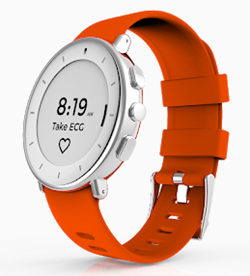
Verily Study Watch Receives FDA 510(k) Clearance for ECG

Alphabet’s Verily announces that its Study Watch has earned FDA clearance as a medical device for performing on-demand ECGs.

Computer virus contained, hospital services returning to normal

Two dozen hospitals in Ontario are nearly done recovering from a Zero Day Virus that impacted administrative and clinical IT systems.

Dignity Health Northridge becomes 1st hospital to acquire earthquake warning system

Twenty-five years after suffering severe damage during the Northridge Earthquake, Dignity Health – Northridge Hospital Medical Center (CA) becomes the first hospital to pilot the government-funded Shake Alert earthquake warning system.

VA needs a contractor to help test its new EHR

The VA issues an RFI for a software testing contractor,  with 80 percent of the job focusing on Cerner.

Kettering luring more than 150 new jobs to business park

Kettering Health Network will this week open a $10 million, 17,000 square-foot command center that will enable staff to view patient status in real time using TeleTracking technology.

Comments Off on Morning Headlines 1/21/19

Monday Morning Update 1/21/19

January 20, 2019 News 1 Comment

Top News

image

Alphabet’s Verily announces that its Study Watch has earned FDA clearance as a medical device for performing on-demand ECGs.

Verily’s offering, unlike the Apple Watch, requires a prescription, perhaps because it was developed to capture health data from clinical trials participants. 


Reader Comments

From Stock Picker: “Re: Jim Cramer. What does he know about healthcare?” First, let’s recognize Cramer’s undeniably impressive credentials – Harvard BA and JD, editor-in-chief of the Harvard Crimson, small-town newspaper reporter, successful hedge fund manager (for a short time during a boom market), and co-founder of a stock website, all before he was a TV host. However, it’s always amusing when cheap-seaters (including elected officials) pontificate based on their superficial knowledge. Everybody these days thinks they are an expert on everything they’ve read about from sketchy Internet sources, holding their ground even while emotionally spouting off to an actual expert for whom the topic represents their life’s work. This is a different form of a volume-to-value challenge where loud people talk over more informed ones.

image

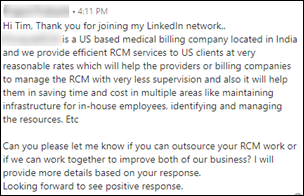
From LinkedOut: “Re: sending an immediate boilerplate sales pitch after connecting on LinkedIn. What if I write a message specific to you and your org? Less annoying?” Only slightly, assuming you are still trying to sell me something. I didn’t join LinkedIn to be pitched, especially by people or companies I’ve never heard of. It also depends on whether you’ve paid any attention to what I actually do, which means that the LinkedIn sales messages I get for software engineering services, cybersecurity consulting, or webinars for non-health IT topics are going to bug me because my profile makes it clear those don’t apply to me. Overzealous Indian dudes in particular seem to love to invade my inbox. It’s like signing up for Match.com and having some weirdo immediately start blasting out full-frontal selfies.

From Deadlock Loser: “Re: Cerner. Did indeed announce another ‘voluntary separation plan’ right after Cliff Illig’s retirement and before the long holiday weekend. Unlike the previous two in 2015 and 2016, this one contained a threat that it would be ‘involuntary’ if certain financial goals aren’t met. Combine this with substandard benefits, readjustment in titles that led to up to 15 percent pay cuts, and blunt communications like this one that kill morale. Executives who are treated like royalty prefer to hire young, know-nothings from local Midwest colleges who are cheap and don’t know any better.” Unverified, but DL included what appears to be a copy of Cerner’s internal announcement from the company’s ironically titled chief people officer, which I’ll excerpt as follows:

Today, we are announcing to all US associates a voluntary offering created for a group of US associates who meet specific eligibility criteria … In 2019, we are expecting to meet a financial goal in order to fund important areas of investment to secure our future as a growth company. If we do not meet our corporate financial goal with the voluntary separation program, we may subsequently conduct an involuntary separation program … An associate may be eligible for the VSP if … the associate has at least 10 years of service and the associate’s combined age and years of service equals or exceeds 65.

From Minimal Shrinkage: “Re: healthcare influencers. When the conference circuit gets into high gear, their insulated conversations among themselves, event promotions, meet-ups, chats, etc. grow exponentially. For every smart, successful, succinct, and cogent healthcare person that contributes to the online discourse, there appear to be 30 others who hold almost no bona fides who produce an endless stream of meaningless, pointless, and self-aggrandized commentary. My grandfather used to tell me, ‘Don’t tell me what you’re going to do, show me what you’ve done.’ Those influencers have also reduced my interest in attending the conferences they infest — I’m not interested in seeing their regurgitated ‘takes’ on stage after not being excited to see them on Twitter and LinkedIn.” 


HIStalk Announcements and Requests

image

About half of provider IT decision-makers look at either KLAS or Black Book before buying software or services, according to last week’s poll. It’s not really a fair comparison since Black Book covers broad trends with big sample sizes while KLAS digs deep into a specific topic (like population health management technology) while interviewing a small number of actual clients, so they are used somewhat differently. I agree with Former Community CIO on the best way to use KLAS, with this being my experience:

  • KLAS is outstanding in describing a market and differentiating vendors within it in ways that vendors themselves would never do for fear of pigeonholing opportunities.
  • A given report tells you who the players are and how much market share they hold.
  • The overall rankings usually jibe with gut feel.
  • Few people would argue with the top- and bottom-ranked products, but KLAS doesn’t help much to distinguish those slugging it out in the middle.
  • Provider executives feel peer pressure to avoid choosing a product that isn’t #1 in KLAS as those peers fail to recognize that one size doesn’t fit all, KLAS isn’t always right, and even top vendors can stumble or get acquired by a crappy parent that ruins the magic.
  • The user comments provide the most interesting information, although they are few in number, you don’t know the commenter’s background and employer to discern relevance, and unknown factors could make them suspect (the client is behind on releases, their IT shop is in shambles, or they merged with someone and had the system foisted on them).
  • Clients who report to KLAS are like Yelp reviewers – they are self-selected with their own agenda, they may not be representative of the entire client base or similar to the reader’s health system demographic, their vendor may influence their participation or rating, and the individual respondent’s background in a particular product may be superficial.

New poll to your right or here: What would you tell Tim Cook if he asked you how Apple should be involved in healthcare?

I invite you to complete my once-yearly reader survey. I have limited ambition, time, and appetite for change just for change’s sake, but nearly everything I do differently today than I did years ago is because I got a spark from someone’s reader survey response. That reminds me that HIStalk will be 16 years old in June, which seems unreasonable given that the initially low readership and conflicting day-job demands should have been strong motivators for me to find another hobby.

I am, as a glass-half-empty curmudgeon, always annoyed by something. My peeve this week, caused by HIMSS19 spam, is people sending an “invite” rather than an “invitation.”Maybe it’s inevitable that verbing nouns (such as “friending,” seeing an Olympian “medal,” or “incentivizing” EHR purchases) will lead to nouning verbs (which along with sending “invites” includes HIMSS listing its federal government “asks.”) It reminds me of nerdy hospital tech guys who worked for me who described their job as “administrating” a system or people (sometimes me included) who say they are “vacationing” given that “vacation” is the noun form of “vacate, ” I say while explanationing.


Webinars

None scheduled in the coming weeks. Previous webinars are on our YouTube channel. Contact Lorre for information.


Acquisitions, Funding, Business, and Stock

image

Data analytics and population health technology vendor Innovaccer closes a $35 million Series B funding round, raising its total to $51 million.

Baxter International acquires True Process, whose platform performs medical device integration and analytics.


People

The soon-to-be-combined Beth Israel Lahey Health names BIDMC CIO John Halamka, MD, MS as executive director of its recently created health technology exploration center.


Announcements and Implementations

image

Researchers at Northwestern University develop a wireless, battery-free soft skin patch that analyzes sweat for PH and levels of chloride, glucose, and lactate. Possible applications include detecting dehydration (Gatorade is already on board), testing for cystic fibrosis, and potentially screening diabetics. Researchers are are working on sensors to monitor kidney function, assess post-stroke rehabilitation, and to monitor depression.

image

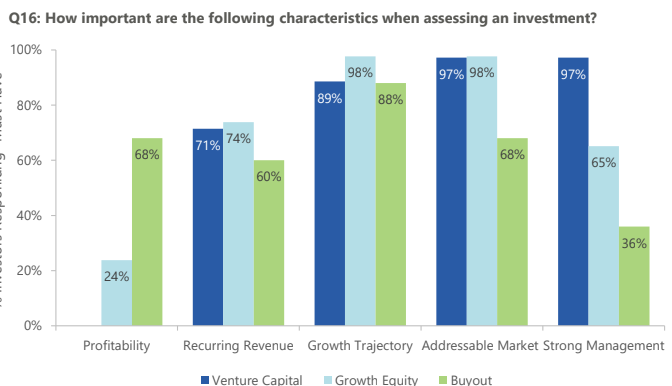
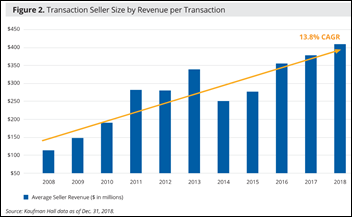
The latest twice-yearly health IT market review of Healthcare Growth Partners says that the market is full of noise, as private equity investors are anxiously looking for investments, health IT seems attractive, and the PE firms are using CRM and other digital marketing techniques to indiscriminately blast out messages trying to beat the others at finding deals. Venture capital and growth equity players say their health IT investment strategy meets expectations, while buyout companies are less satisfied. Primary deal-killers are poor business models, deal sourcing, competition from strategic investors, and valuation. Interesting respondent observations:

  • Many startups offer gimmicky solutions and are run by inexperienced entrepreneurs.
  • Some startups aren’t ready due to lack of a go-to-market plan, an immature product, or lack of pilot sites or customers.
  • Sellers are sometimes looking for a complete exit instead of a non-controlling equity investment.
  • Funding rounds are getting bigger and occurring earlier, such that even a Series A deal involves a company with no recurring revenue and product still in pilot or even pre-pilot.
  • Seed rounds have reasonable valuations, but those from Series A and beyond are overpriced compared to other sectors.
  • Top sectors are population health management, revenue cycle management, infrastructure, and payer services.
  • The most attractive customer segments are payers / employers and health systems, while the least-attractive is patients and families.

Government and Politics

The VA issues an RFI for a software testing contractor,  with 80 percent of the job focusing on Cerner.


Other

Two patients in Scotland’s Queen Elizabeth University Hospital die from cryptococcal fungal infections that authorities believe originated in the droppings of pigeons that were nesting in a machinery room.

image

Bizarre: in Scotland, a 28-year-old female hospital nurse is fired and sent to prison for impersonating a rich, male doctor by using photos of handsome men and a voice-changing machine to harass and stalk 10 women she connected with on dating sites.


Sponsor Updates

clip_image001

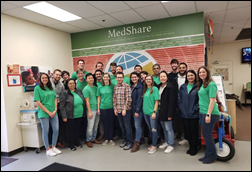
  • The Patientco team works with humanitarian aid organization MedShare to sort and pack medical supplies for hospitals in developing countries.
  • The Chartis Group publishes a new paper, “2019 Healthcare Outlook: Strategic Imperatives for the Year Ahead.”
  • NextGate will exhibit at the 2019 IHE North American Connectathon January 21-25 in Cleveland.
  • OmniSys will exhibit at the ASAP Annual Conference January 23-25 in Kiawah Island, SC.
  • OnPlan Health publishes “The Changing Landscape of Healthcare Payment Plans” report.
  • Experian Health will exhibit at the HFMA MidSouth meeting January 30-February 1 in Tunica, MS.
  • Flagship Medical becomes the first durable medical equipment provider to join Prepared Health’s EnTouch network.
  • Surescripts will exhibit at North Carolina Epic UGM 2019 January 22-23 in Greensboro, NC.

Blog Posts


button


Contacts

Mr. H, Lorre, Jenn, Dr. Jayne.
Get HIStalk updates. Send news or rumors.
Contact us.

125x125_2nd_Circle

Weekender 1/18/19

January 18, 2019 Weekender Comments Off on Weekender 1/18/19

weekender 


Weekly News Recap

  • Atul Gawande cancels his HIMSS19 keynote without explanation
  • 24 hospitals in Ontario invoke downtime procedures after a virus brings down their IT systems
  • TV stock pundit Jim Cramer urges Apple to acquire Epic to bolster its sagging business
  • Definitive Healthcare acquires HIMSS Analytics
  • PerfectServe acquires Telmediq
  • Cerner co-founder Cliff Illig retires from the company’s board, which along with Paul Gorup’s 2015 retirement and Neal Patterson’s 2017 death, leaves no founders involved
  • Walgreens signs a technology and software development agreement with Microsoft
  • The first chief digital officer of NHS England resigns to take a job with a vendor that provides telemedicine services to NHS
  • A study of 2018 hospital acquisitions finds that deals are larger, the selling hospitals are usually not experiencing financial distress, and the line between for-profit and not-for-profit health systems is blurring

Best Reader Comments

I love the people who call MUMPS old, but fail to acknowledge that macOS and iOS are based on UNIX, which is also ancient. Yet no one criticizes Apple for building an empire on dinosaur technology. (I know this, it’s a UNIX system!)

If any EHR company is going to be bought, chances are likely it would be Cerner, not Epic. Judy wouldn’t let that happen until she has moved on. On the other hand, now that all three founders of Cerner have moved on (God bless you NP), Cerner is ripe for acquisition, as it has been rumored for years. I would think Apple, Oracle, or Amazon would be the most likely candidates. Not to mention Cerner’s architecture is a bit more compatible, if you will, to those companies. If Epic were ever for sale, which again probably would never happen, would an Apple/Amazon want to purchase a system whose architecture is MUMPS based? (Associate CIO)

HIMSS doesn’t need any help in finding new ways to gouge vendors out of more money. For years now vendors have seen diminishing returns on their massive investments to attend. Having a booth has become fairly pointless as they attract typically current customers and not new. Decision makers do not circulate around the exhibit hall like they used to. It is important for attendees to remember that there is no HIMSS convention without the tens of millions invested by vendors. Do them a favor and visit their booths, otherwise, I see more and more vendors opting for other conferences. (GenesRFree)

There’s also zero evidence in any of the studies cited that government requirements are the factor contributing to burnout. You can speculate, but they just tied together a lot of disparate information in an attempt to sound knowledgeable about industry trends. They also ignore the conclusions in the same surveys which point out the benefits of EHRs. (Boring)

What has always amazed me is that HIMSS was quick to take your money, yet offered little or no help in how to get an ROI out of a very expensive ordeal. What they offered was was some pretty basic guidance (do’s and don’ts) that did not amount to much. What is needed is some in-depth advice on what to do before the show, during the show, and more importantly AFTER. Seems like maybe that could be another revenue avenue for them. They do like revenue, right? (Frank Poggio)

Life was more interesting with Neal at Cerner, Jonathan at Athena, Glen at Allscripts, and Rich at IDX. HIT has lost passionate and interesting leaders. We still have Judy. (xCerner xAllscripts xIDX)

Apple needs to carefully review the history of the healthcare initiatives of IBM, GE, NCR, Honeywell, Burroughs, Martin Marietta, Northrup Grumman, McDonnell Douglas, Siemens, Lockheed, Revlon (yes, the cosmetics company!), Microsoft, Google, American Express, First Data, American Hospital Supply, and about 10 insurance companies and 20 others. Good luck, Mr Cook. You’ll need it. (Frank Poggio)


Watercooler Talk Tidbits

image image

Reader donations funded the DonorsChoose teacher grant request of Ms. S in Los Angeles, who asked for an IPad to run Lego Mindstorms programmable robots in her after-school technology club. She reports, “The IPad helped us link to product videos, building challenges, downloads, and support pages for the kids. Having an additional IPad in the after-school technology club has helped more students access the curriculum for STEAM learning. We are always short on technology and this new additional piece of technology lets me divide the students into smaller groups and allows them to be independent learners and resourceful. I have now become more of the facilitator because the kids have taken on the responsibility of acquiring their own learning. So from the bottom of my heart, I sincerely want to thank you for your generosity.”

The nursing part of Pennsylvania’s PALS online licensing system goes down, leaving healthcare-related graduates unable to take jobs because employers can’t verify their credentials. The state says it has fixed the problem with legacy system EppiccNurse, which it will replace this year. The system was developed by the Pennsylvania State Board of Nursing to link schools with the Board to communicate pre-licensure activity.

image

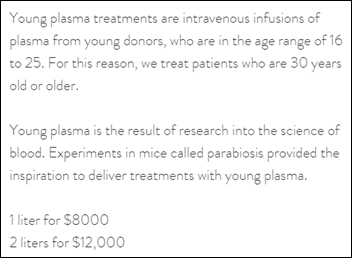
A startup that charges older people $8,000 for a transfusion of young-person blood claims to be up and running in five cities and now takes PayPal for online payments. Experts are doubtful and clinical evidence is non-existent, but the company slides under the FDA radar by offering normal blood transfusions with off-label indications. Ambrosia Health Founder and CEO Jesse Karmazin earned an MD from Stanford, joining what seems like every Stanford medical school graduate in doing something sexier and more lucrative than actually seeing patients after taking up a class spot.

ABC says its upcoming documentary on Theranos called “The Dropout” will include footage of the courtroom depositions of founder Elizabeth Holmes.

image

An executive of White Plains Hospital (NY) dies in the hospital where he had worked for 40 years after collapsing while giving his retirement speech. Ossie Dahl was 64.

A case study in the Irish Medical Journal describes a man with a subcutaneous abscess whose “innovative” method of self-treating his chronic low back pain was to inject himself monthly with his own semen. I’ll admire my own restraint in letting it go at that.


In Case You Missed It


Get Involved


button


125x125_2nd_Circle

Comments Off on Weekender 1/18/19

Morning Headlines 1/18/19

January 17, 2019 Headlines Comments Off on Morning Headlines 1/18/19

Consumer Health Tech Company Ciitizen™ Raises $17M in Series A Financing to Accelerate Data Platform Development and Commercialization

Consumer health data sharing company Ciitizen raises $17 million in a Series A funding round led by Andreessen Horowitz.

Gawande, still mum on plans for new health venture, pulls out of major health conference

Atul Gawande, MD cancels his keynote at HIMSS19.

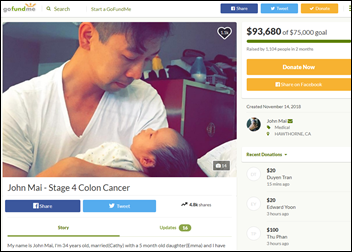
GoFundMe CEO: ‘Gigantic Gaps’ In Health System Showing Up In Crowdfunding

GoFundMe reports that a third of the $5 billion raised on its platform since launching in 2010 has been used for healthcare campaigns.

Epic roll-out creates prescription refill gridlock

After going live on Epic in December, Memorial Hospital (NH) staff struggle to keep up with prescription refill requests as they transfer prescription data to the new system.

Far-reaching impact: Computer virus at HSN affects 24 hospitals across North

A “zero-day virus” forces 24 hospitals in Ontario to revert to downtime procedures while they work to bring their IT systems, including Meditech and Elekta EHRs, back online.

Comments Off on Morning Headlines 1/18/19

News 1/18/19

January 17, 2019 News 6 Comments

Top News

image

SNAGHTMLf0e4eb2

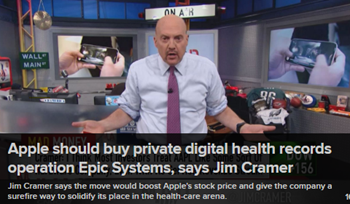
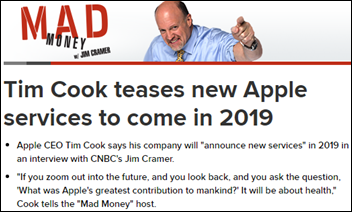
From Dave N: “Re: CNBC’s ‘Mad Money.’ Jim Cramer said he thinks Epic will be acquired or go public, citing Judy’s age.” The stock-picking record of the highly annoying Jim Cramer is poor, underperforming the S&P 500 index funds while exposing investors to more volatility, and this particular recommendation is especially questionable:

  • Judy Faulkner refuses to sell Epic and has told those whose will control the majority of shares after her — her heirs and the board — not to sell or go public. I highly doubt that drowning in a sea of Apple cash would be her preferred way to go.
  • Cramer thinks Epic needs scale, which they don’t — Epic makes billions with a few hundred boutique customers and doesn’t care about millions of app users paying $2.99, social media platforms counting ad clicks, or illogical fanboys who buy overpriced Apple devices as soon as they’re released.
  • Cramer wants Apple to smooth out its hardware vendor market bumps by buying its away into the software market, a strategy that has failed other desperately growth-seeking companies countless times.
  • Apple’s consumer innovation track record died with Steve Jobs, but acquiring Epic to leap headfirst into healthcare won’t make a dent in the real problem of flagging IPhone sales in the absence of any other compelling offering.
  • Cramer claims that Apple and Cerner practice information blocking (which is a stupid thing to say since it’s their customers that are the problem – providers who want to exchange information do so easily) and proposes that Apple become a universal repository for health data. Apple doesn’t need to buy Epic or anyone else to accomplish that, and it’s a weird thing for Cramer to say since he just got finished saying Epic and Cerner aren’t interoperable.
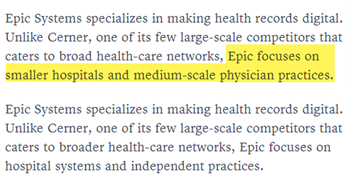
  • Notice the before-and-after result (above) of the show having to alter Jim’s inane comment that Epic focuses on small hospitals. The top version is the original cached version, while the bottom is a post-surgical shot after Jim’s foot was removed from his enlarged mouth. (I reviewed the show video and he really said that Epic is a small-hospital vendor while Cerner focuses on big ones).
  • “Neither Cerner nor Epic wants to make it easier for their systems to work together because their clients would have an easier time switching to a competitor.” Oh, Jim, how much (and how loudly) you say despite how little you know. And by the way, they actually make shirts whose sleeves don’t have to be rolled up – ask for something called “short-sleeved.”

Reader Comments

From Jelly Doughnut: “Re: population health management. Why isn’t it used more if it really saves money, which it should?” Because it saves money years down the road for someone else when the patient / enrollee has moved on to other insurers and providers. A company spending big dollars today to help a 30-year-old patient get healthy will most likely never see the benefit. We probably need some kind of lifetime patient financial scorecard to fix this, yet another healthcare example in which taking better care of people means making less money. The only real exception is with lifetime insurers such as Medicare and the VA, which get to reap the benefit of whatever savings they create.

From KC1981: “Re: Cerner. Is offering ‘voluntary’ retirement packages and is making it clear that if that doesn’t get to the total numbers needed, the next step is forced retirements and layoffs.” Unverified. I’ll get a call in to Jim Cramer.

image

From Nicholas Cage-Free Eggs: “Re: HIMSS ‘news’ publications. Down here in Australia, HIMSS dismissed the award-winning contracted editor of its flagship publication after she ran an insightful, critical overview of the problems with the Australian Digital Health Agency, whose CEO is a friend of HIMSS CEO Hal Wolf. That CEO threatened to withdraw sponsorship of the HIMSS AsiaPac conference. Now HIMSS won’t run stories without the agency’s approval.” Unverified, although I’ve heard that before and the editor’s LinkedIn shows that she did indeed leave a few weeks after her story ran. It’s not exactly ProPublica over there – they should have made it clear they weren’t looking for actual news and hired a marketing person instead of a journalist. 

image

From Acute Malcontent: “Re: social media influencers. There’s something to be said for the HIT crowd that seems to exist only on social media, but meanwhile, I thought you’d get a kick out of this story.” Instagram influencer Caroline Calloway – who in her mid-20s took a $500,000 book advance that she couldn’t pay back when she found out that she can’t actually write – suddenly announces after a two-year hiatus that she’s offering a national “tour” in which she will instruct attendees (at $165 per head) how to create an “Instagram brand.” Twitter roasted her for trying to recruit free helpers, arm-twisting Philadelphia and Boston ticket-holders to travel to New York City instead to make it easier for her, giving attendees packets of flower seeds instead of the promised live orchids to wear in their flowing locks, and letting 20-year-old friends with no work experience run the show. She cancelled the rest of the “tour” and claims in Fyre Festival style that it’s not her fault and she’ll give refunds. Jezebel concludes, “No one is an influencer if everyone is an influencer.” I would add a health IT corollary – you aren’t an influencer, even in its most shallow form, unless you change the behavior (especially the buying kind) of people with real influence. 


HIStalk Announcements and Requests

image

It’s that just-before-HIMSS time when I ask you to take three minutes to fill out my annual reader survey. I use the results for several things – to plan for the year, to manage my ego up or down as needed by reading the positive and negative comments, and to get a mental picture of who is out there on the other side of that blank screen that I vanquish every day.

Dear overzealous sales types – if you connect with me on LinkedIn and immediately spam me with a boilerplate sales message, I will instantly remove the connection, overriding my initial impulse to report you for spamming. I know people told you to Always Be Selling, but that means you are Often Being Annoying and LinkedIn already offers plenty of that.


Webinars

None scheduled in the coming weeks. Previous webinars are on our YouTube channel. Contact Lorre for information.


Acquisitions, Funding, Business, and Stock

image

Consumer health data sharing company Ciitizen raises $17 million in a Series A funding round led by Andreessen Horowitz. CEO Anil Sethi founded the company in 2017 after selling a similar company to Apple for its health records business.

SNAGHTMLed2240c

GoFundMe reports that a third of the $5 billion raised on its platform since launching in 2010 has been used for healthcare campaigns. CEO Rob Solomon says he never though the platform’s medical category would become its most popular. “We shouldn’t be the solution to a complex set of systemic problems. They should be solved by the government working properly, and by healthcare companies working with their constituents.”

Consumer healthcare website company Everyday Health Group acquires Castle Connolly Medical, owner of the Top Doctors database.

image

PerfectServe acquires competitor Telmediq for an undisclosed sum. Telmediq founder and CEO Ben Moore will become PerfectServe’s chief product officer.


People

image

Chris McMahon (Turbonomic) joins Kyruus as SVP of people.
image

Health insurer Oscar names Angela Calman (IBM Watson Health) as VP of communications.

image

ZeOmega promotes Sandra Hewett, RN to CNO.

image

Todd Stottlemyer (CNSI) joins the board of Verato.

SNAGHTMLefde7b9

Nordic hires Tom Kirst (Afton-Armitage) as managing director and special assistant to the CEO.

image

PatientSafe Solutions names Kathleen Harmon, MS, RN (Sphere3) as chief clinical officer.


Sales

  • Partners HealthCare chooses Visage Imaging’s Visage 7 enterprise imaging platform, eliminating multiple legacy PACS and giving the company the largest sale in its history.
  • Williamson Memorial Hospital (WV) will implement Meditech’s Expanse EHR via the company’s subscription service.
  • BridgePoint Healthcare (NJ) will deploy EHR software from HCS at its post-acute facilities in Washington, DC and New Orleans.
  • Arkansas State Hospital selects EHR and RCM technology from Medsphere.
  • Northern California behavioral health services provider Remi Vista selects Cerner Integrated Community Behavioral Health and patient portal.

Announcements and Implementations

Texas Health Resources implements MDsyncNet’s physician on-call scheduling software at eight additional hospitals.

Huggins Hospital and Catholic Medical Center of GraniteOne Health implement Oracle ERP and HCM Cloud.

Managed care company NextLevel Health Partners signs on for PatientPing’s real-time care notifications.

Critical Alert Systems will add real-time patient-generated data from medical devices and EHRs to its critical alarm surveillance solution via Bernoulli Health.


Government and Politics

In Canada, the New Brunswick Department of Health will spend $12.5 million to implement an EHR in three phases over the next several years.


Privacy and Security

image

In Ontario, Health Sciences North works to recover from a computer virus discovered Wednesday morning that has affected several IT systems. A “major computer system breakdown” was also reported at Hôpital Notre-Dame Hospital in Ontario, though it’s unclear if the two incidents are related.


Other

image

After going live on Epic last month, Memorial Hospital (NH) staff struggle to keep up with prescription refill requests as they transfer prescription data to the new system. The hospital has set up an “urgent refill” hotline and special walk-up window at the hospital for patients. It has also established a hotline for pharmacists having trouble with the system. Interim CEO Lee Myles admits the new system’s “complexity is amazing,” and that employees are working “ridiculous hours” to get refill workflows back to normal.

image

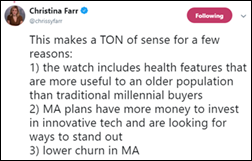
CNBC reports that Apple is talking with three Medicare Advantage plans about offering the AppleWatch to members at a subsidized cost. The $400 latest version of the Watch features senior-friendly fall detection. Skeptics have pointed out that more evidence is needed to determine the device’s impact on outcomes, and that seniors may have a hard time manipulating and reading the device’s small controls and display.

image

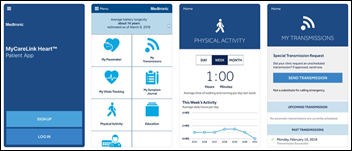
Medtronic develops an app that, for the first time, gives users of its pacemakers the ability to pull data from their own devices.

image

Coursera adds 100 healthcare-related courses to its roster of online classes, emphasizing healthcare informatics, management, and public health.

image

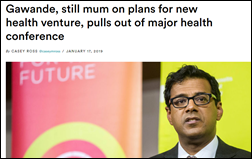
Atul Gawande, MD cancels his keynote at HIMSS19, which isn’t surprising given his media hiatus since becoming CEO six months ago of the joint venture between Amazon, JPMorgan, and Berkshire Hathaway. Maybe he’ll spend the time he’ll save naming the darned thing. Meanwhile, HIMSS announces that HHS Secretary Alex Azar will join CMS Administrator Seema Verma in a Tuesday evening session on interoperability and patient engagement that, based on their Twitter track records, will turn into a political rally.

A 17-year-old teenager in China who sold a kidney to black marketers for $3,000 in 2012 so he could afford to buy an IPhone 4 and IPad 2 is now a 25-year-old man who will be bedridden and on dialysis for life after his remaining kidney failed due to poor technique in the illegal surgery. Five people, including two moonlighting surgeons, went to jail and Mr. Wang was awarded $300,000 in compensation. It’s probably not this Mr. Wang.


Sponsor Updates

  • Optimum Healthcare IT will host a HIMSS19 lunch and learn session titled “Optimizing Outcomes with Real-Time Data Harmonization” on February 12.
  • Patientco adds financing options from ClearBalance to its SmartFinance patient payment technology for health systems.
  • ZappRx partners with Bayer, giving it insight into the medication access and prescription habits of patients living with Pulmonary Hypertension, and with Relapsing Remitting Multiple Sclerosis.
  • Elsevier Clinical Solutions releases a video summary of its recent Health Dialogue roundtable.
  • Clinical Alert Systems partners with Bernoulli Health for real-time clinical surveillance, advanced analytics, and intelligent alert notification.
  • Healthfinch will exhibit at the Allscripts Global Sales Kickoff January 22-24 in San Antonio.
  • Imat Solutions releases a new podcast, “Advancing Data Confidence at HIMSS 2019.”
  • The InterSystems IRIS Data Platform is now available on the AWS Marketplace.
  • Nordic hires Tom Kirst (Afton-Armitage) as managing director/special assistant to the CEO.

Blog Posts


button


Contacts

Mr. H, Lorre, Jenn, Dr. Jayne.
Get HIStalk updates. Send news or rumors.
Contact us.

125x125_2nd_Circle

EPtalk by Dr. Jayne 1/17/19

January 17, 2019 Dr. Jayne Comments Off on EPtalk by Dr. Jayne 1/17/19

All is not quiet on the Congressional front, with the House Committee on Ways and Means sending a letter to CMS Administrator Seema Verma asking for greater transparency in the development of alternative payment models. The Committee notes that “significant policy changes made unilaterally by the executive branch without sufficient transparency could yield unintended negative consequences for beneficiaries and the healthcare community.”

The letter goes on to note that the Center for Medicare and Medicaid Innovation (CMMI) is tasked with consulting experts in medicine and healthcare management, yet the model development process doesn’t always follow the traditional rulemaking cycle that includes public comments. The letter requests that CMS provide a list of “models under active consideration by the agency,” including timelines, comment periods, etc. and gives the agency two weeks to deliver a response. I won’t be holding my breath to see what CMS says.

clip_image002

The US Government Accountability Office has also been busy, releasing a report this week regarding challenges for matching patient records across provider platforms. The 21st Century Cures Act required the GAO to review current matching practices and ways in which federal bodies might improve things. The report highlights work by the Pew Charitable Trusts to improve matching, including standardization of demographic data such as addresses and how EHRs use that data and exploring how biometrics might assist in matching.

It’s clear that we aren’t going to see a universal patient identifier anytime soon, which makes it incumbent for members of the patient care community (including EHR vendors, hospitals, providers, and payers) to come together and create solutions. Having worked with multiple EHRs, I can attest to the fact that some of them don’t even follow US Postal Service formatting standards for addresses, which boggles the mind since they’re readily available and used in many industries. I’ve seen multiple online retailers use the address formatting technology, so I’d think that my medical records should be at least as important as the breadmaking supplies I ordered recently.

The game is afoot for organizations ready to submit 2018 Merit-based Incentive Payment System (MIPS) data. Those eligible clinicians who participated have until April 2 to get the job done at the QPP website. There is a new system in place with a compound acronym – the HCQIS (Health Care Quality Information Systems) Authorization Roles and Profile (HARP) system will be used.

I’d recommend logging in early to make sure your credentials from the previous Enterprise Identity Management (EIDM) system were transitioned correctly and to register with HARP if needed. On a lark, I checked my participation status using the QPP Participation Status Tool and was surprised to see it list a location where I have never seen patients. I’ll be taking the penalty, so will leave it up to my practice administrator to sort it out.

CMS also announced that the new Medicare card mailing process is complete, and that nearly 60 percent of claims are being submitted with the new Medicare Beneficiary Identifier (MBI) numbers instead of Social Security numbers. The final wave of mailings includes Medicare beneficiaries who live in Canada and Mexico. While the final transitions are being worked out, patients can use their old cards through December 31, 2019, although I hope those transactions quickly become few and far between.

Walgreens is uniting with Microsoft to create so-called “digital health corners” for its retail stores. Walgreens plans to begin using the Microsoft cloud and data centers, which means no business for rival Amazon. Walgreens CEO Stefano Pessina is quoted in the article as saying, “Healthcare is too complicated, too big, and if I can say, a little too messy” thus the need to “team up with many, many different, practically all, the players in this industry.” I guess they consider cosmetics service Birchbox to be an industry player since they’ve signed a deal with it as well. The “digital health corners” will be piloted in a dozen stores and are intended to promote management of chronic diseases along with sales of health-related devices. The deal also includes Walgreens signing on for Microsoft 365 services.

In other retail news, Walmart is breaking with CVS after a squabble over prescription pricing. Patients with CVS Caremark pharmacy plans will have to find other places to pick up their medications, although I suspect other providers can’t possibly compete with the loss of the people-watching opportunities at Walmart. In a confusing twist, Walmart-owned Sam’s Club pharmacies remain in-network, so you can still pick up your bulk items at the same time as your pills.

I’m helping some practices make the move to telehealth and have been poring through the literature looking for data on outcomes from virtual care vs. traditional in-person visits. A recent news release from Massachusetts General Hospital caught my eye, as their work was published in the American Journal of Managed Care. The authors found that video visits maintained the same perceived quality of care and communication as in-person visits, while being found more convenient. Mass General has been doing telehealth for more than a decade, with video visits being offered for the last five years for patients requiring follow-up care. Additional key findings included:

  • 79 percent of patients found it easier to find a convenient time for a follow-up video visit compared to an in-person office visit
  • 21 percent of patients thought the overall quality of virtual visits was better
  • 68 percent of patients scored the video visit at 9 or 10 out of 10, and those ranking it low typically cited technical issues as the reason.

Several of my close friends have reached out about HIMSS preparation, especially wanting to know whether I’m in full party-planning mode yet. Although I’ve received a couple of advanced notices from people who want to be sure their event makes my must-attend list, I really haven’t seen much in the way of invitations yet.

One of my usual HIMSS BFFs is likely not going to attend HIMSS this year. The value just isn’t there and it’s time away from work and family that doesn’t seem very productive any more. I have to admit I’ve had second thoughts about attending due to the cost and the general hassle factor, especially since my practice is being very grumpy about allowing the time away in the middle of flu season and the opening of two new locations. I held my ground on the time off, however, since by not going I’d sorely miss the opportunity for those once-a-year catch-ups that I really enjoy.

button

Email Dr. Jayne.

Comments Off on EPtalk by Dr. Jayne 1/17/19

Morning Headlines 1/17/19

January 16, 2019 Headlines 7 Comments

Definitive Healthcare Acquires HIMSS Analytics

Definitive Healthcare acquires the data services business and assets of HIMSS Analytics.

PerfectServe Acquires Telmediq, #1 KLAS Rated Vendor for Secure Communication Platforms

Clinical communications and collaboration company PerfectServe acquires competitor Telmediq for an unspecified amount.

Apple should buy private digital health records operation Epic Systems, says Jim Cramer

CNBC’s Jim Cramer says Apple needs to make a “big, splashy acquisition” in the EHR space to breathe new life into its downtrodden stock, and back up claims that it will revolutionize healthcare.

Medtronic debuts first apps to let heart patients monitor their pacemakers

Medtronic gives patients the ability to pull data from their pacemakers via its new MyCareLink Heart app.

Definitive Healthcare Acquires HIMSS Analytics

January 16, 2019 News Comments Off on Definitive Healthcare Acquires HIMSS Analytics

image 

Definitive Healthcare announced this morning that it has acquired the data services business and assets of HIMSS Analytics.

image

Definitive Healthcare founder and CEO Jason Krantz said in the announcement, “HIMSS Analytics has developed an extraordinarily powerful dataset including technology install data and purchasing contracts among other leading intelligence that, when combined with Definitive Healthcare’s proprietary healthcare provider data, will create a truly best-in-class solution for our client base.”

Comments Off on Definitive Healthcare Acquires HIMSS Analytics

Machine Learning Primer for Clinicians–Part 12

Alexander Scarlat, MD is a physician and data scientist, board-certified in anesthesiology with a degree in computer sciences. He has a keen interest in machine learning applications in healthcare. He welcomes feedback on this series at drscarlat@gmail.com.

image

Previous articles:

Identify Melanoma in Images

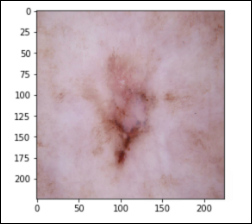
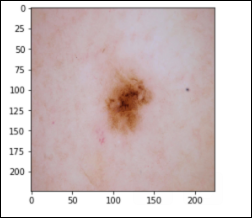
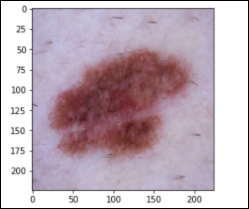
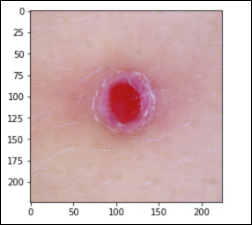
In this last article in the “ML Primer for Clinicians” series, we’ll train a ML model to diagnose melanoma in dermoscopic images.The original data is the HAM10k images dataset, Human Against Machine with 10,000 Training Images,  which is freely available.

The dermoscopic images in the HAM10k dataset have been curated and normalized in terms of luminosity, colors, resolution, etc. The actual diagnosis was validated by histopathology (a.k.a. source of truth) in more than 50 percent of the cases, which is twice more than the previously available skin lesion datasets. The rest of the lesions’ diagnosis was based on a consensus of dermatologists. The 10k images in this dataset belong to the following seven diagnostic categories:

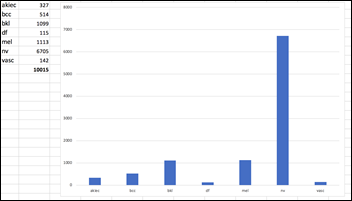
Actinic Keratoses – 327 images solar keratoses, intraepithelial carcinoma, Bowen’s disease (akiec)

image

Basal Cell Carcinoma – 514 images (bcc)

image

Benign Keratosis – 1,099 images seborrheic keratoses, senile wart, solar lentigo, lichen-planus like keratosis (bkl)

image

Dermatofibroma – 115 images (df)

image

Melanocytic Nevus – 6,705 images (nv)

image

Melanoma – 1,113 images (mel)

image

Vascular Lesions – 142 images cherry angiomas, angiokeratomas, and pyogenic granulomas (vasc)

image

The dataset is imbalanced, as the number of images in each class varies from 115 (dermatofibroma)  to 6,705 (nevus):

image

Instead of trying to classify seven skin lesions with a highly imbalanced dataset, let’s simplify the task to the diagnosis of Melanoma vs. Not Melanoma. If we summarize the above categories into two groups, the result is still an imbalanced dataset with:

  • 1,113 Melanoma images
  • 8,902 Not Melanoma

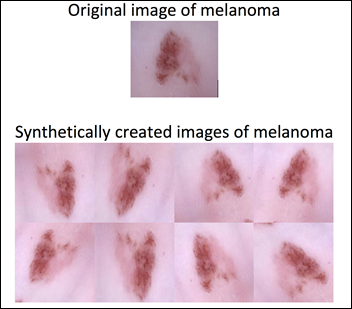
We can apply data augmentation to the Melanoma group and bring the number of images to be similar to the Not Melanoma group. Data augmentation applies a random combination of image modifications — such as zoom, angle, shift, horizontal and vertical flips, etc. — and creates synthetic images.

image

Data augmentation allows the model to be exposed to various modifications of an image of melanoma. This in turn allows the model to learn and later generalize, for example, that a melanoma pointing to the left is still a melanoma if it points to the right. The previously imbalanced 10k images become a 17.8k balanced dataset after the data augmentation of the melanoma group:

  • 8,903 Melanoma images
  • 8,902 Not Melanoma images

With such a balanced dataset, the guessing accuracy should be 50 percent. This is the baseline sanity check before we measure a machine performance on this binary classification task.

Melanoma or Not Melanoma

  • Task: categorize a dermoscopic image as Melanoma or Not melanoma, a supervised binary classification challenge
  • Experience: the 17.8k dermoscopic images dataset detailed above
  • Performance: accuracy, precision, recall, F1 score, and ROC AUC

The newly created 17.8k images dataset is randomly split into three datasets:

  • Train 10,682 images (60 percent)
  • Validate 3,562 (20 percent)
  • Test 3,561 (20 percent)

This image analysis challenge is approached from three angles, as explained in the last article: 

  • Create a convolutional NN (convnet) from scratch
  • Use existing pre-trained models for feature extraction 
  • Fine tune existing pre-trained models

Common to all the following convolutional NN models:

  • Input layer that accepts an image as a tensor: image height (pixels) x width x color (RGB). The models tested accept images from 224x224x3 to 331x331x3.
  • Output layer that predicts a probability between 0 and 1 for the image being Melanoma vs. Not Melanoma. The decision cutoff point is 0.5.
  • In between the above two layers, various architectures of convolutional, pooling, dense, and normalization layers, with millions of trainable parameters (a.k.a. neurons)

Simple Convolutional NN

The Python code and the dataset for this part are publicly available.

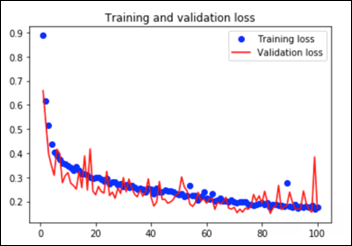
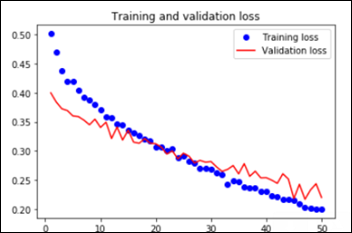
This convnet, with 9.7M trainable parameters, achieves an accuracy of 93 percent on the test dataset of images the model has never seen. The learning curves for 100 training epochs of this model, while using dropout, regularizers, and batch normalization techniques:

image

image

Transfer Learning

Feature extraction and fine-tuning are two common methods of transfer learning. For the following transfer learning, I’ve cross-validated eight open source, pre-trained image analysis models: VGG16, VGG19, ResNet50, InceptionResNetV2, Xception, InceptionV3, DenseNet201, and NasNetLarge. All these computer vision models are freely available as part of Keras, the ML framework used for this image analysis project.

Feature Extraction

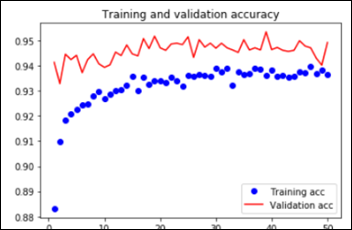
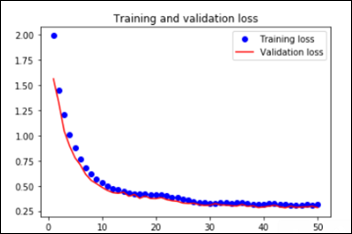
As explained in the last article, with feature extraction, we import one of the above models and freeze it so it won’t be modified during the training process and we add our own trainable layers on top of this pre-trained model. The lowest accuracy results: 86.3 percent with feature extraction on top of VGG16. The highest accuracy was achieved with a model extracting features from ResNet50, 94.5 percent. Note that after 50 epochs, this model was still underfitting on accuracy while perfectly fitting the loss function:

image

image

The Python notebook and the data for the feature extraction (ResNet50) are available.

Fine Tuning

Fine tuning is slightly different that feature extraction. While we still import a pre-trained model and freeze it, we unfreeze the model last block of layers so these block weights will be modified during training. Fine tuning is usually done with a slow learning rate since we do not want to modify the pre-learned weights of the model last block too abruptly, as this may destroy the units (a.k.a. neurons) pre-learned “knowledge.”

The worst performance with fine tuning a pre-trained model was 92 percent – NasNetLarge. The best overall performance on this dataset – 94.7 percent accuracy – was achieved by fine tuning ResNet50, the same pre-trained model introduced above. This time the model has 10.8M trainable parameters and it displays the following learning curves:

image

image

The Python notebook and the images dataset are available.

Model Performance Evaluation

As previously mentioned, there are other metrics besides accuracy that convey information on the relevance of the results: 

  • Confusion matrix (TP,TN, FP and FN)
  • Precision
  • Recall
  • F1 score 
  • ROC AUC

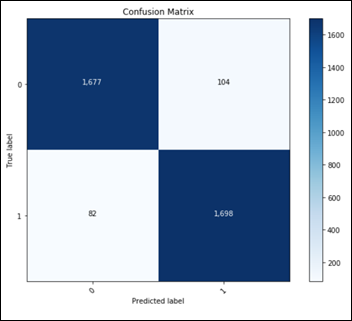
Considering only the best model in terms of accuracy, fine tuning on top of a pre-trained ResNet50:

image

This confusion matrix translates into:

  • TN:  1677
  • FP:  104
  • FN:  82
  • TP:  1698

Final metrics for the best ML model:

  • Accuracy: 94.8 percent
  • Recall: 95.4 percent
  • Precision: 94.2 percent
  • F1Score: 0.948
  • ROC AUC: 0.947

Performance Comparison on Similar Melanoma Identification Tasks

  • Dermatologist ROC AUC performance varies between 0.69 and 0.91.
  • Other ML models ROC AUC performance varies between 0.72 and 0.94.

Conclusions

  • Using freely available infrastructure, framework, Python libraries, and a single dataset, one can build a ML model that outperforms both dermatologists and other ML models in the detection of melanoma in dermoscopic images. 
  • By definition, a learning algorithm will improve its performance on a specific task with each and every new experience learned, so the above algorithm is expected to improve beyond 94.8 percent accuracy if it will be exposed to additional relevant images.
  • A fully operational ML model would have to predict in real time each new image it sees, whether it is melanoma or not, with the probability of the decision. Such a ML model will need to fine tune itself, on a daily or weekly basis, by being re-trained on newly labeled images, those with the ground truth reached by consensus or histopathology results. The periodical retraining of the ML model is analogous to the continued medical education of any healthcare professional.
  • A reportedly shortage of dermatologists in the US, combined with the introduction of full-body 3D photography that produces hundreds and thousands of images per patient, may hint towards the future of this type of ML models — not replacing dermatologists, but supporting them with the pre-screening process of the millions of images coming their way.

Epilogue

I hope that the “ML Primer for Clinicians” series has clarified the main terms and concepts in AI, demystified some buzzwords, and in the process, has left you with some wisdom and curiosity about ML. My intention is to use this series of articles as the backbone of my third book, so please feel free to contact me with any issues, concerns, requests to modify, etc. related to this future manuscript. As I am always curious about new ideas in AI/ML in healthcare, please let me know about your interesting ML challenges.

Many thanks to Mr. HIStalk, who was kind enough to offer me a podium for my musing during the last couple of months. Without his initial spark, this “ML Primer for Clinicians” would not exist.

Morning Headlines 1/16/19

January 15, 2019 Headlines Comments Off on Morning Headlines 1/16/19

Cliff Illig Retires from Cerner Board of Directors

Cerner co-founder Cliff Illig retires from the company’s board “to focus on outside interests.”

Microsoft signs a huge deal with Walgreens, as Amazon’s growing interest in health care looms large

Walgreens signs a deal for its 380,000 employees to use Microsoft technology. The companies will also work together on R&D for patient engagement and chronic disease management software.

DOD’s health data exchange running on bridge contract

The DoD hopes to resolve a contract dispute between two vendors for maintenance of its Defense Medical Information Exchange, a system that supports data-sharing between MHS Genesis, legacy systems, and 53 external HIEs.

Parallon Technology Solutions is Now CereCore

EHR and technology services vendor Parallon Technology Solutions renames itself CereCore.

Comments Off on Morning Headlines 1/16/19

News 1/16/19

January 15, 2019 News 7 Comments

Top News

image 

Cerner co-founder Cliff Illig retires from the company’s board “to focus on outside interests.”

You get to do that when you’ve sold dozens of millions of dollars of CERN shares in the past few months and still hold $550 million worth.

image

I feel like a kid watching Mom and Dad get divorced as companies start losing their colorful founders, making me reevaluate whether I still find them interesting.

Cerner even lost its president, so now it’s exclusively Brent Shafer’s show and I haven’t seen much Neal Patterson-like brilliance or spark from him after a year in his first CEO job.

CERN share price rose a tiny bit Tuesday,  but are down 23 percent in the past year vs. the Nasdaq’s 3 percent loss.


Reader Comments

From Beezer Gutler: “Re: Cleveland Clinic’s Empathy & Innovation Summit. HIMSS is now a ‘partner,’ whatever that means.” I can’t think of many organizations that are less qualified to than HIMSS to provide empathy advice to frontline providers, so I assume that its contribution will be to jam high-paying tech vendors into a program that should be about person-to-person interaction rather than gizmos. The June conference features odd speakers such as bigwigs from Aetna and the AMA (you have to be a pretty awful provider if you have to ask an insurance company how to be empathetic). The conference drew a couple of thousand people last year, although healthcare is notoriously full of people who love to hang around just about any conferences for which patients are indirectly paying via their inflated bills without much hope of ever seeing ROI. It’s fascinating how much money is made by running healthcare conferences – my favorite ironic example is the American Telemedicine Association’s annual conference, which suggests that they believe video is great for practicing medicine but not for watching talking heads.

From Avoiding Buyer’s Remorse: “Re: HIMSS19. What should we expect as first timers in a small booth?” You’ll get some visitors, but most will be just strollers-by looking for giveaways and taking your handouts just to be nice. You’ll feel energized and vital in being part of the “show,” but that high will go away on the plane ride home when you realize that spending the money won’t pan out in sales, and if you were an unknown before, you still are. Shooting your budgetary wad on a HIMSS exhibit as a full-year strategy makes no more sense than binge-eating for three days and assuming you won’t need food for another year. The problem isn’t HIMSS, it’s that exhibitors don’t set reasonable goals and plan well, so I suggest starting with my only partially cynical (which is quite a stretch for me) “Tips for HIMSS Exhibitors.” As holder of an expensive, questionably cost effective three-day lease on a 10×10 space myself, I wouldn’t get my hopes up – we get a lot of visitors just because readers drop by to say hello and that makes it worth it to me, but financially it doesn’t make a lot of sense to be there and you probably won’t get nearly as many folks stopping by.


Webinars

January 17 (Thursday) 1:00 ET. “Panel Discussion: Improving Clinician Satisfaction & Driving Outcomes.” Sponsor: Netsmart. Presenters: Denny Morrison, PhD, chief clinical advisor, Netsmart; Mary Gannon, RN, chief nursing officer, Netsmart; Sharon Boesl, deputy director, Sauk County Human Services; and Allen Pendell, SVP of IS and analytics, Lexington Health Network. This panel discussion will cover the state of clinician satisfaction across post-acute and human services communities, turnover trends, strategies that drive clinical engagement and satisfaction, and the use of technology that supports those strategies. Real-world examples will be provided.

Previous webinars are on our YouTube channel. Contact Lorre for information.


Acquisitions, Funding, Business, and Stock

image

EHR and technology services vendor Parallon Technology Solutions renames itself CereCore.

Walmart leaves CVS’s pharmacy network after failing to reach a price agreement with CVS’s huge Caremark pharmacy benefits management arm.

UnitedHealth Group beats Q4 earnings estimates as its full-year revenue grows to $226 billion and earnings to $17.3 billion. Its Optum services business brought in $8.2 billion in earnings on $101 billion in revenue. It’s good to be a healthcare middleman.


Sales

  • California largest non-profit health data network, Manifest MedEx, selects predictive analytics from HBI Solutions.
  • Lexington Regional Health Center (NE) chooses Cerner Millennium via CommunityWorks.
  • Premier Orthopaedics chooses Allscripts Professional EHR, PM, FollowMyHealth, and Payerpath for its 72-physician practice.

People

.

image

NHS England’s chief digital officer, Juliet Bauer, will leave the organization for a job with NHS-contracted telemedicine vendor Livi.


Announcements and Implementations

CareCloud successfully deploys Medicomp’s Quippe Clinical Documentation throughout its customer base.

DocuTAP launches an urgent care-focused analytics tool called Insight that provides real-time visibility into clinical, operational, and business data.

Northwestern Medical Center (VT) goes live on CommonWell interoperability, embedded in Meditech.

Walgreens signs a deal for its 380,000 employees to use Microsoft technology that includes Office 365, mobility and security tools, and the Azure public cloud. The companies will also work together on R&D for patient engagement and chronic disease management software.


Government and Politics

image

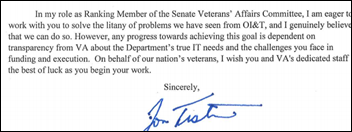
Sen. Jon Tester (D-MT), ranking member of the Senate’s Committee on Veterans Affairs, expresses his IT concerns to newly confirmed VA CIO James Gfrerer:

  • The White House’s proposed VA IT budget contains drastic cuts that don’t reflect new requirements and the VA’s history of “fumbling of IT solutions.”
  • The VA needs strong IT leadership since it “cannot continue to operate in a technology environment in which only the largest and latest crisis drives the agenda.”
  • While much of the Cerner implementation will be run by the Office of Electronic Health Record Management, the VA must go beyond just maintaining VistA and ensure that infrastructure is ready for the new system.
  • The VA must continue to invest resources in projects such as its benefits management system, disability rating system, and financial system.
  • Tester warns that CareT, a system being developed for caregiver assistance, may not support the expanded program and might require buying a commercial system, which would be “unacceptable.”
  • The Senator asked for a list of the VA’s IT projects, their priorities, and how those priorities were established. 

Other

image

Baylor St. Luke’s Medical Center fires its president, chief nursing officer, and COO following media reports of patient deaths caused by substandard care.

The National Center for Health Statistics says Americans are even fatter than previously thought, which it discovered after measuring people directly rather than relying on their self-reported numbers in which they often inflate height and under-report weight. As the old saying goes, I’m not fat, I’m just short for my weight.

image[20]

Those of us who roll our eyes at “influencers” (which is also HIMSS’s new term for “social medial ambassadors who may or not have actual industry influence) will be comforted by the news that they’re being replaced by “avastars,” as companies invest millions to further developer computer-generated, AI-powered synthetic celebrities who not only can generate loyal friends with merchandise-buying potential, but that live forever. Lil Miquela has 1.5 million Instagram followers, of which I would suspect few are significant contributors to society.


Sponsor Updates

  • KLAS recognizes Arcadia for its outcomes-producing, analytics-driven insights in its “Value Based Care Managed Services 2018 report.”
  • AssessURhealth Co-founder Mallory Taylor will present at the Synapse Summit January 23 in Tampa, FL.
  • Bluetree will exhibit at the NJHIMSS 2019 Winter Event January 22 in Monroe Township.
  • The Chicago Tribune profiles Burwood Group President Jim Hart.
  • CoverMyMeds will exhibit at the ASAP 2019 Annual Conference January 23-25 in Kiawah Island, SC.
  • Dimensional Insight publishes a customer spotlight on EvergreenHealth.

Blog Posts


button


Contacts

Mr. H, Lorre, Jenn, Dr. Jayne.
Get HIStalk updates. Send news or rumors.
Contact us.

125x125_2nd_Circle

Morning Headlines 1/15/19

January 14, 2019 Headlines Comments Off on Morning Headlines 1/15/19

U.S. Digital Service has an ambitious agenda at the VA

The US Digital Service is building an interface as part of the VA’s EHR Modernization project to help patients easily access their health records during the projected 10-year switch from VistA to Cerner.

NHS England digital chief moves to digital GP company

NHS England’s first Chief Digital Officer, Juliet Bauer, leaves to become an executive at Livi, an NHS contractor for telemedicine services.

Premier Health Signs Definitive Agreement for Acquisition of Cloud Practice Inc., a National Medical Software Application Company

In Canada, primary care-focused health IT company Premier Health acquires EHR and RCM vendor Cloud Practice for $5 million.

Comments Off on Morning Headlines 1/15/19

Curbside Consult with Dr. Jayne 1/14/19

January 14, 2019 Dr. Jayne 2 Comments

I’ve always wanted to attend the Consumer Electronics Show, but have never been able to get my January schedule to cooperate. That puts me with the rest of the tech aficionados in perusing various blogs and write-ups to find the best new healthcare-related gadgets.

This year’s CES booked 25 percent more vendors with a health focus, which equated to nearly 15 percent more floor space for health tech offerings. I’ve been poring over reports and write-ups and there were quite a few offerings this year that generated a lot of attention. I thought I’d share some of my favorites:

  • Withings showed its Move ECG watch, which is kickily analog but still awaiting FDA clearance. As a physician, I’m not sure of the utility of real-time ECG monitoring for most patients, so it feels more gimmicky than anything else.
  • The Y-Brush toothbrush claims to clean your teeth in 10 seconds using precision nylon bristles positioned at an optimal 45-degree angle. The recommended two minutes for brushing isn’t really that long, however, and I’m not sure the mouth guard-looking device is going to get much consumer uptake.
  • The Hupnos sleep mask links with an app that listens to your snoring and triggers the mask to vibrate so that the wearer moves to a position that is less likely to result in snoring. The mask can also apply Expiratory Positive Air Pressure (EPAP) to help keep nasal passages open. I’ve been on a couple of flights lately where this device would have been a bonus.
  • The Opte Precision Wand from Procter & Gamble’s venture capital division uses blue LED lights to identify dark spots on the skin. Over 100 thermal inkjet nozzles then apply skincare serums, moisturizer, or makeup to even skin tone. They should also consider tattoo covering cosmetics for workers whose employees have restrictive grooming policies, which I’m seeing more and more often in healthcare.
  • Verde launched an electricity-generating treadmill that might let me generate enough juice to power the IPad that serves up enough Netflix to keep me sane on any treadmill-delivered workout.
  • The Chronolife vest aims to monitor vital signs and use machine learning to predict the possibility of an impending heart attack. It will be marketed to healthcare providers, researchers, and insurance companies. FDA approval is still pending.
  • Urgonight is a headset device that links with an app to track electroencephalogram (EEG) patterns to help train people how to generate sleep-enhancing brainwaves. Designers note that it takes three months of regular use to achieve results. It appeared on lists for both the coolest and weirdest devices at CES.
  • The Matrix PowerWatch 2 uses solar power and body-generated heat to power its heart rate sensors, GPS, and notifications while linking with both Apple HealthKit and Google Fit . Designers boast that the GPS will last long enough to run a marathon, but it doesn’t specify the pace. I’m betting my marathon time would be substantially longer than its capacity.
  • The EyeQue VisionCheck device hooks to a smartphone and provides data needed for vision-correcting eyeglasses. It skips the prescription, and at a price point near $30, it’s cheaper than a co-pay. For those of us who have uneven ears, it’s still worth the extra cost to have a real-life optical practice keep us seeing clearly.
  • DFree offers bladder size measurement technology which can help urology patients know when to go. It’s available for purchase at a hefty $500, but can be rented for a $40 monthly trial. DFree is code for “diaper free” and is marketed to help manage incontinence including notifications to both patients and caregivers.
  • Kohler’s smart toilet connects with Alexa along with an app-connected, spa-ready bathroom collection.
  • ReSound Linx Quattro is a smart hearing aid that uses artificial intelligence to learn the wearer’s preferences and to adjust sound profiles. It also allows music streaming through hearing aids via apps for Android and iPhone. The devices are more than twice the cost of typical hearing aids.
  • The Butterfly iQ is a personal ultrasound machine that uses an app to guide the user as he or she obtains images, which can be sent to the user’s healthcare provider. I’m sure physicians will be thrilled about that one.
  • Samsung’s Bot Care is a personal health care assistant that can monitor blood pressure and heart rate. Reports beyond that are slim, and the write-ups I saw made it look more like an alpha offering.
  • Other robots such as the ElliQ are designed to assist senior citizens while allowing family members to monitor from afar. It integrates a tablet to help seniors navigate social media, video calls, and texting, although it’s got a $1,500 price tag plus a monthly subscription.

Much like HIMSS, CES is full of demos and prototypes and the solutions aren’t always fully vetted or independently tested. It’s buyer beware with various startups and crowd-funding offerings. There were also some unusual products, including a Bluetooth diaper sensor to alert caregivers of recent deposits; a Sony outdoor speaker that includes integrated cup holders; a collapsible vintage cardboard camera; a robotic bread vending machine; a self-cleaning litterbox with text notifications; a bicycling safety vest with airbags; and a robot companion for dogs.

My favorite piece of non-health tech is the GoSun Fusion solar cooker, which can heat an oven to 550 degrees. It sports a Bluetooth thermometer to alert users when their food is done cooking and claims it can convert 80 percent of the sun’s light into heat while keeping the exterior cool. The company is also working on a solar-powered cooler unit, giving camping even more of a high-tech spin.

My thanks to CNET for the best coverage of CES and excellent links and photos. Maybe one of these years the scheduling stars will align and I’ll be able to request a press pass for CES. Las Vegas would be a lot more hospitable than the foot of snow I’m enjoying, so we’ll see what 2020 brings.

What was your favorite piece of news from the Consumer Electronics Show? Leave a comment or email me.

button

Email Dr. Jayne.

Morning Headlines 1/14/19

January 13, 2019 Headlines Comments Off on Morning Headlines 1/14/19

2018 M&A in Review: The Growth of Mega Mergers

The average acquired health system had annual revenue of $409 million in 2018, according to a new Kaufman Hall report on mega-mergers, that also found expansions were prompted more by improving business than patient care.

Offshoring over 1,000 health care jobs? That’s coming soon at Dallas-based Tenet

Tenet Healthcare (TX) tells investors it will look across the enterprise – including its Conifer Health Solutions billing and United Surgical Partners International ambulatory services divisions – to offshore over 1,000 jobs in the next 12 to 18 months.

Man gets 10 years for cyberattack on Boston Children’s Hospital

The US District Court in Boston sentences Martin Gottesfeld to 10 years in federal prison and orders him to pay $443,000 in restitution for his role in the 2014 cyberattack on Boston Children’s Hospital and nearby Wayside Youth and Family Support Network.

Early research on Apple’s Health Records service suggests patients generally like it

UC San Diego Health patients report high levels of satisfaction with using Apple’s Health Record feature to connect to and share their health data with family and friends.

Comments Off on Morning Headlines 1/14/19

Monday Morning Update 1/14/19

January 13, 2019 News 4 Comments

Top News

image

The average acquired health system had annual revenue of $409 million in 2018, according to a new Kaufman Hall report on health system mega-mergers. Seven billion-plus dollar transactions skewed the average upward. 

Only 20 percent of the sellers were financially distressed, and 75 percent of the buyers were non-profit health systems that are anxious to grow. 

Kaufman Hall lists several reasons that health systems are expanding, all of them involving improving their own business rather than patient care. It notes that the line between for-profit and not-for-profit health systems is blurring, such as HCA’s acquisition of North Carolina-based Mission Health that also involves funding a local non-profit health trust.

The country’s largest health system, HCA, operates 178 hospitals with annual revenue of $43 billion. It is focusing on markets with increasing population and low unemployment.

Kaufman Hall recommends that health systems expand in markets with high growth or strong demographics, seek strong operational or clinical partners, and increase consumer engagement.


Reader Comments

image

From GuyFromMadna: “Re: Apple. More power to Tim Cook if he can somehow use Apple Watch to solve the crisis of $300 insulin vials or $3,000 out-of-network ED visits. It took me back to Joe Biden’s precision medicine initiative – whatever happened to it?” No technology company or technology itself can solve our mess of a healthcare system and globally underperforming public health. Cook is one of these: (a) naive, which is probable given that companies that have delved much deeper into healthcare than Apple have met their Vietnam after confidently proclaiming themselves disruptors; (b) confusing a narrowly defined view of health that pertains only to a few undiagnosed and often harmless maladies of IPhone-only users; or the most likely answer, (c) desperately trying to feint away from Apple’s rapidly slipping relevance as investors get wary. Claiming that Apple’s best is yet to come and that it involves an industry largely unexplored by Apple is, to me anyway, just silly. Meanwhile, former VP Biden just delivered the keynote address once again at StartUp Health Festival in San Francisco, railing against data silos and most likely thinking about his inevitable presidential run. I haven’t seen any news from his Biden Cancer Initiative, just like I’m still waiting for MD Anderson to justify that “making cancer history” business (no pun intended). At least you know there’s no good treatment for cancer if even rich people are still dying of it.

From AnonymousPlease: “Re: Mid Coast Hospital (ME). Had an extended computer or network outage recently, accordingly to a family member who was told by their lab tech that the computers were down. Sounds like there was an HVAC alarm in the data center that was ignored (reset). By the second time, many servers had overheated.” The hospital’s Twitter account is frozen in mid-2017 and their Facebook doesn’t mention an outage. It seems odd that someone would ignore a data center cooling warning, so I speculate that maybe they shut the alarm off while trying to mobilize an HVAC expert to investigate and then had the temperature get away from them. It would be a tough call to proactively start turning off servers in that situation and they may not have had enough time to activate whatever failover plan they have. Modern servers should be good to at least 110 degrees F, but their individual thermal safeguards can be programmed to take them down at a user-defined temperature. It is, of course, a nightmare trying to recover individual software systems that went down hard even after the server they run on has been brought back online, requiring the enlistment of individual system experts to look at potentially corrupted databases, run disk recovery, free up phantom user sessions, and assess what information was lost.
image

From Sticky Wicket: “Re: [publication name omitted.] How did they get ‘Bret’ Shafer in rewording another site’s story?” Misspelling Brent Shafer’s name and omitting his Chairman title is sloppy, but I won’t call the writer out since just a year ago she was finishing up college and working as an office assistant. That particular clickbait-heavy news aggregation site seems to hire from a single demographic of freshly-graduated, female journalism majors. It has an audience, so there’s not much else to say.

image

From Visual Acuity: “Re: National Federal of the Blind lawsuit against Epic. One of our residents is legally blind and can use Cerner using ZoomText, which we installed after trying the Cerner option that allows increasing some (but not all) font sizes. The resident has less flexibility since Zoomtext must be installed on individual machines and not through Citrix. I do think Cerner (and it sounds like Epic as well) could do a better job supporting accessibility even for physicians who aren’t legally blind, but who have reduced visual acuity.” Thanks for the tip on ZoomText. It offers a Windows-only screen magnifier, another version that includes reading screen contents and keypresses, and a super-product that provides those capabilities plus keyboard navigation, customization, and more expressive screen reading. It also sells a large-print keyboard with hotkeys that control its software. I agree that clinicians, especially those over 40 when presbyopia kicks in nearly universally, might find that their fatigue level, eye strain, and headaches from frequent computer use could benefit from a screen magnifier. I should also mention that Windows 10 has a screen magnifier built in – just press the Windows logo key plus the plus sign (or navigate through the Settings/Ease of Access menu options) – but I tried it and it seems laggy, although I haven’t tried ZoomText to compare. It’s hard to envision (no pun intended) how well a screen reader would work, however, so I don’t envy someone trying to navigate an EHR as the computer reads its screen contents aloud.

From Informed Consent: “Re: partnering with IBM. I have experience with a healthcare software vendor that entered a joint project with a large client of IBM. ‘Joint project’ means that IBM took full control with their leverage and contacts even though we were providing the core of the solution for which they had no alternative. IBM insisted on ‘handling the paper,’ which means they beat us down to a sub-share of the client revenue, then took 20 percent off the top of our portion for ‘taking the risk.’ They didn’t allow us to talk to the client (‘we have the relationship’). We got sucked into providing a reasonable quote for the work, then midway through, IBM said the client’s budget had changed and, ‘You need to cut your portion to $X for this deal to work.’ This happened three times in this one deal even though they wouldn’t tell us how much they were billing our customer. We were down to 40 percent of the original quote when the client cancelled. IBM’s motto is, ‘Our clients are our clients, and YOUR clients are our clients.’ Their salespeople kept wanting intros into our client base but wouldn’t provide the same. Our CEO was excited to get a call from the IBM sales team wanting a price call for a client with similar need. I warned that even though it was their lead and their paper, by the end of the call, they will demand that we give them a minimum revenue commitment, for which we will be on the hook for THEIR unvetted client. The CEO scoffed, but sure enough, my prediction came true in our first call.” I considered HAL – err, IBM — somewhat evil even before their current financial desperation and Watson missteps. I admire some of the technology developments, especially their inadvertent creation of the modern PC industry and Microsoft by botching the original IBM PC rollout by snapping together off-the-shelf components (the failed, proprietary MicroChannel architecture came after the horse had long departed from the barn). IBM eventually walked away from the now-commoditized business by selling the PC business to China-based Lenovo, which turned out to be a much better vendor.


HIStalk Announcements and Requests

image

A convincing 88 percent of poll respondents who self-identify as longstanding HIMSS members say their feelings about the organization are less positive now than five years ago.

image

Gerald says that at least HIMSS now acknowledges that the annual conference is a “trade show” (or a “boat show,” as Jonathan Bush always said, although at least boat show attendees are spending their own money instead of someone else’s) instead of claiming that its primary purpose is education. He says he hasn’t attended a provider’s educational session there in the past five conferences, which is about the same as my own record.

A reader asked via a poll question what’s wrong with HIMSS. My answer as a longstanding member, off the top of my head:

  1. They run their operation like a dues-funded vendor, maximizing revenue at every opportunity.
  2. In fact, they really are a vendor, having acquired for-profit companies, conferences, and publications while somehow remaining a non-profit.
  3. They wildly overpay their executives compared to similarly-sized, non-profit member organizations (I researched this thoroughly years ago when Steve Lieber first hit the million-dollar annual compensation milestone).
  4. They sell access to their provider members to their vendor members in the “ladies drink free” model.
  5. Its “vendor points” system rewards the big vendors that are most willing to send HIMSS huge checks, giving those vendors the dominant voice over those that can’t or won’t pay more.
  6. Like most other member organizations, they get involved in government programs that have profit potential for their vendor members.
  7. They pay lip service at best to patients since there’s no money to be made in supporting better public health, outcomes, or access (much like their provider members, in fairness).
  8. Their media operation studiously avoids running anything that looks like real news unless it cheerleads the industry, filling the remaining empty space with inexpertly written filler pitching products and services that are always predicted to improve healthcare but somehow never do.
  9. They aggressively demand to be the voice of the industry even though, as in the case of the American Medical Association, many of the people in that industry aren’t members and those who are may not agree with the positions HIMSS takes on behalf of its vendor members and itself.

New poll to your right or here, as suggested by a reader: for provider IT decision-makers: which service do you consult before buying software or services?


Webinars

January 17 (Thursday) 1:00 ET. “Panel Discussion: Improving Clinician Satisfaction & Driving Outcomes.” Sponsor: Netsmart. Presenters: Denny Morrison, PhD, chief clinical advisor, Netsmart; Mary Gannon, RN, chief nursing officer, Netsmart; Sharon Boesl, deputy director, Sauk County Human Services; and Allen Pendell, SVP of IS and analytics, Lexington Health Network. This panel discussion will cover the state of clinician satisfaction across post-acute and human services communities, turnover trends, strategies that drive clinical engagement and satisfaction, and the use of technology that supports those strategies. Real-world examples will be provided.

Previous webinars are on our YouTube channel. Contact Lorre for information.


Acquisitions, Funding, Business, and Stock

More JP Morgan Healthcare Conference nonsense: the entire hotel area is so packed that the moneyed minions are meeting in public parks, restrooms, and the furniture department of a nearby Macy’s, with one hotel charging $300 per hour for a table and four chairs with no service. I didn’t really need more depressing examples of what America has turned into, but this one’s at least kind of funny as long as you don’t think about who’s paying.


Sales

  • University Hospitals Cleveland Medical Center joins the global health research network of TriNetX.

Other

image

The conservative-learning National Affairs ponders “The Cost of Hospital Protectionism,” with the obviously brilliant Chris Pope (kudos, seriously – it’s a tough industry to understand and explain) making these points as he looks back on recent hospital industry history:

  • The government has done little to reduce healthcare costs other than to shift the responsibility for paying them while protecting hospitals and encouraging them to inflate costs.
  • Healthcare insurance is becoming increasingly unaffordable, with premiums tripling since 1999 and entitlements expect to consume 40 percent of the federal budget by 2047.
  • Hospital overcapacity encourages hospitals to offer tests and procedures whose per-unit cost is high due to small volumes, often with poorer outcomes.
  • The American Hospital Association promoted cost-based Blue Cross insurance during the Great Depression purely to fund the growth of the expenses of its members.
  • When Medicare Part A was rolled out in 1965, the instant 75 percent payment increase encouraged hospitals to spend more on buildings, staffing, and technology. Within five years, total hospital spending rose 37 percent even though only 7.5 percent of the population gained insurance.
  • Cost-based payment created a “medical arms race” in which hospitals built expensive facilities for expensive procedures, shifting themselves from “institutions of last resort” to all-purpose providers whose costs rose 345 percent in 10 years vs. the Consumer Price Index’s 89 percent rise. As one hospital CEO said, “You could be an idiot and make a fortune on Medicare reimbursement. Any mistake you made got reimbursed.” 
  • Hospitals didn’t worry about the introduction of Medicare DRGs in 1983 because those had a 14.5 percent profit margin built in and excluded capital expenditures, physician fees, and post-acute care services, all of which then started to rise.
  • Patients with good insurance don’t care about cost because they aren’t paying, choosing instead based on convenience and amenities.
  • Commercial insurers have cut into Blue Cross’s dominance by reducing costs, choosing providers based on quality, and introducing managed care that can exclude expensive providers from their network, require prior authorization for expensive procedures, and give doctors financial incentive to reduce the use of unnecessary services. That, along with the rise of ambulatory surgery centers, has slowed the arms race.
  • Hospitals use local political influence, community pride, and vast employment to protect their interests and to have favorable legislation enacted that restricts referral of lucrative patients to lower-cost specialty hospitals that often deliver better outcomes.
  • HMOs and heavy-handed employer cost-control efforts in the 1990s caused a consumer backlash that was fueled by lobbyists for hospitals and doctors, which triggered states to limit cost control practices.
  • Mergers have left 67 percent of hospitals as members of larger systems and often the owners of many more physician practices, but instead of reducing excess capacity, the now-larger health systems are using their clout to increase prices further.

image image

A doctor who received the above “notice” calls out the phony American Board of Cardiovascular Disease, which is hoping that inattentive medical office workers will send a renewal check to the Falls Church, VA edifice in which it conducts its scientific deliberations (photo above – it’s in the UPS Store, not the adjacent UBreak- IFix). It doesn’t even have a website. This would be hilarious if not for Googling, which reveals many cardiologist “diplomates” who actually advertise their fake credential. The Board’s executives apparently live communally in their tiny mailbox along with those of the equally bogus American Academy of Peripheral Vascular Disease, the American Council of Christian Physicians and Surgeons, the American Academy of Surgery, the American Board of Dental Surgery, the American Association of Ethical Physicians, the American Board of Oncology,  National Diabetes Institute, and the American Board of Urogenital Gynecologic Surgery. Being a Diplomate in Internet-Primary Sleuthing in Heath IT myself (no acronym, please), I tracked down the apparent owner of all these organizations – Keith Lasko, MD, DDiv, who had his own medical license yanked by three states in 1990, after which he started all these organizations and several more like them as retribution (or perhaps correctly identifying an underserved market in fake credentials by those entrusted with the public’s health). The reverend-doctor lives on the spectacularly porn-worthy named Vivid Violet Avenue in Las Vegas, although a lawsuit I ran across suggests that his house is being foreclosed upon by “allied infidels” who want to “throw him and his children into the street as unclean dogs,” referring to his “Mosque of the Golden Rule” religious organization, where he has commendably attained the rank of Imram. He also wrote a poorly-received 1980 book titled “The Great Billion-Dollar Medical Swindle.” My conclusion – the “diplomates” are the bad guys here since there’s no way they believe their bogus credentials are real, so their only intention in buying them must be to mislead patients. The Imran is simply meeting the demand.

image

The Hustle interviews the original voice of Siri, voice-over actress Susan Bennett, paid an hourly rate in the summer of 2005 to read seemingly meaningless sentences such as “Militia Oy Hallucinate Buckram Okra Ooze ”for ScanSoft (later acquired by Nuance). She found out only after hearing Siri for the first time that those meaningless syllables – which she had to read precisely as measured by an audio analyzer strapped to her throat – were then chopped up into fragments that could be reassembled to make new words and sentences. Here’s a health IT connection – some of my favorite interviews are with NVoq CEO and speech recognition pioneer Charles Corfield (April 2014, July 2017), who was an early investor in Nuance acquisition BeVocal, widely rumored to have contributed the basics of mobile device speech recognition that became Siri. He’s always amused when I amateurishly try to pin him down on his Siri contribution, chuckling and intoning in his mellifluous British accent, “I think I shall refer you to Nuance to comment on matters of Siri or otherwise.” Corfield also created the precursor to Adobe FrameMaker, the first desktop publishing program, while working on his astrophysics PhD at Columbia after graduating from Cambridge. He’s one of the most interesting people I’ve ever talked to, a lock for my HISsies vote for “industry figure with whom you’d most  like to have a few beers.” 


Sponsor Updates

clip_image001

  • The Nordic team continues its partnership with The River Food Pantry in Madison, WI.
  • Lightbeam Health Solutions publishes a new white paper, “Data-Driven Solutions Providers and Payers Need for Value-Based Care Alignment.)
  • MDlive publishes a case study featuring Cone Health (NC).
  • EClinicalWorks publishes a podcast titled “How Interoperability Fine-tunes a Neurology Network.”
  • Netsmart will exhibit at the North Carolina Providers Council Annual Conference January 14 in Greensboro, NC.
  • OnPlan Health and Patientco will exhibit at the HFMA Western Region Symposium January 13-16 in Las Vegas.
  • Experian Health and Change Healthcare partner to deliver identity management solutions.
  • PatientKeeper will exhibit at the HFMA MA-RI Annual Revenue Cycle Conference January 17-18 in Foxborough, MA.
  • TheFutureofThings.com includes PatientKeeper in its list of top healthcare apps.
  • Huron announces 20 senior-level positions.
  • ZeOmega publishes a new case study highlighting how Alliance Behavioral Health is using Jiva to manage care for North Carolinians experiencing mental health challenges, addiction issues, and intellectual disabilities.

Blog Posts


button


Contacts

Mr. H, Lorre, Jenn, Dr. Jayne.
Get HIStalk updates. Send news or rumors.
Contact us.

125x125_2nd_Circle

Weekender 1/11/19

January 11, 2019 News Comments Off on Weekender 1/11/19

weekender


Weekly News Recap

  • Apple CEO Tim Cook tells CNBC that the company’s greatest contribution to mankind will be related to health.
  • CMS Administrator Seema Verma says its requirement that hospitals post raw CDM lists will encourage developers to create tools that consumers will find more useful.
  • IBM CEO Ginni Rometty says Watson Health is still a viable part of the company’s business and that Watson for Oncology is doing well.
  • England’s NHS issues a long-term plan that calls for technology to improve the ability of patients to manage their own health and to give clinicians access to patient records from any location.
  • Healthgrades acquires Influence Health.
  • Vatica Health acquires CareSync’s care coordination and chronic care management technology following a $1 million bid made last October.
  • The Senate confirms James Gfrerer as the VA’s assistant secretary of information and technology, its first permanent CIO in two years.
  • SVB Financial Group completes its acquisition of healthcare and life sciences investor Leerink Partners for $280 million in cash.

Best Reader Comments

Maj. Gen. Payne says “I want to give you a transparent review of where we are with MHS GENESIS” and then doesn’t. Unless maybe the author of the article left out parts like “it doesn’t work yet,” or “it failed its only assessment so far” or “it has zero interoperability with community providers.” It’s one thing to not see a train wreck coming, but another to have it wreck at your feet and disavow it. (Vaporware?)

Did everyone forget about the Tata case? I understand Epic (or any other vendor) wanting to protect their intellectual property. (UGM Attendee)

But this [health system selling Epic Community Connect that refuses to participate in an HIE] would not be the vendor. It’s the hospital itself that’s trying to absorb / acquire / whatever the neighboring clinicians. Epic has nothing to do with it other than being the hospital’s EHR. It’d be the same situation if it was Cerner I assume. My guess is the ONC will put out a proposal that tackles something that isn’t actually an issue. (Epic Complainer)

My patience and sympathy for gripes concerning no-shows is sharply limited. OK, yeah, it’s socially poor form and it has economic and medical consequences. Yet when those same providers are asked to explain, justify, or even quantify wait times, they cannot. Or will not. Or we receive a long list of excuses as to why the poor on-time performance of clinicians exists. With no solutions offered, not ever. Can anyone say they have not waited in a reception room, for an appointment that didn’t start on time? Often by an hour or more? (Brian Too)

Coach, is your HIE on any national plug & play network? I believe Carequality’s terms are share one, share all. (Ex-EDI)

The Allscripts 2bprecise product was built on NantHealth’s Geonomics product, which they obtained after investing $200 million into NantHealth, only to lose nearly all of it when that division failed and was the focal point of possible legal issues. Any word on how many sites implement and use this 2bprecise product / service? (Dr. JVan)

The screenshot issue is ironic. As I recall, around 2000, Epic settled (for millions $$) a lawsuit that IDX had filed against them which stated Epic had stolen screenshots and documents from the UW Medical foundation.(HISJunkie)

As for Epic moving into tangent markets for LTC, mental health, etc. it will be very interesting to see how they go about this. Develop or buy? Considering that there are many successful vendors that own these markets, they sure do not have the time to develop, so will they break down and buy? Secondly I think that the sales argument that the organization will want to buy from a single vendor will not carry as much weight as it did selling within the hospital. (HISJunkie)

Epic doesn’t have an IP leg to stand on for the screenshot restriction, but I believe they started putting this into their contracts a while back that the organization wouldn’t allow it from their employees, and it probably hits their “good install” metrics if they do. (DrM)


Watercooler Talk Tidbits

image image

Reader donations funded the DonorsChoose teacher grant request of Ms. B, who asked for 30 sets of headphones for her second grade class. She reports, “When my class received our box of goodies, we opened it together and they were so happy to have new headphones. Our old headphones were taped or broken from the usage due to the prior years of teaching. We also had to borrow from other classrooms in order to have a class set. Through your donation, my students have an opportunity to build their educational skills in all areas of learning. Working during technology time as a whole has enhanced reading comprehension, math, and vocabulary development by providing them comfort as they work in their own personal space. Receiving their personal headsets has opened up a whole new world.”

Facebook employees liken their work environment to a cult, in which they are forced to pretend to love their jobs, keep quiet about the company’s many scandals, and to form fake friendships with co-workers to game the company’s peer review system that encourages employees to submit anonymous, unchallenged feedback to the employee or their manager.

A jury awards $14 million to parents in a lawsuit brought against a hospital and a radiologist in a “wrongful birth” case in which they were not warned that an ultrasound image of their 22-week fetus showed possible abnormalities that might have convinced them to terminate the pregnancy.

image

Cell phone providers are selling the real-time location data of their customers, creating a gray market for “bounty hunters” who can locate any cell phone to within a few hundred yards. Companies are selling the data that is intended to be used for fraud detection and roadside assistance firms  – in violation of the privacy policies of the cell phone providers — to developers of apps for car salespeople and bail bondsmen.

A urologist removes a patient’s healthy kidney at UMass Memorial Medical Center after pulling up the wrong CT scan by looking up his patient by name alone, which displayed the images of a different patient with the same name who had the same kidney scan performed on the same day. 

image

The mother of a five-year-old boy whose diabetes is continuously monitored complains that she called Johns Hopkins All Children’s Hospital (FL) to report a high reading, but doctors didn’t call her back for three days. The hospital’s endocrinology department says they will start returning the calls of diabetic patients within 24 hours.

A Qualcomm executive’s keynote at the Consumer Electronics Show is interrupted by his unmuted Alexa device, which demonstrated an uncanny use of AI (during his pitch for using AI in cars) by loudly proclaiming, “No, that’s not true.”


In Case You Missed It


Get Involved


button


125x125_2nd_Circle

Comments Off on Weekender 1/11/19

Text Ads


RECENT COMMENTS

  1. I can't get past the helmets and safety vests. On everyone. Including the model patient. What, are they expecting the…

  2. I'm all for a startup mentality, but there really needs to be a net positive return for all that time,…

  3. Re: It would be interesting to compare after-hours use of generative AI solutions by patients who have access to after-hours…

  4. Would be interesting to see what Providence St. Joe's return has been on all their adventures. When I was on…

  5. It doesn't look like much more than a computer facing a wall!!

Founding Sponsors


Platinum Sponsors


Gold Sponsors


RSS Webinars

  • An error has occurred, which probably means the feed is down. Try again later.