Monday Morning Update 12/10/18

December 9, 2018 News 3 Comments

Top News

image

In England, Health Secretary Matt Hancock bans NHS from buying new fax machines and insists that they be phased out by March 31, 2020.

The Royal College of Surgeons agrees, estimating that NHS still has 8,000 fax machines in service.

Here we hospital people thought we were being cutting edge by moving to multifunction devices that at least bundled faxing with printing and scanning. On the other hand, if a business case exists for using something other than fax, they would already be gone.


Reader Comments

From Digital Debonair: “Re: paging systems. A Texas hospital found that Epic-issued consult pages were not being delivered if the message size exceeded character limits – 280 characters for pagers, 160 for mobile phones. The hospital limited Epic’s ‘reason for consult’ field to 100 characters and added an alert to the intended recipient’s mobile device when the limit is exceeded. Once again, technology’s unintended consequences bring us to the least common denominator instead of fixing the problem by breaking the message into segments or getting the communications vendors to increase their character limits. It’s fascinating that each hospital has to discover and solve this problem on their own. Sigh … we have so many miles to go.” Unverified, but the hospital’s email warning to the medical staff was attached. I verified that Sprint and Verizon have 160-character limits, while ATT breaks messages into multiple 160-character segments automatically. SMS stands for “short message service,” so perhaps the real problem is that hospitals try to use that service for something for which it was not intended (not short, in other words) regardless of the convenience of doing so. There’s also the question of whether PHI should be sent over SMS instead of via an encrypted messaging app that could also provide a larger character limit.

From Wan Complexion: “Re: Most Wired. You didn’t list the winners.” I don’t see the point, even as someone who has run IT in organizations that won. We should judge health systems on outcomes, cost, and consumer focus, not on using tools that should drive those results (but usually don’t). I ate at a McDonald’s and it was still awful despite (or perhaps because of) an enviable arsenal of enterprise-wide technology. By “Most Wired” standards, I should have loved it.


HIStalk Announcements and Requests
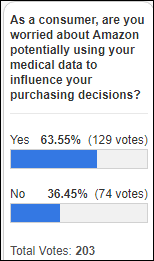
image

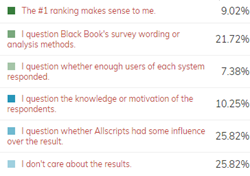
Poll respondents fear that Amazon will use the medical data they can get to influence their buying habits, although to be honest I’d trust Amazon a ton more than Google or Facebook since Amazon’s business model involves moving merchandise, not serving up ads that clearly were chosen using information those companies really shouldn’t have.

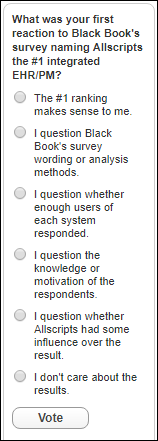
New poll to your right or here: should hospitals be prohibited from using fax machines? Vote and then click the poll’s “comments” link to explain.

I’m questioning those frantically gesticulating TV weather people who this weekend are milking camera time with what they call a “winter storm,” “winter weather,” and of course the inevitable “wintry mix.” It’s not winter until December 21, although I recognize that the less-hysterical “fall storm” won’t keep hunkered-down eyeballs glued to the TV commercials and the result isn’t any different regardless of what the calendar says.

Thanks to the following companies that recently supported HIStalk. Click a logo for more information.


image
image
image
SNAGHTML36257a1
image
image
image
image
image
image
image
SNAGHTML364eabf
image
image
image
image


Webinars

None scheduled soon. Previous webinars are on our YouTube channel. Contact Lorre for information.


Acquisitions, Funding, Business, and Stock

Allscripts shares hit a 52-week low last week, having shed 34 percent in the past three months. Anonymous posters on TheLayoff.com claim that around 80 percent of the 1,700 McKesson EIS people who joined Allscripts with the acquisition 14 months ago are no longer there.

IBM sells off several software lines to an India-based company, among them Lotus Notes/Domino, which should elicit hope from IBM’ers who have been stuck on that unpopular platform while the rest of the world moved on. Maybe they’ll replace it with GroupWise.

image

Medication reminder technology vendor MyMeds issues a press release whose headline appears to be intentionally misleading, dutifully picked up by some crappy health IT sites as a “partnership” between the company and Mayo Clinic. Plowing through the fluff reveals the actual development – the app will offer users Mayo Clinic’s drug information (for which I assume the company is paying). Any resemblance to “teaming up” appears to be coincidental.

InterSystems releases a cloud-hosted version of its TrackCare EHR for hospitals in the UAE and Middle East, licensed in a pay-per-usage model.

Hill-Rom’s newest hospital bed will include FDA-approved sensors for monitoring heart and respiratory rates, checking vital signs 100 times per minute and alerting nurses of abnormalities. The price was not announced, but the company’s traditional bed is among the most expensive with a list price of $20,000.


Decisions

  • Northside Hospital System (GA) replaced Allscripts with Cerner in October 2018.
  • Gifford Medical Center (VT) went live on EClinicalWorks in April 2018, replacing Evident.

These provider-reported updates are supplied by Definitive Healthcare, which offers a free trial of its powerful intelligence on hospitals, physicians, and healthcare providers. )


Announcements and Implementations

Citizens Memorial Hospital (MO) upgrades to Meditech Expanse.

Hospital Sisters Health System integrates Epic with SeamlessMD’s patient engagement solution using SMART on FHIR. 


Government and Politics

Six pain management doctors in Michigan are charged with insurance fraud and unjustified opiate prescribing in submitting $464 million in phony insurance claims.


Other
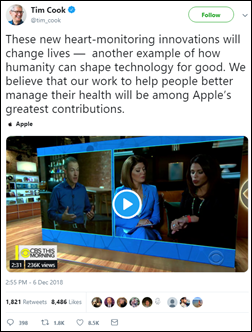
SNAGHTML446a3a9

Here’s an interesting tweet from Apple CEO Tim Cook. I’m not sure the silver bullet for people managing their health lives inside of an IPhone, but I’m sure a citation-desperate academic will compare life expectancy of IOS and Android users vs. a control group of non-cell users.

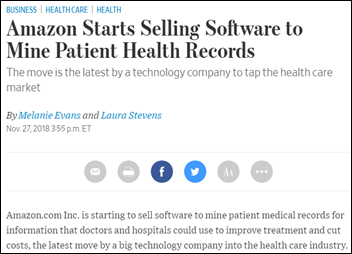
An article by Penn’s Wharton School weighs in on Amazon’s announcement that it will mine unstructured patient data using AI and machine learning in its Comprehend Medical program, saying the service could:

  • Empower consumers.
  • Deliver new insights, particularly with regard to radiology, and connect people with clinical trials.
  • Allow insurers to deny enrollment of patients with potentially expensive conditions.
  • Lighten the workload of doctors.
  • Erode physician loyalty as patients could manage their own medical information or choose to share information with competitors such as retail clinics.
  • Replace consultants who perform custom predictive analytics for individual clinical conditions.
  • Raise questions about data accuracy, especially if consumers are allowed to add or change their information.
  • Cause major problems if Amazon were to be breached.
  • Raise questions of who’s paying the bill for the Amazon service.
  • Lure clinicians into becoming overly reliant on technologies instead of learning, improving, and questioning how the models work.

A ProPublica report finds that journal articles written by physician researchers often don’t disclose the money they’re paid by drug and medical device companies as required, with the medical journals doing little checking of their own. Among them is the dean of Yale’s medical school, the president-elect of the American Society of Clinical Oncology, and the president of clinical operations at Sarah Cannon Research Institute. The reports didn’t have to dig all that deeply – they simply looked up compensation as reported to CMS’s Open Payments Database and compared that to the disclosures section of published articles.

Weird News Andy says this patient hacked up a lung, kinda. A patient coughs up what looks like a bright red, leafless tree, which turned out to be a six-inch-wide blood clot formed in his right bronchial tree (and now you can see how apt that name is). I’ll spare you the photo just in case you’re eating  breakfast since it’s both fascinating and disturbing.


Sponsor Updates

  • Liaison Technologies awards its Data-Inspired Future Scholarship to BYU dual-major student Andrew Pulsipher.
  • Loyale Healthcare introduces the Patient Financial Bill of Rights.
  • Mobile Heartbeat will exhibit at the ONL Winter Meeting December 14 in Burlington, MA.
  • National Decision Support Co. and Redox will exhibit at the IHI National Forum December 9-12 in Orlando.
  • NextGate launches a fundraising campaign to help customer HealtheConnect Alaska recover from the earthquake.
  • Netsmart will exhibit at the TAMHO Annual Conference December 11 in Franklin, TN.
  • The Business Gist features Sansoro Health CEO Jeremy Pierotti in a new video, “The challenge of sharing medical records.”
  • New data from Surescripts shows that its benefit optimization tools have saved patients as much as $8,032 in out-of-pocket costs on a single prescription.
  • Vocera launches three leadership councils to accelerate healthcare transformation.
  • ZappRx will exhibit at Advances in IBD December 13-15 in Orlando.
  • Healthwise discusses why its partnership with ZeOmega benefits clients.

Blog Posts


button


Contacts

Mr. H, Lorre, Jenn, Dr. Jayne.
Get HIStalk updates. Send news or rumors.
Contact us.

125x125_2nd_Circle

Weekender 12/7/18

December 7, 2018 Weekender Comments Off on Weekender 12/7/18

weekender 


Weekly News Recap

  • Apple’s Watch 4 OS update includes the ECG app and arrhythmia notification capability.
  • Meditech acquires its London-based partner Centennial Computer Corporation as part of its creation of Meditech UK.
  • A KLAS report finds that most EHR vendors are progressing well toward supporting a national patient record network now that CommonWell is connected to Carequality.
  • In Australia, Queensland Health’s hospital EHR project will run $188 million over budget if implemented in the remaining hospitals.
  • A ProPublica report concludes that three supporters of President Trump had influence over the VA’s $10 billion Cerner contract and got former VA Secretary David Shulkin fired.
  • Allscripts confirms an unstated number of employee layoffs.
  • Athenahealth files shareholder notice of a vote on its proposed acquisition by Veritas Capital and Elliott Management.
  • Connected health technology vendor ResMed will acquire Madison, WI-based Propeller Health for $225 million.
  • Leading UK EHR vendor Emis Group will shift 40 million patient records from its servers onto AWS as part of a continued  push in the UK for more flexible health data exchange.

Best Reader Comments

Interoperability will never be fully solved by creating more regulations and layering on all sorts of requirements on data then making portions of it voluntary. It’s truly a confusing system mired in all sorts of administrative burden and muck with too much conflicting self-interest. There are many models from other countries that work more effectively, have lower mortality rates, less physician burnout. Perhaps instead of spending billions on more regs and administrative burden, maybe step back spend some of that on evaluating effective healthcare delivery models and select one that works. (Renee Broadbent)

Cerner is THE founder of CommonWell and they make it hardest for their customers to implement. Further mucks up DoD and VA plans for interoperability, though they seem to be all talk little action on interoperability anyway. Thank you Athena, EClinical, and Epic for leading the way! (Charlie Harris)

Is the above for real? Who dreams this stuff up? Mixing two disparate protocols for a transaction activity? Lets make this a complex as possible! It is as if they really don’t want organizations implement this functionality so they make the cost of entry as high as possible. (David Coffey)

Dentists are taught in dental school that they are going to be small business owners, and taught how to run a profitable business. Medical schools seem to focus on a world where all doctors stay in academia, instead of the reality that millions of doctors are small business owners. The expectations that dentists have for the successful operations of their dental healthcare businesses drives the advances in their industry. (Julie McGovern)

I am sure the bigwigs and muckity-mucks that come into consulting after losing their comfy jobs make the rest of us look pretty bad and desperate to outsiders, but from my experience (seven years of consulting, running my own little shop, loving it each and every day) there are plenty of opportunities to work, great clients to help, unbelievable experiences to have, and we have a bit more freedom to live a life that supports having a family, raising children, and balancing a life that isn’t just an identity of “I work for [blank company name].” (Consulting Union Needed?)

An ONC Safety Center (which Congress didn’t fund) with peer review and anti-trust protection for IT vendors is the right answer here. Maybe ONC could focus on that instead of dithering around with tefca and “information blocking.” (Charlie Harris)


Watercooler Talk Tidbits

image image

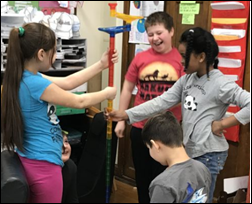
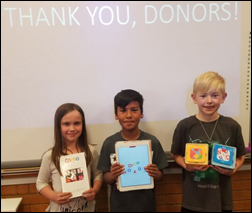
Readers funded the DonorsChoose teacher grant request of Ms. G in Utah, who asked for an an Osmo Wonder Kit for her third grade class. She reports, “We have been using the kit during our small group time. The games that came with the kit help the students practice phonics, number sense, math facts, logic, and other important skills. The students beg to get it out and use it, and even want to stay in during recess to play! I love watching them manipulate the tools to get the right answers. The looks on their faces when they get the answers right are priceless! My absolute favorite part, however, is watching them work together as a team to find the answers. They help and encourage one another, and even when someone gets an answer wrong they encourage their classmates with phrases like, ‘Everyone makes mistakes! Let’s try again!’ I never expected the Osmo Genius Kit to have that sort of impact in my classroom.”

Ben and Michelle of ST Advisors always include my DonorsChoose project in their annual charity support. Their generous donation, matched with funds from my anonymous vendor executives and other sources (some with 10-times matching!), fully funded these teacher projects:

  • Robotics tools for Mr. D’s junior high class in Cedar Creek, TX (classroom was affected by Hurricane Harvey)
  • Math and reading centers for Ms. T’s kindergarten class in Oroville, CA (classroom was affected by the Camp Fire)
  • Programmable robots for Mr. A’s grade school class in Bronx, NY
  • 30 sets of headphones for Ms. B’s sixth grade class in Spring, TX (classroom was affected by Hurricane Harvey)
  • Four Chromebooks for Mr. V’s high school class in Bridgeport, CT
  • Math manipulatives for Ms. L’s first grade class in Washington, DC
  • 14 sets of headphones for Ms. H’s high school class in Mesa, AZ
  • 25 sets of headphones and solar system learning tools for Mr. F’s elementary school class in Porter, TX (classroom was affected by Hurricane Harvey)
  • Diversity and multicultural learning activities for Ms. H’s elementary school class in Wellington, KS

I heard back quickly from several of these teachers, including Ms. T, who said, “I was so surprised when I peeked at my email at lunch and read the great news. I wish I had recorded the squeals of joy from my students when I shared the fun that is to come in the mail for them. Your generosity is appreciated. Merry Christmas!”

This research might have been more appropriately released on April 1. A study finds that a parasite found in cat poop is associated with a higher likelihood of entrepreneurial behavior (I would have expected bull manure given the success of some executives). Actually, my theory is this – Toxoplasma gondii is more commonly acquired by consuming contaminated food or water, which would be far more commonly found in countries such as India whose society values entrepreneurial behavior, hard work, and academic achievement more than ours. I love that many US business are created and run by hardworking, well-educated, family-focused people from other countries who in many ways exemplify the American dream better than many native-born citizens whose goals seem to be consuming mindless entertainment, taking advantage of entitlement programs, and ridiculing those who work harder and smarter and are rewarded accordingly.

SNAGHTML788a786e

I wanted to replace my old, cheap wireless router to make sure I’m using the most current protocols and ran across this fantastic $75 mesh router. I plugged it into the modem, connected to it via its app, entered my desired network name and password, and it was running flawlessly literally within two minutes of opening the box. Setting up a guest network took another 30 seconds (again, just entering a network name and password). The range is excellent, but I had ordered a second one just in case and the only setup required was to plug in the power cord – it instantly connected to the first router and started beaming the signal even further away.

Walgreens partners with FedEx to offer next-day prescription delivery, with same-day service in some cities. 

image

Hurricane-damaged Bay Medical Sacred Heart (FL) will lay off 800 employees – half its workforce – when it reopens in January at one-fourth its original size.

image

Former MD Anderson CIO Lynn Vogel, PhD publishes “Who Knew? Inside the Complexity of American Health Care.”


In Case You Missed It


Get Involved


button


125x125_2nd_Circle

EPtalk by Dr. Jayne 12/6/18

December 6, 2018 Dr. Jayne 3 Comments

clip_image002 

Following the ONC annual meeting at the end of November, I received an email that the slides and webcast would be “made available in the near future.” This always aggravates me after conferences, because by the time they make the content available, people have moved onto other things and momentum is lost. Especially with a relatively small (two-day) meeting, it shouldn’t be that hard to get the materials together since presumably people had to submit their slides in advance for review and approval. Webcasts also aren’t that hard to get online, especially if they’re not edited. Making the materials available quickly would help engage those who couldn’t be there and allow them to be part of the discussion.

clip_image004

I finally had some time to dig into the draft “Strategy on Reducing Regulatory and Administrative Burden Relating to the Use of Health IT and EHRs” document that ONC issued last week. It offers three goals for reducing clinician burden, including reducing time and effort to record information, reducing time and effort for reporting requirements, and improving EHR functionality and ease of use. I’m not sure whether or not I should read something into how those goals were constructed, since fixing the third goal would likely solve a big portion of the first one. When you dig deeper into the document, it becomes apparent that the first item refers not only to documentation effort, but the fact that the documentation required for billing is a burden above the documentation required for clinical care.

The usability discussion specifically addresses poor design of clinical decision support tools, including pop-ups that require “excessive interaction.” It also mentions poor implementation of electronic summary of care documents, lack of standardization around the presentation of clinical content, and the need for improvements to configuration and implementation processes that should “proactively engage the end user.”

One of the problems here is the fact that EHR vendors simply don’t want to spend as much money as would be needed to make EHR systems substantially better. I worked with one vendor that had a limited development budget, which essentially meant that the only work they could afford to do was that which was mandatory – either required for them to maintain certification or to address severe patient safety defects. Even minor patient safety defects were put into the deferred maintenance bucket to sit until more development hours became available, which often meant that they didn’t get fixed. When there’s not enough money to fix patient safety issues, that means that the “nice to have” and usability enhancements logged by customers over the years rarely made it to the requirement stage.

They also go in-depth about reporting issues and the fact that “regulatory requirements and timelines are often misaligned across programs and subject to frequent updates, which require significant investments from clinicians to ensure annual compliance. Government requirements are also poorly aligned with the reporting requirements across many of the federal payer programs in which clinicians may participate …” How about this — let’s put a freeze on federal reporting requirements until the federal payers can get their own houses in order. Present us with a unified set of reporting requirements that make sense clinically and actually allow us to drive the needle for clinical quality rather than just make us report for reporting’s sake.

While we’re at it, here are my other suggestions to solve the issues (although I’m sure they’d never be accepted): First, allow physicians to bill office visits based on time. Not the current “greater than 50 percent of this visit was spent in counseling and coordination of care” nonsense, but actually billing on time like a lot of businesses do, including attorneys, accountants, auto mechanics, and the guy who does my hair. If you’re more complex and take more time, allow us to be compensated for what we do. If you’re a quick visit, let us see you and get you on your way. One might say this may lead to abuses, so let’s put reasonable caps on it, such as a maximum of 16 hours a day. It can’t be any worse than our current system that doesn’t even detect fraudulent physicians that are billing many more procedures than they could possibly do in a day.

Second, let’s also address the usability issue by requiring vendors to issue standardized reports to their clients on how much development time is spent on regulatory requirements, remediation of software defects, patient safety issues, usability, new content, and the like. I know vendors hate this idea because they’re afraid the information will wind up in the public eye, but it’s important for customers to understand whether their vendor is really putting their money where their mouth is. This is hard for publicly traded companies, since actually spending money on development eats into the profit margin. Still, there has to be some kind of accountability for where the millions of R&D dollars are being spent.

While we’re at it, let’s also think about adding some requirements that will just make everyone’s lives easier. Let’s standardize to LOINC for laboratory orders and results. It’s there, it works, and it would save time for hospitals and healthcare organizations. Not just in the EHR, but with the laboratories – I’m tired of federal mandates that put the onus on the physicians, but don’t do anything to make lab vendors comply. I can’t even count the number of practices I’ve worked with whose vendors aren’t sending LOINC codes with results, but the practices have to have the codes mapped in the EHR, so much manual mapping occurs. Why not just fix the problem at the source? The strategy does allude to this a bit with standardization of medication information, order entry content, and results display conventions, but it’s shameful that we’re still talking about this a decade after the start of Meaningful Use.

What about patient matching and interoperability issues? There’s no federal funding for a universal identifier, but what if the vendors came together and created a voluntary one? Let patients opt in or opt out, but if they want to opt in, let’s give them a unique ID they can carry around to their providers that can be used to assist with matching. It’s clear that it’s never going to be a federal priority even if they blockages in front of it are cleared.

I ended up having to stop reading the document, because what I thought was going to be a quick blurb about it has rapidly turned into a semi-angry rant about the state of things. I’ll have to refine my thoughts before I enter my formal comments, which I will certainly do before the January 28, 2019 deadline. ONC plans to post all the public comments that are received, which should make for some entertaining reading in front of a nice fire on a snowy evening.

If you were in charge of all things healthcare IT, how would you fix these problems? Leave a comment or email me.

button

Email Dr. Jayne.

Readers Write: What’s Good for the Dentist is Good for the Medical Doctor as Well

December 5, 2018 Readers Write 4 Comments

What’s Good for the Dentist is Good for the Medical Doctor as Well
By Robert Patrick

Robert Patrick is president of dental at Vyne of Dunwoody, GA.

image

Medical professionals might be tired of the endless requirements of mailing x-rays or other documentation to the insurance company every time they file a claim. Some of them might simply want the ability to add their supporting documentation to claims electronically for easier adjudication.

While medical professionals continue to wait for developments and guidance related to the use of electronic attachment solutions and technologies, their dental colleague counterparts have no such obstacles. Even though there’s no formalized standardization from an organization like the Center for Medicare and Medicaid Services (CMS) for dental, there is a range of solutions that have permeated the sector and enjoy robust use by many thousands of dental practices. Why the disparity?

The simplest reason is that the solutions are readily available in the dental sector, Their use has been embraced despite there being little formal regulation or guidance related to submitting electronic attachments. For example, as long as the solutions are compliant with HIPAA, their use is fair game. Per recent reporting, some on the medical side of healthcare are waiting for a push toward standardization in the way electronic attachments are sent before moving forward with similar solutions.

According to reporting by MedPage Today, Robert Tennant, director of health information technology policy at the Medical Group Management Association — a trade group that represents medical practices — said that HIPAA includes a directive for the federal government to develop standards for electronic attachments. But the HIPAA provision still is not seeing traction or light of day. Even when the Affordable Care Act (ACA) was passed in 2010, it included a provision requiring the federal government to issue a final rule on standardizing electronic attachments, and a deadline of January 1, 2014, for doing so, but nothing yet.

The delay, Tennant speculates, might relate to how CMS can address “solicited” versus “unsolicited” attachments. Maybe the use of a secure attachment protocol or portal for data submission could eliminate this concern. For example, with dental electronic attachment solutions, providers can simply upload their supporting documentation via HIPAA-compliant software services. The respective payer is then notified that attachments are available for claim processing. No muss, no fuss. 

While there’s no requirement or mandate for dental providers to submit attachments, just like there is not one for medical doctors, dental providers are leading the way having embraced the move to electronic attachments years ago, unlike their medical colleagues. Any care professional can (?) make use of the technology, and there is a market on the medical side of the fence, so why the delay in adoption?

One potential issue is that some believe submitting attachments to be “a fairly complex transaction” for health plans to implement. “Since CMS also controls Medicare and Medicaid, they would be required by law to implement this standard, and maybe there is some pushback in terms of the cost to implement this transaction,” said Tennant in the report.

Is regulation on electronic attachments forthcoming for medical providers? The federal electronic attachment conversation continues and was included in the federal government’s unified agenda — a plan of action issued by the Office of Management and Budget — that might not be considered until later this year.

According to regulatory guidance, the electronic attachments rule must contain data formats to be used for the attachments. In 2016, the National Committee for Vital and Health Statistics, a public group that advises the Health and Human Services (HHS) secretary on health data issues, laid out its recommendations for electronic attachments, including suggested formats, in a letter to then-HHS Secretary Sylvia Burwell:

  • For the request for attachments, the group recommended using the ASC X12 format
  • For the response with a submission of attachment, the HL7 format is recommended
  • For the acknowledgement of the response, the ASC X12 format is recommended

For reference, the Accredited Standards Committee X12 (ASC X12) provides standards that can be used for nearly all facets of business-to-business operations conducted electronically. The committee aims to:

  • Develop high-quality e-commerce standards that are responsive to the needs of the standards user
  • Collaborate with other existing standards to make the standards developed more interoperable
  • Avoid any conflict, confusion, and duplication of effort
  • Publish and promote the standards along with their education
  • Drive the implementation and adoption of the standards developed by the committee

Health Level 7, or HL7, refers to a set of international standards for transfer of clinical and administrative data between software applications used by various healthcare providers. These standards focus on the application layer, which is “layer 7” in the OSI model.

The group also recommended that HHS define attachments as the “supplemental documentation needed about a patient(s) to support a specific healthcare-related event (such as a claim, prior authorization, referrals, and others) using a standardized format.”

One thought is that with such guidance and with the backing of CMS, there might be a reduced “provider burden.”

What about the payers? Why not a push by payers for standardized operations? Why don’t payers and providers just decide on standards and implement them without any government help? This hasn’t happened because payers argue that it will cost too much money to implement; no one is going to bother if vendors don’t create products for the providers. Some vendors, of course, are not willing to produce a solution for such without payer’s backing.

In medical care, it seems that everybody’s waiting for somebody else, and no one will do it until the government issues the standard. Perhaps these arguments are valid for physicians, but for dentists, this foundation already is laid. Perhaps infrastructure is the real problem for medical providers. Nevertheless, the technological capabilities exist and have for many years.

If electronic attachments were implemented in medical care, the result could be savings for both health plans and providers, according to the Council for Affordable Quality Healthcare (CAQH), a non-profit alliance of health plans and other organizations whose goal is to streamline healthcare administration. The 2017 CAQH Index report found that only six percent of medical attachments were submitted electronically that year, but the report also found that providers could it save 51 cents per claim – 30 percent of their current cost — if electronic submission were employed, while health plans could save $1.64 per claim, a 94 percent savings.

CAQH launched a project under its Committee on Operating Rules for Information Exchange (CORE) division — a group of about 130 organizations developing operating rules for healthcare administration — to scan and discover where the healthcare industry stands in relation to electronic attachments, including use of a standard format. The organization is examining the varying types of use cases for documentation and the products available in the marketplace to support an automated approach to move the industry forward.

While the number of electronic attachments exchanged is quite small in volume, at least for medical providers, there is a clear path in place that can be executed with or without the support of an organization like CMS or others, as we have seen on the dental side of the house. While doctors may have been waiting for some guidance since HIPAA’s creation in 1996, dentists have been successfully using electronic attachment solutions since at least 1997, and with great results.

Thus, if more than 60 percent of the dentists in America who need to send supporting documentation to payers to get paid for their service are doing so electronically, why can’t the medical professionals of America do the same? America’s dental payers have agreed to participate in electronic attachments while America’s medical payers seem to be waiting for a mandate.

Machine Learning Primer for Clinicians–Part 7

Alexander Scarlat, MD is a physician and data scientist, board-certified in anesthesiology with a degree in computer sciences. He has a keen interest in machine learning applications in healthcare. He welcomes feedback on this series at drscarlat@gmail.com.

image

Previous articles:

  1. An Introduction to Machine Learning
  2. Supervised Learning
  3. Unsupervised Learning
  4. How to Properly Feed Data to a ML Model
  5. How Does a Machine Actually Learn?
  6. Artificial Neural Networks Exposed

Controlling the Machine Learning Process

We’d like a ML model to learn from past experiences, so post-training, it should be able to generalize when predicting an output based on unseen data. The ML model capacity should not be too small nor too large for the task at hand, as both situations are not helping to achieve the goal of generalization.

Under and Overfitting

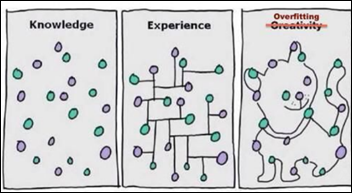
In the funny yet accurate description below: 

  • Knowledge sits in some form, but a ML model with not enough capacity will fail to see any relationships in the data.
  • Experience is the capability to connect the proverbial dots. Once a ML model achieves this level, training should stop. Otherwise,
  • Overfitting is when the model tries to impress us with its creativity. The ML model just had too much training and is now overdoing it.

image

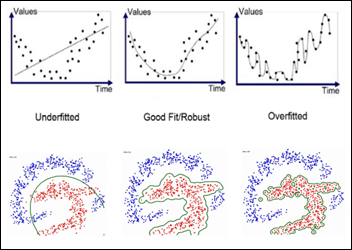
Regression and Classification Examples of Under / Overfitting

We are searching for the sweet spot — a good, robust fit so the model would be able to generalize with unseen data.

The model should have sufficient capacity to be able to learn and improve and yet at the same time, not necessarily become the absolute best AI student on the training set.

image

Underfitting

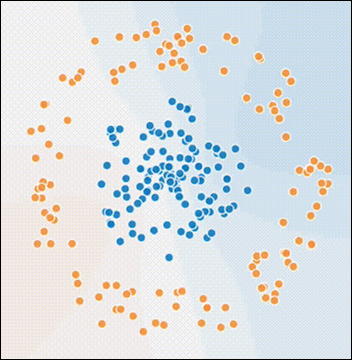
Consider the left side of the above figure. The upper diagram displays data which is obviously not linear. Still, the ML model we’ve applied is linearly restricted – the model capacity is limited for the task.

The lower diagram displays a classification task, but the model is restricted to a circle. Its capacity is limited, so it cannot classify the dots better than with a circle separation line

When a ML model is underfitting, it basically doesn’t have enough or the right type of brain power for the task at hand or the model is exposed to a poor choice of features during training. We can help the ML model by:

  • Using non-linear, more complex models.
  • Increase the number of layers and / or units in a NN.
  • Adding more features.
  • Engineering more complex features from existing ones (using BMI instead of weight and height).

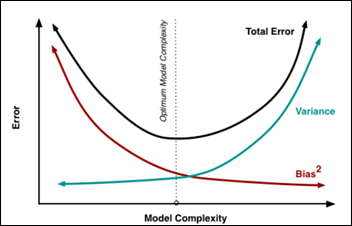
Underfitting is also called high bias and low variance and is one of the causes for a model to underperform. The model has a high bias towards a linear solution (in the regression example above) and a low variance in terms of limited variability of the features learned

Overfitting

You’ve trained your ML model for some time now and it achieves an amazing performance on the training set. Unfortunately, once in production, the ML model is only slightly better than just random predictions. What happened?

As the right side of the above figure shows, the model has used its large capacity to memorize the whole training set. The ML model became a memory bank for the training samples’ features, similar to a database. This overfitting caused the model to over train, to become “creative,” and also to become the best-ever on the training data. 

However, the overfitted model fails on real-life test data because it has lost the ability to generalize. We need the ML model to learn with each experience to generalize, not to become a memory bank

Overfitting is also called low bias and high variance, as the model has a low bias to any specific solution (linear, polynomial, etc.). The model will consider anything, any function, and it has a huge variance. Both factors contribute to an increased overall model prediction error.

image

How do we achieve a balance between the above two opposing forces of bias and variance? We need a tool to monitor the learning process — the learning curves — and a method to continuously test our model at each and every epoch, the cross-validation technique.

Training, Validation, and Testing Sets

Once you’ve got the data for a ML project, it is customary to cut a random 20 percent of samples, the test set and put it aside, never to be looked at again until the time of testing. Any transformation you plan on doing (imputing missing values, cleaning, normalizing, etc.) should be done separately on the training and test sets. 

This strict separation will easily prevent the scenario where normalizing over the whole data set and learning the average and standard deviation of the test set in the process may influence the model decision making in a way similar to cheating or letting the model know information about the test set, which the model should not know. The rest of the data after removal of this test set is the original training set.

As the model is going to be exposed to the training data multiple times — with different hyper-parameters (see below), architectures, etc. — if we allow the model to “see” the test data repeatedly, the model will eventually learn the test set as well. We want to prevent the model from memorizing all the data and especially to prevent the model exposure to the test set .

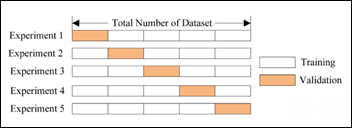
The original training set is used in a cross-validation scheme, so the same training set can be used also for validating each learning epoch. In a fivefold cross-validation scheme, we create each epoch, a 80 percent subset from the original training set and a validation set from the remaining 20 percent. Basically, we create a mini-test set for each learning epoch — a validation set — and we move this validation set within the original train set with each learning epoch (experiment in the figure below):

image

Learning Curves

With a cross-validation arrangement as detailed above, we can monitor the learning process and identify any pathological behavior on behalf of our student ML model during training.

image

Underfitting learning curves above show both the training and the validation curves remaining above the acceptable error threshold during the epochs of the learning process. Basically the model does not learn: either not enough model capacity or not good, representative enough features it can generalize upon. We need to either increase model capacity, increase the number or complexity of the features, or both. Adding more training samples will not help.

Overfitting learning curves show that pretty early during the learning process, the model started overfitting, when the two learning curves separate. The training curve continued to improve and reduce the training error, while the validation curve stopped showing improvement and actually started to deteriorate. Decreasing the model capacity, decreasing the number of features, or increasing the number of samples may help.

Perfect fit happens when the validation error is below the acceptable threshold and it starts to plateau and separate from the training curve. At that number of training epochs, we should stop, call an end for the learning session, and give our ML model a short class break.

Learning Rate

A ML model has parameters (weights) and hyper-parameters such as the learning rate.

image

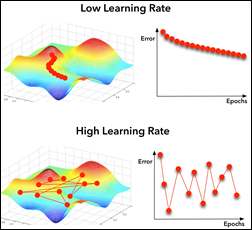
With a too-low learning rate, the model will take its time to find the global minimum of the cost function (left in the above figure). Too high a learning rate will cause the model will miss the global minimum because it jumps around in too large steps. Modern optimizers can automatically modify their learning rate as they approach the minimum in order not to miss it with a too large jump above it.

Data Augmentation

Usually collecting more samples to feed an overfitting model is a time, money, and resource-consuming activity. Consider an image analysis ML model that identifies between dogs and cats in an image. Until recently, this exercise was used by CAPTCHA to distinguish between humans and malicious bots trying to impersonate humans. Machines recently achieved the same level as humans, so CAPTCHA is not using this challenge any more. Nevertheless, dogs vs. cats became one of the basic, introductory exercises in computer vision / image analysis.

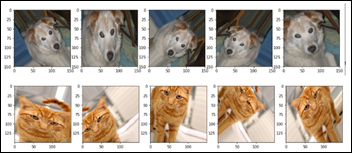
While developing such an image classification model, one usually increases the model capacity gradually until the model starts overfitting. Then its customary to add data augmentation, a technique used only on the training set, in which images are being reformatted randomly around the following image parameters:

  • Zoom
  • Scale
  • Brightness
  • Skew
  • Mirror around vertical / horizontal axes
  • Colors

By exposing the algorithm during training to a more diverse range of images, the ML model will start overfitting at a much later epoch, as the training set is more complex than the validation set. This in turn will allow the model to bring the validation error to an acceptable level.

Data augmentation allows a ML model to realize that a cat looking to the right side is still a cat if it looks to the left side. With data augmentation, the ML model will learn to generalize that a dog is still a dog if it is scaled to 80 percent, flipped horizontally, and skewed by 20 degrees. No animals were harmed during this data augmentation exercise.

image

Regularizers

Eventually, a big enough model will start overfitting the data, even if the training set has been augmented. Another technique to deal with overfitting is to use a regularizer, a model hyper-parameter. Basically it penalizes the model loss function on any large modifications to the model weights. Keeping the changes to the weights within small limits during each epoch is important, as we don’t want the model to literally “jump to any conclusions.”

Dropout

An interesting, different, and surprisingly very efficient approach to overfitting that can prevent a ML model from learning the whole training set by heart is called dropout. Like data augmentation above, dropout technique is used only on the training set. It takes out randomly up to 50 percent of a NN layer units from one learning epoch, like randomly sending home half of the students for one class. How can this strategy prevent overfitting? 

The analogy with these students being dismissed from that class / epoch caused all the other units (students) in the layer to work harder and learn features they were not supposed to learn otherwise. This in turn zeroed the weights for up to half of the units while forcing other units to modify their weights in a way that is not conducive towards a “memory bank.” Shortly, dropout destroys any nascent memory bank a ML model may try to create during training.

Testing

Once training is completed, hyper-parameters have been optimized, data has been re-engineered, the model has been iteratively corrected, etc. then and only then one brings out the hidden testing set. We test the ML model and its performance on the test set will hopefully be close to its real-life performance.

Next Article

Predict Hospital Mortality

News 12/5/18

December 4, 2018 News 11 Comments

Top News

image

A ProPublica report finds that the so-called “Mar-a-Lago gang” of three wealthy supporters of President Trump reviewed the VA’s proposed $10 billion Cerner contract before it was signed even though none of them had healthcare IT or military experience, naming themselves as an “executive committee.”

The physician member of the group, Bruce Moskowitz, also pressed the VA to use his self-developed ED locating app instead of collaborating with Apple. He named his son as the VA’s point person for the proposed project that was eventually abandoned.

The group reportedly got VA Secretary David Shulkin fired for being inadequately deferential to them.

Member Ike Perlmutter (chairman of comic book publisher Marvel Entertainment) has reportedly turned his guns on current VA Secretary Robert Wilkie, angered that Wilkie stopped taking his calls and that he released emails that contained Perlmutter’s name in relation to the VA’s no-bid Cerner contract.


Reader Comments

image

From Avenel Can’t Save This Trainwreck: “Re: Allscripts. Confirming that at least 250 were laid off, 40 of them from sales. Paragon and HHS support to be offshored. Closing offices and laying employees off is necessary because the company has a debt problem.” Unverified. I didn’t see a WARN notices, so perhaps the company is closing offices and offering transfer opportunities to those displaced, meaning that the resulting intentional attrition isn’t technically considered to be a layoff. With regard to your debt observation, I looked up the debt-to-equity ratio of these publicly traded health IT vendors (lower numbers are better):

  • Cerner: 9
  • NextGen Healthcare: 12
  • Athenahealth: 24
  • CPSI: 91
  • Allscripts: 116

From Smattering: “Re: consulting. Can all these health IT people really make a living as independent consultants?” It should be obvious from the LinkedIn profiles you sent that “consulting” is a euphemism for “desperately seeking a full-time job.” Offering to consult isn’t the same as actually earning a living as a permanent consultant. I suspect that quite a few formerly high-flying health IT executives have been shocked to find that their consulting services were in low demand once they lost their purchasing influence, especially since it’s obvious that a sudden urge to become a consultant coincided with being unceremoniously shown their employer’s door. Reading LinkedIn profiles can be depressing. 


HIStalk Announcements and Requests

image

Welcome to new HIStalk Gold Sponsor PatientBond. The Elmhurst, IL-based company’s solutions address consumerism and evolving reimbursement models, amplifying patient engagement initiatives by using consumer psychographics (attitudes, values, lifestyles, and personalities) and digital engagement. Health systems use it for marketing, targeted patient acquisition, reducing no-shows, performing digital follow-up, sending health reminders, performing surveys, closing care gaps, and reducing readmissions. Clients include Partners HealthCare, Shawnee Mission Health, Aurora Health Care, and Trinity Health. The company’s psychographics and digital engagement were paired with the American Heart Association’s care plans to create AHA’s Health Motivation Platform to drive patient behavior change. You can determine your own patient segment by taking the company’s 12-question survey. Thanks to PatientBond for supporting HIStalk.


Webinars

December 6 (Thursday) 11 ET. “Make the Most of Azure DevOps in Healthcare.” Sponsor: CitiusTech. Presenter: Harshal Sawant, practice lead for DevOps and mobile, CitiusTech. Enterprise IT teams are moving from large-scale, project-based system implementations to a continuously evolving and collaborative process that includes both development and business teams. This webinar will review healthcare DevOps trends and customer stories, describe key factors in implementing a DevOps practice, describe how to assess Azure DevOps, and lay out the steps needed to create an Azure DevOps execution plan.

Previous webinars are on our YouTube channel. Contact Lorre for information.


Acquisitions, Funding, Business, and Stock

image

Medical device manufacturer ResMed continues its recent string of health IT acquisitions by announcing plans to buy inhaler use monitoring technology vendor Propeller Health for $225 million. Madison-based Propeller Health has raised $70 million.  

image

Medication safety technology vendor Tabula Rasa HealthCare will acquire Australia-based parenteral medication dosing calculation vendor DoseMe.

Meditech acquires its London-based partner Centennial Computer Corporation as part of its creation of Meditech UK.

I was barely interested in McKesson even before it bailed on health IT, but for those who still care, the company will relocate its global headquarters from San Francisco to Las Colinas, TX. Not shockingly, that’s where the company’s incoming CEO Brian Tyler lives (and where costs are much less). Pretty much every place I’ve ever worked that changed office locations ended up near the CEO’s opulent house since the commute time of that one person outweighs that of hundreds of employees despite HR’s claim that its ZIP code analysis makes that location best for everyone.

image

Athenahealth files the SEC notice of its shareholder vote on the company’s proposed acquisition by subsidiaries of Veritas Capital and Elliott Management. Interesting points:

  • The acquirers will take on several billion dollars of debt to finance the acquisition.
  • Termination fees of several hundred million dollars are specified for both sides of the transaction.
  • 65 companies expressed interest in acquiring Athenahealth — 32 companies and 33 financial sponsors.
  • Athenahealth’s board worried that the company could not meet financial expectations due to declining market opportunities because of low customer switching rates from competing products, a declining win rate, and the need to spend more money on product development to remain competitive.
  • Athenahealth’s change-in-control plan for its top executives provides each with a one-year severance; a year’s bonus; 9-12 months of medical and dental coverage depending on title; full vesting of unvested shares; and up to $10,000 in outplacement costs. That provides Golden Parachute Compensation ranging from $800,000 (for the former interim CFO) to $5.5 million (for the CFO).
  • Former CEO Jonathan Bush would get $4.8 million under a previously negotiated separation agreement. He also owns 900,000 ATHN shares valued at around $122 million.
  • Jeff Immelt, who served as board chair for nine months, leaves with $420,000 and shares worth $1.8 million.

Sales

  • Arizona HIE Health Current chooses Diameter Health for data interchange and clinical data quality.

People

image

Harry Greenspun, MD (Korn Ferry) joins consulting firm Guidehouse as chief medical officer.


Announcements and Implementations

image

An excellent new KLAS report finds that most EHR vendors are progressing well toward supporting a national patient record network now that CommonWell is connected to Carequality, which the authors call “the connection heard round the US” as users of Cerner and Epic can now exchange information. Another factor is the connection of Meditech to CommonWell and NextGen Healthcare to Carequality. Click the above graphic to see fascinating adoption numbers by vendor. Interesting facts:

  • Allscripts and Medhost have not enabled connectivity at all.
  • Allscripts says it will connect TouchWorks and Sunrise in 2019, but the company hasn’t committed to enabling Paragon, Professional, or other products.
  • Longstanding CommonWell member Medhost has yet to connect anything.
  • EClinicalWorks customer connections have tripled since March 2018 and CPSI has done a good job in integrating connectivity.
  • Virence Health (the former GE Healthcare IT) and Greenway Health have made little progress.
  • Cerner customers face the most significant technical hurdles in connecting, requiring 3-6 months to install Resonance and to perform mapping, making Cerner is the vendor furthest away from plug-and-play interoperability.
  • Epic and Athenahealth enable connectivity by default and thus nearly all users of Epic and Athenahealth have connected, which has given them the chance to move on to other pressing projects.
  • The CommonWell-Carequality connection has removed the final obstacle to widespread sharing of records as nearly all EHR users can connect quickly and inexpensively.
  • The biggest interoperability barrier is that providers don’t really care about sharing data and thus don’t bother to actually share records even though EHR vendors have stepped up to make it possible for them to do so.

image

Another new KLAS report reviews clinical surveillance technology, finding that despite the claims of several vendors, Epic and Cerner are the only vendors whose surveillance tools have significant usage. It notes that Epic’s surveillance tools are the hardest to set up due to lack of vendor guidance and best practices, but users who have gone live have created the largest variety of use cases. Cerner, Epic, Stanson Health, and Bernoulli users say the alerts improve patient care and reduce readmissions

image

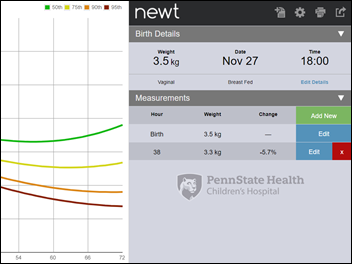
UCSF will study and manage weight loss in newborns by using SMART on FHIR to integrate Epic with NEWT, a free, web-based, hospital-developed newborn weight loss tracking tool. UCFS’s study is called Healthy Start.

UK-based EMIS Group announces a new cloud-based version of EMIS Web, the UK’s most widely-used clinical system. New features include federated appointments, a voice assistant, video consultations, and analytics.


Government and Politics

A Tennessee nurse practitioner pleads guilty to scamming the military’s Tricare medical insurance out of $65 million via the usual route – conducting telemedicine sessions that resulted in prescriptions for expensive compounded medications that were provided by pharmacy co-conspirators who were also charged.


Privacy and Security

A Florida hospitalist staffing group will pay $500,000 to settle HHS OCR charges that it violated HIPAA in 2011-12 by sharing patient information with someone posing as a billing company employee who then exposed the information to the Internet, all without having a business associate agreement with the billing company or having performed a risk assessment.


Other

image

In Australia, Queensland Health’s hospital EHR project will run $188 million over budget if implemented in the 12 remaining hospitals, with an auditor-general’s report noting that Cerner can name its price for contract extensions knowing that its customer has not considered alternative systems. The report also concludes that the project can’t continue without further funding and says the system does not provide value for money.

image

Bill Gates names “Bad Blood” as one of five of this year’s books he recommends. Gates says it is “insane” that Theranos hard-coded demo blood testing machines to display a stuck status bar so they could blame connectivity for the machine’s not working. He says Theranos stumbled because it didn’t have healthcare experts on its board; it sported a Steve Jobs-inspired take-no-prisoners outlook that isn’t appropriate for healthcare; and it allowed Elizabeth Holmes to make her personal legacy the company’s most important goal.

In Canada, the health minister of Newfoundland and Labrador blames Telus Health’s Med Access lab results distribution software for delays in delivering results to several hundred patients in the past year.

SNAGHTML6b451d97

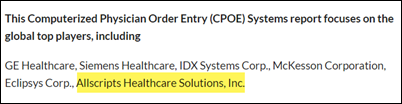
Darn, this was almost a clean sweep – an offshore company’s expensive CPOE market report lists six “global top players,” five which are trivia questions having not sold CPOE systems for a long time.

A Wired article says that unlike Amazon and Google, Facebook has no interest in furthering mankind beyond simply growing its own business and assuming that the world will benefit, leaving it with a platform whose chief attributes are tracking and targeting users. A member of Canada’s parliament said in a hearing involving the governments of nine countries – at which Facebook CEO Mark Zuckerberg was a no-show – that “While we were playing on our phones and apps, our democratic institutions seem to have been upended by frat-boy billionaires from California.”

I was thrilled to discover Fakespot, an AI-powered analyzer of reviews on Yelp, Tripadvisor, and Amazon that spots reviews that are likely phony and then recalculates the star rating accordingly. Those sites could do this themselves, of course, but then they wouldn’t have nearly as many reviews to brag about and their advertising revenue might be threatened. Amazon should allow reviews only from people who have actually purchased the item via Amazon, Yelp should ignore reviewers who have posted few reviews or who are posting about businesses all over the world (likely for cash unless they travel extensively), and Tripadvisor really can’t do much about the flood of fake reviews since neither of these methods would work for a global travel site.

image

In Japan, National Center for Child Health and Development will work with Sony to see if that company’s AI-powered robotic dog Aibo can measurably reduce stress and provide emotional support to children facing long hospital stays. Sony is selling Aibo’s “First Litter Edition” for the US market for $2,900, although there’s a wait list and they won’t ship to Illinois for some reason. Reviews have been OK, although some testers didn’t expect that having a robotic pet that learns that, like a real puppy, you have to train them (although presumably not in the peeing or chewing kind of way).  

Speaking of robots, Weird News Andy volunteers to spearhead an ICD-10 revamp to include the trendy electric scooters that are sending 1,000 people a month to EDs. WNA notes the billing challenge when available codes consider only scooters of the mobility and non-motorized varieties. I swear we’re regressing to children in fawning over scooters, wasting most of our free time playing with toys (of the Internet-enabled variety), and reducing discourse about global events and politics to a spirited game of Rock ‘Em Sock ‘Em Robots.


Sponsor Updates

clip_image001

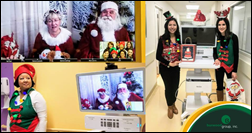
  • Burwood Group helps patients connect with Santa at Advocate Children’s Hospital.
  • AdvancedMD publishes a new guide, “In or Out-source Your Value-Based Care Revenue Cycle Management.”
  • Aprima announces EHR integration with SE Healthcare’s Physician Empowerment Suite software.
  • Bernoulli Health will exhibit at the AARC Congress through December 7 in Las Vegas.
  • KLAS recognizes Bernoulli Health in its 2018 clinical surveillance report.
  • Clinical Architecture will exhibit at the AHIMA Data Institute December 6-7 in Las Vegas.
  • Dimensional Insight will exhibit at the MDM-Forum through December 6 in Denver.
  • DocuTap’s Eric McDonald will present at 1 Million Cups in Sioux Falls, SD December 5.
  • Meditech adds diabetes management capability to Expanse Ambulatory.
  • Access releases EFR Mobile, which supports electronic forms and signatures capability on mobile devices.
  • EClinicalWorks publishes a podcast titled “Strengthening Patient Engagement in Illinois.”

Blog Posts


button


Contacts

Mr. H, Lorre, Jenn, Dr. Jayne.
Get HIStalk updates. Send news or rumors.
Contact us.

125x125_2nd_Circle

News 11/28/18

November 27, 2018 News 1 Comment

Top News

SNAGHTML472a0d59

Amazon will announce this week launch of a software product for insurance companies that mines electronic patient records, including both structured and unstructured data. It will look for incorrect coding or diagnoses to improve quality and lower cost.


Reader Comments

From TaTa Toothy: “Re: Key Dental Group. The practice’s EHR vendor locks it out of its patient database after the practice drops its system.” Key Dental Group (FL) says dental software vendor MOGO is refusing to return its 4,000 patient records following termination of its license. The practice put out a press release titled “HIPAA Security Incident” that warns patients that it has no control over how their data will be protected by the vendor. MOGO’s LinkedIn says the product is “HIPPA-compliant.”

From DiJourno: “Re: fake health IT news. Running all positive stories is a clue.” You can easily recognize advertiser-friendly “news” sites by simply checking their 10 most recent stories to see if they wrote anything negative, especially about an advertiser. I explain when people ask why I’m so cynical that: (a) the frontlines health IT view is a far cry from profit-motivated irrational exuberance supported by vendor-friendly news sites; and (b) fluff written by armchair quarterbacks is in ample supply and thus the obvious need is to inject reality. I grade sites this way: (a) can I immediately use what I just read; (b) did I learn something I wouldn’t have found elsewhere; (c) can I at least paraphrase a given story in casual conversation to sound smart? Otherwise, I have  more entertaining ways to waste my time.


HIStalk Announcements and Requests

image

The earlier-than-usual start of HIMSS19 means it’s time to open up the HISsies nominations, my version of the political primaries. I’ve unsuccessfully hoped every year since the first HISsies in 2008 to avoid dozens of email exchanges like these:

  • (Reader) “I can’t believe the stupid choices for the HISsies voting. It’s the same every year and it should have had X as a choice.”
  • (Me) “Readers do the nominating. Nobody nominated X. So you are complaining now that you don’t like the choices even though you couldn’t be bothered to take 10 seconds to nominate X yourself?”
  • (Reader) No response.

image

Welcome to new HIStalk Gold Sponsor NextGate. The Monrovia, CA-based company offers a cloud-based identity management solution (patient matching, duplicate record cleanup, provider attribution, and biometric ID), provider registry, and  relation registry. Customer success stories include Geisinger, Rochester RHIO, and two UK providers. The company works with more than 100 provider organizations. Thanks to NextGate for supporting HIStalk.


Webinars

December 5 (Wednesday) 1 ET. “Tapping Into the Potential of Natural Language Processing in Healthcare.” Sponsor: Health Catalyst. Presenters: Wendy Chapman, PhD, chair of the department of biomedical informatics, University of Utah School of Medicine; Mike Dow, senior director of product development, Health Catalyst. This webinar will provide an NLP primer, sharing principle-driven stories so you can get going with NLP whether you are just beginning or considering processes, tools, or how to build support with key leadership. Dr. Chapman’s teams have demonstrated phenotyping for precision medicine, quality improvement, and decision support, while Mr. Dow’s group helps organizations realize statistical insight by incorporating text notes along with discrete data analysis. Join us to better understand the potential of NLP through existing applications, the challenges of making NLP a real and scalable solution, and the concrete actions you can take to use NLP for the good of your organization.

December 6 (Thursday) 11 ET. “Make the Most of Azure DevOps in Healthcare.” Sponsor: CitiusTech. Presenter: Harshal Sawant, practice lead for DevOps and mobile, CitiusTech. Enterprise IT teams are moving from large-scale, project-based system implementations to a continuously evolving and collaborative process that includes both development and business teams. This webinar will review healthcare DevOps trends and customer stories, describe key factors in implementing a DevOps practice, describe how to assess Azure DevOps, and lay out the steps needed to create an Azure DevOps execution plan.

Previous webinars are on our YouTube channel. Contact Lorre for information.


Sales

  • Australia’s Queensland Health chooses NextGate’s cloud-based Provider Registry to create a statewide referral service directory.
  • Sweden-based Västra Götalandsregionen will implement Cerner Millennium in its 17 hospitals and 200 primary care centers, Cerner’s second regional contract in Sweden.

People

image

Former University of Utah health system CEO Vivian Lee, MD, PhD, MBA, who resigned after clashing with the university’s cancer hospital leadership, joins Verily as president of health platforms. She will oversee products related to health system improvement and population health. She finished her contract with the university as a radiology professor at a salary of $1 million per year.


Announcements and Implementations

MModal launches Scout Follow-Up, an AI-powered radiology follow-up workflow solution.

HIMSS announces its 2019 “Most Influential Women in Health IT” winners:

  • Aashima Gupta (Google)
  • Kisha Hortman Hawthorne, PhD, MHA, MBA (Children’s Hospital of Philadelphia)
  • Christine A. Hudak, PhD, RN (Kent State University)
  • Lygeia Ricciardi, EdM (Carium)
  • Heather Sulkers (CAMH)

Government and Politics

SNAGHTML4555902f

The GAO will investigate rumored VA meddling by three political supporters of President Trump who said they “were anointed by the President” as private citizens. The three, including concierge doctor Bruce Moskowitz, say they voluntarily offered their help to the VA but were given no authority over the VA’s decisions. The initial ProPublica investigation found that Moskowitz’s negative experience with Cerner led the group to urge then-VA Secretary David Shulkin to perform more due diligence before giving Cerner a $10 billion, no-bid contract. Former officials say Shulkin was fired because of friction with the group over the Cerner contract.


Privacy and Security

BCBS of North Carolina emails a medical claims report for 158 employees of Wilmington, NC to the wrong city.

Systems of two OH and WV hospitals remain down following a ransomware attack Friday, with their EDs remaining on partial diversion.


Other

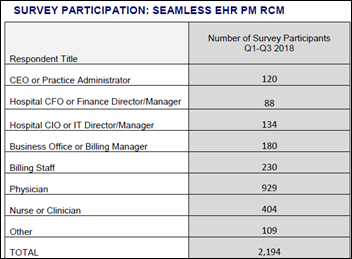
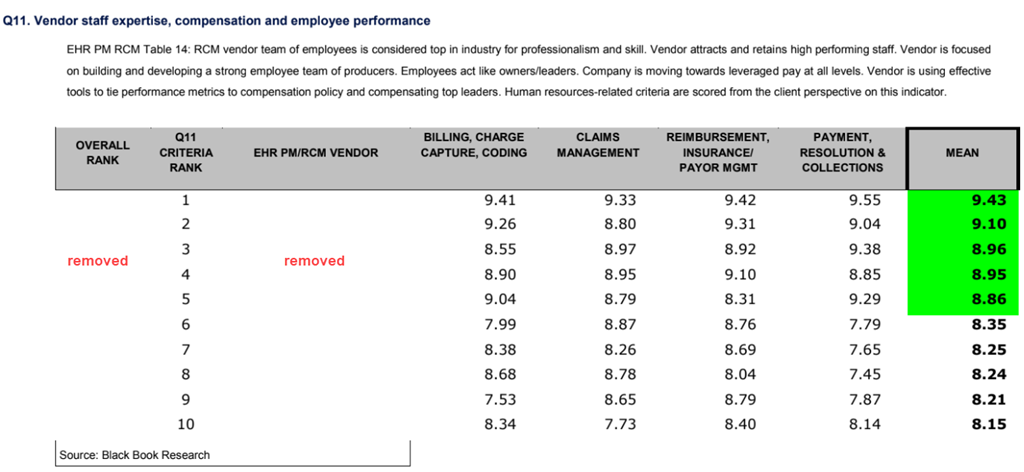
A Black Book survey finds that the CIO’s strategic role has diminished as non-IT department leaders are making more purchasing decisions. It questions whether the “chief” part of the CIO title is at risk as only 21 percent of CIOs say they are involved in innovation projects and departmental purchasing decisions, with 29 percent viewing their role as tactical. Nearly all C-suite colleagues view CIOs as technology providers and order-takers who don’t need to be involved in transformation and innovation efforts. The report finds that average CIO tenure is down to 3.2 years.

image

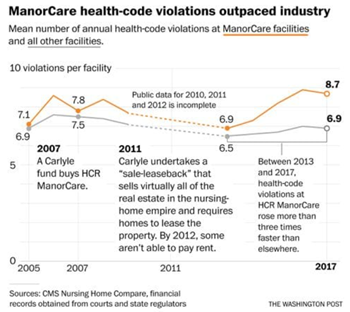
The Washington Post finds that a private equity firm’s acquisition of a national nursing home chain led to dramatically decreased quality of care as the chain was loaded up with debt; cash was extracted to pay investors and PE firm management fees; buildings were sold and leased back at unreasonable rents to free up cash that the private equity company extracted; and employees were laid off as the nursing homes were unable to pay the new debt and rent costs. A company consultant said the bankers and investment people who run the PE firm “did not know a thing about this business at all.” The PE firm says things were going fine until Medicare reduced payments. The PE firm has sold the chain to a non-profit, but the question remains – are the slash-and-burn, flip-focused private equity methods appropriate in healthcare?

I found this “Black Friday for Healthcare”article by Loyale Healthcare CEO Kevin Fleming both interesting and timely. He says:

  • The Black Friday phenomenon involves value + enticement + urgency.
  • Disruption is caused by a commitment to a delivering a superior customer experience, not by simply rolling out digital tools (he was quoting an article by former Sutter Health SVP/CIO Jon Manis).
  • “Delight disruption” in healthcare must include both clinical and financial positive experiences.
  • Medical tourism may represent the first wave of healthcare consumerism.
  • Amazon knows us better than we know ourselves via its rich database, allowing it offer easy shopping, comparing, and buying, and healthcare is beginning to amass such data.
  • Healthcare’s version of retail growth involves offering rewarding personal experiences; enticing consumers with an attractive, affordable product that drives word-of-mouth exposure; and addressing people who delay or avoid care because they think they can’t afford it.

Employees at Mercy South (MO) were scheduled to protest Tuesday after the hospital required employees to receive a flu shot unless they offer medical or religious reasons.

Former Chicago Bears coach Mike Ditka is released from the hospital after being treated for a mild heart attack. Above is the mental picture I immediately conjured given that it’s Thanksgiving and RSNA.


Sponsor Updates

  • Medicomp Systems publishes an e-book titled “Interoperability and the Quest to Solve Healthcare’s Seemingly Unsolvable Problem.”
  • Bernoulli Health will exhibit at the American Association for Respiratory Care Congress December 4-7 in Las Vegas.
  • CoverMyMeds will exhibit at ASHP Midyear December 3-7 in Anaheim, CA.
  • Divurgent publishes a new success story on its Physician Efficiency Program.
  • PointClickCare recognizes Liaison Technologies as its Partner of the Year.
  • LiveProcess will exhibit at the National Healthcare Coalition Preparedness Conference November 27-29 in New Orleans.
  • MDLive provides free online health consultations to California residents impacted by wildfires.
  • National Decision Support Co. will exhibit at RSNA November 25-30 in Chicago.
  • Wolters Kluwer Health will present at the ASHP Midyear Clinical Meeting December 2-6 in Anaheim, CA.
  • The Pharmacy Podcast Network features ZappRx.

Blog Posts


button


Contacts

Mr. H, Lorre, Jenn, Dr. Jayne.
Get HIStalk updates. Send news or rumors.
Contact us.
125x125_2nd_Circle

Curbside Consult with Dr. Jayne 11/26/18

November 26, 2018 Dr. Jayne Comments Off on Curbside Consult with Dr. Jayne 11/26/18

While many people were out doing their Black Friday shopping, I was getting clobbered at urgent care. We saw over 1,000 patients across our locations, which is similar to the patient counts that we see during the height of influenza season.

Many of the patients were coming in for fairly low-acuity problems because their primary care physicians’ offices were closed and they were concerned that their conditions would worsen over the weekend. A portion of the patients had issues that had gotten worse over the holiday, while others had holiday-related injuries.

I saw some Thanksgiving-related injuries, including a patient who was injured by a frozen turkey that fell on her, allowing me to use the ICD codes W61.42 “Struck by turkey” and Y93.G1 “Activity, food preparation and clean up.” Another injured her finger “spiralizing” a sweet potato. I couldn’t find a better code for that other than the usual wound codes, but the turkey incident was a challenge for my scribe.

It’s rough enough seeing that large volume of patients (more than 70 of them were on my schedule) but it was made more difficult by an EHR that behaved erratically. I’m pretty sure my EHR has the world’s most user-unfriendly error codes, such as, “The length argument value must be greater or equal to X” and “Error attempting to push run time parameters onto the stack.” Both of those gems allowed the user to click through without incident and allowed return of normal function, so it’s not clear why we were even seeing them. Although I’ve been in the healthcare IT world for a long time and have come to terms with just clicking through and not getting too worked up, some of my staff members were very frustrated by messages that had no meaning.

Due to increasing co-pays and concerns about crowding at the emergency room, we had multiple patients who ultimately needed transfer to a higher level of care, which can be stressful for the staff. Most of the team I worked with have been in the urgent care space a long time, so they weren’t nervous about handling patients with stroke or chest pain symptoms until emergency medical services arrived to transport them to the hospital.

It’s still challenging, though, especially when your schedule gets backed up while you’re caring for a truly sick patient while other patients are popping out to the clinical station because they feel that they’ve been waiting too long. The consumer-style expectations of our patient population continue to rise, and on a busy day full of lacerations and hospital transfers, it’s definitely harder to meet those expectations. Patients are already frustrated because their primary care physicians’ officers are closed, assuming that they have a primary physician, which many do not.

We also had an uptick in patients who were presenting to us for care after being seen at a retail clinic. They had seen a nurse practitioner only to be told that their condition was outside the scope of practice permitted at the retail clinic and that they would need to be seen by a physician for laboratory work, chest x-rays, etc.

We’re happy to take those referrals, but the patients aren’t thrilled to pay an urgent care co-pay on top of whatever was spent at the retail clinic, not to mention the time involved in leaving one facility and traveling to another. The local retail clinics vary dramatically in how they screen patients for scope of practice. Some seem to do the screening upfront and refer the patient prior to any exam, where others see the patient and then refer. The latter doesn’t make for very happy patients.

One of the more challenging parts of my day was caring for a patient who came in with what appeared to be a viral illness but that turned out to be a life-altering diagnosis. In the urgent care trenches, we’re often accused of practicing defensive medicine or ordering too many tests, but when your CT scan detects a serious cancer that the patient had no idea was present, it’s sobering. I’m sure when Monday rolls around we’ll have to deal with the retroactive authorization for the test, but it will be worth it.

I hate having to tell patients about those discoveries. It would be so much better to have a physician who knows the patient give them the news. Patients are generally glad that they have a diagnosis and a plan to move forward, even if the news is not what they expected. I’ve had several situations like this over the last several weeks and I wish there was a way to follow along with the patient’s care. In our region, though, the big health systems aren’t about to share data with an independent urgent care even though their systems are allegedly interoperable.

Today was a much easier schedule and I had a couple of hours where patients only trickled through the door, so I was able to work on some informatics projects. We’ve been faced with shortages of some of our common medications, so I worked on an analysis of diagnosis patterns and volumes to estimate how long we can stretch our supplies. It’s still baffling that we have shortages of key medications in the US, including antibiotics and especially generics. We’re also low on influenza vaccine, so I worked on a strategy to predict demand and redistribute what we had. Not exactly high-powered informatics or big data analysis, but the run-of-the-mill data needs that are common for practices.

I also spent some time with one of our training scribes to talk about proposed changes to our scribe program since we have had to ramp up quickly to prepare for the opening of several new locations. We don’t want to shortchange any of the training, but want to make it as efficient as possible since scribes are the lifeblood of our high-volume days during flu season.

I had some time to play around with data around influenza and was glad to see that our influenza activity is paralleling the CDCs data at around 2 percent of the visit volume. It’s days like today that I’m glad to have an EHR and can extract data for useful purposes. In the coming weeks I’ll be extracting data for more challenging purposes, including our annual analysis of whether we should continue to opt out of the federal incentive programs. That’s a much bigger project, including analysis of provider workflow, documentation time, and click counts on top of the analysis of payer mix, CPT codes, quality measures, and more. It’s not exactly something I look forward to every year, but it’s rewarding to be able to analyze, interpret, and package the data so that informed decisions can be made.

We also had a tornado warning issued while seeing patients, which put our disaster planning skills to the test. There’s not a lot of patient privacy when you have people huddled in the central core of the office, away from the windows that are present in all the exam rooms. People seemed to take it in stride, though, especially since we’re looking at high winds through the evening and snow into the morning. I may be grumbling during the commute, but at least I’m not in Chicago at RSNA where there is still a blizzard warning in effect. Wherever you may be, I hope your weather allows you to stay safe.

comments_button

Email Dr. Jayne.

A Machine Learning Primer for Clinicians–Part 6

November 26, 2018 Machine Learning Primer for Clinicians Comments Off on A Machine Learning Primer for Clinicians–Part 6

Alexander Scarlat, MD is a physician and data scientist, board-certified in anesthesiology with a degree in computer sciences. He has a keen interest in machine learning applications in healthcare. He welcomes feedback on this series at drscarlat@gmail.com.

image

Previous articles:

  1. An Introduction to Machine Learning
  2. Supervised Learning
  3. Unsupervised Learning
  4. How to Properly Feed Data to a ML Model
  5. How Does a Machine Actually Learn?

Artificial Neural Networks Exposed

Before detailing what is a NN, let’s define what it is not. 

As there is much popular debate around the question whether a NN is mimicking or simulating the human brain, I’ll quote Francois Chollet, one of the luminaries in the AI field. It may help you separate at this early stage between science fiction and real science and forget any myths or preconceptions you may have had about NN:

Nowadays the name neural network exists purely for historical reasons—it’s an extremely misleading name because they’re neither neural nor networks. In particular, neural networks have hardly anything to do with the brain. A more appropriate name would have been layered representations learning or hierarchical representations learning, or maybe even deep differentiable models or chained geometric transforms, to emphasize the fact that continuous geometric space manipulation is at their core. NN are chains of differentiable, parameterized geometric functions, trained with gradient descent.” (From “Deep Learning with Python” by Francois Chollet)

You’ve met already an artificial neural network (NN) in the last article. It predicted the LOS based on age and BMI, using a cost function and trained with gradient descent as part of its optimizer.

image

image


ANN Main Components

  • A model has many layers: one input layer, one or more hidden layers, and one output layer.
  • A layer has many units (aka neurons). Some ML models have hundreds of layers and tens of millions of units.
  • Layers are interconnected in a specific architecture (dense, recurrent, convoluted, pooling, etc.)
  • The output of one layer is the input of the next layer.
  • Each layer has an activation function that applies to all its units (not to be confused with the loss / cost function).
  • Different layers may have different activation functions.
  • Each unit has its own weight.
  • The overall arrangement and values of the model weights comprise the model knowledge.
  • Training is done in epochs. Each epoch deals with a batch of samples from input.
  • Each epoch has two steps: forward propagation of input and back propagation of errors (see above diagrams).
  • A metric is calculated as the difference between the model prediction and the true value if it is a supervised learning ML model.
  • An optimizer algorithm will update the weights of the model using the loss / cost function.
  • The optimizer helps the model navigate the hyperspace of possibilities while minimizing the loss function and searching for its global minimum.
  • After model is trained and it makes a prediction, the model uses the final values of the weights learned.

In the following example, a ML model tries to predict the type of animal in an image as a supervised classification task.

  • An input layer on the left side accepts as input the image tensors as many small numbers.
  • Only one hidden layer (usually there are many layers). It is fully connected to both the input and the output layers.
  • An output layer on the right that predicts an animal from an image. It has the same number of output units as the number of animal types we’d like to predict. The probabilities of all the predicted animals should sum up to one or 100 percent.

ezgif.com-resize

From giphy.

What Is the Difference Between a NN and a Non-NN ML Model?

Non NN Models:

  • One set of weights for the whole model.
  • Model has one function (e.g. linear regression).
  • No control over model internal model architecture
  • Usually do not have local minima in their loss function
  • Limited hyperspace of possibilities and expressivity

NN Models:

  • One to usually many layers, each layer with its own units and weights.
  • Each layer has a function, not necessarily linear.
  • Full control over model architecture.
  • May have multiple minima as the loss function is more complex.
  • Can represent a more complex hypothesis hyperspace.

Remember the clustering exercise from a previous article?

i3

  • Task: given the X and Y coordinate of a dot, predict the dot color.
  • Input: X and Y coordinates.
  • Output: color of dot.
  • Performance: accuracy of prediction.

How would a NN model approach the above supervised learning problem ?

Note that no centroids are defined, nor the number of classes (two in the above case) are given.

The loss function that the model tries to optimize results from the accuracy metric defined: predicted vs. real values (blue or orange). Below there are five units (neurons) in the hidden layer and two units in the output layer (actually one unit to decide if yes / no blue for example, would suffice as the decision is binary, either blue or orange.)

The model is exposed to the input in batches. Each unit makes its own calculation and the result is a probability of blue or orange. After summarizing all the layers, the model predicts a dot color. If wrong, the weights are modified in one direction. If right, in the opposite direction (notice the neurons modifying their weights during training). Eventually, the model learns to predict the dot color by a given pair of X and Y (X1 and X2 in the animation below)

ezgif.com-resize (1)

From “My First Weekend of Deep Learning at Floyd Hub.”

Advantages of a NN Over a Non-NN ML Model

  • Having activation functions, most of them non-linear, increases the model capability to deal with more complex, non-linear problems.
  • Chaining units in a NN is analogous to chaining functions and the result is a definitely more complex, composite model function.
  • NN can represent more complex hypothesis hyperspace than non-NN model. NN is more expressive.
  • NN offers full control over the architecture: number of layers, number of units in a layer, their activation functions, etc.
  • The densely connected model introduced above is only one of the many NN architectures used.
  • Deep learning, for example, uses other NN architectures: convoluted, recurrent, pooling, etc. (to be explained later in this series). Model may have a combination of several basic architectures (e.g. dense on top of a convoluted and pooling).
  • Transfer learning. A trained NN model can be transferred with all its weights, architecture, etc. and used for other than the original intended purpose of the model.

The last point of transfer learning, which I’ll detail in future articles, is one of the most exciting developments in the field of AI. It allows a model to apply previously learned knowledge and skills (a.k.a. model weights and architecture) with only minor modifications to new situations. A model trained to identify animals, slightly modified, can be used to identify flowers. 

Next Article

Controlling the Machine Learning Process

Monday Morning Update 11/26/18

November 25, 2018 News 3 Comments

Top News

image

RSNA 2018 kicks off in Chicago’s McCormick Place, running through Friday.

A big focus of the conference is artificial intelligence and machine learning.

RSNA 2017 drew nearly 53,000 registrants, half of them imaging professionals.

Chicago was under a blizzard warning Sunday evening, with up to 13 inches of snow expected, driven by wind gusts of up to 45 mph. Highs Tuesday and Wednesday will be in the mid-20s.


Reader Comments

image

From Participle Dangler: “Re: your mention of Papa Roach. Lead singer Jacoby Shaddix remains active in hometown causes and supports NorthBay HealthCare’s hospice program.” The Vacaville, CA-born singer – who turned his life around from substance abuse and depression – also supports causes related to hunger and homelessness, having been raised with both.


HIStalk Announcements and Requests

I tossed out last week’s poll due to obvious technological attempts to stuff the ballot box (nearly nobody believes that Allscripts legitimately earned Black Book’s “best integrated EHR/PM” survey finding). I added CAPTCHA protection this week, although I have little doubt that a script kiddie without much else going on in life can crack that as well.

New poll to your right or here: for those who attend both the HIMSS and RSNA conferences, which provides more value? Vote and click the poll’s “comments” link to explain or to suggest another conference that is better than those two.


Webinars

December 5 (Wednesday) 1 ET. “Tapping Into the Potential of Natural Language Processing in Healthcare.” Sponsor: Health Catalyst. Presenters: Wendy Chapman, PhD, chair of the department of biomedical informatics, University of Utah School of Medicine; Mike Dow, senior director of product development, Health Catalyst. This webinar will provide an NLP primer, sharing principle-driven stories so you can get going with NLP whether you are just beginning or considering processes, tools, or how to build support with key leadership. Dr. Chapman’s teams have demonstrated phenotyping for precision medicine, quality improvement, and decision support, while Mr. Dow’s group helps organizations realize statistical insight by incorporating text notes along with discrete data analysis. Join us to better understand the potential of NLP through existing applications, the challenges of making NLP a real and scalable solution, and the concrete actions you can take to use NLP for the good of your organization.

December 6 (Thursday) 11 ET. “Make the Most of Azure DevOps in Healthcare.” Sponsor: CitiusTech. Presenter: Harshal Sawant, practice lead for DevOps and mobile, CitiusTech. Enterprise IT teams are moving from large-scale, project-based system implementations to a continuously evolving and collaborative process that includes both development and business teams. This webinar will review healthcare DevOps trends and customer stories, describe key factors in implementing a DevOps practice, describe how to assess Azure DevOps, and lay out the steps needed to create an Azure DevOps execution plan.

Previous webinars are on our YouTube channel. Contact Lorre for information.


Acquisitions, Funding, Business, and Stock

image

Intelerad acquires radiologist worklist technology vendor Clario Medical.


Announcements and Implementations

Nuance launch PowerScribe One, a radiology reporting platform that includes AI-powered diagnostic and decision support tools. 


Other

Two Ohio hospitals go on ED diversion after their systems are attacked by ransomware.

An Indiana doctor says his lawsuit against EHR/RCM vendor SSIMED (now Meridian Medical Management) for losing 70 percent of his practice’s claims for more than nine years triggered a 2014 DEA raid of his offices for overprescribing narcotics, as accused by former employees of his practice.

image

Spectrum Health’s transplant clinic tells a patient that they won’t perform a heart transplant because she can’t afford the post-surgical immunosuppressant drugs, suggesting that she undertake “a fundraising effort of $10,000,” after which a newspaper columnist concludes that it’s not a healthcare system if “you can’t have a heart unless you do GoFundMe for $10K.”

SNAGHTML3d295354

In Australia, a conspiracy theorist with no medical background charges $4,000 to serve as an expert witness for estranged parents who disagree on vaccinating their children. She has threatened to sue the newspaper for reporting about her services, defending her “support for the public’s right to vaccination choice.” The doctor – she earned a PhD in humanities — claims that a secret WHO committee orchestrates pandemic hysteria under the direction of the World Bank.

In England, a woman sues a hospital for not telling her about her father’s Huntington’s disease, saying she would have aborted her child (now eight years old) if she had known that the girl has a 50 percent chance of being afflicted by the neurological disease. The woman’s father – who had killed his wife – refused to give doctors permission to tell his daughter about his condition, fearing that she would abort the baby. The legal precedent could be significant – do doctors and hospitals have the legal duty to perform genetic due diligence and to override privacy requirements in telling those who may be affected by an identified genetic disorder? A genetic ethics expert observes:

How much effort should a clinician make in chasing up relatives? And those relatives might be unhappy to be tracked down and given unwelcome information – for example, that they possess a gene that predisposes them to breast cancer. You cannot take back that information once you have given it.

image

ProPublica finds that CPAP machines used for sleep apnea often are programmed to report usage data back to the patient’s insurance company, the device’s manufacturer, the medical equipment distributor, and the ordering doctor. Insurers say too many patients who are prescribed the costly machines don’t use them regularly. The article notes that an industry has been created around the potentially serious but often undiagnosed condition, with sleep studies, the CPAP machine, and the required ongoing use of supplies raising the financial concerns of insurers. Medicare requires physicians to document that their patients use CPAP for at least four hours per night in at least 21 of each 30 days, a policy quickly adopted by private insurers, and the manufacturers say their surveillance meets those documentation requirements. 

I saw this commercial watching Thanksgiving parade lip-syncing – UPMC is running $3 million worth of national ads for its living-donor liver donor program as it fights with the dominant local health plan. The KHN article notes that hospitals are trying to lure well-insured patients into their hospitals – and to diminish the impact of insurers trying to control costs despite the health system’s market clout — by creating a national and international brand based on high-priced procedures that few people need. Hospital for Special Surgery and Yale New Haven Hospital are also running national TV ad campaigns that, unlike direct-to-consumer drug company ads, are not regulated by FDA for accuracy. Some Internet wags claim that UPMC’s ad is voiced over by Benedict Cumberbatch of “Sherlock” and it does indeed sound like his highly compensated voice.

Weird News Andy’s turkey day must have caused him to miss this story. A Paris hospital that is recruiting participants for a fecal implant study is overwhelmed with calls, emails, and visits after someone takes a photo of the offer and posts it to social media, claiming that anyone who shows up with a fecal sample will be given $57.


Sponsor Updates

  • Healthwise will exhibit at the NextGen Patient Experience November 27-29 in San Diego.
  • Imat Solutions will sponsor the SHIEC reception at ONC’s 2018 Annual Meeting November 29 in Washington, DC.
  • Influence Health customers UCLA Health, Advocate Health Care, Virginia Mason, and Texas Health Resources win seven EHealthcare Leadership Awards.
  • InterSystems will exhibit at RSNA November 25-30 in Chicago.

Blog Posts


button


Contacts

Mr. H, Lorre, Jenn, Dr. Jayne.
Get HIStalk updates. Send news or rumors.
Contact us.
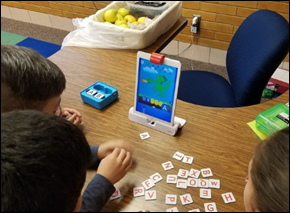
125x125_2nd_Circle

News 11/21/18

November 20, 2018 News 2 Comments

Top News

image

The VA is talking with Apple about connecting IPhone-using veterans to their EHR information, The Wall Street Journal reports.

The program was conceived by top VA officials who worked with President Trump’s so-called “Mar-a-Lago group” of campaign supporters who were later accused of meddling in VA affairs.

Android-using veterans will be out of luck, just like the 40 percent of patients who are seen by health systems that launch an IPhone-only records-sharing project.


Reader Comments

SNAGHTML24d1d5ea

From No Mas: “Re: University of Toledo. Any response back on the progress of their partnership with Athenahealth to develop an inpatient EHR for UTMC?” University of Toledo Medical Center CMIO Bryan Hinch, MD did not respond. It might be best if the project stumbled early since it probably won’t be a priority of Athenahealth’s new private equity owners.

From 98765: “Re: Cerner’s MIPS module. We spend a significant amount of our time assisting clients with MIPS. Every single Cerner client we’ve assisted has informed us that Cerner has no MIPS module. Cerner is apparently makes clients request custom reports if they want their MIPS information, with the ability to submit via their registry.” Unverified. I’m wary of users stating that a vendor is missing capabilities since they often just aren’t aware of it. Cerner users, feel free to weigh in.

image

From NashVegas: “Re: LifePoint. Layoffs Monday, including some heavy-hitting executives.” Unverified, but that would not surprise me – LifePoint Health just completed its merger with RCCH HealthCare Partners, approved by LifePoint’s shareholders in October. Shareholders also rejected a proposed $120 million golden parachute for LifePoint’s top four executives. The company had already announced that Chairman and CEO William Carpenter would retire after the merger, replaced as CEO by COO David Dill. Most of the RCCH executives weren’t listed in the new executive org chart. The company’s performance makes it a given that well-coiffed heads will roll.

From Retired Number: “Re: CHIME Speakers Bureau. Says you have to be actively employed as a healthcare CIO. Several of those listed do not qualify.” Quite a few folks on the list don’t meet that qualification (including CHIME President and CEO Russ Branzell, who obviously doesn’t still work as a health system CIO). I count two retired CIOs, two CMIOs, three consulting firm employees, and a CISO, looking only at the job titles listed on the CHIME page.


HIStalk Announcements and Requests

I suspect that Thanksgiving-proximate readership, as well as health IT news, will be sparse, so we will take a holiday break. I’ll probably return to the nasal grindstone with the Monday Morning Update. Travel, eat, and shop safely, especially you radiology folks who have been convinced to illogically leave your families and postprandial warmth to head off for freezing Chicago and RSNA (as a health IT pundit, my crystal ball tells me you’ll hear the term “AI” a time or two).


Webinars

December 5 (Wednesday) 1 ET. “Tapping Into the Potential of Natural Language Processing in Healthcare.” Sponsor: Health Catalyst. Presenters: Wendy Chapman, PhD, chair of the department of biomedical informatics, University of Utah School of Medicine; Mike Dow, senior director of product development, Health Catalyst. This webinar will provide an NLP primer, sharing principle-driven stories so you can get going with NLP whether you are just beginning or considering processes, tools, or how to build support with key leadership. Dr. Chapman’s teams have demonstrated phenotyping for precision medicine, quality improvement, and decision support, while Mr. Dow’s group helps organizations realize statistical insight by incorporating text notes along with discrete data analysis. Join us to better understand the potential of NLP through existing applications, the challenges of making NLP a real and scalable solution, and the concrete actions you can take to use NLP for the good of your organization.

December 6 (Thursday) 11 ET. “Make the Most of Azure DevOps in Healthcare.” Sponsora few organizations across the country are demonstrating success using advanced technology tied to intuitive processes and procedures.: CitiusTech. Presenter: Harshal Sawant, practice lead for DevOps and mobile, CitiusTech. Enterprise IT teams are moving from large-scale, project-based system implementations to a continuously evolving and collaborative process that includes both development and business teams. This webinar will review healthcare DevOps trends and customer stories, describe key factors in implementing a DevOps practice, describe how to assess Azure DevOps, and lay out the steps needed to create an Azure DevOps execution plan.

Previous webinars are on our YouTube channel. Contact Lorre for information.


Acquisitions, Funding, Business, and Stock

image

The still-unnamed Amazon-and-others health venture hires an analytics and quality improvement officer from BCBS Massachusetts. Dana Safran, ScD will hold the title of head of measurement.

image image

The Wall Street Journal says insurer Humana and Walgreens are discussing taking equity in each other’s companies.

Healthcare cloud vendor ClearData raises $26 million.


Sales

  • Curahealth Hospitals (TX) chooses Evident Thrive EHR.

Announcements and Implementations

image

MModal announces a cloud-based version of its Fluency for Imaging radiology reporting solution.

The AI-powered algorithm of Cardiologs performed better than a traditional algorithm in identifying EKG abnormalities in ED patients, a study finds. 

image

Nicklaus Children’s Hospital (FL) goes live on an IOS-only mobile image collaboration platform powered by Dicom Systems and WinguMD.

ECRI Institute launches ECRI Guidelines Trust, a replacement for AHRQ’s ECRI-managed National Guideline Clearinghouse website that was taken offline on July due to HHS budget cuts.


Government and Politics

A doctor is charged with prescribing medications for patients he had not examined, writing prescriptions on pre-printed pads provided by telemedicine companies that orchestrated a compounding pharmacy scheme that cost insurers $20 million. Hopefully the Nigerian-trained doctor’s “Leader in Medicine” award from a scammy awards company won’t be compromised so he can realize his goal to “improve and evolve his practice,” which sounds like a good idea.


Other

image

In England, a doctor apologizes for ordering a tenfold morphine overdose for an 81-year-old woman who died afterward of pneumonia. The patient was transferred to the hospital from an infirmary without paperwork, so the doctor had to look up each of her meds on the computer to order them for her. He typed in a partial name without noticing that the intended 20 mg dose of sustained action morphine was actually being entered as 200 mg and the pharmacy dispensed the completed order without question.  The doctor has quit working for the hospital trust, saying that it doesn’t allow doctors to use the systems with which they could audit their own clinical work.

image

Weird News Andy says this is a terrible way to lose a Thanksgiving dinner. A North Carolina man’s family lost their chance to gobble the holiday meal he was preparing last year when his always-draining nose contributed an unwanted ingredient. Various doctors who had diagnosed him with allergies, pneumonia, and bronchitis turned out to be wrong – he had a cerebrospinal fluid leak that was repaired via surgery. A doctor offers a smart diagnostic idea – test clear rhinorrhea with a glucose test strip since cerebrospinal fluid contains glucose but nasal discharge does not. 


Sponsor Updates

clip_image001

  • Attendees at Bluetree’s fifth Annual Brinner Fundraiser donate 387 pounds of food for the Badger Prairie Needs Network.
  • Datica will sponsor AWS re:Invent 2018 November 26-30 in Las Vegas.
  • Elsevier will exhibit at RSNA November 25-30 in Chicago.
  • Cedar County Memorial Hospital (MO) completes its Meditech Expanse implementation, assisted by Engage.
  • Glytec congratulates customer Mission Health (NC) on being recognized on IBM Watson Health’s list of top 50 cardiovascular hospitals for 2019.

Blog Posts


button


Contacts

Mr. H, Lorre, Jenn, Dr. Jayne.
Get HIStalk updates. Send news or rumors.
Contact us.
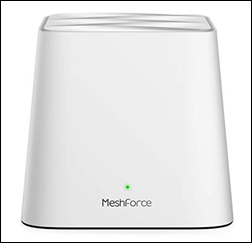
125x125_2nd_Circle

Readers Write: Our Experience with Epic’s App Orchard

November 19, 2018 Readers Write 2 Comments

Our Experience with Epic’s App Orchard
By Chinmay Singh

Chinmay Singh, MBA, MSE is co-founder and CEO of SimplifiMed of San Francisco, CA.

image

SimplifiMed went live last month on App Orchard after several months of work. I believe other startups can benefit from our experience as they pursue integration with Epic.

We integrated with many other EHRs before Epic, including Athenahealth, Centricity, and Drchrono. As I review my experience, there may be a whiff of unavoidable comparison.

1. Epic is the most customer-focused EHR vendor

This became clear to me in my first call with Epic’s App Orchard team. I could vividly imagine a customer in the center of anything App Orchard team discussed — workflow, security, or marketing message. For this reason, I would recommend that startups first integrate with other EHRs, learn from that, and then approach Epic.

2. The App Orchard team knows the customer

Your contact at App Orchard is unlikely to be a mere project manager. He or she will be an active participant and will gently prod and challenge you on your workflows and the selection of APIs. If you don’t have an active Epic customer, this is one of the best resources you have to compensate for the lack of information. Use it.

3. Epic listens to App Orchard members

We all have heard about a certain recalcitrant Midwest company. I was surprised at how receptive the App Orchard team was to my suggestions on the program, pricing, and terms. They listened to my concerns and responded to them in a timely fashion, and I assume that the new program terms were partially influenced by the feedback I provided to them. Reach out to them with your feedback.

4. App Orchard documentation is lacking

The API documentation is very basic, and in some cases, unusable. For example, there is no explanation of the different versions of the same APIs. Or that two different APIs appear to be doing the same thing (they are not) without a good explanation. The advice in #1 and #2 above partially compensates for this. If Epic team needs some inspiration, they should look at Athenahealth’s developer suite. Not only does Athenahealth have more robust documentation, all of their APIs can be tried in the sandbox.

5. No Hyperspace

This is the biggest issue with App Orchard. Without access to Hyperspace, it is difficult to test the product. Moreover, Epic periodically resets the back end, forcing you to re-create your test cases. This is a huge time sink. As we are experiencing now, prospects want to see a demo of SimplifiMed working with Epic. But without access to an Epic instance, we are unable to do so. I would love to hear from other App Orchard partners on how they are overcoming this problem.

Curbside Consult with Dr. Jayne 11/19/18

November 19, 2018 Dr. Jayne 2 Comments

image 

Thanksgiving is upon us, a quintessential US holiday. A friend sent me some seasonally appropriate ICD codes, including the W61.43 category “Pecked by Turkey” and W60 “Contact with Sharp Leaves.” There’s also Z63.1 “Problems in Relationship with In-Laws” for those of you with challenging holiday kinship arrangements.

All kidding aside, in some areas, Thanksgiving marks the beginning of increased healthcare utilization, which stresses the system in a variety of ways. People who have reached their deductibles for the year may be trying to schedule elective procedures at the same time providers and staff are trying to take time off with their families. There tends to be a bit of overeating in the US, which can lead to an increase in gallbladder disease, gout attacks, and elevated blood sugars. Family and personal stress levels increase. Just when things start to settle down, influenza and other viral illnesses will begin to peak.

Just in time for the holiday magic, the United States Preventive Services Task Force released a final recommendation statement regarding screening for unhealthy alcohol use in adolescents and adults. Adults 18 and over should be screened in the primary care setting and in addition to screening and practices should also be providing brief behavioral health counseling interventions to reduce unhealthy alcohol use. However, current information is insufficient to recommend screening in adolescents aged 12 to 17. EHR vendors, get ready to update your clinical guidelines packages.

To further dampen our holiday spirits, the Department of Health and Human Services has released its new Physical Activity Guidelines for Adults that emphasize the fact that roughly 80 percent of US adults and adolescents are not sufficiently active. HHS recommends that adults complete at least 150-300 minutes of moderate intensity activity each week, or 75-150 minutes of vigorous intensity activity each week. We should also be doing muscle-strengthening activities twice weekly. There are other specific recommendations for older adults and pregnant / postpartum women. The bottom line is “sit less, move more,” and even if you’re already moving, you’re probably not moving enough.

As we move toward the end of the calendar year, the healthcare IT space is in the doldrums, with vendors marking time until HIMSS, when they’ll try to make a big splash (among the dozens of other vendors trying to do the same thing) with various product releases and enhancements. The user group season is winding down with hospitals and health systems having exhausted their travel budgets for the year. Even those facilities that have cash to spend might be waiting until the beginning of the calendar year to start dispersing it unless they’ve aligned their fiscal years to the federal calendar and their year started in October. Nothing big usually happens between now and HIMSS unless it’s scandalous or completely revolutionary and unexpected.

It’s a good time to reflect on the year that has been and to think about what we might like to accomplish in the year ahead. I’m encouraging my team to think about their priorities, both professional and personal. Are there new skills that they’d like to learn, or a different area of the healthcare IT world in which they’d like to be more knowledgeable? Are they satisfied with their work-life balance and travel schedule, or do they want opportunities to slow down (or speed up?)

I work with several people who have recently become relatively empty nesters and they’re interested in potentially picking up extra work opportunities to fund things like retirement catch-up savings or creating college savings accounts for grandchildren. I had incorrectly assumed they were interested in slowing down, and without a structured conversation about priorities, I might have missed out on extra capacity with some outstanding resources. Another member of my team will be leaving at the beginning of summer, having decided to purse a public health masters’ program. Sometimes these goals align across personal and professional domains and sometimes they’re at cross purposes, but I appreciate the opportunity to try to help people meet their goals.

I have several good friends who have had it pretty rough this year with layoffs, family illness, natural disasters, and other unexpected surprises. I’m continually impressed by their resilience and their ability to look at the world through a glass-half-full lens (even if it is occasionally tinted with a hint of desperation). It helps put things in perspective and reminds me of how important it is to support the people around you from an emotional standpoint. It has taught me that time is short and success can be fleeting. I’ve made it a point to schedule quarterly meetings with friends and colleagues I had previously lost touch with, even if it’s to meet to walk a couple of miles at the park during a child’s soccer practice rather than sip wine as we might have liked to do in the past. If we don’t make those relationships a priority, it’s too easy to lose touch.

I’d like to challenge our readers to make a list of things they’d like to do in the coming year that will bring them either closer to friends and family or to help them explore a part of themselves that they’ve allowed to be put by the wayside. Maybe it’s a larger commitment such as a new hobby, or maybe it’s something as small as taking yourself to a local museum. I’d love to hear from readers about what they find satisfying and what they’d like to accomplish in the coming year. In the meantime, I’m going to try to find my pre-Thanksgiving bliss with some pastry therapy. Caramel apple pecan pie, in case you’re curious.

comments_button

Email Dr. Jayne.

Monday Morning Update 11/19/18

November 18, 2018 News 4 Comments

Top News

image

Business Insider lists “The 25 Most Valuable US Startups that Failed This Year,” including these health technology companies and the amounts they raised:

  • Paieon (medical imaging, $34 million)
  • Candescent Health (radiology software, $94 million)
  • Medical Simulation (training, $55 million)
  • Theranos (lab testing, $910 million)

Reader Comments

image

From HCInvestor: “Re: Seeking Alpha article on Cerner. Quality of reporting to guide investors is very poor outside of the industry. It’s as if the author hasn’t looked at Cerner’s financial statements or leadership challenges.” I would question quite a few of the statements by the UAE-based research analyst, some of which are so wooden and uninformed that it’s like a computer generated them from financial reports or web pages:

  • I’m not so sure that healthcare IT has “a massive potential to grow,” at least as compared to the boom years of Meaningful Use. CERN shares have been stuck in an up-and-down trading range since early 2015 after years of nearly straight-line growth, and over the past five years, CERN shares are unchanged vs. the Nasdaq’s 82 percent rise. 
  • I don’t understand why Medicare Advantage gives Cerner a competitive edge.
  • The comparison to McKesson makes no sense since the company is mostly out of health IT other than its stake in Change Healthcare
  • The author mentions the DoD contract (in which Cerner is a subcontractor) but fails to mention the larger VA contract (in which Cerner is the prime contractor and thus will pocket a ton more taxpayer cash). The conclusion is cartoonishly oversimplified: “This contract will help build the company’s credibility further, which would pave the way for Cerner to acquire new business.”
  • Cerner, he says, has a “management with a proven track record of delivering growth” even though Chairman and CEO Brent Shafer has been on the job less than a year (and in his first CEO job) and President Zane Burke resigned earlier this month and his position was eliminated.
  • Here’s a bizarre statement: “A single malfunction of their systems would be enough to wipe Cerner off the healthcare IT industry forever,” with the author apparently unaware that such malfunctions happen with every vendor and Cerner in particular was associated (albeit in a poorly researched study) with increased patient mortality at a children’s hospital, which despite headlines had no discernible impact on the company’s growth.
  • The author claims that despite his proclaimed Cerner “moat” and barrier to entry due to long development cycles, the entry of large-scale competitors could drive down profit margins. Which is it?

image

From Bam Margarita: “Re: innovator awards. Pay for play?” Healthcare Informatics flags as breaking news its invitation to vendors to apply for its Innovator Awards winner for a $1,999 submission fee, after which I assume advertising persuasion is then exerted to the “winners” to publicize their “accomplishment.” The magazine’s pitch page humbly accepts its own nomination to facilitate “meaningful conversations” between providers and vendors (in other words, sell ads). I don’t fault anything they do – it seems like quite a few health IT publications and websites have hit hard times and are scrambling to pivot into conferences or running sponsored “news,” which I suspect has created the now-common journalism death spiral as readers find even less motivation to return. Healthcare Informatics was just sold, with the new owner seeming to be most interest in its conferences.

From Cold Gin: “Re: updates. I would like to see you tweet out more frequent HIStalk updates as news develops.” People get crazy stressed out from constantly staring at their glowing screens for political, stock market, and sports updates even as they become oblivious to the real life that is unfolding around them. Sites that provide that information are thrilled that users think such manic behavior is not only normal, but necessary, because the frantic eyeballs earn them advertising dollars even though the nail-biting vigil has zero impact on the outcome. Bottom line: only rarely are health IT events so newsworthy that I would break into your day to relay them. Meanwhile, my thrice-weekly news schedule is nearly perfect for getting the signal without much of the noise.

From Kenyan Jambo: “Re: Allscripts Avenel EHR. What happens at HIMSS19 when a product launched with great fanfare at HIMSS18 hasn’t been heard of since?” In a perfect world, the hope for short memories will be dashed, after which embarrassment ensues. Developing a new product and giving it a high-profile launch is perfectly fine, but the months of radio silence that followed suggests that the public celebration and vendor executive high-fiving was premature.

From Agent Orange: “Re: speech recognition. What’s an easy way to dictate documents without cost or system overhead?” Open a Google Docs document, click Tools / Voice Typing (or Ctrl-Shift-S), click the microphone icon and answer any microphone permission messages, and then simply speak away. Accuracy is good even with only a webcam microphone, system impact is minimal, and cost is zero. Just copy and paste your completed text into whatever app you want. You can also dictate directly into Word, which I often forget about since I basically never use Word.


HIStalk Announcements and Requests

image

Poll respondents say EHR vendors and the government are the dirty old dastards who made EHRs unfriendly.

  • Dean Sittig thinks that while everyone is complicit, EHR vendors didn’t do a great job of operationalizing requirements or constraints.
  • Evan Steele says vendors are forced to make guns-or-butter decisions in either cramming in RFP-sweetening functionality (some of it via the government’s prescriptive requirements) vs. addressing usability.
  • EHR Girl wishes physicians had not taken a hands-off approach when vendors were trying to computerize the medical record in the early 2000s and that the federal government hadn’t trotted out the HITECH carrot without first assessing the state of the EHR market that stood to benefit hugely.
  • Frank Poggio says clinicians are most responsible because all of the vendors have them on staff, also adding that the chestnut that EHRs were built as a by-product of billing isn’t true since Cerner and Epic didn’t even have billing systems until long after they had rolled out clinical systems.
  • Ross Martin takes the long view in blaming World War II, after which the US ended up with employer-based health insurance that begat third-party payers, then Meaningful Use which increased adoption of systems that weren’t focused on patients and users.
  • Industry Stalwart blames insurance companies (of which he or she includes CMS), but also notes that doctors could have opted out of HITECH and accepting insurance, but otherwise have to obey the wishes of outsiders who send them checks.
  • Cosmos works for a vendor that spends half its nursing development team’s time addressing regulatory requirements and the other half dealing with patient safety events and customer escalations, with usability always taking the back seat. He or she also ponders whether the government’s regulation of healthcare threatens competition in favor of what they see as patient safety benefits.

image

New poll to your right or here, as requested by a reader but modified a bit by me: What was your reaction to Black Book’s survey naming Allscripts the #1 integrated EHR/PM? (my post on Black Book’s methodology provides more information). I’m sure the reader who asked for this poll would also like to hear your thoughts, which you can provide after voting by clicking the poll’s “comments” link.

UPDATE: poll cheating has the #1 option (Allscripts as the best EHR/PM makes sense) as the biggest vote-getter. This is pretty obvious:

  • Voting was far heavier than normal, with several votes per minute making it clear that scripting was being used to stuff the ballot box.
  • 170 of the 274 votes that were cast shortly after I wrote this post (more than 60 percent of the total) came from someone hiding their identity and location via the Tor browser. Every one of those votes chose the #1 option.
  • A bunch of votes came from foreign IP addresses, and every single one of those also chose the #1 option.
  • Just about all of the legitimate-looking votes said it’s fishy that Allscripts did so well in the Black Book survey, while none of the suspicious ones did so.

It’s fun and ironic than most of the genuine respondents are skeptical of Black Book’s poll results (most of them wondering whether Allscripts influenced the outcome), and now someone is trying to support that Black Book poll result by cheating on my poll. I think we can assume that all online polls or surveys that aren’t locked down to a validated identity are likely to be gamed by someone who benefits from a particular result.

image

UPDATE 2: I turned off poll voting since the bot-driven cheating is continuing. The results excluding those votes are above. Infer what you will that the “Allscripts being ranked #1 makes sense” option gets 67 percent of the vote when you include the obviously fake voters, but just 9 percent with those omitted. Your “false flag” conspiracy theories are welcome.

image

LinkedIn profile padders and social media aficionados beware: a lot of people roll their eyes when you anoint yourself with non-quantifiable honorifics whose purpose seems to be to deflect from a lack of accomplishment. Poll respondents are OK with innovator, keynote speaker, and entrepreneur since they are can at least be reviewed against career accomplishments. Demo Chic says she’s tired of social media influencers and ambassadors who have nothing better to do while the rest of us are trying to get work done. Being Real says if you really are an influencer or thought leader, you wouldn’t need to broadcast it. Title Smitle believes that the idea of social media ambassadors is a “load of BS” consisting of un-unsightful tweets and “a preponderance of selfies.”

Listening: the new EP from the upcoming 10th album of Papa Roach, which reminds me only slightly of their angrier, earlier nu metal with more of a 21 Pilots sort of intimate, melodic rhyming. I like it. I’m also marveling at live Skillet, drawn in fascination to one of rock’s best and most joyously dynamic drummers in Jen Ledger.  And while I loathe holiday-themed albums (I always picture uninspired, drugged-out rockers who are bound by record company contracts to stumble unconvincingly through ancient, lame Christmas songs in a June LA recording session) Sia’s “Everday [sic] is Christmas” is stellar, barely recognizable as Christmas music because it’s all new songs that you could play year around. She is brilliant.

Jenn has to miss HIMSS19 due to fun family events, so that leaves Lorre to cover our booth solo for three long days with no chance to scurry quickly away for intake and output. Let her know if you would like to stand in for a few minutes or an hour, posing with visitors anxious to take a picture with The Smokin’ Doc or representing me without doing something scandalous (or if it is scandalous, at least making sure it’s fun, yet not legally actionable). I’m also up for hearing about things we might do in our tiny booth that would be fun since we don’t have anything to sell or do except say hello to puzzled passersby.


Webinars

December 6 (Thursday) 11 ET. “Make the Most of Azure DevOps in Healthcare.” Sponsor: CitiusTech. Presenter: Harshal Sawant, practice lead for DevOps and mobile, CitiusTech. Enterprise IT teams are moving from large-scale, project-based system implementations to a continuously evolving and collaborative process that includes both development and business teams. This webinar will review healthcare DevOps trends and customer stories, describe key factors in implementing a DevOps practice, describe how to assess Azure DevOps, and lay out the steps needed to create an Azure DevOps execution plan.

Previous webinars are on our YouTube channel. Contact Lorre for information.


Acquisitions, Funding, Business, and Stock

image

I missed this item previously. VC-backed, Philadelphia-based health cloud vendor CloudMine files for Chapter 7 bankruptcy after defaulting on a $1.8 million bank loan and laying off its 11 remaining employees. The company had raised $16.5 million, most recently in an undersubscribed Series A round in early 2017.  Companies that built applications using CloudMine’s platform were warned that it would be shut down with data deleted per HIPAA requirements.

image

Industry long-timer and neurosurgeon Gopal Chopra, MBBS, MBA launches healthcare AI company Imperativ.


Sales

  • Australia’s Perth Children’s Hospital selects Vocera Collaboration Suite.
  • Signature Healthcare (MA) chooses Santa Rosa Consulting to lead its upgrade to Meditech Expanse and implementation at its multi-specialty physician group.

Decisions

  • Franklin County Medical Center (ID) replaced Evident with Athenahealth in October 2018.
  • Pana Community Hospital (IL) will switch from Allscripts to Cerner in 2019.
  • San Juan Regional Medical Center (NM) will implement Workday for financial management software in July 2019, replacing Meditech.

These provider-reported updates are supplied by Definitive Healthcare, which offers a free trial of its powerful intelligence on hospitals, physicians, and healthcare providers.


People

image image

DocuTAP hires Ron Curtis (Cardlytics) as SVP of product and Kerri Tietgen (KT Consulting) as EVP of people and culture.


Announcements and Implementations

Research network provider TriNetX adds ambulatory care, medical claims, and pharmacy claims from 190 million patients to its network. It also adds propensity score matching to address potential cohort bias.

Catholic Health Initiatives and Dignity Health name their merger-created organization CommonSpirit Health, with the press release brimming with the usual marketing mumbo-jumbo explaining the “positive resonance” that the made-up word (called “one powerful word” despite the fact it’s two words with a trendily omitted space) will create in unifying every single person who is involved in the sprawling endeavor. There’s something unsettling about a ministry preaching the prosperity gospel in “serving the common good” while simultaneously bragging about annual revenue of $28 billion.

image

Ciox Health announces HealthSource Vault, a member-centric data repository that creates a longitudinal patient record from medical records, health assessments, clinical data feeds, and other information sources using OCR and NLP extraction.

CommonWell announces GA of its connection to Carequality two years after the organizations announced a connectivity agreement in December 2016.


Privacy and Security

image

Japan’s newly appointed minister of cybersecurity admits to Parliament that he has never actually used a computer because “I order my employees or secretaries to do it.” He’s also in charge of the 2020 Tokyo Olympics.


Other

The former CTO of Cleveland Clinic spinoff Interactive Visual Health Records, which offered a system that presented a physician-friendly view of Epic data (the company appears to be defunct), pleads guilty to defrauding the Clinic of $2.7 million by skimming payments made to a foreign company. He agreed to being deported following sentencing. The former CEO of Cleveland Clinic Innovations, who prosecutors said was involved in the scheme, was sentenced to federal prison for fraud last year.

Two China-based Google AI researchers return to Stanford University’s medical school to work on healthcare projects.

HIMSS Media says that providing expert news and analysis isn’t really important since “decision-based content” is what drives vendor sales leads and thus pays the bills. The guy who runs the HIMSS media lab explains that “we provide deeper insight for HIT vendors seeking sales prospects” and that he “specializes in the neuroscience of HIT buyers.” In other words, it’s all about ads posing as news and collecting reader information for advertisers, which is in itself hardly news to anyone. Healthcare really pushes the boundaries of “non-profit.”

Daily Mail provides some gruesome photos and videos to show the sad results of fame-hungry teens taking the “Fire Challenge” that involves pouring flammable liquid on themselves and then igniting it while recording on video. It’s not technology’s crowning achievement that kids who are the age of those who died on Normandy’s beaches are now seeking their place in history by eating Tide Pods.

image

Local TV covers how AnMed Health Medical Center (SC) honors veterans who die in the hospital. The hospital announces their passing (with the family’s permission) along with their name and rank, their body is covered with the American flag and escorted to a hearse by available doctors and nurses, and employees line up with hands over hearts to honor the deceased.


Sponsor Updates

image

  • PatientSafe Solutions employees in San Diego relocate to larger office space.
  • Meditech releases a new video, “How the Meditech mobile app transformed home care for Kalispell Regional.”
  • PatientPing moves to expanded office space in Boston.
  • PreparedHealth wins several awards at the inaugural Matter Accenture Digital Health & Life Sciences Pitch Competition.
  • Philips Wellcentive publishes a new white paper, “Embracing Disruption.”
  • Access releases version 8.17 of its Passport web-based electronic forms hospital solution.
  • ZappRx founder and CEO Zoe Barry joins the Life Sciences Cares Board of Advisors.

Blog Posts


button


Contacts

Mr. H, Lorre, Jenn, Dr. Jayne.
Get HIStalk updates. Send news or rumors.
Contact us.

125x125_2nd_Circle

Weekender 11/16/18

November 16, 2018 Weekender 1 Comment

weekender


Weekly News Recap

  • The VA tells a House EHR subcommittee that it will need to spend an extra $350 million on top of its $16 billion Cerner budget to hire “subject matter experts to grade the implementation efforts of Cerner”
  • HHS OCR issues an RFI to solicit the public’s views on whether HIPAA rules prevent or discourage providers, payers, and patients from sharing information for care coordination and case management
  • App vendor Driver, whose technology matches cancer patients with clinical trials, runs out of cash and shuts down just two months after its high-profile launch
  • Veritas Capital and Elliott Management subsidiary Evergreen Coast Capital announced their deal to acquire Athenahealth for $5.7 billion
  • Allscripts rebrands its Payer & Life Sciences Division to Veradigm, offering clinical workflow, research, and analytics software and services to providers, payers, and health IT and life sciences companies
  • Alphabet will move its London-based DeepMind healthcare AI subsidiary under the newly formed Google Health, which will be led by former Geisinger CEO David Feinberg

Best Reader Comments

From my own personal experiences being around and using Allscripts products again NONE of their products are remotely close to being seamlessly, fully integrated … With a dwindling client base, very little new sales in US or abroad it is hard to believe anything about this survey and the process used. (DrJay)

The fear for us as a vendor is that when clients are blindly encouraged to take any external survey, there is then a mechanism for that client to overly complain (not recommend) and our total company satisfaction scores actually drop, not rise. Trust me when I confirm, vendors are not relied on for client participation! Obviously the reaction here is about Allscripts because they promoted this single, narrow focused award so much. Cerner, Epic GE, Athena, Meditech etc. all broadly receive many more Black Book awards every year but publicize them far less, or at least the reactions are tamer. (Longtime HIT Marketer)

Biggest winners [in Athenahealth’s sale to Veritas Capital] — eCW, Greenway, and small vendors willing to go after the long tail. Epic, Cerner, and Meditech in the IDN market. Biggest losers — Athena customers, Athena employees, Athena shareholders who don’t sell in the next six months, and Jonathan Bush’s legacy. (Pickin up the pieces)

I’m sure it’s heartwarming to Athenahealth customers that Immelt’s lead-in was “maximize shareholder value.” (sam lawrence)

Blockchain and bitcoin fever is over. Great! No more explaining what this is to executives and others who are worried we are missing the Blockchain Train! (CaveNerd)


Watercooler Talk Tidbits

SNAGHTML8d122b8 image

Readers funded the DonorsChoose teacher grant request of Ms. S in Ohio, who asked for a long list of “Rube Goldberg machines” for her fourth-grade gifted and talented class. She reports, “Students were given materials to create their own Goldberg. We started with the marble run and the Angry Birds LEGO set. Students had to explain why certain things would work. Then they were given different supplies and had to put the marble in the cup. My students loved the hands on aspect of this project and they learned a great deal. Thank you for your generous donation to our classroom!”

US exceptionalism of the negative kind is evidenced by schools offering “Stop the Bleed” training so that students can try to save their classmates who have been taken down by a mass shooter. It’s depressing to think of sixth graders screaming “medic” while pinned down by hostile fire like you see in a Vietnam war movie.

image

The ED of England’s Northwick Park Hospital pilots using smartphone-dispatched patient transporters (they call them “porters” there), replacing a two-page paper form (!!)

Mayo Clinic will rename its medical school after turnaround consulting firm founder Jay Alix., who has donated $200 million to make the school’s tuition more affordable and to allow it to build technology-focused programs that include artificial intelligence.

image

A Salt Lake City newspaper columnist draws heat for gleefully recounting the “night when I beat the system” by skipping out on an ED bill after being examined for an eye problem. She complains that she doesn’t make enough money to afford health insurance but makes too much to earn government subsidies, then describes how she realized that the ED’s computer downtime left them with nothing more than her name, so she and a friend “crouched and ran toward the exit” and hopped a cab home to avoid paying. She then concludes that it’s cheaper to pay out of pocket (she cluelessly assumes the ED bill was probably around $50, puzzling given that she graduated from the London School of Economics) and that “someone should do something about that.” Readers chimed in with fun comments, such as the fact that the real cost of an ED visit makes her a felon, that “cutesy-poo” writing doesn’t hide the fact that she’s a thief, and that she probably wouldn’t behave similarly at a restaurant.

image image

A woman who had just delivered a baby girl by C-section at Camp Fire-engulfed Adventist Health Feather River is immediately evacuated, after which the ambulance in which she is crammed in with other patients and several hospital clinicians catches fire. The hospital workers, including Tammy Ferguson, RN, who took the photos above, got everybody out and moved the patients to a nearby home, then grabbed garden hoses and shovels to successfully save the house and themselves.


In Case You Missed It


Get Involved


button


125x125_2nd_Circle

Black Book’s Vendor Report Methodology

November 15, 2018 News 7 Comments

image 

Readers asked how Black Book performs its survey-driven health IT vendor reports, apparently surprised that Allscripts finished in the #1 spot for integrated EHR/PM/RCM vendors.

Doug Brown is president and CEO of Black Book Market Research, LLC. He has a long background in hospital administration and a master’s degree in hospital and healthcare administration. He provided quite a bit of information and the full detail behind this particular report, responding nearly instantly to my email. He says the company received a dozen calls in one day about this report, which is just one of 140 it publishes each year.

My questions and Doug’s answers (paraphrased for conciseness by me except when in quotes) are below.

How do you choose the people you survey?

The company sends survey invitations – usually during the big conference season – to those who have volunteered. That includes 90,000 past participants; 330,000 website signups; contact lists obtained from membership groups, journal subscribers, conference attendees; and for private physician practices, contact information from third-party lists. Participants are required to provide a verified company email address for validation.

Are vendors involved, either in providing a client list or publicizing the survey?

Never, Doug says, and he invites anyone to ask any highly-ranked vendors if they’ve ever been in contact with Black Book. Black Book discourages vendor and public relations company involvement and doesn’t communicate with them as surveys are underway (and doesn’t ask them for client lists). He also adds that plenty of vendors publicize their #1 rankings without even buying the detailed report, which he says is just fine.

Black Book can’t restrict vendors from suggesting that their clients complete surveys, but it discourages the practice.

Do you have a sample questionnaire?

The company provided its standard list of 18 KPIs for software or services, which have remain unchanged since they were developed in 2010 with help from academics with relevant software and services experience. It may explain a given item differently based on the audience, such as an infection control nurse vs. a business office manager.

In the 18 principles under “support and customer care,” it is stated that “External analysts, press/media and other clients reference this vendor as a services leader and top vendor correctly.” Does that mean customers provide a response, or that this element isn’t provided by customers?

“The content under the 18 key performance indicators is meant to only be a guide and are modified occasionally to suggest ways that that KPI can be interpreted. For instance, if the analysts or other clients are highly satisfied in terms of support and customer care, so may you. They are suggestive ways to consider the KPI theme – such as reliability or trust. Our goal was to find aspects of the client experience that a prospective buyer could not find in vendor RFP responses or get from tainted vendor-provided client reference calls. We aim to find the user level experience from a wide response pool perceptions, -not the input of a couple dozen financial decision makers or CIOs on advisory boards.”

Was additional information used for the report on integrated ambulatory systems?

“After we are in the audit stages, we often go back to the survey respondents with some additional questions on trends and strategies to give the vendor results some additional color. You will find that in the report before the vendor rankings (much is in the press release) and feel free to share that info.”


SNAGHTML885f52d

The survey responses are reviewed immediately by both internal and external auditors for completeness, accuracy, and respondent validity. Responses from at least 10 unique clients are required to be named in the top 10. Sample sizes that fall below required limits are asterisked.

Overall vendor rank is based on the mean score of the 18 criteria. Each company’s rank in each of the 18 criteria is provided as well.

Some categories had interesting responses of the “wonder what they were thinking here?” types. You’ll have to obtain the full report for details, but I’m flabbergasted that four companies that finished well in the “viability and competent financial management and leadership” category either replaced top executives or sold themselves recently; the top finisher in data security was the only company to have gone offline due to a ransomware attack; and Epic failed to crack the top 10 in surprising categories, finishing behind some questionable players.

However, these are the responses of customers, so their impressions and willingness to remain customers is what counts most.

image

Here’s a sample category result. I removed the vendor information since that’s in the report that Black Book sells (and that they sent me).

Note that this particular survey really didn’t address EHR functionality, just the practice management capability of EHR-integrated systems. Also, it does not appear that vendors selling multiple product lines (Allscripts would top this category, as well) have their individual products broken out, so mixing Practice Fusion with TouchWorks may not yield a sound product-specific result.

Another potentially weak point is one that KLAS struggles with – can a given respondent answer all the questions accurately, such as IT people scoring training or a nurse opining on security?

I’m interested in your opinions.


button

EPtalk by Dr. Jayne 11/15/18

November 15, 2018 Dr. Jayne Comments Off on EPtalk by Dr. Jayne 11/15/18

clip_image002

I’m always on the lookout for interesting startups and young vendors and have been following Diasyst for a while. Looks like they’re hitting their stride as Piedmont Healthcare plans to implement their solution in both diabetes specialty and primary care clinics along with independent Piedmont-affiliated practices and the residency programs at Piedmont Columbus Regional.

Diasyst uses a patient-facing app to gather blood glucose readings and other information, then analyzes the data against best practices and current clinical guidelines. Clinicians can use an intuitive dashboard to make adjustments to patient treatment regimens and communicate those treatment plans directly to the patients, who can review them and indicate acceptance.

I had a chance to see a demo a while ago. The screens are intuitive and the data is backed by research collaboration with institutions like Emory University, Georgia Tech, Grady Memorial Hospital, and the Atlanta VA Medical Center. It’s a great way for physicians to leverage other members of the care team in managing diabetes. I also like that they’re not just engaging with physicians – they’re looking to work with employer-based clinics and payers as well.

clip_image004

Although Mr. H and Jenn have weighed in on the Athenahealth acquisition, I haven’t had a chance to put in my two cents. I agree with the sentiment that it seems like the end of an era, especially since the company has been highly visible in its campaigns for disruption, although at times it feels like they were leading what surely had to be a bubble.

It’s definitely causing some anxiety for clients. I had drinks with my favorite OB this week and they just switched to Athenahealth after some disastrous interactions with a previous vendor. They were hoping for stability, but now feel uncertain about what the changes might mean. Athenahealth has been doing a nice job transitioning from the “more disruption please” era to continue looking at important factors, such as physician burnout.

They just released some new data from their research that showed that physicians feel well supported when they have effective communication and strong communication. Isolation is a predictor of burnout and is exacerbated by administrative burdens, time pressure, and limited referral options.

As industry watchers, we miss Jonathan Bush and his antics (wrestling at MGMA and HIStalkapalooza at the New Orleans Rock’n’Bowl are two of my favorite memories), but seeing what happens next will surely hold our interest.

Back to the story of the demise of my OB colleague’s relationship with her EHR vendor. They had been in negotiations for some time around some serious customer service and financial issues. The discussions stalled and the vendor issued an ultimatum that sounded like it was going to block access to their charts, leading to the decision to make a hasty switch. They’re still sorting through some data migration issues, but are at least up and running.

I’ve seen the emails and notices from the vendor and the best way I can describe them is a cross between a high-pressure timeshare pitch and a blackmail letter, with a side note of pleading. Several emails conflicted each other and different company reps threatened different termination dates and processes while begging them to stay. I was embarrassed for our industry as I read them. We can do better, folks.

clip_image006

Speaking of doing better, NextGen Healthcare hosted its annual User Group Meeting in Nashville this week with the theme “Better Never Stops.” A reader shared this photo of CEO Rusty Frantz on the dance floor.

clip_image008

I always joke that some year I’d like to hit the EHR vendor user group circuit, attending all the major get-togethers as part of a road trip to end all road trips. The budget for that adventure is beyond my reach, but I was more than happy to attend a regional summit hosted by Slalom in St. Louis along with partners AWS, Salesforce, and Tableau. For those of you who haven’t had the pleasure of visiting that Midwest city, you’re missing out on a delightful intersection of barbecue, hot chicken, and Italian food (including something called a toasted ravioli, which is a wonder by itself). Crashing with a med school colleague definitely left more room in the budget for culinary delights, along with the fact that the registration fee for the meeting was a requested donation to the United Way.

It was a different kind of conference, focused on the goal of “reimagining healthcare for the local community” with afternoon breakout sessions where participants worked together to design solutions to problems like price transparency, managing complex care, and battling healthcare inequality. I enjoyed the hands-on approach and hearing directly from people in the trenches rather than being a passive listener. A white-board artist captured comments from a panel discussion as well as from keynote speaker Allison Massari, who spoke about an intense personal trauma and the value of compassion and connection as part of healthcare. My favorite quote was from a speaker who asked, “Is there a way to not essentially make the patient a victim in their own care?” Those are powerful words.

The Slalom team did an excellent job pulling everything together and facilitating the breakouts. I may have to start checking out more regional conferences, especially those in cities where I can find a sofa to sleep on.

clip_image010

At the conference, I also got to prep for HIMSS with some shoe watching. The AWS rep had snazzy trainers and company socks. One of the panelists had some seriously kicky boots, but I couldn’t figure out how to get a picture of them without being too obvious. I’ll have to practice my covert shoe capture skills before February rolls around.

One of my intrepid readers noticed that I didn’t make my usual mention of Veterans Day in Monday’s Curbside Consult. It wasn’t an intentional slight, but rather an issue with my writing timeline ahead of some other commitments, including celebrating a family milestone with my favorite veterans. Many of my physician co-workers trained in the military and their wealth of experience is an ongoing reflection of the years they dedicated to protecting our nation.

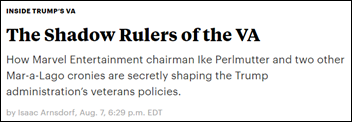
The one hundredth anniversary of the armistice ending WWI was an historic event, but also shows that history continues to repeat itself because the “war to end all wars” has been followed by conflict after conflict. I’m angry when I see people lacking respect for our veterans, but I am heartened by images such as this one of Cub Scouts presenting a wreath at the Tomb of the Unknowns in Arlington National Cemetery. For those who don’t recognize the yellow neckerchief, it means these girls are second graders. Thank you to our youngest generation and let’s hope they Never Forget. (Photo credit: National Capital Area Council, BSA)

comments_button

Email Dr. Jayne.

Text Ads


RECENT COMMENTS

  1. Re: Deliberately Faked Academic Papers in Nature See, this doesn't surprise me at all. Of course AI quotes these bogus…

  2. Challenger exploded on lift-off when the O-rings failed. Columbia disintegrated on reentry after one of the heat shield tiles were…

Founding Sponsors


Platinum Sponsors


Gold Sponsors


RSS Webinars

  • An error has occurred, which probably means the feed is down. Try again later.