Weekender 1/11/19

January 11, 2019 News Comments Off on Weekender 1/11/19

weekender


Weekly News Recap

  • Apple CEO Tim Cook tells CNBC that the company’s greatest contribution to mankind will be related to health.
  • CMS Administrator Seema Verma says its requirement that hospitals post raw CDM lists will encourage developers to create tools that consumers will find more useful.
  • IBM CEO Ginni Rometty says Watson Health is still a viable part of the company’s business and that Watson for Oncology is doing well.
  • England’s NHS issues a long-term plan that calls for technology to improve the ability of patients to manage their own health and to give clinicians access to patient records from any location.
  • Healthgrades acquires Influence Health.
  • Vatica Health acquires CareSync’s care coordination and chronic care management technology following a $1 million bid made last October.
  • The Senate confirms James Gfrerer as the VA’s assistant secretary of information and technology, its first permanent CIO in two years.
  • SVB Financial Group completes its acquisition of healthcare and life sciences investor Leerink Partners for $280 million in cash.

Best Reader Comments

Maj. Gen. Payne says “I want to give you a transparent review of where we are with MHS GENESIS” and then doesn’t. Unless maybe the author of the article left out parts like “it doesn’t work yet,” or “it failed its only assessment so far” or “it has zero interoperability with community providers.” It’s one thing to not see a train wreck coming, but another to have it wreck at your feet and disavow it. (Vaporware?)

Did everyone forget about the Tata case? I understand Epic (or any other vendor) wanting to protect their intellectual property. (UGM Attendee)

But this [health system selling Epic Community Connect that refuses to participate in an HIE] would not be the vendor. It’s the hospital itself that’s trying to absorb / acquire / whatever the neighboring clinicians. Epic has nothing to do with it other than being the hospital’s EHR. It’d be the same situation if it was Cerner I assume. My guess is the ONC will put out a proposal that tackles something that isn’t actually an issue. (Epic Complainer)

My patience and sympathy for gripes concerning no-shows is sharply limited. OK, yeah, it’s socially poor form and it has economic and medical consequences. Yet when those same providers are asked to explain, justify, or even quantify wait times, they cannot. Or will not. Or we receive a long list of excuses as to why the poor on-time performance of clinicians exists. With no solutions offered, not ever. Can anyone say they have not waited in a reception room, for an appointment that didn’t start on time? Often by an hour or more? (Brian Too)

Coach, is your HIE on any national plug & play network? I believe Carequality’s terms are share one, share all. (Ex-EDI)

The Allscripts 2bprecise product was built on NantHealth’s Geonomics product, which they obtained after investing $200 million into NantHealth, only to lose nearly all of it when that division failed and was the focal point of possible legal issues. Any word on how many sites implement and use this 2bprecise product / service? (Dr. JVan)

The screenshot issue is ironic. As I recall, around 2000, Epic settled (for millions $$) a lawsuit that IDX had filed against them which stated Epic had stolen screenshots and documents from the UW Medical foundation.(HISJunkie)

As for Epic moving into tangent markets for LTC, mental health, etc. it will be very interesting to see how they go about this. Develop or buy? Considering that there are many successful vendors that own these markets, they sure do not have the time to develop, so will they break down and buy? Secondly I think that the sales argument that the organization will want to buy from a single vendor will not carry as much weight as it did selling within the hospital. (HISJunkie)

Epic doesn’t have an IP leg to stand on for the screenshot restriction, but I believe they started putting this into their contracts a while back that the organization wouldn’t allow it from their employees, and it probably hits their “good install” metrics if they do. (DrM)


Watercooler Talk Tidbits

image image

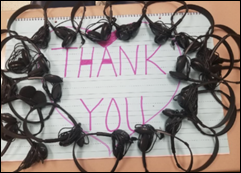
Reader donations funded the DonorsChoose teacher grant request of Ms. B, who asked for 30 sets of headphones for her second grade class. She reports, “When my class received our box of goodies, we opened it together and they were so happy to have new headphones. Our old headphones were taped or broken from the usage due to the prior years of teaching. We also had to borrow from other classrooms in order to have a class set. Through your donation, my students have an opportunity to build their educational skills in all areas of learning. Working during technology time as a whole has enhanced reading comprehension, math, and vocabulary development by providing them comfort as they work in their own personal space. Receiving their personal headsets has opened up a whole new world.”

Facebook employees liken their work environment to a cult, in which they are forced to pretend to love their jobs, keep quiet about the company’s many scandals, and to form fake friendships with co-workers to game the company’s peer review system that encourages employees to submit anonymous, unchallenged feedback to the employee or their manager.

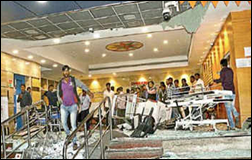
A jury awards $14 million to parents in a lawsuit brought against a hospital and a radiologist in a “wrongful birth” case in which they were not warned that an ultrasound image of their 22-week fetus showed possible abnormalities that might have convinced them to terminate the pregnancy.
image

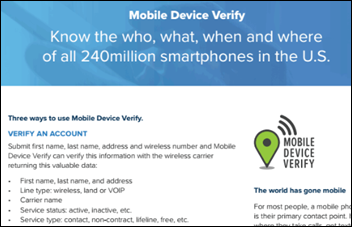
Cell phone providers are selling the real-time location data of their customers, creating a gray market for “bounty hunters” who can locate any cell phone to within a few hundred yards. Companies are selling the data that is intended to be used for fraud detection and roadside assistance firms  – in violation of the privacy policies of the cell phone providers — to developers of apps for car salespeople and bail bondsmen.

A urologist removes a patient’s healthy kidney at UMass Memorial Medical Center after pulling up the wrong CT scan by looking up his patient by name alone, which displayed the images of a different patient with the same name who had the same kidney scan performed on the same day. 
image

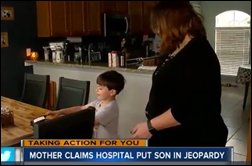
The mother of a five-year-old boy whose diabetes is continuously monitored complains that she called Johns Hopkins All Children’s Hospital (FL) to report a high reading, but doctors didn’t call her back for three days. The hospital’s endocrinology department says they will start returning the calls of diabetic patients within 24 hours.

A Qualcomm executive’s keynote at the Consumer Electronics Show is interrupted by his unmuted Alexa device, which demonstrated an uncanny use of AI (during his pitch for using AI in cars) by loudly proclaiming, “No, that’s not true.”


In Case You Missed It


Get Involved


button


125x125_2nd_Circle

EPtalk by Dr. Jayne 1/10/19

January 10, 2019 Dr. Jayne 2 Comments

clip_image002 

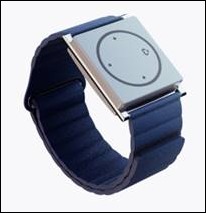
The US Food and Drug Administration has cleared the Embrace smart watch from Empatica for seizure tracking in children as young as six. The watch detects signals associated with generalized tonic-clonic seizures and alerts caregivers. Embrace had been approved for adult use last February, but the extension for children is a big plus for parents. The watch had a 98 percent accuracy rate for detecting seizures during clinical trials.

A Special Communication published in the Journal of the American Medical Association addresses the growth in medical marketing. From 1997 to 2016, medical marketing grew from $17.7 billion to nearly $30 billion, with direct-to-consumer messaging as the most rapidly-growing spending segment. Consumer-facing ads grew from $2.1 billion to $9.6 billion during the period. This includes $6 billion for direct-to-consumer ads for prescription drugs, a total of 4.6 million ads including over 663,000 TV commercials. Since 1997, there has been more than $11 billion in fines for deceptive marketing practices.

I certainly wouldn’t mind going back to the days when we weren’t peppered with ads for erectile dysfunction drugs and treatments for rare cancers while catching the evening news. The piece also addresses non-drug-related medical marketing such as disease awareness campaigns, noting potential harms caused by “medicalizing ordinary experience and expanding disease definitions without evidence of net benefit.”

The American Academy of Family Physicians (AAFP) is responding to the recent CMS proposed rule revising Medicare Advantage regulations. Although AAFP supports the use of telehealth technologies, it disagrees with the CMS plan to allow telehealth providers to count towards a plan’s network adequacy requirement. It proposes that only telehealth providers who also see patients in person should be counted in the payer’s network. AAFP encourages CMS to protect patients from “an encroachment of direct-to-consumer telemedicine not coordinated with the beneficiaries’ usual source of primary care.” AAFP has partnered with telehealth vendor Zipnosis to provide a platform for members who want to deliver their own virtual services.

clip_image004

CMS is at it again, renaming things for no good reason. This time they’ve proudly announced the launch of the “new design for the CMS QMVIG Updates (formerly eHealth) listserv.” I had to dig through the entire email to figure out what QMVIG even stands for – apparently, it’s the Quality Measurement and Value-Based Incentives Group and it is part of the CMS Center for Clinical Standards and Quality. QMVIG is responsible for programs on meaningful measures development, health information technology, and quality compare programs.

The email made a point that “only the name and look of the listserv has changed.” During a government shutdown that is negatively impacting thousands of people, I’d think CMS would have priorities other than rebranding listservs. The January Health IT Advisory Committee meeting has been canceled as part of the shutdown and we won’t be seeing any interoperability rules since that task force was canceled as well.

I had the opportunity to use a different EHR this week and was surprised to see that the Body Mass Index (BMI) calculation was displaying to four decimal points. BMI is calculated based on a patient’s height and weight. Although it’s conceivable that if you measure height to the quarter inch and weight on a digital scale you might get those decimals in the calculation, it’s still distracting to see them since they’re not clinically significant past one decimal point. It’s just one more example of the noise that we see with the EHR. In a paper chart, most of us would have rounded it and called it a day.

The EHR had several other annoying features, including a laboratory results display grid that indicated results were “abnormal” instead of “out of range.” This led to additional discussion with patients as I reviewed their results so that they understood the values weren’t truly “abnormal” or anything to worry about. It also had a single blood pressure field that was free text rather than separate systolic and diastolic fields restricted to appropriate values, leading to staff keying things like 1400/80 and 12090. I’m glad I don’t have to use it on a daily basis.

clip_image006

Being a CMIO isn’t always about the glamorous world of healthcare IT. Sometimes we’re pulled in by other medical leaders to help put data behind a pesky problem. Such was my lot this week when I was asked to gather some data about effectiveness of commercial laundry processes, particularly with our laundry vendor, after our COO read this article about pathogens surviving the wash cycle. After poring through some data, I’m thinking that I might want to investigate a laundry kettle for my own personal use to make sure I’m not tracking anything home on my scrubs.

While researching disinfection protocols, I came across this article discussing the presence of drug-resistant superbug MRSA on ambulance oxygen tanks. Disinfecting the tanks isn’t part of our standard office checklist, but maybe we should add it to the weekly task list.

Speaking of to-do lists, I’m finally starting to get serious about my HIMSS preparations, confirming my actual travel dates and letting my unneeded hotel nights go back into the available pool. I learned my lesson the hard way a few years ago when I waited too long and couldn’t get a booking for my preferred dates and had to leave early. Now, I book a room as soon as the attendee block opens and book it for the entire block, then adjust it in January once I know what my plans are. I have to say I’m a bit envious of exhibitor reps who have their rooms at closer-in hotels booked by corporate meeting planners.

clip_image008

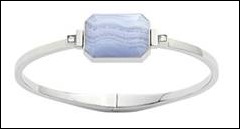
Sadly, I will be attending HIMSS without my trusted Ringly bracelet. I recently got a new phone and couldn’t get the Bluetooth to connect. When I tried to troubleshoot it, I learned that Ringly folded last January after four years in the wearables business. I enjoyed having a functional piece of jewelry that helped me manage my technology without being obnoxious – the color-coded LED blinks and vibration notifications were enough for me. My current Garmin watch can do a lot more than the Ringly, but it lacks the class and elegance. It also lacks the ability to filter notifications like the Ringly did – I could set it to only alert me to texts, emails, and calls from my inner circle rather than letting everything through. Farewell, Ringly as technology, although I’ll still keep you in the bracelet rotation.

What’s your favorite piece of wearable technology? Leave a comment or email me.

button

Email Dr. Jayne.

Readers Write: Expanding the Horizon of Clinical Surveillance

January 9, 2019 Readers Write Comments Off on Readers Write: Expanding the Horizon of Clinical Surveillance

Expanding the Horizon of Clinical Surveillance
By Janet Dillione

image

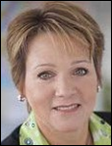
Janet Dillione is CEO of Bernoulli Health of Milford, CT.

Pay-for-performance programs, like the Centers for Medicare & Medicaid Services (CMS) Hospital-Acquired Condition Reduction Program (HACRP), determine provider reimbursement based on a hospital’s ability to meet key patient safety and performance measures. To reap the financial incentives—and avoid the penalties—of HACRP, more hospitals are “investing in clinical surveillance solutions that utilize real-time patient data to reveal deteriorating patient conditions at an early stage,” according to a report released in November by AGC Partners, a multi-vertical research and investment firm.

Continuous surveillance traditionally has been the near-exclusive domain of hospital departments that care for high-acuity patients with the greatest risks for deterioration, such as the ICU. However, the persistence of preventable catastrophic events, such as post-surgical opioid-induced respiratory depression (OIRD) — which accounts for more than half of medication-related deaths in care settings — suggests that the ability to monitor patients continuously and communicate insights to clinical teams in real-time must extend beyond the ICU.

According to a new KLAS report on the subject, “clinical surveillance tools hold the promise of giving caregivers clinically actionable insights that decrease mortality, reduce readmissions, and improve overall patient outcomes, and clinicians expect these alerts to be embedded directly within their workflow.”

However, successfully broadening the utilization of this technology can be complex and disruptive and can bring new uncertainties to the entire organization.

How Scalable is Continuous Surveillance?

For many health systems, continuous surveillance can be broadly used with existing technology infrastructure, especially organizations with critical care units or ICUs. Optimizing that infrastructure’s capabilities and incorporating it into existing clinical workflows is the real heavy lift, but advances in monitoring technology, use of real-time physiological data and smart alarms, and sophisticated analytics and the ability to route that information to remote clinicians show promise for scaling continuous surveillance to a number of patient care departments, including telemetry, maternity, med-surg, and even beyond the walls of the hospital.

Additionally, health systems exploring the viability of continuous surveillance are using their EHRs as a natural starting point. Multivariate, real-time data from medical devices aggregated with retrospective data from EHRs, provides a holistic and complete source of objective information on a patient that can be used for prediction and clinical decision making.

Does It Save Lives—and Costs?

Hospital investments in clinical surveillance and analytics solutions are driven by organizations that are migrating toward value-based care models and are trying to achieve the objectives of value-based care, including improving care quality and outcomes, reducing clinical variation, and reducing healthcare costs.

Similarly, patient safety in the era of value-based care is increasingly defined as preventing adverse events before emergency interventions or costly escalations are required. However, most common monitoring practices are reactive, not proactive –interventions are often applied only after a patient has deteriorated.

A number of hospital-acquired illnesses (HAI) could be prevented by continuous clinical surveillance. Sepsis and respiratory compromise are among the most costly in terms of resources and morbidity and mortality.

  • Industry costs. Respiratory failure that requires emergency mechanical ventilation occurs in 44,000 patients per year in the United States. The cost to US hospitals for opioid-induced respiratory depression (OIRD) interventions is estimated at nearly $2 billion per year.
  • Hospitalization costs. Respiratory compromise ($22,300), ranks in the top five of 20 conditions that have the highest aggregate costs per stay due to the high frequency of hospitalization.
  • Length of stay. Ventilator-associated complications (VAC) can lead to longer stays in the ICU and greater rates of readmission. VAC complications add approximately $40,000 in costs to each case, $1.2 billion in total costs annually.

Will Clinicians Adopt It?

Technology implemented without proper consideration of impacts on workflow and user ability to fulfill their core responsibilities can have deleterious effects on its overall efficacy.

Involving direct-care staff is critical to the success of any new technology. How will this new technology impact how nurses deliver patient care? What adjustments in workflow and practice need to be made, at go-live and beyond? Starting with these questions fosters buy-in from the staff who will be utilizing this equipment. If end users are not involved in the selection, adoption, and implementation of a technology, then the likelihood that they will become owners of that product is significantly lower.

According to a clinical surveillance report released this year by Spyglass Consulting Group, “hospitals recognize the importance of real-time capabilities to enhance patient safety and improve care quality.”

Ultimately, the ability to safely manage patient populations across the enterprise, reduce the cost of care, and align with reimbursement and regulatory incentives are driving and accelerating adoption. Clinical surveillance has arrived in healthcare and the future looks bright.

Machine Learning Primer for Clinicians–Part 11

January 9, 2019 Machine Learning Primer for Clinicians Comments Off on Machine Learning Primer for Clinicians–Part 11

Alexander Scarlat, MD is a physician and data scientist, board-certified in anesthesiology with a degree in computer sciences. He has a keen interest in machine learning applications in healthcare. He welcomes feedback on this series at drscarlat@gmail.com.

image

Previous articles:

Basics of Computer Vision

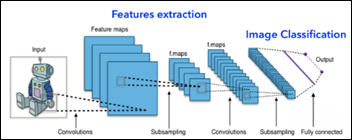
The best ML models in computer vision, as measured by various image classification competitions, are the deep-learning, convolutional neural networks. A convolutional NN (convnet) for image analysis usually has an input layer, several hidden layers, and one output layer — like a regular, densely or fully connected NN, we’ve met already in previous articles:

image

Modified from https://de.wikipedia.org/wiki/Convolutional_Neural_Network

The input layer of a convnet will accept a tensor in the form of:

  • Image height
  • Image width
  • Number of channels: one if grayscale and three if colored (red, green, blue)

What we see as the digit 8 in grayscale, the computer sees as a 28 x 28 x 1 tensor, representing the intensity of the black color (0 to 255) at a specific location of a pixel:

i1

From https://medium.com/@ageitgey/machine-learning-is-fun-part-3-deep-learning-and-convolutional-neural-networks-f40359318721

A color image would have three channels (RGB) and the input tensor would be image height x width x 3.

A convnet has two main parts: one that extracts features from an image and another, usually made of several fully connected NN layers, that classifies the features extracted and predicts an output — the image class. What is different from a regular NN and what makes a convnet so efficient in tasks involving vision perception are the layers responsible for the features extraction:

  • Convolutional layers that learn local patterns of increasingly complex shapes
  • Subsampling layers that downsize the feature map created by the convolutional layers while maximizing the presence of various features

Convolutional Layer

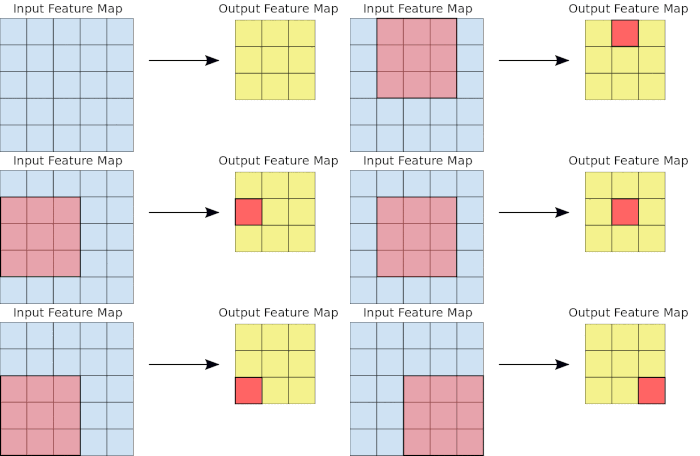
A convolutional layer moves a filter over an input feature map and summarizes the results in an output feature map:

i2

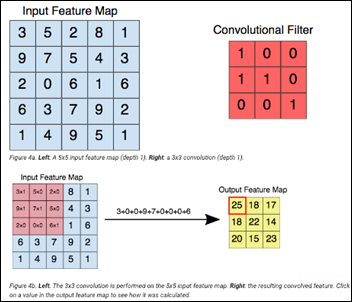
In the following example, the input feature map is a 5 x 5 x 1 tensor (which initially could have been the original image). The 3 x 3 convolutional filter is moved over the input feature map while creating the output feature map:

image

Subsampling Max Pool Layer

The input of the Max Pool subsampling layer is the output of the previous convolutional layer. Max pool layer output is a smaller tensor that maximizes the presence of certain learned features:

i3

From https://developers.google.com/machine-learning/practica/image-classification/convolutional-neural-networks

Filters and Feature Maps

Original image:

image

A simple 2 x 2 filter such as 

[+1,+1]

[-1,-1] 

will detect horizontal lines in an image. The output feature map after applying the filter:

image

While a similar 2 x 2 filter 

[+1,-1]
[+1,-1] 

will detect vertical lines in the same image, as the following output feature map shows:

image

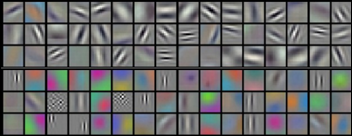
The filters of a convnet layer (like the simple filters used above for the horizontal and vertical line detection) are learned by the model during the training process. Here are the filters learned by a convnet first layer:

image

From https://www.amazon.com/Deep-Learning-Practitioners-Josh-Patterson/dp/1491914254

Local vs. Global Pattern Recognition

The main difference between a fully-connected NN we’ve met previously and a convnet, is that the fully connected NN learns global patterns, while a convnet learns local patterns in an image. This fact translates into the main advantages of a convnet over a regular NN with image analysis problems:

Spatial Hierarchy

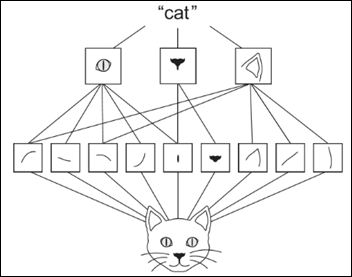
The first, deepest convolutional layers detect basic shapes and colors: horizontal, vertical, oblique lines, green spots, etc. The next convolutional layers detect more complex shapes such as curved lines, rectangles, circles, ellipses while the next layers identify the shape, texture and color of ears, eyes, noses, etc. The last layers may learn to identify higher abstract features, such as cat vs. dog facial characteristics – that can help with the final image classification. 

A convnet learns during the training phase the spatial hierarchy of local patterns in an image: 

image

From https://www.amazon.com/Deep-Learning-Python-Francois-Chollet/dp/1617294438

Translation and Position Invariant

A convnet will identify a circle in the left lower corner of an image, even if during training the model was exposed only to circles appearing in the right upper corner of the images. Object or shape location within an image, zoom, angle, shear, etc. have almost no effect on a convnet capability to extract features from an image. 

In contrast, a fully-connected, dense NN will need to be trained on a sample for each possible object location, position, zoom, angle, etc. as it learns only global patterns from an image. A regular NN will require an extremely large number of (only slightly different) images for training.A convnet is more data efficient than a NN, as it needs a smaller number of samples to learn local patterns and features that in turn have more generalization power. 

The two filters below and their output feature maps — identifying oblique lines in an image. The convnet is invariant to the actual line position within the image. It will identify a local pattern disregarding its global location:

i4

From https://ujjwalkarn.me/2016/08/11/intuitive-explanation-convnets/

Transfer Learning

Training a convnet on millions of labeled images necessitates powerful computers to work in parallel for many days and weeks. That’s usually cost prohibitive for most of us. Instead, one can use a pre-trained computer vision model that is available as open source. Keras (an open source ML framework) offers 10 such image analysis, pre-trained models.  All these models have been trained and tested on standard ImageNet databases. Their top, last layer has the same 1,000 categories: dogs, cats, planes, cars, etc. as this was the standardized challenge for the model.

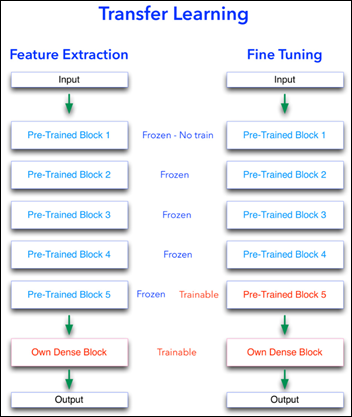
There are two main methods to perform a transfer learning and use this amazing wealth of image analysis experience accumulated by these pre-trained models:

Feature Extraction

  1. Import a pre-trained model such as VGG16 without the top layer. The 1,000 categories of ImageNet standard challenge are most probably not well aligned with your goals.
  2. Freeze the imported model so it will not be modified during training.
  3. Add on top of the imported model, your own NN — usually a fully-connected, dense NN — that is trainable.

Fine Tuning

  1. Import a pre-trained model without the top layer,
  2. Freeze the model so it will not be modified during training, except …
  3. Unfreeze the last block of layers of the imported model, so this block will be trainable.
  4. Add on top of the imported model, your own NN, usually a dense NN.
  5. Train the ML model with a slow learning rate. Large modifications to the original pre-trained model weights of its last block will practically destroy their “knowledge.”

image

Next Article

Identify Melanoma in Images

News 1/9/19

January 8, 2019 News 2 Comments

Top News

image

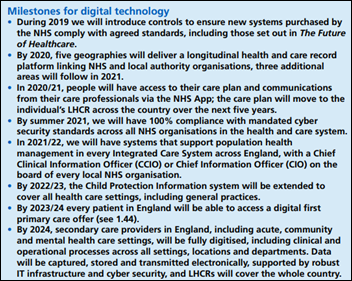
In England, NHS issues a long-term plan that calls for technology to:

  • Improve patient access and the ability to self-manage health
  • Give clinicians access to patient records from any location
  • Apply best practices using clinical decision support and AI
  • Apply population health prediction techniques to assign resources accordingly
  • Capture data automatically to reduce administrative burden
  • Protect privacy and give patients control over their medical record
  • Link clinical, genomic, and other data to improve treatments

Reader Comments

image

From Jaye P. Morgan Gong Show: “Re: JP Morgan Healthcare Conference. I really like your post about the moneyed investors dodging the homeless on San Francisco’s sidewalks, but let’s remember Jonathan Bush stopping to administer CPR while he was walking down the street. Of course, we know what happened to him.” That unscripted drama from 2016’s conference said a lot about the character of the former Army medic and EMT, who didn’t hesitate to hit the dirt in his expensive suit to perform CPR. He explained at the time, “It was a lot like the healthcare industry: a lot of people were standing around tweeting about it, but no one was trying to do anything about this guy lying in the street. So I was like, turn him the f*** over! It was really dramatic. It was intense. The crowd was rooting for us.” Among the beauty queen sashes I ordered for that year’s HIStalkapalooza was one for JB that said, “I CPR’ed some random guy.” Meanwhile, Elliott Management’s Paul Singer had best hope that JB isn’t the only bystander if he goes to ground.

From Info Blocker: “Re: health system not sharing information with an HIE. That’s not like Epic.” Epic isn’t the problem here, it’s that one of their customers that doesn’t want to share patient information. Suggesting that EHR vendors are the bad guys distracts from reality. You only need to find one user of any EHR system that is sharing data by any means (HIE, Carequality, CommonWell, API, internal app, etc.) to disprove the idea that it’s not possible for that system to share information. The only way the vendor is the villain is if they charge unreasonable fees to make it happen. 

From See Me, Feel Me: “Re: National Federation of the Blind. Is suing Epic for discrimination, saying that Epic’s failure to support screen readers prevents blind people from working in Massachusetts hospitals.” That’s actually old news from July of last year. The organization does of lot of suing for inaccessible websites, self checkouts that don’t work well for the blind, universities that don’t make every function and benefit accessible, and hospitals that don’t offer all materials in Braille or electronic form. Section 508 of the Rehabilitation Act of 1973 requires the federal government to make its own technologies usable by the disabled, but I don’t think the requirement extends further and I’ve only heard of it in the context of public web pages. I can’t imagine that Cerner – the federal government’s most expensive IT system in history – is natively accessible, so if it supports use by the blind, it’s probably through a third-party screen reader. Good intentions aside, I don’t know how someone who is blind could navigate information-packed displays that require clicking, choosing drop-downs, and displaying dynamic patient information. The lawsuit notes that Epic’s patient-facing applications have been made accessible and concludes that “Epic thinks that blind people are only fit to be patients, not healthcare workers.” I’m not sure the sarcastic tone and claims of discrimination will win friends and influence people.


HIStalk Announcements and Requests

We’re putting together our HIMSS19 guide that features HIStalk sponsors, so if your company is exhibiting or attending, contact Lorre to get our information collection form about your booth, giveaways, or activities. You’re probably spending a fortune to be there, so you might as well get some free exposure. She also convinced me to offer some sweeteners to cash-strapped startups who sign up as new sponsors, especially those who realize that their exhibit hall time leaves them out of the spotlight for the 362 days of the year afterward.

HIMSS will have some holes in its agenda if the federal government shutdown continues for 33 more days, which I assume would leave some attendees and presenters unable to attend.

image

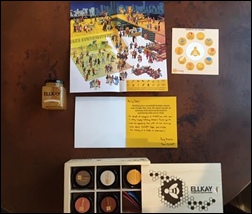
Ellkay sent some fun stuff my way (via Lorre) for the holidays – a beautifully packaged sampler box of their honey (from their rooftop bee hives) and a really cool drawing of their Christmas party guests with a find-the-object game included. I’m generally indifferent to unimaginative corporate giveaways, but Ellkay does it perfectly in not only providing something novel and useful, but that also expresses who they are.


Webinars

January 17 (Thursday) 1:00 ET. “Panel Discussion: Improving Clinician Satisfaction & Driving Outcomes.” Sponsor: Netsmart. Presenters: Denny Morrison, PhD, chief clinical advisor, Netsmart; Mary Gannon, RN, chief nursing officer, Netsmart; Sharon Boesl, deputy director, Sauk County Human Services; and Allen Pendell, SVP of IS and analytics, Lexington Health Network. This panel discussion will cover the state of clinician satisfaction across post-acute and human services communities, turnover trends, strategies that drive clinical engagement and satisfaction, and the use of technology that supports those strategies. Real-world examples will be provided.

Previous webinars are on our YouTube channel. Contact Lorre for information.


Acquisitions, Funding, Business, and Stock

image

Physician and hospital information publisher Healthgrades acquires Influence Health, which offers web services, listings, reputation management, and CRM.

Change Healthcare and Experian Health will combine their healthcare network and identity management capabilities, respectively, to create an identity management solution.

image

Patient engagement technology vendor Vatica Health acquires the technology of the defunct CareSync, for which it made a $1 million stalking horse bid to the bankruptcy court in October 2018. CareSync, founded in 2011, burned through nearly $50 million in funding before abruptly shutting down in June 2018.

Analysts predict that Amazon will create Prime for healthcare, which could focus on offering lower drug prices via its acquired PillPack mail order pharmacy, Alexa services, using its recently announced medical records analytical service to scribe clinical encounters, and providing services such as telehealth and medical devices.

image

Patient matching technology vendor Verato raises $10 million in a Series C funding round, increasing its total to $35 million.


Sales

  • St. Luke’s University Health Network (PA) signs a three-year Epic managed services agreement with HCTec.
  • Boston Medical Center Health System chooses ZeOmega Jiva for advanced care management in its Medicaid ACO. 

People

image

CHIME names Stanford Children’s Health CIO Ed Kopetsky, MS as 2018’s John E. Gall Jr. CIO of the Year.

image

Isaac “Zak” Kohane, MD, PhD (Harvard Medical School) joins the board of Inovalon.


Announcements and Implementations

image

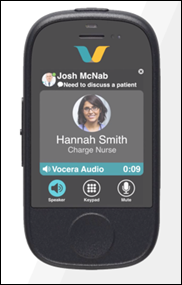
Vocera launches a new hands-free, voice-powered Smartbadge that offers a larger color screen, improved audio, a dedicated panic button, and extended battery life.

image

Another 12 health systems representing 250 hospitals join Civica Rx, which will manufacture its own generic drugs – many of them in IV form — to save money and reduce shortages.

SNAGHTML55fd800

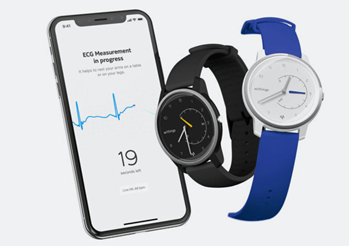
Withings will offer consumers a less-expensive EKG device than the Apple Watch with its $129 Move ECG, which hasn’t yet earned FDA’s marketing clearance. AliveCor’s $99 KardiaMobile came out two years ago as the first and arguably best of the lot.

image

Omrom launches a $499 blood pressure watch that uses an inflatable cuff built into the band rather than the usual questionably accurate optical sensors. It also announces Complete, which adds EKG capability to the blood pressure monitor.

AT&T and Rush University Medical Center will create the country’s first 5G-enabled hospital and will explore ways that a faster cellular network can improve operations and patient experience. 

California health data network Manifest MedEx goes live on NextGate’s EMPI.


Other

image

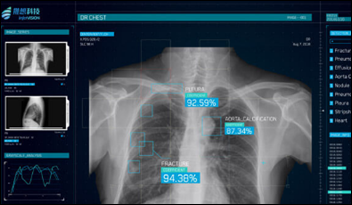
Wired magazine notes that China’s healthcare AI efforts, such as imaging analysis, benefit from that country’s less-rigorous privacy regulations that allow vendors to train their systems using millions of readily available patient images. An example is InferVision, which is being tested at Wake Radiology (NC) and Stanford Children’s Hospital.

image

Vox finds that the ED of taxpayer-funded Zuckerberg San Francisco General Hospital intentionally remains out of network for all private insurers, which the hospital explains is necessary to generate the money it needs to offset charity and Medicaid care. The hospital billed a 24-year-old woman whose broken arm was treated in its ED $24,000 (12 times the Medicare price), of which Blue Cross paid $3,800, leaving her on the hook for over $20,000.

A study published in Health Affairs finds that the 20 top-funded digital health companies have had minimal documented impact on disease burden or cost, with few published studies and an avoidance of measuring outcomes in sicker patients.

A large-scale consumer survey by NRC Health finds that 80 percent would change providers based on convenience alone; long waits and lack of respect are big dissatisfiers; people want to provide feedback quickly after their encounter and preferably by email; and patients don’t care much about provider brand identity and instead focus on their experience with individual clinicians.

Observer polls a panel of experts to name its 20 best “flyover tech” digital health companies that aren’t on either coast:

  • Bind (MN) – insurance management for consumers
  • Solera Health (AZ) – connecting patients to community organizations and apps
  • NightWare (MN) – intervention for PTSD-caused nightmares
  • ClearData (TAX) – cloud computing and information security
  • Healthe (MN) – eye protection from computer device blue light
  • MyMeds (MN) – medication adherence
  • Visibly (IL) – online vision testing
  • Higi (IL) – health kiosks
  • HistoSonics (MI) – non-invasive treatment robotics
  • Lumea (UT) – digital pathology
  • Springbuk (IN) – actionable health insights
  • Sansoro Health (MN) – healthcare data exchange
  • LearnToLive (MN) – online mental health treatment
  • Smile Direct Club (TN) – teeth straightening aligners
  • SteadyMD (MO) – remote primary care that matches the lifestyles of patients and doctors
  • Collective Medical (UT) – ED patient data sharing
  • Limb Lab (MN) – prosthetics
  • Upfront Health (IL) – care journey “next best action”
  • AbiliTech Medical (MN) – robotic assistance for those upper-limb with neuromuscular conditions
  • Vivify Health (TX) – remote care mobile devices

Tennessee pays contracted doctors a piecework rate for reviewing disability applications, with one of them finishing cases – of which 80 percent were denied — in an average of 12 minutes, allowing him to make $420,000 in the past year and $2.2 million since 2013. At least two of the contracted 50 physicians are felons, while others have had their medical licenses revoked.

In England, experts take a hard-eyed view of sloppily handwritten prescriptions after female patient irritates her eyes with what was supposed to be a soothing ophthalmic lubricant, which the pharmacist mistook as an order for a cream for erectile dysfunction. One might assume that the pharmacist ignored a series of computer warnings for issuing a drug for an inappropriate route of administration and patient sex.


Sponsor Updates

  • Divurgent and Gevity will offer their combined healthcare information systems consulting expertise.
  • Access and Dimensional Insight will exhibit at the MUSE Executive Institute January 13-15 in Newport Beach, CA.
  • AdvancedMD announces the winners of its annual Healthcare Innovator of the Year Awards.
  • Tampa Bay Tech awards AssessURHealth with its Emerging Tech Company of the Year award.
  • The Best and Brightest names Burwood Group a Wellness Winner.
  • The Chartis Group publishes a new report, “Why Your Provider Workforce Plan Isn’t Working.”
  • The local news highlights UCSF Medical Center’s use of Collective Medical technology to help “frequent flier” ER patients.
  • Divurgent and Gevity announce a strategic business alliance to expand their services across the US and Canada.
  • DocuTap announces its 2018 student scholarship essay winners.

Blog Posts


button


Contacts

Mr. H, Lorre, Jenn, Dr. Jayne.
Get HIStalk updates. Send news or rumors.
Contact us.

125x125_2nd_Circle

Curbside Consult with Dr. Jayne 1/7/19

January 7, 2019 Dr. Jayne Comments Off on Curbside Consult with Dr. Jayne 1/7/19

clip_image003

The government shutdown has impacted some electronic media, including the National Zoo’s Giant Panda Cam and the National Park Service website. It hasn’t slowed CMS, which continues to send regular emails about the recent final rule redesigning the Medicare Accountable Care Organization (ACO) program. Referred to as “Pathways to Success,” it is designed to advance five goals: accountability, competition, engagement, integrity, and quality. The program modifies the participation options available to push ACOs toward taking on real financial risk faster than they had been under the previous programs.

I have been under the weather and tried to use my illness-imposed downtime to read my way through various fact sheets and documents around the program, but have had trouble making sense of some of it. The CMS press releases reference different announcements and rules that have been put out, including the Calendar Year 2019 Physician Fee Schedule (aka the November 2018 final rule). According to the release, the Pathways to Success final rule also takes a step back in time, finalizing policies for extreme or uncontrollable circumstances for performance year 2017, which were initially established via an interim final rule in December 2017. I had to read that part of the announcement several times since I’m not exactly sure how that works to modify a program year that ended 370 days ago. I thought maybe it was confusing because I was reading it while I was hopped up on cold medicine, but I eventually decided that it’s just confusing.

In trying to distill the communications, my assessment is this. Medicare has figured out that the majority of ACOs are participating in Track 1 for the maximum time allowable and some of them are generating losses. Track 1 is a one-sided model with sharing of savings without the ACO having to take on risk, therefore Medicare absorbs any losses. The original idea was for organizations to use Track 1 as a way to get their feet wet with shared savings in hopes that they’d quickly move to more risk-bearing agreements. That hasn’t happened, so now the proverbial stick has to come out.

The other existing ACO varieties (Track 2 and Track 2) are two-sided. Eligible ACOs share a larger portion of any savings, but in exchange they’re required to share losses if spending exceeds benchmarks. These programs have been shown to generate savings for Medicare and are improving quality, so Medicare wants to further those types of arrangements.

Medicare has also figured out that so-called low-revenue ACOs (mainly made up of physician practices or rural hospitals) are outperforming high-revenue ACOs, which typically include hospitals. There are challenges for the low-revenue ACOs to move to a more risk-bearing arrangement because those organizations may have less control over how their assigned beneficiaries use services and therefore spend money. Medicare piloted the “Track 1+ ACO Model” during 2018, with the goal of proving that a two-sided model with lower risk would be attractive. Its success influenced the construction of the new redesigned program, according to CMS.

The redesigned program offers two tracks, named BASIC and ENHANCED, which are open for five-year agreement periods starting July 1, 2019. The BASIC track lets ACOs start under a one-sided model and gradually accept higher risks as they move through five levels A, B, C, D, and E. Once they reach the highest level, they’d be recognized as an Advanced Alternative Payment Model (APM) under the Medicare Quality Payment Program. The ENHANCED track is based on the existing Track 3 and allows flexibility for ACOs willing to take on the highest levels of risk. The existing Track 1 and Track 2 programs will be discontinued, as will new application cycles for Track 1+. CMS feels those options would be redundant to the new program.

CMS aims to move BASIC organizations through the alphabetical levels (which they refer to as the “glide path”) by automatically advancing them at the start of a new performance year. Organizations would also be able to jump to a higher level faster if desired. The ultimate goal is to move all ACOs to the ENHANCED track, with high revenue ACOs being required to transition more quickly. There are also stratifications based on whether ACOs are identified as experienced or inexperienced with performance-based risk but to be honest I skimmed over those particulars in my pharmaceutical-induced fog.

The final rule updates the mechanisms for repayment when ACOs have shared losses. Both new tracks may start with lower repayment amounts based on a percentage of Medicare Part A and Part B revenues, with the amounts recalculated annually based on changes in the ACO participant list. Benchmarks will also be recalibrated, incorporating data from ACO experience and regional performance measures. The rule also aims to reduce “opportunities for gaming” by holding terminated ACOs accountable for pro-rated shared losses. ACOs are also able to choose between different beneficiary assignment methodologies and to change their selections for subsequent performance years. Starting in January 2020, eligible ACO providers will be able to receive payment for telehealth services for certain beneficiaries in certain situations. There are also changes to expand the Skilled Nursing Facility (SNF) 3-day rule waiver.

The redesign also allows ACOs under certain two-sided models to operate a beneficiary incentive program, which may allow for incentive payments of up to $20 to assigned beneficiaries who receive certain qualifying primary care services from ACO members. It also clarifies that under existing program regulations, vouchers and gift cards can be provided to beneficiaries assuming they meet other program requirements such as being connected to the beneficiaries’ medical care. There are a few other tidbits in the rule including updates to beneficiary notification requirements. Beneficiaries have to be notified of the opportunity to opt-out of claims data sharing along with how to change their assigned primary clinician. CMS is developing templates for these notices in an effort to reduce the burden to participating practices.

I’m only marginally involved in the ACO realm, so I’m sure those who are deeper in the process might have additional insights. I’ll be looking to read digests and summaries in the coming days until I’m on the mend. Until then, my next reading list involves chicken soup.

button

Email Dr. Jayne.

Monday Morning Update 1/7/19

January 6, 2019 News 7 Comments

Top News

image

The VA finally has its first permanent CIO in two years after the Senate confirms James Gfrerer as assistant secretary of information and technology.

The 20-year Marine Corps veteran and US Naval Academy computer science graduate most recently worked for Ernst & Young. He has spent most of his career working on IT business risk and cybersecurity.

Gfrerer replaces interim CIO Camilo Sandoval, a military veteran and former Trump campaign executive.


Reader Comments

From Casual Commitment: “Re: sharing Epic screen shots. Some customers would release shots of every single screen. It’s hard to create a competitive advantage with software and harder to maintain it over time. Customers could release every screen shot of a new release to the world even before going live and competitors could simply copy it, taking away the incentive to create innovation and usability. Some would argue that it’s in the best interest of science and/or safety, but I think most vendors are OK with using images for those purposes and would not ask a client to take them down. Vendor contracts nearly always require clients to get permission before sharing confidential information and academic medical centers often require the same assurances that their confidential information not be shared.” Sometimes I question whether just getting a look at the user interface exposes the intellectual property underneath, but I admit that I’ve written some programs that were inspired by seeing a screenshot or demo, then figuring out how to make it work under the covers, so I can buy that.

image

From Epic Customer: “Re: sharing Epic screen shots. Epic publishes its straightforward approach, but it isn’t well publicized at customer organizations and folks don’t check with the IT department when preparing their publications. Then they are notified that they have used a screenshot inappropriately and are upset that their publication needs to be take down or changed. Blaming Epic doesn’t seem appropriate, but clients are challenged to make it clear to staff the restrictions that ALL vendors impose on to prevent inappropriate use of proprietary information. Most health systems have committees, which would seem to be needed to guide compliance.” Epic Customer provided Epic’s predictably thorough and clear screenshot guidelines, which say:

  • Any public sharing of Epic content (to websites, other vendors, presentations other than to Epic clients, research papers, publications, and books) requires Epic’s review via its Content Approval process, which takes about two weeks.
  • The submission requires stating why using the screen shots is necessary, who will see it, how it will be distributed, and the goal or conclusion of any research (that last aspect troubles me a tiny bit, such as the case where the argument is that Epic’s design endangers patients or burdens clinicians – would that impact the likelihood of approval?)
  • Any vendor that will receive Epic screen shots or functionality description must ask Epic before using it.
  • An Epic copyright notice must be included on every screen shot.
  • Screen shots should crop or blur information not needed for the specific purpose, such as removing menus and toolbars.
  • Content can’t be posted on private video or quiz sites (including YouTube) because the terms and conditions of those sites say that anything posted there becomes the property of that site. 

From Merger Frenzy: “Re: CommonSpirit Health (the soon-to-be merged Dignity Health and Catholic Health Initiatives). Deanna Wise was announced as the consolidated CIO a few weeks ago, then was gone a few days later with two interims in place. The organizations have very different cultures and IT systems (Cerner at Dignity and Epic, Cerner, Allscripts, Meditech, and others at CHI, I think) but they’ve been working on this for over two years. In addition, the merger has been pushed back again to February 1.” I’ll first say that I detest that embarrassing married name, as I do any time the marketing geniuses decide it will be amazing to simply remove the space between two words while leaving them capitalized (“common spirit” sounds like a bar’s cheap well drink). Deanna Wise was named CIO of the 140-hospital, $30 billion, Chicago-based mega-system in a December 4 announcement. Her LinkedIn hasn’t changed and she’s still listed as EVP/CIO on Dignity’s executive page. That’s all I know, other than that big-ego organizations that are used to calling their own shots often can’t stop arm-wrestling for control before, during, and after a superficially friendly merger.

From Telebicycle Coach: “Re: information blocking. My HIE employer has ONE large non-profit hospital in the entire state that refuses to contribute lab result data, which I suspect is because it wants to sell Epic to small practices that don’t need it and can’t afford it, so it tells them it’s the only way they can get lab data. I would love to hear thoughts.” Intentional health system blocking is rampant, as you might expect when trying to convince competitors in any industry to share internal information. I don’t really have any new thoughts except to say that it should either be made a strictly enforced law (driven by complaints like yours) or a condition of being paid taxpayer money in the form of Medicare. No amount of shaming or dangling the patient benefit carrot has worked, just like it hasn’t for getting hospitals to give patients copies of their own records quickly and inexpensively. Shame is an effective weapon only to the extent that an organization fears being shamed.

From Barnard Rubble: “Re: big data. Is it still a contender for the HISsies ‘most overhyped’ category?” The perpetual frontrunner is actually not on this year’s ballot due to a plethora of fizzy competitors, such as blockchain and IBM Watson Health. Maybe big data has finally summited Gartner’s Peak of Inflated Expectations, although I expect the Trough of Disillusionment to be in the form of the lawyer’s warning to “don’t ask a question for which you don’t want to know the answer.” Big data will tell us what we already know and can’t solve – that our system healthcare system is unfair, unaffordable, inefficient, reflective of primitive social policies, incapable of delivering consistently high outcomes, and rife with profiteers and political influence. It’s nice for society’s financial winners to foresee a world in which their every malady is machine-diagnosed and optimally treated with the best, most personalized therapies available, but people are suffering and dying due to problems that have nothing to do with analytics. We should just declare ourselves a third-world country and then take the Bill Gates public health funding approach – use analytics to identify the most health-impacting problems that can be fixed creatively and inexpensively at scale to benefit the most people in hoping to move up from the dregs of developed nation health rankings.


HIStalk Announcements and Requests

image

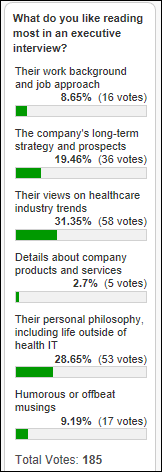
Poll respondents aren’t interested in reading executive interviews that focus on the company’s products or the individual’s personal history – they would rather learn more about the executive’s views on healthcare trends and what they think about life in general. Me, too – I’ve interviewed executives who couldn’t stop blabbing about the amazing potential of their companies under their skilled watch, only to have the company or their careers take a startling stumble soon after. Show us your character and let the rest of us decide whether that piques our interest enough to want to learn more about your business. I’m proudest of my interviews that led readers to feel that they got to know a CEO.

New poll to your right or here: For longstanding HIMSS members: how do you feel about the organization now vs. five years ago? Vote and then click the poll’s comments link to describe what has changed for the better or worse.

Thanks to these companies for recently supporting HIStalk. Click a link for more information.

image
image
image
image
SNAGHTML3add8c04
image
image
image
image
SNAGHTML3ae068dd

Two warnings as HIMSS19 approaches (anybody have other Orlando scam alerts?):

  • Don’t book your hotels through email solicitations, even when they list seemingly legit hotel names and prices. HIMSS blocks all the hotel rooms, so you can only reserve through them for hotels on their official list.
  • Don’t call pizza places whose flyers are shoved under your hotel room door. Those are scams, too, as criminals make up restaurant names, create flyers with phone numbers, and then steal your credit card information when you order that pizza that never arrives (they could get even smarter using a national brand name like Domino’s but with a phony phone number).

Webinars

January 17 (Thursday) 1:00 ET. “Panel Discussion: Improving Clinician Satisfaction & Driving Outcomes.” Sponsor: Netsmart. Presenters: Denny Morrison, PhD, chief clinical advisor, Netsmart; Mary Gannon, RN, chief nursing officer, Netsmart; Sharon Boesl, deputy director, Sauk County Human Services; and Allen Pendell, SVP of IS and analytics, Lexington Health Network. This panel discussion will cover the state of clinician satisfaction across post-acute and human services communities, turnover trends, strategies that drive clinical engagement and satisfaction, and the use of technology that supports those strategies. Real-world examples will be provided.

Previous webinars are on our YouTube channel. Contact Lorre for information.


Acquisitions, Funding, Business, and Stock

SVB Financial Group completes its acquisition of healthcare and life sciences investor Leerink Partners for $280 million in cash and $60 million as a five-year retention pool for Leerink employees (of which D&B Hoovers says there are just 42).

SNAGHTML3ab76a6b

For those who might otherwise forget that US healthcare revolves around business rather than patients, a gallon of meeting room coffee at this week’s JP Morgan Healthcare Conference costs $170 ($21 per cup), hotel rooms for the besuited moneychangers run thousands of dollars, and borrowing 14 power strips in a hotel conference room costs $1,000. Meanwhile, attendees complain about having to dodge San Francisco’s unwashed to get to their all-important meetings about profiting from healthcare services delivery, as hotel security guards and side job police officers shoo away people who are homeless, addicted to drugs, or suffering from mental illness and are thus offensive to the dealmakers whose influence over healthcare policy and delivery keeps increasing. Someone should snap a photo of a money mover in a $5,000 suit (“come on!”) who invests in tech companies pitching population health management or social determinants of health who snootily sidesteps the people the company claims to serve.

image

Patrick Soon-Shiong is once again a leading candidate in the “pie in the face” HISsies category, so I took a look at NantHealth share price – it’s at $0.62, valuing the once-touted enterprise at a paltry $68 million. NH shares rose to as high as $21 on IPO day in June 2016, having since lost a startling 97 percent of their value. I’m pretty sure I can predict the HISsies pie vote of  those early shareholders. The logo reminds me of an old, possibly appropriate, not-safe-for-work joke involving a feather and the distal colon.


People

image

Echo Health Ventures hires Jessica Zeaske, MHS, PhD, MBA (GE Ventures) as partner.


Government and Politics

image

Livongo hires its board member and investor Lee Shapiro as CFO. Shapiro was president of Allscripts when Livongo board chair Glen Tullman was CEO of that company.


Other

I finally got around to looking over last month’s telehealth-focused Health Affairs, with these snips from various articles catching my eye:

  • Not many doctors or patients are using telehealth, although the numbers are increasing and the available information is dated.
  • Lessons learned by four large health systems that have implemented a telehealth program include making sure executives agree on its goals and strategic contribution; coordinating telehealth efforts among multiple departments to set priorities and ensure the availability of support resources; identify champions who can help overcome the resistance of clinicians and employees; develop a patient education and marketing strategy; and evaluate outcomes to support improvement.
  • Major health system adoption barriers are cost, payment, and technical issues, with a key factor being how well state Medicaid pays for the service.
  • A literature review finds that while telehealth interventions appear equivalent to in-person care, its effect on the the usage of other services is not clear.
  • Use of remote experts to support neonatal resuscitation at small hospitals reduces transfers and thus cost, but it is rarely used because nobody pays for it.
  • Kaiser Permanente doctors who take chest pain triage telephone calls spent less time per call compared to nurses and sent fewer patients to the ED, but patients accepted the recommendations of doctors at a higher rate. Mortality rates for calls taken by doctors and nurses were similarly low, but direct-to-physician protocols worked best to reduce ED visits and costs.
  • Appropriate antibiotic use for acute respiratory infections was about the same in telemedicine and in-person visits, but strep tests were used in only 1 percent of direct-to-consumer visits vs. 78 percent in urgent care centers, leading to more repeat visits following telemedicine sessions.
  • CMS’s 2013 decision that a telemedicine doctor can serve as the physician backup for advance practice providers in critical access hospital EDs has led some hospitals to replace local doctor coverage to reduce costs.

I took a quick look at the websites of a few big health systems to see if they had posted their price lists on January 1 as CMS requires, with these results from checking news releases and then searching for “price list” (of course, ignoring the fact that the lists themselves are unhelpful gibberish to consumers):

  • New York Presbyterian – has information for one campus only that I could find
  • Florida Hospital (now AdventHealth Orlando as of January 1) – yes, but as an XML document that gives an immediate browser error
  • Jackson Memorial Miami – yes, but buried deep in the site’s structure
  • UPMC Presbyterian – yes, in Excel (the best job of all those I checked)
  • Methodist Indianapolis – no
  • Montefiore – yes
  • Methodist San Antonio – yes
  • Orlando Regional Medical Center – no
  • Methodist Memphis – yes
  • UCSF – yes
  • Ohio State – yes

image

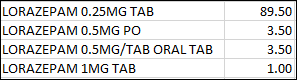
Pro tip from downloading hospital price lists: if admitted to UPMC Shadyside and you take Ativan, the 1 mg dose costs 99 percent less than the 0.25 mg dose (I guess it’s expensive to have someone cut the 0.5 mg tablet in half). Their CDM is full of oddities like this that I assume are the result of shortened descriptions that don’t tell the full story. I started to compare prices across health systems for a few common items, then realized how pointless that would be for consumers or anyone else.

image

Former New York City Health + Hospitals SVP/CIO Bert Robles is fined $9,000 by the city’s Conflicts of Interest Board for convincing an Epic EVP to let his girlfriend take an Epic certification course with him and for asking his employees to get the girlfriend an H+H ID card so she could use office space and computers to study.

image

California plastic surgeons derail the attempt of cosmetic surgeons to advertise themselves as “board certified,” with the former questioning the American Board of Cosmetic Surgery’s training program as a “bogus marketing tool” and claiming that 24 percent of its members have been the subject of disciplinary actions after they left other specialties to perform elective and cash-paid breast augmentation, hair transplants, and tummy tucks without extensive training.


Sponsor Updates

  • The Journal of Clinical Pathways interviews Richard Loomis, MD chief informatics officer for clinical solutions at Elsevier.

Blog Posts


button


Contacts

Mr. H, Lorre, Jenn, Dr. Jayne.
Get HIStalk updates. Send news or rumors.
Contact us.

125x125_2nd_Circle

Weekender 1/4/19

January 4, 2019 Weekender Comments Off on Weekender 1/4/19

weekender 


Weekly News Recap

  • Alphabet’s Verily raises $1 billion in a new funding round
  • Health Level Seven International publishes the FHIR Release 4 standard
  • Epic says that it will will move “beyond the walls” to store patient records from dentists, on-site clinics, drugstores, and potentially home and hospice care providers
  • The New York Times looks at Facebook’s suicide risk screening algorithms, which try to walk the line between user privacy and public health but have not been validated
  • A study finds that free text comments entered by clinicians when overriding clinical decision support recommendations can be mined to identify system errors or shortcomings

Watercooler Talk Tidbits

image image

Readers funded the DonorsChoose teacher grant request of Ms. B from Virginia, who asked for five sets of virtual reality headsets for her high school classroom and for her projects as an instructional specialist (she based her program on STEM integration classes she’s taking through Columbia University and NASA). She provides this update:

I truly apologize for the delay in writing my thank you note, but, there is a reason, a very good reason! Google Expeditions came to our school to launch their newest VR experience and I and my students were a part of the LAUNCH! The pictures included do NOT do justice the the excitement of the day. Imagine third grade students walking around the Coliseum and remarking at all of the archwork, or flying around a Roman ship and realizing how large the galleys had to be! And then being surrounded by bees as they became a flower or as they moved from room to room with the astronauts in the International Space Station. Thank you for helping make this possible!

Anonymous Epic Developer’s donation, when matched with funds from my anonymous vendor executive and other sources, fully funded these teacher grant requests:

  • Math manipulatives for Ms. D’s elementary school class in Aransas Pass, TX
  • Document camera and headsets for Ms. M’s elementary school class in Myrtle Beach, SC
  • Two Chromebooks for Mr. T’s high school math class in Cleveland, TX

An orthopedist raises concerns about “selfie wrist,” a form of carpal tunnel syndrome caused by the wrist rotation of people who take endless mugging phone photos of themselves. I expect the next selfie-induced health crisis to be: (a) women whose lips go permanently numb after too many self-adoring kiss poses for photos; (b) Asians who throw their elbows out making that horizontal V-for-victory thing while preening in front of a scenic backdrop; or (c) tendonitis precipitated by women taking point-of-view photos of their feet from beach chairs pointed at the ocean.

California’s Medi-Cal Medicaid program is investigating private equity-owned Agilon Health, which was subcontracted to coordinate care but reportedly intentionally delayed or denied services purely because of cost. SynerMed, another contractor, was found to have placed patients in danger by denying services and falsifying documents to hide it. Agilon’s own reports show that nurses had to review up to 200 care requests per day and their decisions were reviewed only by a private practice family doctor who checked in during breaks from his own medical practice.

image

Everybody’s likely to be confused at or angered by hospital-posted list prices, so here’s an early example – the father of a seven-year-old whose broken arm was treated at the outpatient clinic of Cincinnati Children’s Hospital Medical Center – sent there by the ED to save him money – finds that based on the just-posted price list, his $2,000 bill included being charged at the highest ED rate. He also notes that he was charged more for an X-ray than the price list says and was billed for surgery for just having a cast applied by a technician. The hospital responded that nobody pays list prices and bills include facility fees that aren’t part of the item charge. A Louisville TV station notes that two hospitals that are next door to each other have CDM prices of $162,000 and $55,000, respectively, for the same prostate cancer drug.

image

Cleveland Clinic fires first-year medical resident Lara Kollab, DO, who used her social media accounts to call for violence against Jews and to threaten that she would intentionally give Jewish patients the wrong medications. She graduated from the obviously appalled Touro College of Osteopathic Medicine, which is ironically part of a system that was created to serve Jewish students.

image

Humans – not particularly bright ones – rise up against the machine (and presumably the potential loss of unskilled jobs) by attacking self-driving test cars in Arizona. Yokels are slashing test car tires, throwing rocks at them, trying to run them off the road or stopping sharply hoping to get rear-ended, screaming at them to get out of their neighborhoods, and waving guns at them. Experts say people are reacting to driverless cars as “robotic incarnations of scabs” and expressing hostility toward big corporations like Waymo owner Alphabet that are furthering their own interests by running beta tests without approval. The companies generally always decline to file charges even when the offender is identified or confesses.


In Case You Missed It


Get Involved


button


125x125_2nd_Circle

EPtalk by Dr. Jayne 1/3/19

January 3, 2019 Dr. Jayne 1 Comment

I mentioned being tired from seeing patients the day after Christmas. Now that we’ve done our month-end close, I know why. We broke our own record and saw nearly 1,300 patients that day, 70-something of which were on my schedule. It truly takes a village to be able to care for that many patients and I’m grateful that my practice’s leadership believes in systems-based care and building teams so that they can run like well-oiled machines. The Centers for Disease Control lists nine states as having high flu activity and another 11 with widespread activity, so it might be a long winter.

clip_image002

This article in the Journal of the American Medical Informatics Association caught my eye with its title: “Cranky comments: detecting clinical decision support malfunctions through free-text override reasons.” I’ve done my share of chart reviews where providers have entered interesting comments when faced with an alert, so I was eager to read more. The authors looked at their database to identify those clinical decision support rules that had at least 10 override comments. The comments were classified into three categories based on whether the user felt the rule was “broken,” “not broken, but could be improved,” or “not broken.” They also looked at the comment frequency and a “cranky word list heuristic” to rank the rules based on the override comments.

Parsing the comments uncovered malfunctions in more than a quarter of all the active rules in the system, which was higher than expected. The authors recommend that “even for low-resource organizations, reviewing comments identified by the cranky word list heuristic may be an effective and feasible way of finding broken alerts.”

For those who are curious, representative override comments included items such as “you are stupid,” “stupid EPIC (sic) reminder,” and comments with many exclamation points. Other cranky words include: dumb; idiot; please stop; why; misfire error, epic, and wrong. The authors note that “swear words were originally included but are omitted from this list because they did not yield comments. Other organizations may wish to include them.”

clip_image004

I’ve heard a fair amount of chatter among physicians regarding the new rule that starting this month in which all US hospitals must publish their price lists online in a downloadable format. Nearly everyone I’ve heard from agrees that having the charges isn’t terribly helpful. What one would really need to know is the negotiated rate between the insurer and the hospital. Alternatively, knowing the hospital’s self-pay discount might be helpful.

Hospital lobbying organizations are concerned that patients might forego care if they see prices that are too high, not understanding that most services are discounted. Of course, there’s nothing stopping hospitals from publishing that data, but we’re not likely to see it soon. I poked around on the websites of the local health systems and within their patient portals but haven’t been able to find anything. I’d be interested to hear from readers who may have actually downloaded one.

On the flip side, CMS has put forward a proposal to require pharmaceutical companies to publish Medicare and Medicaid prices for drugs featured in TV ads. Physicians I’ve talked to are supportive of that idea, and many would like to see TV advertising of drugs eliminated completely. I don’t usually watch broadcast TV, but was exposed to it over the holidays at relatives’ houses. There certainly are a lot of drug ads out there and some of them aren’t even clear on what condition the drug is designed to treat or which patient population is being targeted. Print ads aren’t much better, and even some of the ads in physician trade publications are confusing.

clip_image006

At the beginning of every year, I do some general office housekeeping tasks, including updating my filing and accounting systems for the year and making sure all my recurring calendar appointments are in order. As I was paging through the weeks, I realized that HIMSS is just around the corner and I’m feeling like the next month is really going to be a crunch. I have some serious shoe shopping to do before then, along with breaking in any new purchases. My favorite pair of “trade show shoes” met its demise last year and finding just the right kicks to get me through hours and hours of the exhibit hall will be a challenge. Advance registration discounts end January 14, so if you’re planning to go but haven’t registered yet, you can still save a few bucks.

clip_image008

Working in healthcare IT has been a great way to meet people who work non-traditional hours. Some people make their employment choices based on their enjoyment of overnight shifts because it suits their personalities as “night owls.” Telemedicine and teleradiology have opened up additional options, which has led to the need for support personnel covering the physicians who are staffing those shifts.

I spent some time working at an observatory and know that I do well on the night shift, but only when I can completely tweak my schedule to support it long-term. The occasional night shift kills me. The New York Times recently ran a piece about businesses that are encouraging their employees to work at periods of maximal wakefulness as a way to boost productivity and to help avoid safety incidents due to fatigue.

The US Navy recently migrated the traditional 18-hour submarine schedule to a 24-hour one, and other companies are allowing employees to select day or night shifts based on their preferences. Working remotely can help as well. I know I’m more productive when I work in focused blocks of time outside of the office and having even a 20-minute nap in the afternoon makes a huge difference for me. That’s supported by the “window of circadian low,” which forecasts a midafternoon dip in wakefulness for most people, as mentioned in the article.

The piece mentions strategies employed by pharmaceutical manufacturer AbbVie, where employees go through a nine-hour program to identify their best times for creativity vs. low-energy tasks. Employees are encouraged to mesh their work and professional lives to harness those periods as well as to work around family commitments, leading to a dramatic increase in employee satisfaction with work-life balance. I’ve worked in several clock-punching organizations where even salaried employees were expected to put on a show of being at their desk at certain times regardless of whether they were actually doing anything productive.

Has your employer done any investigation into harnessing people’s most productive periods during the day? Leave a comment or email me.

button

Email Dr. Jayne.

Morning Headlines 1/3/19

January 3, 2019 Headlines Comments Off on Morning Headlines 1/3/19

HL7 Publishes FHIR Release 4

Health Level Seven International publishes the FHIR Release 4 standard.

Bristol-Myers Squibb to buy Celgene in $74 billion deal

The merger, if approved by shareholders and regulators, will create the US’s fourth-largest drug company.

Jvion Secures Significant Strategic Growth Investment to Expand Application of Its Healthcare AI and Prescriptive Analytics Platform

Healthcare AI vendor Jvion raises a growth equity investment of an unstated amount, led by JMI Equity.

Machine Learning Primer for Clinicians–Part 10

January 2, 2019 Machine Learning Primer for Clinicians Comments Off on Machine Learning Primer for Clinicians–Part 10

Alexander Scarlat, MD is a physician and data scientist, board-certified in anesthesiology with a degree in computer sciences. He has a keen interest in machine learning applications in healthcare. He welcomes feedback on this series at drscarlat@gmail.com.

image

Previous articles:

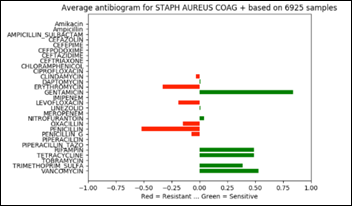
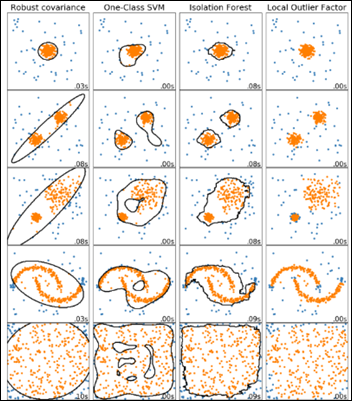
While previous articles have described supervised ML models of regression and classification, in this article, we’re going to detect anomalies in antibiotic resistance patterns using an unsupervised ML model. 

By definition, anomalies are rare, unpredictable events, so we usually don’t have labeled samples of anomalies to train a supervised ML model. Even if we had labeled samples of anomalies, a supervised model will not be able to identify a new anomaly, one it has never seen during training. The true magic of unsupervised learning is the ML model capability to identify an anomaly never seen.

The Python code and the dataset used for this article are available here

Data

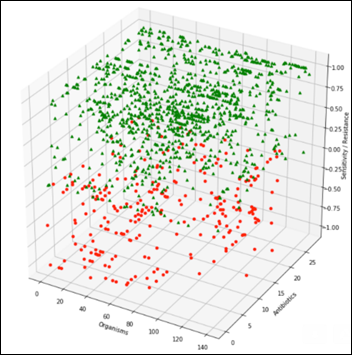
The data for this article is based on a subset of MIMIC3 (Multiparameter Intelligent Monitoring in Intensive Care), a de-identified, freely available ICU database, Using SQL as detailed in my book , a dataset of 25,448 antibiograms was extracted.  The initial dataset includes 140 unique microorganisms and their resistance / sensitivity to 29 antibiotics arranged in 25,400 rows:

image

  • +1 = organism is sensitive to antibiotic
  • 0 = information is not available
  • -1 = organism is resistant to antibiotic

Summarizing the above table by grouping on the organisms produces a general antibiogram:

image

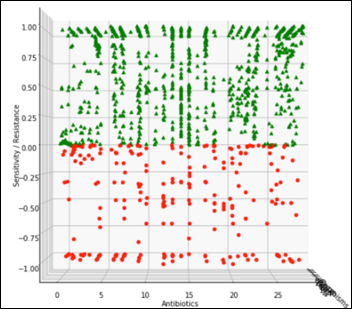
A view perpendicular to the organisms axis on the above chart becomes the projection of all the organisms and their relative sensitivity vs. resistance to all antibiotics:

image

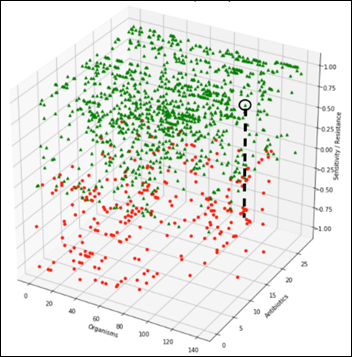
The view perpendicular to the antibiotics axis becomes the projection of all the antibiotics and the relevant susceptibility of all the organisms:

image

The challenge is to detect an anomaly that may manifest itself as a slight change of an organism susceptibility to one antibiotic, for example, along the black dashed line in the diagram below. During testing of the ML model, we’ll gradually modify one organism susceptibility to one antibiotic and test the model on F1 score, repeatedly, at different levels of susceptibility:

image

Let’s focus on the most frequent organism in the data set – Staph Aureus Coag Positive (Staph). 

Staph has 6,925 samples out of 25,400 (27.2 percent of the whole dataset) and its average antibiogram in a projected 3D view:

image

The above chart projected on 2D and rotated 90 degrees clockwise depicts the average antibiogram of Staph:

image

Note that in the above diagram, zero has an additional meaning besides “information not available.” Zero may be also the result of averaging a number of sensitive with the same number of resistant samples and thus and average of zero susceptibility.

Model

  • Task: unsupervised anomaly detection in antibiograms, a binary decision: normal vs. anomaly
  • Experience: 25,400 antibiograms defined as normal for model training purposes
  • Performance: F1 score at various degrees of anomalies applied to the average antibiogram of one organism (Staph) and one antibiotic at a time

Local Outlier Factor (LOF) is an anomaly detection algorithm introduced in 2000, which finds outliers by comparing their location with respect to a given number of neighbors (k). LOF takes a local approach to detect outliers about their neighbors, whereas other global strategies might not be the best detection for datasets that fluctuate in density.

image

If k = 3, then the point A in the above diagram will be considered an outlier by LOF, as it is too far from its nearest three neighbors.

A comparison of four outlier detection algorithms from scikit-learn on various anomaly detection challenges: yellow dots are inliers and blue ones are outliers, with LOF in the rightmost column below:

image

The LOF model is initially trained with the original antibiograms dataset, which the model will memorize as normal.

After the model was trained, we gradually modify the Staph susceptibility to: 

  • Vancomycin only: from the original +0.5 to 0.4, 0.2, 0, -0.2,… -1.0
  • Gentamicin only: from the original +0.8 to 0.4, 0.2, 0, -0.2,… -1.0
  • Both antibiotics at the same time: 0.4, 0.2, 0, -0.2,… -1.0 sensitivity / resistance

Below is a Staph antibiogram with only 13 percent sensitive to gentamicin compared to the normal Staph antibiotic susceptibility at 83 percent for the same antibiotic:

image

And the same comparison as above, but with a Staph population that is 13 percent resistant to gentamicin:

image

Performance

The last example, Staph susceptibility to gentamicin significantly shifting from (+0.83) to (-0.13) creates a confusion matrix with the following performance metrics:

  • Accuracy: 87.3 percent
  • Recall: 82.6 percent
  • Precision: 91.3 percent
  • F1 score: 0.867

At each antibiotic sensitivity / resistance level applied as above, the model performance is measured with F1 score (the harmonic mean of precision and recall detailed in previous articles). The model performance charted over a range of Staph susceptibilities to vancomycin, gentamicin, and both antibiotics:


image

The more significant an anomaly of an antibiogram, the higher the F1 score of the model. An anomaly may manifest itself as a a single large change in the sensitivity of one organism to one antibiotic or as several small changes in the resistance to multiple antibiotics happening at the same time. A chart of LOF model performance over a range of anomalies can provide insights into the model capabilities at a specific F1 score. For example, at F1 = 0.75, Staph sensitivity to gentamicin declining from (+0.83) to (+0.2) will be flagged as an anomaly, but the same organism changing its vancomycin sensitivity from (+0.53) to (-0.2) will not be flagged as an anomaly. 

There are no hard coded rules in the form ofif…then…” when using an unsupervised ML model. As there are no anomalies to use as labeled samples, there is a need to synthetically create outliers for testing the model performance by modifying samples features in what (we believe) may simulate an anomaly.

In all the testing scenarios performed with the LOF model, these synthetic anomalies have always been in one direction: from an existing level of sensitivity towards a more resistant organism, as this is the direction the bacteria are developing under the evolutionary pressures of antibiotics. A microorganism developing a new sensitivity towards an antibiotic is practically unheard of, as it dooms the bacteria to commit suicide when exposed to an antibiotic to which it was previously resistant.

Unsupervised anomaly detection is a promising area of development in AI, as these ML models have shown their uncanny, magic capabilities to sift through large datasets and decide, under their own volition, what’s normal and what should be considered an anomaly.

Next Article

Basics of Computer Vision

Morning Headlines 1/2/19

January 2, 2019 Headlines Comments Off on Morning Headlines 1/2/19

Epic Systems adds dentists, life insurers to its software network

Epic’s VP of population health says the company is “moving beyond the walls” in creating a single repository for all of a patient’s electronic health records – dental, on-site clinics, drugstores, specialty clinics, and potentially home health and hospice providers.

When Doctors Serve on Company Boards

Cancer centers are responding to the perceived conflicts of interest that arise when their researchers and doctors serve on the boards of drug, lab, and medical device companies.

In Screening for Suicide Risk, Facebook Takes On Tricky Public Health Role

Facebook has deployed suicidal thoughts detection algorithms without tracking their outcomes even as the company faces global scrutiny for its privacy practices.

Malware attack disrupts delivery of L.A. Times and Tribune papers across the U.S.

Several newspapers are left unable to print editions after Tribune Publishing is taken down by an attack of Ryuk ransomware, a potent strain spread via malicious emails that was the subject of an HHS Cybersecurity Program warning in August 2018.

Morning Headlines 12/31/18

December 30, 2018 Headlines Comments Off on Morning Headlines 12/31/18

CenturyLink outage knocks out 911 calls, hospital’s patient records

A CenturyLink outage left several hospitals without Internet service Friday, also taking down phones, 911 access, and ATMs all over the country.

Cranky comments: detecting clinical decision support malfunctions through free-text override reasons

A JAMIA-published study of comments that clinicians enter when overriding clinical decision support warnings finds that the text can be mined to identify system shortcomings about 26 percent of the time.

‘Bleed Out’ Shows How Medical Errors Can Have Life-Changing Consequences

A filmmaker’s new HBO documentary covers what he says was a medical error that left his mother with permanent brain damage, for which he primarily blames Aurora West Allis Medical Center’s use of E-ICU coverage.

Stanley Black & Decker Debuts Healthcare And Security Innovations At CES 2019

The company will launch a voice-controlled, smartphone-integrated medication management and caregiver communication tool that supports independent living.

Monday Morning Update 12/31/18

December 30, 2018 News 9 Comments

Top News

image

A CenturyLink outage left several hospitals without Internet service Friday, also taking down phones, 911 access, and ATMs all over the country.

North Colorado Medical Center was forced to go back to paper documentation, while its parent organization Banner Health had phone problems since the outage also affected Verizon Wireless.

image

FCC has launched an investigation since 911 calls couldn’t get through.


Reader Comments

image

From Soccer Mom: “Re: hospital price lists. Will they really be posted online by January 1 per that new requirement you mentioned?” Not in a way that will make the slightest difference to healthcare costs. The “requirement” carries no punishment that I’ve seen for non-compliance, so I will predict that approximately one hospital out of 100 will comply by January 1 (it will be easy to check this week). My reaction to the administration’s toothless, well-intended, but fake healthcare price transparency PR move:

  • Hospitals will at best bury an Excel version of their charge master in some obscure website location where patients can’t readily find it.
  • Charge master prices are meaningless and provide zero consumer competitive shopping value.
  • You as a paying health insurance holder can’t see the negotiated prices under which you will actually be billed since those companies and health systems delight in keeping that information secret, even from (maybe especially from) patients.
  • Patients who suddenly start seeing stories about posted prices (even though the original requirement was announced in April) will question what the fuss was all about when they see that the information is useless, other than to raise their hackles that their big-building, high-employment hospital is charging $5 for an easily recognizable aspirin.
  • Having worked in hospitals forever, I can say with certainty that hospitals intentionally make their charge masters hard to understand. I won a certain amount of admiration from an early hospital employer for being able to obfuscate the entire charge master’s descriptions so that only employees could figure the items out – we got a lot fewer patient complaints about our $10 boxes of Kleenex after the description was changed to “absorbent wipes.”

From Mike: “Re: DonorsChoose. Thanks for doing what you do (and to Mrs. HIStalk for putting-up with it). Here’s a donation. My nieces and nephews are getting used to this idea of me donating instead of buying them more stuff.” Thanks. I’m holding Mike’s DonorsChoose donation since I’m expecting fresh matching funds from my generous anonymous vendor executive (UPDATE: the extremely generous matching funds just arrived, so see below). Mrs. H was happy to see your comment, if for no other reason than because I had to leave my solitary spare bedroom – aka my HIStalk writing place – to show her your message.
image

From Wandering Eyeballs: “Re: the medical resident who hung himself after struggling to use the hospital’s computer system. I’d love to know what system it was.” The website of NHS University Hospitals Birmingham says they use OceanoPAS, which was recently developed specifically for the trust by Servelec. I doubt they’ll be adding this particular user experience to their marketing material, although a competitor could certainly milk it.

From Big Orange Marble: “Re: our executive hire press release. Why didn’t you list that he came from [high-profile company name omitted]?)” Because he didn’t – he took a crappy, short-lived job after leaving the impressive company but before joining yours. I report where someone worked last, not where they worked best. Your career isn’t going so well if its high point came three jobs back.

image

From Spittle Slinger: “Re: designing software with doctors. This article says engineers should work with them directly.” No doubt, but while acknowledging these factors:

  1. Doctors and their workflows are not universal. Location, practice setting, specialty, and education all influence why every doctor thinks their way is the best way. Pleasing them all with a single product design is not possible.
  2. Design isn’t the same as design validation. Ask a single doctor to design a new system and it will probably miss the mark in many ways. I’ve seen some truly awful, shortsighted, and dangerously presumption-driven software that was proudly proclaimed to have been “developed by a practicing doctor for his own use.”
  3. Software sales are often scotched by deep functionality and workflows that violate an individual clinician’s reality rather than failing to embrace it. It’s safer to keep it general if you want to sell broadly.
  4. What doctors say they want isn’t the same as what they would actually use. Doctors who think they are smarter than most of their peers (and that’s a lot of them) often think software needs to protect patient from their less-gifted colleagues (see: clinical decision support).
  5. EHRs that doctors proclaim as unfriendly or unhelpful were often designed by doctors whose vision was limited to what was in front of them, i.e. the paper chart. You won’t get a lot of innovation asking a user what they want. Apple was at one time the boldest, most innovative company in the world because they gave people capabilities they didn’t even know they needed. Build to user spec would have given us slick-looking cassette players.
  6. The best way to incorporate doctors in software design is to observe them, note their challenges and their lack of having the right information at the right time, and then go offline to come up with creative solutions. Have doctors validate the design. Doctors are good at poking holes in clearly visible, faulty assumptions and that’s the best use of their time.
  7. Don’t forget that not all clinicians are doctors. A lot of clinical system use is by nurses, therapists, and other professionals and doctors are clueless about their requirements and workflows.
  8. It’s easy to be lured into the idea that clinical software can be as easy and fun to use as Facebook, Twitter, or Amazon. The fact that such software is not available is not because the rest of us are missing how cool that would be, but because it won’t work.
  9. Selling to health systems means meeting the needs of hospital executives who are mostly in charge. Making doctors happy is incidental.
  10. A given doctor’s idea of a great work environment might be the freedom to be a sometimes-illogical cowboy who disregards everybody else’s data needs and quality oversight. Their perfect system has been around for years – a clipboard and underlings who obey tersely barked orders. Doctors weren’t the ones crying for that to change.

image

From Organized Chaos: “Re: HBO’s ‘Bleed Out’ documentary. It’s fascinating and frustrating on many levels, although some of the content feels unnecessary. It is being promoted as being about medical errors, which seems like an incorrect and unsatisfactory label. Still, it should remind us about the fragile, fragmented nature of healthcare system delivery.” I don’t have HBO and haven’t seen it, but “Bleed Out” — which is getting good early reviews — is a “citizen’s investigation” by a filmmaker whose mother was left with permanent brain damage after an operation that he claims went wrong. The patient lost all her life savings due to medical bills and the filmmaker sued for malpractice, so he’s not exactly an unbiased researcher. The movie PR piece cites a Hopkins estimate that medical errors kill at least 250,000 people in the US each year as the third-leading cause of death, although I worry that, like every time Joe Public sees a video and immediately renders a verdict, an N-of-one family story about a complicated care episode isn’t the best way to address the problem (but it’s good at creating a rallying cry). I’ll also note that the “third leading cause of death” conclusion of the research paper wasn’t backed by good methodology since it was mostly intended to convince CDC to use more than just ICD-10 codes on death certificates. Much of the movie’s focus is on E-ICU at Aurora West Allis Medical Center, which a now-retired surgeon labeled on-camera as “plain goddamn sloppy medicine” and which the filmmaker claims wasn’t effective because his mother’s deteriorating vital signs either weren’t noticed or weren’t reported by the remote staff. Advocate Aurora Health told employees a couple of weeks ago when the movie came out that it regrets the patient’s outcome, but noted that juries found no negligence by the hospital or doctors in the malpractice case. The movie’s tagline of “The American healthcare system just messed with the wrong filmmaker” reeks of sensationalistic propaganda instead of unbiased investigation.


HIStalk Announcements and Requests

image

Just over half of poll respondents who claim to work for provider organizations say their EHR vendor has refused to integrate with a system they wanted to implement from a small vendor. Frank Poggio says the big vendors know better than to refuse outright – they just give a far-off implementation date or an unrealistic price tag. Dave says Epic has never refused integration requests from his IT department, while Adam says his small vendor employer was shut down by the clinic’s large health system parent rather than Epic. People who’ve never worked in health IT often miss the nuances in play here – integration is a risky pain point for the IT department, departments that want a particular system often don’t have the clout to get it budgeted or implemented, and vendors often ignore user requests that haven’t been pushed up the health system’s C-level food chain. In other words, lack of cooperation among competing entities isn’t limited to vendors.

New poll to your right or here, reflecting further on what I would ask Epic CEO Judy Faulkner in the unlikely event that she agreed to be interviewed: what do you like reading most in an executive interview? I’ve interviewed a ton of CEOs and always strongly urge them to avoid spouting the marketing-pushed boilerplate and show some personality and humor in a genuine conversation, which works about one time in 10. I only interview CEOs since VPs play it too safe in worrying about getting themselves fired with a flip comment, but I’ve also learned from experience that consulting firm CEOs are inexplicably the hardest to bring to life, riding banality relentlessly even when I ask them provocative, off-the-wall questions.

image

My anonymous vendor executive replenished the very substantial fund he or she created for me to use for DonorsChoose project matching. This and other matching allowed me to fully fund these projects with Mike’s donation last week:

  • Three Chromebooks and wireless mice for Ms. G’s high school science class in Panama City, FL, which was out of school for five weeks after Hurricane Michael
  • Physics study materials for Ms. B’s high school engineering class in Cleveland, OH
  • 12 sets of headphones for Ms. B’s elementary school class in Cass Lake, MN
  • A white board for Ms. G’s high school chemistry class in Darlington, SC
  • Composition notebooks for science journals for Ms. O’s middle school class in San Antonio, TX
  • A wireless microphone system for Mr. H’s elementary school class in Salinas, CA
  • Linear equation graphing tools for Ms. K’s elementary school class in West Peoria, IL
  • Math manipulatives for Ms. M’s elementary school class in Griffin, GA
  • Wobble chairs, whiteboards, lapboards, and book bins for Ms. S’s elementary school class in League City, TX

I know we all can’t wait for the serious education, demonstrated non-profit budget responsibility, and extreme patient focus of HIMSS19, so you’ll be thrilled to know that it starts in just 42 days.


Webinars

January 17 (Thursday) 1:00 ET. “Panel Discussion: Improving Clinician Satisfaction & Driving Outcomes.” Sponsor: Netsmart. Presenters: Denny Morrison, PhD, chief clinical advisor, Netsmart; Mary Gannon, RN, chief nursing officer, Netsmart; Sharon Boesl, deputy director, Sauk County Human Services; and Allen Pendell, SVP of IS and analytics, Lexington Health Network. This panel discussion will cover the state of clinician satisfaction across post-acute and human services communities, turnover trends, strategies that drive clinical engagement and satisfaction, and the use of technology that supports those strategies. Real-world examples will be provided.

Previous webinars are on our YouTube channel. Contact Lorre for information.


Acquisitions, Funding, Business, and Stock

image

Stanley Black & Decker launches Pria, a voice-controlled, smartphone-integrated medication management and caregiver communication tool that supports independent living.


People

image

Revenue cycle management firm Access Healthcare Services hires David Tassoni (Brimstone Consulting Group) as president of US operations.


Other

A JAMIA-published study of comments that clinicians enter when overriding clinical decision support warnings finds that the text can be mined to identify system shortcomings about 26 percent of the time. Interesting examples: (a) a low-potassium warning that was issued for a patient taking digoxin, caused by techs entering “hemolyzed” instead of a number in the K result; (b) a rule that didn’t identify carvedilol as a beta blocker and thus warned that one had not been ordered; and (c) a cyclosporine level warning that was triggered by an order for the ophthalmic form. I’ve written a lot of clinical decision support rules and analyzed both the override rates as well as the comments and it was always informative, even when doctors used the freeform space to lash out against the world. Here is the most important lesson I’ve learned – you have to look at how often the rule changed behavior, i.e., the problematic order was abandoned or the suggested entry or discontinuation of another order was performed as expected. That’s the only true measure of whether the doctor found the information useful. Although I had some doctors told me that they intentionally avoided immediately doing what the computer recommended just to prevent giving it the satisfaction of finding their mistake (they changed it afterward hoping our analysis wouldn’t notice their near-miss). I’ll add another item from experience – sometimes doctors think a human is reading their free-text comments in real time, as they might have with paper orders, and thus enter enter critical information such as a conditional or corollary order, expended instructions, or an order for an item they couldn’t find using the search box.

Kaiser Health News finds that hospices don’t always have staff available to meet the needs of patients, are rarely being punished for failing to respond to family calls, sometimes don’t have someone to answer questions about new drug and equipment orders, or skip skilled visits because of to understaffing. I’m really frustrated with a health system in which everybody and his brother makes fortunes off sick patients, yet the only place open after weekday business hours is the ED.

In India, Apollo Hospitals complains that the depositions of doctors that were presented to a panel investigating the hospital death of Tamil Nadu’s former chief minister (who was also an award-winning actress) contain significant court transcription errors, such as “incubation” instead of “intubation.”

image

The Bangor, ME newspaper profiles 68-year-old Frank Bennett, who is working through his bucket list in the five years since he was diagnosed with Lou Gehrig’s disease, apparently caused by Agent Orange exposure in Vietnam – choosing a dog, buying a Model A Ford, skydiving, taking family vacations to the Caribbean, and proposing all over again to his wife of 46 years. He’s receiving care from a ALS coordinated care program. He says,

We’re all dying, some at a different rate. I’m not afraid of dying. I fear the process. And my caregivers and family — what they have to see and go through. That bothers me the most. I want people to remember me the way I used to be.


button


Contacts

Mr. H, Lorre, Jenn, Dr. Jayne.
Get HIStalk updates. Send news or rumors.
Contact us.

125x125_2nd_Circle

Weekender 12/28/18

December 28, 2018 Weekender 1 Comment

weekender


Weekly News Recap

  • Movie tough guy Carlos “Chuck” Norris warns against short PCP visits in which prevention topics are missing in action and doctors spend too much time entering EHR documentation.
  • The New York Times predicts that Alphabet-owned DeepMind’s AlphaZero machine learning platform will facilitate science and medicine breakthroughs because it appears to learn why its solutions work rather than just applying brute force to detect and apply patterns.
  • Rep. Jim Banks (R-IN), chairman of the House’s VA technology subcommittee, questions the VA’s plan to implement Cerner patient scheduling, noting the VA hasn’t said what it will cost to move to Cerner scheduling, the timelines required, and the benefit to veterans.
  • New York Times Health notes that more than half of older Americans can’t understand the medical information providers give them.
  • Christmas happened and not much else.

Watercooler Talk Tidbits

image image

Readers funded the DonorsChoose teacher grant request of Ms. F in California, who asked for programmable robots for her kindergarten class. She reports, “These Bee-Bots are even more amazing than I had imagined. The kids LOVE using the Bee-Bots and have learned so much. We began with using the Bee-Bots at centers to help us identify letters, and then beginning letter sounds, then we were able to build CVC words with the Bee-Bots. We are currently learning about shapes and the Bee-Bots have been helping us to do that. The Bee-Bots have been a great introduction to coding/computer science! Thank you for your support!”

The Wall Street Journal describes how primary care doctors who are employed by health systems are pushed hard to avoid sending lucrative referrals outside the system.

image

A small Columbus, OH church that refused to sell its property to Nationwide Children’s Hospital finds itself dwarfed by a $50 million, six-story parking garage that is part of the hospital’s $730 million expansion.

image

A four-year-old girl who has spent her entire life in Ranken Jordan Pediatric Bridge Hospital (MO) after being born prematurely goes home for the first time. It’s a feel-good story as long as you don’t think about the cost and who pays.

image  image

University of Iowa Hospitals and Clinics holds a retirement party for 13-year-old top caregiver Maggie, a shelter dog who has for the past eight years snuggled with ill patients in the hospital’s Furry Friends program. In related news, Finn the therapy greyhound, a former racing dog who graduated from a training program run by prison inmates, is among the 16 therapy dogs that spend time with patients of Riley Hospital for Children (IN).


In Case You Missed It


Get Involved


button


125x125_2nd_Circle

Morning Headlines 12/28/18

December 28, 2018 Headlines Comments Off on Morning Headlines 12/28/18

Livongo Focuses on Government and Labor Segment with Proven Executive

Former Livongo sales executive Randy Forman returns to head up the company’s government and labor division following an eight-month stint at Vida Health.

Can medical devices be hacked? Arizona doctors prepare for possibility of cyberattacks

University of Arizona College of Medicine – Phoenix convenes CyberMed Summit, led by two ethical hackers who are graduates of the medical school.

After nearly five years lawsuit against Flowers Hospital is over

The Alabama hospital sets aside $150,000 to cover claims that a since-jailed lab employee sold 1,200 patient records for filing fraudulent tax returns.

Hospital prices: full cost lists must be published from January 1, new federal rule says

A rule announced in April requires hospitals to post “what they have online” in the form of annually updated, downloadable price lists.

News 12/28/18

December 27, 2018 News 5 Comments

Top News

image

Cinematic butt-kicker Chuck Norris, who is a shocking 78 years old, talks about physician burnout in his monthly health column.

He says PCPs have only an ever-shortening 7-22 minutes to spend with each patient, meaning that health and lifestyle counseling get pushed aside.

Chuck also notes that insurance company and government requirements force doctors to spend half their time documenting in the EHR as “medical clerks.”

In an unrelated item suitable for a slow news day, Chuck’s real name is Carlos.


Reader Comments

image

From Carbon Dating App: “Re: BS in healthcare. Check out Wharton School’s list.” The Ivy League school’s tongue-in-cheek report bluntly labels as BS many recent healthcare examples of “deceptive, misleading, unsubstantiated, and foolish statements,” even including medical literature in which a self-appointed expert considers only a single theory in performing studies that cannot be replicated. The authors cite a major BS problem in trying to improve healthcare quality while reducing costs, in which programs are launched based entirely on political appeal and the optimistic idea that their skimpy details can be refined on the fly. The article includes a BS Checklist Manifesto to identify these major forms:

  1. Top-down solutions in which C-level executives come up with visionary ideas and then move on to the next shiny object as their underlings are forced to try to implement complex change without their involvement.
  2. Consulting firms that pitch one-size-fits-all solutions for healthcare that have saturated the market in other industries and thus require fresh sales.
  3. Silver bullet solutions with little evidence to back them up, such as EHRs and care coordination, that make incrementalism seem meek in comparison.
  4. Following self-appointed gurus such as Don Berwick, Michael Porter, or Michael Hammer, with programs such as the Triple Aim receiving widespread endorsement even though nobody can define the numerator, denominator, or desirable ratio and people continue to confuse ”health” with “healthcare.”
  5. The faddish idea of disruption, which has never really taken off in healthcare, partly because consumers don’t like the idea of healthcare change and neither do the companies and people making fortunes from it.
  6. Stage-based models (of which Meaningful Use is an example) that support models that are often simplistic or wrong.
  7. Excel-driven assumptions that prove wildly incorrect over the long term, such as the prediction that Medicare would cost $12 billion by 1990 instead of the actual $110 billion or that ACOs would save big money.
  8. Fashionable bandwagons, such as hospital mergers and vertical integration that don’t improve performance, as health systems “get the bug that has infected your competitor.”
  9. The idea that best practices such as those of Cleveland Clinic and Mayo Clinic will work for everyone else as consultants claim.
  10. Buzzwords such as “scale,” “synergy,” “population health,” and the worst offenders of three-letter acronyms such as ACO and EHR.

From Academic Health System CIO: “Re: HIStalk. I am a long-time reader and appreciate your very reasonable list of questions to Judy Faulkner and balanced comments about the New York Times article. Thanks for the site, the balance of topics, and approach to the field.“ Thanks. The most fascinating aspect of the Epic story involves the company’s culture and its ability to identify and train bright new college graduates to function effectively in healthcare technology. I can’t imagine any other industry in which a 24-year-old employee with no relevant non-Epic work experience can command the attention of highly experienced health system clinicians and executives and actually get them to complete a painful project as defined by agreed-on metrics. I can assure you that is almost unheard of, as most significant health system endeavors devolve into endless debates and deflected responsibility (everybody is empowered to say no, but nobody can say yes). I would also love to know more about architecture and technology deployment – when’s the last time you heard of an Epic site going down due to Epic’s software (rather than hardware, network, or remote access middleware)? Most of us in the industry have never attended UGM and the company’s close-to-the-vest culture means we don’t really know how Epic works or how its success might be replicated, which I suppose is a good thing from Epic’s perspective but bad for those of who want to understand the legacy of what Judy built. 

image

From Split Pea: “Re: big data. What do you think of this article?” Van Halen’s concert rider required promoters to provide dressing room M&Ms with the brown ones removed, not because they were self-entitled prisses (which they were, but still …), but so they could assess the likelihood that the promoter had read the agreement carefully and followed through on their commitments. Likewise, when I see that a paid author can’t spell the possessive “its” correctly, I assume their abilities are limited and I stop reading. I also avoid Facebook because it’s depressing to see so many comments that sound like they were written by an angry, bitter six-year-old. We might have been better off as a pre-social media society when you had to earn the ability to influence by first passing the scrutiny of a responsible editor or event organizer.

image

From Mister Bittermuch: “Re: HIPAA. I planned to use the light week to catch up on risk assessment work, but with the lapse in government funding, the NIST regulatory resources supporting HIPAA are unavailable. Maybe HHS will, as it has for recent disasters, issue a temporary emergency guidance suspending HIPAA because we can’t get to the necessary resource material (just kidding). Google and file reposting will keep us secure.” The positive aspect of having a dysfunctional government is that things can’t get much worse in its absence.


HIStalk Announcements and Requests

SNAGHTMLc58c559

I rarely use the term “it will change your life” in describing a technology purchase, but I’m happy to say that Mrs. HIStalk’s brilliant Christmas gift to me of a Sonos Play:1 speaker will do exactly that for just $149. The 5x5x6 inch, four-pound speaker connects over WiFi to your mobile device using the Sonos app, which you then use to tune the Play:1 in a couple of minutes by walking around the room with your phone or tablet. The sound is incredibly powerful and rich and the app integrates your streaming music choices (Spotify premium, Pandora, and TuneIn Radio in my case) into a single user interface from which you can choose individual Spotify tracks or playlists, a Pandora station (like jazz for dinnertime or hair band screaming for household chores), or live radio from all over the country. The app works over WiFi rather than via Bluetooth or infrared, so you can control everything from anywhere as long as you’re on the same WiFi. She gave one to a relative as well and has already ordered a second one so they can use them as wireless surround sound rear speakers, while we’re getting a second one for ourselves so we can cover the whole house with music (either the same or different sources). It sounds and works a lot better than old-school speakers-in-the-ceiling home audio and is actually fun to set up in just a couple of minutes, not to mention that you can just unplug the power cord, move it to another room, and plug it back in to get back to the music. I’m pretty sure it has plenty of kick for a patio or back yard gathering, too. Meanwhile, I got Mrs. H an Apple Watch (the Series 3, which was a steal on Black Friday and offers nearly every benefit of the Series 4) and she’s trying to figure out how to incorporate it into her lifestyle beyond the obvious fitness tracking 

It’s a slow holiday time until after New Year’s Day, but even so, two companies have signed up as new HIStalk Platinum sponsors in the past week, obviously using their quieter time to reflect on their need to bolster their expensive HIMSS presence with a timely announcement, not to mention exposure that lasts a full year instead of three days and that reaches decision-makers rather than just booth booty seekers. Thanks for the support.


Webinars

January 17 (Thursday) 1:00 ET. “Panel Discussion: Improving Clinician Satisfaction & Driving Outcomes.” Sponsor: Netsmart. Presenters: Denny Morrison, PhD, chief clinical advisor, Netsmart; Mary Gannon, RN, chief nursing officer, Netsmart; Sharon Boesl, deputy director, Sauk County Human Services; and Allen Pendell, SVP of IS and analytics, Lexington Health Network. This panel discussion will cover the state of clinician satisfaction across post-acute and human services communities, turnover trends, strategies that drive clinical engagement and satisfaction, and the use of technology that supports those strategies. Real-world examples will be provided.

Previous webinars are on our YouTube channel. Contact Lorre for information.


Sales

  • FirstCare Health Plans will offer a virtual care program powered by MDLive.

Other

Odd: a study of 400,000 ICU patients in the UK finds that short men die at a higher rate than tall ones. The author has no idea what this means or what ICUs should do differently (if anything), but speculate that maybe it’s related to incorrectly sized equipment or erroneous drug dosing, providing this unhelpful advice: “The message from this research is for doctors to be more aware of people’s height.” I’ll also say that I’ve seen a few cases in which critical drugs were incorrectly dosed by doctors who failed to take into account a patient’s missing extremity due to amputation or birth defect.

A study finds that the vision of students in Japan is the worst it has ever been, which the government says is due to excessive time spent staring at smartphones and mobile games.

image

In India, a patient’s three sons trash the ICU and beat up security guards after she dies of lung disease. One of them says her treatments were performed incorrectly, the hospital pressed them to pay her bill every day, and employees as well as doctors demanded cash bribes to check on her.


Sponsor Updates

image

More than 1,000 Meditech employees in its Georgia, Massachusetts, and Minnesota offices participated in the company’s Holiday Giving program to help 60 underprivileged families.

image

First Databank employees volunteered at the South San Francisco Holiday Toy and Food Drive.

image

Definitive Healthcare and its employees donated $100,000 in cash and and hundreds of volunteer hours to 30 charities in its home state of Massachusetts in 2018.


button


Contacts

Mr. H, Lorre, Jenn, Dr. Jayne.
Get HIStalk updates. Send news or rumors.
Contact us.

125x125_2nd_Circle

Text Ads


RECENT COMMENTS

  1. Challenger exploded on lift-off when the O-rings failed. Columbia disintegrated on reentry after one of the heat shield tiles were…

Founding Sponsors


Platinum Sponsors


Gold Sponsors


RSS Webinars

  • An error has occurred, which probably means the feed is down. Try again later.