Recent Articles:

HIStalk Interviews Drew Madden, President, Nordic Consulting

June 3, 2013 Interviews 6 Comments

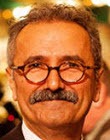
Drew Madden is president of Nordic Consulting of Madison, WI.

6-2-2013 8-30-23 PM

Tell me about yourself and the company.

I have 11 years of EHR experience. I’ve done everything from “roll up your sleeves, build the system” to project management and business development and now to helping run things here at Nordic.

I started my career at Cerner Corporation and then moved on to Epic consulting. I always tell people I felt like I was drinking Pepsi for four straight years and wanted to try a can of Coke — I was intrigued by the other big vendor out there. The company I was working for was ultimately acquired by Ingenix Consulting. I spent some time there as an Epic implementer and business development person until I joined Nordic.

When I met [Nordic CEO and founder] Mark Bakken, the light bulb went off. It was the right place. It was the right time. It was the right culture and vibe that I would have been looking for as a consultant and what I think a lot of consultants are looking for.


It must be interesting running a consulting company right in Epic’s back yard and with all the connections I imagine most of the employees have with Epic. What’s that like?

It’s really pretty good. Only 30 percent of our employees live in Madison. One of our differentiators is certainly being in Madison, but we end up finding a lot of people who worked at Epic and lived in Madison, but life got in the way. Epic requires people to live in Madison in order to work at Epic. They do a great job of finding the best and brightest people in the industry, but some of them want to move back closer to home when they start having kids or their spouse wants to do something different. But like myself, a lot of them still want to be in the EHR area.

They are super excited to be able to continue working on Epic, and ultimately our goals are very much in line with Epic. We want customers to get the most value out of their Epic system. We want to make sure they’re using it in an efficient manner and make sure that we can help do that.


Is it difficult to stay in Epic’s good graces as a consulting firm?

Mark, who started Nordic, started two Microsoft consulting companies. He has his own history and experience with the way Microsoft worked with consultants and consulting companies, so it’s different than what Mark was used to. But I think they do have channels with people that you can communicate with. 

We preach transparency to our employees. That’s part of our selling point. I think if you’re open and honest it’s not difficult to work with Epic. We’ve found a way where I think they recognize the value we can bring to a project when the time comes. Our relationship is really solid.


A lot of what makes consulting companies successful is their culture that they instill with their employees.  Epic folks are used to the culture there. Does that spill over into Nordic’s culture? How do you manage that when you have employees whose first job was working for Epic?

Two-thirds of our employees used to work at Epic. The other third have like an IT or clinical background. We feel like that’s a good mix.

We take a lot of time to get to know the people that we interview. We currently don’t have any recruiters. We have a couple of people who schedule interviews with the inbound interest at Nordic. We take a different approach. We don’t do LinkedIn e-mails and that kind of stuff. I always joke and say that I still get invitations to work as a Cerner consultant based on my LinkedIn profile, but you wouldn’t want me implementing Cerner. We take a different approach and try to get to know the people.

For the first couple of years at Nordic, I think I talked with almost every single consultant, up until we got to maybe 120 or 125. As we scaled, we made sure that we had people that really understood Epic that were talking with the candidates. To a certain extent even over the phone they feel the camaraderie, the secret handshake so to speak, that this person on the other end really knows Epic. We get a lot of respect and excitement from that.


Epic talent is in short supply. How difficult is it to stand out among all the other places they could work?

The secret is focusing on their needs. Our average consultant could probably get a job at five other places in 48 hours, so we’re trying to understand their needs while we’re understanding our clients’ needs. A lot of the work we do is trying to put that puzzle together. It doesn’t always fit right out of the box and intuitively, but we spend a lot of the time trying to make sure that our consultants are in the right role and they’re happy. 

We always say if you have a happy consultant, most likely you’re going to have a happy client. The caliber of people we have here is, I would say, second to none. It’s certainly better than any other organization I’ve ever worked for. If you focus on making sure that your consultants are happy — and that doesn’t always mean giving them exactly what they want, but helping them see that the partnership between Nordic, the individual consultant and the client has to work for all three parties – we spend a lot of time trying to make sure that happens.


What does the staffing curve look like in comparing an Epic implementation to go-live support versus post-live support and optimization. Are clients surprised by the ongoing needs?

Some of our clients probably are surprised by that. I think it’s a byproduct of a tight deadline for an implementation. You do everything possible to meet that deadline and it eventually means that you probably gave up a few things that you wanted. You decide you’ll circle back and get to them post implementation.

We’ve created the Summit series of post-live solutions. The next wave we want to be at the front of is to circle back with clients and do what I would call true optimization. Not just one-to-one staff augmentation and consulting, but more of packaged offerings to go in and do quick assessments on the current state of the Epic implementation or the Epic install is and listen to the client and understanding where they want to go with it. Then do a gap analysis and help them figure out how they get from A to B. We’ve already had a lot of success work with a few customers that had been live for – one in particular has been live for 10 years — but we were able to flesh out 30 months’ worth of potential work they could do to get a little bit more out of their EMR, which was exciting.


Nordic is number one in KLAS among Epic consulting firms. Why do you think that’s the case?

We talk about the fact that not all certifications are created equal. Our consultants are well positioned to really be different. We’ve been told by our clients a lot that a Nordic consultant is different — the way they run a meeting, the way they deliver, the way they’re able to start and hit the ground and have a big impact right away.

I think a part of is that two-thirds of our employees that are former Epic. Epic does a phenomenal job of zeroing in on top talent. At Cerner, they recruited much more from – I was an engineer, my background – so engineering and computer science. Whereas Epic does a fantastic job of looking at the individual. Some of the smartest people I ever worked with at Epic have been zoology majors or music majors, but Epic somehow identifies that recipe for success. Those types of people flourish in the client opportunity. Some of it is again our view of trying to make it a partnership between the client, the consultant, and Nordic. If you can do that, then I everybody feels like they’re getting a fair and equitable deal, which has been successful for us.


Epic doesn’t like people with experience very much — they would rather train somebody who doesn’t have any background than retrain somebody who does. Does the selection process that put them at Epic make them good candidates to work other places?

I think so.  One of the ways that our consultants stand out is they have probably seen between five and 10 implementations. For any given Epic module, they saw a customer do it this way, that way, and three other ways. At last count, our consultants had worked with 240 of Epic’s total client base of around 290. For us to be able to pull from all that data, from all those best practices, and understand the gaps between where a client started and where they want to go … that gives us that extra advantage.


Which areas of specialization or which Epic certifications are the hardest to find or are in the most demand?

Some of that is always driven by what you have. We have almost 100 consultants that are certified in Epic’s inpatient orders and clindoc modules. We have probably 70 in ambulatory and 50 in OpTime. Rev cycle, we have less certified consultants there. That probably has a lot to do with as you look at organizations that maybe are tightening things down financially having a rev cycle person who can come in and help out. There’s a premium on that.

I also think some of the new emerging Epic applications – Cogito, which is the new umbrella reporting application, as well as Willow Ambulatory … we’re fielding more requests from Beaker, the lab module, as more and more clients move that direction.


Beaker follows the typical Epic model where it starts out as being clearly labeled as not ready, but then moves up the food chain. Are there other modules that you see them bringing out or that you’ve heard about?

We don’t really have that visibility. I might take that question and go in a little bit at different direction. I think one of the up and coming modules — more of a methodology than a module – is Community Connect, Epic’s methodology around implementing Epic to reach out to affiliate physician groups or critical access hospitals. It starts to answer the question of how do you offer Epic to areas or organizations that may not otherwise be able to afford, but can work in conjunction with an existing Epic customer in order to have access to an Epic EMR whether they’re acquired by the hospital or not? It’s offered in both capacities. 

We were recently credentialed as one of four Community Connect consulting firms by Epic, which means that we’ve gone through a successful install and that Epic was involved in making sure things went well. As as consolidation happens across healthcare, that will become more and more a need in the industry.


How do you see your business changing as the Epic business changes?

I mentioned the Summit series of post-live solutions. We’ve broken that down into four areas that we think the industry will go and needs to go.

One is optimization. The second is helping customers get the full utility of the Epic upgrade that they take on a one- to two-year basis. We’ve heard from a lot of our customers that doing the upgrade in addition to all of the daily support types of things just becomes … you end up maybe not doing either of them at your level best. That’s another area that we’re looking at, from a command center, sort of a NASA Mission Control, to be able to help multiple customers with upgrades and help them be successful in that area.

The third area is data and analytics. We know ourselves well enough to know we’re not going to create a reporting tool that is going to wow anybody, so that will most likely just be us in trying to be certified industry experts in Cogito and making sure that we can be at the forefront of that as clients have needs.

The last one is ongoing support. What we’ve heard from clients is often they’re left having to choose between, am I going to go out and optimize and circle back and get more efficiency out of the system, or do I just need to keep it running, but I’m having a hard time doing both? In the case where a client wants to use their staff to do some optimization or to run the upgrade, we have the ability, potentially on a remote basis, which could lower the cost of maintaining a system due the ongoing support for the Epic system.

Morning Headlines 6/3/13

June 2, 2013 Headlines Comments Off on Morning Headlines 6/3/13

Westchester hospitals’ sale price over $54 million

Westchester, NY-based Sound Shore Medical Center is expected to be acquired by Montefiore Medical Center for only $54 million after the hospital falls more than $200 million into debt. Contributing factors included a disproportionate population of uninsured patients, and a 2011 EMR install that have caused major delays in billing and cash collection.

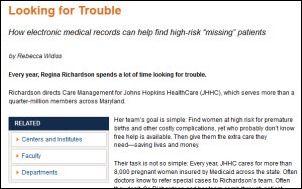
How electronic medical records can help find high-risk “missing” patients

Johns Hopkins’ public health magazine discusses a population health program that uses risk modeling to help identify pregnant patients with an increased likelihood of going into early labor. The team then delivers the necessary care to help mitigate the risk.

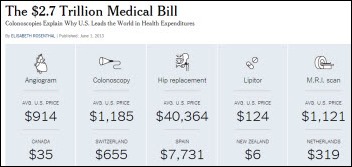
The $2.7 Trillion Medical Bill

The New York Times breaks down the cost variance of a colonoscopy in the US versus other developed nations in a piece that highlights some of the economics driving overall health expenditures in the US.

Mega-contract up for grabs from Department of Health

In England, NHS opens a vendor call for practice solutions to replace the original choices NPfIT approved in 2007. The new program will identify eight practice vendors that UK practices can select from. The program could be worth as much as $2 billion in total health IT spending.

Comments Off on Morning Headlines 6/3/13

Monday Morning Update 6/3/13

June 2, 2013 News 8 Comments

From Misys-Ex: “Re: QuadraMed. Something is taking place. Employees will learn Monday how much longer their employment will last. Some members of management have already packed their offices.” Unverified.

From The PACS Designer: “Re: absence. TPD will be taking a leave of absence from HIStalk to pursue a new development partnership in the healthcare area of expertise. While I will miss the interaction with my fellow HIStalk contributors, I will still read HIStalk regularly and contribute comments on postings when appropriate to do so for my fellow HIStalkers. In the mean time, you’ll be seeing guest bloggers contributing in my absence.”

6-1-2013 7-47-30 PM

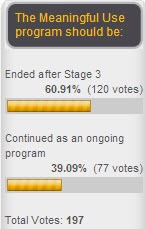
Sixty percent of respondents think the Meaningful Use program should be ended after Stage 3. New poll to your right: would you choose a hospital for elective admission whose clinicians have complained publicly about the safety of its EHR?

Thanks to the following sponsors, new and renewing, that have recently supported HIStalk, HIStalk Practice, and HIStalk Connect. Click a logo for more information.

6-1-2013 7-38-51 PM
6-1-2013 7-37-18 PM
6-1-2013 7-38-09 PM
6-1-2013 7-32-03 PM
6-1-2013 7-44-32 PM
6-1-2013 7-43-41 PM
6-1-2013 7-33-42 PM
6-1-2013 7-46-09 PM
6-1-2013 7-35-53 PM
6-1-2013 7-28-16 PM
6-1-2013 7-30-53 PM
6-1-2013 7-34-21 PM
6-1-2013 7-30-05 PM
6-1-2013 7-45-16 PM
6-1-2013 7-40-36 PM
6-1-2013 7-32-50 PM
6-1-2013 7-35-01 PM
6-1-2013 7-26-40 PM
6-1-2013 7-42-33 PM
6-1-2013 7-29-20 PM
6-1-2013 7-39-33 PM
6-1-2013 7-41-21 PM

Weird News Andy says “Sick Ambulance Kills.” A Washington, DC ambulance transporting a gunshot patient breaks down in the middle of I-295 when its EPA-mandated emissions device shuts the engine down for mandatory cleaning. The patient died during the 5-7 minute delay required to dispatch a backup ambulance. The EPA says it offers an exemption for emergency vehicles.

6-2-2013 9-25-49 AM

Montefiore Medical Center (NY) will buy Sound Shore Health System (NY), which filed bankruptcy on May 14 due to indigent care costs, a drop in patient volume, and a 2011 attempt to install clinical and financial systems, apparently from Allscripts, that continue to cause billing problems even now.

6-2-2013 9-12-03 AM

An article in the magazine of the Johns Hopkins Bloomberg School of Public Health describes the use of EMR information by care managers at Johns Hopkins HealthCare to identify women at risk for premature births and offer them specific interventions. Maryland’s Secretary of Health and Mental Hygiene hopes to use the information to dig deeper into population health, saying, “If you have a map, you might say, ‘All these different doctors are seeing what looks to them like a one-on-one phenomenon.’ But you can see actually it’s a certain community where there are very high rates of asthma. And maybe there’s something going on here… If there’s an anti-smoking effort, maybe the goal today is to hit the whole county. But if you knew that there was a very high concentration of smokers in a particular area and they were having very poor health outcomes, you might target particular buildings.”

6-2-2013 6-34-30 AM

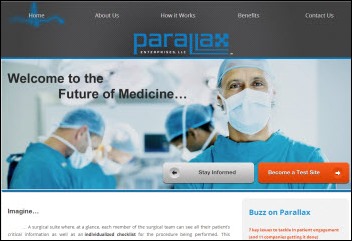
Maryland-based Parallax Enterprises begins development of a pilot-like heads-up display system for the OR that will display EMR information, a patient-individualized surgical checklist, and the patient’s health literacy score so that the OR team can communicate at the right level. I mentioned the company in February when it raised $1 million in funding, also noting the military pilot background of CEO Jeff Woolford, MD. Surgeons will use the  CHaRM heads-up display to interact with the system while remaining sterile. Surgeons can use the system by moving their hands above the sterile field thanks to gesture-sensitive cameras.

Interesting thoughts from Brandon Hull, co-founder of VC firm Capital Partners, at Internet Week New York: “Every other company presenting at Internet Week operates in a clearly defined market economy where we can easily identify buyers and sellers. Healthcare, by contrast, much more closely resembles a command economy full of price fixers and adjusters, oversight and bureaucracy. Stalin-era Soviet Union would be proud … [hospitals] have terrible business practice patterns, aren’t particularly well managed, and soak the federal government for vast subsidies to keep maintaining their existing behaviors. They’re going to be disintermediated.” He says the Affordable Care Act gives hospitals a cheap way to remake themselves into insurance companies in the form of ACOs, while insurance companies that fear being regulated like public utilities are rushing to become providers.

6-2-2013 6-53-04 AM

The New York Times looks at the $10 billion spent annually in the US on colonoscopies, observing, “Largely an office procedure when widespread screening was first recommended, colonoscopies have moved into surgery centers — which were created as a step down from costly hospital care but are now often a lucrative step up from doctors’ examining rooms — where they are billed like a quasi operation.” This is the first in a series of articles that will explain that US healthcare is disproportionally expensive compared to the rest of the world not because of heroic technical interventions, but rather the high prices charged for routine services in the only industrialized nation that allows providers to charge whatever they want without oversight except for Medicare and Medicaid patients.


It happened purely by accident that I was staying up late Thursday night as usual writing HIStalk when I ran across Farzad Mostashari’s just-published letter to the editor of The New York Times, earning the unwarranted but appreciated accolades of some of my favorite tweeple who must have been up late with me to read the new post so quickly.

An Atlanta-area newspaper profiles practice systems vendor Nuesoft, which says its partnership with Practice Fusion could double the company’s 140-employee headcount in the next two years and require  a $20 million capital infusion.

England’s Department of Health issues tenders worth up to almost $2 billion for physician office systems to replace the limited choices offered by the defunct NPfIT.

Vince finishes up the HIS-tory of Allscripts this week.


Contacts

Mr. H, Inga, Dr. Jayne, Dr. Gregg, Lt. Dan, Dr. Travis.

More news: HIStalk Practice, HIStalk Connect.

125x125_2nd_Circle

Advisory Panel: Recent Vendor Experience

May 31, 2013 Advisory Panel Comments Off on Advisory Panel: Recent Vendor Experience

The HIStalk Advisory Panel is a group of hospital CIOs, hospital CMIOs, practicing physicians, and a few vendor executives who have volunteered to provide their thoughts on topical industry issues. I’ll seek their input every month or so on an important news developments and also ask the non-vendor members about their recent experience with vendors. E-mail me to suggest an issue for their consideration.

If you work for a hospital or practice, you are welcome to join the panel. I am grateful to the HIStalk Advisory Panel members for their help in making HIStalk better.

This question this time: Can you describe any notably good or bad experiences you’ve had with a  company in the last three months?


Athenahealth

5-31-2013 8-56-13 PM

The best has been athenahealth so far.


Dell

5-31-2013 9-05-28 PM

Dell SecureWorks managed services. I’d suggest any IT department lift some burden off their security person/persons by letting someone else watch the logs and manage the firewalls. Then the security people can audit the systems and investigation anomalies. 


Harmony HIT

We are working with Harmony to install their Health Data Archiver tool. We are using it to archive data from legacy clinical and financial systems that practices we’ve acquired used to run on.  I wish we’d found it several years ago because it would have avoided a ton of headaches, met customer needs better, and done it more cost effectively.


Impact Advisors

5-31-2013 8-54-15 PM

Doing some great planning work with Impact Advisors. They have some good experience in the Epic world.


KLAS

5-31-2013 9-00-03 PM

Notably good experience with KLAS and their evolving assessment of the BI/analytics market.


McKesson

5-31-2013 9-03-51 PM

We have done a lot of interface work with McKesson over the last three months. They are implementing an EMR at a seven-hospital system and we are working through interfaces with them as each site goes live. They have been wonderful and very helpful. 


NetApp

5-31-2013 9-08-10 PM

NetApp proactively proposed to conduct an end-to-end assessment of our storage environment. Their assessment surfaced a number of gaps, some of which were critical and urgent, needing increased attention from our technical management. It was refreshing to see a storage vendor looking out for our best interests and taking a proactive approach to service. By focusing on NetApp’s recommendations, we likely avoided some major problems that could have affected availability of EMR production and other critical systems.


NextGen

5-31-2013 8-58-11 PM

Hands down my worst experience has been with NextGen, especially their billing "Practice Solutions." 


Comments Off on Advisory Panel: Recent Vendor Experience

Time Capsule: My Low-Tech Dentist Turns Out To Be a Closeted Techie: Why Nobody Cares What IT You Use, Only What Outcomes You Deliver

May 31, 2013 Time Capsule 1 Comment

I wrote weekly editorials for a boutique industry newsletter for several years, anxious for both audience and income. I learned a lot about coming up with ideas for the weekly grind, trying to be simultaneously opinionated and entertaining in a few hundred words, and not sleeping much because I was working all the time. They’re fun to read as a look back at what was important then (and often still important now).

I wrote this piece in December 2008.


My Low-Tech Dentist Turns Out To Be a Closeted Techie: Why Nobody Cares What IT You Use, Only What Outcomes You Deliver
By Mr. HIStalk

125x125_2nd_Circle

My 2005 experience with an IT-savvy dentist was not good. My first (and last) visit to Dr. High-Tech took forever since he had to show me his PACS equipment, his electronic dental record, and his swing-arm TV monitor that would allow me to watch the Three Stooges while getting drilled and scraped.

Unfortunately, he was also a terrible dentist: slow, annoyingly educational, and prone to ill-concealed panic. Despite a flawless exam a year earlier, Dr. High-Tech somberly declared that my mouth was in imminent danger of total destruction, requiring a long list of heroic and expensive interventions that included $7,000 worth of work on one tooth alone.

I headed off for a second opinion, picking a dentist at random from the phone book (I’ll call him Dr. Low-Tech). His conclusion: I needed a filling and nothing more.

I’ve gone to Dr. Low-Tech for the three years since. His office has wood floors, real living room furniture, and no Judge Judy on the TV. He takes his time, talks my ear off, and sings loudly and off-key with the piped-in oldies station. He doesn’t need a dream team of ultra-specialist colleagues. He doesn’t hurt me, he’s never late, and he doesn’t overcharge.

Last visit, I saw something as shocking as Mommy kissing Santa Claus. I followed Dr. Low-Tech out from the treatment room and watched him pass through an unmarked door, getting a brief glance of a massive LCD monitor whiteboard showing every room’s occupant and status.

No wonder he can single-handedly juggle maybe 10-12 patients at a time, all in various stages of numbing, drilling, and swishing. He’s using online scheduling and resource management!

Suddenly everything became clear. I remembered that instead of getting appointment reminder calls, I’d been getting “click if you’re coming” e-mails. The hygienist always knew my history. The front office ladies could always give a perfect balance on my insurance.

Dr. Low-Tech was a closeted techie. He used IT, but didn’t want it to get in the way of taking care of his patients in a personal and caring way. That’s unlike Dr. High-Tech, who hoped patients would be impressed with his gadgets since that’s about all he had going for him.

Dr. Low-Tech has it right. Patients don’t need to know about IT any more than they needed to understand the old-school manila folder filing system. ‘Most Wired’ nonsense aside, nobody gets points for owning technology, whether it’s a doctor, a mechanic, or an accountant. Those professionals are free to use whatever tools they want, but they’ll be judged on outcomes, not on what they’re packing under the hood. Tools might make them a little bit better, but that’s about it.

Measuring the impact on the patient experience should be a part of every technology implementation review. Did patients notice? Was their impression of the overall experience (not the technology itself) better or worse? Did it enhance their experience, or did it get in the way and take away from the human interaction and caring that most people would agree is a vital part of a patient encounter? Did outcomes change?

Doctors always say “first, do no harm.” That’s as true of technology as anything else. Even bad golfers carry around the same expensive gear that Tiger Woods uses, hoping that owning it will make them better golfers. Unfortunately for them, scores don’t lie.

Morning Headlines 5/31/13

May 30, 2013 Headlines Comments Off on Morning Headlines 5/31/13

Health Care Innovation

In a letter to the editor of The New York Times, National Coordinator Farzad Mostashari, MD, concurs with an Times piece published earlier this week which identified the booming health IT startup market as an unintended positive consequence of the Affordable Care Act. Mostashari added that widespread adoption of EHRs and a shift from fee-for-service to value-based purchasing are also positive outcomes of recent public policy.

Computer prompt boosts flu vaccine rates

Pediatricians in New York City were able to increase pediatric flu vaccination rates nine percent by having a pop-up alert built into the practice’s EMR. alerting doctors if the patient had not yet received a vaccination.

RBH faces £18m loss over IT system

In England, Royal Berkshire Hospital writes down $23 million in expenses, much of which it blames on unanticipated costs associated with its Cerner Millennium implementation.

Despite Challenges, MEDITECH 6.0 Customers Say They Are Not Going Anywhere

Despite performance challenges with Meditech 6.0, 95 percent of the company’s customers surveyed by KLAS say Meditech is part of their long-term plans, citing affordability and usability.

Comments Off on Morning Headlines 5/31/13

News 5/31/13

May 30, 2013 News 5 Comments

Top News

5-30-2013 8-38-04 PM

A letter to the editor in The New York Times by National Coordinator Farzad Mostashari says public policy is making the healthcare system smarter, citing the recently announced figures that half of practicing physicians and 80 percent of hospitals are using EHRs.


HIStalk Announcements and Requests

inga_small Some HIStalk Practice highlights from the last week or so: WNA makes a rare HIStalk Practice appearance to comment on a physician who has quit taking insurance. Physician satisfaction with their EHR vendors has declined over the last year. Almost one-third of physicians buying EHRs today are replacing legacy EHRs. Physicians fear that declining reimbursements, rising costs, and ACA-related requirements will threaten practice profitability. Athenahealth recognizes Midland Orthopaedics with its athenaVision award. Most nurse practitioners believe a practice led by an NP should be certified as a PCMH, but most physicians disagree. Dr. Gregg posts a letter to Allscripts. Thanks for reading.

We’ve had some interesting posts on HIStalk Connect lately, so you might want to sign up for e-mail updates if you follow mHealth, innovative technology, and startups. Lt. Dan also does a Friday weekly news recap there that provides a great summary. Some recent articles:

Tim Cook Discusses Wearables, Acquisitions, and Executive Changes at D11 Conference
The Third Screen Revolution in Healthcare Is Before Us
How Consumers Enter the System
EHRs Propagate “Best” Practices
Healthcare Q&A
VentureHealth Launches Equity Backed Crowd Funding Site
Texting for Health Revisited


Acquisitions, Funding, Business, and Stock

5-30-2013 10-27-09 PM

Shareable Ink raises an additional $3 million, bringing its total funding in the last three years to over $14 million.


Sales

Bon Secours Health System Center for Clinical Excellence and Innovation selects Quantros to advise on performance improvements to advance ED quality and safety.

5-30-2013 3-59-37 PM

Southpoint Surgery Center (FL) selects Wolters Kluwer Health’s ProVation MD and ProVation MultiCaregiver.

5-30-2013 4-00-19 PM

The Pennsylvania eHealth Partnership Authority signs a five-year agreement with Truven Health Analytics for its HIE solution.

Clyo Internal Medicine (OH) selects simplifyMD as its EHR provider.

5-30-2013 4-01-48 PM

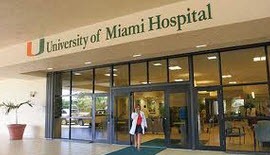
The University of Miami and the University of Miami Health System will deploy Hyland Software’s OnBase enterprise content management solution across 60 academic departments, 30 outpatient facilities, and three hospitals.

5-30-2013 4-03-04 PM

John C. Lincoln Health Network (AZ) selects Besler Consulting to assist in the identification of Medicare Transfer DRG underpayments.


People

5-30-2013 4-04-35 PM

AirStrip names OptumInsight CEO Bill Miller to its board.

5-30-2013 5-23-59 PM

Verisk Health EVP Brian Smith joins the advisory board for telemedicine provider SnapMD.

5-30-2013 2-19-16 PM

Explorys appoints Cleveland Clinic CFO Steve Glass to its board.


Announcements and Implementations

5-30-2013 5-31-21 AM

Advocate Physician Partners (IL), a care management collaboration with Advocate Health Care, implements its 500th independent physician on SynAPPs, Advocate’s cloud-based version of eClinicalWorks EHR.

Practice Fusion announces preferred billing partnerships with ADP AdvancedMD, CollaborateMD, and NueMD.

The Idaho Health Data Exchange and St. Luke’s Health System launch Image Exchange viewing capabilities by eHealth Technologies.

5-30-2013 10-29-54 PM

Malcom Randall VA Medical Center (FL) installs Welch Allyn’s Connex Electronics Vitals Documentation System.

Edward Hospital & Health Services (IL) deploys Levi, Ray & Shoup’s VPSX print management and document delivery system its Epic system.
5-30-2013 10-31-36 PM

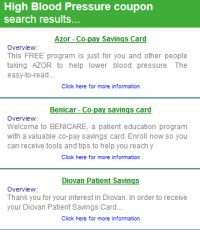
PDR Network will distribute drug company patient support coupons from OPTIMIZERx via EHRs.

SCI Solutions releases Order Facilitator v10, which includes mobile ordering, expanded messaging, and enhanced capabilities for lab order requisitioning, collection, and labeling.

Nuance publicly confirms for the first time that its speech recognition technology powers Apple’s Siri, with CEO Paul Ricci stating at a conference, “We are the fundamental provider of voice recognition for Apple.”

In England,NHS chooses BJSS and Valtech as finalists to develop an electronic referrals service to replace Cerner’s system.
5-30-2013 8-17-36 PM

The MUSE conference is underway this week in National Harbor, MD, wrapping up Friday. The photo above of Farzad Mostashari delivering the keynote was posted to Twitter by Dan McQueen.

5-30-2013 9-03-02 PM

CureMD will demonstrate a new chemotherapy administration module of its oncology EHR that it says took five years to develop next week at the American Society of Clinical Oncologists conference in Chicago.


Government and Politics

CMS advises practices on the role of clearinghouses in the ICD-10 transition, noting that, “While clearinghouses can help, they cannot provide the same level of support for the ICD-10 transition as they did for the Version 5010 upgrade.”

The HHS Office of Inspector General finds that healthcare provider information maintained in the National Plan and Provider Enumeration System (NPPES) and Provider Enrollment, Chain and Ownership System (PECOS) was often inaccurate, occasionally incomplete, and generally inconsistent between the two databases. In NPPES, 48 percent of records contained inaccurate data; 58 percent of PECOS records contained inaccuracies. 

5-30-2013 8-03-47 PM

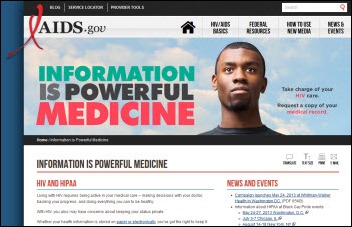
HHS launches the “Information is Powerful Medicine” campaign that targets HIV/AIDS sufferers.

A group of Senate Republicans calls for an independent investigation of HHS Secretary Kathleen Sebelius, claiming that her fundraising efforts for Enroll America, a non-profit that promotes the Affordable Care Act, is inappropriate and possibly illegal in appearing to solicit donations from industries she is responsible for regulating.


Other

5-30-2013 2-41-02 PM

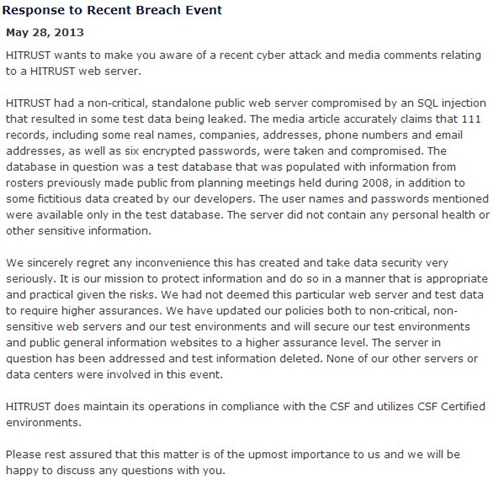
The Health Information Trust Alliance, which promotes data security among healthcare providers, experiences a cyber attack of a non-critical, standalone public Web server. HITRUST a test database with fictitious data was compromised.

Bon Secours Hampton Roads Health System notifies 5,000 patients of a potential EHR security breach after discovering that two clinicians had accessed patients’ medical records “in a manner that was inconsistent with their job functions and hospital procedures.” The hospital has terminated the pair and is offering affected patients free credit monitoring services.

In England, Royal Berkshire Hospital says its problem-plagued Cerner Millennium EPR forced it to write down $23 million. According to the hospital’s CEO, “Unfortunately, implementing the EPR system has at times been a difficult process and we acknowledge that we did not fully appreciate the challenges and resources required in a number of areas.”

Australian researchers review the use of CSC and Cerner CPOE systems in a small-scale study that suggests systems with more drop-down menus may increase error risk.

EMR reminders driven by a connection to New York City’s vaccine registry increased children’s flu vaccine rates by 9 percent, and when physicians chose not to order the vaccine, they documented the reason 98 percent of the time. The results were presented at a pediatrics conference earlier this month.

Despite performance challenges with Meditech 6.0, 95 percent of the company’s customers surveyed by KLAS say Meditech is part of their long-term plans, citing affordability and usability.

5-30-2013 10-34-42 PM

A New York Times article says Beth Israel Medical Center (NY) allowed an elderly heiress worth $300 million to occupy one of its rooms for the last 20 years of her life, but launched “an all-out fundraising campaign” in having executives hang around her room to hit her up for donations and drop hints about making a will. The CEO’s mother even watched a Smurfs video with her hoping to get on her good side.  

Weird News Andy titles this story Step 1: Insert Pencil. A German man complaining of headaches and a runny nose is found to have a four-inch pencil embedded in his head, lodged there 15 years previously in a childhood accident.


Sponsor Updates

  • SIIM and Brad Levin of Visage Imaging have developed a three-minute survey for IT imaging leaders to bring visibility to imaging challenges before next week’s SIIM13 conference in Dallas.
  • Dorland Health names Vocera subsidiary ExperiaHealth the winner of its Case in Point Platinum Award for Discharge Planning Program for its use at Cullman Regional Medical Center (AL).
  • RazorInsights exhibits its ONE Enterprise EHR at next week’s Alabama-Georgia Rural Health Clinic Conference in Opelika, AL.
  • SuccessEHS client ARCare (KY/AR) achieves Stage 6 on the HIMSS Analytics EMR Adoption Model.
  • Imprivata announces that it has the highest market share of any SSO solution among US Meditech EHR hospitals (36 percent) and that the number of hospitals using Imprivata OneSign has increased about 57 percent in the last year.
  • e-MDs posts a Webinar that includes advice for physician practices on health information exchange and Stage 2 MU.
  • Impact Advisors principal Laura Kreofsky and senior advisor Jason Fortin discuss why achieving Stage 2 MU could be challenging.
  • Awarepoint is named a Red Herring Top 100 North America Tech Startup.

EPtalk – by Dr. Jayne

clip_image001

ICA achieves EHNAC Accreditation as a Direct Trusted Agent. Other vendors recognized include Cerner, Max.MD, and Surescripts. All four were accredited for Registration Authority, Certificate Authority, and Health Information Service Provider criteria.

The HIMSS14 Call for Proposals ends next week. It’s hard to submit timely topics nearly a year in advance, but if you’re like those of us in the nonprofit trenches, it may be the only way to have a trip to HIMSS approved. You wouldn’t want to miss an opportunity to attend HIStalkapalooza, would you?

Speaking of educational opportunities, CMS offers a National Provider Call on June 5 to help providers get started with PQRS and the Value-Based Payment Modifier programs. CMS experts will also be available after the presentation to answer questions.

clip_image003

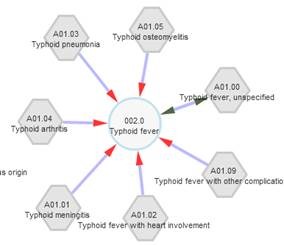
The University of Illinois at Chicago creates an ICD-9 to ICD-10 website. Maybe I have a warped sense of fun, but I enjoyed fiddling with it, and the results make for some frightening diagrams to spice up ICD-10 presentations.

A friend of mine e-mailed this blog by Reid Blackwelder MD, president-elect of the American Academy of Family Physicians. He tells the tale of a neighbor who fell and was taken to the ER where he was possibly misdiagnosed and discharged, then had to return for more extensive testing and a final diagnosis. Along the way, key clinical signs (like his inability to walk) were missed. Treating the numbers (test/lab/film) rather than the patient has become epidemic in the US. Is it defensive medicine, time pressure, the influence of Big Data, or simple lack of caring? I don’t know the answer, but we have to figure out a way to do better.

The article came at the same time that I was having a heated e-mail exchange with an IT colleague about whether we should push our vendor to incorporate genomics content in the EHR. I find it difficult to think that the average physician is going to be able to understand and act on genomic data when our healthcare delivery system so stressed that stories like Dr. Blackwelder’s exist. Of course that’s assuming we figure out a way to pay for gene sequencing and the subsequent treatments suggested by the data, which was the source of the original heated exchange.


Contacts

Mr. H, Inga, Dr. Jayne, Dr. Gregg, Lt. Dan, Dr. Travis.

More news: HIStalk Practice, HIStalk Connect.

125x125_2nd_Circle

Morning Headlines 5/30/13

May 29, 2013 Headlines Comments Off on Morning Headlines 5/30/13

Why Some Doctors Don’t Lean On EHR

A new study published in the Journal of American Medical Informatics Association concludes that EHR adoption has less to do with how tech savvy a doctor is and has more to do with how much uncertainty — an accepted and universal attribute of medical practice — a doctor is comfortable with.

Repeated EHR Alerts Desensitize Clinicians

A case review published in the journal Pediatrics suggests that unimportant CPOE alerts negatively impact patient outcomes, possibly because they cause clinicians to miss important warnings.

Software That’s Hard on Hospital Readmissions

A local North Texas station reports on population health systems being implemented to reduce readmission rates at Texas Health Resources.

With Money at Risk, Hospitals Push Staff to Wash Hands

The New York Times covers efforts being employed by hospitals to increase hand hygiene compliance, including a number of technology advancements that include RFID tracking of physicians coupled with video surveillance and ID badge-enabled soap dispensers that track whether soap has been dispensed and alert the clinician as they approach the bedside if it hasn’t. An unannounced 16-week video monitoring trial at North Shore University Hospital revealed hand hygiene rates at less than 10 percent. Once clinicians were made aware of the video system and were sent weekly e-mails with their performance, the numbers jumped to 88 percent.

Comments Off on Morning Headlines 5/30/13

HIStalk Interviews Frank Naeymi-Rad, Chairman and CEO, Intelligent Medical Objects

May 29, 2013 Interviews 8 Comments

Frank Naeymi-Rad, PhD is chairman and CEO of Intelligent Medical Objects of Northbrook, IL.

5-29-2013 7-22-20 PM


Tell me about yourself and the company.

I received my computer science doctorate degree from Illinois Institute of Technology. My dissertation research work was in developing medical dictionaries that support electronic medical records, decision support, and information retrieval used at the point of care.

I got introduced to medical terminology when I was teaching classes to medical students, where I was directing academic, research, and administrative information services at the Chicago Medical School. These classes included use of computers for directed history and physical documentation, informatics workup, and concepts in medical artificial intelligence as senior electives.

During the senior elective setting, I wanted students to build knowledge for different decision support applications. The major task and challenge that we had developing knowledge for the decision support was standard terminology. Each system had its own dictionary. The systems we used were MEDAS, Dxplain, QMR, Knowledge Coupler, and Iliad. The medical students had to build knowledge for pattern recognition as well as rule-based decision support and application.

The knowledge created by students for a given diagnosis was then compared to knowledge within these expert systems for the same topic. The key learning objective was that everyone learned how the computers were used to make decisions and the results could be manipulated to reflect the new discoveries.

During that process, the most important aspect that came out was when we compared students’ patterns to other expert systems. It became clear that what was missing was standard medical terminology. This became the topic of my dissertation. It was really the concept of capturing and preserving the truth, what the source of truth about a given decision was and how the decision was made by the computer.

It was then necessary to reverse engineer the patterns back to the original form to explain why it led to the need to build a dictionary that students used to codify the rule. This allowed us to compare the pattern across multiple domains using the same foundation dictionaries. This led to my dissertation topic, which was a feature dictionary for clinical systems and electronic medical records.

The ultimate test was how the students’ knowledge would perform when interfaced to real patient data. Into the late 1980s and early 1990s, there were no coded electronic records. This led to the development of a history and physical documentation program on the Apple PowerBook for medical students. This program was expanded as a tool for second-year students as part of a supplement for the introduction to the clinical medicine class.

This program allowed students to develop comprehensive documentation for the history and physical exam. While the objective was to a develop a patient electronic record that could be used to test the student decision support pattern, instead it led to the creation of an electronic medical record which was used a the Cook County ER. IMO was created to help commercialize the product that was sold to Glaxo Wellcome, which at that time was called HealthMatic.

Later on, HealthMatic was sold to a company called A4 Sytems, and then A4 Systems sold its assets to Allscripts. The EMR that we developed at the medical school, with the help from many of the same IMO team developers working with me at the medical school, helped commercialize it. The current generation is called Allscripts Professional.

You can understand how the team who is working at IMO right now are key players in the industry. This is the same team from the medical school as well as the same team that developed the early clinical documentation for HealthMatic and medical content work for Glaxo Wellcome.


Describe how IMO’s product and the terminology works with EHRs.

Our flagship product is interface terminology. Our primary objective is to capture and preserve the clinical intent and then map that clinical intent — the truth — to their corresponding regulatory requirement. Interface terminology manages and maps between clinicians’ terms and the required regulatory code terminology like ICD-10 and Meaningful Use codes as well as reference terminology like SNOMED CT.

The way we have succeeded is that we have removed the overhead of making a clinician to be a coder. They can say what they want to say. We manage the code and mapping and help our EHR partners to capture and preserve the truth.


Who is your most significant competitor?

The competitors that I see are people who do not really understand the challenge of terminology and the importance of preserving the clinical intent. Fortunately and unfortunately for us, I think the knowledge base within the marketplace is growing. We need a dynamic model to respond to these changes as soon as possible.

We are very happy that we are able to help our partners meet regulatory standards. Adaption of standards is a very daunting task for many of our vendor partners. There has been a lot of movement in our space because most of the new regulatory standards require several new coding subsets.

We expect large and innovative competitors coming into the terminology space. What they are missing is the understanding of the electronic medical record and how terminology should be used within the electronic medical record. Having the EHR knowledge expertise gives a true edge to IMO’s team as the market moves from fee-for-service to fee-for-performance.

There are many competitors within the terminology space. We have competitors who are managing the coding for reimbursement and now have to also do clinical. We have competitors who sell you tools in order for you to manage the complex mapping for the coding within the clinical setting.

Terminology management is hard and tedious work. We have a unique group of knowledge workers and physicians because they are good at it and love doing it. Adding to that our technology team, with the understanding of the electronic medical record and how terminology is used within the electronic medical record, creates a major barrier for others to match the quality of our service delivery.


What parts of HITECH have caused both vendors and providers to seek you out as a company?

It’s compliance to the Meaningful Use requirement and making sure that they are able to manage the changes associated with Meaningful Use requirements. When you look at our portfolio of clients, they initially used us to enhance clinical searching and finding codes for reimbursement. I believe Meaningful Use is creating a unique challenge for them because it is moving the market from fee-for-service to fee-for-performance and that aspect of care creates a unique attribute and need of understanding the use of terminology within the state of care. Our interface terminology service is to make sure that the truth about clinical data is stored as expressed by the clinical team.

For example, when you’re on the same term within the assessment, it may have a different ICD-9 code versus that same term in the history section. Being able to have a concept-based architecture that manages this complexity allows for correct mapping to ICD-9 as well as to ICD-10 complex billing post-coordination, but also maps to SNOMED CT and other required Meaningful Use terminology subsets.

We take that complexity out. We manage that complexity within our tool set and then we deliver those to our client base, allowing their clinical user community intent to be preserved so we can also code for care.


A recent study found that IMO’s interface terminology can identify population health issues when paired with EHR data. What are the implications of what that study found?

The early studies that I did historically looked at finding the clinical truth. You really want to make sure that what clinicians are saying is preserved in their words and that the data being collected is following guidance dictated by the clinical team. The data collection service needs to provide terms that reflect the clinician intent in its original form.

We as a company have been very fortunate to be trusted by and permitted to serve one important population of our society, and that’s the clinician. We believe clinicians are under massive pressure to do their job through primitive electronic documentation services that do not speak their language.

I worked at the medical school for 12 years and I observed students going through all of the different stages of medical training. I understand and appreciate the difficulties physicians have to go through in their medical training. The knowledge base learned as part of their training is their most important tool to make them master problem solvers. Capturing and preserving their clinical intent is always the best card we have in understanding exactly what is wrong with the patient and even when a physician is making a wrong assumption.

Our interface terminology allows the truth to be preserved and not distorted by coding optimization templates or services. Preserving the physician intent is responsible for the success of this study, identifying 99 percent plus patients correctly in this publication. By empowering the clinical team and using IMO interface terminology, we are going to have a near perfect understanding of our patients at risk.


What’s your perception of the state of readiness for ICD-10 transition and what impact this is going to have on providers?

The impact for our vendor partners is going to be nominal because we knew going from 14,000 ICD-9 codes to 90,000 ICD-10 codes will be a massive transformation for many EHR vendors. But for our clients, it’s different because we started distributing ICD-10 mapping last year and we have been working with them to deliver their point of service solution.

As part of our support for ICD-10 CM, PCS, and MU 2, we are expanding our terminology foundations by 3,000-plus concepts and as many as 30,000 interface terms per month. What that really means is that our clients are able to manage all these lexical variants long before the regulatory deadlines for ICD-10 and MU2.


ICD-10 is just a different mapping for you and you allow customers to create or maintain their own in addition to what you supply, correct?

Correct. We don’t allow them to manage their own mapping outside of our mapping because we really believe in this crowd-based or wiki-based model. It creates transparency that our clients have the correct standard mapping. Our mapping obviously grows and changes faster because of this transparent model and medical knowledge changes. We have developed sophisticated tools and workflow to manage all the mapping ourselves. 

Normally when people go to IMO we move them to what we call a migration process to make sure that everybody standardizes their local dictionaries to the same datasets. If there is an error in our mapping or if there is an inconsistency, we can always correct it quickly in the next release. But if we allow local mapping, it really can violate some of the principles that we have. We don’t prevent them from having local variation and mapping. They can have their own lexicons if they want to, but we don’t take responsibility for those maps and will not distribute to other sites.


If they have like a certain phrase that they use locally, they can build it into the equivalent of a dictionary so that even if it’s not commonly used they can still understand?

They could still understand, but they should normally be asking to send it to us. If it matches our editorial policies, we distribute to everybody else. Everybody else would use that as well.

But I think it is important for them to be cognizant of the bigger picture because we really believe that this is the grand opportunity to really make standards like SNOMED and ICD-10 to truly work, because if we map correctly to them, at least these standard coding systems and these regulatory coding systems become more valuable for our future. Obviously they will be changing as well. If people start mapping their own local terms, there’s no way to be able to validate or review that and then challenge it.


That would be unusual, right?

That’s unfortunately not true. There is always going to be new concepts requested. We have term request workflow to incorporate new valid terms in our next release within six weeks and to have everything made available to our community. There are going to be some domains that most likely our clients would need to have their own local terminology, but terminology as it relates to clinicians’ decisions, like the problem list, the past medical history, assessment, and plan, which are foundations for clinical team decision making and requires billing codes that need to be codified correctly.


Has ICD-10 changed your business substantially so that people are seeking you out for a painless solution?

I don’t believe that ICD-10 alone is the issue. The reason our product has been sought out is EHR adoption and usability by clinicians. I really do believe that clinicians are commanders-in-chief when it comes down to fighting diseases and planning treatments. Clinicians are the key stakeholders as we transform from fee-for-service to fee-for-performance. They must be in control.

What our vendors do is use IMO as a source of truth for tracking clinician commands and orders, preserving the patient problem list and differential diagnosis using their dictation into the electronic medical record. ICD-10 is just a byproduct that the EHR vendors needed to comply to. You could say the usability is how the value of IMO is realized when complying with ICD-10, SNOMED CT, and within a few years ICD-11 are byproducts.


What research and development is the company working on?

We have been done with ICD-10 for quite a while. Our biggest research and development is invested in tools to manage our growth that we are facing right now. We are becoming the foundation technology innovation platform for many of our EHR partners. What that really means is that we have worked very, very hard to make sure to marry technology with terminology.

We have a cloud-based solution we call our portal service that allows the physicians to search the way they want to search. We can then rank order the search results in context of the domain that they’re searching for. This new technology allows us to do what we call just-in-time vocabulary releases. We have 60 releases a year total and for diagnostic and procedures 10 releases each. Using the portal eliminates many of the overheads associated with local dictionary normalization.

But these 60 releases a year historically without our technology would be impossible to adopt with import/export technologies. In most cases it takes maybe some times two or three months for people to deploy updates or in many cases people only deploy the regulatory requirements rather than updating on a monthly basis. By having this portal technology available, allowing the marriage of technology and terminology, we are able to make these datasets available at the point of service for our clients almost instantaneously after delivery of our service.

This has really increased our product usage. We have over 350,000 physician users and over 2,500 hospitals using our product. Many of our vendors are moving to our portal as their terminology innovation platform. One comment that we get from our clients is that they know when IMO is not there. That’s by far the biggest compliment that we could get.


What does the physician see differently if they’re using a system that uses IMO versus one that doesn’t?

They can find what they’re looking for and the description that they want to assign to the patient’s problem in the right lexical context and within the top three to five term list results.


Is that time-saving for them?

Absolutely. We are seeing up to three minutes for complex visits and as much as 30 seconds per common visit. The most valuable is a more granular problem list and orders in their clinical speak. We have not measured the IMO factor in follow-up time saving. We hope to work with our partners and perform independent research on the effects of having IMO in time and quality.


Where do you see the company going in the next five years?

Where we are going is to empower our vendor partners to deliver the best EHR solutions in the marketplace. We believe that our technology and removing this complexity associated with its managing terminology makes our partners stronger. They can do more innovations for clinician documentation. That is the most important thing to us.

We believe we want to participate in the success of the care delivery organizations in our country. I believe that as clinicians become empowered in the clinical setting and take over the responsibility of delivery of care using IMO-enabled EHRs, they and care delivery organizations will see a reward based on the quality of care they’re delivering. We would be a key part of this transformation for our vendor partners, their clients, and users.

As we allow our vendor partners to innovate, many of IMO’s portfolio terminology-enabled assets that we have been developing in the last 20 years will become more valuable at the front line and will allow our partners to build a positive distance between their offerings and others not using IMO. We hope to grow with our vendor partners to eventually make the US destination healthcare through new innovations in medical terminology-enabled technology. This is the way it should be.


Do you have any final thoughts?

Thank you for your time and opportunity to present IMO to your audience. We are honored with the finding of the independent study result showing that when using IMO interface terminology, nearly perfect agreement is achieved with greater than 99 percent in a peer-reviewed CDC publication. This article was truly energizing for me and the IMO team working in this space of dictionaries and terminology innovation to capture clinicians’ intent. It seems that finally after all these years we can actually see the fruit of our work, and that is really a good feeling.

Advisory Panel: Handling Information Overload

May 29, 2013 Advisory Panel 1 Comment

The HIStalk Advisory Panel is a group of hospital CIOs, hospital CMIOs, practicing physicians, and a few vendor executives who have volunteered to provide their thoughts on topical industry issues. I’ll seek their input every month or so on an important news developments and also ask the non-vendor members about their recent experience with vendors. E-mail me to suggest an issue for their consideration.

If you work for a hospital or practice, you are welcome to join the panel. I am grateful to the HIStalk Advisory Panel members for their help in making HIStalk better.

This question this time, as requested by a reader: How do you manage information overload about new devices, new software, and new services?


"Make the users producers." A good way to keep up with all the new stuff is to engage end users in affinity groups to bring forward their recommendations within a context of a strategic plan. Personally, I keep abreast of new stuff through conferences, reading, talking with physicians and clinical staff, and occasionally meeting with vendors.


It is a zero sum game and always something-else has to give. Like not going to the gym as much or sacrificing some extra time with the family to go to an extra meeting in the effort to stay in the know how. Or reading “Medical Economics” instead of a fiction novel hoping that it will pay off someday by making a smart decision or help  someone else making a smart one for an organization. Or reading your blog instead of watching a show on TV because your blog is so much more fun.


If I’m not talking or listening, I’m reading constantly, 16 hours a day. HIStalk is a very important source of news — very important. I also watch the Advisory Board, Chilmark, and Circle Square. Twitter is a great source of news because of its brevity with links to more detail.


The amount of information we get is absolutely insane! We have taken a formal stand on this. We split different areas up and made them the responsibility of individuals. For instance, one person reads up on new devices, another person reads up on new software, another on new services. Everyone knows who is responsible for which area and forwards pertinent information to them. Once a month, we do an update with each person reporting on what they feel is important. This way, we are all not drowning in e-mails, snail mail, webinars, and conferences. We even split up at HIMSS and AHIMA to explore our own area of update responsibility.  It works for us and no one is overwhelmed with trying to sort through it all.


I try to first see what the demand is from our end users – what are they asking for and for what purpose is the technology needed for? After that I  generally look at KLAS reports to see opportunities to identify best of  breed and go from there.


I make sure to keep my popular blogs to a mall number and read them when time permits. That  is mainly on the weekend or while eating breakfast.  ;)  Boy Genius Report and others on device/mobile. HIStalk on the HIT front, of course! 


We have an Enterprise Architect. Among other things, his job is to stay ahead of new technology and evaluate what might work for our organization and just as important what technology to stay away from. He has a budget to acquire new technology and test it with small pilots (usually using the IS department.) Anytime I get an interesting e-mail (which is rare) regarding new technology, I send it to him for evaluation. I always tell him he has the best job in the organization since he gets to play with new toys.


We let the information enter our consciousness, but only do deep dives if we have a need for a solution or a product replacement or if someone tries to buy something and they need our opinion. It is a never ending task and the first step to not losing your mind over it is to admit it is a never ending task!


(sigh) I don’t have a good answer for this issue. The best I have been able to come up with is regular networking with peers. I tend to target the items that will meet the needs of my current business problems when conducting research. Networking gives me the opportunity to hear about solutions that others have used for problems I have not yet experienced.


Just try to keep from drowning. It is nearly impossible.


You can’t read everything and we focus so much of our time on making sure what we read, communicate, and do is based on quality data. The healthcare space is changing very fast we have to keep up.


We don’t face this issue as frequently as you might expect  However, we rely on our staff to relay back to leadership the market trends – which we in turn take great effort to communicate back to the balance of the client facing staff.


Personally, I will always try something and if it makes my life easier quickly (e.g. within the day), I will stick with it. If it does not, I will move on. At the group level, we are careful to introduce new technologies and do lots of vetting and prototyping to make sure that when we roll it out we have a clear reason to do so and there is a clear ROI to the users.


I listen to everybody and look at anything that any colleague tells me is worth a look — that’s a look, not usually a meeting. Search Twitter, G+ and Google generally for any discussion about that tech.


I am sorry; what did you say? I was too busy checking my iPhone and didn’t hear you. 🙂


Morning Headlines 5/29/13

May 29, 2013 Headlines 1 Comment

Accent on Integration

At MUSE on Wednesday, Iatric Systems will announce the acquisition of the business assets of Accent on Integration. AOI’s products and services, including the Accelero Connect integration platform, will continue to be marketed by Iatric.

Cerner Announces 2-For-1 Stock Split

Cerner has approved a 2-for-1 stock split effective June 17, a strategy employed to reduce a company’s stock price, as CERN shares approaches $100.

Harper Government Invests in eHealth Innovation

The Canadian government announces that it will encourage the creation of local eHealth initiatives by issuing grants to 16 research projects focused on developing technologies that enable patients to self-manage their conditions via eheath applications.

Direct: Implementation Guidelines to Assure Security and Interoperability: May 2013

ONC releases updated guidelines for Direct HIE implementations that will facilitate a MU Stage 2-compliant exchange of information between organizations.

News 5/29/13

May 28, 2013 News Comments Off on News 5/29/13

Top News

5-28-2013 6-57-33 PM

Iatric Systems will announce Wednesday that it has acquired the business assets of Accent on Integration. Iatric will continue to market the Accelero Connect integration platform, as well as AOI’s consulting and professional services. AOI President and CEO Mark C. Andiel will transition to Iatric as SVP of professional services and VP/CTO Jeff McGreath will serve as VP of patient care device integration.


Reader Comments

5-28-2013 10-05-57 PM

From Irene: “Re: Twitter. Did you see this?” MedCity News names 10 healthcare IT professionals to follow on Twitter. It’s actually nine since one of those listed is not a healthcare IT professional, but the rest of us are working CIOs, CMIOs, and clinical informatics professionals. HIStalk is described nicely as, “the pseudonym for a man who describes himself as ‘an informatics guy’ and is also the name of his long-running news and opinion blog on all things healthcare IT. It strikes a nice balance between health IT vendor news and perspectives from hospitals as well as industry trends.” I don’t really do a lot on Twitter since I don’t have much time, but I do appreciate the 5,600 people who follow me.


Acquisitions, Funding, Business, and Stock

5-28-2013 10-10-21 PM

Cerner announces a 2-for-1 stock split for shareholders of record as of June 17, 2013. Had you invested $10,000 in CERN shares at the beginning of 2000, they would be worth $191,000 today.


Sales

Bon Secours Health System (MD) renews its contract with MedAssets for revenue cycle technology and consulting services.

5-28-2013 10-14-17 PM

John Muir Health (CA) selects ZirMed’s RCM, clinical communications, and analytics tools.


People

5-28-2013 6-33-37 PM

Cumberland Consulting Group hires Taylor Ramsey (Surgical Information Systems) as director of business development.

5-28-2013 6-34-52 PM

Paul Uhrig, chief administrative and legal officer and chief privacy office of Surescripts, is named to the board of DirectTrust.

5-28-2013 6-35-47 PM

Explorys appoints Objective Health CEO Russell Richmond, MD to its board.

5-28-2013 6-37-12 PM

Valence Health names Scott J. Cullen, MD (Kaufman Hall) executive director of consulting services.

5-28-2013 6-56-17 PM

Leland Babitch, DO (University Pediatricians, Wayne State University School of Medicine) is named senior medical director of Clinovations.

5-28-2013 8-00-55 PM

Children’s Hospital and Clinics of Minnesota promotes Dave Overman from COO to president/COO. He joined the organization as CIO in 2005 and led its EMR implementation (Cerner, I believe.)


Announcements and Implementations

5-28-2013 3-54-51 PM

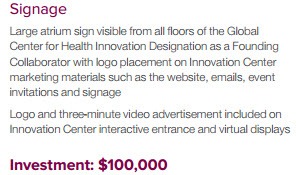
Alego Health becomes the first organization to join the HIMSS Innovation Center as Founding Collaborator, which requires a $100,000 “investment.”

5-28-2013 4-14-16 PM

ADP AdvancedMD launches MyICD-10, a Website to help practices prepare for the ICD-10 transition.

The Georgia Health Information Exchange changes its name to the Georgia Health Information Network to more accurately reflect its mission of creating network of existing health information networks.

Medhost begins marketing the Vanderbilt-developed perioperative management system its parent company bought with its acquisition of Acuitec, calling it Advanced Perioperative Information Management System.


Government and Politics

The ONC releases updated guidelines for Direct HIE implementations to enable the easy and secure exchange of patient health information under Stage 2 MU.

5-28-2013 7-11-25 PM

Canada’s Minister of Health announces that the government will fund 16 new eHealth projects with $100,000 grants, choosing potential innovations that empower patients, create a new generation of decision support tools, and monitor population health. Among the funded projects, all of which are led by an academically affiliated principal investigator: diabetes self-management, depression screening, self-management of cardiovascular disease risk factors, diabetes interventions, anticoagulation therapy management, mental health screening of pregnant women, depression telemetry, a rheumatoid arthritis decision aid, pediatric weight management, ICU discharge planning, and collaborative care for adolescent cancer.


Innovation and Research

Australian researchers find that using an electronic medication management system did not take time away from providers who were providing direct care.

Startups can apply for a one-minute showcase introduction and networking with a Madison, WI-area audience at Start Me Up in Madison on June 10.


Technology

The US Patent Office issues two patents to Greenway Medical Technologies that cover the receipt and transmission of data from multiple EHRs for the purpose of certifications, accreditations, and monetary incentives and for the tracking clinical events.


Other

Sonoma Valley Hospital (CA) notifies 1,350 patients that their information was mistakenly uploaded to the hospital’s public website, making it accessible to Google searches.

A blog post by anesthesiologist Shirie Leng, MD laments the impending end of informal “curbside consults” between physicians due to malpractice concerns. “Lawyers have taken an intrinsic part of human decision-making and interaction and made it, well, dangerous … The minute your doctor thinks better of asking an expert informally what he thinks about my condition or if he thinks you need a formal consultation, the quality of your healthcare goes down.”

Weird News Andy is interested in research that concludes that “sitting is the new smoking” given that he has the equivalent of a three-packs-per-day sitting habit. Researchers say “the chair is out to kill us” in finding that one hour of seated TV-watching cuts lifespan by 22 minutes, while smoking one cigarette shaves off only 11 minutes. Bars must be the most dangerous place on the planet given that patrons are sitting, drinking, smoking (although usually outside) and eating lethal foods like wings and nachos.

Police arrest a man driving 80 miles per hour and using emergency lights and a siren after he initially tells them he’s rushing a friend to the hospital. He finally admits to  playing a police siren app from his Android phone through his car’s speakers.


Sponsor Updates

  • Orion Health will incorporate its Rhapsody Integration Engine into Novari’s Access to Care solution, which integrates physician offices with hospital IT systems for online appointment scheduling and automated reporting of wait times.
  • Impact Advisors principal Laura Kreofsky discusses the use of social media to drive patient engagement.
  • Beacon Partners is conducting a survey on ACO experience.

Contacts

Mr. H, Inga, Dr. Jayne, Dr. Gregg, Lt. Dan, Dr. Travis.

More news: HIStalk Practice, HIStalk Connect.

125x125_2nd_Circle

Comments Off on News 5/29/13

Morning Headlines 5/28/13

May 27, 2013 Headlines 3 Comments

DOD, VA to Clear Claims Backlog

DoD responds to accusations that its EHR decision is hindering efforts to reduce the veterans’ disability claims backlog by outlining a cross-department plan of attack. It includes providing VA Benefits personnel direct login access to DoD’s EMR and improving the format of DoD treatment records so that they are more portable.

Quebec implementing $1.6 billion electronic health record system

Quebec announces that it will move ahead with a proposed province-wide transition to EHRs. The announcement follows a successful two-year pilot program.

National critic of health care information technology says Marin General should heed nurses’ advice 

EHR critic Scot Silverstein, MD interviews with the Martin Independent Journal about the potential dangers of EHRs following recent patient safety-related protests from a nurses union at Martin General Hospital after the hospital implemented a CPOE system.
Advisory Panel: Hard-to-Fill Positions

May 27, 2013 Advisory Panel 7 Comments

The HIStalk Advisory Panel is a group of hospital CIOs, hospital CMIOs, practicing physicians, and a few vendor executives who have volunteered to provide their thoughts on topical industry issues. I’ll seek their input every month or so on an important news developments and also ask the non-vendor members about their recent experience with vendors. E-mail me to suggest an issue for their consideration.

If you work for a hospital or practice, you are welcome to join the panel. I am grateful to the HIStalk Advisory Panel members for their help in making HIStalk better.

This question this time: What positions have been challenging to fill and what creative techniques have you used to fill them?


Many positions are hard to fill.  Some good people have moved into consulting. There is an absence of candidates with desirable skills and experience or expectations applying for some of our positions such as EHR analyst and project managers. At times we have hired strong end users and trained them as one source of talent. 


Medical assistants, receptionists, nurses, all the forgotten heroes down in the trenches without whom a medical office cannot function. They are harder and harder to find as we expect them to: be nice to patients so we do not ruin our Press Ganey scores, learn and operate new billing and EMR systems on the fly, multitask, cross train, be loyal, be health IT and coding experts, show up for work and help see ever more patients, all for almost minimum wages of $9 to $10 an hour at times. All while an EMR vendor, IT consultant, medical device seller, and reseller makes triple the amount of money and not that anybody would miss them if they do not show up for work. ACO stands for " awesome consulting opportunities" and while I am happy that the healthcare reform provided ample employment opportunities to these armies of consultants, the real value in healthcare still gets delivered by those other people… They are grossly underpaid and under-appreciated.


Clinical Analysts for configuring Cerner and Data Analysts. We hired a coder from medical records with a background in computer science to fill the Cerner Analyst position. It’s working out very well, especially since we are reducing our coding staff because of simplification of our reimbursement rules under bundled payments. To fill the Data Analyst positions, I dipped into the finance industry and paired them with a healthcare domain mentor on the data analysis team.


We’ve had challenges filling most of our IT analyst positions. This includes those focused on application development, support, etc. and networking and infrastructure. We’ve started to do some recruiting at college career fairs and looked at a broader market to reach out to.


We have had some degree of difficulty finding programmers and developers that know Delphi and understand healthcare. We will hang on tight to the ones we have because of this. It seems that if someone knows Delphi, they have no idea what an EMR is our how an interface works.


The most challenging this month have been those that actually can understand an implementation plan – not necessarily even having done many as much as someone understanding workflow between the various clinician groups. Individuals are now seeming to get siloed into various career skills and  this could get dangerous as we move forward into unchartered ground.


Where I sit on the tech side, programmer/developer positions. These are the people on your development and interface team that can actual program something from scratch.  Not, oh I know Sharepoint, or I can "read" Visual Basic, C#.  I mean, here is a business process that is junk, go develop a solution based on a platform and programming language. We never have enough of those people and they are so good, the ones you do have get sucked into building templates/screens for your CPOE or outpatient EMR. To fill those positions… man. That’s a tough one because in our organization HR will not work with us on these hard structured pay bands. They treat everyone like a nurse or a millworker. They also have an equation for how much a person should be paid and it’s based more on
age/seniority that experience. When I hired an oracle DBA out of another industry, he wasn’t making that much, but he was older. The equation said I should pay him over $20k more than what he wanted to jump into our org! That kind of stuff is frustrating. So, I would say have an HR department that will work with you on recruiting talent via well-structured pay packages. Also, remove any of those pesky gaps in insurance coverage for when a person starts. Our HR department would make everyone wait 90 days before their medical coverage started. That means all of your new hires have to purchase COBRA for 90 days and that’s almost $700 per month in some cases. 


Anything Epic is a real challenge. We’ve taken the Epic approach to recruiting. Rather than trying to find people with Epic certification or using high-priced consultants, we started a "grow our own" program. We’ve contact local colleges and were able to get access to seniors in engineering, science, and math with GPA of 3.5 and above. They are bright, motivated, and cost about half of a seasoned Epic resource (including certification). They also receive a retention bonus if they stay for a specified time. This program helps with the "brain drain" of the local economy and adds more Epic resources into the national mix. We also don’t have to worry about running afoul with Epic’s non-compete with the existing talent pool. A second program is with a local consulting company that wanted to develop an Epic practice. In return for sponsoring some of their consultants, we received a 50 percent discount on the certified resource and a right to hire after six months. The consulting company paid for all certification training. Lastly, we recruited and hired a CMIO last year. Since everyone has their own definition of CMIO (including the candidates), it took about a year before we found the right fit. As a CIO, I think the best approach is to use the recruitment process as a succession planning process for your job.


None have been a challenge. We have actually reduced our staff by 15 percent since January for cost restructuring purposes.


Database administrators have been the hardest to fill as there are no training programs available locally and very few people have an interest in it. This isn’t very creative, but we found a vendor that specializes in remote database administration at a very reasonable price (a lot cheaper than having an employee). Their team is primarily offshore, but the management is stateside. We have a hard time with project management for the same reasons as above. Again, not a creative solution, but  we are training all of our analysts in basic project management skills and working on standardizing project management for our organization.


Developers and HL-7 experts. Lots of folks with average skills, but few with an inquisitive mind and in-depth skills. Hard to find technical pros with a "healthcare mindset."


Finding the really good Epic consultants to work on projects is the biggest problem. There are so many substandard folks that the expectations have been lowered. We are finding that education is the best medicine to our customers to help them understand to wait for the right person or to set their expectations to a level that they will understand what they are getting. Furthermore the staffing companies who feel they can provide all the staff for the project are doing an injustice to their customers and further damaging the space at this difficult time.
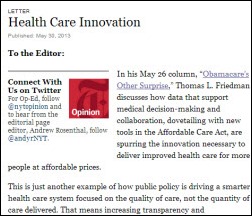

We are a software sales organization. Our greatest challenge is finding good sales people dedicated to thoughtfully selling our solutions. We’ve found that hiring friends of current employees is the best way to find good, competent people.


I think having a good EMR analyst / trainer / optimizer is always a key position. We have had success by looking from within.  The typical person will be a recent college grad who has worked at the front desk in one of our offices for at least 6-12 months. This gives them an understanding of healthcare, as well as the experience of our group culture, while also giving us an understanding of their skillset. They need to have the type of smarts that means they can figure things out when we don’t have the right answer, and they need to have they type of personality which can get along with busy doctors. They enjoy having the ability to extend their career skills and most stay several years. 


Telecommunications manager who is more than a functionary; who understands the urgency for improving clinician-to-clinician communication. Asked our various telecomm vendors who were the best folks fitting that description in the region and hired one who was under-valued where they were then working.


EMR analyst jobs have been the hardest to fill. Our best success in filling these roles has been recruiting internally within our hospitals and medical group and investing in training and experiences to transform them into new IT roles.


Curbside Consult with Dr. Jayne 5/27/13

May 27, 2013 Dr. Jayne 4 Comments

clip_image002

The Greatest Generation

I enjoy volunteering. One of the most meaningful things I’ve done is placing flags on the graves of veterans. My family has a tradition of military service going back to the Civil War. Although placing flags at the National Cemetery gets a lot of recognition, there are smaller projects that may not hit the national news or even the front page of the local paper. I was invited recently to join one of those projects and I have to say it was a great experience.

What makes this event different is that it is significantly smaller and allows youth to interact with veterans directly. The morning starts with the veterans providing breakfast to nearly 300 youth volunteers who experience first-hand the concept of servant leadership. There’s nothing quite like sharing bagels with a WWII veteran and watching young people realize that war isn’t something from their history books or Wikipedia. After breakfast and a brief religious service, the young people (many who aren’t from the same faith tradition as those they’re serving) fan out across nearly a dozen religious cemeteries.

Over the last several years, volunteers (some as old as 97) have combed through cemetery records and identified veterans’ graves, adding a flag holder with a medallion next to each grave marker. In deference to the sacrifice of the veterans, volunteers approach the graves with some ceremony. The flag is placed and saluted and a brief statement of thanks is recited which includes the name of the veteran being recognized. It’s more than just adding the flags, it’s taking the time to speak directly to the person whose service allowed us the freedom we enjoy.

The majority of the veterans we honored were from WWII – often called The Greatest Generation. As we spoke the names it was hard not to wonder who they really were – whether they had children, what they liked to do in their free time, and how they came to rest in these small suburban cemeteries. This generation served their country not for fame or recognition, but because it was the right thing to do. Those who made it home from the war spent the rest of their lives continuing to do the right thing – raising families, taking care of their elders, and supporting their community.

They didn’t have the Internet, smart phones, or billions of dollars of technology at hand. The biggest technology revolution for many of them was getting telephone service that didn’t involve a party line,  and maybe a black and white television. Their solutions for many problems revolved around hard work, sacrifice, and sheer determination. I was grateful to spend the morning communing with them and watching the spirit of service be passed to the next generation.

The peaceful morning was in sharp contrast to the rest of my day, which was spent in a busy urban emergency department. Except for a handful of octogenarians, most of my patients were under age 50. Many of them presented with problems at least partly related to our dependence on labor-saving devices and the quest for convenience – obesity, computer-induced repetitive motion injury, diabetes, high blood pressure.

More than half presented strictly because they wanted the technology of the hospital to convince them they were OK. These patients ranged from the woman who refused to allow a co-worker to remove a bee stinger “because she didn’t have any medical training” to a teenager who refused to believe her two negative home pregnancy tests, demanding a blood test to convince her boyfriend she was indeed pregnant. Nearly every one of them had an iPhone and several were surfing the Internet during the interview or exam, despite requests to stop. A couple of patients argued with me about their treatment, citing Internet information they found while in the waiting room.

Several demanded CT or MRI scans for simple sports-injuries despite having no ability to pay for such a test even if it was indicated, which it wasn’t. Guess what? If you run down a steep hill wearing flip flops, you will fall and sprain your ankle. The Ottawa Ankle Rules say you don’t even need an x-ray, let alone a scan. You need an Ace wrap, some ice, and a pair of real shoes.
It was one of the rougher shifts I’ve worked. I’m sure the contrast between people who want technology to solve all their problems effortlessly and those who were willing to give their lives simply for the concept of a world free of tyranny had something to do with it. I’ve been in informatics for nearly a decade and have seen the wonders that big data can do. I’m excited by the promise of personalized medicine and genomics, but I understand that it all comes at a price. Looking at global economics, it is likely more than any of us can afford. We’re mortgaging our future while we overlook the basic lessons of the past.

Technology isn’t the solution – it’s merely a tool. We have to learn how to use it wisely and at the same time how to temper our addiction to it. I challenge every reader to consider spending a day off the grid. If you can’t spare a day, consider an hour. Go volunteer. Go do something simply to show caring to someone else. Or just go lay on the grass and see that there is a world beyond the screens and clicks. And while you’re at it, say thank you to those who gave all.

Print

E-mail Dr. Jayne.

Morning Headlines 5/27/13

May 26, 2013 Headlines Comments Off on Morning Headlines 5/27/13

More than Half of Doctors Now Use Electronic Health Records Thanks to Administration Policies

The White House blog posts a self-congratulating piece as EHR adoption hits the 50 percent mark among eligible providers.

Obamacare’s Other Surprise

Thomas Friedman of The New York Times publishes an editorial in which he points to a rapid increase in health IT startups as an unforeseen positive consequence of HITECH and ACA.

Allscripts names 2 new directors to board

Allscripts adds former Epic CFO Anita Pramoda and former Brocade Communications CEO Michael Klayko to its board of directors.

Greenway Earns Two U.S. Patents for Care-Coordination Technology

Greenway earns patents for a server configuration that aggregates data from multiple EHR systems and auto-completes accreditation or certification forms and another related to tracking clinical events across multiple EHR systems.

Comments Off on Morning Headlines 5/27/13

Monday Morning Update 5/27/13

May 25, 2013 News 21 Comments

From HIPAA Faxing: “Re: HIPAA rules. Our esteemed EMR vendor wants $20,000 to connect each lab. The lab wants $19,990 to connect their side (funny how they charge the same). That’s $40,000 per lab connection and we use 17 labs and can’t afford that, so we use a fax server. What are the HIPAA rules around faxing? What do we need to do?” Experts, here’s your chance to contribute.

From Delta Don: “Re: Philips iSite. I’ve never seen anything like the disaster of the iSite 3.6 to Intellispace 4.4 upgrade. System and functional instability have pushed the go-live date back three times. It’s now six months late with new issues every day, but Philips personnel are enjoying their extra-long Memorial Day weekend. With vendor-neutral archives making migration among PACS vendors more feasible, you’d think there would be more effort. I won’t even start on the product name when we still have users calling it Stentor.”

5-25-2013 8-43-42 PM

Respondents weren’t overly impressed by the value to the public of the Medicare pricing information released by CMS. New poll to your right, as suggested by a reader: should Meaningful Use be ended after Stage 3 or continued? You’ll get a link to add your comments after voting, so you might as well expound on your position.

5-25-2013 9-20-46 PM
Photo: Pete Marovich/EPA

Monday is Memorial Day, set aside to honor those one million US Armed Forces members who died while serving. Their sacrifice allows you the luxury to decline to fly the flag, visit a military cemetery, or think about those who made the ultimate sacrifice on your behalf. That’s not to say it wouldn’t be nice to do it voluntarily. 

5-25-2013 9-56-11 PM

I impulsively bought Mrs. HIStalk a Google Nexus 7 tablet when I went to the office supply store to get several packs of the index cards I like to write on since she’s computer-averse and always gets my hand-me-down laptops. My initial assessment of the $199 device is that it’s very nice, in some ways better (sharper display) and some not as good (fewer apps) as the iPad mini, but at just 60 percent of the mini’s price, it’s a much better deal. Don’t buy it yet, though – an upgrade is imminent that will add greatly enhanced video.

From the Cerner shareholder/analyst call:

  • Neal Patterson was not only on the call, which is rare, but he actually chaired it and reminisced a bit with good humor about the company’s origins. Fellow founder Cliff Illig was on, which I don’t recall ever happening.
  • The company says the number of physicians using its ambulatory products doubled to 45,000 in the past two years.
  • EVP Zane Burke says Cerner’s competitors are no longer other EMR vendors, but rather companies involved in insurance and big data.
  • Responding to an shareholder’s question about Epic, Neal Patterson said, “They like to say they don’t have shareholders. I’d like to point out to the reality that they do actually have shareholders, it’s basically almost a single individual. And they also point out the fact that in this country, you can’t pass on an ongoing operation … our plans are to take away their advantages and make our strengths stronger and make their strengths weaker on a relative basis … we’re the most innovative company in this industry, we have always been.”

Jamie Stockton with Wells Fargo Securities sliced and diced CMS’s hospital EHR attestation database to find that 7 percent of hospitals that qualified for Year 1 incentives didn’t attest with the same vendor in Year 2. The interpretation was that the Year 2 incentives, which required participation for a full year, were too difficult for some hospitals to meet. The worst-performing vendor was McKesson, which saw its attestations drop off from 10.5 in Year 1 to 6.5 in Year 2, a 38 percent washout rate of an awfully low starting number.

5-25-2013 8-15-52 PM

Allscripts adds two board members that include former Epic CFO Anita Pramoda, who left Epic in 2012 and founded senior PHR vendor TangramCare.

5-25-2013 9-08-46 PM

Allscripts files a lawsuit against its landlord, Chicago’s Merchandise Mart, claiming its lease was violated by allowing excessive noise in renovating five floors just below the Allscripts offices for new (and largest) tenant Google. Allscripts is demanding that the Merchandise Mart stop using nail guns and pneumatic hammers during business hours.

Ed Marx posted an update to his most recent CIO Unplugged about a salesperson who hijacked Ed’s presentation with an overwrought sales pitch disguised as a post-presentation question. I’ll side with Ed. As much as salespeople have been educated (or brainwashed) to believe that their particular hammer is appropriate for any nail, I don’t think it’s acceptable to harass a speaker and audience just because they perceive that nobody’s returning their cold calls. Whatever happened to respecting the prospect enough to let them decide what products and services they want to consider and how they would like to evaluate them?

A New York Times piece by Tom Friedman says that Obamacare, the HITECH program, and HHS’s release of its databases has created a healthcare Silicone Valley that may improve care and lower costs because of the availability of information. Friedman spoke to a family doctor who thought she was giving appropriate colorectal cancer screening recommendations until her EHR showed only 43 percent of her patients had actually received the screening. Adding EHR alerts raised the number to 90 percent, leading to early cancer detection in three patients, which was obviously good for the patients but also for healthcare spending since early-stage treatment costs less. White House CTO Todd Park bragged on entrepreneurs who developed apps around HHS’s databases and kicked off a health data industry. Friedman met with Eviti, Teladoc, Humedica, and Lumeris.

5-25-2013 10-28-11 PM

The White House Blog brags on EHR adoption, crediting the President who spent the money rather than the taxpayers who provided it.

Two people with no transportation experience are named finalists for the position of interim director of the Capital Area Transit System (LA.) One of them is Bob Mirabito, former CIO of Baton Rouge Radiology Group, who says his position was eliminated last year and he needs a job.

The Canadian government revokes the passport of a Quebec doctor who is of defrauding US Medicare of $375 million by submitting phony claims for homeless patients when he was practicing in Texas.

Weird News Andy says he has printing on the brain after reading that 3D printing allows replacing 75 percent of a person’s missing skull.

Vince continues with the very interesting HIS-tory of Allscripts.


Contacts

Mr. H, Inga, Dr. Jayne, Dr. Gregg, Lt. Dan, Dr. Travis.

More news: HIStalk Practice, HIStalk Connect.

125x125_2nd_Circle

Text Ads


RECENT COMMENTS

  1. The sentence was "most people just go to Epic UGM" - that's people going to Epic's annual user conference and…

  2. Merry Christmas and a Happy New Year to the HIStalk crowd. I wish you the joys of the season!

  3. "most people just go to Epic" that's a problem because then EPIC becomes a monopoly in healthcare, if it isn't…

  4. Only if CEO can post 'bail' which nowadays stands at 1B$ paid directly to the orange president or his family…

Founding Sponsors


Platinum Sponsors


Gold Sponsors


RSS Webinars

  • An error has occurred, which probably means the feed is down. Try again later.