Recent Articles:

Readers Write: Achieving Value, A Different Kind of Medical Miracle

April 29, 2013 Readers Write 1 Comment

Achieving Value, A Different Kind of Medical Miracle
By David Bond

4-29-2013 8-37-19 PM

Practice management system (PMS) vendors have long sought to provide their physician customers with more capabilities than just traditional practice management and EHR capabilities. Specifically, providing outsourced patient statements and RCM services are some of the most important opportunities that have been identified to bring greater value to their customers and increased revenue to their firm.

However what I’ve seen is quite frankly an assortment of “half-measure” solutions that don’t efficiently utilize today’s interconnected world: portals that aren’t truly integrated, systems that don’t enhance a practices workflow or focus on usability for both the practice and patient alike. More importantly, that seek to find a solution that yields untapped profit opportunities for those PMS vendors that are able to satisfy these requirements.

In fact, many PMS vendors are mired in paper-based billing methods or a clunky billing portal instead of looking to implement an integrated solution that truly drives value for both the practice and the patient. I also find it interesting that most of these current billing mechanisms do little to significantly boost the profit margins of the PMS vendors offering these services in addition to their core offerings.

My aim is not to criticize these companies, as many have been very successful and offer fantastic products that are of use to their customers, but instead offer insight into new opportunities they can adopt to increase their efficiency and profitability. While the PMS providers might feel their current outsourced paper billing solutions put them in a more favorable light with their physicians, they do little to put more profits in their own pockets, streamline the billing process, help practices with their workflow, create clarity for patients, speed time to payment, or reduce errors on the back end.

Instead of going with a traditional solution that only marginally helps PMS vendors, how about something that can be easily integrated with most solutions and be welcomed with open arms by medical practices and patients alike?

Online billing, patient balance management, and reconciliation services that can be easily integrated with most PMS vendor offerings is in fact a reality today. It drastically reduces the need for paper bills and the cost and delays they create and makes obsolete billing portals that are not truly integrated. Presenting patient statements that are easily understood and allocate the remittance precisely to the services that were received creates clarity for everyone and is highly profitable for any PMS vendor looking to bolster their bottom line through a recurring revenue stream.

Want proof? A major PMS vendor ran the numbers and realized an additional $3 million in pure profit by integrating this capability with its core practice management offering used by 3,500 medical practices. I don’t care who you are, this is real money.

If you’re a PMS vendor and want to achieve real value, both in profitability and long-term customer retention, providing a simple and integrated online bill pay solution will get you there.

David Bond is EVP of PatientPay of Durham, NC.

Curbside Consult with Dr. Jayne 4/29/13

April 29, 2013 Dr. Jayne 2 Comments

clip_image002

Mr. H posted a question in the Monday Morning Update about the decision-making habits of healthcare IT leadership. It brought in a fair amount of reader comments and I thought I’d contribute my two cents.

First, to the original question/comment:

Healthcare IT leadership seems unable or unwilling to take meaningful actions that would benefit their organizations … In a corporate world, leaders who don’t act on revenue opportunities or cost savings don’t last long. Is it asking too much for healthcare IT to make responsible decisions to avoid wasting money?”

Many of the so-called leaders I work with suffer from analysis paralysis. It’s not just IT leaders – it could be finance, revenue cycle, practice operations, or just about anyone. They spend so much time thinking through various options that they ultimately miss the opportunity to make a decision that would make a difference. There’s no understanding of the concept of opportunity cost.

I tend to see this more in so-called non-profit health systems where the business just isn’t run like a business at all. Sometimes I think altruism or the thought that everyone is “trying to do their best” becomes a smoke screen for failure to lead.

It’s not just analysis paralysis, but there are quite a few healthcare leaders I’ve worked with who are simply ineffective. I’ve worked for and with people who range from passive-aggressive to missing in action. One group I worked with in a consulting relationship had an EHR project head who was missing in action. His favorite pastimes included casino gambling and hanging out at the local coffee klatch with a group of wealthy retirees. He’d come to steering committee meetings completely unprepared and expected his subordinates to bail him out. His direct reports were rewarded by having their one-on-one meetings canceled and receiving performance evaluations that were written by other division directors because he was unable to meaningfully assess their performance.

Inept leadership isn’t the only thing that contributes to poor decision making. Awkwardly constructed team structures can be a factor as well, where different verticals end up unknowingly (or intentionally) confounding the needs of other teams. Teams where leadership obviously doesn’t like each other or share any kind of mutual respect can lead to bickering and efforts to block others just do be difficult. When teams don’t get along, it’s up to the next level of leadership to demand cooperation and congeniality or let people go.

Although I agree that the level of involvement (read: interference) of government in medicine makes it difficult to say ahead of the curve, that often sounds more like an excuse than a reason. I’ve seen more than enough healthcare organizations that have no concept of the true cost of the care they’re delivering, and instead of focusing on the bottom line, spend their time whining about payers. Physicians underestimate the value of their time and shift resources the wrong way, taking on additional work rather than “burdening” their staff members. I see too many administrators who are penny-wise but pound-foolish, trying to do complex projects in-house due to perceived cost savings when a team of experienced consultants could have delivered higher quality product with fewer errors, delays, and cost overruns.

Another major problem that leads to ineffective (or no) decision making is failure to understand the value of active change management within an organization. Sometimes unpopular decisions need to be made, but rather than using a formal change management program to smooth the transition, leadership elects to make no decision at all. Guess what, folks? This isn’t high school. You’re not here to be liked — you’re here to do a job and improve patient care. It’s not a popularity contest.

I also see a fair number of “leaders” who don’t understand their core business or its needs. My favorite corporate “stupid human trick” is the lateral outplacement move, where you take someone who is ineffective in your vertical and move them to another vertical in the organization where they may know even less about the business line. Just because someone knows the inpatient setting doesn’t mean they know beans about ambulatory care, and vice versa.

In the same vein, I also see too many people that place stock in certifications and degrees over experience. I’ll take an experienced CMIO who has had to work with the DBAs to resurrect an enterprise app in the middle of the night, whether they have fellowship papers or not. In my neck of the woods MBAs are a dime a dozen and I continue to watch hospital administrators hire people with no healthcare experience at all, then feign surprise when failure occurs.

Is it really that much worse than other industries, though? I’m not sure. Having worked in healthcare most of my career (unless you count a string of fascinating summer jobs), I don’t have a lot to reference against. My friends in non-healthcare IT seem to have managers and decision trees that are as crazy as those I deal with every day. Sometimes running away to become a rodeo clown looks pretty good – until I remember that’s what I already do every day.

Print

E-mail Dr. Jayne.

Advisory Panel: Surprise Projects for 2013

April 29, 2013 Advisory Panel Comments Off on Advisory Panel: Surprise Projects for 2013

The HIStalk Advisory Panel is a group of hospital CIOs, hospital CMIOs, practicing physicians, and a few vendor executives who have volunteered to provide their thoughts on topical industry issues. I’ll seek their input every month or so on an important news developments and also ask the non-vendor members about their recent experience with vendors. E-mail me to suggest an issue for their consideration.

If you work for a hospital or practice, you are welcome to join the panel. I am grateful to the HIStalk Advisory Panel members for their help in making HIStalk better.

This question this time:  What "surprise" IT or informatics projects have come up recently that you didn’t expect to have to deal with in 2013?


We’re about four months away from a pretty big EHR rip-and-replace go-live. The surprise for me has been the steady drumbeat of “business as usual” requests: a new POC lab system, new offices, clinics and moves, interfaces to the legacy system that will be replaced 30 days after go-live, etc. I guess I shouldn’t be surprised — just a little freaked out.


When we began the fiscal year in October, we had not planned on applying for a CMS Shared Savings ACO. The learning curve was steep on this, and now that we were awarded one in January, we are being cautious to make the right decision on an IT platform to support the ACO.


Not sure that it’s a surprise, but the increased focus on meeting regulatory demands have shifted the focus of IS. Even though the organization focuses well on our EHR and Meaningful Use progress, it is difficult to find the funds to refresh our infrastructure and deliver the smaller application needs of the organization (food management and employee health are recent examples that come to mind). Our average age of infrastructure continues to creep upwards while our MU efforts monopolize most of the IS capital. On top of that, there is renewed focus on patient access and experience that have impact to the IS "pot o’ gold" (and for my organization it’s not really much of a pot to begin with – maybe a cup is more accurate). I have had to redirect money away from the non-regulatory projects and leave organizational needs unmet. Old equipment and unhappy customers create uncomfortable CIOs. Not a complaint really, just a reality of the job. These demands on capital make it more critical for IS to be able to tell the story on how we are
going to decrease costs, increase revenues, avoid penalties, etc.


The surprise projects are currently getting planned for 2014 in our organization. Many of them are focused on Meaningful Use – both for 2014 Stage 1 and Stage 2. From our organization’s perspective, it will probably late 2014 or 2015 before we can focus on any significant IT project that isn’t driven by a regulation or a dependency for a project that is.


Multiple instances in my organization where a doctor or department had spent time and money to build out an application for their use and want to now commercialize it. Who knew there would be so much entrepreneurial spirit going on under our hood? Begs the question – should we better create an atmosphere and infrastructure to support these projects, and what is the best way to support them moving forward (e.g. do we help to spin them off into new companies to help create a way to sustain them?) And of course we
have to work through the IP issues as well.


A couple of large HR system and outpatient business analytics projects competing for resources with ICD-10 and Meaningful Use Stage 2 prep projects.


Replace our software for calculating month end reserves. Replacing software for electronic claims submission.


I’m not sure I would call these a complete surprise, but what has surprised me is the volume of good, value-added ideas that are coming up related to using our EMR to further improve quality, safety, efficiency. Multiple IT-enabled optimizations using our EMR and analytic tools to help further reduce readmissions, provide an early warning on septic patients, reduce catheter -associated urinary track infections, and the like. In addition to ensuring readiness for Stage 2 Meaningful Use, we are spending much effort and energy on optimizing our EMR.


No real surprise projects. What is creating unrest is BI, ACO support, and keeping up after we cut our staff by 20 percent.


Interestingly, most surprises here are due to our operational need to jettison existing partners, in my case, in rad onc and imaging. This was primarily due to the relationships going south fairly quickly. Standing up linear accelerators et al, as well as a new PACS, was definitely not even on the radar. Both are significant projects.


HIMSS Healthcare Transformation Project.


Major modifications to our revenue cycle system and the interfaces to our insurance companies, based upon changes to reimbursement policies, particularly capitated payments. Still reeling.


We have a solid strategic plan that’s updated each year. We also have an engaged IT Governance group. I can’t think of any surprises, but we are only halfway through the fiscal year. My mindset is that IS should expect them and not overreact. This is where you can see what your team is made of. Also, surprises provide teaching and growth opportunities.


We have to go through three major code upgrades before February 2014, rather than just two. And we have to implement our EHR vendor’s HIM module upgrade, to our surprise, because none of the vendor’s new functionality works with our current HIM module. That turns out to be a major project, and a prerequisite that has set several other projects (such as physician documentation) back by nearly a year. Lastly, our pharmacy had been trying to "skate by" the MU Stage 2 regs by only implementing bar-coding for IV meds, but we realized after some calculations and CMS FAQs that still wouldn’t hit our required 10 percent. We’re going to have to do a full medication barcode implementation under very tight time frames.


Most surprises have been in the realm of infrastructure upgrades (additional storage and additional wireless capability). Under the heading of wireless capability, the organization chose many years ago to implement a guest wireless network. Our administration wanted to bring their own devices — they balked at having to give permission to sign on to the guest network even with something as simple as an acknowledgement. Because of this, our guest network is regularly exceeding its connection limit. We are working to create a third network for employees and their devices.


New hospital process reengineering projects that will have IT implications.


There is possibility of squeezing in (at least the beginnings of) more inpatient EHR implementations during the latter part of the year than anticipated as we get ever closer to Stage 2 requirements kicking in.


Not a total surprise, but our physicians and our key ambulatory vendor are very rapidly moving toward multiple mobile solutions as well as patient centric solutions. More quickly than we had anticipated, we are learning to support the iPad EMR version, iPhone  apps, and patient portal.  The vendor is providing new cloud computing solutions and we’re learning how to implement and support these very rapidly.


Comments Off on Advisory Panel: Surprise Projects for 2013

Morning Headlines 4/29/13

April 28, 2013 Headlines Comments Off on Morning Headlines 4/29/13

Computer Programs and Systems, Inc. Announces First Quarter 2013 Results

CPSI announces Q1 results: net income increased 23 percent to $6.9 million on $49.5 million in total revenue, EPS of $0.63.

Providence lays off 132 people in Washington state 

Providence Health & Services announces layoffs for 150 employees as a result of an Epic install that it says will streamline processes and reduce the need for certain positions.

Cybertheft heists $1 million from Leavenworth hospital

Hackers have stolen more than $1 million from Leavenworth WA-based Cascade Medical Center by accessing the hospital’s Automated Clearing House account.

UNM Hospital stands by its outsourcing decision

Sen. Tim Keller of Albuquerque, NM is asking UNM Hospital to halt its recently announced plan to outsource transcription services to Nuance and eliminate 50 local jobs. The hospital says that the move will save more than $500,000 a year and that all affected employees have been offered jobs with Nuance.

Comments Off on Morning Headlines 4/29/13

Monday Morning Update 4/29/13

April 27, 2013 News 18 Comments

From Healthcare Outsider: “Re: making decisions. I’m in corporate IT, but a recurring theme appears where healthcare IT leadership seems unable or unwilling to take meaningful actions that would benefit their organizations. They can’t seem to make decisions, and in a corporate world, leaders who don’t act on revenue opportunities or cost savings don’t last long. Is it asking too much for healthcare IT to make responsible decisions to avoid wasting money?” An interesting question that I will pose to readers – leave a comment with your thoughts about whether hospital IT leaders really are missing bottom-line opportunities simply because they can’t make a decision.

4-27-2013 3-43-24 PM

From The PACS Designer: “Re: iPad cancer app. UBM Medica LTD has just released Version 1.5 of their Cancer Management Handbook for the iPad. Now clinicians can get all of the great content from this popular reference tool as well as the latest care updates on their iPad. TPD will add this app to TPD’s List upon the next update release.”

4-27-2013 1-59-54 PM

More than two-thirds of poll respondents don’t like the idea of ONC charging vendors a fee to support its certification programs. New poll to your right, triggered by Bill Rieger’s recent Collective Action post about TEDMED: Should conferences focusing on health IT innovation de-emphasize the involvement of hospitals and physicians because they are part of the problem? There’s a “comments’ link on the poll once you have voted, so feel free to defend your argument.

Rural and community hospital systems vendor CPSI announces Q1 results: revenue up 11 percent, EPS $0.63 vs. $0.51. Chairman David Dye said in the earnings call that, “Several of our competitors are clearly struggling with failed EHR system implementations. As a result, the number of new prospects and contracts that our competitor replacement is increasing.” The company also says that it has been writing contracts that allow customers to defer paying maintenance and support until they achieve Meaningful Use and that is impacting revenue.

4-27-2013 5-00-15 PM

Texas Health Resources is featured in a subscription-only Wall Street Journal article about “exercise meeting rooms”  where employees can meet while using stationary bikes or treadmills. CIO Ed Marx is quoted. He tells me that they also have a meditation room as well as a stand-only meeting room that encourages ending on time.

4-27-2013 5-01-59 PM

New Mexico State Senator Tim Keller urges UNM Hospital to reconsider its decision to eliminate 57 transcriptionist jobs in outsourcing the transcription function to Nuance at an annual savings of $500,000. Nuance has offered jobs to the transcriptionists, but at what the employees claim is a 20 percent pay cut, reduced benefits, and a requirement of an unrealistic 99 percent accuracy rate. Keller says shipping the jobs out of New Mexico will reduce state income tax collections.

4-27-2013 5-03-10 PM

Hackers break into the Automated Clearing House account of seven-bed Cascade Medical Center (WA), diverting more than $1 million to 96 banks. The hospital, whose operating budget is $13 million, recently announced plans to seek affiliation, saying that the Affordable Care Act will require deliver care to more patients without increasing funding and that three of ACA’s cost-savings programs (results-based payments, EHRs, and ACOs) all require major investments.

Providence Health & Services announces plans to lay off 150 billing and medical records employees whose jobs it says will no longer be necessary when it moves to Epic. The system originally notified 687 employees in 2011 that their jobs would be secure for only 18 months, but most of those employees have already transferred to other jobs or quit.

4-27-2013 5-05-44 PM

A former patient registrar sues Integris Grove Hospital for violating her religious beliefs by requiring her to register patients using the identity-confirming PatientSecure palm vein biometric system. She told her supervisor the hospital is lying about the information it collects and that the system resembles Bible’s “mark of the beast” because only the right hands of patients are scanned. Integris says using the system is a job requirement but offered her a transfer to another facility, which she declined saying it wasn’t worth the one-hour commute.

4-27-2013 4-09-32 PM

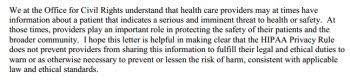
Members of a Congressional panel hear testimony about physician misinterpretation of HIPAA requirements. Rep. Phil Gingrey, MD (R-GA) and others said they wonder if doctors don’t hide behind HIPAA to avoid answering awkward family questions or in their urgency to move on to the next patient,  whole Rep. Bill Cassidy (R-LA) said doctors aren’t HIPAA experts and simply remember colleagues “who have been grabbed by the law and not let loose until every one of their personal resources have been exhausted.” Also testifying was the widow of an Iowa high school football coach who was killed by a mentally ill man with a recent history of violence and animosity toward the victim who had been released from a hospital without notification to his parents or law enforcement officials because of HIPAA requirements. OCR later clarified that providers can disclose mental health information to families and law enforcement officials if such disclosure might be expected to prevent harm.

Weird News Andy says this woman was taking us for a ride. A TV investigative report finds that a 51-year-old South Carolina woman summoned EMS ambulances at least 100 times in the past seven years with vague 911 medical complaints just to get a free ride to downtown Charleston, where she would sign out AMA and then run errands. Upon being arrested, the woman said the rides, billed at $425 plus mileage, were part of her Medicaid benefits. Taxpayers are on the hook for at least $400,000.

A woman who failed a pre-employment drug screen sues her would-be employer, the hospital that administered the test, under the Americans With Disabilities Act. She says her “shy bladder” syndrome leaves her unable to urinate in public restrooms unless she runs the faucet, but the hospital forced her to provide her sample in a sink-less room.

Vince continues this week with his HIS-tory of GE Healthcare.


Sponsor Updates

  • Sunquest Laboratory version 7.0.1003 earns 2014 ONC HIT certification as an EHR module.
  • Mount States Health Alliance (TN) completes implementation of Perioperative Management by Surgical Information Systems.
  • Aventura is named one of the “Top 10 Coolest Startups” by startup group Built In Denver.
  • Mercy Four Rivers Division selects Forward Health Group’s PopulationManager for a population health initiative with The Guideline Advantage.

Contacts

Mr. H, Inga, Dr. Jayne, Dr. Gregg, Lt. Dan, Dr. Travis.

More news: HIStalk Practice, HIStalk Connect.

125x125_2nd_Circle

Time Capsule: This Is No Time for Timidity: Contrarians Who Take Bold Steps Instead of Moaning About Poor Financial Conditions Will Win

April 27, 2013 Time Capsule 3 Comments

I wrote weekly editorials for a boutique industry newsletter for several years, anxious for both audience and income. I learned a lot about coming up with ideas for the weekly grind, trying to be simultaneously opinionated and entertaining in a few hundred words, and not sleeping much because I was working all the time. They’re fun to read as a look back at what was important then (and often still important now).

I wrote this piece in September 2008.

This Is No Time for Timidity: Contrarians Who Take Bold Steps Instead of Moaning About Poor Financial Conditions Will Win
By Mr. HIStalk

125x125_2nd_Circle

I bet every healthcare IT vendor wishes they were a mortgage lender. You make enormous profits for generations, pay gunslinging financial cutthroats salaries of up to hundreds of millions of dollars, and when the music stops on all those illogical investments that racked up obscene profits for years, you cry "Uncle." Uncle Sam, that is. Help, I’ve fallen and I can’t get up … come quick and bring your checkbook.

Unlike those investment clowns, healthcare IT companies die quietly when their time comes. Maybe they run out of cash, exceed the abilities of their founders, or learn the hard way how little they really know about their business. Those who can’t cut it slink off to the Great Vision Center in the Sky. Tough old world.

I’m not only a free marketer, I’m a Darwinist contrarian. You cannot succeed just doing what everyone else is doing. Sheep happily follow each other to the slaughter. The time to take bold action is when everybody else is too scared to, like now.

I have no data to back it up, but here’s what I believe. You hit your financial home runs when times are bleak, not when the exuberance is irrational. Buy when everyone else is selling. Expand when your competitors are cutting back. When the pendulum inevitably swings back, you’ll look like a genius. Those with the big brass ones will win.

There’s no doubt that credit will be hard to get, and rightfully so. But think about this: investors looking for stock market alternatives weren’t raised on plunking cash into unsexy bonds or gold funds. Companies with a track record and a good story will find investors. Maybe it isn’t the best time to run an IPO since stock prices follow the market down, but private investment should be ripe for some smart deals. Buy a competitor, replace unproductive employees, and make unpopular decisions while everyone is preoccupied with the Dow’s latest drop.

Vendors may see the customer pipeline start to dry up. Fear, rational or otherwise, makes people hunker down. That’s not the ideal situation, but it’s a good time to take a breath, look hard at product lines and strategies, and figure out a strategy for 5-10 years down the road. Sharpen the saw in preparation for the spring that inevitably follows winter.

It would be great if economic conditions sucked less, but you play the cards you’re dealt. Down markets eliminate weaklings. Survivors come back stronger than ever. The decisions you make today may well lock in a future (good or bad) that will persist for decades.

While all the timid MBA suits are whining, stuffing their money into mattresses, and telling everybody how well they could have done if the bad old market hadn’t betrayed them, real businesspeople will be quietly making moves to take advantage of current conditions. It’s a zero-sum game. You get to pick: on your feet or on your knees.

Readers Write: The Shady Side of Value-Based Purchasing

April 27, 2013 Readers Write 1 Comment

The Shady Side of Value-Based Purchasing
By Data Nerd

Beginning October 1, 2013, CMS is implementing what it is calling “Value-Based Purchasing.” As a lifelong policy student, I cannot help but admire the mathematical and administrative intellect behind the program.

Even politically speaking, it has a stroke of genius to it. The funds come from a pre-determined source (starting at 1 percent of reimbursement payments) and the payouts cannot exceed a set amount (said 1 percent of payments). This is achieved by several stages of normalization, where scores are weighted and examined as part of a ratio rather than on their own merit. Hospitals can earn in excess of their 1 percent withheld payments either by improving their own scores over time or scoring better than the other hospitals participating in the program. This differential is then weighted and reweighted to ensure that payouts never exceed the 1 percent amount withheld from all participating hospitals. Awards are all dependent on industry performance as a whole, since the same sum of money will be awarded overall even if every hospital had perfect scores.

CMS is to be commended on the clear and concise way they made the details of the program readily available, providing everything from a slide deck to a recorded provider call to walk through examples. But that is where the understanding (and compliments) end for this data nerd.

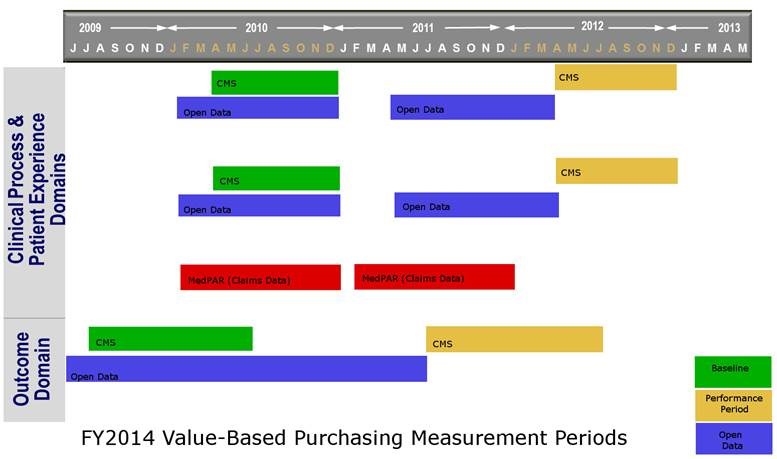
By sharing all of the plans for the program, it was easy to get the impression that numbers could easily be crunched from data that is already open. However, open data sources cover quality metrics that were taken over measurement periods that differ greatly from the measurement periods being used by CMS to calculate awards and penalties. Even though we’re talking about the same metrics, we have different reporting periods, so the data is not going to be the same.

One could argue it is another stroke of administrative genius to craft a program then ensure that no one has the data needed to either predict or verify financial outcomes. Based on the latest release of quality data, none of the open datasets are compatible with what CMS will be using to perform VBP calculations (in green and yellow). Some data have yet to be released, while other archived datasets use different timetables, making it impossible to determine hospital eligibility for the program. MedPAR data could theoretically be used to calculate reimbursement withholdings, but without knowing which hospitals are eligible, it makes it impossible to predict which will participate, much less any other aggregate observations (will more hospitals lose than gain, will losses or gains be great or small, etc.).

With all of the talk about transparency, this whole program looks shadier to me with each passing fiscal year.

clip_image002

Morning Headlines 4/26/13

April 25, 2013 Headlines 3 Comments

Cerner profit up as support, maintenance grows

Cerner reports Q1 results with a $110 million profit, up from $88 million, on $680 million in revenue. EPS $0.62 vs. $0.51. Support, maintenance and services revenue increased 16%, but system sales revenue dropped 12%.

Certification for electronic health record product revoked

ONC has revoked the EHR certification status of two EHRs, Santa Fe Springs Cali-based EHRMagic-Ambulatory and EHRMagic-Inpatient, after complaints from customers led auditors to discover that the platforms did not have the minimum required functionality and should never have passed certification tests in the first place.

Doctor: ‘I gave up on health care in America’

A family practice doctor from Colorado unwilling to comply with Meaningful Use requirements moves to Australia where he reports making $100,000 more than he made practicing in Colorado and with a much lighter schedule.

Nuance Communications Taps Goldman for Advice as Icahn Amasses Stake

Nuance has turned to Goldman Sachs for strategic guidance as billionaire Carl Icahn, known for his penchant for hostile corporate takeovers, continues to amass the company’s outstanding stock. Icahn currently holds a 9.3 percent stake in the company.

News 4/26/13

April 25, 2013 News 8 Comments

Top News

4-25-2013 7-33-10 PM

Cerner posts Q1 results: revenue up 6.1 percent, EPS $0.62 vs. $0.51, beating adjusted earnings estimates but falling short on revenue. A 12 percent decline in system sales was balanced by a 16 percent increase in support, maintenance, and service revenues. From the conference call, the company announced one win over Epic in the quarter, talked up its international business, and touted its population health management efforts. Neal Patterson participated, finishing up with, “You can see from the CommonWell Alliance that we use our leadership position in the industry for the greater good, but also to basically highlight where basically we have bad actors around subjects such as interoperability.”


Reader Comments

From Med Student: “Re: Meaningful Use Stage 3. If you could change anything in Stage 3, what would you include or cut out?” I’m curious about that myself, so please leave a comment with your thoughts.

From Herky: “Re: warm-blooded. Spotted at TEDMED last week, riding the bus together from the Kennedy Center to GWU for Great Challenges Day: Allscripts CEO Paul Black and former CEO Glen Tullman. I guess all those rumors about bad blood between the two were ill founded.”


HIStalk Announcements and Requests

inga_small Some hot news you may have missed this week on HIStalk Practice: compensation for medical directors is increasingly tied to quality metrics, as are job responsibilities. Advice for physicians engaging in Web-based messaging services. Details on athenahealth’s emergency response process, which was activated during last week’s manhunt for the Boston Marathon bombing suspects. EMR adoption by primary care physicians in Canada has doubled from 23 percent in 2006 to 56 percent in 2012. Rather than sell out to hospitals, practice management consultants offer alternate alignment models for consideration. Dr. Gregg puts his spin on the phrase that pays and playing in the healthcare sandbox. Take or moment or three to catch up on the latest ambulatory HIT news and sign up for e-mail updates while you are there. Thanks for reading.


Acquisitions, Funding, Business, and Stock

4-25-2013 7-30-54 PM

Hill-Rom Holdings reports Q2 results: revenue up three percent,  EPS $0.37 vs. $0.43.

4-25-2013 7-31-34 PM

Streamline Health’s Q4 numbers: revenue up 49 percent, EPS –$0.63 vs. $0.00.

4-25-2013 7-32-28 PM

Lexmark subsidiary Perceptive grew Q1 revenue 47 percent to $44 million.

4-25-2013 9-05-02 PM

Informatica reports Q1 results: revenue up 9 percent, EPS $0.16 vs. $0.24.

4-25-2013 9-08-55 PM

Qlik Technologies announces Q1 results: revenue up 22 percent, adjusted EPS –$0.09 vs. –$0.03, beating expectations on both.

Nuance seeks the advice of Goldman Sachs following the acquisition by activist investor Carl Ican of 9.3 percent of the company’s shares.


Sales

The Michigan Health Information Network partners with Surescripts to allow users of Surescripts’ Clinical Interoperability network to send electronic health information to the State of Michigan’s public health reporting system through the HIN and the Michigan Department of Community Health.

Presence Health (IL) awards Harris Corp. a three-year contract to create a private HIE.

4-25-2013 7-35-58 PM

The University of New Mexico Health Sciences Center purchases MDaudit Professional billing compliance software from Hayes Management Consulting.

Syracuse Community Health Center (NY) selects NextGen Healthcare’s Ambulatory EHR, PM, and Electronic Dental Record solutions for its 16-location FQHC.

MModal signs seven new hospitals and imaging centers for its Fluency for Imaging radiology workflow technology.

4-25-2013 7-35-00 PM

Fisher-Titus Medical Center (OH) selects Wolters Kluwer’s ProVation Order Sets.

UC Davis Medical Center (CA) selects TriZetto’s ClaimLogic as its claims processing solution, where it will integrate with Epic.


People

4-25-2013 6-17-53 PM

The Patient-Centered Outcomes Research Institute hires Bryan Luce (United BioSource Corporation) as chief science officer.

4-25-2013 6-18-33 PM

Interactive patient care system provider Skylight Healthcare Systems names Lisa Romano (TeleTracking Technologies) chief clinical officer.

Cleveland Clinic Innovations names its current GM of IT Commercialization Gary Fingerhut as the organization’s interim director, taking over for founding executive director Chris Coburn, who is heading to Partners HealthCare to lead innovation efforts.


Announcements and Implementations

Atlantic General Hospital (MD) implements Allscripts Sunrise.

Physicians’ Alliance of America launches iMedicor SocialHIE, giving its 34,000 physician members the ability to electronically exchange clinical information.

4-25-2013 9-57-08 PM

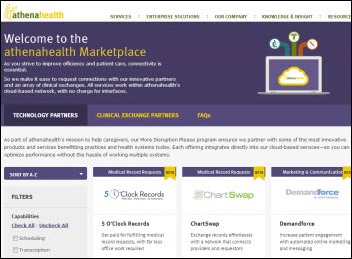
Athenahealth announces its marketplace for third-party solutions.

4-25-2013 8-24-52 PM

HCS, which offers the Interactant suite, launches a new logo and website.

UMass Memorial Health Care deploys MedAptus Technical Charge Capture.

4-25-2013 8-11-18 PM

Patient Logic launches its physician documentation system at three small hospitals. Its sister HealthTech companies are HMS and Medhost.

Children’s Specialized Hospital (NJ) launches GetWellNetwork’s GetWell Town interactive patient system, funded by a grant from L‘Oreal USA.

The physician informaticist who heads up MedAppLab in Germany says diagnostic or prescriptive smartphone apps present too many possible sources of error to be recommended for use, including the quality of peripherals such as headphones.

4-25-2013 8-54-16 PM

Online storage vendor Box says its product is now HIPAA compliant, also announcing 10 partner applications that include the drchrono EHR, in which Box has taken an undisclosed equity position.

Lott QA Group and HRS announce an ICD-10 testbed for coding and clinical documentation.

4-25-2013 7-37-03 PM

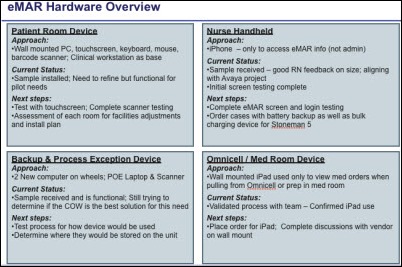
John Halamka says in his blog that Beth Israel Deaconess Medical Center will go live on its homegrown electronic medication administration record in June. He says it’s Web-based, mobile-friendly, and integrated into existing systems. It will support the use of iPhones for viewing, iPads to verify orders at the Omnicell cabinets, and wall-mounted computers with bar code readers for verification.


Government and Politics

CMS proposes raising the maximum reward for reporting Medicare fraud from $1,000 to $9.9 million; denying Medicare enrollment to providers affiliated with an entity that has unpaid Medicare debt; and denying or revoking billing privileges to individuals with felony convictions.

ONC revokes EHR certification on EHRMagic-Ambulatory and EHRMagic-Inpatient following notification that the products did not meet the required functionality and should not have passed certification. InfoGard Laboratories, which certified the products originally, retested them after reviewing additional information and gave them a failing score. Above is the reaction of Candid CIO Will Weider.

AHA tells CMS not to add additional HIE requirements for providers, but instead focus more on implementing current HIT initiatives.

4-25-2013 3-49-10 PM

Meanwhile, the founding members of the CommonWell Health Alliance tell CMS they are committed to collaboration with HIT suppliers, adding that they will use existing standards and supplement them only when needed. Members also emphasized the importance of creating an open forum for secure patient data exchange and removing data access barriers.

4-25-2013 8-04-04 PM

A North Carolina Senate panel approves a bill that would require hospitals to create easily understood bills that include definitions for any medical terminology. State Senator Jeff Tarte, a former hospital CIO via a stint with Ernst & Young, says transparency is tough to solve and just creating nicer bills isn’t going to fix the problem.

A federal grand jury convicts the former medical records director of a Florida-based partial hospitalization program for leading a scheme that submitted $63 million in fraudulent Medicare and Medicaid claims. The therapy provided to the severely mentally ill patients involved watching Disney movies and playing bingo.


Other

4-25-2013 7-24-03 PM

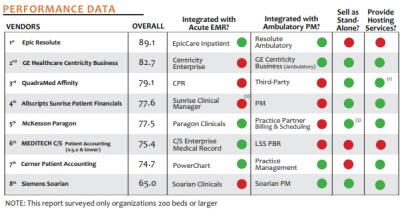
A new KLAS report says that patient accounting systems are the next hot thing in 200+ bed hospitals because of accountable care needs, the tapering off of Meaningful Use system selections, and the impending transition to ICD-10. Integration is a priority, leaving Epic and Cerner as the only inpatient billing systems that also cover ambulatory billing, with Cerner still scoring low but trending up. Update: KLAS says my summary is misleading, so here is their exact wording: “Epic and Cerner are the only vendors whose inpatient billing systems are integrated with both their inpatient EMR and ambulatory billing systems.”

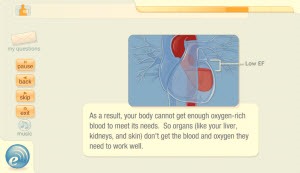
4-25-2013 7-52-13 PM

A solo family physician in rural Colorado says he “gave up on healthcare in America,” sold his practice to a hospital, and moved to Australia because of the 2 percent Medicare penalty he would have been charged in 2015 for not adopting an EHR that he couldn’t afford anyway. He says in Australia people love his American accent, he gets a lot of time off, and he makes $250,000 a year for a light schedule vs. the $100,000 he was making for being overworked in Colorado. “Primary care is highly respected here. That’s not the case any more in America. In the United States, health care has become more about the business of making money. The personal side of medicine is going away.”


CommonWell, challenged directly on Twitter by Terry Bequette, state HIT coordinator for the State of Vermont, says “all HIT developers” are welcome to join.  

WakeMed (NC) creates a video celebrating its 52 years and touting its new $100 million Epic system, which it is implementing along with nearby Triangle-area academic medical centers Duke University Hospital and UNC Health Care.

Truven Health Analytics reports that 71 percent of ER visits made by patients with employer-sponsored insurance coverage are for conditions that did not require immediate attention or could have been prevented with outpatient care.

Medhost files a lawsuit against Health Management Associates, claiming the hospital operator continues to use its ED software despite not having paid the third installment of $4.5 million last year.

4-25-2013 10-13-15 PM

Henry Ford Health System (MI) reports a 15 percent decrease in net income, primarily due to an increase in uncompensated care and the $36 million it spent to implement Epic. According to the CEO, “We knew that 2012 and 2013 would not be easy years for the system because of the Epic costs.”

A court orders UPMC to allow employees to use its computers and e-mail system for union-organizing activities.

Weird News Andy says this is like a reality show for doctors. Utah pediatricians trying to relate better to their teen patients hire acting students to simulate clinic visits and act out medical scenarios. The students are enjoying it so much that they have volunteered to continue after school is out.

WNA also likes this story, in which Seattle police are investigating reports that a nurse imposter entered patient rooms at Swedish Medical Center and cut the IV lines of patients to steal what sounds like narcotic-containing PCA cartridges.

4-25-2013 11-13-38 AM

inga_small In patient fashion news, Henry Ford Health System introduces a new double-breasted hospital gown that closes in the back, uses snaps instead of ties, and is made of thicker fabric than traditional gowns. One of the gown designers notes that, “By creating a hospital gown that is safe, stylish, and comfortable, we’ve made the patient feel more at home, like they’re wearing their own garments." Kind of makes me want to schedule some elective surgery just to try one out.


Sponsor Updates

  • Aprima Medical Software, Greenway Medical Technologies, and Allscripts forego interface fees as preferred partners for Greater Houston Healthconnect’s regional HIE.
  • Elsevier issues a brief that identifies the need for and potential impact of evidence-based medicine.
  • Wellsoft will participate in next month’s 2013 Emergency Medicine Update conference in Toronto and the e-Health 2013 conference in Ottawa.
  • Barb White, director of healthcare solutions for AT&T, discusses cyber attacks and security breaches in healthcare. 
  • MedAssets’ Sandy Hoffman co-hosts the Fifth Annual Mouse Races for MS in Cape Girardeau, MO on April 27.
  • Laura Kreofsky, principal advisor with Impact Advisors, discusses how EPs are spending their Meaningful Use incentives.
  • Prognosis suggests topics to discuss with current or potential vendors to avoid EHR dissatisfaction.
  • Penn State makes the DynaMed clinical reference database available to all students and staff. 
  • Boston Children’s Hospital Chief Innovation Office Naomi Fried and Carnegie Mellon University professor Alan Russell will provide the keynote addresses at the iHT2’s Health IT Summit in Boston May 7-8.
  • ADP AdvancedMD hosts a May 8 Webinar on engaging patients in their healthcare. 
  • NextGen Healthcare hosts a May 1 Webinar on effective claims processing.
  • Stuart Long, Capsule’s chief marketing and sales officer, discusses the benefits of medical device integration and how it works in a hospital.

EPtalk by Dr. Jayne

ONC issues the Apps4TotsHealth Challenge to encourage integration of the TXT4Tots message library into new or existing platforms. The library includes evidence-based messages focusing on nutrition and physical activity and is targeted to parents and caregivers of children 1-5 years old.

The National Institutes of Health is using IT to boost energy savings. Maneuvers that would benefit healthcare entities include forcing computers to go on standby at the end of the day and software to aggressively manage environmental systems.

Children’s National Medical Center is using video games as a way to measure and manage chronic pain. Applications are used for physical therapy as well.

clip_image002

Overheard in the physician lounge: two of my colleagues were discussing slick new carts that have appeared on the floors. I’m happy to note that they are from HIStalk sponsor Enovate.

clip_image004

I received a HIMSS e-mail regarding the annual conference experience and asking me to take a brand survey on my “emotional connection” to HIMSS. I was asked to select images that fit attributes for the HIMSS brand on “touch, taste, scent, sight, and sound.” Maybe I’m too much of a literal person, but I found the concept odd. It also didn’t fit my screen without scrolling, making it a non-starter.

Print


Contacts

Mr. H, Inga, Dr. Jayne, Dr. Gregg, Lt. Dan, Dr. Travis.

More news: HIStalk Practice, HIStalk Connect.

125x125_2nd_Circle

Morning Headlines 4/25/13

April 24, 2013 Headlines 1 Comment

FDA Device Surveillance to Tap Phone App

The FDA Adverse Event Reporting System will be revamped in part by launching a smartphone app for streamlined adverse event reporting by physicians.

Electronic health records key to patient care quality improvement

In England, a survey of physicians reveals that 94 percent believe that patients should have at least some access to their electronic medical records, but only 34 percent like the idea of full access. Physicians also overwhelmingly support allowing patients to update standard sections of their own electronic records, including demographics, family history, allergies, and home medications.

Patient-Centered Outcomes Research Institute to Invest Up to $68 Million to Develop a National Patient-Centered Clinical Research Network

PCORI has committed $68 million in funding to support the development of a national infrastructure to advance patient-centered clinical research that enables efficient participation from broad patient populations.

athenahealth Marketplace Brings Shopping to Health Care IT

athenahealth launches a marketplace of bolt-on pfferings for its cloud-based practice solution from a variety of vendors, including Experian Healthcare, InHealth Clinical Documentation Solutions (ICDS), NHXS, iTriage, and Entrada.

Collective Action 4/24/13

April 24, 2013 Bill Rieger 2 Comments

The views and opinions expressed are those of the author personally and are not necessarily representative of current or former employers.

Reflections on TEDMED 2013

Unpacking my TEDMED experience will be challenging, much like it would be to unpack HIMSS or CHIME conference, but in some ways more difficult. At HIMSS and CHIME, you walk away tired and overstimulated, but have a sense that we’re all in this together.  Walking away from TEDMED, I am exhausted mentally from all of the stimulating presentations and conversations, but I have a sense of being the bad guy. 

TEDMED is a TED conference dedicated to science and medicine innovation. I attended this conference in conjunction with The Breakaway Group’s annual conference, which was very good and stimulating as well and was a great beginning to the TEDMED experience. 

As we transitioned from The Breakaway Group to TEDMED, I had high expectations of people sharing collaborative ideas and experiences on how we can make healthcare better. I was not disappointed. There were some great ideas expressed at TEDMED. Phenomenal medical and scientific research is being conducted all around the world and it was well presented on the TEDMED stage and in The HIVE. 

The HIVE was similar to the vendor floor at HIMSS, but at a much smaller scale. There were only 50 vendors present, all startups in healthcare. None were allowed to reach out to attendees beforehand and they were not allowed to bring propaganda other than their business cards. Each was given a 50-inch monitor and a small table to show their product. There was no sales pressure at all — attendees were able to approach the vendors and ask exploratory questions without pressure. That was a refreshing experience. 

TEDMED was comprised of 10 sessions each lasting about two hours. In each session were several speakers who had their 20 minutes on the big red carpet. Big data, medical research, community health, indigent care, global health, and even end-of-life issues were discussed and presented from various perspectives. It was thought-provoking to say the least. 

The one sense I left with — and perhaps the biggest discussion at dinner with other attendees and guests of Xerox Health — was how both physicians and hospitals were looked at and talked about as being a big part of the problem and not a part of the solution.  There were physician presenters sharing personal stories of what they have done that is cutting edge, but there was absolutely no representation from any hospital or health system on stage. There was an entrepreneurial spirit there and TEDMED clearly puts the future hope of our healthcare system in the hands of entrepreneurs.

We can all agree that our current healthcare system is unsustainable. Farzad Mostashari spoke at The Breakaway Group event, and while he represents CMS and was talking about the end of fee-for-service, he also said that none of us know exactly what the payment model will look like in five years. He acknowledged that more government was not the answer, but a partnership with payers and providers alike working together to blaze a new trail. He was not asked to speak at TEDMED, probably because he represents the establishment. 

I believe very strongly in the capital system and encourage innovation and starting something new and creative, but that innovation has to be partnered closely with hospitals and with our government. That part was clearly missing at TEDMED. As a result, I believe it took away from its effectiveness.

The mission of TEDMED can be derived from its website. "In its core, TEDMED is a celebration of human achievement and the power of connecting the unconnected in creative ways to change our world in health and medicine." Did they achieve this mission? I would say yes, but did they connect the unconnected with the right people? 

Next year, I hope to go again. I will send TEDMED some suggestions about how it can stick it to the man a little less, and instead maybe partner with the man and talk to the man about news ways of doing things. It sounds like the man is listening.

Bill Rieger is chief information officer at Flagler Hospital of St. Augustine, FL.

HIStalk Interviews Elizabeth Holland, Director HIT Initiatives Group, CMS

April 24, 2013 Interviews 8 Comments

Elizabeth Holland is director, HIT Initiatives Group, Office of e-Health Standards and Services for CMS.
4-24-2013 1-33-51 PM

Describe the scope and process for the Meaningful Use audits for hospitals and EPs.

It’s really two pronged now, because we started last year. We started a post-payment audit program and now we are also doing pre-payment audits as well. 

When I say audits, it’s mainly the audits that are being done on the Medicare side. Medicare is actually handling the audits for all the Medicare eligible professionals and then all the Medicare hospitals as well as the Medicare dual hospitals, the hospitals that can get Medicare and Medicaid. But the Medicaid audits of the eligible professionals are being done by the individual states. 

Our audit are looking at Meaningful Use. We’re looking at providers to validate that they are using certified EHR technology. Secondly, we’re looking at them to see if they have the documentation and can justify that they are in fact Meaningful Users.


Will all attesting providers be audited in some fashion or will it be a random selection?

It’s actually a little of both. Certainly not all will be audited, but we are looking and refining our ability to make selections. Some selections are totally random and others are more targeted. We’re using a combination of both.

Some of the targeting is really crude and basic, like we had people who wrote a numerator and denominator to get 100 percent on every single measure. That flagged them for audit.


Like IRS audits, where you have a chance of being randomly audited, but there are certain red flags that you may or may not publicize?

Exactly.


Will the audits be strictly desk audits or will there be field audits?

There may be some field audits, but so far they’ve all been desk audits.


The question I’m asked most often if it will be like IRS forms that tell you how long it will take you to provide the information. Do you have an idea of how much time providers will need to set aside?

I don’t have a feel for that. The audit process becomes very individualized. We’re using the same contractor for pre-payment and post-payment. They send an initial request letter asking for certain things.

What I’m told is that it varies by practice how quickly they can pull that stuff together. Some providers have it all together because they pulled it together  when they did their attestation, so it’s very easy for them to pull it together. Others, it takes more time.

I believe the initial request gives them two weeks to pull everything together. However, if they need more time, we’re very flexible. All they need to do is contact the contact names on the letter they received. We’ve been giving everybody who’s requested it additional time.


What criteria were used to select the audit contractor?

That I honestly don’t know. The selection wasn’t done in my office, so I don’t know how.


Will the auditors, either the individual auditors or the auditing firm, be financially rewarded for identifying fraudulent attestations so that they’re encouraged to find problems?

I don’t believe so. I think they’re paid by the audit. We’re not looking for fraud so much. We’re wanting for people to tell the truth, but so far the only thing happens if you’re found not to be a Meaningful User is that you return your incentive payment. That goes right into the Treasury. It’s not like the whole practice and all your Medicare claims billings are being looked at. That’s not the way these audits are working.


I  assume that a lot of what you may find wrong, like on tax forms, are honest mistakes rather than intentional fraud.

Exactly.


How will you determine intention if you’re only doing desk audits? It would seem like you would need to have a direct conversation.

It has varied. We have sent audit letters and people have returned checks without sending in any documentation. What does that mean? I don’t know. I’m just telling you that’s a fact.

This is not really meant to be a gotcha. If you attested to a particular measure and the standard for that measure was 50 percent and what you told us is you had 90 percent … if we go back in and see you only had 80 percent, that’s fine. You’re still a Meaningful User. We’re not going to say gotcha.

We’re really looking to validate Meaningful Use. if it’s like a percentage off on one measure, we’re not going to die on our sword for that. It’s just if you have repeated measures where what you told us is massively different than the documentation that you’ve shared with us, that’s when you may have more of an issue.


How many audits have been done so far?

All we’re saying right now is that we’re aiming for 5 to 10 percent of the people who received incentive payments.


Based on experience and what you’ve learned so far, do you have any feeling for what the percentage might be that you will find not in compliance that will have to return their check?

I don’t have the feeling for that yet. Part of it is when they first started doing the audits, there were a lot of things that the auditors weren’t totally clear on. My policy staff has worked with them very closely to try to clarify things. That’s part of why we put out some of the guidelines that we put out, so that everybody can be more clear about what documentation they need to save, what they need to be attached to, all sorts of things like that, so that everybody’s nearly well aware of what the requirements are.

I think in the beginning there was just a lot of cloudiness and now we’re trying to make everything much clearer for the auditors and for the providers as well.


Will it be a phased approach where they’re looking at a random sample over a fixed time period, or will it be a big swoop of people …

It will be ongoing throughout the program. What will probably happen — and I don’t know this for sure — but my sense is that if you are audited and you pass, the likelihood of you being selected in the next year will be lower than if you did not pass and you participate in a subsequent year.


Going back to the model of financial audits or IRS audits, there’s usually a thoroughly documented step-by-step process that has every procedure down pat so that the audit person doesn’t have to use a lot of judgmental analysis. Does that exist for Meaningful Use audits, and if so, is it publicly available?

Very close. Any time there is any call for judgment, it comes to my staff. If there’s anything that’s not clear, we make the decision.


Since providers are being held to those audit standards, would they have access to see what those standards are other than the obvious about how the process will work?

I’m thinking we’re going to be putting out a lot more information on that. But yes, they should know what the standards are, and part of that is what the definition of Meaningful Use is.

The goal of the program from my perspective is to get people to switch from paper to electronic, and then once you’re using the EHR, to use it in a meaningful way. We’re not trying to scare people. We’re not trying to get people to return to paper. But then again, we’re also paying out an incredible amount of money. We want to make sure that taxpayers are getting what they expected — that people are really switching to electronic health records.

We have a really strong fiduciary responsibility, so we’re trying to balance that to make sure people know that we’re serious. You should have documentation that backs up your attestation, but it’s not going to be like a “surprise, gotcha” thing. It will be things that you know about.


If the provider is judged to have not been in compliance, is there an appeals process?

At this point, we are still deciding that.


But from what you said, the auditors won’t hold the sole authority on any decision …

That’s the thing. The appeal process is run by my office. If we’ve already weighed in back and forth on the audit, then there’s no need for us to weigh in again.


Let’s say a provider fails the audit and blames their certified vendor. Will there be any push to then evaluate the vendor as well as the user?

We’re talking to the Office of the National Coordinator a lot about that. Honestly, a lot of providers are concerned about their products. But what we’ve said is if the product produces a report and you rely on that report for your attestation, that gives you documentation, and if the tool itself is not calculating accurately but you have reports that document what you attested to, then you’re fine.

There have been lots of instances that the EHR is not calculating things correctly and patches going out and providers being really scared.


If that occurs and it turns out the vendor software has made a mistake of some sort, will there be repercussions to that vendor?

I don’t know if there will be, but we’ve certainly known of several instances with different vendors about patches they’ve put out. We made the auditors well aware of those things so that they don’t penalize the providers.


Much of the documentation involves EMR-generated reports with the vendor’s name on them. It seems like it would be pretty easy for someone to just Photoshop those.

That’s one of the things we’re working on.


Doctors are telling me that there is definitely fraud occurring under the Medicaid program Adapt, Implement, and Upgrade where providers claim to be customers of a vendor and the vendor has never heard of them. Is there ability or an interest in checking to see that if a customer claims that they’re using a particular vendor software that by simply contacting the vendor to find out if they really are or not?

Each state is handling that differently, but before they pay, they’re supposed to have in various standard of validation comes before they pay. In a way it’s like a pre-payment audit where you have to give a bill of sale and things like that to justify your payment.


I don’t want to suggest even though I used that Medicaid example that the possibility is limited to Medicaid. Under the Medicare audit, it could be the same issue, where someone has attested and says, “I use NextGen,” but NextGen says, “No, they’re not a legal user of our software.”

Some of the things that we ask for in the audit are screen shots and things like that. We’re talking about trying to get some sort of automatic … like you have to send an e-mail from the EHR to us so we can validate that they’re actually using the tool. But I think for Medicaid, it’s because you don’t have any measures to do. You are just adapting, implementing, or upgrading. You don’t have to be using. You can just get these tools. I think it’s harder to validate. At this point, the number or people we have participating is so large that I don’t know how we would call all the vendors to find out.


Will the results of the audits be made publicly available in any form?

Yes, but I don’t know when that will be. We have a lot of people who are wanting that.


That wouldn’t name providers, I assume.

I don’t believe so, no. It could certainly go after like provider type, like  large or small eligible professional or hospital. I think from my understanding right now we’re doing a lot more audits on EPs just because there’s more of them. The hospitals are doing really well. The EPs have more issues, but that’s mainly based on sheer numbers.


Audit notices are going out by e-mail. In the experience so far, have there been providers who just didn’t get the e-mail or just ignored it hoping it would go away?

I don’t know that if they ignored it to would go away, but I think if they don’t respond then we send them a letter, like a mail letter. That’s just the first. Just because they don’t respond doesn’t mean they’re off the hook. Good try.


There’s been a lot of attention paid to the group of Republican senators who are challenging the Meaningful Use program. Do you see that the nature or the scope of the audits will be adjusted in any way to appease the folks who want to see it made tougher?

Quite honestly, I think that was an interesting letter. And I think we’re actually, despite what the letter says … a lot of what they want us to do is already included in Stage 2 of Meaningful Use. I believe we’re on the path that they want us to be, but also in the letter they told us to slow down to Stage 3. Stage 3 would be an additional push to do more, but they asked us to … they were happy that we were delaying the rulemaking. 

We’re definitely going to have more conversations with them to clarify how we’re moving forward. We believe we’re really in alignment. We just have to make a better case for ourselves, I think.


One of the most misunderstood aspects from the beginning is that you didn’t have to buy anything to qualify for the incentive. Do you think that people understood that you didn’t necessarily have to invest? Do you have a feel for how many people did invest to earn the payment versus those who are already pretty much in compliance already?

My understanding is that every EHR system out there had to be tweaked. Some were major tweaks and some were minor tweaks, so depending on what kind of system you had, they had to be certified, but in that most cases like the vendors would take care of that. Then you had to make sure you got whatever upgrade or whatever and made sure that it was certified. 

What we don’t have good intelligence on are how many people, especially with the early adopters, were already electronic and just had to do Meaningful Use to get a payment and how many people were nowhere. They just decided, oh, here’s an opportunity to go electronic — you can get some compensation for it. We’re trying to look more into that data.

There’s misinformation out there thinking that there’s a mandate that they must go to electronic health records. That’s not true, although it is true if they’re not Meaningful Users for Medicare, they will get a payment reduction starting in 2015. It’s sort of like the carrot or the stick, any way you can get people to switch to going electronic, because one of the big goals is having interoperability but if you have half the EPs still on paper, reaching true interoperability is going to be really hard.


I don’t mean to harp on this question, but I have a lot of vendor readers. Do you see any reaction to the results of the audits that would impact vendors, such as some changing of the certification criteria?

The certification criteria are already changing for 2014. That was all in rulemaking, so there’s nothing else we can do for Stage 2 at this point. We had to do the rulemaking so early without, in my opinion, enough data to really know what the main issues were with Stage 1.

What we heard anecdotally from vendors is a lot of them have many different tools and that there’s going to be some sort of consolidation as they move to Stage 2. Not necessarily a merging of vendors, but a vendor may have 10 tools that he may only get six or something like that certified for Stage 2 or the 2014 certification. Hopefully that means that vendors are concentrating on certain products and trying to make those products as good as they can possibly be.


Any final thoughts?

From my perspective, we’re trying really hard to educate providers, but we’re also trying really hard to educate the vendors. We have a new vendor work group that we have called with the vendors, working through issues that they’re having. My staff are the people who wrote the Meaningful Use rules, so that we go into in depth explanations about what we mean about each of the Meaningful Use objectives and measures. 

We’ve had a much more collaborative process as we’re moving through Stage 2, mainly because there were a lot of misinterpretations of Meaningful Use measures at the beginning of Stage 1. This time we’re trying to be more proactive as we move forward. The providers have been appreciating that and the vendors have been very appreciative.

We have a really large group of vendors that is participating with us. Hopefully that will lead to a more unified determination for programming of the Stage2 EHRs so that the EHRs will just do better work. They’ll work for providers better.

The main thing that I keep saying to people that I talk to is you shouldn’t be worried about the audits as long as you have told the truth. I know there’s some panic out there, but if you’re honest and you’re telling the truth, you have really nothing to worry about.


Morning Headlines 4/24/13

April 23, 2013 Headlines 4 Comments

Pentagon Resists Administration’s Mandate For An Open Source Health Records System

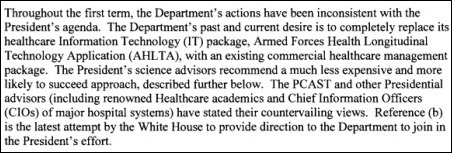
A leaked Pentagon memo reveals that President Obama’s administration has repeatedly recommended that DoD implement a more cost effective open source system like VistA, but that the Pentagon has resisted due to "an incorrect assumption that modernizations based on open systems, as opposed to proprietary commercial systems, will take too long."

CMS Listening Session: Billing and Coding with Electronic Health Records

CMS and ONC will hold a meeting to discuss the increase in code levels billed for some Medicare services associated with EHRs and appropriate coding in an increasingly electronic environment.

Bennet, Burr, Harkin, Alexander Release Draft Bill to Improve Safety of Nation’s Drug Supply

Bipartisan senators unveiled a draft bill calling for a uniform standard for drug tracking that would result in an interoperable, unit level drug product tracing.

Doctors-In-Training Spend Very Little Time at Patient Bedside, Study Finds

A recently published Johns Hopkins study finds that medical students are spending just 12 percent of their time with patients and more than 40 percent of their time on the computer. Researchers say residents spend significantly less time with patients now than they did before 2003, when hospitals were first required to limit the number of consecutive working hours for trainees.

News 4/24/13

April 23, 2013 News 4 Comments

Top News

4-23-2013 8-43-50 PM

Nextgov uncovers a scathing internal Pentagon memo that says DoD’s plans to acquired commercial off-the-shelf software fly directly in the face of the President’s call for a joint DoD-VA EHR based on open standards.


Reader Comments

4-23-2013 9-46-12 PM

From Wesley: “Re: Encore Health Resources. They have laid off multiple people in recent weeks.” I asked Encore CEO Dana Sellers, who provided this reply:

Encore continues to experience strong, healthy growth thanks to wonderful clients and the best consultants in the industry. As a result, we’ve done some realignment of our Client Services organization over the past few weeks to better position Encore to execute our strategy: the delivery of a full life cycle of consulting solutions with a focus on business intelligence and performance improvement. In fact, to meet our increasing business demands, we are actively recruiting for Client Services Executives in Nashville, Florida, Colorado, and California. Send some great folks our way, would you?

From John Porta: “Re: Advisory Panel CIOs not finding value in the HIMSS conference. Who does find value, the marketing VPs? Sales employees think it’s the biggest waste of their time in the pipeline, which is why they spent their days on their phones while ignoring the giveaway seekers and non-buyer IT staff. Why do vendors spend an average of probably $250K to be there preaching to the choir? Maybe just  companies trying to justify their marketing existence. I believe the HIMSS conference is an ongoing, self-perpetuating, ad-selling, marketing come-on. Few companies have the balls to pull out.”

4-23-2013 9-46-55 PM

From Iggy: “Re: MModal. Debtwire said that on April 3, executives told their debt holders that they fell out of compliance in the period ending March 31 and One Equity will ‘cure’ this. Is this routine?” I asked Ben Rooks, who writes HIStalk’s “Healthcare IT from the Investor’s Chair,” who with help from his friends at investment bank Houlihan Lokey provides this explanation:

Loans such as the one that allowed One Equity to borrow money to purchase MModal (the Leverage in the term LBO, or Leveraged Buy Out) have certain ongoing requirements with which the company must comply (known as “covenants”). In this case, there was actually only one such covenant, but it allowed for a maximum amount of net leverage (how much debt each dollar of EBITDA — earnings before interest, taxes, depreciation, and amortization — must support). This metric rose since the deal closed, reaching 6.43x at the end of last year in contrast to the 5.35 that was projected. Interestingly, it was set at 6.5 in Q1, then drops sequentially by .25 until it reaches 5.75 in Q1 2014 (presumably as the company both pays down its debt and grows its revenues and EBITDA). According to Standard & Poor (the debt rater in this case), “MModal has seen its revenue weaken as a result of a slower-than-expected transition to its new products strategy and competitive pricing pressures” and it downgraded the debt a notch. Realizing that these things can happen, however, the loan agreement allows the sponsor (One Equity) to cure the problem, typically by adding more equity dollars or else guarantying part of the loan. Incidentally, M*Modal might not be public, but its debt is, so this was, in fact, disclosed publicly, just not as loudly as in the case of public companies.


Acquisitions, Funding, Business, and Stock

4-23-2013 9-47-45 PM

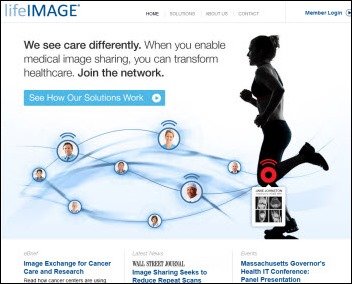
LifeIMAGE closes a $15 million Series C round of financing.

Henry Schein, Inc. secures $300 million of committed financing with The Bank of Tokyo-Mitsubishi UFJ, Ltd. based on the securitization of its A/R.

4-23-2013 9-48-31 PM

CTG reports Q1 results: revenue up five percent, EPS $0.24 vs. $0.20. CTG attributes its growth on increased demand for EMR and other health information technologies.

4-23-2013 9-49-11 PM

Healthcare learning platform vendor HealthStream announces Q1 results: revenue up 25 percent, EPS $0.07 vs. $0.05, beating earnings expectations and sending shares up 16 percent Tuesday.

Israel-based medical social data mining vendor Treato raises $14.5 million in funding. The company’s platform extracts patient comments from blogs and discussion forums, applies natural language processing and other analytics, and provides an overview of patient comments about drugs and conditions. According to the company’s CEO, “Until now, everyone wanted to hear the doctor’s voice. Now, because of social changes and even legislation, everyone wants to hear the patient’s opinion. Regulation no longer pays for the doctor to treat, but for the patient to heal.”


Sales

Nightingale Preventive Care, a provider of healthcare services in Kmart stores, selects HealthFusion’s MediTouch EHR.

4-23-2013 9-50-47 PM

Riverside Health System (VA) chooses HealthMEDX Vision for EMR and billing for its Lifelong Health and Aging Related Services division.

Orange Accountable Care (FL) selects Halfpenny Technologies to provide a lab data interface for referring physicians using risk management services from Orange Health Solutions.

Scott & White Healthcare (TX) contracts with KPMG LLP to assist with its Oracle PeopleSoft v0.2 Human Capital Management reimplementation project.

Ardent Healthcare will expand its use of Infor’s human resources and financial management suites.


People

4-23-2013 9-40-49 AM  4-23-2013 9-42-41 AM

Huron Consulting Group hires Todd Christiansen (IBM Global Business Services) and Joseph Gaetano (Siemens Medical) as managing directors in its healthcare practice.

4-23-2013 7-15-38 PM

Anthony Caponi (Maxim Healthcare Services) joins Direct Consulting Associates as VP of sales.

4-23-2013 7-19-35 PM

MediRevv hires Randy Blue (Resource Corporation of America) as director of sales.

4-23-2013 9-02-49 PM

VC firm Polaris Partners names Tim Kilgallon as CEO in residence, focusing on consumer-directed digital health opportunities. His healthcare IT experience includes stints with Pointshare Corporation and Medaphis.

4-23-2013 9-07-37 PM

Health program and population health management software vendor Aegis Health Group promotes Bill Walker to CTO.

4-23-2013 9-33-06 PM

Mobile applications platform developer Kony Solutions, announcing 90 percent year-over-year growth, names Abhay Parasnis (Oracle) as president and COO.

Gary Peat (Council Capital) joins eDoc4u as SVP of corporate and business development.


Announcements and Implementations

The Patient-Centered Outcomes Research Institute will fund up to $68 million to support organizations focused on the advancement of comparative clinical effectiveness research.

Hamad Medical Corporation in Qatar will implement Cerner Millennium across its primary care centers and eight hospitals.

Allscripts releases Allscripts Care Director to enable care coordination across all care settings.

4-23-2013 7-25-45 PM

Emmi Solutions wins a communication award from The Center for Plain Language for its Heart Failure Transition multimedia series.

4-23-2013 9-55-07 PM

Gwinnett Hospital System (GA) adopts the ChartWise:CDI clinical documentation system.


Government and Politics

HHS considers amending the HIPAA Privacy Rule to allow states to report information on potentially dangerous mental health patients to the National Criminal Background Check System, the database that houses information on individuals prohibited by law from possessing firearms.

4-23-2013 11-42-37 AM

CHIME calls on HHS to extend certification requirements to include the HIE market.

CMS and ONC will convene a May 3 meeting on appropriate coding using EHRs from 9:00 a.m. until 2:00 p.m. in Baltimore. The session will also be streamed online.

A bipartisan group of senators unveils a discussion draft of a bill to create a nationwide electronic system for tracking the distribution of prescription drugs. The proposed measure would require every entity in the prescription drug supply chain to provide electronic transaction information when there is a change of ownership, plus shift the country from a lot-level drug tracing system to a unit-level tracing system.

4-23-2013 2-40-32 PM

CMS and ONC post a joint fact sheet that breaks down the progress made since the passage of the HITECH Act that also includes the latest numbers on EHR adoption, e-prescribing rates, and the increased emphasis on interoperability and exchange.


Technology

Medical device company Smiths Medical will develop connectivity between its infusion systems and Epic using IHE standard profiles to establish communication between the systems.


Other

A small-scale Johns Hopkins study finds that first-year residents in academic medical centers spend just 12 percent of their time interacting with patients, while computer duties take up 40 percent of their hours. Patient time has been significantly reduced since a similar 2003 study, suggesting that mandatory reduced hours may have caused an undesirable balance of work duties. The researchers say better EMR systems would reduce some of the computer time required. The study’s senior author, a hospitalist, concludes, “All of us think that interns spend too much time behind the computer. Maybe that’s time well spent because of all of the important information found there, but I think we can do better.”

4-23-2013 9-56-36 PM

The Kansas Department of Health and Environment will officially take over the Kansas HIE effective July 1. The HIE board acknowledged in September that it financially unsustainable and voted to relinquish its functions to the state.

John Halamka reflects on hospital lessons learned from last week’s Boston Marathon bombings in his “Life as a Healthcare CIO” blog. Among them: making sure systems can support working from home, limiting data center access, increasing on-screen warnings to staff about looking up patient information, and improving HIE capabilities.

A review of CEO salaries of non-profit Chicago hospitals finds 20 who made at least $1 million in total compensation in 2011, with the CEO of Northwestern Memorial HealthCare leading the pack at $4.6 million.

Two former patients of Glens Falls Hospital (NY) file a class action lawsuit against the hospital and its contractor Portal Healthcare Solutions after the medical records of 2,300 patients are left on an unprotected computer network for four months.

Microsoft will sponsor an April 25 panel discussion on Unintended Consequences: Patient Perspectives on the HIPAA Omnibus Rule at the Microsoft Innovation & Policy Center in Washington, DC. Panels will include Iliana Peters (OCR), Corinne Cary (New York Civil Liberties Union), Deborah C. Peel, MD (Patient Privacy Rights), and Hemant Pathak (Microsoft).

4-23-2013 8-49-10 PM

Baltimore-based Healthify, a new startup led by Johns Hopkins University graduates and students, develops a free electronic waiting room questionnaire that can screen for health determinants such as psychosocial risks, nutritional status, housing, education, and substance abuse, all of which significantly increase the odds of an individual requiring hospitalization.

No-frills clinics in India say they can offer heart surgery for $800 by operating in prefabricated buildings that have air conditioning only in the OR suites and that require family members of patients to help care for them. The company’s founder, a noted heart surgeon, says that while Stanford Hospital is spending $600 million to build a 200-300 bed hospital and a new London hospital will cost $1.5 billion, the clinic can build and equip a hospital for $6 million and have it up and running within six months.

Weird News Andy says this might make sense. In England, NHS is considering sending recovering elderly patients to “hospital hotels” run by private hotel chains. It’s modeled after a similar program in Scandinavia and would relieve “bed blocking,” where local councils have cut funding for home health and residential services, leaving patients stuck in expensive hospital beds they don’t really need.

4-23-2013 7-37-54 PM

WNA also likes a story that he titles “A different kind of Brazilian close shave.” A Brazilian fisherman accidentally fires a foot-long harpoon into his skull, then decides to go home to sleep it off. His aunt calls the fire department 10 hours later. He’s in ICU and has permanently lost sight in one eye.


Sponsor Updates

4-23-2013 7-29-06 PM

  • Infor will donate $5 to charity for each attendee of Monday night’s Infor Healthcare party, held in conjunction with Inforum in 2013 in Orlando.
  • Greenway Medical will add RemitDATA’s comparative analytics solution into its PrimeDATACLOUD Remittance Intelligence service, giving practices reimbursement and productivity insights and performance benchmarking.
  • Jill Farnsworth and Mike Grisaffee from Encore Health Resources  will participate in educational sessions at the HIMSS Texas Regional Conference May 14-15 in San Antonio.
  • Healthcare Anytime offers a June 4 Webinar on surviving the avalanche of patient data.
  • Bottomline Technologies donates $2,500 to a memorial fund for Joshua Krantz, a recently deceased employee.
  • The Denver Post names Ping Identity Top Workplace for the second consecutive year.
  • InstaMed launches the InstaMed Healthcare Payments Account, which helps providers get paid faster and through more channels.
  • Visage Imaging releases version 7.1.3 of the Visage 7 Enterprise Imaging Platform, which incorporates over 1,000 enhancements and product fixes.
  • T-System will deploy the NextGen PM solution for its RevCycle+ solution clients.
  • Craneware showcases enhancements to its Bill Analyzer and InSight Audit solution during this week’s HCCA 17th Annual Compliance Institute in National Harbor, MD.
  • eClinicalWorks offers a series of Webinars in April and May on its upcoming eBO Version 6 release.
  • Henry Johnson, MD, VP and medical director for Midas+, a Xerox company, discusses value-driven analytics and the best big data trends for healthcare.

Contacts

Mr. H, Inga, Dr. Jayne, Dr. Gregg, Lt. Dan, Dr. Travis.

More news: HIStalk Practice, HIStalk Connect.

125x125_2nd_Circle

Morning Headlines 4/23/13

April 22, 2013 Headlines Comments Off on Morning Headlines 4/23/13

Nightingale and HealthFusion Partner to Deliver Electronic Health Record (EHR) Benefits to Customers in Kmart

HealthFusion has been selected as the vendor of choice for Nightingale Preventative Care, a Long Island-based primary care center based out of the local Kmart. Nightingale has reported that the Nightingale Kmart clinic is thriving and that it intends to expand its presence across the chain nationally.

The Emerging Benefits of Electronic Medical Record Use in Community-based Care

In Canada, PwC releases a report which suggests that more than $1.3 billion in administrative savings has been realized since Canadian primary care providers began adopting EHRs in 2006.

CHIME to HHS: Extend certification to HIE

CHIME is lobbying to have HHS extend vendor certification criteria beyond just EHRs to include health information exchanges, citing a need for stronger governance in order to promote interoperability.

HIPAA Privacy Rule and the National Instant Criminal Background Check System

HHS files a proposed change to HIPAA regulations that would allow states to share medical records with the National Criminal Background Check System as part of an effort to include mental health information on mandatory gun sale background checks.

Comments Off on Morning Headlines 4/23/13

Readers Write: Misconceptions About the Health IT Workforce

April 22, 2013 Readers Write 9 Comments

Misconceptions About the Health IT Workforce
By Helen Figge, R.Ph, Pharm.D.

4-22-2013 7-02-48 PM

There are many misconceptions out there about workforce development in healthcare IT today. As technologies become introduced into the various healthcare settings to support quality healthcare, it is always assumed that one needs an advanced certification, advanced degree, and advanced resources to implement and support these technologies.

Well, yes and no. For viability if nothing else, these added career efforts are valuable, but truly viable workforce development plans in healthcare IT need to evolve and grow from the bottom up. You don’t make a cake by starting to put the sprinkles together before baking a solid foundation – the cake. The same holds true in the workforce of healthcare IT today.

Many now understand that the backbone to the evolution of the demand for “skilled “workforce today is due in most part to the electronic health record (EHR). Thanks to visionaries like Glen Tullman who positioned the EHR front and center in healthcare discussions, the healthcare market now realizes that the real need in the workforce today involves an understanding of the implementing, programming, interconnecting, and relationship of the EHR to clinician workflow.

One of the backbones to any workforce development plan is continuing education in helping to shape and evolve the IT workforce. Continuing education programs commonly exist for physicians, nurses, and pharmacists. However, there is very little formal infrastructure in place to provide continuing education to the IT workforce. A true educational program for any workforce entity that is sustainable and viable long-term needs to understand the “how” and “why” of the tasks at hand and then educate from that vantage point. 

How would you measure true workforce healthcare IT success? That is yet to be determined, but for all practical purposes, if you don’t understand clinician and healthcare workflow from its various angles and nuances, then you won’t be able to create a viable and competent overall workforce to support the needs out there today. The future of the health IT workforce rests in the hands of those clinicians that adopt the technologies, and in turn, the measurement of success will depend on having critical knowledge about the exact needs of these end users. There is no substitute for knowledge past to bring in the future direction.

The most realistic approach for a viable workforce development program is for organizations to recruit to their organizations and then create loyalty factors for the employees. This in turn provides a base of employees that an organization can draw from for an expanded workforce need. No one really knows the future skills needed in the healthcare workforce, but if an employee can use an iPad or their Android, then they have the potential to learn healthcare IT.

The wave of the healthcare future is mobile applications. You would be surprised how many individuals out there use technologies for various purposes that are non health-related. To get a trained workforce in healthcare IT, maybe we train these individuals through “gaming” learning from such gaming wizards like John Gomez, former CTO for Eclipsys.

Organizations should consider grooming from within and cultivate the talents of motivated employees to fill the voids being felt in today’s healthcare IT marketplace to fill the immediate voids, but also helping to create loyalty programs and career transition pathways for employees. Also, you would be surprised how many prior work experiences are much underestimated in the workplace today. Consider engaging individuals who might have soft and transferable skill sets from other previous positions, encourage them to create new ideas for the healthcare workforce and develop opportunities for long term employment.

There is no nirvana in the formula for developing a healthcare workforce, because if there were one, we would not be hearing endless complaints about not finding “qualified staff” for vacant positions. Groom from within, because healthcare is a forever changing process. It has to be because medicine is an evolving entity, so the skills we are seeking out now may be obsolete in a few years, but if you invest in the person from the ground up, the cake is well baked, so when it’s time for the sprinkles, the final product will look just right.

Helen Figge, BS, PharmD, MBA, CPHIMS, FHIMSS is a principal with Figge Workforce Development.

Curbside Consult with Dr. Jayne 4/22/13

April 22, 2013 Dr. Jayne 2 Comments

clip_image002

It’s a little strange having a secret life as an anonymous blogger. Although I’ve gotten used to hearing colleagues talk about things they recently read on HIStalk, I’m still not entirely used to them talking about my personal posts. I think that will be a bit easier now that I’m apparently a “non-anonymous” celebrity, courtesy of cable TV.

Our hospital has had a “Focus on Your Health” outreach program for several years. It shows on the local public access channel and each episode runs intermittently throughout the month. I did a women’s health feature when I first started practice and it brought an interesting mix of new customers to the practice. I had just opened and needed the business, but the influx of people was challenging enough that I wasn’t too excited about doing it again.

Last month, the hospital was looking for a piece about summer health emergencies and asked me to help out. I figured that since I now work mostly in the emergency department, it might be fun. I dutifully prepared my segment on all the various “things that can get you in the great outdoors” and prepared to film. We covered all the staples: dehydration, sunburn, noxious plants, heat-related illness, venomous snakes, and more.

Most of the conversation was around prevention and the basics. Drink plenty of fluids, avoid being outside during the hottest parts of the day, wear a hat, use sunscreen. Wear long sleeves, pants, and sturdy shoes when working in the yard, woods, or garden. Not exactly hot topics.

What I wasn’t prepared for, though, was the magic of video editing. While we were filming, there was a flat screen with the “Focus on Your Health” logo in the background positioned between the interviewer and my chairs. After filming, the screen was replaced with gory pictures of our discussion topics – rashes, bites, snakes, spiders, and more. Some of the footage seemed right out of a National Geographic “animals eating animals” special.

I was surprised to be a hot topic in the doctor’s lounge. Apparently some of my colleagues thought I had prepared the video clips myself and wondered exactly what I do in my free time to have all those pictures.

I’m self-conscious about being on film, so it wasn’t easy to hear what colleagues thought about my performance. I fretted over that for a day or two until I had my first celebrity encounter at the supermarket. I heard a little voice say, “Hey, mom, it’s the Snake Lady!” and looked around to see who he was talking about. Turns out it was me. His mom said he loved the show and recorded it.

I suppose having one’s performance critiqued is worth it when you see the smile of a child meeting his TV idol. Got a story about public access television? What do you think of it as health information technology? E-mail me.

Print

E-mail Dr. Jayne.

Text Ads


RECENT COMMENTS

  1. The CEO sentenced to jail for massive healthcare fraud will get pardoned in a week.

  2. The comments are true above. HIMSS is facing serious leadership and governance concerns, particularly involving the CEO and head of…

  3. "A valid concern..." Oh please. Everyone picks the software they like and the origin of that software is an afterthought.…

  4. I don't disagree with you completely, but to take the counterpoint: there is plenty of precedent for saying "this *entire…

Founding Sponsors


Platinum Sponsors


Gold Sponsors


RSS Webinars

  • An error has occurred, which probably means the feed is down. Try again later.