Recent Articles:

Readers Write: Think Beyond the Text: Understanding HIPAA and Its Revisions

July 31, 2013 Readers Write 1 Comment

Think Beyond the Text: Understanding HIPAA and Its Revisions
By Terry Edwards

Every day, an increasing number of physicians and other health care providers are exchanging clinical information through a wide range of modes, including smart phones, pagers, CPOE, e-mails, texts and messaging features in an EMR. It’s no surprise that hospital and health system leaders are increasingly focused on securing protected health information in electronic form (ePHI)—a trend that has certainly invoked some confusion across the industry.

As PHI data breaches increase in frequency, hospital executives must strategize ways to eliminate security threats and remain HIPAA compliant. Especially since HIPAA violations can be extremely expensive, leaving these already-strapped organizations in an even more stressful financial situation.

In order to prioritize tangibles such as patient safety, physician satisfaction and overall efficiency across processes and hospitals, health care leadership must consider ways to tackle this confusion and maximize the benefits enabled by modern technology and electronic communications.

PHI can take a variety of paths in today’s complex healthcare environment and expose a health system to risk. But time and time again I see health systems looking to implement stop-gap measures and point solutions that address part—and not all—of the problem.

While texts are commonly sent between two individuals via their mobile phones, the communication “universe” into which a text enters is actually much bigger. It also includes creating ePHI and sending messages—in text and voice modalities—from mobile carrier web sites, paging applications, call centers, answering services and hospital switchboards.

For example, a 400+ bed hospital generates more than 50,000 communication transactions to physicians each and every month. Many of these communications contain ePHI. And if they were transmitted through unsecure networks and stored in unencrypted formats, they would represent a meaningful potential security risk to both the hospital and its medical staff.

In order to identify all potential areas of vulnerability, health care leaders need to consider all mechanisms by which ePHI is transmitted and the security of those mechanisms and processes. No mode of communication can be viewed in isolation. By failing to address all transmitted ePHI, organizations become vulnerable to security breaches with adverse legal and financial consequences, as well as loss of patient trust and reputation in marketplace.

In addition, contrary to what many health leaders have been led to believe, HIPAA provisions do not call out any specific modes of communication. Text messaging is permissible under HIPAA. The law simply stipulates that a covered entity (CE) must perform a formal risk assessment; develop and implement and effective risk management strategy based upon sound policies and procedures; and monitor its risk on an ongoing basis. These regulations apply to providers communicating PHI in any electronic form.

As a result, there is no such thing as a “HIPAA-compliant app.”

HIPAA provisions emphasize the risk management process rather than the technologies used to manage risk. For hospitals and health systems, the pathway to safeguarding electronic communication of PHI lies in the creation of an overall risk management strategy.

Ideally, leaders of the CE will form an information security committee to develop and execute the strategy, which includes representatives from IT, operations, the medical staff, and nursing, as well as legal counsel. Leaders should also consider including an external security firm in the group. Once the committee is formed, the organization should take these four essential steps for protecting the security of ePHI:

  1. Organize and execute a formal risk analysis. A formal risk analysis should break down types of technology used for electronic communication as well as the transmission routes for all ePHI. To ensure HIPAA compliance, ePHI transmitted across all channels must be “minimally necessary,” which means it includes only the PHI needed for that clinical communication. This layer of complexity, which is common in clinical communication processes, underscores the need for a comprehensive security assessment and strategy appropriate for the organization, coupled with the resources necessary to implement that strategy.
  2. Establish an appropriate risk management strategy. The committee should develop a risk management strategy that’s specific to the needs and vulnerabilities of the organization and is designed to manage the risk of an information breach to a reasonable level. HIPAA does not specifically define “reasonable,” but in general, the risk management strategy should include policies and procedures that ensure the security of message data during transmission, routing, and storage. The strategy should also include specific administrative, physical, and technical safeguards for ePHI.
  3. Roll out these policies and procedures and train staff. Implementing new policies and procedures is the biggest challenge for organizational leaders, especially as a substantial proportion of reported security breaches are due in part to insufficient training of staff. As a result, appropriate individuals should be assigned specific implementation tasks for which they are held accountable, while leaders and committee members must carefully monitor the success of implementation. All staff with access to PHI must be educated about the specific policies and procedures, which will help ensure they are upheld across the organization.
  4. Monitor risk on an ongoing basis. To ensure continued compliance with security standards, organizations must conduct ongoing monitoring of their information security risk. Leaders should receive regular trend reports from the information security committee based on their ongoing assessment of ePHI security at the organization. Those reports should support the ongoing assessment of security needs as technology and health care delivery change, and act as a catalyst for changes that may need to be made to the policies and procedures over time.

In today’s increasingly complex healthcare environment, analyzing and implementing a broader policy around security across all forms of electronic communications—rather than focusing on a single mode of communication in isolation—is critical to any health system’s ability to avoid and mitigate the adverse consequences of a breach. By clarifying the confusion around electronic communications now, hospitals and health systems will be better prepared to minimize risk and maximize best-practice communication process in the future.

Terry Edwards is president and CEO of PerfectServe of Knoxville, TN.

Readers Write: Seven Strategies for Optimizing the EHR

July 31, 2013 Readers Write Comments Off on Readers Write: Seven Strategies for Optimizing the EHR

Seven Strategies for Optimizing the EHR
By Marcy Stoots MS, RN-BC

7-31-2013 4-11-56 PM

Healthcare organizations are making a mistake if they subscribe to the notion that once an EHR is successfully implemented, it no longer requires attention. Even the most carefully designed EHR will not work as intended in all situations, causing users to create workarounds that are counterproductive and inefficient. It’s important to develop and implement an ongoing strategy for fine-tuning the EHR so that users can input and access the data they need with fewer clicks and better outcomes, which will improve clinician satisfaction.

Besides moving toward usability and adoption, optimization will help with plans to achieve Meaningful Use Stage 2, which raises the bar significantly. Under the Stage 2 final rule, for example, hospitals must report on 16 of 29 clinical quality measures (CQMs) and Eligible Professionals must report on nine of 64 CQMs. Optimizing the EHR to properly capture this data and generate compliance reporting is crucial.

Finally, optimization is a key step to realizing the financial ROI of the EHR, in which a substantial investment has been made. In today’s landscape of cost containment and healthcare reform, an organization can ill afford to sacrifice financial ROI or be bogged down by inefficiencies.

Below are seven strategies for optimizing the EHR to increase efficiency, improve the ROI, drive adoption, and improve usability, with the ultimate goal of providing better outcomes.

1. Create a Governance Structure

Just as an organization needed a governance structure during planning and implementation of the EHR, it will need one for ongoing optimization. This will provide an avenue for making decisions and keeping the optimization plan moving forward. Problems will continue to arise and solid governance will ensure that they are dealt with effectively. A process should be in place to manage variances when clinicians do not want to adhere to a standardized documentation or workflows. When these crop up, the governance group will need to decide upon appropriate action.

2. Create a Solid Informatics Structure

Many healthcare organizations struggle with the size and organization of the informatics team. From an optimization standpoint, it’s important to get this right. There is no standard answer here; every organization is different. Detailed descriptions of job roles and responsibilities should be created and appropriate resources budgeted.

3. Assign Responsibility

An individual at the leadership level should be designated as the responsible party for optimization. This function should be incorporated into that person’s job description. This is typically an informatics director, but could also be a CMIO or IT director, depending on the organizational structure. Assigning this responsibility will help ensure that optimization is an ongoing process, since it requires continual evaluation and modification. Ideally, for larger health systems, there should also be an optimization team in place that could include clinical leadership, operational leadership, informatics analysts, and super users. For smaller health systems, the team would be much smaller, but informaticists should have optimization as a core job function.

4. Measure

The pain points of clinicians should be determined by interviewing stakeholders, examining service desk tickets, listening to input from IT and informatics staff, analyzing reports and metrics, and observing end-to-end workflows. The most important issues should be focused on with data collected at baseline and after 30, 60 and 90 days. Measuring is an ongoing process. It should be used to monitor progress and gauge success.

5. Create Scorecards

Scorecards are a powerful tool for demonstrating what has been achieved. They display the collected data and communicate improvements to the team and stakeholders. Managing workarounds starts with accountability; Scorecards lets users know where they stand and create a healthily competitive environment that encourages success. They can be used to compare units within a hospital or hospitals within a health system.

6. Provide a Quick Win

Clinicians can be easily frustrated by glitches in the EHR, so areas should be pinpointed that will quickly increase their satisfaction. These are issues that are important to them, yet easy to address, the low-hanging fruit that delivers the highest impact. Success breeds enthusiasm, setting the stage for better adoption.

7. Continue Refining

Optimization is never complete. It is an ongoing endeavor without an endpoint.

Workarounds are a reality. The organization should have an optimization plan to monitor and manage them, as well as establishing ownership of that plan. With proper planning and a roadmap in place, addressing problems and overcoming challenges will go smoothly. The end result will be satisfied users and healthier patients (and lower costs).

Marcy Stoots MS, RN-BC is a principal with CIC Advisory of Clearwater, FL.

Comments Off on Readers Write: Seven Strategies for Optimizing the EHR

An HIT Moment with … Devin Gross

July 31, 2013 Interviews 2 Comments

An HIT Moment with ... is a quick interview with someone we find interesting. Devin Gross is CEO of Emmi Solutions of Chicago, IL.

7-31-2013 4-06-22 PM


What are the problems and opportunities involved with patients forgetting or not understanding what their doctor tells them?

Research shows that by the time patients get to the car, they forget about 80 percent of what their doctors have told them. Frankly, the time you’re in front of the doctor is the worst time to learn, whether it’s in an ambulatory or inpatient environment. We need to empower people to learn at a time when it’s most convenient for them on the terms that they want, whether that’s on a desktop computer, laptop, tablet, or smartphone.

If they don’t remember what their providers have told them, they won’t understand, they can’t become an engaged patient, and their circle of care may feel even more in the dark. That means they won’t follow pre-op or post-op instructions and they won’t know what to expect.

When you can engage patients and their circle of care when and where they are ready to learn and on the devices they already own, they are more compliant and prepared before they come in and are more compliant after the procedure. Their expectations are effectively set, so they’re more satisfied with their experience.


How many patients are really willing and able to participate in their own care and outcomes?

Look at any other industry – banking, airline travel, retail – and you’ll see a growing consumer base that wants more control. Healthcare is no different.

We track and document everything, so this is a very easy question for us to answer. What we know is if we ask someone to participate in one of our programs, somewhere between 40 and 50 percent of people are going to engage. That may be higher depending on geography or conditions. For example, an acute episodic patient might be more likely to engage than a chronic condition patient.

When they activate, our data, which is based on over five million of these encounters, shows that roughly 80 to 90 percent of those patients are going to complete the encounters. We continue to work with our clients around better messaging, around incentives, and around other levels of activation to increase that number. Patients are hungry for this information across all demographics and our data and our platforms support that.


How do your offerings improve patient satisfaction with hospitals?

This goes back to what we discussed before about convenience and empowerment. When you look at what patients want, they want to be communicated with, they want to be engaged on their terms, and they want to understand what is going to happen during their experience. Emmi does that. We extend the conversation. We extend the relationship for both the hospital and the clinician to better communicate, empower, and engage patients. When you do that, patients are going to be more satisfied.

We’ve conducted a number of studies over time that demonstrate when patients are engaged with Emmi, they’re going to be more satisfied.


Will it become common for physicians to prescribe learning material and patient engagement activities?

Yes, it’s already becoming common. We’ve been at this for 11 years, and back then, few physicians and hospitals understood the value of engagement. Today, we’re in hundreds of hospitals around the country and our pipeline is stronger than ever before. Hospitals are looking for this kind of integrated program. It’s not enough to just put a video on the web site and hope they come. It’s important for this to be a prescriptive experience where they can measure the impact and what’s happening out there. Prescribing engagement activities is happening today, and it’s going to happen more and more quickly.

Patient engagement isn’t a fad. It’s here to stay. As new models of care — both around reimbursement and delivery — continue to evolve, the ability to engage and empower people in their care is going to be critical. The ability to engage and empower with a vendor that has been doing it for a long time and has a proven, documented track record is going to be critical. The more we measure, the more we prove, and the more readily we’re seeing provider adoption.


How do your programs integrate with EHRs?

Our solutions are integrated into the leading HIS and EHR systems. Providers, mid-levels, and admin staff alike can order and track Emmi programs for patients right inside their EHR. Many of our integrated clients employ best practices like alerts, order sets, and bulk ordering to streamline Emmi into the standard clinical workflow. In addition, Emmi programs are integrated directly into the patient portal.

As the healthcare market begins the transition from volume to value, Emmi is increasingly being integrated into tools that manage large populations of patients, including registries, population health platforms, and data analytics vendors. Our technology platform and the way that we facilitate integration and analysis are well positioned to take advantage of these trends.

Morning Headlines 7/31/13

July 31, 2013 Headlines Comments Off on Morning Headlines 7/31/13

Community Health Agrees to Buy H.M.A. for $3.6 Billion

Community Health Systems agrees to buy Health Management Associates for about $3.6 billion. Including the assumption of debt, the merger is valued at about $7.6 billion.

Catholic Health Initiatives Optimizes Nursing Care Delivery in Collaboration With Cerner Clairvia

Catholic Health Initiatives has increased patient satisfaction scores, saved $1.5 million from reduced overtime, and and saved another $3 million from reduced length of stay after completing a three-year project that included analyzing nurse processes and implementing Cerner Clairvia to measure and streamline them.

Give the public access to the Medicare database

Senators Chuck Grassley and Ron Wyden call for the release of Medicare’s claims database, arguing that research potential and transparency trumps both the privacy concerns of the patients receiving care and the business concerns of providers uncomfortable with their reimbursement rates being made public.

Fitch Rates Catholic Health Services of Long Island, NY’s 2013 Revs ‘BBB+’; Outlook to Negative

Catholic Health Services of Long Island, NY has its bond rating downgraded and outlook revised to "negative" due in part to a $144 million Epic implementation that led to a $18 million operating loss for the interim period.

Comments Off on Morning Headlines 7/31/13

News 7/31/13

July 30, 2013 News 5 Comments

Top News

7-30-2013 8-31-15 PM

Community Health Systems will buy for-profit hospital competitor Health Management Associates for about $3.6 billion in cash and stock. With the assumption of debt, the merger is valued at $7.6 billion and includes 206 hospitals in 29 states. It will be interesting to see if HMA shareholders approve the deal since it only pays $10.50 per share compared to Monday’s closing stock price of $13.92.


Acquisitions, Funding, Business, and Stock

7-30-2013 7-22-55 PM

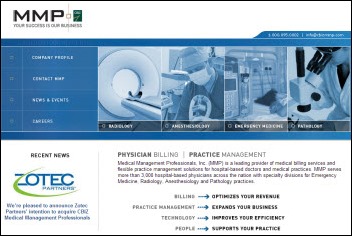
Specialty medical billing vendor Zotec Partners will acquire Atlanta-based ED billing firm Medical Management Professionals for $200 million from CBIZ. The combined companies will have 1,750 employees and $215 million in annual revenue.

7-30-2013 8-32-52 PM

Mediware CEO Kelly Mann says the company, which has acquired five home health software companies, will acquire one or two software vendors each year, focusing on home health and long-term care.


Sales

7-30-2013 5-50-19 PM

Excela Health (PA) contracts with SCI Solutions for its Schedule Maximizer, Order Facilitator, and Results Facilitator solutions.

The Arkansas Office of HIT selects Get Real Health as the patient portal development vendor for providers participating in the statewide HIE.


People

7-30-2013 3-58-42 PM

CareTech Solutions CEO Jim Giordano is named chairman of the St. John Providence Health System (MI) board of trustees.

7-30-2013 3-59-54 PM


John Lutz (Navigant Consulting) joins Huron Consulting Group as managing director of the company’s healthcare practice.

7-30-2013 6-11-48 PM

Justin Graham, MD (NorthBay Healthcare) is named chief innovation officer, healthcare of Hearst Business Media.

7-30-2013 6-16-15 PM

Dann Lemerand (The HCI Group) joins eVariant as vice president, solution engineering.

Clinical Architecture appoints Andrew Frangleton (UBM Medica) managing director of the company’s UK office.


Announcements and Implementations

Qsource and the Tennessee Office of eHealth Initiatives introduce Direct Technology for secure exchange of patient data.

7-30-2013 8-37-49 PM

Catholic Health Initiatives reports savings of nearly $1.5 million from reduced overtime and $3 million for reduced length of stay since its 2010 implementation of the Cerner Clairvia workforce and operations suite in 14 of its hospitals.

TECSYS announces the OR Inventory Manager perioperative supply change management system.

7-30-2013 8-35-56 PM

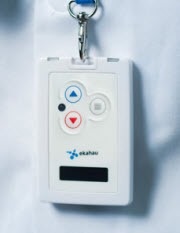
Napa State Hospital (CA) and two other psychiatric facilities give employees Ekahau RFID-powered name badges to signal for help and transmit their location in an emergency.

7-30-2013 7-10-17 PM

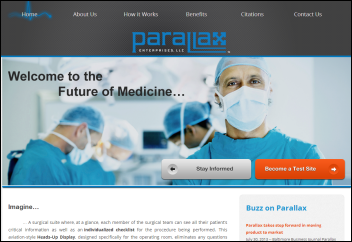
Baltimore-based Parallax Enterprises will begin beta testing its CHaRM OR safety checklist system starting in the fall.


Government and Politics

7-30-2013 5-56-58 PM

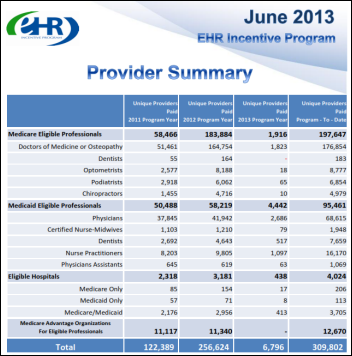
Through the end of June, 305,778 EPs and 4,024 hospitals collected more than $15.5 billion in EHR MU incentives.

inga_small In a Politico opinion piece, Senators Chuck Grassley (R-IA) and Ron Wyden (D-OR) argue for the passage of legislation that would make Medicare claims data available through a free, searchable online database. The senators contend, “The publication of Medicare data will become healthcare’s new financial baseline; the measure of what America’s largest and most powerful buyer of healthcare gets for nearly $600 billion a year.” I understand that privacy issues remain a chief concern, but I have yet to hear a argument compelling enough to convince me that keeping this data largely sealed is preferable to open access and transparency for researchers and consumers.

7-30-2013 8-42-31 PM

A Time article recaps a Washington Post investigative article from earlier this month that describes the AMA group that tells the government how much Medicare should pay doctors. According to former CMS Administrator Tom Scully, “The idea that $100 billion in federal spending is based on fixed prices that go through an industry trade association in a process that is not open to the public is pretty wild.” The AMA criticized the article saying its recommendations are just optional guidelines, but left out the fact that the government accepts 90 percent of those recommendations without question.


Innovation and Research

7-30-2013 8-43-29 PM

A team from the Houston VA Medical Center creates EHR-based triggers to make sure that clinicians follow up on abnormal lab results that can indicate cancer (PSA, occult blood, iron-deficiency anemia, and bloody stools.) Positive predictive value ranged from 58 to 70 percent.

A heart surgeon in India who founded a chain of 21 medical centers offers coronary bypass surgery for $1,583 and hopes to drop the price to $800 within 10 years. The same procedure at Cleveland Clinic costs $106,000.


Other

7-30-2013 8-44-22 PM

MMRGlobal announces Australian singer Guy Sebastian as the spokesperson for its “Don’t Worry Be Happy” advertising campaign for its personal health record.

The ratings agency for Catholic Health Services of Long Island downgrades its bonds, with a key ratings driver being, “Additional expense pressures in fiscal 2013 related to the implementation of an electronic medical record (EMR) has resulted in an operating loss of $18 million for the interim period.” The system filed a $144 million certificate of need in 2010 to implement Epic, which it estimated would add $40 million to its bottom line beyond HITECH payments, including a projection that its length of stay would drop 0.5 days for an annual savings of $28 million.

A jury awards a woman $1.44 million after a female Walgreens pharmacist shared her prescription records with the pharmacist’s husband, who was also the patient’s former boyfriend. Walgreens says the jury was wrong in finding it responsible for the actions of an employee who intentionally violated company policy and says it will appeal.

Weird News Andy calls this article “Potty Mouth.” A China-based research team grows teeth from stem cells extracted from urine. WNA says of this article about a venipuncture robot, “He vants to drink your blaad.”


Sponsor Updates

  • CommVault announces enhancements to its Edge software that give users the ability to securely share, search, and restore files across their mobile, desktop, and laptop devices.
  • NextGen reseller TSI Healthcare will integrate PatientPay with NextGen PM.
  • HealthTronics will integrate SampleMD’s eCoupon and eVoucher solutions from OPTIMIZERx Corp. within its UroChartEHR and meridianEMR platforms.
  • McKesson adds real-time analytics and mobile access to its Strategic Supply Sourcing supply chain solution.
  • ONC head Farzad Mostashari, MD and MGMA Healthcare Consulting Group’s Rosemarie Nelson will deliver keynote addresses at this week’s Aprima 2013 Annual User Conference in Dallas.
  • Greenway Medical will provide its PrimeSUITE customers access to PatientCo’s patient financial engagement  platform.
  • Greythorn Senior Account Executive Paul Tran writes about the importance of “soft skills” within a technology environment.
  • LiquidEHR partners with DrFirst to offer users integrated e-prescribing functionality.
  • Allscripts profiles Manitoba e-Health and its implementation of dbMotion’s eChart solution.
  • Infor Healthcare highlights the success of its supply chain management solutions at several organizations, including MLK Community Hospitals (CA), Huntington Hospital (CA), Prime Healthcare (CA), WellStar Health System (GA), University Health System (TX), and Greenville Health System (SC).
  • Talksoft Corporation integrates its portfolio of messaging services within the Healthpac Computer Systems billing platform.
  • Craneware introduces an update to its Supplies ChargeLink solution that includes an automated search function to identify HCPCS codes.
  • Ingenious Med releases a white paper that offers tips for transitioning to ICD-10.
  • A local publication features the use by Colquitt Regional Medical Center (GA) of Versus RTLS to improve patient care.


Contacts

Mr. H, Inga, Dr. Jayne, Dr. Gregg, Lt. Dan, Dr. Travis.

More news: HIStalk Practice, HIStalk Connect.

smoking doc

Morning Headlines 7/30/13

July 29, 2013 Editorials Comments Off on Morning Headlines 7/30/13

GAO: Fed IT projects need aligned management

The Government Accountability Office releases a report chiding several government agencies for their failed IT projects and project management methods, including the VA/DoD iEHR project and the FDA’s MARCS program. The report says, "the federal government has achieved little of the productivity improvements that private industry has realized from IT” despite $600 billion in federal IT spending in the past ten years.

Oregon Health & Science University notifies patients of ‘cloud’ health information storage

Oregon Health and Science University is notifying 3,000 patients of a data breach after IT staff discover that medical residents have been using Google spreadsheets to help track patient care. The spreadsheets were password protected, but because Google was not a business associate with a contractual agreement to store OHSU patient health information, patients are being notified.

In leaving, Siemens CEO seeks to take down chairman

Seimen’s CEO Peter Loescher has reportedly agreed to step down from his position four years before his contract is up, but only if board chairman Gerhard Cromme is fired with him. Loescher is being forced out because of consistent weak financial performance.

HCA’s Bracken to Retire from CEO Role, Will Remain as Board Chair

Richard Bracken, CEO of HCA, will retire from his position at the end of the year and continue on as chairman of the board. He will be replaced by current president and CFO R.Milton Johnson. Nashville-based HCA is the nation’s largest hospital chain.

Comments Off on Morning Headlines 7/30/13

Curbside Consult with Dr. Jayne 7/29/13

July 29, 2013 Dr. Jayne 1 Comment

clip_image002

Inga mentioned last week that MGMA had sent a letter to Health and Human Services Secretary Kathleen Sibelius. This was triggered by Medicare’s recent announcement that it does not intend to participate in end-to-end testing for ICD-10. In addition to MGMA, there are many more of us that agree that Medicare’s refusal to test with trading partners is problematic.

Medicare has a history of problems with claims backlogs whenever there are changes. My practice experienced this with previous transitions. Although our cash flow disruption was not as large as it could have been, it certainly wasn’t zero. Medicare has tested in the past for both 4010 and 5010 and the processes identified issues which could be resolved prior to the go-live date. CMS touted its testing week for HIPAA 5010 and it appeared to be very successful.

Medicare has said that practices should test with their commercial payers, but the problem there is the number of payers that take their direction from Medicare. If Medicare isn’t going to test, why should they spend resources testing with everyone in their networks?

The worst that can happen is claims are denied, which doesn’t hurt the insurance company and doesn’t hurt Medicare. It does hurt providers of all kinds, whether large or small, and the subsequent payment problems will ultimately have negative consequences for patients.

The MGMA letter calls out CMS for saying back in 2012 that there should be “industry wide best practices for the testing of ICD-10 and other standards.” CMS is requiring all state Medicaid payers to test with providers, but won’t participate itself. Providers are already nervous about ICD-10. This is going to add fuel to the fire.

It’s time for Medicare to eat its own dog food. What do you think? E-mail me.

Print

E-mail Dr. Jayne.

HIStalk Interviews Sunny Sanyal, CEO, T-System

July 29, 2013 Interviews 1 Comment

Sunny Sanyal is CEO at T-System of Dallas, TX.

7-29-2013 12-48-08 PM

Tell me about yourself and about T-System.

T-System was formed in the early 1990s by a couple of ED physicians who essentially wanted to get through the day. They would work all day and then stay back for hours after work trying to figure out what they did all day so they could document all that and get paid correctly.

These  two ED docs said, “Can we just take all the stuff that we do in the ED and organize that with some taxonomy in a way that all all this clinical content can be streamlined? So that we can document while we’re with the patient and very quickly get it all done in not more than two to three minutes and be able to support optimal coding and billing, be able to stand up to scrutiny in case of a lawsuit, be clinically accurate, and support all of our performance and quality and regulatory needs? 

That’s how it started. One sheet of paper, front and back. By the way, Dr. Rick Weinhaus did a really good job on this article about why T-Sheets work. I owe him some thanks. We couldn’t have said it better. 

The company all along has had a combination of both clinical and financial orientation. We’ve kept that alive in our products and services throughout.

I joined the company three years ago when the company was going through a transition and was acquired by a private equity firm. It was an opportunity for me to be a CEO. I had an appreciation for T-System, having seen it as a competitor in my past life. I jumped in because I saw a tremendous opportunity to do some great things in this space.


What are the most pressing issues that EDs are facing?

We call this the unscheduled care space. That’s a combination of emergency care, freestanding ED, hospital-based EDs, freestanding EDs, and urgent care centers. The macro demographic systemic issues are hitting all of these in the same way, but perhaps they’re feeling them differently.

I will clarify that. Largely speaking, they are all seeing an increase in volumes, rising volumes in the ED. At the same time, while volumes are growing, they are also seeing an increase in self-pay. Historically, we associated self-pay as people that didn’t have insurance. You’d have a hard time collecting from them. But more and more self-pays are coming from people on high-deductible plans and HSAs that we call insured self-pay. That’s making collections very, very difficult.

Add to that that reimbursement levels aren’t going up. They are just getting tougher. Productivity demands from people staffing the ED are going on. 

This space is under a tremendous amount of pressure. Doctors are struggling, frankly, to keep up with being able to provide the right services, the right quality of the clinical services, while they’re getting paid less to do more and having to deal with more and more regulatory pressures. The whole system is under a lot of pressure.

At the same time, what we’re finding is in order to get away from some of these pressures, some physicians are leaving the ED as a practice and going to urgent care centers, where they don’t have some of those regulatory challenges. That further exacerbates the pressures in the EDs because now all of a sudden you’ve got staffing shortages. It’s difficult to find doctors, particularly in rural areas.

ED as an environment in general is under siege and we don’t see it getting better. We see it getting worse in that regard because all of the regulatory changes that are in the horizon make it tougher for the ED. If health reform adds more patients, those patients are unlikely to have access to primary care. It’s more likely that they will show up in the ED than not. If there are further reimbursed changes and modifications in the reimbursement programs and reimbursement gets cut then it will hit the ED even harder. 

There is a tipping point here that the volume of beds is not increasing while the patient volumes are increasing. All of the changes in the horizon appear to be negative from an overall impact of the ED perspective.


I like that term “unscheduled care.” Is there any hope at all of reducing utilization of ED as a non-urgent care provider?

Absolutely. If there is a significant shift in the reimbursement models, then you will see hospitals taking steps to reduce ED utilization. Those patients fall into few different categories. Patients that are habitual ED users that don’t need to be at the ED can be redirected somewhere else or they can be educated to not seek care. That’s one option. Patients that do need urgent care but they don’t necessarily need to be at the ED can be redirected to urgent care facilities. I think there’s an opportunity to redirect the patients away from the ED.

However, the real problem is that while there may be habitual abusers, the vast majority of them will need access to care. That is why we coined the term unscheduled care. We’re seeing entire segment growing dramatically. Five years ago, you might have seen a few urgent care centers across any town or city, but today you see a lot of urgent care centers, The volume of urgent care visits today is estimated about 150 million a year. That volume is coming at the cost of other settings of care, maybe ambulatory.

That’s why this unscheduled care segment, which in some ways was nonexistent many years ago, has become this in-between segment. You have scheduled care, which is hospital and physician offices, and then this massive unscheduled care segment. Not all of it is bad. What we want is for patients not to over-utilize the ED services or something where there’s a better, cheaper setting of care. 

I do think that there will be redirection and education and other care coordination — patient navigation services that will redirect the patients to lower-cost settings — but it’s going to be more likely to be the freestanding EDs or the urgent care centers.


Everybody expected a huge influx of newly insured patients with the Affordable Care Act. With the ACA having somewhat of an uncertain future, what do you predict the ED business is going to do?

The patients that need care that don’t have access to care, if they are uninsured, they are showing up in the ED today. I think they will continue to show up. I think the difference perhaps is that with the Affordable Care Act, they were going to get some level of insurance, and that was good for hospitals because rather than receiving nothing and having all these uncollectible or very low levels of collections, they at least get some low level of insurance guarantee that they’ll get some money for it. 

I think the situation is not going to get worse than it is today. That’s my take. I think hospitals would miss an opportunity to collect from these patients. I’m not anticipating that ED volumes would change one way or another, go up or go down, if the Affordable Care Act doesn’t pass.


Hospitals complain about their ED volumes and the burden of servicing these volumes, yet they advertise their ED wait times. Are they trying to market selectively or are just confused about whether they do or don’t want the business?

That’s a great point. They don’t see the ED as a problem. They see the ED as a front door to their hospital, and more and more hospitals are using the ED to change their patient mix. 

I had a hospital CEO tell me that, look, 80 years ago when my hospital was built in this downtown location, it seemed like a good idea. Today, it’s not such a great idea. I can’t help that I’ve got this huge bricks and mortar here, but but what I can do is two things: put my urgent care clinics in the residential areas where I have a better payer mix, and I can do my advertisements on billboards in those areas. Over time, I’ll gradually shift my patient mix and attract a larger percentage of the targeted patient mix into the hospital.

That we see them doing. The person that knows how to use the iPhone to go find the right ED and get to the right wait times or the person that has a car is driving on the highway … chances are they belong to probably a better payer mix. We think this is a conscious effort at shifting the mix. I know they have a volume problem, but by getting better payer mix and with care managers and other triage mechanisms ED, I think their hope is that they can manage that volume better as long as they can get favorable payer mix.


T-System has expanded the product line beyond the core business of ED documentation. Explain why you did that and how.

Even though T-System started out as a clinical documentation company, the founders of the company had reimbursement in mind all along. They wanted to get paid for the work that they did. They wanted to spend as little time as possible to get through the documentation. Even though as a company we have been a clinical company all along, revenue cycle was in our DNA. 

We looked at the market landscape. We looked at what was wrong with the space or what the opportunities were. We were telling our customers if you use T-Sheets or T-System electronic EDIS, you will get reimbursed optimally. But we found that it’s easy to say but harder for hospitals to implement and sustain because over time, even though they’re using a system, chances are they’re not keeping up with training. Chances are they are not keeping up with upgrades and performance. There’s also the chance that performance would degrade and they’re not getting the outcomes that we thought they should get or they could get.

We said a better approach might be to tell our customers that if you use T-System solutions, we will get you paid better, rather than giving them the promise of that they might get reimbursed better. We say, “Use our software and services and we will get you paid better.” Talking about the outcome versus the potential for an outcome as they do it was the difference in changing our strategy. We decided to become a technology-enabled services company. Going forward, we’re applying that philosophy pretty much for every solution line we introduce.

For example, we have a care coordination offering. Rather than just offering software, we want to say, here’s our software that allows you to plan your care transition at the point of discharge well. But then, here’s a set of services where we can help you with that or we can do that for you as well. That’s the approach we’re going to take pretty much in every solution that we roll out. It will be a combination of both the technology and services.


Are you feeling any pressure as a best-of-breed vendor among the Epics and the Cerners out there to cast your net a little wider within your own specialty to make sure that you stay competitive even as their offerings become attractive because they’re fully integrated?

A couple of enterprise vendors have viable ED solutions. Several of them are very far behind. You can see in the recent KLAS study there’s a pretty big gap between the enterprise block in general and the best-of-breed block in general. There’s some natural selection that happens upfront when institutions decide whether they’re going to best-of-breed or enterprise. What we are seeing is that when someone makes a decision now to go best-of-breed, that’s a long-term decision. They’ve decided for certain reasons that that’s the path they’re going to take. It is a fairly stable decision.

We’ve seen this in other departments, where over time when all the systems have been shaken out and interoperability-related issues have been resolved,. Which by the way, each year as Meaningful Uses raises the bar on interoperability, what we find is that it’s becoming easier to have the conversation around how data will flow from the ED into the enterprise.

Given that, you look at other environments like radiology. It used to be that you needed an integrated RIS-PACS system in order to be able to run a radiology department effectively. Over time, that settled into the RIS in some ways being replaced by enterprise order entry, enterprise results supporting, and enterprise scheduling. PACS drives the physician workflow in the department. There has been a settling down where the co-existence of best-of-breed and enterprise has already occurred. You’ve seen that in several other places – cardiology, potentially oncology.

We think similar model is evolving in the ED as well. A good example for us would be Memorial Hermann. They’re a Cerner site. The ED uses Cerner for the enterprise workflow. For the physician documentation or physician workflow, they use T-System as the best-of-breed and the two co-exist in that environment. That’s how we see the space evolving between the enterprise and the best-of-breed.


How do you see the impact of Meaningful Use, especially the future stages, impacting your business?

The more there is an emphasis on interoperability, the better. That’s good for the industry, good for everyone, good for us as well. We hope that ONC will continue to drive that dimension harder. Secondly, Meaningful Use in general has accelerated the adoption of systems, which has been good.

Now what we’d like to see is that at some point, more emphasis be based placed on optimization of these systems. For example, in the ED there’s measures around documentation. Physicians don’t have to document in an electronic system. If the intent was to capture discrete data, if the intent was to get physicians to use the system, just stopping at physician order entry is not adequate.

We’d like to see the data capture portion also be included in some of the future Meaningful Use standards. That would be good for the industry to accomplish what it started out to achieve, which is to gather discrete data and have data codified to electronic format. That would be good for vendors such as for ourselves, because that’s what we do really well.


What are your priorities for the company for the next five years?

If I break that down into short-term and long-term, T-System made this transition to becoming a technology-enabled services company. We started that with revenue cycle. We acquired a few companies last year and we’re in the midst of integrating those companies and we’ve made pretty good progress there. 

Short-term priorities are to continue on with the integration work. Our vision was that technology in the front office and service in the back office … if you combine the two together, you can move the back office component to the front office and become more efficient that way.

Our vision is that a locked ED chart ought to be a coded chart. Our investments are going in that direction. We’re making investments in products and technologies to move our products and services towards that vision. 

Secondly,making investments in the businesses that we’ve acquired to add in new platforms. You might have seen the announcement that T-System is putting in NextGen system as our enterprise practice management system across our entire company. We’re introducing new technologies for point-of-service collections. That’s a real big problem in the ED. Patients leave without paying anything and there’s really no good approaches. We’re going to deploy some POS technologies to improve collections. We’re continuing to make technology investments in automating as much of the coding and billing process, as well as then integrating the coding platforms into the core EDIS.

I’d say in the next two-year, three-year timeframe longer term, we will continue to evolve the company into other service areas. For example today, patients are discharged from the ED. It’s a handshake at curbside. We think that’s wrong. It ought to be a warm handoff to that next caregiver and the transition should be coordinated. We have solutions to do to care transition. 

We believe that where the industry is headed, care coordination, care transition, and helping patients navigate through the system is going to be important. As a company, we will make products and services available in that area. There are other areas within the ED where T-System, with the software systems that we used in the ED and the access to data that we have, we think we can make an impact in areas such as utilization management. We will continue to evolve our capabilities in that direction.

Morning Headlines 7/29/13

July 29, 2013 Headlines 1 Comment

The Hidden Surcharge Americans Pay for Hospital Errors

The Leapfrog Group releases a free online calculator that estimates how much hospitals end up adding to medical bills to account for their medical error-related losses.

Slow Ideas

Atul Gawande, renowned surgeon and public-health researcher, writes a piece in the New Yorker that discusses the inconsistent pace that innovation and technology is adopted in healthcare.

Barnaby Jack Dead: Celebrated Hacker Dies At 36

Barnaby Jack, the San Francisco-based hacker who grew famous exposing security vulnerabilities within medical devices, passed away late last week. Barnaby Jack’s work led to countless security improvements in the medical device field.

Aintree NHS saves £1m a year with electronic patient records

In England, Aintree University Hospital HNS reports that after implementing CCube Solutions’ document scanning and management system they were able to save $1.5 million per year in costs associated with maintaining a paper-based system.

Cerner Corporation (CERN) Management Discusses Q2 2013 Results – Earnings Call Transcript

Cerner hosts its Q2 earnings call, assuring investors that while Q2 revenue was down slightly due to lackluster results from its technology resale operations, the company is still forecasting a $2.95 billion to $3.05 billion full year revenue.

Monday Morning Update 7/29/13

July 27, 2013 News 1 Comment

7-27-2013 1-20-56 PM

From Royal Jelly: “Re: Bobby Byrne interview. Edward Hospital was smart to plan around billing problems with Epic. Hospitals often underestimate the cash flow impact of a go-live.” Readers keep reminding me of the rumored near-meltdown of Wake Forest Baptist Medical Center (NC – above), which at least by urban legend managed to be live on Epic for three months without getting bills out. I don’t know how much of that is true, but there’s a lot of value in reminding hospitals that billing interruptions, no matter how justifiable, are crippling.

7-27-2013 6-56-40 AM

Results from my poll about VC-backed vendors were inconclusive, with a slight preference for them expressed by respondents working for both providers and vendors, but with vendor employees apparently appreciating them a bit more for their tendency toward innovation. New poll to your right: is HIMSS an important player in discussions about healthcare quality and costs?

Here’s how lazy reporting can be passed off as balanced and informed. An Alaska TV station’s headline says the state’s HIE “raises privacy concerns” and “has its share of controversy over privacy” makes it seem that a heated debated threatens to turn into civil unrest. The source of that broad-sounding, film-at-11 conclusion: the station prodded a guy from Alaska’s chapter of ACLU, who provided an uninformed and seemingly indifferent opinion that “if people’s medical records are going to be online, there needs to be really robust security.” News reports increasingly make up stories citing major concerns from unnamed or generalized sources, a sharp contrast from more responsible reporting days when such sloppy generalization about opinions and attitudes would have been rejected without specific facts to back them up.

7-27-2013 1-22-31 PM

From Cerner’s earnings call:

  • It was announced upfront that Neal Patterson would be available during the Q&A, but if so, he was quiet since he didn’t say a single word on the transcript.
  • Services revenue is growing faster than system revenue, which is a good thing as long as you’ve sold enough systems to drive continued services sales. It gives Cerner a way to grow despite competition and a mature market.
  • Global revenue was up 17 percent, which is another way to find new growth even though most US healthcare IT companies don’t do very well internationally.
  • The company brought 10 hospital sites live in 10 months for a newly sold client.
  • Cerner says it has a lot of opportunity and has “only one primary competitor.”
  • Population health was discussed a lot, particularly Cerner’s work with Advocate Health Care.
  • The company says government cutbacks, such as sequestration, increases demand for Cerner systems because they can reduce costs. Quibblers like me would rather hear that “use of systems” rather than the systems themselves reduce costs, but I’m not selling software.
  • When asked about the costs of moving employees to the new campus, CFO Marc Naughton said, “And many times, it’s the cost of the couple of cardboard boxes for them to put in their trunk to take over to the new building, not that we’re low-cost movers, but that is an approach that many of them take.”
  • Naughton says that hospitals are cutting spending on buying the latest and greatest MRI machines whose benefit is mostly marketing rather than medical, but are willing to spend money on IT to reduce costs.
  • I was amused that in talking up a sale it made to a prison system, the inmate population was referred to as “the incarcerated folks.” At least they weren’t referred to as “the mobility-restricted community.”

Caristix releases the HL7 Survival Guide., which addresses the HL7 interface lifecycle. It also includes free tools that include an HL7 listener and router.

7-27-2013 9-46-02 AM

Tim Tarnowski, associate VP/CIO of University of Kentucky HealthCare, will become VP/CIO at Indiana University Health.

The Leapfrog Group rolls out a downloadable Excel worksheet called the “Hidden Surcharge Calculator” that tells employers how much a given hospital’s medical error expense inflates their bill. It’s getting the AHA and other groups riled up over its methodology, which is probably exactly what it’s supposed to do.

7-27-2013 12-34-41 PM

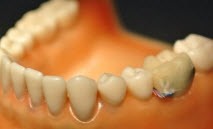
Researchers in China are testing an “oral sensory system” that uses a wired false tooth to identify and record activities such as speaking, eating, and coughing. It may have medical potential, such as tracking dietary habits or detecting smoking. A similar project is Tooth Tattoo, in which a sensor is tattooed into tooth enamel.

7-27-2013 1-24-46 PM

In England, Aintree University Hospital NHS Foundation Trust says its document imaging-based electronic medical record costs $1.5 million less per year than the paper-based system it replaced. It says an innovative indexing solution makes it faster than paper and avoids dumping large PDF files into a folder that need to be individually opened and read. It also allows clinicians to work remotely.

7-27-2013 12-58-07 PM

White hat hacker and medical device security expert Barnaby Jack died Thursday in San Francisco, a week before he was to deliver a presentation, “Implantable Medical Devices: Hacking Humans” at the Black Hat security conference. He claimed he could kill a person from 30 feet away by interfering with their implanted heart device. He was 36.


Contacts

Mr. H, Inga, Dr. Jayne, Dr. Gregg, Lt. Dan, Dr. Travis.

More news: HIStalk Practice, HIStalk Connect.

125x125_2nd_Circle

Time Capsule: Please Excuse My Rear In Your Face, But I Have To Leave This Presentation: How HIMSS Presenters Can Suck Less

July 26, 2013 Time Capsule 1 Comment

I wrote weekly editorials for a boutique industry newsletter for several years, anxious for both audience and income. I learned a lot about coming up with ideas for the weekly grind, trying to be simultaneously opinionated and entertaining in a few hundred words, and not sleeping much because I was working all the time. They’re fun to read as a look back at what was important then (and often still important now).

I wrote this piece in March 2009.

Please Excuse My Rear In Your Face, But I Have To Leave This Presentation: How HIMSS Presenters Can Suck Less
By Mr. HIStalk

125x125_2nd_Circle

Here’s my theory: HIMSS knows that most of its annual conference presenters aren’t nearly as interesting as the jaunty and trumped-up descriptions in the program, so they intentionally arrange the chairs in long rows so audience members can’t bail out discreetly. Even the doors are guarded – by throngs of standing attendees not quite sure they’re ready to make a commitment by actually sitting down, but thereby blocking your access to the cool, energizing air of the hallway that smells like … freedom.

(It would be cool if conferences would legitimize buyer’s remorse by leaving the session doors open and encouraging people to drift in and out based on their real-time interest level. The immediate feedback to presenters — both good and bad — would be priceless).

It would be so much easier if speakers did a good job in the first place. Having spent a shocking percentage of my adult life sitting in the dark on bad seats in convention center rooms, I believe I can offer some valuable speaker suggestions.

  • Everybody dresses up to deliver their presentation, so suits don’t really make much of a positive impression. Try wearing shorts, an Insane Clown Posse tee shirt, or a kilt. Somebody may mistake your attire as a sign of inherent coolness or quirky genius, at least until you start talking.
  • Unless you’re the CEO who’s actually in charge of the whole hospital, don’t lead off with a boring slide full of proud-as-a-peacock statistics about your employer’s ED admissions and annual budget. Audience members immediately drift off trying to determine whether your place is bigger or smaller than theirs.
  • Nobody traveled to Chicago in the dead of winter to watch you recite a memorized speech. Add a little excitement by going off-script, under-preparing, or actually interacting with the audience instead of droning to them. Most of the HIMSS presentations are about as spontaneous as a press release and are delivered with a similar lack of enthusiasm (I truly believe presentations would be better if someone was chosen at random from the audience to go onstage cold and just wing it).
  • Do not use PowerPoint as a TelePrompter. It’s fairly safe to assume that most of the people going to HIMSS can read. Avoid the Shakey’s Pizza sing-a-long moment (Note: actually, adding the bouncing ball might be kind of fun if you aren’t otherwise entertaining).
  • Never put up a slide that requires you to say, “I know you can’t read this.” If our reading it isn’t important enough for you to fix your slide, leave it out.
  • Be daring: don’t use PowerPoint, or if you can’t speak without it, use only graphics. A picture is worth a thousand words, so put in the right ones and you won’t have to say anything.
  • If there’s any possible way can make your point without a slide, please do. This will shock the audience, however, who have never seen a non-keynote speaker actually speak without using on-screen bullet lists (you could even leave the house lights up, cutting into the sleep of those who stayed out too late the night before). If this seems too radical, you can pretend the AV isn’t working (“darned laptop …”), forcing you to reluctantly go off-script.
  • Just because PowerPoint conveniently provides a bulleting function for creativity-impaired speakers doesn’t mean everything should be bulletized. Given the choice between being subject to a dozen PowerPoint bullets vs. .22 caliber ones, I might have to think about it.
  • We know you have lots of facts, but we don’t want or need to see them all. Pruning your presentation takes you longer, but your time is inconsequential compared to that of the roomful of people forced to endure flabby prattling. Everybody loves a speaker who finishes early.
  • Get out from behind the podium and create some energy for the giant room full of people drowsy from their $12 union-produced Caesar salad. If you can’t hold the attention of 500 or more people, maybe you should be writing articles instead of giving speeches.
  • Do not look at the screen, point at it, or wave a laser pointer at it. It’s ours, not yours.
  • Use photos in your presentation to remind us about the real life that we are anxious to rejoin once you stop talking. Pictures of people are perfect since everybody looks at those, especially if you slip in ones of celebrities or hotties. Pictures of your kids or pets always buy you at least a few minutes of goodwill (you can sneak those in by making them your desktop background).
  • Don’t fiddle with your water or slurp it into the microphone. Attendees resent your having a nice, icy pitcher and a glass all your own, so it will make them thirsty. Or, it will make them have to pee.
  • No clipart, no stock photos. One obligatory Dilbert or Far Side cartoon at the beginning and end is acceptable.
  • Don’t use time at the end for questions. 99 percent of people in the room just want to head for the bathroom, coffee line, or most importantly, the Middle Eastern bazaar known as the exhibit hall. People charging the question microphone just want to prattle on with non-questions, showing off their knowledge instead of their lack of it. Their punishment is near-trampling as they try to swim upstream to the microphone as everybody else heads the other way toward the doors.
  • Don’t mistake the post-presentation charge of business card-waving people to mean you were an outstanding presenter. Some people are natural suck-ups.

HIStalk Interviews Bobbie Byrne, MD, VP/CIO, Edward Hospital

July 26, 2013 Interviews 7 Comments

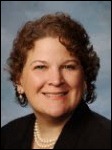
Bobbie Byrne, MD, MBA is VP/CIO of Edward Hospital of Naperville, IL.

Tell me how your Epic project is going.

It’s going really well. I’m really very happy to be on this end of the project 10 weeks after go-live. That period of time is little nerve-wracking. It’s like being very, very pregnant and just wanting to give birth.

But even though it’s going really well, it’s really hard. Expectations of what a good go-live means … it’s important to keep resetting that within the organization, that even though we’re having challenges, even though we’re not quite sure how this workflow is supposed to work, and even though we are making a lot of system changes, that’s expected from a good go-live.

I liken it to the patient who wants to know why they can’t run a marathon 10 weeks after having open heart surgery. Well, you just had open heart surgery. We’re not up to marathon speed yet. I think that’s probably typical.


Has anything been a disappointment so far?

I don’t think there’s anything I’m disappointed in. There’s a lot of things I wish I had done differently. If I get the chance to do this again, I will definitely do certain things differently. There are some things that I thought would work out well that worked out beyond my expectations, and then other things that I thought were going to be really great that have faltered a little bit, but nothing that’s been disappointing.


How much of the Epic decision and the Epic satisfaction going forward is based on the personality of the company rather than the product?

I knew from the beginning and in that period before we went live that I felt 100 percent confident that Epic was going to be there with whatever resources or whoever resources were required in order to get us live safely and effectively. I felt this huge confidence of having the company behind us. I knew they would circle the wagons if we needed it.

In certain areas, we did ask for that. “Hey, you know, we really need some help in this area. We didn’t expect that it was going to be this complicated.” Even after we went live we said, “Please come down and help us with this” and they absolutely did. That was no problem.

But you know, I’m kind of an old development junkie. I really believe that the product is super important. Where we have elegant workflows based on sophisticated and intelligent design, things go really well. Where we have workarounds because the product doesn’t quite reflect the nature of the care that we’re giving here, we have a lot more issues.

So it’s the product and it’s the company. I’m going to say it’s half and half.


What is the biggest differentiator that Epic offers that the competitors don’t?

It’s that 100 percent confidence that they’re going to get us to a successful implementation and they will do whatever it takes to get us there. But they also have all the breadth of products that we needed in order to do a complete rip-and-replace of a hospital. They really do have a very robust surgery system and a very robust medical record system as well as clinical systems and revenue cycle.

Nobody in my organization, no department feels like they got the shaft, like they had to take the immature product or they had to take the worst part in order to give up for the rest of the organization. The product suite is mature across the board. Those two things really made me happy that we chose Epic.


One of the discussions that always seems to come up is that CIOs get fired over Epic for whatever reason. Do you think that …

[laughs] It seems seems to be happening even more lately.


Do you think it’s a problem with Epic? What would it take from your viewpoint as a CIO to get you fired in the middle of an Epic implementation or shortly after?

I don’t want to give anybody any ideas [laughs] Two things that I think were really, really key to our implementation — and not being close to those other situations, I have no idea whether these were impacts those other situations, but for us these were really important — is that number one, our revenue cycle implementation was outstanding. We very quickly got our daily charges out the door, got payment back for care that we were giving one and two and three days after go-live. We did not have a big dip in the finances due to Epic. 

If you think about the way that healthcare is going today, where there’s just declining reimbursement all over the place for a whole host of reasons that have absolutely nothing to do with HIT. You take hospitals that maybe had some financial stress and then you add Epic and a negative impact for Epic on the finances and I can see why the CIO would be blamed, because now we have some real pain for the organization. That did not happen for us. We had an excellent revenue cycle implementation for a whole host of reasons that I won’t get into.

The second piece is setting the expectations. When you first purchase Epic, there’s a great excitement and everybody is very, very excited about, “We’re going to get Epic and we’re going to do all these new things.” There was a period of time when people thought that Epic was going to solve every problem that has ever happened from a workflow perspective in the hospital. 

I started months and months and months ago talking about how hard this was going to be and trying to set the expectations very reasonably. I don’t know if I did it 100 percent and I don’t know if it got through to everybody, but people were saying that all I did for the last three months is walk around saying, “You know, this is really, really going to suck.” So that when there was pain, it was like, “Remember when I told you about how hard this was going to be? This is what I was talking about. This is painful.”

Now we have completely new interactions between nurses and pharmacists, so our nurses and pharmacists get along really well. But now we have these things where the pharmacist says, “I think nurses should do that.” Nurses think, “I think the pharmacist should do that.” These are the kinds of hard choices that we knew we were going to need to make and it’s going to make somebody unhappy. 

I think the expectations for the high of buying Epic and the long implementation and then the high around going live and then you head into that we call the valley of despair, where you realize it’s just really, really hard and it takes really lot of work. When we hit that valley of despair, people were expecting it. They said, ”Oh, yes, you told us so. You told us that this was going to come.”


One of my responses to the idea that Epic seemed to be coincident with the CIOs losing their job was that if you were going to fail, there was a strong likelihood that Epic’s executive status report told you you were going to fail. Did you find that to be true?

It’s probably a matter of degree. We did not expect some of our issues around the high turnover procedural areas and that was a little bit of surprise. We had some challenges with that workflow. But for the most part, Epic was warning us, saying, “You know, your staff is a little bit low on this team. That’s worrisome.” 

When it came down,  those probably were the areas that we should have shored up and maybe would have avoided some of it. But you know, part of this is just a complexity. You think this is thousands of people, thousands of different processes. Epic is really good, but I don’t think even they’re going to be able to totally predict which way your implementation is going to go. And you know, at 36 or 72 or one week or three weeks later, who are going to be the portions of your hospitals that are going to be doing really, really well and who are the portions that are going to be having some challenges. They just don’t have that much of a crystal ball.


One of the other arguments made about why CIOs seem to lose their job after Epic is the huge post-live expense burden. Suddenly the CIO has to try to make things work within the budget that’s allowed when that expense was larger than expected. Do you think there will be surprises in what’s going to cost you to keep running Epic?

No. We talked very extensively at the time that we were doing the purchase and discussing with our board which resources we’re going to stay on. We set the expectations from the very beginning that we were absolutely not going to be able to run Epic on our previous Meditech-level staffing.

The pieces that potentially are coming up as a little bit of a surprise to the organization are the costs of implementing additional modules. The only two things we didn’t implement are the lab product and anesthesia intraoperative documentation. Almost everything else turned over.

When we started to look at what it cost to implement the lab product, there was some surprise. We said, “Wait a minute. I thought we already bought this. It’s part of the enterprise license.” We did have the license fee, but then the additional implementation resources and additional maintenance fee … they thought they were getting a free lab product. We have a joke around here that with Epic, nothing is free, but a lot of things are included.

You have to think about the frame of reference. If you’re trying to do the cheapest IT system you can, Epic is clearly not your vendor, but if you’re trying to think about value for a price and how much we get for how much we pay, I think it seems a little more palatable.


What work is keeping your busiest?

Certainly where we are with Epic is still keeping me busy. We also just closed on a merger with another hospital, Elmhurst Memorial, which is about 17 miles from our core Naperville campus. There’s a lot of work that’s going on in just trying to figure out how these two organizations are going to come together.

We have started to to implement Lawson, which is our ERP system at Edward. We have started that implementation at Elmhurst.

For me, it’s related to stabilizing Epic and getting the Epic mother ship in good shape. Then, how do we extend it out to our new sister hospital?


They are also a Meditech site, right?

Correct.


Is anything going on with the HIPAA changes coming up?

I saw that in some of your talks online. This is something that we have discussed quite a bit internally and felt pretty prepared for. I don’t know whether our compliance and legal team is just maybe a little bit more HIPAA happy than others. It seems like some of your other readers were kind of surprised by this, but these are things that were really were already in play, for us so that’s not something that I am really too worried about.

We continue to have all the worries around how we’re going to grow our data warehouse and how are we going to continue to provide all of the quality data that are required for patients that are medical home. We’ve applied to be in ACO. We have certainly a number of pay-per-performance initiatives going on with different payers. 

Maybe a year ago I would have said that’s really what’s keeping me up at night. Now it is is how do I find and recruit enough report experts and people who can work on our data warehouse to keep feeding this beast of requests for more and more and more information? Which by the way, they all seem to want to be formatted it in a slightly different way and have slightly different requirements and definitions. That has become an operational challenge for that team.


Are you using Epic’s Cogito or do you have some other product that will be your data warehouse?

We have a SQL longstanding homegrown data warehouse that we use for many different purposes and have many feeds that go into them, including all of our historical information. We also feed Epic into there. We would want to keep up with as Epic becomes more sophisticated in their capabilities. We certainly want to make sure that we take advantage of what they’ve developed instead of continuing to develop our own, but right now, I feel like we’re in transition.


Are you planning to buy anything for the possibility of your ACO-type arrangement?

I don’t think the contract is signed, so don’t want to speak about it, but yes, we do have a few add-on analytical products that we need to get implemented in order to feed data in, get comparisons, render it back to our physicians in a way that is helpful, that drives behavior, and allows us to bend this cost curve and try and deliver better care at a  lower price and then hopefully drive back the gain-sharing that all these systems are intended to drive back to the hospital.


It seems like that’s everybody’s first purchase when they contemplate a risk arrangement is to be able to go to their physicians with data in hand and have the peer pressure do the work for them. How are you planning to take that information out?

We have the beginnings of the team. They haven’t fully hired all of the bodies that will do that. We already have a physician liaison program in place. I think a lot of hospitals do, where they are going out to the private offices and so know the individuals in their private offices and have developed those relationships. What we’ll do is expand that model, arming these physician liaisons with the analytics and the dashboards and the … not just the ‘Hey doc, do a better job,” but, “Here’s the key parts of this. Here is how other practices have improved their quality scores.”

I think the first part is to get the data out there to the physicians. Makes a lot of sense. We’ve been working on that for quite a while on inpatient data, saying, “Hey doc, your length of stay in the ICU is much longer than all of your counterparts. What’s going on there? Your medication costs per patient are much higher than all of your counterparts. What’s going on there?”

We’ve been doing that for a while on the inpatient side. Now it’s more of just getting the individuals out of the hospital into the offices to work on the ambulatory data, which is of course where most of the care is delivered and most of the care that we will be at risk for is delivered.


Most of your physicians are mostly community based, right?

We have a relatively large employed physician group, about 135, so a medium-sized employed physician group. We also have a partner medical group, which I believe now almost 400 physicians, that we work very closely with. We share an instance of Epic with them. That means that for our own employed medical group and for DuPage Medical Group, it’s seamless experience for them. That maybe makes up about 55 to 60 percent of our physicians and then the other 40 percent are independent. The DuPage Medical Group is certainly independent, but we have a tight IT relationship with them.


When you look at the problems you’re being asked to solve in general, do you see a need for technology that you don’t either have or doesn’t exist?

I see a need to utilize the technology that we already have invested in to a much greater degree more than I see the need that I don’t have a product that solves this problem. Here actually I have the opposite. Somebody says, I have a particular quality initiative that I want to work on, and oh by the way, I found a niche product and some vendor and salesperson called on me and here, I want to buy this product. 

When you dig in, you say, OK, but wait a minute. Can’t we already do this with the systems that we have today? That’s where it is a constant going back to, say, instead of buying another product, another product, another product, how can we leverage the investment that we’ve made?

I don’t see that there is a lack of products available for what I want to do. I think sometimes that’s not through the organization, because clearly my organization is still looking for these niche products. I think the piece that we really struggle with — and people say they can do it but I kind of I’m a little skeptical — is getting the ambulatory data out of the private physician offices. People go in and say, yes, I can go into 10 different offices running 10 different EMRs and I have a secret sauce that lets me mine each of those 10 different EMRs and feed quality data back so that we can do things like clinical integration or ACO contracting. I just haven’t seen it, so I’d like to see that actually work.


Does having Epic shut the doors for the need for a lot of other systems?

We come back to our core vendor. We’re focused on that core vendor strategy, so for us, it’s Epic, Lawson, DR PACS, and Merge. We really are starting to say, of these systems that we already own, can one of them already do what this niche vendor might do? So it is very often Epic.

Epic also is very good about telling you they don’t have something. They don’t have case management yet, so they’ll say, “Don’t try and take our system and pervert it and put it into some strange configuration in order to make it into a case management system. It isn’t a case management system. When we have it, we will tell you, and then you can implement it.” I don’t feel like we’re trying to do a square peg around hole a lot. I think it’s just a matter of knowing what the full system’s capabilities are.


When you look down the road five years, what do you see is the biggest challenges and opportunities that your department has or your hospital has?

I think the biggest challenges are going to be the new world order of healthcare. How do we take more risk as hospitals, which many of us have never been insurance companies and don’t have that kind of background, so we don’t really understand what that’s going to be? How do we have the higher quality for everyone, not just for certain subsections of the population? How do we do it at a lower cost? 

And then probably most importantly, how do we not go bankrupt between now and that future state? Right now, we still get paid more for doing more. In the future, we will not. But you have to adjust your rate of change with the changes and reimbursement or we won’t even be around in five years in order to continue to serve our community. It’s a very interesting time in healthcare.


Morning Headlines 7/26/13

July 25, 2013 Headlines Comments Off on Morning Headlines 7/26/13

Healthcare Information Technology and Healthcare Information Services: 2013 Mid-Year Review

Healthcare Growth Partners releases its mid-year M&A review for the health IT market. Mergers and acquisitions were down 29 percent year to date due to a significant increase to capital gains taxes effective January 1, 2013. However, investment activity is up 16 percent and continues at a record pace.

Are We Asking Too Much of Our CIOs?

Harvard Business Review analyzes the expanding role of the modern CIO, asking if managing the mountain of new responsibilities is a realistic expectation from one person.

The World’s Most Outrageous Pension Deal?

McKesson CEO John Hammergren’s $154 million pension is scrutinized in a Forbes article that calls it "utterly absurd." Harvard Law School professor Jesse Fried, who notes that Hammergen is also the highest-paid CEO, says "Hammergren has pulled down hundreds of millions in compensation. Even without the pension, it would be very hard for him to spend all his money before he died."

McKesson beats on earnings, falls short on revenue

McKesson reports Q1 results: net income of $424 million on $32 billion in sales drove EPS to $1.83, vs. $380 million and EPS of $1.58 for Q1 last year. Revenue and EPS both fell short of analyst predictions.

Comments Off on Morning Headlines 7/26/13

News 7/26/13

July 25, 2013 News 2 Comments

Top News

7-25-2013 11-14-10 AM

CIOs and CMIOs tell the HIT Standards Committee that Stage 2 MU needs to be delayed a year. They argue that EHR vendors will not deliver 2014 certified software updates in time for hospitals to implement, validate, and train on the changes and meet the July 1, 2014 deadline for starting the 90-day Stage 2 reporting period. The AHA and AMA also submitted recommendations to extend the MU timelines and make them more flexible.


HIStalk Announcements and Requests

inga_small Hot stuff this week from HIStalk Practice includes: comments on why EMR selection should not be based on features. MGMA urges HHS to conduct ICD-10 testing with external trading partners, including physician offices. Social media experts offer tips for physicians. Commentary on EHR vendor consolidation and provider dissatisfaction. EPs share their reasons for dropping out of the MU program. Legislation moves forward to to repeal the Medicare SGR payment formula and develop a payment program based on quality and efficiency. Nothing is more refreshing on a hot summer day than an ice cold beverage and a quick perusal of HIStalk Practice. Thanks for reading.

On the Jobs Board: Developer, Full Stack Android (Google Glass), Sales Director.


HIStalk Webinars

7-25-2013 5-48-30 PM

Encore Health Resources will present Full Speed Ahead: Creating Go-Live Success on Thursday, August 15 at 2:00 Eastern, presented by Judi Binderman, MD, chief medical officer.

In implementing a new EHR, organizations typically focus on getting the software ready … building workflows, creating interfaces, and performing data conversions. Just as critical as having the software reflect the organization’s needs is having the go-live activities mirror the organization’s culture, goals, and end user support needs. This webinar will give an in-depth discussion of those items frequently overlooked and under resourced in bringing an EHR live. Encore Health Resources will share our experiences and lessons learned in supporting 28 go-lives for 22 facilities and over 10,000 physicians.

C-level HIStalk readers have provided presenter feedback and the session will be moderated by HIStalk. Register here.


Acquisitions, Funding, Business, and Stock

Kareo acquires ECCO Health, a Las Vegas-based medical billing provider.

7-25-2013 6-06-21 PM

Compuware’s Q1 results: revenue up 0.6 percent, adjusted EPS $0.10 vs. $0.09. Revenue of its Covisint division was up 17 percent.

7-25-2013 6-07-38 PM

VMware’s Q2 numbers: revenue up 11 percent, EPS $0.57 vs. $0.44.

7-25-2013 6-08-26 PM

Cerner’s Q2 report: revenue up 11 percent, adjusted EPS $0.34 vs. $0.29, meeting earnings estimates but falling short on revenue.

7-25-2013 6-29-33 PM

McKesson’s Q1 results: revenue up 5 percent, EPS $1.83 vs. $1.58,  beating earnings expectations but falling short on revenue. Technology Solutions revenue was up 9 percent, with the company reporting growth in RelayHealth, McKesson Health Solutions, enterprise, medical imaging, and Paragon, which is tracking ahead of projections on getting Horizon customers to switch. Hospital Automation and International Technology have been moved to discontinued operations.

7-25-2013 10-30-07 PM

Vitera Healthcare completes its acquisition of SuccessEHS, which was announced June 17.

7-25-2013 10-30-48 PM

From the Quality Systems earnings call: the Hospital Systems business unit saw a 52 percent drop in revenue as it sustained a $2.6 million loss. The company said it caved in to the threatened proxy fight by dissident shareholder Clinton Group to avoid being “faced with what would be a two-month period of yet another proxy fight like we had last year.” The company says the proxy issue and rumors of a potential sale of the company hasn’t affected the sales pipeline.


Sales

7-25-2013 10-31-34 PM

Sunnybrook Health Sciences Centre in Toronto will implement iMDsoft’s MetaVision clinical information system in its ICUs.

Boston Medical Center selects MModal’s transcription services for its healthcare provider network.

The Denver Endoscopy Center selects ProVation Medical from Wolters Kluwer Health.

7-25-2013 10-33-56 PM

Santa Clara Valley Health & Hospital System (CA) will deploy Capsule Tech’s DataCaptor medical device integration software.

Congress Medical Associates (CA) selects SRS EHR for its 21 orthopedic providers and two locations.

The Physician Alliance (MI) expands its use of Wellcentive to include Wellcentive Advance for creating a quality improvement registry.


People

7-25-2013 6-12-07 PM

Caremerge hires Greg Silvey (PSS World Medical) as VP of business development.

7-25-2013 7-41-24 PM

Direct Consulting Associates names Andrew Tipton (Direct Recruiters, Inc.) project manager.


Announcements and Implementations

7-25-2013 10-34-38 PM

CPSI and Sunquest Information Systems join CommonWell Health Alliance.

7-25-2013 12-32-34 PM

The Regenstrief Institute and the International Health Terminology Standards Development Organisation will link their global healthcare terminologies LOINC and SNOMED.

Siemens Healthcare releases a series of nine videos recorded at the HIMSS conference in which experts address critical health IT issues using only three slides and three minutes. Above is our own CIO Unplugged and Texas Health Resources CIO Ed Marx talking about social media and the hospital CIO.

SCI Solutions announces the the integration of its Order Facilitator product with the Surescripts Clinical Interoperability network.

7-25-2013 7-17-17 PM

Healthcare Growth Partners releases its mid-year 2013 HIT Market and M&A review. It says that healthcare IT buyers will outnumber sellers this year, with competition keen for companies with strong recurring revenue, products that are beyond proof of concept, revenue of at least $5 million, software with strong ROI delivered as a service, and ideally with offerings that fit in risk-based models.

Users of pMD’s mobile charge capture solution increased their Medicare reimbursement by automatically scheduling follow-up visits for discharged patients that are reimbursed under two new CPT codes (99495 and 99496) that pay for transitional or follow-up care if the patient is contacted within two days, the company says. The company says its almost impossible to meet the requirements using a paper-based system because of the tight timelines. If your goal is amusement rather than reimbursement, check out the company’s FAQ page, which in answering a question about the types of reports provided, the answer is “completely, totally amazing ones.”


Innovation and Research

7-25-2013 7-36-00 PM

Qualcomm and Palomar Health (CA) launch Glassomics, the first medically-focused Google Glass incubator.

Above is the just-released TEDMED presentation by Harvard’s Isaac Kohane of the SMART Platform, which advocates the use of extensible, open source apps that sit on top of vendor EHR systems.

7-25-2013 9-19-23 PM

The commercialization arm of Wake Forest Baptist Medical Center (NC) signs a deal with Charlotte-based app vendor Novarus Healthcare to develop disease management apps.

Philips Healthcare announces plans to start an incubator in Israel, where it has a large development center and has made previous acquisitions.


Other

7-25-2013 10-21-28 AM

inga_small St. Luke’s Medical Center in the Philippines introduces an online service that allows patients to book their preferred rooms in advance based on price and room amenities. I kind of like the $1,155 per night Presidential Suite, which includes a receiving room, guest room, PC and printer, eight-seat dining area, and three plasma TVs.

inga_small The mail processing company for  Clark Memorial Hospital (IN) blames a “processing error” for sending 1,093 billing statements to the wrong address.

7-25-2013 3-02-41 PM

inga_small Ezekiel Emanuel, MD, occasional White House advisor and chair of the Department of Medical Ethics and Health Policy at the University of Pennsylvania, calls the U.S. News & World Report “Best Hospitals” rankings and similar rankings “flawed to the point of being nearly useless.” In an opinion piece published in the Wall Street Journal, Emmanuel says the criteria used for rankings are “unrelated to quality, easily manipulated, and incentivize the wrong choices and behaviors.” Emanuel contends that if hospitals showed more transparency about quality, patients wouldn’t need rankings to select the best healthcare.

A Harvard Business Review article suggests that organizations are asking too much of their CIOs, saying the next generation of CIOs will need to balance four personas: infrastructure management, integrating systems, business intelligence, and innovation, possessing an integrative mind, focus and vision, and a trusting and trustworthy nature.

7-25-2013 6-40-31 PM

A Forbes analysis from last month of John Hammergren’s compensation titled “The World’s Most Outrageous Pension Deal?” says the McKesson CEO’s numbers are “utterly absurd”: a $159 million pension if he were to quit today, $131 million in one-year compensation,  a rumored $469 million if he’s fired by any new owners of the company, and $260 million due to his heirs if he dies or becomes disabled. The article says most companies other than McKesson cut back on very high CEO pension plans after SEC rules changed in 2007 requiring them to disclose those deals publicly. It also says the company gave Hammergren credit for years he didn’t work and pay he didn’t receive to come up with the big number, also waiving its early retirement penalty that applies to its other employees.

7-25-2013 7-54-29 PM

New analysis of CMS EHR attestation data for May by from Jamie Stockton of Wells Fargo Securities finds that Meditech, Cerner, and Epic hospitals lead the way in total numbers with over 400 attesting hospitals each, while Cerner, Epic, and HMS are the frontrunners in client percentages with 65 percent of their hospital customers successfully attesting. Trailing in customer percentages with 50 percent or less are McKesson (50 percent), Siemens (45 percent), and QuadraMed (25 percent.)

China’s public hospitals would collapse without the rampant bribery involving underpaid doctors and administrators, according to a Reuters review. New doctors earn $490 per month, the same as cab drivers, and without bribes would simply walk away from medicine. Patients are often expected to pay doctors extra in cash to ensure successful outcomes and to skip the line of waiting patients.


Sponsor Updates

  • e-MDs recognizes six of its clients selected by ONC as either as an Healthcare IT Champion or Meaningful Use Vanguard.
  • Black Book Rankings ranks Vitera the top ambulatory EHR in its user satisfaction survey. Other HIStalk sponsors earning high marks include Care360 Quest, Greenway, GE Healthcare, Kareo, Allscripts, McKesson, and eClinicalWorks.
  • First Databank releases the FDB High Risk Medication Module to help users identify medications designated as high risk by the FDA and with a Risk Evaluation and Mitigation Strategy (REMS) requirement.
  • Aspen Advisors Principal Dawn Mitchell discusses how to build a technology roadmap for emerging value-based care modules in a CHIME College live Webinar.
  • Jessica Clifton, product marketing manager for Billian’s HealthDATA, offers predictions of which healthcare skills will be in demand over the next decade.


EPtalk by Dr. Jayne

clip_image002

My “meeting of the week” award goes to our internal discussion on upcoming changes to the NCQA Patient-Centered Medical Home program, due to launch next spring. New proposed standards call for better integration between behavioral health and primary care. It seems like most of our time in primary care is spent in some flavor of behavioral health anyway – even when dealing with chronic conditions such as hypertension, diabetes, and hyperlipidemia, many of the best solutions are behaviorally driven rather than pharmaceutically derived.

This fifth version of the PCMH recognition program also aims to reduce duplicative testing, focus resources based on patient need, and emphasize outcomes. It sounds a lot like old-time family doctoring, when we aimed to treat what could be fixed as efficiently as possible and not waste resources when they wouldn’t change things.

Somehow I don’t think it’s going to be that easy, though. NCQA accepted comments (limited to 1,800 characters each) until a few days ago. The funniest comment was by my colleague who didn’t find out about the comment period until today, saying he was sorry he missed the opportunity to demonstrate the heightened abbreviation skills he’s mastered after a decade of using EHRs with character limits.

CMS will host a July 30 Webinar on one my favorite topics: Administrative Simplification. All medical students and residents should have to sit through a session like this so that they can see what they are really getting themselves into. If I had any idea how much I would have to learn about medical billing and other non-clinical arenas just to get by, I might have taken my sibling’s offer to pay for the LSAT exam a little more seriously.

Speaking of things that make physicians go “hmm…” the Washington Post runs a piece on doctors’ pet peeves. Items at the top of the list include patients talking on cell phones, late arrivals, no-shows, failure to share all information, lying, asking physicians to commit fraud, and “by-the-way” questions at the end of visits. I recently started moonlighting at a new emergency facility that is very busy and I’m trying to put a positive spin on the exhaustion. Maybe patients talking on the phone when you’re trying to interview them is a good thing – it’s a quick and easy indicator that you have time to run to the bathroom before you see them.

CMS releases the 2015 PQRS Payment Adjustment Fact Sheet, which my billing colleague dubbed “the penalty page.” Read and enjoy!

clip_image004

The MGMA Annual Conference is coming up in San Diego. Inga texted me the other day to see if I was ready to try to beat last year’s record for most parties attended by two bloggers in a single evening. Unfortunately, I’ll be sitting for the new Clinical Informatics board exam that week so I had to let her down gently. Hopefully I made up for it, though, by sharing the happiest bow tie I’ve seen this summer.

Print


Contacts

Mr. H, Inga, Dr. Jayne, Dr. Gregg, Lt. Dan, Dr. Travis.

More news: HIStalk Practice, HIStalk Connect.

125x125_2nd_Circle

Morning Headlines 7/25/13

July 24, 2013 Headlines Comments Off on Morning Headlines 7/25/13

CIOs Call on CMS to Extend Meaningful Use Stage 2

During a Health IT Standards Committee meeting this week, a group of CIOs calls for a one-year delay in MU Stage 2 requirements. They argue that EHR vendors will not deliver Stage 2-certified software updates in time to implement, validate, and train end users.

Partnership to tie LOINC and SNOMED

The Regenstrief Institute (which maintains the LOINC code set) and the International Health Terminology Standards Development Organization (which maintains SNOMED codes) announce a long-term agreement to link the two medical terminology code sets. The decision was made to bring more efficiency to the health information exchange process.

NIH commits $24 million annually for Big Data Centers of Excellence 

NIH commits $96 million to establish eight data centers of excellence, where researchers will develop innovative approaches, methods, and software solutions for data analysis and data sharing.

CommonWell Health Alliance Welcomes New Members CPSI and Sunquest to Support and Advance Interoperability Initiatives 

CommonWell Health Alliance announces the addition of CPSI and Sunquest Information Systems to the interoperability program.

Comments Off on Morning Headlines 7/25/13

CIO Unplugged 7/24/13

July 24, 2013 Ed Marx 11 Comments

The views and opinions expressed in this blog are mine personally and are not necessarily representative of current or former employers.

The unEXPERIENCED Life is Not Worth Living

The famous phrase by Socrates about “the unexamined life” has made its way into many lectures and speeches beyond its philosophical niche. No, I’m not a philosopher. But as I dug deeper for the sake of this post, I stumbled across a distinction he made between people (Athenians) who watched life and those who experienced it.

Observing an Olympic athlete cross the finish line gave a “semblance of success,” but was it true reality? We love to admire superb performance and bask in a new world record. But what would happen if we personally strove for such experiences ourselves?

I choose experience. It doesn’t need be extravagant or expensive. It can be turning off the soccer match on TV and joining a local team. Signing up for ballroom dance class rather than just watching “Dancing with the Stars.” Putting down the books about the missionary taking care of the poor in India and signing up at your local soup kitchen. Turn off Facebook virtual relationships and instead host a live get-together with living people.

My plan had been to share with you fresh leadership and teamwork insights from a recent climb atop Europe’s highest mountain, Elbrus. That was a victorious experience. But my heart isn’t into writing about climbing because of a tragedy that unfolded two days later.

Tradition calls for celebration following a summit. While touring St. Petersburg, five members of my team, including myself, walked down the bustling main street, Nevsky Prospekt. We traded climbing stories and talked about our motivation to climb. People we met said interesting things about the danger of climbing mountains. Our common response became, “Life is short, and a sheltered life was no life at all. You might get hit by a car while playing it safe, so you may as well embrace risk.”

Still light outside, midnight was approaching as we began the journey back to our hotel. Approaching the intersection at Kazan Cathedral, we formed a quasi column so we could pass pedestrians coming from the other side. I entered the crosswalk, leading my friends and walking immediately behind two ladies age twenty-something. In a split second, tires screeched, headlights blazed, and I instinctively dove out of the way. To my left, I heard flesh hit metal … then glass (windshield).

As I landed on the ground, I viewed the unthinkable out of the corner of my eye—those two ladies cartwheeling through the air. By the time I rolled to a stop, they landed 10 meters away. Unconscious. Contorted. Broken. A surreal scene.

After a few seconds of verbal rage and gathering our wits about us, we jumped into action. JJ, our mountain guide, took command. We became docs, EMTs, and comforters. We had both patients stabilized. The dozen policemen who showed up were completely clueless and just stared at us.

I recall vividly watching my bunkmate Frank clasp one girl’s hand and speak calmly to her. She told us she was visiting from Siberia. Her friend lay unconscious and deformed, with her head held stable by our buddy Zac. At the 10-minute mark, a “first aid” vehicle showed up and a woman wearing scrubs emerged. She was with infection control and had no real medical supplies. Applying smelling salts, she was trying to get both patients up and walking before understanding the severity of their injuries.

Adding to the chaos, a policeman grabbed Zac, thinking he was the negligent driver. Tried to arrest him. Bystanders intervened, and our friend was released. We continued providing support, but our counsel to the “infection lady” and the swarming, interfering bystanders was ignored. Ms. Infection was forcing the second patient, now conscious, to move despite obvious skeletal trauma.

I backed off and prayed over the situation, asking God to send the Holy Spirit for comfort, healing, and wisdom. Not having our passports in hand, we left a few minutes later as the mob grew more aggressive. My team prayed from a distance.

Once back in the hotel room, I buried my head in the bath towel and sobbed. I Skyped my wife and texted a friend. Every time I closed my eyes, I saw those ladies doing cartwheels over me. I slept for three hours and returned to the scene, which had since been cleared. I wondered what happened to the Siberians and how they were doing. Who was looking over them? Who was holding their hands? I spent another 30 minutes just praying and reflecting. I could not stop crying.

Today, my team is still processing what we experienced. As traumatic as it was, we were glad we’d been there and hoped the aid we provided helped save a life. We witnessed firsthand how quickly life can be taken away. In a blink of an eye. Something as safe as crossing a street.

Life is full of tragedy and heartbreak. You can bank on it happening again tomorrow. But does adversity really hold us back in life? I’d venture to say it’s our fear-based belief about painful incidences or the possibility of them happening that paralyze us. Instead of falling prey to that paralysis, experience the depth of heartbreak and then grow stronger from it. Conquer the fear and keep living.

Living life with no regrets means crawling out of the ashes of tragedy and walking stronger. On purpose. Determine to live a life fully experienced. We Live.

Ed Marx is a CIO currently working for a large integrated health system. Ed encourages your interaction through this blog. Add a comment by clicking the link at the bottom of this post. You can also connect with him directly through his profile pages on social networking sites LinkedIn and Facebook and you can follow him via Twitter — user name marxists.

Morning Headlines 7/24/13

July 23, 2013 Headlines 1 Comment

Black Book’s Satisfaction Index Resolves Highest Ranked Vendors in the "State of the EHR Replacement Market" Study, Eight Firms Share Distinction of the Top 1%

In a recent poll of dissatisfied ambulatory EHR users, 81 percent of respondents reported that they will replace their original EHR solutions within the next 12 months. Practice Fusion, Care360 Quest, Vitera, Cerner, Greenway, ChartLogic, GE Healthcare, and athenahealth were the vendors respondents identified as most likely to win replacement business.

Federal Health IT Strategic Plan Progress Report

ONC publishes a progress report on its Federal Health IT Strategic Plan for 2011-2015. The report outlines the milestones ONC has accomplished thus far in pursuit of its original goals.

World first computer saving lives

In Australia, a new decision support system implemented in the ED of The Alfred Hospital results in a 21 percent reduction in medical errors during a 33-month trial period.

Children’s Hospital Los Angeles to Host 3rd Annual Symposium on the Meaningful Use of Complex Medical Data

Children’s Hospital Los Angeles will hold its third annual symposium addressing big data analytics and emerging use cases in medicine.

Text Ads


RECENT COMMENTS

  1. "most people just go to Epic" that's a problem because then EPIC becomes a monopoly in healthcare, if it isn't…

  2. Only if CEO can post 'bail' which nowadays stands at 1B$ paid directly to the orange president or his family…

  3. I enjoy reading about the donations to Donor's Choice by HIStalk members. I also believe in the worthiness of Donor's…

  4. I hear you, and I agree—HIMSS is definitely facing some big challenges right now. The leadership and governance issues you…

Founding Sponsors


Platinum Sponsors


Gold Sponsors


RSS Webinars

  • An error has occurred, which probably means the feed is down. Try again later.