Recent Articles:

Monday Morning Update 11/1/21

October 31, 2021 News 6 Comments

Top News

image

Cerner reports Q3 results: revenue up 7%, adjusted EPS $0.86 versus $0.72, beating analyst expectations for both.

From the earnings call:

  • President and CEO David Feinberg, MD, MBA says that EHR vendors have done a good job of automating processes and digitizing medical records, but their products haven’t reached their potential to allow caregivers to spend less time on the computer. He says one of his top priorities will be to improve system usability, a theme he repeated several times in the call.
  • Feinberg says that Cerner has historically tried to do too many things, often without involving other companies. He says the company will focus on high-value areas, sometimes in partnership with others.
  • The company says it is making end-of-life decisions for some less-profitable products. It will also end some low-value partnership arrangements.
  • Client satisfaction that has “not been as high as it should be” has limited Cerner’s ability to pass along the Consumer Price Index escalators that many of its customer contracts allow.
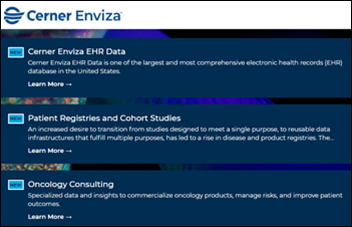
  • Cerner’s data business that is now known as Enviza is generating $130 million in annual revenue.
  • Feinberg says that while health system mergers and acquisitions may create customer attrition, losing a customer who is disappointed with Cerner’s products and services “is something that is completely unacceptable to me.” He will meet with any customers that have been identified as unhappy in his first 100 days.
  • Feinberg said in response to an analyst’s  question about layoffs that companies can’t shrink their way to greatness. He said, “I think it oftentimes is a reflection of management not predicting where the business is going and getting folks retrained for areas of growth so that this stuff doesn’t happen. We need to right the ship, and I think that’s part of the process here. But in some ways, to me, it’s been lack of discipline and lack of focus.”
  • Cerner’s employee count dropped by 1,000 from the end of Q2 to the end of Q3, equally split between layoffs and managed attrition.
  • Asked about revenue cycle product consolidation, Feinberg said that it should have been done earlier, but the mindset was that anything built outside of Kansas City couldn’t be the best.
  • Feinberg says that HealtheIntent offers a good strategy for population health management, but it needs to be streamlined and some of it is falling behind competing systems.

HIStalk Announcements and Requests

image

Insurance companies were most often named by poll respondents as providing poor customer service recently, although the results are likely skewed because fewer people would have had “recent” experience with a hospital or post-acute provider.

New poll to your right or here:  Do you want to have ongoing engagement with a primary care physician who knows your health story? Mike Linnert made me think when he observed in my interview with him that “lifetime value” of health engagement differs among age cohorts – it’s not as simple as younger people behaving less responsibly or thinking they are immortal.

LinkedIn contradictions: (a) bragging that starts with “I’m humbled by …” and (b) personal information posts that lead off with “I rarely post personal information here, but …”


Webinars

November 11 (Thursday) 1 ET. “Increasing OR Profitability: It May Be Easier than you Think.” Sponsor: Copient Health. Presenters: Michael Burke, co-founder and CEO, Copient Health; David Berger, MD, MHCM, CEO, University Hospital of Brooklyn at State University of New York Downstate Health Sciences University. The OR is a hospital’s biggest source of revenue and its costliest resource, yet it often sits idle because of unfilled block time even as providers with cases ready to book lack access. AI-powered emerging technologies can help fill unused OR time and provide decision support to structure workflows and optimize block allocation. This webinar explores the biggest challenges to profitability faced in the OR and the fastest, most impactful changes a hospital can make to address them.

Previous webinars are on our YouTube channel. Contact Lorre to present your own.


Acquisitions, Funding, Business, and Stock

image

Vocera announces Q3 results: revenue up 18%, adjusted EPS $0.28 versus $0.26, beating expectations for both.

image

NextGen Healthcare reports Q2 results: revenue up 7%, adjusted EPS $0.29 versus $0.30, beating expectations for both. NXGN shares are up 19% in the past 12 months versus the Nasdaq’s 38% gain, valuing the company at $1.1 billion.


People

image image

Divurgent hires Jason Potter, MBA (Auditec Solutions) as VP of client services and Sonny Sarma, MPH (Reingold) as principal.


Announcements and Implementations

InterSystems IRIS for Health joins Postgres, MS SQL, and Oracle as a data platform for i2b2 (Informatics for Integrating Biology and the Bedside) for clinical research data management that includes FHIR-based solution development, certified interoperability, seamless data management, and open analytics.
image

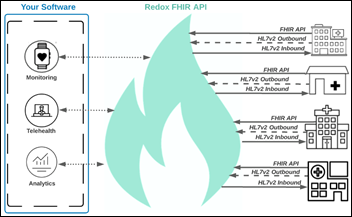
Redox launches a FHIR API that offers patient health record queries, single sign-on, receiving specific events, and writing events back to the EHR.

NextGen Healthcare adds remote patient monitoring to its telehealth solution, allowing practices to support home monitoring devices such as glucometers and blood pressure tools.

Main Line Health (PA) is working with partners to commercialize technology developed by its nurses, initially focusing on hospital room and facility safety devices, EHR add-on components, clinical tests, and medical devices. Informatics nurse Michelle Gray, RN, MSN developed and EHR charting tool that allows nurses to enter information once for both mother and newborn.


Government and Politics

The US Supreme Court may hear Epic’s appeal of its trade secrets lawsuit against Tata Consultancy Services in which an initial jury award of $940 million to Epic was reduced based on precedents that Epic says were incorrectly applied. Epic is appealing a circuit court decision to cap punitive damages at $140 million, which would limit the total award to $280 million.


Other

China will increase its regulation of the country’s 1,600 online hospitals, requiring telehealth physicians to authenticate their identity and limiting the use of AI to impersonate or replace those physicians. China doesn’t allow online consultations as a tool to sell prescriptions, but the new regulations also prohibit physicians making money from drugs and medical examinations and also from directing consumers to specific vendors of drugs and supplies.

Rapper Megan Thee Stallion will graduate from Texas Southern University next month with a bachelor’s degree in health administration.

In England, an 83-year-old partially disabled man who doesn’t use a computer had to wait in line to have blood drawn at a walk-in clinic after being told that several NHS Derby and Derbyshire  locations only book appointments online.
image

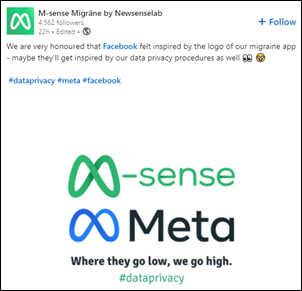
Germany-based prescription migraine app vendor M-sense wins the Internet with this brilliant dig at Facebook.


Sponsor Updates

  • Waystar will partner with Jefferson Community and Technical College in Kentucky to launch the Waystar Scholars Mentoring Program.
  • Premier and Resilinc expand their partnership to enhance supply chain visibility and sustainability.
  • The Healthcare Americana Podcast features RxRevu founder and Chief Innovation Officer Carm Huntress, “Helping Providers Make Informed Prescribing Decisions Through Actionable Data.”
  • Sectra publishes a new case study, “’Cutting-edge’ enterprise imaging enhances workflows and patient care at Mayfair Diagnostics.”
  • Optimum Healthcare IT wins the 2021 CHIME Foundation Partner Award.

Blog Posts


Contacts

Mr. H, Lorre, Jenn, Dr. Jayne.
Get HIStalk updates.
Send news or rumors.
Contact us.

125x125_2nd_Circle

Weekender 10/29/21

October 29, 2021 Weekender Comments Off on Weekender 10/29/21

weekender 


Weekly News Recap

  • Northwell Health and Aegis Ventures create what they say will become a multi-billion dollar program for investing in seed-stage AI-driven healthcare companies.
  • Pharmacy fulfillment, diagnostics, and telemedicine company Truepill raises $142 million in funding at a valuation of $1.6 billion.
  • RCM platform vendor NThrive and its financial backer Clearlake Capital Group will acquire TransUnion Healthcare for $1.7 billion in cash.
  • Cerner launches Enviza, an operating unit that combines expertise from Cerner and its acquired real world data vendor Kantar Health.
  • Amazon launches Alexa Smart Properties for healthcare facilities.
  • Britain’s finance ministry will allocate $2.9 billion for technology improvements across the NHS.
  • Consumer DNA testing company 23andMe will acquire telemedicine and online pharmacy vendor Lemonaid for $400 million.
  • Medicare primary care provider Oak Street Health acquires RubiconMD, which offers PCPs electronic patient consults with specialists.
  • Shares in London-based digital health tools vendor Babylon Health closed their first day of trading Friday up 18% following its SPAC merger.

Best Reader Comments

I enjoyed HLTH, split time in sessions and networking with exhibitors. Safety protocol was solid. Also, got a haircut, why not? Came up with a “crazy enough it just might work” idea while in the chair. PS: barbers have a *lot* of inside info. (Dysf(n))

Since the subject you’ve raised is security, well security is surely an area requiring flexibility. Thus what do you implement? AES? ECC? What should the key length be? Do we need to worry about quantum decryption attacks? Did the NSA really weaken this or that algorithm, and if so, by how much? Who do you trust and why? Honestly, security can be one giant argument that never ends.(Brian Too)

I would guess half of people 18-35 have moved in the last couple years. Younger people have less time off work. They are on a high-deductible plan and primary care practices can’t tell them what they’ll have to pay (retail can). Wait times to get a visit are a couple months in many parts of the country, more if you are trying to establish a new relationship (which in turn will run the bill up over half a grand.) Younger people don’t have a chronic condition, so the immediate value of going in for a visit a few months from now is mostly based around screening. Overall, the costs and barriers to accessing the “country doctor” relationship are higher for younger people while the value and ability to pay is lower. It isn’t a youth “culture” thing; it’s just money. The incremental solution is the same as it has always been, absent major federal legislation. Dramatically increase the supply of people who can be PCPs. It’s well within state legislatures abilities and it is well within the physician industry’s power. In 40 years, all the living voters will have only ever had a transactional relationship with doctors, but the retired providers will have sold their practice to private equity, so the political backlash will be somebody else’s problem. (IANAL)

How many virtual primary care startups can the market support? (IANAL)

To quote Cady Heron from the timeless classic Mean Girls, “The limit does not exist” (at least not yet, but at some point these companies will have to make money). (Dales Brian)


Watercooler Talk Tidbits

image

Readers funded the Donors Choose teacher grant request of Ms. Y in California, who asked for an IPad to use as a document camera. She reports, “I am at a loss for words. I recently had to teach from home due to pandemic circumstances and I was not able to teach much math (specially) because I did not have a document camera to show my work and solve problems. The document camera I have at work is very blurry so even if I am in my classroom it is difficult for my students to see my notes. However, now with the document camera we are able to learn every day regardless of my setting and students are able to see my notes clearly. Thank you!”

image

The organizer of a live autopsy event cancels its Halloween day stop in Seattle after authorities question the ethics of selling tickets for the public to watch autopsies performed on donated cadavers. Death Science charged $500 for its Portland show, which was held in a Marriott hotel conference room. The body came from Las Vegas-based for-profit company Med Ed Labs, which gives families the cremated remains of their loved ones, avoiding funeral costs in return for allowing company to sell the corpses for many thousands of dollars (Death Science would only say that it paid more than $10,000 for the body it used). Reporters who viewed the Portland event along with several dozen attendees noticed that a medical bracelet that listed the man’s name was still attached to the body. Downtown Courtyard Marriott cancelled the Seattle event after finding out that Death Science had misrepresented the gathering as a medical equipment training class.

image

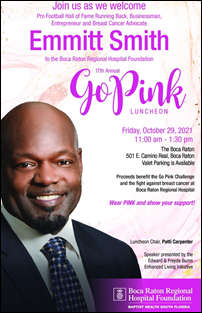
Boca Raton Regional Hospital Foundation refuses to comment on why its fundraiser for immunocompromised women is being held indoors with masks and vaccination optional. The headliner is former Dallas Cowboy Emmitt Smith, who tweeted photos last week showing him signing autographs unmasked at an event. An anonymous insider reports, “It’s typical Boca. When given the chance to have a glitzy event or keep people alive, the glitzy event will win every time. There is just no reason that a foundation with so much money, connected to a hospital, is hosting an in-person event right now.” The foundation, which holds $300 million in assets, earned unwanted publicity earlier this year for allegedly fast-tracking the vaccination of big donors.

A former Texas nurse is sentenced to death for killing four ICU patients who were recovering from heart surgery by injecting air into their arteries. Prosecutors played a recording of jailhouse phone conversations in which William Davis told his wife that the deaths were accidental and his only intention was extend the ICU stays of the patients so he could accrue overtime.


In Case You Missed It


Get Involved

Sponsor
Report a news item or rumor (anonymous or not)
Sign up for email updates
Connect on LinkedIn
Contact Mr. H

125x125_2nd_Circle

Comments Off on Weekender 10/29/21

Morning Headlines 10/29/21

October 28, 2021 Headlines Comments Off on Morning Headlines 10/29/21

Northwell Health and Aegis Ventures to form first-of-its-kind artificial intelligence venture to drive better, more equitable, and lower-cost healthcare

Northwell Health and Aegis Ventures form a joint venture that will invest at least $100 million in seed-stage, AI-driven healthcare companies.

ShiftMed raises $45m led by Panoramic Ventures and Healthworx (CareFirst Holdings) to support growth of leading Digital Health Care Workforce Management Platform

Healthcare shift-filling app vendor ShiftMed raises $45 million in a venture funding round.

Hinge Health Announces $600 Million Investment Led by Coatue and Tiger Global

Digital musculoskeletal clinic Hinge Health’s $600 million Series E funding round brings its valuation to $6.2 billion.

Comments Off on Morning Headlines 10/29/21

News 10/29/21

October 28, 2021 News 9 Comments

Top News

image

Northwell Health and Aegis Ventures form a joint venture that will invest at least $100 million in seed-stage AI-driven healthcare companies.

The companies say they expect the JV to become a multi-billion dollar program that will address healthcare challenges such as quality, equity, and cost.

Aegis committed to the $100 million investment, while Northwell will invest in individual solutions within the program.

Northwell says the JV-launched companies will be able to train their AI-based systems on its extensive and diverse database of patient clinical records, which will allow them to avoid bias.


Reader Comments

From Swing Lube: “Re: health IT executive conferences. Why do they always include golf outings?” Beats me. I always felt left out when attending small-group executive meetings where I was one of few people who don’t play golf. I suppose golf is the default group activity because it’s quiet for networking (unlike, say, a 5K or axe-throwing), it’s expensive and thus a sponsor-supported treat for participants, and those playing are held captive for many hours. Golf outings may incorporate some gender bias, however, since I’ve read that nearly 80% of people who played a round in the past year were male, although I would guess that health IT executive meetings are also male dominated.

From Mark Trade: “Re: product names. Please add the copyright symbol to ours that you mentioned.” This came from a marketing person, who incorrectly believes that any use of a name that has a trademark, copyright, or service mark always needs to be flagged with the corresponding symbol wherever that name is used. Nobody should use those symbols except the company itself, which does so to prevent a competitor from hijacking their name.


HIStalk Announcements and Requests

image

Welcome to new HIStalk Gold Sponsor Bamboo Health. The Louisville, KY-based company — formerly known as Appriss Health plus Patient Ping – focuses on fostering care collaboration and providing information and actionable insights across the entire continuum of care. As one of the largest, most diverse care collaboration networks in the country, its technology solutions equip healthcare providers and payers with software, information, and insights to facilitate whole-person care across the physical and behavioral health spectrums. By serving 2,500 hospitals, 7,800 post-acute facilities, 25,000 pharmacies, 37 health plans, 45 state governments, and over one million acute and ambulatory providers through more than 500 clinical information systems electronically, the company impacts over 1 billion patient encounters annually in provider workflow. Health systems, payers, providers, pharmacies, governments, individuals, and other organizations rely on Bamboo Health to improve care and reduce cost. See the explainer video on YouTube. Thanks to Bamboo Health for supporting HIStalk.


Webinars

None scheduled soon.  Previous webinars are on our YouTube channel. Contact Lorre to present your own.


Acquisitions, Funding, Business, and Stock

image

Online pharmacy Truepill raises $142 million a Series D funding round, increasing its total investment to $256 million at a valuation of $1.6 billion. The company, which offers its white-labeled platform to health brands and pharma, is expanding into telehealth, diagnostics, and COVID-19 wellness.

Healthcare shift-filling app vendor ShiftMed raises $45 million in a venture funding round.


Sales

  • In England, West Suffolk NHS Foundation Trust chooses Zivver for sharing data securely via email and file transfer as it moves from NHS Mail to Microsoft 365 Outlook for email.

People

image

Office Practicum hires Mark Richards (Optimize.health) as chief revenue officer.

image

Quil names Dwight Raum (Johns Hopkins Medicine) as chief digital officer.


Announcements and Implementations

University Medical Center of El Paso implements advanced clinical documentation improvement, audit, and analytics from EZDI, which was recently acquired by AGS Health.

Premier chooses Glytec as its sole supplier of glycemic management software for its members.

The VA expands its rollout of VA Health Chat to two VISNs that make the chat tool – provided by CirrusMD and now including video capability – available to 2.5 million veterans.

Greenway Health expands its care coordination services to offer remote patient monitoring to its ambulatory care clients in partnership with MD Revolution.

LexisNexis Healthcare’s identity management platform is listed on Epic App Orchard.

image

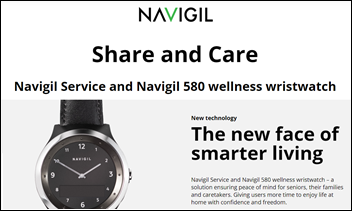
Finland-based Navigil launches its wellness watch for seniors in the US on AT&T’s LTE-M network, offering alarm call routing, notification services, and wellness trend analytics. The company intentionally designed the product to look like a traditional analog watch, explaining in a blog post, “No one, especially my mom, wants to wear a device that screams ‘I’m old.’”

image

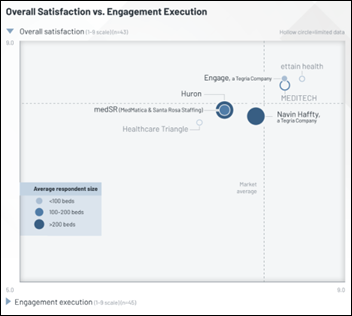
A new KLAS report looks at Meditech implementation services. Tegria-owned Engage scores highest although all validated engagements involved under-100 bed hospitals, while Tegria-owned Navin Haffty, Huron, and MedSR (the merged MedMatica and Santa Rosa Staffing) scored high in broader settings. Meditech’s recently launched implementation services also score above average.


Privacy and Security

Security researchers find an unsecured database containing nearly 900 million patient records that belong to Deep6.ai, whose platform queries EHRs to match patients to clinical trials. UPDATE: Deep6.ai says no patient information was exposed – the database contained only dummy data from MIT’s Medical Information Mart of Intensive Care system that was being used as a proof of concept. 


Other

The many companies that are supposedly on Epic’s non-compete list are listed here. Epic employees can’t work for a competing company, an Epic customer, or an Epic sales prospect for one year after quitting unless their new job has no connection to software or related services.

image

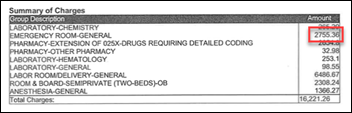
KHN describes how Poudre Valley Hospital (CO) instructed a woman in normal labor to come in through the ED door since it was the hospital’s only unlocked one, then billed her insurance $2,800 for Level 5 ED services that are usually assigned to resource-intensive or life-and-death cases. She had to pay $3,600 out of pocket for her one-night stay after insurance. Several other women reported the same billing surprise. The article cites a white paper by private equity-owned healthcare staffing company TeamHealth that describes how a hospital can increase profit by calling its OB triage area an OB ED, which allows it to “collect facility charges that are otherwise lost in the obstetrical triage setting.” This would be the point where the “blame the game, not the player” debate commences and the non-Americans gasp at the capitalism-driven healthcare system that we accept as normal, at least until we need it.

A jury awards a former marketing SVP of Novant Health $10 million in a reverse discrimination lawsuit in which David Duvall says he was fired without cause in 2018 so the health system could appoint two equally qualified women, one of whom is black, to support its diversity and inclusion program. Duvall says that five other white, male Novant executives were similarly fired, one of them being its CIO (he is presumably referring to Dave Garrett, who left Novant in 2018 after 10 years).

Facebook will change its corporate name to Meta with Facebook as a subsidiary, similar to Google’s creating parent company Alphabet. The company says it has greater ambitions than just being a social media company and will focus on the metaverse that combines virtual and augmented reality. 

image

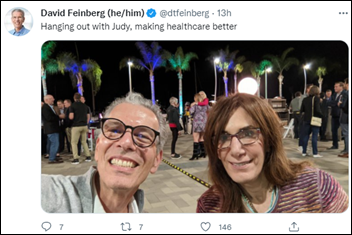
Cerner and Epic CEOs just chillin’ with CHIME21 selfies.


Sponsor Updates

clip_image001

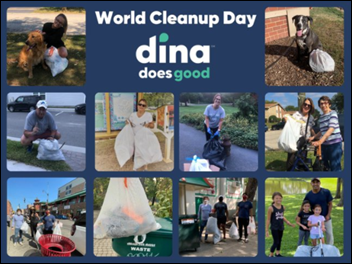
  • Dina employees participate in World Cleanup Day.
  • Clinical Architecture and Wolters Kluwer Health Language will exhibit at the AMIA annual symposium October 27-30 in San Diego.
  • LexisNexis Risk Solutions makes its Healthcare Identity Management platform available in the Epic App Orchard.
  • Olive announces creation of five partnership programs – Develop, Deploy, Distribute, Alliance, and The Library – that will allow solutions built on Olive to be immediately delivered to health systems, payers, and patients.
  • Henry Schein Medical Systems will integrate the Health Language natural language processing solution of Wolters Kluwer, Health into its MicroMD EHR/PM.
  • Change Healthcare, sponsor of the Health Evolution Forum, signs the forum’s Health Equity Pledge.
  • WEDI’s Collective Voice of Health IT Podcast features Fortified Health Security CEO Dan Dodson.
  • Kyruus will host the 8th Annual Thought Leadership on Access Symposium virtually on November 9-10.
  • France-based medical intelligence platform vendor Synapse Medicine integrates First Databank’s drug database and interoperability module with its medication reconciliation technology.
  • Kyruus will host its 8th annual Thought Leadership on Access Symposium November 9-10 to focus on expanding flexibility around patient access and care.
  • Meditech shares updated guidance on COVID-19 vaccine booster shots

Blog Posts


Contacts

Mr. H, Lorre, Jenn, Dr. Jayne.
Get HIStalk updates.
Send news or rumors.
Contact us.

125x125_2nd_Circle

EPtalk by Dr. Jayne 10/28/21

October 28, 2021 Dr. Jayne Comments Off on EPtalk by Dr. Jayne 10/28/21

The big news in the public health informatics space last week was the transition of pandemic data tracking to the Centers for Disease Control and Prevention. The organization owned tracking prior to a shift by the previous administration, and now the HHS Protect platform will fall under the oversight of the CDC. It’s been a couple of years of ups and downs for the agency, with a constant need to evolve its guidance based on data that has been at times difficult to obtain and manage. One would hope that the pandemic would allow for greater visibility into the public health space, and better tools for managing communicable diseases. However, given the fragmentation in our society these days, my hope is tempered by the reality of the situation.

The Journal of the American Medical Informatics Association published an interesting article looking at whether templates are beneficial for creating EHR clinical notes. The authors looked at 2.5 million outpatient visits across 52 specialties and found that templates were used to create clinical documentation 89% of the time. Their findings included a significant presence of individualized templates — over the two years of the study, 83% of templates were used by only one clinician. There were over 100,000 unique templates in the system, which could cause issues during system updates as well as when policy changes might require changes to thousands of templates at a time. They also note that individualization may lead to providers using templates that are outdated.

I found the breakdown of templates and their contents to be interesting. More than 46% of templates included placeholders for manual text entry, where nearly 43% contained only static text. Data links were present in 38% of templates, with 21% having lists for selecting text. Of the 1,000 most used templates, the authors identified five main template types — full-note templates, attestation / signatures, short phrases, datapoints / panels, and screenings / procedures. Not surprisingly, full-note templates were the most commonly used templates, used in nearly 65% of visits. Of the more than 23,000 full-note templates, barely 20% were used by more than one person. The specialty breakdown was also interesting, with pediatricians (particularly residents) more likely to use a departmental template.

The authors note that health systems would benefit from governance, managing templates with standards for naming, documentation, and appropriate use. The study concludes that there need to be standards for templates if organizations want to improve quality. I’ve always worked in organizations that had significant structure around the creation of custom templates, sometimes to their detriment. Thinking about a system with over 100,000 unique templates, I understand even more why it’s beneficial to have some rigor around customization. Especially when templates are being used to support patient care, it’s important to have a discussion around whether there really is a need for each member of a department to have a unique template or whether there can be consensus to create standardized templates that support evidence-based care as well as help with efficient documentation.

Many technology vendors are still having virtual user conferences, not willing to risk significant expenditures on events that can be impacted by pandemic uncertainties. Some healthcare organizations are still not allowing travel outside the local area or the state and others have slashed conference budgets. A friend of mine who works on the vendor side was excited to attend an in-person conference, sponsoring several refreshment breaks as well as staffing a booth in their exhibit hall. Unfortunately, between the time of signing the exhibitor contract and the actual conference, the organizers elected to offer a virtual track but failed to notify exhibitors. In-person attendance was only two-thirds of what had been promised, which definitely changes the return on investment. I understand offering a virtual track, but that’s no excuse for not notifying vendors and sponsors, especially when there isn’t any opportunity provided for them to reach virtual attendees.

clip_image002

The US Food and Drug Administration recently gave marketing clearance to Cognetivity Neurosciences for its CognICA integrated cognitive assessment tool that allows for the early detection of dementia. The artificial intelligence-powered test is performed on an iPad and is said to allow for detection of early cognitive impairment without cultural or educational bias. The platform can be used for large-scale self-administered testing and integrates with electronic health records. The test previously received European regulatory approval as a medical device and is in use by primary and specialist clinics in the UK National Health Service.

My former clinical employer is still suffering from significant staffing shortages, resulting in temporary closings of some locations and limitations on patient volumes at others. They’ve gone so far as to start their own emergency medical technician training program to try to grow their own staff, but that will take months to bear fruit. The reality is that it will take months if not years to build the healthcare labor market to where it needs to be, not only to recover from the pandemic, but to prepare for the aging of the US population. In order to assist, the US plans to spend $100 million through the National Health Service Corps to help address the problem. The program is targeted to match primary care physicians with communities that need them, providing loan repayments and scholarship funds in exchange for a term of service in an area with a shortage of health professionals. States have until April to apply for grants, which could be as high as $1 million annually.

I’ve written in the past about the evolution of clinician communications, and a recent JAMIA piece caught my eye with its title, “It’s like sending a message in a bottle.” The article looks at the consequences of one-way communication technologies in hospitals and how clinical workflows are impacted by workarounds. The study looked at four US hospitals during 2017 and involved researchers spending two weeks shadowing clinicians, conducting interviews, observing, and holding focus groups. They coded their observations to identify preliminary themes as they looked at the primary communication technologies of pagers and telephones. They concluded that many of the workarounds involved the one-way nature of communication, varying access to different technology types, and mismatches between available technology and workflow needs. I’m sure no one who has ever worked in a hospital would disagree. I would be eager to hear reader thoughts on the best vendor solutions for two-way communication.

Got a sexy communication solution that you want to share with the world? Leave a comment or email me.

Email Dr. Jayne.

Comments Off on EPtalk by Dr. Jayne 10/28/21

Morning Headlines 10/28/21

October 28, 2021 Headlines Comments Off on Morning Headlines 10/28/21

Patina Aims to Profoundly Improve the Healthcare and Aging Experience for People 65+ by Reinventing Primary Care; Announces $50 Million Series A Financing

Former Haven executive Jack Stoddard helps to launch senior-focused primary care startup Patina Health, which has accrued $57 million in funding.

Truepill Raises $142 Million Series D to Continue Transforming Consumer Healthcare

Truepill, a pharmacy fulfillment, diagnostics, and telemedicine company, raises $142 million in a Series D round that brings its total funding to $256 million.

A security bug in health app Docket exposed COVID-19 vaccine records

TechCrunch alerts developers of the COVID-19 vaccination passport app Docket of a security bug that allows users to access the personal information of other users.

Comments Off on Morning Headlines 10/28/21

Health IT from the Investor’s Chair 10/27/21

October 27, 2021 Investor's Chair 1 Comment

The Investor’s Chair Answers: “So, How’s your HLTH?”

In my view, a virtual conference just might be something you find on one of Dante’s circles of Inferno (“For your sins, interminable Zoom Fatigue!”), but I’d had such a good time attending the first and second HLTH conferences, I decided to brave HLTH in person. While I have genuine COVID concerns, the vaccine requirement and relative isolation inherent in its Boston Seaport location gave me comfort to book flights and hotel, and I breathed a serious sigh of relief when HLTH announced a testing requirement. Yet again, I’m glad I attended.

image

I was curious how well the onsite testing would work. Other than some app glitches (which could have been user error), I found it very low friction. Show up, do some app stuff, and then get a gentle nasal swab (not nasopharyngeal) and sit for 15 minutes before being admitted to the festivities.

While I didn’t attend sessions since crowds still scare me, I heard mostly positive things about them as a view to the future  — or occasional chest thumping and self-congratulation — rather than actual actionable knowledge one could benefit from. As I’ve observed in the past, for most attendees, HLTH is more about networking than learning. I believe this is by design, and as the saying goes, “the medium is the message,” as HLTH is all about UI/UX. While some called it “overproduced,” I like that aspect.

image

Stressed from waiting for your results? Here’s dog rescue for puppy cuddles.

image

Tired from the wait? How about a juice shot?

Shoeshine? Haircut? Coffee? Snacks? All here for your enjoyment courtesy of one or another HLTH sponsor! 

Echoing an earlier HIStalk comment by my friend John Moore, the event seems much better suited for business development (vendor to vendor) than customer acquisition, so sponsors and attendees should go in with eyes open. This seems supported by a conversation with one fairly early-stage company CEO I met with who told me she had brought a large team of folks to introduce them to the broader concept of health tech, why it’s important, and to network and discuss partnerships.

image

Also echoing John’s view, it is definitely investor-focused, even more so than HIMSS has become. In addition to the off floor conference rooms and the side of floor meeting pods that I gather weren’t cheap, there was actually a speed dating area sponsored by Pitchbook (a data source used by investors and bankers) for 10-minute sessions complete with shot clock for “Funding Founders.” Quite a few strategic investors such as Philips and Cigna had large booths with comfy chairs free for the occupying as well.

image

Other silliness that bordered on the indulgent were the playground area (which at least I never noticed people using)

image

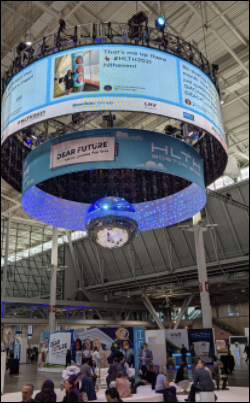
and the disco ball, which did make for a great meeting landmark.

In the final analysis, I’m once again glad I went, or at least I was once I did a post-event antigen test. If you’re going primarily to acquire new customers, I would have some second thoughts and look for some proof points. For me though, it was a chance to see many of my conference buddies who I’ve really missed, learn a few things, and, best of all, meet with over 25 people over the course of a couple of days. Could I have picked up the phone or opened a video window instead? Sure, but to this author, it’s just not the same. If those are your goals, HLTH is well worth it, and I’ll hope to see you next year in Vegas!

Ben Rooks has now attended every (non-virtual) HLTH, 25 HIMSS, 11 Health Evolution Summits, and JPMorgans as far back as its H&Q Days. He’s also been proud to write this column for HIStalk for over a decade, albeit not often enough, so feel free to email him questions or ideas for future installments. He also really enjoys his day job at ST Advisors.

Readers Write: Compliance Reimagined: Transforming the Value Proposition of a Traditional Cost Center

October 27, 2021 Readers Write Comments Off on Readers Write: Compliance Reimagined: Transforming the Value Proposition of a Traditional Cost Center

Compliance Reimagined: Transforming the Value Proposition of a Traditional Cost Center
By Peter Butler

Peter Butler is president and CEO of Hayes of Wellesley, MA.

image

Compliance has gotten a bad rap in healthcare. Traditionally viewed as a necessary cost center, this department is too often viewed as the police force of a health system.

A lot is missing from this simplistic view of the processes that ensure hospitals and health systems aren’t hit with avoidable penalties when the auditors come knocking. Within a rapidly evolving regulatory framework that includes more than a year of fluctuating COVID and telehealth guidance (among other changes), compliance in essence becomes the safeguard to a healthy, sustainable bottom line.

In truth, there is a distinct opportunity for health systems to reimagine a department that has long operated in a silo by embracing forward-thinking revenue integrity models. These innovative strategies bring together billing and compliance teams in a collaborative way to accurately identify, track, and capture all monies owed, transforming the value proposition of compliance in terms of bottom-line impact.

With the right technology-enabled processes, these revenue integrity teams can proactively identify revenue breakdowns on both the front and back end of claim lifecycles and significantly improve revenue capture and financial health.

Compliance is a cost-constrained function inside today’s healthcare systems. While addressing it is a necessary evil, healthcare organizations often struggle to justify allocating extra dollars to optimize this area when faced with so many competing priorities. Yet the business case for investing in the infrastructures and strategies necessary for a technology-enabled revenue integrity model can be an easy one to make in terms of return on investment. Revenue integrity teams can both protect an institution from risk and improve revenue retention. Often, they can also identify dollars that might otherwise be left on the table.

For example, a recent report from the HHS Office of the Inspector General (OIG) pointed to a notable rise in inpatient hospital stays where upcoding was believed to be the culprit, a significant liability for health systems on the compliance front. Revenue integrity processes that integrate systems to create strong partnerships between revenue cycle, billing, and compliance teams can improve this outlook through shared internal monitoring and auditing.

But because revenue integrity is inherently a data-hungry undertaking, manual processes of combing through claims data will not provide the timely insights needed to get ahead of issues. That’s where automation and artificial intelligence becomes a game-changer. Revenue integrity teams equipped with the right tools can conduct real-time monitoring of upcoding risks associated with billing around costly, high-severity cases, significantly minimizing compliance risks that could impact the bottom line.

Compliance professionals are well acquainted with internal auditing practices. On the revenue integrity front, holistic strategies marry the strengths of prospective (front end) and retrospective (back end) auditing. Collaboration between compliance and billing teams can draw on these techniques to make sure claims leave a health system clean from the start. When faced with denials, revenue integrity processes rapidly drill down into root causes to inform process improvement.

From a technology standpoint, here’s how it works:

  • AI-backed prospective auditing. Augmented intelligence and natural language search can help healthcare organizations get ahead of potential problems by detecting anomalies in at-risk claims in near real-time. For example, when considering upcoding risks as mentioned earlier, health systems can automatically flag high-dollar claims, and potential problematic cases can be identified and audited from the outset.
  • Technology-enabled retrospective auditing. Manual efforts to mine thousands upon thousands of claims lines across denials and identify problematic trends for process improvement are typically a non-starter for most resource-strapped compliance departments. Advanced analytics discovery tools exist that can’t comb through denials within minutes and deliver actionable insights.

It’s time for hospitals and health systems to reimagine how they view compliance in terms of impact to the bottom line. With the right revenue integrity strategy, this traditional cost center has the potential to bring real value to financial health and sustainability.

Comments Off on Readers Write: Compliance Reimagined: Transforming the Value Proposition of a Traditional Cost Center

Morning Headlines 10/27/21

October 26, 2021 Headlines Comments Off on Morning Headlines 10/27/21

Clearlake Capital Backed NThrive to Acquire TransUnion’s Healthcare Business

RCM platform vendor NThrive and its financial backer Clearlake Capital Group will acquire TransUnion Healthcare, the data and analytics business of TransUnion, for $1.7 billion in cash.

Anomaly Raises $17 Million To Scale Precision Payments Platform Across Healthcare Industry

Anomaly, whose platform identifies payment and billing errors before they occur, raises $17 million in a Series A funding round.

Arine Raises $11M Series A to Scale Medication Optimization Platform

Medication management optimization software startup Arine raises $11 million in a Series A funding round led by 111° West Capital Partners and Katalyst Ventures.

Comments Off on Morning Headlines 10/27/21

News 10/27/21

October 26, 2021 News Comments Off on News 10/27/21

Top News

image

Revenue cycle management platform vendor NThrive and its financial backer Clearlake Capital Group will acquire TransUnion Healthcare, the data and analytics business of TransUnion, for $1.7 billion in cash.

TransUnion reportedly started fielding offers for the business in early September 2021.

TransUnion Healthcare will generate $190 million in revenue this year in serving 1,850 hospitals and 650,000 physicians.

The companies expect the deal to close in Q4.


Reader Comments

From Anointed One: “Re: HIMSS Accelerate. Is anyone actually using this? They are hiring executives like it’s going to take off and I don’t see it.” I didn’t see anything interesting when I first gave it a test drive and still don’t. The skimpy content is mostly HIMSS people trying unsuccessfully to drum up conversations, pitches for HIMSS events, and the Healthcare IT News crew linking to their stories. I occasionally dampen the enthusiasm of people who think that an online platform is needed to support unmet demand for health IT collaboration (I bought this cool hammer – anybody got a nail?) with these observations from experience in watching similar sites die young:

  • Sites like Accelerate rely on unpaid participants to create content for each other to consume. Few people are interested in doing that, especially busy executives.
  • Free or not, sites need to be clear on what they offer and why users should care. It’s not enough to just put up a discussion site and wait for participation to skyrocket.
  • It has always been hard to build and keep an online audience whose needs are inconsistent and who have many alternatives.
  • Use of information sharing sites is nearly always sporadic because people don’t log on until they need something from other users (a question answered, a contact provided, experience shared) and then go MIA until their next need arises.
  • Discussion sites are like unhosted parties, where just telling people to drop by, bring their own food and drink, and join unknown strangers who have nothing better to do is sure to fail.

Webinars

October 28 (Thursday) 1 ET. “A New Streamlined Approach to Documentation and Problem List Management in Cerner Millennium.” Sponsor: Intelligent Medical Objects. Presenters: Deepak Pillai, MD, physician informaticist, IMO; David Arco, product manager, IMO; Nicole Douglas, senior product marketing manager, IMO. IMO and Cerner announce the launch of the IMO Core CSmart app, an in-workflow offering to improve clinical documentation and problem list management in Cerner Millennium. The presenters will review the challenges and bottlenecks of clinical documentation and problem list management, discuss how streamlined workflows within Cerner Millennium can reduce clinician HIT burden, and demonstrate how IMO Core CSmart can help clinicians document with ease and specificity, improve HCC coding, and make problem lists more relevant. Additional sessions will be offered on November 17 and December 1.

Previous webinars are on our YouTube channel. Contact Lorre to present your own.


Acquisitions, Funding, Business, and Stock

Anomaly, whose platform identifies payment and billing errors before they occur, raises $17 million in a Series A funding round.


Sales

  • Northwell Health (NY) will implement Cedar’s after-visit patient engagement and payment software.
  • Kingman Regional Medical Center (AZ) selects Oneview Healthcare’s Care Experience technology.
  • LifePoint Health expands its use of Loyal’s patient experience technology solutions and will implement its new platform.
  • SCL Health will create a centralized OB hub using PeriGen’s PeriWatch Command Center enterprise-wide telehealth platform.
  • CloudWave announces that seven healthcare organizations have gone live on its recently announced OpSus Cloud Services, which offers managed hosting, disaster recovery, systems management, security, backup, and archiving services that support 125 healthcare applications.

People

image

CitiusTech promotes Bhaskar Sambasivan, MEng to CEO. Co-founders Rizwan Koita (CEO) and Jagdish Moorjani (COO) will leave their executive positions but remain on the company’s board.

image image

Mercury Healthcare (formerly known as Healthgrades) names Chris Hackney (Cision) chief product officer and Manish Goel (Envision Pharma Group) CTO.


Announcements and Implementations

image

Redox develops a connector to Microsoft Cloud for Healthcare, giving Microsoft Azure users the ability to convert legacy EHR data to the FHIR R4 standard.

image

Amazon launches Alexa Smart Properties for healthcare facilities, giving hospitals an easy way to deploy and manage Alexa devices across the enterprise. Early adopters include Boston Children’s Hospital, Cedars-Sinai (CA), BayCare (FL), and Houston Methodist.

Vodafone and Deloitte create a strategic alliance and digital solutions accelerator.

image

Cerner launches Cerner Enviza, an operating unit that combines expertise from Cerner and its acquired real world data vendor Kantar Health.


Government and Politics

Britain’s finance ministry will allocate $2.9 billion for technology improvements across the NHS as part of an $8 billion spending package aimed at decreasing appointment wait times.


Other

image

Stamford Hospital and Stamford Health Medical Group recover from a server failure late last week that forced them to enact downtime procedures, including diverting ambulances and rescheduling elective procedures.


Sponsor Updates

image

  • CoverMyMeds raises $175,000 for cancer research.
  • Netsmart will exhibit at the 2021 LeadingAge Annual Meeting and Expo through October 27 in Atlanta.
  • The Northwest Regional Primary Care Association features Azara Health in “How Automated Outreach with Luma Health & Azara is Helping an Alaska FQHC Keep Patients Healthier.”
  • About partners with The Baldridge Foundation to develop new LeaderDialogue content for healthcare leaders.
  • Cerner VP and CNO Melissa Solito, RN wins the G2Xchange’s Leading for Impact, Women in Leadership award.
  • ChartSpan publishes a new guide, “Help Me Choose: SaaS versus Fully Managed Chronic Care Management.”

Blog Posts


Contacts

Mr. H, Lorre, Jenn, Dr. Jayne.
Get HIStalk updates.
Send news or rumors.
Contact us.

125x125_2nd_Circle

Comments Off on News 10/27/21

Morning Headlines 10/26/21

October 25, 2021 Headlines Comments Off on Morning Headlines 10/26/21

Amazon Brings Alexa to Senior Living Communities and Healthcare Systems with Alexa Smart Properties

Amazon launches Alexa Smart Properties for healthcare facilities, giving hospitals an easy way to deploy and manage Alexa devices across the enterprise.

Clinigence Holdings Announces The Acquisition Of ProCare Health

Population health management company Clinigence acquires managed services organization ProCare Health.

UK Plans $8 Billion Package to Boost Health Service Capacity

Britain’s finance ministry will allocate $2.9 billion for technology improvements across the NHS as part of an $8 billion spending package aimed at increasing capacity.

Comments Off on Morning Headlines 10/26/21

Curbside Consult with Dr. Jayne 10/25/21

October 25, 2021 Dr. Jayne 1 Comment

I always enjoy reading other physicians’ blogs and “A Country Doctor Writes” doesn’t disappoint. When your tagline is “notes from a doctor with a laptop, a house call bag, and a fountain pen,” how can you go wrong? A recent piece titled “American Primary Care is a Big Waste of Time (When…)” had some really good points. He mentions that using scribes in medicine is “almost medieval” and draws a parallel to how books were copied prior to the invention of the printing press. Where other fields are focused on scaling and automation, US primary care is still “doing things one patient at a time.”

I don’t disagree, but I think it’s important to note that there are a number of cultural factors behind how we do things in addition to the technical ones. It’s still difficult at times to get patients to participate in group visits or group classes regarding their health issues, and the pandemic didn’t make that any easier. Our consumer-driven culture and the need to obsessively groom our patient satisfaction scores don’t always support our efforts to streamline care or create consistent workflow processes. Team-based care can certainly help, although some organizations are better at it than others. One of the first things he notes as a time saver is something I’ve been begging physicians to do for years – creating standing orders for health maintenance or preventive measures and letting appropriate support staff enable those activities.

His next point is something I hadn’t thought about in such a clear context, that physicians are “forced to act as if we only see our patients once – ever, instead of over several visits year in and year out. We can’t see you quickly for your sore throat or UTI, because a visit without the required screenings hurts our quality ratings.” This became much more of an issue with the transition to EHR and the Meaningful Use incentive programs, where physicians were tasked with capturing a tremendous amount of information when the patient presented for their first visit of the calendar year. He points to asynchronous interactions via email, events, and other modalities as potential solutions, although he notes that some physicians are still reluctant to embrace these methods because they’re still paid primarily based on direct patient interactions.

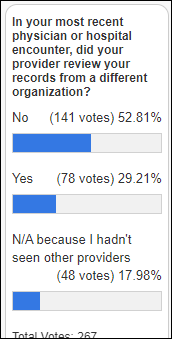
I’d like to see greater flexibility by healthcare organizations to accept data flowing into their EHR from other sources. As I’ve mentioned in previous posts, I still work with health systems that don’t recognize other hospitals’ data for the purpose of satisfying gaps in care, even though it’s available on the system and visible to the patient and providers. EHR technology now supports this, but for some reason, administrators have chosen not to turn it on at one of my sites of care, so there’s always some confusion at the beginning of a visit.

He notes that unless physicians in the traditional US primary care model can adapt, patients will move away to concierge medicine, direct primary care, retail clinics, and other care environments. Some practices are definitely better than others at adapting to new models of care and harnessing the payments available when they participate. Some of my colleagues have refined their practices to the point where their quality scores are so outstanding that they can command additional bonuses beyond what anyone else in the region receives because they’ve embraced new models. Others are electing to retire early, and some are just reacting to changes in the marketplace rather than trying to proactively evolve their practices.

This theme isn’t limited to the musings of a country doctor, however. The Harvard Business Review dove into the topic recently with an eye-catching headline that “The US Health Care System Isn’t Built for Primary Care.” Citing this spring’s report from the National Academies of Sciences, Engineering, and Medicine, they note the conclusion that “primary care is the only medical discipline where a greater supply produces improvements in population health, longer lives, and greater health equity.” The author notes that “current efforts to wring ‘value’ from primary care by focusing on diagnostic algorithms and quality metrics reveal fundamental misunderstandings of primary care’s purpose. The attempts to apply processes and technology designed for subspecialty care to the delivery of primary care have proven insufficient to support the complex work of the primary care team.”

The article poses that unlike other specialties, “the heart of primary care’s success remains a unique relationship between physicians and patients built on trust.” Although I’d like to agree, and a decade ago I might have, there has been a substantial erosion of that trust over the last two decades. When patients had to start changing primary care physicians when their employers went with cheaper insurance plans each year, those relationships became less valuable. The evolution from patient to consumer and customer further eroded the relationship, and new generations who never experienced the ”old-time family doctor” visit didn’t understand its value as they prioritized convenience and speed given their busy lives. The pandemic has put that shifting trust into focus, where some patients are more likely to believe things they read on social media than to trust the advice of their primary care physician.

The section headed by “Primary Care Doctors Are Not Subspecialists” was particularly thought-provoking. Where procedural subspecialists are more likely to be served by checklists, templates, and process-driven approaches, primary care has to be more dynamic. Often the outcomes of primary care are achieved over a period of years rather than months, which makes it more challenging to understand the cost/benefit equation. Money that is spent by commercial insurers during a patient’s employed years might not lead to savings until disease is prevented or caught early, at a time when the patient might be covered by another payer or even by Medicare.

The author lists three places to focus on reinventing primary care, and they’re all things that plenty of others have been saying.

First, we need to reform the payment model since the US spends 50% less on primary care than any other developed nation. Future payment models must support multidisciplinary primary care, and according to the author, “should include predictable cash flow up front, in recognition of primary care as a common good in society.” We’ve tried to do that in the past with capitated payments with varying degrees of success, and although there are organizations that have figured out how to do this well, others seem to want to reinvent the wheel rather than learning from experience.

Second, the author notes a need to fix EHR technology, to create systems that are “clinical first” and are integrated across all facets of healthcare. Now that we’re over the initial implementation hurdles, it’s time for healthcare organizations to optimize what they have and to push their vendors to deliver additional capabilities and efficiencies.

Third, the author proposes that we change medical education. Many practicing physicians were trained in “big hospitals that glamorize subspecialty and inpatient care.” As someone whose medical school didn’t even have a department of family medicine, I know what that’s like. Hearing comments like “you’re too smart to do primary care” isn’t going to encourage the best and brightest to gravitate to the field (although more people in my class went into family medicine than general surgery, which was a blow to the surgical egos at my institution but gives me some hope).

Technology is at the intersection of many of these concepts and will need to keep pace with other changes as the healthcare environment evolves. EHR and other clinical systems vendors have been varyingly successful at this, with some systems moving towards greater integration in a logical fashion but others growing by acquisition and bolt-on solutions, which adds to the feeling of fragmented care. There’s plenty of discussion about “disruption” and “innovation,” but some days it just feels like we’re nibbling around the edges of the problem. A couple of organizations are poised to make some significant change, and I’m eager to see what they come up with.

Not everyone is going to need subspecialty care in their lifetime, but all of us are consumers of primary care services. Do we know the answers but just need to implement them, or are there solutions we’re still not talking about? Leave a comment or email me.

Email Dr. Jayne.

HIStalk Interviews Mike Linnert, CEO, Actium Health

October 25, 2021 Interviews Comments Off on HIStalk Interviews Mike Linnert, CEO, Actium Health

Mike Linnert, MBA is founder and CEO of Actium Health (formerly known as SymphonyRM) of Palo Alto, CA.

image

Tell me about yourself and the company.

Actium Health helps health systems and payers with CRM intelligence. We take all the data they have about their members and identify “next best actions” to drive lifetime value for the members. Before founding Actium Health, I grew up doing similar things for companies in the wireless and financial services industries, and before that, I was investing in consumer internet companies.

What could “next best action” look like for me as an individual consumer, both inside and outside healthcare?

Starting outside healthcare, the goal is to drive lifetime value for a customer relationship. Some “next best actions” don’t have revenue or profit associated with them in the near term, but their investment is in the long-term relationship.

I’ll give you some of the simplest ones I started with. When I was in the wireless industry way back in the early 2000s, you might have called the call center with a question about your bill. While we had you, we might have observed that last month you could have saved $3 had you been on the 100-messages plan instead of the 50-messages plan. You as a consumer would think, “Great! That’s great,” and we as the wireless provider would feel like, “We helped you save some money, but also we probably encouraged you to do more texting, which is something that we wanted you to do anyway because it attaches you to your device more.” Things that you liked about our service, and in the long run, we probably decreased your propensity to churn. And if we increased your usage of text messaging, we hopefully increased the value that you saw from us.

As you get more complex, you can think about perhaps your wealth advisor at your bank. At any given time, your wealth advisor might know that you forgot to make your 529 education contribution for one of your kids, you didn’t make an IRA contribution this year, you haven’t rebalanced your portfolio, or mortgage rates have gone down and you could potentially refinance your mortgage and save some money. The ”next best action” involves which of those things is most valuable to you. I’m a wealth advisor, so my job is to stand by you, not to stand by the products and broadcast out to you, “Hey, this product fits you.” I stand by you, you tell me about your needs, and then I say, “Here’s the most important thing. I know your kids are important to you. If we only have five minutes to talk today, let me focus on the 529 plan.” But to do that, I have to come up with what the most valuable thing is for you. We bring AI to do that on behalf of the wealth advisor or the health advisors here in healthcare.

Is it uncomfortable for providers to think of the lifetime value of a given patient and to reach out to them to offer more services, either to bring in more revenue, to benefit the patient, or both?

It shouldn’t be. The goal is to drive the lifetime value of the relationship. If I ever slammed you products you don’t need, I should assume that you’re going to turn and go somewhere else. Maybe there’s some near-term profit, but over the long run, you’re not going to be with me any more. You’re going to find somebody who takes care of your needs better.

In the financial services example I gave, the goal was to say, “What is most valuable to you and to our relationship?” In healthcare, let’s assume that I’m on a value-based care model with my local health system. The health system knows that I’m past due for a colonoscopy, and maybe they know that I haven’t seen a primary care doc in the last three years. Maybe from looking at their data, they suspect I’m high probability for having kidney disease and don’t know it.

At least for me as a patient, I would love it if the health system didn’t worry about whether they were violating the revenue goal, or violating something about our relationship, and instead felt a moral imperative to reach out and tell me, “Hey Mike, based on the data we have, we think it’s worth you taking this health risk assessment for kidney disease” or “here are the top three reasons that you should come in and see your primary care doc.” I would like them to be reaching out.

Certainly what I don’t want, and what would be violation of HIPAA marketing, is for them to be hawking drugs that may or may not fit me, or to let me know that they have a new partnership with a local imaging center and I should consider going there. Those aren’t the things I want. But I do want things that help drive health for me and my family.

Some patients, especially younger ones, don’t necessarily see the value of ongoing engagement with a health system or primary care physician. How do providers convince them of the value of that engagement or use “next best actions” to address their needs?

You have to step back and, again, talk about what drives lifetime value. Your point is exactly right. What drives lifetime value for my dad in the health system is very different from what drives lifetime value for my son in the health system. My dad wants to know that the health system is proactively thinking about him, looking at the data they have about him, and proactively reaching out to engage him. My son wants to know that they are there if he needs them, so maybe they let them know that he can schedule through text messages or which simple conditions could be managed at urgent care at a lower cost and shorter wait time than the ER.

You have to think about what these things are for each cohort. That is the whole point of the “next best actions” approach. We are developing one-to-one dialogues that for each customer, think uniquely about the things that we have that can create value. I’m not trying to upsell and cross-sell so much as I’m trying to up-serve and cross-serve. If I serve you better, that will drive the loyalty.

I’ll give you a stat so you have a sense of why I think this is important. If I look at Verizon and AT&T, I might say it’s customer churn. I haven’t looked in a while, but last time I looked, it was around two to three percent. Two to three percent of their customers leave them each year. Health system churn, from our back of the envelope math, is between 20 and 30%. It is 10X. What we think we provide is a highly personalized, highly customized solution. You have to ask ourselves why that’s happening.

Healthcare switching costs might be lower than for changing cell providers, and some degree of unavoidable churn occurs because people change employers or their insurance changes. Some people also don’t need or have any provider interaction in a given year. Is healthcare different where they might come back to a provider when they need them or decide that someone else might address their problem more readily?

The difference between total churn and addressable churn is absolutely important. Someone may have moved away someone or switch to plans your physicians aren’t in. But that doesn’t put a big enough dent in the 10X difference that you would say, “This isn’t important to me.” For a lot of health systems, if you haven’t been in to see your primary care or other doctor in two to three years, they make you re-onboard. You have to go see a nurse again before you can see the doctor. We don’t want to do that.

We especially don’t want to do that for the younger generation you mentioned. We’re just helping them. They may not want to see a doctor for one to two years. But during those years, those patients have been thinking about their health. I saw a study that said that the average American spends 11 to 12 hours a month online reading about health information.During that time, I promise you that the people online who are giving them that health information —  it could be Google, it could be other health websites — they want those members, patients, or customers as customers of theirs, too. People realized that the lifetime value of having a customer relationship centered on healthcare is very high.

The other big trend that’s happening right now is value-based care coming on scene. Value-based care is enabling a lot of competitors to build lucrative businesses around having deep customer relationships. In the old model of healthcare, to make a lot of money, you had to have a lot of specialists, because that’s where the money was. In value-based care, you can make a lot of money by keeping people healthy and having good, loyal relationships. You see people like One Medical, VillageMD, Walmart and CVS getting in and saying, “If there’s a new way to have consumer service-based relationships with patients and healthcare, that’s an opportunity.”

How does a health system run “next best action” programs for both their population health and marketing programs without confusing the consumer and making sure that each campaign’s messages are appropriate?

This is where you have the two-canoe problem, with fee-for-service and value-based care competing. But if you scratch a little deeper and look at individual contracts and different incentives, you probably have closer to a 200-canoe problem, with different people and different incentives. But that’s the whole point of the “next best action,” one-to-one dialogue approach. We want to figure out for everybody, what is the most valuable thing we can say to you based on what we know about you?

Let me give you an example of what the differences could look like. I’m going to give you some directional numbers that aren’t exactly correct. If I was a health system, I might ask, what is the value to me as the health system of bringing someone in for a breast cancer screening? Of course there’s value in that I am supporting my patients, but if I look at it on a dollar basis, I would say for every 100 screens I do, I’m going to do about 10 diagnostic follow-ups. I’m probably going to discover one case of cancer, and about half of those I’ll end up treating. Just ballpark numbers there.

For most health systems, if you did the expected value of the margin at each level there and multiplied them up, you’d get about $250. And if I get really good at predicting that women in this cohort are six times more likely than average, reaching out to those women and getting them in is potentially worth $1,500 to me, six times more than average. If I flip it around and ask the community, “What’s it worth if I reach out to you, invite you to come in, and we find that you have cancer and you weren’t otherwise going to come in?” it’s a lot. Because if you didn’t come in, that cancer was going to be much worse by the time we found it.

In a value-based care world, where I make money is by not finding cancer, or finding it so early so I stave off the later costs. That’s worth $250 for an average fee-for-service, but double that on a value-based care contract, closer to $500, to be doing those screenings to avoid the cost of finding later-stage cancer. That’s in addition to bonuses that I unlock or business value I unlock because I hit five stars on my screening, or because I met some threshold in a contract, and I’m able to market my Medicare Advantage plan differently. If you start to take all those into account, you start to realize that for health systems that are truly in value-based care models, there’s enormous value to proactively reach into the community and find people who have cancer and don’t know it. Or reaching into underserved communities and pulling people in that need care from us.

A survey written up on your website found that consumers perceive that their doctors and hospitals ignored them during the pandemic by not answering their phones or reaching out. What is the opportunity for health systems to move ahead from that?

I’m going to give you three quick examples. From January 2020 until now, our customers have increased proactive digital outreach by 10X, and I think there’s still another 10X to go. I think my health system should be reaching out to me at least once a month proactively with, “Here’s your family health income statement and balance sheet” or “Here are new services we have” or “Here are things you should know about what’s going on in the community.”

Second, I move around between health systems. Kaiser is not a customer of ours, but I’m going to mention something they did. During COVID at the peak, Kaiser was sending me three emails a month or even per week on some occasions. Three emails a week. And they were valuable, meaty emails. I liked reading them. They were telling me about positivity rates in my community. Stuff that I was really curious about and stuff that, had they not said it, I would have gone on Google. Kaiser was providing me a service.

The third thing is that last year, cancer diagnosis in the US was down by about half. We didn’t cure cancer last year. What did happen is that half of all the cancers that we probably would normally have discovered got worse. They went untreated, they went undiscovered. Health systems, to my way of thinking, have almost a moral imperative to be reaching out to people, to be looking through the data and saying, “Where are the communities that are most underserved? Who are the people that we think are at higher risk of breast cancer? How do we reach out to them and get them in for screening?” Most of those screenings are free. We have a free service that helps you discover and stave off cancer. That’s not to say anything about kidney disease and all the other diseases that went unaddressed faster that we need to get back to.

Where do you see the industry and the company in the next 3-4 years?

We’ve been talking for a long time that healthcare is a consumer service. If we are a consumer service, then there are some things that are fundamentally true, and you can look around at other consumer service industries. Most importantly, we need to stop thinking about patients as customers. We need to start thinking about people as members. Members have a recurring relationship with you. It’s enduring, it needs to be taken care of, and if you don’t, other people are going to come take your members. And if we have members, then we need to be thinking about how to drive value, delight, and loyalty among our members. Value means value they get from us, delight how happy they are, and loyalty our ability to influence behavior. We do that with “next best actions.”

Value-based care is the sport of the future. It may take a while, but it is the sport of the future. That pay-vider model is coming fast. New competitors are coming in to take advantage of that if our current health systems don’t. Our job is to work with today’s health systems and payers to say, this what’s coming. We can help you bridge the gap to this membership model. To this proactive engagement, where you drive value, delight, and loyalty. We have the portfolio of “next best actions” to do it. At least as I know it today, we are the only company that is working with healthcare providers that hang expected values on “next best actions,” and that is critical to investing and making them happen.

Comments Off on HIStalk Interviews Mike Linnert, CEO, Actium Health

Morning Headlines 10/25/21

October 24, 2021 Headlines Comments Off on Morning Headlines 10/25/21

23andMe to buy telehealth firm Lemonaid for $400 mln

Consumer DNA testing company 23andMe will acquire telemedicine and online pharmacy vendor Lemonaid for $400 million in cash and shares.

Cerner CEO acknowledges more layoffs are coming

Cerner President and CEO David Feinberg, MD, MBA confirms an anonymous employee’s Reddit comment that Cerner will lay off 150 workers in early November.

Oak Street Health Acquires Virtual Specialty Care Provider RubiconMD

Medicare primary care provider Oak Street Health acquires RubiconMD, which offers PCPs electronic patient consults with specialists.

Comments Off on Morning Headlines 10/25/21

Monday Morning Update 10/25/21

October 24, 2021 News 5 Comments

Top News

image

Consumer DNA testing company 23andMe will acquire telemedicine and online pharmacy vendor Lemonaid for $400 million in cash and shares.

23andMe says the acquisition it will extend its ancestry foundation into information about health risks and treatment that will “transform the traditional primary care experience and make personalized healthcare a reality.”

23andMe went public in June 2021 via a SPAC merger that valued the company at more than $3 billion. Shares are up 2% since versus the Nasdaq’s 8% gain.


Reader Comments

From HLTH Watcher: “Re: HLTH and ViVE conferences. Does reader feedback encourage you to attend? I’m considering it for next year or the year after depending on how HIMSS22 goes.” Maybe. Below are the attendee comments I received. My personal challenges with attending to write up the proceeds for HIStalk are: (a) as an introvert, I don’t love attending conferences; (b) I pay my own way to conferences using a phony job title instead of requesting a media pass so that I get a true on-the-ground impression of exhibitors, so my cost would be significant; (c) ViVE ends five days before HIMSS starts, leaving me unsure how to get the most out of two back-to-back conferences in Florida without sensory overload; and (d) HLTH22 is in Las Vegas, a city I avoid whenever possible. I’m sure HIMSS is watching closely since the new competitive threats of HLTH and CHIME could siphon off some of the HIMSS decision-making audience that has kept exhibitors paying, although HLTH momentum could fade if the stock market takes a hit that deflates some high-flying digital health startups that it draws. Meanwhile, HIMSS updates its conference page to reflect HIMSS22, which will offer both an in-person and digital track. The exhibitor count is at 378.

From John Moore: “Re: HLTH. I attended and it’s mostly a conference for smaller VC-backed companies and their investment partners. Exhibit hall was quiet with exceedingly few end user buyers and customers. Small companies had the ability to meet with larger health IT incumbents for potential partnerships. The good part of HLTH is that no other event outside of JPMorgan brings in executives from all facets of healthcare, which provides a broader perspective. The not-so-good is that outside the love fest between startups and their investors, there’s not much for users or patients, it has excessive glamor and glitz, and it’s definitely not worth the expense of attending unless you have networking objectives.”

From Dan Nigrin: “Re: HLTH. I was again impressed. The content and exhibitors represent the future of our industry. At least 100 small startups had friendly people stationed in their small spaces ready to explain things intermingled with larger companies instead of being relegated to some faraway exhibition space. Equally interesting was the gradual entry of more traditional HIT vendors. Panel and keynote discussions were interesting and relevant, many of them with standing room only. Disclaimer – I’m on the CHIME board, which is putting on VIVE together with HLTH this spring.”

From Diligent Scribe: “Re: HLTH. The exhibit hall was never overwhelmingly crowded, but flow of folks was consistent. It felt about perfect since booths were spaced but the exhibit hall didn’t feel bare. As a first-time attendee, what struck me was the quality of attendees and the variety of titles they represented. such as lots of transformation and innovation folks. This led to deep, high-quality conversations in our booth as well as offering a tremendous opportunity to talk with existing and prospective partners. The educational sessions were informative and not a regurgitation of the same old, same old. I felt it was a worthwhile use of my time and the company’s expense, to the point that I’m considering skipping HIMSS next year and just doing CHIME, VIVE, and HLTH since all three together cost less than HIMSS and likely deliver better results due to their content and the audience.”

From Love Doctor: “Re: Surescripts medication histories. Our health system received a patient safety notification that medication histories from two pharmacies were missing the slash or hyphen in the dose, which could cause a dose of ‘take 1-2 tablets a day as needed’ to display as ‘take 1 2 tablets a day as needed’ in Epic. Surescripts has removed the dosage portion of the medication history and Epic has provided a list of patients whose reconciled histories were impacted and removed those that were uncreconciled.” 


HIStalk Announcements and Requests

image

Two-thirds of providers failed to review the available medical records from other providers in the most recent encounter of poll respondents.

New poll to your right or here: Which healthcare organization provided the poorest customer service in your recent personal or family experience?

image

Welcome to new HIStalk Platinum Sponsor Verato. The McLean, VA-based company — the identity experts for healthcare — enables better care everywhere by providing the single source of truth for identity to organizations across the care continuum, including providers, payers, healthcare technology, life sciences, public health, and HIE organizations. Over 70 of the most respected brands in healthcare rely on Verato’s next-generation cloud identity resolution platform for a complete and trusted 360-degree view of their patients, provider networks, and customers in their communities. Organizations can integrate with its HITRUST-certified platform at every step of the care journey across CRM, EHR, enterprise analytics, and digital health experiences quickly and at scale. Thanks to Verato for supporting HIStalk.

I found this explainer video for Verato’s MPI on YouTube.


Webinars

October 28 (Thursday) 1 ET. “A New Streamlined Approach to Documentation and Problem List Management in Cerner Millennium.” Sponsor: Intelligent Medical Objects. Presenters: Deepak Pillai, MD, physician informaticist, IMO; David Arco, product manager, IMO; Nicole Douglas, senior product marketing manager, IMO. IMO and Cerner announce the launch of the IMO Core CSmart app, an in-workflow offering to improve clinical documentation and problem list management in Cerner Millennium. The presenters will review the challenges and bottlenecks of clinical documentation and problem list management, discuss how streamlined workflows within Cerner Millennium can reduce clinician HIT burden, and demonstrate how IMO Core CSmart can help clinicians document with ease and specificity, improve HCC coding, and make problem lists more relevant. Additional sessions will be offered on November 17 and December 1.

Previous webinars are on our YouTube channel. Contact Lorre to present your own.


Acquisitions, Funding, Business, and Stock

image

Cerner President and CEO David Feinberg, MD, MBA confirms an anonymous employee’s Reddit comment that Cerner will lay off 150 workers in early November.

image

Shares in London-based digital health tools vendor Babylon Health closed their first day of trading Friday up 18% following its SPAC merger, making founder and CEO Ali Parsadoust, PhD a billionaire. The company predicts 2022 revenue of $710 million and that its losses will turn into profit in 2024.

image

Medicare primary care provider Oak Street Health acquires RubiconMD, which offers PCPs electronic patient consults with specialists.


Sales

  • Hendrix Medical Center (TX) goes live on a newly created TeleMFM (maternal-fetal medicine) service offered by SOC Telemed and Ob Hospitalist Group. SOC program allows 94% of women with high-risk pregnancies to receive prenatal care and delivery services in their own communities instead of seeing specialists in urban centers.

People

image

KONZA National Network hires Jeff Messer (ToolWatch) as COO/CFO.

image

David Finn, MA (CynergisTek) joins CHIME as VP over its affiliated professional groups.

image

Hillrom promotes J. B. Leeming to area VP of digital health.


Announcements and Implementations

Ninety-one percent of surveyed healthcare professionals say that fixing broken administrative processes is healthcare’s most urgent need for improving patient care, while patients having their medication history readily available to any provider they see would do the most to improve their outcomes. Nearly all healthcare professionals in the Olive-sponsored survey predict that healthcare AI use will be widespread by 2026, but patients remain skeptical.


Government and Politics

image

A Florida state audit finds that case managers of its compensation program for brain-damaged children didn’t consult experts and instead Googled medications, therapy, supplies, and surgeries to decide which were medically necessary. The organization amassed $1.5 billion in assets while sometimes arbitrarily denying or delaying care while offering no appeals process for parents. It did not use a system to track denials or complaints, leading the state’s CFO to observe, “Why is a program of this size doing record-keeping with CD-ROMs?” The program’s executive director resigned on September 21 ahead of the report’s release.


Other

The employee relations department of Phoenix Children’s Hospital (AZ) emails 370 unvaccinated employees using CC:, thus exposing the list of recipients to all. I was thinking as I was writing this that not many people have seen an actual “carbon copy,” just as many computer users know the “save” icon even though it depicts a floppy disk that they have never physically touched.


Sponsor Updates

  • Olive launches The Library, a marketplace offering key distribution channels for industry pioneers.
  • Ascom and Ellkay bolster their respective offerings with RingCentral’s message, video, phone, and call center capabilities.
  • RxRevu receives Cerner’s Partner of the Year Award.
  • Sectra publishes a case study, “One for all – native support for automated breast ultrasound in Sectra’s expanded breast imaging PACS.”
  • Spok publishes a new infographic, “Burnout in healthcare contact centers.”
  • Waystar will exhibit and present at the MGMA MPE21 Conference October 24-27 in San Diego.
  • West Monroe publishes a client story, “Demand for a seamless patient experience drove this health system to innovate – and led to 5X faster results.”
  • Vyne Medical plants hundreds of trees as part of its “Growing Vyne Day” environmental sustainability effort.

HIStalk sponsors exhibiting at the CHIME Fall Forum October 27-30 in San Diego include Bluetree, Clearwater, Meditech, Divurgent, Ellkay, Optimum Healthcare IT, Clearsense, Imprivata, Cerner, HCI Group, Spok, InterSystems, Infor, Quil, Experian Health, and Agfa HealthCare.

Blog Posts


Contacts

Mr. H, Lorre, Jenn, Dr. Jayne.
Get HIStalk updates.
Send news or rumors.
Contact us.

125x125_2nd_Circle

Weekender 10/22/21

October 22, 2021 Weekender Comments Off on Weekender 10/22/21

weekender 


Weekly News Recap

  • Vanderbilt University Medical Center reports that patient-to-clinician messages doubled when it started posting lab results immediately to its patient portal as required by the Cures Act.
  • Virtual care company Babylon begins trading on the NYSE via a SPAC merger that values the company at $4 billion.
  • Microsoft enhances Cloud for Healthcare and Teams with expanded virtual visit capabilities.
  • General Catalyst and Jefferson Health form an innovation partnership in which the health system will use technologies from the venture capital firm’s Health Assurance Network of companies.
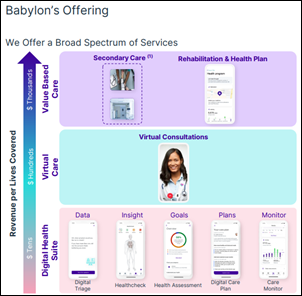
  • The merged Grand Rounds Health and Doctor on Demand rebrand as Included Health.
  • Transcarent announces that it will offer Walmart’s pharmacy services to its self-insured employer customers.

Best Reader Comments

Appreciate the shift in language from “follow the science” to “evidenced-based.” The latter may be less intimidating and widen the door for more shared decision making as the patient and provider collect and review the “evidence” together. (Quynh Tran)

Love it when someone relatively new to the industry has all the answers and calls out the “crooks in the room” who don’t have all the answers – or does have them but they don’t want to share them?! (Steve Ex Twitter)

Am I the only one who thinks that the ratio of “Innovation Conferences” to “actual implemented, at scale innovation” is probably the highest in our industry compared to other sectors? Somehow, other industries keep making my life better through innovation without needing to have some many innovation conferences :). What gives? (Ghost of Andromeda)

Can we talk about how pretty much all of the interoperability standards for healthcare are not secured? HL7 is not an inherently secure protocol. DICOM is not an inherently secure protocol. I don’t think X12 are inherently secure protocols either. The protocols don’t support any native encryption and have little to no authorization/authentication mechanisms. So our healthcare InfoSec friends basically have two overlapping options: 1) encapsulate these messages in a protocol that is secure; 2) Use network microsegmentation to limit which endpoints on your network are allowed to talk to your databases. The problem with #1 is that while it’s doable in theory, and there is even an RFC for doing this with X12, I haven’t seen any commercial products or solutions that implement it. (Elizabeth H. H. Holmes)

Correct that HL7 v2, DICOM, X12 etc. do not have security in the protocols themselves – they are routinely secured by microsegmentation as detailed. I’m not persuaded that it’s more mistake prone than the alternatives – and it’s at least easier to test (but does need testing). FHIR is different – it’s built on the the web stack in order to get web level security. But as the report shows, that requires actual commitment to security to get right. But #2: a commit to metasploit… sounds like a good idea for someone to do. (Grahame Grieve)


Watercooler Talk Tidbits

image

Readers funded the Donors Choose teacher grant request of Ms. K from Arizona, who asked for hands-on math learning tools for her special education class of fourth and fifth graders. She reports, “The materials have arrived, and my students have loved using them during virtual teaching and learning! Thank you for supporting education and helping students develop a love of math! These math materials are awesome at inspiring students to keep learning and to be able to visualize important math concepts.”

image

TV show “The View” demotes its health and safety manager Nurse Wendy after two fully vaccinated hosts tested positive – apparently falsely –-for COVID-19 minutes before Vice-President Kamala Harris was scheduled to go on in late September. The hosts tested negative several times after the incident despite their original positive PCR test. Host Sunny Hostin was angered because her surgeon husband had to be pulled out of the OR because of her false positive and the incident required her medical information to be revealed without her authorization. The show had previously honored Wendy Livingston, RN with an extensive on-air tribute as a healthcare hero.

A Seattle man is indicted for impersonating a nurse for 10 years by stealing the identity of a former college classmate. He had been discovered and fired several times but kept finding new nurse jobs, most recently as a care home’s director of nursing.

image

A hospital ED nurse wheels a stretcher to the helicopter ambulance only to see that the occupant is her boyfriend – who is also an ED nurse at the same hospital – who dropped to his knee to ask her to marry him. She said yes.


In Case You Missed It


Get Involved

Sponsor
Report a news item or rumor (anonymous or not)
Sign up for email updates
Connect on LinkedIn
Contact Mr. H

125x125_2nd_Circle

Comments Off on Weekender 10/22/21

Morning Headlines 10/22/21

October 21, 2021 Headlines Comments Off on Morning Headlines 10/22/21

Association of Immediate Release of Test Results to Patients With Implications for Clinical Workflow

Vanderbilt University Medical Center finds that immediately releasing lab results to the patient portal, as required by the Cures Act, was associated with a doubling of the number of patient-to-clinician messages that were sent immediately afterward.

Chubb Can’t Sidestep Settlement For Canceled Trade Show

A federal court rules that the insurer for HIMSS20 has to cover the organization’s settlement with exhibitors of the cancelled conference.

Babylon, one of the world’s fastest-growing digital healthcare companies, to begin trading on the New York Stock Exchange under the ticker BBLN

Virtual care company Babylon combines with SPAC Alkuri Global Acquisition Corp. to begin trading on the NYSE.

Ann Arbor’s Workit Health raises $118M in Series C funding round

WorkitHealth, developer of a virtual care app for addiction treatment, raises $118 million in a Series C funding round.

Comments Off on Morning Headlines 10/22/21

Text Ads


RECENT COMMENTS

  1. Merry Christmas and a Happy New Year to the HIStalk crowd. I wish you the joys of the season!

  2. "most people just go to Epic" that's a problem because then EPIC becomes a monopoly in healthcare, if it isn't…

  3. Only if CEO can post 'bail' which nowadays stands at 1B$ paid directly to the orange president or his family…

  4. I enjoy reading about the donations to Donor's Choice by HIStalk members. I also believe in the worthiness of Donor's…

Founding Sponsors


Platinum Sponsors


Gold Sponsors


RSS Webinars

  • An error has occurred, which probably means the feed is down. Try again later.