Recent Articles:

Morning Headlines 11/9/21

November 8, 2021 Headlines 1 Comment

CareCloud Reports Record Third Quarter Revenue and Net Income

MTBC subsidiary CareCloud reports record Q3 revenue of $38.3 million, a 21% increase over Q3 2020.

Cyberattack on health tech vendor QRS leads to data theft tied to 320K patients

EHR and practice management vendor QRS Healthcare Solutions announces it was the victim of a cyberattack in August that compromised a server dedicated to the patient portal of several customers.

Philips discloses TASY EMR vulnerabilities pose risk to patient data

Philips alerts end users to two vulnerabilities within its Tasy EHR that could allow hackers to extract data and potentially launch denial-of-service attacks.

Curbside Consult with Dr. Jayne 11/8/21

November 8, 2021 Dr. Jayne 1 Comment

The highlight of my weekend was attending a graduation party for one of my favorite former co-workers. I worked with her in the urgent care trenches for half a decade, through Flumageddon, COVID-19, the deaths of three co-workers, and a host of other calamities.

Of all the people I’ve worked with clinically, she’s one of the handful I would walk through fire for. Three years ago, she decided to go to nursing school and completed her bachelor of science in nursing degree while continuing to work part time. She’s one of the hardest working people I know. I had the privilege of working my last urgent care shift with her, so I was glad she invited me to come celebrate her achievement.

It was a mini reunion of former colleagues, 80% of whom have left our former urgent care employer. It seems like everyone is thriving since they left. Since I was kind of the “mom” of the practice sometimes, hearing their stories brought me joy. Several are in graduate school and others have moved to other healthcare settings, but all of them are still involved helping patients.

It was also fun meeting the graduate’s parents and brothers, and now I understand where she gets her sassiness. Sometimes we don’t get to see people bring their dreams to life, but I’m excited for her in her new role as a nurse in the emergency department of the city’s premier Level One trauma facility. Hopefully we’ll be able to catch up again down the road. It will be interesting to hear stories from a new graduate’s point of view.

The rest of the weekend was spent playing catchup – working on some personal projects and catching up on work I needed to finish after being out for a training class most of the week. For one of my new projects, I need to have a particular EHR certification that I’ve never done before, and it was quite the adventure. Since most vendors are still offering remote training, I decided to take advantage of that option. Not that I mind traveling, but it’s always better to be able to sleep in your own bed. I was pleased that the training had been adapted to remote learners, including having multiple trainers available to cover real-time questions while the main presenter continued presenting the content. That let people catch up while the rest of the class moved ahead. As someone who has taken countless in-person classes, I enjoyed that approach much better than when a single class member holds everyone up with questions since it’s much harder to hand someone off to a co-trainer in a live environment.

Of course, there were some technical glitches for attendees, with people intermittently losing audio or having glitchy video, but that’s to be expected even at this point where most of us have adapted to nearly 100% remote work and virtual meetings. There were also some people with multiple monitors who were having issues with popups they couldn’t see because they would open on a different monitor, and that seemed to be a little trickier for the remote training team to try to troubleshoot. Overall, I thought they did a nice job with plenty of breaks for people stretch and just get away from their desks, and also a full hour for lunch which I haven’t had before even in an in-person class. It was nice to be able to grab something to eat, check email, and walk around a little bit before settling in for another half day of classes.

Fortunately, I’ve worked with this part of the EHR before,so while I’ve never been certified, so the content wasn’t overwhelming. I imagine that if you were new to EHRs in general, such as an IT person who hadn’t done much clinical work but was diving in, the pace might have been a bit brisk. There are plenty of new terms to learn in healthcare (particularly in the wild and wacky world of US healthcare) so the learning curve on those items would have been steep. Most of the attendees were able to get through some clinical workflows though and had a good understanding of how their end users will be using the system. It’s always a good thing when clinical people can see what IT folks have to work with, and vice versa, in order to have a high functioning team.

I’m taking another class this week and it’s a much deeper dive into the underpinnings of the EHR, which I’m very excited about. I never met a database table I didn’t like and am looking forwarding to learning things I may not have known about the underlying structure. As a CMIO, I’m often at the 10,000-foot level, but it’s always good to understand the complexities of the system when I’m asking my team to consider using new features or attempting to customize around a native workflow. I’ve got a topnotch team of seasoned veterans, so I’m not worried about their skills, although I’ve had people working for me on previous engagements who tried to snow me on how hard it would be to do customizations or to modify workflows. I remember one upgrade when my team was acting like they’d have to do hundreds of hours of work to make changes to provider workflow templates, and when we did a work breakdown and estimation exercise, it turned out to be less than one person-week of work.

I also spent some time doing my quarterly Maintenance of Certification questions for both my primary and secondary board certifications. They use completely different methodologies and delivery systems for their questions, and I’m wondering why the different boards can’t get together and come up with a best-of-the-breed solution. One board allows five minutes per question, and you have to do 25 questions per quarter, where the other allows 10 minutes per question with 12 questions per quarter. Fortunately, they’re both open-book and open-internet, with the main limitation being that you can’t engage other people to help you or share the questions with others. I’m not close enough to retirement to consider dropping either certification, so I get to stay on the certification hamster wheel for many years to come.

Did you have a productive weekend, or were you just able to enjoy some down time? Leave a comment or email me.

Email Dr. Jayne.

Morning Headlines 11/8/21

November 7, 2021 Headlines Comments Off on Morning Headlines 11/8/21

Spok Reports 2021 Third Quarter Results

Spok reports Q3 results: revenue down 5%, EPS –$0.13 versus $0.16.

Biden nominates Kurt DelBene as chief information officer at VA

The White House nominates Kurt DelBene, MS, MBA (Microsoft) as VA assistant secretary and CIO.

It will take time to restore healthcare IT system, say Newfoundland officials

Health officials in the Canadian province of Newfoundland and Labrador say health IT systems, including its Meditech EHR, are slowly being brought back online after last weekend’s cyberattack.

Comments Off on Morning Headlines 11/8/21

Monday Morning Update 11/8/21

November 7, 2021 News 2 Comments

Top News

image

From the Allscripts earnings call, following the announcement of quarterly results that beat earnings expectations but fell short on revenue:

  • CEO Paul Black says that NIH has extended its contract for Sunrise for another five years.
  • Veradigm revenue grew 10% year over year.
  • The company admits being frustrated that Allscripts “stock is cheap” compared to companies that enjoy high multiples while operating businesses similar to Veradigm.
  • The core clinical and financial solutions business has seen some shrinking, part of that intentional in focusing on higher-quality clients, but also because of the tail end of a bolus of larger academic medical centers and clients going in a different direction.
  • Allscripts believes that non-US opportunities are “a more level playing field” even though those wins are hard to predict because they are mostly public sector clients with inconsistent deal times.
  • The company sold 2bPrecise at a small gain in August, taking a non-controlling stake in the combined entity instead of cash.
  • Allscripts expects to see managed services opportunities as clients deal with wage inflation and sending teams such as revenue cycle management to work from home, where they could just as easily be someone else’s employee.

HIStalk Announcements and Requests

image

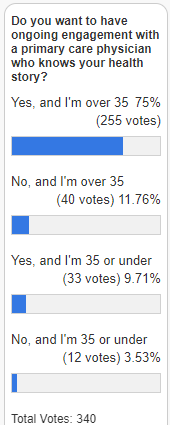
An overall 85% of poll respondents seek ongoing engagement with a PCP, with a slightly higher percentage of over-35s looking for that kind of relationship. David says he wants ongoing engagement, but not ongoing disengagement where he sees the same doctor who never remembers much about him, while Kathy fears the “too many cooks” problem because whatever doctor was available to see her changed her treatment plan.

New poll to your right or here: How do you most often communicate in one-to-one work-related meetings? I’m curious because I do interviews via a conference line where I can record the call, and sometimes surprises people who have learned to spend their entire workday on video calls with cameras on. I say use video for one-on-one calls only if the value it adds exceeds the mental strain of being on camera, and I don’t know of many examples where that’s the case unless documents are being reviewed.


Webinars

November 9 (Tuesday) noon ET. “The Next Generation of Identity Resolution in Healthcare.” Sponsor: Verato. Presenters: J.P. Lugo, solution architect, Verato; Nick Orser, solution architect, Verato. This webinar will provide an overview of person-matching in healthcare, how challenges can be overcome with Verato Referential Matching, and how person-matching technology can support Customer 360, marketing, analytics, IT, and more.

November 10 (Wednesday) 1 ET. “Too Important to Fail: How to Bring Better AI to Healthcare.” Sponsor: Intelligent Medical Objects. Presenters: Dale Sanders, chief strategy officer, IMO; Marc d. Paradis, VP of data strategy, Northwell Health. It’s relatively easy to obtain healthcare data and build an AI demo, but getting AI to perform reliably and with meaningful impact is much harder. However, strategies exist for delivering AI products to commercial markets. This fireside chat will review the status of AI in healthcare; discuss the vital importance of data quality, methodological rigor, and product focus; and explore what this means to the startup and investor world.

November 11 (Thursday) 1 ET. “Increasing OR Profitability: It May Be Easier than you Think.” Sponsor: Copient Health. Presenters: Michael Burke, co-founder and CEO, Copient Health; David Berger, MD, MHCM, CEO, University Hospital of Brooklyn at State University of New York Downstate Health Sciences University. The OR is a hospital’s biggest source of revenue and its costliest resource, yet it often sits idle because of unfilled block time even as providers with cases ready to book lack access. AI-powered emerging technologies can help fill unused OR time and provide decision support to structure workflows and optimize block allocation. This webinar explores the biggest challenges to profitability faced in the OR and the fastest, most impactful changes a hospital can make to address them.

Previous webinars are on our YouTube channel. Contact Lorre to present your own.


Acquisitions, Funding, Business, and Stock

image

Spok reports Q3 results: revenue down 5%, EPS –$0.13 versus $0.16

image

Early-stage investor Colin Keeley provides a fascinating analysis of Canada-based software giant Constellation Software and its reclusive billionaire founder Mark Leonard. The company’s Harris unit contains a long list of acquired health IT vendors, such as Amazing Charts, QuadraMed, IMDSoft, Iatric Systems, Obix Perinatal Data System, and Picis. Interesting observations:

  • The company has acquired more than 500 vertical market software companies and has sold only one of those (in the early days, which Leonard regrets).
  • The company was launched in 1995 with the equivalent of $33 million 2021 US dollars. Its has grown at 30% per year to a publicly traded market cap of $31 billion.
  • Leonard started the company as a former venture capital operator who was frustrated that VCs were interested only in companies that have a large addressable market. He saw many businesses that were in niche spaces that generated high margins from recurring sales of mission-critical software. Constellation bought many of its companies directly from their founders.
  • Acquisition criteria include a mid- to large-sized vertical market software company with consistent earnings and growth, committed management, and an offering price that has already been determined. The average acquisition price ranges from $2 to $5 million, although the company has done bigger deals and says it will continue to do so. They also prefer companies that have low capital investment requirements just in case they need to weather a business downturn.
  • The company reportedly made 90 small acquisitions in 2020 alone.
  • One analyst estimates that Constellation acquires at a price of just 0.8 times annual sales, which is far below market.
  • Constellation leaves the management team of its acquisitions in place, supporting them with best practices and company-wide performance data.
  • The company says it offers its business unit managers autonomy, the ability to scale, and an environment in which rules are few and the focus is making the pie bigger, not fighting over how to divide it.
  • Constellation believes that growing companies create inefficiency by adding layers of management. They prefer that the original manager keep most of the business but then spin off a new business unit under a groomed protégé who can start with a blank slate and focus on customers.
  • All employees are given an explicit career path in which they first learn their particular vertical market, then transition into a leader of people who can run their own business unit. Leonard says, “Become a master Craftsman in the art of managing your VMS business. It is the most satisfying job in Constellation and will generate more than enough wealth for you to live very comfortably and provide for your family. For those whose ambition exceeds their good sense, we have a role that we call a Player/Coach. A Player/Coach continues to run their BU, but ambition drives them to acquire a sizable business, usually in another geography or another vertical “
  • The company’s bonus plan requires long-term investment in its shares, which has created several hundred employee millionaires.

Sales

  • CyncHealth selects Nuance PowerShare for accessing and sharing diagnostic imaging and reports and to alert ED physicians of prior studies.
  • Advanced Pain Care (TX) chooses Athenahealth.

People

image

The White House nominates Kurt DelBene, MS, MBA (Microsoft) as VA assistant secretary and CIO.

image

Jeffrey Brown, PhD (Harvard Medical School) joins TriNetX as chief science officer.

image

Walmart reportedly hires David Carmouche, MD (Ochsner Health) as SVP of its Omnichannel Care Solutions business that includes services that range from primary care to digital medicine and telehealth.


Announcements and Implementations

Nuance collaborates with Collective Medical to launch Nuance PowerShare Image Aware, which alerts ED physicians of prior radiology studies.

Redox announces a solution that enables payers to meet the CMS Interoperability and Patient Access final rule requirements.


Other

The Physician Network Advantage files a lawsuit against Santé Health Systems (CA) and related entities, which the EHR support company says failed to pay $1.5 million for Epic support. Santé says its agreement with PNA called for payment only as funded by grant funding and it notified PNA in September 2020 that the funding would be ending.

image

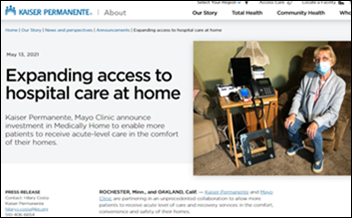
The National Nurses Union says its members are “horrified” at Kaiser Permanente’s pilot project for remote patient monitoring, saying it undermines the role of nurses, places the burden of work on family members, leaves patients far away from other services they usually need, and is intended to boost Kaiser’s profits by lowering costs while being paid by CMS at in-hospital rates under COVID-19 waivers for telemedicine.


Sponsor Updates

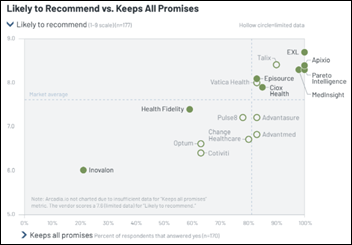
  • The highest-rated HIStalk Sponsor vendors according to the FeaturedCustomers Fall 2021 Hospital Communications Software Customer Success Report include Market Leaders Change Healthcare, Imprivata, Spok, and Vocera; and Top Performers Halo Health and PerfectServe.
  • Wolters Kluwer Health VP & GM Vikram Savkar joins The International Association for Scientific, Technical, and Medical Publishers’ Board of Directors.
  • HCI Group publishes a new remote patient monitoring case study featuring Integris Health.
  • RCxRules partners with AAPC to deliver an end-to-end physician risk adjustment coding managed service.
  • OptimizeRx publishes a new report, “Multiple Sclerosis: Understanding Treatment Barriers and Market Fragmentation.”
  • PerfectServe publishes a new customer success story, “Ridgeview Rehab Specialties department reduces no-show rate by 12.6% with automated text messages to patients.”
  • Surescripts announces that its Real-Time Prescription Benefit has 550,000 prescriber users and processed 300 million real-time prescription benefit checks in the first nine months of 2021.
  • Premier wins an NC Tech Awards winner for the innovative use of technology in the Analytics and Big Data category.
  • The Outcomes Rocket Podcast features RxRevu CEO Kyle Kiser, “Enabling Lower-Cost Prescribing at the Point-of-Care.”
  • TransformativeMed names Jason Larson (Care.ai) VP of sales.

Blog Posts


Contacts

Mr. H, Lorre, Jenn, Dr. Jayne.
Get HIStalk updates.
Send news or rumors.
Contact us.

125x125_2nd_Circle

Weekender 11/5/21

November 5, 2021 Weekender 1 Comment

weekender 


Weekly News Recap

  • Allscripts and Change Healthcare report quarterly results that beat earnings expectations but fall short on revenue.
  • EverCommerce announces that it will acquire DrChrono.
  • Worklfow automation vendor Notable raises $100 million in a Series B funding round.
  • CMS will increase the minimum penalty for hospitals that don’t comply with pricing transparency requirements to $10 per bed, per day starting on January 1, 2022.
  • 23andMe says it hasn’t decided how to integrate its recent acquisition of telehealth provider Lemonaid Health, but expects to incorporate genetic risk factors into its primary care prescribing.
  • A VA survey of employees at its initial Cerner implementation site find widespread worsening of morale, burnout, and lack of confidence in performing their jobs using Cerner, leading to the VA’s pledge to add executive oversight to the project.
  • Kareo and PatientPop merge to form Tebra.
  • Cerner and NextGen report quarterly results that beat expectations for revenue and earnings.
  • Cerner CEO David Feinberg addresses EHR usability and a tightening of less-profitable company products and partnerships in its quarterly earnings call.

Best Reader Comments

ECW is done, no group of size will consider them given their history with the ONC and DOJ. Ambulatory is a three headed race: NextGen, Allscripts, and Athena. And if you don’t want to outsource your billing and/or you want complete control over your data then Athena is out and it’s a two-headed race: Allscripts and NextGen. Yes, smaller market has a lot more competitors. Yes, when part of a hospital those deals automatically go to Epic / Cerner / Meditech / Allscripts. NextGen and Allscripts sitting pretty with cash, decades of data, and way less comp then three years ago. (Allscripts OUTSIDER)

Not sure why the Jonathan Bush post created that much “wake” this week (pardon the boat terminology). HIMSS isn’t any different from any large industry conference gathering including RSNA. Both are still dwarfed by the Consumer Electronics Show, too. HLTH is very well funded, run by experienced conference organizers, and benefited from a market right now (digital health) that is dealing with record inflows of funding. It isn’t some guerilla or boot-strapped effort run by industry outsiders. Probably rivals J.P. Morgan Healthcare Conference in SF right now for industry buzz and appeal to healthcare insiders. Just adding dental benefits to Medicare though would have a much more substantial and immediate impact than anything that comes out of the HLTH conference the next few years. (Lazlo Hollyfeld)

Telehealth is most likely to benefit patients by allowing patients to sidestep their local large medical groups and health systems. That really gets the hairs up on the medical establishment. The telehealth convenience aspects you discussed are very similar to how retail clinics shook out in the 2010s; consumer perceive retail clinics and telehealth to be strictly lower quality but the lower cost and convenience sometimes win out, especially within certain populations / conditions. There is only room for a couple players in this space who will have to have comparatively large scale and potentially with operations subsidized by another line of business. I don’t think any of the pandemic era entrants will survive long enough to challenge the existing participants.
I think what the money people are really interested in now is whether they can shake another business model innovation out of this tree. One model could be your insurance company employs your primary care provider who is readily available remotely. You trust this provider and they direct you to lower waste, lower cost, higher quality care. (IANAL)

Upcoding will always be a problem in the current payment model. Whatever is in the contract between the healthcare facility and the insurer will always trump short lived media attention. Whether it be state-owned hospitals sicking collections agents on their patients, massive hospital groups gobbling up competitors and driving prices up, or ruthlessly upcoding to extract as much revenue from the patient encounter as possible, the system financially rewards all of these behaviors. The hospitals give some discounts to patients exposed in the media, then quietly go about continuing mostly the same practices. (Elizabeth H. H. Holmes)


Watercooler Talk Tidbits

image

Readers funded the Donors Choose teacher grant request of Ms. S in New York, who asked for supplies to allow her first grade class to write letters and journal to offset all the time in front of Zoom and staying at home without siblings. She reports, “Thank you for the boost in letter writing! The children have been talking about their feelings, how they can be a good friend (while in COVID and at home), and have been excited by these extra materials that they have received. As you can see by their letters, they have been writing about how they can be kind, brave, responsible, honest, just to name a few. They are learning about making good choices and how to be great brothers, sisters, nieces, nephews, friends, and children. I have been teaching remotely to students via Zoom and I have to share with you how rewarding it is. They have been reading, writing, and wearing their capes to show their superpower! All of these activities are helping with expressing themselves. The families are so appreciative of all that we do and that YOU do! Thank you for your generosity and for enriching the lives of my children.”

A 65-year-old Utah man faces charges of posing as a doctor in selling medications and surgical procedures out of the basement of his house, which he limited to people who are in the US illegally. He diagnosed an undercover agent with multiple sclerosis, then offered to cure the condition for thousands of dollars in cash.

image

A New York Times article describes how tribe-operated Alaska Native Medical Center (AK) offers patients native fare items such as moose, herring roe, and seal, all donated and prepared as an exception to USDA guidelines since commercial sale is not allowed. Natives weren’t raised on chicken noodle soup and sandwiches, so the hospital added dishes made with traditional ingredient as a connection to the patients it serves. Food Services Manager Cynthia Davis says, “I do not believe that people go into a hospital for a gastronomic experience. I believe that they’re in a hospital because they’re sick or in pain, and they need care. They want comfort foods, foods that someone made for them when they were younger,  someone who loved them and made it with love. And that is our role.”


In Case You Missed It


Get Involved

Sponsor
Report a news item or rumor (anonymous or not)
Sign up for email updates
Connect on LinkedIn
Contact Mr. H

125x125_2nd_Circle

Morning Headlines 11/5/21

November 4, 2021 Headlines 2 Comments

Allscripts Announces Third Quarter 2021 Results

Allscripts announces Q3 results: revenue up 1%, adjusted EPS $0.27 versus $0.11.

Aver Raises $58 Million Investment led by Cox Enterprises and Introduces New Name, Enlace Health

Claims-based analytics vendor Aver raises $58 million and rebrands to Enlace Health to better reflect its focus on solving “the infrastructure challenges driving today’s unsustainable healthcare system.”

Change Healthcare Inc. Reports Second Quarter Fiscal 2022 Financial Results

Change Healthcare reports Q2 results: revenue up 9%, EPS –$0.11 versus –$0.13, beating earnings expectations but falling short on revenue.

News 11/5/21

November 4, 2021 News 7 Comments

Top News

image

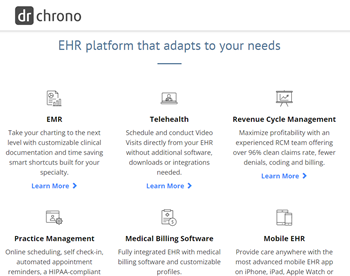
Business management software vendor EverCommerce will acquire EHR/PM vendor DrChrono.

The company previously acquired MDTech, ISalus Healthcare, Updox, My PT Hub, EMHware, Collaborate MD, and AlertMD.


Webinars

November 10 (Wednesday) 1 ET. “Too Important to Fail: How to Bring Better AI to Healthcare.” Sponsor: Intelligent Medical Objects. Presenters: Dale Sanders, chief strategy officer, IMO; Marc d. Paradis, VP of data strategy, Northwell Health. It’s relatively easy to obtain healthcare data and build an AI demo, but getting AI to perform reliably and with meaningful impact is much harder. However, strategies exist for delivering AI products to commercial markets. This fireside chat will review the status of AI in healthcare; discuss the vital importance of data quality, methodological rigor, and product focus; and explore what this means to the startup and investor world.

November 11 (Thursday) 1 ET. “Increasing OR Profitability: It May Be Easier than you Think.” Sponsor: Copient Health. Presenters: Michael Burke, co-founder and CEO, Copient Health; David Berger, MD, MHCM, CEO, University Hospital of Brooklyn at State University of New York Downstate Health Sciences University. The OR is a hospital’s biggest source of revenue and its costliest resource, yet it often sits idle because of unfilled block time even as providers with cases ready to book lack access. AI-powered emerging technologies can help fill unused OR time and provide decision support to structure workflows and optimize block allocation. This webinar explores the biggest challenges to profitability faced in the OR and the fastest, most impactful changes a hospital can make to address them.

Previous webinars are on our YouTube channel. Contact Lorre to present your own.


Acquisitions, Funding, Business, and Stock

image

Allscripts announces Q3 results: revenue up 1%, adjusted EPS $0.27 versus $0.11.

image

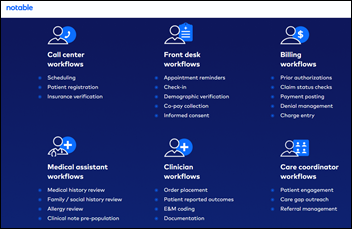
Notable, whose technology scans data from EHRs and other applications to trigger task automation workflows, raises $100 million in a Series B funding round. The three founders came from loan processing software vendor Blend.

Cohort Intelligence, whose technology allows doctors to find patients who are candidates for being billed for Medicare’s Chronic Care Management services, changes its name to Engooden. 

Aver raises a $58 million investment and renames itself to Enlace Health. The company’s website is dense with buzzword bingo-speak that leaves me clueless about what they’re selling, so I’ll let them describe: “Enlace Health delivers the only end-to-end solution that solves the infrastructure challenges driving today’s unsustainable healthcare system. Connecting payers, providers, and patients, Enlace empowers any type of healthcare delivery model, from facilitating retrospective programs to enabling risk for prospective programs. Combining executive-level healthcare DNA with an extensible technology platform, Enlace is the bridge from chaotic healthcare to the healthcare world when Triple Aim optimization is truly realized.”

image

Change Healthcare reports Q2 results: revenue up 9%, EPS –$0.11 versus –$0.13, beating earnings expectations but falling short on revenue. The company’s planned acquisition by OptumInsight is being reviewed by the Department of Justice and won’t be completed earlier than February 22, 2022.

image

Papa, which offers health plans a “family on demand” service to match older adults with non-medical helpers, raises $150 million in Series D funding, valuing the company at $1.4 billion. The company cites studies that found that its use reduces member loneliness by 68%, which then reduces hospital use. The father of 33-year-old co-founder Andrew Parker founded MDLive, where the younger Parker served in sales and VP roles for five years before Papa was launched in 2017. The company’s Uber-like model involves having “Papa Pals” accept task assignments from the company’s app in being paid as independent contractors.


Sales

  • Gundersen Health System will implement Kyruus One and ProviderMatch for Consumers for finding providers and eventually booking appointments.
  • Parkland Health & Hospital System chooses Current Health for remote patient monitoring for hypertension.

People

image

Well Health hires Sean Kelly, MD (Imprivata) as chief medical officer.

image

Healthcare Triangle names Manish Hindupur (XCM Solutions) as VP of cloud service delivery for life sciences and healthcare providers.

image

Nuance promotes Vito Augusta to regional VP.

image

The Providence Digital Innovation Group hires Andy Chu (Bold) as SVP of product and technology incubation.


Announcements and Implementations

image

In England, Verizon Business and telehealth platform vendor Visionable announce Care Everywhere, while will be sold in the APAC and EMEA regions.

Hospital for Special Surgery (NY) becomes the first US hospital to offer Clear’s Health Pass to expedite the entry of vaccinated patients for visits. Visitors who don’t use the technology will continue with in-person screening and check-in.

image

Mazda will add in-car cameras that will detect when drivers are having a stroke or heart attack and then guide their vehicle to a safe spot with flashing lights on, starting with next year’s models that are sold in Japan. By 2025, Co-Pilot Concept will also diagnose impending driver health problems and provide advance warning. The carmaker is working with medical experts to allow its cameras to recognize driver positions that indicate problems.


Government and Politics

The federal government will require facilities that are paid by Medicare or Medicaid to fully vaccinate all of their employees against COVID-19  by January 4, 2022. Enforcement will be via CMS surveyors.

CMS increases the minimum penalty for hospitals that fail to comply with the Hospital Price Transparency final rule to $10 per bed per day starting January 1, 2022. The final CMS rule also prohibits hospitals from hiding their machine-readable price files from search engines.

A VA-conducted anonymous survey of employees of Mann-Grandstaff VA Medical Center finds that 83% say their morale is worse since Cerner went live last fall, 81% report increased burnout, 62% aren’t confident about using Cerner to perform their jobs, and 63% question whether they should continue working for the VA. A Congressional committee questioned whether the VA has moved on prematurely from its first implementation to focus on the upcoming one in Columbus. VA Deputy Secretary Donald Remy says he will visit Mann-Grandstaff, the VA will create a new position for someone with large-scale EHR implementation to oversee daily decisions, and the VA may create a deputy CIO position to oversee the Cerner implementation directly.


Other

image

Bloomberg Businessweek says that 23andMe has stuck to its business plan from 15 years ago – first to convince consumers to send in their DNA samples to gain trivial insight about ancestral origins, then to use their sequencing data to profitably develop drugs — in creating a new IPO’d business that is “sitting somewhere between a Big Pharma lab, a Big Tech company, and a trusted neighborhood doctor.” The article says that co-founder and CEO Ann Wojcicki, who was formerly married to Google co-founder Sergey Brin, was influenced by Google’s strategy to “collect all the data, derive whatever insights you can, and find an adjacent line of business with the potential to yield much bigger profits.” The article notes that consumers who have sent samples might feel baited-and-switched by having the company use the data they paid to contribute used to generate drug profits. Wojcicki says she hasn’t decided how the company will manage its just-announced acquisition of virtual visit company Lemonaid Health, but Lemonaid’s doctors will use genetic information for prescribing drugs once the company has determined the usefulness of genetic risk factors in primary care. She responded to a question about patient privacy by saying that patient data is being widely sold by the medical establishment without the patient’s knowledge anyway, although experts note that 23andMe’s process bypasses a third-party data broker and doesn’t involve paying consumers for using their data to generate profits.

image

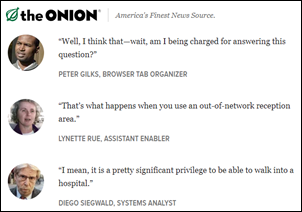
The Onion weighs in on a woman who was charged a $700 ED facility fee by Emory Decatur Hospital even though she left without being seen after seven hours of waiting with a head injury. Emory Healthcare told her that patients are charged before being seen, not for actually being seen.


Sponsor Updates

  • Medicomp Systems releases a new Tell Me Where It Hurts Podcast featuring Phoenix Children’s Hospital EVP and Chief Innovation Officer David Higginson.
  • Cerner and transplant software vendor Transplant Connect integrate their systems to automate donor referrals.
  • CHIME honors Nordic Consulting Board Chair and former CEO Bruce Cerullo with its Foundation Industry Leader Award.
  • Empowered Patient Radio features First Databank Nicole Wulf, “Debunking the Myth of Iodine Allergy Related to Contrast Agents Used in Imaging Procedures with Dr. Nicole Wulf FDB.”
  • Fortified Health Security hires Jessica Marshall (ChanceLight Behavioral Health) as VP of human resources.
  • Goliath Technologies has achieved record revenue and customer growth during the first half of 2021.
  • Health Data Movers publishes a new client story, “EHR Integration Makes Providers’ Jobs Easier.”
  • Vanguard Law Mag features Lyniate Chief Legal Officer Merritt McGowan, “Taking a personal approach to health care law.”
  • Vyne Medical publishes a podcast titled “How Patient Experience is Leading Hospitals Towards Digital Transformation.”

Blog Posts


Contacts

Mr. H, Lorre, Jenn, Dr. Jayne.
Get HIStalk updates.
Send news or rumors.
Contact us.

125x125_2nd_Circle

EPtalk by Dr. Jayne 11/4/21

November 4, 2021 Dr. Jayne Comments Off on EPtalk by Dr. Jayne 11/4/21

clip_image002 

I was at my local academic medical center for a meeting a couple of weeks ago and noticed that they have new policies in place regarding wearing scrubs outside the hospital. Apparently they’ve selected a new and distinctive color for the scrubs that are worn to the operating rooms, and if you’re caught trying to wear them out of the building, you’re subject to disciplinary action and possible termination. They already have scrub “vending machines” that prohibit you from taking scrubs home since they’re linked to your ID badge and you’re limited on how many sets can be issued to you. Wearing scrubs from the outside world into the operating suite isn’t ideal, so it makes sense not to let them go to the outside world in the first place.

Still, they don’t have any restrictions on what shoes can be worn in or out of the hospital, which given some recent news, might be a good idea. Shoe soles were swabbed for the presence of C. difficile bacteria, which is the most common healthcare-associated infection in the US. The results were presented at the Infectious Disease Week 2021 annual meeting and showed that shoe soles had a high rate of contamination and were similar to floor samples taken in either private homes or healthcare facilities. The researchers propose that when patients who are at risk for getting C. difficile infection are placed on high-risk antibiotics, that they may need additional education about cleaning floors and removing shoes before entering the home. Sometimes public health informatics isn’t considered sexy, but if you’ve ever encountered a patient with C. difficile diarrhea, you would likely support any research that would help reduce its presence in the world.

clip_image003

The AHIMA Foundation recently released a study on the “Understanding, Access and Use of Health Information in America.” In short, more than three-quarters of patients in the US don’t leave their physician’s office on a positive note. The study notes disconnects between the information that physicians think they are sharing and what patients understand. The findings are similar among caregivers who share concerns about their loved ones’ ability to process information they’ve been presented.

One of the data points I found most interesting was that more than 20% of patients don’t feel comfortable asking their physician certain questions. That points to the difficulty in building patient-physician trust and open communication. I was reading this in the context of a recent conversation with a medical school professor, who noted that at times his trainees were so uncomfortable with certain topics in class forums where patients were present that they asked if they could present their questions to the patients anonymously.

Other interesting tidbits:

  • Seventeen percent of patients report not having an opportunity to ask questions at all during a visit.
  • Ninety percent of patients search for health information on the internet, and 80% are confident that information is credible.
  • More than half of patients report that they rarely access their medical records to review health information.

The latter bullet point indicates that we have a long way to go as far as the patient side of the information blocking equation is concerned. I certainly don’t see any public health organizations that have the resources to educate patients on the benefits of interacting with their own records, and although hospitals and health systems are promoting the use of patient portals as a convenience, I don’t see a lot of campaigns around how important it is to actually review your records. I’ve found multiple errors in my own charts (one of which was potentially life-altering), so I always review my after-visit summaries, but then again, I’m a physician who is also a data junkie which is a status shared by a relatively small number of patients.

Administrative simplification is a hot topic among my friends who are part of the revenue cycle side of healthcare informatics. The US spends a ridiculous amount of money on healthcare administration and a recent editorial in the Journal of the American Medical Association notes that administrative simplification has the potential to remove a quarter-trillion dollars from our healthcare expenditures in the near future. In 2019, $950 billion was spent on administrative functions within the US healthcare system, despite efforts to introduce technology as a way to streamline functions. In our non-system system, administrative staff outnumber physicians and nurses 2:1 with more than a million administrative roles being added in the last two decades.

The authors propose that 28% of annual administrative spending could be cut without impacts to quality or access. Many of the targeted areas are not healthcare related: general administration, human resources, non-clinical TI, sales, marketing, and finance. The second largest group of targets is financial, including revenue cycle management, prior authorization, and claims processing. Further down the list are the actual healthcare interventions, such as convincing payers they should standardize processes and clinical requirements for prior authorization. The authors propose that for many of the changes, financial incentives would be needed to overcome organizational inertia.

I’ve been in some recent training classes with international physicians, and it’s been interesting to hear their questions about phenomena that are particular to the US health system. In many countries, there’s no concept of different billing codes for different types of visits. In some countries, primary care physicians are mandatory, and in others, the concept doesn’t exist. I’ve enjoyed learning first-hand what things might look like in another part of the world and I hope that some day we could reach the levels of commitment to public health and universal coverage that I’ve been hearing about. In the mean time, we’ll have to keep playing Whac-A-Mole with crisis after crisis in the US healthcare system and see if it can recover before it breaks.

If you’re part of a payer/provider organization, I’d be interested to hear what administrative simplification looks like from your perspective. Is the grass already greener on your side of the street, or are you smiling like the Mona Lisa because there are secrets you can’t talk about? Let’s hear some ideas for how to solve these issues and free up money for other worthy projects. Have ideas? Leave a comment or email me.

Email Dr. Jayne.

Comments Off on EPtalk by Dr. Jayne 11/4/21

Readers Write: Creating a More Equitable Health System

November 4, 2021 Readers Write Comments Off on Readers Write: Creating a More Equitable Health System

Creating a More Equitable Health System
By Wylecia Wiggs Harris, PhD

Wylecia Wiggs Harris, PhD is CEO of AHIMA of Chicago, IL.

image

As a Black woman, I have been aware of the negative impact of health inequities my entire life, long before becoming the leader of the American Health Information Management Association (AHIMA). In the past year and a half, the pandemic has put a spotlight on the inequities of our healthcare system.

AHIMA and our members stand in a unique position to improve health equity. Health information professionals possess the data skills and expertise to make a positive impact, and we often have a bird’s-eye view of our respective healthcare organizations, allowing us to see the big picture and the ripple effects of any decision.

There are tangible actions we can take to improve health equity. It’s vital that we continue to collect patient demographic and social determinants of health (SDOH) data. We must encourage health systems to prioritize the collection of accurate and complete patient demographic and SDOH data. This data will shed light on the socioeconomic factors that impact the health of both individuals and larger populations. Health information professionals treat this data with the respect it deserves.

I’m proud that AHIMA’s advocacy team encourages policies that improve access to care. We believe it’s important for policymakers to guarantee the right for all people to have access to affordable, high-quality health coverage. We must continue to advocate for policies that help our country reach this important milestone.

We’re fortunate that improvements in technology are making it more efficient to address health disparities. Health information professionals promote the use of technology to analyze and improve quality of care and patient outcomes. We encourage the development, piloting, and testing of machine learning and artificial intelligence technologies that identify and address biases in health data; this can help avoid exacerbating existing health disparities and inequities. We are excited and optimistic about how technology can improve health equities in the years to come.

None of this can be done without a capable team of professionals. Investing in and training a diverse, culturally competent workforce is vital to foster an inclusive approach to addressing health disparities and inequities. It’s critical that patients’ demographic data and SDOH data is managed in ways that are culturally sensitive and having a properly trained workforce is critical.

These teams are needed so that we can continue to support efforts to overcome historical mistrust in healthcare institutions. Many communities of color have an understandable mistrust of healthcare institutions, and to counter this we must identify and dismantle policies that support structural racism and discrimination. At a local level, we must also foster positive patient-provider relationships and engage community leaders in decision-making processes.

I thank all the health information professionals who are helping to create a more equitable and just healthcare system and world. Together, we are making a difference.

Comments Off on Readers Write: Creating a More Equitable Health System

Morning Headlines 11/4/21

November 3, 2021 Headlines Comments Off on Morning Headlines 11/4/21

Notable Raises $100M Series B to Expand Intelligent Automation in Healthcare

Healthcare workflow automation company Notable raises $100 million in a Series B round led by Iconiq Growth.

Wellinks Announces $25M in New Funding to Expand First Integrated Virtual COPD Management Solution to More Patients

COPD-focused digital health vendor Wellinks raises $25 million in a Series A funding round led by Morningside Ventures.

Congress fears VA is ‘moving on’ amid persistent EHR challenges, low employee morale at initial go-live site

The VA plans to begin the testing and training phase of its new Cerner EHR deployment at a second site in February, despite concerns that issues at the first site still haven’t been resolved and governance leadership has yet to be put in place.

Comments Off on Morning Headlines 11/4/21

Morning Headlines 11/3/21

November 2, 2021 Headlines Comments Off on Morning Headlines 11/3/21

Kareo and PatientPop Merge to Form Tebra, A Digital Healthcare Technology Company Dedicated to Modernizing Healthcare Practices

Medical practice software vendor Kareo merges with PatientPop, which offers practice growth technology.

EverCommerce to Acquire DrChrono, a Leading Cloud-based SaaS Practice Management and EHR Solution

EverCommerce will add DrChrono’s EHR, practice management, and RCM software and services to its EverHealth line of solutions.

WhiteSpace Health Announces $18 Million in New Funding to Build Out AI-driven Revenue Intelligence Platform

Revenue-focused analytics vendor WhiteSpace Health secures an $18 million investment from parent company Omega Healthcare.

Comments Off on Morning Headlines 11/3/21

News 11/3/21

November 2, 2021 News 8 Comments

Top News

image

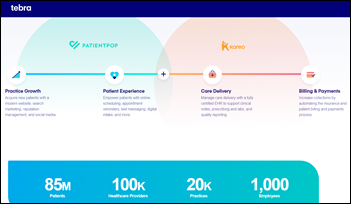
Medical practice software vendor Kareo merges with PatientPop, which offers practice growth technology. The combined companies will operate under the name Tebra.


Reader Comments

From Pipette: “Re: Jonathan Bush. He scorns the HIMSS conference ‘boat show’ in an article, but I seem to recall that Athenahealth docked its own figurative craft out there on the show floor with all those other vendors.” JB has always expressed amusing scorn for the show that his then-company supported as a sponsor and exhibitor. His latest piece from his new seat at Zus Health compares the HIMSS conference to HLTH, observing that while HIMSS feels outdated, mainstream companies are required to attend because 95% of doctor visits are still powered by code written by HIMSS members (he misspells Neal Patterson’s name as “Neil,” but so do a lot of people who probably confuse it with Neil Pappalardo). He says HLTH is like a prom of on-the-rise attendees that is more focused on care than technology, with few geeks in attendance and a lot of premature pomp from companies that will probably fail and “provide critical compost for the winners’ crops.” Here’s his introductory paragraph:

​I think I’ve been to HIMSS roughly a thousand times. It was almost comical to walk into that giant convention center and see the booths two and three stories tall, like giant ships at a boats how. Esteemed patrons would climb up gilded, spiraling stairwells for bottled water and espresso shots, while down on the floor, consultants and competitor employees were shooed away by stiff-smiled booth attendants. These booths, massive and imposing, increasingly looked like something a defense contractor might make, until they literally were made by defense contractors. It was a world where technology was starkly separate from care, where vendors would hawk their wares, distanced from the reality of the very institutions they were selling to. Sure, there were some doctors at HIMSS — the “CMIOs” and whatnot — but they were akin to Afghan translators embedded with our troops — good people, feeling a little bit out of place and a little bit worried that they may be viewed negatively by their people.


HIStalk Announcements and Requests

Question: does it bug you when someone writes “y’all” in an email or social media update? I’ve always liked hearing it said by actual Southerners — kind of like “holler, “howdy,” or “reckon” – but not as much in writing. Blame the English language for not offering a separate plural form of “you”  — other than the outdated “ye” as a plural or “thou” as the singular with “you” as its plural — and thus spawning the workarounds “yinz,” “youse,” and the grating server salutation “you guys.”


Webinars

November 10 (Wednesday) 1 ET. “Too Important to Fail: How to Bring Better AI to Healthcare.” Sponsor: Intelligent Medical Objects. Presenters: Dale Sanders, chief strategy officer, IMO; Marc d. Paradis, VP of data strategy, Northwell Health. It’s relatively easy to obtain healthcare data and build an AI demo, but getting AI to perform reliably and with meaningful impact is much harder. However, strategies exist for delivering AI products to commercial markets. This fireside chat will review the status of AI in healthcare; discuss the vital importance of data quality, methodological rigor, and product focus; and explore what this means to the startup and investor world.

November 11 (Thursday) 1 ET. “Increasing OR Profitability: It May Be Easier than you Think.” Sponsor: Copient Health. Presenters: Michael Burke, co-founder and CEO, Copient Health; David Berger, MD, MHCM, CEO, University Hospital of Brooklyn at State University of New York Downstate Health Sciences University. The OR is a hospital’s biggest source of revenue and its costliest resource, yet it often sits idle because of unfilled block time even as providers with cases ready to book lack access. AI-powered emerging technologies can help fill unused OR time and provide decision support to structure workflows and optimize block allocation. This webinar explores the biggest challenges to profitability faced in the OR and the fastest, most impactful changes a hospital can make to address them.

Previous webinars are on our YouTube channel. Contact Lorre to present your own.


Acquisitions, Funding, Business, and Stock

image

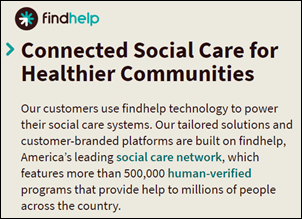
Digital social services referral company Aunt Bertha rebrands to Findhelp.


Sales

  • Christus Santa Rosa Hospital – New Braunfels (TX) selects Care Continuity’s care logistics software to facilitate patient transitions from its ED to primary care physicians and specialists.
  • Pipeline Health System selects Premier’s supply chain technology and services.

People

image image

WebPT hires Ashley Glover, MBA (RealPage) as CEO. She replaces the retiring Nancy Ham, who will move to board chair.

image

Hinge Health names Lalith Vadlamannati, PhD (Amazon) as CTO.

image

HIPAAtrek promotes Amy Coulter to CEO. She co-founded Ability Network, which was sold to Inovalon in 2018 for $1.2 billion.

image image

Southwestern Health Resources (TX) names Mac Marlow, MBA (Lehigh Valley Health Network) CIO and Shashi Vangala, MS (Baylor Scott & White Health) chief data and value creation officer.

image image

Medication management technology vendor Arine hires Todd Christiansen, RPh, MBA (Leidos Health) as chief growth officer, Thomas Cooke (Leidos) (not pictured) as VP of business development, and Amy Mosher-Garvey, MSSW, MBA (Leidos) as VP of client success.

image image

Avia names Anjani Shah, MBA (McKinsey & Co.) SVP of transformation and Dhiraj Patkar, MS (HRGi Holdings) SVP of product for Avia Connect.

image

Agathos, which sends hospital physicians action-level insights on their practice patterns, hires John Pollard (Nordic) as head of marketing,


Announcements and Implementations

image

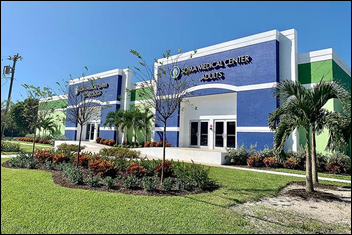
Soma Medical Center has deployed EHR and health information search engine technologies from EClinicalWorks across its 25 facilities in Florida.

image

A new KLAS report reviews risk adjustment solutions.


Privacy and Security

image

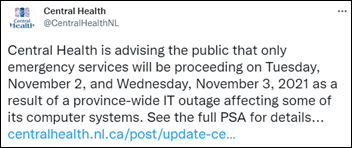
In Canada, Newfoundland and Labrador struggles to recover from a weekend ransomware attack on its health IT systems that has forced its facilities to revert to downtime procedures and cancel appointments.


Other

Seattle Children’s Hospital electronically replaces allergy reaction descriptions in Epic that contain the the formerly common term “red man syndrome” – which it says is racist language — with “vancomycin flushing syndrome.” The hospital also implemented autocorrect functionality to prevent use of the term. The phenomenon in which IV vancomycin causes a red rash was first documented in 1959 as “Red Man’s Syndrome,” which was the subject of a 1985 proposal to instead call it “Red-neck Syndrome” to recognize that it occurs equally in men and women.


Sponsor Updates

  • The Health Innovation Matters Podcast features AdvancedMD Chief Marketing Officer Jim Elliott.
  • A newly published peer-reviewed study concludes that Bamboo Health’s NarxCare solution is effective as an “initial universal prescription opioid-risk screener.”
  • Philips Capsule Medical Device Information Platform has exceeded the milestone of integrating with more than 1,000 unique medical device models.
  • Cerner publishes a white paper, “Unlocking the power of data with the Cerner Learning Health Network.”
  • Dina will exhibit at the FirstLight Home Care conference November 4-5 in Salt Lake City.
  • Engage, a Tegria company, maintains its position as one of the top firms in a new KLAS Research Performance Insights report, “Meditech Implementations Services 2021: Which Firms are Driving Successful Implementations?”
  • Emerge publishes a case study, “Emerge Improved Revenue and Quality for Multi-Specialty Group Using Natural Language Processing.”

Blog Posts


Contacts

Mr. H, Lorre, Jenn, Dr. Jayne.
Get HIStalk updates.
Send news or rumors.
Contact us.

125x125_2nd_Circle

Morning Headlines 11/2/21

November 1, 2021 Headlines Comments Off on Morning Headlines 11/2/21

This Startup Just Raised $7.2 Million To Provide Healthcare For Hourly Workers

Membership-based, in-home and virtual care services startup Vitable Health raises $7.2 million.

Possible cyberattack hits ‘brain’ of N.L. health-care system, delaying thousands of appointments

In Canada, a ransomware attack on Newfoundland and Labrador’s health IT systems force its facilities to revert to downtime procedures and cancel thousands of appointments.

Nation’s Leading Social Care Network Announces New Name, Aligning Brand to Mission in Time of Momentous Impact

Digital social services referral company Aunt Bertha rebrands to Findhelp.

Comments Off on Morning Headlines 11/2/21

Curbside Consult with Dr. Jayne 11/1/21

November 1, 2021 Dr. Jayne 2 Comments

image 

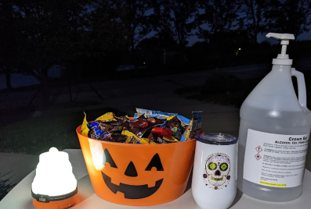
Halloween is my favorite holiday, and I hated that COVID-19 pretty much killed it last year. This year, I decided to make a driveway treat station, keeping a table between the trick-or-treaters and me, and making sure to sanitize before lobbing candy into pillowcases and plastic pumpkins. (No kids’ hands in the bucket, thank you very much!)

I had a little less than half of the visitors I have in a “normal” year, but was glad to see people getting out. Lots of adults were in costume and running around with their youngsters, and more than one mom commented on my gallon of industrial hand sanitizer. What can I say? Old emergency department habits die hard.

I’ve been knee-deep in telehealth projects the last couple of weeks, so I’m always on the lookout for good articles or information. I thought this NPR article was interesting. It presents all the reasons why patients like telehealth, such as not having to leave home, not having to wait at a medical office, etc. However, it also presents data from a recent poll that found that 60% of patients would prefer to see their provider in person. This may be a sign that the pendulum is swinging towards traditional in-person office visits. As a physician, I agree that certain conditions are better handled in person, such as a new orthopedic injury, rashes, or abnormal moles. Patients who are nervous about telehealth or who have technology challenges are better served in person as well.

Still, I take issue with one of the quotes in the article, where a concierge physician mentions limitations during telehealth visits where “You may be missing that opportunity to be talking with the doctor who’s going to say, ‘Hey, by the way, I see you haven’t had your mammogram or you haven’t had your pap [smear].’” I would argue that’s not necessarily a limitation of the telehealth modality, but rather an issue of the patient and physician taking time to focus on preventive measures or reviewing potential gaps in care, which should be easy to accomplish regardless of the way the visit occurs. There’s not anything particular about a telehealth visit that should interfere with a physician accomplishing that discussion. Failing to review preventive milestones seems to me more like a bedside manner issue than an in-person versus telehealth issue.

The article wanders into the premise that maybe telehealth is only for when in-person visits aren’t available, such as in rural communities or where there are shortages of specialists. I disagree. What I’ve seen as a telehealth physician is that many patients prefer not having to interrupt their lives to participate in the frustrating operational exercise of interacting with a medical office. Especially with the overall labor shortage and people leaving healthcare in droves, the frustration factor of interacting with short-staffed offices is at an all-time high. Where offices may be adding greater access through telehealth, they may not be spending time fixing broken processes or making the patient experience smoother.

I had one of those frustrating interactions this week that made me want to tear my hair out. As a person who has had a couple dozen skin biopsies, I know when I see something unusual that needs to be checked out. Due to a busy schedule, I hadn’t been able to call my dermatologist’s office, but ended up checking in MyChart to see if they were doing online scheduling. It looked like they were, and I was excited, but when I hit the button to search for open appointments it told me that someone would be contacting me from the office. Two days later, in the midst of another busy day, I received a MyChart appointment reminder, for an appointment that was two hours from the current time. Since I can’t drop everything and run to an appointment, I canceled it online then immediately called the office to reschedule.

Due to staffing issues, the office has transitioned its scheduling to the medical school’s central scheduling line, and a fairly unprofessional phone staffer told me “I have no clue how you got that appointment, because your doctor is booking way out at the end of February.” I was treated like I was making the whole thing up. He told me that he would have to send a message to the office to “see what they want to do with you” and that someone would call in 48 to 72 hours. I didn’t bother to tell him that 48 to 72 hours would be Saturday or Sunday since I honestly didn’t think he would care. While on the call, I received a MyChart message from a nurse offering me the now-canceled appointment, and I responded that I had canceled the visit already and needed at least a little lead time for an appointment.

Several hours later, I received two hang-up calls from the office followed by a third that actually connected. This was a scheduler who was responding to the central scheduling message and was unaware of the previously offered appointment. I explained the whole timeline to her and that I didn’t think this was an urgent issue, but I didn’t want it to wait four months given my history. She was able to find a “work in” appointment at the end of November. Had I not been a physician who understood the potential seriousness of what was seeing and had the wherewithal to advocate for myself, I probably would have given up by this point. Had I been a worker who couldn’t take random calls from my physician’s office, the phone tag probably would have gone on for days.

It’s within this context and with this type of underlying frustration that people are experiencing telehealth. I’m sure it has an impact on their perceptions of how much better it might seem than having to go to the office, sit in a waiting room, wait some more in an exam room, and be ignored while people tend to phone calls at the check-out desk. Of course some offices manage this better than others, but the point is that patients are ready for a change and anything that is not the status quo is going to be welcome.

The bottom line is that we need to work to make all health interactions more streamlined, more valuable, and more patient and family friendly. While we are making things more convenient with telehealth, we also need to make them more convenient when patients choose or require in-person visits. Let’s optimize all those systems we paid big money for. Let patients update their histories and check in online before the visit rather than handing them the proverbial clipboard at the office and requiring them to write down information they’ve provided a dozen times before. Let’s figure out how to allow patients to self-schedule while simultaneously solving practice capacity issues so it doesn’t take a third of a year for a patient to be able to have a new problem evaluated.

Telehealth is part of the solution, but it’s not the only answer to the many problems we’re facing. Let’s challenge ourselves to try to find one way each month to make things better for our patients. Who’s with me?

Email Dr. Jayne.

Readers Write: The Rise in Health IT Valuations and Deal Flow

November 1, 2021 Readers Write Comments Off on Readers Write: The Rise in Health IT Valuations and Deal Flow

The Rise in Health IT Valuations and Deal Flow
By Chris McCord

Chris McCord, MBA is managing director at Healthcare Growth Partners of Houston, TX.

image

In this post-pandemic era, the world is changing at a pace that is nearly impossible to process, which makes decision-making harder and seemingly riskier than ever. With limited data to inform our decisions and understanding of reality, instincts become crucial as we attempt to navigate and make sense of the world. So, let’s take a moment and unpack some of the data so we don’t have to take a leap of faith.

image

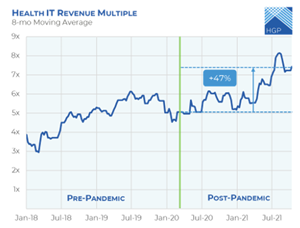
To begin, you aren’t fooling yourself if you think that health IT valuations have risen since the pandemic. Using an eight-month average (the shortest period to capture statistically significant data), average health IT revenue multiples in control M&A and buyout transactions increased from 5.1x immediately prior to the pandemic to 7.4x today. The data imply that the exact same company is now worth 47% more today than before the pandemic, an extraordinary realization that highlights the paradox that is the raging bull market amidst the unrelenting pandemic.

While the 47% increase certainly feels like a head-scratcher, we see key drivers behind the madness, one being the mirror-image trend in the Nasdaq, which has risen an astounding 50% in the same time period. The surge we’ve seen in multiples in this post-pandemic period magnifies an almost uninterrupted decade-long expansion of multiples.

It’s important to note that M&A multiples are influenced by survivorship bias, which creates a bias toward the valuations of deals that close versus those that don’t. The deals that close may have characteristics, such as overall higher quality, that make them superior to those that don’t close. In other words, one can’t necessarily extrapolate value simply from multiples without taking many factors into account.

image

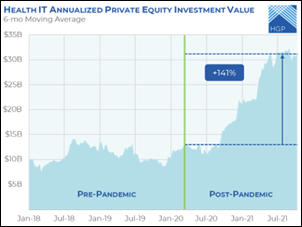
From a health IT perspective, equally pronounced is the spike in investment value. US-based health IT private equity investment historically hovered around $10-15 billion. During the pandemic, this rate increased 141% to more than $30 billion and is just now showing signs of leveling.

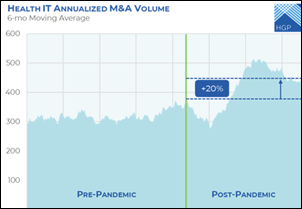
US-based health IT M&A, based on deal volume, also surged during the pandemic, peaking at a rate nearly 50% higher than pre-pandemic levels and settling back to a 20% increase. Low interest rates, excess liquidity, and an indisputable digital health investment thesis are all factors driving these surges in M&A volume and investment value. Further, M&A has been fueled by the threat of the capital gains tax hikes, which has motivated sellers to race to an exit by the end of 2021.

image

What goes up must come down? Barring extenuating circumstances, we may see a leveling, but most likely health IT has entered a new normal. Anecdotally, we see growth equity investment valuations typically priced higher than control M&A transactions (higher than our 7.4x revenue average), and the amount of capital being deployed at these valuations is represented by the 141% increase in private equity investment in our data.

Put another way, there is a substantial amount of capital flowing into the health IT market at historically high valuations. Certainly the investors who are putting capital to work at these high multiples do not expect valuations to drop precipitously, and one could make the argument — albeit a dangerous one because it detaches from fundamentals — that expectations perpetuate themselves.

We will continue monitoring these trends, particularly as we enter 2022 with looming tax hikes, spending plans which significantly impact healthcare, and midterm elections, not to mention the always-uncertain pandemic. Trusting both our instincts and data analysis, we can feel more confident in the direction health IT is taking.

Comments Off on Readers Write: The Rise in Health IT Valuations and Deal Flow

HIStalk Interviews Stephan Landsman, JD, Emeritus Professor of Law, DePaul University College of Law

November 1, 2021 Interviews Comments Off on HIStalk Interviews Stephan Landsman, JD, Emeritus Professor of Law, DePaul University College of Law

Stephan Landsman, JD is emeritus professor of law and organizer and director of the Clifford Symposium on Tort Law and Social Policy at the DePaul University College of Law in Chicago, IL. He co-authored “Closing Death’s Door: Legal Innovations to End the Epidemic of Healthcare Harm” this year.

image

What malpractice risk is involved when clinicians conduct virtual visits?

One of the things that is most concerning is the need for continuity and follow-up. If you are going to conduct medical care by telephonic means, you need to have a reliable system that will keep track of what you’ve advised, what you’ve observed, what tests you need, what the results of those tests are, what follow-up is necessary, what medications ought to be prescribed, and so forth.

Care is not a one-shot deal. It’s not a one phone call kind of thing. It’s a heck of a lot easier to keep track of folks if they show up in your office. It’s more challenging when they don’t. 

The same is obviously true with respect to the kinds of data entries that you make as well. Medical records are incredibly important. Tracking care, tracking information, building up the profile of what the patient’s issues may be, or how they develop or what the reaction to medications is. All of that stuff needs to be entered, needs to be available, and needs to pass before the eyes of the person who was given advice.

By analogy, the hardest time in hospital treatment is the time when one doctor passes the care of a patient off to another. In that situation, you have to have effective communication. You have to have a kind of underscoring of what’s valuable. The same thing is going to be true if the tele-treating physician is not practicing alone, but rather is in a large group, which is usually going to be the case. You need good systems, good data management that’s will get everything of relevance to each of the physicians each of the times that contact, care, or assistance is being done.

Is it sustainable in a litigious environment that telehealth doctors who don’t work for health systems often don’t have access to the patient’s medical records?

There are a couple of kinds of considerations that we ought to think about. The first one that comes to my mind is helping the patient understand that this is real medical care — it’s not a one-shot deal. It may require follow-up, and if follow-up is what we’re thinking about, is there a local physician? Is there an appropriate testing facility? Is there appropriate laboratory? All of that stuff needs to be worked out between the patient and the doctor so there is no perception that you have a one-shot deal. Even if the patient thinks that, the doctor and the treating organization have got to work on the assumption that it isn’t so. That it’s not simply a sore throat and an appropriate prescription that is going to kill a bug, if it’s that kind of thing.

This seems to me to be a very important cultural change to make, both patients and for medical organizations, that when there isn’t an understanding that medical care and medical examination is an ongoing process, then you get particular problems that can lead to legal claims to malpractice and a big mess.

What risks would you warn physicians about as they consider doing virtual visits for a for-profit company as a contractor rather than an employee?

That creates the possibility that there won’t be follow-up. That there won’t be that connection and commitment to patient care that I think is important. That model is one that needs to have some pretty clear ground rules, and some of those have got to come from the physician providing care. He or she has to understand that it’s not ever going to be a one-shot deal.

Lawyers at our school, or at least when I do it, are taught that you can’t give advice without being ready to follow up on that advice and without being committed to the relationship. That first conversation is only the beginning of a relationship. You have to understand this set of situations, patients and doctor, as presenting very similar sorts of demands.

We’re in the midst of culture of change here, and it ought to be emphasized that the treatment via contacting a doctor on the telephone is a very valuable plus to extending care, especially into parts of the population that for financial reasons, psychological reasons, or whatever are very resistant to real face-to-face medical care. But it’s got to be thought of as a relationship. These are not one-shot deals. That’s when you get in trouble, when you think that they’re one shot and don’t have follow-up and don’t have understanding. That tends to be the place where we are likely to see the greatest trauma.

The pandemic led to a relaxation of regulations involving state licensure and requiring initial visits to be conducted in person. Will this loosening of requirements, whether temporary or permanent, raise new legal concerns?

I think it will, yes. We’re feeling our way here. We’re moving in new directions, and the professional responsibilities that will arise out of those new sorts of relationships are ones that we haven’t fully and completely defined. The requirement of face-to-face first has generally not done well in court and has been viewed as a restrictive protection of in-state doctors.

We need to extend the umbrella of care, but having said, that it’s not one phone call. One phone call does not address chronic conditions like diabetes. One phone call does not address progressive heart failure. It’s got to be understood that there’s more going on here. That is part of the change in the universe.

Medical malpractice has often been a signaling device by which medical profession is informed of things that are just not good enough. I’ve done that with things like informed consent, and with a variety of kinds of decision-making between patient and doctor. You’re going to see some of the same kind of considerations being hashed out in future litigation. I certainly would advise to have good insurance coverage in providing this kind of care for any organization that wants to do it, and at the same time, a very careful kind of assessment of what good medical practice requires.

Some investor-funded companies sell prescription products such as unproven COVID-19 treatments and vanity drugs online and use telehealth providers to prescribe them. Does the pressure to issue the prescription increase clinician exposure to risk?

I think that it does. It’s hard to say because it really depends a lot on what’s said, what’s required by the people who are paying the rent, and all that kind of thing. My mind immediately jumped to the time in the United States when online or similar sorts of pharmacies were providing opioid prescriptions through call-in or online mechanisms. Eventually the Congress said, we can’t live with that. That really is in essence of way of fueling what we now believe is the opioid epidemic. Now if you think about that as a model where the danger is fairly substantial, you can say, we are again as a society going to see those kinds of problems and we’re going to react to them.

In the interim, it’s going to be a fairly unpredictable situation. I would not think that it is wise to offer what is in essence medical advice and treatment in situations where your hands are tied about what reactions you can provide and what products you have to present or sell or whatever.

What due diligence and malpractice insurance review should a physician consider when considering doing contract virtual visits for a telehealth company?

You would really want to ask all of those sorts of questions. This is going to sound excessive, but you probably want expert legal advice. We are in a changing field. I would not want to be committed to providing care that was limited in ways that I knew or should have known were handicapped to the patient’s detriment. Part of that is medical due diligence and part of that is legal inquiry. Each of the states is different with respect to these matters. It seems to me that you want to be pretty darned careful about this kind of thing.

I think physicians are pretty concerned about exposure to med mal when they sit down with patients. They should bring that concern to the situation where they’re providing medical advice over the telephone. Part of that is medical scrutiny. Is it good enough? Does it meet the standards? That’s really a question about the profession in the particular state. But part of it is also, where are the courts? Where’s the legislation? What’s been happening?  You need some legal advice. I’d be careful about this kind of thing. 

It’s a great area. It’s a changing area. You miss something if you don’t see the positives here, because I think there really are substantial positives, but  you know we are talking about people’s lives and people’s health and their safety. When that’s going to be jeopardized, you’re going to see a social reaction and there interested parties who are going to push that. Medical societies are not particularly happy with this stuff, they’re going to push, and they have some clout.

Comments Off on HIStalk Interviews Stephan Landsman, JD, Emeritus Professor of Law, DePaul University College of Law


Morning Headlines 11/1/21

October 31, 2021 Headlines Comments Off on Morning Headlines 11/1/21

Cerner Reports Third Quarter 2021 Results

Cerner reports Q3 results: revenue up 7%, adjusted EPS $0.86 versus $0.72, beating analyst expectations for both.

Main Line Health is investing in nurse-founded patient care inventions via a new business arm

Main Line Health (PA) is working with partners to commercialize technology developed by its nurses, initially focusing on hospital room and facility safety devices, EHR add-on components, clinical tests, and medical devices.

Vocera Announces Third Quarter 2021 Financial Results

Vocera announces Q3 results: revenue up 18%, adjusted EPS $0.28 versus $0.26, beating expectations for both.

NextGen Healthcare Reports Fiscal 2022 Second Quarter Results

NextGen Healthcare reports Q2 results: revenue up 7%, adjusted EPS $0.29 versus $0.30, beating expectations for both.

Comments Off on Morning Headlines 11/1/21

Text Ads


RECENT COMMENTS

  1. "most people just go to Epic" that's a problem because then EPIC becomes a monopoly in healthcare, if it isn't…

  2. Only if CEO can post 'bail' which nowadays stands at 1B$ paid directly to the orange president or his family…

  3. I enjoy reading about the donations to Donor's Choice by HIStalk members. I also believe in the worthiness of Donor's…

  4. I hear you, and I agree—HIMSS is definitely facing some big challenges right now. The leadership and governance issues you…

Founding Sponsors


Platinum Sponsors


Gold Sponsors


RSS Webinars

  • An error has occurred, which probably means the feed is down. Try again later.