Home » News » Recent Articles:

Monday Morning Update 7/18/11

July 17, 2011 News 7 Comments

From Brass Tacks: “Re: Danbury Hospital. They fired the CFO over this.” Former Danbury CFO William Roe is sentenced to 33 months in federal prison for embezzling $200,000 from Danbury Hospital (CT) and former employee St. Rita’s Medical Center (OH) by approving invoice payments to a fake software consulting company he had set up. Roe, who made $594K in 2009, blamed poor judgment and begged for a light sentence. The judge, unimpressed by his two court order violations, said, “Your primary concern is for yourself and your family, who have already benefited from the funds you’ve stolen.”

A New York Times article on usability of clinical systems highlights the usual arguments: usability experts say there’s no question that today’s systems are measurably poorly designed to the detriment of clinician users and patients, while vendors strongly resist the imposition of usability standards or mandatory usability testing.

7-17-2011 12-52-47 PM

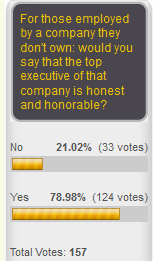
Most poll respondents say the person running the company that employs them is honest and honorable. New poll to your right: should the federal government measure and report the usability of clinical systems?

Essentia Health (ND) goes live on Epic’s EHR July 31th.

Gartner positions mobile application development platform provider Kony in the “Visionaries” quadrant of the Magic Quadrant for mobile consumer application platforms.

David Roberts, HIMSS’s VP of government relations, says it is unlikely that Congress would vote to eliminate future funding for EHR Meaningful Use incentives, despite the current current stalemate in federal budget negotiations. To eliminate the incentives, Congress would need to specifically vote to narrow the scope of the program or eliminate the program entirely. Roberts believes that legislation lacks adequate support to be passed in either houses of Congress.

The weekly e-mails of Kaiser Chairman and CEO George Halvorson are often HIT-related, with this week’s no different. Kaiser researchers have published autism-related studies made possible by its extensive patient data warehouse. They found that pregnant woman who used certain drugs greatly increased the odds of having an autistic baby, but vaccines were not among those drugs. They also found that children are dying of whooping cough because they aren’t being given pertussis vaccine.

Here’s the latest installment of HIStory from Vince Ciotti, this time covering vendors of minicomputer systems.

Greenway Medical Technologies files registration to raise up to $100 million in an IPO. Underwriters include Morgan Securities, Morgan Stanley, William Blair, Piper Jaffray, and Raymond James.

7-17-2011 3-20-52 PM

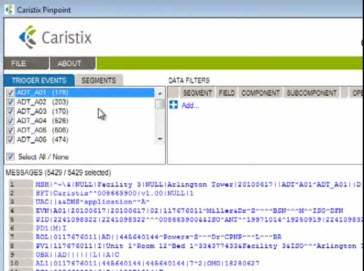
Caristix is offering a free beta program for software that helps hospital integration analysts identify and document custom HL7 interface segments and values.

7-17-2011 1-28-26 PM

Indian River Medical Center (FL) hires as its first CIO Bill Neil, formerly IT director at Presbyterian Healthcare Services (NM).

Scripps Health (CA) chooses Meddius to provide Integration as a Service, replacing its Sybase integration engine.

7-17-2011 2-51-25 PM

Yale New Haven licenses the Rothman Index, which uses real-time clinical systems information to generate a patient score that helps clinicians identify patients whose condition is deteriorating.

UPMC’s living donor kidney transplant program was shut down in May because up to six transplant team members failed to notice a Cerner EMR lab result alert indicating that a donor had undiagnosed hepatitis C. Her kidney was transplanted into a patient who did not have the disease, resulting in the temporary shutdown of the program. The surgeon who did most of the procedures was removed from his position, joining his equally high profile colleague who was fired in an earlier UPMC transplant scandal. A highly regarded transplant nurse was suspended for two weeks. Outside experts blamed generally poor EMR design, saying that UPMC administrators had a “knee-jerk reaction” in removing the surgeon, who had been under pressure to increase procedure volume, instead of examining the system that allowed the error to occur.

7-17-2011 2-46-41 PM

Seven former nurses from Valley Regional Medical Center (TX) sue the hospital, alleging they were fired in retaliation for making good faith reports of unsafe patient conditions. The nurses were terminated for "insubordination" after opposing assignments they claimed endangered critically ill patients. One nurse explained the situation as follows:

"It’s about standing up for your patient. We got into this profession to advocate for our patients… Patients who can’t speak up for themselves… And that’s what we’re trying to do here."

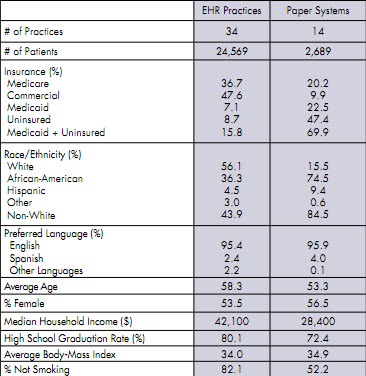
EHRs provide more comprehensive information on health services received than do Medicaid, according to a study published in the Annals of Family Medicine.

Mayo Clinic announces it is close to completing the development of tools that can identify and sort digital health information from any EMR, regardless of file format and data organization. Mayo’s project is funded by the HHS through its $60 million Strategic Health IT Advanced Research Projects (SHARP) program.

Next month CMS will roll out a pilot program for the electronic transmission of documents to support claims. Designated “health care handles” will serve as intermediaries between CMS and providers.

Strange: a city-employed nurse is fired for inappropriately accessing the electronic medical records of hospital patients. She says the real issue is her part-time job as a psychic, where she told patients they were about to experience heart attacks and claimed to be speaking to deceased co-workers from beyond the grave.

Contacts

Mr. H, Inga, Dr. Jayne, Dr. Gregg.

News 7/15/11

July 14, 2011 News 14 Comments

Top News

7-14-2011 4-54-17 PM

Nuance Communications acquires transcription services provider Webmedx. Both companies offer outsourced transcription services with speech recognition capabilities and offer NLP technology to extract information and convert it into discrete data. It’s been a busy week for the transcription services and speech technology segment: earlier this week, MedQuist announced plans to acquire M*Modal for $130 million.

7-14-2011 4-12-37 PM 7-14-2011 4-36-10 PM 7-14-2011 4-37-06 PM 7-14-2011 4-38-30 PM

Allscripts adds four senior execs to its leadership team including Cliff Meltzer as EVP of solutions development, Steve Shute as EVP of sales, Jackie Studer as SVP and general counsel, and John Guevara as CIO. Meltzer is an Apple, Cisco, IBM, and CA Technologies veteran and replaces the now retired John Gomez. Long-time IBM-er Shute replaces Jeff Surges, the current CEO of Merge Healthcare. Studer (GE Healthcare) takes over for Kent Alexander, and Guevara (Microsoft, Intermec, Siemens) is Allscripts’ first CIO.  Allscripts also announced the department of COO Eileen McPartland, who is leaving to become CEO of a private company outside of the healthcare industry.


Reader Comments

From Charlie Brown “Re: Worried. Hey Inga. No push e-mail this AM for HIStalk and no new postings since yesterday. Did HIStalk break?” Thanks for your concern, Chuck, but nothing is broken (well, nothing that I know about, anyway.) Alas, Mr. H didn’t set up anything in advance for posting Wednesday, so we went a rare mid-week day with no Readers’ Write or interview. Mr. H promised me he’d eventually return from vacation, so look for an in-box full of HIStalk blasts next week.

7-14-2011 4-02-06 PM

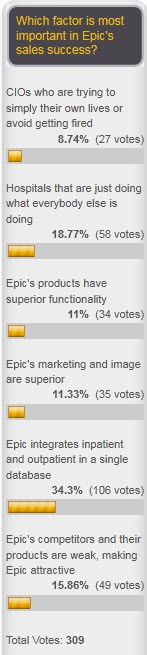
From Boozers “Re: 2010 market share. Wow. Look at how Epic is hurting McKesson.” This table from KLAS shows Epic won 75 deals last year in the 200+ bed hospital market and had no legacy losses. The next best performer was Cerner, with 14 wins and six legacy losses. At the bottom: McKesson Horizon with four wins and 24 legacy losses. Ouch.

7-14-2011 4-26-05 PM 7-14-2011 4-28-05 PM

From Court Jester “Re: From the floor at AMDIS. Lots of interesting discussions and speakers and talk around the evolution of technology adoption by physicians. The hottest topics center around  CPOE and clinical documentation and the need for good workflow and ease of use.” AMDIS’s 20th Annual Physician-Computer Connection Symposium is wrapping up Friday in Ojai, CA. I must admit that if I were Court Jester I would be hanging by the Ojai Resort’s gorgeous pool rather than in the back of one of a meeting room.


HIStalk Announcements and Requests

This week on HIStalk Practice: Dr. Gregg dialogs with Stupid Simple and S&M. Sermo intros Sermo Mobile and iConsult. A whopping 76% of physicians with smart devices utilize iPhones. Physicians increased their ability to generate registries after implementing EHRs. Telepsychiatry is not catching on as fast as other telemedicine services. If you sign up for the HIStalk Practice e-mail updates, the budget crisis might be resolved and the US women might crush Japan. With stakes like that, how can you not sign up? And thanks for reading.


Acquisitions, Funding, Business, and Stock

7-14-2011 4-32-33 PM

drchrono closes $675,000 in its first round of institutional financing. Investors include several VC firms, plus Gmail creator and FriendFeed cofounder Paul Buchheit and Google’s principal engineer Matt Cutts. drchono offers a free EHR for the iPad.


Sales

Nevada Rural Hospital Partners, a 14-hospital alliance, partners with Anthelio (formerly PHNS) to provide business office solutions and coding services to member hospitals.


People

7-14-2011 3-02-52 PM

Progress Software appoints Philip M. Pead to its board of directors. Pead is the current chairman of the board for Allscripts and the former president and CEO of Eclipsys.

7-14-2011 4-07-53 PM

Dominick Bizzarro, the CEO of the Healthcare Information Xchange of New York, resigns to join InterSystems as business manager for the HealthShare HIE platform.


Announcements and Implementations

Nevada-based HealthInsight launches its HIE using Axolotl’s platform. Providers will begin sharing patient information in September.

7-14-2011 8-32-06 AM

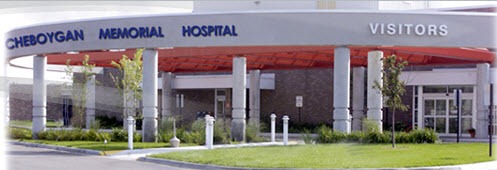
Cheboygan Memorial Hospital (MI) outsources its IT operations to Phoenix Health Systems, who will implement Meditech’s EHR and provide IT leadership and service desk support.


Government and Politics

A bipartisan group of Congressmen introduces a bill that would amend the EHR incentive program to benefit multi-campus hospitals. The legislation would give each hospital campus the opportunity to earn Meaningful Use incentives.


Innovation and Research

The US Patent and Trademark Office awards Epic Systems a patent for “a system and method for providing decision support to appointment schedulers in the healthcare setting.”


Other

Directors of the Kingsport, TN-based RHIO CareSpark vote to cease operations this fall, citing an unsuccessful effort “to transition from a grant and contract based nonprofit organization to a user subscription and revenue sustained entity.” CareSpark was formed in 2005 after receiving $600,000 in funding from the Foundation for eHealth Initiatives and local partners.


Sponsor Updates

7-14-2011 2-00-40 PM

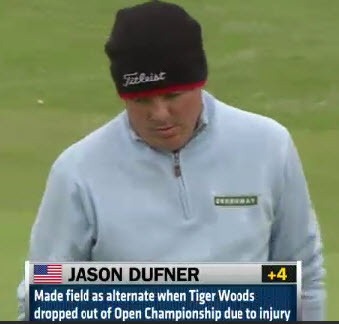
  • Greenway Medical and PGA Tour Golf Pro Jason Dufner debut their new partnership at the British Open. Note the Greenway logo on Dufner’s jacket.
  • The Drummond Group awards SRS EHR ONC-ATCB certification as a complete EHR.
  • GE Healthcare releases a new white paper discussing the annual cost of healthcare-associated infections in terms of dollars and lives. GE Healthcare also announces the formation of MIND, a coalition to help physicians detect, diagnose, and manage neurodegenerative diseases.
  • The Entrepreneurs EDGE awards Lexicomp, a Wolters Kluwer Health subsidiary, its fourth Crain’s Leading EDGE award for creating economic value in Northeast Ohio.
  • Blanton Godfrey, Ph.D. and board chairman of the Institute for Healthcare Improvement will be the featured speaker at TeleTracking Technologies annual client conference in San Diego in October.
  • Sage awards Peter Christensen Health Center (WI) its Healthcare Best Practices award at the Sage Summit conference in Washington DC.
  • Practice Fusion announces Practice Fusion Connect 2011, a free EMR event for its 100,000+ clients, November 11th in San Francisco.
  • AirStrip Technologies expands its leadership team, promoting Bruce Brandes from chief sales officer to EVP and chief strategy officer. Also, AirStrip was named InformationWeek magazine’s Most Transformative Healthcare Application at this week’s Healthcare Leadership Forum in NYC.
  • Emmi Solutions selects Health Language, Inc. to enhance the usability of its patient engagement programs.
  • North Highland announces an expansion into Japan through a partnership with GENEX.
  • Iatric Systems earns ONC-ATCB certification for three more products. Iatric is also hosting a slew of free Webinars over the next three months, covering a variety of clinical and technical topics.
  • Precyse hires Kristen Saponaro as VP of marketing. Saponaro was the principal of Saponaro Communications, LLC, the consulting firm that supported Precyse in its recent rebranding efforts. Precyse was also recently awarded a medical transcription services contract with Community Medical Center (PA).
  • Anson General Hospital (TX) leverages its ChartAccess EHR from Prognosis to successfully attest for Meaningful Use.
  • NextGen execs Charles Jarvis and Tony Landauer are scheduled panelists at next month’s CompTIA Breakaway 2011 in Washington, DC.
  • Allscripts provides its preliminary Q2 financial numbers, which include expected bookings of about $240 million and profits and revenue above analysts’ expectations.

EPtalk by Dr. Jayne

It’s been difficult to get back to the routine with me returning from the beach and Mr. H vacationing, but the lovely Inga has been doing a fantastic job holding down the HIStalk fort. Although I’m still somewhat achy from the gut-busting laughter that accompanied Dr. Gregg’s recent comments on the EHR selection process, I didn’t want to miss the opportunity to share some newsy tidbits and random thoughts.

HHS releases a proposal to revise HIPAA and harmonize it with HITECH provisions. The AMA states: “The proposed rule seemingly goes beyond what is required by laws and would pose significant burdens on physicians if finalized.” The comment period ends on August 1, so let your voice be heard.

The Sage Summit is being held this week at the Gaylord National Hotel and Convention Center in Washington DC. Partner Days are July 10-15 and Customer Days are July 12-15. I understand the Wednesday evening event was “Night at the Museum” at Smithsonian Air and Space. Anyone attending? Let us know what you are seeing and hearing.

A recent survey shows consumers have a higher opinion of facilities using the word “Hospital” as opposed to those who have gone to the ritzier-sounding “Medical Center.” Respondents felt Hospitals provided better care and were more cutting edge. What’s in a name? It reminds me of when a previous employer named their brand new facility the “Cancer Center of Excellence.” Not only was it just tacky, but as far as Centers of Excellence go, it was a new service line that hadn’t gone anywhere near proving itself through outcomes or peer recognition. Personally, I’d like to see a survey on “Information Technology” vs. “Information Services” vs. “Information Systems” departments. A rose by any other name…

For those of you who have been eagerly awaiting implementation of new DEA rules for e-prescribing controlled substances, you’ll probably have to wait on your medical marijuana scripts. The DEA has stated that cannabis “has no accepted medical use and should remain classified as a highly dangerous drug.” Advocates can now appeal to federal courts after a nine year delay. DEA Administrator Michele Leonhart states that “the known risks of marijuana use have not been shown to be outweighed by specific benefits in well-controlled trials that scientifically evaluate safety and efficacy.” How hard do you think it would be to enroll patients in THAT study?

Thanks to Mustang Sally, who sent an article on physicians who use Twitter anonymously. It has some interesting examples, but closes with a mention of the American Medical Association’s ethics policy on social media, which warns that “actions online and content posted… can undermine public trust in the medical profession.” I don’t agree with physicians griping about patients on Facebook or Twitter, but you can imagine that I do see a benefit in anonymity. The full text of the Policy, approved in 2010, can be found here.

Interesting piece from the Kaiser Family Foundation: “Why It’s Okay that EHR Adoption Will Fall Behind 2011 Goals.” The authors cite “cleaning house” as a cause, meaning “older, costly, and difficult-to-implement legacy EHRs will be replaced by less expensive, more agile systems that have been developed specifically for meaningful use and are deliverable in the cloud as Software-as-a-Service.”

clip_image002

I’m off to sample my employer’s mandatory online training offerings, which apparently I must complete or I won’t get paid. After a week of fuzzy umbrella drinks, I’ve decided that Workplace Harassment, Personal Protective Equipment, and Privacy 101 go best with a nice Cab from Joseph Phelps. Have any other suggestions for excellent educational wine pairings? E-mail me.

drjayne


Contacts

Mr. H, Inga, Dr. Jayne, Dr. Gregg.

News 7/13/11

July 12, 2011 News 2 Comments

Top News

The Government Accountability Office reports that the federal government’s systems for analyzing Medicare and Medicaid data for possible fraud are inadequate and underuse, making it difficult to detect the $60 to $90 billion in fraudulent claims paid out each year. The GAO also notes that:

  • CMS spent $150 million on new systems that went live in 2009, yet crucial pieces are missing.
  • The current systems don’t include Medicaid data and CMS’s plans to share Medicare and Medicaid data with states and implement new software have been delayed.
  • Of the 639 analysts who are suppose to use the system, only 41 have been trained so far.

CMS’s top anti-fraud administrator was scheduled to testify for a Senate subcommittee Tuesday to discuss the findings.


Reader Comments

image

From Bamma Bubba “Re: UCLA HIPAA violation settlement. Hospital snoops will never stop – it’s a people problem, not an IT problem. Could be a way to increase federal revenue, but then hospitals just pass the costs on to patient and insurers.” Yep, even though our mothers told us to mind our own beeswax, humans are generally just plain nosy. And at HIStalk we also like to make fun of people that can’t spell HIPAA.


HIStalk Announcements and Requests

Mr. H is still vacationing for a few more days. Either Mrs. H has banned him from the computer or he is in the Land of Bad Internet (I’m betting the latter) because I’ve hardly heard a peep from him in two days. Until his return, feel free to send any hot news my way. Or, if you don’t have hot news, just drop me an e-mail for the heck of it.


Sales

7-12-2011 5-15-54 PM

When Sidra Medical and Research Center (Qatar) opens in 2012, it  plans to run the Cerner Millennium platform and be the first fully digitized medical facility in the country.


People

Mediware hires Michael Anania as VP and GM of the company’s Blood Center Technologies product group. Anania’s previous employers include Roche Diagnostics and Baxter Healthcare.

7-11-2011 2-40-38 PM

MGMA names Susan Turney, MD its president and CEO, succeeding the retiring William F. Jessee, MD. Turney, who is an internist, has served as CEO of the Wisconsin Medical Society since 2004 and founded and chaired the Wisconsin Statewide HIE.

Apollo Health Street beefs up its sales force with the addition of four regional VPs: Ken Bartlett (SSI, McKesson), Dan Contilli (Healthation, SunGard), Troy McCormick (Invikktus, Emdeon) and David Richards (Dell Services, EPBS-Internedix.)

7-12-2011 4-13-40 PM

PointClear Solutions, a provider of HIT product development services, names Rodney Hamilton, MD, CMIO and managing director of its product strategy practice. Hamilton most recently was chief strategy officer for Vanguard Health Systems; he also spent time as a physician liaison with McKesson.


Announcements and Implementations

Predixion Software collaborates with the development team of Clinical Looking Glass to create a predictive model for reducing patient re-admissions. Clinical Looking Glass is a decision support tool that was developed at Montefiore Medical Center (NY).

7-12-2011 5-35-43 PM

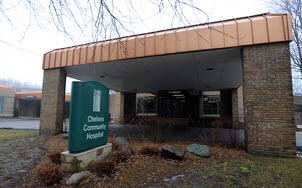
Chelsea Community Hospital (MI) goes live next weekend on its $12 million EMR system. Chelsea is part of Trinity Health so I am assuming it’s a Cerner implementation.

7-12-2011 5-23-15 PM

The Indiana HIE reports that 70 distinct hospitals, long-term health facilities, and health systems were connected to the exchange as of the end of 2010. For the full year, IHIE delivered 3.3 billion pieces of clinical information, which is about 1.1 billion more than 2009’s totals.


Government and Politics

Arizona, Connecticut, Rhode Island, and West Virginia have now launched their Medicaid EHR incentive programs, bringing the total number of live state programs to 21. Only 14 of those states states have issued incentive checks.


Other

7-12-2011 4-55-15 PM

Cerner is sponsoring a 10-week weight-loss competition aimed at helping Kansas City residents drop a combined 100,000 pounds. The KC Slimdown Challenge is expected to involve about 20,000 people. For the calculator-challenged, that’s about five pounds a person.

Corepoint Health is the top-rated vendor in KLAS’s just-released interface engine report. Corepoint has the largest presence of any vendor in smaller healthcare facilities but very few clients in facilities over 500 beds. InterSystems was ranked a close second, though almost all InterSystems Ensemble customers are in 500+ bed facilities.


Sponsor Updates

7-12-2011 6-23-25 PM

  • Cumberland Consulting Groups promotes Erik Howell to principal. Howell has managed multiple HIT projects for Cumberland since joining the company in 2004.
  • Surgical Information Systems is hosting a July 13th webinar on how social media affects healthcare.
  • PatientKeeper’s 2011 User Group Conference is scheduled for September 18-21 in Denver.
  • Lori Prestesater, RelayHealth’s VP of strategy and business development, will be discussing ACOs and Meaningful Use as a panelist at the Institute for HIT’s summit July 26-27 in Denver.  Also at the summit: Software Testing Service CEO Jennifer Lyle, who will join a panel discussion on strategies to achieve Meaningful Use.
  • URAC awards accreditation to MEDecision’s Alineo health utilization management platform.
  • Cancer Treatment of America  selects CareTech Solutions’ Service Desk to provide 24x7x365 IT support for its national network of  centers.
  • Concerro is offering a July 23rd webcast on nursing documentation and reimbursements. Coding expert Glenn Krauss will lead the discussion.
  • Karen Knect of Encore Health Resources will overview e-Measures during a online session July 13th.
  • The Los Angeles County Department of Health will implement Wellsoft Emergency Department Information Systems at its Los Angeles County and USC Medical Center hospitals.
  • Vocera Communications names John McMullen to its board of directors. McMullen is a SVP and treasurer at HP and will serve as chairman of the audit committee.
  • GE Healthcare launches its fully integrated EMR/PM system, Centricity Practice Solution 10.
  • CynergisTek CEO Mac McMillan will be a panelist for the launch of Clearwater Compliance’s HIPAA-HITECH Blue Ribbon panel July 14th.

Contacts

Mr. H, Inga, Dr. Jayne, Dr. Gregg.

MedQuist Holdings to Acquire M*Modal for $130 Million

July 12, 2011 News Comments Off on MedQuist Holdings to Acquire M*Modal for $130 Million

7-12-2011 6-01-04 AM

MedQuist Holdings announced the signing of a definitive agreement to acquire M*Modal and its Speech Understanding technology for total consideration of $130 million, which includes $77.2 million in cash and 4.1 million shares of common stock.

Former Misys CEO Vern Davenport was appointed chairman and CEO of the new entity. He will replace Peter Masanotti as CEO and Bob Aquilina as chairman. Aquilina will continue to serve on MedQuist’s board. and Masanotti will remain a consultant to MedQuist through the end of September.

MedQuist has already been using M*Modal’s technology for its medical transcription business. The company intends to enhance further the integration of M*Modal’s front-end speech recognition technology with MedQuist’s clinical documentation platform.

M*Modal has a current annualized revenue run rate of $24 million, about $7 million of which came from MedQuist.

Monday Morning Update 7/11/11

July 10, 2011 News 19 Comments

From 4merMCK: “Re: McKesson. USA Today reported that MCK’s Hammergren made $150m in 2010, a sizable increase. The gap in salary alone for MCK-IT employees is approximately 375x, and merit increases in the former HBO were 2.5%, or around $2,000. Under Hammergren’s leadership, MCK shares have risen around 20%. At the end of the day, it is shareholder value that drives CEO compensation. Whether that’s worth his increase, only shareholders can answer. Rumor in Alpharetta is that the HIT business was shopped around, but based on the asking price and a declining base, there were no offers. Now they are trying to determine what a ‘growth’ strategy would look like.” Unverified.  

From The PACS Designer: “Re: Internet2 and healthcare. Rural healthcare facilitated through the use of telemedicine solutions is a trend that is gaining more attention. One new area that can accelerate the adoption of telemedicine applications is Internet2, which offers higher speed communications tools. The FCC’s Rural Health Care Pilot Programs (RHCPPs) have been in the past a funding source for employment a rural EHR and telemedicine experiments. State-by-state license requirements for physicians has been one of the roadblocks to further expansion of the concept.”

From Mr. HIStalk: “Re: holiday woes. Funny that I’m reading this on a plane to vacation.” The referenced article includes suggestions for prepping the office in advance of taking R & R to avoid “vacation interruptus.”  Coincidentally, Mr. H just skipped town for some well-deserved time off, leaving me (Inga) as the designated second-in-command. The same article notes that 30% of workers are like Mr. H and intend to contact work while on vacation. Mr. H barely opened his first beer before checking in (and contributing to this post), but Mrs. H and I are hoping he’ll get into the chillin’ mode soon.

7-10-2011 9-13-00 AM

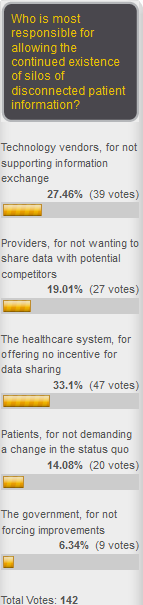
Technology vendors and the healthcare system are most responsible for disconnected patient information, readers say. New poll to your right, just to change it up a little: is your company’s CEO honest and honorable?

7-10-2011 12-41-30 PM

The Tennessee Comptroller of the Treasury releases an audit reporting finding that Community Health Network (CHN) lost or misused $1.26 million between 2007 and 2009. CHN is a non-profit organization that provides medical technology to rural communities, often through grants. Auditors claim the company’s former CEO, Keith Williams, improperly received more than $80,000 by paying himself unapproved bonuses, making personal purchases with CHN’s credit card, and claiming reimbursement for meal purchases that were paid for with CHN’s credit card. Former CFO Paul Monroe was found to paid over $10,000 in unauthorized pay. Auditors also say that Williams and Monroe falsified grant invoices and grant reports and misused proceeds from a state grant to purchase almost $600,000 in unauthorized software. The software vendor later hired Williams as a consultant while he was still employed at CHN.

7-10-2011 11-17-18 AM

Georgia Governor Nathan Deal will speak Monday morning from the Alpharetta headquarters of McKesson Provider Technologies, pitching the state’s campaign to lure technology jobs. It will be streamed live at 8:30 a.m Eastern.

More from Vince on minicomputers, this time focusing on the companies that wrote software for them, one of the biggest of which was started in the proverbial garage.

The VA reveals plans to allow clinicians to use  Android devices, iPhones, and iPads, in addition to the currently supported BlackBerries.

This week’s Time Capsule editorial from 2006: USB Drives Would Help Consumers Quickly Access McClinics. Its conclusion: “This system of having patients walking around with their own information ready to plug into a provider’s system seems like the best solution for now.”

7-10-2011 7-36-44 AM

Morris Hospital & Healthcare Centers (IL) names Cassie Brown manager of health information management. I like that Brown worked at Morris Hospital as a medical records file clerk while in high school school and college and before learning the ropes at a couple of other medical facilities.

Healthcare jobs grew by 13,500 in June, though the hospital sector declined 0.1%. Ambulatory healthcare added 16,500 jobs, including 5,000 in physician offices.

7-10-2011 11-51-07 AM

HIStalk Practice’s own Dr. Gregg gets a shout out in the Columbus (OH) business journal for being the state’s first doctor to get an EHR stimulus check from Ohio Medicaid.

7-10-2011 11-59-42 AM

Broadlawns Medical Center (IA) becomes the first medical center in the state to use PatientSecure’s biometric patient ID system.

7-10-2011 12-10-22 PM

British Columbia’s former deputy minister of health Ron Danderfer pleads guilty of fraud in relation to benefits he received between 2004 and 2007. Danderfer, who oversaw the creation of the province’s $222 million EHR system, admits he accepted the use of a vacation condominium and a job for his wife.

7-10-2011 1-55-38 PM

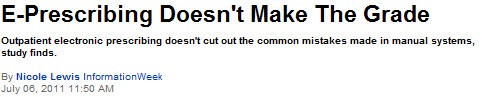
Surescripts and the authors of JAMIA-published article, “Errors associated with outpatient computerized prescribing systems,” issue a joint statement to clarify the study’s use of the term “e-prescribing.” The authors point out that their use of the term “e-prescribing” does not reflect the way the term is used today, nor does it match the federal government’s definition. The study examined what was considered e-prescribing back in in the old days (2008); that is, prescriptions generated by a computer, faxed to a pharmacy, and then printed. You’ve got to admit that “E-Prescribing Doesn’t Make The Grade” is a far more compelling headline than one that says, “The Way Things Were Done Three Years Ago Wasn’t All That Great.”

Contacts

Mr. H, Inga, Dr. Jayne, Dr. Gregg.

News 7/8/11

July 7, 2011 News 6 Comments

Top News

7-7-2011 9-58-22 PM

The start of Stage 2 Meaningful Use will likely be pushed back a year, now that ONC head Farzad Mostashari, MD agrees the current timeline is too aggressive. Stage 2 requirements won’t be finalized for another year, so the growing consensus is that a January 1, 2013 start date would not give EPs, hospitals, and vendors adequate time to prepare.


Reader Comments

image From WildCat Well: “Re: Comcast. Considering offering an EMR system at no cost to physicians who subscribe to Comcast Metro Ethernet services. Physicians have their choice of six-plus EMR preferred providers.” Unverified, although readers have been suggesting that a deal of this type has been in the works for some time.

7-7-2011 9-06-43 AM

image From Man in the White Suit: “Re: Shoe Beacon. You should really be more discrete about where you live.” There’s nothing better than good yard art to express one’s obsessions.


HIStalk Announcements and Requests

7-7-2011 8-35-09 AM

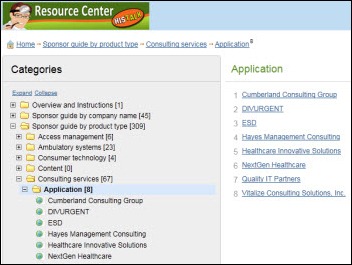
image Check out the new HIStalk Resource Center. Our new reader-requested tool gives you an easy way to search for products and services in over 100 HIT-related categories. Fifty-two HIStalk sponsors have provided details of their offerings and quick links to request more information. To get there: (a) click on the link at the top of this page; (b) click the small banner below the Founder sponsor banners to your left; or (c) click the link on the Related Sites listing to your right. We will continually update the Resource Center, so check it out regularly and let us know what you think.

image Ever find yourself wondering what the heck is going on in the ambulatory HIT world? If so, make sure you are a HIStalk Practice e-mail subscriber. Here are some highlights from this week’s posts: Rob Culbert offers tips for documenting operational and functional workflows to boost customer satisfaction and cash flows. MGMA reveals the top challenges for practice managers. NextGen parent company Quality Systems brings homes three Stevies. AHRQ offers a toolkit to analyze workflow before, during, and after and HIT implementation. Thanks for stopping by.

image Listening: angry 1970s punk from Cleveland’s Dead Boys. Arguably better than the Ramones.


Sales

Aria Health (PA), Norton Healthcare (KY), and St. Luke’s Health System (ID) contract with Hyland Software for its OnBase enterprise content management software.

Aria also selects Allscripts Community Record, powered by dbMotion, to enable data sharing between the hospital’s Allscripts Sunrise, the employed physicians’ Allscripts Ambulatory EHR, and third-party EHRs used by other regional providers.

7-7-2011 8-49-31 PM

The State of New Jersey posts an RFI for the New Jersey Health Information Network, requesting “a single, complete solution” and suggestions of how it can sustain itself financially.


People

7-7-2011 10-16-35 AM

SmartBusiness profiles EnovateIT’s Fred Calero, who leads his company “by treating others as they would like to be treated.” He notes that many of EnovateIT’s employees started on the company’s assembly lines building medical carts.

NCO Group promotes Michael Albrecht to lead its Healthcare Services sales team.

7-7-2011 2-55-10 PM

UnitedHealth Group names Larry Renfro as CEO of its Optum business unit. He replaces Mike Mikan, who is leaving to run a private equity fund. Renfro was CEO of the company’s Ovations group.

7-7-2011 8-34-33 PM

Richard Noffsinger joins Aetna subsidiary ActiveHealth as president and CEO. He was previously with Anvita Health, Amicore, and Microsoft. He replaces Gregory Steinberg, who will head up clinical innovation for Aetna.

7-7-2011 9-19-45 PM

Bob Zollars, chairman and CEO of Vocera since 2007, is profiled in Smart Business of Northern California. He was previously with Wound Care Solutions, Neoforma, and Cardinal Health.


Announcements and Implementations

7-7-2011 2-08-44 PM

University Physicians Hospital (AZ) goes live with EmergisoftED.

image CareCore National announces that its TouchMED prior authorization application for physicians is available on the Cisco Cius tablet. You might expect that this announcement and product information would be available on the company’s Web site since they went to the trouble of issuing a press release, but you would be wrong.

Cerner’s uCern customer collaboration platform wins an award from Jive, the company whose technology powers it.

7-7-2011 10-02-40 PM

University Medical Center (NV) says it has $25 million to spend for system upgrades needed to qualify for HITECH money, but needs $60 million. Its county owners say they don’t plan to make up the shortfall. The hospital is negotiating with McKesson.


Government and Politics

7-7-2011 10-05-51 PM

UCLA Health System settles with HHS for $865,500 for alleged HIPAA privacy and security violations. Two celebrities accused hospital employees of peeking in their charts.

CMS says it won’t be ready to electronically receive quality outcome data for Meaningful Use in 2012 as originally planned. That means that in 2012, EPs and hospitals can report outcome data via attestation and data calculations, just like they’ve done for the 2011 payment year.

The president of the Ontario Medical Association says political party leaders should forget about the scandal-ridden and expensive eHealth Ontario and include electronic medical record programs in their platforms anyway.


Innovation and Research

A JAMA-published study finds that critical access hospitals lag other hospitals in survival rates for heart attack, heart failure, and pneumonia. The author suggests telemedicine as a possible solution.


Technology

image A Florida doctor who came up with the idea for his iMobile Health Record in 2001 is finally getting it to market. Users key in their medical history and med and get a health score in return. It will sell for 99 cents. If it’s the guy I’m thinking, though, he is loaded with credentials: orthopedic surgeon, president of the hospital medical staff, CMIO for a clinical guidelines vendor, researcher, and entrepreneur. I was prepared to make fun of the idea, but he’s got enough credibility to keep me quiet.


Other

image A fired medical data technician sues University Medical Center (NV) for failing to accommodate her claustrophobia by forcing her to work in a cubicle. She has medical documentation backing her claustrophobia claims, so the hospital settled for $150,000.

Physician-run hospitals score 25% higher in quality measures than those where the CEO is a business school type, although the study can’t explain why other than perhaps physicians are truer to the core business of health.

KLAS reports that the number of live HIEs has more than doubled since last year, with private HIEs increasing more rapidly than public HIEs. The lack of traction of public HIEs is attributed to more complicated governance and concerns over long-term funding. Among HIE vendors, Medicity, RelayHealth, and Cerner ranked highest for private HIEs.

image Weird News Andy is atwitter at this news, which he tags as “researching in 140 characters or fewer”: Hopkins researchers run two billion public tweets through software to extract those related to health, then analyze patterns related to allergies, flu, obesity, cancer, and other conditions. They believe tweets can help uncover public health information, but they recognize that users don’t get into much detail, they are usually younger and US-centric, and they probably won’t tweet about some health issues.

7-7-2011 10-08-12 PM

7-7-2011 8-44-35 PM

image A federal appeals court upholds the 2009 conviction and 10-year prison sentence of former McKesson chairman Charlie McCall. His lawyers claimed he signed public filings and auditor letters without knowing that his acquired HBO & Company (McKesson paid $14 billion for it) was inflating revenue figures by improperly recognizing software revenue, but the appeals court ruled 3-0 that he knew exactly what was going on. MCK shares dropped almost by half the day the company announced its findings and still have not regained their pre-Charlie price more than 12 years later.

image Somehow I missed this: Dennis Quaid keynoted at the 2009 HIMSS conference, talking about the heparin overdoses that nearly killed his newborn twins, but merged his Quaid Foundation with the non-profit Texas Medical Institute of Technology a year later.


Sponsor Updates

  • Kansas City Business Magazine recognizes Perceptive Software as one of the city’s top 10 companies for global growth. Selection was based on company culture, community involvement, plans for growth, and commitment to employees. The company has grown its employee count by 40% in the last year.
  • Aventura Hospital and Medical Center (FL) selects ProVation, a division of Wolters Kluwer Health, for gastroenterology and procedure documentation and coding.
  • Sunquest is hosting its 2011 User Group conference July 11-15 in Tucson. New to this year’s meeting: an executive two-day conference, a session by the College of American Pathologists,  and a discussion of the lab’s role in ACOs.
  • MD-IT is searching for a VP of sales and marketing.
  • West Virginia Regional Health Information Technology Extension Center selects Greenway Medical’s PrimeSUITE as a prequalified EHR. 
  • GetWellNetwork adds Jeff Fallon as VP of business development and national accounts.
  • Capsule  is exhibiting at the 2011 HMS Regional Training and Exposition July 12-13 in Austin, TX.
  • Holon Solutions appoints Worth Roberts to VP of sales for its eastern region.
  • OptumInsight partners with RemitDATA to offer Remit Advice Professional, a Web-based analytics service for physician offices that analyzes health plan remittance notices and provides coding and reference tools.
  • Symantec and Allscripts partner to offer an online privacy and risk assessment tool for identifying potential gaps in HIPAA and HITECH compliance.
  • Wayne Memorial Hospital (NC) selects the Access Enterprise Forms Management suite to integrate electronic patient forms with its Meditech system.
  • Webinar alert: a clinical analyst from Jefferson Regional Medical Center will share how his hospital used iSirona’s device integration solution to connect more than 40 devices to Sunrise Clinical Manager. It’s on July 20 at 1:00 PM EDT.
  • The use of the AirStrip OB smartphone monitoring system by Rowan Regional Medical Center (NC) is profiled on a Charlotte TV station, with one OB-GYN predicting that its use could become a nationwide standard of care. AirStrip Cardiology goes live at Cedars Sinai and Texas Health Resources.

EPtalk by Dr. Jayne

7-7-2011 7-45-44 PM

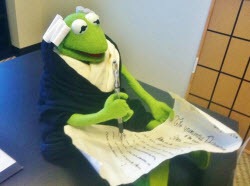
I received a lot of feedback about Monday’s Revolutionary-themed Curbside Consult, including some historical corrections and the hilarious photo of Colonial Kermit. HIStalk readers are the best!

Dr. Jayne,

I am an avid reader of HIStalk and am a great fan of yours. I just loved your July 4 article and I have been a Molly Pitcher fan for quite some time. So it is with trepidation that I have to say that I was also severely disappointed. The Declaration of Independence was approved by the Continental Congress on July 2, 1776 and read in public on July 4. The signing began a week or so later and was not fully completed until the end of the summer. In a letter to his wife, John Adams indicated he expected July 2 to become a national holiday as that was the meaningful date when the Continental Congress declared its independence from Great Britain. Thanks for HIStalk – we all just love it.

Terry

Duly noted. My reference used the word “adopted” to describe what the Continental Congress did on July 4. A handwritten draft was signed by John Hancock and Charles Thomson that day and was sent to be printed for distribution. As for the final product, the National Archives says that most signed on August 2, 1776. The Archives also notes that t “one of the most widely held misconceptions about the Declaration” is that everyone signed it on July 4, so I guess I’m not alone.

I’m glad to encounter another Molly Pitcher fan. I shamelessly admit that I dressed as her once for a patriotic event. Everyone thought I was Martha Washington, though. Maybe I should have put a cannonball wound in my skirt.


Dr. Jayne,

The first incidences of biological weapons as you describe in your recent Independence Day post that I have been able to find was back in the middle ages (mid-14th century) when plague victims were flung into walled cities via catapult by those who we besieging the settlement.

Weird News Andy

Andy always delivers and provided multiple links for my reading pleasure, which I will of course share. I remember this fact from World History and probably a Monty Python movie, but being in Colonial Mode must have suppressed it.

Emergency Medicine covers plague
EyeWitness to History and The Black Death
Attacking a Castle – also includes excellent coverage of fire, battering rams, and other mayhem

7-7-2011 7-55-53 PM

Several readers responded to my recipe solicitation. Here are a few submissions mixed with my personal favorites. And thanks to Janice – I took your advice,but instead of vodka/cranberry on ice with a blue umbrella (apparently my cocktail accessories are lacking),I threw in some blueberries.

Fourth of July Cocktails
Patriotic Cocktails
Twenty Red, White & Blue Cocktails
Five Red, White and Blue Cocktails (including the one pictured above)

No one seemed eager to share a potato salad recipe (what does the proportion of cocktail recipes to side dish recipes say about the average health IT reader, I wonder?) but one reader did share this link — and who doesn’t love a Web site called Killer Salad anyway?

7-7-2011 7-59-49 PM

Now, back to our regularly scheduled HIStalk feature …

It is the month of July, and the usual articles about avoiding medical mistakes and the perils of new interns starting rotations at academic medical centers (the “July Effect”) have started to show up. Prevention leads with  14 Worst Hospital Mistakes to Avoid, noting that most mistakes are medication-related.

MSN jumps right in with Don’t Get Surgery in July…, citing a 10% spike in fatalities in teaching hospitals during the month “confirmed by a new Journal of General Internal Medicine study,” but then saying the spike isn’t due to surgery anyway. It’s basically a hack of the Prevention article, so don’t bother going there. The article is actually from 2010 and the original source is available in PDF here.

Internship was bad enough when all you had to do was write your orders on paper, I can’t imagine walking in with CPOE on top of it. I’d love to interview a PGY-1 to get his/her impressions on healthcare IT but obviously can’t do it with one of my own housestaff. Anyone with friends just starting internship or are you a faculty member willing to serve up an intern? E-mail me.


Contacts

Mr. H, Inga, Dr. Jayne, Dr. Gregg.

News 7/6/11

July 5, 2011 News 13 Comments

Top News

7-5-2011 5-37-48 PM

image Management consulting firm Beacon Partners will announce Wednesday that it has acquired Healthcare Innovative Solutions (HIS), which offers consulting services related to clinical system implementation and workflow redesign. The ten-year-old HIS gives Beacon additional Siemens capabilities, adds to its CPOE expertise, and boosts its revenue and headcount by 15%. I did an HIT Moment With interview with HIS CEO Daniela Mahoney RN a few weeks ago. Congratulations to HIS as the latest in a long list of HIStalk sponsors to be successfully acquired.


Reader Comments

image From NAFTA Doesn’t Work: “Re: Ontario. Healthcare informatics is at an all-time low here, with contracts based on who you know. I applied for a NAFTA-defined TN-Visa for professionals after being hired for a US contracting gig. No problem if you are a US citizen coming into Canada for EMR work, but if you try to go into the US, you are in for a chop-busting. Bring your degrees, transcripts, licensure, immunization records, and first-born child. An immigration officer berated me for being an RN and computer science graduate, saying ‘Seems like an odd combination, doesn’t it? Who would hire you anyway? Why are you trying to take jobs from Americans?’ Like it’s my fault your country can’t find enough people qualified to implement clinical systems based on the $19 billion ARRA commitment. Nothing like being stuck between a rock and a hard place.” We’re not very visitor-friendly here, that’s for sure, but that’s a 9/11 thing. We have a massive Homeland Security bureaucracy, along with a close-the-borders mentality that has caused quite a drain in technology expertise. I know from limited travels out of the country how unwelcome even US citizens are made to feel at immigration after short-term travel, so I can only imagine being a non-citizen trying to relocate here. I felt more welcome and respected in Russia than Newark.

image From Mr F: “Re: The PACS Designer’s WebGL blurb. Key point left out: Microsoft won’t be implementing it in IE because they think it is inherently insecure.”

image From Dakota Dan: “Re: Henry Ford Health System SVP/CIO Arthur Gross. No longer on their Web page.” His bio page has been removed, but that’s all I could turn up since I don’t have contacts there that I recall.

7-5-2011 7-54-30 PM

image From Collard Greens: “Re: KLAS. To consolidate their ambulatory EMR categories, also looking to consolidate/drop research for other ‘non-profitable’ research segments.” I contacted Adam Gale, president of KLAS, who says you are partly right. KLAS is planning to reconfigure their ambulatory EMR categories to better map how those solutions are actually sold to the market. Something like, let’s say, small practices (1-10 docs), medium (11-50), and large (51+). Adam says the other half of your statement isn’t true, though: market need rather than profitability drives the research segments KLAS covers and they’re planning to continue rating mostly the same categories ongoing. It almost seems the opposite to me: they keep adding interesting categories.


HIStalk Announcements and Requests

image Someone asked me at work today about the Stage 1 Meaningful Use rule for hospital clinical decision support. Since I had to look it up anyway to make sure I hadn’t forgotten something, here’s the summary. You have to implement at least one real-time alert and it can’t involve drug-drug interactions or drug-allergy contraindications. It must use information from the meds list, allergy list, demographics, or lab results. The rule must address something that’s of high clinical priority to the hospital and you have to be able to track compliance with the rule. If the rule is of the “don’t enter this order under any circumstances” variety, then the numerator could be calculated as: (number of times the rule fired minus the number of orders entered anyway) divided by the number of times the rule fired. Otherwise, you would need to electronically ask the provider if they changed their intentions based on the rule’s recommendation since you can’t assess compliance or rule effectiveness otherwise, unless you’re comfortable looking at overall ordering patterns for changes (and I wouldn’t be).

7-5-2011 7-24-53 PM

Thanks to new HIStalk Platinum Sponsor McKesson Paragon HIS. If you follow the industry, you know that Paragon is pretty hot stuff, named for five straight years as Best in KLAS in the Community HIS category. It’s certified, runs on a single database, is fully integrated (including clinical and financials), has low hardware costs, is intuitive and easy to use, and runs on pure Microsoft technologies (including SQL). Clinical modules include clinical assessment, CPOE, care plans, order management, meds, and results reporting. On the financial side, there’s patient management, AP/GL/MM/FA, payroll, resource scheduling, HIM, transcription, utilization review, and release of information.  Ancillary apps include pharmacy, OR, ED, rehab, radiology, lab, mobile phlebotomy, and micro. If you are a Meditech customer or prospect, McKesson would be happy to send you a white paper describing the benefits of Paragon for your consideration. I’ll throw in an observation that even though KLAS ranks it under the Community Hospitals category, I’ve heard from users first hand that it scales well to facilities up to at least 400 or 500 beds even though you don’t need a lot of IT people to run it, so don’t let that label scare you off. Thanks to the McKesson folks involved with Paragon HIS for their support of HIStalk.


Acquisitions, Funding, Business, and Stock

image Cerner shares hit an all-time high Tuesday (at least it looks like it as I’m eyeballing the share price graph), closing at $63.00 and pushing the company’s market cap to $10.6 billion.

Chicago area- based Resurrection Health Care and Provena Health will merge their twelve hospitals.


Sales

7-5-2011 10-00-13 AM

University Hospitals Case Medical Center (OH) will deploy athenaCollector for its 1,000 providers. Its MSO is already an athenaCollector client.

7-5-2011 4-13-02 PM

Presbyterian Intercommunity Hospital (CA) signs a services contract with Zotec Partners to manage its radiology department’s revenue cycle.


People

7-5-2011 5-22-54 PM

Blount Memorial Hospital (TN) names Clay Puckett CIO and assistant administrator. He was previously senior director of IS for Carolinas HealthCare System.

7-5-2011 7-09-27 PM

image Mathematician Robert Morris dies at 78, leaving a biography that should be made into a movie. He helped develop Unix, was a master cryptographer for the National Security Agency, led a 1991 cyberattack against Iraq before the first Gulf War, developed Unix security protocols in the 1970s that are used on Apple devices today, developed software that tracked enemy submarines and astronomical bodies, and warned Congress in 1983 that computer viruses were a risk but not likely to be created by children. He was proven wrong in that last assessment five years later when his own son’s worm program spread out of control and took down 6,000 Department of Defense computers (the lad is now an MIT computer science professor).


Announcements and Implementations

7-5-2011 10-02-18 AM

Legacy Salmon Creek Medical Center (WA) will go live on its $110 million Epic EMR by the end of September.


Government and Politics

CMS issues its proposed fiscal 2012 Medicare payment rules and suggests minor increases for most facilities and a whopping 29.5% decrease for physicians. Outpatient payments would increase 1.5%, ACS’s 0.9%, and dialysis facilities 1.8%.


Technology

Radiology site AuntMinnie runs an article on biometric ID,  mentioning palm vein scanning (PatientSecure), physician mobility (Imprivata), fingerprint ID (Digital Persona), and proximity biometrics (Proxense).


Other

Here’s Vince’s latest, this time on minicomputers and complete with names you haven’t heard in quite some time, like Burroughs, DEC, and Four Phase.

image Epic ranks #1 in new HIT contracts for hospitals of greater than 200 beds. KLAS calls Epic’s track record of successful implementations “unmatched” despite lagging technology and a large price tag. Cerner was #2, with many of its new contracts involving new facilities for existing customers. The report finds hospital consolidation is increasing the interest in system integration.

image Johns Hopkins Hospital (MD) will eliminate 160 clerical positions by the end of the year as the hospitals switches to electronic medical records. The hospital will try to reassign the workers, who had been responsible for order transcription and creation and maintenance of paper charts. A reader sent a note last week saying Johns Hopkins was moving to Epic for its ambulatory clinics; Mr. H predicts the move to Epic will be system-wide.

7-5-2011 4-10-26 PM

USA Today profiles Banner Health’s (AZ) five year-old eICU network, which relies on remote critical care specialists to provide guidance to onsite providers. Banner has invested $11.3 million in equipment for the telehealth system and estimates that over the last four years, the program has helped prevent 600 deaths, reduced days in critical care by 26,000, and cut hospital stays by 100,000.

image AMA will draft model legislation for HIEs that will spell out who owns clinical information and who can view it. They seem concerned about insurance company ownership of HIE technology vendors (Aetna and UnitedHealth Group, which own directly or indirectly Medicity and Axolotl, respectively).

7-5-2011 6-43-04 PM

image Would you trust your HIPAA compliance education to this company?

image I thought of Dr. Jayne’s observations about the unhealthy lifestyle choices her patients often make when I read this article. A motorcyclist flips his Harley and dies of a head injury during an organized ride protesting mandatory helmet laws. Experts said the helmet he was illegally not wearing would have saved him. The event organizers, the state chapter of American Bikers Aimed Towards Education, announced that the rider “risked his all for freedom.”


Sponsor Updates

  • Aaron Kaufman, GM and VP of Kony Healthcare, will speak at World Health Congress (MA) July 28-29.
  • Clairvia leads the market segment in Staff/Nurse Scheduling according to KLAS 2011 Mid-Term Performance Review.
  • CareTech Solutions launches its Zero Worries campaign to promote the company’s hospital IT help desk services.

Contacts

Mr. H, Inga, Dr. Jayne, Dr. Gregg.

Monday Morning Update 7/4/11

July 2, 2011 News 8 Comments
7-2-2011 6-07-40 AM

From Michigan Wolverine: “Re: Munson Healthcare downtime. At least the administrator was truthful about the ‘chaos,’ if not about the patient care.” The three-hospital Michigan system loses all connectivity to the world when a planned switch to a backup fiber optic circuit fails. Applications, paging systems, wireless devices, and their IP telephones all went down hard, requiring 4.5 hours for recovery.

From The PACS Designer: “Re: 3D Web browsing. WebGL permits 3D viewing if you use Google Chrome (coming soon to Firefox 6 ). TPD thinks healthcare may find the web 3D feature helpful in following the diagnosis of conditions, such as viewing a colonoscopy result along with healthcare treatment videos. An excellent example to view in 3D on Chrome is the WebGL Iceberg Demo.

From Peter: “Re: thoughts on Google Health. Brilliant, lucid, and real. Thanks, Mr. H :)” This comment came all the way from New Zealand, so I figured I could at least mention it (especially since I appreciate it).

7-2-2011 6-10-45 AM

From Ilya: “Re: Johns Hopkins. Going with Epic for ambulatory to start in a project called Ambulatory First, with a statement from the JHM CEO that ‘we will continue to look for systemwide opportunities for the Epic system to support our health care reform initiatives and goals.” Ilya sent over the CEO’s e-mail announcement, which also points out that Hopkins has more than a dozen patient records systems that are going away. I’m sure additional planning and approvals will be required, but the tea leaves seem to say that Epic will replace a bunch of Hopkins systems very soon, most notably Allscripts Sunrise.

From A CIO: “Re: job change. You recently mentioned my new job. Your reach across the industry is amazing. I’ve heard from people I haven’t been in contact with for years.” I really love hearing that since it’s a blast to get people reconnected just by mentioning them in some way. Maybe I should profile one reader each week with a mini-bio and a photo just to see who reaches out to them.

From McOffice: “Re: executive offices. I was in the office of McKesson CEO John Hammergren a few years ago. It was understated and functional like a working manager’s office, but the view of the Golden Gate Bridge was pretty sweet.”

From Lusitania: “Re: executive offices. McKesson executives in Westminster, CO have very modest offices. Only a few have line-of-sight to the Rocky Mountains – most just see cubicles or walls. The cubes on the west side actually have a better view. The largest offices only have room for an additional four-top conference table. Otherwise, even our lowest directors have offices that match in size and furniture quality (basic Office Depot mahogany).”

7-1-2011 7-24-04 PM

From Cam: “Re: executive offices. We’re in an old mill right on a river between two waterfalls with 20-foot ceilings, wood, and brick. We fish out the window. The CEO’s office is filled with Legos.” I love old mills on rivers, with rough brick and massive wood beams. Somehow it feels right to be working on something high tech in historical, industrial surroundings. Cam was less philosophical when I made that flowery statement in responding to his e-mail, replying with tongue in cheek that, “except our history has to do with exploiting children in a mill setting and we work for pediatricians .”

From Delbert: “Re: executive offices. Judy Faulkner’s is big, but unassuming. Prairie style with a desk area in one part and an almost living room seating area. It’s right by the entrance to one of the buildings, so visits arrive via a sidewalk that goes right by her windows. Definitely no evidence of pretense of wealth and power in her digs.”

From Antoine: “Re: executive offices. NextGen’s two executives share a single office. No parking space, no special bathroom, they swipe the same security card to get into the building. The SVP has the exact same office as her managers – no windows. Very much the NextGen vibe, modest and unassuming.”

7-1-2011 7-36-59 PM

From IntelliDoze: “Re: IntrinsiQ. After looking for several years, it finally has a buyer in ABSG (AmeriSource Bergen Specialty Group). The press release will come out Tuesday. All of the employee options are under water, but on the bright side, they will be asked to sign two-year non-competes! The only folks making money are private equity firm Accel-KKR, not a huge return, but happy to get any return after buying at the top of the market.” Unverified. IntrinsiQ makes the IntelliDose chemotherapy protocol management tool and oncology-specific data mining applications.

From Fess Up: “Re: nextEMR. Those guys are still showing the CCHIT 2011 logo on their site even after you reported that CCHIT ordered them to take it down. They simply didn’t receive that certification.” They now have both the ONC-ATCB and CCHIT logos on their site, so I guess that’s some improvement – they added the correct one, but failed to take down the incorrect one.

Happy Independence Day to my fellow Americans. Some contrarian US history: the Declaration of Independence was signed on July 4, 1776 when the 13 insurgent colonies that were at war with their own British government announced that they were illegally breaking off and starting their own country. It’s very much like when the Southern states announced their secession from the Union in the 1860s, except the British weren’t quite as brutal in using scorched earth force against civilians to keep their empire intact. It was their Vietnam, a humiliating defeat at the hand of cunning rebels that we celebrate annually with hot dog eating contests and China-sourced pyrotechnics. My flag is waving today to celebrate our country, even though its history (both old and new) is uncomfortably less virtuous than they teach in school. But in any case, happy Fourth of July, if you must call it that (and Merry Twenty-Fifth of December).

My Time Capsule editorial from five years ago this time around, squinting in the bright sun after being buried since 2006: Vendors Should Make Software That Crusty Night-Shift Nurses Can Love. I veered into an overly broad generalization about nurses and computers that will probably raise hackles all over again: “Looking over their computer shoulder is like watching your kid play tee-ball – you try to help them by sending powerful telekinetic messages (‘Press Shift-Tab … Shift-Tab’) or with surreptitious body English.”

Listening: Skins, almost new from Buffalo Tom, a Boston alt rock guitar band that has drifted in and out of obscurity since 1986, but has always been good. Great road trip music that also wins my highest and rarely awarded honor: it has gone on my gym MP3 player. 

7-2-2011 11-04-49 AM

A good Google Health epitaph from Zak Kohane at Children’s Boston: “Google is unwilling, for perfectly good business reasons, to engage in block-by-block market solutions to health-care institutions one by one and expecting patients to actually do data entry is not a scalable and workable solution.” Let me be clear in saying that Zak is brilliant (and not just because I know he reads HIStalk and would make a fine writer for it, hint hint). Check out this provocative  article in which he suggests that computers could replace doctors for a lot of the protocol-driven work doctors do, which probably elicited predictable “doctors aren’t fry-slinging teens working at McDonalds” knee-jerk reactions instead of thinking about his point – do we really need doctors to do a lot of what doctors do instead of more important stuff? (and he’s a doctor, so his opinion counts double, not to mention that the military already delivers a large amount of care, including that on the battlefield, using non-physicians who have undergone focused training):

We want our healthcare providers, and particularly our physicians, to be completely up-to-date across the exponentially growing knowledge base of medicine, from drug side effects to genomics. Yet, in this era of  “evidence-based medicine,” we also expect these same physicians to follow well-defined protocols (algorithms on paper or on in electronic medical record systems) so that each patient receives the care that panels of experts have determined to be best. Just as McDonald’s follows sophisticated but regimented systems to make and sell its French fries and shakes.

So, which is it? Is each patient encounter a potential virtuoso tour of the medical arts and biomedical applied sciences? Must each doctor be the equivalent of Todd English? Or is it enough that each patient receive an honorable, workman-like execution of the best guidelines that are available? It is becoming increasingly apparent that we cannot afford a model that claims both kinds of performance delivered by the same person with the same job description.

7-1-2011 8-25-20 PM

Welcome to new HIStalk Platinum Sponsor Covisint, part of Detroit’s Compuware. The company enables “information ecosystems” that allow all healthcare players to securely communicate and collaborate. Its ExchangeLink platform connects hospitals to other providers (physicians, post-acute, referrers) by supporting workflow-driven fax solutions, a secure inbox for online delivery, and document exchange with practice EMRs. It has all the pieces and parts built in: identify management, MPI, and record locator service, and is used by states and HIEs to share information on a large scale to improve quality and coordinate care. Covisint’s App Cloud offers third party apps for e-prescribing, lab orders and results, referrals, disease management, EMR/PHR, and others from names such as Epocrates, DocSite Registry, Ingenix CareTracker, Allscripts, Dossia, and DrFirst. The company just won a MSHUG innovation award for its work with Vermont Blueprint for Health in providing a central registry, clinical decision support, and a care team portal. Many thanks to Covisint for supporting HIStalk.

Here’s a Covisint overview video that I found on YouTube.

A Bloomberg Businessweek post by business intelligence expert Leonard Fuld reminds everybody that his war game simulation predicted that Allscripts needed to merge with another company to avoid becoming an also-ran (it’s not mentioned whether the simulation gave Allscripts the idea). Like many prognosticators, he doesn’t mention other predictions that may not have panned out, like those involving McKesson and GE Healthcare in the same scenario (or his March 2007 statement that “the all-powerful MySpace, with its 130 million-plus members, seems invincible.”) Still, he seems to know his stuff when it comes to competitive intelligence.

7-1-2011 7-10-17 PM

Texas Health Presbyterian Hospital Dallas begins RFID equipment tracking, citing studies indicating that nurses spend up to 15% of their time tracking down needed equipment. The 898-bed hospital says it’s saving $30K per month by avoiding equipment rental. The vendor is Intelligent InSites tied into a Skytron ZigBee wireless network. The hospitals plans to use more RTLS apps tied into its systems (Epic, TeleTracking, and Siemens Invision).

Tampa-based software vendor MedHOK releases 360ACO, an analytics solution for complying with proposed CMS ACO rules.

A reader sent over the JAMIA article that looked at “errors” with e-prescribing. I’d take it with a large grain of salt. The study did indeed use prescriptions from 2008, even though it’s just now being published. Since the retail pharmacies faxed over the de-identified prescriptions, they had no way to know which were truly e-prescribed vs. just printed off from a computer system. Potential ADEs included the potential of harmless issues, like rash or nausea. Most of the “errors” involved omitted or unclear information, such as how long to take the med (which was probably already discussed with the patient and assumed from the quantity prescribed). They also could not make any conclusions about particular e-prescribing or pharmacy systems and had no way to assess how practices implemented their systems or how physicians were trained to use them. To me, the only valid conclusion is that doctors could turn on more edit-checking capabilities of their e-prescribing systems to reduce inefficient clarification callbacks from pharmacies. I don’t see much patient safety impact. Unfortunately, the rags often pick up a story like this and run with it, adding misleading but sexy headlines and trying to make the conclusions seem more dramatic.

7-2-2011 6-13-54 AM

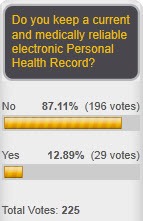
The numbers are unchanged from my 2007 survey: a scant 13% of the most healthcare IT-savvy people on the planet keep their medical information in a PHR. New poll to your right: who is most responsible for the lack of sharing of patient information?

This is strange: Walmart is donating the time of its 142 in-house lawyers to Medicaid patients of Arkansas Children’s Hospital, taking on the government agencies and schools that don’t provide those patients with the benefits to which they believe they are entitled. The company says it will be “facilitative” rather than “adversarial” to Medicaid. If you’re a taxpayer unhappy with the huge entitlement programs you’re funding through your labor, this is probably not the best news you’ve heard today.

Thanks to the companies that supported HIStalk in June by starting or renewing their sponsorship. I do nothing to solicit sponsors except to e-mail a little handout PDF that Inga and I threw together when someone asks for one, so I appreciate those that persist in overcoming our appearance of indifference to support what we do.

7-2-2011 10-06-03 AM 
7-2-2011 10-07-16 AM
7-2-2011 10-09-35 AM
7-2-2011 10-10-55 AM
7-2-2011 10-12-05 AM
7-2-2011 10-13-43 AM
7-2-2011 10-15-03 AM
7-2-2011 10-16-12 AM
7-2-2011 10-17-14 AM 

Unrelated, but kind of amusing: the hammy, preachy host of the endlessly re-run, 2008-cancelled To Catch a Predator (“Have a seat over there. What do you think would have happened if I wasn’t here and a 14-year-old girl was home alone?”) is himself caught on hidden camera as he engages in nocturnal hanky panky with a hot TV anchor 58% of his age and 100% not his wife. Unlike the sickos his show entrapped for almost-honorable reasons (not to mention ratings), he wasn’t unnecessarily pounced on by a dozen camera-hogging, Taser-wielding police officers as he tried to leave the hotel.

E-mail Mr. H.

News 7/1/11

June 30, 2011 News 11 Comments

Top News

 image Third-party firms that implement vendors’ applications outperform the vendors themselves – except in the case of Epic. Deloitte earns the highest overall marks among third-party firms in KLAS’s survey. Coastal and Peer Consulting outscored GE in overall customer satisfaction by 30 or more points; ACS and Vitalize beat Allscripts by 20-plus points, and Encore and Vitalize outscored Cerner by 20-plus points. Epic outperformed them all.


Reader Comments

6-30-2011 6-29-31 PM 

image From Johnny “Hot Rocks” Garcia: “Re: making appointments online. Check out ZocDoc and take note of its investors!” ZocDoc allows searching for doctors within a ZIP code by specialty and accepted insurance. It’s pretty cool, although available only in eight metro areas so far. They have an iPhone app. Investors include The Founders Fund (run by the founders of PayPal, Napster, and Facebook), Jeff Bezos (Amazon) and the chairman and CEO of Salesforce.com. 

image From Glenergy: “Re: Allscripts. A new general counsel – Jackie Studer from GE.” Unverified.

image From Jordan: “Re: copied medical records. Kind of expensive for an electronic copy.” Texas Health Resources charges state-mandated fees for medical record duplication: $42.05 for the first 10 pages of a paper record, $64.07 if they’re on microfilm, and a flat fee of $76.20 for electronic records requested in electronic form. The state may set the price, but I would have to guess hospitals had input into the rather large numbers. That makes the paper statements of banks look like a great deal, although their free online option isn’t even offered by hospitals. Charging more for an electronic dump is odd, although if you’ve looked at a hospital chart, your $42.05 isn’t going to go far considering the stacks of paper that go far beyond 10 pages. Maybe they should just charge law firms 10 times that amount and let patients have copies of their own information at no cost. Most hospitals think they’re doing patients a big favor by letting them see what they’ve written about them.

image From Viking: “Re: GE Healthcare. A marketing director friend had their job eliminated this morning, saying there’s a sweeping org change underway.” Unverified. GEHC doesn’t respond to personnel rumors, so I didn’t even bother asking.

6-30-2011 10-20-38 PM

image From Terminator: “Re: PHRs. I wonder if their functions are gaining ground as standalone apps that people actually do use? For example, Walgreens keeps all my prescription records and I can access them from anywhere, so I have no reason to import them to a PHR. I use an online tool for diabetes logging, although it would cool if it were updated automatically from any meter I use. If I see a glucometer that allows batch uploads of data to a site like this one, I’m grabbing it! That’s all I want in a PHR except for lab data and the ability to communicate with providers, but patient portals are adding PHR-like features as well, some of which have access to data and have appointment-setting tools.” That’s the big debate – would consumers prefer an independent but minimally functional tool like Google Health or one that’s rich in function and data, but tied to a specific provider? So far, they seem to be saying B (and who can blame them, given that both are free?) Notice above that Walgreens even offers online pharmacy chat right from the public Web page, although it would be interesting to know who’s on the other end.

6-30-2011 10-22-06 PM

image From LaidOffInDallas: “Re: UT Southwestern Medical Center. Just laid off several IT employees.” UT Southwestern just announced that, due to the loss of $31 million in state funding, it has cut 350 staff positions, laying off 105 employees.

image From Former CIO: “Re: Epic art. I would suggest that Mr. Ciotti’s opinions about wasting client money are focusing on the wrong target. The vendors who are wasting money are those that spend more on marketing and less on development, thus producing products that are not integrated and do not support patient care needs. Perhaps the artwork enhances employee attitudes and they get more work done for the money. The cost of the product is a fraction of the true cost of ownership when one considers clinician time and effort. Even so, the cost of the product is still competitive.” At least Epic is sharing the investment with employees instead of hogging the goodies for its executives in a “we’re better than you” kind of way, such as companies that give the suits reserved parking spaces, private bathrooms, and offices that would hold 20 of the veal pen cubicles that the real workers toil in. I can’t vouch for Judy’s office since I haven’t seen it, but I picture it as quirky but modest. That’s a fun challenge: e-mail me with a description of the top dog’s office wherever you work – I will run them anonymously. If they have really splendid digs, make sure to snark it up some.


HIStalk Announcements and Requests

image Stuff you’ll want to check out this week on HIStalk Practice: Micky Tripathi details the difficulties associated with tracking and reporting clinical quality measures for Meaningful Use. HHS halts its mystery shopper program for measuring access to primary care. Experts suggest reasons practices are behind schedule for the HIPAA 5010 transition. Dr. Gregg struggles with HITECH guilt and living on the dole. Costco jumps into the EHR world with deals on Allscripts MyWay. AAFP launches its $90/year clinical messaging system. While you are over on HIStalk Practice, sign up for the e-mail updates like the rest of HIT’s coolest kids.

image Listening: reader-recommended Belle and Sebastian, 70s-style indie pop from Scotland. A nice sample is here, if you can overlook the fact that the preachy announcer sounds like Mike Myers playing the Scottish dad in So I Married an Axe Murderer.

image I’m thinking about refreshing the look of the site and maybe even changing the smoking doc logo in some way. I’ve been using this layout for years, and while I don’t really care all that much one way or another, I guess it’s time for an update (I think Inga is interested). If you have ideas, let me know. Most of the responses I’ve received in the past have been of the “don’t change anything” variety, so that’s the default course of action to challenge. 

image I’ll probably publish a Monday Morning Update even though it’s Independence Day (please call it that rather than the Fourth of July). You can amuse me over the weekend by connecting on LinkedIn and Facebook, signing up for e-mail updates, or just checking in to let me know that I’m not the only one with HIStalk on my mind. Have a great holiday. I’ll be taking a few days off starting next weekend, leaving the fabulous Inga and Dr. Jayne in charge.

Jobs on the sponsors-only Job Board: Director of Marketing – Hospital Segment, Director Sales Operations, Senior Enterprise Sales Executive Hospital Southeast. On Healthcare IT Jobs: CEO & President, Clinical Nurse Analyst, Epic Resolute Consultant.


Sales

6-29-2011 12-45-06 PM

Aspirus (WI) signs a clinical documentation contract for MedQuist’s DocQment EP.

6-29-2011 12-45-57 PM

University of Utah selects Authentidata Holding Corp. for its three-year telehealth project that includes health information exchange, workflow management services, and remote patient monitoring solutions.

6-29-2011 12-47-19 PM

University of Oklahoma chooses OmniMD as a preferred provider for medical transcription services.

VHA signs an agreement with Deloitte to offer RCM consulting services to its 1,350 not-for-profit community hospitals.

Ochsner Health System (LA) signs up for Philips VISICU, which will make it the first eICU program in the state when implementation is finished next year.


Announcements and Implementations

6-29-2011 1-37-06 PM

InterSystems names Gila River Health Care (AZ) the winner of its Breakthrough Applications Award for using InterSystems DeepSee BI technology with its Diabetic Analysis Management System.

Scripting automation vendor Boston Software Systems celebrates its 25th anniversary.

6-30-2011 9-21-34 PM

Medtronic announces a free smart phone app for its CareLink telemetry system for implantable cardiac devices.


Innovation and Research

image Cisco announces its Android-powered Cius tablet, due out at the end of July, with the video above featuring Palomar Pomerado Health Chief Innovation Officer Orlando Portale (starting at around the 41 minute mark). The Cius will cost $700, has no 4G connectivity, has only a few dozen apps available from Cisco’s own store, and is sure to bring up the puzzled question, “Why would I want this instead of an iPad that costs less?”


Technology

Oracle will buy storage startup Pillar Data Systems for an undisclosed price. That company’s CEO and majority shareholder: Larry Ellison, who also happens to be the CEO of Oracle. He claims he recused himself from the acquisition discussions, although he didn’t mention why a guy with an Oracle-generated net worth of $40 billion was off running another company on the side.


Other

6-30-2011 7-06-22 PM

image The developer of Nashville’s Medical Trade Center says it will not break ground until at least 60% of its space is leased. The developer anticipated this goal would have already been met, but a mere 20% of the space is under contract. Committed lessees so far include HIMSS, Steelcase, and mdi Consultants.

image  A Florida doctor who moved to a cloud-based EMR a year ago loses access to the records when his Internet connection goes down. He’s been treating patients blindly for three days so far while Comcast tries to fix his broadband. I’ll predict that ONC won’t make his experience the focus of one of its feel-good EMR stories: “If can’t access a patient’s medical records, I’m afraid in the rush of things I might miss something or not do as good a job as I normally would.” His phones are down, too.

6-30-2011 6-00-48 PM

image Note to companies seeking to become “leading” suppliers in healthcare: your message tends to be more powerful when you reference the correct vertical market in your press release (unless there’s a connection I missed between vehicle dealers and healthcare). 

image I saw a press release about a survey claiming that more than 50% of consumers would choose a hospital based on their Facebook and Twitter presence. I found that hard to believe, so I e-mailed the company to ask for the methodology. They offered to provide it if I bought the report for $1,250. I guess I’ll just remain skeptical.

image The coroner says mistakes made at Marin General Hospital (CA) helped kill an ICU patient. A doctor, a respiratory therapist, and three nurses were identified as putting the patient on a ventilator, then leaving the room without making sure it was working. It wasn’t.

image A study of electronic prescriptions finds that about 10% contain at least one error, the same percentage as paper prescriptions. I only have access to the abstract, but I notice that (a) the electronic prescriptions reviewed were form 2008 for some reason; (b) the study treated all errors equally, with the most common being omitted information (which causes no patient harm); (c) it looked at “potential adverse drug events,” which could indicate lack of decision support on the e-prescribing end, but not necessarily (for example, I don’t know if they counted potential drug interactions as “errors” if the electronic prescriber of Drug A was the same one who prescribed Drug B, which is not necessarily either prescriber’s fault).

image Weird News Andy says this man couldn’t have picked a better place to have a heart attack. He complains of chest pain during a cardiologist’s lecture on heart disease at Central Maine Medical Center, then collapses with no pulse or respiration. One of three cardiac nurses in the room jump starts him with a defibrillator, whereupon he is treated in the ED and is doing fine.

image Strange: a former managing director of bankrupt investment banking firm Lehman Brothers is busted for trying to pass photocopied prescriptions for Oxycontin and Ritalin at the local drug store. Police follow his Range Rover to his $35 million home and arrest him.

image Not healthcare related, but an indication of pervasive technology. The Pope tweets on an iPad to help launch a media portal. Yes, that Pope. You might want to friend him.


Sponsor Updates

  • T-System celebrates its 15th anniversary with a five-video series about the history of emergency medicine and of the company.
  • ADP AdvancedMD will expand its workforce by 45% this and add up to 100 new jobs in the Salt Lake City area.
  • West Penn Allegheny Health System (PA) will continue its rollout of Allscripts EHR to its employed physicians and begin offering Allscripts MyWay to its 2,000 affiliated physicians.
  • East End Health Alliance (NY) and its member hospitals choose MedVentive’s Population Manager for sharing clinical information and monitoring performance against evidence-based medicine. MedVentive also announces that former Massachusetts HHS Secretary Charlie Baker is joining its governing board.
  • MEDSEEK enters a strategic alliance with Diebold to offer an automated patient check-in, co-payment, and appointment scheduling solution utilizing Diebold’s self-service kiosk.
  • ZirMed earns its highest-ever rating in the most release KLAS rankings. In addition, 100% of its surveyed clients indicated they would buy ZirMed again.
  • Indiana University Health Centers select eClinicalWorks for two campuses.
  • Iatric Systems announces that its PtAccess, Patient Discharge Instructions, PHR Connect, Clinical Document Exchange, Visual Flowsheet, and PHI Interface solutions have received ONC-ATCB 2011/2012 Certification.
  • Capsule’s DataCaptor medical device integration software earns a KLAS score of 90.5 with three Konfidence Level check marks in the 2011 mid-term performance review.
  • Washington and Idaho Regional Extension Center (WIREC) includes e-MDs as one of the seven vendors chosen for its initial Group Purchase Program.
  • LawLogix joins Perceptive Software’s partner developer network to offer a central document repository with forensic-level audit controls using Perceptive’s ImageNow software, allowing HR departments to manage I-9 and E-Verify compliance requirements.
  • A new KLAS report on HIEs names MobileMD as the highest-rated vendor serving the private HIE market segment.

EPtalk by Dr. Jayne

Multiple news outlets (including HIStalk Practice) picked up the announcement that the Department of Health and Human Services is scrapping its “Mystery Shopper” initiative, originally aimed at determining whether physicians’ acceptance of new patients depended on type of insurance. Observant folks will notice they left the door open to bring this one back later though, stating, “we have determined that now is not the time to move forward with this research project.”

I don’t need a bunch of grant money to tell you the answer to the question of “can you get seen quicker with good insurance” is “yes.” And if we’re talking about specialist physicians, the answer is “double yes.”

I practice in a major metropolitan area with multiple health systems, numerous tertiary referral centers, and some topnotch medical schools. From experience, if you are a Medicaid patient who needs to see an orthopedic surgeon or a neurologist, there less than a handful of places that will see you at all, and even then you’re going to wait. Most likely, you’re going to wind up being seen in a residency clinic.

I’m fortunate to work for a health system that doesn’t force employed physicians to cap Medicaid patient panels — we have a mission to care for those in need. As a result, I do more than my share of Medicaid care compared to my private practice colleagues, who may cap at 150-200 Medicaid patients if they even take Medicaid at all (and many don’t). Reimbursement doesn’t cover the cost of the visit, and frankly, I don’t remember the last time my practice made a profit. If not for the mission of the health system and their generous subsidy, I’d have had to go out of business before I ever had a chance to make a go of it.

There are some patients who are working the system, but the majority of my Medicaid patients are folks that have fallen on hard times or have had other life-altering events such as an unplanned pregnancy or a severe medical issue impact their lives. Some of the most rewarding patient relationships I have are with these patients, who are genuinely appreciative of the care they get.

I practice evidence-based medicine and don’t refer unless I have to. It breaks my heart to have patients waiting six months or more to see a specialist when I know that if they had a commercial payer, I could get them an appointment within a few weeks. I’ve been forced to expand my scope of practice because specialists won’t see Medicaid patients. It’s almost like being the Little Doctor on the Prairie when in fact, I’m just a few doors down from Starbucks.

(And thank you to my “generous” specialty colleagues willing to proctor me in expanding my procedural techniques because you didn’t want to actually see the needy patients yourselves. Guess what? I don’t just do them on Medicaid patients now — I keep all the procedures in-house.)

I’d be happy to charge CMS, HHS, or anyone else willing to listen a hefty fee to tell them how to increase access for Medicaid patients. States such as Colorado are already at critical shortages of primary care physicians. Articles such as this should be required reading for the politicians deciding how to carve up the healthcare pie. Some ideas:

  • Increase the attractiveness of the primary care specialties by increasing Medicaid and Medicare payments for primary care and other cognitive (non-procedural) specialties. The relatively low primary care salaries — coupled with hefty administrative burden, constant on-call and hospital work, and rising patient expectations — are no match for the financial lure of other specialties.
  • Increase loan-repayment plans for primary care and/or offer more zero-interest loans for these disciplines. Most of my classmates came out of training with at least a quarter of a million dollars in student loans. Unless you have a vocation for primary care, a salary of $300-$400K each year looks a lot more welcoming than the $130-$140K primary care starting salary when you’re sporting a student loan payment that’s more than most mortgages.
  • Increase the availability of case managers, care coordinators, dieticians, health coaches, and social workers for Medicaid patients at no cost to the physician. Don’t tie it to some ACO-type scheme. I promise with this infrastructure, if you build it they will come. (My apologies to William Kinsella for shamelessly poaching your line.)
  • Remove administrative barriers for care of medically and/or socioeconomically needy patients, regardless of payer. In addition to the above, remove the requirement that physicians pay for translator services for patients and reimburse this through payers, public or private. I’ve paid over $450 for interpreter services for a visit that I was paid $24. And this is a patient that needed to come in every month because they were complicated – it was a minimum of $150 to get the interpreter to come. Thank goodness my health system is willing to subsidize this, because most private docs don’t have the luxury.
  • Reduce the administrative burden related to health IT initiatives. If you’re going to require something (like submission of data to an immunization registry or submission of syndromic surveillance data) ensure that the states actually have an infrastructure to receive the data. Do not send me on a pointless mission to contact department after department across multiple states trying to find someone who has any idea what I’m talking about, only to find out my state can’t accept either kind of data.
  • Make quality initiatives make sense. Micky Tripathi’s Pretzel Logic: The Quality measure Conundrum says it all. Most clinicians want to give good quality care. But when it becomes so complicated that the average physician is torn between the spirit of the incentive program and the somewhat malleable calculations to demonstrate it, there are a good chunk of docs that decide it’s just not worth it.
  • Understand that the push for healthcare IT has actually made it easier for providers to “cherry pick” the healthy patients or “lemon drop” those that are non-compliant or have poor payers. Back when we had paper charts, it was a lot of work for providers to weed those patients out. Now docs can report on them on a monthly basis with the click of a mouse and decide which patients are too difficult to manage. Probably not what was intended, is it?

So even though it’s dead for now, I’m taking bets on how long it takes the Mystery Shopper program to show itself again. Any takers? E-mail me.


Contacts

Mr. H, Inga, Dr. Jayne, Dr. Gregg.

News 6/29/11

June 28, 2011 News 23 Comments

Top News

6-28-2011 9-53-41 PM

French IT services vendor Capgemini is looking for IT services acquisitions in the US, particularly in the healthcare sector. Says the CEO, “We are a marginal player in several of the key markets. For instance, we are non-existent in healthcare in the US, which I think is a mistake. So we need acquisitions.” You may recall that Cap bought Ernst & Young Consulting in 2000, stuck their name on it (above), then sold it to Accenture five years later after losing a ton of money. I worked with E&Y quite a bit at a previous hospital employer back in their heyday and they were excellent for strategic planning, IT governance stuff, and security work. I had a couple of occasions to work with Cap and they were clueless.


Reader Comments

6-28-2011 8-31-41 PM

From Susan: “Re: Kettering Medical Center (OH). Went live on Epic May 1 on inpatient, ambulatory, and revenue cycle.” The video is here.

From CloseToEpic: “Re: Epic. Heard from a Madison, WI apartment owner that Epic has hired approximately 2,000 new employees who will be starting end of summer. Apartments filling up around Madison.” Unverified, but reasonable.

From WildcatWell: “Re: Google PHR dead. Told ya so. Give a brother some love! Your EMR/EHR insight is THE industry leader. Let’s get all your readers together – I’ll buy the first round.” WCW is a good information source, but I notice that his drink offer was made anonymously.

From Academic CIO: “Re: HIStalk’s eighth birthday. You have really created a resource that, on top of the insight, information, and perspective you deliver, has replaced the trade mags we used to read to try to get a handle on what was happening in the industry (and which were really only giving the vendor-approved view anyway).” I really appreciate those kind words – thanks. The best part about it is getting to connect with some really interesting people and to help bring a variety of opinions to the table.


HIStalk Announcements and Requests

Inga’s taking a semi-break, so I’m soloing this time around. She’ll be back shortly.

Vince Ciotti poses this (easy) question: “What vendor spends (wastes?) the most of its clients’ money on extravagant architecture and frivolous artwork?” Examples above from Vince’s collection.

Ed Marx added an update to his June 15 post with responses to reader comments.


Sales

6-28-2011 10-02-50 PM

Sentara Healthcare (VA) contracts with TeleHealth Services for its interactive patient education solution.

SSM Health Care (MO) contracts with revenue cycle solutions vendor Passport Health Communications for SaaS-based eligibility and financial screening solutions and services for its 15 hospitals.


People

6-28-2011 4-51-22 PM

Practice Fusion names Cora M. Tellez to its board. She’s the former president of Health Net and CEO of Blue Shield of California-Bay Region.

6-28-2011 8-52-23 PM

Mark Lederman, formerly VP/CIO at Interfaith Medical Center (NY), has been named VP/CIO at Chilton Hospital (NJ). We swap e-mails occasionally and he sent over the update, so congratulations to Mark.


Announcements and Implementations

6-28-2011 10-26-24 PM

UMass Memorial Health Care (MA) integrates MyCareTeam’s MCT Clinical diabetes management system with its Allscripts ambulatory EHR, enabling patients to upload their glucose readings.

6-28-2011 11-31-39 AM

Chicago mayor Rahm Emanuel announces that Allscripts will add 300 new jobs in the city by the end of 2012. The company will also host its annual user convention at McCormick Place starting next year.

UPMC implements Oracle GoldenGate with Cerner’s 724Access software to help reduce potential EMR downtime.

A Bama Buddy find: a hospital reports that a batter’s box-type outline made of duct tape outside the rooms of infected patients helps reduce infections, reminding employees about contact precautions and giving them a safe zone in which they can still interact with patients without gowning up.

6-28-2011 9-13-25 PM

Allscripts announces Allscripts RCM Services at HFMA, which it describes as a cloud-based, outsourced business office for physician practices that is charged as a percentage of monthly collections.


Government and Politics

CMS selects The Lewin Group for a project to reduce the number of hospital readmissions for Medicare beneficiaries and improve quality outcomes for patients transitioning from hospitals to other care settings. The company, which is part of OptumInsight, will receive $2.3 million for the first year of the five-year program.

California lawmakers put together a bill that would require clinicians to flag any information they change in electronic medical records. The bill originally required all changes to be identified by user and to let patients see changes to their own records, but those requirements were removed after big healthcare organizations expressed their opposition that California’s standards would then differ from federal standards.


Innovation and Research

6-28-2011 8-38-37 PM

Deborah Peel MD of Patient Privacy Rights sent a link to this story about Personal, a soon-to-be-launched site that lets consumers store information about themselves and then sell it to commercial organizations willing to pay for it. It’s 100 “gems” include such information as when your next oil change is due and what kind of food you like, which they’ll broker on your behalf for 10% of the proceeds. It has some big-time financial backers. Her interest: something like that could give consumers control of their healthcare information, which is being freely sold without their consent for purposes not necessarily in their best interests. It could be used like a PHR, where people enter information that could be made available to sell (to companies) or to providers (for free).


Technology

The Robert Wood Johnson Foundation introduces an online directory that includes performance measurements for hospitals and doctors. It links 197 reports with information on outcomes, cost of care, and whether patients received recommended tests and treatments.


Other

6-28-2011 10-07-27 PM

The LA Times picks up the story reported here awhile back, in which a premature baby was killed by sodium chloride overdose due to a data entry error into a hospital pharmacy’s IV compounder software. The article tries to link that human error to IT safety in general, but the problem really was a lack of IT: Advocate Lutheran General Hospital apparently had no interface between its pharmacy system and the compounder software, so they let unlicensed personnel (pharmacy techs) do the manual data entry, where it’s pretty easy to accidentally swap the values of the electrolytes (although properly installed software should have given a warning). I’ve seen that problem first hand (unfortunately) and developed a simple but elegant solution (fortunately). If you’re a CIO, e-mail your pharmacy director and ask how IV formulas get to Abacus or whatever IV compounding software your hospital uses and whether they have warnings set up in it.

6-28-2011 9-36-02 PM

1-800 Labwear brings out a lab coat with outside pockets specifically designed to hold an iPad (which they spell incorrectly).


Sponsor Updates

  • Kony is named the Most Innovative Company of the Year by the American Business Awards in the technology company category.
  • Hayes Management Consulting adds a Regulatory and Compliance services division that will focus on federal healthcare mandates, HIPAA billing and security policy, EDI V5010, and ICD-10. Anita Archer will lead the division.
  • Northeast Valley Health Corporation (CA) and Community Health Center Network (CA) are among 32 community health centers to select NextGen EHR solutions.
  • Vitalize Consulting Solutions earns an average score of 88.62 in its five service areas as measured by KLAS in its mid-term performance review.
  • T-System celebrates its 15-year anniversary.
  • Northern Virginia Regional Health Information Organization (NoVaRHIO) launches a pilot program with Picis that will allow ED clinicians from Inova Alexandria Hospital ED clinicians to quickly access prescription information.
  • Medicity’s Health Information Exchange Solution for hospitals receives Federal Certification for meaningful use.
  • Inland Northwest Health Services announces that the Spokane Virtual Lifetime Electronic Record (VLER) pilot is now enabling the secure exchange of electronic health information using the Nationwide Health Information Network (NwHIN) Exchange. The use of VLER improves the portability of health information to Veterans and active duty Service members in the Spokane, WA area.
  • CMS awards the Medicare Part D Transaction Facilitator contract to RelayHealth.
  • Orthopedic Institute (SD) chooses the SRS EHR  for its 38 specialty providers.
  • East Liverpool City Hospital (OH) goes live on ChartMaxx by MedPlus.
  • Thomson Reuters launches Infection Xpert, a clinical intelligence dashboard that combines real-time clinical surveillance information, patient information, and patient-specific reference content from Micromedex for reducing and managing hospital-acquired infections.
  • Nashville’s 211 Call Center health navigator program, operated by Family & Children’s Service, chooses MyHealthDIRECT to allow operators to connect callers with available area providers specific to their needs, including the ability to search available provider appointments.
  • Ness County Hospital (KS) goes live on the ChartAccess Comprehensive EHR from Prognosis Health Information Systems just four months after its selection. The hospital plans to meet Stage 1 MU requirements by the end of the year.
  • Main Line Health (PA) signs a five-year extension with MobileMD for its 4D health information exchange service, which it has used since 2007 to connect four hospitals and more than 30 practices to create a virtual complete medical record.
  • Workforce management software vendor Concerro licenses two labor analyses tools from Workforce Prescriptions to allow it to offer labor efficiency review services that cover scheduling practices, agency use, care delay causes, and policies that impact labor ability. Hospitals average $7 million in annual realized savings from labor misalignment. The company’s take on labor management is covered in its blog, with the latest topic being the complexity of managing hospital labor costs.
  • NCR is exhibiting at HFMA this week (Booth 1420), talking about self-service solutions that improve efficiency, cost, and revenue cycle.

More Thoughts on Google Health

Nobody’s really disappointed or even surprised that Google Health is dead (actually, few have even noticed, which tells you all you need to know about its problems). The only surprise is that such an unenthusiastic effort came from one-time paradigm-buster Google in the first place.

Actually, maybe the biggest surprise is that Google is shutting Google Health down in an embarrassingly public raising of the white flag. It would be one thing if they were spending a lot of R&D money on it, but there’s no evidence of that. The app is somewhere between simple and ugly, announcements of new functionality or connectivity have come along once in a blue moon, and no lofty promises were made that it would ever be anything more than it was. Given that GOOG’s market cap is $156 billion, and that pretty much nobody was using Google Health anyway, maybe they should have just abandoned it to die quietly instead of convening a very public funeral, raising ugly questions about the cause of death.

The only real traction Google Health got was among folks who wanted to see a brash, smart, and well-funded upstart barge its way into the healthcare IT vendor mix, elbowing out the companies that have been around for decades to shake them out of their maddening complacency. In that respect, Google ironically did what the non-healthcare IT vendors are sometimes blamed for doing: it laid down a smokescreen of rosy PR, under-delivered on even modest promises, ignored the advice that users and experts were giving, and then just cut and run when the going got tough, another healthcare dabbler that should have known better.

I thought Google Health would do OK, if for no reason other than the company seemed committed to hanging in there, at least initially (they threw the stereotypical launch party at HIMSS, then went silent). But the signs were there. The inexperienced folks they put in charge were replaced by even less experienced folks. Their HIMSS booth was a joke, an empty table with a few black-and-white photocopied half sheets of paper handouts. They didn’t make any acquisitions; they didn’t create any innovative technologies; they didn’t differentiate themselves publicly from HealthVault; and they made no apparent attempt to flex their muscle with the providers, EMR vendors, and insurance companies that were sitting on the key asset needed to make their product fly: data.

Sometimes visionary companies can create a market by thinking big and solving a problem consumers didn’t even know they had (MP3 players and Facebook, for example). This wasn’t one of those times. Google Health was a solution looking for a problem, much like its high-flying and equally dead stable mate Google Buzz. If nothing else, Google Health proved that Google is just as fallible as arch-rival Microsoft in thinking it understands what customers want without bothering to actually ask them.

Here’s my epitaph for Google Health, not as a PHR expert (which I’m not, since I have little interest in them) but as an average consumer/patient.

  1. Google knows just one business: pushing ads in the faces of users willing to tolerate them in return for getting free access to some reasonably useful Web tools. Without large numbers of eyeballs, Google wasn’t interested, and without those useful tools, neither were the eyeballs.
  2. The Google Health model required massive uptake to be successful by its standards, but it was designed to address the health needs of the vocal 2% rather than the indifferent 98%. Hospitals learned that lesson long ago – if you want doctors to use CPOE, you aim your technology at the average doc (busy, struggling, and administration-suspicious), not the geeked out, administration-friendly CMIO who has little in common with them other than wearing a white coat but who sometimes can dangerously convince everyone else they speak for the majority (not like Dr. Jayne, in other words, who actually practices medicine and uses the systems she supports).
  3. When it comes to healthcare, consumers are not empowered, and no amount of technology will change that. They have a tiny bit of discretion when it comes to choosing a doctor, but almost none when choosing a hospital or insurance company. Cool Web tools or not, Joe Sixpack has no leverage over the massive bureaucracies of the average academic medical center or insurer.
  4. Those massive bureaucracies suck big time at managing their own data. The last thing they want to do is (a) share their crappy and unreliable information with patients, or (b) import unvetted patient information from some other source and then have to figure out what to do with it since they are paid for piecework, not thoughtful reflection of piles of information.
  5. “Health” is a good thing that everybody wants for everyone else, but “healthcare delivery” is a cutthroat fight for the financial pie. Collaborative tools are tough sell when the folks at the table are trying to stab each other in the back without being noticed, but especially so when Google didn’t even seem interested in working with them.
  6. The average person (be careful who you picture – the masses are not healthcare- or IT-savvy) sees his or her own healthcare as someone else’s problem. They get sick, they use someone else’s money (insurance) to see a provider, they want immediate gratification from pills or surgery, they aren’t interested in information or recommendations of lifestyle changes. Few of them study the government’s dietary recommendations, interface their bathroom scale to a computer program, or participate in online support groups. They just want to be left alone, secure in the knowledge that their poor health choices can be overcome by an insurance-assigned doctor or hospital. Any suggestion that electively unhealthy folks pay more for their healthcare than electively healthy ones is met with cries of discrimination. The only way to get their attention would be to pay them to take better care of themselves, just like giving your kid $10 for each A on their report card.
  7. Only a tiny number of zealots will accurately and consistently enter their health information into an online shoe box. Not only is it work, there’s no apparent payoff since most providers don’t have the time or interest to read what those folks entered (partially because the technologies they use don’t play well with others any more than those providers themselves).
  8. Consumers use technology for three reasons: it provides them with emotional satisfaction (Facebook), it offers them convenience (Amazon, paying bills online), or it saves them money (eBay, Groupon). Google Health and most PHRs offer none of these benefits.
  9. Addressing the convenience aspect requires removing the friction of healthcare delivery system transactions. They are horribly inefficient, often because the doctors, hospitals, and insurance companies themselves are horribly inefficient (which lends credence to the argument that arming either Joe Sixpack or providers with a lot of technology doesn’t necessarily make things better, particularly when it comes to patient outcomes).
  10. Nobody really trusts big companies all that much, and people are especially suspicious of who sees their health information. Geeks might trust Google with their entire identity, but the average person probably won’t.

Now is probably a great time to retire the term Personal Health Record. It had a questionable premise to start with, but now Google has tainted it as being a plain, static Web page that’s about as fun to use as TurboTax and a whole lot less useful.

I’m an average patient and I want nothing to do with a Google-like PHR. What I want is to be able to:

  1. Make electronic appointments, including being able to search for openings at multiple locations or among competing providers. I don’t want to have get on the telephone or compose an e-mail.
  2. Request prescription refills.
  3. See my lab results as soon as they are available, with a personalized explanation of what they mean.
  4. E-mail my doctor and get a timely response.
  5. Get specifically requested information to my doctor efficiently, and know that he’ll ask for the information he needs, it will remain on file in case it’s needed again, and I’ll have a say in the decisions made from it.
  6. Get automatic reminders for EMR-triggered events (vaccinations, next physical exam due, etc.) but with the option to suppress those that aren’t helpful.
  7. Manage someone else’s health with their permission, such as a child or parent.
  8. Earn an insurance or treatment discount for following recommendations that result in measurably improved health.
  9. Solicit bids or search prices for services not covered by insurance.
  10. View any health information recorded about me with an efficient mechanism to correct any errors.

The average PHR doesn’t do most of these things. They can’t unless providers, insurance companies, and EMR vendors can be convinced to work together. Patients don’t have the sway to make that happen. Employers might, or perhaps some kind of government mandate.

Short of that, PHRs are going to struggle since, by definition, they are trying to bring competing parties together electronically without giving them an incentive to do so. That leaves PHRs as little more than a spreadsheet on which a few consumers can record their own information that nobody will look at.

Many folks who cheerlead for PHRs do so with a vested interest instead of as a consumer. So here’s the challenge to those inclined to comment on this post: instead of the usual pedantic posturing about PHRs as a technology or a business, tell me how YOU PERSONALLY use a PHR, what benefits you’ve received, and what you wish it would do. The “experts” can’t stop talking about Google Health, but none of them so far has admitted actually using it or any other PHR.


Contacts

Mr. H, Inga, Dr. Jayne, Dr. Gregg.

Experian To Acquire Medical Present Value for $185 Million

June 28, 2011 News 4 Comments

image

Ireland-based financial information and technology vendor Experian announced this morning that it will acquire Medical Present Value for $185 million in cash. The Austin, TX-based MPV offers revenue cycle services to providers that include eligibility verification, patient-friendly statements, credit scoring services, and claims software.

MPV, which has annual revenue of $45 million, will become part of Experian’s North America Credit Services division, which offers services for running small businesses. The company’s other healthcare product is SearchAmerica, a 2008 acquisition that evaluates patients for their likelihood of payment and eligibility for financial assistance programs.

Dan Johnson, president of Experian’s Healthcare Services, was quoted in the announcement as saying, “Healthcare providers in the US face growing challenges when it comes to billing and collecting payments for services. With the addition of MPV, Experian is able to provide a more comprehensive set of products and services across the healthcare payments life cycle and help clients manage multiple vendors through a single point of contact”

MPV was founded in 1998 and serves more than 75,000 providers. Its principal investors are Rho Ventures, CenterPoint Ventures, Star Ventures, and Care Capital.

Monday Morning Update 6/27/11

June 25, 2011 News 13 Comments

6-25-2011 5-35-18 PM

Google makes it official: the company is shutting down three-year-old Google Health on January 1, 2012. Google predictably did what its know-it-all technology company predecessors have done over the years: dipped an arrogant and half-assed toe into the health IT waters; roused a loud rabble of shrieking fanboy bloggers and reporters (many of them as light on healthcare IT experience as Google) who instantly declared it to be the Second Coming that would make all decades-old boring vendors instantly obsolete or subservient to the Googleplex; and then turned tailed and slunk off at the first sign of lackluster ROI, leaving the few patients and providers who actually cared high and dry except for those same old boring vendors who have stuck it out for decades instead of chasing whatever sector looked juicy at the moment.

Why did Google Health fail? Simple and obvious: consumer demand for personal health records is close to zero, which has always been the case and probably always will be. Convincing patients to take the time and effort to maintain PHRs is as tough a sell as convincing doctors to voluntarily use CPOE, and for the same reasons: those doing the work don’t get much benefit. Patients don’t want to maintain their own records and clinicians aren’t about to trust patient-maintained information for making treatment decisions (not to mention that taxpayer-incented HIEs and Epic’s MyChart are stealing their thunder by not relying on patient-powered sneakernet in the first place). PHRs aren’t fun. They don’t accrue Farmville points, you can’t put pictures of your cat or a funny YouTube video on them, and you don’t get HITECH money for typing in your weight every now and then. The only model Google knows involves near-universal adoption that gets advertisers salivating, not having a tiny contingent of wellness buffs and savvy chronic disease suffers using their free online service. Ultimately, Google’s problem is that an awful lot of Americans care about reality TV and celebrity gossip more than their health. They’re more interested in patch-me-up-doc “healthcare” than I-need-to-make-better-choices “health” that requires proactive electronic tools. The most shocking aspect of Google Health’s announcement in 2008 was either that Google hadn’t figured that out or that they thought they could succeed anyway.

Want to bet that Google will come crawling back to healthcare one of these days when earnings start to slip? That’s what generally happens with those short attention span technology vendors. Like Microsoft before it, Google has gone from a dominant force that can do no wrong to a clearly fallible company that makes a ton of money, but that often is more of a follower than a leader with surprisingly routine and easily predicted product failures. And speaking of Microsoft, I’m not sure whether Google Health’s timely death is good news or bad for HealthVault, a better product, but still facing the same uninterested market even with the loss of its only high-profile competitor (advantage: Dossia?)

6-25-2011 6-23-57 PM

It’s OK to include scanned documents in an EMR, say 86% of respondents, while a less-forgiving 14% of purists say no way, electronic doesn’t just mean electronic, it means discrete data only. New poll to your right, in honor of the dearly departed Google Health: do you keep a current and medical reliable electronic Personal Health Record? I asked that same question in 2007, when 88% of the most technologically and medically savvy people in healthcare said they did not (maybe Google should have taken those results as one of those warning cow skulls in the desert).

Suggestion to anyone claiming to be an insightful Epic expert: your credibility will be enhanced if you spell the company’s name right (it is not EPIC).

6-25-2011 8-49-18 PM

A company approached me about sponsoring the HIStalk reception at HIMSS next year (I love that I don’t have to troll to get companies interested since I don’t have the time or inclination to do that). I found out from those folks something I hadn’t noticed: HIMSS has completely screwed around with the Las Vegas conference days, with the pre-conference stuff starting on Monday (Saturday is now Monday, in other words) and the sessions run Tuesday through Friday (so everybody will need to bail out for home on Thursday instead of Wednesday). Great – now you can’t do a Saturday night stay when trying to find a cheap flight and we’ll either have to travel with all the other business schmos on Monday or fly out a day early. They’ve moved my cheese and I’m unhappy, but I’ll get over it. So, despite my concluding HISsies slide from Orlando, the reception is probably not going to be Monday night if I decide to do another one. If you’re slotted to present a Friday session, you might want to plan for a roundtable instead of an auditorium.

I am absolutely loving Vince Ciotti’s HIStory series. He’s getting lots of e-mails and kudos, even from 20-something HIT sprouts who understand the “doomed to repeat history” thing and figure they can learn from the pioneer diaries. Vince recently had calls from Jim Pesce (McAuto) and Mike Kaufman, who are following his series and contributed to the installment above (I’m really impressed with Mike’s history since I didn’t realize his deep roots when he and I have exchanged e-mails over the years).  E-mail Vince if you have some history inside your head or on paper that would round out his recollections. The industry goes back to the late 1960s (Meditech was formed in 1969), so with 40-plus years having gone by, it’s time to document some of this stuff.

6-25-2011 9-14-45 PM

Speaking of Mike Kaufman, in Googling to see what he’s up to, I see that he, along with fellow former Eclipsys SVP Hans Boerma MD and money guy Frank Panaccio formed KBT Partners, which offers advisory services to healthcare IT and related companies.

I’m also quite enjoying the work of Micky Tripathi in his monthly Pretzel Logic column on HIStalk Practice. His writing is fluid and personal (not to mention entertaining) and he’s obviously an expert in all things EMR (fortunately, since he’s the president and CEO of the Massachusetts eHealth Collaborative). I just posted his Quality Measures Conundrum piece and it should be required reading for anybody who cares about EMRs or Meaningful Use.

My Time Capsule editorial this week from 2006: Medical Equipment Sales Boom While Health IT Struggles. A snip: “The takeaway message is that, science aside, doctors and hospitals will utilize the hell out of something when they’re paid to do so (equipment, drugs, supplies, and for-profit referral centers). While it’s nice if patient care is improved, it’s only mandatory that it not be worsened.”

A Harvard Business Review working paper covers why creative tension among company executives can be a good thing. One of its examples is Misys CEO Mike Lawrie, who in 2008 insisted that the company’s open source division not be rolled into Allscripts but rather allowed to compete with it for resources, which supposedly benefited both groups.

6-25-2011 7-41-15 PM

Speaking of Misys, the company offering to buy it is revealed as Fidelity National Information Services, a Jacksonville, FL-based bank technology firm that has a healthcare division (benefit administration, PHR, consumer health portal, ID cards, lockbox, revenue cycle).

Weird News Andy revives this story: mourners filing past the coffin at a Russian woman’s funeral are startled when she raises up and begins screaming, not nearly as dead as the local hospital had said. The funeral-goers’ time wasn’t wasted, however: the woman had a heart attack from all the commotion and died minutes later in the same hospital.

A survey finds that no surveyed physicians in the UK, New Zealand, Canada, and Sweden said they practice defensive medicine, compared to the 92% in the US who admit to letting fear of lawsuits drive their medical decisions.

CapSite releases the Lite version of its database, strictly for providers and hospitals. The Web-based tool provides access to thousands of contracts and proposals from peer institutions, complete with pricing and T&C covering 800 vendors in HIT, imaging, medical devices, and services. It’s free for 30 days and the company is signing me up to check it out, so I’ll be interested to snoop around since I love looking at contracts.

Athenahealth buys Point Lookout Resort and Conference Center, 396-acre, $7.7 million property near its Belfast, Maine operations center, which it will use for client and employee training. The facility overlooks Penobscot Bay and has 106 cottages, a bowling alley, and a beach. I’m thinking we need an HIT geek summer camp, complete with marshmallow roasts, snipe hunts, and furtive ukelele-inspired groping around the campfire.

OptumInsight (formerly Ingenix) is awarded a patent for its LifeCode natural language processing technology, which can extract content and context from electronic medical records. That technology runs the company’s computer-assisted coding applications,  which the company says can ease the transition to ICD-10.

6-25-2011 9-01-15 PM

I’m pleased with this find since I’m thrifty (cheap, some might say, including someone with whom I share a bed). I take low-dose lisinopril for blood pressure (my BP is only 115/55, but my doc likes me to take it for some reason). I thought Walgreens offered $4 generics, but they don’t any more, so they charged me $10 for 30 tablets. I looked for alternatives and found that not only does Walmart offer a long list of maintenance meds for $10 for a 90-day supply, but mail delivery to your door is free. That is Walgreens Strike 2, the first being that they charge almost $50 for a vial of Canine HIStalk’s insulin while Walmart sells their custom-relabeled Novo Nordisk insulin for only $24.88. We may have a healthcare crisis in this country, but it would be a heck of a lot worse without Walmart (at least now that they offer health insurance to more of their employees).

Atlanta-based startup Digital Assent, which developed the PatientPad ad-powered patient check-in tool for practices, raises $7.5 million in a Series B funding round. The founders came from Sythis, which developed an interactive selling solution that licensed its technology for PatientPad.

Sad: a hospital-based physician finds that someone is checking out porn and Googling phrases such as “rat poison symptoms in humans” on his office computer. It turns out to be the hospital’s night shift security guard, who has since confessed to trying to kill his family by poisoning them and who is now charged with beating his pregnant wife, his father-in-law, and his five-year-old daughter to death with a baseball bat and then burning down his house.

Cleveland’s MetroHealth System, getting heat from the county council about no-bid consulting contracts and excessive spending, takes positive action: it hires a $300 per hour PR company (without bidding, I assume) to help its executives practice for their appearance in front of the investigating committee.

Another Weird News Andy story that has me in stitches is this story, which he entitles Four Inches? Just a Flesh Wound. An 11-year-old girl trimming her horse’s mane opens up a 10 cm gash in her chest when the horse bolts. Her mother calls emergency response for an ambulance, only to be told to clean the wound, apply pressure, give aspirin, and then drive to the nearest hospital within eight hours or so. The hospital’s first question when she arrived: “Why didn’t you call an ambulance?”

E-mail Mr. H.

News 6/24/11

June 23, 2011 News 4 Comments

Top News

6-23-2011 9-27-09 PM

McKesson signs a definitive agreement to acquire Portico Systems, a supplier of provider management tools for health plans, for a reported $90 million in cash.


Reader Comments

image From Polymorph: “Re: ambulatory rumors. TactusMD just pulled out of their Meaningful Use / EncounterPro offer. EncounterPro has pulled their open source project and also brought in a new management team.” Unverified. These aren’t companies I follow, so I have nothing to add.

6-23-2011 8-40-49 PM

image From Bull City: “Re: Duke going Epic. According to job listings on their HR site, Duke is replacing McKesson Horizon with Epic. MCK loses a showcase site and development partner, Epic steals yet another high-profile client.” Even non-psychics could have seen that coming since Duke has Epic ambulatory underway and hospitals rarely stop there.

image From David: “Re: home brewery. I saw this article and thought maybe you had some extra time aside from HIStalk and the hospital.” It’s a fun article, but it’s not about me. The high-end home brewery of Tim Artz, a director of Agfa HealthCare’s government health IT and imaging business, is featured (he gets extra points for having a homemade meat smoker, whose product surely goes nicely with his beer).

image From Joey Cheesesteak: “Re: Investors Business Daily article. One of my daily reads (along with HIStalk). Their daily 10 Secrets to Success section is highly recommended.” IBD characterizes Cerner shares as slow but steady. I used to subscribe, but finally figured there was no way my casual reading was going to pit me favorably against professional money managers in the zero-sum game of buying stocks. I put my little stash in a wrap account, where it has outperformed my returns and given me someone to blame other than me when it doesn’t. However, I just now remember meeting with some investment guy at Cerner’s user group in Orlando years ago and he kept pressuring me to name one healthcare stock to buy. I told him Cerner. I’m sure he’s taking all the credit.  

6-23-2011 8-38-18 PM

From MT Hammer: “Re: Webmedx. Acquired by Nuance, as told to employees in a conference call Tuesday. Webmedx was the #3 player in the MT field behind Nuance and CBay/MedQuist.” Unverified. Webmedx was the #1 KLAS transcription services vendor for 2009 and 2010 and offers natural language processing solutions for clinical documentation.


HIStalk Announcements and Requests

image If you still aren’t tuned in to HIStalk Practice, here are some of the goodies you missed over the last week: Henry Schein MicroMD GM Keith Slater shares insights on why physicians should or should not implement EHRs. A whole lot of physician practices are not ready for the 5010 transaction set. Healthcare insurers mess up one out of every five claims processed, costing $17 billion in administrative costs — wow. Don Michaels, PhD of Hayes Management Consulting and the Harvard School of Public Health takes about full plates and the ICD-10 500-pound gorilla. Forbes uncovers Practice Fusion’s vision for making money. The cloud looks pretty good in terms of security breaches. While catching up on the latest HIStalk Practice news, help us keep our supporters happy and our servers humming by touring the offerings of our sponsors.

image On the Jobs Board: Solutions Executive, Systems Engineer, Technical Marketing Engineer. On Healthcare IT Jobs: CEO & President, Clinical Application Analyst, Manager of Data Governance, Horizon Implementation Consultant.

image Listening: new from Montreal power poppers Simple Plan, cheery, loud summer music mostly about girls, such as You Suck at Love. It’s like sangria on a hot day: fizzy, sweet, unchallenging, and likely to lock in memories of what you were doing during those ephemeral days when you were enjoying it constantly. They’re big supporters of charitable causes.

image Your HIStalk punch list: (a) sign up for the e-mail updates if you haven’t already, joining a highly selective group of 7,414 subscribers who have Pavlovian reactions of various types when I ring their inbox bell; (b) engage Inga, Dr. Jayne, and me in social intercourse by making our electronic acquaintance on Facebook or LinkedIn (Dann’s LinkedIn HIStalk Fan Club is up to 1,666 members, universally cute and smart from what I can see); (c) vanquish your predilection for passivity and send me news, rumors, photos, guest articles, or sentimental yearnings; (d) love my sponsors at least a little for their brave support of what may be the most amateurish and off-the-wall site in the button-down world of HIT (You Suck at Love? Really?), appreciate their ads by clicking forcefully, check out the Resource Center, and trust that despite the inevitable role conflicts between you as a prospect and they as a vendor, you at least have HIStalk in common and therefore share an appreciation of the offbeat.


Acquisitions, Funding, Business, and Stock

6-23-2011 9-27-49 PM

Healthport merges with Universata, a provider of release of information services.

Shares in Philips take a hit after the Dutch consumer electronics giant warns of lower sales right before the quarter’s end. The company says it will cut costs and restructure.

CSC gets European Commission approval to acquire iSoft, although shareholder approval is still required.


People

6-23-2011 9-07-09 PM

Guillermo Moreno, formerly of Diebold and past president of the South Florida chapter of HIMSS, joins staffing firm Experis as VP of its healthcare practice.

6-23-2011 10-24-26 PM

Navicure names Craig Potts as EVP of sales. He was previously with Fiserv.

6-23-2011 10-31-32 PM

Christine Connelly, the high-powered CIO of England’s Department of Health, will leave her position at the end of the month. She says organization management is being restructured and she has decided not to pursue one of the remaining executive positions.


Announcements and Implementations

Omnicell’s new G4 medication dispensing system earns ONC-ATCB certification as a Modular EHR.

Baptist Health System (AL) and Henry Ford Health System (MI) will pilot a new cloud-based imaging management system from AT&T that provides quick access to images from any system and provides secure image access to referring physicians and facilities.

Mercy Medical Center-Sioux City (IA) makes the local paper for its new Web-based system that allows patients to pre-register, pay bills, and print a medication card.


Government and Politics

image ONC announces that it has made its healthcare IT teaching curriculum available to the public at no charge, including higher education institutions in the US and elsewhere. The material was developed with a $10 million ONC grant. Content covers work redesign, technical support, networking, usability, and project management. It also includes modules with hands-on lab assignments that use the free VistA for Education EHR. The links sent to me didn’t work, but check ONC’s site.

image The US Supreme Court strikes down a Vermont statute that prohibits the selling of prescription data to drug companies (usually via third-party vendors such as IMS Health) so they can develop customized sales pitches for doctors. The court found that Vermont had a vested interested in prohibiting prescription drug marketing as a form of censorship since it is a purchaser of generic drugs, not to mention that the advertising lobby argued that drug marketing is free speech. IMS wet its corporate pants at the news, vowing to gear up its hugely profitable business in the interest of public health and healthcare reform.


Innovation and Research

6-23-2011 8-52-45 PM

image The Children’s Boston/Harvard Medical School SMART Platform Apps Challenge chooses the Meducation app by Polyglot System as the winner of its $5,000 innovation prize, which focused on add-on EMR applications. Meducation will be added to the SMART App Store that launches next year, modeled after its Apple counterpart. Meducation pulls medication lists from the patient record, then allows printing simplified instructions in several languages. It was developed under an NIH grant for underserved populations.

image Two UCSF medical students create MediBabble, a free  app that lets caregivers play pre-recorded patient history questions in various languages to patients who don’t speak English. It asks questions that require only yes-no answers or pointing to a body part.


Technology

image Microsoft’s Craig Mundie pitches the company’s Kinect motion-based game controller at the Pacific Healthcare Summit, citing its potential use in avatar-based group therapy sessions for mental health patients and as a way for doctors to interact with medical records systems using voice and gestures. I didn’t see a video, but above is one from Wake Forest Baptist (NC) showing the use of Kinect to manipulate medical images.


Other

image A 21-year-old con man poses as a doctor at OHSU Hospital (OR), providing medical advice to a patient from the hospital’s coffee shop while wearing a fake hospital badge and uniform. He also claimed to be a software developer at Microsoft.

image PatientSecure is getting publicity like I’ve never seen from its little press release about NYU Langone Medical Center going live on its palm scanning system for verifying patient identity. Above is a lengthy evening news piece from ABC’s New York affiliate.

Aspirus Wausau Hospital (WI) loses phone service and network connectivity for several hours on Wednesday when a maintenance worker accidentally triggers a fire suppression system, requiring ambulances to be diverted and some appointments to be rescheduled.

image Weird News Andy can’t decide if this is real or The Onion. A UK hospital, claiming it’s too broke to install a nurse call system in the wing for elderly patients, hands out tambourines instead. It even provides a backup system: maracas. A relative said, “These people are pensioners – not members of the Monkees or Mick Jagger,” apparently missing the fact that the once-youthful rockers she mentioned are pensioners themselves – Davy Jones is 65, Peter Tork is 69, Mick Jagger is 67, and Keith Richards has to be at least 185.

image WNA also weighs in on this gut-wrenching invention: a self-propelled endoscopy device called The Mermaid, a tadpole-like, joystick-controlled camera that can swim the entire length of the GI tract in a few hours, starting from either end.


Sponsor Updates

  • MedAptus will demonstrate its Intelligent Charge Capture technology at next week’s HMFA ANI conference in Orlando.
  • Also participating in HFMA ANI: EDIMS.
  • MED3OOO’s InteGreat EHR passes all required elements in the CCHIT 2011 Ambulatory, Child Health, and Security test scripts and is now a Pre-Market Conditionally CCHIT Certified 2011 Ambulatory EHR additionally certified for Child Health.
  • Encore Health Resources is named one of Best Places to Work in Healthcare.
  • Besler Consulting will feature its BVerified-Revenue Integrity Auditor at HFMA ANI next week. It allows hospitals to quickly act on revenue enhancement and compliance opportunities.
  • Capario achieves full accreditation with the Healthcare Network Accreditation Program (HNAP) from the Electronic Healthcare Network Accreditation Commission (EHNAC).
  • Catholic Health Initiatives (CHI) is featured as a case study in “getting staffing right” in the new issue of HFMA’s Leadership. Its eight-hospital pilot of Clairvia’s CVM tracks patient progress through the hospital and tracks progress and expected length of stay against CMS benchmarks, suggesting optimal staffing levels and skill mix along the way.
  • Concerro offers a complimentary Webcast that covers Joint Commission Emergency Management Standards.
  • KLAS ranks Encore Health Resources in second place (missing first by 0.2 points) in advanced health information technology services.
  • EnovateIT’s Fred Calero wins Michigan’s Entrepreneur of the Year.
  • Health Language, Inc. unveiled the latest release of its LEAP I-10 at last week’s AHIP’s Institute 2011 Conference in San Francisco.
  • Sage Healthcare adds nine new clients for its cloud-based Sage Intergy On-Demand PM/EHR.
  • Healthwise offers a white paper on Getting Patients to Meaningful Use.
  • GetWellNetwork releases a list of winners of its third annual Interactive Patient Care awards. Top honors went to The Indiana Heart Hospital for using GetWellNetwork’s Heart Failure Care Plan to reduce readmission rates and help cardiac patients manage their condition.
  • T-System promotes Bill Hall to VP of solution development, Scott Martin to manager of solution management, and Hank Hikspoors to director of new product development.

EPtalk by Dr. Jayne

6-23-2011 7-18-18 PM

A networking site for physicians has been launched by Doximity. Unlike my recent trip to the CMS Web site, a visit to Doximity found that my correct and updated practice address was already on file. Advertising the ability to not only connect colleagues but to allow “HIPAA secure messages,” Doximity is supported on iPhone, iPad, Android, and PC platforms. CEO Jeff Tangney co-founded Epocrates. I’m not sure what advantages it has over other networking platforms just yet, but I’m going to keep my eye on it.

6-23-2011 7-20-17 PM

Those of us that work in the primary care trenches have seen a variety of body piercings, some of which have gone awry. Researchers  at the Northwestern University School of Medicine have been using a technology developed at the Georgia Institute of Technology that allows patients with spinal cord injuries to steer wheelchairs using a magnetic tongue stud. The magnet sends signals to a headset, which then transmits to an iPod that controls the wheelchair. Although glue was originally used to hold the magnet in place, trials found that a tongue piercing was more reliable.

Life in the fast lane, literally: personalized medical monitoring devices are one of the coolest and least-discussed types of health information technology. This year I’ve been following IndyCar driver Charlie Kimball, who has Type I diabetes. Kimball wears a continuous blood glucose monitor that feeds to a gauge on the dash right next to other traditional race car data points. He finished 13th in this year’s Indianapolis 500.

News of the Obvious

Surprise, surprise: a Harvard study demonstrates that watching TV, snacking on chips, and staying up too late can cause weight gain. Researchers looked at over 120,000 Americans over a 20-year period and found an average weight gain of three to four pounds per four years. I wonder what the results would look like if it was repeated on IT department staffers, EHR and CPOE implementation teams, and Meaningful Use consultants during the last two years?

More non-surprises, as shared by Bama Bubba: Sleep Deprivation in Medical Caregivers Has Deadly Results.  Extended hospital shifts increase the risk of patient safety compromise as well as vehicular accidents. Having had a close encounter with a rural route mailbox after being up all night, I know this to be true. Starting next month, incoming first-year resident physicians will be limited to 16-hour shifts rather than the current 30-hour cap. Having trained “back in the day” when there were no work hour limits, I see this is a positive step towards a more humane training program, but the jury is still out on what impact the work hour limits may have on resident learning.


Contacts

Mr. H, Inga, Dr. Jayne, Dr. Gregg.

News 6/22/11

June 21, 2011 News 1 Comment

Top News

6-21-2011 7-33-19 PM

The VA awards The Informatics Application Group a $5 million contract to serve as the custodial agent that will manage a proposed open-source development program for VistA.


Reader Comments

image From Anon: “Re: ONC. Recently cancelled a number of print and Web ad contracts. They have instructed their ad agency to work with 10% of their original million-dollar budget.” Unverified.


HIStalk Announcements and Requests

6-21-2011 7-45-15 PM

image Vince Ciotti is loving all the comments, stories, and even corrections he’s getting to his HIStory series. He gave the OK to run his e-mail address for anyone who wants to get in touch. 

image Thanks to the following sponsors (new and renewing) and long-term advertisers that supported HIStalk, HIStalk Practice, and HIStalk Mobile in May. We appreciate their support.

6-21-2011 7-26-17 PM
6-21-2011 7-27-20 PM
6-21-2011 7-28-14 PM 
6-21-2011 7-29-59 PM


Acquisitions, Funding, Business, and Stock

PwC acquires Implementation Specialists (ISH).

6-21-2011 2-54-21 PM

image athenahealth’s Jonathan Bush and Ed Park are among a group of angel investors and VC firms investing in HIT start-up Kyruus. The company’s software platform compiles data from public and private sources to create predictive analytics and professional profiles on physicians. Sound big brother-ish.

Misys doesn’t have much healthcare presence these days, but for those who still follow the company, it confirms that a potential buyer is interested in acquiring the company at a valuation of $1.4 billion.


Sales

6-21-2011 7-37-43 PM

North Idaho Health Network picks MobileMD to provide HIE services for five hospitals and 305 physicians.


People

6-21-2011 5-20-51 PM

PatientKeeper president and CEO Paul Brient wins the Ernst & Young Entrepreneur of the Year award for New England and is now eligible for consideration for the national award.

6-21-2011 5-22-52 PM

Former Ingenix VP Tom MacDougall joins Curaspan Health Group as the company’s first CTO.

6-21-2011 5-25-51 PM

Prognosis Health Information Systems appoints William M. Conroy to its board. He was CEO and president of Initiate Systems until IBM acquired the company in March 2010.

6-21-2011 5-46-03 PM

University Health Care System (GA) names Leslie Clonch as VP/CIO. He was previously with Doctors Hospital at Renaissance (TX).


Announcements and Implementations

6-21-2011 2-28-27 PM

The University of Kansas Hospital goes live with 240 evidence-based order sets using Zynx Health’s clinical decision support solutions. The ZynxCare tools are deployed via KUMD’s Epic EHR.

Accenture and MOH Holdings announce that the first phase of Singapore’s National EHR system is now live.

The data warehouse appliance product of Health Care DataWorks earns EHR Modular certification for calculating and submitting inpatient and ambulatory clinical quality measures.

Yuma Regional Medical Center (AZ) gets a mention in the local paper for its $70 million Epic implementation.

6-21-2011 7-42-43 PM

image Cooper University Hospital (NJ) says it’s the first in the country to transmit real-time clinical information for dialysis patients in the ICU. iSirona’s  medical device connectivity software sends the information to the hospital’s Epic system, allowing doctors to monitor the effectiveness of dialysis treatments from any location. They’re planning something similar for vent patients.


Government and Politics

image CMS will use predictive modeling to fight Medicare fraud. It’s the same sort of risk-scoring technology that credit card companies use, but modified to analyze Medicare claims. That reminds me of the time VISA called me to see if I really did purchase several hundred dollars worth of goods and services at a strip club (the answer was no.) I wonder if Medicare will start calling up 70-year-old men to verify whether they indeed had procedures performed to sever their vasa deferentia?

6-21-2011 3-22-02 PM

The National Library of Medicine launches MedlinePlus Connect, a free service that allows health organizations and providers to link patient portals and EHRs to MedlinePlus.gov for consumer health information. Providers can meet one of the 10 menu set criteria for Meaningful Use by linking to it.

image An India-born weight loss doctor who took in $25 million from billing insurance companies for questionable weight loss treatments makes the FBI’s Most Wanted list. The complaint says the doctor’s five clinic locations billed for tests not needed or not performed, allowed employees to hand out controlled substances without asking a doctor, and dressed up unlicensed personnel and passed them off as nurses. He got in trouble a couple of years ago for insider trading.


Technology

SAP is apparently offering an EMR.


Other

6-21-2011 2-26-19 PM

Several health systems and a few HIT vendors earn spots on ComputerWorld’s 100 Best Places to Work in IT 2011. Top health systems include Kaiser Permanente (16), Texas Health Resources (19), and Lehigh Valley Health Network (20). Recognized vendors include Cerner (27), Quest Diagnostics (70), and Compuware (86).

NextGen will host a webinar this Thursday called Tips from a Physician on Transforming Your Practice Through Meaningful Use. The physician presenter has already led 29 doctors achieve Medicare Meaningful Use.

image Weird News Andy proclaims himself Sad News Andy because  of this tragic story from the UK: a top orthopedic surgeon hangs himself in the garage of his estate, reportedly after making a relatively minor surgical error.

Fallon Clinic (MA) joins Atrius Health. Both are Epic users.

image Odd: a man gives a bank teller a robbery note demanding $1, then sits quietly waiting for police to arrest him. The reason: he’s unemployed, ill, and has been turned down for disability and Social Security. He’s hoping the court puts him away for several years (and says he’ll do it again if not) so he can receive medical care, after which he plans to collect Social Security and move to the beach.

Ohio Public Radio covers electronic medical records, with Dr. Gregg as one of the guests along with folks from ONC and Ohio Health Information Partnership.


Sponsor Updates

  • CynergiskTek and its partner Diebold will exhibit their enterprise security solutions at next week’s HFMA ANI 2011 conference in Orlando.
  • ADP AdvancedMD is sponsoring at this week’s Utah Promontory HIE and Technology Connectivity Conference in West Valley City, UT.
  • Emdeon expands its services portfolio with the acquisition of Chapin Revenue Cycle Management, a provider of hospital-based revenue cycle services.
  • GetWellNetwork’s chief outcomes officer David W. Wright is appointed to the board of directors for the American Nurse Credentialing Center.
  • TeleTracking Technologies will host a free conference on automating transfer center operations August 17-18 in Nashville.
  • HMS Direct, a subsidiary of Healthcare Management Systems, will expand its data center capacity by utilizing hosting services from Peak 10 Inc.
  • Thomson Reuters’ Pharmacy Xpert  and Clinical Xpert CareFocus earn ONC-ATCB modular certification.
  • Medicity announces that its ProAccess technology has received ONC-ATCB modular certification.
  • Benefis Health System (MT) selects NextGen Ambulatory EHR, PM, and HIE technology for more than 80 physicians at its hospital-owned practice.
  • Access releases a new version of its on-demand forms applcation.
  • QuadraMed and Elsevier align to combine Elsevier/MC Strategies ICD-10 e-learning suite with QuadraMed’s ICD-10 Countdown Program.
  • Elsevier also signs an exclusive partnership with The Quality Group (TQG) to market TQG’s Health Care Series, a customized process improvement training solution for healthcare professionals.
  • McGraw-Hill Higher Education and Greenway Medical Technologies announce an online HIT course for colleges and universities. Integrated Electronic Health Records: An Online Course and Worktext for Greenway Medical Technologies’ PrimeSUITE will be offered through McGraw-Hill’s Connect Plus teaching solution.
  • OptumInsight (Ingenix) collaborates with InstaMed to offer CareTracker Payment Connect, an electronic bill payment service for patients.
  • Billian’s HealthDATA will exhibit at HFMA ANI 2011 in Orlando next week. Check in on Foursquare and show it to the booth reps and they’ll give you a Starbucks gift card.

Contacts

Mr. H, Inga, Dr. Jayne, Dr. Gregg.

Monday Morning Update 6/20/11

June 18, 2011 News 10 Comments

From Cheesy Politics: “Re: Epic. At least one Wisconsin political blogger sees it as evil. She does have a point: isn’t HITECH about government getting more control over health information to be able to push out mandates?” I read that post when it was published, but like most partisan blogs, it was a bit too hysterical for me to mention here. Not to mention factually incorrect, saying HITECH has set aside “almost $100 million in total” for EHR incentives (oh, if only) and that the Health IT Policy Committee that Judy Faulkner sits on is “the federal Health IT board.” I agree that the government runs healthcare and will continue to expand its influence over it, but that’s to be expected – they’re paying for most of it in the form of redistributed taxpayer money.

From The PACS Designer: “Re: Prezi. In a recent blog post on HIStalk, Will Weider mentioned that he used Prezi as his online presentation software which he preferred over other possible choices. Prezi seems to be more user friendly with its zooming whiteboard concept, and is gaining more popularity because this feature.” It can “Prezify” your PowerPoint slides, I note. Price ranges from free to $159 per year. PC Magazine gave it 3.5 stars in October, mostly because of limited design choices, but said presentations are “an animated visual feast.” I’m not sure that’s enough reason to switch, especially if you aren’t already using PowerPoint’s animation tools (and let’s face it, for most in-person presentations, those “animated visual feasts” would be super annoying, so I’d save them for making videos).

From Former CIO: “Re: corporate proxy reports. Not healthcare related, but amazing.” A corporate governance group highlights corporate proxy disclosures that are bizarre:  one company’s CEO agrees to spend 80% of his “business time” on the company’s affairs, up from the previously agreed on 60%. I have to say I was disappointed – the proxy disclosures are nothing compared to the perks executives get that aren’t disclosed. Even non-profit hospitals and groups are quite generous with the executive bennies: cars, private club dues, travel, and big bonuses. Clueless VPs get fashionable technologies to screw up, meaning they’ll make impatient calls to the CIO to demand that the on-call field support tech be sent over to their summer home to fix the hospital-provided, state-of-the-art laptop that the VP’s teenage son messed up while torrenting porn.

6-18-2011 11-01-26 AM

Several readers have e-mailed over the years saying that they would like to support HIStalk’s sponsors, but can’t easily figure out who offers what products and services from the ads. They suggested an online guide similar to the one that HIMSS puts together for conference exhibitors, where you can look up companies by category. Great idea, so we’re doing an HIStalk Resource Center that does exactly that. You can navigate by company name or category and jump between companies by breadcrumb links. You can also request information by clicking a “send RFI” link that will let you contact a company directly without having to fool around with composing an e-mail or finding the contact form on their site. It’s a work in progress. I’ve added a tiny clickable banner right below the Founding Sponsor ads that will take you there.

When Ricky Roma left his A Few Good Men parody rebuttal to Dr. Jayne’s complaints about IT, I knew it was too good to not promote to the main page of HIStalk instead of leaving it as a comment. Your reactions proved me correct – it’s darned funny and, for those of us who have worked the IT side of the house, a good description of why IT shops don’t always have the budget or labor to support Apple’s latest gizmo. In case you weren’t around or paying attention back in 2009, check out Ricky’s excellent Tales of the Dark Side (a  snip: “Remember, the demo is an illusion. A lunch demo, doubly so. ”) I’ve been pestering him to write more for HIStalk ever since. If I thought an outpouring of support would convince him, I’d start a petition.

6-18-2011 1-49-46 PM

Not good news if you compete with Epic: while survey respondents give differing reasons for its success, combining answers 3, 5, and 6 together suggest that more than 60% believe it’s because Epic’s product is better. New poll to your right: is it OK that an electronic medical record contains scanned documents along with discrete data fields?

Watching: In Plain Sight, my new favorite Netflix series. You could neatly categorize most people by the character they find most attractive: federal marshal Mary Shannon of the Witness Protection Program, her sister Brandi, or her partner Marshall (who I guess would be Marshal Marshall). Brilliant acting and writing, like this quote: “The second revelation came as I sat at the bar in morose solitude, pondering the cantilevered relationship between bartender’s gut and lower extremities. And this is important, so pay attention. Before the big bang, before time itself, before matter, energy, velocity, there existed a single, immeasurable state called yearning. This is the special force that, on a day before there were days, obliterated nothing into everything. It is the unseen strings tying planets to stars. It’s the maddening want we feel from first breath to last light.” And Listening: Yes, The BBC Recordings 1969-70. Truly amazing and polished, complex music played live by guys in their early 20s, one of my favorite bands (through Relayer, anyway). Stupendously good.

Cerner forms a joint venture in Saudi Arabia to offer Millennium to hospitals there, working with a government-owned investment firm and a business development group.

Dr. Jayne is interested in learning more about IBM’s Medical Record Text Analytics solution (a spinoff of Watson), so if you’re an in-the-know IBMer, feel free to contact her. She missed last week’s Webinar on the topic, I assume.

6-18-2011 10-00-25 AM

I see from his Facebook updates that Ed Marx has reached the top of Mount Kilimanjaro, Africa’s tallest peak at over 19,000 feet (that’s an earlier training pic above, just in case you were thinking that it doesn’t really look all that tall). Ed’s an ardent HIStalk supporter: he voluntarily writes for us (very well, I should add); he Likes all of our Facebook posts; and he graciously took time out of his HIMSS schedule to speak at our sponsor lunch in Orlando. Therefore, I quite reasonably conclude that Ed is the man.

My Time Capsule editorial this week from 2006: Before You Buy, Look at the Impact on User Productivity.

6-18-2011 6-17-33 AM

ONC is using some of its tsunami of taxpayer money for publicity: ghost-written blogs, contests, and now advertising. The one above has a new “campaign” that I’m guessing came from an expensive PR firm: "Putting the I in Health IT.”

Weird News Andy summarizes this story as “The government paying more than necessary and offering less than effective options? I’m shocked, shocked to find that is going on here! </casablanca>” UCSF researchers say Medicaid could save a lot of money by paying for drugs that are on WHO’s Essential Medicines List, which is used by 131 of 151 countries surveyed, instead of letting each state make up their own inconsistent lists. If you’re a fan of creeping socialism, you’ll be happy to note that 20% of the country is on Medicaid. Sometimes I get the feeling that those of us who pay taxes to support everyone else are getting to be a tiny minority.

Speaking of Medicaid’s wasting of money (was that redundant?), North Carolina’s project to replace its Medicaid claims processing system is now two years behind schedule and more than $200 million over budget, not to mention that the state will also pay EDS another $110 million to process claims over two years since the new system isn’t ready. The contractor is CSC, the company that’s even more behind and over budget in Britain’s NPfIT boondoggle, also responsible for Medicaid system problems in other states. The state isn’t blaming CSC, though – they say it’s the federal government’s constant Medicaid tinkering that keeps changing the specs. The state is offering to change the five-year, $287 million contract to a seven-year, $495 million one with Uncle Sam picking up 90% of the tab. I have several reactions: (a) never hire CSC to do anything; (b) North Carolina is obviously ignoring my advice since CSC’s punishment for missing budget and deadline is to get more money; (c) as everybody who knows billing is well aware, the government may talk efficiency and modernization, but its arcane Medicare and Medicaid payment requirements ensure that providers can adopt neither; and (d) it’s pathetic that a mid-sized state has to spend $500 million just to manage Medicaid payments (small compared to Medicare) and none of that money does anything to improve population health or patient care – it’s just an administrivia management system created by an unholy alliance of contactors, lobbyists, and government employees (many of those in the latter category planning an eventually profitable exodus to one of the first two.)

6-18-2011 11-33-42 AM

Minnesota Public Radio runs a surprisingly comprehensive and balanced article on electronic medical records in rural hospitals, covering (a) the benefits; (b) the penalties; (c) the shortage of HIT labor for both providers and vendors; and (d) the likelihood that EMR pressures along with healthcare reform will force rural hospitals to sell out to bigger and better-funded organizations or shut down completely. A quote from the CEO of a 14-bed hospital (above): “I’m not sure that even God’s bank has enough money for electronic medical records. Are we working on it? We’re working ourselves crazy. Eighty percent of our capital budget every year goes toward implementing another aspect of EMR.” The article talks a lot about Duluth-based SISU, a non-profit hospital consortium that offers Meditech systems, hosting services, group purchasing, and IT expertise.

Clueless Internetters who probably couldn’t name the Secretary of State or point out Canada on a map focus their limited intellectual capacity on tracking down Haynes Management, a 21-employee real estate company that supposedly fired an employee whose wife was diagnosed with cancer. In their haste to become part of a viral mob reacting emotionally to the one side of the story they read, the nitwits Google over to Hayes Management Consulting (apparently deciding that the N in Haynes is insignificant) and start sending hate e-mail. Hayes issues a press release denying that it’s them. When Inga e-mailed me the press release, I gave an instant reply: “Hayes is brilliant for using this to promote themselves. It’s fun to write about, so I bet it will get picked up.” Which it has. 

6-18-2011 12-14-30 PM

Lehigh Valley Hospital-Cedar Crest (PA) kills a kidney transplant patient, a 51-year-old nun, with insulin when defective blood glucose testing strips erroneously show her as hyperglycemic. Communication problems were also involved: a nurse from the hospital’s remote ICU monitoring station noticed the difference between results from the test strips and from blood draws, but didn’t tell anyone.

Chuck Friedman, ONC’s chief science officer and one-time #2 guy there, is leaving to run an informatics program at University of Michigan. We told you on June 8, courtesy of rumor reporter Roman DeBeers, that he was quitting, although Chuck ignored my e-mail asking for confirmation. ONC’ers sure like those academic appointments.

Here’s Vince’s latest HIStory, for which he credits the help of Bob Haist of SMS/ISD and Bob Pagnotta of MDS/Tymshare.

Dell will spend $80 million on an ad campaign pitching its capabilities beyond selling commodity PC hardware, with one of the four TV ads showing a doctor. 

Strange: the medical school dean of the University of Alberta is demoted to professor after parts of the graduation speech he delivered were found to have been taken verbatim from a similar speech Atul Gawande gave at Stanford last year. Graduates claim they Googled a particular phrase, “velluvial matrix,” on their smart phones as the dean spoke, allowing them to follow along from Gawande’s original speech. It was a giveaway since Gawande made the phrase up, as he explains later in his own speech: “OK, I made that last one up. But the velluvial matrix sounds like something you should know about, doesn’t it? And that’s the problem. I will let you in on a little secret. You never stop wondering if there is a velluvial matrix you should know about.”

University of Florida gets a $500K NIH grant to create EHR alerts using genetic information, which will influence treatment decisions involving an unnamed drug to prevent heart attack and stroke (which I assume is clopidogrel). 

A Maryland infrastructure company gets a $45 million contract to work with a China-based counterpart in developing a cloud computing center to host electronic medical records in that country.

Utah announces Clinical Health Information Exchange (cHIE), a statewide HIE (part of the Utah Health Information Network) with participation from Intermountain, MountainStar, IASIS, and University of Utah. It’s actually been around for a year or so as I recall, so maybe the announcement was related to broader participation.

6-18-2011 12-50-19 PM

Just in case you need something to run on your iPad: Big Fish Games releases the free Hospital Haste, where you “help Nurse Sally work quickly to diagnose, treat, and cure all of her patients.” (obviously they aren’t intimately familiar with what nurses are legally allowed to do).

E-mail Mr H.

News 6/17/11

June 16, 2011 News 13 Comments

Top News

6-16-2011 9-05-22 PM

The California Hospital Association files suit against the state public health department to block a requirement that hospitals report detailed information about surgical site infections starting June 1. CHA says most hospitals don’t have the information available electronically, so they would have to take time away from patient care to dig through records manually.


Reader Comments

6-16-2011 7-13-03 PM

image From Ricky Roma: “Re: Dr. Jayne’s IT comments. Doctor, we live in a world that has networks, and that network has to be guarded by men with decreased budget and staff. Who’s gonna do it? You? The executive staff? We IT guys have a greater responsibility than you could possibly fathom. You weep for your iPad, and you curse IT. You have that luxury. You have the luxury of not knowing what I know. Denying iPhones, while tragic, probably saves PHI. And my existence, while grotesque and incomprehensible to you, saves PHI. You don’t want the truth, because deep down, in places you don’t talk about in the doctors’ lounge, you want me on that network. You need me on that network. We use words like governance, security, encryption. We use these words as the backbone of a career spent defending something. You use them as a punch line. I have neither the time nor the inclination to explain myself to a physician who sees patients under the blanket of the very security that I provide, and then questions the manner in which I provide it. I would rather you just said thank you and went on your way, Otherwise, I suggest you log on to a PC like everyone else. Either way, I don’t give a damn what device you think you are entitled to.” Brilliant as always from one of my favorite (but seldom heard) contributors.

image From Mile High Club: “Re: WSJ article on use of corporate jets. It includes a searchable database, finding that destinations often coincided with the vacation homes of executives. McKesson had 41 flights to Martha’s Vineyard and Laconia, NH (probably someone’s house on Lake Winnipesaukee).”


HIStalk Announcements and Requests
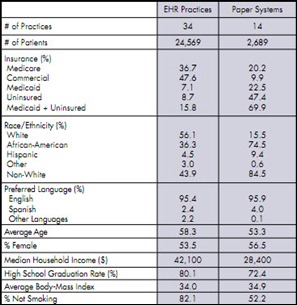
6-15-2011 3-59-55 PM

image This week on HIStalk Practice: additional background on the RWJF report that found diabetics treated by practices with EHRs received significantly better care than those treated at paper-based offices. Turns out the paper-based offices also had almost five times more non-insured or Medicaid patients than the EHR-based practices and twice as many non-white patients. Also: Julie McGovern of Practice Wise shares tips for creating a disaster recovery plan. A new organization is launched to certify medical scribes. Less than one-third of physicians are expected to remain independent by 2013.  Dr. Gregg shares HITECH support woes and wins. If you like the ambulatory world (and who doesn’t?) then you’ll want to make sure to sign up for the HIStalk Practice e-mail updates.

image In almost totally unrelated to HIT news: a couple of girlfriends and I stayed at a upscale hotel recently for a little getaway. All three of us came home with what I have diagnosed to be bed bug bites (you know, I did the Internet research thing and compared my bites to the online photos.) Which leads me to wonder: are bed bugs the latest work hazard for HIT road warriors? It’s a totally disgusting topic, I realize, but it’s an issue I never really worried about in my traveling days. FYI, I complained to the hotel; they checked the room and told me they found no evidence of bed bugs. BFFs and I are thus considering whether we’d be better off visiting a dermatologist or simply seeking a psych consult.

image Listening: Black Joe Lewis & The Honeybears from Austin, TX, recommended by a reader. Here’s what I e-mailed to her: “I’m doing hideously uncoordinated chair-based dance moves to Booty City, thinking I’ve gone back in time to the 60s to listen to Edwin Starr doing 25 Miles from Home. Now I’m going to want to accentuate everything I say with an emotionalHUuaaH’ just like this guy (and James Brown) I’m making that ‘white man trying to be funky’ look by scrunching up my nose, sneering, and and squinting as I bob my head out of time with the music and do some walking bass on the air guitar.”

image On the Jobs Page: Solutions Executive – Virtual Office, Technical Marketing Engineer – Work from Home, Healthcare IT Technical Recruiter. On Healthcare IT Jobs: Allscripts Test Manager and Test Resource, Implementation Consultant, Meditech PCM Implementation Analyst.

image First, do no harm. Once that’s done, (a) sign up for e-mail updates in the box to your upper right (unless your display is set to low resolution, in which case it could be just about anywhere); (b) send me news, rumors, and anything that would tickle my sophomoric humor; (c) find Inga, Dr. Jayne, my sites, and me on your favorite social not-working tool and make the appropriate electronic connections so we can feign mass appeal; (d) accept my personal challenge to randomly inspect five of the admittedly large number of ads to your left and click them, waiting excitedly as in the presence of Monty Hall to see what’s behind Door Number 3 and knowing that you are thereby supporting us keyboard-clackers who work absurd hours after our day jobs; and (e) don’t worry, be happy.

6-16-2011 7-57-55 PM

image Thanks to Bulletin Healthcare, new to both HIStalk and HIStalk Practice as a Platinum Sponsor. The publishing company sends out electronic newsletters to 400,000 doctors every morning by 8:00 a.m., working with two dozen leading medical associations to meet the unique news requirements of their members  as a valued member benefit (American Medical Association’s AMA Morning Rounds, American College of Physician Executives’ ACPE Daily Digest, and American College of Cardiology’s CV News Digest, to name a few.) The Reston-based company is the medical division of Bulletin News, which provides executive news briefings for the President and most of the Cabinet. They’re happy to tell companies about their advertising programs, should yours have an interest. Thanks to Bulletin Healthcare for supporting HIStalk and HIStalk Practice.


Sales

6-16-2011 7-36-17 AM

The Regional Medical Center at Memphis (TN) purchases Carestream Health’s Vue RIS for radiology scheduling and reporting.

The University of Virginia Health System extends its licensing agreement for Streamline Health’s document workflow solutions and adds Streamline’s Correspondence Workflow application.


People

6-16-2011 7-00-57 PM

Press Ganey promotes Robert Draughon from president and CFO to CEO, replacing Richard B. Siegrist, Jr. Siegrist will transition to chief innovation officer and remain on the board. We reported this Monday, courtesy of a rumor report from South Bend Snoop.
6-16-2011 6-39-56 PM

PatientSafe Solutions names Joseph Condurso president and COO. He was a CareFusion VP and also spent time with Cardinal Health.
6-16-2011 4-13-54 PM

EnovateIT president Fred Calero wins Ernest & Young’s Entrepreneur of the Year award for Michigan and Northwest Ohio in the healthcare services category.
6-16-2011 7-34-26 PM

image Vivek Kundra, the nation’s first CIO, will quit in August to take a Harvard fellowship. Like his boss, opinions vary on whether he has accomplished anything of positive significance. Nobody has said much about a possible successor, so I don’t know if Aneesh Chopra has the cred or interest.

6-16-2011 8-20-08 PM

Industry long-timer Rick O’Pry, founder of JR O’Pry Consulting and IntraNexus, launches a consulting company called HIT Strategists.


Announcements and Implementations

6-16-2011 7-31-21 AM

St. Michael’s Hospital (MN) will go live on Meditech on July 1.

image Mayo-Austin (MN) apologizes to patients for long registration delays caused by the EMR it installed in April, saying it “has temporarily slowed down our registration process and phone response time as we check the accuracy of patient information and become more proficient with the system.” They’ve hired more staff. I bet decreased patient satisfaction and increased headcount to do the same work wasn’t in their business plan.
6-16-2011 8-30-48 PM

Omnicell’s OmniRX medication dispensing system wins Best in KLAS for hospitals 200 beds and over.

PDR Secure launches the RxEvent adverse event reporting service, which will allow doctors to report drug problems directly from their EHR. It was developed in conjunction with Greenway, the American Pharmacists Association, and athenahealth.
6-16-2011 9-20-52 PM

UPMC announces its HealthTrak mobile app for iPhones and iPads that allows patients to review their test results, history, meds, and appointments. It’s based on Epic’s MyChart.


Innovation and Research

image Fujitsu works with a hospital in Japan to roll out a patient guidance system based on e-paper. Patients carry an electronic card holder that guides them to diagnostic departments, checks them in, and accepts their payment. They can wander around while waiting since the system calls them when it’s their turn (not that hospitals have anywhere interesting to wander around in anyway, but at least they could distance themselves from Unemployment TV).


Technology
6-16-2011 6-45-45 PM

Ottawa Hospital is deploying mobile technology in a big way, purchasing 2,800 iPads for its 456-bed facility. The CIO notes that its iPad and iTouch users include doctors, nurses, pharmacists, respiratory therapists, and even janitors.
6-16-2011 3-12-45 PM

Online physician networking site QuantiaMD finds that over 30% of physicians use tablet devices, 20% of them in clinical settings.

6-16-2011 7-19-21 PM

Panasonic announces that it will bring out an enterprise-grade, Android-powered Toughbook tablet in the fourth quarter.


Other

Sparrow Health System (MI) hosts a job fair in an attempt to fill 70 to 80 IT job openings. Analysts will support the health system’s $100 million Epic EHR implementation. Starting salaries are $50-80K.

The Missouri Hospital Association estimates that 90% of the state’s hospitals use an EHR for at least one of 24 functions. On average, hospitals use about nine EHR functions, though 44% use at least 13.
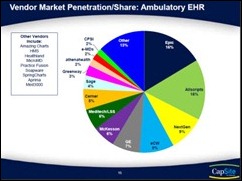
6-16-2011 3-13-59 PM

CapSite believes the ambulatory EHR and PM market will exceed $3 billion through 2013, with 63% of physicians replacing their current PM systems for an integrated PM/EHR and 38% upgrading or replacing their current PM. Capsite’s 2011 U.S. Ambulatory EHR and PM Study also predicts that 50% of physician will be investing in ambulatory EHR systems. In terms of current market penetration, Allscripts and Epic each have 16%, followed by eClinicalWorks, NextGen, and GE.

A tornado in Verona, WI left Epic powerless for most of last Thursday, forcing it to run on backup generators.

image A California man is arrested for pretending to be a medical doctor. A patient got suspicious after he told her to treat her kidney disorder by eating watermelon in a hot tub.

image Weird News Andy is speechless about this story: a woman in Sweden with fever, chills, and aches calls four times over four days for an ambulance, but is turned down because she is still able to speak. She dies. But WNA is tittering at this piece about English hospitals warning employees that their uniforms must not expose their midriffs or “excess cleavage” (whatever that means) after patients complained.


Sponsor Updates
6-16-2011 7-05-44 PM

  • SCI Solutions posts a video describing its new Arrival Manager product and a cool flipbook of its annual Innovations in Access Management magazine.
  • MEDSEEK wins the 2011 Frost & Sullivan North American Health Records Technology Leadership award.
  • FormFast and T-System collaborate to integrate the print management portion of FormFast’s workflow software with the T-Sheets documentation system.
  • CareTech Solutions announces that two of its clients won 2011 Aster Awards for their Web sites.
  • AsquaredM is offering a June 23 Webinar on improving revenue cycle performance with Lean Six Sigma.
  • Hanger Orthopedic Group will deploy NextGen Ambulatory EHR and PM at its 675 orthotic and prosthetic patient care centers in 45 states.
  • The Tennessee-headquartered RegionalCare Hospital Partners selects Healthcare Management Services (HMS) to provide clinical and financial applications .
  • McKesson VP and medical director David Nace, MD is speaking about bundled payments at this week’s AHIP conference in San Francisco.
  • A health center customer of TELUS Health Solutions wins an Ingenious Award for using the company’s remote patient monitoring solution to increase nurse productivity, reduce home visits, and save $450 per patient.
  • Humana will offer financial assistance to physicians adopting Allscripts EHR as part of is as part Humana Medical Home EHR Rewards Program.
  • Pinehurst Dermatology (NC) contracts for the SRS EHR.
  • API Healthcare hires Kathy Douglas, RN, MHA as the company’s chief nursing officer. She founded the non-profit On Nursing Excellence.
  • TeleTracking Technologies will preview its new RTLS solution at the 2011 Association for Advancement of Medical Instrumentation conference being held June 25-27 in San Antonio.
  • HHS’s Office of Minority Health and Quest Diagnostics announce a program to  donate 75 MedPlus EHR user licenses and one year’s subscription fees to physicians in small practices serving minority populations in Houston.
  • Perceptive Software names Glenn Cross VP of Marketing.
  • MED3OOO is offering an on-demand Webinar on Why ACOs Should Be Physician Led that features Amit Rastogi MD, president and CEO of PriMed LLC, a 70-provider medical group in Connecticut.

EPtalk by Dr. Jayne

6-16-2011 6-51-10 PM

Mile·stone (noun)

  1. A stone functioning as a milepost.
  2. A significant event or stage in the life, progress, development or the like of a person, nation, etc.

I believe in celebrating milestones. With the rapid pace that many of us run each day, it’s easy to overlook key events. We get used to doing the same tasks each day / week / month / year, falling into the cycle of “lather-rinse-repeat” and losing sight of the work that we are accomplishing.

I encourage my team to remember that, although this may be the 43rd time they’ve trained “E-prescribing 101,” this is the first time the users in their classes are seeing it. I remind them to remember the impact they are having on our end users and that completion of each class is an accomplishment.

We just took our 250th physician live on one of our clinical systems. The go-live wasn’t any different than any other go-live — the physician was aggravated that he had to be there and I was aggravated at having to deal with his surliness towards the IT team. However, calculating the number of times we’ve executed the same process multiplied by the number of people needed to work closely together to successfully get that physician live, it becomes significant. If you would have offered me a bet at the start of the rollout that we’d have this many physicians live on that application at this point, I wouldn’t have taken it.

We tend to take for granted the things that seem to be always present. Maybe we celebrate the beginnings and the ends — the new teammates and the retirements — but we forget to mark the events that happen along the way.

The five-year anniversary of an incredibly challenging project is passing without anyone in our organization other than those of us who were on the team at the beginning noticing. On one hand, maybe it’s good that the tool has become such a part of the organization that it’s not a big deal. But for those of us who still have flashbacks from the go-live (and probably a little post-traumatic stress disorder), it’s amazing.

Celebrating milestones helps us learn what others value and why it matters. Last Wednesday was HIStalk’s eighth birthday. Although Mr. H mentioned it, he tends to be the somewhat shy and retiring type, so it was pretty low key. I’d like to do my part to celebrate HIStalk and reflect on the impact Mr. H and company have had on me.

As a reader, HIStalk provides a reliable, humorous, and entertaining source of information that I could not possibly have uncovered without hours of sifting through the announcements, updates, and studies that come through my inbox and across my desk each week. It gives me tidbits of industry gossip that sometimes hit too close to home.

I’ve learned things about competing health systems that I could not have sleuthed out on my own. I’ve surprised vendor execs by asking them to confirm rumors about their companies that they haven’t even heard themselves. I’ve experienced HIStalkapalooza and the IngaTini.

As a member of the HIStalk team, I’ve had the opportunity to see different sides of vendors as Inga and I cruised the aisles at HIMSS, at one point switching badges to see if it made a difference in how we were received. One of the high points was meeting Mr. H for the first time in the HIStalk limo, changing into our doctor disguises and walking down International Drive with Inga in her amazing boots. We saw our sponsors, many of whom compete directly with each other, breaking bread together at the HIStalk luncheon.

I’ve learned that whether people like a particular piece I’ve written or whether they hate it, I don’t take it too personally either way.

This has been an opportunity to meet amazing people, make new friends, and learn that being anonymous can be a challenge. Using Dr. Jayne’s e-mail address, I’ve emailed people I’ve known for years — and have been ignored. I’ve socialized with key players in government and healthcare and have had to bite my lip to keep from saying, “OMG, if you knew you were talking to Dr. Jayne you would not have just said that.”

I’ve also built necessary career skills – namely the ability to keep coffee from coming out my nose when my co-workers quote HIStalk pieces that I’ve had a hand in.

Best of all, I’ve learned that what may seem like an insignificant event at the time can be a life-changing one. I’d like to thank a certain vendor exec for casually asking, “Do you read HIStalk?” over drinks on a certain day in 2009. At the time, I didn’t. But thanks to that simple question, along with the faith and support of Mr. H and Inga, as well as the camaraderie of Dr. Gregg and Dr. Travis (MD recently conferred!) I’m about to click SEND on Dr. Jayne’s 50th post. Here’s to milestones.

image


Contacts

Mr. H, Inga, Dr. Jayne, Dr. Gregg.

News 6/15/11

June 14, 2011 News 7 Comments

Top News

6-14-2011 9-49-29 PM

image Three Kentucky healthcare systems will form a single organization with a combined 91 hospitals, clinics, and home health agencies. The new system will include the University of Louisville Hospital, the James Brown Cancer Center, the six-hospital Jewish Hospital & St. Mary’s Healthcare, and the seven-hospital St. Joseph Health System. As part of the deal, Catholic Health Initiatives will make an incremental capital infusion of $320 million to support the system.

image A new Robert Wood Johnson Foundation report finds that 51% of office-treated diabetics in Cleveland received all the care they needed from practices using electronic medical records vs. 7% from paper-based practices. A similar correlation was found for diabetic outcomes. I didn’t see study methodology so I can’t really evaluate it to determine if it adequately proved cause vs. effect, but it’s interesting.


Reader Comments

image From Paula: “Re: Vince’s HSD piece. What about McDonnell-Douglas IHS? It was an innovative system for its time. When McAuto decided to get out of the hospital systems business, it was sold.” Here’s a reply from Vince:

Thanks for reading these dusty old bits of trivia! Yes, IHS (Integrated Health Systems) was one of many turnkey minicomputer systems that the shared giants offered in the 80s – which is going to be the next epoch in HIS-tory covered. McAuto bought IHS in the mid-90s as a DEC-based "total" HIS, to complement their wide array of other turnkey mini offerings, including HDC, MHS, LabCom, RXCom and RadCom. SMS offered a bunch of minis too: ACTIon 400, 700 & 1200, Spirit Choice, and MS4. Ironic the shared giants got into minis so big! Stay tuned for all the details in two weeks."

image From Former TMISer: “Re: Commission on Professional and Hospital Activities (CPHA). Vince might want to do a piece on them since they were maybe the first to computerize healthcare data on a large scale. It was a grant-supported non-profit that collected, processed, and stored abstracted data on more than 50% of hospitals back in 1969, offering three products: Professional Activity Study, Medical Audit Program, and Length of Stay Study. All were paper-based printouts. CPHA was influential in the development of the International Classification of Diseases and its length of stay data contributed materially to the development of DRGs.”

6-14-2011 7-03-23 PM 

image From The PACS Designer: “Re: StartUp Health. In addition to HIStalk giving smaller companies a chance to succeed, the federal government has announced a program called StartUp Health. This new effort will help entrepreneurs create a long-term roadmap for success by providing education, support, and capital to build a health and wellness business.”

6-14-2011 8-30-54 PM

image From augurPharmacist: “Re: American Society of Health-System Pharmacists. The Summer Meeting in Denver has lots of HIT content. Discussions include bar code scanning at each step of the intra-hospital supply chain such that ‘when a drug product changes hands, it gets scanned.’ There’s a growing awareness about the technologies required to enable intended pharmacist practice model change from inside the pharmacies to the patient side. Lots more information available on pharmacy’s professional initiative referred to as PPMI by searching ‘PPMI.’”

6-14-2011 8-12-17 PM

image From J.U. Stice: “Re: nextEMR. Looks like they are the most recent ONC-ATCB certified EHRs to die on the vine. No employees, unpaid bills, empty promises. Classic story of underfunding and no marketing traction. If you build it, they will come? I don’t think so.” I contacted CEO and Founder Alan Faustino MD, who provided this response:

Reports of our demise have been greatly exaggerated. While we have experienced our share of growing pains, like most companies in this economy, we are still offering the same outstanding service and support that has help us survive in this turbulent and confusing HIT period. As a matter of fact, we have been vetted out by several organizations recently from a financial and technology point of view and have been successful in developing strong relations that will sustain this company today and into the future. As an example, we have been chosen as the EMR of choice for the McFarland group to implement and use EMR for research initiatives. We have weekly webinars and look forward to using our technology to better the overall success and increase influenza immunization to the under represented in this country. I can assure you that the NMA and the Cobb institute would no likely involve themselves with a company not in operation. As a matter of fact, we have in conjunction with the McFarland group a webinar tonight and welcome anyone to join and "feel our pulse" Like many businesses, we have had to let go of some employees for financial or performance reasons. However, we wish these people well and hopefully they will find more constructive things to do with their time. However, I do appreciate the "press." Hopefully, HIStalk will allow us to show a different perspective on our company and welcome the opportunity to let the physician community know how nextEMR, along with our partners, are giving physicians the technology to be frankly better physicians today.

image From Chip: “Re: poll on giving patients a list of employees who accessed their electronic medical record. You have to do this to pass ARRA and EHR certification requires it, so vendors must have overcome any technical hurdles.”


HIStalk Announcements and Requests

6-14-2011 9-32-53 PM

image I have to give a shout out to Best Buy for some superior customer service I just received. I bought a new Asus PC from them, but noticed it had integrated graphics rather than the advertised 1 GB ATI graphics card, which was almost certainly an error in the specs Asus gave them (or perhaps an Asus manufacturing mistake). It wasn’t a huge deal and it wasn’t Best Buy’s fault, but I called the local Best Buy store where I had picked it up (I had done ship-to-store) and they told me to bring it over. They gave me a brand new 2 GB card ($100) and for “my inconvenience” (basically, next to none), they had the Geek Squad folks install it while I waited – all at no charge. I felt bad for even calling since the graphics aren’t all that important to me, but Best Buy really came through. The new PC is working great and I’m finally off Vista and WinXP (except at work, of course, where the ten-year-old XP still reigns unchallenged).


Sales

6-14-2011 3-13-34 PM

Norton Healthcare (KY) purchases the Morrisey Concurrent Care Manager application to automate its care management processes


People

James Hauschildt EdD, MA, BSN, RN is named academic dean of Saint Luke’s College of Health Sciences (MO). He was formerly with Dearborn Advisors, Dell, Cerner, and the Air Force nurse corps.


Announcements and Implementations

6-14-2011 12-05-32 PM

Massena Memorial Hospital (NY) goes live on MEDHOST’s EDIS.

6-14-2011 3-12-14 PM

image Shands Healthcare (FL) goes live on its $95 million Epic EMR at three facilities. A fourth facility will be added in September and several faculty practices will go up next year. The same article includes some interesting facts about Epic: the company has 240 customers; one-fourth of the country’s physicians use Epic software; and, 110 million patients (38% of all patients) will be in an Epic system once pending implementations are complete.

The School of Medicine at the University of Alabama-Birmingham starts its EHR implementation, which will be completed in five phases over the next 18 months. Stephen Stair MD, the physician executive sponsor of the project, provides an update above.

6-14-2011 3-10-45 PM

West Tennessee Healthcare System deploys BIO-key International biometric ID software within its Sentillion Vergence solution.

6-14-2011 8-46-21 PM

image A nine-physician internal medicine group in Michigan sells itself to Oakwood Healthcare, saying it passed on aligning with Henry Ford Health System because HFHS couldn’t get its EMR installed quickly enough. HFHS says the EMR wasn’t a priority because they are replacing their McKesson system with a $100 million custom system from RelWare and didn’t see the point in installing a system that will be gone in two years. Oakwood uses NextGen, but signed a contract in April to implement Epic in its hospitals and practices at a cost of $60 million.

Philips will roll out its eICU system in India within a year.


Government and Politics

Maine legislators vote to allow residents to opt out of the state’s HIE database.

image Mark your calendar: July 3 is the last day eligible hospitals and critical access hospitals can begin their 90-day reporting period in fiscal year 2011 for the Medicare EHR incentive program. Eligible Providers have until October 3.

The Boston Globe points out that the state still does business with IBM’s Cognos division even as one of the company’s former salespeople goes on trial for giving kickbacks to the speaker of the house of Massachusetts in return for getting software contracts without going through the required bidding process. Neither IBM or Cognos, which had not been acquired by IBM at the time of the alleged incident, have been charged, but it’s possible the SEC could get involved if evidence suggests that the sale boosted the acquisition value of Cognos.

The UK’s NHS says that even though the country’s “digital by default” policy requires citizens to communicate with government agencies by digital means, that requirement will not be imposed on those seeking health services. Instead, the government will meet whatever demand citizens have, with one of its technical leaders saying, “The idea that we should wait for everyone to agree before offering digital services is ludicrous.”


Innovation and Research

A study finds that implementation of healthcare IT had no effect on outcomes for nursing home patients, other than it seemed to make them more disruptive.


Other

6-14-2011 3-17-14 PM

HIMSS names Hudson River Healthcare (NY) as its single finalist for the Community Health Organization Davies award.

image Mayo Clinic’s chairman of health policy and research says that the clinic won’t be participating in an ACO, at least based on the proposed rule. According to Douglas Wood MD, Mayo’s objections include the use of oversight boards to judge performance, the proposed anti-trust rules, the methods of measuring effectiveness of care, and the way patients would be assigned to ACOs.

maxIT Healthcare celebrates its 10-year anniversary by sending out its executives in an RV with a cool paint job, driving across the country to visit its consultants and clients in the field.

6-14-2011 7-26-36 PM 6-14-2011 7-29-36 PM

image Weird News Andy noodles out a great story about a doctor and a diva (he clarifies they are not one and the same in this particular case). An opera singer (on the left above) shopping at a Manhattan Trader Joe’s gets annoyed at a teenaged boy who blocks her husband from grabbing a frozen Pad Thai dinner. Hubby complains loudly, so the boy’s mom (a doctor, on the right above), bellows out, “Get that pole out of your ass.” The opera singer admits that she then slapped the doctor, but adds that she needed slapping because the doctor was “getting into her personal space.” The opera singer is on trial for attempted assault.  

6-14-2011 9-07-53 PM

image Here’s a great interview and character study of Bill Gates, who talks about global health and how his kids will need to find regular jobs because he’s not giving them much money (“much” meaning quite different things to Bill than to you and me). Trivia: he bristles when the reporter asks if his kids have iPhones, iPads, or iPods, saying, “They have the Windows equivalent … they are not deprived children.” You forget how young he was (21) when he and Paul Allen started Microsoft in 1975 – the photo above is from 1984, well into the company’s growth and the year that Windows was launched. He looks about 12.

I like this well-written and just-sarcastic-enough editorial by a physician and former president of AAPS, whose bio contains this wry observation: “As a life-long dog lover and trainer, she realizes that her dogs have better access to medical care and more medical privacy than she has, and her veterinarians are paid more than physicians in the United States for exactly the same types of surgery.” Among her unhappy but amusing observations (not all of which are correct) about medical practice is this:

Now there’s also “healthcare reform.” That includes the push for the EHR (electronic health record). Physicians are being bribed with $44,000 for installing one that meets the government’s desire to have your formerly private medical record on a government database. With this system, a keystroke can fill your medical record with mistakes, yet a physician can’t write a progress note without learning to navigate a computer program so obsessive that the detail required to order a simple test would do for a moon landing. The former head of CMS (Centers for Medicare and Medicaid Services), Nancy-Ann Min DeParle, made around $2 million dollars working for the company whose program it is, before she became an unaccountable “Czar” in the present regime.

A female visitor trips while walking out of the elevator at Louisiana Medical Center and Heart Hospital. She claims permanent injuries to her arm, shoulder, and neck that cause her pain and suffering, disability and mental anguish, loss of income, loss of earning capacity, and expenses. She’s suing the hospital for $600,000.


Sponsor Updates

  • Highmark selects MEDecision’s collaborative health management solutions to support the management of its 4.8 million members.
  • Practice Fusion hires Edwin Miller as its first VP of product management. He previously worked for Curaspan, Artromick, and athenahealth.
  • Health Language is demonstrating its upgraded version of LEAP I-20 at booth #335 at this week’s AHIP conference in San Francisco.
  • CareTech Solutions and its client, Central Maine Medical Center (ME) are chosen by the Ohio Hospital Association to present an IT security case study, Security Assessments: A Tool to Manage Risks and Achieve HIPAA Compliance, at OHA’s annual meeting this week in Columbus.
  • The 49-bed Monroe County Medical Center (KY) contracts with Healthcare Management Systems for its EHR suite.
  • The City Paper of Nashville and Nashville’s Entrepreneurs’ Organization name ICA president and CEO Gary Zegiestowsky as one of the top ten entrepreneurs in the Nashville area.
  • ZirMed earns a #79 ranking on HCI’s 100 list of top HIT companies.
  • Business Alabama magazine and Best Companies Group name MEDSEEK one of the 2011 Best Companies to Work For in Alabama.
  • PatientKeeper releases its Charge Capture solution for Android.
  • Nebraska Medical Center chooses Voalte’s integrated communication solution.
  • Sage Healthcare Division announces that more than a dozen healthcare facilities have chosen Sage Intergy Meaningful Use Edition.
  • Moses Cone Health System (NC) selects ProVation Order Sets for its five hospitals.
  • Duncan Regional Hospital (OK) will implement T-SystemEV STAT to manage average length of stay in its ED.
  • North Shore-LIJ Health System extends its enterprise agreement with Surgical Information Systems by choosing the SIS Anesthesia documentation solution.
  • The entire recruiting team of Intellect Resources achieves Certified Personnel Consultant certification.
  • NYU Langone Medical Center implements the PatientSecure palm scanning solution for biometric patient identification. A patient commented, “This technology makes you feel like a VIP. You just put your palm on the scanner and you’re done registering at your doctor’s office, no clipboard, no hassle of paperwork to check in, plus, it’s absolutely secure. It’s immediate and instantaneous. Never in my life have I experienced health care like this before. ”

Contacts

Mr. H, Inga, Dr. Jayne, Dr. Gregg.

Text Ads


RECENT COMMENTS

  1. Isn't that actually present perfect indicative?

Founding Sponsors


Platinum Sponsors


Gold Sponsors


RSS Webinars

  • An error has occurred, which probably means the feed is down. Try again later.