Home » News » Recent Articles:

Monday Morning Update 12/12/11

December 10, 2011 News 5 Comments

12-10-2011 4-55-17 PM

From Dr. Boogie: “Re: Gwinnett Medical Center (GA). Goes on total patient diversion due to a computer virus. Physician portals impacted, hospital systems shut down. News media says no patients were impacted. Using old fashioned paper until systems can be resurrected.” Verified. They’re using paper and runners, with campuses in Lawrenceville and Duluth still on trauma diversion this weekend after the virus was discovered Wednesday, meaning ambulances are being sent elsewhere. They hope to have the problem fixed by Monday. For the nerds among us, they were hit with SillyFDC, a worm that spreads on removable or mapped drives that have Autorun turned on. It supposedly spreads without doing harm, but having seen similar worms take down hospitals myself, I’d bet it generated so much TCP/IP traffic that the network bogged down, requiring field support techs to touch every PC with network nodes isolated to prevent the virus from propagating right back from another unfixed PC. One thing you learn: antivirus software on individual PCs can tell you if they are infected, but they don’t tell you at a network level which PCs are spreading it, so you end up looking for network traffic patterns and isolating devices one at a time. Thus, A/V tools are of limited benefit, especially if users just ignore their messages like they usually do.

12-10-2011 4-39-01 PM

From CC: “Re: Validus handheld e-prescribing tool. Has been acquired, but they won’t say by whom. An employee told me and said it was hoped the news would not appear in HIStalk, but loyalty to HIStalk got the better of me.” I assume that’s Validus Medical Systems, quietly acquired by Imprivata in July 2011. They offered a mobile order entry app for hospital physicians that Imprivata either isn’t marketing or hasn’t repackaged yet since I see no mention on Imprivata’s site. We can take joint responsibility for disappointing the folks who hoped not to see the news here.

From Petaler Dan: “Re: Quebec’s medical error registry. Here’s news on how hospital mortality rates have fallen, although it doesn’t cover Quebec. And here’s Montreal coverage on the report and how mortality rates have decreased significantly — scroll toward the end for quotes on surgical checklist implementation, which is reassuring.”

From McKesson Horizon Client CIO: “Re: McKesson. To employees affected by this latest turn of events, you worked very hard over the last several years and your dedication to the customer base did not go unnoticed. You are collateral damage from mismanagement and lack of a principled leadership. For the patients you helped me and my team serve, thank you and best of luck.”

From Uggams: “Re: GE and Microsoft. This is a Microsoft healthcare surrender flag. Somehow they convinced GE to help them bury the bodies. Michael Simpson’s only relevant experience was running Horizon Clinicals for McKesson, ironically mercy-killed the same day he was announced as CEO of the new GE-Microsoft home for dying products. Sentillion had solid, well accepted products, but was especially aggrieved by the meddling of its Microsoft masters, and now they are cast aside with products and vague ideas that nobody cares about.” That’s the biggest disappointment to me. Microsoft had insinuated that Sentillion’s products would find mainstream Microsoft use. Now it’s relegated to the group that includes some GE-Intermountain screwing around that never seems to provide any real, marketable products (are those Intermountain-led Carecast enhancements just about done?) and some GE products that, to be honest, I’ve barely heard of. I don’t think anybody really believes that Microsoft is growing its healthcare business rather than retreating from it, so that leaves GE’s track record as a nimble innovator to make something happen. But I’m going to stop being cynical and give them six months to show some progress, with my hopes that they really can do it. We need some new stuff to talk about since Epic and Meaningful Use are getting repetitive.

12-10-2011 6-58-18 PM

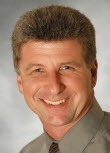
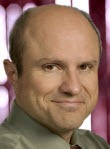
From Ex-Tele: “Re: TeleTracking. Anthony Sanzo, former CEO of AHERF, has stepped down as CEO of TeleTracking.” Verified by a company spokesperson. A search is underway for his replacement. The interim CEO is Michael Zamagias (above), board chair of the company.

From Booth Monkey: “Re: Meditech exhibiting at HIMSS. Something must have happened to get them back in. As a silver corporate HIMSS sponsor with mega-sponsor points, those of us who worked our way to the top of the exhibit booth selection process would start over by dropping out, so look for them back on the corner wall by the bathrooms. So it is with those who dare to thumb their nose at HIMSS, as it was in the beginning, is now, and forever shall be, HIMSS without end.”

Listening: I was in the mood for some slow-dance kind of doo-wop, one of my favorite musical forms even though it was popular only before my time and most of the original performers are dead now. Among my favorites: The Passions, Earl Lewis & The Channels, The Schoolboys, The Skyliners, The Excellents, and The Shields. I always plan to listen to just one song and end up playing them all afternoon. It’s a triumphant and truly American form of vocalizing, drawing from gospel and rhythm and blues and performed by untrained, uneducated, largely forgotten blue-collar part-timers crossing every ethnic and racial line who were working for nothing because record companies were robbing them blind (for many of the records, the performers are anonymous because nobody at the studio cared enough to even write down their names.) I defy you to listen to The Closer You Are, Just to Be With You, or  My True Story without joining in with your own background harmonies.

Thanks to the following sponsors (new and renewing) that supported HIStalk, HIStalk Practice, and HIStalk Mobile in November. Click a logo for more information.


12-10-2011 2-40-35 PM
12-10-2011 2-42-16 PM
12-10-2011 2-31-13 PM
12-10-2011 2-35-35 PM
12-10-2011 2-43-16 PM
12-10-2011 2-29-48 PM
12-10-2011 2-41-26 PM
12-10-2011 2-36-37 PM
12-10-2011 2-32-14 PM
12-10-2011 2-33-05 PM
12-10-2011 2-34-42 PM
12-10-2011 2-44-08 PM
12-10-2011 2-38-50 PM
12-10-2011 2-39-42 PM
12-10-2011 2-33-57 PM
12-10-2011 2-37-58 PM

12-10-2011 3-23-04 PM

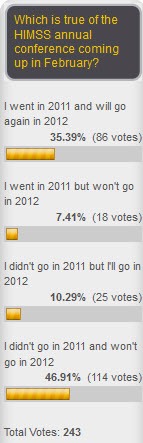
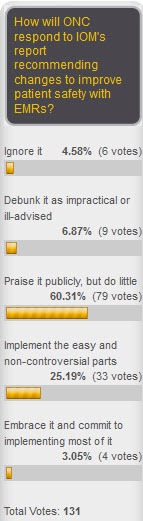
We can learn two two facts from my last poll:  (a) around half of respondents went to the most recent HIMSS conference, and (b) about the same percentage will attend the next one. Not exactly earth-shattering news. New poll to your right: what do you think about McKesson’s Better Health 2020 plan as described by MPT President Dave Souerwine in my Friday interview? The great thing about having a lot of well-informed readers is that companies can get immediate and broad feedback that’s not available anywhere other than HIStalk, so here’s your chance to provide it (and feel free to leave comments on either the interview or the poll if you’d care to elaborate).

I don’t want to get into the placement business for displaced McKessonites who are among the announced 174 employees who may lose their jobs, but another company has already e-mailed me looking for high-level marketing people from there. E-mail me.

12-10-2011 3-58-47 PM

Speaking of HIMSS, HIStalkapalooza is on: Tuesday, February 21 at FIRST Food & Bar at The Palazzo in Las Vegas. I’ll have more later, including opening up of the invitation list sometime after New Year’s. Our soon-to-be-named sponsor is doing a great job with the planning and has bought the place out. We’re going for a fun but networking-friendly vibe. The stage show will include our King and Queen contests with Lindsay and Greg again; people running around in beauty queen sashes for no apparent reason; some kind of contest or charity fundraiser that Inga and Dr. Jayne are cooking up to which I’m not really privy (I suspect shoe-related activities, which is great for the guys since the ladies come dressed to kill); and of course the HISsies awards. Put it on your calendar and watch for the announcement in a few weeks.

My Time Capsule editorial this week from five years ago: Sounds Like Somebody’s Industry Has a Case of the Mondays. “Nobody seems to be innovating anything. Everybody claims big R&D spending, but the products are starting to all look alike, kind of a no-nonsense 1980s Soviet Union version of software by committee. Or it could be their customers, blaming everyone except themselves for poor ROI.”

Here’s a scoop from our official friends at Cerner: the company (like Meditech) will be exhibiting at the upcoming HIMSS conference after sitting out for a few years. I’ll be talking more with them soon to get the story. They said customers wanted to see them there, which doesn’t surprise me.

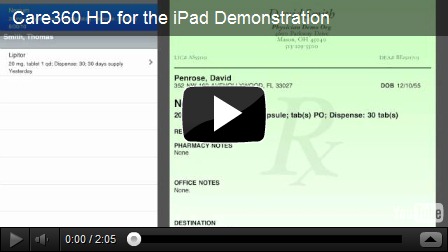
Quest’s Care360 EHR is named the top standalone e-prescribing platform by Black Book Rankings. Above is a demo of its iPad version, just because I happened to see it on YouTube and it’s new.

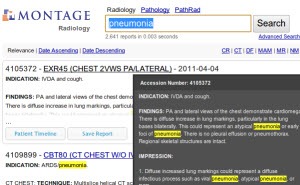
Some of my favorite “why doesn’t every vendor offer this” tools are plain old Google-like EMR search tools that physicians can use to get quick answers from electronic medical records. Mass General goes one step further with QPID, a semantically driven variant that can perform searches by concept and not just keyword.

Here’s an example of why you don’t want your company to go public: analysts warn Scottish CDM software vendor Craneware that if it doesn’t want to see its stock price drop, it needs to announce a big sale in the next three weeks. So is the message to give whatever ridiculous discount is required to convince a hesitant prospect to sign on the line which is dotted? Is that end-of-period timing so important that signing a money-losing contract quickly is still a good idea?

Here’s Vince’s latest HIS-tory, this time on boutique consulting firms. Dorenfest, Kennedy, Johnson, Weil, Levine … fascinating stuff. He names some 1985-era individual consultants and admits to never having heard of any of them – have you? It puts your own legacy and mortality in perspective when looking at names from just 25 years ago and wondering how their lives turned out, where they are today, and how their work fits against the backdrop of history.

Weird News Andy urges Hollywood to pay particular attention to this article since both smoking and breast enhancements are common there, fearing that the result during a strong wind could be “a nip in the air.” A plastic surgeon warns breast augmentation surgery patients to avoid smoking afterward since nicotine and carbon dioxide can disrupt blood flow and can “cause her nipples to turn black and fall off.” WNA also likes this story, even though he worries that patients might be admitted as brunettes and discharged as blondes: a new and promising method of room disinfection involves pumping ozone and hydrogen peroxide into a room to sterilize everything in it.

Inga asked our sponsors to share any charitable works, celebrations, or other notable holiday-related events going on at their places. Here’s one to get us started: BridgeHead Software and its 25 US employees donated $1,000 to Youth Villages Holiday Heroes, which matches the wish lists of disadvantaged children with sponsors who provide them. Kudos to them.

12-10-2011 7-11-56 PM

Employees of chiropractor PM/EMR vendor Redpine Healthcare Technology of Panama City, FL ask county commissioners to help them get overdue paychecks. The company’s CEO says he’s trying to find an investor, but employees were last seen packing up their cubes and nobody’s answering the phones. The county says it’s going after the $350K it gave the company to relocate there, which came with a guarantee the company would add at least 150 jobs over three years. The county has a lien on the software.

Struggling New River Behavioral HealthCare (NC), behind on payments to the guy who wrote some Meaningful Use enhancements for its eNotes mental health records system, faces loss of access to all of its records if it can’t pay up quickly.

12-10-2011 7-30-43 PM

Here’s one of the dumber articles that attempts to explain the Microsoft-GE JV. The article itself is obviously a typical no-value-added rewriting of the press release to make it sound like authoritative reporting, but how about that headline?

E-mail Mr. H.

News 12/9/11

December 8, 2011 News 6 Comments

Top News

Microsoft and GE announce the formation of a joint venture company that will take over most of the people and assets of the Microsoft Health Solutions Group along with specific GE Healthcare products. See the HIStalk story from early Thursday, which includes insights from interviews with the key executives involved.


Reader Comments

12-8-2011 6-45-08 PM

inga_small From Curious Reader: “Re: Black Book Rankings. I am confused about Black Book’s results. Do they break out their ratings by hospital size? CPSI usually sells to community hospitals, not the same ones Epic sells to. I don’t know how those are comparable. How is Black Book even defining and EMR? Picis is a surgery and anesthesia vendor — they don’t really have an EMR system.” This report includes multiple categories including under 100-bed hospitals, community hospitals, large hospitals, health systems, and EDs. Per Black Book’s website, the rankings are based on survey results that cover 18 performance areas. To make the Top 20 list, vendors must have at least 10 unique clients participate. Results for these ratings were based on 12,075 validated responses. There is no mention on how an EMR is defined, though it may be included in the full report. In you need to further satisfy your curiosity, you can purchase a report for $3,250, but note it will only include details on a single category and not all the inpatient EHR categories.

12-8-2011 9-07-25 PM

mrh_small From EMR Wannabe: “Re: GE and Microsoft. From trying to work with it, I know that Amalga UIS is an overly complicated hairball. I wasn’t sure about Qualibria, although last year when I asked a GE team how the knowledge project with Intermountain Health was going, they just broke into laughter and said, ‘depends who you ask.’ I said, ‘Well, I’m asking you,’ to which they took the Fifth (amendment, not bottle). Now with this announcement, we can see that Microsoft and GE decided to combine, and then bury, their respective dead or dying.” Amalga seems cool, but I don’t hear much from its customers once they’ve signed contracts, so NewCo should work to get the word out. I hope the companies really are planning to do something innovative like the announcement says. However, those with long memories will find it hard to forget (or forgive) historical examples of big, unfocused vendors who brashly stormed the HIT gates and then slunk off quietly shortly thereafter, unceremoniously dumping the charred remains of once-proud companies they had burned through and hoping the smell of utter failure would wash out of their Teflon-coated corporate suits. Recall when Baxter and IBM formed IBAX and quickly sold it off to HBOC, relieved to put distance between themselves and the albatross they had spawned from their passionate but short-lived union by creating a new company and not really caring whether it succeeded or failed.

For those scoring the Microsoft-GE JV at home, I’d watch for: (a) an indication of how much money the partners are investing vs. just letting the new organization sink or swim on whatever revenue it can muster; (b) the announcement of a real, delivered, buzzword-free product; (c) press releases listing newly signed contracts from paying customers that aren’t cherry-picked partner sites getting something else in return; (d) a lengthening roster of third-party developers that buy the “ecosystem” story and build useful apps on top of it; and (e) the assignment of experienced, high-ranking executives to the new company (so far new CEO Michael Simpson is the only person named and he’s been with GEHC only since 2010.) Some would say Peter Neupert’s retirement was the most negative aspect of the news (and it wasn’t even included in the announcement,) but to me it’s the fact that the announcement was made in such a hurry that they hadn’t even chosen a company name yet. We will report their progress here, good or bad. I’m as guilty as anyone about moaning that nobody innovates, then laying on the scorn when someone tries, so I’ll try to be cautiously optimistic, even though in talking to Neupert and Simpson Wednesday before the announcement, I couldn’t figure out exactly what they are planning to build, who the customer will be,and how the odd lot of products will contribute to the end result. I’m neutral on most of the products named since I’ve heard little about them, but I hope the former Sentillion people and applications don’t suffer in the chaos since they deserve better, having created a strong base of hospital customers that rely on their technologies.

mrh_small From SmallMe: “RE: Microsoft HSG. Major RIF and re-org in advance of the HSG/GE joint venture announcement.” According to our Microsoft contact that I asked to confirm, “Like all companies, Microsoft evaluates our business priorities regularly. As we evolve HSG’s strategy, we’re concentrating more on building a compelling platform and have eliminated a small number of positions to align with current priorities.”  

12-8-2011 8-59-18 PM

mrh_small From EthicsInHealthcareBusiness: “Re: RSNA. I’m surprised there isn’t more stringent hiring vetting by big vendors. Take the example of [vendor VP name omitted], who while at [vendor name omitted] was named in a federal lawsuit (CIVIL NO. 2004-116) accusing him of fraudulent pricing in dealings with government purchasing agents. The lawsuit was dismissed on a technicality, but it drove a parallel criminal investigation by the Defense Department and the US attorney’s office in Philadelphia. Why would a company risk this potential liability?” I omitted the specifics since, as you said, the lawsuit was dismissed and his innocence must be presumed. If he’s found guilty by the Feds, I’ll name names. His previous employer was known both globally and historically for shameful bribery. I blurred their name only a little above, but enough to say I didn’t unfairly name the company specifically.

mrh_small From Erik: “Re: McKesson. Halting all development of Horizon Clinicals 10.3 and deployment of Horizon Enterprise Revenue Manager.” Unverified. I got several e-mails from MCK employees Thursday morning that a company call was in progress (our readers are so loyal I’m surprised they didn’t conference us in.) Inga asked what was up and I told her if I had to guess, I would say MCK is either killing off Horizon or moving its revenue cycle efforts from HERM to Paragon since both had been rumored previously. I’ll be crowing to her endlessly if both guesses are correct, although I must credit readers who reported those possibilities to me in the first place starting many months ago. I’ll know more Friday, as McKesson Provider Technologies President Dave Souerwine asked to brief me. Unfortunately it will be late in the afternoon since I have to get home after work from the hospital to do it (darned day job!), but I’ll recap in the Monday Morning Update if not before.

mrh_small From MCKWorker: “Re: McKesson. All HERM staff essentially laid off. New direction for development, to combine with Paragon. HERM employees will have 60 days to interview for positions with that new strategy.” Unverified. It’s funny that Inga pinged a couple of her MCK sources and they told her company bigwigs had warned them that HIStalk would be probing for information. They were correct. Inga and I were flattered, even though the compliment was almost certainly unintentional. Apparently they weren’t too worried about anyone but us being on top of the breaking news and caring enough to dig beyond any official announcement.

mrh_small From Must Remain Anonymous: “Re: McKesson. It has finally happened! The call came today that McKesson will cease development of its Horizon product. All support will stop in seven years. Product development will now focus on the Paragon application instead. To be announced to their physician advisory council tomorrow morning. It is about time that McKesson drops the dead weight.” Unverified, until Friday anyway. If true, that would be truly remarkable given that Paragon has been close to being killed off several times, as Vince has explained in his HIS-tory lessons. Horizon has ample problems, but to think of Paragon as MPT’s flagship product is a mind-bender. If true, kudos to that little engine that could for hanging in there, excelling over and over, and giving the company an overachieving understudy for when its star couldn’t make curtain call.

And lest we forget among the corporate announcements from the several companies mentioned here, there are people behind these decisions, grunts like you and me who leave their families every day to do the best job they can, competently even though their expertise is related to products no longer in favor, who are torn with worry about their future livelihoods that are being manipulated invisibly by factors entirely beyond their control as corporate drones judge them unfairly on what they do today rather than their ability to contribute in a different way tomorrow (I hate that about corporate BS more than anything). Right now, they’re putting on a game face to try to make a nice Christmas or Hanukkah for their kids and families without seeming too preoccupied by work stuff that shouldn’t be intruding on their celebrations and religious observations, but at night when the lights go out, they are sleepless in contemplating what could change for them and those who depend on them. Join me in beaming some positive thoughts their way because I’m guessing they could use them right about now. I’ve been there and it sucks, but it eventually gets better.

mrh_small From Kurt: “Re: McKesson. I’m hearing they announced that they are spending $1 billion in healthcare IT. Is this correct? If so, this is more than most other vendors combined.” I’ll let you know soon. That sounds like an awfully large number even for a company of McKesson’s size, but I’m not ruling anything out. If they asked me for advice (not likely), I’d say they should show some leadership (meaning spend money) in building innovative solutions that will make their HIT presence respectable (i.e., high KLAS scores and a growing customer base), unlike their fellow conglomerate vendors that seem to be happy milking the wrinkled, desiccated udders of their thinning herds of malnourished and badly aging cash cows. In McKesson’s defense, they did make a huge investment (and later write-down, unfortunately) in developing HERM, so give them some credit for taking action, even if the result wasn’t what they had hoped. Corporate management has changed since then (and probably for that reason), so perhaps the environment is more conducive to nimble innovation now. I’d have to see that to believe it since it’s a rarity in a huge, publicly traded company.

12-8-2011 9-13-22 PM

mrh_small From Leotardo: “Re: Epic in the UK. Old news?” Two big-name English hospital trusts name their short list of potential post-NPfIT EMR vendors: Cerner, Epic, and Allscripts. The report says that “Epic is known to have invested heavily in the Cambridge procurement.” The Brits had better price out flights from London to Madison before finalizing a budget since they would be creating a massive carbon footprint for the endless mandatory training visits. Britain was one of few places where Cerner could pursue business knowing that Epic wouldn’t be sitting across the table, so news of an Epic win would not be celebrated in KCMO. And if Epic loses, that would be even bigger news since they usually don’t.

mrh_small From Wildcat Well: “Re: Costco selling Allscripts MyWay. Isn’t that an insult to every EHR sales rep out there? What exactly will Allscripts sales reps do now? The EMR adoption bubble is developing a very short shelf life.”

12-8-2011 8-31-36 PM

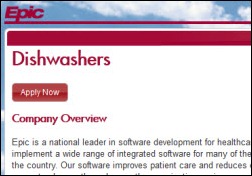
mrh_small From JB: “Re: Epic. I think this job would be humorous to highlight.” Epic hires only fresh-from-college greenhorns, so if you are experienced in healthcare IT, informatics, consulting, or process re-engineering, this is your one chance to get your foot in the Star Trek-themed door. I wonder how many Epic dishwashers have passed the company’s notorious MUMPS programming test?

mrh_small From Poutine: “Re: Quebec’s medical error registry. Finally done after being promised in 2002, but not getting provider data.” Provider error reporting is mandatory, but a third of them submitted incomplete information, while nine hospitals claimed “technical difficulties” that prevented them from filing even one report.

mrh_small From Skeptic: “Re: Micky Tripathi’s breach article. Part of me says. ‘Well done for a conscientious job.’ It’s not as if the folks involved had much of a choice in how to respond if they wanted to be law-abiding and careful stewards of the cards handed them by our system. The rest of me says. ‘This is insane.’ A street thief  steals a laptop and there is ‘an infinitesimally small chance’ the information would be accessed and/or abused. We spend $300K direct dollars and another large chunk of internal time — not to mention hours spent on the government regulatory side — addressing it, after which the thug still has the laptop and the exposure is still infinitesimally small. How much will we spend when the risk is real? And the lesson learned is that we all need to behave even more carefully and institute even more policies. This is great news for security companies, government agencies, and regulators. It’s horrible news for patients. Every dollar we spend on this kind of craziness is a dollar not available for patient care. At present, we’ve managed to construct a ridiculously expensive system relative to actual care delivered. This is an index case of how we’ve done it. (a) lesson one: no amount of anything is going to prevent this sort of thing. That’s not an excuse to be careless, but we need to use some common sense when applying blame. This blame falls on the thief. Period. (b) lesson two: the most sensitive data the healthcare system owns is financial. Identity theft is worth cash; PHI is close to worthless despite the paranoia surrounding it. We need to find ways to universally encrypt ADT/financial information and to not bind it so tightly to PHI. (c) lesson three: if we want to deliver better healthcare, there are better places to spend our patients’ money.”


HIStalk Announcements and Requests

inga_small Thanks to Micky Tripathi’s outstanding contribution on his organization’s patient data security breach, traffic on HIStalk Practice has been especially heavy this week. We’ve posted a number of other great items over the last week including Brad Boyd’s discussion on the need for clinically integrated organizations. Other news bits of note: CMS releases a well done MU toolkit for providers. Physicians are fairly unaware of ACOs and don’t know if they should join one. Only 4% of all eligible providers have been paid incentives for meaningful EMR use. Physician wait times are shortest in Wisconsin and longest in Mississippi. Requests: (a) read HIStalk Practice regularly because it thrills me to know that my father is not the only one tuning in; (b) next time you need to purchase something HIT-related, consider the offerings of our sponsors; and (c) sign up for HIStalk Practice e-mail updates because I love knowing that I am not the only one with an overflowing inbox. Thanks for reading.

mrh_small On the Jobs Board: Manager of Professional Services, Senior Trainer, Senior Software Engineer. On Healthcare IT Jobs: NextGen Workflow Process Consultants, EMR Application Specialist, Technical Services Manager.

mrh_small Inga, Dr. Jayne, and I take risks writing HIStalk. We could get fired from our real jobs if unhappy companies figure out who we are and complain to our bosses about something we’ve said about them. We could lose sponsors for reporting news objectively and stating our opinions honestly (GE, Microsoft, and McKesson are all HIStalk sponsors, for a current example, but we still have to say what we think or else we’d be just another rag that uncritically spews vendor-friendly non-news). We could lose long- or short-term significant others because we sit in front of computers way too much, or risk letting life pass us by as we fixate on the relatively tiny topic of healthcare IT after spending already-long days at work (tonight’s HIStalk took me 5.5 hours, so my total non-work time in the past 24 hours, including sleep, was about six hours.) If you want to provide some reward to offset that risk, (a) sign up for e-mail updates for HIStalk, HIStalk Practice, and HIStalk Mobile; (b) connect with us on Facebook and LinkedIn; (c) support our sponsors, especially those we have to occasionally say negative things about, by clicking their ads, checking them out in the searchable, indexed Resource Center, and sending them consulting RFIs; (d) send us rumors, news we might have missed, and updates on what’s going on where you work; and (e) help us find the good news of IT helping patients, IT people doing commendable work, and IT companies innovating and making a difference. Thanks for being part of what we do, which means you’re actually part of who we are.


Acquisitions, Funding, Business, and Stock

12-8-2011 7-55-08 PM

inga_small A day after we (and thus you) were tipped off by HIStalk reader Elroy, Streamline Health Solutions announces that it has signed a definitive asset purchase agreement to acquire Interpoint Partners for $5 million. We like to think they had to fast-track the announcement because of Elroy’s rumor report.

12-8-2011 4-05-38 PM

Humana acquires healthcare analytics company Anvita Health.


Sales

12-8-2011 4-09-31 PM

The federal government awards McKesson Provider Technologies its DIN PACS III contract, allowing it to sell PACS and related sub-systems to all branches of the US armed forces and civilian defense department agency facilities. The two-year contract has a potential value of $30 million.

12-8-2011 4-10-43 PM

Morehead Memorial Hospital (NC) selects Unidesk for desktop provisioning and application delivery for its VMware-based Virtual Desktop Infrastructure.

Meridian Health (NJ) to ICA’s CareAlign 3.0 for its 95 locations.

Group Health Cooperative of South Central Wisconsin and Group Health Cooperative of Eau Claire (WI) select McKesson Analytics Advisor.

Tidewell Hospice (FL) chooses Allscripts Homecare and EPSi financial management.

China-based diagnostic testing vendor Kindstar Globagene Technology chooses PathCentral’s anatomic pathology system for its 2,000 hospital customers in China.

Personal health record vendor MMRGlobal, which runs the MyMedicalRecords.com site, says Surgery Center Management has offered $30 million to license its patents for the PHR, patient video site, and document management system for providers.

12-8-2011 9-52-39 PM

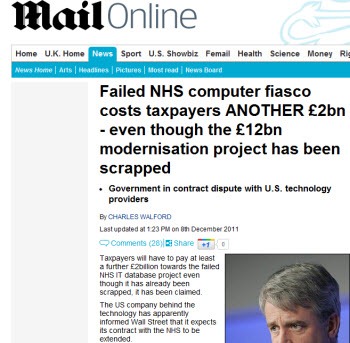
CSC says it expects its NPfIT contract will be extended by an extra year through 2017, despite the company’s past problems delivering implementations on schedule that contributed to the cancellation of the $19 billion project. CSC expects to earn up to $3 billion for the 12-month extension. The former CIO said CSC would probably sue if its contract was cancelled, concluding that it might be cheaper just to pay them.


People

Medical documentation software provider Emdat hires Michael Grayson (Eclipsys, Sentillion, IDX) as VP of strategic partnerships.

12-8-2011 6-06-38 PM 12-8-2011 6-07-34 PM 12-8-2011 6-08-34 PM 12-8-2011 6-09-17 PM

HIMSS adds four members to its board of directors: Dana Alexander, RN, MSN, MBA, FHIMSS (GE Healthcare); Brian R. Jacobs, MD, MS, FHIMSS (Children’s National Medical Center, DC); Kenneth R. Ong, MD, MPH, FACP, FIDSA, FHIMSS (New York Hospital Queens); and Fred D. Rachman, MD, FHIMSS (Alliance of Chicago Community Health Services.)

Encore Health Resources expands its client services leadership team with the hiring of Greg Bluth, Ken Frantz, Jason Griffin, and Jim Kearns.

12-8-2011 6-30-09 PM

MED3OOO’s board of directors promotes Carl Smollinger from executive VP of ACO and employer services to COO.


Announcements and Implementations

12-8-2011 4-20-47 PM

NYU Langone Medical Center implements IOD’s release of information solution.

Wolters Kluwer Health releases its expanded IPhone app, UpToDate MobileComplete.

University Behavioral HealthCare (NJ) goes live on Stockell Healthcare Systems’ InsightCS Revenue Cycle Information Management platform.

DrFirst partners with Atlas Medical to offer physicians the ability to place lab/rad orders and review results via DrFirst’s Rcopia e-prescribing solution.


Government and Politics

12-8-2011 2-35-30 PM

Medicare and Medicaid have paid 2,868 hospitals and 21,425 EPs approximately $1.8 million for the Meaningful Use of EHRs through the end of November.

12-8-2011 8-29-49 PM

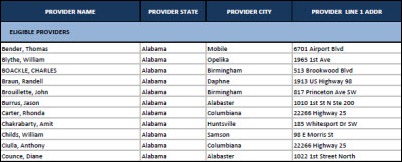
Dr. Jayne mentions below, but here’s a list of all Medicare EPs who have received HITECH money through September 30.

The State Department and the US Coast Guard sign an interagency agreement to share Epic’s EHR and access to VLER, the EHR used by the US Armed Forces EHR for its current and retired members.


Other

VA employee unions raise concerns that a plan to add RTLS technology will lead to staff monitoring. The VA is issuing a $550 million draft request for proposals for RTLS to interface with cleaning and sterilization equipment. The department claims it has no official plans to tag and track employees. One union representative views any plans to use RTLS to track employees as “the beginning of Big Brother” and “and invasion of privacy.”

12-8-2011 4-22-12 PM

Meditech announces it will return to the HIMSS conference this year as an exhibitor. In looking at the HIMSS conference site, it does not appear that Cerner will be following Meditech’s lead in coming back.

Programmers world-wide celebrated last weekend with Random Hacks of Kindness, where self-proclaimed hackers developed programs for humanitarian purposes. Among them were an emergency response system for the Samoan Islands, a real-time disease tracking system, and an app that can scan a photo of water-borne bacteria to determine if it’s safe to drink.

The FBI subpoenas several businesses in its investigation into the financial dealings of Wayne County, MI. Among the companies whose contracts are being reviewed is Strategic Business Partners, a Detroit IT company that has billed the county for $22 million over several years, some of that for developing EMR software for the county jail.

A hospital in Canada being sued for malpractice by a patient who suffered a stroke during surgery tries to convince a judge to give it access to the patient’s Facebook and Twitter accounts, her computer, and her iPhone. The hospital’s argument was that since the patient claims her health and enjoyment of life had been harmed, they should be able to look for evidence to the contrary. The judge said no, calling it “ a classic fishing expedition without the appropriate bait.”


Sponsor Updates

12-8-2011 8-51-19 PM

  • The Advisory Board Company’s Crimson business unit wins the Best Booth award at the IHI forum in Orlando, with recognition of its employees for their knowledge and demonstration skills.
  • GE Healthcare releases a white paper that highlights the use of Centricity Practice Solution to achieve Meaningful Use requirements.
  • Healthwise launches Healthwise Spanish Knowledgebase, which includes evidence-based health information.
  • Symantec Health and DrFirst will present at April’s EPCS Leadership Symposium.
  • Blanton Godfrey, co-founder of the Institute for Healthcare Improvement, keynotes at TeleTracking Technologies’ 2011 Client Conference and predicts that better workflow choices will determine winners and losers after health reform.
  • DIVURGENT releases a white paper on the selection of the right IT infrastructure for ACOs.
  • The Irish Health Service Executive announces that four of its 35 hospitals are live on McKesson’s Horizon Medical Imaging PACS, with the remainder coming up within 20 months.
  • T-System’s CMIO Robert Hitchcock MD and CFO Steve Armond CFO discuss how to use IT to make an emergency department profitable.
  • Lawson Software introduces Infor10 Lawson S3, which includes integration between Lawson technology and products and applications from its newly acquired company Infor.
  • e-MDs customer James F. Holsinger, MD, PC wins the 2011 HIMSS Ambulatory Davies Award of Excellence for the quality of patient care through practice’s Meaningful Use of EHR.
  • MedVentive was selected to participate in last month’s Mid-West BluePrint Health IT Innovation Exchange Summit.
  • Intelligent InSites posts congratulations to President and CEO Doug Burgum, who is also chairman of the board of the SuccessFactors, just acquired by SAP for $3.4 billion. He was also an early investor and leader of Great Plains Software, which Microsoft acquired for $1.1 billion in 2001.

EPtalk by Dr. Jayne

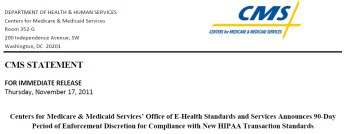
HIPAA 5010 report: just a tad more than three weeks left until the January 1, 2012 deadline. Although CMS has announced that it won’t enforce compliance until March 31, don’t let the extension fool you. Many in the industry are predicting transaction rejections and cash flow interruptions to those who are not ready. CMS will be looking for non-compliant physicians who are expected to provide proof that they are preparing to be fully compliant.

clip_image001

It’s National Influenza Vaccination Week through Saturday. I’ve been impressed by the Centers for Disease Control and its use of social media (they had me at the Zombie Apocalypse.) Hospitals and health systems are steadily moving towards making vaccination a condition of employment whether you’re in direct patient contact or not. Several of the “IT guys” I work with always complain about it since they don’t work in the hospital proper and I usually have to remind them it’s not just about patients, but also about lost workforce productivity and increased healthcare costs. People do still die from the flu and it’s recommended this year for everyone age six months and older. Please get your flu shot, especially if you’re in a high-risk group.

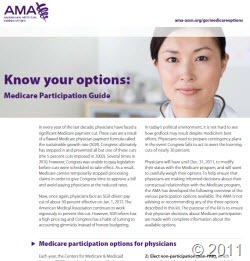
The American Medical Association publishes a “How To” guide for Accountable Care Organizations and Co-Ops. Chapter Six includes advice on EHR incentive programs. It’s not a bad read for those who either have been living under a rock the last several years or just need a refresher on the basics. I like the chapter’s closing paragraph:

As is clear from this chapter, the adoption of a certified EHR system and the achievement of Meaningful Use is a very arduous task. Eligible professionals should remember that the incentives or penalties that are the consequences of this task are not insignificant.

Speaking of Meaningful Use, if you’re a Safety Net provider, I thought this upcoming webinar from the Health Resources and Services Administration (HRSA) looked interesting: Tips for Overcoming the Gray Areas of Meaningful Use for Safety Net Providers. At least someone is admitting there are some gray areas. Presenters from Regional Extension Centers and CMS will review “problem areas” that include vendor relations, attestation, and troubleshooting quality measures. It’s December 13 at 2 p.m. EST. You can send questions in advance to healthit@hrsa.gov

clip_image003

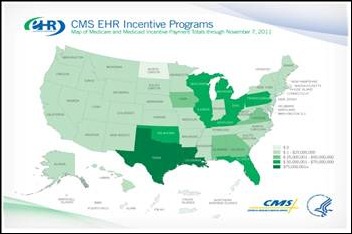
CMS has a new web page that shows MU incentive payment and registration data through October 2011. Maps show payment and registration breakdowns by state as well as individual state reports of registrants and payments. For those of you who want to know if your colleague in the doctor’s lounge was just blowing smoke, here’s the list of those who have already received payments.

There was an announcement earlier this week that Medicare will allow mining of its claims database for the purpose of creating report cards on providers. Employers, insurers, and consumer groups will have access to the data and physicians will be individually identifiable. People have been after this data for a long time, but I’m not sure how useful it will really be. There are so many other factors that go into determining quality other than sheer volume and claims data. One prominent hospital I worked at appeared on some payer reports as having poor numbers for morbidity and mortality for certain high-risk procedures. Once the case mix was analyzed, it was apparent that this tertiary referral center really did have patients that were sicker than average and also that they were willing to attempt procedures on patients so sick that other facilities wouldn’t even consider it. We’ll just have to see what comes out of the data.

I’m back from the rodeo and settling back into the daily routine of crunching quality reports of my own, as well as doing never-ending upgrade planning and dealing with ever-cranky colleagues. I do have something big planned for next week, but you’ll have to keep reading to find out what it is. Let’s just hope it doesn’t end up involving law enforcement or a bail bondsman.

Have a question about Meaningful Use, CMS, or whether the wearing of red Rocky Mountain jeans really says something about a girl? E-mail me.

Print


Contacts

Mr. H, Inga, Dr. Jayne, Dr. Gregg.

Microsoft, GE Form Healthcare Joint Venture

December 7, 2011 News 10 Comments

image

Microsoft and GE Healthcare announced this morning that the companies will form a joint venture, creating a new company that will offer software tools for managing population health to improve outcomes and cost.

Microsoft will move its Health Solutions Group employees and assets to the new company, effectively ending its direct involvement in provider healthcare technology. Corporate Vice President Peter Neupert announced his retirement from Microsoft.

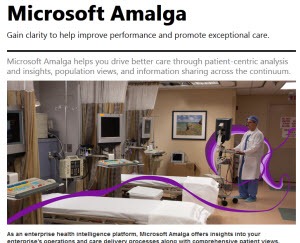
The new company, which has yet to be named, will be launched in the first half of 2012. Microsoft will contribute its Amalga health intelligence platform, the Vergence context management and single sign-on solution, and the expreSSO enterprise single sign-on product to the joint venture. Those products had been acquired from MedStar Health (Azyxxi) in 2006 and Sentillion (Vergence, expreSSO) in 2009.

Microsoft HSG’s hospital systems product line that was acquired from Thailand-based Global Care Solutions in 2007 had already been retired, but was sold to Orion Health in October 2011.

GE Healthcare will provide its eHealth HIE and the Qualibria clinical knowledge application that it is developing with Intermountain Healthcare. 

In an interview with HIStalk, Neupert said the bulk of HSG employees will be transferred to the new company, joining those GE Healthcare employees who are assigned to the eHealth and Qualibria projects for an initial headcount of 700. The company’s headquarters will be in Redmond, WA.

Microsoft’s HealthVault will not be part of the joint venture, Neupert told us, explaining that HealthVault needs to remain “independent and consumer-facing.”

The announcement states that the new company will deliver “a distinctive, open platform that will give healthcare providers and independent software vendors the ability to develop a new generation of clinical applications.”

Neupert explained that Microsoft Amalga will be the base layer of the new offering, bringing in data from other systems and adding metadata. GE Healthcare Qualibria will provide advanced data descriptors such as clinical vocabulary and context (such as where a patient’s blood pressure was taken and whether the patient was sitting or lying down at the time.) External applications can then retrieve data, data meaning, and workflow context from the new system. “Provider and payor will become intermixed,” Neupert said. “Our customers already do cohort management. How do we get really good at making cohort groups discoverable and manageable in an interesting way?”

Neupert said the platform will have open APIs for developer access. Amalga’s services can manage healthcare-specific requirements such as access controls and auditability, allowing third-party developers to build solutions around large enterprise databases.  “In a patient-centric world, you want the data to be separate from the app,” he told HIStalk. “You want competition to be based on user interface and functionality, not a vendor’s ability to lock up the data. Customers want choice.”

The announcement indicates that the new company will market its products globally. Neupert said that there’s always a difference between ambulatory and inpatient care and that all governments want to tie in home care. He expects the new products to assist in those efforts, acknowledging that countries will evolve differently.

Michael J. Simpson, general manager of GE Healthcare’s Healthcare Knowledge & Connectivity Solutions practice, has been named CEO of the new company. He joined GE Healthcare in 2010 after a few months as SVP of product strategy for QuadraMed. Before that, he spent 5 1/2 years as general manager and chief technology officer of McKesson’s Horizon Clinicals business unit.

Simpson told HIStalk that he plans to enable customers to be amazed, opening up the user experience to caregivers and bringing the cultures of software development and customer relationship management to the patient. “Connectivity across inpatient and outpatient will require new platforms,” he said.

News 12/7/11

December 6, 2011 News 7 Comments

Top News

12-6-2011 6-19-43 PM

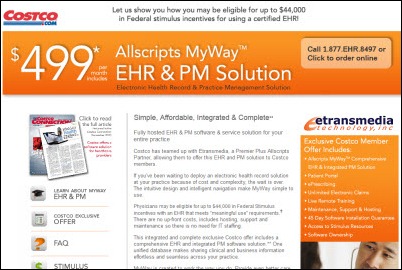
Costco announces its entry into the PM/EHR software and services business through its partners, Etransmedia Technology, Inc. and Allscripts, moving from a test phase to full launch after experiencing high demand. Costco will offer the Allscripts MyWay PM/EHR along with hosting maintenance, support, training, implementation services, and unlimited claims processing for $499 per month. The company will have a booth at HIMSS.


Reader Comments

inga_small From Unibroue: “Re: Kaiser MU-payment mishap. The doctor who did not receive her MU incentive because Kaiser mistakenly claimed it is now making progress towards collecting her money. After a couple of attempts, she connected with the right person at Kaiser, they have corrected the registration issue, and the doctor should now be able to have her payment processed correctly.” Many thanks to our great readers who offered advice and contact names to help this doctor straighten things out.

inga_small From Fancy Schneider:Re: HIStalk’s reputation. I was recently in a meeting at a hospital and HIStalk came up. Someone commented that it was the only place where they could get real information in an industry that is swamped with vaporware.”


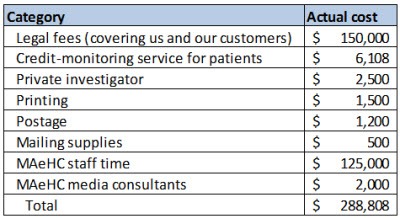
inga_small From Bob Coli, MD: "Micky Tripathi’s First-Hand Experience with Patient Data Security Breach. This is the best overview of a PHI security incident that I have seen to date. Every word is valuable to consumers, healthcare professionals, and everyone else in America striving to achieve maximally secure and efficient data portability and fully interoperable HIE.” Other readers concur with Dr. Coli, with some urging that Micky’s post be “mandatory” reading and naming it HIStalk’s “Post of the Year.” Even Mr. H, who is parsimonious with his praise, called Micky’s piece “outstanding” and suggested that if there were Academy Awards for blog posts, that this one would be a shoo-in. The cost of the breach (above) should get your attention, after which you can read the article here.

12-6-2011 6-31-00 PM 12-6-2011 6-34-57 PM

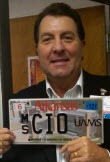
mrh_small From Dave Miller: “Re: University of Arkansas for Medical Sciences. Some news for HIStalk. Our RFP scoring committee has recommended Epic. We still have to nail down funding and get the contract done, but the die is cast.” Dave, who is vice chancellor and CIO at UAMS (cool license plate) says they will replace Eclipsys Sunrise and Medipac on the inpatient side and Logician and Signature for ambulatory, plus a bunch of miscellaneous systems. Dave’s an old friend of HIStalk who has kept in touch since his days at University of Chicago Medical Center.

mrh_small From Benzyl: “Re: PQRS. Do you see the number of submitting practices increasing or decreasing this year? What about hospitals? It seems that submissions slowed down after the incentive was reduced from 2% to 1% this year, or maybe other programs are getting the attention of practices.” Readers, chime in with your comment if you like.

mrh_small From Long-Time Reader: “Re: HIT spending. I was wondering if you know what percentage of total healthcare spending HIT represents? Awesome site!” I’ll again go to readers who might a data source since I don’t know that I’ve seen an HIT-specific number that’s more precise than the typical “technology” that covers medical equipment.

12-6-2011 9-20-14 PM

mrh_small From Gladys Kravitz: “Re: Cape Coral Hospital (FL). I was told by someone who works there that their Epic go-live didn’t go well, taking two hospitals down for several days. The person said administration was responsible since they didn’t go for the ‘deluxe’ Epic package from Epic and tried to manage the implementation on their own.” Unverified.

mrh_small From Dadudadu: “Re: HIStalk. I hate to draw the comparison, but your statement about doing what you love and the money will follow sounds a lot like the philosophy of Epic. That intangible sense of purpose, unadulterated by the naked self-interest introduced by the pursuit of money or power or fame is, of course, what makes this website so great. And results, paradoxically, in more Money, Power, and Fame than you want. Be honest, what pays more at this point: HIStalk or your day job? Regardless, kudos to you for finding what you love, and doing it well so we all can benefit from it. Thanks.” One thing I should have added to my statement is that you almost have to work for yourself to either (a) do what you really love in the way you want to do it, and (b) reap money, power, and fame, since by definition, corporate employers fully expect to arbitrage the difference in what you’re worth vs. what they pay you, laying claim the great majority of that difference by rebating tiny raises and bonuses to encourage your occupational inertia for their continued benefit. I admire Epic for at least appearing to have something other than their corporate bottom line front and foremost, although it’s rare that good-sized companies can create and maintain a “we just want to do good work” philosophy, especially after the founders step aside (no different than when humbly wealthy self-made parents leave their fortunes to bratty, entitled children.) It’s probably empowering to have a lot of money, but I’m just as empowered by not needing much of it. If I ever quit my day job, which I admit contemplating on occasion, my questionably achievable goal would be to work for myself instead of someone else for a change.

12-6-2011 9-34-23 PM

mrh_small From Elroy: “Re: Streamline Health. Acquiring Interpoint Partners, to be announced next week.” Unverified. Streamline does document management, while the Atlanta-based Interpoint Partners offers business intelligence and analytics. Streamhealth’s President and CEO Robert Watson, who took the job in February 2011, was previously a director of Interpoint. That adds credibility to the rumor.

mrh_small From The PACS Designer: “Re: NPfIT Roundable. The UK’s NPfIT has had its ups and downs, but they are still looking to the future and have assembled a group to talk about it.”

mrh_small From LanMan: “Re: Cerner. Buying IP blocks from now-defunct Borders? What for? And I heard this from a Brit publication?” Actually you could have heard it here since I mentioned it on December 2. At $786K, it was supposedly the second largest transfer of IPv4 addresses after Microsoft bought $7.5 million worth from also-defunct Nortel. IP addresses are about to become harder to obtain and more expensive with the advent of IPv6, which is replacing the current IPv4 as it runs out of available addresses. Cerner could be buying the addresses for resale, but I would speculate that it’s just ensuring that it will have enough for its own use for the foreseeable future, or perhaps to avoid expensive network infrastructure upgrades that IPv6 addresses will require.

12-6-2011 9-09-47 PM

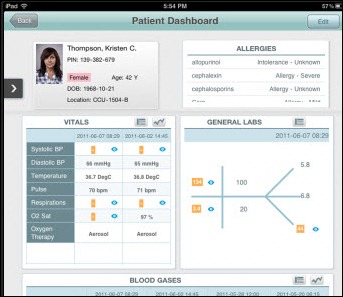
mrh_small From Lyssa Neel: “Re: native EMR apps for the iPad. Our app, VitalHub Chart, sits on top of Cerner PowerChart and makes data available to clinicians in a native iOS interface. Please take a look and let me know what you think.” Lyssa, whom I notice sports an impressive PhD in computer science from MIT, is CTO for VitalHub. Their product was developed at Mount Sinai Hospital in Toronto. Cerner users, what do you think?

mrh_small From Early Girl: “Re: Microsoft Health Solutions Group. Some kind of announcement involving GE Healthcare will be made this week, either GEHC acquiring HealthVault and/or other MSFT products or some kind of marketing agreement.” Unverified.


HIStalk Announcements and Requests

12-6-2011 9-22-33 PM

mrh_small Travis Good is on the ground at the mHealth Summit, so you can check out his reports on HIStalk Mobile. He says attendance is an impressive 3,500.


Acquisitions, Funding, Business, and Stock

Healthcare quality improvement firm Avatar International acquires HR Solutions, a human capital management consulting firm that specializes in clinical engagement.

12-6-2011 9-24-10 PM

Streamline Health posts a Q3 profit of $296,000, up 212% from a year ago. Revenue fell 4% to $4.3 million.

12-6-2011 6-49-35 PM

Health Tap raises $11.5 million in Series A funding, raising its total to $14 million. It provides an online community where anyone can ask questions to US-based physicians at no charge. The company says that 6,000 physicians are participating so far, attracted by the “gamification” of earning reputation points for answering questions or agreeing with answers provided by other doctors. Big-name investors in the 12-employee company include Eric Schmidt (Google) and Ester Dyson.

SAIC reports Q3 numbers: revenue flat, EPS –$0.27 vs. $0.46, but exceeding analyst earnings expectations by a penny after excluding one-time items. The company said it paid $190 million in cash to acquire Vitalize Consulting Solutions in July 2011.


Sales

12-6-2011 3-49-42 PM

QuadraMed RCM client Memorial Hospital of Sweetwater County (WY) chooses QuadraMed’s Computerized Patient Record and Quantim Electronic Document Management.

12-6-2011 3-50-54 PM

The San Diego Beacon Community selects Santech’s SanText SMS platform to send text messages to parents for appointment reminders and to inform them of their children’s immunization needs.

Lehigh Valley Health Network (PA) selects Orion Health’s HIE for its 50+ hospitals, clinics and health centers.

Association of Ontario Health Centres signs a 10-year contract with Canada-based EMR vendor Nightingale Informatix, which says it will earn $9 million in revenue in the first three years.


People

Mary Crouch joins Orchestrate Healthcare as its Meditech Practice Manager. She was previously with Laughlin Memorial Hospital (TN).

12-6-2011 6-23-34 PM

Tad Jacobs, DO, CMIO of Avera Medical Group (SD), is promoted to chief medical officer.

12-6-2011 8-42-57 PM

TriZetto names Pierre Samec, formerly of Expedia, as EVP/CTO.


Announcements and Implementations

The Greater Houston HIE announces the formation of its collaborative HIE network, which includes representation from over 60 hospitals across 14 counties.

12-6-2011 3-56-34 PM

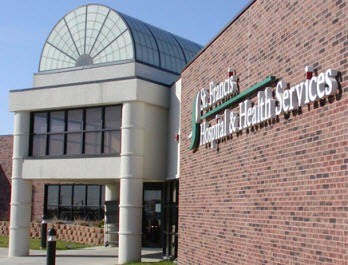
St. Francis Hospital & Health Services (MO) announces plans to launch its Epic EHR on March 31, 2012.

Aintree University Hospital NHS Foundation Trust implements CCube Solutions’ electronic document management system, powered by Kodak production scanners and Kodak Capture Pro Network Edition imaging software.

gloStream will integrate clinical decision support from DiagnosisOne into its EMR.

Trustwave announces MyIdentity, a cloud-based two-factor authentication solution that supports five mechanisms (digital certificates, one-time SMS message passcodes, voice call-back, pushed login alert to mobile, and a mobile app that generates a one-time password.)

12-6-2011 9-31-43 PM

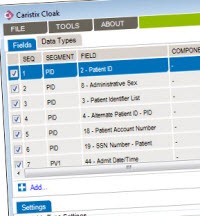
Caristix launches Cloak, which strips patient-identifiable messages from HL7 data for creating sample messages or clinically valid data for testing. The company, which was featured in HIStalk Innovator Showcase in November, offers a seven-day free trial.


Innovation and Research

Microsoft Research is applying spam-fighting techniques to the analysis of HIV cells, finding similarities in how viruses mutate as they attack the immune system and spammers who fine-tune their payloads to bypass spam filters.

mHealth Alliance announces its Top 11 in 2001 Innovators Challenge. Winning apps include pregnancy surveillance, voice-powered information retrieval, diagnostic tools for telemedicine, counterfeit drug detection, patient teaching, physician collaboration, patient communication, baby tracking, and care reminders. Above is a demo of an smart phone-based EMR developed by Martin Were MD, MS of Regenstrief Institute for HIV treatment and control in Kenya.

12-6-2011 8-35-11 PM

IRobot, the company behind the Roomba vacuum cleaner, applies for a patent for AVA, a five-foot-tall robot with a “head agonistic design” that can accommodate tablets or smart phones.


Other

The board chair for Maryland eCare says that mortality rates have fallen 30% across hospitals that have implemented its telehealth systems that supplement ICU coverage at rural hospitals.

12-6-2011 4-04-32 PM

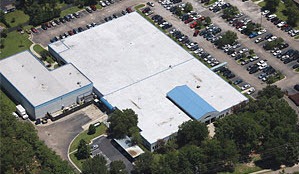
CPSI pays $9.5 million for its new Mobile, AL corporate headquarters, which includes 16.5 acres and 135,500 square feet of office and warehouse space. The company had been leasing 13 buildings in the same office park.

12-6-2011 3-15-55 PM

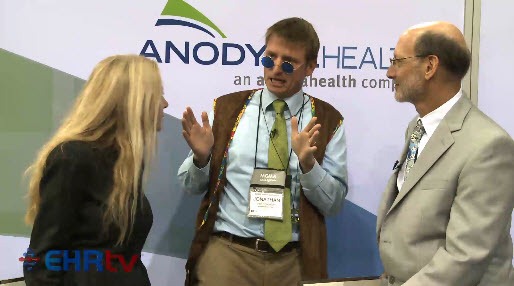
inga_small EHRrtv publishes its MGMA interview with the always entertaining (and interestingly-attired) Jonathan Bush of athenahealth. He’s like no other CEO out there.

Aetna and ProHealth Physicians (CT) say that their four year Provider Collaboration program has resulted in 37% fewer inpatient hospital days on a risk-adjusted basis and 35% few hospital readmissions.

12-6-2011 3-32-21 PM

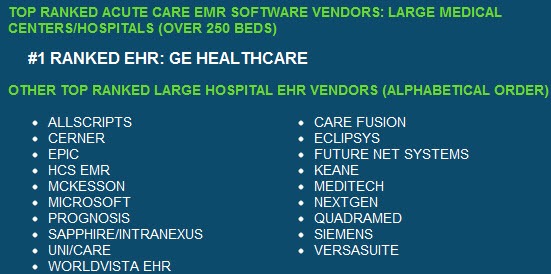
CPSI, Cerner, GE Healthcare, and Picis earn top client satisfaction scores in Black Book’s ranking of inpatient EHR vendors, obviously reaching vastly different conclusions than KLAS.

12-6-2011 3-40-43 PM

The Leapfrog Group includes 65 hospitals (including 18 Kaiser facilities) on its list of Top Hospitals, based on the delivery of quality care.

mrh_small An article in Wired magazine called Apple’s Secret Plan to Steal Your Doctor’s Heart is not particularly focused or convincing, but a fun read. I couldn’t figure out its conclusion other than (a) doctors like using an iPad because it saves them time; (b) hospitals seem to be warming up to them; and (c) Steve Jobs had a small interest in healthcare after trying unsuccessfully to develop a Pixar CT imaging system. Like many articles these days, it seems  highly analytical and fresh until you think about precisely what you learned and realize that it wasn’t much.


Sponsor Updates

12-6-2011 3-43-43 PM

  • Elsevier introduces Procedures Consult App for iPad, iPhone, and iPod Touch.
  • Adler Hey Children’s Hospital and Liverpool Women’s Hospital (UK) select Perceptive Software’s ImageNow electronic document management system.
  • Wolters Kluwer Health announces its acquisition of Medknow PVT Ltd, expanding its open access publishing business.
  • Capital Health (NJ) goes live on Wellsoft EDIS in its four emergency departments.
  • dbMotion announces the 2012 schedule for its Insights into HIE seminar series.
  • Michael O’Neil, founder and CEO of GetWellNework, moderates a discussion on mHealth and the role of patient education and monitoring medical compliance at this week’s mHealth Summit.
  • Qualcomm Life Inc. and AirStrip Technologies collaborate to offer mobile monitoring to home health providers and patients.
  • Capario launches a streamlined payer enrollment process.
  • Teradici combines Imprivata OneSign Virtual Desktop Access with its PCoIP Firmware release 3.5.0 to offer virtual desktop access via access cards and ID badges.
  • A Practice Fusion press release discusses five top trends and surprises in HIT for 2011.
  • In a December 12 Webinar, South Jersey Health System CIO Thomas Pacek  will share how MobileMD is helping his organization’s physician network to grow and coordinate patient care.
  • Nebraska Health Information Initiative announces that physicians are now sharing patient immunization information with NESIIS through the HIE’s Axoloti-powered platform from OptumInsight.
  • San Diego Business Journal profiles Awarepoint and its four new RTLS patents.
  • Vibra Healthcare (PA) selects PatientKeeper Physician Portal and Mobile Clinical Results for its long term acute care hospitals nationwide.
  • Forst & Sullivan awards AT&T its Competitive Strategy Leadership Award for its approach to mHealth.

Contacts

Mr. H, Inga, Dr. Jayne, Dr. Gregg.

Bottomline Technologies Acquires Logical Progression

December 5, 2011 News Comments Off on Bottomline Technologies Acquires Logical Progression


Financial software vendor Bottomline Technologies announced today that it has acquired the assets of Logical Progression of Cary, NC, which sells the Logical Ink mobile provider documentation solution for hospitals and large clinics. Terms were not disclosed.

Logical Ink is an interactive paperless forms platform that the company markets as an intuitive, workflow-based alternative to traditional computer documentation. Bottomline Technologies will offer that product as part of its healthcare product portfolio.

Logical Progression was featured in the HIStalk Innovator Showcase in June 2011.

Monday Morning Update 12/5/11

December 3, 2011 News 12 Comments

 12-3-2011 4-30-02 PM

From It’s All Good: “Re: [vendor name omitted]. In post-acquisition happenings, staffers have been required to sign a highly restrictive non-compete agreement or face termination, with a number of 10+ year veterans opting not to sign and accepting termination instead. Next up, aptitude tests for those who remain. Pushing out seasoned veterans without having ready replacements is not a best practice.” At least it’s a free country, where the employment commitment works both ways. I admire those who took their walking papers instead of sticking around if they were really that unhappy. Complaining about your job while staying in it is like telling everybody how your spouse mistreats you – if you truly feel demeaned or endangered, stop talking and get out of the situation immediately. The bad thing about company belt-tightening is that you first lose the people with marketable skills and experience, leaving you stuck with those who don’t have anywhere else to go. Update: I concur with a reader’s comment that my “spouse” comment sounded insensitive, so I reworded to be clearer what I meant.

From Farina: “Re: being anonymous. It’s a shame you’re anonymous as you know more than pretty much all of the people that I talk to at vendors, VCs, or healthcare orgs. You’d also make a great advisor for a lot of companies.” I’m happy keeping a low profile, which also keeps me as focused and honest as a monk in a locked-down monastery. Not to mention that “knowing” is different from “doing,” obvious since I still toil in the salt mines of a non-profit hospital. Sometimes I’m envious of those with greater ambition and different skills who create and run large organizations and make names for themselves, but this is still the best “job” I’ve ever had (and the longest held at 8.5 years and counting.) I’m not motivated by money, power, or fame, so I’m fine. I firmly believe that if you do something you really enjoy for reasons other than making money, the money will find you anyway.

12-3-2011 3-19-32 PM

It surely cannot be possible that Christmas is just three weeks away and the HIMSS conference is just eight weeks after that. I get slammed every year in January and February doing the HISsies, gearing up for HIStalkapalooza, setting up our little HIMSS sponsor appreciation lunch, handling a big surge of e-mails of all kinds, and running around the conference anonymously and telling you about what I’m seeing (and trying to keep up with my real job at the hospital, of course.) If you need anything from me, this is a great time to let me know since I’ll be heads-down from New Year’s until March.

12-3-2011 3-07-27 PM

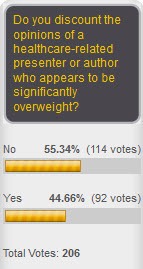
Nearly half of respondents say they have a problem buying into healthcare-related ideas that are presented by someone who’s overweight. New poll to your right: did you go to HIMSS last time and will you be going in February? I registered and made travel arrangements last week. This past year on February 20, Las Vegas was sunny with a high of 46 degrees compared to the normal high of 64. Exhibitors are going to hate the location since they’ll be competing for attendee attention with casinos and showgirls.

12-3-2011 3-50-28 PM

Our own Travis Good MD of HIStalk Mobile will be reporting from the mHealth Summit in the DC area starting Monday. Here’s his preview and links for following along with him this week (sign up for updates and you won’t miss anything). HIStalk Mobile is a media partner, meaning Dr. Travis gets to play intrepid reporter and prowl around areas that are off limits to regular attendees (OK, I’m not sure there really are any of those, but that makes it sound more exclusive than just taking notes along with everybody else.) Big-name keynoters include the Surgeon General, the chairman of the FCC, Kathleen Sebelius of HHS, and some notables from Qualcomm, Apollo Hospitals Group, Verizon, and West Wireless Health Institute.

12-3-2011 9-22-42 PM

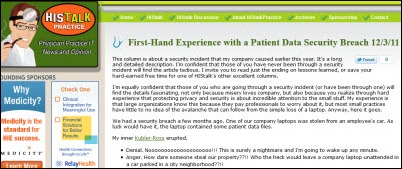
I’ve just posted on HIStalk Practice Micky Tripathi’s gripping, highly educational account of having his organization’s patient data breached. It’s long, detailed, full of documentation and like nothing you’ve ever read since nobody has ever talked so openly about their own organizational mistakes. We all know data breaches are potentially embarrassing, but you’ll be surprised (unless you’ve lived through a breach yourself) at the gray regulatory areas, the “who’s really responsible” question (shocker: legally, it wasn’t Micky’s organization, Massachusetts eHealth Collaborative), and just how much money and effort is required to go through the required steps. I’ve preached for years about encrypting mobile devices, so if budget is your barrier, send a copy of the article to your CEO and I bet the project will be quickly funded. I always enjoy Micky’s regular HIStalk Practice columns since he’s not only an expert, he’s also one of the most engaging writers I know. In this case, has served the entire industry, for which we should all be grateful. I consider this piece to be mandatory reading for just about everybody.

Listening: Odessey and Oracle from The Zombies (and yes, I spelled it correctly). This is the innocence, psychedelia, and British Invasion fascination of the 1960s captured permanently on vinyl like a prehistoric bug in amber. By the time this album came out in 1968 the band was broke and disbanded (they could barely afford studio time and had to record it in mono.) Time of the Season climbed the charts and the group still declined to tour, so fake groups gave concerts using their name, with one even grabbing the band name’s trademark that had expired. For my money, I’d take this album over Sgt. Pepper’s and Pet Sounds as the best of the decade (right up their with Love’s Forever Changes and either The Doors or Strange Days from The Doors).

I had some major upgrade work done on the site over the weekend. Most of it is behind the scenes, but if you read HIStalk, HIStalk Practice, or HIStalk Mobile on a smart phone or iPad, you may see some improvements. I noticed that the iPad display was sometimes fuzzy for reasons I could never figure out and that seems to be fixed, plus there’s new support for Apple’s Retina display.

My Time Capsule editorial this week from five years ago: HBOC 1, Everybody Else 0, in which I opine, “Among those involved were certainly some crooks and some fools, but let’s not forget those who suffered most, those McKesson lifers who had stashed away years’ worth of shares of their unexciting company’s stock instead of risking their future on flaky fads like Microsoft and Dell. When lonely old conservative widower Dad McKesson brought home a sexy young step-mom named HBOC, she stole the kids’ piggybank.”

12-3-2011 6-36-13 AM

Welcome to new HIStalk Platinum Sponsor Etransmedia Technology. You may recall that the Troy, NY company facilitated the offering of Allscripts MyWay nationally through Costco, but they’ve created quite a few products of their own related to PM/EHR, patient connectivity, physician mobile, revenue cycle, and clinical documentation. The SaaS-delivered EtransConnect ACO product suite has tools for connectivity, patient identity management, a clinical data repository, and an orders report portal for providers, rounding those solutions out with a community patient portal and back-end analytics tools. The company’s ambulatory EHR toolkit provides a full-function patient portal (appointments, health histories, messaging, refills, consents, online statements, and structured data exchange such as by CCD). Also offered is custom reporting modules and a mobile charge capture app that lets physicians document their hospital rounding activities to send charges back to their own EHRs for billing. The company just announced that it’s  #155 on Deloitte’s Technology Fast 500 with a 647% revenue growth over the past five years. Thanks to Etransmedia Technology for supporting HIStalk and its readers.

12-3-2011 6-56-08 AM

Thanks to Intelligent InSites for supporting HIStalk as a Platinum Sponsor. The Fargo, ND company’s tagline is Enabling the Real-Time Enterprise, which it does with an extensive list of RTLS-powered solutions (asset management, patient flow, bed management, infection control, patient and staff safety, environmental monitoring, and mobile information access.) The company just announced its enterprise Big Data analytics solution that uses the wealth of information it captures to identify trends, track key performance indicators, and call out process improvement opportunities. Also just announced is a consulting service that helps hospitals identify specific areas (and hard-dollar impact) in which RTLS-powered solutions can improve outcomes, patient satisfaction, and cost. I was intrigued that the company’s largest investor and interim CEO is Doug Burgum, who bootstrapped and ran fellow Fargo company Great Plains Software until Microsoft bought it for $1.1 billion in 2001. Thanks to Intelligent InSites for helping me do what I do.

I like to get the big-picture view of a company by checking out an introductory video (I’m lazy and have a short attention span), so I found the one above for Intelligent  InSites on YouTube.

The new Plano, TX office of MedAssets will consolidate over 1,000 employees in a building covering 225,000 square feet. The company’s corporate headquarters is in Alpharetta, GA, which I note has a population around 60,000 and about the same number of HIT-related company offices (slight exaggeration.)

12-3-2011 8-32-45 AM

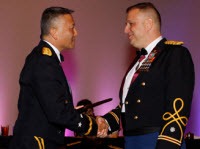
The IT team behind the US Army’s MC4 battlefield EMR wins the top IT team award from the Association of Military Surgeons of the United States. Receiving the award above is Lt. Col. William Geesey, project manager (on the right.)

Vince Ciotti takes a slight detour from his ongoing HIS-tory of HIT software vendors, this time leading off a series on consulting firms. Vince is looking for your first-hand stories, so if ampersanded names like Coopers & Lybrand and Ernst & Whinney cause one of those TV dream bubbles to appear over your upraised head as you dreamily recall the glory days of dark-suited Big Six accountants descending on your hospital with their weapons of choice (legal pads, expense accounts, and blank RFPs for selling add-on work), then feel free to reminisce with him for future installments.

An ED doctor in Canada admits that he looked up medical information on his girlfriend’s former husband during a child custody dispute. The hospital’s computers have a 10-minute logout period, so the doctor would go behind users who left their PCs logged on to look up records under their user ID. The hospital’s SVP of medicine says it hopes to implement a card-based computer system that automatically logs users off, so there’s a sales opportunity if your company offers those.

12-3-2011 4-08-15 PM

Ed Marx has a big go-live at Texas Health Resources and found this signage amusing.

A fascinating Forbes article called The Bomb Buried In Obamacare Explodes Today – Hallelujah! says the only truly important part of the Affordable Care Act took effect on Friday. That’s when the medical loss ratio part of the law kicks in, requiring insurance companies to spend 80% of the premium dollars they collect on medical care (if they underspend, they have to write customers a check.) The author says this marks the slow but sure death of for-profit insurance companies because they know they can’t do that and still make a profit, so they are already moving to more profitable businesses (but read the comments at the end for some interesting counterpoints, with a notable one being that insurance companies make most of their profit from investing the money until it’s spent anyway and that’s not changing.) A snip from the article:

So, can private health insurance companies manage to make a profit when they actually have to spend premium receipts taking care of their customers’ health needs as promised? Not a chance – and they know it. Indeed, we are already seeing the parent companies who own these insurance operations fleeing into other types of investments. They know what we should all know – we are now on an inescapable path to a single-payer system for most Americans and thank goodness for it. Whether you are a believer in the benefits of single-payer health coverage or an opponent, mark this day down on your calendar because this is the day seismic shifts in our health care system finally get under way. If you thought that the Obama Administration chickened out on pushing the nation in the direction of universal health care for everyone, today is the day you begin to understand that the reality is quite the contrary.

12-3-2011 9-30-03 AM

Raul Recarey, president and CEO of the Missouri Health Connection HIE, quits after eight months on the job.

12-3-2011 9-46-00 AM

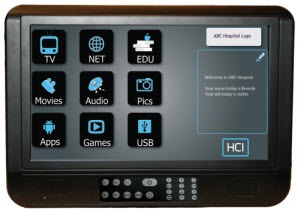
HCI’s USA-built Android-powered RoomMate Healthcare TV for hospitals includes a patient and visitor whiteboard, a web browser, video and music options, a pillow speaker, an an optional hard drive for video streaming. It comes in screen sizes from 22 to 42 inches and includes just about every kind of connectivity available. It integrates with the company’s MediaCare2 product, which allows hospitals to send “information prescriptions” to specific patient TVs, such as educational videos, images, and announcements. It also allows hospital staff to control patient TVs from a central location.

Stupid lawsuit: a prisoner sues his former hostages, a newlywed couple whose home he broke into while evading police on suspicion of murder. The couple agreed at knifepoint to hide him, but called police when he fell asleep. He brandished the knife again and was shot by a SWAT team officer. He’s suing the couple for $235,000 worth of medical costs and emotional distress, saying they breach breached  an oral contract by turning him in.

E-mail Mr. H.

News 12/2/11

December 1, 2011 News 6 Comments

Top News

12-1-2011 3-53-40 PM

12-1-2011 3-52-51 PM

EDIS vendor Forerun will acquire substantially all the assets of competitor Emergisoft, including customer contracts, product rights, software, and services. Emergisoft President Jordan Davis will be the new VP of sales and CTO Godson Menezes takes over as director of operations. Forerun was formed in 2006 to commercialize ED software developed at Beth Israel Deaconess Medical Center in Boston. John Halamka is on the company’s advisory board.


Reader Comments

12-1-2011 6-55-23 PM

mrh_small From Ralph Hinckley: “Re: Pat Cline of Quality Systems. Has officially left.” He announced in July that he would be retiring this year.

12-1-2011 7-05-19 PM

mrh_small From The Tom: “Re: Carrier IQ. PC World has an article about Android devices that should raise concerns for folks using them in healthcare. I would think this has HIPAA implications.” A security researcher finds that performance monitoring software vendor Carrier IQ, which says its product is running on 150 million phones, is apparently installing virus-like software on Android, BlackBerry, and Nokia smart phones that logs every keystroke, screen touch, and Web search. The company got nasty with a quick denial and a cease-and-desist letter to the researcher, but after he put out a video showing what he had found, Carrier IQ suddenly gritted out an apology. Maybe their software can log how many times cell phone users call the dozens of law firms that are no doubt filing class action suits as we speak.

12-1-2011 8-45-37 PM

mrh_small From Giselle: “Re: Medical Justice. Have you heard about the questionable agreements they sell to private practice physicians? The Center for Democracy and Technology has filed a complaint with the Federal Trade Commission arguing that the company itself was engaged in ‘deceptive and unfair business practices.’” Medical Justice is mostly known for applying a heavy legal hand to anyone (especially patients) who posts less-than-stellar comments about physicians on public sites, especially those of physician rating services (some of those sites claim Medical Justice also plants fake glowing reviews of its own.) Medical Justice also files counterclaims against expert witnesses with their state licensing boards and encourage physicians to make their patients sign contracts (a “Mutual Agreement to Maintain Privacy”) promising they won’t say anything negative about them. Every one of these services is of question legality (or at least questionable enforceability), but I can’t say that I don’t agree at least a little with what they do given absurd malpractice lawsuits.


HIStalk Announcements and Requests

11-30-2011 2-40-33 PM

inga_small Here’s what we have been up to at HIStalk Practice over the last week: Dr. Gregg preps for his audience with HIT’s Queen and King, aka Secretary Kathleen Sebelius and National Coordinator Farzad Mostashari. MU attestation figures from Greenway, athenahealth, and meridianEMR. AMA intros My Medications, a consumer app to track meds and allergies. CDC reports on ambulatory EMR adoption rates. Coming soon: the best “best practice” article you may ever read on how to handle a security breach, courtesy of Micky Tripathi of the Massachusetts eHealth Collaborative. If you aren’t yet a HIStalk Practice subscriber, this is the time to do it because Micky has some great stuff coming our way.

mrh_small Thanks to Cindy for her nice post covering the various flavors of post-acute care (and thanks to the classy readers who posted their appreciation in comments on her article – she’s new at this, so she can probably use the encouragement.) Cindy will be following up shortly in a post about the IT systems used in those organizations. She and others have offered to keep HIStalk readers informed about developments in the post-acute areas, which I guarantee will soon be hitting the radar of CIOs as their hospitals start getting penalized for readmissions that might have been preventable by better care coordination and use of technology. It’s one of those things that the tea leaves (and experts) are telling me we should be talking about now rather than later.

mrh_small On the Jobs Board: Java developer, IS Director – Hospital, Solutions Marketing Manager, Expert Communications Consultant. On Healthcare IT Jobs: SQL/EHR Programmer, Epic Certified ASAP Builders, Technical Services Manager.

12-1-2011 10-24-04 PM

mrh_small I keep forgetting to mention these: the Resource Center lets you search for vendors or navigate through a rather slick index of product and service categories, with a nice description and contact information for each one you find. Brand new is the RFI Blaster (a working name), where you can enter just a few details about the consulting help you need, attach a document if you want, and then shoot the result off immediately to one, some, or all of HIStalk’s sponsors that provide consulting services, putting yourself in the catbird’s seat to sit back and wait for responses. We’re always trying to do cool stuff for sponsors, and cooler still is that both of these ideas came from provider readers who like giving business to those who support us.

12-1-2011 7-58-17 PM

mrh_small Welcome to new HIStalk Platinum Sponsor Aventura. The Denver-based company’s technology provides doctors and nurses with near-instant access to the information they need at the place they need it, allowing them to spend more time with patients instead of pounding their keyboards in frustration and griping to the CIO about poor response time and convoluted logons. We found each other through my Innovation Showcase when my panel of reviewers voted them in (there’s a ton of information at that link, including videos, interviews, etc. that were part of their application.) CEO Howard Diamond has been really supportive in sending nice notes every now and then after our initial interview, also letting me know that he has hired three HIStalk readers recently. I was surprised and pleased to have the company support HIStalk as a sponsor, which I appreciate. Thanks to Howard Diamond and the Aventura folks (including those HIStalk readers who have just joined them) for supporting my work.

mrh_small Here’s Alegent Health’s testimonial about Aventura, just in case you don’t feel like clicking over to the Innovator’s Showcase post.

mrh_small We all have success metrics in our personal lives: the number of people who call us on our birthdays, how often our kids come home, and how many former flames turned just-friends still seem to harbor a bit of smoldering passion in remembrance of what once was. Out here in Internet-land, it’s a cold and inhospitable environment, so all Inga, Dr. Jayne, and I have as our feel-good accomplishment measures are numbers: (a) e-mail signups; (b) reader comments and rumor reports (c) shallow expressions of like via Face and LinkedIn;  and (d) clicks on the ads of sponsors who beam us into your living rooms. On the other hand, like a Pavlovian experiment, you can boost our mood using nothing more than your keyboard and mouse to increment those numbers by which we pitifully measure our self worth. And for that, we thank you.


Acquisitions, Funding, Business, and Stock

12-1-2011 3-50-47 PM

Tele-ICU program provider Advanced ICU Care closes on a new round of equity funding led by Trident Capital.

12-1-2011 7-50-53 PM

Hospital systems vendor eCareSoft will acquire Expert Sistemas Computacionales, a Mexico-based software developer. It’s an odd transaction given that eCareSoft is the US affiliate of the company it plans to acquire. Its SaaS-based, certified inpatient system was launched in January. The company signed Central Texas Hospital (TX) as a customer in April, claiming small hospitals can go live in as little as 120 days.


Sales

12-1-2011 3-55-45 PM

HealthBridge (OH) selects Clinical Architecture’s Symedical Server for its HIE infrastructure.

12-1-2011 3-57-23 PM

The Louisiana Health Care Quality Forum chooses Arcadia Solutions to help define its statewide quality improvement and measurement objectives and the HIT tools required to implement them.

The VA and DoD  award Harris Corporation two multi-year contracts worth $17.1 million to help their doctors operate an eye injury and vision registry.

12-1-2011 4-02-36 PM

Florida Memorial Hospital and Medical Center of Manchester (TN) select RazorInsights’ ONE-EHR.

12-1-2011 5-57-22 PM

Oakwood Healthcare System (MI) will expand its use of Streamline Health Solutions’ document management program through a direct licensing agreement and the purchase of additional Streamline Health solutions.


People

12-1-2011 5-58-50 PM

Myca Health, developers of Hello Health, promotes Steven Ferguson from VP of product management to patient management officer.

Health Revenue Assurance Associates appoints former Medical Learning manager Peggy Harper as its director of ambulatory services.

12-1-2011 4-08-17 PM

Cognosante adds Davis Foster (Evolvent, Vangent) as chief business development officer and SVP.

Healthcare robot maker Aethon names Peter Seiff as SVP of business development and product strategy. He was previously with McKesson Pharmacy Systems.

Nephrologist Thomas Stokes MD, medical informatics director at East Alabama Medical Center (AL), is recognized by the state hospital association for his involvement with the organization’s EMR implementation. The hospital says he donated money for employee education and also programmed a problem list that helped it qualify for $4 million in MU money.


Announcements and Implementations

The Kansas Health Information Network and ICA announce that KHIN has signed up its 1,000th provider to its statewide HIE that uses ICA’s CareAlign CareExchange and CareConnect technology.

12-1-2011 10-11-59 PM

Gateway Regional Medical Center (IL) goes live on Concerro’s ShiftSelect solution.

Nason Hospital (PA) implements the Access Intelligent Forms Suite to generate forms, wristbands, and medication barcodes for patients in its Siemens MS4 system.

McKesson will introduce RightStock, a usage tracking system for its AcuDose-Rx medication cabinets that helps prevent drug stock-outs, at the ASHP Midyear in New Orleans.

12-1-2011 7-34-27 PM

Nazareth Hospital (PA), part of Mercy Health System and Catholic Healthcare East, went live Thursday on CPOE with Meditech Client Server version 5.65. The reader-provided announcement from its internal Web site is above..


Government and Politics

12-1-2011 7-24-25 PM

mrh_small The New York Times takes another look at Newt Gingrich’s Center for Health Transformation, which he insists isn’t a lobbying firm even though it works similarly (the difference, he says, is that he takes money only from clients whose positions align with his own). The newspaper found an unsecured backup of the members-only section of CHT’s site and turned up minutes of a conference call in which Gingrich had arranged joint meetings between his members and top-ranking federal officials on the topic of electronic medical records. Clients paid up to $200K annually for memberships, with CHT taking in $55 million over 10 years. One of the companies he pitched was HealthTrio, which he said could deliver a UK-type EHR for every US citizen for 10 cents per person per month (the company just named Gingrich to its advisory board this past June – above.) A Congressional staff member said off the record that Newt talked a lot about members of his center without disclosing that they were paying him: “It was a year before I even realized that the Center for Health Transformation was even a for-profit company because it didn’t sound like one.”

Former Massachusetts House Speaker Salvatore DiMasi starts his eight-year stint in federal prison after being convicted in June of taking kickbacks for steering state contracts to Cognos (IBM). He claims to be innocent and outraged.


Other

inga_small CRN, a publication whose target audience is VARs and resellers, profiles Dell and its EMR VAR program. Dell has shifted its EMR sales approach away from direct to the customer after discovering that implementing a system from vendors like Allscripts or NextGen requires more integration than Dell initially realized. Of course, anyone who has been in HIT for some time could probably have advised Dell that implementing an EMR is not like installing Quicken. Dell is now partnering with local VARs that can provide onsite support and with application providers that offer solutions certified to run on Dell technology.

12-1-2011 3-39-14 PM

inga_small If you think you have mother-in-law issues, consider what it might be like to have Lisa Dawn Mack as your family matriarch. The former Valley View Hospital employee is arrested for stealing $178,000 from the hospital and another $47,000 from her daughter-in-law. She allegedly stole a portion of the money in a relatively mundane fashion by filing unauthorized mileage reimbursements. However, she also hired her daughter-in-law at the hospital, overpaid her for her consulting work, then had the daughter-in-law reimburse the overpayments  directly to Mack for the purpose of repaying the hospital. She also had the daughter-in-law give her a portion of her check to pay the IRS, but just kept the money for herself.

mrh_small Cindy our post-acute care expert turned up this interesting article: an Irish hospital sends out male nurses in bicycles to the homes of senior citizens who are seeking to be admitted. The nurse approves the admission or is empowered to deliver the needed care directly in the patient’s home if they determine admission is not necessary. The patient avoids the stress of a hospital stay and society avoids the cost of it.

mrh_small Cerner wants to buy all 65,536 IP addresses held by defunct Borders Books for $12 each.

mrh_small Weird News Andy is showing a fondness for a 50-year-old cartoon in labeling this story, “Flying squirrel in the ER, no big deal. Now if they had a moose …” This particular version of Rocket J. Squirrel was found in an ED trauma room of Robert Wood Johnson University Hospital (NJ), where it repeatedly flew into a glass wall trying to escape. The fire department gently escorted it off property and released it in a nearby wooded area, possibly eliciting fan mail from some flounder.

mrh_small Here’s a Medical Justice-type news item, although that organization isn’t named as being involved: an 83-year-old man fresh out of ICU after having a stroke is greeted by his neurologist, who breaks the ice by saying he “had to spend time to find out if you were transferred or died.” The family is appalled and the patient’s son posts negative comments about the doctor’s bedside manner on several websites, quoting one of the neurologist’s colleagues who called the doctor “a real tool.” The doctor files a defamation suit against the man, but the judge dismisses the case, saying “a real tool” is too vague to be considered defamatory.


Sponsor Updates

12-1-2011 6-09-43 PM

  • Mountainside Hospital (NJ) achieves Meaningful Use using its clinical system from Healthcare Management Systems.
  • Passport Health offers a white paper discussing the increased importance of patient payments in the healthcare revenue cycle.  
  • Rita Russell, senior director of program management for RelayHealth, will present at NCPDP’s Education Summit in February.
  • Melinda Noonan DNP, RN, NEA-BC, director of nursing operations for Rush University Medical Center, is quoted about how her organization uses data from TeleTracking Technologies to predict staffing needs, patient volumes, and other trends.
  • Forbes names Shareable Ink to its list of America’s Most Promising Companies.
  • The Greater Houston HIE appoints Encore Health Resources founder Ivo Nelson to its board.
  • Sentry Data Systems offers a white paper on HRSA’s 340B drug billing audits that start in February.
  • NetApp awards World Wide Technology Inc. two Partner Excellent Awards.
  • CynergisTek and Diebold will host a December 13 webinar entitled Managing and Monitoring Healthcare Data.
  • MEDSEEK announces that 1,000 hospitals are using its eHealth solution.

EPtalk by Dr. Jayne

Social media is increasingly used to gauge public health, according to American Medical News. It cites a study that appeared in Archives of Pediatrics & Adolescent Medicine that looked at Facebook posts to identify college students who may have drinking problems. I’d like to take this opportunity to remind everyone of the perils of friending co-workers and (gasp) your boss. And to my employees who are my Facebook friends, feel free to filter your drinking exploits from my news feed (unless there is a good martini recipe involved.)

In CMS news, the deadline for all Medicare providers to re-enroll has been pushed back to 2015. That’s an additional two years to try to ensure smooth processing without significant backlogs or other unintended consequences. Additional changes to the enrollment system including electronic signatures, document upload, “seamless” password resets, and other features are slated to be online by the end of 2012.

12-1-2011 6-31-07 PM

With physicians facing a 27% cut in Medicare reimbursement effective January 1, many are reconsidering their participation options. Although we’ve seen these threatened pay cuts several times over the last decade, this is the first time I recall seeing the AMA advertise a Medicare Participation Kit to guide physicians as they consider becoming non-participating providers. It includes sample letters to patients for providers choosing to opt out or limit their Medicare panels as well as informational downloads.

I mentioned recently a study that showed that physicians who own nuclear and stress testing equipment are more likely to order those tests. Presented this week at RSNA was a study looking at MRI imaging. Physicians who owned MRI machines had more than twice the number of normal results as physicians who had no ownership ties.

A study from the Department of Veterans Affairs looked at Internet-delivered provider education as a way to reduce cardiovascular risk in patients who have had heart attacks. Providers received educational modules, practice guidelines, literature summaries, and e-mail reminders for more than two years. Looking at seven clinical indicators, there was minimal difference in outcomes.

In non-technology news, Pfizer’s blockbuster drug Lipitor went generic Tuesday night. I wonder if patients were lined up outside the pharmacies at midnight like readers waiting for a Harry Potter installment?

For those of you who are probably like me and work in front of the TV, this article about infertility and laptop use was of interest. It seems that use of Wi-Fi connected laptops has been shown to decrease sperm quality. For the curious, the sperm were randomized and exposed to laptops after reaching the lab. Investigators conclude that actual human studies are needed.

12-1-2011 6-32-54 PM

A friend sent me this news item for Inga. The Rock ‘n’ Roll Las Vegas Stiletto Dash is set for this weekend at the Palazzo. Competitors must wear at least a 3” heel for the 50-yard dash, which ends (fittingly) at a champagne bar. Heels cannot be taped, tied, or adhered to the foot. I think Inga and I may have to do our own Stiletto Dash at HIMSS – I’ve already started looking for the perfect shoes for HIStalkapalooza.

Print


WANTED: S&M Show Seeks Mosh Pit
By Dr. Gregg

Certainly you heard the word of the deadline pushback to ease the pressure on folks trying to decide whether or not to hit the Stage 1 starting blocks. Madam Secretary Kathleen Sebelius announced that little gem Wednesday at a meeting held in the Unified Technologies Center of Cuyahoga Community College in Cleveland. Along with this, she and Dr. Mostashari announced the new findings of a doubling of EHR adoption in just the past two years.

However, this was yesterday’s news, and I’m fairly sure you’ve already read enough diversity of opinion via tweets or blasts or blogs on it. So instead of yet another “what does this really mean” rehashing, I’d like to share a few thoughts I thunk while sitting in the crowd at the aforementioned Sebelius & Mostashari Show in Cleveland.

12-1-2011 6-21-55 PM

First off, Kathleen Sebelius moved up this year from 57th to 13th on the Forbes list of “The World’s 100 Most Powerful Women.” You can see why: she has a countenance that shows the ferocity acquired from uncounted political battles and the seemingly stern “hide” that comes from learning to slough off the daily barrage of slings and arrows that inevitably fly in that eternal battleground.

Yet, as I hear from folks who know her well, she is also approachable in public and attentive to the opinions and presence of those around her. Plus, according to Wikipedia, she’s a huge jazz fan and has an untarnished record going of attending thirty (30!) consecutive New Orleans Jazz Fests. Now, I don’t care how stern you may appear on a panel or in a board meeting: anybody who has ever been to NOLA’s Jazz Fest knows a little something about how to have fun and what some really, really good music is all about.

So, following the main act by Sebelius and Friends (i.e., the panel discussion,) up steps “The Mostashari.” I wanted to say that he was the opening act for Sebelius given her position, power, and the fact that she was the headliner. However, since his act followed hers — and especially because of the supreme “choreography” of his act — I’m not sure this is true. To say he stole the show would be absolutely true.

Even before the “show” had begun, Farzad was working it. He came into this roomful of some 100+ folks and glad-handed all around before the show started, grinning that infectious grin of his almost non-stop. He was engaging, but at all times obviously a man on a mission.

During the opening panel’s time on stage, Farzad would be very attentive-appearing, but with an almost unobtrusive manner and with an almost a rhythmic beat, he’d be checking e-mails or texts. (Both he and the Secretary would text or check e-mails off and on continually throughout the performance, of course. Even Ms. Sebelius was pretty discrete about it, I must admit.)

But, when the panel was done and break time was over, it was time for the real show to begin: “Farzad: The Champion Physician Champion.”

Originally, the “intimate discussion period” was supposed to be with Farzad and about 12 of us. But, some 50 or so folks were still hanging around after the break, apparently thinking they might be a part of this session. We had already started out into a hallway to head toward a smaller room for the chat when it became clear that there was some confusion as to just who was invited. With barely a skipped beat, Farzad says, “That’s great! Let’s just make it an intimate meeting with 50.” So, about face, back to big room we went.

Now, as many of you may have read here, I used to do sound engineering in the “big time” rock-n-roll world. I gotta tell ya’, I’ve never seen an act by any band or performer – especially by ANY geek, even the inimitable Steve Jobs – that had more true “rock star” quality than did Dr. Mostashari.

12-1-2011 6-26-25 PM

He steps down off the stage onto the floor to be at the same level as the crowd. He bounces from one side of the room to the opposite. He is charged with energy. He starts off the show with the requisite rock star proclamation: “Ohio, you’re my new favorite state!” (Hello, Cleveland!) He bounds back and forth. He actively engages the crowd. He applauds audience contributions at every opportunity. He sits on the dais, takes off his suit jacket, and rolls up his shirt sleeves, ready to get to work. He challenges the crowd. He unflinchingly accepts challenges from the crowd. He throws in a last “Ohio, I love ya!” before the show ends. He sticks around a good amount of time afterwards to talk to the masses.

Dr. Mostashari, you are, sir, without question, a rock star. You are the head cheerleader for all HIT physician champions and you are superb in the role. Thanks for the great show.

The only thing missing was the Mostashari Mosh Pit.


Contacts

Mr. H, Inga, Dr. Jayne, Dr. Gregg.

Post Acute Care Market and Providers 11/30/11

November 30, 2011 News 16 Comments

I am a long-time reader of HIStalk. Even though I do not work in the acute care space, I find that monitoring what is going on in hospital and physician practice IT helps in planning for what might be coming down the road for post acute care.

A while back, there was a request for information about providers in the post acute care market, and I thought, “Hey, I know about that.” So, like the “long-time listener, first-time caller” that you hear on radio talk shows, I contacted Mr. H about a journalistic opportunity. He agreed, so here we go.

This article is the first of a two-part series about providers and technologies in the post acute care market. This is not meant to be an exhaustive analysis, but more of an overview to give you a bit more insight in to this part of the health care continuum.


Home Health

The term home health includes several types of providers, which can be quite confusing for consumers and healthcare practitioners alike. For purposes of this discussion, home health means a Medicare-certified agency that provides skilled care services. In 2009, 3.3 million Medicare beneficiaries received care from 11,400 home health agencies, for which Medicare paid $19 billion.

Population served

People who are under the care of a physician who require intermittent (less than eight hours per day), skilled (nursing, physical therapy, occupational, or speech therapy) home health aide, or medical social services. Almost exclusively, the payer is Medicare. Other payers include Medicare HMO, Medicaid, and commercial insurers. Home health eligibility is not dependent on a hospital stay; however, hospitals are by far the majority referral source for home health.

Special rules and regulations

The “patients” must be confined to their home in order to receive services. “Confined to home” is a misunderstood regulation in home health, even amongst the providers themselves. Essentially, what Medicare says is: the patient should leave the home only infrequently, and, when they do, it is a significant and taxing effort, usually because of medical reasons.

Medicare-reimbursed home health services are not for long-term custodial care. The services are focused on helping the patient become independent as soon as possible. The average number of visits (all disciplines) per patient for a 60-day episode of care in 2008 was 37.

Reimbursement structure

In 2000, Medicare changed from “we will pay you what it costs you” per-visit reimbursement to the Prospective Payment System. Patient acuity (clinical and functional) is measured at specific points in a patient’s episode of care. These skilled assessments are performed using the OASIS assessment tool. The result of the assessments is a Case Mix Weight (acuity) that determines how much money the home health agency will receive for a 60-day episode of care. Patients do not pay a co-payment or deductible to receive home health services.

Regulatory environment

Post acute care is highly regulated, with regular on-site surveys by state and federal regulators. Many home health agencies have achieved accreditation through the Joint Commission or other accrediting bodies.

Ownership

Home health agencies can be affiliated with a hospital, free-standing, for-profit, or not-for-profit.


Private Duty

Private duty home care agencies provide home care aides, companion care, homemaker services, and possibly nursing services in the client’s home or place of residence.

Population served

This varies tremendously from agency to agency—from newborns to seniors. Some agencies provide only unskilled (aide and companion care) and some provide highly skilled nursing (infusion, ventilator) services.

When compared to the costs associated with a retirement community, private duty home care can be an affordable option for many seniors. The average annual cost for a nursing home is $69,715. The average annual cost for an assisted living facility resident is $36,372. (Source: MetLife Market Survey of Nursing Home & Assisted Living Costs). Seniors who want to remain in their homes can often do so cost effectively with a few hours of care a week. For example, 20 hours of companionship home care a week costs approximately $1,500 a month, or an average annual cost of $18,000.

Reimbursement structure

Many services are paid directly by the “client”. Some insurance models will pay for some private duty services — Medicaid, long term care insurance, worker’s compensation, and commercial payers.

Regulatory environment

This is all service dependent. If only companion services are provided, depending on the state, only a business license may be required. If personal care (home care aide) or skilled nursing services are provided, then state department of health services (or equivalent) regulations will apply.

Ownership

There are some national chains, but many are privately owned by individuals who tend to be active in their local communities.


Home Health Registries

The reason I specifically chose to discuss registries is because they many times are confused with home health agencies since their name or advertising may include “home health.” These businesses are essentially a referral agency. They are the middleman between certified nursing assistants, home health aides, companions, etc. and an individual looking for services.

Population served

No particular population—newborns to seniors.

Special rules and regulations

None, since they are only a placement resource.

Reimbursement structure

Cash. They take a percentage from the person that is able to gain employment from their referral.

Regulatory environment

Business license. May having a bonding requirement.

Ownership

Private.

Hospice

Population served

Individuals who are terminally ill, their families and friends, and the communities in which they are located. Most hospices accept payment from Medicare, Medicaid, and commercial payers. Some with excellent funding may not require the individual to pay and will not bill insurance.

Hospice services may be provided in the client’s place of residence (home, assisted living facility, and skilled nursing facility) or a dedicated hospice facility, many times referred to as a “Hospice House.”

Special rules and regulations

Specifically, I will discuss the regulations for a hospice that is reimbursed by Medicare. All of the “clients” must have a “Certification of Terminal Illness” signed by a physician that states that it is reasonable to believe that the individual has less than six months to live due to their terminal illness. When the individual elects the Medicare Hospice benefit, they are stating that they no longer will seek curative treatment for that specific ailment. This election may be revoked by the person at any time during their care in hospice if they decide to receive potentially curative treatments for the terminal illness.

A significant percentage of the services hospices provide must be performed by volunteers. The agencies are responsible for supporting their local communities with education about terminal illness and will provide counseling services to the community — for example, in a high school where a tragedy has taken place. Hospices must provide bereavement services for 13 months after the person has died to any person designated to be a member of the client’s “family.”

Reimbursement structure

Paid on a per diem basis for as long as the client is under Medicare-reimbursed hospice care. Medicaid and commercial insurers will pay differently depending on the state and the client’s policy.

Regulatory environment

Medicare regulations state that the care provided to the client is done by an “interdisciplinary team” made up of nurses, social workers, spiritual support, aides, counselors, and the hospice medical director.

Ownership

National chains, hospitals, foundations, and communities,


Skilled Nursing Facilities, Nursing Homes, Long-Term Care

A nursing home or skilled nursing facility (SNF) is normally the highest level of care for older adults outside of a hospital. Nursing homes provide what is called custodial care, including getting in and out of bed, and providing assistance with feeding, bathing, and dressing.

However, nursing homes differ from other senior housing facilities in that they also provide a high level of medical care. Each resident’s care is supervised by a physician, with skilled nursing care and rehabilitation services available on site. Some facilities specialize in stroke care, dementia and cognitive services, neurological disorders, etc. Many folks who have had orthopedic surgery (total joint replacements) will go to the skilled nursing facility to get rehabilitation services after their acute care hospitalization.

2011 statistics: 15,682 facilities serving 1.4 million residents. The average facility size is 109 beds at 80% of capacity.

Population served

Mostly frail seniors, the severely disabled, and individuals with cognitive disorders.

Special rules and regulations

It is said that outside of the nuclear industry, long-term care providers are the most regulated. There are local, state, and federal regulations. Under the federal Older Americans Act, every state is required to have an Ombudsman Program that addresses resident and family complaints and advocates for improvements in the long-term care system.

Like home health, a standardized clinical and functional assessment called the MDS must be performed at regular intervals to determine the resident’s acuity and the services they require, which drives reimbursement.

Medicare residents must have a qualifying hospital stay prior to admission in to the SNF. Medicare will cover 100 days of service for that “spell of illness.” If the resident is discharged from the facility prior to the 100th day, either to the community or the hospital, they can return to the facility within 30 days and continue that same 100 days of coverage. If they do not, they must wait for 60 days and have another three-day hospital stay in order for Medicare to cover another episode of care. So if they return to the facility between Day 30 and 60, Medicare is not paying.

Reimbursement structure

Medicare 14.2 %, Medicaid 63.6%, other/government 22.2%. There are some commercial payers, workers compensation, and long term care insurers.

Ownership

National chains, regional companies, private, for-profit, not-for-profit. About 6% are hospital owned.


Assisted Living Facility

Assisted living is a retirement housing facility that provides independent living while offering extra help where needed. Some common services are help with getting dressed, laundry assistance, transportation, housekeeping, cooking and preparing meals, and medication assistance.

Assisted living facilities can stand alone,or be a component of a senior living facility which includes independent living, assisted living, and skilled nursing facilities all on one campus. Many assisted living facilities have special secured (locked) dementia or “memory” units.

Population served

Individuals of retirement age.

Special rules and regulations

Have to meet many of the same regulations as a skilled nursing facility with regard to building, safety, personnel requirements, etc. Nursing oversight is required for personal care services and medication assistance. Ombudsman oversight occurs in this environment as well.

Reimbursement structure

Mostly reimbursed by the individual. Some long-term care insurers will cover.

Regulatory environment

Highly regulated, oversight by the state where the facility is located.

Ownership

National chains dominate the market, some affiliated with religious organizations.


Durable Medical Equipment

Durable medical equipment is special equipment for home use that provides therapeutic benefits or helps patients perform tasks they would otherwise not be able to accomplish. Durable medical equipment is defined as equipment that can withstand repeated use, serves a recognized medical purpose, generally is not useful to an individual without an illness or injury, is appropriate for home use, and is prescribed by a physician as medically necessary.

Typical equipment supplied: wheelchairs, hospital beds, lift chairs, scooters, diabetic supplies, canes, crutches, walkers, commodes, home oxygen, and traction. Many vendors will have a retail store front and equipment warehouse with home delivery service.

Population served

Newborns to seniors.

Special rules and regulations

Depends on the payer source and whether or not they are accredited. Medicare reimbursement brings special requirements.

Reimbursement structure

Cash, commercial payers, Medicaid, Medicare.

Regulatory environment

Recent changes to the DME landscape has turned the industry upside down. Section 302 of the Medicare Modernization Act of 2003 (MMA) established requirements for a new Competitive Bidding Program for certain durable medical equipment, prosthetics, orthotics, and supplies (DMEPOS). Under the program, DMEPOS suppliers compete to become Medicare contract suppliers by submitting bids to furnish certain items in competitive bidding areas, and the Centers for Medicare & Medicaid Services awards contracts to enough suppliers to meet beneficiary demand for the bid items. The new, lower payment amounts resulting from the competition replace the Medicare DMEPOS fee schedule amounts for the bid items in these areas. All contract suppliers must comply with Medicare enrollment rules, be licensed and accredited, and meet financial standards.

Ownership

Some national chains, many private.

I hope this information helps you understand these post-acute health care services and providers. Part Two of this series will cover the information systems typically found in these environments, who the major players are, and what things to consider if looking to partner with these entities in shared payment arrangements, or ACOs.

Cindy Gagnon, RN, FNP has worked as a provider of post acute care services as well as a functional / clinical designer, implementation specialist, and manager of support services within the post-acute care information technology community. You may contact Cindy at: cindy.gagnon@comcast.net.

Meaningful Use Stage 2 Deadline Extended

November 30, 2011 News 3 Comments

Under a news release headline of “We can’t wait: Obama Administration takes new steps to encourage doctors and hospitals to use health information technology to lower costs, improve quality, create jobs” HHS announced today that providers starting participation in the Medicare EHR incentive programs in 2011 will not be required to meet Stage 2 standards until 2014, a year later than was originally announced.

The previous timetable allowed providers to sit out a year and begin participation in 2012, thereby automatically extended their own Stage 2 deadline until 2014.

The announcement includes an HHS reminder that “doctors who act quickly” (by February 29, 2012, according to previously published dates) can still qualify for 2011 incentive payments.

The announcement also cites a new CDC study that found that 52% of office-based physicians plan to seek HITECH money, with 34% of practices now using electronic records software with at least “basic” capability.

From the announcement:

HHS also announced its intent to make it easier to adopt health IT. Under the current requirements, eligible doctors and hospitals that begin participating in the Medicare EHR (electronic health record) Incentive Programs this year would have to meet new standards for the program in 2013.  If they did not participate in the program until 2012, they could wait to meet these new standards until 2014 and still be eligible for the same incentive payment. To encourage faster adoption, the Secretary announced that HHS intends to allow doctors and hospitals to adopt health IT this year, without meeting the new standards until 2014. Doctors who act quickly can also qualify for incentive payments in 2011 as well as 2012.

These policy changes are accompanied by greater outreach efforts that will provide more information to doctors and hospitals about best practices and to vendors whose products allow health care providers to meaningfully use EHRs. For example, in communities across the country HHS will target outreach, education and training to Medicare eligible professionals that have registered in the EHR incentive program but have not yet met the requirements for meaningful use. Meaningful use is the necessary foundation for all impending payment changes involving patient-centered medical homes, accountable care organizations, bundled payments, and value-based purchasing.

News 11/30/11

November 29, 2011 News 17 Comments

Top News

mrh_small HIMSS EHR Association responds to NIST’s EHR usability draft. Its concerns:

  • There’s no proof that usability issues are a barrier to EHR adoption
  • The document does not take into account how EHRs are used in practice
  • The document’s references are old and the checklist-based review method has limitations
  • The stated expert review requirements are “unwieldy and unproven”
  • The summative testing requirements are impractical and don’t reflect practice customization and limitations imposed by vendors of the underlying operating system
  • Users prefer a system that’s efficient to one that’s easy to learn and the main beneficiary of usability improvements would be novice users
  • Usability reviews are subjective and even expert evaluators often don’t reach the same conclusions
  • Prescriptive standards for functionality and aesthetics will hinder innovation

Reader Comments

11-29-2011 7-55-04 PM

mrh_small From Blue Horseshoe: “Re: ViaTrack acquisition by NextGen. Verified.” According to the e-mail, QSI’s acquisition of its NextGen EDI partner closed on November 14, with the goal of expanding the company’s inpatient EDI market (with no impact to its ambulatory clearinghouse partners, the e-mail emphasizes).  

11-29-2011 9-23-51 PM

mrh_small From Red Flag Raised: “Re: Epic. Why are they talking to the New York Stock Exchange?” Epic’s CFO speaks at the Wisconsin School of Business in a presentation stated to be “a practice run through the material that the Epic group is planning on giving to the NYSE.” The topic was on the Dodd-Frank Act that addressed Wall Street reform. A bit of sleuthing turns up Anita Pramoda’s November 29-30 NYSE audience – a CFO forum for institutional investors at NYSE Euronext. She’s moderating the session, which doesn’t appear to have anything to do with an Epic plan to go public. Unrelated: she’s apparently also the CFO of OnTech, which makes self-heating drink containers for coffee. Above is what rather surprisingly displayed when I pulled up her LinkedIn profile.

mrh_small From ShakingMyHead: “Re: UMCSN in Las Vegas. Finally signed an agreement to buy Horizon Clinicals. Now that is weird news.” The hospital chose McKesson as vendor of choice in August 2010, but ran into money problems until McKesson apparently came way down on price.

11-29-2011 6-53-52 PM

mrh_small From The PACS Designer: “Re: Nimbula. TPD has blogged about cloud applications in the past, and now that the concept is becoming widespread, thought HIStalkers would like to try out this concept themselves. Now they can with a free trial called Nimbula Director 1.5.” The company says the product provides “a one-stop virtual data center management solution.”


Acquisitions, Funding, Business, and Stock

11-29-2011 3-22-15 PM

Optometry HIT company RevolutionEHR is raising $600,000, according to an SEC filing.

11-29-2011 9-26-39 PM

Xerox subsidiary ACS acquires The Breakaway Group, developers of the PromisePoint cloud-based service that allows providers to practice using their EMR technology in a simulated environment.


Sales

11-29-2011 3-29-00 PM

Beth Israel Medical Center (NY) signs a five-year contract with CriticalKey for its KeyEngine software, which enables the electronic transmission of patients results from Beth Israel’s RIS system to the individual EMRs of participating physicians.

The Johns Hopkins Hospital selects Versus Advantages RTLS for staff locating, asset tracking, and automated nurse call cancellation.

Abbeville Area Medical Center (SC) selects Virtual Radiologic’s Enterprise Connect, a PACS alternative solution.

11-29-2011 3-26-20 PM

Wake Forest Baptist Medical Center (NC) chooses Huron Consulting’s Click Portal software to automate clinical trials business processes.

Vitera Healthcare Solutions announces that Medical Group of North County (CA), Bloomingdale Medical Associates PA (FL), Doctor’s Medical Center (FL), Rheumatology Associates PC (MA), Women’s Care Group, PC (TN) and Robert C Byrd Clinics (WV) have selected Vitera Intergy Meaningful Use Edition EHR solution.

Northern California Surgery Center selects the ProVation EHR solution for ambulatory surgery centers from Wolters Kluwer Health.

St. Jude Heritage Medical Group (CA) chooses MediRevv for insurance resolution A/R management services.

Acuo Technologies announces contracts for its vendor neutral archiving solution with University of Rochester Medical Center (NY), Kettering Health Network (OH),  and CHRISTUS Health (TX).


People

11-29-2011 5-11-46 PM

Good Shepherd Medical Center (TX) appoints Ralph Holcomb as CIO. He was previously with Baylor Jack and Jane Hamilton Heart and Vascular Hospital (TX).

11-29-2011 5-13-44 PM

MedQuist Holdings hires Matt Jenkins as SVP of corporate business development. He was previously with Allscripts.

11-29-2011 5-15-19 PM

Elsevier/MEDai names Thomas H. Zajac as president. He was previously with CareScience and TSI.

11-29-2011 7-04-06 PM

Cardiology center software vendor Perminova announces Craig Collins as its president and CEO. He was previously with PetriTech.

Medicalis names Jim Boyle (Stentor, Perot) as COO and Guy Anthony (Solaicx) as CFO.


Announcements and Implementations

Children’s Mercy Hospital & Clinics (MO) completes its 30th installation of SeeMyRadiology.com for the communication of radiology images between hospitals, imaging centers, and physician practices.

11-29-2011 3-30-05 PM

Willis-Knighton Health System (LA) deploys EMC Symmetrix VMAX storage systems to accommodate its Meditech, Siemens Soarian, and Sectra PACS applications.

University Behavioral Healthcare, a division of the University of Medicine and Dentistry of New Jersey, goes live on vxVistA and vxMental Health Suite from DSS, Inc.

11-29-2011 9-32-06 PM

Martin Memorial Health Systems (FL) gets a mention in the local paper for going live on the first phase of its $80 million Epic EMR this week. VP/CIO Ed Collins checked in with an update last week.

Kony Solutions announces Member Mobile, which allows health plan members to browse and purchase plans, locate care services, request appointments, check benefit status, and refill prescriptions.

RTLS vendor Intelligent InSites will introduce its “big data” business intelligence solution at IHI’s quality improvement forum in Orlando next week. The company also announces a consulting service to help hospitals place a value on their RFID and RTLS technologies.

Walgreens subsidiary Take Care Health Systems, which operates employer health and wellness centers, will run Cisco’s San Jose health center and provide telemedicine services from there to the company’s Durham, NC campus using Cisco’s HealthPresence technology.  

11-29-2011 7-07-45 PM

Healthcare imaging vendor Barco announces MediCal QAWeb Mobile, calibration software for tablets used for viewing medical images. A free version is available on iTunes.

Select Data introduces an iPad application for use in the home health market.

Candelis announces that its cloud-hosted medical image services will be integrated with Microsoft HealthVault, allowing patients to import and share images.

11-29-2011 9-34-13 PM

Montage Health Solutions says that its enterprise search and analytics technology for EHRs and radiology information systems is live at Keck Medical Center of USC (CA), Children’s National Medical Center (DC), and University Health Network (Ontario).


Government and Politics

11-29-2011 8-42-59 PM

Rep. Tom Marino (R-PA) is taking heat from critics of his bill that would allow providers to report suspected EMR-related errors without legally admitting wrongdoing. Attorney Cliff Reiders, who sues providers for a living, says giving providers immunity would “encourage the wrong thing” and wouldn’t provide encouragement to improve EMRs.

The National Library of Medicine updates its RXNorm clinical drug vocabulary, adding standardized drug names linked to NDC numbers and also including the full NDC set from the Red Book by Thomson Reuters.

The VA says 89% of its project milestones were met on time in FY2011, exceed the goal of 80% that was set in 2009 when fewer than 30% of its projects were finished on schedule.


Innovation and Research

ONC announces four finalists for its developer challenge for apps related to using public data for cancer prevention and control. They are Ask Dory! (locates nearby clinical trials), My Cancer Genome (provides treatment options based on clinical trials involving specific genetic mutations), Health Owl (provides cancer recommendations from family history and demographics), and Cancer App by mHealth Solutions (offers suggestions for reducing cancer risk).

Technology developed by a hospital in Israel allows the family members of patients undergoing cardiac catheterization procedures to watch in real time on their iPads. The original version of the story said the app was co-developed by McKesson, but that reference has been removed.


Other

Sanford Health (ND) is hiring 100 part-time and full-time employees to help with its $8 million transition to the Sanford One Chart EHR (aka Epic).

Oxford University Hospitals Trust pushes back this week’s Cerner go-live at three of its hospitals, saying it needs more time to prepare.

inga_small I couldn’t help but reminisce about  Mrs. Fletcher reading this story. An 81-year-old woman activates her medical alert system when her 55-year old daughter attacks her in bed after an argument over money. Paramedics saved the day.

inga_small One day I will check out RSNA, mostly because I am intrigued by the size and scope of the event. OK, I also like the idea of holiday shopping on Michigan Avenue. RSNA was expecting about 700 exhibitors and over 58,000 attendees from over 100 nations. If you are there, send us an update and your best photos.

UCSF, Brigham and Women’s Hospital, Weill Cornell Medical College, and Inland Imaging partner with Medicalis to form a radiology workflow consortium to enable direct scheduling of radiology orders from the point of care.

Karen Pletz, the former president of the Kansas City University of Medicine and Biosciences, is found dead in her Florida home. Under her leadership, the school expanded its campus and fund-raising efforts, but she was abruptly fired in 2009 amidst charges of embezzling $1.5 million.

11-29-2011 9-37-02 PM

MedicalRecords.com, which offers a free online database of EMR applications to generate leads that it sells to vendors for $150-300 each, says the 400 EMR vendors clamoring for business is “like a gold rush” with 7% of them buying its leads.

The New York Post runs just-released compensation information for executives of New York’s hospitals, naming four hospital CEOs whose one-year bonuses exceeded $1 million. Herbert Pardes, retiring CEO of New York-Presbyterian Hospital, made $4.3 million, while the CEO of a struggling 326-bed hospital came in #2 with $4.2 million in total compensation in a single year.

mrh_small Weird News Andy, observing that “people are smarter than governments” since healthcare insurance doesn’t carry a two-year contract like cell phones, likes this story: a study finds that “jumpers and dumpers” are taking advantage of a Massachusetts law that forces insurers to accept patients with pre-existing conditions. They are buying insurance, having expensive elective surgery, and then dropping coverage. That practice costs the state $37 million per year. WNA also likes this story about electronic surveillance of hospital handwashing practices, which he entitles, “Big Brother is Washing You.”


Sponsor Updates

11-29-2011 6-19-36 PM

  • Quality IT Partners sponsored the 12th Annual Scott Hamilton & Friends Ice Show and Gala, held in Cleveland on November 5. The company’s guest was a patient undergoing cancer treatment at Cleveland Clinic. 
  • Medical Transcription eXpress joins MD-IT as a Medical Transcription Service Organization associate, allowing it to resell the MD-IT platform and EMR.
  • Nuance Healthcare and Bayer HealthCare’s MEDRAD launch an interoperable solution that connects the MEDRAD Certegra informatics platform and Nuance PowerScribe 360 reporting technology .
  • Sarah Corley MD, CMO of NextGen Healthcare, and Gregory Sheffo MD, CMO of Clearfield Hospital (PA) will discuss the impact of healthcare reform to the ambulatory care sector during a December 15 Webcast.
  • Dell says its acquisition of InSite One a year ago has increased its managed object count by 25%, with the company managing over 65 million clinical studies and 4.5 billion diagnostic imaging objects.
  • Robert Hitchcock, MD FACEP, T-System VP and CMIO, discusses five key reasons a CDS should be used in the ED.
  • Worcestershire Acute NHS Trust goes live with Orion Health Clinical Portal.
  • At RSNA, Merge Healthcare unveils its cloud-based platform Honeycomb along with its first application, free image sharing.
  • T-System expands its partnership with Iatric Systems to include interfacing technology for hospitals connecting T-SystemEV EDI with enterprise EHRs.

Contacts

Mr. H, Inga, Dr. Jayne, Dr. Gregg.

Monday Morning Update 11/28/11

November 27, 2011 News 9 Comments
11-27-2011 3-58-18 PM

From Ganglion: “Re: Franciscan Health System (WA) going to Epic. An internal memo referenced ‘a major payer’s requirement for providers to be on the Epic platform’ was unusual. I wasn’t aware that payers had that much say in such matters.” I found the item below by Googling. Maybe the major payer in question is the federal government and the ‘requirement’ involves earning MU bonuses / avoiding MU penalties.

Franciscan Health System (FHS), Tacoma, WA, along with CHI’s ITS and clinical leaders, has recommended that FHS work directly with Epic to purchase and implement Epic’s Enterprise Suite as its electronic health record solution. The project plan and budget will be presented to President’s Council in February for approval. CHI’s decision for FHS to implement Epic is based on several factors that have the potential to significantly affect the organization’s ability to remain competitive and accelerate growth, including a major payer’s requirement for providers to be on the Epic platform and Epic being the pervasive clinical IT platform in western Washington. The project will include a fully integrated electronic health record, a revenue cycle application and other applications for inpatient and ambulatory centers and employed physician practices. The Oregon facilities in the same CHI Division as FHS will implement Meditech 6.0 and Allscripts. The project is expected to begin in early 2012 and to be complete in mid to late 2013. As part of OneCare, the project will have full leadership, ITS and project management support from CHI’s national office.

From Is3Mreallyafriend?: “Re: 3M interfaces letter to customers. Looks like a desperate attempt to protect a market. You decide.” The purported e-mail from 3M was attached, with some relevant snips below. It says that the company is merely enforcing agreements already approved by customers in their contracts and that 3M will issue licenses at no charge for interfaces that meet those requirements.

The rapid transition to digitized records and expanding use of “machine learning” capabilities make it possible for some software applications to utilize 3M intellectual property in ways it was not intended nor authorized to be used … We are reviewing our current vendor relationships to verify that all existing interface license agreements include provisions that protect 3M intellectual property and ensure the compliance and validity of the output produced by our products …. If 3M agrees to enable an interface and an interface license agreement is finalized with a vendor, we will provide the vendor, at no cost to the vendor or to you, 3M confidential interface specifications … We can assure customers there will be no impact until the July 2012 3M software release, at which point direct interfacing from any vendor application not covered under an interface license agreement will be disabled.”

11-27-2011 4-00-09 PM

From BadgerMom: “Re: Martin Memorial announcement. How many times do we have to say it’s Epic, not EPIC?” I noticed that and let it slide since it seems so be a hopeless cause to expect customers sending dozens to hundreds of millions of dollars to a four-letter-word vendor to know how to spell its name. It’s annoying when vendor marketing people insist on capitalizing a company’s name for no apparent reason in press releases, but they’re innocent in this case since even Epic spells its own name correctly, as clearly shown in its logo.

11-27-2011 2-39-41 PM

From Ken Lawonn: “Re: Epic at Alegent Health. I can confirm your reader’s post.” Ken, who is SVP of strategy and technology at the Omaha-based Alegent, provided the following information:

I am the CIO at Alegent Health and wanted to confirm the post today by Nikita that the Alegent Health Board has approved a recommendation to move into due diligence with Epic. This recommendation was the result of an high level evaluation done by an IT Evaluation Committee made up of board members, physician leaders, and system executives that considered the future needs of the organization and the best platform to support us. In the end, this was about an integrated solution across the continuum of care as we move to a future where our success will be based on our ability to effectively manage a population and our need to be as clinically integrated as possible. In our evaluation, we believed Epic would provide us with the best platform for success. It was a tough decision as we have been partners with Siemens for many years, have enjoyed many great successes with the Soarian product, and Siemens is aggressively working to build out their platform to support this future environment. And while I personally believe they will be successful, the overall Committee felt Epic’s proven record was too much of an advantage. Our final decision will come in March, but we are entering full evaluation of Epic at this time.

11-27-2011 4-01-20 PM

From Pretty Patty: “Re: ViaTrack Systems. Acquired by NextGen.” Unverified. I’ve seen no announcement about the Augusta, GA claims and eligibility transactions vendor. I would have expected publicly traded parent company Quality Systems to have filed an 8K if the rumor is true, but I don’t claim to be an expert in that area.

From Wally LG: “Re: HCA. Has chosen Epic, or so I’ve heard. Heard from Epic staff that top implementation positions have been staffed even though no official announcement has been made.” Unverified.

From Reverend of Funk: “Re: whole hog vs. best-of-breed. I’ve worked at three HIT shops. One implemented everything that Cerner ever created, the second did the same with Epic, and the third (my current employer) is an academic system with a Cerner backbone and lots of best-of-breed extremities. Is #3 an oddity among most new Cerner and Epic implementations? Things are so confusing here that people don’t even know where data comes from, and just putting together data for basic purposes involves tweaking interfaces or creating new ones.” My limited, anecdotal experience is that Epic implementations usually involve replacing everything with Epic except for its obviously weak systems like lab (although with Epic, it rarely takes long to progress from new/weak to slightly less new/best available, so we’ll see if Beaker LIS makes the usual quick climb to the top of the heap.) Epic is often chosen as the solution to a hospital’s data-chasing problem and the company isn’t known for its friendly integration cooperation with competitors, but I would say both issues are less true of Cerner. That’s a cue for readers to chime in with a description of their own experience.

11-27-2011 3-42-08 PM

From DW: “Re: Patty Vogel. You may want to let people know of her passing. She was CEO of Barrow Neuro in Phoenix, but earlier in her career was a pioneer in the MSO market in North Carolina. A fine person with a long and successful career in the HIT business.” Patty Vogel died on November 4 at 68.

11-27-2011 12-56-17 PM

HITREC’s aren’t worth the $650 million in taxpayer money that’s funding them, so say 84% of poll respondents. New poll to your right, from a reader’s earlier comment and just in time for holiday-related food binging: would you discount the opinions of a healthcare-related speaker or author who appears to be significantly overweight?

Listening: new from White Wizzard, LA-based retro-metal that isn’t all that original or interesting, but serviceable in a pinch for someone feeling nostalgia for Rocklahoma-type 80s hair band music that could pass at times for Whitesnake, Dio, Iron Maiden, or Rush. I don’t love it, but I don’t hate it.

Weird News Andy worked busily through the Thanksgiving holiday to locate this tasty morsel, which captions as, “At least this man has some skin in the game.” The former world’s fattest man, who has lost almost 500 pounds after costing British taxpayers over $1.5 million in medical care over the past 15 years, is demanding that the British government pay for a $10,000 skin-tightening operation. NHS says that’s not happening until his weight stabilizes. The former letter carrier had gained so much weight that he was transferred to the letter sorting department, where he was fired for stealing money from the envelopes. He wasn’t just big boned: he was scarfing down 20,000 calories per day until taxpayers provided him with gastric bypass surgery.

WNA also contributes this story, in which a male nurse says he was fired from the health department of Dearborn, MI for disobeying a Muslim supervisor’s orders to not treat women wearing Islam garments and instead take those patients to the supervisor. He stopped doing that when a doctor complained about the treatment delays caused by that practice. The 63-year-old nurse, a former Army medic in Vietnam, has filed a sex discrimination lawsuit. WNA ponders whether the families of those patients would have sued the nurse if he had followed the rules and detrimentally delayed the care of their their relatives.

11-27-2011 1-33-15 PM

An Alaskan chiropractor whose patient information was found to be wide open on the Internet says a EMR4Doctors.com, a Las Vegas-based EMR vendor he used for a short period in 2008, is responsible. He says the vendor stored his patient information in an unsecured text file that a patient found when Googling his own name. The chiropractor thanked the patient, notified HHS, and says he’ll sue the vendor if there’s anything left to sue (he thinks the company is defunct.) An Internet search suggests that EM4Doctors is run by a chiropractor named Don Lewis, who uses the address of a small house in Las Vegas (above.) Its Web page is still active and the 1-800 number brought up a PBX message when I called it Sunday afternoon.

11-27-2011 2-25-06 PM

CMS Administrator Don Berwick says he’ll resign effective December 2, four weeks before his appointment would have expired anyway. President Obama, who gave Berwick the job in July 2010 using his “recess appointment” authority to avoid Senate confirmation hearings, says he will nominate Marilyn Tavenner (above), a nurse and Berwick’s second in command, as his replacement. Most of her career was spent at Hospital Corporation of America, ironic given that she worked as an executive of the for-profit hospital operator during the time it (as her previous employer) earned a record $1.7 billion fine for Medicare fraud (against her current employer.)

Vince Ciotti provides HIS-tory Episode # 32, the third part of his HIS, Inc. coverage. This one reads like a novel, full of intrigue and unpredictable twists and turns. Very enjoyable.

A doctor in Canada runs afoul of a peer review group over her practice’s use of an EMR. Her practice manager (also her husband, who is also the developer of the MedScribbler EMR she uses) asks for a peer review assessor who has EMR experience since her practice is paperless, but also advises the peer review group that the practice will bill them $150 per page for completing its questionnaire and $400 per hour for providing access to the practice’s records. The peer review group files a complaint and the doctor is advised that her medical license will be suspended immediately. The husband agrees to complete the forms at no charge, but tells the assessor to bring his own computer on which to install a copy of MedScribbler for reviewing the records. The assessor has installation problems and the husband says the assessor can call his company’s support line to get help for the usual $100 charge. The assessor walks out and files a complaint saying the doctor was uncooperative, resulting in another threat to revoke the her license. The husband says it’s not his fault that assessors aren’t tech savvy enough to review electronic medical records, he wouldn’t have been expected to provide free tech support if he didn’t coincidentally happen to be the software developer, and assessors should not have unrestricted access to the non-clinical part of patient records.

Nuance announces Q4 numbers: revenue up 18.5%, EPS –$0.02 vs. $0.01. Excluding one-time acquisition costs, the company beat expectations with earnings of $0.42.

In England, University Hospitals of Leicester issues a $930 million (USD) tender notice for a vendor to help it deliver electronic patient records and technology-related benefits over a 15-year period and then help it commercialize its knowledge as an IT services provider.

A Wisconsin technical college plans to discontinue its programs for medical transcription and health unit coordinator, saying the medical transcription program isn’t attracting very many students and graduates aren’t getting jobs because speech recognition technology has reduced the need for their services. It says HUC program graduates can’t find jobs because CPOE requires doctors to enter their own orders.

11-27-2011 5-22-36 PM

Fast Company runs a fun (but sadly accurate) article called How to Commit Medicare Fraud In Six Easy Steps. A key element: focus on quantity rather than quality since CMS doesn’t have the resources to check rejected claims, so a fake provider can just keep shot-gunning claims and some will eventually go through.

A woman being treated in a Scotland hospital’s ED for broken fingers starts receiving Facebook messages from  someone who said he was “checkin u out” and asking about her hand. Her unknown admirer admits to being a hospital maintenance worker who saw her in the ED and looked up her information in the hospital’s computer system. The contract maintenance employee has been suspended by his employer, the police are involved, and privacy practices are being reviewed.

E-mail Mr. H.

News 11/23/11

November 22, 2011 News 3 Comments

Top News

11-22-2011 9-05-52 PM

mrh_small A USA Today article examines the effect of stimulus money on publicly traded companies, with those in healthcare IT being “the clearest connection between the stimulus and the economy.” I don’t get this statement: it says Cerner clients have earned $100 million in stimulus money and Cerner has 20% market share, so it concludes that industry sales must have been boosted by $500 million per year, when (a) stimulus payments to providers have nothing to do with vendor sales; (b) even if they did, it wouldn’t be an annual increase; and (c) the number is probably much larger than $500 million a year, given that Epic alone has probably exceeded that number even just on the software and services part of its contracts. The article mentions sales increases for Allscripts and athenahealth, although Jonathan Bush of athenahealth opined that his company is “… a beneficiary of stimulus spending, but we’d be doing even better without it. What you really needed was hundreds of cloud-based companies innovating.”


Reader Comments

inga_small From A Muse: “Re: weighty issue. Does anyone else feel a bit uncomfortable when we have industry thought leaders, spokespeople, and senior management of do-good healthcare companies or organizations who are overweight? When I see obese people in organizations advancing remote patient monitoring or other disease management, it makes me think, ‘Yep, it’s working for you, partner.”

11-22-2011 3-42-41 PM

inga_small  From Teena Martini: “Re: picture perfect. I saw the shoe when I was in Las Vegas and crawled into it. And I am a Martini!’” All Inga BFFs beware: there is some stiff new competition from Teena Martini (that’s her real name!) Teena, who is director of clinical applications at Gwinnett Medical Center in Georgia, sent me her photo after I mentioned a desire to crawl in this exact shoe with an Inga-Tini in hand. During HIMSS, I am dragging Dr. Jayne with me to the Cosmo for a serious photo shoot.

inga_small  From EMRsehole: “Re: [vendor name omitted.] The acting head of HR whacked numerous sales reps and others have had to sign an airtight non-compete.” Unverified.

11-22-2011 9-11-42 PM

mrh_small From Mack Chiavelli: “Re: Newt Gingrich. All true. My former healthcare IT company, now dead and therefore nameless, ‘donated’ much, much money for Newt’s influence to drive interoperability and open systems in government circles. We even sponsored a number of his speeches to pre-HIMSS CHIME annual Fall Forums and later to CHIME members when the organization capitulated to HIMSS. I don’t know how successful we were, but Newt certainly made out well.”

mrh_small From Insider: “Re: Epic moving into Meditech territory at Poudre Valley. It’s true that PVHS is getting rid of Meditech 6.0 and putting in Epic. Meditech’s 6.0 performance was just too painful and their response was not enough to keep the business.”

11-22-2011 7-19-10 PM

mrh_small From PigEarstoPurses: “Re: 3M. I received this e-mail today about a 3M interface policy change. Wondering if others got it? It true, I would hope customers tell them to take a hike since it’s none of 3M’s business where and how customer data is utilized.” A letter from OptumInsight to its own customers says that a new 3M policy requires customers to submit an inventory of anything that interfaces with 3M’s applications. It also requires vendors of those systems to license their interface with 3M because its intellectual property is at risk. The letter claims 3M says it will disable any interfaces that aren’t covered by licenses by July 2012. Readers have sent rumors about 3M supposedly not allowing their encoder product to interface with non-3M speech recognition applications, so that may or may not be related. 3M is welcome to provide a response since this is just one side of the story.

11-22-2011 7-40-47 PM

11-22-2011 7-39-40 PM

mrh_small From Ed Collins: “Re: Martin Memorial Health Systems, Florida. I’m an avid reader and find HIStalk to be a valuable tool in my CIO arsenal. Here is a bit of news that your readers might enjoy. MMHS will be going live with Epic inpatient and ambulatory apps at our two hospitals, our freestanding emergency department, and nearly half of our medical group (45 PCPs) on December 1. The specialists who represent the remaining half of our medical group go live in March. The local ad campaign started over the weekend. Nine days and counting to go-live!” I asked Ed (he’s the VP/CIO of MMHS) if he got tired of shuttling people to Verona for the never-ending Epic training, but he observes that the product just works, so the training focuses on user and analyst knowledge of the system. I swapped e-mails with another CIO earlier this week and we reached that same conclusion: you begrudge the huge time and money investment for Epic’s upfront training that seems like overkill, but only until the day you go live and everybody’s ready (extensive training, documentation, and proficiency testing is part of Epic’s secret sauce that competitors rarely emulate.) Above is MMHS’s ad in the local paper explaining the transition. I know from a long-ago site visit I took there that MMHS’s outgoing system is Meditech, so this is yet another instance of a previously unthinkable but now increasingly common phenomenon. Thanks to Ed for the report – I always enjoy hearing from the front lines.

11-22-2011 7-50-10 PM

mrh_small From THB: “Re: Franciscan Health System (WA). Going Epic.” According to its project page, Franciscan brought in Deloitte for planning (seems like Deloitte gets a ton of that business) and will name a consulting firm to help with the implementation any day now.

mrh_small From The Fixxer: “Re: UPMC’s altered EMR lawsuit. I am amazed that electronic medical records are being used to tamper with evidence. Why would an old geezer retired surgeon want to learn how to enter a finding in an EMR? The hospital has training facilities and Cerner experts to teach him. The bigger story is who advised him to do this. Might there just be a Penn State like scandal involving the attempted cover up of deaths of adults?” A judge orders UPMC to allow its head of quality assurance to be deposed to explain why he changed the electronic medical record of a patient who had died three days earlier in the hospital. UPMC’s lawyer in the malpractice lawsuit against it argued that the QA director was doing routine peer review work, but the plaintiff’s attorney says he not only changed the record after the fact, but also asked another doctor to add documentation about how the patient died.

11-22-2011 8-03-56 PM

mrh_small From Nikita: “Re: Alegent in Omaha. They have also begun the popular to journey to Epic, starting from Siemens in their case. The board is planning a final act on the subject in March 2012, with a stated 4-5 year migration period. Part of the support argument references Epic’s being ‘a single system.’” Unverified. Alegent and Siemens have been ultra-chummy for years. If the rumor is true, Soarian gets the boot.


HIStalk Announcements and Requests

11-22-2011 3-26-18 PM

inga_small  Looking for some interesting HIT companies to follow on Twitter? I created an “Inga’s Fav” list on Twitter, so if you follow me, you should be able to access the list.

mrh_small I don’t know about you, but I’m particularly thankful for the Thanksgiving break because I’m tired. I will most likely not post again until the Monday Morning Update (unless I can’t resist), so we will reconvene here then. If you are traveling, spending time with friends and family, or just slouching in front of football on the TV while dribbling gelatinous globs of cylindrical canned cranberry sauce down your front, I hope you have a wonderful holiday reflecting on those things for which you are thankful.


Acquisitions, Funding, Business, and Stock

Telemedicine provider Foundation Radiology Group raises $1 million to expand its network of community hospitals.


Sales

11-22-2011 3-54-31 PM

In advance of its migration to the Meditech 6.0 platform, Parkview Medical Center (CO) expands its agreement with Summit Healthcare to include Summit Express Connect.

11-22-2011 7-02-19 PM

Children’s Mercy Hospital & Clinics (MO) chooses Accelarad’s SeeMyRadiology for image sharing. The company says its growth in the past 12 months makes its platform “effectively a Health Information Exchange for imaging in the region.”


People

11-22-2011 4-05-07 PM

Cal eConnect appoints Robert M. (“Rim”) Cothren, PhD as its CTO, tasked with overseeing the organization’s HIT and exchange projects. He previously served as CTO for Cognosante.


Announcements and Implementations

SCI Solutions convenes its charter Executive Advisory Board to advise the company on solution development and the acceleration of the company’s growth. Some of the familiar names on it: Dave Garets (The Advisory Board Company), Ivo Nelson (Encore Health Resources), Jay Toole (Dearborn Advisors), and Allana Cummings (Northeast Georgia Health System.)

11-22-2011 3-56-20 PM

Nuance Communications signs a reseller agreement with Montage Healthcare Solutions, allowing it sell Montage’s healthcare data mining and performance measurement technology to its radiology customers.

11-22-2011 4-00-11 PM

St. Vincent Healthcare (MT) replaces its GE Centricity EHR with a $4 million system from Epic. It’s part of Sisters of Charity of Leavenworth, which is moving all facilities to Epic.


Innovation and Research

11-22-2011 8-51-51 PM 11-22-2011 8-53-24 PM

Aetna and the Center for Biomedical Informatics at Harvard Medical School will partner to apply bioinformatics data analysis techniques to aggregated clinical databases, hoping to evaluate treatment alternatives for outcomes and cost, study patient compliance in chronic disease, and evaluate the potential of combined EHR and claims data to predict disease. The project will be co-directed by Zak Kohane MD, PhD of Harvard and Brian Kelly MD of Aetna (above.)


Other

11-22-2011 3-35-53 PM

inga_small  A 46-year-old former physician is arrested for practicing medicine without a license out of her home and for committing a series of burglaries that include the theft of landscaping lights, decorative patio chairs, and bicycles. She has also been charged with selling phony lottery tickets. Lisa Marie Cannon was a licensed pulmonologist until she failed to renew her license in June. The local police chief calls the case “very bizarre.”

The Joint Commission issues a statement saying it is “not acceptable for physicians or licensed independent practitioners to text orders for patients to the hospital or other healthcare setting.” It notes that texting does not provide the ability to verify the sender and  it can’t store the original message for validation.

HIMSS is launching mHIMSS, a new organization focused on mobile health technologies. The new website indicates a late November launch.

EHR adoption for midsize and large ambulatory practices will exceed 80% by 2016, according to IDC Health Insights. IDC provides an assessment of 10 EHR products from eight vendors, based on their current successes and predicted performance over the next three years. eClinicalWorks earns the top score, followed by Cerner, Sage, and NextGen. 

mrh_small Weird News Andy calls this article “Abs of steel, butts of steal.” Florida police officers arrest a transgender woman for practicing medicine without a license after complaints that her derriere-enhancing procedures involved injecting patients with toxic substances such as Super Glue and Fix-a-Flat. WNA also tracks international news as evidenced by this story, in which a German gynecologist is arrested for taking photos of his patients during their exams without their permission, with the evidence search yielding 35,000 nude pictures. And WNA likes the development of a talking plate in England that commands diners to stop bolting their food down, although he’s hoping that the 1,500 pound plate refers to British currency rather than weight.

11-22-2011 8-17-00 PM

mrh_small A couple of items sent over by Roger Maduro of Open Health News from the just-ended VISTAExpo & Symposium in Redmond, WA. Oroville Hospital (CA) goes live on VistA without using outside consultants after spending $500K of its own money to enhance the VA’s product to meet its needs, tapping into the developer community to create its own modules and interfaces. The total project cost was $10 million, which includes all hardware, replacement lab and medical equipment that could interface to VistA, and iPads. Roger also notes that VA CIO Roger Baker made a surprising announcement in embracing newly named VistA custodial agent OSEHRA (Open Source Electronic Health Record Agent), saying the VA will use the OSEHRA product as its own and will contribute development to it.

mrh_small I got Vince’s HIS-tory (HIS Inc., Part 2) a bit late for Saturday, so here it is, including naming “the most pathetic name in the HIS industry.” I really like this week’s instructional guide on “How to Sell Vision-Ware,” which I found to be deadly accurate. Another excellent installment from HIT’s de facto historian.


Sponsor Updates

  • Covisint will participate in Michigan’s Council of Women in Technology Signature Event on December 3.
  • Passport Health Communications announces its educational and online demonstration webinars through December.
  • Gateway EDI will participate in next week’s PriMed Midwest meeting in Rosemont, IL.
  • Software Testing Solutions offers its free eBook, The Who, What, When and Why of Validation.
  • Trustwave announces three December webinars on security trends.
  • Amit Hajra of Hayes Management Consulting blogs on ways to optimize EHR to improve efficiency and increase ROI.
  • Practice Fusion wins Top Ten ratings in ten categories from AmericanEHR Partners, a program of the American College of Physicians.
  • RelayHealth co-sponsors a free on-demand webcast on medical home leadership.
  • CapSite’s SVP and GM Gino Johnson will present findings from CapSite’s recently published HIE study at next week’s 23rd Annual Piper Jaffray Health Care Conference. The Advisory Board, Allscripts, GetWellNetwork, Imprivata, MedAssets and PatientKeeper are also conference presenters.
  • Transcription Unlimited (MO) signs a partnership agreement with MD-IT to offer the MD-IT platform and EMR to its physician clients.
  • Culbert Healthcare Solutions becomes an Executive Corporate Partner of AMGA.
  • Sixty-three of Texas Health Care’s 140 physicians have demonstrated Meaningful Use compliance with NextGen EHR.
  • Oracle awards Orion Health the Oracle PartnerNetwork APAC ISV Partner of the Year for 2011, reflecting Orion’s performance using Oracle products and technology to create value for its customers.

Contacts

Mr. H, Inga, Dr. Jayne, Dr. Gregg.

Monday Morning Update 11/21/11

November 19, 2011 News 14 Comments

11-19-2011 11-41-03 AM

From FunFacts: “Re: Newt Gingrich. The 2010 Cerner Health Conference had a speaker from Newt’s Center for Health Transformation, Melissa Ferguson. Any idea what she talked about?” Newt’s business is getting scrutiny from everywhere now that the dearth of decent Republican candidates puts him in front of the pack by default. The Washington Post says his think tank pocketed $37 million from healthcare companies. Not to mention that HIMSS gave him its Advocacy Award in 2005, admiring his “consistent support and insight for the adoption of interoperable health records” as a “key collaborator and advisor with HIMSS and others on healthcare information technology topics.” CHT has locked down its online membership list, but I mentioned some of Newt’s clients back in 2007: GE Healthcare, Siemens, Allscripts, CHIME, and more.

From From the ONC Annual Meeting: “Re: Epic. In the usability session, Janet Campbell from Epic said the government would need to pay Epic to perform usability safety validation. An audience member asked how much more than $27 billion would be needed. Silence from young Ms. Campbell. Is this an indication of the way the EHR industry (or maybe just Epic) is going to react to the IOM report on HIT safety?” Unverified. The shame is that customers aren’t pressing vendors for improvements. That being the case, I can see the vendors’ point of view: why should they (and thus their customers) be forced to pay for an unfunded mandate for changes that customers aren’t demanding? (much like EHR certification.) 

11-19-2011 1-38-51 PM

From Quixotic: “Re: Epic moving into Meditech territory. The board of Poudre Valley Health System has approved the decision to move from Meditech to Epic. This comes right on the heels of the Edwards decision you published last week. Both were Meditech 6.0 sites.” Unverified. Poudre Valley is a Baldrige winner and CIO Russ Branzell (above) is a pretty high profile, quoted on Meditech’s site from 2009 as saying, “being committed to excellence also meant being committed to our Meditech system.” It was just this past January that Russ said PVHS’s Meditech implementation would be complete right about now after spending $30-40 million.

Regardless of whether this item is true, what can we learn from recent decisions that have gone Epic’s way?

  • It used to only be Cerner who needed to worry about Epic and even then only with its bigger customers. Now it’s every vendor of inpatient clinical systems and hospitals of every size.
  • Epic used to be selective about which customers it would take on. Either it has relaxed the requirements or the demand must be overwhelming given the huge ramp-up of customer count, most of it in last two years.
  • As hospitals and practices consolidate, Epic’s footprint grows by default since its large customers are usually the acquirer rather than the acquired.
  • Everybody said Epic couldn’t scale up to handle a lot of business. They were wrong, at least so far.
  • Epic’s revenue is up to around a billion dollars a year. The “small company risk” argument used by big competitors isn’t working.
  • Hospitals are so anxious to move to Epic that they don’t care about the money and organizational energy they’ve spent on recent implementations. Hospitals with freshly implemented systems costing dozens to hundreds of millions of dollars are happy to dump them and move to Epic, so incumbents can’t even count on switching costs to protect their customer base.
  • If even seemingly happy customers of Epic’s competitors are willing to replace their current systems with Epic, imagine how easily Epic could steal the unhappy ones if it wanted.

Since both Epic and its competitors just keeping doing what they’ve always done, you might suspect the leading team will keep piling on points in this embarrassingly lopsided victory. Time and customer money is running out to mount significant competition, so the only Plan B is to hunker down, try to keep existing customers happy since new ones will be hard to come by, and hope Epic’s dominance causes it to stumble to the point that customers will walk away from their huge investment and go shopping yet again for systems they didn’t want the first time around. That or just cede the core inpatient systems market to Epic and find less-competitive territory, which some pretty cool small companies are already doing.

From Clearing House: “Re: Netwerks. They are our clearinghouse and changed to 5010 on November 7, 2011. The vast majority of our claims have not been processed by payors. We have physicians having to go to their line of credit to make ends meet. Almost two weeks and counting.”


11-19-2011 11-45-05 AM

From All Hat, No Cattle: “Re: EHR oversight. I would be interested in your thoughts on these ideas.” This is in reference to a Journal of Patient Safety article by Hardeep Singh MD, MPH; David Classen MD, MS; and Dean Sitting, PhD. It follows up on the IOM’s healthcare IT patient safety report by recommending a national EMR oversight program.

The article advocates the National Transportation Safety Board model mentioned repeatedly in the IOM report. A federal group would work with hospital EMR safety committees to collect and analyze events and near-misses and then publishing prevention strategies (that sounds like the Institute for Safe Medication Practices model, which has been amazingly successful working in exactly that manner).

Provider organizations would have an EMR safety officer (not necessarily a full-time job) who would investigate issues and perform self-assessments. A national board would review aggregated data to spot trends and send out mitigation recommendations, but would also have some clout in working with EMR certifying bodies, NIST, and ONC in a coordinating role.

Recognizing that few clinicians are reporting EHR-related problems, the article proposes two ways to increase data collection: building error reporting tools into EMRs (like “click here to report a problem”) or setting software triggers to detect possible errors (like quickly cancelled orders).

Here’s where it gets a bit uncomfortable: it suggests mandatory investigations. The example given incident is EMR downtime that affects two or more clinical functions and that lasts for more than a day. It also suggests unannounced on-site EMR safety inspections with inspectors armed with a Joint Commission-like list of items to check.

My thoughts:

  • I think the NTSB model is probably a good one, especially since NTSB is an independent agency and has no regulatory authority. I’d be fine with it as long as it didn’t become the usually swollen federal bureaucracy run by big-pension political appointees.
  • I really like the idea of having one individual in a provider organization (a licensed clinician – MD, RN, RPh, whatever) designated as being responsible for collecting local problem reports, regularly evaluating the clinical systems setup against accepted standards and avoiding known problems. A single point of contact would be useful, not to mention that most hospitals have no single, empowered individual assigned to over see EHR-related patient safety issues – usually it’s just a CMIO whose role has been marginalized as the see-no-evil IT cheerleader.
  • The idea of a “click here to report a problem” button is one I’ve advocated previously. It would be nice if vendors would build that in, but that’s really not necessary – somebody could write a little app that would pop up a screen or Web page outside the application to capture the information. The problem is that there’s no way a short description of the perceived problem will be useful without follow-up. Imagine having to sit in DC and track down daily stacks of unrelated rants, petty whining, and “problems” that are of the PEBMAC variety (problem exists between monitor and chair).
  • I don’t think the triggers idea would work. The number of false alarms generated would be overwhelming, and before you know it, you’d have hundreds of overpaid civil servants pushing paper with no real benefit.
  • I don’t like mandatory investigations or safety inspections. That’s more of a stick than a carrot and encourages an adversarial relationship with providers who aren’t intentionally doing anything wrong.

Education is the key, along with setting some general standards. How many providers run through a test plan before slamming in vendor upgrades? Expire their order sets to make sure they are still relevant? Test every change in a non-production environment? Have non-IT beholden clinician users test and sign off on any changes?

I’ll say again: follow the Institute for Safe Medication Practices model. They are an excellent example of improving patient outcomes without requiring taxpayer subsidies or government bureaucracy. They make one major assumption that I don’t see reflected in this paper: that providers want to do the right thing and will actively participate in the best interests of their patients, making the stick-wielding unnecessary. ISMP uses education, not regulation. They carry clout with drug manufacturers to eliminate product issues that cause medication errors (poor labeling, bad packaging design, confusing instructions.) They provide self-assessment tools, Webinars, and on-site consulting help. If you have a serious patient incident, you call them rather than vice versa.

The most significant but not really stated idea in the article is that EMRs themselves aren’t the problem in most cases – it’s how they are used. That’s a provider problem, not a vendor problem. You can put all the inspectors you want in vendor development centers and you still wouldn’t catch most of the problems as customers develop their own terminologies, screens, interfaces, reports, and workflows. The suggestions in the article put the burden mostly on the customers, not the vendors, and I think that’s fair (it’s their job to put the heat on their vendors for optimal design and fast problem resolution.)

I personally think you could start to turn the battleship with non-governmental non-profit of 5-20 employees. It  wouldn’t provide oversight, but leadership. Work on awareness and best practices. Take voluntary reports and even if you don’t get many, blast them out there and let the reaction go somewhat viral. Develop constructive relationships with vendors and call out the obstructionists publicly. Make best friends with all those REC people out there. Align with the people who talk a lot about patient safety but don’t have technology expertise (Joint Commission, state licensing boards.) Steer clear of endless theoretical debates and react to real-life incidents. Stay well away from HIMSS and CHIME if you want to keep your objectivity, but think about working with AMIA. Self-fund through educational and consulting offerings. We have a highly collegial and collaborative industry, so use a network of experts as needed  to bolster staffing for specific projects. Even if the government eventually does something, this kind of work will still be needed – ISMP’s work isn’t diminished by the fact that there’s a plodding FDA out there.


Listening: a rare “highest recommendation” for reader-recommended Zip Tang, the most stunning, heart-racing progressive rock I’ve heard since early Genesis or Kansas. For my fellow prog heads, think Flower Kings or Spock’s Beard without the wimp factor and with regular wisps of Gentle Giant, ELP, and maybe a little Styx thrown in, but stripped of the 70s excesses and with a harder edge, more soul, and catch-your-breath harmonies. They are just stupendously good, to the point that I can’t sit still while listening and I almost got a lump in my throat a couple of times from the sheer brilliance of it. Their version of Tarkus is better than ELP’s. Here’s the kicker: these are day-jobbers, with Passport Health SVP Marcus Padgett on horns and keyboard and Richard Wolfe MD of Resurrection Health Care on bass (but I’m not giving them a mulligan for that – their excellence requires no asterisk.) These guys make me remember why I love prog so much. I’ll be playing Zip Tang’s three albums all weekend and buying them from iTunes for the Nano. Truly awe-inspiring, and I’m not prone to hyperbole.

My Time Capsule editorial this week from November 2006: The Bandwagon Effect and Healthcare IT Purchases. A test dose: “After all, everyone whose organization is as good and well-known as yours is buying Vendor A’s products, they say. Those customers are not only deliriously happy, they’ve formed a high school-like clique that makes fun of Vendor B losers and dates cheerleaders after football practice instead of attending chess club meetings. ”

11-18-2011 8-30-06 PM

Thanks to one of my CIO readers for this great idea. He gives HIStalk sponsors first crack when seeking consulting help and suggested I create a single form that allows prospects to contact any or all of them in a single step. The result: the Consulting Engagement Request for Information page. Fill in the very basic information about your needs, add a supporting attachment if you like, check off the companies you want to send it to (one, many, or all) and click Submit. Your work is done – the companies you chose get your information immediately by e-mail. I’ll be adding a linked graphic later, so if you can think of a more memorable name for it (I thought of RFI Blaster, but couldn’t warm up to it) let me know.

OhioHealth selects the athenaCommunicator patient communication service from athenahealth. It’s an odd-looking press release since both organizations surgically excised the logical space between their two names, with one choosing to capitalize both names of their artificially conjoined twins while the other chose to capitalize neither. I blame marketing people run amok.

11-18-2011 9-17-02 PM

Want to see Farzad Mostashari and Aneesh Chopra bust a move? I’m not exactly sure who shot this video at ONC’s annual meeting (the screen capture above is the best I could get), but I have to say that the bow-tied National Coordinator Dr. FM is looking good out there on the makeshift dance floor with some nice improvisational and rhythmic movement, while the US’s CTO appears somewhere between bemused and mortified. I like to think that they were pulled to the dance floor by the excellent music, the legendary Meaningful Yoose Rap from Dr. HITECH (Ross Martin, MD.) I like that they loosened up and aren’t afraid to have fun. Inga and I tried to connect with Farzad’s predecessors (Brailer, Kolodner, and Blumenthal) and all of them stiffed us repeatedly like we were unworthy interlopers on sacred ground, but the new boss seems a little more tolerant to riffraff of our ilk.

11-18-2011 9-33-11 PM 11-18-2011 9-31-40 PM

Speaking of Farzad Mostashari, is it just me, or does he strongly resemble the outstanding actor Enrico Colantoni (Veronica Mars)?

11-18-2011 9-35-21 PM

And speaking of ONC, 60% of readers say it will do little in response to the IOM’s healthcare IT safety recommendations. New poll to your right: are HIT Regional Extension Centers worth the $650 million in federal grants designated to fund them?

11-19-2011 1-16-30 PM

Two tiny Washington hospitals consider affiliating with Swedish Medical Center, with one carrot being that they’ll get Epic cheap. Jefferson Healthcare, with 25 beds, says they could never afford Epic on their own, while 45-bed Forks Community Hospital says it’s facing a $1 million Meditech upgrade anyway and would welcome Epic at a lower price even though it “may be overkill” for a small hospital.

A Maryland woman says she may sue the hospital where her baby was born after nurses restricted the time she was allowed to spend with her newborn son. The baby had tested positive for drugs, but as an addictions nurse herself, the woman demanded to be tested and was found to be drug-free. The hospital later apologized, saying scheduled computer downtime resulted in erroneous lab results.

Weird News Andy makes a rare weekend appearance, calling out this story in which a woman suddenly goes completely deaf after delivering her third child (and not from the crying, WNA helpfully adds.) The happy outcome: a University of Utah surgeon diagnoses her condition as otosclerosis, a genetic condition in which the hearing bones are fused together. He fixed her problem and she says she’s hearing better than she has in decades.

Another WNA find: a three-year investigation by a group of 21 scientists concludes that there’s not enough evidence to prove that drinking water prevents dehydration, so bottled water companies will be prohibited by law from claiming otherwise. Said a Member of European Parliament, “This is stupidity writ large. The euro is burning, the EU is falling apart, and yet here they are: highly-paid, highly-pensioned officials worrying about the obvious qualities of water and trying to deny us the right to say what is patently true. If ever there were an episode which demonstrates the folly of the great European project then this is it.” 

E-mail me.

News 11/18/11

November 17, 2011 News 15 Comments

Top News

11-17-2011 6-01-13 PM

inga_small CMS announces a 90-day period of “enforcement discretion for compliance” for the HIPAA 5010 transaction set, meaning CMS will not enforce compliance until March 31, 2012. The announcement follows mounting pressure to delay enforcement since many payers, providers, and vendors are reporting they are behind in their internal and external testing. And the rejoicing commences among procrastinators and those dependent on procrastinators.


Reader Comments

inga_small From Kaiser-ite: “Re: fixing MU payment mishap. After doing some digging, I have a contact for someone that should be able to correct the issue with the doctor who was not paid her Meaningful Use incentive because it was incorrectly paid to Kaiser. From what I could tell, Kaiser’s  Meaningful Use payments are sought through a combination of different entities, but there is an overall PMO for getting it done. Being a Kaiser-ite, I hate to see the opacity of the org frustrate people.” I have connected Kaiser-ite with Unibroue, who originally sent us the note on behalf of his frustrated client. I’m thankful we have so many great readers that are eager to lend a hand when possible. We hope to hear a happy ending to this mess.

11-17-2011 9-03-13 AM

inga_small From Beantower: “Re: giant shoe sculpture at Cosmo. This made me think of you. Possible venue for the HISsies.” OMG that is beautiful! If our sponsors hadn’t already secured another Vegas venue, I would be lobbying hard for the Cosmo. Actually, I might be too easily outed if HIStalkapalooza were somewhere close to this shoe as I would be the one trying to crawl into the sculpture with my Inga-tini in hand.

11-17-2011 9-47-47 PM

inga_small From Little Honey Bee: “Re: Connexin Software. Connexin receives a multi-million dollar investment from Bluff Point Associates. Note the plan for ‘broader clientele’, which is code for ‘no longer focusing on pediatricians’ because there’s no VC company in the world who’d focus on the lowest paid of the specialties.” Connexin offers Office Practicum EHR/PM, which has traditionally been marketed exclusively to pediatricians. The press release makes numerous references to pediatrics, so at a minimum Connexin trying to ease potential concerns from customers that the company’s commitment to pediatrics will be lost in the “next stage of growth.”

mrh_small From TH: “Re: 5010 enforcement delay. The questions have started pouring in to vendors, payers, and providers on implications.” It seems the government never sticks to a firm date when HIT is involved, which given some of what the government requires is like a death row inmate hearing that the electric chair is broken, but the repair person has been called. I don’t know that a three-month option enforcement period really changes anything, other than to give laggards hope that 5010 will just go away if they ignore it long enough.

mrh_small From TheBus: “Re: Epic’s reputation. I attended a Minneapolis Collaborative meeting this morning, which focuses on innovation and startups. This one was focused on healthcare innovation, with a great lineup of startup and CEO panelists. Epic was cited specifically by two separate panels as a barrier to progress. Startups and legitimately funded innovators are chomping at the bit to share healthcare data and make it more actionable and Epic’s unwillingness to share and cooperate is a major issue. This group of driven CEOs will move on without Epic if they need to. Epic needs to decide if it’s an innovator or a cash cow. It’s beginning to act like the latter, which is good for its owners, but bad for everyone else.” Just to play devil’s advocate, few companies go out of their way to help their competitors. It’s kind of their job to earn the business on their own. But if we’re talking “healthcare is different than other businesses” even though it really isn’t no matter how often we keep saying it, then it would be nice if Epic played well with others, although as Steve Jobs urged, “Control the user experience.”

11-17-2011 9-42-25 PM

mrh_small From CDSMavin: “Re: UpToDate. A study found that use of UpToDate’s clinical decision support shows shorter length of stays, lower risk-adjusted mortality rates, and better quality performance.”  I don’t find the Journal of Hospital Medicine article impressive. The quality differences were almost imperceptible (LOS 5.6 days vs. 5.7 days, for example) and it was another of those public health-type studies that just matched up a bunch of readily available databases (the UpToDate customer list being one) and looked for differences between customers and non-customers without any attempt to distinguish between cause vs. effect. Were those tiny differences in the cherry-picked numbers due to using UpToDate, or rather due to the differences in characteristics of which hospitals buy UpToDate and which ones don’t? (like if your hospital is hemorrhaging cash and can’t afford to buy medical databases, you’re probably falling short in clinical areas as well.) They didn’t even ask how  hospitals were using UpToDate, so if you believe the authors’ conclusions, all you need to do is buy the product and put it on the shelf. The authors had the data right in front of them that would have provided a more conclusive answer to their vague assertion that UpToDate improves outcomes: show us the mortality rates of individual hospitals before and after they signed up. UpToDate is an excellent product (full disclosure – Wolters Kluwer Health is a sponsor, but I was using UpToDate way before then), but as a vendor of critically evaluated, soundly researched medical evidence, I wouldn’t promote this article too hard if I were them.


HIStalk Announcements and Requests

11-16-2011 12-25-37 PM

inga_small This week on HIStalk Practice: the Wichita City Council entices Pulse Systems to stay local. Medley Health secures $20 million in Series A financing. gloStream expands it partners program. AAFP’s president encourages members to achieve PCMH recognition. Practice Wise’s Julie McGovern reflects on the similarities between HIT and medicine. In you are curious about the above photo, details here. Stay in the ambulatory HIT loop by signing up for email updates and checking out our sponsors’ offerings. And thanks reading.

mrh_small Listening: reader-recommended Kevin Salem, a reclusive, commercially indifferent but very talented roots rocker (Tom Petty meets The Replacements) whose modest peak of reluctant fame came in the mid-‘90s. He’s a smart writer on his site, with this fun snip: “In this way, becoming a parent is a lot, I imagine, like being Newt Gingrich: you wake up one day fat and changing your position on virtually everything, blaming your transgressions on the overflow of devotion (in his case, to country, in ours, to our progeny).”

mrh_small  Go ahead, make Inga’s day: (a) sign up for e-mail updates; (b) electronically canoodle with us via Facebook and LinkedIn; c) send news and rumors by clicking the puzzlingly green Rumor Report box to your right; (d) thank a sponsor since CEOs just gush when a reader tells them their sponsorship is appreciated; and (e) behold in the mirror the face of a rebel, a thinker, a self-directed universe-denter who isn’t afraid to get news from a thoroughly unprofessional site of uncertain provenance, for which I am eternally grateful since it would be lonely here otherwise.

mrh_small My latest pet peeve: desperate pseudo-news sites that insist on running dumb slide shows or photo galleries, forcing you to click endlessly through unrelated pictures one at a time just to see the crappy list they’ve hastily assembled with dumbed-down headlines that would have easily fit onto a single page, like”12 Great Places to Raise Kids” or “25 Gourmet Ramen Noodle Ideas.” You know, of course, why they do that: every one of your time-wasting clicks counts as a page view, eliciting gooseflesh on the part of Internet-savvy but marketing-stupid advertisers who don’t catch the fact that such mindless clicking, no matter how many impressive statistics it generates, provides them with no benefit whatsoever.

mrh_small On the Jobs Board: Clinical Applications Analysts, Director Client Programs – HIE Architect, Senior Implementation Project Manager. On Healthcare IT Jobs: SQL/EHR Programmer, Manager IS Enterprise Systems, Epic Revenue Cycle.


Acquisitions, Funding, Business, and Stock

Safeguard Scientifics leads a $7 million Series A financing for Medivo, an HIT company providing data analytics and lab testing services. Safeguard also recently added billing system software provider AdvantEdge Healthcare Solutions to its portfolio.

The stocks of nursing home operators and their landlords have fallen sharply since July, when the government announced a 11.1% cut in Medicare reimbursements. Landlords are concerned that some nursing homes won’t have enough money to pay their rent. Industry analysts believe investors may be over-reacting since many nursing homes have ample cash to manage operations for at least another 12-18 months, and most landlords set rents low enough so that operators have cash available in the event of earnings shortfalls. 

Perceptive Software releases its ModusOne document output management solution for GA.

11-17-2011 7-28-56 PM

AirStrip presented at the mHealth Conference in Paris this week as the company prepares for an international launch, with GE Healthcare as its global distribution partner.

11-17-2011 7-47-24 PM

mrh_small  GE announces that it will open a global software center in San Ramon, CA, hoping to speed innovation and commercialization of software technologies in its many business lines and to lead its 5,000 software professionals. The announcement mentions intelligent systems that operate on the “industrial Internet.” Healthcare gets the only customer quote, with Mount Sinai Hospital President and COO Wayne Keathley talking up GE’s tools to manage patient flow and costs. The gratuitous photo accompanying the press release didn’t do the company any favors other than to boost CT scanner usage as readers suddenly come down with unexplained headaches.

11-17-2011 8-19-06 PM

New Mexico Software changes its name to Net Medical Xpress Solutions. It offers PACS, a radiology reading service, and a newly announced telemedicine service.


Sales

11-17-2011 3-36-48 PM

HANYS Solutions, a subsidiary of the Healthcare Association of New York State, expands its agreement with QuadraMed to include identity management solutions.

Northern Ireland Health and Social Care selects Mediware’s JAC Computer Services Limited technology for enterprise medication management.

San Diego Beacon Community (CA) selects OptumInsight to build its health information exchange.

11-17-2011 9-57-32 PM

Huntington Hospital (CA) engages MedAssets for revenue cycle solutions that include tools for charge master management, charge capture auditing, and cost management of drugs and supplies.


People

11-17-2011 5-58-51 PM

The  Patient-Centered Primary Care Collaborative announces that Marcia Nielsen, PhD, MPH, will take over as executive director as of January 2, 2012. She is associate dean for health policy at the University of Kansas Medical Center. 

Revenue cycle and PM vendor MedSynergies names Vicki Laurie as CIO. She was previously with Anthelio.

11-17-2011 7-12-41 PM

mrh_small Healthcare Quality Catalyst brings on HIT long-timers Dale Sanders (above) as SVP and Larry Grandia as a board member. Dale was CIO of the Cayman Islands health system and at Northwestern University Medical Center before that. Larry was CTO of Premier, but those who’ve been around awhile remember him from DAOU Systems and Intermountain Healthcare (Vince mentioned him in his HIS-tory recently, in fact.) HQC sells clinical improvement data warehouse solutions; I interviewed co-founder Steve Barlow in August.
11-17-2011 8-11-02 PM

Frank Maddux is named chief medical officer of renal therapy provider Fresenius Medical Care North America. Health IT Services Group, the EMR company he founded, was acquired by Fresenius in 2009. It sells the Acumen nEHR nephrology EMR.

11-17-2011 8-22-57 PM

mrh_small  Mary Alice Annecharico, formerly SVP/CIO at University Hospitals (OH), is named SVP/CIO of Henry Ford Health System (MI) in an HFHS internal e-mail forwarded by a reader. The announcement mentions HFHS’s “clinical transformation with Epic,” the impending $350 million project to replace its just-implemented $100 million system.


Announcements and Implementations

11-17-2011 3-39-03 PM

inga_small The 25-bed Grande Ronde Hospital (OR) enters its initial stages of EHR implementation. The hospital’s IT manager tells the local press that “the electronic health record system doesn’t necessarily save time because physicians will have a lot more data to type into the system, but it’s more efficient and the government is requiring more information on costs and quality.” The article also notes that the EHR could provide other benefits “if the system works.”

CureMD Healthcare launches its HIE connectivity with HCA.

11-17-2011 3-40-18 PM

Northern Michigan Regional Hospital goes live on CPOE with Cerner PowerChart.

Massachusetts General Hospital goes live on the Sunquest CoPathPlus 5.0 anatomic pathology solution.

SCI Solutions announces that it signed 53 new clients in FY11, raising its total to more than 450 hospitals.

Sectra’s newly announced RIS v 7.0 includes enhancements to allow radiologists to meet Meaningful Use objectives, including a referring physician portal, a patient portal, and lab test tracking.


Government and Politics

11-17-2011 10-02-14 AM

CMS releases the 2012 application for its Medicare Shared Savings Program. ACOs have the option of starting April 1 (applications accepted December 1-January 20) or July 1 (applications March 1-30.)


Technology

Home care software provider Procura launches Procura Mobile for Android, adding that option to its existing BlackBerry client.

11-17-2011 10-00-55 PM

Business analytics company Pentaho announces native HL7 support with Pentaho Business Analytics.


Other

11-17-2011 3-42-38 PM

HIMSS releases its full agenda for the HIMSS12 educational program, which includes over 300 sessions.

CHIME and eHealth Initiative release an HIE guide for CIOs.

11-17-2011 10-02-36 PM

AHIMA expresses disappointment with the AMA’s opposition to the ICD-10 implementation schedule, noting that ICD-10 offers “countless benefits.” AHIMA says it has demonstrated that administrative systems can be easily implemented for most primary care practices and that specialty practices will only be using a small number of codes.

Despite widespread success recruiting  and enrolling providers, RECs have helped relatively few providers attest for Meaningful Use. Of the 90,000 providers enrolled nationwide, only 1,000 have attained Meaningful Use; the goal for RECs is for at least 20% success. Some RECs have faced challenges with staff recruiting and retention, while others complain of difficulties getting software upgrades from vendors on behalf of their clients.

A blogger visiting the Epic campus posts a great collection of photos from her tour of Intergalactic Headquarters. She captures everything from obscure works of art, architecture, and the assorted whatnots.

GetWellNetwork PatientLife System earns the top spot in KLAS’s just-released review of interactive patient systems, beating four competitors. The category covers hospital in-room systems that can provide patient education, on-demand video, patient surveys, entertainment, Internet access, patient requests, and nurse communication.

11-17-2011 7-53-14 PM

A laptop stolen last month from Sutter Medical Foundation contained personal information for 3.3 million Sutter Health patients, although that information was benign (patient names, contact information, medical record number, and insurance information.) The laptop wasn’t encrypted, although Sutter says its encryption project was underway and it will now accelerate that effort.

Health Outcomes Sciences posts a free trial of its ePRISM clinical risk modeling software, which provides patient-specific automated consents and outcomes forecasts for angioplasty.

mrh_small Verizon makes its Fraud Management for Healthcare software available to government and private health insurers. “Makes available” was not qualified with “for free,” so this is apparently a product announcement.

mrh_small This is a rare two-Newt mention edition: USA Today calls out Newt Gingrich for shilling healthcare vendors who pay fees to his big-money Center for Health Transformation without disclosing his vested interest. Example: he and Sen. John Kerry lauded his Center’s clients Allscripts and Misys in promoting electronic prescribing legislation that would benefit them back in 2008. I’ve ripped Newt’s center here for years because he passes it off as a noble think tank working for the betterment of society, when in fact its primary purpose is to line Newt’s pockets and keep him publicly visible. In fact, here’s what I said in 2008 when I was annoyed at another example of Newt’s shameless pitching:

Newt Gingrich pops up at Silver Cross Hospital (IL) to brag on Misys technology, of all things. Well, mostly about himself and his business, Center for Health Transformation, which the newspaper calls a "collaboration of public and private sector leaders." He’s our Jesse Jackson, sticking his head anywhere there’s a camera, somehow becoming wealthy without ever having had a real job, and working the system for personal benefit. I still kind of like him, but it’s trending down.

mrh_small This is one of the most egregious medication errors I’ve heard of: a hospital nurse intending to give Pepcid IV to a patient who is suffering from heartburn instead grabs pancuronium, the muscle blocker most often used for intubation (with respiratory support) and to kill prisoners (without respiratory support, basically smothering them). He dies; the family is suing. An investigation found that the nurse pulled the pancuronium from the secure area in which it was stored, didn’t read the label, skipped the bar code checking step, and then left the patient alone for 30 minutes afterward. She was fined $2,800, received a warning, and still works at the hospital.

mrh_small A man trying to commit suicide in a hospital’s ED parking lot by mixing deadly chemicals in his VW convertible changes his mind, strolling into the ED at 3 in the morning. The ED had to shut down for over four hours as the hazmat team cleaned up. The man is fine and may face charges.


Sponsor Updates

11-17-2011 10-07-14 PM

  • Shepherd Center (GA) implements RelayHealth’s MedGift patient gift registry and social media network.
  • Buchanan County Health Center (TX) says its implementation of  the Access Intelligent Forms Suite has streamlined the organization’s paper process and facilitated integration with its Meditech 6.0 system.
    Billian’s HEALTHDATA releases its list of the 25 Best & Worst Rated US Hospitals, based on patient experiences at 3,002 hospitals.
  • Concerro revamps its website and asks for feedback. Those sharing their opinion on Facebook, LinkedIn, or Twitter will be entered into a drawing for a $100 Amazon gift card.
  • Practice Fusion reveals its iPad prototype and roadmap at last week’s Connect 2011 meeting.
  • MED3OOO congratulates its client PED-I-CARE (FL) for winning the MGMA/ACMPE Fred Graham Award for Innovation in Improving Community Health.
  • Healthcare Management Systems (HMS) announces that 17 additional client hospitals have successfully attested Stage 1 MU.
  • Cynergisk Tek CEO Mac McMillan will discuss healthcare privacy and security issues at seven regional HIMSS conferences in Q4 2011.
  • David Nace MD and Arien Malec of RelayHealth participated in ONC’s annual meeting this week in sessions related to IT requirements of Patient-Center Medical Homes and interoperability, respectively.
  • Elsevier Clinical Decision Support collaborates with ExitCare to integrate ExitCare content into the Elsevier/Gold Standard and MDConsult products.
  • NextGen names Port Gabmle S’Klallam Tribe (WA), Drs. Goodman & Partridge OB/Gyn (AZ), and Nautilus Healthcare Management Group (CA) as winners of its sixth annual Best Practice Awards for exemplary use of NextGen solutions.


EPtalk by Dr. Jayne

The Centers for Disease control recently released its final review of the Healthy People 2010 program. The results of its 10-year health goals aimed at improving the health of Americans are mixed. Although targets were met for 23% of the 733 objectives and progress was made in half of the remainder, there was no change for 5% of the objectives and 24% of them actually became worse. Obesity and health disparities targets were among those missed. Now that we have a baseline, I’ll be interested to see if Meaningful Use makes a difference on any of these metrics.

Surprise, surprise: a new study published in the Journal of the American Medical Association finds that physicians who own and bill for nuclear stress and stress echo testing are more than twice as likely to order those tests than physicians who don’t bill for those services.

News of the Weird: enterprising parents who want their children to be naturally infected with chickenpox are apparently using Facebook to arrange shipment of items contaminated by sick children. Pre-licked lollipops, blankets, and other disgusting items were reportedly being exchanged. In addition to being gross and disgusting, it’s also illegal.

clip_image002

Disco isn’t dead: researchers looking at effective technique for cardiopulmonary resuscitation (CPR) compared the chest compression technique of providers listening to either silence or the songs “Achy Breaky Heart” or “Disco Science.” Although the disco beat helped providers give compressions at a more ideal rate, it didn’t improve the depth of compressions.

The AMA announces a series of workshops to assist with the ICD-10 transition. Exciting locations include Baltimore, New Jersey, Dallas, Atlanta, and Las Vegas, all during the first part of December.

clip_image004

To Wear, or Not To Wear: hot on the heels of a UK ban on wearing white coats or long-sleeved uniforms in health care, a pair of articles show that maybe traditional garb isn’t as bad as was thought. A study performed in Jerusalem showed that upwards of 60% of physician and nurse uniforms harbored bacteria, some of the multidrug-resistant variety. Authors note, however, that “it remains to be determined whether these bacteria can be transferred to patients and cause clinically relevant infection.”

A separate study published earlier this year showed no significant difference in bacterial colonization rates between infrequently washed white coats and short-sleeved uniforms which were donned fresh each day. After eight hours of wear, the newly laundered uniforms were as contaminated as the white coats.

Frankly, I think some of the grossest places in the hospital are the computer workstations. I see very few keyboard covers that can be wiped down, and what’s even worse is the food crumbs in the keyboards, meaning someone is actually eating while using a dirty keyboard. Eww. That’s one more reason I carry my own personal tablet on rounds – I know when it’s been sanitized and I know for sure I don’t ever document without washing my hands first.

While researching this topic, I came across a related study which showed that “non-conventional” nurses’ attire (i.e. brightly colored clothing) helped lower children’s distrust of healthcare providers and reduce fear. Maybe Patch Adams was onto something after all. Interestingly, coloured uniforms (honouring the British spelling) also improved parental perception about the reliability of the nurse.

No surprise here: empathy can’t be taught. A study in the Archives of Surgery shows that surgical residents who attended communication training increased their communication scores, but not how much empathy they are perceived to have.

People notes: HIStalk Medicine Cabinet member Micky Tripathi was featured in a Medical Economics piece on Regional Extension Centers.

Have a question on billing practices, keyboard sanitizing, or choosing sassy scrubs? E-mail me.


Print


Contacts

Mr. H, Inga, Dr. Jayne, Dr. Gregg.

News 11/16/11

November 15, 2011 News 16 Comments

Top News

11-15-2011 9-24-11 PM

The AMA’s House of Delegates votes to “work vigorously to stop implementation” of ICD-10, which it says will create “significant burdens” on the practice of medicine with no direct benefit to the care of individual patients. AMA President Peter W. Camel, MD also notes that physicians are concentrating on EMR implementation and the switch to ICD-10 would “add administrative expense and create unnecessary workflow disruptions.”


Reader Comments

11-15-2011 12-10-34 PM

inga_small From Big Scout: “Re: NextGen User meeting. Kicked off today with a multimedia presentation including keynote speaker John Foley, former lead solo pilot for the Blue Angels. Some of the key themes so far: Meaningful Use preparation, ICD-10, and high performance teams. Farzad Mostashari is also in attendance.” We love the “from the field” reporting, so thanks for sharing. Big Scout is one of over 4,200 participants at this week’s NextGen user meeting in Las Vegas.

inga_small From Unibroue: “Re: HITECH mess. One of my clients just got rejected for her ARRA money because Kaiser claimed her payment earlier in the year. She had supposedly signed a contract with them while still in medical school, though she never actually went to work for them. She has no idea how it happened, but expects a nightmare to undo it. The feds don’t even provide any kind of contact information and have just advised her to ‘get in touch with Kaiser Foundation.’ A billion-dollar conglomerate has her $22K and she’s not happy.” Maybe readers have suggestions on how to resolve. Good luck.

inga_small From Not in Kansas: “Re: NHS. The National Health System is a thing to be seen. Of course on the way to seeing it, you have to deal with impossible parking, non-working lifts, a large bucket catching the drips from the ceiling, and hazardous waste parked in the corridor.” Not in Kansas reports that she is across the pond assisting a relative who is having surgery. While some American patients might envy the cost of NHS care (it’s free), the US model does, for the most part, afford us an abundance of well-maintained facilities and other niceties.

mrh_small From Non-Sequitur: “Re: HIStalk quoted. I just loved the sweet irony of seeing you quoted in the pages of one of those magazines you described, which ran an article on the Colorado HIE cost challenges saying the story was ‘plucked from the HIStalk web site.’” I thought that was darned nice of Health Data Management (or perhaps more accurately, reporter Joe Goedert,) for hat-tipping HIStalk instead of just following my link and pretending they found that story on their own. Joe’s one of the good writers who learned the players and the lingo, sticks to reporting the news objectively and skillfully, and doesn’t confuse being an sideline observer with being a participant who’s qualified to render advice or provide expert editorial opinion (“I’m not a doctor, but I play one on TV.”) The first thing I do when I read an editorial or self-assured comment telling providers or vendors what they should or think is check LinkedIn for the author’s education and experience. I’m usually not impressed.

mrh_small From Olly Oxen: “Re: Cleveland Clinic. A healthcare market research report says Cleveland Clinic has exceeded Epic’s capabilities for data analysis and revenue cycle tools that will be needed to manage populations in an ACO-type model. Executives there are apparently disappointed that Epic isn’t interested in helping them in those areas, forcing the clinic to bring in other vendors after paying all that money for Epic.” Unverified, but OO provided an excerpt from the report.

mrh_small From Janga: “Re: NIST’s draft on EHR usability testing. HIMSS provides their commentary.” The HIMSS response expresses concern at having actual usability experts doing the testing, favoring instead “inclusion of individuals with practical clinical experience.” I don’t agree – the document clearly identified steps in which subject matter experts would be involved to provide subjective analysis and comments, but real usability testing is product-agnostic (are menus labeled clearly, how many clicks to complete a task, etc.) HIMSS also thinks testing conditions should reflect real-life interruptions and competing workflow, which sounds nice on paper but isn’t really how usability testing is done (remembering again that usability is a profession with its own literature and standards, not just a bunch of nerds deciding arbitrarily how products should be tested.) Having said that, though, I think HIMSS was admirably restrained in not nitpicking the draft to death and trying to insert itself into the process (like it did for EHR certification.) So I’ll moderate my comments: HIMSS brings up some industry-specific points worth considering, although usability experts and NIST have way more expertise and thus should have the final say.


HIStalk Announcements and Requests

11-15-2011 6-43-54 PM

mrh_small Welcome to new HIStalk Platinum Sponsor NextGate, whose MatchMetrix master index solution manages over 50 million unique entities (patients, providers, terminology) worldwide. The Pasadena, CA-based company was founded by the technical brains behind one of my favorite products of all time, the STC Datagate integration engine (we’re talking mid-1990s here that I was involved in buying it for my health system), arguably the first generation of what eventually became vendor-independent interoperability solutions. The NextGate folks are serious technologists with expertise in EMPI, enterprise registry, enterprise application integration, and service oriented architecture, all vital for presenting consolidated data views and exchanging information. MatchMetrix gets high KLAS scores; is used by both providers (HIEs and health organizations) as well as vendor partners; and offers low TCO, fast implementation, and straightforward management. For those of us who appreciate high-achieving geeks, note that every single member of NextGate’s leadership team has earned their technical stripes. Thanks to NextGate for supporting HIStalk.


Acquisitions, Funding, Business, and Stock

11-15-2011 2-56-25 PM

simplifyMD secures $4.5 million in new capital and names Michael Brozino as president and board member. He was previously with McKesson and the McKesson-acquired A.L.I.

PHR vendor MMRGlobal reports a Q3 net loss of $2.1 million, compared to last year’s loss of $1.7 million. Revenues were $352K compared to last year’s $270K.

11-15-2011 6-15-43 PM

Nashville-based critical access hospital software vendor Custom Software Systems, Inc. changes its name to CSS Health Technologies. It sells the ChartSmart EMR.

Healthcare learning and research solutions vendor HealthStream opens the public offering of 3,250,000 shares of its common stock, with the sole book-running manager being William Blair & Company, LLC. Proceeds could reach more than $50 million.


Sales

11-15-2011 2-58-58 PM

Avalon Health Care Management selects HealthMEDX Vision as its enterprise-wide solution for its 39 long-term care facilities.

Alabama Medicaid and the state of Alabama partner with Thomson Reuters to build the infrastructure for a statewide HIE known as One Health Record.

11-15-2011 6-38-29 PM

Barnabas Health (NJ) selects the MedAptus Professional Intelligent Charge Capture solution for its 4,500 physicians.

11-15-2011 7-09-23 PM

Healthcare Access San Antonio (TX) chooses Medicity’s HIE technology to connect its providers and area hospitals, initially using the iNexx platform to create a 22-county referral network. HASA is one of only two regional grant recipients to qualify for state funding to start implementing an HIE.

11-15-2011 8-43-01 PM

Florida Medical Clinic selects Humedica MinedShare for managing its patient population and improving clinical outcomes.

11-15-2011 8-44-26 PM

Catholic Healthcare West signs a three-year, $4.3 million deal to implement AirStrip OB remote fetal monitoring on mobile devices.

University Medical Center (NV) gets county approval to buy an unnamed $31 million clinical system (presumably McKesson.) The hospital said in July that it couldn’t come up with the $60 million needed and had only $25 million to spend with McKesson, its vendor of choice.

11-15-2011 6-34-29 PM

mrh_small The board of Edward Hospital (IL) voted Monday evening to approve the purchase of Epic as its core system along with Lawson for ERP, VP/CIO Bobbie Byrne MD, MBA tells me. She says, “I have a great deal of respect for many of the vendors in our industry and I was impressed with several of the proposals we received. Epic was the right choice for Edward because of the robust integrated products for clinical and revenue cycle across both hospital and physician office settings. One patient, one record, one bill …” You may remember Bobbie from her four years with Eclipsys as SVP of clinical solutions.

11-15-2011 8-48-16 PM

The Portland VA chooses Magpie Healthcare’s CareConnect to connect clinicians with on-call staff and to activate care teams. Magpie was one of six organizations to receive funding under the VA’s Innovation Initiative.


People

Mediware CFO Michael Martens will step down effective February 15, 2012 to rejoin a former employer. He joined the company two years ago. The company will conduct a national search for his replacement.

11-15-2011 6-17-09 PM

Sean P. Kelly, MD joins Imprivata as chief medical officer. He will continue his practice as an emergency physician at Beth Israel Deaconess Medical Center.

11-15-2011 6-25-31 PM

ZirMed names former Culbert Healthcare and GE VP Kent Rowe as VP of sales.

11-15-2011 6-20-14 PM

Jack Walsh, formerly with IMS Health, Inc., joins SRSsoft as CFO.

11-15-2011 6-21-50 PM

Intelligent InSites names Mary Jagim chief nursing officer.

11-15-2011 6-36-27 PM

Carol Simon, PhD is named director of the just-announced Optum Institute for Sustainable Health.


Announcements and Implementations

11-15-2011 3-03-07 PM

inga_small Henry Ford Health System (MI) launches its $100 million EMR this month (the article says it’s a homegrown product, but I believe it’s actually RelWare’s EXR.) That’s a temporary solution since the health system is negotiating with Epic in a deal valued at $350 million, which based on HFHS’s most recent financial report, will cost the health system six years’ worth of net income.

MRO Corp announces that it is among the first health information handlers to successfully pass all critical integration tests for CMS’s CONNECT Gateway Pilot Program, which facilitates the electronic submission of medical documentation to RAC auditors.

Cincinnati-based HIE HealthBridge selects IBM Initiate Patient software for its infrastructure.

Greenway Medical launches PrimeDATACLOUD, a care delivery platform that recognizes and aggregates data from various EHR and HIS platforms and facilitates health information exchange.


Government and Politics

HHS’s own Indian Health Service is struggling with the transition to ICD-10 for its RPMS, IHS’s version of the VA’s VistA. CIO Howard Hays says ICD-10 is his highest short-term priority.

Florida Governor Rick Scott, appearing on a public radio talk show, seemed to be referring to the Florida Health Information Exchange when saying, “There haven’t been a lot of studies to date that suggest electronic medical records have saved a lot of cost. They’ve increased cost because of the way you have to keep all the records. I’m the one who should be taking care of my information and not relying on the government to do it because I believe it will raise the cost of healthcare without a result.”


Innovation and Research

inga_small Researchers in Belgium are developing technology to embed “electronic noses” in mobile phones to verify the freshness of food, test air quality, and measure blood alcohol levels. It’s all part of a human “Body Area Network” (BAN) system that also incorporates wireless sensors for monitoring heart rates and blood glucose levels.

11-15-2011 2-37-44 PM

inga_small And in other nose news, Grand Challenges Canada and the Bill & Melinda Gates Foundation award The Electronic Nose a $950,000 grant to support further development and testing of its technology for detecting TB immediately and non-invasively from a patient’s breath.

11-15-2011 8-56-05 PM

In England, a former Royal Army Medical Corps captain working on his PhD in computer science develops Mersey Burns, an iPhone and iPad app that calculates the IV fluid needs of severely burned patients such as soldiers on the battlefront. His research, conducted with two plastic surgeons, won an NHS innovation award this month.


Other

Michigan Health Connect (MHC) announces that Olympia Medical Services is extending MHC’s HIE solutions to its 500 physician members.

mrh_small Massachusetts doctors who take patient photos for their EMRs and in reaction to the Red Flags identity theft rule are losing patients who claim the practice is an invasion of their privacy. The practices highlighted say they’ll scan the patient’s own photo or driver license instead of taking their picture if the patient prefers, but the patient interviewed by the local paper says “people are being tracked.” The executive director of the World Privacy Foundation says medical identify theft is usually an inside job that the photos won’t prevent, not to mention that “we don’t want our healthcare providers to become the new airport TSAs.”

mrh_small In South Korea, the medical doctor who founded the country’s leading anti-virus software company donates $133 million (USD) to educate the children of low-income families. He’s also a top candidate for next year’s presidential election.

11-15-2011 8-39-30 PM

mrh_small ECRI Institute announces its Top 10 Health Technology Hazards for 2012, all related to recent incidents that made headlines:

  1. Alarm fatigue / lack of alarm response
  2. Exposure hazards from radiation therapy
  3. Infusion pump-related medication errors
  4. Cross-contamination from flexible endoscopes
  5. Change management with regard to medical device connectivity
  6. Mixing up enteral feeding lines with IV lines
  7. Surgical fires
  8. Sharps injuries
  9. Anesthesia equipment problems not discovered during surgery
  10. Poor usability and design of home medical devices, leading to misuse

Sponsor Updates

  • Optum launches The Optum Institute for Sustainable Health to provide analysis and insight on the landscape of healthcare.
  • Miami Children’s Hospital’s nursing manager Deborah Hill-Rodriguez, MSN, ARNP, PCNS-BC, will discuss best practices during GetWellNetwork’s November 17 Webinar entitled Leveraging Technology to Support Pediatric Fall Prevention.
  • NextGen Healthcare recognizes five client hospitals for successful Stage 1 Meaningful Use attestation.
  • David Finn of Symantec Health shares his thoughts on the need to take action on security and privacy in healthcare in the company’s Healthcare Online blog.
  • The Detroit Free Press names CareTech Solutions a Top Workplace in the large company category for the third year in a row.
  • Apixio announces that its Community Search product has been integrated with Allscripts Sunrise EHR and is available on the Allscripts Application Store and Exchange.
  • AdvancedMD announces the availability of its 2011 Fall release, which enables practices to send ANSI 5010-formatted claims.
  • Awarepoint is awarded four additional patents for its real-time location systems for hospitals.
  • Imprivata wins the Security Projects of the Year award at the 2011 Computing Security Awards.
  • MEDSEEK announces that 18 of its healthcare clients received a total of 25 honors at the Strategic Communications eHealthcare Leadership Awards competition.
  • The Technology Services Industry Association and Impact Learning Systems designate TeleTracking Technologies as a Certified Support Staff Excellence Center.

Contacts

Mr. H, Inga, Dr. Jayne, Dr. Gregg.

Monday Morning Update 11/14/11

November 12, 2011 News 9 Comments

11-12-2011 6-11-16 AM

From THB: “Re: Cheyenne Regional Medical Center. Going Epic.” The 218-bed hospital gets board approval to replace McKesson Horizon with Epic in a $19 million deal, saying it will cost about $5 million over five years to implement Epic. It says Meaningful Use money will offset that amount, and after that, Epic will actually be cheaper that McKesson. Epic doesn’t usually sell to hospitals that small, so either CRMC is affiliated with a larger Epic customer or Epic is started to push down into Meditech territory.

From WSDiner: “Re: HCA. At a Credit Suisse Healthcare conference investor dinner Thursday night, HCA’s management said they piloted Meditech 6.0 this year and will pilot Epic next year. They said that no other vendors (i.e., Cerner) were under consideration.” The reader provided a Credit Suisse contact to confirm, but he didn’t respond to my e-mail. This will be interesting if it’s true – my read has always been that HCA just wants to scare Meditech into better pricing by bringing in competitors, but Epic doesn’t walk away without a contract in most cases. HCA is Meditech’s largest customer, contributing 8% of the company’s revenue in 2010.

From Commodore: “Re: Cerner running poorly on the iPad. Do other inpatient vendors have native apps?” The only one I know of is Epic, which has Canto (above.) There may well be others. I tried using a couple of my hospital’s clinical apps the iPad using the Citrix portal and that’s definitely not something that’s workable for clinicians. The shrunken screen is impossible to comfortably read, you have to constantly zoom to hit tiny drop-downs with your finger, and the clicking doesn’t feel sure-footed at all. I think it’s safe to say that for most vendors, there’s not much to brag on if your iPad capability consists of running an emulated desktop screen. Only your marketing people will be impressed.

11-12-2011 7-36-12 AM

From The PACS Designer: “iPad viewer. The FDA has now approved an iPad viewer from Carestream called Vue Motion. The application permits the viewing of image files from many different PACS platforms, including cloud-based offerings, and can be integrated into EHR solutions to permit viewing of image files and patient records through a single sign-on.”


Here’s my summary of business lessons learned from the Steve Jobs biography. 

My Time Capsule editorial from October 2006:  Economics 101 and the Healthcare IT Market (that’s a pretty lofty premise to cover in 500 words). A Sam’s Club tiny paper cup-sized sample: “Hospitals can be convinced by questionable claims of product superiority or patient risk, and even more so by seeking vendors just as prestigious as they fancy themselves (no Walmart shopping for big academic medical centers, even though patients are the ones paying.)”

Note the reduced number of animated ads to your left thanks to those overachieving sponsors who have already traded out their animated ads in advance of the January 1 target date. I always feel bad when requiring changes like that, but it will benefit sponsors as well since readers will pay more attention to more subtle ads. I’ll digress by saying that while few things surprise me these days, one that does is the non-financial support I get from sponsors. Not all of them, since a few are purely ad placements without much personal connection, but the majority have executives and regular employees who keep in touch, send me music recommendations, e-mail me a well-timed attaboy right when I’m feeling overwhelmed or under-accomplished, or send off-the-record snarky comments about one thing or another. HIStalk is an after-work hobby for me rather than business and I like that the connections aren’t always business related.

Venture capital superstar and billionaire Peter Thiel, speaking at Practice Fusion’s conference (he’s an investor), says highly paid salespeople can land big businesses as customers and relentless marketing can get consumer sales, but companies that can sell to small businesses (like most medical practices) are rare since those small businesess are reluctant to change. He gave as examples QuickBooks and PayPal (implying Practice Fusion as well, naturally.) Also at the conference: Practice Fusion rolls out its iPad app, although I’m not clear if that’s a new native app or just the LogMeIn remote control version that was announced at HIMSS.

11-12-2011 5-03-52 PM

Doctors and hospitals in Boulder, Colorado are questioning whether joining Colorado’s statewide RHIO (CORHIO) is worth the subsidized cost. Small practices say the upfront training costs and $85 per doctor monthly fee are steep, and doctors at Boulder Medical Center says there’s not much value to them since they’re already connected via their NextGen systems. CORHIO’s five-year business plan called for taking in $26 million in federal grants and $19 million in subscriber fees.

11-12-2011 6-30-01 AM

Polls that list companies always bring out ballot box stuffers, but they’re fun nonetheless. Epic wins this one handily, with a fairly even spread among the losers. New poll to your right: how will ONC respond to the IOM’s report that criticized patient safety efforts related to electronic medical records?

We already know what HIMSS thinks of the IOM recommendations since Steve Lieber quickly released a statement. He zoomed right past all the patient safety concerns, preferring to focus on one sentence that says paper records are also risky, thereby summarizing the entire work as “a strong endorsement for the path healthcare is on.” Well, OK. He also is somewhat dismissive in saying IOM looked at only at the patient safety aspect of HIT and it’s already fussed about that before (which is exactly what you’d want IOM doing given that there are plenty of loud voices, especially that of HIMSS, extolling the virtues of technology for purely commercial reasons and ignoring IOM’s previous recommendations). A critic might say, “Who’s this association executive  with no credentials in medicine, research, or technology speaking on behalf of his unpolled membership to critique the work of a large group of unbiased and extremely well-credentialed IOM medical experts whose thoughtful opinions were commissioned by ONC?” but to question the authority (audacity) of HIMSS to weigh in on complex national matters is just not done. If you say anything even slightly negative about commercially sold healthcare IT, HIMSS is going to hit the PR airwaves, often cherry-picking a few HIMSS-friendly members to chime in for credibility support. Choose your side: an unbiased group of scientists vs. an exhibit hall-funded trade group. I like some (maybe even most) of what HIMSS does, but its predictable knee-jerk defense of the industry and federal grants just annoys the heck out of me as a dues-paying member, especially given that so many of us members pride ourselves in spotting and debunking shoddy research methods, investigator bias, and inconclusive evidence, all in the interest of improving patient outcomes and reducing healthcare costs just like IOM is trying to do.

Here’s Vince’s latest HIS-tory, highlighting Healthcare Information Systems. I’m cringing a little because he attacks someone at the end, to be named in the next installment. I don’t know who it is, but I’m hoping that person is (a) not a reader; (b) dead; or (c) one of Vince’s pals he’s just joking around with.

Thanks to the following sponsors (new and renewing) that supported HIStalk, HIStalk Practice, and HIStalk Mobile in April. Click a logo for more information.

11-12-2011 6-50-36 PM
11-12-2011 6-51-39 PM
11-12-2011 6-53-17 PM
11-12-2011 6-54-25 PM
11-12-2011 6-55-19 PM
11-12-2011 6-57-10 PM

Epic hosted a college team programming competition in its offices this past Saturday. You wonder how many of the geeky combatants left with job offers, and also how the reporter kept a straight face in writing up details: “Winners and awards will be announced after the 4:30 p.m. conclusion of the competition, which will be held in the Nebula room in the Heaven building. Parking is available in the Yoda underground garage.”

Jackson Memorial Hospital takes part in a quickly assembled telemedicine project that will connect Miami specialists with hospitals in Iraq, part of a $1 billion contractor’s project as the State Department takes over field hospitals and medical care when US troops pull out December 31.

Weird News Andy wonders how many EMRs have edits that would prevent documenting this. In Mexico, a 10-year-old girl gives birth. You have to either admire or detest the creativity of the UK-based newspaper’s accompanying photo of a girl packing a toddler along in some kind of serape, clearly desperate for a visual, yet struggling with the lack of an Enquirer-like picture of a 10-year-old: the photo has nothing to do with the actual story and was “posed by models.” Its readers are apparently so stupid that reading text without even an irrelevant picture is unthinkable.

WNA also notes that health conditions are leaning toward the Third World in the Occupy Wall Street encampment. The unfocused unemployed there are coming down with a variety of respiratory infections as they sleep among their trash, pee in bottles without washing their hands, pass cigarettes and alcohol mouth to mouth, and refuse free flu shots because they’ve concluded that vaccines are a government conspiracy. They have a volunteer-staffed medical tent, but it only stocks herbal remedies.

ONC’s blog (which is actually written by its contracted PR company – it’s not like Farzad’s going to bare his innermost thoughts or music recommendations there) highlights the VA’s Blue Button initiative in honor of Veterans Day.

11-12-2011 7-30-48 AM

As Dr. Jayne mentioned, Walmart is denying that it plans to develop some kind of national primary care program, but they might want to check with their RFI people they’re clearly looking for partners to “rapidly create a comprehensive healthcare solution to deliver low-cost, high-quality primary healthcare services nationally.” The RFI lists specifically that partners should be able to offer chronic care services (diabetes, hypertension, etc.), lab tests, vaccinations, physical exams, health screenings, and durable medical equipment support. They say they will consider vendors who offer only “enabling technologies” as well, and the RFI requires prospective vendors to describe their proposed information system and “data sharing model.”

Ed Marx updated his most recent post to respond to reader comments. He’s always gracious, even to his anonymous attackers. And here’s the secret I shared with Ed: I don’t usually delete negative comments because I’d rather let readers provide the majority opinion via their own responses.

Speaking of Ed’s pieces, a few folks howl if I dare run anything that’s not directly related to their jobs, but many (most, maybe, especially at the senior levels) enjoy a mental break with personal stories about patients, working in HIT, or life’s lessons learned. Yours are welcome.

11-12-2011 9-25-20 AM

An Investor’s Business Daily article notes that its medical software sector dropped from #2 a month ago to #67, mostly due to the huge drop in CPSI’s share price after it missed expectations. The article says Cerner beat estimates but profit margins slipped in the most recent quarter, while Quality Systems shot itself in the foot in its earnings conference call by implying (but later clarifying) that most of its new sales were coming from replacements, suggesting that the market was past its peak. Athenahealth is mentioned for beating expectations but not by enough (double expectations?) and took a 7% share price drop as a result. On the positive side, shares in MedAssets jumped 14% and later 17% after beating estimates and Allscripts share price took a slight turn north after reporting results. Above is a one-year price chart of the shares of all those companies: Allscripts (blue), Cerner (red), Quality Systems (dark green), athenahealth (yellow), MedAssets (brown), and CPSI (light green). Leading the pack are Cerner and athenahealth. Looking at just the past three months, the clear winner is Allscripts, with MedAssets and Cerner basically tied for #2 but pretty far off the pace. Looking back five years, your best return would have been Cerner and Quality Systems. Always amusing is that ever-vigilant stock analysts flip-flop their recommendations a day or two after unusually good or bad news is announced, providing no benefit whatsoever for the clients paying them for non-retrospective advice.

I’m beginning to be annoyed by research companies selling expensive reports under the headline, “XX Market to Reach $X.XX Billion by XX.” One of these days I’m going to check the accuracy of their past predictions, which I suspect is minimal. Inga loves to run those press releases like they’re real news, along with the splashy results of questionably conducted surveys that are favorable to the companies paying to have them done. She’s usually good natured about my edict that she’s allowed only one survey mention per post.

Inga notes that Sage’s new name, Vitera, is also a band’s name. She and I don’t usually like the same music, but they’re good for an unsigned band, a Latin-style pop with a harder guitar edge, like a Spanglish Guns N’ Roses. Check out this live video and the flying V fiddle, which sounds to me like prog rock meets Texas swing. 

11-12-2011 10-25-16 AM

A Jacksonville, FL woman starts a booming business that provides scribes to do patient care documentation for ED physicians. The scribes, often pre-med or nursing students, are contractors billed out at $20-25 an hour, a bargain according to the company’s medical director. “For every hour we spend, we get about 15 minutes at the bedside of patients and 45 minutes of every hour documenting everything … part of it’s insurance. Part of it’s medical-legal. Part of it is a federal mandate to have everything documented electronically.”

Startup accelerator Rock Health signs on UnitedHealth Group as a sponsor. It joins Microsoft, Nike, Qualcomm, and Quest.

Outsourcer and iSoft acquirer CSC reports Q2 numbers: revenue up 1%, EPS –$18.56 vs. $1.19, cutting guidance. The ugliness was caused by a massive $2.69 billion write-down of goodwill and a settlement of a contract dispute with the US government. Shares predictably tanked.

Two nurses file a class action lawsuit against Aurora Medical Center (CO) after being written up for trying to clock in before putting on their hospital-provided scrubs. They say they should be paid for the time it takes to go to the scrubs room, find some that fit, put them on, then go clock in.


History Mingles with Innovation in Atlanta
By Erin Sweeney, Director of Marketing
The Friedman Marketing Group

The “who’s who” on the Atlanta healthcare scene met at the historic Fox Theatre this week to discuss innovation and opportunity—along with military weaponry. The HealthIT Leadership Summit, founded by the Technology Association of Georgia, Metro Atlanta Chamber, and Georgia Department of Economic Development drew nearly 200 attendees and such notables as Drs. Robert Kolodner, Mark Dente from GE, and Kenneth Wilson, a U.S. Army Major who served three tours in the Middle East.

Key takeaways from the eyes of this healthcare marketing guru include:

  • There is a whole new generation of healthcare IT experts ready to lead the charge.
  • Analytics are a key capability for all healthcare IT systems.
  • There are some really cool virtual reality glasses being tested in Afghanistan to help military medics and other first responders save lives—may come stateside soon.
  • Vendors that enable ACOs through harmonization of multiple systems will be winners.
  • Vendors that are behind can easily get ahead using new technology.
  • Cloud computing is here to stay, on-premise is antiquated.
  • Patients will spur providers to innovate.
  • Boards will be more involved in quality improvement.
  • Interoperability must happen between states.
  • Average venture capitalist investment in healthcare IT is $3 – $5M.
  • VCs are more interested in companies where technology is driving a service; and the two are not treated separately.

Amidst all the innovation, attendees did hear one reality check offered up by a panelist and based on research from Cigna Health: the average patient has 200 documents located in 19 different places.

And finally, Justin Barnes from Greenway Medical painted a gloomy picture for physician reimbursement and suggested groups ask themselves, “Do we interoperate or join an ACO?” Another panelist encouraged groups to look around and decide who they’ll affiliate with instead of waiting until the best dance partners are taken.

Overall, the Summit was interesting and a bit eye-opening. The TAG speakers and panelists added some fun and humor to the discussions. Dr. Dente pointed out that women are caregivers for not only their own elderly parents, but also their in-laws. Doctors’ appointments, prescriptions, transportation to and from check-ups — the women do it all. Looks like the upcoming holiday gatherings will be a walk in the park compared to what’s in store for this gal.


E-mail Mr. H.

News 11/11/11

November 10, 2011 News 11 Comments

Top News

11-10-2011 10-16-39 PM

National Coordinator Farzad Mostashari says ONC will beat the IOM’s suggested 12-month deadline in rolling out a program to accept and analyze patient safety reports related to computer systems.


Reader Comments

11-10-2011 10-17-50 PM

inga_small From Duck Hunter: “Re: West Johnson. West Johnson, vice president for healthcare revenue cycle consulting at Huron Consulting Group, is leaving at the end of December. He was an original Stockamp person.” West sent me a note confirming his departure.

inga_small From Phone Geek: “HIT Policy Committee meeting. This afternoon I have been listening to the HIT Policy Committee meeting. There’s now a rah-rah session about consumer access to their EHR records. President Obama wants every person to access his personal health record by 2014. I keep wondering if we should be more concerned about every person having access to healthcare and ensuring that rural America has access. And maybe making sure that we have good EHR implementations delivering systems that clinicians like to use and that they and their delivery systems receive value from.” Well, the HIT Policy Committee really has no influence on healthcare accessibility, however important the need. On the other hand, isn’t there a workgroup that focuses on EHR adoption and certification – and presumably considers usability?

11-10-2011 7-47-05 PM

mrh_small From B.S. Walks: “Re: Cerner finally fulfilling the façade prophecy. Look at the stock dump that happened 10/27 and 10/28, dropping from $72.88 to $63.67. They are going counter-market, which isn’t a good sign unless you’re a short seller.” Above is a three-month share price graph of CERN (blue), DJIA (red), and Nasdaq (green). The trend line definitely looks better over a full year, but there was a big dip in August and the second starting in October. It could be more of a reflection on the sector since some of the HITECH luster seems to be wearing off as some companies haven’t met lofty expectations that were built into the share price.

mrh_small From Horned Frog: “Re: Epic. Salaries are in line with what most new college grads get, or better I suspect since many of them are liberal arts majors. However, their incomes rise quickly, often exceeding what the typical med tech, nurse, or hospital IT person might make, although they typically work more than 40 hours a week. And with regard to requiring everybody to live in Madison, there’s a lot of advantage in having people show up at corporate, sharing knowledge and networking. Corporate offices often had the greatest product expertise, and vendors allow road warriors to travel from wherever. It doesn’t necessarily cost more to travel across the company than to take a shorter trip.”

mrh_smallFrom Porcini: “Re: Vince’s article on Epic. Hiring fresh grads isn’t new – Cerner started that. I doubt you can attribute cost overruns to training cost since organizations plan for those and it’s a good investment. Regarding ‘the Epic way.’ how do you define success in allowing user to customize – inefficient workflows? Unhappy clinicians? Epic charges so much because it can, and because it delivers what it promises in a timely fashion for a price that customers seem to find justifiable. And if Epic brainwashes its users to earn high KLAS scores, why aren’t other vendors doing that? I’ve never seen anything like Epic’s most collegial user group meeting. The amount of education and information sharing is absolutely astounding.”

mrh_small From Buffalo Tom: ”Re: IOM report. Maybe I’m reading too much into it, but organizations with internally developed software fall under this definition, at least with regard to certification. I’m involved in the certification program and have seen firsthand how good ideas and intentions can create a lot of extra (and arguably unnecessary), like developing EHR modules that will be never used beyond earning certification. Compounding these recommendations is the discussion of mobile healthcare applications falling under FDA purview. Imagine if all of our clinical projects required certification or FDA approval before go-live. That might push hospitals to third-party solutions exclusively and we know there is no vendor that has a solution for every provider and scenario. I’m for safety checks and resources to help develop safer software are needed and valuable, but with regard to in-house development, I don’t think they need to jump through additional regulations imposed because of some shop that popped up last month to hurry up to get into the healthcare space.”

11-10-2011 8-33-40 PM

mrh_small From Hat Creek: “Re: TEDMED 2012. Are you going?” Probably not – registration is $5,000, the attendee list is “curated” (meaning you don’t automatically get to come just because you have $5,000 to wave around), and it’s not all HIT-related. They had fun speakers last time around, including Dean Kamen, Michael Graves, Tim O’Reilly, Loudon Wainwright III (I could have sworn he was dead, but he’s not), Steve Wozniak, and some semi-celebrities.

mrh_small From Lugubrious: “Re: Health IT Leadership Summit in Atlanta. SoloHealth won the Intel Innovation Award for their health and wellness kiosk. Bart Foster, the CEO and founder, was a very nice guy who accepted the award with a lot of humility and brought his team up on stage with him.” I found the above video on YouTube. The touch screen kiosk checks vision, blood pressure, weight, and BMI and lists doctors and “valuable offers from healthcare partners” (meaning ads, I assume.) I’d skeptical that a glorified, electronified scale and eye chart can have a significant impact on health (the people who need to hop on the scales tend to steer a wide berth, no pun intended, around them), but the technology itself seems interesting and the direct-to-consumer approach is different. I like the idea that users can create an account and access their information from any of the company’s kiosks. Maybe it should include a one-click connection to a nurse-staffed telemedicine center where you swipe your credit card to get a consultation for $20 or something. Ask Walgreens – they are clearly the leader in putting technology and innovative services right in their existing stores, turning what used to be “the pharmacy” into a “health center.”


HIStalk Announcements and Requests

11-9-2011 1-11-02 PM

inga_small Wondering what treasures await you on HIStalk Practice? A few gems from the last week: 52% of office-based doctors are e-prescribing. Greenway Medical is named a preferred EHR vendor for at least 10 RECs. MGMA’s Rosemarie Nelson provides great recommendations on improving EMR adoption. athenahealth earns a spot on a list of Top Places to Work in Boston. Brad Boyd of Culbert Healthcare Solutions tackles ICD-10 and 5010 readiness.  Sign up for your HIStalk Practice e-mail updates because you never know what booty you may find there (and I mean the treasure kind, though the foot kind often makes an appearance on HIStalk Practice as well.)
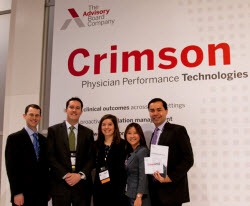
11-10-2011 11-01-27 AM

inga_small I perused my calendar last night and realized that HIMSS is just over three months away. Wow! Mr. H mentioned that HIStalkapalooza is on the calendar for February 21, which means it’s time to start shopping for the perfect party outfit (new shoes!) Returning this year: our always-popular “Inga Loves My Shoes” contest, sashes for the sassy, and the crowning of our HIStalk King and Queen (for the best-dressed partygoers.) Of course we will name the winners of the HISsie awards and hope that Jonathan Bush will return as emcee (Neal Patterson has agreed to step in if JB is unavailable.) We’re also considering a few new things for both the party and HIMSS in general, so stay tuned.

mrh_small Friday, which contains the 11th hour of the 11th day of the 11th month that marked the end of World War I hostilities, is Veterans Day. Unlike Memorial Day, which is set aside to honor those who died in military service, Veterans Day is when we honor all American veterans (hopefully we do that on other days as well.) It’s a refreshingly non-commercial commemoration that involves no Hallmark moments, mandatory gifts, or heavily sponsored sporting events, so why not start your own tradition and take the opportunity to tell a veteran that you appreciate their service and sacrifice? If you served, are serving, or have loved ones in the military, thank you.
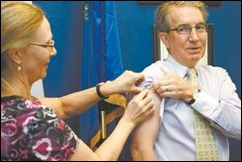
mrh_small Listening: reader-recommended Ratatat, a couple of Brooklyn guys with a spare bedroom full of synthesizers (and a few guitars) that somehow make rocking instrumentals that are real songs (not background music) that sound like a non-computerized mad stew of Genesis, Boston, and Muse with some hip hop drum loops for rhythm. Sometimes the occasion calls for soaring, dramatic music free of unskilled singing of uninspired lyrics and these fellas deliver. Like most reader recommendations, this one was spot on with what I like. If I were making a movie, I’d want them to do the soundtrack.

mrh_smallOn the Jobs Board: Support Consultant, HIM Coding Manager, Director Client Programs – HIE Architect. On Healthcare IT Jobs: Research Informatics Analyst, Epic Revenue Cycle, eGate Integration Analyst

mrh_small Inga, Dr. Jayne, and I work day jobs, so we do the best we can with HIStalk given the time we have, trying to compete with well-funded armies of full-timers running around and reporting for various magazines and sites. You can help by reading, telling others, and supporting our sponsors. We can always use guest articles, insightful comments, and news tips. There’s the usual stuff I always mention (friending, liking, connecting, and signing up for e-mail updates) but we’re open to ideas if we can figure out how to find the time to do them.


Acquisitions, Funding, Business, and Stock

11-10-2011 10-24-43 PM

Emdeon reports Q3 numbers: revenue of $282.1 million (14.7% increase); non-GAAP adjusted EBITDA of $76.7 million (15.3% increase.)

11-10-2011 2-38-36 PM

Siemens AG announces that it ended its fiscal 2011 with record operating results that included several orders worth over $100 million for Soarian Revenue Cycle. Siemens Healthcare also just finalized a $28.7 million contract with Hawaii Health Systems.

Millennium HealthCare Inc. completes its acquisition of medical billing and consulting firm Premier Technology Resources.

11-10-2011 6-52-39 PM

11-10-2011 6-54-36 PM

Vista Equity Partners completes its acquisition of Sage Healthcare Division and renames the company Vitera Healthcare Solutions. Matthew Hawkins, previously CEO of library software vendor SirsiDynix, is named CEO, replacing former Sage Healthcare President Betty Otter-Nickerson. The ambulatory product line remains intact.


Sales

11-10-2011 2-40-03 PM

Northwest Michigan Surgery Center selects the Versus Advantages RTLS to automate process flow management for the clinical staff.

11-10-2011 2-41-42 PM

SUNY Upstate Medical University (NY) signs an agreement with TeraMedica to implement Evercore Enterprise Vendor Neutral Architecture, which will support integration for SUNY’s Epic EMR. 

John C. Lincoln Health Network (AZ) selects iSirona to connect medical devices to its Epic CIS.

11-10-2011 10-27-16 PM

Lakeland Regional Health System (FL) chooses RelayHealth for its enterprise HIE.

Twelve-bed Sedgwick County Health Center (CO) selects the ChartAccess Comprehensive EHR from Prognosis.

Four-hospital Lifeline Hospital Group will partner with Optum to bring that company’s billing and collection systems to Lifeline’s hospitals in United Arab Emirates and Oman. Optum says it will take what it learns there to aid its expansion in the Middle East.


People

11-10-2011 6-34-29 PM 11-10-2011 6-36-39 PM

Merge Healthcare appoints Peter Urbain (IBM) SVP of partner sales and Steven Tolle (OptumInsight, Allscripts) SVP of solutions management.

11-10-2011 7-55-54 PM

Omnicell founder and CEO Randall Lipps is named to the board of outsourced radiology provider Radisphere.


Announcements and Implementations

The Tri-State REC announces that it has met its enrollment goal of 1,739 primary care providers in Ohio, Indiana, and Kentucky.

11-10-2011 7-00-54 PM

North York General Hospital (ON), the first hospital in Canada to go live on CPOE and bedside bar code scanning of medications, earns the Innovation in the Adoption of Health Information award from Canada’s Health Informatics Association. The Cerner customer had been previously been recognized as HIMSS EMRAM Stage 6 hospital.

11-10-2011 10-28-31 PM

LSU Health Shreveport goes live on electronic medical records (Epic?) The implementation moves on to E.A. Conway and Huey P. Long hospitals.

Web-based PM/billing vendor Kareo launches its electronic patient statements and payment portal for practices.


Government and Politics

HHS’s Office for Civil Rights will begin conducting HIPAA compliance audits this month for office-based physicians, hospitals, and health plans. Twenty audits will be performed in the initial round and selected entities will be notified in writing within 10 days. Officials will visit the audited sites within 30 to 90 days of notification.

mrh_small A Senate technology subcommittee chaired by Sen. Al Franken (D-MN) frets over recent healthcare data breaches at Minnesota hospitals, with Sen. Franken saying, “The same wonderful technology that has revolutionized patient health records has also created very real and very serious privacy challenges.” Ranking committee member and physician Sen. Tom Coburn, MD (R-OK) opines that maybe electronic records aren’t all that great. “They gotta get into my office to get it when it’s on a piece of paper.” Above is the Senator in his former life as a comic with partner Tom Davis (old timers will remember them from SNL) in an excellent Rolling Stones parody. Franken should get the band back together and run for governor with Davis as his lieutenant.


Technology

mrh_small Steve Jobs gets his first posthumous nod for being right yet again: Adobe is abandoning its attempts to make Flash work on mobile browsers, and in fact, may be admitting that Flash is obsolete for the Web in general. Steve refused to allow Flash to run on Apple’s mobile devices, saying it’s proprietary, buggy, full of security holes, a CPU pig, incapable of responding to a touch screen interface, and a battery-eater. He said Apple mobile users enjoy videos and games just fine without Flash and that Adobe should dump Flash and focus on HTML5, which they apparently are now doing. Adobe canned 750 employees this week with the usual “restructuring to focus on core business” excuse, taking a $94 million charge for eliminating 7% of its work force.

Indigo Identityware announces iDNA for the iPad, which it says offers password-free strong authentication via a four-digit PIN to access a virtual desktop (including Citrix.)

A CIO article reports that a few clinicians at Seattle Children’s Hospital tested the iPad for running a virtual desktop in patient care areas. The verdict: every one of them returned their iPad, saying Cerner apps that were designed for desktop-and-keyboard users sucked big time on the small touchscreen.

11-10-2011 10-30-55 PM

Several states and technology vendors in the EHR/HIE Interoperability Workgroup define standards by which EHRs connect to HIE in a plug-and-play (their words) fashion.


Other

11-10-2011 11-43-49 AM

Epic goes before the Verona (WI) Planning Commission to present an expansion project that will add 900 offices and 700 underground parking spaces. Three buildings will make up the “Farm Campus” and may feature barn siding rather than brick, and possibly a silo. Epic, by the way, expects 2011 revenues to reach $1.1 billion, up from last year’s $825 million. A Verona city administrator estimates the new project will cost Epic $75 million.

11-10-2011 12-03-17 PM

inga_small Kudos to the eClinicalWorks employees who spent time this week volunteering with Habitat for Humanity in Boylston, MA. The eCW folks helped with painting, laying down floors, and assorted other projects.

The rate of healthcare employment fell from 45,000 new jobs in September to only 11,600 in October. Physician offices accounted for 8,000 of the new opportunities in October.

A new report estimates that the combined ambulatory and inpatient EMR market will grow to over $8.3 billion by 2016. Allscripts hold the largest share of the ambulatory EMR market while Meditech leads in the acute care segment.

11-10-2011 2-43-52 PM

The Clark County Commission (NV) considers a $30 million proposal for a McKesson EMR system for University Medical Center. The contract includes a one-time fee of $27 million, $4 million in annual fees for the next four years, a $1 million reserve, and $1.3 million to backfill employees and perform ongoing system maintenance.

A three-year study from the RAND Corporation concludes that providers are interested in bundling payments to cut health costs, but find the strategy difficult to implement. Technical challenges include deciding what problems should be subject to bundling and providing clinicians with the information needed to improve care. Cultural issues include convincing providers that cost cutting measures will not reduce the quality of care.

mrh_small Elected officials urge residents of Freetown, MA to show their support for a proposed Meditech facility to be located in their town, an option Meditech walked away from in September after tangling with the state’s historical commission over preservation issues. Given that the unemployed citizenry vastly outnumber the archaeologically astute, just about everyone is trying to neuter the commission’s authority in their pleas urging to Meditech to reconsider.

mrh_small Notorious patent troll Acacia Research Corporation announces that EMR vendor Aprima has decided to pay the company off in the form of a “license agreement” rather than spend money defending itself against a nuisance infringement lawsuit. Acacia’s intellectual property is, “The generation of a document utilizing user-modifiable document structures, a database including information to be placed into a particular document structure, and a computing device which combines the particular document structure with relevant information stored in the database.” Legal chest-puffing is good business: Acacia booked $63 million the most recent quarter. The company owns patents for such medical innovations as catheter insertion, cardiac stents, performing laparoscopic surgery, medical monitoring, PACS, and wireless physiologic monitors.


Sponsor Updates

11-10-2011 7-06-50 PM

  • On the first day of its go-live, Baptist Healthcare System’s (KY) ED exceeds Meaningful Use thresholds using T SystemEV.
  • Passport Health releases its November schedule of live demonstration webinars.
  • Trustwave’s security and compliance portal TrustKeeper is named a 2011 Chicago Innovation Award winner.
  • MED3OOO announces upcoming dates for its webinars featuring InteGreat EHR with Quippe technology. MED3OOO will give away an iPad 2 at each session.
  • e-MDs and TMF Health Quality Institute offer free assistance to Texas e-MDs customers interested in earning incentives under PQRS 2012.
  • Covisint releases a report on three PQRS misconceptions that could prevent providers from obtaining CMS incentive dollars.
  • Scott Besler and Jonathan Besler of Besler Consulting  will present Medicare Hot Topics at the HFMA NH/VT Annual Health Care Reimbursement Seminar December 8.
  • The Kansas and Missouri regional extension centers select Greenway Medical’s PrimeSUITE EHR for their combined 2,548 providers.
  • Wolters Kluwer Health announces the addition of general surgery to its UpToDate clinical knowledge system.
  • Baptist Hospital (TN) is using MyHealthDIRECT to schedule community provider appointments for its discharged patients.
  • Healthcare Integration Strategies enters into a Provider Consulting Organization agreement with CapSite, enabling Healthcare Integration Strategies to offer the CapSite service as part of its consulting engagements.
  • An Aspen Advisors case study covers its engagement by Indiana University Health to analyze the personal health record market and best practices use of PHRs by health systems.

EPtalk by Dr. Jayne

It seems as though we’ve had a couple of slow news weeks lately, but the past few days have been what you could call a target-rich environment. Of course, the Institute of Medicine report is tops on many colleagues’ minds. Mr. H did a great job with his digest, which thankfully gave me enough talking points to look as if I had read the whole thing, when in fact I had spent my time watching Fast Five rather than doing actual work in the evening at home as I usually do.

Personally, I’m intrigued by the comments about regulating software, but I also think we need to hold users accountable for certain behaviors. I have physicians who regularly strive to defeat EHR safety features and others who complain about every safety feature which is introduced. No matter how non-intrusive the code, they take it as an assault on their profession. Maybe for those physicians who demand to wear the mantle of medicine as it used to be rather than living in the present, I say adepto super is: get over it.

Merritt Hawkins releases the 2011 Survey of Final-Year Medical Residents, which looks at career preferences and plans of those completing their training. Not surprisingly, over the last decade there has been a ten-fold increase in the number of physicians who are looking for hospital employment. Solo practice continues to be a non-starter. The number of residents who owe between $200,000 and $250,000 in student loan debt has grown from 7% in 2003 to 19% in 2001. My take on it: more validation of the impending primary care shortage. It’s much harder to pay off that kind of debt as a PCP than as a radiologist or dermatologist.

clip_image001

Speaking of the primary care shortage, the headline “Walmart wants to be your MD” certainly caught the eye of THIS medical doctor. Just when you thought that we’d seen the worst of the worst ideas in healthcare reform, this one comes along. Apparently Walmart requested information from partners looking to reduce healthcare costs and then had to issue a statement correcting its position, stating it was “not building a national, integrated low-cost primary health care platform” even though that’s what the statement said.

Walmart’s track record of driving jobs out of the economy in the name of low prices is well known. I hardly think a company that hasn’t even figured out how to offer affordable health insurance to its own employees has any business getting into the healthcare fray. Within days of this request, they also announced that they will no longer offer health insurance to new part-timers. As the article states, primary care isn’t what is driving up the cost of healthcare in America. My favorite quote from the article summarizes this as just another retail clinic attempt to gain market share: “If you get someone in the door, you can also sell them milk and a shotgun.”

Speaking of great quotes, I love this one from an article on transitioning from paper to electronic records. When asked what data should be transferred to the EMR, one physician answers, “depends on how anal-retentive you are.” This absolutely hits the nail on the head.

A friend of mine just went through the grueling process of prepping all of her charts for bulk scanning. She quickly discovered that her practice had kept every scrap of paper that ever came into the office, regardless of relevance or utility (and independent of liability as well.) She falls into the “slash and burn” camp and quickly rid her charts of duplicate and meaningless information, but not every provider is that motivated or has that much free time. Most want to keep everything, which often results in simply converting a messy paper chart (where nothing can be found) into a messy electronic chart (where nothing can be found.)

An interesting survey finding mentioned in the article: 44% of organizations are not explicitly measuring the effectiveness of productivity of their scanning process. My final quote of the day comes from Pretty WomanBig mistake. Big. Huge.

Considering the massive effort involved in converting from paper to EHR, scanning is one of the places where the work is reproducible as well as being amenable to applying lean manufacturing principles. Unlike work with patients or families, you can look at cycle time, accuracy, and per-page outputs when you look at scanning. Charts CAN be treated like widgets. Unless you just want to spend more money than you actually need to or prefer to be scanning for years, this process should be looked at carefully.

Have a question about milk and shotguns, takt time, or what’s next in my Netflix queue? E-mail me.

Print


Mr. H, Inga, Dr. Jayne, Dr. Gregg.

Text Ads


RECENT COMMENTS

  1. Isn't that actually present perfect indicative?

Founding Sponsors


Platinum Sponsors


Gold Sponsors


RSS Webinars

  • An error has occurred, which probably means the feed is down. Try again later.