A Machine Learning Primer for Clinicians–Part 5

November 14, 2018 Machine Learning Primer for Clinicians Comments Off on A Machine Learning Primer for Clinicians–Part 5

Alexander Scarlat, MD is a physician and data scientist, board-certified in anesthesiology with a degree in computer sciences. He has a keen interest in machine learning applications in healthcare. He welcomes feedback on this series at drscarlat@gmail.com.

image

Previous articles:

  1. An Introduction to Machine Learning
  2. Supervised Learning
  3. Unsupervised Learning
  4. How to Properly Feed Data to a ML Model

How Does a Machine Actually Learn?

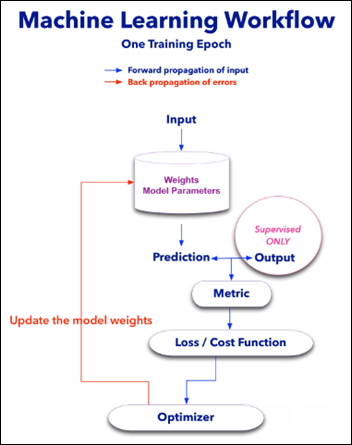
Most ML models will have the following components:

  • Weights – units that contain the model parameters and are modified with each new learning experience. a.k.a train epoch.
  • Metric – a measure (accuracy, mean square error) of the distance between the model prediction and the true value of that epoch.
  • Loss or Cost Function – used to update the weights with each train epoch according to the calculated metric.
  • Optimizer – algorithm overseeing the loss function so the model will find the global minimum in a reasonable time frame, basically preventing the model from wondering all over the loss function hyperspace.

The learning process or model training is done in epochs. With each epoch, the model is exposed to a batch of samples. 

Each epoch has two steps:

  1. Forward propagation of the input. The input features undergo math calculations with all the model weights and the model predicts an output.
  2. Back propagation of the errors. The model prediction is compared to the real output. This metric is used by the loss function and its master – the optimizer algorithm – to update all the weights according to the last epoch performance.
image

Consider a model, in this case a neural network (NN) that tries to predict LOS using two features: age and BMI. We have a table with 100 samples / instances / rows and three columns: age, BMI, and LOS.

  • Task: using age and BMI, predict the LOS.
  • Input: age and BMI,
  • Output: LOS.
  • Performance: mean square error (MSE),  the squared difference between predicted and true value of LOS.
g1

Forward Propagation of the Input

Input is being fed one batch at a time. In our example, let’s assume the batch size is equal to one sample (instance).

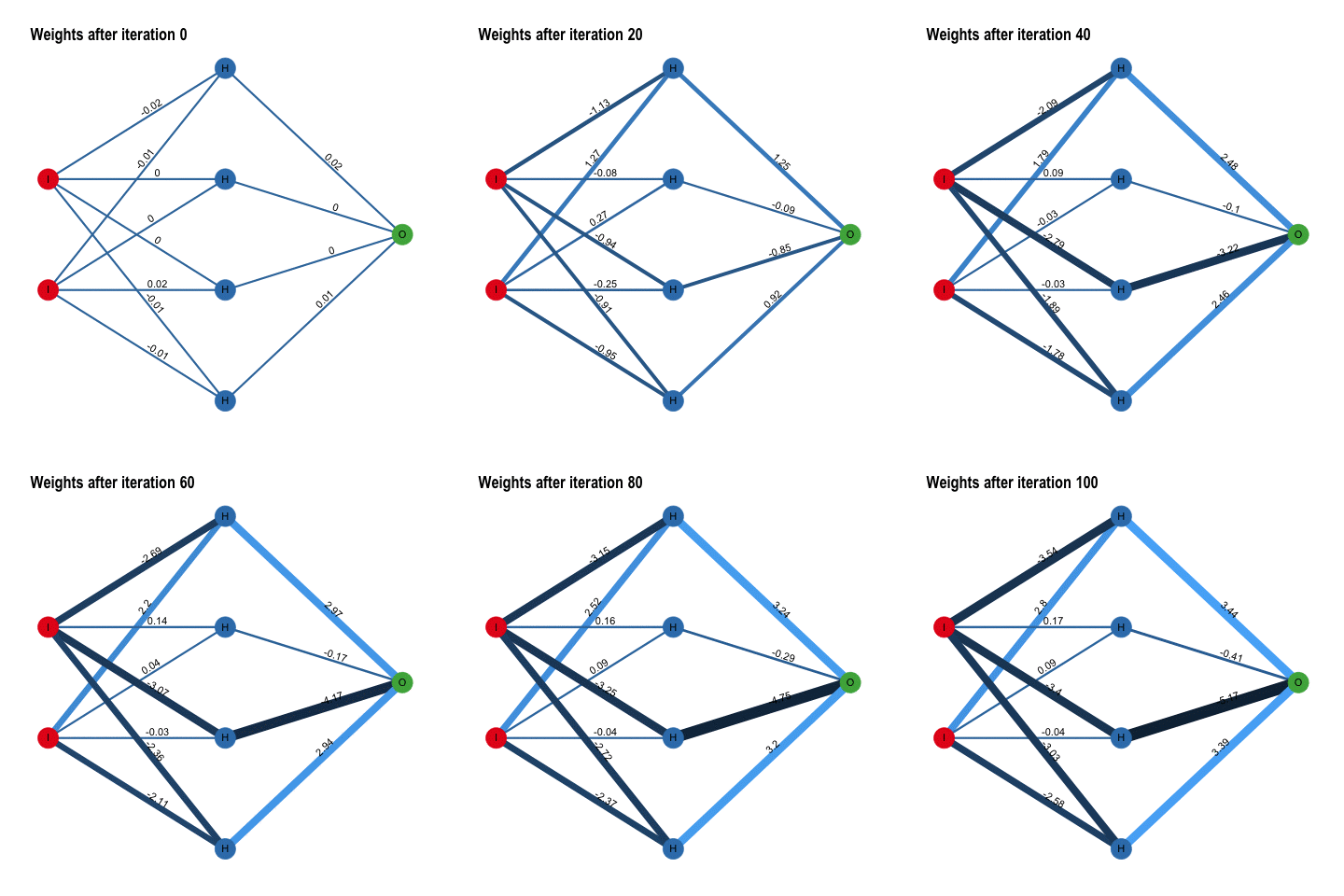
In the above case, one instance enters the model at the two left red dots: one for age and one for BMI (I stands for Input). The model weights are initialized as very small, random numbers near zero.

All the input features of one instance interact simultaneously through a complex mathematical transformation with all the model parameters (weights are denoted with H from hidden). These interactions are then summarized as the model LOS prediction at the rightmost green dot – output.

Note the numbers on the diagram above and the color of the lines as weights are being modified according to the last train epoch performance. Blue = positive feedback vs. black = negative feedback.

The predicted value of LOS will be far off initially as the weights have been randomly initialized, but the model improves iteratively as it is exposed to more experiences. The difference between the predicted and true value is calculated as the model metric.

Back Propagation of the Error

The model optimizer updates all the weights simultaneously, according to the last metric and loss function results. The weights are slightly modified with each sample the model sees – the cost function is providing the necessary feedback from the metric that measures the distance between the recent prediction vs. the true LOS value. The optimizer basically searches for the global minimum of the loss function

This process is now repeated with the next instance (sample or batch) and so on. The model learns with each and every experience until it is trained on the whole dataset.

The cost function below shows how the model approaches the minimum with each iteration / epoch.

g5

From “Coding with Data” by Tamas Szilagyi.

Once the training has ended, the model has a set of weights that have been exposed to 100 samples of age and BMI. These weights have been iteratively modified during the forward propagation of the input and the back propagation of errors. Now, when faced with a new, never before seen instance of age and BMI, the model can predict the LOS based on previous experiences.

Unsupervised Learning

Just because there is no output (labels) in unsupervised learning doesn’t mean the model is not constrained by a loss / cost function. In the clustering algorithm from the article on Unsupervised Learning , for example, its cost function was the distance between each point and its cluster centroid, and the model optimizer tried to minimize this function with each iteration.

Loss / Cost Function vs. Features

We can chart the loss function (Z) vs. the input features: age (X) and BMI (Y) and follow the model as it performs a gradient descent on a nice, convex cost function that has only one (global) minimum:

g3

Sometimes two features can present a more complex landscape of a loss function, one with many local minima, saddles and the one, much sought after, global minimum:

image

From “Intro to optimization in deep learning” – PaperSpace Blog.

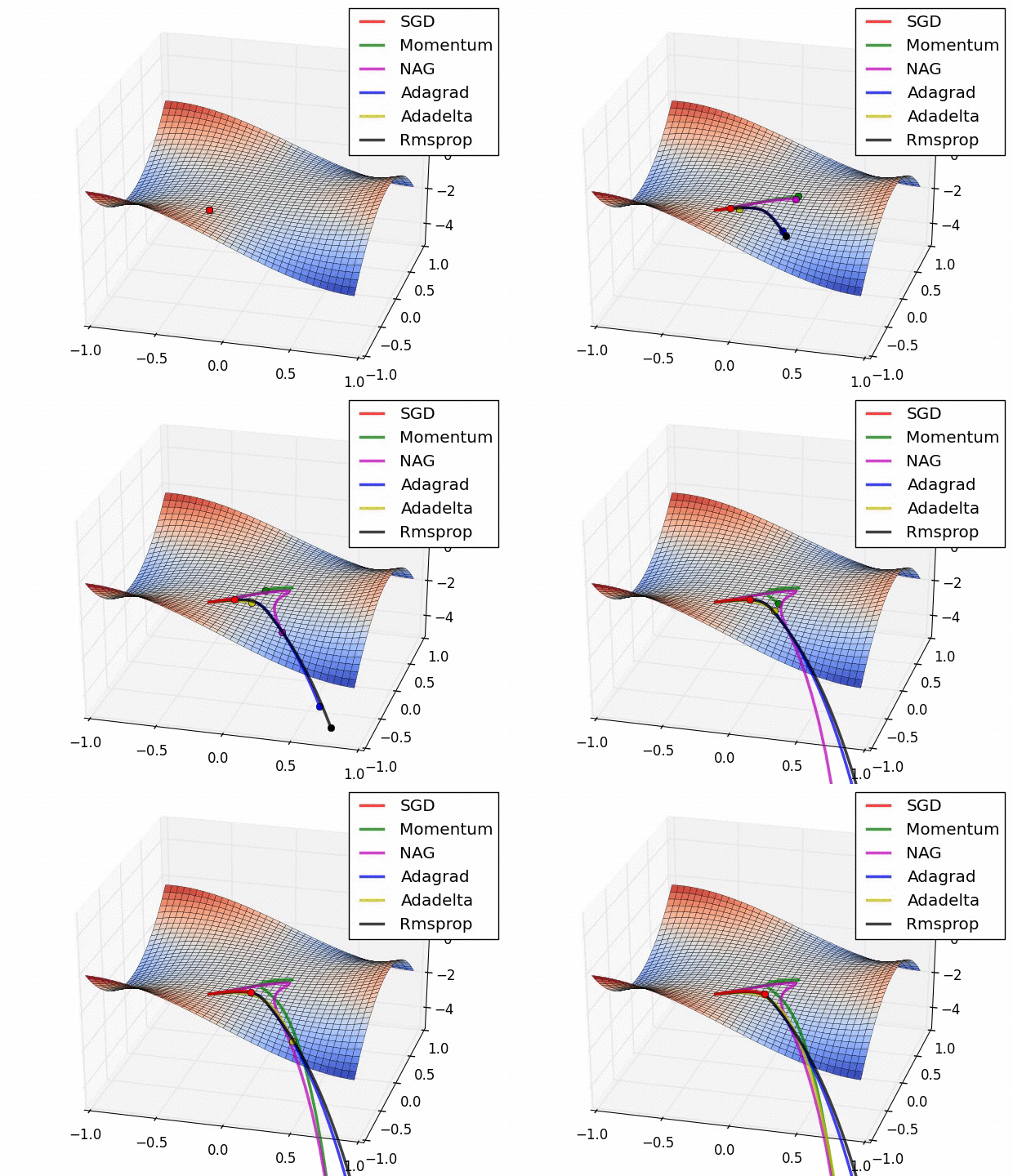
Here is a comparison of several ML model optimizers, competing to escape a saddle point on a loss function, in order to get to the optimizers’ nirvana – the global minimum. Some optimizers are using a technique called momentum, which simulates a ball accumulating physical momentum as it goes down hill.  Getting stuck on a saddle in hyperspace is not a good thing for a model / optimizer, as the poor red Stochastic Gradient Descent (SGD) optimizer may be able to tell, if it will ever escape.
g4

From “Behavior of adaptive learning rate algorithms at a saddle point – NVIDIA blog.

Just to give you an idea of how complex a loss / cost function landscape can be, below is the loss function of VGG-56 – a known image analysis model trained on a set of several million images. This specific model loss function has as X – Y axes the two main principal components of all the features of an image. Z axis is the cost function.

The interesting landscape below is where VGG-56 has to navigate and find the global minimum – not just any minimum, but the lowest of them. Not a trivial task.

image

From “Intro to optimization in deep learning” – PaperSpace Blog.

Compressing many dimensions an image usually has, into only two (X-Y) – while minimizing the loss of variance – is usually a job performed by principal component analysis (PCA),  a type of unsupervised ML algorithm. That’s another aspect of ML – models that can help us visualize stuff which was unimaginable only a couple of years ago, such as the 3D map of the cost function of an image analysis algorithm.

Next Article

Artificial Neural Networks Exposed
News 11/14/18

November 13, 2018 News 9 Comments

Top News

SNAGHTML435b007f

Driver, whose technology matches cancer patients with clinical trials, runs out of cash and shuts down just two months after its high-profile launch.

The company had 85 employees and 30 cancer centers participating, but its revenue model was to charge patients $3,000 upfront plus a monthly fee to be matched with studies (lesson learned – never base your revenue projections on what healthcare consumers are willing or able to pay unless your product involves recreational drugs, vanity surgery, or sex).

The company says it will try to help its few paying customers transition smoothly, but cautions that it doesn’t have the money to issue refunds.


Reader Comments

image

From Randy: “Re: the $20 million donation to Seattle Children’s from former Microsoft CEO Steve Ballmer. I generally agree with the sentiment about big donations to hospitals instead of public health, but the Ballmer gift is to the Odessa Brown Children’s Clinic, which serves the historically underserved, African-American neighborhood in Seattle. They will use it to locate a second facility near the light rail station so that the families of patients who are displaced by Seattle housing prices can still access the clinic’s services.” I saw that and it’s indeed a good cause, although Seattle Children’s makes enough profit that they should have been able to do the right thing without waiting for Ballmer’s donation. Still, I recognize that hospitals – including whose that have employed me – never seemed to be able to get anything done without borrowing more money (probably because they were always erecting or buying new buildings), so perhaps the donation avoided that.

From BH: “Re: breach. [vendor name omitted] contacted one of our partner hospitals to inform them that an employee of the company had their credentials compromised, and that those compromised credentials may have accessed their servers. Not sure yet what products or product lines were affected, but the company that received this notice is a hospital that uses multiple products. I have not yet seen any public statement about this activity or any breach notifications” Unverified, so I’ve left the company name off for now. Forward the email to me, please. 


HIStalk Announcements and Requests

image

Thoughts on the acquisition of Athenahealth by Veritas Capital:

  • We’ve now seen health IT’s own example of the damage that can be wrought by a vulture fund that will do anything to make money by running roughshod over whatever company is unfortunate enough to find itself in its crosshairs.
  • The activist investor and minority shareholder, Elliott Management, is a bone-picker, not a long-term investor (this is the company that bought heavily discounted Argentina sovereign debt, then seized one of its navy ships for non-payment). They will pressure the new Athenahealth to cut costs, sell parts piecemeal, and then run another IPO with a new story. That will likely not resonate with Veritas, which has a more measured approach (and healthcare experience) in increasing value by improving operations and strategy. It will be interesting to see how those two owners co-exist.
  • We’ve also seen yet another downside of going public, where you can’t control who buys your shares or what public demands significant shareholders will make.
  • Perhaps the most ironic pairing since Jimi Hendrix opened concerts for the Monkees is combining Athenahealth with the health IT assets of the former GE Healthcare. Integrating those portfolios with the Cotiviti payments processing and analytics business to create something worth more than the sum of their parts will be challenging, especially in establishing a brand identity (quick – what does Emdeon sell?)
  • Athenahealth Chairman Jeff Immelt obviously brought little to the table in his short tenure as a quick Jonathan Bush replacement, spending his days trying to convince potential buyers and likely engineering the pairing of Athenahealth with the assets of GE Healthcare (after being fired by the wildly underperforming GE and previously overseeing the hot mess that was GE Healthcare IT in his executive tour that also included plastics and appliances).
  • It’s likely that the acquisition marks the end of the nascent Athenahealth inpatient EHR business and thus its hopes to become an enterprise player that can compete with Epic, Cerner, and Meditech.
  • Athenahealth struggled with contracting ambulatory EHR demand and some of its competitors have been acquired for presumably unimpressive sums, highlighting big problems with the ambulatory EHR/PM market in the absence of Meaningful Use stimulus and the strong trend toward health systems acquiring practices and replacing their EHR/PM systems with the hospital standard.
  • GE Healthcare’s 2014 workforce management technology acquisition API Healthcare will see new life as a separate company once again. Veritas Capital acquired the well-regarded business in July 2018.
  • Athenahealth’s claims of being a healthcare disruptor — which earned airplay mostly because of its charismatic and investor-entrancing former CEO Jonathan Bush — weren’t always believable  since the company had a lot of India-based workers pushing paper and was an easily swatted fly of Bush’s favorite target Epic, but whatever innovation the company has accomplished or promised is probably not going to happen under private equity ownership and a CEO with no healthcare experience.
  • Jonathan Bush made Athenahealth more interesting than the company deserved.

image

HIMSS19 starts in 90 days, so I threw down a few thoughts.


Webinars

None scheduled soon. Previous webinars are on our YouTube channel. Contact Lorre for information.


Acquisitions, Funding, Business, and Stock

image

Smart scheduling and throughput technology vendor LeanTaaS raises $15 million in a Series C funding round, increasing its total to $39 million.

image

Several health IT startup CEOs form HealthTech4Medicaid, which will advocate for Medicaid’s use of technology (with special emphasis on the ones its members sell). I’ve heard of only a handful of the 40+ companies whose CEOs are involved.

Business Insider fawns over a former exec of Facebook and Google whose company is working on continuous, wearable imaging devices that it hopes to sell in drugstores in competing with MRIs. It’s an interesting idea with a lot of potential pitfalls along the way (such as the FDA’s approval), but the real problem is that investors, startups, and consumers obsess over new diagnostic tools that can create false positives (requiring clinician time and possibly causing harm as the patient gets roped into the healthcare widget factory). We have many problems with US healthcare, but misdiagnosis and under-diagnosis aren’t anywhere near the biggest ones other than to investors looking to make mint.

The best reporter in the business, CNBC’s Chrissy Farr, reports that Alphabet will move its London-based DeepMind healthcare AI subsidiary under the newly formed Google Health, which will be led by former Geisinger CEO David Feinberg. The Google Health name is apparently being recycled from the company’s failed personal health record, which was rolled out in 2008 and shut down in 2011 when the company finally realized the obvious – nobody (including Google executives, no doubt) will bother entering their information into a PHR.


People

image image image

Veritas Capital-owned Virence Health, soon to be merged with Athenahealth under the latter’s name, hires Karl Salnoske (Laureate International Universities) as SVP of engineering and cloud operations; Sal Mahbouba (Ratava Partners) as SVP of professional services and support; and R.J. Timmons (Tenet Healthcare) as SVP and general counsel.


Announcements and Implementations

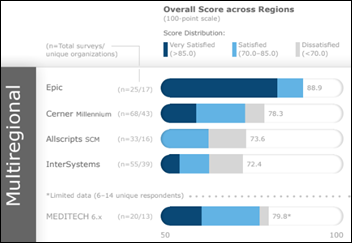
A Black Book survey of 3,000 hospital-owned or employed practices finds that 40 percent are budgeting to replace their practice management systems in favor of hospital-integrated systems, with 89 percent of hospital executives saying non-integrated EHR/PM systems impede their ability to participate in alternative payment methods. Hospitals say moving to an integrated PM system increases scheduling satisfaction, increases collections, and reduces time and resources required. Allscripts, GE Healthcare, and Cerner topped the integrated ambulatory systems review, while NextGen, Aprima, and Azalea Health took the bottom spots. The results might seem screwy, but as reader Longtime HIT Marketer reminds us, Black Book is not evaluating products or deep-diving with a handful of handpicked customers, but instead is simply reporting the perception of a statistically valid number of users. As he or she adds, “If Allscripts clients believe their products are integrated, then they are integrated.”

image

A Dimensional Insight survey of 85 health IT executives finds that few have high levels of trust regarding the financial, clinical, and operational data their organization makes available via self-service tools. The company recommends keeping subject matter experts involved in collecting, transforming and presenting data; automating complex data manipulation logic; and getting frontline data consumers involved.

image

Microsoft announces the open source FHIR Server for Azure. And please, enough with the witless “fire” puns since it’s a convenient but illogical way to sound it out (the accurate way will elicit more gasps than giggles).


Other

Analysis finds that half of the $52 billion in quarterly profits of publicly traded healthcare corporations came from just 10 companies, nine of which sell drugs. Drug companies pocketed nearly two-thirds of the profit on just 23 percent of the revenue. The new tax law that reduced corporate tax rates helped, as AbbVie paid just $14 million (0.5 percent) of its $2.76 billion in profit in taxes, while Pfizer’s tax rate was just 1.6 percent.

image

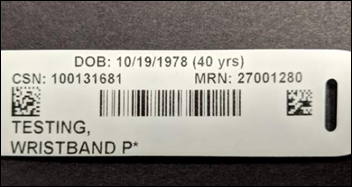
St. Charles Health System (OR) removes patient gender from wristbands at the urging of psychologists who say it causes harm to transgender patients while providing no benefits. Epic reviewed how it stores gender or name to determine how the information is used – to address the patient, to communicate with insurers, or for clinical purposes – although it says only one-third of customers use its expanded gender identity categories. It’s a fine line to walk when such patient characteristics as age, race, ethnicity, weight, religion, and genomic characteristics are required to make good clinical decisions, yet aren’t appropriate to use elsewhere, with the saving grace being that electronic systems can show the information only to those who need it. 

image

I get the newsletter of innovation and investment advisor CB Insights, which also produces conferences. CEO Anand Sanwal offers these ideas that are pretty much the opposite of health IT conferences:

  • No sponsors on stage, ever – it’s disrespectful to attendees to have speakers who “do a sales pitch, often dressed up as mediocre thought leadership.”
  • All sessions are moderated by impartial, real journalists.
  • No panel discussions since 99 percent of them are terrible
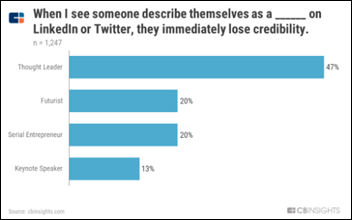
  • “Thought leaders” ruin events – 47 percent of poll respondents say someone loses all credibility if they refer to themselves as a thought leader.
  • Sanwal says that only four of the 100 conferences at which he has spoken in the past four years were content-first and thus good for business, while the rest had negative value. He has learned that writing content has better ROI since the audience is larger and the shelf life is longer.

image

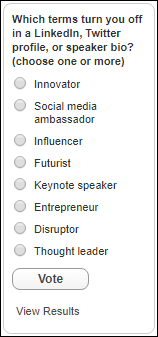
The CB Insights rant led me to create my own poll. Which terms turn you off in a LinkedIn profile, Twitter profile, or speaker bio? (note: the self-flattering choices all came from the LinkedIn profiles of health IT folks whose list of accomplishments and tenure per employer are, to be kind, a bit short). I’m the only LinkedIn profile self-reporting as “blowhard” of the many who repeatedly earn the title. Has ‘health IT’s poet laureate” been claimed?

image

Weird News Andy pivots from his entertainingly odd stories to laud the nurses of Adventist Health Feather River Hospital (CA), who hastily evacuated patients as the Camp Fire reached the hospital’s parking lot, then had to make their way back to the hospital when their own escape routes were blocked. The hospital employees set up triage in the fire-surrounded parking lot for locals who were unable to evacuate, then were ordered by firefighters to leave when the hospital roof caught fire, by which time roads were less congested because everybody had already fled for safety. 


Sponsor Updates

clip_image001

  • FDB employees volunteer at the Midwest Food Bank to support those in need.
  • Bluetree will exhibit at the RCM Leaders Forum November 14-16 in Dallas.
  • Collective Medical integrates its care collaboration network with California’s CURES 2.0 prescription drug monitoring program database.
  • CarePort Health will exhibit at the ACMA Western Pennsylvania event November 17.
  • EClinicalWorks publishers customer success stories from Gastro Health and Big Sur Health Center.
  • Carevive Systems will exhibit at the 2018 Palliative and Supportive Care in Oncology Symposium November 16 in San Diego.
  • Impact Advisors is named to Consulting Magazine’s “Fastest Growing Firms” for the second straight year.
  • Diameter Health will exhibit at the NCQA HL7 Digital Quality Summit November 14-16 in Washington, DC.
  • A Riverside Medical Center (IL) study finds that use of Glytec’s EGlycemic Management System reduced hypoglycemia in critical care patients by 73 percent and was associated with patients transferring out 0.25 days faster.
  • Meditech integrates DrFirst’s MyBenefitCheck prescription pricing solution with its Expanse EHR.
  • Mental and behavioral screening technology vendor AssessURhealth is named Tampa Bay Tech’s “Emerging Technology Company of the Year” for 2018.

Blog Posts


button


Contacts

Mr. H, Lorre, Jenn, Dr. Jayne.
Get HIStalk updates. Send news or rumors.
Contact us.

125x125_2nd_Circle

Looking Ahead to HIMSS19

November 13, 2018 News Comments Off on Looking Ahead to HIMSS19

image 

We’re 90 days out from the start of HIMSS19. Notes:

  • Register by December 3 to obtain the early bird discount ($825 for members, $1,055 for non-members).
  • Book a hotel ASAP if you haven’t already. Rooms are available at several close-in hotels at reasonable rates. Or, do as I always do and rent a house or condo through Airbnb or VRBO and then just take Uber or Lyft to the convention center. Do not reply to the shady non-HIMSS emails offering rooms – they’re a scam since HIMSS controls basically every hotel room you’re likely to want.
  • Note the odd dates – the opening reception is Monday evening (February 11),  the opening keynote is Tuesday morning, and the conference ends after a partial day on Friday (that’s going to be a slow conference day for sure).
  • The exhibit hall will be open Tuesday morning and will close Thursday evening.

The online educational agenda is incomplete, with many sessions containing only a placeholder without presenter names (seems a bit late to still be working on that, but it’s not going to change anyone’s plans either way). All keynote speakers announced so far work in for-profit companies – Atul Gawande, MD (of the ABC consortium that hasn’t named itself yet), Susan DeVore (Premier), and Mick Ebeling (Not Impossible Labs). Many of the educational sessions have vendor presenters, quite different from the HIMSS conferences a few years back where the commercial side of health IT was kept separate from the education sessions.

The theme of the conference is the rather dopey “Champions of Health Unite,” perhaps a stretch given that most of the attendees are vendors or IT-related people whose scope and influence in “health” is tiny (we contribute slightly to the work of providers, whose services in turn contribute about 20 percent of a person’s overall health). HIMSS, as usual, proclaims itself an equal partner as we advance information and technology “to meet our biggest challenges head-on and truly transform health,” which you would think would have been accomplished by now since they claim impending “transformation” every year and the US healthcare system is a bigger mess than it’s ever been.

download

image

What we’ll be doing there:

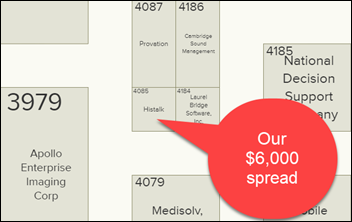
  • Our tiny 10×10  booth is #4085. The location is OK (especially since we’re not selling anything) and several of our neighbors are HIStalk sponsors, which is often fun. We’re near the restrooms, of course, since that’s always the case except that one year we were nearly co-located with the Thai food kiosk.
  • Many small booths remain available. I wouldn’t wait long to get on board, though, since latecomers aren’t listed in the printed guide. I’m always skeptical about companies that aren’t organized enough to sign up given a full year’s notice, especially if they’re pitching project management services.
  • Exhibiting isn’t cheap. Non-member booth space costs $45 to $47 per square foot plus $725 for a corner. HIMSS provides five exhibitor or client badges for each 100 square feet purchased, which makes it a better deal for us even though we only use a couple of those badges.
  • The 10th and final HIStalkapalooza was in 2017, so there’s no need to email me asking for tickets (I still get those requests regularly). You can watch the video of the 10th and final one at HIMSS17 in Orlando if you’re feeling nostalgic.

The biggest individual booths in square feet are:

  • IBM (15,300, total space 15,810 – that cost them well over $600,000 at the corporate member rate of $39 per square foot plus extra for corners – maybe Watson made the call)
  • Allscripts (10,800, total space 11,100)
  • Epic (9,900, total space 13,500)
  • Cerner (8,400, total space 12,300)
  • GE Healthcare (7,000, total space 7,400 – I’m not sure what they’ll be pitching since they’ve sold off their health IT business)

Exhibitors get priority choice for booth space given their HIMSS Exhibitor Priority Points, earned by spending a lot on HIMSS stuff (including participating in other HIMSS-owned conferences and throwing down major advertising dollars to its HIMSS Media PR factory).

You might want to review these reader-provided tips if you’re a first-time attendee.


image

We’re be doing our usual HIStalk stuff at HIMSS19:

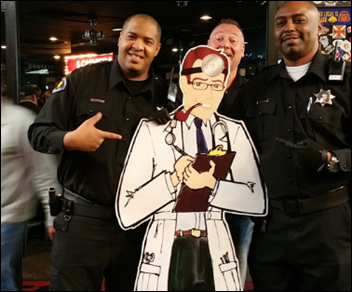
  • Having interesting characters and pseudo-celebrities hang out in our little booth. Let us know if you want to participate – my definition of celebrity-hood leans toward the offbeat.
  • Talking up HIStalk sponsors a bit beforehand to let folks know what they’re doing there. We will be too busy after January 1 to get new sponsors on board until after the conference since it’s just 41 days between New Year’s Day and the conference’s start.
  • Giving away stuff in our booth, which ranges from the slightly cool but obviously cheap (when I have to pay for it) or nicer, vendor-supplied swag that is higher quality but potentially less cool.
  • Cruising the exhibit hall to write up what we see — the buzz, giveaways, demos, and booth people behaving badly (see my exhibitor tips to avoid being called out, and for God’s sake don’t dress non-clinicians in scrubs).
  • Covering the 5 percent of vendor announcements (most of them unwisely pushed out Monday amidst the mayhem) that contain something even mildly interesting.
  • Maybe having some kind of DonorsChoose fundraising event if I can figure something out.
  • Posting the HISsies results. Which reminds me that I need to get the voting underway soon given the early conference date.

Curbside Consult with Dr. Jayne 11/12/18

November 12, 2018 Dr. Jayne Comments Off on Curbside Consult with Dr. Jayne 11/12/18

clip_image003 

I was intrigued by the results of Mr. H’s recent poll results regarding reader attendance plans for HIMSS19. Only 28 percent of respondents will be going, although the sample size is pretty small at 216 readers. Most of the people I’ve asked recently about their HIMSS plans are under substantial budget constraints, with some employers limiting even high-level IT staffers to only one conference per year. Those with limits seem to generally choose their EHR vendor’s user group meeting, or otherwise a meeting that is more specific to projects that they’re going to be working on in coming months.

Since HIMSS released the educational sessions schedule this week, I decided to do a bit of a deep dive to see what is on the calendar that might be interesting to potential attendees or might bring value to their efforts to persuade their employer to send them.

The first place I landed was the subset of Views From the Top sessions, where attendees can “be inspired by compelling stories from high-ranking leaders in a variety of industries.” The first session that popped up was one presented by Jason Cheah, who is CEO of the Agency of Integrated Care in Singapore. I do enjoy the international sessions, often there are some progressive approaches to healthcare IT problems, although it can be tricky to find nuggets that can be applied back home since the healthcare delivery systems might be significantly different from what we have to work with in the US. I recently spent some time with some physicians from Canada and learned that although some of the issues are the same, there’s enough of a different spin on payment and prioritization of initiatives that some of the best ideas I heard would be difficult to apply at my own hospital.

Wednesday’s session titled “Transparency in Prescription Drug Costs to Help Patients Save Money” will certainly address a US-centric topic, given that the presenters are CVS Health Chief Medical Officer Troy Brennan, MD and Surescripts Chief Executive Officer Tom Skelton. They’re slated to talk about drug cost and benefit plan information transparency and how to better expose that information to patients, prescribers, and pharmacies. Price shopping is a big deal for the patients I currently serve – many are using sites like GoodRx to help make medications more affordable. It’s still a patchwork of coverage, though, as one of my patients found out when a local Walmart refused to honor the $15 price listed in the app, telling the patient it would be $50. The patient didn’t fill it at our office due to a $40 price tag in the first place, and with the drive and the confusion ended up in a situation where our office was closed so they couldn’t get it from us for less, so they didn’t fill it at all. Not good news for the teenager with bronchitis and asthma who really would have benefitted from access to an inhaler overnight.

Another Views From the Top session is titled “Defeat Nation State Actors Stalking the Health Care Sector” and covers cybersecurity best practices and risk exposure management. It sounds interesting, but likely more suited to the technical side of the house as opposed to the average clinical informaticist.

Next, I went to the section titled Reactions from the Field, which is designed to feature “market suppliers ‘in the field’ working closely with healthcare organizations to address common issues in cybersecurity, innovation, life science / pharma, or artificial intelligence.” It goes on to note that there will be four sessions with three panelists each, but no details are published. I’ll have to check back in a month or two to see what that’s all about. The Industry Solutions Sessions are also not listed in detail yet but are slated to include vendor-sponsored case studies presented in hour-long sessions.

The HIMSS Davies Award Sessions are listed and include a number of bread-and-butter type sessions covering issues we deal with on a regular basis: improvement of quality scores; reducing urinary tract infections due to catheter use; decreasing falls; improving pediatric asthma outcomes; sepsis management through clinical decision support and virtual care; clinical risk systems; and achieving the Triple Aim. Although some of the session descriptions clearly stated which organization was presenting, others used acronyms or abbreviations that left me guessing. There also were no presenter names included.

The Government Sessions header also failed to include a list of actual sessions, although it promises to help attendees “get answers to your pressing questions surrounding the Trump Administration and its impact on health and health information technology.” I assume the usual players will be making an appearance, but again will have to check back.

From there it was on to the General Education sessions, where a brand-new Blockchain Forum has been added. There are three specific sessions listed out for those of you looking to get the most current information on everyone’s favorite buzzword. I found a couple of interesting sessions interspersed among various forums, including one on counterfeit pharmaceuticals in the supply chain and another on data interoperability across non-hospital care venues such as long-term / post-acute care facilities.

There do appear to be a couple of new formats and venues for sessions. The SPARK Session (Session Providing Actionable and Rapid Knowledge) is designed to be 20 minutes of quick insights. Sessions are also being grouped into “content streams” aligned with the Quadruple Aim and allowing attendees to focus on domains of technology, information, organizational efficiency, care, environment, and societal challenges. There will also be a Learning Lounge with on-demand viewing of live-streamed sessions. I hope the room is large and the chairs plentiful because it might become the hip place to be for those with tired feet and aching backs.

From a consultant standpoint, I’m hoping there will be some good sessions in the Federal Health Community Forum, although no sessions were listed yet. I’m helping clients through a number of governmental initiatives including the Comprehensive Primary Care Plus (CPC+) program and of course MIPS, so if there’s any easier ways to navigate or advise, I’m hoping to pick up some tips. As with other areas, the details aren’t quite posted yet.

In the email announcing the session listings, HIMSS promised over 400 sessions and there certainly isn’t anywhere near that number posted yet for our consideration. It just goes to show that I should probably go back to planning my HIMSS session attendance like I have for the last several years – at the last minute on the plane while sipping a cocktail and hoping I packed the right shoes. At least by then HIMSS should have all the sessions listed and maybe some presenters.

What’s your strategy for planning your trip to HIMSS? Are the sessions important, or is it more about the exhibit hall, building new relationships, and catching up with colleagues? Leave a comment or email me.

comments_button

Email Dr. Jayne.

Veritas Capital Will Acquire Athenahealth for $5.7 Billion

November 12, 2018 News 5 Comments

image

Private equity firms Veritas Capital and Evergreen Coast Capital will acquire Athenahealth in an all-cash deal worth $5.7 billion, the companies announced this morning. The $135 per share sales price represents a 12 percent premium over Friday’s close.

Athenahealth wil be combined with Veritas-owned Virence Health, which sells the former GE Healthcare financial, ambulatory, and workforce management product lines. Veritas acquired that business from GE for $1.05 billion in cash in July 2018.

The combined companies will operate under the Athenahealth brand with headquarters remaining in Watertown, MA. After the transaction is completed, Veritas will restore API Healthcare as a separate workforce management technology company. GE Healthcare acquired API Healthcare in January 2014.

Athenahealth’s CEO will be Virence Chairman and CEO Bob Segert, who was hired by Veritas in September 2018. He has no healthcare experience

Evergreen Cost Capital is the private equity subsidiary of Elliott Management Corporation, the activist investor that targeted Athenahealth and forced the ouster of Athenahealth co-founder and CEO Jonathan Bush in June 2018. Elliott Management offered $160 per share bid for Athenahealth in September 2018 but then backed away, either as a result of due diligence or the realization that Athenahealth turmoil had decreased the price required to buy it. The company says it supports the acquisition and will retain its minority share in it.

Some of Veritas Capital’s previous health IT acquisitions include the healthcare business of Thomson Reuters (now IBM Watson Health’s Truven Health Analytics, $1.25 billion); payments processing technology vendor Cotiviti ($4.9 billion); and analytics vendor Verscend (formerly Verisk Health, $820 million). Verscend and Cotiviti were combined under the Cotiviti name upon completion of Verscend’s acquisition of Cotiviti in August 2018.

ATHN shares rose 10 percent in early trading following the announcement prior to the market’s open. They’re up 5 percent in the previous 12 months vs. the Nasdaq’s 7 percent increase. They peaked in the $145 range in early 2014.

button

Monday Morning Update 11/12/18

November 11, 2018 News Comments Off on Monday Morning Update 11/12/18

Top News

image

Athenahealth reports Q3 results that had been pushed back a week: revenue up 9 percent, adjusted EPS $1.08 vs. $0.56, beating earnings expectations but falling short on revenue.

The company also delayed its earnings call one week to Monday afternoon after the market’s close.

The unexplained delay might indicate that an announcement about its acquisition interest will be forthcoming. Veritas Capital and Elliott Management were rumored a couple of weeks ago to be close to finalizing their acquisition of the company.

UPDATE: Reuters reports that Veritas Capital and Elliott Management will announce Monday that they will acquire Athenahealth for $135 per share. ATHN shares closed Friday at $120.35.


Reader Comments

image

From Spam in a Can: “Re: news items. Wonder if you have thoughts on seemingly contradictory recent news item? An anonymous couple donates $2.1 million to RIP Medical Debt, which will use the money to pay off $250 million in debts. Second, a family donates $200 million to Harvard Medical School.” I’m just riffing here, but my thoughts:

  • It’s kind of sad that charity RIP Medical Debt is even a thing. It buys discounted portfolios of medical bills that have been characterized as uncollectible, then pays them off for consumers who meet its need-based criteria. By then, I would assume that the debtor has moved on, has had their credit destroyed, or didn’t plan to pay their bill anyway. Whoever is holding the debt will appreciate having it paid, I suppose.
  • Providers won’t see the money since the accounts were already written off and, as with all other healthcare discounting and contracting, the rest of us are covering their shortfall.
  • RIP Medical Debt estimates that Americans owe $1 trillion in medical debt.
  • Each $1 donated to the charity allows $100 in debt to be purchased and forgiven.
  • Harvard Medical School’s $200 million pledge was from Ukraine-born Sir Leonard Blavatnik, the wealthiest man in the UK at $21 billion. HMS will spend his money on research projects and startups that presumably won’t offer anything free to patients.
  • Neither of these news items necessarily benefit patients or help improve our mess of a healthcare non-system that ignores public health, is left to deal (poorly) with health-harming economic disparity, and is controlled by a politically entrenched industrial complex (including all of us reading here) whose cost is eating up close to 20 percent of our gross domestic product.

image

From Choosy Mothers: “Re: health IT books. You should write one about HIStalk.” A description of how I fill an empty computer screen each day wouldn’t make a compelling read, but I’ve seen some awful books published since Amazon lowered the bar with self-publishing tools. Some healthcare executives have hired vanity book services, where you pay them to repurpose whatever you have lying around (presentations, blog posts, interviews, etc.) into a “book” that requires nearly zero effort, inspiration, or intent to deliver reader value (and authors can even game Amazon’s system into declaring their crappy book to be a “bestseller.”) The worst thing about the democratization of publishing platforms (blogs, podcasts, social media updates, and even hard-to-fill speaking spots for an excessive number of conferences) is that we’re all being bombarded with lightweight, poorly written, ego-stroking and resume-padding filler that an objective editor would have rejected or at least helped improve. On the bright side, it’s easy to identify who to ignore since they’re laying the evidence right in front of you.


HIStalk Announcements and Requests

image

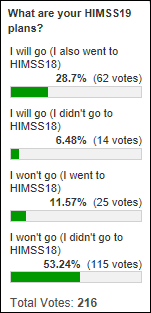
HIMSS19 attendance bookmakers might be interested that nearly twice as many HIMSS18 attendees will skip HIMSS19 than non-attendees of HIMSS18 who will go this time around, which on election night would have stoked lengthy analysis and discussion about whether it’s a wave, to whose benefit, and for what reasons.

New poll to your right or here: Who is most responsible for clinician-unfriendly EHRs? Vote and then click the poll’s comments link to explain your vote or the solution you would recommend.

Sunday, November 11 is Veterans Day (celebrated Monday), set aside to honor all US military veterans. You can attend a parade or celebration; fly the flag; visit or volunteer at a VA hospital; ask your employer to honor veteran co-workers; arrange to anonymously pick up a veteran’s check at a coffee shop or restaurant; or I suppose just pay your taxes to support the VA’s $10 billion Cerner contract that hopefully will benefit veterans. Or you do nothing at all because the country they served allows that, too.

Health IT news is uncharacteristically light as everyone in the industry focuses on honoring veterans (OK, maybe that’s not the reason, but I don’t know why otherwise). It’s not a holiday for most of our industry, so you can at least take a mental vacation for the few minutes of saved reading time.


Webinars

None scheduled soon. Previous webinars are on our YouTube channel. Contact Lorre for information.


Sales

  • Parkview Medical Center (CO) chooses Access for electronic signatures and forms.

Government and Politics

Andy Slavitt’s HAMA Forum article enumerates the Triple Threat to the Triple Aim: (a) health disparities associated with income, location, and race; (b) the “single aim” of revenue that overshadows the more important aims; and (c) the weaponization of healthcare by unresponsive politicians and lobbyists.


Other

Executives of S&P companies are dropping their references to blockchain in earnings calls, analysis finds, with buzzword-dropping down 80 percent as its shareholders stopped believing the hype and share prices stopped increasing accordingly.

image

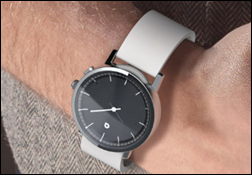
CNBC notes that alumni of the failed wristwatch-powered blood pressure monitor Quanttus, formed by MIT researchers in 2012 and shut down in 2016, have moved on to Verily, Apple, Google, and other big consumer firms, some of which are working on blood pressure projects of their own.


Sponsor Updates

  • PointClickCare names Liaison Technologies its Partner of the Year.
  • Lightbeam Health Solutions will exhibit at the 2018 Institute for Quality Leadership November 13-15 in San Antonio.
  • Loyale Healthcare examines industry consolidation and closures in “How to Survive the Growing Wave.”
  • Waystar and Surescripts will exhibit at the NextGen One Users Meeting November 11-14 in Nashville.
  • Netsmart will exhibit at the VAHCH Annual Conference November 13 in Glen Allen, VA.
  • Nordic, Clinical Computer Systems, developer of the Obix Perinatal Data System, and The SSI Group will exhibit at the HIMSS GC3 event November 14-16 in Mobile, AL.
  • PerfectServe will exhibit at the HealthLeaders CNO Exchange November 12-14 in Charleston, SC.
  • ROI Healthcare Solutions publishes a new e-book, “Embracing HR Innovation.”
  • Philips Wellcentive will exhibit at the AMGA 2018 Institute for Quality Leadership November 13-15 in San Antonio.
  • Wolters Kluwer Health donates Lexicomp app subscriptions to clinicians working aboard Mercy Ship hospitals.
  • ZeOmega will exhibit at the TAHP Managed Care Conference and Trade Show November 12-15 in Houston.

Blog Posts


button


Contacts

Mr. H, Lorre, Jenn, Dr. Jayne.
Get HIStalk updates. Send news or rumors.
Contact us.

125x125_2nd_Circle

Weekender 11/9/18

November 9, 2018 Weekender 3 Comments

weekender


Weekly News Recap

  • Google hires Geisinger President and CEO David Feinberg, MD, MBA to develop its healthcare strategy across its business units
  • Bedside patient engagement company GetWellNetwork acquires HealthLoop, a Silicon Valley-based developer of automated messaging for follow-up care
  • A study of EHR-related medication events in pediatric hospitals, of which 18 percent appear to have caused harm, finds system usability as the cause 36 percent of the time
  • Premier announces that it will acquire clinical decision support vendor Stanson Health
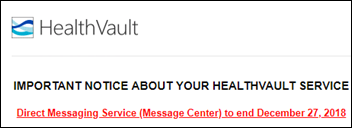
  • Microsoft tells users of its HealthVault personal health record that it will shut down Direct messaging on December 27, 2018
  • ResMed announces plans to acquire MatrixCare for $750 million
  • Allscripts says in its earnings call that it will launch a formal sales process for its stake in Netsmart
  • Two nationally prominent articles observe how poorly hospital EHRs handle the end of daylight saving time, as information entered between 1:00 and 2:00 a.m. is deleted when the system clock is set back

Best Reader Comments

I feel for providers and their in baskets. I previously worked for a gigantic HMO with a huge amount of virtual care and no support staff and it really was a second job. I am sure it is similar for other community providers. At my current employer, we definitely struggle with Revenge of the Ancillaries (or perhaps just curse of complying with billing). For imaging orders, providers have to enter a coded diagnosis and a separate field for reason for test. It makes me cringe every time I watch them. (Midwest Fan)

No one gives a rip about who was promoted to chief marketing officer or of human resources of a vendor’s firm. (leftcoaster)

[Replying to leftcoaster] As a chief marketing officer who is also a company founder and key member of our executive team determining strategy, providing input for product development, and working with customers during implementation, I politely suggest you broaden your view of what a marketing leader really does. (Not Just Glossy Ads)

Just recently finished applying for life insurance and part of that was an hours-long review of medical history where they wanted every place I’ve had care in the last five years. Had to sign ROIs and personally work with a few providers to get my medical record. Also had to have a few labs done with no existing conditions to call for it. (YoungBuck)

Cleveland Clinic Florida release of records – they do have that option in Epic but choose not to use it at this point. They absolutely should get on board and modernize. No reason not to (other than maybe it’s more profitable doing what they do, which is sad). (FactCheckPlease)

The “dilution” effect on systems is real. A really terrific small system can easily become a meh larger system, which can become a truly hated enterprise system. Chefs will recognize this as the “too many cooks in the kitchen” syndrome. (Brian Too)

Does no one see the issue with having a orthopedic surgeon work as a dictation scribe where the productivity is 30 min visit = 1 hour scribing? Does India have too many doctors and not enough jobs for doctors? I think lot of providers still have the paternalistic view that they know best because they are the smartest and the wisest at all times, and everything in healthcare should be catered to them. That has always resulted in bad outcomes for the patient in the past, and that sort of attitude needs to be checked. (“Ancillary” Person)

Regarding the reported archaic workarounds for daylight saving time. What is truly archaic is that we are still changing our clocks twice a year! I don’t see an easy way to alleviate this problem in the EHR when accurate, timed entries are critical to patient care and also required. (CaveNerd)

Atul’s concerns about the problem list are entirely the fault of using an insurance system that demands specific diagnosis codes before they will pay for procedures. Maybe, if we didn’t have a ridiculous payment system, we wouldn’t have ridiculous software designed to feed a ridiculous payment system. (ItsThePayorsDummy)


Watercooler Talk Tidbits

image image

Readers funded the DonorsChoose teacher grant request of Ms. K in New York, who asked for a document camera (the one they have is shared by four classrooms) and a speaker to replace their broken one so the class can hear the audio portion of videos. She reports, “These supplies went straight from the box to the front of the classroom. Your support transformed our classroom learning environment to where we are now able to hear sound for videos and have students bring work up to have it projected and seen. This has led to more student-led instruction and reflection on their work. By empowering them to use their own work to model through the concepts, give feedback to one another, and be open to how they can be better has been transformational to our classroom culture. Thank you for your continued support!”

image

My mention of hospitals still requiring faxes resonated with a reader who works in a large radiology practice. They have HL7 integration and many options for sending results electronically, but they still send 100,000 pages each day by fax. Most interesting is that clients ask them to fax, on average, THREE copies of the same result, which as he concludes,” Yes, we are their copy machine!” I joked that someone should develop a healthcare-only fax integration engine that can parse information from fixed form locations and convert it to HL7-compatible data and he said that’s already been attempted, but was thwarted by low fax image quality and trying to convert handwritten data. The fact that it was even attempted says a lot.

I looked at the records request page of several hospitals and found these consistencies:

  • The patient is expected to know which of several listed health system departments delivered care to them (hospital, clinic, private practice, imaging, etc.) and to complete a form for each. So much for the benefit of being treated by a health “system.”
  • The request forms are often lengthy (several pages) and confusing because they try to cover all situations, such as patients requesting their own records, authorizing someone else to receive their data, or requests by providers rather than patients.
  • Most hospitals require the completed form to be delivered to the HIM department in person, mailed, or faxed. You will immediately understand the consumer challenge in the majority of hospitals where HIM is buried in the basement of the hospital’s busiest building where parking is hard to find and not free (although commendably, some hospitals offer patient drop-off parking spots or free valet parking). Why can’t hospitals offer a service desk in a less-congested area where all patient requests can be handled? Kudos to those hospitals that provide an email address for submitting the form, which works if patients have a scanner at home (none of the hospitals I checked provide a form that can be completed online).
  • The forms often refer to “PHI” as though patients should understand what that means (even when the form indicates what the letters stand for).
  • Requests for billing records are not covered by requests for medical records and are not mentioned on the HIM page.
  • On the plus side, some hospitals gave specific instructions for downloading information from the patient portal, offered the option to receive information via secure email, listed their prices for providing copies of records, listed the legal rights patients have with regard to their records, and gave estimates of how long it would take to receive records (although that ranged from days to many weeks).

California voters reject a proposition that would have capped dialysis profits, a measure opposed by hospitals, doctors, and the two highly profitable national dialysis companies that spent $111 million to squash it.

NIH seeks a contractor to manufacture “marijuana cigarettes” for THC-related studies, also requiring the small business it chooses to provide a placebo for control groups (“nicotine research cigarettes.”)

The SEC files insider trading charges against the airplane mechanic husband of a UnitedHealth Group HR VP who spied on her to obtain confidential merger information. James Hengen is alleged to have made $63,000 in profits by taking positions in two companies that were later acquired by UHG and also tipped off his brother and some co-workers to load up on shares.

image

Someone steals a 10-foot-long inflatable colon used by University of Kansas Cancer Center in its “Get Your Rear in Gear” colorectal cancer public education program. In a happy ending, KC police recovered the stolen colon, moved to action by TV colonoscopy queen Katie Couric, who wittily tweeted, “Does anyone know the scope of the crime?” Hopefully, there’s no obstruction of justice. We need to flush out what happened here and get to the BOTTOM of it.” It was returned intact (no semicolon here) although conspiracy theorists question whether the theft was a PR stunt.


In Case You Missed It


Get Involved


button


125x125_2nd_Circle

EPtalk by Dr. Jayne 11/8/18

November 8, 2018 Dr. Jayne 1 Comment

There was some chatter in the physician lounge this week about a study published in JAMA Network Open looking at the accuracy of EHR medication lists vs. the substances actually found in patients’ blood. Researchers looked at 1,350 patients and found that while a majority of medications were detected in the blood as listed in the EHR, there were many more medications detected that were not reflected in the EHR. Such incomplete documentation prevents systems from performing drug-allergy and drug-drug checking, placing patients at risk.

As much as some clinicians don’t like it, I prefer when patients bring in all their medications and supplements, even if it takes extra time going through a brown bag, shoebox, or tote. That way we can keep the EHR updated and also physically impound medications that patients shouldn’t be taking, if warranted.

There was also a fair amount of conversation around Tuesday’s elections, and the various positions held by candidates regarding healthcare. Kaiser Health News published a great piece looking at the various terms being thrown around during the election, including single-payer, universal healthcare, and Medicare for all. Gubernatorial candidates in California, Massachusetts, and Florida were pushing for state-run single-payer systems, where others were calling for less specific “universal coverage” or “public option” provisions. Like those mentioned in the article, the physicians around my lunch table didn’t fully understand the different models or what they might mean not only to their practices, but to their families.

There was zero chatter around the announcement by CMS that access to Quality and Resource User Reports and PQRS Feedback Reports will be sunset at the end of December. Since 2016 was the last performance period for those programs and 2018 was the final payment adjustment year, there isn’t much of a need for the reports to remain online. Physicians or their authorized representatives can download them until December 31, but it’s unclear how many providers reviewed the data in the first place or whether they tried to use it to drive practice-level improvements. Reports will be available eon the CMS portal for those of you looking for a little bedtime reading.

As I was getting ready to leave, one of my colleagues asked me what I thought of Atul Gawande’s recent New Yorker essay on “Why Doctors Hate Their Computers.” He takes readers through Partners HealthCare’s journey from homegrown EHR to Epic, and all of the physicians around the table were familiar with that 16 hours of training he leads with. (In our case, it was 17, and let me tell you everyone was counting.)

Having run more than a handful of EHR implementation projects, I loved Gawande’s description of his trainer, “younger than any of us, maybe a few years out of college, with an early-Justin Bieber wave cut” whose technique incorporated “the driver’s ed approach: You don’t want to be here; I don’t want to be here; let’s just make the best of it.”

Gawande walks us through his own thoughts about the rise of computers, including the once-coveted Commodore 64, which brings back memories for some of us who have been on the cutting edge. Having been the second person I knew with a modem (the first being the guy from whom my brother bought the used card from), I felt a little bit of his pride and optimism as he readied himself for training. The last three years have quashed that optimism, however, and he has “come to feel that a system that promised to increase my mastery over my work has, instead, increased work’s mastery over me.”

I appreciated his discussion of “the Revenge of the Ancillaries,” where design choices were considered by constituents from various parts of the organization. He makes a point that was telling: “The design choices were more political than technical: administrative staff and doctors had different views about what should be included. The doctors were used to having all the votes… Now the staff had a say (and sometimes the doctors didn’t even show.)”

I’ve seen that happen during several build decision projects, and it sounds like there may not have been adequate checks and balances in the governance process. For example, requiring stakeholder signoff in addition to participation in the working groups. Requiring user acceptance testing of critical workflows would also have caught some of the issues he cited, such as hard stops and required fields, prior to the go-live. He also highlights issues with the maintenance of patient problem lists that are exacerbated by governance issues, with duplications and lack of specificity in entries. Cut and paste is also an issue, one that could be addressed by governance and consensus among users about the best way to use the EHR.

Gawande does discuss the phenomenon of governance, noting that, “As a program adapts and serves more people and more functions, it naturally requires tighter regulation. Software systems govern how we interact as groups, and that makes them unavoidably bureaucratic in nature. There will always be those who want to maintain the system and those who want to push the system’s boundaries.”

I’m in agreement, but it’s still a challenge to figure out why organizations don’t spend the time needed up front to define some of these goals. What is the vision for the new system? How does it support the mission? What are the expected outcomes? How do we define success? Instead it’s often a race against a timeline, which may or may not reflect organizational tolerance for a particular speed of change. The best implementation I ever worked on had a motto of “go slow to go fast.” We may have spent more months in the design and build phase than other organizations, but when we went live, we hit the ground running and there were very few changes needed to the system in the first few months.

Mr. H has already commented on the Gawande piece, and one reader shared their thoughts on the physician mentioned who admittedly ignores messages in her inbox and deletes them without reading them. I hope there aren’t any patients reading The New Yorker who might have a concern about their care in her practice, because if she is ever called into court about a missed diagnosis, things aren’t going to end well for her. I can’t imagine publicly admitting that I don’t review results and I doubt that the medical staff administration is going to think too kindly of it.

Reading the piece from the perspective of a clinical informaticist, there’s a lot to unpack, and also a lot of opportunity to potentially improve things for the impacted physicians. I’m not sure what I think about it from a patient perspective or a non-IT perspective, since it oversimplifies and under-explains some of the complexities that have brought us to where we are. That’s what I told my colleague, and I ended with a reminder that the one of the EHR subcommittees still has some openings, so if he wants to be part of the solution, there’s a venue available.

clip_image002

clip_image004

I don’t frequently call out companies for wacky marketing, but this one is baffling. The subject line of the email advertises a profitability webinar with “cybersecurity strategies you can use,” but the email itself discusses patient experience and how to “cultivate a loyal base.” Oh yeah, and there’s the part where they sent the invitation out less than 24 hours in advance for a webinar that is in the middle of the work day. For mass marketing emails, I’d recommend peer review at a minimum before sending them out. Get it together, folks.

[UPDATE] Greenway Health was quick to read Dr. Jayne’s comment and apologize that their email preview line displayed incorrect wording (the subject line itself was correct). They also note that this was the third in a three-email series, so those who wanted to sign up had ample time well before this email. They also say their surveys and best practices indicate that 2:00 p.m. ET works best for providers.

Do cold emails entice you to join webinars in the middle of the day? How many do you register for that you end up not attending? Leave a comment or email me.

comments_button

Email Dr. Jayne.

A Machine Learning Primer for Clinicians–Part 4

Alexander Scarlat, MD is a physician and data scientist, board-certified in anesthesiology with a degree in computer sciences. He has a keen interest in machine learning applications in healthcare. He welcomes feedback on this series at drscarlat@gmail.com.

image

Previous articles:

  1. An Introduction to Machine Learning
  2. Supervised Learning
  3. Unsupervised Learning

How to Properly Feed Data to a ML Model

While in the previous articles I’ve tried to give you an idea about what AI / ML models can do for us, in this article, I’ll sketch what we must do for the machines before asking them to perform magic. Specifically, the data preparation before it can be fed into a ML model. 

For the moment, assume the raw data is arranged in a table with samples as rows and features as columns. These raw features / columns may contain free text; categorical text; discrete data such as ethnicity; integers like heart rate, floating point numbers like 12.58 as well as ICD, DRG, CPT codes; images; voice recordings; videos; waveforms, etc.

What are the dietary restrictions of an artificial intelligence agent? ML models love their diet to consist of only floating point numbers, preferably small values, centered and scaled /normalized around their means +/- their standard deviations.

No Relational Data

If we have a relational database management system (RDBMS),  we must first flatten the one-to-many relationships and summarize them, so one sample or instance fed into the model is truly a good representative summary of that instance. For example, one patient may have many hemoglobin lab results, so we need to decide what to feed the ML model — the minimum Hb, maximum, Hb averaged daily, only abnormal Hb results, number of abnormal results per day? 

No Missing Values

There can be no missing values, as it is similar to swallowing air while eating. 0 and n/a are not considered missing values. Null is definitely a missing value.

The most common methods of imputing missing values are:

  • Numbers – the mean, median, 0, etc.
  • Categorical data – the most frequent value, n/a or 0

No Text

We all know by now that the genetic code is made of raw text with only four letters (A,C,T,G). Before you run to feed your ML model some raw DNA data and ask it questions about the meaning of life, remember that one cannot feed a ML model raw text. Not unless you want to see an AI entity burp and barf.

There are various methods to transform words or characters into numbers. All of them start with a process of tokenization, in which a larger unit of language is broken into smaller tokens. Usually it suffices to break a document into words and stop there:

  • Document into sentences.
  • Sentence into words.
  • Sentence into n-grams, word structures that try to maintain the same semantic meaning (three-word n-grams will assume that chronic atrial fibrillation, atrial chronic fibrillation, fibrillation atrial chronic are all the same concept).
  • Words into characters.

Once the text is tokenized, there are two main approaches of text-to-numbers transformations so text will become more palatable to the ML model: 

image

One Hot Encode (right side of the above figure)

Using a dictionary of the 20,000 most commonly used words in the English language, we create a large table with 20,000 columns. Each word becomes a row of 20,000 columns. The word “cat” in the above figure is encoded as: 0,1,0,0,…. 20,000 columns, all 0’s except one column with 1. One Hot Encoder – as only one column gets the 1, all the others get 0.

This a widely used, simple transformation which has several limitations: 

  • The table created will be mostly sparse, as most of the values will be 0 across a row. Sparse tables with high dimensionality (20,000) have their own issues, which may cause a severe indigestion to a ML model, named the Curse of Dimensionality (see below).
  • In addition, one cannot represent the order of the words in a sentence with a One Hot Encoder.
  • In many cases, such as sentiment analysis of a document, it seems the order of the words doesn’t really matter.

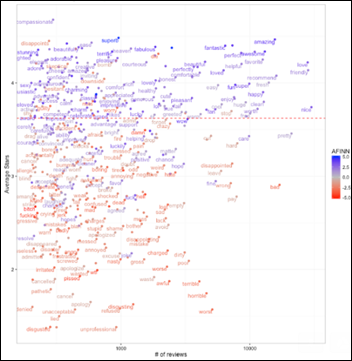
Words like “superb,” “perfectly” vs. “awful,” “horrible” pretty much give away the document sentiment, disregarding where exactly in the document they actually appear.

image

From “Does sentiment analysis work? A tidy analysis of Yelp reviews” by David Robinson.

On the other hand, one can think about a medical document in which a term is negated, such as “no signs of meningitis.” In a model where the order of the words is not important, one can foresee a problem with the algorithm not truly understanding the meaning of the negation at the beginning of the sentence. 

The semantic relationship between the words mother-father, king-queen, France-Paris, and Starbucks-coffee will be missed by such an encoding process.

Plurals such as child-children will be missed by the One Hot Encoder and will be considered as unrelated terms.

Word Embedding / Vectorization

A different approach is to encode words into multi-dimensional arrays of floating point numbers (tensors) that are either learned on the fly for a specific job or using an existing pre-trained model such as word2vec, which is offered by Google and trained mostly on Google news. 

Basically a ML model will try to figure the best word vectors — as related to a specific context — and then encode the data to tensors (numbers) in many dimensions so another model may use it down the pipeline.

This approach does not use a fixed dictionary with the top 20,000 most-used words in the English language. It will learn the vectors from the specific context of the documents being fed and create its own multi-dimensional tensors “dictionary.” 

An Argentinian start-up generates legal papers without lawyers and suggests a ruling, which in 33 out of 33 cases has been accepted by a human judge.

Word vectorization is context sensitive. A great set of vectorized legal words (like the Argentinian start-up may have used) will fail when presented with medical terms and vice versa.

In the figure above, I’ve used many colors, instead of 0 and 1, in each cell of the word embedding example to give an idea about 256 dimensions and their capability to store information in a much denser format. Please do not try to feed colors directly to a ML model as it may void your warranty.

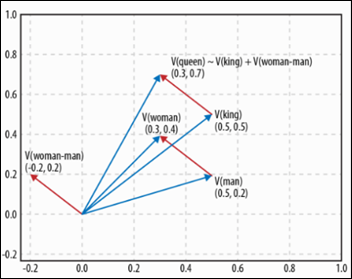
Consider an example where words are vectors in two dimensions (not 256). Each word is an arrow starting at 0,0 and ending on some X,Y coordinates.

image

From Deep Learning Cookbook by Douwe Osinga.

The interesting part about words as vectors is that we can now visualize, in a limited 2D space, how the conceptual distance between the terms man-woman is being translated by the word vectorization algorithm into a physical geometrical distance, which is quite similar to the distance between the terms king-queen. If in only two dimensions the algorithm can generalize from man-woman to king-queen, what can it learn about more complex semantic relationships and hundreds of dimensions?

We can ask such a ML model interesting questions and get answers that are already beyond human level performance:

  • Q: Paris is to France as Berlin is to? A: Germany.
  • Q: Starbucks is to coffee as Apple is to? A: IPhone.
  • Q: What are the capitals of all the European countries? A: UK-London, France-Paris, Romania-Bucharest, etc.
  • Q: What are the three products IBM is most related to? A: DB2, WebSphere Portal, Tamino_XML_Server.

The above are real examples using a a model trained on Google news.

One can train a ML model with relevant vectorized medical text and see if it can answer questions like:

  • Q: Acute pulmonary edema is to CHF as ketoacidosis is to? A: diabetes.
  • Q: What are the three complications a cochlear implant is related to? A: flap necrosis, improper electrode placement, facial nerve problems.
  • Q: Who are the two most experienced surgeons in my home town for a TKR? A: Jekyll, Hyde.

Word vectorization allows other ML models to deal with text (as tensors) — models that do care about the order of the words, algorithms that deal with time sequences, which I will detail in the next articles.

Discrete Categories

Consider a drop-down with the following mutually exclusive drugs:

  1. Viadur
  2. Viagra
  3. Vibramycin
  4. Vicodin

As the above text seems already encoded (Vicodin=4), you may be tempted to eliminate the text and leave the numbers as the encoded values for these drugs. That’s not a good idea. The algorithm will erroneously deduce there is a conceptual similarity between the above drugs just because of their similar range of numbers. After all, two and three are really close from a machine’s perspective, especially if it is a 20,000-drug list. 

The list of drugs being ordered alphabetically by their brand names doesn’t imply there is any conceptual or pharmacological relationship between Viagra and Vibramycin.

Mutually exclusive categories are transformed to numbers with the One Hot Encoder technique detailed above. The result will be a table with the columns: Viadur, Viagra, Vibramycin, Viocodin (similar to the words tokenized above: “the,” “cat,” etc.) Each instance (row) will have one and only one of the above columns encoded with a 1, while all the others will be encoded to 0. In this arrangement, the algorithm is not induced into error and the model will not find conceptual relationships where there are none.

Normalization

When an algorithm is comparing numerical values such as creatinine=3.8, age=1, heparin=5,000, the ML model will give a disproportionate importance and incorrect interpretation to the heparin parameter, just because heparin has a high raw value when compared to all the other numbers. 

One of the most common solutions is to normalize each column:

  • Calculate the mean and standard deviation
  • Replace the raw values with the new normalized ones

When normalized, the algorithm will correctly interpret the creatinine and the age of the patient to be the important, deviant from the average kind of features in this sample, while the heparin will be regarded as normal.

Curse of Dimensionality

If you have a table with 10,000 features (columns),  you may think that’s great as it is feature-rich. But if this table has fewer than 10,000 samples (examples), you should expect ML models that would vehemently refuse to digest your data set or just produce really weird outputs.

This is called the curse of dimensionality. As the number of dimensions increases, the “volume” of the hyperspace created increases much faster, to a point where the data available becomes sparse. That interferes with achieving any statistical significance on any metric and will also prevent a ML model from finding clusters since the data is too sparse.

Preferably the number of samples should be at least three orders of magnitude larger than the number of features. A 10,000-column table had be better garnished by at least 10,000 rows (samples).

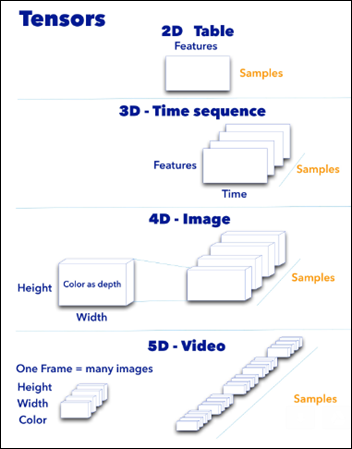
Tensors

After all the effort invested in the data preparation above, what kind of tensors can we offer now as food for thought to a machine ?

  • 2D – table: samples, features
  • 3D – time sequences: samples, features, time
  • 4D – images: samples, height, width, RGB (color)
  • 5D – videos: samples, frames, height, width, RGB (color)

Note that samples is the first dimension in all cases.

image

Hopefully this article will cause no indigestion to any human or artificial entity.

Next Article

How Does a Machine Actually Learn?

button

News 11/7/18

November 6, 2018 News 12 Comments

Top News

image

A review of 9,000 EHR-related pediatric medication events in three hospitals that use Cerner or Epic finds that EHR usability contributed to 36 percent of the reports, while 18 percent appear to have caused patient harm.

The most common problem areas were lack of system feedback and confusing visual displays.

The authors recommend that ONC add pediatric safety and usability measures to its certification requirements, that vendors and providers use realistic test-case scenarios, and that Joint Commission include EHR safety in its accreditation.


Reader Comments

image

image

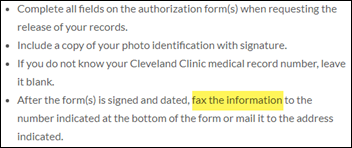
From Indigenous Species: “Re: records request. I was a patient of Cleveland Clinic of Florida, which I believe is a big Epic user. They have a fancy patient portal. I used it to request a copy of an operative report and they said I had to contact the medical records department by telephone. I got through the automated attendant to the point I received a message saying I needed to either mail in a request or fax it, after which I could expect something in 10-14 days. Gazillions of dollars spent on Epic and where are we? The same place we were 20 years ago.” Cleveland Clinic Florida’s instructions (above) are embarrassing for any hospital, much less a universally-admired one – in what time warp do patients have a fax machine sitting in their homes (or for that matter, a landline to plug it into)? Why do hospital HIM departments so quickly and firmly reject the idea of printing, signing, scanning, and emailing a completed form (or even better, using DocuSign) in favor of getting their fax fix? Meanwhile, the hospital’s authorization to disclose form is, not surprisingly, a consumer-unfriendly mess for those who just want a copy of their own information. It only covers sending information to someone else, and if that’s not bad enough, the form’s footnote adds, “Cleveland Clinic Florida may, directly or indirectly, receive remuneration from a third party on connection with the use or disclose [sic] of my health information.” That’s an interesting revenue stream – taking a cut of the fees their patients are paying to obtain their own information. I hereby nominate them for my “Least Wired” consumer award, for which they may nose ahead of stiff competition via the form’s outdated reference to “venereal disease.”

From Onion Peeler: “Re: startups. Where can we send our news?” I answered, but this reminds me of a pet peeve. The misused term “startup” should carry an expiration date of maybe 3-4 years, beyond which the defining characteristics — continued outside investment, demonstrably fast growth, lots of industry buzz, and an infrastructure designed to scale — are no longer true. By that point, it’s just a less-sexy sounding small business, not that there’s anything wrong with that. Maybe “startup” should be added to the list of terms that are meaningful only when someone else uses them – innovative, world class, award-winning (preferably detailing who gave the award and for what), and disruptive. Otherwise, it’s just BSaaS. 


Webinars

November 7 (Wednesday) 3:00 ET. “Opioid Crisis: What One Health Plan is Doing About It.” Presenter: Samuel DiCapua, DO, chief medical director, New Hampshire Health Families; and chief medical officer, Casenet. Sponsor: Casenet. This webinar will describe how managed care organization NH Health Families is using innovative programs to manage patients who are struggling with addiction and to help prevent opioid abuse.

Previous webinars are on our YouTube channel. Contact Lorre for information.


Acquisitions, Funding, Business, and Stock

image

Premier will acquire clinical decision support vendor Stanson Health for up to $66.5 million in cash. The announcement also notes that Stanson is developing a prior authorization system for medical and pharmacy benefits. Founder Scott Weingarten, MD, MPH, who is also SVP and chief clinical transformation officer of Cedars-Sinai, will remain as leader of the business. Stanson had raised just $3 million in a single Series A funding round in mid-2015.

Alphabet kicks off a two-day, employee-only conference on healthcare on its Sunnyvale, CA campus, featuring outside speakers Eric Topol, MD and former FDA commissioner Rob Califf, MD.

MJH Associates, which runs conferences and magazines such as Pharmacy Times and The American Journal of Accountable Care, acquires Medical Networking, Inc., which operates the Medstro communities and online challenges platforms as well as the Medtech Boston website.


Sales

  • Health First (FL) chooses Kyruus ProviderMatch to allow consumers to find providers and book appointments via its website and call center.
  • Renown Health (NV) implements PeriGen’s PeriWatch labor analysis software in its childbirth unit, including its Cues fetal surveillance solution.
  • FQHC Community Healthcare Network (NY) will use Valera Health’s smartphone-based patient engagement solution for patients with behavioral and chronic health conditions.
  • Massachusetts General Hospital chooses CarePassport for patient monitoring and engagement in its research studies. The company’s founder is Mohamed Shoura, PhD, who is also CEO of imaging vendor Paxera Health (formerly Paxeramed).
  • LStar Imaging (TX) chooses ERad for imaging.

People

image

Collective Medical hires Kat McDavitt (Insena Communications) as chief marketing officer.

image

Cantata Health names Tad Druart (ESO Solutions) as chief marketing officer.

image

Health IT security and patient engagement technology vendor Intraprise Health hires industry long-timer Sean Friel (Voalte) as president.


Announcements and Implementations

image

Microsoft will shut down HealthVault’s Direct messaging service as of December 27, 2018, according to an email forwarded by a reader. The company did not provide a reason. The company says “other messaging services” are available, but the notice doesn’t list them and I saw no alternatives on its website except for CCD exchange. I’ve emailed Microsoft’s press contact but haven’t received a response.

image

In what might be the first use of teleaudiology, hearing aid manufacturer Phonak will offer access to hearing care professionals to perform online fitting and tuning via its remote support app. The company’s rechargeable hearing aids can already connect to mobile devices via Bluetooth to provide optimized sound quality for TV, music, and phone calls and its MyCall-to-Text app converts telephone conversations to text in real time. Hearing aids are inherently unexciting unless you need them (or need to pay for them, which is exciting in all the wrong ways), but this seems like pretty cool technology. Switzerland-based parent company Sonova Group is the world’s biggest hearing care solutions vendor (or close to it) with 14,000 employees and $2.7 billion in annual sales.

image

A KLAS report on how well EHR vendors serve non-US regional needs finds:

  • Epic performed best with no dissatisfied customers.
  • Cerner finished second despite not engaging proactively and often at extra cost.
  • Meditech does well in Canada, UK, and Ireland although with concerns about slow growth and development.
  • No Allscripts customers report high satisfaction and they often feel they’re on their own to implement.
  • InterSystems has trending sharply down in the past two years due to staffing problems.
  • Latin America is led by MV (which is increasing its lead) and Philips.
  • InterSystems has slipped behind Cerner in the Middle East, while Epic has the highest score but just three live sites as prospects would like to see increased regional presence and expertise.
  • Cerner and InterSystems lead in Asia/Oceania, as Allscripts customers express low confidence in the company’s R&D efforts and its acquisition strategy.

China’s Tencent announces an AI-powered smart microscope whose voice interface allows pathologists to issue commands and reports.

In England, East Kent Hospitals University goes live with the Allscripts patient administration system.


Other

image

Atul Gawande’s piece in The New Yorker titled “Why Doctors Hate Their Computers” makes these points:

  • Computers have simplified tasks in many other industries, but have made enemies of their healthcare users.
  • Partners HealthCare’s $1.6 billion Epic implementation involved less than $100 million worth of Epic software, with the remainder of the cost being lost patient revenue and the cost of implementation staff.
  • Epic SVP Sumit Rana describes “The Revenge of the Ancillaries,” where ancillary departments are given a seat at the implementation table and influence decisions to make their jobs easier while forcing required fields and additional data entry on doctors.
  • A busy internist colleague says Epic has reduced her efficiency, requiring her to finish documentation after going home and to struggle with a jammed Epic in basket to the point that she just deletes messages without reading them.
  • The ability for everyone to modify the problem list has made it useless, requiring a review of past notes that are often excessively lengthy due to copying and pasting.
  • Gawande quotes an author who in the 1970s described how users initially embrace new capabilities with joy, then come to depend on them, then find themselves faced with the choice of submitting or rebelling to the system’s control over their lives.
  • An office assistant notes that much of the work she performed has been shifted to Epic-using doctors.
  • Partners HealthCare’s chief clinical officer, who has been through four EHR implementations, says Epic is for the patients who look up their lab results, review their medication instructions, and read the notes their doctors have written about them. He also notes that the EHR supports population health management and research.
  • Partners uses scribes, but due to concerns about turnover and errors, they chose an offshore service in which India-based doctors create visit documentation from digitally recorded encounters. A 30-minute visit requires an hour to document, with the result then reviewed by a second company doctor as well as a coding expert who looks for billing opportunities. However, as Gawande observes, “What is happening across the globe? Who is taking care of the patients all those scribing doctors aren’t seeing?”

image

Epic further explains how the recently mentioned New York Life integration works. People applying for life insurance ordinarily have to supply their medical history on paper after obtaining it from their hospital, a slow and expensive process. The integration uses Epic’s Chart Gateway service, which when authorized by the patient and the health system, sends information electronically to life insurance companies. It’s not blanket access to MyChart or to the data of any other patients. This is the first time I’ve heard of Chart Gateway.

The Wall Street Journal explains why smart speakers like Amazon Echo can’t make voice-requested 911 calls, at least for now: (a) lack of GPS precision; (b) inability to be called back by operators; and (c) users would need to pay 911 surcharges as they do for cell service.


Sponsor Updates

  • EClinicalWorks publishes a podcast titled “How PRM Services Boosted Youth Engagement in NYC.”
  • The Chicago Tribute names Intelligent Medical Objects as a “Top Workplace.”
  • Former Pepsi and Apple CEO John Sculley will deliver the keynote address at MDLive’s user group meeting Wednesday at 9:30 a.m. EST, with his presentation live-streamed.

Blog Posts


button


Contacts

Mr. H, Lorre, Jenn, Dr. Jayne.
Get HIStalk updates. Send news or rumors.
Contact us.

125x125_2nd_Circle

Morning Headlines 11/6/18

November 5, 2018 Headlines Comments Off on Morning Headlines 11/6/18

ResMed to Acquire MatrixCare, Expands Out-of-Hospital SaaS Portfolio into Long-Term Care Settings

Connected health vendor ResMed will acquire LTPAC EHR and quality software vendor MatrixCare for $750 million.

Social Determinants Of Health: Holy Grail Or Dead-End Road?

A Forbes article says that addressing social determinants of health can’t improve health outcomes on its own, calling for improving food literacy, enhancing the respectful relationship between patients and providers, and addressing poverty and the lack of economic opportunity that often override health needs.

Exact Sciences signs deal with Epic Systems, hikes sales, widens losses

Madison, WI-based cancer screening test vendor Exact Sciences will implement Epic for “order entry all the way through revenue cycle and customer care.”

Cancer Society Executive Resigns Amid Upset Over Corporate Partnerships

American Cancer Society EVP/Chief Medical Officer Otis Brawley, MD resigns after negative reaction to the organization’s commercial partnerships with companies with questionable health credentials, such as Herbalife International, Long John Silver’s, and the Tilted Kilt bar chain.

Curbside Consult with Dr. Jayne 11/5/18

November 5, 2018 Dr. Jayne 3 Comments

A reader recently asked for Mr. H’s prediction on what to expect from Medicare’s “Patients Over Paperwork” initiative. Mr. H asked me to chime in, along with readers, with my thoughts on the proposed changes to E&M codes, office visit documentation, and other paperwork.

He noted that, “It’s hard to separate meaningful HHS/CMS announcements from the political rhetoric spouted by its campaigner-appointees, so I’ve quit trying.” I agree that it’s a quite a challenge to figure out what is going on with CMS lately, since there seem to be many announcements talking about how great things are going to be, but with little change for the people actually doing the boots-on-the-ground work.

I’ve been shocked by the level of rhetoric in CMS announcements under the new administration. Everything seems to have been cranked up a notch and things that need not be political are being politicized. Healthcare finance and payment for providers is complicated and divisive enough and doesn’t need red vs. blue overtones applied on top of it all.

As to the initial question, I think that some of the details in finalizing the 2019 Physician Fee Schedule (PFS) and Quality Payment Program (QPP) rules show that the current CMS/HHS leadership might have bitten off more than they can chew. Physicians were initially excited about a potential move to overhaul Evaluation and Management (E&M) coding, creating fewer “blended” codes that were purported to more accurately reflect the work being done by physicians during office visit encounters. Although there was some positive excitement, the majority of the 15,000 comments that CMS received were negative, according to multiple reports (for those of us who didn’t read all of them). On November 1, CMS responded to that dichotomous excitement by delaying changes to those visit codes until 2021.

It’s important to remember that even though CMS ostensibly only makes the coding rules applicable to Medicare patient visits, because of how things work, they’re pretty much applicable to everyone, including commercial insurance payers and Medicaid. Self-pay patients are impacted somewhat, depending on how practices handle those patients.

The overall sentiment cited in the announcement of the delay was concern by physicians that the planned blending would reduce payments to physicians caring for Medicare patients with complex health conditions and/or multiple chronic conditions. CMS will now plan to consolidate the codes from eight to three instead of the originally-proposed two, preserving the “level 5” code used for the most complex (and most time-consuming) office visits. Another two years are needed to work out the details, apparently. CMS Administrator Seema Verma is quoted as saying, “We know this is going to have a tremendous impact on many physicians in America. We want to get it right.”

I take issue with that comment. If you knew it was going to have such a huge impact, why did you think it was OK to go ahead and put it in the most recent proposed rule? Wouldn’t it have been better to put together some working groups or task forces, etc. including actual working physicians rather than cobbling together something internally and then having to take it back? To an in the trenches physician, this back and forth makes one feel like CMS doesn’t understand us and that it has become reactionary rather than proactively addressing the issues that all of us face. If the wheel was less squeaky, would this have moved along?

The American Medical Association and the Medical Group Management Association are in support of the delay, noting in various press releases and on-the-record comments that the plan was flawed. MGMA SVP of Governmental Affairs Anders Gilberg stated, “Blending payments rates in 2021 won’t necessarily reduce burden, especially with CMS’ newly required add-on codes.” More than 150 various medical societies signed on to a letter opposing the new structure prior to the announcement of the delay.

CMS claims that proposed changes will simplify the way physicians bill for visits, and along with other modifications, are expected to save clinicians $87 million in administrative costs in 2019, ultimately yielding a net savings if $843 million over the coming decade and 21 million hours by 2021.

You know what would also save money and reduce physician angst, possibly slowing the retirement and exodus of much-needed clinicians? Stop harassing physicians with coding audits. Practices constantly receive requests from their Medicare intermediaries asking for documentation to justify the various codes. The practices I work with have gotten responding to these down to a fine science, trying to waste as little of their time as possible. Most of them have a 95 percent or greater success rate in justifying their codes.

I agree that means that five percent of the time they are overcoding or undercoding, but does catching that justify the millions of hours spent dealing with the audits? How about targeting the most egregious offenders and letting the rest of the physician base spend their staff resources managing patients rather than printing and mailing/faxing records to auditors? Burden isn’t just a financial problem – it’s a psychological one and is closely associated with clinician burnout.

Notwithstanding the delay in the E&M codes, CMS is moving forward with other elements of the Rule (and other proposed rules) that are supposed to reduce burden or save money. Physicians can focus on documentation of the interval history since the previous visit, rather than re-documenting previously documented information just for the sake of documentation. Physicians will not have to re-document the chief complaint and history of present illness already documented by their staff or by the patient himself/herself, just because the rules require it. Wholesale acquisition costs for Medicare Part B drugs are supposed to be lowered with the savings passed on to consumers. The so-called “Meaningful Measures” plan should simplify quality reporting for various federal programs that often do not align. Telehealth services and remote monitoring under home health should save money.

As I try to put my thoughts together on this complex topic, my blood pressure is definitely rising. I struggle with the conundrums that we’re facing in healthcare today, at least in the way that I have boiled them down so that I can attempt to understand them:

  • We don’t want universal healthcare, but we want universal control over how physicians and facilities bill and how they are paid.
  • We want to set up complex rules to control payments, but then we get upset when organizations figure out how to game the system (RIP, provider-based billing).
  • We don’t want higher-quality physicians to be able to charge more for their services on the front end, but want to spend loads of administrative money trying to incent them (or penalize others) on the back end.
  • We don’t want to require payers and employers to cover a universally agreed-upon subset of preventive services and money-saving interventions such as birth control, but we want to reduce disease burden and lower the rate of poverty.
  • We want the most high tech services in the world regardless of whether they’re indicated, but we don’t want limits on those services based on ability to pay or overall financial burden to society.

There are many other elements I could cite, but I’d like to preserve some good spirits for the rest of the day and a charity project I’m about to go work on. I wonder, though, as policy-makers debate the solutions they propose for all of this, if they really think about both sides of the various equations or whether we’ve gotten to such a position of polarization that they can only see their own perspective.

What do you think about the Patients Over Paperwork initiative? Leave a comment or email me.

comments_button

Email Dr. Jayne.

Morning Headlines 11/5/18

November 5, 2018 Headlines 5 Comments

Allscripts Healthcare Solutions (MDRX) Q3 2018 Results – Earnings Call Transcript

Allscripts executives comment on the potential sale of Netsmart and its plan to increase margins for the former McKesson EIS business, but fail to directly answer a question about plans of its biggest client Northwell Health and make no mention of its Avenel EHR that was announced at HIMSS18.

OpenText to Acquire Liaison Technologies, Inc.

Information management technology vendor OpenText will acquire competitor Liaison Technologies for $310 million in cash.

Like clockwork: How daylight saving time stumps hospital record keeping

Users describe how they work around Epic’s inability to handle documentation entries between 1:00 a.m. and 2:00 a.m. when clocks are moved back at the end of daylight saving time.

Why Doctors Hate Their Computers

Atul Gawande, writing about his experience with Epic’s go-live at Partners HealthCare, says EHRs were supposed to increase the mastery of doctors over work, but have actually increased work’s mastery over doctors. He quotes an Epic executive’s description of “the Revenge of the Ancillaries,” where the go-live allowed non-doctors to influence their workflow in unproductive ways. He also notes that EHRs have made the problem list nearly worthless and that Epic’s In Basket is “clogged to the point of dysfunction.” He also quotes Partners Chief Client Officer Gregg Meyer, who reminds that Epic is for the patients, not the doctors, and is at least mildly enthusiastic about using scribes. 

Monday Morning Update 11/5/18

November 4, 2018 News 10 Comments

Top News

image

From the Allscripts earnings call following release of poor quarterly numbers that sent shares down 19 percent Friday:

  • The company will launch a formal sales process for its share of Netsmart, which it says is a complex transaction because of the terms of the joint venture agreement between the companies. 
  • Netsmart’s Q3 business performance was “lighter than we expected” and executives on the call repeatedly stated how much better the Allscripts numbers would have been without Netsmart (which isn’t exactly talking up a planned divestiture), although CEO Paul Black said, “we are very bullish about Netsmart’s prospects whether or not a transaction is ultimately consummated in the near term.”
  • Northwell Health extended its TouchWorks agreement for another five years. Questioned by an analyst about whether Northwell (which is the largest customer of Allscripts) will also extend its Sunrise agreement, President Rick Poulton waffled, saying only that Northwell has one year left on its managed services agreement and that it’s not a high-margin business.
  • The company says it and its competitors know that the EHR and revenue cycle solutions market is mature and the churn isn’t going to generate a lot of net profit for anyone. Allscripts will ramp up services offerings to offset the decline.
  • The company again did not mention its previously highly touted Avenel EHR that was unveiled at HIMSS18.
  • Allscripts hopes to increase the margin of the former McKesson EIS business from single-digits to 18-20 percent.
  • The company says retention of customers of the formerly free Practice Fusion is strong after Allscripts started charging for it, adding that Allscripts is blending that business in with its payer and life science offerings (Practice Fusion runs drug company ads and sells de-identified patient data to pharma).

Reader Comments

From Lil’ Mob: “Re: Healthcare Informatics sold. HIStalk is the rare, independent voice in this space.” Vendome sells Healthcare Informatics magazine to another publisher whose goal is helping vendors “bring their services and products to market” (which I take to mean that seldom is heard a discouraging word that might make the ad salespeople’s job harder). For example, the four most important news stories of last week were not flattering to vendors – ProPublica’s critical assessment of the VA’s Cerner implementation, poor quarterly results from Allscripts and NextGen Healthcare, and Orion Health’s desperation-fueled sale of Rhapsody. None of those stories appear on the websites of the magazines that finished most closely (but still way behind) HIStalk in Reaction Data’s C-level provider survey. They instead ran with these questionably useful stories:

  • Is emotional support part of AI’s future in healthcare?
  • In Northern Virginia, Rethinking ACO Strategies—For PCPs and Specialists
  • Royole’s bendy-screen FlexPai phone unveiled in China

HIStalk Announcements and Requests

image

Most poll respondents are proud of what their employer sells. New poll to your right or here: what are your HIMSS19 plans?


Webinars

November 7 (Wednesday) 3:00 ET. “Opioid Crisis: What One Health Plan is Doing About It.” Presenter: Samuel DiCapua, DO, chief medical director, New Hampshire Health Families; and chief medical officer, Casenet. Sponsor: Casenet. This webinar will describe how managed care organization NH Health Families is using innovative programs to manage patients who are struggling with addiction and to help prevent opioid abuse.

Previous webinars are on our YouTube channel. Contact Lorre for information.


Acquisitions, Funding, Business, and Stock

image

Information management technology vendor OpenText will acquire competitor Liaison Technologies for $310 million in cash.

image

England’s NHS Digital will eliminate 500 jobs in a restructuring, about 20 percent of its staff.

image

Apple turns in record Q4 numbers driven by jacked-up prices rather than increased sales or innovation. Shares sank Friday after the company announced that it will no longer provide individual unit sales or average prices, which would lead to the conclusion that (a) the company plans to hold price-insensitive fanboys hostage to make its numbers; and (b) Apple would rather not publicize the fact that it’s milking the cash cow harder (in a mature market in which its products are the highest priced) by increasing services and add-on revenue per customer, which isn’t very transparent for a traditionally transparent company. Much of the market won’t pay baseline prices of $1,300 for an IPhone, $1,800 for a Macbook Air, $399 for an Apple Watch, or $799 for an IPad Pro. Meanwhile, the company kicks the latest dent in the universe in an enhancement to the IPad, which will no longer offer a headphone jack. 


People

image

Dean Smith, MD, MBI (US Department of State) joins GlobalMed Telemedicine as CMIO/SVP of government relations.


Announcements and Implementations

image

Epic signs an agreement to give insurer New York Life direct access to its EHR to extract information for people who are applying for life insurance.

PatientPing adds the capability to tag patients who are covered under bundled payment models.


Government and Politics

image

The Federal Trade Commission shuts down a Florida company that sold $100 million worth of worthless health insurance plans, saying that Simple Health Plans LLC misled purchasers into thinking that its medical discount program – which cost up to $500 per month — was actual insurance. The “insurance” does not cover pre-existing conditions or prescriptions, pays a maximum of $100 per day for hospitalization, and has a yearly cap of $3,200 and even then only if the patient is hospitalized for 30 days or more. The government’s restraining order also calls for seizing the owner’s $1 million bank account and his Lamborghini, Range Rover, and Rolls-Royce.


Privacy and Security

Defunct Georgia-based Best Medical Transcription pays $200,000 to settle charges that it exposed the information of patients of Virtua Medical Group (NJ) to Internet searches, a problem reported by a patient who Googled herself and found her own medical records. The New Jersey attorney general also banned Best Medical owner Tushar Mathur from doing business in the state.

Other

Kaiser Health News notes that Epic can’t handle vital signs entered between 1:00 a.m. and 2:00 a.m. on the Sunday when daylight saving time ends because those entries will be deleted when the clock is set back, forcing hospitals to document manually until after the time change. The articles says that nurses at Johns Hopkins and Cleveland Clinic date their entries after the time change to 1:01 a.m., but add a note that the vital signs were actually taken an hour after the previous entries rather than just one minute.

Steve Ballmer becomes the latest rich person to donate millions to a hospital, leading me to implore the financially fortunate to support public health, not expensive healthcare service vendors (even if their customer base consists of heartstring-tugging children). Seattle Children’s doesn’t really need Steve’s $20 million – last year it had a $224 million profit on $1.4 billion in revenue – and it’s a shame that such tech titan largesse is always focused on their home cities like Seattle, San Francisco, and Palo Alto.

image

A Boston Globe magazine piece called “Losing Laura” describes the death of a 34-year-old woman who walked to the ED of Somerville Hospital while experiencing an asthma attack but couldn’t get in because of a confusingly marked entrance and the inability of 911 operators to pinpoint her precise location on the campus. She collapsed outside a locked glass door through which she could see the ED waiting area, and a hospital nurse who went outside to look for her from the 911 call didn’t notice her on the ground. I’m at least a little bit sympathetic to the hospital, which is otherwise being sued and cited by the state – EDs in suburban hospitals were not usually designed for walk-up access in life-threatening emergencies. The article notes that while Uber and Lyft drivers are guided directly to their fares with near-perfect accuracy, the FCC requires cell providers to locate a 911 caller only to within 300 meters.

In India, a judge who is annoyed at deciphering illegible doctor handwriting on injury and death reports requires them to print and sign transcribed copies from their computers. The same court previously ordered doctors to write legibly and fined those who didn’t, but the problem persisted.

image

The author of the bestselling “PH Miracle” book series, who claimed that an acidic diet causes disease and offered treatments around that principle, is ordered to pay $105 million to a cancer patient who sued him for negligence and fraud. The author, who had already served jail time for practicing medicine without a license, advised the patient – who was also a former employee of his — to forego traditional cancer treatment and instead let him take over with sodium bicarbonate IVs administered at his $3 million ranch.


Sponsor Updates

clip_image001

  • Lightbeam Health Solutions employees team up with Habitat for Humanity in Dallas.
  • LogicStream Health will exhibit at the National Association for Healthcare Quality Conference November 5-7 in Minneapolis.
  • CitiusTech names seven industry leaders to its advisory board.
  • CHIME elects Meditech EVP Helen Waters to the CHIME Foundation Board.
  • Mobile Heartbeat will host a user group meeting November 7-9 in Sunny Isles Beach, FL.
  • Netsmart will exhibit at the National Hospice and Palliative Care Organization Fall Conference November 5 in New Orleans.
  • Nordic will host a reception during the Population Health and Connect Summit November 7 from 6:30-8:30pm in Madison, WI.
  • Clinical Computer Systems, developer of the Obix Perinatal Data System, will exhibit at the Michigan Critical Access Hospital Conference November 8-9 in Traverse City.
  • OnPlanHealth announces a partnership with the Dallas-Fort Worth Hospital Council.
  • Meditech recaps its Physician and CIO Forum.
  • KLAS recognizes PatientSafe Solutions and Voalte as top vendors in its “Decision Insights: Secure Communication 2018” report.
  • Pivot Point Consulting will exhibit at the 2018 HIMSS Virginia Fall Conference November 5-7 in Williamsburg, VA.
  • The SSI Group will exhibit at the Georgia HFMA Fall Institute November 7-9 in Savannah.
  • Sunquest Information Systems will exhibit at the ATLAS Medical User Group November 6-7 in Chicago.
  • Waystar will exhibit at CHUG Southeast November 8-10 in Nashville.
  • Surescripts will exhibit at the NextGen User Group Meeting November 11-14 in Nashville.
  • SymphonyRM will host a networking event at HCIC18 November 6 from 7-10pm in Scottsdale, AZ.
  • AMIA includes TriNetX VP of Informatics Matvey Palchuk in its inaugural class of fellows.

Blog Posts


button


Contacts

Mr. H, Lorre, Jenn, Dr. Jayne.
Get HIStalk updates. Send news or rumors.
Contact us.

125x125_2nd_Circle

Weekender 11/2/18

November 2, 2018 Weekender Comments Off on Weekender 11/2/18

weekender


Weekly News Recap

  • A ProPublica investigative article questions the VA’s selection of Cerner, its management of the implementation, its choice of questionably experienced project leadership, and the gap between the original lofty goals and the reality of what Cerner is delivering
  • Allscripts and NextGen Healthcare turn in disappointing quarterly results that sent shares sharply down
  • McKesson Chairman and CEO John Hammergren announces his March 2019 retirement
  • Orion Health finalizes the sale of its Rhapsody integration engine to Hg, which will sell and support it as an independent company
  • Seattle-based 98point6 raises $50 million to expand its chat-powered “virtual primary care” unlimited service
  • A report blames Cerner for May 2017 outages at seven Queensland Health hospitals, refuting the Australian health system’s initial claim that the downtime was caused by ransomware
  • Cerner says in its earnings call that its DoD and VA work will drive growth until its population health management business takes off
  • Analysts speculate that IBM’s $34 billion acquisition of Red Hat may signal a Watson wind-down and a return to enterprise software and services
  • Roper Technologies says in its earnings call that revenue of its Sunquest business is trending down due to competitive pressure and that it will be “rebasing” the business

Watercooler Talk Tidbits

image image

Readers funded the DonorsChoose teacher grant request of Ms. S in Colorado, who asked for a “huge box of math tools and games” (actually 17 items in total) for her elementary school class. She reports, “Thank you so much for sending us such amazing math games. I can honestly say that kids are loving math more than ever. They loved the dice game you sent us called Math Chase. One kid rolls one large dice and then proceeds to roll five other colored dice. They have to use the five other dice to make the number on the large dice. They can use addition, subtraction, multiplication, or division and it requires so much critical thinking. It has been so great to see kids apply the skills we have been learning. Now they can’t wait for math class because they know it will be fun!”

Wired magazine notes that Stanford has enrolled a huge umber of study patients whose heartbeat will be monitored from their Apple Watch, but questions whether screening huge numbers of people who don’t have symptoms will result in better care instead of misdiagnosis, unnecessary testing, and overtreatment. It also notes that Apple will release EKG and irregular rhythm features to the general public before the study is finished.

Memorial Healthcare Systems (FL) markets its telehealth service to South Florida hotels, hoping to recruit visitors and tourists for the $59 service.

Brigham Health uses text-based patient engagement for colonoscopy patients, reminding those who are scheduled for the procedure to complete their prep correctly. The no-show rate has dropped from six percent to four percent, while the number of poorly prepped patients has decreased from 11.5 percent to 3.8 percent.

Female medical students taking Canada’s licensing exam complain about #tampongate, their term for the test’s requirement that feminine hygiene products be declared and inspected upon entry.

image

CNN notes the irony that while the man charged with killing 11 people at a Pittsburgh synagogue was screaming “I want to kill all the Jews” in the ambulance and ED, the nurse treating him and the hospital president who stopped by to check on him were both Jewish. Allegheny General Hospital President Jeffrey Cohen, MD — who is a member of the Tree of Life synagogue where the shooting occurred — said, “We don’t ask questions about who they are. We don’t ask questions about their insurance status or whether they can pay. To us, they’re patients.” He added a comment about the alleged shooter: “The gentleman didn’t appear to be a member of the Mensa society. He listens to the noise, he hears the noise, the noise was telling him his people were being slaughtered. He thought it was time to rise up and do something. He’s completely confused.”


In Case You Missed It


Get Involved


button


125x125_2nd_Circle

EPtalk by Dr. Jayne 11/1/18

November 1, 2018 Dr. Jayne Comments Off on EPtalk by Dr. Jayne 11/1/18

clip_image002 

November is Home Care & Hospice Month, so let’s give a shout-out to members of the healthcare informatics community who work in those environments. From my time at Big Health System, it seems like hospital projects get all the recognition and the lion’s share of the budget, while ancillaries like home health and hospice are struggling to even get support.

There are a number of challenges faced by these disciplines that make their work tricky – connectivity issues, mobile documentation, chart fragmentation, lack of coordination among prescribers and referring physicians, and more. Plus, there are the challenges inherent with going into people’s homes and dealing with unpredictable (and sometimes dangerous) situations.

Our occupational health clinic works with a home care group and I’ve heard stories about home care teams that go the extra mile bringing food and personal care items to patients who are struggling to stay out of the hospital. Hats off to these vital members of the healthcare team and the informatics personnel who support them.

Whether it’s related to the month of recognition or not, CMS released a rule finalizing changes to the Home Health Prospective Payment System. Claiming it will “strengthen and modernize Medicare,” it made changes to coverage for remote patient monitoring, added home infusion therapy benefits, and updated payments for home health with a new case-mix system. Burden is also supposed to be reduced through fewer reporting measures for certifying physicians. The changes begin in calendar year 2020.
Building on the legacy of EMRAM, HIMSS Analytics releases a new Infrastructure Adoption Model called INFRAM. Along with AMAM and CCMM, the models are designed to measure organizational efforts to improve processes and outcomes through technology implementation and adoption. INFRAM is designed to assess technical infrastructure within health systems, benchmarking prior to go live on EMR (as HIMSS still calls them) systems. Subdomains assessed as part of the model include security, collaboration, wireless capabilities, data center, and transport.

The American Medical Association is providing $15 million in grants over five years to fund innovations in residency training. The Reimagining Residency Initiative aims to transform residency training to better prepare graduates for the healthcare system of the future. Depending on the specialty, graduating residents are often unprepared to operate in the “non-system” that we have going in the US – they may not have been trained on value-based care, coding in such a way that one can actually be paid, and working collaboratively with other physicians and members of the healthcare team.

AMA did this previously in a $12 million program with medical schools, leading to development of a “Health Systems Science” textbook and curriculum to teach physicians to work with emerging technology and how to participate in patient safety, quality improvement, and team care projects. The Request for Proposal will be distributed on January 3, 2019 with letters of intent due February 1. Medical schools, health systems, and medical specialty societies are invited to participate along with graduate medical education sponsors. Awards will be announced in June 2019.

NCQA announces availability of various datasets to help us with our analytics endeavors. The Quality Compass 2018 dataset includes HEDIS and CAHPS data, aiding benchmarking. The current set includes data for commercial, Medicare, and Medicaid submissions. Separate data is also available for CAHPS 5 OH Adult survey results for commercial and Medicaid payers. Also, there is a CAHPS Booklet includes benchmark data for Adult and Child CAHPS surveys. Last, the Health Insurance Plan Ratings 2018-2019 results include scores similar to the Medicare Five-Star Quality Rating System.

clip_image005

The American Medical Informatics Association announces its Inaugural Class of Fellows for the newly established FAMIA Applied Informatics Recognition Program. The program is designed “to recognize AMIA members who apply informatics skills and knowledge within their professional setting, who have demonstrated professional achievement and leadership, and who have contributed to the betterment of the organization.” The recognition is open to physicians, nurses, pharmacists, and others within clinical informatics. Formal recognition will occur at the AMIA 2019 Clinical Informatics Conference in Atlanta, April 30-May 2, 2019. Some of my favorite people are on the list – congratulations to all!

clip_image007

As I’ve worked with youth in various community organizations over the last decade, I’ve seen the expansion of smartphones, with both positive and negative impacts on youth knowledge, exploration, and relationships. Time magazine reviews recent research on the impact of technology on young people’s mental health, noting increased rates of diagnosis for depression and anxiety in those using screen-based devices for more than seven hours per day. The data is from a 2016 study looking at more than 40,000 children ages 2 to 17.

When doing a sanity check on the data, I originally balked at the seven-hour figure as an outlier, but the study notes that around 20 percent of youth aged 14 to 17 spend this amount of time on screens each day. Youth in this use category were also more easily distracted, had emotional lability, and had difficulty finishing tasks compared to those who spent only an hour a day on screens. Adolescents were more likely to have issues than younger children.

Every time I’m in an airport and see toddlers and young children glued to a phone or tablet while their parents are also glued to a phone, I want to scream. Maybe I’m turning into the local curmudgeon, but childhood is a time for wonder and explanation. I want to tell them to take their children over to the window and look together at what is going on around the airplane. Watch the baggage handlers and look for your bags. See how the plane gets refueled. Talk about the jobs people do and how everyone plays a part in getting you to your vacation or grandma’s house or wherever.

Those behaviors in young childhood influence how individuals will use phones and devices as teens, and we know from numerous pieces of research that social media use is linked to low well being in teens and adolescents. There’s nothing funnier than watching a group of teens stand in a circle and “group chat” instead of actually chatting face-to-face with each other. Funny, but sad. I’m glad that one of the organizations I work with is a no-phone zone for the most part, forcing young people to interact with each other and also with the adults supporting their adventures.

Weird news of the day: Having one’s appendix removed has been linked to a nearly 20 percent lower risk of developing Parkinson’s disease. Researchers noted that the appendix holds alpha-synuclein, which is thought to influence Parkinson’s development. One working hypothesis is that the appendix participates in immune surveillance “contributes to Parkinson’s through inflammation and microbiome alterations.” It’s not compelling enough to run out and have surgery, but I’ll be interested to see where the data takes us.

What is your organization doing to celebrate Home Care & Hospice Month? Leave a comment or email me.

Email Dr. Jayne.

HIStalk Interviews Peter Butler, CEO, Hayes Management Consulting

October 31, 2018 Interviews Comments Off on HIStalk Interviews Peter Butler, CEO, Hayes Management Consulting

Peter Butler is president and CEO of Hayes Management Consulting of Wellesley, MA.

image

Tell me about yourself and the company.

I’ve been at Hayes for 25 years. We are a technology-enabled company leveraging our MDaudit software platform to drive billing and audit compliance productivity as well as revenue integrity solutions across healthcare organizations.

Is it hard to retool a consulting firm into a software vendor?

It’s challenging. After a long corporate career in consulting, you develop a name for yourself in that area. We got our start with IT consulting, then over a period of time, moved into revenue cycle consulting and EHR implementations and so forth. Our MDaudit platform took a greater foothold in the industry and we were experiencing quite a lot of trust with it.

We saw this, years ago, as the future direction of the company. We foresaw health IT consulting needs diminishing and becoming commoditized. We wanted to leverage our strength. That’s when the software piece came in.

It was a difficult journey trying to change the mindset of a 25-year-old company and people who have a lot of longevity in it, asking them to think differently, more like a software company. It came with a lot of challenges.

Are you happy that you made that decision early when you see other consulting firms just now starting to react to market changes?

Very happy. When we were going through that transition, the hardest part was that it wasn’t happening fast enough. I look back in the rear-view mirror and say, OK, we did it. We got there. This is good. Where do we go from here? It’s important for us to stay relevant in the industry and in our client organizations.

We’ve turned the corner. We are looking forward to building ourselves as a software company and continuing to make a difference in healthcare.

What are the top issues in billing compliance?

Years ago, the top issue was how a healthcare organization with 2,000 providers could audit all of them annually. Then they acquire two more medical groups of a couple of hundred providers. How do they get through those audits with limited resources? Their organizations weren’t giving them the staff since they were really seen just a cost center.

Now the trend is, I have limited resources, so let me take a step back and look at all of the billing compliance risk areas to my organization. Bubble those to the surface so that I can take my limited resources and go tackle those challenges. Are they really risk areas that I should be concerned about, or are we a billing outlier for good reason because we are multi-specialty and we specialize in this type of service? In the old days, they were looking for fraud and abuse inside their organizations.

Now it’s taking a different turn. Where can I sharpen my attention to the revenue cycle? What am I actually providing for service, but not billing for? Compliance officers stay in the mindset of looking for areas where they can ensure that their organizations are billing appropriately, not over-billing Medicare things and like that. But they’re partnering with revenue integrity leaders inside their organization who are looking at the same data. What are we leaving on the table? We’ve delivered these services. There’s more pressure on reimbursement. We want to make sure we’re getting paid for everything we’ve done.

Is anybody doing a lot of billing compliance work as due diligence before provider acquisitions or mergers?

They are, but they should be doing more. I’ve had conversations with compliance officers who said, I just got a message from the CEO that we’ve signed our letter of intent. We’re moving forward with buying this practice or hospital. They aren’t paying attention to making sure that, as part of the due diligence process, they are billing and coding appropriately. Let’s understand the risks of acquiring this organization. It’s almost been an afterthought from senior leadership that the compliance professionals find themselves in post-transaction.

Is the focus different when a private equity firm is the buyer, such as the trend of acquiring dermatology practices?

We’ve had some of those PE-backed companies call us and say, we’re about to make an offer for this dermatology practice. Before we finalize it, can you do some diligence around their revenue cycle and their billing practices? Make sure that they are billing and coding appropriately and that what they are telling us and what we’re reading in the reports is actually what’s happening.

Those are mini-assessments. They don’t take a lot of time, but they give the buyer an opportunity to understand where the risks and opportunities are. Once they finalize the deal, if they go forward, where can they find revenue opportunity and operational efficiency? There’s definitely a lot of that from the financially-minded buyers.

What trends are you seeing that aren’t getting much attention?

A lot of revenue cycle leaders in years past ran their organizations based on metrics. They would tell their staff, you need to make X number of calls or you need to touch X number of claims. A trend I’m seeing that will pay dividends later is that instead of looking at volume-based metrics or metrics for the sake of metrics inside those revenue cycle follow-up departments or patient access departments, ask that if you touched a claim, what did you do with it? Did you make changes to it that positively affected the organization? Were you able to identify root cause and go back and make changes that actually stuck so that we’re not seeing these problems over and over?

Some of our clients are assigning audit-minded people to look at the goals and responsibilities of those who support the day-to-day operations. Looking at whether their daily tasks drive positive change, the quality outcome in the operation. They are using spreadsheets to document who they’re working with, the types of audit completed, the follow-up, and the result.

It can become an arduous task, but the concept is, are you driving better quality outcomes in your role, or are you just saying you made your 50 calls or worked your 10 work queues? What was the result of that? That’s an important trend and overdue in healthcare.

Hopefully we can instill some best practices in the industry so that we have less need for those auditors. You’ve done your training and you’ve built some great training programs to educate the people who are touching every aspect of the business operation.

Do you have any final thoughts?

Some interesting things are happening that we’ll see more of as quality reimbursement plays a bigger role in healthcare. CMS recently proposed some E&M simplification rules with the concept that it will save money and provider coding time. They’ll save 50 hours a year or something like that, taking away all of the detail-level E&M coding and documentation you have to do. CMS is also looking for ways to save money for the taxpayers and the government, so it has to be viewed through that lens as well.

It will come at some point, probably not in January, but it will come with challenges that the healthcare industry needs to walk through. If you’re billing Medicare, you’ve got Blue Cross Blue Shield as secondary, and you’re doing simplified billing for Medicare, what do you do with that claim? It gets passed down to a secondary payer. There are other issues around RVUs and how you reimburse your doctors that will be impacted by changes like this from CMS. We have a lot of work to do as we think about simplifying the billing process in the industry. It won’t come without challenges.

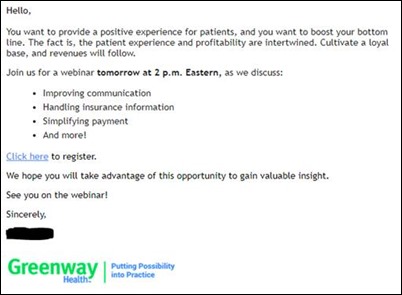
Text Ads


RECENT COMMENTS

  1. Challenger exploded on lift-off when the O-rings failed. Columbia disintegrated on reentry after one of the heat shield tiles were…
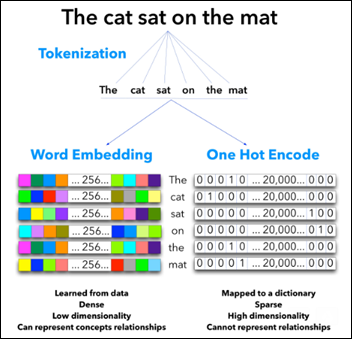
Founding Sponsors


Platinum Sponsors


Gold Sponsors


RSS Webinars

  • An error has occurred, which probably means the feed is down. Try again later.