Home » News » Recent Articles:

News 5/30/12

May 29, 2012 News 4 Comments
Top News

5-29-2012 6-49-41 PM

In the UK, NHS says it will shut down its HealthSpace personal health record by March 2013. The Department of Health director says the system attracted few users, which he says is because, “It is too difficult to make an account. It is too difficult to log on. It is just too difficult.” A 2010 report commissioned by the government said it was failing for the reasons that government-run software projects usually fail: poor project oversight, lack of ability to define standard datasets, poorly defined consent practices, and contractors looking out for their own interests. I found this comment fascinating and relevant to other clinical IT system deployments:

The fortunes of the SCR and HealthSpace programmes appeared to turn partly on the philosophical question “Where is the wisdom we have lost in knowledge?”. Many though not all senior stakeholders in CFH, the professions and the IT industry viewed knowledge as stable and discrete data items which could be extracted from their context, placed on the SCR and transmitted to new people and contexts while retaining meaning. An alternative perspective holds that much knowledge is tied to particular people, organisations, experiences and practices and is difficult if not impossible to extract from its context or the people who know it.


Reader Comments

5-29-2012 9-35-06 PM

From Period Piece: “Re: hospital pricing article. Cash is king.” The LA Times covers the seldom-discussed topic of hospitals offering lower prices to cash-paying patients. Its lead example is a hairdresser who pays $700 per month for medical insurance and who was charged $6,707 for a CT scan, of which her share after insurance was $2,336, but had she just written the hospital a check, she would have paid only $1,054. Another hospital lists the same test at $4,423, the Blue Cross Blue Shield negotiated price is $2,400, and the cash price is $250. Says the patient, “I was really upset that I got charged so much and Blue Shield allowed that. You expect them to work harder for you and negotiate a better deal … it kills me that I’m paying that much in premiums and it’s better to pay cash out of my own pocket.” In yet another example, a doctor ordering blood work for his patient found that the hospital charges $782, the insurance company billed the patient for $415, but the patient’s cash price would have been $95. Like everything related to hospital charges, there’s even a catch to paying cash: you have to lie upfront in saying that you don’t have insurance since hospitals won’t give the cash discount otherwise since they don’t allow price cherry-picking, although they may offer a cash discount on the insurance company’s negotiated price. The hospital’s Robin Hood-like explanation: insured patients have to pay more to cover the underpayment of Medicare and charity care. The hairdresser is suing Blue Shield and seeking class action status, but the insurance company says it doesn’t guarantee that providers won’t undercut its negotiated prices for cash-paying patients (in other words, they’re making a fortune on administrative skim and premium-raising and thus have no incentive to worry about what their customers are paying providers.) Here’s the thing about medical insurance: both patients and providers would be better off without it other than for its coverage of catastrophic events, which of course is what it was supposed to be in the first place until it morphed into the borderline socialist “health insurance” that used to pay for everything, but now pays less and less even as medical costs increase and patient rebel at the idea of being responsible for their own healthcare expenses.
5-29-2012 9-43-09 PM

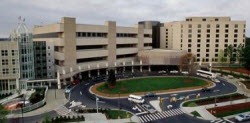
From Pico D’Gallo: “Re: Duke. Their cost for implementing Epic was announced at $700 million over seven  years, surely a record.” Verified, at least the $700 million part — I found a link here.


HIStalk Announcements and Requests

inga_small Based on the success of the HIStalk Advisory Panel, we want to add a separate HIStalk Practice Advisory Panel for practicing physicians and others working in the ambulatory space. Every month or so we’ll e-mail 3-4 questions pertaining to product issues or needs, cool technology that you might be using in your practice, and other issues affecting physician offices. If you have a few minutes every so often to participate, please drop me an e-mail. Many thanks!

5-29-2012 7-32-12 PM

Thanks to HealthCare Anytime, joining HIStalk as a Platinum Sponsor. The San Diego-based company offers a cloud-based patient self-service portal (online bill pay, recurring payments, once-time payments by telephone, appointments, pre-registration, secure messaging, refills, and PHR) that gets providers paid faster and makes their operation more efficient. Of course, patients like it too – who wouldn’t, compared to playing time-wasting telephone tag and jotting down indecipherable notes about balances and appointments? The portal helps providers meet two key Meaningful Use Stage 2 requirements: allowing patients to view/download their information and actually exchanging secure messages with at least 10% of them. The company has been around since 2000 and is run by Steve Click (founder and former CEO of Dairyland, now Healthland) and Brady Click (CEO of Intelligent Health Systems and founder of HealthCare Anytime.) The company is at MUSE in Orlando this week if you’d care to drop by Booth 207 to say hello. Tell them you saw them mentioned on HIStalk – sponsors love that tangible manifestation of their support. Thanks to HealthCare Anytime for supporting HIStalk.

I trolled YouTube to see if there were any videos about HealthCare Anytime and, what do you know, here’s a just-posted two-minute overview of their patient portal. I’m usually not that lucky, mostly because not all companies have caught on to the marketing value of posting videos on YouTube or Vimeo.

I can’t believe I’m saying this, but I’m getting kind of excited about Windows 8. I’m hoping it’s an easy and cheap upgrade, but the “cheap” part is negotiable with me – I don’t mind paying for an OS that’s more stable and functional (but I wouldn’t use Internet Explorer even if you paid me.) History has shown a predictable “every other Windows release sucks” pattern going back to Windows for Workgroups, so I’ll believe Microsoft has regained its long-lost relevancy and reputation for innovation if they can break that pattern. If not, Steve Ballmer needs to be fired immediately and I may go with a Mac since the Win 8 team appears to have stolen liberally from the Mac OS anyway. I’m interested in the announcements from WWDC (Apple’s developer conference, probably the most-watched conference in the world) in a couple of weeks, the first without Steve Jobs.


Acquisitions, Funding, Business, and Stock

In the UK, McKesson hires a lobbying company to help it earn IT business following the demise of the government’s NPfIT project. McKesson, which wasn’t a successful bidder in that project, can now sell directly to individual hospital trusts.


Sales

The National Institutes of Health awards Evolvent Technologies a 10-year contract to provide IT services and solutions for the NIH IT Acquisition and Assessment Center. The contract’s ceiling value is $20 billion.

Australia’s Austin Health and the Center for Ambulatory Surgery (NY) select ProVation by Wolters Kluwer Health for GI coding and documentation.

In the UK, Surrey and Sussex Healthcare NHS Trust votes to not only stick with the NPfIT-provider Cerner Millennium, but to extend its contract and add on the RadNet radiology information system. The trust is also seeking a PACS.
5-29-2012 9-39-50 PM

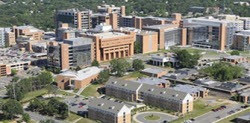
David Miller, vice chancellor and CIO of University of Arkansas for Medical Sciences, tells me that the organization has approved an $87 million Epic implementation. They expect to save $10 million per year in clinical improvements and $2 million in reduced software maintenance costs. Upgrading existing systems to meet Meaningful Use requirements would have cost $24-30 million.

LongView International Technology solutions wins a $300 million Military Health System contract to develop proof-of-concept applications that may have something to do with the joint DoD-VA EMR (the announcement doesn’t really say). The company also recently won part of another $20 billion contract. The five-year-old company was started by a retired Navy officer with an MS in hospital administration who had been assigned to the Secretary of Defense to manage a $20 billion appropriation (hopefully not the same one his company won.)


People

5-29-2012 6-25-56 PM

Imprivata names Mark Clark (Hitachi Data Systems) as VP of international sales, based in London.

5-29-2012 9-04-28 PM

Andrew Terry is named VP of software engineering at electrophysiology lab software vendor Perminova. He was previously with Sotera Wireless.


Announcements and Implementations

Krames StayWell makes its library of discharge instructions available to Meditech customers.

5-29-2012 9-47-44 PM

The HealthBridge HIE (OH) announces the go-live of its ED Admit Alert System, which lets physicians know when their patient visits the ED or is admitted.

MediServe announces that its MediLink for Outpatients solution will support recent changes to therapy caps for hospital-based outpatient therapy services.

The White House invites Iatric Systems to participate in the June 4 Patient Access Summit, where it will be one of 25 invited participants. Facilitating the event will be US CTO Todd Park, National Coordinator Farzad Mostashari, and VA CTO Peter Levin.

Image sharing network vendor lifeIMAGE anounces release of programming APIs that will allow software developers to enable image sharing directly from their applications. The announcement cites an unnamed academic medical center’s use of the API to send images from access management systems to Epic and to allow its employees to populate WebMD’s PHR with their images. I interviewed President and CEO Hamid Tabatabaie awhile back and learned a lot about the state of image sharing.


Government and Politics
5-29-2012 8-21-39 PM

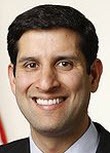
Former US CIO Vivek Kundra, now with Salesforce.com, takes a shot at the IT establishment, which he says is stifling innovation. “There are these evil CIOs that everyone hates because they’re the ones that tell you ‘you can’t bring technology to your workplace.’ They represent the greatest threat not just to innovation, but also to citizens getting the services they want.”

Under fire: the Affordable Care Act’s 2.3% excise tax on the gross sales of medical devices, set to kick in next year but facing increasing Congressional resistance. At least if you believe the WSJ article, which seems to be partisan in the Republican direction (read the article comments for fun).


Innovation and Research
5-29-2012 9-50-59 PM

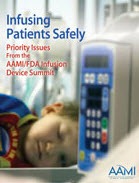
The CareFusion Foundation awards a $329K grant to the Healthcare Technology Safety Institute to study smart IV pump errors. Brigham and Women’s will coordinate the efforts of 10 hospitals in observing smart pump use to find problems, then identify possible solutions. The institute is part of the biomed-intensive, non-profit Association for the Advancement of Medical Instrumentation, which has worked with FDA on issues related to IV pump safety.


Technology

inga_small Epic authorizes implementations of its EHR on Intel x86 servers running open-source Linux, virtualized to VMware. Previously Epic ran exclusively on AIX and UNIX servers. This should make Epic a bit less expensive and perhaps more attractive to smaller facilities, though hardware is a minor part of the Epic implementation budget. Awhile back we ran a rumor that Epic was looking at the open source equivalent to Cache, so this might be a signal that they are looking for less proprietary and less expensive ways to run their systems.
5-29-2012 8-31-19 PM

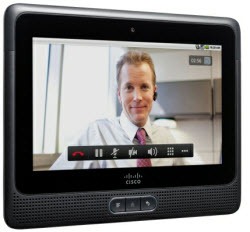
Cisco kills off its Cius tablet for businesses less than two years after it was launched, born back when the original iPad wasn’t all that robust and businesses were expected to buy enterprise-grade tablets instead of succumbing to pressure from their employees to be allowed to  bring in their own far cooler tablets. It’s bad enough to be trying to move non-Apple tablets, but you are toast if yours is more expensive besides (the Cius was $700).


Other

5-29-2012 9-56-06 PM

South Shore Hospital (MA) will pay $750,000 to settle charges related to a 2010 data breach that compromised the personal data of 800,000 people. The hospital contracted with Archive Data Solutions to erase and resell 473 data tapes, but failed to encrypt the data and didn’t tell the vendor that the tapes contained PHI. The vendor shipped the tapes to a subcontractor to do the work and two of the three boxes were lost.

A UK doctor accused of killing two elderly patients by ordering tenfold overdoses of morphine is acquitted of manslaughter. He admitted that he made a mistake in prescribing the drugs while he was reading e-mail and checking online cricket scores.

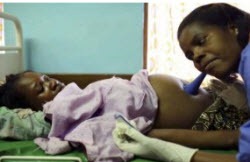
Also in the UK, a hospital launches an urgent investigation after a patient complains that an exam light wasn’t working when the doctor was trying to stop her post-delivery bleeding, leading him to order the nurse to hold up his iPhone so he could work from its light. Says the patient, “Then the doctor and nurse had a bit of an altercation when the light went off, as she didn’t know how to do the finger swish thing to keep turning it on, and he… felt she wasn’t listening to his instructions.”

Weird News Andy says this took guts, but he urges police to add practicing surgery without a license to the charges. Police responding to the home of a New Jersey man who was threatening to harm himself with a 12-inch kitchen knife find him barricaded in his room, and when they kick the door down, the man stabs himself repeatedly in the abdomen and throws skin and parts of his intestines at the officers. The man, who has a history of psychiatric problems, is hospitalized in critical condition.


Sponsor Updates

  • AT&T Health sponsors a June 5 Webinar discussing the creation of an enterprise image management strategy in the cloud. 
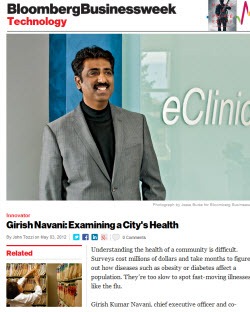
  • Bloomberg Businessweek profiles Digital Prospectors Corp.
  • Capsule will showcase its device integration solution a this week’s International MUSE 2012 Conference.
  • Newfoundland and Labrador Centre for Health Information selects Orion Health to provide framework for its providence-wide interoperable EHR.
  • SCI opens registration for its Client Innovation Summit 2012, to be held October 21-24 at Chateau Élan in Braselton, GA.

Contacts

Mr. H, Inga, Dr. Jayne, Dr. Gregg.

More news: HIStalk Practice, HIStalk Mobile.
Monday Morning Update 5/28/12

May 27, 2012 News 4 Comments
From Wanderlust: “Re: [company name omitted.] They say [CEO name omitted] has an open bedroom door policy and that [president name omitted] is really running the operation while [CEO name omitted] publicly spouts the company line.” Unverified, so I’ve expunged names, which means a least half a dozen people will e-mail me convinced that it’s their company I’m writing about. Some of them will probably be right.

From The PACS Designer: “Re: iPhone 5. A rumored feature is a 4-inch screen versus the 3.5 inch screen in the iPhone 4.  Another new feature is called haptic touch, which gives the user the feel of a real keyboard click.”

Several folks said they enjoyed reading about the innovative companies named by the HIStalk Advisory Panel. Me too, so I’ve decided to open up the process to anybody who works for a provider organization. Send me the name of an innovative company you’ve hired at your place and tell me why you like them. Use your work e-mail account so I know you’re really a provider and not a shill. I’ll summarize the responses, omitting those companies I’ve already mentioned.

5-26-2012 9-02-07 AM

 
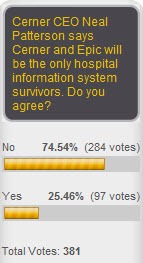
Three-quarters of poll respondents don’t agree with Cerner CEO Neal Patterson that Epic and Cerner will be the only survivors in the full-system hospital business. New poll to your right: should hospitals be required to give discharged patients an easily understood itemized bill? Folks have asked me why that’s such a big deal. I can only say that from my experience working for several hospitals, we made every effort to make patient bills hard to understand, mostly because (a) our charges, like those of most hospitals, were wildly inaccurate, and (b) patients tended to get really upset when they found out what we charged for a box of Kleenex or a single Lipitor tablet. In either case, we didn’t want lines of patients demanding explanations or legislative changes, so we just made the bills hard to understand by deliberately creating vague CDM descriptions.

My Time Capsule editorial this week from 2007: Surprise! Below-Average Doctors Use EMRs, Too, in which I say, “Personally, I don’t care whether my doctor uses electronic medical records, pen and paper, or a stone tablet and chisel. His tools are his business. I judge him on my personal outcomes. I expect him to invest in whatever it takes to deliver those outcomes, no different expectations than I would have for a mechanic, masseuse, or chef.” But since them, my doc has moved to an EMR and is a shining example of how to use it right: we view it together, he pays it minimal attention when I’m talking, and he uses previous data points (labs, weight, etc.) to put the current values in perspective. I’d probably not care whether he used an EMR if he was the only provider I ever see, but in this day and age, that would be highly unusual.

5-26-2012 10-26-30 AM

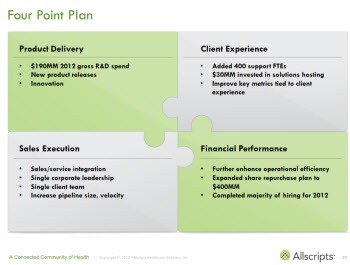
A Delaware court grants HealthCor its motion for an expedited hearing on its complaint against Allscripts. The investment company, which is a big Allscripts shareholder, wants the company’s annual shareholder meeting pushed back from June 15 to give it time to submit its own slate of three directors and to enlist shareholder support for that slate via proxy votes. The court date will be June 14, the day before the shareholder meeting – that should provide some drama.

5-26-2012 10-28-01 AM

Vinc’s HIS-tory is his second installment on product names.

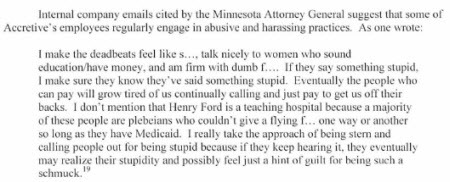
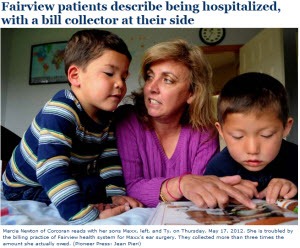
The Minneapolis papers are having a field day with the Fairview-Accretive story, knowing that those stories are easy to write and are inflammatory enough to boost dying print circulation for a day or two. In the latest installment, they find patients with anecdotal stories about Accretive’s collection practices, such as, “After they put me on a morphine drip, they came into the emergency room with a credit card machine. Because I had an IV in my arm and had limited mobility, they handed me my purse so I could pay them on the spot.” Fairview also admits that sometimes Accretive collected more than the amount eventually owed and refunds were slow in being sent, with a least one patient’s refund still not delivered after eight years. The papers don’t seem to be writing stories about the many patients in every hospital who keep coming back for additional services without any intention of paying, even though they are financially capable. That’s because the real story is a lot harder to write — why hospital charges are so high that patients can’t or won’t pay (high salaries, low efficiency, expensive buildings, low ROI information systems, lack of incentives to lower costs, etc.)

The Pittsburgh newspaper examines an interesting issue related to a $1.37 million settlement against UPMC Presbyterian. Four doctors were accused of changing the patient’s electronic medical record to hide their mistakes, but at UPMC’s request, the doctors were removed as defendants in the lawsuit. The hospital pays, while the docs get off with no record of wrongdoing in practitioner databases. Federal law requires that doctors be reported if they were dismissed from a lawsuit as a condition of settlement, but hospitals and insurance companies don’t do it. The AMA’s position is that settlements of questionable medical liability lawsuits have little to do with physician competence, so they aren’t fans of more detailed practitioner reporting. I’m not sure I disagree, but maybe it would make sense to launch a separate investigation into possible practitioner wrongdoing every time a lawsuits are filed.

5-25-2012 6-30-27 PM

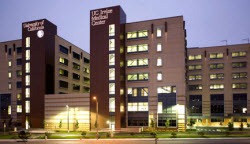
UC San Diego Health Sciences CMIO Joshua Lee is named CIO of USC Health.

5-25-2012 6-53-41 PM

BESLER Consulting promotes Jonathan Besler to president and CEO. He was previously senior director of client services. Former President Brian Sherin will transition to senior advisor.

5-27-2012 2-55-06 PM

Murray-Calloway County Hospital brings on Annette Ballard as CIO. She was previously with Jacobus Consulting.

Weird News Andy wants to sell this patrol car video (which isn’t really family friendly) as Docs Gone Wild. A Florida anesthesiologist arrested after nearly causing an accident with his speeding BMW fails a field sobriety test, refuses to give a blood sample, bangs his head repeatedly into the back seat of the patrol car until it’s bloody, then spits the blood in the face of a Florida Highway Patrol sergeant. Once in the hospital, he kicks out a light fixture and threatens three troopers. Police find $40,000 in his pockets and in the car was another $14,000, a .44 caliber pistol, a .45 caliber semiautomatic, and unidentified drugs. The doctor was upset because he thought the troopers were stealing his money. He’ll really freak out when he calculates the net present value of his immediate and permanent unemployability.

WNA is also fascinated with this weight loss story. A 70-year-old woman whose slow weight gain had swelled her stomach to the size of a huge beach ball is found to have a benign ovarian cyst. Her surgeon removes the 56-pound, fluid-filled mass, but is modest about his achievement, saying he’s seen a 100-pounder and the record is over 300 pounds.

Spokane, WA-based radiology provider Inland Imaging LLC spins off Nuvodia, with plans to offer its technology services nationally.

5-26-2012 10-40-54 AM

Nokia and the X Prize Foundation announce the $2.25 million Nokia Sensing X Challenge, a competition to stimulate development of continuous sensors for public health issues such as obesity, chronic diseases, and aging. Three competitive rounds will be held over the next three years and will likely include teams progressing toward the $10 million Qualcomm Tricorder X Prize.

Memorial Day is not just a three-day weekend — it’s the one day set aside each year to honor those who have died in military service. Go to the beach, picnic, or have a cookout, but please take a moment to honor the memory of those who gave up all of those things to die thousands miles from home while serving their country (and are dying still today.) Most of us will never experience or even understand their sacrifice, but the least we can do is take a few minutes from our year-round comfortable existence to honor it.

E-mail Mr. H.

News 5/25/12

May 24, 2012 News 4 Comments

Top News

5-24-2012 10-09-40 PM

The FCC votes 5-0 to approve allow wireless patient monitoring systems such as those being developed by GE Healthcare and Philips to share a frequency spectrum that was previously used exclusively for aircraft testing. Hospitals using the new systems will be able to monitor patients anywhere in their buildings without connecting them to hard-wired instruments and limiting them to specific areas such as ICUs. In-home patient monitoring via Medical Body Area Network devices will also be supported, so that body-worn sensors can communicate wirelessly with an in-home station that will send data to a hospital or other provider.


Reader Comments

From Raydonia: “Re: downtime of Transcend Systems/Nuance on 5/21. They are paying full-time transcriptionists the princely sum of $60 for the day of downtime. As of this writing Tuesday, we are down again. It’s a big deal. At-home workers don’t have the rights that on-site workers have. Any questions and you’re told, ‘Be glad you have a job.’” Unverified. I’m probably the last person you’d want to have soothing you since I’m not usually too sympathetic to career-related gripes. If you don’t like the job and have better prospects, you should take the better job. If you don’t have better prospects, then I agree with the company – the market is telling you something and you should be glad you’re working since lots of people aren’t. In this economy, knowledge workers and those with skills that are in high demand but limited supply are going to be treated very well, but the rest will be have to reset their expectations since the threat of automation or offshoring is always there (hello, HP layoffs). I don’t mean to be a downer, but our parents and schools are feeding us the “dream big and do whatever makes you happy and you’ll be rich and famous” story that doesn’t usually match reality unless you’re freakishly smart, cunning, connected, hard working, or lucky. I think that’s one reason the unemployment rate isn’t going down much – people are holding out for yesterday’s comfortable, high-paying jobs that are gone for good for many of them. In your case, I concur that being paid a “salary” based on piecework seems odd, but if that’s the work arrangement you signed up for, then I guess being paid just the base amount for days you can’t work is consistent, even though it sucks when it’s not your fault that there’s no work to do (kind of like minimum wage restaurant servers who would starve without tips). Hopefully they’ve got their systems back to normal since I’m sure your hospital customers are as anxious as you are to reconnect. 

5-24-2012 8-38-23 PM

From Pop Top: “Re: HL7. They are encouraging vendors to put the ‘Care Connected by HL7’ logo on their splash screens. Do you think any vendors will do this?” I don’t know why they would. Users are the ones who see the splash screen and they don’t care about HL7. Other than giving HL7 free advertising, I don’t see the benefit. And not to be overly critical since I’m probably the worst at aesthetic design (as readers who are always complaining about the HIStalk format can attest), but the logo looks kind of cheesy to me – harsh and badly proportioned wth an unpleasant 3D chiseled effect. Not to mention that the HL7 part of it, even though it’s their regular logo, is hard on the eyes. White on black looks like a DOS screen.

From Annie: “Re: Cerner. Consulting SVP David Sides resigned last week.” Unverified. His bio is still up and his LinkedIn profile says he’s still there.


HIStalk Announcements and Requests

inga_small Some nuggets you might have missed this week from HIStalk Practice: former Medic and A4 CEO John McConnell shares insights on HIT startups, Meaningful Use, Allscripts, and more. Dr. Gregg discusses the data-drenched world of HIT and the need for tools to keep things simple. A glitch leads to the rejection of 450,000 Humana claims sent through the Availity clearinghouse. Is the direct primary care model just a new name for concierge medicine? My take on banning smart phone pics in doctors’ offices (hint: good luck with enforcement.) A physician seeks opinions on drchrono. ONC promotes device integration for ophthalmologists. What do these news bits, interview, and opinion pieces have in common? None can be found on HIStalk, meaning you best pop over to HIStalk Practice to ensure you remain in the know. While there, click on a sponsor ad or three and educate yourself on some cool offerings. And don’t forget to sign up for the e-mail updates. As always, thanks for reading.  

Listening: brand new from Slash, excellent guitar-heavy rip-it-up rock that’s loaded with licks reminiscent of the best of the 1970s and early 1980s: Deep Purple, AC/DC, Whitesnake, and of course Guns N’ Roses. Nobody’s making straight-ahead hard rock these days, especially the kind that sounds like a real band instead of one guy and a laptop. It doesn’t exactly break new ground, but it’s going to be killer at summer gigs like Rocklahoma this weekend. And I can’t help cheering for Black Sabbath, together on stage again (minus drummer Bill Ward over money issues) after a seven-year hiatus and Tony Iommi’s lymphoma, opening their Birmingham, UK show last week with 1971’s amazing Into the Void.

Dr. Rick is back from the NIST-ONC EMR usability meeting. I asked if anybody recognized him since I work in an anonymous vacuum and always wonder what that’s like. He said a few folks did, including Farzad Mostashari. Rick will be providing a meeting recap after he gets caught up on his ophthalmology work.

On Healthcare IT Jobs: Application Analyst II, Assistant Director IT-Medicine, Hospital Software Analyst II, System Architect, Cerner Testing Project Manager.

5-24-2012 7-33-33 PM

Welcome to new HIStalk Platinum Sponsor Clinithink. Healthcare solution vendors use the company’s cloud-based CLiX natural language processing engine to turn free text medical notes into fully coded structured data (ICD-9, ICD-10, SNOMED CT) that payers, providers, and analytics companies can use to improve quality, increase revenue, and meet reporting and regulatory requirements. Structured data entry via check boxes and drop-downs makes like easier for the computer, but the richness of the patient encounter is often locked away in the detailed narrative of those providing the care. CLiX converts that data to information for everything from capturing Meaningful Use measurements to providing doctors with smart search capability for research that understands “bronchial hyperreactivity” as being related to “asthma.” Thanks to Clinithink for supporting HIStalk.

Here’s an overview I found of Clinithink’s CLiX on YouTube. It shows the user’s narrative popping up SNOMED CT codes.


Acquisitions, Funding, Business, and Stock

5-24-2012 10-23-35 PM

Kony Solutions closes on a $15 million third round of funding, led by Insight Venture Partners.

5-24-2012 10-24-12 PM

Healthcare payment network InstaMed secures $14 million in new capital.

5-24-2012 10-25-05 PM

Shares of Scotland-based charge master systems vendor Craneware drop by 15% after analysts speculate that its US customers might be chasing Meaningful Use money rather than buying its financial software, at least until next year. The company indicated in January that the situation was exactly that, but predicted a quick reversal of the trend. Other analysts agree with that earlier assessment, saying demand is already recovering.

5-24-2012 10-25-40 PM

Compuware reports Q4 numbers: revenue up 21%, EPS $0.12 vs. $0.16. Its Covisint subsidiary, which offers HIE and cloud-based services for healthcare, had annual revenue of $74 million, up 34%.

5-24-2012 10-26-54 PM

Nashville Medical Trade Center signs its biggest tenant so far, the RFID in Healthcare Consortium trade group. It will use part of its 80,000 square feet for The Intelligent Hospital, the hospital replica you saw in the downstairs exhibit hall at HIMSS in Las Vegas earlier this year (it was doing big business each time I checked). HIMSS will have 25,000 square feet in the building, which has 1.5 million square feet.

5-24-2012 9-41-22 PM

University of Maryland spins off Analytical Informatics, Inc., which will offer radiology dashboards and eventually expand into BI and quality tools that cross systems. 

Philips shares drop after its CEO warns that the European debt crisis may hurt imaging sales there.


Sales

5-24-2012 10-28-21 PM

Kosair Children’s Hospital (KY) selects Amcom Software’s clinical alerting middleware and smart phone communication solutions, planning to integrate it with their GE Healthcare Telligence nurse call system, GetWellNetwork interactive patient care system, and Cisco wireless IP phones and smart phones.

Omnicell closes on its previously announced acquisition of MTS Medication Technologies, a provider of medication adherence packaging systems.

Tri-State Gastroenterology Associates (KY) selects eMerge | ENDOTM for procedure documentation and workflow for its endoscopy center.

Lakeland Healthcare Group (IL) selects Merge Healthcare’s complete radiology cloud solution.

5-24-2012 10-29-37 PM

Indiana Orthopaedic Hospital selects the anesthesia information management system from Surgical Information Systems.


People

5-24-2012 5-43-53 PM

Former WellPoint VP Ryan Miller joins Availity as SVP of strategy and corporate development.

5-24-2012 9-15-32 PM

Todd Helmink (Allscripts) has joined The LDM Group as VP of strategic partnerships.

Greater Houston Healthconnect, a regional health information network, names Philip Beckett PhD (Baylor College of Medicine, RosettaMed) as CTO.


Announcements and Implementations

The US Olympic Committee announces that GE’s continued sponsorship will include the use of Centricity to manage the care of the 700 athletes participating in the London 2012 Olympic Games.

Iatric Systems and Order Optimizer announce the availability of an evidenced-based order set platform for Meditech Magic using Iatric Systems’ OrderEase solution.

MED3OOO announces the general availability of InteGreat EHR V6.5, which includes Quippe technology from Medicomp Systems.

RelayHealth and Greenway Medical complete a development agreement to exchange data between hospitals and ambulatory clinics.

5-24-2012 10-01-00 PM

Healthwise wins a Center for Plain Language award for its course on coronary artery disease. The non-profit company’s course combines easily understood content that is personalized by user type (recent coronary event, someone whose symptoms have subsided, etc.) Healthwise has previously won similar awards for its arthritis and low back pain materials.


Government and Politics

Representatives Michael Burgess MD (R-TX) and Gene Green (D-TX) introduce legislation that would require states to require hospitals to disclose information on charges for certain inpatient and outpatient services and to require insurance companies to provide enrollees a statement of estimated out-of-pocket costs for healthcare services.

5-24-2012 8-50-20 PM

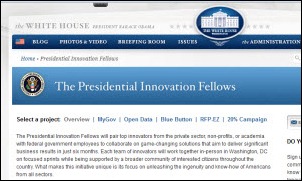
US CTO Todd Park, writing on The White House Blog, announces the Presidential Innovation Fellows program. He’s looking for 15 innovators to spend 6-12 months in DC starting in July to work on one of five projects:

  • Open Data Initiatives (entrepreneurial use of government data for societal benefit, including but not limited to healthcare)
  • Blue Button for America (consumer downloading of their own health information)
  • MyGov (access to government information)
  • RFP-EZ (development of a platform to make it easier for the government to buy technology from startups)
  • The 20% Campaign (move US aid payments from cash to electronic payments)

Innovation and Research

5-24-2012 7-28-55 PM

Three students at a Ugandan university win a prize for their smart phone-powered fetal monitoring system, which analyzes fetal sounds and produces a plain-English description that midwives and birth attendants can understand. The device costs at least 80% less than an ultrasound machine.

A study finds that OptumRX’s text message prescription reminder program improved medication adherence, with 85% of patients taking their at-home oral meds correctly vs. 77% without the reminders.


Technology

5-24-2012 9-30-25 PM

Cerner is looking pretty smart for buying up 65,000 IP addresses from bankrupt Borders for $12 each. The IPv6 kickoff is in a couple of weeks, but the transition is expected to take up to 10 years, meaning Cerner hedged its bets in being able to run in dual stack mode with the additional old addresses.


Other

5-24-2012 6-55-36 PM

The main Delaware newspaper covers the Delaware Health Information Network, which it says has enrolled 92% of the state’s providers. The front page story’s key figure is Christiana Care Health System CIO and DHIN Chair Randy Gaboriault, who had a recent positive experience with the value of shared medical information during a heart attack scare. He says his mother was not as fortunate – she died a couple of months ago after being treated by an unconnected hospital that did not have her history available, which he is convinced led to her unfortunate outcome.

5-24-2012 10-31-35 PM

Fairview Health Services (MN) fires CEO Mark Eustis, presumably after being embarrassed by never-ending press caused by the heavy-handed patient debt collection tactics allegedly employed by Accretive Health, which he brought in. Of course he also could have been fired had Fairview lost a ton of money by not collecting aggressively enough, so there’s that fine line thing.

As already reported here thanks to a tip from reader Gran Cru, Partners HealthCare (MA) takes a $110 million write-down on its soon-to-be dumped Siemens financial system, dropping its Q2 net income to $5 million vs. last year’s $71 million. As also reported here, bringing in Epic will cost another $600-700 million.

5-24-2012 5-59-05 PM

A scrub nurse at a Washington urology practice sues Robert Weissman MD, claiming that he threw an intra-operative tantrum that included cursing at her, throwing instruments, and finally intentionally stabbing her in the finger with a needle that he had just withdrawn from a patient’s scrotum.

5-24-2012 8-57-20 PM

Weird News Andy finds this story to be weird and wonderful. A Baltimore area high school freshman develops a 3-cent paper sensor that can detect cancer by indicating high levels of a particular protein, making it cheap enough to use in routine screening. Over 200 researchers he asked to help him test his invention turned him down, but now he’s working with a Johns Hopkins researcher, he has won $75,000 in the Intel International Science Fair (above), he has patented his device, and a San Diego biotech firm has offered to help him perform the FDA-required clinical trials.

WNA also likes this spooky security camera video from the ED of St. John’s Mercy Hospital in Joplin, MO as it was being hit by a tornado a year ago.

Dr. Jayne wants to play Weird News Andy in finding this obituary of a “crazy woman” characterized by her family as “De Facto empress of the hell she lived in.” I almost ran out of fingers trying to tally her former / present, living/dead husbands, not to mention her “friends at the Lakeside Trailer Park.” The family also noted that among the folks who will miss her most are Anheuser-Busch, Philip Morris, and the Ohio State Lottery. Her loved ones concluded with some sound advice: “Everyone dies, but not everyone lives. Mom lived. She lived hard, but she lived full. So, ‘Don’t cry because it’s over….. Smile because it happened!’ Light your smoke and raise your glass and remember the last thing she said to you that made you laugh so hard you thought you were going to wet yourself; but this time don’t hold back. Because she never did. “

5-24-2012 10-33-51 PM

I was startled to see this pop up on my LinkedIn page.

The executor of the estate of a 102-year-old heiress says everybody robbed her blind before she died, convincing her to give them extravagant gifts. Her daytime nurse got $31 million, the night nurse was given $1.1 million, her two doctors got $3.1 million, and Beth Israel Medical Center got a $6 million Manet painting for allowing her to live in the hospital for years even though she was healthy. Her attorney says she gave the gifts because she was generous (and he got only $60,000).


Sponsor Updates

  • Practice Fusion announces the availability of customizable endocrinology templates.
  • Cooper Green Mercy Hospital (AL) goes live on Stockell’s InsightCS Revenue Cycle Inofrmation Management system, including patient access and patient accounting.
  • TELUS Health Solutions and Orange partner to develop remote monitoring solutions for chronic disease patients.
  • Allscripts releases a white paper by CMOs Doug Gentile MD and Toby Samos MD that explores insights from ACO pioneers.
  • Lifepoint Informatics is sponsoring G2 Intelligence’s Laboratory Outreach Conference June 6-8 in Las Vegas.
  • The Advisory Board Company’s Crimson team will lead two breakout sessions at the 3rd Annual Health Datapalooza June 5-6 in Washington, DC.
  • CareTech Solutions announces that its clients Barnes-Jewish Hospital (MO), Touro Infirmary (LA), and Wheaton Franciscan Healthcare (WI) have won 2012 Aster Awards for their websites.

EPtalk by Dr. Jayne

clip_image002

Is it easier to focus when viewing content on an iPad vs. a television? Maybe. Pediatric neuroscience researchers note that while children will look away from a TV screen 150 times per hour, they are less likely to look away from an iPad. This is felt largely to be because of the touch interface being directly aligned with the action on the screen. This could help children learn more effectively, although scientific studies of how devices affect child development can take three to five years. The iPad’s relatively short time on the market in effect makes all of us (not only children) guinea pigs.

Seasoned IT staffers sometimes comment to me that new physicians seem like they’re getting younger. Recent actions to shorten medical school may make this more of a reality. Citing the nationwide shortage of primary physicians as well as increasing student debt, schools are compressing primary care training. Those who have already decided to pursue careers in primary care will experience fewer vacations and elective courses. Schools are also offering accelerated programs for certified physician assistants who want to pursue medical degrees.

clip_image004

With smart phones being everywhere, practices are considering asking patients to refrain from taking pictures while receiving care. Although providers are mandated to maintain privacy, patients are not. I was reminded of this a couple of years ago while riding on my hospital’s float in a community parade. A patient stepped out from the crowd and called up to a surgeon riding next to me, “Hey doc – my husband’s hemorrhoids are much better!” (And yes, those are cow-print balloons.)

clip_image006

One of the challenges of being a medical informaticist is doing the right thing with data. The recent USPSTF recommendation against routine PSA-based prostate screening is an interesting case study in data-driven clinical decision making. Numerous consumer groups are coming out against it, much like they did with revised mammogram recommendations in 2009.

Several readers responded to Monday’s Curbside Consult that discussed whether patients presenting to the emergency department should pay before being treated for their non-emergent condition. One reader notes,

One strategy implemented in a southwest US health system was to assess but not treat such patients. A triage nurse did the full assessment and scheduled them with a new PCP in the a.m. This reduced ED use by the patients over later months. They even had virtual staff to interview and set up the follow-up for smaller EDs. I think this was presented at the last CHIME meeting.

Isabel Healthcare releases a mobile version that offers Apple-using clinicians additional clinical decision support at the point of care. Subscriptions are available in weekly, monthly, and annual varieties, making it ideal for rotating medical students and occasional users. I’ve used Isabel (via EHR integration) for some time and it’s extremely valuable.

clip_image007

Florida State University researchers have created the Pacifier Activated Lullaby device, which musically reinforces premature newborns who must develop the ability to coordinate a suck / swallow / breathe response for feeding. The specially wired pacifier and speaker system plays a lullaby each time a baby completes a successful sucking motion and has resulted in shorter hospital stays and reduced costs. The FDA-approved device reduced neonatal ICU stays by an average of five days. It’s a cool an innovative device that I almost missed reading about – the sending address on the press release had University misspelled, making me think it was spam.

Print


Contacts

Mr. H, Inga, Dr. Jayne, Dr. Gregg.

More news: HIStalk Practice, HIStalk Mobile.
Dr. Sam 5/23/12

May 23, 2012 News 5 Comments

On the Other Side of the Quality Chasm

The acceleration of the movement toward electronic health record (EHR) implementation and adoption begun by the Institute of Medicine reports of the late 1990s and fueled by the American Reinvestment and Recovery Act of 2009 has propelled us away from the paper environment at a rate that would undoubtedly not have been present in their absence. It is now possible to conceive of a time when the majority of our healthcare institutions and professionals function entirely in an electronic environment.

Now that the other side of the quality chasm is in sight, it is worthwhile to consider what it may be like when we land there, and prepare for a vastly different environment.

A significant body of evidence has been building over the last decade reflecting medical errors that may occur because of electronic medical records. Examples include default acceptance of all orders in an order set when some may not be applicable to a specific patient, or an inaccurate weight entered manually for a newborn but used to automatically calculate medication doses. Any implementation should include attention to proactively averting such errors by responsible quality control processes.

The practice of medicine in real time and enhanced capabilities for granular auditing bring the considerable exposure to medical liability to the forefront. Standards of expectation should be established for reasonable response times to alerts, e-mails and data generated and delivered in real time. Clear policies, consistent with state law, should be established to define exactly what compromises a legal electronic medical record, what information must be produced in the event of litigation, and consideration of consistency in patient care considerations in implementing new features and functions. (Is a different level of care being delivered to a subsection of patients within a hospital if a new feature or function goes live on one service and not another?)

It will be very long time before most hospitals and practices cease to work in a part paper, part electronic environment, but the common goal is to eliminate as much paper as possible. It is therefore highly probable, if not certain, that a generation of clinicians will eventually evolve who have never worked on paper.

It is also certain that hospitals and practices will experience both planned and unplanned system down time. Downtime policies specify circumstances where documentation and order entry must revert to paper, but do not generally address the possibility that clinicians may not know how to work on paper. As part of disaster planning and down time policy determination, policies should be in place for clinicians to be trained at regular intervals in the use of order forms, progress notes, history and physical notes, medical administration forms, etc. that may be called to use in a disaster environment or system down time. After a few years using fully implemented EHRs, they may simply not know how to use paper.

Similarly, ward clerks, pharmacists, lab technicians, and other support personnel must know how to carry out their responsibilities on paper, and must periodically be retrained.

Paradoxically, we may have to be certifying people to work on paper in the future.

Several years ago, I began to consider the vulnerability of our massively growing medical databases. Even though security measures, redundancy, and backup processes are in place, much of the firewall technology is "off the shelf," which simply means to me that someone sitting in a distant country can find a way through it. Most hospital security and background checks on IT personnel consist of credit reports and other forms of superficial investigation, but are rarely in-depth security evaluations.

In spite of painful mass casualty attacks and natural disasters that we have experienced (the Oklahoma bombing, September 11, Hurricane Katrina), our emergency rooms remain woefully unprepared to handle a massive number of injured people or able to sustain care for a large population of injured individuals for anything other than a very short time. If one considers the potential chaos that could ensue from a combined mass casualty episode combined with an intentional attack on the same regions’ medical databases, the importance of this consideration becomes obvious. Organizations such as HITRUST are bringing the importance of protecting our databases to light. As we move further toward the universal use of EHRs, hospitals and database specialists will need to devote more time, energy and money to protecting our healthcare databases.

I have recently been an active participant in the debate over physician-patient communication by e-mail. The greater issue goes far beyond this particular debate. While the mechanics of physician-patient interactions may be brought into the 21st century by reduction to the 1s and 0s of the binary world, the art of medicine cannot be.

If one has ever engaged in online dating, cyber political debate, or an e-mail argument, they will appreciate that much is lost in the absence of face-to-face interaction. Things are said that would never be said when an immediate reaction can be anticipated with someone who is physically present in real time and not in an untouchable, invisible virtual space. In an electronic environment, as much attention needs to be paid to taking care of the emotions and reactions of patients as is paid to the convenience of the communication vehicle in use. This lesson must not be lost for the upcoming generation of texting / Facebooking / Twittering clinicians. Those of us with grey hair have a teaching responsibility in this arena

Let’s not cross a quality chasm and create an empathy chasm.

Samuel R. Bierstock, MD, BSEE is the founder and president of Champions in Healthcare, LLC, a strategic consulting firm specializing in clinical information system implementation and healthcare IT business strategies.

News 5/23/12

May 22, 2012 News 9 Comments

Top News

5-22-2012 9-56-10 PM

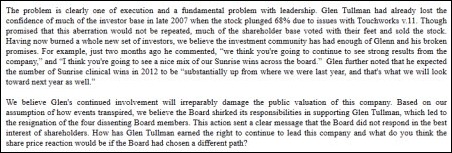
HealthCor, which owns 5% of Allscripts, launches a proxy fight for control of the company by suing Allscripts over its nomination process for board members. HealthCor says the resignation of three of the company’s nine directors last month, all of whom had ties to Eclipsys before Allscripts acquired that company, left the Eclipsys product lines unprotected “from the continuing failures of execution of [Glen] Tullman,” whose ouster it had previously demanded. HealthCor wants the June 15 Allscripts annual meeting postponed to give it time to nominate its own candidates for the three open board seats, saying Allscripts should not have put forth its own slate of prospective new board members without giving shareholders the same opportunity. HealthCor is also criticizing Tullman’s $7.2 million compensation in 2011, saying he makes more than the CEOs of competitors whose stock is going up instead of down.


Reader Comments

5-22-2012 9-57-00 PM

From BoltUpright: “Re: Shantanu Paul. Interesting that he left Allscripts to head up product development at Vitera. He was a major player in the overall integration strategy at Allscripts. Not sure if his departure is motivated by a desire to jump ship because they weren’t listening to him, or if he’s being pushed out as a scapegoat for the integration problems they are having.” Vitera announced Paul’s appointment as SVP of product development here.

5-22-2012 6-56-56 PM

From White Lightning: “Re: Dan Michelson, chief marketing officer of Allscripts. Leaving the company.” Unverified, but a purported internal company e-mail sent my way says he’s leaving to become CEO of a private software company after 12 years with Allscripts. He won’t be replaced, according to the e-mail.

5-22-2012 9-58-40 PM

From Reverse Transcriptionase: “Re: Transcend. The servers of the former Transcend Systems transcription company that Nuance acquired have been down for days.” E-mails forwarded to me refer to a major system issue that was caused by failed storage devices. The last e-mail I saw, from Monday, said that they were still down and were typing and faxing stat reports, preop H&P, and radiology reports. I tried the Transcend Services Web site on Monday evening and it was down, but it’s working now, so I assume the problem has been resolved. Anybody can have systems fail and I give them credit for communicating thoroughly, although I’d be interested to hear what customers did in the interim.

5-22-2012 8-45-49 PM

From Casual Hospital Administrator: “Re: famous highly wired hospital. Patients appear to have been harmed.” The family of a former post-bypass ICU patient of UPMC Shadyside (PA) sues the hospital, claiming the 68-year-old man was somehow not attached to monitors when he died. Documents apparently verify that the patient was not being monitored for a 16-minute period, saying only that “mistakes were made.”

From Don Diego: “Re: HIStalk Advisory Panel. I’m an avid reader and also impressed with the insight, but the post on what Allscripts should do to fix things is absolutely amazing. Way to go, HIStalk.” I appreciate the involvement of the 79 panel members (now 94) who have volunteered to offer their opinions on topics I’ll e-mail them every few weeks. Most of them are CIOs, CMIOs, and practicing doctors, with a few vendor executives added to the mix. They can provide their honest thoughts knowing that even though I won’t identify them in any way, they’re still not potentially untrustworthy anonymous commenters (like Allscripts competitors, for example) since I know who they are. I’ll take suggestions on what I should ask them in the next round of crowdsourcing. In the mean time, I’ll be listing a few companies they mentioned in response to my question about any cool, small companies they’re working with – stay tuned later in the week.

From CDiff: “Re: Chicago CEO pay. The Chicago Tribune set up a Web page so you can do your own sleuthing on any aspect of compensation. Allscripts and Accretive did not bubble up, the the Trib’s lead story was about Debra Cafaro of healthcare real estate investment trust Ventas, who made $18.5 million. As you know, we have no method to compensate you for all you do; you remain the very definition of priceless.” Healthcare well represented on the list: drug maker Abbott ($24 million), supplies vendor Baxter ($14 million), supplies vendor Hospira ($12 million), and drug store operator Walgreen ($12 million) on the first page alone. Glen is on the list at $7.2 million and Mary Tolan of Accretive lags the well-enriched executive pack at $1.6 million.

From Carriage Bolt: “Re: Cerner single revenue cycle product. I’ve heard Adventist Health West is helping them develop a clinic and physician revenue cycle module.” Unverified.


HIStalk Announcements and Requests

Here’s a tip for companies who go to the trouble to issue press releases about their new hires. Include a link to a hi-res photo and insist that the person create a LinkedIn profile that includes a head shot (and not a thumbnail-sized one – a professionally made full-size headshot since LinkedIn automatically creates the thumbnail). You would be surprised at how many press releases I get about folks who have no apparent photographic presence on the Web, or who use a blurry, small, or amateurish snapshot as their LinkedIn photo. I’m less likely to run those announcements. Another gripe is PR companies that e-mail me a press release that hasn’t been posted anywhere else (including the company’s own site), so I don’t have anything to link to. Or, that send Word documents instead of pasting the text into the body of the e-mail or attaching a PDF – I practice safe text, meaning I’m not opening your Word doc unless I know where it’s been.


Acquisitions, Funding, Business, and Stock

5-22-2012 8-05-21 PM

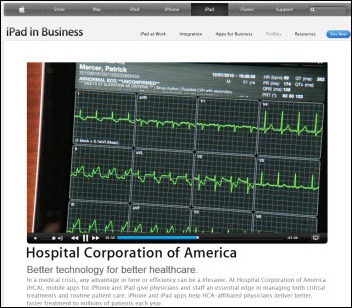
Apple’s iPad in Business page features HCA’s use of AirStrip, Epocrates, PatientKeeper, Heart Pro, and other apps I didn’t recognize.

5-22-2012 8-07-49 PM

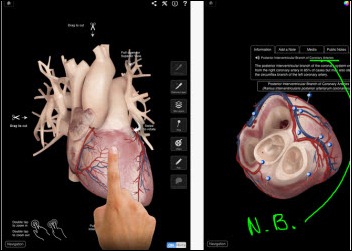
Here are iPad screen shots of Nova’s $17.99 Heart Pro, developed with Stanford University School of Medicine as a patient teaching tool. Very cool.


Sales

Iowa Primary Care Association selects Ignis Systems to integrate lab orders and results for 15 community health centers running Centricity EMR.

5-22-2012 10-03-14 PM

San Jacinto Methodist Hospital (TX) chooses PerfectServe for clinical communications.


People

5-22-2012 5-49-27 PM

Former Optum/Axolotl VP Anand Shroff joins Health Fidelity, Inc. as chief technology and product officer.

5-22-2012 6-34-28 PM

Nate Ungerott joins Health Care DataWorks as VP of sales. He was previously with Accuvant.

5-22-2012 9-36-17 PM

Investor Sue Siegel is named CEO of GE’s healthyimagination, which is spending billions on healthcare innovation and bringing healthcare IT to rural and underserved areas. She replaces Mike Barber, who has moved to VP/GM of molecular imaging at GE Healthcare.

Teresa Jamison is named VP of customer operations of SciQuest. She was previously with Allscripts.


Announcements and Implementations

Oregon’s statewide HIE implements Harris Corporation’s CareAccord platform and Direct Secure Messaging system.

Anthem Healthcare Intelligence, a provider of healthcare BI solutions and services,  rebrands as Agilum Healthcare Intelligence.

The 319-bed Cooper Green Mercy Hospital (AL) implements Medsphere’s OpenVista EHR and Stockell Healthcare’s Insight CS financial and accounting solution, replacing Meditech. The hospital says it will receive considerably more HITECH money than its five-year costs.

CBORD will offer Horizon Software International’s point-of-sale system that allows cafeterias to handle meal plans, payroll deduction, and gift cards to provide “the best total return on investment for healthcare food service operations.” Pretty cool, but I wish hospitals cared enough about their cafeterias to stop outsourcing them to companies like Aramark or Sodexo, who are given free rein to coldly enforce margin-preserving policies that would drive a real restaurant out of business within days: pre-portioned freezer-to-grease prisoner food from Sysco (the potato peeler has left the building), wildly overpriced drinks with no free refills, and weighing plates so that a modest portion of waterlogged spaghetti with canned sauce ends up costing $8. Nobody cooks, everybody scowls defiantly (especially the cashiers), and they all clear out by mid-evening, leaving the captive audience of off-hours employees and visitors with only the vending machines as a shining example of wellness. The best, cheapest, and most nutritional food that’s anywhere close is usually the hot dog cart out front or the caterers who bring in real food for the executive meetings.


Government and Politics

5-22-2012 8-57-01 PM

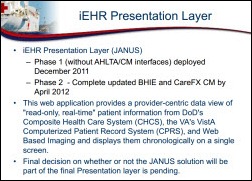
The VA refines its VistA strategy at the Open Source Think Tank, planning to spend up to $5 billion to tap the open source community and the private sector to advance VistA. Among its significant challenges is the Military Health System, which likes the fat cat contractor approach that turned its own AHLTA EMR into a $10 billion flop. The generals claim they’re leading the military-industrial complex charge, trying hard to win some EMR hearts and minds. In the mean time, the VA and DoD announce that they won’t roll out their integrated EHR until 2017. The excellent NextGov got a copy of the presentation outlining the problems. The only sure thing is that it will be late, over budget, and politicized.


Innovation and Research

A Brigham and Women’s study finds that doctors who dictate their notes instead of using templates or typing free text have lower quality of care, as evidenced by standard quality measures. The authors postulate that doctors who use a keyboard instead of a microphone pay more attention to on-screen discrete data elements and clinical decision support messages.


Technology

Bloomberg profiles Jintronix, a company I’ve mentioned that’s building technology around Microsoft Kinect that helps home rehab patients do their exercises correctly.

Mentioned in the above article is potential Kinect competitor Leap, a $70 iPod-size Minority Report-type pre-order USB peripheral that the company says will be 200 times more accurate than “a game system that roughly maps your hand movements,” able to distinguish individual fingers and track movements down to 1/100th of a millimeter. Assuming it’s not bogus, which seems to be a topic of discussion.


Other

5-22-2012 5-54-49 PM

In the UK, NHS announces an initiative to provide patients with online access to their medical records by 2015.

Bond ratings firm Fitch Ratings surveys its client hospitals about capital spending and finds that they consider IT investments to be the most important, ranking much higher than capital spending to increase capacity and align with physicians. The company was surprised to find that hospitals don’t expect the Patient Protection and Affordable Care Act to have significant influence on their capital spending plans regardless of the Supreme Court’s ruling.

Boston Children’s Hospital announces that an employee at a conference in Buenos Aires, Argentina lost an unencrypted laptop containing information on over 2,000 patients as an e-mail attachment. Somehow until trying to track this down I didn’t realize that Boston Children’s Hospital is one facility of Children’s Hospital Boston (if I’m correctly deciphering the seemingly contradictory logos and names on their site).

One of those lame problem-solver type news crews investigates a woman’s 10-hour ED wait, quoting the ED doc’s two mitigating issues: a new EMR system (Cerner from Trinity Health, I believe) and the need to treat sicker patients first.

5-22-2012 8-17-10 PM

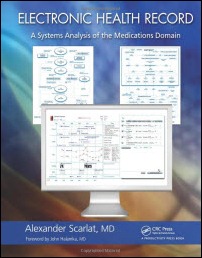
HIStalk reader Alexander Scarlat MD’s book, Electronic Health Record: A Systems Analysis of the Medications Domain, is now available on Amazon. This is not one of those easy-to-skim books that seem to get published without any real purpose – it is hardcore into the medication domain (prescribing, drug concepts, dispensing, MAR, user interface, etc.) Alex was kind enough to send me an autographed copy since I reviewed a pre-press chapter and provided a quote for the back cover:

… encompasses high-value, high-volume therapeutic transactions of indescribable complexity that touch nearly every licensed professional in a hospital, enrobing drug ordering, dispensing, and administration in sophisticated layers of clinical decision support, caregiver work lists, and back-end charging and continuum of care functions. I am pleased that the topic merits its own formal review and analysis in Dr. Scarlat’s book. I found the user interface chapter immediately useful – in fact, I’m hoping the vendors of my own hospital’s systems take its recommendations to heart.

Weird News Andy is all up in our grill with , which he subtitles, “A Brush with Death.” Doctors investigating a man’s suspected appendicitis instead find that his intestine is pierced by a nail-like object later identified to be a bristle from his metal grill cleaning brush, which had become embedded in the steak he ate.


Sponsor Updates

  • Greenway Medical and NextGen will participate in a patient data exchange demonstration during the ONC’s 2012 Direct Demonstration Showcase in Washington, DC May 31.
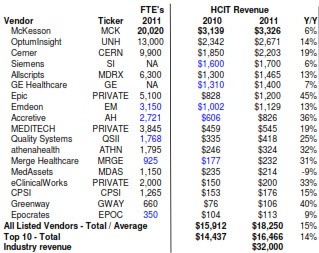
  • Healthcare Informatics releases its annual list of top 100 vendors based on revenues from HIT products and services. HIStalk sponsors earning a spot of the list include: 3M Health Information Systems, API Healthcare, Allscripts, Beacon Partners, Capario, CareTech Solutions, Cumberland Consulting Group, eClinicalWorks, GE Healthcare, Greenway Medical, Health Data Specialists, HealthStream, Iatric Systems, Impact Advisors, Lawson Software, maxIT Healthcare, MED3OOO, MEDSEEK, McKesson, MedAssets, Merge Healthcare, NTT Data (formerly Keane), NextGen, Nuance, Optum, Orion Health, Passport Health Communications, SCI Solutions, Sunquest Information Systems, Surgical Information Systems, T-System, TELUS Health Solutions, TeleTracking Technologies, The Advisory Board Company, Vitera Healthcare Solutions, Vocera Communications, and ZirMed.
  • ICA and AlliedHIE launch a national health information exchange to identify technology and communications issues within healthcare organizations.
  • Michael O’Neil, founder and CEO of GetWellNetwork, gave a patient engagement presentation at Cleveland Clinic’s Patient Experience Summit on Tuesday.
  • Hayes Management Consulting reports that eight of the top ten US hospitals listed on US News and World Report’s Honor Roll use MDaudit.
  • The hospital authority for Memorial Hospital and Manor (GA) approves a consulting engagement with Vitalize Consulting for the implementation and training of hospital’s eMAR/BMV project.

Contacts

Mr. H, Inga, Dr. Jayne, Dr. Gregg.

More news: HIStalk Practice, HIStalk Mobile.
Monday Morning Update 5/21/12

May 19, 2012 News 11 Comments

From Determinant: “Re: Cerner. Have you heard of them trying to sell ProFit patient accounting for both hospitals and practices? Looks like Cerner wants to complete head to head with Epic by offering one combined solution set for hospital, professional, and physician clinic billing.” I haven’t heard that. Anyone?

5-19-2012 3-43-42 PM

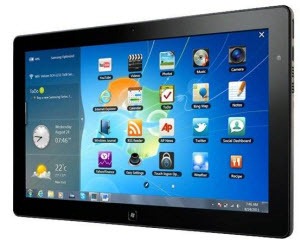
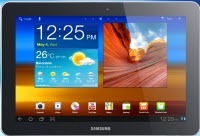
From The PACS Designer: “Re: Samsung Slate. One of the drawbacks of the iPad when it comes to viewing healthcare legacy apps is its small size. This hampers the effort to move these apps to a tablet display. Samsung has released a tablet called Slate with a 11.6 inch form factor, which should make the legacy app transition effort easier.” Samsung seems to be leading the “bigger than Apple is better since we can’t beat them otherwise” charge with its 3×6” Galaxy smart phone (or “smablet”) and now the 11.6” Slate. You’re going to look like a tool yapping into the bigger-than-your-hand Galaxy that covers the whole side of your head like Gordon Gekko’s 1987-era cell phone in Wall Street (which in turn looked like a Vietnam War walkie talkie), so I suggest budgeting for a headset and to arrange tailoring services for pocket expansion. The Slate will basically be the size of the entry level MacBook Air screen without the keyboard, meaning you’re back to a laptop size again other than the touch screen and a lot more money. Wasn’t portability the whole point of these devices? All of this makes me think that Windows 8 could be a really big deal since it seems that everybody wants some features of iOS (apps, touch, crisp display) but doesn’t care too much otherwise, and Win 8 will of course run on cheaper commodity hardware.

From Real Doll: “Re: former Cerner COO Paul Black on the board of Allscripts. The other new board member is from UPMC, which has close Cerner ties. Could be a merger in the works.” Unverified. I suppose anything is possible and Cerner isn’t all that strong on the ambulatory side, but that would be an ugly marriage.

Listening: Material Issue, a Chicago-based guitar-heavy power pop trio from the mid-80s. The frontman-founder killed himself in 1996, but the band left behind some great music. I also looked back to my February 13 post as Van Halen started their tour, when I said, “Check out their tour, but I’d be cautious about buying tickets for anything after the Boston show since tours seem to bring out the squabbling between the Van Halen brothers and whoever their lead singer is at the moment (Roth, Hagar, Cherone, lather, rinse, repeat) and the whole thing could go down in flames (think The Eagles without the concert-dollar greed that makes them pretend to get along.)” Sure enough, the band has postponed the remainder of their tour, although I missed the date — the Boston show was March 11 and it lasted a few weeks longer than that.

5-19-2012 8-10-02 PM

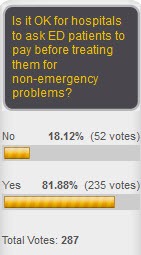
It’s OK to ask ED patients with non-emergent problems to pay before treating them, say 82% of respondents. New poll to your right, from the next story down: will Cerner and Epic be the only hospital information system survivors?

5-19-2012 4-19-01 PM

Cerner CEO Neal Patterson says at Cerner’s shareholder meeting that the company could be pulling in $10 billion per year in revenue by 2020, almost five times today’s total. He also says he’ll probably retire before then. When asked about the complexity of meeting provider technology needs, he said Cerner and Epic might be the only companies left standing. The “and Epic” part is not very Neal-like, so maybe he’s already mellowing on his way to the rocking chair.

Long-term care provider Deseret Health Group chooses HealthMEDX Vision to manage patient records across its 20 locations.

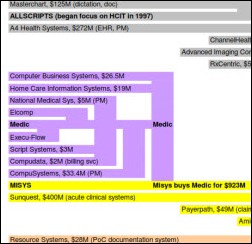
On HIStalk Practice, Inga interviews John McConnell, who sold more than $1 billion worth of companies that weren’t Eclipsys (Medic and A4) to what is now Allscripts.

Eight physician groups in the Kingsport, TN area start the OnePartner HIE, which will use the Siemens MobileMD platform.

5-19-2012 7-14-16 PM

The Twin Cities paper profiles the use of SafetyPad by Hennepin County paramedics. The tablet app, developed by Open Inc., receives 911 information, records vital signs, provides checklists, and notifies the ED that the patient is inbound. The hospital’s server receives a copy of the chart, looks for trends that may signal an epidemic, and bills insurance companies quicker than on paper (10 days vs. 90).

Here’s your weekly dose of HIS-tory, in which Vince talks about product names.

The FCC will vote this week on allocating a chunk of the wireless spectrum to Medical Body Area Networks, in which wearable patient sensors would communicate wirelessly to a local base station to send information back to physicians. FCC Chairman Julius Genachowski lauded the technology, citing examples such as remote EKGs, smart pill boxes, and diabetes management devices, also pointing out that half of hospital inpatients aren’t monitored and could potentially be with MBANs. If the rules are approved to reallocate the spectrum formerly used by commercial test pilots, the US would be the first country in the world with a dedicated spectrum for MBANs. He specifically mentioned that GE and Philips are working on the technology.

The results of Dr. Oz’s 15-minute physical on 1,000 Philadelphians using Practice Fusion’s free EMR: 43% were obese, another 29% were overweight (meaning a total of 72% weighed more than they should), 43% had high blood pressure, and 40% had pre-diabetes. Two patients were found to have significant problems (blood chemistry, hypertension) and were admitted to the hospital. Practice Fusion compared the data from its records on 40 million patients to conclude that more of those 1,000 patients were hypertensive than in several other large cities. The article says the Dr. Oz show chose Practice Fusion over several other EMRs that were considered, including Epic and drchrono.

Reading Hospital (PA) reports that a now-fired employee exposed the medical information of 12 patients by printing their billing information and using it in a training class.

A Department of Homeland Security bulletin warns that connecting medical devices to wireless networks is risky, and organizations that do it need to implement a really good security program. They mention the VA’s use of virtual LANs with access control lists as one way to keep unauthorized users out. A problem is that more devices are using commercial operating systems rather than custom-developed embedded ones, meaning they are more susceptible to malware.

5-19-2012 4-40-21 PM

A team of electrical engineering students from Portland State University wins Cornell Cup USA Presented by Intel for its prescription drug identification device, which provides near-instantaneous identification of tablets and capsules from their image. The students came to the university through the Intel Vietnam Scholars Program, in which interns from the Intel’s Ho Chi Minh City factory study engineering at Portland State.

5-19-2012 4-58-08 PM

In Australia, the government of Victoria finally kills off the HealthSMART project that was to have provided hospitals with software from Cerner, iSoft (now CSC), and InterSystems. The initial $318 million budget had run up a $557 million tab before funding was ended. Only four health services are live today of the 10 the government had promised would be running by 2007. Most folks blame mismanagement and poor planning rather than the vendors.

The Chicago business paper reports that Merge Healthcare Chairman Michael Ferro and companies he’s invested in have earned $9.3 million in side deals from Merge. Only four of the 11 related-party transactions were reviewed by independent directors. Shares have dropped 61% in the last couple of months.

5-19-2012 6-02-19 PM

The former assistant dean of Temple University’s medical school, along with the university, will pay more than $1 million to settle Medicare fraud charges in which $4.5 million in plastic surgery work was billed to Medicare but performed by unsupervised medical residents. The doctor is serving a seven-year term in federal prison for 150 counts of fraud.

5-19-2012 5-21-46 PM

The Tucson newspaper recognizes Sunquest Information Systems interface programmer Kenny Wickert, who throws annual  cookouts at work to collect co-worker donations for a Tucson child protection organization. Each event raises around $5,000. Says Kenny, who has worked for Sunquest for 21 years, “I see people dropping 20 and 30 bucks in the jar for a burger … We grew up just dirt-poor, and she always made it work with what we had. It’s kind of fair that I give back now that I can.” The award was given by Ben’s Bells, a kindness recognition program started by the mother of two-year-old Ben, who died when a respiratory infection caused his airway to swell shut while he was playing.

5-19-2012 5-41-18 PM

5-19-2012 7-57-59 PM

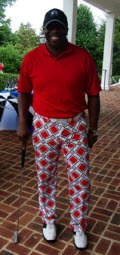
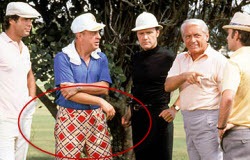
I lauded HealthNovation President and CEO Mike Mosquito at HIMSS in Las Vegas after observing his sartorial splendor, explaining as I asked to take his photo that Inga would be impressed with his truly sharp-looking outfit. Here’s a shot of him taken by Jennifer Dennard at last week’s Georgia HIMSS golf tournament, pulling off a great look despite what might appear to a highly questionable choice of trousers even in the “go to hell pants” world of golf clothing (I’m thinking Rodney Dangerfield’s Al Czervik in Caddyshack). I found by searching that I ran a photo of Mike from the same tournament last year, in which he was equally resplendent. I should get him to take a pic of his closet contents.

5-19-2012 5-45-00 PM

The event funded $2,000 scholarships for Ana Alston (Georgia Health Sciences University), Tiffany Formby (Georgia Tech), Laura Griggs (College of CoastalGeorgia), Lars Moen (Georgia State), and Laura Sims (Georgia Tech).

E-mail Mr. H.

News 5/18/12

May 17, 2012 News 14 Comments

Top News

5-17-2012 7-14-39 PM

Big Meaningful Use news: 3M, as part of its deal with the VA and DoD to help create a shared electronic medical records system, makes its Healthcare Data Dictionary available to all providers, payors, and vendors anywhere in the world for free. The dictionary translates to and from standard terminologies such as LOINC, RxNorm, ICD-9, ICD-10, and SNOMED CT, allowing disparate systems to communicate via concepts that support semantic interoperability. Check out the company’s white paper on the dictionary. You may recall that the feds licensed SNOMED for the entire country a few years back, making it free. This announcement may be even more important for interoperability, although I don’t see much buzz about it for some reason.


Reader Comments

5-17-2012 5-00-25 PM

From HIT Cynic: “Re: Cal eConnect. Looks like another state HIE bites the dust.” Not exactly. California’s HHS announces that it will move oversight of the state’s ONC-supported HIE program from Cal eConnect to the Institute for Population Health Improvement, which is part of UC Davis Health System. IPHI’s director is Ken Kizer MD, renowned for whipping the VA into shape in the mid-1990s.

From Wise Guy: “Re: new Allscripts board member Judge Cindrich. He’s a major consigliere to UPMC CEO Romoff, whose former right-hand man Phil Green is also on the Allscripts board.” I assume their UPMC connection is a coincidence. It’s a sure bet that they are Glen-friendly, though. I’ll be interested to see this quarter’s announcements and results since it’s pretty much go-time, one way or the other.

From Grand Cru: “Re: Partners HealthCare. They are all in with Epic. A catalyst was the Siemens rev cycle project, which needed a significant cash infusion over and above the existing budget. They were supposed to have all hospitals live by now and only one is (barely). This got the board’s attention since they were already looking for a clinical solution. I heard the write-off will be around $100 million on top of the cost of moving to Epic. Yikes! Siemens had an entire floor of one of the Partners office buildings, with employees who had moved their families and been there for years. Within two hours of Siemens getting the Epic decision, the floor was empty – they were told to move out ASAP.” Unverified. But in the mean time, Partners goes public with its plan to spend $600 million on Epic, which I’ve heard from several folks is a soup to nuts implementation, not just clinicals. I either didn’t know or forgot that former National Coordinator David Blumenthal MD has a Partners position – chief health information and innovation officer, according to the article.

5-17-2012 7-34-13 PM

From Dr. Gregg: “Re: health literacy. I was on a focus group call for the AHRQ-sponsored Center for the Advancement of Health IT concerning health literacy, which you mentioned on April 6. We were asked how to best get the word out about their health literacy guide and someone suggested popular HIT blog sites. Someone said, ‘Great idea, like HIStalk’ and it sounded as though everyone the call enthusiastically agreed. The moderator concurred with gusto that many of their focus group participants had come by via HIStalk.” I’ll try not to get all soapboxy, but I’ve been an obnoxious advocate of readability for many years. Everybody’s talking about software usability, but we medical people are even more deficient in content usability – the words we speak and write for patients are poorly thought out, full of jargon, and way beyond their level of comprehension. It’s hard – I once researched and wrote 100 or so patient education handouts (conditions, meds, treatments) and got the readability down to around 6th grade level, but it took a lot of careful wordsmithing and translating. This AHRQ publication contains most of my secrets, including a super-handy checklist at the end. I wish someone could convince the medical journals to break the self-sustaining cycle by eliminating their snotty, third-person dry recounts of studies in their articles – providers learn absolutely everything wrong about how write, resulting in articles that no human being can possibly understand even with the fivefold increase in time it takes to try to pry apart the dense, lifeless, code-worded verbiage to extract the tiny bit of useful information. I guarantee I could summarize a stack of medical journals in a couple of easily-read pages and you wouldn’t miss anything important. Anyway, the AHRQ pub is good whether you’re a readability beginner or just need a refresher. It’s a free download and, as you might expect, it’s easy to read.

5-17-2012 8-07-43 PM

From Radar Love: “Re: InfoLogix. It’s hard to believe the company, which largely failed in the RTLS market, is owned by Stanley Black and Decker and is acquiring AeroScout. They have maybe two installs that I can recall.” A rumor posted by a business publication in Israel (where AeroScout was founded) says Stanley Black and Decker will acquire AeroScout for $200-250 million via its healthcare division (meaning InfoLogix). InfoLogix lists quite a few customer testimonials on their site (Baylor, Tucson Medical Center, Albert Einstein, Swedish, etc.) so either your two installs number is incorrect or there’s something going on with the testimonials.

5-17-2012 6-31-01 PM

From Dennis “Doc” Gross: “Re: Captain Donna Rowe and National Nurses Week. I will always be grateful to Capt. Donna Rowe. She was the triage nurse the night our Dustoff helicopter went down bringing in a scout dog injured by shrapnel. We flew out of Dong Tam in the Mekong Delta  and were bringing  the dog to the Army’s veterinary hospital in Saigon. Our tail rotor blew out and all I remember was a big bang and then the helicopter did six 360s and we dropped into the trees from about 400 feet. I woke up the next day in the 3rd Field. A few years back, I was in contact with Capt. Rowe by e-mail. She and all of the nurses that served in Vietnam will always have my respect. They are special people and did a thankless job with compassion and professionalism. Many of my buddies and other soldiers owe their lives to these wonderful nurses. May God bless them.”


HIStalk Announcements and Requests

inga_small Highlights from this week’s HIStalk Practice: MGA-ACMPE asks HHS for a six-month deadline extension for submitting e-prescribing exemption requests. Vitera CEO Matthew Hawkins says his company will add up to 100 employees and spend $25 million on new technology. The AMA asks CMS to push the ICD-10 deadline to October 1, 2015. CureMD, Practice Fusion, and athenahealth take the top spots in KLAS’s review of SaaS ambulatory EMRs. Aaron Berdofe explores the definition of health informatics. Julie McGovern of Practice Wise offers advice for providers investing in IT hardware and services. Thanks for reading!

5-17-2012 8-11-20 PM

Constantine Davides felt pangs of responsibility to update his healthcare IT vendor family tree with your suggestions, so here’s the new version he did. I was thinking about it today. With consumer application software, companies buy each other and usually just keep selling the same software with no new claims. Purchasers continue to be happy since they have no new expectations and already got what they thought they would get. In healthcare, companies try to convince prospects that the mess of thrown-together unrelated products have become seamlessly integrated and synergistically improved just because the marketing people said so, happy to take the customer’s money even though they are sure to be disappointed in the futures they bought but may not receive. If you are industrious, you could plot number of acquisitions against KLAS scores and see if there’s a relationship.

On the Jobs Board: Business Development Executive, Director Solution Sales EPSi, Clinical Pharmacist.

Inga, Dr. Jayne, and I aren’t as smart as that $20 billion brat Zuckerberg. Instead of inventing Facebook (aka the OS for Farmville), we toil anonymously on HIStalk, trying to inform our healthcare IT audience while we actually work in healthcare IT (a novel concept). We’re on the non-profit side of the house, which means that a few muckety-mucks at the top of our org charts make millions, but down at our pagers-and-cubicles level, the perks are few and far between. You can, however, provide us with an emotional payday without spending a cent. Sign up for the spam-free e-mail updates by clicking the Subscribe to Updates link at the top of the right column (or by clicking here). Bond with us on all of the social not-working sites, or join Dann’s “no dues, no benefits” HIStalk Fan Club on LinkedIn as 2,460 cool people have done (check the list … impressive.) Choose a color and click each sponsor ad to your left that uses it, possibly finding an interesting offering purely by chance. Play with the searchable Resource Guide and give the Consulting RFI Blaster a try if you need consulting help. Send me news and rumors. I’m sure you can think of other ways to stroke our fragile egos, but I’ll leave that up to you. Reading HIStalk is the best way, of course, as is using your beguiling charm to get others to do the same. Thanks for hanging out with us.


Acquisitions, Funding, Business, and Stock

5-17-2012 9-19-57 PM

DICOM Grid, which offers a SaaS platform for medical imaging applications, closes a $5 million financing round. The company also announces sales to Frederick Memorial Hospital (MD), Ella Health (PA), and Texas Medical Center.

5-17-2012 9-19-29 PM

Emdeon reports Q1 results: revenue up 5.4%; net loss of $17.3 million versus a profit of $7.3 million a year ago. The company attributes the loss to the cost of taking the company private last year when PE firm Blackstone Group purchased the company for $3 billion.

5-17-2012 9-20-32 PM

Measurement technology vendor Agilent will acquire Denmark-based cancer diagnostic company Dako for $2.2 billion.


Sales

Catholic Health Initiatives signs a 10-year agreement with Tenet Healthcare subsidiary Conifer Health Solutions to manage revenue cycle services at CHI’s 56 hospitals. The agreement calls for CHI’s revenue cycle employees to transition to CHI and for CHI to receive a minority position in Conifer.


People

5-17-2012 3-56-32 PM

Healthcare RCM provider Adreima names Bob Wilhelm (TriZetto, Cerner) CEO. Former CEO Connie Perez is moved to the position of president.

5-17-2012 4-03-23 PM 5-17-2012 4-04-55 PM

Paul Black (Genstar Capital and former Cerner COO) is appointed to the board of Allscripts. Also named is Robert Cindrich (UPMC). All directors will stand for re-election at the June 15 shareholder meeting.

5-17-2012 7-47-43 PM
iSirona promotes Philip Sawa to VP of sales.

5-17-2012 8-02-05 PM

Medicomp Systems promotes Dan Gainer from senior software engineer to CTO.

CynergisTek hires Neil Buckley (Partners Healthcare) as VP of technology solutions, Eric Nelson (Secure Privacy Solutions) as a contributing principal, and Arnold “Van” Zimmerman as a contributing principal.


Announcements and Implementations

5-17-2012 9-22-09 PM

Bon Secours Charity Health System (NY) chooses MediRevv to provide A/R management for its three hospitals.

Wolters Kluwer Health will integrate its ProVation Order Sets with Meditech Client/Server and Magic version 5.64.


Government and Politics

Here’s a dynamic Farzad Mostashari from ONC, effectively explaining Meaningful Use in five minutes to an oddly boisterous audience.


Other

Over a third of all prescriptions were sent electronically by the end for 2011, up 22% from a year ago. An estimated 58% of physicians were e-prescribing.

Verizon Wireless will phase out its unlimited mobile data plan this summer, making Sprint the sole remaining carrier to offer an all-you-can-eat data plan. A saturated cell phone market means carriers will look to existing subscribers to preserve their margins, and now that everybody’s addicted to mobile data, customers will likely gripe but pay up. Cell phones and TV cable were considered expensive luxuries not long ago, but now even people who complain that they’re broke still pay $100 plus per month for each and can’t conceive of giving them up (much like alcohol, cigarettes, sports tickets, and gasoline).

A federal appeals court upholds the conviction of a UCLA Health System employee who was charged with violating HIPAA after accessing the information of over 300 patients without authorization. The employee said he didn’t know it was illegal, but the court ruled that’s not a valid excuse.

5-17-2012 7-00-48 PM

5-17-2012 7-01-45 PM

Eclipsys founder Harvey Wilson gets voted off his Florida private island by $15.6 million, pocketing a tidy $4.2 million profit for owning the tropical property for 2 1/2 years. Harvey’s former 11-acre barrier island off the coast of Vero Beach, FL has a 16,800 square foot mansion, a two-story guest house, a tennis pavilion, and a citrus grove for when Harvey felt like having an orange. He bought the island new in 2009 for $11.4 million. The unnamed buyer also bought all the furniture and paid the $1 million in closing costs. The listing I ran across said it was offered at $25 million, so maybe the buyer got a good deal, although Harvey is a slick enough salesman that I doubt it. Just in case it isn’t obvious, selling software is a lot more profitable than buying or using it.

Utah’s director of technology services resigns following the theft of about 780,000 online medical records from state computers. Hackers broke into the state’s Medicaid eligibility server March 30 and officials say the security tools were improperly installed.

Fairview Health Services (MN) admits that it was getting a ton of negative feedback from its employees about Accretive Health’s collection efforts, even as Accretive was given the authority to fire those hospital employees who weren’t producing big collection numbers. An internal survey found that 40% of hospital employees weren’t comfortable collecting money from patients as soon as they hit the door. An administrator complained that Accretive people were tying up all the ED rooms trying to extract money from patients, not all of which had previous balances. Fairivew’s CFO, on hearing of Accretive’s practice of giving top collectors gift cards, asked the company, “Do you also understand that this practice violates our corporate policy?” Fairview finally dropped Accretive after the company ignored the concerns of auditors who found that they were violating an agreement with the previous attorney general to lay off the heavy-handed debt collection. 

The question raised by the Accretive mess that nobody wants to ask or answer is this: how much collection effort is too much? If the model forces a hospital to operate as a business, is it fair that some customers get away without paying, quite a few of them perfectly capable but just unwilling to do so because it’s not exactly a pleasurable purchase? Or that they don’t pay because hospital list prices are absurd, with insurance companies getting huge discounts on the $4 aspirin that cash-paying patients are expected to pay at list price? Accretive probably went too far, but it’s a slippery slope. They are the symptom, not the problem. Imagine if a restaurant couldn’t turn away hungry but broke patients, has to serve them steak and lobster if that’s what they want, and has to welcome them back for meal after meal even though they’re capable but unwilling to pay. Is that fair to the other diners who will have to make up the difference?

5-17-2012 9-27-57 PM

El Camino Hospital (CA) opens a health center for Medicare patients, applying the medical home model for patients who can’t find doctors willing to accept Medicare as payment. The director is a geriatric medicine specialist, iPads are used for data entry, and staff provide services such as nutritional counseling, social services, and physical therapy.

5-17-2012 9-29-56 PM

Conservative political commentator Michelle Malkin says “Chicago cronyism over the White House” got a program run by “one of President Obama’s closest golfing buddies” at University of Chicago Medical Center a $5.9 million HIE grant from HHS’s Center for Medicare and Medicaid Innovation that will “enable Mrs. Obama’s cronies to build a government-sponsored electronic medical record-sharing system.” She says (and feel free to chime in if you have an opinion):

I warned two months ago that the Obamacare Innovation Center and its multibillion-dollar slush fund smacked of "another pipeline for political payoffs and Chicago-style boodle that will result in less patient autonomy, fewer health-care choices, more government intrusion and lower-quality care." The University of Chicago Medical Center grant walks and talks like just such a political payoff. I have reported extensively on how Mrs. Obama helped engineer the Urban Health Initiative’s plan to offload low-income patients with non-urgent health needs. With consulting help from Obama senior adviser David Axelrod’s Chicago-based PR firm and the blessing of fellow Chicago pal Valerie Jarrett (who chaired the hospital’s board of trustees), Mrs. Obama sold the scheme to outsource low-income care to other facilities as a way to "dramatically improve health care for thousands of South Side residents." The program guaranteed "free" shuttle rides to and from the outside clinics. In truth, it was old-fashioned cost-cutting and favor-trading repackaged by a nonprofit, tax-exempt hospital as minority aid. Clearing out the poor freed up room for insured (i.e., more lucrative) patients.

A federal appeals court allows a whistleblower lawsuit to proceed against Partners HealthCare and two of its researchers, accused of submitting falsified Alzheimer’s data to obtain a $15 million NIH grant. The whistleblower is a PhD statistician who says he was fired for refusing to work with data known to be bogus.

5-17-2012 9-31-35 PM

Weird News Andy needs ICD-10 coding help for a condition he calls “Liar Liar” while noting that the story is set in San Onofre State Beach, CA, home of a nuclear power plant and close to a navy firing range. A woman whose children picked up some orange and green rocks on the beach puts them in the pocket of her cargo shorts, which later ignite after they went home. She “stopped, dropped, and rolled” as her husband tried to put out her hot pants, giving himself second-degree hand burns and scorching her wood floor. She was hospitalized with third-degree burns. The rocks (above) are being tested, but appear to contain phosphorus, which is used in making flares.

The body refrigerator at the Oklahoma Medical Examiner’s Office breaks down, requiring 28 bodies to be moved to refrigerated trucks just as the state legislature debates funding of a new building for the office. Coincidence or leverage?


Sponsor Updates

  • GetWellNetwork will offer CBORD’s room service offering in its interactive patient care solution.
  • The Ontario Ministry of Health and Long-Term Care signs a two-year contract extension with TELUS Health Solutions for its Health Network System.
  • MEDecision hosts more than 150 customers at its client forum.
  • T-System is selected as a finalist for Red Herring’s Top 100 Americas Award, which honors the most promising private technology ventures.
  • DrFirst recognizes 10 of its client hospitals for being named to the Thomson Reuters list of Top 100 Hospitals.
  • New York eHealth Collaborative will honor Jeffrey Immelt, chairman and CEO of GE, and Samual Palmisano, chairman of IBM, at its 2012 gala in October.
  • Allscripts and dbMotion will host a June 12 seminar discussing the connecting of healthcare communities.
  • Beacon Partners offers new Webinars on MU Stage 2, project management, and Epic Community Connect.
  • A Billian-sponsored Webinar presents results of a post-implementation EMR perception study.

EPtalk by Dr. Jayne

Inga already mentioned this on HIStalk Practice, but I have to put my two cents in. The AMA recently sent a letter to HHS Acting Administrator Marilyn Tavenner, requesting an additional delay of ICD-10 until at least  October 1, 2015 citing “inadequately aligned” federal programs. Although I don’t disagree about the number of competing initiatives, this sort of feels like a child trying to renegotiate bedtime. They already extended it once, and since we’ve known about this for years, many of us just want to be done with it.

Speaking of HIStalk Practice, I really enjoyed the Practice Wise piece that Inga published earlier this week. Topics like proactive network support and asset management are often overlooked by small practices (and frankly some large ones) who later are surprised by their importance when something goes wrong.

Many physicians are worried about the loss of privacy (for both physicians and patients) resulting from the boom in social media. Cyberstalking is certainly easier when someone has an online presence, but I didn’t realize how many physicians have been impacted by old-fashioned stalking. A recent report presented at the American Psychiatric Association annual meeting notes that more than 20% of surveyed physicians said they have been stalked by a current or former patient at some point. Having been on the receiving end of stalking a few times, this is worrisome.

Recently I’ve seen an uptick in the number of spam e-mails I receive. One today asked me if I’m the person responsible for adding content to a particular HIStalk page from 2008. This was clearly not from an HIStalk reader based on other things in the e-mail, so off to the trash can it went. Of course I couldn’t avoid going to see what the topics of the day were and I wasn’t disappointed: bad decisions at Allscripts led the news.

clip_image002

I’ve heard the phrase Goat Rodeo used to describe various IT projects, but I’m wondering if we’re going to have to retire it from the lexicon? Apparently it’s also the title of a recent album by acclaimed cellist Yo-Yo Ma. Speaking of goats, I enjoyed reading a recent blurb about a New York emergency doc who found happiness on a goat farm. In the midst of a go-live right now, I agree that career alternative is starting to sound awfully appealing.

Speaking of go-lives, I wanted to share a hilarious email I received last week in response to my piece on EHR upgrade training. I was lamenting the difficulty of finding the training room. This reader earns the coveted “Laugh of the Day” award:

Don’t blame IT for lack of signage to your training room. I’ve gone around and around with facilities on this. They won’t put up permanent signs because not that many people need to know this information on a regular basis. TJC and the fire marshal prohibit 8 1/2 x 11 paper signs. I’m not sure how many people are killed annually by these things spontaneously combusting.

In the same spirit, some top pieces of advice from this go-live:

  • When your implementation team recommends you reduce your schedule, they’re not kidding.
  • When they asked you six months ago to start cleaning up your illegible paper problem lists and medication histories to make go-live easier, they weren’t kidding then either.
  • Don’t be afraid to ask questions – we won’t laugh at you (at least not to your face – at happy hour, however, it’s another story.)
  • Please, for the love of all things, let your support staff support you.
  • If you’re going to drink from the secret bottle of bourbon you keep in your desk, the least you can do is share.

Have a favorite piece of go-live advice? E-mail me.

Print


Contacts

Mr. H, Inga, Dr. Jayne, Dr. Gregg.

More news: HIStalk Practice, HIStalk Mobile.

Quality Systems Acquires The Poseidon Group

May 16, 2012 News Comments Off on Quality Systems Acquires The Poseidon Group

 image

Quality Systems, Inc. announced this morning that it has acquired The Poseidon Group, an Atlanta-based emergency department information systems vendor. Quality Systems will integrate the Navigator PC and NavigatorWeb EDIS modules into its NextGen Inpatient Solutions small hospital product line.

NextGen Healthcare Inpatient Solutions EVP Steve Puckett was quoted as saying, “This acquisition provides our clients additional value by extending our hospital suite portfolio of advanced solutions to the Emergency Department. This product along with our surgical services suite will help support our rapid growth upward into the community hospital market.”

The acquisition closed May 1. Terms were not disclosed.

News 5/16/12

May 15, 2012 News 5 Comments

Top News

5-15-2012 7-53-49 PM

Accretive Health sends a detailed response to Senator Al Franken, who is investigating the company’s hospital collection practices. The company says its primary purpose is to help patients by making sure they use the benefits to which they are entitled, also adding that the company follows HFMA guidelines, including making it clear that services won’t be withheld for financial reasons. Accretive says it complies with all federal laws, including HIPAA, and that all but one of its missing laptops was encrypted and that one was because a now-fired employee messed up. The company also hires a boatload of influential guns-for-hire former politicians to polish its tarnished reputation: former HHS Secretaries Mike Leavitt and Donna Shalala, former Senate majority leaders Tom Daschle and Bill Frist, and former CMS administrator Mark McClellan. Newt Gingrich on Line 1?


Reader Comments

From MT Hammer: “Re: Transcend Services (now Nuance). Medical transcriptionists file a class action lawsuit against the company for labor law violations.” The 13 named transcriptionists claim that Transcend violated federal labor laws by paying them per line of text transcribed or edited but not for related activities such as looking up information, thereby dropping their compensation below the $7.25 federal minimum wage. I’m surprised that Transcend hired them as work-from-home employees instead of independent contractors, but maybe the company provides more direction than would be expected for a contractor.

5-15-2012 7-06-30 PM

From David Stock-Man: “Re: Quality Systems/NextGen. Anyone have thoughts on the company missing its numbers and shares getting crushed?” QSII announced preliminary Q4 results last Thursday, with expected revenue for the quarter of $107-111 million and EPS $0.24-0.27, blaming revenue recognition delays for missing expectations and issuing guidance down for the fiscal year. FY2013 guidance calls for revenue and earnings growth of up to 25%. Some folks on the stock message boards are crying foul, saying that pro traders were taking huge put positions in the shares right before the announcement, suggesting the possibility that word leaked out (without having any proof, of course.) Shares that were trading in the $45 range just a handful of weeks ago are down to $30. Above is a one-year graph of QSII (blue) and the Nasdaq (red). Shares have a long track record of steady growth, are now priced relatively cheaply, and the company’s margins are good, so if you’re feeling confident that this is just a bump in the road, you get to buy shares at a discount (and if you’re wrong, you get to lose even more money). All I know is that quite a few of the old-school EMR vendors seem to be failing to meet lofty expectations lately despite billions of taxpayer dollars being spent to help them sell product, so if not now, when?


HIStalk Announcements and Requests

Thanks very much to the 68 readers who donated to support the four young daughters of Epic analyst and long-time HIStalk reader Tim Dodson of Children’s Medical Center (TX), who passed away recently at 34. Including the three of us who matched $250 in contributions dollar for dollar, our total contribution was $5,495, which I’ve deposited to the fund set up by Tim’s wife Wendy for the girls, flagging it with a note saying it came from Tim’s fellow HIStalk readers. I covered the credit card fees, so every dollar you donated went directly to support the children. Those of us who chipped in know that it could have been us who died young and unexpectedly, leaving a family deprived of not only their loved one, but of their primary breadwinner as well. You did good.


Acquisitions, Funding, Business, and Stock

5-15-2012 8-48-22 PM

The Trizetto Group announces that its subsidiary Gateway EDI has acquired NHXS, a provider of contract compliance and point-of-service adjudication workflow automation. Gateway will incorporate NHXS’s capabilities into its EDI and RCM offerings.

Wolters Kluwer sells its prescription data business to PE firm Symphony Technology Group.

5-15-2012 8-20-04 PM

Simplee, which offers free online medical expense management tools for consumers, raises $6 million in a Series A funding round.


Sales

Unity Health System (NY) selects Phytel’s Atmosphere platform as part of its infrastructure for population health management.

Cape Cod Healthcare (MA) chooses Courion Suite for user access management for its Siemens Soarian system, scheduled for a December go-live.

5-15-2012 7-28-46 PM

Stewart Webster Hospital (GA), a 25-bed critical access hospital, selects the ONE EHR from RazorInsights.

The State of Arizona contracts with Mosaica Partners for consulting help in updating strategic and operations plans for the state’s HIE.

5-15-2012 7-29-39 PM

Orange Coast Memorial Medical Center (CA) selects PerfectServe’s clinical communication platform.

Hartford Hospital (CT) will deploy OTTR’s transplant system, including the recently announced OTTRvad module for ventricular assist device patients.

Norton Sound Health Corporation (AK) will deploy ambulatory and inpatient solutions from NextGen.

5-15-2012 7-32-13 PM

Chesapeake Regional Medical Center (VA) contracts with ICA Informatics to develop an HIE for its integrated delivery network.

Boston Medical Center (MA) signs a five-year license agreement with Streamline Health for use of its business intelligence and analytics solutions in 19 physician group practices, while Bronx-Lebanon Hospital Center (NY) extends its licensing agreement with Streamline Health for five years.

North Texas Accountable Healthcare Partnership (TX) selects Orion Health’s HIE solution to connect its 12,000 physicians.

Advocate Health Care (IL) selects Merge Healthcare’s cardiac imaging and informatics solution. Merge also announces that 12 radiology and orthopaedic practices have selected its EHR products.

Aetna selects Kony Solutions’ KonyOne Platform for its mobile health app.


People

5-15-2012 6-05-47 PM

The Massachusetts eHealth Institute names Laurance Stuntz (NaviNet, CSC Healthcare) as director.

5-15-2012 6-07-26 PM

e-MDs hires former CO-REC director Robyn Leone as director of public policy and government initiatives.

5-15-2012 6-08-50 PM

M*Modal brings on Kathryn Twiddy (Quintiles, Misys) as chief legal officer.

5-15-2012 6-09-38 PM

Blair Butterfield (GE Healthcare IT) joins VitalHealth Software as president of its North American division.


Announcements and Implementations

5-15-2012 8-38-16 PM

Rockford Memorial Hospital (IL) goes live next spring on the health system’s $40 million Epic system. Rockford’s physician group has been live since last year.


SoutheastHEALTH and Missouri Delta Medical Center join forces to build and manage a $3.5 million networking and data storage center for their organizations and other medical providers. Both hospitals will also install a $12 million Siemens Soarian system over the next year.

5-15-2012 8-39-34 PM

Austin Diagnostic Clinic (TX) goes lives on PatientKeeper Charge Capture for its 120 physicians.

Aetna Pharmacy Management offers its members new services based on their prescription claims data: (a) switching to once-per-day meds when appropriate; (b) recommending trying a less expensive single component of a combination drug; (c) flagging prescription that have been taken longer than recommended; (d) sending prescribers a letter for daily doses that exceed that listed in product labeling; and (e) identifying cases where a new prescription may indicate that a previous one caused side effects.

5-15-2012 8-15-40 PM

Medical billing and financial management vendor Fi-Med Management says it will expand its services and add 145 new jobs in the Milwaukee area. It says its new software can help hospitals identify over- and under-charging and avoid audits.


Other

Allscripts will train and hire 40 City College of Chicago graduates, whose salaries will be paid by the City of Chicago for their first six months.

5-15-2012 7-35-18 PM

Cerner customer The Hospital de Denia achieves HIMSS Analytics Europe Stage 7, the first Spanish hospital and the second in Europe to do so.

A Northwestern Memorial Hospital (IL) employee is charged with identity theft after a police search of her home, triggered by her use of several credit cards to pay her water bill, uncovers the credit card numbers, birth dates, and Social Security numbers of more than 50 patients.

inga_small Last weekend I had the chance to snuggle with a relative’s new baby, which reminded me of this recent article. Laptop magazine compiled a list of 15 current technologies that newborns will never see, including wired home Internet, Windowed operating systems, hard drives, the mouse, desktop computers, and fax machines. If I had written the article, I would have put an asterisk by a few of them (desktops, fax machines) and added, “Not applicable to healthcare because providers are resistant to change.”


Sponsor Updates

5-15-2012 6-33-12 PM


  • Surgical Information Systems recognizes five hospital systems with 2012 SIS Perioperative Leadership Awards, among them Holy Spirit Hospital (PA – above.)
  • Certify Data Systems ranks as a tier one enterprise HIE vendor in the Chilmark 2012 HIE Market Report.
  • CynergisTek expands its portfolio of offerings to include the HIPAA Surveyor Solution Series and the HIPAA Audit Readiness Solution Portfolio.
  • AHA Solutions and GetWellNetwork host a Webinar featuring Texas Children’s Hospital and its interactive patient care RFP process.
  • PatientKeeper awards Ashe Memorial Hospital (NC) its customer innovation award.
  • EHRConsultant’s AIMSConsultant division provides advice on choosing the right anesthesia information management system.
  • Informatica releases its Informatica 9.5 platform, designed to maximize customers’ return on big data.
  • BridgeHead Software will sponsor The Big Event social gathering at the 2012 MUSE International Conference May 29-June 1.
  • Computerworld honors Lehigh Valley Network (PA) with its 2012 Laureate award and NASCAR Teamwork award for its innovative use of DigitalShare, T-System’s ED patient documentation system that’s based on Shareable Ink technology.
  • Barrington Orthopedic Specialists (IL) selects NextGen’s EHR, PM, portal, and other solutions for its 15-physician practice.
  • College Park Family Care Center (KS) selects eClinicalWorks EHR for its 91 providers.
  • Emerson Hospital (MA) integrates Access Intelligent Forms Suite with its Meditech Magic system.
  • Kareo upgrades its billing system clients to a new release, which includes enhanced claim scrubbing capabilities.

Contacts

Mr. H, Inga, Dr. Jayne, Dr. Gregg.

More news: HIStalk Practice, HIStalk Mobile.

Monday Morning Update 5/14/12

May 12, 2012 News 8 Comments

From McPACS: “Re: McKesson. Pulling out of the UK PACS market.” Unverified.

From The PACS Designer: “Re: iPad at Sears. TPD decided to look for a new dishwasher at Sears and was surprised that the sales consultant used an iPad to show the features. Not only are the sales consultants using them, but so are customers as they travel through the various departments. Hopefully healthcare institutions will put iPads in patients’ hands so they can understand what diagnostic tools and procedures are being used to treat their ills.”

5-12-2012 6-41-48 PM

HIStalk readers are evenly split in which political party their beliefs most closely match, as unlikely as that might sound. New poll to your right: is it OK for hospitals to ask ED patients to pay before treating them for non-emergency problems?

Listening: reader-recommended The Hellacopters, 70s-style defiant, no-nonsense hard rock from a Swedish punk band that not only sounds like MC5, but does an even more frenetic cover of Kick Out the Jams than the Detroit original. Disbanded in 2008.

My Time Capsule editorial this week from May 2007: All Government Agencies Agree – You’re Free to Buy EMRs for Physicians, Even When it Doesn’t Make Sense. A test dose:

Being a bureaucratic IDN, we were known for high overhead and low performance, especially compared to the doctor’s A+ certified, college dropout nephew who was willing to design networks and develop software for $15 an hour after his grocery bagging shift was over. He was cheaper, so that made us thieves, our doctor customers assumed (doctors always assume that hospitals are getting rich, underestimating the profit-sapping effects of inefficiency and inertia.)

Researchers from Penn’s medical school develop an EMR “accountability tool” that asks ED physicians who are ordering a CT scan for abdominal pain to justify the need. Its use reduced the likelihood of having a CT scan ordered by 10%, reducing cost and patient radiation exposure.

5-12-2012 9-17-13 PM
Weird News Andy wants this Mayo Clinic Jacksonville radiology tech charged with Murder 1: he pleads guilty to stealing fentanyl that was ordered for interventional procedure patients by replacing it with saline contaminated with hepatitis C. One of the patients had just received a liver transplant and later died of hepatitis C without knowing how he contracted it. The tech faces life in prison.

Another big health system struggles with the bottom line following its Epic implementation. The bond rating agency of Norton Healthcare (KY) gives it an A-, but notes that its finances are “weak for its rating level” given its expected $37 million in operating losses for FY2012 due to “full implementation of the electronic medical record, strategic spending to expand women’s service at the St. Matthews campus, strategic spending on pediatrics in cooperation with the University of Louisville in addition to Medicaid reductions.”

5-12-2012 7-27-02 PM

Encore Health Resources names Clair Detraz as partner for corporate planning. She was previously with CTG Health Solutions.

The Government Accountability Office needs to fill an open patient/consumer advocate position on the HIT Policy Committee, which is kind of a big deal given that group’s influence. Nominations are due May 25.

Boston-based web and mobile healthcare developer Medullan moves into new office space to make room for the 35 new employees it needs.

5-12-2012 9-19-46 PM

In the UK, a physical therapist designs neck testing software, hoping to reduce the huge number of phony of whiplash claims that require only the patient convince a doctor of their choosing that they’re in pain.

Prosecutors claim a doctor was drunk, texting, and speeding when he ran into the highway’s bike lane and killed an 18-year-old skateboarder, later cleaning the blood from his BMW’s bumper, deleting the text messages, and refusing to give a blood sample. His two employees also deleted the text messages he sent them, claiming they did so before finding out that he had been arrested.

5-12-2012 8-40-44 PM

St. Joseph’s Children’s Hospital (FL) holds a prom for 100 current and former peds patients, giving seriously ill patients a chance to experience something they either missed in the past or may not survive to enjoy in the future. Employees donated many of the gowns and tuxedoes.

Kaiser Foundation Hospitals and Health Plan took in $12.7 billion in revenue in Q1 and earned profits of $770 million.

In the UK, a study finds that the cash-strapped NHS is paying “extortionate” prices of up to double or triple those listed on Amazon for flash memory and cables. It also finds that a plan that allowed private companies to fund new construction in return for long-term maintenance contracts has resulted in hospitals being charged over $500 to have a light bulb changed.

In Pittsburgh, newly filed tax records show that the former CEO of West Penn Allegheny Health System was paid $7.4 million in 2010, some of that from severance. UPMC’s president and CEO was paid $6 million.

Shares in Greenway Medical Technologies jumped 26% Friday after the company reported increased revenue, making GWAY the biggest percentage gainer on the NYSE for the day. Shares are up 20% since the February IPO.

E-mail Mr. H.

News 5/11/12

May 10, 2012 News 16 Comments

Top News

Government investigators applying statistical tools to sift through HHS data find $5.6 billion in questionable Medicare billings from 2,600 pharmacies, many of them in the Medicare fraud hotbed of Miami. Some beneficiaries received hundreds of prescriptions each year (two patients received more than 1,000 prescriptions per year), while pharmacies in Baltimore, Detroit, and Tampa had unusually high narcotics dispensing. CMS administrator Marilyn Tavenner said she agrees that oversight should be improved, but doesn’t want CMS to be flooded with false leads, especially since the report does not provide examples of proven fraud.


Reader Comments

5-10-2012 7-12-11 PM

From Not a Smurf: “Re: insourcing in healthcare. What do you think about this book’s premise that American workers are being left unemployed because of the importation of RNs and MDs to work at American hospitals & other healthcare settings?” I assume we do import a lot of doctors and nurses. I’ve worked in rural hospitals where we had basically no American-born physicians, creating odd communities of extended families of doctors from mostly India, the Philippines, and Colombia taking care of people who had never been more than 50 miles from home and who often couldn’t understand a word their doctors said. Those docs were smart enough (or maybe just more ambitious) to have chosen procedure-based specialties like surgery, radiology, and cardiology instead of the lower-paying general medicine and pediatrics. And, to open their own practices instead of working for someone else. We had some horrible ones that were certainly harming patients with their obvious incompetence, but I don’t know that the numbers were disproportionate to some equally bad good old boy docs who didn’t pay much attention in their med school classes. I agree with the premise that we have more foreign healthcare workers than you might expect, but I don’t see that as necessarily bad. Foreigners usually take jobs that Americans either aren’t smart enough to do (engineering, computer science) or are too lazy to do (farming, restaurant work). I don’t buy the idea that foreign docs and nurses are stealing desirable jobs from equally qualified and willing American candidates. In the backwater places I worked, you couldn’t pay enough money to get American docs to move there from the more desirable cities — it was foreign-born docs or none at all. The supply of doctors and nurses is artificially limited by schools and licensing boards to keep incomes high anyway, so I like the idea of breaking that monopoly. We’re going to need a lot of healthcare people to care for entitled baby boomers. All the docs I know are keeping plenty busy no matter where they were born. But as I gaze down from high on my soapbox, I’ll ask: what do you think?

From ORISpilot: “Re: Andrew Brearton, CIO of St. Joseph’s Health Center in Toronto, Ontario. Resigned today due to ‘health reasons’ and will be replaced by an interim CIO until a full-time replacement is found.” Unverified.

5-10-2012 7-56-53 PM

5-10-2012 7-54-53 PM

From Pickle_Juice: “Re: heard two rumors. Partners is dumping their Soarian install in favor of Epic. Lifespan in Providence, RI is switching from Siemens (I think they were Invision, tried Soarian, but pulled back to Invision) to Epic.” Rumor #1: true. Partners has indeed chosen Epic as vendor of choice, but I haven’t seen a definitive list of what they’ll be replacing (knowing Epic, probably everything possible, but the business apps weren’t mentioned in the e-mail from the Partners CEO that was forwarded to me). Rumor #2: not true yet. I asked Lifespan SVP/CIO Carole Cotter (above) and she says Lifespan is considering five vendors, with the incumbent Siemens being one of them. The selection will take several months.

From Joey: “Re: Partners. This is a dream sale for Epic. The private offices are latched onto Partners as part of their IPA, so Epic’s sale goes far beyond the hospital itself. Partners will tell them that to stay in the IPA, they will have to get on Epic, and they will.”

5-10-2012 9-49-45 PM

From Eagle Driver: “Re: St. Luke’s in Kansas City. Just heard a wild rumor that they’re going Epic. I think they’re McKesson inpatient, Allscripts outpatient. No real information, but maybe you can check with your sources.” VP/CIO Debe Gash says they’re evaluating products, but haven’t made a decision yet. The fact that they’re evaluating products says a lot (are any Horizon customers not actively looking?)

From Blue Dog: “Re: [hospital system name omitted]. Re-evaluating their EHR strategy for owned practices in over 100 cities. [product name omitted] was picked in 2010, but has been an epic (no pun intended) failure, with no successful implementations and three botched ones. They are moving to athenaclinicals for at least a quarter of future installs. Hospital and vendor staff can’t get along and hospital leadership is so frustrated with the IT department that it’s beyond reality. Huge internal struggle. Many of the EHR issues are actually related to IT issues.” Unverified, with names removed for now. The CIO didn’t respond to my inquiry, but I’ll allow a bit more time.


HIStalk Announcements and Requests

inga_small This week on HIStalk Practice: ONC launches an Health IT Dashboard. Sermo says its iConsult app is a hit with physicians. ONC publishes a guide to privacy and security for physician offices. A Tennessee practice agrees to pay $4.36 million to settle a fraudulent claim lawsuit. ChartLogic makes a big EHR sale to a 25-provider group in Arizona. Dr. Gregg shares a juicy (and unconfirmed) rumor about his EHR vendor. It’s all good stuff, but I think Dr. Gregg’s piece is particularly thought provoking. Sign up for e-mail updates when you stop by. And thanks for reading.

inga_small We are always looking for interesting and fun content for HIStalk Practice, including contributions from providers, consultants, road warriors, or other ambulatory HIT enthusiasts. We can’t promise fame and fortune, but our other regular contributors will likely tell you that Mr. H and I are highly appreciative, occasionally offer constructive feedback, and every now and then send amusing off-the-record information. Drop me an e-mail if you are interested.

Thank you very much to those 45 generous readers who have contributed to the hat-passing I’m doing to support the four young daughters of Tim Dodson, a long-time HIStalk reader who passed away suddenly last week at 34. He was an Epic analyst with Children’s Medical Center (TX). I’ll leave the Donate button in the right column of this page for a couple of days, also mentioning that two readers (Ed Marx of Texas Health Resources and Dave Shaver of Corepoint Health) have offered to do as I did and match $250 in contributions dollar for dollar, just in case you need to be convinced to slide off the fence. I’ll be sending the money to the fund that’s been set up for the girls shortly and will give you the total. I’m sure I speak on the family’s behalf in saying that they appreciate any and all support, both emotional and financial.


Acquisitions, Funding, Business, and Stock

5-10-2012 9-44-17 PM

MEDSEEK announces that private equity firms Silver Lake Sumeru and  Essex Woodlands will finance a management buyout of the company. CEO Peter Kuhn says the change will allow the company to accelerate the expansion of its platform.

5-10-2012 9-44-55 PM

e-MDs reports a 20% increase in revenue and a 10% increase in employee count over the last year, also saying the company was profitable in 2011 and that it invested 40% of its annual revenue in R&D.

5-10-2012 9-43-43 PM

Enterprise data management vendor CommVault announces Q4 numbers: revenue up 27%, adjusted EPS $0.29 vs. $0.25. The $2.4 billion market cap company has never done an acquisition.

5-10-2012 9-45-28 PM

Vocera turns in its first quarterly report after its April 2 IPO. Its Q1 results: revenue up 26%, adjusted EPS $0.06 vs $0.07. Full-year 2012 was given as $100-102 million in revenue and non-GAAP earnings of $2.5-$3.0 million. Shares that were IPO priced at $16 are now at $23.35, including a 7% jump after the earnings announcement.

5-10-2012 9-15-11 PM

Ireland-based startup Cara Health is profiled in an Irish publication for its Patient Journey Record readmission avoidance software that will be aimed at the US market. Recently discharged patients are called by telephone and their responses to specific questions are linguistically analyzed and compared to a database of key phrases that may predict a need for readmission, allowing earlier intervention. Clinical trials of the software found that 30-day readmissions were reduced by 51%.

5-10-2012 10-07-44 PM

UK-based hospital patient care software vendor Ascribe engages William Blair & Company to explore its strategic alternatives, with speculation being that the investment banker might find a US buyer.  

5-10-2012 10-28-25 PM

Nuance announces Q2 numbers: revenue up 22%, adjusted EPS $0.43 vs. $0.32, beating expectations. Healthcare revenue was up 24%.

5-10-2012 10-40-27 PM

Greenway reports Q3 results: revenue up 52%, adjusted EPS $0.08, beating revenue expectations and with year-ago quarterly EPS not stated due to tax changes.


Sales

5-10-2012 10-42-04 PM

Banner Health Network and Aetna expand their ACO relationship to include HIE technology from Medicity for population health management and patient services.
Lutheran Healthcare (NY) selects Merge Healthcare’s iConnect solutions as its enterprise imaging platform.

Dossia (NY) selects NexJ Connected Wellness platform as part of a NYC Health Department pilot program to give patients PHR access.


People

5-10-2012 5-35-31 PM

Cognosante appoints John Calabro (OK HIE Trust) as leader of the company’s HIE practice.

5-10-2012 5-37-41 PM

EHR provider Spring Medical Systems promotes Mark Benvegnu to president and CEO. He will continue as chairman of the board.

5-10-2012 5-39-42 PM

iSALUS Healthcare, developers of OfficeEMR, names Chuck Dietzen MD (Timmy Global Health – above) chief medical officer, Randy Kidd (Stratice Healthcare) EVP/CIO, and John Brady (Stratice Healthcare) EVP/chief marketing officer.

5-10-2012 6-48-52 PM

The National Council for Prescription Drug Programs elects First Databank VP Thomas R. Bizzaro to its board of trustees.

5-10-2012 6-51-07 PM

Scott West (STC/SeeBeyond/Sun Microsystems) joins NextGate as SVP of global sales.


Announcements and Implementations

Michigan Department of Community Health, Michigan Health Connect, and Michigan Health Information Network activate real-time electronic reporting of public health information to the State of Michigan’s Care Improvement Registry using Medicity’s platform.

5-10-2012 10-44-06 PM

Baptist Health South Florida deploys Centrify Suite for access management and centralized user management.

BCBS of North Carolina and SAS announce their collaboration, with BCBSNC using SAS database analytical tools to identify patients who could benefit from specific interventions and to allow the insurance company to target its offerings and communications.

5-10-2012 9-03-58 PM

PDR Network and the iHealth Alliance announce a drug safety certification program for EHRs and e-prescribing platforms. Products earning a PDR Certified seal must contain full FDA drug labeling for prescribers, drug alerts and warnings (safety alerts, boxed warnings, recalls, and REMS Communications), adverse drug event reporting, and patient education content, all updated at least weekly. 

5-10-2012 9-25-09 PM

Veriphyr donates its patient privacy breach protection service to Gillette Children’s Specialty Healthcare (MN).

M*Modal launches its cloud-based speech understanding platform and M*Modal Fluency Direct for enabling speech in EHRs.


Government and Politics

In compliance with the HITECH Act requirement, CMS publishes the names, NPI numbers, business phone numbers, and addresses of Medicare EPs and hospitals that have successfully demonstrated MU as of March 2012. If you happen to need a free list of 44,000 providers or almost 1,000 hospitals, the lists can be downloaded in either CVS or PDF file formats.

HHS issues final rules to streamline reporting requirements for hospitals and to retire older versions of e-prescribing transactions for Medicare Part D. The regulation changes are expected to yield over $1.1 billion in savings the first year.

5-10-2012 9-21-54 PM

The Utah Division of Occupational and Professional Licensing puts its upgraded disciplinary action database online, including records of physicians, nurses, pharmacists, and other licensed healthcare professionals.

I’m impressed with The Health Datapalooza taking place in Washington, DC on June 5-6, put on by the Health Data Initiative. Speakers include some VC guys, the CEO of Aetna, Matt Miller of NPR, the executive editor of Wired magazine, former Senate Majority Leader Bill Frist, Todd Park (US CTO), Kathleen Sebelius (HHS Secretary), Atul Gawande (physician author), Dominique Dawes (former Olympian), and Farzad Mostashari (ONC). Sessions look interesting. Hospital guys like me find it hard to get time off to run around to conferences, so if you’re going and want to be my on-the-ground reporter there, let me know.

Speaking of government conferences, I’m excited that EHR design guru and HIStalk contributor Dr. Rick saw my mention of the May 22 ONC/NIST EHR usability conference and has decided to attend (and to provide a post-conference report, I assume.)

5-10-2012 9-33-36 PM

ONC announces its Health IT Dashboard, with geographic maps covering its various grant programs and HIT adoption.


Other

Imprivata announces the results of its Fifth Annual IT Trends Survey, including findings that single sign-on, virtual desktops, and remote access are the top three enablers for engaging physicians to adopt CPOE.

5-10-2012 7-09-10 PM

Speaking of Imprivata, here’s their latest cartoon (insert your own orthopedist joke here). If you’re a Scott Adams wannabe, submit your cartoon ideas here.

5-10-2012 7-40-00 PM

Finding it hard to keep track of which vendors have acquired which other vendors over the years? Check out this acquisitions family tree, graciously offered to HIStalk readers by Constantine Davides, senior analyst with Boston-based JMP Securities. It could be turned into a fun HIT trivia game, with questions such as, “ What was the coding solution vendor that Cerner bought a few years ago?” or, “What vendor bought Intelus?” I bet it will jog some good stories out of Vince for future HIS-tory presentations.


Here’s another video in honor of Nurses Week, this one recommended by a reader since it makes her think of her sister, a pediatric oncology nurse, and her patients.

University of Miami’s medical school will lay off up to 800 employees because of state budget cuts and reduced payments from struggling Jackson Health System, which itself laid off more than 900 employees earlier this year.

An employee of Waukesha Memorial Hospital (WI) is charged with embezzling $1.5 million from the hospital by submitting invoices from his wife’s painting company. Management got suspicious five years later at the large number of invoices paid to a single company, then determined that nobody had seen anyone doing any painting other than hospital employees. The employee told investigators that he wanted to make restitution, saying he estimated he owed the hospital $100K. When shown the deposited checks for $1.5 million, he said, “So I guess I probably owe them more.”


Sponsor Updates

5-10-2012 6-59-54 PM

  • A group from the University of North Carolina Hospitals wins a prize for their abstract on LVAD at the UNOS Transplant Management Forum. Their work was sponsored by OTTR Chronic Care Solutions. Above are Paul Kenyon of OTTR, Randy Watkins of UNC Hospitals, and Tim Stevens of Providence Sacred Heart Medical Center & Children’s Hospital (WA) and chair of the OPTN/UNOS Transplant Administrator’s Committee.
  • Bloomberg Businessweek profiles Digital Prospectors Corp.
  • At this week’s Healthcare IT Institute Conference, Aventura SVP Brian Stern discusses comprehensive solutions to change the way clinicians work with HIT.
  • Passport Health reports that more than 50% of the facilities listed on Thomson Reuters Top 100 Hospitals for 2012 use Passport’s eCare solution for RCM.
  • Orion Health announces the release of Rhapsody Integration Engine V5.
  • Medicomp Systems offers a free webinar May 24 and 30 on navigating future demands in healthcare.
  • Practice Fusion profiles Andrew Bronstein,MD, an orthopedic surgeon who uses its EMR.
  • Emerson Hospital (MA) goes live on the Intelligent Forms Suite from Access, launching its forms on demand functionality from Meditech.

EPtalk by Dr. Jayne

clip_image002

An article published in the Journal of the American Medical Informatics Association demonstrates that linking a personal health record medication review tool to the provider’s electronic health record can reduce potentially harmful medication discrepancies. The trial was cluster-randomized and included 11 primary care practices using the same personal health record. Over the 18-month study period, some practices received an intervention that provided access to a medication module capable of prompting patients to review their medications and identify potential discrepancies.

Now that the comment period for Meaningful Use Stage 2 is over, there seems to be a preponderance of medical associations commenting against it. Nearly 100 groups joined the American Medical Association in sending a 37-page letter to CMS Administrator Marilyn Tavenner. Highlights:

  • Non-participants in Stage 1 should be surveyed to identify barriers to participation prior to finalizing Stage 2 requirements.
  • New core measures (or Stage 1 menu measures moved to core in Stage 2) should be evaluated for “evidence of efficacy, administrative burden, costs to physicians, and technological standards.”
  • Measures assessing elements outside a physician’s control (such as patient use of technology) should be avoided.
  • Providers should not have to meet all 20 core measures plus clinical quality measures. Allowing providers to opt-out of a few would allow them to achieve MU with a good faith effort.
  • MU rules should only apply to Medicare/Medicaid patients.
  • Disparate health IT programs need to be synchronized so that providers are not penalized for participating in one over the other.

Interesting note: state medical societies not signing include California, Montana, and New York. Major organizations not signing include the American Academy of Family Physicians and the American College of Physicians.

The American Medical Association Journal of Ethics (online at virtualmentor.org) publishes an editorial discussing the need for physicians to counsel patients on material they obtain from the Internet.


clip_image004

HIMSS13 calls for both proposals and reviewers are still open. If you have a great story to tell, now’s the time to ensure your boss has to fund your trip to the Big Easy.

For my friends in clinical engineering, Fluke introduces a new device for simulating vital signs during patient monitor testing and calibration. I noticed the website says it’s 17 pounds lighter than its predecessor, which apparently also had the ability to simulate the new onset of a hernia.


clip_image006

We’re wrapping up National Nurses Week, so if you haven’t taken the time to thank a nurse (or several), you still have a couple of days to do so. On further thought, how about making it part of your everyday routine?

Print


Contacts

Mr. H, Inga, Dr. Jayne, Dr. Gregg.

More news: HIStalk Practice, HIStalk Mobile.
News 5/9/12

May 8, 2012 News 12 Comments

Top News


5-8-2012 6-34-47 PM

Merge Healthcare announces Q1 results: revenue up 16%, EPS -$0.02 vs. –$0.04 GAAP, $0.13 vs. $0.15 non-GAAP. Both revenue and earnings fell short of expectations, sending shares reeling to a 36% drop on Tuesday and trimming the company’s market cap to $229 million. The company also announced that it will divide itself into two operating divisions, with CEO Jeff Surges continuing to lead the Merge Healthcare group (85% of revenue) and Justin Dearborn leading Merge DNA, which will focus on consumer health stations and clinical trials software (the former eTrials Worldwide, which Merge acquired in 2009). Both groups are moving to subscription-based pricing, with the resulting revenue recognition changes causing the Q1 numbers miss, according to Merge.


Reader Comments

5-8-2012 7-07-19 PM 5-8-2012 7-24-21 PM

From Smith: “Re: Accretive Health. Pulling out all the stops, having Chicago Mayor Rahm Emmanuel ask the Attorney General to back off.” There’s never a shortage of political scumbaggery in Chicago, but in this case it’s hard to decide which is more unsavory: Accretive presumably calling in favors or Emmanuel granting them. The mayor provides his unsolicited counsel, saying he doesn’t want the Minnesota AG talking to Accretive customers about its alleged strong-arm hospital collections tactics until she first talks to Accretive CEO Mary Tolan. AG Lori Swanson was unimpressed, saying Tolan has declined to meet with her, also declaring, “This is a law enforcement matter. Unfortunately, Accretive appears to address it as a political one. It has retained or contacted numerous heavyweights in the national Democratic Party.” That’s Emmanuel hanging out with Tolan in the photo above from the Chicago Tribune and Swanson on the right. Being an Obama coattail-rider doesn’t seem to carry the clout it once did given that fellow Democrat Swanson is happy to tell Emmanuel to take a hike.

From Gino: “Re: HIStalk from Epic. It’s a sign of a healthy atmosphere when a number of employees can’t access an industry blog so they bring it up to their supervisors, who bring it up to the COO, who contacts the blog.” I agree. Carl gets extra points for not only taking ownership of the problem reported to him by employees, but also for slyly slipping in my grammar pet peeve in closing his e-mail to me with, “Any way (not anyway) you could help me out?”

5-8-2012 8-20-02 PM

From Reality TV Watcher: “Re: The Amazing Race. The finale reminded me of an EHR implementation – no shortcuts to completing an install. Also typical that the Epic team made it work, regardless.” Dave and Rachel Brown of Madison, WI were revealed Sunday night as the million-dollar winners of CBS’s The Amazing Race. She’s a project manager for Epic. If she stays at Epic, you’ll know it’s a pretty good place to work, just like that billionaire lady who hasn’t given up her day job there either.

From Not Very Innovative: “Re: CMS’s first round of innovation grants. Winners announced this morning from thousands of submissions. I’m probably being a sore loser, but I really do think we would see more mileage out of this taxpayer money if awards were given to younger, smaller organizations (maybe some private companies, too). If these huge hospital systems and research universities were going to be doing the kind of innovation that CMS is looking for, one might think they would have already done it out of the hundreds of millions CMS pays most of them each year. Total grant funding may eventually get to $1 billion.” The only project I’d heard of (and was impressed by) was telemedicine-based Project ECHO, and that was because I interviewed its director, Sanjeev Arora MD, in 2009. Otherwise, I have no idea if any of the projects will amount to a hill of beans, and for those large organizations you mentioned, I’m just as skeptical as you are. If those highly profitable non-profits had it in their power to improve outcomes and reduce costs but didn’t bother to do so until Uncle Sam made it rain, shame on them.

From Kathy: “Re: Nurses Week. We have a talented HCA Communications Group who wrote, sang, and starred in this video.” Nice and catchy.

From Charles Rivers: “Re: Partners HealthCare. Rumor is they’ve started to notify physicians of their decision to implement Epic. Any truth to that? I’m curious if how they’ll switch PCHI practices from GE Centricity or LMR.” Unverified, but several folks have told me that Partners has chosen Epic, which is hardly surprising news if true other than that former Partners CIO John Glaser runs Siemens, which I’ve heard was the other vendor being considered.


HIStalk Announcements and Requests

5-8-2012 7-49-28 PM

I mentioned previously that long-time HIStalk reader Tim Dodson, senior analyst with Children’s Medical Center in Texas, died unexpectedly this past Friday, May 4 at 34 years of age. Here’s what Ed Marx had to say about him:

Tim Dodson’s death is tragic on many levels. He will be missed by his beautiful family, community, and those who ever had the opportunity to work with him. Tim was a reverse mentor of mine and I learned so much from him. One quick fun memory to share. Tim revered Epic and especially CEO Judy. The bulk of Tim’s career was working for health systems that used Epic and he had just about every Epic certification known to man. One day Judy was in our HQ to meet with our C-Suite and was making her way up to our Board Room. I called Tim to our Board Room and the timing worked out that we were in our foyer as Judy walked in. So Tim was able to meet one of the people he most admired in life. He was beside himself and ironically had worn an Epic polo shirt that day. Judy was gracious with her time and completely engaged. I will never forget the glow on his face. The only times I saw Tim with a brighter glow was when he was with his family. Tim, you are missed already. You will not be forgotten.

The memorial service will be Saturday at 1:00 PM at Park Springs Bible Church in Arlington, TX.

Tim leaves his wife Wendy and four daughters. I’ll hazard a guess that a 34-year-old hospital analyst isn’t leaving a million-dollar trust fund, so if you’d like to help his family out, click the Donate button in the right column below the poll and give whatever amount you like. I’ll match the first $250 in donations dollar for dollar. Our collective donation, which I’ll flag as being from Tim’s fellow HIStalk readers, will go to a fund that has been set up to help raise the little girls. Thanks.

Note: this is a PayPal donation function, which I’ve used before for other charitable endeavors. You don’t need a PayPal account – instructions will be displayed on the left side of the page for making a straight credit card payment and printing a receipt. If you have trouble with it, let me know how much you’d like to donate and I will e-mail you a money request from Google Checkout.


Acquisitions, Funding, Business, and Stock

5-8-2012 6-40-43 PM

The board of directors of Allscripts approves a Stockholder Rights Plan that would allow stockholders to buy Allscripts shares at a 50% discount in the event of a hostile takeover attempt. Allscripts says the move was not done in response to any current  attempts, but says the stock price does not adequately reflect the company’s long-term potential. The plan effectively means management has to approve any takeover, even one that would represent a financial windfall to its shareholders.

5-8-2012 6-40-14 PM 

Mediware reports Q3 numbers: revenue up 22%, EPS $0.22 vs. $0.17. The company attributes the improved numbers to its blood bank and blood center systems and its Department of Defense projects.

5-8-2012 8-21-30 PM

Emdeon acquires TC3 Health, a provider of cost containment solutions for healthcare payers.

5-8-2012 8-25-37 PM

Israel-based RTLS vendor AeroScout will be sold to an unnamed “international infrastructure and services company” for $240 million.


Sales

Stilwell Memorial Hospital (OK) selects Medsphere’s OpenVista.

5-8-2012 9-55-12 PM

Beaumont Health System (MI) contracts for the HealthShare platform from InterSystems to share patient information and analytics across internal and external systems.

The VA awards Harris Corporation a one-year, $1.2 million contract to design and develop a rules-based eligibility system.

University of Louisville Physicians (MO) contracts with Peak 10 to provide IT infrastructure and disaster recovery services.

5-8-2012 9-52-37 PM

UC Irvine Medical Center (CA) selects iSirona’s device connectivity solution to connect its medical devices to Allscripts EMR and to export data to a research database.


People

5-8-2012 6-44-40 PM

Mission Health (NC) appoints Marc B. Westle DO as SVP of innovation. He was formerly president and CEO of Mission Medical Associates.

5-8-2012 6-45-51 PM

Press Ganey hires Greg Ericson (Maxim Healthcare) as corporate SVP and CIO.

5-8-2012 6-47-00 PM

Ernst and Young names MedSynergies CEO J. R. Thomas a finalist in its Entrepreneur of the Year 2012 program for the Southwest Area North.

5-8-2012 7-13-49 PM

Jocelyn DeWitt PhD is named VP/CIO of University of Wisconsin Health. She was previously with University of Michigan Hospitals and Health Centers.

5-8-2012 7-45-20 PM

Pamela Banchy RN is named CIO of Summa Western Reserve Hospital (OH). She was previously with Summa Health System.

Prognosis HIS names Dustin R. Whisenhunt (TransUnion) as EVP of client solutions.


Death

5-8-2012 8-32-21 PM

Cathy Mueller, VP of client experience at Cerner, died Sunday, May 6 after a long battle with cancer. She was 65.


Announcements and Implementations

The Indiana HIE launches SeeMyRadiology.com’s cloud-based imaging platform, giving physicians and hospitals access to shared radiology images.

Columbus Regional Health (IN) will go live on its $15 million Cerner system on June 24.

Sonoma Valley Hospital (CA) will go live on McKesson Paragon on May 22.

M*Modal will interface its computer-assisted coding solution with 3M’s coding and reimbursement system.

McKesson releases a 2012 update to its InterQual clinical criteria tool, adding condition-specific capabilities for managing admissions and length of stay.

Craneware announces GA of enhancements to Insight Medical Necessity, including customize keyword pick lists, commercial payor prior authorization, and expanded reporting capabilities.


Government and Politics

NIST and ONC will host an EHR usability workshop, Creating Usable EHRs: A User-Centered Design Best Practices Workshop, on Tuesday, May 22 in Gaithersburg, MD. Farzad Mostashari MD (ONC) and Jacob Reider MD (ONC) will provide a welcome and overview. Beyond the usability workshops, technical guidance on NIST’s guide for EHR usability will be offered. It’s not a budget-buster: registration is $35 and hotel rooms are $125, provided you get signed up before the 60-attendee registration cutoff is reached. CORRECTION: the afternoon session has two tracks. One is a hands-on session by IDEO, a highly notable design and innovation consultancy whose presence indicates a strong government interest in truly user-centered, out-of-the-box thinking EHR design, which is impressive. That’s the session with the 60-participant limit. The other afternoon track of presentations has no limit on the number of participants, and there’s no registration cutoff.


Innovation and Research

5-8-2012 10-08-25 PM

Researchers at University of Arkansas develop the e-bra, wired with sensors that transmit blood pressure, body temperature, respiratory rate, oxygen consumption, and a full EKG via Bluetooth or WiFi. The bra, intended for female athletes, can be programmed to send alerts if it detects abnormalities. The team plans to create a vest version for men.


Other

5-8-2012 10-09-29 PM

athenahealth earns the #4 spot on Forbes annual Fast Tech 25 list of “growth kings.” Quality Systems, the parent company of NextGen, was ranked 19th.

KLAS reviews Microsoft Amalga, which it says has limited sales and a 14-point drop in performance scores over the past two years. Half of the interviewed customers said its implementation and maintenance costs were higher than they expected. Others noted that the product is flexible, but complicated.

5-8-2012 10-00-33 PM

The Kansas City newspaper profiles Cerner’s Neal Patterson and reveals a few lesser-known facts about his background and personal life, including:

  • He and his brothers shared chores growing up on the outhouse-equipped family farm in Oklahoma
  • To put himself through college, Patterson and his brothers raised hogs
  • He visits a certain “dive bar” a few times a year with friends to discuss politics, business, and family
  • Patterson’s wife Jean is battling cancer.

The 2nd International Summit on the Future of Health Privacy will be held June 6-7 at the Georgetown Law Center in Washington, DC. Speakers include Farzad Mostashari MD of ONC, Ross Anderson PhD of the University of Cambridge Computer Laboratory, and Latanya Sweeney PhD of Carnegie Mellon University. It’s sponsored by Patient Privacy Rights.

The wife of Army Chief Nurse Captain Bruce Clark, deployed in Afghanistan, watches her husband die 7,500 miles away during their Skype video chat. She tried frantically for two hours to contact someone in the military to check on him as the video feed continued. The army is investigating, but say they do not suspect foul play.

5-8-2012 10-04-10 PM

Memorial Hermann Hospital (TX) will run a Twittercast of a live brain surgery on Wednesday, May 9, with live tweeting and delayed photos and video.

A UK hospital nurse apologizes for the care she gave to a newly admitted 91-year-old patient who later died. Abnormal results from labs drawn immediately after his arrival were posted on the computer and called in by the lab, but the agency nurse did not alert doctors. In addition, the patient was never given the antibiotics that had been ordered. The hospital says it has has increased training, now requires senior employees to sign off on the assessment, has moved patient details from the white board to an electronic system, and has issued a mobile phone to the charge nurse so the lab could make direct contact. The hospital also banned the agency nurse.

In Canada, Hospital for Sick Children rolls out Pain Squad, an iPhone game app it developed that helps children communicate the pain symptoms they’re experiencing. Several TV crime show stars appear on it. I noticed Toronto-born Enrico Colantoni — who I know only as Keith Mars from the excellent Veronica Mars — at the 2:19 mark. The video suggests that the app will be made available (sold, I assume) throughout Canada and the US.

UnitedHealth Group reaches $100 billion in annual sales, buoyed by 71 acquisitions in 12 years.


Sponsor Updates

  • Medicomp CEO David Lareau discusses HIEs and the data tsunami they are creating in a guest article.
  • OTTR Chronic Care Solutions will participate in next month’s American Transplant Congress convention in Boston.
  • PatientKeeper hosts its user group conference this week in Cambridge, MA.
  • Shareable Ink partners with Medical Web Technologies to integrate preoperative information collected through Medical Web’s One Medical Passport system with Shareable Ink’s intraoperative solution.
  • The County of Fairfax Virginia, a MED3OOO customer, earns recognition from CMS for its 100% accuracy rate in billing of emergency medical services.

Contacts

Mr. H, Inga, Dr. Jayne, Dr. Gregg.

More news: HIStalk Practice, HIStalk Mobile.

Monday Morning Update 5/7/12

May 5, 2012 News 13 Comments

From Artie: “Re: Allscripts. The big event is the end of this quarter. If the company doesn’t show large improvement, it will be all she wrote.”

5-5-2012 4-49-42 PM

From The PACS Designer: “Re: better heart health. TPD is all for improving one’s heart health, and a tool that can help others do so is THUMPr. It’s an interactive tool to help you learn how to take better care of your heart by using Aspirin, Blood pressure control, Cholesterol management, and Smoking cessation (ABCS).”

Listening: Hospitality, happy, jangling, female-led 60s-feeling pop from Brooklyn. Their first video stars the actress who played Maeby Fünke in Arrested Development.

5-5-2012 5-13-53 PM

Respondents to my last poll chose CERN for their imaginary $100K investment even after the recent inadvertent discounting of Allscripts shares. New poll to your right, as requested by a reader: which political party’s beliefs most closely match your own? (“most closely” being the key word since it’s not much of a poll if everybody writes a lengthy position statement).

Thanks to the following sponsors, new and renewing, that supported HIStalk, HIStalk Practice, and HIStalk Mobile in April.

5-5-2012 9-54-19 AM
5-5-2012 2-41-16 PM
5-5-2012 9-50-33 AM
5-5-2012 9-52-18 AM
5-5-2012 10-06-36 AM
5-5-2012 10-03-10 AM
5-5-2012 9-56-22 AM
5-5-2012 9-57-23 AM
5-5-2012 9-59-09 AM
5-5-2012 9-48-35 AM
5-5-2012 9-58-14 AM
5-5-2012 10-04-57 AM
5-5-2012 10-01-01 AM
5-5-2012 9-47-28 AM
5-5-2012 10-04-04 AM
5-5-2012 10-05-47 AM
5-5-2012 10-02-08 AM
5-5-2012 9-49-37 AM
5-5-2012 10-00-06 AM
5-5-2012 9-55-23 AM
5-5-2012 9-46-11 AM 

Epic EVP Carl Dvorak send me a nice e-mail asking if I could figure out why HIStalk wasn’t accessible from Epic’s campus. Lots of employees were asking, apparently. It wasn’t Epic’s fault: last Friday’s Allscripts news and my mention of two Epic wins in the UK caused a flood of Epic readers to visit HIStalk. So many, in fact, that my hosting company’s firewall suspected a denial-of-service attack and blocking incoming traffic from Epic’s IP addresses. That’s been fixed. Now I’m wondering if the report that Allscripts had blocked HIStalk access from the Raleigh office was the same issue, since certainly their employees would have been equally curious about that day’s news.

The bond rating agency of Dartmouth-Hitchcock (NH), noting the health system’s weak operating performance, blames two factors: reduced state funding and the cost of implementing Epic.

HIMSS Analytics names 17 of the 23 hospitals owned by Banner Health (AZ) as EMRAM Stage 7. They use Cerner, I believe.

 5-5-2012 7-26-15 PM

Long-time HIStalk reader Tim Dodson, senior analyst with Children’s Medical Center (TX), died last week.

The Nashville Medical Trade Center names six new tenants, including software vendors Informatics Corporation of America and The SSI Group. They’ll be next door to big tenant HIMSS on the top floor.

Vince’s HIS-tory this week deals with  big drops in a company’s stock price..

Document management system vendor BlueWare will move its corporate headquarters and 190 jobs from Cadillac, MI to Melbourne, FL.

Imprivata is assigned a patent for a rules-based method of authenticating a computer via biometrics without using the security functions of the underlying operating system.

E-mail Mr. H.

News 5/4/12

May 3, 2012 News 7 Comments

Top News

5-3-2012 9-30-09 PM

The US Congress asks Accretive Health CEO Mary Tolan to provide the company’s hospital customer list, employee policies, and past complaints, citing its concerns about violations of HIPAA, EMTALA, and the Fair Debt Collection Practices Act. Above is a snip from the letter. AH shares dropped 3% Thursday and another 2% in extended trading, having given up 58% in the past four weeks.


Reader Comments

5-3-2012 10-40-37 PM

inga_small From Calorie Counter:  “Re: Cinnabon and nurses. Cinnabon is giving nurses free rolls (730 calories, 24 grams of fat) in honor National Nurses Week. Maybe hospitals should ban Cinnabon consumption.” Yeah, well, I wish hospitals good luck with enforcing that. Here’s another brilliant marketing idea: maybe CVS should consider honoring nurses by giving them a free pack of cigarettes.

5-3-2012 3-21-45 PM

inga_small From HIPAA Police: “Re: passwords. A nurse in IMCU was complaining to me about having to remember too many passwords. She then showed me the back of the badge to illustrate just how bad it is and let me take this photo.” In case you can’t make it out, her badge notes the passwords for several different systems, including Pyxis, pharmacy, and e-mail. I am sure that HIPAA Police does not work at the only hospital that can’t afford an SSO solution, so how do others manage multiple passwords? Bigger badges?

From Sweet Tea: “Re: size of the healthcare IT market. One commercial company’s estimate is $40 billion per year, close to your estimate of three times Vince’s $12 billion revenue number for the largest companies.”

5-3-2012 9-14-13 PM

From Stock Analyst: “Re: size of the healthcare IT market. Our company thinks it’s around $32 billion in size, of which $9 billion is hospitals.” Thanks for that information.

From J-Lo: “Re: Stage 2 comments. I seem to recall that with the Stage 1 NPRM, you could see the comments everybody else submitted. Is that not the case with Stage 2?”

From Nasty Parts: “Re: Allscripts. If things to continue to go bad for Glen Tullman, he can always focus on his other company. How many people know that Glenn is the CEO of another company?” At least 20,000+, assuming HIStalk’s readers paid attention when I mentioned it a couple of times in the past. People are always sending me stuff that I’ve already run, though, so maybe they’re trained by newspapers to assume that small stories aren’t important and are skimming HIStalk posts just a bit too fast. Here, I could describe World War III in one paragraph while using twice that space to rave about some weird band I like.

5-3-2012 10-45-36 PM

From Moe: “Re: Trinity Health. The group of hospitals in Columbus, OH (Mt. Carmel) brings 10,000 users live on Cerner big bang , including revenue cycle, clinicals, lab, and more.” Nice. If you have any pictures, send them over. Who doesn’t love command center pics?


HIStalk Announcements and Requests

inga_small This week’s highlights from HIStalk Practice: electronic medication reminders may improve adherence in the short term, but long term effectiveness remains unclear. More than 40% of all primary care providers are enrolled in RECs, including 50,000 in practices with fewer than 10 physicians. CareCloud CEO Albert Santalo wins Miami’s Technology Entrepenueur of the Year award. Dr. Gregg muses on odds and ends, inluding a shift in HIT discussions beyond Meaningful Use and the end of service for a few clinical informatics professionals. If you’re not a regular HIStalk Practice reader, what are you waiting for? And if you are one of the thousands of readers stopping by each month, many thanks!

A few folks always seem to be getting Inga and me confused, sending her information intended for me. Just to clarify: we don’t tag straight news items with who wrote them – we both do. If Inga adds her opinion, answers a question directly, or otherwise writes something in a way that might not be clear who’s talking, I put the little red icon in front of that item (as above). Otherwise, it’s me (Mr. H) you’re reading. I was tagging my items with a blue icon, but that was a bunch of unnecessary blue icons given that it’s just the two of us (other than Dr. Jayne, who has her own clearly marked section).

A pet peeve: confusing one-word adjectives with two-word nouns and adverbs. Example: Walmart may have everyday low prices, but you will see them in the story every day (not everyday.) You may have a backyard swimming pool, but it’s not in your backyard.


Acquisitions, Funding, Business, and Stock

5-3-2012 10-46-44 PM

MedAssets reports Q1 numbers: revenue up 15%, EPS $0.00 vs. -$0.28, with the company pointing to costs involved in its Broadlane acquisition in November 2010, but still beating estimates on both revenue and earnings. Non-GAAP earnings were $0.24 vs. $0.17.

5-3-2012 10-48-24 PM

The Advisory Board Company announces a 2-for-1 stock split following the release of its Q4 numbers: revenue up 33%, EPS $0.46 vs. $0.30.

5-3-2012 7-00-07 PM

Amcom Software acquires the IMCO-STAT CTRM product from IMCO Technologies that will allow traceable delivery of critical lab test results to the ordering physician by paging, PCs, tablets, and smart phones.

Facebook’s upcoming IPO will raise about $11 billion based on Thursday’s announced price range, valuing the former dorm room project at up to $100 billion.

Two law firms file class action lawsuits against Allscripts, charging the company and its officers with intentionally hiding failed integration efforts, missing its revenue and earnings guidance, and misrepresenting its post-merger prospects after it acquired Eclipsys. All routine and rarely meaningful, of course, guaranteed to happen when any company’s stock drops unexpectedly.


Sales

HHS contracts with Archimedes, Inc. to develop a modeling and simulation software platform for clinical scenarios, health interventions, and disease conditions.

5-3-2012 10-50-58 PM

Samaritan Regional Health System (OH) enters into a multi-year contract with CareTech Solutions for comprehensive IT services.

Radiology Associates of Fox Valley (WI) selects McKesson Revenue Management Solutions for its 33-physician practice.

Shands HealthCare will use the Rothman Index to monitor patient status and to conduct research at its Gainesville and Jacksonville campuses. I interviewed co-founder Michael Rothman 18 months ago for insight into how the software works.


People

5-3-2012 5-50-23 PM

Medecision names Katherine Schneider MD (AtlantiCare) as chief medical officer.

5-3-2012 8-32-58 PM

Former Eclipsys CFO Bob Colletti joins academic credentials exchange vendor Parchment as CFO.

5-3-2012 9-49-51 PM

MIT Sloan CIO Symposium chooses four finalists for its CIO innovation award based on four criteria: trusted advisor, business leader, strong communicator, and proven manager. Among the finalists is Catherine Bruno, VP/CIO of Eastern Maine Healthcare. Healthcare CIOs on the speaker list for the May 22 event include James Noga (Partners HealthCare), Chuck Podesta (Fletcher Allen Health Care), and Sue Schade (Brigham and Women’s Hospital.)

5-3-2012 9-56-07 PM

DuPage Medical Group (IL) names Krishna Ramachandran as chief information and transformation officer, where he will lead the 330-physician group’s Value Driven Health Care initiative. I note that he’s a member of the HIStalk Fan Club on LinkedIn, so special congratulations to him (it’s fun to read down the list of 2,408 members – since most folks have photos, it’s like an HIT yearbook.)


Announcements and Implementations

Mercy Health System (PA)  activates its Meditech EHR across its four hospitals and 44 physician offices.

Phoebe Putney Memorial Hospital (GA) goes live on McKesson CPOE on May 15.

5-3-2012 10-57-06 PM

Newark-Wayne Hospital (NY) goes live on Epic as part of Rochester General Health System’s $65 million EHR initiative.

JPS Healthcare (TX) will go live on its $110 million Epic system this Saturday, the seventh Metroplex-based health system to do so.

Practice Fusion launches an API that allows any laboratory to connect directly to its EMR and send lab results using standard HL7 data files.

Gartner names Kony Solutions a Visionary in its report on mobile application development platforms. The company also announces that it supports the BlackBerry 10 platform.

CE Broker announces the EverCheck paperless system for automatically verifying professional licenses for credentialing, including sending alerts about licensure status changes and maintaining an archive of all licensure changes for Joint Commission review. The price is $0.45 per employee per month.

Vassar Brothers Medical Center (NY) credits technology it had just installed with saving the life of a firefighter who had a heart attack during a fire. His EKG, taken immediately in the ambulance, was sent to cardiologists at the hospital, allowing them to hit a door-to-balloon time of 18 minutes, a third of the standard. The technology they use is AirStrip Cardiology (remote EKG viewing), GE Healthcare’s MUSE Cardiology (EKG storage), and Physio-Control’s LIFENET (EKG sharing between emergency medical services and hospitals).

5-3-2012 9-03-46 PM

The Johns Hopkins Hospital opens its new Sheikh Zayed Tower and The Charlotte R. Bloomberg Children’s Center using the Versus Advantages RTLS to support asset tracking, fleet management, nurse call automation, and food cart tracking. New York Mayor Mike Bloomberg donated $120 million of the $1.1 billion construction cost of the two towers.

MediServe announces a Web-based solution for private practice therapy providers. The Attigo system includes billing, documentation, scheduling, and practice management.


Government and Politics

During this week’s HIT Policy Committee meeting, members discussed whether licensed professionals and scribes should be allowed to enter data into EHRs on behalf of physicians under the Stage 2 MU program. The proposed rule would require physicians to use their own user IDs when accessing the system, also holding them responsible for approving information entered on their behalf by anyone else. Several committee members raised concerns that the doctor won’t benefit from clinical decision support otherwise since most systems provide their guidance during order entry.

Also from the HIT Policy Committee meeting: CMS reports that more than $5 billion in Medicare and Medicaid MU incentive payments have been made to 93,650 EPs and hospitals through the end of April.

5-3-2012 5-59-09 PM

Representative Renee Ellmers (R-NC), chair of a House subcommittee on health technology (also a nurse and the wife of a surgeon), asks CMS to exempt from MU requirements those physicians in small practices and those close to retirement.


Other

The US again outspends other industrialized countries on healthcare with mixed results. At $8,000 per person, well above the next-highest Norway and Switzerland at $5,000, survival rates for breast and colorectal cancer were the highest, but death rates for asthma and diabetes-related amputations were also the highest. The report blames US costs on expensive drugs, medical services, and technology such as MRIs and CT scans, with a high obesity rate also adding to the total.

In Canada, the Hospital Employees’ Union publicly criticizes the outsourcing of 130 hospital medical transcriptionist jobs, saying the result will be less secure, of lower quality, and increasingly expensive. The hospital executive in charge of HIM says they’re already outsourcing half their transcription to the same group without problems, no information is stored on transcriptionist PCs, and per-minute rates are the same as they were in 2006 and will save $3 million of the $14 million annual transcription budget. Part of the appeal was the chance to move to a system that has better speech recognition capabilities.

Also in Canada, Nova Scotia’s Department of Health and Wellness and Canada Health Infoway announce an expansion of their peer support program for users of the Nightingale ambulatory EMR.

McKesson Automation’s building in Cranberry Township, PA was evacuated Tuesday evening after a female employee reported hearing a bomb. Police gave the OK to return when they concluded that the woman was hallucinating after experiencing an adverse reaction to an unnamed medication.

5-3-2012 9-45-04 PM

Bloomberg BusinessWeek profiles eClinical Works CEO Girish Kumar Navani and the company’s involvement with health projects in New York City. The company’s annual revenue was reported as $250 million.

5-3-2012 10-02-39 PM

Sunday night’s finale of The Amazing Race pits Epic employee Rachel Brown and her husband, Major Dave Brown, against three other couples. The winners will get $1 million.

5-3-2012 10-08-39 PM

In Ireland, three NUI Maynooth students win the Irish finals of the Microsoft’s Imagine cup for developing docTek, which allows patients with chronic illnesses to record symptoms for online review by their doctors. They will compete in the global finals this July in Sydney, Australia.

A UK doctor is investigated after sending an 18-day-old baby home with what was later determined to be myocarditis, which killed the baby the next day. The parents say that during the examination, the doctor looked up the baby’s meds on the computer and suggested giving him Tylenol, but he never left his chair to actually look at his patient.


Sponsor Updates

5-3-2012 8-25-07 PM

  • Benefis Health System (MT) signs an agreement with MedAssets to use its Spend and Clinical Resource Management Solutions and initiate use of MedAssets GPO and other cost containment services.
  • Angleton Danbury Medical Center (TX) creates a paperless registration system for its Meditech system using forms software from Access.
  • DrFirst announces that 6,000 pharmacies can now accept electronically transmitted prescriptions for controlled substances using EPCS Gold.
  • GetWellNetwork recognizes ten hospitals for Excellence in Interactive Patient Care during its GetConnected 2012 conference.
  • The Advisory Board honors Virginia Hospital Center (VA), Alegent Health (NE), and Monmouth Medical Center (NJ) with 2012 Crimson Physician Partnership Awards for improving the quality of care they provide while documenting more than $13.2 million in aggregate savings.
  • MEDecision introduces its new brand and highlights the evolving healthcare market during this week’s 2012 Client Forum.
  • A Detroit business publication profiles the growth and focus of JEMS Technology, which has seen one-year growth of 100% for its encrypted remote video solutions for healthcare.
  • Culbert Healthcare Solutions promotes Tina Sarantos to manager of consulting services for the company’s GE and Allscripts practices.

EPtalk by Dr. Jayne

clip_image002

CMS keeps sending me e-mails about ICD-10. For whatever reason, I thought this header was really funny given the recent delay. I’m personally worried that the 60-day comment period for the Stage 2 Meaningful Use NPRM is almost over and I haven’t gotten my personal comments finished yet. You can submit yours via the MU specific comments page. Although my organization has submitted its own official comments, I’m encouraging every physician, provider, and patient I know to comment as well.

CMS also issues a final rule on the use of the National Provider Identifier (NPI) on Medicaid and Medicare enrollment and claims documents. I can’t imagine that anyone out there practicing doesn’t have an NPI after all this time, but if you don’t, you have 60 days until the rule takes effect.

A Circulation article documents improvements in blood pressure control among US veterans. Over 10 years of data from the VA Health Data Repository was analyzed. Authors credit performance measurements in the EHR as contributing to the improvements.

Medical Economics advises providers how to respond to negative reviews on physician rating sites. Common complaints from a patient group profiled in the article include long wait times, lack of communication about delays, not being informed about test results, and failure to return phone calls promptly. Among the tips:

  • Don’t respond to negative reviews. Ask the site to remove unfair information.
  • As your patients to review you since most give positive reviews.
  • Conduct your own surveys to let patients feel heard.
  • Start a blog or practice website to help control your online presence

5-3-2012 6-34-21 PM

For women physicians tethered to their practices via smart phone, JoeyBra provides a solution that lets you avoid those pesky purses, totes, and satchels. Right now, it’s only available in leopard print. Personally I think an iPhone is a little bulky to be storing in my bra, but to each his (or her) own. Even with the leopard print, I don’t see Inga lining up to purchase one either.

Print


Remembering an Industry Leader and Friend
By Daniel S. Herman

5-3-2012 6-39-56 PM

John Cornelius Wade, former CIO at Saint Luke’s in Kansas City, former chair of the HIMSS Board of Directors, colleague, and a close friend of mine, passed away on Saturday.

He was ill for the past several months. I spoke with his wife Cheri Thursday evening, and to John on his birthday a couple of weeks ago. He was in great spirits and was talking shop.

I first met John in Chicago in 1987 when we served on the First Illinois HFMA chapter IS Committee when I was with KPMG/Peat Marwick and he was CIO at Northwestern Memorial.  We were reacquainted by a colleague at FCG in the spring of 1993 shortly after he took the CIO position at Saint Luke’s.

John was a loyal person who was tenacious in everything he pursued. He would drive from Kansas City to Boston all night to see family. He did home repair himself, refusing to call a handyman despite his wife’s objections (until he fell off a ladder and dislocated his shoulder).

His loyalty was expressed in many ways across business and personal situations. He was an authoritarian leader when it came to running the IS shop, and was often opinionated when interacting with his customers throughout the health system.

In 1993, John took over a data processing (DP) shop from an interim management team from Andersen Consulting. He was swift to make leadership changes inside the IS organization, also changing how the department served its customers. He redefined the IT strategy; enhanced governance, project prioritization and executive ownership of technology-enabled IT initiatives; and established service level metrics by which he measured and demonstrated accountability. Saint Luke’s went on to become one of the first healthcare organizations to win the coveted Malcolm Baldrige Quality Award and the Missouri Quality Award almost 10 years ago.

When John retired from Saint Luke’s in 2008, the health system’s IT group was (and still is) considered one of the most effective and well-run healthcare provider IT functions in the country. It has been recognized for its outstanding IT governance structure.

John accomplished much in his 71 years and touched many people. I’ve learned a lot from him personally and professionally during our 25-year friendship. His memory will be in my heart for eternity.

Information about John, including photos and information about funeral and memorial services, is available here. Please take a moment to read the many memories and tributes from his friends and industry colleagues and add your own.

Daniel S. Herman is founder and managing principal of Aspen Advisors.


Contacts

Mr. H, Inga, Dr. Jayne, Dr. Gregg.

More news: HIStalk Practice, HIStalk Mobile.

News 5/2/12

May 1, 2012 News 11 Comments

Top News

Castlight Health raises $100 million in Series D funding, raising its total to $181 million. The San Francisco company offers online tools to help consumers choose providers, evaluate cost and quality, and understand their healthcare benefits. Above is a TV news report about the company.


Reader Comments

5-1-2012 7-40-54 PM

From Reckless Speculator CIO: “Re: Allscripts. Glen will appoint someone from HealthCor to the board to placate them and save his Teflon self. I think he said after the Misys merger, ‘Given the choice to control the boardroom or executive suite, always choose the executive suite.’” I tweeted Monday that big Allscripts shareholder HealthCor Management is urging the company’s board to replace Glen Tullman as CEO or put the company up for sale, saying his 13-year record of underperformance is not acceptable, particularly with the HITECH tailwind and high returns to shareholders of the company’s competitors (Cerner and athenahealth were named). They point out the company’s strengths, such as Sunrise and EPSi.

From Customer CIO: “Re: Allscripts. Stock prices don’t mean much to us as a customer, but I would like to know what the company disagreement was about. Perhaps over resources for its clinical products vs. a new inpatient revenue cycle product.”

From EMRwatcher: “Re: Allscripts. Glen wants to engineer a buyout of the company. He’ll probably get fired first, but that will make it easier for him to spend time getting the cash together.”

From MDRX Files: “Re: Allscripts. They should be well positioned for the shift of focus to the ambulatory world with clinical integration and accountable care. Epic is benefitting from their solid vision and impeccable execution, but the door is open for Allscripts to raise the bar as the only company designed to deliver on the future. Everybody else has inpatient baggage that will slow them down. I hope Allscripts takes advantage of the stock plunge to go for it. The software side of the industry needs fresh thinking. Some companies will become commoditized as data an information prevail as strategic and they’re so entrenched in their transaction processing history that they can’t fathom any other world. Epic has the advantage of not being publicly traded and not required to deliver quarterly numbers, but maybe an Allscripts shakeup was what was needed to invigorate them to take a bolder view of the future.”  

From Global Travelin Babe: “Re: Allscripts CEO debacle. I have no idea if it has any merit, but I heard they’re going after a few brand name, reputable CEOs to get their mojo back. Two names mentioned were Ivo Nelson from Healthlink and John Glaser of Siemens.” That sounded pretty off the wall, but I asked both Ivo and John since I like to get answers when I can. They say, not surprisingly, that they have not been approached and wouldn’t be interested.

5-1-2012 9-52-23 PM

From Kermit: “Re: healthcare IT from a doctor’s point of view. This is a monthly show for the Mass Medical Society, produced at a local cable access station where I volunteer. Given my links to health IT, I suggested this topic.”

5-1-2012 9-55-16 PM

From Vince Ciotti: “Re: Susan’s inquiry about the size of the healthcare IT market. The top 13 vendors had $12 billion in revenue in 2011, so I’d guess the total market is at least twice that with all the niche players and consulting firms.” Above are Vince’s numbers.

From Dragon Man: “Re: Mike Mardini. The founder and CEO of Commissure, the radiology speech recognition company acquired by Nuance in 2007, is leaving. He was also the founder and CEO of Talk Technology, acquired by Agfa in 2001.” Unverified. No change in his LinkedIn profile so far.

5-1-2012 9-38-18 PM

From HIPPA Hound: “Re: Raleigh newspaper’s series on hospital profits and low levels of charity care. Not new since it was reported last week, but it has struck a few nerves.” Politicians (including the ever-present Sen. Chuck Grassley, who will no doubt write a scathing letter of inquiry that yields nothing) get worked up about about the ongoing series, which I’m sure is exactly what the newspaper planned. Every newspaper follows the same formula when trying to goose dying circulation: (a) write a huge and endlessly publicized series on some hot button topic, with or without solid facts and objectivity; (b) refer to their own series in some high-and-mighty editorials; (c) prod everyday people enough times about the topic du jour until they get enough outraged quotes to yield let another article; and (d) pester people in power about their articles until somebody finally at least pretends to share their outrage and makes vague promises about coming down hard on the villains. That’s about as good as it’s going to get from the dead tree folks whose readers avoid making eye contact with the politics and world news sections as they make a beeline for the sports page and comics.

From Kaiser Roll: “Re: Kaiser Permanente’s innovation award winners. Here’s the list.” Some of the technology winners:

  • Knowledge Builder, which provides a way to import clinical algorithms into a rules engine to identify appropriate treatment conditions that are likely to occur, such as kidney stones
  • OpQ, an operational dashboard that extracts information from the data warehouse and Epic Chronicles database every 10 minutes to allow outpatient managers to oversee staff assignments and patient flow.
  • Specimen Transfer and Tracking (STAT), a chain of custody tracking system for specimens that would replace paper logs.
  • Ambulance on the Information Superhighway, an inter-facility transportation clinical documentation tool.
  • Nurse Advice Chat, an online chat function for the nurse advice center.
  • Matching Clinical-Facility Data, tools to integrate various information sources to determine whether the physical environment, such as patient room characteristics, affect patient outcomes.
  • Hospital Capacity Grid, a one-screen view of activity and capacity across a 21-hospital region.
  • BirdDog, which sends lab results to the mobile devices of ED clinicians.

HIStalk Announcements and Requests

5-1-2012 6-11-43 PM

Welcome to new HIStalk Gold Sponsor nVoq. The privately held Boulder, CO company offers the SayIt speech recognition solution, exclusively endorsed by the AHA with vocabulary support for over 35 medical specialties. The SaaS-based SayIt is being rolled out in both ambulatory and inpatient healthcare settings, where users gain productivity within minutes as they dictate SOAP notes and other text directly into their EMR with no integration required, even using voice commands to navigate through their templates and operate other applications. SayIt is delivered as a low-cost Internet subscription, so users can use it at work, at home, or on the road. The company is interested in expanding its service delivery network and welcomes inquiries to VP/GM Debbi Gillotti. Thanks to nVoq for supporting HIStalk.

Here’s a video I found of Microsoft’s Bill Crounse MD talking about nVoq.


Acquisitions, Funding, Business, and Stock

Allscripts expands its stock repurchase program to $400 million from the $200 million that was approved a year ago.

5-1-2012 7-05-04 PM

Kansas City, MO startup Cognovant raises $500K in a seed round to launch its first product, the PocketHealth personal health record. The basic version will be a free App Store download, with paid upgrades available for versions that handle more complex needs and allow use by multiple family members. The founders are Joe Ketcherside MD and Stan Pestotnik RPh,  who were executives at TheraDoc before it was acquired by Hospira.

5-1-2012 9-41-47 PM

McKesson announces Q4 results: revenue up 10%, EPS $2.09 vs. $1.62, beating expectations on both. Technology Solutions revenue was down 2% and profit was down 20%. John Hammergren said in the conference call that several Horizon Clinicals customers have committed to moving to Paragon and conversions have begun. He also said that while EMRs are important, customer success will be driven more by performance management, analytics, care coordination, and payor capabilities, and that RelayHealth is well positioned for the MU Stage 2 emphasis on connectivity.


Sales

Perry County General Hospital (MS) selects RazorInsights’ ONE-Electronic Health Record for its 22-bed critical access hospital.

Southwest Medical Center (KS) contracts for Summit Healthcare’s Provider Exchange for integration with physician offices.

West Tennessee Bone & Joint Clinic selects SRS EHR for its 11 providers.

Fletcher Allen Health Care (VT) will use the CapSite hospital purchasing database, which gives subscribers access to research studies and thousands of real-life contracts, proposals, and RFP responses covering healthcare IT, imaging equipment, professional services, and medical devices from 1,400 vendors.

5-1-2012 9-42-52 PM

Somerset Medical Center (NJ) signs a renewal agreement for secure e-mail services from Zix.

Perinatal Quality Collaborative of North Carolina will implement a wireless clinical support system from San Diego-based startup Cognitive Medical Systems.


People

5-1-2012 5-52-48 PM

The Allscripts board of directors elects Dennis Chookaszian as its chair. He was previously chairman and CEO of retirement advice site mPower and had retired in 1999 as chairman and CEO of insurance company CNA. He’s been on the board since September 2010.

5-1-2012 5-55-03 PM

New Jersey Hospital Association’s Healthcare Business Solutions affiliate appoints Michael Guerriero (MedAssets, Eclipsys) VP of business development.

5-1-2012 5-58-14 PM

Telemedicine provider Virtual Radiologic names former US Oncology COO George Morgan as CEO. He replaces Rob Kill.

5-1-2012 5-59-49 PM

Vocera Communications subsidiary ExperiaHealth names Elizabeth Boehm (Forrester Research – above) director of patient experience collaborative and Christine Henningsgaard (Accretive Health) national practice leader.

Elsevier promotes Hajo Oltmanns to president of its CPM Resource Center.


Deaths

5-1-2012 6-04-11 PM

Joanne Wood, SVP of client services of Meditech and president and COO of LSS Data Systems, died Sunday, April 29. She was 58.

5-1-2012 6-08-44 PM

John Wade, former VP/CIO of Saint Luke’s Health System and former HIMSS board chair, passed away Saturday, April 28. He was 71.

5-1-2012 7-58-02 PM

Rick Brown, founder of the UCLA Center for Health Policy Research, died April 20 at 70.


Announcements and Implementations

5-1-2012 9-44-46 PM

Bon Secours Mary Immaculate Hospital (VA) goes live on Epic as part of Bon Secours Health System’s $200 million EHR initiative.

Lifepoint Informatics introduces CPOE Connect, a plug-in solution that allows vendors and commercial labs to offer seamless lab order entry using existing EHRs.

Preceptor Consulting, which offers go-live support and clinical training for EHR implementations, is supporting the implementation of the Cerner IView charting flowsheet at all campuses of Emory Healthcare.

5-1-2012 8-46-51 PM

In Canada, The Collingwood General & Marine Hospital goes live with PatientOrderSets.com.


Government and Politics

The American Hospital Association tells CMS that most hospitals will not be able to meet proposed Stage 2 Meaningful Use requirements, warning that, “many of the proposals put regulatory requirements ahead of actual experience with these technologies – an approach that will likely have unintended consequences."

Meanwhile, CHIME urges the government to give providers more time to prepare for Stage 2. Among its specific recommendations: a 90-day EHR report period for the first payment year in Stage 2.

The General Accountability Office (GAO) recommends that CMS verify provider requirements band collect more information before paying out EHR incentives.


Technology

MedAptus selects problem search technology from Intelligent Medical Objects for its Professional Charge Capture solution, which will allow clinicians quick access to diagnoses when completing charge documentation using ICD-10.

Wyse Technology integrates Imprivata OnSign into its thin and zero clients, offering No Click Access for Citrix and VMware View that supports roaming between locations with badge validation.

5-1-2012 9-46-29 PM

Valued Relationships Inc. signs with AT&T to provide remote patient monitoring services for VRI’s nurse-staffed telemonitoring center. The service will capture information from wireless health devices in the home, such as scales and blood pressure cuffs, and issues triage alerts to the monitoring center when appropriate.

More information on the technologies used by Max Healthcare, the first two hospitals in India to earn Stage 6 EMRAM recognition from HIMSS. They include WorldVistA EHR (a free offshoot of the VA’s VistA), the open source Mirth integration engine, and a homegrown hospital information system. Dell Services manages its IT operations, including the EHR implementation, running all IT infrastructure into a private multi-protocol label switching cloud hosted at a remote data center.

5-1-2012 9-47-59 PM

In the UK, Blackpool Teaching Hospitals NHS Foundation Trust rolls out 900 Samsung Galaxy Tab tablets to clinicians in a deal with Vodafone.

5-1-2012 9-27-47 PM

A Massachusetts psychologist creates  what she says is the first evidence-based treatment app for obsessive compulsive disorder. Live OCD Free costs $79.99.


Other

KLAS reports that half of providers anticipate buying or replacing a business intelligence solution in the next three years. In alphabetical order, the top five most considered BI vendors are IBM, McKesson, Oracle, QlikTech, and SAP.

inga_small A Weird News Andy wannabe sends this story about man with a toothache who made a poor choice of dentists: the girlfriend he had just dumped. She sedated him and removed all 32 of his teeth, saying she had tried to remain professional, but couldn’t help thinking “What a b—–d” as he was unconscious before her. Most of us gals have had that feeling once or twice.

The real Weird News Andy wonders who will update EHR med lists if the FDA allows drugs for hypertension, diabetes, infections, migraines, asthma, and allergies to be sold without a prescription, possibly justifying that practice by requiring pharmacist counseling.

Here’s a fun SNL parody video that T-System created as an opening to its user group meeting. It has a lot of details that are worth a rewind, for instance at the 1:30 mark, where development VP Bill Hall is stereotypically sucking down what appears to be a Red Bull.

In the UK, North Bristol NHS Trust admits to a huge budget overrun in its second try at a successful Cerner rollout after problems with the first. Most of the extra money was spent on additional support people.

5-1-2012 7-31-48 PM

The Dr. Oz Show partners with Temple University Health System and Practice Fusion to run a May 19 “15-Minute Physical” event in Philadelphia, where 1,000 people will be screened and the resulting analytics report presented to the city by the end of the day.

Facebook urges its users to post their organ donor status. Self-proclaimed pundits crow that Facebook is naïve in thinking that sticking a “donate” label on your profile provides legal consent, but they’re missing the point: the idea is to use social networking to encourage people to sign up with state registries. Your Facebook profile will outlive you, so your organs might as well follow its lead.


Sponsor Updates

5-1-2012 7-56-19 PM

  • Cumberland Consulting Group promotes Saman Pourkermani to executive consultant.
  • Merge Healthcare releases its Merge Honeycomb Archive archiving application.
  • Beacon Partners is named by Boston Business Journal as one of the region’s fastest-growing companies.
  • Baptist Health System (AL), INOVA Health System (VA), and Park Nicollet Health Services (MN) select  LRS software for secure document delivery from their Epic footprints.
  • T-System outlines its pending response to the proposed MU Stage 2 rule to ensure it addresses the needs of EDs.
  • Olmsted Medical Center (MN) extends its partnership with MED3OOO through 2017.
  • Teletracking hosts a free networking lunch May 11 in Baltimore featuring Kevin Capatch, director of supply chain technology and process engineering for Geisinger Health System.
  • Intelligent InSites joins the Cisco Developer Network in the wireless / mobility category.

Contacts

Mr. H, Inga, Dr. Jayne, Dr. Gregg.

More news: HIStalk Practice, HIStalk Mobile.

Monday Morning Update 4/30/12

April 28, 2012 News 19 Comments

4-28-2012 4-22-04 PM

Given the significant Allscripts news and opinion, I’ve moved that into its own section at the bottom. That will make it easier for readers who don’t really care about that topic to skip it. I’m assuming the interest is out there, however, given that HIStalk had 9,600 visits and 17,000 page views on Friday, above normal.

From Bignurse: “Re: [vendor name omitted.] An absolute disaster in our state. No customer support is available. Lawsuits are being prepared. Meanwhile, patient care is at risk from systems that are crashing. I feel badly for laid-off employees, but every more alarming is customers facing the specter of systems going down forever. They need help!” I’ve left off the vendor’s name to offer a suggestion. Hopefully someone has complained formally to the vendor from at least one of those sites. Send me a copy of that document and I’ll run it here with any company response. That’s not only more fair to the company, but more useful to readers who really don’t know what’s going on.


From Susan: “Re: overall size of the healthcare IT market. Any estimates of total money spent annually by hospitals or clinics?” Maybe someone knows the answer to this question, which sounds like something Epic would ask on its famous employment test.

4-27-2012 8-00-41 PM

HITECH’s impact on patient outcomes has been modest, respondents seem to be saying. New poll to your right: if you had $100K to invest in the stock of one healthcare IT vendor, which would you choose?

Listening: the fresh and very well produced first album of Electric Guest, some LA kids cranking out a delightfully catchy mix of pop, soul, and electronic dance music that would be great for driving as long as you can control your in-seat gyrating better than I can. The low bass notes of the opening song are so strong out of my PC’s subwoofer that my Diet Coke with Lime can is vibrating across my desk like the quarterback in a 1970s electric football game. I’ve played the CD three times in a row, which is unusual for me.

Vince’s HIS-tory this time around covers the history of an innovative but trouble-prone input device that required creating an intentionally poor user interface to hide its design flaws: the typewriter.

4-28-2012 2-26-47 PM

The Minneapolis-St. Paul newspaper finds that two executives of Fairview Health Services, which is taking heat for allowing Accretive Health to strong-arm its patients into paying for ED and other medical services upfront, have connections to the company. The son of Fairview’s CEO is an Accretive employee, while the son of its physician group CEO is also an Accretive employee and helped it implement aggressive collection policies. In addition, the physician group CEO was found to be a shareholder in Accretive. The fallout from Tuesday’s national press about the tactics was dramatic: by Friday, Fairview had severed all relationships with Accretive. In addition, Fairview’s board held an emergency meeting from which its CEO was excluded, but he apparently emerged with the organization’s support. The biggest question is whether it was legal for Fairview to give Accretive full access to its patient records for collection purposes. Nearly overlooked in all the debate is that Ascension Health was Accretive’s original customer and owns a sizeable chunk of the company. Accretive’s market cap after its 61% share price drop (!!) over the past month is $919 million, with Ascension Health’s equity worth $72 million.

Nuance closes on its acquisition of medical transcription vendor Transcend Services.

4-28-2012 2-49-31 PM

The local business journal covers the recent Epic go-live at 206-bed Greenwich Hospital (CT), part of Yale New Haven Health System. The hospital spent $25 million ($121K per bed), according to the article, which gives the entire system’s cost as $250 million.

4-28-2012 2-53-27 PM

Yale New Haven is also mentioned as using the SAMI system from local startup MyCare, LLC, a product described as having capabilities for EMR searching, alerting, a rules engine, and analytics.

4-28-2012 3-14-37 PM

4-28-2012 3-20-49 PM

Harvard Business School healthcare expert Regina Herzlinger says accountable care organizations and patient-centered medical homes will go down in flames just like the 1990s capitated HMOs that preceded them, with the key problems being (a) inefficient EMRs, (b) awkward team culture, and (c) challenges in developing public health insurance exchanges. Instead, she advocates a focused factory model, where instead of providers taking on whatever problems cross their doorstep, they focus on particular health conditions, such as diabetes. She’s written such books as Market Driven Health Care and Who Killed Health Care? She blames today’s healthcare mess on hospitals consolidating to eliminate competition, bureaucratic insurance companies with wildly overpaid CEOs, and federal government meddling.

Weird News Andy’s joke: How do you make a Phillips screwdriver? Mix vodka with milk of magnesia (cue rim shot). That’s to celebrate this story, in which a Kentucky woman is suing her dentist, claiming she needed abdominal surgery to remove a screwdriver he dropped down her throat while repairing her dentures.

E-mail Mr. H.


Allscripts

From Stock Boy: “Re: Allscripts. This was a when, not an if. HCIT rollups never work. The coup could have gone either way – one vote and it could have been Tullman’s blood running through the Merchandise Mart. Investors are also afraid that another shoe will drop, like whether Lee Shapiro survives or even wants to. Clients have been angry – I’ve heard that Tullman is personally banned from several high-profile Eclipsys sites. The timing of Davis’s resignation could not be worse, and naming his new firm would have eliminated one piece of missing information. Investors hate uncertainty, so the stock is likely dead money for six months. They will be doing a ‘sum of parts’ valuation. Maybe a private equity leveraged buyout would work, but it would be tough. Allscripts is in third or fourth place, but it’s still a big market, and if I invested in this sector, I’d be a buyer of MDRX. Glen is a talented CEO and can sell water to a drowning man. He’s one of the most aggressive and competitive, but within an ethical framework, I’d be disinclined to bet against him.”

From MDRX Mole Army Private: “Re: Allscripts. HIStalk access is being blocked at the Raleigh office. Good thing I have a smart phone!” Unverified and pointless in any case since I’m pretty sure employees have a variety of ways to access an unfiltered Internet on their own.

Allscripts shares closed at $10.30 on Friday, down 36% on 20 times normal trading volume as Nasdaq’s second-biggest percentage loser for the day. Market cap dropped over a billion dollars, and Glen Tullman’s wallet was $5 million lighter at dinner than it was at breakfast. Not to mention that Glen’s frequent verbal sparring partner Jonathan Bush’s athenahealth now has a bigger market cap than Allscripts ($2.61 billion vs. $1.96 billion).

My reaction to Friday’s events:

  • During the investor conference call, Glen’s performance hit extremes of negativity and optimism at a time when he desperately needed to inspire confidence as the last man standing. He went into graphic, pathological detail about all of the company’s significant problems. When asked tough questions by the analysts on the earnings call, however, he trotted out unconvincing cheery optimism that those problems would be quick to solve. That’s when he actually answered what was asked instead of reciting unrelated positive factoids about Agile development methodology. If I were grading his performance, I’d go with a C minus (with demerits to whoever should have been coaching him better, not just during the call, but in overall transparency given that last quarter’s conference call was rosy.) It just seemed to lack conviction, glossed over the apparent gravity of the situation, and seemed to be scripted into trying to convince everybody that these issues all came up in one quarter and would require just one quarter to fix.
  • I was surprised that MDRX shares didn’t regain some of their losses by end of day Friday, especially since Nasdaq closed up for the day. Stocks often regain huge opening losses after the bad news is digested, the company’s fundamentals are re-examined, and overreaction seems likely in hindsight. in this case, the initial negative reaction stood for the most part and the dead cat didn’t bounce much.
  • The biggest problem Allscripts now has isn’t the sales organization or the loss of board members, but rather the now-public record of executive upheaval and share meltdown. Hospital CIOs look first at the KLAS ratings and client roster when evaluating a vendor, but hospital CFOs go straight to the stock pages, and what they’ll find there may cause them to unholster their veto stamp. I’ve been in the room several times when that exact event occurred with other companies.
  • Allscripts is raising consulting prices, pushing harder for customers to buy more of those services, and being more aggressive in cross-selling. Sometimes those tactics provide a bottom line boost, sometimes they just annoy prospects into inflating the company’s “nickel and dime” KLAS scores or even push them to choose another vendor.
  • If you were a hospital swimming against the populist tide and considering Sunrise instead of Millennium or Epic, you might question whether the dismissal of all of the former Eclipsys board members and the disagreement over the company’s direction was a signal that Sunrise isn’t the company’s focus. I didn’t get that impression at all from the conference call since Sunrise was most of the conversation, but some might make that inference (and you can bet competing salespeople will be making sure their mutual prospects consider it.)
  • The company has good opportunity to make its board stronger with some non-Eclipsys people. The former board members of Eclipsys were hardly a model of success, mostly known for approving questionable and ultimately failed acquisitions and finally finding a willing buyer for the company after years of shopping it around with no takers. Maybe they wanted to stick with the old Eclipsys ways, or perhaps Allscripts felt misled by what it found after it bought the company.
  • Glen has said repeatedly that integration between the company’s ambulatory and inpatient EMRs would be basically a slam dunk that would send Epic fleeing for cover. Now the word is that, according to the customers who were supposed to benefit from that integration, Allscripts failed. That seems to indicate that nobody was actually talking to those customers (a massive mistake when you’ve got North Shore-LIJ to keep happy no matter what it takes.) Meanwhile, the Epic train keeps rolling over everything in its path, and all of this news just gives it a little bit more steam that it doesn’t need.
  • Glen may think that losing John Gomez wasn’t a big deal, but it seems that most of the challenges Glen listed were related to development – high costs, poor delivery, and an apparently stripped down Sunrise integration plan that clearly fell short of expectations. Glen is a big-picture salesman, so every time he talks we hear about how smoothly the integration will happen, how easy it will be to juggle a barnyard full of EMRs and keep them all current with regulatory changes, and how well Sunrise can compete with Epic because Epic is 30 years old and not an “open” system like Sunrise (one might suspect that his definition of that term is anything but technical.) It’s going to take more than a company full of Glens to make that happen, no matter how you reorganize the sales force.
  • The company had outsourced some of its technology work, sending some programming to India and turning over hosting management to third parties. Given that it apparently didn’t develop good integration specs for Sunrise, what does that leave as its core competency?
  • The drop in share price sets the clock back three years, before HITECH and the Eclipsys acquisition. In fact, share price is less today than at the company’s 1999 IPO ($10.30 vs. $16.00).
  • It will be interesting to see if the vultures swoop in to buy now-cheap shares to the point they can force the company to put itself up for sale, hoping to make a quick buck on the flip. That would be the worst possible outcome for everybody except the money-lenders.
  • The same day that Allscripts was trying (and mostly failing) to ease concerns about its debacle, Cerner put up huge numbers and Epic was announced as having beaten both companies in a pivotal two-trust selection process in the UK. Not only did Allscripts lose absolute ground, it lost even more relative ground against its most significant inpatient competition that many feel was already insurmountable.
  • No matter what explanations are provided, the casual observer might conclude that Glen staged a coup that cost the company four board members and its CFO at the worst possible time. Those boardroom discussions must have been particularly acrimonious given that the parties involved, all of whom hold Allscripts stock, were willing to torch the share price and possibly damage the company irreparably by going public with their spat.
  • Was Jim Cramer a genius for urging investors to get out of Allscripts and into Cerner a month ago, or a fool for shamelessly pitching it and fawning over Glen Tullman for the four years prior to that? Had you bought and sold when he suggested, you would have made around 30% over 3.5 years, whereas buying Cerner upfront instead would have more than tripled your money over the same period.
  • The biggest unknown: could a different CEO or ownership improve the situation? Eclipsys wasn’t selling much of anything before the acquisition; there’s little hope that Sunrise can do anything more than catch the occasional crumb dropped by Epic or Cerner; the company doesn’t have very much non-US business; it offers too many legacy EMRs that will require significant ongoing investment and face ever-stiffer competition on price; the market is rapidly changing as providers chase the ACO and population management dream (rightly or wrongly; and the HITECH tailwinds have died down considerably.
  • As a counterpoint, Allscripts remains a large and profitable company; company fundamentals will make it attractive again once the embarrassment wears off and things settle down; its practices are apparently entirely honest and ethical; Glen Tullman proved himself a stock market and finance master in wresting control from the clueless overlords at Misys; he gets to pick his own loyal board members to replace the dearly departed and apparently less-loyal members; and the industry sector may be changing but it’s not going to go away. Long-timers will remember at least a couple of times that Cerner shares tanked on similar news, only to come roaring back.
  • Expectations are now lowered and the gloves can come off. All the bad news is out there and already priced into the stock’s current (low) value, so now’s the time to make all the tough decisions that nobody wants to make when a company is riding high. Write down all the bad investments, retire badly aging products, fire the underperformers, show some competitive fire and frankness instead of Teflon Barbie-like reassurances that the sky isn’t falling when it clearly is, and decide exactly what it is that Allscripts wants to be when it grows up other than a collection of mismatched businesses that got thrown together primarily because they were struggling individually.

4-28-2012 1-25-44 PM

Here’s the five-year share performance of Allscripts (blue), the Nasdaq (green), and Cerner (red). A $10,000 investment in May 2007 would be worth $28,700 today (Cerner), $11,980 (Nasdaq index), and $4,350 (Allscripts).

I interviewed Glen Tullman and Phil Pead about the Allscripts-Eclipsys merger the day before it was announced, asking them to give me the criteria to judge their performance two years afterward (September 2012). Here’s what Phil Pead said:

From a shareholder perspective, I would like to see you grow the top line and prove your earnings per share leverage over that period. If I was a client, I would grade you by the integration between the product solutions to make this a great experience for their hospital and ambulatory environments so that the two came together. If you were looking at it from the employees, I would want to say that the next few years will be some of the most exciting with all the new opportunities they have to plan.

If you’re an Allscripts customer, tell me what all this news means to you. Please use your real name and employer with the confidence that I will absolutely not allow you to be identified in any way, but I need to be sure I’m getting legitimate information and not an Allscripts competitor trying to pile on (it happens). I’ve heard from investors and employees, but the real unknown is what Allscripts customers think about what’s happening.

HIStalk Innovator Showcase – Health Nuts Media

April 27, 2012 News 1 Comment

4-27-2012 12-18-42 PM

Company Name: Health Nuts Media
Address: 949 Concha St., Altadena, CA 91003
Web Address: www.healthnutsmedia.com
Telephone: 818.802.5222
Year Founded: 2010
FTEs: 6


Elevator Pitch

Health Nuts Media is attacking one of the primary causes of skyrocketing healthcare costs, poor health literacy, with a complete platform of easy-to-use assessment tools and a full suite of consumer-friendly educational resources, including animation, games and apps.

Business and Product Summary

Low health literacy costs the U.S. health system up to $236B annually and leads to higher health care utilization, problems understanding instructions and taking medications, inappropriate self medication, and reduced life expectancy. Costs are four times higher for individuals with low health literacy than for those with proficient health literacy. Only 12% of Americans have proficient health literacy, and that number has not changed over the last 40 years. 

Health Nuts Media will dramatically improve the health literacy of Americans by providing easy-to-use online assessment tools and a suite of consumer-friendly educational resources. These include easy-to-understand animated videos for both adults and kids in multiple languages. We deliver technology in a software-as-a-service model with a wide range of customization options from hospital rooms to medical homes improving healthcare literacy one patient at a time. Our clients are managed care organizations, hospitals, doctors, schools, government agencies, accountable care organizations, disease management companies, insurers, and consumers. 

Target Customer

Managed care organizations, hospitals, physicians, health educators, schools.

Customer Problem Solved

Low health literacy leads to dramatically higher costs and poorer outcomes. Health Nuts Media increases health literacy through consumer-friendly assessment tools and easy-to-understand educational resources.

Competitors

KidsHealth, Krames Staywell, Milner-Fenwick.

Advantages Over Competitors

Health Nuts Media produces health education content that is more engaging and more interactive than other offerings in the marketplace. Our Emmy Award-winning production team delivers highly engaging, branded experiences that create true market differentiation for our clients.


Fast Facts

  • Complete suite of health literacy assessment and education tools with a unique combination of quality health education, premium animation, and enjoyable storytelling
  • Emmy Award-winning production team
  • Kids Education Advisory Panel (KEAP) enhances our child-friendly focus
  • Diverse medical expert review panel – doctors, nurses, health educators, homeschooling parents
  • Customization and made-to-order content creation services available

Pitch Video


Customer Interview (a physician who runs a pediatric medical content site)


What Health Nuts products and services do you use and what difference have they made?

As a content provider for primary care practices for the past 10 years, I’ve seen a lot of medical content come my way. The animated information from Health Nuts Media is fresh, engaging, creative, and effective. We have chosen to add it to our library of medical content to distribute to many of the websites that we host and service.

How would you describe your experience in working with Health Nuts?

Tim Jones of Health Nuts Media is passionate about bringing the message of Good Health to all children. I admire his vision. He will teach many children about the importance of caring for their own bodies.

How would you complete this sentence: "I would recommend talking to Health Nuts as a potential customer if you are …"

A children’s hospital, a pediatrician or family physician, or an advocate for kids.


An Interview with Tim Jones, CEO, Health Nuts Media

4-27-2012 12-43-06 PM

Medical people seem to be challenged to provide patient education that’s both understandable and engaging. What problem does that cause and how do you turn that into a compelling return on investment for your product?

Some of the studies that we’ve seen show that low health literacy costs up to $236 billion every year, if we’re just talking about dollars and cents. Our basic thesis is people don’t want to be sick, they don’t not want to follow their doctor’s instructions or not take the medication they’re told to take. There’s just a basic misunderstanding, where individuals will overestimate their ability to understand and healthcare professionals and clinicians will overestimate what people did understand by saying, “Well, they didn’t ask any questions, so I assume they understood everything.” Therein lies this big black hole of information.

What we’re trying to do is bridge that gap and make non-written forms of communication available so that those with health literacy or innumeracy problems can understand what it is that they’re supposed to do.

Do you think the expectations have changed with online video services like YouTube and video-friendly devices like the iPad?

Absolutely. One of our advisors, Dr. Pion, is an OB-GYN doc who just turned 80 years old last summer. I don’t think any of these things are necessarily like, “Oh my gosh, we never thought of this in the ’60s or the ‘70s.” We’re just at this point in time where it’s actually possible with our technology now that even 10 years ago really didn’t exist. There was not real way to reach the masses the way that we have the ability to do today.


You have a standard library of resources. What are some of your more popular titles or topics?

Diabetes is by far the most popular. Asthma has also been very popular with us –  we know there are nine million kids in the U.S. with asthma that are dealing with it. But we also do a lot of things like gastroenteritis and vaccinations and broken bones. A lot of the topics that we deal with are common with pediatrics.

You do custom work. What kind of things have people asked for?

We’ve done breast cancer. We just finished a series on clinical research in both English and Spanish. Some of our clients like our library, but they have their own corporate mascot or brand identity, so we’ve taken their characters and wrapped them around our content as well.

When you draw the box around what you do versus what you might want to do down the road, where do you see things going? Right now you focus primarily on pediatrics. Do you see a different focus or moving into games or anything like that?

Absolutely. Every age demographic here and all around the world responds to this. Gaming is so important to our long-term objectives. We realize that it’s very popular format. It’s a great way to get information out to people without pounding them over the head with, “This is education.” We know that it works.

There’s lots of research that shows that gaming and gamification can work and deliver better clinical outcomes. That’s definitely part of the path. We see storytelling and gaming fitting together very well.

How do you make a business case that your videos are not only good for patient outcomes, but are something that customers should invest in?

We know that someone with low health literacy will end up costing something like four times more than those with proficient health literacy. Take away all the outcomes and the lower life expectancy, but if you’re just looking at a business case to say those folks that don’t understand what it is that you need to have them understand, those folks that don’t understand how to take their medication properly, how to follow your instruction will cost you four times more than those who do understand.

When you look at it in those terms and understand that that is a cost of hundreds of billions of dollars to the healthcare system every year, it’s fairly easy to make a business case to those healthcare organizations that mare managing large populations of patients, especially under a capitated basis where there’s a fixed fee or accountable care organization. It makes a pretty simple bottom line case for return on investment.

Prior to that when providers were paid for episodes and not outcomes, the only business model would have been to get drug or insurance companies to pay for your videos. The change to managing health must give you more organizations to sell to.

It does, right. We believe at the end of the day that individuals are very concerned. Nobody wants to be sick. Ideally education happens at the hospital, at the doctor’s office, at the clinic, but we also realize that when a parent has a child that’s sick and they want that information, more often than not they’re going to the Internet. They’re trying to find good resources.

For instance, we know in research that for every day a child has an asthma attack and has to miss a day of school, that will cost those parents an average of $172 per day. We know that in the average poorly controlled case of asthma, they will miss somewhere between 12 and 18 days of school per year. The real cost, not even the medication cost, not even the long-term cost on academic achievement in lifelong earnings, but just that simple mom or dad has to miss a day of work to take care of that child, it makes a pretty compelling case even at a consumer level that good information is worthwhile and will end up saving them money and help them to be more healthy.

What do you hope to gain from the exposure?

I really think we’ve got a great idea. We’ve got a great company. We’re fairly new and not a lot of people know about us yet. We also say that we like to collaborate. We like to be part of larger systems. My sense is there are so many people out there who are working in the technology space and the HIT space that really don’t know about us and they think of ways that we fit into their systems that we haven’t even thought of yet.

To me, that’s what becomes very exciting. We know where we’ve started and where we’re going and where we’re headed. We don’t ultimately know where we’ll end up. I think some of this exposure could start conversations, could start relationships that take us to places that we haven’t even yet imagined.

Text Ads


RECENT COMMENTS

  1. Today's post contains the phoenixes rising from the ashes of the post COVID telehealth era. There's two things that destroy…

  2. "Block [...] will lay off nearly half of its workforce [...citing...] AI". Here's an alternative interpretation. AI has become an…

  3. A Week in the Life of Clinical Informatics: Sunday: patient care. Monday: system design. Tuesday: iterate on feedback. Wednesday: governance…

Founding Sponsors


Platinum Sponsors


Gold Sponsors


RSS Webinars

  • An error has occurred, which probably means the feed is down. Try again later.