


Monday Morning Update 9/2/13
From The PACS Designer: “Re: TPD’s back. Since development efforts on a cloud based ICD-10 solution are winding, down it allows TPD the time to post again. A significant event took place concerning Apple this week which could be of interest to HIStalkers, and that is Apple’s acquisition of software company AlgoTrim. Their software improves access speeds to large file sizes typical and larger diagnostic imaging studies that are more prevalent than ever in today’s practices. The AlgoTrim Fast Compression Library is the fastest lossless codec (compression) on the market, with speeds four times faster than similar codecs.”
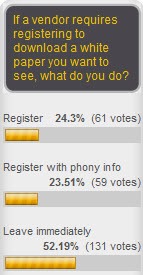
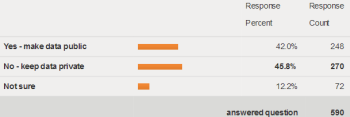
I’ve been saying for years that companies need to override their lead-happy sales and marketing people and make their advertising material (like white papers and case studies) freely available on the Web without requiring completion of a sign-up form. My survey results back that up all the way. Half of a company’s prospects run for the hills when faced with a form, and another quarter provide phony information to avoid the dreaded follow-up call. Add in the number of people who sign up but don’t return calls and you’ll see the futility of trying to drum up product interest via an intrusive data collection form. New poll to your right: if you routinely attend the HIMSS annual conference, what’s your primary reason?
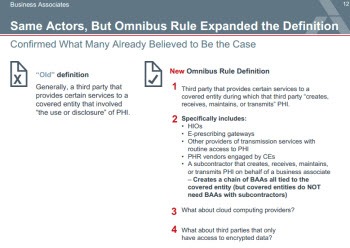
Just a reminder: a couple of folks with outstanding credentials will present a free HIStalk Webinar, “The HIPAA Omnibus Rule: What You Should Know and Do as Enforcement Begins” next Tuesday, September 10 at 2:00 p.m. EDT. Their presentation is not sponsored – they just stepped up when I asked for volunteers to go over the changes for readers now that the enforcement date is upon us. Thanks to our presenters from The Advisory Board Company: Rebecca Fayed, associate general counsel and privacy officer; and Eric Banks, information security officer. I watched their practice session and it’s meaty and fluff-free in the admirable Advisory Board fashion.
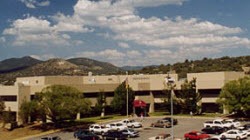
Financially struggling 68-bed Gila Regional Medical Center (NM), a Stage 6 EMRAM hospital and Meditech customer, eliminates its CIO position after the departure of David Furnas (and most of the executive team) earlier this month.
Joe Miccio (Divurgent) joins ESD as regional sales VP.

A Dallas news magazine recounts the fascinating tale of a newly licensed MD-PhD neurosurgeon whose incompetence left several patients maimed or dead while the state’s medical board couldn’t stop him from practicing. Colleagues called the doctor the worst they had every seen and said his skill level was no higher than a first-year resident as he kept inadvertently slicing arteries causing patients to bleed to death, and in one case the OR team had to forcibly remove him from the OR to prevent him from killing his patient. His marketing team and his 4.5 star Healthgrades.com rating brought in plenty of new patients to his loftily named practice, Texas Neurosurgical Institute. Surgeon readers will be horrified by this recap by a peer who had to clean up one of his messes: “He had amputated a nerve root. It was just gone. And in its place is where he had placed the fusion. He’d made multiple screw holes on the left everywhere but where he had needed to be. On the right side, there was a screw through a portion of the S1 nerve root. I couldn’t believe a trained surgeon could do this. He just had no recognition of the proper anatomy. He had no idea what he was doing.” The article blames the situation on malpractice caps, laws that hold hospitals liable for damages only if their intentions are provably malicious, and a nearly powerless medical board charged more with keeping licensure records and counting CE hours than watch-guarding patient safety.
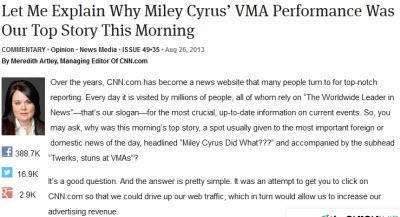
I’m constantly annoyed by websites (including healthcare IT ones) that tart up worthless “news” stories with catchy headlines, gratuitous graphics, annoying slide shows, and shameless ploys to get more clicks to impress potential advertisers. That’s all I’ll say since I can’t outdo The Onion’s eloquent criticism of CNN’s decision that Miley Cyrus is the most important news in the world, packaged as a phony confession from CNN’s editor, which is summarized as, “All you are to us, and all you will ever be to us, are eyeballs. The more eyeballs on our content, the more cash we can ask for. Period. And if we’re able to get more eyeballs, that means I’ve done my job, which gets me congratulations from my bosses, which encourages me to put up even more stupid bullshit on the homepage … Advertisers, along with you idiots, love videos.” Right now on CNN as some of its top stories: “The best cat video of all time is …”, “What Miley’s saying now”, “Twin baby pandas now fuzzy, cute,” and “Hear painful beauty pageant blunder.” You won’t find any of those stories on the BBC, although it probably gets a lot less traffic in not pandering to the average American reader. In healthcare IT, you get the added bonus of writers who have never worked in healthcare IT trying to explain it to experts or even editorializing about it, which would be like an unathletic sportswriter telling Peyton Manning how to throw a football.
The non-profit Medical Identity Fraud Alliance launches with founding members that include AARP and the Blue Cross Blue Shield Association. The group says its goals include driving policies, laws, and technology to reduce medical identify fraud.
Wake Forest Baptist Medical Center’s botched Epic implementation caused it to lose $55 million in the fiscal year on the operations side, according to its preliminary financial report. The hospital says the Epic implementation “did have a substantial negative impact on fiscal 2013 operating performance through both direct implementation expenses and associated indirect expenses,” causing a $54 million hit due to go-live disruption, deferred operational improvements, and billing problems.
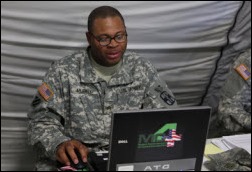
The US Army is preparing for a major upgrade to its MC4 battlefield EMR that will include a move to Windows 7, replacing Micromedex with Lexicomp, adding a graphical user interface to TC2, and requiring a PKI-E certificate for security.
In England, NHS expects up to 50,000 clinicians to learn the basics of programming under its Code4Health initiative, which hopes to encourage them to develop prototypes that NHS can turn into open source tools. The program is based on the US Code for America program, which encourages government employees to learn programming. Code for America is described above in a TED talk by its founder and CEO.
A North Carolina comprehensive clinic for the uninsured closes, blaming a loss of funding, the state’s decision not to expand Medicaid coverage, and a loss of productivity caused by its new EHR.
The Federal Trade Commission files a complaint against Atlanta-based LabMD, claiming that a patient-specific billing worksheet with information on 9,000 of its lab test patients was found on a file-sharing network and later in the hands of identity thieves.
Vince continues his HIS-tory of Cerner, from which I learned where the name originated and how the IPO came about.
Happy Labor Day, especially to those actually laboring on healthcare’s front lines. It may seem like the end of summer, but officially you still have three more weeks to wear those snazzy white shoes and seersucker suits.
Contacts
Mr. H, Inga, Dr. Jayne, Dr. Gregg, Lt. Dan, Dr. Travis.
More news: HIStalk Practice, HIStalk Connect.








































Re: Dr Z. Great story, but whatever happened to professional courtesy???