Recent Articles:

Morning Headlines 6/5/19

June 4, 2019 News 2 Comments

Former National Health IT Coordinators Respond To Proposed ONC, CMS Interoperability Rules

All six former National Coordinators pledge their support for the proposed ONC/CMS interoperability rules, saying they will transform information flow, spur innovation, and empower consumers.

CVS turning 1,500 stores into HealthHUB locations with less retail, more health care

CVS will expand its HealthHub store layout pilot to 1,500 stores that will retool 20% of the floor space to offer health kiosks, digital health tools, and expanded MinuteClinics.

RxRevu – the Industry Leader in Prescription Decision Support – Secures $15.9 Million in Series A Funding Led by UCHealth

Denver-based RxRevu, which offers EHR-integrated prescription pricing decision support, raises $15.9 million in a Series A funding round.

Cerner Calls for App Ideas That Improve Consumer Access to Health Records

Cerner challenges developers to build apps on top of its platform that can help consumers access, understand, and use their EHR information in the 2019 version of its Code App Challenge.

News 6/5/19

June 4, 2019 News 11 Comments

Top News

image

All six former National Coordinators pledge their support for the proposed ONC/CMS interoperability rules in a Health Affairs article. They say the rules will transform information flow, spur innovation, and empower consumers. They also observe that:

  • Rapid advancement of FHIR and APIs is critical.
  • Expanding interoperability requirements to health plans is “game-changing.”
  • Using Medicare’s Conditions of Participation to advance interoperability is a powerful tool.
  • Strong enforcement of information blocking provisions should be high priority and access to the USCDI data set via APIs should be free since “price has unacceptably been used in the past to ration electronic exchange of information or to block it outright.”
  • The federal government should work in parallel to create a consumer privacy framework, especially around third-party APIs and consent processes.
  • Stakeholder education will be important.

Reader Comments

image

From Crown Victoria Secret: “Re: Atrius Health. Has become an allied member of The Permanente Federation.” The forwarded internal email announcement describes a vaguely defined collaboration that began on June 1 between the 715-doctor, Boston-based Atrius Health and the Federation, the leadership and consulting group for the eight Permanente Medical Groups that serve Kaiser Permanente members. The independent, non-profit Atrius has 75% of its nearly $2 billion in annual revenue tied to full-risk contracts. It just announced a $39 million profit for 2018.

From Orion’s Belt: “Re: executive coaching. What do you think of people earning a formal coaching credential and hanging out a shingle to advise executives?” I don’t know how many executives are seeking such assistance, and certainly just waving around a freshly printed certificate without a history of demonstrated personal success won’t be much of a draw (it’s a “those who can” sort of thing). I like the idea, though, and I even toyed with taking one of the (expensive and hard-marketed) certification programs not too long ago just because the courses sounded interesting. Certification requires quite a bit of hands-on training and completing a bunch of actual coaching hours that are critiqued by the person being coached, so it’s not a quick, cheap, or low-effort project, not even counting the fact that it’s all for naught if nobody hires you.


HIStalk Announcements and Requests

image

Industry long-timer and friend of HIStalk Vince Ciotti tells me that he and his partners have closed down their consulting business, HIS Pros, after 30 years. His long-running “HIS-tory” PowerPoint series on the history of the health IT industry was housed on the now-shuttered website, but Vince is sending me the files so I can post them permanently on HIStalk. The companies and people he mentions shouldn’t be forgotten and some of them offer lessons that we can learn all over again. Plus they are a heck of a lot of fun to read, especially if you’ve been around awhile.


Webinars

None scheduled soon. Previous webinars are on our YouTube channel. Contact Lorre for information.


Acquisitions, Funding, Business, and Stock

image

Denver-based RxRevu, which offers EHR-integrated prescription pricing decision support, raises $15.9 million in a Series A funding round led by Colorado’s UCHealth.

SNAGHTML3d9f2d40

Cerner challenges developers to build apps on top of its platform that can help consumers access, understand, and use their EHR information in the 2019 version of its Code App Challenge. Winners receive a year of assistance in getting their app ready to be published on Cerner’s app store. Last year’s winner in November 2018 was a smart glasses-powered EHR navigation and documentation tool that isn’t yet listed in Cerner’s store.

image 

image

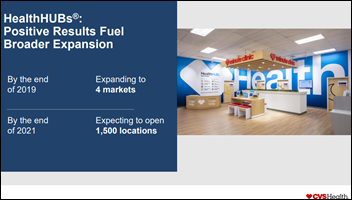
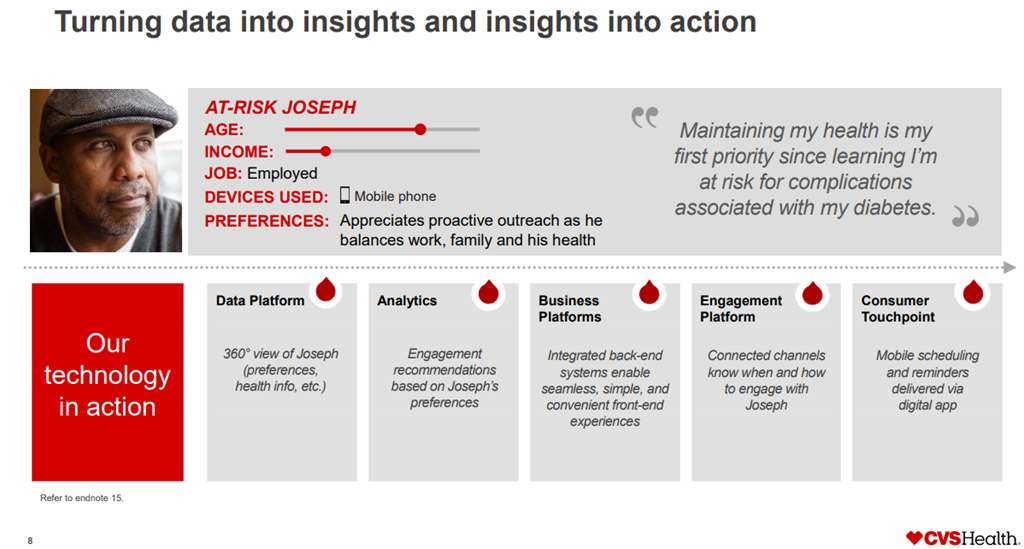
CVS, sweating under retail pressure from Amazon following its acquisition of Aetna, will expand its HealthHub store layout pilot to 1,500 stores that will retool 20% of the available floor space to offer health kiosks, digital health tools, yoga classes, dietitian counseling, expanded MinuteClinics. and SmileDirectClub teeth straightening (big companies really hate putting spaces between words). The space will come from reducing the inventory of slow-selling items such as greeting cards. The company’s #3 stated priority is to seamlessly connect digital and physical experiences, turn data into insights and action, and offer an intelligent engagement platform. CVS also expects big financial returns from chronic disease management.


People

image image

CoverMyMeds, which was acquired by McKesson for over $1 billion in early 2017, promotes David Holladay to president and Scott Gaines to COO. Co-founder and CEO Matt Scantland will leave the 1,000-employee company by the end of the year, while COO Michelle Brown will move into a different role. 


Announcements and Implementations

image

A KLAS report covering recently announced inpatient EHRs for under-200 bed hospitals finds that only Athenahealth and Meditech have brought customers live, with those vendors having signed 115+ hospitals each. Just three hospitals each have contracted for ECW’s inpatient system and Epic Sonnet. Athenahealth customers worry about significant product functionality gaps (mostly clinical) and that the company has paused sales of the inpatient product during its corporate turmoil, with 22 hospitals cancelling their contracts in the past two years. Meditech Expanse earns high marks in both administrative and clinical areas, as does the company’s cost transparency. KLAS notes that Epic Sonnet isn’t really intended for small hospitals, but rather larger ones that are willing to start off with less functionality or lower cost with plans to eventually move up to the full Epic product, with Community Connect as provided by larger hospitals (rather than Epic itself) being the only real small-hospital option. ECW is losing prospects, most of them running CPSI or Allscripts Paragon, to other vendors due to delays in bringing any sites live. The bottom line is: (a) Meditech Expanse is the only successful new product; and (b) it’s not easy for ambulatory EHR companies to develop and implement a successful inpatient product.

Glytec will expand the capabilities of its EGlycemic Management System to create Therapy Advisor, a “Software as a Medical Device” platform that supports dosing and management of all diabetes medications, not just insulin. It will give providers evidence-based recommendations on product selection that also include patient affordability.

Sacramento-based non-profit medical technology startup support group MedStart shuts down, citing a drop-off in funding, plans by UC Davis to develop a similar program in Sacramento, and failed merger talks with other organizations. 


Government and Politics

image

President Trump responds to a reporter’s question during a joint session with Prime Minister Theresa May by saying that any post-Brexit trade deal needs to allow US companies to sell to the National Health Service. Response was quick and unflattering from everyone from British politicians to clinicians who don’t like people, especially those from other countries, messing with NHS.

Coffey Health System (KS) will pay $250,000 to settle the federal government’s claim that it falsely attested to Meaningful Use in 2012-2013 by failing to perform a security risk analysis. The whistleblower lawsuit was filed by two people, one of whom I was able to find online as an employee of the 25-bed hospital’s compliance office. 


Privacy and Security

The information of 12 million Quest Diagnostics lab patients is exposed in a breach of the systems of American Medical Collection Agency, which provides billing services to Quest contractor Optum360.


Other

image

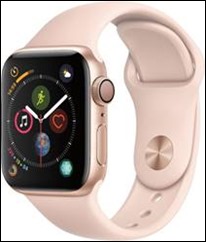
Apple makes some health-related announcements at its WWDC developer conference, most of them pertaining to Watch:

  • WatchOS6 will add menstruation tracking, which will also work on the IPhone’s Health app
  • WatchOS6 will introduce a Noise app that will measure sound levels
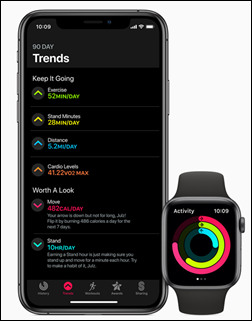
  • Watch’s fitness tracking will be displayed as rings that tabulate daily movement, exercise, and non-sitting time and will roll those into long-term trend displays
  • WatchOS6 will allow using the App Store directly from the Watch
  • The IPhone’s Health app will be redesigned to offer notifications, favorites, and health highlights

image

Verizon is hyping the heck out of its 5G service, with some of its questionable claims now including improving cancer treatment. The cell carriers like the opportunity to capturing market share, but 5G doesn’t seem like a silver bullet – it requires a ton of closely-spaced towers; it does nothing to bring broadband to rural areas where the cable company monopolies have stopped installing fiber and upgrading infrastructure; nobody has looked hard at what healthcare bandwidth limitations 5G expects to remove; and cell carriers (like the cable companies) provide notoriously poor user support. Eric Topol called them out for the TV commercial above, inviting them to show data proving that they improve cancer outcomes. I also winced at their use of the tired “fight” analogy.  

image

Stanford professor and investor Phyllis Gardner is earning fame for her comments about Theranos and founder Elizabeth Holmes that were included in two documentaries about the company, some of those critical observations made long before a series of investigative reports brought the company down. She says:

  • She tried to tell Holmes early on that the company’s technology could not possibly work, but Holmes brushed her off and has since “been the burr under my saddle.”
  • Many smart venture capitalists sent Holmes packing when she invoked “trade secrets” in refusing to explain how the Theranos technology worked.
  • It was corporate malfeasance to load up the company’s board with people who had no science understanding, which she called “old men [whose] brains go to their groin.”
  • She knew the phony deep voice, black turtlenecks, and “the glammed-up look” of Holmes was fake, but says you could never see her real self.
  • “I didn’t find that many people at Stanford who thought she was amazing.”
  • She rips Silicon Valley’s “fake it until you make it”mantra for healthcare: “In medicine, you do not fake it. Ever. That is verboten, and that is why we have regulatory agencies … you don’t fail 10,000 times and get it right on the 10,000st. That is absolutely evil to say that.”

SNAGHTML3f2398bc

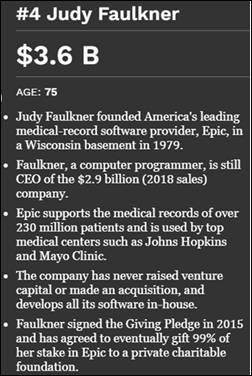
Forbes releases its list of “America’s Richest Self-Made Women,” with Epic CEO Judy Faulkner coming in fourth with an estimated net worth of $3.6 billion. Wisconsin women took two of the top four spots, with #1 being Diane Hendricks of construction material vendor ABC Supply at $7 billion. The most bizarre winner – Suzy Batiz, whose toilet spray Poo-Pourri has sold 60 million bottles in giving her a not-so-crappy net worth of $240 million, tying Reese Witherspoon. 


Sponsor Updates

  • Dimensional Insight earns top scores for customer experience and vendor credibility in the annual Wisdom of Crowds business intelligence market study.
  • Avaya leverages Google Cloud to provide a wider range of global organizations with flexible, scalable communications and collaboration solutions.
  • Bluetree will exhibit at the Epic Michigan User Group Meeting June 10 in Ypsilanti.
  • Prepared Health will exhibit at the CMSA 2019 Annual Conference June 10-14 in Las Vegas.
  • KLAS recognizes CenTrak for standout industry performance in its 2019 report on real-time location systems.
  • CompuGroup Medical will exhibit at the New Mexico Primary Care Association Annual Conference June 13-14 in Albuquerque.
  • Collective Medical helps providers support and coordinate care for homeless patients.

Blog Posts


Get Involved


button


125x125_2nd_Circle

Morning Headlines 6/4/19

June 3, 2019 Headlines Comments Off on Morning Headlines 6/4/19

Biden Cancer Initiative Announces the Oncology Clinical Trial Information Commons

Former Vice President Joe Biden’s cancer initiative will include data from nine organizations including IBM Watson Health and Ciitizen as part of a new clinical trial data sharing platform.

Quest Diagnostics Statement on the AMCA Data Security Incident

Quest Diagnostics notifies customers of a data breach at its billing services vendor, American Medical Collection Agency, that could potentially affect 12 million patients.

Best Buy takes new steps to grow its healthcare business

Best Buy acquires personal emergency response and telemedicine company Critical Signal Technologies.

Comments Off on Morning Headlines 6/4/19

Curbside Consult with Dr. Jayne 6/3/19

June 3, 2019 Dr. Jayne 1 Comment

clip_image003 

Maybe I am becoming less tolerant as I get older, but I seem to be very easily tired by people in this industry who talk a good game, but are unable to get any of their ideas to fruition. It’s especially tiresome when these folks are hired by major organizations at high salaries and they can’t seem to solve the basic problems that plague clinical technology projects.

I worked with one of these folks a year or so ago when he was hired by one of my clients as a senior vice president for clinical transformation. I had been doing clinical transformation work for them for almost a year, so I was excited that they were finally putting some leadership and visibility behind the effort other than just third-party consultants. What I immediately found, however, was that he had no experience with physician adoption or creating workable timelines. His only healthcare experience was in the finance realm, and he immediately alienated nearly everyone on the project who had been working hard for incremental change.

A lot of us asked ourselves how he was hired and came to the conclusion that the organization was looking for a social media wunderkind, someone who was an “influencer.” But it turned out he was only an influencer in his own mind. He curried favor with the physicians by agreeing with their (largely unfounded) complaints about the EHR and by offering to throw the entire project out and get the group moved over to Epic per their request.

This was during his first 30 days of employment. He didn’t bother to do the due diligence to find out that the EHR project was suffering because providers had contracts that financially rewarded them for bad behavior and refusal to use the EHR. He didn’t find out that the rest of leadership had no stomach for either changing the contracts or doing something else to change the behavior, but instead took the easiest route in condemning the vendor.

The organization is now in the throes of a significant software spend. They still have no governance, no change control, and no plan. But by golly, they’re going to be on Epic, so all their problems will be solved.

I continue to watch this individual on Twitter and am surprised he doesn’t have tendonitis in his shoulder from patting his own back so much. I still have some consulting work going on with the client, although thankfully outside of his area, and it’s been hard to watch the carnage. I wonder at times whether anyone above him has read the story about the emperor having no clothes. Most of the workers under and around him see through it, and I feel for them.

I was having flashbacks this week when I met someone at a conference who reminded me of him. He was full of great ideas about how his organization was going to use data to drive outcomes and change clinical behavior. It sounded great until it took a dark turn towards volume-based incentives. I watched others in the roundtable session nodding their heads and listening attentively and I wondered if they were missing the fact that he was talking about incentivizing providers for ordering more tests, medications, and procedures.

His independent provider organization is somewhat boutique-y and has a large population of young and middle-aged patients who value convenience. Due to their relatively low Medicare population, they’re not part of an Accountable Care Organization and they’re not worried about readmission rates. They offer a significant spectrum of cosmetic services along with all kinds of wellness testing that isn’t typically covered by insurance.

Essentially, his organization has come up with what I would consider bogus metrics, a “compassion index” that uses interventions as a proxy for good clinical care. Using point-of-care tests rather than medical knowledge or those pesky clinical decision rules raises a provider’s index. Prescribing multiple medications to treat patient symptoms also raises that index (however, over-the-counter medications that the patient might already be taking do not). He (and I assume the rest of the leadership of the organization, since the presentation was clearly bragging on their outcomes) has latched onto a word-track that “patients know we care by how much we do for them.”

I wondered for a minute if the presentation was straight out of The Onion. Certainly no one in the current healthcare environment would be talking about running up charges? As a former primary care provider, I always thought patients knew we cared by the fact that we sat down and talked with them, counseled them through their issues, and made sure they had follow-up.

I hid in the tall grass and waited for the opportunity to ask a question about what most of us would consider “real” metrics, such as antimicrobial stewardship or appropriate use criteria for advanced imaging. I asked it nicely, and it was fun to watch him blow it off saying that they don’t find those types of metrics to be relevant to their practice. You could see the light bulbs come on over a couple of the attendees’ heads because those types of actual clinical quality metrics have been so drilled into our heads, why would someone not use them?

He went on to describe some of their other metrics, which sounded more like defensive medicine than anything else. He explained their push for imaging as “patients feel better when they know beyond a doubt that nothing serious is going on,” which I immediately translated to “our accountant feels better when we radiate people.”

Nothing in medicine is “beyond a doubt” because there is great variability in patients and how their bodies react to various biological challenges. Medicine throws me curve balls all the time, including the patient last week who was very, very anticoagulated but still had a new deep venous blood clot form in his leg. Trying to use shotgun-style testing as a substitute for clinical intuition, experience, and evidence-based care is a dangerous construct.

He went on to talk about their interventions to drive clinician behavior and raise the “compassion index” alongside patient satisfaction scores. It sounds like they look for outlier physicians and sit them down and use peer pressure to try to raise the volume of order interventions. It didn’t sound like they overtly bonused physicians based on ordering volume, but instead use emotional hooks to try to keep clinicians on track. They do bonus physicians on throughput, which makes it easier for people to just order tests rather than sit down and explain a decision process to patients, since education and shared decision-making take time.

I found their bogus metric even more bogus when he explained that they judge the usage of interventions based on the documented chief complaint, not on the diagnosis. At this particular facility, the chief complaint is self-selected by the patient on a kiosk at check-in, so judging whether providers order testing based on that is particularly obnoxious. I’ve had patients who say their complaint is “throat pain” that is really poison ivy on the neck, so if a provider is going to be dinged for not ordering a strep test for throat pain that’s actually a neck rash, they’re fighting an uphill battle.

I can’t imagine working at a place like that. He did note that they have some issues with provider turnover. I’ve found that when people talk about their turnover issues, it’s kind of like talking about how much alcohol they drink – it’s likely to be underestimated.

I’m not sure how long payers are going to put up with this, or how long patients will keep coming back if they have to shoulder the bills for over-testing. Not to mention that over-testing is not a harmless intervention. Sometimes you find things that lead you to additional interventions when it would have been better if you hadn’t done the test in the first place. It falls into the “do no harm” piece of what we trained for as physicians.

I’m curious if this is a new trend or if this guy is as much on the fringe as I think. Have you seen anything like the compassion index in your area? Leave a comment or email me.


button

Email Dr. Jayne.
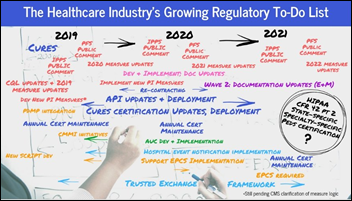
Readers Write: Why the Interoperability and Patient Access Proposed Rules Matter for the Future of Healthcare

June 3, 2019 Readers Write 2 Comments

Why the Interoperability and Patient Access Proposed Rules Matter for the Future of Healthcare
By Russ Thomas

Russ Thomas is CEO of Availity of Jacksonville, FL.

image

The Centers for Medicare & Medicaid Services (CMS) and the Office of the National Coordinator for Health IT (ONC) have proposed new rules designed to give patients greater control over their own data and advance interoperability across the healthcare industry. Should the rule be finalized in its current form, millions of patients will have unprecedented access to and control over their own health information by 2020.

With some limited exceptions, including several related to privacy and security, the Interoperability and Patient Access Proposed Rule would make patient data exponentially more accessible and portable through open data-sharing technology and patient-facing apps.

Ideally, this would not only provide patients greater ownership of information related to their diagnoses, procedures, and tests, but also would mandate the seamless transfer of information from one healthcare organization to another as patients transition from physician to physician – enabling the promise of coordinated care within a complex healthcare system.

HL7 FHIR will be required as the standard for supporting all APIs under the proposal. Nearly 90% of hospitals and 70% of MIPS-eligible clinicians are using FHIR-enabled EHRs, according to ONC.

On paper, the rules are a logical extension of the Triple Aim—delivering better quality, better population health, and lower costs. Our industry has long advocated for the migration of patients to the center of the healthcare ecosystem.

However, empowering patients as consumers is only as effective as the tools they have to make more informed choices about their care. In this regard, healthcare is woefully behind the curve. Consumers can easily and securely access banking transactions and retail purchases over their smartphones, but not, say, their own clinical information, which is often tangled in a web of data silos, privacy rules, and vendor competition. Implementing and standardizing these rules will not be an easy lift.

In the real world of healthcare, the free flow of data and determining how, where, and when it is routed to the appropriate person is a daunting task with the highest of stakes. Although applying the proposed rules industry-wide will be time-consuming and resource-intensive, I believe the effort is both worth it and long overdue.

These proposed rules are a critical tap on the shoulder, a reminder that achieving healthcare’s future is impossible without first solving the foundational problems rooted in our present moment.

Healthcare technology companies should be at the forefront of supporting industry standards that drive efficiencies and interoperability and reduce costs and administrative burdens for their customers. Tools like FHIR enable healthcare organizations to efficiently exchange well-defined information.

I believe that this standardization is essential to the shift to value-based models of care, where payers and providers are seeking secure ways to better communicate and exchange information.

Standards, however, are only one part of the solution. Creating a more solid foundation for healthcare’s building blocks requires several key ingredients: widespread adoption of automation; more efficient channels for sharing and maintaining healthcare information; and modernization of laws governing healthcare data access and sharing, like HIPAA. It also requires evolution of business models to reward transparency and information sharing and penalize data duplicity.

On the payer side, many health plans still store provider data on legacy systems in multiple disconnected databases. As business requirements have evolved, insurance organizations have implemented incremental stopgap measures to address data limitations, but these don’t address the core challenge, the lack of a single source of truth.

It’s important to hear from all concerned stakeholders in order to get these rules right. However, I believe that at the core of these rules lies an essential truth. Unlocking and harnessing the power of data and providing patients the ability to access it is the truest course to a more sustainable and patient-centric healthcare system.

We have been presented an opportunity to fundamentally transform the American healthcare system for the better. It would be a mistake to miss it.

Morning Headlines 6/3/19

June 2, 2019 Headlines Comments Off on Morning Headlines 6/3/19

EHR Developers are Aligned with Goals of Cures NPRM, Hope ONC will Remove Ambiguity and Reassess Timeline

The vendor members of the HIMSS Electronic Health Record Association raise “significant concerns” in draft comments about proposed federal rules covering interoperability.

Troubled microbiome startup uBiome to lay off some employees, refund payments from federal insurers

Microbiome testing vendor UBiome’s interim CEO warns employees of pending layoffs in the wake of federal investigations that have also prompted the company to refund government payments for its tests.

Kan. Hospital Agrees to Pay $250K To Settle False Claims Act Allegations

Coffey Health System (KS) will pay HHS $250,000 to settle claims that it falsely attested to conducting security risk analyses as required by the Meaningful Use incentive program.

Comments Off on Morning Headlines 6/3/19

Monday Morning Update 6/3/19

June 2, 2019 News 11 Comments

Top News

image

The vendor members of the HIMSS Electronic Health Record Association raise “significant concerns” about proposed federal rules covering interoperability. Their draft comments note that:

  • The rule limits EHR vendor profits and thus discourages innovation because it requires them to share their intellectual property. The proposed rule would require vendors to offer interoperability elements with “reasonable and non-discriminatory terms.”
  • The compulsory licensing rule would require developing documentation, APIs, and patents, creating a regulatory burden that might “outweigh the opportunity that remains.”
  • ONC’s definition of “interoperability elements” and “electronic health information” are overly broad and unreasonable, while some of the defined exceptions would be nearly impossible to enforce.
  • EHR vendors can’t deliver the programming necessary in the proposed 24-month timeline, especially when they are dealing with other CMS and ONC regulatory requirements.
  • The proposed rule includes ambiguous definitions such as “reasonable,” “as soon as possible,” and “near real-time,” which is risky when penalties can be issued of up to $1 million per infraction.
  • EHRA recommends publishing an Interim Final Rule this year to allow continuing clarification and feedback and to create a way that vendors can get quick answers to their questions.

The Health Innovation Alliance this week said the rule is too vague and contains too many loopholes, recommending that ONC and CMS “go back to the drawing board.”


HIStalk Announcements and Requests

image

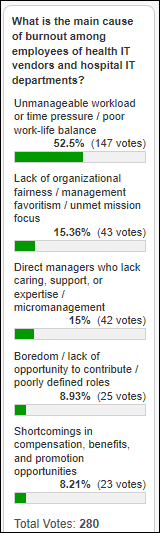
More than half of poll respondents say vendor and hospital burnout in health IT is caused by excessive workload and time pressure rather than organizational, management, and compensation issues. Furydelabongo says that work overload could be a symptom of having incompetent or overly ambitious managers, while Drex cites the nearly universal absence of good IT governance in hospitals that encourages employees work at whatever tasks they believe are important or that executives complain the loudest about.

New poll to your right or here: What method did you use the last time you communicated directly with a doctor who was providing care to you? I’m looking for your most recent exchange, the final one in your most recent encounter.

Happy 16th birthday this week to HIStalk, which I started writing in June 2003. I think it was June 6, but I’m not certain since I sometimes think it was June 3. Back then:

  • Some big healthcare names were George W. Bush, Tommy Thompson, Tom Scully, Dennis O’Leary, Erich Reinhardt, Linda Kloss, Anthony Principi, and Neal Patterson.
  • Hospitals were struggling with early CPOE implementations.
  • Kaiser Permanente had just chosen Epic.
  • Cerner had just made its first UK sales and opened its new headquarters.
  • HIMSS offered HIMSS03 in San Diego (with keynotes from Jeff Immelt, Rudy Giuliani, and Patch Adams) following Summer HIMSS in Chicago and also launched Solutions Toolkit, the predecessor to HIMSS Analytics.
  • Computers ran Windows XP while users licked their wounds caused by Windows ME and awaited / dreaded the promised magic of Windows Vista as the effects of the “every other Windows release sucks” rule were about to be felt.
  • People sent messages on BlackBerry devices and talked on the Nokia cell phones that dominated the market.
  • Companies such as MercuryMD, Misys, First Consulting Group, Per-Se, IDX, Healthlink, Quovadx, Alaris, and Sentillion were making a few sales.
  • Health IT news came slowly and with little critical review other than from expensive, influential newsletters such as “Inside Healthcare Computing” and “HIS Insider.”

Listening: new from NF (Nate Feuerstein), a 28-year-old, Michigan-based, Eminem-influenced rapper whose lyrics are emotional but commendably free of profanity (a change he made in 2010, saying that he’s Christian even though his music is not) and misogyny. His vocal rhythms immediately embed themselves in your head even if the lyrics don’t. The link is for “Let You Down,” which is not only a dramatic video, but also a powerful song about the strained relationship between a disappointed father and his son who has bitterly decided that their superficial relationship is over.

Thanks to the following companies that recently supported HIStalk. Click a logo for more information.

image
image
image
SNAGHTML330213fb
image
image
image
image
image
image
image


Webinars

None scheduled soon. Previous webinars are on our YouTube channel. Contact Lorre for information.


Decisions

  • Bayhealth (DE) switched from Avaya To Cisco Systems for call center technology in April 2019.
  • Highpoint Health (IN) will replace Meditech with Allscripts in July 2019.
  • ProMedica Coldwater Regional Hospital (MI) replaced Meditech with Epic on May 1, 2019.
  • Chestnut Hill Hospital (PA) will go live on Epic in August 2019.
  • Baptist Health Floyd (IN) will replace Allscripts with Epic In June 2019.

These provider-reported updates are supplied by Definitive Healthcare, which offers a free trial of its powerful intelligence on hospitals, physicians, and healthcare providers.


Announcements and Implementations

SailPoint earns a US patent for its application of AI/ML to identify peers among system users to detect those whose access profile is unusual enough to warrant review for potential security concerns.


Other

image

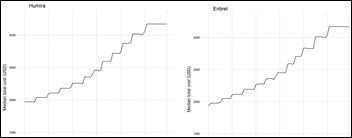
Eric Topol notes the nearly identical, relentless price increases for competing best-selling injectable arthritis drugs Humira and Enbrel, which generated a combined $28 billion in 2018 sales. Today’s price is more than double that of 2012, with cash-paying patients paying more than $5,000 per month even with the best coupon offered by GoodRx. The cost is much less in the UK, which doesn’t allow endless drug company patent filings and lawsuits that block competition for biologic drugs.

CDC reports that the number of US measles cases has broken the 25-year-old record even though we’re only halfway through the year. Measles is classified as “eliminated” in the US, but that achievement is at risk for the first time in a generation.

image

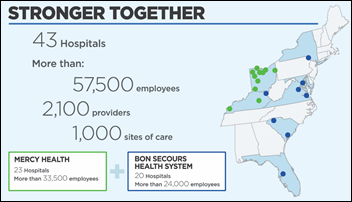
I’m fascinated that Cincinnati-based Bon Secours Mercy Health will sell its majority stake of an RCM company it bought for $60 million in 2016 for $1.2 billion. The Catholic health system, former in September 2018 with the merger of Mercy Health and Bon Secours Health System, had just announced its merger with Ireland’s largest healthcare provider, a five-hospital system in Dublin, with intentions I don’t quite understand (unless they’re using Ireland’s favorable tax status to benefit their for-profit ventures).


Sponsor Updates

  • Sansoro Health announces an integration partnership with OpiSafe, which provides clinical decision support for opioid prescribers.
  • TriNetX will exhibit at Academy Health June 2-4 in Washington, DC.
  • A study finds that hospitals using Meditech Expanse outperformed Cerner and Epic clients in CMS quality and value measures.
  • Wolters Kluwer Health promotes Greg Samio to president and CEO of health learning, research, and practice.
  • The SSI Group will exhibit at the Alabama HFMA Annual Institute June 2-4 in Destin, FL

Blog Posts


Get Involved


button


125x125_2nd_Circle

Weekender 5/31/19

May 31, 2019 Weekender Comments Off on Weekender 5/31/19

weekender 


Weekly News Recap

  • The latest funding round of precision medicine platform vendor Tempus values the company at $3.1 billion
  • Cerner initiates a $0.18 quarterly dividend for shareholders, its first
  • Cincinnati-based Bon Secours Mercy Health announces plans to sell its majority share in a revenue cycle management subsidiary, netting $1.2 billion on its 2016 investment of $60 million
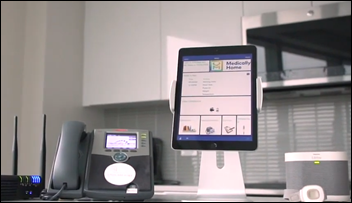
  • Cardinal Health makes a $10 million investment in home medical monitoring technology and monitoring services vendor Medically Home Group
  • Change Healthcare files an amended prospectus for a $200 million IPO that doubles the value indicated in its mid-March filing
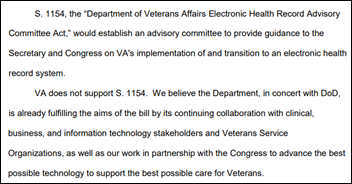
  • The VA opposes a Senate bill that would create an independent advisory committee to oversee its $10 billion Cerner implementation

Best Reader Comments

Tempus got a $3.1 billion valuation without any peer-reviewed data on the veracity of its precision medicine claims? Without any randomized clinical trials? Oh, well. We live in a world where a company putting out green color scooters on city sidewalks can get valuation in billions of dollars, so why not? (TempusInATeapot)

I’m still trying to get my head around why people insist that privately held companies that are still very profitable are “struggling” because revenues are down. The key being the slight decline in overall revenues was clearly predicted in advance. Maybe the major shareholders have a little heartburn because of unreasonable expectations borne out of the MU honey pot days, but the companies still are very healthy. (Smartfood99)

I had an interesting interaction with an insurance pre-auth department. They claimed that they needed my knee MRI report faxed to them because of HIPAA. I told them I didn’t have a fax machine, and why didn’t they have a secure portal for these? They again claimed HIPAA, but said there were several third party websites I could use to upload a PDF to and they would fax on my behalf, and better yet, some had free trial periods. (Bob Smith)

I did consulting about a decade ago for a teaching hospital that was being built to advise on how to make sure the layout promoted it being “EHR ready.” I was handed the outlines of the medical ICU floors and they had left so little space that they were either going to have to choose call rooms or tiny conference / charting rooms on the same floor. When I pointed that out, I was told that they couldn’t change any of that, and the space was going to be offices for the ICU leadership, so no call rooms or conference rooms. Turns out a committee had put together their high-level requirements and handed it to the architects who had returned these designs, and at that point, it was too late to make any changes. (DrM)

The brand new multi-million dollar building at our medical center eliminated conference rooms and working areas for clinicians. This means there is no place to sit at a desktop computer and actually do work or make phone calls. The computers in the patient rooms are ergonomic disasters. Plus, it’s difficult to concentrate and write efficiently when patients or families are asking questions. Patient privacy will be infinitely more challenging without any available private areas to discuss clinical issues. They did, however, install a faux fireplace in the oncology infusion center to make it seem more welcoming and homey. (Anonymous)

Is Epic still growing? Not if you read between the lines. Last year they said they hired 400 new employees. Now they say turnover is 10%, others say 20,% maybe it’s 15%. Either way that’s means replacing at least 900 employees per year. Looks like they may be cutting back or at best be in a holding position. Makes sense since Judy said a few months ago in a news article they are done building, and with the end of HITECH money, that juggernaut is over. The hospital market is clearly saturated, and a month or so ago, an Epic VP stated they want to move into other levels of care, like LTC, rehab, etc. But those markets are also saturated with some very well established vendors and Epic does not buy other companies. Is the writing on the wall? (HISJunkie)


Watercooler Talk Tidbits

image

Readers funded the DonorsChoose teacher grant request of Ms. A in Washington, DC, who asked for math manipulatives for her pre-K class. She reports, “The math manipulatives you have provided will help to develop math skills during our center time and small group instruction. My kids are using the math manipulatives to practice counting, measurement and sorting. They are so excited to practice math now! Each student has a favorite manipulative they like to use. They like to make groups of five and 10, find out how many items are needed to make the scale go up or down and mix up all of the manipulatives and sort them according to shape, size, or feature. Thank you again for your donation and for making math accessible and fun!”

image

Security experts warn that hackers can modify the USB ports of airport phone charging stations, allowing them to access user data or install malware. The fix is obvious – use your wall charger instead.

image

A startup is developing software that can be used to deploy a drone in response to reported incidents or 911 calls, allowing first responders a live look at a fire or accident scene within 30-90 seconds even though they won’t arrive for 8-15 minutes. 

image

An orthopedic surgeon opens a coffee shop in the lobby of Lake Health Beachwood Medical Center (OH), with 100% of the proceeds being donated to a local charity that helps single mothers buy homes. The Ethiopia-born doctor is one of the highest-volume shoulder surgeons in the US.

The Chinese scientist who was widely condemned by his peers for creating the world’s first genome-edited babies says he’s getting inquiries from shady fertility clinics offering to pay him to show how he did it so they sell those services .

The Chicago Tribune profiles a practicing 100-year-old optometrist who says he has no plans to retire. “I work because I feel I’m doing some good … I enjoy it. It’s not work as far as I’m concerned.”

image

Fascinating: the doctor behind those ubiquitous online ads in which he begs us to “throw out this vegetable now” is found to be an integrative health MD who runs a variety of questionable websites that sell expensive herbal products and books for weight loss and constipation. He never says what vegetable everyone should throw it is and the ad uses photos of different ones, but it’s likely corn. The article also notes that the ads are known as “chumboxes,” sponsored pay-per-click content that baits people into clicking ads featuring miracle cures, ads triggered by the viewer’s IP address to offer what appear to be local services, and those that tease about something that is “weird.” Keep in mind that they exist only because people are stupid enough to click on them.


In Case You Missed It


Get Involved


button


125x125_2nd_Circle

Comments Off on Weekender 5/31/19

Morning Headlines 5/31/19

May 30, 2019 Headlines Comments Off on Morning Headlines 5/31/19

Tempus raises $200M at a $3.1B valuation

Precision medicine platform vendor Tempus raises $200 million in a Series F funding round that values the Chicago-based company at $3.1 billion.

Cerner’s initial quarterly dividend exceeds original estimate

Cerner initiates a $0.18 quarterly dividend, its first and $0.03 greater than it originally mentioned in February.

Apprio Announces New Commercial Health Division, ApprioHealth, to Meet the Specialized Needs of Hospitals and Health Systems

Government health IT contractor Apprio creates a new commercial healthcare division to market its RCM services to hospitals and health systems.

Welkin Health Raises $17.5 Million in Series B Funding from Altos Ventures

Patient relationship management vendor Welkin Health raises $17.5 million in a Series B round, bringing its total funding to $30 million.

Comments Off on Morning Headlines 5/31/19

News 5/31/19

May 30, 2019 News 3 Comments

Top News

image

Precision medicine platform vendor Tempus raises $200 million in a Series F funding round that values the Chicago-based company at $3.1 billion.

CEO Eric Lefkosky, JD founded the company in 2015 after launching two marketing companies, a logistics technology company, and a venture capital firm. He is also chairman and co-founder of Groupon and formerly served as that company’s CEO. 


Reader Comments

image

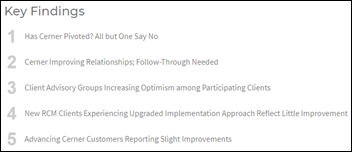
From Food for Chewing: “Re: KLAS’s new report on Cerner revenue cycle management. I’m curious to know if Cerner paid for or commissioned the report.” KLAS responded to me by saying that it was initially creating the report without Cerner’s involvement, but Cerner asked KLAS to convene a big-client summit that was hosted by Intermountain. The Cerner clients then asked KLAS to provide quarterly updates about Cerner’s progress. Cerner will engage around those results, and while KLAS tell me specifically that Cerner is paying, it’s not unreasonable since Cerner commissioned the follow-up. Cerner won’t get much immediate mileage from this initial report – the client feedback (at least as reported in the “Key Findings” summary, which is all I can see) is nearly universally negative, not surprising given the meeting’s genesis (no pun intended for you Cerner DoD MHS types).

From Crowdfunding Not for the Weak at Heart: “Re: HEAL Diabetes Clinic. Received an email indicating that after its StartEngine funding campaign, CEO Richard Koffler ‘surprised us by announcing his resignation from the company.’ The company decided that it couldn’t move forward without home, so it is shutting down and returning any leftover money to investors.” The company’s webpage says it has closed and Koffler’s LinkedIn indicates that he has resigned. It offered a ketogenic diet program.

From Non-Corporate Man: “Re: your experience with an HIT vendor owned by a large company. My experience was the opposite. I did just about every job you could think of in corporate HIT, did an MBA and law degree while working full time, and got the CEO job because I knew all the pieces.” My only for-profit experience was with this vendor, but it was eye-opening to see what happens when a Fortune 500 company acquires a failing software vendor that quickly disappears into the murk of the corporate balance sheet once it fails to meet overly optimistic expectations. They only bought us with the questionable hope that our sexy-sounding business would jumpstart their anemic growth rate, apparently actually believing our financials that must have been quite the work of fiction ( (I speculate our executives offered them the “Promises & Lies” version of our P&L).

image

From Union Rep: “Re: HIT headlines. This one is surely among the worst.” I agree. As health IT wit goes, this is half. The story itself is basically a rewritten press release, so someone was anxious to show some poorly executed creativity in the headline in desperately punning “Sunrise.” I can only imagine the damage they would do in trying to work “Millennial” into a Cerner sales announcement.


Webinars

None scheduled soon. Previous webinars are on our YouTube channel. Contact Lorre for information.


Acquisitions, Funding, Business, and Stock

image

Multi-state Bon Secours Mercy Health will sell a majority stake in its Ensemble Health Partners RCM and Epic optimization business to Golden Gate Capital for $1.2 billion.

image

Cerner initiates a $0.18 quarterly dividend, its first-ever such payment and $0.03 greater than it originally mentioned in February. Opinions vary on whether companies that initiate dividend payments are showing signs of strength (making so much money that they might as well share it with investors) or weakness (management can’t entice people to buy the stock otherwise). I generally side with the latter. Companies that are doing well and expect strong future performance would be better off investing the money in their own business and let the success-driven share price increase reward its shareholders. But that’s just me, and if CERN shareholders love the stock, they can just reinvest the dividends themselves. CERN shares are down 3% vs. the Nasdaq’s 3% rise since Brent Shafer took over on January 10, 2018.

image

Government health IT contractor Apprio creates a new commercial healthcare division to market its RCM services to hospitals and health systems.

image

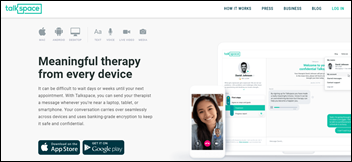
Talkspace raises $50 million in a Series D round led by Revolution Growth, bringing its total funding to $107 million. Optum’s behavioral health business has signed on for the company’s online therapy service.

image

Pillo Health raises $11 million to complete its Series A round. Lead investor Stanley Black & Decker will work with Pillo to launch a direct-to-consumer version of its digital home health companion later this year.

Patient relationship management vendor Welkin Health raises $17.5 million in a Series B round, bringing its total funding to $30 million.


Sales

  • UCLA Health (CA) selects Microsoft’s Azure cloud computing services to speed up data analysis for researchers and precision medicine efforts.
  • The Louisiana Dept. of Health will implement provider credentialing software from Verisys.
  • Allegheny Health Network (PA) selects Vynca’s end-of-life care planning technology.

People

image

Mount Sinai Health System (NY) names Andrew Kasarskis, PhD (Icahn School of Medicine) as EVP and chief data officer.

image

Roni Zeiger, MD (Smart Patients) joins Facebook as head of health strategy.


Announcements and Implementations

image

Woman’s Hospital (LA) goes live on Meditech Expanse.

image

OHSU Doernbecher Children’s Hospital (OR) offers parents Locus Health’s app-based remote monitoring software for use post-discharge.

image

PerfectServe announces GA of embedded messaging within Cerner.


Privacy and Security

image

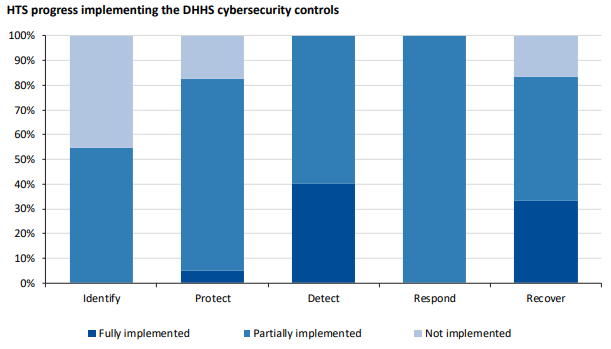
In Australia, auditors warn Victoria’s public health system officials that weak cybersecurity practices have left facilities vulnerable to attacks. A review of security measures at several hospitals within the state found similar weaknesses, including weak passwords, poor system and network monitoring, inadequate user access controls, and lack of appropriate governance and policy frameworks. Barriers to implementing all 72 of the recommended cybersecurity measures include lack of budget and staff, plus a lack of awareness around third-party vendor security protocols.

image

Allegheny Health Network brings its Epic system back online after an unspecified network issue caused it to go down Wednesday morning. The outage affected all seven of its Western Pennsylvania hospitals.

image

Indiana-based Medical Informatics Engineering and its subsidiary NoMoreClipboard will pay $900,000 to settle a multistate lawsuit brought against it last year by 16 state attorneys general over a 2015 breach that compromised the data of 4 million patients. Meanwhile, nobody is planning a PHI heist of 4 million clipboards.


Other

Canada’s Sunnybrook Health Sciences Centre will integrate its self-developed SunnyCare clinical workflow solution with CPSI Evident’s Thrive EHR. The organizations will also establish an outcomes innovation center in Toronto.

image

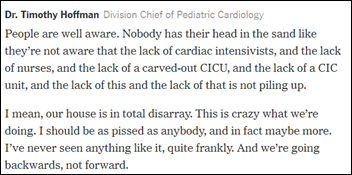
A New York Times investigation finds that pediatric cardiologists at UNC Children’s Hospital (NC) were so alarmed at high death rates that they questioned — in secretly recorded department meetings obtained by the newspaper — whether they would send their own children there for surgery. From the Times article:

  • The hospital’s death rate was among the worst among the 82 institutions that publicly report it.
  • Cardiologists and hospital executives were all worried about the hospital’s high death rate, but didn’t know what to do about it.
  • Since 2015, the hospital had lost two of its pediatric cardiac intensivists and some experienced nurses, closed its CIC unit, and didn’t have a dedicated cardiac intensive care unit.
  • A transplant surgeon failed to show up to perform a heart transplant when a donor heart became available on a weekend, leading one cardiologist to say, “This is what you signed up for. Who is he to play God with some kid’s life?”
  • UNC said it has since replaced leadership that hospital administrators called “a dysfunctional group.”
  • So many hospitals offer complex pediatric heart surgeries that some hospitals, including UNC, perform few cases and thus have limited resources and experience. Several hospitals have shut down similar programs or merged with others in hopes that higher volumes would drive better outcomes.
  • UNC says mortality data alone isn’t a good measure and termed it “critically important” to instead look at risk-adjusted data, but then refused to release that data because it says the data doesn’t adequately reflect that its patients are sicker.
  • The since-retired head of the children’s hospital told cardiologists to follow their conscience if that included referring patients to other hospitals, but warned them that reduced surgery volume would hurt hospital revenue and possibly cost them their jobs.

Sponsor Updates

image

  • HCTec employees volunteer with the Gentlemen’s Quest of Tampa and the United Way.
  • Elsevier Clinical Solutions will exhibit at ASCO June 1 in Chicago.
  • EClinicalWorks will exhibit at the SCPHA Association Annual Clinical Network Retreat June 7-9 in Myrtle Beach, SC.
  • Glytec publishes a new case study, “Paul Chidester, MD: How Sentara Healthcare Achieved the Standard of Care in Glycemic Management, and Your Organization Can, Too.”
  • Google Cloud releases a new video, “American Cancer Society: Powering cancer research using Google Cloud machine learning.”
  • Hayes Management Consulting will host a reception during the AAMC Compliance Officers’ Symposium June 6 in Washington, DC.
  • Audacious Inquiry celebrates 15 years in business by reflecting on 15 significant company milestones.
  • Nordic releases a new podcast, “How to build an effective hub-and-spoke relationship.”
  • NextGate publishes a new case study, “Enterprise Patient Matching Helps KeyHIE Establish Integrated Network of Accurate, Accessible Health Records and Drive Down Duplicate Record Rate to Less than 1%.”

Blog Posts


Get Involved


button


125x125_2nd_Circle

EPtalk by Dr. Jayne 5/30/19

May 30, 2019 Dr. Jayne 1 Comment

clip_image002 

I’ve been following Diasyst for some time and was happy to see their recent win at the Webit.Foundation Founders Games in Sofia, Bulgaria. Diasyst was recognized as a finalist and was selected by Microsoft for Startups for $120K in awards to support growth, including assistance with investments and partnership development. Diasyst has an elegant solution that assists clinicians with diabetes management and currently partners with Emory University, the US Department of Veterans Affairs, and Georgia Tech.

clip_image004

The state of Missouri closed its legislative session last week and remains the lone holdout in the US without a statewide prescription drug monitoring program. St. Louis County provides the leading workaround with its federally-funded voluntary PDMP; more than 70 additional jurisdictions including Illinois, Kansas, and Oklahoma share data with the system and it now covers 84% of the state’s population. Missouri legislators continue to cite privacy concerns as preventing Missouri from enacting PDMP legislations despite the support of new governor Mike Parsons. A Kaiser Health News piece covering the issue is worth reading. One of the main legislators who had opposed a statewide PDMP is a family physician, although he was finally term-limited. PDMP legislation has also been inexplicably tied up with gun rights issues. It should be noted that Missouri was also last to implement a statewide immunization registry. My favorite quote of the piece: “But if 49 other legislatures are saying ‘This is important, we need to save lives,’ I don’t understand why Missouri can’t find a way to compromise and do what’s best for its citizens.”

clip_image006

It’s already been mentioned in HIStalk, but I’m intrigued by Amazon’s foray into wearables that can read the emotion of the wearer. It’s a step up from a mood ring, but I wonder how well Amazon is really doing with understanding user emotions and experiences at present. The company needs to do a better job selling its data in a way that I don’t keep seeing ads for products I’ve already bought. The device would supposedly analyze user voice patterns to determine their emotional state. I’m just trying to get my Echo to recognize my commands when I’m moving across the room or when there is background noise.

Artificial intelligence continues to be a headliner for buzzword bingo and the US government continues to expand spending. Early adopter agencies such as the Defense Department, the General Services Administration, NASA, and the Department of Health and Human Services are using AI to reduce backlogs or increase productivity of existing workers. Additional departments looking to leverage AI include the Departments of Agriculture and Veterans Affairs, along with the National Institute of Standards and Technology. Additionally, the Patent and Trademark Office wants to use AI to screen patent applications against more than ten million patents already on the books.

A recent report on federal AI adoption highlights the need to make sure agencies have solid business cases for AI and that they’re not building solutions in search of a problem. It also notes that government needs to get “beyond the belief that AI is magic. It’s not – it’s something that’s evidence-based that uses data.” The report also calls for a unified ethics framework that addresses difficult issues around AI transparency and accountability. Previous projects involving analysis of drone footage have been controversial.

clip_image008

The US Food and Drug Administration (FDA) is fast-tracking an Apple Watch app to help individuals who experience nightmares from post-traumatic stress disorder (PTSD). The NightWare app uses biometric data collected during sleep and processes them with machine learning algorithms to identify the onset of nightmares. Vibrations are triggered to interrupt the nightmare without waking the user or interrupting sleep rhythms. The FDA granted “breakthrough status,” which is typically granted for life-threatening conditions with no approved treatments. Nightmares and nightmare disorder are linked to increased risk of suicide, heart disease, diabetes, memory loss, anxiety, and depression. An estimated 5 million Americans suffer from nightmare disorder. NightWare is conducting randomized clinical trials prior to applying for FDA priority review.

I’ve noticed an increase in the number of elderly patients who don’t have family nearby. They may continue to drive past the point where it is safe because they don’t want to be dependent on taxis or ride share services. As the Baby Boomers age, self-driving cars may be an appealing way to stay independent. IBM and British startup Cera Care are taking a deeper look at using the technology off the road to help elderly patients navigate within their homes. They plan to use lidar laser sensors from self-driving cars to monitor patient movements and daily routines. A change in movement patterns may indicate physical deterioration, psychological changes, or a fall. Lidar sensors are expensive at approximately $1K per room, but developers expect costs to fall over time.

clip_image010

The University of Michigan finds that the DNA of new doctors ages six times faster than normal DNA during the critical internship year. Researchers looked at segments of DNA called telomeres, which keep the ends of chromosomes intact. The interns were compared against a control group of college students. The study showed that telomeres in stressed subjects shrank in an accelerated way. The data could be applicable to other populations exposed to prolonged stress such as military trainees, new parents, and those working for startup companies.

I had the chance to connect with an old friend and industry vet this week. It was great to catch up and to commiserate about the problems we’re trying to solve out in the client community. Some of the issues we continue to run across include clients who want to do the wrong thing despite our best advice, such as failing to flag deceased patients in the system. Nothing says “patient engagement” like a family receiving a colonoscopy reminder after their loved one has died of colorectal cancer. As we use increasing amounts of information across numerous applications and data streams, the need to ask “is this the right thing for the patient” becomes more important.

Does your organization constantly keep patients at the forefront? What are your pitfalls or a-ha moments? Leave a comment or email me.

button

Email Dr. Jayne.
Morning Headlines 5/30/19

May 29, 2019 Headlines Comments Off on Morning Headlines 5/30/19

Allegheny Health Network’s computers go down, delaying some procedures

Allegheny Health Network’s Epic system goes down Wednesday morning due to an unspecified network issue that has affected all seven of its Western Pennsylvania hospitals.

Talkspace announces $50M Series D, expands services to over 5M lives

App-based therapy company Talkspace raises $50 million in a Series D round.

Tennessee, 15 Other States Reach $900,000 Data Breach Settlement

Indiana-based Medical Informatics Engineering will pay $900,000 to settle a multistate lawsuit brought against it last year by 16 state attorneys general over lax security practices that led to a 2015 breach that compromised the data of 4 million patients.

Golden Gate Capital to Buy Stake in Billing-Services Firm

Bon Secours Mercy Health will sell its Ensemble Health Partners RCM business to Golden Gate Capital for $1.2 billion.

Comments Off on Morning Headlines 5/30/19

Morning Headlines 5/29/19

May 28, 2019 Headlines Comments Off on Morning Headlines 5/29/19

Medically Home® Group Raises $10 Million Towards Its Virtual Hospital Series B Funding

Cardinal Health makes a $10 million investment in home medical monitoring technology and monitoring services vendor Medically Home Group.

Banner Health launches Banner Innovation Group

Banner Health (AZ) launches an Innovation Group, bringing together its incubators and innovation and digital business leadership team to support and commercialize homegrown technologies and services that benefit the patient experience.

MISSION Act’s new community care program ready for prime time, VA says

After three years and $7 million, the VA continues to struggle with the development, implementation, and certification of a new IT system that will manage the MISSION Act’s caregiver program.

NextGen Healthcare, Inc. Reports Fiscal 2019 Fourth Quarter and Year-End Results

NextGen Healthcare CEO Rusty Frantz says the company’s Q4 results exceeded revenue expectations thanks to growth in bookings and deal size, and the launch of integrated ambulatory care software.

Comments Off on Morning Headlines 5/29/19

News 5/29/19

May 28, 2019 News 3 Comments

Top News

image

Cardinal Health makes a $10 million investment in home medical monitoring technology and monitoring services vendor Medically Home Group.

The company says that its remotely monitored “virtual hospital room” that it sets up in the patient’s home saves the 60% of the expense of hospitalization that is related to fixed costs, such as buildings.


Reader Comments

From Hospital Digital Marketer: “Re: Google. Did they ban healthcare systems from posting star ratings for doctors in search results? We pay a lot to our survey vendor to post these on our website, but the stars disappeared after Google updated its search engine results pages.” I’ll invite marketing folks to weigh in since this isn’t something I follow.

From Pendulous Appendages: “Re: management. What eventually happened to your software vendor employer manager who refused to alert customers to a problem that put patients in harm’s way?” I Googled him and turned up nothing, leaving me free to speculate hopefully that karma found him despite his apparent corporate fast track back then. I did locate his boss, the corporate suit who was parachuted into our office as a 20-something newly minted executive assigned to lend his vast knowledge to our failing operation – he later became CEO of several large healthcare companies (one of which he took public, another of which was sold to an especially scummy drug company) and is now an investment company partner. My takeaways from this:

  • The people who end up in charge have the drive, ambition, and personality quirks that set their direction early. They never spent time as programmers, clinicians, or cube-dwellers, having been chosen early on for internships and consulting assignments that skipped the hands-on layer. It doesn’t hurt to be a family friend or relative of a company bigwig.
  • Some of the anointed ones are screaming, petulant psychopaths (the CEO I mentioned above was the poster child for that), while others are generally amiable since they aren’t really emotionally invested in the assignment that they know is just a brief stop on their ascent to the summit. I didn’t mind working for the later-career ones who took the top job as a favor for our investors and therefore were more often bemused than tyrannical in realistically assessing their ability to do anything more than delay the inevitable.
  • They took every job with the next one in mind. Those of us rowing the boat saw a lot of captains come and go. We were happy to see most of them leave, apprehensive about which company man would be sent to our corporate hinterlands to replace them, and full of conflicting thoughts about their jobs and lives versus ours as we passed around the newspaper reports of their opulent home purchases and saw them wheeling their testosterone-boosting sports cars (all but one were male) into their reserved parking spots each day.
  • The rise to the top can be achieved even while running failing, doomed companies as long as you can make their corporate budget contribution look temporarily better than when you arrived (i.e., laying people off, cutting R&D, sunsetting products, increasing maintenance and services fees). This is not a good thing for customers, but then again, having a perpetually money-losing software vendor isn’t sustainable anyway.  
  • The victory lap for circuit-riding CEOs is in venture capital and other investment activity, which lines their pockets even more than running companies.

HIStalk Announcements and Requests

I occupied some of my time over the long weekend with binge-watching: all but the final couple of episodes of ”What/If” and continued progress on “Justified,” both of which I recommend for unchallenging yet engrossing entertainment. Next up is “High Seas.” It’s fun that so many series are available on the streaming services we use (Netflix, Hulu, and Amazon Prime) that when someone asks you what you’re watching or vice versa there’s an 80% chance the other person hasn’t heard of it, unlike the old “three networks” days when everybody talked about the same shows. I didn’t realize until getting engrossed in “Justified” that it’s an old series, having run on FX from 2010 to 2015, magically reborn to feed the streaming beast. 

I was browsing on my Chromebook as I often do (because it’s light and small, just right for a break in the easy chair) when I recalled that Microsoft Office 365 contains fully functional Web versions of the suite (Word, Excel, OneDrive, etc. – everything except Access) that run just fine on it. I could do nearly everything I do on a full Windows desktop on the Chromebook, although “nearly” still prevents a full switch. I suppose I could just get a small, lightweight laptop for these situations, such as a Surface, but I don’t really need one.

image

Welcome to new HIStalk Platinum Sponsor Google Cloud. Solutions include unified, HIPAA-compliant and HITRUST CSF-certified data storage with Cloud Healthcare API access; the BigQuery managed, server-less data warehouse; the Cloud Machine Learning Engine and TensorFlow for building and training custom models; collaboration tools such as the G Suite productivity suite and Chromebooks; and Cloud Healthcare API and Apigee Healthcare APIx to bridge systems and applications with FHIR and DICOM support. Customers include Cleveland Clinic (extending its EHR and performing analytics via APIs); Lahey Health (collaboration); Hunterdon Healthcare (collaboration); and Colorado Center for Personalized Medicine (data warehouse for patient and genetic data for personalized diagnoses and treatment as well as research). Rush University Medical Center powers its MyRush app with Google Cloud, improving customer experience and patient outcomes with API-enabled services, use of 250 analytics variables, and management of the access gateway with OAuth, validation policies, and traffic management. Google Cloud offers a free tier that provides everything from storage to development tools, APIs, and analytics. CIOs can connect with the company at CHIME’s Fall CIO Forum in November. Thanks to Google Cloud for supporting HIStalk.

Here’s a panel discussion on “The Future of Health” from Google’s just-concluded Cloud Next 19 developer conference.


Webinars

May 30 (Thursday) 2:00 ET. “ONC Data Blocking Proposed Rule: What Health Systems Need to Know.” Sponsor: Philips PHM. Presenter: Greg Fulton, industry and public policy lead, Philips. Proposed data-blocking regulations could specify fines, disincentives, and de-certification of providers who don’t provide an API for patients to extract all of their data. This webinar will describe who is deploying APIs, the scope of data and third-party apps that can be used, the seven costs that do not count as a data-blocking exception, and the health system protections that don’t involve using a vendor. It will also provide examples of data blocking and further exceptions.

Previous webinars are on our YouTube channel. Contact Lorre for information.


Acquisitions, Funding, Business, and Stock

image

Change Healthcare files an amended prospectus for a $200 million IPO, double the value of its mid-March filing.

image

Apple reportedly acquires Tueo Health, which is developing an app to monitor the nighttime breathing of asthmatic children. The deal was supposedly done in late 2018, but nobody noticed until now.

UCSF ends its plan to affiliate with Dignity Health’s four Bay Area hospitals, citing unresolved issues related to women’s reproductive services, LGBTQ care, and end-of-life options.


Sales

  • Loma Linda University Medical Center chooses QuadraMed for patient identity management.
  • Western Maryland Health System chooses PeraHealth’s Rothman Index for real-time monitoring of patient condition.

People

image

Surgical automation and software vendor Caresyntax hires Tim Lantz (Sentry Data Systems) as president.

image image

Divurgent hires Bill Bottomley (HighPoint Solutions) and Mary Beth Seaman (HighPoint Solutions) as client services VPs.


Announcements and Implementations

image

Muhlenberg Community Hospital (KY) replaces Meditech with the Epic system of its corporate parent, Owensboro Health, with the project coming in under budget at $2.3 million. 

Imprivata enables its Confirm ID EPCS solution to run under the Google Chrome browser, making it more accessible to Meditech users.


Government and Politics

A Kaiser Health News analysis reviews whether the reduced cost involved with healthcare overhaul could wipe out “the industry” (meaning providers, insurers, and others) that provides 20% of the country’s employment. The article quotes economists who previously worried that the bloated and growing healthcare sector was being used as a “wildly inefficient jobs program” to drag the country out of the Great Recession. A healthcare economist observes that hospitals make up the top six employers in Boston and two of the top three in Nashville, with the main source of healthcare cost savings being layoffs that he estimates would impact 2 million people, equally split between providers and insurers. Another economist agrees, but says high healthcare costs sap non-healthcare industries in ways that can’t be easily measured.


Other

I missed this earlier: HHS OIG report finds that ACOs (of the six it studied) that run a single EHR are able to to share electronic data in real time, whereas those using multiple EHRs are limited to phone calls and faxes. The report also notes that care coordination outside the network is hard even with HIEs (since they provide limited data) and that most ACOs aren’t using analytics to personalize care. 

A federal lawsuit questions whether hospitals are sidestepping anti-kickback laws by overpaying the salaries and perks of doctors they hire whose test and procedure volume generates hospital profits that exceed their specialty-specific losses. It highlights the aggressive practices of Wheeling Hospital (WV) to increase its market share, which include directly tying physician compensation to the hospital revenue they generate and hiding doctor payments within office lease terms that give some doctors incomes that are multiples of what their private practice counterparts are making. Meanwhile, CMS dropped the hospital’s quality star rating to one, the lowest possible score.

A study estimates the annual cost of physician burnout at $4.6 billion, or $7,600 per doctor per year. Now that WHO has added “burnout” as a rather vaguely defined ICD-11 diagnosis (symptoms: exhaustion, negativity, and reduced productivity), let’s hope we don’t medicalize it by paying for questionable treatment that then creates consumer demand as we’ve done for other newly defined conditions – we don’t want doctors to burn out from treating doctor burnout.


Sponsor Updates

  • Nuance customers in Colorado, Mississippi, and Ohio adopt the company’s CDI solutions.
  • Surescripts expands its White Coat Award to include categories for health systems, pharmacies, and pharmacy technology leaders, as well as EHR vendors.
  • FDB releases MedKnowledge Canada to support bi-lingual medication management app development.
  • The Chartis Group publishes a paper titled “Launching a Revenue Cycle Automation Strategy.”
  • Aprima will exhibit at the NJMGMA Practice Management Conference June 5-7 in Atlantic City.
  • In Argentina, Emergencias deploys Avaya’s IX Contact Center software to help save lives.
  • Bluetree will exhibit at the IPMI Healthcare IT Institute June 2-4 in San Antonio.
  • Burwood Group will exhibit and present at the Southern California CIO Executive Summit June 5 in Universal City.
  • PeriGen publishes a white paper titled “How to Reduce Exposure to Obstetric Megaverdicts with AI-Driven Technology.”
  • CompuGroup Medical will exhibit at the Arizona Medical Association Annual Meeting June 1 in Chandler.
  • CoverMyMeds will exhibit at the NG Healthcare Provider Symposium June 5-7 in Savannah, GA.

Blog Posts


Get Involved


button


125x125_2nd_Circle

Morning Headlines 5/28/19

May 27, 2019 Headlines Comments Off on Morning Headlines 5/28/19

Physician burnout costs the US health care system approximately $4.6 billion a year

Researchers from the Mayo Clinic (MN), AMA, Stanford University, and the National University of Singapore determine that physician burnout costs the US healthcare system $4.6 billion a year, or $7,600 per employed physician.

WindRose Health Investors Commits $85 Million in Financing to Kidney Health Management Company Healthmap Solutions

Technology-enabled kidney health management business Healthmap Solutions raises $85 million from Windrose Health Investors.

Regulators approve $21M power line to serve Epic Systems’ growing needs

Utility regulators in Wisconsin approve a $21 million underground power line to accommodate Epic’s needs over the next several years.

Comments Off on Morning Headlines 5/28/19

Morning Headlines 5/27/19

May 26, 2019 Headlines Comments Off on Morning Headlines 5/27/19

VA tells Senate no on more Cerner EHR oversight

The VA opposes a bill that proposes creating an independent advisory committee to oversee the $10 billion Cerner EHR implementation project.

Why the new HHS CIO is not your usual suspect

New HHS CIO Jose Arrieta, who comes to the role with a contracting and technology background, will make cybersecurity, cloud computing, and emerging technology his initial priorities.

Change Healthcare files for $200M upsized IPO

Change Healthcare increases its planned IPO from $100 million to $200 million.

Apple bought a start-up that was working on monitoring asthma in children

CNBC reports that Apple purchased pediatric asthma monitoring company Tueo Health late last year.

Comments Off on Morning Headlines 5/27/19

Monday Morning Update 5/27/19

May 26, 2019 News 4 Comments

Top News

SNAGHTMLfbc3deb

The VA skips a House committee meeting that addressed oversight of its Cerner implementation, but attends a Senate meeting long enough to oppose a bill that proposes creating an independent advisory committee to oversee the $10 billion project.


Reader Comments

From Anon E. Mouse: “Re: EHR timers. Cerner was the vendor that wasn’t directly mentioned in the article, although it’s obvious since Eva Karp works for Cerner. Cerner’s Lights On Network has been freely available with such timers for years and is used by many of their clients daily. Cerner invests a ton of effort in building additional timers as they introduce new software and functionality and then works to attack the problem areas to improve performance and clinical workflow.” Cerner’s write-up of Lights On Network describes its benefits: finding users whose system actions suggest that they could use help, identifying system bottlenecks, flagging unusual system settings, and benchmarking against other Cerner clients.


HIStalk Announcements and Requests

image

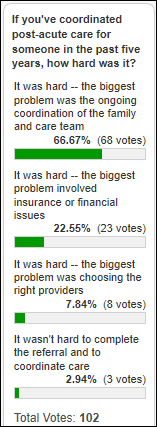
A convincing 97% of poll respondents who have coordinated post-acute care for someone said it was hard, with the biggest issue being trying to coordinate the activities of the care team and family. Some comments:

  • Vicki says organizations served only their own interests in caring for her family members, such as a SNF that wasn’t interested in helping find a home health provider other than the one it owns.
  • Clark’s experience with transitions from ICU to LTAC, SNF, home care, and therapy providers is that nobody every had current patient information, creating both frustration and danger.
  • Brittany’s experience with hospice care is that medical equipment wasn’t delivered, transportation was delayed, and nurses misunderstood the family’s wishes and kept the family member over-sedated in denying them the chance to have meaningful final moments together.
  • Another reader reports that they experienced excellent coordination at Johns Hopkins, but had a “consistently horrendous” experience at their own hospital, where they are a physician faculty member. HIM dragged their feet on providing an electronic copy of the medical records, obtaining images required two trips and upfront payment of fees, a chaotic discharge process created delays that necessitated rescheduling home health appointments, refrigeration-required antibiotics were delivered early when nobody was home, prescriptions were sent to the wrong pharmacy, hospital nurses argued with the family over the medication list in insisting that their computer must be correct, and the hospital ran out of common medical supplies.
  • Caregiver Informaticist says their family member’s care was never coordinated in several trips between LTAC and the acute care hospital, with no information sharing after being falsely told that the LTAC’s doctors round at the hospital and attend joint care planning meetings.

New poll to your right or here: What is the main cause of burnout among employees of health IT vendors and hospital IT departments? My experience working for a crappy vendor makes “all of the above” attractive, but let’s focus on the most important item on the list. For me, that was incompetent, uncaring managers who interfered with our productivity in trying to add value to processes they would never understand, poring over their MBA textbooks in their spiffy offices with the doors shut before emerging into the cube farm to make a lofty pronouncement that after applying their exemplary insight to our operation, they had figured out the solution to our problems (we had tried it before and failed, but saying so elicited scorn that what we had been missing then was their keen leadership). Worst of all, they had no healthcare background and thus nothing but contempt for our users and the patients who depended on our systems – we were just a widget factory that happened to sell healthcare software. I made an impassioned, stick-figure level plea to one of the suits about a patient-endangering software defect that I had laboriously documented urging him to simply allow us to notify all customers of the problem since we hadn’t yet figured out how to fix it. His answer: “We don’t owe those clients a damned thing.”


image

Monday is Memorial Day, created not to serve as a nonchalant kickoff to summer, but rather to set aside time to remember those who died while serving in the armed forces. It’s perfectly fine to pass on attending a ceremony or an increasingly rare Memorial day parade, but perhaps you know someone who lost a family member (especially if it happened within the past handful of years) who was serving and could drop them a quick email or social media acknowledgement of their loss. Here’s another idea – take flowers to a cemetery that has a section set aside for soldiers and leave one on each grave that doesn’t already have some.

In Flanders Fields
By John McCrae

In Flanders Fields the poppies blow
Between the crosses row on row
That mark our place; and in the sky
The larks, still bravely singing, fly
Scarce heard amid the guns below.

We are the Dead. Short days ago
We lived, felt dawn, saw sunset glow,
Loved and were loved, and now we lie
In Flanders fields.

Take up our quarrel with the foe:
To you from failing hands we throw
The torch; be yours to hold it high.
If ye break faith with us who die
We shall not sleep, though poppies grow
In Flanders fields.


Webinars

May 30 (Thursday) 2:00 ET. “ONC Data Blocking Proposed Rule: What Health Systems Need to Know.” Sponsor: Philips PHM. Presenter: Greg Fulton, industry and public policy lead, Philips. Proposed data-blocking regulations could specify fines, disincentives, and de-certification of providers who don’t provide an API for patients to extract all of their data. This webinar will describe who is deploying APIs, the scope of data and third-party apps that can be used, the seven costs that do not count as a data-blocking exception, and the health system protections that don’t involve using a vendor. It will also provide examples of data blocking and further exceptions.

Previous webinars are on our YouTube channel. Contact Lorre for information.


People

image

HHS promotes Jose Arrieta to CIO.


Announcements and Implementations

Lawrence General Hospital completes its implementation of Meditech Expanse under a fixed-fee implementation agreement with Santa Rosa Consulting.

image

A new KLAS report covering opioid prescription intelligence finds that all vendors reviewed performed well. PastRx tops the list in pulling PDMP data into the chart for physician review, while AffirmHealth and Collective Medical were praised in their respective regional pain management clinic and ED environments. Appriss Health and DrFirst were seen as less helpful in developing an opioid stewardship strategy since they work with users only indirectly.

In England, Guy’s and St Thomas’ NHS Foundation Trust issues a 10-year, $225 million tender for a enterprise EHR that will be used by up to 35,000 employees of three London-based trusts.


Government and Politics

SNAGHTMLf7bb2e8

The VA’s self-developed, open source workflow tool Light Electronic Action Framework (LEAF) wins a government health IT magazine’s innovation award. The team used the tool to develop a telehealth provider volunteer site for hurricane relief efforts (pictured above) within 24 hours.


Other

A data study finds that Canadian buyers of marijuana (where it is legal) avoid paying by credit card since they know their data is likely to be stored on servers in the US (where it isn’t legal). Also in play is that some employers enforce zero-tolerance policies for non-medical use. Canada’s own Office of the Privacy Commissioner recommends that buyers pay cash since the US government can access their credit card records without a warrant and could prevent them from entering the US.

I’m fascinated by this: Elon Musk’s SpaceX uses its Falcon 9 rocket to launch the first 60 low-Earth, 500-pound satellites of its $10 billion Starlink broadband service, which will offer inexpensive broadband connectivity to the northern US after six launches, the whole country after 12, and the entire populated world after 30. The company will use the revenue from the broadband service to fund its planned colonization of Mars.

image

An interesting op-ed piece by the co-founder of a clinician collaboration platform says that architects ruined healthcare by emphasizing grand, soothing aesthetics for visitors while eliminating the conference rooms and lounges where clinicians can interact with each other. He also opines that the Disney-created concept of hiding the “messy parts” of running a hospital means that the healthcare professionals themselves are the messy parts. He concludes that hospital design is now obsessed with distracting people from thinking about their health rather than making them healthy.

More evidence that Americans are too science-challenged to form rational healthcare opinions: people are OK with the widespread rollout of untested medical treatments, but object to randomized trials in which two equally acceptable treatments are applied to separate groups to determine which is better. Experts can’t explain the results, but think people might worry that consent is required from those who don’t get a particular treatment or that such tests should be unnecessary because experts should already know what works.

image

A third-year UTHealth medical school student who has undergone six brain surgeries, survived on artificial nutrition due to gastroparesis, and had a stroke that left her temporarily paralyzed from the waist down says the experience (along with deficits in her hand function from the stroke) has motivated her to consider a career in physical medicine and rehabilitation and neurology.


Sponsor Updates

  • Meditech; NextGate; Clinical Computer Systems, developer of the Obix perinatal data system; CereCore; CloudWave; Experian Health; PatientKeeper will exhibit at the 2019 MUSE Inspire Conference May 28-31 in Nashville.
  • Waystar will exhibit at the EClinicalWorks Education Expo May 27-31 in Boston.
  • The Chartis Group publishes a white paper titled “Bridging the Digital Divide in the Healthcare C-Suite: Positioning IT for Success in the New Health Economy.”
  • OmniSys and Surescripts will exhibit at the PioneerRx Connect 2019 May 31-June 2 in Orlando.
  • Relatient welcomes its 100th employee.
  • Sansoro Health releases a new 4×4 Health Podcast, “Intellectual Property for Entrepreneurs and Investors.”
  • The SSI Group will exhibit at the South Carolina HFMA Annual Institute May 28-31 in Myrtle Beach, SC.
  • PatientKeeper will demonstrate its EHR optimization solutions this week at E-Health in Toronto and MUSE Inspire in Nashville.
  • Community First Health Plans goes live with ZeOmega’s Jiva LTSS for long-term care.

Blog Posts


Get Involved


button


125x125_2nd_Circle

Text Ads


RECENT COMMENTS

  1. Would be interesting to see what Providence St. Joe's return has been on all their adventures. When I was on…

  2. It doesn't look like much more than a computer facing a wall!!

  3. Really interesting perspective — especially around the EHR market. What I’m seeing lines up with this: Epic keeps consolidating, Oracle/Cerner…

Founding Sponsors


Platinum Sponsors


Gold Sponsors


RSS Webinars

  • An error has occurred, which probably means the feed is down. Try again later.