Recent Articles:

Morning Headlines 8/20/19

August 19, 2019 Headlines Comments Off on Morning Headlines 8/20/19

US healthcare BPO may be valued at $225 million: PE firms in race to acquire emids Technologies

Several investment firms, including Everstone Capital and ChrysCapital Advisors, are in talks to buy Nashville-based health IT vendor Emids Technologies for between $200 million and $225 million.

athenahealth Appoints Simon Mouyal as Chief Marketing Officer

Simon Mouyal (Medidata Solutions) joins Athenahealth as chief marketing officer.

Two Chairs raises $21M to continue to build out its mental health clinics

Mental healthcare company Two Chairs will use a $21 million Series B funding round to expand its clinic footprint in California, and improve and expand upon its patient/provider matching technology.

Comments Off on Morning Headlines 8/20/19

Curbside Consult with Dr. Jayne 8/19/19

August 19, 2019 Dr. Jayne 1 Comment

clip_image003 

I wrote back in 2017 about the All of Us research program, sponsored by the National Institutes of Health. Originally they were trying to build a cohort of 1 million patients to help them look at genomic, clinical, and lifestyle data over a 10-year period. The New England Journal of Medicine recently published an update on the program’s progress.

Following the original beta program that I wrote about, All of Us opened for general enrollment in May 2018. Elements of the program include health questionnaires, EHR data, physical measurements, and the collection of biospecimens.

As of last month, more than 175,000 participants had contributed biospecimens, with more than 80% of those participants being from “groups that have been historically underrepresented in biomedical research. That’s a pretty big deal, since it’s difficult to recruit research subjects from certain subsets of our population. They’ve also collected EHR data on more than 112,000 participants from 34 recruitment sites. Should the researchers meet their goals, the robust nature of the data would allow researchers to explore factors related to individual lifestyle differences, socioeconomic factors, environment, and biology in order to better understand how we can prevent, diagnose, and treat diseases.

Having historically underrepresented patients join the program is great since those populations often have inadequate access to healthcare. Although some conditions can be linked to race and ethnicity, they’re only pieces of the puzzle. Other factors influencing health include age, sex, gender identity, sexual orientation, disability status, access to healthcare resources, income, educational level, ZIP code, and more. Researchers are prioritizing those underrepresented populations for physical measurements and biospecimen collection.

Unlike other data-gathering programs, All of Us doesn’t focus on any particular set of diseases like cardiovascular conditions or cancers. It seeks to create a broad data set that can be used for a variety of investigations, including outcomes research. Although they’re currently only enrolling adults with the ability to participate in an informed consent process, they’re looking at protocols for enrolling minors as well as adults who might be cognitively impaired. The materials are only available in English and Spanish, so it’s not a true cross section of the population, but the program is moving in the right direction.

The program has launched a web-based data browser where you can search concepts for some of the conditions and statuses being tracked. Although patients can only see their biometrics and survey responses, the researchers are working to build protocols to share genetic, laboratory, and EHR data back to participants. Priority will be given for actionable genetic information and pharmacogenetic results, delivered to those patients who have elected to receive that information.

Since the database is intended to be longitudinal, it will be interesting to see how many patients continue to participate over time. Since its inception, Congress has allocated $1.02 billion to the program, including funding for genome sequencing and setup of genetic counseling resources for participants receiving actionable results. The 21st Century Cures Act authorized funding through 2026 in the amount of $1.14 billion.

Another element that they’re still trying to work out is the incorporation of wearables data. Patients can share data gathered from Fitbit devices and investigators are looking at collection of data from other sources. Given the number and diversity of devices out there, they would need to support quite a few platforms to be able to get a good sampling. My extended family’s affinity for devices ranges from Garmin to Fitbit to Apple. Even with concerns about the validity of data from wearables, it’s interesting to note that simply having a wearable health tracker of any kind says something about a patient’s socioeconomic status and awareness of health issues.

One of the challenges noted by the authors is the incomplete nature of some of the EHR data, along with variability in that data. They are working to harmonize the data that they bring in from EHRs at recruiting institutions and are discussing ways to incorporate data from patients receiving care in rural settings. Health Information Exchanges might be another data source for those patients.

A quick tour through the online data browser illustrates some of the challenges of managing the data. The concept of diabetes can be rendered as the presence of disease, as a factor leading to adjustment of other lab values, and as a status identifier. There are also issues with EHR data in that it’s not always going to be complete enough to have the statistical power that you might find with data collected as part of a prospective trial. Still, it’s better than some of the current options, and I’m eager to see how things develop.

The biggest challenge they’ll have to face, however, is recruiting the more than 800,000 patients they still need to create their target population. It’s likely that in the early days of the program enthusiasm and awareness were high, resulting in the enrollments they already have. They’re going to have to stay on pace at the recruiting centers they already have up and running or dramatically expand the number of locations that can assist in the recruiting process.

Another option is to expand what they call direct volunteers, which are patients who come to the program from outside the designated recruiting centers. Reaching those folks who might be in rural areas or who just don’t come into care and are therefore less likely to be recruited requires different kinds of efforts. I haven’t personally heard anything about the program except from healthcare IT sources, and I’m constantly in and out of medical centers across the country. I’ve seen more signage about Ebola virus than I’ve seen about the program.

Given the size and breadth of our reader base, I’m hoping someone has first-hand experience with All of Us, either as a researcher or as part of one of the recruiting institutions. What has your experience been? How enthusiastic is the team? What can the rest of the healthcare community to do help you meet that million patient goal? Leave a comment or email me.

button

Email Dr. Jayne.

Morning Headlines 8/19/19

August 18, 2019 Headlines Comments Off on Morning Headlines 8/19/19
Starboard Value shrinks stake in Cerner

Activist investor Starboard Value, which scared Cerner into giving it board seats in a “cooperation agreement” in April 2019, has sold CERN shares as the price moves up.

Cape Cod Healthcare to build $180M patient tower on Hyannis Harbor

Cape Cod Healthcare will build a $180 million patient tower in Hyannis and will implement Epic.

The Patient Record Scorecard: What is it and Why we did it.

Consumer health data platform vendor Ciitizen rates hospitals on how well they respond to patient requests for copies of their own information.

Comments Off on Morning Headlines 8/19/19
Monday Morning Update 8/19/19

August 18, 2019 News 3 Comments

Top News

image

Consumer health data platform vendor Ciitizen rates hospitals on how well they respond to patient requests for copies of their own information.

It’s an interesting idea that isn’t well fleshed out in this initial effort due to a tiny, possibly non-representative sample size and reliance on self-reported hospital policies that were collected via a survey.

This limited information, along with anecdotal stories (such as my own), don’t paint a true picture. I would rather see the federal government (via HHS / CMS / ONC) provide a mandatory records request portal that requires the hospital to log its eventual actions (with timestamps) and allows patients to add comments or complaints. That bypasses the problem in trying to educate masses of consumers about the legal obligations of providers and how to file a complaint when they aren’t met.

Otherwise, hospitals seem happy with their contrived system of paper forms, in-person HIM department visits, faxed copies, and high fees since they don’t really want to share the data of patients anyway due to competitive and malpractice concerns.


Reader Comments

image

From ApplestoApples: “Re: JAMA article on Apple Health Records. It’s Apple-only and the highlighted use of FHIR is irrelevant. The next report should cover providers that offer a published mechanism for any vendor who wants to be a member, given the article’s prediction of an eventual ‘ecosystem’ (that number would be zero right now). Even better, how about limiting it to those providers who make the full EHR record of the patient available as HIPAA requires? Until the right to access records is not just the law and the subject of toothless Office for Civil Rights letters, HHS infographics and YouTube videos but also enforced, FHIR doesn’t matter. But definitely cool that JAMA gave us some pretty underwhelming Apple Health adoption data.” Agreed on all counts. The industry whines about proprietary solutions, then embraces the most proprietary technology vendor in touting Apple-only patient access to a tiny subset of their own Epic-only records (IOS represents less than half the US mobile device market). The article reports that only 0.7% of the patient portal users of the studied health systems have used Apple Health Records. It did not attempt to quantify any outcomes that resulted or the extent of ongoing patient use and for what purposes. I agree that health systems, including the Apple-partnering ones, make it difficult for patients to obtain electronic or paper copies of their complete medical records and HHS does nothing to make them comply with federal regulations.


HIStalk Announcements and Requests

SNAGHTML125b98bd

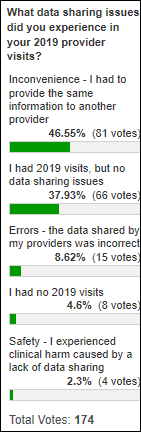
Most poll respondents found at least some forms of technology useful in their most recent provider visit, with the patient portal topping the list and the virtual visit bottoming it. I get the sense that few of us place a lot of value on the IT aspects of our provider encounters, while my previous poll results suggest that even fewer of us – even among my healthcare IT-centric readership who obsess over “Most Wired” type self-stroking awards — choose providers based on the technologies they use or even care one way or another.

New poll to your right or here: How proud are you of the largest healthcare system near you in terms of patient outcomes, community benefit, and financial practices? Click the Comments link after voting to explain.


Webinars

September 5 (Thursday) 2:00 ET. “Driving 90% Patient Adoption Across Your Network: How US Dermatology Partners is Showing Us The Way.” Sponsor: Relatient. Presenters: Michele Perry, CEO, Relatient; Sara Nguyen, VP of applications and integrations, US Dermatology Partners. US Dermatology Partners is helping its physicians reclaim time they can spend with patients and is turning patient engagement strategies into business results across its 90 locations in eight states. Attendees will learn how US Dermatology Partners defined its patient engagement objectives and physician-optimized strategies. They presenters will provide advice on starting or accelerating  patient engagement goals.

Previous webinars are on our YouTube channel. Contact Lorre to present your own.


Acquisitions, Funding, Business, and Stock

Activist investor Starboard Value, which scared Cerner into giving it board seats in a “cooperation agreement” in April 2019, has sold CERN shares as the price moves up.


Sales

  • Nebraska Health Information Initiative chooses InterSystems HealthShare for provider data-sharing.

Announcements and Implementations

Cape Cod Healthcare will build a $180 million patient tower in Hyannis and will implement Epic. Its most recent tax filings show a profit of $48 million on revenue of $871 million, with the CEO earning $1.6 million and the CIO $367K. I believe Cape Cod Hospital was an original Meditech site going back to the late 1960s, then switched to Siemens / Cerner Soarian in 2010.


Other

image

Sources report that informatics pioneer Donald Lindberg, MD has passed away. He was a pathologist, former director of of the National Library of Medicine, and the first president of AMIA, having focused on informatics since 1960. He was 85.

image

The New York Times profiles the thousands of outsourced workers who sit in cubicles India all day marking up medical images to train AI systems. It observes that the systems they are training may eventually reduce human employment, but in the mean time have created jobs that range from decent to exploitative. One woman’s entire workday was spent listening to recordings of people coughing to help train a diagnostic system. 

A commercial construction magazine previews “smart hospitals” that include such technology such as heart attack alerts that are triggered by patient alarms that then call the care team members, detect their locations, and then override elevator settings to get them to the patient’s room quickly. Engineering firms are also looking at ways to incorporate smart speakers.

A Nature op-ed piece says that the AI algorithms touted in research articles aren’t really usable by providers because: (a) they don’t change the incentives that led to optimizing processes for the current state; and (b) individual providers don’t have the technology and expertise to train the algorithms for local conditions and to test for bias. The authors draw a comparison with EHR “data liberation,” which sounds great but doesn’t happen because entrenched players are rewarded by the status quo. It concludes,

Health systems are faced with a choice: to significantly downgrade the enthusiasm regarding the potential of AI in everyday clinical practice, or to resolve issues of data ownership and trust and invest in the data infrastructure to realize it … the opportunity exists to both transform population health and realize the potential of AI, if governments are willing to foster a productive resolution to issues of ownership of healthcare data through a process that necessarily transcends election cycles and overcomes or co-opts the vested interests that maintain the status quo—a tall order. Without this however, opportunities for AI in healthcare will remain just that—opportunities.

An NHS hospital in Scotland apologizes to 400 patients whose discharge letter incorrectly indicated that they have cancer, an error the hospital blames on a computer system switchover.

image

Vermont State Rep. Ben Jickling resigns his seat (and his golf course day job) in accepting a job offer from Epic. The 24-year-old doesn’t appear to fit the usual Epic profile since he didn’t graduate from the small liberal arts college he attended.

image

Non-programmers won’t get this: a security researcher who bought a vanity license plate of “NULL” in trying to avoid getting traffic tickets by confusing California’s DMV system gets the opposite result – he has racked up $12,000 in tickets that were intended for other drivers whose tag number was accidentally omitted by the citing officer. The state’s ticketing subcontractor will cancel his individual tickets only if he can’t prove he wasn’t involved, potentially preventing him from renewing his registration. A Wired journalist named Christopher Null says he could have told the man that using the word “null” in any form is asking for problems because poorly tested programming often mishandles it.

A woman who boiled eggs in the microwave as instructed by YouTube videos is rushed to a hospital burn unit when the eggs explode upon removal, causing skin and eye damage that doctors worry could be permanent.


Sponsor Updates

clip_image001

  • Waystar donates over 100 used laptops to families in the Louisville area to help support tech education in underserved neighborhoods.
  • NextGate will exhibit at the 2019 SHIEC Conference August 18-21 in National Harbor, MD.
  • Netsmart will exhibit at the Florida Behavioral Health Conference August 21-23 in Orlando.
  • Clinical Computer Systems, developer of the Obix Perinatal Data System, will exhibit at the 6th Annual OBGYN Conference for Nurses and Physicians August 22-23 in Chattanooga, TN.
  • Diameter Health will exhibit at the SHIEC conference August 18-21 at National Harbor, MD.
  • Relatient expands its offerings in the Greenway Marketplace to include patient self-scheduling, patient intake, online payments, visit surveys, and two-way messaging.
  • Nordic posts a podcast titled “How to drive efficiencies between your ERP and EHR in OR and beyond.”
  • Surescripts will exhibit at the 2019 Aprima User Conference August 23-25 in Grapevine, TX.
  • TriNetX will exhibit at the International Conference on Pharmacoepidemiology & Therapeutic Risk Management August 24-28 in Philadelphia.

Blog Posts


button


Contacts

Mr. H, Lorre, Jenn, Dr. Jayne.
Get HIStalk updates. Send news or rumors.
Contact us.


125x125_2nd_Circle

Morning Headlines 8/16/19

August 15, 2019 Headlines Comments Off on Morning Headlines 8/16/19

Nurx Secures $52 Million to Expand Access to Sensitive Health Needs

Contraceptive and at-home STI testing telemedicine company Nurx raises $52 million in a Series C round led by Kleiner Perkins Digital Growth Fund and Union Square Ventures.

Accenture Federal Services Wins U.S. Navy Bureau of Medicine and Surgery Contract to Help Transform Healthcare Delivery for Sailors, Marines and their Families

Navy Medicine awards Accenture a $79 million contract for program and project management support for EHR optimization and health informatics, virtual health, and AI initiatives.

Computer blunder forces Queensland hospitals back to paper records

A handful of Queensland Health hospitals in Australia revert to paper for several hours after a routine overnight update to the state’s beleaguered IEMR system goes awry, making the medical records of male patients inaccessible.

Comments Off on Morning Headlines 8/16/19

News 8/16/19

August 15, 2019 News Comments Off on News 8/16/19

Top News

image

Navy Medicine awards Accenture a five-year, $79 million contract for program and project management support for EHR optimization and health informatics, virtual health, and AI initiatives.


Webinars

September 5 (Thursday) 2:00 ET. “Driving 90% Patient Adoption Across Your Network: How US Dermatology Partners is Showing Us The Way.” Sponsor: Relatient. Presenters: Michele Perry, CEO, Relatient; Sara Nguyen, VP of applications and integrations, US Dermatology Partners. US Dermatology Partners is helping its physicians reclaim time they can spend with patients and is turning patient engagement strategies into business results across its 90 locations in eight states. Attendees will learn how US Dermatology Partners defined its patient engagement objectives and physician-optimized strategies. They presenters will provide advice on starting or accelerating  patient engagement goals.

Previous webinars are on our YouTube channel. Contact Lorre to present your own.


Acquisitions, Funding, Business, and Stock

image

Ambrosia founder Jesse Karmazin says the anti-aging blood transfusion business has shut down for good. The company, which pitched transfusions of “young” blood to older people for $8,000 a liter, shut down for a few months earlier this year after receiving a warning letter from the FDA. Karmazin managed to get operations back up and running in two states, and now says he has started a new company called Ivy Plasma, which will offer transfusions from people of all ages.


Sales

  • Providence Health & Services (OR) will implement the Loopback Rx Platform from Loopback Analytics at its Credena Health pharmacy.
  • Quorom Health (TN) will implement Medhost’s clinical and financial software at 25 hospitals over the next 20 months.
  • HIEs OneHealthPort (WA) and Healthcare Access San Antonio select health data integration software from Diameter Health.

Announcements and Implementations

image

St. Claire HealthCare implements emergency department information exchange software from Collective Medical through a partnership with the Kentucky Hospital Association first announced last December.

image

Florida’s E-FORCSE PDMP uses technology from Appriss Health and Express Scripts to connect to the Military Health System PDMP, which now shares data and analytics with 39 state-based PDMPs.

image

The People-Centered Research Foundation will use data de-identification services from Datavant to securely link patient data across its National Patient-Centered Clinical Research Network. Organized with funding from the Patient-Centered Outcomes Research Institute, the network comprises 70 provider and payer organizations that share data for research purposes. Datavant added de-identification capabilities to its health data management services when it acquired Universal Patient Key last year alongside a $40 million funding round.

image

A new KLAS report covers payer care management, a term it uses to encompasses utilization management, disease management, case management, care coordination, and member engagement. ZeOmega and Cognizant are most often considered in new decisions, but VirtualHealth and AssureCare are making inroads as newer market entrants. Medecision is the vendor most often mentioned as potentially being replaced, while Casenet leads in overall satisfaction but is trending down due to missed expectations. 


Privacy and Security

image

Intraprise Health develops BluePrint Protect security software to help enterprises with third-party risk management.


Other

image

A handful of Queensland Health hospitals in Australia revert to paper for several hours after a routine overnight update to the state’s beleaguered IEMR system goes awry, making the medical records of male patients inaccessible. Hospital staff attributed the glitch to a later-than-normal start time.

image

Developers of the Anura app claim its machine learning technology can accurately assess a user’s heart rate, stress level, body mass index, blood pressure, and risk for heart disease and attack from a 30-second selfie using transdermal optical imaging. Research published last week in an American Heart Association journal found that the app could measure blood pressure accurately 96% of the time.


Sponsor Updates

  • Elsevier Clinical Solutions will exhibit at NACDS TSE 2019 August 24-26 in Boston.
  • EClinicalWorks will exhibit at the East Hawaii IPA Annual Healthcare Symposium August 16-18 in Waimea.
  • Ellkay, Imat Solutions, and InterSystems will exhibit at the 2019 SHIEC Conference August 18-21 in National Harbor, MD.
  • Ensocare will exhibit at the ACMA Florida Chapter Annual Conference August 22-23 in Championsgate, FL.
  • Hayes Management Consulting names Craig Surette (Athenahealth) senior solutions engineer and William Heuschneider (Athenahealth) client success manager.
  • HCTec Marketing and Sales Operations VP Rob Borella joins the Tennessee HIMSS board.
  • Imprivata makes Identity Governance available to customers working with Microsoft Azure Active Directory.
  • Nordic releases a new podcast, “How to drive efficiencies between your ERP and EHR in OR and beyond.”

Blog Posts


button


Contacts

Mr. H, Lorre, Jenn, Dr. Jayne.
Get HIStalk updates. Send news or rumors.
Contact us.


125x125_2nd_Circle

Comments Off on News 8/16/19

EPtalk by Dr. Jayne 8/15/19

August 15, 2019 Dr. Jayne 1 Comment

EHR vendors, get ready to make some updates: The US Preventive Services Task Force (USPSTF) plans to recommend screening all adults for illicit drug use, including inappropriate use of prescription drugs. The draft recommendation statement is open for public comment through September 9. As an EHR client, we expect these kinds of recommendations to play out in our EHR as soon as they’re published, but for many vendors it’s a long road between when a recommendation is issued or a guideline is updated and when it actually is in the hands of the majority of their clients. I’d be interested to hear from vendors how they approach these types of updates and how quickly they can get them to the point of care.

Speaking of recommendations and regulations that never become reality, here comes yet another delay for implementation of the Appropriate Use Criteria for advanced diagnostic imaging that was initially passed in 2014. NPR reports that the delay will continue, with 2020 as a “testing” year where Medicare will not block inappropriate scans. CMS won’t make a decision until 2022 or 2023 on whether (and when) penalties will begin. The reality is that Medicare and other payers continue to pay for unneeded diagnostic exams. These exams are often ordered because patients demand them, even though they show low clinical utility. Physicians increasingly worrying about being “dinged” on patient satisfaction scores that go along with it, often under duress. Advanced imaging services are a profit center for many medical institutions and physicians chafed at the idea that they’d have to log additional keystrokes in the EHR to document compliance with the criteria.

A friend of mine who used to work in corporate IT has recently moved into the world of healthcare IT. I’ve been enjoying his reactions as he learns about all the crazy stuff that we have to deal with, including managing claims, handling capitation payments, and more. He recently visited a practice that was processing data using stacks of papers to trigger the workflow and track who was doing the work. I’m thinking about prescribing him some muscle relaxers to counteract the ill effects of all the head shaking he’s probably doing. It’s always amusing, but sad in many ways, to watch someone experience the dirty underbelly of healthcare. It’s a mix of shock, disbelief, and outrage. Those are the same emotions I’m feeling while I read “Code Blue: Inside America’s Medical Industrial Complex” by Mike Magee. I had started it prior to my international medical adventures and resumed the read after hearing from my fellow volunteers. Hearing from them about how healthcare is delivered with lower cost and higher quality in their countries just makes my blood pressure rise. I sold any stock in EHR vendors long ago, but will be divesting some remaining pharma investments shortly. Shareholders are part of the problem, not the solution.

Corporate profiteering is everywhere, and I experienced it in another conversation today. One of my residency colleagues went to work last year for a group that does Direct Primary Care as an employee benefit. She’s been enjoying the work, especially the part where she has an hour for new patient visits and 30 minutes for regular visits, and feels like she actually has time to partner with her patients to improve their health. She wanted me to know that her company is expanding to my area and to see if I was interested in a referral to their recruiter. Since that’s a major aspect of primary care that I miss in my current clinical practice, I said I was game.

She proceeded to tell me a little more about the company, including that they were recently purchased by a PE firm and that there has been the addition of a good number of VPs that don’t seem to do anything but have titles in sales, marketing, and operations. That’s part of why and how they’re expanding; the PE money is an infusion but also increases the need to create some revenue from the system. Although their profit is largely driven by the difference between what the employers pay and the services the patients use, she agrees it’s only a matter of time before the nature of the practice changes. For providers in the trenches, though, it’s a difficult balance between practice paradigms that have good elements but some features that are unsettling. Her final thought was that it’s still better than the HMO she used to work for, so I guess there’s that.

image

I’ve always wanted to visit Spain, and I wish I was still doing a reasonable volume of lab work so I would have justification to attend the upcoming LOINC Conference outside of Barcelona. Both the Laboratory and Clinical LOINC Committees will be at the same meeting for the first time, and the conference fee is low compared to other organizations. For those of you heading to the sun-drenched Mediterranean, enjoy!

The next couple of months are full of meetings and functions. ONC is hosting an interoperability forum  August 21-22 that has a good-looking agenda, but there are too many parallel tracks – I wouldn’t be able to pick just one to attend. There’s also a symposium on September 6 around patient matching for prescription drug monitoring programs. This also starts the User Group meeting season, beginning with the Aprima User Conference from August 22-25 in the Dallas area. I hear that’s a fun one, but have never been able to make it work with my schedule.

New Hampshire becomes the latest state to expand telehealth services, with Governor Chris Sununu signing a bill expanding the scope of services covered under Medicaid. Previous regulations limited telehealth services to specialists, but the new law mandates coverage for virtual primary care, remote patient monitoring, and substance abuse disorder treatment as long as the patient has already established care face-to-face. The definition for “originating sites” for those face-to-face services has been expanded from medical offices to include “the patient’s home or another nonmedical environment such as a school-based health center, a university-based health center, or the patient’s workplace.” It’s not as expansive as providers might like, but it definitely helps the state move forward. The law also creates definitions around asynchronous telehealth for non-urgent issues, which will help provide services when video visits might not be realistic.

I skim a lot of journals and publications, but have to admit I wasn’t aware of the Renal & Urology News before a reader sent me this snippet: A recent study looked at referral patterns at Wake Forest School of Medicine and found that patients with rare genetic conditions might be more likely to refer themselves to an academic medical center based on information they find on the Internet. The authors noted that primary care physicians might not be aware of certain rare conditions, so “If patients suspect a rare disorder that is undiagnosed by their physicians, actively pursuing self-diagnosis using the Internet can be successful.” Dr. Google, take note.

button

Email Dr. Jayne.

Morning Headlines 8/15/19

August 14, 2019 Headlines Comments Off on Morning Headlines 8/15/19

Grays Harbor Community Hospital Provides Notice of Recent Ransomware Attack

Grays Harbor Community Hospital and Harbor Medical Group in Washington confirm that a ransomware attack caused their downtime in June.

The founder of a startup that charged $8,000 to fill your veins with young blood says he’s shuttering the company and starting a new one

Controversial blood transfusion startup Ambrosia shuts down for good after receiving an FDA warning that prompted it to close its operations in all but three states earlier this year.

Ancestry’s CEO signals a major healthcare play is on the horizon

Genealogy and consumer DNA testing company Ancestry is actively building out its health team as it prepares to move into precision medicine.

Comments Off on Morning Headlines 8/15/19

Morning Headlines 8/14/19

August 13, 2019 Headlines Comments Off on Morning Headlines 8/14/19

Mercy’s Tech Arm Launches a Nationwide Real-World Evidence Network to Pool Clinical Data for Advanced Analysis

Mercy Technology Services launches a real-world evidence database in which de-identified data from a consortium of health systems will be sold to drug and medical device manufacturers.

Microsoft welcomes new Chief Medical Officer Dr. David Rhew

David Rhew, MD (Samsung Electronics) joins Microsoft as chief medical officer/VP of healthcare.

Q-State Biosciences and 2bPrecise Announce Partnership

Allscripts backs a partnership that will combine the precision medicine data tools of 2bPrecise (in which Allscripts is the primary investor) with those of genetic sequencing vendor Q-State Biosciences.

Comments Off on Morning Headlines 8/14/19

News 8/14/19

August 13, 2019 News 4 Comments

Top News

image

Mercy Technology Services launches a SAP-powered real-world evidence database called Real-World Evidence Insights Network in which de-identified data from a consortium of health systems will be sold to drug and medical device manufacturers.

Providers will be paid each time the data of their patients is accessed by a subscriber’s query. They can also use the analytics-generated evidence to help make their own business and clinical decisions.

The network will initially focus on orthopedics, cardiology, and oncology.

MTS notes that the SAP HANA database – which took 10 years to create – uses natural language processing to extract information from physician notes to provide deeper clinical intelligence.

Mercy previously announced three medical device manufacturers as customers of its own patient database – Johnson & Johnson Medical Devices, Medtronic, and BD.


Reader Comments

From I Was There: “Re: Vince Ciotti’s HIS-tory. I see quite a few inaccuracies that might only be noticed by those of us long-timers who have moved on.” Vince covered a massive amount of HIT ground going back five decades, so he has always solicited corrections and clarifications from those whose personal experience gives them a sharper memory into long-faded details. I’m sure he would still enjoy hearing from anyone who notices mistakes or can add their own interesting stories. Email him at vciotti@hispros.com and we will append your new information. Many of the industry’s pioneers from the 1970s and 1980s have retired, left the industry, or in some cases, passed away, so this is the last best hope to get the history nailed down for posterity.

From No See-Ums: “Re: paywalled newspaper and journal articles. Your links to them are frustrating since I can’t read them.” I link to paywalled articles only if I can find a reliable summary or abstract posted elsewhere since I can’t see them, either. I’m unwilling to pay for a subscription to a local or specialized publication that I would rarely use, which always leads me to conclude that someone should either sell a mass subscription or charge a low national price for reading just one article (vs. the high price that medical journals charge). The danger of ITunes-like news is, of course, that it would encourage the same bad practices for journalism as it did for music, unleashing a flood of clickbait and populist drivel. Craigslist,  Facebook, and vulture capital firms helped kill dead tree publishers, but their biggest problem is the lack of ongoing demand for intelligent, accurate news reporting. 

From Post-Acute Pat: “Re: post-acute healthcare market. I’ve been reading your site since 2010 and your blurb about hospice /nursing homes and Gordon Gekko was spot on. I don’t think the average person understands how private equity has gobbled up the entire post-acute market and none of them care about the patient or HCAHPS. I work for a huge, PE-owned home care and hospice provider that keeps merging with other PE-owned companies. See the attached email from our CEO, which came out right after we had massive layoffs, raises were cancelled, 401K match was eliminated, and hospice services such as music and physical therapy were eliminated and telehealth was greatly reduced to meet only payer contract minimums. Our PE owners require a 10% annual return and anyone who says that isn’t possible are shown the door.” The RN CEO urges his underlings to focus on revenue generation, earnings, and cash collections. That’s not unlike his non-profit health system peers, however. All of us pretend that when we need care, it’s going to be like in those golden, pre-Medicare years in which healthcare was run by empathetic locals who felt a calling to alleviate the suffering of their fellow citizens under a self-imposed honor system in which hospitals were modestly-run charities. Now it’s all about profits, cash hoarded to buy up (and screw up) competitors, or construction companies called in to soothe the organizational Edifice Complex with phallic towers. Odds are good that the first and last people you’ll see in your life are employees of profit-obsessed organizations. In between, you will be bounced around profit-maximizing health systems, clinics, insurers, drugstores, drug and device manufacturers, and ambulance services until either your health or your health insurance runs out. Then it’s off to PE-owned nursing home, hospice, home health, or rehab until finally your cooling corpse is trucked off to a PE-owned funeral home. Some or most of the frontline people will serve as a credit to their chosen profession and calling, sometimes defiantly treating patients in do-unto-others mode instead of how the corporate whip-crackers demand. Unfortunately, faceless money-lenders impact our life as Americans a lot more than we realize.  


Webinars

September 5 (Thursday) 2:00 ET. “Driving 90% Patient Adoption Across Your Network: How US Dermatology Partners is Showing Us The Way.” Sponsor: Relatient. Presenters: Michele Perry, CEO, Relatient; Sara Nguyen, VP of applications and integrations, US Dermatology Partners. US Dermatology Partners is helping its physicians reclaim time they can spend with patients and is turning patient engagement strategies into business results across its 90 locations in eight states. Attendees will learn how US Dermatology Partners defined its patient engagement objectives and physician-optimized strategies. They presenters will provide advice on starting or accelerating  patient engagement goals.

Previous webinars are on our YouTube channel. Contact Lorre to present your own.


Acquisitions, Funding, Business, and Stock

image

Allscripts backs a partnership that will combine the precision medicine data tools of 2bPrecise (in which Allscripts is the primary investor) with those of genetic sequencing vendor Q-State Biosciences. Q-State co-founder and board chair David Margulies, MD was the first CIO at Boston Children’s Hospital in the late 1980s and served as a Cerner executive from 1990 to 1996. 2bPrecise leadership is mostly folks from the Allscripts-acquired DbMotion. MDRX shares dropped in an up market following the news.

Point-of-care pharma promotional platform vendor OptimizeRx reports Q2 results: revenue up 37%, adjusted EPS $0.09 vs. $0.07. The company said in the earnings call that it has integrated with Epic and Cerner to present in-workflow patient savings opportunities, broadening its EHR reach following a previous agreement and integration with NextGen Healthcare.  

Business Insider reports that consumer DNA testing and family history company Ancestry will follow the lead of competitor 23andMe in offering genomics and individualized medicine products.

Performance-based collaboration platform vendor Apervita acquires Qcentive, which offers technology to support value-based contracting and payments.

Specialty-specific EHR/PM vendor Compulink acquires contact lens ordering site MyEyeStore, which optometrists and ophthalmologists can use to sell other retail products.  


People

image

Struggling drugstore chain Rite Aid hires as its new CEO Heyward Donigan, who was previously CEO of healthcare shopping app vendor Sapphire Digital, formerly known as Vitals. RAD shares dropped 5.3% Tuesday after the announcement, down 77% in the past year vs. the Nasdaq’s 2.6% gain, valuing the company at $357 million.

image

David Rhew, MD (Samsung Electronics) joins Microsoft as chief medical officer/VP of healthcare. 


Announcements and Implementations

image

England’s Basildon Hospital rolls out Maternity Direct, a chat application that connects pregnant women with an NHS registered midwife who can answer questions and offer advice at no charge. Basildon and Thurrock University Hospitals NHS Foundation Trust developed the app along with software developer Acadiant.

image

A new KLAS report on enterprise-level medication inventory management (MIM) finds that Omnicell’s optimization analytics solution leads the pack, although it has been implemented by only a few customers due to cost, the breadth of underlying Omnicell products that is required, and Omnicell’s need to educate prospects on the goals of MIM and how it is supported by the company’s IV room and robotic dispensing systems. Problems with newer versions of Omnicell’s automated dispensing cabinets have also led to customer wariness. KLAS says Epic’s Willow Inventory MIM isn’t used much because of limited reporting and par management capabilities that force customers to use the inventory systems of their equipment vendor. Cerner customers “have primarily been left to drive development themselves” and the company hasn’t integrated its own RxStation dispensing cabinet with its MIM software.

image

Clinical Architecture releases Pivot, a turnkey data interoperability and data quality solution that processes inbound messages (in FHIR, CDA/C-CDA, HL7, and customer formats); applies Symedical normalization NLP, and clinical reasoning; and then delivers an outbound message that meets the requirements of the receiving system.

image

CHI Franciscan Health opens the analytics-powered Mission Control Center in its clinic in Gig Harbor, WA, from which the health system will monitor patient care and capacity in eight of its hospitals. GE Healthcare is the health system’s partner on the project.


Government and Politics

CompuGroup Medical lauds the ruling of a federal appeals court in favor of the American Clinical Laboratory Association, which sued HHS in claiming that its implementation of the Protecting Access to Medicare Act (PAMA) oversteps its authority in collecting market-based lab data to set Medicare payments. ACLA says HHS’s exclusion of hospital labs via a change to the “majority of revenues” test will skew its market studies. The case will go back to the district court.


Other

image

A Stanford School of Medicine study finds that privately insured patients are billed out-of-network charges in 43% of ED visits, 42% of inpatient admissions, and 86% of ambulance rides. Admitted inpatients faced a median surprise bill of $2,040, well beyond the financial resources of most of them. The study looked at claims data through 2016, so It’s probably reasonable to assume that the situation has worsened since. It’s interesting that more than 900 hospitals issued surprise bills for more than 90% of their ED visits, which one might speculate is an intentionally hospital-designed feature rather than a bug.

A newspaper’s investigation finds that Tennessee’s health department knew that Nurse Practitioner Jeffrey Young, who calls himself “Rock Doc,” was working without a doctor’s supervision, writing high numbers of opioid prescriptions, and having sex with patients that was described as “non-consensual,” but they didn’t shut him down during a four-year investigation. The state’s lead investigator admitted that she started carrying a gun to work after questioning Young about a patient’s overdose death. A follow-up article promises to disclose that Young was providing prescriptions to local police officers in return for favors. Young has been indicted by the federal government for prescribing 1.4 million opioid pills and 1,500 fentanyl patches in three years, after which a drug company sales buddy texted a death threat to the DEA’s lead investigator. “Rock Doc” also starred in a failed reality TV show pilot called “Rock Doc TV,” in which he kinds of looks like talentless but likeable TV food hack Guy Fieri while rapping against his “haters” who spread stories about him.

A Wall Street Journal report notes that health systems such as Geisinger, Mount Sinai Health System, and Mayo Clinic are selling the genetic profiles of patients to drug companies, reaping hundreds of millions of dollars without the patient’s knowledge or approval. 

image

Cerner locks down its Continuous campus in Kansas City, KS after a man armed with an assault rifle claims to have killed his wife and says he’s going to the adjacent outlet mall next. He opened fired on responding police officers, who killed him. Nobody else was injured, although the man’s wife has been missing since Monday morning.

SNAGHTML19f44ecf

A woman whose breast cancer required two surgeries and 20 rounds of radiation sues faith-based health-sharing ministry Aliera Healthcare, which is one of several companies that regulators in several states say are sham operations designed to bypass insurance regulations. Aliera refused to pay for the woman’s first surgery, for which the hospital billed her $195,000, saying her breast cancer was a pre-existing condition. Her attorneys say the company spends only 30% of its $180 million in annual revenue on medical bills, the rest being pure profit. Aliera responded to a TV station’s inquiry, “Healthcare sharing ministries provide members with a more flexible method for securing high-quality healthcare at an affordable price, something that is more important than ever to Texas residents who face increasing costs for traditional health insurance.” Washington’s state insurance commissioner fined the company $1 million last week, while Georgia has forwarded complaints about it to the FBI.

image

An man who made several ED visits for swallowing problems finally gets an accurate diagnosis eight days later – he had swallowed his false teeth during minor surgery. The dental appliance was then surgically removed, but repeated bleeding required further hospitalizations, blood transfusions, and emergency surgery for a torn artery.


Sponsor Updates

  • Aprima will host its annual user conference August 23-25 in Grapevine, TX.
  • Datica co-founder Travis Good, MD will speak at a Catalyst HIT Lunch & Learn on August 28 in Denver.
  • Diameter Health becomes the first organization to earn EMeasure certification from NCQA and ONC.
  • PMD successfully completes its second SOC 2 and HIPAA security audits.
  • CarePort will exhibit at ACMA Florida August 22-23 in Champions Gate, FL.
  • CompuGroup Medical responds to the Court of Appeals ruling in support of the American Clinical Laboratory Association.
  • Cambia Health Solutions features Collective Medical CEO Chris Klomp on its HealthyChangers podcast.
  • Clinical Architecture will exhibit at the 2019 SHIEC Annual Conference August 18-21 in National Harbor, MD.
  • Culbert Healthcare Solutions will exhibit at East Coast CORE August 14-16 in Boston.

Blog Posts


button


Contacts

Mr. H, Lorre, Jenn, Dr. Jayne.
Get HIStalk updates. Send news or rumors.
Contact us.


125x125_2nd_Circle

Morning Headlines 8/13/19

August 12, 2019 Headlines 1 Comment

Akira Health Acquired by Telus Health

Canadian health IT company Telus Health acquires Toronto-based Akira Health, which offers app-based and in-person care.

CHI Franciscan introduces new healthcare hub at its acute care hospitals

CHI Franciscan (WA) goes live with a new Mission Control Center that uses predictive analytics from GE Healthcare to streamline patient care at eight of its hospitals.

Internet Brands’ WebMD Acquires QxMD

WebMD acquires QxMD, a Canadian company that offers providers digital point-of-care educational resources and medical calculators.

These health-tech veterans want to avert the next Theranos disaster with ‘medical diligence’

Former 23andMe VP Ruby Gadelrab and former Color Genomics CMO Jill Hagenkord, MD launch MDisrupt to help investors thoroughly vet health IT companies looking for financing.

Curbside Consult with Dr. Jayne 8/12/19

August 12, 2019 Dr. Jayne Comments Off on Curbside Consult with Dr. Jayne 8/12/19

clip_image003 

I had lunch with an old friend today and was surprised to learn that he has engaged with a telehealth client. Although he’s a database guy at heart, he’s also got a mind for developing solutions, and that’s how he wound up in the space.

He’s working for a group that is developing chatbot technology for health systems that want to incorporate asynchronous visits into their offerings. Rather than just script out various scenarios, however, they’re working to leverage existing data to design responses and offer care to patients, so I was intrigued. Right now they have some flexibility since they aren’t billing for the service (it’s being offered as a perk of being a patient in the practice) and don’t have to worry about checking boxes for claims and billing. It will be interesting to see where things go.

Telehealth is definitely at the forefront of many organizations’ strategic plans. Whether you’re a dedicated telehealth vendor or a practice looking at it as a solution to reduce revenue leakage, if it’s not part of your plan, you need to be thinking about it.

Physicians are looking at telehealth as a way to improve their work-life balance. Although many have been doing the equivalent of after-hours visits for free for decades, they’re now looking to be paid for their services and compensated for their time away from family (or away from sleep, in many cases).

Patients are also highly interested in telehealth from a convenience standpoint, although they’re not always well versed in whether the services are going to be covered. I’ve seen some backlash from patients concerned about being billed for a visit that they didn’t really consider to be a visit, since in the past they had talked to their physician after hours for free. There will definitely need to be education on what services are truly telehealth vs. phone calls after typical office hours.

As a physician who has started to deliver telehealth visits, I’ve found it challenging. You have to use different skills than you might in a face-to-face encounter, even if video is enabled. There are subtle differences in the interaction, and I feel like I’m drawing a lot on my experience as a physician in making sure I’m not missing anything.

As residency programs issued their new graduates at the end of June, I’ve heard of several new grads that are going straight to telehealth without ever having had a face-to-face practice. I remember how uncertain I was as a new grad in solo practice and didn’t have colleagues to bounce things off of. I would think that feeling would be magnified for a new grad, especially if their residency program didn’t really prepare them for telehealth. I don’t think there are that many programs that do, at least not in family medicine. If there’s any mention of telehealth, it’s as an adjunct to the traditional physician-patient relationship, not as a standalone.

Physician specialty organizations are eager to push back at the idea of standalone telehealth. The American Academy of Family Physicians recently highlighted a study about the value of the physical exam. The group describes the physical examination as “central to the relationship between physician and patient for millennia,” but notes recent “skepticism about tis role in patient care.” Researchers looked at a very small (16) set of family physicians to understand how they perceived physical examination experiences and what those physicians identified as objective and subjective benefits of the exam as part of patient care. Some described the actual examination as critical, with one saying that providers who don’t conduct exams are not good doctors. Others said they used the exam to confirm or disprove their suspicious after discussing the history of the present illness. One physician said there was an expectation to perform an exam, and therefore doing it helped build the relationship.

I have a different take on exams after staffing the World Scout Jamboree. Our exams there were entirely dictated by physician preference and the patient’s presentation, with no consideration given to billing, body systems, or bullet points. Some of our patients were healthy teens with self-limited problems that dictated a minimal exam, while others were diagnostic dilemmas that required more.

On the world stage, at least in that environment, I don’t think that doing more vs. less made a difference to the patients. One of my Swedish colleagues at the Jamboree noted that physicians there do a minimal exam. The focus is more about sitting down and talking through things rather than the laying on of hands, at least in his experience.

The study authors also note the emotions felt by physicians during the physical exam, especially when assessing sick patients. They also reveal their own emotions by saying that “we should not dismiss physical examination as nostalgia” in favor of technology.

I suspect that physicians that perform minimal exams in the face-to-face setting are doing so because it’s clinically appropriate. I too often see people examining unrelated body parts just out of habit or because they think they need to, regardless of whether it will affect the care plan. This is difficult to address when precepting students, but an important topic as we look at evidence and data-driven approaches to care.

I had a teacher once who insisted that no physical exam was complete without a rectal exam. He legitimately expected the interns to perform that exam on every single inpatient. Several of us refused, citing the odds of finding an incidental rectal cancer as completely out of balance with the invasive nature of the procedure and the discomfort caused to patients. That’s an extreme example, but I also see students and new grads that examine thyroid glands on every patient, just because it’s habit and regardless of the chief complaint.

Mysticism and romanticization of the exam aside, sometimes you just don’t need to see the patient, let alone examine them, and it’s entirely possible to deliver quality care without laying on of hands. That’s going to be difficult for many audiences to accept.

Pediatricians are also coming out with concerns about telehealth, particularly regarding over-prescription of antibiotics. That’s not been my experience as a telehealth provider, where the degree of antibiotic stewardship is highly visible and frankly much more strict than my face-to-face practice. I’m sure there are bad actors out there, but painting everyone with the same brush isn’t ideal. I also see plenty of traditional family medicine docs who call out a Z-Pack for upper respiratory infections even if the infection is most likely viral. I see those patients in the urgent care setting when they complain that their antibiotics didn’t work, and get to spend plenty of time counseling them on the differences between bacteria and viruses and exactly why their antibiotics didn’t work.

It’s important to also note that not all telehealth is direct to consumer. Some services are offered as part of a traditional practice, others are arranged by an employer, and still others are funded by insurance companies and other payers looking to keep costs down. It’s a complex solution that isn’t one size fits all and doesn’t always fall under similar models. The only thing I know for sure is that telehealth isn’t going away anytime soon.

How aggressively does your organization track antibiotic stewardship? Leave a comment or email me.

button

Email Dr. Jayne.

Comments Off on Curbside Consult with Dr. Jayne 8/12/19

Morning Headlines 8/12/19

August 11, 2019 Headlines Comments Off on Morning Headlines 8/12/19

Mueller: Centra’s Billing a Top Priority

The president and CEO of Centra Health (VA) apologizes to the community for billing problems that followed its September 2018 rollout of Cerner, which it also blames for recent operating losses.

Nuance Communications (NUAN) Q3 Earnings and Revenues Top Estimates

Nuance reports Q3 results, noting that although its healthcare revenue increased 2%, its HIM and EHR implementation businesses underperformed.

Gates Foundation snaps up top Apple Health researcher to run a new digital health group

Apple healthcare expert and radiation oncologist Andrew Trister, MD, PhD leaves the company after three years to join the Gates Foundation, where he will help US digital health entrepreneurs take their products to the developing world.

Comments Off on Morning Headlines 8/12/19

Monday Morning Update 8/12/19

August 11, 2019 News 5 Comments

Top News

image

From Thursday’s Allscripts earnings call:

  • Two Paragon accounts added ambulatory as part of their contract extension in the quarter, with 20 clients having signed long-term agreements since the Paragon business was acquired from McKesson in late 2017.
  • Two clients bought Sunrise, 61-bed San Gorgonio Memorial (CA) and an 1,100-bed hospital in the Philippines.
  • The company is negotiating a contract extension with its biggest customer, Northwell, and expects a decision to made by the end of the year.
  • Allscripts says it knew that the Department of Justice was investigating Practice Fusion pre-acquisition, and while the $145 million settlement amount “is not insignificant,” it is in line with settlements made by other EHR vendors that were under similar investigation and paying a settlement will allow Allscripts to put that history behind it.
  • Allscripts expects that “recoveries from a variety of third parties” will “help offset a portion of the amounts” of the $145 million DoJ settlement that is being negotiated.
  • Paul Black says that the company’s expansion into the high-growth payer and life sciences markets distinguishes it from its EHR peers.
  • The company continues to seek “strategically priced M&A” to drive growth.
  • Allscripts says its ZappRx and HealthGrid acquisitions haven’t made a significant impact on revenue so far.
  • The company is happy with its retention of the former Practice Fusion customers.

Allscripts shares dropped 4% Friday after the report.

The all-time high for MDRX was in early 2000, with shares since having shed 88% of their value. A $10,000 investment in Allscripts five years ago would be worth $6,456, while putting the same money into Cerner shares then would be worth $12,000 today.


Reader Comments

From Imbued Dignity: “Re: patients participating in vendor product design and conferences. Aren’t all of us patients?” We are at one time or another, so “patient” in terms of industry involvement should probably mean “not working in health-related job.” So-called patient advocates (perhaps better labeled as “patient-advocates”) may add some value in hailing from outside the industry  — at least until they make a fill-time job from vendor payments — and may have gained more exposure to our system since they have chronic conditions. We all have our personal expectations and aspirations for healthcare and can obviously see (and say) when they aren’t being met, but we sometimes respond better to heart-tugging or indignation-raising stories about the frequent occurrences of where the system fails. Absent that aspect, we wouldn’t need patient advocates any more than we need advocates for using Facebook or paying the electric bill. The fact that healthcare and health IT executives are shocked, saddened, or motivated by the personal stories of patient advocates means that they are hidden away in their ivory tower. They just need to talk to real people, including their own employees. They also need to retain empathy after the heart-tugging speech is over, which may be their biggest challenge. Healthcare organizations and their executives may express support for a well-told patient story pointing out how the organization failed them, but I’m not too sure they go back home and actually fix the problems.

image

From Craniotomy: “Re: physician assistant buying a closed hospital. What’s your guess as to why?” He got a big-footprint commercial building for just $200,000 in the form of closed Cumberland Regional Hospital, most likely wildly underpriced because it’s located in a rural area where specialized real estate demand and investment money is limited, so he has a lot of options for expanding his own clinic business and bringing in other healthcare tenants. He can also cherry-pick the most profitable parts of the unprofitable hospital’s business – probably the ED, which was also the service most valued by the community – without trying run run acute care or skilled nursing beds. PA Johnny Presley also just offered $1 million for the closed Jamestown Regional Medical Center, which is next door to a clinic he owns. Tennessee is a certificate-of-need state, so he says he will apply to reinstate some JRMC services, such as a freestanding ED, outpatient diagnostic center, and surgery center. It seems that he’s just interested in the real estate and not the hospital or home health license, so hopefully he won’t follow the steps of others elsewhere who made big promises about saving a rural hospital and then used it purely as a billing machine for lab claims that are paid at higher hospital rates. Local politicians are in a tough spot when a hospital closes and thus displaces a bunch of employees who vote, given them obvious urgency to get it re-opened under whatever terms and/or vague promises they can get. 

image

From Exec Checker: “Re: Athenahealth. How much of the executive team remains from its days as a publicly traded company?” Not much. Veritas acquired the company in February 2019 and the eight-member executive team is mostly new – only one member joined the company before 2016. A couple of the execs have some healthcare experience, but the rest (including Chairman and CEO Bob Segert) do not. Here’s your “where are they now” moment looking back a few years vs. LinkedIn now:

  • Jonathan Bush, chairman and CEO – no current job listed.
  • Kyle Ambrester, SVP and chief product officer – CEO of Signify Health (clinical and social care coordination).
  • Dan Haley, SVP /general counsel – no current job listed.
  • Diane Holman, SVP/chief people officer – no current job listed.
  • Stephen Kahane, MD, president – no current job listed.
  • Prakash Khot, EVP/CTO – co-founder and CTO of Prekari Labs (privacy software).
  • Timothy O’Brien, chief marketing officer – CEO of Groups Recover Together (addiction treatment).
  • Jonathan Porter, SVP of network services – no current job listed.
  • Todd Rothenhaus, MD, chief medical officer – CEO of Cohealo (health system capital equipment software).
  • Karl Stubelis, SVP/CFO – CFO of Data Intensity (managed cloud services).

image

From The Usual Usury: “Re: Meditech. You didn’t offer your opinion when the reader asked about what they should do to grow.” That’s a tough one. Their sweet spot is small to mid-sized hospitals that want a proven, functional, full-hospital system whose upfront and annual maintenance costs are a lot less than those of Cerner and Epic. That’s Meditech, but the problem is that those prospects  are either (a) being acquired by large health systems, or (b) are also prospects for running Cerner or Epic as either a remote-hosted or client-hosted service offering, which also gives them easy connectivity to the larger health systems that almost always run Cerner or Epic. That leaves few prospects for vendors like Meditech, CPSI, Medhost, and others no matter what advantages they offer. Meditech is finally moving toward product the market wants – with integrated ambulatory, cloud hosting, and good support for web and mobile – but I don’t have a good feel on how many prospects remain. The other challenge is that while cash-strapped hospitals might save a fortune in maintenance costs switching off Epic or Cerner to Meditech, few of the hospitals that bought and implemented those systems recently are likely to want to start over with another round of disruption, not to mention that hospitals in cost-cutting mode are probably targets for being acquired or marginalized anyway.

image

From Green Machine: “Re: Cornerstone Advisors. Managing Principal Keith Ryan is no longer with the company.” Keith’s LinkedIn profile says he left Cornerstone in June 2019 after selling the company to cloud managed services vendor 8K Miles in December 2016. He has since turned his 500-acre farm in Tennessee into a hemp and CBD business. 


HIStalk Announcements and Requests

image

Only a small percentage of poll respondents expect the Cerner-Amazon Web Services agreement to produce much in the way of healthcare innovation. Dan agrees that “Cerner in the cloud” isn’t all that innovative, but believes it may increase CIO confidence that the cloud is viable, provide easier access to data onto which innovation can be layered, and give Amazon direct experience in supporting health IT and HIPAA.

New poll to your right or here: What technologies did you find personally useful in your most recent provider encounter? Click the Comments link after voting and add anything I missed.

SNAGHTML92f5103

A CIO asked me years ago to create the Consulting RFI Blaster, which provides an efficient, low-friction way to contact multiple firms by completing a single, simple form in which most fields are optional (like if you would rather be contacted by email instead of by telephone).

Listening: angry, dramatic music from Meg Myers, way too dark for one-time spin but loaded with nuance that grows on you.


Webinars

None scheduled soon. Previous webinars are on our YouTube channel. Contact Lorre to present your own.


Acquisitions, Funding, Business, and Stock

image

Nuance reports Q3 results: revenue down 9%, EPS $0.31 vs. $0.28, beating analyst expectations for both. Healthcare revenue increased 2%, although the company’s HIM and EHR implementation businesses underperformed.

image

CPSI reports Q2 results: revenue down 3%, EPS $0.50 vs. $0.34, missing analyst expectations for both. The company said in the earnings call that customers are taking longer to make decisions and aren’t driven by urgency. It adds that it’s tough selling TruBridge because small-hospital personal connections and community image make it hard for those hospitals to outsource their business offices, while larger hospital prospects are outside CPSI’s client base. CPSI shares are down 12.5% in the past year, valuing the company at $332 million.

image

Apple healthcare expert and radiation oncologist Andrew Trister, MD, PhD leaves the company after three years to join the Gates Foundation, where he will help US digital health entrepreneurs take their products to the developing world.


Sales

  • Quorum Health signs an EHR deal with Medhost to continue using its EHR in transitioning off a previous agreement with Community Health Systems, from which Quorum was spun off in early 2016.

People

image

Jacob Brauer (NextGen Healthcare) joins SymphonyRM as VP of engineering.


Announcements and Implementations

image

Two senior facilities operators go live on Netsmart’s Referral Manager, which they say has decreased their processing time by 73%. The system can be used standalone or integrated with EHRs such as Netsmart MyUnity.


Privacy and Security

image

Cybersecurity vendor UpGuard finds an Internet-accessible MongoDB database containing the health records of 37,000 people who had signed up with Neoclinical, an Australia-based clinical trials matching company. Neoclinical did not respond to emails or telephone calls, so public access to the information wasn’t removed until 25 days later. The psychology involved with helpfully telling a company that they are exposing sensitive information is complex, often leading to messenger-shooting.

Lehigh Valley Health Network (PA) admits that an admitted patient’s business partner – a plastic surgeon with whom he was feuding – inappropriately accessed his medical records in Epic. The patient, who is suing the health system, says it ignored his privacy complaints and did nothing for months. Investigation by the health system and the state health department corroborated the patient’s claim. The doctor insists that he had an active patient relationship with the patient, which the health department says wasn’t the case. 


Other

image

In Canada, Nova Scotia closes registration to the MyHealthNS patient portal after McKesson Canada declines to renew its contract due to low registrations under the contract’s pay-per-user pricing model. The government says it will replace the system, which was rolled out in 2017. Less than 10% of doctors have enrolled despite the province’s offer to pay them up to $12,000 per year if they encourage their patients to sign up, respond to electronic messages from patients, and share their test results via the portal.

image

The president and CEO of Centra Health (VA) apologizes to the community for billing problems that followed its September 2018 rollout of Cerner, which it also blames for recent operating losses. The health system says it spent $65 million on its first implementation phase vs. the $33 million that it originally budgeted under Cerner’s direction, much of that apparently related to the unexpected hiring of hundreds of consultants to train staff. Andy Mueller, MD, who took the top job in May 2019, says in an op-ed piece in the local paper:

I want to talk about one thing many of us in this community have struggled with, and that is Centra’s billing. Transitioning to a new electronic medical record last year seemed to compound an already weak process. From late bills, to incorrect bills to long wait times on hold for customer service — it has not gone unnoticed.  We must do everything in our power to help reduce the stress and anxiety of having to deal with health care bills. Plain and simple, we must do better, and we will. Period. We did not get here overnight, and correcting the system will also not be an overnight achievement. My ask for this community is to bear with us as we get our system corrected. We are working to review each account to ensure we have processes in place to make our billing accurate and more efficient. We’ve also embarked on additional system training and education for our staff. It’s all hands on deck here.

In Australia, Queensland Health Minister Steven Miles says the crash of its behind-schedule, over-budget SAP S/4HANA ERP system right after go-live was caused by user error. He says in response to media reports that it’s not unusual for employees to stockpile inventory or to buy items with their credit cards.

Research by Johns Hopkins Bloomberg School of Public Health finds that independent charities that offer drug co-pay assistance – most of which get their tax-exempted funding from drug companies — usually cover only expensive, brand-name drugs and exclude those patients who don’t have insurance, with the end result most likely being that they increase overall healthcare costs.

Six Philadelphia-area health systems bid a surprising $55 million for the 550 medical residency positions being auctioned off by bankrupt Hahnemann University Hospital. A notable legal objection comes from CMS, which pays more than $100,000 per year for each resident and says it will be precluded from recouping any cost-based overpayments once control is transferred to a different owner.


Sponsor Updates

  • Waystar publishes the results of a new study, “The Patient Financial Experience: Consumer Attitudes and Behavior.”
  • CloudWave launches a new website for multi-cloud healthcare IT solutions.
  • Wisconsin Women’s Health Foundation implements Redox’s health IT integration capabilities through the Redox Gives program.

Blog Posts


button


Contacts

Mr. H, Lorre, Jenn, Dr. Jayne.
Get HIStalk updates. Send news or rumors.
Contact us.


125x125_2nd_Circle

Weekender 8/9/19

August 9, 2019 Weekender 1 Comment

weekender


Weekly News Recap

  • Allscripts announces mixed Q2 results, which include a $145 million charge toward settling any liability that results from the Department of Justice’s Meaningful Use investigation against its acquired Practice Fusion.
  • CVS beats Wall Street’s quarterly expectations and announces plans to expand its HealthHubs concept and to implement “next best action” programs for chronic care management.
  • England’s NHS announces plans to form an $300 million artificial intelligence lab.
  • Truman Medical Center pays ransomware hackers to regain access to its systems.
  • Duke Clinical Research Institute and Cerner announce a pilot project to study patient data from non-Duke sites as the initial step in forming Cerner’s Learning Health Network.
  • The DefCon cybersecurity conference creates a mocked-up hospital full of medical devices for hackers to play with.
  • A new funding round values London-based AI health services vendor Babylon Health at over $2 billion.
  • Guidehouse will acquire Navigant for $1.1 billion.
  • Beaumont Health responds to reports of IT-heavy layoffs and the recent departure of its CIO and CMIO.

Best Reader Comments

Are you getting your license in other states for telemedicine purposes?? It always interests me how you have to have to be credentialed in the state of the patient even though you are providing the service from a different state, right?. Then I think of weird examples, like if you are on the phone with a patient who is riding in a car and they drive across state lines. One second you are having a legal conversation with a person and the next second you might be breaking the law! (Creds)

Even the most tech-awarded CHIME and HIMSS hospital systems are relying on their insurance to protect the corporation (not patients’ privacy) from hackers, Shamefully, most hospital CIOs have maintained very small budgets for cyber protection solutions and put basic security on auto pilot. [Ransomware victim] Truman Medical Center is “Most Wired” since 2010, Stage 7 HIMSS Analytics since 2013, a 2015 Davies Enterprise winner, and a Cerner model show site in its home town. (Are CIOS Ignoring or Ignorant?)

We need a law that says that they can’t play around with “re-identifiable data.” At this point we’re all aware that de-identified really means “not immediately identified”, or “you have to put in some work to make identifiable again.” De-identified should become un-identifiable. Of course in order to do that, you’ll probably be destroying whatever value they’re getting out of it. But they shouldn’t get to call it de-identified, it’s still PHI/PII unless mathematically provable that you can’t use that data to get to the identity of the people. (AC)

Why is Eric Topol not brave enough to say it? If you are in hospital administration, the group that collectively lobbies for you is called the AHA. If you are a small business owner – physician, the group that collectively lobbies for you is the AMA. If you are an employee of either of those two, the group that collectively lobbies for you is called a union. Ask a nurse to explain it to you. (SelfInflictedWound)

Meditech’s sales revenue is declining again. The company’s progress seems to be one step forward, two steps back. Saying the company is profitable and the balance sheet looks good, as was heard at the shareholder’s meeting, is another way of saying they are surviving. Meditech has yet to explain to its shareholders why it suffered such a large contraction during the period of greatest expansion the market has ever experienced, placing it a very distant third behind Cerner and Epic. (Running on MT)

I’ve talked to 5+ doctors about the thought process that they use to diagnose patients. I would characterize it as being a “satisficing” approach and I don’t think that computers are going to help make it better. I’m curious, though, about the percentage of diagnoses people think are incorrect. It really depends on how you define a misdiagnosis. 10% seems reasonable. (IANAL)

What’s [tackling problems with more impact than misdiagnosis] worth in real dollars that real physicians or medical organizations are going to spend? Unless I can convince enough physicians to pay for that service, what good does that do? I have to pay for my rent and groceries, too. We can have as many clever ideas for improving outcomes and patient health as we like, but we can’t do it for free. (HIT Girl)


Watercooler Talk Tidbits

A doctor from University of Calgary’s medical school mines Alberta’s EHR to find 60 ED visits that contain the word “scooter” to determine the extend of e-scooter injuries, although he admits that word usage might compromise accuracy. He urges those using the scooters to wear a helmet, which few riders of the newly introduced rental e-scooters do. The city requires helmets for bicyclists but not scooter-riders and allows only scooters to be ridden on sidewalks. 

image

Doctors eventually find that a Michigan woman who had choked on the first bite of a grilled hot dog and then experienced repeated problems afterward with breathing, talking, and swallowing had a wire embedded in her throat, which turned out to be a bristle from a grill brush. Doctors removed it and she’s fine. She urges people to use plastic grill cleaning brushes, explaining that her husband later passed a magnet over the grill and picked up 30-40 more bristles.

image

A  man who was sentenced 20 years ago to jail and six months of psychiatric counseling for impersonating a doctor over a six-month period at UCLA Medical Center graduates from a Caribbean medical school at 47, admitting that it’s tough to get licensed and accepted into a US residency when his past includes forging prescriptions. His education probably isn’t helping his quest – a current student of the for-profit Saint James Medical School says the school has a minimum GPA of 2.0, an MCAT-optional admissions process, an attrition rate of 86%, an 8% first-pass NBME pass rate, and a low residency match rate. 

image

Physician assistant Johnny Presley buys the recently closed Cumberland River Hospital (TN), pledging to open his fourth outpatient clinic there within four weeks and then possibly eventually adding a standalone ED. He paid $200,000 for the hospital, which had been bought for $6 million by a local hospital in 2012 that closed it after ongoing financial losses. He explains, “I might not be hardly as smart as some people or have as much money as some people, but I’ll outwork anybody. I just apply a lot of commonsense approaches. It’s a one-man show … I spent my life working in rural hospitals and rural communities and it’s a needed service in these areas. Unfortunately, it’s like time left those places, and it’s very sad. Growing up and working in them, seeing them all start to close is very sad.”

image

The for-profit hospital operator that bought two Wheeling, WV-area hospitals two years ago announces plans to close them both. One started as a city hospital in 1890, while the other opened its doors in 1906.

image

A jailed, 77-year-old pain management doctor in Detroit who is accused by the federal government of bilking insurers out of $500 million in a scheme involving opioid prescribing and spinal injections offers to turn his lakefront estate into a privately guarded prison if authorities will release him. Raj Bothra, MD’s most prolific prescriber, Eric Backos, MD – who “specializes” in “pain management, medication management, opioid detoxification, EMG/NCS testing to identify specific location of nerve injury, Botox therapy, and acupuncture” – prescribed 5.9 million pills from 2013 to 2018, with 86% of them being opioids and with at least two patients dying of overdoses following their visit.


In Case You Missed It


Get Involved


button


125x125_2nd_Circle

Morning Headlines 8/9/19

August 8, 2019 Headlines Comments Off on Morning Headlines 8/9/19

Allscripts Announces Second Quarter 2019 Results

Allscripts announces Q2 results that include a $145 million charge to settle all criminal and civil liability related to the Department of Justice’s Meaningful Use investigations into its Practice Fusion unit.

Experian acquires MyHealthDirect, strengthening leadership position in patient access and engagement

Experian Health acquires care coordination and appointment scheduling software vendor MyHealthDirect.

NHS to set up national artificial intelligence lab

In England, Prime Minister Boris Johnson allocates $303 million for the development of a National Artificial Intelligence Lab that will operate within the national health service’s digital innovation unit.

Castlight Health Announces New Customer Center of Excellence in Utah

Castlight Health will open a new Customer Center of Excellence in Salt Lake City next year, and hire up to 200 new staff by 2022.

Comments Off on Morning Headlines 8/9/19

News 8/9/19

August 8, 2019 News 3 Comments

Top News

image

Allscripts announces Q2 results: revenue up 1%, adjusted EPS $0.17 vs. $0.19, beating earnings expectations but falling short on revenue.

GAAP earnings swung from a $65 million gain to a $150 million loss quarter over quarter.

The company announced that it has recorded a $145 million Q2 charge to settle all criminal and civil liability related to the Department of Justice’s Meaningful Use investigations into its Practice Fusion unit.

Allscripts had offered to buy Practice Fusion for up to $250 million in mid-2017, but pulled its bid when the federal government opened a review of Practice Fusion’s compliance with Meaningful Use requirements right after EClinicalWorks paid $155 million to settle similar charges. Allscripts eventually bought Practice Fusion for $100 million in January 2018.


Reader Comments

image

From Considering MaaS: “Re: Meditech as a Service. Now that the first wave of sites has been brought live, I’m curious about feedback. I understand that they are now offering it to community hospitals, so I suspect that the trial run with critical access hospitals must have been successful.” I’m happy to report any firsthand experience reports that are sent my way.


HIStalk Announcements and Requests

image

Vince Ciotti surprised me with a spiral-bound version of his HIS-tory series, which while highly useful in its bookmarked, searchable PDF form, is truly impressive as a thick book that makes you realize how much work he put into it.

A Google PR person responded to the reader’s question about the “Google Health advisory board” to which some industry folks list membership. They said Alphabet has a number of groups, but this particular Healthcare Advisory Board was created in 2013 and isn’t tied to a particular product, team, or strategy. They said the group is convened “from time to time,” which I interpret as being rarely since the link provided was some guy’s announcement of being chosen in 2015. I don’t know if this group is connected to the Google Health Advisory Council that was announced in 2007.


Webinars

None scheduled soon. Previous webinars are on our YouTube channel. Contact Lorre to present your own.


Acquisitions, Funding, Business, and Stocks

image

Experian Health acquires care coordination and appointment scheduling software vendor MyHealthDirect.

image

CNBC reports that CVS and Walgreens pharmacists are denying prescription transfer requests from PillPack, claiming patients haven’t given their permission to make the change, perhaps after signing up for PillPack’s service accidentally or forgetting they had done so. CVS has told its pharmacists to make sure that people who ask about PillPack are told about similar CVS offerings, while some pharmacists have admitted to throwing away PillPack’s faxed (!) requests. Walgreens, meanwhile, will close 200 stores in the US as part of previously announced restructuring plans.

image

CPSI announces Q2 results: revenue down 3%, EPS $0.12 vs. $0.02, missing expectations for both.

image

CVS Health reports Q2 results: revenue up 35%, adjusted EPS $1.89 vs. $1.69, beating expectations for both and valuing the company – including its $70 billion acquisition of Aetna late last year – at $82 billion. CVS shares are down 13% in the past year vs. the Nasdaq’s 2% gain. The company said in the earnings call that it will convert 1,500 locations to HealthHubs in the first half of 2020 after seeing the uptick in Net Promoter Scores and increased store traffic that is driving sales. It is piloting “next best action” programs at its HealthHubs and MinuteClinics to close care gaps and improve chronic care management. CVS will also roll out CarePass nationally, for which members pay $5 per month to get free shipping, access to a 24/7 live pharmacist helpline, and a 20% discount on CVS Health branded products.


Sales

  • Plumas District Hospital (CA) will go live on Cerner Millenium through its CommunityWorks offering by the end of the year.
  • Missouri River Medical Center (MT) selects Evident’s EHR and TruBridge’s RCM services. Both are CPSI companies.

People

image

CommonSpirit Health hires Suja Chandrasekaran (Kimberly-Clark) to be its first senior EVP /chief information and digital officer.

image

Rick Schooler (Practical Advisory, LLC) joins Lee Health (FL) as CIO.


Announcements and Implementations

image

HL7 CEO Charles Jaffe, MD announces the 23 organizations that will participate in real-world testing of its FHIR Bulk Data Implementation Guide. Developed with help from ONC and Boston Children’s Hospital/Harvard Medical School, the guide will also be used by CMS as part of its new Data at the Point of Care pilot set to launch next month.

image

Advocare implements EClinicalWorks across its 200 practices in New Jersey and Pennsylvania.

image

UCHealth (CO) works with AI company Avaamo to develop a virtual assistant skill for Amazon’s Alexa that can help patients find UCHealth providers, facilities, and content. It will soon integrate “Livi” with its Epic EHR and patient app.


Government and Politics

image

In England, Prime Minister Boris Johnson allocates $303 million for the development of a National Artificial Intelligence Lab that will operate within NHSX, the national health service’s digital innovation unit. Initial projects will focus on treatments for cancer, dementia, and heart disease.

image

Reuters reports that Merck has received a series of subpoenas related to a federal investigation into an unnamed EHR vendor – presumably Practice Fusion – acquired by Allscripts last year. Practice Fusion teamed up with the drug maker in 2014 to conduct a population health management study on the effectiveness of vaccine alerts within its EHR.


Other

image

Pittsburgh Health Data Alliance researchers will use machine learning technology from AWS in eight projects related to cancer diagnostics, precision medicine, voice-enabled technologies, and medical imaging.

Nashville Public Radio looks at the progress Vanderbilt University Medical Center is making with the development of its VEVA EHR voice assistant. Built on Nuance technology and integrated with the hospital’s Epic system, VEVA is set to go live with a handful of physicians later this month. They’ll initially use it to familiarize themselves with patients before appointments.

It’s early days for hospital interest and investment in AI technologies, according to a survey of 115 hospital executives. Respondents were nearly evenly split with regard to awareness of available solutions and vendors. Twenty-three percent of survey takers plan to invest in AI today, while 50% plan to do so within the next two years. Executives believe supply chain and revenue cycle management, finance, and human resources will benefit the most from automation.

image

Lawmakers in Australia accuse appointment scheduling app HealthEngine of misleading and deceptive conduct after a news investigation last summer revealed that the company sold or passed user information to insurance brokers and law firms. HealthEngine has also been accused of manipulating patient reviews, and promising its advertisers that ads could be targeted based on user symptoms and conditions. Co-founder and CEO Marcus Tan has assured customers that the company has shut down its third-party referral service and overhauled its practice recognition system: “We are working hard to rebuild the trust we’ve lost with our users.”

Apple, Eli Lilly, and data collection company Evidation Health have conducted a study to determine if information from Apple’s devices can be used to detect early signs of dementia. The 12-week study equipped participants with an Iphone, Watch, and Beddit sleep tracker. Those already diagnosed with cognitive decline typed more slowly and infrequently, sent fewer text messages, filled out fewer surveys, and relied more on support apps.


Sponsor Updates

image

  • HCTec staff volunteer with the Nashville Food Project.
  • FormFast will exhibit at the Florida Society for Healthcare Risk Management & Patient Safety annual meeting August 15-16 in Orlando.
  • Hayes Management Consulting will sponsor the Epic East Coast CORE Summer/Fall 2019 event August 14-16 in Boston.
  • VentureFizz.com’s CxO Briefing interviews Imprivata President and CEO Gus Malezis.
  • InterSystems adds API management to its IRIS Data Platform.
  • PointClickCare adds Collective Medical’s care transition technology to its post-acute care EHR.
  • DrFirst uses Imprivata’s Mobile Device Access to develop single sign-on access to its HIPAA-compliant Backline messaging software.
  • Elsevier and LogicStream Health will align their respective Care Planning and Clinical Process Improvement and Control Software Solutions to help improve nursing documentation.
  • Norton Healthcare (KY) adds ProviderMatch for Consumers from Kyruus to its website to help patients find providers more easily.

Blog Posts


button


Contacts

Mr. H, Lorre, Jenn, Dr. Jayne.
Get HIStalk updates. Send news or rumors.
Contact us.


125x125_2nd_Circle

Text Ads


RECENT COMMENTS

  1. RE NEJM piece: He shouldn’t future-conditional with “they can retreat, which might mean abdicating medicine’s broad public role, perhaps in…

  2. The sentence was "most people just go to Epic UGM" - that's people going to Epic's annual user conference and…

  3. Merry Christmas and a Happy New Year to the HIStalk crowd. I wish you the joys of the season!

  4. "most people just go to Epic" that's a problem because then EPIC becomes a monopoly in healthcare, if it isn't…

Founding Sponsors


Platinum Sponsors


Gold Sponsors


RSS Webinars

  • An error has occurred, which probably means the feed is down. Try again later.