Readers Write: The Key to Population Health Management: The Convergence of Data, Technology, and Social Determinants of Health

September 26, 2018 Readers Write 3 Comments

The Key to Population Health Management: The Convergence of Data, Technology, and Social Determinants of Health
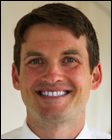
By Matt Miller, PhD
image

Matt Miller, PhD is vice president of behavior science at StayWell of Yardley, PA.

Advances in technology are having a significant impact on the healthcare individuals receive. Patient DNA is used to personalize treatments with precision medicine. Artificial intelligence (AI) and machine learning are speeding diagnosis and helping providers determine the best courses of action. The Internet of Things (IoT) is enabling a wide range of remote clinical applications, from medication adherence to monitoring vital functions including glucose, heart rate, and blood pressure to configuring and gathering real-time data from medical devices such as pacemakers and defibrillators.

While these technologies are powerful on their own, the combination of these various patient-specific data streams can produce an exponential impact on improving patient outcomes when merged with behavioral and environmental insights. Integration of this diverse data, through electronic health records (EHRs) and other critical healthcare systems, will play an important role in creating an ecosystem that enables providers and patients to get the information they need, when they need it. In turn, this integration of data will support the larger goals of improving population health.

Modern healthcare is well positioned to reap the rewards of recent advances in technology. Silicon and graphene at the chip level and microelectromechanical systems (MEMS) in semiconductors are in devices used every day for diagnoses and treatment, such as CT scanners, X-ray machines, magnetic imaging, ultrasound, and for monitoring blood pressure, glucose levels, and other vital statistics. These components play critical roles in sensing, data processing, and controlling machines used to monitor and treat patients. Add data science – AI and machine learning – to the mix and the industry can begin to explore new frontiers in healthcare by expanding our ability to detect and interpret patterns.

We are beginning to see this convergence of new technologies emerge in targeted use cases. Computer vision and convolutional neural networks are helping radiologists identify malignant tumors, minimizing the pain, inconvenience, and cost of biopsies. Pharmacogenomics and precision medicine are enabling researchers to identify first-line medications for patients based on their genomes and develop therapeutics based on the unique characteristics of the individual and his or her disease.

These applications are just the beginning of innovations that will redefine healthcare in the 21st century. But there may be a simpler example of how today’s data capture technology can make an equally significant impact in improving population health. This approach involves integrating behavioral, environmental, and social data directly into physician’s workflows, so healthcare professionals can have a more robust understanding of a patient’s risk factors and take proactive steps to help patients remain, or become more, healthy.

Social determinants of health (SDOH) are macro-level factors responsible for influencing health risks and health outcomes. SDOH include economic stability, neighborhood and physical environment, level of education, access to healthy food and quality healthcare, available support systems, and stress. These factors contribute to an individual’s life expectancy, mortality, healthcare expenditures, health status, and functional limitations, according to the Henry J. Kaiser Family Foundation.

Research demonstrates the enormous influence of behavior and SDOH on patient outcomes. Clinical interventions impact only 10 to 20 percent of a person’s health outcomes, while socioeconomic and environmental factors determine 80 to 90 percent, according to The National Academy of Medicine.

Consider the possibilities if a physician had access to social and behavioral information alongside lab tests, imaging results, and other background information about the patient. Not only could the doctor see that his 50-year old female patient’s glucose is high and creatinine and hemoglobin are slightly off, he could also evaluate the impact of her adherence to taking prescription medicine, stress level, and the fact that she lives in an urban food desert and doesn’t have access to regular care.

These types of solutions are already coming to fruition, in a variety of forms and functionality. Consider the offering developed by Proteus Digital Health, which combines ingestible sensors, a small wearable sensor patch, and mobile application to monitor patient health patterns and medication adherence behaviors. The objective information collected by the Proteus system enables doctors to initiate, adjust and measure treatment effectiveness, saving patients and payers money while optimizing care and amplifying outcomes.

Johns Hopkins University School of Medicine was also recently awarded a grant to continue research of the Emocha mHealth app, which tracks medication details and care management for individuals with tuberculosis, a diagnosis where strict medication adherence is essential for positive outcomes. The app connects patients and providers for Directly Observed Therapy (DOT), in which patients record themselves taking prescribed medication. The video is uploaded to a telehealth portal, where providers can confirm the medication was taken correctly and collaborate with patients on care management. Early results show that Emocha app boosted medication adherence rates by 94 percent and saved almost $1,400 per patient in treatment costs.

Using multiple data points to triangulate a patient’s condition enables physicians to deliver healthcare with a more holistic perspective. Understanding the gravitational force SDOH has on health outcomes, physicians not only can address the symptoms of disease, but can also respond to variables known to cause and/or exacerbate illness. With these types of insights, they can make more informed decisions around diagnosis, treatment and the continuum of care.

It can be a challenge for physicians to get insights into social and behavioral factors. But the move to EHRs, plus greater integration and effective data exchange through standardization efforts like Fast Healthcare Interoperability Resources (FHIR), are beginning to make these promises a reality. By capturing more data points through EHRs and having access to complete records regardless of where healthcare services are delivered, physicians will have a more comprehensive picture of patients’ background and health, empowering them to provide the care and resources to meet the unique needs of each patient.

Several device manufacturers are already offering remote monitoring tools capable of capturing patient health data at home and uploading it to an EHR for physicians to track.

For example, Boston Scientific’s Latitude Home Monitoring System enables physicians to monitor implanted devices to manage heart conditions. A five-year study of the system showed that there was a 50 percent relative risk reduction of death as compared to patients who only went to the clinic for device checks. Honeywell’s Genesis Touch collects biometric information, such as oxygen saturation, blood pressure, and weight and shares them with physicians. The related mobile app also enables video visits between patients and physicians and offers an interactive teaching tool to demonstrate techniques to manage various conditions and ensure the patient understands the treatment protocols.

Now take this integration a few steps further. Imagine,that through the power of AI and machine learning, a physician could be proactively alerted to key data points about a patient, in real time, outside of a hospital or office visit. Machine learning would identify certain thresholds that trigger the need for the physician to send a message containing educational materials to the patient, change a prescription based on data trends, or even alert emergency services.

Lessons learned from these types of just-in-time, adaptive interventions can be extrapolated to improve population health services by empowering physicians to offer data-driven recommendations to their patients.

For example, many practices may offer a universal stress reduction program to their patients. However, stress can manifest itself in a myriad of ways for different people at different times in their lives. By using the full scope of data available to understand the stressors – physical, social, and behavioral – and other factors impacting each patient, providers can do more than simply and generically “manage stress.” They can develop an intervention that helps specifically manage that patient’s unique stressors.

The future of each individual patient’s outcome is brighter when you combine the nuance and tailoring of personalized medicine with the reach of population health. Advances in science, technology, and use of SDOH brings this future within reach.

Readers Write: Projects and Costs Out of Control? Take a Low-Dose Aspirin

September 26, 2018 Readers Write 3 Comments

Readers Write: Projects and Costs Out of Control? Take a Low-Dose Aspirin
By Frank Poggio

image

Frank Poggio is president and CEO of The Kelzon Group.

A recent announcement in the news about the lack of effectiveness and risk of taking daily low-dose aspirin triggered my re-thinking about the age old question of, “Why is healthcare IT so far behind commercial industry?” or, “Why is healthcare delivery so costly and inefficient?”

“Experts” always say we can improve costs and quality if we practice evidence-based medicine. OK, I can buy that, but what if the evidence keeps changing every few years? I am willing to bet that in about five years some researcher will say that new data shows daily aspirin is good for you, so hope you didn’t stop taking it. How many times have we seen that with other foods like coffee, red wine, etc.?

And what about classic annual diagnostic procedures like Pap smears, mammography, and PSA tests? Or therapies like angioplasty, tonsillectomy, bloodletting, or frontal lobotomy? The list goes on. All deemed good one day in the past, but not so good or maybe deadly soon after.

This obsession with comparing medicine and healthcare to other industries falls apart if you look at a simple example. Say you are washed up and stranded on a large island. As it turns, out there is an abandoned cabin on the island with a motorized boat left at the dock. You also find a set of mechanic’s tools in a storage area, and lucky you, you happen to possess a little mechanical talent from your high school shop class. What you do not have is any documentation covering the boat or engine, but with your cursory experience with cars, you figure out how to start the engine. But alas, it will run only for a few minutes.

You tinker with it for days, but without any owner’s or repair manuals or other specs, everything you do is hit or miss. Of course you take an evidence-based approach, using trial and error and a little creativity. As you fail to make headway and start experiencing severe hunger pains, you take the engine apart to try to get a better understanding of its engineering and how it should function. Put it back together, try again, no luck, apart again, try again, and on and on.

Wouldn’t it easier if you had some documentation, like maybe a troubleshooting guide? Every boat engine that comes off an assembly line has one. If only the original owner had kept it, you could avoid all the time-wasting reverse engineering. And thank heavens the engine isn’t amorphous or biological, which brings us back to the human condition.

When you were born, didn’t the doctor give your mother your owner’s manual, troubleshooting guide, design specs, and of course a warranty? What, you say, you can’t find them, and the frustration is giving you a severe headache? Too bad, maybe try this aromatherapy — it worked for me.

News 9/26/18

September 25, 2018 News 2 Comments

Top News

image

Several provider organizations develop Health Record Request Wizard, an online tool that walks patients through submitting a request to providers for electronic copies of their medical records. It extends a previous form developed by AHIMA by adding branching logic.

Despite the headline proclaiming that it helps families obtain and share their records, it doesn’t – it addresses the 2 percent of the work involved in providing a standard user interface for such requests while neatly turfing off the 98 percent of technical integration to EHR vendors who may not see the value in supporting someone else’s front end. Only three health systems and no EHR vendors have pledged to support it.

Plus it doesn’t support the most prevalent and essential healthcare technology – the fax machine.


Reader Comments

image

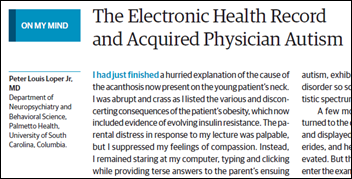
From HIT Medical Student: “Re: JAMA article. I think your readers will find the author’s conclusion as ridiculous and insulting as his title. How are physicians still using ‘autism’ as a pejorative in professional settings? At what point, if ever, are all physicians going to understand that EMR documentation is a vital part of patient care and population health management?” The JAMA Pediatrics opinion piece titled “The Electronic Health Record and Acquired Physician Autism” was written by Palmetto Health (SC) psychiatrist Peter Loper, Jr., MD. He blames a “fixation on the EHR” for his being “abrupt and crass” with patients, complaining that he had previously refused to use an EHR during encounters and admitting that he was “chronically behind on documentation.” His point is that focus on the EHR during encounters causes doctors to “exhibit the same behaviors that render this disorder so socially incapacitating for those on the autistic spectrum” while failing to note the humanity of the encounter and that the physician-patient relationship is key to disease management. He could have made his point without the autism reference, and had he done that, I would defend him since he’s a child-focused psychiatrist and EHRs (Palmetto uses Cerner) do little to improve his practice over paper other than to get him paid. He also suffers from the ubiquitous misperception that his N-of-one experience is generalizable to the entire medical profession and also fails to consider how his employer chose to configure the EHR and mandate its use, doing as doctors often do in shooting the EHR vendor messenger without realizing that it wasn’t them who made the workflow decisions.  

From Crass is Greener: “Re: Memorial Sloan Kettering and Paige.AI. Your update makes me wonder about its business relationships with IBM and Allscripts looks like, knowing that IBM needs to prove out Watson and Allscripts’ propensity for ‘doing deals’ (see Verity Health).” Hospitals excel at cloaking business deals behind lofty, altruistic proclamations (this is especially common with oncology and pediatrics since everybody is extra empathetic to those patients.) It would be interesting to see MSKCC’s contract with IBM, especially since reports suggest that Watson Oncology is more of a mechanical turk that just sends whatever recommendations MSKCC’s doctors manually offer while disguising it to look like machine-powered insight. I wouldn’t trust any deal involving Patrick Soon-Shiong’s Nant companies, and the apparent enthusiasm with which Allscripts did so suggests desperation on both ends of the transaction, leaving the now-bankrupt Verity in the middle of a Sunrise implementation they didn’t want and their financial Santa Claus moving on to other shiny objects after just one year. My life’s most relevant lesson learned is that people and organizations (including many non-profits and all health systems) do whatever benefits them the most, so follow the money.


HIStalk Announcements and Requests

Listening: new from Badflower, LA kids who can crank out some hard rock. They are touring tiny venues (like bars) right now – they’ll be in Madison, WI on October 12. I’m enjoying their music along with the best manufactured cookie I’ve had in years, Oreo Thins with pistachio (I expect the coconut to be equally wondrous). 


Webinars

September 26 (Wednesday) 12:30 ET. “How to Ensure Patient Records are Always Available.” Sponsor: Goliath Technologies. Presenter: Goliath Technologies engineering staff. This webinar will discuss how an early warning system can help your organization ensure your EHR systems and patient records are always available. You’ll also learn how to proactively anticipate, troubleshoot, prevent, and resolve end user experience issues before users or patients are impacted.

Previous webinars are on our YouTube channel. Contact Lorre for information.


Acquisitions, Funding, Business, and Stock

CenTrak acquires the security solutions assets of Elpas Solutions, which include infant protection, wireless call, staff duress, man down, and wander management.


People

image

Akron Children’s Hospital (OH) promotes pediatric hematologist-oncologist Sarah Rush, MD to CMIO.

image 

Intelerad Medical System hires Paul Lepage (Telus Health) as president/CEO.


Announcements and Implementations

image

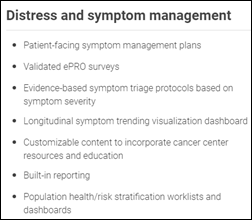
Cancer management and patient engagement technology vendor Carevive goes live with its patient care planning software at University of Missouri Health Care’s Ellis Fischel Cancer Center, where it is integrated with Cerner Oncology.

image

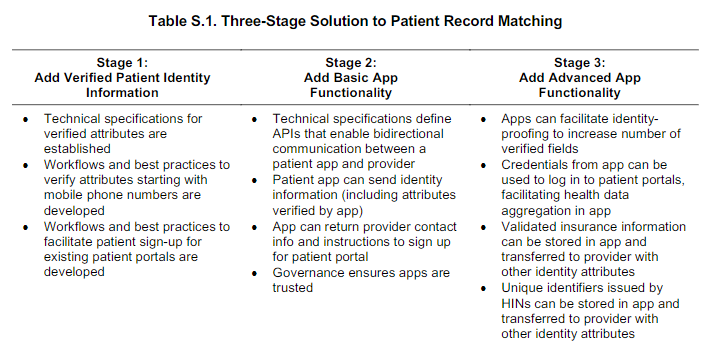
I missed this earlier: a Rand report recommends that patients get involved with provider record-matching challenges, with these suggestions:

  • Implement a voluntary universal identifier, managed by an organization that does not store PHI
  • Implement a patient-managed public key
  • Expand the use of government-issued identifiers such as driver license numbers
  • Match records by asking patients to verify their identity by answering “what you know” type security questions
  • Use biometrics with demographics
  • Verify the identity of patients by sending one-time verification codes to their phones
  • Implement consumer-directed exchange
  • Use regional health record banks
  • Give patients a user interface so they can verify record matches themselves
  • Have patients supply their own record location information

SNAGHTML132c3363

In urge-to-merge and marketing provider news, Greenville Health System and Palmetto Health will rename their South Carolina partnership to Prisma Health, while in Florida, Orlando Health and Lakeland Regional will end their affiliation October 1 after just one year due to their “different strategies and distinctive communities served” that were apparently not evident 12 months ago. One might assume it was an uneasy relationship between Orlando and Lakeland since the websites of both systems have been scrubbed of any evidence of the affiliation, including their rosy press releases from last year that predicted improved patient access and clinical quality. And in Maine, Eastern Maine Healthcare Systems (which oddly makes “system” plural) will rename itself Northern Light Health, following the lead of hospitals that have eschewed their confusing “health system” moniker to make a land grab for the “health” label even though hospitals have only a tiny impact on health while taking the lion’s share of healthcare expenditures.


Other

image

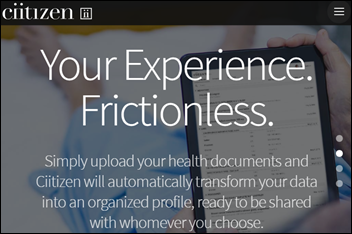
Intermountain precision genomics director Lincoln Nadauld, MD, PhD decries EHR-generated PDFs as a crude form of interoperability, noting that a particular patient’s 143-page record could not be searched, viewing it caused it to re-default to 6-point font with each page flip, it could not display CT scan images, and it contained only the first page of genomic testing results. He advocates a patient-controlled, cloud-based, searchable repository, not surprisingly since he wrote the piece for Ciitizen, a pre-beta vendor that will offer such a sharing platform. It sounds a bit like CareSync, which unfortunately couldn’t make a go of offering a stellar service that also included having humans obtain the subscriber’s medical records (my CareSync experience was excellent). I’m ever-skeptical about a business model that expects patients to obtain and upload their own records since they historically won’t bother.

image

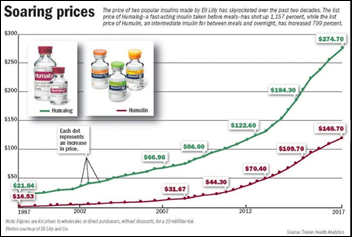
An Associated Press analysis finds that despite the White House’s claim in May that drug companies would announce “massive” price cuts almost immediately, 2018 has seen 96 price increases for every one price reduction. HHS Secretary Alex Azar — a former executive of a drug company that dramatically increased insulin prices during his tenure — says he’s not counting on “the altruism of pharma companies lowing their prices.” Drug price hikes are often small but frequent and makers of competing products often raise prices in lockstep.

Former UN Secretary General Ban Ki-moon says the US healthcare system, the world’s most expensive by far, is morally wrong in that “nobody would understand why almost 30 million people are not covered by insurance.” He says drug companies, hospitals, and doctors are using their lobbying power to avoid universal healthcare. 

A Michigan jury awards $130 million to the family of a boy who in 2006, as a two-month-old, developed cerebral palsy that the family’s attorneys claim was due to a botched IV start at Beaumont Hospital. The family’s lawyers say the now-12-year-old is a “charming and beautiful boy” who needs help getting in and out of the bathtub.

image

I’ve lost interest in the heavy-handed and unrealistic medical program “The Resident,” but  its Season 2 premiere this week borrowed an idea from year-old episode of “Grey’s Anatomy” by featuring a cyberhacking story line. The hospital’s drama-filled blackout turns out to be the work of a hacker who got herself admitted to the hospital so she could breach its systems from the inside (Hollywood loves “the call is coming from inside the house” as a shocker) in revenge for high medical bills that forced her to drop out of college. Least believable (and that’s saying a lot for this episode) is that the hacker was admitted for a UTI instead of being streeted with a prescription for antibiotics, and when confronted about the breach, she handed over a thumb drive backup that somehow fixed everything. Not unbelievable is that the hospital fired an uninvolved IT guy over the incident. 


Sponsor Updates

  • Crossings Healthcare Solutions will demonstrate its clinical decision support tools for physicians, nurses, and informaticists at the 11th Annual DV/NJHIMSS Fall Event this week in Atlantic City, NJ and at the Cerner Health Conference October 8-11 in Kansas City, MO.
  • ROI Healthcare Solutions is featured on the TV program “Newswatch.”
  • Kyruus will convene a CEO panel at the Fifth Annual Thought Leadership on Access Symposium in Boston October 15-17.
  • MModal and Enjoin will partner to offer a technology-driven clinical documentation improvement advisory solution to address population health.
  • The Wisconsin State-Journal profiles Nordic Data & Analytics Services Delivery Manager Eric Pennington.
  • Nordic’s managed services division has signed 20 clients and expanded to 100 consultants.
  • Healthwise launches its FHIR app in Epic’s App Orchard.
  • Aprima will offer HIPAA compliance programs from Abyde.
  • Mmodal partners with Enjoin to offer clinical documentation consulting services.
  • ZappRx partners with specialty pharmacy Dunn Meadow to speed up prescription access for oncology and pulmonology patients.
  • FDB publishes a new case study describing how Health First improved medication adherence with FDB’s Meducation in its Allscripts Sunrise EHR.
  • AdvancedMD will exhibit at WebPT’s annual Ascend conference September 28-29 in Phoenix, AZ.
  • Aprima, CoverMyMeds, CTG, Culbert Healthcare Solutions, and Direct Consulting Associates will exhibit at MGMA September 30-October 2 in Boston.
  • CarePort Health will exhibit at ACMA Maryland September 29 in Baltimore.
  • Change Healthcare will host Inspire 2018 September 30 in Phoenix, AZ.
  • Cumberland Consulting Group will exhibit at the MDRP Summit 2018 October 1-3 in Chicago.
  • Dimensional Insight will exhibit at 2018 IntegraTe October 2 in Davie, FL.

Blog Posts


Contacts

Mr. H, Lorre, Jenn, Dr. Jayne.
Get HIStalk updates. Send news or rumors.
Contact us.

125x125_2nd_Circle

Curbside Consult with Dr. Jayne 9/24/18

September 24, 2018 Dr. Jayne 1 Comment

Being in the consulting world, I am exposed to a large variety of practices, partnerships, health systems, integrated delivery systems, and more. It’s always challenging when clients and prospects want me to “find someone that looks just like us” before they agree to start working on a project.

I let them know that it’s not just a question of finding someone in my client base that has similar characteristics, but sometimes even finding someone in the healthcare realm that looks like them is challenging to impossible. Explaining this can be difficult, especially after clients have interacted with vendor sales reps who have done their best to convince them that as long as they talk to someone in the same specialty, or as long as they talk to a group of the same size, that they can expect to have comparable experiences.

I see this with both small and large clients, even with large health systems that think that just because XYZ health system on the other side of the country did a certain project a certain way, that they will have similar outcomes. There are so many variables that play into a project’s success, that it often becomes one of those “your mileage may vary” situations.

I ran across this recently with an organization that was looking to understand what size of a team they needed to support their ambulatory EHR needs after migration to a new system. They seemed rather upset that I couldn’t just tell them how many people to hire, without performing some level of discovery around the level of support they planned to provide, what their proposed governance structure would look like, what the organization’s support budget was, and what skill set they expected the team to have.

It’s a complex equation, and I always try to attack the idea of governance – both clinical and application – as the first step in figuring out what makes a group tick and what their needs might be. Organizations that understand the value of governance are like gold to me. They understand that decision-making is important, as is understanding who owns the application and who is responsible for making decisions related to implementation, maintenance, support, and upgrades.

When an organization decides to have tight governance, it can result in not only cost savings due to decreased variation, but also in measurable quality when providers understand that it’s important for people to deliver care in a standardized way. Many organizations do a good job with this during the design and build phases of an implementation, but once the system goes live it’s tempting to fall into bad habits.

Organizations may make customizations to appease a single provider or a small group of providers, which not only consumes resources in the present time, but also in the future, as those customizations have to be constantly evaluated against upgraded software versions. Some organizations I’ve worked with don’t even track their customizations, so they can’t possibly evaluate them. Each upgrade becomes a bit of a surprise as they try to figure out what the “out of the box” software looks like vs. what they have installed in their environments.

My first Lean Sigma project years ago was to work on an EHR upgrade, and I admit that the project itself failed – we ended up not taking the upgrade – but we learned a tremendous amount about the methodology needed to successfully evaluate a new release and get it through the upgrade process. We created an evaluation paradigm that I still use today, across multiple vendors and even outside of EHR applications.

Sometimes the decision to modify the application rests with a clinical committee, but other times it’s the nebulous “IT” that reviews requests and makes the changes. This is unfortunate because technology projects require care and feeding not only by the technical team, but by clinical and operational owners. However, it’s easier to blame “IT” rather than addressing inadequate or absent governance. Other groups may keep their governance structures after go-live, but they become weak over time due to shifting priorities, members’ attention being focused elsewhere, or outright neglect.

It’s great when things are ticking along just fine, but bringing your governance group together quarterly even if there aren’t major decisions to be made isn’t a bad idea. There may be issues that are brought to light or maybe the group just confirms that things are going well, but it’s one of those things that if you don’t ask, you might be missing problems that you didn’t even know existed. If you can’t even get people in the room, that might be a red flag for apathy or end users checking out rather than engaging.

Governance can be tightly linked to management, although it’s best if neither exists in a vacuum. Strong management helps ensure that decisions that are made are carried out in an effective and cost-efficient manner. Effective management is what transforms an organization to being reactive towards the squeaky wheel into one that can proactively look for issues and identify solutions before things turn into problems. It’s often difficult though to have strong management with physician groups, especially when there are numerous competing personalities and where organizational politics becomes a factor.

I’ve seen so many groups take a page out of “Lord of the Flies” rather than be willing to address difficult colleagues or tackle ineffective team members. When I work with them, I present techniques for communication and consensus-building and sometimes it seems like this is the first time they heard that there are “treatments” that can help get them through the rough spots just like there are remedies for medical conditions.

Both governance and management can be tightly linked to culture. I frequently encounter organizations that can’t articulate their culture, and I guarantee that if the leadership can’t even define the concept, they’re not doing a great job of carrying it to the rest of the organization. If leadership is preaching the need for strong governance and effective management,and then doesn’t deliver on those expectations at the highest levels, it becomes not only demoralizing, but often costly for the organization which ends up floundering. The importance of these relatively “soft” disciplines shouldn’t be underestimated.

It’s with all of these factors mind that I approach each organization I work with. One has to understand who they are, where they have been, where they are going, and where they want to be before you can make recommendations to help them. When you’ve seen one organization, you’ve seen one organization, regardless of how similar they may be in size, scope, specialization, etc. It’s tough to determine whether your experiences might be like someone else’s without asking some difficult questions.

I challenge organizations who are in the market as buyers to consider this concept when you are presented with a reference site or a case study that someone is trying to use to convince you to buy, or when you’re trying to determine your implementation or support model. You might find yourself asking some difficult questions of your own organization. Uncomfortable as it might feel, it’s a good thing.

How does your organization approach concepts like governance? Leave a comment or email me.

Email Dr. Jayne.

Monday Morning Update 9/24/18

September 23, 2018 News 8 Comments

Top News

image

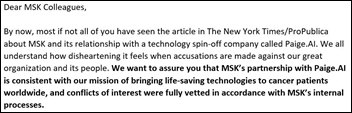
Memorial Sloan Kettering Cancer Center leadership defends itself to its employees following reports that it gave for-profit AI startup Paige.AI exclusive access to its 25 million pathology slides in return for an equity stake for itself and several MSKCC executives (in essence, profiting from the work of its pathologists and the property of its patients instead of by creating new intellectual property). The health system explains that:

  • It is sharing only de-identified patient data and not actual slides (note: the Paige.AI partnership announcement specifically says it gained “exclusive rights to MSK’s library of 25 million pathology slides” that are “accompanied by de-identified pathologic and clinical annotation”)
  • The relationship between its executives and the company was vetted for conflict of interest
  • Board members and faculty who received equity won’t participate in company decisions
  • They’ll kick back some of the proceeds to the pathology department

image

MSKCC’s recent bad press – including unreported conflicts of interest by a since-resigned key researcher who was raking in drug company money and skepticism about its relationship with IBM Watson Health – add it to the list of health systems whose high-falutin’ patient care proclamations fail to hide the fact that it often acts like any other self-enriching business whose own interests come first. It paid its CEO $6.7 million (plus he gets a company house), its CIO $1 million, and its chief fundraiser $1.4 million, according to its most recent tax forms.

In case you missed it, sick and frightened cancer patients are a highly profitable widget in this country. As is typical in healthcare, nebulous consent forms allow their data to be sold to any willing buyer without their permission or benefit.

ProPublica notes that its report didn’t create the MSKCC Paige.AI controversy – it was MSKCC’s own pathologists who complained that their work had been taken for the benefit of top MSKCC brass. Surprisingly, they didn’t complain that Paige.AI’s business model requires the company to characterize the work of human pathologists as subjective, error-prone, and inefficient compared to allowing a computer to do their work.

image

image

MSKCC’s former pathology department chair Marc Rosenblum, MD wrote the most brilliantly sarcastic internal email I’ve ever seen last month (subject: “Department: Fleece(d)”) in offering suggestions to hold a Paige.AI naming contest with stock options as a prize to “fully embrace the entrepreneurial tenor of our times;” to create a department logo to “trumpet where we’re going” that would look good on a Patagonia fleece; and to create a department fight song. 


HIStalk Announcements and Requests

image

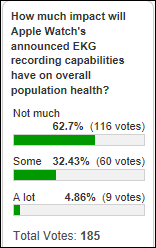
Poll respondents are skeptical about the population health benefits of the Apple Watch’s EKG recording capability.

New poll to your right or here: would you be OK with having your social media activities monitored for health research or to trigger personalized health improvement suggestions? I admit I’m fascinated by the human aspect of expecting an insurer to cover huge financial risk while denying them relevant information, which then goes back to the argument about universal healthcare, under which such lifestyle forensics would be unnecessary since the entire country would make up the risk pool. Life insurers are allowed to require medical exams, getting auto insurance involves having your pre-existing condition (driving record) examined initially to set premium prices and having that price jacked up (or the policy cancelled) following a paid claim, and all forms of business insurance (malpractice, cybersecurity, etc.) come with the expectation of allowing the insurer to assess their risk by inspecting sensitive records. Only with health insurance are we offended at the idea that insurers need to learn more about our health before agreeing to pay to maintain it, an expectation that has risen due to out-of-control hospital and drug costs in the absence of political will to address the issue.


Webinars

September 26 (Wednesday) 12:30 ET. “How to Ensure Patient Records are Always Available.” Sponsor: Goliath Technologies. Presenter: Goliath Technologies engineering staff. This webinar will discuss how an early warning system can help your organization ensure your EHR systems and patient records are always available. You’ll also learn how to proactively anticipate, troubleshoot, prevent, and resolve end user experience issues before users or patients are impacted.

Previous webinars are on our YouTube channel. Contact Lorre for information.


People

image

Mazars USA promotes Gil Enos to leader of its healthcare consulting group.


Announcements and Implementations

Wolters Kluwer Health launches a new version of its Sentri7 clinical surveillance solution.


Other

image

Researchers question whether it’s a good idea to apply Cambridge Analytica-type social media “digital phenotyping” to target people for population health interventions. They note that such activities incur the risk of public backlash (when social media users realize they’re being monitored and controlled) and having those users go underground by avoiding using words that all out their health-harming practices.

image

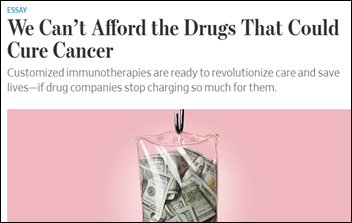
An oncologist’s Wall Street Journal op-ed piece ponders the dilemma in which drug companies charge whatever high prices the market will bear irrespective of their actual research and manufacturing costs and the extent to which the drug improves an individual’s health, noting that the US is the only country that approves marketing of drugs without negotiating the allowed selling price:

The extraordinary cost of these treatments presents a tragic dilemma: We may soon have a miracle drug for cancer whose cost, when multiplied across the population that needs it, could bankrupt the country. Consider what would happen if the new drugs were used to treat 250,000 cancer patients per year—just 40 percent of the Americans who die annually from cancer. At $373,000 per patient, a Kymriah-type immunotherapy treatment would increase drug spending in the US by approximately $93 billion a year. This would mean an almost 20 percent increase in the country’s total annual drug spending—for just one drug. To put that figure in perspective, it amounts to $300 per American, or $500 if we include associated medical services.

Why we should have been lawyers: a Georgia jury awards the family of a baby whose penis was injured during a midwife’s circumcision $30 million.

image

A fun Bleacher Report profile of Laurent Duvernay-Tardif, MD – who is also a right guard for the Kansas City Chiefs who signed a five-year, $41 million contract extension with $20 million guaranteed last year – reveals interesting facts:

  • He made good money at 12 years old selling pesto that he made himself, explaining that it had to be very good since “I wasn’t cute enough to get any sympathy purchases.”
  • His parents took the children on year-long sailing trips carrying only rice and canned vegetables to show them that money isn’t all that important.
  • The Quebec born Duvernay-Tardif graduated from McGill University’s medical school even though he spoke only French and all his classes were conducted in English, so he played lecture recordings at half speed while looking words up in a dictionary.
  • He was on call on NFL draft day, so he gave his phone to a nurse and asked her to say yes to any team that drafted him while he participated in an emergency C-section.
  • He is only the 10th player ever drafted by the NFL from a Canadian college and the first active doctor to be on a team’s roster
  • The NFL denied his request to add “MD” after his last name on his jersey, which he says is OK since “my name is Duvernay-Tardif, and it’s plenty long enough like that.”
  • He explanations the motivation required to master two difficult professions: “My biggest fear is doing nothing. When you start downsizing your expectations of what you can do with your time, it’s hard to go back. If I spend an offseason doing nothing, I don’t know if that drive will come back. That scares me more than anything.”

Sponsor Updates

  • Lightbeam Health Solutions launches the Pop Health Podcast with an initial episode on gaining patient buy-in for chronic care management.
  • MedData and Experian Health will exhibit at the HFMA Region 7 Conference September 26-28 in South Bend, IN.
  • Kansas State University’s College of Engineering names Netsmart its 2018 Company of the Year.
  • Clinical Computer Systems, developer of the Obix Perinatal Data System, will exhibit at the CSO HIMSS Leadership Symposium September 28 in Cincinnati.
  • PreparedHealth will exhibit at the Regional DV-NJ Chapters HIMSS Conference September 26-28 in Atlantic City.
  • The SSI Group will exhibit at the HFMA South Texas and TAHFA Fall Symposium September 23-25 in San Antonio.
  • Surescripts and ZappRx will exhibit at the NASP Annual Meeting & Expo 2018 September 24-26 in Washington, DC.
  • TriNetX will host TriNetX Summit18 September 25-26 in Boston.
  • Vocera will exhibit at the Illinois Health and Hospital Association Leadership Conference September 25 in Lombard, IL.
  • Consulting Magazine names Huron a “Best Firm to Work For” for the second consecutive year.
  • Wellsoft will exhibit at Emergency Nursing 2018 September 26-29 in Pittsburgh.

Blog Posts


Contacts

Mr. H, Lorre, Jenn, Dr. Jayne.
Get HIStalk updates. Send news or rumors.
Contact us.

125x125_2nd_Circle

Weekender 9/21/18

September 21, 2018 Weekender Comments Off on Weekender 9/21/18

weekender 


Weekly News Recap

  • Pathologists at Memorial Sloan Kettering Cancer Center complain that its executives and board members received equity in pathology decision support company Paige.AI after MSKCC gave the company exclusive access to its archive of patient tissue slides
  • Boston Medical Center, Brigham and Women’s Hospital, and Massachusetts General Hospital collectively pay $999,000 to settle patient privacy complaints related to the in-hospital taping of the TV show “Boston Med”
  • Athenahealth shares drop sharply on the news that activist investor Elliott Management will pass on acquiring the company at its previously offered price of $160 per share, citing problems it found during due diligence
  • Waystar announces its acquisition of Connance
  • Aramark sells its Healthcare Technologies business to clinical engineering and asset management company TriMedx for $300 million
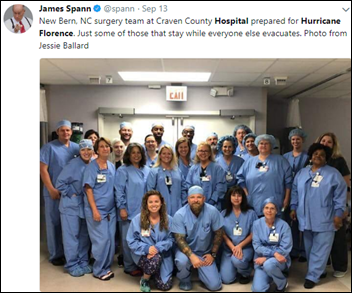
  • The impending arrival of Hurricane Florence in the Southeast motivates HIEs to connect their systems, hospitals to offer free virtual visits, and HHS to temporarily waive several HIPAA Privacy Rule requirements

Best Reader Comments

It’s not the one with the best algorithm that wins – it’s the one with the best data. (MLtrainedMD)

I expect we’ll see more unfortunate deals like the Paige one over the next few years as clinical organizations with good reputations cut deals with AI/ML companies. The AI/ML companies need someone clinical to provide them their training cases and the executives mistakenly think the data isn’t worth anything since it’s just “sitting there.” Lots of AI/ML companies are getting away with a treasure trove of valuable data very inexpensively. (DrM)

I think a lot of women exclude themselves from some pursuits early on in life (computers, science, leadership roles, etc.). Therefore they don’t develop those aptitudes, and therefore there just aren’t a lot of qualified women out there to be hired into those roles. (And therefore, when there is a qualified woman, they can be subjected to more skepticism and scrutiny than others.) Some say the solution is to hire by quota. But if there is an insufficient number of qualified female applicants, then that just results in hiring unqualified ones into roles that others may be better qualified for. Which is (a) not fair, and (b) also creates a credibility problem for the hapless woman. And it renders awards / promotions to women in these roles essentially meaningless, even if they were given based on merit (because people will assume they were quota-driven). Not an easy problem. (Clustered)

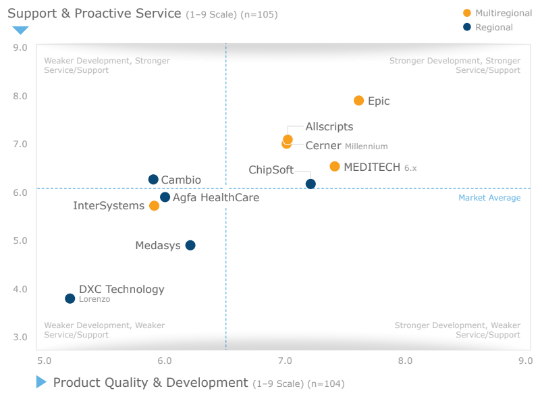
I’ve taught research methods and sampling methods for 45 years. I’ve written books and articles about research methods etc. KLAS is the example I use of the worst possible false “research” presentations. Only a fool would pay attention to a KLAS rating. It is a means of selling KLAS reports and of favoring vendors who pay for KLAS reports. I’m not saying they intend to deceive, but their design does that. Period. Thus, even if they wanted to be truthful, they can’t be with their research approach. It has no statistical validity. It’s an advertising tool. (Ross Koppel)


Watercooler Talk Tidbits

image image

Readers funded the DonorsChoose teacher grant request of Ms. E in Michigan, who asked for a handheld carbon dioxide meter and map printing supplies for the Girls Club air quality mapping project. She reports, “The members of my Girls Club love to do science activities, and taking them home with them to report back was even more exciting. The girls went through and took data for their own homes, businesses, and even the school. It was interesting to see the areas of high and low concentration of carbon dioxide at different places. Some were surprised at the results, especially the levels coming form our school! Thank you for bringing a science project to life that allowed my girls to become real scientists.”

SNAGHTML1f866627

A new California law requires hospitals to make plant-based meals – as recommended by the AMA and the American College of Cardiology – available to patients.

Italy’s anti-establishment movement gets a law passed that allows parents to attest that their kids have been given 10 mandatory vaccines without providing proof, promoting personal choice in claiming scientific arrogance, drug company influence, and supposed connections to cancer and autism. One group of doctors publicly claims that eating nuts is more effective that vaccines for preventing illness (insert your own nut-related pun here).

California’s private surgery center accreditation agencies, which are paid directly by their surgery center customers, often approve facilities that have been decertified by Medicare; that are being run by medical professionals who have lost their licenses or who were caught practicing outside the scope of their training; or that have high complication or death rates. One of those private accreditors is Joint Commission. In a fun overlap of events, an endoscopy center earned its “widely recognized symbol of quality” the same day state health inspectors declared “immediate jeopardy” when they saw a newly hired receptionist disinfecting endoscopes.

image

FDA’s warning letter to a Addison, IL pharmaceutical testing laboratory cites problems with quality control, staff training, unsuitable equipment, and the owner’s operation of a microbrewery in the same space where yeast counts were measured, with FDA dryly noting that “A brewery employee was also preparing beer kegs in this area. In addition, laboratory test media, open beer bottles, and brewing materials were co-mingled within the same refrigerator.” The website of Seery Athlone Brewing touts that its owner – who also owns the lab – has a degree in microbiology and “more than 30 years of experience in fermentation – perfect for brewing!”

image

Life insurance company John Hancock will require policyholders to wear activity tracking wearables to earn its discounted premium rate, extending the practice of its Vitality program that offers discounted trackers such as the Apple Watch.  That company found that its policyholders lived 13-21 years longer than average, which instead of implying that using fitness trackers improves health, might instead suggest that those customers were healthier to begin with and agreed to prove it by having Big Brother monitor their exercise levels in return for life insurance discounts.

A  man is admitted to the hospital in critical condition after he and his partner, high on a date rape drug, decide (after what I’m sure was thoughtful deliberation) to boil 15 eggs and insert them into the southern rather than the northern opening of his alimentary tract.


In Case You Missed It


Get Involved


125x125_2nd_Circle

EPtalk by Dr. Jayne 9/20/18

September 20, 2018 Dr. Jayne Comments Off on EPtalk by Dr. Jayne 9/20/18

This week is Prescription Opioid and Heroin Epidemic Awareness Week. There are several ONC resources available to help clinicians lean what technology is available to them, including prescription drug monitoring programs and electronic prescribing of controlled substances. My practice still hasn’t taken the leap to the latter since we dispense the majority of our controlled substances from our in-house pharmacy, although it’s now mandatory in some states.

clip_image002

AMIA has issued a Call for Participation for its 2019 Clinical Informatics Conference in Atlanta. The CIC meeting has a greater focus on applied clinical informatics, clinical decision support, and health policy compared to the annual fall AMIA meeting. Atlanta is a fun town and I’ve heard the clinically-focused meetings are great, but I’ll miss it due to it conflicting with my annual stint teaching in an outdoor classroom program.

I had some great reader feedback on my recent piece about cultural competency. Readers seem to appreciate the articles that aren’t necessarily pure healthcare IT but touch on issues that many of us face in the workplace.

One reader shared their own experiences with cultural competency training that’s likely to be minimally effective. It’s being delivered as a single mandatory three-hour session and we all know how much information people really absorb after the first hour or so. The reader notes, “Everyone I’ve talked to has been longing for the olden days before text pagers, when you could go to a meeting, set off your own beeper by surreptitiously turning it off and back on again and then acting surprised before rushing out to respond to the ‘emergency,’ never to return to the dreaded mandatory activity.”

The training is also being delivered lecture-style to large groups, which is a shame because group discussion could really bring this topic to life. If care teams or groups of workers attended together, discussion could help them learn more about each other and how to work together effectively as a team as well as with their patients. The reader goes on to describe an institutional push to curb profanity, noting the need to start “whipping out thesauruses looking for allowable substitutes – maybe they should just put Ivory Soap dispensers in the hall to allow cleansing of tongues and improved hand washing in one swoop.” I suggested they consider the Elizabethan Curse Generator, which automates insults in Shakespearian English. Take that, thou distempered fat-kidneyed wagtail!

clip_image004

I was glad that Jenn mentioned the annual Physicians Foundation report on the state of physician practice. The decline of independent practice continues, with barely a third of the 9,000 physicians surveyed using that term to describe themselves. Although Jenn covered some of the highlights, including that 80 percent of physicians feel they have experienced burnout, I found some additional statistics that were thought-provoking:

  • US physicians handle over 1 billion patient encounters each year across all settings of care
  • 12 percent of physicians are planning to find a non-clinical position
  • 61 percent favor either a single-payer health system or a single-payer system with a private insurance option; 27 percent favor a market-driven system; and only 4 percent think we should maintain the current system
  • 22 percent of physicians either do not see Medicare patients or limit the number they see
  • 32 percent of physicians either do not see Medicaid patients or limit the number they see
  • 47 percent of physicians are compensated based on quality/value, but only 18 percent believe that these payments will improve care or reduce costs
  • On average, each office-based physician supports about 17 jobs and pays a total of $1.4 million in wages and benefits.
  • 49 percent of physicians would not recommend medicine as a career to their children or other young people
  • 27 percent of physicians would not choose to be a physician if they had their career to do over
  • More than 68 percent of physicians do not believe that Maintenance of Certification processes accurately assess their clinical abilities
  • Physicians work an average of 51 hours per week

The report includes a listing of questions and responses aggregated by various demographic factors including age, employment status, gender, and specialty. It also includes direct comments from respondents, which start on page 50 if you’re interested.

One of the mechanisms that physicians use to combat burnout and reduce the amount of time spent interacting with the EHR is the medical scribe. JAMA Internal Medicine ran an article  this week titled “Association of Medical Scribes in Primary Care With Physician Workflow and Patient Experience.” The question posed was whether using scribes decreases documentation burden, improves productivity, improves patient communication, and enhances job satisfaction among primary care physicians. Not surprisingly, the study (although limited at 18 primary care physicians) showed that using scribes was linked to reductions in documentation time and improvements in productivity and job satisfaction.

I’ve been in a practice that uses scribes for the last three years, although I don’t always have a scribe during every shift. We deploy them based on volume of patients seen at our various locations, so if you are scheduled for a lower-volume location you may be on your own. When it gets busy and five or six patients walk in at the same time, you definitely wish you had a scribe. Although I’m fast with the EHR and have tons of personalized templates, macros, and order sets, it’s still not as fast or as accurate as working with a scribe who can document while you’re doing the exam and speaking with the patient.

Unfortunately, many of our scribes are pre-meds or post-baccalaureate students trying to gain admission to medical school or a physician assistant program. This means that once the admissions letters come out, we have to hire a fresh crop of scribes and attempt to turn them into Olympic athletes before influenza season hits.

clip_image006

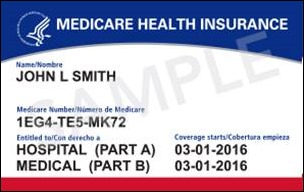
The new Medicare cards continue to roll out, with more than 35 million mailed to date. Medicare is processing claims and eligibility requests using the new Medicare Beneficiary Identifier and it seems to be going smoothly for the regions where the new cards have arrived. Cards should be mailed to all Medicare participants by April 2019. I polled a couple of colleagues on the revenue cycle side and haven’t heard of any major hiccups, but would be interested to hear from readers who are knee deep in it (especially any readers who are Medicare beneficiaries themselves.)

Email Dr. Jayne.

News 9/19/18

September 18, 2018 News 5 Comments

Top News

image

Activist investor Elliott Management — whose criticism of Athenahealth caused the company to fire founder and CEO Jonathan Bush, cut costs, and seek a buyer – joins several other would-be suitors that will pass on acquiring the company at Elliott’s previously offered price of $160 per share.

Elliot says its due diligence has turned up significant Athenahealth problems. ATHN shares dropped sharply on the news.

Athenahealth will extend its bid deadline by 10 days through September 27.

Critics of Elliott’s tactics speculate that the firm is hoping that Athenahealth will accept a fire-sale price to avoid the public embarrassment of eliciting no acceptable offers.


Reader Comments

From NXGN Woes: “Re: Nextgen. Employees were told last week that two C-level executives are leaving the company. Operations employees will report to the CFO.” Unverified. NXGN Woes provided names, although I’ll decline to include them since their LinkedIn entries and the company’s executive page remain unchanged. UPDATE: a reader tells me that marketing SVP Tamra Rushing has been replaced and provides this internal email from CEO Rusty Frantz:

Due to personal reasons and effective immediately, Scott Bostick has made the decision to step down from his position as Chief Operating Officer and into an Individual Contributor role reporting directly to me. Please join me in thanking Scott for his leadership as he transitions into this new role. Further, in the coming weeks, the executive team will work with the senior leaders within the client services organization to ensure a successful transition under the leadership of our Chief Financial Officer, Jamie Arnold. The leaders who will now be reporting to Jamie Arnold include: Mitch Waters –  SVP, Sales, Colleen Edwards – SVP, Marketing, Allen Plunk – SVP, Managed Services, and Ben Clark – SVP, Client Services. At this time, we will not be backfilling the Chief Operating Officer role. We will move forward with a flatter organizational structure to ensure continued success of the commercial client facing organization.

From Jellico: “Re: KLAS. We dropped out of the relationship after they failed to contact any of the dozens of our consulting firm’s clients whose names we provided. All of the four KLAS reps we had been assigned over several years have left the company. I’ve kept in touch with two of those and both say they were uncomfortable collecting money from vendors they were rating. It will be interesting to see if Black Book gains traction. They appear to be more straightforward and they don’t accept monies from vendors they rate.” I’ve found KLAS’s market reports to be informative in how they broadly characterize a particular market segment. I have less confidence that they use enough statistically defensible methodology to rate individual vendors reliably. Still, the company’s business model is propped up by (a) the high-ranked vendors who usually keep paying in hoping of remaining on top, and (b) the also-rans who believe – accurately or not – that maintaining or increasing their KLAS payments will improve their chances of earning KLAS bragging rights. No CIO in their right mind would buy something based on KLAS scores and I suspect that few do, but anxious vendors are always looking for a competitive advantage and hope KLAS can provide it, even if indirectly. In KLAS’s defense, consulting firms (of which they are arguably one) often make recommendations to clients based on laughably subjective factors gleaned from casual conversations that they package up into impressive PowerPoints, so it’s hardly a new concept. I enjoy the Black Book survey results, where they survey huge numbers of people and then slice and dice their responses into a mind-boggling set of reports whose statistical underpinning and transparency seems reasonable. A significant deficiency of many of the survey-type reports I see is that they fail to categorize respondents (do they work for a single hospital, a health system in a corporate role, or a medical practice?) and they often fail to distinguish between a vendor and its multiple products (which Allscripts EHR were the respondents talking about?)


Webinars

September 26 (Wednesday) 12:30 ET. “How to Ensure Patient Records are Always Available.” Sponsor: Goliath Technologies. Presenter: Goliath Technologies engineering staff. This webinar will discuss how an early warning system can help your organization ensure your EHR systems and patient records are always available. You’ll also learn how to proactively anticipate, troubleshoot, prevent, and resolve end user experience issues before users or patients are impacted.

Previous webinars are on our YouTube channel. Contact Lorre for information.


Acquisitions, Funding, Business, and Stock

image

Waystar will acquire workflow and predictive analytics vendor Connance to enhance its revenue cycle management capabilities.

image

Hospital purchased services technology vendor Valify acquires Lucro, which offers a hospital-vendor marketplace.

image

Signet Accel, the Ohio State University spinoff that offers the Avec data integration platform, has reportedly downsized and parted ways with CEO John Raden. I also noticed that former EVP of Sales and Marketing Brenda Barry has gone back to her previous employer after one year on the job. Regenstrief President/CEO and AMIA board chair Peter Embi, MD, MS was a Signet Accel co-founder and medical advisor.

Aramark will sell its Charlotte, NC-based hospital medical equipment management and clinical engineering business to Trimedx for $300 million.

Silicon Valley venture capital firm Kleiner Perkins will spin off its digital health group – which includes some of its most prominent partners, who have invested in Uber and Stripe – into an independent group. The early-stage team will continue to operate under the Kleiner Perkins name. The firm’s healthcare technology investments include Collective Medical, Livongo, and Mango Health. It previously invested in Teladoc.

The Justice Department approves the $52 billion merger of insurer Cigna and pharmacy benefits manager Express Scripts.


Sales

  • Beacon Health System will implement MyHealthDirect’s patient self-scheduling system.
  • Children’s Health (TX) signs a 15-year, $75 million agreement with Philips for patient monitoring and PACS technologies.
  • DCH Health System (AL) chooses Santa Rosa Consulting to lead its Meditech Expanse implementation.
  • Cigna will expand its diabetes prevention program in collaboration with Omada Health.

People

image

GetWellNetwork hires Peter Keating (Advisory Board) as chief people officer.

image

Jeff Sturman (Cumberland Consulting Group) joins Memorial Healthcare System (FL) as SVP/CIO. He was previously SVP of IT there from 2004 to 2012, where he led its selection and implementation of Epic.

image

PatientPing hires Sagnik Bhattacharya (Epic) as VP of payer and provider initiatives.

image

Jesus Delgado (Rush University Medical Center) joins Community Healthcare System’s Community Foundation of Northwest Indiana as VP/CIO.

image

Healthcare investor and innovator Tom Main, managing partner of 7wire Ventures, died Sunday.


Announcements and Implementations

image

VisualDx launches Aysa, a consumer app that inspects a user’s skin condition photos, asks relevant questions, and then provides possible causes. 

image

Meditech announces Greenfield, a third-party app development environment that supports FHIR and will offer a store of approved apps. 

Mercy Technology Solutions launches a cloud-hosted, pay-per-study PACS offering.

EPSi adds Ilerasoft’s medical equipment investment and usage capabilities to its capital budgeting system.

Ciox Health announces HealthSource Gym, a learning environment that will help healthcare organizations assess, train, and develop medical coders.


Government and Politics

image

HHS publishes a report covering the state of its data sharing among its 29 agencies, noting problems that include a lack of standards for inter-agency data requests; variation in technical formats and approaches; the variety of statues that regulate data collection project; and the increased chance of privacy violations as data availability increases.   


Other

California doctors will be required to consult the state’s prescription drug monitoring program database before prescribing opiates under a law that takes effect October 2. The CURES system was developed in 1997 and updated in 2009 and 2016, but a 2012 newspaper investigation found that less than 10 percent of doctors and pharmacists had even bothered to sign up for access.

Amazon Web Services features Angel MedFlight Worldwide Air Ambulance’s self-development of an IPad charting application that uses AWS and Salesforce

In Africa, the governor of Nairobi makes an unannounced visit to a maternity hospital to follow up on complaints of negligence, orders an employee to open several unlabeled boxes and bags in a storage room. and finds the bodies of 12 infants. Reports suggest that the babies died when the hospital’s incubators lost electrical power. The government will follow up with investigations into rumored child trafficking and giving babies to the wrong families. Kenya’s public hospitals are mismanaged, underfunded, and staffed by doctors and nurses who have gone on strike over low pay and poor working conditions.

image

A Cincinnati neighborhood creates a Christmas celebration for a two-year-old whose aggressive brain cancer is likely to kill him before December. Six neighbors of Brody Allen’s family put up their Christmas lights early, sent cards, and will have a Christmas parade that includes fire trucks and supporters driving their own cars. He is too weak to walk, so his siblings wheel him around the neighborhood in a Red Flyer wagon covered with blankets.


Sponsor Updates

clip_image001

  • CenTrak donates $5,000 to the Kerala Flood Relief Charity Fund.
  • ACOs using Lightbeam Health Solutions achieved 1.7 times the savings generated by non-Lightbeam ACOs.
  • Cumberland Consulting Group will sponsor and present at the Medicaid Drug Rebate Program Summit October 1-3 in Chicago.
  • Formativ Health adds several new features to its Patient Engagement Platform including payment functionality powered by Patientco.
  • Wolters Kluwer highlights patients as an underutilized resource in the fight against sepsis.
  • AdvancedMD will host its EVO18 annual user conference October 3-5 in Salt Lake City.
  • Aprima and Direct Consulting Associates will exhibit at the Ohio MGMA Fall Conference September 19-21 in Columbus.
  • Jason Spurck (SOS Tech Group) joins Audacious Inquiry as support engineer.
  • TechVibe Radio features Arcadia CTO Jon Cook.
  • Datica publishes a new book, “Complete Cloud Compliance: How regulated companies de-risk the cloud and kickstart transformation.”
  • Burwood Group will host “Cloud Revolution with Burwood, Citrix, & Google” September 27 in Chesterfield, MO.
  • CarePort Health will exhibit at ACMA Kentucky/Tennessee September 24 in Nashville.
  • CoverMyMeds will exhibit at the PCMA Annual Conference September 23-25 in Scottsdale, AZ.

Blog Posts


Contacts

Mr. H, Lorre, Jenn, Dr. Jayne.
Get HIStalk updates. Send news or rumors.
Contact us.

125x125_2nd_Circle

Curbside Consult with Dr. Jayne 9/17/18

September 17, 2018 Dr. Jayne 1 Comment

clip_image003 

To maintain my board certification, I have to do a variety of coursework “modules” on an ongoing basis. Sometimes they’re more academic, such as learning the latest and greatest clinical guidelines, and sometimes they’re more practical, such as a practice improvement project around handwashing by providers and staff. For those of us who aren’t in traditional practice, the choices are sometimes slim since we don’t have continuity patient panels that we can research with or look at trends in quality. One of the offerings that I completed for my upcoming board certification renewal was a module on cultural competency.

In healthcare, cultural competency means caring for patients in a way respects their health beliefs and cultural practices. Sometimes it can directly impact medical treatment, such as not making recommendations for animal-derived products when that would be contrary to a patient’s beliefs or preferences. In other situations, it might be more subtle, such as having an understanding of the communication preferences of different cultures and how decisions are made within extended family structures. It can also be having an understanding of medical treatments performed by different groups, including everything from cupping to intercessory prayer. It might also be respecting a patient’s desire to entirely reject treatment regardless of the potential for success.

Understanding different cultural beliefs of your patients can certainly help build trust and rapport with them, as well as helping to identify treatments that they will accept and complete. Letting patients know that you’re interested in learning about their values and beliefs helps them feel empowered and part of the care team. It’s great that healthcare providers are thinking about cultural competency, but learning more about it got me thinking about cultural competency in that context of the general workplace.

I recently worked with a company that placed a priority on this, creating various forums for employees to interact based on their family situations, ethnic groups, or interests outside of work. It was great to watch people who might not normally interact get together around a common characteristic and get to know each other.

I’ve also worked with companies that don’t have even a basic understanding of cultural sensitivity. In our increasingly polarized society, some people push back against the idea of political correctness, but rather than thinking about it that way, one might want to consider that it’s just a basic human kindness to respect the beliefs of others. I’ve been at a company that was hosting a development team from India (along with the host team’s existing multicultural employees) where the catered lunch that was ordered consisted entirely of barbecued beef and other items that had meat in them, including the baked beans and the potato salad. I cringed when I saw several people with plates of only corn bread and coleslaw.

I’ve been in meetings where the presenters used hunting metaphors such as, “You can’t shoot the moose from the lodge” and other gems, not noticing that it wasn’t playing well to the non-sportsman audience. Of course, the audience can exhibit cultural sensitivity and understand that the presenter is reflecting his own cultural practices as well rather than just acting horrified. Cultural sensitivity is a two-way street.

That’s the challenge in coaching people to develop a workplace demeanor that allows them to respect their own beliefs and traditions without stepping on those of their colleagues and employees. There’s certainly a continuum of behavior, ranging from insensitive to boorish with many different shades in between.

It’s important to understand the potential for difficulty here, because when someone in a leadership position doesn’t understand that balance, it can be perceived as creating a hostile workplace. Even when it’s unintentional or through sheer ignorance, a pattern of disrespectful behavior can become a serious workplace issue. Some companies have responded to this by formally implementing diversity training programs employee education, but it needs to go beyond that. Sometimes those programs are highly focused around specific groups rather than focusing on the more general concept of acting in a way that would make people comfortable regardless of their cultural background or beliefs.

Assuming that people from a specific background don’t eat or not eat specific foods can be an issue. I’ve worked with dozens of people whose practices are very different from their historical roots. Sometimes it’s easier to think about these challenges in a broader way – for example, thinking of dietary needs as not only a cultural issue, but also a medical one. Asking a more open-ended question around whether people have any dietary restrictions or requirements is more inclusive than asking whether people need a specific type of meal. I’ve been to plenty of corporate-type lunches where the question is never asked. That’s an easy pitfall to avoid and keeps the meeting planner from trying to figure out what different parameters they need to accommodate.

From a healthcare provider perspective, it’s great to learn about different traditions and practices so that you’re not surprised by the descriptions of treatments that patients may be doing at home, or that so you can have an understanding of how those therapies might complement or conflict with what you might recommend. However, a larger part of cultural competency is just learning how to talk with people about they prefer to be treated and being considerate of fellow human beings. It’s about not making assumptions and not trying to cast your own beliefs and values on the people with whom you interact.

There is a tremendous amount we can learn from each other and it just takes being open to learning about other people’s beliefs and needs and understanding how they may differ from your own. It’s about going back to the basics of hospitality and helping ensure that people feel comfortable regardless of where they come from or where you are going.

How does your organization approach cultural competency? Leave a message or email me.

Email Dr. Jayne.

Monday Morning Update 9/17/18

September 16, 2018 News 6 Comments

Top News

image

Paper EHR woes following Hurricane Katrina created the push for EHRs and interoperability in 2005 (and propelled Karen DeSalvo into the National Coordinator role in early 2014), so it’s fitting that Georgia’s GRAChIE HIE is working to connect Southeast providers via the EHealth Exchange to meet care needs that are being challenged by Hurricane Florence.

In related news, HIEs in Tennessee and North Carolina take just 48 hours to connect their respective systems to allow Tennessee providers to pull up records for North Carolina evacuees who require medical care there.

Also, UNC Health Care waives fees for its MDLive-powered virtual visits during the hurricane.

image

HHS reminds hospitals in North Carolina, South Carolina, and Virginia that it is temporarily waiving several HIPAA Privacy Rule sanctions and penalties:

  • The requirement to obtain patient consent to speak with family members and friends about their care
  • The requirement to honor patient requests to opt out of the facility directory
  • The requirement to provide a notice of privacy practices
  • The right of the patient to restrict uses and disclosures and to request alternative forms of confidential communications

I would be interested in hearing from IT folks hurricane-affected hospitals about how they prepared for the storm or responded to its effects.


Reader Comments

From Silver Surfer: “Re: KLAS. We’re a vendor and cancelled our agreement three years ago after KLAS assigned 18 months of feedback from our clients to the wrong vendor. Three years later, anyone searching KLAS for our consulting firm gets a message that our results don’t meet minimum KLAS Konfidence levels, meaning that we might be losing business from prospects who see that as a negative for our company even though it was KLAS’s error.” Unverified. The strongest complaints I get regarding KLAS’s methodology involve (a) how many of a vendor’s clients they survey; (b) how they select those they speak to; and (c) whether that small subset of clients is representative. People also express concern that paying KLAS to survey more clients than they might otherwise contact gives deeper-pockets vendors a chance to gain ground.

From Vishnu: “Re: [vendor name omitted]. Protecting its managers and team leads against internal sexual harassment accusations. Hopefully in time they will do what’s right.” I’ll omit the company’s name in the absence of legal evidence, such as a filed lawsuit.

image

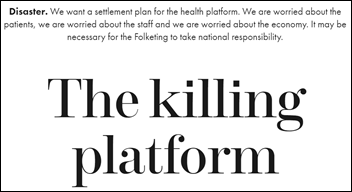
From Dr. Ross: “Re: Epic in Denmark. I was in southern Europe for a conference and this article seems to be all the talk, even though I haven’t seen it mentioned in the US.” Three doctors in Denmark’s Capital Region refer to its newly implemented system (in a Google-translated page) as “the killing platform,” saying that it’s cumbersome, illogical, and doesn’t easily share data with quality and research databases (they expressed their concerns in a Danish language video that doesn’t include an English translation). The doctors say the Region’s claim that 30 systems have been replaced by one is “fake news,” as departments that previously used 6-7 systems are still running 3-4, and warns that reduced productivity may bankrupt the Region. They conclude that the system was built for private hospitals in the US and isn’t suitable for those in Denmark despite the claims of “US salesmen and lawyers,” urging the Danish Parliament to take over the project instead of “cling[ing] to a mistake just because you spent a lot of time making it.”

image

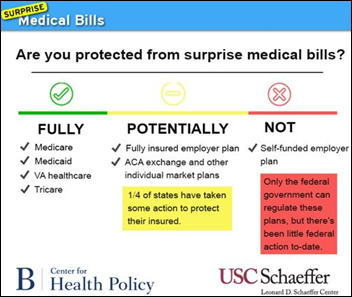
From Udon: “Re: ERISA. Would love to see an expose on that statute, which renders most state-level legislative and regulatory actions meaningless because it governs employer-funded health plans. If you are denied a scan or behavioral stay, you have to sue the health plan – which will fight it tooth and nail – and the most you can get is the cost of the denied benefit.” ERISA, which sets standards for private health and pension plans, got a recent spotlight when an HCA hospital assured a heart attack patient that his out-of-network stay would be covered by his insurance, then went after him for the $109,000 balance beyond what Aetna paid because his employer-provided insurance was self-funded (as is true of 60 percent of people), meaning he’s not protected by state-mandated prohibition of balance billing. On the other hand, those state protections are not common anyway and are often not comprehensive. ACA prohibits balance billing for out-of-network ED visits, but still allows out-of-network doctors, hospitals, and ambulance services to demand payment from the patient beyond the negotiated amount their insurance pays. So, Mr. Life-Threatening Emergency Patient, your job before breaching a hospital’s financially (and sometimes clinically)dangerous wall is:

  • Study your employer’s insurance ahead of time to see if it’s self-funded.
  • Keep a list of which hospitals are in your policy’s ever-narrowing provider network.
  • Never travel beyond the immediate vicinity of those in-network hospitals.
  • Stay conscious at all times during your medical crisis (or better yet, bring a medical bodyguard) so you can ask every person you see whether they’re in your network since hospitals are notorious for letting people work out of their building who are anxious to bill you separately and who don’t need your approval to do so.
  • Remember that you don’t have a choice of ED doctor, surgeon, anesthesiologist, hospitalist, etc. and your condition makes elective transfer unlikely, so wear ear plugs to mute the sound of the ever-ringing cash register.
  • Assume that despite paying for what looks like decent insurance, an unplanned medical event could progress quickly into an unplanned medical bankruptcy courtesy of healthcare profiteers and their political lap dogs who like things just the way they are.

HIStalk Announcements and Requests

image

Poll respondents express little interest in paying for expanded consumer genetics testing at a higher price, with the most significant concern being that long-term care insurers could use your personal data against you — the testing companies aren’t covered by HIPAA’s minimal protections and therefore your data can be sold to anyone.

image 

New poll to your right or here: How much impact will Apple Watch’s announced EKG recording capabilities have on overall population health? I admit I’m skeptical about all consumer diagnostic tools for these reasons:

  • Our system is already burdened by excessive use and cost, so further clogging up EDs and PCP offices with Apple Watch wearers demanding to have providers interpret their likely meaningless readings isn’t necessarily a good thing
  • Many millions of Americans have already been accurately diagnosed with life-affecting conditions they can’t afford to have treated and this further aligns people into have/have not categories
  • It reinforces Silicon Valley’s misperception that our poor public health is caused by underdiagnosis or misdiagnosis rather than a screwy system of misaligned incentives and the siphoning off of most of our healthcare spending to episodic care providers rather than toward population and public health
  • Such tools also reinforce the inaccurate idea that funneling symptom-free people into a healthcare system that can do more harm than good is in their best interest, especially the largely elderly population likely to experience atrial fibrillation

Thanks to Jenn for covering for me for a few vacation days. I’m happy to have rendered myself at least temporarily redundant so I can take occasional worry-free time off without being chained to a computer all day. You may notice the difference since my writing is grumpier and more wearily skeptical than Jenn, whose forte is admirable journalistic excellence rather than pent-up, post-vacation ranting.

image

Spam protection has made sending bulk email – such as my HIStalk “we’ve published something new” notices – a crapshoot. People tell me every day they aren’t getting the updates, yet the problem always involves their email server’s settings that I can’t fix. I can only suggest that you enter your email again if you aren’t getting my updates, which is risk-free since you won’t get multiple email copies no matter what.

image

Welcome to new HIStalk Gold Sponsor LightSpeed Technology Group. The Chapel Hill, NC-based company’s VeriDOCs revenue cycle solutions offer a secret sauce for professional fee coding and billing in emergency, anesthesia, and hospitalist management services in supporting technical disparity and diverse coding volume across many locations. It offers interfacing (EHR integration, demographics, billing); the VeriCODE quality-driven medical coding application; a web-based coder QA pre-billing audit application; a physician peer review tool; and VeriNET workflow oversight and reporting. The end result is that coders and auditors work from a streamlined, secure platform that drives faster onboarding, more efficient coding, and faster bill turnaround. Thanks to LightSpeed Technology Group for supporting HIStalk.


Webinars

September 26 (Wednesday) 12:30 ET. “How to Ensure Patient Records are Always Available.” Sponsor: Goliath Technologies. Presenter: Goliath Technologies engineering staff. This webinar will discuss how an early warning system can help your organization ensure your EHR systems and patient records are always available. You’ll also learn how to proactively anticipate, troubleshoot, prevent, and resolve end user experience issues before users or patients are impacted.

Previous webinars are on our YouTube channel. Contact Lorre for information.


Acquisitions, Funding, Business, and Stock

image

Outgoing Cerner President Zane Burke has sold $52 million worth of CERN shares in the past couple of weeks. I notice. CERN shares are down 6 percent in the past year versus the Nasdaq’s 24 percent gain.

image

Netflix co-founder Marc Randolph, speaking at Health Catalyst’s Health Analytics Summit, urges attendees to develop optimism, confidence, and a tolerance for risk in describing how the tiny, struggling, two-year-old Netflix practically begged Blockbuster to buy it for $50 million and was quickly shown the door. He advocates “testing it without doing it,” explaining that Netflix “was not about having good ideas. It was about a system and a culture of trying lots of bad ones. What we realized is that the key to this is not the good idea. It was how quickly and easily and cheaply you could try as many ideas as you could think of.”


Sales

  • Wyckoff Heights Medical Center (NY) chooses Allscripts Sunrise Abstracting.
  • Chicago area home care provider Bowes In Home Care joins PreparedHealth’s EnTouch network that connects hospitals with post-acute providers to improve outcomes.

Decisions

  • Stevens Community Medical Center (MN) will replace Cerner and EClinicalWorks with Epic in November 2018.
  • Summit Healthcare Regional Medical Center (AZ) will go live with Allscripts Sunrise in 2019, replacing Allscripts Paragon.
  • IU Health Jay Hospital (IN) replaced Meditech with Cerner on March 1, 2018.

These provider-reported updates are supplied by Definitive Healthcare, which offers a free trial of its powerful intelligence on hospitals, physicians, and healthcare providers.


People

image

Industry long-timer Jonathan Niloff, MD, MBA died Saturday of cancer at 64. He was chief medical officer of Diameter Health, a board member of HIMSS North America, and founder of MedVentive (acquired by McKesson in 2012) as well as a former cancer surgeon and ovarian cancer researcher.


Announcements and Implementations

image

A new Reaction Data survey of 300 providers finds that 62 percent are using speech recognition in their EHRs, with another 15 percent working on it and a stubborn 23 percent saying they’ll never use EHR speech recognition. Not surprisingly, Nuance is the big dog and is gaining ground, while MModal’s much smaller market presence still makes them Nuance’s only real competitor and its user satisfaction is higher. Epic is by far the most commonly used speech-integrated EHR. Only 3 percent of speech recognition users say they might switch vendors.

image

A new KLAS report on clinical documentation improvement says that Nuance and ChartWise provide the strongest financial ROI, Iodine’s high-satisfaction tools are disruptive in prioritization functionality, and 3M’s offerings are overhyped. Claro Healthcare leads a small pack of services firms that offer CDI optimization and outsourcing.


Other

AMA’s newswire highlights a JAMIA-published comparison of order entry clicks between Cerner and Epic under the title of “62 clicks to order Tylenol? What happens when EHR tweaks go bad.”

image

An investor in online pharmacy Pillpack — whose value went from zero to more than $1 billion in five years when it was recently acquired by Amazon from its early 30s founders above — lists the company’s lessons learned:

  • Relentlessly focus on the end user
  • Build a full technology stack that allows the company to control its own destiny (Pillpack spent $10 million building its systems)
  • Stand your ground against larger competitors
  • Realize that you can’t grow and optimize a business simultaneously – design for scale, don’t code before understanding processes, and don’t industrialize without understanding the problem you’re trying to solve
  • Hire executives and board members who have a founder mentality
  • Invest in culture, which will be harder to manage as the company grows
  • Don’t aim for a people-free business – human touch is essential
  • Hire strong operations leaders who have a bias for action
  • Hire a strong CFO/COO

In India, the state of Uttarakhand orders the government to provide printers so that every doctor’s prescription can be printed out before signing, addressing a problem in which patients and pharmacists often can’t read the doctor’s writing.

image

NYU Langone Health’s magazine notes that for the first time, all eight of its surgery chief residents are female.

image

A jury awards $4.6 million to a cruise ship passenger whose flu symptoms were mismanaged by the ship’s doctor, claiming:

  • The Colombia-trained physician (which the lawsuit misstates as “Columbia-trained”) was inexperienced and gave a 25 mg dose of promethazine IV instead of safer, better drugs
  • The doctor missed the patient’s cubital vein and instead injected the drug quickly into his ulnar artery
  • Staff ignored the patient’s report of a burning sensation, declining to evacuate him by helicopter and instead waiting until the ship’s next port
  • The patient developed compartment syndrome, requiring his arm to be amputated at the elbow

image

Weird News Andy says that despite early examples of scientific hype that turned out to be wrong (“nuclear power will be so cheap it won’t be worth metering usage”) he still likes that we’re getting closer to a Tricorder-like device. University of British Columbia engineers develop a Band-Aid sized ultrasound transducer that could turn a smartphone into an ultrasound machine for $100.

Odd: a Pennsylvania court upholds the prison sentence given to a man who in 2015 dialed 911 while choking. First responders found the 47-year-old passed out on his living room floor, clad only in underwear and socks in front of his computer monitor that was displaying a child pornography chat room. He unsuccessfully claimed that unnamed enemies framed him, with his daughter providing a heartwarming family moment in testifying that her dad isn’t smart enough to know how to download porn.

image

Internal medicine resident Mike Natter, MD notes that the relationship between the number of things carried and level of medical training is inverse.


Sponsor Updates

  • Voalte announces that its VUE user conference, to be held October 3-5 in Sarasota, FL, has sold out for the first time in its history.
  • LogicStream Health publishes a new report, “The New Healthcare Imperative.”
  • MedData will exhibit at the Ohio American Academy of Pediatrics 2018 Annual Meeting September 21-22 in Dublin.
  • Waystar will exhibit at Ohio MGMA September 21 in Dublin.
  • The American Heart Association/American Stroke Association names Nordic a “Get with the Guidelines”-compatible vendor.
  • Clinical Computer Systems, developer of the Obix Perinatal Data System, will exhibit at the annual Georgia Perinatal Conference September 19-21 in St. Simon’s Island, GA.
  • Experian Health and PatientKeeper will exhibit at AHIMA September 22-27 in Miami.
  • PerfectServe will co-host the Hospital for Special Surgery Educational and Networking Open House September 21 in New York City.
  • Redox will present at Health 2.0 September 16-19 in Grapevine, TX.
  • T-System offers disaster relief T Sheets free of charge to hospitals in the path of Hurricane Florence.
  • Mazars USA welcomes Chief Human Resource Officer Julie Venkat.

Blog Posts


Contacts

Mr. H, Lorre, Jenn, Dr. Jayne.
Get HIStalk updates. Send news or rumors.
Contact us.

125x125_2nd_Circle

News 8/29/18

August 28, 2018 News 4 Comments

Top News

image

Harris Computer Systems acquires Iatric Systems, which it will run as an independent business unit.

Iatric President/CEO Frank Fortner will join Harris as EVP of Iatric Systems.

Iatric’s website says it has 200 employees. The company is headquartered in Wakefield, MA. It has won awards for patient privacy monitoring, specimen collection barcoding, interoperability, and EHR optimization.

Harris’s health IT business includes Amazing Charts, GEMMS, Harris Healthcare Clinical Solutions, Harris Coordinated Care Solutions, IMDSoft, MediSolution, Morcare, Picis, PulseCheck, and QuadraMed.


HIStalk Announcements and Requests

Listening: the amazing if unlikely 2011 pairing of Amy Winehouse and Nas, leading me to belatedly appreciate her troubled genius. The eclectic streaming station roped in my scanning with the little-heard 1967 tune “Monterey” by Eric Burdon and the Animals and moved on to a weird mix of great music, including that of Amy, who died of alcohol poisoning in 2011 as her initiation into the 27 Club of musician deaths.


Webinars

None scheduled soon. Previous webinars are on our YouTube channel. Contact Lorre for information.


Acquisitions, Funding, Business, and Stock

image

Politico reports that debt-ridden Verity Health System, acquired by Patrick Soon-Shiong last year, will file bankruptcy in the next few weeks. The article notes that Soon-Shiong forced the system to implement Allscripts Sunrise when he held a financial stake in that vendor, costing the health system an estimated $20 to $100 million even though it preferred Epic. Losses have forced the health system to cut back on IT infrastructure services and charity care. The health system lost $119 million in the year ending in June 2018 versus an expected break-even budget even as Soon-Shiong’s management company was paid $20 million.

image

Palm Beach Gardens, FL-based Bridge Connector, which integrates customer relationship management systems with EHR and other hospital systems, raises $5.5 million in a Series A funding round that follows a $4.5 million investment in its June 2018 seed funding round.


Sales

  • Steward Health Care chooses Wolters Kluwer for point-of-care knowledge tools, infection surveillance, and evidence-based clinical decision support.
  • Mohawk Valley Health System (NY) chooses Epic to replace its five non-Epic EHRs.
  • Partners HealthCare will offer urgent care video visits through its health plan, working with Teladoc Health.

People

SNAGHTML26f64d

Pivot Point Consulting hires Janice Wurz (Impact Advisors) as VP of advisory services.

image

CTG co-founder G. David Baer died August 21. He was 82.


Announcements and Implementations

image

A new KLAS report covering the European EHR market finds the top vendors to be Epic, Cerner, and Allscripts in that order, with Epic growing market share in Netherlands and Scandinavia despite customer feelings that its approach is US-centric and Cerner seeing its growth mostly in the UK but with inconsistent delivery. Meditech and Allscripts are noted as performing very well for their users despite a small customer base. The top three vendors in terms of 2012-2017 market wins are InterSystems (by far), Agfa, and Epic.

image

The Pew Charitable Trusts, MedStar Health’s human factors group, the AMA, and external reviewers publish “Ways to Improve Electronic Health Record Safety,” a call for voluntary improvement of usability testing, integration of usability and safety reviews into product life cycles, and creating safety-focused test case scenarios.

image

Adventist Health System – which is changing its name to AdventHealth – buys the 10-year naming rights to the practice facilities and administrative offices of the Tampa Bay Buccaneers NFL football team, saying the move will allow it to “identify and tackle important health issues in the Greater Tampa Bay Area” (the pun may or may have not been intentional).

image

St. Luke’s Boise Medical Center (IA) opens a 60-station, 350-employee virtual hospital (St. Luke’s Virtual Care Center) that will offer clinic consultation, hospital consultation, and home monitoring.

OSEHRA will create an international version of the VA’s VistA EHR, with participation from South Korea, China,  and Jordan.


Other

image

Another struggling, rural hospital gets in trouble for allowing itself to be used in a questionable lab billing scheme. Blue Cross Blue Shield of North Carolina sues LifeBrite Hospital of Stokes and removes the hospital from its network after its volume of submitted lab tests rises from 267 per month to 67,000, most of them for urine toxicology screening for out-of-state patients who had no hospital connection. BCBSNC paid $11 million for what it says are fraudulent, inflated-price tests before it stopped payments, claiming that the hospital was purchased strictly to take advantage of its in-network contracts. LifeBrite bought the bankrupt 99-bed hospital last year – then named Pioneer Community Hospital of Stokes — for $400,000 and BCBSNC says it has billed $76 million since. The Georgia company has just one other hospital, but runs national reference lab LiteBrite Laboratories.

image

Central Maine Healthcare’s recently hired CEO Jeff Brickman says he moved too quickly in trying to turn around the health system’s finances, causing doctors and employees to push back over its Cerner implementation. Their no-confidence vote failed, however, as the board reiterated its support for him.

image

We’re going to need a lot more reporters: an HCA hospital tells a heart patient that his insurance will cover his four-night, out-of-network heart attack stay, then bills him for $109,000 and turns it over to collections when the high school teacher can’t pay. State-mandated protection against balance billing didn’t apply in his case since his employer is self-insured. Experts say Aetna had already paid the hospital at least 2-4 times reasonable charges. NPR’s coverage of the story suddenly resulted in the for-profit hospital offering a “financial assistance discount” that reduced the teacher’s bill to $782, a 99.3 percent “bury this story now” cost savings that it will surely make back from patients whose stories earn less press.

image

Meanwhile, former ED physician Matthew Wetschler – who was left with a $500K bill after his insurer Oscar refused to pay out-of-network San Francisco General Hospital for emergency treatment after he broke his spine – says UCSF has turned over 41 separate accounts under his name to debt collectors. This is a good lesson – given their inability to hold prices down by negotiating with market-dominant health systems, about the only tools insurers have left are to (a) deny coverage; (b) increase the portion patients pay; and (c) most damaging of all, to create such narrow networks that bills for emergency care or services received while away from home are almost certain to be denied, with the patient getting stuck with the balance at full list (imaginary) price.


Sponsor Updates

  • Bluetree will exhibit at the CHIME Partner Education Summit September 5-7 in Chicago.
  • Bernoulli Health showcases the latest features of its Bernoulli One platform, including integration of patient ECG rhythm reports into Epic’s EHR, at Epic UGM this week in Verona.
  • CompuGroup Medical will exhibit at PainWeek September 4-8 in Las Vegas.
  • Spok will participate in several health events through fall.
  • Dimensional Insight emerges as a top cross-industry vendor in the latest KLAS Healthcare Business Intelligence Report.
  • DocuTap will host its annual user conference October 3-5 in Denver.

Blog Posts


Contacts

Mr. H, Lorre, Jenn, Dr. Jayne.
Get HIStalk updates. Send news or rumors.
Contact us.

125x125_2nd_Circle

Curbside Consult with Dr. Jayne 8/27/18

August 27, 2018 Dr. Jayne Comments Off on Curbside Consult with Dr. Jayne 8/27/18

I’ve been helping a good-sized provider organization through a practice transformation project recently and it’s been a major challenge. They initially hired me to help them spin up a transformation team, which would be tasked with running various projects across the organization. Some of the change that needed to happen was financial or revenue cycle, but there were also a number of clinical projects that had been repeatedly placed on the back burner due to lack of focus or resources.

The goal was to help them identify which internal resources might be a good fit for the team and to educate those resources on not only the overall process of change management and practice transformation, but to ensure that they had a super-user level of knowledge of the EHR, practice management system, and ancillary applications. This would allow them to have the deep knowledge required to lead people through change, even in small groups where there might not be a subject matter expert readily available. They were to serve as kind of a SWAT team for transformation – go to a practice or site, lead the efforts, make suggestions, get it all documented, and supervise the rollout of the changes.

I was also tasked with helping the organization hire external resources to fill any gaps that we couldn’t fill internally. We knew that some members of the transformation team would only spend part of their time on the team – they may stay as half-time in their regular role and spend half of the time on transformation. My client felt strongly that for the transformation team to have a high degree of credibility, they needed to be in the trenches at least part of the time. I wasn’t opposed to the concept as long as we could make the scheduling and workload allocation work. The clinical employees selected for the team were particularly excited about being able to do the transformation work without having to give up the clinical experiences that they enjoy.

Where the super-user development and change leadership education went well, the hiring of external resources quickly turned into a disaster. My client subscribes to some HR functions through its parent hospital system and the hiring process is one of them. The first roadblock we ran into was getting the job descriptions created and approved.

Despite the provider organization being 100 percent on board with what I had created (drawing on samples from other major provider organizations), the hospital HR team didn’t understand what we were trying to do and insisted on trying to create the new positions around an IT-centric model that didn’t make sense for the provider organization. They wanted to classify the new transformation resources as project managers, which although it makes sense on some levels, doesn’t totally match what we expected them to do. In that IT-centric model, having the PMP certification may have been important, but not necessarily for our project. What was more important to us was having a proven track record of leading organizations through complex change, and especially experience in healthcare.

After a couple of months, we finally had the jobs posted and then were at the mercy of the hospital’s talent recruitment team to screen and vet potential candidates. I’m not sure whether it was market forces or what was going on, but nearly all of the first 10 applicants they presented to me came from the automotive industry. Their resumes were heavy on project management and not a single one had ever participated in a clinical project. That led to many phone calls between the provider organization’s leadership, the talent team, and myself trying to again explain what we were looking for.

Apparently our job postings had been handed off to a new recruiter who didn’t receive all the notes from the original HR team, and the new guy thought we wanted project managers and that’s what he was serving up. Following that clarification, we received a steady stream of candidates that were either medical assistants or office managers, but who didn’t have any background in change management. It took a little over two months to actually receive a screened applicant who seemed capable of doing practice transformation. In the mean time, I was contemplating regular appointments with Miss Clairol to cover the grey hair that I was sure this scenario would cause me.

By then, I was handed off to a third recruiter, who explained what was going on. The hospital had outsourced that particular part of HR and the recruiters were actually contractors from a third party that also provided services for a multitude of non-healthcare organizations. After some additional level-setting, we had a decent pool of applicants and were off to the races for some video interviews.

I was excited about using the video platform to do an initial interview. Particularly for activities that are technology-heavy and people-focused, understanding how they interact with their device is a good test. Our first video interview was a disaster. The candidate was logged into the Webex session twice and was trying to use both a phone session and a computer microphone / speakers session at the same time. There was a horrible echo and everything I said was played back to me as it resonated around the applicant’s desk, which was right in front of a large sunny window so that the applicant was backlit and you couldn’t even see his facial expressions.

We spent 10 minutes of the interview trying to get him to hang up one session, or at least disconnect the audio, which he finally figured out. Still, he was left with two sessions. He must have been using a laptop for the camera, but looking at us on another device, because then we always got a shot of his right-side profile as he looked away from us. At that point, I knew it wasn’t going to be a good fit because if you can’t figure out how to talk directly to your interviewer, I’m not going to want to spend a ton of time with you.

It also became apparent that he was probably doing the interview from his current place of employment, as someone walked in and just started talking to him about his work without knowing that he was busy. That’s not a good sign, either. I began to wonder whether he was doing the interview using company property or what was going on, which makes you think that a candidate is likely to pull those kind of shenanigans on you if you’re foolish enough to hire them.

By the end of the call, the HR rep was as frustrated as I was. In our debrief, it seemed that he was even more motivated to try to find the right kind of candidate for us so we can get going on these projects. I’m getting rather impatient because my client wants to power ahead with transformation efforts even though they’re short-staffed relative to what they want to do and we haven’t finished building the methodologies and training the resources that we do have. It’s hard to convince the C-suite that sometimes you have to hurry up only to wait, and that sometimes you need to go slow at the beginning so that you can go quickly in the future.

I’m doing a lot of “managing up” on this engagement and helping them understand that their impatience is what got them to the place where they needed to bring in outside assistance and to get them to trust the process and trust the team. I’ve got another stack of candidates ready for interviews once we get the scheduling sorted, so let’s hope this week is a better one.

What’s your favorite interview question? Leave a comment or email me.

Email Dr. Jayne.

HIStalk Interviews Mike Linnert, CEO, SymphonyRM

August 27, 2018 Interviews Comments Off on HIStalk Interviews Mike Linnert, CEO, SymphonyRM

Mike Linnert is founder and CEO of SymphonyRM of Palo Alto, CA.

image

Tell me about yourself and the company.

The team and I have been doing customer relationship management solutions for large consumer service brands for 15 to 20 years. We’ve had the privilege to work with some of the biggest brands in the country, such as American Express, AT&T, Wells Fargo, and Verizon. We’re taking the learnings from those industries — how they take data, how they distill data down to action, how they use it to proactively engage their customers — and bringing that insight into healthcare. There’s a real opportunity for it.

How does healthcare compare to other industries in its use of customer relationship management systems?

We’re 10 to 15 years behind. You can see it in a few key ways. Healthcare is just starting to think about how to proactively reach out to our customers. Traditionally, the business model was that we waited for them to need us and call us, then we focused on providing good access. The paradigm is shifting. It’s both a competitive imperative and a business imperative, but it’s also a health imperative to drive healthier, happier customers. Health systems are beginning to aggressively reach out.

You see pockets of it starting to happen, in particular, with organizations that are looking at population health and starting to take some risk. They’re moving from “we have a lot of data” to “we have lists that we need to call or execute against.” We’re seeing it more aggressively by organizations that have taken more risk, or those that have the luxury of being able to be forward thinking. But they’re in the early stages. They haven’t thought about how to use technology to drive it, haven’t identified the business metrics that indicate that they’re doing well, and haven’t institutionalized the process.

Health systems historically didn’t want to make it obvious in a customer-facing way they were running a business. Is it a change for them to be behave like a for-profit business in going after new patients, upselling services, and measuring doctor loyalty?

I would say it’s less about thinking about being a profitable business and more about improving delivery to customers. Other customer service industries have found a way to take the business they have, distill it down to a few key metrics, and then take action based on those metrics. Can we distill all our data down to value, delight, loyalty, and next best action for every single customer we have?

The most important of those is the next best action. A health system should be able to answer the question of, if I had the privilege of talking today to any one of the million people that I have in my patient / customer database, what would be the most important thing I could say to them? That involves looking across the health system. We execute in different silos — the population health team, the primary care team, case managers, care coordinators, revenue cycle, and on and on. I need to grab all the data from all those different groups and distill it down to action. What do we want to do?

Then I need to the able to prioritize those actions by combining what it takes to keep my patients healthy and loyal, the capacity I have available to serve them, and the metrics that drive my business. The metrics I use to drive my business don’t have to involve profitability. Some look at growth. Some look at profitability, because no money, no mission, and I need to run the health system. But if my goal is delight, I’m measuring how happy my customers are with me. That’s an important metric and it impacts my next best actions as I allocate them.

People miss the concept of stirring capacity and business metrics into patient need. When I’m looking for the right patients to reach out to proactively, I don’t want to call a patient and extol the virtues of an annual wellness visit if their doctor doesn’t have any capacity to do annual wellness visits for the next three months. If I’m going be proactively reaching out, I need to prioritize who I can serve the best right now. That’s a fundamentally different way of metric-driven thinking.

How much overlap exists between pure analytics systems versus your system of using analytics to drive consumer engagement?

We think of ourselves as an algorithm-driven CRM company. It has two parts. Part one is getting all the data that we can, factoring in the corporate priorities or imperatives and the available capacity. Running algorithms that map the combination of those three variables into next best actions for everybody. That’s part one, the analytics.

Part two is how to engage customers around those next best actions. Engaging them is where a traditional CRM takes over, but they’re not well married to that next best action data analytics piece within healthcare. Once we inject those next best actions, we can start looking across the different silos of the business and saying, for this list of patients, the population health team is the most important next best action. The population health team might determine that their metrics are driven by the imperative around driving down per-member, per-month costs, which is really a proxy for making sure we’re seeing the right numbers at the right venues and the right times.

I’ll give you a tangible example. Some of our clients are coming to the conclusion that the next best actions that can help them bend the cost curve and drive patient delight are weekly or monthly phone calls. Maybe we take our high-cost, high-need patients and put them on a schedule. We’re not calling to say “you have a care gap” or “we have some coding gaps we’d like to get closed with you.” We’re calling to say, “Hey, how are you doing? We noticed that you’re consuming a lot of care. How can we help you better map into the services we have that are maybe more appropriate for you, making sure we’re seeing you in the right venue?”

We find that those weekly and monthly calls aren’t necessarily just health focused around how the patient is feeling, their pain, or their medications. They evolve to be things like, “How did you do last week? You were going to do a 5K, how did it go? How’s your family doing?” It’s in the context of those weekly calls that we discover the things that we can be doing to help. Referrals to job placement, referrals to food banks, getting a patient to see a primary care doc for an emergent issue before it turns into an ER visit.

This sounds like new ground for hospitals in having non-billable patient conversations. Do you coach them on what they should be doing?

We work together with our clients. Our business model is fewer, bigger clients. We talk to every one of our clients every day. As we learn things with different clients and we see things work, we’re constantly sharing.

But the driving force usually has to start within the medical group or the executive team. There has to be a metric or an imperative that gets reduced down to next best actions. Calling people with a potentially high need is not enough. You need a true metric that says, the way we’re going to measure success around this effort — and I’m grabbing a random one — is that we’re going measure per-member, per-month cost and customer delight. If we do that, then we can show that based on those metrics, we can identify the actions that drive those metrics. We can reduce our next best actions to a dashboard that we can manage against. It’s not spinning up an effort, but rather trying to drive a metric, and in service of that, here are the things that we’re going do.

Frankly, things go pretty fast. If you don’t see the metric moving the way you want within a month or two, then something’s wrong. If we’re doing a good job of tracking both activity and accomplishment, we can say that the metric is not moving because we didn’t get in touch with the patients we said we wanted to. Or, we got in touch with them, but our schedules are such we weren’t able to get them in for the appointments we wanted them to have. Or, we got them scheduled, but some of them no-showed the appointment.

If you’re tracking that, you can decide what to do differently. You should be able to be reduce whatever issue you’re tackling to next best action and what to do differently for each customer.

Are those health system and medical practice efforts segregated by whether a given patient is covered by a risk agreement versus being billed under fee-for service?

Some of those things get considered some of the time. We’re looking for the opportunities to create value for our customers. What do they need from us? You make a really good point that when people come to us, it’s easy. We just do the things that they ask for or the things that we believe they need. When we switch that and say we’re going to go to them and we’re in the proactive outreach business, we have a problem. If we have a million people in our customer database, we couldn’t call all of them today even if we wanted to. If somehow we could call all of them today, we don’t have appointments or services available for all of them today. Now we’re in the business of trying to figure out the most important people to call.

You’re correct that part of the decision involves corporate priorities. If we have a priority around our ACO and one of our priorities for our ACO patients is driving down per-member, per-month cost, then we look at those people who might have the the biggest impact and what things we can do for them, then call them first. Those things can range from consuming care in the right place to leveraging social determinants of health. If we know financial security is a challenge for you right now and that drives your health, then let’s make sure that we’re talking to you about referral to job training or job placement and engage around some of those things through the proper channels.

What best practices have you seen for health systems improving their relationships with physicians?

You have to be really clear if you’re going to have physician outreach. What’s the purpose? What is the definition of success? We see a lot of physician outreach teams meeting with providers and talking about referral patterns, but it’s not clear how you measure them. An executive team could say to the provider outreach team, we want you to make sure our providers are reducing leakage. That’s probably the most common one we see.

But some of our more sophisticated customers are also saying, we want to educate our providers about what’s going on in the system and where we think we’re moving forward. Or, we want to educate our providers about our solutions to help them drive their quality metrics. Or, we want them to understand that we have marketing programs they can take advantage of. That’s one aspect.

The other aspect is that if we do next best actions the right way, we’re having a pretty big impact on provider satisfaction. Systems that have moved into population health are using their population health system to surface lists for the primary care office, such as those people who need retinal exams or breast cancer screening. The lists help offices hit their quality scores, but they create another administrative burden for the office. Now the office has to figure out which lists move which metrics, which metric they are furthest behind on, and how they can find time to do outbound calling. That’s a challenge for them.

The right way to do that — and the way any other industry would do it — is to say, let’s look at those lists as yet another feed into our candidates for next best actions. Then go to the office and say, we have one list. We’ve run the algorithms for you. We’ve prioritized the most important people for you to reach out to.

If we’ve done that right, we can even offer to take that outreach effort out of the office. And if I’m really looking forward, instead of having you remain accountable for your quality scores, let us the central health system be accountable for reaching out, driving the right patients to you, getting them on your schedule and into your office, and letting you know the most important things to do with them while they’re there. That puts you in the business of engaging the patients, doing the things you see as most important. Just make sure to check our list of why this particular patient is in your office or why we reached out to them to come see you.

Do you have any final thoughts?

Healthcare is evolving really fast. If you look forward five or 10 years, most health systems are under-serving their customers today. They are under-investing in their customers and in proactive outreach. If they can generate these lists of next best actions, use the data and lists they have, inject their business imperatives and capacity availability, and map next best actions for every single patient, then they can engage in proactive outreach in a way that drives patient health, drives patient delight, and hopefully reduces provider burnout. It also drives financial performance.

That really is a big change because it requires rethinking about metrics and where they are going. We’ve taken in over five billion lines of data in pursuit of coming up with these next best action plans for every single patient in our universe.

The imperative we see is that if you don’t do it, somebody else will. There are a lot of people coming into healthcare today who are trying to compete with health systems. Their number one observation is that most patients are not tightly tied to those systems, so they have an opportunity to insert themselves between the health system and the patient and grab that customer relationship. If health systems can start mapping the next best actions and engage in proactive outreach, they can drive the relationship they want to have.

I would love people to think about us as the next best action guys. Being able to reduce all the data to actions, not just presenting more data, is the critical thing that will happen in healthcare. It has proven successful in every other consumer service industry.

Monday Morning Update 8/27/18

August 26, 2018 News 1 Comment

Top News

image image

Two key leaders of the VA’s Cerner implementation have turned in their resignations – Chief Medical Officer Ashwini Zenooz, MD and Chief Health Information Officer Genevieve Morris.

They had held those jobs for just 15 months and barely more than one month, respectively.

image

Morris posted her resignation letter on Twitter.

Morris had tweeted a few days earlier that her song of the day was Tom Petty’s “I Won’t Back Down.”


Reader Comments

From Shalom: “Re: news articles. I just wanted to say thanks for the curation.” You’re welcome, but I push back at the term “curation” for several reasons: (a) it’s insufferably trendy; (b) it marginalizes the reporting of breaking news, rendering opinion, and developing reader interaction that goes beyond linking to someone else’s stories; and (c) quite a few questionably educated and experienced folks have taken on the “curator” title, which like “thought leader,” is a self-bestowed honorific that often deflects attention from a striking lack of actual accomplishment. I’m careful who I trust to filter news and render opinion.


HIStalk Announcements and Requests

image

Most poll respondents aren’t expecting much to result from Silicon Valley tech giants announcing their support for healthcare interoperability. Furydelabongo concludes, “As long as we consider interoperability to be a technology problem, it will never be solved. For the same reason, I doubt I’ll ever be able to move seamlessly between a Honda, Ford, and BMW and have a similar data experience. Everyone has their own secret sauce that gives them a market advantage. Why would they do anything to compromise that?”

New poll to your right or here: How much impact will blockchain technology have on healthcare cost and quality? My implicit message is that until it can directly influence those factors, then don’t waste time salivating over it.

image

Welcome to new HIStalk Gold Sponsor Prepared Health. The Chicago-based company’s EnTouch Network makes it easier for patients to stay healthy at home by connecting them with providers, caregivers, and payers. Health systems use the platform to stay connected to referral sources, involve the patient’s caregivers in their care, receive real-time alerts of changes in risk or care setting, and monitor for fraud and abuse via GPS-powered visit verification. Its EnTouch Analytics identifies and manages evidence-based interventions. Centegra’s director of care coordination explains, “We were struggling to reduce excessive use of medical staff and better match patients with the right level of care when they left the hospital. We needed a tool to track our patients and their progress from the moment we got involved with them. The phone calls and faxes between various providers and manually writing down notes were not working.” Co-founders Ashish Shah and David Coyle spent years in key roles with Medicity. Thanks to Prepared Health for supporting HIStalk.


Webinars

None scheduled soon. Previous webinars are on our YouTube channel. Contact Lorre for information.


People

image

Urgent care documentation technology vendor Edaris Health promotes Meg Aranow to CEO.


Government and Politics

image

New York City police arrest former CDC Director Thomas Frieden, MD, MPH on charges that he grabbed the buttocks of an unnamed female acquaintance of 20 years who was leaving a dinner party in his home.


Privacy and Security

The adoptive parents of a two-year-old who died of drowning sue McAlester Regional Health Center (OK), claiming that some of its cafeteria workers accessed his records and one of them contacted the boy’s birth mother. The lawsuit says that a food service employee whose EHR credentials allowed looking up patient information for meal delivery had been told to post their login credentials on a sticky note on a computer, which gave other workers access. The couple’s attorney admits that he can’t sue for a HIPAA violation, but he can claim that the hospital was negligent in not meeting HIPAA requirements.


Other

image

The New York Times looks at dementia-fighting strategies in the Netherlands that include a bus ride simulator; a mini-vacation room built to mimic a beach with sounds and heated sand; video projection; a re-creation of a bar complete with singing and real alcohol; robotic pets; and rooms featuring rotary phones, typewriters, and other decor with which many residents grew up. Residents enjoy memories and shared experiences that reduce the need for medications and restraints. 

image

Financial Times says big pharma is willing to embrace clinically validated software that serves as a key component in managing or curing a particular condition. It notes MoovCare, an algorithm-powered web portal offer by Israel-based Sivan Innovation that studies suggest can extend life expectancy for lung cancer patients by early detection of relapses and complications. Novartis is working with Pear Therapeutics, which offers a software-only treatment for substance abuse that will be launched in the US in the next six months. 

image

Tobacco companies are using sophisticated hashtag campaigns in reaching out to social medial influencers – who are sometimes paid or invited to attend promotional events — to portray smoking and vaping as hip while getting around laws that prohibit tobacco advertising. One company specifically told the influencers to use only cigarette pack photos in which the required health warning is obscured.

image

England’s new health secretary Matt Hancock vows in a Facebook post to implement national interoperability standards after he observes staff at Chelsea and Westminster Hospital reverting to pen and paper.

image

Home genetic test vendor 23andMe will turn off API access to its anonymized data sets, telling developers that they can access company-generated reports but not the underlying data. 23andMe had previously planned to launch an app store, but was worried about vetting third-party developers. The company turned off access to an anonymous developer in 2015 who used it to create a “race wall” so that sites could block users of specific gender, ancestry, or genetic characteristic.

image

Stanford’s John Ioannidis, MD, DSc urges reform in nutritional epidemiology research, noting that newspapers and websites pick up wildly misleading studies that conclude that eating or not eating a particular food changes health status or longevity. He basically says that everybody eats, so you can always find some questionable correlation between diet and health that usually means nothing and distracts consumers from the amply documented risks of smoking, lack of exercise, air pollution, and climate change. 

image

The Dallas business paper profiles Children’s Health SVP/CIO Pam Arora.

The decision by the late Senator John McCain to stop his cancer treatment provides a reminder of how to avoid being insensitive or incorrect in those situations:

  • Don’t refer to someone as “battling cancer” or as a “cancer victim” – they simply have cancer
  • Declining chemotherapy, radiation treatment, or surgery doesn’t mean the person is “giving up” in choosing quality of life over aggressive treatment
  • Palliative care is a medical care option, so someone who chooses it has not “ended their medical care”
  • The military metaphor that comments on the person’s toughness, bravery, or willingness to “fight” doesn’t necessarily help them “beat cancer” or suggest that those who failed to do so were lacking those qualities
  • The term “survivor” isn’t always meaningful because the person will always wonder if the cancer will come back and isn’t necessarily leading the same life they led before

image

Epic expects to host 8,000 users and 9,000 of its own employees at UGM this week. Sunday offered dinner around the campfire with an emphasis on Wisconsin foods (I’m thinking cheese curds, wursts, and beer, but that’s from my own limited experience). Verona got pounded by rain this weekend and it will be hot and humid with highs in the mid-80s through Tuesday, but the sun and cooler temperatures return Wednesday with highs barely breaking 70. Attendee updates and reports are welcome.

image

I ran across Citizens’ Council for Health Freedom when Googling something unrelated, noting that its nurse CEO just published (via a vanity press) “Big Brother in the Exam Room: The Dangerous Truth about Electronic Health Records.” A tweet congratulates her for “hitting #1 on an Amazon best seller list,” although (a) that was in just the “Medical History & Records” category; (b) it has since fallen to #12 in that category; and (c) the book’s overall sales rank suggests that it is selling maybe 5-10 copies per day. Its website seems to harbor a lot of anger about healthcare in general:

  • It asks people to sign a form declaring that they will not enroll “the national Obamacare Exchange system,” although the point why anyone would do that (versus just not signing up) isn’t clear.
  • It says the Affordable Care Act is a “massive national tracking system” and that its implementation means “Our life, our liberty, and our future as a free nation hangs in the balance. Will the government get control of our healthcare, and with it the power to decide whether we live or die? ”
  • It urges people to refuse to sign a provider’s Notice of Privacy Practices, although it makes no argument as to what value that provides beyond being annoying to staff.
  • It posted a petition demanding that people be allowed to get Social Security benefits without signing up for Medicare since they are then “involuntarily enrolled in Affordable Care Act Accountable Care Organizations.”
  • It declares PCORI to be a “federal rationing plan.”
  • It says doctors “push” flu vaccine to hit government targets even though the “best quality of care may be to recommend against the vaccine”
  • It decries provider score cards based on adherence to evidence-based medicine to be “government cookbook medicine.”

If you like the book I mentioned above, you’ll surely want to study this article in the ultra-conservative Washington Times titled “How AI is pushing US healthcare down a USSR path.” It concludes that behind the “bureaucratic bull-crappery” of the announced support for interoperability by tech giants is this:

Out go the individual’s expectation of medical records’ privacies; in comes the prioritization of the healthcare as a collective, not individual, good. The medical breakthroughs may be significant. But the flip side is that suddenly, it’s not you and the doctor in that office. It’s you and the doctor and a nationally approved streamlined course of care, based on Big Data collection, Big Business information-sharing, and AI-fueled decisions. And when you’re done? Count on your outcomes — the success or failure of your medical treatment — being fed as fuel to the machine learning beast.

 image

Weird News Andy has an unnatural love for fecal transplant stories and titles this one “Bottom’s Up.” Scientists create a “baby poo smoothie” probiotic supplement. Punster WNA says this idea has reached a new low and hopes that this, too shall pass.


Sponsor Updates

clip_image001

  • Summit Healthcare staff volunteer at The Greater Boston Food Bank in support of company-wide philanthropic initiatives.
  • Loyale Healthcare provides insight on rising healthcare costs and impacts on patient satisfaction.
  • MDLive will exhibit at the Connected Health Summit August 28-30 in San Diego.
  • Meditech 2018 Revenue Cycle Summits boost customer communication.
  • National Decision Support Co., Pivot Point Consulting, Surescripts, and Visage Imaging will exhibit at Epic UGM August 27-30 in Verona, WI.
  • WebPT publishes “The 2018 Rehab Therapy Salary Report.”
  • Philips Wellcentive releases a new video, “Bridging the VBC Care Gaps Survey.”
  • Chief Executive profiles ZappRx CEO Zoe Barry.

Blog Posts


Contacts

Mr. H, Lorre, Jenn, Dr. Jayne.
Get HIStalk updates. Send news or rumors.
Contact us.

125x125_2nd_Circle

Weekender 8/24/18

August 24, 2018 Weekender Comments Off on Weekender 8/24/18

weekender


Weekly News Recap

  • Medicaid Transformation Project signs up 17 leading health systems to develop solutions to improve the healthcare and social needs of the 75 million Americans who are on Medicaid
  • Employer-focused primary care clinic operator Paladina Health gets a $165 million investment
  • A New Yorker article describes the hostile shareholder attack launched last year on Athenahealth by activist investor Paul Singer’s Elliott Management and the company’s history of using shady tactics to pressure CEOs to cave
  • CNBC reports that primary care group One Medical is discussing a possible $200 million fund raise
  • The VA gives its providers the ability to automatically view the immunization and medication histories of those patients who are also Walgreens pharmacy customers
  • Anthem settles its huge 2015 data breach for $115 million

Best Reader Comments

New generations can learn from pioneers’ and predecessors’ successes and failures, not make same mistakes on new technology. A patient automated post-discharge call system is a part of larger business (financial, clinical, CRM) and technology ecosystems. Technology is key component of effective “solution,” but no more than culture, goals/metrics,org structure, supportive processes / technologies, and right staff (level, role, skills). Payments models are complex and in flux; Medicare and Medicaid future uncertain, human factors play a huge role in these processes. ROI is challenging. (Ann Farrell)

The IT vendors game the system, and with these scores submitted by profit-driven IT vendors, CMS seems to come up with comparative ratings. I’m hoping some sensible person can establish a true and accurate performance evaluation system. I wonder if all this has contained the rate of Medicare spending? (Mipsvendor)


Watercooler Talk Tidbits

image image

Readers funded the teacher grant request of Ms. F in Florida, who asked for action cameras and storage for her STEM charter school third grade class. She reports, “Thank you for donating to my students’ project. This project was one that they specifically asked me to write. They love taking pictures and videos and even more so they love watching or looking at pictures or videos of themselves and their friends. They were so excited when I told them this project was funded, and even more excited to start using the cameras. It has become a reward in the class to be the class photographer for the day. With this I have started to teach them how to upload their pictures, edit them and publish them. This project is one that will continue to be fun for my students and will be extremely useful for class projects, class field trips, and memories of our time together in class. Thank you for your support!”

A GAO report finds that while the perceived high cost of health insurance turned some consumers away from buying policies on Healthcare.gov, HHS also intentionally reduced the 2018 coverage numbers by slashing advertising by 90 percent, cutting navigator funding by 42 percent, and shortening the enrollment period.

image

This week sees a second huge investment in primary care practices – Paladina Health (DaVita’s former employer clinic business that was sold this year for $100 million) raises $165 million for expansion and acquisition. One Medical has raised $350 million and Iora Health has taken in $100 million in investment. The Bloomberg article notes that UnitedHealth Group’s Optum now has at least 30,000 doctors on its payroll, while companies like Walmart and GM are contracting directly with health systems to provide employee health services. 

A New York Times article observes that while FDA requires drug manufacturers to prove that their products are safe and effective, that doesn’t answer the question of how their safety and effectiveness compares to that of similar drugs, which would help prescribers choose more wisely.

Another New York Times article says NYU’s elimination of medical school tuition for all students is noble but misguided, suggesting that the med school should follow the lead of NYU’s own law school in waiving tuition only for those students who commit to lower-paying public service jobs or who practice in underserved areas.

image

A Tincture article decries the healthcare expense of erecting billion-dollar hospital buildings such as those of Stanford, Boston Children’s, and the Denver VA hospital. A snip:

It is true that hospitals (excuse me, “health systems”) are diversifying — building/buying satellite locations, freestanding emergency rooms, urgent care centers, and physician practices — but those big buildings remain the locus, and their sunk costs weigh on hospitals’ finances …  What I want to see are images of services being delivered where I am, focused around me, aimed at my convenience — not at the convenience of the people delivering my care … Don’t donate money for hospital expansion / renovation plans. Don’t buy bonds for them, either. Don’t sit passively on hospital boards that push for them or expensive new equipment. Instead, we should be questioning: how can a “hospital” most impact our communities’ health? What kinds of investments in our communities’ health can they be making? How we do push healthcare and health down as close to where and how people live as possible?

image

The Boston endocrinologist whose questionable claims that vitamin D deficiency is “pandemic” spawned creation a billion-dollar lab and supplement industry has been paid by companies that sell those products. Just about every other researcher has concluded that Americans get plenty of vitamin D and wouldn’t benefit from supplements or tanning beds.

A contract firm’s security guard is arrested at St. Francis Hospital (TN) after being caught having sex with the corpse of a patient whose body was being prepared for organ harvesting.

image

TV news always tries to leave you laughing with a vapid, irrelevant story, so here’s one that’s hilarious yet relevant. A Deloitte survey of C-level executives finds that 74 percent of those in healthcare say their understanding of blockchain technology is “excellent” to “expert.” These are no doubt the same executives who can’t perform even basic laptop tasks unaided, who pay secretaries to print out their emails so they can read them on paper, and who sympathize with hospital departments who send an employee off to Best Buy with a procurement card to buy PC and networking equipment because the IT process isn’t immediately gratifying. Only 39 percent of executives in all industries think blockchain is overhyped and 43 percent say blockchain is among their top five strategic priorities. This is the greatest gift a blockchain snake oil salesperson could ask for – clueless yet overconfident executives anxious to get on a questionable innovation bandwagon despite a complete lack of a business case.


In Case You Missed It


Get Involved


125x125_2nd_Circle

EPtalk by Dr. Jayne 8/23/18

August 23, 2018 Dr. Jayne Comments Off on EPtalk by Dr. Jayne 8/23/18

clip_image002 

Big news for the clinical informatics community last week, as the American Board of Preventive Medicine announces that Diplomates no longer have to maintain a primary medical board certification when they apply to recertify for clinical informatics. This also applies to those certified in addiction medicine, and really is a win for those of us who don’t practice traditional clinical medicine any more but still want to remain board certified in clinical informatics. ABPM already allowed this to happen with the subspecialties of undersea / hyperbaric medicine and medical toxicology, so it’s not clear why there was a disconnect in the first place. The policy becomes effective on January 1, 2019.

I still practice and have to sit for a re-certification exam next year and am not looking forward to re-learning all the areas that will be tested that I no longer practice, such as obstetrics. It will also be my first time using a totally online prep strategy, so we’ll have to see how that goes.

From Change in My Pocket: “Re: NYU’s free medical school tuition offer. What’s your take on it?” I agree with some of the naysayers. I’m not sure it’s going to have the desired effect. I went to medical school with plenty of students who were from families that paid for their medical school expenses outright and it didn’t drive them into the ranks of primary care. Lifestyle is a major factor in choosing a medical career, as well as earnings potential. Those aren’t going to be significantly altered by free tuition, although it may reduce the number of 15-year-old Honda Accords in the physician parking lot since that seems to be the vehicle of choice for primary care physicians who are still paying off their student loans.

Being a primary care physician is extremely demanding  mentally and emotionally as well as temporally, especially if you practice full-spectrum primary care including hospital and taking your own after-hours call. Most of the PCPs I know don’t take the traditional day or half-day off each week like the proceduralists do. Yes, I know most workers don’t get a half day off each week, but that’s how it often works in the medical world (to make up for things like weekend call, after hours call, etc.) and primary care definitely feels the squeeze.

There’s also the lack of respect from colleagues who make comments about “you’re just the primary” or view us as simply gatekeepers who are there to make sure they have a referral base. Free tuition isn’t going to make being a primary care physician sexy, especially since a good chunk of the population is OK with receiving their care from nurse practitioners at retail clinics or from a revolving-door cast of primary physicians that they see over time as their insurance coverage changes.

For me, a few things would make bring a primary physician exciting again. First, salary potential. I have a number in my head that if I could make it as a primary care physician without working 80 hours a week, I would jump at it.

Second, wider networks that allow patients to actually remain with a continuity physician for 10, 20, or 40 years. I would see patients for a year or two, then they’d have to change to the other hospital in town’s network, then their insurance would change, and they’d be back again. I had a dream of seeing patients for their entire lifespan and it just wasn’t reality. But when you could keep a patient for five or more years, it was gold. I’m still friends with some of those patients even though I’m long past being their physician.

Third, fewer insurance hassles and more trust of honest physicians. In my career as a solo physician, I was never denied a treatment that I requested through pre-certification. My orders were justified 100 percent of the time, not only by medical evidence, but by the insurance reviewers. When you have a physician who meets the criteria, can’t we perhaps back off on the pre-certification nonsense? I could have slimmed down at least 0.5 FTE on my balance sheet if I didn’t have to deal with pre-certification and pre-authorization. Sure, there are bad guys out there, but find them and stamp them out — don’t punish the good guys.

I don’t even mind the CEHRT or reporting hassles as long as there are decent EHRs out there. I’d be willing to take those extra clicks if the above conditions could be met. I loved my patients and miss many of them dearly. I felt like I was doing good for my relatively underserved community. I got to do fun things like ride on a float in the Founders’ Day parade. I cried with them when it was sad, went to funerals and hugged their widows, and celebrated when their kids got married. I even caught some babies. But I also worked a lot of late nights dealing with bureaucracy and silliness until finally the siren song of healthcare IT lured me away.

I do have patients who try to have continuity with me in the urgent care environment and will call around to see if I am working at a particular location when they need care. I’m lucky that I can stay in the industry and try to work for change from another angle, but many primary care docs give up when faced with the career they have not being what they thought they signed up for.

The article brings up a couple of interesting points about NYU and their offer. Their freshman class is only 102 students, down from 120-130 previously. Its students are in the 99th percentile for both GPA and MCAT scores. These are not “average” medical students, and in my experience, students with that kind of street cred are typically bound for high-profile subspecialties like orthopedic surgery, plastic surgery, interventional cardiology, etc.

Medical school admissions are very competitive, with only 41 percent of applicants being admitted. My practice employs scribes and previously most of them were applying to med school. This year, nearly all of them applied to and were admitted to physician assistant school. It’s perceived as a way to basically do the same thing as a physician, but in less time and for less money.

clip_image004

Earlier this week I attended a Medicare Shared Savings Program webinar hosted by the Partnership to Empower Physician-Led Care, which advocates for independent physicians and practices as they transition to value-based care. They put together a nice summary of the proposed Medicare rule and the changes it will bring for independent practices. Overall it should be good for physician-led Accountable Care Organizations. Comments on the proposed rule are due October 16, 2018 and we expect a final rule in early 2019. Delays in rule-making could mean that programs can’t start until mid-2019, which should make for some interesting half-year reporting. According to panelist (and not-so-secret Dr. Jayne crush) Farzad Mostashari, it will probably take 100 pages of regulations to sort out the half-year issue.

clip_image006

What’s your favorite bowtie? Send a pic – email me.

Email Dr. Jayne.

News 8/22/18

August 21, 2018 News 3 Comments

Top News

image

A New Yorker article describes the hostile shareholder attack launched last year on Athenahealth by activist investor Paul Singer’s Elliott Management, noting how the firm often uses questionably ethical tactics to pressure recalcitrant CEOs of targeted companies.

The investment firm denies – not very convincingly —  that it anonymously tipped off journalists about Athenahealth’s company culture, sent copies of Jonathan Bush’s divorce documents to a tabloid, or opened fake social media accounts that featured nude pictures and from which messages were sent to Bush’s girlfriend with the subject line, “Do you know where your man is?” Bush resigned shortly afterward from the company he had co-founded, leaving Athenahealth to choose its path forward without him.

image

Elliott Management was previously alleged to have hired private investigators to tail the CEO of another targeted company in hoping to force him out for personal behavior and to present each board member of a targeted company with personalized, dirt-containing dossiers about themselves with the implicit threat that the information could find its way into public hands if Singer didn’t get his way.

A snip:

The idea that companies exist solely to serve the interests of shareholders—rather than also to serve workers, customers, and the larger community — has been dominant in the business world in the past 30 years. As the field of activist investing becomes increasingly crowded, many investors are going beyond their original mission of finding ailing or mismanaged companies and pushing them to improve. Instead, some have been targeting larger, financially prosperous companies … Throughout our conversations, Bush returned to a theme that consumed him. He talked about how investors like Singer — financiers who take the assets built by others and manipulate them like puzzle pieces to make money for themselves — are affecting the country on a grand scale. A healthy country, he said, needs economic biodiversity, with companies of different sizes chasing innovation, or embarking on long, hard projects, without being punished. The disproportionate power of the Wall Street investor class, Bush felt, dampened all that, and gradually made the economy, and most of the people in it, more fragile.


Reader Comments

From Lumbar Puncture: “Re: Optum’s acquisition of Advisory Board’s Crimson business. Optum is forcing customers to migrate to its Claims Analytics platform. Doesn’t seem like adequate notice to retire a product. Maybe they would change their mind if enough customers threaten to walk. They’re also dumping MARA score and switching to another risk score prediction model, probably because it costs them less.” Unverified. Customer comments are welcome.

image

From Pin Drop: “Re: hearing aids. They have improved since 2016 in becoming smaller, stronger, more comfortable, and more technologically advanced. I can change the ‘directionality’ of mine via a smartphone app and tune them for the ambient noise. The power and ability to address feedback is far better than just three years ago. I paid $1,800 for them at Costco, much less than the $4,700 quoted in the magazine article. More competition and better technology will improve the market, as the article concludes, but the current situation isn’t as dark as it states.” The article predicts that Apple, Samsung, and other big consumer companies might jump into the market once FDA restrictions are removed. Aging baby boomers would probably flock to  “Hearing by Dre” in the Apple store even as they studiously avoid the audiologist’s waiting room.

From Doublemint Triplets: “Re: Twitter. Who other than HIStalk is worth following for industry news?” These are among the few Twitter accounts I follow: @EricTopol (for research and patient-centered news); @chrissyfarr (a prolific source of healthcare and technology business insight); @ASlavitt (for Medicare news, albeit left-leaning); @JohnsHopkinsSPH (for the public health perspective); @Cascadia (more patient-centered insight); @DrNic1 (he finds all kinds of oddball but usually related stuff); and @TheOnion (for a much-needed break from in-the-weeds discussions). These provide me with the highest hit rate for topics that interest me.


Webinars

None scheduled soon. Previous webinars are on our YouTube channel. Contact Lorre for information.


Acquisitions, Funding, Business, and Stock

image

CNBC reports that primary care group One Medical is discussing a possible $200 million fund raise from a private equity firm that will also buy $100 million of existing shares. The company was valued at over $1 billion even before the rumored investment. I admit that I’m not financially sophisticated enough to see the lucrative opportunities or efficiency improvement opportunities that a PE-owned primary care chain would offer, at least beyond slashing its highest labor cost (doctor salaries). Or maybe they’re sensing our unmet demand for receiving care in our most vulnerable moments from a private equity-owned business (my irony was not really ironic given that the moneychangers jammed their fingers into the healthcare pie long ago). Venture backers aren’t known for exhibiting patience in playing the long game, although PE owners have more patience than VCs. Both are always on the lookout for the greater fool.


Sales

  • The Iowa Clinic (IA) chooses MyHealthDirect for patient self-scheduling.

People

image

Audacious Inquiry promotes Scott Afzal to president.

image

University of Iowa Hospitals and Clinics chooses as its new CEO Suresh Gunasekaran (UT Southwestern Health System). He started his health system career as UT Southwestern’s AVP of health systems affairs and CIO from 2004-2014.

image

Analytics vendor Unissant promotes Ken Bonner to president and chief growth officer.

image

GE Ventures Senior Managing Director and health IT angel investor Lisa Suennen leaves the company after less than two years on the job.

image

Goliath Technologies hires Donna Grare (TrialScope) as EVP/CTO.


Announcements and Implementations

image

A new KLAS physician scheduling report names Shift Admin and QGenda as the most impactful with high “money’s worth” scores, while Amion offers an easy-to-use, well-supported system that doesn’t provide comprehensive scheduling algorithms and rules engines. 

image

A new KLAS nurse and staff scheduling report gives ShiftWizard and Kronos high marks for reducing overtime and agency costs, although Kronos comes with a higher learning curve and cost. The needs of larger health systems are best med by Kronos, Avantas, and Change Healthcare despite their average scores, while some Cerner customers struggle to get even its basic functionality implemented and complain about its manual processes and underwhelming support. The report notes that predictive scheduling isn’t living up to its hype.

NCPDP takes ownership of NIST’s ERx Validation Suite, an ONC-approved e-prescribing testing tool.

AdvancedMD announces GA of its EPayments patient-managed electronic payments solution.

image

Recondo takes over the contracts of customers who had purchased a subset of its EmpoweredPatientAccess patient access solutions from The Advisory Board Company via a reseller agreement with that company, with Recondo acquiring the client base from Optum (which acquired Advisory Board’s healthcare business in August 2017). The transaction increases Recondo’s installed based by 33 percent and quadruples the company’s profitability.

image

The Dallas business paper profiles Tech Titan Awards finalist Leah Miller, CIO at HCA’s Medical City Healthcare (TX). The article notes that her team came up with the idea of 3-D printing ultrasound images so that blind parents-to-be can visualize their babies.


Government and Politics

The VA announces that its providers will be able to see the Walgreens-maintained medication and immunization histories of patients in a collaboration between the organizations. Criteria for participating in the Veterans Health Information Exchange are here.


Privacy and Security

A small executive survey finds that 70 percent of US healthcare companies don’t carry cybersecurity insurance.


Other

image

Forbes profiles UK-based Cambridge Bio-Augmentation Systems, which plans a USB-type interface between the human nervous system and external devices. Co-founder and CEO Emil Hewage explains, “We are focused primarily on these peripheral nerves – not the brain or the spine – as we think the impact starts by listening to the signals that go back and forth to our heart, pancreas, or diseased limb and learning how to decode those signals. The idea is to learn where the hallmarks of a disease or sudden adverse event are being picked up, and then using machine learning tools to send signals back in to immediately treat or triage something.”

In China, a pharmacist who wasn’t willing to burden his parents financially with his newly diagnosed stomach cancer goes into hiding. Despite a $130 billion healthcare reform program, people can’t afford treatments, insurance coverage is poor, and governments don’t have the money to offer free care. The pharmacist’s father, a rice farmer, makes just $150 per year. A government advisor says (referring to China but equally relevant in the US), “China’s healthcare system must find a way to reduce its costs. It is too expensive now and has surpassed what most ordinary people can afford.” Eighty percent of rural cancer patients die within five years.

image

St. Louis University will install 2,300 Amazon Echo Dot smart speakers to cover every dorm room with a centrally managed skill (no individual setup required) that will allow students to ask campus-specific questions related to hours of operation, sports schedules, or upcoming events.

image

Eric Topol, MD says his short trial of Seqster has given him his first aggregated view of his information from his four Epic-using providers, 23andMe, and fitness trackers, although he notes that it doesn’t accept PDFs (so no scanned paper records), users can’t edit incorrect information. and it doesn’t collect data from very many sensors. The San Diego-based company, which is in early access mode, says it has raised $4 million in seed funding. 

image

Facebook and NYU School of Medicine collaborate on a project that will attempt to speed up MRI scans tenfold by using AI. They hope to take a faster, lower-quality MRI that can then be enhanced via a neural network.

image

A Politico Florida reporter’s writes her first article in a planned series titled “I’m Coping With Cancer by Reporting On It” after receiving a breast cancer diagnosis at 31.


Sponsor Updates

clip_image001

  • Over the past four years, attendees at Aprima’s annual user conference have made more than 1,700 blankets and gift bags for the Children’s Medical Center of Dallas.
  • Colorado’s CORHIO deploys Health Language interoperability and data normalization solutions from Wolters Kluwer Health.

  • Bernoulli Health, CoverMyMeds, and Culbert Healthcare Solutions will exhibit at Epic UGM August 27-30 in Verona, WI.

  • Casenet publishes a new report, “The Reasons Why Care Management Platform Implementations Fail.”
  • Griffin Health enhances their FormFast Capture solution with FormFast Go for speedier e-signatures at the point of care.
  • Collective Medical joins the Strategic Health Information Exchange Collaborative (SHIEC) as a strategic business and technology partner.
  • Diameter Health and Zen Healthcare IT partner to deliver comprehensive clinical data connectivity, integration, and normalization.
  • Dimensional Insight will host a regional user meeting August 23-24 in Chicago.
  • DocuTap publishes a new case study, “MedAccess Urgent Care Averages Wait Times Under 15 Minutes with Clockwise.MD.”

Blog Posts


Contacts

Mr. H, Lorre, Jenn, Dr. Jayne.
Get HIStalk updates. Send news or rumors.
Contact us.

125x125_2nd_Circle

Text Ads


RECENT COMMENTS

  1. Challenger exploded on lift-off when the O-rings failed. Columbia disintegrated on reentry after one of the heat shield tiles were…

Founding Sponsors


Platinum Sponsors


Gold Sponsors


RSS Webinars

  • An error has occurred, which probably means the feed is down. Try again later.