


News 11/22/19
Top News
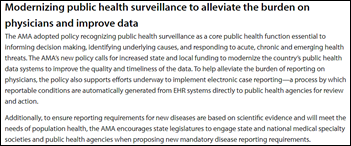
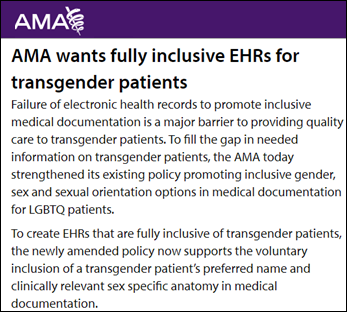
The American Medical Association adopts a policy that calls for increased state and local funding to modernize public health IT systems. AMA also wants provider EHRs to be capable of automatically sending reportable conditions to public health agencies.
AMA is also encouraging state governments to engage state and national medical specialty societies and public health agencies when considering new mandatory disease reporting requirements.
Reader Comments
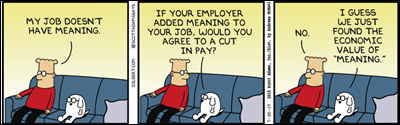
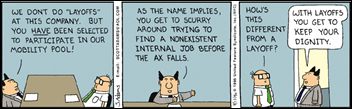
From Fatted Calf: “Re: layoffs. Your list of the steps people go through after being laid off should have included advice.” That wasn’t the reader’s question that I was answering via my reality check, but here you go:
- Don’t be ashamed at being laid off and don’t try to hide the fact that you are involuntarily seeking employment. Layoffs are a failure of executives and only they should feel shame. Develop a one-sentence description of why you no longer work there (general cutbacks, product sunsetted or sold, etc.) and practice succinctly answering the question, “Why did you leave?” because it will be asked often.
- Set your alarm to get up early every day, dress in real clothes, keep a calendar, make calls, exercise, and treat every day like a workday whose goal is to find a new job. Lack of time is no longer an excuse.
- Spend a day debriefing yourself in writing. What did you like and dislike about your job and employer? What did you and they do wrong? What good and bad job decisions did you make?The only point of this is to get that crap out of your head so you can move on to more productive pursuits than moping around and second-guessing. It’s amazing sometimes how committing something to writing frees up brain storage and mental CPU cycles.
- Don’t badmouth your previous employer. You stayed in your rut until the choice wasn’t yours, so there’s no virtue in complaining only afterward how bad it was.
- Take several days to plan your ideal career and who might hire you to practice it. You have the opportunity, no matter how unwelcome, to change your preconceived notions about yourself and the niche into which your former employer placed you.
- Polish your LinkedIn, adding your job’s end date, changing your title for “seeking a new opportunity,” and make sure your “About” section is punchy and reflects your abilities. Please don’t use stuffy third-party wording, aka the Godcam view of yourself, such as “Seasoned health system manager” – make it personal, direct, and memorable (and include a decent headshot that isn’t cropped from a phone photo from your last beach trip). Then create one-page, one-sided resume that gets to the point with the most important information listed first. Hiring managers don’t care too much about your personal statements and they already know that you’ll provide references on request. Unless you’re applying for a low-level job, you won’t get hired via an application or resume anyway, with incompetent corporate HR departments being one big reason, so make calls and get out of the house instead of staring at your laptop trying to use IT skills alone to get hired.
- Attend a local conference such as a HIMSS chapter if you aren’t willing to relocate or a national conference if you are. Those can be target-rich environments for job searches, or at worst, for learning about how the world revolves outside your former company. I also got a couple of good jobs working with a recruiter who I vetted pretty carefully, so while not everyone’s experience is positive, it worked for me.
- Decide if you are willing to move under any circumstances. If not, then your job search and networking activities will look different than if you’re willing to relocate.
- Increase your visibility with LinkedIn articles, tweets, or anything else that could catch a potential employer’s eye, assuming that your insight and writing ability match your job expectations.
- Reach out to everybody you know via email or LinkedIn messaging and keep a worksheet of who you contacted and when. Use the six degrees of separation power of LinkedIn to figure out who might hire you and the email searching ability of Google to get that person’s work email address so you can introduce yourself. You only need to hit one home run to forget the swings and misses.
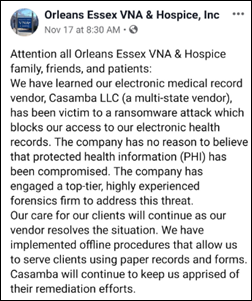
From RansomwareHitsHome: “Re: Casamba LLC. A ransomware attacked has forced some agencies that use its software back to paper records and forms.” The California-based post-acute care EHR vendor hasn’t publicly acknowledged the attack, but this update was provided by one of its customers.
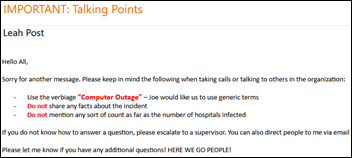
From FlyOnTheWall: “Re: Allscripts layoffs. The highest number I heard was greater than 350, but I’ll stand on my 125-150 let go until I find out more. They are in publicity damage control.” Unverified. I checked WARN notices for Illinois and Pennsylvania for the last several months and didn’t see any Allscripts entries, but WARN applies only to office closures and mass layoffs since they’re intended for giving the state rather than the employees a heads-up.
HIStalk Announcements and Requests
A reader approves of my activation of two-factor authentication to secure my Gmail accounts, but warns that the SMS-based verification option is not secure. He has first-hand experience – he lost $4,000 within minutes of someone using a SIM port hack to steal his cell phone number, which then allowed the hacker to reset the passwords for Gmail, banking, Twitter, etc. I took his advice and switched the authentication method to Google Authenticator, a free app that – like those flashing hardware dongles in the old days – generates authentication codes every few seconds. It’s like SMS messaging, except you open the phone or tablet app to get the current code and the mobile device doesn’t even need to be online at the time (unlike the SMS option). I had a few false starts in trying to figure out how to link the app to multiple email accounts from multiple mobile devices, but I finally figured it out by Googling. Another option is Google Prompt, which allows you to simply touch a phone pop-up acknowledging that it’s really you logging in on the other device, but it only works when the Gmail app is open and I don’t use it.
Webinars
None scheduled soon. Previous webinars are on our YouTube channel. Contact Lorre to present your own.
People
Jon McAnnis (Providence Health Plans) joins Zoom+Care as CIO.

Regenstrief Institute promotes Indiana University School of Medicine professor Shaun Grannis, MD to VP of data and analytics.

Nick White (Deloitte) joins Orbita as EVP of patient care solutions.

OurHealth promotes Brian Norris, RN, MBA to EVP of population health.
Announcements and Implementations
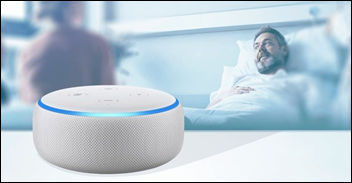
Orbita announces GA of OrbitaAssist, a bedside virtual health assistant designed to complement nurse call systems. Back-end software routes patient requests to the appropriate member of the care team, while front-end AI assures the patient their request is being fulfilled.

Datica will debut its new cloud compliance technology, including end-to-end cloud managed services, in early December.
Imprivata announces OneSign 7.0, which adds single sign-on for web based applications.
Government and Politics

Kaiser Health News publishes a retrospective look at stalled federal efforts to ensure the safety of EHRs. Ideas have included developing a database to track reports of deaths and injuries related to health IT and establishing an EHR safety center, neither of which have come to fruition due to funding and oversight issues. The issue gets even thornier thanks to a 21st Century Cures Act clause that prohibits the FDA from getting involved. Medical informaticist Dean Sittig, PhD says, “There wasn’t a lot of interest [at ONC] in talking about things that could go wrong. They gave out $36 billion. It’s hard for them to say EHRs aren’t safe.”

The Mann-Grandstaff VA Medical Center in Spokane, WA is hiring 108 more employees to cover anticipated productivity losses during its Cerner go-live on March 28. VA officials insist they are on track to meet that deadline, but will have no qualms about pushing it back should patient safety become an issue.
Privacy and Security
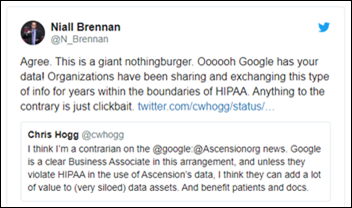
Google Health lead David Feinberg, MD attempts to clarify the company’s HIPAA-compliant work with Ascension, pointing out that the health system is piloting an interface concept he first mentioned at the HLTH Conference last month.
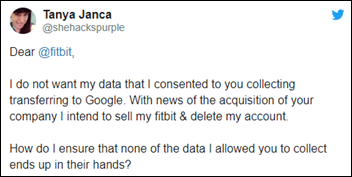
In the wake of Google’s Fitbit acquisition and health data trust debacle with Ascension, Wired offers step-by-step instructions on how to manage the privacy settings of popular health apps like Fitbit, Apple Health, and Google Fit. Some consumers have become so wary of Google and its plans for their health data that they have abandoned their Fitbits. One concerned user explained, “I’m not only afraid of what they can do with the data currently, but what they can do with it once their AI advances in 10 or 20 years.”
Other
A hospital in Bangalore, India will use its patient data to map areas where pothole-related injuries send up to four cyclists each day to its ED.

Kaiser Permanente will name its new medical school after former CEO Bernard Tyson, who passed away earlier this month. The school will open next summer in Pasadena, CA and will offer free tuition to its first five graduating classes.
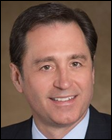
A former marketing SVP of Novant Health sues the health system for reverse discrimination, claiming that as a white male, he was fired as part of a corporate diversity push and was replaced with two minority hires. David Duvall, MBA, MPH says that at least five other white male executives, including the CIO, were terminated and replaced almost immediately with “either a racial minority and/or female.” He was let go right before his five-year anniversary, when his termination would have entitled him to 18 months of base pay, 1.5 times his previous bonus, $200,000 in retirement benefits, and company-paid health insurance.
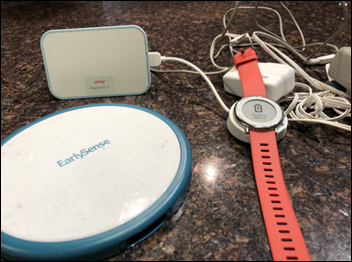
Digital health investor, consultant, and author Terri Mead critiques her second annual visit as a participant in Verily’s Project Baseline Health, a four-year study announced in 2017 that aims to create a database of the sequenced genomes of 10,000 volunteers. Study participants like Mead also agree to wear activity trackers that share their sleep patterns, activity, heart rate, and other health metrics with Verily researchers. Her criticisms:
- The “archaic” use of Google Forms to capture patient intake data.
- The risk of inconsistent and unreliable data thanks to manual data entry that does not use drop-downs that are tied to medical terminology.
- The study expressed no interest in her “female parts,” which left her assuming that they consider females “a standard deviation away from males.”
- Lack of follow up on patient adherence to use of wearables, some of which she stopped using months before.
- Abandonment of lung/breathing tests due to budget issues.
Sponsor Updates
- AMIA inducts Intelligent Medical Objects VP of Customer Experience Steven Rube, MD and VP of Clinical Informatics Eric Rose, MD into its 2020 class of fellows.
- Optimum Healthcare IT publishes a new case study, “Cerner Millenium Implementation at Ellis Medicine.”
- The Chartis Group publishes a new paper, “Being a Digital Health System: It’s No Longer a Question of If or When.”
- Pivot Point Consulting releases the first episode of its new Get to the Point podcast, “Flexibility vs. Interoperability. Can Clinical Documentation Do Both?”
- Imprivata updates its OneSign authentication and access software to offer users seamless cloud-based access from any device.
Blog Posts
- How Choosing the Right EHR Helped Our Practice (EClinicalWorks)
- How Google Cloud helps prepare the military’s medical professionals to serve around the globe (Google Cloud)
- The Value of Health Education: Improving Engagement for Members with Diabetes (Healthwise)
- Broadening radiology’s medical imaging horizons (Hyland)
- Optimizing Revenue Cycle Processes: The Technology Factor (Impact Advisors)
- 5 Ways to Measure the Value of Clinical Mobility (Mobile Heartbeat)
- Can Predictive Analytics Cut Patient Care Costs? (Definitive Healthcare)

Contacts
Mr. H, Lorre, Jenn, Dr. Jayne.
Get HIStalk updates. Send news or rumors.
Contact us.






















I was born roughly 2 months after the US space program began (Explorer 1), and I've followed it all my…