Home » News » Recent Articles:

News 10/14/09

October 13, 2009 News 13 Comments

urmc

From Lizzie Borden: “Re: University of Rochester. I hear they just signed with Epic systems for their EMR solution. What are they installing and are they hiring? Interestingly, I also know that Buffalo Medical Group has acted proactively and offered their Epic analysts a $$ incentive to stay with them instead of fleeing to U of R.” URMC’s Web site says Epic says contract negotiations “were finalized in September 2009.” It also says that they’ve had to scale the $49 million project back, but still hope to nab $8 million of taxpayer ARRA money. It’s the full-blown inpatient system, apparently, expected to go live in the fall of 2011. Details here.

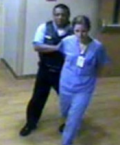
From Topper Harley: “Re: trial. Not too nice of the doctor!” An HIT company executive goes on trial this week, facing multiple felony charges for an alleged road rage incident. I initially did a detailed write-up complete with links and accident scene photos, but I reconsidered for several reasons: (a) he’s been charged, but not found guilty, which means he’s innocent; (b) he is an HIStalk reader and I’ve swapped e-mails with him in the past, so it would be needlessly painful for him to read the story here and know that his peers are doing the same; (c) I could easily wreck his career unintentionally just by giving the unproven details a spotlight. If and when he’s found guilty of something major, I’ll provide details. Until then, I’ll express non-specific sympathy for all involved and my hope that justice prevails.

From Luke O’Scyte: “Re: Ontario. It is called a learning opportunity, or perhaps a teachable moment, how not to spend one billion dollars. The Ontario government, through arrogance and folly, decided that they new best how to pick the market winners, run their own networks, decide on which technologies to approve and which to ignore. So how did that work out for them? See the auditor’s report (warning: PDF).” It’s full of juicy details, like that eHealth Ontario’s CEO paid a recruiter $1 million upfront to fill 15 management positions; one successful contractor’s bid was five times more than a comparable one and more than quadruple the budgeted amount; and $800 million of the $1 billion spent to date was for a private network that “remains significantly underutilized because as yet there is insufficient health-related information on it.” in other words, they jumped all over their equivalent of NHIN without first getting provider EMRs up and running to populate it. 

aug14

ucsf

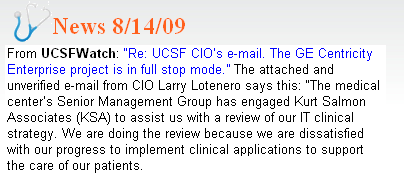
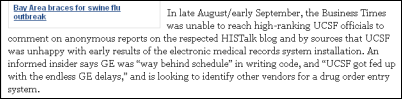
UCSF finally confirms what I reported in August as a rumor (supported by a reader-forwarded copy of an internal department e-mail): UCSF has halted (temporarily, at least) its $50 million GE Centricity project. You’d never know there was trouble in paradise if you Google UCSF+Centricity: the rags and press releases were making it sound like a match made in heaven. Thanks to SF Business Times Chris Rauber for giving HIStalk and rumor reporter UCSFWatch credit.

Here’s the next gossipy tidbit provided to me by one of those UCSF rumor reporters: as soon as UCSF’s lawyers get them out of their GE contract, they’re going with Epic. Unverified.

Cisco takes its Vision Van (or whatever you call a demo trailer) to Auburn Memorial Hospital (NY), showing off technologies such as videoconferencing and mobile caregiver communication.

Eclipsys announces scheduled events for its EUN conference in Dallas next week. ARRA’s on the list, not too shockingly, along with the customer knowledge sharing tool Eclipsys Outcomes Toolkits and physician sessions on its PeakPractice ambulatory EHR.

medmatica

Welcome back to HIStalk Gold Sponsor MedMatica Consulting Associates of Chester Springs, PA, a software and technology implementation firm (Epic, Eclipsys, Siemens, Meditech, Cerner, etc.) The company provides HISAssist support plans (live, telephone-based, or Web-based) for those vendor products as well. I’m blessed with amazing sponsor retention, so having MedMatica come back soothes my overwhelming feelings of inadequacy at least temporarily.

brightnote

McKesson announces that all of its physician EMRs can now use Bright Note Technology. I didn’t really understand from the press release what it does, exactly, but it’s some kind of multiple input/single search capability for patient data. I found this demo on YouTube, showing a doctor using speech recognition to dictate a single SOAP note that parses out the information into specific chart data elements.

Inga’s update from MGMA today is on HIStalk Practice.

GetWellNetwork announces GetWell Town, an interactive patient care system designed for pediatric patients, and its first customer, Walt Disney Pavilion at Florida Hospital for Children. It includes care content, child life programming, entertainment options, parental controls, pediatric education, and pediatric pathways.

A summer intern (Harvard-graduated lawyer, Stanford PhD candidate) at IBM Research comes up with an encryption breakthrough that may have great potential for protecting health information, especially with cloud computing. Homomorphic encryption, formerly viewed as impossible by cryptographers because it takes a lot of computing horsepower, allows running calculations on encrypted data without actually decrypting it. IBM hired him, of course.

Listening: My Dying Bride, an old favorite doom metal band that I’d forgotten about.

Weird News Andy characterizes this story as both weird and sad. An 31-year-old English veteran of the war in Iraq dies after receiving cancerous lungs transplanted from a donor who had been a heavy smoker. The tumor wasn’t discovered until months after the transplant, during which time its growth accelerated, fueled by the routine post-transplant immunosuppressive drugs the patient was taking. The delay in noticing the tumor was blamed on poor communication among the radiologists and doctors involved. The cancerous lung made him ineligible for a second transplant since, under hospital rules, he had become a cancer patient.

NIH gives Kaiser $54 million of ARRA/taxpayer money to conduct biomedical and personalized health research using HealthConnect.

RelayHealth announces that 50 health systems and hospitals have contracted to join its RelayHealth Network, which connects 20,000 doctors, 90% of retail pharmacies, and 52 reference labs, all of which automatically update 7.6 million shareable personal health records for HIE connectivity and care coordination. We may need to talk to a participating site since that sounds pretty interesting.

quickenhealth

Allscripts announces that it’s the first EMR vendor to integrate its systems with Intuit’s Quicken Health Bill Pay, which gives patients an easily understood statement and the ability to pay online. Doctors get paid 18 days faster on average. Everybody seems to like the Quicken app, which I first wrote about in early 2006 and talked up as potentially a big deal, although it seemed to take a long time to see the light of day.

Also announced: Allscripts will offer its practice customers point-of-care patient payments via mPay Gateway, which calculates patient responsibility and obtains payment authorization before the patient leaves the office. Inga interviewed mPay Gateway CEO Brian Beutner just last week on HIStalk Practice. We asked him the obvious question – are patients really willing to pay before leaving the office? He says 90% of them will. “They like the fact that there are no more unpleasant surprises and the simplicity of taking care of the payment up front, rather than having to wade through numerous statements from the doctor and comparing them to the multiple EOBs and other confusing insurance documents.”

Check out TPD’s list of iPhone applications for healthcare. If you know of others, leave a comment on that article and he will expand his list. Thanks to TPD for putting the list together and for his ongoing contributions to HIStalk.

daveroberts

Dave Roberts, the VP of government relations for HIMSS and former mayor of Solana Beach, CA is running for Congress.

qlikview

A reader e-mailed to ask if I’d heard of QlikView, with which she was impressed in using it on a consulting project. I hadn’t, so I Googled. It’s a very cool BI tool (check the online demos) and supposedly the fastest growing BI company in the world (which probably means Oracle, IBM, or Microsoft will be buying them next week, unfortunately). I noticed that Bassett Healthcare was listed as one of its healthcare customers, so I Googled yet again to find that apparently Surgical information Systems uses it for its SIS Analytics offering (PDF case study here).

ACI_Header.indd

Two Johns Hopkins pediatricians and informatics faculty members launch Applied Clinical Informatics, an official online publication of the International Medical Informatics Association and AMDIS that hopes to “bridge the gap between visionary design and successful and pragmatic deployment.”

The VA awards a claims processing contract worth up to $60 million to VistA integrator Document Storage Systems.

Cedars-Sinai admits that it overdosed 206 CT scan patients with eight times the intended dose of radiation because of  “a misunderstanding about an embedded default setting applied by the machine.”

Dell, fresh off its Perot buy, will be looking for more healthcare acquisitions, says Michael Dell.

uva

UVA Medical Center confirms that it will implement Epic, which I speculated in February (I’m not psychic – if a hospital has more than 400 beds, I always guess Epic and I’m usually right). UVA was the hospital that got a lot of press (some of it snarky) recently when it said it would hire scribes instead of repurposing busy doctors, so now we know which EMR they’ll be typing into.

University of Central Florida gets preliminary HHS approval to start a health technology regional extension center and apply for $8 million in stimulus money.

An Oklahoma hospice owner fears that reimbursement cuts and government-encouraged EMRs will drive him out of business. “One of the things they talk about is electronic medical records, which has great applications for medical doctors’ offices, but for hospices, that doesn’t help us at all.”

Philips posts surprisingly good Q3 numbers, with an expected loss of $66 million actually turning into a $258 million profit. Healthcare margins dropped to 9.6% and sales were down 4%, however.

You would think PHR vendor MyMedicalRecords is a huge enterprise given endless press releases and PR efforts. Not so: the quarterly revenue of its money-losing parent company was $221K.

Virginia Tech gets a $28 million NIH grant for infectious disease research at its Virginia Bioinformatics Institute.

E-mail me.

TPD’s List of iPhone Applications

October 11, 2009 News 20 Comments

TPD’s List of iPhone Apps – Update #4
By The PACS Designer

Input from HIStalkers and some further research helped expand the number of iPhone applications for this updated list. Newly added applications are marked with an (N).

  Medical for Physicians/Nurses
   
  ARUP Consult
  It’s a laboratory test selection support tool
   
  Lab Tests
  The Lab Tests available are: Blood Bank, Clinical Chemistry, Coagulation, Hematology, Serology, Immunology, Tumor Markers, Urinalysis and Therapeutic Drugs
   
  Lab Tests Online
  A resource that can be accessed by mobile devices
   
  Normal Lab Values
  A tool to help clinicians determine normal laboratory values
   
  Medical Lab Tests
  Offers short and concise information including normal lab values of the most common clinical laboratory tests
   
  Capzule
  An application for EMR access
   
  HeartIT
  A medical imaging viewer
   
  Ziosoft zioTerm 2D/3D
  A tool for viewing 2D/3D image files on your iPhone
   
  GE Clinical Images
  Showcase clinical IMAGES from GE Healthcare imaging systems
   
  iRadiology
  An app that allows for quick review of classic radiology cases during rounds or clinical rotations
   
  HeartScan for iPhone
  An app to turn your iPhone into a convenient heart rate monitor
   
  Eponyms-touch
  An eponym database
   
  Med Mnemonics
  A unique learning tool with over 1400 mnemonics
   
  Medical Abbreviations
  An app that contains over 14,000 abbreviation definitions
   
  AbbStore-Lite
  An app with the complete resource for medical abbreviations, acronyms, and eponyms
   
  Quick Medical Terminology and Abbreviation Reference
  The #1 selling medical terminology reference app on iTunes
   
  The Wheel
  A gestational age calculator
   
  The Wheel SP
  A tool to do fetal biometric calculations along with normal GA calculations
   
  The Wheel RE
  Recreates the classic obstetric wheel gestational age (GA) calculator used by healthcare providers for decades
   
  Perfect OB Wheel
  A simple and fast pregnancy wheel for clinicians
   
  Pocket Therapist
  Provides quotes to help with problems
   
  Pocket Medical
  Gives you medical terms and conditions
   
  WebMD Mobile
  Provides symptom checker, drugs and treatment, and First Aid info
   
  Care Connector
  Caregiver information on the go
   
  My Life Record
  A place for storing personal information
   
  8h2o
  A tool to track water consumption
   
  STD2006
  STD2006 contains the CDC STD Treatment Guidelines using their original, but difficult to navigate, table of contents
   
  Skyscape
  Provides outlines in Clinical Medicine®, Archimedes™ – Medical Calculator, RxDrugs™: Drug Dosing Tool and MedAlert™
   
  MedHelp
  A disease tracking tool for healthcare workers and their patients
   
  pMDsoft
  A tool to view data about your patients in realtime to aid charge capture
   
  iChart
  A digital medical assistant to manage patient records
   
  Osirix 3.7.1 for MacOS
  An image processing software dedicated to DICOM images produced by medical equipment
   
  OsiriX for iPhone 1.1.1
  OsiriX is a companion application to OsiriX for Mac which is an interactive visualization program designed for display and analysis of medical images
   
  Patient Tracker
  An application from DoctorCalc that helps track your patients
   
  iBlurb
  An application developed by one of our own, Dr. Paul Friedman
   
  Nature Mobile
  The nature.com iPhone application allows you to access science news stories and the latest published research
   
  iStethoscope
  An application that turns your iPhone into a stethoscope
   
  Swine Flu + Outbreaks Near Me
  An application from HealthMaps that alerts you in realtime about disease outbreaks in your area
   
  Instant ECG
  An application to view rhythm strips and 12-lead ECG movies
   
  HealthFusion® Mobile Apps (Contact Company for details)
  HealthFusion® Mobile Apps deliver new tools that physicians need to treat patients, no matter where you are, and to help ensure that you are in constant communication with your practice.
   
  iPatientEd
  A tool to teach patients about their specific diseases or health conditions
   
  Macpractice iPhone Interface 2.0
  A hospital rounds assistant and more
   
  Sad Scale
  A tool to check depression, postpartum depression, geriatric depression, children depression scale and graph them
   
  Monthly Prescribing Reference
  MPR provides concise prescription and OTC drug information, side effects and interactions for medical professionals
   
  Helsana-Eye Test
  Hold you iPhone with arm stretched to test your eyesight
   
  Eye Chart Pro
  An app to test eyes of patients using a iPad rather than an iPhone
   
  EyeXam
  A tool to evaluate vision on the eye chart using the highest performance method.
   
  iNeedADoc
  A tool to find the best doctor for your health condition
   
  Proloquo2Go
  A tool for those who have speech difficulties
   
  Pocket reference for doctors (in development)
  Read about brave University of Saskatchewan students going forward with a devlopment effort for doctors.
   
  Snoflake SNOMED CT Browser
  A tool for viewing SNOMED CT information
   
  Sleep Apnea Test
  This application gives an indication of whether the reader may have symptoms of sleep apnea
   
  iSore
  A gruesome directory of medical conditions affecting the eyes, skin and mouth
   
  Harvard University Headline News
  Get the latest news from Harvard on your iPhone
   
  NHS News
  Keep up with the latest news from the UK’s National Health Service
   
  Medpage Today Mobile
  This app puts breaking medical news and CME/CE credits at your fingertips, with daily coverage of over 30 specialties and annual coverage of over 60 meetings and symposia
   
  SearchMedica
  An app that improves the practice of medicine by allowing practitioners to use the Internet to discover the most recent, relevant, and authoritative clinical information
   
  Medsy
  A tool to help you with scheduling your medications
   
  eRoentgen Radiology Diagnosis
  A tool to due radiology diagnosis
   
  ICD-9 and ICD-10 Helper
  A tool to help with coding
   
  IQMax
  A tool to gather the latest clinical and hospital information
   
  iMobileHealthCare
  iMobileHealthCare has developed iAorticValve, a reference guide to all heart valve products.
   
  CobbMeter
  A medical tool designed to measure the Cobb angle, the kyphosis angle, and the sacral slope on vertical spine radiographs
   
  Ethicon-PVP for iPhone
  This app is a course about umbilical hernia repair using a partially absorbable mesh patch
   
  iTriage Health Network
  A tool that provides self-diagnosis/triage and hosp/clinic/doctor finder all in one
   
  Meine Klinik
  A German version of the iTriage Health Network
   
  Medicopedia
  A database search tool in French
   
  VisualDx Mobile
  An app that shows disease variation with MULTIPLE images of each disease
   
  Instant ECG
  Electrocardiogram App that works on the iPhone
   
  EPI Life
  A revolutionary mobile phone device that has an integrated multi-lead ECG and Health Suite fubction
   
  Medical Calculator
  Another application from DoctorCalc that helps with calculations
   
  ABG for iPhone
  ABG is a multipurpose medical calculator used to analyse arterial blood gasses and perform other functions
   
  ACC Pocket Guidelines
  A clinical practice support tool set from the ACC that provides concise, portable reference tools about cardiology
   
  Corticonverter
  A quick and easy-to-use utility application to perform corticosteroids unit convert
   
  Calculate (Medical Calculator) by QxMD
  A next-generation clinical calculator and decision support tool
   
  DizzyFix by Clearwater Clinical (for Vertigo)
  This tool instantly enables any physician to take a patient through the correct treatment maneuver for BPPV
   
  MyMoodMonitor (mym3)
  An app that allows you to screen for potential depression and anxiety symptoms (including bipolar disorder and ptsd) in one easy review
   
(N) T2 Mood Tracker
   
  T2 Mood Tracker is a mobile application that allows users to self-monitor, track and reference their emotional experience over a period of days, weeks and months using a visual analog rating scale.
   
  5-Minute Clinical Consult
  An app to do quick consults
   
 
  The most complete, evidence-based drug information resource, right at your fingertips
   
  Drug Addiction
  A tool to monitor and identify drug addictions
   
  Drug Infusion
  A calculator for IV Med Drip Rate infusions
   
  Grays Anatomy
  A well known anatomical book by Henry Gray was first published in 1858 and is now in a mobile format for users
   
  iBP Blood Pressure
  A blood pressure tracking and analysis tool
   
  ICU Pearls
  An app that provides over 1,000 pearls of wisdom
   
  Medical 360
  An app for hard to find medical information
   
  Quick Medical Terminology
  A tool recommended by the Medical Group Management Association (MGMA) for referencing purposes
   
  Medicine On Call
  Presents treatment and laboratory tests orders for all diseases and disorders that are likely to be encountered in the hospital
   
  Nursing Central
  The complete mobile solution for nursing
   
  NCLEX-RN Wiz
  NCLEX-RN Wiz is the Number One Review app for NCLEX-RN review and nursing school course review
   
  RNotes
  Helps nurses provide premium patient care by putting the latest quick-reference, clinically-focused nursing information at their fingertips
   
  Informed RN Pocket
  A good reference for nurses who need quick information
   
  PatientKeeper® Mobile Clinical Results™
  Mobile Clinical Results is the mobile companion product to the PatientKeeper Physician Portal
   
  Paramedic Protocol Provider
  An app that provides quick offline access to over 170 field treatment protocols
   
  Pedi STAT
  A tool to achieve rapid pediatric reference information during emergency or critical care environments
   
  Psychiatry i-pocketcards
  The i-pocketcards cover a wide range of tests and scales used for the psychiatric assessment of a patient
   
  Psychology Encyclopedia
  A good reference for students and beginners in the study of Psychology
   
  Pubmed On Tap
  A search tool for mobile referencing of the PubMed website
   
  Skyscape Medical Resources
  An app about medical information and decision support resources for healthcare professionals, including physicians, nurses, physician assistants, nurse practitioners, medical students, nursing students, and more
   
  Student BMJ
  A monthly international medical journal for medical students and junior doctors
   
  Taber’s Medical Dictionary
  A medical dictionary that is very popular with current users of the application
   
  Pri-med Mobile
  A professional community of peers and expert faculty delivering world-class content through a network of meetings, multimedia content, and online tools.
   
  MedAnywhere©
  MedAnywhere© is an iPhone App and optional full line of Bluetooth® systems that enable a customer to have constant and comprehensive medical care capability in an emergency
   
  Smile Reminder
  An application to enhance your practice by engaging your patients in the care process
   
(N) Pri-Med Mobile – powered-by QuantiaMD
   
  Pri-Med offers healthcare providers a professional community of peers and expert faculty delivering world-class content through a network of meetings, multimedia content, and online tools
   
(N) pMDsoft Charge Capture
   
  An app to improve the efficiency of your office through better charge capture
   
(N) Top Doc
   
  Experience and react to realistic patient encounters that require quick clinical responses, just like a real medical clinic, with Top Doc, a new medical quiz App from Elsevier and Legacy Interactive
   
(N) Procedures Consult
   
  Procedures Consult is an online multimedia tool that offers clear details on dozens of medical procedures
   
(N) MedAptus
   
  Enterprises that have deployed MedAptus solutions have realized millions of dollars in increased revenue, improved organizational productivity, and enjoyed enthusiastic user adoption
   
(N) Surg-i-Scan
   
  Surg-i-Scan™, from ImageXpres Corporation, is a surgical safety checklist application that conforms to the World Health Organization initiative to have surgical protocol check lists available for use by surgeons and nurses during surgical operations, and other invasive procedures, in an effort to reduce incidents of death, and reduce surgical complications by more than a third.
   
(N) VisualDx Mobile
   
  This new medical app combines physician-reviewed clinical information with thousands of medical images from renowned physician and institutional collections. The only medical application to represent the variation of disease presentation through age, stage, and skin type, VisualDx Mobile addresses the key complexities faced by many clinicians today when diagnosing dermatologic and other visual conditions.
   
(N) mSleepTest
   
  Snoring is not a joke and it could be a sign of a much more serious disorder
   
(N) CTCAE v4.0 (from The Children’s Hospital of Philadelphia)
   
  The National Cancer Institute (NCI) Common Terminology Criteria for Adverse Events (CTCAE) is a standardized system to quantify or grade the severity of adverse events (AE) that occur with drug treatment or from medical devices. A definition of mild (grade 1), moderate (2), severe (3), life-threatening (4) and death related to AE (5) events is provided for each AE term.
   
(N) InovaER (from Inova Health System)
   
  An app to get real-time updates on Inova Health System’s nine emergency room locations throughout Northern Virginia
  http://itunes.apple.com/us/app/inovaer/id384637516?mt=8
   
(N) UroApp
   
  UroApp is a mobile app that connects to a social network for Urologists in Canada
   
(N) OfficeEMR Mobile™
   
  OfficeEMR Mobile™ is a Free add-on to iSALUS’s web-based electronic medical record and practice management service
   
(N) Evolving Health
   
  This dialysis capacity planning tool enables you to quickly estimate the savings that could be generated by changing your mix of dialysis patients
   
(N) MS Patient Resources
   
  MS Patient Resources makes an office visit what it should be—a two-way conversation between you and your patient
   
(N) ZirMed Patient Check-in (for iPad only)
   
  Give your medical practice a modern feel while at the same time saving paper and eliminating the constant issue of illegible handwriting
   
(N) ResolutionMD Mobile
   
  ResolutionMD Mobile is the only product that delivers anytime, anywhere full-functionality advanced visualization of medical images to your mobile device
   
(N) MacPractice iPad VNC Interface
   
  Use an iPad as a portable, wireless, touch-screen monitor and use MacPractice on it
   
(N) iClarity Lite (for iPhone & iPad)
   
  A medical image viewing app that enables viewing images stored on ClarityPACS, or using iClarity Gateway, to receive and view images from an existing PACS
   
(N) HD Radiology (for iPad)
   
  One of many iPad apps from MedicMaKe to educate you about Radiology and other modalities
   
(N) modalityBODY (for iPad)
   
  Use modalityBODY to organize, annotate, search and store thousands of medical images and create custom image collections for study and reference
   
(N) AirStrip Cardiology™
   
  A platform designed with a vision of securely sending critical patient information directly from hospital monitoring systems, bedside devices, and electronic health records to a clinician’s mobile device
   
(N) The Johns Hopkins POC-IT® ABX Guide
   
  The Johns Hopkins ABX Guide is a point-of-care resource that covers everything you need to know about treatment of infectious diseases
   
(N) PhotoClinic Mobile
   
  PhotoClinic Mobile helps primary care physicians diagnose and treat conditions. Search images and case studies of conditions submitted by office-based physicians and published in Consultant.
   
(N) Nimble from ClearPractice (for iPAD only)
   
  A comprehensive EMR built specifically for the iPad
   
(N) Med-Surg: Gastrointestinal & Genitourinary
   
  Familiarize yourself with questions encompassing common scenarios, health problems, and case studies that you will encounter as a nursing student with Med-Surg: Gastrointestinal & Genitourinary by HESI QuizMe
   
(N) Bedside
   
  Bedside enables the clinician to take the Electronic Patient Record to the patient in a hospital bed, out in a community setting or at the patient’s home
   
(N) iVCL
   
  An app that’s a c-arm simulator and anatomical viewer designed to teach all medical staff and students hand-to-eye co-ordination skills and anatomical positioning concepts in a radiation free environment
   
  Groups of Apps
   
  iPhoneness
  Group of applications for pregnant mothers that include Woman Calendar, Foods to Avoid When Pregnant, Contraction Master, and others
   
  12 EMRs for iPhone
  A collection of a dozen EMRs for your iPhone including Epic’s Haiku and others
   
  Unbound Medline
  One of a group of medical applications for the iPhone from Unbound Medicine
   
  Medzio Mobile Health Network
  Medzio is a free iPhone application that connects consumers to a variety of healthcare services
   
  Lexi-COMPLETE
  An application that provides access to 20 databases
   
(N) Apps for All – Healthful Apps
   
  Healthful Apps takes the legwork out of finding the best health-related apps, saving you time and money so you can focus on getting or giving quality healthcare. For example, the Mood Lifters allows you to quickly identify, based on peer reviews, the best apps in this category
   
  Apps for Patients
   
  Pharmacy
   
  Epocrates Essentials
  An Rx information source. See below for information on the next version to be released later this year.
   
  iPharmacy
  A Pharmacy Locator application
   
  The Merck Manuals for iPhone
  The app provides quick and easy access to the Home Edition’s comprehensive and understandable medical information
   
  Medscape Mobile
  A drug search and interaction checker application
   
  Remedy Systems
  A free e-prescribing application certified for prescription routing through the SureScripts network
   
  RXnt
  An e-prescribing application for physicians
   
  Pharmacist’s Letter®
  A popular daily reference tool for pharmacists
   
  Psych Drugs
  A tool to learn important and useful information about various psychotropic medications
   
  NREMT Paramedic Medications
  An app with a comprehensive list and overview of the drugs used by paramedics
   
  Diabetes
   
  Islet
  A mobile Diabetes management application
   
  GC Pro™ (formerly Glucose-Charter)
  A tool to track blood glucose, insulin and other medications
   
(N) Vree™ for Diabetes
  Vree™ for Diabetes provides you with helpful tools in one easy-to-access location to manage your disease
   
(N) BGluMon – Blood Glucose Monitor
   
  Blood Glucose Monitor is an advanced and easy-to-use tool to watch for your blood glucose concentration on a daily basis and included tools for recording, editing, exporting data, calculating and drawing statistics and reports
   
(N) BGStar glucose monitoring and iBGStar Diabetes Manager
   
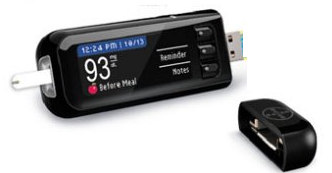
  iPhone and iPod touch users with diabetes will soon have an accessory and companion app that will help them monitor blood glucose levels from Sanofi-Aventis
   
(N) NovoDose™
   
  A mobile insulin analog dosing guide application for the iPhone and iPod Touch from Novo Nordisk
   
  Fitness
   
  Fitness Tracking
  A tool for keeping up with your fitness routines
   
  I PHIT
  A fitness tracking tool
   
  Steps
  A pedometer for walkers
   
  iNewLeaf
  Exercise and heart rate training information
   
  Heart Pal Free
  An application for logging, charting, and analyzing your blood pressure and sharing it with your physician
   
  Heartwise Blood Pressure Tracker
  The highest rated app for recording and keeping track of blood pressure readings
   
  The Human Body 2
  An app that details the human body for users
   
  Weight Watching
   
  WeightMan
  Application for recording (managing) your weight everyday
   
  WeightBot
  A tool to track history of your weight
   
  Lose-it!
  A weight loss application to help you set goals and control calorie intake
   
  Easy Weight Loss
  An app to discover how to lose weight with these easy weight loss and diet tips
   
  Weight Loss Tracker
  An app to help track weight loss goals that is popular with current users
   
(N) myPlan – The Special K Challenge™
   
  The Special K Challenge™ is a two week weight management program designed just for you – using a great variety of Special K® products. It’s a great way to kick start a better you! And now, it’s easier than ever to stay on track.
   
  Lose Weight With Andrew Johnson
  This App is designed to help dissolve the bad habits associated with overeating, eating too fast, eating at the wrong times etc.
   
(N) LIVESTRONG Calorie Tracker
   
  An app for helping you keep your calorie intake lower to reduce your weight
   
  Smoke Quitting
   
  Quitter 1.5
  An aid to promote the quitting of smoking
   
  I Quit Smoking
  An aid to stop smoking
   
(N) The EX Plan
   
  The EX Plan app is a whole new way to think about quitting smoking – as “re-learning life without cigarettes". This app lets people create their own personalized quit smoking plan and connect with other smokers online at BecomeAnEX.org
   
  CPR Aids
   
  Pocket First Aid & CPR
  A tool for emergencies
   
(N) PocketCPR
   
  PocketCPR for iPhone™ provides REAL-TIME feedback and instructions on CPR that empowers ANYONE to learn and practice CPR
   
(N) CPR & Choking
   
  A tool to educate you in the art of giving CPR and also how to clear the paths of choking victims
   
(N) Phone Aid
   
  An app to show you how to perform CPR to save a life
   
  Nutrition
   
  Restaurant Nutrition
  A tool to check those carbs
   
  Food Additives
  A tool to take control of what you eat
   
  Vitamins & Minerals
  An app to learn about essential vitamins & minerals, what they do, & their food sources
   
  Relaxation
   
  Relax Completely
  A fantastic hypnosis session for deep relaxation by one of the UKs leading hypnotherapists and trainers
   
  Relax Dream
  An app that provides relaxing sounds
   
  Relax Ocean Waves
  An app that provides relaxing sounds and beautiful videos
   
  Relax Raindrops
  An app that provides the sound of raindrops to relax you
   
  Relax Waterfall
  An app that provides relaxing sound from various environments such as whales, rain, thunder, waves, and more
   
  Relax with Andrew Johnson Lite
  A popular relaxation tool that has been highly rated by others
   
  Stress Check
  An app with powerful stress management tools to help you manage your stress more effectively
   
  General Health
   
  Health N Family
  A health information tracker
   
  FDA for iPhone
  US Food & Drug Administration information
   
  MyNetDiary
  An online diet service
   
  Health and Fitness Mobile
  A personal training aid
   
  Polka
  A health & wellness tracking tool
   
  Infections
  A tool to help avoid infections by highlighting typical signs of advancing infection
   
  HealthAssist
  An application designed to help people who take prescription medications better manage their conditions
   
  Caregiver Apps
  An app that helps to manage a caregiver’s day-to-day activities: track medications, illnesses, appointments or get expert advice
   
  My Epilepsy Diary
  An app to keep track of seizures, medicines, and how you feel
   
  A Low GI Diet
  An app to help monitor the foods you eat
   
  Amazing Human Calculator
  An app that will help answer questions you have about your body
   
  BabyBump
  A tool to track a pregnancy through to the delivery time
   
  Body Systems – Anatomy Quiz
  A tool to educate you on your anatomy
   
  BP Tracker Lite
  You can use this to easily log your BP, HR, medication and other useful information
   
  Brain and Nerves
  An app to educate and inform about the brain and its nerves
   
  Am I Pregnant Quiz
  A tool for determining if you are pregnant
   
  Labor and Contraction Timer
  An app to easily time labor contractions
   
  Menstrual Calendar
  A tool for calculation from FertilityFriend.com
   
  Expecting
  A tool that can help you along the way to that special day – your due date and your child’s birthday
   
(N) Pink Pad Pro (Period, Fertility & Health Tracker)
   
  An app that provides a central location for women to track pregnancies
   
  Learn Muscles
  A good learning tool for understanding muscles
   
  Muscle System (Head and Neck)
  A tool providing details of each muscle’s origin and insertion. It also include details of each muscle’s action and nerve supply
   
  Skeletal System (Head and Neck)
  A tool to educate you on the subject of the skeletal system
   
  Muscle Trigger Points
  A Reference for the most common trigger points and referral patterns for over 70 muscles
   
  Netter’s Musculoskeletal Flash Cards
  Brush up on bony anatomy with this tool
   
  My Medical
  An app to keep track of all of your personal medical information in one convenient place
   
  Physical Exam Essentials
  An app that provides you with a quick overview of the essential aspects of the physical exam
   
  Sex-Facts
  An app that contains hundreds of interesting, fun, and useful facts about sex
   
  Sexual Health Issues
  An app to educate you about sexual intimacy, and how to achieve healthy relationships
   
  Speed Bones MD
  A game to test your knowledge of the human structure
   
  Speed Brain
  A game to test your base of knowledge about the human brain
   
  uHear
  An app with high quality professional hearing tools in a mobile format
   
  Visualize Healing with Andrew Johnson
  An application that is intended to help people through meditative visualization
   
  Women’s Health
  An app developed by a fitness expert to help enhance women’s health
   
(N) Dr K’s Breast Checker
   
  Breast cancer affects women of all ages, so being breast aware is very important to all women, including younger women
   
(N) iBreastCheck
   
  This app will help women be breast aware and could make all the difference through early detection techniques
   
  TremorTracer
  A tool to view symptoms that destroy nerve tissue such as Parkinson’s disease or multiple sclerosis
   
  Control of Communicable Diseases Manual
  A tool to find out about communicable diseases
   
  Apps for Healthy Kids
  An app to learn about First Lady Michelle Obama’s Let’s Move! campaign to end childhood obesity within a generation
   
(N) KidsDoc
   
  Is your child sick? Whether you’re on the go or at home, this app will help you know what to do next
   
  MyHumana Mobile
  A portable extension of Humana’s guidance promise
   
(N) Coppertone MyUVAlert™
   
  This handy iPhone application helps you with sun protection information for your whole family, offering local UV index forecasts, custom sunscreen reapplication reminders that you set, and individualized product recommendations
   
(N) VideoMD
   
  Video MD features Free Health Videos and Doctor Videos that are created by physicians and are used to educate patients
   
(N) Main Street Medica Mobile
   
  Use Main Street Medica Mobile to help better understand the cost implications of your choices, evaluate your options and determine which health care providers will best serve your needs
   
(N) iChemoDiary
   
  The iChemoDiary is a personal oncology diary to record your chemotherapy schedule, treatments, medication and symptoms such as nausea and vomiting
   
(N) iManage Migraine
   
  iManage Migraine provides a comprehensive suite of educational tools, real-time tracking, and analytic capabilities to enable you to better understand and manage your personal migraine experience
   
(N) Sleep On It
   
  Get the iPhone alarm clock that does it all! Set your alarm and with one tap you can record how much sleep, then add info about sleep quality, your mood, meds and more to see what affects your sleep and how much you really need to feel rested and energized
   
(N) CU-PetHealth
   
  CU Pet Health is a handy application brought to you by the College of Veterinary Medicine at Cornell University that allows you to manage information about your pets including biographic info, vaccines, medications and diet
   
(N) East TN Kids
   
  East TN Kids is an application for the iPhone or iPod that will allow you as a parent, grandparent or caregiver to keep a record of important medical information on your child, read helpful pediatric health information and easily get in touch with your doctor or East Tennessee Children’s Hospital
   
(N) Lets Move It
   
  An app from the Cleveland Clinic that makes it easy to move forward on your goal to wellness
   
(N) iMapMyRIDE
   
  iMapMyRide makes cycling fun and easy, turning iPhone into a social cycling partner while tracking your speed, distance, route, and more using GPS
   
(N) MMEx
   
  An Australian eHealth platform for recording your health information
   
(N) AsthmaPulse
   
  An app to take control of your lung health using AsthmaPulse
   
  Development Tool
   
  Apple Developer for iPhone
  An app to design, code, and build an iphone application
   
  Communication Tool
   
  ICE
  An application for use in case of an emergency
   
  Care360 Mobile
  Access medication history, lab results and more along with adding notes for follow-up
   
(N) Care360 Mobile (for iPad)
   
  An app for use in clinical situations from Quest Diagnostics
   
(N) Care360 Mobile (for iPhone)
   
  An app for use in mobile situations from Quest Diagnostics
   
(N) Quest’s My Gazelle(TM) App
   
  Get Quest Diagnostics lab results anytime on your iPhone, store emergency information, share essential health and emergency info with local doctors, and manage medications
   
  AllOne Mobile
  A tool to give you access to your HealthVault account
   
  iRefill
  An application to refill prescriptions with your mobile device
   
  Allscripts Remote™ for iPhone
  An application that enables providers to remotely control their Allscripts Enterprise or Professional EHR from any location
   
  motionPHR
  A Personal Health Record (PHR) for mobile use
   
  Health Cloud
  A native iPhone client for Google Health, and its PHR with a view of the PHR in the form of a Continuity of Care Record (CCR)
   
  myMediConnect
  All of your medical records made available securely online, accessible anytime, anywhere as a PHR
   
  howsthepatient
  An app to update family and friends about a hospital stay of a loved one
   
  Documents To Go
  An all-in-one application with support for Microsoft® Word, Excel & PowerPoint, PDF, Apple iWork and other files
   
  Simplenote
  An app with more features to replace the Notes app on your iPhone, iPod touch, or iPad
   
  Dragon Dictation for the iPhone
  Dragon Dictation is an easy-to-use voice recognition application powered by Dragon® NaturallySpeaking®
   
(N) Dragon Medical Mobile Search
   
  Dragon® Medical Mobile Search is the fast, accurate and smart way for busy, mobile physicians to search online content on their iPhone™ using their voice
   
  RightSignature
  A tool that provides electronic signature capabilitiy
   
  Citrix Receiver for iPhone
  Gives you the ability to run Windows apps on the iPhone using XenApp
   
  iResus
  An app that provides up to date information to emergency department personnel
   
  Opera Mini & Opera Mobile browsers
  An app that can provide speedier browsing of the Internet
   
  Health Plan Search
  Search for health plans by Zip Code
   
  HMAA
  This app will help you search for medical providers when you are in Hawaii
   
  mPassport Barcelona
  An app to find trusted doctors, ready to see you when you are traveling
   
  Siri – Your Virtual Personal Assistant
  Siri is a new way to get things done
   
  Emergency Radio
  An app to inform on activity broadcast over police radios and emergency vehicles
   
  perfectserve
  An app providing voice, online, and mobile solutions for hospitals and physician practices
   
  text4baby
  A messaging service for pregnant women
   
  Pulse MobileMD
  A workflow app for medical professionals
   
  Walgreens Mobile
  Walgreens Mobile is an app for handling your daily prescription needs
   
  Jewish Hospital & St. Mary’s HealthCare iPhone
  Jewish Hospital & St. Mary’s HealthCare is the first hospital in Louisville to develop a unique iPhone and Blackberry app to serve the needs of its patients
   
(N) uCentral from Unbound Medicine
   
  uCentral is an institutional gateway to knowledge resources using PDAs, wireless devices, and the Web. It provides institutions with a powerful and flexible platform for delivering knowledge to the point of need and communicating with mobile users.
   
(N) MD-IT iConnect
   
  MD-IT iConnect transforms your iPhone or iPod Touch into an easy-to-use wireless dictation device with secure upload functionality direct to the MD-IT Platform
   
(N) Dr. Chrono Medical Practice Management
   
  Dr. Chrono has created the world’s first native iPad Electronic Health Record Platform available for free download in the iTunes App Store. The Dr. Chrono iPad EHR platform is paired with a hosted SaaS (Software as a Service) practice management backend that provides electronic medical billing and scheduling over the web
   
(N) Jewish Hospital & St. Mary’s HealthCare App (for Patients)
   
  Jewish Hospital & St. Mary’s HealthCare has created a unique iPhone and Blackberry app to serve the needs of its patients
   
(N) EMNet findER
   
  EMRNet findER locates the closest emergency room with one click using the most comprehensive national ER database
   
(N) Amcom Mobile Connect
   
  The Mobile Connect application on your BlackBerry, iPhone, or Android separates critical messages from less important emails and SMS messages
   
(N) DocNog California
   
  Finding a doctor or hospital is easy with DocNog California. With this simple and easy-to-use application, you can search for family doctors and specialists, hospitals, and urgent care facilities
   
(N) Beth Israel Deaconess Find a Doctor
   
  With this Beth Israel Deaconess application you can search for affiliated doctors by name, specialty, or even by proximity to your location
   
(N) MedWatcher (from Children’s Hospital Boston)
   
  Stay up to date with the latest news and government safety alerts for the prescription medicines you take. Submit any side effects you experience to the US Food and Drug Administration (FDA) to make drugs safer for everyone.
   
(N) WhiteGlove Mobile
   
  WhiteGlove Mobile allows WhiteGlove House Call Health members to access their WhiteGlove account to schedule a visit, view their medical history, visit history and membership status – all from their iPhone or iPod Touch!
   
(N) NortonMobile (from Norton Healthcare)
   
  The NortonMobile iPhone application gives you instant, real-time access to the largest network of physicians, hospitals, urgent care centers and specialty centers in Greater Louisville – all at the tap of a finger
   
(N) Scott & White Mobile
   
  An app where you can search physicians and healthcare providers at any Smith & White location or emergency room location
   
(N) Scribe Mobile
   
  Scribe’s iPhone dictation solution “Scribe Mobile” delivers the convenience of handheld dictation with the near real-time file transfer of telephone dictation
   
(N) Doximity
   
  Doximity is a private network for verified physicians and medical professionals to connect, refer, and securely communicate
   
(N) Find A Health Center
   
  A tool for mobile devices from Health Resources and Services Administration to help you find a health center in your area
   
(N) St. Vincent’s Health System’s Dial-A-Nurse
   
  Dial-A-Nurse is a free community health information service to provide general health and medical information
   
(N) uCentral from Unbound Medicine
   
  uCentral is an institutional gateway to knowledge resources using PDAs, wireless devices, and the Web. It provides institutions with a powerful and flexible platform for delivering knowledge to the point of need and communicating with mobile users.
   
(N) MedPage Today Mobile
   
  MedPage Today Mobile puts breaking medical news and CME/CE credits at your fingertips, with daily coverage of over 30 specialties and annual coverage of over 60 meetings and symposia
   
(N) mPassport Paris
   
  mPassport is your mobile, medical passport, a personal medical concierge that lets visitors to Paris get the timely, quality care they need
   
  Finance
   
  Yahoo! Finance for iPhone
  A financial online tool
   
  Futures
   
  Lorenzo for the iPhone
  iSoft has announced an iPhone app to be released for its Lorenzo software
   
  General
   
  This category is for useful applications that are not mobile specific:
   
  Yowza
  An application to get coupons to save money on purchases
   
  DoubleCheckMD
  A tool to check for Drug Interactions and Side Effects
   
  Laugh Out Loud for Health
  A humorous app better suited for the iPad rather than the iPhone
   
  Pogo Stylus
  A cool application to show your artistic side
   
(N) Fire Up Your Sex Drive
   
  This application makes a kind of high frequency alpha wave to synchronize with your brain wave. It could stimulate your brain to adjust endocrine system and produce some male sex hormone. This is a very healthy way without any side effect, and you will not need the pills to destroy your body any more!
   
(N) ZumoCast
   
  No more syncing music to your phone. ZumoCast streams your entire music collection to you with a familiar interface. It even supports your iTunes playlists. ZumoCast also turns your computers into a personal cloud, enabling you to access all of your files and media without having to upload. Now you have access to all your content with zero effort.
   
(N) Glympse – Location Sharing Made Simple
   
  With this app you can share your location with anyone, in seconds
   
(N) Tesla AmbiScience Apps
   
  Tesla’s Ambient Music Tracks to provide the most relaxing, gratifying listening experience available on an app for the iPhone and iPod Touch.

Hopefully the expanded list provided with this update will get more users of iPhones the education needed to do better in their daily job performances.

Monday Morning Update 10/12/09

October 10, 2009 News 8 Comments

umissouri

From Defiant One: “Re: University of Missouri. Don’t know if you had heard, but the CIO position there was also outsourced to Cerner. That’s a really bonehead move considering the amazing progress they have made since a Hunter turnaround in 2003. They won the CHIME collaboration award and now give away the position to Cerner.” Inga is trying to connect with MU, which is what they call themselves for some reason (odd: UM calls itself MU just like University of Kansas Medical Center calls itself KU Medical Center – are dyslexics running the Midwest?)

From Lou Mannheim: “Re: athenahealth. Maybe it got lost this week with their buy of Anodyne, but did anyone else find it interesting that athenahealth is now working with IBM for their BPO? Vague filing and no press release. Anyone know what they are doing together? Interesting given the Dell/Perot deal.” SEC filings indicate that athenahealth signed a five-year deal on October 2 to have IBM provide business services from India and the Philippines. Some of athena’s claims work was being done offshore, so I suspect this is routine.

From Ex-Cerner Guy: “Re: Bellevue lawsuit award. Ellis Hospital was more or less forced by NY State to take Bellevue over, so it should be interesting to see if NY State has written some sort of indemnification or protection into the merger agreement.” This relates to the $43 million jury award I mentioned last time in which the since-acquired 40-bed Bellevue Hospital was sued for mishandling the resuscitation during a baby’s birth in 1984. The 24-year-old woman, who has since graduated from college but uses a wheelchair, was awarded $20 million to pay home health aides, $15 million for future pain and suffering, $6 million for past pain and suffering, and $2 million for medical expenses and loss of earnings. So in a single judgment, a 40-bed hospital is on the hook for $43 million for a patient who didn’t even die (it would have been far cheaper if she had, apparently). How do you manage healthcare costs and not address cases like this? If the patient had the same injuries but wasn’t awarded the money, where would she have come up with the supposedly needed $20 million? This is another form of cost-shifting: hospitals insure themselves at great expense against awards like these, thus sticking everyone with the tab and giving insurance companies nice profits.

From Lou DiPisquale: “Re: EMRs. I have a friend looking for some suggestions for a home health/parish nursing EMR that is fairly inexpensive (her work is grant funded). Do you know of any basic EMRs that would be a good fit?” I’m calling in a lifeline since I’m a hospital guy and the home health EMRs we used were not inexpensive. Anyone have suggestions?

cern1

Cerner shares continue their tear, closing Friday at $84.41. The three-month graph above compares CERN (blue) to the Dow (red). If shares hit $89.70, Neal Patterson’s holdings will be worth a cool half a billion dollars.

HIMSS is looking for a Director of Government Services whose responsibilities will include “managing the Government Relations growing book of business for government services contracts” and “Develop programs and initiatives related to recruitment and retention of commercial organizations involved in the Payer and/or Life Sciences aspects of healthcare.” Wonder what that’s all about?

I was hoping for better news from my poll that asked how the employers of readers are doing economically compared to six months ago. Their situation is better, say 49%, while 31% say it’s worse and 20% say things haven’t changed. I suppose that’s not terrible, given that only a third are worse off now than before. Now here’s a fun new poll to your right: does your primary care doctor use an EMR and is that important to you?

This tech-savvy doctor, entrepreneur, and IT investor in Mumbai seems fun. He likes his job because “I get women pregnant – and get paid for it!” (he’s a fertility specialist). He’s got cool technology on his practice’s site and some creative informational cartoons and courses. The VP of one of his angel investments lists the Top 10 reasons that doctors in India don’t use software in their practices, observing that “Most doctors are very poorly organised, and don’t even bother to keep records of their patients. They often do not remember anything about the patient ; and forget even his name ( as many patients have learned the hard way).” India’s Top 10 is not much different than the US Top 10.

Peter Witonsky, president of iSirona, e-mailed to say that University Hospitals Geneva Medical Center is live with his company’s DeviceConX , which is sending GE critical care monitoring data to Eclipsys Sunrise.

Inga’s off to MGMA this weekend, so keep an eye out for a perky, curious female furtively taking notes for her daily recap on HIStalk Practice. Inga and Dr. Gregg Alexander have conspired to produce some fun HIStalk/HIStalk Practice magnets that some of the sponsors will be giving away in their booths (the booth list is here). 

pof

Speaking of conferences, the American Academy of Pediatrics one starts Saturday in DC, where I’m one sponsor of the Pediatric Office of the Future exhibit (divided into sections: Patient Access, Enhancing Workflow, Advanced Communications, and Care Management and Quality). I made a primitive and snarky PowerPoint to run on my little display that hopefully Dr. Gregg Alexander can turn into something presentable that won’t embarrass him as a Pediatric Office of the Future team member. I had an unworkably last-minute brainstorm that we have a little meet-and-greet with Dr. Gregg, but our day jobs don’t leave much time for event planning. At least give him a little nod if you see him around.

apple

Jonathan Bush red shorts at Health 2.0 mystery solved, courtesy of Matthew Holt. Jonathan heard that Glen Tullman of Allscripts would be appearing remotely on huge video monitors, so he re-enacted Apple’s brilliant 1984 commercial where the runner shocked the mindless drones to life by hurling a hammer into the video image of a thinly disguised IBM overlord. Now that’s funny.

Speaking of Glen Tullman, Forbes chats him up. He predicts Allscripts will double its count of doctor users next year, observing that “We are watching what will be the fastest transformation of a major U.S. industry in history”. He observes that it took ATMs 10 years to proliferate while EMRs till take only three, but he didn’t mention that banks paid for their own ATMs as their own rational business decision and that EMRs have been around for decades with minimal user interest until taxpayers were volunteered as their underwriters.

I like to Google HIStalk occasionally to see who’s talking about me. I ran across this nice mention on The Huntzinger Management Group’s site. “The Huntzinger Management Group is a Platinum Sponsor of the HIStalk Web Blog and supportive of the interactive communication among healthcare organizations. HIStalk is a fantastic place to read the most up-to date healthcare IT news.” I appreciate the sponsorship, but the kudos are even better and I appreciate them. I know it’s hokey, but when I write HIStalk the picture in my mind is of a bunch of us (providers, vendors, consultants, etc.) standing around swapping stories with beers in hand. That quote gets the “interactive communication” part right since I’m even happier sharing the ideas of others than I am my own.

An article covers the cash flow improvement at Kentucky Medical Services Foundation in its use of the Professional Intelligent Charge Capture application of MedAptus.

Apelon releases the latest version of its open source Distributed Terminology System on SourceForge.

Korea IT Times is running a series on what it calls u-Health, which means ubiquitous technologies that improve health and well-being of the general population. I like the term. This is another international example where you could read the whole article without realizing it’s not talking about the US. “Information system analysts and Web developers may also feel threatened when u-healthcare consumers and u-healthcare providers dictate specific information management functions and requirements instead of relying on the experts. Poor and inadequate ubiquitous technologies and interfaces will not be tolerated and will fall by the wayside.”

finland

Speaking of EMR problems that are international, Finland is behind on its legal mandate to roll out EMRs and e-prescribing by 2011 because expanding it to a national level exposed problems with incompatible software. They’ve decided it’s easier to change the law.

Another doctor who’s not afraid of using a computer: this cardiologist made $40 million day-trading his way through the late 1990s, but gave only the losing trade information to his accountant. When the market collapsed, he had to underreport IRS losses to avoid triggering an audit for the gains. He’s looking at big fines and jail time for $16 million worth of tax evasion, not to mention the $476K he already paid for Medicare fraud.

oscar

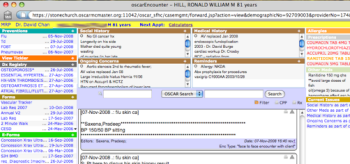
University researchers in Canada say their open source OSCAR EMR, used by 600 doctors so far, could be rolled out a heck of a lot cheaper than the widely panned $1 billion eHealth Ontario project. One reason, its physician developer says with a straight face, is that “we don’t have very many high-priced executives and consultants”. I found the user group page here and also this video demo.

Mediware’s CFO quits to become CFO of an IT security firm.

The good times just keep rolling for eHealth Ontario. CTV News finds that $2.1 million of severance was paid to seven executives fired from its predecessor, Smart Systems for Health, when the new political administration took over.

eClinicalWorks will include Healthwise patient instructions and online health information library with its EMR and patient portal, respectively.

E-mail me.

News 10/9/09

October 8, 2009 News 25 Comments

jbshorts

From Bush vs. Tullman: “Re: Health 2.0. Was at Health 2.0 for the Jonathan Bush and Glen Tullman panel. Bush came out in red boxing shorts and a blazer! I will say Bush and Kibbe made some good points. Was disappointed that Tullman didn’t even show and came via teleconference.” Maybe Glen shares my belief that if it’s really 2.0, it shouldn’t require hauling in a ton of carbon-burning attendees to sit in a room together to watch oddly named startups hoping to find buyers for their no-revenue companies —  err, helping empower patients via the Internet. Still, it sounds like fun. I’d rather have the noobs pitch their businesses to a panel of money guys, like my semi-favorite show Shark Tank (“You’re dead to me now.”) Maybe I can get rich guys like JB and Glen to be on an HIStalk shark panel at HIMSS and they could actually invest in some HIT bootstrapper’s venture.

 scribe

The response to a USA Today article on medical scribes is getting me riled up, with smug know-it-alls weighing in with uninformed comments like these: “I guess the older doctors who aren’t computer literate need scribes.” I’m trying hard to censor the profanities that I’m itching to write. Do you think less of your “younger” CPA if he or she isn’t typing into your 1040 form while you’re talking? Would you be happier if your lawyer stared at a PC screen instead of the jury? Does the President tickle the ivories on a laptop sitting in front of him while meeting with heads of state? Do even Steve Jobs and Steve Ballmer type their own meeting minutes while running Apple and Microsoft? Sure, the information needs to be entered into the EMR, but who says the doctor has do their own typing to get it there? Kiss your EMRs-for-everybody plans goodbye if the best method you can come up with is having doctors do all the data entry, the only highly paid professionals shamed into using tools whose benefit they question just because someone else thinks it’s a good idea (why not make patients enter their own information into a PHR? or schedule their appointments and ED visits on the Web? Or, for that matter, eliminate their own financial “scribes” and pay doctors by credit card before leaving the office?)

Law firms chosen to represent the state of New York in class action suits are heavy donors to state controllers. Among the “pay to play” firms is the one that made $80 million in engineering McKesson HBOC’s $1 billion settlement. 

allocade

Medical City (TX) goes live with the On-Cue patient itinerary system, a NASA-developed, AI-driven resource optimization system that servers as the “air traffic controller” for getting inpatients and outpatients where they need to be as orders and department backlogs change. I’m impressed with the credentials of the execs (former NASA and Philips people, with even the sales VP holding two master’s degrees from excellent schools).

The VA and DOD have finished the first of three phases of the military’s lifetime record program, the VA CIO says, making their systems interoperable. Phase II is making the records available on NHIN and Phase III involves making all information available during care delivered anywhere and at any time.

A reporter from one of the biggest national newspapers e-mailed to ask if I have examples of vendor non-disclosure contract language as mentioned in Ross Koppel’s interview. I’ll be the anonymous middleman if you can e-mail me examples (or use the Rumor Report form to your right, which accepts attachments like a contract scan).

Cerner keeps getting press for its H1N1 reporting project, which some lazy newspapers are reporting as some kind of exclusive arrangement initiated by Uncle Sam. I had mentioned that the Feds won’t get much data from big academic medical centers unless Epic jumps on board, to which Sunquest e-mailed me to mention that 60% of Epic’s customers and over 70 academic medical centers run LISs from Sunquest, which has been reporting infectious disease data to CDC and states since 2005.

A new HIMSS Analytics report (warning: PDF) says hospitals will struggle to meet ARRA funding requirements, with less than 25% of them live on nursing clinical decision support needed to track measurements such as A1c diabetics under control, smokers offered cessation counseling, and patients receiving VTE prophylaxis. This is an excellent, meaty report that crosswalks system capabilities to ARRA requirements and shows where the industry stands in having the necessary systems implemented. If you are a CIO whose hospital plans to collect stimulus money (or a hospital systems vendor), you should study the expected criteria and how your hospital compares nationally. Some hospital bed ranges have only single-digit penetration of systems that will probably be needed, meaning they had better get on the stick if they want handouts.

Lots of events have been posted to the HIStalk Events Calendar, which also lists events on the main page of HIStalk. You can add yours (free).

Like today’s posting? Add your e-mail address to the Subscribe to Updates box to your upper right and you’ll be the first to know whatever’s important. You might be surprised by the number of e-mails I get from people who thank me for (a) giving them an intense introduction to how the healthcare IT industry really works; (b) reporting some piece of information that made or saved them millions; or (c) making them feel more connected to the industry while traveling. You would spend hours a day to get the information you get here in minutes (and some of what’s here isn’t available anywhere else). The downside is that you may find me annoying, but hopefully that’s a trade worth making (and there’s always Inga as the sweet, sexy one in any case).

Speaking of handouts, they’ve driven us to this kind of headline: Kidney patients, job creation are focus of e-records initiative. University of Buffalo’s practice plan and Computer Task Group embark on a $29 million project ($7 million coming from the state), that “should improve health care.” It sounds like a separate project from the HIE announced there a few weeks ago, but I’m not sure since the practice plan is involved with both.

A hospital in Wales selects a Web-based diabetes care management tool from Hicom Technology.

The Y-12 National Security Complex in Oak Ridge, TN licenses EMBOS, an EMR developed for its 4,500 employees, to Healthcare Technology Partners LLC. The system was developed for Y-12 to help the Department of Energy meet the government’s EMR push. I found nothing on the company, other than it was started by former Y-12 executives. 

hisser

The mysterious HisserVideo e-mailed to say that he (or she) posted two more funny HIT cartoon videos. CIO: “Didn’t you just send me a press release about a 30-hospital group implementing Super-2000? How could it work for them?” Sales Guy Steve: “Those hospitals are in El Salvador and we sort of just gave it away to get a tax break to offset profits on our Salvadoran coffee business.” He worked my Vision Center observations into the third video, with Sales Guy Steve explaining its expansion: “We are taking over the space where we used to have the QA team.” Sales Guy Steve responds to the product expert’s observation that he knows little about his client except their bed count: “Because I was once having dinner with Bob [the CIO] and the bottle of wine was $414 and Bob said that was funny because they have 414 beds. Pretty neat that I remembered that, huh?” You can add comments to the YouTube page suggesting future installments.

Sentillion is placed in the “visionaries” quadrant of Gartner’s Magic Quadrant for User Provisioning, even more impressive considering that Sentillion was the only healthcare-specific vendor evaluated. That jogged my memory to go back and re-read my interview with Sentillion co-founder and CEO Rob Seliger from two years ago. “People often say that healthcare is slow to adopt technology, yet you can look at the amazing equipment from imaging systems to robotic surgery that is used. I don’t see a fear of technology in healthcare, just an avoidance of technology that’s an impediment to healthcare delivery. Vendors often miss that. We work really hard to get that right.”

stock  

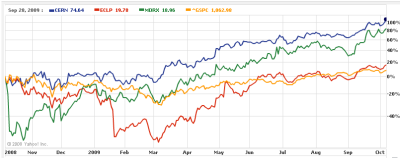
It’s a good time to be an HIT vendor shareholder, at least if you bought at the right time. Above is a chart comparing Cerner (blue), Eclipsys (red), Allscripts (green), and the S&P 500 (gold) for the past 12 months. If you had the foresight to buy at the lowest price in the previous year and sold today, your money would have more than doubled with Cerner, nearly tripled with Eclipsys, and quadrupled with Allscripts.

The Toronto Star dissects the ambitious Smart Systems for Health initiative, which started out with grand ideas that turned into a money pit. By 2005, the agency had spent $260 million but accomplished little, triggering an operational review that characterized it as poorly regarded, short on strategic direction, and subject to inadequate oversight. By then the tab had run up to $458 million and the agency had over 300 employees. A year ago, it was dissolved and replaced by eHealth Ontario, now the subject of its own accusations of bloat, wasteful spending, and underachievement. The total now stands at over $1 billion. On Wednesday, Health Minister David Caplan resigned the day before an auditor’s “scathing” report criticizing the project was released. The auditors also uncovered government executive pay problems, where salaries were funneled through local hospitals to bypass government salary limits. Former CEO Sarah Kramer provides a statement that says, basically, that she was on the hook for quick results, the board knew exactly what she was doing, and, while people think a lot of money was wasted under her watch, it was a fraction compared to the amount that was blown before she took the job.

It didn’t take long for the lawyers to jump on the Broward General “reused IV” newspaper article. A personal injury law firm is “taking a proactive stance” to “educate and protect”. Translation: they opened 24-hour-a-day call center offering “free legal advice” from a “legal intake professional” (which I would guess means an offshore call center rep). Apparently the firm is a fixture on daytime TV in South Florida, or as one local puts it, “They are most ubiquitous during Unemployment TV (AKA, the morning talk shows, soap operas, and early afternoon game shows).”

The Wall Street Journal sees opportunity for vendors like Apple and RIM as hospitals replace pagers with smart phones. The article mentions a Stanford trial of accessing Epic on the iPhone, UPMC’s giving doctors and nurses BlackBerrys, and THR Presbyterian’s use of AirStrip OB.

Another Missouri hospital outsources application hosting to Cerner, this time Heartland Health. Eight hospital employees are being canned as a result, apparently.

Forbes profiles Epic. “But the hottest company in the electronic medical records industry is a secretive Wisconsin outfit called Epic Systems. It does little marketing or advertising, shuns acquisitions, never issues press releases and tries to stay out of the headlines. The privately owned company admits it once put up a billboard that said ‘Marketing Sucks … Epic Systems.’” It quotes KLAS as saying Epic is winning 40% of big-hospital sales, which seems low to me since I almost never hear of anyone else selling a big site.

Meditech’s Fall River building wins a design award from the New England chapter of the American Institute of Architects.

Gaile Hinte of HIMformatics is elected president of the North Carolina Healthcare Information and Communications Alliance.

Inland Northwest Health Services (WA) is suing Deaconess Medical Center in a dispute over who owns its Meditech software license.

Big lawsuit verdict: a 24-year-old college graduate claims she lacks motor skills due to improper hospital resuscitation during her birth in 1984. The jury awards her $43.5 million from 40-bed Bellevue Hospital (NY), since taken over by Ellis Hospital. The doctor already settled out of court.

Yale University Health Services admits that several of its employees inappropriately looked at the electronic medical records of murdered pharmacology student Annie Le before they could be sealed.

Odd: a German banker downloads a fake Oxford medical degree and performs 190 hospital surgeries, including amputations, in 14 months before finally getting caught. He was promoted at the hospital despite having misspelled both “doctor” and “medicine” on his fake degree.

Cleveland Clinic predicts the most influential emerging medical technologies for 2010. None involve IT.

E-mail me.

HERtalk by Inga

From Maathai: “Re: MGMA must-have trinkets. We will be handing out cards for people to ‘Plant a Tree’. They take the card, log on to a Web site, and select one of 16 countries where Seed the Future has a reforestation project going. We are hoping to have 1,000 trees planted before the end of the year. We also have recycled cardboard pens, but I don’t think they are as exciting as planting trees.” I’ll definitely be popping over to The Origins Healthcare Solutions booth (1006) to help make the world a greener place. Maathai also noted they are handing out stickers and will randomly hand out $50 bills to people wearing the stickers. That’s the kind of green I’m talking about.

From Ernestine: “Re: Health 2.0 conference. Lots of payer and consumer market here. So far it is a disappointment. Sitting in a session now and half are gone, even with cocktails to follow, and it is the first full day.”

From Dr. Love: “Re: Health 2.0 and Jonathan Bush. I don’t think we fully understand what he is wearing.  He’s a strange dude.” athenahealth’s Jonathan Bush and Allscripts’ Glen Tullman participated in a “Cats and Dogs” panel, which was suppose to pit “major IT vendors” and Web-based “clinical groupware” vendors. The athena folks tell me that JB was having a little fun with the whole show-down theme and was wearing his boxing shorts. I’m looking forward to seeing the video.

While at the Health 2.0 conference, MDLiveCare announces it will be the first telehealth company to partner with Google Health. The partnership includes the exchange of medical data between MDLiveCare and the Google Health PHR.

Just days after announcing its purchase of Perot Systems, Dell says it’s closing a desktop computing plan in Winston-Salem, NC. Six hundred people will lose their jobs next month, and another 300 by the end of January.

In a more positive announcement, Dell reveals plans for a new smart phone using Google software and running on the AT&T cellular network. The phone will use Google’s Android operating system.

Voalte, our favorite pink pants-wearing vendor, announces the results of its pilot installation with Sarasota Memorial Hospital. Using Voalte’s iPhone-based voice, alarm, and texting product, Sarasota’s nurses were able to provide faster response times for patients and reduce overhead paging by 78%.

CCHIT announces that vendors and developers can start applying for modular certification programs focused on meeting meaningful use requirements. The Preliminary ARRA 2011 program is limited to meaningful use standards spelled out in the ARRA legislation and will provide a certification label identifying which objectives the EHR technology supports. CCHIT is also launching its 2011 Certification program.

MedicAlert Foundation teams with SNOMED Terminology Solutions to provide SNOMED CT controlled medical vocabulary as part of its MedicAlert EMIR service.

David Blumenthal tells an AHIMA audience that the growth of EHR will create at least 50,000 new positions in HIT. 

E-mail Inga.

News 10/7/09

October 6, 2009 News 5 Comments

From Alborg: “Re: Herb Conaway’s bill. Good news! I researched the status of the 5/2009 Assemblyman Herb Conaway’s bill (first reported at HIStalk) to make non-CCHIT certified EHR systems illegal in the state of NJ, and it seems that they shelved it without action. Two things helped kill the bill: the fact that the HHS finally threw the Sherman Antitrust Act-busting CCHIT "under the bus" on 7/16/2009, leaving CCHIT’s future murky in 2010 and beyond as EMR vendors will flock to the new ONC certification, and the bad press that started all over the ‘net with nothing but the bad facts about this bill and its main sponsor, Assemblyman Conaway, who had HIMSS associations and had received corporate lobbying money.” I’m a political illiterate, but I wonder if he just introduced the bill to return a favor incurred somewhere along the way but never really thought it could or should pass. I can’t imagine that a politician (even a doctor like him) suddenly decided this was his hill to die on unless someone was prodding him.

reidentify

From S. Silverstein: “Re: HIT vendors selling ‘de-identified’ clinical data to pharmas (with the latter’s increasingly public record of ghostwriting of scientific articles favorable to their products, salesmanship of drugs for non-approved uses in violations of FDA guidelines, suppression of adverse clinical trials results, etc.). The vendors are perhaps opening up unnecessary cans of worms that will bite them when civil libertarians start taking notice. See: Ohm, Paul, Broken Promises of Privacy: Responding to the Surprising Failure of Anonymization (August 13, 2009). University of Colorado Law Legal Studies Research Paper No. 09-12. Available at SSRN. Perhaps vendors should stick to their core business of HIT production, which — as regulation of HIT increases — will require even more focus.” I think a lot of the work being done hides conveniently behind the concept of “anonymization” as an absolute; a simple technique of magically rendering highly sensitive personal data untraceable. Sounds good to a lay person, right? It even sounds technically reasonable as long as you’re thinking of someone having only one data element (just your birth date) instead of multiples (your birth date and ZIP code) and one database (a prescription file) instead of multiples containing joinable fields (prescriptions plus driver’s license records plus a grocery store loyalty card database). It’s like security in general: rarely absolute, secure only if there’s not enough incentive for someone to go to the trouble to crack the code.

An associate professor of pathology at University of Missouri criticizes his employer’s decision to outsource to Cerner, pointing out that the political appointees that make up the university’s Board of Curators have led the university to a 102nd place ranking among 110 national colleges (in their defense, it’s right up there with a lot of other big, football-obsessed easy admission state schools like Oklahoma, Nebraska, and Tennessee). Some snips, obviously fueled by a few rounds of tenure: “It appears he [University president Gary Forsee] is prone to make the same top-down decisions that were unsuccessful when he directed a large communications network … The medical school’s administrative residency program is on probation and is undergoing critical review; a major factor is that the Cerner system is so cumbersome that resident training is compromised … Three years ago, the radiology department dropped a Cerner software program because it was seriously flawed.”  

sarahkramer

Sarah Kramer, the former eHealth Ontario CIO who was fired for handing out no-bid contracts, is accused in a CBC article of doing something similar at her previous job as CIO of Cancer Care Ontario. Accenture was told it didn’t make the final vendor cut for a $5 million surgery wait time application, but an Accenture senior partner friendly with the CIO was allowed to make an oral presentation criticizing the two short-listed vendors, resulting in Accenture’s being awarded the contract three days later. And in the least shocking news of all, the $5 million system turned out to be a $20 million system. That’s one side of the story, anyway. I’m guessing there are two.

keas

Former Google Health bigwig Adam Bosworth launches Keas, a Web site that provides individualized care plans. It sounds like a rather pedestrian idea, but he’s got a big executive team, an army of stock art models, and grand plans to let providers create plans (not medical advice, the terms of service make clear) to which patients can subscribe as easily as buying an iPhone app. My money would be on the usual revenue sources, i.e. drug company advertising and trying to get deep-pockets insurance companies to buy bulk subscriptions for their patients. Apparently all the good domain names were taken, leaving the company to link its futures to an obscure New Zealand parrot (the kea) shown in its logo.

Speaking of Google Health, it proudly announces that two more insurance companies have signed on, rocketing the total to three (with just a few hundred to go) after 20 months, which is decades in Internet time.

Weird News Andy approves this message: “Impending lawsuits? Nah!” An anonymous caller to the compliance hotline of Broward General Medical Center (FL) reports that a nurse is using the same IV fluid bag and set on multiple cardiac stress test patients. True, the hospital found. They’re warning 1,800 patients to get hepatitis and HIV tests. The nurse quit and left the country.

Ingenix announces that its CareTracker EMR has new Surescripts-certified e-prescribing capabilities.

Kathleen Sebelius tells Cerner and its customers that President Obama thanks them for being “a health partner in this ongoing battle.” This refers to Cerner’s H1N1 network, to which 200 hospitals are contributing data. It sounds like they’re flagging ED admissions with elevated temperatures, which doesn’t seem all that specific (I seem to remember that some county or state health departments already track that). I’m also not sure what the government would do faced with an obvious local flareup (drop ship Purell? redirect Tamiflu supplies?) but at least they’ll know (except in communities served by large academic medical centers that are more likely to be running Epic than Cerner).

Speaking of Cerner, the local paper covers its prospects, citing a William Blair estimate that HITECH will goose Cerner sales by as much as $8 billion. They have a great picture of the three founders beaming. Another article describes Neal Patterson’s emotional recounting of the healthcare experience of his wife Jeanne, who has breast cancer.

 ucern1

Cerner announces its uCern social networking site, the uDevelop development platform, and the uCern Store for buying applications. I don’t know anything more about those offerings since only Cerner customers can access them. It sounds interesting, anyway, although the all the hospitals I’ve worked at would not have contributed apps because (a) it’s not our core business; (b) we don’t want some rube hospital calling us up demanding support for something we wrote for our own use; (c) we don’t want to help our competitors who might buy our stuff; and (d) we have irrational fears of being sued if something goes wrong. My experience is that hospitals are mildly willing to help out a vendor’s customer peer provided they feel technically or medically superior and hopefully geographically distant to them, but nobody’s going out of their way to make it happen.

tspringmann  

Tressa Springmann, VP/CIO of Greater Baltimore Medical Center (MD), is named to the advisory board of Maryland’s HIE, CRISP (Chesapeake Regional Information Systems for our Patients). I made fun of the tortured acronym a few weeks back and got a nice note (and a music recommendation) from Johns Hopkins CIO and CRISP board member Stephanie Reel, who explained that they just tried to pick a name that reflected their intentions. Always quick to jump at the chance to provide unrequested and likely unwanted advice, I suggested Chesapeake RHIO, to be acronymized into CHERHIO (the jaunty English greeting, not the oaty breakfast cereal).

Open source BI vendor Pentaho acquires the assets of SaaS BI vendor LucidEra. The companies have raised nearly $50 million of capital between them.

nhodge

I had planned to attend Mayo Clinic’s symposium on healthcare last month since they were kind enough to invite me (as did Dr. Natalie Hodge, the “iPhone Doctor” and co-founder of Personal Medicine International), but day job logistics got in the way. They have session videos up, though, so I will need to check those out. I’m watching Natalie right now, in fact.

QuadraMed launches its ICD-10 Countdown Program, which includes the Quantim ICD-10 Coding Simulator, educational tools, and services to help providers convert to ICD-10.

The press seems shocked that Bellevue Hospital (NY) got a tip that Joint Commission was on its way and sent a staff e-mail urging the discharge of “patients that do not need hospitalization” and having supervisors check to make sure patient documentation was complete. Surely they don’t think that hospitals just conduct business as usual without regard to an impending survey, even now that they are unannounced? Or that Joint Commission isn’t aware of its multiple roles of accreditor and vendor? You used to be able to pay them (and maybe still can) to do a mock survey to make sure you were ready for the real thing, kind of like cramming for the SAT to get a score you couldn’t have obtained without help.

Was this really how stimulus money was supposed to work? General Hospital in Nashville says it will get more than enough stimulus money to cover the remaining $3 million cost of its EMR project, but wants to borrow city money to finish it since that chicken has to come before the financial egg.

E-mail me.


HERtalk by Inga

Routine use of electronic health records can improve the quality of preventive care and help manage chronic disease in primary care practices, according to a primary care study.

athenahealth signs an $30 million agreement to purchase AnodyneHealth Partners, a SaaS business intelligence provider. Anodyne will continue to market its BI solution as a standalone product. In addition, athenahealth plans to integrate the service into the athenaCollector platform. The deal includes a cash payment of $22.3 million with the potential for additional consideration of $7.7 million, based on the achievement of certain business and financial milestones. Neither Mr. H nor I had heard of Anodyne before, but understand they traditionally serve large and enterprise-size medical groups. Jonathan Bush says the Anadyne purchase should help them get their foot in the door at some of the larger institutions.

Blue Shield of California makes $29.6 million available for pay-for-performance bonuses. Medical groups and IPAs can qualify by demonstrating the performance of quality care using such measures as diabetes care, patient experience, managing ER visits, and deployment of IT.

The Wyoming Department of Health grants a $4 million, three-year contract to ACS to provide an EHR and HIE for the state of Wyoming.

baptistne

Baptist Healthcare System (KY) becomes the first health system to simultaneously implement both the access and business management modules of McKesson’s Horizon Enterprise Revenue Management solution. Baptist Hospital Northeast went live August 15th.

In a $54 million stock deal, Nuance Communications acquires eCopy, a provider of document scanning solutions. Nuance plans to combine eCopy’s touch screen technology with its existing multifunction printer desktop solutions.

3M Health Information Systems, McKesson, and Executive Health Resources sign a strategic agreement to offer RAC Advanced Services. The joint solution will combine 3M’s coding and billing solutions, McKesson’s InerQual medical necessity criteria, and EHR’s physician advisors to conduct second-level reviews.

The use of smartphones by physicians is expected to increase from 64% today to 81% by 2012. A more “mature” and proficient physician audience will emerge and the Internet will become physicians’ primary professional resource. Look for physicians to use their smartphones for everything from administrative tasks to patient monitoring.

The Bronx RHIO selects Axolotl’s Elysium Exchange to power its HIE. Participating providers will be able to electronically exchange via existing EHRs, or, with Axolotl’s Elysium EMR Lite product.

summa

Summa Health System (OH) selects Wolters Kluwer Health to provide its ProVation MD software for cardiology procedure coding. Summa plans to use the software at its three cardiac cath labs at Summa Akron City Hospital.

People keep asking when we are going to get on Facebook. Yesterday, I decided to forego all my much more important tasks to set up a site for myself (Inga Histalk) and an HIStalk Fan Club. Now, in addition to reading HIStalk, HIStalk Practice, and Twitter, you have one more way to stay in the know/surf the Web and pretend you are working.

I’m Denver-bound this weekend, headed to the national MGMA conference. We’ll be posting a Must-See Vendors guide later this week, plus I’ll be sending in daily updates. If you are attending, feel free to pass on any tips for sessions to attend or booths with must-have trinkets. Be sure to visit our great sponsors, who will be handing out a limited supply of HIStalk magnets (I’d bet everyone would think you were really cool if you brought one back to put on the lunchroom fridge). Special thanks to the multi-talented Dr. Gregg Alexander who created the magnets and who regularly writes on HIStalk Practice and still finds time to practice full-time.

E-mail Inga.

Monday Morning Update 10/5/09

October 4, 2009 News 10 Comments

From Cernerfan: “Re: Barts 18-week backlog in thousands.” In England, Cerner Millennium is blamed for the jump from 1,700 to 23,000 patients whose referrals don’t meet the 18-week target from referral to treatment at Barts and the London NHS trust. They’ve been live since April 2008, so the “things are shaking out” excuse is getting a bit long in the tooth.

sidewiki

From The PACS Designer: “Re: Google Sidewiki. Google has a new feature called Sidewiki that permits useful information to be added to any web page. The Cleveland Clinic is using Sidewiki to add heart disease information to enhance details about the disease and its prevention.” I have to admit that I hate this idea with a passion. Users can now take control of Web sites, splattering unvetted comments onto any site without the owner’s permission or involvement (they call it “contribute to any web page”, in other words, even those to which you weren’t invited to contribute). Who’s to say that the nasty comments on Cerner.com didn’t come from a competitor? It’s a step backward for sites like this one that already allow nearly unrestricted comments, but exercise some control to keep the conversation civil, the facts accurate and relevant, and the personal attacks limited. Using some third-party tool also splits off what should be a threaded conversation, with Sidewiki hijacking for Google’s benefit conversations that could have been better served with existing technology. Sidewiki is a really bad idea, but I’ll predict that Google will kill it anyway after it gets wrapped up in a few slander suits over malicious postings. In fact, I seem to remember that a similar technology met a timely death for exactly that reason not too long ago, although I don’t remember its name.

From EHR Geek: “Re: FierceHealthcare. Rumor is that Mr. HIStalk was named one of FierceHealthcare’s Nine Healthcare Bloggers worth a click. We love us some Mr. HIStalk!!” Thanks to the folks there for the mention.

From Electric Slide: “Re: vendor evaluation. Are hospitals that are evaluating vendors still using Gartner’s Magic Quadrant, KLAS, or HIMSS Analytics? Given ARRA, it would seem like the value has diminished and both charge a lot of money from the vendor side.” I’ve always thought that, for major purchases like clinical systems, hospitals mostly went with less logical criteria: (a) how enamored the hospital executives are with the vendor’s vision, executive charm, and marketing fervor (all of which usually are negative signs rather than positive, but are widely accepted); (b) whether they just want to dump an incumbent and try their biggest competitor as something new; or (c) CIOs choosing the option that looks like the least work and risk for IT (i.e., just buy more stuff from current vendors). I can only speak to the selections I’ve been involved with personally, but those (oddly, for science-based organizations), usually ended up being influenced by intangible BS like the Vision Center, personal relationships that really should have required the hospital executive to recuse themselves from the selection, or either buying the same system as a competitor (to show them up with better utilization) or what they didn’t (to avoid being labeled as imitative). Any resemblance to an orderly process driven by the needs of clinicians and their patients was purely coincidental.

From J-Lo: “Re: HIMSS. Enjoyed your reception, but it was hard to hear and kind of frustrating that people stayed in their typical cliques rather than a whole bunch of mingling. I did meet several new folks cuz I made the effort, but maybe, just maybe you and Ms Inga could come up with a way to integrate your guests a bit more.” I agree completely. We need some gregarious event ambassadors to get people talking (I had high hopes for the strippers from year before last, but as I should have known, spirited conversation wasn’t their long suit). Former A-V club geek Dr. Gregg Alexander has promised to help out with improved presentation logistics now that we won’t be constrained by the limited capabilities of a hotel ballroom, so I’m looking forward to fog machine effects and maybe Inga flying in on a wire.

From NHIN-a-new: “Re: NHIN. This exclusive confab last week may be worth analysis – did we just hear the sound a door opening? Looks like ONC is exploring a really interesting way to apply the NHIN to the reality of consumer environments. Think linking the ATM network to your cell phone – now that would be a ‘cool technology of the week.’ As long as there is enterprise aggregation of data we need the structure the NHIN provides in standards and specifications (the work going on inside the NHIN project on details specs and governance issues is absolutely amazing!)  And this session shows a way to coordinate these two innovations.” John at Chilmark Research reports that the government’s intentions for the Nationwide Health Information Network maybe be changing from a data exchange platform for provider data to a “Health Internet” that is more driven by and beneficial to consumers. That makes sense based on some of the buzz around new federal CTO Aneesh Chopra and his interest in “government as a platform”. I’ve been saying all along that “meaningful use” ought to be based on the data providers contribute electronically rather than paying them for simply replacing paper with EMRs, so perhaps this is a step in that direction. Everybody (except the government and its Medicare payment rules) knows you ought to be paying for the result you want.

From Lips Kudlow: “Re: EMRs as medical devices. This is truly frightening. It would result in the decimation of an already beleaguered Canadian EMR software industry, not to mention smaller added-value healthcare software vendors. It wouldn’t surprise me if the large vendors (Cerner, Meditech, et al) have lobbied Health Canada to issue just such a ruling, since large companies typically have a vested interest in stifling innovation and competition from upstarts.” Health Canada releases a notice stating that software “use only for archiving or viewing information or images” is a Class I medical device and systems that manipulate, analyze, edit, measure, or graph information are Class II medical devices. That means vendors must be ISO certified to sell those products in Canada. The definition of “patient management software” is a bit vague and sounds as though it was intended to cover physiologic monitors (note the reference to “active diagnostic devices” and “monitoring a physiological condition”), but I’ve e-mailed for clarification.

I’m back on the job, so thanks to Inga for keeping things under control while I was away. She did great, if you ask me. I’ve got a lot of catching up to do and will unavoidably mention items she already covered, but it’s all new to me.

Regional Medical Center (SC) is always doing something newsworthy when it comes to Cerner, whether it involves board members fighting over parliamentary procedure in approving its Cerner contract or having its employees crying racism over including a banana-wielding gorilla in its post-project celebration. Now its board argues bitterly over its proposed $1.3 million purchase of medication dispensing cabinets from Cerner, specifically debating whether Cerner is a sole-source supplier in that marketplace (uhh, ever heard of Pyxis or AcuDose?) The CFO says they decided that only Cerner could provide the cabinets since theirs are “integrated”. Board members argued, shouted, and insulted each other to the point of having to be gaveled down by the chair. Cerner still gets the business, or at least I think it did based on the somewhat confusing recap.

A-Life will connect its Actus computer-assisted coding system to the Ingenix Web.Strat encoder.

uncbreach

Plains Regional Medical Center (NM) learns that its mammography information was hacked two years ago in a breach at the University of North Carolina at Chapel Hill, which provided its previous system for generating mammography follow-up letters.

A reader asked if GE is still selling Centricity Lab in the UK. Inga asked GE and we appreciate their response: “The business has decided to shift its strategy away from forward production on the Centricity Lab product. The demand for it is, perhaps, as strong as ever yet currently concentrated in smaller, community-based EMR settings. We really need to focus on maximizing the personalized service we can deliver to the existing install base and will continue to service and support all current installs (as well as honoring all current orders).”

In Ontario, the hospital CIO who was involved in issuing $3 million in no-bid consulting contracts to a former co-worker steps down. Diane Beattie and her employer, London Health Sciences Centre, have agreed to part ways, but now the politicians are arguing over the $451,000 in severance pay she will receive for her 21 months on the job. Her contract called for severance of a full year’s salary plus a month of pay per year of service. Maybe someone ought to investigate who approved that kind of a deal, which is somewhere between remarkable and nuts (her employer says it’s a “standard contract for senior staff in teaching hospitals”).

Oracle’s Larry Ellison on cloud computing: “I remember I was reading W and I read that ‘orange is the new pink’ and ‘cloud is the new SaaS’ or ‘cloud is the new virtualization’ … maybe I’m an idiot, but I have no idea what anyone’s talking about. It’s just complete gibberish … I’m going to access data on a server on the Internet and that’s cloud computing? … These people who are writing that crap are out there. They’re insane.”

chc

HHS secretary Kathleen Sebelius will address the 6,000 attendees of the Cerner Health Conference on Tuesday, talking about healthcare reform. Any irony is unintentional.

Beaumont Hospital (MI) CIO Paul Peabody will retire after 35 years there, part of an executive restructuring. 

My poll on who readers would like to work for given comparable jobs offer drew 527 responses, which I’m guessing indicates some level of either fraudulent voting or vendors encouraging employees to vote for the home team. Anyway, take it for what it’s worth: Epic won with 30%, followed by McKesson (17%), Meditech (13%), Cerner (12%), Eclipsys (11%), GE (11%), and Siemens (6%). New poll to your right, raising a moistened finger into the air to detect a shift in the winds of economic change: over the past six months, how has your employer’s economic situation changed?

The layoffs just keep on coming at Texas Health Resources.

Cerner digs deeper into the life sciences, licensing its Discovere system to clinical trials vendor Quintiles. Part of Discovere is the former First Genetic Trust technology that Cerner bought somewhere along the way. Quintiles signed an agreement with that company back in 2001 and took an equity position in it. The Discovere modules include biobanking, research registries, public health investigator workflow, clinical trials management, and adverse event reporting.

I ran across an overview (warning: PDF) of Cerner’s LifeSciences, which apparently involves selling patient data from the EMRs it hosts. “Through our data mining of our vast warehouse  of electronic health records (EHRs), you can accelerate development processes and reduce business risks. This is when Cerner LifeSciences makes it possible to analyze anonymous, HIPAA-compliant, EHR-derived data for efficacy and safety.” That’s an interesting business. Long-time readers will remember that I’ve cautioned previously about providers selling off their data rights since they have more value than you might suspect. Cerner is pretty smart to include contract language that allows them to sell anonymized customer data to drug companies, getting it free, in essence, from its IT customers.

Several hospital nurse executives provide testimonials about the contribution of the Kronos employee scheduling solution to their Magnet designation.

 jf

West Tennessee Healthcare CIO Jeff Frieling gains additional responsibilities as VP of hospital services.

Another big hospital CEO retirement payout: Valley Medical Center (WA) gives its CEO a $1.73 million retirement bonus even though he’s not retiring. The hospital put the money aside in 2003, payable if the CEO retires after his 60th birthday or if he is fired or demoted (!). He’s still working at $900K per year and still has a separate pension plan for whenever he really does retire, courtesy of the local property owners whose taxes support the hospital. The hospital issues the boilerplate lame excuse that every other over-paying hospital uses: “It’s a highly competitive market, and our board feels that in order to keep someone of Rich’s caliber, he needs to be compensated as such.” Are they admitting that it’s such a dump that nobody would sign on for the pittance of, say, $500K? $250K? Like Wall Street, nonprofit hospitals are clearly out of control in their executive pay practices.

preflight

This is interesting: the orthopedics chair at Bronx-Lebanon Hospital Center (NY) e-mails an unsolicited testimonial to the vendor of an iPhone aviation pre-flight checklist app. The doctor had modified the templates to create pre-surgical checklists for total hip, total knee, and arthroscopy, one of which reminded him to check a particular patient’s lab result. The outcome, in his words, was “a life was saved.”

TeleTracking Technologies acquires small RTLS vendor RadarFind.

Odd hospital lawsuit: the family of a man who died of a heart attack in the ED sues the hospital, claiming the ED doctor let him die so he could steal the patient’s $16,000 Rolex.

SUNY Stony Brook will expand its use of PatientKeeper, adding its ePrescription and Pay for Performance modules. ePresciption will be live by the end of the year in time to qualify for the 2010 Medicare incentive payment. PQRI will also be running in time to get that incentive.

UK stock analysts postulate that the three divisions of Misys (healthcare, banking, and treasury and capital markets) could be split off into their own companies to increase shareholder value, also guessing that Allscripts will be the first since it’s about the only bright spot the company has. Meanwhile, some nuggets from the Allscripts-Misys earnings call: (a) “Some of our competitors are talking about a pause; we’re surely not seeing it.”; (b) Allscripts is working with Henry Schein in implementing the big North Shore-LIJ deal recently announced; (c) a new factory-type Enterprise rollout has cut deployment time and hours by 50%.

iphonebriefing

A reader sent in a flyer for a series of invitation-only Apple executive briefings covering the iPhone in medicine. The ones in Chicago, Reston, and New York are over, but sessions in Boston and Cupertino will be held later this month (we geeky programmers are amused at the address of Apple’s executive briefing center: 4 Infinite Loop). I’m certain it was oversight that Inga and I haven’t received our invitations yet.

GE Healthcare’s joint venture with Bangalore’s Wipro is enhanced to become GE Healthcare’s sole vehicle in India. GE CEO Jeff Immelt predicts that healthcare products and services developed cheaply in India will be exported to the US, helping manage healthcare costs here.

Former FCG president Steve Heck joins Impact Advisors as VP after a couple of years at Navigant.

This doctor doesn’t mind using a computer: a former pediatrician is ordered to appear before North Carolina’s medical board, charged with failing to report his DWI arrest and for using the PC of a practice for which he was working to write pornographic stories.

A Children’s Boston research article says EMR data can be used to help doctors identify domestic abuse. The most positive correlation for females was for injury, poisoning, and alcoholism. For men, it was mental health conditions.

E-mail me.

News 10/2/09

October 1, 2009 News 11 Comments

HERtalk by Inga

From: Coding Guy “Re: ER Documentation System. I can tell you from compliance training I have received from HBMA and networking with other compliance officers, that providing prompting for higher services is a no-no. It’s similar to having superbills where there are no checkboxes for non-billable services – if you’re not providing a mechanism for recording non-billable services it could get attention. I’m not a lawyer but I do have access to very good counsel and providing provider feedback that hints of guiding upwards for bills is definitely to be avoided.  Most OIG investigations are triggered by disgruntled employee tips, so any bad messaging and training around a system like this could lead to unwelcome attention.”

More than three-quarters of healthcare executives surveyed by PricewaterhouseCoopers LLP agree that the secondary use of EMR data will be their organization’s greatest asset over the next five years. Essentially, it is all about data mining, and how it can be used to improve patient care, predict public health, and reduce healthcare costs. However, PWC finds that the lack of standards, privacy concerns and technology limitations are holding back progress.  PWC just published  “Transforming Healthcare through Secondary Use of Health Data,” which calls for public-private collaboration and government incentives to collect, share and use health data; to establish standards; and to redefine technical architecture to allow interoperability.

Here’s a keynote address I would have loved to hear. Ron Galloway spoke at the Healthcare Facilities Symposium & Expo this week and said that the Wal-Mart’s distribution of eClinicalWorks “is the biggest thing going on in healthcare right now.” Galloway also predicts that between the company’s plan to get its 1.4 million employees’ health record formatted electronically and the projected 22 million patients visiting its EHR-equipped clinics by 2014, Wal-Mart is positioned to be a major force in HIT.

st. anthony

Surgical Information Systems (SIS) names St. Anthony’s Medical Center (MO) an SIS Center of Excellence, based on its “best practices” use of the SIS Solution. Within a year of installing SIS, St. Anthony increased efficiencies in several areas, was able to increase OR caseloads 5%, and decreased late case starts by 4%.

Jewett Orthopaedic Clinic, a 32-provider, seven-office clinic in Florida, selects the SRS hybrid EMR. Speaking of SRS, I noticed that Evan Steele was recently interviewed on the EMR and HIPAA blog. His take on ARRA and stimulus money: “The cost associated with reduced productivity that a high-volume, high-performance physician would incur by entering the data to meet the meaningful use requirements dwarfs the incentives being offered and the relatively small penalties which start six years from now (in 2015).”

Allscripts announces its first quarter numbers, which include non-GAAP revenue of $167.5 million compared to $164.7 million last year. The non-GAAP revenue numbers take into account the 2008 and 2009 revenue numbers of both Allscripts and Misys Healthcare. GAAP revenue was $164.9 million versus $92.8 last year and earnings were $.15/share. The company exceeded Wall Street estimates of $.14 cents/share earnings. During Allscripts’ investor call, the company indicated its recent deal with North Shore-Long Island Jewish was worth just over $10 million, but had a potential value of more than $75 million, depending on how many physicians signed on. Investors seemed pleased, with shares on Wednesday hitting their highest point in nearly two years ($20.61.)

Southeastern Regional Medical Center (NC) plans to implement Allscripts suite of care management solutions, by the way. The hospital will use the web-based SaaS  product to enhance continuity of care across the organization and prepare for Medicare’s RAC program.

CVS pharmacy customers now have the ability to download their prescription histories into HealthVault.

caretracker

Ingenix expands the e-prescribing capabilities of its CareTracker EMR solution and is now SureScripts-certified.

Emergisoft releases its iPhone Simulator, which will allow physicians to customize the iPhone for use with Emergisoft’s physician documentation in the ER.

HHS Secretary Kathleen Sebelius releases a report detailing how The Columbia Basin Health Association (WA) was able to improve health care using HIT. After implementing an EHR, the community health center initiated automated tools to increase the monitoring of diabetic patients. Within six months, the facility documented dramatic increases in overall care for its diabetics, including a 55% jump in the number who received foot exams and a 34% increase in eye exams.

Virginia Blood Services purchases Mediware’s LifeTrak software to manage its blood donor records throughout central Virginia.

iMedicor successfully completes a pilot project involving 225 pharmacy outlets using iMedicor’s information exchange portal. All the outlets successful implemented iMedicor’s direct-to-pharmacy electronic prescription refill technology, which is available at no charge to physicians and pharmacies.

eMED-ID introduces a wearable device that uses GPS technology to track a person. Their target market includes people prone to wander, such as Alzheimer’s patients and those with autism. No mention if it is appropriate for straying boyfriends.

greg ericon

Broadlane, a cost-management company for healthcare providers, names Greg Ericson CIO. Most recently Ericson worked for a medical device company, but I’d love to hear more about his stint at the Home Shopping Network.

API Healthcare announces the general availability of its Acuality Patient Classification System. The software helps hospital to assess patient care requirements to make appropriate staffing assignments.

A mere week or so after its official launch, Humedica says it’s entered a long-term partnership with Anceta, the healthcare informatics subsidiary of AMGA. The association selected Humedica as its exclusive partner to develop a nationwide data warehouse and clinical analytics platform.

doylestown

Doylestown Hospital (PA) selects MedQuist to provide RAC consulting services and software.

Mr. H finally found an Internet connection and checked in long enough to say he doesn’t miss any of us. (Well, that isn’t really what he said. That was just my interpretation. His exact words: “Life sucks 90% of the time. This is that other 10%.”)

Maybe he will smile just a bit upon learning that Fierce Healthcare named HIStalk to a list of  Nine Healthcare Bloggers Worth a Click. Editor Anne Zieger says that “if you’re in health IT, there’s no excuse to miss HIStalk.” And, Dodge Communication put HIStalk on their list of Top 10 Twitterers for healthcare marketing and PR Professionals, saying HIStalk is “a great way to hear the perspective of those professionals working in the trenches.”  Many thanks!

inga

E-mail Inga.

News 9/30/09

September 29, 2009 News 20 Comments

HERtalk by Inga

From: Overworked “Re: UCSF cancels GE Centricity project & lays off 33 IT analysts & support staff. Was this reported already somewhere? I work with a pharmacist who was formally laid off from UCSF last week and given 2 months severance pay. Apparently UCSFMC cancelled their GE Centricity project three weeks ago and he said he knows of 33 IT analysts and IT support folks that were laid off. He says the GE project budget was blown out of the water within 1 year and it had been going on for over 3 years – he had been on board for 3+1/2 years. He says it wasn’t even close to being implemented. I thought it was interesting that I couldn’t find anything in the press – but forgive me if I’m telling you old news.” Unverified. Dang. Mr. H always accuses me of not reading what he writes but I don’t think we have any official word that UCSF ha terminated its relationship with GE. However, UCSFWatch did send over a note last month suggesting things were not going well. The medical center management had hired Kurt Salmon Associates to figure things out and at that time GE-related activity was on hold.

The North Shore-LIF Health System (NY) announces it is subsidizing up to 85% of the EMR implementation and operating costs for over 7,000 of its affiliated physician. Participating doctors can received subsidies of up to $40,000 each over five years to implement Allscripts EHR. The initial agreement with Allscripts includes licenses for 1,200 doctors and one analyst suggests the deal is worth $20 million. In any case, it’s definitely one of Allscripts’ largest sales ever. North Shore’s subsidy program includes a unique twist: physicians will be subsidized at a rate of  either 85% or 50%, depending on whether or not they are willing to allow North Shore to use the EHR to report and share their performance data and allow them to compare it against a set of nationally care and outcome metrics.

Allscripts also announces that Baptist Memorial Health Care (TN) has selected Allscripts EHR/PM to automate its 65 employed and 3,100 affiliated physicians.

Meanwhile, a Jeffries’ analyst upgrades Misys to a buy and predicts the company will sell off each of its three divisions. Speculation is that the first division to go would be the Allscripts segment, which would appeal to buyers like “GE Healthcare and similar major players.” Analyst Milan Radia says, “”Our upgraded price target reflects our view that we are now approaching an end game in the transformation of Misys.”

coding

A reader forwarded the attached copy of an email sent to all the ER docs at his hospital. He explained to me the ER recently adopted a new documentation system and is now paperless. However, authorities are now questioning if the system is in compliance with billing regulations because it prompts users to add certain items in earn a higher level service. If the “experts” determine that the system is out of compliance, the hospital will likely need some sort of fix from the vendor. In the worst case, the hospital (and presumably others in its chain) will have to revert to paper for some amount of time. I asked a reader his opinion, and he believed that technically the system was “legal” because the doctor still has to approve the code. However, he suggests it is a tricky game that can invite “serious auditing.” Any other opinions?

If you are a careful reader, you will have noticed that Mr. H left me to my own devices this week while he is out gallivanting the world. We always joke about how I would handle things if some major IT story broke while he was out of pocket, like someone buying Cerner or Judy Faulkner resigning from Epic. I’m thinking that Xerox’s acquisition of ACS was just a warm-up for some really big, breaking story during Mr. H’s next vacation. Investors, by the way, appeared lukewarm on the merger, and Xerox’s stock price fell 15% on Monday. The $5.7 billion cash and stock deal allows Xerox to expand its footprint into the services business, not unlike HP’s EDS purchase last year and Dell’s recently announced bid to buy Perot.

cerner mo

Cerner and the University of Missouri announce a $100 million partnership that reassigns about 100 workers from the UM Health System to Cerner. The plan calls for the creation of the Tiger Institute of Health Innovation, which will be tasked with designing innovations to improve patient care and population health. University and Cerner officials say the collaboration could improve patient safety and save the state $1 billion (sounds optimistic.) As part of the 10-year agreement, the university and Cerner would split profits from any new developments based on the amount of money each invests in the institute. A portion of the proceeds would be used to continue funding the institute. Former Ascension Health CIO Sherry Browne will lead the institute.

Accretive Health, a provider of RCM services, files for  a $200 IPO.

HHS Secretary Kathleen Sebelius announces $27.8 million in ARRA awards, including 18 grants totaling $22.6 million for EHR implementations. The balance will support various HIT projects, including HIEs and helping existing health centers use existing EHRs to improve patient health outcomes. Think how fun it must be to be Sebelius, handing out millions of dollars to grateful recipients every couple of weeks. Almost as good a gig as Santa Claus

health quest

The Hannaford Charitable Foundation presents Health Quest (NY) a $50,000 donation to help fund its CPOE project. This is the second such gift from the foundation that was created by the Hannaford supermarket chain. Health Quest is investing about $60 million to overhaul its IT infrastructure, including implementation of a Cerner system.

Freshmen at Indiana University are embracing the school-supplied PHR, with 40% already using the program just weeks after the start of school. NoMoreClipboard.com is the PHR vendor.

The State University of New York at Stony Brook expands its deployment of PatientKeeper products, adding the ePrescription and Pay for Performance applications.

Nuance Communications announces the availability of version 9 of its eScription application. Among other changes, version 9 offers advancements in document quality review and administrator efficiency.

The Lake Erie Regional Health System/TLC Health Network is awarded a $4 million grant towards a $5.6 million IT integration project between the Brooks Memorial Hospital and TLC Health Network facilities. The grant is part of $436 million in funds being distributed through the Health Care Efficiency and Affordability Law of New York State.

RelayHealth says that both Hill Physicians Medical Group (CA) and Montefiore Medical Center (NY) have improved care collaboration, patient satisfaction, and specialty treatment prioritization using RelayHealth’s referral management service. The product, which was co-developed with Hill Physicians, facilitates secure health information exchange between primary care providers and specialists.

west ga

West Georgia Health System signs a seven year deal with Perot Systems for revenue cycle services to the hospital organization. Perot just recently provided the health system support services to implement MEDITECH 6.0.

Speaking of Perot, I was sad to hear that the individual charged with insider trading ahead of Dell’s proposed purchase of Perot was one of the heroes in the 1979 Iranian hostage rescue. If you aren’t familiar with the story, Ross Perot spearheaded a mission to rescue two of his employees held hostage in an Iranian jail. Reza Saleh was an EDS employee at the time and led the mob that broke into the prison and ultimately rescued the hostages. The SEC has now charged Saleh of making $8.6 million in illicit profits from the Perot/Dell deal.

Hudson Headwaters Health Network, a network of 16 community health centers in upstate New York, receives a $7 million grant to finance HIT and a medical centered home initiative.

ehr adoption1

A new report from the Information Technology and Innovation Foundation finds that Finland, Sweden, and Denmark are the clear global leaders in terms of EHR adoption in hospitals. Those countries also ranked far better in their use of electronic prescribing and CPOE. At least we beat the Brits and New Zealand.

University Hospitals (OH) makes plans to rent a closed school to train more than 4,000 employees on its new Eclipsys Sunrise EMR system. The health system wants 6-day-a-week, 24-hours-a-day access to the school from January to June.

Cumberland Consulting Group is named one of 2009 Best Small Firms to Work for by Consulting Magazine.

The CDC issues $4.37 million in grants to fund four new Centers of Excellence in Public Health Informatics. The recipients will use the funds to enhance HIT and improve the detection of and response to emerging public health interests. Winners are Harvard Pilgrim Health Care, Indiana University, the University of Pittsburgh, and the University of Utah.

scrabble

Warning: if you are an HIT purist, feel free to mosey along and not read this last note. For the rest of you, here is an amazing statistic: more than 2 billion applications have been downloaded from Apple’s App store since July, 2008. More than 85,000 apps are currently available, and only about 18% of the downloaded apps are paid for. However, the average cost of paid applications is growing and US revenues for applications will grow 10 times between 2009 and 2013, reaching $4.2 billion. I downloaded my first paid application recently: Scrabble ($4.99) and I am totally addicted.

inga

E-mail Inga.

Xerox to acquire Affiliated Computer Services

September 28, 2009 News 1 Comment

Xerox announces plans to buy ACS for in a $6.4 billion cash-and-stock deal. The deal is worth $63.11 per share, which is a 34% premium over Friday’s closing price.

Monday Morning Update 9/28/09

September 25, 2009 News 4 Comments

From Evan Marcos: “Re: conference invitations. Amen. After a lifetime in healthcare marketing, this is how the VIP scam works. Target a slice of C-level pigeons (CEO, CFO, CIO, CNO, etc) who need a few days off to relax. Next, choose a speaker panel of political hacks, policy wonks, executive has-beens, and think tank blowhards. Throw an innocuous agenda that yaks about the obvious in a fabulous, expensive resort. Now, the hook. Market the VIP ‘Summit’, ‘Roundtable’, or ‘Executive Leadership Council’ to healthcare C-levels and tell them they can attend for next to nothing but airfare in exchange for 20-30 minutes of their time talking to a vendor. Second hook, market the ‘executive lead opportunity’ to vendors wanting badly to make their quarterly numbers and find low-hanging fruit in exchange for a mere $30,000 – $50,000 (which pays for the conference and salaries for the organizers). Now, market the everloving stew out of it with aggressive, relentless, pit bull sale folks in a boiler room. I’ve been on both sides of the invitee list and I assure you there’s rarely anything truly positive to come from it except for the salaries and commissions to the organizing company. And I think you know who the top two or three offenders are.”

From Larry Leotard: “Re: new company. I saw an analysis that said new SaaS companies need to assume negative cash flow for 3-4 years because when you get paid monthly, the cash comes in slowly compared to selling licenses. Sales expectations in start-up biz plans are always too optimistic. Anyone can sell 10 hospitals, but getting to 40 is hard.”

I’m taking a little break, so Miss Inga will be presiding for a few days. Please treat her with the appropriate deference and civility as she is a delicate flower.

janepauley

The newly opened Jane Pauley Community Health Center (IN), a collaboration between Community Health Network and the local school system, is using the GE Centricity EMR, merging physical and behavioral data. Its namesake, the former news anchor and Mrs. Garry “Doonesbury” Trudeau, was on hand.

Salem Hospital (OR) signs for PureSafety’s Occupational Health Manager.

The PACS Designer is putting together a list of iPhone apps designed for healthcare people to use on the job. Send me the names of those you like and I will forward to TPD for a future Readers Write article.

rfds

In Australia, the Royal Flying Doctor Service is rolling out a new EMR for its remote patients.

Some employees of Regional Medical Center (SC) are crying “institutional racism” after a hospital ceremony recognizing the IT people involved in its Cerner project kicked off with someone in a gorilla suit handing out bananas while “Hail to the Chief” played in the background. The committee who planned the program always starts off with that music to introduce the CEO and the theme of the program was, “We’re Bananas Over You”, but that explanation didn’t appease those who were offended. The trustees get into the act, claiming the hospital tried to “sweep things under the rug,” so the hospital is sending everybody off for diversity training.

I’m happy to announce that we’ll be having another blockbuster HIStalk event at the Atlanta HIMSS conference in March. Sponsors have stepped forward, a topnotch venue has been secured, and liquor trucks are being diverted from all over the Southeast to stock it up. More details to follow, but mark down Monday, March 1 in your planner. Your event ideas are welcome.

rk

Former ONCHIT head Rob Kolodner retired on September 22 after 31 years of public service. A job darned well done, I say. In his e-mail announcement, he said, “I am delighted to not only to have had the honor to serve our nation’s veterans for almost three decades, and be able to help them in their time of need after so many of them put themselves in harm’s way on our behalf, but also to have had the privilege of participating in VA-wide and nationwide activities to improve the quality, safety, and efficiency of patient-centered health care. Hopefully, this time we will finally succeed in achieving sufficient health reform to trigger the transformations in health and care that we so desperately need in the US.” 

contourusb 

Bayer announces Contour USB, a plug & play glucometer that launches diabetes management software on a PC.

West Georgia Health System chooses Perot for revenue cycle services in a seven-year agreement.

An insurance company executive recommends three areas of focus for HIT startups: electronic connections for families, caregiver coordination, and population health.

Boston Medical Center, which just gave former CEO a one-time $3.5 million parting gift at her retirement, will close an ICU and lay off its 40 workers. The selectively generous facility will lose $170 million this year. Maybe it has board members from Merrill Lynch.

Newly announced Davies winner Urban Health Plan (NY) was able to create alerts and clinical decision support rules on its eClinicalWorks EMR the same day that CDC issued its H1N1 guidelines.

Odd lawsuit: an ambulance chaser and a Florida hospital are suing each other after the malpractice lawyer demanded records of all the hospital’s adverse events going back to its opening in 1934. The lawyer claims he’s thinking about getting a colonoscopy and wants to know how many perforated colons have occurred there. So why not just ask for those specific records? “"I could have a family member contemplating another procedure,” he said evasively. Or a client — he’s suing the hospital over a client’s perforated colon.

E-mail me.

News 9/25/09

September 24, 2009 News 12 Comments

 humedica

From Been There: “Re: Humedica. It’s a good thing they raised $30 million because with a CEO, CMO, CTO, CFO and five vice-presidents (among just 40 employees), they might be a touch top-heavy. One other observation: no VP of Sales. I hope their solutions sell themselves.” Humedica, a “next-generation health care informatics company”, launches itself in a blaze of buzzwords. I don’t know any of the people on the board or management team, but it’s got a lot of investment people in charge, especially from Leerink Swann (one of the companies that provided its $30 million in seed money). It sounds like they’re doing population-based data analytics stuff. I’m going to guess that the company was formerly Health Insight Technologies since I see some people and address overlaps. If so, that means they’re going to be selling de-identified patient data, which means they have to figure out how to get hospitals to give it to them. Hoping to cash in on Uncle Sam’s proposed effectiveness and outcomes studies, I’ll postulate, since they seem in an awfully big hurry to gear up.

From Fan of Mr. HIStalk: “Re: Accretive. They are backed by the same VC money as Exault, an HR outsourcer created form BP’s HR department that went public and was picked up by a big player. Ascension says, ‘We will give you 14 of our hospitals in Michigan to try this in at no cost to us. If you succeed, we will let your take over all of our RC functions. If not we can just ask you to go away. We have had more than one client curious and concerned about what Accretive might launch in the RC space. It is lucrative and prime for re-engineering."

From Carrie Ann: “Re: Newsweek’s Top 500 Green Companies rankings. I thought it was interesting who made the list and who was not on it. Equally interesting is the criteria they used (which is up to speculation and debate) as well as the categories said companies fall into. For instance, Cerner made the list under Technology yet McKesson is listed under Retail. Things that make you go hmmmm.” Here’s the healthcare list and technology is here. Cerner snuck in only because, being in the software business, it doesn’t create greenhouse gas, acid rain, or toxic emissions. Otherwise, it earned a 4.04 score (on a 100-point scale) for green performance reputation.

From Fuzzy: “Re: ACS. I work for ACS in their healthcare solutions division and there has been absolutely no word of a furlough, mandatory or otherwise. And we’ve no end in sight for the contract that I’m currently assigned to.”

eyeonbi

From BostonGuy: “Re: BIDMC. Interesting issue about ER physicians charging more at night.” SEUI’s organizers are making a fuss about the $30 ED surcharge for patients seen between 10 p.m. and 8 a.m., parking their billboard truck outside the Four Seasons where the hospital’s community leaders are meeting (a pretty swanky place for a hospital meeting — rooms start at $500).

From The PACS Designer: “Re: Linux desktop. Linux, the open source software platform, is finding more uses as developers build more applications using Linux as a server operating system. One area of growth for Linux is desktop applications, and one of the desktop systems that is free is Gnome. Gnome just released its latest version, Gnome 2.28, which adds support for Bluetooth devices, and should gain new mobile users who want a desktop view for their netbooks and phones.”

Jobs: System Analyst: SQL Server/Web Developer, CMS Operations Specialist, Epic Beacon Consultant, Java Developer.

I keep getting “you’re invited” e-mail blasts, urging me to attend one conference or another. I figure maybe I’m getting a VIP offer of free attendance for some reason. Nope – only after I’ve skimmed a mountain of marketing prose do I find that my “invitation” entitles me to pay the same exorbitant registration fee as everybody else.

British police appeal to the public to help find a man who stole two PCs from St. James Hospital last month. The new HP laptop and desktop contained “vital” radiotherapy software for cancer research that had not been backed up.

London Health Sciences Centre, stung by a whistleblower’s disclosure of an auditors’ report showing that its CIO had issued $3 million of no-bid contracts to friend, takes decisive action. It launches an investigation to find the whistleblower, saying the report was confidential. Not the smartest PR move I’ve seen.

Piedmont Healthcare expands its use of NextGen’s PM/EMR.

Dragon NaturallySpeaking 10 Standard with Headset – $29.99 after rebate and pretty cheap shipping. Saw it in the ad and thought someone might be interested.

The prospect of getting stimulus money has brought new HIEs out of the woodwork, so here’s yet another: Camden Health Information Exchange (NJ). Noteworthy Medical Systems will run it, I’ve heard.

A British shoplifter is arrested after a judge questions the veracity of her doctor’s note that claimed she couldn’t appear because of an appointment. Said the judge, “I have never seen a doctor write that clearly.”

The customer service director of a UK Internet service provider sends out a mass marketing e-mail pitching the company’s new billing system, but accidentally attaches a CSV file with full information on all the nearly 4,000 people who had signed up for it, including their contact and logon information. Among those whose information was contained in the file were a local hospital and New Scotland Yard.

Susan Neimeier joins medical device connectivity vendor Capsule Tech as chief nursing officer.

Red Hat announces Q2 numbers: revenue up 12%, EPS $0.15 vs. $0.10, beating estimates for both revenue and earnings. Nice.

E-mail me.

HERtalk by Inga

From My Fair Lady” “Re: KLAS appoints UPMC to board. This should be interesting. With UPMC owning a stake in dbMotion, how can they possibly be unbiased in their approach to interoperability platforms?”

From Joe Wilson: “Re: CEP America Chart off. Here is some clarification from the CIO of California Emergency Physicians – MedAmerica. Though Picis was quickest with regard to timing, they were missing two of the six elements of the case. Since CEP gave the cases out in advance, timing was far less important than having a complete chart. CEP declared Wellsoft the ‘winner’ by five seconds based on both quality and timing.”

From Alex DeLarge: “Re: foreign healthcare. Remember A Clockwork Orange? We ought to make all our legislators read these anecdotes and then challenge them to keep repeating that our healthcare is the best in the world.” 

sun life

Sun Life Family Health Center (AZ) selects the browser-based InteGreat EHR for its six clinics. InteGreat is a division of MED3OOO.

The 180-provider Jackson Physicians Alliance (MI) inks an agreement with Cielo MedSolutions to purchase licenses for Cielo Clinic software.

The SEC charges two men with running an $8.6 million insider trading scheme in connection with Dell’s recent agreement to buy Perot. One of the men, who has done work for Perot, apparently got wind of the pending Perot acquisition. Less than three weeks ago, he and a buddy then purchased over 9,000 Perot call options. The SEC was not amused.

It’s been the best of times and it’s been the worst of times for IT provider InfoLogix. The company announces a new contract with Albert Einstein Healthcare Network (PA) to develop Web-based eLearning software to support its EMR implementation. InfoLogix also releases word that it received a deficiency letter from NASDAQ stating that it no longer meets the minimum $1.00 per share requirement for continued listing, though they have until March 15, 2010 to regain compliance.

Hewlett-Packard retires the Electronic Data Systems name, renaming it HP Enterprise Services.

central ct

The Hospital of Central Connecticut selects Ingenious Med’s IM Practice Manager for electronic charge capture.

The Ottawa Hospital partners with EDCO to implement its Solarity and Solcom  products to digitize, store, and route paper documents electronically.

Former MinuteClinic CEO Michael Howe joins MEDNETWorld.com’s board of directors. Interestingly, Howe also is the former CEO of Arby’s, which may or not come in handy when dealing with HIEs.

LibertyHealth (NJ) launches EDIMS’s nursing documentation and charge capture systems. The health system implemented EDIMS’s CPOE and physician documentation systems in March.

Outpatient Surgery Center of Jonesboro (AR) selects ProVation MD software to document GI procedures.

Halfpenny Technologies’ new Web-based portal allows physicians to order lab procedures and view results.

Vermont Information Technology Leaders and Allscripts reveal plans to enter into a strategic alliance. Allscripts will extend preferred pricing to Vermont physicians, with both organizations focusing on providers in small practices or rural areas.

kolosky

Doctations appoints Jerry Kolosky chief operating officer. He was a VP for 3M Health Information Systems.

The Washington Health Information Collaborative extends grants to 34 physician practices, health clinics, and hospitals in small and rural communities across the Pacific Northwest. Providers will receive up to $20,000 each to invest in IT to improve health care. First Choice Health is contributing $500,000, the largest single donation.

WellSpan Health’s York Hospital implements AeroScout’s Wi-Fi solution for asset tracking.

In case you missed it,we posted an interview with athenahealth’s Jonathan Bush on HIStalk Practice yesterday. Bush, in his ever-amusing, passionate, and irreverent way, gives the low-down on the company’s new program that guarantees athenaclinical users six months’ free service if  they fail to qualify for government stimulus money. Here’s a sample: “I believe that every single doctor that we give a proposal to on athenaClinicals will actually make more cash as a result of being on athenaClinicals than not. I couldn’t say that for (the last) five years, and I still can’t say that about any of the other software products that I’ve seen.” While you are over on HIStalkPractice, sign up for e-mail updates so you don’t miss any other cool stuff.

inga

E-mail Inga.

News 9/23/09

September 22, 2009 News 11 Comments

healthcareui

From Shane O’Keefe: “Re: Boingboing. Healthcare UI is on it it today.” It’s a Minnesota HHS app screen shot. I thought sure it was from my hospital since we’ve got an app that’s a dead ringer, PF keys and all. One of our clinical apps at a hospital I worked at jumped from merely unattractive and clunky screens to what nurses called “the DOS screen,” some kind of function the vendor must have slapped in there in the early 1990s without ever finishing it. Every time a group got trained, you could stand outside the door and hear the universal gasp when it came up, a moment every bit as horrifying as the chest buster scene in Alien.

spacetime

From The PACS Designer: “Re: search in 3D. If you want to save some clicks while searching and scrolling for information, try SpaceTime 3D. TPD entered HIStalk in the search box and selected Who is Mr. HIStalk and got some interesting links about our Mr. H. and his fame in the healthcare space!” Now that’s pretty darned cool. I was captivated at being able to flip through images of Web pages with the scroll wheel, although maybe the attraction was that I was reading about me.

From Barb Wyerr: “Re: CCR data exchange between practices in Wisconsin. I am a physician interested in learning who accomplished this task.” I didn’t get the name from the rumor reporter, so shoot it over if you know. Thanks.

From Raphel Cherry: “Re: Accretive Health. They are indeed a rising star in the area of revenue cycle management. They perform end-to-end accounts receivable process enhancement for hospitals, working closely as a partner with the internal staff rather than an outsourcing service. Their forte is analyzing PPO contracts between insurance companies and hospitals. The system they developed for this is very effective at finding areas of discrepancy between the contracts’ stated amount and actual reimbursement, giving hospitals an edge in appealing claims. It’s a good value proposition for the hospitals because they only charge a percentage of the incremental revenue recovered. So far they have invested very little in marketing because they have been able to build a strong backlog on word-of-mouth referrals.” I notice that its Web site is not only primitive, it’s running a DotNuke add-in that has a lapsed license (it comes up first thing when you Google the company). They must be real tightwads, a characteristic I admire in a business.

From Hilton Valentine:
“Re: Accretive Health. I believe Accretive Health is owned or at least partially owned by Ascension Health. Ascension essentially seeded it by outsourcing revenue cycle work and workers from Ascension Health Hospitals in Michigan and Indiana. They have consolidated those people, systems and processes from their not-for-profit hospitals and I believe their long-term goal was to also provide services outside of Ascension Health and take the company public.” I think you are right. Accretive is listed among the many, many portfolio holdings of Ascension Health Ventures. Ascension is obviously doing just fine and about to do a lot better after the IPO. In snooping through Ascension’s tax records, I believe we have a new winner in the highest paid non-profit hospital CIO category – $803K. The legal counsel,  CMO, and several VPs make over $1 million, the CFO nearly $2 million, and the CEO over $2.5 million. It spent $700K on lobbying and has its own advocacy department. All are puzzled about how to bring exorbitant healthcare costs down.

From Billy Bear: “Re: ACS. They have mandated a one week ‘furlough’ for all employees. In other words, an enforced week’s vacation without pay. In a generous gesture, the Tucson based Midas+ division management negotiated to take the burden on themselves with a two week ‘furlough’ each. Meanwhile ACS posted a profit of $97.5 million on revenue of $1.696 billion in its fiscal fourth quarter.That’s down from a profit of $98.6 million in same period in 2008, but despite the economic downturn, ACS had its second-best quarter ever in terms of new business signings. It added accounts valued at $271 million.” Unverified.

Salar, the Baltimore clinical document solutions vendor I mentioned the other day, is named one of Baltimore’s Best Places to Work. The Fells Point company is hiring, their spokesperson let me know, and among its clients are Johns Hopkins, UMass, UPMC, and George Washington. 

My doctor’s EMR pleased me again. I got an e-mail yesterday that my lab results were in. Clicked the link, signed into the portal, and not only were all my results there, my doc had put a comment at the top of each set, adding stuff like “looks good”, “everything’s normal”, etc. I thought it was very cool, like getting another session with my doc without having to drive and fork over a co-pay.

Cerner shares are on a tear once again, screaming up to $75.17 at Tuesday’s close. That values the whole shebang at over $6 billion and Neal Patterson’s shares at an amazing $420 million. One analyst speculates that Dell wants to get into the software business and might be interested in Cerner, CPSI, or Eclipsys.

Things you can do on HIStalk: (a) sign up for e-mail updates using the form at the upper right of the page, thus ensuring that you, like 4,680 of your peers who have already signed up, can pedantically recite fresh fact after fact to your impressed colleagues who didn’t have your enviable foresight in signing up for updates of their own; (b) search through all the stuff written here since June 2003 using the Google-powered search box, also to your right; (c) check out the sponsor ads to your left (Founding, Platinum, Gold) and give the folks who keep me spouting nonsense the chance to see some return on their investment; and (d) see the cool stuff to your right: text ads, the Rumor Report button that lets you tell me your darkest secrets, a jobs list, the latest posts from the discussion board, and the most recent comments left on HIStalk posting (you are missing out if you don’t read those). And I almost forgot: the HIStalk Calendar is bulging with fun events.  Lastly, pat yourself on the back in my stead since I appreciate your reading here.

markamey

Mark Amey, formerly of Ascension Health, is named CIO over several healthcare units of University of Southern California. Don’t blame me for scalping Mark in the picture – it was some kind of arty USC photographer.

HIMSS announces the 2009 Davies winners: MultiCare Health System, Tacoma, WA (organizational); Virginia Women’s Center, Richmond, VA (ambulatory); and Urban Health Plan, New York, NY and Hearts of Texas, Waco, TX (community health). 

Listening: reader-recommended Anberlin, hard-rocking emo from Winter Haven, FL. On tour now crisscrossing all over the US. I like it when readers say, “I think you’d like this” and I do.

This is one of the most bizarre HIT-related press releases I’ve seen. The MyMedicalRecords PHR people proudly announce that they’ve paid $250,000 for an 80-million person marketing database (provided by a company whose Web site doesn’t even work). Tons of irrelevant and frankly embarrassing details are included, like how the company will pay for it, how annoyed spam recipients can unsubscribe, that they bought cell phone numbers along with the usual e-mail and street addresses, and how competitors can’t use the same database. So, let’s review: would you trust your sensitive healthcare information to a company that brags on its newfound spamming capabilities? What the hell were their PR people thinking? 

Australia’s health department cancels a contract for a desktop software package that would have provided stopgap interoperability functionality. The biggest practice management vendor decided not to participate, saying the timeline was too short and the budget too small. “Clearly, this is just another little pilot where the initial work consumes the whole budget, and there is no provision for ongoing support.”

Nobody had much to say about Dell’s acquiring Perot. Here’s your chance. I’ll probably run a Readers Write on Wednesday, so feel free send me your opinion piece. Who wins and loses? Does Dell do another healthcare acquisition? And since grabbing up consulting companies seems to be cyclically imitative, who else might buy or sell?

Speaking of Perot, the family will supposedly make $400 million on the sale, boosting the $2 billion fortune of Ross Junior and the $5 billion pile of Ross Senior. There’s that theory that even if you redistributed all the country’s wealth evenly, the same tiny percentage of people who have it now would get it all back in a few decades. I tend to believe that.

Blessing Hospital (IL) integrates its AtStaff ClairVia patient acuity system with its EMR to calculate acuity and workload on the fly from patient assessments.

samplemd

A WebMD co-founder is involved with a startup called SampleMD that will replace traditional doctor drug samples with downloadable vouchers and co-pay coupons that are sent directly from doctors to pharmacies. Sounds good other than that pharma will get even more prescribing and patient data that’s none of their business.

Thanks to Kermit, who e-mailed me bright early Monday morning about the Dell-Perot deal, allowing me to scoop all the pros, which being shallow and insecure, makes me happy.

A BIDMC doctor wants patients to read the notes that doctors record in the chart, electronically or otherwise, and urges removing obstacles such as high copying costs or requiring the chart to be read only in the doctor’s presence. Mentioned is a $1.5 million national study that will see how doctors and patients like it when patients can read the chart notes.

ed

Weird News Andy mines this gem: an ED nurse is handcuffed by a Chicago police officer and locked in his squad car after she tells him he can’t get blood samples from a DUI suspect until they’re admitted. She’s suing, saying, “We work hard. We get abused. We get yelled at. We get, you know, beat up. And to have a police officer treat an emergency room nurse that way goes against so many things.”

E-mail me.

HERtalk by Inga

Picis is declared the winner of a live “Chart-Off” during the California Emergency Physician Annual Partnership Meeting. The challenge pitted EDIS vendors against each other in documenting an electronic patient record, with Picis ED PulseCheck winning over competitors that included Cerner, Wellsoft, and T-System.

Schuylkill Health (PA) deploys SafeTrace Tx transfusion management software, which is offered through Global Med Technologies and its Wyndgate Technologies division.

Rex Healthcare (NC) signs a multi-year agreement with MEDSEEK to design and implement a clinical portal.

Apparently the locals are pleased by the economic boon provided by Epic’s annual user conference, which started Tuesday. The 3,600 attendees are expected to provide a $2.5 million boost to the economy. As I wore my boots this weekend, I thought about all the fun events planned for the the Wild West-themed meeting: horse and carriage rides, a tug-of-war tournament, mechanical bull rides, and a cow-chip tossing. Yee-haw!

comm hospital south

Community Hospital South (IN) goes live on GE Centricity Enterprise 6.1 and Monitored Care. The combined solutions will help the hospital capture clinical and medical device data into their existing Centricity EMR system.

Two new healthcare systems successfully launch Siemens Soarian Clinicals: Ingalls Health System (IL) and St. Peter’s Hospital (NY), both of which went live in the spring.

Quality Systems, the parent company of NextGen, appoints Philip N. Kaplan COO of NextGen and the QSI dental unit. Kaplan resigned as a board member in order to take over the COO role. Craig A. Barbarosh, an attorney who specializes in organizational restructuring, becomes NextGen’s newest board member.

I got my first news bit from Weird News Andy, who said, “If ANYBODY would be interested in this, it would be you.” Apparently there’s a movement afoot (no pun intended) in the UK to ban stiletto heels in the workplace. Which is obviously just plan wrong and a violation of women’s civil rights, as suggested by the proposal’s critics. The gals on my side argue that stiletto heels give women a power advantage in male-dominated workplaces because the shoes make them appear taller and enhance their sex appeal. Someone needs to throw shoes at those crazies supporting function over fashion.

KLAS adds four members to its advisory board: Russell Branzell, CIO, Poudre Valley Health System; Chuck Christian, CIO, Good Samaritan; Jessica Grosset, CIO, Mayo Clinic; and Rasu Shrestha, chief of enterprise imaging software, UPMC.

Speaking of KLAS, the prolific research firm’s latest report looks at customer satisfaction for hospital staffing software, finding a significant gap between the vendor solutions favored by nurses and other stakeholders. Nurses prefer RES-Q Labor Resource Management and McKesson ANSOS One-Staff. Kronos Workforce Scheduler is their least favorite option. On the other hand, the financial and HR people types strongly favor Kronos over other options for its strong reporting capabilities and anticipated cost savings. That probably makes sense both ways.

MEDHOST is selected to provide the ED solution for Cox Healthcare (MO).

iasis

IASIS Healthcare goes live with the Medicity Novo Grid in two of its six regions. The implementation facilitates health information exchange between IASIS and providers, regardless of whether the providers use electronic or paper records.

If you are wondering how US healthcare compares to the rest of the word, this article includes a number of “real-life” anecdotes from American travelers. For the most part, patients reported care was good and much cheaper than comparable services in the US.

ACS State Healthcare wins a $4.5 million, two-year deal to develop the Kentucky HIE.

Blessing Hospital (IL) goes live on AtStaff’s ClairVia Patient Acuity system, which is integrated with the hospital’s Eclipsys EMR.

Officials at Phoenix Children’s Hospital calculate a $140,000 savings in license fees after implementing Orion Health’s Rhapsody Integration Engine. The hospital made monitor data available to clinicians within the hospitals. They’re adding a second Rhapsody interface, this one to establish bi-directional information exchange between the pharmacy application and EMR for another $180,000 in savings.

The local paper provides detail on the McKesson EMR go-live at Three Rivers Health (MI).

CareTech Solutions partners with Peak Positions to provide a turnkey organic SEO program to improve the search engine ranking of hospital Web sites.

pocketpack

This new iPhone case looks pretty handy, complete with its flash option and credit card holder. All it needs is a removable side pack for lipstick.

E-mail Inga.

Dell To Acquire Perot Systems

September 21, 2009 News 7 Comments

perot

Dell announced this morning that it will acquire Perot Systems Corporation for $3.9 billion. The all-cash transaction is expected to close in the November to January time frame.

The $30 per share offer for Perot represents a 68% price premium to Friday’s close.

Perot will become a services unit within Dell as it attempts to diversify beyond hardware sales. Perot President and CEO Peter Altabef will say on, Dell says.

Monday Morning Update 9/21/09

September 19, 2009 News 8 Comments

From Carpluv: “Re: CCR. It has been reported that a group in Wisconsin has actually tested and exchanged CCR record from a different ambulatory EHR system. This is big news since hospitals tell doctors they have no interoperability unless they work through them. CCR and CCD are part of CCHIT certification and are certainly a component of future HIEs, but nobody really did it until this week. This reduces the drama and cost of interfaces on both sides and plays well in the small physician market.”

From Clint Gristwood: “Re: Epic. I consulted a friend and Epic employee when considering a job there. According to him, turnover is extremely high. In his trainee class of 20, only five or six were left standing after a few months. Responsibility and workload constantly accrue, and those who are struggling will only get buried. Most of the people who fail try moving into consulting or return to school for graduate studies. As far as the employment contracts, Epic cannot legally enforce them, but will try other tactics. One trick they pull is threatening to not work clients who poach Epic’s human capital. This puts a steep price on employers picking up talent out of contract.”

From Eli Cummings: “Re: Emdeon. I believe the stock analyst’s sour note on Emdeon should be taken with a grain of salt. Emdeon has a solid core transactions processing business that is unlikely to see an erosion of its recurring revenue anytime soon. This analyst previously worked at Leerink Swann, where he gained notoriety for making outlandishly bearish calls on healthcare IT companies. eResearch’s stock was devastated by a report of his, even though the thesis has yet to play out in fundamentals. Perhaps the fact that this analyst was one of only two analysts covering that company had to do with its precipitous decline. He launched a similar assault on Computer Programs & Systems (CPSI) with an Underperform rating, albeit less successful. After leaving Leerink, Bret Jones resurfaced at Brean Murray, completely turning around his opinion by launching with an Outperform on CPSI. Some stock analysts will go out of their way to craft outrageous statements if it gets them the limelight.”

From Rex Wife: “Re: smart phone software. Do you have a good list of healthcare software for the iPhone? It’s too hard to find the good stuff in the apps store.” No, but I could start one. Good idea or not?

I asked in my previous poll how much influence Dell will have now that it’s jumping into the practice EMR fray. Not much, according to readers: 62% said none and 31% said a little. New poll to your right: we keep talking about vendors as employers, so if you had an equivalent job offer from the ones listed, which would you choose?

Those computer programs that crunch through long lists of kidney donors and would-be recipients to find compatible pairs are very cool, making it possible for family members to get a transplant for a loved one even when their blood types are incompatible. University of Michigan announces that it has developed its own organ matching software. Profiled are two husbands whose tissue incompatibilities precluded donating a kidney to their respective wives, but the program matched them so they could donate to each other’s wives. Confusing, which is why it takes major software to sort it out when dealing with thousands of people and infinite possibilities.

Speaking of transplants, here’s a sad tale of family bickering: a man accepts $37,500 from his leukemic brother to donate bone marrow to him, but then backs out and says he’s too sick, claiming the money was a loan. In a statement to the newspaper, he said, “I did not make David ill, and I am not to blame for his illness” and suggested his brother find a donor registry or hit up their other brother. His brother responds, “If he knew he had this Wizard of Oz disease, this magical disease that he won’t disclose to anybody, then why did he take the money? And to say I loaned him the money, then, gee, it’s a coincidence that he needed money and I needed a transplant".”

 apelon

Welcome aboard to new HIStalk Platinum Sponsor Apelon of Ridgefield, CT. The international clinical informatics company focuses on data standardization and interoperability. Its computer scientists, informaticians, and clinicians are involved with projects involving Mayo, CDC, NLM, Stanford, and many others. The company is heavily involved with deploying and maintaining terminology and vocabulary such as SNOMED CT, UMLS, RxNorm, ICD-9 and ICD-10, also working with US Cancer Institute, VA, FDA, NIST, ONC, the Social Security Administration, and Canada Health Infoway. All the work involving EMR deployment, interoperability, and data mining will require stringent deployment of expertly designed terminologies, so I’m sure their phone is ringing a lot these days. All that plus it’s their tenth birthday this month. Thanks to Apelon for supporting HIStalk and the people who read it.

lhsc

The CIO of two hospitals in London is named in a whistleblower’s complaint for hiring a former colleague to do $3 million worth of no-bid consulting over six years. An internal auditor concluded, “The arrangement — and in particular, the dollars involved — begs the question as to whether LHSC should just be hiring TV (Tom Vlasic) as an employee, and stop paying the exorbitant per diem rates of a consultant. An in-house solution would most likely be more economical.” Nobody’s claiming the work was subpar, so at least the money wasn’t wasted. Also in question is whether the hospital should be working on regional integration projects (observations from the audit are above).

An LA Times article covering California’s 12.2% unemployment rate mentions a hospital IT guy who lost his job eight months ago. Shown are union members picketing Toyota for daring shut down their plant, which is full of all kinds of irony. Maybe we’ll all learn lessons about not getting too complacent about being someone else’s employee since it’s a voluntary arrangement both ways. Personally, I wish more people would hang out their own shingles instead of just looking for someone else to pay them since the idea of working for yourself is just as foreign (no pun intended) as paying your own medical bills. Small business is usually what keeps the economy moving, not multi-national corporations.

A VA inspector’s report finds that the Hampton VA Medical Center misdiagnosed a man’s stroke that left him permanently disabled. The former paramedic told the ED clerk that he was having a stroke and presented with classic symptoms, but was sent home. Also noted was that another patient’s lab result had been posted to his EMR, leading to the incorrect assessment that his labs were OK. The doctor, whose contract was not renewed, had copied and pasted results from another patient.

I interviewed Justin Barnes and Mark Segal, the chairman and vice chairman of the HIMSS Electronic Health Record Association, on HIStalk Practice.

tolan

I don’t think I’ve heard of Accretive Health, but a reader says their primitive and information-devoid Web site hides a powerhouse revenue cycle company. I found this Crain’s Chicago Business article (warning: PDF) on CEO Mary Tolan, who sounds like a fireball (the “happy, confident capitalist” fires the bottom 10% of company employees, or as she says, “invites them to their next career chapter that is not us”). It’s a $250 million company with former Secretary of State George Shultz on the board. Gearing up for an IPO, so I’ve heard.

Weird News Andy loves this, proclaiming “I’ve heard of inhaling your food, but your utensils, too?” A man puzzled by months of coughing spells and lack of energy sees several doctors who eventually figure out there’s something stuck in his lung. One offers to remove the lung, but he fortunately he seeks more opinions. Turns out he had a one-inch chunk of a Wendy’s spoon stuck there, apparently inhaled as he gulped down a drink. The doctor summarizes: “We’re looking at it and realizing that there are letters on it … We started reading out loud, ‘A-M-B-U-R-G-E-R,’ and realized it spelled, ‘hamburgers.’ Everybody was shocked. We had no clue why something that said, ‘hamburgers’ would be in someone’s lung." The patient is doing great, saying he can get around and breathe again.

billboard

Andy also noticed that two Central Florida hospitals have put up electronic billboards showing their ED wait times, updated every half hour.

Former Healthlink/IBM VP Stacey Empson joins Courtyard Group (or Couryard Group, if you believe the misspelled headline) as partner.

Two Johns Hopkins cardiologists write a Washington Post editorial extolling VistA as a cheaper, more effective practice solution that is “much more user-friendly than its counterparts.”

Boston Medical Center, a safety net hospital on such shaky financial ground that it could be closed, pays its retiring CEO $3.5 million on top of her $1.3 million salary.

Speaking of Hopkins, JHMI, MedStar, UMMS, and Erickson Retirement Communities are mentioned as the organizations behind Chesapeake Regional Information System for our Patients (CRISP), which is hopefully better at creating an HIE than it is at brute-forcing a cute and irrelevant acronym out of the uncooperative name it also chose. It’s getting $10 million in Maryland money to get going. Also mentioned is Baltimore vendor Salar Inc., which sells documentation and charge capture applications.

Former Cardinal Health marketing director Laura Bellon is named VP of healthcare solutions and strategy of Perceptive Software, makers of the ImageNow document management system.

Anesthesia systems vendor DocuSys raises $9 million in financing. It also says business has slowed and its plans to add 300 Atlanta-based employees to its current 55 have been postponed.

Allscripts shares hit a 52-week high on rumors it has signed a $20 million contract with North Shore Long Island Jewish Hospital. Market cap is at $2.69 billion, more than double that of Eclipsys and nearly half that of Cerner. Share price has nearly quadrupled in a near, so like all other investments you didn’t make, it was a natural.

maxhc

Perot Systems gets its first international outsourcing deal, winning a 10-year contract with India’s Max Healthcare hospital chain worth $18 million. Perot will also deploy VistA there.

Someone goofs at Great Ormond Street Hospital in London, e-mailing detailed patient care complaints from the family of a teenager who died there to the local newspaper by mistake. It’s the usual story – the employee was trying to send an e-mail to someone by name, but instead got someone else with a similar name, in this case a newspaper reporter. The paper, showing restraint that would be surprising here, alerted the hospital and declined to disclose details about the information.

E-mail me.

News 9/18/09

September 17, 2009 News 41 Comments

From Doofus: “Re: Allscripts. Word on the street that Allscripts is sending a letter to Misys EMR clients stating that they will not make MISYS EMR compliant with ARRA guidelines and that these clients will need to move to the Allscripts family of products. Fees are in the area of $2,500 per provider and a fee per practice. Training and data conversion are not included but are discounted.” A contact there says word on the street is wrong. Since meaningful use hasn’t been defined, Allscripts hasn’t made any statement about the likelihood of MEMR being compliant or what they’ll do (or offer) if it isn’t. Maybe there was some confusion over an ongoing offer to those MEMR customers who would like to upgrade to one of the company’s better products at their convenience.

From Pat Patterson: “Re: HIStalk Practice. The last e-mail blast link takes you to the eClinicalWorks home page. PS – Tell Inga she is my ‘secret girlfriend’. I just love women who can talk tech and shoes all in one column!” Inga was scurrying to the airport and pasted the wrong link into the e-mail, leading Pat to joke that we must have sold the mailing list to eCW. She can definitely talk the girl stuff, to which I agree there’s nothing more attractive than a really smart woman who’s still fun. My secret girlfriend is Tina Fey since I’ve become a big 30 Rock fan. Love the glasses.

From The PACS Designer: “Re: InformationWeek Top 250. The latest rankings from InformationWeek’s Top 250 Innovators has been released with the following healthcare providers being amongst the top 25:  #2 Cincinnati Children’s Hospital M. C., Marianne F. James, Sr. VP & CIO; #9 University of Pittsburgh M.C. (UPMC), Daniel S. Drawbaugh, Sr. VP & CIO; #18 Beth Israel Deaconess M.C., John D. Halamka,CIO; #21 Sentara Healthcare, Bertram S. Reese, Sr. VP & CIO; #22 Christus Health, George Conklin, Sr. VP & CIO;  #23 University of Arkansas for Medical Sciences, Kari Cassel, CIO. TPD salutes these institutions for being tops in IT innovation!”

From Dr. Curious: “Re: Eclipsys. After reading the post about Eclipsys letting their consultants go and giving their implementation work to consulting partner, a huge red flag went off. In this year, they have replaced their CEO, CFO, and dismantled their professional services division. It makes me wonder if there is more to this than meets the eye. For example, could it be that they are preparing for a buyout, or are they struggling through financial difficulties? Everything I have seen and heard about Eclipsys points to a near-term end for them. What are your thoughts?” I suppose it was time to replace the CEO and CFO. Outsourcing the professional services organization is puzzling since theirs was pretty good, but it never seemed to make the money they expected it to, possibly because they don’t sell Sunrise all that often and that probably caused bench time (how else can you lose money billing out $50 an hour employees as $250 an hour consultants?) You may not have noticed that share price has made a steep climb up in the last six months, going from $8 to $20, which is highly positive given the company’s erratic financials in years past. Despite some impressive successes in clinical systems, they’re always going to be banging heads (usually unsuccessfully) with the Epic juggernaut since they have the same sweet spot, but Epic’s got everything else and not just the core doctor-nurse-pharmacist stuff. Positives: the former Premise, EPSi, and MediNotes, all good (but not cheap) acquisitions. Andy Eckert knew zip about healthcare, so I’d consider that a minus, as was the long roster of lackluster and revolving door VPs that served time there. OK, so now that I’ve brain-dumped, here’s what I think: excellent products, hopefully improved management, but sorely in need of a strategy that keeps them out of Epic’s way while earning the confidence of stock analysts. They need a Neal Patterson.

The rumored Eclipsys contractors, by the way, are Vitalize, ACS, and MaxIT. All fine companies, but as one reader said, it all rides on how Eclipsys manages them.

From Anomymously Happy to be Done with Epic: “Re: Epic. I find it really hard to believe that an office is such a perk, given that the employees actually working hard for Epic don’t spend more than three days a month in the office! And as you nicely put it, people become ‘untouchable’ when they leave Epic. They don’t truly try to LEGALLY enforce the non-compete, because they can’t! I was a team lead at Epic and you are ‘encouraged’ to set mutual end dates with your team members rather than fire them. These people are too naive to know that if they do set a mutual end date that they won’t be eligible for unemployment, etc. Mr. HIStalk, please don’t ‘Like their model as a capitalist!’ I feel really bad for new young people who think that Epic is a place to start their career!” I’ll have to disagree a little. Lots of those folks aren’t all that employable, so it’s a darned good job in comparison to their likely alternatives (and pays a lot more than Meditech without the Boston expense besides). The former employees who complain about the company are self-selecting, i.e. they left, so naturally they aren’t going to brag. The ultimate measure is employee turnover, a stat I don’t have.

From Dan: “Re: your doctor’s EMR. You are an experienced observer and your comments are welcome, but we could all use the context of the make to put it all into some perspective.” I hinted around to my doc, but he never came out and said whose product it was and, surprisingly, I didn’t see its name on the screen. I was thinking GE, but that might have been another doc that I’m recalling. He mentioned McKesson, but he was tying into some hospital information, too, so I don’t know which system he was talking about. I don’t know that there was anything all that special about the EMR anyway, but I was impressed with how he integrated it into his practice.

From RIS Reporter: “Re: Kindred. The Radiology Information System unexpectedly went down at more than half of all Kindred LTAC hospitals in the US. Current radiographs were unavailable for interpretation or view for hours. That would not be so bad, except that Kindred harbors hundreds of train wreck patients.” Unverified.

spyagent

An Ohio hospital employee opens a personal e-mail from a former boyfriend using Yahoo Mail on a hospital PC, surely violating a number of IT security policies. The e-mail had been intentionally infected with a $115 commercially available program that sends all keystrokes and a regular series of screen images to a designated party (the former boyfriend in this case). He not only got 1,000 screen captures loaded with patient and employee information, he also was the recipient of up to five years in jail and a bill for the hospital’s trouble in the amount of $33,000. A quoted security expert was mildly sympathetic to the hospital, but questioned how they allowed it to happen.

Weird News Andy finds this odd but not humorous story: a patient dies six days after she is somehow set on fire during surgery in an Illinois hospital.

ahn_thumb[2]

Alliance Health Network, which runs disease-specific patient social networks used by vendors of related products and services to try to sell them stuff, raises $3.3 million in Series C funding, raising its total to $6.6 million.

University of Missouri big wheels meet behind closed doors with “several unidentified men”, leading to speculation by 100 IT employees that their jobs are about to be outsourced to Cerner. One was quoted as saying, “The workplace is miserable. We come in every day not knowing if we’re going to have a job in five months,” which means nothing much would change if CERN takes over. The suits got careless, apparently, with the CIO letting slip the never-heard term Tiger Partnership in referring to the Cerner relationship and another executive denying a newspaper’s open records requests with the excuse that pending contract discussions are exempt, then saying “we’re done here” when he realized that he had just let the cat out of the bag by acknowledging that the Cerner correspondence involved a contract.

Edgefield Hospital (SC) signs for Swearingen Software’s RISynergy RIS. I didn’t know Randall was still selling, to be honest. Great product, but the “what if he gets hit by a bus” question always came up when we considered it at places I’ve worked, even though we all liked it. I like their Web site, in which the first menu item to the left of the standard About Us is one called About You, which is fun.

uci

UC Irvine acknowledges that CMS nailed it with an “immediate jeopardy” warning earlier this summer, the result of a California Nurses Association complaint that faulty PCA pumps were overdosing patients. Ironically, the CMS found that the pumps were fine and it was nurse errors that caused the overdoses, one of which happened while the inspectors were on site. I’m guessing the rather radical and pro-union CNA quieted down the mad-dog rhetoric a bit on hearing the nurses were at fault like the hospital said all along.

Revenue cycle management vendor Passport Health Communication hires former Cerner VP Seth Rupp as CTO.

Medicity is offering a Webinar next Friday called On the Leading Edge of Meaningful Use: HIE in the State of Delaware.

Listening: new from Muse, dramatic and theatrical orchestral progressive. They even sound kickin’ live — a little Uriah Heep, a little Queen, a little U2 (by my untrained ear). I’m surprised that they’re #6 on Amazon and they have 63 million MySpace plays. Like it lots, although I wish they were more obscure so I could feel smug about finding them by accident.

Our sponsor friends at Culbert Healthcare Solutions redesigned their Web site with a lot of highlights listed for some of their practice areas (Allscripts, Epic, GE/IDX, revenue cycle, etc.) I have to admit that I didn’t know they did as much as they do – workflow, EHR, RCM, interim management, and systems integration. Business must be good because they’re looking for consultants, I noticed.

National coordinator David Blumenthal tells an AHRQ audience that nobody’s done enough research to really know how to implement EMRs, saying “one thing we haven’t done is apply the scientific method in the practice of healthcare and medicine.” So in other words, if EMRs were drugs, FDA wouldn’t allow them to be sold, especially $19 billion worth of taxpayer expense. I’m feeling really good about HITECH right about now. I’m being facetious, but the problem with studying technology implementation is that, unlike drugs and devices, the technology is just a reliable extender of unreliable human variation. Hospitals are run like mom-and-pop shops when it comes to repeatable processes, with a massive variation between what administration decrees and what the front-liners actually do in the uncarpeted areas of the hospital. It would be unenlightening, as well as unfair, to hold the technology accountable for any change in outcomes (good or bad). This makes probably the thousandth time I’ve said this, but here I go again: if you are really good (personally or organizationally), healthcare IT has the potential make you a little bit better. If you aren’t very good, your level of suckitude will be unchanged or very likely will increase when you throw technology into the mix.

Rwanda will implement the Jeeva system in all hospitals next year. A little Googling turned up its vendor, India-based Karishma, which focuses mostly on East Africa, Southeast Asia, and the Middle East, but which lists the USA as its #4 market, with partners IBM, Intel, and Oracle and a US office in Virginia. They offer every kind of system that a hospital would need from what I can tell. The clinical decision support system sounds really cool. This might be a company to watch.

Henry Ford Health System chooses Apollo PACS.

A stock analyst says newly public Emdeon is a “melting platform” whose clearinghouse business is threatened by new competitors (athenahealth) and HIEs, speculating that providers will bypass clearinghouses and simply submit claims directly to payors. You don’t often see a new issue getting a “sell” rating.

I’m behind again, so be patient if you’ve e-mailed. We’ve got some good stuff coming, but it takes more time than you might think. I love every minute, but there just aren’t enough of them available.

bangkok_thumb[2]

Seventeen Bangkok hospitals will use a single EMR, with one benefit being the ability to attract medical tourists. IBM is involved.

You have to like the name of this long-term care physician system: PAR 3 EMR.

Sharp HealthCare is the subject of a press release by ColdFusion Web framework / content management vendor PaperThin, which says the health system redeveloped all its Intranet and Internet pages using its CommonSpot CMS.

North Carolina wants $40 million of federal money to build an HIE, $20-30 million to hire 40 employees for nine regional extension centers, and $28 million for a broadband network for medical images.

National Library of Medicine launches the Newborn Screening Coding and Terminology Guide, intended to help states move forward with common standards for including newborn screening information in EMRs.

Children’s National Medical Center (DC) gets a $150 million donation from the government of Abu Dhabi to create the Sheikh Zayed Institute for Pediatric Surgical Innovation.

E-mail me.


HERtalk by Inga

epic wild west


From: Miss Manager “Re: Epic prepares for a Wild, Wild UGM. Please share fashion tips for western wear, thank you!” Miss Manager sent over this link to the Verona paper detailing Epic’s user group meeting next week, which features a Wild, Wild West theme. First, I am so glad Miss Manager inquired about fashion, since I know far more about that than I do the Epic software. Obviously, boots are a must. I have some adorable Steve Maddens with spurs, so I am bummed I wasn’t invited to attend. Other than that, you can never go wrong with lots of rhinestones and studs. For those of you more focused on HIT than fashion, here are some interesting details to note. Epic is foregoing a traditional keynote speaker, choosing to “not go overboard” in light of the poor economy. The company is offering “recession pricing” of $300 per person, versus the last year’s $600 fee. Expected attendance is 3,000 plus the company’s 3,400 staff. Needless to say, the area’s 2,500 hotel rooms are going fast, and the Super 8 and Holiday Inn Express are already booked.

3M Health Information Systems releases a new application to covert ICD-9 based applications to IC-10.

JPS Health Network (TX) selects Order Optimizer as its evidence-based order set and clinical decision support platform.

I’d love to know who wrote this. Maybe it was Mr. H himself.

oschner

Ochsner Health Systems (LA) goes live on DocuSys Anesthesia Information Management and Anesthesia Drug Management at its 41 anesthetizing locations.

Lots of apologies in the media these days: Joe Wilson, Kanye West, Serena Williams. Now Cleveland Clinic’s CEO also says he’s sorry if his recent comments on obesity caused any offense. Could Mr. H also be trying to make amends with the disabled after he recently accused the elderly of wasting government money on free scooters?

CliniComp names Stephen Armstrong VP of marketing. Armstrong is former VP of marketing and founding executive of Patient Care Technology Systems.

EHRtv.com posts 40 videos from the Allscripts Client Experience, including Glen Tullman’s keynote address and several client interviews.

Healthcare analytics company MedAssurant acquires fellow analytics vendor Catalyst Technologies. The merger creates the country’s largest company providing administrative and hybrid medical record data review and analysis.

methodist dallas

Methodist Health System (TX) agrees to implement Webmedx’s Transcription Outsourcing Service and Enterprise software solution. The system will interface with Methodist’s EHR.

I understand that pharmacies would prefer you hang up the cell phone and talk to the pharmacist when picking up your meds. However, I think this Illinois CVS pharmacy is stretching the truth a bit with its posted signs claiming they’re unable to help customers on cell phones “due to HIPAA regulations.”

The Minnesota HIE is named a finalist for a Minnesota High Tech Association 2009 Tekne Award. The HIE is up for the Innovative Collaboration of the Year award.

The Premier healthcare alliance becomes the first group-purchasing organization to contract with AirStrip Technologies. The AirstripOB product provides providers real-time remote access to such data as maternal contractions and fetal heart rates.

Streamline Health announces its Q2 numbers: $18K loss, compared to a $429K loss last year; quarterly revenue fell 16% to $4.1 million, compared to $4.9 million in 2008.

St. Vincent Health (IN) expands it use of MedAssets’ RCM products to improve contract management, charge capture ad recovery, and claims management.

Adventist Health System signs up to implement Dolvey Systems’ computer-assisted coding solution. Fusion CAC will be installed in Adventist’s 33 hospitals to enhance both the inpatient and outpatient coding process.

Sentara Healthcare moves a fifth hospital to Epic’s EHR with its recent go-live at  Sentara Williamsburg (VA.) Sentara is investing over $230 million in the project for its seven acute care facilities and 380 clinics.

Novant Health plans to roll out MEDai’s PinPoint Review predictive modeling solution across its nine hospitals. Novant will use the tool to identify and manage its inpatient populations while patients are still in the hospital.

Here’s some promising news: at last week’s HITSP board meeting, committee chairman Dr. John Halamka predicted the cost of developing health data exchanges are likely to fall as providers begin adopting standards. Halamka is betting that interfaces that today might cost $20,000 to $30,000 might in time fall to $5,000 to $10,000.

inga

E-mail Inga.

News 9/16/09

September 15, 2009 News 10 Comments

From Herb Alpert: “Re: Eclipsys. They are designating three business partners that will replace their own professional services people. Eclipsys is emphasizing speed-to-value, pushing cookie cutter implementations. They listed the partners last week on their Partners page, but appear to have removed that page from their site.” I know that Orchestrate Healthcare picked up some of their people and used them on their SCM/eLink project at UC Irvine (someone from there told me).

ciovideo

From Roger Dodger: “Re: videos. These hit the big vendor mentality on the head.” The animated videos are pretty funny (Video 1, Video 2). Guess along with me which vendor the animated CIO is talking about. “Our front-end processes blow and your 1970s-build application is the problem. The competition is killing us with ease of access and the payors are denying every claim we send them. When is your effing next generation system going to be ready?”

epic

From William Faulkner: “Re: Epic. I can tell you without much discomfort that expectations are high and few places give 20-somethings this much autonomy. I have truly enjoyed working for one of the two hottest companies in one of the hottest industries despite little healthcare experience. The employment structure is incredibly flat, so high turnover and burnout have put five-year vets in fairly senior positions, which keeps new hires motivated. KLAS is king – I must have seen our KLAS ratings 15 times in training. Everyone does get an office, in my case fully equipped with an office mate.”

From Been There, Done That: “Re: Caymans. It’s been a while since I heard of Cayman Island Healthcare! At one point, the old CIO from U of Miami was ‘consulting’ there and bringing in his old friends from Cerner.” Brand new CIO Dale Sanders posted a comment to Monday’s post, so I e-mailed to ask him for an update. Nothing heard so far, but I’m sure he’s busy.

The Health IT Standards Committee submits its recommended EHR privacy and security standards. The initial set is basic, but by 2013, EHRs would be required to use HL7 BRAC role-based access control, security assertion markup language, and WS-Trust for secure exchange of Simple Object Access Protocol messages.

calendar

Several new events were added to the HIStalk Calendar (and you can add yours for free, of course). Among them is a September 22 free Webinar entitled Understanding State and National HIT Policy, sponsored by eHealth Initiative and featuring John Glaser.

Weird News Andy likes this story detailing Medicare’s stance on buying assistive technology for patients with speech problems. They will buy an $8,000 desktop PC whose only function is generating speech from text, but not a $150 iPhone app that does something similar. Personally, I’m riding the fence here because I keep remembering those “free scooter” commercials that beg any Medicare recipient with any kind of walking problem to get their sporty ride, courtesy of taxpayers. And if it’s that great of a device, maybe patients should spend their own money on it instead of relying on Medicare to cover every little thing.

Retired hospital CEO and current hospital consultant Ronald Gade, MD joins the board of Doctations.

Hybrid EMR vendor SRSsoft is named to the Inc. 5000 list of fastest growing private companies in America.

newt

Newt Gingrich does a video pitch for StatCom, remarkably coincident with StatCom’s ponying up big bucks to join Newt’s civic-sounding yet entirely for-profit Center for Health Transformation.

IASIS Healthcare implements Sentillion single sign-on in seven of its 15 facilities, yielding a 60% reduction in password reset calls to the help desk. They say they’ll have all 15 running by the end of the year.

Inga and I thought it would be interesting to get a look at eClinicalWorks from the customer perspective, so she attended their user group meeting in Las Vegas this week. Her updates are on HIStalk Practice: #1, #2, #3, where she also covers some eCW announcements, including opening some new offices.

mychildrens

Speaking of eCW, Children’s Boston announces that its Indivo/MyChildren’s PHR will bring in data from both the hospital’s Cerner system and the eCW system used by its physician group. It will use eClinicalWorks Electronic Health Exchange.

Athenahealth announces its guarantee that physician users will be able to quality for HITECH incentives, offering them six months of service free if not. The announcement covers in some detail the complex corporate accounting that’s required to offer something like that, which is interesting in itself. Jonathan Bush quotes Malcolm Gladwell in saying it takes 3% to reach a tipping point, so he’s hoping the program takes the company over the top.

Swedish Medical Center (WA) takes an equity position in 72-doctor multi-specialty group Minor & James Medical, citing their belief that healthcare reform will require cooperation beyond having hospitals simply buy practices. The local newspaper article speculates that the group will move to Swedish’s Epic system, which sounded possible if not likely when I interviewed Swedish CIO Janice Newell a couple of weeks ago.

I visited my doctor recently and have to say I was impressed with the practice’s EMR use. He conducted the whole session with both of us looking at the monitor, walking me through labs and meds (sounds simple, but it was amazingly effective and the display was great even on his puny 15” or so monitor). He mentioned that he would never put a keyboard or monitor between him and a patient, which was cool. I had a sleep study done awhile back and he pulled up the on-screen transcription from the polysomnography people and walked me through their findings. I needed a prescription refilled and he shot that off electronically, saying he was a big fan of e-prescribing, especially for drug interaction checking. The practice is just starting to use speech recognition, which he seemed to like, and also templates, which he seemed to hate (he said he refuses to use them because they create reams of worthless junk data in the EMR). He likes his EMR, I’m in fine health, and we’re both happy. He also said he would definitely get the H1N1 flu shot when it comes out, just in case you’re waffling like me.

A Buffalo group gets a $1 million grant to develop a data sharing pilot project.

Spacelabs announces its Sentinel cardiology information system.

The West Virginia Health information Network delays its RFP for creating a statewide HIE as it figures out how stimulus money and meaningful use definition could change its plans. The new date is November.

Odd lawsuit: a hospital stages a fake pharmacy stickup as a drill without telling employees. A pharmacy technician is suing the hospital and its parent company for false imprisonment, claiming the drill’s aftermath required her to have ongoing therapy for depression, anxiety, panic disorders, post-traumatic stress syndrome, and emotional distress.

E-mail me.

Healthcare IT from the Investor’s Chair 9/15/09

September 14, 2009 News 4 Comments

Thanks to all who commented on my earlier posting, I appreciated all the feedback and look forward to an ongoing dialogue here courtesy of Mr. HIStalk and the lovely Inga. I’ll compile all questions asked and answer one or two with each posting in addition to my current topic.

With the recent stock market recovery, companies are once again going public (or, as they say on the Street, “the IPO window is open”). Emdeon returned to the public market with a successful IPO in mid-August and Healthport recently filed its prospectus with the SEC. I’ll sound off on both of those shortly, but I’m sure some might appreciate a plain English translation of what I just said along with how it happens.

Following my last post, Healthfreak asked, When does an investment banker tell a company to go in for an IPO or plain loan from a bank?

First, traditionally there were two types of banks — commercial banks (loans) and investment banks (IPOs). Both did much more, of course, but the Glass-Steagall act signed in 1933 drew strict firewalls between the two. While Glass-Steagall was repealed by the Gramm-Leach-Bliley Act of 1999 (and we can see what fun that led to in the financial world of late), let’s assume it’s still in place as different bankers within the a larger bank that offers both services still do different things.

Why would a company go public? It’s expensive, intrusive, and, as the leadership of such companies as Epic, Meditech, or eClinicalworks would likely attest, requires a dramatically increased focus on short-term results over potential long-term benefits. Not to mention it means anyone with a Web browser can learn what senior management is paid.

Companies typically go public for two reasons: they need the money for corporate purposes (such as developing a product, expanding a sales force, or making an acquisition) or they want to provide liquidity to investors or shareholders. Microsoft, for example, never needed additional capital, so its IPO was to allow its employees and founders to ultimately sell stock. Even if existing shareholders aren’t selling stock in the IPO, part of the goal is to create liquidity and a marketplace so they ultimately can, be they founders, employees, or investors.

A loan makes more sense if the company needs growth capital and has, importantly, a business that will generate sufficient cash flow to ensure the loan’s repayment, and if the owners don’t want to give up any control by selling stock. In the case of, say, a biotech or early-stage software company, the business is perceived as too risky to loan to, but is often financeable, as equity investors will take on significantly more risk (in exchange, of course, for significantly higher return potential). Incidentally, the economics of running IPOs are inherently more attractive than loaning money, hence the spate of commercial banks buying investment banks — Citi, Bank of America, and Chase, to name a few.

What’s the process? It typically begins with the company and its board of directors selecting the underwriting team (aka, “syndicate”) by conducting what is fondly known as a “bake-off”. This is a grueling ordeal for both sides, where the company invites a large number of investment banks to come pitch for the business. The banks are often pre-screened based on the firm’s reputation, the quality of the research analysts they have covering the space, and how successful the bankers have been at showing love to management and the private investors.

Bake-offs consist of 60-90 minute sessions during which a team of bankers from each firm parades through the company’s boardroom and explains, through dramatic interpretation of huge PowerPoint decks, why their firm should be part of the underwriting team and, ideally, lead the process.

In an act that has become almost ritual, each bank comes in and presents their firm’s credentials and skills in taking companies public as well as which buy-side accounts they would expect to participate in the wonderful stock offering. Each firm has, in effect, the same map of the country with the same mutual and hedge funds highlighted and talks about their special relationship with the buyers. “But we’re not here to talk about ourselves, we’re here to talk about HIStalkCo” the senior team member says (typically the more the merrier in these meetings, as it shows the prospective firm’s view that this is a client worth dragging senior people across the country for).

The bankers then drop to their knees to talk about what a wonderful company HIStalkCo is (“transformational” and “game-changing” are always good words) and how they would position the story to prospective investors. Prior to Elliot Spitzer’s intervention, this part was done by the research analyst, but subsequently, the bankers have had to play that role, with varying degrees of success.

Next comes the part the investors really care about: stating just how much the bankers think the company is worth.

Here’s where people lean forward. As I shared in an earlier post, stocks trade on their earnings potential and so the company has already shared its projections with the bankers to help them prepare their valuation analysis. I’ll note that at this point one assumes that management’s projections are gospel and (at this point) never challenges them.

(Incidentally, everyone seems to ignore the fact that management’s projections rarely see the light of day — prudent analysts always “haircut” management’s forecasts to help ensure the company can actually achieve them, and valuation is ultimately driven off those projections.)

To predict value, the bankers define a “comp group”, a peer group of similar companies with similar characteristics. The assumption is that similar companies will trade at similar multiples of earnings / revenues / EBITDA, and it’s not an unreasonable assumption. Of course HIStalkCo will trade at the high end of its peer group, so one assumes a similar forward price-earnings multiple and then applies a 15% “IPO Discount” to reach your best guess of the likely value of the stock once it’s publicly traded. The reason for the IPO discount is that portfolio managers need to be compensated for taking the risk inherent in an untried stock. For some reason, it’s always 15% — I’ve often wondered why (perhaps it’s like 186,000 miles per second or other laws of nature).

The fun part in valuation, however, is choosing the comps themselves in such a way as to maximize the predicted value. Everyone wants to hear their company is worth a huge amount, so this is where it gets laid on the thickest. Every software-as-a-service (SaaS) company is comped to salesforce.com. Every HCIT company is comped to athenahealth or whoever the high flyer-du-jour happens to be. Desperate to win the battle of the value, some bankers were comparing Emdeon to Mastercard to goose the expected value — after all, they both process transactions!

It astounds me that companies seem to give so much credence to this part of the presentation, because picking an underwriter based on their take on value is like picking a realtor based on what they tell you your house is worth. As I’ve said in more than one pitch (stating the obvious), it’s the buyers that will set value here, not the bankers.

After all this bragging, positioning, discussing the marketing plan, and valuation, the board room has become a bored room and it’s time to thank the bankers for their thoughtful work and invite the next group in. Then, most likely, hear a presentation that has 90% overlap with all the rest. Finally it’s time to chose the lucky team and move to the next phase.

Time to start writing the prospectus? Sorry, there’s still the happy task of informing the winners, consoling (and justifying decisions) to the losers, and then dividing the hoped-for spoils of victory. Companies, in effect, typically pay the underwriters 7% of the offering proceeds. For a $200 million IPO, that means there’s $14 million to go around. How it’s divided is, as you’d expect, is topic near and dear to everyone’s hearts.

IPOs have a lead manager who typically does most of the work — running drafting sessions, coordinating diligence, scheduling investor meetings (the “road show”), taking orders from accounts, and ultimately setting the price. Not unreasonably, they want a good chunk of the fees for those services — sometimes as much as 70% (way too much, IMO).

There’s also some prestige associated with it. Lead-managed deals are tracked and give bragging rights, so the phenomenon of “co-lead managers” emerged. After negotiating with the lead (aka, bookrunning manager) on how much they get, the company needs to divide what’s left with the co-managers. Each co-manager will insist that they need more — for fairness’s sake, to “motivate the organization to pay attention to the deal”, or due to precedence.

Start writing? Not yet. Besides how much they make on the deal, the banks also care about what order they appear on the cover as that’s another source of prestige and bragging rights. While names on the prospectus cover are first set by order of how big a share of the underwriting the banks receive, after that, it’s due to “precedence”, and it really matters to the banks.

(Please don’t laugh — in my banking career, I’m sure I spent literally hours pleading for a better placement on various prospectus covers even though there was no extra money involved. I even had junior bankers research the vaunted precedence to prove that William Blair was listed under B, not W, and my counterparts no doubt did the same to prove the opposite! Why do the banks care? Candidly, I always wondered.)

Now that the underwriting team has been chosen, we’ll take a short break and my next topic will take us from the organizational meeting through pricing the deal and beyond.

In the mean time, RustBelt Fan asks, What are the signs and symptoms that my vendor is being shopped for buyers?

Ideally, there should be none. Part of a banker’s job is trying to minimize the potential of a leak. As you can expect, that’s a challenge, as information exchange is the lifeblood of the Street. However, while investors and companies might find out, it’s much harder for customers and employees to learn it.

I first encountered HIStalk a number of years ago when a client of mine whose business we were selling called us on the carpet for allegedly leaking information to Mr. HIStalk. The blog had almost perfect information about the process. I confessed with embarrassment that I’d actually never read it (nor had any of my colleagues). But, needless to say, I started reading it then.

Bottom line, RBF — in a skillful process, you rarely can tell. But remember, where there are outside investors, there’s an ultimate need for them to get liquidity in their investment, either through a sale or IPO. Whether you’re talking to a potential vendor or employer, I don’t think asking about investor plans, or, in fact, the state of the company’s balance sheet, should be taboo. As a customer, you’re making a commitment to a vendor, and while a sale of the company might not impact it, hearing what the vendor says can never hurt. Just keep the grain of salt in mind, as they’re often not able to predict what investors will want them to do.


Ben Rooks is the founder of ST Advisors, a strategic consultancy offering long-term and project-relationships to companies and financial sponsors. He earned an MBA in healthcare management from The Wharton School of the University of Pennsylvania, has done healthcare IT equity research, and has worked as an investment banker in over 25 successfully closed healthcare and medical technology transactions valued from $40 to $365 million.

Text Ads


RECENT COMMENTS

  1. Isn't that actually present perfect indicative?

Founding Sponsors


Platinum Sponsors


Gold Sponsors


RSS Webinars

  • An error has occurred, which probably means the feed is down. Try again later.