Home » News » Recent Articles:

News 2/11/09

February 10, 2009 News 12 Comments

From Brailer’s Revenge: "Re: another non-profit seeking hospital and vendor members. Most hospitals would have to ante up $8-20K for a seat at the table. Not clear what you get in return." Link. The National eHealth Collaborative’s initiatives include prioritizing standards initiatives and NHIN (it’s the AHIC successor, as it was known for awhile). It was just launched last month and John Glaser (who’s on its board) described it right here on HIStalk right after that. It’s a pretty big deal, especially with stimulus money coming and some structure needed around it, and entirely above board. I don’t know why hospitals would join either, but if they’re spending big money on EHRs, they at least get some voice in long-term direction. And, coincidentally, right after I wrote this, I got an e-mail from NeHC communications director Meryt, who sent over a newly released white paper developed with HITSP and CCHIT (fulltext on John Halamka’s blog, which saves me having to post it) that lays out their vision.

From Ex IBM’er: "Re: Healthcare and Life Sciences. Several folks RIF’ed out today."
 alfresco

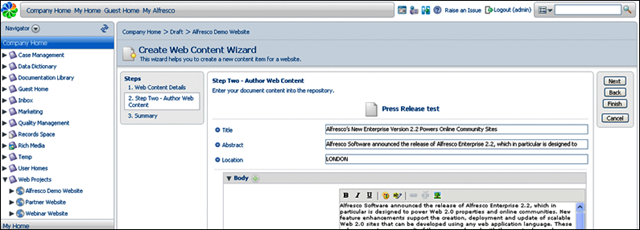
From The PACS Designer: "Re: Alfresco. Enterprise Content Management is becoming more in demand by healthcare professionals and one free software solution addressing ECM is called Alfresco. HIStalk sponsor Red Hat has some experience with being an Alfresco installer and can help those who are interested in this software solution." Link.
tedtalks

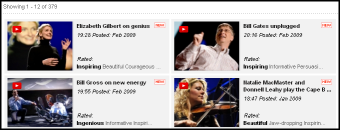
From Cloud Jumper: "Re: alternative to HIMSS. Maybe you could do something like the TED talks, where the coolest people could give their talks to cool savvy people in the audience and it’s all on video so we can watch it later if we were uncool enough not to be invited. You could get the vendors to do tasteful little ads in front of each video, as TED does, to pay for it." That would be fun, although healthcare is so profit-oriented and fiercely protective of turf even on the non-profit side that the cool factor is turned down several notches (kind of like being the heppest cat at HFMA). Still, it would definitely be different than the mainstream conferences, where the same old faces exaggerate their successes with the same old ideas prettied up to seem more daring and contemporary. But, the one article commenter was spot on: HIMSS can only put people on stage who volunteer to be there, so those who have never been a speaker or committee member have no excuse to gripe about the result (I have, so I can). That’s one of my HIStalk goals, though — to showcase the good ideas of people who don’t have the time, money, or ego needed to ride the PowerPoint Podium.

The Senate passes the economic stimulus package and Kaiser Family Foundation has a summary of it (the current version, until a compromise is reached with the House). The Senate’s bill calls for $19 billion for HIT vs. $20 billion in the House bill. Both sides want to give Rob Kolodner’s previously shoestring-funded office incomprehensible amounts of "discretionary" funds, $3 billion vs. $2 billion (is anyone a little scared of that?) Surely up for heated debate: the Senate’s bill punts on privacy, while the House calls for strict privacy protections. Wall Street wasn’t exactly overjoyed with the grim reality of this financial Hail Mary or the worse-by-the-day bank bailout; the major indices all dropped nearly 5% on Tuesday.

Speaking of that, the former lieutenant governor of New York weighs in with Ruin Your Health With The Obama Stimulus Plan. She says senators should vote against what she calls "the handiwork of Tom Daschle": ONCHIT as a big new bureaucracy, government interference with physician decisions, and intentionally slowed development of new drugs and technologies because they’re expensive. Daschle, she says, thought seniors should deal with conditions that come with old age instead of being treated for them, moving dollars to younger people (as cold as that sounds, I’d have to agree at least in general). Here’s the big finish: "The health-care industry is the largest employer in the U.S. It produces almost 17 percent of the nation’s gross domestic product. Yet the bill treats health care the way European governments do: as a cost problem instead of a growth industry. Imagine limiting growth and innovation in the electronics or auto industry during this downturn. This stimulus is dangerous to your health and the economy."

Add Rush Limbaugh to the list of HITECH haters. From his Monday show: "Your medical treatments will be tracked electronically by a federal system. Now there are arguments back and forth about whether or not this is a good thing. The opportunity for the loss of privacy is huge here … by digitizing and making everybody’s healthcare records computerized … especially having a major federal database where everybody’s health records are." I’m conservative and even I can’t stand that pompous gasbag, so I can’t imagine who’s still listening to him.
commehr

The New York Times just published a piece on HITECH, citing a letter that urges not just throwing EHR money at doctors, but also distributing lessons learned via "Regional Health IT Extension Centers" to help out with projects in small medical practices, which sounds like a great idea. You will note that the letter (warning: PDF) has few vendor signatories, unsurprisingly.

Cerner’s Q4 numbers, announced after the market close: revenue up 18%, EPS $0.86 vs. $0.49, thrashing expectations of $0.59. Say what you want about good old Republican boot-strapper and plain-speaking Neal, but the man knows how to run a company better than those big, fancy foreign conglomerates choking on healthcare IT and everything else they toe-dip into. Thank goodness for MEDITECH, Cerner, and Epic, run by the founders instead of hired gun Wall Streeters and sticking to their healthcare IT knitting instead of selling nuclear weapons, theme parks, and jet engines (not to mention toxic assets to taxpayers in one huGE example).

I got a couple of e-mails suggesting that Medical Records Institute, the folks who run TEPR, have laid everyone off and closed down. I’m sure that’s somehow tied in with their new focus and conference, but perhaps the change was more severe than was hinted. I’m sure updates will follow.

Listening: Seether, South African metallish grunge.

IBA/iSoft gets two contract extensions with Netherlands hospitals.
steiner

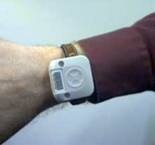
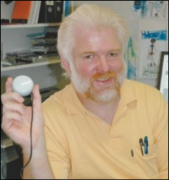
A surgeon in Australia develops a USB emergency button that, when pressed, sends a message to all PCs on the network along with the location of the sender. He created it after noting that several doctors had been killed by patients.

Allscripts announces that it will sell its Medication Services business (I asked Glen Tullman about it almost three years ago). The company also approved a $150 million stock repurchase plan.

Hospital layoffs: Columbia St. Mary’s (WI), 54; Cascade Healthcare Community (OR), 74.

Jobs: FCP-MS4 Patient Accounting Expert, McKesson Horizon Lab Consultant, IT Director.

Healthcare Growth Partners publishes its Q4 2008 Healthcare IT Transaction Summary & 2008 Year in Review (warning: PDF).

IBM and UnitedHealth test the medical home model, in which a primary care physician (not a gatekeeper) coordinates care among other medical professionals, often by using information technology. I’ll defer to Scott Shreeve, who provides a better synopsis than I can.

Interesting: hospitals that hire doctors often write employment contracts that don’t allow the doctor to contact patients if he or she leaves and also prohibits them from opening a practice within a specified radius. Patient are also charged large amounts to have their paper records copied so they can seek care elsewhere. Noncompetes are standard in business, in case nobody noticed that even non-profit healthcare is one.

A third of Australian healthcare and IT professionals say they’ve experienced compromised patient safety due to IT downtime.

Idiotic lawsuit: an admitted alcoholic on a two-day bender (more like a "breaker" in this case) in a Marriott falls more than 100 feet off a stairway while drunk, causing what he says is permanent brain damage. He’s suing the hotel for serving alcohol to an addict (him) and thereby causing his injury. He’s claiming injury, pain and suffering, anguish, disfigurement, medical expenses, loss of earnings, loss of the enjoyment of life, and aggravation of a previous condition.

A laptop stolen from Parkland Hospital (TX) last week may contain information on over 9,000 employees.

Availity announces the availability of real-time Florida Medicaid eligibility and claims status at no charge.

E-mail me.

HERtalk by Inga

From Ronald Miller: ”Re: Henry Schein. Former MED3OOO VP Keith Slater is now the GM at Henry Schein Medical Systems. Good move for Henry Schein. It was only a matter of time until they figured out they had NO CLUE how to deal with a PM/EMR product after spending all that money on it. Maybe now the button ups at Schein will do a better job than Pfizer did with Amicore.”

From Jerry McGuire: “Re: Great piece today with Allscripts CEO on stimulus. From your piece, it seems the curious angle is identifying when IT does and doesn’t serve as a stimulate function. Maybe a virtual roundtable?” We’d love to hear readers’ opinions on what IT functions could stimulate the economy.

The Washington Post posts a graphic that breaks down the $819 billion stimulus package. It doesn’t say where the $20.2 billion for HIT is going, much less what part of IT is stimulating, but it is a pretty impressive graphic.

Caritas Healthcare (NY) files for Chapter 11 bankruptcy protection and its two hospitals are projected to close this month. Caritas had a net loss of $64 million for 2008, prompting the board to vote to close Mary Immaculate and St. John’s Queens hospitals.

QuadraMed announces that revenue for FY08 will be slightly ahead of the $146-149 million guidance previously provided. The company also expects EBITDA to significantly exceed the previous $15.8 million target. Reading between the lines in the press release, Keith Hagen sounds a bit cautious when discussing 2009 and the company’s potential for new business: “Approximately two-thirds of our revenues are produced by recurring maintenance and term license contracts, and a large percentage of our 2009 revenue is expected to be generated by this recurring base, our project backlog, and our broad set of products and services."

The 25-bed Hiawatha Community Hospital (KS) becomes the 55th hospital to go live on IntelliDOT’s BMA system.

clip_image002

Catholic Health Initiatives names Michael O’Rourke its permanent CIO and senior VP. He’s been interim CIO since August 2008 for the 77-hospital organization.

Capsule announces that 10 new healthcare organizations selected its device connectivity solution during the last quarter of 2008.

Marshfield Clinic (WI) adopts a new BI solution to make better use of its vast amount of patient data. Marshfield will utilize SAP’s Business Objects XI intelligence system to improve patient care and analyze internal business operations.

Eclipsys announces that Greenwood Pediatrics (CO) has selected Eclipsys PeakPractice (the former Medinotes PM/EHR solution). The 10-physician group apparently chose Eclipsys over Epic, which their hospital offered to subsidize.

A former Queen’s Medical Center (HI) administrator pleads guilty in federal court for defrauding her former employer out of $594,000. Patricia Syling is accused of creating bogus contracts between a company she owned and Queen’s, and charging the hospital for services that were not performed. Syling was hired by Queen’s in September 2001 as the corporate compliance administrator and director of revenue cycle. In an unrelated charge, Syling is also accused of defrauding another former employer, Citrus Health Care of Florida, of more than $1 million and using $320,000 of the proceeds to buy a luxury sky box at Tampa Bay Buccaneer football games.

The McKesson Foundation awards $60,000 in grants to nine Minneapolis-St. Paul-area non-profits. The funds will be used to support health and wellness programs benefiting children and families.

A Texas Medical Association survey finds that doctors worry their financial hardships threaten quality of care and access. Declining payments, claim denials, incorrect or late payments, and administrative burdens are taking time away from patients.

The University of Chicago Medical Center (the First Lady’s old haunt) plans to cut 450 jobs in order to cut 7% off its annual budget. This is in addition to the elimination of 15 senior executive posts, including the one vacated by Michelle Obama (we’ll try not to be cynical about the huge raise UC gave her just before Obama won using the rationale that she was essential and therefore worth every penny).

MRO expands its services to include remote release-of-information processing and remote and staffed services.

HIMSS Analytics releases a list of the top vendors of acute care EHR systems based on total number of installations. For 2008, MEDITECH topped the list at 26.6%, followed by McKesson (14.1%) and Cerner (12.6%). I wonder how the rankings would end up if the list were based on number of total beds?

The octuplet story just gets crazier and crazier. Apparently the mom’s fertility doctor is not as successful as most doctors around the country, with his patients having much lower than average rates of pregnancies and births. Also, at least two former employees have sued him, including an office administrator who accused Kamrava of tax and insurance fraud. The office manager claims the office kept two sets of books, one for cash and the other for insurance, and some cash was never entered into the computer or deposited in the bank. Meanwhile the Kaiser Permanente hospital where the children are receiving medical care is requesting Medi-Cal funding to help pay for the octuplets’ medical care since Mom is unemployed, living on food stamps, and mostly letting her mother raise her first six children.

Compuware’s Covisint subsidiary collaborates with the VIP Health Initiative to provide a secure single point of access to share clinical data. The VIP Health Initiative was formed by Scripps Mercy Physician Partners, SMPP Services and Physician Partners Management Services.

Despite massive financial losses as a result of Hurricane Ike, UTMB Galveston intended to pay $3 million in bonuses until a faculty group discovered the plan. According to the Texas Faculty Association, once the bonus plan was uncovered, UTMB canceled the payments. The largest bonus recipient would have been the school’s executive VP, provost, and dean of medicine, who was scheduled to receive over $122,000 – on top of his $700,000 annual salary. The school claims it was planning to cancel the bonuses anyway.


E-mail Inga.

MD Leader 2/10/09

February 9, 2009 News 2 Comments

The Stimulus Bill Will Change How IT Data is Used in Healthcare

At this writing, the Stimulus Bill has not been passed, but it will change how we use IT. The funding and implementation incentives will get all the press, but it is the fine print that has the potential to change how IT healthcare information is used.

The Stimulus Bill will restrict use of healthcare data. To date, the biggest areas of concern have been:

  • The use of patient consent for internal healthcare operations;
  • Revised definitions of healthcare operations limiting use of patient information (potentially including use of patient information for quality reporting);
  • Accounting for of all disclosures, even for treatment;
  • Patient consent for information use by a healthcare exchange;
  • Extending privacy and security rules to business associates.

None of these issues may appear in the final bill and additional elements can be added at the last minute. The legislation is moving fast and there will be unintended consequences. How government chooses to enforce the provisions and how our own organizations choose to interpret will determine the impact on our operations.

When the final bill is signed, evaluate the direct economic impact. Also be sure to look for additional provisions that will change how healthcare uses data.

petersanderson

Peter Sanderson, MD, MBA is a family physician and Director of Medical Informatics and Operations and Executive Sponsor, EHR Program, at Ministry Health Care. He can be reached at pete.sanderson@ministryhealth.org. He also blogs at MD Leader.

CNN: Compromise Stimulus Bill Eliminates All $2 Billion of HIT Grants

February 7, 2009 News 2 Comments

CNN reports that the slimmed-down economic stimulus bill being debated by Congress has had the $2 billion line item earmarked for healthcare IT grants removed as part of a cost-cutting compromise.

The original House plan called for $2 billion in HIT grants plus another $18 billion to be managed by CMS in the form of pay-for-performance incentives. Details of the current plan being debated have not been released.

UPDATE: a reader sent over a worksheet provided by his Senator. The House had originally proposed $2 billion for ONCHIT, while the Senate had proposed $5 billion. The proposed compromise calls for a $2 billion reduction from the Senate’s proposal, leaving $3 billion, which is still $1 billion more than the House had suggested. Those aren’t final numbers.

UPDATE 2: Here’s a link to the current version of the bill as of Monday morning (warning: PDF). The HIT grant part is on page 139, but here is the full text:

OFFICE OF THE SECRETARY
OFFICE OF THE NATIONAL COORDINATOR FOR HEALTH
INFORMATION TECHNOLOGY (INCLUDING TRANSFER OF FUNDS)

For an additional amount for ‘‘Office of the National Coordinator for Health Information Technology’’,  $3,000,000,000, to carry out title XIII of this Act which shall be available until expended: Provided, That of this amount, the Secretary of Health and Human Services shall transfer $20,000,000 to the Director of the National Institute of Standards and Technology in the Department of Commerce for continued work on advancing health care information enterprise integration through activities such as technical standards analysis and establishment of conformance testing infrastructure so long as such activities are coordinated with the Office of the National Coordinator for Health Information Technology: Provided further, That funds available under this heading shall become available for obligation only upon submission of an annual operating plan by the Secretary to the Committees on Appropriations of the House of Representatives and the Senate: Provided further, That the Secretary shall provide to the Committees on Appropriations of the House of Representatives and the Senate a report on the actual obligations, expenditures, and unobligated balances for each major set of activities not later than November 1, 2009 and every 6 months thereafter as long as funding under this heading is available for obligation or expenditure.

Monday Morning Update 2/9/09

February 7, 2009 News 7 Comments

From Doug DeCinces: "Re: E&Y. E&Y is shutting down its Health Sciences Advisory Services practice. At least 100 employees at all levels (partners and down) are losing their jobs." Unverified.

From Skeptic: "Re: TEPR. They’re claiming 800 registrants, which is pathetic even if the number is accurate. They’re also claiming that a common comment was ‘best program in 25 years.’" The only positive comment I’ve heard is that the weather was good. Now that HIMSS is eating the universe, it’s like the NIT basketball tournament once the NCAA expanded to 64 teams. If someone really wanted to offer a HIMSS alternative, it would need to be a lot cooler and a lot brasher. I’m thinking I’ll start a BIL conference or an unconference whose whole agenda is like the interesting, less commercial hallway meetings that are usually the best part of any conference. Those could be held at cooler, smaller, cheaper locations than the tired old Orlando-Las Vegas-Chicago circuit of mile-long convention centers and $15 room service burgers, like an HIT Chautauqua that leaves you educated, rejuvenated, and not embarrassed that your employer’s time and money were wasted.

meddispense

From Kate: "Re: medDispense. Emerson (NYSE: EMR) bought them last month for an undisclosed amount." I confess that I didn’t even know that automated drug dispensing vendor medDispense was still around. Trivia: they started as a division of HCS, the Montgomery, AL software vendor who sold McKesson what is now Horizon Meds Manager. Emerson makes heavy duty commercial stuff like power plants and air conditioners. Not too successfully of late, apparently, since the company announced late Friday that it will axe 14,000 employees, more than 10% of its workforce, by October. The sale went through on January 15.

From Tarhill: "Re: HHS secretary. Has anyone heard if Newt Gingrich might be a candidate?" Well, like Daschle, he’s written books and held high political office. The similarities end there. Maybe he would be a good choice, but he brings a lot of baggage, is on the wrong ideological side, and would never fully trusted at the level Daschle would have been. The problem is that all the plans were built around Daschle, so he’ll be tough to replace even if the job is split into two (advisor and HHS leader). I hesitate to say this, but I’m not convinced he wasn’t the best choice despite questionable industry ties. Sure, it’s iffy that he was paid millions as a non-lawyer working for a law firm in ways that sure seem to indicate off-the-books lobbying, but if Obama wants political experience, every closet has a surplus of skeletons.

From Vendor Guy: "Re: QuadraMed. Heard a rumor that QuadraMed is getting to pull the plug on the old Compucare/Affinity product." Half accurate, as I suspected and Inga confirmed with a company spokesperson. QuadraMed recently notified existing Affinity Clinical customers that Affinity Clinicals will not be supported after 1/1/12. This is hardly a surprise: they were very clear with the QCPR acquisition that Affinity Clinicals weren’t up to snuff and that QCPR was a far better solution that would be the go-forward offering. However, the far, far more widely installed and much better Affinity Registration/Access and Revenue Cycle products aren’t going anywhere. See also the interview I did with CTO Jim Klein in HIStech Report: "We had to be frank with ourselves. The Affinity clinical system, unlike the patient accounting system, had not kept up with functionality. Both ‘build’ and “buy” options were viable, but people’s expectations about how the team could turn things around just screamed ‘buy.’" They’re offering deals and extended Affinity Clinicals support to customers who move to QCPR.

HIMSS just won’t seem the same without MEDITECH and Cerner there, will it? Maybe that’s a good thing. Past excesses at all levels (individual, business, and government) make it appropriate to tone down the boat show (and that MEDITECH, as the always-frugal but huge vendor, lead the way after Cerner). Non-conspicuous consumption is "in" again, thank goodness. The big question: will other companies follow their lead? My pledge: I will not criticize or allow criticism here of any company that decides to refocus their resources on something other than the HIMSS conference. Each vendor has to decide for themselves whether it’s worth it. Even if there’s little money to be saved by pulling out at this late date, I think both providers and vendors are cautious about appearing extravagant. I’ll be there, but I’ve always been a complete cheapskate, like subsisting at last year’s HIMSS on Subway sandwiches and going for the cheapest hotel on the bus route. I did buy a can of soda one day, but griped constantly about the cost to anyone who would listen.

Sisters of Charity of Leavenworth Health System (KS) sues Lawson Software for retiring "critical" applications it bought in 2001 for $1.4 million. Lawson says it will end support in May 2010 for employee time off tracking and medical supply inventory management. Their contract says they can exchange their applications for other similar ones for a nominal fee, but Lawson wants another $155K in licensing fees plus increased maintenance because their only other similar applications have additional capabilities.

A Sacramento publication (I’m guessing it’s one of those free counterculture weeklies that features wildly liberal articles, ads for sex chat lines, and good restaurant and concert reviews) takes on EMRs, managing to make Britney Spears the focus. Here’s a fun snip: "It [Kaiser] developed two versions before settling on its current HealthConnect project using Epic Systems software (which is quickly becoming the national standard for EMRs)." Popular, but a national standard? It may be an obscure publication, but Deborah Peel of Patient Privacy Rights found the article and left the only comment it has received, calling EMRs "dinosaur technologies" and urging readers to contact Congress to vote no on HITECH unless privacy provisions are added.

riley

Clarian Health (IN) shuts down a $475 million construction project as part of an urgent cost reduction project that includes 10% pay cuts for VPs and efforts to renegotiate vendor contracts. More than 400 construction workers were immediately put out of work, some of them finding out only when they arrived at the job site Friday morning.

The University of Virginia Health System gets approval for a new $59 million EMR project. The vendor isn’t named, but I’d have to guess Epic given (a) the price; (b) the line about access to records anywhere on Earth; and (c) the fact that nobody’s selling any big deals these days except Epic (the hippie weekly may be right). I believe UVa was IDX/CareCast, so I assume GE Healthcare will be losing another customer.

Kaiser Permanente announces that a recently arrested non-employee had a computer file containing KP employee information, source unknown. They offered the usual free year of credit monitoring.

I’ve closed the two polls on economic conditions. Results: EMR vendor people say they’ve seen slowdowns because of the economy (68%) and because prospects are waiting to see if the government will help them purchase (11%). Only 21% say it’s business as usual with no slowdowns (it would be interesting to know which companies those are!) On the provider side, 54% of those considering an EMR purchase say they’re moving forward without planned delays, 38% say they’ve delayed their project because of the economy, and 8% say they’re waiting on possible government help. Respondent counts were 47 vendors, 26 providers. It appears that the possibility of government handouts isn’t holding many prospects back, but the economy definitely is.

New poll: if you went to HIMSS last year, what are your plans this year and what’s your employer doing? It’s awkward to phrase the question in a poll, but I did it this way: indicate whether you’re going or not, and then whether your organization is sending fewer people or not. People keep asking me how I think attendance will be; I can’t imagine it won’t be down, but conventions are like sporting events: fan-flation uses the most flattering number — turnstiles or ticket sales. I care less about announced attendance than what vendors tell me they’re seeing in the exhibit hall since, let’s face it, that’s the metric that drives conferences.

virtualvisit

The Virtual Practice Project at Mass General is working on a medical kiosk that walks patients through touch screen-answered questions and checks blood pressure. The doctor in charge explains: "The way we deliver traditional health care is a bit antiquated. It’s based on face-to-face interaction between the doctors and the patient." I found this report (warning: PDF) which mentions that RelayHealth is providing some of the online visit technology.

The unSummit for Bedside Barcoding will be in Tampa May 6-8. Good agenda, good hotel, and CEUs for nurses, pharmacist, and lab techs. You save money by signing up by February 28.

Here’s a TV show that I hope has met its much-deserved demise: "Flip This House." When Joe Sixpack starts thinking he’s an expert in day trading, commodities speculation, and real estate investing, it’s time to run for the hills.

I think it’s obvious, but for any newcomers, you will want to read the article comments because some thoughtful conversations are to be found there. If you’ve clicked the e-mail link, you’ll see them automatically, but readers will post comments after you’ve read it. To see those, click the Home link at the top of the page, then click the "show comments" link at the bottom of the article. I’m pleased that folks comment quickly, knowledgeably, and respectfully, offering a nice mix of opinions (I don’t claim to be right all of the time and readers sometimes change my mind).

Also for newbies: add your e-mail address in the Subscribe to Updates box at the upper right of the page and you’ll get instant e-mail updates when I write something new (surely you want to be among the first to know — you should see the server drag when hundreds or thousands of people all hit the site at once when an e-mail update has gone out). The Search box does a Google custom search on HIStalk and HIStalkPractice combined, all 5.5 years worth (I may have mentioned your company, your boss, or you in those millions of words). Also, click that "Email this to a friend" graphic to alert some e-mail pals about an HIStalk article or click the horrid green Rumor Report box to tell me a secret.

One more update: someone asked for the "Print This Post" option that used to be here, so I’ve re-installed that function that I didn’t realize had gone astray. The link is at the bottom of each article.

Inga did a couple of cool interviews on HIStech Report. Our old friend John Holton of SCI Solutions provided his usual honest, experienced assessment of the industry ("PHRs are being developed by Microsoft and Google and others. It’s the way information will be stored and sent because no one really cares about your medical history except you.") She also talked to Bruce Cerullo of Vitalize Consulting Solutions, another friend of HIStalk who I had fun with at last year’s HIStalk HIMSS event ("Having really good people wanting to come under our umbrella is a win for them, a win for us, and a resulting win for our clients. I also think there will be a lot less job-hopping in general over the next 12 months. I believe we will see more stability among the consultant firms.")

Bizarre: Wuesthoff Health System (FL) is offering patients from competing hospitals $100 gas cards for a copy of their EOB. They want to see how they stack up on charges. Maybe they got the idea from Scott Shreeve’s Million EOB March.

Like it needed more bad news: Grady Hospital (GA) may be the source of four patients’ Legionnaires’ disease, which allows Legionella and attornii scumbaggia to thrive at the expense of normal species.

somerset

Four employees of Somerset Medical Center (NJ), one of them the hospital’s credit manager, are charged with altering patient bills to trigger $35,000 worth of refund checks made out to the four and sent to the same address. That doesn’t seem like a very smart plan coming from someone in management.

Idiotic lawsuit: a couple attacked and beaten in their home are treated at Stephens Memorial Hospital (ME). A security guard hears them talking about being attacked and calls police, who check out their house and find 95 pounds of marijuana, for which the couple pleads guilty. They’re suing the security guard and the hospital, claiming violations of HIPAA and state confidentiality laws, violation of privacy, and emotional distress.

E-mail me.


Report from the Field
Nick van Terheyden on TEPR

For those coming from the fully winterized East Coast and Midwest in February, any location that has a temperatures rising above 35° is going to be attractive, but Palm Springs would be hard to beat. Set in the shadow of the San Bernardino Mountains and weather that sat in the mid 70s and provided clear blue skies every day was a delight. The conference itself has clearly seen better days and estimates ranged from the “official” ~7-800, to my unofficial count at opening keynote of 4-500 to overheard “only 320 rooms sold." Whatever the number, it was small and often felt overrun with presenters and vendors.

AHIMA felt similar this year, with a distinct feeling that there were fewer attendees and several anecdotal stories of cancellations to save money. Even the RSNAathon was lighter than previous years, but with such large numbers to start with, the decrease has less impact. Fascinated to see how significant the effect will be on HIMSS.

The opening sessions were great, and like or not Adam Bosworth’s views on where to spend the $50 billion stimulus, he had a compelling story that was not about technology investment (surprising for an acknowledged pioneer of XML) but centered on incenting behavioral change in the US population to stop the epidemic increase in American waists. But it was the Illness in the Age of “e” hosted by Danny Sands from Cisco and his patient Dave deBronkart that stole the show.

In an emotional and graphic account, the pair detailed Dave’s experiences from the first incidental finding of an aggressive form of renal cell carcinoma through intense and “often severe and rarely fatal” side effects to the closest thing you can hope, for next to cured: No Evidence of Disease, or NED. Insisting on patient participation to help guide the process, even check for errors (he cited a recent case of wrong side surgery for someone with the same renal carcinoma where they removed the wrong kidney!) that would have easily been prevented with patient involvement. Nothing to bring home the relevance of what we all work for than hearing right from the patient’s mouth. Dave (@epatientdave) stayed the duration, shook up several other presentations, and joined the impromptu TweetUp by the side of the pool on Monday night with @alphabest @HealthITGirl and yours truly @DrNic1.

But no social networking presence from the Medical Record Institute, and as I pointed out in my Tweet, “It’s so Web 1.0…. no blog, no tweet, one month before presentations will be online." There was some activity as @Megan_maguire weighed in, but a little late. (unlike HIStalk and HIStalk Practice that have wrapped their arms around these media, use it effectively, and participate jacked in just like Neo from The Matrix – which is how I feel a lot of the time!)

The panel discussion with Google and Microsoft and MedCommons was a bust – and an education in panel techniques. Hearing three replies, all similar, to each question was uninformative and boring … sigh. The case is made — we need disruptive attacks to the current status quo and that needs to come from innovators who shake up the system and incumbents. PHI will play a role and the individual will become a key player. The recurring focus on the big cash supposedly heading for our industry was in many instances distracting and in some cases potentially detrimental since the likelihood that the cash will end up steered towards those with the best advocacy and influence in Washington places additional strain on the small upstart that is trying to disrupt the status quo.

The final panel discussions on Thursday were like many conferences — poorly attended, and at one point the panelists outnumbered the attendees. However — a gem from one of the discussions: "CCHIT certified EMR = unusable" … but you can *upgrade* to a non-CCHIT certified alternative.”

There was little traffic in the vendor area, which was located at the end of a long walk past all the educational sessions and had limited opening hours. The main topic of conversation was the likelihood of anyone returning to the show or if there would be a show to return to.

Sadly for this long time attendee, this year’s TEPR felt too much like an Irish wake without the alcohol. Much of the oxygen has been sucked out of the conference circuit by HIMSS, which is unfortunate since smaller conferences offer more opportunity to really meet colleagues and vendors and gather information in a practical learning environment.

MEDITECH Pulls Out of HIMSS 2009

February 6, 2009 News 18 Comments

MEDITECH announced today that it will not attend the HIMSS conference in April, citing the expenses involved for both the company and attendees.

The statement of President and COO Howard Messing is as follows:

Participating in the annual HIMSS conference has proven to be beneficial to MEDITECH and LSS through the years, as we have been able to renew acquaintances, attract new customers, and showcase new product offerings there. Nonetheless, the current economic climate mandates we pay particular attention to spending resources wisely this year. Just as we encourage customers to make HCIS selections based on value, we too must carefully evaluate our expenses and focus on priorities. For this reason, MEDITECH and LSS will not attend the HIMSS conference this year. Instead we will use communication channels such as our extensive program of regional events, annual workshops, Webex demonstrations, and meditech.com to share information. Using this approach, we will be able to continue sharing information on key topics, control our expenses, and minimize everyone’s costs.

News 2/6/09

February 5, 2009 News 10 Comments

From The Watchman: "Re: Epic. I hear that Judy Faulkner is telling newly signed clients to not use consultants, sending her own instead. Word is she was out at Dartmouth and at NYU saying the same thing."

From Carpluv: "Re: HITECH. If my practice is on a Stark-sponsored hospital ASP, will we still get the stimulus that totals $41,000?"

Inga worked hard to interview Glen Tullman of Allscripts in the pre-dawn hours this morning, so look for that to follow. I’ve given her the night off as her Employee of the Month award, so I’m solo-posting this time.

TEPR non-attendance and this should be scaring the bejeebers out of HIMSS: GE Healthcare cancels its August User Summit, citing customer travel cutbacks.

Community Medical Center (PA) signs for SIS.

TPD mentioned IPv6, the solution to running out of IP addresses worldwide. Here’s an article about it, co-authored by a VP from Stratus Technologies, an HIStalk sponsor.

cch

This is odd but probably a good idea: Cincinnati Children’s Hospital offers employees a class in minimizing their foreign accents to sound more American. A bit steep at $2,300 considering the hospital benefits as well as the employee, but it’s still cool.

Listening: brand new The Red Jumpsuit Apparatus, melodic hard rock. Failure to air-drum is not an option. Also: A Cursive Memory.

Jobs: Epic Resolute Professional Billing Consultant; PMO Eclipsys, Cerner, or Epic; Team Lead, Load and Performance.

Rotherham NHS bails out of NPfIT to bid its own EMR contract, unwilling to wait for Lorenzo to be ready. They will issue their award shortly in a deal expected to exceed $50 million.

IBM announces software that will transfer medical device data into a PHR. IBM says it built the product following Continua’s guidelines. That’s kind of interesting, assuming doctors will find it convenient to get the information from the PHR. Since most of them wouldn’t have access to home monitoring data otherwise, maybe they’ll use it.

Terry Ragon, founder of InterSystems and co-founder of the former IDX, donates $100 million to Mass General with the goal of developing an AIDS vaccine within ten years. He’s also convinced several scientists to join up with the new institute bearing his name instead of working in their individual silos. All the money spent on Cache’ licenses and maintenance fees by users of MEDITECH, Epic, and a bunch more HIT vendors will at least go back to a worthy healthcare cause. That’s an amazing gift.

elibrary

Inside Healthcare Computing has opened up its new Electronic Library, an archive of articles from that newsletter and its HIS Insider acquisition that’s available to everyone. Full articles are available from 2007 back, with more being added regularly. And while other publications and sites are awash in self-important policy analyses and spouting ivory tower eggheads, my guest contribution to the newsletter this week is My Lifelong Clock-Puncher’s Entrepreneurial Brainstorm: How the HIStalk Home Shopping Channel Will Make Me Rich. Don’t say I didn’t at least try to squelch the gloom and doom.

Sad: an elderly man injured in a traffic accident in Japan dies after being turned down by 14 EDs called by paramedics, reflecting lack of capacity in Japan’s hospital system. That’s not the record, though: one woman got shut out 49 times in Tokyo.

lucas

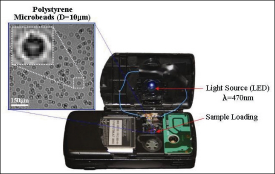
A UCLA photonics research group modifies a cheap cell phone with around $50 worth of parts to create a mobile lab for certain tests, such as CD4 or hematology. The device counts microparticles using a UCLA algorithm that’s 90% accurate. A biochemistry professor says, "What makes it quite valuable is that it is small and inexpensive. It’s also the scientific proof of a principle in its very early stages. Once the group puts more and more work into it there are going to be a huge number of applications that are going to come out."

webpax

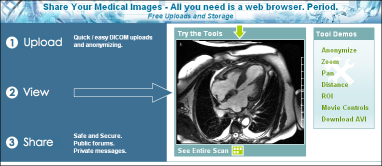
Heart Imaging Technologies of Durham, NC, which makes the "100% client-free PACS" WebPAX system, announces a free Web site for patients to upload and share diagnostic-quality DICOM images. It allows anonymizing the images, has some PACS-like viewing tools, and provides discussion tools for each image in a kind of social networking wraparound to medical images. I’m not exactly sure how patients will use it, but it’s available for research and educational use as well.

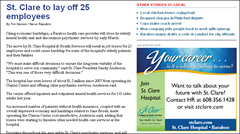
Hospital layoffs: St. Clare (WI), 25; Santa Rosa Memorial Hospital (CA), 152; Petaluma Valley Hospital (CA), 30; Swedish Medical Center (WA), 200; Niagara Health System (ON), 90.

stclare

Speaking of St. Clare, notice the ironic juxtaposition of the layoff story right by their paid recruiting ad. 

A former employee of Bon Secours DePaul Medical Center (VA) is sentenced to a year in jail for using patient information from the hospital’s computer system to apply for loans in their names, then stealing the loan checks from the mail.

Red Hat announces a call for papers for its Red Hat Summit in Chicago, September 1-4. Papers are due March 9.

Idiotic lawsuit: a golfer’s ball ricochets off a yardage marker on the course, hitting his eye hard enough to cause a permanent loss of sight. He’s suing the golf course, saying the owners should have warned him about the markers. "It’s not a frivolous, run-it-up-the-flagpole-and-see-who-salutes kind of thing," his lawyer assures.

E-mail me.

News 2/4/09

February 3, 2009 News 8 Comments

From At TEPR: "Re: I’m at TEPR. Attendance is way,way down. I feel sorry for the MRI, and that’s bad to feel sorry for a good organization. Might be best to pull the plug and go out with dignity, or else morph into something else."

From oneHITwonder: "Re: TEPR. Opening session — 3 hours and 15 minutes straight, four different speakers. Nothing earth-shattering in the first three, couldn’t sit there for the fourth speaker. Breakouts are organized strangely, with multiple speakers on a related topic grouped together, some talking for 20 minutes, some 25 minutes, some 30 minutes. Makes it very hard to session-hop. First two speakers in breakout were like an advertisement for particular vendors. Interesting to learn about new products, but geez. The best part of the day was the conference center fire alarm that got me out of one session that was a bit dull. Oh, and no refreshments other than water. Lunch was a brown bag with a chicken wrap and a cookie … the cookie was 631 calories…OMG! But for those of you buried under snow, it was 82 degrees here yesterday!"

From The PACS Designer: "Re: IPv6. The Internet is running out of available IP addresses and it is forecast that the 4 billion address maximum will be reached by 2011. To alleviate this problem, some of the countries outside the U.S. have already upgraded to the new Internet Protocol version 6 or IPv6. The IPv6 can handle 340 billion or more addresses, so upgrading your systems to be able to handle IPv4 and/or IPv6 will be necessary in the near future." Link

From RIS Guy: "Re: Agfa. As a follow-up to the report a few weeks ago about Agfa cutting sales positions, they laid off 80 people in their service and support groups. They were already threadbare."

From Tom DaschedHopes: "Re: printing HIStalk. Is it possible to have a printer-friendly button for articles?" That was apparently lost in the recent upgrade, which I hadn’t noticed. I will try re-installing it. I liked it myself.

Another Obama nanny tax washout: chief performance officer candidate Nancy Killefer, who withdrew her candidacy Tuesday for the same "distraction" reason that Daschle gave. The former Treasury Department CFO led the modernization of the IRS, but once she left office, had a tax lien placed on her home for $298 in unpaid taxes. Treasury Secretary Geithner somehow slipped by despite far more significant transgressions. 

Guess which regional healthcare therapeutic product business grosses $100 million a year, pays its CEO $500K, employs 1,000 people, and has people questioning why its board members are also its vendors? The non-profit Florida’s Blood Centers of Orlando. I suppose its tough not to make a fortune when your product cost is zero (courtesy of donors) yet sells for $300 a unit to other non-profits.

ipill

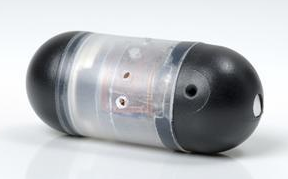
Philips creates the iPill programmable pill (technically, iCapsule) that can be directed to travel to specific parts of the body and to release its payload in specific ways. Mentioned here before, but apparently closer to reality.

An Allscripts survey finds that physician groups are overwhelmingly happy to take federal stimulus money to use toward EHR adoption. Less consensus was found in what form the payments should take — being paid to buy EHRs or being paid to use them. Two-third of doctors said they would participate in a pay-for-purchase program, and not surprisingly, practices that already have EHRs think Uncle Sam should reimburse them retroactively. Survey flaws: only 15% of the respondents were actual providers; the rest were administrative staff. EHR users made up 60% of those surveyed, far outpacing overall adoption. And, the response rate was less than four percent. That’s not a criticism of the survey, just the usual cautions about drawing conclusions from it.

London Health Sciences Centre gets a magazine mention for its Censitrac software system that tracks medical instruments in sterile processing right down to the tray and follows them through the cycle of use and preparation for re-use.

epocrates

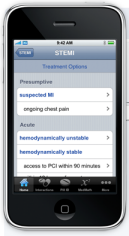
Epocrates enhances its iPhone drug reference application with a premium version that includes disease content and medical calculators.

SafeMed, the real-time analysis vendor that Google Health uses, changes its name to Anvita Health. It claims the new name (from some Sanskrit word that nobody’s ever heard of) is more reflective of the company’s expanding decision support capabilities beyond the original drug interaction checking. I’m suspecting an infringement lawsuit, but I’m reliably cynical.

Apple and Adobe are collaborating to create an acceptable version of Flash for the iPhone.

I did an HIStalk Practice interview with Garrison Bliss, MD of Qliance, a concierge-type medical practice in Seattle. I really like the concept: patients pay from $49 to $129 per month, depending on their age, whether they want family medicine vs. internal medicine coverage, and whether they prefer after-hours access to general coverage vs. a specific physician. There’s no contract required and no exclusions by health or insurance status. They use technology, although I see all the sign-up documents are PDFs that have to be mailed or faxed back. This blogger wrote a great piece summary of the model.

E-mail me.


HERtalk by Inga

From Tempid: “TEPR. Official attendance is supposedly over 700 people, but the opening session looked to have only about 200 people. A few years ago, this show drew about 2,500. But the weather is great.”

I’m feeling pretty 2.0-ish, using Twitter to follow the TEPR show. Nick van Terheyden provided some great impressions, including: “Interesting view shared @TEPR. It’s so Web 1.0…. no blog, no tweet, 1 month before presentations will be online; Google thinks PHR penetration is 2-3%; The panel format is difficult since we get 3 similar answers to each question.” Nick said he would try to give HIStalk readers a more expanded write-up. (Nick is my latest BFF because he took the time to check out my LinkedIn photo and tell me he loves it).

Speaking of Tweetering, is it appropriate to send Tweets while your wife is delivering your child? Or, while you are in the middle of getting a vasectomy? (Note to self: ask these questions before getting serious with next boyfriend).

umass

UMass Memorial Health Care (MA) selects dbMotion to create a single, interoperable electronic patient record across various IT environments and care areas.

Yet again, Nuance Communications extends its cash offer to acquire Zi Corp. Nuance is giving the shareholders two more weeks to consider the merits of its $.40/share offer. I wonder if I’d like having a boyfriend as persistent as this?

The National Qualify Forum (NQF) names Memorial Hermann Healthcare Systems (TX) the 2009 NQF National Quality Healthcare Award winner.

Medical Records Institute announces the 2009 TEPR Award winners. The VA won first place with its MyHealtheVet PRH and the Private Access suite won in the “Hot Products" category.

HIMSS announces that registration for its annual conference is ahead of 2008 trends. Non-exhibitor attendance is up almost three percent from the same period last year.

Police take a prisoner to United Medical Center (DC) for unspecified medical treatment. The patient/prisoner is allowed to go the men’s room alone, wearing only a white shirt and boxers. Before anyone has time to miss him, he climbs through the restroom ceiling, reaches another hospital room, and escapes. The prisoner has not yet been found. The paper indicates that the police didn’t provide a description of the boxers.

clip_image004

Researchers develop a new application for RFID that evaluates walking patterns to detect early signs of dementia.

Quality Systems, the parent company of NextGen Healthcare, reports a 17% jump in net income in its fiscal third quarter, to $13.2 million. Revenue grew 36% to $65.5 million. The bulk of the earnings came from the NextGen division, which posted $61.5 million in revenue (up 40%) and operating income of $22.8 million (up 28%). About $7.5 million of NextGen’s revenues came from two separate practice management companies acquired last year.

Mediware Information Systems reports a Q2 profit of $303,000 ($.04/share) compared to a $337,000 loss the same period last year. Revenue was up from $8.7 million a year earlier to $10 million.

Aspen Valley Hospital (CO) signs a five-year extension to its business process outsource agreement with CSC. The original outsource agreement was with First Consulting Group in December 2005. CSC also announces a new subscription tool called HealthSpace Advisor, which enables hospitals to analyze how effectively they’re using space in key revenue-generating areas.

Logical Images names Andrea Pennington chief medical office. The company provides decision-support technology for diagnostic-imaging providers.

E-mail Inga.

Daschle Withdraws from Consideration for HHS Secretary

February 3, 2009 News 11 Comments

Tom Daschle has withdrawn from being considered as HHS secretary, citing his desire to avoid distractions over his failure to pay taxes previously owed. President Obama said, "I accept his decision with sadness and regret."

Daschle was quoted as telling a journalist this morning, "I read the New York Times this morning, and I realize that I can’t pass health care if I’m too much of a distraction."

Being John Glaser 2/3/09

February 2, 2009 News 6 Comments

An Alternative Plan for $20B

The congressional discussion around the $20B HIT investment is rapidly drawing to a close. However, there may still be time to discuss an alternative investment approach.

Rather than financial incentives for physicians and hospitals, education of HIT professionals, and other current ideas, I came up with the following.

For Healthcare Providers

There are something like 4,000,000 physicians, nurses, and other allied health professionals. For each of them, we would get:

  • 3-D goggles. These goggles will improve EHR usability and hence we’re more like to see high levels of e-prescribing and other important EHR uses. I would suggest that we get high quality goggles; not the Super Bowl cheap kind. 4,000,000 providers x $30/quality goggle = $120,000,000.
  • iPhone. Again, to improve ease of use and also provide some cool software (including a GPS so they know where they are in the hospital) I would get all providers an iPhone. 4,000,000 providers x $200/iPhone = $800,000,000.
  • EHR baseball caps. So their patients know that they are all on the EHR team, we would get all providers an EHR baseball cap with a fancy EHR logo. 4,000,000 providers x $12/cap = $48,000,000.

For HIT Professionals

I think (without facts) that there are something like 200,000 professionals who will be involved in EHR implementation and support. For each of them, we would get:

  • Oscilloscope. This will help troubleshoot EHR problems and configure the software. 200,000 professionals x $1,200/oscilloscope = $240,000,000.
  • Soldering gun. They will also need a soldering gun to fix any problems they find. 200,000 professionals x $200/soldering gun = $40,000,000.
  • Trinkets. All of these professionals will go to HIMSS to hear talks and see what’s what in the exhibit hall. Since we want them all to get high quality exhibit hall trinkets, I am proposing that each attendee get $1,000 worth of trinkets. 200,000 professionals x $1,000 worth of trinkets = $200,000,000.
  • Infrastructure. To connect all of these EHRs, we will need an EHR satellite. 1 satellite x $1,000,000,000/satellite = $1,000,000,000.

Patients

We should do something for patients since this really is about them. I had initially thought that we’d get everyone in this country an electronic stethoscope that could be connected to the satellite, but with only $20B, we can’t afford it. 300,000,000 people in the US x $300/stethoscope = $90,000,000,000.

We have $17,552,000 left to spend. This is approximately $60/person.

Since it will take some time to launch the satellite and manufacture and distribute goggles, caps, trinkets, etc. and since we want everyone to take better care of themselves soon, I would get each person in this country:

  • The AMA Family Medical Guide at $30 each
  • A Deluxe Pilates Exercise CD at $30 each

And that’s the alternative plan. Some of the estimates of healthcare professionals and EHR staff may be low, but I am also sure that we could get a bulk deal on the items above and still stay within budget. We may not be able to get a deal on the satellite.

johnglaser

John Glaser is vice president and CIO at Partners HealthCare System. He describes himself as an "irregular regular contributor" to HIStalk.

What Usability Is and How to Recognize It

January 31, 2009 News 5 Comments

By Jim Bradford, Ph.D.
The Bradford Report

From time to time when I use a new application, I seem to develop a kind of Tourette’s Syndrome characterized by teeth grinding, fist clenching, and dark mutterings. As I struggle through yet another badly designed, user-unfriendly system, I find myself wishing fervently that Bill Gates had finished college.

Technically, the user friendliness of a system is known as “usability.” There is an entire academic discipline (variously called “Human Factors” or “Ergonomics”) that is devoted to the study of usability. But if you don’t happen to have a Ph.D. in Ergonomics, how do you recognize a well designed, highly usable system?

Mental Models and the Psychology of Geeks

The human brain constantly monitors the environment and creates models about it. This allows us to think about our environment and make predictions about what will happen next. We carry over this natural tendency to model things into our interaction with computers.

Not all models are created equal, however. I have a friend who believes that if you set a thermostat as high as it will go, it will warm up the house faster. It is not an unreasonable model — it just doesn’t happen to be right.

The best system designers work hard to give you many clues about how a system works. This allows your brain to make a good model that produces accurate predictions about system behavior. When you encounter such a system, you begin to feel that the system is natural, intuitive, and easy to use.

Unfortunately, geek psychology doesn’t often lead to this kind of design process. In 1971, Gerald Weinberg published his (now classic) book, The Psychology of Computer Programming. To boil a long tome down to its essence, the kind of person attracted to computer programming is frequently the type of person the media would characterize as a “troubled loner.” Unfortunately, the design of usable systems requires a well-developed ability to understand how people think, feel, and react when confronted with a complex system. As a rule, troubled loners are not good at this.

As a consequence, human factors experts are often drawn from the “touchy feely” disciplines (i.e., anything other than engineering or computer science). They are often brought in to fix computer systems that are so horribly hard to use that almost no one can make them work. This strategy is akin to bringing in a doctor only after the patient has died. The usability specialist does what he or she can, but the result is usually a system that has evolved from being impossible to use to the point where it is merely frustrating to use.

The traditional approach to developing computer software (design-code-fix) is pretty well entrenched. Thirty years of preaching from academia has not noticeably improved the usability of computer systems. The key to usability, I believe, is an informed and demanding consumer. This is rooted in a fundamental property of a free market economy — if people stop buying poorly designed products, companies will eventually stop making them.

The Informed Consumer—How to Recognize Usability

Affordance

This design principle dictates that the appearance of things should provide a strong hint about how they are used. A hammer looks like it would be good for driving nails. A screwdriver suggests how screws should be managed. An espresso machine … well, not so much. Hammers and screwdrivers have good affordance and espresso machines have poor affordance. When you look at the user interface of a new piece of software, do the commands, buttons, menus, and other gizmos give you a good idea of how to use the system? If they don’t, it’s Strike One against the designer.

Prescriptive Feedback

When using complex systems, people will make mistakes. This provides the acid test for usability. Have you ever encountered an error message that says something like, “Illegal command or filename”? Good grief! Which is it, the command I just used or the file I just named? What law did I break? What makes a command illegal? Why can’t I call a file anything I want?

Can you imagine if other products were designed like software? Can you imagine a dashboard trouble indicator saying, “Illegal battery voltage or engine temperature”? If software doesn’t help you fix mistakes, then it is Strike Two against the designer.

Task Fit

Software is a tool. Some software is a tool for creating documents, other software helps manage your finances and still other software exists purely to entertain you. Well designed software should focus on doing a small number of distinct tasks (a half dozen at most) and it should be obvious how the controls of the user interface help you do each task.

Unfortunately many software companies prefer a “one size fits all” approach to development and end up creating a “one size fits nobody” product. If it’s not obvious how a software application’s capabilities relate to the task you have in mind, then it is Strike Three against the designer.

The Bottom Line

In recent years, the nature of our daily lives has changed to such an extent that many of us spend the majority of our working and private lives sitting at a keyboard. Usability has become an important determiner of the quality of life for citizens of the twenty-first century. If the software you use is not intuitive, if it is not helpful, and if it doesn’t fit the tasks you want to do, then walk away … just walk away.

jimbradford

Jim Bradford is a scientist, professor, and consultant dedicated to the art of making technology easier to use. He wrote this article specifically for the readers of HIStalk after we exchanged e-mails about the problem of usability in healthcare applications.

Monday Morning Update 2/2/09

January 31, 2009 News 7 Comments

scottwhiteFrom Sam Axe: "Re: Scott & White. I am reasonably certain that GE/IDX is supporting the physician revenue cycle – not the hospital, which remains Siemens Invision. The GE article referenced in the response agrees with that and I believe they are probably accurate in their claims around the physician revenue cycle in academic medical centers." Thanks. I wish the press release had been more clear since both the customer and vendor in this case have separate offerings for inpatients and outpatients.

From Blago: "Re: Big shake-up at GE HCIT. Vishal Wanchoo out as CEO." Not according to Jennifer, a GE spokesperson and Inga’s new BFF, who said, "absolutely not." Inga was tickled, though, that Jennifer knew who she was when she called, even though she had thought Inga was someone I just made up. Now I’m inspired to invent up a huge staff of imaginary people, a seeming force to be reckoned with instead of some guy hunched over a PC for immoderate hours each day. Jade and Mariposa, massage my shoulders as I type, yes?

From Spanky: "Re: stimulus. How are pediatric providers going to get reimbursed for EHR use when they don’t bill Medicare?"

googleerror 

The Google, as our former president called it, became unusable Saturday morning as every search hit falsely triggered the "harmful site" warning, meaning you couldn’t click through to any of them. Above is one of those dastardly malware sites it protected me from.

Tom Daschle, HHS secretary nominee, has what sounds like a minor tax problem: he failed to pay taxes on a car and driver some rich guy loaned him. I’d be more concerned about his taking goodies from rich guys than whether he paid taxes on them, but the Senate doesn’t sound too worried about it. At least Daschle himself isn’t loaded, according to previous Senate reports, although he’s got way more than me.

Misys PLC turns in good six-month numbers: revenue up 22%, profit more than tripled. Pretty darned amazing, especially since it doesn’t include the spinoff of Misys Healthcare. Misys says 55% of its revenues come from healthcare in the US.

Speaking of Allscripts, Allscripts Professional (aka Healthmatics EHR) was CCHIT certified (Ambulatory 08 plus Child Health) just two weeks ago, so that stock board rumor was wrong. An analyst had asked Glen Tullman in the earnings conference call on January 8 about two expiring certifications, apparently thrown off (like me) by the two names, and somebody mistakenly picked up on that.

January’s HIStalk traffic set a new record, up about 40% from a year ago. Thanks for reading.

Listening: The Connells, jangle pop from Raleigh, NC since 1984.

timpanogos

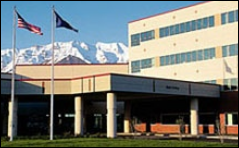
Two Utah hospitals buck the trend and open up new expansions.

I heard from a CIO reader whose hospital, a big place, is 100% CPOE. I said I’d never heard of one doing all oncology and neonatal orders on a general CPOE system, but there’s at least that one. I agreed not to provide specifics, but I’ve asked for more information since I know many of us would like to know how they did it.

Who knew? The owner of ambulatory EMR vendor Purkinje, according to their site, is the famous VC billionaire John Doerr, backer of Compaq, Netscape, Sun, Amazon, Google, and others. His brother is the CMO and chairman of the executive board. John Doerr put $10 million into the company in 2007. The logo on the site now says GenesysMD even though the Purkinje name is used otherwise, so the company name appears to be changing (just confirmed with Margalit, the company’s product management director, who’s like me and working on the computer at 11:30 at night). Their deal: $399 per provider per month for software, unlimited support, hosting, interfaces, all clinical content (CPT, ICD9, First DataBank, etc.) and free training and implementation for users who sign up in February.

Over on HIStech Report, Inga interviewed John Shagoury of Nuance Communications.
stimuluspayments

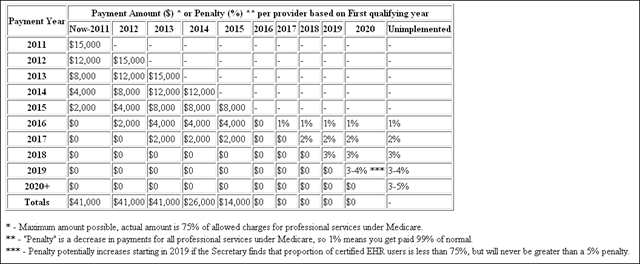
DrM made a year-by-year table of payments and penalties for the House’s stimulus bill that just passed. I inserted it as a graphic above, so click to enlarge.

Hospital and employee information in Japan is exposed on the Internet when an employee copies data from a damaged flash drive to his PC, forgets the file is still there, then fires up his file sharing software at home. That’s happened before in Japan, I seem to vaguely remember. They love that Winny P2P client over there.

Speaking of which, a Computerworld article mentions on the danger of data exposure from peer-to-peer file sharing, citing a study in which a researcher found a document with full data on 9,000 lab patients, 350 mb of data from an anesthesia group, and an 82-field worksheet on 20,000 hospital patients. The last sentence is a little shot: "The range of health care information floating on P2P networks and the variety of sources from which it is being leaked highlight the disorganized and decentralized manner in which health care data is being collected, stored, used and shared, he said."

Here I go and run an interview with Peter Waegemann and he fails to tell me that they’re renaming TEPR to M-Health Conference. HITgeek has an idea: "If TEPR is changing its name, perhaps you could hold a contest or survey for what it should be."

A University of Chicago study finds that 90% of hospitalized patients couldn’t correctly name even one of the doctors taking care of them. Three quarters had no idea and 60% of the rest were wrong. Academic medical centers have a gaggle of people rounding in teams, of course, popping in for a few minutes once or twice a day, so maybe that’s not surprising.

timescopay

Here’s an example of how insurance has corrupted the whole idea of patient responsibility: an LA Times article marvels that practices using real-time adjudication "can, and sometimes do, ask patients to pay those costs at the time of service." Shocking! Why can’t medical practices be like restaurants, gas stations, and mall stores in just letting people take what they want, walk out, and be billed sometime later to pay whatever amount is convenient? That should be the #1 step in healthcare reform — get patients to understand that healthcare isn’t free just because you have (or once had) an insurance card. The insurance companies escape consumer wrath because it’s the doctor’s office who has to come collecting what they didn’t pay.

The IT department was at fault in the recent PC virus infection in England, incorrectly configuring antivirus software on some PCs and failing to get AV updates to some of them, an outside IT auditor finds.

If you want to know how the HIT industry is doing, forget all those publicly traded companies with a mishmash of products and businesses and look at the software-only company that has the most hospital customers: MEDITECH, which 2,200 hospitals are running today. For FY08: revenue was up just under 6%, but net income dropped 60%, mostly on investments (I hear that). Interesting: CEO Neil Pappalardo and CFO Barbara Manzolillo asked that the Board give them only the same bonuses other employees get and not the special Director bonuses since the company didn’t do very well, reducing their paychecks by 64% and 52%, respectively, over their 2007 comp. Neil’s shares are worth over $500 million even at the internally set share price that the militant shareholders always complain is artificially low.

A WV doctor and former town mayor is ordered to repay an insurance company $180,000 for blood tests and injections that patients never received. The doctor blames his billing staff and software, says he has nothing to do with billing, and that judges discriminated against him. He was nailed in 2007 for underreporting income from 2000-2002, when he also worked as a day trader.

GE Healthcare is following its Burlington layoffs with mandatory unpaid employee furloughs.

Hospital layoffs: Clearfield Hospital (PA), 33; Saint Joseph Medical Center (PA), 40.

Sure to fuel the healthcare debate: is it a good use of healthcare resources to provide expensive fertility treatments and preemie care to an unmarried, apparently unemployed, and bankrupt woman in her 30s and her new octuplets that bring her up to 14 children, all of them conceived through in vitro fertilization? She’s trying to be self-sufficient, though: she wants $2 million and a career as a TV child expert from either Oprah or Good Morning America in return for her story.

I don’t get how magazines think. An article mentions that Philips sold CPACS to a hospital in Saudi Arabia, but the headline in SmartBrief says "Philips strikes a partnership with Saudi Arabian hospital." If that’s the case, I struck a partnership with the local sports bar at lunch today when I bought a very good burger there. Just because salespeople murmur the P word to make prospects comfortable doesn’t mean there’s a legal agreement to share expenses and profits. Anything else is called "a sale." Funny thing is, the article it referenced called it that — SmartBrief added the "partnership" line.

CPSI announces Q4 numbers: revenue up 14%, EPS $0.45 vs. $0.36, falling short of earnings expectations but raising guidance and declaring a dividend.

MEDSEEK announces a 47% increase in contracts and a 33% increase in licenses for 2008, referencing its KLAS 2008 Category Leader status in clinical portals.

California is out of money, so it plans to stop paying bills Sunday. The controller whines that withholding money from Californians will delay economic recovery, blaming everybody except the state itself. CA is $25 billion short for 2009, unemployment is 9.3%, and median home prices are down 50% in less than two years. Like Florida, they weren’t complaining during the boom that benefited them, but can’t accept the idea that the good times have already rolled.

Amanda Adkins, a 34-year-old Cerner executive, is named chairwoman of the Kansas Republican Party. It probably wasn’t a total shock since she was the only candidate.

E-mail me.

News 1/30/09

January 29, 2009 News 13 Comments

From Dr. Strangelove: "Re: medical education. Medical care & physicians take a lickin’ on this study of revamping their education. The issue was never getting enough physicians trained – it was getting them to work anywhere except the big cities where they could make enough money to stay entrenched in the social class created for them in the last half of the 20th century (and pay off medical school). Their attitude… well… that’s another thing entirely. It has to do with ‘the chief god in charge’ formula taught to them in medical school and in part to the kind of personality profiles it takes to survive medical school, an internship, and residency." A sentence from the report (warning: PDF) that advocates the reform of medical education: "The overarching theme that coursed through the discussions was the urgent desire to bring medical education into better alignment with societal needs and expectations."

From MM: "Re: vendor calls. The vendor calls and e-mails have gotten completely out of hand. A confluence of a new year and a very slow economy has everyone with anything to sell trying to make contact. My assistant, who is good at spotting the legitimate calls from random sales calls, has been tricked a few times this month. I can’t take it any more! Anyone else feeling a high level of sales activity?"

From Chef Tony: "Re: sponsor ads. We’re a sponsor and I’m a reader. I really dislike the animated ads, too. Nobody is hanging around to read each screens change. I deal with huge NYC agencies whose designer kids are often clueless about what gets information out to the target market. Unless it’s Super Bowl Sunday, educate or inform with ads, not entertain."

From Doug Dinsdale: "Re: Allscripts. A stock board posting claims that Allscripts Healthmatics and Allscripts Professional were scheduled to lose CCHIT certification last week. Is that true?" I don’t think so, but I’m sure Allscripts will clarify. According to the CCHIT Certified Ambulatory EHR 2007 list, both products were certified a year ago. I’m working from memory here, but I think certification is good for two years, i.e. even though CCHIT issues new criteria every year, vendors don’t have to recertify (with one exception: Stark and anti-kickback donations require products to have been certified within the past 12 months, but not necessarily on the current criteria, and extensions are available). You just have to pay CCHIT’s annual maintenance fee (huh? CCHIT requires payment of a maintenance fee even when a vendor doesn’t use any certification services, which was the justification for the fee in the first place?) For stimulus purposes, I think both products are good for another year in any case. I’m sure someone with a more expert opinion than mine can help.

From Friend of Tim: "Re: it’s a good thing you’re a nice guy." Link. Michael Arrington, the "surly and macho" founder of the Silicon Valley blog TechCrunch that carries quite a bit of investor influence, takes a leave of absence after receiving death threats and having someone walk up to him at a conference and spit in his face. I am a nice guy – thanks for noticing (cynical and juvenile, sure, but we all have our crosses to bear).

From Dinger: "Re: Baylor/Perot. Any word on how it’s going? I’m hearing rumblings."

From Paul Molitor: "Re: HITECH. I have to respectfully disagree with John Glaser’s interpretation of HITECH. You get the same compensation per clinician regardless of when that clinician starts to use an EHR. The declining payment schedule per ‘eligible professional’ begins with the ‘payment year’ in which that professional becomes a ‘meaningful EHR user’. The start of the declining schedule is not anchored in a specific calendar year and the schedule applies to each individual. A relevant excerpt from Sec. 4311: ‘(ii) AMOUNT- Subject to clause (iii), the applicable amount specified in this subparagraph for an eligible professional is as follows: (I) For the first payment year for such professional, $15,000. (II) For the second payment year for such professional, $12,000.’ See here for the full text."

From Moose Haas: "Re: MRI/TEPR. Completely washed up. Went to their event last year. It had to be one of the worst events I’ve ever attended. Rumor is MRI is being shopped, but no takers." I appreciate Peter Waegemann’s taking the time to share some thoughts (several  of which I agree with). 

From Sam Butcher: "Re: physician practices delaying EMR purchases. Many groups will delay. Those interested in EMRs for business or clinical reasons have already bought. The remaining ones are resisting change claiming EMRs cost too much or aren’t better than paper. These are the same groups that resisted electronic claims years ago. It’s no surprise that many of these practices are poorly managed. The same paralysis happened with practice management stimulus during the debate over Hillarycare." That’s an interesting observation. As much as I don’t believe the Most Wired hype, it would be interesting to compare the quality and profitability of non-technology using practices to the others. There are certainly plenty of badly managed practices out there (one way to identify them is to check the name tag of the least competent person in the reception area: if that person’s last name is the same as the doctor’s, expect the worst).

From Carpluv: "Re: physician practices delaying EMR purchases. Obamanations, grand idea for financial help for EHRs, has stopped the buyers in their tracks. They’re all waiting for the handout. Great momentum change!"

vistanyt

From Elsie EHR: "Re: physician practices delaying EMR purchases. Same song, different year. On July 21, 2005, the NY Times ran an article about the VA’s VistA system titled ‘U.S. Will Offer Doctors Free Electronic Records System.’ The article, which was widely quoted and reprinted, painted a rosy picture of the ‘free’ system. It was eagerly read by practitioners who were actively looking for an EHR as well as those who were on the fence. All that press prompted thousands of physicians to put their EHR plans on hold so that they could ‘wait and see’ what free goodies the government would provide. Some are still waiting." Link. That’s the most over-hyped and under-delivered part of Brailer’s original plan — giving away VistA (hospital and office) to legions of clamoring providers. Flop (see: Free Kittens).

From E. Buzz Miller: "Re: event. Will there be an HIStalk reception at HIMSS this year?" Wow, lots of people have been e-mailing that question, so thanks for the anticipation! I believe that’s affirmative, so keep Monday evening free. I’m hoping to line up a couple of notable speakers, maybe (and/or holding a spot for a HISsies winner or two if they’re game). For those who went last year, I’m open to suggestions on how to maximize the networking opportunities or anything else that would make it more meaningful and memorable. I never really asked attendees what they liked best or how to make it better, so now I am. Some people would just put out food and drinks, but I’m too neurotic to just let it unfold.

stanford

From Trimaxion: "Re: Stanford. Stanford Hospital has again delayed its Epic CPOE Oncology (Beacon) go-live of their Comprehensive Cancer Center. They have serious patient safety concerns, need new development, and can’t scale the complexity of the site." Unverified, but I know some Stanford folks read and may reply. I can’t say I know of any oncology app that isn’t a work in progress, though. The protocols and pre-dose monitoring and calculations are a bear. Even the so-called "100% CPOE" hospitals usually punt on oncology (and some or all of peds, like NICU).

From Bobby Peru: "Re: layoffs. Keep up reporting them." An interesting counterpoint from Think Positive: "I would propose to you that it is no longer news worthy or interesting news if another company has a layoff. I agree in better economic times this type of insight into a company’s fortunes or failures is helpful guidance to your readers." Think Positive is right, I believe, because it is indeed neither newsworthy or all that insightful that a vendor lays off staff these days, unlike the pre-recession when such activity might foretell future problems or shifts in strategy. Maybe this is a happy medium: I’ll keep reporting layoffs (provider and vendor) only if they have been reported elsewhere. Is that good, or should I follow Bobby’s suggestion and keep running whatever I hear? Let me know.

In the meantime, in the absence of a ruling, Omnicell supposedly dismissed somewhere between several dozen and a hundred field support employees on Wednesday, but an official number of 101 was given with its Q4 report: revenue up 7.1%, EPS $0.10 vs $0.09. Those are darned good numbers if you ask me, but cutting payroll is the most common hunkering down for weathering the economic storm overhead. Cold, but smart.

It’s your last chance to cast your HISsies ballot.

Listening: brand new alternative hard rock from Hoobastank, who kind of disappeared after one hit several years ago. I like it a lot – it’s harder than their older stuff. I still hate the name, though.

flatstanley

Intellect Resources has a new newsletter, which I always enjoy. The "traveling Flat Healthcare IT Man" piece is fun – wish I’d thought of it for HIStalk (it’s from a children’s book called Flat Stanley). They also have a new website with both HIT positions and candidates.

A huge win for GE: Scott & White chooses Centricity Business (the old IDX billing system, I assume) for patient access, revenue cycle management, and BI.

Jobs: Cerner Clinical Systems Analyst, Pre-Sales Engineer, EHR Clinical Trainer and Implementations, IT Director. There are some nice positions and employers posted.

Here’s an interesting example of commitment to healthcare: El Camino Hospital is purchasing the physical plant of Community Hospital of Los Gatos, putting current ECH CMIO Eric Pifer in charge there. ECH is taking over June 1 when Tenet’s lease runs out, but Tenet said, screw it, we’re closing the hospital on April 10 because it’s losing money anyway and we’d rather just cut and run. Employees thought they were finally going to be safe under ECH, but now they’re all getting the axe. ECH says they can’t get it ready to re-open until the fall. As a for-profit company, it’s the right business decision for Tenet, I suppose.

Humana will contribute provider incentives to encourage participation in the Wisconsin HIE (would one sound that out as WHEE or WHY?)

While I’m thinking about it, I’d like to thank the companies that sponsor HIStalk and HIStalk Practice. It takes guts to put your ad (flashy or not) beside some of the stuff I write. For most of them, it’s not a sterile transaction handled by detached PR people — it’s company executives who want to support what we do and who pull the strings to get the bean counters to write a check to a vaguely untrustworthy-looking enterprise working out of a PO box. Make your own decision on what to buy or from whom, but if you get the chance, thank them for their support.

Investor’s Business Daily covers athenahealth in an article purportedly about subscription EMRs, but mostly about ATHN stock.

If you’ve e-mailed me lately, hang in there and I’ll get back to you. It’s nearly impossible for me to do much more than skim the inbox until the weekends since HIStalk, HIStalk Practice, and HIStech Report are kind of in full swing at the moment (there will be record readership in HIStalk this month, which is surprising since the first several days were a long holiday weekend for most folks).

losgatos

Speaking of CHLG, I heard this from Vendor Val: "El Camino Hospital plans to bring CHLG up on their Eclipsys Sunrise computer system and introduce physician order entry. Great news – for their competitors. CPOE had some success at El Camino because the city subsidizes the hospital and the hospital subsidizes the close-knit Independent Physicians of El Camino with free eClinicalWorks. Of course these MDs are very tech-savvy and have link-ups with the hospital’s Eclipsys Sunrise systems and can view lab data, medical histories, and procedures from the comfort of their own offices (they attract a lot of Stanford Hospital doctors who cut their teeth on computer glitches, spotty interfaces, and lots of downtime). But Los Gatos is a diverse collection of paper-happy independent physician practices who have no incentive to invest in technology and many are aging retirees with no interest in learning new programs."

Nextgov reports that Rob Kolodner will be staying on as ONCHIT.

California’s ED doctors sue the state, claiming that the ED system will collapse without additional funding. The state is ranked last in ED access and 43rd in ED payment. The docs claim EDs are getting the state’s burden of caring for the poor and elderly dumped on them. The state’s Department of Health Care Services had a cheery response: more budget cuts are likely, with proposals on the table to cut Medi-Cal’s budget by $1.1 billion and cutting physician reimbursement on March 1. I’m no expert, but this sounds like a seriously explosive situation there since I remember how ugly the King-Drew situation got.

Rich Elmore reminds me that his blog post mentioned the possibility of delayed provider EMR decisions because of Uncle Sam’s potential golden handshake.

stlukes

St. Luke’s Regional Medical Center (ID) restructures its 28 IT positions into 18, forcing incumbents to play musical chairs to decide which 10 get the boot. It seems that hospitals are falling into one of two camps: (a) those who have big-ticket IT projects underway and aren’t about to jeopardize them to save a few IT salaries, and (b) those who never really believed that technology was all that valuable and are robbing the IT operational and capital budgets for more critical needs.

A UK survey calculates that dry cleaners there found an estimated 9,000 USB sticks, some no doubt full of sensitive information, that were left in the pockets of clothing dropped off.

E-mail me.


HERtalk by Inga

From Comforter: “Re: layoffs. Cabell Huntington laid off between 30 and 40 middle managers a couple of weeks ago, saving between $3 and $4 million per year. Many were-long time employees, with more than 20 years of service. One questioned how the hospital could have committed $40 million to Cerner a couple of years ago, but now finds itself in dire straits. Security escorted the employees out of the building immediately, standard policy for sure, but compounding the duress of getting fired.” The local paper reports that 40 jobs were eliminated earlier this month.

From Jason: “Re: Faxton-St. Luke’s Healthcare. You may have already heard, but Faxton St. Luke’s is an Eclipsys client.” Thanks for the correction. I erroneously said they had Cerner.

From Inside Outsider: “Re: Rob Kill. Is the new CEO of Virtual Radiologic Corporation really named Rob Kill? First time I’ve ever heard of a person named for breaking two commandments." Funny, although I bet Rob’s heard it too many times to do anything except grimace and give a polite, dry two-beat chuckle (HAH ha).

From Ziggy: "Re: Hospital marketing. With all the troubling economic news, budget cuts, and all, I am wondering the effect on hospital marketing? What are other hospitals finding to be most effective for the money?” Medicare fraud?

Sometimes it’s the little things about a company that can turn you off. Last September, I semi-seriously made fun of this Med Com USA press release because the first sentence went on forever. Lo and behold, here’s a new one just about like it: “MedCom USA, Inc. (OTCBulletinBoard: EMED) a leading provider of HIPAA compliant healthcare and financial transaction solutions for the healthcare industry, which recently signed letters of intent to acquire PayMed USA, LLC and Absolute Medical Software Systems, a leading provider of HIPAA compliant medical, dental, healthcare and financial transaction solutions for the healthcare and dental industry is pleased to announce that it has appointed an additional board member resulting in three independent board members and one inside member.” But what annoyed me the most was that in order to open their Web site with my Chrome browser, I was required to upgrade to a newer version of Flash (which I blew off, because I decided I didn’t need to see their site that badly.) If you read the press release, you’ll notice they had some high-level turnover, so I’ll give them the benefit of the doubt and assume they haven’t had a chance to focus much on marketing.

With the meltdown of Satyam Computer Services, other outsources like EDS, Perot, and ACS hope to pick up a few new clients. One consultant estimates Satyam will lose $2 billion worth of business to competitors over the next two to four months.

Tennessee expands its medical video network to allow physicians to treat pregnant women in rural counties. BCBS of Tennessee Health Foundation has provided $1.8 million in funding to allow perinatologists to view live ultrasounds remotely.

HIMSS announces its support for HIT provisions under consideration by Congress, citing three reaons: 1) the economy will benefit as jobs are created; 2) patients will benefit because of increased safety, and, 3) doctors will benefit because it reduces the current cost barriers. They don’t mention this, but of course it would be helpful to their 350 corporate members (and thus they themselves) as well.

A survey finds that hospitals and health systems are cutting back on both capital spending and unprofitable healthcare services. Hospitals are worried about declining investment values, shrinking margins, and stagnant philanthropy. This report reminds me of our own little survey to your right. If you are a vendor or a hospital, let us know what effect the economy is having on your world.

I wonder if this is just a co-incidence? Mr. H and I start using Twitter to keep abreast with all things HIT. Three weeks later Twitter seeks to raise at least $20 million in Series D funding. That’s a bunch of tweets.

The U.S. Bureau of Labor Statistics reports that retail prices for hospitals increased 5.9% in 2008, compared to 8.3% the year before. Wholesale prices for hospital services increased 1.5%, compared to 3.9% in 2007.

A CDC report finds that the total number of outpatient surgeries increased from 1996 to 2006, from 20.8 million to 34.7 million visits. Outpatient surgery visits accounted for about one half of all surgery visits in 1996, but nearly two thirds of all surgery visits in 2006.

clip_image004

Eastern Maine Medical Center announces 76 job cuts, reductions in overtime, and holds on several projects. The hospital was a 2008 Davies Award winner. The local paper also noted that the hospital’s CEO received almost $700K in compensation and benefits last year.

Wetzel County Hospital (WV) receives government approval to seek up to $6 million in bonds, which includes $175,000 to upgrade its CPSI EMR and Payroll applications.

Trustees with Regional Medical Center (SC) approve a $78,000 contract with HIMformatics to oversee its Cerner IT project.

Tenet Healthcare says it expects a Q4 net income of $5 million and $63 million in earnings for 2008.

Would the average person pay $20 to e-mail a medical specialist for advice?  A physician group is betting on it, having launched a Web site designed to give anyone with a medical question the chance to receive medical advice, medical recommendations, and medical information from specialized medical doctors. 

clip_image005

Revenue cycle management company MTBC outfits its own airplane to be a flying promotional platform. Well, why not? Guess it beats the yellow pages, especially if you’re marketing to pilots.

Norton Healthcare (KY) selects Unibased Systems Architecture to provide resource management software and services.

ICA announces the deployment of its data and technology aggregation solution at Lourdes Hospital (KY).

E-mail Inga.

Being John Glaser 1/29/09

January 28, 2009 News 9 Comments

The current version of the Health Information Technology for Economic and Clinical Health (HITECH) Act, which is part of the larger economic stimulus legislation, will alter the HIT industry and the IT plans of our organizations.

For outpatient electronic health records, the Act puts some non-trivial money on the table. A provider who uses a certified EHR can get a maximum (through Medicare) of:

$15,000 In 2011
$12,000 In 2012
$8,000 In 2013
$4,000 In 2014
$2,000 In 2015

This totals $41,000. This will clearly increase interest in adoption and could represent a lot of revenue for a provider organization.

To get this money, a provider must demonstrate that they are meaningfully using health information technology. What does "meaningfully" mean?

  • Using e-prescribing
  • Connecting through HIEs to improve the quality and coordination of care
  • Submitting information on clinical quality measures.

While we might be more or less clear about what e-prescribing means, clarification is clearly needed about what we mean by the second and third criteria.

It is anticipated that HHS will spend 2009 providing specifics and clarity about what providers have to do to demonstrate meaningful use. This means that most providers will have one year – 2010 – to finish EHR implementation and put in place the infrastructure, applications, training, etc. needed to get the as much of the incentive money as possible.

This is a tall order. And it means that providers should start moving now (if they aren’t already) even though the dust has yet to settle on the specifics.

johnglaser

John Glaser is vice president and CIO at Partners HealthCare System. He describes himself as an "irregular regular contributor" to HIStalk.

VA Will Pay $20 Million to Settle Stolen Laptop Lawsuits

January 27, 2009 News 8 Comments

The Department of Veterans Affairs will pay $20 million to settle a class action lawsuit involving a privacy breach caused by a laptop stolen from a VA employee in 2006, according to a proposed settlement.

The laptop and its external drive contained names, dates of birth, and Social Security number of over 26 million military members and veterans. The equipment, stolen in a routine burglary of a data analyst’s home in Maryland who had taken it home without permission, was recovered by authorities, who concluded that its information had not been accessed.

The settlement will be paid to veterans who can show they were harmed or incurred credit monitoring expenses.

News 1/28/09

January 27, 2009 News 9 Comments

methodist From The PACS Designer: "Re: best hospital workplaces. Fortune Magazine has just published its 2009 list of top 100 places to work, which includes 13 hospitals. The highest ranked is Methodist Hospital System (Houston) at #8; followed by #19 – Ohio Health; #45 – King’s Daughters Medical Center (KY); #62 – Griffin Hospital (CT); #63 – Mayo Clinic; #67 – Children’s Healthcare (Atlanta); #68 – Southern Ohio Medical Center; #75 – Atlantic Health (NJ); #76 – Lehigh Valley Hospital and Health Network (PA); #77 – Northwest Community  Hospital (IL); #79 – Baptist Health South Florida; #85 – Arkansas Children’s Hospital; #98 – Vanderbilt University. TPD congratulates those selected as being top notch in their treatment of employees." Link.

From FIT003: "Re: McKesson. They have started laying off staff. Long-term employees are the first to have been laid off. Initial numbers, placed at 50-75 people within the Alpharetta operations." Unverified.

From Songbird: "Re: Perot’s MEDITECH solutions group, formerly JJWILD. Planning a third round layoff this Friday, January 30." Unverified.

From KFC: "Re: Keane Healthcare. About 10% or 30-35 employees from the Keane Healthcare division over the last two weeks. With the sunsetting of the old First Coast Systems patient billing application and the merging of the Unix product, I wonder how this will impact the always-delayed timeline?" Unverified. For all these unverified layoff rumors, by the way, I will run a brief company response if one is provided, whether confirming or denying. That’s fair.

From Ken Kercheval: "Re: physician practice EMRs. It is going to be an interesting year. Lots of companies will go away. Like they say, ‘When the tide goes down, you find out who isn’t wearing a swimsuit’. Indeed."

From Jackie Martling: "Re: sponsor ads. Just a suggestion. The animation is annoying to the point I copy and paste your great content to avoid the distraction. Seems unfair to the non-annoying ads." Noted and dutifully passed along to the sponsors for their future consideration.

HISsies voting will be winding down shortly, so cast your vote now.

Listening: The Gaslight Anthem, a reader suggestion. Good Jersey Shore bowling alley ballads with a soupcon of punk. Should be on an indie film’s soundrack. They’re on Letterman Friday night and touring everywhere.

The Raymond James folks sent over a couple of briefs about the healthcare IT stimulus proposals on the table. They predict that HIT adoption incentives will be around $32 billion over ten years, with the biggest adoption jump happening in 2011-2014 and with the biggest potential beneficiaries being physician practices and hospitals in the 300-499 bed size. They question, as I did yesterday in HIStalk Practice, whether prospects may actually hold off on purchasing clinical systems until the federal involvement shakes out. With that in mind, I’ve put two new polls to your right — one for vendors, one for providers — asking about any purchase delays your employer has been involved with. Your comments are welcome, too, so feel free to e-mail me. The stimulus could actually be detrimental in the short term if potential customers become indecisive.

A Fort Bragg military team is the first to use the AHLTA-Theater battlefield EMR to document patient encounters stateside.

A former Kaiser Permanente employee in Los Angeles kills himself, his wife, and five children ages 8 and under (including two sets of twins), apparently after being fired in a dispute with an administrator. His suicide note claims that the administrator told him on coming to work one day that "you should have blown your brains out." His wife had also previously worked for Kaiser. Update: according to CNN, both parents had been fired from Kaiser for cause.

A reader says Ivo Nelson, formerly of Healthlink/IBM, will launch his new business next week. It’s called Encore Health Resources. The domain is registered to a PR firm’s contact and address.

IBA’s iSoft gets a deal to install its software at 38 Healthscope hospitals in Australia.

New on HIStech Report: an interview with Steve Ura, CTO of MED3OOO, including questions about its InteGreat acquisition.

Capsule (they seem to have dropped the "Technologie" part of their name except when referring to their Paris headquarters) announces the addition of 80 more medical device drivers to its library of 400.

google

Consumer Watchdog demands that Google "cease a rumored lobbying effort" related to stimulus bill discussions that would allow the company to sell patient information to Google Health advertisers.

Members of Parliament want individual trusts to be able to buy their own systems if NPfIT can’t get its Cerner and iSoft software problems fixed within six months. Also reported: one trust that’s merging with another may be planning to drop Cerner and go with the other hospital’s 20-year-old Atos Origin legacy system. All of this, of course, is a warning to anyone who thinks huge healthcare IT projects can work fine if given the proper money and oversight, neither of which is in short supply in the UK as NPfIT disintegrates.

 redpost

This may sound off topic, but I’ve been involved with similar solutions that made IT a hero: an Indiana Web 2.0 startup announces that its WiFi digital sign technology has been installed at several hospitals. It’s a terrible press release (as any would be that references rotten teeth) but maybe interesting.

hennepin

Hospital layoff: Hennepin County Medical Center (MN), 100.

The Wisconsin paper investigates a touchy topic: do hospitals provide enough free care to be worth all the tax breaks they get, especially when governments are strapped?

A rumor site reports that Apple CEO Steve Jobs will undergo surgery at Stanford Hospital, citing as a source "a secondhand account passed along from an employee at Stanford." I’m sure the HIPAA-violating source will provide updates throughout the day if the story is true (he was rumored to have been thinking about a liver transplant).

A phony doctor is arrested at his fake doctor, nurse, and dentist school in India. Graduates of the "Medical Diploma Training Agency" are actively practicing, it’s believed. The doctor was printing his own diplomas, but later outsourced it to a computer company. He was turned in by a night guard who paid for his dentist’s diploma, was told he had to ante up more money, and then was allegedly beaten by the fake doctor for complaining.

Siemens says its healthcare business isn’t so great, but it still sucks less than GE’s.

An Australian hospital is in such dire financial straits that employees, feeling sorry for patients, are spending their own money to buy groceries, bandages, light bulbs, and computer paper.

Venture investing declined in 2008 for the first time since 2003. Green tech companies are hot; software vendors and Web start-ups are ice cold.

Archives of Internal Medicine Article
Clinical Information Technologies and Inpatient Outcomes

"Health info technology saves lives, costs" screams the Yahoo News article. Modern Healthcare fires out an e-mail news blast, claiming that "when computers replace paper, patient mortality rates drop 15% during hospitalization."

The headlines are misleading (as they often are to lure in readers). You need to interpret the article yourself.  It’s available online.

Here’s the conclusion, verbatim from the article: "Hospitals with automated notes and records, order entry, and clinical decision support had fewer complications, lower mortality rates, and lower costs."

Sounds promising. Even more so when the article talks about the researcher’s use of a survey tool that actually measures how much technology is being, not just how much has been bought (although that CITAT survey instrument itself isn’t available in this or the predecessor articles that I could find, which is odd since that’s a key part of interpreting the findings).

However, the study had compromises:

  • It covered only patients >50 years old and only four medical conditions.
  • It randomly surveyed physicians using an AMA file, asking them to respond and to include the hospital in which they provided most of their inpatient care, but it wasn’t clear whether they provided all that much inpatient care at all or whether they were the most prolific doctors at the hospitals being reviewed.
  • Since the doctors who responded drove the choice of hospitals, those hospitals studied were not typical: they were much larger and more of them were academic medical centers.
  • Outcomes were determined from claims data.
  • Some results were predictably erratic, such as the lack of correlation to length of stay and the conclusion that use of electronic notes and records increases the odds of heart failure complication.

Compared to studies that preceded it, this one’s pretty good, but it suffers from Most Wired-like conclusion-leaping (not in the article, but by those who try to turn it into a sound bite). Nothing suggests that technology use caused the improvement, only that it seemed to coincide with it. So, we know what we already knew or presumed: good hospitals are more likely to do many things (including deploy IT) better than bad ones.

Nothing in the article suggests that a given hospital will see its quality improve just because its starts using technology (in fact, that might have been an even more interesting study: take those same hospitals studied, identify those that recently implemented clinical systems, and compare their before-and-after numbers to see if anything changed).

The bottom line: it’s a pretty good study that has encouraging conclusions, even if they are iffy. IT won’t make bad hospitals good, but it can help make good ones a little better if it’s used right and along with other improvement measures. The article does not, however, suggest that IT is the can’t-miss answer to quality and cost problems.

E-mail me.


HERtalk by Inga

Consultants warn that as the economy worsens, more hospitals will lay off employed doctors or slash their pay. The US Department of Labor reports that 107 hospitals had mass layoffs (50+ employees) for the first 11 months of 2008.

Despite all the bad news of layoffs, many believe that healthcare still offers more stability than other sectors. In fact, the US Bureau of Labor Statistic predicts 3 million new wage and salary jobs between 2006 and 2016, more than any other industry. In nursing, older students, men, and second career newcomers are joining the ranks.

In a paper entitled “Hospitals as Hotels,” researchers conclude that amenities such as good food, attentive staff, and pleasant surroundings may play an important role in hospital demand. “From the patient perspective, hospital quality therefore embodies amenities as well as clinical quality. We also find that a one-standard-deviation increase in amenities raises a hospital’s demand by 38.4 percent on average, whereas demand is substantially less responsive to clinical quality as measured by pneumonia mortality.” Sounds like the message is to buy nice furniture instead of improving care if you want to keep the beds full.

tricity

Turmoil at Tri-City Medical Center (CA) has employees wondering about the facility’s long-term stability. Last month, a new board majority placed the hospital’s top eight administrators on paid leave and brought in a temporary management team that opponents claim have no hospital experience.

An Ohio man sues a nightclub for $25,000 after a stripper’s shoe flies off during a tricky dance move, chipping a bone in his nose that will require surgery to fix. No word on whether her shoe was damaged, but I say shame on that stripper for risking her shoes.

HealthGrades releases (warning: PDF) its seventh annual Hospital Quality and Clinical Excellence study. Medicare patients treated at top-rated hospitals are 27% less likely to die there, on average, than at other hospitals.

The Association of Academic Health Centers calls for a revision of the HIPAA privacy rule following a study in which HIPAA was found to impede study recruitment and study diversity.

McKesson reports mixed financial results for its fiscal third quarter, losing $20 million because of the $493 million paid to settle AWP price fixing charges. Without that, EPS would have been $1.05 vs. $0.68 last year on slightly higher revenues. Technology Solutions grew but missed expectations due to contract signing delays in hospitals and physician practices. Cost cutting was the key to a pretty good quarter. The company raised its earnings outlook, running the stock up 12% on Tuesday.

MedAvant Healthcare Solutions appoints Troy Burns as CTO. He previously worked at Misys and Payerpath. MedAvant’s president Andrew Lawson is also a former Misys guy.

Philips Healthcare reports 9% sales growth in Q4, driven by sales in imaging systems, healthcare informatics, and customer services. Royal Philips as a whole ended the year with a $1.9 billion loss and will lay off 6,000 employees.

Scott Perra, the new president and CEO of Faxton-St. Luke’s Healthcare and Mohawk Valley Network (NY) claims the implementation of an EMR is his first priority. The health system is about 18 months into installing its $15 million clinical system (I believe Cerner).

clip_image003

In what the company calls a planned transition, Virtual Radiologic Corporation promotes President Rob Kill to CEO. Company co-founder Dr. Sean Casey will remain chairman of the board. The announcement coincides with the release of the company’s Q4 and full-year financials, which include a 24% jump in revenue for the year. Adjusted net income grew from $7.0 million to $9.7 million. The company also just signed its third internal client, this one in Saudi Arabia.

Griffin Hospital (CT) implements the Logical Ink electronic charting system in its new Center for Cancer Care.

Madonna Rehabilitation Hospital (NE) plans to adopt (hopefully they’ve signed a contract) Eclipsys clinical solutions.

The Outpatient Rehabilitation Center of Margaret Mary Community Hospital (IN) implements Chart Links therapy documentation and scheduling system for its 19 physical, occupational, and speech therapists.

PHR vendor MediKeeper announces the appointment of David Ashworth as CEO.

The Queen’s Health System (HI) renews its IT outsourcing contract with ACS. The new contract is valued at $26 million over three years and includes Queen’s Medical Center and its affiliates. ACS has been providing IT services to Queen’s since 2001.

BJC HealthCare (MO) signs a five-year agreement with CareTech Solutions. CareTech will provide BJC and its 11 affiliated hospitals a suite of Web products and services including CareWorks content management system and BoardNet communications portal.

I was amazed to learn there are now over 10,000 applications available for the iPhone. A cool new HIT tool just announced: Safe OR, which includes a 19-item surgical safety checklist A Surgical Safety Checklist to Reduce Morbidity and Mortality in a Global Population.

Picis CEO and Vice Chairman Todd Cozzens will chair the Business Office Improvement educational track at TEPR+ next week. I’m envious of anyone who gets to spend a few days in Palm Springs right now. If you’re attending, send us updates and impressions.

Medsphere announces the successful implementation of BCMA at all eight of West Virginia’s state network of acute, psychiatric, and long-term care hospitals.

athenahealth and the Illinois State Medical Society announce an agreement to offer special pricing on athenahealth’s PM solution to its 12,000 members. I also saw that athenahealth hit a 52-week high Monday, following Jonathan Bush’s appearance on CNBC’s “Mad Money” with Jim Kramer.

E-mail Inga.

MD Leader 1/27/09

January 26, 2009 News 8 Comments

Ministry Health Care Will Implement CattailsMD

Ministry Health Care has chosen to implement CattailsMD electronic health record. For over 20, Marshfield Clinic has developed a comprehensive electronic health record, now available as a CCHIT-certified ambulatory EHR product known as CattailsMD. The EHR is also available with a data warehouse to actively drive decision support and population management.

clip_image002


Conventional Wisdom

Conventional wisdom speaks against the use of an internally developed product. While conventional wisdom is often used as a rule of thumb, tunnel thinking can limit your options. Every software decision is the result of a complex analysis of objectives, risks, benefits, values, and mitigation strategy. The purpose of this post is not an exhaustive explanation of our decision, but rather a review of several factors influencing our thoughts.

EHRs Are Becoming a Utility

Within a few years, EHRs will be more of a utility than a unique product. Increasing CCHIT certification and government incentives are driving standardization of function. Many organizations are turning to SureScripts to satisfy the CMS E-prescribing incentive. SureScripts standards will be just one of many leading to an ever-increasing identical functioning of EHRs. Simply having an EHR will not lead to process improvement nor increase clinical quality.

EHRs Do Not Improve Quality

Most EHRs have not improved quality of care. Simply automating our traditional process should not be expected to fundamentally improve quality. Improvement occurs when we redesign our care systems and standardize our processes (often enabled by use of an EHR). It is not the EHR that magically improves care; it is the people and processes utilizing the EHR that improves care. If you are both vendor and end user, then you can first vision how care should be provided and then deliver the necessary software to support it.

Marshfield Clinic has effectively demonstrated the value of this approach by achieving improved quality of care resulting in decreased health care costs in an ongoing CMS Demonstration Project.

The Status Quo Will Not Meet Future Needs

Our health care system is broken, we simply are not meeting the prevention, wellness, and primary care needs of our patients. We do not have enough primary clinicians to meet our current needs and we are not producing enough primary clinicians to meet our future needs. In Wisconsin (warning: PDF), the demand for primary care clinicians in the next 10 years is projected to increase by as much as 33% with only a 5% increase in clinicians. We will need to redesign our health care delivery system if we hope to meet future needs.

Our use of CattailsMD maximizes our opportunity to influence the design of an EHR to meet the needs of our patients. Although our vendor is interested in the commercial success of the product, as a provider of health care, their prime objective is the same as ours: caring for patients.

It Is All About the Data

Ministry Health Care and the Marshfield Clinic have a large number of common patients and will share the same EHR. While a shared EHR with a single source of truth for medication lists, allergies, labs, and documents is appealing, the real value is an extensive data warehouse ten years in the making. The data warehouse currently contributes to a number of activities including population management, disease management, maintenance of numerous registries, formal research, and increasingly, decision support.

As our business intelligence tools become more robust, I expect increasing emphasis will be placed on activities such as searching the database for trends of best care, identifying potential drug interactions, post-marketing surveillance of medications, and identifying care opportunities that will improve the health of the communities we serve.

A Decision Without Risk?

Is our decision to use CattailsMD without risk? Nope. But then again, no decision is. During the 20 years I have been interested in health care IT, I have seen numerous vendors (both large and small) come and go. I have also been through the agony of “upgrades” in hardware, operating systems and entire new versions of software forced on us by our vendors.

What has not changed is our need for information to improve health care. We are on the threshold of having EHRs and data warehouses that do not just present information, but actively support the practice of medicine.

A Future Post

Ministry Health Care and the Marshfield Clinic have been actively working to build the infrastructure necessary to support a joint EHR. In a future post, Dr. Carlson (Marshfield’s CIO) and I will discuss some of the issues we have dealt with that will have national significance if government seeks to foster greater sharing of patient data.

While you are waiting for a joint post, please take some time to read Will Weider’s (Ministry’s CIO) advice for President Obama.

petersanderson

Peter Sanderson, MD, MBA is a family physician and Director of Medical Informatics and Operations and Executive Sponsor, EHR Program, at Ministry Health Care. He can be reached at pete.sanderson@ministryhealth.org. He also blogs at MD Leader.

Monday Morning Update 1/26/09

January 24, 2009 News 6 Comments

rsna

From RSNA Body: "Re: RSNA. Don’t believe this RSNA whitewash about attendance. These were pre-attendance numbers — wait for the audited RFID traffic numbers. I was there and, for the first time, there were hardly any lines for anything. I spoke to cabbies, bus drivers, restaurateurs, vendors, etc. who all reported thin crowds. One cabbie asked me on Wednesday if the radiology show was over because he said the traffic was so light. Several vendors told me that a number of hospital customer contingents had cancelled their RSNA trip or only sent a few rather than the scheduled dozen or so staff. With IT vendor layoffs since November and a worsening economy, I predict a huge decrease in HIMSS attendance." You’re probably right. Conferences, like sports venues, have been known to report big attendance despite obviously empty seats.

From Eclipsys on the Ropes?: "Re: Eclipsys. I understand that McKesson just took another revenue cycle customer away from Eclipsys: ‘Baptist Healthcare System Selects McKesson to Optimize Physician Revenue.’ Can you verify this for your readers?  If so, it seems like Eclipsys is in a certain death spiral. Also, the client that represents 10% of the ECLP revenue is probably North Shore Long Island Jewish since they have both outsourcing and software." I’ll have to call in a lifeline on that because I have no idea. It’s the Baptist group in Kentucky that contracted with McKesson for physician revenue cycle management. I don’t recall hearing anything about Eclipsys there, but it may well be. Update: the group is not an Eclipsys customer, so the reader’s understanding is incorrect (to the other reader who said my facts are incorrect, they aren’t my facts: the blue text is a reader’s question; my answer in black text was "don’t know, never heard of ECLP being there.")

From I’m Just Saying: "Re: Eclipsys. The 10% of revenues client may be Baylor. Also, expect more layoffs this week in Services. One VP resigned in December (J. Bell) and two others were termed last week (B. Pille & D. Tom). J&J could be a good answer."

shoeshine

HIMSS is not too many weeks away. I haven’t come up with any HIStalk-related activities yet since I’ve been swamped, but we’ll have some HIStech Report interviews coming very soon. The conference was awash last year in Fake Ingas, HIStalk shoeshines, badge ribbons, the big bash, and probably stuff I’ve forgotten (like that $1,000 worth of tote bags I bought – is anyone still using theirs or did I waste my money?) I’m open to ideas from vendors on anything that would be cool for readers.

A Georgia family puts everything they own except their house up for auction on eBay to pay the medical bills of their children, a 7-year-old with an autoimmune disease and another with autism.

HHS announces acceptance of HITSP interoperability standards (warning: PDF) that took effect January 16. Complete list here.

Jobs: Sales Account Executive, Northeast, Director of Channel Sales, Epic Clinical Reports Writer, MEDITECH Consultant – Advanced Clinicals. Sign up here for a weekly jobs blast.

Speaking of jobs, several folks at Eclipsys lost theirs this week, which I reported as a rumor on Wednesday. At least 100 have been shown the door, a couple of folks say, and the purge may not be over yet.

alegent

And speaking of layoffs, Children’s Hospital of the King’s Daughters (VA) laid off 28 employees on Friday and also cut 90 unfilled positions. It’s also shutting down its child care center. Mike e-mailed about Alegent Health (NE – Immanuel Medical Center pictured above), which laid off seven VPs this week and will eliminate 285 more positions by March. It also forced 20 senior managers to take a 10% pay cut.

And more layoffs: GE Healthcare dumps an unnamed number of employees in Burlington, somewhere between 8 and 39 given their sketchy announced percentage range. The staggering giant has never been forthright about its cutbacks in the old IDX office, probably due more to smothering bureaucracy rather than intentional obfuscation. Kind of like when Jeff Immelt put on his happy face about GE Capital while the rest of the world (me, anyway) proclaimed loudly that the company could not possibly avoid fallout from the financial sector meltdown. Let the record show that Jeff was way wrong: GE’s Q4 numbers announced Friday after the market close showed revenue down 5%, EPS $0.35 vs. $0.66. GE Healthcare’s profits were down 9%. The stock dropped nearly 11% during Friday trading and is down another 11% after hours.

And even more layoffs: NorthShore Skokie Hospital (IL), 150; Frankford Health System (PA), 100; Hamilton Health Sciences (Canada), 250; Irvine Regional Hospital and Medical Center (CA), 510.

Intel’s chairman Craig Barrett will retire in May. He’s been loud about healthcare and technology (I quoted him in July 2007), so maybe we’ve not seen the last of him.

pwc

Two PricewaterhouseCoopers executives in India are arrested and charged with conspiracy for the company’s role in signing off as auditor on the books of Satyam Computer Services, whose chairman admitted that $1 billion of claimed cash didn’t exist. I mostly associate PWC with dumb names: its own and the one it announced for its consulting organization in 2002, "Monday," which thankfully never happened because the company sold the whole organization to IBM just five months later.

The State of Massachusetts signed a big mandatory EMR law in August with $25 million a year in funding to get doctors online by 2015. The state cut the budget to $15 million two months later, which everybody agrees is far short of what’s needed to get the job done. Also agreed, judging from the comments, is that not much benefit has been derived so far.

Another victim of Bernie Madoff’s Ponzi scheme: Charleston Area Medical Center (WV), whose foundation lost $800K and the hospital $200K.

McKesson CEO John Hammergren gets his name and picture in The Wall Street Journal, although it’s hardly a flattering mention. The article addresses the methods companies use to calculate executive pension value into a single lump sum payment, with some using an obsolete federal formula that boosts the number as "a sneaky way to give executives larger pay." McKesson tweaked the formula for Hammergren last March, jumping his parting gift’s value to $85 million (everybody’s outraged about healthcare costs, so you might think that would raise an eyebrow or two).

Former QuadraMed CEO Larry English gets a new job as CEO of CIFG Holding, Ltd., a Bermuda-based holding company running a French bond insurer recently bailed out after getting burned on derivatives.

malawi

Think we’ve got healthcare challenges? Malawi has 14 million people, of which 1 million are HIV positive, and only 280 doctors. Their answer: treatment protocols managed by non-physicians using touch screen clinical workstations (developed in Ruby on Rails) at the point of care. Scroll down for several YouTube demos. It would never work here, of course, because vendors couldn’t load it down with proprietary bells and whistles to boost the price. Still, you have to like this quote extolling the virtues of designing systems to take the use through a consistent, guided function (which I always argue in saying that charting a med should be as easy as the import wizard in Excel): "If the system is useful, then other people want to use the system. This is a nice problem that gets solved with…training! But soon, the developer notices that users keep using the system in a way that was totally unexpected. Time for another training session… But there is another approach that doesn’t rely on training. They are called constraints … The amount of training required is usually inversely proportional to the number of constraints in the system.."

Two sides of a Connecticut hospital’s proposed health information exchange. Pro: the hospital is raising money for the $8 million project and hopes the federal government will pay for it while it’s slinging money around. Con: the president of the state medical society says the government shouldn’t pay because mandated physician usage would just make the state’s doctor shortage worse because they’d steer clear of Connecticut.

Debbie Turpin, clinical systems manager at Alton Memorial Hospital (IL), is named chief nurse executive.

Odd lawsuit: a mentally disturbed female prisoner is taken by corrections officers to a hospital for psychiatric treatment, where she "went berserk" and bit the nurse’s hand. The officers watched and did nothing, later saying they believed it was outside their jurisdiction. The nurse is suing the city.

E-mail me.

Text Ads


RECENT COMMENTS

  1. Isn't that actually present perfect indicative?

Founding Sponsors


Platinum Sponsors


Gold Sponsors


RSS Webinars

  • An error has occurred, which probably means the feed is down. Try again later.