


News 8/19/15
Top News

CTO Paul Contino leaves NYC Health & Hospitals Corporation, the fourth high-ranking IT HHC official to depart following an investigation of its $764 million Epic implementation. HHC previously fired CIO Bert Robles, two other employees, and seven consultants. Several of the project’s top positions being filled in interim by Clinovations (acquired by The Advisory Board Company in February 2015), which was given a $4 million, 15-month contract to manage the project. HHC is investigating reports of consultant overbilling on the project that is 18 months behind schedule. Internal documents suggest an actual project cost of $1.4 billion, nearly double the announced cost. HHC chose Epic in January 2013 at an announced contract price of $302 million. It hopes to bring it live system-wide by 2018.
Reader Comments

From Former PF Employee: “Re: Practice Fusion’s interim CEO. Ryan Howard was never going to make it as CEO through an IPO. He had too many issues and wasn’t able to temper them enough. An IPO may happen but isn’t as imminent as the PR team says — that was a tactic to distract people from the need to change CEOs. It wasn’t supposed to be this sudden, but that’s how Ryan is and part of why this is a good decision overall. Side note: why does everyone think PF only generates revenue from ads and selling data? Ads are maybe 30 percent and data actually isn’t sold (while ‘insights’ from the data are sold, that’s less than five percent too).” Unverified.
From Duluth Dilettante: “Re: Practice Fusion’s interim CEO. I agree, you don’t put in an interim CEO to prepare for an IPO. A lot of venture money was poured into both Practice Fusion and CareCloud, both of which changed CEOs. The ‘broken’ healthcare space offers opportunities but is complicated, especially when competing with incumbent vendors like Epic and Cerner. Once you take VC money, the game changes to achieving lofty financial goals or getting kicked out by impatient investors.” I can’t imagine the learning that’s required of a startup CEO who faces a tough investor grade card at each revenue milestone. Think about Neal Patterson guiding Cerner from a picnic table conversation to a huge corporation and what he had to learn along the way. CEOs who are afraid of losing their job let boards convince them to maximize short-term profits even at the expense of long-term potential, so risky innovation isn’t encouraged, like Cerner spending a fortune developing Millennium in the late 1990s. One might postulate that every publicly traded company would have been better, but not necessarily bigger, if it had stayed private and stuck with a non-quarterly mindset like Epic, InterSystems, Meditech, and quite a few other health IT companies that are still run by their very successful founders after decades.
From Hospital Money Man: “Re: CMS. Cutting it awfully close for the 2015 MU modification / alignment rule. Reporting periods need to start no later than October 2 assuming the provision sticks. There’s no time for vendors to respond and QA is the first to get cut. Some vendors will hedge in assuming NPRM will pass as written, but there’s obvious risk. Just in case anyone wonders why we’re in the position we’re in with consensus that EHR functionality is in shambles and calls for program postponement.”
HIStalk Announcements and Requests
My latest gripe: referring to provider payments as noble-sounding “reimbursement,” an especially embarrassing euphemism when the reimbursee books an annual “surplus” of hundreds of millions of dollars. Also, publications that say Congress prohibits use of a National Patient Identifier, which isn’t exactly true – it only prohibits HHS spending government money to implement it.
Webinars
August 25 (Tuesday) 1:00 ET. “Cerner’s Takeover of Siemens: An Update (Including the DoD Project).” Sponsored by HIStalk. Presenters: Vince Ciotti, principal, HIS Professionals; Frank Poggio, president and CEO, The Kelzon Group. Vince and Frank delivered HIStalk’s most popular webinar, "Cerner’s Takeover of Siemens, Are You Ready?" which has been viewed nearly 6,000 times. Vince and Frank return with their brutally honest (and often humorous) opinions about what has happened with Cerner since then, including its participation in the successful DoD bid and what that might mean for Cerner’s customers and competitors, based on their having seen it all in their decades of experience.
Previous webinars are on the YouTube channel. Contact Lorre for webinar services including discounts for signing up by Labor Day.
Acquisitions, Funding, Business, and Stock

Wolters Kluwer will acquire physician CME provider Learners’ Digest International for $150 million in cash.

Denver-based predictive analytics vendor NextHealth Technologies raises $1 million in funding from investors that include Nuance Healthcare President Trace Devanny.

Medical coding services vendor Aviacode receives a $16 million investment to further develop its marketing and technology. David Jensen founded the company in 2000.

Rehab therapy software vendor WebPT acquires Therabill, which offers a Web-based practice management system for therapists.
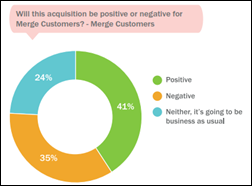
Bold, insightful investment firms set a consensus target share price of $7.05 for Merge Healthcare, no doubt acting independently of the news that IBM will acquire the company for $7.13 per share.
Sales

Hospital District of Helsinki and Uusimaa in Finland chooses Epic’s $424 million bid to replace its patient care system. Epic outscored CGI based on price, functionality, usability, and interoperability. HUS has 21,000 employees and nearly 3,000 beds.
People

St. Jude Children’s Research Hospital (TN) names Keith Perry (University of Texas MD Anderson Cancer Center) as CIO.
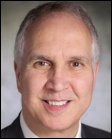
Froedtert & the Medical College of Wisconsin hires William Showalter (Wellmont Health System) as SVP/CIO.

Steve Puckett, EVP/CTO of Quality Systems (NextGen), resigns “by mutual agreement with the company.” His duties will transition to COO Daniel Morefield.

Meg Aranow (The Advisory Board Company) joins SRG Technology as SVP of technology.

CareTech Solutions President and CEO Jim Giordano is appointed vice chairman of Ascension Michigan’s board.
RightCare Solutions names Jeff Edgin (Siemens Medical Solutions) as SVP of business development.
Announcements and Implementations
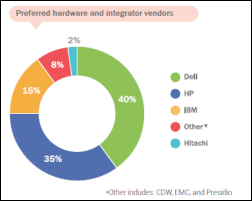
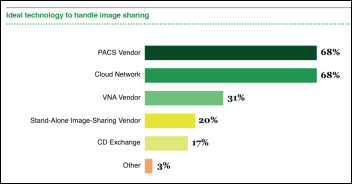
Peer60 publishes “IT Infrastructure Trends in Medical Imaging 2015.” It’s interesting that hospitals are nearly equally split between wanting to buy PACS or VNA hardware on their own vs. choosing a turnkey solution. Preferred hardware vendors were Dell and HP.

Clinical Architecture announces Content Cloud, a cloud-based terminology update service.
Novant Health (NC), which has the highest Epic MyChart engagement in the US with 50 percent of its users logging into the portal at least monthly, will integrate user wearable data into MyChart using Apple HealthKit.

Capital BlueCross (PA) announces that enrollees can start using its American Well-powered physician video visits on January 1, 2016.
Government and Politics

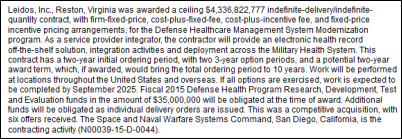
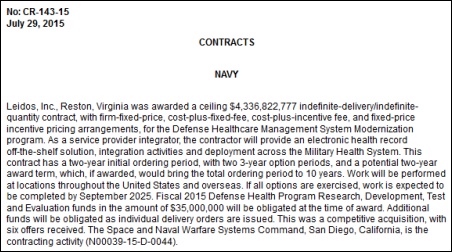
Leidos wins another big military medical contract, earning a 10-year, $900 million bid to support US Army medical research.
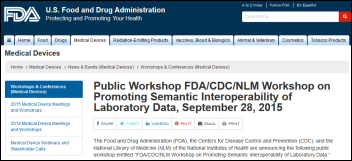
FDA, CDC, and NLM will convene a free public workshop on promoting semantic interoperability between diagnostic devices and EHRs/LISs on September 28, 2015 at the FDA’s Silver Spring, MD campus.
Privacy and Security
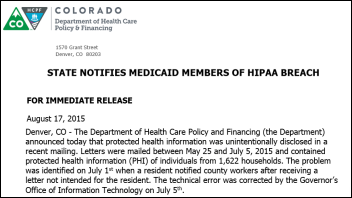
The State of Colorado apologizes for sending 1,600 PHI-containing letters intended for Medicaid recipients to the mailing addresses of other people due to a vendor’s programming error.
Innovation and Research
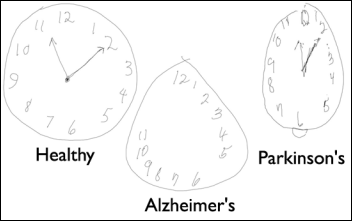
MIT researchers develop a cognitive assessment in which smart pens analyze the way a person draws a clock, automating a manually interpreted test and potentially allowing earlier detection of dementia.
Technology
An article about the Internet of Things says consumer and other light uses (some of them absurd, like refrigerator and trash can sensors) can’t be profitable since they communicate via expensive cellular networks.
Other
In England, local media get worked up after their Freedom of Information requests reveal that a hospital paid a cardiologist $17,000 to cover three, eight-hour holiday shifts, or compensation of $708 per hour.
UK investors complain that digital health innovation is stifled there by NHS, whose bureaucracy controls nearly all health-related spending even as NHS says its future success depends on innovative technology. A frustrated English startup CEO who moved his company to the US despite being named a NHS Innovation Accelerator Fellow says, “The NHS is optimized for people with large sales organizations and/or specific knowledge about how the system works. Although US healthcare has its problems and there are some messed-up incentives, at least there are incentives.” You can imagine a similar situation here if the federal government ran healthcare even more than it already does.
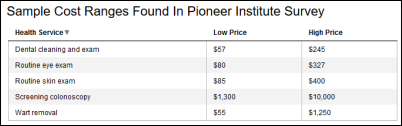
A study of 96 medical specialists in Massachusetts finds that most are unaware of the state’s 2012 medical transparency law that requires them to provide consumers with self-pay prices within two business days. Dentists were the most accommodating, presumably because they have many patients without insurance. One ophthalmology practice quoted $140 for an eyeglass exam, but raised the price to $327 when told the patient would be paying cash. Price estimates for a colonoscopy that includes facility and anesthesiology charges ranged from $1,300 to $10,000. Some practices told the surveyor that they weren’t allowed to give prices by phone, while others were “downright rude.” The president of the state medical society blames “the complexity of the payment system.”
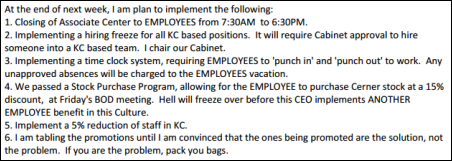
The Kansas City paper digs back into Cerner history in comparing Amazon’s “brutal” workplace to Neal Patterson’s infamous 2001 threatening employee email that sent CERN shares down 20 percent after it went public. I’ve changed my opinion about the email over the years as several then-Cerner employees have said Neal was right – employees were taking advantage of the company’s management sloppiness and he had to skip those layers to get his point across directly and unequivocally. It must have worked since shares have increase somewhere around eightfold since then vs. the Nasdaq’s doubling. Still, it’s fun to run his spitting nails email every couple of years.
The New York Times publishes a great article called “How to Know Whether to Believe a Health Study.” It says the problem with randomized trials is that they focus on narrow populations of people who are most likely to benefit from the particular treatment, often also excluding older patients and children. However, it fails to mention what I see as the biggest problem – studies are often sponsored by companies that suppress publication of the negative or even inconclusive ones. The author likes observational studies in which large, existing databases are mined for new insights as long as they cover broad populations and not just people who chose to receive a particular treatment.
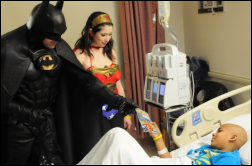
Lenny Robinson, who sold his cleaning business and made a full-time job of visiting hospitalized children in Maryland costumed as Batman, was killed Sunday when his stalled Batmobile was struck by another car on Interstate 70. He was 51.
Sponsor Updates

- Aprima announces attendance of 800 at its user conference earlier this month.
- Caradigm and iHT2 publish “12 Things You Need to Know About Value-Based Reimbursement.”
- MEA|NEA is named to the Inc. 5000.
- AdvancedMD offers a look at its new ICD-10 website.
- AirWatch becomes a founding sponsor of the new Center for the Development and Application of Internet-of-Things Technologies at Georgia Tech.
- Strata Decision Technology participates along with Costs of Care in a national story contest called “The Best Care, The Lowest Cost: One Idea at a Time.”
- Aventura offers “A Nurse’s Perspective: Shifting the Focus from the Computer to the Patient.”
- Awarepoint posts “Protect Patients, Cut Costs & Increase Compliance with Real-time Temp Monitoring.”
- Besler Consulting offers “Medical Necessity and Ambulance Services.”
- Cumberland Consulting Group and Divurgent are named to the Inc. 500 I 5000 list.
- Recondo Technology will exhibit at the HFMA Region 8 Mid-America Summer Institute August 26 in Minneapolis.
- Practice Unite offers “Achieving High Adoption of Patient Engagement Apps.”
Contacts
Mr. H, Lorre, Jennifer, Dr. Jayne, Dr. Gregg, Lt. Dan.
More news: HIStalk Practice, HIStalk Connect.
Get HIStalk updates.
Contact us or send news tips online.





















































































































































































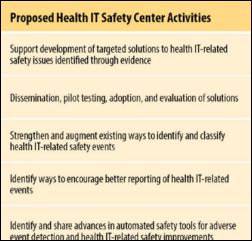












The news about AHRQ is very unfortunate. The AHRQ staff were always excellent to collaborate with. They had an impressive…