Home » News » Recent Articles:

News 5/6/15

May 5, 2015 News 3 Comments

Top News

image

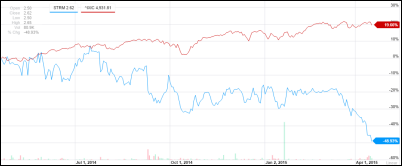
Cognizant reports Q1 results: revenue up 20 percent, EPS $0.62 vs. $0.57, beating expectations for both and boosting the stock to a record high Monday. The company’s healthcare unit, which includes its November 2014 TriZetto acquisition for which it paid $2.7 billion, increased revenue by 43 percent year over year. CTSH shares are up 32 percent in the past year. Cognizant says it has added 500 consultants and 300 developers to the former TriZetto business and was selected for $200 million worth of synergy deals, which it says proves its expectations of $1.5 billion in post-acquisition revenue synergies. TriZetto had closed 2014 at $729 million in revenue with single-digit growth rates before the acquisition. Cognizant CEO Frank D’Souza added that while the TriZetto integration continues, the company would consider another acquisition of similar size.


Reader Comments

image

From Compadre: “Re: Athenahealth. Its core offering is data entry, not software. They have thousands of people scanning, typing, and following up on claims. The actual software is just a Web front end that drives little profit margin. Let’s do some math. One MD internist collects $25K per month. Athena charges 7 percent ($1,750) to perform billing services, allowing it to book annual revenue of $1,750 x 12 months so the top line revenue looks like it’s growing. However, the cost is $1,500, leaving $250 per month for busy work. That’s not cloud computing. The street has caught on to this and it’s starting to show in investor sentiment. Finance rule 101: not all revenue is created equal.” A Forbes analysis says Athenahealth, like Allscripts, is facing low and declining ambulatory EHR margins compared to Cerner and says ATHN struggles with “evaporating profits, competitive struggles, and fading tailwinds” even as its share price climbs, making it ripe for implosion.

From BestBets33: “Re: Dr. Jayne’s report on her friend’s hospitalization. I often wonder why discharge planning and education is so disorganized. They do these things every single day, yet everywhere I’ve been it is such a cluster. Think about confused patients and nurses chasing things that should have been taken care of with a short checklist.” It is ridiculous that award-bragging hospitals can’t drive their policies and technologies down to frontline staff, meaning patients are at the mercy of whatever the individual nurse or doctor decides to do given their other priorities. Any other high-volume, high-revenue business would collapse from the lack of standardization and consistency – can you imagine shopping at a Walmart or eating at a McDonald’s that is run like a hospital? I suggested to Dr. Jayne that she ask her friend to request a copy of her medical record to see how closely it matches reality, not to mention finding out the cost and time required to get it. The hospital has a $200 million EHR, but from Dr. Jayne’s account, they’re using it poorly. Here’s my theory: hospital executives all over the country have fooled themselves into thinking they offer great care because they’ve walled themselves off from reality. They don’t eat their own dog food — when they themselves are forced into the patient role, they either go elsewhere due to privacy concerns or they get the swanky suite treatment far away from the huddled masses who pay their huge salaries. I would bet that every one of us who has been hospitalized was appalled at the inefficiency, clinical errors, and lack of consistent humanity. We ought to be embarrassed as an industry at what we’ve let ourselves become while pretending otherwise, but on the other hand, just acknowledging the opportunity for improvement is the first step.

From Picky Eater: “Re: Jeremy Bikman’s comments about KLAS. One report I saw recently costs $16,000 and it surveyed only a few dozen people. That’s not sustainable, especially considering that its methods are not statistically valid.” KLAS’s business model is brilliant – by ranking vendors, it creates a profitable maelstrom as the higher-ranked ones pay it fees to brag on their accomplishment (no matter what its statistical validity) and the lower-ranked ones pay the company for whatever insight it can offer to help them move up the food chain. I contributed to KLAS as a provider almost from the day they opened and my summary is that I rarely quibble at their best- and worst-ranked vendors – it’s the ones in between that are always duking it out. It was most useful when I was looking at a product I knew nothing about because otherwise the reports only validated what I already knew. I wasn’t as interested in the rankings or even the scores as much as I wanted to read customer comments, but even then you can’t put too much stock in them since you don’t know either the organization or the background of the commenter.

From Sam: “Re: Ed Marx. I like reading his submissions because he seems like a CIO with a philosophy. I’m curious if he resigned to work for a new organization and which one it might be.” I’ve heard indirectly that he has a new job, but I’ll leave it up to him to announce it when he’s ready.


HIStalk Announcements and Requests

image

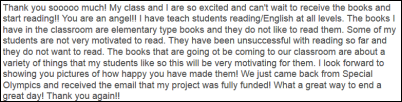
This is Ms. Sheppard’s Texas third-grade class using the drawing tablet, response buzzers, and iPad projector adapter bought with our DonorsChoose donation. She says the students now want to do all of their work using the response system since they enjoy competing. Maybe the buzzers should be used at some of the HIMSS snoozer sessions, or perhaps at executive meetings after being wired to provide an electrical shock to the presenter if the majority of attendees are bored.

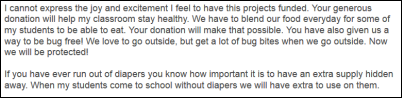
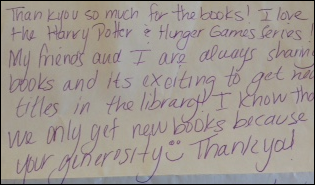
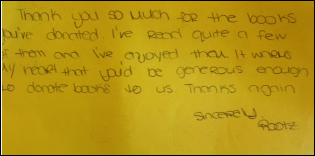
I also got a fun thank-you card from a high school student who is happy with the algebra calculators we purchased for the class. It reads, “You’re my hero. You’re like the Superman of my math class today. For years now my brain has had one thought … I hate math. But now it is a lot easier for me to do basic and hard math because of the technology you have donated. I still don’t like math, but it’s not the worst thing in the world.” It apparently isn’t, because the student ended with a PS that included a complicated math problem and the challenge, “See if you can solve this.” It’s great seeing the benefit of donations firsthand, knowing that the impact wasn’t diluted by middlemen salaries and wasteful corporate overhead (which is why I would never donate to a hospital).

image

Meanwhile, Epic has generously donated $4,500 towards our classroom projects, so I’ll be funding quite a few new ones this week. I have to look at our total donated, but I think it’s $20,500, and that funds a lot of important activities. Thanks to Epic for helping a bunch of kids  – I will make it a point to look for Wisconsin teachers in need.

Listening: reader-recommended Tame Impala, a one-man band from Australia that sounds like Sergeant Pepper-era John Lennon jamming with the children of Pink Floyd at the home of Tears for Fears.

Thanks to the following sponsors, new and renewing, that recently supported HIStalk, HIStalk Practice, and HIStalk Connect. Click a logo for more information.


image
image
image
image
image
image
image
image
image
image
image
image
image
image
image
image
image


Webinars

May 19 (Tuesday) 2:00 ET. “Lock the Windows, Not Just the Door: Why Most Healthcare Breaches Involve Phishing Attacks and How to Prevent Them.” Sponsored by Imprivata. Presenters: Glynn Stanton, CISSP, information security manager, Yale New Haven Health System; David Ting, CTO, Imprivata. Nearly half of healthcare organizations will be successfully cyberhacked in 2015, many of them by hackers who thwart perimeter defenses by using social engineering instead. The entire network is exposed if even one employee is fooled by what looks like a security warning or Office update prompt and enters their login credentials. This webinar will provide real-world strategies for protecting against these attacks.

May 20 (Wednesday) 1:00 ET. “Principles and Priorities of Accountable Care Transformation.” Sponsored by Health Catalyst. Presenter: Marie Dunn, director of analytics, Health Catalyst. Healthcare systems must build the competencies needed to succeed under value-based payment models while remaining financially viable in the fee-for-service landscape. This webinar will outline key near-term priorities for building competency at successfully managing at-risk contracts, with a particular focus on the importance of leveraging data to drive effective decision making.


Acquisitions, Funding, Business, and Stock

image

Imprivata announces Q1 results: revenue up 32 percent, EPS –$0.28 vs. –$2.29, beating expectations for both.


Sales

Visiting Nurse Service of New York chooses Cureatr for secure messaging and care coordination.

CareMore Medical Group of Nevada signs up for the chronic care management program of Allscripts.

Grady Health System (GA) selects Strata Decision’s StrataJazz Continuous Cost Improvement.


People
image

Penny Wheeler, MD, president and CEO of Allina Health, joins the board of Health Catalyst, replacing Larry Grandia.

image

Kathleen Brenk (Trust Company of America) joins Recondo Technology as chief human resources officer.
image

Former HHS Innovation Fellow Zac Jiwa joins healthcare API vendor MI7 as CEO. He had been an advisor to the company.


Announcements and Implementations

Raintree Systems will offer its customers patient billing solutions from PatientPay.
image

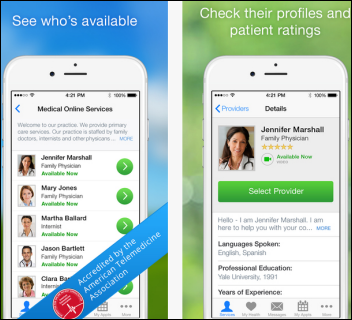
Telehealth service vendor American Well releases a telehealth app for providers who want to see non-urgent patients via high definition video visits and Apple HealthKit connectivity. It also allows patients to choose a particular doctor or to take first-available and for doctors to invite their patients to a telehealth visit.

IBM, Epic, and Mayo Clinic will collaborate in using IBM’s Watson to analyze EHR information.

CompuGroup Medical announces CGM Analytics, a data aggregation and analytics solution.


Government and Politics
image

Rep. Ted Poe (R-TX) introduces a bill that would prohibit HHS from implementing ICD-10. He’s been a hater from the beginning (mostly of anything Democrats favor), but his previous legislative attempts to stop ICD-10 haven’t gained traction and probably won’t this time either since he doesn’t have much Congressional clout. At least he’s apparently given up on his repeated attempts to prove that President Obama isn’t a US citizen.


Other
image

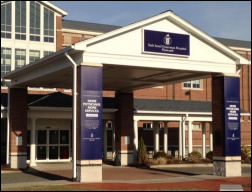
Beth Israel Deaconess Hospital – Plymouth (MA) declares “Email Free Fridays,” urging employees to stop emailing each other for a least one day per week, get out from behind their desks, do real work, and communicate with co-workers face to face.
image

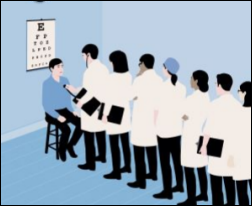
Atul Gawande says in a New Yorker article that performing unnecessary tests and procedures is expensive and risky to patients, but it’s hard hit the sweet spot between doing too little and doing too much, especially in an environment that pays doctors for unnecessary care and penalizes them (via satisfaction scores and lawsuits) for lapsing into inadequate care territory. My interest is something he doesn’t emphasize much – what voice does the patient have in those decisions? We always assume patients want their doctors and hospitals to be aggressive with their procedures and prescriptions, but I suspect doctors aren’t always good at explaining the long-term benefit or recommending only those treatments that they themselves would choose.

A three-hospital study finds that while physicians often blame demanding patients for running up healthcare costs, less than 9 percent of oncology patients ask for specific tests or treatments, nearly all of those are clinically appropriate, and physicians very rarely comply with the inappropriate ones.

An MIT Technology Review article says Apple will recommend genetic testing to certain iPhone users, arrange for the tests to be run by academic partners, and then allow people to share their results with each other or with researchers via ResearchKit. UCSF and Mount Sinai Hospital are planning studies that will involve DNA collection.

The family of deceased Ebola patient Thomas Duncan says the donation of $125,000 by Texas Health Resources as part of its settlement with the family is “not nearly enough,” expressing shock that THR didn’t provide the $5 million the family asked for to build a hospital in Liberia.
image

Legacy Health System (OR) goes to an emergency operations plan when an apparent power surge takes its systems down for 12 hours.

image

A New York Times article covers the rise of air ambulance services that are raising their rates dramatically and pressing harder for patient payment even as insurance companies reduce coverage. A glut of medical helicopters has caused usage to drop and an industry trade group is trying to convince the federal government to increase their Medicare payments, warning that “it’s about access to healthcare.” Billion-dollar operator Air Methods, which operates 450 helicopters and airplanes in 300 locations, charges an average of $40,000 per flight. It’s another of those healthcare things that sounds like a fairly good idea to doctors and patients until everybody finally realizes what it costs.
image

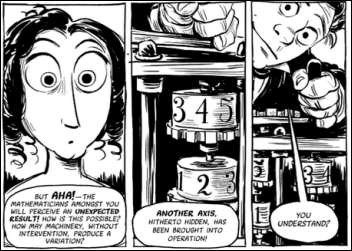
Weird News Andy offers a thumbs-up on the just-published “The Thrilling Adventures of Lovelace and Babbage: The (Mostly) True Story of the First Computer,” which he describes as “fun, smart, and very entertaining / informative.” It’s a mix of fact and fiction for “the whimsical intelligentsia,” a group to which we all surely aspire to belong.


Sponsor Updates

  • Extension Healthcare wins the Health Tech Award from Indiana’s TechPoint.
  • A team from Nordic will ride in the Madison Tour de Cure benefit for the American Diabetes Association on May 16.
  • PatientSafe Solutions CEO Joe Condurso is interviewed by The Wall Street Journal about health app development.
  • Ingenious Med is named as one of Atlanta’s 100 fastest-growing companies.
  • Medecision asks, “Who is Responsible for Patient Engagement?”
  • Cumberland Consulting Group Managing Partner Jeff Lee is featured in a PharmaVoice article on technology.
  • Culbert Healthcare Solutions offers “3 Strategies for Retaining and Attracting Top-Notch Physicians.”
  • Capsule Tech offers “Are your medical devices configured to reduce alarm fatigue?”
  • ADP AdvancedMD offers “Spring Cleaning for ICD-10” tips.
  • TransUnion Healthcare President Gerry McCarthy is quoted in an article that addresses uncompensated care.

Contacts

Mr. H, Lorre, Jennifer, Dr. Jayne, Dr. Gregg, Lt. Dan.

More news: HIStalk Practice, HIStalk Connect.

Get HIStalk updates.
Contact us online.

125x125_2nd_Circle

Monday Morning Update 5/4/15

May 3, 2015 News 3 Comments

Top News

image

Henry Chao, the CMS CIO and deputy director who led the rollout of Healthcare.gov, has retired. He was little noticed until a September 2014 House report on the site’s failure, which quoted emails from former HHS CTO Bryan Sivak that characterized Chao as being in way over his head to the point that HHS plotted to hijack the project to try to salvage it. Chao reported to CMS CIO Tony Trenkle, who hightailed it for an IBM federal IT executive job just a handful of weeks after the site went down in flames (of taxpayer money).


Reader Comments

From Not So Lucky: “Re: McKesson EIS division. Big layoffs Friday.” Unverified.


HIStalk Announcements and Requests

image

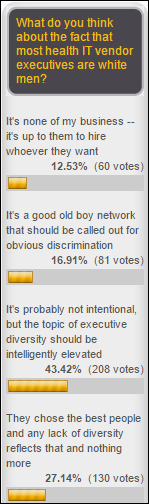
Around 17 percent of poll respondents think that HIT vendors intentionally stack the executive deck against women and unstated minorities, but most of them feel that companies have simply chosen the best people for the job and possibly only need ongoing reminders of the desirability of diversity. Some readers commented that perhaps companies can’t even see the benefit of executive diversity because they’ve never practiced it, while others commented that the “mommy track” may present a more attractive option for women who aren’t very interested in the never-ending hours, travel, and relocation required to move up the executive ladder. Cerner Europe GM Emil Peters referenced the poll on Twitter, saying, “Personally I think it’s a travesty. And I’m going to do what I can to fix it. However, I don’t think it’s by design.” New poll to your right or here: within the past two years, have you had to pay a medically related bill that created at least a modest degree of personal financial hardship?

Here another poll that interests me since I see a lot of people playing around with media in ways I don’t quite get: which would be the most attractive way to catch up on a weekly health IT news summary? I personally have never listened to a podcast and don’t anticipate a time that I ever will, so the results will help me figure out if I’m in the Bell curve hinterlands.

Check HIStalk Practice for the Population Health Management Weekly Roundup.

image

I bought Regina Holliday’s brand new book “The Writing on the Wall” from Amazon and became so engrossed that I read it nearly straight through this weekend. My expectations are modest for healthcare IT-related books given some fairly lame ones, but this one is among the most moving things I’ve ever read, more of a story about love and family, overcoming adversity, and standing up for what’s right than the usual preachy, recycled facts about technology coming from someone who thinks of patients as people and/or customers different from themselves (the big secret: we’re all frightened, marginalized patients at one time or another). If your blood runs above room temperature, I predict you’ll laugh, cry, and get fighting mad at the very system you work within as you read about her life and the untimely death of her husband, but you’ll also find it uplifting and empowering. It would be a great read even without the IT connection. I’ll most likely write a full review shortly since to do less would be a disservice to people who either want or need to peruse it, but here are some excerpts that got me as I learned that Regina’s art is not limited to the visual variety:

We come into this world screaming and owning nothing. We grow and change. The years pass by and we fill with life experience as our homes fill with possessions. Time rolls on and on, but for all of us there is an end. Some will meet their end on highways and some in hospitals, but for most of us the end is the same. We are patients in the end. We pluck at cloth hospital gowns, left with only a few possessions: our watches, rings, and wallets … Hospitals can deconstruct a person as assuredly as I could lay bare a jewelry box. Take any professional adult and remove their clothes and their accessories. Dress them in a threadbare gown that is faded by thousands of wash cycles. Give them a number rather than a name. Confuse them with jargon while applying copious amounts of medication. Then watch them try to navigate the maze of care … I felt like a bright blue inconsequential bird in my Easter dress as I fluttered among the forests of polo shirts, hoodies, and business suits. Conference attendees in the world of medicine have a uniform look. You were welcomed if you wore a suit, tolerated if you wore a hoodie, and ostracized in a church dress. I was not wearing the correct uniform, but I took a deep breath and introduced myself. I would say, “Hello, my name is Regina Holliday. I want to paint about healthcare to improve health policy for patients.” I’d then say that I was inspired to paint by my late husband who very recently died of kidney cancer. I would give them my slip of paper masquerading as a business card. Then tell them to reach out to me via social media or email. Then I’d share the horrific things we had experienced during my husband’s 11-week hospitalization at five different facilities. I would see them step back from me with a brief condolence. A nervous half-laugh would often escape their lips. I was a widow fresh from the graveside asking questions that affect the lives of us all. I was not supposed to be there. They were having a ball and I was death walking among them.

image

I’ll have more DonorsChoose project updates later, but here’s a photo from Ms. Classen’s intervention algebra class using the calculators we provided. She says, “What we’re able to do now with these calculators is amazing. Many more students are going to get the practice they need to graduate high school and learn to solve difficult problems thanks to you all.” 

image

Here’s a photo of Mrs. Rowe’s third graders using the six iPad Minis we bought them for math study.

I was thinking about how hospital patient rooms often resemble hotel rooms in being littered with previously popular but now-useless technology components, which in the hotel’s case often includes iPod docking stations and dial-up ports that get used rarely and never, respectively.


Last Week’s Most Interesting News

  • CMS releases a gigantic Medicare Part D prescribing database for 2013 that includes details on $103 billion of drug spending.
  • Teladoc announces IPO plans and files an antitrust lawsuit against the medical board of its home state of Texas for requiring prescribers to see a patient at least once in person before issuing a prescription.
  • Anthem books $865 million in Q1 profit, up 25 percent despite its massive data breach during the quarter.
  • Imprivata acquires palm vein scanning biometric vendor HT Systems.
  • The chair and ranking member of the Senate’s HELP committee follow through on HHS Secretary Sylvia Burwell’s request for help identifying pressing but easily solved EHR-related issues.
  • A Brookings Institution report questions why patients are charged significant and inconsistent prices to receive copies of their own electronic medical records from providers.
  • CareCloud announces $15 million in additional funding and a new CEO.
  • Validic receives another $12.5 million in funding.
  • Vanderbilt University Medical Center announces that it will replace McKesson Horizon, some of which was developed internally by Vanderbilt, with either Cerner or Epic.

Webinars

None scheduled soon. Contact Lorre for information about webinar services.


Acquisitions, Funding, Business, and Stock

image

Startup MORE Health receives $3 million in Series A funding for its multi-language EHR that connects doctors and patients in China with US specialists.

image

From the Athenahealth earnings call, which followed Friday’s expectations-beating earnings report that for some reason triggered a 7.4 percent share price drop:

  • The company added 2,300 providers in the quarter, raising its total to 64,000.
  • The RazorInsights team has been moved into the Atlanta office and the company has made RazorInsights sales, cross-sold AthenaOne to a RazorInsights client, and sold both products to a new client.
  • Jonathan Bush says the urgent and convenient care market is the most important to him because it’s growing fast and is managing “worried well” lives.
  • Bush says of big, non-academic health systems buying Athenahealth, “These guys have done their homework, gotten out their protractors and done the math on the arc of their flight, and they see it not clearing the tree tops. Not clearing the tree tops due to lack of profit is a great way to make you for-profit … They know that they can’t put the kind of obscene amounts of capital against or manage internal IT systems in the way that the fancy pants universities can afford to do and they’re slowly coming around to us and it’s exciting.”
  • The company says it won’t talk about individual hospitals or sales of RazorInsights, but “When we look at our growth, first of all, we’re starting with a very new company with a small base, so it’s relatively easier to grow a lot on the small base. We don’t intend to talk specifically about the number of individual Razor deals or that sort of thing. We really bought RazorInsights as a strategic asset along with WebOMR to build out our full inpatient solution over time.” Bush added that RazorInsights got its clients to Meaningful Use but “the billing needs a lot of work, like a lot” and says by year-end Athenahealth will offer a full-service revenue cycle program to RazorInsights users.
  • In justifying the $40 million paid for RazorInsights, Bush says Athenahealth got the best deal it could since the VCs who owned the company were either going to re-fund it or step out, so he sees it as an “acqui-hire” play in buying a product, a founding team, and brave early customers, adding that he’d like to do more of that.
  • Bush responded to an analyst who asked how bookings revenue drove operating income improvement, “If you’ve been following us for a while, you’re following a caterpillar, right? There’s sometimes where the nose of the caterpillar doesn’t appear to be moving at all, but back in the ass, it’s building up potential energy which will turn into a great nose stretch. ”
  • Bush said of ICD-10, “Never has a Bush felt so longing for more federal mandates as I have felt since the dying down of Meaningful Use and ICD-10 and PQR and ABC and do-re-mi. It is so easy when some fearful group of federal apparatchik are going to come for your prospect if they don’t buy. We are currently in a period where there are no apparatchiks coming … if ICD-10 tightens up and actually looks real later in the year it will help our close rate. I will feel sheepish about it because it seems a silly reason to make a free market move. But it’s true that right now our close rates are lower and that the specific reason we can attributed to it is no urgent federal mandate to buy.”
  • Bush said that Athenahealth’s connection to CommonWell is in beta and that he’s OK with making EHRs interoperable via other methods because “otherwise we’re all going to be on some federally mandated ridiculous EHR.” He adds, “CommonWell could have been perceived as sort of a PR smite against Epic, which I assure you I would never want … I want to be anything that Epic’s in as well, even if we have to double pay. This is not the solution for interoperability by any stretch. This is just a service so that a patient can get their freaking chart and have the same patient match to all the different systems that their chart is in. So I don’t think you guys should think of CommonWell as some sort of silver bullet that fixes everything … I don’t think it’s a solution to the real challenge, which is the B2B interoperability … that’s kind of the new frontier that we’re doing most of our work on.”

Sales

Erlanger Health System (TN) chooses Epic in what the local paper says is a $100 million deal.

CoverMyMeds will use state-specific electronic prior authorization requirements information from Point-of-Care Partners.


People

image

Valence Health hires Michael McMillan (Cleveland Clinic) as SVP of strategic solutions.


Announcements and Implementations

CVS says in its earnings call that its Epic rollout is on schedule and will be completed by mid-year.


Government and Politics

A Washington Post review finds that nearly half of the 17 health insurance exchanges created as alternatives to Healthcare.gov are struggling with high technology and call center costs along with less-than-expected enrollment numbers. They’re considering raising fees charged to insurance companies, sharing costs with other states, asking for state money, or shutting down and using Healthcare.gov instead.


Technology

image

image

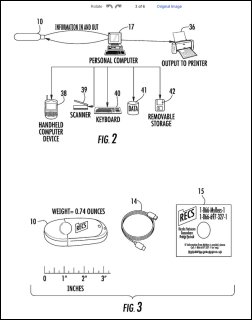
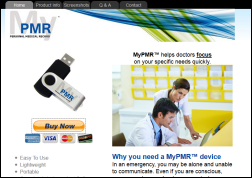
Consumer personal health record vendor LMG 3 Marketing and Development Corp. sues Apple, claiming that its Health and HealthKit apps violate its patents for technologies that it claims to have licensed to retailers such as Target. I found the original 2012 patent, which is a vague and seemingly unrelated description of a personal health record on a thumb drive. The primary inventor is Mike Lubell of Raleigh, NC, who developed MyPMR in 2000 while creating an EMR/PM business unit  for Canon Business Solutions. LMG 3 apparently still offers MyPMR for $34.95.


Other

Former National Coordinator David Brailer, MD, PhD says in a Wall Street Journal opinion piece titled “They’re Your Vital Signs, Not Your Medical Records” that Congress should ensure that individuals have unqualified ownership of their health information and be given legal control over who sees it. He adds that patients should be allowed to designate an “infomediary” who can manage their information on their behalf. He warns that EHR vendors and providers block interoperability to gain a competitive edge and because “whoever controls health information will dominate the healthcare marketplace and its vast profit pool.”

image

Intermountain Healthcare CHIO Sameer Badlani, MD lists his favorite apps for reference guides (DynaMed, UpToDate, ACP Smart Medicine); drug reference (Epocrates, Lexicomp, and one listed as Medimex that I assume is supposed to be Micromedex); clinical calculators (MediMath, MDCalc, and one I haven’t heard of, OxCalc); and antibiotic guides (Johns Hopkins Antibiotics Guide, Sanford Guide).

UnitedHealthcare will offer 24×7 video-based virtual physician visits to members enrolled in self-funded employer health plans, expanding availability to employer-sponsored and individual plan participants in 2016. It’s working with Doctor On Demand, Optum’s NowClinic, and American Well, with access through its Health4Me app. 

A Phoenix TV station profiles the local neurosurgeon who in 2008 developed The Medical Memory, which provides doctors with video recording equipment for recording patient encounters and posting them securely online for reference and sharing. I checked out the video link from the site showing his overview, but was kind of turned off that he got rather curt with whoever was running his slides (he’s a neurosurgeon, after all). It’s fascinating to me that on at least half a dozen occasions recently, I’ve had email or telephone conversations with healthcare IT people who came across as rude and clueless, leading me to question: could they possibly be that unlikeable in real life, or do they just come across poorly online without realizing it?

I’ll go out on a limb with this story: a Florida man sues a hospital for discarding his amputated leg in the trash, which he discovered when homicide detectives knocked on his door to inquire about what it was doing there.


Sponsor Updates

  • The SSI Group will exhibit at the Louisiana HFMA meeting May 3-5 in Lafayette.
  • Streamline Health will host the 2015 NEXT Summit Client Conference May 3-5 in Atlantic Beach, FL.
  • VitalWare shares “Five More Facts about ICD-10.”
  • Versus Technology recaps its HIMSS15 presentation on “Transforming Process Improvement through RTLS Data.”
  • Huron Consulting Group will sponsor the 2015 Cristo Rey Viva Event on May 7 to support the students of Cristo Rey Jesuit High School in Chicago.
  • Verisk Health offers“How Dollars Flow to Fight Medicaid Fraud.”
  • Sunquest Information Systems will exhibit at the Pathology Informatics Summit May 5-8 in Pittsburgh.
  • T-System President and CEO Roger Davis weighs in on EHR interoperability.
  • Team Hackasaurus Rex wins TransUnion’s first Hackathon, held at California Polytechnic State University.
  • Truven Health Analytics will host its Advantage Conference May 4-7 in Boca Raton, FL.
  • Valence Health will exhibit at Becker’s Review and Annual Meeting May 7-9 in Chicago.
  • ZirMed CEO Tom Butts shares his thoughts on IT trends and challenges, hospital CFOs on preventing claim denials before they happen, and ICD-10.
  • MedData exhibits at the MGMA Anesthesia Administration Assembly through May 1 in Chicago.
  • MediQuant President Tony Paparella is interviewed as part of the #TalkHITwithCTG podcast series.
  • Navicure exhibits at Centricity Live through May 2 in Orlando.
  • New York eHealth Collaborative will exhibit at the Crain’s Health Care Summit May 5 in New York City.
  • Nordic Consulting releases the fifth episode of its “Making the Cut” video series on Epic conversion planning.
  • NTT Data offers “It’s Beginning to Look a Lot Like Christmas … Thoughts on the Apple Watch.”
  • Oneview Healthcare will exhibit at Digital Health Live 2015 May 5-7 in Dubai, UAE.
  • Orion Health, Patientco, and PDS reflect on their HIMSS15 experiences.
  • PMD offers “There’s More to Health Than Being Happy: What a Patient Satisfaction Score Really Means.”
  • Qpid Health will exhibit at the Medical Informatics World Conference May 5 in Boston.

Contacts

Mr. H, Lorre, Jennifer, Dr. Jayne, Dr. Gregg, Lt. Dan.

More news: HIStalk Practice, HIStalk Connect.

Get HIStalk updates.
Contact us online.

125x125_2nd_Circle

News 5/1/15

April 30, 2015 News Comments Off on News 5/1/15

Top News

image

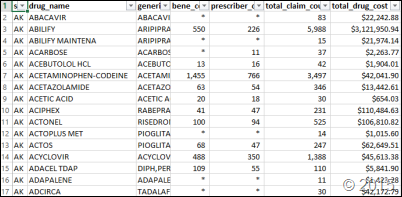
CMS releases a Medicare Part D prescription database for 2013 that includes details down to the individual prescriber for $103 billion in drug costs.


Reader Comments

From Ortho Doc: “Re: Meaningful Use. The ‘we can’t tell what the numbers mean yet’ for MU2 rear their ugly head in an Advisory Board report. Only 38,472 EPs have attested for MU2 to date. My guess is that only about half actually did Stage 2 as there was the Stage 1 reprieve. Even so, only 18 percent have successfully attested, which is a complete failure of MU. Someone ask CMS and ONC the tough questions, please. Now what are they going to do?” I’ve lost what little interest I had in MU – it’s a distraction to the real work that needs to be done, it encouraged providers to impulsively buy the same old EHRs they wouldn’t spend their own money on, and it put the federal government’s fingers in what should be private business practices and the patient-physician relationship. I’m actually encouraged that providers are bailing out since maybe they will refocus on what’s important.

image

From Dan: “Re: DonorsChoose. We’ve noticed the recent activity on HIStalk and would like to participate. Your effort is very well aligned with our philanthropy and community involvement objectives, especially around STEM (science, technology, engineering, and mathematics). It’s great that you’ve topped $10,000 towards the effort and we’d love to make a $5,000 contribution. We’d also like to keep the contribution confidential – I’m simply reaching out on behalf of others who feel strongly about this topic and have worked to approve the funding.” I never disclose sources, but I’m making an exception this time because Cerner’s generous donation should be acknowledged (I warned Dan that I would probably name the company). I also suggested an interview with one of Cerner’s female engineers who mentors local girls about technical careers, so that’s coming soon. Thanks to Cerner, I’ll be funding another $5,000 worth of DonorsChoose projects with an emphasis on those related to STEM, which is vital to our global future as we fall behind countries that emphasize those subjects more than we do. Kudos to Cerner for stepping up with no expectation of recognition. 

Speaking of the DonorsChoose project, donating $500 for some time with Centura SVP/CIO Dana Moore is Holland Square Group, which provides contract help to Centura.  

From Ockham: “Re: Judy Faulkner. A rare panel appearance at the World Medical Innovation Forum put on by Partners HealthCare. I attended Day 1 and I was very impressed with the speakers. I also found it fascinating that even though the conference was on neurology, every panel and speaker ended up talking about genomics and how it is going to transform medicine. Unfortunately, I couldn’t be there for Judy. Epic clinicals and everything go live at Brigham and Women’s in 30 days. Boston should feel like a home town to Judy with almost all but BIDMC soon to be live on Epic.”

From Soul Survivor: “Re: Medfusion. 20 percent payroll downsize.” Unverified.


HIStalk Announcements and Requests

This week on HIStalk Connect: Teladoc files IPO paperwork, and simultaneously sues the Texas Medical Board for antitrust violations. Scanadu raises a $35 million Series B to fund clinical trials of its Tricorder-like Scanadu Scout. Validic reports strong Q1 results and raises a $12.5 million Series B that will be used to ramp up operations and meet growing demand for its personal health data interface engine. White coat hackers demonstrate a number of security vulnerabilities found in tele-operated surgical robots.

This week on HIStalk Practice: CareWell Urgent Care goes with Athenahealth. PatientlySpeaking integrates with Aprima. Iora Health CEO details the delight of developing a homegrown EHR for primary care. IOM rebrands. ICD-10 study shows physicians have their heads stuck in the sand. North Florida Women’s Care goes with Keona Health. Telemedicine price wars escalate. Tattooed community up in arms over Apple Watch’s heart rate sensor sensitivity. Sherpaa bypasses "old school" video for more effective text message consults. Thanks for reading.


Webinars

None scheduled soon. Contact Lorre for information about webinar services.


Acquisitions, Funding, Business, and Stock

image

Dallas-based video doctor consultation vendor Teladoc will file an IPO. The company also files an antitrust lawsuit against the Texas medical board for passing a new rule that requires doctors to meet a patient face to face before prescribing medication.

image

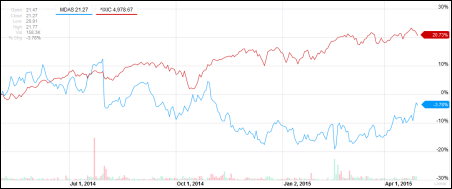
MedAssets announces Q1 results: revenue up 9.9 percent, adjusted EPS $0.31 vs. $0.32, beating expectations for both. Chairman and CEO Halsey Wise said in the earnings call that he’s not happy with the company’s financial performance and announces plans for a “data-centric future” as customers ask the company to offer more services than just group purchasing as health system emphasis partially shifts from inpatient to ambulatory where MedAssets has minimal presence. The company plans to combine its supply chain and revenue cycle data with insights from its Sg2 analytics group (acquired in August 2014 for $142 million) to provide customers with deeper analytics. Above is the one-year share price chart of MDAS (blue, down 3.8 percent) vs. the Nasdaq (red, up 20.7 percent).

Care, quality, and compliance software vendor MedHOK acquires Continuum Performance Systems, which offers Medicare process management software.

image

Anthem shakes off its January 2015-reported data breach in booking Q1 profits of $865 million, up nearly 25 percent from a year ago, mostly due to increased Medicaid plan membership.

image

Athenahealth reports Q1 results: revenue up 27 percent, adjusted EPS $0.24 vs. $0.12, beating estimates for both. ATHN shares are up 20 percent in the past year.

image

Imprivata acquires HT Systems, which offers the PatientSecure biometric identification system, for $19.1 million in cash plus performance incentives worth up to $6.9 million. The company’s palm vein scanning patient ID system is used in 324 hospitals.


Sales

image

Community Health System (IN) chooses Allscripts dbMotion for its clinically integrated network.


Announcements and Implementations

Surescripts expands its CompletEPA prescription electronic prior authorization coverage to nearly 100 percent of US patients by partnering with PDR.

Boston Scientific will integrate analytics software from TogetherMD into its cardiovascular products.

IBM, Apple, and Japan Post Group will deliver iPads to up to 5 million senior citizens in Japan by 2020. The IBM-developed apps include medication and lifestyle reminders, community services access, and electronic monitoring that extends Japan Post Group’s fee-based home visits.

image

Apple revises its App Store review guidelines to require ResearchKit developers to obtain institutional review board approval for studies involving human research. The previous language recommended but did not require IRB approval.

New York-Presbyterian Hospital launches the self-developed NYPConnect staff communication app.

Athenahealth connects the lab hub of Liaison Technologies to its network.


Government and Politics

image

Former Texas for-profit hospital chain CFO Joe White is ordered to pay $4.4 million in restitution for filing false Meaningful Use attestation reports, adding to his previous sentence of 11 years in prison for healthcare fraud. He also falsified the entries using another employee’s ID and faces up to seven years in federal prison for identity theft in his May 27 sentencing. Chain owner Tariq Mahmood, MD was sentenced to 11 years in federal prison a couple of weeks ago for Medicare and Medicaid fraud, with the US attorney cheering the decision by saying, “What we do not need is providers like Tariq Mahmood who masquerade as physicians and pretend to care about American healthcare but actually are determined to loot the Medicare Trust Fund.”

image

Premier comments on the House’s 21st Century Cures, urging ONC to help liberate data “locked in proprietary software systems” by developing standards (including patient identifiers, security, and APIs) and publicly reporting measures of interoperability via ONC’s certification program. Premier’s comments are valid, but as an organization representing providers, it places the blame on vendors rather than providers who are neither demanding or using interoperability capabilities due to competitive concerns.

image

Senators Lamar Alexander (R-TN) and Patty Murray (D-WA) of the Senate’s HELP committee make good on their promise to help HHS Secretary Sylvia Burwell with ideas for EHR improvement by inviting their Senate colleagues to join a working group that will identify ways to improve care, interoperability, and patient access to their own information.


Privacy and Security

A security guard at Mercy Health Saint Mary’s (MI) apologizes for looking up the EHR record of a 19-year-old female patient and then sending her a Facebook friend request.


Innovation and Research

image

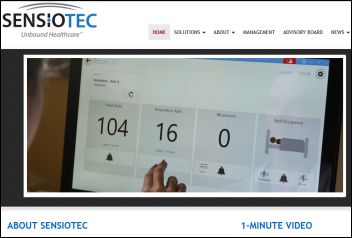
Sensiotec wins an innovation award from the Technology Association of Georgia and the Southeastern Software Association. The company’s Virtual Medical Assistant offers FDA-approved, non-contact patient monitoring for post-acute care patients, with a monitoring panel placed under a patient’s bed or chair to continuously stream biometric information to the cloud.


Technology

image

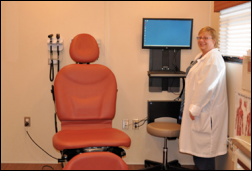
Ron Kloewer, CIO of Montgomery County Memorial Hospital in Red Oak, IA, sent over a link to a Verizon story about the hospital’s Heartland Mobile Health unit, which connects the mobile exam room by 4G LTE to the hospital’s EHR.

image

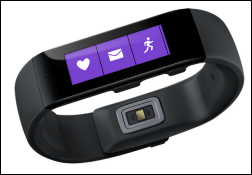
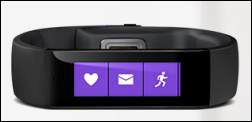
Microsoft releases a software development kit for its Band smart watch that providers app developers access to its body sensors and notification tiles.


Other

image

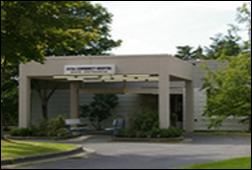
Sitka Community Hospital (AK) says one of its top priorities in trying to survive financially is to fix its software problems, especially those that are causing delayed billing. Googling suggests that the system they installed last year is Healthland.

Deaconess Health System (IN) will install and maintain Epic for Good Samaritan Hospital (IN) via the OneCare ACO. I believe the system getting replaced is McKesson Horizon, which Good Samaritan bought in 2007.

image

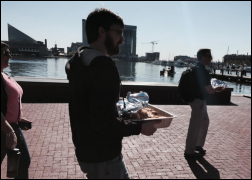
Sensationalistic US news sites love crises that keep eyeballs coming back, milking the latest plane crash, natural disaster, or civil unrest for all it’s worth. Good news doesn’t sell in the “if it bleeds, it leads” style, so here’s a counterpoint: the folks at Baltimore-based Salar were at Inner Harbor Wednesday handing out food to whoever was around – National Guard, police, locals, and visitors. Scour the web and you’ll find pictures everywhere of locals helping looted business clean up, protecting police from those intending to harm them, and reminding opportunistic criminals that torching a CVS and stealing lottery tickets hurts rather than helps.


Sponsor Updates

  • Microsoft announces Office plug-ins for DocuSign.
  • Mobile charge capture vendor pMD will become a PQRS registry for 2016.
  • Extension Healthcare offers “Reducing Clinical Noise and Solving the Challenge of Interruption Fatigue – A Nurse’s Perspective.”
  • PatientSafe Solutions hosted a 40-participant HIMSS15 breakfast event discussing smartphone-based clinical communication and collaboration.
  • Galen Healthcare offers part 1 of “Management-friendly policies we’ve taken to improve information security … and why you should too.”
  • The HCI Group interviews ERP Practice Director Lane Tucker in its latest blog.
  • ZeOmega hosts its client conference May 4-6 in Plano, TX.
  • Healthcare Data Solutions unveils a new brand and website.
  • First Databank adds natural health products to FDB MedKnowledge Canada.
  • Holon Solutions will exhibit at the National American Hospital Association Meeting May 3-6 in Washington, DC.
  • Influence Health will hold its Influence Client Congress May 3-6 in St. Louis.

Contacts

Mr. H, Lorre, Jennifer, Dr. Jayne, Dr. Gregg, Lt. Dan.

More news: HIStalk Practice, HIStalk Connect.

Get HIStalk updates.
Contact us online.
125x125_2nd_Circle

HIMSS15 Patient Advocate Recap–Melanie Peron

April 29, 2015 News 3 Comments

How do I sum up the HIMSS tornado I lived for three days with my new advocate friends? It is quite difficult, but it’s time that I did it!

image

Almost four years ago, I decided to act and founded a social enterprise called l’Effet Papillon (The Butterfly Effect) in my home of France. It is dedicated to bringing a greater welfare to patients and their families. Since September 2011, we have organized 20 shows in patient hospital rooms (oncology services) and over 1,000 patients and family members received visits from musicians and storytellers. With the supportive care we provide to hospitals, charities, and socio-medical structures, 500 patients participated in individual or collective sessions.

It is incredible to see the power of this non-medical approach. Less anxiety, less feeling of social isolation, less consumption of antidepressants, and fewer relapses. This idea was born after being a caregiver for 18 months and after being very shocked by the social isolation of patients and family.

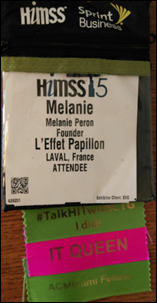
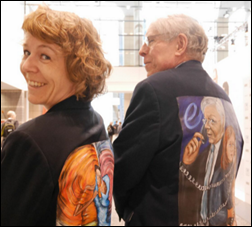
After being in contact with Regina Holliday for three years thanks to social media, I became a proud member of The Walking Gallery when she painted my jacket, “Butterflies.” When she suggested I apply for the patient advocate scholarship she created with HIStalk to attend at HIMSS15 in Chicago, I was surprise because I thought I was too small. I applied, thinking I had nothing to lose and that maybe I could be one of the lucky, happy, few patient advocates.

A few weeks after, I learned that I was one of the five winners. When I discovered the four other winners, I was very honored to be a part of this incredible team of rocking ladies. I also noticed that I was the only non-American patient advocate. Me, little social entrepreneur from France who struggled to provide supportive care and greater wellness to people, I’ll attend this huge event. I was thrilled!

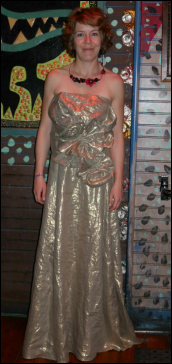
For my trip to Chicago, friends and family wanted to be part of this journey, and in a way, they were with me. A friend of mine, Geraldine, took time to help me with the English version of the website. She also coached me for presenting my project. Another friend, Richard, helped me with the English version of the website of l’Effet Papillon. My friend Sonia lent me a beautiful couture dress of her atelier GLM fashion.

I arrived a few days before because I wanted to acclimate myself to the time zone, to the city, and to the language. I was a little bit worried to take part to this event and not to be able to speak like I did in French. HIStalk and Lorre organized everything very well before my arrival. Thanks to FormFast, I had the chance to stay in a very lovely and nice hotel during the event. Sunday evening I met Lorre for the very first time for real at Maggiano’s Little Italy at the HIStalk sponsor event and we met very nice people from Health Catalyst attending HIMSS as vendors.

image

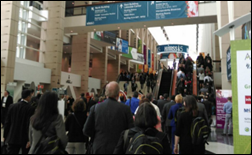
I arrived at McCormick Place on Monday with the shuttle. Even though I heard it was a big event, I was impressed by the crowd. I searched for the HIStalk booth with a great excitation to meet Regina, Lorre, Jennifer, Amanda, Tami, and Carly. I was searching a lot because HIMSS is so big. Even in the biggest stadium when I went to see my favorite rock bands, I never felt so lost!

image

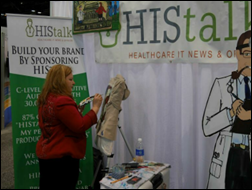
Finally, after a little time, I found the HIStalk booth and Regina. She was painting the jacket of Gabriela Wilson, a very nice person who I will meet the day after. Meeting Regina in real life is like meeting someone you waited for a long time. Quickly after this very happy moment, I met Carly, Tami, and Amanda and the team of patient advocates that was there. Sadly at the last minute Kim Witczak, our fifth winner of the scholarship, couldn’t come because of her job.

Monday was the first day of meeting in real with all my Walking Gallery friends and I passed all my day with them. I wanted to take the time to know them, to share our experiences, and to be with them, so I didn’t see a lot of vendors. The Walking Gallery of Healthcare members are so inspiring! You can’t imagine how wonderful and shining they are!

image

Regina organized a gathering of the members and I met E-Patient Dave for the very first time. I was so happy! It’s thanks to a talk of Dave that I discovered him and Regina. I had the feeling to meet one of my favorite rock stars! And Dave is so nice! He gave me a badge for the Society for Participatory Medicine and proposed me to be a member of this society because they need of the participation of patients to move forward with the care and the treatments of patients. I would love to have the same kind of organization here in France.

image

image

image

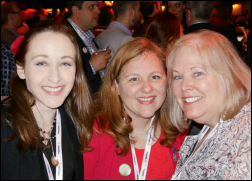
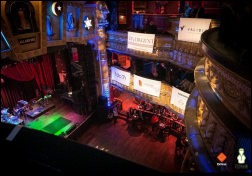
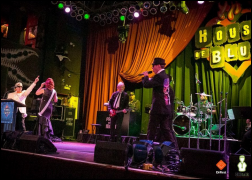
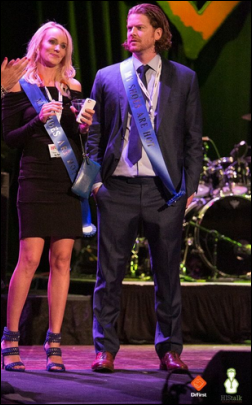
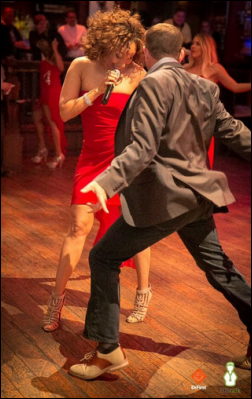
Monday night was the HIStalkapalooza event, a VIP event that is the place to be during HIMSS. As a fan of music, I was delighted to go to the House of Blues and share this lovely moment of music and happiness with my friends. For this special occasion, I wore my French couture dress and everyone loved it! I even receive the “Mr. H’S Secret Crush” sash. I think I succeeded to make a good representation of my friend’s work and talent!

Tuesday, we went to visit vendors with Tami. They welcomed us well and I think they were a little surprised to discover patient advocates. Finally, they all told us it was a great idea to have patient advocates in this event. I’m deeply convinced that everyone will take advantage asking patients their needs. How can we imagine being efficient toward the users of the healthcare system while ignoring them?

Unfortunately, I didn’t have the time and the chance to meet the cancer centers who were at HIMSS and I came through a lot of trouble with the WiFi. If some of them read this post, I’ll be happy to have a talk with them on Skype!

image

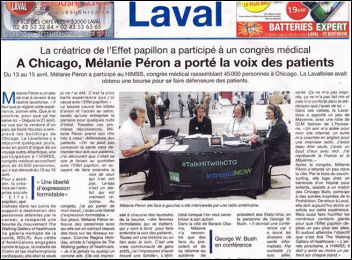
Tuesday afternoon was the CGT live interview and I was a little scared about it. As you know, English isn’t my mother tongue. I make a lot of mistakes and it’s very frustrating to not be able to express your thoughts like you can in your native language (French for me). With the help of the two kind interviewers and the support of Tami, I came through safe. I tried to give the voice and the needs of the people who aren’t heard, who are voiceless — the patients. I hope the message is understood and empathized by many.

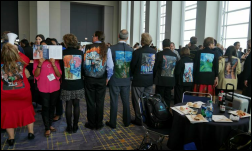
After the interview, we had another gathering with the walkers. I had the privilege of meeting Kym and Ross Martin, two lovely people who know very well how important support and the well-being are both for patient and caregiver. Kym is a three-time cancer survivor and she is as shiny as the sun. Ross loves music and he founded The American College of Medical Informatimusicology and Ross named me fellow for France! I’m very proud to be part of it when you know how important music in my life and in my work is. That’s how l’Effet Papillon began, with music and the meeting of the French singer Benabar.

When you’re a lucky patient advocate invited thanks to HIStalk patient scholarship, you are invited to very nice events and a lot of people want to talk and share your thoughts about patient’s needs with you. Tuesday evening, we had two events where we were invited. The first was the Speakeasy party organized by Medicity. The second was the social media healthcare leaders in Gino’s. It was very nice and Tami won a Chromebook!

I began Thursday with a session about physician tools for patient engagement and it was very interesting. I learnt that 72 percent of Internet users look online for health information within the past year (2012 survey) and research indicates informed patients are more likely to comply with physician-recommended treatment, more willing to take an active role in their own health, less likely to make unnecessary health visits such as to emergency room, and more likely to have better health outcomes. About the topic patient-centered vs. patient engagement, they told us that patient-centered care is about the actions of the physician and other care providers and patient engagement is about the action of the patient regarding their own care. I have the dream that all physicians share the same goal and so the healthcare system!

image

Little after, I did a demo of Bliss in a Starbucks for Tami.

After that I had a nice meeting with Bewatec. This company offers multimedia communication solutions for hospitals. I thought it could be interesting for them to see Bliss, the social network of l’Effet Papillon I imagined and designed to answer to the social isolation of sick people. I have to keep in touch with them because we did not have a tablet version for the moment.

Because of the awful WiFi, I heard very late about Carly and the fact that she was in the emergency room of a Chicago hospital. She did so much for the patient advocacy during the event that her body stopped her with a huge migraine. With my daily headaches and the huge migraines I have quite often, I understand very well this kind of problem. When you give a lot and you don’t rest enough, your body stops you. And Carly, as a chronic patient with Crohn’s disease, knows that much more than me.

On the afternoon, I met Medfusion and they did a demo of their portal of portals for me. I’m not used to applications like that and I was surprised to find it quite easy and user friendly. They told me they asked for patients’ thoughts and needs when they were creating their app. The solution manager gave me an invitation code to download the app and try it, but unfortunately it’s not supported by my HTC One mini 2 so I am unable to review it.

image

image

At the end of the day, we had the last gathering of The Walking Gallery.

Thanks to HIStalk for this scholarship opportunity at HIMSS, I lived one the very best moments of my life. It was one the most incredible experiences I have had since the beginning of l’Effet Papillon. I met amazing and lovely people, people who inspire the change, people who dare, people who try and a lot of DOERS! With Amanda, Tami, Carly, Regina, Lorre, and Kim (you were there in our thoughts), I found incredible new friends.

I have never been so well received and listened to. In 2011, when people asked me, “Why do you want to create something which doesn’t exist? If a structure dedicated to bring a greater welfare for sick people doesn’t exist, it is because it’s not possible,” at that time, I discovered those crazy people like me are called social entrepreneurs. In 2015, thanks to HIStalk and Regina Holliday, I discovered that I was a patient advocate and a change maker.

One day, I’ll hope to bring wellness and happiness in the US too and I think Bliss could be a lovely way. I met so nice people there! The butterfly wants to fly and bring bliss actions everywhere.

I hope I will have the chance to live again those kind of moments and to attend to other events like that with patient advocates. Don’t forget about Carly’s challenge for HIMSS16: bring at least one patient to each booth!

Again, a huge thanks to Regina Holliday with The Walking Gallery of Healthcare and HIStalk who allowed me to be part of this journey.

If you want to stay in touch, feel free to contact me, I’ll be happy to talk with you by website, email, Twitter, Facebook, or LinkedIn.

HIMSS15 Patient Advocate Recap–Amanda Greene

April 28, 2015 News 3 Comments

When I first heard about the opportunity to attend the 2015 HIMSS conference in Chicago as a HIStalking patient advocate on Regina Holliday’s blog, I knew I had to apply even if I didn’t earn one of the coveted scholarships. I wanted to be a part of the incredible opportunity that invited patients to be a part of the largest health IT conference of the year. I was thrilled when I found out that I was going to be one of five patient advocates selected by Regina and the HIStalk team.

image

"LA Lupus Lady" in The Windy City of Chicago at HIMSS15.

After weeks of planning and preparations, taking a trip when you manage a chronic illness is more than packing your suitcase — it involves strategy and planning for all contingencies. Traveling to Chicago, checking in to the hotel, and adjusting to Chicago time is for most people the extent of travel stress. For me, the seemingly endless walk to the departure gate and retrieving my luggage was a virtual marathon, yet my adrenaline and excitement pushed me with a sense of excitement. I made it to the shuttle and arrived McCormick Place with eagerness and anticipation.

There was a small registration situation, but soon I found myself meeting Colin Hung (@Colin_Hung of #hcldr) for the first time. I love meeting my friends from social media in real life and had been looking forward to hugging Colin at HIMSS. Thankfully Colin had access to an extra HIMSS pass and shared his access with me.      

Strolling the streets of Chicago was one thing but walking the aisles of booths within the exhibit hall of HIMSS was incredibly empowering. I was filled with joy and inspiration with every step. The colorful signage and well-appointed booths were on abundant display as Colin helped me wield the magnificent madness and lead the way to the HIStalk booth to check-in with Regina and the HIStalk team.

image

Regina Holliday and Colin Hung show off their "The Walking Gallery" jackets in the HIStalk booth at HIMSS15.

Soon I was on my own and wandered through the exhibition hall, meeting executives and representatives for the largest health IT companies as well as the next big thing and meeting the teams behind the start-ups who strive to create the next big paradigm shift in information technology. After a fabulous first day of HIMSS adventures, it was time to celebrate at the HIStalkapalooza party held at Chicago’s famous House of Blues, where I was proud to participate in judging the HIStalk "Best Dressed" and "Best Shoes" contests. In case you don’t know this about me, let me share that I love it when my passions collide, and being a patient advocate with a new Karen Kane dress on at the HIStalk HIMSS party was a real collision of my passions for health activism, fun, and fashion.

The reason attending HIMSS was such a pleasure for me is that HIMSS is a "global, cause-based, not-for-profit organization focused on better health through information technology." As a healthcare activist, I was happy to be healthy enough to attend the conference and absolutely thrilled to be able to engage and connect with the stakeholders involved with developing the next generation of healthcare devices and apps. More importantly, I was able to be seen and heard as a patient advocate.

image

Patient advocate "engaged" with Jan and Jack at HIMSS.

On Tuesday morning, Jan Oldenburg of the HIMSS Connected Patient Initiative shared the value and impact of engaging with patients at the Digital Health Meetup. This meetup was one of the most empowering sessions of HIMSS15. I was already teary from Jan’s passion for the community and retelling of Regina Holliday’s story "73 cents" when she asked if anyone was a member of "The Walking Gallery" and wearing their jacket.  Of course, I was. I stood up and "modeled’ my jacket. Soon after, Jan mentioned that WEGO Health CEO Jack (@healthyjack) Barrette was in the crowd. I was overwhelmed by inspiration and had to talk with Jan about how I could continue my passion for the Connected Patient Initiative and community after the conference was over.

image

"Connected Patient" Learning Gallery exhibit at HIMSS.

Imagine the future of healthcare where patients and doctors are able to share EMRs/EHRs with immediate access and are able to create a system of Meaningful Use. (No Meaningful Use "MU" without me.) At the HIMSS conference, the future is not some far off and distant place but "the future is now."

image

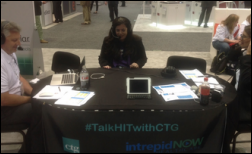
In addition, to attending HIMSS as a patient advocate, I was interviewed for #TalkHITwithCTG. Thank you to CTG Health Solutions for being a sponsor of the HIStalking patient advocates HIMSS registration passes. CTG Health Solutions was generous and extended their extra passes to HIMSS to HIStalk and that is how the HIStalk patient advocates were able to gain admission to HIMSS. (Thank You!)  

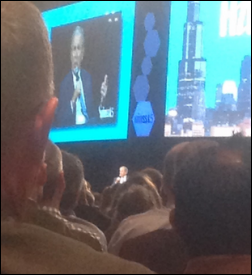
Headlining the HIMSS conference was former POTUS George W. Bush. He was surprisingly jovial and recalled his memories of days during his Presidential administration. I enjoyed his family stories of how his parents and family have taught him the value of family, trust, and love. Though attendees were told not to take pictures during his keynote presentation, as a patient advocate I was also told to be gently and openly "disruptive," so I enjoyed the challenge of sneaking pictures of 43 during the Q&A.

image

Former President George W. Bush giving the keynote at HIMSS15! Wowing the crowd.

Immediately after the Presidential keynote, it was time for the HIMSS Block Party, a celebration of the community and regional HIMSS chapters representatives were there to encourage a real sense of community.  It was at the HIMSS Block Party where Regina and the HIMSS attendees who are members of The Walking Gallery gathered for a photo op and hugs. On my way out of the party, I luckily met the California HIMSS chapter representatives, and as luck would have it, I won the Block Party prize of California wine and treats. The HIMSS community made me smile even more (on the last day after the conference) than I thought possible.

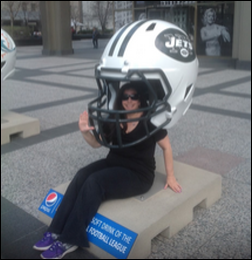
The next day, I spent more than a few hours napping and recouping from the conference, but I forced myself to get out and explore the city. In addition, to visiting the famous Bean sculpture, I went to Tribune Plaza for a special "photo op" with my favorite football team’s helmet. Despite being in Chicago, I had to pose with the New York Jets helmet, a part of the city’s preparation for the NFL draft. 

image

Passions collide in Chicago… #LHandSign in the New York Jets helmet in front of the Chicago Tribune. Raising Lupus Awareness in the city after HIMSS15 wrapped.

It was an honor and pleasure to join the HIMSS community. I feel so lucky to have had the opportunity to participate as a HIStalk patient advocate. I will never be able to show my deep gratitude and appreciation to everyone who made my journey to Chicago such a wonderful adventure.  Lorre, Jennifer, and of course the entire HIStalk team, I am so grateful. How can I begin to thank Regina Holliday for creating the environment where patients are included?  

I am proud to share my adventures in Chicago and hope that this post was able to give you a glimpse into my HIMSS journey. Patient advocacy is my path and I feel that my trip to Chicago was a delightful turning point in empowering me to "level up” my activism and share my enthusiasm for advocacy. In case you are wondering, yes, I am still smiling.

News 4/29/15

April 28, 2015 News 3 Comments

Top News

image

Vanderbilt University Medical Center (TN) will replace its McKesson Horizon system — the CPOE portion of which it developed in-house as WizOrder starting in 1995 — with either Cerner or Epic. That’s one of the last homegrown systems to bite the dust, both at Vanderbilt and everywhere else as McKesson puts its commercialized version out to pasture after a 12-year run. It’s also interesting that Vanderbilt is echoing the general market trend of considering only Cerner and Epic to be viable choices, showing no interest in looking at Allscripts, Meditech, or McKesson Paragon.


Reader Comments

From Willow: “Re: Xerox Midas+ layoffs. Four laid off so far, apparently prompted by the first poor quarterly earnings report in the company’s history, which appear to have been caused by the high consulting and infrastructure costs spent on its Juvo product.” Unverified.

image

From Concerned CC Client: “Re: new CEO at CareCloud. Positioned as great new, but in reality not. Since they were founded in 2009, under Santalo’s direction, they have gone through $80.5 million, are not making money, and now need $15 million to stay afloat.” EHR/PM vendor CareCloud announces Ken Comee as CEO, replacing Albert Santalo, who will remain as chairman and chief strategy officer. The company also announced $15 million in additional funding from existing investors. Technology executive Comee has been on CareCloud’s board since 2012, and according to his LinkedIn profile (which features the overly arty “more chest, less head” look above), he has no other healthcare-related experience.


HIStalk Announcements and Requests

We’ll have HIStalk Practice posts Monday through Thursday going forward (instead of just twice weekly) and Jenn will also write a Friday summary of population health management news. Sign up for short, fun, and informative updates and see what’s new in ambulatory, practice, and PHM.


Webinars

None scheduled soon. Contact Lorre for information about webinar services.


Acquisitions, Funding, Business, and Stock

image

Private equity firm Francisco Partners will acquire healthcare talent management solutions vendor HealthcareSource from majority owner Insight Venture Partners.

image

Merge Healthcare announces Q1 results: revenue up 6.9 percent, adjusted EPS $0.05 vs. $0.04, beating earnings estimates but falling short on revenue.

image

Validic raises $12.5 million in Series B funding from investors that include the venture arm of Validic customer Kaiser Permanente.

The Raleigh, NC business paper says Allscripts will build a new 18-story building for its 1,260 local employees, although the company hasn’t confirmed. The article mentions that Allscripts recently “rebalanced” 3 percent of its workforce.

image

The Chicago business paper profiles referral management software vendor Fibroblast.

image

Scanadu raises $35 million in a Series B round to further develop its Scout tricorder-like body scanner.

CTG announces Q1 results: revenue flat, EPS $0.08 vs. $0.19. The company blames soft healthcare IT services demand as providers delay projects or staff them internally.

Aetna announces Q1 results: revenue up 8 percent, EPS $2.20 vs. $1.82. Chairman and CEO Mark Bertolini said in the earnings call that its Medicity business is “seeing a lot of growth.”

image

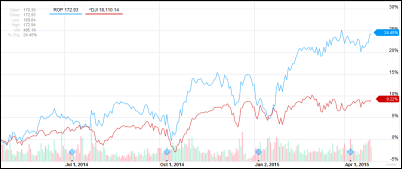
Roper Industries, which owns many companies that in healthcare IT include Sunquest and Strata Decision Technologies, reports Q1 results: revenue up 4 percent, adjusted EPS $1.55 vs. $1.46, falling short on analysts’ revenue expectations but beating on earnings. The company announced in the earnings call that it has changed its name to Roper Technologies to emphasize that it isn’t just an industrial company but rather a collection of businesses that deliver 60 percent gross margins. Above is the one-year share price chart of ROP (blue, up 24 percent) vs. the Dow (red, up 9 percent).


Sales

Consolidated Laboratory Services chooses McKesson Business Performance Services for billing.

Star Medical Center (TX) contracts with Anthelio Healthcare Solutions for revenue cycle optimization.


People

image image image

Medical kiosk vendor HealthSpot hires Gail Croall, MD (Anthem) as chief medical officer; Eric Eichensehr (Levitate Technologies) as CTO; and Bruce Roberts (RxEngage Partners) as COO.


Announcements and Implementations

image

In Qatar, Al Khor Hospital goes live on Cerner Clairvia for nursing staff management.

The CEO of Henry Ford Health System (MI) says that while the system took an initial financial hit in 2013 after its $353 million Epic implementation, using Epic helped it save $65 million in 2014 and HFHS will cut $300 million in cost by 2016 as its financial turnaround continues. Meanwhile, UNC Health Care (NC) also credits Epic with its stronger-than-expected operating income.

Wellcentive, SpectraMedix, and eClinicalWorks are pilot testing NCQA’s eMeasure electronic clinical quality measure program for Meaningful Use and HEDIS reporting.

T-System announces its tablet-based T Sheets Digital for Urgent care that includes 45 chief complaint-based templates.

MedAptus releases Premium Analytics for its charge capture suite.  

QPID Health is named a Gartner “Cool Vendor.”


Government and Politics

The Institute of Medicine will rename itself to National Academy of Medicine effective July 1, 2015.

National Coordinator Karen DeSalvo, MD says in a Health Affairs blog post (which appears to have been taken verbatim from her HIMSS conference presentation) that ONC will use Medicare payments and the DoD’s EHR contract bid to push interoperability.


Privacy and Security

image

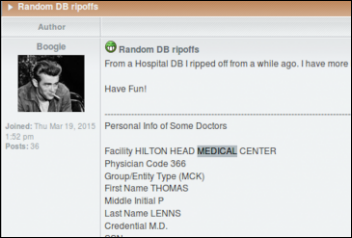
A security researcher finds data from Hilton Head Hospital (SC) for sale on a hacker marketplace, apparently exposed during a 2014 breach caused by PST Services, a McKesson subsidiary that provided billing services to Tenet’s hospitalist contractor and inadvertently opened up its billing records to Internet searches.

image

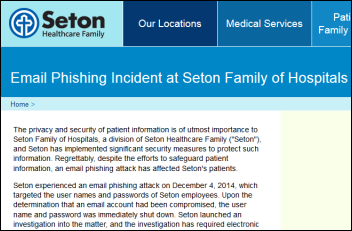
Seton Family of Hospitals becomes the latest organization to expose patient information via employee-targeted email phishing attacks. Hackers accessed the information of 39,000 Seton patients in the December 4 breach.


Other

image

Pella Regional Health Center (IA) opens a 24×7 nurse hotline as part of its patient-centered medical home efforts. Anyone can call the hotline to discuss concerns or make appointments with nurses who have access to the EHR.

Partners HealthCare expects to double the $80 million in annual revenue it receives from licensing and spinoffs.

Former National Coordinator David Blumenthal, MD says in a Wall Street Journal editorial that healthcare IT will fall short of its potential unless security and interoperability are improved.

A Brookings article highlights the maximum “reasonable cost” providers can charge patients for providing 75 copied pages of their records, which ranges from $19 in California to $101 in Georgia. It mentions that providers in many states can charge patients the same per-page amount for copies of their digital records even though the provider cost is essentially zero.


Sponsor Updates

  • Amerinet extends through 2018 its member discounts to revenue integrity products from Craneware, also adding the company’s InSight Medical Necessity tool.
  • Zynx Health and Meritage ACO will present “Using a Mobile Tool to Create a Virtual Caregiver Huddle” at the NPSF Congress April 29 – May 1 in Austin, TX.
  • Cueatr posts a photo slideshow of its experience at the HIMSS conference.
  • ADP AdvancedMD announces the launch of its SmartPractice e-letter for independent practices.
  • AtHoc details its integration with Apple Watch.
  • Besler Consulting outlines how “CMS-1498-R2 gives hospitals option to have their SSI Factor recalculated.”
  • CareSync offers “Here’s How CareSync Changes Lives for the Better.”
  • CareTech Solutions takes a look at how The Metro HealthSystem used the company’s solutions to realize SEO advantages and budget benefits.
  • The local paper looks at how several HIStalk sponsors — CenterX, Forward Health Group, Healthfinch, and Nordic Consulting – are making an impact in their native Madison, WI.
  • Team CoverMyMeds shares personal highlights of HIMSS15 in its latest blog.
  • MedCPU looks back on its HIMSS15 experience.
  • Health Care Improvements Institute announces its partnership with xG Health and interviews xG Health CEO Earl Steinberg, MD and President/COO Ray Herschman.

Contacts

Mr. H, Lorre, Jennifer, Dr. Jayne, Dr. Gregg, Lt. Dan.

More news: HIStalk Practice, HIStalk Connect.

Get HIStalk updates.
Contact us online.

125x125_2nd_Circle

Monday Morning Update 4/27/15

April 26, 2015 News 14 Comments

Top News

image

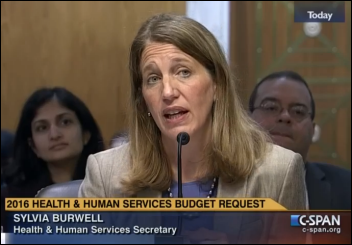
HHS Secretary Sylvia Burwell, testifying on the department’s $84 billion 2016 budget request, is challenged by Sen. Lamar Alexander (R-TN) who stated that half of doctors don’t like their EHRs to the point that they’ll accept Medicare penalties rather than deal with workflow disruption, adding that the AMA found that 70 percent of doctors say their EHRs weren’t worth the cost and that EHRs are the leading cause of physician dissatisfaction. Burwell responded that HHS will work with Congress on a list of administrative action items related to EHRs, which seems to refer to the work of the HELP committee that most recently talked about interoperability and interviewed Epic’s Peter DeVault. What worries me most about the entire exchange is that nobody questioned whether HHS or Congress have any business involving themselves with how doctors use EHRs, where Burwell’s response might have logically been, “Respectfully, our job is making taxpayer payments to providers who choose to participate in Medicare and HITECH, but otherwise the EHRs that providers buy, use, and complain about really aren’t under the government’s purview. We should be monitoring the outcomes, not prescribing the process, which is how government works with all other industries.”


HIStalk Announcements and Requests

image

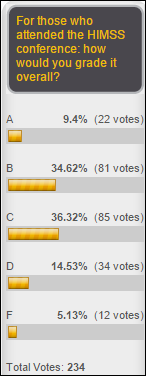
Poll respondents grade the HIMSS conference with somewhere in the C-plus range. A consulting company vendor says it was successful in meeting with clients and networking with peers, while a CIO observes that the HIMSS conference is all sizzle and no steak as it keeps growing and ratio of vendors to providers seems to be going up as well. New poll to your right or here: what do you think about the fact that most health IT vendor executives are white men? (“I’m not thinking about it at all” is a poll option as well). Add a comment to support your position if you like.

image

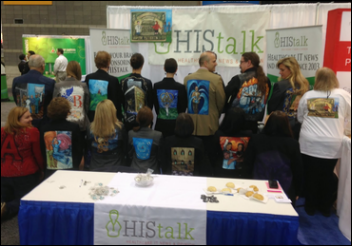
We were signing up for our microscopic booth for HIMSS in Las Vegas and were surprised to find that nearly all of the exhibit spaces have already been taken in the booth signup frenzy that occurs even before the previous conference is over. I don’t have the money or HIMSS points to play with the big boys, but even the 10×10 spaces in weird locations were mostly booked up. The tiniest parcels run around $5,500 and I declined the $2,500 extra HIMSS wanted for a corner space (they didn’t charge extra for our corner spot the past two years). We’ll be in #5069, with our presence probably annoying our next door neighbors Varian Medical Systems and Patient Prompt even though we’ll keep their area busier than it would be otherwise as we have a fun cast of characters running around. At least we don’t have much stuff to stick in there – we brought everything we used in our McCormick Place booth in one large duffel bag and set it up in maybe 20 minutes. There’s no ROI since we don’t have anything to sell, but we like just saying hello and giving our boothless friends a place to hang out.

image

Speaking of our McCormick Place booth, patient advocate Regina Holliday wrote a nice summary of the time she spent there and her HIMSS experience in general.

I forgot to mention an unpleasant encounter Lorre had with the “HIMSS police,” who were a little bit snippy in confronting her at our booth and demanding that we stop using the name “HIMSS Bingo” in referring to a contest that we had nothing to do with other than allowing winners to pick up their prizes there. The HIMSS person was too busy scolding to hear that she had the wrong scoldee.

Most people think of Epic first on the list of Madison-connected companies. Here’s another that just came to me: John Holton, who graduated from UW in 1975, founded Atwork in 1983 and then Scheduling.com (now SCI Solutions) in 1999, although both operated out of California rather than Wisconsin.


DonorsChoose Project Updates

Feel free to skip this section if you aren’t following our project as it winds down – the normal stuff follows.

image
image
image
image
image

Thanks to new participant The Breakaway Group, who donated $500 to get on Centura SVP/CIO Dana Moore’s dance card. I’ve funded $10,478.21 in projects, including these new ones, including some I chose in Colorado since that’s where Dana lives:

  • A printer, tablet supplies, and early literacy books for an elementary school teacher’s graduate courses in education, Los Angeles, CA.
  • A camera and photo printing equipment for creating a time capsule for a high school in Atlanta, GA.
  • Math games and learning activities for a second grade class in Garland, TX.
  • An iPad case and AV adapter for English language learners at an elementary school in Las Vegas, NV.
  • A TV and flash drive to promote newly arrived books in the library of a high school in Walden, CO.
  • Drums for rhythm and movement activities for special needs students at an elementary school in Centennial, CO.
  • Six iPad keyboard cases for a fourth grade class in Lone Tree, CO.
  • Globes, maps, and books for a K-2 class in Denver, CO.
  • A tablet with keyboard for English as a second language students at an elementary school in Fort Lupton, CO.
  • A Chromebook for an earth sciences class at a high school that can’t be accredited due to lack of hands-on learning tools in Norfolk, VA.
  • A complete library of high-interest, low-readability books for a class of severely intellectually disabled students at a middle school in Conway, SC.
  • Four boom boxes and 12 sets of headphones to create a literature listening station in the reading area of an elementary school in Seattle, WA.
  • A library of classic books for a third grade class in Clarksdale, MS.
  • Hand sanitizer and tissues for profoundly mentally disabled K-5 classroom in North Charleston, SC.
  • Baby wipes, diapers, a food blender, wheelchair supplies, and insect repellent for a handicapped K-2 students at an elementary school in North Charleston, SC.

Webinars

None scheduled soon. Contact Lorre for information about webinar services.


Last Week’s Most Interesting News

  • Infor signs an agreement to distribute its hospital data integration products in Cuba.
  • A RWJF study of personal health records finds that consumers value their own subjective narrative entries more than anything else, while doctors rarely even look at them.
  • Seven disabled veterans sue the VA for failing to deliver copies of their disability-related medical records for up to 25 months after their requests.
  • LabCorp announces a direct-to-consumer testing program.
  • Kaiser Permanente announces plans to open a 900-job healthcare IT campus in Atlanta.
  • A judge orders MyMedicalRecords to pay the legal defense costs of Allscripts and WebMD after those companies prevailed in two of a nearly endless number of questionable MMR patent infringement lawsuits.

Acquisitions, Funding, Business, and Stock

image

Business Insider runs the first skeptical article I’ve seen about Silicon Valley lab darling Theranos and its $4.5 billion net worth, 31-year-old founder Elizabeth Holmes. Experts say they have no idea how the company’s technology works because Theranos won’t publish peer-reviewed studies about its tests, won’t let independent experts review its labs, and doesn’t acknowledge whether it’s actually using the same analytical machines as other labs in addition to its small-sample size equipment that other labs use as well. The article also questions whether can scale given its plans to perform 1 million tests in 2016, less than 0.2 percent of the number performed by Quest. Quest and other competitors are questioning whether tests performed by Theranos using capillary blood (microfluidics) are accurate.   


Sales

Children’s Hospital Association chooses Clinical Architecture’s Symedical for global terminology management for analyzing comparative data.

image

Avera Health System (SD) selects Meditech 6.1 Web EHR for 33 hospitals and 208 clinics. The press release isn’t clear as to whether this is an all-new product and Googling the term “Meditech Web EHR” brings up a non-specific mention on the company’s website, which used to be a no-nonsense list of information but is now maddeningly glossy and detail-free, with artsy scrolling pages and oversized type crying for Internet attention without providing much value in return. Click “EHR Solutions” and you won’t see a list of them. I don’t fully understand how a product can be “groundbreaking” if it’s in version 6.1 or whether this is just a new Web front end for the same old products.


People

image

Mark Young (StayWell Health Management) joins PatientSafe Solutions as COO.


Announcements and Implementations

Phynd Technologies will analyze the cost to Nebraska hospitals of managing their provider information manually vs. using its provider information management platform in a project funded by the state.


Government and Politics

The VA forms an 11-member medical advisory group to advise it on healthcare delivery issues.

image

Here’s a pretty funny tweet from CMS Chief Data Officer Niall Brennan.


Technology

image

Healthcare is always a lagging chaser of consumer technologies, so I’m not quite sure what to make of the just-announced Amazon Dash, a WiFi-connected, product-specific stick-on electronic button that lets users restock a particular product with a single press. It’s either a brilliant time-saver that creates even more loyalty to Amazon and the products it sells or, as The New Yorker opines, “an uneasy image of our homes as giant Skinner boxes, and of us as rats pressing pleasure levers until we pass out from exhaustion” that bypasses the brief thinking moment of “Why am I using all this stuff?” while driving to the store. I didn’t realize that Amazon already offers a speech recognition and barcode scanning version of Dash for users of its expensive AmazonFresh grocery delivery service in Seattle, California, and New York metro areas.


Other

USA Today profiles the involvement of patients in the EHR selection of Partners HealthCare (MA), which invited a patient who sits on its advisory board to help choose its $700 million system. I like the approach, although I can’t help but think of the economic strong-arming and brand name-brandishing Partners does to squeeze out competitors and force insurers to pay its exorbitant rates, which isn’t really in the best interests of patients or the healthcare economy in general.

An investigation has been underway in Texas to review the state’s issuance of a no-bid Medicaid anti-fraud system contract to a local bidder with zero experience. The Houston newspaper points out that the state was already using a similar system that had recovered $56 million against its original cost of $16 million, while the new $20 million system (with a pending $90 million extension) has recovered zero dollars. Nearly all of the funds came from all of us who pay federal taxes. State government was asleep at the wheel, with a prime example being that the contractor (21CT) billed it the full price of a $452,000 project the day after the purchase order was signed and the state paid it immediately. A few state employees have been fired and a criminal investigation is underway. The state’s HHS inspector general who arranged the deal lied to CMS by claiming that a competitive bidding process had been conducted and then resigned after local newspapers exposed the scandal.


Sponsor Updates

  • Nordic offers a recap of #HIMSS15 through its Twitter feed.
  • PatientKeeper offers thoughts on “HIMSS and hEHRs.”
  • MBA HealthGroup offers “Skin in the Game: Keys to Success in a Private Dermatology Practice”
  • MedData breaks down the 2015 PQRS payment adjustment statistics.
  • Wellsoft will exhibit at the EDPMA Solutions Summit April 26-29 in Amelia Island, FL.
  • Sandlot Solutions will exhibit at the Big Data in Healthcare Summit April 28-30 in Boston.
  • Netsmart’s e-prescribing solution attains certification for controlled substances.
  • TeleTracking asks, “Who’s Looking Out For Nurses?”
  • PDS offers “Five Tips for a Trend-Setting Healthcare IT Strategy.”
  • NTT Data offers “Wearables in the Enterprise – What are Industries Saying?”
  • Patientco adds 2.4 million patients to its patient revenue cycle platform.
  • PeriGen recaps last fiscal year in “Another 48,611 births powered by PeriGen.”
  • PMD offers “Keeping Priorities Straight and Scaling Support.”
  • QPID Health CMO Michael Zalis, MD is featured in “Diagnosing Imaging: Maximizing Appropriate Use with Smart Decision Support.”
  • Sagacious Consultants offers “ICD-10 Training for Providers, Coders, and CDI Specialists.”
  • New York eHealth Collaborative offers “The Healing Power of Your Own Medical Records and SHIN-NY.”
  • Stella Technology offers “HIMSS15 Conference Highlights and Takeaways.”
  • Summit Healthcare declares that “HIMSS 2015 Did Not Disappoint!”
  • T-System will exhibit at the UCAOA National Urgent Care Spring Convention April 27-30 in Chicago.
  • Truven Health Analytics offers “Appealing the CMS Risk Adjustment and Reinsurance Calculations: Making Sense of the Discrepancy Regulations.”
  • Versus Technology publishes “Reflections on the Oklahoma City Bombing, from a Nurse Who Was There.”
  • Huron Consulting Group is named one of America’s best employers by Forbes.
  • Winthrop Resources will exhibit at Interop Las Vegas 2015 April 27-May 1.

Contacts

Mr. H, Lorre, Jennifer, Dr. Jayne, Dr. Gregg, Lt. Dan.

More news: HIStalk Practice, HIStalk Connect.

Get HIStalk updates.
Contact us online.
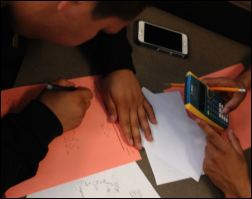
125x125_2nd_Circle

News 4/24/15

April 23, 2015 News 8 Comments

Top News

image

Two New York-based, healthcare-related organizations strike deals that will make them some of the first US firms to conduct business in Cuba now that sanctions have been relaxed. Roswell Park Cancer Institute (cancer research) and Infor (hospital data integration) announced their plans following a trade delegation visit this week led by New York Governor Andrew Cuomo.


HIStalk Announcements and Requests

I decided to follow through on looking at female representation on vendor executive teams as listed on company webpages since it came up on HIStalk last week. Companies have the incentive to hire the most qualified people regardless of demographics, but just in case you’re interested for whatever reason, here’s the percentage of females they’ve chosen.

Percentage of Females on Leadership Team (highest to lowest)
Wolters Kluwer Health 50
Meditech 41
Merge 33
TriZetto 25
Advisory Board 25
Optum 23
Athenahealth 22
Quality Systems 22
InterSystems 22
Cerner 19
Nuance 18
Greenway Health 18
Leidos Health 17
GE Healthcare 15
Premier 15
Surescripts 12
Philips North America 11
MModal 10
Emdeon 8
Allscripts 0
McKesson Technology Solutions 0

Some other percentages:  Facebook (20), Microsoft (19), Google (15), and IBM (27). HIMSS comes in at 17 percent.

I was reading a tweet that referred to pilot turned safety expert (and 2010 HIMSS keynoter) Sully Sullenberger as a “national hero.” The cynic in me (which has a significant presence) cringes at how we’ve devalued the term “hero” to label anyone who experiences adversity (including the randomly applied kind) rather than reserving the term for those who exhibit bravery or noble deeds in intentionally sacrificing themselves on behalf of others. Sully landed his plane safely in the Hudson River, but he was saving himself as well as his passengers. He was cool under pressure, humble, and performed the job he was being paid to do better than most would have done, but “hero” might be a stretch, just as it is when referring to athletes, victims of violence, someone who calls police to report a crime in progress, or groups that may well contain some but not all heroes (firefighters, service members, or even clinicians, for instance).

This week on HIStalk Practice: interoperability melancholia sets in after HIMSS. Matter Chicago CEO previews AMA physician office of the future. Radiology practices select new rev cycle technology. Azalea Health takes on telemedicine. Physicians’ Alliance of America looks for PCP feedback on EHR charting productivity. New study finds that online physician reviews don’t have much to do with clinical expertise. Modernizing Medicine CEO Dan Cane dives into the company’s relationship with IBM Watson. StatDoctor CEO Alan Roga, MD outlines the benefits of video in telemedicine.

This week on HIStalk Connect: Tech-savvy health insurance newcomer Oscar Health raises a $145 million funding round on a $1.5 billion valuation in just its second year in business. Ernst & Young creates a digital maturity index focused on quantifying the sophistication of telehealth programs. Color Genomics unveils a $259 genetic screening test that looks for 19 key mutations, such as BRCA1 and BRCA2, that are known risk factors for developing breast or ovarian cancers. Gravie, a private health insurance exchange startup, raises a $12.5 million Series B to expand its presence into Texas and Illinois.


DonorsChoose Fundraising Project Update

image

image

image

Our total now stands at $10,000 thanks to new participation from ZirMed, TransUnion Healthcare, BlueTree Network, and Orchestrate Healthcare. BlueTree Network was notable in donating $1,000 instead of the requested $500, while TransUnion Healthcare VP Patrick Gilmore missed the chance to meet with Centura SVP/CIO Dana Moore at the HIMSS conference but said he wanted to donate anyway. Dana will provide a summary of his conversations with these companies later. I’ve funded $6,656 in projects and will get the remaining $3,344 out to classrooms by this weekend.


Acquisitions, Funding, Business, and Stock

Navicure announces a 32 increase in year-over-year sales of its billing and payment solutions.

India-based Wipro expects its healthcare business to hit $2 billion in annual revenue by 2018, double its 2015 expectations, mostly due to increased technology spending triggered by US healthcare reform. The company will target acquisitions in the $100-$200 million range, saying it passed on acquiring TriZetto (acquired by Cognizant for $2.7 billion) because of the price.

The Illinois Hospital Association will merge with the Metropolitan Chicago Healthcare Council effective January 1, meaning the state hospital association will be running an HIE (MetroChicago HIE) and insurance company.

image

A federal judge orders the legally prolific MyMedicalRecords to pay the defense fees of WebMD and Allscripts, which beat some of MMR’s bottomless patent infringement lawsuits after refusing to pay “licensing fees” for ubiquitous technologies.

image

Jeff Bezos discloses the financial performance of Amazon Web Services for the first time in the unit’s nine-year history, stating that it’s a $5 billion business that’s growing fast.

A Wall Street Journal article finds that universities (Vanderbilt, Emory, and University of Arizona) are cutting ties with their cash cow academic medical centers as their high costs threaten to exclude them from exchange-based insurance networks.


Sales

image

Swedish Cancer Institute (WA) chooses the Synapse Precision Medicine Platform to provide oncology clinical decision support using patient genomic information.

Mount Sinai Health System (NY) selects the InterSystems HealthShare interoperability platform.

CareWell Urgent Care chooses Athenahealth’s EHR and practice management system for its 49 providers.

LTPAC EHR vendor SigmaCare chooses Liaison EMR-Link hub to connect with lab and imaging vendors.

Augusta Health will use Meditech performance monitoring tools from Goliath Technologies. The company’s press release doesn’t bother to mention where its new client is located (who writes this stuff, anyway?), so I’ll take a Google-inspired guess and say Virginia.


People

image

Davide Zaccagnini, MD (Nuance) joins SyTrue as CMIO.

image

Dominick Bizzarro (Value Informatics) joins insurer MVP Health Care as EVP of business development and informatics.

image

Cerner co-founder and Chief of Innovation Paul Gorup is retiring, insiders tell me. He helped develop PathNet in the 1980s, left Cerner in 1987 to run a radio station monitoring company, then returned to Cerner in 1999 to develop its hosting business. Gorup said in a 2013 interview, when asked why Cerner succeeded in healthcare while IBM and GE fizzled, “That’s easy. What does the head of IBM get up and think about every morning? I guarantee you it’s not healthcare. Same with the head of GE. He might think about energy or finance, but not healthcare. You have to think about it 24 hours a day. It’s not a part-time business. If healthcare becomes a part of something else, you’ve lost your focus.”


Announcements and Implementations

Referral software vendor EHealth Technologies announces a partnership with Box to support PDF viewing, medical image display, and structured document viewing.

Craneware announces enhancements to its Chargemaster Corporate Toolkit that include a single consolidated view, corporate chargemaster change distribution, and advanced workflow integration.

Capsule releases its Early Warning Scoring System for its SmartLinx Chart Express charting solution to alert clinicians of patient deterioration based on real-time vital signs analysis.

Zynx Health enhances the secure text messaging capabilities of its ZynxCarebook mobile coordination platform.

A TransUnion Healthcare analysis finds that increasing healthcare expenses and lower consumer credit lines have left consumers less able to pay their medical bills than last year. A big driver of the increased patient cost involves joint replacement procedures, which are 20 percent more expensive than they were a year ago.


Government and Politics

In Australia, the Victoria medical association calls on the state to spend $39 million to improve connectivity between hospitals and practices, hoping to at least enable delivery of discharge summaries and lab results after several expensive IT projects failed to deliver that capability.

Minnesota’s health commissioner says he’s concerned about pushback on the state’s 2008 requirement that all providers use EHRs by the end of this year. He debunks four privacy myths that are apparently the crux of the unstated opposition’s campaign.

A New York Times investigative report finds that the VA’s wait times scandal cost only three jobs vs. the 60 firings the VA claimed. One VA employee was fired for accepting gifts not directly related to wait times, one retired to avoid being fired, one is awaiting termination, and five employees were reprimanded. The VA often transfers problem employees and those who appeal their terminations can collect their paychecks for up to two years while awaiting a decision. 


 Innovation and Research

HHS will support three projects via its Ventures Fund: a website that allows providers to crowdsource possible new uses for existing drugs, an evaluation system for funding disaster preparedness, and a smart phone based diagnostic tool for malaria.

A Robert Wood Johnson Foundation study of personal health records finds that while consumers believe the most important information contained in PHRs is their own recorded daily observations (diet, exercise, mood, medication response), physicians usually don’t even look at them, instead turfing such review off to nurses and health coaches. The study also found that consumers think their information is valuable enough to outweigh any privacy concerns. It also concludes that demand for PHRs is surprisingly low because nobody is sure what problems they’re supposed to solve. I’ll extend my own musing: technology-powered lusting for discrete data capture and big data analysis cannot overwhelm the essential nature of the encounter, which is to listen to what the patient (and not necessarily their data points) is saying. Not everything that’s health related can be described by passively collected data dropped into convenient little buckets, and not everything that’s important will come up without skilled engagement of the “tell me how things are going” variety. My takeaway is that we need to make sure that technology enhances rather than limits the use of the patient’s own voice in the participatory guiding of their health.


 Technology

image

Heal releases a house call app for the Apple Watch that allows users to request a doctor visit with a single touch. Doctors equipped with mobile diagnostic apps such as the AliveCor ECG and CellScope otoscope arrive at the desired location within an hour and spend as much time as needed for a fixed fee of $99. One of Heal’s investors is Lionel Richie.


Other

Hospitals are moving inner city hospitals to suburbs where better-paying patients live, a Kaiser Health News article reprinted in Newsweek points out. Hospitals defend the practice by saying it’s cheaper to build a new suburban hospital than to renovate a old, land-locked downtown facility, but city officials say their core areas are being medically abandoned as hospitals chase patients who have better insurance.

Oxycodone-related deaths dropped 25 percent following Introduction of Florida’s doctor-shopping database of controlled substance prescriptions, a University of Florida study finds. However, deaths were already decreasing after the state shut down hundreds of pill mills posing as pain management clinics.

A study finds that 28 percent of Americans did not perform even one physical activity in 2014, increasing the “totally sedentary” number to the highest it’s been since 2007. Experts blame reduced physical education time in school and the competitive nature of school sports that leaves most students on the sidelines.

HealthLoop founder Jordan Shlain, MD says he started the company when he realized as a doctor that his mental model was wrong – inviting a patient to contact him when in need is not the same as proactively checking up on them, which he summarizes as invalidation of the “no news is good news” attitude since that means the same as “no data is good data.” He also says hospitals dehumanize their treatment failures by giving them the blame-free, dumbed-down label of “readmission.” He warns that probability-challenged people often make bad decisions in using data and algorithms as a blunt instrument without paying attention to what it means for individual patients.

An Australian blogger who built a business (including a wellness app) by claiming she cured her terminal brain cancer by diet and lifestyle alone admits that she was lying – she never had cancer. She was caught when she failed to donate $300,000 in app sales to charity as promised.

image

Weird News Andy titles this article as “A Rocky Experience in the OR.” A professor and facial surgeon in England loses his license after punching an anesthetized patient in the face 10 times to correct a broken cheekbone. The doctor admits that he “manually reduced the fracture” because the patient wasn’t fit for surgery, adding that doctors punch patients all the time while doing CPR. The patient is fine, while the surgeon is now offering his services in Dubai.


Sponsor Updates

  • Valence Health is convening its second annual Pediatric Collaborative for Value-Based Care forum in Chicago this week.
  • DocuSign is named among Silicon Valley’s “Best Places to Work 2015” for the fourth consecutive year.
  • E-MDs will exhibit at the MGMA regional meeting April 29 in Galveston, TX.
  • Galen Healthcare recaps the “Top 5 Themes from the Super Bowl of HIT.”
  • Hayes Management Consulting offers “Planning for the Unexpected EHR Downtime: 4 Key Steps.”
  • HCS will exhibit at the National Association of Long Term Hospitals 2015 Annual Meeting April 30-May 1 in Washington, DC.
  • HCI group offers “7 Essential Items Every McKesson Horizon Customer Should be Considering.”
  • Healthfinch’s Karen Hitchcock offers “A First-Timer’s First Impressions.”
  • Healthwise will exhibit at the Annual NPSF Patient Safety Congress April 29 in Houston.
  • Holon Solutions offers “RightFax End of Life Support Dates: Are You Ready?”
  • Impact Advisors offers its top 10 takeaways (and HISsies Award coverage and predictions) from HIMSS15.
  • The Atlanta Business Chronicle recognizes Ingenious Med as one of the city’s top 100 fastest-growing privately held companies.
  • PDR will exhibit at the National Association of Chain Drug Stores Annual meeting April 25-28 in Palm Beach, FL.
  • LifeImage celebrates five years in business and 1 billion images exchanged.
  • LifePoint Informatics offers a new white paper explaining “Why Access to Lab & Diagnostic Data is Important to Providers, Payers, and Patients.”
  • Logicworks explains why it sells managed cloud services rather than consulting services.

Contacts

Mr. H, Lorre, Jennifer, Dr. Jayne, Dr. Gregg, Lt. Dan.

More news: HIStalk Practice, HIStalk Connect.

Get HIStalk updates.
Contact us online.
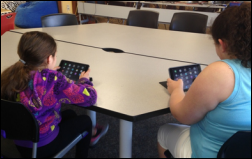
125x125_2nd_Circle

Morning Headlines 4/23/15

April 22, 2015 News Comments Off on Morning Headlines 4/23/15

FDA grant to determine drug safety through EHRs

The FDA is offering a grant worth up to $1 million to fund research focused on mining EHRs for data that will support post-market drug safety assessments.

Comparative Effectiveness of Childhood Obesity Interventions in Pediatric Primary Care

A study published in JAMA Pediatrics finds that the use of clinical decision support prompts in the pediatric primary care setting had a positive effect on reducing BMI in obese children. The CDS alerts presented clinicians with obesity screening guidelines and links to relevant weight management programs.

Senate hearing examines telehealth benefits, barriers to expansion

More than a dozen bi-partisan senators attended yesterday’s Senate Commerce Subcommittee meeting on telehealth to lobby for expanded access to telehealth services for Medicare beneficiaries and for infrastructure investments that would expand internet access in rural areas.  Kristi Henderson, chief telehealth and innovation officer at the University of Mississippi Medical Center, explains ‘Right now, the greatest challenges lie in winning the federal level reimbursement parity that will make telehealth attractive in the marketplace and securing the reliable, high quality connectivity that telehealth requires.”

News 4/22/15

April 21, 2015 News 10 Comments

Top News

image

Seven disabled veterans sue the VA, claiming that they’ve waited 10 to 25 months for copies of their medical records, delaying their eligibility for benefits.


Reader Comments

From CIO: “Re: patient engagement survey. Do CIOs really think they own it?” A HIMSS-sponsored poll finds that nearly half of health system CIOs believe they own patient engagement in their organizations, but I think there’s a definitional issue here. CIOs often mislabel the tools vs. the program when it comes to analytics, population health management, and patient engagement. The software is just one part of the initiative even though Meaningful Use muddies the picture with its purely technical requirements for patient engagement. I’m fairly certain CIOs don’t really believe they’re in charge of the entire program, but if they do, either they or their employer have a big problem. Non-clinicians (especially IT and marketing people) should not be trying to engage patients.

From Nasty Parts: “Re: Allscripts. What’s going on? Lots of recent senior departures: Diane Bradley, John Dragovits, Peter Mcclennen, Perry Sweet, and Chad Baugh, to name a few.” Unverified. The LinkedIn profiles of all of these folks still list Allscripts as their current employer, although I’ve found that in general people don’t update their profile until they get another job.

From Little Suzie: “Re: [publicly trade vendor name omitted]. I’ve heard from a not-necessarily-reliable source that they may be acquiring [publicly trade vendor name omitted]. True?” Lips are typically and justifiably sealed when publicly traded companies are involved in M&A talks. This one would be huge. I don’t see the synergy, but the first vendor is on a roll and the second is wheezing, so it’s possible that a fire sale is being discussed.

image

From Pirate Wench: “Re: interesting sexual harassment lawsuit against a healthcare IT executive.” It’s juicy, but keep in mind you’re reading only one of the inevitable two sides of the story. The lawsuit, filed by a demoted employee, says Quality Systems, Inc. (parent of NextGen) protects its male employees who harass female employees. The real story will be how the lawsuit is disposed of, which I strongly suspect will be by a sealed settlement since a trial would be unpleasant for both sides.

From Candid Cameron: “Re: females at HIMSS. I saw a big drop in booth babes, which I think is due to pressure from publications such as HIStalk. I’d like to see recognition of companies with at least 40 percent female executives or 40 percent female speakers at the conference.” I’m wary of assuming intentional bias (gender, age, nationality, etc.) in observing executive team demographic composition, but it would be interesting to see the percentage of VP-and-up females in each company.


DonorsChoose Project Updates

This isn’t directly related to healthcare IT, so feel free to skip on down to the next section if it’s not your thing.

image

image

Our DonorsChoose project donations have jumped as another company offered a $500 donation in return for 20 minutes of Dana Moore’s time by telephone and our anonymous matching vendor agreed to match this donation as well. That brings our total to $8,000. I’ll be funding new projects as a result. Meanwhile, above is another of the many teacher thank you emails I received, this one from a kindergarten classroom for which we donated a projector. I was so moved that when I saw that Mrs. Henry had an open grant request for an AV cart to house their new projector that I funded that as well.

image

image

Meanwhile, here are a couple of student-written thank you notes from an earlier project we funded. DonorsChoose defaults the option to receive student notes to “yes” when you fund a project, but I unchecked it this last time because it’s a fair amount of work for the students and we funded so many projects I would be overwhelmed by all their notes anyway. Still, it’s gratifying to hear from the students who are actually benefitting from the donations.


HIStalk Announcements and Requests

image

One of the more disturbing things I saw at the HIMSS conference was people running around wearing giant red noses, courtesy of a Walgreens fundraiser for children’s poverty. I like the cause but not the noses, which make me think of Stephen King’s evil clown in “It.”


Webinars

April 22 (Wednesday) 1:00 ET. “Microsoft: The Waking Giant in Healthcare Analytics and Big Data.” Sponsored by Health Catalyst. Presenter: Dale Sanders, SVP of strategy, Health Catalyst. Microsoft has been quietly reengineering its culture and products to offer the best value and most visionary platform for cloud services, big data, and analytics in healthcare. This webinar will cover the Healthcare Analytics Adoption Model, the ongoing transition from relational databases, the role of new Microsoft products such as Azure and Analytic Platform System, the PowerX product line, and geospatial and machine learning visualization tools. Attendees will learn how to incorporate cloud-based analytics services into their healthcare analytics strategies.


Acquisitions, Funding, Business, and Stock

Israel-based drug maker Teva will pay $512 million to settle charges that it paid competitors $200 million to delay rollout of a generic version of its sleep disorder drug Provigil. The company  also an unsolicited $40 billion bid to acquire generic competitor Mylan, which recently moved its headquarters to the Netherlands to avoid US corporate taxes and to take advantage of anti-takeover laws.


Sales

image

St. Luke’s University Health Network (PA) chooses Strata Decision’s StrataJazz Continuous Cost Improvement.

image

University of Florida Health (FL) chooses Visage Imaging’s Visage 7 Enterprising Imaging Platform for both Shands and UF Jacksonville.

image

Beth Israel Deaconess Hospital-Plymouth (MA) selects Voalte for caregiver communication and secure texting on personal smartphones.

IntegraMed Fertility chooses the Patient Pulse portal from Anthelio Healthcare Solutions.

University of Vermont Medical Center chooses ReadyDock’s disinfecting device docking station for its NICU.

Erlanger Health System (TN) will implement an unnamed $100 million EHR, replacing the current system that the CEO says is the #1 source of hospital dissatisfaction. I found their RFI online, which says they are running Siemens Invision in the hospital and GE Centricity in most of the practices, but I didn’t run across anything that says which system they’ve bought.

Henry Mayo Newhall Hospital (CA) chooses Summit Healthcare’s Provider Alert solution for ambulatory information sharing.


People

image

Awarepoint names Thomas Warlan (Medlee) as SVP of software engineering.

image image

Besler Consulting hires John Slaby (Siemens Healthcare) as VP of product strategy and Heather Swanson (Wolters Kluwer) as regional VP.

image

Ahmed Haque, ONC’s director of the office of programs and engagement, will join former National Coordinator Farzad Mostashari’s Aledade.

Source Medical names a new leadership team that includes former executives of Dell, Allscripts, and NextGen.


Announcements and Implementations

image

Extension Healthcare announces upgrades to its alarm management solution that include enhanced voice-annunciated alarms, enhanced RTLS-enabled care team availability, extended iOS and Android device support, and a way for physicians to view their patient’s care team members and contact them securely from outside the hospital.

LabCorp will launch a direct-to-consumer lab testing business to compete with drug chains and other competitors that have offered those services for years, many of which were using LabCorp to draw and process their samples. Patients won’t need a physician’s order if their state permits them to request their own lab tests. LabCorp hasn’t said which tests it will offer or how they will be priced. Sounds great for patient empowerment, but then again, so did the idea that drug companies should be allowed to advertise directly to potential patients.

Netsmart enhances its vendor-agnostic HIT Value Model that helps providers develop IT adoption strategies and benchmark progress.


Government and Politics

Congress finally acts on a 2004 GAO recommendation to remove Social Security numbers from Medicare cards to prevent identity theft despite CMS complaints about the effort involved. The mandate was included in the SGR doc fix bill.


Technology

Software vendors always state that you legally don’t own their software – you’re just licensing it. Tractor maker John Deere takes it to the next level, telling the Copyright Office that farmers aren’t actually buying their tractors, they are instead purchasing an implied lifetime license to the John Deere software that runs them. It’s an important argument as companies try to favorably position their products as being software that end users or potential competitors can’t tinker with under the Digital Millennium Copyright Act.

image

Color Genomics announces a $249 saliva test kit that detects 19 genetic markers for breast and ovarian cancer. The company, sensitive to the limited population for which screening is indicated and the potential patient concerns about the results, requires that one of its designated physicians order the test and then provides a board-certified genetic counselor to explain what the results mean. Similar tests were priced at up to $4,000 until the US Supreme Court denied a competitor’s assertion that nobody else should be able to perform such testing since it held a patent for naturally occurring genetic sequences such as the BRCA1 and BRCA2 genes.


Other

image

Emails exposed in the Sony Pictures breach show TV huckster-physician Dr. Oz trying to get Sony to sign him up as a pitchman for its wearables line, although his interest seems entirely commercial rather than medical.

image

Health Catalyst SVP David Burton, MD provides six predictions in an HFM Magazine article: (a) health systems and payers will address at-risk contracting as strategic thinkers, bet-hedgers, or ostriches with their heads in the sand; (b) population risk evaluation will shift from reviewing actuarial buckets to being driven by delivery systems that focus on improving specific clinical areas where they can perform optimally; (c) virtual shared accountability networks will form as ACOs and clinically integrated networks realize the cost of out-of-network services; (d) the emphasis on quality and safety improvement will spur development of analytic software and best practices starter sets; (e) providers will focus cost reduction efforts on the 80 percent of patients for whom evidence-based guidelines apply; and (f) sponsors will seek more flexible analytics systems that can respond more quickly to external changes.

Reporter Joe Goedert shares my disdain for turning marketing and PR people loose to make illogical decisions, specifically as related to the HIMSS conference: (a) CPSI not only changing its name questionably, but providing a confounding buzzword-heavy and thoroughly unconvincing explanation of the need to do so; (b) an unnamed analytics vendor that bussed reporters offsite for a roundtable discussion but then informed them that the discussion was off the record and nobody could leave until it was over, which means it was a complete waste of their work time; and (c) President Bush and HIMSS telling reporters 90 minutes before his keynote that his remarks and the softball questions asked by HIMSS CEO Steve Lieber (the guy who wrote him a huge check – his speaking fee is around $150,000) were off the record.

image

A vendor friend gave me a $200 Microsoft Band smart watch at the HIMSS conference. I gave it a try yesterday but put it back in the box after an hour or so. It is huge, bulky, and rigid (since it has a touch screen) to the point I couldn’t even get it under the cuff of my long-sleeved shirt and it barely fit around my wrist besides. It has a continuous pulse monitor, which is interesting but of marginal value for most people, and it pops up calendar and message alerts provided you’re willing to leave your phone’s Bluetooth turned on at all times. I gave it to an initially enthusiastic friend for a second opinion and got the same feedback: it’s cool, but not cool enough to be worth permanently hanging a heavy handcuff on your wrist even though it packs the heart sensor, GPS, light sensor, skin temperature sensor, and galvanic skin response measurement. I think my friend may end up reconsidering, though, after using it for a workout and seeing the results in Microsoft Health.

A judge issues a temporary restraining order that prevents Texas Health Resources from filing a worker’s compensation claim on behalf of Nina Pham, the Ebola nurse who is suing the health system. THR says such a claim should settle her issues and that Pham’s claims against it are unjustified since she’s an employee of one of its hospitals, not the corporation itself, and she’s not suing the hospital.

image

Weird News Andy says “Some day my prints will come – you can bank on it.” A NEJM case study profiles a woman whose chemotherapy treatments caused her fingerprints to disappear, which she discovered when her bank’s biometric ID system rejected her transaction.

I’m sure WNA would have caught this story: an Irish bank presses charges against customers who discovered that a temporary bug in the bank’s ATM software allowed them to withdraw more cash than they had in their accounts, inspiring one woman to make 115 ATM withdrawals totaling $60,000 in one afternoon to pay a Nigerian man to donate a kidney to her father.


Sponsor Updates

  • Medicity Network 5.6x earns Healtheway Vendor Validation.
  • CenterX Co-Founder and CEO Joe Reinardy will moderate a session on real-time benefit verification and electronic prior authorization at this week’s CBI conference in Philadelphia, PA.
  • Kareo announces a new version of its outsourced billing solution.
  • SyTrue publishes a story  about how healthcare organizations are unlocking the value of unstructured data.
  • Accreon’s work on the NB Cancer Network project is nominated for a 2015 Kira Award.
  • ADP AdvancedMD offers “Recent enhancements to the EHR charge slip.”
  • CommVault posts the second part of its series on “Disaster Recovery: Past, Present, and Future.”
  • Aventura posts a brief explanatory video on awareness computing.
  • Caradigm staff offer reviews of HIMSS, one featuring a great pic of HIStalk friend Regina Holliday.
  • CareSync offers “The Top 6 Reasons Why CareSync is For You.”
  • CitiusTech exhibits at Bio-IT World 2015 through April 23 in Boston.
  • ZeOmega releases its annual content update of best practices in evidence-based medicine care management.
  • Columbus CEO ranks CoverMyMeds as a Top Small Employer Workplace in Central Ohio.
  • Culbert Healthcare Solutions offers  “A Consultant’s Perspective: Teach ‘Em How to Fish.”
  • HIMSS15 attendees help Divurgent raise $5,000 for Lurie Children’s Hospital.
  • Peer60 offers a new report on mobile health and patient engagement.
  • Burwood Group is named to The Channel Company’s CRN Tech Elite 250.

Contacts

Mr. H, Lorre, Jennifer, Dr. Jayne, Dr. Gregg, Lt. Dan.

More news: HIStalk Practice, HIStalk Connect.

Get HIStalk updates.
Contact us online.

 

125x125_2nd_Circle

HIMSS15 Patient Advocate Recap – Carly Medosch

April 21, 2015 News 3 Comments

image

This year was my first time attending the HIMSS conference. I definitely like to be prepared, so I took advantage of the pre-conference materials such as guidebooks, maps, and an hour-long webinar orientation in the week before the event.

image

I knew McCormick Place was a large venue and I knew HIMSS would have a lot of attendees, but when I walked in Sunday afternoon, I felt like yokel in the big city for the first time “Golly gee, this sure is a big building!” And that was just the lobby of the North Building – one of four (plus a hotel) that make up McCormick Place.

image

I spent most of Sunday on the hunt for a suit jacket that would become my very first Walking Gallery jacket. In fact, Regina Holliday would be painting it in the HIStalk booth during HIMSS! The jacket had to be perfect because I plan to treasure it for years to come, but it also had to be stylish since I intend to wear it every chance I get. As a patient suffering from a variety of symptoms that include pain, fatigue, and brain fog, it’s important to me to look my best as a way to compensate.

Although I have an undergraduate degree in design and a masters in business, my symptoms often cause me to feel inadequate. In a crowd of healthcare professionals, I still often struggle to be taken seriously as “just the patient.”Never mind the fact that my 21 years of daily on-the-job experience often exceeds that of other healthcare professionals.

Garment bag in hand, I arrived for the first party of HIMSS — the speakeasy-themed opening reception. It was impossible to spot anyone I might know in the huge, dark ballroom. Eventually I met Vincent McGee, a healthcare IT executive from Atlanta. He later emailed me to say that one of the highlights of HIMSS was the conversation we had. Later, I found Colin Hung, someone I have known online for years but never met. In fact, earlier this year, Colin volunteered to call my mom and walk her through the live stream set up so that she could watch me in a keynote panel at Stanford. These types of friendships exemplify social media and the online health community for me.

At the end of the party, I finally met up with Regina. Of course she had been held up on the way to meet us, recording an impromptu interview calling for everyone in America to request their medical records on July 4!

Next, I was on to a glitzy party at the top of Wit hotel, where I met up with friends and basically ate my weight in cheese and bread. This event was notable as a place where I finally met #HITsm maven Mandi Bishop. I was warned that these parties have a reputation for people drinking too much and getting a little “handsy.” I am grateful to my friends for allowing me to tag along to some parties, never making me feel out of place for not being an HIT insider and, of course, not getting handsy! I only had one drink and turned in early because I had a long, busy Monday ahead of me.

In Chicago, I used the city bus and the subway system to get around. Monday morning I walked a block, picked up a dozen Dunkin’ Donuts, and caught the city bus for the mile ride to McCormick. I didn’t know anybody at the Walgreens / Alex Gourlay keynote, but I made friends with the gentleman sitting next to me, who had attended all the way from England. We discussed the pros and cons of the NHS vs. the American healthcare system. After the keynote, I offered donuts to the people sitting near me. Then it was off for the exhibit hall.

image

I ended up spending most of Monday and Tuesday in the exhibit halls, and even then I was not able to walk past every section, let alone visit even a fraction of the booths. In fact, there was allegedly an entire disaster response section with a tractor-trailer that I never even saw.

The exhibit halls, occupying the North and South Buildings of McCormick Place, totally blew my mind for a number of reasons. In a past life as a graphic designer, some of my work involved designing exhibit booths—of course these were the standard backdrops and pop-ups. The booths at HIMSS ran the gamut from these small, standard types to truly massive structures, many of which had two levels and included large conference tables or enclosed rooms for discussing business deals.

In the weeks prior to the conference, I was surprised at the volume of direct mail I received, each full-color glossy postcard extoling the virtues of one booth or another and describing the fabulous prizes I could enter to win when I visited. This all seemed extremely lavish to me, especially since I know many people dealing with chronic illness who are unable to work and struggle every month covering basic expenses such as $4 prescriptions. The Walgreens keynote mentioned their program to donate a vaccine to an underprivileged person in a third-world country for each customer who purchased their vaccine at Walgreens. I wonder how many vaccines could be provided with the money spent at HIMSS?

image

In fairness, I should say that once I experienced the exhibit floor, the lavish giveaways seemed more practical. I certainly made sure I attended my pre-booked appointment at the Mirth booth. How did I decide to book this 30-minute demo? They promised a Fitbit fitness tracker to every person who completed their demo. I am happy to report that they treated me fairly, explaining their products to me and giving me the Fitbit without complaint.

The really neat thing about demos like Mirth’s was that it afforded me a rare opportunity to experience HIT tools from the provider side, something I’m not likely to see an my next checkup. I’m sure that for many vendors, offering prizes and giveaway offers better ROI than large, flashy booths. As a consumer and a patient, I want vendors to keep their costs as low as possible. I am not convinced that a gigantic booth at HIMSS actually pays off.

I was definitely concerned about how vendors would react my presence. I was “just a patient” and I definitely did not have thousands or millions of dollars to spend on their products. Thankfully, Mr. HIStalk reassured me prior to the conference that he would happily call out any vendor who treated us especially poorly. It’s not that I wanted to get people in trouble, but fear of reenacting the shopping scene from the movie “Pretty Woman” kept playing through my head.

Luckily the vendors I visited at HIMSS pleasantly surprised me. I did have one vendor tell me not unkindly that they didn’t have anything that I would be interested in seeing.

Only two unpleasant experiences stand out in my mind. One day I was behind two very unsavory sales dudes as they discussed their annoyance at having their time wasted talking with someone who obviously was not going to make a purchase. Luckily for those guys, I did not see what company they represented. Another instance was when I tried to enter a prize drawing and was met with a bit of a sneer from the woman working there. It might have just been a matter of luck, however, because fellow HIStalk patient advocate scholarship winner Amanda told me that she did not have very pleasant interactions with many of the vendors.

I was relieved that the most common reaction to my presence was a little confusion and then mostly excitement. On Wednesday I had several hours of demos booked with people interested in my opinion and expertise as a patient. I was also lucky to know a handful of people from previous events or from Twitter who were happy to introduce me to other vendors. Some positive reactions that stand out in my mind are those from the Dell booth, the Panasonic booth, and of course the CTG booth who provided the registration badges for the patient advocates.

image

It was such an honor for me to be interviewed by Joe Lavelle and Rayanne Thorn at the CTG booth. I laughed when they thanked me for taking the time to tell my story. As I explained, it’s easy to talk, but the real honor is when someone is willing to listen. We came up with the idea to have a patient for every booth at HIMSS16. Will your organization step up and sponsor a patient?

There were two cool things about the Dell booth. Instead of the usual swag (most of which probably ends up in the trash), Dell had glue guns and flower petals so visitors could make colorful, sparkly flowers which would then be donated to Brooke’s Blossoming Hope for Childhood Cancer Foundation which provides fun headbands to children who’ve lost their hair from chemo. The Dell employees were also really excited to hear that HIStalk had sponsored patients to attend HIMSS. They enthusiastically told me about programs where Dell used feedback from actual patients.

image

While checking out products on the outside of the Panasonic booth, I got called over by an acquaintance to try out their Connected Patient Room Solution. They had a display with information, education, and entertainment for the patient and their caregiver. The system also featured audio technology that could be used to isolate sounds for patients sharing a room (or just those with alarm fatigue). I have no idea how it works, but if you are directly under the speaker, you can hear music (or other audio), but as soon as you shift a bit, you can’t hear anything. The sound also has the effect of drowning out the other noises in the room.

image

The Sonifi Health booth had similar types of displays for patient education and entertainment. They had modules with specifics on medications, and the program could also utilize videos as part of the discharge process. I appreciated that they had an RN on staff to help with education and engagement. From my months in the hospital, I know that nurses interact far more with patients than anyone else, although they often don’t get the respect they deserve within healthcare.

The most creative swag was from Nick Adkins, who (lacking a booth) wandered HIMSS wearing a kilt and handing out pink socks with mustache designs to promote his HIPAA-compliant video service Reel Dx. I was happy to trade donuts for socks with Nick and his business partner.

I was pleased that HIMSS had a Connected Patient Gallery, but the actual experience left me disappointed. At one point, they were using the theater to run a trivia game about Walgreens. On another visit, I tried to find someone from Patients Like Me, but only found a video, no actual humans. I spotted some devices to record blood glucose, weight, blood pressure, etc. but the vendor (who admitted their products weren’t capturing the older, less techie demographic) got agitated when I persisted in asking why something like a scale needed to use a smart phone anyway. My older, less techie relatives barely leave their house, and I’m sure transmitting the data via dial up would suffice, if necessary. This strikes me as a prime example of a business not really understanding or caring about their customers. It’s worth noting that I did not see any patients in the Connected Patient Gallery on any of my visits.

Overall, I’d give HIMSS a B rating. The event was way too big. I’m concerned about the professionals there to make important business deals for their organizations. There’s no way to keep everything straight and the pace and atmosphere is exhausting and confusing. The keynotes were mostly overly optimistic, glossy commercials presented by rich white men. We need to see more patients on stage. The options for food were so expensive and the lines so long that at one point my favorite booth giveaway was cucumber water. I’m not sure why the transportation was such a problem — Chicago has a train, a subway, and city buses, along with shuttles to nearly every hotel, taxis, and Uber cars. I’m concerned that health IT purchases are being made by people willing to wait an hour for a taxi or pay 4.5x surge pricing for an Uber rather than walk to the curb to catch a bus for $2.

The best parts of HIMSS for me all involved people. My favorite thing was meeting up with old friends and making new ones. I loved vendors who were genuinely excited to talk to a patient. It was an honor to be able to tell my story and to represent patients who could not attend. I had a lot of fun live tweeting and was especially happy when my “normal” followers (non-HIT) thanked me for the coverage. The best swag I brought home was the stack of business cards and new connections for future advocacy opportunities.

The buzzword for HIMSS seemed to be interoperability. I also heard a lot about engagement and compliance. Hopefully the campaign to bring more patients next year takes off. I think many vendors want to involve patients, but are genuinely baffled about how to do so. I hope that with the presence of more patient advocates at HIMSS, vendors will begin to understand that they must learn how to engage with patients and that we need them to comply with their oaths to serve us.

DonorsChoose Fundraising Project at the HIMSS15 Conference

April 20, 2015 News 1 Comment

image

Dana Moore, SVP/CIO at Centura Health, offered to give vendors 20 minutes of his full attention during the HIMSS conference in return for a $500 donation to support classroom projects via DonorsChoose. Seven companies signed up, plus another company that wishes to remain anonymous offered to match the money pledged. Dana said it was the best hours he spent at the conference.

image

image

image

image

The project made $7,000 available to help teachers. The grant requests I funded with the money (some of which I announced previously) are as follows, some of them made possible because of available matching funds from other donors such as the Bill & Melinda Gates Foundation:

  • Two Fire HD devices for a middle school reading program in San Diego, CA.
  • A projector for a kindergarten class in Erie, PA.
  • Professional development books for kindergarten teachers in Charlotte, NC.
  • A Chromebook for an elementary school class in Toppenish, WA.
  • Algebra calculators for a high school class in Auburn, WA.
  • A sand and water table for K-2 children, all with multiple disabilities, in Rosamond, CA.
  • Headphones for K-2 classes in Portland, OR.
  • A drawing tablet for the iPad for grades 3-5 in Lockhart, TX.
  • Three iPad Minis for a sixth grade class in Oklahoma City, OK.
  • A television and wall mount for presenting Spanish learning materials for a middle school in Magna, UT.
  • Speech therapy learning tools for a speech pathologist for an elementary school in Hawkinsville, GA.
  • Two Chromebooks for web-based reading and writing programs for an elementary school in Springfield, OR.
  • A science, technology, engineering, and math (STEM) bundle for an elementary school in Herminie, PA.
  • Studio furniture for a TV show news set for a high school in Atlanta, GA
  • An iPad Air 2 and strategy workbooks for an elementary school in Phoenix, AZ.
  • A Chromebook for a high school in Gilroy, CA.
  • An iPad Air 2 with classroom management tools for a high school in Conway, MO.
  • A microphone and recording equipment for creating video documentaries for an elementary school in Pea Ridge, AR.
  • Teacher lodging expenses for attending a national educator’s conference for an elementary school in Greenville, SC.
  • Math learning centers for an elementary school in Wilder, ID.
  • Math learning centers for a kindergarten in Chicago, IL.
  • An iPad Mini for teacher professional development for an elementary school in Memphis, TN.
  • A STEM bundle for a second grade class in East Islip, NY.
  • A Surface Pro 3 for math practice for deaf students in Grades 4-5-6 in Seatac, WA.
  • Seven laptops with robotics programming tools for an elementary school in Tukwila, WA.
  • A Surface Pro 3 and iPad Mini for math exercises for an elementary school in Seatac, WA.
  • Six iPad Minis for math practice for an elementary school in Auburn, WA.
  • Math problem solving centers for an elementary school in Fort Walton Beach, FL.

Dana Moore’s Recap

I wanted to give a report on my experience at HIMSS meeting with companies who each generously donated $500 to DonorsChoose.org.

In order to give some perspective, it is important to note that Centura is in the early stages of replacing our current EHR with Epic. Two areas of focus for me related to the Epic implementation were supplementing our training and go-live support and helping us jumpstart our Connect program.

With that background, here is a brief synopsis of each of the companies I met with at HIMSS. Please remember that I had 20 minutes with each firm, so these are impressions and not endorsements.


Leidos

image

Full disclosure: we currently are working with Leidos.

Scott and team were checking in on the team in place at Centura and then we discussed our potential needs on training support and Connect. We had a very casual conversation due to the current working relationship.


QPID Health

image

Early Wednesday, I ran into a colleague from Colorado and we were discussing our never-ending pursuit of analytics. We both commented how great it would be if our HIE could find a company that could jump start such efforts. Enter QPID. Their platform seems to be an answer to the problems I had been discussing earlier and they are currently working with two HIEs as well as numerous health systems.


Nordic

image

Drew and the team at Nordic were very informative on their experience supporting health systems implementing Epic. We discussed our challenges and will be having further discussions with Nordic on the areas where we may need assistance.


TeraRecon

image

Full disclosure: we currently are working with TeraRecon. 

This was a reminder that every organization needs to have regular meetings with all of their current partners to ensure they fully understand the solutions offered. Paul and his team quickly outlined a way we could potentially leverage our current solution to reduce our interface costs with Epic as well as bring outside images into the organization in a more efficient manner than is happening today. Follow up meetings are being scheduled.


Serra Health Consulting

image

Loyal readers will remember Mr. H writing that one donor was planning to teach me how to make balloon animals. Serra generously wanted to make a donation and also donated their time since I was behind schedule.


EDCO

image

One of the issues we have at Centura is indexing of scanned documents, especially with our clinics. While we will be dramatically reducing the number of scanned documents with the implementation of Epic, it will never go to zero. EDCO appears to be a solution to help. They offer several solutions from total outsourcing of scanning to outsourcing the indexing of the documents. EDCO does not sell a document management system and we are not in the market for one. Their solution seems to be a good fit to solve an issue for us so further meetings are being scheduled.


Physician Network Advantage

image

PNA was on my list of people to talk to at HIMSS so I was excited to see them on my calendar. My interest was on their Connect offering and how they might help Centura jumpstart our efforts. If you are an Epic client and considering offering Connect, ask John to show you their eight-foot long Visio on the Connect process. It is impressive and sobering at the same time.


I had a lot of fun meeting with everyone and came away with follow up for the team at Centura. I want to apologize to all of the people who patiently waited for me when I fell behind schedule due to travel time between booths.

The most exciting part of this experience is that we raised $7.000! Thank you to the companies listed above and to the anonymous donor who matched everyone’s contributions. I would also like to thank Mr. H and Lorre for all of their work to make this happen.

Monday Morning Update 4/20/15

April 18, 2015 News 7 Comments

Top News

image

Kaiser Permanente chooses midtown Atlanta for a $20 million IT campus that will create 900 jobs.


Reader Comments

From Justa CIO: “Re: HIMSS. Do you think it’s becoming irrelevant for people in HIT leadership roles? I find it much less compelling since I can find product information or call someone who has experience with something without being away for a week and spending thousands of dollars of my employer’s hard-earned money while plugging away at real issues. I would like to know what you and others think. Your coverage is excellent – it was enough to make me post this question as I realized that the only things I miss was networking and your choice party.” I’m mixed on the value of attending the conference. Networking can be overrated if you aren’t a vendor selling something – I sometimes think CIOs should stop talking to each other entirely (except to check vendor references) and do creative rather than imitative things since healthcare IT sometimes looks like lemmings following each other off the cliff. HIMSS is efficient in bringing people together so they can schedule time together, but otherwise it’s a horribly inefficient mess of social events, glitzy exhibits, job seeking, and glad-handing and you might be better off just buying the education session recordings (which are included free with conference registration). I’m not convinced that the non-profit health systems that spend fortunes to send people there (often more as a personal reward than a business necessity) show measurable ROI or demonstrate care improvement as a result. Here’s a challenge to health system CIOs that I will report anonymously if you respond: list the immediately actionable items you took away from the conference that you couldn’t have done without attending. Or, the actions you took in the past year that were driven entirely by your 2014 HIMSS attendance. Our HISsies “best CIO” winner John Halamka keeps BIDMC running despite his non-attendance this year.

image

From Texas Rules: “Re: Next Wave Connect healthcare-specific social collaboration solution. It continues to purge staffers – Drex DeFord and most of the Seattle team are gone.” Drex’s LinkedIn profile indicates that he left the company in February. I asked Chairman Ivo Nelson, who replied,“ It’s pretty common for startups to go through some turnover in the first few years. As you know, I’ve been through this before and getting the right team in place is a sign of health, not illness. Next Wave Connect has steadily grown its staff and will continue to grow this year. We have a good team in place under the leadership of Jim Jacobs and I’ve been very pleased with our progress. Just our March To HIMSS campaign garnered over 15K hits and MyCHIME is has been a huge success.”

From Concerned Tester: “Re: [health system name omitted]. An IT director is under investigation for accepting an Aruba vacation from their [vendor name omitted] rep. That director and his former boss hid a problem with orders that didn’t match after an EHR upgrade. He also pushed out an update that broke the connection to the HIE that caused slowdowns and lost data. The good news that the vendor is being kicked out and Epic will happen in 10 months, but the bad news is that the director was successful in getting them to switch to the previous vendor’s HIE.” I’ve omitted names since I couldn’t verify, but I’m interested in who’s doing the investigation.

image

From Magnum PI: “Re: Meaningful Use data from Jamie Stockton at Wells Fargo Securities. The numbers don’t seem to match what CMS provides. I also thought CMS stopped including vendor names in their numbers due to ongoing inaccuracies.” Jamie provided this response: “The only hospitals that needed to attest for Stage 2 in 2014 were the ones that originally entered the program in 2011-12. That cohort of hospitals is 2,600 facilities (vs. the 4,800 that have registered for the program through today). If we look at net attestations (adjusting for the fact that sometimes more than one vendor is listed by a hospital when they attest and therefore one hospital occupies multiple rows for the same attestation year in the CMS spreadsheet), then we calculate that 1,800 hospitals have attested for Stage 2, which roughly matches the number your reader quoted. If you just took 1,800 and divided it by 2,600, then you would get about 70 percent of hospitals having successfully attested for Stage 2. I probably need to make that 70 percent number much more clear in the future and we also need to add a line to the bottom of our Stage 2 table that adjusts the gross number of attestations (which was 2,900) down to the 1,800 net. When we look at vendor success rate, we are excluding the hospitals that have switched vendors since 2011-12. If we didn’t, Epic would have a 130 percent success rate because many McKesson, Meditech, and Siemens hospitals that first showed up in 2011-12 with those vendors have subsequently switched to Epic and would not be in the denominator of the calculation for Epic. Excluding all 400 hospitals that have switched vendors, we get to an average vendor success rate of 55 percent. Obviously that penalizes vendors in their success rate if they have lost market share, but I think that is OK. There is a reason that the hospitals moved away from them. At least with the February data set that powered our most recent analysis, CMS continued to publish the vendor names associated with each attestation.”

From The PACS Designer: “Re: medical 3D printing. At the Washington University School of Medicine, cardiothoracic surgeons are using 3D printing to prepare for heart operations. Recently they used the 3D method to prepare for a difficult heart repair for a 20-month-old toddler at St. Louis Children’s Hospital.”


HIStalk Announcements and Requests

I feel sorry for the housekeeping people who had to discard all the junk HIMSS conference attendees left in the overflowing trash cans of their hotel rooms at checkout. Every year most of the booth swag and handouts that seemed worth grabbing in the exhibit hall fail to earn their luggage space back in the hotel, so rather than pack it and haul it home, it’s easier to just chuck it. Somewhere in Chicago there’s a landfill full of Caradigm-provided HIMSS backpacks, although I actually brought mine home since it’s a nice one. I also brought back the pair of insulated coffee mugs that First Databank cheerfully provided.

image

Arcadia Healthcare Solutions provided the most useful handout ever, a conference essentials pack that included a bottle of water, a coozie, breath mints, ibuprofen, foot bandages, antacid tablets, and vitamin C fizzy drink powder.

The conference reminded me of an observation I had years ago after sitting in on a variety of VC and executive meetings. Mid-level executives and startup CEOs always wear impeccable suits and frown at everything to make sure people take them seriously, while the folks with real money and power wear casual clothes and joke around because they’ve earned the ability to do whatever they want and don’t care what the suited second string thinks. I like that a lot. Big-time VC guy Peter Thiel famously says that his fund will never invest in a technology company whose CEO wears a suit.

Speaking of the conference, I didn’t hear any comments or see any tweets quoting something interesting that was said by the keynote speakers. Did I miss anything by not attending any of them? I’m also interested in more definitive comments about what you liked and didn’t like. Did you go to any educational sessions? Did you meet anyone who was particularly impressive or obnoxious? What vendors raised your interest?

Here’s an odd expression I’ve heard quite a few times over the years: “a piece of software.”

Phrases that need to be expunged from the healthcare vocabulary: mobile health, population health, and patient-centered. All of those be assumed when talking about health. They don’t require being defined as a separate novelty category as they once might have been.

I was annoyed at a video interview with Karen DeSalvo conducted by a young HIMSS Media person with unstated credentials (she includes nothing about education or background in her LinkedIn profile) who repeatedly referred to the national coordinator (and acting assistant secretary for health)  as “Karen.” Even if she’s your BFF, she should be referred to as “Dr. DeSalvo” when interviewing her on video – that shows basic respect for her education, role, and age. 

Thursday beat Wednesday’s HIStalk readership record with 14,658 page views from nearly 11,000 unique visits.

image

The folks who didn’t attend HIMSS expected their workload to be about the same last week, although a fourth of them admitted that it’s easier when their bosses aren’t around. New poll to your right or here: if you attended the HIMSS conference, how would you grade it?

Lorre has posted some of the interviews DrFirst did at the conference. Here’s one with our HIStalkapalooza host, Forward Health Group’s Barry Wightman.

Here’s another DrFirst HIMSS conference interview, this one with DrFirst CEO Cam Deemer on the one year delay of mandatory electronic prescribing in New York.

For those who attended HIStalkapalooza: what would you do differently? How would you make it more attractive to potential sponsors for a 2016 version? I haven’t decided if I’ll do it again next year, but Lorre has confidently placed a hold on a Las Vegas venue thinking I’ll re-up.

Listening: The Suffers, big-horns Gulf Coast melting pot soul from Houston. This is your chance to tell people about a great band they’ve never heard, but will almost certainly like once they do.

Welcome to new HIStalk Platinum Sponsor xG Health Solutions of Columbia, MD. The clinician-led company brings to the national market healthcare transformation tools and knowledge developed by Geisinger Health System. The company offers care management services (including population health analytics) and offers help with transition to a fee-for-value environment. XG Health solutions announced at the HIMSS conference EnrG, a suite of advanced interoperability software modules that use Geisinger-developed care models to improve acute and chronic care management, connecting via SMART on FHIR to work seamlessly with any FHIR-enabled EHR (the initial partners are Athenahealth, Cerner, and Epic). The evidence-based care modules address procedures and conditions such as CABG, hip fracture, COPD, diabetes, and chronic kidney disease. EnrGRheum, which addresses rheumatologic diseases, will be released in Q3 2015 with six additional apps following. Thanks to xG Health Solutions for supporting HIStalk.


Webinars

April 22 (Wednesday) 1:00 ET. “Microsoft: The Waking Giant in Healthcare Analytics and Big Data.” Sponsored by Health Catalyst. Presenter: Dale Sanders, SVP of strategy, Health Catalyst. Microsoft has been quietly reengineering its culture and products to offer the best value and most visionary platform for cloud services, big data, and analytics in healthcare. This webinar will cover the Healthcare Analytics Adoption Model, the ongoing transition from relational databases, the role of new Microsoft products such as Azure and Analytic Platform System, the PowerX product line, and geospatial and machine learning visualization tools. Attendees will learn how to incorporate cloud-based analytics services into their healthcare analytics strategies.


Acquisitions, Funding, Business, and Stock

image

CPSI renames its EHR business line Evident. or at least that’s what the verbose yet uninformative press release suggests. It will continue to run its services business under the TruBridge name. The Evident name seems rather generic, not particularly relevant, and likely to get lost in Google searches. Apparently the CPSI name survives as the parent and in the company’s Nasdaq listing. Vince Ciotti tipped me off with the photo above that he took in the HIMSS exhibit hall.

image

Streamline Health reports Q4 results: revenue up 1.2 percent, adjusted EPS –$0.04 vs. –$0.13. Shares dropped almost 7 percent Friday on the news. Above is the one-year price chart of STRM (blue, down 49 percent) vs. the Nasdaq (red, up 20 percent).


Announcements and Implementations

Tallksoft launches its Survey+ patient survey app that allows medical practices to benchmark their patient experience and practice performance.

Cerner will offer Healthwise health education content to Millennium users and via its HealthLife Engagement module.

image

Ernst and Young announces development of its Telemedicine Adoption Model.


Government and Politics

image

The estimated cost of opening the new Denver VA hospital rises to over $2 billion vs. the original VA estimate of $630 million. It’s also two years behind schedule.

The Atlantic says hospitals are chasing CMS patient satisfaction scores that focus on making people happy rather than making them well, encouraging hospitals (even those with low clinical ratings) to redirect funds toward putting in valet parking, live music, and VIP loyalty lounges. They’re also scripting nurse interactions to troll for higher survey scores and tying clinician pay to the results even though everybody knows that the patient isn’t always right. A previous version of the survey allowed comments, where patients complained that their dying roommate was making too much noise and that their sandwich didn’t contain enough pastrami. Experts worry that hospitals trying to appease patients might avoid talking to them about unpleasant topics such as losing weight, seeking mental health treatment, or stopping smoking. Most amazing is that patients with the highest reported satisfaction had higher hospitalization rates, higher costs, and a higher mortality rate.


Other

Here’s the final installment of Vince Ciotti’s vendor revenue review for 2014, this time covering small-hospital vendors.

image

I missed that Athenahealth’s Jonathan Bush tweeted this last Tuesday, including a HIStalkapalooza photo taken back stage at the House of Blues.

The latest drug of abuse: amphetamine-based ADHD drugs such as Adderall (aka “mommy crack” or “productivity in a pill”), which mostly young career go-getters are using to increase career competitiveness through short-term improvement in focus and attention. Interestingly, the anonymous executive profiled in the New York Times article is a health IT startup CEO, who says she has no choice but to take the drug because it is “necessary for the survival of the best and the smartest and the highest-achieving people.”


Sponsor Updates

  • HCS sponsored the “Arc of Monmouth Walk and 5K” on the Asbury Park Boardwalk in New Jersey last week and raised more money than all other teams for people with intellectual and developmental disabilities.
  • Strata Decision Technology will add Yale-New Haven Health’s quality indicators into its StrataJazz platform to help providers understand the high cost of quality variation.

Contacts

Mr. H, Lorre, Jennifer, Dr. Jayne, Dr. Gregg, Lt. Dan.

More news: HIStalk Practice, HIStalk Connect.

Get HIStalk updates.
Contact us online.

125x125_2nd_Circle

From HIMSS 4/16/15

April 16, 2015 News 8 Comments

My headline isn’t exactly accurate – I’m still in Chicago, but I didn’t wend my way back to McCormick Place this morning since I just wasn’t interested enough to bother. Instead, I caught up on some work, bought some clothes at Macy’s on State Street (my favorite store anywhere), and had dim sum in Chinatown.

Interesting: HIMSS scratches Atlanta and New Orleans off the cities list for future conferences, saying they can’t handle the growing attendance. That leaves only Orlando and Las Vegas as HIMSS conference locations since HIMSS had already expunged Chicago permanently (for the second time, in fact, as a result of two different tiffs – once over nasty exhibit hall workers and the second because RSNA got better Chicago hotel room rates). Exhibitors won’t be thrilled since both Orlando and Las Vegas have ample distractions that keep attendees doing something fun instead of trudging the exhibit halls like swag-seeking zombies. I really dislike Las Vegas, but there’s nothing like being handed stripper cards on your way to an educational session. If HIMSS were a stock, it would be split – other than vanity and economy of scale, it would be a lot more interesting and manageable as two separate conferences.

I thought of another company that is growing quickly based on announcements and appearance: Validic.

This week on HIStalk Connect: A number of enterprise health IT Apple Watch apps are unveiled during this week’s HIMSS conference. CMS publishes data suggesting that up to 66 percent of rural US hospitals failed to generate a single patient portal visitor during MU1 attestation. Partners Healthcare joins forces with Samsung to develop a series of remote patient monitoring solutions. Researchers at Vanderbilt University develop genetically engineered microbiome capable of tricking mice into thinking they are not hungry. 

image

I was surprised to see this photo tweeted by Athenahealth showing Jonathan Bush returning to his company’s Monday night party with the shaving cream from his HIStalkapalooza-applied pie still on his face. We provided him with cleanup facilities, so I can only assume he wore the foam as badge of honor.

The final HIStalkapalooza count from House of Blues was 788. We invited 1,465, meaning that 46 percent of them didn’t attend. That’s a frustrating part of trying to plan an expensive per-person event, which I fortunately anticipated in assuming a no-show rate of 40 percent in signing the House of Blues guarantee. I’ll try not to think about the fact that the incremental cost of having more than 100 extra folks would have been zero since I was charged for them anyway. At least it’s not like last year when each of those no-shows prevented someone else from coming, although we would have let some walk-ins enter had we known about the no-shows ahead of time.

HIStalk had 13,500 page views on Wednesday, which I believe is a record.

Jenn reported an encounter with the “Epic police” this week. Epic was demonstrating in the Interoperability Showcase and Jenn (who had a HIMSS conference press pass) snapped a photo of what Epic was publicly displaying. Someone from Epic came up, said nobody’s allowed to take pictures of Epic’s screens, and then demanded that the photo be deleted from the camera while they stood there to verify. That sounds like Soviet-style overstepping big time, especially since Jenn was attending as a journalist – if you are showing your product on the big screen, if HIMSS doesn’t prohibit picture-taking in the exhibit hall (which they don’t any more as far as I can after reviewing the attendee agreement), and if the person taking the photo doesn’t work for an organization that has signed a confidentiality agreement with Epic, then I don’t believe Epic people have any legal basis for detaining attendees and demanding that they delete photos. Claims of friendly and open interoperability just don’t jibe with clearly evidenced paranoia and legal muscle-flexing. I think there’s enough Epic out there that whatever national secrets are contained on their screens have already been exposed.

Nordic did some live interviews during the HIMSS conference. Here’s one with Lorre.

Here’s Nordic’s interview with one of our patient advocate scholarship winners, Carly Medosch. We’ll have a writeup from each of them next week. Carly had a flare-up of her condition on Wednesday that required her to visit the ED, so I’ve suggested she write up that experience as part of her narrative as a HIMSS conference patient advocate.

I’m not sure what my HIMSS takeaways are. The focus seemed more on “doing” rather than “buying.” The first glimmer of patients turning into consumers showed itself. Big health systems have gotten bigger and are dealing with electronically absorbing their acquisitions. Every vendor has figured out interoperability according to themselves, yet every provider struggles to get the patient information they need that resides elsewhere. Everybody seems sick of Meaningful Use. What’s your answer to “HIMSS15 was the year of the …”?

I took some of the photos DrFirst took at HIStalkapalooza and turned them into a video (with marginally cheesy royalty-free music that I bought for the occasion for $18 just to stay legal). I’ll probably post more later and I have video from the event coming as well.

Dana Moore had a great time meeting with folks who donated to DonorsChoose. He’ll be writing up what he learned and liked for next week’s HIStalk.

I’ll be back to normal HIStalk writing this weekend for the Monday Morning Update after traveling back Friday. I’m interested to hear your thoughts about the conference this week.

Jenn’s HIMSS Day 4 4/15/15

April 16, 2015 News 2 Comments

The end of my fifth HIMSS marked the first time I’ve ever had a flight cancelled. My unexpected stay in a Howard Johnson 20 minutes from O’Hare with just the clothes on my back and the electronics in my HIMSS book bag gave me extra time to mull over the rest of my HIMSS experience.

The fourth and final day of the conference for me was a bit more scheduled, with a few media briefings and a good chunk of time spent walking around the exhibit hall in one last attempt to get a flavor for what this year’s product offerings were all about. Buzzwords seen on booths and heard in show-floor conversations included value-based care, population health management, interoperability … the usual. Not much has changed in that area from an exhibit hall perspective, with the exception of EHRs no longer being the big-ticket item. They have turned into the backbone for everything else.

I chatted with the folks from Health Care DataWorks, which spent the bulk of its HIMSS promoting a variety of knowledge packs, pre-built dashboards build into its enterprise data warehouse that address 16 hospital areas including ER, OR, and patient-related analyses. HIStalk contributing author and Cedars-Sinai CIO Darren Dworkin made an appearance at a HCD roundtable early in the week to discuss how the health system used HCD business intelligence and analytics to achieve HIMSS Analytics Stage 7 status..

image

The folks at biometric identification company M2sys caught up with me to show me their first foray into mobile health. The RightPatient platform includes a mobile health app and wearable integration server that caters to both consumers and providers. The server takes data from consumer wearable devices and delivers it to the appropriate EHR, while the accompanying mobile app is the first I’ve seen that combines many most of us already have on our phones – personal health record, appointment scheduling, activity tracking, medication reminders, alerts, mood and health monitoring, and health games, to name a few. It can even be configured to accommodate the health data of multiple family members, with all data seamlessly transferred to their provider’s EHR.

I’ve been fairly vocal about the problem of having too many patient portals to log into, so it’s interesting to see the similar problem of having too many apps figured out via the aggregation of many into the distillation of one. President Michael Trader tells me that the platform will launch in July, with a mental health version already in the works.

image

My last show-floor one-on-one was with the Xerox and HealthSpot team. I have been interested in the HealthSpot remote-consultation kiosk for some time, and was happy to get a personal tour. My big question for CEO Steve Cashman was, “How is this a better option than picking up my phone while at home for care via a telemedicine app?” He confidently told me that going to a kiosk location offers benefits that a telemedicine app can’t match: reimbursement; a pipeline of HealthSpot physicians who also work for local hospitals and health systems; better quality of care; regulatory benefits (he kept bringing up the fact HealthSpot can operate in Texas); and automatic integration of health data via Xerox back-end technology into the patient’s EHR. The company is looking to launch its kiosks in 25 Rite-Aid stores in June. I’d definitely like to give it a try if they ever come to Georgia.

image

My inaugural visit to the Interoperability Showcase was an interesting one. The area was divided into a number of different “vignettes,” scenarios of patient care featuring family members going through different medical events. After a brief introduction by a healthcare IT magician in a central seating area, audience members dispersed to one of the vignettes, where we listened to three different docents run through the technologies involved in that particular family member’s diagnosis and treatment.

image

I decided to visit the oncology/clinical trials visit of 38 year-old patient Isabel, which involved technologies from Epic, InterSystems, and the CDC. As any hard-working member of the press would do, I whipped out my camera phone to document my experience, only to have the Epic rep immediately tell me that no pictures were allowed. He even followed me out of the presentation afterwards to ask that I delete any screenshots I may have taken. The one above is the only one I managed to get.

I walked over to a different vignette to see if they were as strict with their photography restrictions, only to find out they had no problem with photography. I snapped a few shots, but did notice that the rep working the video screen logged out of whatever application he was demoing as I snapped away. The whole experience left a bad taste in my mouth. Isn’t interoperability at its core about sharing data?

A few other random observations as I attempt to wrap up my coverage:

Interviews with Dana Moore: I heard from Lorre that it was his most worthwhile HIMSS experience, and it was certainly in demand. I love knowing that money raised from Mr. Moore’s time and expertise is going to a good cause like Donors Choose. It’s great to work for an employer that places importance on helping others. I saw several other companies highlighting their charitable efforts, including Dell and QuadraMed. HIMSS attendees also got the chance to spin Divurgent’s vibrantly colored Trivia Charity Wheel. Their spins helped the company raise $5,000 for Lurie’s Children’s Hospital of Chicago.

image

image

Customer service in the Windy City: It was fantastic, especially at McCormick Place. Everyone had smiles on their faces, and one security guard even chased after to me to ensure I went the right way to the West Hall.

Size and scope of the conference: I found the exhibit hall strangely confining despite its expansiveness. The press room was too far away from the exhibit hall to warrant my making the trek once or twice a day for a free meal, reliable WiFi, and quiet workspace to gather my thoughts and plan my show reviews. I’m not sure who thought putting zero restrooms in the exhibit hall would be a good idea – it certainly wasn’t for me. Like Mr. H and 35,000+ of our closest friends, I probably spent more time walking from point A to point B than in meetings, talking with vendors, or attending keynotes combined. For the record, I went through 10 Band-Aids on my poor blistered feet over my four days there.

image

image

Exhibitors: I managed to run into HIStalkapalooza sponsors Divurgent and Sagacious Consultants during my exhibit hall trek. Both teams kindly squeezed together for group shots. I can’t wrap up conference coverage without mention our gracious neighbors in the exhibit hall – Medisas and Oxford Healthcare IT. The Medisas team put up with a variety of shenanigans in and around the HIStalk booth, while the Oxford team kept us well fed with their daily buffet of Chicago-style hot dogs and Garrett’s popcorn.

image

image

Overall, I felt like I barely scratched the surface of what the show had to offer. I didn’t make it to any educational sessions other than Monday’s keynote, a similar experience to many of the providers I spoke to. It seems most people prefer to spend their time at HIMSS connecting with colleagues, and visiting vendors they otherwise wouldn’t be able to get to throughout the year. Perhaps next year I’ll take a different approach and spend most of my time in sessions rather than on the show floor. Given that it’s in Las Vegas, I can only hope the House of Blues there will be happy to host our next HIStalkapalooza. I hear Lorre is already entertaining sponsorship requests.


Contacts

JenniferMr. H, Lorre, Dr. Jayne, Dr. Gregg, Lt. Dan

More news: HIStalk, HIStalk Connect.
Contact us online.
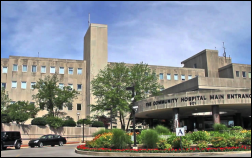
Become a sponsor.

JennHIStalk

From HIMSS 4/15/15

April 15, 2015 News 9 Comments

From Canuck: “Re: British Columbia EMR. Big implementation gone sour with a reported $125 million spent so far with nothing to show. This story barely touches upon the issues encountered thus far, issues we’ve all seen in other similar projects.” British Columbia parts ways with IBM two years into a 10-year, $700 million project that remains 85 percent incomplete. The health minister still expects to get the project done on time and budget, which is ridiculously optimistic given government IT performance worldwide even when it doesn’t involve dumping the prime vendor. Perhaps the US Department of Defense should notice that its big EHR bidders haven’t performed well in comparable but much smaller projects outside the US, although fault is often hard to assign to either government or prime bidder incompetence. I can’t name a single big government IT project that was delivered on time and on budget, but I can name a bunch that were abandoned with no benefit whatsoever.

From Due North: “Re: NantHealth. Cancelled their HIMSS conference presence at the last minute, eating the huge deposit. Everyone I knew there is gone.” Unverified, but new President Bob Watson was available only in the private meeting rooms over by HIMSS Bistro, which I happened to see while having a lakefront lunch there today. 

Here’s an interesting rumor I heard today from a fairly good source: Karen DeSalvo will reportedly leave her HHS position in a couple of weeks. I hope it’s not true because she’s a credit to public service and has in her short tenure done a very good job in walking the ONC tightrope that tries to balance innovation, public health, and Meaningful Use. The source suggested that Micky Tripathi turned down an offer to serve as interim, which would be a surprising offer given that he’s brilliant but not an MD like all of the National Coordinators so far. I’m almost always a cynical sourpuss when it comes to industry leadership and yet I find myself hoping she not only continues as National Coordinator,  but is given more federal responsibility despite serving within a lame duck administration. The rumor wasn’t clear, so perhaps there’s a bigger role for her within HHS, such as with CDC or NIH. Or maybe it’s not true at all. Feel free to ask her after her Thursday morning HIMSS keynote if you’re still in Chicago. She gets my vote for whatever she wants to do, as does her predecessor Farzad.

image

Here’s Regina Holliday’s latest artwork, which she painted right in the HIStalk booth this week. It’s in honor of HIStalkapalooza, with the pie representing the one Judy Faulkner presented to Jonathan Bush and the beauty queen sash indicating, “We are your biggest fans,” which Regina said she heard repeatedly from folks at the event in reference to HIStalk.

image

I met one of our HIStalking scholarship winners today when Lorre introduced me to Mélanie Péron, our representative from Paris. She cried, hugged, and expressed endless appreciation for the opportunity to attend the conference representing patients. She triggered instant insight on what it takes to be successful as a patient advocate. We healthcare people are used to geeks calmly presenting reams of worksheets, but we are justifiably easily moved by people who can tell a heartbreaking or inspirational story, who get fighting mad at injustice or incompetence, or who tug at our hearts with sadness when the industry in which we work in caused harm to their loved ones or failed to prevent it. We all know it could have been us our our family members on the wrong end of a bad but unfortunately not uncommon healthcare experience. Maybe that handful of people we brought to Chicago are dwarfed by the 43,000 others here who are more interested in finding expensive dinners or selling systems, but their activism keeps us all honest and pushes our faces to the mirror of what’s wrong with healthcare that only we can fix. It’s brilliant. I’m glad they were in Chicago this week and I’m anxious to hear their thoughts about the big business aspects of a sometimes indifferent care delivery system that they’ve now witnessed firsthand.

image

Our HIStalk friend Marty Mercer says HIStalkapalooza is the best party he’s ever attended, possibly because he was being fawned over by two members of Party on the Moon.


Today’s Conference Notes

image

I started my day with a visit with HealthLoop. They were handing out badge ribbons indicating “Empathologist” because they create electronic connections to patients that make them feel connected and engaged in a high-touch way, including scripted electronic check-in. The messaging extends the patient experience before and after the planned encounter, such as sending pre-surgical patients a daily reminder by phone or email to get up and walk around or otherwise prepare for their procedure or to recover from it afterward. It boosts patient satisfaction while delivering patient education. It can even route patients automatically to doctor rating sites and collect survey information for patient-reported outcomes. It was a quick but positive look.

I then stopped by Medfusion, which offers a free “portal of portals” in aggregating multiple portals into its vendor-agnostic one. It was pretty cool in that it can tie together multiple portals to look like a single one to the patient, displaying everything via a slick app. Vendor- and provider-specific portals are really ridiculous in this day and age where every patient would have to manage 10 of them to keep up (and instead never bother to log on at all), so combining them all visually is about the best we can hope for at present.

Next I visited Influence Health, whose EHR-agnostic product brilliantly combines patient engagement, provider marketing, and a patient portal. Consumer choice means providers need to selectively market their services and it’s interesting how Influence Health does it with a consumer user interface that is as familiar as Facebook and Outlook. The company seems to get the connection between clinical patient engagement and provider marketing better than anyone. I only saw a short demo, but it looked solid and smart to me.

A reader asked me to check out Patient Route, way back on the no-man’s land of the HX360 pavilion (which was maddeningly difficult to navigate even with booth number in hand – it literally took 20 minutes to find them even though I was within 100 feet of their little stand). They do some kind of predictive throughput and staff modeling based on historical and real-time information, although I have to say the pitch I was given was not particularly well thought out or informative. About all I heard is that the Brigham is using it to push more surgeries to their suburban hospitals where they get paid more for the same work and don’t have capacity limitations. They didn’t give me enough information to form an opinion.

I checked out MedCPU and was guardedly impressed. The company’s clinical decision support product brings in the usual HL-7 data but also decomposes the free text information that forms most of the available patient data, using natural language processing, text extraction, and a clinical context engine. It turns all of that text into discrete information that is used to provide EHR warnings via a Citrix DLL, so that it sits in the EHR window but separate from it and thus requires no integration effort. It gives clinicians warnings of conditions that are far too subtle for normal field-based CDS to detect. My “guardedly” adjective refers only to the fact that I want to talk to a live site, which the company is arranging. If it works as billed, it’s really well beyond the rather primitive CDS such as drug-drug interaction warnings and drug-lab contraindications. Eyal Ephrat, MD has a track record that instills trust, having founded E&C Medical Intelligence (now PeriGen, which does great work). He and I got a bit deep into the bowels of their patented technology and I want to learn more from actual users.

A reader suggested I look at Innovatient, which offers in-room entertainment, patient assignment, and some nurse call system overlap. I can’t say it struck me as offering anything not already readily available from Oneview, GetWellNetwork, and other vendors, but they have 10 live sites and maybe there’s more than I noticed.

Another reader wanted me to look over Patientco. I can’t get too excited about patient bills and payment options, but if I did, I would love it. They print easily understood bills (designed using sound psychological principles right down to the colors used) and make it easy for patients to settle up online. Patientco is about as cool as billing can get and customers are seeing higher collections and patient satisfaction from using it.

Yet another reader asked me to check out Healow, part of eClinicalWorks. I don’t have much of a reaction – it seemed to be a basic phone-powered portal into a provider’s eCW system with some wearables connectivity built in.

image

NextGen had this cool, computer-controlled waterfall that actually spelled out words and presented pictures using only water patterns. It was bizarre but fascinating.

Today’s MedData scones: banana-maple and pumpkin. My Fitbit can’t count enough steps to offset the calories I took in enjoying them.

image

HIMSS requires exhibitors to refrain from heading out before Wednesday’s 4:00 exhibit hall close time, but plenty of them (HIStalk included) were boxing up well before then.

image

Some strange Epic booth art.

image

Epic’s KLAS results posted on their booth walls shows Cerner second with no green at all, Allscripts flailing around in the middle spot, and Meditech dropping precipitously toward the all-red CPSI bottom feeder level.

image

This is pretty amazing. Centura SVP/CIO Dana Moore met with interested vendors today at a price of a $500 donation to DonorsChoose in return for 20 minutes of his uninterrupted time (which was matched by a generous, anonymous vendor so that we raised $6,000 for needy classrooms today). I expected Dana to nod politely and check his watch constantly from boredom, but instead he told Lorre that it was the best two hours he’s ever spent at a HIMSS conference. Every one of the six vendors had a solution to one of his current problems and one of them had a solution that he didn’t even know existed. His positive experience makes me think we should replicate it on a larger scale at some point, carefully matching provider executives with vendors based on needed, available solutions.  


HIStalkapalooza Photos from DrFirst

Thanks to DrFirst for providing photography and videography at the event. I’ll probably turn some of the many great photos into a video slideshow or something since it’s great for folks to see themselves having fun. As much as I fussed for many months about the effort and personal cost exposure of running the party, it felt worth it to see the crowd responding so positively to the HISsies and the band.

image

image

image

image

image

image

image

image

image

image

image

image

image

image

image

I’ll get back to a more regular posting schedule since I’ll pass on returning to the conference Thursday. It’s been a long week.

Jenn’s HIMSS Day 3 4/14/15

April 15, 2015 News 2 Comments

image

My third day at HIMSS started off with the #HITchicks tweetup at the HIMSSpot in between the exhibit halls. A group of about 50, including a smattering of men, attended to talk and tweet about the role of women as patient advocates and the highlights of HIMSS15 thus far. It didn’t take long for the “booth babe” conversation to take off, with one audience member shouting out HIStalk for bringing attention to the unfortunate trend a few years ago, and consistently calling out those companies that choose to hire pretty faces in tight-fitting spandex to shill their products. I thought it was especially fitting that me, Lorre, and friends of HIStalk added the badges below to our HIMSS15 wardrobes. Kudos to HIStalker Steve Blumenthal, business and corporate law attorney at Waller Lansden, for supplying them. He’s got a pretty sharp sense of humor for a lawyer.

image

The tweetup had not one but three highlights for me: University of Michigan Hospitals and Health Centers CIO Sue Schade – CHIME’s CIO of the Year – stopped by the voice her support for the group. Kym Martin, a four-time breast cancer survivor and patient advocate (not to mention the lovely wife of HIStalk Blues Brother Ross Martin, MD), shared her story of patient advocacy and journey as a four-time breast cancer survivor. Last but not least, ONC National Coordinator Karen DeSalvo, MD stopped by to share her experience as a woman who has worked in academia, public health, and now on the national political stage.

image

image

My next stop was the ONC press briefing, where staff gave a run down of the office’s accomplishments over the last year. Interoperability and partnerships were definitely the overarching theme. DeSalvo took the briefing as an opportunity to announce the availability of $1 million in grant funds to support health IT projects for the Community Interoperability Health Information Exchange Program. The program will award funds to 10 organizations, including those that are not eligible for MU incentives. Applications for the program are due June 16.

We didn’t get too far into the Q&A before someone brought up the patient engagement crowd’s (including Farzad Mostashari, MD’s) uproar over the decision by CMS to change the Stage 2 requirement so that providers now have to show that one patient, rather than 5 percent of their patients, accessed their information online. DeSalvo calmly stressed that ONC is absolutely committed to ensuring that patients have access to their health data, adding that she is encouraged that a dialogue is taking place on the issue. She also reminded reporters that this is a proposed rule, and that formal comments on the rule are encouraged. I understand why some might call this a step backward for the MU program, but I can’t help but think many providers are breathing sighs of relief. You can’t force people to use the Internet, especially those that don’t have access to a computer or reliable WiFi. As DeSalvo reiterated throughout her response to this question, the true challenge will be a cultural one, not necessarily one solved by technology, which is why it’s so important for the ONC to partner with other federal agencies as they attempt to evolve their focus beyond EHRs.

image

My next stop after a quick lunch in the press room as at the Emdeon booth, where I moderated a panel discussion with Emdeon’s Gene Boerger and CareCloud’s Albert Santalo on fueling product innovation with big data. I was slightly jealous of the stylish and super-comfy shoes the Emdeon staff were sporting, not to mention the cushioned carpet in their booth. I enjoyed wandering around both sides of the exhibit hall afterwards, snapping pictures of those that had unique designs, catchy marketing gimmicks, and bustling crowds.

image

image

image

image

image

image

image

image

image

image

image

image

image

image

image

image

image

image

image

image

image

image

image

My remaining time at the conference was spent at our booth, where I got the chance to witness The Walking Gallery converge, courtesy of HIStalk’s good friend Regina Holliday. I especially loved the vibrant color of Farzad Mostashari, MD’s jacket. Let the data flow ….

image

My day concluded with a quick stop by the Patientco party, where I ran into Caroline Wood and Sherry Farrugia of Georgia Tech. Talk soon turned to a company called Evidation Health, launched last month by GE Ventures and Stanford Health Care to improve health outcomes with evidence-based digital health tools. Their excitement about the startup was palpable, so I may have to crash the road trip they’ve got planned to go out there later this year.

image

After that it was on to the Edifecs #HIMSSandHers meetup, where I happily talked shop with Politico’s Ashley Gold. I left with a T-shirt and a selfie stick, my favorite piece of HIMSS swag so far. Despite being thoroughly exhausted, I’m already looking forward to seeing what my final day of HIMSS will bring.


Contacts

JenniferMr. H, Lorre, Dr. Jayne, Dr. Gregg, Lt. Dan

More news: HIStalk, HIStalk Connect.
Contact us online.

Become a sponsor.

JennHIStalk

Text Ads


RECENT COMMENTS

  1. Today's post contains the phoenixes rising from the ashes of the post COVID telehealth era. There's two things that destroy…

  2. "Block [...] will lay off nearly half of its workforce [...citing...] AI". Here's an alternative interpretation. AI has become an…

  3. A Week in the Life of Clinical Informatics: Sunday: patient care. Monday: system design. Tuesday: iterate on feedback. Wednesday: governance…
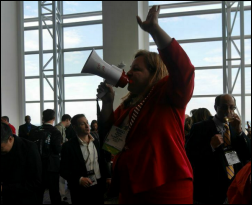
Founding Sponsors


Platinum Sponsors


Gold Sponsors


RSS Webinars

  • An error has occurred, which probably means the feed is down. Try again later.