Dr. Jayne at HIMSS 2/12/19

February 13, 2019 News Comments Off on Dr. Jayne at HIMSS 2/12/19

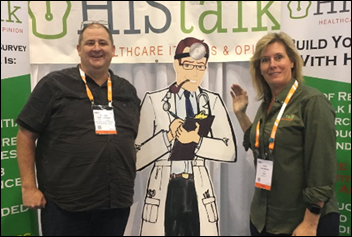
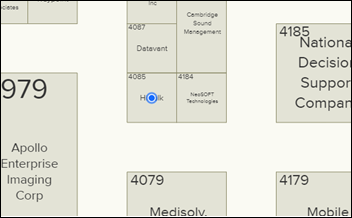
I started the day at the HIStalk booth seeing what Lorre’s plans were for the day. She’s riding solo at HIMSS this year and had a few take-home items on her list, including various stuffed critters from vendor booths. I was happy to help score her a Charlie from Healthfinch (#2790), but she’s still seeking a zebra and a giraffe for her menagerie. If you can help her score one, she can be found at #4085. You can also come by and have your picture taken with our iconic Smokin’ Doc and pick up a HIMSS survival kit from our friends at Arcadia (#2915).

clip_image002

clip_image004

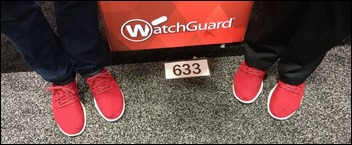
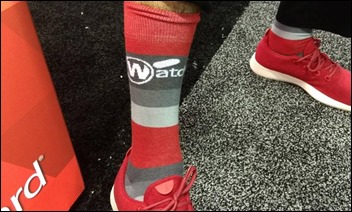
The folks at WatchGuard (#633) drew me in with their friendly smiles and bright shoes, which were accompanied by equally fun socks. I always love booth reps who reach out to greet you in a friendly way. Apparently, socks are a hot item again this year at HIMSS. I was also impressed by the reps at Kronos, who not only asked nicely if they could scan my badge, but looked at where I was from and asked some questions about my travel and whether I had a hard time making it to HIMSS. Those are the kind of people you want working your booth, those who can strike up a conversation without making it feel forced.

I dropped by First Databank (#1921) and saw some of their new solutions for targeted medication alerts. They are really helping to work to make alerts more meaningful for clinicians by using lab values to filter out alerts where they’re not appropriate because labs are being monitored and checked. They’re also doing some interesting work building out a database for veterinary medications. We love our pets, and especially with the entry of payers into the pet market, there is a need for better tools for those caring for our furry friends.

Just next door (also in #1921) was sister company Zynx Health, which was showing their new Lumynz solution. It’s really slick for those of us trying to lead the charge for value-based care, allowing clinical and financial leaders to easily see whether patients are receiving the evidence-based interventions they should be receiving, or whether factors of underuse or overuse are in play. The tool also measures compliance with order set use on a per-provider basis and helps clinical leaders educate their physicians on the evidence behind caring for a variety of clinical conditions. On the financial side, they’re helping CFOs understand how much they might be losing by under-delivering care. It will be great to see how it takes off and is well worth seeing.

clip_image006

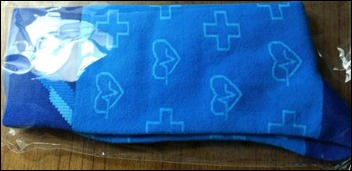
I managed to pick these up from VMware for the sock-lover in my life, who was very disappointed that I spent his birthday at HIMSS instead of being curled up under a quilt in the frozen north.

clip_image008

Thanks to the following sponsors who were proudly displaying their signs: Visage Imaging (#1391); PatientBond (#4591); and Nordic (#2579). Thanks also to Lorre who ran around the sweltering convention hall this morning delivering them before the doors opened. I spent much of the day wishing I was wearing cooler clothes, so hopefully tomorrow will be a bit cooler.

clip_image010

clip_image012

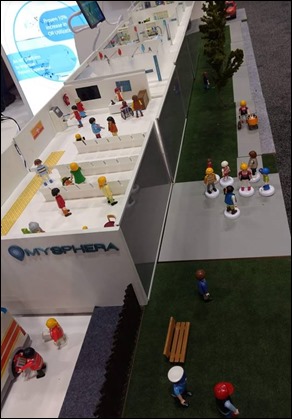
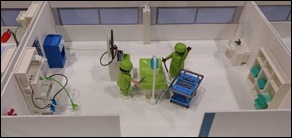
MySphera (#985) had this awesome Playmobil hospital setup, complete with operating room and IV bags. It brought a smile to my face during a long slog through the hall.

clip_image014

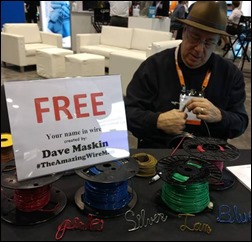
CPSI featured Dave Maskin, The Amazing Wire Man, who is able to make anyone’s name out of wire. He got his inspiration for the craft after rewiring a lamp and is available for parties and special events. People were in quite a line waiting to have their names crafted. It seems like there are overall fewer catchy entertainers today, although I only made it through half of the hall.

clip_image016

Cognosante had some great orange shoes.

clip_image018

Sponsor Lightbeam Health Solutions (#4370) truly brought their A game, featuring this trio of dapper gents.

I attended a lunch sponsored by Cognizant, who had a lot to say about digital revenue cycle management. They’re advocating a sensible approach to automation, where people are used to handle exceptions and difficult situations but where routine tasks are automated. They’ve done some interesting work with claims and denials that is worth taking a look at. They also talked about using Blockchain for “smart contracts” between payers and providers along with real-time adjudication to create frictionless payments. They also offered wisdom on tackling small projects first and earning trust and demonstrating wins, rather than trying to proverbially boil the ocean as some organizations do.

.clip_image020

Healthjump brought their color coordination.

clip_image022

These folks didn’t bring anything, since their 20×10 booth was empty.

Tonight’s social schedule included the New Media Meetup and a dinner with some potential clients, although bad traffic and inability to use Uber due to a cell connectivity issue conspired against me and kept me from making it to the Salesforce party. I’m disappointed but there wasn’t anything I could do, so hopefully they won’t blacklist me for next year.

I did manage to catch up with some former colleagues, which was time well spent. I always enjoy hanging out with people who are truly motivated to make life easier for their clients (and by translation the patients they serve) and who can see through all the bluster and noise that HIMSS brings.

Time to rest up!

From HIMSS 2/12/19

February 12, 2019 News 6 Comments

image 

News Items

CMS Administrator Seema Verma said in today’s opening session that previously announced hospital penalties and lower incentives for practices were supposed to encourage the industry to move forward on its own with interoperability, but the industry’s failure to do so resulted in this week’s proposed rules that are more prescriptive. She said the changes are aimed at insurers that refuse to share their claims data, although I’m not sure that comment was intended to be comprehensive.

Former White House CTO Aneesh Chopra agreed that the industry failed to self-organize to add more content, adding that the federal government’s initial data set was supposed to be a minimum, but the private sector didn’t take it further and the government had to create a new rule to get the entire medical record. Chopra said that CEHRT 2015 is a Roku and now we can add channels.

Verma added that this administration wants to deregulate, but the industry’s lagging behind the government required new regulations to get value for the $36 billion it spent on Meaningful Use. She also said that the next task is to bring in post-acute care providers.

University of Toledo issues an RFP for an EHR, apparently giving up its questionable project to help then-Athenahealth (now Virence Health) develop a new inpatient system. I expected that project to flounder once Elliott Management started pressuring the company, but there’s not much doubt that it will never see the light of day under new leadership.


From the Burner Phone

image

“Hope you’re enjoying Orlando, and washing your hands regularly. This little tidbit just crossed my Twitter stream. I look forward to seeing it mentioned in the News section.” “Fox & Friends” TV host Pete Segseth says on TV that he hasn’t washed his hands in 10 years, adding in placing a second foot in mouth, “Germs are not a real thing. I can’t see them, therefore they’re not real.” He claimed later via Twitter (of course) that he was only joking and then returned to his real job of bashing Democrats, but here’s the punch line: he was President Trump’s frontrunner to replace soon-to-be-fired VA secretary David Shulkin. Imagine a guy who is running a sprawling medical enterprise like the VA who throws out comments like that, even if he is kidding.

“A company won a KLAS Best in Category and attended the KLAS event this week, but its attendees weren’t allowed to go on stage to receive their award because they weren’t wearing sport coats.” That might be the most bizarre thing I’ve heard this week.

“I was talking to someone fro the since-acquired HIMSS Analytics about their physician clinical data. Turns out they only have information for hospital and employed doctors – they don’t know anything about independent practices.”

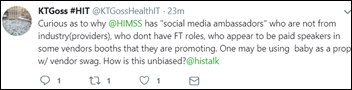
“Is it just me or are some of these HIMSS Social Media Ambassadors losing all semblance of self-control? What is wrong with these people?” Some of them are like kids turned loose on Disneyworld after chugging a two-liter Mountain Dew, but HIMSS chose unwisely in anointing one highly questionable guy who doesn’t even seem be at the conference – his entire HIMSS-related output since the conference started is one retweet. Therefore, he’s my favorite one.


Observations
image

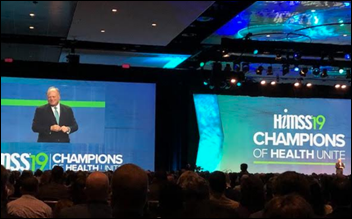
I haven’t been to a HIMSS conference opening session for a couple of years (because they promised to be dull or vendor-led). My observations:

  • The slick media show that played before the session began was all about HIMSS, its influence, its acquisitions, and its grand plans to stick its nose into every aspect of health and healthcare. Gone are the days when a series of quaint PowerPoints were running that listed its committee members, Life member and Fellows, local chapters, and volunteers. It was a celebration of being large and influential rather than giving credit to the members who pay dues, attend events, and serve on committees.
  • HIMSS should be renamed HIS (Health Information Society) since Management Systems (the MS part of its name) has disappeared from the agenda and maybe as a career discipline since its 1980s heyday. Instead, HIMSS has decided that the “information technology” part of its mission statement will be split as “information and technology.”
  • HIMSS sees itself as an advisor, enabler, and media powerhouse, all of which sound like for-profit activities even though HIMSS is a non-profit.
  • The musical act was harmless enough, with a gospel choir of probably Disney day-jobbers singing dad rock (granddad rock, actually) in the form of Queen’s “We Will Rock You” and “We are the Champions” as the HIMSS logo throbbed obscenely in time with the music.
  • HIMSS pointlessly paraded its caped poster children Champions on the stage – where they danced awkwardly for a few seconds before thankfully getting off – and just seeing one of them who has been relentless with self-promoting tweets and selfies made me recoil physically. Probably nice in person, but unaware or unconcerned about an obvious need for constant attention.
  • The opening keynote celebrated the accomplishment of moving the industry from paper to electronic records, failing to look at the flip side of billions in taxpayer-funded incentive payments and the failure of that expensive technology to improve cost and quality.
  • Karen DeSalvo is a gem, whether she’s working in health IT or public health, and Aneesh Chopra seems fun and enthusiastic.
  • I really disliked having talking points popping up on the screen beside the speaker’s image. Reason: the practice reminds me that they’re just reading their presentation.
image

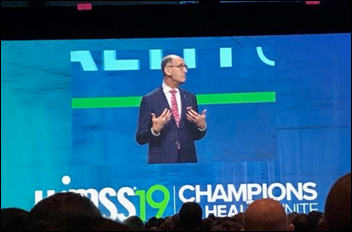
Mayo Clinic CIO and HIMSS board Cris Ross, MBA (he’s not a doctor, despite what some Twitterers seem to think) was an outstanding speaker in describing his transition from helping get Epic implemented to seeing it used by his caregivers for treating his newly diagnosed cancer. He seemed genuine, empathetic to others who are facing a cancer journey, and optimistic about technology’s potential role in improving care.
image

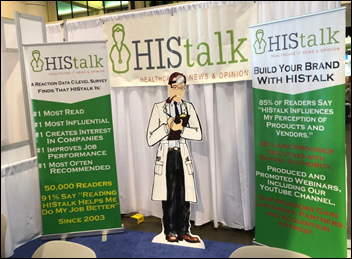
Our booth traffic was nearly non-existent today, the day in which we had to choose booths for HIMSS20 (for which we’ll always get the dregs given our lack of HIMSS spending). I’ve long questioned whether the high cost of exhibiting is worth it for little guys like us with no HIMSS vendor points, low budgets, and non-existent ROI, so I pulled the plug on exhibiting at future HIMSS conferences. The Smokin’ Doc will be no more, at least in standing guard in his own space. A reader said I would get far more value from having someone drop by vendor booths to explain the benefit of supporting HIStalk, so maybe that’s an alternative.

Speaking of dead exhibits, I can only imagine what it was like in the beyond-7000 sections past the food court. I doubt many attendees are noticing the signs begging them to keep going beyond the fake ethnic food booths.

It takes me at least five hours to recap my day here, so I’ve learned to hightail it out of the exhibit hall when it closes (or earlier) and get to work. Last night it was cheap Chinese and a burger the day before that, so who knows what culinary delights await tonight? The lunch madhouse at the convention center was as crazy as usual – long lines to buy overpriced and over-processed food, then the pleasure of eating it standing up next to a restroom door because the demand for seats exceeds the supply by fivefold.

Thanks to the reader who dropped me off a great backpack. It has been invaluable.

Show floor notes:
image

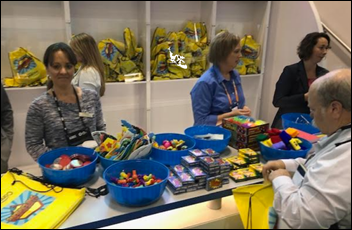
Connection put out games and supplies for attendees to bag up for patients in the local children’s hospitals. I did it and it was quite satisfying. Good job.
image

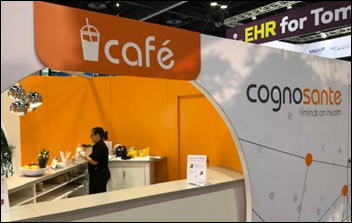
This nice lady whose name I forgot to write down insisted that I try the smoothie she had made. It was delicious, something with strawberries (and I don’t usually enjoy smoothies).
image

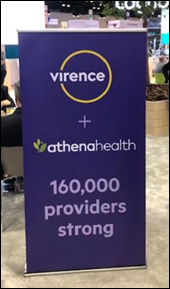
I still can’t grasp pairing Centricity with Athenahealth, but the deal has been consummated.
image

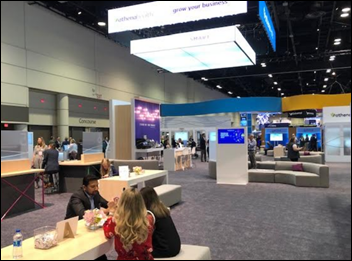
Meanwhile, I guess Athenahealth had already paid for its large space before it was led away on a leash, so it was turned into a basement rec room with basically nobody stopping by. Although to be fair, its bad booth location at HIMSS18 and installing Jeff Immelt as Jonathan Bush’s bumbling chaperone had already killed off the massive crowds that Athenahealth had drawn every year before the mess started.
image

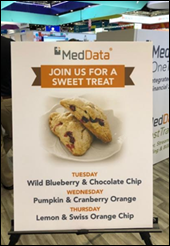
Here’s the MedData scone schedule. It includes the great pumpkin and cranberry orange that I’ve had before, but omits the best flavor of them all – their passion fruit.
SNAGHTML7690cd04

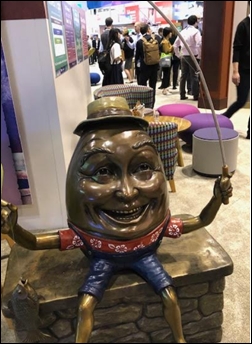
Epic always has calculatedly weird stuff in its booth, but this guy is creepy.
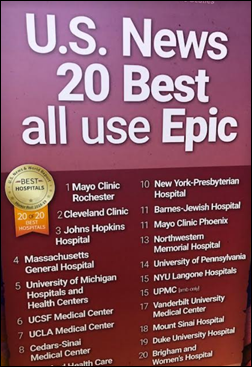
image SNAGHTML769290fb

Epic marketing posters. I didn’t get a shot of the one that said 80 percent of medical students or something like that are trained on Epic.
SNAGHTML7693c93c

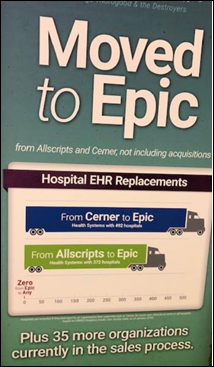
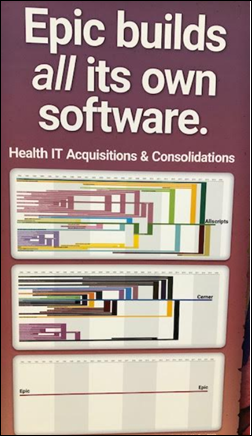
This Epic poster includes a footnoted credit to healthcare equities guy Constantine Davides for his laborious plotting of the acquisitions over time of Allscripts, Cerner, and Epic (also crediting HIStalk since I ran it a few years ago and it was a big hit). Epic is picking up the torch in keeping the graphic updated, for obvious marketing reasons. Constantine is now at Westwicke, which was itself recently acquired. 
SNAGHTML7698938e

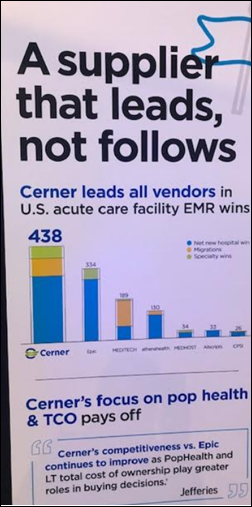
Here’s what Cerner had to say on the matter.
image

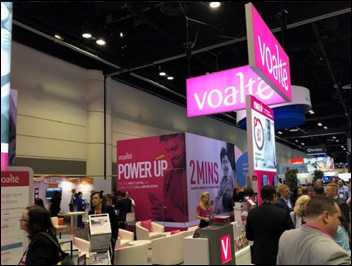
I remember years ago when Voalte’s tiny band of mostly industry newbies blew into the HIMSS conference bedecked in shockingly Pepto-Bismol colored pants. Voalte’s booth has grown along with its business and its people are now experienced, but the company has admirably continued to use pink as its trademark – you can spot someone from Voalte from way down the hall.
image

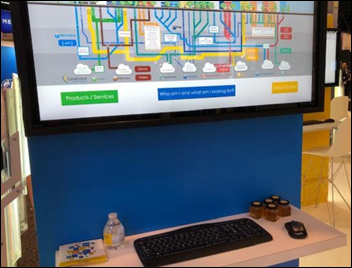
Ellkay keeps honeybees on its roof, co-founder Lior Hod is the proud head beekeeper, and there’s always beekeeper’s gear around the office so visitors and the children of employees can visit the hives (they almost brought a live hive to HIMSS19). They have honey in their booth along with cool graphics and really nice people (thank goodness their “data plumbers” tagline didn’t steer them toward carrying plungers while wearing low-rider pants). 

AxiaMed has the nicest people I’ve ever met in a HIMSS booth. They offer a patient payments solution, and in my case anyway, some cool argyle socks.

AT&T was doing a demo of using Magic Leap virtual reality during surgery.

What I didn’t see today:

  • The usual magicians from Hyland and Cantata Health. The former used a different guy and I assume that the amazing Bob wasn’t at the Cantata booth that I couldn’t find. Update: a reader says Cantata, like quite a few other vendors, took a meeting room rather than a booth, so no more Bob.
  • Booth babes, at least not any obvious ones.
  • Demos involving hospital beds and non-clinicians wearing scrubs or white lab coats.
  • Food offered in booths during happy hour.

What I did see: people filming and recording everywhere, getting in the way of everybody else to record material that nobody cares about. And the same handful of “pay us and we’ll show up in your booth and promote it” folks.
SNAGHTML76ae5a33

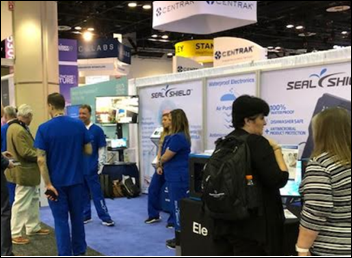
People of mobile device sterilizer vendor Seal Shield let me down in having non-clinicians running around in scrubs. I know it seems innocent enough, but clinicians earn those scrubs every day and resent having them worn by laypeople as conference costumes. They may actually be so turned off that they’ll seek out your competitor. You have been warned.

image

This was over the top but kind of cool, although I don’t remember the vendor (which may say a lot). Update: a reader says its Intermountain Healthcare, something to do with launching an incubator / investment arm like every big health system seems to be doing (although Intermountain missed the unicorn in their back yard, Health Catalyst).
image

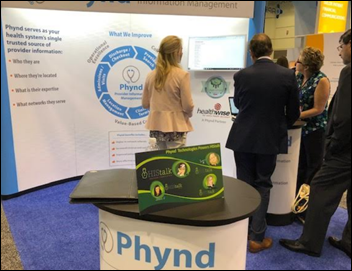
Thanks, Phynd, for featuring our sign so prominently.

Identity Automation had a photographer and studio-type setup for taking professional headshots, for which demand should be high given the awful profile pictures I’ve seen on LinkedIn.

Google Cloud, Microsoft, and Amazon Web Services all had big crowds in their booths.

NextGen Healthcare gave me a quick look at its mobile EHR app, which despite some questionably motivated and questionably insightful recent praise, looked just fine, but not anything a knowledgeable observer would consider game-changing. In fact, NextGen didn’t even develop the app – they got it when they bought the money-losing Entrada for $34 million a couple of years ago.

A reader asked me to report on Nuance’s  “AI-Powered Exam Room of the Future” demo room. It was about what I expected since I saw something similar from them last year and liked it – a doctor conducts an entire patient encounter using only voice, in which speech recognition converts lay terminology to medical (and vice versa) to create a progress note, structured documentation, and orders, all ready to be signed. Voice biometric authentication is part of the package as well, as is a wall-mounted bank of 16 microphones that can sense location (such as which leg the doctor is examining). My recommendation – the instructions the “doctor” was rattling off to the patient were full of timelines, activities, and drug names – the doctor could send the voice recording or the layperson transcription to the patient to reinforce what they were told but likely forgot. Patient advocates should pick up that charge, although doctors probably fear malpractice exposure.

Speaking of which, I haven’t heard anything about the “voice assistants” that were all the rage at HIMSS18. Maybe they’ve graduate to actual use in the field already.
image

Here’s your mysteriously unsung hero of the conference and of the last several years of health IT. Grahame Grieve is the always-modest guy who is basically the father of FHIR (at least as I understand it, but I’m sure one could argue the point). Think about that – one guy from Down Under makes it happen that Apple can develop health apps, that vendors can offer third-party APIs and apps, and that systems can exchange information to the point that the federal government becomes FHIR’s cheerleader. You can’t tell me this guy hasn’t done more than many of the self-important suits running around, yet he never demands credit or recognition and hasn’t earned a dime from his work. Did you hear when I said Apple? Do you get what we wouldn’t have without FHIR? Nearly everything you need to know about today’s interoperability opportunities and challenges are made clear in my 2015 interview with him. I asked him a final question of what he would wish for if he could wave an interoperability wand and he brilliantly said (or perhaps predicted), “I wish the clinicians would believe in clinical interoperability the way that the IT people believe in IT interoperability. We’ve had doubters in the past, but pretty much everybody believes in it now if only we can get there. I wish the clinical people thought that that was a clinical problem.” To which I might add, “I wish health system executives would see interoperability as a responsibility to their patients, not as a threat to their bottom line.”
image

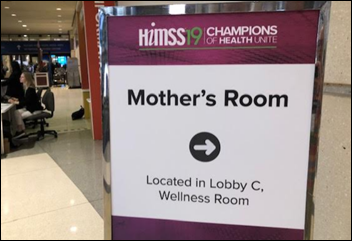
At least it was your apostrophe rather than your heart that was misplaced, HIMSS.
image

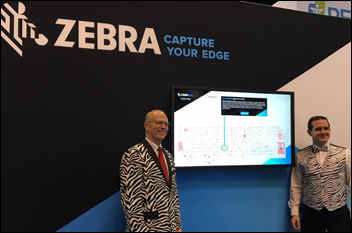
This is kind of a fun look and appropriate, too.
image

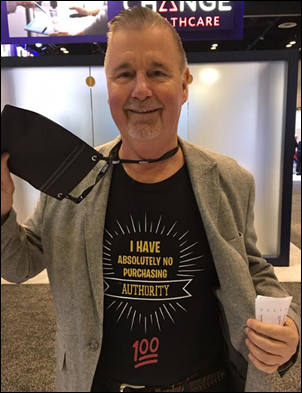
Brilliant, not to mention self-designed. I believe we may have struck a distribution deal.

I had a quick theater demo of an Alexa-powered patient scheduling app from EMedApps. It was OK, although the generic wording of “provider” as recited to the home user is awkward, even though we as industry people haven’t figured out the best term to refer to the alphabet soup of licensed people who could see a given patient.

I had never hood of Hook, a three-year-old company that connects to Epic and Cerner (via FHIR API and Sandbox, respectively) to present a single view of a patient’s information that can be filtered, sorted, and searched. NYU Langone is piloting and the company is looking for more sites.

CITI Healthcare offers data migration and has an app on Epic’s App Orchard. Steve was a good guy there.
image

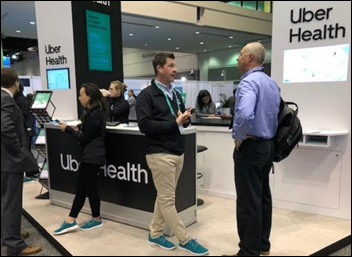
The younger crowd represent with skin-tight suits, wild shoes, and diligently differentiating accessories like bow ties. Those of use whose youth is behind us can attest that when we, too were trying convey confident rebelliousness by ironically dressing and acting the same way, that practice itself was obvious form of confidence-lacking conformity. I like that HIMSS is targeting the early-career folks with their own social events – let’s make them feel welcome. We’re at that interesting point where the people who created health IT from punch card readers and 80-character terminals are retiring and throwing the flag to those behind them.

My goal of the day was to get vendor-offered socks, especially the loud and unusual kinds. Sometimes they handed them over generously, sometimes they stiffed me in saying that the front-and-center displayed socks are for prospects only (hey, if it’s on the podium, it should be fair game), and in Intermountain Healthcare’s case, I couldn’t score a pair of the cool Life-Flight socks because the lady working there was deep into some kind of technical struggle from which her gaze did not avert.
SNAGHTML76b28d17

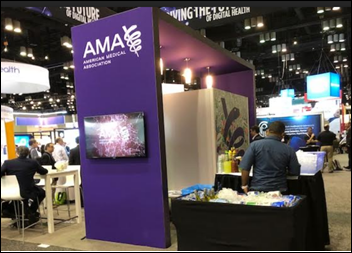
I was surprised that the AMA had a happy hour bar going. But then again, just about every booth had a happy hour bar going.

Someone asked me at the end of the feet-ruining day what I saw as the big themes. I’m not sure I saw any so far, but I’ll say:

  • I saw few claims of old systems being suddenly AI-powered, and in fact not many companies were pitching AI at all and most of those that did were obviously using the term in a marketing rather than technical definition (they don’t actually have it, in other words).
  • The term “big data” was spoken by no one, having been yesterday’s tired fad (again, a marketing term than a technical one).
  • Certainly the new proposed CMS rule has diverted a lot of industry attention right as the conference started – it’s a huge document to digest and it has big implications to both providers and vendors.
  • Vendors didn’t seem all that excessive in their booths, although maybe I’ve just become immune to it.
  • I didn’t see all that many booth staffers screwing around with their phones or huddling for inter-employee chats instead of paying attention to visitors. In fact, I saw vendors having pre-opening scrums, going through orientation checklists, and describing the goals of the company to everyone involved.
  • It felt like maybe people are starting to see the HIMSS conference as more of a boat show distraction with the ever-present government action discussion thrown in and little of substance in between. Maybe system selection has been rationalized, health systems have locked in with their preferred vendors as those health systems expand, and the huge unknowns of genomic science and artificial intelligence fighting for air time with lack of interoperability (or lack of a market for it), questionable usability, and uncertain ROI. We’ll see if the HIMSS attendance – announced tomorrow, probably – is trending up or down (they predicted more than 45,000).
  • The US health non-system is not sustainable and expensive technology hasn’t improved cost or outcomes despite those neon gulches of previous HIMSS conferences in which vendors claimed to have the solution for every problem du jour. As Mike Leavitt said in today’s opening session, you can’t be on the world’s leaderboard if you’re spending 25 percent of your GDP on healthcare.

Tell me – what should I see or do Wednesday that would rise above my trite observations about booth snacks or lack of magicians?


Dr. Jayne at HIMSS 2/11/19

February 12, 2019 News Comments Off on Dr. Jayne at HIMSS 2/11/19

I was thrilled to finally make it to Orlando in one piece, and to not have to engage my backup plans of flying to Tampa and renting a car or having to come a day later. My HIMSS schedule this year is crazier than it’s ever been, with only a few scattered hours of free time. Missing all of Monday would have been a mess since I had several meetings with people I only see face-to-face at HIMSS. Fortunately, I connected with a colleague in Chicago that I hadn’t expected to see and we were able to spend a couple of minutes together doing some quality shoe-watching.

ONC jumped on the “let’s release things at HIMSS” bandwagon by posting the Notice of Proposed Rule Making for Interoperability since we’ll all have time to read it this week. Those of us who are at HIMSS are running around crazy, and the ones we left on the home front are running around crazy covering the work we left them. Proposed requirements include the ability to export electronic information in a computable format for not only single patients, but for all patients in the event of a provider switching EHRs. They missed the mark, however, since they’re allowing vendors to determine the export standards they will use rather than making a proscribed standard. They also clarified seven exceptions to the information blocking provision. If anyone has the time to read it and finds other interesting nuggets, leave a comment or email me.

I was glad to get out and pick up my registration materials in the morning before the sun began to beat down mercilessly. For those of us in frozen climates, being exposed to anything warmer than 50 degrees is likely to cause heat prostration. I met up with a good friend and planned our booth crawl strategy for tomorrow, so I hope all of you manning the booths have your game faces on. We’ll be watching for the best, worst, and most memorable booth teams. Despite the sun, I made the walk back to my hotel without melting, but opted to take the shuttle bus when I returned to the convention center for the opening reception.

clip_image002

The reception was full of attendees donning superhero capes, some of them over their backpacks, which made for an interesting look. There were Spandex-clad entertainers dressed like Spiderman, Batman, and their masked colleagues. The room was pretty dark so it was difficult to take pictures without being totally obvious – I missed some great shoe pics for sure. The lobby outside the Valencia Ballroom had some faux food trucks serving as bars that looked like they had long lines – fortunately the lines inside were much shorter. HIMSS continues to not understand “cocktail reception food,” offering several items that required forks, making it difficult to figure out what to do with your drink. I also thought I saw someone eating something with chopsticks but was never able to find the buffet from which it came.

The reception is a great time to connect with friends old and new before everyone splits up to various vendor events and company dinners. I try not to sign up for more events than I can actually attend. My usual wing-woman was off to the KLAS dinner, so I opted for one of the regional HIMSS chapter events, which ended up being a good choice as I met several new folks who had some great stories to share. My dinner partner was a vendor rep who covers several states including two served by the chapter, and I learned a fair amount about a certain niche in the medical equipment market.

Key themes continue to include EHR optimization and workflow improvement. In talking to a few people at big health systems, I learned that there are quite a few organizations that aren’t anywhere near down the path to value based care as it might be assumed that they would be. In many areas there is still a lack of alignment between value-based contracting and physician incentives. It’s hard to get people to coordinate care and reduce utilization when they’re still being paid on a model that is largely based on production. I think those of us in the healthcare trenches assume everyone is trying to be on the cutting edge when in reality many groups are just trying to hang on. Since Mr. H doesn’t do the party circuit and Jenn isn’t here this year, I had to do my part for the team and whirl off to the next event.

clip_image004

Nordic Consulting outdid itself as usual with its classy event at the Oceanaire Seafood Room. Just about every type of seafood was represented, along with a nice wine selection and a dessert bar that made a nice addition to the night. The room layout was conducive to conversation and I was able to recover from the loud volume yell-fest at my previous event. I’m always impressed by their staff, who print out badges and place them in reusable magnetic holders so you don’t wind up with sticky film on your clothes or holes from the pins given at some events. No wristbands, either.

clip_image006

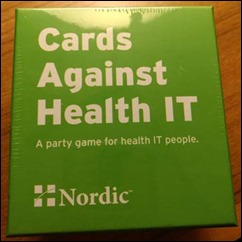
Upon returning your badge holder on the way out, you were presented with a Cards Against Health IT game, which I can’t wait to play. They assured me it is workplace appropriate, unlike the game that inspired it. I regularly attend a Halloween party with a number of local healthcare IT folks, so I know what I’ll be bringing this year along with my standard casserole full of hot artichoke dip.

clip_image008

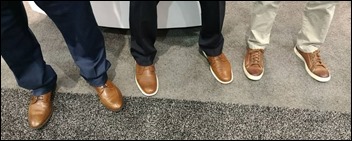
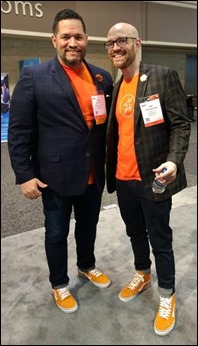
Lots of cool shoes at Nordic, reminding me of my wilder shoe days. I’ve needed cortisone shots after my last couple of trips to HIMSS, so I’ve dialed my footwear down quite a bit. I do have some sparkly numbers planned for tomorrow night and they’re comfy to boot.

There were several other parties tonight. I heard the one hosted by sponsor Redox was hopping, but I was pretty worn out after battling travel last night and surviving the relative heat wave today. As I headed for my low-rent but walkable hotel, I met up with an attendee who was trying to figure out how to walk to a hotel adjacent to mine, so we had a nice chat on the way. It was nice to get to know a woman in the startup space and learn more about what she is trying to accomplish with using technology to fuel smoking cessation and positive behavior change.

clip_image010

Also on tomorrow’s dance card is an opportunity to crash the new HIMSS member ice cream social. If that doesn’t work out, there are plenty of in-booth happy hours to offer distraction. I’ve got a long list of must-see booths and will be waiting with the crowds for the doors to open. Until then, I need some beauty sleep!

From HIMSS 2/11/19

February 11, 2019 News 4 Comments

News Items

image

HHS / CMS / ONC seem to have developed a knack for publishing important documents late on a Friday or immediately before the first day of the HIMSS conference. HHS released its long-awaited Notice of Proposed Rulemaking for interoperability, as required by the 21st Century Cures Act, on Monday morning, although legal experts note that the NPRM was posted online but not in the Federal Register. A few items I noted from a quick skim of the 724-page document:

  • Actors who spend money to support information exchange would be allowed to recover those costs by charging fees.
  • EHR vendors would not be allowed to charge for using their APIs, except in charging providers who use them or vendors who offer value-added services. Fees would be cost-based, objective, and consistently applied.
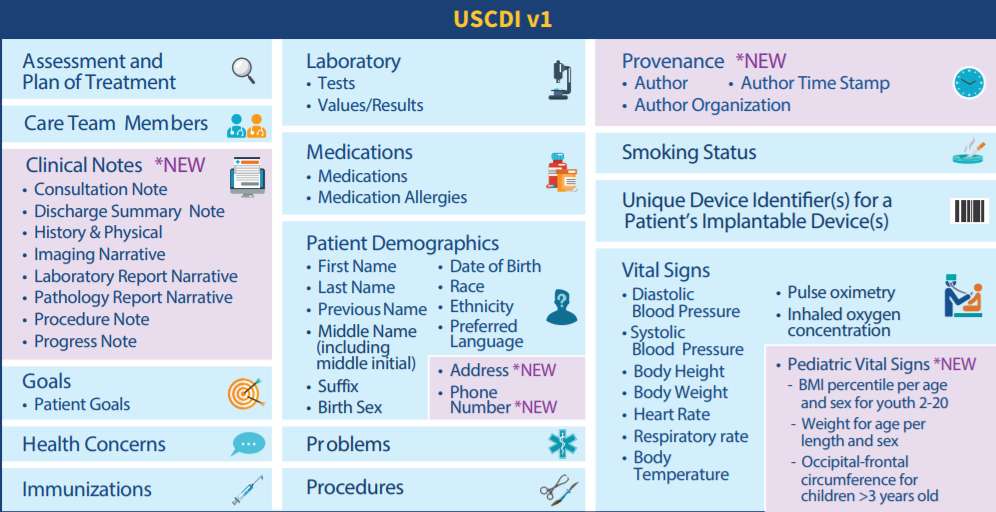
  • All EHR vendors would be required to support USCDI Version 1 as a standard.
  • APIs would be certified and vendors would be required to use the SMART Application Launch Framework Implementation Guide. They would be required to post API specifications publicly.
  • EHR certification would be expanded to include the product’s ability to export data to allow users to convert to another product.
  • EHR certification would be expanded to include pediatric care criteria.
  • Charging patients excessively to obtain their own information when they paid to have it created in the first place is information blocking. That’s going to be a big one that the American Hospital Association is sure to vigorously protest.

From the Burner Phone

image

Text me news, rumors, photos, and booths I should visit this week, then watch for your items to appear anonymously in my daily recaps if I find them interesting.

“The Athenahealth – Elliott deal closed. Some ELT turnover was announced, including Paul Merrild. You should do some asking around about the hospital product, keeping an eye on the LinkedIn profiles of the company’s hospital-oriented employees.”

image

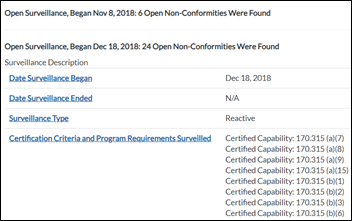
“A Greenway client told me today that Intergy – not only Prime Suite – has 30 broken certification elements. I don’t pretend to understand what’s involved in fixing this list on ONC’s site (scroll down to ‘surveillance activities,’) so maybe it’s being overblown. I am following up with a solid inside source.” 

“As the US healthcare continues to struggle with protecting and securing our data, I suggest readers attend HIMSS19 Session 171 to learn real world experience of implement GDPR from two real professionals who have walked the talk, and have the callouses and boot blisters of the journey. I have no conflict of interest, do work for, or have financial interest – I’m just aware of their excellent work.”

image

A couple of folks asked me about my burner phone, which actually is an app called Burner rather than a physical phone. It’s easy to set up, slick, and cheap ($4.99 per month, no commitment, unlimited texts and calls). You get a new phone number that you can give out freely since it’s not traceable (no caller ID) and is disposable (apparently it’s good for Craigslist, online dating, signing up for online services that require phone verification, and probably stalking). The texts and calls flow to your phone normally, but through Burner inbound and outbound, so your actual cell number is never exposed and your cell bill shows only your Burner number. Folks who are doing something far more sensitive than I can delete their Burner and all associated records by literally just pressing one on-screen button, which I suppose is a benefit if you anticipate an “FBI, open up” knock at your door. I’m just using it because I ran across it and was intrigued.


Observations

image

I checked the online HIMSS shuttle schedule while waiting at the designated spot. It suggested using the real-time shuttle location app, which was actually a web page and not an app. Perfect – it said a shuttle would be arriving in one minute. Then the one minute changed to 23 minutes, then to seven, then to six, then to 16 … and by then I had waited quite awhile and gave up and called for a Lyft ride. Unlike the HIMSS bus “app,” Lyft’s was deadly accurate.

image

I was anxious to pick up my conference backpack so I could transfer all the junk in my hands and pockets. That didn’t happen – for the first time that I can recall in my long HIMSS conference history, the official HIMSS bag is a actual tote instead of a backpack. It holds a lot less, but more importantly, it can’t be slung over my shoulder, meaning I’ll be spending all week with one hand dedicated to lugging it around. I nearly brought along my travel backpack from home since I didn’t want to be without it for even the few hours of travel (much less for a week), but alas, I made an incorrect assumption that its presence would be, as it has been every year, redundant. Vendors in the exhibit hall, this could be your moment in the sun if you brought giveaway backpacks – let me know and I’ll let everyone know (after first grabbing one for myself, of course).

Tote bag (literally) pick-up didn’t go so well for me today because I couldn’t understand a word of what the person at the desk was saying because of her strong accent. However, I celebrated whatever culture she is or was part of since it’s good reminder that the industry isn’t just white-bread tech geeks and frat boys salespeople any longer (having a clear memory of when it was, and when male nurses and female executives were unheard of). 

SNAGHTML710d1089

The exhibit hall was like a summer day in Vietnam – swelteringly hot, loud, and dangerous with vehicles (fork lifts and tractors) careening in all directions following no apparent rules and with little regard for pedestrians. The heat levels, caused by having the massive load-in doors opened wide on an 82-degree afternoon, sent me fleeing for the comfort of the air conditioned main halls after just a few minutes watching the pre-game show of geeky IT guys and swaggering equipment operators who were slowly turning the unsightly mess of packing boxes and rolled-up carpet into what you will see tomorrow.

Tomorrow morning will be like Christmas. Vendors will be downing Starbucks in the hall after spending a tiring late night decorating the tree, stacking the presents, and turning on the twinkly lights. We kids will be pacing outside the doors, pressing our noses to the glass and fidgeting impatiently until the doors are flung wide so we can rush in to ooh and aah at the marvel of the tableau that was created just for us. It won’t be long afterward, however (Thursday, to be exact) before everybody will be sick of their new and often broken toys, the pre-holiday euphoria will have transformed into disillusionment, and various family members will have drunk too much spiked Kool-Aid and will have stormed off to their rooms in anger and then scheduled earlier flights home.

image

Arcadia has once again put together these invaluable conference first aid kits that you can get from their booth (#2915) or ours (#4085).

image

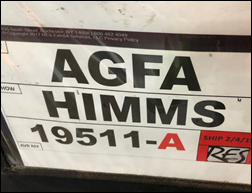
This vendor’s packing crates luckily arrived at the right place despite the spelling error, which I expect to see a few more times this week in locations that are, unlike this one, public-facing.

image

Our magnificent edifice is fully constructed, requiring one Lorre and zero Teamsters to pack it all in from the Lyft drop-off area since it weighs in at maybe 20 pounds total. I’m sure some overnight HIMSS inspector will correct the beneficial mistake in which we have two power outlets (having paid for none), three chairs (having paid for two), and a backdrop that is larger than the carpet (having paid for a 10×10 carpet to cover the same-sized space). I’m not sure that paying $6,000 for a mostly-empty square of concrete that will hold maybe $300 worth of homebrew furnishings makes good fiscal sense, so I will reevaluate in our post-show briefing call, which basically means I’ll ask Lorre if she thinks it was worth it. Her outlook will be more positive if fun people keep stopping by or new sponsors keep signing up.

Special guests in our micro-booth this week (covering Lorre’s necessary intake and output since she’s working solo) will be:

  • Tuesday 2:00 – 3:00: Nancy Ham, WebPT CEO, will offer advice to women in health IT on negotiating with confidence.
  • Wednesday 10:00 – 11:00: Susan Newbold, PhD, RN, owner, Nursing Informatics Boot Camp.
  • Wednesday 1:30 – 2:30: Stuart Miller, CEO, MindMapUSA.
  • Thursday 11:00 – noon: Ben Rooks, founder and principal, ST Advisors.

image

This video posted on Twitter shows KLAS celebrating its winners during HIMSS19. It’s nearly as cringey as that Siemens Healthineers forced merriment video from a couple of years ago, as the suit-wearing stiffs are cajoled by prancing funsters to sing along with the words on the screen (painfully woven to include the names of the winners in the lyrics) and to bang their sticks in appreciation as the script requires. Seriously, KLAS, shouldn’t you keep arm’s length from the vendors you purport to objectively review? Do you suppose Consumer Reports throws sing-a-long parties with car-makers after the April issue comes out? Would CR have lauded Volkswagen as a winner after the feds caught them falsifying their test results? Does everything in healthcare have to involve a party or self-promotional opportunity that might raise the question of WWPT—What Would Patients Think?

image

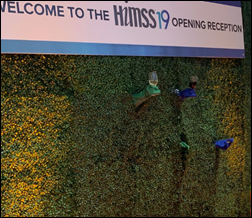
Several folks sent me this odd feature of the opening reception, in which gloved hands protruded from topiary to offer drinks. I would have enjoyed hearing the HIMSS staffer pitching the idea of an alcoholic glory hole, or perhaps hearing the even zanier ideas that didn’t make the cut.

Dr. Jayne at HIMSS 2/10/19

February 11, 2019 News 3 Comments

I was eagerly awaiting my flight to the Sunshine State this morning, but the travel gods decided to conspire against me with an inch of ice that closed the airport and a good number of Interstate segments. I thought I was getting ahead by traveling in on Sunday instead of Monday, but no such luck. I’m sitting here with my re-ticketed flight, plus three others in hand, so that I can cover my bases and get there one way or another even if I wind up going through Tampa. Thank you, Southwest Airlines, for the beauty that is the fully-refundable ticket.

I’ll start reporting on HIMSS once I actually get there. In the meantime, I received a thought-provoking contribution from an anonymous CEO and I thought it was worth sharing.


Thirteen times in the past 14 years, I have ventured to HIMSS. Each year, at an earlier moment in the week, I regretted the decision to attend. It is mainly because I am missing work that doesn’t go away (because I have), but more and more it is because the show serves no actual purpose. In the following rant, I am going to lay out an argument for how to make the best of HIMSS now that you are on your way, as well as why many that are excited to be in sunny, humid, putrid Orlando are doing the fool’s errand in thinking this will be a worthwhile week.

Full disclosure: I have held (too) many jobs in healthcare IT over the past 12 years and have been on all sides of the HIMSS conference. I have worked a booth, represented companies that didn’t have a booth, paid my own way to join in the educational experience, paid for booths, been on stage, been on panels, and have even just gone to spy on competitors under a fake name and fake company. I’ve had all the badges.

For all parties involved, the juice is most definitely not worth the squeeze.

From a participant / attendee standpoint, I can learn the same from the sessions that I can from a simple Google search (Google Scholar, that is) or a dogged follow of specific influencers in healthcare IT. The sessions fall into distinct categories: (a) a health system employee getting that CV bump by reporting some of the details of something they did successfully; or (b) a vendor-driven presentation that solves no need I am aware of, with limited data and an obvious conclusion.

In the end, most people are nursing a hangover, catching up on real work, or looking to network their way through the presentation. Very, very little actual discourse is driving these educational sessions. It is not like novelty is a strong suit here.

Seeing all the vendors under one roof is both staggering and depressing. We’ll spend the same amount of money on “eradicating AIDS in the US” this year than HIMSS collects for booths with VR headsets, cushy lounge chairs, video demonstrations, DeLoreans, Vespa scooters, and random art and marketing collateral. Think about that. Is this conference on par with eradicating a horrible disease (or at least attempting to? I can’t say for certain if the Trump Administration’s promise is actual doable) What does the money actually go toward?

From a vendor perspective, it is highly unlikely you’ll get a return on your investment from HIMSS (and highly unlikely that your company actually provides an ROI to your customers, but that rant is saved for another day, cool?) The booths are mainly visited by the lookie-loos, the spies, the executives who are just getting their steps in before they go drinking, the swag shoppers, and the investors looking to defend their previous capitalization. Very few decisions are made at HIMSS that are business related, and many of the non-business decisions made at HIMSS are not good ones either (no one looks smart and successful at a business event that looks more like a 1990s wedding party, no one).

You’ll end up running out of your good swag and people will mill around just long enough to earn the larger gift you are hiding for the good prospects. The big award you give out — be it an Alexa, Apple Watch, Caribbean cruise, or gift card — will go to the best prospect you met that week, and we all know that. And if you don’t do that, take my advice, you should. If you are giving things out to everyone, splashing cash and gifts on anyone that comes by, we’re thinking of all the reasons you are able to do that … and let’s be honest, there is no good reason in healthcare to be that flush with money. But sending out those enticing emails for $50 to take a demo — are you sure that is the most enticing way to get your solution known? It’s trick-or-treating for professionals. Scan my badge and give me my prize. Boo!

If you are looking for a job, I actually give you a pass. It is an expensive way to get a new job, but I understand that for many in geographically inconvenient locations, this is the hiring fair that you yearn for. I just know that if you are convinced to get that 100 percent online master’s degree from the “Academics” arena, well, you are too easily parting with your hard-earned money. I have yet to encounter someone who went through those programs successfully. And I have been around a long time. I know people have been successful finding a new job at HIMSS, I am personally unsure how best to go about it, and quite certain that the readers of this blog would be incredibly excited to learn your story and tricks. (Tim, can we pay someone $25 for sharing their tale of recruiting at HIMSS?)

So, what is left? Who is really at HIMSS? Well, if you work for a big vendor in a sales role, you are there. If you are looking to invest in healthcare IT, you are probably there, too. If you are actually shopping for a new solution for your hospital, state, government agency, health system, or clinic, you are fooling yourself into thinking that you are buying what you are seeing — as vaporware is really the only commodity on the HIMSS market — but most likely your institution had a HIMSS budget and you won the lottery this year (and that was me one year and it was cool, except when it wasn’t). Beyond that, there are some media folks, some freelance marketers, consultants, and 14 licensed care providers. Even though you are at the largest healthcare IT conference in the country, if you fall ill or hurt, there will most likely not be a doctor available to help (excusing the ones that have the license but don’t practice because they are too busy “disrupting.”)

If you are presenting on a side stage, you have been conned. You’ve been convinced that being a vaudevillian sideshow act on the floor amidst 40,000 wanderers is somehow going to attract interest in your small company or solution. You are just noise. If you are in the hall where booths turn into small lockers with a monitor, you are lost beyond help and your best chance is to meet your neighbors and see if you can partner together. People floating into those dead-end sections are mainly there to steal a good idea for their idea-bereft big company. And you’re lucky if you get a chance to partner with them, otherwise consider your “innovative, breakthrough disruption and killer app” officially stolen. The deepest depths of the floor are always very interesting, but also reek of desperation and fear. If this doesn’t go well for so many of them, the prospects for their continued operation through next year is staggeringly limited.

For those that go to meet up with friends and old colleagues, I am sure your employer would wish you’d find a less expensive reunion in the future. But I get it, I have many HIMSS-friends from over the years that I only see there, and it is nice to bump into them and quickly swap stories and hugs before sauntering off.

Quick help on your attire: suits=rank-and-file employees; jeans=investors; ties=people who have been doing this longer than you want to know; cool shoes=posturing innovators and lemmings. Socks are clearly the new tattoo, so if you aren’t in a hip color, you may not be invited to the meet-up, party, or club, so choose appropriately. If you get blisters and complain about it, you should be banished. It is a big show, big floor, lots of standing. No one will besmirch the genius who desires to wear a comfortable, but unfashionable shoe. Medical personnel have been wearing Dansko clogs for millennia without any concern. (They are damned comfortable if you are ever in the market. It makes sense to me if you are on your feet for 18 hours to wear them, regardless of price).

I hate to rain on your parade down to Orlando (I actually don’t, but I know I should care about it), but the sideshow act that HIMSS has become is worth pointing out. They are in it for their own gain, not yours. HIMSS is not there to cultivate a better healthcare system for the world, it is there to separate you (and/or your employer) from money. They’ll put you on their television show, let you be retweeted or favorited on their social media, they’ll incent you to buy a bigger thing next year, all so long as you keep sending them money. They will bend over backwards to sell you whatever they think you will buy. They have become shameless.

We’ve oft joked that Vegas is best for getting people to part with their money. Paying unnecessarily for food, drink, events, and hotels. But Orlando has mastered this art. They do it for the entire family, the grift of the entire community is astounding, and they don’t even take a gamble on losing. Even for the most seasoned, there is always a regretful purchase or expense that is only possible when you are stuck in Mouseville with a million tourists. International Drive does not do discounts, sales, or market-based pricing.

So, given this, what should one do with HIMSS? My simple answer is to profit from it. And I mean that in the dirtiest way possible. “If it is free, it is for me.” If there is a contest, enter it. If there is a meeting that comes with a gift card, schedule it. If there is a party with an open bar and dinner, feed and imbibe to your heart’s content. If there is someone in an elevator, say hello. If there is a group of people that look interesting, introduce yourself. If you see someone in military regalia, thank them, offer to buy them a snack, and ask them questions since they are usually the most interesting people there.

If you are stuck behind a booth in a job you’d rather not have, walk a row over and chat up your contemporaries. They know the drill, they know where the snacks are, the free beer and wine at 3:30, and the evening parties that are so big a formal invite isn’t necessary. They’ll get you through, show you the ropes, and maybe even become a friend. But eliminate the notion that you are going to learn about the future, become a better version of yourself, or grow your business, because that’s not what HIMSS is there for (unless they can profit from it).

Have fun, be safe, enjoy the show, and avoid the biggest mistakes you can. I’ve decided to cancel my reservations this year, as it appears I have finally graduated to recognizing my folly before I even leave for the show.

Acquisition Announcements 2/11/19

February 11, 2019 News Comments Off on Acquisition Announcements 2/11/19

image 

Francisco Partners acquires Qualcomm Life from Qualcomm and will restore the name of Capsule Technologies, the medical device connectivity business that Qualcomm acquired in 2015. The business also includes the 2Net medical grade mobile connectivity platform. Qualcomm announced in June 2018 that it was seeking a buyer for the Life division.

image

Patient communications and nurse call vendor Critical Alert Systems will acquire nurse call analytics vendor Sphere3 Consulting. 

From HIMSS 2/10/19

February 10, 2019 News 4 Comments

From Degree Checker: “Re: Hal Wolf. WTF on his undergrad degrees and no advanced ones?” I’m not quite sure how Hal’s undergrad-only degrees in business and textile management became the perfect qualification for running the sprawling HIMSS (although I bet he wears really nice suits), but quite a few people in the industry show little evidence of academic achievement or curiosity. However, my dichotomy is this: while I sometimes share the urge to belittle those whose educational accomplishments seem inferior to my own, I appreciate those who lacked the resources or connections to attend big-name schools (or to graduate college at all) yet made their mark purely on their ability and/or ambition. My classroom knowledge has often proved laughably simplistic as I mounted a feeble argument with someone who toils in the trenches every day. I remember that despite my freshly minted MBA, I struggled with the practical impact of depreciation and PTO balances on our health system IT budget until someone who didn’t have a degree provided stories that helped me keep it straight. Therefore, I will save my wrath for those who lack both education and work achievement, holding firm that Twitter-professed enthusiasm offsets neither.

From Overhead Opener: “Re: this article pitching a specific EHR vendor’s app. Looks like pure shill work.” I agree. I won’t mention specifics since what I’m about to say is unkind. The author is a notoriously self-promoting gasbag (I edited out the other kind of bag that I originally wrote) and the site isn’t exactly known for the purity of its journalistic endeavors. The author’s LinkedIn lists no degrees and no work experience outside of marketing, which is exactly what this crap piece smacks of despite being labeled as some sort of thought leadership. All of the author’s recent articles for that site pitch the products of specific companies under the guise of identifying big-picture trends.

From Green Around the Gills: “Re: Greenway’s DoJ settlement. There are a lot of extremely vindicated former (and current) Greenway / Vitera employees out there this week. Too bad Tee Green just got himself named chairman by Streamline Health. There really isn’t a lot of justice in the world.” I’ve learned from experience that those people at the top tend to stay there. My takeaway: when the captain of the ship sprints for the lifeboats, the rowers had best be considering their escape route, which probably doesn’t include the typical C-level exits of moving to another executive role, taking an investment firm job, or sitting profitably on company boards. Those aren’t rower benefits, but perhaps provide incentive to seek situations that are less dependent on the whimsy of those who are, like everybody else, mostly interested in their own outcomes.

Since I’m complaining about misleading clickbait posing as journalism, here’s my full disclosure: despite my headline, I am “from HIMSS” only mentally, not yet physically (that happens Monday at the last possible minute). This is just my pre-HIMSS19 warm-up stretch before the real exercise begins.

I criticize HIMSS a lot (because they give me ample reason), but let me be clear – they are unbelievably good at running conferences. Their slips won’t be showing this week. Everything will seem to unfold effortlessly, every microscopic detail will form one pixel of the big picture, and you will leave at the end of the week having seen a polished show in which the props, backstage workers, and a year of planning stayed out of the spotlight. Groups are often lured into starting their own conferences because HIMSS and others make it look deceptively easy to draw a satisfied crowd in the absence of a large staff or budget, but it doesn’t work like that.

SNAGHTML69b07a9e

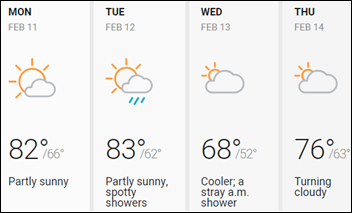
This week’s Orlando weather is looking good, other than prediction of a slightly bleaker Wednesday that exhibitors will love because it will keep attendees inside.

Many attendees – including Dr. Jayne – aren’t so lucky with their weather at home, as folks are having their flights to Orlando delayed or cancelled. 

818.722.1903

Text me interesting news, rumors, and photos during the conference. It’s a burner, so I’ll likely ignore voice calls and block the inevitable PR spammers. I’ll just be cruising the exhibit hall and convention center hallways looking for examples to share of both good and bad behavior.

image

Thanks to Dimensional Insight, which celebrated its “Best in KLAS 2019” for business intelligence and analytics by increasing its level of HIStalk sponsorship.

Speaking of that, Lorre is offering a deal to companies that want to sign up as sponsors or upgrade their sponsorship, a reward you get only for having the perseverance and ingenuity to find our tiny, poorly positioned booth buried in the exhibit hall alleys (hint: it’s near the place where guys come out checking their zippers – no outside jokes allowed, please).

Buffalo-based Catholic Health will implement Epic. I think they’ve been on Cerner Soarian for many years.

Also choosing Epic – Saudi Arabia’s King Fahad Medical City. Cerner is usually stronger in that part of the world, but Epic’s go-live at Johns Hopkins Aramco Healthcare a year ago may have established a figurative beachhead.

image

I’m not too bothered by non-experts running underfoot throughout the exhibit hall snapping selfies and acting important, but charging vendors for in-booth appearances while riding the HIMSS social media ambassador coattails seems inappropriate. However, HIMSS itself rakes in a lot of vendor cash for providing exposure and access in blurring the ethical line, so at least it isn’t being hypocritical in insisting that pay-for-play be ended or even clearly noted. I should run a poll of how many readers have been “influenced” by each “influencer,” although I expect they would implore their Twitter followers to stuff the ballot box to validate their self-imagined importance.

Buzz suggests that ONC may announce its long-delayed information blocking rules this week.

Decisions, brought to you by Definitive Healthcare:

  • Kenosha Medical Center (WI) will replace teleradiology from REAL Radiology To Envision Physician Services in 2019.
  • Central Peninsula General Hospital (AK) moved from NightShift Radiology to REAL Radiology on February 1.
  • Island Hospital (WA) replaced Nightshift Radiology with REAL Radiology on February 1.

Business Insider ponders the $1.8 billion paper valuation of Medicare Advantage insurer Devoted Health, started up by Ed and Todd Park (formerly of Athenahealth) even with zero customers or revenue so far. That must be one fantastic slide deck.

More birth tourism news: a couple from China who paid a company to get them into the US for their baby’s delivery hightails afterward back to China, leaving their hospital bill unpaid and leaving their baby still in NICU because it was born with birth defects. China’s one-baby policy was recently expanded to two and may be eliminated entirely as the country faces economic stagnation, which should reduce some of the barbaric health practices that the law caused.

HIStalk Interviews Nora Lissy, Director of Healthcare, Dimensional Insight

February 7, 2019 Interviews Comments Off on HIStalk Interviews Nora Lissy, Director of Healthcare, Dimensional Insight

Nora Lissy, RN, MBA is director of healthcare for Dimensional Insight of Burlington, MA.

image

Tell me about yourself and the company.

I’ve been a registered nurse for over 30 years. I started out as a clinician, with the majority of my time spent in the emergency room. I then got interested in hospital operations and working with the operational folks and leadership. As healthcare evolved, I evolved with it and got into analytics, understanding numbers and outcomes. I used Dimensional Insight’s system in three different organizations in three different roles and found that I loved what I was able to do with it. I came on board with the company in 2013. I help organizations understand their information, their data, and to get the right data to the right people so that they can act upon it.

Do health systems underuse nurses and other clinicians in using data to make decisions?

Yes. Our president likes to talk about the “data gene,” which some people have and some don’t. Every organization definitely has pearls — not only nurses, but lab and rad techs who actually understand the global picture. There’s always one person in every department where everybody knows that if you need an answer, you go to them. Those people are usually data-driven to begin with, just naturally.They do get underutilized, or shall I say mis-utilized. They have their regular job, and then when they have a chance, we’ll  have them do reports and stuff like that for us. But some very strong care providers are also analytical and would be helpful in pushing forward the analytics process.

BI and analytics tools triggered a buying frenzy. What was the result?

Like you said, it was a frenzy. Everyone felt like they had to get it. Many people are influenced by pretty pictures, or they go down a path and they’ve got someone who’s caught their interest.

What I’ve noticed in working with customers and in the literature is that sometimes customers take on too much. BI is a journey. When an organization tries to do 15 projects at the same time, it’s inevitable that none of them will get finished. A project gets started. Then it’s like, OK, this is cool, we can use that same tactic over here. They start big project B before finishing big project A, with the same people working on both. Now you’ve pulled them in two different directions and nothing gets finished.

The successful ones that I’ve seen have stayed within the guidelines of their strategic plan. Some people feel it takes too long to get that done, but you need to have a plan, a path you’re going down. Not just say, “We’ve got BI and we can do everything.” Every tool can, but you have take the steps and do it and close the loop before you go to the next one.

I’ve worked in organizations that had four or five BI tools, so they had four or five reporting teams. They still had the same problem — my BI tool says this, your BI tool says that. They never really got together and said, what do we say as an organization?

Does BI get the credit way down the line when the decisions it influenced finally produces positive, measurable results?

I think so. What I’ve seen is that there’s a big fervor at first. Everybody gets it, they see stuff, and they go wow.  But a BI install suddenly provides access to a lot of information. That’s the other “aha” that gets you. We have all this data and we don’t know what to do with it. We had none, now we have too much. How do we core it down to what’s going to be meaningful to us?

That’s where I think the BI tool can come into play, to help us focus on what we need to focus on because we have so much out there. Healthcare is just loaded with data, and more comes in every day. We want to use these complex business rules and these algorithms, but we could have obtained the same answer if we had just used a quicker approach.

Health systems have all this new data, multiple teams, and a mix of acquired health systems and practices using different systems and different terminologies, plus trying to decide whether to centralize the analytics function. Do these factors make it tougher to do analytics right?

Absolutely. It’s an absolute challenge, everything you just said. You might have a hospital organization that has been using an embedded BI tool for years. Then all of a sudden they acquire, or they’ve been acquired. They decide that they don’t want A, or they really want B. Then you have to go through a conversion of what they’ve done. Aside from just the acquisition process, you have to work on linking and cross-walking different EMRs or even the same EMR implemented with different approaches.

I’ve worked in two organizations that had four or five reporting teams. We were chasing our tails. Who do you believe? Who has the loudest voice this month or with this leadership? The people who really need the BI, the operational and front-line people, throw up their hands and say, “I don’t even know what I’m getting any more, so I don’t even care.” You look at who is using the BI and there’s little utilization. The people we’re trying to help don’t even get all the information they need because there are too many competing answers.

I find that the best success is when you bring in not only stakeholders, which is your leadership, but also the people that you’re expecting this data to help. They need to be a part of the process. You can’t just put this together and say, here you go, you’re on your own, take it and run with it. You have to bring them into the process so that they understand the value they’re getting. It’s one thing bringing a BI tool in, but what’s the value I’m going to get from it? Is it just one more report that I have to go through, or will it give me value and make my day better?

My experience is that the people who use analytics the most are department managers and directors instead of C-level executives who don’t even have computers on their desk. Should the C-suite be involved or pay more attention to what data is available and how it’s being used?

I would say that over the last two or three years, I’m seeing more and more C-suite involvement. I have a couple of customers that if the information isn’t available when the CEO comes to work, he or she is calling and saying, where are my numbers? So I am seeing more senior suite involvement.
There are two types of BI – the “how are we doing” numbers for the C suite and then the operational things, which are near and dear to my heart. The things that I had to do as a clinician or as a manager of clinicians. The things that I needed to arm them with. We can give that to them. Before, we would have to go through 15 reports to try to figure it out. It’s making their life easier.

There are so many rules and regulations coming out in healthcare. I have to remember to dot my I and cross my T. Maybe if I had a queue list to tell me that these are the three things I have to worry about, that would make my life easier.

It’s like anything else you do in life. It’s a daunting task if you have a room full of garbage and you have to decide where to start. You have to pick at it and say, I know I’m going to keep the stuff over there. That’s one fewer thing I have to worry about. From a BI perspective on the operational side, they see their page with their three things and they’re all green and they’re good. If one is red, they have to go focus on that. It’s helping them get through their day-to-day operational side.

We haven’t quite gotten the value from BI because healthcare and the operational side of things are complex. When I say operational, I’m thinking about your clinical folks. Was the assessment done in 24 hours? When was the last time case management saw these patients? There are standing operating procedures that are in place that if something goes wrong, we might stop and take a look at it. But generally speaking, it just goes along day by day until the holes in the Swiss cheese line up and you realize you should have been seeing this. But life’s busy in the hospital. We need to provide actionable information to the day-to-day providers so they can prevent the harm.
What new data elements are available for that alerting and trending analysis and how are they being used to impact individual patient care instead of just giving executives a stoplight report?

It’s more the capacity of how BI itself is evolving and how data is being pulled. The old world of BI was SQL queries. Now you’re getting into columnar databases that allow for a faster retrieval and for more data to be viewed at one time. That technology allows you to cipher through millions of rows of data. 

Think about it from a lab perspective. When I was at a healthcare organization in North Carolina, I worked with a clinical pharmacist to identify the five or six high-risk drugs that they wanted to have insight into. Then we got a tickler every time the lab values changed. We added the information to their hourly census, so that when the lab values came in and the patient was on this particular medication, they would see the trend before it got to a critical point. They would see that it’s been rising for the last two days by 0.2 percent each time, so we had better keep an eye on it.

It becomes more useful with the ability to visualize and manage more data at one time. I have another organization whose pharmacists use it to look at critical medications. They bring in over 40 million rows of data to use their work queues to improve their movement from IV antibiotics to PO antibiotics so they can lower cost, improve patient care, and hopefully get the patients out of the hospital sooner than later.

The BI approach uses technology to highlight exceptions to the defined desired values, while the machine language approach would be to throw a lot of data at the system to identify new problems or opportunities that humans have missed. How do those approaches co-exist?

Machine learning has a way to go, in my opinion. Someone still has to feed that machine some kind of algorithm, and it has to know what it’s looking for. Some are more sophisticated and can do patterning and I think that will become invaluable over time. It’s not mature yet, where physicians believe that it shows them what they expect. But it will be an invaluable asset as it continues to grow and as we continue to understand how all the data fits together.

Why have we stopped hearing the most overused term on the planet, “big data?”

Because everything is big data. It was just a catch phrase. I don’t know where it started, and then all of a sudden, it just went away and no one is even saying it any more. This may sound ignorant, but it’s the same thing when we talk about AI and machine learning. What do we mean by AI and machine learning? What concept do people have of that? What are the developer’s concepts? What do its potential users think? It raises the same kind of question as the term big data.

Do you have any final thoughts?

I really enjoy what I do now because I get to work within my passion in using analytics to help providers — who need it more than anybody else – and to help the operational folks with their daily operational process that is very difficult. There’s a lot of expectation that the people on the front line will get things done, remember all these rules, and do all these things. As we move forward in analytics, we will hopefully be able to make that life easier for them and help them focus on getting back to taking care of the patient.

EPtalk by Dr. Jayne 2/7/19

February 7, 2019 Dr. Jayne Comments Off on EPtalk by Dr. Jayne 2/7/19

Physicians are always up in arms about quality reporting, having been burned by payer, federal, and institutional quality programs. The American Academy of Family Physicians released a position paper recently that hopes to help influence the development and use of quality measures in physician payment initiatives. The Academy plans to use the principles outlined in the paper in its discussions with payers, health plans, and healthcare IT developers.

The first principle involves differentiating between quality measures and performance measures, with a goal of using the former for internal clinical improvement while reserving the latter for comparative data and resource allocation efforts. AAFP supports the use of performance measures, not to drive penalties, but to show where investment should be made to improve access and equity in healthcare.

The second principle addresses integration of quality measures into an overall methodology, allowing for “a safe space to allow honest assessment of care without fear of punishment and without pressure to increase revenue or produce bonus payments.”

The third principle outlines the need for a single set of universal performance measures that “focus on outcomes that matter most to patients and that have the greatest overall impact on better health of the population, better healthcare, and lower costs.” A secondary goal is limiting the measures that are included in value-based payment programs since “giving in to the temptation to measure everything that can be measured drives up cost, adds to administrative burden, contributes to professional dissatisfaction and burnout, encourages siloed care, and undermines professional autonomy.” It goes on to say the standard set of measures should be used across all payers, programs, and populations.

Principle Four addresses the application of performance measures at the system level, with risk adjustment as needed for demographics, case severity, and social determinants of health.

Principle Five addresses primary care features such as access, coordination, patient and family engagement, and care management.

The sixth principle calls for health IT redesign, encourage automated data collection and quality measurement while eliminating the need for self-reporting. I’m not thrilled that AAFP left this one at the bottom of the list as it is so critical to the success of primary care moving forward.

I’m working with a couple of vendors that are taking existing EHR data and using it in novel ways at the point of care, focusing on making life easy for clinicians and improving outcomes for patients. It’s been refreshing to see their enthusiasm, but the rubber will meet the road as they begin integrating with EHRs since their products essentially replace clunky or non-existent EHR features that clinicians need and want. The future of healthcare IT is bright and there are many challenges to come, a good thing since unless I win the PowerBall, I’ll be here for a while.

My curiosity was piqued by a pre-HIMSS email for Edgility, a vendor that claims to be “bringing situational awareness to healthcare.” It’s always interesting when a phrase can be used in multiple contexts, and seeing “situational awareness” my mind went directly to my most recent self-defense class. If you’ve ever spent time with military or law enforcement people, you’ll know what I mean about situational awareness. You will have had to sit where you don’t want to sit so that someone else can have their back to the wall.

For those of you who might not be preppers, here’s a quick summary of how others think of the phrase. It’s amazing how the 10 tips provided in the article directly apply to what we do in healthcare IT: learn to predict events; identify elements around you; trust your feelings; limit situational overload; avoid complacency; be aware of time; begin to evaluate and understand situations; actively prevent fatigue; continually assess the situation; and monitor performance of others. Even the ad for the bug-out bag applies, knowing how hospital staffers coped with working during recent natural disasters.

One of the sessions that caught my eye for HIMSS is one covering a Centers for Disease Control project that is digitizing infectious disease guidelines to work within EHRs. The team’s goal is to create digital algorithms and guidelines that could be easily consumed by various EHR platforms, shortening the time that it takes to implement that kind of decision support within the EHR. In our global environment, there’s a need to stay vigilant about emerging diseases. My dermatologist’s office still has a sign up advising patients to let staff know if they’ve traveled from West Africa, even through it’s been years since Ebola was in the US.

It’s also important to be able to use guidelines for diseases that we see more than we should, such as the current measles outbreak. If this topic floats your boat, you can join me on Tuesday the 12th at 3 p.m. in room W311E.

Neurodiagnostics vendor Oculogica, Inc. recently received FDA approval for its EyeBOX concussion detection tool. It can be used on patients from five to 67 years old and employs eye-tracking technology to identify patients with suspected concussion. I regularly see concussions in clinic and not just from football any more. Some of the worst I’ve seen have been from water polo and field hockey. The EyeBOX solution doesn’t require documentation of a testing baseline for athletes and isn’t easily gamed by someone who is eager to return to play, unlike some of the alternatives.

clip_image002

I’m engaged in a health exchange project that happens to include a client using the Greenway Health EHR, so you can bet there was plenty of buzz today about the payment the company will be making to settle recent False Claims Act allegations. One of the key allegations was Greenway’s modification of the software that is used in the certification testing so that it appeared that Prime Suite had certain capabilities. News flash, folks — it’s not just Greenway. I suspect there are plenty of other vendors out there who cooked their software a bit to either pass certification more easily. I’ve seen functionality that was included for testing that was later implemented in a materially different way for the rollout to actual clients.

The only way to truly protect consumers is to require testing on off-the-shelf products by independent testers, not a dream-team of vendor employees who know how to grease their way through the defects. This is similar to what we saw with Volkswagen sneakily modifying test builds for their diesel vehicles. I’ve already heard other vendors bad-mouthing Greenway and all I’ll say is that people in glass houses shouldn’t throw stones.

I’ll be headed to sunny Orlando soon, so this will be my last post until HIMSS starts on Monday. Watch this space for all the news, rumors, party updates, and great shoes.

button

Email Dr. Jayne.

HISsies 2019

February 6, 2019 News 1 Comment

HIStalk Interviews Terry Edwards, CEO, PerfectServe

February 6, 2019 Interviews Comments Off on HIStalk Interviews Terry Edwards, CEO, PerfectServe

Terry Edwards is founder, president, and CEO of PerfectServe of Knoxville, TN.

image

Tell me about yourself and the company.

I started PerfectServe in the late 1990s after spending a few years in a technology company called Voice-Tel, which was one of the early pioneers in interactive voice messaging. At that company, I saw the need to improve communications in healthcare and later started PerfectServe. The company started in managing communications in the physician’s office, extending later into managing nurse-to-physician communication in the hospital and acute care environment while still doing the physician work. We evolved that over the last several years into one of the most comprehensive communication platforms in the industry.

How will the mid-January acquisition of Telmediq, the top-rated secure communications vendor, change your business?

PerfectServe was acquired by the Los Angeles private equity firm K1 Investment Management in the middle of last year. That was part of the plan to get our early venture investors out. They had been invested in PerfectServe for a long time and stood behind the company. We were able to give them a successful exit.

With that, we were also able to clean up PerfectServe’s balance sheet and to gain the backing we needed to execute on a broader strategy. As you and I have talked about in the past, the industry in which we operate is that outside the realm of the EMR, the technologies are fragmented. We started to see this just in the fragmentation of communications alone. But in addition, other technologies that are adjacent to communications could be part of a more comprehensive platform.

We surveyed the landscape and saw the opportunity to consolidate some of the stronger players within our category. Telmediq was at the top of that list. It had capabilities that we did not have, such as in the contact center and call center space as well as in nursing mobility. We thought those would be valuable to our customers. While there’s overlap in what both companies do, Telmediq was doing some things better than PerfectServe, and PerfectServe was doing some things better than Telmediq. By bringing these two together, we believe we’ve created the leading communications platform in the marketplace.

How important is it for a CEO to work with investors who can help take the company to the next level or help it clarify its acquisition and positioning strategies?

K1 is a growth investor. There are different kinds of private equity firms and different business models. Some will find slower growth opportunities with companies that might be growing five or 10 percent a year, then put two of them together and then take out costs and try to drive synergy.

K1 is a growth company where they are looking to invest. They are about building leaders in the category. As they evaluated PerfectServe, one of the opportunities was that PerfectServe could be the cornerstone of a much larger and broader care team collaboration product offering strategy. That led to the opportunity to acquire Telmediq.

We just announced two other acquisitions. Lightning Bolt Solutions, which is in the physician scheduling space, and CareWire in the patient communications space. Our broader strategy is to build the care team collaboration platform of the future. We will do this through both acquisition — and integration of the acquisitions — as well as organic development. That takes capital to do well, which is why we have K1 at the table with us.

Was the death of pagers greatly exaggerated?

[laughs] They are dying a slow death, but there’s a long tail.

Consumers seem to be using phones more often for texting more than for making phone calls or sending email, and now they are using speech recognition to drive that messaging. How is that  impacting healthcare communication?

I’ve been amazed to watch the adoption of texting as a mode of communication. When we started PerfectServe, everything was voice driven. In fact, the first version of the PerfectServe platform was purely an interactive voice response platform. All the communications were voice driven and interacting with the keypad.

We first entered the acute space in 2005. Due to the nature of the platform, 100 percent of the communications we were processing were over the phone, either as a live call or sending a page or text message. The text messages could be as an alphanumeric page or SMS and they were all system generated.

We later introduced our web interface and then our mobile interface. With mobile came texting. We started to see texting rise.

About 18 months ago, we introduced a new user object so that nurses could authenticate in the same way as our physicians. With that, we were able to facilitate bidirectional communication. A nurse can send a text to a doctor via the secure platform, then the doctor can reply. In our newest hospital environments, 90-plus percent of all the communication that’s running through the platform is text, and it is secure text, which has been fascinating to see. It’s convenient and that’s the benefit.

What is being done to make communications part of the overall workflow?

Gartner has classified us in the category of clinical communication and collaboration, or CC&C. They gave it that name to help communicate to hospital buyers that communication is more than just secure texting. Secure texting is a component of a broader communication strategy.

But as we’re looking at this — and I think it’s consistent with how Gartner is looking at this – the clinical communication platform is a core component or pillar of a broader care team collaboration platform. It needs to encompass the communication modalities of secure texting, paging, SMS messaging, email notifications, and voice calling, whether it’s a cellular, voice over IP, or landline. You have to have this omni-channel communications component.

The key to PerfectServe since Day One has been our workflow capabilities. We are automating a communication workflow to make sure that we can connect the initiator – a nurse or a doctor or some other caregiver — to the person they need to reach, who can then take action at that moment in time. Workflow is a component of this.

As you think about workflow, there’s not only the algorithms around routing, but also call schedules. PerfectServe as well as Telmediq built call schedules into our platforms, but they were limited to the schedules specific to a communication workflow. Medical groups, for example, have scheduling needs that are broader than that, that go across the whole workforce. That is where Lightning Bolt comes into play.

These adjacent technologies move beyond communications to staff scheduling, referral management, rounding, and integration into other technologies like alarms, alert systems, nurse call, and interactive patient care. Our vision is to build the most comprehensive care team collaboration platform, either by building or acquiring technologies that make sense to be a part of it, and then integrating with those that are adjacent but outside the domain, such as nurse call.

How have the communications needs of health systems changed as they acquire hospitals and practices?

I don’t think they are changing, but the expansion is enabling them to put in stronger governance structures to drive higher levels of standardization. One of our clients, Advocate Health Care in Chicago, has been a model in terms of saying, these are the parameters upon which we’re going to communicate with you. We’re going to have these minimum standards around fail-safe notification processes and escalation and things like that. This starts to move the organization away from letting doctors do it however they want, which might be might be efficient for them but not for nurses or colleagues who need to reach them.

What do you as a CEO do during the HIMSS conference?

[laughs] It’s usually a pretty packed schedule. I will spend a little bit of time in our booth, and that’s unstructured. But for the most part, I’ve got meetings scheduled, a mix of customer meetings, new prospect meetings, analyst meetings, and sometimes meetings with folks in the financial community. It’s usually a pretty intense time, one of those events that I look forward to, but that I also hope to never attend again.

Do you have any final thoughts?

I’m excited about where PerfectServe is. Not just for me personally or our company, but for our customers. I’ve been in this space for a long time and I’ve seen a lot of things. There’s this bigger vision that I started to see about three or four years ago and it is here now. PerfectServe and our customers have the opportunity to deliver even greater value than I envisioned. I’m excited about that and excited about the future.

News 2/6/19

February 5, 2019 News 8 Comments

Top News

image

Cerner reports Q4 results: revenue up 4 percent, adjusted EPS $0.63 vs., $0.58, meeting earnings expectations but falling short on revenue.

The company announced plans to start paying a quarterly dividend of $0.15 in Q3 2019.

Also in Cerner news, the company will lay off 129 employees at its Augusta, GA office on March 31, according to WARN Act filings. I assume that’s at Augusta University Health, which I believe outsourced IT to Cerner a few years back but seems to be using at least some Epic now.


Reader Comments

image

From Slack MF: “Re: Slack. Looks like it’s getting into healthcare.” The CNBC story suggesting that Slack will target the provider market for information sharing is is a stretch, based on the collaboration technology vendor’s security page being updated to say that its product is HIPAA compliant. It’s good practice for general tech vendors, especially those like Slack who are about to IPO, to make sure they meet HIPAA business associate requirements, but that doesn’t mean they will go after that (or any) end user market specifically. Slack is like Salesforce in offering the core technology and leaving most of the industry-specific content to third-party app developers, so I would expect its new HIPAA status to create interest among vendors to use its API to develop new healthcare tools, such as patient messaging and engagement. I wouldn’t expect Slack to suddenly delve into a specific healthcare product and sell it directly, especially as it tries to optimize its first few quarterly reports. A lot of time and energy is being wasted speculating on whether or how Amazon, Google, or other tech giants will invade healthcare instead of just waiting to see what they announce. Meanwhile, if you’re a health IT vendor dealing with PHI and are looking for a pivot or expansion area while riding some big coattails, give Slack’s API specs a look.

From Amish Avenger: “Re: ICD-10. It’s interesting that people can submit ideas for new terms.” An expert says CDC is overwhelmed and thus way behind in reviewing code requests for newly discovered rare diseases, with the ICD-10 codes being important for quantifying each condition’s prevalence and for performing research. The article also notes that ICD-11 is scheduled to take effect on January 1, 2022.

From Talking Dead: “Re: broadcasting from HIMSS19. Who is consuming all of those podcasts, fake TV shows, and audio and video interviews that clog up the exhibit hall aisles?” No one. It’s just a vanity project for the people who produce them. Just because someone lugs video gear around the exhibit hall or perches in front of the lights answering questions doesn’t mean anyone else cares. I recall few times that I’ve even glanced at those videos and no times that I missed anything when I didn’t. I notice that some questionable sites are taking vendor payoffs to do their interviews and gabfests directly in their booths, which should immediately evaporate whatever credibility they had in the first place (think Fyre Festival, and I’m resisting hard saying FHIR Festival).


HIStalk Announcements and Requests

Expectations were appropriately low for Super Bowl halftime performer Maroon 5 — which has racked up a puzzlingly long yet entirely undistinguished career peddling corporately-crafted drivel like “Moves Like Jagger” — but the bland – er, band – managed to underwhelm anyway. The dull show, which bisected a dull game, sent America to console itself in guacamole and wings. Here’s my too-late, Georgia-focused alternative of some real music: get REM to reunite, maybe with the B52s backing (as long as they don’t play “Shiny Happy People”). My set list: (1) “Texarkana;” (2) “What’s The Frequency, Kenneth?;” (3) “Losing My Religion;” (4) “Man On the Moon;” and (5) the obvious and appropriate closing number, “It’s The End Of The World As We Know It (And I Feel Fine).”

Dann, who started the HIStalk Fan Club on LinkedIn forever ago, tells me it has over 3,700 members. I don’t look at it unless someone’s asking me for a favor, in which case seeing that logo on their profile makes me a lot more likely to help.


Webinars

None scheduled soon. Previous webinars are on our YouTube channel. Contact Lorre for information.


Acquisitions, Funding, Business, and Stock

image

Premier Inc. announces Q2 results: revenue up 3 percent, adjusted EPS $0.66 vs. $0.50, beating expectations for both. COO Mike Alkire said in the earnings call that the November acquisition of Stanson Health was highly strategic and its decision support product is selling well, although that business’s revenue is only in the $3-5 million range.


Sales

  • Four hospitals in Europe choose Hyland Healthcare for enterprise imaging.

People

image

Healthwise hires Daniel Meltzer, MD, MPH (Blue Cross of Idaho) as chief medical officer.


Announcements and Implementations

image

A new KLAS report on EHR/PM systems for practices of 10 or fewer doctors finds that they’re looking for products based on functionality, usability, and support – they don’t care much about about outcomes or technology. NextGen Healthcare, CureMD, and Aprima were the vendors most aligned with those product attributes, while the lower user satisfaction with CareCloud, Cerner, and EMDs may be due to their technology focus.

MedStar Health’s National Center for Human Factors in Healthcare and the American Medical Association launch “See What We Mean,” a campaign for EHR safety and usability. It asks people to sign a letter asking Congress to push ONC to implement the EHR Reporting Program that was mandated in 2016 by the 21st Century Cures Act.

image

Baylor Scott & White Health and Memorial Hermann end their merger discussions.

image

In England, NHS Digital publishes its front-end code in GitHub to help third parties build mockups, prototypes, and working applications that connect to NHS’s websites and services.

CommonWell announces a Connector program in which health IT vendors can connect to its services through a CommonWell integration member without joining CommonWell themselves.

image

“A Machine Intelligence Primer for Clinicians” by Alexander Scarlat, MD is now available on Amazon. He wrote the 12-part series on HIStalk and he clearly knows his stuff from both a machine learning and MD perspective.


Other

image

The US Patent Office publishes a 2017 Google patent application for AI-powered software that would use aggregated EHR information collected via FHIR to predict and summarize medical events, sending its findings to individual providers as a patient timeline. The focus seems to be on mining valuable information that would otherwise be lost in the EHR clutter, including a quote, “A wealth information creates a poverty of attention.” I can’t figure out how some sites concluded from the patent application that Google is developing an EHR.

image

A study published in Health Affairs finds that hospital prices – not those of physicians who bill for services they provide in hospitals – are responsible for driving up healthcare costs, according to the first research to distinguish between the two. Hospital inpatient prices increased 42 percent over eight years. The data came from the Health Care Cost Institute, which made headlines recently when UnitedHealthcare said that it will no longer share its claims information with the organization.

image

We’ll need a new ICD-10 code for the time doctors spend debunking the dopey and sometimes dangerous health ideas of Gwyneth Paltrow’s Goop, which has bagged a docuseries deal with Netflix from which GP will dispense the “more strategic, bigger stories we want to tell,” presumably to gullible women who trust that Gwyneth’s “lifestyle brand” products (vitamins, sex toys, cookbooks) will help them lead the full lives that have otherwise escaped them. We’re in the public health danger zone when people trust obviously underqualified “experts” or their own “feelings” to decide which parts of proven science they choose to ignore.

image

Doh! The Super Bowl featured a male Nipplegate, so now we have a HIPPAgate.

image

A former nurse of Vanderbilt University Medical Center is indicted for making a medical error in which she injected an elderly patient with the paralyzing agent vecuronium (Norcuron) instead of the ordered sedative midazolam (Versed) that was intended to to overcome the patient’s claustrophobia before having a PET scan. The nurse withdrew the wrong medication from the automated dispensing cabinet after typing in the letters VE for versed, then after not finding the drug’s name, overriding the system to gain access to the vecuronium. The patient was left alone in the scanner for up to 30 minutes where she experienced cardiac arrest and brain death, then died the next day after life support was turned off. The Tennessee Bureau of Investigation charged the nurse with reckless homicide and impaired adult abuse after Vanderbilt fired her. So much for a non-punitive culture that encourages a review of errors to help prevent more instead of coming down hard on a professional who makes a mistake (which is all of them). Having reviewed thousands of medical error reports in hospitals over the years, I guarantee that the “Swiss cheese effect” was in place, where the nurse’s carelessness wasn’t the only procedural irregularity that day. For example, the CMS investigation contains these big red flags that go beyond an incompetent nurse going rogue:

  • Pharmacy had not approved the nurse’s dispensing cabinet override.
  • The nurse didn’t document the administration in the EHR after asking the charge nurse how to do it, being told that “the new system would capture it on the MAR.”
  • I assume barcode verification was not used since it should have prevented the error, perhaps because the medication was administered in radiology rather than in the usual patient care areas.
  • The nurse was assigned as a “help-all,” for which no specific job description exists.
  • She was talking to an orientee who was assigned to her while she was working hard to obtain the wrong drug.
  • The nurse was asked to administer the drug in the radiology department, but she wasn’t assigned to work in radiology, so she left the patient immediately after injecting her.
  • The radiology control room had cameras, but they don’t show sufficient detail to detect whether a patient is breathing. The techs assumed that the patient’s eyes were closed because of the bright lights.
  • The nurse gave the patient’s primary care nurse the bag containing the medication vial immediately after the injection, but that nurse didn’t look at it for 15 minutes because he was charting.
  • The event occurred on December 26, 2017. I would have looked into whether VUMC’s Epic go-live on November 2, 2017 might have contributed to the error because of the related changes (ADC interfaces, labels, documentation, etc.)
  • That date might have had its own impact – the radiology department told CMS they were swamped that first day after Christmas. Staffing levels may also have been affected in that vacation-popular week between Christmas and New Year’s Day.

image

A Canada-based cryptocurrency exchange says its clients will lose their $190 million in holdings after the only person who knew the password to its storage system – the company’s 30-year-old founder – has died. Questions are understandably being raised about whether perhaps his death was faked and he’s off somewhere having fun with the money given that currency-moving transactions have occurred after the account was locked. Not that cryptocurrency attracts scammers or anything.

Super Bowl viewers seemed mostly unimpressed with the all-important commercials, but this one from Microsoft is not only touching and relevant to the company’s business, but it’s also an ode to diversity, inclusiveness, and resilience that the country can certainly use.


Sponsor Updates

  • Mobile Heartbeat’s 2018 monthly active user count for its MH-CURE communications and collaboration platform doubled year over year, with hospitals averaging 1,150 regular users.
  • Providence St. Joseph Health expands its use of provider data management and patient access solutions from Kyruus.
  • AssessURHealth will participate in the Startup Grind Global Conference February 11-12 in Silicon Valley.
  • Culbert Healthcare Solutions will exhibit at the WRUG Winter Conference February 14-15 in Las Vegas.
  • UConn Technology Innovation Program’s first growth award goes to Diameter Health.

Blog Posts


button


Contacts

Mr. H, Lorre, Jenn, Dr. Jayne.
Get HIStalk updates. Send news or rumors.
Contact us.

125x125_2nd_Circle

Curbside Consult with Dr. Jayne 2/4/19

February 4, 2019 Dr. Jayne 1 Comment

Our EHR friend John Halamka, MD co-authored a piece in the Harvard Business Review earlier this month regarding strategies for making EHRs less time-consuming for physicians. Their ideas are sound, although I’d like to expand on them a bit from the trenches.

The first point made is the need to “standardize and reduce payer-imposed requirements.” On the surface, they’re talking about the documentation requirements for an office visit, which in the US is approximately 700 words. This is significantly longer than the average note in other industrialized nations, including Canada, Australia, and the UK.

CMS is attempting to provide leadership here in blending the codes for certain Evaluation and Management (E&M) codes, therefore “reducing” documentation in some areas, but it doesn’t go far enough. Instead of trying to describe complex rashes, why can’t we upload pictures and have that count for payer documentation? Instead of trying to describe a trauma or laceration, we could fully document it. In those situations, the adage about a picture being worth a thousand words is true.

Getting relief from onerous workflows in the EHR is one thing, but if you want to impact clinician satisfaction and reduce burnout, I’d go a step beyond to look at other payer-driven workflows such as pre-authorizations, pre-certifications, and peer-to-peer conversations that waste clinician time.

I was called recently to provide documentation to prove why I needed to order a CT scan of a patient’s abdomen since an insurance reviewer felt I hadn’t given the right information. I asked the reviewer if she bothered to look at the patient’s CT scan result. Perhaps the large pancreatic tumor that was discovered — based on my clinical suspicion and corroborating exam findings — should be enough to prove why the CT scan was necessary. She stated she didn’t have access to the reports. Instead of using their own resources to review the outcome, they wasted my time trying to prove something that turned out to be obvious.

The second point made by Halamka et al is that EHR workflows need to be improved. I whole heartedly agree with the need to remove non-value-added steps from the workflow and to minimize disruptive or unnecessary alerts. Information needs to be available to the people who need it, at the time they need it, and at the appropriate level of detail. Our EHR went haywire for a while and every user was seeing a popup declaring that “Eligibility Checking has returned on John Doe,” which was ridiculous and took several days to correct.

No matter how much improvement vendors make in their workflows, however, there is still the tendency for practices to misapply those workflows, either through lack of understanding or lack of skill. Our EHR continues to throw errors whenever we try to prescribe certain medications because the NCPDP codes aren’t mapped. I know our vendor uses the premier database for medications, so I have to assume that it’s poorly implemented in the practice. If there are risks that a client might not keep their formularies up to date or might have implementation issues, then vendors should consider process that provide automatic updates so that physician workflows are preserved. A nice side effect is that confidence in the vendor will increase, since physicians rarely understand that their own practice has misapplied the technology and tend to blame it on the vendor.

The team’s third point is that the EHR user experience needs to be improved. I don’t know of a physician out there who wouldn’t agree with this point. I continue to see EHR “upgrades” and “enhancements” that are downright silly. One EHR that was shown to me by a client had a title bar that was blue and displayed the patient’s name and information. Since the EHR would allow you to have multiple patient charts open at the same time in separate windows, the title bar was essential so you could not only see quickly which patient was loaded, but also so that you could tell which window was active. In the interest of making the screens more “vanilla,” the vendor removed the blue title bar, making it much more difficult to see which window was active, forcing users to go to the Windows taskbar and click on the different taskbar buttons to cycle them and reactivate them. The upgrade was definitely a downgrade, and since it’s been that way for a year, I doubt the vendor thinks it’s an issue.

Another EHR claims to be “mobile friendly” but the screens don’t fit on a standard mobile device, requiring right-to-left scrolling of popups, which isn’t very mobile friendly. When trying to use it on my Microsoft Surface, it won’t accept the native handwriting recognition input and instead makes me use a tap-tap-tap keyboard to enter data. What a waste of time. The same EHR doesn’t have restricted fields for blood pressures, allowing nonsense values such as 80/1000 to be entered. For years, vendors used the ongoing proliferation of regulatory requirements as an excuse for why they couldn’t develop “nice to have” features that end users had requested. Now that those requirements have slowed a bit, I don’t see vendors sinking vast amounts of R&D funding into usability.

I continue to see healthcare IT products that don’t include basic elements of usability, such as using indicators beyond color to indicate whether lab values are high or low. Someone who is red/green colorblind isn’t going to see your red/green schematic – they need other indicators, such as graphics or text, to provide meaning. I see vendors that include password requirements that don’t meet current NIST recommendations, such as requiring overly long passwords with high degrees of complexity or mandating changes every 30 days. Clients can’t opt out in many cases and are stuck with a vendor’s interpretation of security needs that is out of date or untenable. I see EHR searches that can’t handle partial strings or aren’t intelligent enough to recognize typos.

I can’t wait to get to HIMSS next week and see what vendors have been up to and whether they should move up in my Hall of Fame or should be relegated to the Hall of Shame. I’d like to see some bold new user interfaces with lots of bells and whistles intended to keep physicians happy. I hope I’m not sadly disappointed.

If you’re a vendor and have bells and whistles you want to show off, leave a comment or email me. I’ll be sure to drop by anonymously and check it out.

button

Email Dr. Jayne.

Monday Morning Update 2/4/19

February 3, 2019 News 11 Comments

Top News

image

Dignity Health and Catholic Health Initiatives complete their merger to form the 142-hospital, $29 billion CommonSpirit Health.

The new health system said in the announcement, “We didn’t combine our ministries to get bigger, we came together to provide better care for more people.” I’ll be interested to see the post-merger metrics that prove success beyond the “bigger” part.

CommonSpirit Health will be run by co-CEOs (a horrible idea) from its ritzy headquarters in Chicago. The system does not otherwise operate in Illinois.

Interim co-CIOs Laura Young-Shehata and Denis Zerr are running IT until a replacement for Deanna Wise is hired.


Reader Comments

image

From Significant Brother: “Re: HIMSS health IT trends forecast. What did you think of it?” I didn’t see anything in it that was particularly insightful or interesting, to be honest, so I didn’t even mention it (plus they called it the “first annual” report, which is a journalistic no-no – you describe something as “annual” only after it has been around for two years). The full-body photo and boilerplate quote from CEO Hal Wolf did little to dispel the perception that it’s just a vanity piece intended to remind everybody how influential HIMSS thinks it is. It also focuses entirely on care providers rather than public health (the former has only a tiny impact on the latter). We have the cliche reference to “the perfect storm” and the yet-again maturing of digital health. The report was obligingly parroted as news by the HIMSS marketing – err, media – division. That group just did a conference tips video that was absolutely painful, ranging from the obvious (wear comfortable shoes, make a schedule, allow enough time between events) to the self-serving (watch HIMSS TV, track down the social media ambassadors as the “celebrities of HIMSS,” and read the vendor-friendly HIMSS publications).

image

Here’s my scorecard from two years ago on rating self-proclaimed industry thought leaders, which might work well in scoring the LinkedIn profiles of those “celebrities of HIMSS” in the form of social media ambassadors. I hadn’t heard of a particular one, so I checked that person’s LinkedIn and calculated a score of exactly zero — no healthcare experience, no degree, no membership in HIMSS, few health-related tweets, few health-related followers, and a ton of Twitter followers that mostly seem to be the phony ones you buy online to look influential.

From Crafty Ploy: “Re: HIMSS. Are you interviewing CEOs there?” No. I attend anonymously with a phony name, job title, and employer name on my badge. I meet with no one, attend no parties, and don’t even utter the word HIStalk. I just trudge the exhibit hall and then go back to my VRBO place to write up what I saw and heard. You can’t be objective while hanging out with executives or sucking up trying to bag ego-flattering speaking engagements or advisory board positions. Remaining anonymous keeps me objective and transparent since it’s all right here on the page.

From Truant: “Re: Best in KLAS. I didn’t see some department systems in there, like pharmacy.” Best-of-breed ancillary systems have mostly died off. First to go were pharmacy and medication administration systems (due to the need to integrate with ordering), then radiology, and finally lab systems. Those departments liked their standalone systems better, but were outvoted in favor of enterprise integration. About the only survivors in hospitals – and it’s a short-term position as Cerner, Epic, and Meditech eat the world – are LISs from Orchard, SCC, and Sunquest. You do not want to be a standalone hospital system vendor whose company future depends on your customer not ousting you in favor of their EHR’s integrated module. The appeal is obvious — integration becomes a single vendor’s problem and you’re down to one throat to choke.

From Ignoble End: “Re: doctors getting lap dances to prescribe opiates. What’s the world coming to?” The world has already arrived at this destination. Regardless of their expressed noble intentions, everybody (doctors, corporations, patients, software vendors, social media platforms, and politicians) will do whatever rewards them the most. Your only hope is that their most-sought reward is something more altruistic than cash, but you’ll be wrong in most cases. It’s also true that doing something slimy that involves only a relatively small punishment is still a net win. It’s nice but unreasonable to think that doctors are more virtuous than the rest of us.


HIStalk Announcements and Requests

image

Three-fourths of poll respondents say they’ll be working harder next week, with identical percentages for attendees as well as those left behind. Let’s agree not to think about how much productivity is lost from attending the annual spring boat show.

New poll to your right or here: Did the VA make the right decision in abandoning its Epic schedule pilot and implementing Cerner instead?

image

My once-yearly reader survey has drawn the usual mix of positive and negative, but I appreciate every response equally because someone cared enough to fill it out — indifference kills more sites than anything. One randomly chosen respondent will be reimbursed (aka “paid,” but we coyly don’t call it that in healthcare) with a $50 Amazon gift card, so fill it out and nobody will be the wiser whether you’re being nice or just looking for Amazon giftage. I try not to peek before all responses are in, but I’m touched by how many folks have kept reading even after they retired or moved to other industries, as well as by those who apparently worry daily that HIStalk will have gone dark because I’ve lost interest or died (I’m hoping for the former if forced to choose). I can also say that while my audience is self-selecting, I’m sitting on a treasure trove of their feedback that tells me why they keep reading year after year and everybody knows that rewarded behavior is likely to recur.

Here’s the digital technology that could revive Apple and maybe some people besides – create a real-time sensor for measuring blood levels of alcohol and recreational drugs, or use existing ones to detect overdose symptoms and call a pre-defined friend for help.

I got wrapped up in the music that was cranking in a small store I was in the other day, picking up on some deep tracks from Pink Floyd and a few other prog bands. The kid working said it was a Pandora Pink Floyd playlist customized via extensive use of the thumbs up/down option, which I always forget about. It had a few missteps, such as Credence and the Rolling Stones because older people listen to older music and fool the algorithms, especially Spotify’s, into thinking the bands are similar. My search for early Pink Floyd jams led me to new music from Rodrigo y Gabriela, a Mexico-based acoustic guitar duo whose all-guitar cover of Pink Floyd’s “Echoes” (from 1971’s “Meddle”) is perfect. I then understandably needed to revisit the stunning original, as recorded by the visionary Floyd live (using their regular touring gear) in the ruins of Pompeii in 1972 with no audience present in a brilliant exploration of a new art form by impossibly god-like band members who were all in their 20s. The contributions of the underappreciated Nick Mason (drums) and Richard Wright (keyboards and vocals) are evident, even more so on “A Saucerful of Secrets.” No crowd noise, no idiots waving cell phones, just the band getting deep into the zone in broad daylight (for some of the tracks) while ignoring the film crew. Just because it’s not loud or flashy doesn’t make it for stoners only. Music as contemplative art for the ages  – what a refreshing idea.

If Pink Floyd isn’t your thing (how is that even possible?) then there’s new music from one of my favorite hard-rocking bands, Norway’s The Dogs.

Dear industry people who aren’t technologists: please stop using the phrase “full stack” immediately. Thank you.

image image

Orlando’s weather for HIMSS19 is looking about as good as it did in 2017 in my photos from then above, with highs predicted to be around 80 and lows in the mid-60s. You’ll be sunning yourself while sprawling in the convention center’s questionably hygienic grass under that HIMSS sign before you know it.

image

Welcome to new HIStalk Platinum Sponsor Avaya. The Santa Clara, CA-based company offers unified communications and contact center products and services. For healthcare, that means collaboration solutions (mobile communications, multimedia, automated workflows); patient services (resource matching, omnichannel solutions, automated administration), and virtual care solutions and outreach. Seamless care team member communication improves outcomes, provides patient support, and keeps EHR information updated; patient services such as digital scheduling, referrals, reminders, and revenue cycle inquiries create a better patient experience; and telehealth video and outreach provide remote access to specialists and care teams and support care plan coordination. See Avaya at #6451 at HIMSS19 for communications solutions demos. Thanks to Avaya for supporting HIStalk.

Thanks to these companies for recently supporting HIStalk. Click a link for more information.

image
image
image
image
image
image
image
image
image
image
image
image
image
image
image


Webinars

None scheduled soon. Previous webinars are on our YouTube channel. Contact Lorre for information.


Acquisitions, Funding, Business, and Stock


People

image image

Waystar hires Steve Levin (Connance) as chief strategy officer and Bill Barrett (Connance) as general counsel.

image image

The SSI Group promotes Mark Blossom to chief data operations officer and Will Israel to VP of enterprise analytics solutions.


Other

image

The editorial board of the New York Times warns that 23andMe’s consumer DNA testing performs poorly in predicting the risk of developing chronic diseases because it only recognizes a few relevant genetic mutations and thus isn’t a substitute for medical office testing, calling it “more parlor trick than medicine.” The authors describe the company’s BRCA breast cancer test as “like proofreading a document by looking at only a handful of letters” since 23andMe tests only two rare BRCA mutations while ignoring 1,000 others. The tests also offer predictions for diseases that aren’t most often cause by genetics. The article notes that FDA reversed its decision to allow the company to perform health-related tests only because the company posts a host of disclaimers.

In Australia, a law professor questions why any doctor at Queensland Health can change the medical record of any patient in the nine hospitals where IEMR is live.

image

It’s not just this country that spends ridiculous sums erecting ornate hospital buildings that do little to improve patient care or access – the estimated cost of Ireland’s National Children’s Hospital has swollen to $2.3 billion, or $4.7 million per bed. That price doesn’t include IT systems, the research center, and integrating the three existing hospitals that will be combined. The wildly over-budget project is so expensive that only four beds will be added beyond the total of 473 that were already available.

SNAGHTML40e0c7b7

Here’s a good example of something that clinicians do better than EHRs, at least for now – compare the rise in abnormal liver lab results with courses of drug therapy to see what caused the damage (or false positives, you could also interpret). This might be something that a well-trained machine learning algorithm could have kicked out as suspicious.

image

Thanks to ethnographic researcher Sam Ladner, PhD (she’s a female, by the way) for tweeting out the link to this Microsoft paper titled “Guidelines for Human-AI Interaction.” The 18 AI design guidelines it lists include some that are particularly relevant to healthcare:

  • Time services based on the user’s current task
  • Make it easy to invoke and dismiss the system’s service and to correct it when it’s wrong
  • Clarify the user’s intent or “gracefully degrade” the system if the user’s goals are not clear
  • Remember recent interactions to provide user context
  • Personalize the user’s experience by learning from their behavior
  • Notify users when capabilities are changed or added

image

This is a fresh take. IT systems often provide value in catching physician mistakes, but sometimes are over-programmed as an enforcement tool by hospital executives and ancillary departments who are convinced that doctors will harm patients without their wise oversight. That’s a dynamic that needs to be better understood – just how clinically autonomous should physicians be? What organizational structures and policies best protect the patient’s interests? Are we expecting too much or too little from the decision-making of doctors? Should we trust them to turn off EHR oversight (like certain warnings or informational pop-ups) that they find more intrusive than helpful? If medical practice is to be standardized and corporatized, what is the best use of physician expertise?


Sponsor Updates

  • Liaison Technologies releases a new executive perspective video, “Digital Transformation Starts With Data.”
  • LiveProcess publishes a hospital emergency preparedness self-assessment quiz.
  • Health systems realize significant financial benefits from AI-driven revenue cycle solutions from Recondo Technology.
  • Pivot Point Consulting will exhibit at the AHA Rural Healthcare Conference 2019 February 3-6 in Phoenix, AZ.
  • Zen Healthcare IT partners with Aigilx Health to deliver healthcare data exchange and interoperability services.

Blog Posts


button


Contacts

Mr. H, Lorre, Jenn, Dr. Jayne.
Get HIStalk updates. Send news or rumors.
Contact us.

125x125_2nd_Circle

Weekender 2/1/19

February 1, 2019 Weekender 1 Comment

weekender 


Weekly News Recap

  • EMDs acquires Aprima
  • Nordic acquires Healthtech Consultants
  • Harris Healthcare’s Iatric Systems acquires Haystack Informatics
  • The VA ends its pilot of Epic scheduling and will instead implement Cerner at all facilities
  • KLAS releases “Best in KLAS 2019”
  • Australia’s Queensland Health and SA Health struggle with their Cerner and Allscripts projects, respectively
  • FDA Commissioner Scott Gottlieb, MD outlines several ways in which the agency will use digital systems to make healthcare more efficient and patient focused
  • The VA’s Office of Electronic Health Record Modernization opens positions for deputy chief medical officers to help oversee its Cerner implementation

Watercooler Talk Tidbits

image image

Readers funded the DonorsChoose teacher grant request of Ms. K in Indiana, who asked for math manipulatives and calculators for her fifth grade class. She reports, “My students are very excited about these fun new activities. We use them daily to play math games, explain and show different math processes, and even to check our everyday calculations. Having these hands on tools will allow my current as well as my future students to learn numerous math skills. Being able to visualize, draw, and understand these foundational math skills will allow these kids to become life long learners and the future leaders of America!”

image

The Internet lit up this week with endlessly retweeted “news” that scientists in Israel have confidently predicted that they will develop a cure for cancer within a year with a “cancer antibiotic.” The coverage proves that even news sites will run anything that draws clicks, actual journalism is basically dead for lack of demand and the real goal is to be first rather than best, and that consumers have no ability to realize they’re being misled. The holes in the story are ample:

  • Every website picked up the story from the Jerusalem Post without digging further.
  • The original story had just one source – an interview with the board chair of the company working on the treatment, who has no clinical credentials and is not a scientist (despite the headline). The “complete cure for cancer” quote was his. His previous experience includes running a chicken breeding operation and consulting for a business intelligence company.
  • The company lists just three employees on its website.
  • The company has not conducted any human trials, published any research articles, or enlisted the involvement of outside oncology experts, saying it doesn’t have enough money to do so. It has completed one experiment in mice.
  • The New York Post, Forbes, and Fox News ran with the Jerusalem paper’s headline without doing any research or asking local experts to evaluate the company’s claim. They backtracked a bit afterward, but the revised tweets drew just a fraction of their original uncritical stories.
  • The company backtracked after higher-quality news organizations questioned the comment, explaining that “cure” means “starting human trials within a year.”

image

Federal authorities arrest three people for running “birth tourism” companies that charge wealthy, pregnant women who are Chinese citizens big money to bring them to the US for delivering their babies in hotel-like birthing houses, which under US law makes the babies immediate US citizens. The company’s websites pitched customers that their children could get US government jobs, free education through high school, and Social Security benefits even when living outside the country. The companies told the women to lie on their visa application, wear lose clothes through customs to hide their stomachs, list their destination as the Trump Hotel in Honolulu to improve their chances of being ignored by immigration officials, then fly to Los Angeles to deliver. One couple paid a hospital its indigent care rate in cash, then hit Beverly Hills for a shopping spree at Rolex and Louis Vuitton. Sixteen of the 19 people who were charged were clients who ignored court orders to remain in the US to assist with the investigation. They also skipped out on their hospital bills. Estimates suggest that up to 36,000 Chinese citizens have babies in the US each year.

image

Non-profit dental insurance company Delta Dental takes heat for paying its CEO $14 million (until they fired him for having an affair with a subordinate), paying its top 10 executives more than $30 million, flying board members and their families to Barbados for company meetings, and planning to acquire a for-profit competitor. Dental insurers are minimally regulated, with no requirement that they spend a specific percentage of revenue on care, and are exempt from paying federal income tax. The company gave the excuse all non-profit healthcare companies use when caught lining executive pockets  – we have to pay well to attract top talent to benefit patients and we use outside companies to make sure pay is appropriate.

Shriners Hospitals for Children will stop offering inpatient care for children at five of its 20 hospitals, saying fewer patients need care of that level of complexity.

image

A Miami plastic surgeon’s nationally marketed cosmetic surgery practice – located in a strip mall and offering discounts and payment plans to working-class Hispanic and African American patients – has had eight patients die after botched cosmetic procedures performed in assembly-line fashion. The owner had previously lost his license for allowing unlicensed employees to perform surgery and had changed the business name several times over the years.

A pain management doctor pleads guilty to stealing the IDs of his patients to obtain opioid prescriptions for himself.

image

A reader sent a link to something that has zero to do with health IT, but is cool (no pun intended). A Michigan school superintendent and a high school principal create a fabulous snow day announcement, featuring amazing acting, humor, and singing to the tune of “Hallelujah.” Surprised by their video going viral, the talented duo followed up with another vortex-related video, this one set to “Frozen.” I could watch these guys all day.

Our Lady of the Lake Children’s Hospital (LA) will stream the San Diego Zoo Kids channel to patient rooms. In related news, Baton Rouge Animal Hospital will offer its patients San Diego Jail TV.


In Case You Missed It


Get Involved


button


125x125_2nd_Circle

EPtalk by Dr. Jayne 1/31/19

January 31, 2019 Dr. Jayne 2 Comments

clip_image002 

It’s officially HIMSS time, with the first set of party invitations hitting my inbox this week. I am sad to say that there is so much overlap I’m not going to be able to make half of what I’d like to attend – too many events on Tuesday evening, for sure. I’ve heard from several vendors who are also doing happy hours in the exhibit hall (one that even lets you start getting happy at 3 p.m.) so it’s going to be all about pacing yourself, along with having good shoes.

I’m also starting to get information about product launches or significant updates that vendors are featuring. If you want me to consider dropping by your booth, let me know what you’re showcasing at HIMSS and I’ll see if I can work you into one of my booth crawl schedules. So far, my list of must-see booths include HIStalk sponsors FormFast (#2121 )and perennial Dr. Jayne favorite First Databank (#1921). I’m also looking to attend a session about Vanderbilt University Medical Center’s efforts to include voice assistants within their EHR.

clip_image004

I’ve also got Medicomp (booth 3901) on my must-see list, especially with their new OpEHRation Game. They’re giving away $100 every half hour, so I’m sure there will be lots of others checking it out. I’m looking forward to seeing how they deployed their Quippe Clinical Documentation solution within CareCloud’s platform. They have a dedicated HIMSS page, which was great for better understanding what they hope to accomplish at HIMSS and what they’ll be showing. I’ve heard they’re also getting into the HCC coding space.

I’ll definitely be strolling the hall with phone in hand, capturing the moment and the craziest things I see. After HIMSS, I’ll go back to my curmudgeonly self, keeping my phone out of sight and out of mind bolstered by research that continues to show that trying to capture the moment for posterity actually interferes with the experiences themselves. Research by faculty at the Olin Business School of Washington University in St. Louis also looked at texting during experiences and concluded that “behaviors, such as texting, tweeting, and posting on social media that surreptitiously distract people from the moment” result in “diminished enjoyment.”

I’m always exhausted when I return from HIMSS, so I’m wishing that someone would sneak in while I’m away and install this innovative new sleep platform that has been shown to improve sleep and memory. Maybe the sleep would be more restful – research subjects fall asleep faster when rocking and spend more time in deep sleep.

From Smoke ‘em if You Got ‘Em: “Re: recent piece Thanks for your recent piece on medical marijuana. You’re not the only one doing homework on the topic. Cleveland Clinic has also decided to Just Say No.” The Cleveland Clinic shared their opinion  earlier this month in an op-ed piece, stating, “We believe there are better alternatives. In the world of healthcare, a medication is a drug that has endured extensive clinical trials, public hearings, and approval by the US Food & Drug Administration. Medications are tested for safety and efficacy. They are closely regulated, from production to distribution. They are accurately dosed, down to the milligram. Medical marijuana is none of those things.” The piece calls on the US and Ohio governments to “support drug development programs that scientifically evaluate the active ingredients found in marijuana that can lead to important medical therapies.” I suspect the client I mentioned last week will likely decide along those same lines.

Planned Parenthood is entering the world of chatbots with its new offering Roo, which is designed to interact with teens 13 to 17 years old via text message. Topics include birth control and sexually transmitted diseases. The project was funded through a private grant with hopes that teens would embrace the anonymous nature of the chatbot to ask questions they may be afraid to ask elsewhere. When I was a medical student teaching sexual health in a school district where there was a high rate of teen pregnancy in their middle school, we used the low-tech “write your question down and throw it in the hat” to reduce barriers to asking questions. It was amazing what they didn’t know about their own bodies and how pregnancy and diseases can happen.

CMS has released the “What’s Covered” app to display what “Original” Medicare covers for patients. It distills some of the most-visited content from Medicare.gov into a format that can help beneficiaries and their caregivers see what is covered. I can tell you right now that most of my Medicare-eligible relatives have no idea whether they’re on Original Medicare or a Medicare Advantage plan, despite whatever any wording on their materials might say. CMS began its eMedicare initiative in 2018 to deliver information to its beneficiaries, noting that about two-thirds of them use the Internet on a daily or near-daily basis. Other tools are being designed to help patients sort through their coverage options and understand what their choices might do to their out-of-pocket costs. I hope that make those tools available to physicians, because half the time I can’t quickly find the information I need to best counsel patients and loved ones.

The institute for Medicaid Innovation is calling on EHR users to increase their use of ICD-10 codes to document social determinants of health. Z56 covers issues with employment and underemployment. I actually used Z56.5 (uncongenial work environment) last week to document a patient who was having issues with absenteeism due to a coworker harassing her. Z59 covers problems related to housing and economic circumstances including homelessness, poverty, lack of safe drinking water, and more. Both codes are non-billable, but help to quantify the number of patients facing serious challenges.

NCQA is redesigning its Patient-Centered Specialty Practice and Oncology Medical Home programs, with a launch scheduled for July 1, 2019. The redesign mirrors changes to the flagship Patient-Centered Medical Home (PCMH) program, redesigned in 2017. A crosswalk  matching the new PCSP program to the 2016 program is available along with a video summary of changes. Practices will engage in ongoing transformation with annual reporting instead of the current three-year recognition cycle. NCQA cites multiple reasons for the change, including increased flexibility for practices, simplified reporting, and better alignment with current public and private initiatives along with greater adaptability to future changes.

clip_image006

As we tick ever-closer to Valentine’s Day (which some of us will be celebrating at HIMSS) I’ll be mourning the loss of conversation hearts. Candy producer Necco folded last year and the new owner Spangler Candy Company decided not to make any this year because it couldn’t ensure it could meet consumer expectations since the acquisition didn’t occur until September. Hopefully they’ll be back for the 2020 Valentine’s season, but until then, I’ll be looking for other options. I’m betting more than one HIMSS exhibitor will be handing out candy.

If you’re exhibiting, will you be incorporating Valentine’s Day into your booth swag? Leave a comment or email me.

button

Email Dr. Jayne.

News 1/30/19

January 29, 2019 News 2 Comments

Top News

image

FDA Commissioner Scott Gottlieb, MD says in an address to the Bipartisan Policy Center that “digital technologies are one of the most promising tools we have for making healthcare more efficient and more patient focused.”

He added that streams of real-world data from EHRs, devices, and medical claims can provide important safety and effectiveness information beyond randomized controlled trials.

Gottlieb says that adding real-world data into regulatory quality programs is a “key strategic priority for the FDA.”

FDA will:

  • Convene stakeholders to develop a framework for incorporating digital systems into clinical trials oversight
  • Bring clinical trials to the patient using data from EHRs and wearables
  • Use software-based learning to analyze real-world data to suggest drug labeling changes
  • Work with universities to develop an FDA curriculum on machine learning and artificial intelligence and to offer a post-doctoral fellowship on AI tools

HIStalk Announcements and Requests

Filling in your HIMSS19 dance card? Check out what HIStalk’s sponsors will be doing there in “HIStalk’s Guide to HIMSS19” (online) or downloadable as a PDF file here. Spoiler: they will be doing presentations (with customers in many cases), cocktailing, donating to worthy causes for each booth attendee, and giving stuff away.

SNAGHTML2b6647a0

Also for your HIMSS19 list, please drop by our unbelievably tiny and sparsely furnished booth (#4085), perhaps multi-tasking by swinging by on your way to the adjacent restroom. No swag, no BS, just Lorre (who’s stuck solo in there all week) saying hello and the usual cadre of really cool industry people who seek us out. We have nothing to sell and little to give away, although I expect that our friends at Arcadia will again provide the ever-popular conference first aid kits.

image

Perhaps you’ve basked in the verdant Wisconsin summer moments between sessions of Epic training or UGM, fantasizing about drowsing away an afternoon in the company treehouse or spending a lazy day baring souls with Judy over Chardonnay (a milkshake in her case) in a swing chair as the Epic herd grazes contentedly below in the fragrantly rolling fields. Visitors this week will instead be dashing dangerously from bus to building, appreciating only the geothermal heating and the countless fireplaces that adjoin training rooms. Many of us aren’t thrilled about going to HIMSS19, but Orlando’s blue sky and green grass with highs in the mid-70s are probably sounding pretty good right now to Epic employees as they watch their exhaled breath shatter.

Speaking of weather, the AP Stylebook reminds me of yet another pet peeve, this one involving immaculately coiffed TV weather celebrities. It’s the weather that gets warmer, not the temperature (temperatures, or “temps” as they sometimes say, merely increase). I watch zero broadcast TV except when I’m stuck somewhere, but I’m always amazed at (a) the near-ubiquity of “scare weather” intended to keep people panicked in tracking the steady march of certain Armageddon in the form of a few minor impending flurries or sprinkles; and (b) milking what should be a 10-second update (temperatures now and for the next couple of days, chance of rain or snow) into a grinning, gesticulating, graphics-heavy spiel that lasts several minutes as advertisers wet themselves from excitement. I’m also puzzled (not quite annoyed since I haven’t figured it out) by the suddenly rampant use of the word “inform” in odd ways , such as “to inform product strategy.”


Webinars

None scheduled soon. Previous webinars are on our YouTube channel. Contact Lorre for information.


Acquisitions, Funding, Business, and Stock

image

Zebra Technologies will acquire healthcare temperature monitoring solutions vendor Temptime.

image

Philips will try to dodge trade war tariffs by swapping production to and from the US and China in the first half of 2019. An analyst likes the company’s recently reported numbers, but says that “Connected Care & Healthcare Informatics was, like previous quarters, well below expectations.”

image

Interesting: the merging Catholic Health Initiatives and Dignity Health (set to become CommonSpirit Health this week) operate hospitals in 21 states, but none of them are in Illinois even though the combined organization will have its headquarters in a fancy office building on Chicago’s West Loop. A CHI spokesperson says the Chicago office “will house the office of the CEO” even though the 150,000 widgets of production will stay in their non-Illinois trenches. That’s not the stupidest part of the new organization’s plan – the CEOs of both merged organizations will become co-CEOs of the new one, a democratic mess that always results from mergers that one side won’t approve if the other side gets the big chair or more board seats. Co-CEO Kevin Lofton (paid $6.8 million by CHI in the most recent tax year) sits on the board of a drug company and Rite Aid, while Co-CEO Lloyd Dean (his side of the “ministry” paid him over $10 million last year) serves on the board of McDonald’s, so they can do their business stuff far from paying patients. The non-profit, merged ministry’s 140 hospitals will crank out an unholy annual revenue of $28 billion. While I was poring over tax records, I noticed that former Dignity CIO Deanna Wise outearned some of the hospital presidents at an eye-popping $2.3 million for the most recent tax year, eclipsing her CHI counterpart Michael O’Rourke’s $1.3 million. Deanna’s new employer Banner Health paid her CIO predecessor Ryan Smith around $900K.  

Patient scheduling website Zocdoc will start charging physician subscribers for each new patient who books an appointment, abandoning the flat-priced subscription model that has been in place since 2012. One dermatologist says that a new patient appointment will cost him an unsustainable $35. The CEO of the Jeff Bezos-backed Zocdoc helpfully advised that half of New York subscribers would pay less (meaning that .. well, it’s pretty obvious) and adds this insultingly dumbed-down excuse as to why the fee structure the company itself developed now makes no sense since it leaves money on the table: “Providers who receive a greater volume of bookings from our Marketplace have benefited the most from this flat fee structure. However, it has been a less sensible economic decision for the many providers who received fewer bookings via our Marketplace.” Punishing your best customers isn’t usually the soundest business strategy.

Apple reports Q1 results: revenue down 5 percent, EPS $4.18 vs. $3.89, beating expectations for both. The company has stopped reporting individual product unit sales that would likely be embarrassing in the case of the IPhone, whose sales revenue dropped 15 percent year over year, a situation Apple blames on China’s economic uncertainty instead of offering a premium-priced product in a commoditized market. Services revenue was flat at $10.9 billion, representing  13 percent of total revenue.


Sales

  • Summit Healthcare (AZ), an 89-bed specialty provider, chooses Allscripts 2bPrecise for precision medicine. The hospital is also replacing Allscripts Paragon with Sunrise.
  • West Calcasieu Cameron Hospital (LA) will implement Wellsoft EDIS.
  • Northeastern Health System (OK) selects the IntelliGuide financial advocacy and patient eligibility system from PatientMatters.
  • Orlando Health is implementing Collective Medical’s EDie help its ED clinicians identify and support patients at risk of opioid use disorder and those exhibiting opioid-seeking behavior. 

Announcements and Implementations

A former IBM VP says the company fired her after she warned her bosses that their layoff plans would expose the company to age bias lawsuits. She also says she ordered to ignore the federal government’s request to provide the names of those employees over 50 who were laid off from her Nevada business unit as the company attempted to “correct seniority mix.” Catherine Rodgers offers a simple way to resolve the issue: “IBM is a data company, Release the data.” 

image

Health Catalyst releases Rapid Response Analytics Solution, which reduces the time required to develop analytic insights by 90 percent by allowing less-technical people to answer their own questions.

Clinical Architecture releases Symedical 2.1 for clinical content management.


Government and Politics

image

The VA’s Office of Electronic Health Modernization is recruiting deputy chief medical officers holding the MD/DO degree and state medical license to share EHR best practices, oversee EHR change management, and coordinate with their DoD counterparts. The four-year term positions pay $145,000 to $245,000 per year and require relocation to Washington, DC, Seattle, or Kansas City.

Walgreens will pay $209 million to settle federal charges that it defrauded Medicare and Medicaid by dispensing more insulin pens to patients than their prescriptions called for, falsified claims information, and programmed its pharmacy computer system to prevent its pharmacists from dispensing less than a five-pen box regardless of the quantity actually ordered.


Privacy and Security

Facebook blocks crowdsourced tools that allowed journalists and the public to see how its advertisers – especially those running political ads — target users. Facebook says the change was necessary to protect user privacy under its terms of service.

Singapore’s Health Ministry says the medical records of 14,200 people with HIV were posted online by a previously jailed and deported American who had lied to officials about his own HIV status. Authorities think the information was obtained by the man’s lover, a doctor who formerly headed up a public health unit until he was fired for submitting his own blood samples so that his partner wouldn’t be fired.


Other

image

China’s Ping An Health Medical Technology Company installs one of its unstaffed “One-minute clinics” (they don’t really pay attention to US trademarks like MinuteClinic over there) in a highway rest stop, offering drivers and passengers medical advice and prescription drugs that have been “cryogenically refrigerated to ensure their quality.” It’s basically a drug vending machine attached to a Porta Potty-like telemedicine booth. “Cryogenic” actually means using temperatures lower than –238 degrees Fahrenheit, which if the announcement were true would be great for those who enjoy watching liquids explode.

Stanford researchers, including iconoclast John P. A. Ioannidis, warn that healthcare “unicorns” like Theranos often have not published peer-reviewed studies to prove their claims, reiterating a previous definition of “stealth research” in which seemingly brilliant ideas are packaged within aggressive corporate announcements and mass media hype rather than any forms of transparency, accountability, and credibility that might help identify investment thesis holes that range from irrational exuberance to outright fraud.

In Australia, a newspaper’s investigation finds that Queensland Health’s Cerner ieEMR EHR project continues to struggle with mislabeled specimens, missing data, medication errors, and vanished test results. Clinicians in critical areas such as ICU and anesthesia are struggling most after replacing their best-of-breed products. Cost has risen from the original 2017 estimate of $428 million USD to nearly $1 billion today,. Cerner was given a no-bid contract for the project. EHealth Queensland is under investigation by the Crime and Corruption Commission. 

Also in Australia, SA Health will make immediate changes to its Allscripts-powered EPAS project — including applying an upgrade and “rebranding” the system – after an external report criticizes the project’s lack of accountability, poorly articulated clinical benefits, underuse of expert consultants, and lack of physician involvement. The government advocates starting over at two sites to decide whether keep Allscripts, also indicating that it will scrap the billing module for a system specifically built to meet the needs of hospitals in Australia. The project has consumed $229 million of its budgeted $301 million at the 25 percent completion mark. Politicians are arguing whether the software or the implementation is the problem and whether changing the project’s name is just a way of saving face.

You would think marketing people would know how to craft a message that doesn’t instantly make the rest of us roll our eyes, but Illinois Medical District innovation community decides that “launching a new brand identity” is newsworthy, bragging on its “clear, concise, and arresting new creative assets” and reiterating that it offers “the full suite of new branding assets” (the announcement gratingly uses the word “assets” four times in six paragraphs). Change your brand identity all you want, but expect universally negative reaction for thinking that (a) it’s important news; and (b) an announcement is necessary at all, no different than someone issuing a press release touting how much better they look after finally getting new clothes.

image

A new book tells the story of Paul Le Roux, a South African computer programmer who made hundreds of millions of dollars selling opioids and other prescription drugs to US customers without ever setting foot here, dealing with small-town accomplices (doctors and pharmacists) who solved his “last mile” problem for cash as customers found his online pharmacies via paid search engine ads. His cartel was run from a laptop, openly publishing pharmacy websites whose ownership was obscured by the domain registrar and servers that be created himself. He branched out into dealing arms; created a fleet of yachts, planes, and drones to move hard drugs around the world; set up his own militia in Somalia; bought gold and laundered money; and hired mercenaries to collect money and kill opponents. He was caught by the DEA in a sting operation after a 10-year investigation by young Minneapolis DEA diversion investigator named Kimberly Brill. This “Breaking Bad” type story has Netflix written all over it.

A woman sues a hospital, claiming that she gave her permission to turn off life support for her brother, only to find that the patient she had been visiting for days was someone else with the same name and similar appearance. Family members gathered to say goodbye to Fred Williams as he died, only to find out as they were making funeral arrangements that their Fred Williams was actually in jail for assault — they had authorized pulling the plug on someone else’s Fred Williams.


Sponsor Update

clip_image001

  • Audacious Inquiry employees take part in the MLK Day of Service.
  • AssessURHealth will exhibit at the Greenway Health User Exchange February 5 in Atlanta.
  • CoverMyMeds will exhibit at the NACDS Regional Chain Conference February 3-5 in Palm Beach, FL.
  • Divurgent publishes a new white paper, “Navigating Healthcare Through Today’s Cybersecurity Landscape.”
  • Hospital application performance and availability monitoring technology vendor Goliath Technologies achieves its ninth consecutive year of record growth.

Blog Posts


button


Contacts

Mr. H, Lorre, Jenn, Dr. Jayne.
Get HIStalk updates. Send news or rumors.
Contact us.

125x125_2nd_Circle

Text Ads


RECENT COMMENTS

  1. Challenger exploded on lift-off when the O-rings failed. Columbia disintegrated on reentry after one of the heat shield tiles were…

Founding Sponsors


Platinum Sponsors


Gold Sponsors


RSS Webinars

  • An error has occurred, which probably means the feed is down. Try again later.