Recent Articles:

Morning Headlines 6/20/18

June 19, 2018 Headlines Comments Off on Morning Headlines 6/20/18

Quest Analytics Acquires BetterDoctor to Create First Health Plan Platform to Ensure Network Adequacy, Provider Data Accuracy and Improved Member Experience

Healthcare provider management and network access technology company Quest Analytics acquires provider management system vendor BetterDoctor.

Ascension Debuts Subsidiary to Help Other Companies Succeed Through Process Automation

Ascension’s shared services subsidiary launches Agilify, which will offer help with intelligent process automation.

Veritas Capital-backed Verscend to Acquire Cotiviti for $4.9 Billion

Verscend Technologies will acquire healthcare payments technology company Cotiviti for $4.9 billion.

Comments Off on Morning Headlines 6/20/18

News 6/20/18

June 19, 2018 News 3 Comments

Top News

image

Walmart patents a system for storing a patient’s vital medical information in blockchain database housed in a wearable device.


Reader Comments

From Uncle Carbuncle: “Re: IT department names. I’ve seen it go from DP to MIS to IT and now sometimes to technology services.” I would add “information services” to your list. I once worked in a health system’s IT department that used that name, I had a pretty great office in the executive building near the flagship hospital’s entrance. Many early mornings a patient or a visitor would exit confused from the elevator and follow the light to my door (since I was usually the first one in the office suite). They had seen the “information services” sign on the sidewalk close to the hospital’s entrance and were looking for directions. I actually enjoyed riding back down the elevator with them and walking them to the front door, especially since I’m sure some of them were nervous. I also knew that their way-finding challenges were just beginning since we had a remarkably unhelpful system of colored floor lines, puzzlingly named zones, and signage that failed to overcome user-unfriendly hallways created by constantly tinkering with the available space in ways that left even employees lost at times.

From Electric Avenue: “Re: your list of sponsors that are leaving. Did you insult them with something you wrote or failed to write?” Never, as far as I know, since my sponsors understand that they don’t get editorial control or the option to post fluff pieces on HIStalk like other sites offer. The most common reasons for dropping are: (a) the company’s low-level marketing person who was assigned to deal with us leaves and nobody left knows anything; (b) the company is acquired; (c) they’re out of money; or (d) a new marketing VP is trying to score points by cancelling any relationships they didn’t personally initiate. The first reason is by far the most common – turnover in vendor marketing departments, especially among the less-senior folks, is apparently astronomical. 


HIStalk Announcements and Requests

I forgot to mention another gratifying aspect of my unplanned urgent care visit this past weekend that happened while taking a mini-vacation way out in the sticks. I was worried whether my problem required an ED visit and recalled that my new concierge service includes having the personal cell number of my solo practice PCP. I reluctantly called him just after dawn on Saturday morning. My doc was perfectly caring, thoughtful, and supportive in suggesting a plan of action. I told him how much I hated waking him up and he reassured me with, “that’s what I’m here for.” It’s an amazing deal for an all-inclusive price of $60 per month, which includes many lab tests, imaging procedures, minor surgical procedures, and at-cost prescriptions. He treats me like a valued customer with whom he has a long-term relationship that benefits us both. I only hope he doesn’t go broke in hesitating to price his services more reasonably.


Webinars

June 21 (Thursday) noon ET. “Operationalizing Data Science Models in Healthcare.” Sponsor: CitiusTech. Presenters: Yugal Sharma, PhD, VP of data science, CitiusTech; Vinil Menon, VP of enterprise applications proficiency, CitiusTech. As healthcare organizations are becoming more adept at developing models, building the skills required to manage, validate, and deploy these models efficiently remains a challenging task. We define operationalization as the process of managing, validating, and deploying models within an organization. Several industry best practices, along with frameworks and technology solutions, exist to address this challenge. An understanding of this space and current state of the art is crucial to ensure efficient use and consumption of these models for relevant stakeholders in the organization. This webinar will give an introduction and overview of these key areas, along with examples and case studies to demonstrate the value of various best practices in the healthcare industry.

Previous webinars are on our YouTube channel. Contact Lorre for information.


Acquisitions, Funding, Business, and Stock

image

Appleton-WI-based healthcare provider management and network access technology vendor Quest Analytics acquires provider management system vendor BetterDoctor.


Sales

Christus Health will implement Vyne Medical’s Trace voice recording and quality assurance platform to identify discrepancies or confusion about the information given to patients.


Announcements and Implementations

image

Ascension’s shared services subsidiary launches Agilify, which will offer help with intelligent process automation.

A Change Healthcare payer study finds that value-based care is reducing healthcare costs more than expected and now account for two-thirds of payments.

UK-based Medicalchain will explore the potential benefits of blockchain in healthcare with Mayo Clinic. 

image

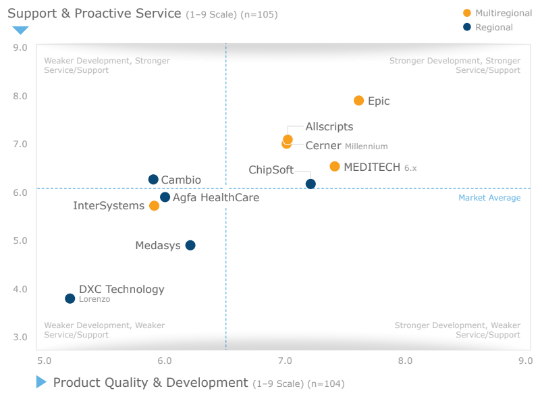
A new KLAS report on cybersecurity services (advisory, technical, and managed) finds that CynergisTek leads in breadth of services and number of engagements for advisory and technical services, while Fortified Health Security has the highest number of managed services engagements. The most commonly requested services are performing risk assessments and security program assessments. 


Government and Politics

An HHS law judge upholds HHS OCR’s $4.3 million HIPAA fine against MD Anderson Cancer Center for losing two unencrypted USB drives in violation of its own policies that require encryption.

The pre-existing conditions political football has generated interesting debate, including the Republican argument that guaranteeing coverage and the same premium prices to those who are either sick or well tests well in voter polls … until the question is reformulated to ask whether it’s OK for sick people to pay the same premiums as healthy ones, in which case even many Democratic voters say no. It’s an interesting exercise trying to educate healthcare-uninformed voters exactly how insurance works, who pays and who profits, and how risk pools work to calculate premiums.


Privacy and Security

Washington Health System (PA) suspends at least 12 employees who are suspected of looking at the medical records of a co-worker who was killed when a driver lost control of his car and ran into a WHS building.


Other

SNAGHTML1671dc8d

An Indiana doctor sues Apple for interrupting his medical practice with the “devious trick” of forcing IOS updates without the user’s approval as a requirement for its further use. He sent Apple a bill for the $200 time he claims he lost and demanded that his phone be returned to the previous IOS version, then filed the lawsuit after Apple declined to do either.

image

Bloomberg profiles – with an embarrassingly click-baiting headline – the outcome-predicting Medical Brain project of Google. It notes (barely) the failure of IBM Watson Health to accomplish the same goals of reducing cost or improving outcomes. The author’s analysis must have been superficial in failing to note that Google has already tried and failed to “break into the healthcare business” with its miserable, short-term Google Health project.

I missed this article until someone tweeted it out: “Why Doctors are Running Out of Empathy,” a physician’s bleak look at what our healthcare “system” has turned into with some interesting insights:

If we take the word “healthcare” to mean the mishmash of hospitals, doctors, insurance companies, and vendors that profit from our physical and mental maladies, then perhaps it would be more accurate to call [our healthcare system] “sickness-billing” … Government food policies … resulted in a massive increase in calorie-dense, nutrient-poor, and highly processed “foods” in our diet …led to dramatic increases in obesity, diabetes, heart disease, cancer, and autoimmune disorder rates in the United States. The costs borne by Medicare and insurance companies consequently swelled, producing a strained “system” unprepared to handle the increasing need for preventive care. In response to rapidly rising costs, Medicare (to which most insurance companies look for guidance) created a growing number of obstacles to reimbursing doctors and hospitals, and all payers followed suit. These obstacles started as documentation-focused rules, requiring doctors to record a certain number of data points for each medical visit, otherwise reducing reimbursement. This is why your doctor, during your visit for an ankle sprain, may ask if you have had any constipation, vaginal bleeding, or ringing in your ears … EMRs dramatically reduced physician productivity. This was primarily because the EMR companies got away with designing software with horrendous user interfaces and user workflows .. . the Internet buzzed with stories of Epic bullying anybody who criticized its software. Can you imagine the backlash if Microsoft or Google tried to place gag orders to prevent criticism of their software?
image

This says a lot about US healthcare. UK-based drug company Indivior will seek an injunction to halt FDA’s approval of a generic to its opioid addiction drug that generates 80 percent of its $1.1 billion revenue and $320 million profit. It also obtains a restraining order against an India-based competitor that was preparing to launch the generic. Indivior says it will introduce a generic of its own for some reason and will cut its operational costs, Shares dropped 23 percent on the FDA news.

image

A McKinsey analysis of claims data finds that opioid prescribing patterns vary wildly among doctors:

  • Opioid prescribing is widespread and not just the result of clinician outliers
  • Geography plays a significant role
  • Much of the prescribing resulted from a surgery rather than acute medical care, with up to 70 percent of the patients who underwent specific procedures being given opiate prescriptions
  • Prescribing was inconsistent even within a single medical practice, varying by the condition being treated
  • Doctors often prescribe opiates to patients who have known risk factors, such as having a history of non-opioid substance abuse, having two or more behavioral health issues, or using more than four doctors or pharmacies to obtain opioid prescriptions in the preceding six months
  • Most prescriptions are written by a clinician who isn’t the “quarterback” for managing the patient’s primary problem
  • EDs issue relatively few opioid prescriptions

WHO adds “gaming disorder” to ICD-11, saying that it is similar to drug addiction because it can take precedence over the patient’s other activities, they can’t stop playing even after they experience negative consequences, and their sleep, diet, and work performance suffer.  


Sponsor Updates

  • Formativ Health will exhibit at HFMA’s annual conference June 24-26 in Las Vegas.
  • PeriGen will demonstrate its AI-powered Vigilance fetal and maternal early warning solution at AWHONN Connection June 23-27 in Tampa.
  • North West Anglia NHS Foundation Trust goes live with Agfa Healthcare’s enterprise imaging for merged Peterborough City, Stamford, and Hinchingbrooke Hospitals.
  • Boston Software Systems signs a multi-year contract with a national health system for RPA, EHR, and data optimization services.
  • Chief Executive profiles CarePort Health CEO Lissy Hu, MD.
  • The Tech Tribune includes CareSync in its list of “10 Best Tech Startups in Florida.”
  • Kyruus will host its Fifth Annual Thought Leadership on Access Symposium (ATLAS) in Boston October 15-17.
  • CenTrak reports significant growth in its hand hygiene business and an increase in hospital compliance rates.
  • Change Healthcare publishes a new payer study, “Finding the Value: The State of Value-Based Care in 2018.”
  • CoverMyMeds will exhibit at the ASAP Mid-Year Conference June 20-22 in Palm Beach, FL.
  • The Cleveland Plain Dealer recognizes Direct Companies, the parent company of Direct Consulting Associates, as a Top Workplace in Northeast Ohio for 2018.
  • Divurgent publishes a new health system case study, “Success Story: Windows 10 Upgrade.”

Blog Posts


Contacts

Mr. H, Lorre, Jenn, Dr. Jayne.
Get HIStalk updates. Send news or rumors.
Contact us.

125x125_2nd_Circle

HIStalk Interviews John Talaga, EVP/GM, OnPlan Health

June 19, 2018 Interviews 1 Comment

John Talaga is co-founder and EVP/GM of OnPlan Health of Bannockburn, IL.

image

Tell me about yourself and the company.

I’m a co-founder of OnPlan Holdings. I co-founded HealthCom Partners, which was acquired by McKesson in 2006. We developed introduced PatientCompass, which was the first online account management tool for hospitals.

OnPlan Health addresses the market shift to high-deductible health plans. Co-founder and CTO David King and I created OnPlan to help hospitals settle balances with patients with high out-of-pocket costs. The business also supports and serves higher education, which has similar challenges to healthcare.

Premiums and deductibles are rising and few people in America have enough savings set aside for even modest unexpected expenses. What’s it like on the front line of health systems?

The shift has hit the boardroom. Over the last couple of years, the level of executive presence on the rev cycle side has increased. You have VPs of revenue cycle and chief revenue officers that you never had in the past. When you hear the term “third payer” — the patient being the new payer — it’s real. Hospitals are having to deal with so much of the self-pay that it’s as much as commercial and Blue Cross, in many cases.

The front lines are asking, what do we do about it? A lot of technology has poured in and has been invested in. Companies are offering automated payment plan functionality, front-end collection at point of service, and scheduling. It’s a form of retail-ization — trying to collect as much as they can up front, but also trying to automate and reduce the cost that it takes to collect on the back end.

You have this new focus of, “The old way of doing things is no longer good enough. We don’t have the staff to be able to do that.” Companies are turning to outsourcing early outs. Some are turning towards financing. But those solutions are expensive and they disintermediate the patient, so they are looking at technology that allows them to work on their own to prevent having to place accounts with those options.

Is the financial conversation that might precede the medical conversation awkward for both the patient and the provider?

It’s a very different environment when you talk about the doctor’s office versus the health system and the hospital. Where my company spends the most time is in the health system, where physicians are part of the health system and are connected to a hospital with the higher cost.

In the doctor’s office environment, there still is an expectation that you’re going to pay for your service. We know what it costs, typically. There’s nothing emergent that comes from that visit. They will bill on the back end and typically patients have the money to pay that.

It’s the surprising bills that come with services that cost more, typically coming from a service that involves the hospital. The patient doesn’t have budget and sometime doesn’t even realize what they signed up for — what their employer provided them for a health plan — until the bill comes. They wonder, why am I getting a bill for $2,500 when I have insurance? Reality sinks in.

It’s this surprise factor that’s difficult on the financial side. Setting those expectations has been a big priority of hospitals. We’re going to do an estimate for you and this is approximately what you’ll owe. They try to collect as much as they can up front, but that expectation carries through after adjudication of the balance.

Is the approach the same for patients who are unable to pay versus those who are simply unwilling to pay?

The expectation is that 80 percent of the patients are willing to pay. They just have to understand what it is they owe. Then they have to have the means.

The introduction of revenue cycle analytics has been positive. Though analytics can be used from a propensity-to-pay perspective to identify the patient’s ability to pay, but also to determine how how much means they have to cover a specific balance. Analytics isn’t just directional. It’s getting to the point where, this patient owes this balance, they have this much left on the deductible, so here’s what they can afford.

That technology is done on the front end. But now more hospitals are also doing it for self -pay as well. How should we approach this patient? What should we offer them to pay as opposed to just asking for the full balance knowing that they’re probably not going to be able to pay it and they may end up in collections? Propensity-to-pay has evolved into revenue cycle analytics.

Those unwilling to pay is going be a difficult one to solve. Those are probably for the collection agencies, simply because you’ve got a different problem than somebody who just doesn’t have the means.

What do health systems do in that case where someone hasn’t made progress on their previous payment plan obligation?

The analytics only go so far. It gives you the profile of this patient at the moment. Hospitals are now taking it to the next level to automate processes and policies to avoid the traditional one-on-one negotiation. In the past, payment plans were set up on a phone call. Somebody who needs help seeks it out and agrees to a payment arrangement.

Now companies are using analytics to provide a payment plan offer proactively. We give them an installment offer that they’re able to pay. And if they’re able to pay that, let’s give them the ability to self-activate without having to call us. That could be by going online or mobile to activate the plan or even writing a check based on what they’re willing to do a payment plan for.

If they take the call center mostly out of it, like 70 percent of those payment plans that are activated, the next step is whether the patient stays on that plan. The rules are in place. You have to make your payments. You can’t miss two payments or you’re going be terminated from your plan. Those patients will be treated differently the next time they come in for service.

It’s working the analytics visibility to the staff, putting it into automation so that they don’t have to do hand-to-hand combat, if you will. But then also being able to utilize what happened when the patient presents themselves back in the office.

Is discounting the initial price for someone who has to pay cash a significant factor in creating the payment plan?

For revenue cycle leaders, the goal is still to get someone to pay in full. The goal isn’t to get them on a plan. But for a segment of patients, that’s the only way they’ll be able to pay. The discounting usually comes in after uninsured discounting, when a patient has a balance after insurance or they owe a patient responsibility. They’re driving incentives such as, you can get on this payment plan and we’re willing to do this for you. But if you pay us in full in the next 30 days, as a prompt pay discount, we’ll take 5 or 10 percent off.

What they’re doing instead is driving discount incentives, mainly post-service, to try and get them to pay off their balance as opposed to getting on a plan. The plan itself should be enough of incentive to pay over a time that makes sense for them.

On the front end, if the analytics are there, they will offer some deeper discounting to be able to get them to pay in full. But again, what you’re seeing is payment plans being set up off the estimates. It’s easier to say, you owe $1,000. Do you want to pay $1,000, or do you want to pay a portion of it? How about we set you up on a plan for $100 a month? Then when your insurance pays, we will adjust your balance and your $100 a month will continue until the end of the term. It’s easier for a consumer to accept that as opposed to just paying some dollars towards a cost they don’t know yet.

I assume it’s not in the best interest of either the provider or the patient to turn a bill over to collections,.

That comes across loud and clear in terms our business and how we position ourselves to serve hospitals. They’re trying to reduce bad debt and the amount of placements that they send to bad debt collections, But also even to their pre-collect, early out vendors. Even though early out vendors are first party, you have hospitals that are turning them over at Day One.

The big concern is, if I’m using this outsource vendor, they’re collecting and I’m paying for balances that maybe the patient would have automatically paid with a payment plan. If I can get some automation in place, then maybe I only have to place accounts that are expensive to early out at a later time. If I’m placing accounts at Day 60 and I’m trying to collect on my own internally before Day 60, then how can I collect as many as I can by settling on payment plans before I have to turn them over to a collections agency?

The whole idea of turning patients over to a collections agency is perceived negatively. They’re trying to keep engagement and patient loyalty so they will come back to the health system. To do that, they want to have that direct interaction with them without having a collection agency asking them to pay their bill.

Do you have any final thoughts?

The revenue cycle leaders are trying to reduce the pain points of increased self pay, so there’s a resurgence of patient financing. You hear about these recourse options for essentially getting a loan to pay off their bills. In terms of financing, the revenue cycle leaders are debating whether to sell their receivables. Where it’s falling is that if they can get more of the functionality and tools with analytics and automation in their system to do it themselves, with the reserves they’re willing to fund for these balances, then they only use financing on the back end for those balances that need long terms. That is the direction that is becoming more acceptable with these leaders, as opposed to one or the other.

Morning Headlines 6/19/18

June 18, 2018 Headlines Comments Off on Morning Headlines 6/19/18

Walmart Patents System for Accessing Medical Records Stored on a Blockchain

Walmart’s latest patent suggests it will develop a wearable that will give emergency responders access to an unresponsive patient’s medical record using blockchain technology.

Google is training machines to predict when a patient will die

Findings from Google’s Medical Brain team show that its AI has a higher accuracy rate at predicting deaths, discharges, and readmissions than traditional hospital warning systems.

Judge rules in favor of OCR and requires a Texas cancer center to pay $4.3 million in penalties for HIPAA violations

MD Anderson Cancer Center (TX) must pay $4.3 million in penalties for HIPAA violations stemming from three data breaches and non-compliance in following up with device encryption.

Comments Off on Morning Headlines 6/19/18

Curbside Consult with Dr. Jayne 6/18/18

June 18, 2018 Dr. Jayne Comments Off on Curbside Consult with Dr. Jayne 6/18/18

clip_image003 

One of the hot topics in the physician lounge lately has been telemedicine. Several of the larger physician organizations are pursuing strategies to incorporate telemedicine into their practices. It’s interesting to see the different strategies they’re taking, and given the similarities of their patient populations, I’ll be looking forward to seeing which one is more effective.

The first group wants to render the telemedicine services in-house because they think it’s going to be key for patient loyalty. They’re looking at different platforms that will enable their physicians to not only perform video visits in lieu of face-to-face visits in the office, but to perform after-hours services. One of the major drivers of the latter is trying to prevent some of the revenue leakage that’s currently going to urgent care and retail clinics. Of course, they pay some lip service to quality of care and continuity of care, but the conversations their decision-makers are having seem more about the revenue than anything else. The members of the group that are part of administration are completely on board with it, but the rank and file physicians aren’t entirely in favor.

The group is multi-specialty and leadership seems to think that the primary care physicians are more willing to consider telemedicine than the subspecialty physicians. Even among those willing to consider it, though, there are some doubts since many of the primary physicians have given up non-office practice. They no longer see patients in the hospital and haven’t taken call in years, preferring to use nurse triage services rather than being awakened in the middle of the night. For physicians who aren’t even willing to call out antibiotics for an uncomplicated illness without seeing a patient in the office regardless of the validity of the symptoms and history, it will be a huge cultural shift for them to sit at the computer or use their phones to speak with patients who are angling for medication or other treatments over the phone.

For them to be successful, they need a platform that will help them document what they’re doing. It will need to connect seamlessly with their EHR to ensure that the records of evaluation and treatments are not lost. The physicians aren’t going to tolerate having their documentation sit in a separate system or be unavailable to them in the future. They’re also going to have to figure out how to divide up the work and the revenue for the visits, because I can’t imagine every physician wanting to be on call 24×7. If the subspecialty physicians agree to it, they may adapt more easily since they’re already used to sharing call and taking care of each other’s patients without specifically being compensated for it since many of their procedures are billed on a global basis. Many of the procedural subspecialists have physician assistants that work with them and I can imagine the PAs will handle most of the telemedicine work.

Unfortunately, they’re on an EHR platform that doesn’t have telemedicine capabilities and hasn’t integrated with any of the telemedicine companies they’re looking at. Although the group’s leadership is eager to get started, I suspect it could take a year for them to really be ready to implement a solution. First they have to make a decision, then they’ll enter the contracting phase (which is never speedy for them), and then they’ll have to figure out the integration and implementation pieces. If they are smart, they’ll work on the cultural pieces and figure out the call schedule and compensation parts while the IT team is working their magic.

The other group has a similar patient population, but they believe their analysis shows that their patients are less concerned about loyalty than they are about being able to reach a physician quickly after hours. The physicians aren’t terribly interested in video visits as an alternative to office visits, but they do want to capture the revenue that they’re losing to after-hours competitors. They’ve elected to outsource telemedicine for primary care since that’s where most of the business is – it’s not like there are after-hours orthopedic surgery or neurology clinics that patients are going to, so the group is going to hold off on doing anything with their subspecialty physicians. They’ve found a vendor that will send documentation to them for all telemedicine visits, and although the data is going to be formatted as a document rather than as discrete data, they’ll be able to have the solution up and running in a matter of weeks.

If you’re an informatics purist, that might not be a palatable solution. But if you’re looking to solve the business problem of revenue leakage, they’re at least going to get a percentage of the revenue if they go about it this way, rather than getting zero revenue for patients going to urgent care or retail clinic facilities. They’re also contractually guaranteed to receive records from the visits rather than crossing their fingers and hoping they’ll get something back from the pharmacy clinic. Hopefully their understanding of their patients is accurate and there won’t be too many concerns about being cared for by physicians who don’t know them or their histories. I asked the physicians I was talking to whether the telemedicine company will have access to the EHR for medication lists or notes and they weren’t sure. That will need to be ironed out during the contracting process for sure.

Once they are established with the after-hours component, they have the option to expand how they use telemedicine technology. I think their strategy is prudent. Rather than waiting for the perfect solution, they’re at least going to dip their toes into the proverbial waters and see how it plays for their patient population. I’ll have to make a point of checking in with them in a couple of months and see how things are going – whether they were able to get through the contracting phase quickly and whether they were right in their assumptions about how their patients will receive their new offering.

Have you implemented telemedicine? How is it going? Leave a comment or email me.

Email Dr. Jayne.

Comments Off on Curbside Consult with Dr. Jayne 6/18/18

Morning Headlines 6/18/18

June 17, 2018 Headlines Comments Off on Morning Headlines 6/18/18

Elizabeth Holmes indicted on wire fraud charges, steps down from Theranos

The US Attorney indicts Theranos founder and CEO Elizabeth Holmes and former President and COO Sunny Balwani for fraud, charging that as Theranos executives, they knew that the company’s blood testing technology was unreliable and was not competitive with conventional lab testing.

Citing weak demand, IBM Watson Health to scale back hospital business

IBM Watson Health executives tell employees that the company will scale back its hospital pay-for-performance tools business.

UK report warns DeepMind Health could gain ‘excessive monopoly power’

An external review raises red flags over DeepMind Health’s control over NHS data streamed between its real-time, care communication Streams app and future third-party developers.

Walgreens to Move Approximately 1,800 Positions to New Chicago Office

Walgreens will employ 1,800 staffers at a new office in Chicago that will accommodate its expanding Technology Center of Excellence.

Comments Off on Morning Headlines 6/18/18

Monday Morning Update 6/18/18

June 16, 2018 News 26 Comments

Top News

image

The US Attorney indicts Theranos founder and CEO Elizabeth Holmes and former President and COO Sunny Balwani for fraud, charging that as Theranos executives, they knew that the company’s blood testing technology was unreliable and was not competitive with conventional lab testing.

Holmes resigned as Theranos CEO just before the charges were announced Friday. She will remain on the company’s board, for whatever that’s worth when the company in question is on its last legs.

Holmes and Balwani face up to 20 years in prison plus fines and restitution payments. 


Reader Comments

From Portal in the Storm: “Re: patient portals. My EClinicalWorks patient portal still lists the prep for my year-ago colonoscopy on my current medication list. I asked the doctor’s nurse to fix it, so she changed it to ‘not taking,’ but it was still listed on my portal as a current med. I mentioned it to my doctor, who discontinued it, but it still shows up on my current medication list. ECW’s My PHR shows the status as ‘not taking.’ Also, my poor doctor sees all meds, both taking and not taking, in a single current medication list with no option to sort or filter to show just the active meds. When folks complain about usability, I always assume it’s some advanced review these systems need, when in fact it’s obvious things any new user could point out.” Unverified.


HIStalk Announcements and Requests

image

A slight majority of poll respondents think Athenahealth will be a lesser company without Jonathan Bush. Some respondents worry that the finance guys will take over from the visionary and cultural leader and instead of fixating on customers and product delivery, will jack up prices and hack at costs to improve the bottom line. Others say that without his dogged determination in focusing on long-term objectives, the bean counters will stifle innovation by just delivering what short-sighted customers say they want. One respondent said directly, “Steve Jobs was a douche, but I don’t think Apple is better off today.”

New poll to your right or here: has your employer had layoffs or other workforce reductions so far in 2018?

image

Thanks to respondents who provided honest, painful thoughts about how suicide has affected them.

image

This week’s question involves co-worker relationships.

Welcome to new HIStalk Platinum Sponsor Goliath Technologies. The Philadelphia-based company’s technology improves EHR user experience by helping IT departments anticipate, troubleshoot, and prevent issues related to slow log-in and application performance. It brings application monitoring for Cerner, Epic, Meditech, and other EHRs and business applications into a single console with real-time performance data, covering everything from endpoint to Citrix or VMware Horizon delivery infrastructure. Universal Health Services uses the system to monitor performance of its hosted Cerner system deployed nationally, where it logs into several Cerner applications every 30 minutes using a user’s exact keystrokes and network access to identify failures or slowdowns so they can be fixed quickly. That monitoring allowed UHS to pinpoint WiFi problems in a specific hospital. The company offers a demo and a 30-day free trial. I interviewed CEO Thomas Charlton a couple of weeks ago just because he sounded interesting and the company then decided to become a sponsor as a result. Thanks to Goliath Technologies for supporting HIStalk.

Here’s a video I found on YouTube describing Goliath’s Cerner monitoring system.

I had a good experience this weekend with an independent urgent care center in a tiny, remote town whose physician assistant recently treated my minor injury. The place was well staffed but empty, so I didn’t have to wait. They don’t accept my insurance but they charge just a fixed $75 (which in my case included a lidocaine injection, a bunch of silver nitrate sticks, and the usual odds and ends) and they used the insurance card information to retrieve my meds and problem lists, which they verified with me at the start of the visit. I received an email immediately afterward containing a link to sign up for the practice’s Athenahealth patient portal, and that went painlessly in simply entering the numeric code that was texted to my telephone number on file. I really worried about being forced to some hospital’s ED with the strong likelihood of getting stuck with out-of-network charges, so being quoted $75 made me happy, even more so when they treated and streeted me quickly.


Webinars

June 21 (Thursday) noon ET. “Operationalizing Data Science Models in Healthcare.” Sponsor: CitiusTech. Presenters: Yugal Sharma, PhD, VP of data science, CitiusTech; Vinil Menon, VP of enterprise applications proficiency, CitiusTech. As healthcare organizations are becoming more adept at developing models, building the skills required to manage, validate, and deploy these models efficiently remains a challenging task. We define operationalization as the process of managing, validating, and deploying models within an organization. Several industry best practices, along with frameworks and technology solutions, exist to address this challenge. An understanding of this space and current state of the art is crucial to ensure efficient use and consumption of these models for relevant stakeholders in the organization. This webinar will give an introduction and overview of these key areas, along with examples and case studies to demonstrate the value of various best practices in the healthcare industry.

Previous webinars are on our YouTube channel. Contact Lorre for information.


Acquisitions, Funding, Business, and Stock

image

IBM Watson Health executives tell employees that the company will scale back its hospital pay-for-performance tools business.

image

Former Cleveland Clinic President and CEO Toby Cosgrove, MD joins the board of Denver-based prescription decision support vendor RxRevu. The company’s board chair, Stephen McHale, was founder, CEO, and board chair of Cleveland Clinic spinoff Explorys,  which was acquired by IBM in 2015 and rolled into Watson Health.

Google is hiring for its Brain division, apparently for a research project called Medical Digital Assist that will use AI and speech recognition to create physician documentation. It may be a continuation of its Stanford Medicine digital scribe study from last year.


Announcements and Implementations

The AMA weighs in on augmented intelligence in a policy approved at its annual meeting, insisting in its own involvement to set direction, ensure physician friendliness, and integrate it with medical practice. AMA used the term AI to describe “augmented intelligence,” with the subtle difference being important – “augmented” means that AMA considers AI’s role as offering recommendations to doctors who are free to use them or not.


Sponsor Updates

  • Vocera will exhibit at the Cleveland Clinic Patient Experience Summit June 18 in Cleveland.
  • In the Netherlands, The Princess Maxima Center for Pediatric Oncology implements Wolter Kluwer’s UptoDate and Lexicomp solutions.
  • ZappRx expands its partnership with prior authorization services company PARx Solutions to include all treatment areas on the ZappRx platform.

Blog Posts


HIStalk Sponsors Named to the HCI 100

#4 Change Healthcare
#5 Philips
#9 Leidos
#17 Nuance
#20 Ciox Health
#21 Wolters Kluwer Health
#23 Roper Technologies
#26 InterSystems
#30 EClinicalWorks
#31 Meditech
#41 Experian Health
#43 MModal
#44 Netsmart
#47 Waystar
#52 Hyland
#56 Nordic
#58 Spok
#59 Elsevier
#60 Harris Healhcare
#61 Vocera
#62 CSI Healthcare IT
#65 Optimum Healthcare IT
#66 Imprivata
#67 Medhost
#68 Agfa Healthcare
#72 HCTec
#73 The HCI Group
#82 Cumberland Consulting Group
#87 AdvancedMD
#89 Impact Advisors
#90 Medecision
#93 The SSI Group
#97 WebPT


Contacts

Mr. H, Lorre, Jenn, Dr. Jayne.
Get HIStalk updates. Send news or rumors.
Contact us.

125x125_2nd_Circle

What I Wish I’d Known Before … Considering or Attempting Suicide or Losing a Friend, Family Member, or Co-Worker To It

I wish I would have known that I would be “judged” on my level of grief after the loss. One of my classmates in medical school committed suicide during the last half of our last year. Even though I wasn’t in his most inner circle of friends (really just his fiancée and a couple of others), we had been on many rotations together and saw each other almost every day, so I took the loss very hard. I started talking to other classmates about collecting for a memorial (our school already had a piece of art in the lobby dedicated to a previous student who also committed suicide) and was quickly approached by the dean, who told me I had overstepped my bounds and that this should be left for his friends to do.

I was shocked, and had no idea that there were different levels of grief and response which one was limited to based on one’s perceived relationship to the deceased. I certainly considered him my friend and I think that not being able to do anything “useful” in response to the loss made it worse for me. Two decades later, I still think about him – seeing him was one of the bright spots of my day, and I think about the loss for the patients who never got to experience his brand of caring and compassion. He would have been an outstanding physician.


We were brand new parents, and my husband was terribly depressed. I didn’t know it. I knew he was worried about his work situation, money, our living situation, and he didn’t like me being the primary provider. I didn’t know that as a new dad, he worried he that he’d turn out like his paranoid schizophrenic, alcohol-abusing bio-father despite the fact that he never consumed alcohol. I had no idea about the depth of his worry, struggles and depression. Certainly, no idea he was dealing with suicide-level depression – or that he’d stopped going to his crappy job during day and instead, went to his parent’s place where no one was, and that he’d pull a gun from the cabinet and contemplate killing himself. I wish I’d known what everyone wishes: That I knew. That he spoke up.

My husband didn’t end up taking his life. Two things happened that day: One, my cousin, who worked at the same place my husband had been called to see if he was feeling okay, so I knew something was up. (He hadn’t been to work in over a week.) I’m glad someone noticed he wasn’t there! Two, that day, my husband had a gun in his mouth. He heard a voice, that he was sure was God, tell him not to do it. That he was loved and needed, and that he’d be causing more pain than he’d take away. He came home, confessed/cried (without me asking where he’d been), and then we talked with family and our pastor.

That was nearly 14 years ago. He found a job he liked not long after. Our kids are 13, 10 and 1, and he’s now a stay-at-home dad for our youngest, with only gratitude for getting to stay home vs. feeling “less of a man”. It was a turning point for us in terms of depth of our relationship. We always communicate, and I don’t worry that he’d do that to me/us, and I haven’t since those early days. I wish they knew things aren’t as bad as they seem, and they can get even better.


People perceive and react differently, but these have been helpful.

https://www.ted.com/talks/andrew_solomon_depression_the_secret_we_share

https://www.ted.com/talks/kevin_briggs_the_bridge_between_suicide_and_life


I wish I’d known how incredibly cruel people can be in the wake of a suicide, as I witnessed the “friends” of a woman I know gossip about her and blame her for her husband’s suicide. It costs exactly nothing to offer condolences, mow someone’s lawn, help tidy their house and wash dishes, and keep your base thoughts to yourself. Conversely, you gain nothing by spreading malicious gossip about a family in anguish.


I don’t think it can ever be overstated – talk about it. Talk about anxiety and depression and that it can happen to anyone. It’s okay to have it, it’s okay to talk about it, it’s okay… Maybe your anxiety/depression isn’t as severe, but you should still talk about it. You’re not on an island, you’re not alone. We all have it, whether we want to admit it or not.


Two things:

The emotional bleakness that drives one to attempt suicide really will go away
When people do die by suicide their family and friends never get over it.

Over the years, I’ve lost several acquaintances to suicide and I wish they had chosen to reach out for help. Unfortunately, I’ve felt the sense of loss and tragedy when the lives of decent and talented individuals are ended prematurely. I’ve also seen the way in which it haunts their family, their close friends and any treating health care professionals. Sometimes that’s what suicidal individuals want — to make others suffer, out of anger — but plenty of others who care about the person will suffer as well. Unlike other kinds of grief where the sadness subsides and good memories predominant, with suicide one never can remember the person without those memories being tinged or overwhelmed by the way that the person chose to die.

For many years while in late adolescence and early adulthood, there was rarely a week that I didn’t consider suicide. I attempted suicide several times and was hospitalized many more. At the time, I never thought I’d live long enough to be able to legally get a drink. Finally, with the help of excellent psychiatrists who didn’t give up on me and with medications and years of weekly therapy, those thoughts went away entirely. Now I’m approaching retirement and I am genuinely happy and content. I have had a very successful career, wonderful spouse and great friends and family. And I am extremely grateful that I’ve been able to enjoy all of that.


My son committed suicide. I’m angry with him for making the last chapter of his short biography the defining event of his life, meaning that in trying to forget the painful memories of the event itself, we’ve ended up forgetting him.


I lost a cousin to suicide and a brother-in-law to suicide. My brother-in-law (JP) left two young girls in 2006. His 17-year-old daughter found him post GSW to the head. I wish I had talked to his daughters or his estranged wife to know that he was exhibiting some of the signs of suicide. He pushed his daughters away and completed the items on his bucket list in a short period of time. He was having financial difficulties and marital difficulties. He had counseled a seventeen year old against suicide in the weeks preceding his own suicide. I have witnessed the devastation this loss has put on his family and most especially his daughters. There is always the question of what if? And why?

Having been close to JP and knowing how kind, loving and dedicated he was to his family and church, it is hard to hear people speak cruelly of those that have succeeded in their attempt. I know that at the time JP died, he thought he was doing the absolute best thing for everyone and saving them the grief of dealing with his perceived mistakes. He just didn’t realize how devastating it would be for the rest of their lives. My niece still grieves deeply and asks what if and why on the anniversary of the day it happened, his birthday, Christmas, Father’s Day …


That he was suffering from something which hurt him so much that he took his own life at such a young age.


I found my girlfriend after she had taken her life in the bedroom we shared. Finding someone is a whole other subset of suicide survivorship that comes with special considerations. Talk to someone, and be self-aware and accepting that it’s okay to experience symptoms of PTSD. I let myself feel them so I can process and deconstruct them. See a professional and be honest with yourself most of all. There are many survivorship support groups to help you, take advantage of them. Take care of yourself. You become acutely aware that obligations to yourself need to sometimes take priority over others. There are a few thoughts that I’ve consciously decided to accept to help me get through it:

1) It’s not my fault
2) I’ll never know exactly why she did it, and that’s okay
3) The pain of this loss will never get smaller, will never resolve itself, will never reach some form of poetic closure. But that’s okay. Although I’ll always carry this pain, I am able to get stronger in carrying it. A mile never gets shorter, 10 lbs is always 10lbs, but as long as you practice dealing with those things in a healthy way, you will get stronger in your ability to carry on.

I try to honor her memory by being good to myself and others. I much prefer it to the alternative.


How much you blame yourself for your family members actions. You constantly question why didn’t I know, why didn’t I see, why didn’t I call them that morning, why didn’t I tell them I love them more, etc. WHY, WHY, WHY. The only thing I can do now is try to educate others to not carry the survivor guilt.


I have a perspective from both sides.

Before Considering: How much (and how many) people actually love and care about you even when you feel very very alone and unsupported. People you don’t even realize care love you. That suicide is a permanent solution to a temporary problem even when that problem doesn’t seem temporary in the slightest. That life gets better and there is in fact a light at the end of the tunnel even if you can’t see the light right now. The light may not show up immediately either but it is there and you will eventually see it.

Before Losing a Friend: How much I’d wish I would have reached out more, kept in touch better, not let life get in the way of my relationships with people and been there to support them through a hard time. Knowing how much pain someone was going through to choose suicide makes me incredibly sad. I care so incredibly much about my friends and family and really humans in general that I don’t want to see anyone hurting in that way. I am not always great at showing it but I care very much.


What I wish I’d known before before my attempt at 12: I did nothing to deserve three years of bullying and teasing. I wasn’t the “easy taaaahhhget” my mother told me I was. I wasn’t the scapegoat Teen Magazine told me I was. I wasn’t the “fat loser” my sister told me I was. I was just a shy kid who got good grades. I was actually happier than I thought I was.

What I wish I’d known before my second attempt at 15: Dear lord, not finishing my science project was not a big deal. I didn’t need to be perfect. I was actually happier than I thought I was.

What I realized while contemplating my third attempt at 38: Sure, the three years of a manipulative sister-in-law had taken its toll on my marriage and friendships, and was poised to do the same on my career once she joined my employer…but I was the only one in a position to fix myself. Considering suicide was a symptom, not an answer. People with cancer go to oncologists, and people with suicidal thoughts go to therapists. It was surprisingly that simple. I was actually UNHAPPIER than I thought I was, but years of stuffing down my emotions and trying to live up to others’ expectations had left me unable to recognize my own feelings.

I’ll say it again: considering suicide is a symptom, not an answer. It’s a flag to reach out and get help. Help is there. Keep reaching, keep trying. Suicide leaves the survivors with a hole filled with confusion, anger, loss and regret…because the person who left is more meaningful than they realize.


Logic does not work.


Taking your life ruins others people’s lives. It causes so much pain and struggle to the family/friends that you know. It’s hard to live on without that person. It’s like a massive hole in their hearts for the rest of their lives. When someone famous or someone in the limelight takes their lives the Suicide rate peaks putting suicide at the forefront of minds for folks struggling.


That a person who has many friends, and posts happy photos on FB is actually in many cases lonely and should be reached out to.


Assuming that the person did not have the courage (or could be selfish enough) to take their own life and destroy the lives of their children and family in the process.


Wish there was a way we could know that someone is so depressed they would rather not live. Good lesson of really asking someone if they are doing okay.


I lost my nephew to suicide, a veteran who suffered from PTSD and had trouble adapting. I wish I had known or understood the severity of what vets go through. I wish I would have pushed harder to have him meet with a mentor friend. I wish that our VA would listen when vets reach out for help. I don’t think them buying Cerner will help – they should be investing in more humans to serve, not more computers to record.

Suicide is not selfish. It’s a result of a sickness. Awful people said awful things about that when he died. We don’t demonize the cardiac patient for the heart attack, yet its 80 percent preventable. Depression is an illness. It made him think he was helping his family and kids by removing himself from the equation. We need more connecting and less computers and tech.


Weekender 6/15/18

June 15, 2018 Weekender Comments Off on Weekender 6/15/18

weekender


Weekly News Recap

  • GPB Capital acquires Maryland-based RCM/EHR vendor Health Prime International.
  • Inspirata acquires Caradigm from GE Healthcare
  • Former IBM employees say Watson Health’s troubles stem from the company’s inability to successfully merge the assets of its acquired Phytel, Explorys, and Truven Health
  • The VA announces plans to create a device implant registry

Best Reader Comments

I think many rural providers/clinicians feel like they are forgotten or not considered in the larger healthcare picture. (Kallie)

Digital health / telemedicine is going to be the cheap, low-quality option that serves the masses while high-touch, in-person visits with an actual physician is going to be the gold standard that is expensive in 10 years. You already see this playing out in the wealth management industry and healthcare will be no different. (Lazlo Hollyfeld)

Someone can have full knowledge of what the #MeToo movement is about and still feel that it should be acceptable to acknowledge a male’s contributions to his field. Even if that guy has his flaws, although admittedly, I don’t know how big they are – the news coverage seems sensationalistic and other accusations are somewhat vague. (Clustered)

I love my 20+ year marketing career, but there are definitely “special internal challenges” faced by marketing teams that other teams like finance and development would never have to deal with, i.e. everyone knows how to do marketing. (Christine)


Watercooler Talk Tidbits

image image

We provided STEM materials for Ms. H in Alabama, whose DonorsChoose teacher grant request explained that her school provides at-home services to special needs children who have experienced significant vision or hearing loss. She reports, “This means the world to me and my students. By providing our students with materials to TAKE HOME is amazing. We have never had the opportunity to send materials home with students before. The materials have allowed the students the ability to show off their progress and things we have been working on at school to their parents. Students are going to succeed above and beyond due to your generosity.”

image SNAGHTML52e698

Also checking in was Ms. H from Ohio, whose first graders received take-home math and science materials. She says, “When we opened the boxes, they were excited that they would be able to take these materials home with them. They were happy that they would get to use these with their families at home. We have been able to help build and grow our math and science skills. These resources create meaningful and engaging activities for the students.”

Uber files a patent application for an AI-powered enhancement to its app that would analyze a user’s typing mistakes, walking patterns, and time and location in the hopes of identifying ride requesters who are drunk, allowing the company to alert the driver (who might be paid more to deal with an intoxicated passenger) and possibly to decline to dispatch a shared ride.

This it fascinating. Forty years ago in June 1978, punk rock band The Cramps played at a California state mental hospital, caught on low-quality videotape despite pre-HIPAA patient confidentiality concerns. The fascinating part is that the band overcame a puzzled, tepid reception to rock the place out and dance with the residents. Lead singer Lux Interior (who died of aortic dissection in 2009 at 62) bluntly told the audience, “Somebody told me you people are crazy, but I’m not so sure about that. You seem to be all right to me.”

Forbes profiles the billionaire founder of a Minnesota hearing aid company that he started by buying an existing business for $13,000, after which he built it into the country’s largest hearing aid manufacturer. It’s not a feel-good recap, though, as the company has struggled since the founder moved on to charitable efforts and misdeeds by his assigned replacements – one of them his stepson – have led to loss of market share as innovation stalled.

A hospital in Vancouver that caters to “birth tourism” — in which expectant mothers from China have their babies delivered there to earn them instant Canadian citizenship — sues a since-vanished mother from China whose baby required a $300,000 stay. The hospital, which has been labeled a “passport mill” along with untold numbers of “baby houses” that market to cash-paying foreigners, delivers an average of one baby per day to parents from China.

Coming this fall: Two-Point Hospital, a PC video game that’s interesting to me because of odd items in the make-believe hospital: old-fashioned radiators, live plants in most rooms, and a Sega videogame in the lobby.


In Case You Missed It


Get Involved


125x125_2nd_Circle

Comments Off on Weekender 6/15/18

Morning Headlines 6/15/18

June 14, 2018 Headlines Comments Off on Morning Headlines 6/15/18

Hackensack Meridian Health Funds Key Innovation to Improve Health Care in New Jersey

Hackensack Meridian Health uses its $25 million innovation investment fund to finance Pillo Health’s digital home health companion.

Outcome Health names advertising executive as new CEO

Embattled waiting room media company Outcome Health names Matt McNally (Publicis Health) CEO.

Google is hiring people to work on improving visits to the doctor’s office with voice and touch technology

Google looks to grow its Medical Digital Assist project, which is working on physician note transcription using the company’s AI-powered Home and Assistant technology.

Comments Off on Morning Headlines 6/15/18

News 6/15/18

June 14, 2018 News 5 Comments

Top News

image

Cancer informatics technology vendor Inspirata acquires Caradigm from GE Healthcare. Imprivata bought Caradigm’s identity management business in October 2017. Microsoft, originally a 50-50 Caradigm joint venture investor with GE Healthcare to which it contributed its Amalga data platform, sold its share to GE Healthcare in April 2016.


Reader Comments

image

From Witty Lad: "Re: Techsoft’s MDRhythm. We are considering their EHR for a volunteer-run clinic. I can’t tell if they’re still in business, but I want to give them the benefit of the doubt with[out] embarrassing them if they indeed are. Wondering if you know anyone who is a current or former client?" Not off the top of my head, so I’ll invite readers to weigh in. I discovered they are indeed still in business after a quick phone call to the company (answered promptly by the helpful Maria once I navigated through the automated phone tree), though their website is woefully out of date.

From Pampered Poodle: “Significant layoffs at Ascension Information Systems today. Ascension has been in financial strife and is in the process of a major reorganization of IT services.” I assume PP means Ascension Information Services, the IT shop out of the similarly named St. Louis-based health system. Unverified, though in line with a reader’s comment shared in April.


Webinars

June 21 (Thursday) noon ET. “Operationalizing Data Science Models in Healthcare.” Sponsor: CitiusTech. Presenters: Yugal Sharma, PhD, VP of data science, CitiusTech; Vinil Menon, VP of enterprise applications proficiency, CitiusTech. As healthcare organizations are becoming more adept at developing models, building the skills required to manage, validate, and deploy these models efficiently remains a challenging task. We define operationalization as the process of managing, validating, and deploying models within an organization. Several industry best practices, along with frameworks and technology solutions, exist to address this challenge. An understanding of this space and current state of the art is crucial to ensure efficient use and consumption of these models for relevant stakeholders in the organization. This webinar will give an introduction and overview of these key areas, along with examples and case studies to demonstrate the value of various best practices in the healthcare industry.

Previous webinars are on our YouTube channel. Contact Lorre for information.


Acquisitions, Funding, Business, and Stock

image

Cardinal Health sells a majority stake in post-acute care services and analytics company NaviHealth to private investment firm Clayton, Dubilier & Rice for an undisclosed amount. Cardinal acquired the private equity-backed company in 2015 for $290 million.

Google looks to grow its Medical Digital Assist project, which seems to be toying around with physician note transcription using the company’s AI-powered Home and Assistant technology. Project team members have been working with Stanford Medicine (CA) on a digital scribe study that will conclude in August. Stanford physician and Google project liaison Steven Lin, MD admits training AI-powered speech recognition software to extract meaningful data to add to an EHR is “more of a complicated, hard problem than we originally thought.”

image

Text-based telemedicine app company Medici raises $22 million in a Series A funding round.

image

Strategic Management Consultants acquires Digital Reasoning’s anesthesiology-focused Shareable Forms (fka Shareable Ink) clinical documentation technology.

image

Hackensack Meridian Health (NJ) dips into its $25 million innovation investment fund to finance Pillo Health’s digital home health companion. Hackensack and Pillo will work to launch a medication management pilot using the device with an eye towards eventual commercialization.


People

image

Nick Martin (Optum International) joins DuPage Medical Group (IL) as CTO.

image image

The American Medical Association names psychiatrist Patrice Harris, MD president-elect at its annual meeting. She will succeed newly sworn-in New Mexico Oncology Hematology Consultants CEO Barbara McAneny, MD.

image

Cantata Health hires Wesley Brown (SQLWatchmen) as VP of development.

image

Outcome Health picks up the pieces with the appointment of Matt McNally (Publicis Health) as CEO. The waiting room media company has spent the last several months settling lawsuits stemming from allegations that it misled advertisers and investors, shuffling CEO Rishi Shah and President Shradha Agarwal to less visible positions, and watching its $5.5 billion valuation take a beating in the press. Publicis Health was an Outcome Health advertiser, having pulled out pending the results of a third-party verification of Outcome Health’s audience – the results of which haven’t yet been released.


Sales

  • The HealtheConnect Alaska HIE will implement NextGate’s Enterprise Master Patient Index.
  • Nantucket Cottage Hospital (MA) selects bedside patient engagement software from Aceso.
  • Tallahassee Memorial HealthCare (FL) chooses Voalte’s clinical communication and alert notification system.
  • The New Jersey Hospital Association and its Health Research and Educational Trust will offer Collective Medical’s opioid tracking tool to EDs across the state.

Announcements and Implementations

image 

SoutheastHealth (MO) develops a virtual ICU program with technology from Avera ECare.

Cohealo develops cloud-based software that uses EHR data to help hospitals better manage and utilize medical equipment.


Other

The Cardiovascular Research Consortium will leverage TriNetX’s data aggregation capabilities and analytics to give its biopharma partners access to clinical data.

image

I can’t decide whether this article is a disturbing look at the sleazy means some plastic surgeons will use to puff up their already inflated egos, hopefully gaining new patients in the process, or an accurate portrayal of the way surgeons and their savvy marketing teams use social media to get the word out about their services.


Sponsor Updates

image

  • The PatientKeeper team volunteers at The Giving Factory and donates over $5,000 to its Cradles to Crayons program.
  • Adventist Health System (FL) expands its use of Stanson Health’s clinical decision support software across its 46 hospital campuses.
  • Liaison Technologies and Aberdeen release the results of a new survey, “Enterprise Data in 2018: The State of Privacy and Security Compliance.”
  • Navicure/Waystar will exhibit at Florida MGMA June 20-22 in Orlando.
  • Nordic will exhibit at the Healthcare Industry User Group meeting June 17-20 in Phoenix.
  • Recondo Technology signs a large IDN, several major universities and an affiliated large physician group, helping it close $5 million in new contracts so far this year.
  • Experian Health achieves HITRUST CSF Certification and EHNAC Healthcare Network Accreditation.
  • To improve care coordination, the Wisconsin Statewide Health Information Network will offer participating providers and payers access to PatientPing’s real-time patient notifications.
  • Pivot Point Consulting hires Jenn Bula, RN (MedSys) as director, advisory services.
  • EClinicalWorks will exhibit at the North Carolina Primary Care Conference June 14-16 in Charlotte, NC.
  • HBI Solutions will exhibit at the Minnesota Dept. of Health E-Health Summit June 14 in Brooklyn Center.
  • Healthfinch will present at the AMDIS Physician Computer Connection Symposium June 18-22 in Ojai, CA.
  • Ciox Health Chief Digital Officer Florian Quarre joins the Forbes Technology Council.
  • Image Stream Medical parent company Olympus partners with accelerator MedTech Innovator.
  • InterSystems will exhibit at HL7 FHIR DevDays 2018 June 19-21 in Boston.
  • Intelligent Medical Objects will exhibit at the AMDIS Physician Computer Connection Symposium June 18-22 in Ojai, CA.
  • Kyruus will exhibit at the Cleveland Clinic Patient Experience Summit June 18-20 in Cleveland.
  • Patientco adds AccessOne financing products to its SmartFinance patient financing feature.
  • ChartLogic publishes a new white paper, “The True Value of Using Revenue Cycle Management.”
  • KLAS recognizes TransUnion Healthcare’s EScan Insurance Discovery solution with an an overall score of 89.4 out of 100 for Coverage Discovery in its latest software and services report.
  • HBI Solutions announces that two customers have implemented its predictive suicide risk model.

Blog Posts


Contacts

Mr. H, Lorre, Jenn, Dr. Jayne.
Get HIStalk updates. Send news or rumors.
Contact us.

125x125_2nd_Circle

EPtalk by Dr. Jayne 6/14/18

June 14, 2018 Dr. Jayne Comments Off on EPtalk by Dr. Jayne 6/14/18

Mr. H has mentioned the rise of private equity in healthcare, most recently in this week’s news and morning headlines. I’ve seen it both from the consulting side and from the trenches as I’ve watched several of my friends sell their independent practices.

It’s amusing to watch their thought process. These are the same physicians who wouldn’t consider selling their practices to a local health system for fear of being beholden to “the man,” yet they’ll get in bed with private equity. Even before the ink is dry, some of them have seen their worlds completely reorganized with less of a focus on clinical quality and patient care and more of a focus on profits. I’m not sure why my colleagues are surprised when this happens. By definition, private equity firms are investment management companies,. Not healthcare companies, not charities, and certainly not physician-led organizations.

Allowing private equity investments puts you on a slippery slope, but selling to private equity moves you squarely into the realm of being a for-profit business, whether you want to put an altruistic healthcare face on it or not. I’ve been in consulting engagements (working for physician groups) where the PE firm brings in its own consultants and starts slashing and burning before even trying to understand the practice’s culture, patient population, and what they’ve tried to do already. I’ve watched dermatology practices converted to almost exclusively cosmetic enterprises over the protests of the former controlling physicians who actually want to practice dermatology.

There’s only so much money out there. It’s tempting to think that the PE firm is actually going to invest in you and grow your business the way you might have done on your own, but in reality, they’re likely to drastically change your way of life and profit will be the driving force behind most decisions moving forward. Caveat emptor!

I got a kick out of Jacob Reider’s comments about potential suitors for Athenahealth following the departure of Jonathan Bush. He discounts the possibilities of Apple, Cerner, and Microsoft, but gives 10 percent odds to Salesforce. He also throws the possibility of Roper/Strata Decision into the mix. I agree with Jacob that Strata CEO Dan Michelson gets the EHR market, and the last time I saw him in action, it made me want to go home and learn more about cost accounting – something you don’t hear too many people hankering to do in their free time.

From No Surprise Here: “Re: HDHPs. Check out this article about high-deductible plans keeping patients from accessing preventive care services. No surprise, right?” The link is from the American Academy of Family Physicians and cites a study from the Robert Graham Center for Policy Studies in Family Medicine and Primary Care. The study found that patients who have high-deductible health plans but who do not have health savings accounts to go with them are less likely to receive preventive care or care from primary physicians or subspecialty service providers. The authors looked at data from 2011-2014 for almost 26,000 privately insured adults in four categories: no deductible, low deductible, high-deductible plan with savings account, and high-deductible plan without savings account. Those in the latter category were 7 percent less likely to receive breast cancer screening and 8 percent less likely to receive a flu vaccine. Screenings for hypertension were slightly (4 percent) less.

Under the Affordable Care Act, preventive care is supposed to be exempted from out-of-pocket charges, including deductibles, but this only applies to certain identified preventive services. It definitely doesn’t apply to my breast MRI, which is indicated due to my very high lifetime cancer risk, and fortunately as a physician, I can afford to pay for it. But for those services that are explicitly exempted — such as well visits, screening tests, and vaccinations — many patients don’t realize they have access without a deductible, so they don’t seek care.

As I’ve said before, there’s not the greatest incentives for insurance companies to advertise all the services they cover at minimal cost to the patient since the return on investment is likely to be years down the road when the patient may be with another payer. One would hope the payers could adopt the attitude of “we’re all in this together” since the number of patients moving around is likely to impact all of them, but I haven’t seen much education to patients in this regard. Failure to have patients take advantage of preventive services that are shown to be cost-effective illustrates the lack of attention to public health efforts in our nation. We’re relying on the primary care workforce to identify all these gaps in care and take care of them, but if the patients don’t have a primary to see (the wait in my community is well over six months), aren’t eligible to be seen at a clinic, or just don’t go, then no one is handling it for the patient.

I’ve always found the AAFP to be a solid source of information, both as a physician and as a patient. I was sad to see their writeup on increased suicide rates across the US. Looking at data through 2016, the suicide rate has increased nearly 30 percent, with 45,000 Americans age 10 or older taking their own lives. We hear about the celebrities, but we don’t hear about the others, and we don’t hear enough about the people who tried and didn’t succeed.

One of the most heartbreaking situations I ever encountered was a pre-teen who tried to hang himself and was found by his parents, but not quickly enough, resulting in severe anoxic brain injury. I cared for him several years later due to some complications of his multiple medical issues. It’s never to early to talk about mental health.

In the times that suicide has touched me personally, for most, there was no warning. This is borne out by data that shows that in states reporting complete information for 2015, 54 percent of the time there were no known mental health conditions. The data also shows an increase in visits for non-fatal self-harm, rising 42 percent between 2001 and 2016. Firearms were used in 48 percent of cases.

Suicide is preventable. The article lists key strategies:

  • strengthening economic supports (housing stabilization policies, household financial support)
  • teaching coping and problem-solving skills to manage everyday stressors and prevent future relationship problems, especially in early life
  • promoting social connectedness to increase a sense of belonging and access to informational, tangible, emotional and social support
  • identifying and better supporting people at risk (military veterans, people with physical or mental health conditions)

As a side note, the next to last bullet does not refer to Facebook, Snapchat, Instagram, or other social media that can actually increase feelings of decreased self-worth and hopelessness. We’re talking real, interpersonal connections that might be made when people are actually together interacting like human beings. I see a lot of people who are well “connected” but have no one they can really turn to. Reach out to your friends, your neighbors, and the people you know and consider getting to know them better.

I’ll get off my soapbox now and get back to the business of working on a lab interface. Thanks for listening.

Email Dr. Jayne.

Comments Off on EPtalk by Dr. Jayne 6/14/18

Morning Headlines 6/14/18

June 13, 2018 Headlines Comments Off on Morning Headlines 6/14/18

Medici Raises $22M+ in Private Capital

Text-based telemedicine app company Medici raises $22 million in a Series A funding round.

CD&R and Cardinal Health to invest in naviHealth

Cardinal Health sells a majority stake in post-acute care services and analytics company NaviHealth to private investment firm Clayton, Dubilier & Rice for an undisclosed amount.

Countess of Chester cosies up with Cerner in 15-year deal

The Countess of Chester Hospital NHS Foundation Trust will replace its Meditech software with Cerner Millenium.

Comments Off on Morning Headlines 6/14/18

Morning Headlines 6/13/18

June 12, 2018 Headlines Comments Off on Morning Headlines 6/13/18

Private equity’s thirst for health care providers

Triggered by news of KKR’s planned acquisition of Envision Healthcare Corporation for $9.9 billion, a new report says that private equity firms love buying healthcare provider companies that wield a lot of market power, especially physician and ED staffing groups and air and ground ambulance companies.

Biotech’s Soon-Shiong hiring bankers for Nant cancer drug IPO

Billionaire doctor Patrick Soon-Shiong, MD says that despite the poor stock performance and heavy criticism of his two publicly traded companies NantHealth and NantKwest, he will IPO a new chemotherapy development company later this year.

GPB Capital Acquires Health Prime International, Building Upon its Healthcare IT Portfolio

Private equity firm GPB Capital acquires Maryland-based RCM/EHR vendor Health Prime International.

Moody’s says Lahey merger could help bond rating of Beth Israel parent

Moody’s downgrades the credit rating of Beth Israel Deaconess Medical Center parent CareGroup, citing concerns about its $534 million BIDMC expansion project and significantly lower margins at Mount Auburn Hospital following its $110 million FY2017 implementation of Epic.

Inspirata Acquires Health Analytics Company, Caradigm; Plans to Use its Award-Winning Platform to Accelerate Development of its Cancer Information Data Trust

Cancer informatics technology vendor Inspirata acquires Caradigm from GE Healthcare. Imprivata bought Caradigm’s identity management business in October 2017. Microsoft, originally a 50-50 Caradigm joint venture investor with GE Healthcare to which it contributed its Amalga data platform, sold its share to GE Healthcare in April 2016.

Comments Off on Morning Headlines 6/13/18

News 6/13/18

June 12, 2018 News 3 Comments

Top News

image

An Axios report says that private equity firms love buying healthcare provider companies that wield a lot of market power, especially physician and ED staffing groups and air and ground ambulance companies. Those businesses make money when their providers are forced on hospital inpatients (often at out-of-network rates) or during moments when the patient has no choice.

Part of the company’s high margins come from the “surprise” portion of bills that insurance doesn’t cover.

SNAGHTML4e82a490

The article was triggered by news of KKR’s planned acquisition of Envision Healthcare Corporation for $9.9 billion.

image

Envision provides ED doctors, hospitalists, anesthesiologists, radiology, and children’s services in 1,800 clinical departments in 45 states. It also operates a freestanding surgery center.

Elizabeth Rosenthal, author of last year’s bestseller “An American Sickness” and editor of Kaiser Health News, tweeted out in response her book’s rules of our medical market.


HIStalk Announcements and Requests

image

This week’s question has generated quite a few heart-wrenching but sometimes uplifting recaps. I didn’t explain well why I solicited stories that are in ample supply elsewhere — these are coming from health IT peers and might resonate more strongly with struggling folks who work in our industry.

My least-favorite word of the moment: “seasoned,” a self-descriptive adjective used mostly by executives but sometimes companies who feel their experience needs its own laudatory designator. The mental picture it always creates for me is either (a) someone getting salted and peppered, or (b) a person or company as a stack of firewood that has dried up and is ready to go up in flames. It’s kind of like “innovative,” “nimble,” “entrepreneurial,” and “successful” in being self-congratulatory, yet conveniently unquantifiable.

Listening, only because it immediately caught my ear as played on a pirate sort of anti-corporate streaming radio station: Kevin Ayers, whose 1969 “Lady Rachel” was new to me (as was he himself, in fact). He was an original member of Soft Machine in the mid-1960s and played in the prog subtype of Canterbury Sound, which can range from whimsical to psychedelic, but always melodic (Soft Machine shared bills with Pink Floyd). Kevin died in 2013 at 68 with his Soft Machine heyday long passed. The lyrics and the voice he sings them in are kind of creepy: “Then she unwraps the parcel, And discovers a castle inside, The drawbridge is open, And a voice from the water, Says welcome my daughter, We’ve all been expecting you to come. She climbs…” His life’s finale was 2007’s “The Unfairground,” recorded with members of then-popular bands such as Teenage Fanclub and Roxy Music. 


Webinars

June 21 (Thursday) noon ET. “Operationalizing Data Science Models in Healthcare.” Sponsor: CitiusTech. Presenters: Yugal Sharma, PhD, VP of data science, CitiusTech; Vinil Menon, VP of enterprise applications proficiency, CitiusTech. As healthcare organizations are becoming more adept at developing models, building the skills required to manage, validate, and deploy these models efficiently remains a challenging task. We define operationalization as the process of managing, validating, and deploying models within an organization. Several industry best practices, along with frameworks and technology solutions, exist to address this challenge. An understanding of this space and current state of the art is crucial to ensure efficient use and consumption of these models for relevant stakeholders in the organization. This webinar will give an introduction and overview of these key areas, along with examples and case studies to demonstrate the value of various best practices in the healthcare industry.

Previous webinars are on our YouTube channel. Contact Lorre for information.


Acquisitions, Funding, Business, and Stock

SNAGHTML4e97de09

Billionaire doctor Patrick Soon-Shiong says that despite the poor stock performance and heavy criticism of his two publicly traded companies NantHealth and NantKwest, he will IPO a new chemotherapy development company later this year. Investors might want to proceed cautiously – shares in NantHealth and NantKwest have dropped 77 percent and 46 percent since their respective IPOs.

image

Private equity firm GPB Capital acquires Maryland-based RCM/EHR vendor Health Prime International. Among GPB’s other holdings are dozens of car dealerships, several garbage collection companies, a concert video streaming service, life sciences firms, and health IT vendors Cantata Health, ITelagen Healthcare, MDS Medical, and Meta Healthcare IT Solutions.

image

Inova’s healthcare accelerator invests in CoverMyTest, which automates prior authorization workflow for genetic and genomic testing. The company name seems like it would be legally challengeable by McKesson-owned CoverMyMeds, which offers the same type of PA service for medications.

image

Sentry Data Systems, which sells 340B hospital drug subsidy program software, wins the first round in its antitrust lawsuit against CVS, which bought its own 340B administrator and required that its hospital and clinic customers use that company exclusively.

image

Moody’s downgrades the credit rating of Beth Israel Deaconess Medical Center parent CareGroup, citing concerns about its $534 million BIDMC expansion project and significantly lower margins at Mount Auburn Hospital following its $110 million FY2017 implementation of Epic. Moody’s also worries about planned Meditech upgrades at three CareGroup community hospitals. However, the ratings firm says a proposed merger with Lahey Health would create economy of scale and market share that could make CareGroup competitive with Partners HealthCare in the Boston area.


People

image

John Elms (Connexall USA) joins nurse call system vendor Critical Alert Systems as CEO.


Announcements and Implementations

image

A Cincinnati Children’s study that is really small in sample size and scope finds that TempTraq’s Bluetooth-powered continuous temperature monitoring patch detects early fevers better than the usual episodic methods. The company says it can be integrated into central monitoring and EHR systems.TempTraq is part of Blue Spark Technologies, which makes flexible printed batteries similar to the temp-monitoring patch.

The Concord newspaper profiles former medical software technologist Chris Stakutis, who is working on a skill for Amazon Alexa for elderly people that reads news and emails aloud, allows creating messages, and asks questions about their health.


Other

SNAGHTML4cacf3b8

In Australia, doctor finder and appointment scheduling service HealthEngine is caught modifying more than half of patient-submitted practice reviews to make them sound more positive, with the local paper somehow tinkering with the site’s HTML to obtain before-and-after images. The company says it “has never intended to be a traditional ratings and review site” since its goal is to “celebrate high-performing practices” by publishing only positive reviews and sending negative ones privately to the practice (which is the real story that the paper mostly missed). Hopefully it takes fewer liberties with its medication management app. Meanwhile, it has removed the reviews from its site as it contemplates its future.

image

A new KLAS report on digital rounding technologies – which includes rounding by nurses as well as non-clinical employees – finds the market to be immature, with few use cases and low customer expectations beyond replacing paper-based systems. Most of the vendors had too few customer responses to assure data validity.

image

Spok’s annual mobile strategies report, derived from a smallish survey of 300 hospital employees, finds that 57 percent of hospitals have a mobile strategy, a decrease from 2017. Half said their strategy addresses communications needs, with 25 percent each saying it’s either a clinical or a technology initiative. The survey found that clinicians are increasingly involved in developing mobile policies, mostly to offer input on technology selection and to improve adoption rates. In-house Wi-Fi and cellular coverage remains the biggest problem, reported by more than half of respondents.

image 

Weird News Andy gets this potty started by filing this breaking news item under Porta-Jong. A North Korean defector who served in the military says that Kim Jong-un always travels with his own private restroom, including one that’s installed in an armored black limousine for motorcading. WNA assumes that if Western intelligence agencies gained access to his leavings, it might lead to a serious data dump about his health, although he acknowledges that the rumor was leaked by a stool pigeon. 


Sponsor Updates

  • ChartLogic’s ambulatory EHR earns ONC’s 2015 Edition certification, with the company noting that 100 percent of its clients who participated in its 2017 MIPS program attested successfully.
  • Memorial Medical Center (TX) is featured in a video testimonial about its use of the hosted version of the Obix Perinatal Data System.
  • Santa Rosa Consulting publishes a white paper titled “Utilizing Lean Management Principles During a Meditech 6.1 Implementation.”
  • Meditech posts a podcast titled “Rural Healthcare and the Role of the CIO,” featuring Methodist Hospital CIO and 2017 Gall CIO of the Year winner Randy McCleese.
  • In Ireland, Aut Even Hospital moves to an integrated radiology department with Agfa HealthCare’s enterprise imaging.
  • A new customer study shows that medical practices using Aprima’s EHR with Kno2 saved 103 hours per provider annually.
  • AssessURHealth publishes a new customer success story featuring Mark Weissman, MD of GMS Florida West Coast.
  • Burwood Group accelerates its cloud management practice with the adoption of HyperGrid’s HyperCloud platform.
  • Change Healthcare will exhibit at the AMDIS 2018 Physician-Computer Connection Symposium June 18-23 in Ojai, CA.
  • Divurgent publishes a new white paper, “Blockchain: The Challenges and Opportunities in Healthcare.”

Blog Posts


Contacts

Mr. H, Lorre, Jenn, Dr. Jayne.
Get HIStalk updates. Send news or rumors.
Contact us.

125x125_2nd_Circle

HIStalk Interviews Jeremy Schwach, CEO, Bluetree Network

June 12, 2018 Interviews Comments Off on HIStalk Interviews Jeremy Schwach, CEO, Bluetree Network

Jeremy Schwach is CEO of Bluetree Network of Madison, WI.

image

Tell me about yourself and the company.

I’m Minneapolis-St. Paul-born, so I’ve got those Midwest roots. I was born to an accountant and a microbiologist, and unfortunately, I didn’t get either of those skills, so I was forced into business. I found myself at UW, where I started my first company out of my dorm room. It was a bus company. That went pretty well and whetted my palate for the entrepreneurship journey. It didn’t really run in the family, but I had a very good support structure. I had supporting parents and they said failure was OK, which pushed me out of my comfort zone.

I got the first company running. Then I found this weird little software company out of Verona right out of UW. After a brief stint living in South Africa, I moved back to Wisconsin and started my career at Epic. I was there for about six years. After living out my non-compete at a large health system and understanding how hard it is to deliver healthcare, I jumped into this next entrepreneurial thing with co-founders and started Bluetree.

We today are about 250 or so people. We’re not that great at marketing, so people don’t know this, but we’re about 60 percent staff augmentation, specifically in the Epic space. But about 40 percent of what we do is what we call solutions, which is more around strategy. Clients come to us to ask, “We’ve got all this data coming into Epic. Can you help us make sense of it and maybe pull payer data in?” Or, “We know we can do a lot more and make our physicians more productive. Can you guys help us do that?”

Where we’re a little bit different is that we focus on Epic because we know it so well. We like to come in and help with figuring out what the plan is, the strategy, but then we get our teeth into actually getting it done. We always say that ultimately we want our result to be that we delivered something tangible that worked well for our client.

How do you differentiate yourself in that market where there are a lot of competitors?

We didn’t actually want to be a consulting company. We raised a little bit of friends and family. The problem we were trying to solve was that having worked at Epic– and about 40 percent to 50 percent of us came from Epic — we looked out in the wild and saw all of these different consultants, but there weren’t a lot of great consultants.

We thought technology could solve that, so we started as a matchmaking platform. Luckily I failed many times in life, so I knew after that didn’t work, there was still a path forward. We were trying to solve this quality problem. We built this matchmaking platform and went out to clients and said, “You can find the specific skill sets within Epic that you need. Everybody’s going to get reviewed Amazon ranking style. Pretty soon you’ll start to see who all the great people are.”

Potential clients said, “You kids know nothing. It’s a good idea. The transparency and quality problem is a real problem for us. But we’re not going to social network our way to consultants. Sometimes we need 10 people. If things are going great, we want to just pick up the phone and call you. For all those reasons, we’re not going to use your silly platform. But here’s all our needs.”

That was 2013. We learned pretty early on that the market wasn’t ready for a tech platform, but that this consulting thing could probably work. We just said, if we’re going do this like everybody else, let’s stick to our guns on the core quality piece in this area that we know really well called Epic. That was the differentiator.

With some dumb luck on timing, we grew really quickly post the big implementation boom, after everybody had Epic live and had to figure out, what do I do with this super powerful machine now that it’s up and running? Clients started saying not just, “Do you have a strong hospital billing person?” but also, “Our AR over 90 is spiking,” or, “We’ve got to figure out how to build managed care dashboards.” The questions started to change. That was the impetus for the shift to a more outcome-based strategy or solutions.

Half our company comes from the provider space, knows the business of healthcare, knows what it’s like working in a health system. Half of us come from Epic, so we know this tool really well and we’ll be able to maximize the power of it. That’s how we differentiate and have been able to continue growing over the last six years.

Sometimes hospitals only care about getting someone who holds a specific certification. How much of what you learned from your original iteration of letting customers rate their consultants did you apply to the way that you hire and place consultants at Bluetree?

It’s the big reason that we stuck around in the Epic space. We constantly have questions about, should we help Cerner clients or Meditech clients? What we found is we know the Epic space so well that we can use our network and feedback from our clients to help differentiate who’s the rock star. They say in service work that a great person is 10 times better than the median. That is precisely the reason we’ve stayed focused in the Epic niche. We feel like we’re able to differentiate that quality piece.

How has the Epic consulting market changed in the past two or three years?

Again, a lot of life is just dumb luck. Not a lot of people know this, but the only reason I picked Epic out of UW is because they were going to pay me $1,000 extra over Maytag. I very easily could be servicing Home Depots right now.

In terms of our trajectory, we found our footing in 2013 and 2014. There was still a lot of implementations, but you had some really big players that specialized in implementations. Therefore, a lot of our early clients had Epic live and were figuring out what to do next. We got a little bit lucky in that we were on the end of that wave, perhaps the downward slope, as optimization, the next level wave, took off. All of our growth is in what we call solutions. It’s managed services. It’s everybody trying to figure out, how do we do this thing much more cost effectively?

Epic is a really robust, big system. Five years ago, we weren’t seeing that a lot of clients were ready to outsource a lot of that. Now I think the opposite is happening. We see that growing pretty quickly. Then it’s all this stuff, all the buzzwords you read about. We’re on the ground working with clients to figure out, how do we make physicians — happier is not a great word — but how do we ensure that they’re able to get their work done the way that they perceive that they used to? What we’re finding on that particular front is that it’s not about squeezing in extra patients. Physicians are documenting and then going home and having dinner with their kids and then documenting again before they go to sleep. A lot of what we’re doing now is, we might not be able to squeeze in extra patients, but we can help you get more efficient. You’ve got this amazing system that frankly you’re probably not using to the best of its abilities. It’s those types of conversations that now make up the majority of what we’re doing.

What interesting things are you seeing clients do with the wealth of Epic data they’re suddenly sitting on?

Man, I wish I had a lot of cool stories. A lot of what we’re seeing is more foundational. You go live with Epic. You have a massive amount of data. As users start to get comfortable with the data, they start to ask the right questions. From there, you have to figure out, what’s the strategy so that we can iterate fast enough? A lot of our work is around that basic foundation. A lot of clients have data warehouses. They also have Caboodle. Many of them have visualization tools. A lot of our work is around the strategy of, how do we make sense of all of these tools? How do we help you iterate faster?

I don’t know if this is cool yet. I think the outcomes are going to be really cool, but even getting payer data back into the warehouses, back into Epic, is a relatively new thing. We’re seeing more and more clients start to work with payers who, perhaps not overly surprisingly, don’t all want to give up their claims data. Part of the work is figuring out how to work with the payer to get the data back, and then once it’s in Epic, that’s the opportunity to start using it. We’re seeing a lot of foundational type of stuff happening.

What are the most impactful things that you learned from working at Epic that affect how you do business now with your own company?

This perhaps isn’t controversial, but I cannot think of a place I’d rather start than Epic. We’ve grown from zero to well over 250 employees in five and a half years. I truly believe that without learning a lot of those fundamental lessons that I learned and we learned at Epic, I don’t think we would have been able to do it.

First and foremost, Epic does such a good job training their people. It’s not just training, but it’s giving people opportunity. One of the best technical people I worked with at Epic was a philosophy major. Epic just found a smart person and said, “We can use this raw talent and mold it.” I really respect that philosophy. We see some of our clients taking a similar philosophy — hire a lot of really smart people, regardless of whether they’re healthcare or not, and then introduce them to healthcare and train them on their processes and allow them to fail and learn. Epic was just so good at that.

I think the other thing they did pretty well is that the talent bar stayed high at Epic. That’s probably easy when you’re a small company, but it gets progressively harder as you grow. You have to be laser focused and deliberate about keeping that quality bar high. Epic used to say, get those A players. Get the best people. Those best people will figure anything out, regardless of the problem. Then those A players will find other A players, and you’ll be able to scale that way. You’re going to make mistakes. You’re going to hire B’s, and that is OK, but you have to fix the mistake. You have to grow those people, Because if you don’t, those B players make mistakes and hire C’s, the C’s hire other C’s, and pretty soon the A’s are looking over at the C’s and saying, “Why am I doing all this work?” and they leave.

Epic did such a good job training and was focused on giving people opportunity. Then they did a fabulous job, mostly through culture, of keeping the strong people there. I was there for about six years and it was just a remarkable experience.

Do you have any final thoughts?

Can I use this time to promote something unrelated? I don’t get a lot of opportunities. There’s a great non-profit I’m associated with called Year Up. They’re a workforce development program in about 15 cities. They’re trying to bridge the opportunity divide. There’s a lot of really talented urban, young adults who have raw talent and are looking for work. There’s a lot of companies with open, entry-level positions. They do a good job facilitating those connections. It’s about a year-long program where they’re taking these talented young adults and training them up to start a career in corporate America. There’s a big focus on finance and software development in certain regions, and there’s a push for healthcare. Northwell in New York uses Year Up interns and one of the Sutter hospitals uses them. There’s just an amazing opportunity to get really smart young people trained up in healthcare and do good while doing it.

If I get to reach any health systems that are interested, they should feel free to contact Year Up directly or reach out to me and I’ll connect them.

Comments Off on HIStalk Interviews Jeremy Schwach, CEO, Bluetree Network

Morning Headlines 6/12/18

June 11, 2018 Headlines Comments Off on Morning Headlines 6/12/18

IBM’s problems with Watson Health run deeper than recent layoffs, former employees say

Former IBM employees say Watson Health’s troubles stem from the company’s inability to successfully merge the health data assets of Phytel, Explorys, and Truven Health – companies it acquired between 2015 and 2016.

VA Awards Contract to 1Vision and AMC Health for Telehealth Solutions

AMC Health and 1Vision will provide enrolled veterans access to telehealth services as part of the VHA Home Telehealth Program.

Apple, Cerner, Microsoft, and Salesforce

Former deputy national coordinator for health IT and Alliance for Better Health CEO Jacob Reider, MD downplays the likelihood of top Athenahealth suitors successfully picking up where Jonathan Bush left off.

Comments Off on Morning Headlines 6/12/18

Text Ads


RECENT COMMENTS

  1. All fair points - I think the core issue I’m trying to articulate is really about how markets behave over…

  2. Interesting argument, but I'm not entirely convinced. Customers losing money, that they can in any way blame on an EHR…

  3. That’s fair — and to be equally fair, I’m not arguing that Epic is about to be unseated by some…

Founding Sponsors


Platinum Sponsors


Gold Sponsors


RSS Webinars

  • An error has occurred, which probably means the feed is down. Try again later.