3M’s Health Information Systems division accuses IBM and its Truven Health Analytics business of using 3M software to sell data to customers without the proper licensing agreements.
AdventHealth – the Florida-based health system that was renamed a year ago from Adventist Health System – will replace Cerner with Epic.
An anonymous AdventHealth employee says the health system was discouraged by the work that would be needed to address Cerner’s ambulatory and revenue cycle shortcomings. That person also said that consolidating AdventHealth’s three prod domains to one – those systems can’t communicate with each other now – would cost nearly as much as buying Epic, which its physicians wanted.
Another anonymous AdventHealth employee had predicted the switch two months ago, saying that the health system was frustrated with Cerner’s revenue cycle offerings, its lack of integration with its ambulatory system, and the redirection of the company’s focus to its DoD and VA work.
AdventHealth also uses Athenahealth and several other EHRs that will be replaced by Epic.
The three-year project will begin within the next two weeks.
AdventHealth is among the country’s largest non-profit health systems. It operates 67 hospital and ED locations, generates nearly $20 billion in annual revenue, and employs 83,000. It is not related to California-based Adventist Health, which recently terminated its Cerner revenue cycle outsourcing contract.
Cerner shares closed up slightly Tuesday.
Reader Comments
From Newser Nabob: “Re: AdventHealth. Why was it breaking news that it will move from Cerner to Epic?” It’s important when one of the country’s largest health system decides to spend billions to switch EHRs, especially if you are one of 125,000 people who work for Cerner, Epic, or AdventHealth; if you own CERN shares; or if your company does business with AdventHealth or might get the opportunity to do so with a vendor change. It would be equally newsworthy if a similarly sized organization announced plans to move from Epic to Cerner.
From Rolling On: “Re: Advocate Aurora Health. Massive Epic go-lives, with 15 hospitals last weekend in Wisconsin and the central lab that performs 15 million tests annually going up on Beaker. This weekend, three hospitals including Advocate Children’s that total 1,000 beds on all modules. No issues.”
HIStalk Announcements and Requests
Welcome to new HIStalk Platinum Sponsor 314e (it’s an abbreviation for Pi, explained here). Services offered by the San Francisco-based health IT-only consulting firm include EHR (advisory, implementation, training, go-live support, optimization); interoperability (interfaces, data conversion and archiving, FHIR); analytics (BI, data science, AI); technology (programming, cloud adoption, automation, testing); and managed services and staff augmentation. The company has completed over 200 EHR implementation engagements, 180 of them Epic, with consultants averaging four certifications and eight years of Epic implementation experience. It also has Cerner and Meditech expertise and has contributed to projects involving EClinicalWorks, Athenahealth, and NextGen Ambulatory. Thanks to 314e for supporting HIStalk.
Webinars
None scheduled soon. Previous webinars are on our YouTube channel. Contact Lorre to present your own.
Acquisitions, Funding, Business, and Stock
Workforce management system vendor OnShift, which focuses on the senior care market, acquires Avesta Systems, which sells talent acquisition software.
McKesson begins the process of selling its majority stake in Change Healthcare, offering MCK shareholders the chance to exchange their shares for discounted shares in SpinCo, the subsidiary that holds its Change Healthcare ownership.
Da Vinci robotic surgery system vendor Intuitive Surgical acquires Orpheus Medical, which offers a video documentation system for surgery.
Open Source Electronic Health Record Alliance (OSEHRA) — which focuses on the VA’s soon-to-be retired VistA system — will shut down Friday.
People
Caroline Macumber, MS (Apelon) joins Clinical Architecture as EVP of professional services.
Announcements and Implementations
Medicomp adds clinical content and updates its clinical AI engine to include terms and mappings to support the documentation, reporting, and treatment of the 2019-NCov coronavirus strain.
Government and Politics
The VA pushes back its scheduled March 28 Cerner go-live at Mann-Grandstaff VA Medical Center (WA) until at least the end of April. Schedule user training has been cancelled as the implementation team continues work on integration with other VA systems. Meanwhile, the VA requests $2.6 billion in 2021 to continue the rollout.
Other
Forbes reports that the DEA is asking EHR vendors to provide EHR patient information to help it investigate suspected opioid overprescribing. It says that EHR vendor DrChrono provided 9.3 GB of medical records in response to a DEA records request involving a small Arkansas medical practice.
CNBC reports that Google Health has grown to more than 500 employees who work from its Palo Alto, CA office under VP David Feinberg, MD, MBA.
Interesting: the insurer for Utah’s state employees is paying for flights to Mexico for a test group of 10 people who get their prescriptions filled there. The state saves 50% of the $62,000 annual cost of arthritis drug Enbrel for a single patient, even after paying for airfare. Patients must take four trips per year because federal drug importation law allows them to bring back just a 90-day personal supply.
Sponsor Updates
Wolters Kluwer and Ariadne Labs celebrate their 10-year partnership providing UpToDate access to clinicians in resource-limited settings through the Better Evidence program.
The Boston Business Journal profiles Kyruus, highlighting the fact that the company plans to soon add 100 employees.
AdvancedMD becomes a corporate sponsor of the Association of Independent Doctors, offering half-off membership discounts to select applicants.
Avaya donates communications solutions to Wuhan Vulcan Mountain Hospital to help care for coronavirus patients.
Burwood Group will host an axe-throwing mixer on Valentine’s Day at STL Axe Throwing in St. Charles, MO.
The local news covers ConnectiveRx’s expansion plans in Pittsburg, including the addition of 1,500 jobs.
The Digital Healthcare Podcast features Diameter Health CEO Eric Rosow.
PatientKeeper’s EHR optimization software solutions streamline physician workflow, improve care team collaboration, and fill functional gaps in existing hospital EHR systems. With PatientKeeper as the “system of engagement” complementing the EHR system of record, physicians can easily access and act on all their patient information from PCs, smartphones and tablets, improving physician satisfaction, efficiency, and patient care. PatientKeeper is used by more than 70,000 physicians at hospitals and health systems across North America. (Sponsor Spotlight is free for HIStalk Platinum sponsors).
Florida-based AdventHealth, renamed from Adventist Health System just over a year ago, will replace Cerner with Epic, Cerner has confirmed.
AdventHealth operates 67 hospital and ED locations, reports nearly $20 billion in annual revenue, and has 83,000 employees, placing it among the largest non-profit US health systems. It signed its first deal with Cerner in 2002.
Cerner says the changeover will take five years.
Anonymous Reddit posters had predicted the change months ago, saying that the health system was frustrated with Cerner’s ambulatory and revenue cycle issues. They also said Cerner’s price for consolidating AdventHealth’s three prod domains into one to support in-house data sharing was nearly as much as buying and implementing Epic, which was the preference of its physicians. They said AdventHealth was unhappy that Cerner’s attention had been refocused on its DoD and VA projects.
California-based Adventist Health, which recently terminated its Cerner revenue cycle management contract, is not related to AdventHealth.
Medicare-focused primary care company Iora Health raises $126 million in a Series F funding round led by Indian investment firm Premji Invest, bringing its total raised to nearly $350 million.
Healthcare stakeholders from Omada Health and the University of California, San Francisco argue in Health Affairs against an Epic-induced delay in ONC’s release of its final interoperability rules.
I’ve had a crazy couple of weeks working on a big project that finally reached a major milestone. Now I feel like I’m operating in a bit of a vacuum. I’m taking a break from the clinical trenches for a while and will be doing some traveling.
I have to admit that I feel a little guilty about having a couple of weeks where I’m not operating under multiple timelines. I do pretty well with work-life balance, keeping track of how many hours I actually work compared to my capacity. It started as a way to make sure I could stay afloat financially without an actual employer, but I discovered it was also a reflection of how much non-productive time I had so that I could better reflect on what I was doing with that time.
When I applied for medical school, the majority of applicants went straight through from their undergraduate institutions to medical school. There were a handful of people in my college class who did research or something else for a year before applying, but often that was because they weren’t sure they wanted to go to medical school. The students I work with now typically take at least a year off between college and medical school applications. Many are doing research or looking for ways to distinguish themselves from the growing pool of applicants. Others are studying and prepping for the Medical College Admissions Test (MCAT) that they didn’t take as undergrads because they didn’t feel they had enough time to study. Still more are taking post-baccalaureate courses to make themselves look more competitive.
Most of my scribes fall into the “study and prep” group. We’ve had some thoughtful discussions about what it was like back in my day (I never thought I’d be saying that, but here I am) versus how it is for them now. Initially, I thought that having time before they went to medical school might make them more rounded and less stressed when they finally got there, but I’m finding that the extra year or two might be adding to the overall stress level as admissions become more competitive.
Many other things have changed in medical education. For example, work hour limits and other protections that were designed to try to make the process more humane for learners. Additionally, students are much more digitally enabled and technology savvy than we were when I was in school. I wonder what kind of impact the combination of changes will have on physician burnout down the line. Will they see the EHR and other systems more as tools or mere annoyances rather than as their arch enemies? Will technology be able to evolve with their expectations?
Expectations are so important when we consider how we perceive things. I recently had a phone interview with a potential clinical employer. He’s someone I know from a past employer and perhaps that made him a little too comfortable as we were chatting. He made some comments about some of the other candidates he had passed on interviewing, generally around what he considered a relative lack of work ethic compared to physicians of his age group. I’m a little younger than him training-wise, but not much.
I was floored by the fact that he was only offering two weeks of vacation plus three days of continuing education for his potential new partner, regardless of their experience. In our area, most of the health systems are offering new grads three weeks of vacation plus a full week of continuing ed time. He seemed unaware of the competition’s benefits, which again had me thinking about expectations and how they influence our thinking.
It was in that frame of mind that I read the recent JAMIA article on metrics for assessing physician activity using EHR log data. The authors believe that reporting standardized efficiency measures would help experts understand the environments in which physicians practice. I don’t disagree that data is important, but it doesn’t take into account data about the practice patterns that physicians had before and to which they continuously compare their current experience, whether consciously or unconsciously. We don’t have many measures of total charting / message time for each eight hours of scheduled patient time, except in practices that were forward-thinking and performed time studies and optimization exercises.
I’ve done operational efficiency projects for the better part of a decade, whether as part of an employed CMIO role or as a consultant. Many of the measures that the authors hope to manage are often best addressed by non-technology solutions. These have been around a long time, but practices continue to be resistant to implementing them:
Time spent prescribing and managing refills. I still see physicians who only prescribe medications a month at a time, or who won’t even give enough refills through the next anticipated office visit. Experts have long advised year-long refills for stable patients, yet this is still a struggle for many. I also see people unwilling to delegate refill authority to other clinicians, insisting on reviewing each request themselves.
Inbox time per eight hours of scheduled patient time. This is another area where operational issues can have an impact. Is the inbox overloaded because patients want appointments and can’t get them? Is the schedule double booked, or has the practice taken steps to manage its panel size so that those who want appointments can get them and aren’t forced to leave or send messages? Does the inbox contain remote patient monitoring information that could be handled by ancillary team members?
Time spent writing notes. I often see physicians who used paper templates or dictation macros in the paper / dictation world who won’t spend the time to create provider-specific defaults or templates within their EHR. I still do not understand why it is so difficult to convince these providers that spending a little time will benefit them later.
Even though we may not have data on legacy work patterns, the authors pose some excellent research questions that are important for future research, including the impact of staffing ratios on various endpoints. They also note challenges with implementation of the measurements, including EHR idle time-outs, variable definitions of “work outside of work,” and the variability of prep work done prior to clinic sessions. They also noted that not all work is done in the EHR – clinicians spend time on the phone with patients and colleagues, have family meetings, complete FMLA and other paperwork, and otherwise interact with patients and the care team.
The authors are careful to note that data capture may lead to “unintended negative consequences” as physicians change their behaviors because they are being monitored. Perhaps they will write briefer notes or otherwise be less comprehensive than they might otherwise have been because they will be concerned about the appearance of inefficiency. They also are clear that they “do not suggest that these new measures be included as requirements in any federal reporting programs.”
As much as quantitative research is important, I’d love to see a greater focus on qualitative research with regards to clinicians’ perceptions and expectations. Do their past experiences and biases inordinately impact their use of technology? What level of impact do other forces have, such as documentation requirements, payer constraints on diagnostics and treatment, and government regulations? How much do various stressors impact our performance and our level of compassion for our patients? It would take time and resources to examine these questions.
What do you think about standardized metrics for assessing physician EHR activity? Leave a comment or email me.
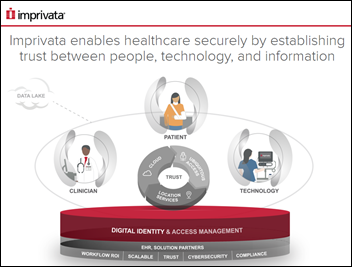
Private equity firm Thoma Bravo considers selling health IT digital identity vendor Imprivata, which could command a price of more than $2 billion on annual revenue in the $100 million range.
Health IT and consulting company CitiusTech allocates $100 million for the future acquisition of niche cloud computing and AI businesses, plus health IT companies in Germany, Japan, and the UK.
A JAMIA article — whose lead author is the AMA’s burnout expert Christine Sinsky, MD — calls for EHRs to automatically analyze their system logs to report seven standardized efficiency measures.
The authors say such reporting would help experts understand the practice environment. It would also help improve operational, technical, and policy decisions.
The efficiency measures are:
Total EHR time for each eight hours of scheduled patient time.
The amount of work performed outside of normal hours, which would require physician schedules to be published to the EHR.
Time spent writing notes.
Time spent prescribing and managing refills.
Inbox time per eight hours of scheduled patient time.
The percentage of orders that are completed by contributions from non-physician team members (bigger is better, indicating top-of-license optimization).
Amount of undivided attention patients receive during an encounter, defined as total encounter time minus EHR time.
HIStalk Announcements and Requests
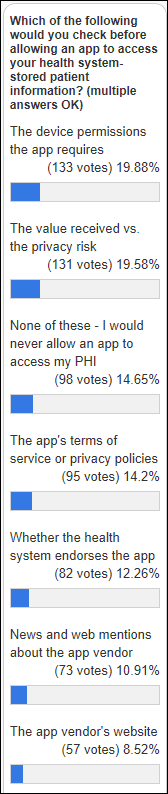
Quite a few poll respondents would never allow an app to access their health information, but others might after considering the permissions the app requires and whether the value received is worth the privacy risk. Not all that many respondents would read the vendor’s terms of services or privacy statement, which is where all the useful information hides. Note: the percentage figures are worthless, but that’s how the poll service lists responses when multiples are allowed.
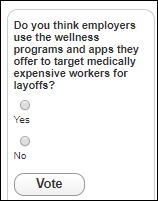
New poll to your right or here: Do you think employers use the wellness programs and apps they offer to target medically expensive workers for layoffs? I would be super interested in hearing from someone who knows for a fact that it happens.
Welcome to new HIStalk Platinum Sponsor QliqSoft. The Dallas, TX-based company’s secure texting, on-call scheduling, patient communication, and clinical collaboration solutions – which use a unique, cloud pass-through architecture – are used by 1,000 hospitals, home health, and hospice organizations to offer reliable, real-time communication among doctors, other caregivers, and patients. Qliq Secure Texting processes 165 million messages each month, including group and broadcast messages, custom quick messages, active directory contacts, escalated call notifications, presence status settings, and EHR integration for customers such as Virtua Health. HIPAA Camera Roll supports image sharing in real time on personal devices. The company’s Quincy chatbot platform supports proactive patient engagement without requiring an app download, while its Visit Path mobile care delivery tracking allows hospice and home health agencies to comply with 21st Century Cures Act-required electronic visit verification. Thanks to QliqSoft for supporting HIStalk.
Here’s a Qliq for Android overview video I found on YouTube.
Reader Survey
Here’s your one last chance to fill out my reader survey, which benefits me (it’s my once-yearly chance to connect with readers) and might benefit you as well (I’m randomly drawing one or more respondents for a $50 Amazon gift card). Meanwhile, I admit that I’ve peeked at early responses and have already made two changes that readers suggested:
I found a way to allow reader comments to be automatically approved for regular commenters, which will eliminate the delay after a comment is posted until I approve it and thus make it visible to readers.
A survey respondent suggested that I run a “Sponsor Spotlight” occasionally to remind them what a sponsoring company offers. Platinum sponsors can provide a short description (no more than 75 words) and I’ll run the responses in the order received.
I’ll close the reader survey later this week and summarize the results. I appreciate the feedback, the good ideas, and the best wishes. I even appreciate the negative ones since they thicken my thin skin and show that someone at least cares enough to complain instead of just moving on.
Thanks to the following companies that recently supported HIStalk. Click a logo for more information.
Webinars
None scheduled soon. Previous webinars are on our YouTube channel. Contact Lorre to present your own.
Acquisitions, Funding, Business, and Stock
Insiders report that Thoma Bravo is considering selling health IT digital identity vendor Imprivata, which could command a price of more than $2 billion on annual revenue in the $100 million range. The private equity firm paid $544 million for the company in July 2016.
Vocera reports Q4 results: revenue up 2%, adjusted EPS $0.15 vs. $0.18.
Nuance announces Q1 results: revenue flat, adjusted EPS $0.27 vs. $0.27, beating Wall Street expectations for both. The company said in its earnings call that early adopters of of its ambient clinical intelligence “exam room of the future” are reporting improvements in physician satisfaction, patient throughput, and documentation time, with its formal launch planned for Q2. Nuance says its HIMSS demonstrations will show a more interactive solution. The product is customized for each medical specialty and will start with five high-revenue and complex specialties, after which rollout will continue to additional specialties at the rate of 1-2 per month. Nuance is considering licensing the product based on exam volumes, bundling in hardware to minimize upfront cost.
Sales
Minnesota mental health clinic provider Nystrom & Associates chooses Relatient for patient outreach and communications.
People
Children’s Minnesota promotes acting VP/CIO Dave Lundal, MBA to the full-time position.
Announcements and Implementations
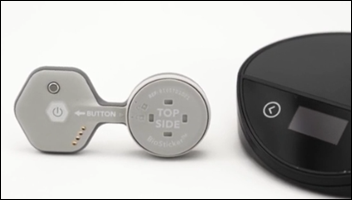
The local TV station profiles the rollout by UCHealth (CO) of BioIntelliSense BioSticker, a chest patch that monitors vital signs (respiratory rate, heart rate, skin temperature, gait, and body position) and stores the information for 30 days. UCHealth’s CARE Innovation Center help develop and test the FDA-approved device, which will receive its first patient use later this year.
Government and Politics
Interesting: several Missouri health systems don’t allow their doctors to certify patients for medical marijuana use – even though such use is legal in that state – because they receive federal funding and federal laws still classify marijuana as an illegal drug that has no medical benefits, potentially threatening their income or licensure. SSM Health’s chief medical officer says, “There’s not a great evidence base to support using this for the majority of complaints that come through. But again, I think the important thing for our providers was to trust them to do the right things. If patients are going to use cannabis, they should be using it under the supervision of a doctor they know and trust. We don’t want our patients to run off to the local doc-in-a-box to get certified for medical marijuana without us participating in that care.” Note the telemedicine aspect in the company webpage above.
Other
KHN reviews the “moral injury” that is experienced by ED doctors whose employers push them to order unnecessary but profitable tests; to see patients quickly but superficially to improve “door to doc” time and generating higher facility fees; and to treat patients in hallways because of ER overcrowding and hospital discharge inefficiency.
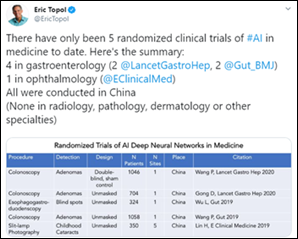
Eric Topol’s medical literature review finds that only five randomized clinical trials have looked at the use of AI in medicine (all of the studies were performed in China) and just 11 prospective trials have been completed in a real clinical environment. All of the studies addressed diagnosis rather than treatment.
Sponsor Updates
Meditech publishes a new Success Story, “CalvertHealth Makes Major Gains in Battling the Opioid Epidemic.”
Mobile Heartbeat will exhibit at the ACNL Annual Program 2020 February 10 in Rancho Mirage, CA.
Clinical Computer Systems, developer of the Obix Perinatal Data System, opens an office in Dubai.
PatientPing features Cerner VP of Population Health John Glaser, MD in its interoperability video series.
Redox releases a new podcast, “The New Interop Paradigm with America’s First CTO, Aneesh Chopra.”
Relatient announces its patient relationship management software now integrates with Virence Health’s Centricity Practice Solution.
T-System relocates its headquarters to 6509 Windcrest Drive, Suite 165, Plano, TX 75024.
Wolters Kluwer provides easier access to latest coronavirus resources and tools for front-line clinicians and medical researchers.
February 7, 2020WeekenderComments Off on Weekender 2/7/20
Weekly News Recap
The VA says the firing of Deputy Secretary James Byrne, who was the top executive over its Cerner implementation, won’t affect its planned initial go-live in late March.
Health IT developer platform vendor Commure exits stealth mode and names former Health Catalyst CEO Brent Dover as CEO.
Patient data vendor Verana Health raises $100 million from investors that include Google-owned GV.
Hyland acquires blockchain-powered document and content authentication vendor Learning Machine.
CompuGroup Medical pays $250 million to acquire several Cerner products that are marketed in Germany and Spain,
The CEOs of 60 health systems sign a letter opposing HHS’s proposed interoperability rules, as urged by Epic CEO Judy Faulkner.
Cerner’s Q4 results beat Wall Street revenue and earnings expectations.
MedStar Health becomes the first member of Cerner’s new Learning Health Network.
KLAS announces its “Best in KLAS Software & Services 2020” winners.
Best Reader Comments
What would happen with the public discourse if Facebook came out in favor of the proposed [HHS interoperability] rule because it would allow them easier access to you and your family’s medical record? Facebook then adds a new Terms of Service all users mindlessly click through which gives them the rights to attempt to access your data? If you come down differently on the philosophical debate as to whether the government should act to protect its citizens’ privacy / whether the government should be a nanny state, that’s fine. Just be careful what you wish for. If the proposed rule goes through, and some app maker or advertising platform suffers a breach, then they will likely suffer trivial consequences at worst and your complete identity and medical data will be on the internet forever. (Elizabeth H. H. Holmes)
There isn’t any enforcement occurring around layoffs that target employees who are likely to be expensive, and the toolset provided by these [employee wellness] companies are built around identifying those employees. (Jim)
What are these employer-funded health tech companies going to look like after the next recession? Not a 2008 style recession, but a regular one. Employers are going to drop these expensive services faster than they drop break room snacks or drink tickets at the Christmas party. If the renewal contracts are a year or less or if the employer pays by usage, these companies are going to drop like flies. (What)
Watercooler Talk Tidbits
Readers funded the Donors Choose teacher grant request of Ms. W in Virginia, who asked for STEAM tools for her kindergarten class. She reports, “My students have loved centers this week, as they get to explore the new gifts! It has been so cool to see their little minds at work. They have made some really creative projects. They have used the straw builders and LEGOs to create patterns. They wrote about what they built with the magna tiles. They collaborated with their classmates to plan, create, and test their ideas with the STEAM kits. As a teacher, it was been a joy to watch them work, learn, and grow. Thank you again for providing us with this wonderful opportunity!”
Hong Kong will use smartphone-connected tracking wristbands to quarantine people who have visited the Hubei province in China in their homes. Authorities will be alerted if the wristband moves more than 100 feet from the smartphone during the two-week quarantine. Geofencing is also apparently being used, but not GPS, with the director of health saying, “These are people who have to be quarantined at home. The are not criminals, so we agree we have to respect their privacy.”
Police arrest a man who broke into the oxygen tank room of North Memorial Health Hospital (MN) and turned off the valves that provide oxygen to patients. The man, who was previously charged with unplugging computers and TVs in the same hospital, said he was mad at the hospital. The hospital lauded its engineering team in a statement:
The North Memorial Health engineering team is continuously monitoring the hospital environment – from temperature to humidity to oxygen levels. If any of these systems move out of a predetermined acceptable range, they quickly act to identify the cause of the problem and fix it (and they are good at what they do!). The hospital oxygen system which was affected during this incident is a system with multiple redundancies (aka several backup systems). When our engineers noticed the oxygen system pressure moving below the desired range, they quickly identified the issue and corrected it. They did this so effectively and efficiently that none of the backup systems even needed to be activated. No patients were harmed due to this system disruption.
A North Carolina TV station takes a hidden camera into a local clinic’s stem cell treatment sales pitch to prospective patients who had been recruited by a mailed flyer,. The salesman rattled off a long list of conditions that he claimed stem cell treatments can cure, adding, “Don’t fret if you don’t see something on here that’s ailing you – we probably just ran out of room on that slide.” The station also told Carolinas Regenerative Medicine that it would be reporting that its medical director has been indicted on federal charges of distributing oxycodone, after which it removed his bio from its website. The medical claims remain, including a pitch for platelet-rich plasma treatments for erectile dysfunction.
A psychiatrist in Australia loses his license after being found mentally unfit to see patients. The doctor claimed that President Trump ordered him to post Deep State conspiracy theories on his practice’s website, where he claimed the existence of a global Satanist pedophile ring and that 9/11 was faked. His conduct was reviewed after he complained to the medical board about his wife having an affair with another psychiatrist. When told that his license would be suspended pending improvement in his mental state, he called the council chair a “filthy dirty f&%$ left-wing slut” who, along with media reporting the story, is part of the conspiracy against him.
Waud Capital Partners commits $150 million to pursue health IT opportunities with former MatrixCare CEO John Daamgard, who sold the company to ResMed for $750 million in 2018.
Vanderbilt University Medical Center (TN) creates the Vanderbilt Clinical Informatics Center, which will collaborate with care teams, clinical quality, and risk management departments to spread innovation and research and optimize its use of Epic.
The VA hospital in Palo Alto, CA will become the world’s first 5G hospital in the US once it opens later this year, giving providers the ability to expand telehealth services.
VA Secretary Robert Wilkie says the departure of Deputy Secretary James Byrne will not impact the department’s transition from VistA to Cerner, which is scheduled to begin in late March.
John Windom, executive director of the VA’s Office of EHR Modernization, and Melissa Glynn, assistant secretary for enterprise integration within the VA’s Office of Public and Intergovernmental Affairs, will continue to oversee the day-to-day management of the project.
Wilkie fired his #2 executive Monday, reportedly due to White House frustration with how the VA has addressed the sexual assault complaint of a Navy veteran and staff member of the House Veterans Affairs Committee, who says the event occurred in a VA medical center cafeteria.
Reader Comments
From Slurpee: “Re: HIMSS 2020 Most Influential Women in Health IT. Just announced.” HIMSS doesn’t say how it chose the six winners, all but one of whom work for for-profit companies. HIMSS says its own members and certificants get preference, and those who are chosen are also on the hook to contribute free content for HIMSS to use in its publications. I recognize the names of just two of the six, and searching HIStalk finds that two of them have been mentioned over many years. At least they hold responsible industry jobs instead of the usual underachieving tweeters who organizations choose them purely for their potential to provide free PR.
From Rewriting My Resume: “Re: VCU Health. Look on their website tomorrow for Epic job postings.” I see one job now, but I’m sure more are coming as Epic replaces a Cerner/IDX implementation of 15 years.
From Kiosk Guy: “Re: VA. They have issued an RFI for 4,200 kiosks. They have failed repeatedly on choosing ADA-accessible units thanks to a sweetheart deal (in my opinion) with Vecna. They seem to favor IPads, but it’s not clear if Vecna is in the running. My guess is that Leidos and Accenture get the deal with backstop from Cerner, while we get another non-accessible solution deployed en masse by a Federal agency.” The VA says it will replace 4,200 end-of-life Vecna VKiosk self-service kiosk devices and is looking for vendors to participate in pilots in the Spokane, WA and Columbus, OH areas. The document says the contractor must meet all ADA requirements, including following 508 standards and offering an audio mode alternative for veterans with disabilities. Required functions include a variety of authentication modes, health screening capability, vital signs capture, patient check-in, appointment reminders, integration with Cerner, digital document signing, patient intake analysis, and optional functions such as wayfinding, HIPAA form signing, and patient check-out and surveys. The VA says the device must support Lightning cables, which seems to indicate that only Apple hardware will be considered. The VA chose Vecna in 2009 and the company previously said it had installed 6,000 kiosks. The contract’s initial value was reported as $120 million and Vecna was awarded at least $30 million in add-ons (that I could find easily by Googling) since then.
HIStalk Announcements and Requests
Thanks to those who have have completed my quick, once-yearly reader survey, even if only with hopes of winning a $50 Amazon gift card. Just about every HIStalk idea that I act on – some work out, some don’t – come from the results. I work alone without having any actual conversations about what I do and this is the only feedback I get.
Listening: She Drew the Gun, England-based mellow psych pop with big hooks, created by singer-songwriter Laura Roach. Also: Cherry Glazerr, LA-based smart, poppy girl grunge. Videos of Shakira’s Super Bowl performance also sent me her way on Spotify for the first time in awhile, reminding how infectiously energetic the world music of the 43-year-old is, even if she does seem to lip sync a lot at big events.
Webinars
None scheduled soon. Previous webinars are on our YouTube channel. Contact Lorre to present your own.
Acquisitions, Funding, Business, and Stock
San Francisco-based, General Catalyst-funded Commure exits stealth mode to launch a FHIR-compliant software developer platform for creating new cloud-based healthcare applications in a HIPAA-attested environment. Industry long-timer Brent Dover, most recently president at Health Catalyst through December 2018, is Commure’s CEO.
Verana Health raises $100 million and acquires data science company PYA Analytics. The company analyzes de-identified patient data from registries maintained by the American Academy of Neurology and American Academy of Ophthalmology (both of which have members on Verana’s board) and then sells the resulting insights to drug and medical device companies. Among its investors is Google-owned GV. The company has raised $138 million since 2015.
From the Cerner earnings call, following its Q4 report in which it beat Wall Street expectations for revenue and earning:
Chairman and CEO Brent Shafer expressed the company’s support for HHS’s proposed interoperability rules.
Revenue backlog was down 10% year over year due Adventist Health terminating its RevWorks contract, as well as implementation of an accounting standard that precludes counting a contract towards bookings if it contains a termination clause.
The company repeated its intention to pursue mergers and acquisitions.
Cerner’s strategic growth business (non-Millennium and outside the fee-for-service provider world) generated $520 million in 2019, a 22% growth year over year.
The company will move nearly all of its non-government HealtheIntent clients to Amazon Web Services in the first half of 2020.
Development of Cerner’s MyStation patient engagement solution will halt and clients will be referred to GetWellNetwork.
The VA contract will ramp its way up to $1 billion per year or more in annual revenue as work progresses under the 10-year, $10 billion contract.
The company does not expect to see any impact from the firing of VA Deputy Secretary James Byrne, who was ultimately responsible for the VA’s Cerner rollout.
Cerner expects to see “tons of opportunity” in selling providers the technology they need to work under Medicare Advantage and bundled payment models.
The company expects to leverage Amazon’s consumer competencies and has obtained visibility into Amazon projects such as Haven and PillPack.
Moving clients to AWS will have a small but incremental impact on cost savings, as Cerner spends $100 million on data center software alone and spends more money supporting clients who aren’t on current releases.
Cerner will move consultants from its acquired AbleVets government contracting firm to its VA project as they complete their open assignments, hoping to reduce the company’s third-party costs.
Hyland acquires Learning Machine, which offers blockchain-powered document and content authentication.
Waud Capital Partners commits $150 million to pursue health IT opportunities in working with former MatrixCare CEO John Daamgard, whose sold the company to ResMed for $750 million in 2018. He was previously COO of Mediware, which was taken private by Thoma Bravo in 2012 (then sold to TPG Capital in 2017 and renamed to WellSky in 2018). Waud’s portfolio includes specialty EHR/PM solutions such as ChiroTouch.
CompuGroup Medical pays $250 million to acquire several Cerner products that are marketed in Germany and Spain — Medico, Soarian Integrated Care, Selene, and Soarian Health Archive. Readers had correctly reported that those businesses were up for sale.
Sales
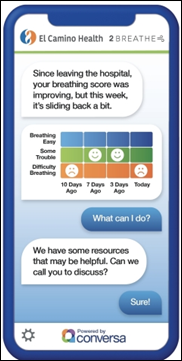
El Camino Health (CA) will use Conversa Health’s conversational AI chat program to monitor patients with respiratory conditions to reduce COPD-related readmissions.
OU Medicine and the University of Oklahoma Health Sciences Center sign a five-year, $200 million contract with Epic.
People
Sheri Ribeiro (Allina Health) joins Cottage Health as VP/CIO.
PerfectServe names Steffan Haithcox (Tabula Health) as chief marketing officer and Nazir Rostom (GetWellNetwork) as CFO and promotes Jeff Brown to COO and Mary Hatcher to SVP of product development.
Announcements and Implementations
Vanderbilt University Medical Center creates the Vanderbilt Clinical Informatics Center, which will collaborate with care teams, clinical quality, and risk management departments to spread innovation and research and optimize its use of Epic. Vanderbilt clinical decision support director and biomedical informatics professor Adam Wright, PhD will direct the center.
Allegheny Health Network (PA) implements CarePort Health’s care coordination and notification software.
Government and Politics
Nearly 60 health systems sign a letter opposing HHS’s proposed interoperability rules, as urged by Epic CEO Judy Faulkner. Those CEOs signing include those of UW Health, West Virginia University Health System, SSM Health, Catholic Health, Guthrie, Mary Washington Healthcare, Mercy Health Services, Beth Israel Lahey Health, NYU Langone Health, PeaceHealth, and Piedmont Healthcare. Good reporting by CNBC’s Chrissy Farr.
Federal authorities indict Reinaldo and Jean Wilson, husband-and-wife owners of telemedicine companies Advantage Choice Care and Tele Medcare, for their roles in an illegal kickback scheme that swindled Medicare out of $56 million. The couple allegedly orchestrated a ring of providers that ordered medically unnecessary orthotic braces for Medicare patients.
Other
An American Medical Association survey — of unknown quality since methodology was not stated and most practicing doctors aren’t AMA members (UPDATE: a reader found the methodology and it looks good, even re-surveying the same doctors who participated in 2016) — finds that:
Physician participation in virtual visits has doubled to 28% of respondents since the 2016 survey.
Use of mobile apps and sensors to monitor chronic disease patients rose to 22% and patient engagement tool adoption rose to 32% (those numbers don’t seem reasonable to me, especially when the patient monitoring definition includes automatically triggering alerts).
37% of doctors say they use clinical decision support, meaning that two-thirds of them don’t (the survey defined this as highlighting significant changes in patient data).
58% of doctors say they give patients digital access to lab results, appointment reminders, refills, and appointments (they offer a portal that may or may not be used by patients, in other words).
Sponsor Updates
Glytec congratulates a dozen clients on receiving five-star ratings from CMS.
Healthcare Growth Partners publishes its “Health IT January 2020 Insights.”
Medicomp Systems will work with clinical text structuring company Emtelligent to develop new solutions that will support efficient clinical workflows and improve usability.
The Chartis Group names Chelsea Wyatt (The HCI Group) a principal in its I&T Practice.
Meditech selects MedPower to deliver Meditech Expanse training to customers in the UK, Ireland, South Afrida, Asia Pacific, and the Middle East.
February 6, 2020Dr. JayneComments Off on EPtalk by Dr. Jayne 2/6/20
Apparently some Advanced APM payments are going to be slowed for some providers as CMS is missing the banking information it needs to send the payments. The profiles of nearly 2,800 physicians are lacking, but I doubt those folks are likely to see the entry in the Federal Register that includes links to documents where providers can verify if they are on the list. Providers have until February 28, 2020 to submit updated banking information. The bonuses are for the 2017 performance year, so some of those providers may have retired or otherwise left practice.
Missouri is apparently going to try to get it in gear this year, as the state legislature has introduced bills to finally try to create a statewide prescription drug monitoring program. It’s the only state in the nation without such a database, although the St. Louis County database is used by a good chunk of the state in an attempt to provide better care for patients despite the actions of previous legislatures. Several state senators have said they’ll try to block it with a filibuster, and if they do, I hope their constituents think twice about voting for them again.
My practice’s “just in time” ordering habits have bitten us, as there has been a surge in mask purchases due to the novel coronavirus outbreak. Masks are apparently on backorder and our supplier isn’t sure when they’re going to be getting any, so we’re no longer giving them to patients and some offices are out completely.
I find our administration’s response to the issue to be lackluster since influenza is still a big issue in the community, having killed more than 10,000 people in the US. Some leaders act as if contracting the flu is just a given, and many of our employees are allowed to stay at the office working even though they should be at home resting. Yet another reason I’m keeping my eye out for a new clinical gig. There’s always telehealth, where my risk of being coughed on by a patient or colleague is zero.
Speaking of telehealth, some of the opposition I hear with regard to that particular care delivery paradigm revolves around “giving Z-packs like water.” The telehealth organization I work with is very particular about antibiotic stewardship and providers are monitored to ensure that antibiotics are given appropriately. I was glad to see some recent analysis on how traditional practices fare in this regard. The study looked specifically at Medicaid claims data over a 10-year period and found that nearly 45% of antibiotics lacked a clear indication for their use. Almost 28% of prescriptions had no associated office visit. The data was from 2004 through 2013, before the rise of telehealth and long ago in the dim ages when patients simply called the office and relayed their symptoms. Of those prescriptions that had an associated office visit, 17% of them had a diagnosis that was not infection related.
The authors note that current strategies to reduce unnecessary antibiotic prescriptions are targeted at the office visit level. However, I would argue that EHRs could augment this by flagging visits where providers prescribe antibiotics with no associated visit. Although an actual warning might be annoying, it would be fairly easy to report on the data and present it for clinicians to review and see how they compare to their peers. Of course, as virtual visits occur, there would need to be further sub-categorization to review those virtual visits specifically for rates of antibiotic prescribing. Other feedback could include in-visit alerts that an antibiotic has been prescribed with no corresponding appropriate diagnosis.
Other beneficial interventions fall in the realm of public health, which as we know is underfunded. Greater patient understanding of when antibiotics are indicated and how to take them appropriately would be the best intervention. I still see too many patients who “took a couple of leftover amoxicillins” before coming to the urgent care for evaluation, which is a failure not only in the current situation, but also in the previous episode of care. Providers also need to know how well they are performing in this regard. I know many physicians who don’t have a clue what their metrics are for antibiotic treatment of respiratory infections, and that’s a shame.
As a blogger, I read a lot of other blogs and the best one I saw this week was Jacob Reider’s, titled: “When sponsored CDS is a crime.” His commentary on the Practice Fusion debacle sums up what he calls “the tension between better health and better profit.” Apparently he had a ringside seat for some initial exploration of the slippery slope of sponsored clinical decision support that led to specific elements of the 2014 Edition of the Certification Criteria for Health Information Technology. He recalls a lunch meeting with Practice Fusion’s then-leader Ryan Howard where they discussed some of the ethics around clinical decision support. Reider is clear that he doesn’t think the opioid situation happened on Howard’s watch, and gives us some visibility into the CDS that was actually in the application. It’s well worth the read.
I also enjoyed this brief Bloomberg Law summary of the HIPAA-related issues that prevent physicians and patients from texting one another. The reality is that it’s time to update HIPAA. The world has changed significantly since the law was passed in 1996. The internet was just a baby then (Netscape Navigator, anyone?) and many people could barely dream of email, let alone APIs and Netflix. In case you’re wondering, other notable things from 1996 include the debut of the Motorola StarTAC flip phone, Dolly the cloned sheep, Nintendo 64, and Tickle Me Elmo.
From Longtime Reader: “Re: app data. Concerns about what happens with our data as we sign up for apps are worthy. That being said, with respect to the big corporate health systems (whether ‘not-for-profit’ or not), the cat has long been out of the bag. We sign away our rights to control our data under duress or blinded by bureaucracy the moment we cross the threshold. Indeed, my primary care doc’s front desk has a signature pad, with no visual presentation of what one is signing for, that memorializes the act, with only some mumbling by the lovely front desk staff about its significance.” I’ve taken to signing those signature pads with something that either only vaguely resembles a signature, or is fully legible but not my name. I’m still waiting for someone to notice.
My HIMSS prep is in full swing as I continue the quest for cute shoes that are comfortable as well. They have to work from day to night as I transition from the expo hall to the afterparties, which is a tall order for any footwear. If you have any suggestions, let me know.
VA Secretary Robert Wilkie assures members of the press that the departure of Deputy Secretary James Byrne will not impact the department’s transition from VistA to Cerner.
Nearly 60 health systems sign off on a letter written by Epic CEO Judy Faulkner urging HHS Secretary Alex Azar to revise the proposed interoperability rules in light of their patient privacy concerns.
Consumer genetic testing company Ancestry announces it will lay off 6% of its staff, following a similar move made by competitor 23andMe several weeks ago.
February 5, 2020Readers WriteComments Off on Readers Write: Value-Based Care Can Work When High-Touch, Personalized Care is the Strategy
Value-Based Care Can Work When High-Touch, Personalized Care is the Strategy By Adam Sabloff
Adam Sabloff is founder and CEO of VirtualHealth of New York, NY.
Humana recently released some noteworthy figures related to the company’s value-based care programs. An annual review of the health plan’s efforts reported 27% fewer hospital admissions and 14.6% fewer emergency rooms visits compared with traditional approaches.
That’s good news for the healthcare industry in terms of the sizable investment it has made into evolving pay-for-performance models over the past decade, especially in light of early studies that suggested lackluster returns. In fact, one 2016 study published in the British Medical Journal found minimal evidence to support the theory that value-based care models impacted mortality rates.
The question now becomes: What is driving Humana’s results?
Simply put, the payer’s model is much more targeted than early, broad-stroke approaches to value-based care. They have implemented infrastructures and workflows that identify and address not only the clinical needs of patients, but also social determinants of health that may be keeping members from following through with care plans. This strategy is enabling Humana to achieve higher-touch, more personalized care.
It’s an imperative differentiator that healthcare stakeholders need to embrace heading into the next decade. At a high level, the industry acknowledges that it is on an unsustainable financial course. Yet, alarm bells should be ringing loudly amid concerning statistics related to the silver tsunami, the rapidly-growing aging population that is characterized by a high percentage of complex, chronic conditions.
Consider the following figures:
The US Census Bureau projects that by 2030, one in every five residents will be of retirement age.
85% of older adults have at least one chronic health condition and 60% have at least two, according to the National Institute on Aging.
Demand for long-term services and supports (LTSS)—an area of high-touch care that currently supports more than 12 million elderly and those living with disabilities —will increase in tandem with the aging population. Consequently, providers and payers must embrace the concept of whole-person care models that consider not only broad clinical strategies that promote wellness, but all the socioeconomic needs of each patient. For instance, Humana attributes much of its success to its ability to identify challenges stemming from social determinants of health—such as food insecurity or social isolation—and help patients access services and make better health choices.
Having insights into social determinants of health (SDoH)— the non-clinical factors that make up 80% of overall health—will continue to characterize success with value-based care, which is crucial for healthcare stakeholders to know. Broad-based approaches to improving population health that may promote regular wellness checks and follow-ups only go so far. In the case of LTSS, many elderly patients who live alone and are no longer able to drive will have difficulties picking up prescriptions or getting to doctor’s appointments. Addressing their lack of transportation can have a significant impact on readmission rates and emergency department visits.
In addition to whole-person care, providers and payers need to address the 5% of patients who require critical, complex, and chronic care, who account for approximately 50% of total spend. After recognizing the shortcomings of traditional care management models implemented alongside legacy technology, some stakeholders are turning to a “wedge” strategy that addresses the needs of complex care populations. The approach carves out the subsets of their member population that have complex care needs and places them on an auxiliary tech tool that surrounds them with a comprehensive care ecosystem capable of effectively addressing their needs.
The healthcare industry has made enormous strides over the past decade to usher in better approaches to care, and there have been many lessons learned. One important lesson is that optimal care considers the whole person, and care managers must have insights into facets impacting outcomes—clinical, behavioral, and social—to impact performance in a meaningful way.
As providers and payers turn the corner into a new decade, it’s important that all reflect on successes, failures, and new opportunities, acknowledging and embracing the promise of high-touch, personalized care for complex patient populations.
Comments Off on Readers Write: Value-Based Care Can Work When High-Touch, Personalized Care is the Strategy
February 5, 2020Readers WriteComments Off on Readers Write: Fixing What Ails Healthcare
Fixing What Ails Healthcare: A Checklist for Building a Modern Primary Care System By Ray Costantini
Ray Constantini, MD, MBA is founder and CEO of Bright.md of Portland, OR.
For years, the industry has been struggling to find solutions to help fix what’s broken in primary care. There’s been an influx of urgent care centers, retail health clinics, and video telehealth services to address the growing patient load, offer more convenient access to care, and help stem physician burnout. While these alternatives are now commonplace, the state of primary care has actually gotten worse instead of better.
The healthcare sector is plagued by a shortage of primary care physicians. Existing providers are retiring or leaving practice because of burnout, and there are not enough interested medical students to take their place. Between 1996 and 2007, the number of medical students going into general medicine declined as much as 61%.
Making matters worse is that there are even greater demands on primary care providers’ time. The Affordable Care Act added millions of more insured patients into the mix just as the aging population needed more care. Add to that the burden of exponentially more administrative tasks, which take providers’ time away from seeing patients.
With primary care resources on the decline and waits for appointments sometimes exceeding 50 days, urgent care centers and retail clinics saw opportunities to jump in to offer supplementary services. The number of urgent care centers exploded during the last decade, reaching more than 8,000 nationwide by 2018, and the number of retail clinics doubled. But even these vast amounts of new options have been unable to ease primary care burdens.
Others have turned to video visits to streamline provision of care and eliminate the need to travel to doctors’ offices. But in reality, video telehealth is equally problematic for providers and patients. In fact, video technology often adds another layer to delivering care. To prepare for a 20-minute “visit,” a provider must go to a location where the patient’s privacy won’t be compromised and then set up the equipment. Plus providers still have the same administrative tasks that accompany an in-person visit. On the flip side, video may not be a viable alternative for patients who lack broadband services or who may not be tech savvy.
Even though they value the convenience of these walk-in clinics and video, a recent survey found that patients still overwhelmingly prefer to receive care from their own provider or any healthcare provider rather than from tech companies or retail centers.
So what can primary care providers do to ensure their practice is on the right track to deliver 21st century care? Here’s a checklist that will help health systems meet the needs of modern patients, while also reducing their administrative burdens:
Survey resources. Which resources are being underutilized? Which are overburdened? Where can shifts be made to increase productivity?
Embrace a care team approach. Staffing each step of the care pathway appropriately allows everyone to practice at top of license. Introducing virtual care team members multiplies that positive impact.
Use technology where it makes sense and for what it does well. Automate the repetitive tasks to let machines do what they do best and free up humans to practice the art of medicine. With an assist from useful technology, high-quality care can be delivered in less than two minutes for conditions that account for about 60% of primary care visit volume.
Be open to change. Just because it worked 100 years ago doesn’t mean it works today or that people still want to operate that way. Not everyone is resistant to change. Many are likely clamoring for it.
Link bricks with clicks. Integrate online offerings with in-person ones. Whether a patient gets care virtually, in a clinic, or in the emergency department, every provider should benefit from access to the most up-to-date and accurate health record.
Find a partner that can help solve challenges today and in the future. Innovation matters, but the technology must be human-centered and configured to address each practice’s unique issues.
Modern primary care must be on-demand, which means not just when patients want it, but from wherever they are — home, school, work, or even the bus. Technology, such as asynchronous virtual care, already exists to make this possible. Practices now must embrace change and evaluate how they can evolve to be true game-changers in primary care.
Comments Off on Readers Write: Fixing What Ails Healthcare
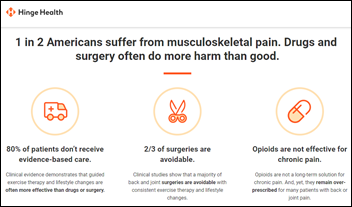
Hinge Health, an employer-focused digital physical therapy company, raises $90 million in a Series C funding round that increases its total to $126 million.
VA Secretary Robert Wilkie fires his #2, Deputy Secretary James Byrne, due to “loss of confidence in Mr. Byrne’s ability to carry out his duties.”
Byrne was the VA’s highest-ranking official whose responsibilities included its Cerner implementation and other computer projects. He said in November that either he or Wilkie would make the decision of whether Cerner will be ready to go live at two pilot sites on March 28. Byrne expressed confidence in November that the scheduled go-live at Mann-Grandstaff VA Medical Center (WA) and Puget Sound Health System was on track.
Axios reports that the White House was not happy with the VA’s handling of a sexual assault complaint, leading Wilkie to ask for Byrne’s resignation.
The VA did not respond to press inquiries about who will take responsibility for its Cerner project.
Byrne is a United States Naval Academy graduate. He was deployed as a United States Marine infantry officer, served as a Department of Justice prosecutor, and was counsel to the OIG office that monitored the federal government’s $52 billion Iraq rebuilding program. He was the VA’s General Counsel for two years before being confirmed as VA deputy secretary in September 2019. He held that job for 20 weeks before being fired Monday.
Reader Comments
From Ghost in the Machine: “Re: Cerner in Europe. Millennium is being pulled from Spain, Portugal, and France. They are also trying to find a buyer for the Siemens product in Spain and Portugal. That leaves no product to sell, so no need for sales teams and eventually everyone else. It’s not GDPR driving these actions, it’s nearly non-existent margins.” Unverified. UPDATE: CompuGroup Medical announced Wednesday morning that it has acquired several Cerner applications that are marketed in Germany and Spain — Medico, Soarian Integrated Care, Selene, and Soarian Health Archive, for which CGM paid $250 million.
From NFL Fan: “Re: Kansas City. Congratulations to Cerner and the other HIT vendors there on the Super Bowl win!” I’m glad that elitists who see the Midwest as faceless flyover country — including many who don’t know or care that two adjacent states confusingly have their own respective Kansas City – might have learned something (beyond lip synching shamelessly while booty shaking admirably) in watching the drought-breaking Chiefs win. KC area schools have cancelled Wednesday’s classes to allow customers to proudly cheer their taxpayer-supported entertainment vendor and its 20-something-year-old, possibly concussed employees who didn’t voluntarily choose to live there, so try not to whack someone while doing that questionably sensitive tomahawk chop thing. For me, I would avoid the adulatory, freezing parade masses and instead have some Jack Stack brisket and burnt ends with a Boulevard beer. Several health IT companies make the Kansas City area their home, with some of them off the top of my head being Cerner, Netsmart, and WellSky.
HIStalk Announcements and Requests
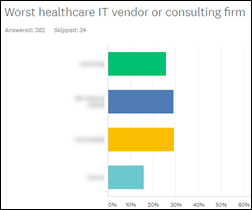
I emailed the HISsies ballots yesterday to HIStalk update subscribers. Voting is tied to those individual email addresses, so non-subscribers can’t vote (to prevent ballot box stuffing). The nominees came from reader submissions, so blame yourself if you don’t like the choices but didn’t bother to nominate your own. Voting so far has yielded few surprises despite heavy voting action in the “worst vendor” category.
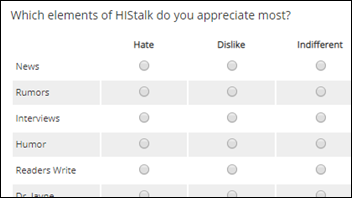
Speaking of voting, please take a couple of minutes to fill out my annual reader survey. I sit in an empty room filling up an empty computer screen every day, so this is my one chance each year to see who’s out there and how I can do a better job of meeting your needs. I always get a lot of good ideas from reader responses. I’ll sweeten the pot by doing one or more random drawings for a $50 Amazon gift card.
Webinars
None scheduled soon. Previous webinars are on our YouTube channel. Contact Lorre to present your own.
Acquisitions, Funding, Business, and Stock
Cerner reports Q4 results: revenue up 6%, adjusted EPS $0.75 vs. $0.63, beating analyst expectations for both.
Hinge Health raises $90 million in a Series C funding round, increasing its total to $126 million. The company styles itself as “the world’s most patient-centered digital hospital” in the form of wearables, personalized exercise plans, and health coaching for back and joint pain, paid for by employers.
Premier acquires two healthcare supply chain companies – Acurity and Nexera – from Greater New York Hospital Association for $292 million. The companies offer group purchasing and supply chain consulting, respectively.
I care even less about McKesson now than when they were a crappy HIT vendor who bailed out, but just in case you still own shares, the company reports Q3 results: revenue up 5.3%, adjusted EPS $3.81 vs. $3.40, beating earnings expectations.
Sales
University of Alabama at Birmingham Health System will implement TransformativeMed’s EHR-embedded worfklow and alert notifications apps.
Norton Healthcare chooses Appriss Health’s PMP Gateway to integrated prescription drug monitoring program information into its EHR.
MedStar Health joins Cerner’s Learning Health Network, which sells de-identified patient data to drug companies, as its first health system customer. The program was started in August 2019 in conjunction with Duke Clinical Research Institute.
Health plan Regence will offer members chat-based, around-the-clock access to doctors using CirrusMD’s Ask a Doctor app.
People
Greater Hudson Valley Health System (NY) promotes Craig Filippini, MBA to CIO.
Chris Morrish (NaviHealth) joins Cohort Intelligence as SVP of enterprise sales.
Identity and data exchange vendor 4medica hires Jorge Nobregas (Siemens Healthineers) to the newly created position of SVP of sales.
Southwestern Health Resources promotes Brian Coffey, PhD to SVP of data insight and innovation.
Announcements and Implementations
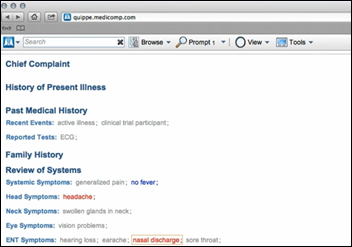
Medicomp Systems and Emtelligent will partner to develop clinician workflow and usability solutions based on Medicomp’s Quippe clinical data engine and Emtelligent’s medical natural language processing engine. The first co-developed solution is in beta testing and will be released this quarter.
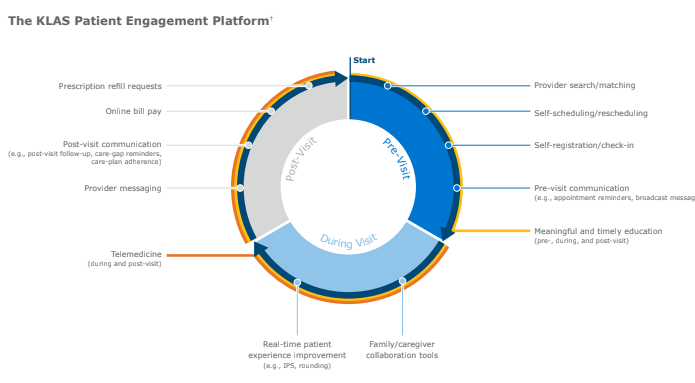
KLAS reports on its November 2019 patient engagement summit that drew 20 provider and 19 vendor attendees. Early high-level success stories involve matching patients to community programs; providing patient care reminders; making visits easier with pre-visit videos, appointment reminders, online rescheduling, and online urgent care appointment scheduling; and increasing patient portal use.
Life and health reinsurer Reinsurance Group of America announces an underwriting risk score service for life insurers that performs real-time analysis of EHR and medical claims data.
Other
China admits the first patients to its 1,000-bed coronavirus hospital that was built in 10 days by a crew of 7,000 workers in Wuhan. A second 1,500-bed hospital will open this week. Clinicians will connect to a Beijing hospital using a video system that was installed in less than 12 hours, while medical robots will transport drugs and specimens.
Interesting: Memorial Sloan Kettering Cancer Center has hired a new CIO with no healthcare experience (Atefeh Riazi, who held that role with the United Nations) who will report to the chief digital officer it hired in November 2019 (Claus Torp Jensen, who came from CVS Health and Aetna). Former VP/CIO Pat Skarulis has apparently retired. MSKCC’s federal tax forms show that Skarulis was one of the higher-paid CIOs among non-profit health systems at $1.4 million, joining at least a dozen of her MSKCC peers in the million-dollar club. I also note from that tax form (from the 2017 tax year) that former IBM CEOs Ginni Rometty and Louis Gerstner both sit on MSKCC’s board and IBM was one of its top five contractors at $4.9 million.
In England, NHS hospitals are installing “sleep pods” to allow doctors and nurses to take short naps during their shifts, with an average stay of 17-24 minutes. American company MetroNaps makes the pods, which include soothing music, lights, and vibrations. Sleep medicine experts say it’s unreasonable that air traffic controllers are required to take a 30-minute break every two hours to avoid mistakes, but NHS caregivers rarely get time to recharge.
Sponsor Updates
Optimum Healthcare IT publishes an infographic titled “Year in Review: 2019 Healthcare Data Breaches.”
ONC recounts the effectiveness of the Patient Unified Lookup System for Emergencies (PULSE) powered by Audacious Inquiry during the California wildfires last fall.
PatientPing’s national network of Next Generation ACO providers earns over $150 million in savings for 2018.
AdvancedMD will exhibit at the NILA Mid-Winter Meeting February 7-8 in Scottsdale, AZ.
BlueTree adds Epic MyChart support to its service center capabilities.
Bright.md updates its Upper Respiratory Infection SmartExam modules to include coronavirus screening.
CI Security will sponsor the Data Connectors Charlotte Cybersecurity Conference February 5 in North Carolina.
ConnectiveRx will expand its campus in Pittsburgh to meet staffing projections that could reach 1,500.
CoverMyMeds receives The Medical Mutual Pillar Award for Community Service.
CommonWell’s latest blog, “#InterOp in 2020,” features input from Clinical Architecture CEO Charlie Harp and Diameter Health CEO Eric Rosow.
A federal judge grants Epic’s motion to dismiss a case brought by the National Federation of the Blind, which argued that the company’s software is designed in a way that hampers blind people from effective healthcare employment.
VA Secretary Robert Wilkie fires Deputy Secretary James Byrne, who was working closely with Wilkie on the department’s EHR transition, due to a “loss of confidence.”
MedStar Health (MD) becomes the first member of Cerner’s new Learning Health Network, a collaboration between health systems and clinical research organizations that aims to better enable its members to conduct medical studies.






































































Would be interesting to see what Providence St. Joe's return has been on all their adventures. When I was on…