Home » News » Recent Articles:

News 6/27/08

June 26, 2008 News 2 Comments

From Home Alone: "Re: Misys Homecare. What can anyone tell me about it? Will they run this into the ground much like the old Sunquest?"

From Jerry Rivers: "Re: job helper. I saw your ad that says 75% of HIStalk readers say it helps their job. I don’t believe it." The ad banner you mentioned is running on HealthcareITJobs.com and it refers to this exact question from the spring HIStalk Reader Survey: "Over the past year, HIStalk helped me perform my job better." 228 respondents answered, with 172 (75.4%) saying True and 56 (24.6%) said False. Hey, just because we make it entertaining doesn’t mean our information isn’t useful. Lots of folks are looking for competitive advantage out there and we try to give it.

From Tom Terrific: "Re: WellPoint. I’ve heard it mentioned in two separate areas that Wellpoint is rolling out EMRS to physicians. Do you know anything about this?" They did e-prescribing quite a while ago and were keeping some sort of PHR, but I hadn’t heard of new physician projects. If you know, tell me.

From Boba Fett: "Re: NextGen. Scott Decker to be named CEO of NextGen. Patrick Cline getting kick upstairs to head QSI." Unconfirmed and probably can’t be since QSII is publicly traded. But, Scott’s a reader (I interviewed him when he was with Healthvision) so you never know. Perhaps presciently, he mentioned Pat Cline then. Quality Systems CEO Lou Silverman announced Tuesday that he will resign effective August 16.

From E. Buzz Miller: "Re: Emageon. Perkins is out." An SEC document says COO and onetime heir apparent Chris Perkins has resigned, effective July 25, following all the proxy fight stuff with Oliver Press Partners.

A reader commented on my Odd Lawsuit from Tuesday that involved age discrimination, interpreting my remarks as defending the hospital where the 69-year-old employee with 42 years on the job was allegedly fired by her supervisor after a barrage of "old lady" comments. My usually full-bore sarcasm must have been masked since I’m all the way behind the lady who got canned, provided she’s telling the truth, of course. I’d much rather see the apparently obnoxious supervisor get nailed instead of the hospital, but that’s not how it works with age discrimination.

Listening: Beatnik Termites (reader recommendation). Infectiously fun summer, doo-woppyish surf-pop-punk. I was totally hooked in the first 15 seconds of Somebody Else’s Baby. Five stars. I’ve played everything on their MySpace page about a dozen times.

Royal United Hospital Bath delays its planned Millennium go-live in the UK, worried about Fujitsu’s interest in finishing the implementation now that the company is backing out of its NHS contracts.

New CIOs: Pardee Hospital (NC) names Harold Moore, formerly of Piedmont Healthcare Management Group. UPMC Magee-Women’s Hospital (PA) announces the promotion of Lou Baverso to CIO, replacing Bruce Haviland who has moved to UPMC Mercy. Antoine Agassi, chair of Tennessee’s eHealth Advisory Council, takes the CIO slot of hospitalist provider Cogent Healthcare of Nashville.

Jobs: Cerner Clinical Consultants, Epic Clarity Consultants, C++ Developer.

Sure to raise some eyebrows, including those of the FDA: an article in the new JAMA shows that RFID devices interfere significantly and sometimes hazardously with nearby ICU medical equipment. Especially prone devices: infusion pumps, with 8 of 9 models (five B. Braun and two Alaris) having problems ranging from false alarms to failure. Pacemakers were problematic, too, with erroneous pulsing, and ventilators also acted up. You will no doubt here conflicting interpretations, with RFID locating vendors claiming the study was a European lab experiment with minimal real-world applicability, while competitors whose systems use infrared and sonic waves (or maybe even barcodes) will point out that RFID was designed for warehouse pallets, not deploying to rooms full of life-sustaining medical equipment, and has the exact qualities you might expect to interfere with sensitive gear. Thanks to the reader who sent the full text article over. I’m open to comments from anyone who knows the topic and who has read the article.

CCHIT is looking for 13 new Commissioners to serve a two-year term. Senior execs are invited to apply in July for terms that begin in October. The current list is here and you can e-mail your resume to CCHIT to be considered.

Children’s Healthcare of Atlanta goes live on Epic CPOE. This may be the first time I’ve seen Epic mentioned in a significant press release, and even then only because it’s from the customer.

An Epocrates survey of medical students finds that only 20% of them believe widespread EMR adoption will happen in the next five years. Too bad they didn’t put a more reasonable timeline on there — in most cases, five years isn’t enough for a single hospital to bring up a full EMR. Still, they believe technology improves care and patient safety. When asked to rate the US healthcare system (such as it is), 40% gave it a D or F and 35% predicted healthcare reform in the next five years. It’s the Facebook generation: 6% spend more than 24 hours a month on the social networking site.

The local paper runs a story on MidState Medical Center’s (CT) implementation of Eclipsys Sunrise Knowledge-Based Charting.

West Virginia gets a nod for its EMR network covering 19 free clinics.

Politicians are knocking a healthcare IT bill around, but given how often this happens with no result, I’m not really paying attention yet.

Siemens Medical Solutions caves in to Acacia Research, which uses broad and questionable patents covering common technology to scare companies into paying licensing fees rather than court costs. This time, it was Acacia’s patent for PACS that got the company a Siemens check.

University Hospital (GA) gets a TV mention for its rollout of Horizon Enterprise Visibility, McKesson’s patient flow solution. We have good background in our February interview with McKesson’s Paul Gartman about the former Awarix product.

BIDMC CIO John Halamka tells a Red Hat Summit audience that healthcare can learn from open source initiatives. The Red Hat folks actually invited me to attend and report, which I appreciate, but the day job got in the way.

E-mail me.

Inga’s Update

A number of employers of HIStalk readers employers made Computerworld’s 100 Best Places to Work in IT, announced today. Included: Mount Carmel HS, VHA, Sutter Health, Palmetto Health, Partners, THR, NY Presbyterian, Intermountain HC, Englewood Hospital, Duke, and Cerner. (All the grief that Cerner gets and they still came in at #92 – and the only HIT-specific vendor to make the list.)

Picis is selected to provide high-acuity solutions to seven new Madrid hospitals. The applications will integrate with the hospitals’ Siemens systems.

Initiate Systems withdraws registration for a $75 million IPO, citing unfavorable market conditions.

Premiums were apparently not the only things that went up last year at several California health insurance companies. The California Medical Association reports that multiple CEOs earned $1 million+ salaries while their companies produced more than $4.3 billion in profits.

Connecting for Health announces that numerous companies and privacy groups have endorsed a set of practices to protect personal information and promote PHR adoption. The study also notes that the majority of the Americans see value in PHRs, though less than half were interested in using one. Only 2.7% of the public is using PHRs today and 57% of the non-adopters cited privacy issues as their biggest concern.

JAMA publishes a study that suggests RFID is potentially hazardous and, when implemented in the hospital environment, on-site EMI tests should be conducted. That could prove to be a boon for companies like Sonitor Technologies that use ultrasound for location and tracking devices instead.

KLAS announces an initial study of medical oncology vendors. IMPAC, IntrinsiQ, and Varian were the only three vendors with sufficient installations to provide statistically valid data. Varian got the overall highest rating, though all three were fairly close.

A record 24 million Americans, or 8% of the population, have diabetes, according a new CDC report (warning: PDF). That is a three million person increase between 2005 and 2007. Another 57 million have pre-diabetic conditions. There is no doubting that the disease and its complications continue to dramatically affect healthcare and the economy in general.

Former Misys Sales VP Scott Boyden is named senior VP of sales and marketing of Streamline Health Solutions.

Rex Healthcare (NC) announces that Novlet Mattis Bradshaw is the hospital’s new CIO. Bradshaw comes from The Seton Family of Hospitals (TX) where she was IT’s senior consultant and program director. We told you about this weeks ago, of course.

Catholic Health East will deploy Craneware’s Chargemaster Toolkit products for its headquarters and 16 acute-care facilities in eight states.

E-mail Inga.

News 6/25/08

June 24, 2008 News 3 Comments

From Maxwell Silverhammer: "Re: Patients’ Action Network. I received this in my e-mail and haven’t seen a lot about it." Link. Looks like the AMA is trying to enlist patients to petition Congress to not reduce Medicare doctor payments.

From The PACS Designer: "Re: cloud utilities. TPD has commented about clouds and their spread across the globe through employment of computing grids. Even Dr. Bruce Friedman of Lab Soft News has dedicated his web comments to the cloud phenomenon by quoting myself and others. Now, through a mention by Dr. Bruce, I’ve been reading the Rough Type web site by Nicholas Carr, who has a recent post about how far cloud computing has come and where it is about to go, which should prove interesting to HIStalkers. His post is titled On the trail of the itinerant computer." Link. That’s a thought-provoking read, the idea that computing and digital property can’t be constrained to time and place, with ensuing political and economic ramifications.

From Dr. Bernie Tupperman: "Re: MEDecision. The premium to share price is ridiculous to the point of being insane. I guess that’s the decision-making you get as a quasi-nonprofit when your accountability is totally limited. The fact that HCSC accounts for 25% of the revenue of MEDE just makes the multiple that much higher. I am surprised no political candidates have grabbed on to this. It’s great news for MEDE shareholders, but the cash to pay for it is coming out of the hides of consumers in Illinois, Texas, etc." I think I’m the only person to pick up on the fact (in Brev+IT, which you can sign up for to your right) that BCBS operator HCSC is MEDecision’s biggest customer. They’ve offered $121 million, quadruple the closing share price, to acquire the company.

From Slap Maxwell: "Re: CattailsMD. Will Weider is not the CIO of Ministry and Marshfield. They are completely separate organizations. Carl Christensen is the corporate CIO for Marshfield Clinic. Also, Ministry is not the alpha site. The system is already used by over 700 physicians and several organizations. Marshfield has been building its own systems for more than 20 years and has almost 200 programmers employed to build and maintain its CCHIT-certified EHR." Will is CIO over two organizations, of which I got one right (the other, I assume, is some kind of joint hospital project). I don’t know anything about the players, so I asked Will for dumbed down explanation. Ministry has its own 160-physician group that competes/collaborates with the 750-doc Marshfield Clinic, but Marshfield admits most of Ministry’s hospital inpatients. Ministry will implement a homegrown ambulatory clinical application from its competitor, in other words, chosen over the usual big-name commercial ambulatory EMR systems. Ministry’s inpatient clinical systems (Meditech and Centricity) aren’t going anywhere, though.

From RUKR: "Re: Royal Bath. First UK trust to go live with Millennium LC1." Link.

I ran an anonymized rumor from Rodney A. Rippy last Friday about a physician office EMR vendor supposedly in looking for an angel investor in a New York meeting. Not true, the company’s CEO tells us. His investment bankers met with execs from a competing EMR vendor to see if that company might be a good acquisition target and that was it so far. He promises to tell HIStalk first if anything changes, into which I read that the company will actually expand, not contract.

Regional Medical Center at Memphis (TN) implements Medseek’s physician portal, putting Meditech data in front of its docs. Other Medseek announcements: its sales doubled in Q1 and it will support HealthVault.

Jobs: Cerner Clinical Consultants, .NET 3.5/WPF Developer, McKesson Consulting Opportunities.

Columbia, MD-based business intelligence vendor Medisolv acquires Clinsaver, a Canadian decision support/dashboard vendor.

Mediware announces its BiologiCare transplant materials tracking system.

Drug companies spent $168 million on lobbying in 2007, double 2001’s total.

A hospital clinical informatics nurse is interested in a high-level, head-to-head comparison of clinical systems from Cerner and Meditech (either Magic or C/S) for an in-house decision. If you have experience with both and want to jot down some thoughts, I’ll send them her way. Thanks.

Premise CEO Eric Rosow will ride a bike 85 miles in the Pan-Mass Challenge on August 2 to raise money for Dana Farber’s The Jimmy Fund. I sponsored him (Premise does the same for me, so it’s only fair) and you are welcome to join me.

Sad news from Meditech President Howard Messing: "I don’t know if this is the kind of thing you print, but Darrel Lapierre has passed away. Darrel was well known and respected in the MEDITECH community, serving as Staff Master Sergeant in the Air Force (highest non-commissioned rank), then CIO of Hillcrest Baptist Hospital, then as CIO of Columbia/HCA Healthcare, and then as a consultant to many, many hospitals. He will be missed by many of us who deeply respected him.  Full obituary: Darrel John Lapierre was born April 13, 1944, married on  February 12, 1966 to his wife of 42 years Bonita Jacquetta McGaw, and died at the age of 64 on June 22, 2008 in his home after a courageous battle with cancer. Darrel was born in Montreal, Quebec, Canada. At a young age his family moved to Joliet outside of Chicago. He was an avid sportsman excelling in wrestling and football. After High School he joined the US Air Force while still as a Canadian citizen. The Air Force assigned him to Tachikawa, Japan. There fell in love and was married to his devoted wife Bonnie. Darrel became a proud US Citizen, and together they raised two children while traveling the world. He worked with the medics and hospitals of the Air Force and was assigned to many overseas posts, once being transferred from Thule, Greenland to Las Vegas, NV. By Federal law, only one percent of the Air Force enlisted force may hold the rank of Chief Master Sergeant. CMSgt Darrel J. Lapierre (Ret.) had a long and distinguished career making friendships that he treasured. After retiring from the Air Force he continued to work in hospital administration and focused on data management. Advancing in his field, he became the CIO of Columbia Healthcare (now HCA), one of the largest healthcare organizations in the nation. After retiring a second time he built a successful consulting business just to enjoy working with the people he cared about.His last career was maintaining a low handicap, a great yard, and a happy home. He is survived by his wife Bonnie, son Coady, daughter Eve, sister Debbie, 3 grandchildren, and countless friends." Condolences to the family and those who knew him.

Industry longtimer Nick van Terheyden joins speech recognition/physician documentation vendor M*Modal as CMO.

Anesthesia system vendor DocuSys will move its headquarters from Mobile to Atlanta.

Cardinal Health buys red tee shirts for 600 of its employees to wear on Fridays in the USA Cares "Red Shirt Friday – I Care Too" campaign to support US troops and raise money for the Military Family Assistance Center.

A New Jersey hospital has fired two nurses for HIPAA violations since last year, the nurse’s union says. The union is offering privacy training to its members, so kudos to them for taking that initiative (regardless of motivation).

Mayo Clinic’s two retail pharmacies re-opened Tuesday after being shut down since last Wednesday by an unspecified computer problem.

PubMed creator and NIH employee David Lipman, MD is one of three finalists in the 2008 Service to America Medal in the Citizen Services category.

Odd lawsuit: a 69-year-old woman fired after 42 years on the job at an Omaha hospital is suing Alegent Health for age discrimination. Her complaint says a new, younger female supervisor called her an "old lady" and a "dinosaur", said the was "older than dirt," and made adult diaper remarks before firing her.

Emageon caves in in its proxy fight with big shareholder Oliver Press Partners. CEO Charles Jett will leave the company’s board and OPP will get three board seats.

E-mail me.

Inga’s Update

I ran across a side-by-side comparison of McCain’s and Obama’s health care proposal. Helpful if you are interested in just the highlights of each candidate’s positions on access to health care coverage, cost containment, improving the quality of care, and financing.

Eclipsys announces the availability of a new revenue cycle dashboard tool. Children’s Omaha is one of the first organizations giving it a try.

Misys’ Center for Community Health Leadership releases a free handbook entitled “Best Practices for Community Health Information Exchange.”

Hoag Memorial Hospital Presbyterian (CA) is extending preferred pricing on Allscripts EHR/PM for qualified staff. If I recall correctly, Hoag is providing similar arrangements for several EMR vendors, following the assumption that one size does not fit all.

Covisint is partnering with AT&T and Microsoft to create an HIE over a secure broadband connection. Patients will use HealthVault to share their information with providers accessing AT&T’s Healthcare Community Online. If you build it, will they come?

The Indiana Family and Social Services Administration creates the Indiana Flood Victims eHealth Support Center, designed to provide doctors with medical information on flood victims. Regenstrief Institute, the Indiana HIE, and Electronic Data Systems (EDS) are also lending a hand.

We mentioned last week that Mercy Medical (IA) was evacuated due to the Midwest floods. Another facility suffering major damage (to the tune of $125 million) is Columbus Regional Hospital in Indiana. The floodwaters filled the basement and rose 2-3 feet in the first floor. Several areas got hit pretty hard, including the ER, lab, pharmacy, and IS department. As workers do their best to clean up, ER employees are setting up a temporary space in a mobile emergency room trailer borrowed from the Carolinas Medical Center. The mobile ER includes four ICU beds and a two-bed operating room.

clip_image002

CCHIT publishes its approved final criteria for inpatient and ED EHR certification. For the first time, it has also published standards for a new certification category – enterprise EHRs, for vendors providing interoperable outpatient, inpatient, and ER records.

Emerging Health Information Technology and Davincian Technologies are teaming up to help healthcare organizations further automate their revenue cycle billing processes. The strategic alliance positions Emerging to provide the professional services and Davincian the software solutions.

I went to Mr. H’s HIStalk Radio and found his selections fun but a bit too hip for me (go figure!) If his mix doesn’t work for you, my newly created Inga Radio includes hunky guy singers, legendary guy singers, hip chicks, lots of singer-songwriters, some indie, a bit of hip-hop, foot-tapping rockabilly, and a bit of country-folk-rock. Sort of the anti-Mr. H. In any case, I am now a total Pandora addict.

The Trizetto Group releases a survey that concludes information sharing and aligned incentive programs will reduce healthcare costs. Also, between 88 and 91% of patients responding saw some value in online information tools that help anticipate healthcare costs, select benefit options, and obtain customer service. Eighty-one percent of consumers expressed concern about their future healthcare costs, while more than 90% of both employers and payers considered wellness incentives at least somewhat effective at lowering employees and families’ healthcare costs.

Looks like McKesson is going to have to settle for as much as $15 billion in damages in connection with the lawsuit allegedly inflating prescription drug prices (we predicted the payout could be big in a Brev+IT earlier this year). That makes John Hammergren’s $26.8 million compensation for 2007 seem like chump change. Hammergren’s pay grew 18% from 2006, which is 9% higher rate than McKesson’s revenue growth for the fiscal year ending in March.

E-mail Inga.

Monday Morning Update 6/23/08

June 21, 2008 News 2 Comments

From Sir Lord Baltimore: "Re: hospitals not like hotels. These two are at least taking steps in the right direction. The first is for a Group Health project in Bellevue, WA . The second is the new SSM facility in KS." Link 1, Link 2. Interesting, especially from a design standpoint, but unless they decline to accept insurance, they’ll still be ruled by the treat ’em and street ’em mentality that makes hospitals more like quick lube places than the quiet, restful places in the country they used to be back in the "sanitarium" days. Can you imagine a hotel being paid to see how quickly they can get you to leave? Maybe the whole concept of insurance was a socialist experiment gone bad, especially when the social goal of "healthcare for all" really means selling everyone insurance.

From Samuel Kershaw: "Re: Firefox. This sucks big time." Link. Google, in a rare retreat, pulls the plug on its Browser Sync and says competitors’ products were better than its own anyway.

From Trampas McClure: "Re: employer award. Our hospital IT department won one of those magazine awards for being a great employer. Management put signs around to remind employees how good they have it and pretending it to congratulate staff for something or other. Just down the hall is a bulletin board full of open position postings. If it’s so great, why did all those people leave?"

New poll to your right: should hospitals require prospective CIOs to have specific application or vendor knowledge?

Forsyth Medical center (NC) gets a mention in the local business journal about its upcoming Microsoft Amalga implementation, although only the first four paragraphs are visible to non-subscribers (like me).

Over in the UK, it sounds like there’s a good possibility that BT will slide into Fujitsu’s former role of implementing Cerner Millennium, at least in the south trusts. That’s what I hear, anyway.

rhad 

A warm welcome to RelayHealth, now an HIStalk Platinum Sponsor. Inga and I had worked with the folks there on our interviews about the company (Virtual Information Exchange and Financial Clearance Services) and we thought they were pretty cool with their Fake Ingas and badge ribbons at HIMSS, too. So now we’re all hitched and everything. They’re a sponsor of HFMA’s ANI, which starts Monday, June 23, and I’m sure they would appreciate your stopping by to say hello (on behalf of HIStalk, since I’ll be slaving away at work instead of playing the slots in Las Vegas). They’re a load of fun in our book (the people we know, anyway) and they really want to support HIStalk’s readers. Thanks to RelayHealth.

Listening: to HIStalk Radio, of course. Most recently played: L7, Bikini Kill, Yeah Yeah Yeahs, Operator, and Go Betty Go. If you haven’t listened to new music since college, jump on, at least if your tastes are like mine (girl singers preferred but not required; punk, prog, and surf  influences OK; no soft rock or singer-songwriter warbling; no rap or so-called country that’s really insipid pop; and anything indie, emotional, and rough around the edges preferred over formulaic corpo-rock and choreographed posers).

Ministry Health Care (WI) will move to the clinical system developed by Marshfield Clinic, discussed in my November interview with former Director of IT Tanya Townsend. CattailsMD even has its own web site, the tone of which (and the successful pursuit of early CCHIT certification for it) suggests that maybe Ministry will be the alpha site before commercialization, either by the clinic or maybe by an interested vendor (hmm … guesses who would be interested? although GE’s lack of results from Intermountain should be a cautionary tale). Will Weider, CIO of both organizations, has more. I told him he’ll be a media darling now – he’ll get that USA Today photo yet.

Tennessee’s Shared Health HIE upgrades its Clinical Xchange, with technology from Allscripts, IBM, Initiate Systems, MedAI, Oracle, and Orion Health.

Here’s to the power of shared knowledge and inspiration. Several weeks ago, a CIO reader took me to task for some comments I’d made, leading me to write an editorial called Perfect is the Enemy of Good Enough: Waiting for IT Nirvana Kills Projects and Patients (her comments inspired me to dash the whole thing off in one sitting in a Panera while eating one of those orange-iced "scones," stretching that definition to to ease the customer’s guilt over having dessert for breakfast). Anyway, another CIO e-mailed me yesterday to tell me that he planned to use the editorial to launch some discussion among his team. Pretty cool.

A Cerner intern wins a prize for developing a mobile phone application that lets college students sell their used textbooks locally. 

The author of that Newt Gingrich interview article I mentioned last time, e-mailed me to mention that it was actually published in State Legislature Magazine and came from the Forum for State Health Policy Leadership, part of the National Conference of State Legislatures. Also suggested: readers should check out their web site and state legislative tracking database.

Here’s a great article on Epic Systems. Tidbits: nobody had heard of them locally until they started building the new HQ; the company was small (and confident) when they decided to build the monstrous $205 million campus; new construction will push its Verona, WI facilities investment to $500 million; and the company is actively going after business outside the US. Snips: "A contemporary photo of Faulkner, 64, is impossible to find, and a brief trade-news account of her 2002 speech to the Accelerate Madison tech group (she reportedly stipulated that her talk could not be recorded) is treated by Epic watchers as the Rosetta Stone for understanding Epic’s idiosyncratic approach to personnel … Epic is famous for its rigorous screening of job applicants and providing its staff a world-class work environment. Private offices for everyone (not the cubicles so common in the tech world), imaginatively designed conference rooms for work-team meetings, art-filled buildings, gourmet food, an anything-is-okay dress code, generous stock plan, the sabbatical program and more. All to spur creativity, productivity and loyalty."

The new AVP and "chief growth officer" at Inova Loudoun Hospital (VA) is former CIO James Rohrbaugh.

Interesting technology: a retired ED starts a company to market his invention, an $8,000 imaging machine that highlights patient veins for nurses trying to start IVs.

Two Mayo Clinic retail pharmacies in Rochester are shut down temporarily because of unspecified software problems.

Odd: a Georgia doctor and two office assistants are charged with false arrest after allegedly refusing to allow a female patient to leave the office when she couldn’t pay her bill immediately. Her lawyer claims she was told her visit would cost $98, but when she couldn’t come up with the $755 final charge, she was locked in a room, forced to look up her bank records on the computer, and was walked outside to retrieve a payroll check from her truck while staff kept her keys.

GE Healthcare lays off hundreds of Waukesha workers because of declining imaging sales.

This article on a Santa Rosa (CA) clinic’s EMR implementation has a great quote from the medical director: ""We don’t really have a health care system. We’re building a model for efficient, safe, timely, patient-centered care so that when we have a national health system, we can be part of that solution."

A Michigan paper does a pretty good job describing a physician group’s use of Covisint’s physician service, which includes e-mail, results, and claims. I saw it at HIMSS and was impressed, at least given my rather quick perusal.

Idiotic lawsuit: a 52-year-old female cop is suing Victoria’s Secret after she claims her eye was damaged when a thong she was putting on shot a piece of rhinestone trim into her eye, requiring her to use ointment. Her attorney tried to stave off "idiotic lawsuit" eye-rolling and also declined to say how much she’s suing for, saying "In terms of money, that’s not what we really want here. We want to make Macrida fully redressed for her grievous injury." Money, in other words. She might want to either choose a non-thong next time, consider bumping up a couple of sizes, or re-sew the bling with some 50-pound test fishing line. I’m pretty sure I don’t want to see a 52-year-old traffic cop in a V-string in any case.

E-mail me.

News 6/20/08

June 19, 2008 News Comments Off on News 6/20/08

From Cousin Carl: "Re: EHR study. NYT’s piece on barriers to adoption of EHRS by small groups -points to most EHRs being designed for hospitals or large groups. Does highlight athenahealth’s EHR being used." Link. Inga mentions it below. Interesting David Brailer comment about EHRs that appeal more to hospitals selecting doctor systems than the doctors themselves: "What we see is a deficit in innovation, and that is something innovators and the capital markets can address."

From Enrico Pallazo: "Re: your Inside Healthcare Computing editorial. About time someone opened up this dialogue. Go for it! This needs to be a national conversation." It was called If Uncle Sam Doesn’t Like Healthcare Administrative Costs, Why Did He Create Them? A sample sentence: "Uncle Sam, as the biggest payor, is the also most demanding, bureaucratic, and arrogant." I don’t know the topic well enough to do anything more than raise the issue, so the movement will need to recruit.

From Larry Leisure: "Re: Misys. Rumor has it that the Misys sales force has been reduced." We ran some comments assuring us that would happen, so if it did, it’s not much of a shocker. One rumor was that nobody was making quota, so with the merger impending, that’s going to happen.

From The PACS Designer: "Re: Firefox 3. TPD downloaded the Firefox 3 release and found it to be much faster when accessing web sites versus the old version. Also liked the enhanced graphics and new highlighting features for recent sites visited. As always, there will be some security problems with this new version and the first problem appeared on release day, but will be fixed quickly according to the Mozilla representatives. Firefox is available in over 45 languages, thanks to the contributions from Mozilla community members around the world."

From Rodney A. Rippy: "[Physician EMR vendor] had an invite-only meeting in NYC last week looking for someone to buy or be bought in a ‘merge to keep us alive’ attempt. After their home healthcare buyout firm screwed the pooch, they’ve realized that the only asset their have is their software (not very good, really) and their clients (worth something). ~$30m in debt, need $5-10m to stay open, hoping for an angel. The real problem is that they fired a lot of the people who knew what they were doing in order to make room for the New Order, who didn’t. Familiar story?" Inga’s trying hard to confirm, but seems to be getting the runaround. This is a pretty big vendor with quite a few awards. Maybe David Brailer should buy them.

Next, on a very special Listening: I created a Pandora radio station with the stuff I like. You can stream this bad boy and hear all kinds of good stuff for free, 99% of which you will never have heard of. I’ll keep tweaking it, so it will improve over time. We can listen together while reading HIStalk and sipping that Starbucks latte that Inga mentioned. Playing now: Dressy Bessy.

Jobs: Principal Pharmacy Systems Analyst (VA), Soarian Consultants – $5,000 Sign On (MA), SQL Developer (TX).

Insurance company Health Care Service (sounds like the kind of crazy, out-of-the-box name a bunch of  insurance company types would dream up after one too many wine spritzers) will buy case management and data exchange vendor MEDecision for $121 million. Quadruple the share price? Are they nuts? CEO David St. Clair hits another home run, having sold GMIS to McKesson HBOC in 2001, although master money man and industry long-timer Carl Witonsky was the company’s board chair and CEO during its IPO (he’s currently chairman of Sentillion’s board and they’re doing great too, so I’d put my money there if I had enough of it to get Carl’s attention).

cern1   cern2

How did I miss this? Cerner and a division of Steelcase are burning up a fortune in gas on a multi-city tour of the Smart Semi, an 18-wheeler mobile showroom. It was in Manhattan Thursday, then headed back to the Midwest (hitting three Wisconsin cities, but steering a wide berth around Madison). It’s booked through the end of the year, including some conferences.

Final tally: Firefox 3.0 easily breaks the world record for one-day downloads with 8.3 million, two of which were me (one for home, one for work). You can get it here, although if you’re like me and don’t warm up to the so-called "awesome" address bar, you can go back the old one with this plug-in. It’s even faster than Opera, making Internet Explorer feel like sprinting with hip waders on.

Fujitsu has two weeks to pay back $132 million to NHS for walking out on its contract. Doh!

And speaking of the UK, a leaked document obtained by The Guardian suggests that the Lorenzo situation there is worse than acknowledged, with IBA shifting resources from the more important second phase to try to keep the first one going.

Concord Hospital (NH) fixes application delays after consolidation with WAN optimization.

All hospitals like to point out their new construction is being "like a hotel." Surely nobody’s buying that beyond first glance. Hotels don’t lock you up in airtight rooms with no view, have unannounced and sometimes surly people shuttling in and out of your room to probe your private areas, serve food from the same outsourced companies that specialize in portion control for prisons, and don’t charge you $2,000 a night for the crappiest mattress and TV channel selection possible. No matter how nice the architecture, hospitals are about as unlike a hotel as they could possibly be, other than strangers sleep there. Nobody in their right mind wants to be in one or, God forbid, die in one. With all the discussion about changing physician practice models, it would be great to rethink how hospitals work from the ground up. They’re more like a factory than a restful, respectful place to recover.

Some local paper gives Newt Gingrich some softball healthcare questions, sounding worshipful toward his Center for Health Transformation but not picking up on the fact that it’s a for-profit business run by an ex-politician (but I’m still a fan, sort of). He says healthcare will exceed the rosy $77 billion in annual savings that the federal government just said was a pipe dream.

If you’ve e-mailed me lately, I’m really behind. Sorry about that. I just can’t find enough hours in the day to keep all the plates spinning. I’m trying and I read and appreciate every e-mail, so don’t be offended.

E-mail me.

Inga’s Update

Seven new healthcare organizations have selected Sentillion’s provisioning solution in the last six months.

Company-sponsored health clinics for employees are on the rise, according to a Dallas newspaper. Employers with as few as 2,500 employees are offering this perk for staff and proponents, claiming they lower costs for everyone.

The Wisconsin Health Information Organization (WHIO) is collaborating with Ingenix to create a statewide repository of health claims data.

LinkedIn has raised $53 million in financing and is now valued at over $1 billion. I’m confident that valuation would be significantly less without the 123-member HIStalk fan club. For those keeping track, I now have 106 connections compared to Mr. H’s 139.

Southwest Washington Medical Center enters into a three-year agreement with Novo Innovations to facilitate health information exchange between the hospital and at least 14 practices.

The University of Wisconsin Health System is partnering with OnBase to integrate disparate patient information into the EMR. (Isn’t OnBase the one with the fun baseball theme booth at HIMSS? And offering beer at 11:00 in the morning?)

WellSpan Health System (PA) claims a 28% reduction in annual A/R and a 98% cash collection rate since it implemented Eclipsys’ Sunrise Access Manager and Patient Financial applications at two acute care facilities. The press release calls it WellSpan Health Systems, that last word apparently being both incorrectly pluralized and superfluous.

Former Misys and GE Healthcare exec Kathy Blum is named CEO for Applied Computational Technologies, a software company providing dose calculation technology for radiation therapy treatment.

athenahealth announces the resignation of Christopher E. Nolin as SVP, general counsel, and secretary in order to spend more time with his family. Current deputy general counsel Daniel H. Orenstein will be the company’s new general counsel and secretary.

McKesson reaffirms its earnings forecast for fiscal 2009, predicting between $3.75 and $3.90 EPS.

RelayHealth announces expansion of its healthcare connectivity offerings to include patient education programs and care management support services, and solutions for integrating medication record data and expediting claims processing.

ProHealth Care, Inc. contracts with Orchestrate Healthcare to provide application integration consulting services. Speaking of Orchestrate, one of its clients needs a NeoTool expert, so we said we’d give it a mention.

Martin Memorial Health Systems (FL) selects Allscripts EHR and PM product for its 80-physician group. Martin already uses Allscripts’ Care Management solution in its hospitals.

Massachusetts General Physicians Organization signs a multi-year licensing agreement with Virtual Radiologic for teleradiology services. The organization is the largest multi-specialty group practice in New England and partners with Mass General.

Incidentally, Virtual Radiologic’s CEO and founder Sean Casey wins the Entrepreneur of the Year award in the technology category for the Upper Midwest region.

Survey results from a New England Journal of Medicine EMR survey confirm that physicians continue to resist EMRs. Highlights: only 4% of physicians have full EMRs, 42% report they are in the process of setting up an EHR system or plan to do so in the next two years, and less than 9% of 1-3 physicians groups have any sort of EMR. Those using EMRs report positive effects, but financial barriers (still) are preventing most from adopting the technology. Another major barrier, according to 54% of the 2,758 respondents, was finding an EHR system that meets their needs.

The installation of Epic in Cerner’s backyard seems to be going well. The University of Kansas Hospital reports it is now live on EMR in the ED, the latest phase in their $50 million, three-year installation.

I thought the Ms. CIO piece in this week’s Reader’s Write was quite fun. We are encouraging more folks to provide interesting commentary. It could be your 15 minutes of fame!

E-mail Inga.

News 6/18/08

June 17, 2008 News 8 Comments

From Dr. Know: "Re: CIO job at Caritas Christi. You are on to something here. Unfortunately many CIO jobs are down in the weeds and not viewed as strategic. In this particular example, I can see the handwriting on the wall: just keep Meditech running; there is nothing new going on here.  Also, it highlights a common problem with headhunters and HR folks — they just don’t get the ‘strategic CIO’ argument."

From Jimmy B. F. James: "Re: lawsuits. The problem with requiring plaintiffs to pay if they lose is that a small guy may back out even if he knows he’s right because he knows the big guy’s 100 lawyers will cost him a fortune if he loses. Before Microsoft knew (or cared) what the Internet was, a guy came out with an application called Internet Explorer. He owned the name. Along comes Microsoft and they call their application (wait for it) Internet Explorer. The man sues. Microsoft takes him on in courts. Man runs out of money and eventually goes bankrupt. Microsoft wins. I agree that we need tort reform in this country, but our less-than-wise government has not had a good record of late of protecting its citizens. It’s been all too concerned about protecting businesses, though." I found coverage of the 1996 lawsuit.

From Madrigal: "Re: Epic. Interesting article. The more I read about Epic, the more I see their similarities with Meditech." Link. Worth a scroll down to see what I hope is an old picture of Dave Garets, sporting what looks like a monstrous set of Texas longhorns made of hair under his nose. All he needs is a boater hat, a red vest, and three guys behind him singing Sweet Adeline.

From Wayne Newton: "Re: Emageon shareholder proxy. Emageon represents a huge amount of intellectual/IT capital, significant enterprise imaging software market share (7-8%), and long-term recurring revenue agreement with some of America’s finest facilities. These Carl Icahn wannabes (OPP) from New York wouldn’t know a decent investment in digital imaging  if it bit ’em on the butts. The bubbas from Alabama deserve another chance to smack the cheeks of GE, Philips, Agfa, Siemens, and McKesson once again. OPP are flippers looking for a quick buck without any knowledge about healthcare IT or imaging. I hope they lose their A$$."

Listening: Union Carbide Productions, Swedish psych-punk, defunct since 1992, but still kickin’ out the jams with Chameleon Ride here in HIStalk Music Heaven.

McKesson says it has reinvented revenue management and made up a word to describe it: enterprise revenue management. It sounds like a marketing package that includes applications, RelayHealth, InterQual, and consulting.

Futjitsu bailed on NPfIT four years into a 10-year contract because it has lost an estimated $670 million so far and new terms being sought would have made it worse. That’s almost to the penny the amount Accenture hemorrhaged before ran for NPfIT cover two years ago (note to self: don’t hire Accenture to negotiate contracts).

Doctors at Sault Area Hospital (ON) are questioning lab results after problems interfacing its Meditech EMR to its contract outpatient lab.

Six-hospital SSM HealthCare-St. Louis axes 75 management employees, many of them bigwigs. I would say that’s close to unprecedented. I don’t know about you, but I’m seeing quite a few hospital layoffs that nobody seems to be noticing, trend-wise.

Some Sunquest employees have registered www.sunquest.org and put a discussion forum there. Not all of them are happy.

Jobs: Senior Systems Engineer – Healthcare Vertical (Symantec), Clinical Analyst (MEDHOST), Consultant (Healthia Consulting). Sign up for job blasts. A hospital HR person sent this to Gwen: "We’re extremely pleased with the response of applicants we received from HealthcareITJobs.com. Within 24 hours of our Director of Information Systems position being posted, we had received numerous qualified applicants. This is the first time we had used this website and we were very pleased with the response. We had a very nice applicant pool to choose from."

Here’s the zillionth story of a doctor who decided EMRs were too expensive, so he developed his own and wants to sell it. He ran the design by some advertising company programmers and got the advertising company owner’s wife market it. He says the Cerner system used by nearby Clarian is "as popular as malaria." From the screen shots, it appears to have been designed in ColdFusion, certainly the kind of underpinnings a technical novice might choose, but web-based nonetheless. For the same $5,000 upfront for the first doc and $200 a month for hosting, you could buy well-established and CCHIT-certified systems with pretty good support, of course, but maybe this one’s better (being nice). And down the street, a programmer is running a Craigslist ad to perform discount surgery, claiming that, as a former surgical patient, he’s entirely qualified to undercut people who wasted all that time in medical school. (that’s what you call your satire right there).

Dell donates $75,000 worth of computer equipment for the EMR project at Mercy Medical Center of Northwest Arkansas.

I upgraded my SnagIt to the new Version 9. I wish healthcare software companies were as well run as Techsmith. They send great newsletters, their software is unendingly powerful and flexible, and they make it easy to upgrade or to migrate to a new PC.

Speaking of a new PC, I got one of those too since mine was getting long in the tooth: AMD 6000 dual core, 4 gB, big SATA hard drive, Asus motherboard, WinXP, neon-lit case with a humongous fan, and Fedex shipping – all for $580. Got a 22" Acer LCD coming from Newegg for $199. It’s fun times in the nerd-cave. Mrs. HIStalk is demanding to know what we’re going to do with the four obsolete towers and three monitors already in here, but I might need them someday (right).

GE Healthcare will integrate EKG data with EMRs from e-MDs, eClinicalWorks, GEMMS, McKesson, Medinotes, and Medtuity.

QuadraMed completes a one-for-five stock reverse split, hoping to boost share price to the $5.00 minimum that would allow it to move up from Amex to Nasdaq. That’s looking good so far, as shares are at $10.35 after the split.

Taxachusetts will give the state’s life science industry $1 billion over ten years.

Ambulance chasers didn’t wait long to file a class action suit against University of Utah Hospital and its courier company after last week’s theft of backup tapes from a courier’s car.

Idiotic hospital lawsuit: an illegal immigrant was an inpatient at Martin Memorial Hospital (FL) for two years, racking up an unpaid $1.5 million bill before the hospital paid his way back to Guatemala. He sued for being sent home and the hospital has spent $250,000 so far in its defense. Half the hospital’s births are to illegal immigrants who don’t pay a cent, so they’re kind of steamed that the feds aren’t interested.

Idiotic citation: a patient flakes out in a 40-bed hospital’s ED at 2:00 a.m., leading frightened staff to call the police. They came and subdued him with a Taser, after which he was medicated and transferred to another hospital with a psych unit. The state’s health department cited the hospital for the incident, saying it should have been better prepared for psych patients.

E-mail me.

Inga’s Update

I was so very sad Friday to hear that Tim Russert died. In my mind, he was the expert who knew exactly how to take all the political rhetoric and boil it down to simple terms for the rest of us. I’ve decided Mr. H, who claims he never watches TV and hardly knew who Russert was, is the Tim Russert of the HIT world; he has the same passion about his work and is an expert at reading the lay of the land and communicating his take on things.

The University of Maryland Medical System is in the process of going live on CareMedic System’s Financial Record revenue cycle software.

The AMA is discussing the pros and cons of provider-sponsored secret “shopping” to evaluate physicians and healthcare facility performance. Personally I would be happy to volunteer for the shopping gig if it enabled me a free Botox treatment or the like. On the other hand, I’m not sure hanging out for hours on end waiting for some medical treatment would be the most exciting job, regardless of how many People magazines were in the waiting room.

Picis announces a new social networking website to facilitate interaction among its clients. Picis Exchange Network was announced at the company’s Exchange Customer Conference that finishes up Wednesday. Also during the conference, Picis recognized five customers who have improved their organization’s performance using Picis software.

Last week a reader informed me she had figured out my “true” identity but would keep it top secret if she could be a fake Inga next year at HIMSS. I not sure she really has it figured out, but I am happy to support a fake Inga or two. In fact, I am thinking about creating a new line of Inga attire that goes beyond the original “Kiss me, I’m Inga” or “I’m Hot, I’m Inga” sashes. I could set up a site on eBay. Maybe it will include The Inga shoe, which I envision as a very high-heeled red pump. If you are a fashion aficionado, I’m open to suggestions.

Actually, speaking of HIMSS, I was on their site recently and see that attendees can start reserving rooms online for next year’s meeting. I also checked out the prices of those Chicago hotel rooms. Ouch. I’ll need to sell a ton of Inga goodies just to pay for the hotel room!

A Commonwealth Fund-supported study concludes hospitals that implemented Leapfrog-endorsed patient safety practices, including CPOE adoption, reported better quality of care and lower mortality rates.

Interesting article about why women quit IT careers. The top reason is not (perhaps surprisingly) because of family and work life balance issues but because of the “machismo that continues to permeate these work environments.” An estimated 51% of women are out of IT before age 40.

The Association of Academic Health Centers reports that HIPAA is negatively impacting biomedical research. The biggest issues include burdensome administrative procedures associated with HIPAA and declining participant recruitment.

John Hammergren, with the help of a few employees and execs, will Ring the Opening Bell at the NYSE Wednesday. McKesson is celebrating the 175th anniversary of its founding.

Sunquest announces a $4.6 million sale to ACL Laboratories for its CoPathPlus Anatomic Pathology System. ACL has been a Sunquest client since 1987 and runs several other Sunquest applications. In another press release, Sunquest congratulated sales rep Patty Miller for winning the Clinical Laboratory Management Association Member of the Year Award. CLMA is an international association with 5,300 members.

And speaking of Sunquest, a number of employees and former employees have recently shared company commentary on the HIStalk Forum. In case you’ve missed it, there is quite a mix of happy and disgruntled posts about the company, its various owners, and managers.

E-mail Inga.

Monday Morning Update 6/16/08

June 14, 2008 News 6 Comments

From Bignurse: "Re: primary care. Someone I know who is a less-than-compliant diabetic was recently dismissed by his primary care physician because his HgA1c was too high. The letter said they could no longer manage his diabetes and he would have to see a specialist. So much for primary care. This is the scary part about P4P and other incentives-based medicine.

From Don Artest: "Re: lawsuits. A better idea than the plaintiff paying if they lose is for the plaintiff’s legal representation to pay the defendant’s costs. Sometimes the loser is right and shouldn’t be penalized for seeking redress. But it sure would cut down on lawyers gone fishin’."

From The PACS Designer: "Re: STM PMI standard. In my HIStalk interview last September, I mentioned that ASTM was working on a Privilege Management Infrastructure format to enhance HIPAA requirements. This month, ASTM has released the ASTM E2595 – 07 Standard Guide for Privilege Management Infrastructure document for healthcare. The PMI standard contains a guide that defines interoperable mechanisms to manage privileges in a distributed environment. This guide is oriented towards support of a distributed or service-oriented architecture (SOA) in which security services are themselves distributed and applications are consumers of distributed services. The mechanisms defined in this guide may be used to support a privilege management infrastructure (PMI) using existing public key infrastructure (PKI) technology. Also, the guide addresses an environment in which privileges and capabilities (authorizations) shall be managed between computer systems across the enterprise and with business partners." Link.

Chuck Podesta went to Fletcher Allen Health Care (VT) as CIO, so his CIO job at Caritas Christi is posted. Odd requirement: "Meditech is a definite must-have and current." I thought CIOs were supposed to be strategic thought leaders and visionaries, not application experts. That’s like searching for a CEO with experience retrieving Nortel voice mail.

Speaking of voice mail, here’s a pet peeve. You dial a company’s support line and the recorded message prattles on about how the options have changed. We get it – you’re always screwing around with the options and we should always listen before pressing buttons, except that your damned message runs forever before we can actually hear the new options listed. One vendor’s help line starts off with a leisurely, long-winded message that finally starts listing the choices 22 seconds later (and painfully slowly even then), followed by the usual round of sub-messages.

Tim Elwell of Misys Healthcare responded (via Fred Trotter) about Ryan Bloom’s departure and what that means for the company’s open source initiatives. They’re hiring software architects, so there’s a hint.

Mercy Medical Center in Cedar Rapids, IA was evacuated due to flooding on what will certainly be a memorable Friday the 13th for the folks there.

A reader’s comment last week suggested that I cover more conferences, to which I replied that, unlike most consultants-turned-bloggers who can troll for business there, I’d just be spending my own money and PTO to run around anonymously (not that there’s anything wrong with that). I won’t names, but a certain vendor offered to cover all registration and travel expenses for me to report live and anonymously from HFMA. I can’t swing the days off, but HIStalk readers are so cool.

Jim Goldberg, whose 23-year-old son died during treatment for a swollen leg in Bumrungrad Hospital while visiting Thailand to be ordained as a Buddhist monk, will be featured in a European TV show (Clip 1, Clip 2, Clip 3). He claims Josh Goldberg was murdered, that a conspiracy was formed to keep him from finding out, and that Joint Commission (which accredits the hospital) won’t acknowledge his complaints because they were paid off to accredit the medical tourism facility for its American owners (I haven’t verified his claims, obviously, so I’m just telling you what they are). Microsoft bought the hospital’s information system and called it Amalga, you may recall.

John Finch Jr., VP of corporate development for Benedictine Hospital (NY), is named CIO for new oversight corporation Health Alliance Planning.

Cerner and Zynx Health expand their strategic relationship, which seems weird for both parties to announce (kind of like dating your ex) since Cerner bought the company from Cedars Sinai for $23 million in 2002 and sold it to Hearst for $12 million in 2004, keeping its life sciences business and the rights to use its medical content. Hearst announced its original plan as rolling Zynx into its First DataBank offerings, but that must have changed.

3M announces a "consulting solution" for charge master review.

Harris Corp. spent part of its Q1 $600K lobbying tab to push EMRs. Very noble.

Listening: The Muffs, LA garage pop with big guitar hooks. They’re defunct, but still sound great. Digital recordings means bands live forever.

Hospitals laying off staff: Cape Cod Hospital (MA), Kaweah Delta Medical Center (CA), Simi Valley Hospital (CA). The list seems to get longer each week.

Odd: a woman hospitalized in India called the night nurse about her stomach cramps. The patient’s husband said the nurse then beat his wife. The patient complained, the nurse was removed, a mob of 100 people "laid siege" on the hospital administrator’s office, and police had to break them up.

Speaking of India, a lab there is fined for taking 25 days to send the lab results of a man whose kidney treatment couldn’t begin without them. He died. The lab blames a problem with a US reference lab’s laboratory information system.

Medicare isn’t do so well in sniffing out fraudulent billing, paying most claims without question, according to the Washington Post. One high school dropout cranked out $105 million in claims with nothing more than a laptop, submitting 140,000 phony bills for HIV treatment in South Florida and making herself a millionaire. Apparently someone got wise at around the $100 million mark.

Northwest Health Systems (AR) invokes HIPAA-like secrecy about why computer systems were offline in all three of its hospitals this week, refusing to comment. If they won’t talk, I’ll guess: hacker attack (bot?) since they said systems couldn’t communicate.

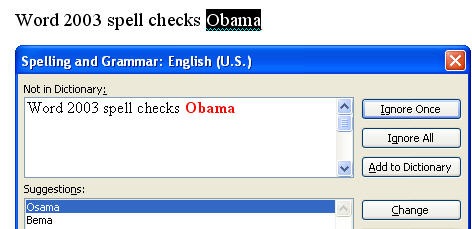
Critics of Barack Hussein Obama like calling him "Barack Osama," but who knew one of them is Microsoft? Word’s spell checker helpfully suggests substituting Osama for Obama, which being your intrepid reporter, I had to try (below.) I smell hotfix!

wordspellcheck

I have no idea what this Merge Healthcare stock announcement means, but I’m sure it’s earth-shattering given that share price has rocketed up to 96 cents.

And speaking of imaging companies on the ropes, the "corporate pirates" trying to get enough shareholder proxies to overthrow Emageon’s board turn down the company’s offer of some seats in return for going away.

Thank you for reading. Click a few of those ads to your left and take a look if you get a minute. If you’re not getting e-mail updates or the Brev+IT newsletter, you can sign up to your right. I’m always up for rumors and news and you can submit longer pieces of your own (anonymous or otherwise) for the Readers Write weekly edition. Bye.

E-mail me.

News 6/13/08

June 12, 2008 News 4 Comments

Two readers confirmed that University General in Dubai will be selecting Epic based on cost of ownership, although they haven’t started contract negotiations yet. That shouldn’t take long unless Epic gives them more options than the usual "here’s our boilerplate and non-negotiable price list." Epic’s taking over the world, it seems, so maybe that "Intergalactic Headquarters" silliness actually has some merit. Imagine if they had a Vision Center (or is that an oxymoron?)

A reader confirms that Novlet Bradshaw is joining Rex Healthcare (NC) as CIO, coming over from Seton Family of Hospitals in Austin, TX.

John Halamka posts a list (warning: XLS) of the components of the medical record and showing BIDMC’s progress in moving them from paper to electronic. I really like this scorekeeping idea and have advocated it previously. Hospitals need to know what parts make up the legal medical record, where they are storing each part of it today (especially if it’s not consistent among nursing stations or facilities), and a running progress report on how close they are to becoming fully electronic. I’ve seen Joint Commission blast hospitals who were wishy-washy about this, to the point where nobody could even tell them where specific documents were stored (and in some cases, duplicated).

Hospitals are actually expecting patients to pay and checking their credit-worthiness online, apparently shocking the whole country with their brazen gall. "But critics say access to patient financial information can lead to abuse. Hospitals might deny non-emergency care to patients with a poor credit history. Overzealous billing personnel might nudge patients to tap into available lines-of-credit to pay for care." Unfortunately, health care is not free to deliver, which also makes it not free to consume. It’s too bad that insurance has dumbed consumers down to this fact. Substitute "car owners" for "patients" and "engine repairs" for "care" where I’ve bolded and you’ll see how silly this argument is.

Welcome to new HIStalk Platinum Sponsor PatientKeeper of Newton, MA. Need to increase physician use of those expensive and hard-to-implement physician systems? You’ll want to talk to them – it could save your job if you’re a CIO or CMIO. I’ve mentioned the interview we did with CEO Paul Brient and it’s a good introduction to what the company does. I was looking over their site just now and darned if they don’t have a video (the one called Saving Time) from Berkshire Medical Center that includes CMIO Michael Blackman, who I just interviewed (I didn’t realize they were PatientKeeper customers until I saw his picture on their site). Thanks to PatientKeeper for supporting HIStalk and its readers.

pk

It looks like we’ve settled on a Wednesday run for Readers Write, so feel free to jot down your best or most amusing thoughts and send them over.

Here’s a great editorial on the VA’s misguided and DoD-led push to rid itself of the VistA system that was supposed to be a guiding light for all of healthcare trying to drag itself out of the dark ages. I’ve talked before about the billions AHLTA cost DoD (most of it going to fat cat contractors) and now those folks are trying to make their system the favorite over open source and paid for VistA while the VA starts heavy petting of its own with Cerner.

Stanford Hospital & Clinics hits a big cost-savings target through a variety of creative and employee-driven changes, the EMR doesn’t get a tip of the hat: "The installation of EPIC, the new electronic medical records system, produced a temporary glitch that set back some savings." Doh!

Nuance announces a voice search function for the iPhone, allowing users to use search engines hands-free.

Yahoo ends talks with Microsoft for the final time, watches its shares tank 10%, and resorts to putting Google’s ads on its search page. Shareholders, time for the torches and pitchforks.

Odd lawsuit, this time in Canada. A couple find a dead fly in their bottled water. They sue the water company, claiming the shock caused depressive disorders and all kinds of aftermath that required medical care. The guy even threw up on the witness stand for effect, resulting in a $450,000 award. The water company appealed and won. The couple somehow got their case in front of the Supreme Court (don’t they have anything better to do?), who ruled that the man’s psychiatric illness was debilitating, but also ruling that he’s a wuss and the water company couldn’t have done much about that. The best thing is that, since they don’t have the archaic US civil litigation system, the couple have to pay all the legal bills for the people they sued, close to $500K. Imagine how rational lawsuits would become if the plaintiff couldn’t just try Lawsuit Lotto with no risk.

E-mail me.

Inga’s Update

Quality Infusion is implementing Misys EMR and Vision across its 25+ clinics in Southeast Texas.

Non-profit Allina Hospitals & Clinics is creating a $100 million Center for Health Care Innovation to support clinical and population health research innovation. The goal is to improve health and health care within the community. I personally think it’s a better use of extra funds than employing private jet service.

The University of Utah Hospitals and Clinics is busy notifying 2.2 million people that their billing records were stolen. The records, which included social security numbers, were stolen from a courier’s van. The hospital has agreed to provide free credit monitoring for all affected, which could be a windfall for whoever wins that contract.

SCI Solutions announces 24 new contracts for its Order Facilitator and Schedule Maximizer products.

After discussions with 150 healthcare professionals, KLAS announces a list of its top ten considered vendors for healthcare business intelligence.

Island Hospital (WA) is successfully using Motion C5 tablets for point of care nurse documentation with their MEDITECH Magic system.

CCHIT announces a new advisory task force to contribute strategic and policy guidance for PHR development. I wonder if they will consider how to convince providers they are worth using?

The healthcare guys at Stratus Technologies are excited about the company’s new software-based high availability product running on standard x86 servers. Stratus will market Avance to hospitals and medical clinics, as well as a number of other verticals.

MedcomSoft’s founder and CEO is stepping down following a special executive committee’s study evaluation of the company’s market potential for its PM/EMR product. Chairman Dr. Steven Small, who led the evaluation, is also retiring. Stepping in are Robert Wilson as CEO and John Gillberry as chairman. Toronto-based MedComSoft is hoping to expand its US presence.

Lynx Medical Systems and the Health Management Academy announce a joint research project to explore the impact of ED services on hospitals and health systems. Researchers hope the results will provide benchmarks for improving quality of care and ED financial health.

eRx is on the rise according to an eHealth Initiative. Last year more than 35 million prescriptions from 35,000 prescribers were sent electronically, a 170% increase over the previous year. While that’s great progress, the numbers represent only six percent of physicians and two percent of the eligible prescriptions.

The CDC releases new estimates on life expectancy rates and I’m happy to report that odds are pretty good that I can keep writing HIStalk for many more years. Currently life expectancy is 80.7 years for women and 75.4 years for men. I may outlive Mr. H by a few years, so that should be enough time for me to get really good at this.

E-mail Inga.

News 6/11/08

June 10, 2008 News 2 Comments

From David Kissinger: "Re: Vision Center. You don’t have to wait until you are San Francisco to see the NEW McKesson Vision center. Click the video on the right of the screen." Link. I nearly choked when Hammergren said "integrated" in the two-minute informercial since the folks in the trenches know that’s a stretch, but I’ll assume that’s another Vision yet to be realized. And, even though he talks about the Vision Center, the video is just generic stock footage – there’s nothing from the Vision Center (or Centers, since the page says there are three of them). Nothing to see there, don’t bother clicking, although the Hammer is one smooth-talking guy in the narration (in a professional way, I mean).

From The PACS Designer: "Re: PDF/H. We are all familiar with the Portable Document Format or PDF.  Healthcare now has two PDFs. The original PDF becomes PDF/A and the new PDF/H is born thanks to the joint efforts of ASTM International and AIIM (formerly called "Association for Information and Image Management"). The new PDF/H now incorporates the use of the eXtensible Markup Language or XML, so you now will be able to provide transfer technology along with security options such as digital signature and audit capabilities to make the PDF/H desirable for collaboration amongst patients, providers, and others in the healthcare industry." Link.

From Dr. Who?: "Re: NHS inflexibility. That sounds like a version of ‘blame the victim.’ Perhaps Cerner and the other big vendors need to examine their own internal assumptions, inflexibility, and leadership." Great plan, except NHS has gone through just about all the vendors and isn’t happy with any of them. Playing solo hardball isn’t much fun. Maybe they should have gone through with Richard Granger’s threat to write their own apps.

From Keith Moon: "Re: reading it first. I see obscure stories in HIStalk and magazines and e-mail newsletters have them right after. I bet they get their ideas from you." Some have openly admitted as much and thanked me. Others just seem to coincidentally find the exact same stories from the gazillions I go through to choose the most important ones for HIStalk. I don’t mind either way.

From Mack: "Re: Dubai. I heard that the university hospital in Dubai chose Epic over Cerner and Eclipsys." I hadn’t heard that. It would be somewhat of a shocker since Cerner has put forth strong efforts there. Confirmation welcome if you can provide it.

From Doug Dinsdale: "Re: Misys Open Source. According to his LinkedIn profile, the tenure of Ryan Bloom, Director of Open Source Development at Misys, appears to have lasted a whopping seven months." Look like the company’s Open Source revolution is over, or at least being led by an understudy. Bloom left Misys month and is working for RadarFind, a healthcare RTLS systems vendor in nearby Morrisville, NC. VP Tim Elwell is still at Misys, according to his profile.

From Independently Irritated: "Re: QuickBooks. I hate it as well. I was told Peachtree is an easier alternative. Wondering what other independent consultants use?" I’m not sure any of the packages are both strong and simple. I’ve used MYOB and it was OK, but maddeningly clunky.

From Interested: "Re: ONCHIT. I read the section in BrevIT about the ONCHIT strategic plan and I’m curious about your opinion on what that means for EMR/RHIO connectivity companies like Medicity." Medicity is sittin’ pretty, to make a rhyme. The plan was broad and maybe short on details, but nothing suggests a reduced interest in interoperability. Medicity has big clients, has picked up valuable domain expertise like a snowball rolling down a mountain, and is associated with RHIOs that are actually successful (and was itself involved in developing the business model of CalRHIO, I’m sure). The failing RHIOs had one typical attribute in addition to being naive about financing: they chose weak technical partners learning alongside them, which will give Medicity a strong Round 2 pipeline.

From kidzdoc: "Re: HealthLogic. Has everyone at HLSC vanished since Bank of America acquired them? I knew the owner and the CEO both departed shortly after the buyout, not seeing eye to eye with the six billion dollar Treasury divisions leader. More key executives have vanished. Is anyone left that is old school HealthLogic?" It’s been almost two years since the revenue cycle vendor was acquired. I’ve not heard a peep and all that’s left is what could well be the ugliest and most dysfunctional web site I’ve seen.

From IT RN: "Re: FAAN. Rosemary Kennedy, Chief Nursing Information Officer at Siemens, will be inducted as a Fellow into the American Academy of Nursing this fall. This is one of the highest honors that can be bestowed on a nurse. This is particularly impressive as very few Fellows are from the vendor arena."

From xtremegeek: "Re: Jon Burns, stuck cleaning up the mess at the University of Maryland Medical System, is making his move. Major restructuring on the way. Stephanie Reel might finally have some legitimate competition in Baltimore, MD. Also, a new CIO at Rex Healthcare in Raleigh, a senior PM from Dell, to start June 16, 2008." Thanks. I didn’t run the Rex name because I’d hate to be wrong and get her in trouble, but I don’t doubt your information.

From Tom Yumgoong: "Re: hated software. Top of my list is Office 2007. Outlook is fine, but I hate the ribbons on Word, Excel, and PowerPoint. My productivity has gone down so much because of trying to find things and extra keystrokes. It just sux." Indeed it does. I got tired of bizarre Access behavior and had that POS yanked off and Access 2003 put back on my work PC. The ribbon is just absurd, items gray out for no apparent reason, the help function is horrible, and the damn thing would lock up at odd times, like just clicking into a field definition or when trying to save a tiny SQL. You’re right – it was taking me half a day to do something that I could have cranked out in 20 minutes in the old version (to be fair, I didn’t take any training, so maybe there are dark secrets).

Someone posted a comment about some former CIOs who joined HIMSS and since left. I don’t know names, but it shouldn’t be hard to figure out. I did note that Liddy West has left there.

Microsoft names its Healthvault "Be Well Fund" recipients, organizations who will build applications for HealthVault. They look kind of interesting.

The folks at Sentillion have some hot jobs (engineers, analysts, implementations, and others). And speaking of Sentillion, Duke University Health System will deploy Tap & Go proximity card single sign-on solution for identity and access management, adding to its Vergence implementation.

We  interviewed Sentillion CEO Rob Seliger a few weeks ago, by the way. We also interviewed Paul Brient, PatientKeeper CEO, and former HTP CEO Ray Shealy on the RelayHealth acquisition. Good thoughts from the top.

NHS says 15 hospitals will be up on Millennium by the end of the year (five more, in other words).

Odd lawsuit: a woman receiving injections in a pain clinic develops an infection that paralyzes her. She claims the doctor didn’t swab her neck with alcohol first and neither the doctor or nurse can remember (since it’s such a routine practice, one might guess). She filed suit and jurors went with her version of the story, awarding her $6 million.

Listening: Go Betty Go, LA chick punk.

You’d think a hospital in chichi Boca Raton, FL would be doing well, but Boca Raton Community Hospital lost $42 million last year. Snip: "The hospital improved its billing system, hired nurses instead of using temporary ones and took control of spending on medical products." What kind of execs would wait until a whopping loss to do the obvious? And this sounds ominous: "New software and other improvements should bring $11 million that was missed last fiscal year." Like many hospitals that are on the ropes, they’re trying to build their way out the problem with new construction.

Interesting: Adventist Midwest Health is using EndoTool by MD Scientific of Charlotte, NC for glucose management (IV insulin dose calcs) which exchanges information with the EMR. I hadn’t heard of it, but here‘s the site (not very slick and disclosing no management information).

Donna Beed of Walter Reed Army Medical Center was promoted to lieutenant colonel in April and will become CIO for the Pacific Regional Command and Tripler Army Medical Center (HI) in August.

Big iPhone news, as scheduled: the iPhone 3G will go on sale for as little as $199 next month with an AT&T service contract. It’s faster, thinner, has GPS built in, supports VPNs, and has a software store. Docs will be carrying them within weeks, I’m guessing. Think of it as a computer that makes calls, not a telephone. Medical software introduced during Steve’s speech: MIMvista and Modality.

Drug companies are developing a system with CRIX International (which in turn seems to be working with Northrop Grumman) that will allow them to file clinical trial forms electronically, to enroll study participants, and to report adverse drug events directly from practice EMR systems (that part will launch in September at Brigham and Women’s).

The city council of Colorado Springs is upset with Memorial Health System to the point of considering selling it. This councilman summarized what I’ve seen of typical hospital board relations: "You whip 15 slides past me and I’m put in a position to draw the conclusion I’m led to draw." Council members didn’t know until they read it in the paper that the hospital’s new CEO had been hired and was given a $550,000 salary.

HIMSS announces two new organizations: the Institute for eHealth Policy (which sounds like a lobbying group, but may not be) and the National Health IT Collaborative for the Underserved.

E-mail me.

Inga’s Update

New recently announced installations: Virginia Commonwealth University Health system has successfully implemented McKesson’s Horizon Medical Image system; Pinecrest Hospital (WV) is now live on Medsphere’s OpenVista; and Robert Wood Johnson University Hospital has activated Eclipsys Sunrise Clinical Manager for its 4,000 users and claims its doctors are entering 75% of their 12,000 medication orders a day online.

The local Fall River (MA) newspaper features local employer Meditech and the high job satisfaction of its employees. It’s a nice, feel-good story that includes mention of the beautiful facility and very low turnover rates (two employees out of 60 in the last 2 1/2 years).

The Pittsburgh newspaper details the usage and costs associated with (non-profit) UPMC’s private jet. The paper estimates that over a nine-month period, UPMC staff flew the jet 58 times, averaging $18,752 per flight.

SleepEx announces the release of a new EMR that interfaces with sleep diagnostic equipment. Apparently the software is on display in Baltimore at SLEEP 2008, a national convention for sleep specialists (who knew there was such an organization?)

I came across a funny video from those zany Stratus Technologies folks describing virtualization and high availability servers. As the YouTube post says, even your mother-in-law could understand these concepts.

Greenway Medical Technologies, NextGen, Initiate Systems, and IBM are some of the technology companies demonstrating real-time standards-based clinical healthcare data exchange at this week’s National Health IT conference in D.C.

Secretary Leavitt names the 12 communities selected to participate in its national Medicare demonstration project. The five-year project provides financial incentives to providers using EMRs, with the goal of improving quality of care.

E-mail Inga.

Monday Morning Update 6/9/08

June 7, 2008 News 7 Comments

From McK Nugget: "Re: Vision Center. The new McKesson Vision Center is opening in San Francisco at the world headquarters (the second floor, to be exact). It has been under renovation for the past six months. It’s pretty cool to check out if you are ever in town." 

From Horton Hears a Who: "Re: hospital delay. St. John Health System has been implementing Cerner for quite some time." Link. Providence Park Hospital (MI) has pushed back its opening 28 days for EMR system work. Snip: "We changed some of our thinking around technical issues. We delayed the opening to allow for changes in our IT systems to occur. We are implementing the first fully electronic medical record system, in our health system. It is a very complex installation."

From Victoria Winters: "Re: conferences. Your HIMSS coverage made it more interesting and fun. You should report from others." It’s no coincidence that well known and well traveled bloggers are usually self-employed since they can snag add-on business to make it worth the trip. I’m an anonymous wage slave, so I’d be using my own money and days off. But, we’ll see.

From Steve Alaimo: "Re: Thomson Health. Heard on the street they reorganized their sales team. They hired a former VP of Sales from SoftMed to run the West Coast region."

A journalistic stretch: the local paper tries to goad Lawrence & Memorial Hospital (CT) into saying they regret signing with McKesson for clinical systems now that the state’s own attorney general is now suing the company for AWP inflation. It must have been a mighty slow news day or the paper works too hard to find local connections to somebody else’s story. First, being sued doesn’t mean you’re guilty. Second, guilty or not, the hospital is in final negotiations, so walking away doesn’t make sense. Third, the suit doesn’t change the reasons McKesson was picked in the first place. And fourth, it’s a massive company, so one part has little impact on the other.

David Schlotterbeck, vice chair of Cardinal Health and former president and CEO of Alaris before Cardinal bought that company, is named to the board of teleradiology provider Virtual Radiologic.

Don’t forget: your contribution to the next Readers Write issue is welcome.If you’re informative, funny, or insightful, there’s a platform for you. 

Jobs: Staff Software Development Engineer (Eclipsys – PA), Project Manager (T-System, TX), Senior Health Systems Analyst (San Mateo County – CA), Consultant (Healthia Consulting – MN), Healthcare IT Sales, Account Exec to VP (QuadraMed – CA). Sign up for Gwen’s free weekly e-mail jobs list – it never hurts to know what’s out there.

df

Another Google Street View pic: Dana-Farber Cancer Institute in Boston (click to enlarge).

I see HIMSS has created another VP position, this time for a former CIO to push its new Organizational Affiliate (all you can eat) membership plan. From the description, the responsibilities are: (1) "leverages relationships with CIOs to sell them Organizational Affiliate memberships and other HIMSS and HIMSS Analytics products and services" and "assists the Sales team in their efforts to close the business"; (2) "help [CIOs] understand the strategic value of the benefits of participation in the HIMSS Analytics Annual Study"; (3) "Engages executives by getting them to participate in HIMSS initiatives as well as market exposure opportunities." Seems kind of creepy for a nonprofit to hire a CIO to sell stuff to other CIOs, but at least you can’t accuse them of not running it like a business.

Here’s a demo of the Myca patient portal/EMR platform that Jay Parkinson is involved with. Pretty cool technology, possibly unsettling to physicians who won’t even accept e-mails from patients.

Reminder: click that ugly green and amateurishly made Rumor Report box to your right to send me stuff confidentially. Seen a cool technology, have an IT department or vendor idea, or have something important to say ? I’m your guy. I’m also building my interview queue back up, so tell me who’s especially insightful and fun.

A new study proves the obvious: don’t get your medical advice from US journalists, who miss major points, can’t explain the big context, and fail to disclose conflicts of interest.

I missed this: the guy behind WhereTheMoneyGoes.com, which rails against profits and salaries at non-profit hospitals, has been outed in The New York Times as not only running that site, but also an anti-Obama site. "The operative behind it is Joe Novak, 54, a consultant whose colorful history in Illinois politics earned him the nickname Low Blow Joe. A Chicago Sun-Times columnist once wrote that if dirty tricks were an art form, ‘Novak would be Renoir.’ … Mr. Novak said in an interview that lately he had been working almost exclusively for Mr. Rooney. His projects, he said, involve exposing inequities in health care that result in poor people’s being denied medical treatment or gouged by insurers and hospitals, topics of interest to Mr. Rooney, who champions medical savings accounts as an alternative to conventional health insurance." I interviewed him in 2005 and, to a large extent, agree with his cynicism about "nonprofit" hospitals raking in the money and paying big salaries, although now I see that our motivations differ.

Kudos to four IBM employees in Ireland, who used open source software to create a free service that lets senior citizens sign up for a daily "how are you doing" call. IBM also paid for the hardware.

Pittsburgh insurer Highmark will spend $29 million (0.42% of its $6.8 billion revenue) to encourage physicians to buy technology, paying 75% or up to $7,000 per doctor. Its similar 2005 program ran afoul of IRS restrictions on money transfer, so Highmark will pay doctors directly this time.

eCast, which sells provider and drug trials software, will  bring on up to 100 new employees in Raleigh, NC to double its size. Moving to Raleigh: Medis, which sells software for imaging modalities.

The nursing union at HCA hospital Centerpoint Medical Center (MO) petitions the hospital to complain about nurse understaffing, citing poor patient ratings. The hospital says the suit is a union tactic (they’re in contract negotiations) and that it’s trying to hire 300 nurses in a tight market. In a related lawsuit against another HCA hospital, plaintiffs representing a deceased patient claim (from the court filing): "… that HCA injured them and other class members by maintaining inadequate numbers of nurses at its hospitals as a cost-savings strategy. According to their complaint, HCA developed a computer software program,  implemented by its subsidiary hospitals, that caused the hospitals to provide inadequate levels of medical staff."

UK hospitals have had 522 laptops stolen in the past three years.

Former McKesson CEO Mark Pulido, who was de-pantsed by Charlie McCall into paying $14 billion for the book-cooking HBOC and fired six months later when the accounting scandal story broke, now works for an investment company … advising them about acquisition opportunities. Maybe Charlie should emerge from seclusion to sell him something else, like his new company, Hazmat Systems.

The White Stone Group’s newsletter (warning: PDF) not only has an interesting case study from West Jefferson Medical Center (LA), but also a recipe for hot fudge cake. They’ll be at HFMA, but probably without the cake.

I was Googling some old acquaintances and noticed that Wayne Miller is now with Vitalize Consulting Solutions in their McKesson practice. That led me to snoop around the website of some other HIStalk sponsors to see what’s happening, so I noticed that Intellect Resources has a weekly newsletter for job seekers (news and position listings). Hayes Management Consulting has an online newsletter.

Providence Portland Medical Center (OR) implements real-time locating of periop personnel and equipment from Sonitor Technologies and PCTS’s Amelior OR Tracker.

I was reading an article about software that users truly hate. My list: (5) SmartFTP. (4) QuickBooks. (3) Internet Explorer. (2) Windows Vista. (1) Lotus Notes. For me hate to software, it has to be a resource hog, counterproductive to what I want to do, and illogically designed by an arrogant company. I know a few healthcare apps that could have made the list from what I’ve seen firsthand, but I don’t use them enough to hate them.

E-mail me.

News 6/6/08

June 5, 2008 News 3 Comments

From Sherman McCoy: "Re: HCI 100. I highly doubt that VersaSuite is a $300 million company and that E*HealthLine has $290 million in revenues. Healthcare Informatics did a much better job this year in scouting out private company and divisional revenues for the rankings, but there are a good percentage that seem to be off by a number of decimal points." Link. I’m always suspicious of voluntarily submitted numbers that are hard to audit and incented toward exaggeration, but this is the best measure for those looking for some correlation of size to anything else. Too bad they can’t use tax records since those numbers are surely far more conservative. A good read in any case. Congrats to those HIStalk sponsors who made the list: Sage Software (#20), NextGen/QSI (#32), QuadraMed (#34), Picis (#37), Vitalize Consulting Solutions (#71), and Hayes Management Consulting (#86). Another handful of companies from the list are in the process of joining us, so that’s pretty cool. In case I haven’t said it lately, I thank all of our sponsors (on the list or not) for supporting HIStalk and its readers.

From Happy Days at McKesson: "Re: execs. Michael Simpson has been removed as the GM over Horizon Clinicals and sent over to the UK on a ‘special project’. While he did drive delivery of 10.1, which finally drives some semblance of integration and fills some of the major holes from a functional standpoint, his style did not work well with the development organization. Mike Myers has been asked to step in as the interim GM in addition to maintaining his responsibility for Life Sciences. The big question now: who is Mike grooming as the heir apparent? Billie Waldo is always a safe option. Merrie Wallace and Gerry McCarthy were recently moved into Horizon Clinicals as Pam Pure pointed at one of the recent All Hands meetings. Time will tell, but our team is going to step back and enjoy the fact that McKesson management seems to finally be listening to the development team vs. sales." Inga confirmed with McKesson: Simpson has been named CTO of the International Operations Group and Mike Myers is interim GM for Horizon Clinicals. Your information was dead on the money – thanks.

From Dr. Lisa Cutty: "Re: Cerner. I am wondering why Cerner is so relaxed about their NHS failures? According to this article, it was the poor Cerner performance which caused Fujitsu’s leaving. In their last shareholder meeting, there was no word about the troubles and the audience missed a chance to ask the CEO." Link. I don’t know if it’s Cerner’s problem entirely since NHS wrote the specs (I assume) and they’ve run off other big vendors with their inflexibility. If NHS didn’t budget money for scope creep localization and Cerner is already on a tight margin, I can see why there would be a stalemate on who pays. My opinion is that no vendor can make them happy for the price they want to pay. Cerner would take a black eye for losing business there, but I bet it’s so minimally profitable that they wouldn’t be too upset (once shareholders got over it, anyway). There’s always the Middle East.

Inga and I like doing interviews because (a) we have the same questions as readers and enjoy having them answered, and (b) we learn a lot by doing them. We just talked to PatientKeeper CEO Paul Brient and I have to admit that I didn’t realize how broad the company’s offerings are (who knew they have RHIO and HIE customers?) and that 10% of US hospitals are PatientKeeper users. They’ve got a good handle on the "last mile" problem of getting physicians to use hospital-related clinical systems. The interview is on HIStech Report. Worth a read, but I could be biased about that just a little.

I also interviewed former HTP CEO Ray Shealy, now a VP at RelayHealth after that company announced its acquisition of HTP just four weeks ago. I think this may be the first interview (and surely the most in-depth) with anyone at either company since then. It’s a meaty read that explains how the former HTP’s offerings fit with those of RelayHealth and gives a look at the broad industry trends of consumerism, the shift to patient financial responsibility, and the increased patient satisfaction that results from providing clear financial information upfront. Readers like me (non-experts in patient financial services) will get a good overview of what’s changing in that area of hospitals (hint: a lot).

Time has a nice piece on Cleveland Clinic’s use of information technology (if you can forgive the title’s absurd pun, Medical Mouse Practice). A snip: "Hospital policy mandates that every time a Cleveland Clinic patient sees a doctor in any of 37 buildings on the main campus or dozens of satellite locations in Florida, Abu Dhabi and southeastern Ohio, that doctor will be holding his or her medical chart. With paper records, physicians didn’t have those records 20% of the time. As soon as charts were digitized, EHRs were at their fingertips."

Listening: The Unlovables, NY female-led punk. Also: Sahara Hotnights, Swedish all-girl pop/punk. Punk chicks rule.

A study says that hospitals in which IT reports to the CFO have better financial performance. Actually, I’m reading between the lines since reading the actual lines themselves would set me back $7.95 and I don’t really buy the premise (and therefore the article). I recognize some Florida State University names among the authors, I think. I would think it’s hard to prove that IT reporting influences the hospital bottom line vs. happens to correlate to it in some way. There’s also the question of value and quality, of course.

St. Luke’s Episcopal (TX) will use McKesson’s Horizon Clinicals Care Team Release.

Speaking of McKesson, it will reopen its Vision Center that features futuristic technology (sharing the name and function of rival Cerner, apparently and oddly). The article doesn’t say where it is, but since Robot RX is pictured and I know the old one was in the Automation division in PA, I assume it’s there.

An analyst says online pharma advertising doesn’t have demonstrable ROI, so WebMD’s future may not be rosy. A good point: most sites simply repackage the same consumer information from a handful of sources, meaning the sites are pretty much alike. An insightful snip: "Consumers, frustrated by a lack of content depth and few new products or services, desperately pound Google to try and find ‘long tail websites’ to quench their information thirst (leaving Google the big winner in the online health space; not Pharma, not advertisers, not agencies)." Thanks to the reader who sent this over.

CHUM and McGill hospitals in Montreal will work together on clinical systems. Both use Oacis.

Hearst subsidiary First DataBank, drug data vendor for many (most?) hospital information systems, will pay $1 million in a class action settlement over allegations that FDB and McKesson conspired to inflate the average wholesale prices of drugs. McKesson continues to fight the suit.

The graduation ceremony for Verona Area High School (WI) will be held this Sunday in the auditorium of Epic Systems, whose 5,300 seat capacity eliminates the need for a ticket allotment for the friends and families of the 340 members of the Class of 2008.

California will launch a prescription drug database, the AG (former "Governor Moonbeam" Jerry Brown) announced Wednesday. Some of its expense is being funded by the charitable foundation of a web entrepreneur whose two children, ages 8 and 10, were killed in a traffic accident by a doctor-shopping drug abuser.

ACLU jumps into the electronic medical records privacy fray.

Erlanger Health System (TN) finally chooses PHNS in an eight-year outsourcing deal for the entire IT department.

E-mail me.

Inga’s Update

The Merge Healthcare saga continues as the company announces a reorganization of business operations and some executive management replacements. The company will rename itself to Merge Fusion, eliminate 60 of its 360 employees, and replace the CEO, president, CFO, and Cedara division president. Ken Rardin is out. Two of the four new officers come from Merrick Ventures, from which Merge borrowed $20 million last month, giving them five of 11 Merge board seats.

An Ann Arbor newspaper reports that the University of Michigan Health System has cut medication mistakes 29% following its online order entry implementation. UM also claims the $95 million UM-CareLink system (Eclipsys Sunrise) has cut 40% off the time between ordering and administration medications.

Mr. H mentioned in his last post he will be away for a few days next month, leaving me in charge. I look forward to ranting, “I’m in control here.” We’ve already had some entertaining (and famous) guest authors step up to offer their services, but we have room for a couple more. We have secured a couple of “Johns,” though I believe we only have one writer from the fairer sex (not Judy). E-mail us if you would like to participate.

I can’t decide what is worse: having to sell almost $8 million in stock options to satisfy a divorce settlement or having to send out a press release announcing it. If I were the ex-Mrs. Jonathan Bush, I would be planning some exotic vacations, replacing my SUV, and buying lots of new shoes.

KLAS releases the results of its ambulatory EDI clearinghouse survey. Navicure received top honors over the eight other rated vendors. Zirmed and Gateway also ranked high; Availity and Emdeon were at the bottom of the pack. The other evaluated vendors included The Consult, Misys, RelayHealth, and Ingenix.

The 45-physician Rush-Copley Medical Group (IL) selects Allscripts for its EMR/PM solution.

In an article about Oracle’s possible push into the healthcare space, an industry analyst predicts Oracle’s most likely targets to be Cerner, Eclipsys, and Epic. Epic claims they have absolutely no interest in being acquiring because they enjoy their private status.

Starbucks announces a new program that allows participants to sip a coffee and enjoy free Wi-Fi. There are a few requirements and limitations, but in my mind, few things go better together than HIStalk and a latte.

Beth Israel Deaconess selects iMDsoft’s MetaVision critical care system for its seven intensive care units.

Nuance Communications recognizes 17 healthcare organizations that achieved 125 percent or greater productivity gains or at least a million dollars savings using eScription’s CAMT solution. The Million Dollar Savings and Productivity Award winners included Brigham and Women’s Hospital, which was recognized for the highest savings total ($9MM since 2001.)

MultiCare Health Systems (WA) selects Sunquest’s LIS for the health system’s new hospital. MultiCare is also adding Sunquest’s CoPathPlus, Microbiology, and Blood Bank products.

Sunquest also announces that St. Cloud Hospital has achieved 100% patient identification accuracy and reduced non-identification specimen collection errors to virtually zero since implementing Sunquest Collection Manager in November.

Appalachian Regional Healthcare System is installing HealthPort’s revenue cycle management solution in three hospitals.

GE Healthcare and UPMC announce their forming a new company specializing in making digital pathology equipment. Omnyx is GE’s first standalone company formed with an academic medical center. Gene Cartwright, a former GE molecular diagnostics president, will serve as CEO.

E-mail Inga.

News 6/4/08

June 3, 2008 News 4 Comments

From Dr. D: "Re: Stanford. Seems like Stanford Medical isn’t the only lost account problem facing a certain big consulting company these days. Two more are about to fall due to missed milestones."

From DRPend: "Re: CEMHR. I have come to conclude that what’s really required is what could best be categorized as an Central Electronic Medical Health Record (CEMHR). The patient would have audit control and a place for personal information, but the vast majority would be a centralized repository that would take standardized medical data from a variety of sources. I favor the astronomy community standard of using geographically separate, redundant ‘central’ storage centers. I’d use a VMS login security OS with tunneling into other OS and Data environments. This would access a meta language-based interfacing engine to help build record variance recognition rules and provide an audit trail for anyone gaining access to the data. The big issue, of course, is security control, and that would most likely need a neural circuit algorithm based on multiple ID recognition criteria. No one method would work alone, so the whole process would require the kind of cross sectional parallel studies that only the Open source community could provide. Maybe it’s time to have a Healthcare Public Utility created which could bridge the gap between proprietary Software and OpenSource Software."

From Carol Wayne: "Re: Cerner/Google Health. Call me cynical, but I think there are other motives involved here. Of course the patient will not enter accurate medical information – they can’t. They don’t have it all in the first place and no one would trust something typed in by the patient for medical-legal reasons. BUT, if Cerner found a way to enter standardized information into a Google health record, in a fully locked-down, non-repudiated (is that a word?) manner, then the local hospital CIO will want to use that same message stream to populate their own data warehouse. So, Cerner and everyone else will be a step farther away from locking in the customers with proprietary messaging. Also, it will cost Cerner (and the other vendors) a LOT of money to convert to those kinds of standardized messages and no one is offering to pay the bill. So, while they can say that the PHR is useless to the patient/physician interface, there are other reasons to downplay the movement. Any patient with a complex medical problem can see the advantage of having an integrated data feed from multiple providers. Any vendor can see that, too, but wants to get paid. Stalemate." Agreed. Neal’s "electronic shoebox" comment is accurate for what PHRs are today, but of course he has the capability to turn them into something more, yet also has the proprietary interest to avoid doing so. PHR vendors need EMR vendors much more than vice versa. From a patient’s point of view, that sucks, but from a company/shareholder angle, why would I spend resources to help a potential competitor (and my existing competitors) for no benefit? Answer: if customers demand it. So in that regard, only Cerner’s customers can change his mind.

From Bobby Orr: "Re: electronic shoebox. Neal should be careful about throwing stones in glass houses. He already tried to put out a PHR that he charged for (HealthVault is free) with little or no success a few years ago. It was donated (free) to Type I juvenile diabetics and even that had little traction because everything had to be done by the patient (or their parents). Regardless, it is a solid concept, especially for chronic disease management, regardless of who provides the tool." Excellent point — Cerner does indeed offer its own PHR, so Google and MSFT are its direct competitors (and free).

From Dagny Taggart: "Re: Epic and NHS. About nine months ago, a high-level delegation of NHS personnel paid a visit to Evanston Northwestern Healthcare in Chicago to take a look at their Epic installation as a backup vendor. They were very impressed with what they saw, so much of the groundwork for Epic and the NHS has already been done."

From The PACS Designer: "Re: virtual storage networks. In the months to come, you’ll be hearing more about a new concept called the Virtual Storage Network or VSN. It is different from virtualization in that a VSN is an enterprise virtual network addressing storage. It makes efficient use of all storage locations within the enterprise through disc and tape partitioning. For example, if you have 100 PCs, the hard drive of each PC will be partitioned to grant 10 to 12 percent of that hard drive to VSN usage. An advantage that you can gain through this method is, if a PC is stolen, you will not lose the entire record file if parts of the stored file are archived elsewhere."

Listening: The Hellacopters, Swedish punk/pop, on their farewell tour right now.

Clarification: Healthcare IT News is not selling its e-mail list (I wasn’t implying they are, but an unrelated general comment I made might have misled one or two people) and the mailing list it is selling doesn’t include HIMSS members (which their list broker didn’t say in the announcement I cited). The publisher laid on some heavy-handed sarcasm in a forum posting that I didn’t care much for, but I’m still willing to clarify.

The Rockefeller Foundation will host Making the eHealth Connection: Global Partnerships, Local Solutions in June and July in Italy. It’s invitation-only, though.

Sign up to your top right in the Subscribe to Updates box and join 3,459 of your friends to get updates when I write something new at HIStalk.

Allscripts sent over a transcript of a couple of its customers touting its proposed merger with Misys. A snip: "It supports our best-of-breed strategy. We really went out there and said, Misys is the best on the practice management side, and Allscripts is the best on the EHR side, and we took a risk. We’ve been rewarded and we truly believe that both products are the best in the industry, so this potential merger really supports our best-of-breed strategy." That’s one thought, but here’s another: do enough prospects simultaneously feel that the respective company’s products are good enough to want them both and, even then, which products do you run with to avoid confusing the market? I’m not sure Misys has strong enough PM offerings to match up with the Allscripts EMR, especially with strong competitors tearing up the market on price. Of course, it doesn’t matter at all what Allscripts or I think … prospects will vote with their dollars and nobody can predict that outcome.

Dell Children’s Hospital (TX), less than a year old, gets a rented diesel generator courtesy of Austin Energy after that company’s failover to a backup generator didn’t work, leaving the hospital with power outages on three occasions.

Here’s an opportunity: I’ll be taking a few days off in July and I’m looking for guest authors who can amuse and inform HIStalk’s readers (but not too well since I don’t want to obsolete myself). Inga likes the idea of people whose first name is John/Jon (Halamka, Glaser, Bush), which is a fun. I like CEO-types (Judy, now’s your chance), clinicians, pundits, or celebrities (if you’re connected by one of those six degrees of separation thing to some big star who isn’t illiterate, they’re in). E-mail me if you’ve got the right stuff. I’ll feel better about being away if I know it’s in good hands, along with Inga’s of course.

Walter Reed Army Medical Center says an "outside company" breached one of its PCs, possibly exposing the information of 1,000 patients.

Not surprising: despite what I’m pretty sure were quite a few nominating votes, somehow I didn’t make the ballot for the 100 Most Powerful People in Healthcare even though I’ve never heard of many of the folks who did. I cry dangling chad!

A reader is looking for an HIT colleague from the 70s, Dr. Ed Heller. E-mail me if you can help. Thanks.

Just announced: HLTH Corp. will sell its ViPS data analytics business to General Dynamics.

Jobs: Product Consultant – Sales Support (virtual), Systems Analysts (FL), Sales Executive – McKesson Practice (PA), Executive Project Manager – Nationwide (virtual).

St. Mary’s Hospital (WI) goes live on Epic, one of 20 SSM hospitals that will be implemented by 2011 at a cost of $330 million.

Interesting: a new study gave tablet PC-powered health surveys to adolescents waiting to see a doctor. 59% of respondents screened positive for injury risk, depression, or drug abuse, allowing doctors to address them immediately. I’ve read other studies showing that patient histories are more accurate when completed on the impersonal computer rather than face-to-face or on paper because issues perceived as embarrassing.

An article about a medical tourism conference predicts the future: you take your own blood sample and mail it off, check your result on a web site, then call a 24-hour help line of Indian doctors to get advice on what to do next (or in which country to have surgery). Unrealistic? Not if it saves money.

Speaking of medical tourism, patients are sneaking across the Mexican border for better medical care. From the US side, that is, since hospital care in Mexico is apparently a lot more responsive and less expensive. Says a patient: "U.S. hospitals are too slow, too expensive and treat you like a herd of cattle. It’s a vicious cycle of people and doctors who abuse the system."

The Wall Street Journal reports that hospitals or their collection agencies are selling patient debt in online auctions, raising concerns that buyers (often collection agencies themselves) will strong-arm patients to pay up (a novel concept in healthcare). Auction sites mentioned: ARxChange and Medipent.

The opening of a new Providence Park Hospital (MI) is delayed a month to install EMR hardware.

CMS says that hospitals can pay for custom interfaces to physician practice EMRs without violating Stark.

Just in case you want to read the 2003 employment agreement of the president of Allscripts’ TouchWorks division, it’s on the web for some reason.

Thanks to readers for reading and sponsors for sponsoring. Criticisms aside, I spend a ton of time trying to get you the right information quickly (with the occasional entertainment thrown in). I’m proud that, in my reader survey, 75% of you said HIStalk helps you do your job better.

Idiotic lawsuit: a guy claimed he broke his wrist in a single-car accident in 1999, but the hospital ED didn’t X-ray it. He got surgery later that year after a walk-in clinic visit and sued the hospital and three doctors. He agreed to delay the original 2005 trial date, skipped a 2007 date claiming he had new injuries, and didn’t show up at all for trial this year. His lawyer quit, he disappeared, and the defendants had to hire a skip tracer to try to track him down (with no success). Case dismissed.

Odd lawsuit: a hospital employee sues her employer for not training her to walk across a rug, leading her to fall over it. The employee tripped on a scrub room rug and fell. She’s suing, claiming permanent injuries, past and future pain, mental anguish, impairment, disfigurement, lost earnings, medical expenses, and attorneys’ fees.

E-mail me.

Inga’s Update

I hear that Medventive, a developer of evidence-based medicine software solutions, has raised $3.55 million in Series B funding. Former Sentillion president Nancy Ham is president.

I could use a little funding myself, despite receiving my economic stimulus check in the mail this weekend. I suppose I should count myself lucky that I got one at all, but it’s hard to feel stimulated by $10.78, especially after just spending $100 (!) to fill up my SUV.

Ophthalmic PM/EMR software vendor First Insight partners with DrFirst for e-Rx and medication reconciliation. Meanwhile, Kryptiq is GE’s exclusive Centricity e-RX partner.

A delegation from the Hashemite Kingdom of Jordan trekked over to Midland Memorial Hospital to check out their Medsphere OpenVista installation. I have actually been to George Bush’s home town and found the people very nice, but I wonder if Midland felt a little “simple” compared to life in a Kingdom.

The birth of the new Allscripts-Misys Healthcare Systems, Inc. is still on track, following the expiration an anti-trust regulatory waiting period (13-syllable name and all).

If you are a road warrior, you might want to check out Computerworld’s list of “8 incredibly useful tools for road warriors.” Lots of nifty gadgets mentioned including an oldie but goody, cellophane tape.

Eclipsys and Emerging Health announce a partnership to provide joint services in the NY/NJ/CT area. Eclipsys will leverage Emerging Health’s implementation expertise while Emerging will market Eclipsys and provide remote hosting services.

The Insight Research Corporation, which does market research for the telecom industry, releases a report estimating the US healthcare system will spend $55 billion on telecommunications services over the next five years. That is a compounded rate of 8.4% over the forecast period.

The Federation of American Hospitals, which includes for-profit members LifePoint Hospitals, Universal Health Services, and Tenet spent $630,000 on lobbying in the first quarter. That is about half of what Oracle spent over the same period.

Our little HIT world seems fascinated by the drama going on in the UK and their NHS. It’s somewhat like our culture’s intrigue with Britney’s struggles or the latest celebrity divorce. We’re addicted to other people’s problems because it makes our own struggles seem smaller. If you need to feel better about your little world, read about the recent woes of several trusts that were forced to shut down their Personal Demographics Service after a software upgrade.

The Kroger Company invests in The Little Clinic LLC and plans to expand the grocery chain’s walk-in medical clinics. Kroger operates 26 PA and/or NP-staffed Little Clinics.

E-mail Inga.

ONCHIT Releases New Strategic Plan

June 3, 2008 News Comments Off on ONCHIT Releases New Strategic Plan

ONCHIT today released its strategic plan for 2008-2012. The full PDF file is here.

A few highlights: develop a privacy and security framework that reconciles inconsistent standards, “foster the business case” for the exchange of health information and encourage competition, encourage standard formats for freestanding PHR information, increase the number of EHRs that have clinical decision support, and develop standards for aggregating population health information.

Specific 2012 targets for physician practice EHR adoption: 40% overall, 12% for practices of five doctors and fewer.

More emphasis on CCHIT certification: “Specify that, to the extent permitted by law, certified EHRs and products are necessary components for any federally funded programs, pilots, and demonstrations that include the use of health IT.” A 2010 milestone is to have the majority of physician EHRs in use to be CCHIT certified.

ONCHIT will encourage health profession licensing bodies to include informatics criteria in their standards.

Monday Morning Update 6/2/08

May 31, 2008 News 15 Comments

From Dr. Know: "Re: Stanford. Spoke with a physician at Stanford today. They recently went live with Epic. The physicians are in revolt: ‘takes too much time and is very difficult to use.’  Also, if you admit a pediatric patient through the ER and they need to be admitted into the children’s hospital, all of the information needs to be re-entered manually from paper, as Lucille Packard runs Cerner and it is not interfaced with Epic, which is running at Stanford Hospital."

From kcstar: "Re: Jay Parkinson. For all of your fawning, it seems he was more of a self-promoter than a physician. The outcome was predictable, and as he even stated, ‘unsustainable’." Link. I interviewed him, but I wouldn’t say I fawned. He has some good ideas and I like the idea of going off the grid (as Scott Shreeve says), but he’s not fault-free. He thinks he’s got the entire system figured out despite being a new med school grad, he seems to be a bit smug, his kind of medical practice has zero relevance to the 99.99% of the country that’s not in New York City treating young and healthy hipsters for the occasional sniffle, and he seems to hate just about everything and everybody involved in medicine outside his little world. For a brand new doctor, he’s shrewdly wangled his 15 minutes of fame, but can his "tear it down and start over" ideas scale and is he really the best spokesperson for changing medicine just because he does magazine interviews and blogs and sometimes finds time to see a patient for cash? Time will tell. Give him credit for some pretty fresh ideas, at least, even though his experience with the non-fresh ones is minimal. I’m happy he took the time to be interviewed here since few in the industry had heard of him back in November and the ensuing debate was interesting.

Speaking of 15 minutes of fame, Dann, who started the HIStalk Fan Club on LinkedIn, let me know that it’s up to 58 members, which I find astounding and immensely gratifying (especially when I see the roster of highly accomplished folks who signed up – thanks!) I keep thinking I should offer something in return, like dibs on signing up for the HIMSS shindig or something (which, FYI, looks to be on track). Having a fan club is pretty darned cool, especially since being anonymous eliminates the possibility of egomania.

I do my share of Neal Patterson ribbing, but I’m also on record as being a fan in many ways (started Cerner and stuck around, didn’t sell out to some conglomerate, says whatever he damn well pleases). Case in point: Google is sweet-talking Cerner about jumping on the shaky Google Health bandwagon, but Neal is keeping them at arm’s length since he doesn’t buy the PHR concept, which he calls "electronic shoeboxes" that put the onus on consumers for record-keeping. I’m with Neal on that one. Consumers might use healthcare search engines and social networks, but they aren’t going to keep reliable medical records.

If you get Healthcare IT News, your information is available to anyone willing to pay $150 per thousand addresses for list rental. HIMSS calls the publication a "member benefit," i.e. you get a subscription by default to boost its ad rates, but apparently the benefit isn’t entirely yours. I must be the only person who has thousands of industry e-mail addresses that I won’t share with anyone.

Ah, to have minimally inquisitive publications willing to print whatever companies send over. Health Imaging News crows about McKesson’s "unveiling" of MyPacs.net. A 10-second Google fact-check would have shown that to be false: the original journal article describing its development was accepted in 2001 and the site was announced at RSNA 2002. Unless "unveil" means "bought the original company and put out a press release," it most certainly was not just unveiled.

Fundraising software vendor Blackbaud, whose products are used by many hospital foundations, will buy struggling competitor Kintera for $46 million in cash.

The 12-hospital group in Canada whose MEDITECH systems were down is back online. The company blames a corrupted file, but the media report says two US hospitals had the same problem at the same time. Seems suspicious that three customers all had corrupted files simultaneously.

Wyoming is considering allowing CNAs to administer medications, but only for specific drugs, most of them non-prescription. A waste of time, it would appear, since patients seldom need only those meds, so the nurse would have to go behind them to finish the med pass anyway.

Ontario will invest $109 million to improve ED efficiency, with part of the money set aside for IT.

Thanks for reading. If you aren’t getting the e-mail update or Brev+IT, you can sign up to your right (and I won’t sell your information). I’m always interested in rumors or thoughts, easily submitted by clicking that big green Rumor Report box to your right.

E-mail me.

Art Vandelay’s 10 Tips for Finding IT Budget Cuts

1. Create a list of all contracts. Detail the benefits of the components to the business. Document the key terms. Be sure to include the impact of canceling and restarting maintenance. Look for consolidation opportunities. Also look for areas of low impact if a cut occurred. Possibly negotiate longer-term maintenance deals (ex: go from one-year maintenance to three-year). Review contracts for network carrier services, cellular and wireless data, pagers, real estate leases, and power.

2. Review your application inventory and document functions. Look for overlaps and apps with few benefits. Consider the cost of consolidation and migration.

3. Review the project inventory budget impact. Consider initial and recurring costs. Look for overlaps, low tangible benefits, and those with long paybacks. Consider leasing hardware or software. Also consider risk-based contracts for services.

4. Create chargeback reports if you aren’t doing so. This requires developing a list of all costs and an allocation method. Look for business units with an inordinate amount of costs with little tangible return. In more progressive organizations, the reports allow leaders to monitor and adjust their variable costs with some explanation of the impact.

5. Create a database of staff ratings including true performance reviews. Next, align the output with the project inventory and application importance or benefits. Identify staff that can be cross-trained to pick-up other projects in the pipeline if a staff reduction occurs.

6. Run a zero-based budget with a fair-minded financial analyst involved. Note the areas where cuts occur so you are ready if asked.

7. Analyze the use of your reporting applications. Provide real examples of where the tools can benefit this type of analysis, such as staffing, lost revenue, cost reporting, and supplies.

8. Consider virtualization and consolidation. Potentially related benefits include reduced power consumption, heat generation, and maintenance costs Align hardware with key benefits. Focus investments in hardware on those platforms benefiting the business the most as well as where you have the most skills.

9. Bid all hardware purchases even if it moves them away from your standard suppliers. Minimally, this gives you leverage to keep your suppliers honest.

10. Consider use of open source software where you have or can buy or build skills.

News 5/30/08

May 29, 2008 News 3 Comments

From Moses: "Re: CCHIT. Big changes for 2008 CCHIT ambulatory certification criteria that goes into effect with the first application window 07/01/08. Two new extensions to the base certification, Child Health and Cardiovascular. Certified status good for two years as opposed to current three. Lots of new interoperable functional requirements." Link. The two new extensions are optional, but enhanced interoperability is not (sending and receiving patient summaries per HITSP standards). And, did you notice that those exciting new NAHIT acronym definitions differentiate the term EHR from EMR by basically saying that CCHIT-certified EMRs are by definition EHRs, but everything else is an EMR? Seems a bit self-referential. I personally think EHR is a standard no vendor has yet reached (longitudinal, containing health and not just medical records, accessible for reading and updating by all providers from pharmacies to acupuncturists, and contributing to aggregate data sources). But, who am I to argue with BearingPoint, especially when I’m not the one getting $500K?

From Craig Garrison: "Re: Misys. The end of their fiscal year is May 31 and apparently only about 10% of the sales force is expected to achieve quota. Bet that a number of salespeople become available for hire over the next few weeks (some by their own choosing and some to Misys choosing)."

From The PACS Designer: "Re: miniPACS. A new miniPACS has been developed by researchers in South Korea. The team at Seoul National University Bundang Hospital reports that the miniPACS they developed is wireless and saves time when compared to manual archiving of digital records. The researchers utilized a laptop computer with 802.11b wireless LAN functionality and incorporated internally developed DICOM modality and storage server modules. The mean time interval from image acquisition to main PACS server storage was five minutes and 42.4 seconds when the wireless miniPACS was used, compared with 38 minutes and 25.5 seconds without." Link.

From Curious: "Re: downtime. Last week, while visiting a patient at Hillcrest Medical Center in Tulsa Oklahoma (an Ardent facility), I heard the nursing staff complaining of their system being down. Being the curious HIS professional, I could not resist inquiring as to the nature of the problem. They were told the downtime was the result of a fire at the Nashville data center.  Also, they were told it could last several days. Not sure what happened, my friend was discharged the next day. Sounded like big news! Does anyone know if Ardent or McKesson made an announcement or possibly declared a sentinel event?" Perhaps Inga can make an inquiry.

Hartford Hospital will repay $800,000 to Medicare for chemotherapy overcharging. I don’t know why hospitals don’t complain more about the ridiculously complex software and process requirements just to get bills out to the feds, which I’m guessing gave Hartford heartburn. Example: now they want NDC numbers and complex package size calculations every time outpatients get drugs. Nobody barcode scans outpatients (surgery, cath, etc.) Nobody except the caregiver knows exactly what they used to prepare an individual patient’s dose. It’s nearly impossible to follow the guidelines about package size choice and wastage. Imagine the clinical good that could be built into systems if they weren’t constantly being overhauled just to keep Uncle Sam happy. Anybody complaining about how far behind healthcare IT is compared to other industries should have to sit through an overview of how grouper and case mix programs work. No industry I know of has to spend so much automation energy just to create an invoice.

This article on practice EMR adoption is more interesting when it talks about the inpatient EMR cost of a couple of hospitals: Texas Health Resources ($200 million) and Baylor ($240 million.)

Scott Shreeve noticed that Ingenix apparently plans to go open source with its analytics tools. Check this quote: "I think it is because we don’t define ourselves by our products alone, but the problems we solve and the imagination of our people and clients. Believe it or not, our employees would rather be known to our clients for solving bigger problems and being known as industry leaders than for competing based on proprietary data and methodologies. This represents a whole new way of thinking for us if we are willing to improve." That’s pretty cool. I’ve asked for an interview, so we’ll see.

Inga mentions below that Fujitsu is pulling out of its NHS contract (following Accenture, of course, which already retreated tail between legs). BT is the heir apparent, but here’s the rub: like Fujitsu, BT uses Cerner as its subcontractor for the London region. Some NHS folks have been bitterly and vocally opposed to Cerner Millennium, possibly the point that NHS could decide not to choose another contractor at all, letting the trusts go their own way. I’ve said all along that localization issues would be a struggle for Cerner and that iSoft had plenty of problems before it ever hooked up with NHS. Are there any vendors left ready to step up to the plate immediately with a greater chance of success? Just one: Epic. Here’s why that makes sense: they’ve proven through Kaiser that they can handle massive deployments, they’ve been rumored to have an interest in going international, it’s by far the highest KLAS-rated system, and just about every large US health system making a clinical systems decision seems to pick Epic these days and they’re all doing just fine (other than the monstrous cost). If they want to expand outside the US, the UK is the obvious choice, especially since it’s big business in one swoop. I don’t have any information (insider or otherwise), but if Millennium comes under serious UK fire, I bet Judy will be on a plane (if she hasn’t already been). CERN shares were down 2.7% today.

Proof that spell check still requires human oversight: this press release. Sunshine Medical Clinic became SunShine Medial Clinic, which implemented Electronic Medial Records software. And course, you just know that mistakes of that magnitude will conclude with a HIPPA gaffe and you won’t be disappointed. I could point out a few more errors, but that’s plenty.

A new problem: researchers are getting caught Photoshopping the images they submit to journals.

Jobs: Clinical Applications Specialist (MA), Database Administrator/Architect (MA), HL7 Interface Analyst (TX), Medical Billing Professionals (CO), Service Specialist (TX). Gwen writes a fun, chatty weekly newsletter with all the jobs that even I read, for which you can sign up here.

Orion Health is offering a white paper about the use of its integration products with MEDITECH.

Cardinal Health may have one of its drug warehouses shut down by the Ohio board of pharmacy for selling large quantities of controlled substances to a company that was peddling them on the Internet.

E-mail me.

Inga’s Update

The EEOC files a federal class action lawsuit against John Muir Health (CA), claiming that it didn’t hire at least seven nurses based on a doctor’s incorrect diagnosis of latex allergies. The lawsuit contends the organization acted "with malice and/or reckless indifference to (the nurses’) federally protected rights."

NHS terminates its $1.8 billion contract with Fujitsu for EHR implementation at a southern England hospital following a dispute over the government’s demands for more flexibility over the system being installed. NHS and Fujitsu could not agree on payment terms for the changes.

Meanwhile, the CEO of Worthing and Southlands Hospital says its Cerner Millennium system is still suffering from “inferior functionality,” leading to “significant level of discontent among clinicians.” He also goes on to say the hospital is unable to satisfactorily capture, record, and bill all activity. Sounds like they’ve got themselves one big ole mess over there.

Moses Taylor Hospital replaces Microsoft Exchange with Linux-based Exchange clone PostPath. The IT staff claims PostPath was half the price and is working well for its 700 users.

A few days ago, we mentioned the city of San Francisco is suing McKesson for allegedly conspiring to artificially inflate wholesale drug prices. Now Connecticut has followed its lead with a similar suit.

Microsoft announces it has bumped its funding an additional $1.5 million for its HealthVault Be Well awards, designed to “encourage innovative online solutions to address significant health issues.” If I were Mr. H, I would probably say something cynical, like Microsoft is simply trying to pay more companies to interface with HealthVault. Since I am Inga, I will instead say kudos for any effort to improve health and outcomes for patients.

Berger Health Systems announces its successful deployment of the PatientKeeper Platform and Physician Portal.

Aetna is named the top payer for its business dealings with physicians in athenahealth’s latest PayerView rankings, which are based on actual claims performance for athenahealth providers. The State of New York’s Medicaid program ranked last in the nation due to its complex patient referral authorization requirements, slow or non-existent reimbursement policies, insistence on the use of proprietary medical claims forms, and confusing and paper-based billing requirements.

A computer crash Monday affects 12 northwest Ontario hospitals. The hospital issued this statement Tuesday: “We currently know that this is not a hardware issue, but is rather an issue related to software code. Our vendor, Meditech, is working diligently to remedy the situation. The delivery of patient care will be slowed as a result of this interruption of service. Expect longer waits, especially in the Emergency Department.” Officials also say the outage poses no risk to patients or their data (assuming you are not bleeding to death in the ER, I suppose). They also claim it’s difficult to project when the problem will be fixed.

E-mail Inga.

News 5/28/08

May 27, 2008 News 3 Comments

From drNurse: "Re: new site. Thanks for the best blog in the world! Fabulous news! HIStalk makes my day. Have you seen this? (It showed up on the AMIA OpenSource working group list…)  Pretty funny, and, sadly true. One of our faculty just wrote to ask if they have an academic advisory board. They need one, don’t you think?!" Link, and also its sister site. Somebody mocked up a pretty fun parody of CCHIT and EMR vendors. Given the carefully hidden registration information, the elaborate site design, and the flurry of blog mentions that surely aren’t coincidental, I’m betting it’s a viral marketing project of a vendor. I got quite a few e-mails about both sites. I think they do need an advisory board and you and I should be on it (for an appropriate stipend and travel to exotic meeting locales, of course). Thanks for your ultra-nice comments, by the way.

From Charles Bronson: "Re: RHG. They laid off their entire Employer Group business unit on Thursday, 21 people representing most of the seasoned health care people." Unverified, but I’ll ask Inga to check it out.

From HIS_Grue: "Re: Philips selling MedQuist. MedQuist is the world’s largest medical transcription company and would be larger if the Cbay/MedQuist merger goes through. The new MedQuist transcription platform has speech recognition technology from Philips firmly embedded in it and MedQuist resells products from Philips. The plan mostly worked, other than the litigation issues that caused selling for a loss and taking away near-term revenue gains."

From Rogue: "Re: retail clinics. In the 80s and 90s, it was all about walk-in clinics or, as they were so horribly monikered, ‘Doc in the Boxes’. Having consulted to 20 or so of them, they were very different from today’s retail clinics. They were staffed by physicians and the well-done ones partnered with the local medical staff for PCP and specialist referrals. However, the best revenue models relied on 1/3 of patients being repeat customers, so there was inherent conflict in trying to hook everyone up with local medical staff for an ongoing relationship. Hospital-sponsored clinics had to wrestle with economic viability vs. peace with the medical staff. Today’s clinics can learn from the walk-ins. Those I saw never had an electronic record and it was a cash/credit card business – here’s your superbill, you go hassle the insurance company."

I got a response from Dossia’s PR firm about the reader’s speculation that they would part ways with Indivo, which the CHIP people denied last week. "Dossia has no plans to change from using Indivo as its core technology and is working closely with the Children’s Hospital team to deliver the next release of Dossia; to that end we are even moving into the same office space in Cambridge." Sounds like that rumor has been put to rest.

That RAND study that Cerner paid for and quotes widely (claiming HIT will save $77 billion a year) is hogwash (warning: PDF), according to the Congressional Budget Office. Criticisms: (a) it estimated potential impact, not likely impact; (b) it excluded studies that didn’t show positive HIT effects; and (c) it used 2004 adoption trends. The benefits, it says, will mostly accrue to integrated delivery systems, which are, not coincidentally, the only constituency installing them in significant numbers. CBO was equally critical of a similar study by the Center for Information Technology Leadership, declaring its assumptions to be "overly optimistic." The conclusion is exactly what you’d expect: it’s not the systems, it’s what providers do with them that might provide benefits, and they are more likely to improve quality than save money. And you know what? Improved quality is reason enough.

Listening: new from The BellRays, fierce soul from California, like Tina Turner backed by the best indie band you’ve ever heard. Check the second video if you’re sick of lip-synching posers. My highest rating.

Consumer Health World gives (warning: PDF) the Order Facilitator product of SCI Solutions an award for "Best Web Tool for Promoting Community."

Inga and I are getting more user-submitted material (which we like), so we’ve decided to give those writings their own issue of HIStalk once a week or so (on a day we don’t usually write). Send in your editorial or other commentary (under 500 words and subject to editing) and maybe we’ll feature them on Reader Day. Informative, amusing, sarcastic … it’s up to you.

Final results of the CIO education poll: 57% say no Master’s degree is needed, 43% think it is (if you don’t have one, hope your future boss is in the slight majority). New poll to your right: will NAHIT’s freshly minted abbreviations increase HIT adoption? Not to show my cards, but my guest editorial in the newsletter tomorrow is entitled Hello, NAHIT? Wanna Buy My Dictionary for $29 Billion? Here’s a snip: "Note: it is law that every healthcare IT article written by dull reporters or unimaginative academics must start with one of two opening lines, either, (a) ‘In 2004, President George Bush called for every American to have electronic health records by 2014’ or, (b) ‘In its landmark 1999 report To Err is Human, the Institute of Medicine said that medical errors kill 98,000 Americans each year.’ Spoiler: this one goes with (a)."

A CIO told me a curious story about a new computer virus he’s seen that isn’t in McAfee’s definition files. Microsoft says they’ve seen it only in healthcare. If you’ve had a similar experience, let me know and maybe we can figure out if there’s a common software exploit or geographic area.

Robertson Research Institute (MI) releases a new version of its medical diagnosis software NxOpinion, which is marketed primarily outside the US.

Best wishes and thanks to James Liska, 42, a biomedical equipment manager at Lawrence & Memorial Hospital of New London, CT and sergeant in the Connecticut National Guard, shipping out for the Middle East next month with his unit. Hospital CIO Kim Kalajainen took time to attend an employer appreciation event Friday at Fort Dix, leading to the article I ran across.

Cerner announces a Millennium go-live at a 468-bed Johns Hopkins-affiliated hospital in United Arab Emirates.

Medsphere is offering a June 4 webinar on Midland Memorial Hospital’s reaching Stage 6 of the HIMSS Analytics EMR Adoption Model.

McKesson’s CERME makes this hospital software coordinator’s Bad, Bad Software list. "During this debacle, the tech guy informed me that the database name ‘Care_Enhance_Review_Manager’ was unacceptable. (It’s a frickin database name. It’s frickin acceptable) How do I know it’s frickin acceptable? Because it was THEIR previous tech person who frickin named it that and it worked for years that way. So anyway, this guy insists on creating a new database with the proper name ‘cerme’. Hmm… why not just rename the old one? BECAUSE HE DIDN’T KNOW HOW TO FIX IT." It’s amusing and honest, which means someone will probably demand it be taken down.

And speaking of McKesson, this is odd: the company reimburses CEO John Hammergren for his lawyer’s time in convincing them to boost Hammergren’s pay.

MedAvant will sell its lab results reporting business to focus on EDI.

Thailand-based medical tourism hospital Bumrungrad International will rent laptops to patients, hinting that it may eventually use conferencing applications to connect patients to caregivers.

Two employees of Maimonides Medical Center (NY) are arrested for patient identity theft and using a doctor’s PC to set up an account at Neiman Marcus.

Former GEMS IT CFO Brian Gladden is named CFO of Dell.

Odd: a British hospital RN loses her license for offering sexual services via a web site, then meeting with an undercover reporter posing as a john while wearing her hospital uniform (complete with badge) and using her real name.

New appointees to the HHS’s National Committee on Vital Health Statistics: Harry Reynolds, BCBS of NC; Mark Hornbrook, Kaiser Permanente; Blackford Middleton, Center for Information Technology Leadership; Walter Suarez, Institute for HIPAA/HIT Education and Research; and Sallie Hunt Milam, chief privacy officer for WV and executive director of the WV Health Information Network. NCVHS advises HHS on health data, statistics, and national health information policy.

I hope you had a nice holiday (and flew your flag). I did nothing work-related for two whole days, a personal best that left me bored but rested.

E-mail me.

Inga’s Update

We can land an aircraft on Mars, but we can’t get rid of the ants in NASA’s computers. Ants are infiltrating computer systems in NASA’s Texas area and knocking systems offline. Sounds like a movie waiting to be made.

Neal Patterson is bullish about Cerner and healthcare IT companies in generally, predicting continued growth in the industry. The comments were made at Cerner’s annual shareholder’s meeting last week.

A British newspaper publishes a few of the top medical errors at Norfolk and Norwich University Hospital. Most were the result of human error and were medication incidents (sound familiar?) However, the accidental gluing of a patient’s eyelid sounds pretty unusual.

Meanwhile in the UK, the NHS has announced full deployment of their new EHR system has been delayed an additional four years, until 2014-15.

CCHIT announces the 2008 Ambulatory EHR certification requirements. The new criteria include additional interoperability requirements. Also new are optional certifications in pediatrics and cardiovascular medicine. Look for announcements on the inpatient requirements sometime in June.

The Advisory Board Company purchases Crimson, a provider of data, analytics and business intelligence software to hospitals, health systems, and physician clinics.

Imprivata releases results from its Identity Management Trends in Healthcare 2008 survey of 171 healthcare IT decision makers. On the rise: tools for accessing applications and networks regardless of location in and out of an organization’s facility. Password management and application security are productivity obstacles.

NextGen announces (warning: PDF) that Health Management Associates will utilize its revenue cycle management services. Healthcare Management already uses NetGen’s PM and EPM solutions.

Dutch scientists claim they have completed the first sequencing of an individual woman’s DNA. Since 2001, the DNA of four men has been sequenced, lending proof to the theory that women are harder to figure out.

E-mail Inga.

News 5/23/08

May 22, 2008 News 8 Comments

From Garrnut: "Re: TEPR. TEPR was a bust. Not very well managed. Badges were hard to read (titles were bigger than company  names – who cares about them when you can’t tell where someone is from?) Exhibits were few and small and staffed by 10-year-olds. Sessions were repetitive and some were downright boring. I read somewhere that they’re trying to shake the boring stuff and broaden it like a poor man’s HIMSS for 2009. The one and only time I went years ago, it was horrible, fraught with logistical problems and bad speakers who would have emptied a HIMSS local chapter meeting room in about 60 seconds (no lie: one poorly credentialed speaker was so badly prepared that within 10 minutes, an irritated audience member had hijacked his session and turned it into a freeform discussion group while the presenter watched helplessly from the podium). I’m not entirely convinced that the vendor awards (you must be present to win) and gimmicky product shootouts really require a whole separate conference. They had a few good speakers this year, but the vast majority of presenters were vendor people. I’ve never known anyone who has attended, but someone must go (HIM people trying to get into IT, maybe?)

From Intel_Inside: "Re: Dossia. Dossia has fired Indivo/Children’s Hospital and is now working with a third partner." Not true, according to the two CHIP sources we contacted. I tried Dossia and haven’t heard back, but unless the scoop is so hot that the CHIP folks haven’t been told, this looks to be wrong. Confirmation welcome, however.

From DRPend: "Re: soup story. I could be mistaken, but I think that pretty much any meat-based soup contains body fluids, albeit not human. Seems strange though, I have done coliform counts on restaurant food, but never a fluid analysis." Reminds me of an old story about Adolf Hitler. Right as people started sipping bouillon at dinner, he’d squick them out by referring to it as "corpse tea." What a funster.

From The PACS Designer: "Re: PACS/RIS integration. TPD has done numerous posts on the various aspects of integrating PACS and RIS. As we are seeing more installations of PACS, it would be a good time to mention how important an integrated system PACS/RIS is for improving radiology efficiency and workflow processes. Since more modalities are now tied to the PACS/RIS, it would be best for a fully integrated system from the same manufacturer, which in turn will eliminate the need for custom application interfaces to the older systems."

From Alex Handris: "Re: retail clinics. Back in the 90s, consultants suggested that hospitals sponsor retail clinics to serve the community and bring in new patients. There was a HUGE pushback from their attendings, who saw it as a threat to their office practices. No one seems to be mentioning this, but I bet it’s still an issue."

If you’re thinking about presenting as HIMSS09, your proposal is due May 30. They could use better presentations, so jump right in. Maybe I’ll submit a scientific topic and then get up there and instead pitch HIStalk shamelessly for the entire session, flanked by Fake Ingas.

Speaking of HIMSS, its new Organizational Affiliate offering looks like a strategy to rope in lots of new members with dues even less than the usual token $140 a year. Example: a "healthcare provider" of any size (at least it appears) can have unlimited individual members for $2,975 a year, which also includes conference discounts, two complimentary annual conference registrations and some e-learning stuff. So, your 10,000-employee IDN can register everybody down to the janitors for 30 cents a year each. I guess this is an acknowledgment that individual members are profitable even if they don’t pay a penny in dues. It’s like bars that offer free drinks to the ladies (providers) because what they really like are men (vendors) who pay full price while checking out the ladies drinking free. Hospitals will save money, which is nice, and HIMSS will report a gazillion new members and tempt some of them to attend the conference to keep it growing as well. Smart, although it’s tough enough already for vendors to find a real decision-maker in the throngs and it’s about to get tougher.

An interesting article on Internet-attached sensors that provide "situational awareness." Example: apartment complex washers and dryers that show their status online and e-mail people when their laundry is finished. The UW professor notes that RFID and GPS sensors are cheap, but organizations need to retool to take advantage of the possibilities. Smart.

If you hit HIStalk last night or early this morning, you were greeted by a serenade that got old fast. The graphics person for new Platinum Sponsor Loftware got overly creative with their ad, adding a sound effect that looped endlessly (I should have caught it, but my adserver software doesn’t play sound in preview). Here’s their mea culpa: "While we certainly meant to ‘make a little noise’ in the HCIT market with our HIStalk ad sponsorship, we didn’t intend to toot our own horn too loudly. In the future, we’ll have to let the value of our products speak for themselves." Some of you cynics might think it was a stunt, but I’m pretty sure they were shocked when I forwarded over some of the blistering comments and told them I had to pull the ad or risk losing all my readers in one day. Let’s not hold it against them, OK? Their comeback was pretty cool.

Speaking of ads, in case I haven’t mentioned it (I don’t remember), I’m having some redesign done that will make the ads smaller and better-positioned. A few folks (sponsors and readers alike) said the ads are too big, which is a nice problem to have since I wasn’t getting many complaints when I had just Medicity as a sponsor, brave souls going it alone with me and my ten readers several years ago (OK, admit it: has anyone been reading all the way back to June 2003 when I started HIStalk?). Anyway, I hear you and the sponsors have responded positively to the changes, so look for them in a few weeks. And, needless to say, thank you for supporting the sponsors who support HIStalk.

A former endoscopy tech from a Connecticut hospital is arrested for stealing the names and social security numbers of six patients.

William Young, CIO of Ellis Hospital in Schenectady, NY, is appointed to the board of the Healthcare Information Exchange of New York.

Medsphere announces the open source release of the OpenVista clinical system beta, which can be downloaded from its site. There’s lots of open source licensing terminology that would probably turn a CIO off rather than on, but I suppose this is good news even if I don’t understand most of it (like, haven’t they been saying all along that it was open source?) Hopefully they won’t sue anyone this time.

Looks like Microsoft is beefing up the imaging capabilities of Amalga (aka Azyxxi) in a new release. 

I do this rarely and only when I hear about layoffs (so please don’t ask): if you’re an experienced implementer of physician systems and have recently become unemployed, an implementation VP wants to talk to you.

Cerner’s Care Console sounds pretty popular with patients at Spectrum Health (MI).

Wisconsin’s Department of Commerce is taking shots for not including any high-tech businesses in its promotions, but defends itself by saying it tried to get Epic’s Judy Faulkner, who passed. Says a spokesperson: "Her staff told us she is a private person and wasn’t looking for any publicity."

A big German insurance company require doctors to to go online, but the mandatory software is sold by just one company, a joint venture of some doctors and an IT firm.

A University of Florida medical professor is fired when it was discovered that a PC he gave to friends contained the medical information of 1,900 patients. University policy requires PHI storage only on university servers, so he’s history.

The Massachusetts Medical Society doesn’t like having it doctors ranked for cost and quality, to it’s suing the state agency that runs the program.

Philips finally unloads its albatross MedQuist stake to CBay for $285 million. Philips paid way over a billion dollars before the MedQuist lawsuits started flying, so I’m sure nobody dares utter the word in polite Dutch company.

Aetna’s CEO pooh-poohs Google Health and HealthVault, declaring that Aetna’s own system is better since those other companies don’t have "an interest in improving the system or looking for gaps in care."

Here’s some outstanding Verichip snark: "And on people who’ll be walking around for the next decades with slivers of dead glass injected in ’em. Kinda hope they don’t grow tumors, as there may be nobody left to sue."

WebMD plans to outdo real science with ad-support crapware, as evidenced by the 10 most popular articles being sought by its dimwitted audience (note the preponderance of headlines that promise pictures or lists for those who need to rest their lips before forging ahead): 10 Surprising Health Benefits of Sex, The Flat Belly Diet, Pictures of Adult Skin Problems, 6 Serious Medical Symptoms, Sex Myths vs. the Facts, Learn How to Spot Bedbugs, 12 Embarrassing Body Problems, 7 Causes of Fatigue, Personal Questions from Women, View Common Childhood Skin Problems. And these are the people who are supposed to maintain their own medical records online?

Have fun this weekend and don’t forget those who lost a lifetime of weekends on your behalf. You may not agree with the jobs they’re ordered to perform, but respect the soldiers and sailors who do it for their country, allowing the rest of us to remain blissfully unaware of the horrors of war and of being maimed or killed on hostile, distant soil. Fly the flag, thank a veteran and their family, and remember the fallen this Memorial Day, even if for only a minute, OK?

memday 
Photo: Charles Dharapak/AP

E-mail me.

Inga’s Update

CDW selects EnovateIT for its Sapphire Partner Program. Sapphire partners typically provide in industries that represent emerging trends in the technology marketplace.

From Wompa1: “I appreciate your defense of Dr. Peel. Why is it that privacy advocates and civil libertarians are always lumped in with the tin-foil hat crowd? Thanks for your rebuttal to the bleating of the sheep that don’t ever concern themselves with corporate or government entities accessing their private information. I understand that practitioners have a ‘work product’ that becomes the health record. However, the individual is paying for that work, either directly or through an insurance company. Should that individual have no say in how it is used? No one wants an employer having access to their health records, but this is a direct result of allowing the employer to provide your medical coverage. Would we rather have the government (at any level) providing that coverage and accessing the information? Dr. Peel is contributing to the discussion in positive ways, her detractors’ whining notwithstanding.” Wompa1 shares some additional thoughts on Dr. Peel, Matthew Holt, insurance, and discrimination on the Forum.

From Computer Nurse: “As a female and a nurse informaticist, I am concerned that this survey is billed as an ‘HIT’ survey, when in fact the survey population consisted of 633 readers of Health Imaging & IT and subscribers of Health Imaging News. The results are in no way representative of the vast variety of specialties involved in HIT, especially those in other clinical areas outside of radiology/imaging. The survey should be renamed ‘The Imaging in HIT Salary Survey’.”

EMR vendor Pulse Systems is a new reseller for Stratus Technologies and their 99.999 % uptime ftServer fault-tolerant servers.

Constellation Software increases its stake in Mediware to almost 14%, making it one of the company’s largest shareholders.

Troubled Merge Healthcare enters into a private financing deal with with Merrick RIS, netting Merge $16 million to be used to settle a class action securities lawsuit. Merrick RIS gets to replace five Merge board members with its own people.

The official definition of electronic medical record: "an electronic record of health-related information on an individual that can be created, gathered, managed, and consulted by authorized clinicians and staff within one health care organization." For more official definitions, check out the National Alliance for HIT’s report, “Defining Key Health Information Technology Terms.” Thanks to the OHC, who funded this multi-month project, no one should ever again be confused by the terms EMR, EHR, PHR, HIE, and RHIO.

Private equity firm Lindsay Goldberg is investing $75 million in Ambulatory Services of America for future expansion. Nashville-based ASA provides alternate-site health care services.

The federal government is spending about $2 million of our money on full-page newspaper ads to inform consumers of hospital satisfaction rates for more than 2,500 hospitals. The ads note patient ratings on two measures of quality of care, including the percentage of patients who always got help when they needed it and the percentage of patients who got antibiotics one hour before surgery. The rankings don’t include hundreds of hospitals who didn’t release patient satisfaction scores.

In case I get carried away sipping adult beverages on the beach this weekend and forget to send Mr. H an update, hope everyone has a happy and safe Memorial Day. And take a moment to memorialize those who have sacrificed to give the rest of us the freedom to play in the surf and enjoy our good lives.

E-mail Inga.

News 5/21/08

May 20, 2008 News 8 Comments

From Mr. Green Jeans: "Re: retail clinics. They are partnering with local health systems, like Wal-Mart with Memorial Hermann and Bon Secour. I believe CVS is doing the same in some markets. The slower uptake is due to the challenge they face in becoming profitable and having secure operational infrastructure in place to handle self-pay and the commercial carriers, which many are now accepting. This is why, in my opinion, you saw CVS/MinuteClinic (which has over 50% of the retail clinic market) select athenahealth to handle PM and billing a few weeks ago. Getting paid and not have billing nightmares for patients is key. The EMR play here is small, as they only conduct a finite number of procedures. The billing and back-office operations are critical to shorten the time between opening a clinic and it becoming viable. The big boys (WM and CVS) are figuring this out."

From K.K. Kallenbach: "Re: comments. Where do the comments in HIStalk come from?" Since this is your comment, now you know! Readers e-mail me or use the Rumor Report (to your right) to send news, rumors, comments, documents, pictures, etc. If they’re good, I run them here (anonymized, of course). Some folks click the Comment link at the end of an article and post their own comments (click the same Comments link at the end of an entry to show them). A very few messages are posted in HIStalk Discussion (usually idiot foreign spammers selling electronics whose messages I have to delete), but we always wish more folks would post there since reading and replying are easier.

From Dr. BeanTown: "Re: Google Health. Dr. Halamka has moved BIDMC live. Curious what your thoughts are." If PHRs have a chance of succeeding, it will be because hospitals allow patients to populate PHRs with their reliable data without it being burdensome (patient-entered data is not worth much in most cases). I like BIDMC’s willingness to lead the pack and I would trust Halamka more than almost anyone to be the patient’s advocate and to be honest in assessing how well it works. It’s slightly odd to use a patient-controlled technology as an intermediary between sophisticated practitioner IT systems (i.e., the patient as the interface engine), but maybe that will serve as a good privacy tollbooth (and Halamka seems thoughtful about privacy as well). With a few big places jumping on board, PHRs will either sink or swim quickly, I would think. If patients aren’t interested, expect the former, so part of BIDMC’s job, I’m guessing, is promoting it. It’s an Internet technology, so a quick market share grab is the main strategy.

From CareGuy: "Re: RHIO. Vermont’s only RHIO failing?" Link. State government wants Vermont Information Technology Leaders to reduce the size of its 21-member board, hire a CEO, and speed up its work. The state tacked on a medical claims fee that will give the private VITL $27 million over seven years, so they’re getting more involved. Doesn’t sound like they’re failing, though.

From Poo Flinging Monkeys: "Re: Misys. Layoffs Monday, almost a dozen folks in implementation, most with a least 10 years." Unverified, but reported by at least four readers.

From Madrigal: "Re: MEDITECH. Their new Southcoast office opened Tuesday in Fall River, MA. Picture attached." Thanks for the pic – nice building!

meditech

Listening: Under the Flood, hard-rocking newcomers from Charlottesville, VA.

Say hello to new HIStalk Platinum Sponsor Loftware of Portsmouth, NH. Its products include technologies to manage label printing, barcodes, RFID labels, and retail labels. They have a nice case study from Johns Hopkins on their site involving a lab management system for tracking research samples. Their VP of marketing has a strong healthcare IT background, including as a Health Language, Inc. co-founder and member of HIMSS, AMIA, and AMA. The company is the world’s second largest employer of RFID-certified staff. Welcome to Loftware and thanks for supporting HIStalk and its readers.

loftware

Tanya Townsend has been named shared services CIO at St. Mary’s Hospital Medical Center and St. Vincent Hospital (WI). She was at St. Clare’s when I interviewed her in November. Maybe HIStalk made her famous!

Shafiq Rab is named VP/CIO of Orange Regional Medical Center (NY).

Jobs: EMR Developer (FL), Clinical Applications Analyst Lab (WA), Senior Web Developer (DC), Pharmaceutical Informaticist (TX). You can sign up for a weekly e-mail since there’s too many jobs to list here.

San Francisco’s city attorney and a local health plan for low-income residents file suit against McKesson, alleging price fixing. It’s related the Massachusetts suit from 2005 involving average wholesale price of prescription drugs.

Wireless asset tracking vendor InfoLogix acquires Aware Interweave, a provider of mobile information applications for SAP users.

Quality Systems Inc. (NextGen) will acquire revenue management company Healthcare Strategic Initiatives of St. Louis, MO to augment its NextGen Practice Solutions revenue cycle management services business.

VISICU (aka Philips) announces the results of a 156-hospital remote ICU monitoring study: the mortality rate was 9.6% vs. 13.5% nationally, supposedly representing over 7,000 saved lives in the sample.

An Erlanger Hospital (TN) board member and former Tennessee senator walks out of a meeting of the board’s finance committee over an outsourcing proposal from PHNS. The CIO says IT employees favor the move (I’d be surprised if so) but another board member says the contract doesn’t adequately address their future. Says the hospital’s data center will be shifted to the one PHNS runs, which sounds great until the hospital decides to end the outsourcing arrangement (which nearly always happens) and they don’t have a data center or the capital to build one. Perot was also a contender for the business.

An e-mail making the rounds in Kansas City claims "a friend" became sick on soup from a local restaurant, which was analyzed (by a hospital … riiiiight) and found to contain body fluids. It’s surely an urban legend, of course, since hospitals don’t test soup for diseases. What’s interesting, though, is that the newspaper’s original version of the story (cached on Google) included this snip: "The e-mail chain lists smiles@cerner as one of the originators, but a spokeswoman for North Kansas City-based Cerner Corp. said it was not a valid Cerner e-mail address and the name of the e-mailer was not a Cerner employee," but the story was changed afterward – the current version is missing that sentence. That e-mail address may not be valid at this moment (or at all, actually, since it was missing the .com at the end) but the brochure (warning: PDF) for Cerner’s 2008 user conference lists that e-mail address (with the .com) and the employee’s name it belonged to — it was the contact person for canceling exhibit space. None of this matters one iota except I thought the changed story seemed sinister.

The Shared Health statewide information exchange in Tennessee will use software agent technology from Novo Innovations for integration.

Sentillion announces new Q1 customers that include Baptist Birmingham, Hawaii Pacific, UNC Health System, and University of Chicago.

Hey, thanks a lot for reading, e-mailing me, and recommending HIStalk to others. It means a lot to me. Without you, I’d just be downstairs pretending to be interested in watching Kristi Yamaguchi dance.

E-mail me.

Inga’s Update

I have been reading the comments bashing privacy advocate Dr. Deborah Peel and decided it was time to weigh in. I have talked to Dr. Peel a couple of times and was actually surprised she was not the crazy zealot I expected. Instead, she is passionate, well-spoken, and makes some good arguments. She is not against PHRs or using data for medical and genetic studies. She believes that health data belongs to the patient and they should decide who gets it. In other words, it is my decision whether or not everyone may look at all my information, or, whether no one can access my mental health records. Peel is a psychiatrist and became an advocate after having many patients pay for services in cash because they didn’t want their employers to know they were under psychiatric care. Peel also advocates a “break the glass” option should you end up in the ED. I understand that if patients must provide approval before anyone accesses their information (de-identified or not) then it complicates many things, but I can’t say I disagree that I should own my own medical information. I also agree with Matthew Holt and his suggestion that we should also be looking harder at banning discrimination based on health information—especially with regard to insurance coverage.

Speaking of privacy, I played with the new Google Health site and it seems quite friendly and easy to use. However, when you sign up you must agree to give Google “a license to use and distribute (your information) in connection with Google Health and other Google services.” The disclosure also reminds users that HIPAA rules don’t apply to them. I decided I need more warm fuzzies than that before sharing all my medical secrets.

I’ve been amused by how many readers have mentioned they share my shoe passion and have gotten some great tips for places to buy shoes! For example, Saturday morning I got this note from Marlo Thomas: “I thought about you on Friday afternoon. I was the new DSW at Cascade Station, down the street from the Portland airport. Other great DSW stores: San Fran, the store just off Union Square, and Cincinnati, the Rookwood location. Both these are multi-story facilities with ‘better than average’ brands and selection.” I must confess the e-mail sent me into deep shoe envy and I had to go to my nearby DSW to purchase this very sexy pair of black strappy sandals. I was going to take a picture of them to post but I decided Mr. H wouldn’t go for it since he is a sensible shoe kind of guy.

The Detroit News reports that Wayne State University Physician Group is cutting 80 clerical positions following its outsourcing agreement with athenahealth.

eClinicalworks announces a sale to Georgia’s second-largest GI group.

Collaborative Software Initiative (CSI) announces it has released the first open source, web-based infectious disease reporting and management system. The State of Utah Department of Health is piloting.

A federal appeals court upholds a previous ruling that a North Texas IPA engaged in unlawful price-fixing in its negotiations with various health insurers.

Compuware announces its Q4 and fiscal year earnings (ending March 31.) For the year, revenues were flat and income was down 15%. The better news was a 38% increase in software license revenues for Q4 and the overall better than projected Q4 numbers.

Tennessee Medicaid contracts with ACS for a five-year, $156 million deal to manage its data and ongoing systems operations.

Several people have indicated TEPR is on its last leg, but nonetheless, it has announced its 2008 Outstanding HealthIT solutions. Winners include CapMed (Best PHR), MediNotes Clinician Supply Chain Manager (Hot Products), and Doctations and eMedicalFiles (tie – EMR Systems Best Meeting Medicolegal Requirements). Does anyone select an EMR product because it best meets medicolegal requirements?

Valley Baptist Medical Center in Brownsville claims its cardiology and radiology departments are saving $28,000 a month since replacing film with digitized images on EMC systems.

UPMC CEO Jeffrey Romoff was paid $3.95 million in 2007, which is 20% higher than the year before. Not-for-profit UPMC actually paid 11 people more than $1 million last year. All I can say is that these numbers are staggering. Mothers, the time has passed for urging your daughter to find a nice doctor to marry – the real money is in administration.

On a not-totally-unrelated note, check out the results from Health Imaging’s 2008 HIT salary survey. Not surprisingly, CIOs earn the most ($180-200K) and system administrators the least ($40-50K). Interesting statistic: you could hire 100 system administrators or one Jeffrey Romoff for the same money!

E-mail Inga.

Text Ads


RECENT COMMENTS

  1. Isn't that actually present perfect indicative?

Founding Sponsors


Platinum Sponsors


Gold Sponsors


RSS Webinars

  • An error has occurred, which probably means the feed is down. Try again later.