EPtalk by Dr. Jayne 11/1/18

November 1, 2018 Dr. Jayne Comments Off on EPtalk by Dr. Jayne 11/1/18

clip_image002 

November is Home Care & Hospice Month, so let’s give a shout-out to members of the healthcare informatics community who work in those environments. From my time at Big Health System, it seems like hospital projects get all the recognition and the lion’s share of the budget, while ancillaries like home health and hospice are struggling to even get support.

There are a number of challenges faced by these disciplines that make their work tricky – connectivity issues, mobile documentation, chart fragmentation, lack of coordination among prescribers and referring physicians, and more. Plus, there are the challenges inherent with going into people’s homes and dealing with unpredictable (and sometimes dangerous) situations.

Our occupational health clinic works with a home care group and I’ve heard stories about home care teams that go the extra mile bringing food and personal care items to patients who are struggling to stay out of the hospital. Hats off to these vital members of the healthcare team and the informatics personnel who support them.

Whether it’s related to the month of recognition or not, CMS released a rule finalizing changes to the Home Health Prospective Payment System. Claiming it will “strengthen and modernize Medicare,” it made changes to coverage for remote patient monitoring, added home infusion therapy benefits, and updated payments for home health with a new case-mix system. Burden is also supposed to be reduced through fewer reporting measures for certifying physicians. The changes begin in calendar year 2020.

Building on the legacy of EMRAM, HIMSS Analytics releases a new Infrastructure Adoption Model called INFRAM. Along with AMAM and CCMM, the models are designed to measure organizational efforts to improve processes and outcomes through technology implementation and adoption. INFRAM is designed to assess technical infrastructure within health systems, benchmarking prior to go live on EMR (as HIMSS still calls them) systems. Subdomains assessed as part of the model include security, collaboration, wireless capabilities, data center, and transport.

The American Medical Association is providing $15 million in grants over five years to fund innovations in residency training. The Reimagining Residency Initiative aims to transform residency training to better prepare graduates for the healthcare system of the future. Depending on the specialty, graduating residents are often unprepared to operate in the “non-system” that we have going in the US – they may not have been trained on value-based care, coding in such a way that one can actually be paid, and working collaboratively with other physicians and members of the healthcare team.

AMA did this previously in a $12 million program with medical schools, leading to development of a “Health Systems Science” textbook and curriculum to teach physicians to work with emerging technology and how to participate in patient safety, quality improvement, and team care projects. The Request for Proposal will be distributed on January 3, 2019 with letters of intent due February 1. Medical schools, health systems, and medical specialty societies are invited to participate along with graduate medical education sponsors. Awards will be announced in June 2019.

NCQA announces availability of various datasets to help us with our analytics endeavors. The Quality Compass 2018 dataset includes HEDIS and CAHPS data, aiding benchmarking. The current set includes data for commercial, Medicare, and Medicaid submissions. Separate data is also available for CAHPS 5 OH Adult survey results for commercial and Medicaid payers. Also, there is a CAHPS Booklet includes benchmark data for Adult and Child CAHPS surveys. Last, the Health Insurance Plan Ratings 2018-2019 results include scores similar to the Medicare Five-Star Quality Rating System.

clip_image005

The American Medical Informatics Association announces its Inaugural Class of Fellows for the newly established FAMIA Applied Informatics Recognition Program. The program is designed “to recognize AMIA members who apply informatics skills and knowledge within their professional setting, who have demonstrated professional achievement and leadership, and who have contributed to the betterment of the organization.” The recognition is open to physicians, nurses, pharmacists, and others within clinical informatics. Formal recognition will occur at the AMIA 2019 Clinical Informatics Conference in Atlanta, April 30-May 2, 2019. Some of my favorite people are on the list – congratulations to all!

clip_image007

As I’ve worked with youth in various community organizations over the last decade, I’ve seen the expansion of smartphones, with both positive and negative impacts on youth knowledge, exploration, and relationships. Time magazine reviews recent research on the impact of technology on young people’s mental health, noting increased rates of diagnosis for depression and anxiety in those using screen-based devices for more than seven hours per day. The data is from a 2016 study looking at more than 40,000 children ages 2 to 17.

When doing a sanity check on the data, I originally balked at the seven-hour figure as an outlier, but the study notes that around 20 percent of youth aged 14 to 17 spend this amount of time on screens each day. Youth in this use category were also more easily distracted, had emotional lability, and had difficulty finishing tasks compared to those who spent only an hour a day on screens. Adolescents were more likely to have issues than younger children.

Every time I’m in an airport and see toddlers and young children glued to a phone or tablet while their parents are also glued to a phone, I want to scream. Maybe I’m turning into the local curmudgeon, but childhood is a time for wonder and explanation. I want to tell them to take their children over to the window and look together at what is going on around the airplane. Watch the baggage handlers and look for your bags. See how the plane gets refueled. Talk about the jobs people do and how everyone plays a part in getting you to your vacation or grandma’s house or wherever.

Those behaviors in young childhood influence how individuals will use phones and devices as teens, and we know from numerous pieces of research that social media use is linked to low well being in teens and adolescents. There’s nothing funnier than watching a group of teens stand in a circle and “group chat” instead of actually chatting face-to-face with each other. Funny, but sad. I’m glad that one of the organizations I work with is a no-phone zone for the most part, forcing young people to interact with each other and also with the adults supporting their adventures.

Weird news of the day: Having one’s appendix removed has been linked to a nearly 20 percent lower risk of developing Parkinson’s disease. Researchers noted that the appendix holds alpha-synuclein, which is thought to influence Parkinson’s development. One working hypothesis is that the appendix participates in immune surveillance “contributes to Parkinson’s through inflammation and microbiome alterations.” It’s not compelling enough to run out and have surgery, but I’ll be interested to see where the data takes us.

What is your organization doing to celebrate Home Care & Hospice Month? Leave a comment or email me.

Email Dr. Jayne.
HIStalk Interviews Peter Butler, CEO, Hayes Management Consulting

October 31, 2018 Interviews Comments Off on HIStalk Interviews Peter Butler, CEO, Hayes Management Consulting

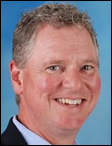
Peter Butler is president and CEO of Hayes Management Consulting of Wellesley, MA.

image

Tell me about yourself and the company.

I’ve been at Hayes for 25 years. We are a technology-enabled company leveraging our MDaudit software platform to drive billing and audit compliance productivity as well as revenue integrity solutions across healthcare organizations.

Is it hard to retool a consulting firm into a software vendor?

It’s challenging. After a long corporate career in consulting, you develop a name for yourself in that area. We got our start with IT consulting, then over a period of time, moved into revenue cycle consulting and EHR implementations and so forth. Our MDaudit platform took a greater foothold in the industry and we were experiencing quite a lot of trust with it.

We saw this, years ago, as the future direction of the company. We foresaw health IT consulting needs diminishing and becoming commoditized. We wanted to leverage our strength. That’s when the software piece came in.

It was a difficult journey trying to change the mindset of a 25-year-old company and people who have a lot of longevity in it, asking them to think differently, more like a software company. It came with a lot of challenges.

Are you happy that you made that decision early when you see other consulting firms just now starting to react to market changes?

Very happy. When we were going through that transition, the hardest part was that it wasn’t happening fast enough. I look back in the rear-view mirror and say, OK, we did it. We got there. This is good. Where do we go from here? It’s important for us to stay relevant in the industry and in our client organizations.

We’ve turned the corner. We are looking forward to building ourselves as a software company and continuing to make a difference in healthcare.

What are the top issues in billing compliance?

Years ago, the top issue was how a healthcare organization with 2,000 providers could audit all of them annually. Then they acquire two more medical groups of a couple of hundred providers. How do they get through those audits with limited resources? Their organizations weren’t giving them the staff since they were really seen just a cost center.

Now the trend is, I have limited resources, so let me take a step back and look at all of the billing compliance risk areas to my organization. Bubble those to the surface so that I can take my limited resources and go tackle those challenges. Are they really risk areas that I should be concerned about, or are we a billing outlier for good reason because we are multi-specialty and we specialize in this type of service? In the old days, they were looking for fraud and abuse inside their organizations.

Now it’s taking a different turn. Where can I sharpen my attention to the revenue cycle? What am I actually providing for service, but not billing for? Compliance officers stay in the mindset of looking for areas where they can ensure that their organizations are billing appropriately, not over-billing Medicare things and like that. But they’re partnering with revenue integrity leaders inside their organization who are looking at the same data. What are we leaving on the table? We’ve delivered these services. There’s more pressure on reimbursement. We want to make sure we’re getting paid for everything we’ve done.

Is anybody doing a lot of billing compliance work as due diligence before provider acquisitions or mergers?

They are, but they should be doing more. I’ve had conversations with compliance officers who said, I just got a message from the CEO that we’ve signed our letter of intent. We’re moving forward with buying this practice or hospital. They aren’t paying attention to making sure that, as part of the due diligence process, they are billing and coding appropriately. Let’s understand the risks of acquiring this organization. It’s almost been an afterthought from senior leadership that the compliance professionals find themselves in post-transaction.

Is the focus different when a private equity firm is the buyer, such as the trend of acquiring dermatology practices?

We’ve had some of those PE-backed companies call us and say, we’re about to make an offer for this dermatology practice. Before we finalize it, can you do some diligence around their revenue cycle and their billing practices? Make sure that they are billing and coding appropriately and that what they are telling us and what we’re reading in the reports is actually what’s happening.

Those are mini-assessments. They don’t take a lot of time, but they give the buyer an opportunity to understand where the risks and opportunities are. Once they finalize the deal, if they go forward, where can they find revenue opportunity and operational efficiency? There’s definitely a lot of that from the financially-minded buyers.

What trends are you seeing that aren’t getting much attention?

A lot of revenue cycle leaders in years past ran their organizations based on metrics. They would tell their staff, you need to make X number of calls or you need to touch X number of claims. A trend I’m seeing that will pay dividends later is that instead of looking at volume-based metrics or metrics for the sake of metrics inside those revenue cycle follow-up departments or patient access departments, ask that if you touched a claim, what did you do with it? Did you make changes to it that positively affected the organization? Were you able to identify root cause and go back and make changes that actually stuck so that we’re not seeing these problems over and over?

Some of our clients are assigning audit-minded people to look at the goals and responsibilities of those who support the day-to-day operations. Looking at whether their daily tasks drive positive change, the quality outcome in the operation. They are using spreadsheets to document who they’re working with, the types of audit completed, the follow-up, and the result.

It can become an arduous task, but the concept is, are you driving better quality outcomes in your role, or are you just saying you made your 50 calls or worked your 10 work queues? What was the result of that? That’s an important trend and overdue in healthcare.

Hopefully we can instill some best practices in the industry so that we have less need for those auditors. You’ve done your training and you’ve built some great training programs to educate the people who are touching every aspect of the business operation.

Do you have any final thoughts?

Some interesting things are happening that we’ll see more of as quality reimbursement plays a bigger role in healthcare. CMS recently proposed some E&M simplification rules with the concept that it will save money and provider coding time. They’ll save 50 hours a year or something like that, taking away all of the detail-level E&M coding and documentation you have to do. CMS is also looking for ways to save money for the taxpayers and the government, so it has to be viewed through that lens as well.

It will come at some point, probably not in January, but it will come with challenges that the healthcare industry needs to walk through. If you’re billing Medicare, you’ve got Blue Cross Blue Shield as secondary, and you’re doing simplified billing for Medicare, what do you do with that claim? It gets passed down to a secondary payer. There are other issues around RVUs and how you reimburse your doctors that will be impacted by changes like this from CMS. We have a lot of work to do as we think about simplifying the billing process in the industry. It won’t come without challenges.

A Machine Learning Primer for Clinicians–Part 3

October 31, 2018 Machine Learning Primer for Clinicians Comments Off on A Machine Learning Primer for Clinicians–Part 3

Alexander Scarlat, MD is a physician and data scientist, board-certified in anesthesiology with a degree in computer sciences. He has a keen interest in machine learning applications in healthcare. He welcomes feedback on this series at drscarlat@gmail.com.

image

Previous articles:

  1. An Introduction to Machine Learning
  2. Supervised Learning

Unsupervised Learning

In the previous article, we defined unsupervised machine learning as the type of algorithm used to draw inferences from input data without having a clue about the output expected. There are no labels such as patient outcome, diagnosis, LOS, etc. to provide a feedback mechanism during the model training process.

In this article, I’ll focus on the two most common models of unsupervised learning: clustering and anomaly detection.

Unsupervised Clustering

Note: do not confuse this with with classification, which is a supervised learning model introduced in the last article.

As a motivating factor, consider the following image from Wikipedia:

image

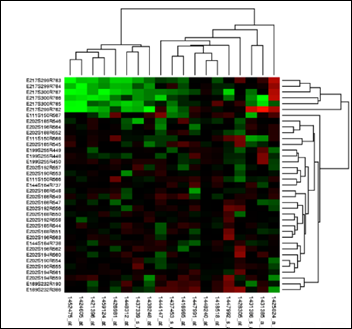
The above is a heat map that details the influence of a set of parameters on the expression (production) of a set of genes. Red means increased expression and green means reduced expression. A clustering model has organized the information in a heat map plus the hierarchical clustering on top and on the right sides of the diagram above. 

There are two types of clustering models:

  • Models that need to be told a priori the number of groups / clusters we’re looking for
  • Models that will find the optimal number of clusters

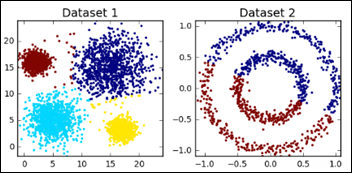
Consider a simple dataset:

image

Problem definition:

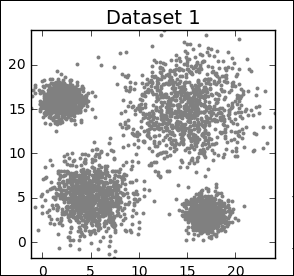
  • Task: identify the four clusters in Dataset1.
  • Input: sets of X and Y and the number of groups (four in the above example).
  • Performance metric: total sum of the squared distances of each point in a cluster from its centroid (the center of the cluster) location.

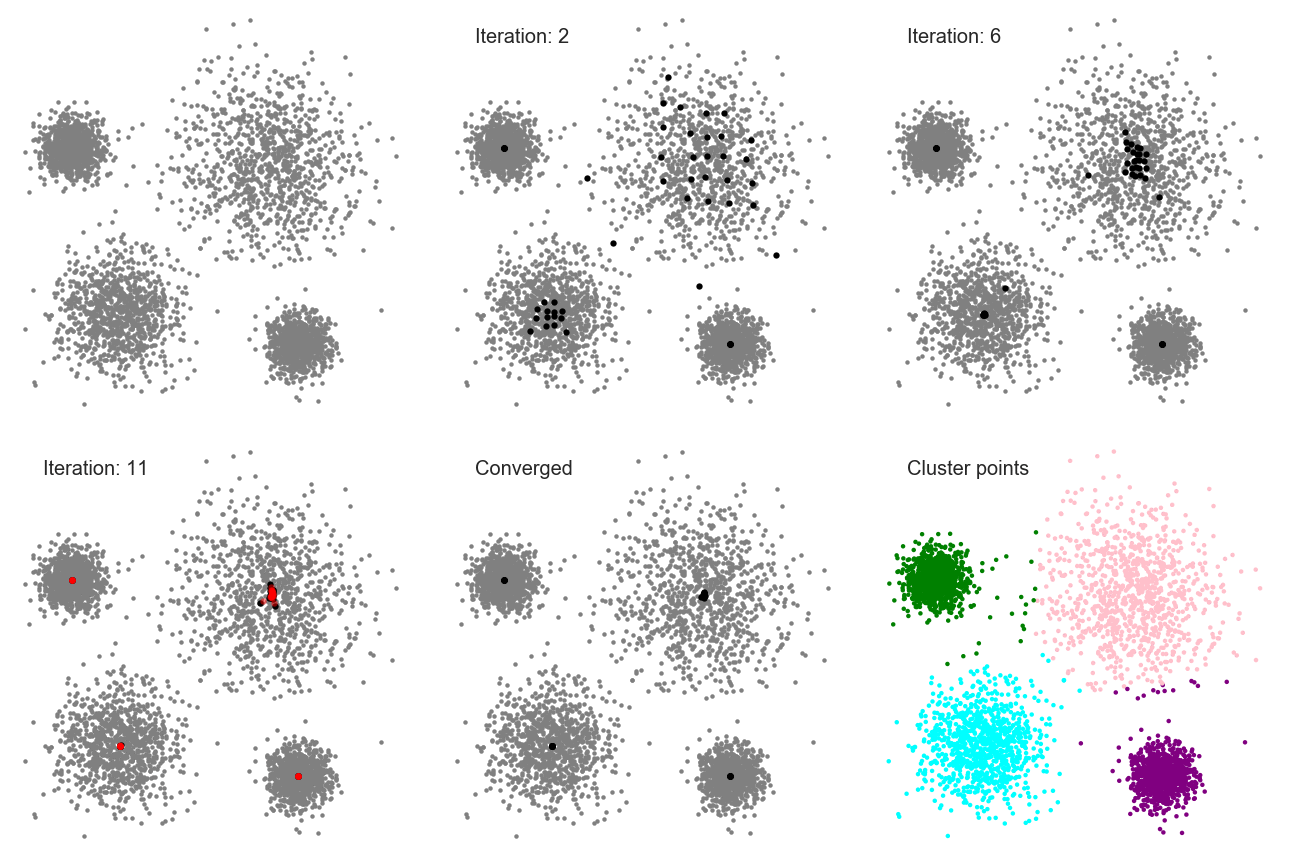
The model initializes four centroids, usually at a random location. The centroids are then moved according to a cost function that the model tries to minimize at each iteration. The cost function is the total sum of the squared distance of each point in the cluster from its centroid. The process is repeated iteratively until there is little or no improvement in the cost function.

In the animation below you can see how the centroids – white X’s – are moving towards the centers of their clusters in parallel to the decreasing cost function on the right.

kmeans

While doing great on Dataset1, the same model fails miserably on Dataset2, so pick your clustering ML model wisely by exposing the model to diverse experiences / datasets:

image

Clustering models that don’t need to know a priori the number of centroids (groups) will have the following problem definition:

  • Task: identify the clusters in Dataset1 with the lowest cost function.
  • Input: sets of X and Y (there are NO number of groups / centroids).
  • Performance metric: same as above.

The model below initializes randomly many centroids and then works through an algorithm that tells it how to consolidate together other neighboring centroids to reduce the number of groups to the overall lowest cost function.

mean_shift_tutorial

From “Clustering with SciKit” by David Sheehan

3D Clustering

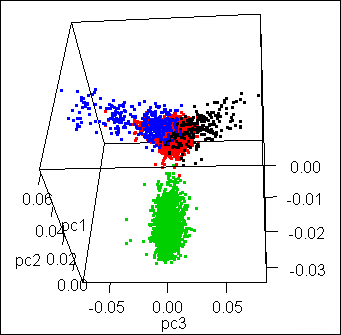
While the above example had as input two dimensions (features) X and Y, the following gene expression in a population has three dimensions: X, Y, and Z. The mission definition for such a clustering ML model is the same as above, except the input has now three features: X, Y, and Z.

image

The animated graphic is at www.arthrogenica.com

Unsupervised Anomaly Detection

As a motivating factor, consider the new criteria for early identification of patients at risk for sepsis or septic shock, qSOFA 2018. The three main rules:

  • Glasgow Coma Scale (GCS) < 15
  • Respiratory rate (RR) >= 22
  • Systolic blood pressure (BP) <=100 mmHg

Let’s focus on two parameters, RR and BP, and a patient who presents with:

  • RR = 21
  • BP = 102

A rule-based engine with only two rules will miss this patient, as it doesn’t sound the alarm per the above qSOFA definition. Not if the rule was written with AND and not it had OR between the conditions. Can a ML model do better? Would you define the above two parameters, when taken together, as an anomaly ? 

Before I explain how a machine can detect anomalies unsupervised by humans, a quick reminder from Gauss (born 1777) about his eponymous distribution.

One-Variable Gaussian Distribution

image

You may remember from statistics that the above bell-shaped normal Gaussian distribution can accurately describe many phenomena around us. The mean on the above X axis is zero and then there are several standard deviations around the mean (from -3 to +3). The Y axis defines the probability of X. Each point on the chart has a probability of occurrence: the red dot on the right can be defined as an anomaly with a probability of ~ 1 percent. The dot on the left side has a probability of ~ 18 percent,  so most probably it’s not an anomaly. 

The sum (integral) of a Gaussian probability distribution is one, or 100 percent. Thus even an event right on top of our chart has a probability of only 40 percent. Given a point on the X axis and using the Gaussian distribution, we can easily predict the probability of that event happening.

Two-Variable Gaussian Distribution

Back to the patient that exhibits RR = 21 and BP=102 and the decision whether this patient is in for a septic shock adventure or not. There are two variables: X and Y, and a new problem definition:

  • Task: automatically identify instances as anomalies if they are beyond a given threshold. Let’s set the anomaly threshold at three percent.
  • Input: sets of X and Y and the threshold to be considered an anomaly (three percent).
  • Performance metric: number of correct vs. incorrect classifications with a test set, with known anomalies (more about unbalanced classes in next articles).

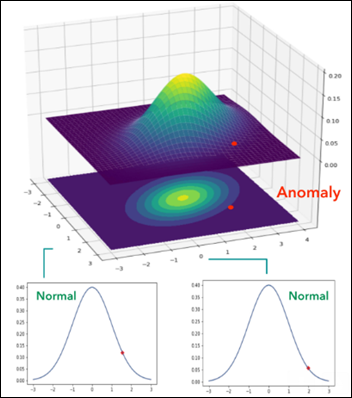
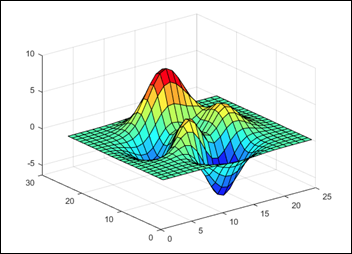
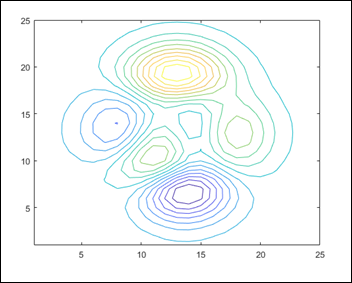
The following 3D peaks chart has X (RR), Y (BP), and the Gaussian probability as Z axis. Each point on the X-Y plane has a probability associated with it on the Z axis. Usually a peaks chart has an accompanying contour map  in which the 3D is flattened to 2D, with the color still expressing the probability.

Note the elongated, oblong shape of both the peaks chart and the contour map underneath it. This is the crucial fact: the shape of the Gaussian distribution of X and Y  is not a circle (which we may have naively assumed), it’s elliptical. On the peaks chart, there is a red dot with its corresponding red dot on the contour map below. The elliptic shape of our probability distribution of X and Y helps visualizing the following:

  • Each parameter, when considered separately on its own probability distribution, is within its normal limits.
  • Both parameters, when taken together, are definitely abnormal, an anomaly with a probability of ~ 0.8 percent (0.008 on the Z axis), much smaller than the three percent threshold wee set above.

image

Unsupervised anomaly detection should be considered when:

  • The number of normal instances is much larger than the number of anomalies. We just don’t have enough samples of labeled anomalies to use with a supervised model.
  • There may be unforeseen instances and combinations of parameters that when considered together are abnormal. Remember that a supervised model cannot predict or detect instances never seen during training. Unsupervised anomaly detection models can deal with the unforeseen circumstances by using a function from the 1800s.

Scale the above two-parameter model to one that considers hundreds to thousands of patient parameters, together and at the same time, and you have an unsupervised anomaly detection ML model to prevent patients deterioration while being monitored in a clinical environment. 

The fascinating part about ML algorithms is that we can easily scale a model to thousands of dimensions while having, at the same time, a severe human limitation to visualize more than 5D (see previous article on how a 4D / 5D problem may look).

Next Article

How to Properly Feed Data to a ML Model

News 10/31/18

October 30, 2018 News 3 Comments

Top News

image

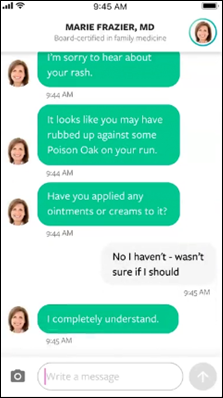
Seattle-based 98point6 raises $50 million to expand its chat-powered “virtual primary care” unlimited service that costs a flat $20 per year for the first year, then $120 in following years.

The company’s 15 doctors serve patients in 38 states.

Millennials and others for whom convenience is paramount will probably love turning a doctor visit into a text chat, but calling it “primary care” seems like a stretch since it’s just responding in kneejerk fashion to user-reported symptoms, with no effort made to provide continuity of care or chronic condition management. Anyone want to spend $20 to give it a test drive and let me know how it turns out? I bet the $20 deal doesn’t last long. 

I’m interested that the company’s terms of use include a binding arbitration clause, leading me to question (a) does that clause really prevent malpractice lawsuits and instead force plaintiffs into arbitration with no class action option? (legal precedents suggest yes), and if so, (b) why don’t more doctors include binding arbitration clauses in their “new patient” forms with hopes of getting more reasonable judgments than are often awarded by juries made up of mostly retirees, students, and the unemployed?


Reader Comments

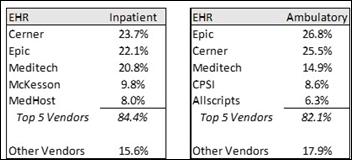
From Doyenne: “Re: Cerner share price. It’s dropping due to ‘Cernover,’ in which whole metropolitan areas like Seattle, Chicago, and the Bay Area are switching. Contracting: Seattle Children’s and University Washington. Implementing: University Illinois Chicago, Northwestern. Implemented: Dallas Children’s, Packard Children’s, Royal Children’s (Melbourne), University of Utah, Loma Linda, John Muir.” Unverified, and I agree only somewhat. Certainly Epic’s focus on academic medical centers has given it high-profile customers that created regional momentum, but Cerner is still turning in good numbers due to diversification even as Epic has inflicted obvious pain. Cerner talks less these days about big hospital wins, ambulatory, revenue cycle, and CommonWell and instead reassures investors about population health, IT services, non-US sales, sales outside the Millennium base, and its perfectly timed contracts with the DoD and VA (all of which conveniently avoid butting heads with Epic). The biggest questions are how the company will perform given the questionably credentialed replacements it chose for Neal Patterson and Zane Burke; the good or bad PR that will result from whatever happens with DoD and VA; and diversifying its business to meet Wall Street growth expectations while avoiding becoming a GE-like unfocused conglomerate that behaves like a dull mutual fund. Quite a few companies stumble after they lose a fire-breathing visionary leader, but like Apple, Cerner can always keep booking add-on sales of services, accessories, and questionably improved new models to an existing client base that is reluctant to shop elsewhere. My bottom line: while Epic’s business is solely focused on EHR customers and it’s hard to beat (and getting harder) in that market, Cerner is not limited to EHR sales, and investors price its shares accordingly even though we hospital-centric insiders see Epic as the unstoppable juggernaut.

From Splainin’ to Do: “Re: startups. This health IT site is charging startups to have their updates and company profiles published as fake news. Do it!” No thanks. That site didn’t even register in the Reaction Data survey of C-level health system executives and charging vendors to run their biased content seems to be yet another way to send readers fleeing. You can sell your integrity only once and you can’t buy it back afterward. I take an infrequent look at the content, advertisers, and overall excellence of sites similar to mine and I don’t see many ideas I’d want to emulate.


Webinars

November 7 (Wednesday) 3:00 ET. “Opioid Crisis: What One Health Plan is Doing About It.” Presenter: Samuel DiCapua, DO, chief medical director, New Hampshire Health Families; and chief medical officer, Casenet. Sponsor: Casenet. This webinar will describe how managed care organization NH Health Families is using innovative programs to manage patients who are struggling with addiction and to help prevent opioid abuse.

Previous webinars are on our YouTube channel. Contact Lorre for information.


Acquisitions, Funding, Business, and Stock

image

IBM will acquire Red Hat for $34 billion, apparently hoping to reverse years of declining revenue by trying to compete with entrenched cloud computing competitors such as Amazon and Microsoft. IBM’s bet-the-farm investment in Watson Health may well become the Previous Shiny Object as the company moves to its more familiar roots in enterprise software in hopes of placating impatient shareholders. I’m pretty sure Red Hat customers aren’t thrilled.


People

image

Cantata Health promotes Krista Endsley to CEO. NTT Data sold its healthcare software business to GPB Capital to create Cantata Health in April 2017, which tapped former NTT Data SVP/GM Mike Jones as CEO through April 2018 when Endsley joined Cantata as president.

image

Oncology analytics vendor Cota Healthcare hires industry long-timer Mike Doyle (QPID Health) as president and CEO.

image

PatientSafe Solutions hires Tim Needham (Burwood Group) as chief commercial officer.


Announcements and Implementations

image

A KLAS report on secure communication finds that while ambulatory providers are focusing on simply exchanging messages securely, health systems are moving toward broader, enterprise-level platforms that include interfacing and support for multiple workflows (Voalte and Vocera are furthest along in offering a true communication platform, KLAS concludes). The top vendors (in terms of market consideration, customer retention, and performance) are TigerConnect, Voalte, and Epic. Potential disruptors are Telmediq and PatientSafe Solutions, which have high win rates and quality scores, while KLAS says Spok and Imprivata are losing business due to lagging development.

image

Mason, OH-based startup Clarigent Health will commercialize technology developed by Cincinnati Children’s Hospital that assesses suicide risk by analyzing conversations between patients and their therapists or doctors.

Dimensional Insight launches Measure Factory, an automation engine that extends its Diver Platform to support data governance and data integrity.

LabCorp adds support for Apple Health Records, which will allow patients to send their lab results to their IPhones. Some Twitterati were puzzled why it only supports IPhones, with the obvious answer being that while Apple is #2 in mobile phone OS behind Android, there’s no Apple Health Records counterpart in Android (Google Fit is mostly just activity tracking).

Partners HealthCare and Lifespan end their merger talks, with Partners forging ahead with plans to acquire Lifespan competitor Care New England Health System. 


Other

In Australia, a report blames Cerner for May 2017 outages at seven Queensland Health hospitals, refuting the health system’s initial claim that the downtime was caused by ransomware. Investigators say Cerner has refused to provide system logs covering the incident. Cerner is the leading candidate to win a new bid for a patient administration system and insiders report executive pressure to avoid putting the company in a bad light.

Fascinating: a Utah insurer rolls out a “pharmacy tourism” option in which patients who take expensive drugs will be given plane tickets to San Diego, a ride across the border to Tijuana, and $500 as a cash bonus to buy their drugs in Mexico, where they are so much cheaper that the insurer still saves money. Hopefully Mexico won’t build a big, beautiful wall to keep medical tourism invaders out. 

image

Weird News Andy comes up with a seasonally appropriate thriller that leads him to conclude, “Always go for the $5 teeth; the $3 teeth will get you every time.” An Alabama woman completes her Halloween ensemble with $3 fake teeth, only to find that the included temporary glue was (at least in her case) permanent. The emergency dentist, in true Halloween fashion, debated whether to saw or drill away the plastic with the risk of making her permanently scary, but as the woman describes, he eventually “picked and pulled and I squealed like a baby.”

And in a WNA Halloween Two-fer, a surgery professor says students have spent so much time in virtual worlds that they fare poorly at hands-on surgical work that requires thinking in three dimensions and “actually doing things.” The instructor recommends pumpkin-carving as good training because it is “one example of using sharp instruments with great delicacy and precision on a hard surface with a soft inside to create something that you have got in your mind and then you have to make it happen.”


Sponsor Updates

  • Glytec publishes an ebook titled “Hypoglycemia in the Hospital: Why Is It Costing You Millions and What Can You Do?”
  • EClinicalWorks posts a podcast titled “Tools and Training to Target Physician Burnout.”
  • Vocera will resell QGenda’s provider scheduling system in the federal healthcare market and the companies will integrate their systems.
  • CarePort Health expands its product, analytics, and customer success teams.
  • Impact Advisors is named to Modern Healthcare’s list of largest revenue cycle management firms.
  • AdvancedMD will exhibit at APTA PPS November 7-10 in Colorado Springs.
  • Waterloo MedTech awards Agfa Healthcare with its 2018 Award of Distinction.
  • Aprima will exhibit at the AAP National Conference & Exhibition November 3-5 in Orlando.
  • CarePort Health will exhibit at the ACMA 2018 Leadership Conference November 5-7 in Huntington Beach, CA.
  • CompuGroup Medical will exhibit at the AMP 2018 Annual Meeting & Expo November 1-2 in San Antonio.
  • CoverMyMeds will make its RxBenefit Clarity real-time benefit check tool available to Allscripts users.
  • CTG, Cumberland Consulting Group, and Dimensional Insight will exhibit at the CHIME Fall CIO Forum October 30-November 2 in San Diego.
  • Diameter Health will present at the AMIA 2018 Annual Symposium November 3-7 in San Francisco.

Blog Posts


Contacts

Mr. H, Lorre, Jenn, Dr. Jayne.
Get HIStalk updates. Send news or rumors.
Contact us.

125x125_2nd_Circle

HIStalk Interviews Kurt Garbe, CEO, IMAT Solutions

October 29, 2018 Interviews Comments Off on HIStalk Interviews Kurt Garbe, CEO, IMAT Solutions

Kurt Garbe is CEO of IMAT Solutions of Orem, UT.

image

Tell me about yourself and the company.

IMAT Solutions solves the core data problems of healthcare companies. We focus on how to improve data quality, data currency, the amount of data, and the type of data that companies can look at.

How do you position the company among competitors?

Many companies look at different parts of data — analysis, cleanup, or integration. We take a more comprehensive approach. This is a data platform. What are the requirements for the different types of data you’re trying to bring in, the comprehensive data? How do you look at cleaning up the data that’s coming in? How do you look at the currency? How do you make sure you can quickly access that data in a comprehensive way? We look at all of those components, not just some individual pieces and parts.

How would you assess healthcare in terms of your C3 framework of data that is clean, comprehensive, and current?

Healthcare is still, unfortunately, at the early stage. We know this from talking to our customers. It’s across the board. Different companies have different strengths and focus on different things, but we haven’t found a lot of evidence that people have taken the full picture and made a lot of progress.

Are healthcare organizations making decisions using data that is either bad or incomplete?

Absolutely. The core question is, what data are we even talking about? The data related to healthcare and the health of an individual includes a lot of free-text data, unstructured data from lab reports, notes, and so forth. When we talk to people through surveys and discussions, 80 percent aren’t looking at that data yet. They don’t apply natural language processing to figure out what insights they could get from that data.

It’s the old story about the elephant. We look at data as this big elephant. Some people look at data as just the foot or the trunk. They’re only looking at the pieces and parts. They don’t usually say their data is good — they admit it’s a challenge, something they’re looking at, or the subject of some new initiatives. We don’t find a lot of complacency and satisfaction.

It gets more complicated where a health system has several groups. Each says they have clean data, and they probably do to a great extent, but the data is not coordinated. How they describe their data and how this other group describes their data are not consistent. It’s therefore not particularly useful in having a real impact.

What due diligence is required before accepting a new source of data to understand its semantics rather than just finding matching columns that can be joined to create a bigger database?

I wish we identified some rules of the road out there. This is a major effort and a major problem. Like everyone in data and healthcare, they’re doing the best they can. Often they’re just prioritizing. They are saying, we can’t absorb all the data, but can you give us the following type of data so we can work on that first? Let’s cut the problem into small pieces.

That’s a practical approach that works, but it takes a long time. They are often disappointed with the impact of those efforts. You get the greatest impact when you’re using the largest amount of data to make decisions.

Will artificial intelligence and machine learning help solve the problem?

We’re in an unfortunate race. People talk a lot about AI and machine learning. But with these systems, as much as they’re making great progress in AI and machine learning, the inputs — unstructured and free-form data — are still weak. An AI engine or machine learning algorithm can’t necessarily turn it into something meaningful and useful.

Years ago, everyone was talking about predictive analytics. We have these great models, but the source data isn’t very good. You’re trying to do more analytics and use more of these advanced tools on poor data to get to that answer faster, as opposed to getting a better answer. People still have to spend a lot of effort to to turn unstructured data into something useful and meaningful that a predictive analytics engine, AI algorithm, or machine learning can do something with.

The challenge, and it’s a big one, is that the unstructured data multiplies the amount of data you have by a factor of five or 10. It’s 10 times more than you used to have, so how do you get meaningful results from it in a meaningful time frame? If it takes a week to process through all that data every time you run a report, create a model, or do some analytics, you’re not going to do it often. That’s why we talk about the currency, meaning how quickly you can get insight out of all of this data that you have.

That’s why we talk about the C3. It’s not just the fact that you have comprehensive data. You’ve got all of your data in an unstructured form, and through an NLP process or even manually, you’ve cleaned it up. It’s consistent, it works well. But now, how do you get results out of that in some meaningful time frame, where you can run reports, look at the reports, and say what works, what doesn’t work, or look at these fields instead? You’re now interacting with the data. That’s where this third C of currency comes in. That’s the only way you get high impact from whatever tools you have, whether it is predictive analytics, AI algorithms, or machine learning.

What lessons did you learn from connecting the aggregated datasets of two HIEs together after Hurricane Florence and validating that the result was accurate at a patient level?

The historical approach to interoperability or interconnecting data is to tell Company A, “Here is how we want you to give us output.” That’s historically a huge problem. Company A doesn’t have the time or they don’t see the value of doing that. Our approach is, just give us what you have. We won’t ask you to change your formats, your fields, or anything else. You give us what you have, this other organization does the same, and we’ll re-index that data and provide one comprehensive view.

The major lesson that we’ve learned in integrating new clinics and new hospital groups into these data pools is that we have to lower the bar of what they have to do. We’re not asking them to change their format, because those IT discussions are often where interoperability gets bogged down, where you ask people to change what they do. We don’t do that. Just provide us what you have and we will make it work for you.

How do you see the company and the general areas of data interchange, quality, and interoperability changing in the next five years?

Our aspiration, and the hope that we have for healthcare, is that tools such as AI, machine learning, and predictive analytics can help deliver real results now. We need to raise a bar on the baseline of getting comprehensive data, making it current so it can be analyzed in real time, and making sure it’s clean, consistent, and makes sense.

If we can get to that baseline, those other tools will get you what you want in healthcare — bending the cost curve, improving outcomes. Without that, we’re still in some ways guessing. If we can address the core data issues, those tools, as well as others that we can’t envision today, can help us make decisions on what it actually happening instead of guessing, which is what’s happening now in healthcare.

Do you have any final thoughts?

The topic of improving healthcare through data is not new. It has been envisioned, talked about, and hoped for for 20-plus years, if not longer. What is exciting now is that the technology, the ability to actually get there, has caught up to that vision. We look forward to helping make this vision come true.

Curbside Consult with Dr. Jayne 10/29/18

October 29, 2018 Dr. Jayne 1 Comment

I happened to be in New York this week during the pipe bomb scare, close enough to the CNN offices to receive an emergency alert on my phone advising me to “shelter in place.” The presenter in the continuing education seminar I was attending must have seen everyone checking their phones even though they were supposed to be silenced, so she stopped the presentation to find out what was drawing everyone’s interest.

People were texting friends and family members to let them know that they were OK or were looking for news on what was happening in the neighboring building. It was clear that with everything going on there wasn’t going to be much learning happening, so the conference organizers wisely instituted an unplanned break.

Although most of us were from out of town, several physicians at the table in front of me were residents of the city who had been in practice there during the World Trade Center attacks in 2001. They began talking about what it was like that day, being put on alert by their hospitals that they should prepare for a mass casualty event. They talked about the preparations to receive hundreds of patients, including possible air transports to hospitals outside the city, as the events began to unfold. They also talked about the horrible experience of waiting for patients who never arrived and how that affected them as clinicians. It was clear that even after so many years, they are still profoundly impacted by the events of that day.

The conversation moved into one around disaster preparedness and what is different for them now compared to what was in place then. As we talked, they were checking in with their hospitals to let them know their location and status should there be an actual bomb detonation. By that point, we were informed that our building was on a modified lockdown procedure, with guests and employees being encouraged not to leave and no one allowed to come in. I assume they would have allowed physicians to leave in the event they were needed emergently, but I’m glad the incident was resolved relatively quick and we never had to find out how the lockdown really worked in the lobby.

There was a side conversation about the fears that clinicians and others that work in hospitals carry with them. People are afraid of how they might react to a disaster or mass casualty situation, whether they would be able to stay the course and care for patients or whether they would want to focus on making sure family and other loved ones are safe. A few mentioned episodes of violence they had experienced in their own hospital workplaces, including assaults on patients and staff and even an active shooter event. Nearly everyone mentioned a higher frequency of drills and discussions of potential dangers, with several in the conversation noting that the ongoing drills and reviews are likely contributing to the anxiety.

The fear of violence has influenced technology purchasing decisions. Hospitals are installing advanced security systems and some require visitors to present identification so they can be credentialed to enter the facility. Visitors are wearing stickers with their names, pictures, and sometimes their destination, such as a room number or office suite. It’s different from back in my Candy Striper days when we looked up the patient’s name on a printout, told the visitor the room number, and pointed them towards the elevators without a second glance. I don’t think there are too many facilities that would leave a lone 13-year-old girl manning the front desk any more.

We talk a lot about EHRs, revenue cycle platforms, clinical and financial analytics, telehealth platforms, and the numerous systems that support our hospitals and practices. Although I’ve seen the booths for security vendors at HIMSS, I’ve not had the chance until recently to reflect on those additional systems that CIOs might be called on to select and support in order to ensure business continuity for the facility. One vendor’s website notes their commitment to using big data to analyze incidents and predict patterns in order to better protect patients and staff. That’s a tall order to consider for those of us who are more used to contemplating PHI breaches than we are to thinking about breaches of the physical perimeter.

Although we have a panic button under the front desk of each of our clinic locations, I’ve been fortunate in not being at work in a situation where the staff had to use it. The staff has activated it on accident and based on the anxiety level while they worked to get it resolved, I can’t imagine what they would feel like in a live-use scenario.

In past clinical positions, I’ve worked at facilities where I had to park my car in a chain link enclosure inside the parking garage. I have staffed emergency departments where metal detectors and armed guards were just part of the daily scenery. We performed “fit for confinement” examinations on prisoners being transported by law enforcement, so on any given shift, there might be a patient handcuffed to the gurney. In those situations the potential risk was visible and fairly obvious and we grew to accept it as part of the job, but we didn’t think much about some of the other dangers that might come our way.

I would be interested to hear from readers on the state of security in their facilities and whether their organizations are using technology to help mitigate threats to patient and staff safety. In the times we live in, there is more to think about then tornadoes, fires, floods, and hurricanes.

What keeps you up at night about safety or potential disasters that might impact your organization? Leave a comment or email me.

Email Dr. Jayne.
Monday Morning Update 10/29/18

October 28, 2018 News 8 Comments

Top News

image

From the Cerner earnings call following a small revenue miss that sent shares down 11 percent on Friday: (CERN shares are down 19 percent so far in 2018 vs. the Nasdaq’s 2 percent gain):

  • Q3 bookings were up 43 percent over last year, although revenue was up just 5 percent due to lower-than-expected software and technology sales.
  • The company expects its DoD and VA business to drive growth as financially-challenged providers and lack of regulatory incentives reduce private sector market urgency (“there isn’t anything that’s forcing clients to get deals done.”)
  • The company expects the federal government business, along with the replacement market, to carry the company until HealtheIntent revenue grows. It notes that its population health business has grown slower than projected.
  • Chairman and CEO Brent Shafer says Cerner will be the partner of choice for healthcare innovation.
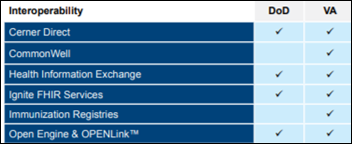
  • Chief Client Officer John Peterzalek says Cerner is a leader in interoperability and expects to benefit if the government issues interoperability mandates.
  • The company expects its $10 billion VA contract to deliver $1 billion in annual revenue by 2022, although task order timing makes the growth irregular.
  • CFO Marc Naughton says that selling population health tools can deliver $3-4 per member per month, but adding services such as those enabled by its deal with Lumeris could increase that PMPM amount to $15.
  • The company’s ITWorks outsourcing business generates single-digit margins, but selling software and services into that client base can yield 40 percent margins.
  • Naughton, responding to a question about monetizing the data Cerner holds, says he sees eventual opportunity, but regulatory limitations make it a non-focus area for now.
  • Four more DoD sites will go live in early 2020.
  • The company hasn’t decided how the VA work will be divided among Cerner and its partners even though the company originally mentioned a 50-50 split as a placeholder.
  • Cerner will continue with its R&D spend and will focus on business segments that can deliver $100 million in revenue.

Reader Comments

From Jules Verne: “Re: webinars. What advice do you have for getting more registrations?” I get insight from the webinars we do since I see the stats for clicks, registrations, and attendance. My conclusions:

  • Make the goal to educate, not to sell something (we struggle endlessly trying to make this point with the junior marketing people of vendors). Potential audience members won’t sign up for what promises to be a sales pitch and they won’t sit through a webinar that turns into one.
  • Get customers or outside experts as presenters. Nobody will give up an hour of their day to hear a company marketing person’s perspective on population health or analytics.
  • Make sure the presenter is prepared. It’s shocking when during rehearsal the presenter (usually enlisted from a health system) has never seen the slides, doesn’t know what they’re supposed to talk about, or delivers a presentation that doesn’t match the abstract.
  • A product overview or demonstration is not a broadly educational topic and won’t generate many signups. On the other hand, even a handful of attendees is fine if they become prospects. Evaluate success accordingly. We did one super-specialized webinar that drew only five attendees, but they were good leads for the niche product and the vendor was smart to realize that a couple of self-qualified prospects was much better than 100 uninterested attendees (but a marketing person might have, from their perspective, seen it as a failure).
  • Include on the registration page a descriptive abstract and an honest description of the target audience. Sometimes companies get only a small percentage of those who looked at the registration page to actually register, which means something on that page made most of them bail (most likely the webinar description, speaker bio, or asking for too much information to register).

HIStalk Announcements and Requests

image

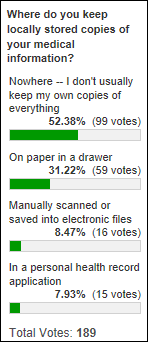
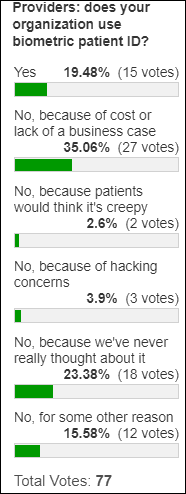
Previous polls found that most of us health IT people don’t really care whether our doctors use EHRs and we prefer old-fashioned doctor-patient relationships over evidence-based medicine and technology. Last week’s poll demonstrated more of the puzzling “do as I say, not as I do” dichotomy between our jobs vs. what we want for ourselves and our families as patients, as nearly none of us (me included) keep their own medical information in electronic form.

New poll to your right or here: are you proud of the products or services your employer offers?

image

Mrs. H bribed me to see “A Star Is Born” with her, and while the movie was good and the acting was terrific (actor-director Bradley Cooper admirably mimicked a singer and singer Lady Gaga excelled as an actor), the key moment for me occurred early in the movie, when I excitedly elbowed a startled Mrs. H to point out that Gaga’s character Ally was wearing a Yes tee shirt (although from their forgettable 1978 “Tormato” tour, I later found by Googling).

Listening: Rebelution, a California-based, highly literate reggae band whose UC Santa Barbara-graduated members are described in articles decrying cultural appropriation as “fratty white guys” (apparently those magazines believe that reggae is the exclusive domain of dreadlocked, spliff-brandishing Rastafarians who refer to everyone as “mon” and whose rainbow-colored clothing and revolution-inciting musical messages are obscured by ganja clouds). At least the bass player’s first name is Marley. Sample lyrics: “Whether you want love or money, good fortune or fame, you want a brand new car, you want the world to change. You better take some action right now, because there’s nothing in the world that you can’t get, so don’t fill your life with confusion and regret, you better take some chances right now.” I’m listening to more reggae these days because it’s one of few genres that haven’t been overproduced into unlistenable vacuity. I’m also enjoying refreshingly non-explicit hip-hop from Common, who I also liked in AMC’s western series “Hell on Wheels.”


Webinars

October 30 (Tuesday) 2:00 ET. “How One Pediatric CIN Aligned Culture, Technology and the Community to Transform Care.” Presenters: Lisa Henderson, executive director, Dayton Children’s Health Partners; Shehzad Saeed, MD, associate chief medical officer, Dayton Children’s Health Partners; Mason Beard, solutions strategy leader, Philips PHM; Gabe Orthous, value-based care consultant, Himformatics. Sponsor: Philips PHM. Dayton Children’s Health Partners, a pediatric clinically integrated network, will describe how it aligned its internal culture, technology partners, and the community around its goal of streamlining care delivery and improving outcomes. Presenters will describe how it recruited network members, negotiated value-based contracts, and implemented a data-driven care management process.

November 7 (Wednesday) 3:00 ET. “Opioid Crisis: What One Health Plan is Doing About It.” Presenter: Samuel DiCapua, DO, chief medical director, New Hampshire Health Families; and chief medical officer, Casenet. Sponsor: Casenet. This webinar will describe how managed care organization NH Health Families is using innovative programs to manage patients who are struggling with addiction and to help prevent opioid abuse.

Previous webinars are on our YouTube channel. Contact Lorre for information.


Acquisitions, Funding, Business, and Stock

image

Politico reports that Epic announced at its annual developer meeting that it will reduce its fees for listing third-party software in its App Orchard. One software company’s CEO had previously said that listing a simple HHS family planning questionnaire on the the app stores of Epic and Cerner would cost $750,000 per year. With the change, early-stage startups will pay just $100 per year to gain access to Epic’s API documentation and testing sandbox, then will pay an unstated higher amount once their product is released.

image

From the Roper Technologies earnings call, following a Q3 report in which it beat both revenue and earnings expectations (the diversified company owns Sunquest, Strata Decision, Atlas Medical, SoftWriters, CBORD, and several other health IT vendors):

  • The company promoted COO Neil Hunn to president and CEO in late August, moving Brian Jellison to executive chairman due to health problems. Hunn came from MedAssets
  • The company’s Medical and Scientific Imaging segment, which represents 29 percent of Roper’s revenue, increased quarterly revenue 11 percent to $380 million.
  • Sunquest’s US business declined in “mid-single digits” while expanding globally, with 2019 expectations for Sunquest continuing to trend down due to competitive pressure. Roper says it will be “rebasing the North American business” of Sunquest. It also notes that it paid only 10 times EBITDA to acquire Sunquest for $1.42 billion in cash in 2012. 

Decisions

  • Crossing Rivers Health (WI) replaced Evident with Epic in June 2018.
  • Ferrell Hospital (IL) will switch from Medhost to Epic in fall 2019.
  • Chatuge Regional Hospital (GA) will replace Allscripts with Cerner in October 2019.

These provider-reported updates are supplied by Definitive Healthcare, which offers a free trial of its powerful intelligence on hospitals, physicians, and healthcare providers.


Announcements and Implementations

Vanderbilt University Medical Center gets a federal grant to mine its 20-year EHR database and biological samples to look for biologic and genetic markers of Down syndrome.


Government and Politics

The Spokane newspaper interviewed just three veterans for its story on implementing Cerner in the VA, but those they chose were perceptive:

  • Army vet Charles Bourg, 64, questioned why Cerner got a no-bid $10 billion deal, adding that while it’s nice that the VA and DoD are trying to integrate their respective Cerner systems, it’s more important that Cerner connect to outside doctors.  He adds, “You have to go in the basement of the VA to get the records … and it can take weeks. I did get electronic records from the VA to take to the [private practice] doctor, but he couldn’t even open them up.”
  • Former Navy Seabee Charlie Monroe says he’s skeptical about the new system and fears it will take away from the time doctors spend with patients.
  • Air Force veteran Bob Brodie says the VA never paid the bill for his VA-approved stay at a private hospital, which then turned his account over to collections.

Other

A federal grand jury indicts a former IT employee of Catholic Health Initiatives for allegedly issuing $72 million in phony purchase orders to a co-conspirator’s IT consulting firm for integration services, then splitting the take.

AMIA publishes core competencies for master’s-level applied health informatics programs that can be tested after graduation.

image

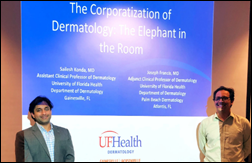
The Journal of the American Academy of Dermatology takes down a research paper that analyzed the effect of private equity firms buying up dermatology practices after it receives complaints from several dermatologists who have PE ties. One of them is the Academy’s incoming president, who sold his own practice to a private equity-owned management company on whose board he sits. The peer-reviewed article observed that PE firms selectively acquire practices that perform high volumes of procedures covered by private insurance and Medicare, also noting that quite a few of those practices also run profitable pathology labs.

In Russia, a woman shows up a hospital with an ultrasound order she had changed to a different procedure, then attacks the hospital doctor who refused to perform the test, throwing the order’s clipboard at him and then beating him over the head with his computer keyboard.


Sponsor Updates

  • LiveProcess will exhibit at the Delaware Healthcare Forum October 30 in Dover.
  • Meditech will exhibit at the 2018 AMIA Annual Symposium November 3-7 in San Francisco.
  • Netsmart will exhibit at the NHPCO Fall Conference November 5 in New Orleans.
  • Clinical Computer Systems, developer of the Obix Perinatal Data System, will exhibit at the Annual Perinatal Partnership Conference October 28-30 in Myrtle Beach, SC.
  • OmniSys will add ScriptPro’s SP Central Pharmacy Management System to its Fusion-Rx interactive voice response solution for pharmacies.
  • PatientSafe Solutions, Pivot Point Consulting, Redox, and Surescripts will exhibit at the CHIME18 Fall CIO Forum October 30-November 4 in San Diego.
  • Patientco publishes a new white paper, “Improving Patient Financial Experience Through Smart Payment Technology.”
  • Voalte will exhibit at the OONE Fall Conference November 1-2 in Columbus, OH.

Blog Posts


Contacts

Mr. H, Lorre, Jenn, Dr. Jayne.
Get HIStalk updates. Send news or rumors.
Contact us.

125x125_2nd_Circle

Weekender 10/26/18

October 26, 2018 Weekender Comments Off on Weekender 10/26/18

weekender 


Weekly News Recap

  • Nova Scotia’s province-wide EHR selection nears completion, with all vendors except Allscripts and Cerner failing to make the cut in a process that has raised questions about possible bias
  • Clearlake Capital Group will acquire provider management, credentialing, and payer enrollment technology vendor Symplr
  • VC-backed Naya Health, which developed a $1,000 smart breast pump, apparently shuts down after user complaints that its product does not work
  • Vatica Health makes a $1 million bid to acquire the assets of chronic care management company CareSync, which abruptly closed its doors in June
  • Politico reports that Pentagon investigators have found Madigan Army Medical Center’s new Cerner-based MHS Genesis software lacking in effectiveness, suitability, and interoperability
  • Deborah DiSanzo, general manager of IBM Watson Health for the past three years, will step down

Best Reader Comments

What the US has now is elements of several [healthcare] systems, As T.R. Reid described in “The Healing of America; A Global Quest for Better, Cheaper, and Fairer Health Care,” for veterans and their families, we’re Britain or Cuba. For those who receive health insurance through their employer, we’re Germany or France. For people over 65 on Medicare, we’re Canada. For the percent of the population who have no health insurance, the United States is Cambodia. (Wadiego)

Very nice of IBM to allow Deb DeSanzo to keep her job and take a demotion despite her lack of success in turning the corner. I wonder how the thousands of IBM’ers who were laid off at the end of each quarter the past three years when the numbers weren’t good feel about this? (The More Things Change)


Watercooler Talk Tidbits

image image

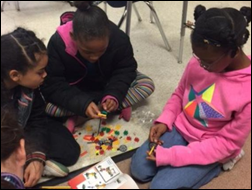
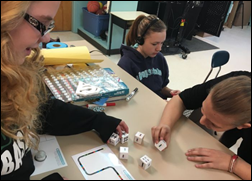
Readers funded the DonorsChoose teacher grant request of Mrs. H in Alabama, who asked for STEM maker kits for her fifth grade class. She reports, “This project has been a lifesaver. My students were so surprised when we received the kits. They were so excited to know they had something that they could actually build by themselves without my instruction. My students are using the K’NEX STEM Education Kits during our science intervention.”

image

The US Military Academy uses a robot to co-teach an ethics philosophy course, feeding Bina48 data about wars and philosophy as well as an instructor’s lesson plan to allow it (her?) to deliver a lecture and answer student questions. The AI developers blocked her access to the Internet fearing that, like many students, she would take the lazy way out and simply regurgitate Wikipedia. She has her own Facebook page and completed a “Philosophy of Love” college class a year ago. Developers patched her rather stern countenance into a smile a couple of months ago.

image

23andMe CEO Anne Wojcicki says one of the company’s biggest competitors is Gwyneth Paltrow’s Goop — which specializes in wacky products that have zero scientific basis — and fake, clickbait news about health that draws in naive eyeballs. She summarizes Goop’s “faux science,” such as anti-vaccine advocacy, as benefitting from Paltrow’s celebrity in a way that the CDC can’t counter with actual facts. Goop paid civil penalties and offered customer refunds to settle a lawsuit over the company’s promotion of a floral blend to prevent depression and jade vaginal eggs to regulate menstrual cycles.

Analysis finds that eliminating the requirement that all Americans carry health insurance and allowing the sale of policies that don’t cover pre-existing conditions have caused a 16 percent jump in premium cost for exchange-based silver plans. 

Wired takes a contrarian view of Silicon Valley’s obsession with disruption in reviewing three books, noting:

  • Technology’s promise to lead us into the future turned out to be all about those companies – taking our personal data, eating up our time and creativity, and invading our homes and cities
  • They promised an open web and individual liberty while trampling on both
  • They created rising inequality, not because it was inevitable, but because they used old-school capitalism in dodging regulation and squashing competition
  • They squeezed labor markets by hiring obedient, flexible, and poorly paid subcontractors and unofficial workers – many of them immigrants – who are not covered by wage and safety protection
  • Venture capitalists make massive profits by arriving late to the party after companies have already taken risks and developed something innovative
  • Much of the hard work of innovation is accomplished using government grants and research for which taxpayers receive nothing
  • Science-based philanthropy rewards causes favored by tech donors who prefer life-extending technologies for themselves rather than a better healthcare system for all

image

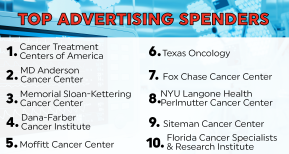
A report by Truth in Advertising titled “Cancer Care: The Deceptive Marketing of Hope” finds that cancer centers have exponentially ramped up their advertising in competing for patients, with 90 percent of them using emotion-tugging but deceptive stories in which outliers who survived high-mortality cancer (at least in the short term) imply that the specific cancer center saved them despite poor odds (example: “statistics mean nothing to believers.”) For-profit chain Cancer Treatment Centers of America leads the advertising pack. Following CTCA’s lead are mostly non-profits, which unlike CTCA, are not subject to Federal Trade Commission actions for deceptive advertising. All advertise clinical trials, immunotherapy, and genomic testing that aren’t always effective and carry their own risks.

image

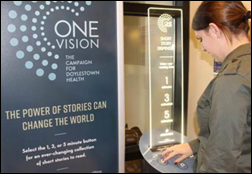
Doylestown Hospital (PA) installs a free short story dispenser in its ED, which gives visitors a short read printed on non-toxic, recycled paper that can help them pass the time. It’s a nice thought, although convincing Americans to look away from their phones or ad-filled TV junk shows to actually read something is a tough sell.


In Case You Missed It


Get Involved


125x125_2nd_Circle

EPtalk by Dr. Jayne 10/25/18

October 25, 2018 Dr. Jayne 2 Comments

clip_image002 

ONC has posted the agenda for its annual meeting to be held November 29-30 in Washington, DC. Day One begins with a welcome from Jared Kushner, director of the White House Office of Innovation, followed by a heynote from HHS Secretary Alex Azar. Breakout sessions will cover international health IT efforts, disaster response, HIEs, APIs, FHIR, and an “Ask the ONC Clinical Team” session. Day Two includes a fireside chat with National Coordinator Don Rucker, MD along with Senators Lamar Alexander and Tammy Baldwin.

Value-based care is the chief buzzword for many healthcare organizations and the Comprehensive Primary Care Plus (CPC+) initiative was touted as a way to end the chicken-or-egg struggle faced by ambulatory organizations as they try to figure out how to pay for better care coordination that will lead to incentives that can help them pay for better care coordination and more comprehensive care. The American Academy of Family Physicians has called on CMS to modify the window between when practices have access to their Performance-Based Incentive Payment reports and when they have to repay incentives plus interest.

The reports were to be available around September 26 with interest starting to accrue on October 18. There’s a 19-month gap between performance and reporting, but the CMS piper expects to be paid within a month. The Medicare Shared Savings Program gives Accountable Care Organizations 90 days to repay shared losses. If the current timeline holds, it’s yet another barrier to practice participation in what is supposed to be a driver towards value-based care.

It’s clear that the focus on quality and value isn’t changing any time soon. CMS is hosting a National Provider Call on October 30 to talk about Physician Compare and the upcoming release of publicly available Quality Payment Program data for 2017. A 30-day preview period will allow providers to review their information before it is posted for all to see. The session will include time for question and answer, so if you’re not sure how to navigate the release of information or what to do if you feel it’s not accurate, I’d recommend attending.

Telemedicine is growing and I’ve considered dipping my toe in the waters as an opportunity to deliver patient care without spending 12- to 14-hour shifts in the trenches. Consumer Reports is bringing a recent Annals of Internal Medicine study to the masses regarding increased antibiotic prescriptions issued during telemedicine encounters. The study suggests that there is an association between the length of the visit and the likelihood of an antibiotic prescription. It looked at 13,000 telemedicine visits performed for patients with respiratory complaints. More than 65 percent of phone encounters resulted in an antibiotic prescription. Unfortunately, the research team didn’t have access to the actual encounter documentation so there was not a solid way to determine whether the antibiotic prescriptions were appropriate.

The article offers good information on being an informed telemedicine patient, and notes that “patients often view a telemedicine encounter as more of a consumer transaction than a healthcare visit … here’s an expectation that they get to call a doctor, pay for the visit, and get a prescription.” The author encourages patients to write down their symptoms first including when they started, which is good information for any patient seeking care.

Physician practice management publications such as Medical Economics are encouraging providers to bill telemedicine codes for their own patients. Close to 30 states have so-called telemedicine parity laws, which require commercial payers to reimburse telemedicine services at the same level as face-to-face visits. There are some nuances to coding, though, and physicians are wise to investigate their payer contracts as well as the requirements for proper coding of phone visits.

Many of the scribes in my practice are applying to medical school or physician assistant programs. Those that know I’ve spent time as an administrator often ask about that career path and opportunities in healthcare should they not be admitted to the program of their choice. Money isn’t everything, but I’m happy to share the trend in hospital executive salaries with them. The study looked at CEO and CFO compensation at 22 non-profit medical centers in the US using the “US News & World Report” hospital honor roll list from 2016-17 along with four notable health systems. The authors looked at the growth of clinical worker wages compared to nonclinical workers and management workers.

The rise in value-based care demands administrators with strong financial and quality management backgrounds, which may be driving increased executive salaries. Operational leaders are also in demand as health systems retool their strategic plans. Still, the authors conclude that “there does not appear to be a proportionate increase in healthcare utilization. These findings suggest a growing, substantial burden of non-clinical tasks in healthcare. Methods to reduce non-clinical work in healthcare may result in important cost savings.” I don’t know of too many physicians who would disagree with that sentiment.

clip_image004

Interesting news for patients who rely on fitness trackers as a tool to assist with their fitness goals. The British Journal of Sports Medicine reports that many trackers aren’t good at measuring energy expenditure. The authors reviewed data from 60 studies looking at 40 trackers worn on the arm or wrist. Devices tended to underestimate energy expenditure, but those that also measured heart rate were more accurate. As an experiment, I used my Garmin watch on the treadmill in “indoor” mode and found that it, too underestimates the mileage my treadmill says I’m logging. The Garmin is accurate in GPS mode when I take it outside for a workout, so it’s still my wearable of choice.

There was quite a bit of buzz in the physician lounge this morning about the FDA approval of Xofluza, which is the first new anti-influenza agent in roughly 20 years. It’s a single dose and can be used to treat patients age 12 and older as long as they’re diagnosed within the first 48 hours of illness, similar to current medications. The wholesale price has been set at $150, but the retail price hasn’t been listed. Genentech makes it and will be offering a coupon for patients with commercial insurance that allows them to purchase it for $30. Now we’ll have to see how quickly EHR teams can get the drug updated for easy prescribing.

How quickly can you get a new drug into your providers’ virtual prescription pad? Leave a comment or email me.

Email Dr. Jayne.
HIStalk Interviews Rachel Marano, Managing Partner, Pivot Point Consulting

October 24, 2018 Interviews Comments Off on HIStalk Interviews Rachel Marano, Managing Partner, Pivot Point Consulting

Rachel Marano is managing partner and co-founder of Pivot Point Consulting of Brentwood, TN.

image

Tell me about yourself and the company.

I’ve spent my entire career in healthcare IT, almost 18 years. I’m a computer science graduate. I started my first job at Cerner, where I learned the healthcare IT industry through the Cerner consulting concept. I eventually moved into the hospital side, going to work for Advocate Health Care to get off the road. I did a good bit of implementation and then worked my way into the Epic space and became a certified consultant for a variety of consulting companies. I did everything from build to project management at the project director level.

I launched Pivot Point Consulting in April 2011 with the intent of continuing in the healthcare IT industry, but as a consulting group and a vendor. I’ve seen multiple angles of the industry — software development, the hospital side, the consulting side, and now as an entrepreneur in the healthcare IT space.

What are the most important things you learned from working with Cerner and Epic and their products?

Their products are achieving the same goal, but have different ways of getting there. Both have strong implementation methodologies. Obviously their philosophies and corporate cultures are different. Cerner’s support model is different from Epic’s. Pivot Point Consulting serves both markets.

I’ve worked on both sides and have seen the advantages of both systems, the integration, and how they play in the industry. My roots are Cerner and I spent a good part of my career in Epic, so I think they are equally important in this industry. They create tremendous value for organizations. Many of our consultants have found themselves in both worlds over the years.

Cerner has made a lot of advances in their interoperability and in the international market, which has given them many additional clients. Epic continues to grow domestically and internationally. Epic has a unique way of managing the implementations — giving feedback, doing progress reporting, and ensuring success in install, implementation, and outcomes — which is different from how Cerner manages its clients. They are different animals, with both achieving the same end goal but with different paths to get there. We’ve seen tremendous success with our clients on both products.

How has hospital and health system consolidation affected the consulting business?

It’s certainly a different landscape when there is a lot of merger and acquisition activity. But by definition, that creates opportunity for migration, implementation, and optimization in consolidating older systems to one standard system. It has created a lot of strategy, advisory, and assessment-level work for us and in the entire industry. We’ve done quite a bit of M&A work in the last few years in helping with pre-planning, organizational IT strategic planning, and infrastructure planning for M&A.

We’re doing a large M&A strategy session right now with an organization in downstate Illinois. They didn’t know how to approach the amount of M&A they will be going after in the next 10 years and how that would affect them operationally, strategically, and financially. We put together roadmaps.

Consolidation has, from a consulting perspective, allowed us to look at the industry differently and to see the future state of where these systems will be. Many of them will be unified, integrated, and on similar platforms instead of best-of-breed. We’re going to see a lot more organizations on one platform where they can transfer data more easily.

Are large health systems in less of a hurry than before to rip and replace the systems of the hospitals they acquire in favor of the corporate standard?

One of our larger clients spent probably $200 million on Epic implementation over the years. They were bought by a much larger organization. Things are integrated between the two systems other than the Epic instances. The large organization is maintaining its existing Epic instance and the smaller organization will maintain its Epic instance. They’re both on Epic, but they are running independently by design.

The sheer cost of starting again, redefining workflow, and standardizing all these things between the two systems almost makes the juice not worth the squeeze after these organizations have spent so much money. Things are working, they’re getting the reporting that they need, they’re compliant, and their workflows and operations are efficient with those instances. It makes great sense for some organizations, less for others. Ultimately cost, resourcing, staffing, and other competing projects all come into play into that decision-making. But for some organizations, once they sign on the M&A dotted line, they’re moving forward and starting with the migration.

What projects are floating to the top of health system lists?

We’re seeing a lot of patient engagement, population health, privacy and security, optimization. A lot of managed services, outsourcing the support of these systems. More organizations are shifting energy away from EHR to ERP. The concentration is now that we have the data, what do we do with it? How are we using those measurements to improve performance, clinical outcomes, return on investment, and cash flow? It’s a much more advanced space.

Almost all of our clients are focused heavily on patient engagement initiatives in one way or another. How patients are interacting with their patient portals and what their experience is like from a technology perspective. Systems are in place, we’re live, software is working. Operations, workflow, and clinical and revenue cycle are functional. Where do we go from here in these Phase 2, 3, and 4 post-live scenarios?

Do health systems know what they want to do with population health and patient engagement or are they looking for direction?

Both. More-tenured organizations that have been on these EHR platforms and have software, analytics platforms, or tools are much further ahead in deciding what their initiative looks like or what it should mean. We have small organizations that haven’t even said the word. They’re looking for our guidance and our advisory around the right moves. What tools should we be working with? What vendors are good in this space? Should we be bringing Healthy Planet live? Should we be doing some type of integration?

Most of our large organizations are already underway and have someone leading the charge with population health in some regard. Some of our smaller organizations that might be a little bit further behind are looking for direction and directive. Some don’t know how to approach it, it’s lower on their list, and they’re still trying  to get their technology in order.

What do CIOs tell you is the hardest part of their job?

I haven’t heard as much about CIO turnover. You’ll see it with M&A, but jobs are also evolving into other areas. Some of our CIOs are more focused on innovation and driving revenue into the IT department where before it was more about creating a specific technology infrastructure.

Their challenges continue to be resourcing. I hear this consistently. How do we continue with additional future-state projects with the existing staff? How do we leverage organizations and potentially managed services or outsourced solutions to maximize our organizational resourcing?

Definitely innovation. We have CIOs who are focused on developing programs internally in their IT departments to drive revenue, to create revenue-generating entities within their organization that can align potentially with their IT shop. Potentially consolidating efforts with other local hospitals, leveraging other IT departments and their resources. We’ve seen a lot of unusual approaches to the post-EHR implementation world in CIO roles and evolving how they play in their organizations.

What are the issues most commonly involved when a health system calls you wanting to replace an incumbent consulting firm?

Typically we find that organizations are unhappy with the relationship, the level of consultant talent, or potentially the level of experience and ability. A lot of times, we’re called on because they’re unhappy with the level of service.

But we also find that organizations are looking for a firm that can do more than just one thing and can cast a wider net of service offerings. The group understands their culture, nuances, and their uniqueness and are able to go in other directions, whether it be at an advisory level, a managerial level, legacy, potentially on revenue cycle or clinical, training, and managed services. We’ve seen a good bit of that and we’ve seen organizations that are looking for companies at a certain KLAS level, where they’ve had vendors that have fluctuated in that KLAS standing. Organizations consistently say they’re looking for vendors within the top 10 in their category and that’s who they stick with.

Our focus is relationships, trusted advisory, strategic connections with our clients, and offering value. Being able to identify a challenge and provide a solution. We can do that at more of a strategic level, but also with staffing. We’re trying to approach it differently. We definitely do staffing, but we’ve always been a firm that has been consultant led and consultant driven. We have a different vision on how we work with clients and how we engage with them.

What are the biggest opportunities and threats for health systems, CIOs, and companies in the next 3-5 years?

Merger and acquisitions. We’re going to see in the next 10 years more and more organizations being consolidated, with fewer and fewer independent organizations. The challenges come with combining facilities, the cost of doing that, and technology integration. That will drive the future of the healthcare market. The continued advancement in the technology itself will also change how we are leveraging data.

Do you have any final thoughts?

Our organization is evolving and certainly has changed over the years. When Pivot Point started, we were focused pretty heavily on Epic and Cerner implementation. At that time, that was where the industry was, and that was the main focus of most organizations. We have changed with the times and evolved with the industry and continue to meet the needs of our clients.

We have cast a wider net into some of these divisions, departments, and areas where we see challenge and opportunity. A lot of that is around that managed services space and assisting clients with post-live initiatives. We’re going to continue to see more organizations putting energies in and around that as well as the strategic and more challenged areas around privacy and security, population health, mobility, and even compliance and infrastructure and technology.

A Machine Learning Primer for Clinicians–Part 2

October 24, 2018 Machine Learning Primer for Clinicians Comments Off on A Machine Learning Primer for Clinicians–Part 2

Alexander Scarlat, MD is a physician and data scientist, board-certified in anesthesiology with a degree in computer sciences. He has a keen interest in machine learning applications in healthcare. He welcomes feedback on this series at drscarlat@gmail.com.

image

To recap from Part 1, the difference between traditional statistical models and ML models is their approach to a problem:

1

We feed Statistics as an Input and some Rules. It provides an Output.

With a ML model, we have two steps:

  • We feed ML an Input and the Output and the ML model learns the Rules. This learning phase is also called training or model fit.
  • Then ML uses these rule to predict the Output.

In an increasing number of fields, we realize that these rules learned by the machine are much better than the rules we humans can come up with.

Supervised vs. Unsupervised Learning

With the above in mind, the difference between supervised and unsupervised is simple.

  • Supervised learning. We know the labels of each input instance. We have the Output (discharged home, $85,300 cost to patient, 12 days in ICU, 18 percent chance of being readmitted within 30 days). Regression to a continuous variable (number) and Classification to two or more classes are the main subcategories of supervised learning.
  • Unsupervised learning. We do not have the Output. Actually, we may have no idea what the Output even looks like. Note that in this case there’s no teacher (in the form of Output) and no rules around to tell the ML model what’s correct and what’s not correct during learning. Clustering, Anomaly Detection, and Primary Component Analysis are the main subcategories of unsupervised learning.
  • Other. Models working in parallel, one on top of another in ensembles, some models supervising other models which in turn are unsupervised, some of these models getting into a  “generative adversarial relationship” with other models (not my terminology). A veritable zoo, an exciting ecosystem of ML model architectures that is growing fast as people experiment with new ideas and existing tools.

2

Supervised Learning – Regression

With regression problems, the Output is continuous — a number such the LOS (number of hours or days the patient was in hospital) or the number of days in ICU, cost to patient, days until next readmission, etc. It is also called regression to continuous arbitrary values.

Let’s take a quick look at the Input (a thorough discussion about how to properly feed data to a baby ML model will follow in one of the next articles).

At this stage, think about the Input as a table. Rows are samples and columns are features.

If we have a single column or feature called Age and the output label is LOS, then it may be either a linear regression or a  polynomial (non-linear) regression.

Linear Regression

Reusing Tom Mitchell definition of a machine learning algorithm:

” A computer program is said to learn from Experience (E) with respect to some class of tasks (T) and performance (P) – IF its performance at tasks in T, as measure by P, improves with experience (E)”

  • The Task is to find the best straight line between the scatter points below – LOS vs. age – so that, in turn, can be used later for prediction of new instances.
  • The Experience is all the X and Y data points we have.
  • The Performance will be measured as the distance between the model prediction and the real value.

The X axis is age, the Y axis is LOS (disregard the scale for the sake of discussion):

3

Monitoring the model learning process, we can see how it approaches the best line with the given data (X and Y) while going through an iterative process. This process will be detailed later in this series:

1

From “Linear Regression the Easier Way,” by Sagar Sharma.  

Polynomial (Non-Linear) Regression

What happens when the relationship between our (single) variable age and output LOS is not linear?

  • The Task is to find the best line — obviously not a straight line — to describe the (non-linear) polynomial relationship between X (Age) and Y (LOS).
  • Experience and Performance stay the same as in the previous example.

4

As above, monitoring the model learning process as it approximates the data (Experience) during the fit process:

5

From “R-english Freakonometrics” by Arthur Carpentier.

Life is a bit more complicated than one feature (age) when predicting LOS, so we’d like see what happens with two features — age and BMI. How do they contribute to LOS when taken together?

  • The Task is to predict the Z axis (vertical) with a set of X and Y (horizontal plane).
  • The Experience. The model now has two features: age and BMI. The output stays the same: LOS.
  • Performance is measured as above.

Find the following peaks chart — a function — similar to the linear line or the polynomial line we found above.

This time the function defines the input as a plane (age on X and BMI on Y) and the output LOS on Z axis.

Knowing a specific age as X and BMI as Y and using such a function / peaks 3D chart, one can predict LOS as Z:

6

A peaks chart usually has a contour chart accompanying, visualizing the relationships between X, Y, and Z (note that besides X and Y, color is considered a dimension, too, Z on a contour chart). The contour chart of the 3D chart above:

7

From the MathWorks manual

How does a 4D problem look?

If we add the time as another dimension to a 3D like the one above, it becomes a 4D chart (disregard the axes and title):

8

From “Doing Magic and Analyzing Time Series with R,” by Peter Laurinec.

Supervised Learning – Classification

When the output is discrete rather than continuous, the problem is one of classification.

Note: classification problems are also called logistic regression. That’s a misnomer and just causes confusion.

  • Binary classification, such as dead or alive.
  • Multi-class classification, such as discharged home, transferred to another facility, discharged to nursing facility, died, etc.

One can take a regression problem such as LOS and make it a classification problem using several buckets or classes: LOS between zero and four days, LOS between five and eight days, LOS greater than nine days, etc.

Binary Classification with Two Variables

  • The Task is to find the best straight line that separates the blue and red dots, the decision boundary between the two classes.
  • The Experience. Given the input of the X and Y coordinate of each dot,  predict the output as the color of the dot — blue or red.
  • Performance is the accuracy of the prediction. Note that just by chance, with no ML involved, the accuracy of guessing is expected to be around 50 percent in this of type of binary classification, as the blue and the red classes are well balanced.

In visualizing the data, it seems there may be a relatively straight line to separate the dots:

8

The model learning iteratively the best separating straight line. This model is linearly constrained when searching for a decision boundary:

9

From “Classification” by Davi Frossard.

Binary Classification with a Non-Linear Separation

A bit more complex dots separation exercise, when the separation line is obviously non-linear.

The Task, Experience, and Performance remain the same:

10

The ML model learning the best decision boundary, while not being constrained to a linear solution:

11

From gfycat.

Multi-Class Classification

Multi-class classification is actually an extension of the simple binary classification. It’s called the “One vs. All” technique. 

Consider three groups: A, B, and C. If we know how to do a Binary classification (see above), then we can calculate probabilities for:

  • A vs. all the others (B and C)
  • B vs. all the others (A and C)
  • C vs. all the others (A and B)

More about Classification models in the next articles.

Binary Classification with Three Variables

While the last example had two variables (X and Y) with one output (color of the dot), the next one has three input variables (X, Y, and Z) and the same output: color of the dot.

  • The Task is to find the best hyperplane shape (also known as rules / function) to separate the blue and red dots.
  • Experience has now three input variables (X, Y, and Z) and one output label (the dot color).
  • Performance remains the same.

 2018-10-24_5-53-08

From Ammon Washburn, data scientist. Click here to see the animated 3D picture.

How can we visualize a problem with 5,000 dimensions?

Unfortunately, we cannot visualize more than 4-5 dimensions. The above 4D chart (3D plus time) on a map with multiple locations — charts running in parallel, over time — I guess that would be considered a 5D visualization, having the geo location as the fifth dimension. One can imagine how difficult it would be to actually visualize, absorb, and digest the information and just monitor such a (limited) 5D problem for a couple of days.

Alas, if it’s difficult for us to visualize and monitor a 5D problem,  how can we expect to learn from each and every experience of such a complex system and improve our performance, in real time, on a prediction task? 

How about a problem with 10,000 features, the task of predicting one out of 467 DRG classifications for a specific patient with an error less than 8 percent? 

In this series, we’ll tackle problems with many features and many dimensions while visualizing additional monitors — the ML learning curves — which in my opinion are as beautiful and informative as the charts above, even as they are only 2D.

Other ML Architectures

On an artsy note, as it is related to the third group of ML models (Other) in my chart above, are models that are not purely supervised or unsupervised.

In 2015, Gatys et al. published a paper on a model that separates style from content in a painting. The generative model learns an artist’s style and then predicts the style effects learned on any arbitrary image. The left upper corner is an image in Europe and then each cell is the same image rendered in one of several famous painters’ styles:

12

Scoff you may, but this week, the first piece of art generated by AI goes for sale at Christie’s.

Generative ML models have been trained to generate text in a Shakespearean style or the Bible style by feeding ML models with all Shakespeare or the whole Bible text. There are initiatives I’ll report about where a ML model learns the style of a physician or group of physicians and then creates admission / discharge notes accordingly. This is the ultimate dream come true for any young and tired physician or resident.

In Closing

I’d like to end this article on a philosophical note.

Humans recently started feeding ML models the actual Linux and Python programming languages (the relevant documentation, manuals, Q&A forums, etc.) 

As expected, the machines started writing computer code on their own. 

The computer software written by machines cannot be compiled nor executed and it will not actually run.

Yet …

I’ll leave you with this intriguing, philosophical, recursive thought in mind — computers writing their own software — until the next article in the series: Unsupervised Learning.

News 10/24/18

October 23, 2018 News 1 Comment

Top News

image

Clearlake Capital Group will acquire provider management, credentialing, and payer enrollment technology vendor Symplr. Terms were not disclosed.

Symplr acquired Cactus Software (provider management) in early 2016 and Vistar Technologies (provider management) in mid-2017.


Reader Comments

From Vaporware?: “Re: Cerner at DoD MHS. The system is not operable, much less interoperable, after 20 months of being live overall and Congress should get to the bottom of it. EHR stabilization is usually measured in low single-digit weeks. Any CIOs willing to compare?” Politico says that a preliminary DoD report concludes that MHS Genesis at Madigan Army Medical Center is “not effective and not suitable” – the same conclusion reached after evaluating the three previous test sites – and adds that the system is “not interoperable.”


Webinars

October 30 (Tuesday) 2:00 ET. “How One Pediatric CIN Aligned Culture, Technology and the Community to Transform Care.” Presenters: Lisa Henderson, executive director, Dayton Children’s Health Partners; Shehzad Saeed, MD, associate chief medical officer, Dayton Children’s Health Partners; Mason Beard, solutions strategy leader, Philips PHM; Gabe Orthous, value-based care consultant, Himformatics. Sponsor: Philips PHM. Dayton Children’s Health Partners, a pediatric clinically integrated network, will describe how it aligned its internal culture, technology partners, and the community around its goal of streamlining care delivery and improving outcomes. Presenters will describe how it recruited network members, negotiated value-based contracts, and implemented a data-driven care management process.

November 7 (Wednesday) 3:00 ET. “Opioid Crisis: What One Health Plan is Doing About It.” Presenter: Samuel DiCapua, DO, chief medical director, New Hampshire Health Families; and chief medical officer, Casenet. Sponsor: Casenet. This webinar will describe how managed care organization NH Health Families is using innovative programs to manage patients who are struggling with addiction and to help prevent opioid abuse.

Previous webinars are on our YouTube channel. Contact Lorre for information.


Acquisitions, Funding, Business, and Stock

image

Kyruus lists its ProviderMatch for Salesforce on the Salesforce AppExchange and announces a $4 million Series D investment by Salesforce Ventures, increasing its total to $76 million.

image

CNBC reports that Silicon Valley-based, VC-backed smart breast pump startup Naya Health —  whose CEO had blamed the company’s sluggish start on the male-dominated VC industry despite what she claimed is a $30 billion market opportunity – has apparently shut down and left customers without support for its $1,000 device amidst complaints from some of its users that it does not work.

The company that was hired to auction the assets of the defunct CareSync asks the court to expedite a $1 million sale to risk adjustment technology vendor Vatica Health, requesting via an emergency motion to finalize any and all bids by November 5. CareSync had raised $49 million before closing abruptly in June 2018.


Sales

image

Island Hospital (WA) replaces its existing electronic signature product with that of Access, integrated with Meditech. 


People

image

Divurgent hires Gary Germaine (Leidos Health) as VP of client services.

image

Mordecai Kramer (Baim Institute for Clinical Research) joins Carevive Systems as VP of data generation and outcomes, life sciences.

SNAGHTML108009c2

Medtronic co-founder Earl Bakken, who created the modern medical technology industry with the company’s introduction of the first implantable pacemaker in 1960, died Saturday at 94. The former electronics repairman founded the company with his brother-in-law, working from a Minneapolis garage to offer hospital equipment repair and TV installation.


Announcements and Implementations

image

Healthcare Growth Partners looks at the vendor “haves and have-nots” from EHR consolidation brought on by high overall market penetration as well as hospitals employing physicians and acquiring practices (HGP estimates that over 50 percent of doctors now work for hospitals). Cerner and Epic are winning the replacement market; specialty EHR vendors are doing well in specialized practice areas not as well served by Epic and Cerner; but Healthland, the former Siemens, the former McKesson Enterprise, and Allscripts Practice Fusion are losing ground as the “have-nots.”

image

Denver Health Epic Data Architect Mark Iannucci publishes Epic UserWeb Search on the Chrome Web Store, which allows search terms prefaced with “uw” to search UserWeb or those starting with “uw sherlock” to find occurrences in Sherlock logs, all while skipping the Galaxy screen (assuming you’re already logged into Epic UserWeb and are using the Chrome browser, of course).

image

Laudio releases its staff relationship management platform that allows hospital managers to manage employee recognition, accountability, burnout risk, onboarding and career development, and work issues. The founder and CEO is industry long-timer Russ Richmond, MD. 


Government and Politics

A White House-proposed rule would not only push “junk” health insurance plans (short-term and association health plans) that potentially contain extensive exclusions, it would also encourage employers to offer healthcare imbursement arrangements that give each employee a fixed dollar amount with which to purchase their own insurance, which the administration acknowledges would reduce the number of insured people. All of the new recommendations would support states offering plans that are not ACA compliant in such areas as pre-existing conditions and lifetime payment limits.


Other

image

A New York Times article provides advice from chronically ill people on how to make best use of the US healthcare system (or more precisely, two ways to do that plus two suggestions for bypassing it in favor of getting informal personal advice).

Researched published in JAMA finds that use of medical crowd-funding campaigns is growing, people often ask for money to obtain treatments that are not evidenced-based or that may be harmful, meaning those who donate are helping line the pockets of practitioners who are delivering questionable care.


Sponsor Updates

  • AdvancedMD will exhibit at the American Academy of Ophthalmology event October 27-30 in Chicago.
  • IDC MarketScape names Arcadia a leader in its assessment of US population health analytics vendors.
  • TMC names Atlantic.Net a 2018 Cloud Computing Security Excellence Award winner.
  • Bluetree will exhibit at the CHIME CIO Leadership Academy 2.0 October 29-30 in San Diego.

Blog Posts


Contacts

Mr. H, Lorre, Jenn, Dr. Jayne.
Get HIStalk updates. Send news or rumors.
Contact us.

125x125_2nd_Circle

Curbside Consult with Dr. Jayne 10/22/18

October 22, 2018 Dr. Jayne 1 Comment

Clinician burnout is at epidemic levels, so I always keep my eye out for scientific papers looking at the issue. A recent paper titled “Implementing Optimal Team-Based Care to Reduce Clinician Burnout” talks about team-based care as a model that “strives to meet patient needs and preferences by actively engaging patients as full participants in their care, while encouraging all health care professionals to function to the full extent of their education, certification, and experience.”

The idea of working at the top of one’s education and licensure is one that I continue to struggle with as I work with physicians who feel that EHRs have turned them into data entry clerks. Although I work with some high-functioning offices, there are far too many where people are doing work that could be done by individuals with less training or experience and at a lower cost. Getting the team composition just right is a challenge, and in the corporate practices I work with, there are barriers such as headcount caps to content with.

I recently worked with a practice that was dealing with a “brick in, brick out” philosophy from their health system HR department. When a highly-paid and long-tenured RN retired, the practice wanted to split her salary and hire three lower-level resources to handle some high-volume office tasks. The hospital-focused HR team would have no part of that strategy, even though it was budget neutral and would benefit the practice, citing various policies and a temporary hiring freeze as barriers. The practice could hire a less-expensive resource to fill her shoes, but then it would lose that salary difference out of their budget for the following fiscal year, hobbling them in a different way.

The practice’s leaders elected to replace the nurse with a similarly-priced resource, which didn’t solve their problem, but preserved their overall budget in hopes that they might be able to make a change in the future if they could get the HR team onboard. It was sad to watch a practice be forced to make bad business decision that reduces their ability to deliver the patient care that needs to be delivered because the corporate structure couldn’t get out of their way.

The paper addresses digital barriers to team-based care, noting that “although EHRs have important advantages in terms of improving continuous access to legible clinical information, they are not optimally designed to support clinical care.” The authors encourage organizations to look at ways to expand the utility of EHRs, including:

  • Examining excessive signature requirements or mandates that physicians must perform certain documentation elements.
  • Accelerating information exchange.
  • Including systems other than EHRs in the discussion of interoperability, including patient health records, registries, etc.
  • Facilitating a learning health system including the use of predictive analytics and artificial intelligence.

They go further to call for CMS to modernize “outdated” documentation guidelines that were created to support billing in the era of paper records. They also suggest that ONC and CMS “could make prescribed medication selection, alternatives, and pricing transparency available to clinical teams at the point of care as a regulatory EHR requirement.”

I’m sure vendors wouldn’t be too thrilled about additional requirements, but as a clinician, I would be thrilled to have that kind of functionality in my EHR. Right now, the only price transparency I have for medications is for the prescriptions we dispense in-house, which are either $10, $20, or $30 at the time of checkout. We don’t make a lot of money on them and we don’t run them through insurance but offer them as a convenience to patients who don’t want to have to stop by the pharmacy on the way home.

The article also looks at workforce barriers, including issues “from the training and mind-set of health care team members to team organization and leadership.” Employee turnover is a challenge for many of the ambulatory organizations I counsel, and usually it’s driven by several factors: inadequate interview and hiring processes, inadequate training, lack of on-the-job mentorship and support, and work/life balance challenges.

Poor interview and hiring processes can lead to mismatched expectations and poor fit with workplace culture. Poor training can lead not only to patient care issues, but to fear and trepidation for employees who feel they’re being asked to perform beyond their comfort zone. When I worked for Big Hospital System, new medical assistants received zero standardized training beyond HIPAA and other compliance trainings. Any clinical training was at the purview of the office manager, who didn’t report to the physicians in the office but rather to a regional administrator. The result was a staff that didn’t always know what they should know to be successful, which led to physician distrust and reluctance to allow them to handle even basic clinical tasks such as taking a blood pressure.

At my current practice, clinical support staff are put through a rigorous training program including clinical terminology, procedures, organizational culture, patient communication, and more. They are then scheduled a certain number of “training shifts” with a clinical leader, where they must complete their procedure logs and document their clinical tasks. These training shifts are added on to a practice’s regular staffing. Although they are training on the job, they’re not expected to immediately fill a standard scheduled position – they are there to learn.

We lose some folks along the way with this rigorous training. Mostly people who realize that our staff really do work at the top of their licenses and who aren’t on board with working as independently as we allow our staff or doing the procedures we expect our staff to perform on a daily basis. I’d rather lose them in training, though, rather than a month or two in.

Once training is complete, each employee is assigned to a “core team” of employees for the purposes of communication, mentoring, and ongoing training. This core team may or may not include people they work with regularly, which gives them the opportunity to have a sounding board about situations which may have happened in the clinic or with other employees. It also provides accountability for ongoing training and mentorship opportunities.

Lack of work/life balance certainly contributes to burnout, not only among physicians, but among all clinicians. I’ve worked with practices where employees can only request a certain number of days off each month regardless of how much vacation they have in their bank. I spoke to one nurse recently who was working during a family wedding because his son also had religious confirmation that month and he was only allowed to “protect” one weekend.

Although I realize the need to balance schedule coverage, this doesn’t build loyalty or allow team members to meet their personal needs. This employee made no secret of the fact that he’s interviewing for a position in telemedicine, where he can work more flexible schedules. Employers need to be in tune with the needs of the current workforce, especially in fields where there are shortages and competition among employers to be the workplace of choice.

The paper closes by noting that our “current payment system is not designed to offset the costs associated with forming, training, and sustaining clinical teams.” Because these tasks are often considered soft skills, organizations often give them less attention than hard-data items like patient volume, patient satisfaction scores, and clinical quality metrics. The money spent on building high-functioning teams is well worth it, but comes at a cost that might derive from a chicken-or-egg finance equation. Programs like the Comprehensive Primary Care Plus initiative are designed to provide this money up front, but only time will tell if that approach is as successful as we hope.

What is your organization doing to foster team-based care? What are they doing to unwittingly sabotage it? Leave a comment or email me.

Email Dr. Jayne.

Monday Morning Update 10/22/18

October 21, 2018 News 2 Comments

Top News

image image

Stat reports that Deborah DiSanzo, general manager of IBM Watson Health for the past three years, will leave her role.

DiSanzo will be replaced by SVP John Kelly III, PhD, who wrote a defense of Watson Health in an August 2018 blog post in which he refuted an unflattering article by The Wall Street Journal.

DiSanzo will take a demotion to the strategy team of IBM Cognitive Solutions.

IBM announced last week that earnings from its cognitive offerings were down 6 percent year over year, although it said Watson Health is growing.


Reader Comments

image

From Vaporware?: “Re: VA’s Cerner contract. Kudos to them for transparency in listing what they bought, but it looks like they and the VA will be running different systems. Also, DoD didn’t purchase CommonWell even though 60 percent of care happens outside MHS.” The VA’s list of which Cerner systems it and the DoD bought in their respective contracts reveals quite a few differences, some of them understandable due to the types of services offered. DoD skipped quite a few modules that while not useful in battlefield hospitals, would seem to have a place in the dependent care that makes up much of its volume. The DoD passed on modules for cardiology, gastroenterology, CommonWell, most of population health management, integrated radiology dictation, and all transaction services except for automated messaging. I didn’t realize that CommonWell is something you have to buy as an upfront cost, although its documentation says that health IT vendors may charge “commodity-like” fees. Cerner previously pledged not to charge users until at least through the end of 2019.


HIStalk Announcements and Requests

image

Most of us might make our living advocating medical standardization, use of technology, and applying patient care experience to our own situation, but poll respondents don’t find those to be positives when choosing our own doctor, instead valuing participative decision-making. Debtor concludes, “Here is the problem with the concept of socialized medicine in the United States. Even among an informed group, we put personal patient ‘concerns’ and ‘decisions’ ahead of evidence-based guidelines and vetted treatment protocols. I fully support your right to have concerns and make decisions about your own health,  but I’d prefer not to pay for them if they’re not supported by science.” Matt says, “We get a ton of policy push in healthcare, which we’ve seen create its own echo-chamber to the detriment (in some very real cases) of beneficial practice. It runs its course until the downstream consequences create push back and the the policy is pulled back, which creates a difficult environment for real and helpful innovation.”

New poll to your right or here: where do you keep locally stored copies of your medical information?

SNAGHTML56bf64c

Only 20 percent of providers are using biometric patient identification, with most of the remaining 80 percent saying either there’s no business case for it or because they haven’t really thought about it. They aren’t really worried about patient perception or hacker concerns. Industry Analyst Supporter of Biometrics approves “perception deception” in using phones as the biometric reader, adding, “Most folks don’t blink about their biometrics being the vehicle to access their iPads and phones, but feel that their privacy and security regulated healthcare provider asking is too invasive.” Ed A warns of potential lawsuits for providers that fail to follow laws like the Illinois Biometric Privacy Act that require obtaining patient consent and following requirements for biometric use and retention. XCIO’s health system employer biometrically verifies identity in registration areas to reduce duplicate records, insurance fraud, and inaccurate patient billing. 


Webinars

October 30 (Tuesday) 2:00 ET. “How One Pediatric CIN Aligned Culture, Technology and the Community to Transform Care.” Presenters: Lisa Henderson, executive director, Dayton Children’s Health Partners; Shehzad Saeed, MD, associate chief medical officer, Dayton Children’s Health Partners; Mason Beard, solutions strategy leader, Philips PHM; Gabe Orthous, value-based care consultant, Himformatics. Sponsor: Philips PHM. Dayton Children’s Health Partners, a pediatric clinically integrated network, will describe how it aligned its internal culture, technology partners, and the community around its goal of streamlining care delivery and improving outcomes. Presenters will describe how it recruited network members, negotiated value-based contracts, and implemented a data-driven care management process.

November 7 (Wednesday) 3:00 ET. “Opioid Crisis: What One Health Plan is Doing About It.” Presenter: Samuel DiCapua, DO, chief medical director, New Hampshire Health Families; and chief medical officer, Casenet. Sponsor: Casenet. This webinar will describe how managed care organization NH Health Families is using innovative programs to manage patients who are struggling with addiction and to help prevent opioid abuse.

Previous webinars are on our YouTube channel. Contact Lorre for information.


Decisions

  • Lavaca Medical Center (TX) went live on Cerner in April 2018
  • Pershing Memorial Hospital (MO) will go live on Cerner in June 2019
  • Kennedy Health System (NJ) will replace Cerner with Epic in 2019
  • Hutchinson Health Hospital (MN) will replace Microsoft Dynamics GP with Infor for financial and supply chain management in October 2018

These provider-reported updates are supplied by Definitive Healthcare, which offers a free trial of its powerful intelligence on hospitals, physicians, and healthcare providers.


People

image

GetWellNetwork hires Sameer Siraj (Optum) as chief product officer.


Announcements and Implementations

A new Black Book report on HIM-related technologies names these winners:

  • Nuance (end-to-end coding, clinical documentation improvement, and health information management solutions in both inpatient and ambulatory settings; CDI software)
  • Optum360 (coding and CAC outsourcing)
  • MModal (document capture and transcription)
  • 3M (coding consulting, document imaging)
  • Dolbey (medical speech recognition)
  • Revspring (patient communications and financial satisfaction)
  • Recondo (patient identification and tracking)

Other

Patients who are involved in “non-emergent” ED visits exhibit the same symptoms as ED-appropriate visits 88 percent of the time, an analysis concludes, so it’s probably not reasonable for insurers to demand that patients make an accurate ED-or-not decision. One in six ED visits could be avoided by warning patients that their insurance won’t pay for a non-emergent visits, but such a policy would also discourage the 40 percent of those patients who have ED-appropriate symptoms from going there.

A study finds that hospitals accredited by Joint Commission deliver no better patient outcomes than those certified by other private groups, while hospitals with only a state survey accreditation perform just as well as any of them.


Sponsor Updates

  • Lightbeam Health Solutions publishes a new white paper, “Data-Driven Solutions Providers and Payers Need for Value-Based Care Alignment.”
  • LiveProcess will exhibit at the Health Care Association of New Jersey event October 23-25 in Atlantic City.
  • Meditech releases a new video, “Palo Pinto Mobile Clinic Uses Meditech Ambulatory to Bridge Care Gaps.”
  • Clinical Computer Systems, developer of the Obix Perinatal Data System, will exhibit at the HMHB Annual Meeting & Conference October 22-23 in Atlanta.
  • OmniSys will exhibit at the McKesson Pharmacy Systems Chain & Health System User Conference October 23-24 in Pittsburgh.
  • The SSI Group will exhibit at the MAPAM Annual Fall Conference October 22-23 in South Yarmouth, MA.
  • Surescripts and ZeOmega will exhibit at the 2018 CAHP Annual Conference October 22-24 in San Diego.

Blog Posts


Contacts

Mr. H, Lorre, Jenn, Dr. Jayne.

Get HIStalk updates. Send news or rumors.
Contact us.

125x125_2nd_Circle

Weekender 10/19/18

October 19, 2018 Weekender Comments Off on Weekender 10/19/18

weekender


Weekly News Recap

  • FDA updates draft guidance on managing cybersecurity issues for the premarket submission of medical devices
  • Digital prescription savings company OptimizeRx acquires interactive patient messaging vendor CareSpeak Communications
  • MIT will spend $1 billion to create an artificial intelligence college
  • Varian Medical acquires Noona Healthcare, whose software captures oncology patient-reported outcomes and supports symptom management
  • Pathology image detection support system vendor Deep Lens announces $3.2 million in seed funding and availability of its free VIPER service for pathologists
  • A judge rejects a bid by former Theranos executives Elizabeth Holmes and Ramesh Balwani to block prosecutors from extending their investigation deeper into the company

Best Reader Comments

The only way to improve things is to get [users]to open up about what’s on their mind. What you get is like an archeological dig where you are sifting and sorting, trying to find the treasures scattered amidst the dirt and rocks. (Brian Too)

I really wish folks would stop referring to the US healthcare “system.” We have a healthcare industry, not a system (unless you’re talking about Medicare or the VA), with competing entities looking for market share. Competitors don’t share information. Also, with the emphasis on reimbursement, preventive care (and pharmaceutical cures vs. treatments) take a back seat. (Kermit)
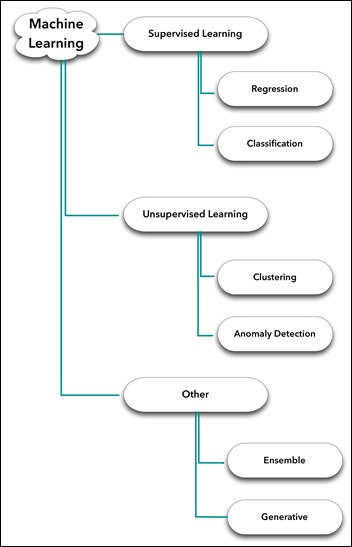


Watercooler Talk Tidbits

image image

Readers funded the DonorsChoose teacher grant request of Mr. V in rural Maine, who requested programmable robots for his student-driven coding class for grades 6-8. He reports, “The robotics and coding materials that you have allowed us to acquire have opened many new avenues for my students. Students have been able to try their hands at coding, program design, and problem solving. This project has offered students who struggle in other content areas like reading by offering them a chance to view reading in an entirely new light. The simplicity of the coding commands in combination with the ability to see their work in action has proven to be very successful in engaging a broad array of students. These materials have allowed students who have struggled in other aspects of their learning to become leaders.”

Epic tells Wisconsin utility regulators that its expected peak demand usage of electricity will double in the next 10 years, placing the company among the state’s top electricity users that are otherwise mostly manufacturing plants. That’s in addition to its extensive use of solar, wind, and geothermal energy.

image

A hospital in England installs wall-mounted buttons near its doors that can be pushed by people who notice someone smoking their despite clearly visible “no smoking” signs. The buttons trigger the playing of a recorded announcement over a loudspeaker, with a child’s voice asking them nicely to stop using terms such as, “Someone’s mummy or daddy could be having their treatment today.” A pro-smoking group (who knew?) calls the system “Orwellian” and says a better idea would be to move the smoking area further away, but not so far that less-mobile smokers can’t reach it easily. That sounds great on paper, but as many of us have observed first hand, is a lot harder than it sounds, especially evenings and nights when patients, visitors, and employees are illuminated only by the glow of their cigarettes as darkness encourages them to choose personal convenience over posted rules. I was interested that the BBC announcement referred to “tannoy,” which is apparently like Kleenex having turned a company name (in this case, a loudspeaker manufacturer) into a common noun.

An Atlanta radiologist who made a fortune from his medical device patents is sentenced to six months in prison for a $2 million tax fraud scheme in which he claimed to be a minister who had taken a vow of poverty. Michael Jon Kell, MD made up a church, named himself as pastor, and placed all his assets in church accounts from which he funded vacations, private school tuition for his kids, online dating services, and ownership of his lavish mansion.

In England, the BBC notes that Member of Parliament Dan Poulter is working 28 hours per week at a side job – in his case, as a doctor taking psychiatric training – than any other member. The article also notes that his voting record is among the lowest of Conservative members.

A shoeshine man who worked from the halls of UPMC Children’s Hospital of Pittsburgh died this week at 76, having donated all of his tips since 1982 – over $200,000 — to the hospital’s Free Care Fund.


In Case You Missed It


Get Involved


125x125_2nd_Circle

A Machine Learning Primer for Clinicians–Part 1

Alexander Scarlat, MD is a physician and data scientist, board-certified in anesthesiology with a degree in computer sciences. He has a keen interest in machine learning applications in healthcare. He welcomes feedback on this series at drscarlat@gmail.com.

image

AI State of the Art in 2018

Near human or super-human performance:

  • Image classification
  • Speech recognition
  • Handwriting transcription
  • Machine translation
  • Text-to-speech conversion
  • Autonomous driving
  • Digital assistants capable of conversation
  • Go and chess games
  • Music, picture, and text generation

Considering all the above — AI/ML (machine learning), predictive analytics, computer vision, text and speech analysis — you may wonder:

How can a machine possibly learn?!

As a physician with a degree in CS and curious about ML, I took the ML Stanford/Coursera course by Andrew Ng. It was a painful, but at the same time an immensely pleasurable educational experience. Painful because of the non-trivial math involved. Immensely pleasurable because I’ve finally understood how a machine actually learns.

If you are a clinician who is interested in AI / ML but short on math / programming skills or time, I will try to clarify in a series of short articles — under the gracious auspices of HIStalk — what I have learned from my short personal journey in ML. You can check some of my ML projects here.

I promise that no math or programming are required.

Rules-Based Systems

The ancient predecessors of ML are rules-based systems. They are easy to explain to humans:

  • IF the blood pressure is between normal and normal +/- 25 percent
  • AND the heart rate is between normal and normal + 27 percent
  • AND the urinary output is between normal and normal – 43 percent
  • AND / OR etc.
  • THEN consider septic shock as part of the differential diagnosis.

The problem with these systems is that they are time-consuming, error-prone, difficult and expensive to build and test, and do not perform well in real life.

Rules-based systems also do not adapt to new situations that the model has never seen.

Even when rules-based systems predict something, it is based on a human-derived rule, on a human’s (limited?) understanding of the problem and how well that human represented the restrictions in the rules-based system.

One can argue about the statistical validation that is behind each and every parameter in the above short example rule. You can imagine what will happen with a truly big, complex system with thousands or millions of rules.

Rules-based systems are founded on a delicate and very brittle process that doesn’t scale well to complex medical problems.

ML Definitions

Two definitions of machine learning are widely used:

  • “The field of study that gives computers the ability to learn without being explicitly programmed.” (Arthur Samuel).
  • “A computer program is said to learn from experience (E) with respect to some class of tasks (T) and performance measure (P) — IF its performance at tasks in T, as measured by P, improves with experience E.” (Tom Mitchell).

Rules-based systems, therefore are by definition NOT an ML model. They are explicitly programmed according to some fixed, hard-wired set of finite rules

With any model, ML or not ML, or any other common sense approach to a task, one MUST measure the model performance. How good are the model predictions when compared to real life? The distance between the model predictions and the real-life data is being measured with a metric, such as accuracy or mean-squared error.

A true ML model MUST learn with each and every new experience and improve its performance with each learning step while using an optimization and loss function to calibrate its own model weights. Monitoring and fine-tuning the learning process is an important part of training a ML algorithm.

What’s the Difference Between ML and Statistics?

While ML and statistics share a similar background and use similar terms and basic methods like accuracy, precision, recall, etc., there is a heated debate about the differences between the two. The best answer I found is the one in Francois Chollet’s excellent book “Deep Learning with Python.”

Imagine Data going into a black box, which uses Rules (classical statistical programming) and then predicts Answers:

clip_image002

One provides Statistics, the Data, and the Rules. Statistics will predict the Answers.

ML takes a different approach:

clip_image004

One provides ML, the Data, and the Answers. ML will return the Rules learned.

The last figure depicts only the training / learning phase of ML known as FIT – the model fits to the experiences learned – while learning the Rules.

Then one can use these machine learned Rules with new Data, never seen by the model before, to PREDICT Answers.

Fit / Predict are the basics of a ML model life cycle: the model learns (or train / fit) and then it predicts on new Data.

Why is ML Better than Traditional Statistics for Some Tasks?

There are numerous examples where there are no statistical models available: on-line multi-lingual translation, voice recognition, or identifying melanoma in a series of photos better than a group of dermatologists. All are ML-based models, with some theoretical foundations in Statistics.

ML has a higher capacity to represent complex, multi-dimensional problems. A model, be it statistical or ML, has inherent, limited, problem-representation capabilities. Think about predicting inpatient mortality based on only one parameter, such as age. Such a model will quickly achieve a certain performance ceiling it cannot possibly overpass, as it is limited in its capabilities to represent the true complexity involved in this type of prediction. The mortality prediction problem is much more complicated than considering only age.

On the other hand, a model that takes into consideration 10,000 parameters when predicting mortality (diagnosis at admission, procedures, lab, imaging, pathology results, medications, consultations, etc.) has a theoretically much higher capacity to better represent the problem complexity, the numerous interrelations that may exist within the data, non-linear, complex relation and such. ML deals with multivariate, multi-dimensional complex issues better than statistics.

ML model predictions are not bound by the human understanding of a problem or the human decision to use a specific model in a specific situation. One can test 20 ML models with thousands of dimensions each on the same problem and pick the top five to create an ensemble of models. Using this architecture allows several mediocre-performing models to achieve a genius level just by combining their individual, non-stellar predictions. While it will be difficult for a human to understand the reasoning of such an ensemble of models, it may still outperform and beat humans by a large margin. Statistics was never meant to deal with this kind of challenge.

Statistical models do not scale well to the billions of rows of data currently available and used for analysis.

Statistical models can’t work when there are no Rules. ML models can – it’s called unsupervised learning. For example, segment a patient population into five groups. Which groups, you may ask? What are their specifications (a.k.a. Rules)? ML magic: even as we don’t know the specs of these five groups, an algorithm can still segment the patient population and then tell us about these five groups’ specs.

Why the Recent Increased Interest in AI/ML?

The recent increased interest in AI/ML is attributed to several factors:

  • Improved algorithms derived from the last decade progress in the math foundations of ML
  • Better hardware, specifically designed for ML needs, based on the video gaming industry GPU (graphic processor unit)
  • Huge quantity of data available as a playground for nascent data scientists
  • Capability to transfer learning and reuse models trained by others for different purposes
  • Most importantly,  having all the above as free, open source while being supported by a great users’ community

Articles Structure

I plan this structure for upcoming articles in this series:

  • The task or problem to solve
  • Model(s) usually employed for this type of problem
  • How the model learns (fit) and predicts
  • A baseline, sanity check metric against which model is trying to improve
  • Model(s) performance on task
  • Applications in medicine, existing and tentative speculations on how the model can be applied in medicine

In Upcoming Articles

  • Supervised vs. unsupervised ML
  • How to prep the data before feeding the model
  • Anatomy of a ML algorithm
  • How a machine actually learns
  • Controlling the learning process
  • Measuring a ML model performance
  • Regression to arbitrary values with single and multiple variables (e.g. LOS, costs)
  • Classification to binary classes (yes/no) and to multiple classes (discharged home, discharged to rehab, died in hospital, transferred to ICU, etc.
  • Anomaly detection: multiple parameters, each one may be within normal range (temperature, saturation, heart rate, lactic acid, leucocytes, urinary output, etc.) , but taken together, a certain combination may be detected as abnormal – predict patients in risk of deterioration vs. those ready for discharge
  • Recommender system: next clinical step (lab, imaging, med, procedure) to consider in order to reach the best outcome (LOS, mortality, costs, readmission rate)
  • Computer vision: melanoma detection in photos, lung cancer / pneumonia detection in chest X-ray and CT scan images, and histopathology slides classification to diagnosis
  • Time sequence classification and prediction – predicting mortality or LOS hourly, with a model that considers the order of the sequence of events, not just the events themselves

HIStalk Interviews Rizwan Koita, CEO, CitiusTech

October 17, 2018 Interviews Comments Off on HIStalk Interviews Rizwan Koita, CEO, CitiusTech

Rizwan Koita is CEO of CitiusTech of Princeton, NJ.

image

Tell me about yourself and the company.

I’m the founder and chief executive officer of CitiusTech. We founded the company in 2005. This is my second company — I started a tech support company. Before that, I spent about five years with McKinsey & Company.

When you and I spoke last in 2015, CitiusTech was about 1,600 or 1,700 people strong. We are now at 3,200 people. It’s been a fairly strong growth year this past year and over the last few years. We do a whole bunch of stuff in healthcare technology for our customers across what we call the Clinical Value Chain.

What is driving the company’s strong growth?

From the revenue perspective, we are now part of the Healthcare Informatics Top 100. Our revenue was $127 million last year and are on track for close to $150 million this year. We also made a strategic investment in a company called FluidEdge Consulting, which is at about $25 to $30 million. We are hoping that, on a consolidated basis, we will end this year with revenue of about $175 million. As you can see, that’s a very significant jump from where we were last year.

The growth of the company is essentially coming in a couple of areas. We do a lot of work with payer organizations in the US market. We do a lot of work with provider organizations. Both of those markets have accepted CitiusTech solutions and our services very nicely. We also work with some of the medical software and technology companies and support their growth. That business is actually doing quite well. It’s a fairly homogeneous growth across our offering with providers and tech companies as well as with payer organizations. To a smaller extent, we work with pharma organizations as well.

There is a tremendous shift toward data management, a tremendous shift toward analytics, and now a significant shift toward data science and machine learning. We at CitiusTech have a significant amount of expertise in these areas. We’ve been able to do value-added work for our customers.

How will artificial intelligence and machine learning affect healthcare in the next five to 10 years?

I’m going to talk about history a little bit. Ten years back, the emphasis was on deploying what I would call foundational applications, such EMRs, health information exchanges, and connectivity software. A lot of big problems in data integration still remain and are getting solved. Steadily the focus of the industry has moved towards, what do we do with all the patient data, clinical data, financial data, and operational data that is getting generated? What’s the best way to manage that data? That could be on-premise, cloud, or a more traditional enterprise data warehouse versus big data solutions.

After the data management problem starts to get solved, the next logical question is, how do we start to use more analytics? Increasingly there is a lot of focus on what I would call the standard analytics, like regulatory reporting and and Level 1 analytics. But as the industry is maturing, we see a tremendous focus towards a slightly more advanced analytics. How do you take this massive amount of data that is now getting captured — EMR, lab, pharmacy, or claims — and put it together to be able to solve more complex problems? These are often not possible to solve using traditional analytics, But some large healthcare entities are using machine learning and AI tools to use that information to drive their problem solving.

If you look at the market, there are a lot of smaller proofs of concept and very interesting pilots going on. But the number of real-life deployed applications at scale is still small. You have lots of tools and utilities, but a small number are actually being used for inpatient care at scale. We are trying to help our customers solve that problem.

There is a dichotomy between what’s happening in pilots, research, or academic settings but little of it in production. In the next five to 10 years, we are going to see a tremendous number of successful models getting deployed in the real world for improving patient care, improving efficiency, and reducing cost, all of which are critical for healthcare.

Will use of AI and machine learning create a competitive advantage for health systems that deploy them more quickly or skillfully?

There will be a clear stratification of the types of organizations that can use machine learning and AI. At a simple level, if you take the provider market and hospital systems, a very large entity — Mayo Clinic, Cleveland Clinic, New York Presbyterian, Baylor Scott & White, and other large health systems — will be able to gather that information, and for research purposes or otherwise, build and create their own models.

The bulk of the healthcare ecosystem will largely be dependent on the vendor community to facilitate the use of such advanced tools. If I had to fast-forward five to 10 years, I would say that a lot of the deployment of these tools will be driven by the vendor community — EMR vendors, medical imaging vendors, lab services companies, or some of the other guys who have the financial, intellectual, and technical horsepower. They can aggregate large data sets, build models, and then test those models and get them through the FDA approval process and other barriers that are required before deploying these models in the real world. I see a greater likelihood of that happening. Some of the very large health systems also have a strong R&D inclination and have the ability to drive innovation, but that would be much harder for mid-tier and small hospital systems.

Thousands of models are being created today in healthcare using machine learning and AI. These models can be created in hospital research centers, academic institutions, or by five guys in a garage who have deep clinical insight. If you look at thousands of these models and then look on the production side, you find that the number of real-life applications in production is low.

The reason for that is that customers are getting bombarded by a lot of models — created internally or externally — but they don’t necessarily have the skills required for model validation. Imagine that I’m a large medical imaging company. Tons of folks are coming to me and saying they have great algorithms for medical imaging. I as a medical imaging company must have the horsepower to be able to put together a team that can independently take clinical data, run it through the models, validate the efficacy of the models, and fine-tune the models before I can validate whether the model is effective or not. Model validation is a huge pain area for the industry.

The second area is model operationalization. If you have a validated model, the task of integrating it with the clinical workflow is reasonably complex. Say, for example, that I have a model in medical imaging. Knowing that it’s a validated model, I still must be able to incorporate that model into the workflow of a radiologist. If it’s a colon cancer detection algorithm, then the characteristics of the colon cancer patient’s image needs to then fire up this AI or machine learning algorithm. The algorithm should be able to give back a response that is clearly visible to that radiologist or specialist who is looking at the colon cancer image. The radiologist should be able to either accept or reject the proposition or the findings of the machine, the AI algorithm. Once they accept it, that information should get fed back into the algorithm to incrementally optimize and enhance the algorithm. The result should be presented back as part of the report or to the patient or what have you.

It requires a certain degree of engineering effort to incorporate the model into the clinical workflow in addition to meeting the data science capability. To operationalize the model, you need a bundle of different skill sets — data sciences, product development, QA and validations, and perhaps FDA certification.

We find that technology companies and hospital systems that are trying to operationalize their data science models often don’t have that blend of capabilities that is required for them to truly operationalize the model. We end up with a scenario in which there are a lot of pilot models, the number of models that are validated are fewer, and the number of models that are operationalized is really, really small. Obviously these things will change in the next five years, so we’re at a very exciting juncture, but it will require a serious level of thought on the part of the stakeholders to be able to actually achieve the validation operationalization, which is one of CitiusTech’s core value-add to our customers.

Do you have any final thoughts?

Our company is on an interesting trajectory where are helping our customers drive innovation in healthcare. We are also seeing tremendous growth from a business perspective. I’m really excited about the kind of work that we are doing for the segments that I described. We are setting up a very strong advisory board that we will announce in the next two or three weeks. We’re doing other things to drive the growth of the company both organically and inorganically, actively engaging with other companies that may have complementary skills and solutions to ours. I’m really excited about the growth part of the company and looking forward to the next five years.

Text Ads


RECENT COMMENTS

  1. Re: Deliberately Faked Academic Papers in Nature See, this doesn't surprise me at all. Of course AI quotes these bogus…

  2. Challenger exploded on lift-off when the O-rings failed. Columbia disintegrated on reentry after one of the heat shield tiles were…

Founding Sponsors


Platinum Sponsors


Gold Sponsors


RSS Webinars

  • An error has occurred, which probably means the feed is down. Try again later.