Recent Articles:

Monday Morning Update 1/11/10

January 9, 2010 News 7 Comments

haiku

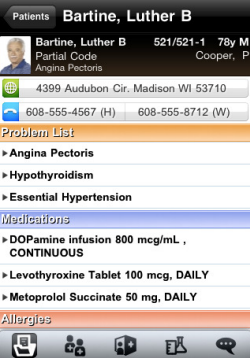
From Situation: “Re: little Epic app. Haiku available now. Get it from iTunes.” I like that it even has tallman lettering on the drug names. The one mention I found says users need a Haiku license and Epic Summer 2009. It works on the iPhone and iPod Touch.

submit

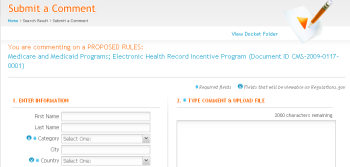
From Colleen: “Re: Meaningful Use. Looks like the comment period has opened.” It sure does, even though ONCHIT just told be it would be Wednesday. You can submit comments electronically on the Meaningful Use criteria. The link to the larger reimbursement document isn’t working yet.

From SniffSniff: “Re: RHIOs. I’m working with RHIOs in various locations. A large vendor is not playing nice — won’t share data, won’t participate, and is pushing its hospitals to not be part of the health exchange. It’s apparently coming from the top. Yep, you guessed it — Epic. I’m going to the client in two weeks to explain this and advise them against the EHR, solely based on this reason.”

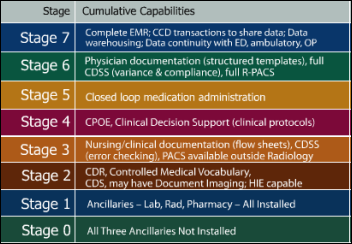
From Proust: “Re: HIMSS Analytics Stage 7. University of Wisconsin Hospital and Clinics got its designation on January 7, another Epic facility.” Do you suppose its outcomes and costs showed improvement and are superior to its lesser-staged competitors? My guess: no.

 ct

Ingenix will announce that it will offer interest-free loans to practices who buy its CareTracker PM/EMR. In addition to guaranteeing that CareTracker will meet meaningful use technical requirements, Ingenix says it will also help providers qualify for CMS incentive payments. Here’s their best pitch, though: the Web-based CareTracker EHR costs only $23,500 over five years, less than the ARRA reimbursement of $44,000 over five years.

Revenue cycle management vendor Origin Healthcare Solutions of Windsor, CT announces that Technology Crossover Ventures has made a “significant growth equity investment” in the company.

US CTO Aneesh Chopra, speaking at the CES show in Las Vegas, emphasizes healthcare IT:

“We don’t have a lot of innovation yet about how consumers can communicate with our electronic health record systems and smart meters and frankly education technology. We need more innovation. If you ask how many people receive an electronic record of their health information after they visit a physician or a hospital… I would be shocked if it was more than five percent. It’s probably more like two percent. That’s one of the provisions we’re calling for — the ability of patients to get records within 48 hours of their request. We should have a fairly open standard that will allow entrepreneurs to make that a low-cost product that physicians and hospitals could acquire.”

I’m not sure anything about HITECH encourages innovation, low-cost products, or entrepreneurs, but that’s what he said.

Listening: reader-recommend Hey Marseilles, an unsigned Seattle indie folk/pop band with orchestral backing. They’re good, reminding me a little of R.E.M.

medstracker

Myrtue Medical Center (IA) chooses MedsTracker Enterprise Medication Reconciliation from Design Clinicals, which the hospital’s CEO says will increase patient safety while qualifying it for ARRA funding.

poll010910 

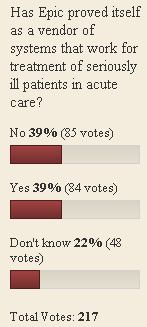
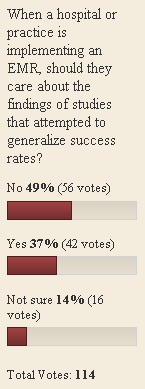
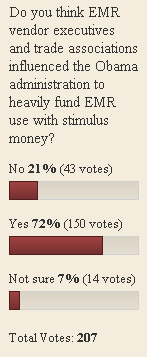
Above are your responses to my last poll on the proposed Meaningful Use criteria. New poll to your right: if providers meet the Meaningful Use criteria, will the average patient benefit?

Ninety-four of the 100 University of Missouri Health Center IT employees who were offered a chance to transition to the Tiger Institute the hospital created with Cerner take the offer, with six passing. Those 94 are now Cerner employees, bringing their seniority along and keeping their current salaries plus $1,000. Some of them think that’s unfair given that they are now Cerner employees working for state employee wages. “We have a ton of experience, so we don’t want young whippersnappers coming in making $10,000 or $15,000 more than we are.” Did he really say “whippersnappers?” I’d bet the number left in a year is a good deal less than 94.

Elsevier acquires NurseSquared, which offers an EHR simulation product for nurse training.

Christopher Thompson MD, chief medical officer of ED documentation system vendor Touch Medix, is sentenced to five years in prison for his role in a road rage incident involving bicyclists.

An Arkansas county jail will make prisoners responsible for paying a co-pay for medical treatments and prescriptions. The ordinance was approved by justices of the peace, who also passed a “pay for stay” ordinance that bills convicted prisoners for their room, board, and transportation to and from jail.

Royal Victoria Hospital in Barrie, ON launches its TELUS Sourcing Solutions HR systems as it begins recruitment for over 1,000 new employees to staff its expansion.

SAIC gets up to $14 million over five years to support the VA’s blood bank software.

Wales announces The Welsh Clinical Portal.

Odd lawsuit: a man trying to determine if his surgeon made mistakes sues University Community Hospital (FL) when the hospital tells him the search through decades of paper information will cost him more than $1 million. The hospital explained that its employees would have to manually search patient charts and redact privacy-related information. The lawsuit demands that the hospital prove its actual cost of producing the records.

E-mail me.

Healthcare IT from the Investor’s Chair 1/8/10

January 8, 2010 News 4 Comments

Ask the Chair


All these HCIT companies have been issuing press releases lately informing us that they are going to present at the 28th annual J.P. Morgan Healthcare Conference. What is that and should I even care?

The J.P. Morgan Healthcare Conference is the biggest healthcare-focused investor conference of the year.

Now, almost all the large and middle market banks have conferences for their institutional investing clients to meet with public companies, hear their pitches, chat with management, and hobnob in general. While most of them are sector-specific (be it healthcare, gambling — which is probably a fun conference, energy, consumer goods, etc). J.P. Morgan is truly the mother of all healthcare investing conferences.

Formerly known as the H&Q Conference until JPM acquired Hambrecht and Quist, the conference is held every January in San Francisco (home of H&Q), by tradition at the Westin St. Francis in Union Square. All next week, CEOs and other officers of healthcare companies and their hangers-on will converge on the City by the Bay.

It’s important to know that HCIT is just a small part of the fun and often lost in the excitement of pharma, biotech, managed care, medical device, and healthcare service companies all showing up to tell their stories. I’ve often thought that if the next big San Francisco Earthquake occurs during this week, healthcare costs would drop by a meaningful percentage!

But why the flurry of press releases? Under SEC Rule FD (for Fair Disclosure), because the companies participating might say something material to their stock price, the fact that they’re presenting needs to be disclosed in advance, and presentations are usually Web-cast, too. Note that back before this rule was adopted, companies would often disclose information only in this type of setting (i.e., only for institutional investors to act on).

Making the conference even more interesting (and widely attended), in addition to the public company presentations, banks invite up and coming private companies to present in a separate track. This allows both private (i.e., venture or PE) investors to look for investment opportunities for their portfolios and public investors to have access to private companies that might not be on their radar yet – giving them a chance to check out what’s coming down the IPO path someday, likely to compete with a public company they hold in their portfolio, or increase their knowledge of the industry as a whole. More importantly, it allows the bankers to show some love to prospective clients by giving them a forum and an audience.

What’s particularly interesting about the JPM conference (and H&Q before it) is the size of the crowd it draws. Because so many companies and investors are in one place, others follow (Metcalf’s Law in action, perhaps). Not only are J.P. Morgan bankers on hand, healthcare investment bankers from its competitors can be found in the vicinity of Union Square as well, in addition to a bevy of others who service the industry (including me), a practice commonly known as “poaching”. The city fills up with not only the companies and investors invited, but companies, investors, and assorted others who weren’t invited and won’t be attending anything official.

As a result, the week becomes a mammoth series of meetings, receptions, and the like hosted by PE and venture funds and even competing banks. It’s like the joke about why the atheist goes to temple: “Meltzer goes to talk to God, I go to talk to Meltzer”. To me, the H&Q Conference (as many still call it) is second only to HIMSS as a time to have 3+ days worth of consecutive meetings with clients, prospects, and old friends. Just like at HIMSS, you can be at a coffee shop or street corner waiting for a meeting to start and run into people you’ve known for years.

Does the non-investing HIStalk reader need to care? Well, unless you’re wondering where everyone went, but truly, not a whit. However, since the question was asked, and Mr. HIStalk has asked for the “insider view”, I thought this might provide some interesting color on explaining the recent press release action.

My next post (coming soon), will discuss the hows and whys of QuadraMed and Amicas’ announcements last month that they were escaping the slings and arrows of the public equity markets into the waiting and eager arms of private investors. In the meantime, please keep those interesting questions coming.

Ben Rooks
The Chair

Ben Rooks is the founder of ST Advisors, a strategic consultancy offering long-term and project-relationships to companies and financial sponsors. He earned an MBA in healthcare management from The Wharton School of the University of Pennsylvania, has done healthcare IT equity research, and has worked as an investment banker in over 25 successfully closed healthcare and medical technology transactions valued from $40 to $365 million.

News 1/8/10

January 7, 2010 News 9 Comments

regulationsgov

From Nurse Carol: “Re:  meaningful use. Will you provide links and document numbers for commenting on the proposed rules?” I e-mailed ONCHIT just to make sure I understood the process and they kindly verified: the 60-day comment period starts with the date the rules are published in the Federal Register, which is scheduled for next Wednesday, 1/13. Comments can be left on regulations.gov. I’ll run the exact link once it’s available.

From Nosy me: “Re: GE. GE has put their Centricity EMR implementation on hold at UMDNJ School of Osteopathic Medicine due to lack of payment. UMDNJ, the health university of New Jersey, contends that they have gotten nothing for their investment so far except extended timelines and escalating bills.” Unverified.

From The PACS Designer: “Re: Thoma Bravo LLC. PACS vendor AMICAS has decided to accept an offer from Thoma Bravo LLC to buy their shares at $5.35/share. TPD is very familiar with AMICAS and their acquisition of Emageon. While the AMICAS PACS is a great product, the Emageon PACS is just the opposite and the reason AMICAS may want to go private is to keep their shareholders from finding how bad things really are with the Emageon product line. Having Thoma Bravo LLC is just what the patient (AMICAS) needs to get better!”

gore

From IKnowPlenty: “Re: things that make you go ‘hmmm’. The keynote address for AHA’s annual leadership meeting is disgraced climatologist Al Gore. I fail to understand what he has to do with healthcare or hospitals, other than wanting to sell them carbon credits.” He finally got his big house LEED certified once word got out on the Internet he invented that his electricity usage was more than a dozen times the average. He’s about as relevant as the other speakers, though: Freakonomics guy Steven Levitt, former White House secretary and Vanity Fair editor Dee Dee Myers, and film maker Ken Burns. You know it’s a stretch when the guy with the most relevant healthcare credentials is talking head Sanjay Gupta. These folks don’t speak free, so your hospitals (meaning patients and taxpayers) are footing their bill. According to tax records, AHA took in $120 million last year, of which $22 million was pure profit (in a non-profit way). Three of its executives made more than $1 million, the CEO made $2 million, and all are appalled that anyone would suggest that healthcare reform is needed.

From FinSoft: “Re: QuadraMed. Steven Russell gets 86’d as collateral damage from the Dunn hiring.” The 8K also gives Tom Dunn’s hiring details.

From Nasty Parts: “Re: Sage. I hear they will announce a new president shortly and Lindy Benton will stay on as SVP of sales.” Unverified, although Nasty Parts has a pretty good track record.

From CongestiveITFailure: “Re: CCIM. Community Care Information Management, another Ontario Ministry of Health and Long Term Care eHealth agency, is currently being run by the partners from Blue Pebble, a consulting firm. There is a serious conflict of interest, as Blue Pebble hires their own eHealth subcontractor consultants and places them (on a contract basis) within CCIM. They take a percentage of their subcontractors’ daily rate and pay them via a third-party vendor so as to skirt current provincial salary disclosure rules. The partners from Blue Pebble consulting were put together by the current Ontario MOHLTC Associate Deputy Minister John McKinlay. Another scandal is imminent with such a conflict of interest.” Unverified, but I found this October article that says the same thing. Three of the project’s senior managers set up Blue Pebble and then got 30% of the project’s consulting business. CBC says Blue Pebble also did work for the disgraced eHealth Ontario and its predecessor, Smart Systems for Health Agency. An anonymous informant said Blue Pebble was using the government’s people and technology and charging them for it.

malaysia

From MalaysiaHITFan: “Re: HIT vendors. Surprised no announcement out of HIT vendors on what are presumably sizeable contracts. Focus on openness must be why Epic missed the cut.” I saw the article, but couldn’t decide whether I was interested in it. Malaysia awards contracts to Microsoft, Eclipsys, Cerner, and IBA Health for new systems, although the date of those contracts isn’t mentioned, so I’m thinking its old news. Still, the projects are interesting: teleconsultations, personalized education, CME, smart cards, and a Lifetime Health Plan for every citizen (which the article candidly says “became the biggest failure of the Ministry” when the business model turned out to be shaky and the managing company went bust). Now they’re doing an HIE instead.

Cardinal Health announces a bar code-powered inventory and ordering system called Connect System (catchy name) for laboratories.

Wait … what’s that sound? Someone crying out for help? Why, it’s my HISsies nominations, pining for some Web-based intimacy with all those knowledgeable HIStalk readers who would be the first people I would ask to name the Industry Figure of the Year, the Best and Worst Vendors, the CIO of the Year, and of course the happy winner of The Pie. The upcoming voting won’t be all that interesting if the only nominations I get are from vendors nominating themselves for the good awards and their most hated competitor for the bad ones. I’ll close the nominations out this weekend, so vote now or forever hold your peace.

tcrh

Twin County Regional Hospital (VA) expands its McKesson Paragon implementation to include Practice Partner. It’s in Galax, a town I like although I’ve been only a couple of times (the Rex Theater for live bluegrass, Aunt Bea’s for barbeque, and a bounty of fiddle players).

The College of American Pathologists releases its updated XML version of the CAP Cancer Checklists, used for cancer description and reporting.

 wellsoft

Many thanks to Wellsoft, new on board as a Platinum Sponsor of HIStalk. What you should know about the company: (a) it offers a highly awarded emergency department information system; (b) Version 11 has some cutting edge new features (anatomical diagrams, clinical decision support, medication reconciliation, and a patient entry kiosk), and (c) the Wellsoft EDIS has some powerful technology behind it, such as Oracle, interfaces to all hospital information systems, remote updating, guaranteed 15-minute support response time, and custom reporting. Get on their mailing list here and check out the video. They will be in Booth 7005 at HIMSS, FYI, which reminds me that a couple of years ago at HIMSS, I went to some super-geeky, small-room session on clinical decision support architecture or something like that and I noticed a casually dressed, deeply immersed guy sitting a couple of seats over. I checked his badge and it was John Santmann, MD, founder of Wellsoft. I don’t think I’ve ever seen a CEO in a real HIMSS session and a hardcore one at that, so I admired him immediately. End of pointless anecdote.

Hocking Valley Community Hospital (OH) will implement Keane Optimum iMed and migrate to Optimum Patcom.

I’m all for free speech, but the same people posting the same comments about EMR safety and FDA regulation under multiple phony names (yes, I can tell) is wearing a bit thin. I sometimes agree with the argument, but I don’t need it jammed down my throat several times a day. Would I be wrong to delete those comments?

Listening: a recommendation from Tom in Verona, WI (gee, wonder where he works?): Nothington, polished and pop-tinged punk that immediately motivated me to attempt a frowning-faced, intense desk drum solo that nearly slung the watch off my arm. An excellent choice. I was going to listen to part of just one song to be nice to Tom, but I keep playing them over and over.

Vanderbilt opens BioVU for internal research projects with IRB approval. It’s a DNA data bank with 75,000 samples linked to the de-identified EMR records of their owners. One of the first studies will look for a relationship between DNA and drug response.

I got some info on the contract between Universal Health Services and Cerner. It’s a pretty big rollout: ED, clin doc, orders, CDR, meds, biomedical device integration, LIS, pharmacy, and OR. Not ADT or accounting, which are notoriously weak links of Cerner (heard much about ProFit lately? Exactly.)

practiceone

Practice management vendor AdvancedMD acquires EHR vendor PracticeOne, hoping to roll the products together into a SaaS solution.

This might make a good remote hosted EMR commercial: thieves break into a medical practice and steal its Fujitsu Lifebooks, but as the CEO tells the reporter, “None of the electronic medical records reside on the computers or on our property” since they use a hosted service.

itriage

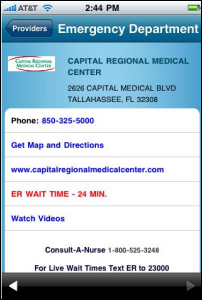
Capital Regional Medical Center (FL) publishes its ED wait time to the iPhone via iTriage.

Several former executives of iSoft, including the former chairman and CEO, face criminal charges in Britain for making false and misleading statements.

AT&T will launch five Android-powered mobile phones in the next few months, one made by Dell and another rumored to be a version of Google’s just-announced Nexus One.

At the International Consumer Electronics Show, Cisco demonstrates a home version of its TelePresence videoconferencing system, showing how it could be linked to medical devices to pass voice, video, and data from patient to physician. At the same show, Skype announced that its application is now capable of making high definition video calls and will be incorporated into HDTVs (as a newfound Skype Video user not even using HD, video calls via Skype are still one of the coolest things ever, just like being in the room with the person on the other end of your free call).

Two Regenstrief informatics fellows win AMIA student awards, one for a graphical tool to examine drug interactions, the other for a system that proposes drug and lab suggestions based on physician ordering habits. I’m thinking I should cover more of this research-based informatics stuff since it interests me and it’s innovative.

eClinicalWorks will offer patient education from Krames, including 1,300 aftercare instructions in several languages that are suggested to physicians based on EMR information as well as for direct patient access through eCW’s patient portal.

Odd lawsuit: an MRI clinic’s car injury claim is fully paid by its insurance company, receiving the state-allowed maximum $10,000 in PIP benefits. Their attorney sues the insurer for $2.59. For once, an insurance company gets to accuse someone else of being a scumbag. “Who has the greater motivation to sue in this case, the MRI clinic that’s seeking $2.59 or an attorney who charges about $375 an hour for his services?”

E-mail me.


HERtalk by Inga

From Father Time: “Re: meaningful use timeline. It is my belief that the MU clock will start ticking 10/1/2010 as that is the start of the government’s 2011 fiscal year. I am certainly no authority on the subject, but it would seem the government would use their year vs. calendar or any other for the time period used  to verify meaningful use of hospitals and providers.  If you consider that time period and use the HMS/CMS 90-day model, a hospital would have to begin to prove meaningful use BEFORE July 1, 2011. In hospital years, that is REALLY soon!” I agree with Father Time that the MU clock could start as early a 10/1/2010 for hospitals (in fact my graphic indicated that). HIMSS also said 10/1/2010 in their webinar this week. However, the committee’s “recommendation” is that the Secretary choose the calendar year (starting 1/1/2011) for meeting the definition, which would give both hospitals and vendors more time to ramp up.

From CPOE Guy: “Re: EMR and girl talk. Maybe I don’t understand girl talk, but those of us providers using Epic (Kaiser for example) are doing at least 99% order entry; in my case it’s 100%. The only exceptions in our organization is for super emergency verbal orders during codes where the doc can’t get to a computer, and even there it is frowned upon. Our prescribing is 100% electronic for normal Kaiser patient prescriptions not requiring written (the former ‘triplicates’  such as morphine, Ritalin). I write handwritten prescriptions only for non-Kaiser patients who wish to fill their meds elsewhere and even then, I enter these electronically into the EMR to keep our record complete.”

From Outta Touch: “Re: Latest meaningful use guidelines. In the last few days, I’ve asked a few doctor acquaintances about their impressions on the latest proposed meaningful use definitions and certification guidelines. Most have simply given me a blank stare, asking what I was talking about. Am I running with the wrong crowd or is the average doctor just not interested?” My guess is both. Who wants to hang out with doctors that can’t talk techie? Give me a Dr. Alexander or Dr. Diamond any day. And, I suspect that most doctors are more concerned with practicing medicine and getting paid then they are with dealing with the minutiae. Most practices have at least one doctor or an administrator who is more interested in following the specifics. Plenty of doctors are happy to defer to the “experts” until they are handed a tablet and told to enter a prescription.

From Jabez William Clay: Re: draft rules on the EHR incentive plan. Have you guys seen this?” The CSC study that indicates US hospitals are only halfway ready to qualifying ARRA payments. In fact, only two-third of hospitals have identified gaps in their current systems. A quarter of the 58 hospitals think they meet at least 70% of the readiness criteria.  

From Felice Fontanta” “Re: ARRA questions. Thanks for your analysis! Very helpful. A few questions I haven’t seen answers to yet: How and when are the funds going to be disbursed? Say you demonstrate MU in the 1/1/2011 – 3/31/2011 time period, when and how will you be paid your $18k? And,  In terms of qualifying docs, is the Medicare program restricted to Medicare providers? So a pediatrician would not be eligible for any funds unless they have a significant Medicaid panel?” The legislation says that incentive payments be disbursed in a single consolidated payment or in periodic installments, as the Secretary may specify. However, the recommendation is for a single lump payment “as soon as we ascertain” meaningful use for the applicable reporting period. Regarding participation in the Medicare incentive program, it is restricted to Medicare providers. Pediatricians can participate in the Medicaid program if at least 20% of their patient volume is Medicaid.

Mr. H and I have had multiple questions posed to us regarding the latest certification and meaningful use recommendations. We don’t claim to be experts, but we are happy to try to get clarification on certain points if we can. Here are a few FAQs that we have gathered from readers, this week’s HIMSS webinar, and the CMS website:

Q: To count as CPOE, must the provider personally (hands on keyboard) enter the order, or may physical entry of the order, under the provider’s direction, be done by other staff?

A:  The reg states “directly”.

Q: Our pathologists are employed by a clinic and physically work in a clinic. Do they qualify as eligible Medicare outpatient providers?

A: Depends on whether the clinic or the hospital provides the facilities or the equipment.

Q: Is an eligible hospital is only an acute care facility or does it include other types of facilities, such as rehabilitation facilities?

A: CMS uses the "CCN" – the CMS certification number assigned to each hospital – to assess whether or not a hospital is eligible.

Q: If a hospital ER is using CPOE for all orders, does it qualify for the 10% of CPOE for a hospital?

A: The ER is counted as outpatient, so no, it will not fulfill the 10% CPOE requirement for an inpatient facility. (HIMSS waffled a bit on this during their webinar but finally came to this conclusion.)

Q: On the hospital side, must the physician enter the CPOE order directly? Or may they have their MA do the entry under their authority?

A: The reg states "directly".

Q: If only 10% of the hospital’s staff is using the certified system, and the rest are still paper-based, would this satisfy the CPOE requirement?

A: The requirement is that 10% of all orders be entered by CPOE.

Q: Do State Mental Health Hospitals qualify for incentive payment? What about long term care providers such as nursing homes?

A:  No. The following types of institutional providers are eligible for incentive payments under Medicare and/or Medicaid provided they meet the applicable criteria. Under Medicare, institutional providers eligible for the EHR incentive payments include “hospitals" as defined under section 1886(d) of the Social Security Act and critical access hospitals. Under Medicaid, these institutional providers are acute care hospitals and children’s hospitals.

Q: If you are a provider or hospital and not a meaningful EHR user, when do the penalties kick in?

A: Starting in calendar year 2015 for physicians and FY2015 for hospitals. At that time, CMS will begin to reduce Medicare Market Basket adjustments. There are no payment adjustments associated with the Medicaid provisions.

Q: How will the public know who has received incentive payments under the Recovery Act?

A: CMS will post the names of those receiving Medicare incentives online. The list will include the elements identified in the Recovery Act: name, business addresses, and business phone number of all Medicare eligible professionals and hospitals who received incentive payments under the Recovery Act. There is no such requirement for CMS to publish the names of those receiving Medicaid incentive payments,though States may opt do so.

That last fun fact was Mr. H’s favorite, by the way. Surely it will be a boon to telemarketers who will have all the information required to pounce on the nouveau riche doctors.

SCI Solutions launches Schedule Maximizer (v32) which includes e-mail appointment reminders, expanded portal functionality, and several new revenue cycle reports.

randeep

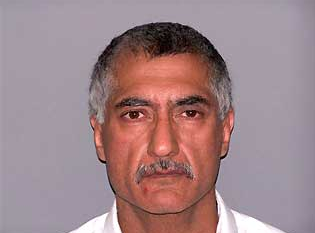
An Arkansas doctor is indicted for planting a bomb that critically injured the chairman of the Arkansas Medical Board last February. Dr. Randeep Singh Mann, who had been previously penalized by the Arkansas Medical Board for overprescribing medication, was charged with planting a car bomb that left the board chairman with blindness on one eye, damaged hearing, and several broken bones. Mann was already facing federal weapons charges for possessing unregistered machine guns and explosives that are permitted only for military use.

lexington memorial

Wake Forest University Baptist Medical Center (NC) selects QuadraMed’s Enterprise Scheduling for scheduling hospital ancillary procedures.

Allscripts strikes a deal with CVS Caremark to migrate thousands of users from the proprietary CVS iScribe e-prescribing tool to Allscripts e-prescribing.

Surgical Information Systems picks up an endorsement from the American Hospital Association for its surgery scheduling system.

Our favorite pink pants-wearing friends at Voalte say their Voalte One iPhone application is now generally available, following a successful pilot program at Sarasota Memorial Hospital (FL).

CHIME raises some concerns about the newly released meaningful use regulations, particularly with the short timeline for hospitals to implement EHRs. They believe that the 2014 deadline for hospitals and EPs to meet Stage 3 criteria is too soon. CHIME also says the extensive reporting requirements will be burdensome for hospitals. And, CHIME points out that since hospital-based physicians aren’t eligible to receive stimulus funds, it may create a disincentive for health systems to invest in ambulatory EMRs. To that last point, I don’t quite agree, since hospitals will need the physicians to have EMRs to meet interoperability requirements.

inga

E-mail Inga.

Lawson Software To Acquire Healthvision for $160 Million

January 7, 2010 News 2 Comments

healthvision

Lawson Software announced this afternoon that it will acquire integration vendor Healthvision and its parent company, Quovadx Holdings, Inc. for $160 million. The all-cash transaction is expected to close later this month.

Lawson said it expects to use Healthvision’s Cloverleaf technology, used in 33% of North American hospitals, to connect multiple source systems and help providers comply with interoperability requirements. Healthvision also offers a Health Information Exchange platform and MediSuite, a clinical applications suite marketed in Canada.

HIStalk contact Thomas Servo reported on December 11 that Healthvision’s owner, Battery Ventures, would announce a sale of the company around New Year’s.

Readers Write 1/7/10

January 6, 2010 Readers Write 9 Comments

Submit your article of up to 500 words in length, subject to editing for clarity and brevity (please note: I run only original articles that have not appeared on any Web site or in any publication and I can’t use anything that looks like a commercial pitch). I’ll use a phony name for you unless you tell me otherwise. Thanks for sharing!

Glen Tullman’s 10 for ‘10: Top 10 Healthcare IT Trends for 2010
By Glen Tullman

glentullman

1. 2010 Will Be the “Year of the EHR”

We are at the beginning of the fastest transformation of a major sector of our economy in the history of the United States. The American Recovery and Reinvestment Act has provided billions in incentives to encourage adoption and “meaningful use” of Electronic Health Records. Given the time-stamped nature of the program, we can expect to see a dramatic increase in EHR adoption. Physician groups recognize the need to deploy an EHR now to be ready to demonstrate “meaningful use” by 2011, when the ARRA incentive payments kick in.

With CMS issuing the requirements for an EHR to qualify for meaningful use, many physician groups that were sitting on the sidelines will feel more comfortable getting their EHR initiative underway. It is clear that 2010 will be the “Year of the EHR”, not only because of the rapid rise in adoption rates, but more so because of the positive impact that this technology will have on how patient care is delivered.

You will continue to see two different approaches to acquiring EHRs. The first are investments by physician groups focused on creating efficiency in their practice and collecting the stimulus incentive. The second are community-based decisions where hospitals and health systems invest on behalf of their owned and affiliated physicians, with an eye toward referrals and being “easy to do business with.”

The most recent example is North Shore Long Island Jewish Health System with their program to connect approximately 7,000 affiliated physicians. In 2010, many more health systems will realize the benefit of leveraging the ARRA incentives and the Stark Safe Harbor to help build stronger connections with affiliated physicians in their communities.

2. Not “One System” . . . “One Patient Record”

The old thinking that you need the same system across your hospitals and ambulatory providers will give way to a new way of thinking. As more physicians automate and connect, the large IDNs, academic medical groups, and other integrated systems will put less emphasis on a single IT solution and more emphasis on connecting existing systems to build One Patient Record. This will enable caregivers to access a comprehensive view of all data available about a patient from any location within or outside of the system. Clearly, many physicians already have systems installed in their practices, so establishing a connection to these existing practices will be as important as the rollout and connection to new practices. Organizations that think strategically about this endpoint will find themselves better positioned to take advantage of new opportunities that will emerge in the market.

3. Communities Will Connect

Healthcare is still a local phenomenon. Depending on the estimates you use, 90 percent of all patient care is provided within 30 miles of a patient’s home. Given its local nature, the first priority must be to electronically connect caregivers across a community, leading at some point in the future to a national health IT infrastructure. In 2010 we’ll see more health systems banding together with others in their communities to create local health information exchanges as well as other approaches that enable One Patient Record across a region. A local network is easier to manage and already proving successful with HIEs like the Transforming Healthcare in Connecticut Communities (THICC), which connects that state’s top 20 hospital systems with each other and with major physician groups.

4. Service and Support Will Become Competitive Differentiators

One of the key reasons ARRA was passed was to create jobs. According the White House, over 50,000 will come from the healthcare information technology sector. Allscripts will hire hundreds of new employees, not only to help our clients deploy the technology, but also to assist them in using it in a meaningful way and optimizing the technology to deliver quality care. Clearly there will be a premium on process redesign and consulting services. Those who have the resources and can deliver these services will be rewarded.

5. Innovation Will Begin to Drive Sales and Use of EHRs

Innovation will become a differentiator and drive adoption as it has in other industries. The ability to access your EHR via your phone (iPhone, BlackBerry, Windows Mobile, etc), use a kiosk to register, check labs at home via a portal, and pay your bill via Quicken Health are all examples of physician/patient-focused innovations that deliver simplicity, customer service, and also take out cost. Using advanced technology from outside the four walls of healthcare is symbolic of the transformation of healthcare into more of a consumer-driven business.

6. Revenue Cycle Management Will Become Integrated

Given the need to focus on new EHRs, most physician groups will choose not to replace their existing practice management systems. As a result, in 2010 the larger hospital vendors and EHR/Practice Management vendors will leverage their large installed bases to aggressively move into Revenue Cycle Management. Early leaders in the standalone RCM space will see growth slow and those firms that can integrate RCM with widely-used EHR and PM will dominate.

7. Management Reporting Will Transition to Actionable, Quality Patient & Population Management

As information becomes more available across bigger networks, more emphasis will be placed on developing proactive quality feedback rather than simply reporting. The focus will be on changing caregiver behavior by driving actionable feedback to providers at the point of care, not after the fact. This is the first step toward the development of true “information systems”.

8. Payers, PBMs, and Pharmacies Will Use EHRs to Deliver Information

As the market for Electronic Health Records heats up, we’ll begin to see payers, pharmacy benefit managers, and pharmacy chains partnering with e-prescribing and EHR solutions to efficiently deliver new kinds of information on best practices, care plans, and additional clinical guidance to physicians as they begin to directly tie compensation to results. We have already seen this with current pay-for-performance programs and it is likely a preview of things to come.

Changing physician behavior at the point of care has been the Holy Grail of healthcare. Now the “cable system and set-top boxes” will finally be in place to do just that. Think of this as a formulary, but with a focus on something beyond just the cost of a medication or which one to choose .. but rather an entire plan of care for the patient.

9. Intuitive is Best

Whether it’s ease of use or ease of deployment, “easy” is a must in 2010. We’ll see the customer experience transformed in both areas with an emphasis on intuitive, easy-to-install, easy-to-learn systems (think the difference between your average cell phone and the iPhone).

10. Software as a Service

Software as a service has been advertised as “the” solution for healthcare. The reality is that SaaS is a great option and will be one of a number of solutions. The fact is that physicians don’t really care whether the Electronic Health Record and Practice Management Systems, along with other solutions, are hosted, client-server, or SAAS — they just want them to be easy to access and use. And, many physicians think software as a service is synonymous with monthly payments, like leasing a car. That is a critical and appealing element. The answer is that SaaS will need to be a part of a vendor’s solution set.

As noted, we are watching and participating in a major economic transformation, one that is being driven from all sides. What we know is that while Electronic Health Records are not sufficient by themselves to solve the healthcare crisis in America, they are a necessary component of any solution that drives safer, higher quality healthcare provided cost effectively.

2010 will be the “Year of the EHR” and our current healthcare system of disconnected silos will begin the transition into a connected system of health.

Glen Tullman is CEO of Allscripts.

Major Flaw In Claims Operations Model Found Responsible For Payer Overpayments
By Stephen Ambrose

stephenambrose

As part of the insurance industry, subrogation has at times been a bit of a dirty word to policyholders and personal injury attorneys, but a necessity to payers. Known as “the great balancer”, the "right of subrogation" means that a (health) insurer may choose to take action to recover a calculated amount from a claim paid to a policyholder if the loss was caused by a third party.

A major flaw identified within today’s subrogation model is the inability for a payer or their outsourced vendor to accurately identify only those times when their policyholder has pursued and successfully settled a third-party claim. There exists no public database of third-party liability claim filings and the use of court records only applies to less than ten percent of all claims anyway.

Over many years, the most widely utilized method for identifying policyholders who are involved in injury claims is through an indirect identification method of data mining patient claims via diagnostic codes, billed procedures, doctor type, and accident / injury check boxes. Such flagged information generally leads to form letters sent to the patient, who is supposed to complete and return them, both timely and accurately, to the payer or their outsourced claims vendor.

This ubiquitous system of TPL claim involvement has suffered from a number of shortfalls including patient accuracy, inability of complete follow-up, use of indirect identifying factors, timeliness of detection, as well as missing claims filed for chronic illness and malpractice. These factors greatly limit a payer’s knowledge of wasteful injury claim overpayments and make identification of TPL claims more of a “good-guessing” game.  Additionally, the current system allows outsourced claims vendors to demand large collection fees from recoveries made on behalf of their payer clients.

A new model of injury claim identification offers health payers greatly increased TPL claim knowledge while addressing waste reduction and delivering more cost-effective operations to the payer community. Known as Collaborative Subrogation, or Subrogation 2.0, this Web-based technology connects patient release-of-information (ROI) requests, made of the provider with a health payers claim department.

The innovation of better identifying TPL claims stems from limitations, inherent within the use of claim forms and electronic claims data, submitted by providers in their billing. Chiefly noted and now improved upon is the understanding that injury claims are not just “accidents”, but rather any claim involving, in part, the use of medical billings to substantiate value. This opens up areas of medical malpractice, chronic illness, product liability, and other non-auto liabilities.

Collaborative Subrogation is employed as a lower-cost, Web-based operation, where health payers use an online search engine to match provider-submitted TPL data. The approach is one of layering on a new model, in conjunction with existing subrogation software and outsourced vendors. 

Stephen Ambrose is executive director of SubroShare.

News 1/6/10

January 5, 2010 News 8 Comments

hippa  

From HIPPAcrates: “Re: notice of proposed rule-making. The summary spreadsheet is very useful, thanks. I just found this error in the government document and hope it’s not an omen.” Even the feds can’t spell HIPAA with the full wording right in front of them. Surely I’m not the only one who knows how to modify Word’s dictionary to catch gaffes like this.

From Dean: “Re: MU. Was just reviewing your summary of the meaningful use doc. Very nice work, even better than Halamka’s at geekdoctor, of course you probably don’t have a Kevlar suit or a handy folding bike! I think a great reader poll would be to ask whether people with CPOE installed have implemented drug-drug or drug-allergy interactions. My bet is that most people who have tried this have turned it off. I think this is a terrible requirement. Current drug-drug interaction checkers are way too sensitive and generate way too many false positives. I’ve reviewed some papers that reported over 25% of medication orders generated alerts. That is unacceptable in my book.” Maybe he needs the Kevlar suit because of bike-induced thigh chafing. The problems with clinical warnings are:

  • Practitioners universally believe they don’t personally need them, but they think they should be turned on for their less-capable peers.
  • Duplicate drug checking throws out a ton of false alarms and is useless 99% of the time.
  • Allergies are often entered without the type, severity, and onset of the reaction, meaning that everybody’s “makes my stomach hurt” allergies trigger the Cry Wolf syndrome and allergy warnings are overridden 95% of the time.
  • Users aren’t always given the tools to modify the warnings to suit their needs, such as expanding the by-the-book dose ranges and setting their own ranges based on experience.
  • The few vendors of clinical data rigidly adhere to conservative manufacturer data and the advice of their overly cautious lawyers in overweighting accuracy at the expense of usefulness.
  • Systems don’t allow personalizing the alerts, so while the family doc might benefit from a renal warning for a particular drug, it’s a sure bet that the nephrologist who gets the exact same warning surely won’t.
  • Of all these, the last one could be easily implemented, other than the fact that data vendors, hospitals, and IT people don’t trust their docs to turn off warnings that they don’t value (a rather condescending “computer knows best” outlook).

From Crumbgirl: “Re: GE Centricity Enterprise. You will hear big news out of Indiana if you have not already!” I haven’t heard anything so far.

From Infodoc: “Re: your MU summary. Thought you’d like to know that the Advisory Board referenced your Meaningful Use summary in their Meaningful Use briefing published Monday. HIStalk is becoming a good example of a disruptive technology.” Honestly, all it took was a couple of hours of skimming the documents to pick out the relevant parts. I think the trick is that, as a nerd, I was the only pseudo-journalist sitting home with nothing better to do right before New Year’s. I do appreciate the nice comments about it, though. And I do like to disrupt whenever possible.

From Bob in Accounting: “Re: Epic’s newsletter list for customers to prepare for meaningful use.” My 99% condensed summary of what it said: (a) upgrade; (b) finish rollouts; (c) implement e-prescribing; (d) install MyChart; and (e) install Care Everywhere for data sharing.

From Chris: “Re: EHR. First off, I really appreciate your ongoing coverage of all things health IT related. As I’ve been reading your site and others, I’m failing to identify a distinction between EMR and EHR in terms of the ARRA/HITECH legislation, ‘meaningful use’ and certification criteria. Is there a true distinction between the two? I feel as though I see them used almost interchangeably. Thank you for your insights and clarification!” Theoretically, HITECH applies only to EHRs since the products must be certified and, by definition, all certified EMRs are actually EHRs since they are interoperable. I have a philosophical disagreement with that loose terminology, however, probably because vendors have latched onto it for marketing purposes for the same old products that pre-dated the EHR term. EMRs are used to treat patients. EHRs are used to manage health and community wellness, including collecting data from a much wider net than just doctors and hospitals. I’ll stand by my crotchety proclamation: I don’t care what vendors say, none of them have an EHR. That’s why I always call them EMRs unless I’m quoting someone else.

srosenberg

From Lacey Underall: “Re: Humana. A dermatologist takes them to small claims court. Way to go!” I love this. A dermatologist, tired of Humana not paying his claims for years ($120K total) but unwilling to pay a lawyer 40% to go after them, takes the insurer to small claims court by bundling the claims into packages that fall within the $5,000 limit. Humana’s lawyer is surprised, given that he has never been to small claims court. The doctor tells him, “This is the first of 25 claims we’ll be submitting … Humana could save those $350 filing fees times 25 and his time and fees times 25 if they would just process our claims." Even though the tactic hasn’t worked for other doctors because Humana got their case moved to federal court, it did this time: Humana coughed up $80K and the doctor is hoping to collect the rest of what they owe him before their next court date.

I’ll be charitable in characterizing the post-holiday response to my HISsies nominations plea as modest. The voting that will follow next week or so is going to be pretty dull if nobody nominates their best and worst vendor, industry figure of the year, etc. It takes just a minute or two and validates my pathetic existence, so humor me.

mikesupple  

Former Cerner sales VP Mike Supple joins recruiting firm B.E. Smith as SVP of business development.

Ten-provider Orthopaedic Center of Southern Illinois chooses the SRSsoft EMR after its free trial, saying the docs are saving 30-60 minutes each per day.

Madrigal sent me an e-mail announcing Meditech’s merging of PtCT into its regular organization, which I reported last week. The company has posted the announcement and a company Q&A.

Universal Health Services chooses Cerner and its Remote Hosting Option for its 24 hospitals. The modules weren’t stated (red flag – did they commit to all of Millennium or just a few modules?), but per FlimFlam Man, they will replace Opus Healthcare, Siemens pharmacy and ADT, RMS, and others.

Cerner also announces a deal in which Tenet will increase its Millennium use from 14 hospitals to 47. Shares were up 6% today, hitting a 52-week high and raising the market cap to $7.29 billion and nearly making Neal Patterson a hemi-billionaire (he’s got $496 million worth).

Revenue cycle vendor Passport Health Communications names David Whitt CFO.

Jobs: Eclipsys Systems Engineers/DBAs, Anesthesia Product Specialist, Clinical Implementation Specialist.

Former Eclipsys SVP Tom Dunn joins QuadraMed as SVP of sales and marketing.

Tennessee gets $2.7 million in stimulus money for a project that CMS says will improve patient outcomes. Reading further: the money will be spent on “planning activities”, like doing a study to figure out why doctors won’t use EMRs.

Three Montana provider organizations go live on the beta version of EMix, a vendor-neutral cloud computing platform from DR Systems for sharing radiology images and reports. They claim it’s as easy to use as e-mail. The company pitches charging patients to manage their images online, for which it takes a cut of the revenue.

Newham University Hospital NHS Trust says its Cerner system is saving it money and reduced patient wait times. Patients in the same area are using Philips home monitoring diagnostic equipment in a test for NHS.

amcom  

The owners of paging and communications systems vendor Amcom Software sell controlling interest to a partnership of a private equity firm and a venture capital firm. The private equity firm says they’ll probably sell it at some point.

I think I missed this when it was announced: Epocrates names Geoffrey Rutledge MD PhD, formerly of Wellsphere, as CMO/EVP of product development.

nexus

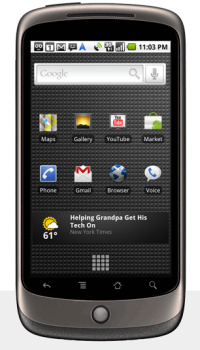
Google announces its Nexus One Android-powered cell phone. It seems anti-climactic, hardly an iPhone-killer. Too bad it didn’t involve cheap cell service, although maybe the master plan is to serve up phone ads that offer a lower cost all around.

Odd lawsuit: a woman sues Walgreens, claiming that a store employee leaving the bathroom knocked her down with the door. She wants medical costs, damages and “other sums to compensate her for her injuries,” claiming that Walgreens should have instructed employees to look before opening the door, for failing to tell her to move, and for failing to equip the door with a warning device.

E-mail me.

HERtalk by Inga

timeline ehr1

In yesterday’s HIStalk Practice, I touched on a few nuggets of information about the latest EHR meaningful use recommendations. I might add it is worth a read because there are some points Mr. H and I haven’t seen covered elsewhere (and while you are there, sign up for the e-mail updates.) One particularly confusing item relates to the timeline for proving meaningful EHR use in order to earn incentive dollars. I tried to summarize a bit on the timeline for getting money, but because it is particularly confusing, I decided a graphic might help (click it to enlarge).

For those that want to follow along at home, this information is found around pages 23 to 31 in the larger, 557-page document. As I interpret things, to qualify for stimulus money during 2011, a hospital or eligible professional (EP) must demonstrate meaningful use of EHR for “any 90-day period within the first payment year.” The earliest possible start date for that 90-day reporting reporting will likely be January 1, 2011. The latest day to start a 90-day reporting period and still qualify for 2011 money is October 1, 2011. After earning incentive money in the first year, entities will be required to prove meaningful EHR use for a full year, starting on January 1, in order to qualify for second-year funds. Thus, if an entity qualified any time during 2011, it would have to continue to prove that it used its EHR meaningfully from January 1, 2012 to December 31, 2012 in order to qualify for the 2012 incentive funds. And, if the entity doesn’t try to qualify for the first time until sometime in 2012, then it must prove meaningful use for the full year beginning January 1, 2013, to get the second-year funds. And so forth. If someone interpreted things differently (or can explain this better), please advise.

caritas1

athenahealth signs a deal with Caritas Christi Health Care to offer athenaclinicals to 500 employed providers and 1,200 affiliates. CIO Todd Rothenhaus, MD, the Caritas SVP/CIO, confirmed to me that Caritas will offer athena and eClinicalWorks, which was announced previously.

I was talking EMRs with a girlfriend at lunch today (isn’t that what most gal pals do?) and we agreed that we can’t think of any providers that currently enter 80% of their orders themselves. We thought we might come up with a doctor who uses e-prescribing 75% of the time (but we thought of lots of reasons why a patient and provider might prefer the paper prescription). We couldn’t come up with a single small office group that is currently capable of sending patient data electronically to other providers (often times because the receiver can’t accept the data). The one bright spot is that the recommendations clearly state that “documenting a progress note for each encounter” is not a requirement for proving meaningful use. Otherwise, the mountain is high.

Ridiculously sad, any way you look at it. An unemployed, unmarried 35-year-old mother of nine sues three doctors and two nurses after being sterilized against her will. The mom was delivering baby number nine via a planned C-section and and asked for an IUD to be implanted immediately after delivery. Instead, the doctors performed a tubal ligation.

trinity1

Trinity Health (MI) buys 1,200 bundled EHR/EPM software licenses from NextGen, increasing its rollout to all employed providers in its network.

Happy 2010, by the way. The ever-generous Mr. H gave me a bit of time off during the holidays, but now I am back at it. Mr. H and I have each waded through pieces of the latest meaningful use documents in hopes of becoming industry experts. Unfortunately, at least in my case, more wading is required. I was hoping there might be some clarification about what exactly a “certified EHR technology” is. Of course “CCHIT” is never mentioned anywhere, even though it seems a given that CCHIT will be a requirement since they are the only certifying body out there. Why can’t the Secretary or the ONC come right out and say it’s CCHIT 200x for now? That way buyers know what is required and vendors know what they need to do if they want to participate.

inga

Send Inga meaningful words.

Readers Write 1/05/10

January 4, 2010 Readers Write 10 Comments

Submit your article of up to 500 words in length, subject to editing for clarity and brevity (please note: I run only original articles that have not appeared on any Web site or in any publication and I can’t use anything that looks like a commercial pitch). I’ll use a phony name for you unless you tell me otherwise. Thanks for sharing!

The Direction of Healthcare Industry Technology
By Steve Margolis, MD, MMed, FCS, BSIS, MBA

Regarding the recent John Gomez interview on the direction of healthcare industry technology:

“Interoperability is a huge one where the way that this industry’s worked, has been not embracing the ability to exchange or interoperate between systems. We’ve been kind of proprietary. I think that also creates a challenge and a barrier for hospitals to move.”

I agree that data system interoperability is key to moving the industry forward. The plans for standards of interoperability, privacy, and security will be finalized next year. It’s going to change the landscape and mandate exchange of “semantically interoperable” information among care providers and between providers and patients.

Beyond that, we all know many common applications in healthcare are not available from a single vendor and cannot be made to integrate easily. Supporting third-party integration is extremely helpful, allowing provider organizations access to the latest advances in knowledge and technology, especially when you consider that the fundamental focus of ARRA and other federal initiatives is to take costs out of the nation’s healthcare delivery system.

Content for evidence-based care is dynamic and federal regulations are changing too rapidly for a stagnant platform. I think our industry needs to take lessons from the iPhone app model, i.e., ease of ability to integrate new applications to meet the growing need to keep up with the latest information and technology advances in order to sustain quality and curb costs — especially when the provider’s core vendor is not ready to meet those particular needs.

In short, the right technology approach for the industry is an open technology platform that provides flexibility in both front- and back-end integration, together with the means to easily cater to constituent-specific workflow. This openness is necessary to allow for the cost-effective leveraging of existing and future technology investments.

That’s why we’ve been deeply involved with Eclipsys in developing a platform that provides a services-oriented architecture that allows for third-party integration and multiple applications in context of both the patient and the user. This app integration strategy will enable providers and other third parties to build applets that will enable easier integration between existing vendor solutions, legacy, and/or other in-house developments.

The key benefit for this design approach is that hospitals need not be concerned that prior technology investments will become obsolete if the vendor advances the platform. Conversely, it means that user innovation doesn’t have to cater to the vendor’s development timeline or direction. This type of openness will allow a hospital to integrate with any Web service with a similar open health platform for driving innovation and efficiency.

Another area of important technological development is in the area of visual workflow tools. Many healthcare workers prefer to design visually and iteratively. A visual workflow tool enables rapid prototyping. Examples of this need include the opening of new clinics or the development of a new protocol in response to a pandemic.

Working together, the clinical team can translate their thinking into a devised workflow in very short order and then upload and incorporate that workflow into the system. The beauty would be that the workflow could incorporate third-party systems, such as interacting with NIH or CDC systems and provide biosurveillance data and outcomes data that could help treat pandemics in real time across the country or globe.

This is just one example, but it exemplifies the possibilities we could leverage in open architecture design. To take the monumental steps needed to improve care delivery, we will need this type of open architecture to overcome the challenges we face in delivering quality healthcare in a rapidly changing and ever-demanding environment.

Steve Margolis, MD, MMed, FCS, BSIS, MBA is chief medical informatics officer at Orlando Health of Orlando, FL.

Interoperability 2009
By Jerry Sierra

I’m a nurse who has worked in healthcare IT for over 10 years; six (and counting) for two of the top vendors. However, I feel compelled to share a story that has absolutely nothing to do with my background.

I recently moved my family from Wisconsin to Cleveland. I know you won’t be able to concentrate on my story unless I add it was to be near family (but I also really like Cleveland). My 22-month-old decided months ago to stop the normal progression to solids and instead to stick with bottles. After extensive medical testing, I’ve come to the conclusion that he’s outgrown his reflux, and out of sheer stubbornness (inherited from my wife, of course), refuses to eat anything but M&Ms, goldfish, and yogurt. As much as I like these snacks, I have fears of having to pack these items and a bottle in his lunch box for the next 12 years. To prevent that, we took him in to see our Cleveland pediatrician for a referral to their feeding clinic.

During the visit, we filled out a records request for our Wisconsin hospital and prepared to wait a few months for our referral appointment. Being a cynic, I decided to call and make sure that the records had been sent to the Cleveland GI. They, of course, had no idea what I was talking about and suggested calling Medical Records. They, of course, assured me that the doctor had never sent the piece of paper to MR and that it was never scanned into the EMR. They promised to promptly send me out a new form.

After a few short weeks, I received the form, filled it out, and sent a copy to the hospital in Wisconsin. After waiting a few more weeks, we received a letter from the Wisconsin hospital letting us know that they would love to help us out but, because of HIPAA, they could only accept their own records request form (it’s been a while since I waded through the act, so I must have forgotten that section). So I copied the exact same information onto the form with the correct letterhead and sent it off. I called a few weeks later and was told that the records were mailed out.

We arrived at the specialist’s office and asked the doctor if he had received the records. Would anyone care to guess the response? Anyone? Anyone? Bueller? Of course, he had received nothing. So I took out my tattered copy of the Wisconsin EMR report and the doctor photocopied it so that it could be scanned and added as an attachment to the visit note in the Cleveland EMR (which coincidentally, enough is the SAME vendor). There you have it, a shining example of real-world interoperability.

Who was to blame for this mess? The hospitals, for having antiquated workflows and not turning on key features like the ability to e-mail physicians? The vendor for not making it easier to share information and not allowing patients to add to their own records? The government for not mandating the NHIN, CCD exchange, etc.?

As you can see, the interoperability bar is set depressingly low. Let’s hope 2010 is the year we start making some real progress.

A New Reality in Healthcare Systems – Automation, Agility, and Compliance
By Bruce Oliver

The ever-changing administration of healthcare, increased regulatory requirements, cost control demands, clinical quality, patient safety,and satisfaction issues challenge the US healthcare system. The volume of these challenges requires automation, agility, and compliance, plus relentless execution from healthcare organizations who expect to survive and prosper in the new US healthcare system.

The current HIPAA 5010, ICD-10, ARRA (American Recovery & Reinvestment Act), and HITECH Act of 2009 mandates, incentives, and requirements — and the penalties for noncompliance — are forcing all healthcare organizations to adopt new technologies, processes, and standards. Additionally, pending new health reform legislation will add more requirements to an already over-burdened healthcare delivery and administration system.

Making the changes necessary to achieve the mandated requirements should be viewed only as one of many steps. This first step should be a well thought out and comprehensive strategy designed to prepare healthcare administrative organizations to take full advantage of imminent changes, such as secure anytime-anywhere access to patient information and clinical data, improved patient quality, safety, and service standards and real-time processing of medical transactions and claims.

In addition to the new requirements, national healthcare reforms will require healthcare organizations to implement new business processes and workflows to be compliant while being cost effective. It requires foresight to establish corporate standards, project methodologies, and updated infrastructure to adapt to pending and future requirements for process automation, organizational agility, and operational excellence and compliance.

As healthcare provider and payer administrative organizations embark on compliance processes, they can build parallel paths toward business process improvement and operational excellence. This can happen because compliance is an organizational process that includes business process and technical reengineering for healthcare organizations. Therefore, an organization’s overall strategy should be centered on achieving operational excellence as well as implementing new regulations for compliance. This strategy would require the organization to:

  • Establish standardized operational excellence as a corporate strategic priority that is parallel to the implementation of new regulatory mandates, incentives and compliance projects.
  • Reassess how and why the organization conducts business to improve agility, especially in the area of manual business and clinical processing that may provide opportunities for online real-time processing and secure anytime-anywhere information availability for more effective decisions and reductions in operational costs.
  • Define operational excellence as an enterprise wide initiative with measurable goals that extend beyond the regulatory compliance dates. Once initiated, this initiative should continue to scale up or down to improve, evolve and automate business processes to meet the ongoing healthcare mandates requirements as needed.
  • Target compliance areas that can provide high degrees of success in shortest possible time to build momentum and demonstrate compliance. Foster the use of agile technologies and software tools for automation of processes to realize faster results and improved functionality.
  • Create sustainable knowledge transfer processes, staff training infrastructure, and programs to develop the skills required for operational excellence as an extension to the HIPAA 5010, ICD-10, ARRA, and HITECH projects and new health care reform regulatory requirements.
  • Link operational excellence goals to compensation and incentives to focus and reward program efforts.

Healthcare organizations that are able to accomplish this dual effort should be able to differentiate themselves in the marketplace. This differentiation will be evident not only in outcomes and operational performance, safety, and quality measures, but in financial performance as well.

An automation, agility, and compliance approach does not necessarily require an organization to do an enterprise “rip and replace” project and face the monumental risks associated with it. Instead, an operational excellence plan executed with incremental improvement in systems and infrastructures is a risk adverse and affordable approach toward the automation, agility, and compliance the organization is striving to achieve.

Bruce Oliver is the payer practice director at maxIT Healthcare, LLC.

Monday Morning Update 1/4/10

January 2, 2010 News 14 Comments

calvert

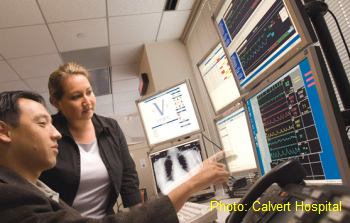
From Ned Flanders: “Re: remote ICU monitoring. Publication bias apparently runs both ways. JAMA rejected a study evaluating the clinical and financial impact of remote ICU monitoring last year because although the results were extremely impressive, they claimed the study had a weak design (before and after) and did not shed light on the actual reasons why remote ICU monitoring helped (since it had already been shown to help). Curious considering the recently published study had the same design and flaws, with the only difference being outcome.” This highlights a little-appreciated reason for not believing everything you read: the most powerful influence wielded by publishers isn’t how they spin a particular story, it’s their choice of which stories to include in the first place. That process has zero transparency to readers, so it’s the most dangerous. The second most powerful is where the piece appears if it is published. The third is how the headline (or abstract) is worded since many people will base their conclusion, consciously or subconsciously, on that alone.

From FinSoft: “Re: QuadraMed. Jim Klein is out – read the 8K from December 30.” This was actually reported by Misys_ex to me in early December, but I always hesitate to run rumors about named individuals unless it’s public knowledge since I’d hate to see my own name in “he’s been fired” speculation (no need to give the boss ideas). Jim was SVP of product management and CTO until his “involuntary termination”. Some degree of executive change is all but mandatory when a company is acquired. Companies don’t generally buy other companies because they don’t want to change a thing.

From Anne Onymous: “Re: HHS rules. For years, vendors charged a fortune for simple interfaces to the systems of other systems. Now, in order to get certified, they have to offer this interoperability. In addition, they may not be able to charge for it! There are no provisions for them to charge for receiving patient data, although there is no mention about sending patient data (I could have overlooked it). I predict that in the final rules, certified vendors will have to receive select patient data and respond to inquiries for it from other certified systems at little or no cost. This is reasonable and necessary for patient care. The impact of these rules will be very positive for vendors that provide niche applications.”

statehie

From Downtown: “Re: meaningful use. Awesome summary. Will anyone other than attorneys read the whole thing? With an unusual lack of fanfare, ONCHIT seems to have published a new Web site, StateHIEResources.org. It was registered on the 13th by some Canadians. Now I’m really confused!” I signed up for the listserv and it’s apparently a follow-up to (and the same domain registrant as) the State Health Information Exchange Leadership Forum, run by AHIMA “through a cooperative agreement with the Office of the National Coordinator for Health IT.” The new site has no AHIMA reference. ONCHIT apparently offshored its Web development to Canada.

From ChiSalesChick: “Re: a big EMR vendor I won’t name. They are ‘restructuring’ a lot of their sales people right out of a job.”

From Cleveland Brown: “Re: HIStalk. I was scrolling down the sponsor list yesterday and thinking about how far your little blog site has come in the years that I have been reading. All of your hard work and your integrity surely has brought you well-deserved respect and fame (if not fortune). Thank you so much for producing the one blog that I turn to daily! I do admit, however, that I do not share your site with many of my peers. It is important for my ego to always know more than anyone else and reading HIStalk makes it so.” Lots of readers have confidentially told me they keep their HIStalk reading habits secret for the same reason, which is flattering and amusing. I guess that does slow the word-of-mouth effect, although I note that December’s HIStalk visits were up nearly 40% year-over-year, which is closer to shocking than merely surprising since I keep figuring that anyone who cares has already found it.

jama

Speaking of the remote ICU article, thanks to the reader who sent over the JAMA full text article. The article by a University of Texas Medical School associate professor looked at mortality, complications, and length of stay before and after implementation of Philips VISICU in six ICUs in five hospitals (in a single health system) from 2003 to 2006, using around 2,000 randomly selected patients (about half the total). Hospital mortality dropped a little, but that was not statistically significant after adjusting for severity. There was minimal effect on complications and length of stay. The big gotcha: two-thirds of the patients studied had doctors who allowed the intensivists to intervene only in life-threatening situations, i.e. they were not really letting the remote intensivists manage those patients. Also: the hospitals did not integrate their CPOE and progress notes into VISICU, so all the intensivists had to work from was a daily fax (note the irony that, among all that expensive technology, the only “interface” was a daily fax from one user to another). My conclusions (crediting Smalltown CIO for some thoughtful comments left on my original post about this article): (a) as is often the case, implementation decisions had more impact on outcomes than did the technology itself; (b) you could flip the conclusion around and say that, since tele-ICU had no negative impact, it provides opportunities to maximize use of scarce resources; (c) rural sites could use tele-ICU and keep the patient closer to family members without negatively impacting outcomes (and helping support those rural facilities instead of big academic medical centers); and (d) hospitals buying remote ICU monitoring technology should first see if local docs will support it by letting those remote intensivists do something more than just provide off-hours fire watch coverage.

advancedicucare

Speaking of tele-ICUs, Advanced ICU Care, a St. Louis ICU monitoring service whose 60 intensivists and ICU nurses use VISICU, raises another $2 million of investor money, bringing its total to $12 million.

It’s a new year – time for parades, bowl games, and HISsies nominations. Tell me your thoughts about 2009’s best and worst vendors, the smartest and stupidest vendor moves, and of course the granddaddy of all HIT industry awards: your choice for “HIT industry figure in whose face you’d most like to throw a pie.”

Another New Year’s tradition: newspaper profiles of the local hospital’s first baby of the year, which as I annually note, seldom involves married parents.

Listening: Boston-based Lyres, which sounds like the Animals or Seeds time warped from a 1960s garage into the 1990s with their Farfisa organ in tow.

muxls

HHS didn’t make its proposed Meaningful Use standards easy to work with, scattering them over two verbose PDF files (they didn’t exactly lead by example when it comes to discrete data and interoperability). I pored over the documents again in my usual nerdy New Year’s Eve (while watching some guy doing an Evel Knievel-style car jump on TV and all three hours of Rush in Rio) and put the actual criteria and thresholds into a handy-dandy Excel worksheet (note: it looks crappy in the preview, but perfect once you download). It spells out the provider parts of the MU requirements in concise detail. Certification and payment specifics means nothing if you can’t look down this list and nod your head that, hey, we can do all this stuff on the computer. Let me know of any additions or changes. I numbered the criteria just for reference, but it’s a made-up number.

Some thoughts on the proposed Meaningful Use criteria:

  • I’m trying to figure out who the big winners will be if these criteria are approved. Consultants for sure. Companies like RelayHealth that provide eligibility, claims, and information exchange services. Companies that can perform a security analysis. Vendors that offer a usable medication reconciliation function. Vendors with patient portals. Companies that can help put vital signs information directly into the EMR.
  • Losers: EMR vendors already strapped to pay for CCHIT certification who now have to cough up another million or two to meet the additional requirements. That’s another blow to small and innovative vendors who aren’t raking in the cash, meaning the market tilts even more in favor of the older, bigger ones whose sales were so limited that the government decided to intervene in the free market in the first place. Market consolidation is probably good, but I expect the development agenda will now be even more driven by Uncle Sam, not users (especially since the HITECH sales window is small, so even sales-driven innovation may dry up once everybody has chosen their dance partner).
  • Lots of folks, me included, expected the criteria to be a slam dunk for moderately tech-savvy hospitals and practices. Not so: considering the small percentages of them using CPOE and e-prescribing, the minority that can provide electronic copies of information to patients, and the small number of practices that can provide patients with fast access their online health information, the these are stretch goals. I bet those requirements will be dialed back in the final version for that reason.
  • Good luck with providing the denominator number for the reimbursement measures. You will need to know the total number of prescriptions generated, the number of orders issued, and the number of episodes in which medication reconciliation should have been performed. The document indicates an estimated time to generate the denominator at one hour using the EMR’s capabilities, which is surely a mistake since the EMR doesn’t help you count paper orders.
  • The CPOE requirement is generous to hospitals, which have been screwing around since the 1980s trying to get doctors to use CPOE with dismal results. They are required to hit only 10% CPOE usage since “CPOE is traditionally one of the last capabilities implemented at hospitals.” (like, decades after buying it?) Practices, most of them considering their first EMR in a quick ramp-up to earn HITECH money, need 80% usage right out of the gate. I expect changes here, too, with the hospital target raised and the practice one lowered.
  • With the minimal CPOE usage required for hospitals, the five required (and undefined) clinical decision support rules won’t have much impact on patient outcomes.
  • The report cites a pseudo-fact that, “Some vendors have estimated that EHRs could result in cost savings of between $100 and $200 per patient per year.” Vendors say a lot of things, but I believe only those that are enumerated in a contract, preferably with rewards or penalties to encourage backing up self-serving statements with risk. I’m not sure I would have included that stat.
  • The report used the high estimate of EHR cost from a range of $25,000 to $54,000 per provider, stating that “we believe the cost of such technology will be increasing.” Why should software costs increase when user bases are increasing, which should allow vendors to spread their fixed software development costs over more users? The only one factor that would raise the price is the vendor cost of complying with certification requirements (government meddling in free markets never comes free).
  • That higher upfront EMR cost makes the elusive $44K jackpot even less enticing. Doctors were already avoiding EMRs because of cost and negative workflow impact. Providers are questioning whether they can qualify for the incentives and whether they trust the government to pay them.
  • Conclusion: if you like the idea of having the government use taxpayer money to encourage the use of specific products in the pursuit of lofty and possibly unrelated goals, this at least pushes some theoretical behavior change in the users who choose to participate. If you’re a provider trying to decide whether the government money has too many strings attached, this might convince you that it does. And if you asked me how the odds of high EMR utilization changed with the release of these proposed requirements, I’d say they got worse.

poll010209 

Apparently we are not collectively certain that Epic is a proven solution for acute treatment of seriously ill patients, at least based on the results of my last poll. A new one to your right (or lower left if your screen resolution is set low): are the initial Meaningful Use criteria too easy for providers to meet, too hard, or about right?

I love this newspaper article because it reminds me how shocked I was the first time I saw what it describes first hand: the person in scrubs assisting a surgeon performing an OR procedure is sometimes an unlicensed salesperson of the medical device being used. In addition to the skilled medical personnel in the OR, “at the foot of the operating table, there’s Chuck Bates, a guy who studied biology in college and always wanted to go to medical school but never did. Instead, he began his career selling hot dogs to grocery stores. As the surgeon prepares to make an incision, Bates stares at the X-ray monitor. Come up one centimeter and make your incision there, Bates tells the surgeon.”

This is what the lure of taxpayer-funded EMR Welfare has done. An Indiana group holds its first planning meeting about applying for $15 million in federal HIT money (the Beacon Community Program) even though the representative of the only hospital involved (and the main beneficiary of the grant) skips the meeting because he’s on vacation. Their application is due January 8, so they met without him. The county health department director figured the financial windfall would be nice, but low EMR provider usage makes the group a pretty poor EMR beacon for the country to follow: “It’s been a real struggle. The hospital’s computer system has been crap. I’m not sure it is even 15 percent, let alone 25 percent.”

E-mail me.

CIO Unplugged 1/1/10

January 1, 2010 Ed Marx Comments Off on CIO Unplugged 1/1/10

The views and opinions expressed in this blog are mine personally, and are not necessarily representative of Texas Health Resources or its subsidiaries.

Think with your Heart
By Ed Marx

Will it bust your view of me to know I cry at work? It’s true. Whenever I give a tour or visit staff on a floor, at some point I excuse myself and cry. I can’t help it, especially after talking with skilled clinicians who demonstrate sympathy. Seeing the patients overwhelms me, and starts me thinking about the sanctity of life. My heart swings between brokenness and compassion, between impressed and thankful. And this all drives me to keep doing what I do.

I never want to forget that I’m here to serve those in their most vulnerable, and often dire circumstances. One benefit of no longer having an office is my increased time spent in our hospitals and on our patient floors. My weekly leadership meetings—when we do meet in person—are often held at one of our medical centers.

Why do I make my team do this, you ask?

A few years back, I realized that what separated the top performers from the average worker was neither skill nor experience but talent. Further analysis revealed compassion as the key talent. Top performers connected skills with compassion. They linked their hearts to their brains.

I had to help others understand that what they did daily affected a patient’s life. But how? A motivational speech might nick their emotions for a day or two, so that wasn’t good enough. I needed an approach that transcended their mental understanding, a connection so strong that synapses would rewire and link the brain to the heart and infect their souls forever.

Since realizing this need, I’ve employed several strategies. The single most effective method is the annual Connections program. This spring will mark my 7th year of Connections. The remarkable happens when you remove the physical barriers between clinicians and those that support them. When a programmer sees the impact of his code on a patient, his heart is changed. When a service desk agent sees the face of the physician she’d helped navigate through the electronic health record, her heart grows a size. Sympathy wakens in the data center engineer when he learns from a nurse that patient outcomes improve because of the technology delivered without interruption. And an administrative assistant understands the urgency of communication when she personally sees the life and death stress.

Their brains tap into their hearts.

Here’s how it works, and then I’ll show you the outcomes.

· Everyone must participate, especially you the leader. (Given how easy it is to revert to insular ways and become ingrown, I keep my connections fresh)

· Speak with your hospital leadership and identify points of contact

· Develop a schedule and begin registration into clinical areas

· Allow employees a choice according to their interest such as ED, OR, Lab, Nursing, Pharm, etc.

· Spend a minimum of a half day with a clinician, full day optimal

· Set up an interactive site to have employees post feedback on their experience

· Follow up immediately on any items clinicians need help with

· Send thank you notes to all clinicians involved

· Repeat yearly

Outcomes:

· Transformations-

“I must admit I hated this idea but did it because I had to. I have worked for the health system for 20 years and for the first time I realized we have patients. Of course I knew what we did as a hospital but really, this was incredibly impacting and I will never be the same.”

“I am not the same today as yesterday.”

“I volunteered to observe in the OB unit. With clinician and patient permission, I witnessed the birth of twin babies. I never realized all the behind the scenes coordination required and it opened my eyes to a whole new world.”

“I never saw myself as part of the patient care process until now.”

“My life is changed; I always wanted to be care giver but didn’t like blood so chose a different path in technology. Now I tell people I am both.”

“I run marathons. I was more exhausted shadowing a nurse today. I never knew.”

“In one day I witnessed the joy of healing and the pain of death. I now see how critical IT is and why we need to be the best that we can be to support the front lines.”

“I am a nurse and did not see why I had to take part in this program. After today, it was like I was hit by a ton of bricks! Wake up call! Thank you, thank you, thank you.”

· The clinicians shadowed learn more about technology. They learn that we care and that they have this incredible support structure surrounding them. This aspect is almost as beneficial as the Connections themselves.

· Respect from operational leaders increases because they see that you care.

· While not scientifically validated, there appears to be an overall correlation between organizational outcomes and Connections.

· As Connections form, employee engagement rises and new talents are created and nurtured.

I love a great speech, giving out raises and bonuses. But evidence suggests these have fleeting influence on performance. In fact, some studies indicate the enthusiasm over a raise lasts two weeks. I speculate this is because money only engages the brain. Conversely, transforming a person’s way of thinking and view of themselves results in long-term effects and a new person. Even the hardest of hearts and the most gifted intellectual will begin to view things differently. Once they’ve connected.


Ed Marx is senior vice president and CIO at Texas Health Resources in Dallas-Fort Worth, TX. Ed encourages your interaction through this blog. (Use the “add a comment” function at the bottom of each post.) You can also connect with him directly through his profile pages on social networking sites LinkedIn and Facebook, and you can follow him via Twitter – User Name “marxists.”

Comments Off on CIO Unplugged 1/1/10

ONCHIT Releases Preliminary Definition of Meaningful Use

December 30, 2009 News 52 Comments

The federal government announced regulations this evening that define “meaningful use” of EHRs and the CMS incentive program associated with it, barely meeting the December 31 required date for issuing an initial set of standards.

The rules will go into effect 30 days after publication following a public comment period. The meaningful use rule is here (warning: PDF).

The incentive rule (all 556 pages of it) is here (warning: PDF). It contains specifics about percentages of orders, payment schedules, specific numerators and denominators for measures, etc. I gave it a quick skim and got most of the information about use measures, but if someone wants to summarize the payment portion early Thursday, I will post it (since I’ll be at work).

These specifications apply to Stage 1, which take effect in 2011. They fall into four categories of standards: vocabulary, content exchange, transport, and privacy and security.

Stage 2 requirements start in 2013 and Stage 3 requirements in 2015. Those will be defined later by HHS.

This is a summary of the most important information.

CPOE
Practices: Use CPOE for orders involving medications, laboratory, radiology, and referrals.
Hospitals: medications, laboratory, radiology, blood bank, PT, OT, RT, rehab, dialysis, consults, and discharge and transfer.
Orders do not have to be sent electronically to the fulfilling department (lab, pharmacy, etc.)
Practices must enter 80% of their total orders directly by the clinician into the CPOE system. Hospitals must have 10% of all orders entered by CPOE.

Clinical Checking of Orders
Real-time screening (drug-drug interactions and drug-allergy contraindications), formulary check, user ability to maintain screening rules, track user responses to alerts.

Problem List
Longitudinal current and active diagnoses coded in ICD-9-CM or SNOMED CT.
80% of unique patients must have at least one coded problem/diagnosis, with “none” being an allowed entry (hospitals and practices).

E-Prescribing
Practices only.
Must send 75% of non-controlled substance prescriptions electronically.

Active Medication List
80% of unique patients must have at least one coded entry, with “none” being an allowed entry (hospitals and practices).

Medication Allergy List
Longitudinal with allergy history.
80% of unique patients must have at least one coded entry, with “none” being an allowed entry (hospitals and practices).

Demographics
Practices: preferred language, insurance type, gender, race, ethnicity, and data of birth.
Hospitals: all of the above plus date and cause of death if applicable.
80% of patients must have demographics recorded as structured data

Vital Signs
Height, weight, BP, BMI, growth charts for patients 2-20 years old, temperature, pulse.
80% of patients aged 2 and over must have blood pressure and BMI entered.
Children 2-20 must have a growth chart.

Smoking Status
Record if current smoker, former smoker, or never smoked.
Must be recorded for 80% of patients.

Structured lab results
Display results, translate LOINC codes, allow maintenance based on new results.
Must record as structured EHR data 50% of all results that are delivered in positive/negative or numeric format.

Patient Lists
Allow user to select, sort, retrieve, and output patient lists based on demographics, medications, and conditions.

Report Quality Measures to CMS and States
Calculate, display, and submit quality measure results

Patient Reminders
Practices only: issue based on patient preferences, demographics, conditions, and medication list.

Five Clinical Decision Support Rules
Beyond drug screening, based on demographics: diagnoses, lab results, or medication list. Real-time alerts and suggestions based on evidence. Track response to alerts.

Eligibility
Allow user to record and display based on eligibility response from insurer.
Must cover 80% of unique patients.

Submit Claims
Must submit 80% of all claims filed electronically.

Electronic Copy of Health Information to Patients
Allow user to create an electronic copy of test results, problem list, medication list, medication allergy list, immunizations, and procedures. Hospitals must also provide a discharge summary but not procedures.
Must provide an electronic copy of health information to requesting patients within 48 hours.

Electronic Copy of Discharge Instructions
Hospitals only.
Must provide electronically to 80% of discharged patients who request them.

Timely Patient Access to Health Information
Practices only: diagnostic results, problem list, medication list, medication allergy list, immunizations, and procedures. Within 96 hours of availability.
Must provide to 10% of unique patients.

Clinical Summary of Each Office Visit
Practices only: diagnostic results, medication list, procedures, problem list, immunizations.
Must provide for 80% of office visits.

Information Exchange
Enable electronic sending and receiving of diagnostic test results, problem list, medication list, medication allergy list, immunizations, and procedures. Hospital requirements also include a discharge summary.
Must conduct at least one test of exchanging information.

Medication Reconciliation
Compare and merge two or more medication lists into a single list that can be displayed in real time.
Must be performed in 80% of encounters and care transitions.

Submit Data to Immunization Registries
Must conduct at least one test of submitting information.

Submit Lab Results to Public Health Agencies
Hospitals only.
Must conduct at least one test of submitting information.

Submit Syndrome Surveillance Data to Public Health Agencies
Must conduct at least one test of submitting information.

Protect Electronic Patient Information
Unique identifier, emergency access for authorized users, session timeout, encryption where preferred, encryption when exchanging information, maintain audit logs, provide integrity check for recipient of electronically transmitted information, verify user identities and access privileges, record PHI disclosures.
Must conduct a security risk analysis and implement security updates.

Transport Standards
SOAP and REST
HL7 CDA R2 Level 2 CCD or ASTM CCR
ICD-9-CM or SNOMED CT for problem lists
ICD-9-CM or CPT-4 for procedures, moving to ICD-10-PCS or CPT-4 for Stage 2
RXNorm for medication lists
UNII for Stage 2 allergy lists (no standard now)
CDA template for Stage 2 vital signs (no standard now)
UCUM for Stage 2 units of measure (no standard now)
LOINC for lab results
NCPDP Formulary & Benefits Standard 1.0 for drug formulary checks
NCPDP SCRIPT 8.1 or 10.6 for prescription information
ASC X12N and NCPDP for transactions
CMS PQRI 2008 Registry XML for quality measures
HL7 2.5.1 for submitting lab results to public health agencies, with UCUM and SNOMED CT encouraged
HL7 2.3.1 or 2.5.1 for submitted surveillance information to public health agencies and for immunization information
Encryption only if organization sets it as a standard

Median Estimated One-Time Costs for CCHIT-Certified EHRS to Be Certified as Complete EHRs
CCHIT Ambulatory 2008: $1 million
CCHIT 2007/2008 Inpatient: $1.38 million

Median Estimated One-Time Costs for Pre-2008 or Uncertified EHRS to Be Certified as Complete EHRs
Practice EHR: $2.4 million
Hospital EHR: $3.3 million

Estimated Median Industry Costs for EHR Preparation
2010: $61.35 million
2011: $54.53 million
2012: $20.45 million

News 12/30/09

December 29, 2009 News 10 Comments

medent

From C’mon Man: “Re: would you buy an EHR from this man? Or a demonstration of how easy it is to smile at the patient, hold the computer, and enter data all at the same time. I do not get it, why is anyone fussing? This ad has sold me, outdated CCHIT and all.” Hey, have some holiday compassion: it’s tough making a living trying to get doctors to use EMRs they don’t really want. My first thought reading the “gift that keeps on giving” part of the ad: the old joke about syphilis.

haleybarbour

Note to Mississippi Governor Haley Barbour: don’t ask a question if you don’t want to know the answer. The Gov, getting his tweet on, sends out a blurb pitching cost cutting. An administrative assistant in University Medical Center’s nursing school tweets back, suggesting that maybe he should get his medical exams during normal working hours like everybody else instead of requiring employees to come in after hours on overtime. The Governor’s Office is not appreciative, tracking her down and demanding that the hospital’s compliance officer deal with her. They did, citing HIPAA laws in telling her to quit or be fired even though she didn’t know anything about his health first-hand. The Governor’s Office claims they didn’t contact anyone.

I just noticed that the verified e-mail subscriber count has passed 5,000. Thanks to everybody who reads HIStalk. I can’t express how satisfying and humbling that is, especially when I’ve had a sucky day at work (not today, though – it’s great with everyone taking time off, although the long winter grind starts in earnest next week).

From Thanks: “Re: KLAS. Thank you for publishing the article on KLAS. I was really upset that you never said much lately about this. KLAS is a big scam.” The Readers Write article by Swearingen Software CEO Randall Swearingen drew quite a few diverse comments. Some believe KLAS is an evil money factory, while others say their approach is reasonable. Not that you care, but here are my observations about KLAS.

  • I have contributed to KLAS surveys (although not recently) and never detected any suggestion of impropriety. I found their information useful and referred to it fairly often, although not to the exclusion of doing my own homework. I wouldn’t have paid for the subscription and reports.
  • I would like to see more statistical transparency in their methods, preferably by external and impartial oversight. Adam Gale said he welcomed this in my 2007 interview with him, but I haven’t seen any changes.
  • I don’t believe it when KLAS insists that wild result swings (the “first-to-worst” phenomenon) is a reflection of vendor changes. I think it highlights the problem of trying to extrapolate hard statistics from squishy interview data, no matter how many mumbo-jumbo graphs you include.
  • KLAS doesn’t claim to be the Consumer Reports of the industry (see Adam’s comments in my interview). They are a survey company, not a software testing company. At best, they accurately summarize information that vendor customers have given them.
  • KLAS has always taken specific data of limited usefulness and wildly extended it into all kinds of repurposed reports that mean very little but that provide extra sales revenue. I have always ignored those anyway, so I can’t say that bothered me.
  • The KLAS business model is the same as that of HIMSS: providers pay little to nothing, but their participation motivates vendors to pay to play. Whatever they are selling, vendors keep buying of their own free will.
  • Like every other survey-based award, vendors who score well plaster their results everywhere. Those who don’t complain that the process was rigged.
  • For me, I paid the most attention to the user comments rather than the fancy graphs and stoplights. For we provider-siders, I bet I could provide an equally valuable service by just contacting a lot of verified system users, asking them a handful of questions, and publishing the results.
  • My overall conclusion: the evils of KLAS are really a reflection of the evils of its provider and vendor members. Vendors try to game the system without getting caught, while providers unwisely overweight the value of KLAS in making their IT decisions. All of that is highly profitable to KLAS, but more power to them for creating a niche that still has minimal competition and strong business after all these years.

Back in 2005, I wrote an editorial pitching the idea of a standard healthcare database schema. I’ve seen other folks pick up that idea lately. Given the push for interoperability, I still like the idea. Here’s a snip of what I said then:

This is where my noodling got out of hand. Why can’t every vendor voluntarily or mandatorily use the same database layout for core information? How many ways can you express and repose standard elements such as date of birth, gender, address, etc.? Vendors can, when under duress, feed their data to a standard interface. Why can’t all systems just use an approved core set of tables, updated by the same core set of business rules, and then add their value through additional related tables, GUIs, business rules, etc.? Everyone’s patient database could look and work the same. Seen one, seen ’em all. Customers would be as thrilled by this idea as vendors would be appalled by it. Standard reports would work for every hospital, not just those of a particular vendor. Data translation for third-party reporting would be a no-brainer. Conversion of one system to another would be a piece of cake. Hospitals could easily merge and un-merge with each other to their heart’s content, with data conversion and extraction being assured. You might even have your choice of database software, given an Internet-like abstraction layer that supports everything from Oracle to Cache’. Talk about your interoperability!

An unconvincing article a couple of months ago concluded that remote monitoring of ICU patients by intensivists had little impact on outcomes. I can’t see the full text of this new JAMA article, but it seems much more conclusive, even though its conclusion is the same: “Remote monitoring of ICU patients was not associated with an overall improvement in mortality or LOS.” It’s the CPOE problem, however – many of the institutions had it, but weren’t really using it (although that in itself might, as for CPOE, give an organization reason to question its own capabilities before whipping out the checkbook).

lifebot

LifeBot announces GA of its VoIP-based workstation for EMS telemedicine, offering full compatibility with digital radio systems.

Inga’s got a couple of great interviews running on HIStalk Practice: Scott Decker (new president of NextGen) and William Zurhellen, MD (a pediatrician and CCHIT expert panel member who has some shockingly frank things to say about the state of EMRs, CCHIT, and standardization).

Listening: Ben’s Brother, slightly whiny Britpop that still sounds good, although I eventually needed some nasty chick music to offset it and headed over to desk-drum to L7 for the zillionth time.

OHCHIT has an upcoming conference call to talk about the $6 million it will spend to get universities to develop a health IT competency exam (warning: PDF) for degree-less HIT people, a little chunk of its $120 million Health IT Workforce Development Program.

bethesdaheart

Greenway Medical rolls out its PrimeSuite EHR, PM, and interoperability product to Bethesda Healthcare System (FL).

Northwestern Medical Center (VT) gets CON approval to implement Meditech for $5 million, also expecting $577K in stimulus money as a result.

Odd lawsuit: a man sues Barnes Jewish Hospital after he claims he slipped on a Q-tip while visiting a patient, causing extensive injury, disability, and suffering.

E-mail me.

Readers Write 12/28/09

December 28, 2009 Readers Write 19 Comments

Submit your article of up to 500 words in length, subject to editing for clarity and brevity (please note: I run only original articles that have not appeared on any Web site or in any publication and I can’t use anything that looks like a commercial pitch). I’ll use a phony name for you unless you tell me otherwise. Thanks for sharing!

TPD’s Review of the RIS/PACS Relationship
By The PACS Designer

As hospitals try to get more efficient, it would be a good time to review what the Radiology Information System (RIS) and Picture Archiving and Communications System (PACS) can bring to the institution when it comes to efficiency.

First, let’s review the imaging piece, which is PACS. The main purpose of the PACS is to digitize image files for easier access and increased image sharing. While a PACS is a significant change, it does start to improve processes through more rapid access to image files. The PACS also encourages the sharing of image information with other departments.

Next, the acquisition of a PACS can be a significant draw on financial resources, as it will require workstations for each radiology department member, and other need-to-know individuals who require image file access privileges.

Weighing the cost against the benefits of a PACS, the institution can reduce film and chemical costs with a PACS, and also improve process flow for patients through quicker access to image files. These improved results have to be weighed against the financial outlay that has to be made to bring digital imaging to Radiology.

Now, adding a RIS to a PACS can further improve the scheduling of patients for Radiology procedures. The RIS allows efficient scheduling to take place through its automating of the scheduling software. The software can also highlight potential bottlenecks to alert staff to a looming problem.

The RIS lets everyone know what each radiologists workload is, and how fast equipment can be used to take advantage of each equipments efficiency features.

Another benefit of adding a RIS to a PACS is the bi-directional flow of patient information after procedures are completed and sent back to the RIS for staff review and planning.

In summary, a RIS/PACS configuration can bring great value to the Radiology imaging process, and help reduce costs overall after careful redesign of existing processes.


Awards For Sale?
By Randall Swearingen

KLAS recently named its “Top 20 Best in KLAS Awards: Software & Professional Services 2009” report. Before I list my concerns, you need to understand a few basic points about KLAS.

Their main award is the “Best in KLAS” award. It is supposed to be awarded to the vendor with the highest customer satisfaction scores in a given category (i.e. the best vendor). To be “Best in KLAS”, there has to be a minimum of three non-asterisked vendors in a given category. Vendors are asterisked when they have less than 15 customer surveys because KLAS doesn’t consider the data reliable. In addition to their “Best in KLAS” award, KLAS also has “Segment Leader” awards for those vendors whose categories don’t qualify for “Best in KLAS”.

rswearingenIt is important to note where KLAS gets their revenue because it seems to indicate a conflict of interest between serving the healthcare industry and serving the healthcare vendors. One source of their revenue is from selling their reports to hospitals, clinics, consultants, vendors, etc. Since hospitals and clinics can get free reports by completing just one vendor survey, very little revenue comes from them. The bulk of KLAS revenue comes from vendors. Vendors pay KLAS to survey enough of their customers to get the asterisks removed their products. That isn’t cheap.

KLAS further encourages vendors to pay to have the asterisks removed from at least two of their inferior competitors so that they can be eligible for “Best in KLAS”.

KLAS also charges vendors an annual fee to view KLAS data (including their own). The fee is calculated as a percentage of that vendor’s annual revenue. Thus, larger companies pay more than smaller companies to view KLAS data.

Of course most vendors elect not to pay KLAS, which is why most products are asterisked in their database. But, those who do pay and who are awarded “Best in KLAS” play the award up big time in ads, trade shows, etc.

See the conflict of interest yet? Isn’t the purpose of KLAS to identify and reward the best vendors on the basis of customer satisfaction? Not based on how much a vendor pays?

Back to this year’s report. As a radiology information system vendor, I went straight from the e-blast to review the radiology winners. The “Segment Leader” in the Radiology Ambulatory category this year went to a vendor who happens to be asterisked. Upon reviewing the report, I contacted one of my customers, who has a KLAS account, and asked them to compile some KLAS data for me. Turns out that the winning vendor had scores that were slightly better than those of Swearingen Software.

I then turned my focus to the Radiology Small category. Swearingen Software had the highest scores in the Radiology Small category in all three sections (PRIMARY INDICATORS, DETAIL INDICATORS, and BUSINESS INDICATORS) but the “Segment Leader” award was given to a vendor whose scores ranked seventh out of the10 vendors in all three sections! If you have a KLAS account, you can easily verify all of this information. In the KLAS e-blast, they did not disclose how the “Segment Leaders” were selected or that it doesn’t necessarily go to the vendor with the highest scores.

I felt compelled to dig deeper, so I asked my customer to review the “Segment Leader” section of the report and look for any clues that might explain this action. My customer informed me that upon close inspection of the Top 20 KLAS report on their Web site, a small note is shown below the “Segment Leader” chart which states: “Other solutions must have at least two products that meet the KLAS minimum for statistical confidence in order for a product to earn category leader status.” (That means having a minimum of two non-asterisked products somewhere in KLAS).

OK. So let me get this straight. It’s possible for a vendor to have two non-asterisked products (even if they are the absolute worst scores in their respective categories) AND they can have the absolute worst score in a different category AND they can still win the “Segment Leader” award for that category. Remember, vendors have to pay to get their asterisks removed. Hmmm. What happened to the concept of the award going to the vendor with the best scores?

Simple questions: who monitors KLAS? Who audits them? What independent source verifies their data to make sure it is accurate and fairly represented since they seem to have influence over some buying decisions? Answer: nobody.

I think the “Best in KLAS” award should be renamed to the “Deep Pockets” award. It would be more fitting.

Randall Swearingen is founder and CEO of Swearingen Software, Inc. of Houston, TX.

AMICAS To Go Private in $217 Million Buyout

December 28, 2009 News Comments Off on AMICAS To Go Private in $217 Million Buyout

image

Medical imaging vendor AMICAS announced this morning that it will be bought by private equity firm Thoma Bravo LLC for $5.35 per share, a 21% premium to Thursday’s closing price.

Stephen Kahane, AMICAS president, CEO, and chairman, was quoted as saying, “With the additional capital and operational expertise available to AMICAS through Thoma Bravo, we will be able to grow as the needs of our customers evolve and will be enabled to better serve our market.”

Comments Off on AMICAS To Go Private in $217 Million Buyout

Monday Morning Update 12/28/09

December 26, 2009 News 6 Comments

pctc

From Madrigal: “Re: letter sent to Meditech customers on December 21.” Unverified, but here’s what the reader sent:

I am happy to announce that effective January 1, 2010, the products, functions, and staff of Patient Care Technologies, Inc. (PtCT) will be fully merged into MEDITECH. PtCT will no longer exist as a separate entity, and all divisions within PtCT will report through MEDITECH’s organizational structure. PtCT’s products will become part of MEDITECH’s HCIS, and will include three offerings: Home Health, Hospice, and well@home Telehealth.

From Lee Morningwood: “Re: Wellogic. Did you decide not to expose them?” I hadn’t named the Cambridge, MA HIE vendor by name, but I received several e-mails purporting to be from former employees back in August. They made a number of claims about the company. I exchanged a couple of e-mails with the CEO and sent him a list of questions, but didn’t hear back. So, all I know now is what I knew then: JobVent said in November 2006 that Wellogic asked it to remove negative postings about the company and Wellogic’s 24-hour support line rang to voice mail (and still did when I tried it today, despite the CEO’s assurance in August that it was a temporary problem due to a telephone system switchover). Meanwhile, I see that JobVent has several recent postings of unknown veracity about the company that repeat some of the same claims that I got by e-mail.

From RocketRobo: “Re: Cerner. The Vancouver Island Health Authority gets local media mention for their $67M Cerner implementation. Five years to bring up the first four hospitals, another three years to bring the rest up. A lot of remote communities will benefit from this model.”

From Ed: “Re: update. Is an update available on the rumor that a major health system will cancel its outsourcing agreement?” I mentioned previously that I had received a couple of anonymous e-mails claiming a big outsourcing contract will be cancelled in early January. The client was supposedly Ascension Health and the vendor CSC, with which Ascension signed a ten-year, $1.4 billion agreement in 2004. Ascension CIO Mark Barner did not return my e-mail of December 8. Therefore, it’s just a rumor – for now.

kcwizards

Construction begins on the future Kansas home of the Kansas City Wizards soccer team and 4,000 Cerner employees, encouraged by $230 million in incentives offered by an apparently desperate Kansas. This architectural rendering is apparently from Neal’s perspective as he can happily note that the parking lot is substantially full and all the Wizards are hard at work, although the pizza delivery vehicle is difficult to discern.

The DoD-VA IT integration project will be delayed for up to two years after a Pentagon review discovers an “inappropriate and potentially unethical relationship” between a DoD manager and the CEO of network performance technology vendor Adara Networks. The tiny company was reported to be under a DoD investigation in July after paying $240,000 in lobbying fees and then getting earmarked funds from Sen. Thad Cochran of Mississippi.

ONCHIT announced $80 million in grants for HIT training last month. Now comes another $38 million for universities for competency assessment and certificate programs. I’m picturing David Blumenthal wielding one of those tee shirt shooter guns like you see at sporting events, launching $5 million packets of taxpayer currency to crowds of handout-hungry universities. HIT Geek sends this assessment: “Why not a program to re-employ the many skilled workers who have been laid off from healthcare IT vendors due to the economic downturn? No need to train them, and they are available immediately.”

hitpc

Speaking of David Blumenthal, he declares that ONCHIT’s advisory work group meetings will be open to the public starting January 1. Modern Healthcare reporter Joe Conn had called them on it, questioning whether “it was appropriate to close the meetings even if they had legal authority to do so” considering the President’s recent open government order. Suddenly, Blumenthal’s blog cheers the “no closed meetings” idea like he had just thought it up, declaring that “we want to do more to bring you into the conversation” without referencing the earlier resistance to open meetings (and a somewhat haughty-sounding defense of the practice). It’s a good move, but a simple “we were wrong” would have been nice, especially since I bet the closed door meetings were inconsequential anyway.

maxlagers

The HIStalk party at HIMSS will be Monday, March 1 at 7:00 at Max Lager’s, a short walk from the Georgia World Congress Center. Thanks to primary sponsor Encore Health Resources. Ivo Nelson and Dana Sellers know how to throw a bash, as several of you mentioned by e-mail after the last conference in Chicago. More to come, including the usual online RSVP.

mayo

Two unnamed Mayo Clinic employees, one of them a doctor, are fired for violating privacy policies.

I was in the Apple store today (Saturday, the day after Christmas). Recession or not, it was packed with buyers, not returners. A big announcement is supposedly coming in January, which I’d speculate is its rumored tablet offering. I was feeling up the Mac Mini, which is a cool little $599 computer for PC’ers like me who don’t need to re-buy a monitor and keyboard.

poll122609

Recent articles aside, EMR adopters shouldn’t put too much stock in the results realized by users who preceded them, according to my last poll. New poll to your right: when I asked John Gomez from Eclipsys about Epic’s dominance, he said, “But when you get into the real serious acute care, when you get into the real treatment of very, very sick patients; to the best of my knowledge, I don’t know if they’ve proven themselves yet.” Do you think Epic has proved itself in that regard?

Creepy: a Canadian inventor creates a robotic dream girl that speaks 13,000 sentences in two languages, recognizes faces, plays games, and slaps anyone who paws her. Her “husband” says she’s the perfect woman because she “is always helpful and never complains.” He hopes his robot can serve as a home health companion, which I’m guessing could be funded by selling it for seedier purposes.

Finnish doctors have the same EMR gripes as US ones, according to this Helsinki newspaper article: work slowdowns, lack of an easily understood abstract of immense amounts of information, and decreased time with patients due to increased time entering data. “Software companies have started to become interested in listening to users only in recent years,” a board member of the Finnish Medical Association said.

E-mail me.

News 12/23/09

December 22, 2009 News 11 Comments

bb

From BlackBerry Bramble: “Re: BlackBerry. Tonight, for hours, a widespread BlackBerry service outage has occurred and spread to Messenger. Does anyone depend on it for patient care and can I sign up for a backup system?” Sounds like a Messenger upgrade cause the problem like it did last week.

From HC Biker: “Re: Cerner’s IMC acquisition. I know IMC pretty well. They recently decided to use eClinical Works for the primary care side of their business and had some custom software written to link eCW with the occupational medicine software that they were using. Not sure what Cerner plans on doing with this business, but they had a couple of failed bids to provide employer-based primary care and perhaps this is their way to finally get some success in the business. On the surface, it does not appear to be a good fit.”

From RaleighObserver: “Re: my 2010 prediction. Dell acquires Allscripts for their footprint. Tullman pockets a ton of money before Dell realizes the house of cards that it inherited and he runs for public office.”

liveedu

From The PACS Designer: “Re: Microsoft live@edu. Microsoft is trying to attract new students to its e-mail application called live@edu. So, if you are a student reading HIStalk, let your school administration know about their service. One of the key features is each user is granted 25GB of storage space for their e-mail address, plus they also have some other nice features at low cost to the institution.” It doesn’t work with Chrome, I see.

From Weird News Andy: “Re: no longer a member of the 3-H club.” Harlem Hospital gives a 54-year-old woman an advertised $15 mammogram, throwing in a blood test for free. She claims the hospital told her the blood test revealed that she had terminal HIV, hepatitis, and herpes. She suffers for weeks, then gets a call from the hospital saying it was a mistake and she’s fine after all. No apology, though. She thanked God for her new lease on life, then got herself a malpractice lawyer because “we don’t want anyone else to go through what we’ve been through.” People always say that when suing, but they always just keep the money.

From Marvin Gartner: “Re: Why nothing on the AM J Med article by Himmelstein et al entitled ‘Hospital Computing and the Costs and Quality of Care: A National Study?’ No savings – limited outcomes improvement in only one of four measures. This article needs to be discussed.” OK, allow me to rant: I get e-mails fairly often from someone who indignantly claims I missed or intentionally ignored some big story, when in fact it was prominently featured and mentioned more than once. I pretty much never miss a story, but casual readers much less rarely skim blissfully right by them. I mentioned that article twice in November, one writeup coming in uncharacteristically long at four paragraphs, 555 words, and even a picture of one of the authors (that was exactly one month ago today). So, it has been discussed amply right here, with my conclusion being that the article is not surprising, but not definitive, either. I bought a guitar once, but I’m not blaming the manufacturer for my inability to play the guitar parts of Rush’s The Trees since I’m pretty sure Alex Lifeson could pick up my old six-string and knock it out flawlessly, so mileage most definitely varies with both guitars and EMRs, mostly because of who’s playing. This article matched up a few databases and then blamed the guitar, written by folks who have a definite political agenda and who profess that “idiot hospital administrators” buy EMRs “to extract more money” and “jack up the charges.” I don’t disagree with the concept that providers haven’t historically shown impressive IT results (I preach that myself all the time), but I question the takeaway that nobody should be implementing software systems because they universally don’t work. The problem isn’t that 80% of providers are too weak in change management and reproducible processes to implement software successfully — it’s that they think they are in the 20%.

From Big Wayne: “Re: Flower. You might want to take a look at a sorta grassroots movement to get patients informed about interoperability issues and asking their providers to ‘talk’ to each other.” Flower is some kind of interoperability manifesto. I have a short attention span, so I couldn’t really figure out if it’s a movement, a technology, or a business.

I made a couple of tweaks to speed up page loads: I cut the number of front-page stories from five to three (click the Archives link at the top of the page to see the last 200) and I took pictures out of the View/Print Text Only page. In case you were wondering.

 clearview

API Healthcare acquires Clearview Staffing Software of Addison. TX, a vendor of SaaS scheduling systems for healthcare temps. API is offering a January 20 Webinar to explain how its system can help hospitals manage their agency staff.

IBM Global Financing makes a pitch for the credit business of providers who buy EMR systems from companies like Siemens, HMS, and SCC Soft Computer (and bunches of others). It’s like a payday loan until the iffy ARRA windfall comes through, and I’m betting that quite a few of those customers (especially those on the physician practice side) will be grudgingly sending in checks years after their clunker is up on wheels in the front yard. Next you’ll be seeing reps from the other companies with the hoods up on their PCs, offering “Buy Here, Pay Here” weekly payments at larcenous interest rates. Free financing advice: if you are assured of making money from ARRA (do your math carefully), then borrow the money to make sure you are implemented in time. If not, pass — Americans go broke regularly by financing items that have negative ROI (cars, TVs, and vacations) instead of paying cash and treating them as an unbudgeted splurge. 

Craneware shares pop a little in Europe after the company signs a deal with Intermountain for its charge master product.

The Singapore government is soliciting bids for an interoperable EMR system for general practice doctors, with the proposal due by January 23 after being delayed for a few weeks.

In the least-shocking New York Times news of the day, John Halamka has been a nerd since birth. The article pitches the idea that we don’t have enough nerds to innovate in computing, which isn’t surprising either since students and their parents seem amused that little Johnny doesn’t get math and instead sets unrealistic sights on being a rock star or supermodel like those obnoxious Disney Channel children, thus ensuring ongoing technical domination by those from India, China, Vietnam, and elsewhere where parents don’t pander to their children.

emram

Children’s Pittsburgh meets (warning: PDF) EMRAM Stage 7 from HIMSS Analytics. There are a bunch of others, but all are owned by Kaiser or NorthShore. The HIMSS Analytics criteria are above. If he Harvard people need a new study, it would be fun to compare their outcomes, both pre- and post-implementation as well as overall mortality rates, especially since Children’s famously saw theirs skyrocket after their badly managed original Cerner implementation (but the study they did wasn’t much better designed than the implementation – my 2005 comments are here).

medhub

MedHub, a five-employee University of Michigan spinoff that sells residency management software, says it has bagged some big hospital clients and will expand if it can find qualified people. Maybe the problem, according to their jobs page, is that they want people who are proficient in PHP and mySQL who have “good personal and phone skills.” That rules out most of the people I know.

This sounds like pork to me: two small Pennsylvania hospitals get a $1.6 million Defense Department grant to help them in their fight against bioterrorism. What that means: they get federal taxpayer cash to buy software written by a local doctor. I tried to figure out what the software does from the company’s Web site, but it never actually says, other than throwing out terms like “process arbitrage” and “process adaptation.” It doesn’t sound like anything related to bioterrorism, but I wasn’t all that motivated to figure it out. Unfortunately, federal handouts need a lot more zeroes to be worth serious scrutiny these days.

GE Healthcare, unhappy about negative statements a Danish radiologist made about its Omniscan drug in a professional presentation two years ago, unleashes the lawyers on him, suing him for libel. GE says he accused them of suppressing information.

IBM and the government of Taiwan sign a research agreement to “pioneer smarter solutions, technologies and services that would be validated in Taiwan and then exported to the rest of the world by IBM and Taiwan companies.” On the list: mobile devices, analytics, and cloud computing.

This probably has application in healthcare: Raytheon develops an iPhone app that shows a real-time map of friendlies on the battlefield, allowing coordinated movements and reduced chance of friendly fire. The company admits it would probably work better on Palm and Google smartphones, which can run concurrent applications (the iPhone can’t, apparently).

Stan Opstad, formerly product management director at Ingenix, is named SVP of product management and development of Healthland.

Sad: the big-ego leaders of two competing, big-money, celebrity-touting cleft palate repair charities run competing ads against each other, try to buy each other out, and accuse each other of poor outcomes.

Newsweek predicts that Microsoft will fire Steve Ballmer in 2010 after the company’s string of financial and product woes.

Mike Thomsett, founder of practice EMR vendor Thera Manager of Murray Hill, NJ, says he was robbed of a Canadian Nobel Prize for his imaging work at Bell Labs. He designed and patented CCD cameras, but the Nobel for imaging devices went to a former Bell Lab colleague who was looking at a similar technology but for entirely different purposes, he says, blaming the awards committee for faulty research.

Odd lawsuit: a woman visiting a corn maze claims to have a severe allergic reaction that her attorney says was caused by “some kind of pesticide or herbicide” used by the family orchard. She’s suing for $2 million.

Have yourself a merry little Christmas. I’ll probably not post until the Monday morning update since news will be sparse, but let’s get together then.

E-mail me.

‘Twas the Night Before Christmas
By Inga

santa

‘Twas the night before Christmas, when all through IT
Not a creature was stirring – not a single PC.
The charges were updated by users with care,
In hopes that more money would make its way there.

The doctors were finished, all smug in their heads,
While nurses were checking on every last bed.
And the CIO in his office, and I in my cube
He cleaned out his email while I watched YouTube.

When out from Windows 7 there ‘rose an odd clatter,
I switched off The Who to check on the matter.
Then away across the ‘Net I flew – launching Flash,
I opened up HIStalk, hoping nothing would crash.

My tunes on Pandora were silenced at once
Yet my laptop moved slowly – it seemed to take months.
When, what to my wondering eyes should appear
But a miniature Mr. H and Inga, that dear.

As my GeForce driver became lively and quick
I knew in a moment it must not be a trick.
More rapid than eagles, his rumors quickly came,
And he whistled, and grumbled, and called them by name.

“Now Neal! Now Glenn! Now Girish and JB!
Now Philip! Now Judy! Now Pappalardo and Sunny!
To the top of web page! To the top of the crawl!
I know all your secrets! Yes I do know them all!”

With news and some gossip, the wild rumors fly
The leaders read closely, hoping they will not win pie.
Daily to HIStalk – those the top dogs do click
To read Mr. H and his Inga, with all of their shtick.

And then, in a twinkling, I heard a new sound
My disk drive was churning and chugging around!
As I drew down my head to refresh the screen
Out popped Mr. H – an amazing sight to be seen!

He was dressed in polyester, from his head to his foot,
He had quite the old-fashioned programmer look.
A bundle of gadgets he had flung on his back,
As well as a Blackberry, still new from its pack.

His eyes – how they twinkled! His dimples how merry!
He looked ready to scribe a new fun commentary!
His droll little humor was clear from the start
This was the man who made blogging an art!

The stump of a pipe he held tight in his teeth
And a light was encircled on his head like a wreath.
He had a kind face and pooch at his belly
So this the man who turned vendors to jelly?

He was quiet and quick – the picture of stealth
As he checked out the tech things in our office of health.
A wink of his eye and a twist of his head
He noted our software and computers by beds.

He spoke not a thing as he took a keyboard,
I recalled how his words were stronger than swords.
Then touching his finger upon the word “send”
Today’s posting had clearly come to an end.

He sprang to my laptop and gave a short whistle
Then into cyberspace he left – as fast as a missile.
But I heard him exclaim as he slipped out of sight
“Happy Christmas to all, and to all a good-night!”

E-mail Inga.

HIStalk Interviews John Gomez

December 21, 2009 Interviews 30 Comments

John Gomez is executive vice president and chief technology strategy officer of Eclipsys.
jgomez 

The HIStalk reader who suggested I interview you said that you are the Steve Jobs of healthcare IT –  the industry’s leader, visionary, and celebrity. Do you see yourself in that way?

No, I don’t see myself in that way. It’s kind of funny, but no, I do not see myself in that way. I guess it should be flattering, but I don’t think I see myself as the Steve Jobs of healthcare.

His reasoning was that the areas you’ve worked in for Eclipsys have thrived, that customers follow what you do, and that employees get your message. Is it good for the company for you to have such a strong customer following and loyalty within the company?

It depends. I’d have to look at the mix of clients that we’re talking about, but I think it’s good. I think it’s great that clients love the message that I deliver, but that message is put together with all of my peers, the teams that I work with. I don’t certainly believe that it’s a one-man show.

I think it’s part and parcel for the company itself, and the company is delivering the message. If I’m the instrument or the megaphone for that, then I’m just happy that the message is resonating and that the people that are receiving the message actually are resonating with what’s being said.

But I don’t certainly think that it’s just me. It’s just the culmination of everything that’s going on around me, and the people that I’m fortunate enough to surround myself with.

Company executive turnover has made you the one constant over the past several years, the continuity between one group of executives and the next. Is there anything that you have to be cognizant of or anything you do differently knowing that you’re the continuity in the customer’s eye?

I don’t know. Although I don’t consciously sit there and go, “Ah, I think I need to make sure this is preserved or not.” I think for as much change as there’s been — and I certainly think all the changes happened for the right reasons — I kind of view it and when I talk to clients about it is that these are evolutionary changes and they’re, in my view, not disruptive.

But that said, I think the one thing that is important, at least from my standpoint — and whether this is me actively doing it or just part of the fact that it’s the way the company’s been operating — is that the message has been consistent. At least for the six years that I’ve been here and through any of the management changes, the messages have continued to be consistent. Now, more than ever, I think that message is going to continue to propel forward. The strategies and the views that we’ve been delivering to clients, that’s something that has prolonged regardless of any changes in the management.

Phil’s been with the company for six months. What changes has he made?

I think Phil is an extremely interesting person as a CEO. He has a strong technical background. He has a very strong financial sales and marketing background. I think he’s able to bring together the different perspectives. I think one of the things he’s been able to do is truly create a cohesiveness amongst the executive team, which is translating into everything we do across the company.

I think more than ever, that we’ve got a very strong synergy between our service and support, development, marketing, and sales organizations. He is also holding, very strongly, more so than ever before, people accountable through the commitments we make to our clients.

Overall, I’m actually loving working with the guy. I’m not brown-nosing if he reads this answer or not. I just think that he’s actually doing a very strong, very good job. Overall, he’s just brought a whole new set of disciplines to the company. I think it’s the right change at the right time, bringing him on board.

As a technology guy who’s worked outside of healthcare, what do you think about an industry that’s dominated by healthcare-only development tools, like MUMPS?

I think it’s time for a change, but I think not just because of the technology around MUMPS. We’ve got products at Eclipsys that are built on MUMPS, although we’re moving off those. I think that there’s a lot of opportunity in healthcare. I think the way that things are done from a technology perspective, we need the change.

I can say it’s kind of a sad situation that healthcare is so far behind the rest of the world from a technology perspective. There’s very little innovation in healthcare around pure technology. There’s a lot around the modalities, but if you think about it, the core essence of innovation doesn’t come from healthcare. That’s really sad because this is the one industry that really affects peoples’ lives every day.

One of the things I tell my engineers all the time is this is the only job you will ever have, even if you work for like a 911 system or for the government, that your code could kill someone. It seems really interesting to me that we have that responsibility in our hands, but yet overall as an industry, very, very little innovation comes from this industry. To me, it’s just upsetting, that kind of state of affairs for us.

Would you say that the limitations of today’s systems are because of their technology, or because of their design? Or, because it’s just the inertia of having to go back and start over?

I think it’s all three and more. I think that we have a lot of hospitals that are comfortable with the technologies that they’ve put in place. It’s not just hospitals. I think it goes across everything from physicians to long-term healthcare facilities. Across the spectrum of healthcare, they’ve become either comfortable or they resist it because of the fear of adopting technology and what that may mean to them in the learning curve.

Which goes back to innovation, it shouldn’t be that hard to implement and embrace these systems and put them to practical use. I think the technologies themselves create very, very challenging barriers to entry. For some cases they’re very old, twenty-, thirty-year-old technologies like the MUMPS stuff.

I think we also don’t pay attention to paradigm shifts. Right now we’re seeing paradigm shifts in other industries, like cloud computing. We’re seeing things scaled down and scaled up to either mobile platforms or large-scale, interactive platform kind of environments. We don’t embrace that. We’re not leading that, yet it can make a tremendous difference to healthcare.

Interoperability is a huge one wherethe way that this industry’s worked, has been not embracing the ability to exchange or interoperate between systems. We’ve been kind of proprietary. I think that also creates a challenge and a barrier for hospitals to move.

I also think that there’s just kind of, at least from a technology perspective — and I’m first and foremost to talk about Eclipsys, but I think we’re fortunate that we have great people — I don’t know if the industry is attracting great technologists. That also creates a challenge through this inertia of innovation.

But if it’s a perfect market, customers get what they ask for; assuming that someone would step in and give it to them if the current vendors didn’t. Are hospital customers too easy on their vendors?

That’s an interesting question. I think hospitals could push vendors much, much harder to drive the evolution of technology. I think there’s an inherent responsibility that when you work in a healthcare facility or a healthcare information technology vendor, that your responsibility is at the end of the day, to try to get the best quality care for the patients that are using that technology. If you’re not driving the vendors to innovate and evolve their product lines and embrace new technologies, then I think the hospitals are being too easy.

The studies that have come out in the last couple of weeks are suggesting that systems are not meeting expectations for improved quality and reduced cost. What should hospital software vendors do if that’s true?

If it’s true, it probably goes down to a lot of the cryptic things that you just see in a lot of the vendor systems. They’re difficult to implement, they’re difficult to configure, it’s difficult to maintain online. Quality is not what people expected it to be. The usability is, in some cases, ten-, fifteen-year-old paradigms. Those kind of things need to change, right?

The vendors need to be in a position where they’re affording people solutions that are usable, and if they’re usable, I think you can drive adoption. When you drive adoption and you can apply technology to patient care, you will translate it to better outcomes. I mean, we’ve just touched the tip of the iceberg in terms of using things like analytics or predictive informatics or diagnostic decision support instead of clinical decision support.

If you look at the Gartner Scale, there are very few vendors that are Generation 3. I think there’s only three. I could be wrong on this, but I think it’s us, and I’m thinking Cerner. Generation 4 is what vendors should be striving for. HIMSS Level 6 is just starting to become something that most vendors are able to do, and really, they should be driving for HIMSS Level 7. The hospitals should be using and applying those tests and saying, “This is where we want to be. This is our vision, and we’re just not going to buy from anybody that doesn’t allow us or enable us to get there.”

You mention data; and everybody wants to use data, but not be the one to have to create it. Eclipsys is pretty well acknowledged as the CPOE expert. Is that paradigm valid, or do you see anything changing that makes that somewhat of a dated concept itself — the idea that physicians need to type into a system to be able to reap these other benefits or provide someone else some benefits?

I think that yes, things have to get easier for physicians to want to enter the data or provide the data. I think that’s a great way to paraphrase it. Until we lower the bar or the difficulty of the user of the system to enter that data, then we’re not going to have the richness there. We’re not going to have the full picture that allows us to treat patients effectively.

What’s interesting is we’re kind of in a situation where if we can lower the bar, get people to provide the data in easier and easier ways, it actually helps all of us long term. Not just as vendors or hospitals, but even our own interest.

At some point, we don’t just want to look at episodic care, we want to look at womb-to-tomb kind of care and long-term care. The more data we have, the better outcome we’re going to have individually. Then when we go to a doctor or we go to a hospital we want that level of care, yet we’re not, in most cases, doing anything to enable it.

From an Eclipsys standpoint, we are doing a lot to try and lower that bar. There are technologies we’re looking at and changes to the way that we’re collecting data and allowing providers to be immersed with an experience that hopefully will start making things much easier to do. I appreciate you saying we’re kind of the experts in CPOE, but I don’t think we can stop. We have to keep pushing things further.

When will we see what kinds of things that you’re looking at in technology?

From an Eclipsys standpoint, not to be a teaser or things like that, there are a variety of things that we announced at our Eclipsys User Network around visual workflow and our new solutions platform and where we’re headed with that.

But in terms of the UI, we’re doing a lot to move our UI forward. Now one of the challenges for any vendor is that you don’t want to create disruptive change because that becomes very costly and becomes, in and of itself, a barrier to the healthcare institutes. What we’re trying to do is take an evolutionary approach to our UIs and incorporating usability as we go. But some of the things you’ll see in our next release are that the UI adjusts to you, it learns from you depending on where you are in the system.

One of the other things we’re doing is working on a concept of Workbenches, which create an immersive experience for a particular type of provider. So if you’re a nurse, the assistant is tailored to you as a nurse and reflects the support of your workflows. If you’re a physician, it supports your specific type of workflows.

The other thing we’ve been working on for a long time is thinking through how we can apply gaming concepts to the UI. In fact, one of the key things in terms of getting data or responding to data that involves a patient is being able to present information in the UI in a way that doesn’t overwhelm the practitioner. So we’ve been working very hard on providing the right information at the right time for whatever that practitioner may be doing in terms of their scope of the workflow.

Those kinds of changes have to be very specific. We hope you’ll start seeing some of those things come to market in the Q1 timeframe, and then we also have some things slated for the Q3 timeframe in terms of uplifts to usability and things like that.

Wall Street has typically punished publicly traded companies that rewrite. Is the technology there to allow those sorts of changes without really scrapping the database and the underlying architecture?

We started back in what, 3.5, which was about 2004, and we’re now coming to market in Q1 with our 5.5 release for our clinical solutions. We’ve been evolutionary all along, and so we’ve introduced things like ObjectsPlus, aligning third-parties that develop applets. We opened up our MLM library to allow people to develop these kinds of self-contained macros. We’re building on top of that. Our platform, going forward, we’ll continue to move those things forward.

One of the big areas that we’re investing in now is opening up the APIs so that they’ll be a service-oriented architecture. We very, very have seriously been looking at cloud computing and seeing how we can invoke that and provide kind of a healthcare information technology as a service.

None of these are disruptive. I mean, we’ve had a great legacy of our upgrades just being in-place upgrades and not requiring you to do schemas or lose the work you’ve done or redevelop the add-ins that our third-parties or our clients build. We want to just keep going forward, and the big thing we’re trying to do is open up the platform, allow for third-party innovation. Hopefully, we’ll even have competitors build on top of our platform.

We’re charting a course where none of that will occur with disruptive changes. I think there’s a time and place for disruption. I don’t think this industry is, right now, ready for disruption as they’re trying to get their arms around everything going on with the government trends and outcomes and everything else.

Some people would say that a lot of the reasons the same old systems keep selling is that IT departments want to avoid risk and perceive that that’s less risky. Do you think that that whole concept of extensibility versus just buying everything from a single vendor, even if it’s not very good, is going to be a message that will resonate with the right people who make hospital decisions?

I think you’re starting to see both. I think you’re starting to see that kind of the larger hospital systems are taking risk in saying, “Look, we’re going to change and swap out systems.” They’re starting in probably the departmentals because they’re seeing the benefits of fully integrated applications.

We’re moving down the path very strong. We have a fully integrated platform. That said, though, if you’re going to have innovation and you’re going to really drive vendors to continue evolving, I think it’s really rare where you can have one vendor that is going to continually innovate as such a pace that it will allow you to meet the needs of the hospitals in terms of patient care over the long-term.

You know Apple — you mentioned Apple at the beginning of the talk — Apple’s a very unique situation. They get innovation right and they’ve been very good and strong at what they do. I think it’s hard to replicate Apple’s success, so the answer to that is have an open platform.

Sure, you can go with integrated; you can go with single-vendor, but never tie yourself into a position where you can’t innovate on top of the platform that you’ve chosen. That openness should allow you to bring in third parties, to build your own applications as the institutions, but protect you from not being locked into a single vendor solution.

The company invested in EPSi and practice management. Are those key to the single strategy, or is that just a way to broaden the front that you put out to customers?

It’s kind of both. From one standpoint, we’re working right now to natively integrate those offerings, but the way we’re doing native integration is that everything can also stand alone.

For instance, EPSi will be integrated with our core solutions platform, so it means it’ll share security and auditing and other pieces of our platform with all of our applications. If you were to buy EPSi and you didn’t own any other Eclipsys app, when you install it, it’ll lay down the core platform. If you buy another application from us, then it will use what has already been put in place. You don’t have to redefine security. You don’t have to redefine auditing or roles, or places within the hospital or anything else — cost centers or cost codes, billing codes.

But that said, if you were to just buy EPSi and you wanted to integrate a third party, you should be able to do that without having to buy anything else from Eclipsys. So, we see that. EPSi certainly pushes forward our ability to move into new market areas and integrate in places that don’t previously own Eclipsys products. We also see it as a complete offering on top of an integrated platform. That core comes from Eclipsys so, there’s a little bit of both.

Do you see any possibility that either customers or third parties will develop open source components that work with your products?

That’s a really interesting question. For us, one of the things we announce at the Eclipsys User Network was the Eclipsys App Exhange, which will roll out in Q1. The App Exchange will be an opportunity for not only clients, but for third parties to actually build applets or MLMs or visual workflow add-ins and things of that nature on top of our platform.

If the third parties or the clients wish to put that into the public domain or license it specifically as open source, it’ll be their choice. We won’t regulate that. It’s very similar to the Apple Apps Store concept. We have not worked out yet whether or not we will invoke a commerce engine on top of our platform.

For now, we’re just seeing that clients can either exchange content or applets with each other, or get them from third-parties and then work out the revenue model between themselves. What we really wanted to do is be a facilitator and take the work we’ve done in the platform and now extend it out to third parties.

We’re talking to third parties now, who actually are competitors of ours, and they’re learning about what we’re doing and they’re saying, “Ah, this actually would reduce my cost of ownership because you guys are going to do all the plumbing work. Then, I could just snap on top of you.” What we’re saying to them is that’s great. We’d be happy to have you on the platform, but we may compete with you.

So far we’ve gotten feedback that people are saying, “Well, then let the games begin.” I think that kind of stuff is great for healthcare because it lowers costs, it opens things up, third parties can innovate, and hospitals aren’t tied into a single solution at any point in time. It kind of feels like it’s the right kind of place to be doing this.

Does Eclipsys have what it takes to compete for the long haul against some pretty formidable and well-funded competition like Epic and Cerner?

It would be hard for me to say no to that question, but my honest gut-level belief is yes. Think of it this way. Our clinical are considered the best in breed. One in four physician orders, I believe, in the US electronically placed is placed on an Eclipsys system. We’ve been improving steadily our KLAS rankings. Our customer satisfaction is up. So from that perspective, we’re doing all the right things.

We’ve just now announced the new Sunrise Financial Management product that comes out in early 2011. That’s our full-blown revenue cycle system with ambulatory billing and international support, fully integrated into our clinicals. Not interfaced, but true integration.

We’ve got fully object-level integrated pharmacy. We’ll very shortly have fully-integrated lab. Then on top of that, we’ve got one of the few fully-integrated clinical analytic packages, which will allow you to do data warehousing out of the box; do all your core measures and do visual query by example.

Then you’ve got the EPSi and the Premise workflow stuff on a single platform. On top of that you’ve got the visual workflow tools which will allow you to use Vizio-style diagramming to actually visually draw your workflows.

On top of that, that visual workflow tool can work with any web service in the world. It doesn’t matter whether it’s an Eclipsys web service or a third-party web service. So I look at that and I go, “Wow, that’s the breadth of the platform and we’ve got a very strong vision of where we want to go.”

We’re lowering the bar in terms of how usable the system is and allowing third parties to create an ecosystem through the Eclipsys App Exchange. I not only think we have the ability to compete with the Epics and the Cerners and whoever else may come along, I think in very short order they’ll be wondering like, “Holy crap. What have we been doing all along, and how are we going to deal with this?”

What does Epic have to do to stumble enough to let somebody else get back into the big-hospital game?

Good question. I’ve met Judy a few times. I think she’s a very, very brilliant person. She’s doing a great job at what Epic does. I think that right now, Epic’s situation is that they seem to be doing the right things, but I’m not really sure they’ve done anything hard.

I think they’ve gotten some preliminary implementations done. They’ve done some good large hospital implementations. But when you get into the real serious acute care, when you get into the real treatment of very, very sick patients; to the best of my knowledge, I don’t know if they’ve proven themselves yet. So it’ll be interesting to see where they go with that.

We’ve been doing long-term care, long-term disease management, critical care, oncology; you know, real in depth stuff for a very long time. Now we’re pushing very, very, very actively into the ambulatory market. So it’ll be interesting. I think it’ll be, through the next two to three years, a very interesting battle. I’m not sure if I, specifically, would feel comfortable saying that if Epic does these three things, they’ll stumble. But I think that there’s a short-term…

I would compare Epic to Netscape in that they were kind of an industry darling for a long time, but then when people wanted to get to the next level of the Internet and really start pushing things really hard, Netscape didn’t seem to be the answer. We’ll see if that turns out to be reality or not, but the reality is I think they’re a great company and Judy’s a great person. The people I’ve met from there are really talented people, so it’ll be an interesting competition.

The problem is they’ve taken away this window of time that’s driven by everybody’s first big clinical implementation and the HITECH possibility is there. They’re grabbing all the big customers who aren’t going to just dump them after they’ve spent $50 million. Are there going to be enough customers left to buy somebody else’s innovative product?

I’d let somebody else in the company talk to our financial sales, but from what I’m seeing, I think you will see that we continue to have strong, steady growth. The piece in terms of, are there other people left, right now there are selection processes going on that we’re beating up again. It’s actually good things.

We’ve introduced the “Speed To Value” methodology which reduces our implementation timelines by a dramatic amount and improves the quality. We’ve introduced a warranty that helps provide and drive our ability to assure that clients will get HITECH certified. I think if anything, we probably just aren’t talking up enough all the things that we are doing. But I don’t see that, “Wow, Epic’s doing all this stuff and Eclipsys isn’t.” So if anything, I think we just kind of walk a silent path and just keep doing what we’re doing. So far what we’ve been doing seems to feel and be on the right track.

Do you think offshoring of development has done as well as everybody expected?

I think we’ve learned a lot about offshoring. At this point, it’s just another office. The one thing that I think has helped us is we’re being able to bring a lot of young talent on board. That’s helped a lot with our ability to actually evolve the platform and evolve the other things that we’ve been doing.

I think that if I were to do it again, I might approach the problem differently, but I would certainly do it. I don’t think there’s anything in my mind that makes me go, “Wow, we shouldn’t have done this,” or “I would never do this again.” So far, it’s been an effective tool, and at this point in time, it’s another office for us.

We have development teams that have different geographic rotations. We’ve put the technology in place, like Cisco TelePresence and other things, to help coordinate those teams. We’ve got strong management layers in place to assure that those teams are held accountable. At this point, our offshore teams are no different than any of the other teams that we have.

Last question. What would you say the most important priorities are for the industry? Or what should they be over the next five to ten years?

I think interoperability’s huge. If you can’t interoperate, it does put hospitals into a position where they’re stuck with a vendor. If that vendor doesn’t get it right, it becomes really hard to whip into place. So proprietary systems that are not open and don’t interoperate with other systems, I think, are a tremendous detriment to the industry itself and so forth.

I think the second thing is we’ve got to make it really easy for people to adopt the technologies at all levels. If we don’t do that, then we’ll have great systems that can talk to each other, but no reason to talk to each other. I think usability has to be addressed. We have to see more innovative user interfaces. We have to have systems that are helping physicians and not just providing data and just kind of being like a ledger.

The third thing is I think we’re not really recognizing the value yet of home health and integrating the patient more directly into the systems and the technologies. I think the third big area that we have to concentrate on is the integration of the patient into the system, and kind of reaching out to the patient. This goes way beyond portals or mobility, I think, which is not really reaching out to our own healthcare opportunities.

Those three things, I think, will probably be the big priorities that I’d love to see. I think it would fundamentally change how healthcare information technology’s done, and thereby, help transform healthcare in the United States.


Monday Morning Update 12/21/09

December 19, 2009 News 11 Comments

From Pete Pistol: “Re: Dell/Perot. Looking at additional details on the conference call, ‘Chief Executive Michael Dell has suggested that the company may purchase another software company to beef up its offerings’. Care to speculate who that might be or what type of software they are likely to buy? I’m thinking an EMR vendor (based on another mention on that call), but not sure. They also mentioned becoming a Primary Source Vendor for the federal government and expanding services to outside of the US, which I thought was interesting.” It always makes me nervous when a company with one fading core competency, even one like Dell that was a hotbed of manufacturing and logistics innovation years ago, runs out of runway and suddenly decides to jump into something it knows nothing about without any apparent conviction, especially when patients are involved. I’m hoping it’s not an EMR vendor since the last thing we need is another big company like GE or Siemens dipping a corporate toe into healthcare just because it makes diversification sense. But, if it’s a healthcare software vendor they want, I’d suspect their partners might get a look just like Perot did (Allscripts, eClinicalWorks, AMICAS, etc.). So let’s help Michael Dell out … who should Dell buy? Tell me.

imc 

Another of those jumps into a non-core competency … Cerner’s announced acquisition of IMC HealthCare. I’m not sure I’d want a software company providing my healthcare services, any more than I’d want a healthcare provider selling software. I’d have to guess that Cerner picked it up cheap since it had only 23 health centers and was announced as having no impact on Cerner’s 2010 financials. The company says it has custom-developed software, so maybe that’s what Cerner wants. I’ve heard no rousing employee endorsements of Cerner’s health clinic, so maybe having Mr. Tick Tock managing your healthcare matters isn’t the height of employee compassion.

From Avid Reader: “Re: a summary of healthcare overhaul on a napkin.”

David Blumenthal sends an e-mail announcing availability of $60 million more of taxpayer money to “fund research focused on identifying technology solutions to address well-documented problems impeding broad adoption of health information technology,” whatever that means. He calls the program Strategic Health IT Advanced Research Projects, preferring the cute acronym of SHARP rather than the correct one of SHITARP (hey, they picked the name and decided to turn it into an acronym, not me). 

Rodney Schutt resigns as CEO of troubled vendor Aspyra. COO Ademola Lawal will replace him. I don’t have a link, but someone sent over the 8K form. Going down in flames.

I’ve said more than once that click-and-dropdown EMR forms don’t provide the richness of information as an old-fashioned narrative, despite their appeal due to supposed ease of use and the capture of discrete data. A Nuance survey proves it. When presented with an HPI note for the same patient, one dictated in Dragon Medical and the other from a completed EMR point-and-click template, 97% of doctors said the former would be more useful in their treatment of the patient. All the press people must be taking Christmas off early since I got all these announcements that aren’t on the Web yet.

National eHealth Collaborative announces Laura Adams of the Rhode Island Quality Institute as board chair; Simon Cohn, MD of Kaiser as vice chair; and Thomas Fritz of Inland Northwest Health Services as treasurer. I haven’t seen the press release posted yet. The organization is still looking for board members, with nominations due by Christmas day.

poll1219 

I think the above results say all that needs to be said about my last poll. A new one to your right (or to your lower left if your screen resolution is set low): should a provider implementing an EMR care about general studies that attempt to generalize success rates?

It’s a Weird News Andy twofer: he notices that Intermountain Healthcare has resumed its employee 401K contributions, but then also finds that it’s facing a class action lawsuit for claimed overcharging of patients.

Astronaut, LLC announces the beta of VistA Shuttle, a Amazon cloud-based version of either WorldVistA or OpenVista.
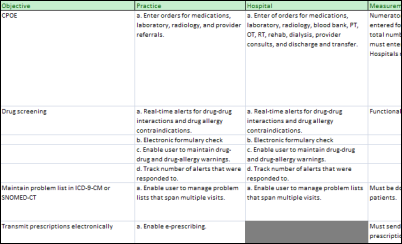
southwestgeneral

Southwest General Health Center (OH) finishes the first phase of its ambitious $26 million IT plan that includes clinical systems, wireless technology, tablet PCs, biometric security, mobile carts, periop documentation, speech recognition, enterprise scheduling, and an HIE. That’s a lot for a hospital of around 300 beds.

sushoo

Practice EMR vendor DoctorsPartner offers the Sushoo (bless you) independent HIE, free for DoctorsPartner customers or $2,500 upfront and $80 per month otherwise.

Saskatchewan’s electronic health record could be finished for all residents within four years for an additional $365 million beyond the $235 million already spent with another $60 million a year in operating costs. The problem is they may not have the money due to “nose-diving potash prices.”

I plan to write HIStalk at least some of the time over the holidays, if for no other reason than because almost nobody else does that (pros and amateurs alike). It’s a good time to write a guest article or tell me something interesting since hard news may be in short supply (but you never know).

E-mail me.

Text Ads


RECENT COMMENTS

  1. Really interesting perspective — especially around the EHR market. What I’m seeing lines up with this: Epic keeps consolidating, Oracle/Cerner…

  2. Why does the displayed "exam room of the future" still have the classic "clinician has their back to the patient"…

  3. Anything related to defense will need to go to Genesis.

Founding Sponsors


Platinum Sponsors


Gold Sponsors


RSS Webinars

  • An error has occurred, which probably means the feed is down. Try again later.