I enjoy volunteering. One of the most meaningful things I’ve done is placing flags on the graves of veterans. My family has a tradition of military service going back to the Civil War. Although placing flags at the National Cemetery gets a lot of recognition, there are smaller projects that may not hit the national news or even the front page of the local paper. I was invited recently to join one of those projects and I have to say it was a great experience.
What makes this event different is that it is significantly smaller and allows youth to interact with veterans directly. The morning starts with the veterans providing breakfast to nearly 300 youth volunteers who experience first-hand the concept of servant leadership. There’s nothing quite like sharing bagels with a WWII veteran and watching young people realize that war isn’t something from their history books or Wikipedia. After breakfast and a brief religious service, the young people (many who aren’t from the same faith tradition as those they’re serving) fan out across nearly a dozen religious cemeteries.
Over the last several years, volunteers (some as old as 97) have combed through cemetery records and identified veterans’ graves, adding a flag holder with a medallion next to each grave marker. In deference to the sacrifice of the veterans, volunteers approach the graves with some ceremony. The flag is placed and saluted and a brief statement of thanks is recited which includes the name of the veteran being recognized. It’s more than just adding the flags, it’s taking the time to speak directly to the person whose service allowed us the freedom we enjoy.
The majority of the veterans we honored were from WWII – often called The Greatest Generation. As we spoke the names it was hard not to wonder who they really were – whether they had children, what they liked to do in their free time, and how they came to rest in these small suburban cemeteries. This generation served their country not for fame or recognition, but because it was the right thing to do. Those who made it home from the war spent the rest of their lives continuing to do the right thing – raising families, taking care of their elders, and supporting their community.
They didn’t have the Internet, smart phones, or billions of dollars of technology at hand. The biggest technology revolution for many of them was getting telephone service that didn’t involve a party line, and maybe a black and white television. Their solutions for many problems revolved around hard work, sacrifice, and sheer determination. I was grateful to spend the morning communing with them and watching the spirit of service be passed to the next generation.
The peaceful morning was in sharp contrast to the rest of my day, which was spent in a busy urban emergency department. Except for a handful of octogenarians, most of my patients were under age 50. Many of them presented with problems at least partly related to our dependence on labor-saving devices and the quest for convenience – obesity, computer-induced repetitive motion injury, diabetes, high blood pressure.
More than half presented strictly because they wanted the technology of the hospital to convince them they were OK. These patients ranged from the woman who refused to allow a co-worker to remove a bee stinger “because she didn’t have any medical training” to a teenager who refused to believe her two negative home pregnancy tests, demanding a blood test to convince her boyfriend she was indeed pregnant. Nearly every one of them had an iPhone and several were surfing the Internet during the interview or exam, despite requests to stop. A couple of patients argued with me about their treatment, citing Internet information they found while in the waiting room.
Several demanded CT or MRI scans for simple sports-injuries despite having no ability to pay for such a test even if it was indicated, which it wasn’t. Guess what? If you run down a steep hill wearing flip flops, you will fall and sprain your ankle. The Ottawa Ankle Rules say you don’t even need an x-ray, let alone a scan. You need an Ace wrap, some ice, and a pair of real shoes.
It was one of the rougher shifts I’ve worked. I’m sure the contrast between people who want technology to solve all their problems effortlessly and those who were willing to give their lives simply for the concept of a world free of tyranny had something to do with it. I’ve been in informatics for nearly a decade and have seen the wonders that big data can do. I’m excited by the promise of personalized medicine and genomics, but I understand that it all comes at a price. Looking at global economics, it is likely more than any of us can afford. We’re mortgaging our future while we overlook the basic lessons of the past.
Technology isn’t the solution – it’s merely a tool. We have to learn how to use it wisely and at the same time how to temper our addiction to it. I challenge every reader to consider spending a day off the grid. If you can’t spare a day, consider an hour. Go volunteer. Go do something simply to show caring to someone else. Or just go lay on the grass and see that there is a world beyond the screens and clicks. And while you’re at it, say thank you to those who gave all.
Thomas Friedman of The New York Times publishes an editorial in which he points to a rapid increase in health IT startups as an unforeseen positive consequence of HITECH and ACA.
Greenway earns patents for a server configuration that aggregates data from multiple EHR systems and auto-completes accreditation or certification forms and another related to tracking clinical events across multiple EHR systems.
From HIPAA Faxing: “Re: HIPAA rules. Our esteemed EMR vendor wants $20,000 to connect each lab. The lab wants $19,990 to connect their side (funny how they charge the same). That’s $40,000 per lab connection and we use 17 labs and can’t afford that, so we use a fax server. What are the HIPAA rules around faxing? What do we need to do?” Experts, here’s your chance to contribute.
From Delta Don: “Re: Philips iSite. I’ve never seen anything like the disaster of the iSite 3.6 to Intellispace 4.4 upgrade. System and functional instability have pushed the go-live date back three times. It’s now six months late with new issues every day, but Philips personnel are enjoying their extra-long Memorial Day weekend. With vendor-neutral archives making migration among PACS vendors more feasible, you’d think there would be more effort. I won’t even start on the product name when we still have users calling it Stentor.”
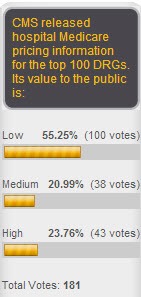
Respondents weren’t overly impressed by the value to the public of the Medicare pricing information released by CMS. New poll to your right, as suggested by a reader: should Meaningful Use be ended after Stage 3 or continued? You’ll get a link to add your comments after voting, so you might as well expound on your position.
Photo: Pete Marovich/EPA
Monday is Memorial Day, set aside to honor those one million US Armed Forces members who died while serving. Their sacrifice allows you the luxury to decline to fly the flag, visit a military cemetery, or think about those who made the ultimate sacrifice on your behalf. That’s not to say it wouldn’t be nice to do it voluntarily.
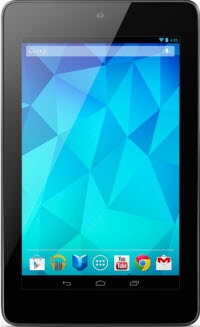
I impulsively bought Mrs. HIStalk a Google Nexus 7 tablet when I went to the office supply store to get several packs of the index cards I like to write on since she’s computer-averse and always gets my hand-me-down laptops. My initial assessment of the $199 device is that it’s very nice, in some ways better (sharper display) and some not as good (fewer apps) as the iPad mini, but at just 60 percent of the mini’s price, it’s a much better deal. Don’t buy it yet, though – an upgrade is imminent that will add greatly enhanced video.
Neal Patterson was not only on the call, which is rare, but he actually chaired it and reminisced a bit with good humor about the company’s origins. Fellow founder Cliff Illig was on, which I don’t recall ever happening.
The company says the number of physicians using its ambulatory products doubled to 45,000 in the past two years.
EVP Zane Burke says Cerner’s competitors are no longer other EMR vendors, but rather companies involved in insurance and big data.
Responding to an shareholder’s question about Epic, Neal Patterson said, “They like to say they don’t have shareholders. I’d like to point out to the reality that they do actually have shareholders, it’s basically almost a single individual. And they also point out the fact that in this country, you can’t pass on an ongoing operation … our plans are to take away their advantages and make our strengths stronger and make their strengths weaker on a relative basis … we’re the most innovative company in this industry, we have always been.”
Jamie Stockton with Wells Fargo Securities sliced and diced CMS’s hospital EHR attestation database to find that 7 percent of hospitals that qualified for Year 1 incentives didn’t attest with the same vendor in Year 2. The interpretation was that the Year 2 incentives, which required participation for a full year, were too difficult for some hospitals to meet. The worst-performing vendor was McKesson, which saw its attestations drop off from 10.5 in Year 1 to 6.5 in Year 2, a 38 percent washout rate of an awfully low starting number.
Allscripts adds two board members that include former Epic CFO Anita Pramoda, who left Epic in 2012 and founded senior PHR vendor TangramCare.
Allscripts files a lawsuit against its landlord, Chicago’s Merchandise Mart, claiming its lease was violated by allowing excessive noise in renovating five floors just below the Allscripts offices for new (and largest) tenant Google. Allscripts is demanding that the Merchandise Mart stop using nail guns and pneumatic hammers during business hours.
Ed Marx posted an update to his most recent CIO Unplugged about a salesperson who hijacked Ed’s presentation with an overwrought sales pitch disguised as a post-presentation question. I’ll side with Ed. As much as salespeople have been educated (or brainwashed) to believe that their particular hammer is appropriate for any nail, I don’t think it’s acceptable to harass a speaker and audience just because they perceive that nobody’s returning their cold calls. Whatever happened to respecting the prospect enough to let them decide what products and services they want to consider and how they would like to evaluate them?
A New York Timespiece by Tom Friedman says that Obamacare, the HITECH program, and HHS’s release of its databases has created a healthcare Silicone Valley that may improve care and lower costs because of the availability of information. Friedman spoke to a family doctor who thought she was giving appropriate colorectal cancer screening recommendations until her EHR showed only 43 percent of her patients had actually received the screening. Adding EHR alerts raised the number to 90 percent, leading to early cancer detection in three patients, which was obviously good for the patients but also for healthcare spending since early-stage treatment costs less. White House CTO Todd Park bragged on entrepreneurs who developed apps around HHS’s databases and kicked off a health data industry. Friedman met with Eviti, Teladoc, Humedica, and Lumeris.
The White House Blog brags on EHR adoption, crediting the President who spent the money rather than the taxpayers who provided it.
Two people with no transportation experience are named finalists for the position of interim director of the Capital Area Transit System (LA.) One of them is Bob Mirabito, former CIO of Baton Rouge Radiology Group, who says his position was eliminated last year and he needs a job.
The Canadian government revokes the passport of a Quebec doctor who is of defrauding US Medicare of $375 million by submitting phony claims for homeless patients when he was practicing in Texas.
Weird News Andy says he has printing on the brain after reading that 3D printing allows replacing 75 percent of a person’s missing skull.
Vince continues with the very interesting HIS-tory of Allscripts.
A Five-Step Approach for Collaborative ICD-10 Testing By Deepak Sadagopan
With the October 1, 2014 ICD-10 deadline rapidly approaching, payers and providers should be knee deep in their transition and testing efforts. According to CMS, there will be no more delays.
For many, especially healthcare provider organizations, ICD-10 is straining resources across all operational departments, including revenue cycle, coding/HIM, and IT. Providers are actively seeking ways to contain the cost of compliance and minimize revenue disruption post-transition. Many are mitigating ICD-10 risks by analyzing historical data and prioritizing high-risk areas based on impacted specialty or department.
As providers evaluate high-impact scenarios, they need to take a more strategic approach by allocating scarce, skilled resources to the evaluation of high-impact cases, natively coding those carefully selected scenarios, and then collaboratively testing these scenarios with their trading partners.
This last step is vital to avoiding revenue cycle disruption after the transition. While collaborative testing may require more testing time, the resulting ICD-10 readiness will give providers the ability to foresee potential coding problems and possibly avoid a negative impact on revenue flow.
Most importantly, with the rapid evolution of value-based reimbursement programs that would include direct trading transactions between providers and payers, collaborative ICD-10 testing will build confidence and pave the way for more intense collaboration that involve higher financial stakes for both parties.
But there’s a problem. Nearly two-thirds of respondents to a survey conducted at the February 2013 Healthcare Mandate Summit indicated they have used, or are planning to use, the additional year to conduct testing. However, two-thirds of respondents also said they do not have a specific strategy in place for collaborative testing. By not testing together, providers are missing out on a significant opportunity to share coding knowledge and outcomes with their trading partners.
Collaborative testing is a key component to overall mandate adherence and can be managed with a simple five-step approach. This approach enables providers to assess their readiness and achieve a less disruptive transition to ICD-10.
Establish a baseline. Providers and their trading partners should evaluate at least 12-18 months of key performance indicators such as claims acceptance rates, electronic claim adjudication rates, and aggregate claim reimbursement amounts for high-impact medical services.
Identify key partners. Healthcare providers should identify and connect with trading partners that want to achieve ICD-10 compliance with as little financial risk as possible. This approach brings both perspectives to the table to establish a balanced testing plan.
Develop test scenarios. Both parties work together to establish testing goals and mutually beneficial testing scenarios. The choice of test scenarios should involve a mix of cases likely to increase or decrease reimbursement compared to historical claims data.
Run tests. Both parties set up their test systems and infrastructure to test identified scenarios and run them through their processes. Providers should natively code scenarios in ICD-10 and send claims to the payers. The payers natively process the claims in ICD-10 through the complete life cycle and return the reimbursement advice to the provider.
Assess results. Providers and payers compare results with the baseline to identify discrepancies. Providers can use the results to assess impacts to internal coding productivity, DNFB days and revenue disruptions that may occur post-transition.
With 85 percent of healthcare costs hanging in the balance, it is imperative that problems are solved before the 2014 deadline. Providers and their insurance plan partners hold the key to each other’s success, and by coming together early, everyone can better ensure business readiness and financial neutrality.
Deepak Sadagopan is general manager of Clinical Solutions & Provider Segment at Edifecs.
May 24, 2013Time CapsuleComments Off on Time Capsule: Camping Out for a Cerner Black Friday Door-Buster Special: Mr. HIStalk’s Plan to Stimulate the HIT Economy By Encouraging Unrestrained Holiday Season Greed
I wrote weekly editorials for a boutique industry newsletter for several years, anxious for both audience and income. I learned a lot about coming up with ideas for the weekly grind, trying to be simultaneously opinionated and entertaining in a few hundred words, and not sleeping much because I was working all the time. They’re fun to read as a look back at what was important then (and often still important now).
I wrote this piece in November 2008.
Camping Out for a Cerner Black Friday Door-Buster Special: Mr. HIStalk’s Plan to Stimulate the HIT Economy By Encouraging Unrestrained Holiday Season Greed By Mr. HIStalk
Capitalists and fans of pointless and unsatisfying consumerism, rejoice! Even in a tanking economy, America’s newest national holiday, Black Friday, brought out the greedy and sometimes violent masses last week, just like the good old (pre-recession) days.
I’m guessing that most of us in the industry weren’t standing in front of our local Wal-Mart on Thanksgiving evening, anxiously awaiting its 5:00 a.m. opening (picture a Soviet bread line made up of looters on a camping trip). No amount of civil irresponsibility is too much to score precious Caitlin a “Baby Alive Learns to Potty” doll.
Caitlin: “Mom, did Santa bring this?”
Role Model Mom: “No, Princess, I beat a woman in a wheelchair senseless and ripped it from her bleeding hands right in front of her kids at the checkouts to save $20 that day after we gave thanks for God’s bounteous riches. Now go away while I watch Desperate Housewives.”
All of that publicly displayed greed has stimulated my latest brainstorm: HIT Black Friday.
I’m picturing a Friday morning line of rental cars filled with hospital IT people sitting in Epic’s frosty driveway, hoping to score a 20 percent break on software license fees (if they’re one of the first five hospitals to sign a contract and if Judy likes them). Turkey-tryptophan groggy CIOs rushing Cerner’s HQ to score a pre-sunrise BOGO deal on Millennium applications. RSNA attendees taking indirect Chicago flights to first get rolled-back pricing on a clinical transformation door-buster special ($200 an hour a twenty-something consultant) from one of the big consulting firms.
Like those consultants, I’m projecting big benefits. Big PR all around. Low vendor costs. Desperate competition since nobody’s selling anything anyway. The chance to upsell (“Say, know what’d go great with that LIS? A matching CPOE application and an extended warranty at 20 percent annual maintenance. Want it wrapped?”)
Print publications would love the revenue from full-page ad inserts. Muckraking blogs like mine would leap at the chance to leak the Black Friday deals. The HIMSS opening session could feature videos of big-name CIOs out-sprinting each other in Friday’s pre-dawn hours at the HIMSS bookstore to get discounts on the latest Marion Ball bestseller or chic HIMSS hoodies for all the homeys in the HIT ‘hood. Nothing creates demand better than the illusion of widespread demand.
In fact, instead of having its virtual conference during the shopping season, HIMSS should stage a Midyear Conference in December that eliminates all the usual boring parts (educational sessions) and focuses entirely on a big-budget, sprawling spectacle of Vegas-like exhibits, self-important attendees jostling to fill their vendor trick-or-treat bags, and the Marrakesh Bazaar-like scent of aroused technology capitalists getting their HIT hunt on during the industry’s annual bacchanalia of commerce (OK, smartass, it is NOT the same as the annual conference – I said December).
Now don’t get all high-horsey on me. HIT is about moving iron. Closing the deal. Getting, not using. To paraphrase that Brillat-Savarin quote shown at the beginning of Iron Chef America, “Tell me what you buy, and I will tell you what you are.”
Like Black Friday, during all the hustle and bustle of enjoying family and reflecting on one’s good fortune and place in the universe, let’s take a moment to remember what’s really important: buying a lot of soon-to-be junk like an ancient Egyptian boy king loading up his tomb with Blu-Ray players and GPSs since an afterlife without them would just plain suck.
So set your alarm for next November 27 at 3:00 a.m. for the first HIT Black Friday. Like the leader of the free world said, it’s your patriotic duty to get out there and go shopping.
Comments Off on Time Capsule: Camping Out for a Cerner Black Friday Door-Buster Special: Mr. HIStalk’s Plan to Stimulate the HIT Economy By Encouraging Unrestrained Holiday Season Greed
Executives from competing Kansas HIEs are struggling to cooperate with a state mandate that they integrate their networks. State legislatures had to step in this week to prevent the companies from charging each other access fees to comply with the mandate.
Conservative blogger and frequent “Fox and Friends” guest Michelle Malkin profiles the rise of Judy Faulkner, portraying her as a political insider and big Obama campaign donor who secured herself an appointment as the only vendor representative on the federal Health IT Policy Committee.
Secretary of Defense Chuck Hagel tells the DoD that he supports the use of commercial software to replace the department’s AHLTA EHR rather than switching to the VA’s VistA platform as he previously hinted was his preference. The DoD says it has identified 20 commercial software vendors capable of meeting its EHR needs. You’d have to bet on Epic given that it’s outselling everybody in big hospitals, they were allegedly the DoD frontrunner in 2010, and the Wisconsin Congressional delegation was squeezing the federal government to choose Epic awhile back (and not to mention that there are nowhere near 20 serious players to choose from.) On the other hand, DoD loves throwing billions at the fat cat contractors and Epic might not want to work through them.
Reader Comments
From Lil Wayne: “Re: Practice Fusion. Does anyone buy into their claim of having 30 percent of the primary care market? Seems beyond ludicrous.” I’m always curious about their methodology for counting actual users vs. someone who signs up with minimal usage. I would also be interested in seeing audited user statistics. Practice Fusion isn’t in the top five vendors by Meaningful Use attestation as I recall, in the low single digit percentages of all attesting providers.
From Stephanie: “Re: certification. If I already have a certified completed EHR and use another vendor’s patient portal within the HIE, does my patient portal also need to be certified? I’m just placing patient documents out in the portal for patients to view.” I know Frank Poggio will answer if nobody else does.
From Sleepless Fax Server Administrator: “Re: HITECH modifications to HIPAA. Will add risk to faxing or mailing results. There is a 100 percent chance of a violation when a provider changes practices since no healthcare IT system can determine the right address or fax number based on the date the patient was seen – they always use the current information. Even if you solved that problem, how would any system know if the patient followed the provider to the new practice? Also, critical radiology results are required by regulation to be faxed within 24 hours.”
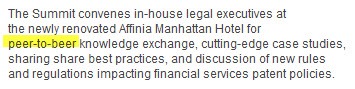
From Major Tom: “Re: conference. Thought you would enjoy this e-mail.” A promoter pitches their conference as offering “peer-to-beer” knowledge exchange, creating mental images of sullen, bar-perched attendees mumbling into their mugs.
From Non-Sequitur: “Re: RAC recoveries hit $1.37 billion. Forwarding a synopsis from Wolters Kluwer. You are still the brightest spot in many of my mornings!” Thanks, milady, that’s sweet of you to say. The article says RACs collected $1.371 billion in Medicare overpayments and returned $65.4 million in underpayments in the first six months of FY2013 (obviously like with the IRS, your odds of an unexpected refund aren’t so good when the RACs come knocking). The current major issue is documentation for cardiovascular procedures.
HIStalk Announcements and Requests
Listening: Superchunk, possibly the best and most prolific indie band in history. I’ve played all 15 of their albums on Spotify and it’s a stunning body of influential work spanning almost 25 years. A new album will be out in August and a tour follows.
Acquisitions, Funding, Business, and Stock
Online medical consult provider ConsultingMD secures $10 million in funding from Venrock.
Quality Systems reports Q4 results: revenue up 2 percent, EPS –$0.07 vs. $0.25, missing on both.
Poor performance in the company’s Hospital Solutions Division (a $4.2 million loss on $4.5 million revenue) will require investments in development, implementation,and support.
Steve Puckett will be moved from Hospital Solutions to CTO and COO/EVP Daniel J. Morefield will take over Hospital Solutions.
In a “what were they doing before?” moment, the company said it has “aligned our marketing team with our overall revenue objectives and shift and focus to increasing product demand and lead creation,”
To an analyst’s question about implementation margins of zero percent, the CFO’s response was, “There’s a number of factors, but I think hospital certainly is. I think we’ve already been talking about the — some of the challenges that we’ve been — that we’ve had there and that certainly impacted the profitability on that particular revenue category. I think — so it gets a little hard to generalize. On the ambulatory side, we’ve got — but I’ll let you — you ought to know, though, that certainly it’s not something — we are paying attention to it and we do intend to drive higher margin there in that space. We have — we are in some — having some transition in the ambulatory world … the full expectation is, for us, it’s going — going forward is to drive a higher level of profitability on that revenue category.”
The company declined to give dates for a SaaS product, saying it will focus on the current product.
The company expects a move back to larger EMR vendors as the small ones fail trying to keep up with Meaningful Use and ICD-10.
They expect more government programs to follow the DoD’s apparent lead in moving to commercial software, with vendors scrambling to get their GSA status.
Sales
East Lansing Orthopedic Association (MI) selects SRS EHR.
Conway Medical Center (SC) chooses StrataJazz from Strata Decision Technology for decision support, budgeting, and capital planning.
People
The New Jersey chapter of Entrepreneurs’ Organization and the Star-Ledger/NJ.com name SRS CEO Evan Steele the winner of the Garden State Entrepreneur Excellence Award in the $10M+ category.
TeleTracking Technologies hires Nanne Finis (Joint Commission Resources) as VP of consulting services.
Yousuf Ahmad, who will take over as CEO of Mercy Hospital (OH), is profiled in the local business paper because of an earlier position as CIO of Mercy Health Partners. Interestingly, he attended University of London on a cricket scholarship, graduated at 19, and is ranked among the world’s 400 best Scrabble players.
Announcements and Implementations
Cerner’s PowerChart Touch mobile solution earns a bronze award for Best Clinical Health Care Experience at the 2013 International User Experience Awards.
All of Maine’s 38 acute-care hospitals and 376 ambulatory provider sites have agreed to participate in the state’s HIE, operated by HealthInfoNet.
Holy Family Memorial Health Network (WI), Johnson Memorial Hospital (IN), and United General Hospital (WA) implement Hyland Software’s OnBase enterprise content management platform integrated with their Meditech systems.
Government and Politics
Idaho State University will pay $400,000 to settle alleged HIPAA violations stemming from a breach of unsecured data on 17,500 patients from an ISU family medicine clinic. The university notified HHS of the breach upon realizing that a disabled firewall had left patient data unsecured for at least 10 months.
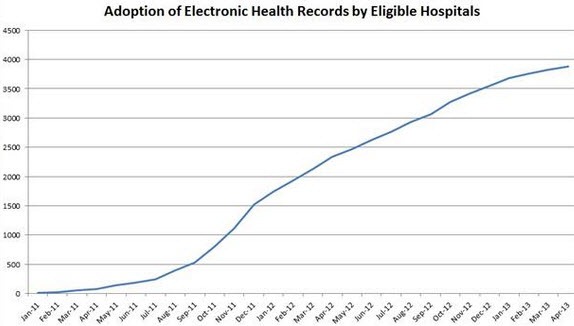
HHS reports that 55 percent of all EPs and and 80 percent of eligible hospitals and critical access hospitals have been paid MU incentives through the end of April. HHS had established a goal for 50 percent of EPs and 80 percent of hospitals to have EHRs by the end of 2013.
North Carolina’s state auditor finds that the state’s DHHS hasn’t overseen the implementation of its new $484 million Medicaid claims system properly, making it likely it will not be ready by the scheduled go-live in 40 days. CSC developed the system, which was written in COBOL by programmers from India copying code the company developed for a similar system in New York, and previous audits found poor documentation and unauthorized changes. DHHS allowed CSC to develop the acceptance criteria for its own project. The system was supposed to go live in August 2011 at a cost of $265 million. The state had already cancelled a 2003 contract with ACS saying their system wasn’t working before hiring CSC. Residents of other states are on the hook since the federal government is covering 90 percent of the development costs and at least 50 percent of the ongoing operational costs. Nothing good has ever come from combining state and federal governments, taxpayer money, contractors, and ambitious computer system plans.
Innovation and Research
Intermountain Healthcare announces a system that will track cumulative radiation exposure from higher-dose imaging exams and report it via the EMR.
Other
The County of Monroe Industrial Development Agency (NY) approves $369,359 in tax exemptions for eHealth Technologies, which is building a $4 million, 36,000 square-foot facility and is planning to add 60 jobs over the next three years.
Via Christi Health (KS) blames lower than anticipated revenues for its decision to lay off up to 400 staff members — about four percent of its workforce — across the state by the end of June.
Conservative columnist Michelle Malkin, known for writing screamingly partisan books such as Culture of Corruption: Obama and His Team of Tax Cheats, Crooks, and Cronies sets her sights for the second time on Epic’s Judy Faulkner in an article titled “The Obama crony in charge of your medical records.” She also weighs in that HITECH is “government malpractice at work;” calls out Epic and not its competitors for having “enhanced power to consolidate and control Americans’ private health information” (missing the point that only Cerner runs a profitable business unit that sells de-identified data from the hospital systems it hosts); and accuses the President of choosing Faulkner as the vendor representative on the HIT Policy Committee because of partisan politics (“the foxes are guarding the Obamacare henhouse.”) It’s a safe bet due to partisanship on both ends of the political spectrum that anyone who follows her faithfully believes every word, and anyone who doesn’t wouldn’t believe even one.
In Detroit, Henry Ford and Beaumont call off their merger plans, with the unstated sticking points apparently being cultural differences, disagreements over keeping both academic medical centers, and the unwillingness of Beaumont’s independent physicians to work with Henry Ford’s management.
All you need to know about the inevitable demise of most HIEs once the government grant trough has been lapped dry is contained in this story. The squabbling CEOs of two Kansas HIEs force the state’s lame duck HIE regulatory body to pass a resolution preventing them from trying to charge each other connection fees. KHIN and LACIE are required to connect their networks by July, but KHIN demanded that LACIE pay it a fee. The date has been moved back to December, and meanwhile the regulatory board – KHIE – will turn over its responsibilities to the state’s Department of Health and Environment on July 1 in a cost-cutting move. The dialog from the May 9 meeting:
[KHIN CEO] "If we give that data to another (network) they will have a competitive advantage, if we give it to them for free. We know that LACIE knows this — they’ve been out talking to providers all across the state of Kansas saying ‘If you join LACIE you can join at a lower fee, and you’ll get all of KHIN’s data for free.”
[LACIE CEO] That’s untrue, Laura. That’s absolutely untrue and we’ve told you it’s untrue. I’m sorry, Mr. Chair but that is an absolute lie.”
A University of Florida study finds that ED employees spend 12 minutes per hour on Facebook, and strangely enough their usage increases with ED patient volume and severity. On the other hand, it was a one-hospital study covering a 15-day period in late 2009 covering mostly the time between Christmas and New Year’s, so the method isn’t convincing.
A Pennsylvania judge orders the hiring of a forensic examiner to review the Facebook page of a woman who claims she slipped and fell due to a puddle of liquid on the floor of Lancaster Regional Medical Center. The woman claims she suffered serious injuries and can’t afford the surgery; the hospital found Facebook pictures and videos from up to 17 days after the accident after showing her frolicking in the snow.
Sponsor Updates
Greenway Medical announces the availability of its PrimeMOBILE mobile access solution for Windows 8.
Biilian’s HealthDATA posts a list of the 10 hospitals claiming the most in outpatient charges, according to expense report data published by CMS.
Liaison Healthcare launches Healthcare Terminology Manager and Healthcare Terminology Translation to facilitate the management of diverse controlled medical vocabularies for simplified data exchange.
Park Place International will market Interbit Data’s disaster recovery and business continuance software solutions to its customers implementing Meditech.
Levi, Ray & Shoup introduces MFPsecure, a line of hardware and software aimed at the pull printing and secure document delivery markets.
Ping Identity announces details of the workshops at its Cloud Identity Summit 2013, which takes place July 8-12 in Napa, CA.
The Boston Globe names Keane, Inc., now part of NTT Data, to its Globe 100 Hall of Fame in recognition of the company’s 25 years as a top-performing company in Massachusetts.
Visage Imaging releases Visage Ease version 1.3.0, which gives authorized healthcare providers mobile access to imaging results on iOS devices.
Care Team Connect hosts a July 10 Webinar on readmission prevention.
EClinicalWorks CEO Girish Kumar Navani discusses the company’s latest projects and offers his perspective on where healthcare is headed and IT’s role in healthcare transformation.
Greenway Medical customer Texas Orthopedics shares how its use of PrimeMOBILE has improved patient care and increased efficiency, productivity, and profitability.
INHS highlights the SHMC Pediatric Oncology clinic and its use of online status boards to cut patient wait times.
Encore Health Resources posts a YouTube video featuring CEO Dana Sellers participating in a discussion on EHRs and analytics.
Emdeon CEO George Lazenby shares his secrets to innovation and growth.
EPtalk by Dr. Jayne
From Anotherdrgregg: “Re: your recent piece on gimmicks. Preparing for our EMR, we looked at all our diets, some 30 in all, including the oddly named ‘anti-atherogenic diet.’ We reduced the number of diets to four, not including bariatric diets. The reasoning was that if you could hold it down, you were probably going to be discharged home. Administration nodded sagely, then went ahead with diet on demand complete with special breakfasts and a chef in a toque. Now they want to know why utilization is not high.” Any reader who can use the word “toque” gets my vote. He went on to list other frivolous hospital expenditures: flat screen TVs, real oak moldings on the doors, and carpets so thick that you can’t roll a gurney on them. He closed with this thought: “The finest hospital I ever worked at had painted cinderblock walls. it was a forward operating base.”
Hard to believe it’s almost June. In CMS terms, that means barely more than a month before Eligible Hospitals in the first year of Meaningful Use run out of time to begin the reporting period for Fiscal Year 2013. If you don’t start your reporting period by July 3, you’re out of luck as the federal fiscal year ends September 30.
Reuters Health reports that many health Web sites are too complicated and full of jargon, leading to confusion for patients. Instead of the fourth to sixth grade reading level recommended by the American Medical Association and the Department of Health and Human Services, the average reading level of online materials studied ranged from high school to college. Reviewers also found information that was oversimplified to the point of inaccuracy and large numbers of clichés at some specialty sites.
Scientists have often debated whether white coats and neckties spread germs. Unfortunately for fashionistas like Inga, handbags are now under scrutiny. Twenty percent of handbags studied had levels of bacteria high enough to cross-contaminate other surfaces. I wonder if the findings would also apply to brief cases or laptop bags?
HHS Secretary Kathleen Sebelius reports that HHS has exceeded its goal of transitioning 50 percent of eligible providers and 80 percent of eligible hospitals onto EHRs by the end of 2013.
Defense Secretary Chuck Hagel testified last month before a House Appropriations Committee to report that DoD had fallen behind on its plans to implement an integrated EHR with the VA; that much of the allocated money for the project had been spent with little to show for it; and that when the decision to launch a vendor search for a commercial EHR was made, he "didn’t think we knew what the hell we were doing." At the conclusion of that hearing, Hagel promised that he would halt the commercial vendor search and report back within 30 days with DoD’s new plan for delivering an integrated DoD/VA EHR. This Wednesday, bending to internal DoD pressure, Hagel reversed course on nearly all that he had said before the House Committee, reporting in a memo that DoD would resume its commercial EHR vendor selection rather than develop an integrated solution with the VA or adopting VA’s VistA.
All of Maine’s acute-care hospitals have agreed to participate in HealthInfoNet, Maine’s statewide query-based HIE. Thirty-four of Maine’s hospitals are already connected to the network, and the last four are scheduled to go live by the end of the year. HealthInfoNet is also connected to 376 ambulatory practice sites.
Free Web-based EHR vendor Practice Fusion launches a patient-facing site that allows patients to compare doctors and book appointments. After the appointment, patients can review their spending history across the entire history of their medical visits.
Pagers Cost Hospitals Billions Each Year By Larry Ponemon, PhD
Earlier this month, the Ponemon Institute released a study titled “The Economic & Productivity Impact of IT Security on Healthcare” that aims to quantify the impact that the use of pagers and other outdated communication technologies has on healthcare. The research reveals that communication in healthcare lags behind other industries, in large part because of the perceived security and compliance risks associated with the use of smartphones and other modern technologies.
As a result, outmoded communication systems waste clinicians’ time, limit patient interaction, lengthen discharge times, and lead to significant industry-wide economic loss.
The healthcare industry is facing some challenges in trying to balance the convenience benefit of new technologies with the need to keep patient health information protected at all times. While the implementation of electronic medical records and other new technologies is designed to improve efficiency and enhance patient care, it also has the potential to introduce risk, so IT departments must ensure that these new systems meet security and regulatory compliance requirements to keep private information protected.
As organizations struggle to strike this balance, the use of pagers and other outdated communications technologies continues as the status quo, in large part because of the perceived security and compliance risks associated with the use of smartphones and other modern technologies.
To quantify the impact this has and try to understand the scope, we surveyed 577 doctors, nurses, hospital administrators, IT practitioners, and other healthcare professionals. Overwhelmingly, respondents agreed that the deficient communications tools currently in use decrease productivity and limit the time doctors have to spend with patients. They also recognized the value of implementing smartphones, text messaging, and other modern forms of communications, but cited restrictive security policies as a primary reason why these technologies are not in use.
This study revealed that the use of pagers and other outdated communication technologies decreases clinician productivity and increases patient discharge times, collectively costing U.S. hospitals more than $8.3 billion annually.
According to our findings, clinicians waste an average of about 46 minutes each day due to the use of outmoded communication technologies. The primary reasons cited are the inefficiency of pagers, the lack of Wi-Fi availability, the inadequacy of e-mail, and the inability to use text messaging. On average, we estimate that this waste of clinicians’ time costs each U.S. hospital more than $900,000 per year. Based on the number of registered hospitals in the US, this translates to an industry-wide loss of more than $5.1 billion annually.
We also found that similar deficiencies in communications lengthen patient discharge time, which currently averages about 101 minutes. The majority of respondents said about half of this time could be eliminated if modern communication technologies were allowed. Specifically, 65 percent of survey respondents believe that secure text messaging can cut discharge time by about 50 minutes. Again, based on the number of registered hospitals in the U.S., we estimate that this ‘idle time’ during the discharge process costs more than $3.1 billion in lost revenue per year across the healthcare industry.
One of the primary reasons why smartphones and other newer technologies have not yet been adopted on a broad scale is the perceived security and compliance risks this would create. As a matter of both best practices and complying with HIPAA regulations, healthcare IT administrators are charged with keeping clinical systems and private health information protected at all times. As with other industries, we see that the reduction of risk often comes at the sacrifice of the convenience and productivity benefits of newer technologies.
For example, native SMS text messaging is not encrypted and therefore cannot be used to transmit private health information. Many hospitals have a policy forbidding the use of texting despite the fact that research like ours clearly demonstrates the value it would have on both clinical workflows and patient care. In fact, the majority of respondents to our survey said HIPAA compliance requirements can be a barrier to providing effective patient care. Specifically, HIPAA reduces time available for patient care, makes access to electronic patient information difficult, and restricts the use of electronic communications.
There is clearly a tension between giving caregivers access to the best possible technology to do their job effectively and ensuring that security and compliance requirements are met. Unfortunately we see that the pendulum seems to swing in favor of the latter, and while it is absolutely necessary to ensure security and patient privacy, clinician productivity and patient care suffer as a result.
One of the takeaways from our research is that healthcare professionals—both clinicians as well as IT staff—seem to understand these challenges and the benefits of deploying more modern communication technologies. For example, 74 percent of survey respondents said secure text messaging either has replaced pagers or will replace pagers within the next two years at their organization.
This is encouraging, and we think research like this will help the healthcare industry realize that the cost of implementing new, modern communication tools will be just a fraction of the economic and productivity costs of continuing to rely on pagers and other outdated technologies.
Larry Ponemon, PhD is chairman and founder of Ponemon Institute of North Traverse City, MI.
The views and opinions expressed in this blog are mine personally and are not necessarily representative of current or former employers.
Don’t Sell Me, Bro’!
I haven’t stirred blog waters in a while, so let me throw a rock along the surface and see if it skips or splashes.
I admire those who are skilled in the art of persuasion. We need salespeople to bring ideas to help solve business problems. But timing is everything. Solomon waxed it eloquently in ancient days: “There’s an opportune time to do things, a right time for everything on the earth.”
Let me be straight. The right time to sell is never before, during, or after a speaker’s presentation. Yet this happens too often.
I recently finished the keynote for the Texas HIMSS conference. During Q&A, a salesperson launched into an infomercial. I was on my heels a bit and tried to move on. Instead of giving up, he launched into a second infomercial. I just wasted five minutes of precious audience time and subjected everyone to this windbag. I don’t remember a word he said or his company. This type of approach does nothing but spark tension and resistance.
The above incident broke the camel’s back. I am DONE with it. Hence, the motivation for this post and some practical advice on how to put things in their proper place.
Zeitgeist: “Understanding the intellectual and cultural climate of” the speaker presentation. Just for a moment, take off the sale’s hat and empathize with the presenter. Dependent on content, I have worked 10 to 20 hours to put something respectable together. Once it’s assembled, I rehearse at least the same amount.
For the above-mentioned HIMSS presentation, a colleague and I spent 20 hours putting together the content. We spent additional time with Advisory Board and Gartner to review and improve. I stayed up past 2 a.m. the night prior making last-minute adjustments. I spent three hours before the curtain opened rehearsing again.
As is typical, when I finished speaking, I felt as if I’d completed a big race or mountain summit: exhausted and elated. I’m asking myself how I could’ve done better and I’m beating myself over the lines I missed.
After this presentation, a line formed at the stage to talk. Now don’t get me wrong, I love the interaction when it is an exchange of ideas. Ideas energize me. Interacting with individuals often helps me decompress. But I get indignant when feigned interest is actually a veiled sales pitch.
When you sell me, I completely shut down. I will not remember a word you say. I will toss your business card. One person actually pulled out their iPad to give me a demo of the newest product destined to solve our nation’s woes. Really?
What I love is when attendees come up and we share ideas or perhaps I can answer a couple of questions they had from the presentation. This is like a reward, and I will find energy to connect. I love to help. But don’t sell me, bro’.
To keep this from happening again, I developed some untested recommendations. I am interested in your ideas as well. Please contribute with a comment so we all make better use of this precious time. Both audience and speaker will appreciate these.
Facilitator
Control the microphones. When you hand someone a mic, you have lost control. By holding it for them, you can prevent a hijack.
Provide boundaries. Let the audience know upfront that questions are welcomed and encouraged, with two caveats: infomercials or pontification are shunned.
Assertiveness. If someone violates these rules, protect the speaker and move on to the next question.
Speaker
Be direct. If someone goes into sales mode, actively shut them down and move to the next question or person.
Buddy system. Have a buddy with you as you prepare for the talk. If accosted, the buddy steps in.
An associate. Appoint an associate to stand with you after the talk. If someone goes into sales mode, they can step in and you move to the next person. My wife is great at this during parties. If she senses a sneak attack, you’d better watch out.
What’s worse than being sold post-presentation? Being accosted before the presentation with a sales pitch. When heading into a presentation, the last thing on my mind is listening to someone drone on about their product or service. My thoughts are focused on exceeding audience and organizer expectations. I’m absorbed with logistics perfection: visuals, lighting, and sound. I’m gaining a sense for the flow and vibe of the room. Not to mention I’m straining to remember all my key points! This is a big deal. It is show time.
Don’t sell me, bro’!
Update
I really appreciate the feedback and the ideas. I love understanding the multitude of perspectives. As I stated at the start of the blog, I have great respect for sales professionals. I have wonderful relationships with many that have helped our organization transform its business and clinical operations enabling superior outcomes.
That said, I still stand fast on this idea –you must respect the presenter and never try and sell them before, during, or after. There is a time for sales and there is a time for presentations. But they are distinct.
Ed Marx is a CIO currently working for a large integrated health system. Ed encourages your interaction through this blog. Add a comment by clicking the link at the bottom of this post. You can also connect with him directly through his profile pages on social networking sites LinkedIn and Facebook and you can follow him via Twitter — user name marxists.
NextGen Healthcare board member Ahmed Hussein resigns after multiple failed attempts to take control of the company through proxy fights. He currently holds more than $100 million in company stock, which means that he can reinstate himself to the board in the future through cumulative voting rules.
The Healthcare Innovation Council, an independent group of healthcare experts, has called upon Congress to reconsider the CMS Meaningful Use program since it is not furthering Congress’s goal of improving patient care. The group calls for a reboot of Meaningful Use before all of the money is spent. They are asking for a shift in focus away from hospital adoption of technology and toward improving the design and implementation of the EHR systems.
A Silicon Valley editorial praises Santa Clara Valley Medical Center’s $220 million Epic implementation, calling it a robust system that should lead to more efficient billing and significantly improve quality of care.
Healthland acquires post-acute care software vendor American HealthTech of Jackson, MS.
Reader Comments
From Dortlund: “Re: GE Healthcare. Charging a premium on top of annual maintenance for MU Stage 2 and ICD-10.” Not to mention spelling “after hours” as “afterhours” for some reason.
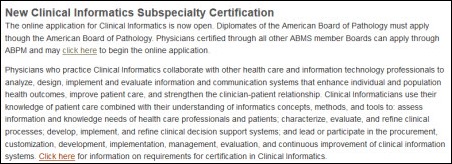
From CMIO: “Re: clinical informatics exam. I applied, paid, and took a board prep course and plan to take the practice test this summer. I did not do a fellowship, but I want to be on the inaugural class of the new board based on three years as CMIO. It is worth it for me, as this is my career and this is my credential.”
From NoLongerPhamis: “I LOVED the last Slideshare about GEHC/IDX. Almost fell out of my chair laughing. The part about seamless integration of marketing materials was spot on. I was there.” This was in a recent episode of Vince Ciotti’s HIS-tory.
Acquisitions, Funding, Business, and Stock
Healthcare consulting firm Information Resources Associates, Inc. merges with ESD.
Virtual visit technology vendor ConsultingMD raises $10 million in funding from Venrock.
Pittsburgh-based wound care EHR vendor Net Health acquires Integritas, which offers EMR/PM solutions for urgent care, occupational health, and hospital employee health.
Quality Systems, Inc. investor and board member Ahmed Hussein, mostly known for criticizing his fellow board members and launching proxy fights in an attempt to take control of the company, resigns. He owns more than $100 million in QSII shares.
Sales
Orange Accountable Care, a subsidiary of Orange Health Solutions, will deploy Sandlot Care Manager, Sandlot Dimensions, and Sandlot Metrix.
Wellmont Health System (TN) expands its relationship with MModal to include MModal Fluency Direct and Fluency for Imaging as its clinical documentation platforms.
St. Joseph’s Imaging (NY) selects Merge Healthcare’s Outpatient Radiology Suite.
The ERx Group, a staffing provider for rural acute care and critical access facilities, will use T-System’s clinical, financial, and operational technology and services.
Southeast Alabama Medical Center selects Besler Consulting to assist in the identification of Medicare Transfer DRG underpayments.
Western Maryland Health System (MD) will use Dimensional Insight’s business intelligence solution, The Diver Solution.
People
Long-term care EHR provider MatrixCare names Denise Wassenaar (Alliance Pharmacy Services) chief clinical officer.
Imprivata, expecting to go public within two years according to its CEO, names John Halamka, MD (Beth Israel Deaconess Medical Center) and former Phase Forward CFO Rodger Weismann to its board.
Stoltenberg Consulting appoints Douglas Herr (maxIT Healthcare) VP of Epic practice and client relations.
Announcements and Implementations
Peak Health Solutions partners with ChartWise to offer a solution that includes Peak’s clinical document improvement consulting and education program and ChartWise’s CDI software.
Stillwater Medical Center (OK) integrates its Philips IntelliVue patient monitors and Meditech ED management solution using the Accelero Connect healthcare integration platform from Accent on Integration.
North Shore-LIJ Health System adds cameras in operating rooms at its Forest Hills Hospital (NY) to remotely audit surgical teams for performing timeouts prior to procedures and to alert hospital cleaning crews when a surgery is nearing completion.
Fox Business News is running a week-long series called “How Private are Your Medical Records?” on “The Willis Report.” Monday’s episode featured Deborah Peel, MD of Patient Privacy Rights and Mark Rotenberg of the Electronic Privacy Information Center.
Covenant Health (TX) and MemorialCare Health System (CA) are named winners of the 2013 Crimson Physician Partnership Awards presented by The Advisory Board Company, saving a combined $20 million by presenting comparative performance information to their physicians.
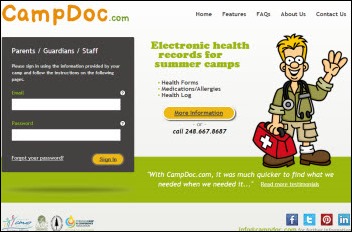
CampDoc.com releases an electronic medication administration record module for its summer camp EHR.
Government and Politics
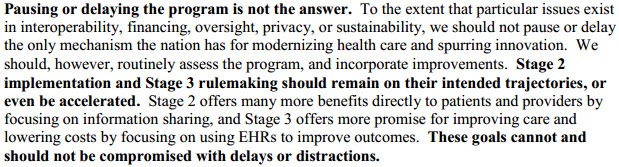
The Consumer Partnership for eHealth and the Campaign for Better Care submit a letter to the six Republican senators who last month questioned whether the implementation of the HITECH Act was money well spent. The consumer groups argue that MU is working and that delaying Stage 2 implementation and Stage 3 rulemaking will be detrimental to patients, will stifle innovation, and will delay progress towards interoperability.
CMS posts the 2014 ICD-10-PCS files, including code tables, index, and coding guidelines. CMS notes that the FY 2014 ICD-9-CM diagnosis codes will not be updated.
ONC posts positions (1, 2) for medical officer reporting to the Office of the Chief Medical Officer.
Twila Brase, RN, president and co-founder of Citizen’s Council for Health Freedom, says EHRs are burdensome and inaccurate, adding that they are turning doctors into data clerks. She adds, “Documenting a full clinical encounter in an EHR from scratch can be pure torment. The full chart doesn’t fit on the computer screen. Each element is selected by a series of clicks, double-clicks, or even triple-clicks of a mouse button. Hunting, clicking, and scrolling just to complete a simple history and physical exam is a tedious and time-wasting experience."
A Health Innovation Council commentary article says HITECH is causing, “A massive disruption of providers’ patient care focus as they chase Meaningful Use dollars; increased burdens on physicians, nurses and clinicians since EHRs as currently designed require more, not less, of their time and effort; and an unprecedentedly huge expenditure by providers on EHR hardware and software at a time when providers are under severe financial pressures.” The group recommends that the HITECH program either be redesigned to emphasize patient care, safety, and efficiency or be shut down completely and spend what’s left of the money on rewarding provider care improvement by whatever means they choose. What is minimally noted in the press release is that the Health Innovation Council was formed and is run by Anthelio Healthcare, the former PHNS, a healthcare IT consulting services vendor.
In the UK, Health Secretary Jeremy Hunt announces creation of a $400 million fund to help hospitals with the cost of replacing paper-based clinical documentation and prescribing with electronic systems.
Other
MyMedicalRecords.com files another patent lawsuit, this time against the recent Allscripts acquisition Jardogs. The complaint states that the FollowMyHealth Universal Health Record infringes on MMR’s personal health record patents.
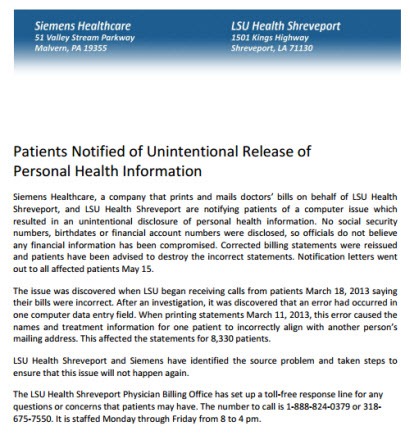
LSU Health Shreveport (LA) and Siemens Healthcare inform 8,330 patients of an unintentional disclosure of PHI stemming from an error in a computer data entry field. LSU and Siemens, which prints and mails bills on behalf of LSU Health physicians, have now identified and corrected the error that caused the names and treatment information for one patient to incorrectly align with another patient’s mailing address.
UPMC will outsource its transcription services to its development partner Nuance at the end of June, laying off 100 transcriptionists who have been offered jobs by Nuance.
Moore Medical Center (OK) is destroyed by a 200 mph tornado, but the 30 patients housed in the 46-bed hospital all survived, as did all of the hospital’s employees.
A Silicon Valley newspaper editorial lauds the $220 million Epic implementation at Santa Clara Valley Medical Center (CA), saying it will improve billing efficiency and quality of care, also avoiding the 1 percent Medicare penalty and instead reaping $11 million in HITECH funds.
Weird News Andy says he’ll take one today if it can help find his car keys. A New York Times article says helper robots will be used to help care for the elderly.
Sponsor Updates
ISirona employees participate in the Emerald Coast Mud Run benefiting Heart of the Bride, which supports orphans around the world.
DocuTrac, a provider of EMR technology for behavioral health, will add DrFirst’s e-prescribing technology into its QuicDoc EMR Professional and Enterprise edition software.
An Imprivata-commissioned survey of Canadian HIT executives reveals key barriers for clinicians when accessing patient data, including a lack of systems integration, privacy and security concerns, and slow access.
McKesson’s Horizon Lab 13.5 becomes for the first LIS to receive EHR Module certification for MU Stage 2.
Ingenious Med updates its impowermobile charge capture software to include the ability to create a virtual superbill at the point of care.
Greenway Medical adds ClientTell’s ReminderManager patient communications solution to its Online Marketplace as a certified API solution for the PrimeSUITE platform.
DirectTrust.org and EHNAC extend accreditation to ICA under its Direct Trusted Agent Accreditation Program.
In a GetWellNetwork-sponsored Webinar May 29, administrators from Hasbro Children’s Hospital (RI) share details of how it improved patient satisfaction and workflow by joining patient-centered care technology with a meal ordering system at the bedside.
Kareo posts a Webinar that answers the top six Stage 2 MU questions and offers three reasons to check out CMS eHealth.
Several HIStalk sponsors earn a spot on the Informatics 2013 Top HCI 100 list, including 3M, ADP AdvancedMD, Allscripts, API Healthcare, Beacon Partners, Capario, CareTech Solutions, Covisint, Craneware, CTG, Cumberland Consulting Group, eClinicalWorks, Elsevier, Emdeon, ESD, GE Healthcare, Greenway, Iatric Systems, Impact Advisors, Infor, Intellect Resources, MModal, McKesson, MedAssets, Medseek, Merge, NextGen, NTT DATA, Nuance, Optum, Orion, Passport Health, Philips Healthcare, Siemens Healthcare, Sunquest Information Systems, Surgical Information Systems, T-System, TeleTracking Technologies, TELUS Health Solutions, The Advisory Board Company, The SSI Group, Vitera Healthcare Solutions, Vocera Communications, Wolters Kluwer Health, and ZirMed. Porter Research submitted, compiled, and reviewed sales figures to create the list.
The Philadelphia Alliance for Capital and Technologies recognizes InstaMed as its Technology Growth Company winner and Halfpenny Technologies a Life Science Growth Company finalist at the Alliance’s 2013 Enterprise Awards.
Imprivata launches a migration program that enables customers using the Citrix SSO feature to migrate to Imprivata OneSign SSO. Also, Imprivata participates in a breakout session on desktop virtualization and SSO at this week’s Citrix Synergy conference in California.
Emdat profiles Illinois Bone and Joint Institute, which realized a 50 percent year-over-year cost savings in documentation and correspondence costs using Emdat alongside its EMR.
Beacon Partners hosts a May 31 Webinar integrating business intelligence and analytics through the healthcare enterprise and offers a white paper on why risk assessments help reduce an organization’s risk of a data breach.
Awarepoint’s RTLS platform will be featured in an industry-wide interoperability demonstration at the Association for the Advancement of Medical Instrumentation 2013 Conference and Expo June 1-3 in Long Beach, CA.
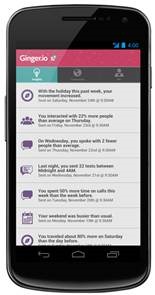
Several readers shared this link about a smartphone app that tracks patient activity and reports it to physicians. Called Ginger.io, the app is being studied at several hospitals in the US. The goal is to mine data on phone use and movement to show changes in patterns that could indicate illness or worsening of chronic conditions.
The app has to be activated by a hospital or health care company and obtains a baseline on personal activities once it’s activated. Caregivers are notified when there are changes in patterns of travel, phone calls, texting, etc. According to the Ginger.io website, it uses both passive data collected from the phone and active data reported by patients to create context-sensitive interventions.
The behavioral analytics platform is based on research from the MIT Media Lab. Several interesting papers are referenced on the website. With the level of data that can be gathered, privacy is a concern. The site claims to “only collect data we need to paint a rough texture of your behavior.” Patients are able to control whether data is shared with clinicians and researchers and can opt out at any time.
As a primary care physician I find the idea intriguing. The key is in the predictive ability of the algorithms to identify when a patient would benefit from an intervention. For this to really take off with hospitals and health systems, however, outcomes are not enough. It’s going to have to demonstrate cost savings as well. It will also take some patient education to make some of the “insights” valuable. Just looking at the screenshot, they’re pretty vague. “On Wednesday, you spoke with 2 fewer people than average.” “You interacted with 22% more people than average on Thursday.”
It reminds me of a virtual parent of high school students. You need to get out more. Stop talking on the phone and go to bed. You’re spending longer on your homework than usual. Get some exercise. You’re texting too much. Your music is too loud. There are twice as many miles on the car as there should be for where you said you were going.
Thinking back to what my phone has been up to the last several days, I wonder what the app and related algorithms would think of me. My boss is out of town, so I used Monday and Tuesday as rare opportunities to work remotely. I love working from home – I’m at least 40 percent more productive than in the office and feel a greater sense of accomplishment. I was able to use my land line and wasn’t running around so I made virtually no calls. Would it think I was withdrawn? Or would it interpret the flurry of text messages as I tried to reschedule a girls’ night out as evidence that my behavior was still within the range of normal?
Have you tried Ginger.io or do you know anyone who has? I’d love to hear what they have to say about it. E=mail me.
MMR Global files a patent infringement suit against Jardogs, recently acquired by Allscripts. The suit references Jardog’s FollowMyHealth patient portal as infringing on an MMR Global patent. Prior to this suit, MMR Global had been predominantly targeting hospitals and health systems in its string of lawsuits, but it appears that patient portal vendors will now be targeted as well.
Organizations from California, Massachusetts, Minnesota, and Wisconsin announce the formation of a new collaborative initiative with the goal of documenting and sharing best practices guidance to help hospitals prepare for ICD-10 conversion.
Louisiana State University and Siemens Healthcare have informed 8,000 patients that their personal health information was exposed after a bug in a Siemens system associated visit information with incorrect billing addresses. Siemens had been contracted to print and mail patient bills on behalf of LSU. The issue was discovered when patients began calling the hospital reporting incorrect names and treatments on their bills. No Social Security numbers, birthdays, or account numbers were exposed in the breach.
National Coordinator for Health Information Technology Farzad Mostashari, MD, will deliver the opening keynote speech during the ICD-10 Forum on June 17-18.
IDC Health Insights has published a guide to ACO formation, detailing five stages of what it calls ACO maturity. The report emphasizes the importance of introducing new technologies, like data analytics and mHealth apps, to support post-acute care, but only after key maturity levels are reached.
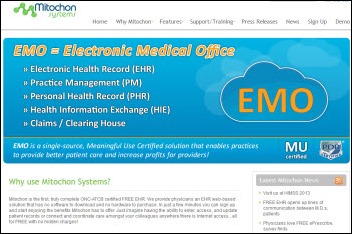
Free web-based ambulatory EHR vendor Mitochon Systems has announced that it will close its health IT business unit. Mitochon was a Meaningful Use Stage I certified vendor with 12 attestations according to the most recently released CMS data.
Seattle-based Tableau, a data visualization vendor popular in the healthcare space, raises $254 million on its IPO Friday and shares closed up 64 percent at the close of its first day of trading.
Wake Forest Baptist CIO Sheila Sanders will step down from her position effective May 31st. She leaves her position for personal reasons, unrelated to recent difficulties with Baptist’s Epic implementation.
MD Anderson announces a wage freeze, a reduction in hiring, and the postponement of construction projects due to lower than anticipated operating income for FY13. President Robert DePinho reports that an increase in donations and investment income is the only reason the institution will finish the year with positive net income.
From The PACS Designer: “Re: Microsoft’s updated BAA. Microsoft has released an update for its Business Associate Agreement to encompass more secure communications tools for HIPAA compliance. The changes provide for healthcare organizations to leverage cloud solutions to improve clinician productivity, care team communication, and care transition coordination while maintaining compliance with the recently updated Omnibus HIPAA Final Rules.”
From Laboratorian: “Re: University of Michigan. Goes live June 1 with a massive IT rollout. This includes a new Epic (Denali) implementation and a completely new LIS, an experimental version of SCC-Soft being used at U-M for the first time. The LIS rollout, in particular, is particularly audacious in scope, being the culmination of a seven-year implementation cycle. Barcode-based tracking of both tubes and surgical pathology specimens will be on par with the level of automation seen at BML labs in Japan. The spatial location of every asset in lab space will be tracked in real time. The project benefitted from co-development of code with support from U-M’s own software engineering teams. Nearly 2.5 million lines of new code above base SCC product will drive this new version.” SCC is often forgotten as maybe the leading LIS vendor for big health systems, and writing 2.5 million lines of new code is just crazy. Obviously Beaker wasn’t going to do the job for UM, although it’s improving to the point that some larger Epic customers are cautiously committing to it.
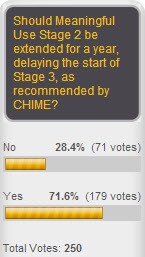
More than two-thirds of respondents think that Meaningful Use Stage 2 should be extended for a year before starting Stage 3. New poll to your right: CMS released hospital Medicare pricing information for the top 100 DRGs. How valuable is that information to the public?
Jamie Stockton of Wells Fargo Advisors sent over his monthly summary of hospital EHR attestations by vendor. Customers of the big multi-national corporations whose business is mostly not healthcare IT (McKesson, Siemens, and GE) are the clear laggards.
Just in case you are wondering what it would be like to have HIMSS darling and cardiologist Eric Topol, MD as your doctor, ponder this quote from an NBC fluff piece from January that I just ran across: “These days I’m actually prescribing a lot more apps than I am medications.” He claims that up to 80 percent of the 20 million echocardiograms performed each year could be replaced by in-office smart phone tests, saving the healthcare system $13 billion per year. In a stunning piece of investigative journalism, the on-camera talking head (also a doctor) who has clearly performed her research convinces him to eat tortilla chips and goads him into saying positive things about his own books and devices.
EHR vendor Mitochon Systems notifies its customers that it will shut down its free cloud-based EHR service in mid-June. The company isn’t sure how doctors will retrieve the data they’ve entered on patients before the system is turned off, but says it will come up with something.
Data visualization software vendor Tableau Software, whose product is popular in healthcare, raised $254 million in its Friday IPO as shares soared 64 percent. I’ve played around with it a couple of times and it’s pretty cool – there’s a free trial download on the site.
Sheila Sanders, VP/CIO of Wake Forest Baptist Medical Center (NC), will step down effective May 31. The hospital says she’s leaving the $465K job for personal reasons that are unrelated to its struggles with Epic.
CareWire names advisors Ken Saitow and Phil Hotchkiss as president/CEO and EVP/chief product officer, respectively.
Encore Health Resources CEO Dana Sellers was recognized Friday, May 17 as a Distinguished Engineering Alumna by the Cockrell School of Engineering at The University of Texas at Austin. She was also named Friday as a finalist for the Ernst & Young Entrepreneur of the Year for the second consecutive year.
James Holtzman is promoted from CFO to CEO of Prognosis Health Information Systems.
Terry Boch (JET Health Solutions) joins Wellcentive as SVP of sales and marketing.
Susan K. Newbold PhD, RN-BC, director of Nursing Informatics Boot Camp, is selected as one of the 2013 “Women to Watch” by the Nashville Medical News.
MD Anderson, which just announced Epic as vendor of choice, will freeze wages, cut back on hiring, and postpone construction projects, hoping to offset an anticipated 2014 financial shortfall that it blames on the federal government (the Affordable Care Act, the budget sequester, and federal deficits) even though its rapidly increasing operating expenses seem to be its primary problem.
A controversial decision by Britain’s NHS allows life sciences and insurance companies to buy access NHS’s patient-identifiable data (“bespoke patient-level abstracts), even providing companies with an Excel worksheet to calculate their cost.
Partners HealthCare System (MA) made a $133 million profit in the latest quarter even after it took a $110 million accounting charge to write off computer systems slated for replacement. Most of that came from investment income, as operating income dropped from $41 million last year to $5 million.
Vince covers Part 1 of the HIS-tory of Allscripts this week (more specifically, TDS, which passed through many hands before landing in the Allscripts lap via its acquisition of Eclipsys.) Vince also scored a major coup for upcoming episodes – he e-mailed Judy Faulkner at Epic and asked if could talk with her about the company and she invited him to meet with her in Verona, which he did last week and is still gushing about. Those are going to be some great HIS-tory installments.
Sponsor Updates
Carl Fleming of Impact Advisors raised $6,000 for St. Baldrick’s Foundation by having his head shaved at Impact Palooza 2013.
Sunquest Laboratory v 7.0.1003 is certified as an EHR module by CCHIT.
256 Shades of Grey(scale): The Dirty Little Secrets of Radiology and PACS By Brad Levin
There is widespread agreement that radiology has been the epitome of success spreading PACS far and wide over the last two decades. Thousands of organizations transformed from the dark ages of film to digital operations. Early activity started in the mid-1990s and peaked in the mid-2000s. Once the 2000s were in full swing, many groups moved to PACS for the first time, but it was relatively common for PACS early adopters to have implemented their second or in rare cases, their third PACS by then.
Along came the late 2000s, when industry analysts KLAS and Frost & Sullivan called for the next wave of PACS replacements. Many systems had aged well beyond the average 5-7 year lifespan of PACS, and it seemed like a solid market forecast. However, in reality the replacements never came in earnest.
Fast forward to present day and the institutional use of PACS has stagnated. PACS continue to be used past their useful life, problems persist, and upgrades are delayed. The other contributing factor is a majority of institutions today are using PACS born in the late 1990s or early 2000s. Their vendors purchased PACS largely through acquisition, and while these systems have been upgraded periodically, most of the core architectures remain largely unchanged.
This would be fine if time stood still, but of course it hasn’t. Over the last two decades, modalities have advanced at breakneck speed, producing computed/digital radiography, multislice CT, PET/CT, digital mammography, and the newest modality, digital breast tomosynthesis (or 3D mammography).
Modern technology has also dramatically changed consumer and physician expectations. Everyone expects instant gratification. Pay phones are extinct and we all use smartphones. The world is app-driven and tablet accessible. LPs/CDs have been replaced with MP3s. Medicine is mobile, and we’ve ditched our VCRs/DVDs for streaming media.
Today’s challenging healthcare environment, supported by yesterday’s PACS technology, has led to widespread chronic problems and missed opportunities. When I was told recently that some of the most senior leaders in imaging informatics had convened and were discussing how "Radiology Has Solved The Problems of Going Digital", I was stunned. Based on what I see at community hospitals, academic medical centers, IDNs, imaging centers, radiology groups, and teleradiology vendors, I know that statement couldn’t be farther from the truth.
The vast majority of practices are digital, but are their problems solved? In my view, absolutely not. Just this week I spoke with a PACS administrator from a 400-bed hospital in the Southwest. I was told that when their network access peaks, performance gets crushed on PACS, taking up to a minute to launch even a small CR study. Radiologists launch the study on PACS, grab a coffee, and hope that when they come back they can start reading the study. While this may or may not be just a PACS issue, it is a persistent, unacceptable problem nonetheless.
If you are unaware of the state of your imaging operations, I encourage you to speak to your radiologists, referring physicians, PACS administrators, and your IT staff. You may also consider meeting with your affiliates, and plan on attending the upcoming SIIM 2013. If you tackle today’s Imaging problems with the same vigor you used to transform from film to digital, your problems will quickly go into the rearview mirror.
Brad Levin is general manager, North America for Visage Imaging.

























































Would be interesting to see what Providence St. Joe's return has been on all their adventures. When I was on…