Recent Articles:

Morning Headlines 4/10/13

April 9, 2013 Headlines Comments Off on Morning Headlines 4/10/13

Administration pushes toward electronic medical records

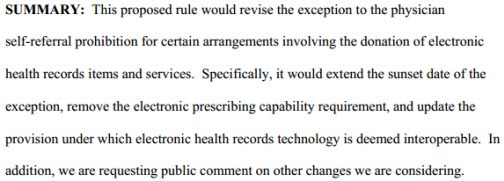
CMS and OIG both propose rules extending the safe harbor exceptions to both the Stark Law and the Federal Anti-Kickback Law that are set to expire on December 31, 2013. The laws would otherwise prevent hospitals and health systems from subsidizing EHRs for practices that refer patients to the organization.

Tavenner Moves Closer to CMS Confirmation

Marilyn Tavenner, acting head of CMS, received bipartisan support at her confirmation hearing Tuesday, taking her one step closer to becoming the agency’s first confirmed administrator since Mark McClellan, MD, PhD left the post in October 2006.

My first 100 days as Allscripts CEO

Paul Black provides some perspective on the transformation he is leading at Allscripts.

Did Jon Stewart Foil The Pentagon’s Health Records Plan?

Following a groundswell of negative media coverage and the appointment of former VA deputy administrator Chuck Hagel, the DoD seems to be revisiting the idea of adopting VistA in order to more efficiently move toward a central, integrated EHR.

Comments Off on Morning Headlines 4/10/13

News 4/10/13

April 9, 2013 News 14 Comments

Top News

4-9-2013 10-40-32 AM

The HHS inspector general and CMS propose rules that would update and extend existing safe harbor exceptions and allow hospitals to continue subsidizing EMRs for affiliated physicians.


Reader Comments

From Wildcat Well: “Re: HIE. ONC announces an interest in a nationwide interoperable HIE. Is this not the same initiative as the CommonWell Health Alliance pilot? CommonWell will be a 501(C)(6), but regardless. Looks like a race of private vs. the government. Thoughts?”  

4-9-2013 7-33-51 PM

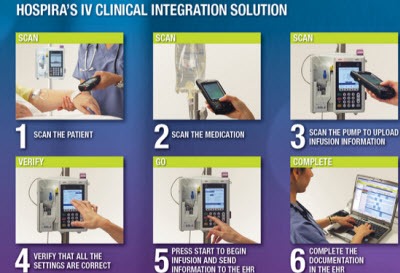
From Shodan the Barbarian MD: "Re: Shodan search engine. Guess you could easily find the IP address of a monitor, anesthesia machine, ventilator, or IV pump and change the settings. Scary with the virtually non-existent security of these devices.” A CNN article covers the Shodan search engine, a Google-like service that finds any device connected to the Internet such printers, webcams, routers, servers, security cameras, and even medical equipment. Many of those devices have no security protection at all, and many more have the manufacturer’s original password or an easily guessed replacement like “password1” or “1234”. An independent security consultant was able to run a car wash, turn off the cooling system of a hockey rink in Denmark, and access the control system of a French hydroelectric plant.

4-9-2013 7-43-59 PM

From Bob Loblow: “Re: QuadraMed. CMIO Joe Bormel, MD has left after 10 years and is now with ONC.” His LinkedIn profile still shows him as an independent consultant, having left QuadraMed in January 2013. Update: readers confirmed that Joe started as ONC’s medical officer on Monday, April 8.

From JM: “Re: healthcare IT resources. What would you recommend a recent graduate do to better understand the HIT environment? Are there specific resources, entry-level positions, or education to seek out?” This question comes up every few months and I always invite readers to provide advice.

From Marie: “Re: at-risk contracts. I am doing research for a master’s program. We hear about at-risk contracts between payers and providers, but why haven’t we seen a similar movement between HIT vendors and providers? Why aren’t providers demanding that vendors go at risk for the cost and quality results they promise? Why aren’t vendors offering it to create competitive advantage?” I can only say that you’d be crazy as a vendor to make a hospital your partner knowing they don’t have the focus and capability to deliver the 80 percent of an HIT project’s value that comes from how a system is used rather than the system itself. That would be like a hammer manufacturer going at risk that you’ll build something nice with their product and pay them if so. I’ve had experience writing at-risk contracts as a customer and either party could get royally screwed just because some idealistic metric (readmissions, medication errors, cost per case, etc.) went up or down over several years because of factors entirely unrelated to the new system. Perhaps you could look at more specific measures such as orders originating from an order set, accepted clinical warnings, or decreased turnaround time, but it’s hard to assign a dollar value to those. But I’ll let readers chime in and help Marie with her project.


HIStalk Announcements and Requests

inga_small This week marks my sixth anniversary at HIStalk. Happily I still think it’s the best job in HIT. In fact, every once in awhile I have to pinch myself to make sure I am not dreaming and that I am not about to wake up in the middle of the night to catch a 6:00 a.m. flight for an EHR demo to a bunch of doctors and their transcriptionists(!) Thanks Mr. H for keeping it fun.

4-9-2013 7-45-43 PM

Welcome to new HIStalk Platinum Sponsor Xerox, and specifically its Healthcare Solutions business. The company’s provider offerings include system selection and implementation (Meaningful Use, EHR, ERP, revenue cycle, ICD-10), optimization (technology and infrastructure, extended business office, collections, compliance), and analytics (clinical surveillance, decision support, care management, case management, and benchmarking). The company has been serving providers for 25 years, has 1,500 hospital clients, works in 31 states, and does work for 19 of the top 20 health plans. Some of the major vendors supported are Epic, Cerner, GEHC, Siemens, Meditech, McKesson, Allscripts, Infor Lawson, and Kronos. Thanks to Xerox for supporting HIStalk.

Here’s a video I found on YouTube that provides an overview of Xerox in healthcare.


Acquisitions, Funding, Business, and Stock

A Wisconsin newspaper’s article called “Life After Epic: From Epic ‘Grad’ to Entrepreneur” covers companies started by still-young former Epic employees, some of them working from a railroad car converted to co-working space. A local entrepreneur networking group estimates that 50 former Epic employees are working startups in the Madison area, most of them not healthcare related. A new entrepreneur says Epic’s one-year non-compete clause provides a good time to start a company.

4-9-2013 10-32-34 PM

Allscripts CEO Paul Black was paid $9 million in his first 12 days on the job, according to the Chicago business paper. Most of that was in stock and bonuses. Glen Tullman, his fired predecessor, made $7.1 million in 2012.

4-9-2013 10-33-14 PM

iMDsoft opens a new office in Dusseldorf, Germany that will provide around-the-clock support to its customers in Germany, Austria, and Switzerland.


Sales

Presence Health (IL) will deploy the Medseek Predict CRM solution.

Mississippi Medicaid selects the MedeAnalytics Accountable Care Solution to warehouse claims and clinical data collected from various HIEs.

4-9-2013 10-34-01 PM

The Ocean Beach Hospital (WA) board of commissions approves the purchase of Healthland’s EHR.

Planned Systems International and its partner Mediware win a $5 million DoD contract to provide validation services for the Enterprise Blood Management System.


People

4-9-2013 6-04-33 PM

Versus promotes Kevin Jackson to VP of technology.

4-9-2013 6-11-33 PM

Terry McGeeney, MD (TransforMED) joins healthcare consulting firm BDC Advisors.

4-9-2013 6-10-41 PM

MedeAnalytics hires Ping Zhang (Epocrates) SVP of product innovation and CTO.

4-9-2013 9-39-25 PM

Paula Sanders is promoted to chair of Post & Schell’s national Health Care Practice Group of 30 attorneys, representing clients on health facility regulation including RAC audits, HIPAA, and fraud and abuse.


Announcements and Implementations

The Joint Commission issues a Sentinel Event Alert after 80 deaths between 2009-2012 are found to be related to medical device alarm fatigue.

Massachusetts General Hospital and American Well announce a telehealth pilot program that will initially focus on child and adolescent psychiatry, heart failure, and neurology.

Christus Health Systems and Legacy Community become the first providers in Houston to share patient data via the Medicity-powered Greater Houston Healthconnect HIE.

4-9-2013 1-50-38 PM

Western Maryland Health System implements the Visibility Staff Assist solution from Versus Technology.

The local paper profiles St. Luke’s Regional Medical Center (IA) and its recent transition to EHR. The paper notes that, “The Affordable Care Act, commonly called Obamacare, requires health care providers to move to electronic medical records by 2014” and that, “Epic is not interoperable with hospitals and clinics that use other forms of electronic medical record.”

CIC Advisory announces a Meaningful Use Stage 2 benchmarking tool that includes on-site interviews and reviews followed by a detailed scorecard for a flat fee of $2,500.

4-9-2013 6-53-07 PM

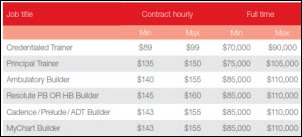
Technology recruiter Greythorn offers its first Healthcare IT Market Report. It covers salaries, benefits, consulting , bonuses, and part-time employment.

Spain’s first telemedicine service launches as La Palma and Tenerife Islands offer virtual consultations via Cisco HealthPresence.

MMRGlobal launches a service that will allow providers to offer and bill for telemedicine services via its personal health records system. It has also adding a genomics module. Both will integrate with the 4medica EHR beginning April 15.


Government and Politics

4-9-2013 10-38-15 PM

Nextgov reports a rumor that the DoD may be ditching its plans to upgrade its AHLTA EHR system and instead reconsider using the VA’s VistA, with two potential reasons cited by sources: (a) the rise of former VA deputy director Chuck Hagel to Secretary of Defense; and (b) the satirical comments on incompatible DoD-VA EHRs by Jon Stewart in his March 27 “Daily Show,” in which he blamed the DoD for stubbornly following its expensive AHTLA agenda to avoid giving up ground to the VA.


Technology

4-9-2013 10-39-35 PM

Johns Hopkins surgeon and patient safety expert Martin Makary, MD, MPH says in a JAMA editorial that hospitals should use the video equipment they already have in the OR to record every procedure to support quality improvement efforts. Patients overwhelmingly support having their procedures recorded, surveys have found, and the recordings could be used for training and for inclusion in the EHR to support less-detailed operative notes.

4-9-2013 7-18-09 PM

The Apache Software Foundation moves the Apache cTAKES  project to a Top-Level Project. The open source NLP system, originally developed by a Mayo Clinic team, extracts information from free-text EMR documentation.

Google announces that its Google Fiber gigabit-speed Internet service, originally rolled out in Kansas City with 100 times normal broadband speed, will be live in Austin, TX by the middle of next year.


Other

4-9-2013 11-22-30 AM

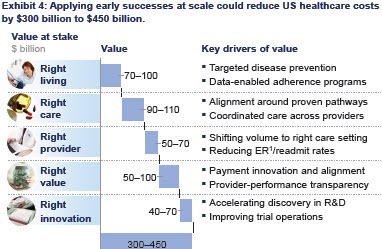
The big data revolution could reduce healthcare spending by an estimated $300 to $450 billion according to a McKinsey & Company report.

Paul Black blogs about his first 100 days as CEO of Allscripts and reflects on emerging themes, including the need to work closely with customers and patients to transform the industry; the need for population health management across venues for care; and the importance of coordination care tools.

The Wall Street Journal looks at the use of cloud-based storage for medical images, noting that more than half of the country’s health systems are expected to embrace cloud-based image storage over the next three years.

GE Healthcare, which cut 10 percent of its South Burlington, VT staff last year, lists 120,000 square feet of its office building there for lease. The company has 436 employees occupying 142,000 square feet.

4-9-2013 6-24-06 PM

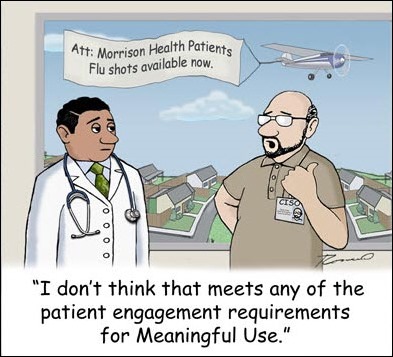
Here’s the latest cartoon from Imprivata.

4-9-2013 8-20-57 PM

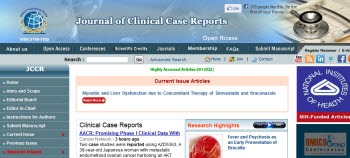
The New York Times covers “a parallel world of pseudo-academia” in which conferences and journals with prestigious-sounding names offer presenters and authors resume-padding exposure in return for cash. It says that universities need to be careful in reviewing resumes and predicts that people will be misled by poorly research publications that appear in credible-sounding online-only journals. A research librarian estimates that 4,000 “predatory open-access journals” are being published because it is “easy money, very little work, a low barrier to start-up.” One physician sent two articles in response to an e-mail from The Journal of Clinical Case Reports and was billed $2,900, with the journal running his articles even after he requested they be withdrawn. A Duke University School of Medicine professor agreed to serve on the board of one such publication and was surprised it solicited him to recruit authors and publish his own papers; when he asked to be removed from the board, the journal just left his name on its masthead anyway.

4-9-2013 8-25-10 PM

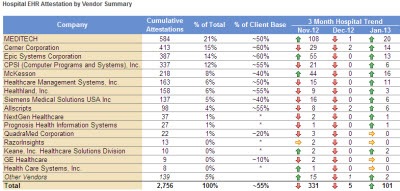
Jamie Stockton of Wells Fargo Securities provides updated MU attestation information for hospitals. Leading in EP attestations were Epic, Allscripts, eClinicalWorks, NextGen, GE Healthcare, McKesson, Cerner, Practice Fusion, Greenway, and athenahealth, which
as the top 10 vendors accounted for two-thirds of all attesting EPs.

4-9-2013 7-40-24 PM

Weird News Andy uncovers this case of texting while flying: the National Transportation Safety Board finds that a contributing factor in a 2011 medical helicopter accident was the pilot’s texting before and during the flight. The helicopter crashed into a field after running out of fuel, with NTSB’s conclusion being that the distracted pilot thought he had more fuel than was actually available. The pilot, a flight nurse, a paramedic, and a patient were killed in the crash. The pilot had sent or received 240 text messages during his shift the day the helicopter crashed, including seven during the flight itself as he made arrangements to have dinner with a co-worker.


Sponsor Updates

  • Billian’s HealthDATA offers a white paper on the top integrated marketing priorities in the age of healthcare reform.
  • AT&T generated $5.6 billion in revenue in 2012 from healthcare industry businesses implementing one of the company’s cloud and mobility-based solutions.
  • AirStrip ONE beats 15 competitors in a mobile health app contest. 
  • Brad Levin, GM of Visage Imaging, will participate in a SIIM 2013 session titled “Who do you turn to for help in developing solutions?” in the Dallas area June 6-9.
  • Wellsoft will participate in the 2013 Emergency Medicine Update and the e-Health 2013 conferences in Canada during the month of May.
  • Emdeon highlights the benefits of e-prescribing and discusses why providers need to embrace the technology.
  • Merge Healthcare and Integrated Data Storage will create a hosted private cloud offering for the Merge Honeycomb platform.
  • Cassie Sturdevant, a senior recruiter with Impact Advisors, joins a panel of other healthcare recruiting experts to discuss the healthcare job market.
  • Surgical Information Systems CTO Eric Nilsson shares his impressions on interoperability and the Intelligent Hospital Pavilion at last month’s HIMSS conference.
  • HealthEdge partners with CTG Health Solutions to deliver integration services for customers using the HealthRules Answers BI suite.
  • Cornerstone Advisors Group launches its new website.

Contacts

Mr. H, Inga, Dr. Jayne, Dr. Gregg, Lt. Dan, Dr. Travis.

More news: HIStalk Practice, HIStalk Connect.

125x125_2nd_Circle

Morning Headlines 4/9/13

April 8, 2013 Headlines 1 Comment

Medical device alarm safety in hospitals

The Joint Commission issues a Sentinel Event Alert after it receives 80 reports of deaths between 2009-2012 that were related to alert fatigue.

The big-data revolution in US health care: Accelerating value and innovation

A new report published by McKinsey & Company claims that big data models could lead to $300 billion to $450 billion in reduced healthcare spending annually, or 12 to 17 percent of the $2.6 trillion spent on healthcare in the US.

Catholic Health Initiatives and Accenture Apply Analytics to Identify Health Risks Among Patient Populations

The 78-hospital system Catholic Health Initiatives and Accenture have announced a collaborative nine-month project during which big data analytics tools will be developed to identify at-risk patients within CHI’s patient population. The initiative will also focus on enhancing CHI’s data warehousing capabilities.

AliveCor Names Industry Veteran Dan Sullivan President and CEO

AliveCor, the smartphone-enabled ECG company, announces the appointment of Daniel Sullivan (previously of SuperDimension, Inc.) as president and CEO.

Readers Write: Optimization and ROI on HIT Investments

April 8, 2013 Readers Write 1 Comment

Optimization and ROI on HIT Investments
By Dave Vreeland

4-8-2013 8-13-34 PM

During HIMSS 13, our company had the privilege of bringing together a select group of HIT executives from some of the nation’s leading health systems for a breakfast discussion. The food was impeccable thanks to Chef Donald Link. The topic was measuring and maximizing ROI on HIT investments.

While incentive dollars offer a simple measure of ROI on the revenue side of the ledger, this represents only one aspect of the substantial benefits clinical systems can yield. The takeaway: a proper optimization program with broader consideration for the projects comprising it can bring a truly positive return to healthcare organizations over a 10-15 year period if properly considered and executed.

Since the passage of HITECH four years ago, we’ve seen vast deployment of clinical information systems across the country, many of which were highly accelerated in the rush to meet Meaningful Use and other regulatory deadlines. We’ve also seen these accelerated implementation projects, both successful and troubled, spawn subsequent optimization efforts, some focused on resolving original implementation issues and some focused on achieving benefits that could not have been anticipated earlier and became evident only after a wide audience of end users was actively working within the system.

We have learned whether an organization approached its baseline implementation strategically, with a focus on workflow and clinical quality goals, or took a more tactical approach targeted toward achieving minimal Meaningful Use and maximizing HITECH incentive payments, is unimportant in the broader scheme of things. The key lesson is that an overall program of work that includes a well-executed, relatively rapid initial clinical system implementation followed by a program of closely monitored optimization projects will maximize the financial return and other benefits.

Over breakfast, we shared a number of lessons learned when it comes to measuring the return on HIT investments:

  • Implementing clinical information systems is a significant investment that brings significant value.
  • Models to accurately reflect both the costs and the return on these technologies are developing, but this work is complex.
  • In order truly maximize the return on these investments, healthcare organizations must view the implementation effort more broadly and make optimization an organizational-wide operation.
  • Optimization is critical in achieving a return on HIT investments.

Dave Vreeland is a partner with Cumberland Consulting Group of Franklin, TN.

Readers Write: Epic’s MyChart Signup

April 8, 2013 Readers Write 31 Comments

Epic’s MyChart Signup
By Anonymous

To borrow from a physician’s comment, “When technology understands what people want from healthcare, our system has a chance. “

Last week while at my physician’s office, I signed up for MyChart. Since my healthcare provider organization went live on Epic about four years ago, my experience from a patient perspective has deteriorated significantly, becoming worse each year. I suspect this is also a result of cost-cutting actions and trying to do more with fewer people. 

My primary physician is terrific, but even she seems to now be distracted by data entry during our annual visit. I took my question list in and we talked about them.  She entered data and then I got home, realizing a couple of the issues were not ultimately addressed with a proposed solution, both of us sidetracked by data entry.

I have to say that I was totally underwhelmed by MyChart.

All I could really see in the record was a list of my meds, the ability to request a refill, and my most recent vaccines. The Health Summary stated that I have no "Health Issues," yet I was referred to a specialist for more tests and treatments.

Test results: I could not view any of my labs  or history of lab results. The message said, "On occasion, there are minor abnormalities reported with patient lab tests which are not significant. Any significant abnormalities will be addressed by your physician, who will give you the appropriate instructions.”

Medical history:  under Diagnosis, there was "anesthesia." I wonder if that diagnosis is for appearing "anesthetized" while navigating my healthcare?

There was more history on my parents than on me in MyChart.

Appointments: they did score here. My past and future appointments did appear. But to schedule the appointments, I had to go through nightmare IVR. One appointment scheduling system left me on hold for 11 minutes before reaching a person to schedule.

I received my first electronic message from one of the specialist’s assistants I am seeing. It was annoying to open the e-mail to find I have to go into the portal (yep,now what is my user name and what is my password…I have forgotten) to merely see an e-mail they sent with a link to an online education for a procedure, easily available to me if I Googled the topic. I was annoyed by the required time to retrieve message and the fact I thought it might be important and require my immediate attention. And later, to go back in to send a response.  

So I didn’t send an electronic response — I called them back. This "assistant" seems to know very little about the procedure. Every time we speak, there is a new tidbit of info which impacts my planning and what happens pre- and post-procedure. When I asked her why I wasn’t told this before, she responded, "I am just reading it now.”  

I still have no clear answers to questions I am posing as an informed healthcare consumer and advocating on my own behalf. I cannot imagine how my parents would navigate through this. In fact, they would not be able to do what I am having to do and would have been no-shows. 

Although I have now signed up for this revolutionary change in healthcare, I see minimal benefit to electronic messaging. I would put money on my actual physician not likely choosing to communicate with me through this portal in the near future.

Curbside Consult with Dr. Jayne 4/8/13

April 8, 2013 Dr. Jayne 7 Comments

clip_image001

One of last week’s Morning Headlines posts mentioned the appalling situation of backlogged disability claims at the Department of Veterans Affairs. According to PBS, one site was so packed with paper claims information that the structural integrity of the building was compromised. A report from the VA Office of the Inspector General cited 37,000 claims folders stacked on top of file cabinets which “exceeded the load-bearing capacity of the building itself.”

Even more horrifying is what this represents – more than 800,000 veterans who are waiting for their claims to be processed, which can take over a year. The workload for disability reviewers varies from state to state, creating further inequity. Nebraska, South Dakota, and Maine have shrinking backlogs but the nationwide average wait time is 286 days for claim review.

I realize that the VA is not CMS is not Meaningful Use is not the Affordable Care Act. However, they all come from the same place. In the spirit of reform and pay for performance, I’d like to offer a new program for Congress to write into law. Any Meaningful Use, PQRS, or ePrescribing penalties should be placed on hold until the federal government shows it can get its own house in order. Since MU is grading me using a variety of metrics as a proxy for quality care, we can use the VA claims backlog as a proxy for process efficiency.

The VA is the quintessential government-run bureaucracy. It has a lot of advantages over the way that the rest of us practice – single payer, single set of regulations, and a well-defined patient population. By extension, the VA disability claims should be able to benefit from some of that homogeneity and be a pinnacle of efficiency.

Of course this will never happen since the whole bureaucracy is brought to us by the same entity responsible for the sequester debacle. I read with great interested about Vanderbilt University Medical Center and what they’re doing to balance their budget shortfall: halting employee accrual of vacation days, cutting discretionary spending, eliminating bonuses, and freezing salaries. VUMC plans to cut $20 million out of this fiscal year’s budget and $30 million next year.

To show solidarity with its constituents, I’d like to see members of Congress freeze their own salaries and benefits until they deliver a balanced budget and show that they have a plan for the future. While they’re holding off on penalizing us, they can also back off on MU (and other) audits to allow health care providers to actually focus on caring for patients. When their house is in order, then they can consider telling us how to run ours.

Viva Jaynecare!

Print

E-mail Dr. Jayne.

Morning Headlines 4/8/13

April 7, 2013 Headlines 4 Comments

HP’s Chairman Steps Down, Two Directors to Depart

John Hammergren, chairman, president, and CEO of McKesson, will leave HP’s board after 46 percent of shareholders opposed his re-election, due largely to a failed acquisition strategy that has resulted in $17 billion in losses since 2010.

Cambridge signs with Epic

Epic signs Cambridge University Hospital and Papworth Hospital, with go-live scheduled for October 2014.

Wake Forest Baptist has cost overruns, revenue loss with electronic records system

Wake Forest Baptist Medical Center cites struggles with implementing Epic as the primary reason for its nearly $50 million operational loss during Q2. Moody’s has downgraded the hospital’s credit rating from A1 to Aa3.

21 Most Admired Companies Making IT A Competitive Advantage

Health systems make up nearly 25 percent of the companies listed in the recently published report, “21 Most Admired Companies Making IT A Competitive Advantage.” Kaiser Permanente, HCA, Mayo Clinic, Cleveland Clinic, and Intermountain Healthcare all made the list.

Monday Morning Update 4/8/13

April 6, 2013 News 11 Comments

From Antares: “Re: HIStalk. Ever since my very first week at Epic, HIStalk has been part of my morning information breakfast :)  I think you guys provide a forum that is critical to identifying cutting edge news, trends, and opinions.” Antares is the the co-founder and president of a new consulting firm. Nice comment — thanks.

4-6-2013 6-52-41 AM

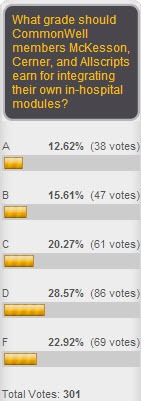
A somewhat surprising one-third of respondents expect to leave their employer within the next year. New poll to your right, inspired by a reader’s comment: CommonWell Health Alliance is touting interoperability among its members. What grade would you give those members that offer hospital systems (McKesson, Cerner, and Allscripts) for the level of integration among their own hospital modules?

On the Jobs Board: Senior Program Manager – Caradigm Intelligence Platform, Solution Sales Executive, Senior Director Clinical Product Management.

4-6-2013 8-50-58 AM

McKesson Chairman, President, and CEO John Hammergren, along with the other longest-serving member of HP’s board, will resign after being pushed out by shareholders angry over a series of  botched HP acquisitions approved under their watch. Hammergren’s re-election was opposed by 46 percent of shareholder votes. HP Chairman Ray Lane will also step down, although he will remain on the board.

4-6-2013 9-30-51 AM

In the UK, the Cambridge University and Papworth NHS trust hospitals sign a contract to implement Epic and become the company’s first UK reference sites. The 10-year, $250 million contract goes to HP Enterprise Services to manage the eHospital project. Go-live is planned for October 2014. Epic beat Allscripts and Cerner last year because of Epic’s standardized and successful implementation methodology, although the trusts acknowledge that the always-tricky localization of the US product is something they will be watching closely.

Franciscan St. Elizabeth Health (IN) goes live over the weekend with Epic in its three hospitals, part of Franciscan Alliance’s $100 million project.

Wake Forest Baptist Medical Center (NC) admits that some of the $50 million it lost in the half of its fiscal year was caused by its implementation of Epic. The hospital spent $13.3 million on Epic of an unannounced total project cost, but also cited an additional $8 million of expense due to “greater-than-anticipated impact on volumes and productivity” and another $27 million in lost margin because of productivity losses during implementation. OR cases were reduced 4.1 percent, with the time required for Epic training being one of the factors listed. Moody’s, the hospital’s bond rating agency, downgraded the hospital’s debt to A1 in March because of “the unexpected decline in financial performance through the first half of fiscal 2013, largely due to the installation of a new information technology platform (Epic).” The hospital’s CFO issued a statement to the ratings downgrade saying that Moody’s has an overall negative outlook for non-for-profit health systems, but acknowledged the financial hit that its Epic implementation has caused.

In Canada, a high-profile doctor decides to leave the province because quality is declining, wait times are increasing, and Newfoundland and Labrador are among few provinces that does not provide an EMR, which she says is “vitally important.” The doctor has taken a hospital job.

Axial Exchange launches the Patient Engagement Index, which grades hospitals on their deployment of personal health technologies, social media usage, and patient satisfaction results from CMS’s HCAHPS survey.

CEOs surveyed by Gartner name 21 organizations as the most admired for using IT as a competitive advantage, among them Cleveland Clinic, HCA, Intermountain Healthcare, Kaiser Permanente, and Mayo Clinic. The most important indicator, the CEOs said, is providing customer-facing IT.

Philadelphia-based healthcare accelerator DreamIt Health announces its inaugural class of 10 companies that will start four-month boot camp on Monday. They are:

  • AirCare (telenursing and readmission prevention)
  • Biomeme (infectious disease diagnosis and tracking)
  • Fitly (game-based child obesity motivation)
  • Grand Round Table (matching EMR information against other cases for diagnosis)
  • Medlio (virtual health insurance card)
  • OnShift (clinician communication)
  • Osmosis (mobile clinician learning)
  • MemberRx (drug selection based on EMR information)
  • SpeSo Health (online second opinions for diagnosis)
  • Stat (patient transport)

4-6-2013 10-23-18 AM

Another health accelerator launches, with Louisville, KY-based XLerateHealth opening for business and offering a 10-week mentoring program. Applications for the August class will be accepted through May 17.

PDR Network will present the third annual PharmEHR Summit on Wednesday, April 17 in Philadelphia. The invitation-only meeting of leaders from pharma and EHR vendors will feature panels on EHR leadership, patient engagement, the Wall Street view of the EHR industry, an FDA presentation on EHRs, and several other sessions.

A New Jersey court rules that Warren Hospital can subpoena the records of Internet service providers in trying to identify unknown hackers who accessed the hospital’s e-mail system and sent defamatory messages to all employees in 2010.

4-6-2013 10-34-46 AM

Maryland’s Health Services Cost Review Commission will decide this week whether to allow the CRISP HIE  to use its confidential patient-level data to support CRISP’s population health management functions.

In Tanzania, the text messaging service of Parents Love Me, a national healthy pregnancy and safe motherhood program, reaches 100,000 subscribers in 15 weeks, with 4 million text messages delivered since it was launched in late November 2012.

An editorial by the CIO of a hospital in Spain urges NHS to continue its quest to go paperless. He says his own all-digital Cerner hospital viewed technology as the essential tool for improving quality and affordability of care. His tips: create the culture for change, get clinicians involved so they can understand the patient benefits, keep it simple, and focus on how training is delivered. His hospital freed up 8,000 physician and nurse hours annually and reduced length of stay by 10 percent.

This story amused Inga, who added a WNA-like title of, “Maybe she was planning to claim a charitable donation.” An Oregon woman is indicted for dumping the clothes of her deceased 89-year-old mother in a Goodwill store dumpster and also including her mother’s body.

More from Vince this week on the HIS-tory of Meditech.


Contacts

Mr. H, Inga, Dr. Jayne, Dr. Gregg, Lt. Dan, Dr. Travis.

More news: HIStalk Practice, HIStalk Connect.

125x125_2nd_Circle

The Skeptical Convert 4/5/13

Dispatch from the Beachhead

I’ve had a weekend to recover now, but on Friday, seven days into the Epic go-live (including the go-live weekend as the GI on call) I felt like Tom Hanks 20 minutes into “Saving Private Ryan.”

The D-Day analogy is actually pretty useful for both the negatives and the positive of the experience. The plus side is the incredible massive force brought to bear on the project — people everywhere, hardware guys, red-jacketed helpers, administrators, docs from the Big House, sometimes actual Epic people. The system was going live simultaneously for two community hospitals, but ours had the empty space for 140 call-in workstations, and when I went by there last week, every one of them was occupied. And so when I needed a beachmaster, I could walk on over there to find one without getting shot at (at least not yet). 

But even with massive firepower from the Navy and Air Force, the troops still had to take Omaha Beach. And every clinician seem to have reached that moment where he was hunched behind the seawall wondering how he would ever get out of this situation. 

Everybody survived, though, more or less. There was plenty of help from the red vest people standing around, although mostly of a very specific ground-level nature–sort of like the Bangalore Torpedoes that get way too much credit in all three of the cinematic depictions of Omaha Beach that I’ve seen (“Ryan,” “The Longest Day,” “The Big Red One”).

But historians say it was the individuals that were able to call in Naval artillery, and the ship commanders who responded with precision fire who turned the tide, and in my own (OK I admit overglorified) way, I had to find higher level people with a big-picture grasp of the situation to solve most of the problems I encountered. 

I know, I’m over the top, but I can carry this analogy further. The massive pre-landing bombing that fell behind enemy lines reminds me in a way of much of my 16 hours of training, with what in my ground-level opinion was overemphasis on detail (bombs/process) and not enough on fundamental principles (target/fundamental concepts).  

For example, in my training as a “surgeon,” with a lot of work on how to work the pre- and post-op navigators, there was no mention of the fact that apparently because of a fundamental issue in Epic, I wouldn’t see those navigators automatically if I opened up the patient from the inpatient list instead of the surgical schedule. 

But enough carping. The beach is secured, the smoke is clearing, the beachmaster did in fact show me how to get that navigator up from the inpatient list this morning. There are a lot of other details that will take months to figure out (I just discovered the existence of sticky notes about five minutes ago). But I’m up and walking forward, however shakily. Onward to Berlin. 

Robert D. Lafsky, MD is a gastroenterologist and internist in Lansdowne, VA.

Collective Action 4/5/13

April 5, 2013 Bill Rieger 5 Comments

The views and opinions expressed are those of the author personally and are not necessarily representative of current or former employers.

Make It Personal

Everything is a category, until it becomes personal. At one point in my life, my wife was a category. I was thinking about a wife, dreaming about a wife, looking for a wife, but at that point she was a category in my life, a label “Wife.”  

Then I met Susan. WOW! How blessed was I! When she was just a category, I knew I would love her of course, but not nearly as much as I found out I could. She switched from a category to something very personal.  

The same thing happened with my children. Before they were born, even during the pregnancy of each child, they were categories. We shopped for them and tried to love them before they were born, but to some extent they were still a category. Then the moment comes, the moment that happens so few times in life — you hold your child for the first time. This category suddenly became very personal. 

I read a blog post recently by John D. Halamka MD, CIO at Harvard School Of Medicine. In the post, John shared about the loss of his father. There are other posts on his blog where John talked about how his family prepared for this.  It reminded me of when my father passed in 2008.  As I am sure it did for John when he was with his father in the hospital, healthcare became very personal to me.

In the ICU where my father died, I was looking at tags on equipment, making sure they were safety checked.  The computers on wheels were looked at with scrutiny as I tested to ensure they could at least roll around easily. I wanted so badly to check the PCs to make sure they had antivirus software loaded. I watched as the nurse documented and became frustrated at how long it took the screens to update. At that point, processes, policies, procedures, communication, service, and clinical excellence were all very personal to me.  

When I returned to work at my local hospital, my team of technicians were not happy with me for the first few weeks. I was not only dealing with the passing of my father. The new heightened awareness of service gained on that trip was being unleashed on them.  I wanted to bottle the passion this intense personal experience gave me and carry it with me every day, but eventually the rhythm of everyday life interfered and that sensitivity lessoned.

Making things personal made a difference in my perspective. I thought about how to provide this personal experience to members of the team without them having to go through what John and I went through. How do we make flowsheets, order sets, discharge summaries, wireless access points, and Citrix servers personal?  

As we thought about this, the Clinical Experience program was born. Through a great partnership with clinical leadership, every member of the IS team is able to spend eight hours per quarter on a nursing unit observing. They are not there to fix anything or provide support, although I am sure at times they do. They are there to watch, learn, and gain the insights that only a personal experience can provide.  

There are times when team members get frustrated with this program, as they are busy and don’t want to be interrupted in their own work. We reinforce to them the power of personal experience. We ask others to share specific experiences they had while on the floor and how it impacted their work. 

Leaders promote engagement on many levels, but short of being a clinician on the floor, there is no better way to directly engage with our patients and co-workers than to be right there with them as they participate in the care process. We believe that this periodic change in environment will stir up some creative thinking and lead to great innovations for our hospital.

Bill Rieger is chief information officer at Flagler Hospital of St. Augustine, FL.

Time Capsule: Best Buy’s “You, happier™” Slogan Says a Lot About Unhappiness (Both American and Healthcare IT)

April 5, 2013 Time Capsule 1 Comment

I wrote weekly editorials for a boutique industry newsletter for several years, anxious for both audience and income. I learned a lot about coming up with ideas for the weekly grind, trying to be simultaneously opinionated and entertaining in a few hundred words, and not sleeping much because I was working all the time. They’re fun to read as a look back at what was important then (and often still important now).

I wrote this piece in September 2008.


Best Buy’s “You, happier™” Slogan Says a Lot About Unhappiness (Both American and Healthcare IT)
By Mr. HIStalk

125x125_2nd_Circle

To me, the most important part of the Sunday newspaper is the Best Buy ad. I don’t really need what’s in there (nothing they sell is essential, like food or clothing). I’m doing my patriotic duty, which calls for irresponsible consumer spending to keep the shaky economic wheels turning. I usually grab a computer gadget (who can resist yet another USB drive?) or a sure-to-be-unopened DVD boxed set of a TV show that I never watched when it was on.

This week’s ad had a new slogan under the Best Buy logo (right above the must-have LCD TVs). It said, “You, happier™.” They put that little TM in there, daring competitors to even think about appropriating such an ingeniously alluring come-on.

(TV may be nothing but trashy reality shows and endless commercials, but those can apparently masquerade as satisfying entertainment when beamed into a 52” plasma HDTV with surround sound. Insanity is watching Adam Sandler movies over and over on Blu-Ray and expecting different results).

Not that I don’t trust Best Buy’s motives, but I’m beginning to think that “You, happier™” isn’t working. According to a recent survey, US citizens are #16 in the list of countries when it comes to overall happiness. Everybody’s broke, so maybe we’re as happy as we’re going to get racking up credit card debt to fuel the pointless accumulation of consumer goods.

I was also thinking about the parallel with US healthcare. We’re mid-pack there, too, coming in at #37 as WHO sees it (edging Slovenia but trailing healthcare juggernauts Costa Rica and Dominica).

Providers waste a lot of money on poorly conceived IT purchases. That alphabet soup of ERP, CPOE, and BI looked appealing. So did all those juicers that late-night TV watchers ordered in a depressing quest for happiness (does anyone other than the 165-year-old Jack LaLanne really pulverize $3 worth of raw carrots to get a skimpy glass of awful-looking juice that still tastes like raw carrots?)

I love going into Best Buy. I’m happy roaming the HIMSS exhibit hall. I’m uplifted at the idea that I can trade money for, in the immortal words of Carl Spackler in Caddyshack, total consciousness. No fuss, no muss, just plug and play, or at least that’s the message. Don’t even think about trying to sell customers self-sacrifice and focused diligence when the guy next booth over is promising immediate gratification and a sweeping “vision.”

When healthcare IT enables great things, it’s because vendor and customer did a ton of work. That 10 percent of the iceberg that’s visible, the pretty screens and shiny servers, doesn’t begin to tell the story, although it often makes the sale. Home Depot’s hammer display doesn’t show bashed thumbs and blisters, I’ve noticed.

Conspicuous consumption of IT is highly unlikely to make “You, happier™” any more than passively buying self-help books or hanging on Oprah’s every word. What you get is a false sense of accomplishment that’s easily disproved by unchanged outcomes or efficiency. An hour later, you’re hungry again.

The industry doesn’t benefit long-term if customers are dissatisfied with vendors because they bought products naively, unwilling to contribute the sweat equity required for success. Maybe it would help if magazines and trade shows stopped trying to foist their breezy equivalent of Best Buy’s slogan on the industry: “You, Most Wired™.”

Morning Headlines 4/5/13

April 4, 2013 Headlines 1 Comment

Policy Committee ponders CommonWell influence

Farzad Mostashari, MD, and Judy Faulkner discuss the ramifications CommonWell will have on interoperability during this weeks ONC HIE workgroup.

Baylor Quality Alliance Selects Greenway for Participation in EHR Program

Greenway announces a partnership with Baylor Health Care System to provide ambulatory EHR’s for its cmomunity physicians.

HIMSS Analytics Honors Florida Hospital Carrollwood with Stage 7 Award

120-bed Florida Hospital Carrollwood, an Aventist Health System facility and Cerner shop, is awarded HIMSS Stage 7. 

EHR Adoption Encouraged by State Meaningful Use Acceleration Challenge 2.0

ONC has renewed the state Meaningful Use accleration challenge with new benchmark goals for the 2013 year.

News 4/5/13

April 4, 2013 News 16 Comments

Top News

image

At this week’s HIT Policy Committee meeting, members discussed the CommonWell Health Alliance and its implications for the industry. Committee member Paul Egerman outlined the Alliance’s goals, which focus on providing a nationwide data exchange program that is paid for by participating vendors. Judy Faulkner, who also serves on the committee, reiterated that Epic was not initially invited to participate in the Alliance and questioned whether the group would favor the founding companies and if it planned to sell de-identified data. Other members expressed concerns that Alliance efforts may inhibit other regional and national HIE initiatives.


Reader Comments

image

From The PACS Designer: “Re: patient engagement. TPD and spouse had our first experience this week with Epic’s MyChart as we were encouraged by our provider, Yale New Haven Health System, to create our online medical record. As more of us seek treatment, you can expect to be coaxed into having an online medical record so other future providers can verify your past medical history so as to provide high quality services to their patients. MyChart is on TPD’s List of iPhone Apps.”


HIStalk Announcements and Requests

A few highlights from HIStalk Practice  from the last week: Vitera launches an iPad app for Intergy EHR. The AAP recommends pediatricians adopt e-prescribing systems with pediatric functionality. Forty percent of physicians say they are burned-out. Legal experts recommend that physicians pay closer attention to ADA requirements when adopting computerized tools. More physicians are suing former patients and their families over negative ratings and reviews posted on the Internet. Dr. Gregg explains the correlation between scrambled eggs and MU, HIT, and HITECH. NextGen Healthcare’s SVP and Ambulatory Division Manager Michael Lovett discusses his company, the industry, the competition, and the future. And, one last plea: please take a moment to complete our annual HIStalk Practice reader survey. Thanks for reading.


Sales

Texas Health Services Authority selects InterSystems to develop and implement its HIE infrastructure based on the HealthShare platform.

Inland Empire Health Plan will deploy MedHOK’s platform for managing patient populations.

The NIH’s National Heart, Lung, and Blood Institute awards SAIC a prime position on an IT support services contract worth up to $184 million over five years.


People

4-4-2013 11-35-46 AM

Healthcare consulting firm Qualidigm names Timothy M. Elwell (Misys Open Source Solutions) as CEO, replacing the retiring Marcia Petrillo.

SAIC promotes Robert Logan from director of engineering for IT services to CIO. Logan will also serve as CIO for Leidos, SAIC’s planned spinoff company that will provide national security, health, and engineering solutions

Agilex hires former VA CIO Roger W. Baker as its chief strategy officer.

4-4-2013 1-50-57 PM  image

Besler Consulting hires Maria Miranda (Multiplan) as director of reimbursement services and Arthur Baxter (Hayes Management Consulting) as RVP of sales..


Announcements and Implementations

image

Summerville Medical Center (SC) completes a one-year pilot program with GE Healthcare for its hand-washing monitoring technology. The program monitors data from employee badges and soap and hand sanitizer stations and has been recording several thousand hand-washing events per day.

Austria’s Landeskrankenhaus Feldkirch goes live with iMDsoft’s MetaVision in its ICU.


Government and Politics

ONC awards the NY eHealth Collaborative a cooperative agreement to participate in the Exemplar HIE Governance Program on behalf of the EHR/HIE Interoperability Workgroup.

ONC launches the State Meaningful Use Acceleration Challenge 2.0, which will encourage states to set aggressive goals on EHR adoption and meeting MU criteria.


Other

Intermountain Health (UT) will pay the federal government $25.5 million after admitting it illegally compensated more than 200 of its referring physicians for more than 10 years. The health system reported the violations in 2009 following a review of employment contracts and lease agreements among its hospitals and doctors.

Bay County (FL) commissioners vote to approve $360,000 in incentives to to keep iSirona’s operations in Panama City. The company will consolidate its operations, which will either created 300 full-time jobs to Panama City or lose 117 jobs if it chooses another of te three locations it is considering.


Sponsor Updates

  • PeriGen highlights some of its Q1 2013 achievements, which included $6.4 million in funding, the addition of Thomas J. Garite, MD as chief clinical officer, NIH validation of its PeriCALM Patterns software, and a record number of bookings.
  • Holon Solutions participates in the TORCH Annual Conference in Dallas April 17-19.
  • Orion Health offers a white paper on demystifying direct messaging.
  • Lifepoint Informatics participates in the Clinical Laboratory Management Association’s annual KnowledgeLab conference April 7-10 in Orlando.
  • MedAssets recognizes University Health System with its 2012 MedAssets President’s Award for saving more than $13 million and realizing $14 million in cash flow improvement.
  • McKesson executives will share perspectives on technology innovation and strategic network design and management at next week’s World Health Care Congress in National Harbor, MD.
  • Medseek continues its discussion of why mobile is a must for healthcare organizations.
  • A Ping Identity survey of security professionals finds that organizations are embracing BYOD and the culture of work anywhere/anytime.
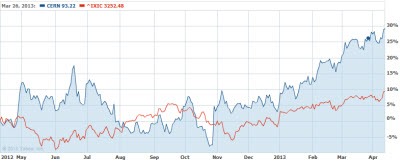
  • Ben Marrone, principal advisor with Impact Advisors, offers insights into balancing improved access with patient privacy concerns.

EPtalk by Dr. Jayne

CMS is hosting calls for groups considering participation in Medicare’s 2014 Accountable Care Organization program. Calls will be held on April 9 and April 23 and registration will close when space is full.

Practices using web tools, tablets, and kiosks for patient data entry, online bill pay, and other functions may want to consider whether those media are accessible under the Americans with Disabilities Act. The Department of Justice is working on regulations for accessibility of Web-based content, which should be out later this year.

A Cochrane Library review shows that computer-based tools to help diabetes patients manage their condition have a small impact on blood glucose control. There was no documented impact on weight loss, depression, or other quality of life metrics. Those using mobile phones did slightly better than other devices.

clip_image002

My Twitter-induced laugh of the day was “How People Sit in Meetings and What it Really Means.” Which style are you?

From Easter Bunny: “Re: EMR pimp. Did you hear Dan Marino is now pimping an EMR because IF ONLY his orthopedists had access to his complete medical records, he wouldn’t have been the greatest quarterback to never win a championship. Or, is he just repeating his old Isotoner gloves experience of being a shill for an underwhelming product or industry?” I do love some of the comments in the press release:

  • “Surgeons often see injuries they haven’t seen before…” Not according to my orthopods, who claim they see the same thing over and over and therefore should be able to document any visit in one click or less.
  • “Since no two orthopedic surgeons practice the same way…” Have they never heard of evidence-based care?

Not surprisingly, Marino is not only a spokesperson, but also an investor.

March 30 was Doctors’ Day. Although the AMA sent me an e-mail as did a locum tenens agency I worked for three years ago, there were no happy words from my hospital. Happy belated Doctors’ Day to all.

drjayne


Contacts

Mr. H, Inga, Dr. Jayne, Dr. Gregg, Lt. Dan, Dr. Travis.

More news: HIStalk Practice, HIStalk Connect.

Morning Headlines 4/4/13

April 3, 2013 Headlines 1 Comment

Former VA CIO Baker heads to Agilex

Recently resigned Roger Baker, CIO of the VA, has found a new home at Agilex, a government contracting firm specializing in software development, cloud computing, and mobility.

JAMA: Current EHRs Lack Large-Scale Data Capabilities

A recent viewpoint article published in the Journal of the American Medical Association suggests that as data-heavy sciences like genomics, epigenomics, and proteomics advance, health systems will be forced to look beyond the storage capacity of their EHRs to keep up with data storage needs.

Intermountain Healthcare pays $25.5 million to settle claims allegations

23-facility health system Intermountain Health has agreed to pay $25.5 million to settle claims that it violated the Stark statute after admitting that over a decade, it illegally paid bonuses more than 200 of its referring physicians.

ONC HIE workgroup offers interoperability suggestion

ONC’s Health Information Exchange workgroup met today to discuss possible policy solutions for promoting interoperability.

Veterans Affairs Backlog Files Stacked So High, They Posed Safety Risk to Staff

A recent PBS story on the now nationally followed VA claims backlog describes a Winston-Salem, NC office that had folders stacked so high that they posed a safety risk to employees and further delayed the approval process because needed folders were often stored layers deep in claims piles. The weight of the paper eventually created a structural problem when inspectors realized that the sheer weight of the combined folders exceeded the load-bearing capacity of the building itself.

Readers Write: The Economics of Google Glass in Healthcare

April 3, 2013 Readers Write 6 Comments

The Economics of Google Glass in Healthcare
By Kyle Samani


Google Glass is a fully-featured modern computer running a derivative of Android that fits into a glasses-like form factor that rests comfortably on your face. That includes CPU, RAM, storage, battery, a heads-up-display, a microphone, camera, speaker, WiFi, GPS, Bluetooth, and bone conduction technology.

Although Google has been shy to admit it, Glass will have some form of bone conduction technology so that you – and only you – can hear. Of course, you’ll be able to take a picture of or record anything at any time and transmit that data to the entire Internet wirelessly in real time. It’s quite an extraordinary technological breakthrough.

A lot of people think Google Glass can be used as a development platform to create amazing healthcare apps. So do I.

Many of these ideas are obvious, and many of them could be relatively simple to develop. But we won’t see most of them commercialized in the first year Glass is on the market, maybe even two years.

The most obvious analogy to Glass is the iPhone. It’s a revolutionary new technology platform with an incredible new user interface. Glass practically begs the iPhone analogy. Technologically, the analogy has the potential to hold true. But economically, it does not. Because of the economics of Glass, many of these great ideas won’t see the light of day any time soon.

First, there’s the cost. Glass will run a cool $1,500 when it lands in the US this holiday season. There’s no opportunity for a subsidy because Glass doesn’t have native cellular capabilities.

Second, and even more importantly, Glass needs to prove compelling given that you already have a pretty incredible smartphone in your pocket. When the iPhone launched, it competed with the non-consumption of 2007: dumb phones. Glass has to compete with a whole new class of non-consumption: iPhones and Androids. That means Glass has to be so incredible that you’re willing to spend $1,500 given that you already have an amazing smartphone in your pocket. Glass only provides marginal value. It’s a tough sell.

Take another look at the Google link from earlier in this post. Would you pay $1,500+ for any of those individual applications? Probably not. As a hospital CIO, would you pay $1,500+ per employee for hundreds of employees for any of those applications? Probably not.

Although these are all good ideas, the vast majority of Glass ideas aren’t compelling enough to justify the cost of Glass itself. This is inherently true in all Google Glass application markets, both consumer and enterprise. It’s especially true in healthcare given the additional costs of integrating into existing systems and processes.

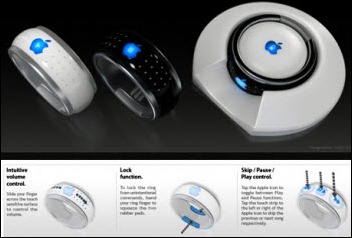
Doctors in outpatient clinics face a similar challenge. Though some physicians, and perhaps some surgeons, will shell out $1,500 early on, most doctors won’t be willing to commit that kind of capital. I’m sure many physicians would feel concerned about making their patients feel socially uncomfortable, even if a given application proves clinical and financial ROI. But at some point down the line, doctors will probably adopt a Glass-like technology platform, especially with something like the MYO Armband. The human computer interaction (HCI) opportunities with a Glass+MYO armband are endless.

Over time, an increasing number of Glass healthcare apps will become available and the price of Glass and its competition (I’m looking at you, Apple. Also, learn why there will be no iWatch) will fall. Eventually, healthcare app developers writing on Glass will find success, but very few will in the first year Glass is on the market.

That does not mean that the Glass ecosystem is destined for failure. Glass has the potential to solve big problems. Capitalism dictates that app developers will figure out how to use it to solve big problems.

My favorite VC proverb is, "Provide pain pills, not vitamins." For every painkiller Glass app, there will be dozens of vitamins. The painkillers will drive the success of this platform. No one needs to buy Glass. But Glass can help people and create new efficiencies in enterprise markets such as healthcare, education, manufacturing, transportation, construction, gaming, tourism, and many others.

I’m incredibly excited about Glass. It will change the world. Maybe not in its first year on the market, but it will. No one thought much of the iPhone in its first year on the market, but it delivered a revolutionary new user interface and provided a new technology platform that app developers will extend to solve an enormous number of previously unsolvable problems. Glass will, too.

Glass developers, off to the races!

Kyle Samani is inpatient deployment manager at VersaSuite of Austin, TX.

CIO Unplugged 4/3/13

April 3, 2013 Ed Marx 4 Comments

The views and opinions expressed in this blog are mine personally and are not necessarily representative of current or former employers.

Meet the Parents: Making Lasting First Impressions

This past couple of weeks, I’ve had the honor of getting to know the newest member of my team. More than once, I’ve been the newbie on the block, and I know exactly how awkward this can feel. It reminded me of another newbie situation that happened over two decades ago.

My freshman year ended and I was smitten. Forced to part from my college crush made my summer unbearable. I didn’t see Julie for 12 long weeks while participating in Army combat medic school. Testosterone raging, I wanted to marry her. Right then!

When I returned in the fall, our courtship blossomed. We started making life-long plans and set a date 18 months out.

Then it was time to meet the parents.

A friend lent me her Jeep over winter break. I drove my future bride through the ice and snow to introduce her to my parents. Making our way from Ft. Collins south to Colorado Springs, we chatted about family as Julie played with the handcuffs hanging from the rearview mirror. She inadvertently cuffed herself.

Laughing, we searched the Jeep for the key. No key. I had no contact information for my friend, who had headed to Florida for Christmas. Bouncing down I-25, Julie’s arm dangled from the mirror.

Refusing to let her meet my parents in this condition, I pulled into a truck stop and explained our dilemma to a repairman. Smirking up a storm, he cut the chain, freeing Julie’s arm from the mirror. We continued our journey south.

Stopping at the Springs’ police headquarters, we requested assistance to remove the cuff. The suspicious officer pummeled her with questions — “Who did this to you?” — and asked for the Jeep’s registration. The Florida vehicle had no registration. I started to consider my one phone call. “Dad, can you and Mom meet us at the police station and post bail?” Not the ideal first impression.

We have one chance to make a first impression, so make it good. One nice thing about starting in a new organization is the opportunity to begin from scratch—with your management, your team and your customers. It’s critical to think about the mechanics of that first impression long before you arrive. Great books such as Your First 90 Days provide superb guidance.

The best takeaway for me was not to “hit the ground running,” but to “hit the ground listening.” In my current position, I’d spent the first 90 days meeting with 100 key leaders, team, and customers, taking copious notes. Summarizing by theme, I reported these back and used them to guide my priorities that first year. The greatest gift we can give is to listen.

First impressions work both ways and are too easily forgotten when new employees, leaders, or customers jump on board. Go out of your way to make a noble impression on the new team member who clearly feels lost and out of sorts. Newcomers to the organization afford us with golden opportunities to show we care about their success.

When possible, secure their contact information prior to their arrival and reach out in advance with an invite to dinner or coffee. In my role overseeing technology, I aim to guarantee that organizational newbies have all the tools and access needed to be productive on arrival day.

A first impression is more than personal. It’s professional.

The cops finally released us. Unable to de-cuff Julie, they sent us to a locksmith. After hearing our story, the locksmith called the cops and we repeated the cycle. Finally getting police clearance, the locksmith freed Julie.

Although late, we reached my parents’ home sans the suggestive jewelry. She made an incredible first impression, and Mom and Dad immediately embraced Julie as part of the family. I sometimes wonder if their reception would have changed if my fiancée had shown up as a jailbird. A tough gig to recover from, for sure. Perhaps my parents would have bribed me as Julie’s parents had tried to do.

Ed Marx is a CIO currently working for a large integrated health system. Ed encourages your interaction through this blog. Add a comment by clicking the link at the bottom of this post. You can also connect with him directly through his profile pages on social networking sites LinkedIn and Facebook and you can follow him via Twitter — user name marxists.

Morning Headlines 4/3/13

April 2, 2013 Headlines Comments Off on Morning Headlines 4/3/13

Nuance Jumps After Investor Carl Icahn Reports 9.3% Holding

Wall Street billionaire Carl Icahn, known for his longstanding history of executing hostile corporate takeovers, reveals that he currently holds a nine percent stake in Nuance. Should he manage to seize control, Nuance would very likely be reorganized, forcing out failing business units and consolidating the rest. Shares rose eight percent in after hours trading on the news.

WMC health records now electronic

238-bed Weirton Medical Center, WV, goes live on its $30 million Siemens Soarian EHR implementation.

Mo. Senate passes required telemedicine coverage

The Missouri Senate has approved legislation requiring insurance companies to cover medical services provided electronically if they cover for the same service delivered in person.

February 2013 EHR Incentive Program

CMS has paid $12.7 billion in Meaningful Use incentive payments through February.

RazorInsights Hires Former Siemens RVP Karl Kiss to Drive Sales

Karl Kiss, regional vice president at Siemens, moves to RazorInsights taking over as VP of sales and marketing.

Comments Off on Morning Headlines 4/3/13

Text Ads


RECENT COMMENTS

  1. Why does the displayed "exam room of the future" still have the classic "clinician has their back to the patient"…

  2. Anything related to defense will need to go to Genesis.

  3. That, or we see if Judy will announce Epic's new Aviation module (probably called Kitty Hawk) that has integrated Cruise…

  4. The $50 billion Rural Health payout is welcome. In context, it's less than the total cost of the F22 raptor…

Founding Sponsors


Platinum Sponsors


Gold Sponsors


RSS Webinars

  • An error has occurred, which probably means the feed is down. Try again later.