Recent Articles:

Curbside Consult with Dr. Jayne 1/4/16

January 4, 2016 Dr. Jayne Comments Off on Curbside Consult with Dr. Jayne 1/4/16

image

This year started with a bang as I received my first request to bid on a new consulting engagement over the weekend. I need to do quite a bit of discovery before I decide whether or not I’m going to take it, but I admit I’m seriously intrigued.

It’s from a group of physicians that consults at various extended care facilities and nursing homes where documentation is still done on paper. They’re looking at ways to better manage the use of potentially harmful medications in the elderly. Their needs initially sounded like more of a traditional “assistance with system selection” effort, which I’ve done quite a bit of. That’s how they heard about me. But the more we talked, I understood that they’ve already narrowed it down to three vendors and are looking for some very pointed critiques of the approaches.

In hearing overviews of the proposals, they range from moderately serious to what sounds downright comical. They seem like they would be a good bunch of people to work with, although I’m halfway tempted to tell them they need to choose Door #4 and go back to the drawing board. I can tell from several states away that the one proposal was cooked up by some sales team who really doesn’t understand the business or the needs of the providers and I’m tempted to take the job just to skewer them. I’m not sure I’m going to be able to dedicate enough time to this job as it would likely need, so I may have to take a pass depending on their timing and some other factors.

I worked New Year’s Eve in the trenches, which is always a good time. My experience over the years is that staff members working the holidays tend to be motivated to help move things along as quickly as possible, since you never know when your next rush of patients is going to arrive and you don’t want to be caught behind if you can help it. My shift ended before midnight, though, so I didn’t get to see a lot of the more story-worthy patient visits.

I can say honestly, though, that influenza season is here in full force. If you haven’t received a vaccination yet, there’s still time and I would encourage everyone to do so. If this weekend is any indication, there’s a high potential for this season being quite challenging.

I spent the rest of the weekend getting caught up on email and around the house. My goal this year is to not have an inbox that is perpetually full.

I took particular delight in clicking “delete” on a couple of emails from CMS. One was regarding batch upload for 2015 EHR incentive program attestations. Although I’m still peripherally involved in assisting my clients through this process, I am glad to not be personally accountable for managing the process for my own physician group. The attestation period for Medicare programs starts today and runs through February 29 for those of you playing the home game.

I also enjoyed deleting a CMS “year in review” email celebrating a look back at ICD-10. There were several emails from CMS and ONC covering their joint effort to address quality measure reporting under the various inpatient and ambulatory reporting systems as well as the EHR incentive program. They’re trying (again) to streamline the reporting process and reduce the burden to users, organizations, and vendors, but I’ve not been impressed by their previous work in this regard.

I also found an email from CMS about the new Medicare Drug Spending Dashboard and spent a few minutes checking it out. Drugs were selected for inclusion on the main dashboard due to high total program spending, high annual spending per user, or a large increase in average cost per user. Some of the drugs having the highest jumps were generics – why is digoxin up 298 percent? It’s been generic as long as I’ve been practicing. It’s still relatively cheap in the grand scheme of things, but I was surprised by the numbers.

Not surprising was the inclusion of several medications that are extremely expensive and often-prescribed despite being only marginally more effective or tolerated than the traditional / generic / cheap competitors. There were more than 20 drugs on the list which have more than $1 billion in total spending (2014 data) with some in the $3B range. The original email about the dashboard mentioned that HHS convened a group of consumers, providers, employers, vendors, payers, government agencies, and others to discuss how to balance “the dual imperatives of encouraging drug development and innovation while ensuring access and affordability.” I’d personally like to see Medicare beneficiaries take this list to their doctors and if they are on some of these high-dollar drugs, discuss whether there are alternatives and how much benefit they’re really getting from the Cadillac vs. the Buick vs. the Chevy and how that meets their life goals.

I shudder when I see patients in their 80s and 90s who are on medications that are adding little to their health besides higher costs and an increasing risk of complications due to polypharmacy. I remember when a patient in her early 90s came to “interview” me as she was shopping for a new doctor. She and her daughter (who was 70) came to talk about my philosophy of geriatric care. She was reasonably healthy and shared a home with her daughter and had only been hospitalized once in the previous five years. I honestly told her that I didn’t have a lot of patients in her age bracket, but if she were to join my practice, my main goal would be to prevent as much as possible and to give her medications only if absolutely required. I must have made an impression because she transferred her records the following week.

Some of the reporting around the CMS drug dashboard data shows the shift in disease burden as different populations join the Medicare rolls. Hepatitis C treatment has a significant cost impact along with cancer, diabetes, and pulmonary disease. It also mentions that this is only part of the relevant data – it doesn’t include spending data for commercial payers, Medicaid, the VA, or the military and doesn’t show whether there are rebates or other cost-shifting arrangements.

I expect Medicare to be insolvent by the time I’m 65 and out-of-pocket costs to be absolutely insane, so I’m doing what I can to keep chronic disease off my doorstep. Although I’m not the most disciplined when it comes to food choices (the pastry therapy doesn’t really help either), I’ve got a pretty solid relationship with my treadmill since I upgraded it early last year. Committing to be on it as many days as possible is as close to a resolution as I’m getting.

What’s your New Year’s resolution? Email me.

Email Dr. Jayne.

Comments Off on Curbside Consult with Dr. Jayne 1/4/16

Startup CEOs and Investors: Marty Felsenthal

The JPMorgan Healthcare Conference and the State of Healthcare Innovation
By Marty Felsenthal

image

I had a lot of fun last year at this time writing about the JPMorgan Healthcare Conference. With thanks to Mr. HIStalk, I thought I’d take an opportunity to provide an update on the conference (it’s happening next week in San Francisco) and also on the state of innovation in healthcare services and healthcare software, as the two subjects are very related.  

This will be my 19th consecutive year at the conference, a streak that a handful of the very coolest people might find more impressive than the Golden State Warriors’ winning streak at the beginning of the NBA season. I have been investing in venture-backed healthcare software and services companies for all of those 19 years. I’m recently and temporarily retired, but I’ve been fortunate to have generated strong returns during my career, to have worked with some great entrepreneurs, and to have worked with wonderful partners.  

That said, and as I mentioned last year, until the HITECH and the Affordable Care Acts were passed, I was as relevant as Rand Paul in a Republican debate or a movie theatre showing “Star Wars” I, II, and III. Until 2010, there was certainly innovation in the provision and administration of healthcare, but it was just more limited and — relative to its potential importance to our country — not enough people cared. That all changed with the passage of those two pieces of legislation.  

Once it became obvious that legislative and judicial efforts to change or repeal the Affordable Care Act would not be successful, almost overnight I underwent a combined transformation like Shia LaBeouf (Megan Fox) in “Transformers I,” Anthony Michael Hall (Kelly LeBrock) in “Weird Science,” and Will Ferrell (his first wife Leslie Bibb) in “Talladega Nights.” Life is pretty good these days for people like Steph Curry and me.

With Reform here to stay, the JPMorgan Healthcare conference became the Comic-Con of the healthcare services and software world. The conference this year will be every bit as crowded and frenetic as in recent years past. However, there are, in my opinion, two very big differences from last year.  

When we’re out with friends, my loving wife of 17 years often refers to me as her "old" husband and then goes on to describe what her "new" husband is going to be like. I still haven’t figured out if she intends to leave me, kill me, or just wait for nature to take its course, but she has made it very clear he won’t snore, he won’t nap on weekends, and he’ll be better at taking advice.  

The first big difference at the conference this year is the number of "old" companies that aren’t presenting — or at least won’t be presenting in 2017 if their mergers are completed. During 2015, we have seen a tremendous amount of consolidation activity in healthcare companies attempting to reduce SG&A as a percentage of revenue through the benefits of scale; attempting to gain negotiating leverage with payers or providers (as the case may be) through horizontal consolidation; attempting to gain the benefits of vertical integration by owning more of the value chain; and attempting to diversify away from their core business into areas of the healthcare value chain that potentially have more opportunity and/or may be less regulated.

OmniCare, Rite-Aid, IPC The Hospitalist Company, United Surgical Partners, Vanguard Health, Cigna, Humana, HealthNet, Catamaran, Merge, and Gentiva are just a partial list of public companies that have announced acquisitions this past year and won’t be presenting this year (or next, depending on their merger timing). There are countless other private companies that have been acquired by United, Optum, CVS, Blue consortiums, AmSurg, Emdeon, The Advisory Board, IBM, and others.  

I don’t know this for certain, but as a lifelong fan (for the past 3-4 years) and someone who one day aspires to own 0.0000001 percent of the Warriors, I’d wager my next NBA championship ring that there was more merger activity by dollar volume in healthcare services and healthcare software this year than we’ve ever experienced. This trend will absolutely continue in 2016.

The second big difference at the conference this year is the number of newly public and potentially very disruptive health care software and services companies presenting at the conference this year, all of which speak to the changing healthcare landscape.  

  • Evolent Health (NYSE: EVH) is presenting. The company provides technology and services to help health systems manage full or partial risk, obviously a huge opportunity in the transition to value-based care.
  • Press Ganey (NYSE: PGND) is newly public and deploys its technology and services to help providers measure and manage patient satisfaction, which is increasingly being tied to reimbursement and will only get more and more important as insurance networks get more narrow. 
  • Inovalon (NASDAQ: INOV) is presenting and is a very interesting company that helps health plans and provider organizations collect the necessary data to get paid appropriately, and more importantly, analyze that data to measure quality and identify opportunities to improve quality. 
  • Teladoc (NYSE: TDOC) is also presenting (disclosure:  I’m on the board of Teladoc). Teladoc is deploying its telemedicine platform across many specialties and in the payer and provider communities to address issues related to access, convenience, and cost. 
  • HealthEquity (NASDAQ: HQY) completed their IPO in the second half of 2014, but they also represent another newly public and innovative company helping consumers navigate the transition to high deductible health plans with better tools and engagement. 
  • FitBit (NYSE: FIT) isn’t presenting, but they have participated in healthcare conferences in the recent past and went public last year. I’m always a little torn about whether this is really a healthcare company, but suffice it to say the potential for inexpensive remote monitoring in healthcare using a tool like FitBit is pretty immense. 
These six companies had IPOs in the past 18 months and collectively represent more than $10 billion of market value.

In my 19 years of going to the conference, I’d wager my likely nomination as the next head of HHS that this is the first-year ever that the JPMorgan Healthcare conference had six newly public and truly disruptive healthcare services and healthcare software companies presenting. That’s a very big deal for healthcare — it will lead to more great entrepreneurship and it speaks to the great market needs and opportunity being created by healthcare reform.
This brings me to the current state of innovation in healthcare software and healthcare services, with a little bit of advice for entrepreneurs and larger companies alike trying to capitalize on that innovation.  

I’ve never been more optimistic or excited. Pessimists will point to the unsustainability of the exchanges (unaffordable for most in their current form without subsidies and attracting too few healthy people). They’ll say hospitals can’t manage physicians or assume risk. They’ll say that the sector is over-funded with venture and growth capital, there are too many companies being formed to do exactly the same thing, there are too many inexperienced entrepreneurs, and there are too many inexperienced investors. They’ll also point to the venture markets more broadly and the vulnerability of all the unicorns.

All fair points, but I have unbridled optimism for healthcare right now. I don’t think there has ever – ever — been a better opportunity to create more successful healthcare software and services companies, to make them bigger, and to do it faster (I sound like Oscar Goldman in “The Six Million Dollar Man”). I think the healthcare sector is undergoing the same kind of transformation that the financial services sector started in the 1970s and that continues to this day. The changes at the JPMorgan Healthcare conference I described above are a great reflection of the beginnings of that transformation and opportunity.

Healthcare is the single largest sector of the economy at almost $3 trillion. While there are certain things our healthcare system does extremely well and better than anyone else in the world, there are other aspects that are very broken. It obviously costs too much, we use way too much paper and don’t take advantage of software and automation to the extent other industries do, we still use way too much MUMPS and client-server technology, we don’t routinely use clinicians at the top of their license, our reimbursement system has historically incented volume instead of value, we aren’t as thoughtful about care at the end-of-life care as we should be, care is too fragmented and poorly coordinated, hospital systems don’t treat their best customers like a valuable asset that could walk across the street to a different system, insurers have customers paying them more than $10,000 per year year after year and do nothing to establish a personal relationship…

It’s an obvious list that could go on and on, and therein lies the opportunity. It’s so obvious. As a country with a political and economic system that responds better to change than any other place in the world, entrepreneurs have always risen to the task when markets were broken and/or a catalyst was provided. The Affordable Care Act (for all its imperfections) provided that spark. In my opinion, we’re in the top of the first inning of a game that’s going to last two to three decades. 

My advice to entrepreneurs is simple. Start your company. Try to think of a unique business or clinical problem that isn’t currently being addressed. Surround yourself with experienced people who have built businesses before. Recognize that you have an opportunity cost so establish a set of metric-based milestones that represent the least you’d hope to achieve over the next six, 12, and 18 months. Stick them on your bathroom mirror, stare at them every morning, and hold yourself accountable / be honest with yourself. If you aren’t hitting them, change paths or go do something else.  

Also, pick your financial partners carefully. Money is flowing loosely and freely in this environment. Personally, I think a lot of these capital sources are, in fact, a commodity (and some worse), but there are some truly value-added sources out there and I’d take their money at a discount to work with the right partner.

I’m biased towards experience so that you can diligence what you’re getting from your capital partner. I’d ask for every example they can provide of commercial contracts they introduced to (or helped facilitate for) the companies they invested in. I’d ask the same of every management team member they introduced. I’d make reference calls on them the same way they make reference calls on you and ask to talk not only to CEOs they did well with, but CEOs they fired or CEOs with whom they lost money.

Ask how they think about capital intensity and burn. Personally, I think one of the single most important areas where an investor can add or detract from value is helping to determine whether it’s time to throw fuel on the fire or to continue to let things simmer based on the market size, the competitive environment, the exit environment, and the company’s proven or unproven ability to execute. 

I started my investing career at the tail end of the dot-com bubble in the late 1990s. I was fortunate to have generated returns well above the benchmarks during that environment, too. For the reasons mentioned above, I do think this time is different, but there are some valuable lessons for entrepreneurs.

First, you can raise too much money. If you raise $50 million to execute against an opportunity where your exit is only going to be $75-$100 million, you won’t do too well and your investors won’t be too happy (and ours is a small community, so you want happy investors to back you or speak well of you for whatever you do next).

Second, just because you raised all that money, please don’t feel obligated to spend it. To my point above, I think it’s very important to manage your burn and be extraordinarily disciplined about when you put fuel on the fire.  

Third, every young company hits a bump (or five) in the road. The line to success is never straight. Treat everyone as respectfully and thoughtfully as possible because even though you’ve got everything figured out today, that might change tomorrow and you will still want doors to open freely and eagerly for you.  

Similar to the late 1990s, we’re seeing a tremendous amount of interest from a wide variety of large companies who want to partner with young, innovative companies. This is happening in the broader economy and in healthcare specifically.  

Until recently, I was a managing partner at a wonderful venture firm that included as its limited partners some of the largest for-profit and not-for-profit insurers, health systems, pharmacy chains, and healthcare foundations in the country. We also had the opportunity to interact with drug distributors, diagnostic companies, multi-sector technology firms, PBMs, and others who were equally interested in a window into healthcare innovation. There are some common characteristics of larger organizations that partnered with young and innovative companies the best.

First, they recognize that innovation is only a means to an end. There were too many large companies in the late 1990s (Time Warner AOL being the best example) and too many companies in this cycle pursuing innovation and change just because their competitors did it or just because something seemed cool and hip. The laws of nature still apply and you need a clear business objective, a product that makes sense, and a business model that makes sense.  

When partnering with young companies, don’t worry about over-paying or every little contract detail. You presumably have a strong balance sheet. To a degree, small differences in price or terms at this stage don’t make a difference in the long run.  

What makes a difference is whether you picked the right company. I was fortunate to have led a financing round at Teladoc early on and at the lowest valuation. However, the truth of the matter is that each investor in the subsequent three private rounds have generated outstanding returns to date as well. I led a later and more expensive round at Change Healthcare before Emdeon acquired it. In both cases, it almost didn’t matter what round you participated, just that you partnered with them.  

To that point, when partnering with innovative companies, the most important thing you can do is pick the right partner, and good people obviously make good partners. Avoid entrepreneur hubris when coupled with inexperience. Treat good people well. Give them responsibility. Be flexible and responsive with them. Commit to make the partnership work. Provide transparent and timely feedback on how the partnership is working and ask for the same. If you buy or partner with a company with good people, figure out ways to make sure the good people stay and to make sure they expose the rest of the organization to what they’re working on.  

There are some great examples of large companies that do innovation well. Aetna partnered successfully with lots of our portfolio companies. United / Optum have been wonderful at almost all of the points above.  A number of Blue Cross Blue Shield plans have really stepped up their games in the past decade with direct investments, collaborative investments, and partnerships and acquisitions of technology companies.   Walgreens and CVS have done it well with their retail clinics  UPMC and The Advisory Board have done it with Evolent. Intermountain Healthcare, Geisinger ….it’s a very large and growing list and much larger than just these companies.  

Some of their common themes are that innovation has senior level sponsorship and multiple sponsors. Many of these organizations have a senior-level executive (or someone reporting to a senior-level executive) whose responsibility is to act as facilitator between the executive sponsors of innovation and the folks in the lower parts of the organization who actually get things done. These organizations also make sure to incent their teams — not just on the next big acquisition or meeting projections, but on some of these softer points around innovation. Some of them provide capital for off-cycle and off-budget rapid pilots.  

Much more so than HIMSS, the JPMorgan Healthcare Conference is a microcosm of our healthcare ecosystem because it covers every major and minor sector of the market, not just technology. The name of the game at the conference for the past six years (and in healthcare more broadly) is change, and every student of markets knows that big change always creates big opportunity. Healthcare is the single largest sector of the US economy and it is undergoing an unprecedented amount of change. 

It’s going to be a great year for the entrepreneurs, investors, and large companies that can capitalize on it. Most important, I’m very optimistic that patients are also going to end up better off for all this change — with better and more consistent quality, with lower-cost alternatives, and with a much improved consumer experience.

Marty Felsenthal has been working with and investing in innovative healthcare software and services companies since 1992 and has led financings and/or provided growth capital to companies such as Teladoc (TDOC), Change Healthcare (acquired by Emdeon), Aperio (acquired by Danaher), PayerPath (acquired by Allscripts), Titan Health (acquired by United Surgical Partners), and USRenal Care (acquired by Leonard Green).

Morning Headlines 1/4/16

January 4, 2016 Headlines Comments Off on Morning Headlines 1/4/16

Epic Systems growth expected to continue

A local paper reports that Epic’s employee base has grown to 9,400, increasing by 1,400 in the past year.

Patients given just hours warning to attend hospital after problems plague new IT system

In England, an estimated 20,000 patients at Hull and East Yorkshire Hospitals NHS Trust have erroneous data in their medical records and appointment waitlists jumped from 40,000 to 60,000 patients as a result of a troubled CSC Lorenzo EHR migration.

How Denmark Dumped Medical Malpractice and Improved Patient Safety

ProPublica analyzes the results of Denmark’s decision to eliminate malpractice suits, replacing them with a government-run claims program that pays patients when they are harmed, but also collects the details of their case and uses it to improve the overall care delivery system.

Comments Off on Morning Headlines 1/4/16

Monday Morning Update 1/4/16

January 3, 2016 News Comments Off on Monday Morning Update 1/4/16

Top News

image

The Madison paper reports that Epic’s headcount has increased to 9,400, up 1,400 in the past year. Campus 4 and Campus 5 are under construction and will add 3,500 offices and the company is sharing the cost of expanding Nine Mound Road to four lanes to handle Epic employee traffic. The company also announces that it has 360 healthcare organization customers in 10 countries and booked $1.8 billion in 2014 revenue.


Reader Comments

image

From Crank Caller: “Re: McKesson. I agree with your prediction that it will divest its health IT business. I’ve heard from two reliable sources within McKesson that Paragon is for sale, not that anyone would want to buy it.” Unverified, but the company seems to be constantly apologizing for its health IT business, it hasn’t produced great numbers, the Better Health 2020 initiative doesn’t seem to get much airplay after an initial big splash, and the company has shut down product lines like Horizon. With the retirement of Jim Pesce, anything could happen.

image

From Simmering Stock: “Re: 2015 share price performance. Some vendors are traded on non-US exchanges.” I intentionally limited my list to companies whose shares trade on US exchanges, but some that don’t are:

Pro Medicus (parent company of Visage Imaging), Australian Securities Exchange: up 191 percent
Craneware, London Stock Exchange: up 68 percent
Orion Health, New Zealand Stock Exchange: down 45 percent

From HIPAA Shake: “Re: your medical records request. Did you ever hear back from the Office for Civil Rights?” I filed a complaint in July with both OCR and the hospital that refused to provide me with an electronic copy of my medical records (the hospital claimed it is required to do so only for providers and patients can only get printed copies). I haven’t heard back from either organization. Good thing I haven’t been comatose for the six months with my doctor anxiously waiting to see what happened during my one-day stay in early 2014.

image

From EHR Product Manager: “Re: LA Times op-ed piece on physician working conditions. I left a faith-based academic medical center to work on the vendor side, which definitely has a better work environment. The AMC emphasized work-life balance but I couldn’t get them to let me work remotely even one day a week, which is a given in the vendor world. Is healthcare seeing a brain drain due to perceived lack of perks?” The Stanford medical student’s article says it’s easy to understand why the school’s graduates often forego residency to jump straight into industry in contrasting their environments: the working conditions for low-pay medical residents involve fluorescent lights, endless pages, and cell-like on call rooms, while business school students ride fancy buses to tech companies that provide free gourmet meals, gyms, massages, and on-site services such as bike repair and yoga classes. I would hope that those who choose to pursue professions such as medicine or the ministry don’t expect the eye-popping perks awarded to a tiny percentage of the young workforce who are chosen to work at Google or Facebook (or Epic, for that matter) — I’d rather see the folks who are torn between patient care and Silicon Valley just hire on with Google instead of naively wasting a medical school spot. Excluding poor working conditions for residents, hospital jobs are a mixed bag, especially for non-executives who aren’t eligible for bonuses, fancy offices, and expense accounts. Sometimes the time-off policy is pretty generous and layoffs are less frequent, but otherwise the rewards of hospital work mostly involve the satisfaction of helping people rather than helping yourself. It’s also not a given that people have a choice between the two worlds – hospitals hire lots of people who overestimate their own capabilities in failing to realize that nobody else would want them. My only conclusion is that medical schools should paint a realistic picture of what it’s like being a doctor before offering admission to a student who might have unreasonable expectations, but that’s not their business model — university tuition coffers are filled by students who are destined for a rude awakening when they realize that their expensive degree has little market value or has prepared them for a job nobody would really want.


HIStalk Announcements and Requests

image

Cerner and Epic share the lead as the companies for which poll respondents lost the most respect for in 2015. New poll to your right or here: what are your HIMSS conference plans?

I hope everyone enjoyed their most-of-December industry slowdown. The industry rocket is about to blast off now that New Year’s is behind us and HIMSS is just eight weeks away. News was understandably slow last week, so today’s post won’t consume too much of your first-day-back output.


Last Week’s Most Interesting News

  • ProPublica launches a searchable database of health data breaches and privacy complaints.
  • A new law takes effect that allows CMS to fine insurance companies for publishing incorrect provider databases.
  • AMA President Steven Stack, MD names EHRs as the top cause of physician frustration.
  • A New York non-profit rolls out an app that alerts volunteer first responders of nearby medical emergency 911 calls.

Webinars

January 13 (Wednesday) 1:00 ET. “Top 5 Benefits of Data as a Service: How Peace Health Is Breathing New Life Into Their Analytics Strategy.” Sponsored by Premier. Presenter: Erez Gordin, director of information management systems, Peace Health. Finding, acquiring, and linking data consumes 50 to 80 percent of an analyst’s time. Peace Health reduced the time analysts were spending on data wrangling, freeing them up to create new actionable insights.

Contact Lorre for webinar services. Past webinars are on our HIStalk webinars YouTube channel.


Acquisitions, Funding, Business, and Stock

image

South Carolina-based Singular Sleep offers $249 home-based sleep apnea studies and $69 online consultations for patients in 13 states.

image

The Chicago business paper profiles Prepared Health, which offers a care team communications platform. The company was started by folks formerly with Medicity.


People

image

Bruce Matter (AMC Health) joins Banyan Medical Systems as EVP of sales.


Other

image

In England, problems with the implementation of CSC/iSoft Lorenzo at Hull and East Yorkshire Hospitals NHS Trust cause extended patient waitlists and short appointment time notices.

ProPublica covers Denmark’s 1992 elimination of medical malpractice lawsuits, replaced by a national compensation program in which patients file claims that are reviewed by independent experts who set compensation in return for gaining access to the details for ongoing improvement. The two most-used criteria there are: (a) was care of substantially lower quality than a specialist would have provided; or (b) did the patient experience a rare medical event, such as an unusual drug reaction. The average paid claim is $30,000, but citizens there file seven times the number of claims as in the US and four times more patients per capita receive awards. Doctors there are also legally required to tell patients when they’ve been harmed during medical care. The president of a US association of malpractice lawyers hates the idea, of course, fretting that “those with economically viable cases would take pennies on the dollar when their case is worth substantially more.” He left unstated the obvious two last words of the sentence that motivates him: “to me.”


Contacts

Mr. H, Lorre, Jennifer, Dr. Jayne, Dr. Gregg, Lt. Dan.

More news: HIStalk Practice, HIStalk Connect.

Get HIStalk updates.
Contact us or send news tips online.

125x125_2nd_Circle

Comments Off on Monday Morning Update 1/4/16

Morning Headlines 12/31/15

December 30, 2015 Headlines 1 Comment

Nearly 1 in 3 patients say email communication with providers improved their health

Researchers from Kaiser Permanente have published results from a 1,000-patient survey,  finding that one-third of patients who sent messages to their providers said it improved their health, led to less office phone calls, and reduced office visits.

Valeant Says CEO J. Michael Pearson Is on Medical Leave

Valeant CEO J. Michael Pearson is being treated for pneumonia and will be on medical leave for an indefinite period. In his absence, the company will be run by a three-man office of the chief executive.

North Shore-LIJ ends first nine months with higher margin

North Shore-LIJ Health System (NY) ends its third-quarter with $6.4 billion in revenue, up from last year’s $5.4 billion, but ended the quarter flat due to poor investment performance.

Morning Headlines 12/30/15

December 29, 2015 Headlines Comments Off on Morning Headlines 12/30/15

HIPAA Helper: Who is Revealing Your Private Medical Information?

ProPublica publishes a search tool that lets consumers search for doctors, hospitals, insurers, and pharmacies to see if they have had any data breaches or privacy complaints.

Health Insurers to Face Fines for Not Correcting Doctor Directories

Starting Friday, CMS will be able to fine insurers $25,000 per beneficiary for errors in the Medicare Advantage provider directory and $100 per beneficiary for errors in plans sold on public exchanges.

Avoid ageism when testing physicians

A blog post debating the value of competency testing for aging physicians suggests that testing should be rolled out across the board and not just for aging physicians, citing inconclusive research on the influence age has on clinical performance.

Cyber security: Attack of the health hackers

Financial Times estimates that 100 million patient records were stolen by hackers in 2015, with 80 million coming from the Anthem breach alone. Eight of the 10 largest healthcare hacks on record happened this year.

Comments Off on Morning Headlines 12/30/15

News 12/30/15

December 29, 2015 News 10 Comments

Top News

image

image

ProPublica launches HIPAA Helper, which allows searching government data to see if a given provider or insurer was named in privacy complaints, breaches, or violations. The organization calls out frequent offenders , none of which have been assessed penalties by the Office for Civil Rights. 


Reader Comments

image

From The PACS Designer: “Re: fluorescent camera pills. As we get smaller technology in the form of camera pills, the innovations become exciting. Florescent technologies are now so small that they can be inserted into a swallowed form that includes a camera that can now detect cancer without using an endoscope. The sensor used is called the single photon avalanche detector (SPAD) and it can detect single light photons given off by the molecules in human tissue.”

image

From Dorm Fridge: “Re: saying ‘no problem.’ I say it to indicate that whatever I did wasn’t a burden. It makes just as much sense as ‘you’re welcome.’” “You’re welcome” indeed doesn’t make much sense (nor does “thank you,” for that matter – why not “I thank you?”) but at least it’s traditional. Just about everybody I’ve heard say “no problem” — or its even more annoying variant, “not a problem” — is under 30, so I certainly wouldn’t use the phrase when trying to sell something to curmudgeonly older executives. I’ve also noticed that younger folks have unnecessarily raised the gratitude gamesmanship by embracing “thank you SO MUCH,” oddly pronouncing the “so” more like “soul.” Here’s a compromise: expressions of gratitude don’t require a reply, especially the call-and-raise response of thanking that person back, so just let it ride unchallenged or give a slight smile or nod. It’s all weird, of course, just like saying “goodbye” or “bye,” which originated as a shortened version of “God be with you,” which technically a non-believer shouldn’t be saying. I’m also intrigued that non-Texans are using “howdy” for some reason.


HIStalk Announcements and Requests

RIP Motorhead and Hawkwind singer Lemmy, who has died of cancer at 70.

image

A reader who wishes to remain anonymous donated $250 to my DonorsChoose project, which was matched by the Bill & Melinda Gates Foundation and then again by my anonymous vendor executive. That allowed me to fund $1,000 worth of teacher grant requests, all of which carried additional matching funds to stretch the donation value to fund $2,000 worth of projects:

  • Three sets of ear buds and wireless mice for Mrs. Steele’s kindergarten class in Huntland, TN.
  • Two programmable robots for Mr. Willet’s elementary school digital lab in Asheville, NC.
  • Five MP3 players to form a listening center so that Ms. Johnson can read books for her first grade class in Oklahoma City, OK, in which the student poverty rate is 100 percent and 98 percent are English Language Learners.
  • A Chromebook, case, six sets of headphones, and a wireless mouse for Ms. Johnson’s third grade class in Philadelphia, PA.
  • An iPad Mini, Apple TV, case, and display adapter for Mrs. Robles’ middle school math class in Phoenix, AZ. She replied almost immediately, “Oh my God! Because of you, all my underprivileged students will be beaming with smiles and their brains full of knowledge that they will be eager to engage in and learn. It is because of wonderful people like you that our children have equal access to success and in becoming someone in this world! The kids have had to deal with the lack of the proper tools to learn. This will definitely be a game changer. They will not feel left out in the technological world and will be super proud to come and learn in my room. Over 150 students will now feel part of a new era of learning.”
  • A laptop and Ethernet switch for a student-led project in which the West Covina, CA school’s robotic team will recruit new members by demonstrating their robots to fellow students and parents on Saturdays. As the students who made the request summarized, “This year, our robotics team won the 2015 Chezy Champs Competition and we are ready to win it again! Just like a football team, after high school seniors graduate, we have to rebuild the team. Without enough team players and support, we are at risk of losing our robotics program … With a new notebook and Ethernet switch, we will be able to showcase our previously built robots! We want to be able to show how exciting robotics is, and be able to present this without having any embarrassing hiccups.”

Webinars

January 13 (Wednesday) 1:00 ET. “Top 5 Benefits of Data as a Service: How Peace Health Is Breathing New Life Into Their Analytics Strategy.” Sponsored by Premier. Presenter: Erez Gordin, director of information management systems, Peace Health. Finding, acquiring, and linking data consumes 50 to 80 percent of an analyst’s time. Peace Health reduced the time analysts were spending on data wrangling, freeing them up to create new actionable insights.

Contact Lorre for webinar services. Past webinars are on our HIStalk webinars YouTube channel.


Acquisitions, Funding, Business, and Stock

I took a look at how publicly traded health IT-related stocks fared in 2015 from best to worst. For the year to date, the S&P 500 was up less than 1 percent, Nasdaq around 7.5 percent, and the Dow down less than 1 percent.

  1. MedAssets: up 56 percent
  2. Nuance: up 43 percent
  3. Aetna: up 38 percent
  4. Leidos: up 34 percent
  5. Allscripts: up 21 percent
  6. UnitedHealth Group: up 19 percent
  7. Vocera: up 18 percent
  8. Cognizant: up 17 percent
  9. Athenahealth: up 13 percent
  10. Teladoc: down 8 percent (since its June IPO)
  11. Premier: up 4 percent
  12. Quality Systems: up 4 percent
  13. McKesson: down 3 percent
  14. The Advisory Board Company: up 3 percent
  15. Cerner: down 5 percent
  16. Imprivata: down 14 percent
  17. CPSI: down 17 percent
  18. Evolent Health: down 34 percent (since its June IPO)
  19. Castlight Health: down 64 percent
  20. Streamline Health: down 68 percent

Government and Politics

image

A new law that goes into effect this week allows CMS to fine insurance companies whose provider directories contain mistakes that can cause patients to inadvertently receive out-of-network care. California fined Anthem Blue Cross and Blue Shield of California last month after discovering that 25 percent of the doctors in their directories either didn’t accept their insurance or had moved, while Blue Shield has paid $38 million to cover out-of-network bills that were caused by its inaccurate doctor listings. Critics say the provider directories are full of doctors who are dead, moved, retired, no longer accepting insurance, or not accepting new patients. Insurance companies say directory management is a nightmare since doctors often don’t return their calls and 30 percent of them change affiliations in a given year. CMS originally required insurance companies to call every doctor monthly to verify their listings, but changed that to quarterly since as MGMA says, “The last thing physicians want is for hundreds of health plans to call them every month.”


Privacy and Security

image

This won’t help the argument for a national patient identifier: the TSA may stop accepting driver’s licenses issued by several states that refuse to comply with federal standards. Federal law requires states to check documents that verify the identity of applicants, equip the license with a chip or magnetic stripe containing the information collected, and to share information with other states and the federal government. The Department of Homeland Security wants to implement the $3.9 billion program to more carefully check travelers and to prevent identity theft, while critics say it’s the equivalent of a national ID card and the recent hack of the Office of Personnel Management raises concerns about storing too much personal information in one location.

image

Mainstream media have picked up on a Financial Times report that simply added up the number of hacked US medical record records for 2015 and reached the unsurprising total of 100 million, nearly 80 million of which resulted from the Anthem breach alone. FT repeats the hacker motivation in which a credit card record fetches only $1 on the black market, while a complete medical record is worth $2,000.


Technology

image

The first non-beta release of Google Glass will occur in mid-2016, says a newspaper that ran purportedly leaked photos of the device obtained from FCC filings. It will now be sold only to businesses under the name Google Glass Enterprise Edition, available only from companies that will pre-load their software on it. Features include a sturdier hinged design, an external battery pack, a larger screen but at least one model that won’t include a screen at all, and eventually a clip-on model for people who wear glasses. Excited Glassholes who paid $1,500 for the previous version – most of whom abandoned it quickly due to limited functionality and unlimited public scorn — probably aren’t thrilled that the Glass development team now refers to their premature technology investment as “little more than a scuba mask attached to a laptop.”

image

St. Jude Children’s Research Hospital scientists develop ProteinPaint, a free Web application and dataset that allows scientists to analyze and contribute information on genetic mutations that cause pediatric cancer.


Other

An interesting article questions the AMA’s interest in requiring competency testing for aging physicians. Some experts say evidence is scant that older doctors are less competent or less likely to follow modern standards and therefore any new competency testing should be applied to all doctors. This is a brilliant quote: “It’s a growing concern now that 26 percent of active physicians in the US — about a quarter million docs — are over 60. Fears they will soon go running for the exits and create a physician shortage are competing with fears that they will stick around forever and create a quality performance gap.”

In Pakistan, a government official angry at the IT department of a local hospital gives it until February 15 to go live with its computer system after the project was delayed for five years.

image

The $1,000 per pill hepatitis C drug Sovaldi costs only $4 in India after Gilead Sciences licenses 11 India-based companies to produce generic versions that aren’t available here. You’re welcome, India (or should that be “no problem?”) That nicely illustrates how product pricing that would be entirely reasonable in every other industry (charge whatever people are willing and able to pay) is infuriating when being an un-wealthy citizen of a purportedly wealthy (but deeply in debt) country means you can’t afford to get something that would make you healthier.

image

Researchers find that contrary to perception, Britons have better teeth than Americans, mostly because they have access to publicly funded medical and dental care and we don’t. We’re mid-pack in global dental health, which is a lot better than we fare in overall health in every category other than spending.

A senior manager at a company that specializes in “changing health behavior” (meaning being paid to push paid advertising at doctors) urges colleagues that “we must rely in EHR technology to capture data and use it to target our messages effectively … Our promotion can be just as successful as [wrestling promoter] WWE.” You can bet that sort of nonsense will neither raise physician EHR satisfaction nor lower US healthcare costs, but the fact is, it works, because doctors aren’t nearly as smart as they think in resisting the siren song of billion-dollar industries willing to do anything to wrest control of their prescribing pen or keyboard.

image

It’s puzzling to me why some experts – doctors, CIOs, and health IT people – seem to structure their entire professional lives around Twitter and Facebook as though whatever they do there constitutes a professional accomplishment worth including on their LinkedIn profile. As evidence, note the unconvincing “7 Social Media Platforms Every Urologist Should Use,” which suggests that “it’s becoming essential for every healthcare professional to cultivate an online presence” and adds that following lame conference tweets is as good as actually attending. The author says every urologist should use Facebook, LinkedIn, Doximity, Twitter, Figure1, Instagram, and Periscope. I think it’s probably an uncommon urologist whose social bleatings would prove entertaining or informative, so perhaps the blanket recommendation that all of them take to the airwaves should be tempered with the reality that not all of them are well suited for it. Self-proclaimed “King of the Urology Twitter World” Ben Davies, MD  (@daviesbj) is an obvious exception, although he shares stuff that patients might not need or want to see.


Contacts

Mr. H, Lorre, Jennifer, Dr. Jayne, Dr. Gregg, Lt. Dan.

More news: HIStalk Practice, HIStalk Connect.

Get HIStalk updates.
Contact us or send news tips online.

125x125_2nd_Circle

Morning Headlines 12/29/15

December 28, 2015 Headlines Comments Off on Morning Headlines 12/29/15

At Theranos, Many Strategies and Snags

Pulitzer-prize winning investigative journalist John Carreyrou recaps the fast paced rise and fall of Theranos in a year-end Wall Street Journal article.

Why Preventing Cancer Is Not the Priority in Drug Development

The New York Times investigates how the FDA and US patent system work together to inadvertently discourage preventative and early-stage cancer treatment research, while encouraging late-stage treatment research. The article builds a case arguing that “There’s more money to be made investing in drugs that will extend cancer patients’ lives by a few months than in drugs that would prevent cancer in the first place.”

Obama administration’s proposed insurance reforms incite industry backlash

Several consumer protection provisions included in proposed rules governing 2017 ACA insurance plans have drawn criticism from insurance companies, including minimum provider network standards, and the introduction of “standardized options.”

Comments Off on Morning Headlines 12/29/15

Curbside Consult with Dr. Jayne 12/28/15

December 28, 2015 Dr. Jayne Comments Off on Curbside Consult with Dr. Jayne 12/28/15

clip_image002 

I must have been very good because Santa brought me a new Microsoft Surface Pro 4 to play with. As much as Windows 8 gave me fits last year, the transition to Windows 10 has been just about seamless. I’m enjoying its small size and the touch screen even though it has run through a couple of upgrade cycles in the few days I’ve had it.

The only downside has been that I haven’t been able to get my Outlook .pst file to import into Office 2016. I’m not sure if it’s because I’m making a large jump in versions or because I’m going from regular Office to 365, but it’s going to be a non-starter if I can’t get it done before my next client engagement.

I can’t believe 2015 is coming to a close. It’s certainly been an interesting one, with lots of ups and downs for everyone. Many of us have bonded through the trials and tribulations of ICD-10, although more than a few people have expressed their happiness that they’ll likely be retired before another version of ICD goes into use.

Depending on how fast that becomes a reality, I can probably arrange to be in that category if I keep picking up extra shifts at the urgent care and invest well. I’ve spent so much time on the road this year that my living expenses have been lower than usual, so once I finish my taxes, I might be able to make a pretty good contribution to my nest egg.

I knew I had been on the road a lot since going the consultant route, but it really hit me when I started receiving the year-end summaries from my frequent traveler programs. I gained status on one airline and lost it on another – too bad we can’t use accumulated miles to buy our way up because I’d be able to keep status for a long time. I rarely use my free miles since I’m usually out with clients.

Since I was in quite a few smaller towns, I ended up splitting my hotel nights among three major chains, so I didn’t have enough nights at any of them to keep the highest reward tier. Two are merging, though, so we’ll have to see what happens with that. My favorite summary was from National Car Rental, which not only listed the number of rentals for the year, but also the total miles driven. I’m very glad I wasn’t putting that mileage on my own car!

Also in my mailbox were some year-end messages from vendors. Although most were of the folksy greeting variety (pine trees, snow, fireplaces) one was extremely salesy and seemed to have the undertone of a company desperate to meet quarter-end numbers. It probably would have been OK a month or two ago, but in the flurry of holiday niceties, it stuck out like a sore thumb. It wasn’t surprising, though, because this particular company has been in a relative tailspin for some time and constantly misses the mark on knowing its audience and managing social media and other communications channels. If you think this might be your company, I know some tremendously savvy PR people who could help if you’re interested in making a change.

Just for entertainment, I did a random sampling of the 100-odd pieces I wrote for HIStalk this year. There were definitely some consistent themes across the year, including data breaches far and wide and the push for interoperability. Hackers have also been big news, although it feels like they’ve been busier with other industries besides healthcare. Our harm is more likely to be self-inflicted although no less alarming. If hackers decide to consciously target healthcare rather than banking or other industries, it’s certainly going to be a wild ride.

There was also a consistent theme of market consolidation through vendor mergers, acquisitions, and closures. That can often be bad news for physicians and hospitals, although I suppose it could be a good thing if you have a bad vendor and are the kind of group that has to be pushed in order to jump.

Even among customers that aren’t struggling, there have been quite a few de-installations and it’s obvious that Epic will continue to dominate in the large health system space. My former employer is knee deep in migrating to a single vendor system and I enjoyed catching up with some of my old colleagues last week. The project is already behind and over budget in the first year after contract signing with the first go-live being almost a year in the future. It should be interesting.

Other big news included the repeal of the SGR payment system through the so-called “Doc Fix” bill. In addressing other new payment models, it’s going to add complexity for many customers and vendors who will have to add code to address new requirements and the need for additional robust reporting around shared risk arrangements. Less-prominent government-driven news included reporting from the Open Payments law, which is still less accurate than needed, but a good start.

The end of 2015 also saw the final state approving e-prescribing of controlled substances. Although it’s legal in all 50 states, that doesn’t mean it’s well-adopted. Most of my clients don’t have it live due to lack of pharmacy participation, but maybe we’ll do some projects around that in 2016.

In consumer news, the topic of whether wearables have peaked was fairly big news, as was the rise and fall of Theranos. The latter should continue to be an interesting topic in 2016 and I expect we’ll hear more tales from the inside as some of the investigations continue.

Interoperability was a huge buzzword and there has been a lot of push around it, but I’m not sure it’s making a huge difference in the lives of the average physician unless you’re just referring to being able to see data across your entire health system or hospital platform. I’m certainly not seeing competing hospitals doing any data sharing at all and it looks like RHIOs and HIEs are on their deathbeds in some parts of the country.

This year gave me several things to celebrate, including being able to practice my way from multiple part-time and locum tenens gigs to a steady one working for people I not only respect, but have a lot of fun with. Their decision to opt out of the Meaningful Use program (and the subsequent removal of many time-consuming and sometimes useless clicks from the EHR workflow) was one of the highlights of my year. I also made it to AMIA and caught up with old friends, made some new ones, and learned a few things along the way.

This is the close of my fifth year writing for HIStalk, which has been a tremendous experience. It seems like just yesterday I was sending Mr. H my humorous “Top 10” list of reasons he should hire me. It’s been exciting to watch us grow beyond the blogs to hosting webinars and supporting the next generation through the DonorsChoose projects. I’m looking forward to another year of healthcare IT news and opinion.

What are you looking forward to the most for 2016? Email me.

Email Dr. Jayne.

Comments Off on Curbside Consult with Dr. Jayne 12/28/15

20 Top Stories of 2015, 20 Predictions for 2016

December 28, 2015 News 3 Comments

image

It’s not too hard to choose 2015’s big stories, but I’m annoyed by people who make obvious “predictions” that are intentionally vague enough to evade accountability, like psychics who boldly proclaim that their client will have “a change in fortune” or “family developments, some good and some bad” in hoping desperately not to lose business by being proved clearly wrong. My predictions will be specific and I’ll publicly recap them this time next year even if they make me look silly.

What are your predictions for 2016? Send them my way and I’ll list them here.

Stories

  1. The Department of Defense chooses the team of Leidos, Cerner, Accenture, and Henry Schein for its $4.3 billion EHR project.
  2. High-flying Theranos and Turing Pharmaceuticals go down in flames, at least temporarily.
  3. NantHealth continues its acquisition streak and PR push, but temporarily shelves its IPO plans.
  4. ICD-10 finally goes live with barely a ripple thanks to the in-the-trenches folks who modified systems to accommodate it.
  5. The Supreme Court upholds the Affordable Care Act, but poor-performing state exchanges, increased insurance company costs, and increasingly higher deductible and narrower networks leave the middle class footing the bill for a bold experiment that has mostly helped providers gain paying patients without improving overall health.
  6. Just about everybody pushes back on Meaningful Use Stage 3, either by complaining to Congress or exiting the program, and doctors increasingly say their EHRs are the top source of their dissatisfaction.
  7. Industry mergers increase dramatically at all levels – health systems, health IT vendors, drug companies, and insurance companies.
  8. Epic CEO Judy Faulkner pledges to donate her multi-billion dollar fortune to a charitable foundation upon her death or direction.
  9. Epic and Cerner continue to dominate the inpatient systems market at the expense of their only significant competitor, Meditech.
  10. Data breaches become commonplace, including hackers who accessed the identities of 80 million people associated with Anthem.
  11. Cerner completes its acquisition of the former Siemens Health Services, but sees its financial results tarnish slightly immediately following.
  12. Athenahealth acquires software from RazorInsights and Beth Israel Deaconess Medical Center as it increases its push into the inpatient market.
  13. CVS and Walgreens continue to lead health IT with innovative apps and services.
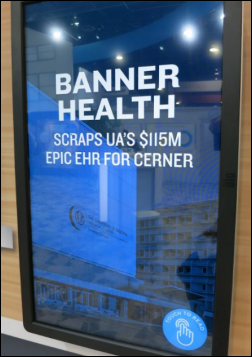
  14. Epic wins several impressive customers, but struggles in the UK, loses the DoD contract, and will be displaced with Cerner following Banner Health’s acquisition of financially strapped University of Arizona Health Network.
  15. The OpenNotes project to allow patients to review clinician documentation gains ground with positive study findings and new funding.
  16. Expectations increase for the FHIR standard as the best way to integrate EHR information with other systems.
  17. ONC releases its Interoperability Roadmap that calls for EHR vendors to expand their API support and for the government to streamline privacy and security policies.
  18. Mobile apps show considerable promise for diagnosing and monitoring mental health conditions, especially depression.
  19. Apple announces ResearchKit for clinical study enrollment.
  20. Major healthcare systems and payers pledge to migrate most of their business to value-based payments by 2020.

Predictions

  1. The cooled-off IPO and funding markets will leave nearly all of the unprofitable startups that graduated from the overabundance of accelerators and incubators in the past few years struggling to gain or maintain momentum and customers. Companies with IPO intentions will postpone their plans due to market conditions, but Health Catalyst will do so anyway with decent but comparatively unspectacular initial share price results as wary investors wait for a couple of good quarters to convince them.
  2. Healthcare costs will become a contentious topic in the 2016 presidential elections as the millions of Americans who purchased health insurance are stung by low utilization and high costs due to high deductibles and co-insurance, leaving them both poorer and less healthy than before. Medical bankruptcies will increase significantly and hospitals in particular will find it difficult to collect the money owed by under-insured patients. At least one presidential candidate will timidly suggest cost controls – both provider and pharma – as the only remaining option in trying to manage the increasingly damaging costs of healthcare in the US. Provider mergers will continue and national brands such as Kaiser Permanente that combine insurance and care delivery will gain prominence.
  3. Consumers will lose interest in fitness trackers and wearables as 2015’s Christmas presents gather January dust just like they did last year.
  4. The CEOs of Epic, Cerner, and Meditech will start to pull back from day-to-day company involvement as they approach retirement.
  5. ONC and Meaningful Use will become increasingly less relevant and more contested as ONC replaces Karen DeSalvo with a new National Coordinator who lacks her experience and bipartisan support.
  6. Several mid-tier consulting firms will be downsized or acquired as their implementation and advisory business dries up.
  7. At least three big health systems will experience a data breach that results in exposure of the information of 100,000 or more their patients. The industry will realize that collaboration to identify and mitigate breach threats is essential and of mutual benefit. The government and organizations such as HIMSS will attempt to create and manage an information sharing and risk assessment platform.
  8. The VA will announce plans to eventually replace VistA with a commercial product. Congress will push Cerner since the Department of Defense will be implementing it, but the VA will favor Epic just to be different.
  9. At least one Epic and Cerner customer will switch to the other company’s product in trying to get a better deal on crippling software maintenance fees. Epic will also expand its hosting service to compete with Cerner’s successful offering.
  10. The terms “telemedicine” and “mobile health” will become antiquated as they simply become another accepted aspect of care delivery. “Information blocking” will also fade away as a hot term when everybody realizes the concept involves speculation without proof, but consumers will increasingly demand that their providers share their information – both with their other providers and with themselves – without charging per-page fees for information that exists in electronic form.
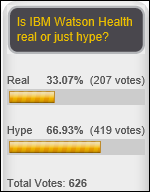
  11. IBM Watson will continue to produce mostly hype. No convincing studies will demonstrate its value, but newly announced, high-profile partnerships will keep IBM shareholders hopeful.
  12. The dark horse publicly traded company best positioned to succeed in health IT and related areas without a lot of fanfare will be Premier.
  13. Athenahealth won’t get much inpatient traction with the former RazorInsights and BIDMC’s WebOMR.
  14. McKesson will consider packaging and divesting its many health IT offerings as non-core business.
  15. Epic will not join CommonWell, but will leapfrog its competitors in offering APIs and slowly building a carefully controlled third-party ecosystem.
  16. Software for population health management and analytics will enter Gartner’s Trough of Disillusionment as providers implement it poorly and without a commitment to truly change their profitable business models.
  17. Cerner and Epic will continue to poach the business of Meditech, CPSI, and best-of-breed vendors whose small-hospital customer bases are being acquired by larger health systems.
  18. “Big data” will support a few meaningful clinical studies performed using only aggregated electronic information, but “little data” will provide more impressive but less-publicized results as doctors design the treatments of individual patients by reviewing the outcomes of similar patients.
  19. Consumer healthcare apps will continue to be plagued by inconsistent use, questionable design, and an unremarkable impact on health or outcomes.
  20. CHIME and AMIA will follow the HIMSS model of increasing conference attendance and revenue by catering to high-paying vendors willing to buy access to prospects.

Contacts

Mr. H, Lorre, Jennifer, Dr. Jayne, Dr. Gregg, Lt. Dan.

More news: HIStalk Practice, HIStalk Connect.

Get HIStalk updates.
Contact us or send news tips online.


125x125_2nd_Circle

Morning Headlines 12/28/15

December 28, 2015 Headlines Comments Off on Morning Headlines 12/28/15

Why the AMA president wants the government to back off

AMA president and emergency room physician Steven Stack, MD calls EHRs the leading frustration of providers today, saying that they decimate efficiency and cripple communication.

Faster Medical Attention With App

In Jersey City, public health officials are rolling out an app that will alert nearby first responders if someone calls 911 in need of emergency medical assistance. The project will cost $2 million and includes costs to train and equip volunteer first responders.

Top Defense Contractors have Paid more than $7 Billion in Misconduct Penalties Since 1995

McKesson appears in a watchdog report on government spending for being the most penalized DoD contractor for misconduct, having paid $2.05 billion in fines across 24 instances of misconduct since 1995.

Comments Off on Morning Headlines 12/28/15

Monday Morning Update 12/28/15

December 27, 2015 News 9 Comments

Top News

image

AMA President Steven Stack, MD says EHRs are the #1 frustration of doctors, explaining,

We live in a world where a 2- or 3-year-old can pick up a smartphone and use it with no instructions. If you’re not careful, they’ll order from Amazon and have something delivered to your house two days later. But we have graduate-educated physicians who are being forced to use software that looks like it’s on an old-fashioned, DOS-based system, a Tandy, an Atari, the kind of software you can only see in a museum. And that’s the software we’ve been given to manage patients’ health and well-being. So you have physicians whose efficiency is decimated. Their ability to communicate with each other is completely crippled. And then they’re told you’re not doing a good job.


Reader Comments

image

From Coal-Bearing Santa: “Re: Marshfield Clinic. I’ve heard that CareCloud has made a deal for its Cattails system and will white label it as an additional CareCloud product.” I forgot that the organizations announced a deal in April 2015 to sell software and services to large physician groups.

From Frisbee Golfer: “Re: Claritas Mindsciences. The three-person firm (everybody is a consultant), which makes the Craving to Quit app, has asked consultants to work for half their normal rates and is struggling to pay vendors after they failed to raise funds for operations in December.” Unverified. Their executive page still lists four people, but what drew my attention is that the company spelled its own name incorrectly on the exec page and sometimes uses “Mindscience” instead of “Mindsciences.”

From John: “Re: NHS. They have the top Christmas song!” In England, the Lewisham and Greenwich NHS Choir beats out Justin Bieber for the top Christmas song. Bieber encouraged his Twitter followers to buy the record instead of his own, which sent it to the top of the sales chart. Proceeds will be donated to charities.


HIStalk Announcements and Requests

image

Three-fourths of poll respondents say they had at least as good a year in 2015 as they did in 2014. Pablo says he left the health IT staffing market because business is dying due to EHR vendors expanding their own internal consulting teams, a saturated and commoditized market, and staffing companies that failed to transition into advisory services.

New poll to your right or here: which company did you lose the most respect for in 2015? Vote and then click the poll’s Comment link to explain.

image

I’ll be closing my reader survey shortly, so you’ll have done your good deed for the next year if you take two minutes to complete it. I’m already contemplating one change as suggested by a reader who would like to see more in-depth reporting in particular areas.

My latest pet peeves: (a) people who say, “I get that” in subtly but indignantly correcting someone who they perceive believes otherwise;  (b) those folks, mostly younger, who respond to a thank you with, “No problem,” thereby devaluing the act that triggered my gratitude by suggesting it wasn’t much effort for them; and (c) Facebook users who excitedly “like” obviously phony stories without bothering to check Snopes.com first, like photos of the Egyptian pyramids covered by snow after a freak storm.

image

We funded four tablets for three pre-K classrooms in New York via DonorsChoose. Mrs. Martin says many of her students had never seen a tablet. They watch videos on them, trace on-screen letters with their fingers to learn to write, and play educational games. That’s a pretty strong ROI for tablets that cost only $41 each.

An anonymous donor sent $500 for my DonorsChoose project, which was matched by the Bill & Melinda Gates Foundation in a one-day funding special and then the $1,000 total was matched again by my anonymous vendor executive, allowing me to fund these projects (some of these had additional matching funds applied as well):

  • 10 sets of headphones for Mr. Ohlinger’s middle school science class, Canton, OH
  • A Bluetooth robotic arm, a solar powered robot, and a BoeBot robot kit to create a robotics team at Ms. Sobosan’s high school in Las Vegas, NV
  • 15 scientific calculators for Mr. Cho’s Bureau of Indian Affairs high school class in Lower Brule, SD
  • Math story books for Ms. Livingston’s third grade class in Las Cruces, NM
  • Headphones, whiteboards, privacy partitions, and paper supplies for Mrs. Heinrich’s elementary school class in San Jose, CA
  • Three tablets for Ms. W’s second grade class in Oakland, CA

Anonymous Epic QA donated $100, with multiplied into $400 due to Gates Foundation and my vendor exec matching money to buy these items:

  • Engineering toys and team building sets for Ms. Medina’s first grade class in Los Angeles, CA
  • 25 sets of headphones for Mrs. Riley’s second grade class in Baltimore, MD
  • An iPad Mini for Mrs. Ulhaque’s first grade class in Houston, TX

I had a little bit of extra money in the account, so I decided to buy a Chromebook, wireless printer, and supplies for Mrs. Hamilton’s fourth grade class in Carson, CA. I also realized that when I announced that donations had funded $22,000 worth of projects in 2015 that I was off considerably – all of the recent donations were via gift cards and those show on the donor’s totals, not mine. The actual total is a lot higher and even that doesn’t take into account matching funds from foundations.


Last Week’s Most Interesting News

  • The Department of Defense expands the scope of the DHMSM project in giving Leidos/Cerner a no-bid hosting contract, saying Cerner’s systems won’t work properly unless the company hosts them itself.
  • Medicare releases a dashboard showing its drug-specific spending.
  • Martin Shkreli is arrested on securities fraud charges and fired as CEO of the two drug companies in which he holds substantial ownership.
  • Congress passes a blanket Meaningful Use hardship exemption.
  • Vanderbilt University Medical Center announces that it will replace McKesson’s Horizon Expert Orders, which VUMC originally developed as WizOrder, with Epic.

Webinars

None in the next few days. Contact Lorre for webinar services. Past webinars are on our HIStalk webinars YouTube channel.


Acquisitions, Funding, Business, and Stock

A watchdog’s report finds that McKesson paid the most money in misconduct penalties of all Department of Defense contractors since 1995. McKesson paid $2.05 billion in penalties for 24 instances of misconduct while earning $6.2 billion of the Pentagon’s business.

image

The Greenville, SC paper profiles local personal health records startup ChartSpan, which says it will grow from 20 employees to more than 200 within the next two years.


People

image

Eric Alper (Lifespan) is named VP/chief clinical informatics officer at UMass Memorial Health Care.

image

Firelands Regional Medical Center (OH) promotes Denao Ruttino to AVP of operations.


Other

image

New York-based non-profit United Rescue is spending $2 million to train and equip volunteer first responders in Jersey City, NJ who will be notified via a smartphone app when someone nearby calls 911 with a medical emergency, allowing them to render aid to the victim before paramedics arrive. The program is modeled after one in Israel where 3,000 volunteers respond to 700 emergencies each day for a program cost of $7 million per year.

image

Impact Advisors sent over photos from their holiday employee gatherings across the country, including this one from Chicago.


Contacts

Mr. H, Lorre, Jennifer, Dr. Jayne, Dr. Gregg, Lt. Dan.

More news: HIStalk Practice, HIStalk Connect.

Get HIStalk updates.
Contact us or send news tips online.


125x125_2nd_Circle

Morning Headlines 12/24/15

December 24, 2015 Headlines 1 Comment

Outcomes From Health Information Exchange: Systematic Review and Future Research Needs

OHSU researchers systematically review studies on health information exchange outcomes, concluding that the full impact of HIEs on outcomes are inadequately studied. The researchers recommend more rigorous study designs and creation of standards by which to describe the various types of HIEs.

Mount Sinai Hospital Launches Initiative to Improve Transitions of Care for Venous Thromboembolism Patients

Researchers at the Icahn School of Medicine will receive a $500,000 grant to develop an app for patients recently diagnosed with VTE. The app will support patients as they transition out of the hospital by offering medication adherence support, symptom tracking, and a way of communicating with a dedicated clinical worker that can answer questions.

Bribery probe nets $12M and more than two dozen doctors

Investigators in New Jersey are charging Biodiagnostic Laboratory Services with paying monthly cash bribes to more than two dozen local physicians in exchange for blood work referrals that resulted in more than $100 million in Medicare payments.

Morning Headlines 12/23/15

December 22, 2015 Headlines 4 Comments

The 2016 Interoperability Standards Advisory is Here

ONC releases its 2016 Interoperability Standards Advisory, a catalog of federally recognized interoperability standards and specifications.

Defense Healthcare Management System Modernization (DHMSM) – Hosting Scope

DoD modifies the scope of its DHMSM program, adding a no-bid contract to Leidos for hosting services that are expected to cost $5 million per year.

Medicare Drug Spending Dashboard

CMS releases an online dashboard that highlights drug-specific spending trends for Medicare Part B and Part D prescriptions.

Baby Boomers Set Another Trend: More Golden Years In Poorer Health

A USC report predicts that Medicare spending will more than double to $1.2 trillion by 2013, with cost increases attributed to an aging baby-boomer generation that is in poorer health than prior generations, but has a longer life expectancy.

News 12/23/15

December 22, 2015 News 6 Comments

Top News

image

ONC releases its 2016 Interoperability Standards Advisory that lists federally recognized interoperability standards and guidance.


Reader Comments

image

From Ambient Occlusion: “Re: homegrown EHRs. Regenstrief/Eskanazi signed up for Epic earlier this year.” Somehow I was thinking Marshfield Clinic and my fingers typed Regenstrief instead when I was trying to think of the last few health systems that are using homegrown EHRs (BIDMC is the other) now that Vanderbilt is moving away from WizOrder/Horizon Expert Orders in favor of Epic. I replied as such to Ambient Occlusion, who then pondered what Marshfield will do after pumping so much money into Cattails. He added a theory that they’ve probably capitalized some of their software development costs and would therefore not only need to spend big money to replace their self-developed product, but even more to write down whatever of its depreciated costs that remain on the books. Marshfield has tried to commercialize Cattails, but given that the newest press release on their site is from 2010, I’m guessing it’s not burning up the EHR charts.

From Benign Growth: “Re: HIStalk. I’m new here and I can’t figure out who’s writing what.” That’s easy – every word you read in an HIStalk news post is mine (Mr. HIStalk, aka Mr. H) unless I’m taking a rare day off and Jenn is covering for me. It always amuses me when people refer to the HIStalk “team” as through there’s a bunch of us working full time in an office. I write HIStalk, Jenn writes HIStalk Practice, Lt. Dan writes the HIStalk headlines and HIStalk Connect, and Lorre handles the webinars and sponsor activities. We each do our own thing with minimal contact with each other since we’re spread out and don’t need much supervision. Our past and present day jobs didn’t often support the creativity and fun we enjoy here. It will be 13 years in June since I started HIStalk and I still can’t wait to start filling the blank page every day.

image

From Rough Taxpayer Sex: “Re: DHMSM. SPAWAR has added a sole-source hosting agreement to Leidos/Cerner. This looks like a total scam. Either they lied in the RFP about what they could provide or they’re lying now.” DoD awards Leidos a no-bid Cerner hosting contract that it claims won’t cost more than $5 million per year, explaining the need to modify the scope of the $4.3 billion award as follows below. Note that it’s nobody’s fault according to the wording – Leidos didn’t suggest that service and the government people involved could not have anticipated the need for it (I expect this excuse to be re-used for future expensive scope changes):

While Leidos solution meets the contract requirements, many of the capabilities of the DHMSM EHR cannot be fully realized unless they are hosted in the Cerner environment. In order to fully enable these functionalities, the DHMSM EHR requires direct access to proprietary Cerner data, which is only available within Cerner-owned and operated data centers. The proprietary data consists of quantitative models and strategies which are the result of extensive Cerner-funded research and development efforts conducted over 15 years. The models are based on analysis of clinical, operational, and financial data associated and incorporate vast amounts of actual longitudinal patient data and information collected through other Cerner applications. Forward deploying the DHMSM EHR into any other hosting solution would prevent access to these models and data. Significant functionality exists within the required system that utilizes machine learning and computational statistics to enable predictive analysis and decision support that directly impact patient outcomes. Therefore, no other contractor can satisfy the requirement. Prior to awarding this performance-based contract, the Government could not have anticipated this solution-specific need, which is why this scope was not included in the original RFP.


HIStalk Announcements and Requests

image

I use the responses from my once-yearly reader survey figure out what I’m doing well and not so well. I would appreciate two minutes of your time to complete it. That will also place you in the running as the randomly chosen recipient of a $50 Amazon gift card. I used previous survey results to make changes that became into some of the most important attributes of HIStalk, so your time will not be wasted. I get a lot of great ideas from the survey, although I have to be careful not to: (a) fix something that isn’t broken; (b) do something that isn’t true to my personality or passions; (c) take on more work than I can handle effectively; or (d) do something that would make writing HIStalk less fun so that I would be tempted to quit doing it.

image

An anonymous Epic developer donated $200 for my DonorsChoose project, to which I applied matching funds from my anonymous vendor executive as well as from private foundations to purchase these items:

  • Fraction, decimal, and percent learning tools for Mrs. Sutton’s third grade class in Herrin, IL
  • A Chromebook for Ms. Marlowe’s kindergarten class in Charlotte, NC
  • Math games and learning materials for Ms. Osborne’s elementary school class in Columbia, SC
  • Math games and a learning center rug for Mrs. Begg’s middle school class of learning and emotionally disabled students in Baltimore, MD

image image

Ms. Osborn’s Florida second graders, many of whom are children of immigrants and frequently-moving military families, are working in teams using the STEM materials we provided via DonorsChoose to solve real-world engineering problems.

image

Also checking in is Ms. C from South Carolina, who teaches a class of severely intellectually disabled seventh and eighth graders for whom our DonorsChoose donation provided a library of around 100 high-interest, low-readability books. She provides background on the student in the photo above as an example: “The picture of the boy reading a book with my Dr. Seuss hat on is a child from a low-income family. He will come to school hungry and is usually very sleepy because he can’t sleep at night. He is very capable of reading better than he does right now. He loves to go over to my little classroom library and pick out a book to read. The other day he told us that he is actually leaning something this year. Until this project was funded, I really didn’t have enough books for a classroom library, but now I do.”

It’s that time of year where we’ve now gotten past the shortest day (December 21) and spring and the HIMSS conference aren’t far away. I’ll probably take this Friday and next off since I doubt many folks will be reading on Christmas and New Year’s eve and day. I expected to be mostly loafing around for most of December since it’s usually slow, but I’ve been pretty busy with fresh news and lots of companies are signing up as HIStalk and HIStalkapalooza sponsors. It’s good to keep busy, for which I thank every person who reads HIStalk and every company that supports it.

Thanks to the following sponsors, new and renewing, that have recently support HIStalk, HIStalk Practice, and HIStalk Connect. Click a link for more information.

image
image
image
image
image
image
image
image
image
image
image
image
image
image
image
image


Webinars

None in the next few days. Contact Lorre for webinar services. Past webinars are on our HIStalk webinars YouTube channel


Acquisitions, Funding, Business, and Stock

image

Invoice Cloud acquires Imagevision.net, which offers the HealthPay24 point-of-service payment product used by 100 hospitals.

The professional regulator in England bars two former finance directors of one-time NHS software supplier iSoft (now owned by CSC) from practicing accounting for eight years for their involvement in the company’s financial irregularities nearly 10 years ago. Four company executives were acquitted in 2013 of securities charges.


Sales

image

Northern Arizona Healthcare chooses Cerner Business Office Services for its ambulatory clinics and ACO, apparently replacing Athenahealth.


Announcements and Implementations

Summit Healthcare releases a Cerner-specific version of its domain compare-and-sync platform that supports data extraction, analysis, regression, and testing.

image

Halifax Health (FL) goes live with Wolters Kluwer Health’s POC Advisor for real-time, data-driven sepsis alerts and advice.


Government and Politics

image

CMS releases the Medicare Drug Spending Dashboard that includes the top 15 drugs by overall annual cost and per Medicare user as well as the drugs whose price jumped the most in 2014. The $1,000 per tablet hepatitis C drug Sovaldi topped the list as Medicare spent $3.1 billion on it at an average per-patient cost of $94,000. The most expensive drug per patient was Remodulin, used to treat pulmonary arterial hypertension, which cost an average of $134,000 per patient per year. You will recall that the Affordable Care Act prohibits Medicare from negotiating drug prices, a carrot added by the White House to appease drug companies who otherwise would have used their political clout to kill its administration-defining initiative.

Kansas state auditors say the state’s delayed Medicaid system rollout was due to unrealistic timelines and unmet functionality promises from contractor Accenture. Federal taxpayers are footing most of the cost of the Accenture contract that is worth $135 million upfront and $50 million for ongoing maintenance. Auditors predict that the project will run $46 million over budget, with nearly all of that bill also being passed along to federal taxpayers.

image

CMS is investigating complaints filed by two former Theranos employees who claim that the lab company instructed its employees to continue using its proprietary testing technology despite “major stability, precision, and accuracy” problems. The former employees said results varied widely and that quality control checks of the testing method often failed. Theranos says the former employees are just disgruntled. The company continues to claim that it will publish peer-reviewed data proving its claims, but says they aren’t yet ready.


Other

image

Baseball data analysis expert and Harvard-trained statistician Paul DePodesta, played as a composite character by Jonah Hill in the movie “Moneyball,” joins Scripps Translational Science Institute in a part-time, unspecified role. He says in an interview conducted by his new co-worker Eric Topol, MD:

If there’s a player who has been in the Major League for say five years, we have an awful lot of data on that player. So when we’re making a decision on that player, we may largely be using data to make that decision. Go to the total opposite end of the spectrum – a 15 year old playing in Maracaibo, Venezuela – we don’t have a whole lot of data on him. We have some, what I would call sort of outside data. We know about players form that area, we know players of his size, his strength, his age, his position. Not necessarily specific things about him, but we can create general conceptions about what that player could be expected to do based on all these other players have done who are similar to him in same fashion … people are trying to get their arms around uncertainty and trying to make better decisions for the future and realizing that data can really help them do that. Whether it’s financial services or trucking or farming, I mean there are all sorts of different industries that I never even dreamed of back when the book first came out and even when the movie came out that have reached out to us — to me or to Billy or to others — and have said, “We’re doing this now and it’s really helping — do you have other ideas about what we might be able to do?

image

Speaking of “Moneyball,” I’ll say again that of the many conference speakers I’ve seen, the best was Billy Beane of the Oakland Athletics. If you haven’t seen the movie, here’s a recap. Beane’s team didn’t have the money to sign or retain big-name players who made occasional crowd-pleasing plays yet failed to achieve consistency, so he measured and analyzed available player performance data to choose lesser-known and therefore less-expensive players who produced consistent but unspectacular results, like getting on base a high percentage of the time, and then managed using those specific strengths to produce team wins. I thought it was bizarre that Health Catalyst chose Beane as a keynote speaker for its first Healthcare Analytics Summit in the fall of 2014 until I heard him.

image

A USC report predicts that Medicare spending will double to $1.2 trillion by 2030 as per-beneficiary costs rise 50 percent, caused by aging baby boomers who — much more than in previous generations — are overweight, disabled, and suffering from chronic conditions. In other words, people who might have died from now-preventable heart disease will live longer and more expensively in requiring treatment of cancer and Alzheimer’s disease.
image

CMS identifies at least five drugs whose cost doubled in 2014 from the new Medicare Drug Spending Dashboard that I mentioned above, with the ridiculously unoriginal Vimovo (two old generic drugs combined, naproxen and esomeprazole, the first for pain and the second to reduce side effects caused by the first) leading the list after a new company bought the drug and raised its price 500 percent. Ancient drugs captopril and digoxin were among the leaders, which cries out for some sort of action to stop companies from buying the rights to old drugs and then jacking up their prices to yield pure profit without the inconvenience of performing research studies or creating something new that might benefit patients rather than shareholders.

image

I also note that Vimovo maker Horizon Pharma is using a now-common drug company trick to increase patient demand while raising societal costs overall – its “support card” promises that patients will pay little or nothing as co-pays even while the company is sticking their insurance company for the inflated cost. Medicare spent $39 million on this lame drug in 2014, which of course means doctors prescribed it quite a bit for reasons that probably aren’t entirely rational.

image

It hasn’t been a great week for Martin Shkreli, who in addition to being arrested on securities fraud charges and then fired as CEO of Turing Pharmaceticals, has now been fired as CEO and board member of KaloBios, the drug company he bought just a few weeks ago. Meanwhile, Shkreli tells the Wall Street Journal that the government trumped up securities charges in desperately trying to find something to arrest him for. He also claims that his over-the-top behavior is “a social experiment” that makes him an undeserving target. He would make an ideal HIStalk interview, although I’m not holding my breath.

image

This image has been used so many times without attribution that I can’t tell where it came from, but I saw it on LinkedIn and liked it.

Gallup’s annual poll of most honest and ethical professions finds nurses, pharmacists, and physicians taking the top three spots. The last-place finishers are members of Congress, telemarketers, and lobbyists.


Sponsor Updates

Blog Posts


Contacts

Mr. H, Lorre, Jennifer, Dr. Jayne, Dr. Gregg, Lt. Dan.

More news: HIStalk Practice, HIStalk Connect.

Get HIStalk updates.
Contact us or send news tips online.

125x125_2nd_Circle

Morning Headlines 12/22/15

December 22, 2015 Headlines Comments Off on Morning Headlines 12/22/15

Congress passes blanket MU hardship exemption

The House and Senate pass S. 2425, a bill that provides blanket hardship exemptions that will allow practices and hospitals attesting to meaningful use to avoid 2017 reimbursement penalties.

US Probes Theranos Complaints

The Wall Street Journal reports that the FDA is investigating several new complaints it has received from former Theranos employees, including one that questions the accuracy of the company’s only FDA approved blood test.

GOP senator lifts hold on health nominees

Freshman GOP Senator Ben Sasse (NE) has lifted his hold on HHS confirmation hearings after the administration releases documents about ACA co-op performance. The decision paves the way for National Coordinator Karen DeSalvo, MD to be confirmed as the Assistant Secretary for Health.

Shkreli fired from KaloBios

Former Turing Pharmaceuticals CEO Martin Shkreli has been fired from his position as CEO at KaloBios Pharmaceuticals as he awaits his trial for securities fraud.

Comments Off on Morning Headlines 12/22/15

Curbside Consult with Dr. Jayne 12/21/15

December 21, 2015 Dr. Jayne 3 Comments

clip_image002 

The year is rapidly coming to a close. Typically this is the time when things are relatively slow in the industry trenches, at least until the first of the year when the frenzied run-up to HIMSS begins.

I’ve got my countdown page ready, not because I’m dying to go to HIMSS, but because I’m excited to see many of the friends I’ve made in the IT world that I only get to see once a year. Although we stay in touch through email, it’s just not the same as being able to get together in person, share a drink, and swap stories. Of course I’m also excited about HIStalkapalooza, although I haven’t given a single thought to my shoe wardrobe yet.

Several of my colleagues are still waiting to see if they will be able to make it to HIMSS. Those who are vendor employees have seen cuts in the number of attendees sent by their companies the last several years. Others from the provider side sometimes find HIMSS to be not only overwhelming, but given the current economics of medical practice, not worth the cost. There are also those who work at faith-based organizations that will not pay for conferences held in Las Vegas, but at least those folks know outright that they’re not going to attend unless it’s in Orlando since everywhere else seems to be out of the running.

I’m wondering what the big buzz will be about this year. Meaningful Use is old hat, although there will still be some picking over the bones of Stage 3. Value-based reimbursement has been on the rise, although for many, it’s more of a buzzword than an actual strategy.

The reality of putting together some of the IT infrastructure required to maximize the promise of value-based reimbursement is daunting. Although the large health systems and academic medical centers can be demanding about their networks and try to control their physicians, it’s put a terrible strain on independent practices and also on patients who want to see physicians across multiple systems but are being steered to stay within the vertical. It was bad enough when insurance networks were restricting choice, but to have your physicians negatively incented to refer you to the consultant of your choice is another thing entirely.

Many people think that interoperability should solve this problem, but the reality for many physicians is that interoperability is a joke. Not only are there incentives biased against sharing from the hospital side, but as an independent physician, I can’t even get access to the hospital web portals in my area because I’m not on staff.


Being a member of the medical staff has not only a financial cost but a professional one, with many hospitals requiring physicians to provide call coverage for patients in the hospital. Although that requirement can often be shifted to a hospitalist physician, they also require physicians to be available for outpatient follow-up, which is nearly impossible when you are a part-time physician at a practice that doesn’t have scheduled appointments and doesn’t provide primary care.

I would love to be able to log into a hospital portal and get follow up on the patients I have to transfer to the hospital. We’re seeing more and more of them as cost-shifting drives them to urgent cares when they really should have been in the emergency department in the first place. Although we’re pretty advanced at my facility, the last few shifts I’ve worked have included multiple ambulance transfers for people who were actively having heart attacks. There was one just the other night with a life-threatening stomach bleed, which let me tell you looks pretty much exactly like it does when they show it on TV medical programs.

All of the patients I’ve had to transfer have cited cost and access as the primary reasons they chose us instead of another facility. Since my roots are in primary care, I always wonder how they are doing, but I never see a discharge note or any kind of communication from the hospital despite my multiple Direct addresses that should make it easy. Maybe I should head to the mall and ask Santa to bring me some discharge summaries for Christmas. I’m not sure if the elves have signed a BAA, however.

I’m winding up the year with a last-minute lab interface project that is keeping me pretty busy. The client is super nice and had an issue with their lab vendor canceling their contract with minimal notice, so they’re in a hurry to get a new one live before their interface is shut down. The work is somewhat tedious, but that will be good to keep me busy.

Today is the shortest day of the year and I’m glad it’s here. I’ve missed having light in the evenings and have had to spend more time on the treadmill than I like. I’m looking forward to longer days and being able to get back on the streets without fear of a broken ankle from tripping over something in the dark. We certainly can’t have that in the run-up to HIMSS. Once this project is done, I’m laying low until the New Year.

What are your plans to wind up 2015? Email me.

Email Dr. Jayne.

Text Ads


RECENT COMMENTS

  1. ... because it's a construction worksite. (It's a bit more evident from the second photo in the linked post.)

  2. I can't get past the helmets and safety vests. On everyone. Including the model patient. What, are they expecting the…

  3. I'm all for a startup mentality, but there really needs to be a net positive return for all that time,…

  4. Re: It would be interesting to compare after-hours use of generative AI solutions by patients who have access to after-hours…

  5. Would be interesting to see what Providence St. Joe's return has been on all their adventures. When I was on…

Founding Sponsors


Platinum Sponsors


Gold Sponsors


RSS Webinars

  • An error has occurred, which probably means the feed is down. Try again later.