


News 9/7/16
Top News

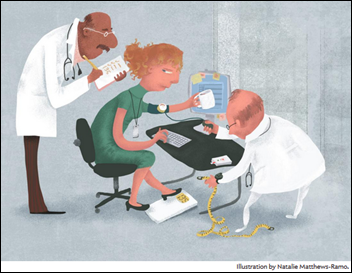
A tiny AMA-sponsored time and motion study finds that ambulatory practice doctors spend almost twice as much time working on the EHR or performing other desk tasks than seeing patients, with the observed physicians spending only 27 percent of their available time in face-to-face contact with patients.
Physicians spent only around half of their exam room time directly interacting with the patients in front of them, with most of the rest consumed with EHR and desk work. The doctors studied also spent another 1-2 hours past their quitting time doing clerical catch-up.
It’s a very small study, both in numbers as well as the breadth of specialties, practice settings, and geographic areas that were observed. It also contains subjective interpretation of what constitutes non-patient time, in that doctors may be discussing health issues with patients or reviewing information on the screen while using the EHR since those activities are not necessarily mutually exclusive. It also doesn’t address the fact that EHR time may not necessarily be wasted depending on the situation, any more than arguing that radiologists spend too much time looking at PACS images or that anesthesiologists should pay more attention to patients and less to their monitors.
The study also does not compare the time doctors spend using paper charts or the benefits of EHRS while obviously trying to make the AMA’s point that EHRs – and not the healthcare system doctors created in voluntarily accepting checks from insurance companies and the federal government and thus being required to meet their documentation requirements – are responsible for their unhappiness and lack of productivity. I don’t like the tax system, but I don’t blame TurboTax.

An accompanying Annals of Internal Medicine editorial touts the AMA’s STEPS Forward program and concludes, “Now is the time to go beyond complaining about EHRs and other practice hassles and to make needed changes to the healthcare system that will redirect our focus from the computer screen to our patients and help us rediscover the joy of medicine.”
Reader Comments

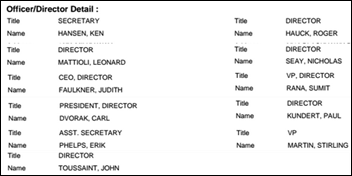
From Voice of Reason: “Re: Epic’s succession plan. As a former Epic employee, the whispers I heard during my time there was that Sumit Rana was going to take over as the next CEO once Judy steps down. The recent piece on HIStalk on Epic’s board of directors corroborates this – he and Stirling are the only two members other than Judy/Carl that work at Epic. Ultimately, I think Sumit will get the nod over Stirling since Sumit has much more visibility within the company and he is a developer whereas Stirling is a TS – there’s an unwritten rule that people defer to developers within the company.” Sumit went to work for Epic in 1998 immediately after he graduated from Delhi College of Engineering and has worked his way up to SVP. Note: I don’t usually correct reader comments, but as other readers have noted and his LinkedIn profile clearly states, Stirling Martin’s background is as a developer (going back to June 1997) and he has never been a TS.
From Former Epic: “Re: Epic’s succession plan. Unless things have changed since I worked there (about three years ago), Judy is very tight-lipped about how things will work after she’s gone. She addressed it once to my knowledge, and all she said was ‘There’s a plan in place.’ As far as the qualifications of her children to run the company, Judy herself wasn’t necessarily qualified back in 1979, so I don’t see that stopping them. At this point, I think Carl Dvorak is the real brains of the operation.” The challenge might be that while the second generation of family business owners usually are much more trustworthy than the third generation, there’s still the issue of mixing founder offspring and business, especially when company ownership is turned over to a foundation. On the other hand, Judy has shown remarkable talent and focus in taking Epic where it is today, so I’m sure she is not oblivious to the challenges and will make every effort to mitigate any threat to the company’s current state. A success story to be emulated is S.C. Johnson & Son, the cleaning supply company (also based in Wisconsin) that’s in its fifth generation of family ownership and leadership with 12,000 employees and $7.5 billion in sales.
From Super Bill: “Re: Epic. Suing one of its customers. Perhaps they don’t want anyone to know how Epic forces smaller regional hospitals and independent practices to enter into agreements with larger players to help with interoperability issues. See this filing.” Epic attempts to block University of Iowa Hospitals and Clinics from complying with an open records request from an unidentified individual who seeks information about services provided by KLAS. An Epic employee sent the health system a KLAS report covering EpicConnect and included attachments that Epic doesn’t want released. Epic argues that the attachments are not public record and are proprietary. I can say from first-hand experience that Epic fights tooth and nail any attempt to obtain contract records from tax-supported organizations that are required by law to provide them to anyone who asks, apparently requiring in their sales contract that the health system send such requests to Epic’s team of lawyers that will use every available company resource to keep the information private in the ultimate form of information blocking.
From What Would HIPAA Do?: “Re: security. I work for a vendor and one of our practices is being forced our EHR after joining a local healthcare system. The new vendor gave us access to an SFTP site to transfer the practice’s data. When we logged in, we could see the data from another 4-5 practices sitting there in plain view. We reported this to the vendor and they said they aren’t worried since they only give the log-in to people they know. Should we report this or formalize our complaint to the vendor? Are we overthinking this?” I’ll invite readers to respond. Personally, I would let your customer know and let them decide how to proceed since any complaint directly from you as a competitor would look like sour grapes, not to mention that there’s no upside to your involvement. It’s always touchy to report a potential security issue that (a) does not and could not affect you; (b) is purely theoretical; and (c) risks having the insecure (pun intended) vendor file an FTC or other form of complaint claiming that you illegally accessed the information of their clients, hoping to deflect the potential damage to the messenger as has been done in several recent health IT examples.
From Will Eye Am: “Re: the magazine that always features men on the cover. Why would you question their choice of featured subject if it’s mostly men in CIO roles?” Mostly because the magazine is produced by an India-based company, and in my admittedly limited experience, it’s more culturally acceptable there than here to treat women as less than equals. Perhaps I’m jaded by my first hospital job in a rural, for-profit hospital that was a veritable Statue of Liberty for the unskilled medical huddled masses yearning to bill Medicare, where our multicultural medical staff insisted (and hospital policy mandated) that female nurses hug the hallway walls with eyes reverentially downturned as they passed. Companies can do whatever they want, but as such shouldn’t be insulted if I report the percentage of non-white men on the boards or leadership teams or, in this case, note that the magazine can’t seem to find anyone other than white men for its covers.
Webinars
None scheduled soon. Contact Lorre for webinar services. Past webinars are on our HIStalk webinars YouTube channel.
Acquisitions, Funding, Business, and Stock

3M acquires Switzerland-based semantic coding vendor Semfinder.

McKesson discloses in an SEC filing that the Department of Justice has requested information about its previously announced divestiture of its IT business to a new entity created in a venture with Change Healthcare. DOJ is reviewing the proposed plan for any antitrust concerns.

In Scotland, Craneware reports an 11 percent increase in first-half revenue to $67 million, with pre-tax profit of $19 million.

CompuGroup Medical acquires Italy-based pharmacy software vendor Vega Informatica e Farmacia S.r.l.
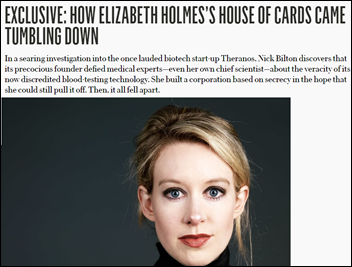
Vanity Fair runs a fascinating summary of the Theranos debacle and CEO Elizabeth Holmes that includes interesting observations:
- Holmes mimicked Apple to the point of wearing Steve Job-like black turtlenecks, forbidding company teams from communicating with each other about their projects, and emphasizing the company’s “story” instead of its actual technology.
- The Wall Street Journal reporter who broke the story was surprised that Holmes, who micromanaged every company decision, could not explain how its technology worked.
- Company insiders urged Holmes to rebut the damaging initial WSJ report by enlisting scientists to endorse the company’s work, but that wasn’t possible because Holmes hadn’t allowed scientists to publish peer-reviewed papers about it.
- The company’s chief scientist could not make the product work even as Holmes touted it to a widening audience, leading to his 2013 suicide.The company’s response upon being told that he had died was to demand that his widow return the company’s confidential information and later to threaten to sue her for talking to reporters.
The author summarizes the Silicon Valley mentality that created Theranos as:
The venture capitalists (who are mostly white men) don’t really know what they’re doing with any certainty—it’s impossible, after all, to truly predict the next big thing—so they bet a little bit on every company that they can with the hope that one of them hits it big. The entrepreneurs (also mostly white men) often work on a lot of meaningless stuff … [they] generally glorify their efforts by saying that their innovation could change the world, which tends to appease the venture capitalists because they can also pretend they’re not there only to make money. And this also help seduce the tech press (also largely comprised of white men), which is often ready to play a game of access in exchange for a few more page views … In the end, it isn’t in anyone’s interest to call bullshit.
People

Culbert Healthcare Solutions hires Nancy Gagliano, MD, MBA (CVS Health) as chief medical officer.
Announcements and Implementations

Uniphy Health announces GA of its Sentinel sepsis alerting platform.

MedStar Health (MD) delivers patient education delivered using the technology platform of local startup Mytonomy.
Privacy and Security
In Scotland, an environmental activist sues Donald Trump’s Aberdeen golf course, charging its employees with violating the Data Protection Act by using their phones to film her peeing behind a dune on the course. The course admits that it did not register with the data protection regulator despite running at least nine security cameras that were recording guests who weren’t warned that they were being filmed, but says that’s irrelevant because those weren’t the cameras used to record the alfresco urination.
Technology
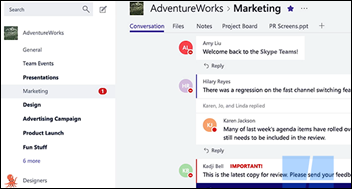
Microsoft, which decided against offering $8 billion for team communications app Slack, is reportedly working on a similar Skype product called Teams, which will offer chat room-like channels, private direct messaging, and Facebook-like threaded conversations.
Other

Franciscan Alliance will rename the 13 of its 14 hospitals that are named after saints to new names that reflect “Franciscan Health” plus their city name, effective next week.
Business Insider profiles the CIO of drugmaker Merck, who believes that companies must undertake digital transformation or die. The CIO says it’s a change in operation that doesn’t necessarily increase IT spending. Merck gets its CIO involved with technology VCs to get early access to startups, encourages its IT employees to find interesting startups and work with them on technology, and allows its developers to create software and sometimes helps them turn it into a startup.
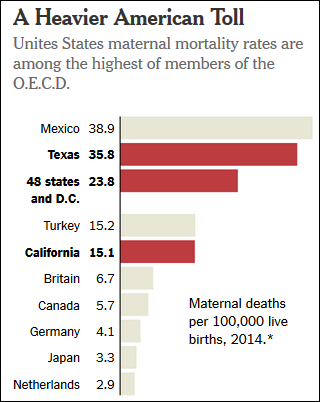
A study finds that the US has the second-highest maternal mortality ratio among 31 developed countries, with Texas recording alarmingly high numbers of women who die during and after pregnancies mostly due to state government decisions about healthcare funding and access.

ED doctors treating an Arizona man‘s small facial cut are shocked to find that it’s the entry wound for a four-inch piece of a broken chopstick lodged deep in his brain. The man reported that he had grabbed his brother from behind in a Chinese restaurant and his brother stabbed him with the chopstick over his shoulder. He’s OK. Googling turns up other examples of chopstick-related violence, such as a prisoner who killed himself by stabbing himself with a chopstick and a more recent example in which a man confessed to killing his elderly father during an argument by stabbing him in the throat with the wooden utensil. The National Chopstick Association has not yet invoked the “chopsticks don’t kill people” argument.
Sponsor Updates
- PatientPay will present at the CED Tech Venture Conference next week in Raleigh, NC.
- Aprima will exhibit at the Arizona State Physicians Association meeting September 15-17 in Scottsdale.
- Audacious Inquiry Senior Manager King Yip is named a finalist in ONC’s Blockchain in Healthcare Challenge.
- Bernoulli Health pledges to share its data as part of the Patient Safety Movement.
- Besler Consulting releases a new podcast, “Live from HFMA Region 3.”
- Boston Software Systems releases a new podcast, “Improving Clinical Workflow at Patient Discharge.”
- CoverMyMeds will exhibit at the American Society for Pain Management Nursing Annual Conference September 7-10 in Louisville, KY.
- Cumberland Consulting Group will exhibit at the Healthcare Executive Group Annual Forum September 12-14 in New York City.
- Elsevier Clinical Solutions will exhibit at the Emergency Nursing Association annual conference September 14-17 in Los Angeles.
- EClinicalWorks will exhibit at International Vision Expo West September 15-17 in Las Vegas.
Blog Posts
- The 2016 Aprima User Conference: Another Great Meeting in the Books! (Aprima)
- Take Full Advantage of EPCS (AdvancedMD)
- Why do Healthcare Information Systems Account for $40+ Billion? (Catalyze)
- Sometimes, You Can’t Take “No” for an Answer (CareSync)
- How Does Your Data Grow? (Spok)
- From Clinician to Consultant: A Different Way to Care for Patients (ECG Management Consultants)
- Reducing Patient Fall Risks with Comprehensive Bed Exit Alarms (Extension Healthcare)
- Top 5 HIE Participant Onboarding Considerations (Galen Healthcare Solutions)
- The Importance of Optimizing Operational Business Processes (Hayes Management Consulting)
- 8 Strategies for an Effective EMR Go-Live (The HCI Group)
Contacts
Mr. H, Lorre, Jennifer, Dr. Jayne, Lt. Dan.
More news: HIStalk Practice, HIStalk Connect.
Get HIStalk updates. Send news or rumors.
Contact us.































































I was born roughly 2 months after the US space program began (Explorer 1), and I've followed it all my…