Recent Articles:

Morning Headlines 5/12/25

May 11, 2025 Headlines Comments Off on Morning Headlines 5/12/25

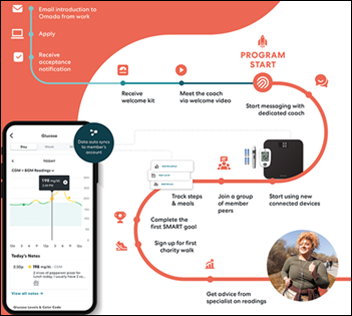
Virtual chronic care company Omada Health files for IPO

Virtual care provider Omada Health files for an IPO, reporting a $44 million loss on $170 million in 2024 revenue.

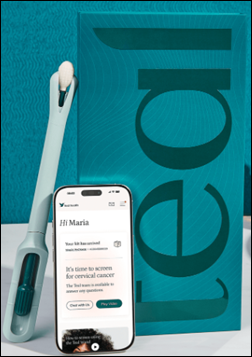
FDA Approves Teal Health’s Teal Wand –The First and Only At-Home Self-Collection Device for Cervical Cancer Screening, Introducing a Comfortable Alternative to In-Person Screening

The FDA approves the Teal Wand, a prescription device that lets average-risk women collect a cervical cancer screening sample at home, mail it in, and review results via telehealth.

CompuGroup Medical and CVC plan delisting – public delisting offer announced by CVC

Global health IT company CompuGroup Medical will move forward with delisting from the Frankfurt Stock Exchange as part of investor CVC Capital’s take-private acquisition deal first announced last December.

Navy’s Military Sealift Command Upgrades IT to Ensure Health Care Continuity

The US Navy’s Military Sealift Command is in the process of upgrading its IT infrastructure, including linking the US Naval Ship Mercy to the federal MHS Genesis EHR.

Comments Off on Morning Headlines 5/12/25

Monday Morning Update 5/12/25

May 11, 2025 News 3 Comments

Top News

image

Virtual care provider Omada Health files for an IPO, reporting a $44 million loss on $170 million in 2024 revenue.

The company posted strong revenue growth and a narrower net loss compared to 2023.

Co-founder and CEO Sean Duffy has led Omada since 2011, following stints as a Medgadget blog contributor and developer of Excel training tools. He dropped out of Harvard’s medical and business schools in 2010.


Reader Comments

From Not Pratap Sarker: “Re: Oak Street Health. Moving away from Greenway’s EHR and RCM services. This is Greenway’s largest customer. Their EHR Canopy currently sits on top of GW.” Unverified. I’ve emailed Greenway’s media contact. UPDATE: Oak Street is moving to Epic. Thanks to Brendan Keeler for sending a link to details. Oak Street is also listed on Epic’s UserWeb.


HIStalk Announcements and Requests

image

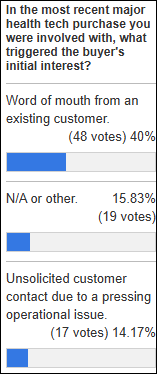
The top responses from last week’s poll suggest that the best sales and marketing activity is to let your product and support do the talking.

New poll to your right or here: For those over 50, what is the #1 thing you wish you had done differently? I’ve run this question a couple of times over the years, hopefully giving the under-50 folks time to replot their course if needed. I’m sure they would also benefit from an explanatory poll comment if you are so inclined.


Thanks to the volunteers who contributed to the first of my revived Executive Watercooler frontlines report. If you’re in a decision-making role at a health system, ACO, or hospital-owned medical group; serve as a CMIO, CNIO, or clinical informaticist; lead a health system IT organization; or work as a digital health executive, you’re welcome to join them. You’ll get a monthly question by email to which you just click “reply” with your answer.

image

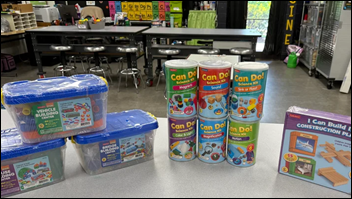
Alabama teacher Ms. H sent some photos from her elementary school class, for which reader donations funded STEM-based centers.


Sponsored Events and Resources

None scheduled soon. Contact Lorre to have your resource listed.


Acquisitions, Funding, Business, and Stock

image

The FDA approves the Teal Wand, a prescription device that lets average-risk women collect a cervical cancer screening sample at home, mail it in, and review results via telehealth. Shipping begins in June and the company is seeking coverage from insurers.

Kouper Health, which offers AI-powered tools to manage post-discharge care transitions and reduce readmissions, raises $10 million in funding. Co-founder and CEO Salman Ali, MBA, previously co-founded the at-home sleep apnea testing company GetSnooze.

Nordic-owned Healthtech opens Canadian offices in Halifax, Montreal, and Vancouver.

Definitive Healthcare reports Q1 results: revenue down 7%, EPS $0.05 versus $0.08, beating estimates for both. DH shares rose 31% on the news, valuing the company at $398 million. They’re down 29% in the past 12 months.

image

Former Theranos CEO and current federal inmate Elizabeth Holmes is reportedly advising her partner Billy Evans – a hotel heir and father of their two children — on his new medical testing AI startup. The company is raising funds to develop what it calls “the future of diagnostics” and “a radically new approach to health testing” for “human health optimization.” A recent patent claims that the technology can analyze sweat, urine, saliva, and small blood samples. That’s the happy couple above in pre-incarceration days with their husky Balto, which Holmes insisted was a wolf and whose eventual disappearance she blamed on a mountain lion that carried him off.


Sales

  • University of Iowa Health Care will implement Visage Imaging’s Visage 7 in a $13 million contract.

People

image

The FDA hires Jeremy Walsh (Booz Allen Hamilton) as its first chief AI officer.

image image

Intermountain Health promotes Tamara Moores Todd, MD to chief health informatics officer and Jason McClellan, RN, MBA to chief clinical informatics officer.

image

Tiffany Hodgins, MSHI (Health Catalyst) joins Sacvalley Medshare as chief technology and quality officer.

image

Jay Scholes (Veradigm) joins Advantmed as VP of sales.


Announcements and Implementations

Black Book Research overhauls its healthcare IT research model, adding AI-driven real-time sentiment analysis, redesigned KPIs, continuous survey pilots, and broader access to reports that are neither paywalled nor vendor-sponsored.

A year-long independent study finds that use of an AI assistant – Navina’s AI Copilot in this analysis – reduced clinical review time for complex visits by 40%, decreased physician burnout by 32%, and improved value-based performance as measured by Risk Adjustment Factor and Star quality ratings.

Nova Scotia Health delays the go-live of its Oracle Cerner Canada system until December, following its 10-year, $260 million agreement that was signed in February 2023. No reason was provided.


Sponsor Updates

  • Optimum Healthcare IT publishes a new case study titled “Northeast Georgia Health System’s Cloud-First Transformation Journey.”
  • PerfectServe announces the winners of its 2025 Nurses of Note Awards Program.
  • RLDatix signs a Memorandum of Understanding with the Department of Health – Abu Dhabi to develop a patient safety system using its technology.
  • Sonifi Health will exhibit at the Texas Regional HIMSS Conference May 12-14 in Grapevine.
  • TeamBuilder will present at The Millenium Alliance Transformation Assembly May 13-14 in Dallas.
  • A new Wolters Kluwer Health survey finds that nursing schools will more than double their use of generative AI over the next two to three years.

The 2025 MedTech Breakthrough Award winners include the following HIStalk sponsors:

  • Capital Rx’s Judi Health (best insurtech solution).
  • CliniComp (EHR innovation award).
  • Timely by DrFirst (best overall patient engagement platform).
  • Elsevier ClinicalKey AI (AI innovation award).
  • Inovalon’s Social Drivers of Health Market Insights (best data visualization solution).
  • Navina (best use of AI in healthcare).
  • SmarterDx (best overall healthcare operations solution).
  • Symplr (best healthcare big data platform).
  • TrustCommerce, a Sphere company (healthcare payments innovation award),
  • Waystar (best overall healthcare payments solution provider).
  • WellSky (best home healthcare solution).

Blog Posts


Contacts

Mr. H, Lorre, Jenn, Dr. Jayne.
Get HIStalk updates.
Send news or rumors.
Follow on X, Bluesky, and LinkedIn.
Sponsorship information.
Contact us.

Executive Watercooler: Projects that Surprisingly Delivered Real Value

May 10, 2025 Advisory Panel Comments Off on Executive Watercooler: Projects that Surprisingly Delivered Real Value

The HIStalk Executive Watercooler is a group of hospital CIOs, hospital CMIOs, practicing physicians, and a few vendor executives who have volunteered to provide their thoughts on topical industry issues. I’ll seek their input every month or so on an important news developments and also ask the non-vendor members about their recent experience with vendors. You are welcome to suggest an issue for their consideration.

If you work for a hospital or practice, you are welcome to join the panel. I am grateful for the help of members 

This question this time: What technology project ended up delivering real value even though you were skeptical at first?


The availability of notes and results through the patient portal has been a major plus for many patients, particularly for those with significant health conditions. It’s not perfect yet, especially for people with limited health literacy and for adolescents, where access and/or parental access is often blocked. But with appropriate introduction to the portal and efforts to help engage patients to use the portal, it can be a big help in coordination of care, identifying errors in records, and reducing the need for phone contacts for normal results. 


Clinical pathways. I thought they would get ignored completely. I underestimated our system CMO’s drive to put it on the incentive compensation matrix. Now, it’s still a performance based metric as opposed to actually improving, say, mortality, associated with, say, a CHF admission. But it’s a start, and better than a lot of other things we take on.


Ambient listening scribes.


In the fall of 2019, we began to pilot video visits for our integrated Behavioral Health program. We licensed Zoom for 50 users and spent the time and effort to integrate it with our Epic system. We had a total of six completed virtual BH visits during the three-month pilot period, so we were very skeptical about the adoption of virtual visits. Fast forward three months when the governor announced the COVID-19 shutdown in March 2020. All we had to do was ask Zoom to apply a license increase for our account and then train providers and their support staff on how to use virtual visits to provide urgent medical care and some age-appropriate well visits. We were able to pivot to virtual care in two weeks and were ready to continue caring for patients and families when the shutdown took effect. 


Electronic whiteboards in patient rooms. We implemented them in a children’s hospital and saw an immediate increase in patient engagement with the care team via the whiteboard. Often parents are asleep or taking a break when the team arrives in the room. The ability to leave questions or requests for the team was an immediate win. Accurate reporting of the care team by shift, goals for the day and other information prominently displayed without to log into a portal allowed the less tech savvy easy access to information.


In the past year, we implemented a new AI tool to crawl through all types of data in Epic ( including PDFs in blob server and other external documents) and create a master summary of patient’s clinical history. Goal was to do a better job of exposing critical data from many external sources (unstructured) that might be missed in rapid review of the chart before and during clinical encounter. My organization was asked to be an earlier adopter of this technology. I was skeptical that if there was a tool that could do this efficiently, due to my belief that if such a tool existed and delivered on its promise, every Epic customer in the country would be clamoring for it and that was not currently the case. We proceeding with contracting and have been running the application for about seven months and it is performing as promised, bringing significant value to our clinicians, helping address burnout, and improving the care we are delivering.


Most recent would be ambient listening AI. We are an Oracle Health customer and I had concerns about their solution’s usability and acceptance by physicians. While still not perfect, we are seeing great results and receiving glowing reviews. We are still reviewing and measuring outcomes but expect to be able to tell a very positive story.


We had an AI/LLM project that was focused on evaluating the full reporting ecosystem and identifying redundancies and gaps as well as filling in any gaps. It was far faster and more effective than I originally thought it would be.


One thing that comes to mind is when we rolled out Ninjio cybersecurity training. I wasn’t skeptical of the technology, rather of user adoption. I was surprised how usually cynical clinicians responded to the short and entertaining videos and actually learned tactics to help keep us more secure.


Comments Off on Executive Watercooler: Projects that Surprisingly Delivered Real Value

Morning Headlines 5/9/25

May 8, 2025 Headlines 1 Comment

Hinge Health says revenue increased 50% in first quarter — still no price range for IPO

Virtual physical therapy vendor Hinge Health updates its IPO prospectus with Q1 results, showing revenue up 50% to $124 million and a $17.1 million net profit.

Kouper Emerges from Stealth with $10M in Funding to Transform Transitions of Care

AI-powered care transition management startup Kouper launches with $10 million in funding.

Cedars-Sinai Launches Digital Innovation Hub to Advance Healthcare Solutions

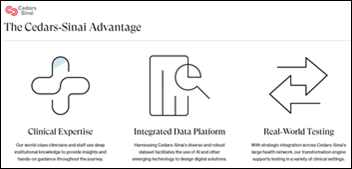
Cedars-Sinai and Redesign Health launch an innovation center that pairs health system experts with startups to develop digital health solutions, with Cedars-Sinai serving as the first customer.

Israeli hospital to launch innovation hub in Mass.

Israel’s Sheba Medical Center will open a US office for its startup accelerator in Massachusetts, aiming for a Boston-area location.

News 5/9/25

May 8, 2025 News 4 Comments

Top News

image

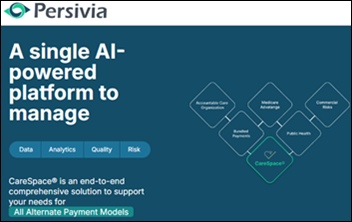
Persivia, a provider of data aggregation and AI-driven analytics, raises $107 million in funding.


HIStalk Announcements and Requests

Listening: Foo Fighters, of which I’m far from a fan, but I’m obsessed with videos of Dave Grohl (also not a fan) bringing audience members up to play. Kiss Guy and Richard the Drummer will give rock star wannabes goose bumps. I’m also not a fan of sports, but I’m intrigued by YouTube videos and livestreams of the sports-adjacent antics of the Savannah Bananas


Sponsored Events and Resources

None scheduled soon. Contact Lorre to have your resource listed.


Acquisitions, Funding, Business, and Stock

image

Virtual physical therapy vendor Hinge Health updates its IPO prospectus with Q1 results, showing revenue up 50% to $124 million and a $17.1 million net profit. The company announced IPO plans in March but hasn’t set a price range.

AI-powered clinical data abstraction vendor Carta Healthcare raises $18.25 million in Series B1 funding. Industry veterans who are on the executive team include Brent Dover (Medicity, Health Catalyst, and Commure) and Greg Miller (Healthlink, Medicity, and Health Catalyst).

WeightWatchers files for Chapter 11 bankruptcy to eliminate $1.15 billion in debt. The company’s transformation plan includes creating a better digital experience for members and expanding its weight loss medication telehealth business.

image

Cedars-Sinai and Redesign Health launch an innovation center that pairs health system experts with startups to develop digital health solutions, with Cedars-Sinai serving as the first customer. The focus will be specialty care access, personalized medicine, workflow intelligence, and provider-payer-patient coordination.

image

Israel’s Sheba Medical Center will open a US office for its startup accelerator in Massachusetts, aiming for a Boston-area location. The accelerator has backed 100 startups, including three unicorns.

image

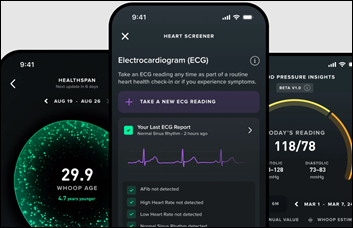
Health and fitness wearable company Whoop releases new models that offer 14-day battery life, a heart screener with ECG whose data can be shared with doctors, daily blood pressure insights, and women’s hormonal insights. Membership costs $199 to $359 per year and includes the device and charger.


People

image

Health Data Movers names David White (Nordic) business development executive.


Government and Politics

NIH will analyze Medicare and Medicaid claims data to study chronic disease, starting with autism.

President Trump’s replacement nominee for surgeon general has a health tech connection: Casey Means, MD — who dropped out of her residency and never practiced traditional medicine — is a co-founder of Levels, which offers AI-powered tracking of food intake, habits, and data from continuous glucose monitors for health optimization, weight management, and improving athletic performance. Subscription to the app is $199 per year, while adding the CGM and supplies adds $199 per month.


Privacy and Security

Masino discloses in an SEC filing that a cyberattack on April 27 is hampering its ability to ship orders.

Illinois Governor J.B. Pritzker signs an executive order that bans state agencies from collecting autism-related personal data unless it is required for care, compliance, or eligibility.


Other

An appeals court rejects the attempt by former Theranos CEO Elizabeth Holmes to have her 2022 fraud conviction overturned, leaving the Supreme Court as her last chance to reverse the 11-year sentence.


Sponsor Updates

image

  • Clinical Architecture staff help sort 2,390 pounds of food at Gleaners Food Bank of Indiana.
  • Surescripts will present at Kroger Health’s Nourishing Change Conference May 13-15 in Cincinnati.
  • Black Book Research celebrates Women’s Health Month by releasing its free report, “Black Book of Women’s Health Information Technology and Software Innovations.”
  • Capital Rx releases a new episode of “The Astonishing Healthcare Podcast” titled “Empowering Plan Sponsors: Data Access & Analysis, with Bridget Mulvenna.”
  • Ellkay will exhibit at the 2025 MUSE Inspire Conference May 27-30 in Grapevine, TX.
  • Impact Advisors releases a new episode of its “Impactful AI” podcast titled “Synthetic Doppelgängers.”

Blog Posts


Contacts

Mr. H, Lorre, Jenn, Dr. Jayne.
Get HIStalk updates.
Send news or rumors.
Follow on X, Bluesky, and LinkedIn.
Sponsorship information.
Contact us.

EPtalk by Dr. Jayne 5/8/25

May 8, 2025 Dr. Jayne 1 Comment

image

Farewell, Skype, parting is such sweet sorrow. Not really, since I hadn’t used it in years. In fact, I had forgotten that I even had a Skype account and didn’t remember until I went to the website to try to grab a logo.

I exported my contacts and there were only three, which makes sense since it was a personal account and not the corporate one that I last used in 2018 or so. Supposedly all contacts and conversations were ported to Teams, but I didn’t see them there. Skype was founded in 2003 and headquartered in Luxembourg, which I don’t think I knew when I was a user. It just goes to show that no matter how cool you think your solution is now, there’s a chance that it won’t be around in a couple of decades.

I had a routine trip to the dentist recently and was pleased to see that they had incorporated some newer evidence-based recommendations into their treatment protocols. Apparently they have also upgraded their imaging system, because it’s now using AI to flag areas of concern on the images. I got a kick out of listening to the dental hygienist explain what the AI was doing and how the goal was just to draw the viewer’s eye to areas that needed additional attention and that the AI was not practicing dentistry.

She knows that I’m a physician, but probably not that I’m an informaticist. Regardless, I’m glad that she didn’t make assumptions about my knowledge and did the same educational talk she likely gives to all the patients. The AI flagged areas that I knew were already concerning, so at least it was concordant with my history. I enjoyed being able to see and discuss the images instead of how things used to be when x-rays were still on tiny pieces of film.

I also had a visit to a new consulting physician and was reminded how difficult it is sometimes to try to put yourself in a “just be the patient” mindset when you know what the best practices are in the industry. The receptionist was friendly, but jumped straight into some screening questions that were straight out of 2021, including whether I’ve traveled outside the US recently and whether I’ve been exposed to anyone who has been sick in the last 30 days.

The answer to the latter was, “I’m sure, given all the bugs that are going around,” but it’s really a nuisance question unless you’re asking about particular kinds of illness. I was around someone who later tested positive for Influenza B, but that was two weeks ago and I’m asymptomatic, but I doubt the receptionist wants to get to that level of history. I’m also sure I’ve been exposed to COVID-positive people given the wastewater numbers in my area, but it seems that no one is testing at home any more and people are likely just walking around with viral symptoms. She also asked if I had been positive for COVID in the last ten days, which was more relevant, but again if people aren’t testing, they’re unlikely to know.

The office visit was uneventful, although the practice could benefit from a few patient-centric tweaks. The exam room had a bulletin board with a handful of flyers attached, but it was across the room from the patient chair, so there was no way to read it without walking over to it. At that point, you would be behind the door if someone opened it. The flyers were also bad photocopies in small font, so they weren’t terribly welcoming to patients who need readers or other visual aids.

There was only one patient chair, leaving no place for family to sit and no place to put a purse or tote other than the floor, which I don’t like in a medical facility. The physician asked about my job, and once I said “clinical informatics,” I got an earful about his dislike for ambient documentation. Apparently he’s been burned by hallucinations and the need to spend excess time doing edits, so he is phasing it out in practice. He’s in a subspecialty where every detail can have meaning, so I’m not surprised that he’s meticulous as far as his note content.

After the consultation, I was sent across the hall to the hospital-owned lab and made a beeline for the “sign in here” poster that points to a clipboard. The receptionist interrupted her conversation with another patient, turned to me, and said “You can use the kiosk.” She pointed over my shoulder to a kiosk that was on the wall behind me, next to the door that I had just come through, but positioned in a way that I wouldn’t have seen it entering the room. I think a sign that says “please check-in on the kiosk behind you” might be in order, since I heard her do the same thing several times while I was waiting.

I was also unamused to see a dirty waiting room with crumbs and dirt on the floor at 7 a.m. If one were giving the benefit of the doubt, one could think there might have been a patient eating a messy breakfast in there. But based on the distribution of the mess, it’s more likely that whoever is mopping is just pushing things back under the chairs since it was also all over the waiting room. I guess I’m just a curmudgeon expecting healthcare facilities to be clean. Still, I know from my leadership roles that it’s difficult to hire these days and also difficult to ensure quality. Still, if I were this facility’s manager I would be embarrassed.

From there, I went to a non-medical appointment, where I was also asked to check in via a kiosk. This time it was more visible to the average customer. I got a kick out of the fact that the “title” picklist in their system included such options as “crown princess,” “baroness,” and “viscount” and was very much tempted to use one of them just to see if it would raise eyebrows. Since I’m generally a rule-follower, I went with a more appropriate choice.

By the time I finished that appointment, I was already getting lab notifications from my patient portal, which was pretty surprising given the kinds of tests that were ordered. Some of the more obscure ones actually resulted faster than the standard chemistry panels, which is unusual. I suppose the speed and accuracy of the results might outweigh the state of the waiting room, but I guess that’s just healthcare in today’s world.

What’s your definition of clean? Do your facility’s floors shine like the top of the Chrysler building? Leave a comment or email me.

Email Dr. Jayne.

Morning Headlines 5/8/25

May 7, 2025 Headlines Comments Off on Morning Headlines 5/8/25

Carta Healthcare Secures $18.25 Million in Series B1 Funding to Accelerate AI-Powered Clinical Data Abstraction and Analytics

AI-powered clinical abstraction technology vendor Carta Healthcare raises $18.25 million in a Series B1 funding round that was led by UPMC Enterprises.

NIH, CMS Partner to Advance Understanding of Autism Through Secure Access to Select Medicare and Medicaid Data

NIH researchers will look at the Medicare and Medicaid data of patients diagnosed with autism spectrum disorder to better understand its causes and impacts as part of a previously announced research program that will ultimately gather data on a variety of chronic conditions.

Tellihealth Introduces New Brand Identity to Lead the Future of Connected Care

Chronic care management and remote patient monitoring company Accuhealth rebrands to Tellihealth following last summer’s acquisition of competitor Signallamp Health.

WeightWatchers Takes Strategic Action to Eliminate $1.15 Billion of Debt, Strengthening Financial Position for Long-Term Growth and Profitability

WeightWatchers files for Chapter 11 bankruptcy protection in an effort to get rid of debt and ultimately expand its digital prescription weight-loss management and medication delivery business.

Comments Off on Morning Headlines 5/8/25

Healthcare AI News 5/7/25

May 7, 2025 Healthcare AI News Comments Off on Healthcare AI News 5/7/25

News

image

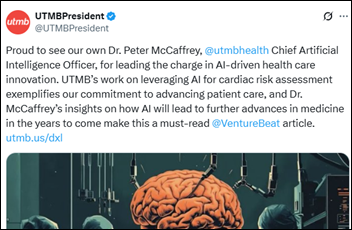
UTMB is running AI on all CT scans to generate cardiac risk scores, flagging 5–10 of the 450 monthly scans for follow-up intervention. Chief AI Officer Peter McCaffrey, MD, MS says,

What I love about this is that AI doesn’t have to do anything superhuman. It’s performing a low intellect task, but at very high volume, and that still provides a lot of value, because we’re constantly finding things that we miss. We know we miss stuff. Before, we just didn’t have the tools to go back and find it.

Nvidia releases Parakeet 2, a lightweight, open source transcription model that runs on just 2GB of RAM and is free for commercial use, making it ideal for building transcription tools, voice assistants, or real-time subtitles.


Business

UnitedHealth Group is running 1,000 AI applications in production that summarize data, help process claims, run customer-facing chatbots, and help its 20,000 software engineers write code. The company says it won’t use AI to deny claims.

image

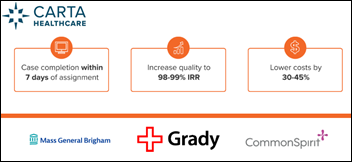
AI-powered clinical abstraction technology vendor Carta Healthcare raises $18.25 million in a Series B1 funding round that was led by UPMC Enterprises.

Hippocratic AI enters the Japanese market with a Tokyo-based partner, launching the first Japanese-language healthcare agent for non-diagnostic tasks like scheduling, follow-ups, chronic care check-ins, and med adherence.


Research

image

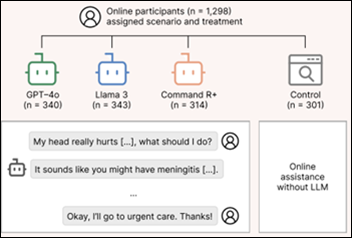
An Oxford study finds that while LLMs perform well on medical quizzes, they aren’t much help to non-experts who are making decisions. Users who relied on chatbots fared no better than those who Googled or guessed, mostly because they gave the technology incorrect or incomplete information about their situation. The authors warn against using chatbots as the front line of care.


Other

image

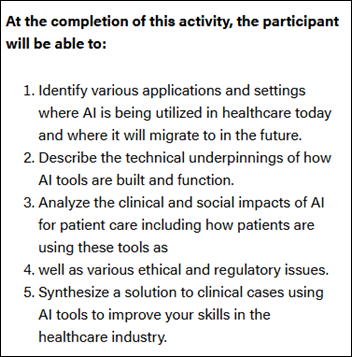
Purdue’s College of Pharmacy launches a $500 online AI certificate program for healthcare professionals, offering 42 AMA PRA Category 1 Credits for physicians and 42 contact hours for pharmacists.

image

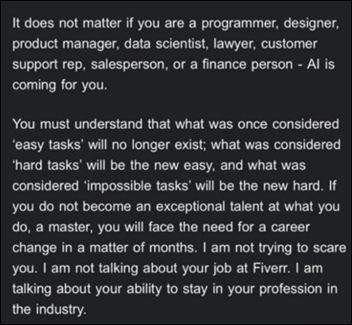
Fiverr’s CEO candidly levels with employees about AI’s threat to their jobs and his. Meanwhile, my TIL term of the week is “vibe coder,” which describes someone who designs software by telling AI what they need, then letting it generate the code.


Contacts

Mr. H, Lorre, Jenn, Dr. Jayne.
Get HIStalk updates.
Send news or rumors.
Follow on X, Bluesky, and LinkedIn.
Sponsorship information.
Contact us.

Comments Off on Healthcare AI News 5/7/25

HIStalk Interviews G. Cameron Deemer, CEO, DrFirst

May 7, 2025 Interviews Comments Off on HIStalk Interviews G. Cameron Deemer, CEO, DrFirst

G. Cameron “Cam” Deemer is CEO of DrFirst of Rockville, MD.

image

Tell me about yourself and the company.

I’ve been with the company for 21 years, as CEO for the last two and a half years. I started my career in the ministry, where I worked many years with churches in Arizona and did some time in Papua New Guinea working with Bible translation. I got into healthcare IT totally accidentally during the recession in 1992, when I came back to the US. I grew up here in the PBM industry. I worked for the old PCS Health Systems in Scottsdale and then building what eventually became Surescripts while I was at NDC Health. I have been with DrFirst ever since.

DrFirst is celebrating its 25th anniversary this year. It has been a really interesting ride. The company was originally founded to eliminate what I would call technology friction for the doctor. I was the first product manager for this little 30-person company when I came here. The CEO and founder, Jim Chen, sat down with me and said, “Look, Cam, you need to understand one thing. Here’s what I need you to do. I need you to make sure that DrFirst is number three in the e-prescribing space. That’s your target.”

I was like, “Why would you want to be number three?” He said, “Any industry always ends up with three players. I don’t care if we’re number one or two, I just want to be number three.” With that challenge, I started my career at DrFirst. 

We have developed a huge footprint over time. We are handling scripts for about 550,000 doctors a quarter. We provide the e-prescribing back end for 275 EHRs. We are actively engaging 6 million patients a week for various programs, most of them adherence related. We have always been an innovative company that is trying to solve what we think are the real, gritty problems in healthcare.

You said in a recent article that the pharmacist’s role in patient care was limited by the original design of the electronic prescribing network. Do you see that changing, particularly given the struggles of the drugstore chains?

When I joined PCS in 1992, the company was already experimenting with e-prescribing. They were doing some of the early seminal work of getting some doctors to use the system. I believe at the time that they were using email to send prescriptions to Walgreens, and then the pharmacist would pick it up from the email. In those days, there were a lot of early attempts to do e-prescribing in different ways and PCS wasn’t the only company involved. That was eventually all destroyed by a patent troll who went through the industry suing everybody. Then that industry had to reinvent itself. 

While that was all going on, PCS selected me to be their representative on the script task force at NCPDP when it was first put together. I was one of the three original co-chairs working on SCRIPT 1.0 and continued to be loosely involved with e-prescribing at PCS. I was thrilled to death when we announced the creation of RxHub in collaboration with ESI, Medco and PCS at the time. We built that system based on technology that already existed, the pharmacy claims switching technology. 

It made all the sense in the world. The PBMs had already transformed pharmacy, and healthcare IT around pharmacy, by fully digitizing the claims process. It worked great. We went from paper claims to terminals and then PC or mainframe-based transmission of claims through a central switch. It was great, so you can imagine that when they turned their attention to e-prescribing and said let’s digitize that, they had every belief they could do it. They had what they believed was the right technology, and they built it. 

When Surescripts saw what was happening, they decided they had to do the same thing and not let the PBMs cut them off from the doctors. So they also implemented e-prescribing based on claims switch technology, which I had been helping develop while I was at NDC Health. When I came to DrFirst, RxHub was already there. Surescripts was already there. DrFirst was working to get the doctors to adopt e-prescribing. None of us had any time to really think about it.

This just seemed like the right solution. It did what it was supposed to do. It let 600 participants on the EHR side talk to 600 participants on the pharmacy side and solved that many-to-many problem. It converted the prescription from writing into a digital format so it could be picked up on the other end and imported into systems. It accomplished its goals. 

We are 20 years down the road now, and it is just now that the cracks are starting to show, as people are saying, “This doesn’t quite work right. This isn’t quite what we need.” It has become a real cap on innovation in the industry, the way the e-prescribing network works. Fundamentally, the problem is that it’s a technology that was designed for pharmacy claims.

A pharmacy claim is a financial instrument. It’s a request for reimbursement from the pharmacy, an accounts receivable, essentially. It goes to a PBM, who runs it against a contract in the adjudication process and promises to pay. They send back an accounts payable transaction to the pharmacy so they can reconcile that to the accounts receivable that they sent forward. So it’s basically two participants, a pharmacy and a PBM. It’s based on a contract, and it’s a mathematical process. There’s nothing more to it than how it matches against the contract.

Prescriptions are totally different. A prescription is a clinical order, not a financial instrument. It is initially ordered by a highly trained clinician who has evaluated a patient, considered their current problem, their ongoing problems, their other treatments, and the other medications they’re taking and then making a decision based on what they know about that patient. Not just clinically, but also all the other factors, such as what they can afford and what they are willing to do.

Then they send that clinical order to another highly trained professional at the pharmacy, who would like to be able to evaluate that, add their thinking to it, and interact with the provider who wrote the script in case something needs to change. Eventually that’s filled by the pharmacist and the patient needs to pick it up, so the patient is another participant here who maybe doesn’t know whether their prior auth has been approved, whether it’s ready at the pharmacy, and how badly they really need it.

There’s a lot that the patient also has to think about through this process. There’s also pharma, who really, really, really wants the drug to be filled at the pharmacy once it’s written. And there’s of course the PBM, who’s interested in getting as clean a script that ideally matches what they’re trying to do with the patient as well. You have five key participants in this process, all trying to work around a transaction that is flowing through something that was designed for claims, and it just doesn’t work. 

The biggest failure point is that the script arrives at the pharmacy with no context. The pharmacist can’t really do their job, the job they’ve been trained for, because all they get is the digital version of the script. We’ve been taking a look at that for many years. It was the recent FTC settlement with Surescripts that opened the opportunity for other networks to enter the market, so we have introduced our version, which includes the ability to carry the extra data needed with the transaction to establish rule sets by which we can manage workflow issues.

For instance, some scripts get to a pharmacy that the pharmacist is never going to be able to fill, so they have to call the doctor to get clarification. We can handle that on the front end, just based on a rule that says if you get a script like this, ask the doctor to correct it in these ways before it actually goes pharmacy. It saves the doctor a phone call, saves the pharmacy a phone call, and the patient has access to therapy more quickly.

The solution is freeing up the clinical order to be a clinical order and to have everything it needs to be processed without a lot of friction at the pharmacy.

Early e-prescribing was done on a standalone PC or terminal. How has it progressed to integrate back into the EHR?

You raise a good point that initially e-prescribing was standalone. Now it’s fully integrated into the EHR. It’s just part of the standard EHR workflow. 

What’s been done over the last several years is bringing more of the information the doctor needs to make a decision into that system. One is real-time benefit check, where you’re doing a pre-adjudication of the script to give the doctor an idea of what the impact will be on the patient when they show up at the pharmacy and having to pay for that prescription. Also giving the doctor the same information on alternative drugs that would also be applicable under the therapeutic class so the doc can make a more informed decision based on plan design. That has helped people avoid prior authorizations, so that the doctor can see one drug that requires prior auth, so I’ll go with the one that doesn’t. Along those lines, information about the patient’s plan has been useful.

What’s coming now is more information about the prior authorization question sets that the doctor needs to answer ahead of time. The ability to grab that information from the EHR and send it along with the request for the PA so that you don’t have to have back-and-forth between the doctor and the PBM to get the PA approved. A lot of what’s happening now is pulling information into the doctor’s office that would avoid them having to have phone calls or electronic back-and-forth with pharmacies or PBMs.

How are you looking at AI?

We definitely don’t believe that just slapping a chatbot on top of our existing stuff counts as AI. We’re actually trying to take a much deeper approach to it and go at it from three levels.

Probably most important and foundationally, we’re trying to train every single person in DrFirst to be comfortable with the concepts of AI. Comfortable with interacting with it to help them develop individual visions around how AI can be used to automate processes at the company, as well as be incorporated into our products to improve workflow for other people. So we’re starting with our people first. We move it then into the feature set of our products to make workflow better for the folks who use what we do. In other words, it becomes a feature.

We are just now starting to work on an actual product that is completely AI based. For us, the most important applications of AI are practical. We’ve been using it, actually for quite a while, for interoperability solutions that are e-prescribing. We’ll continue to expand focusing on AI’s ability to help people get work done quicker with more information and fewer redos and stuff like that.

What kinds of medication-related engagement do patients want or need?

Some interesting things are happening right now. Consumer engagement is really hot in healthcare. It has been interesting to watch how that is expressing itself out in the wild. This is one of the areas that we’re intensely interested in, but I probably should have said this earlier. We like to think of ourselves as productively contrarian. It doesn’t matter to us so much what other models are being built right now. We are more interested in what’s the right way to handle the situation. 

If you think about what happens with patients today, there’s a lot of activity around patient choice of pharmacy. What if the script is written for a patient, and then for some reason, the patient wants to go to a different pharmacy? I’m going to be passing this pharmacy on the way home. I’d rather pick it up there, or I found that I can get a consumer card that would be cheaper at this pharmacy than that pharmacy. There’s a lot of talk of use cases like that that aren’t really all that interesting because they’re probably fairly rare based on how people tend to develop habits and how they pick their pharmacy in the first place. I usually think of that as trying to come up with a solution where there’s no problem.

But there are other more significant things. Patients who have important drugs that they need to receive, but the script has been written to the wrong pharmacy. For instance, a specialty drug that has a limited distribution network is sent to their regular retail pharmacy which may be reluctant to give it up, because if they can special order the drug, they can probably make a decent profit on it. But the patient’s going to have to wait much longer than they would if it just were going to the right pharmacy in the first place. Being able to alert the patient that the drug has been sent to a pharmacy that can’t fill it for them immediately is an issue.

Another example would be that the patient shows up at the pharmacy and the pharmacy says, “We don’t have that in stock. Give us until Wednesday and we’ll have it.” The patient may not want to wait till Wednesday and they need to have it filled at a different pharmacy if they can find one that does have it in stock. The ability to switch that script without having to rely on the pharmacy being willing to give it up, or a doctor being willing to rewrite the script to a different pharmacy, that’s all friction from the patient side.

You see a few different solutions in the industry. For instance, having the doctor write the script to a company that will then show the patient on an app that they’ve downloaded that a prescription has been written for them, then giving them a choice of pharmacies so the patient can pick a pharmacy. Another model might be to persuade the doctor to write the script to a non-dispensing pharmacy, which would then determine the best place for the patient to fill it and then reach out to the patient in different ways to give the patient the option of which pharmacy to use.

These solutions are pretty hot right now. There’s a lot of talk about those. But they suffer from the fact that they require everybody to be out of workflow. The doctor has to not use the default pharmacy, they have to write to a pharmacy that’s not actually going to fill the script, but it’s going to get the patient to fill the script. The patient has to download something and go through an extra step , where otherwise they would just show up at the pharmacy. The physician is out of the workflow and the patient is out of workflow. Typically the folks that are doing these kind of models struggle with volume, and no wonder since everybody’s being required to do something unusual.

Another dirty little secret is why, in the early days of e-prescribing, NCPDP picked this model instead of a more European model, where the script would go to the cloud, the patient would just show up at whatever pharmacy they wanted, and the pharmacy would pull it down from the cloud. That was actually considered in the early days of the SCRIPT standard, and it was promoted at the time by a representative from the University of Alabama.

I remember the meeting where this happened. Everybody else in the meeting disagreed with that approach because they were trying to solve for the adherence problem, that patients are given scripts and are then trusted to deliver that piece of paper to the pharmacy. That creates one more barrier for the patient actually getting the script filled. The pharmacist isn’t doing their job, the doctor’s not getting the results they want, and pharma certainly isn’t getting revenue from the drugs being filled.  So instead, they decided to have it sent to the pharmacy. That will set up an expectation in the patient. They need to go pick it up. It can create a little work for the pharmacist because if the patient doesn’t show up, they have to return it to stock, which is a pain in the neck. 

Nonetheless, it has worked really well. It did in fact improve adherence dramatically. Patients are much more used to picking up their drugs now than they used to be. When we go to a model where the patient becomes the delivery mechanism again, you’re just stepping back into the past to a time when compliance was happening at a lower rate. First-fill adherence was lower than it is today and patients weren’t getting on therapy. We believe the right way to do this is to keep it all in workflow. Let the doctor write the script and let the patient interact with the physician directly whenever the script can’t be filled for some reason. Don’t force the patient into making a selection if they don’t want to make a selection, because if they don’t make one, nothing happens. Make sure the script still gets to the pharmacy.

What will be most important to the company over the next two or three years?

Number one is that we are reinventing the e-prescribing platform. We’re going to give the industry what it deserves. Doing that is very important to us.

We are working to eliminate all the points of friction in the specialty drug workflow. That will become increasingly important with new developments in medicine.

Those are the two challenges we’re taking on right now.

Comments Off on HIStalk Interviews G. Cameron Deemer, CEO, DrFirst

Morning Headlines 5/7/25

May 6, 2025 Headlines Comments Off on Morning Headlines 5/7/25

Infinx Acquires i3 Verticals’ Healthcare Revenue Cycle Management Business

Patient access and RCM company Infinx acquires the RCM business of i3 Verticals, its second acquisition in two months.

CareCloud Delivers Growth and Strong Cash Flow in Q1 2025, Advances AI and Acquisition Strategy

CareCloud shares jump on the company’s Q1 results: revenue up 6%, EPS –$0.04 versus – $0.10.

HealthStream Announces First Quarter 2025 Results

HealthStream reports Q1 results: revenue up 1%, EPS $0.14 versus $0.17, falling slightly short of expectations for both and sending shares down nearly 20% Tuesday.

VA must ‘put onus back on Oracle’ to right EHR deployment, secretary says

VA Secretary Doug Collins tells lawmakers that he is working to streamline communication between the department and Oracle Health, citing the decision to condense the number of decision-making committees from eight or nine down to just one that communicates directly with the vendor.

LifeMD Reports First Quarter 2025 Results and Raises Full-Year 2025 Guidance

LifeMD reports Q1 results: revenue up 49%, EPS $0.01 versus –$0.19, valuing the virtual primary care company at $342 million.

Comments Off on Morning Headlines 5/7/25

News 5/7/25

May 6, 2025 News 10 Comments

Top News

image

CareCloud reports Q1 results: revenue up 6%, EPS –$0.04 versus – $0.10. Shares rose 26% Tuesday, valuing the company at $93 million.

The company said last week that its newly created, 50-member AI team will have 500 employees by the end of the year.


Reader Comments

From Nasty Parts: “Re: Epic. Are they getting too big, a la UnitedHealth Group? Smaller software vendors are constantly squeezed by Epic invading their solution, or telling prospects that Epic’s basic system is good enough or that they have a solution on the product roadmap. I think UHG will be broken up at some point and Epic will have 75% of the market in 6-7 years. Are we allowing a monopoly to be created?” Epic, unlike UnitedHealth Group, is giving the market what it wants. The alternative to “allowing” a monopoly is “disallowing” it, for which no legal or practical grounds exist. It’s hard to justify interfering with buyer preference in the absence of consumer harm. My take:

  • The acute care EHR market is a legal oligopoly, with Epic its dominant player that keeps increasing market share.
  • About half of US hospitals use Epic, which is not a monopoly and certainly not one that has provably competed unfairly.
  • Epic’s mega-suite strategy echoes Meditech’s early model: tightly integrated systems from a single vendor, which theoretically lowers both cost and risk.
  • That approach is now supercharged by Epic’s deep financial and engineering resources, which have allowed it to push into MyChart Bedside, the Cheers CRM, Hello World messaging, Secure Chat for clinicians, and its sprawling analytics suite. Each new product puts Epic head-to-head with a vendor who built it first and maybe better.
  • Beyond making its products attractive, Epic also controls the interoperability and app store access of its potential competitors.
  • Epic’s dominance, combined with the massive time, expertise, and capital that would be needed to build a competing system, makes new entrants unlikely.
  • There’s no sign that the federal government has an interest in challenging Epic’s position. Dominant players in other industries (Adobe, Intuit, Salesforce, Bloomberg, Shopify) have faced little pushback for similar market control.
  • I agree with your major point. Epic is not a monopoly and has done nothing illegal, but its dominance in a critical industry sector creates system risk in providing a single point of failure and a potential bottleneck to innovation if the company gets lazy or does something as a money grab, like going public.
  • Until regulators or customers decide to penalize popularity, Epic’s dominance is a feature of the landscape, not a bug.

Sponsored Events and Resources

None scheduled soon. Contact Lorre to have your resource listed.


Acquisitions, Funding, Business, and Stock

HealthStream reports Q1 results: revenue up 1%, EPS $0.14 versus $0.17, falling slightly short of expectations for both and sending shares down nearly 20% Tuesday.

LifeMD reports Q1 results: revenue up 49%, EPS $0.01 versus –$0.19, valuing the virtual primary care company at $342 million.


Sales

  • MetroHealth (OH) will implement AI-enhanced inpatient and ambulatory clinical workflow solutions from Pieces Technologies.

People

image

Revenue cycle solutions vendor Millennia hires Scott Pattillo, MS (Homecare Homebase) as CEO.


Announcements and Implementations

Wilson Health (OH) implements Epic.

image

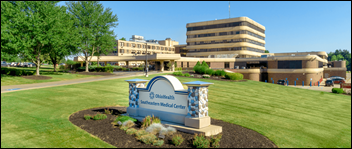
OhioHealth Southeastern Medical Center goes live on Epic.

A small Canadian study finds that the medical records ecosystem is a web of commercial data brokers, for-profit providers, and pharmaceutical companies, each of which helps turn patient records into profitable commercial assets. Notably missing from that loop are patients and their best interests. The authors warn that unsupervised distribution of data to drug companies could give them even more leverage to push high-margin, patent-protected drugs.


Government and Politics

Rep. Nikki Budzinski (D-IL), the ranking member of the House Veterans’ Affairs Technology Modernization Subcommittee, warns that federal cutbacks could impact the project’s timeline and success. She notes that some of the VA’s recently cancelled projects are related to the EHR project and some EHR modernization staffers have been laid off or accepted a deferred resignation offer.

A poll finds that fewer than half of Americans have any confidence that federal agencies ensure that safety and efficacy of drugs and vaccines, while even fewer are confident that the federal government could respond well to infection disease outbreaks. The authors found that the level of confidence is shaped by partisan perspectives.


Other

image

Dr. Jayne’s favorite celebrity-backed subscription lab test company, Function Health, acquires full-body scanning MRI company Ezra. Function will now offer a 22-minute full-body scan for the low, low price of $500 – a third of the cost of Ezra’s lowest-tier offering. A 47-minute scan costs just $2,000. Function co-founder and CMO Mark Hyman, MD says that “[w]hat used to be the domain of the wealthy is now accessible to everybody, including comprehensive imaging.”


Sponsor Updates

  • AGS Health will exhibit at CHIACON25 June 1-4 in Long Beach, CA.
  • DrFirst wins a Silver Stevie Award in the customer service department of the year category at the annual American Business Awards.
  • CereCore releases a new podcast titled “Why IT Governance Leads to Innovation and Growth.”
  • Clinical Architecture releases a new episode of “The Informonster Podcast” titled “How Velox Helps Payers Measure Data Usability.”
  • Cordea Consulting partners with Amazon Web Services to help healthcare organizations implement Epic’s Isolated Recovery Environment.
  • Crossings Healthcare Solutions parent company UHS names former Cerner executive Chris Vernaci associate VP of technology ventures.
  • Altera Digital Health announces the activation of Sunrise Surgical Care, its integrated operating theatre system, at Latrobe Regional Health in Australia.
  • Redox integrates IntelePeer’s AI-powered automation platform for medical and dental practices with its interoperability network.
  • Netsmart adds automated auditing capabilities to its Bells AI platform.
  • Capital Rx releases a new episode of “The Astonishing Healthcare Podcast” titled “What’s New with Medicaid PBM? With Jessin Joseph, PharmD, MBA.”

Blog Posts


Contacts

Mr. H, Lorre, Jenn, Dr. Jayne.
Get HIStalk updates.
Send news or rumors.
Follow on X, Bluesky, and LinkedIn.
Sponsorship information.
Contact us.

Morning Headlines 5/6/25

May 5, 2025 Headlines Comments Off on Morning Headlines 5/6/25

TeleMed2U Acquires Sigma Tactical Wellness, Expanding Virtual Specialty Care Access to Law Enforcement and First Responders

Specialty-focused virtual healthcare company TeleMed2U acquires Sigma Tactical Wellness, which specializes in cardiac risk detection for public safety personnel.

Weave Communications to Acquire TrueLark, Accelerating AI-Powered Front Office Automation

Patient engagement and payments vendor Weave will acquire virtual receptionist software company TrueLark for $35 million.

ENT Partners Acquires Currence Physician Solutions

Practice management company ENT Partners acquires medical billing and financial analytics company Currence Physician Solutions.

Comments Off on Morning Headlines 5/6/25

Curbside Consult with Dr. Jayne 5/5/25

May 5, 2025 Dr. Jayne Comments Off on Curbside Consult with Dr. Jayne 5/5/25

An article that was published in the Journal of the American Medical Informatics Association this week addresses the realities of primary care staff members trying to manage the ever-growing volumes of EHR inbox messages. The research was done using qualitative methodology, including focus groups and observations at four academic primary care clinics. The output of those sessions was analyzed and coded into different themes. The study was small, with three nurses and nine medical assistants included. The authors highlighted key themes in the abstract: “Staff described inbox work as fragmented, feeling like an assembly line, requiring frequent communication with other team members to clarify and manage tasks, and requiring navigation of expectations that varied between patients, clinicians, and clinics.”

As someone who has spent a great deal of her career working on process improvement projects, I can feel in my core how the staff must have been trying to articulate a day in the practice. I’ve been around since the pre-EHR world and would note that some of these feelings are not unique to managing an EHR inbox. When we managed paper-based phone messages, we had a lot of these same issues, with the additional problems of having delays in messaging due to having to pull the chart from the file room, or even profound delays when the chart couldn’t be found because it was in a pile on the physician’s desk, their floor, or possibly even in their car or at their home. Working messages in the EHR is certainly faster, which makes one think of the old adage about how technology just makes a bad process go faster.

Seeing these results makes me wonder how much process improvement work the organization did alongside the EHR implementation. Did they spend resources to look at unnecessary process variation and make an effort to try to streamline workflows? If they did, what was the plan for sustaining those changes over time and not allowing the processes to drift back to individual ones?

In a group practice environment, it can be challenging to meet everyone’s needs when each clinician or care team is doing their own thing, and this study seems to illustrate that. The authors noted that there were some protocols available to those working the inboxes, so it sounds like there was at least some work in that regard. They also noted, though, that staff had to address messages that contained information that conflicted with the medical record, which required additional work. We had those issues in the paper world as well, especially when patients called about lab or imaging results that had been done elsewhere and we might not have had a copy at the ready.

In the background section of the article, the authors note that primary care physicians often spend an hour or more managing the inbox for every eight hours of patient care delivered. They also comment that primary care clinicians tend to receive more messages than other specialties and as a result have a higher time burden for inbox management. Not surprisingly, they’re often among the most burned out clinicians. As a result, many organizations are delegating some of this work to support staff, with this concept being studied less than physician work in the inbox, hence the need for this type of research.

The work was done at UW Health, which is affiliated with the University of Wisconsin-Madison, and looked at two general internal medicine clinics and two family medicine clinics. The article notes that they focused on adult primary care practices because those clinicians “receive more inbox messages than pediatricians or physicians in other specialties,” which caught my attention. I think we sometimes think that parents make a lot of calls to their pediatricians’ offices, but I suppose that’s more of a perception and not a reality.

The authors used EHR metadata to identify sites where support staff users were helping manage the inboxes based on functions such as pending medication orders during refill requests for controlled substances. This measure was selected because managing those refills is complex, but uses protocols so that staff can review the chart and pend orders for clinician review. They identified sites with high and low levels of this workflow in order to diversify the sample.

Due to the small number of clinics participating, the number of respondents was low, with some sites having only one medical assistant and one nurse participate, and other sites having three medical assistants but no nurses participate. The most common workflow was where messages sent to clinicians would go to the staff pool rather than directly to the clinician. Members of the pool would then either manage the message or forward it on to a clinician based on protocols.

Some of the fragmentation themes weren’t unique to an EHR workflow, such as being interrupted to bring patients back to exam rooms while also trying to manage messages or having to float to another clinic to cover a staff shortage. Another in that category was the fact that different physicians had expectations that the protocol shouldn’t be followed for their patients, which is not an EHR issue but an operational and clinical quality one. Others were unique to EHR work and particularly pool work,  such as refill requests, coming in through multiple pathways (phone, pharmacy interface, patient portal) leading to three different staff members unknowingly working on the same task.

One of the themes in particular caught my attention, that of limited control, with a staff member commenting, “They made these teams without… asking about how we felt about it.” One of the key tenets of any change management project is to identify stakeholders and understand where they’re coming from. If you don’t do this, it’s nearly impossible to define the “what’s in it for me” needed to support a change management campaign.

There’s a chance that this was done early in the process change, but the people who made the decisions are no longer with the practice. Based on some of the projects I’ve recently seen, there’s also a chance that supervisors made the decisions without discussing with frontline staff. Although that kind of effort can make a project go faster, it’s rarely the right answer for long-term success or happiness of the end users.

The authors note “several fruitful directions for future research,” but I’m more interested to learn what the organization is doing with the information that was uncovered through this study. Have they expanded efforts to collect data from a broader segment of the staff, or looked at experiences in more clinics? Have they compared the protocols from site to site to identify areas of unwarranted variability? Is anyone addressing physicians who are telling staff not to follow an agreed-upon protocol? The devil is in the details for all of those elements when trying to move forward with positive change. If you’ve got the scoop, I’d love to hear from you and of course can keep any comments anonymous.

What do you think is the most successful intervention to reduce inbox burdens for support staff members? Leave a comment or email me.

Email Dr. Jayne.

Comments Off on Curbside Consult with Dr. Jayne 5/5/25

Readers Write: Virtual CISOs Bring New Hope to Orgs Without Dedicated Cybersecurity Officials

Virtual CISOs Bring New Hope to Orgs Without Dedicated Cybersecurity Officials
By Ryan Finlay

Ryan Finlay is principal chief information security officer, advisory services, at CereCore.

image

Healthcare CIOs are grappling with tight budgets, leading 71% of them to report their intent to seek alternative labor solutions for top priorities such as cybersecurity services. Virtual chief information security officers (VCISOs) offer a pragmatic solution for organizations that are seeking to enhance their cybersecurity resilience strategy.

VCISOs provide organizations with access to high-level cybersecurity expertise without the need to add a full-time executive to the payroll. This fractional leadership model is particularly beneficial for healthcare organizations that often struggle with limited resources and can also be leveraged in an advisory capacity to extend the resources of healthcare IT leaders. A VCISO brings specialized knowledge and strategic direction, helping to assess current security programs, define improvement strategies, and build resilience against cyber threats.

Organizations that lack a full-time dedicated security official could have growing cybersecurity concerns based on limited internal expertise and governance directed by a leadership team with competing priorities. Engaging a VCISO on a part-time basis introduces collaboration with various internal teams, such as a security council and IT security committee, to assess cybersecurity posture and develop a strategic plan for improvement.

A VCISO can help evaluate the effectiveness of existing security protocols, advising on compliance with HIPAA security rules, and implementing resilience-building measures. By leveraging VCISO expertise, organizations can enhance their cybersecurity posture, mitigate risks, and ensure ongoing readiness for future threats.

The value of VCISOs is further underscored by recent survey results of CHIME (College of Health Information Executives) CIOs. The survey highlights cybersecurity as the top IT priority for healthcare CIOs, with 30% of respondents identifying it as their primary focus. This consistent emphasis on cybersecurity reflects the growing recognition of the importance of robust security measures in protecting sensitive data and maintaining operational integrity.

Additionally, the survey revealed a trend towards adopting fractional and virtual strategies for IT leadership. With tight budgets and limited resources, many CIOs are turning to partnerships and outsourcing to address staffing challenges and enhance cybersecurity capabilities. This approach allows organizations to access specialized skills and expertise without the financial burden of full-time hires.

VCISOs can strengthen cybersecurity resilience and bring new confidence to cyber strategies with these best practices:

  • Conduct regular security assessments. Regularly evaluate the effectiveness of current security measures, identify areas for improvement and options for addressing them.
    Develop comprehensive security programs. Create detailed action plans that address identified gaps and align with industry standards and regulatory requirements.
  • Foster collaboration. Encourage collaboration between VCISOs and internal teams to ensure a cohesive approach to cybersecurity.
  • Stay informed on threat trends. Keep abreast of the latest cybersecurity threats and trends to proactively address emerging risks.
  • Implement continuous improvement. Regularly update and refine security protocols to adapt to the evolving threat landscape.
  • Assist during recovery efforts. In the event of an incident, healthcare leaders can need extra hands to prioritize what needs to be done and make informed recovery decisions.

By providing strategic direction, expertise, and capacity, VCISOs can enable organizations to navigate the complexities of cybersecurity without the need for a full-time executive.

Readers Write: The New Reality of Ransomware: Why Your Epic Environment Needs an Isolated Recovery Plan

May 5, 2025 Readers Write Comments Off on Readers Write: The New Reality of Ransomware: Why Your Epic Environment Needs an Isolated Recovery Plan

The New Reality of Ransomware: Why Your Epic Environment Needs an Isolated Recovery Plan
By Bill Smith

Bill Smith is director of Epic practice at Cordea Consulting.

image

In early 2024, one of the nation’s largest healthcare payment and revenue cycle platforms was hit by one of the most disruptive cyberattacks in US healthcare history. For weeks, the industry watched as claims processing, pharmacy operations, and revenue cycle management were paralyzed. Providers couldn’t get paid. Patients couldn’t fill prescriptions. Some health systems resorted to writing down billing info on sticky notes while scrambling to find workarounds.

This attack was a wake-up call, not just for rev cycle teams, but for every CIO, CISO, and CTO who is responsible for keeping clinical systems online. If ransomware can take down a national clearinghouse for weeks, what could it do to your Epic environment?

“We Have DR,” They Said. “It’ll Be Fine,” They Said.

In 2024, over 180 confirmed ransomware attacks targeted healthcare providers, compromising more than 25 million records. Backups are encrypted. Disaster recovery (DR) plans fall apart. IT teams scramble for answers. The clock ticks, and patient care suffers. Hospitals and health systems limp through outages for weeks, rebuilding from scratch. We’ve seen it happen too many times.

For healthcare IT leaders, the stakes are higher than ever. When an attack disrupts access to Epic on prem, clinicians lose access to patient records, and operations grind to a halt. The organization also loses patient trust and revenue  to the tune of $1.9 million for every day of downtime, on average.

The truth is, traditional DR wasn’t built for ransomware, and it can’t guarantee Epic will come back online quickly or at all. It was designed for hardware failures, natural disasters, and short-term interruptions, not for sophisticated cyberattacks that can quietly compromise your environment, your production systems and backups, over weeks or months before detonating.

We’re long past the point where traditional backup and DR strategies are sufficient. This isn’t about fear, it’s about preparation. The rules of disaster recovery have changed, and the most resilient healthcare organizations are already adapting by setting up isolated recovery environments (IREs) that can keep them running when everything else grinds to a halt.

Enter the Isolated Recovery Environment

Think of an IRE as an Epic safety vault, completely separated from the turmoil outside. It’s encrypted, dormant until you need it, and updated in near real time with mirrored Epic data. When activated, it gives your organization rapid access to Epic Hyperspace via a public URL to enable basic electronic documentation. With standalone deployments of Interconnect and managed services like Kuiper all segregated in the IRE, this version of Epic is protected from the attack.

An IRE isn’t just another backup system. It’s a fully functional, secure replica of your Epic environment that’s cut off from production and the broader network, purpose-built to remain untouched during a ransomware attack. When (not if) ransomware hits, you can keep delivering patient care, even when your production environment is down.

Why AWS: The Business Case Beyond IT

Many organizations are turning to AWS as the platform of choice for Epic IRE, and with good reason. This isn’t just an infrastructure upgrade, it’s a strategic investment in business continuity and patient safety. For Epic on-prem systems, here’s how an IRE on AWS changes the game:

  • Rapid recovery. Switch over to a functional Epic environment in minutes, not days.
  • Real-time access to Epic. Clinicians retain access to schedules, notes, and secure chat, even mid-incident.
  • Immutable data protection. Advanced network isolation capabilities with air-gapped, encrypted backups shielded from tampering or deletion.
  • Operational continuity. Maintain patient care workflows and reduce revenue loss.
  • Limited read/write access. Secure logging of patient data even during an attack
  • Lower risk profile. A stronger recovery plan can lead to lower cyber insurance premiums.

You also get a cloud-native architecture that scales without breaking your budget, along with AWS’ unmatched security and compliance (146+ HIPAA-eligible services and HITRUST CSF-certified environments). Pay-as-you-go pricing minimizes upfront costs, and deployment is fast (you can go from zero to IRE in as little as 10 weeks)

An IRE on AWS doesn’t just protect data. It safeguards continuity of care. It provides your team with confidence and a sense of stability during a period of chaos when peace of mind is hard to find.

If your recovery strategy still relies on assumptions that backups will be accessible and that downtime will be minimal, it’s time to rethink that strategy. IREs aren’t the future, they’re what forward-thinking healthcare organizations are implementing right now because they’re tired of rolling the dice.

If ransomware’s coming for you (and it is), meet it with a tested, isolated copy of Epic in a fortified cloud bunker. An Epic IRE on AWS offers a proven, practical way to build ransomware resilience into your core IT operations. Because in today’s threat landscape, continuity isn’t just about recovering systems, it’s about preserving trust, safety, and care delivery under pressure.

Comments Off on Readers Write: The New Reality of Ransomware: Why Your Epic Environment Needs an Isolated Recovery Plan

HIStalk Interviews Guillaume de Zwirek, CEO, Artera

May 5, 2025 Interviews Comments Off on HIStalk Interviews Guillaume de Zwirek, CEO, Artera

Guillaume de Zwirek is CEO of Artera.

image

Tell me about yourself and the company.

My name is Guillaume de Zwirek, which is a funny name. I was born in Canada. My mom was a physician, my dad was a software engineer, and somehow I turned into a blend of both of them. That’s surprising, right? I turned into a health tech entrepreneur.

I founded Artera 10 years ago, so we just celebrated a decade. I founded it out of personal experience of having to navigate a complex healthcare condition, having to coordinate all of my care by myself. I was frustrated with the status quo, the present state of doing everything on the phone. I didn’t feel like I was a customer, but rather just a cog that came in for a visit, revenue was booked, and I was sent on my merry way. I felt like we could deliver tech that could bring some of the relationships back to healthcare.

What relationship do people want with a hospital or health system? How do you measure the clinical and business value of those relationships?

I never went to business school, but the train of thought that most people are familiar with is that you can do two out of three things, the iron triangle. You can win on service, you can win on quality, and you can win on price.

We think that service is one of the most important things. Relationships are really, really important. They connect us to people. They are the foundation of trust. Especially in an industry like healthcare, when you’re vulnerable and conditions may be life-threatening, it’s important to you know who is caring for you. That flows all the way through from the physician at the top of the pyramid through to the folks who answer the phone and help you get coordinated to the right resources.

From a foundational level, humans want to connect. They want to build trust. They want to build relationships.

Dentistry is a great example. My brother is a dentist, and he shared an interesting anecdote with me. He bought a dental office, which is what most dentists do when they go into business. I asked him why it’s so easy to get funding for a dental practice when the dentist will change and you would expect most patients to leave. He said that I would be surprised that while he spends five to 10 minutes with the patient, the hygienist spends 30 minutes, and people don’t ever want to leave their hygienist. 

You can extrapolate that thought to all of healthcare. If you think back on your best experiences, you knew the person, you trusted them, and they were caring for you. That’s what we’ve been doing for 10 years. We’re only part of it. We are the technology that the people have to be bought in on the other side. But it creates unbelievable connection and loyalty.

As a personal example, I once complained to a solo PCP because her front office staff were clearly incompetent and unfriendly. She urged me to call the practice after hours to avoid them because they would be gone and she would pick up herself. Can technology solve that or does the underlying problem need to be fixed first?

It’s both. The tech can help with monitoring your staff. We released a new product recently, a homepage, which is pretty simple concept. But it highlights how staff is doing in our tool. Are folks productive? Are patients happy with their experience? Are they waiting a long time for responses when cases get routed to a live agent? 

This has been helpful for our customers because they can see where things are going well, and where things are going poorly. They can do coaching on the operational side. So we’ve definitely seen ourselves extend more to the operations.

A lot is changing in tech, like agentic AI. Do we need as many humans as we used to, or, or can these digital employees do the job better? I think the jury is still out on that, but there’s a fundamental technological shift happening right now in the world, but also specifically in healthcare.

Describe agentic AI and how it will be less frustrating than the phone trees of old, where the patient’s time and patience were valued less than preventing them from talking to a human.

The key word in agentic AI is agent. By agent, we mean agency, the ability for an AI to complete a task on behalf of a patient. That is the key condition, the product.

When you think about a generic AI solution, there’s actually at least six underlying technologies that make that possible. Most people probably think about the phone and being able to talk to a digital human just as you described. The alpha version of this technology dates back over two decades, which is what you were describing, a phone tree. Press 1 for Spanish, press 2 for English. That technology is known as dual tone multi-frequency. That technology is dead. That was Version 1.

Version 2 was natural language understanding, which was, please say “one” or “yes” if you would like to continue in Spanish. The patient could respond and say si por favor, ad we would understand that to mean yes and effectively means 1 and then we would continue them down the tree.

With agentic AI and with LLMs under the scene, we can ask open-ended questions, the patients we can respond, and the AI has agency to interpret what is being said and route them down the right path. That right path might be a skill, like resetting a portal password or canceling an appointment, or it could be a skill like routing that patient to a live human being because the agent is not capable of fulfilling that task. The technology has completely transformed.

I have yet to call a health system truly using agentic AI, that final version that I described, but the technology is there. I think for good reason, healthcare should be cautious. You do not want LLMs hallucinating and giving patients bad guidance.

But I think we are on the cusp of a good chunk of the telephonic volume going to these agents, because they can perform tasks more accurately and more quickly than a human can. That will free up our existing staff to focus on the high-acuity cases and building those relationships that I just described, those real, human-to-human relationships that engender trust and loyalty with your provider.

I assume that much of the volume of abandoned calls involves scheduling, which can be complex due to the patient’s primary preference of date, time, location, provider, or soonest visit. How can AI improve that?

Scheduling is by and large the highest use case for call volume. We process nearly 3 billion interactions a year and scheduling is more than half of the inquiries that come into our system.

The interesting thing with scheduling is that we have standards that all the EHRs comply with, and many have FHIR scheduling endpoints. The problem is that those are unusable in practice without the rules you just described that.

There are not only are patient preferences, there are provider preferences. Let’s talk about orthopedics. You can’t just schedule an appointment with any orthopedic surgeon willy-nilly. They have specialized focus. Some may work on pediatrics or adolescents. Other may work on hip replacements, but only for a specific gender. Those preferences get really, really complicated. 

We have a ways to go on the scheduling side in terms of standards. It’s nice that we have the FHIR standards, but without those preferences on top of them, it is hard to deliver fully end-to-end autonomous self-scheduling with an agent. Kyruus, DexCare, and Radix are solutions that provide that filtering logic. The EMRs have started doing this, too. I’m hopeful that those folks will start exposing their APIs, because we don’t want to have to go out and build that logic again on another system.

How important is it that AI products integrate with existing systems?

Before we get to integration, let’s talk about the underlying tech. It’s a complete commodity. We believe that the underlying infrastructure has been commoditized by the big players like Meta, OpenAI, Google, Anthropic, and a bunch of other vendors under the hood.

With AI technology, it is not hard to build an alpha prototype. That’s why you see three-person companies raising a ton of money. We don’t think there is a durable advantage in the technology alone. We believe that the market will shake out in a way where three things will be important to hospital and physician group buyers.

One is that they will look to their existing vendors first, so it’s distribution. Second is content. Do you understand our workflows? Do you have an easy button for turning our documented business practices into autonomous agents? Third, to your point, is integration.

Integration is going to favor folks who have distribution and market share, because they will have connected into a lot of different systems. They will have connected into every EHR. They will have gone deep on their APIs. They may have gone to third parties. But integration in itself is not a durable moat, because anybody can do it. We have a lot of open standards. Integration is critical because the agent needs to be able to perform actions, so full stop. But that is something anybody can do.

I actually think that what is going to shake this market out more is distribution, because it is so easy to build. The folks that build it into their products quickly in a very cost-effective manner and make it super simple are the ones that are going see the most traction.

People have a lot of options when choosing a way to communicate, and many of them seem to least prefer talking to a human on the phone. How do you address that as a business in terms of preference for texting versus calling?

It comes down to patient preferences overall, and it’s not always patient preference. It’s also socioeconomic. Do you have access to a smartphone? Is there somebody who speaks your language on the other side of that text or the other side of the phone? We need to meet patients where they are.

I think the right strategy is omni-channel. It’s multimodal and allows patients to gracefully switch from one modality to another. We talked about dual-tone multi-frequency technology, or DTMF, the phone tree where you’re pressing 1 and you’re just trying to get to an agent or you’re a yelling “agent” at the phone. Poor implementation of automation or AI is worse than just having a human in the first place. 

The right balance, in my humble opinion, will always include humans and AI. I do think AI has the ability to complete tasks faster. I do still think I think there will always be a yearning to talk to a human being when it’s appropriate. So I think it will be a combination, and that’s what we’re seeing from our customers. It’s going to be text, it’s going to be phone, it will be video. In some cases, there’s a combination of all three. Strategically, folks should think about how to bring all three of those things under either a single vendor or a consolidated tech stack to be able to manage those graceful transitions, including language.

There are other dimensions beyond channel that are going to be important to serving patients effectively. I’ll give you an example. For most companies, AI over the past couple of years has been a solution in search of a problem. A lot of people have spent a lot of money and launched a lot of experiments.

One experiment that took off for us more than we expected was translation. It was as a copilot, just a button in the UI. We looked at the patient’s preferred language and we auto-translated communications coming in from the patient into English, so that any staff member could read them. Then when the staff member responded, I could say, “Tim, nice to hear from you. Yes, I have scheduled you for lab work next week.” When we sent that message, we would auto-translate it into the patient’s preferred language.

You wouldn’t believe how popular that has been. A simple tool, very easy to build. So again, the advantage isn’t the technology, the advantage is we have 50,000 call center and back office agents in our application every single day, and they were all able to use it immediately. There’s nothing new to buy, there’s no net new integration, they just automatically were upgraded into capable individuals who can speak 100 languages. 

How hard is it for a health tech business to stay on top of the daily changes to LLMs and also make sure they don’t negatively impact your product?

You have to be experimenting with every cloud service provider at all times. We have simulations in Azure, Google Cloud Platform, AWS, and OpenAI. We are running experiments at all times in all four systems.

I’ll give you a tactical example. The biggest issue with an AI voice agent today, a robot you talk to on the phone, is latency. By latency, I mean, when I say something, how long does it take for the AI to respond? A natural human conversation is not going to be more than, I don’t know, 1.52 seconds. Most of those agent take much longer, which is way too long. You can tell, and it’s a frustrating experience. 

The technology behind that that slows things down is converting speech to text, then making an API call to the LLM, then the LLM returning text that you turn into speech that you read back to the patient. All of that adds a lot of delays. Literally two weeks ago, a new technology was introduced by OpenAI called speech-to-speech, where you don’t actually need to convert anything to text. The LLM is doing all of that natively, which significantly reduces latency.

The day that was announced, we had an experiment running and we were benchmarking the latency against our other system. Every single week, new tech is coming out. We need to understand, does it meet our HIPAA requirements? A lot of the experiments we run, we would never take to production because they’re not ready.

Second, how is it fundamentally going to change the way the software is built? It truly is, if not weekly changes to the underlying infrastructure, daily changes. That is dangerous for people in the infrastructure layer, because investment that you might have spent tens or hundreds of millions of dollars building can be wiped out overnight when one of these large providers releases an update.

What concerns and opportunities for the company do you expect to see over the next couple few years?

We’re in the business of customer service. I try to ignore the noise of what’s going on in the markets, with competition, and other other things in general. How can we make this experience incredible? How can we make the healthcare experience the best experience that the customer, the patient, will ever go through? We are always looking at new technologies. We are patients ourselves. We talk to patients. We talk to providers. How can we make that world class? 

There are advancements that are ready to be taken advantage of by healthcare providers. We talked about one a lot today, agentic AI, but there are others that are even simpler. Branding is one. How often do you get a text message or a phone call from a provider and you have no idea who it is, so you don’t answer. Then you don’t find out what your lab result is. Did you know there’s technology today that allows for branded calling and branded texting? There’s a new protocol, Rich Communication Services or RCS, that Apple just started adopting late last year.

This is all technology that’s available today that can help build that trust. We are focused on being on the forefront of that, deploying that to our customers as quickly as possible to continue building that trust that they have with patients. Our goal is to be that invisible infrastructure layer. When folks work with us, they know that we will be on top of the best technology and the best possible experience that they can deliver to their patients. That’s what drives and motivates us. We will follow the markets and the technologies that come to bear over the next decade and more to come. 

I think fitness as an entrepreneur, as a CEO, comes down to doing the work yourself. I’ve always been in the details. An I building code for agentic AI? No, but could I tell you every single part of our stack? Am I the first person testing a solution? I’m calling agents in French in the morning and I want to know exactly where the technology is. 

That fitness is important. Like if you’re an athlete, you need to go on the track every day and make sure that you’re fit for the next race. As an entrepreneur, as an executive, as a CEO, you have to stay fit and sharp, which means you need to talk to customers every day. You need to understand the tech intimately. You need to understand how you’re deploying to customers. It’s one of the most important parts to doing a good job in business. 

Hopefully you can tell that I love what I do. I’m obsessed with it. I love working in healthcare.

Comments Off on HIStalk Interviews Guillaume de Zwirek, CEO, Artera

Morning Headlines 5/5/25

May 4, 2025 Headlines Comments Off on Morning Headlines 5/5/25

Trump budget offers big increase to VA’s EHR effort, cuts to agency IT systems

The White House’s budget proposal would increase funding for the VA’s Oracle Health EHR project by $2.17 billion and decrease the VA’s spending on specific IT items by $493 million.

Madison Dearborn Partners to Acquire Significant Ownership Position in NextGen Healthcare

Private equity firm Madison Dearborn Partners acquires an undisclosed stake in NextGen Healthcare from Thoma Bravo, which took the company private in 2023.

Waystar Reports First Quarter 2025 Results

RCM vendor Waystar reports Q1 results: revenue up 14%, EPS $0.17 versus –$0.13.

Comments Off on Morning Headlines 5/5/25

Text Ads


RECENT COMMENTS

  1. "A valid concern..." Oh please. Everyone picks the software they like and the origin of that software is an afterthought.…

  2. I don't disagree with you completely, but to take the counterpoint: there is plenty of precedent for saying "this *entire…

  3. Teens will certainly find a way to use their social media apps of choice. I'm not in favor of the…

  4. I've been in this business a long time. Choosing the "right" technology product is fraught, especially when it comes to…

  5. EHRMusing - You make a lot of accurate statements about key factors in the selection process but the comment about…

Founding Sponsors


Platinum Sponsors


Gold Sponsors


RSS Industry Events

  • An error has occurred, which probably means the feed is down. Try again later.

RSS Webinars

  • An error has occurred, which probably means the feed is down. Try again later.