Home » News » Recent Articles:

News 6/22/16

June 21, 2016 News 4 Comments

Top News

image

Reuters reports that McKesson is discussing a merger of its Technology Solutions IT business with Change Healthcare (the former Emdeon) as MCK sheds its non-pharmaceutical business lines in trying to prop up its share price, which has dropped 24 percent in the past year.

It’s not likely MCK will get anywhere near the $14.5 billion it massively overpaid for book-cooking HBOC in 1998 since most of HBOC’s original product lines are dead or dying, customers were alienated by the poorly devised and executed Better Health 2020 program in 2011, and there’s not much new to crow about other than RelayHealth. But getting out of the IT business should at least temporarily buy time of the “unlock shareholder value” type.

The industry will once again relearn the oft-told lesson that health IT toe-dippers who earn most of their money in unrelated sectors will always bail out for greener pastures while shafting the customers who believed the lofty predictions and promises made by executives who have long since left for greener pastures themselves. I’ll wait patiently while you ponder your answer to, “Name something amazing McKesson has done in its 18 years in health IT.”


Reader Comments
image

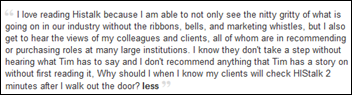
From Lou: “Re: LinkedIn recommendation. I left this for you." That made my day – thanks.

image

From Able Bodied: “Re: Presence Health (the merger of Resurrection Health and Provena Health). Has decided to go all Epic. Provena uses Meditech. Interesting considering the cost of Epic and that Presence Health bonds have been downgraded by Moody’s to nearly junk status because of poor financial performance and a questionable outlook for the next 18 months. Can you say a merger with a larger system? Word on the street is that they are talking to Ascension.” Unverified. New management at Presence has taken a lot of write-downs, laid off hundreds of people, and had to borrow more than $500 million at the end of May after losing $186 million last year. Resurrection moved from McKesson Horizon to Epic in 2011.


HIStalk Announcements and Requests
SNAGHTML1bf1dd86

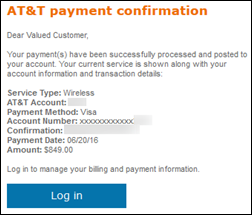
I spent quite a bit of time Monday resolving a hack on my AT&T cell phone account. I called the company immediately after receiving $2,300 in emailed payment updates. A hacker had somehow added himself as an authorized user of my account, bought two iPhones on contract, then paid the contracts off in a Washington Apple store.  AT&T telephone support backed out the charges, but I had to go to the AT&T store to have the SIM card replaced. I also changed my password to a stronger one (I admit that my years-old one was weak) and added a second-level security challenge of a four-digit PIN. It’s interesting that my credit card wasn’t compromised since nobody – including AT&T employees – can see the actual credit card number, only the last four digits, but once you’re in the account you can make purchases using it. I was thankful yet again that I use the magnificent LastPass to manage all my passwords for a princely $12 per year, meaning I log on seamlessly to all sites despite having created strong passwords like my new AT&T one.

My overused word of the week: “seasoned,” a meaningless adjective peppered (pun intended) throughout LinkedIn by executives who describe themselves as such instead of allowing the reader to simply peruse their past experience and decide for themselves. I’m also occasionally annoyed by LinkedIn profiles written in the third person or that don’t contain complete sentences and thus give the appearance of being written by a Godcam-like observer instead of the profile holder, such as, “Proven track record of consistently increasing business performance.” If you want to stand out on LinkedIn, be yourself instead of spitting out inflated, boring bullet lists extolling personal greatness. Also, invest in a professional headshot instead of cropping the grainy image of your head from a family photo (or inexcusably not including a photo at all, suggesting body image issues).
image

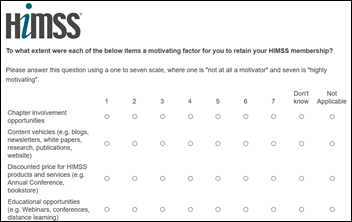
I received an email link to the HIMSS member survey today and, as happens every year, bailed out after wading through three dense pages of questions with no end in sight. They just can’t seem to understand that (a) the time requirement should be reduced and clearly stated in the email; (b) the survey should show a progress meter; and (c) making every answer required instead of just assuming the don’t know/not applicable choice as the default is annoying. It looks like a survey designed by a committee of people who don’t know much about surveys.


image image

Mr. Weber (who is a Teach for America teacher) reports that his Hawaii middle schoolers are using the two Chromebooks and assorted supplies we provided in funding his DonorsChoose grant request to dig deeper into math and to perform college readiness work during his advisory time. He adds, “My students were thankful for everything. They wondered who could donate so much to our school without even knowing them. They sincerely appreciated the generosity of strangers, and I think it made them think about ways that they could contribute to society in the future.”


Webinars

June 28 (Tuesday) 2:00 ET. “Your Call Is Very Important.” Sponsored by West Healthcare Practice. Presenters: Cyndy Orrys, contact center director, Henry Ford Health System; Brian Cooper, SVP, West Interactive. The contact center is a key hub of patient engagement and a strategic lever for driving competitive advantage. Cyndy will share how her organization’s call center is using technologies and approaches that create effortless patient experiences in connecting them to the right information or resource. Brian will describe five key characteristics of a modern call center and suggest how to get started.

Contact Lorre for webinar services. Past webinars are on our HIStalk webinars YouTube channel. Lorre’s getting bored because of the industry slowdown that kicks in every year right about now, so ask her nicely for her “Summer Doldrums Special” that we always run through Labor Day and you’ll get a great deal.


Acquisitions, Funding, Business, and Stock
image

Pharmacy restocking software vendor Kit Check raises $15 million in a Series C round, increasing its total to $37 million.
SNAGHTML1c07c744

The New York Times profiles the struggling Oscar Health, a self-proclaimed insurance disruptor that uses technology to offer consumer-friendly policies. The company, which has raised $728 million and is starting a New York health center to deliver care itself, is losing money because:

  • It sells policies only on insurance exchanges, which have enrolled fewer people than expected.
  • It’s getting stuck with sicker patients with expensive pre-existing conditions whose coverage is guaranteed by ACA.
  • All insurers are realizing that they priced their exchange policies too low to break even, although Oscar’s competitors have the advantage of being able to make up their losses elsewhere.
image

Philips acquires Northern Ireland-based digital pathology software vendor PathXL.


Sales

The Koble-MN HIE, health data intermediary, and health information organization chooses Orion Health’s Amadeus precision medicine platform.


People

image

Release-of-information systems vendor Verisma names Marty McKenna (Allscripts Analytics) as president and CEO.

image

Paul Boemer (FIS Healthcare Solutions) joins PatientPay as EVP.


Announcements and Implementations

Denver Health (CO) goes live on Bernoulli’s Nuvon VEGA medical device integration.
image

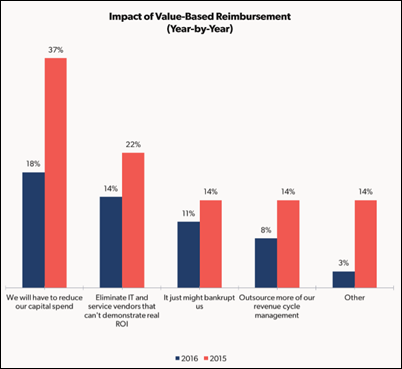
A new Peer60 revenue cycle report finds that about two-thirds of hospitals don’t plan to participate in value-based payment programs, with those under 500 beds being more hesitant to change. They worry about getting stuck with non-compliant patients as competitors cherry-pick the patients that show higher levels of value and thus generate more revenue. Interestingly, the second-most reported expected impact of value-based payment is eliminating IT vendors who can’t demonstrate solid return on investment, with hospitals apparently happy to give them a pass until money gets tight.

image

The US Patient and Trademark Office issues Aventura its eighth patent, this one covering how the company’s Sympatica situational awareness platform updates virtual resources and applications based on user location in managing roaming computing sessions.

image

Quintiles opens a healthcare technology and apps accelerator in Research Triangle Park, NC, staffing it with simulation analysts, wearables experts, and user interface designers.

image

C.L. Brumback Primary Care Clinics (FL) goes live with Forward Health Group’s PopulationManager and The Guideline Advantage.

Scottsdale Institute publishes a report describing the IT challenges involved in creating clinically integrated networks.


Government and Politics
image

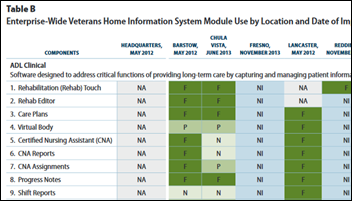
California auditors find that CalVet, the state’s VA operation, has wasted $28 million since 2007 on a since-cancelled EHR contract for veterans homes. The auditors blame CalVet for poor project oversight. CalVet had decided to replace Meditech because veteran histories could not be viewed across facilities, choosing SolutionsWest Consulting (later Brekken Technology) as a replacement even though it was not Meaningful Use certified.

Medicare finally realizes that its fraud-incenting “pay and chase” practice of paying providers first then asking questions later doesn’t make sense as it tests a program in five fraud-famous states (IL, FL, MI, MA, and TX) in which home care providers will have their claims reviewed in advance before CMS pays for those services. CMS previously found that 60 percent of the home care claims it paid were “improper.”

The VA won’t fast-track executive firings now that the Justice Department has ruled that VA employees have the right to appeal their termination to the Merit Systems Protection Board. Rep. Jeff Miller (R-FL), chair of the House veterans panel, said of the VA’s decision not to use the authority given it by Congress in response to the wait times scandal, “Everyone knows VA isn’t very good at disciplining employees, but this decision calls into question whether department leaders are even interested in doing so."


Other

Oncologist and informaticist Robert Miller, MD, medical director of the American Society of Clinical Oncology’s CancerLinQ cancer big data project, describes how the “learning system for oncology” works. CancerLinQ, built on SAP’s HANA platform, extracts data from oncologist EHRs via several methods and standardizes the information with a terminology rules engine and natural language processing. Doctors can query the identifiable information of their own practice’s patients, while de-identified analytics reports are provided by the CancerLinQ team. CancerLinQ provides real-time practice performance analysis against standard quality measures and gives oncologists observational data to support clinical decisions. The article concludes with an excerpt from a journal editorial:

However, how is an individual clinician to proceed when faced with a patient in the exam room with a rare tumor for which evidence-based clinical practice guidelines do not exist, and the patient is not a candidate for a trial? Or a patient with a common malignancy like breast cancer coexisting with a myelodysplastic syndrome with del[5q]? Or the much more common scenario of a patient with compromised renal function faced with the decision as to the advisability of potentially nephrotoxic, but curative adjuvant chemotherapy? The availability of a powerful tool like, CancerLinQ, that can provide insights into the real world outcomes of similar patients, when combined with existing trial-generated evidence and full patient consent, may be transformative to the practice of the art of medicine in these difficult situations.

image

UCSD Health CIO Chris Longhurst, MD, MS tweeted out this photo from the CHIME/AMDIS CMIO Boot Camp, held this past Sunday through Tuesday in Ojai, CA.

A study finds that doctors who accept inexpensive drug company-paid lunches prescribe more of the brand-name drugs the company sells to their Medicare patients. Perhaps the AMA could look into this instead of chasing imaginary “digital snake oil” or maybe CMS should just buy every doctor a fast food lunch to get on their good side about MACRA. My experience with doctors is this: while maybe a fourth of them apply quid pro quo in intentionally returning the drug company favor by altering their prescribing habits, most of them instead simply overestimate their own objectivity and intelligence in being able to distinguish drug company propaganda from rigorous scientific review. In other words, they actually think they were educated rather than sold to. Drug reps love playing to a doctor’s inflated ego in getting them to do their bidding.

image

CNBC profiles a former Microsoft designer who was paralyzed by a medical mistake at Overlake Hospital Medical Center (WA). He received a $20 million settlement and a seat at the table as Overlake reviews what went wrong in his case and how systems design work might prevent other errors.

image

The 66-year-old bass player of Foghat (“Slow Ride”) is left unable to play music due to the side effects of lung cancer chemotherapy. A 2012 CT scan revealed a lung mass and the suggestion “to exclude the possibility of a primary lung neoplasm,” but he wasn’t notified of the finding and nobody followed up. The tiny growth has since spread, is inoperable, and carries just a 4 percent survival likelihood. He’s suing.


Sponsor Updates

  • AirStrip is featured in an Ultera Digital podcast on health IT marketing.
  • GetWellNetwork Founder and CEO Michael O’Neil is named EY Entrepreneur of the Year for 2016 in the health category in the Mid-Atlantic region.
  • Besler Consulting releases a new podcast, “Healthcare Retrospect Part 1: All Americans Were Uninsured.”
  • Strata Decision Technology receives “Peer Reviewed by HFMA” designation for the second time.
  • Boston Software Systems releases a new podcast, “Migrating Legacy Systems to Epic.”
  • Optimum Healthcare IT hires Larry Kaiser as director of marketing.
  • Impact Advisors publishes a white paper, “Cutover Plan: The Missing Link to a Successful Go-Live.” 
  • Divurgent will exhibit at HFMA’s ANI Conference June 26-29 in Las Vegas.
  • E-MDs will host its annual User Conference & Symposium June 23-25 in Austin, TX.
  • HealthGrid will deliver patient education content from Healthwise via its patient engagement solution.
  • EClinicalWorks will exhibit at 2016 Optometry’s Meeting June 30-July 2 in Boston.
  • Glytec’s Glucommander and EGlycemic Management System are featured in five studies presented at the American Diabetes Association scientific sessions.
  • Greencastle Associate Consulting’s Jim Blanchet earns PMP certification from The Product Management Institute.
  • HCS will exhibit at the Texas Hospital Association Behavioral Health Conference June 23-24 in Austin, TX.

Blog Posts


Contacts

Mr. H, Lorre, Jennifer, Dr. Jayne, Lt. Dan.
More news: HIStalk Practice, HIStalk Connect.
Get HIStalk updates.
Send news or rumors.
Contact us.

125x125_2nd_Circle

Monday Morning Update 6/20/16

June 19, 2016 News 2 Comments

Top News

image

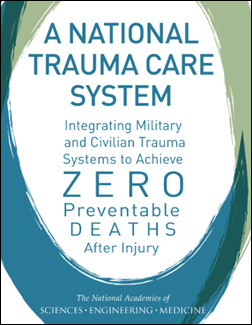
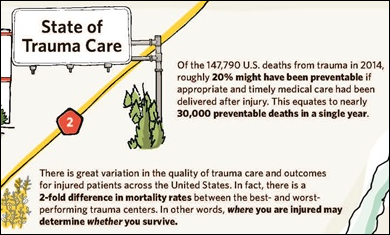
A government report estimates that 30,000 US patients die unnecessarily from trauma each year since trauma center death rates vary widely such that “where you are injured my determine whether you survive.” It urges creation of a national trauma system driven by best practices that includes both military and civilian systems and pre-hospital providers such as ambulance services.

The leading cause of death among people under 46 years old is trauma (motor vehicle accidents, gunshots, and falls).

image

The report from the National Academies of Sciences, Engineering, and Medicine recommends that trauma centers create real-time access to patient-level data that would also be used in a national quality improvement program.


Reader Comments

image

From Former Westminster, CO Employee: “Re: McKesson. I worked on Horizon for 15 years. Upper management refused to listen to QA, support, implementation, and development and would demand that change requests be closed with known software bugs shipped to clients to meet project deadlines. Hospitals would then report the bug, which would be re-opened as a Hot Fix Solution as the cycle repeated. Management was more concerned about running a tight ship and laid off many critical people. Paragon will suffer the same because the management culture has not changed.” Unverified.


HIStalk Announcements and Requests

image

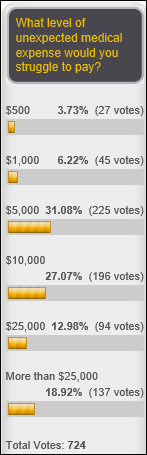
Most poll respondents would struggle to pay an unexpected medical bill of $5,000 to $25,000, which is a lot better than the 47 percent of Americans that a federal study found would struggle to pay a $400 emergency bill. New poll to your right or here: do digital tools reduce the efficiency of care delivery as the AMA contends?

Here’s a fun enhancement idea for the new iPhone patient data EHR query: let the app automatically file an HHS data-blocking complaint for unsuccessful requests.

image image

Mr. Martinez is using the document camera we provided in funding his DonorsChoose grant request to record his live presentations so that students in his California high school classroom can review portions they missed or to keep up when they’re absent. He’s recording additional examples and placing them on his website so that students can follow along on their own time.

image image

Also checking in is Mrs. Evans from Florida, who says many of her elementary school’s students had never used a tablet until we provided six of them for her gifted class.

Listening: new from Radiohead, slower and more melodic (some might say “wimpier”) than previous masterworks like “OK Computer,” but sometimes you have to let good bands evolve and give their new stuff a multiple-play chance to grow on you.


Last Week’s Most Interesting News

  • Apple adds C-CDA records import capability to iOS 10, giving iPhone-using consumers the theoretical ability to request and capture their basic medical information from provider EHRs.
  • AMA passes a resolution supporting creation of an ONC-administered health IT safety center.
  • Doctors in Australia demand that patient update access to their own medical records be revoked, saying they can’t trust the information.
  • The AMA’s EVP/CEO lashes out at “digital snake oil,” broadly panning the health-related software that is available to doctors and consumers.

Webinars

June 28 (Tuesday) 2:00 ET. “Your Call Is Very Important.” Sponsored by West Healthcare Practice. Presenters: Cyndy Orrys, contact center director, Henry Ford Health System; Brian Cooper, SVP, West Interactive. The contact center is a key hub of patient engagement and a strategic lever for driving competitive advantage. Cyndy will share how her organization’s call center is using technologies and approaches that create effortless patient experiences in connecting them to the right information or resource. Brian will describe five key characteristics of a modern call center and suggest how to get started.

Contact Lorre for webinar services. Past webinars are on our HIStalk webinars YouTube channel. Lorre’s getting bored because of the industry slowdown that kicks in every year right about now, so ask her nicely for her “Summer Doldrums Special” that we always run through Labor Day and you’ll get a great deal.


Acquisitions, Funding, Business, and Stock

image

TransUnion acquires Auditz, which offers point-of-service patient revenue products.

image

Cerner shares continue their recent slide, closing at prices not seen since July 2014. Above is the one-year price chart of CERN (blue, down 22 percent) vs. the Nasdaq (red, down 6 percent).


Announcements and Implementations

image

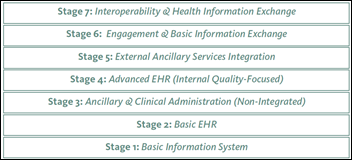
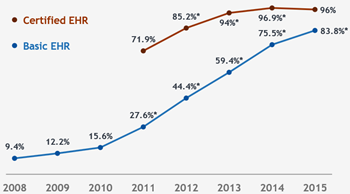
LeadingAge Center for Aging Services Technologies creates an EHR adoption model for long-term and post-acute care providers.


Government and Politics

The government of South Australia continues its years-long legal pleading to software vendor Work Systems, whose 1990s-era, DOS-based patient records system is still being used by 64 of South Australia’s health sites. The vendor demands that state government stop using its software since its license for a retired version has expired, but the government argues that forcing it to stop using the system would endanger patients. South Australia is in a bind because its Allscripts-powered EPAS project is behind schedule and over budget with only three sites live amidst widespread doctor protests that the system endangers patients.

image

Karen DeSalvo, MD, MPH and her HHS team wore blue to support Men’s Health Week last week.

image

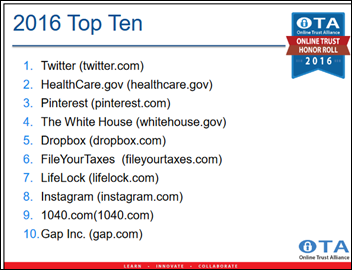
An independent analysis finds Healthcare.gov to be the second-most secure consumer website.

The VA engages Underwriters Laboratories to help improve the cybersecurity of its medical devices.


Other

It’s been said that “a true test of a man’s character is what he does when no one is watching,” which is an apt summary of a new study that finds increased rates of hospital hand-washing when clinicians know they are being observed. Easy-to-spot infection prevention nurses saw a 57 percent rate of hand-washing compliance, while less-recognized volunteers saw staff washing their hands when they should only 22 percent of the time.

image

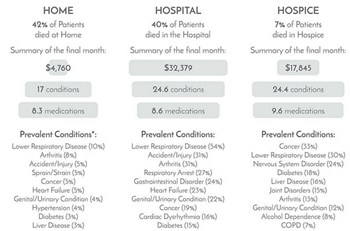
An excellent analysis by Arcadia Healthcare Solutions that I hadn’t previously noticed until NPR ran a story on it finds that the cost of care provided to dying patients in their final 30 days varies widely by where they die. Patients who expire in a hospital consume $32,000 worth of services, while those who pass away in nursing homes, hospices, and at home cost $21,000, $18,000, and $5,000 respectively. Saddest of all is that 40 percent of patients died in a hospital, something that few people want. The company offers several interesting dataset visualizations on its site.

I also missed this New York Times op-ed piece from a few weeks back in which a University of Oslo professor pans the idea of a “cancer moonshot,” saying the Catch-22 of cancer is that it can’t be cured and thus keeping people alive longer means they’re more likely to get cancer again. He recalls that President Nixon called for a cancer moonshot of his own in 1971 and the National Cancer Institute has spent $90 billion since then even as cancer rates increased. He concludes that the effort wasn’t wasted, however: “We’re a lot better at fighting cancer. We just can’t cure it,” but warns of “the rhetorical spin that drives the cancer enterprise.” He urges that doctors save lives via the “boring stuff” of getting patients to stop smoking, use sunscreen, eat better, and exercise, saying that will do more good than “promising the moon.”


Sponsor Updates

  • Vital Images will exhibit at SCCT 2016 June 23-26 in Orlando.
  • Zynx Health will exhibit at AMDIS 2016 June 21-24 in Ojai, CA, as will LogicStream.
  • Integris and The Chartis Group will present “Centralized Scheduling for a Physician Enteprise” at the HFMA National Institute June 26-29 in Las Vegas.

Blog Posts


Contacts

Mr. H, Lorre, Jennifer, Dr. Jayne, Lt. Dan.
More news: HIStalk Practice, HIStalk Connect.
Get HIStalk updates.
Send news or rumors.
Contact us.
125x125_2nd_Circle

Morning Headlines 6/17/16

June 16, 2016 News Comments Off on Morning Headlines 6/17/16

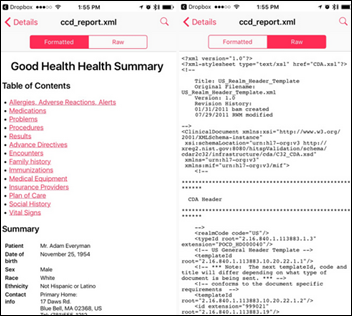
Hands-on: Apple brings HL7 CCD health records to HealthKit in iOS 10

iOS 10 includes an enhancement that will let iPhone users to download and store their health records from providers capable of transmitting a CCD.

Navicure Partners with Bain Capital Private Equity to Continue Growth and Expand Healthcare Technology Platform

Navicure receives a strategic investment from Bain Capital Private Equity. Financial terms were not disclosed.

AMA Throws Support Behind Development of a National Health IT Safety Center

AMA house delegates approve a proposal formally supporting the creation of a National Health IT Safety Center.

Doctors want patient control over e-health records revoked

The Australian Medical Association argues that patients should not be able to control what is entered into their personal health records. AMA president Michael Gannon, MD explains, “If patients are able to control access to core clinical information in their electronic medical record, doctors cannot rely on it.”

News 6/17/16

June 16, 2016 News 1 Comment

Top News

image

Apple’s iOS 10 will allow users to request copies of their medical records from their smartphones, provided their provider’s EHR can export a Continuity of Care Document. Users can also import records from Safari and Mail. The translated medical summary can be stored directly in Health.


Reader Comments

From Meltoots: “Re: CMS and EHR vendor snake oil. MU was an unmitigated disaster for safety, security, usability, efficiency, and physician burden, yet it continues with a new name. Everyone wants to move away from fee-for-service, yet we have no idea how to attribute quality care from multiple doctors to a single patient. This is a not-so-secret CMS push to put providers into large practices so they can crank down on payments. Providers have had enough.” The other concept at work is that hospitals, which have performed so pitifully and indifferently in coordinating patient care and managing populations, are figuring out how to reap the lion’s share of the money that will be spent to improve it. It’s also interest that just as it’s hard to detect Medicare fraud because providers work under the NPI of other providers in group settings, it’s equally hard to determine using billing data which of them is individually responsible for wise or unwise care decisions.

image

From Gray Sky: “Re: Medhost. Has had outages for the past two weeks for all hosted applications. Inside information points to a storage information where customer data has been erased. The company continues to investigate options to restore the data to a reasonable point in time.” I ran this rumor Tuesday with the vendor name omitted pending the company’s response, which Medhost has provided:

Medhost supports software applications in over 1,100 facilities across the United States, Canada, and Puerto Rico. Over the past several weeks we have experienced system outages impacting a total of three hosted facilities. In one instance, the outage was extended for several days. Medhost utilized both system vendors and consultants as well as its internal resources to determine the cause of these outages and to act to prevent any future outages. The extended outage was due to failure of the operating system. Medhost applications were not a contributing factor to this system outage and no customer data was lost. All customer systems have been restored and are working as designed. While we view any outage as unacceptable, we will use this as an opportunity to improve availability and resiliency of the Medhost systems. Medhost Direct historical uptime availability exceeds 99.99 percent, and no hosted facility has experienced an outage of more than 14 hours in over two years.

image

From  Credenza Cowboy: “Re: Martha Jefferson’s errant EHR click that mistakenly labeled the patient as deceased. They aren’t live on Epic yet.” I didn’t realize that, although I attended a years-ago Cerner user meeting at which their IT director was present, so maybe they are on Cerner. Either way, it’s an interesting tip-of-the-iceberg type user error that fortunately, in this case anyway, had no clinical impact. Sentara bought the Charlottesville, VA hospital in 2010.

From Pensive Moment: “Re: digital snake oil. Do  you agree with the AMA?” Mostly no. The AMA’s solution to all problems is to put doctors in charge of everything despite their poor track record of following evidence-based guidelines, delivering whole-person health, and serving as patient advocates without bias toward their personal incomes. They have also demonstrated their own snake-oil gullibility in letting drug and medical device companies dictate their clinical behavior via shady but effective sales tactics that sometimes result in sub-optimal or even dangerous medical decisions. You will notice minimal reference to care teams in the AMA’s impassioned stand that, as usual, assumes the “Doctor as God” position in excluding all other clinicians and in pushing AMA’s commercial interests. The AMA is right that many apps (especially the consumer-facing ones) are of questionable value and that doctors have been shafted in being expected to document everything for the benefit of bureaucrats. They’re also correct that much of what doctors don’t like was handed down to them from insurance companies and the government (whose checks they don’t mind cashing, however, as evidenced by their continued participation). The AMA’s bloviating is what you get when each clinical profession has its own membership organization looking out for the interests of its dues payers while claiming to represent patients who are – along with the 80 percent or so of US doctors who aren’t AMA members, including a bunch who quit after AMA endorsed passage of the Affordable Care Act — invariably absent from its proceedings. All of the solutions offered by the AMA for “digital dystophia” involve AMA-led products and services, so from now on, let’s blame them.

From Limelight Seeker: “Re: our event. Please promote the upcoming tweetchat, webinar, or video I’m involved with.” I will say only this: quite a few overexposed pontificators — especially social media self-gratifiers and cheap-seats observers — are short on credentials to be educating the rest of us. My accomplishment-driven twit filter is powered by LinkedIn.


HIStalk Announcements and Requests

image

Welcome to new HIStalk Gold Sponsor Catalyst Healthcare Advisors. The eight-year-old company offers consulting services in strategy, finance, operations, and technology (IT strategy, system selection, contract negotiation, and system implementation, optimization, and integration). The company led Yale-New Haven’s expense reduction project in helping the health system save $350 million annually. Among its other 200 clients are Baylor, Indiana University Health, Community Health Network, and Good Samaritan Hospital. You may know founder and CEO Steve Furry, who has been in healthcare consulting for 35 years, and senior advisor Parker Hinshaw, who founded maxIT. The company just announced the hiring of two new sales executives covering the West and Midwest. Thanks to Catalyst Healthcare Advisors for supporting HIStalk.

image image

Ms. Marlowe says her North Carolina kindergarten class is benefitting greatly from the Chromebook we provided in funding her DonorsChoose grant request, with the students specifically enjoying listening to stories online.

Listening: reader-recommended Richmond-based singer-songwriter Lucy Dacus, an up-and-comer who sings thoughtful and warm indie folk music that reminders the reader of the magnificent Cowboy Junkies and me of Kristin Hersh of Throwing Muses

This week on HIStalk Practice: CMS announces $10 million in grants to help practices transition to new payment models. Midwest Orthopaedic Consultants goes with care coordination tech from PinpointCare. AMA adopts long-awaited ethical guidelines for telemedicine practice. CureMD adds Izenda business intelligence tool to its PM software. Emergency Care Specialists launches joint venture with Answer Health Telemedicine. Facebook develops suicide prevention tools and protocols. Culbert Healthcare Solutions VP Randy Jones equates revenue cycle KPIs to “the ritual of the snipe hunt.”


Webinars

June 28 (Tuesday) 2:00 ET. “Your Call Is Very Important.” Sponsored by West Healthcare Practice. Presenters: Cyndy Orrys, contact center director, Henry Ford Health System; Brian Cooper, SVP, West Interactive. The contact center is a key hub of patient engagement and a strategic lever for driving competitive advantage. Cyndy will share how her organization’s call center is using technologies and approaches that create effortless patient experiences in connecting them to the right information or resource. Brian will describe five key characteristics of a modern call center and suggest how to get started.

Contact Lorre for webinar services. Past webinars are on our HIStalk webinars YouTube channel.


Acquisitions, Funding, Business, and Stock

image

As I mentioned in an update to Monday night’s post following a response to my inquiry to Navicure, Bain Capital Private Equity makes an unstated strategic investment (presumably taking a majority interest that meets the definition of an acquisition) in the company. Among the sellers is JMI Equity, which took a minority position in Navicure in 2009. JMI bears the initials of John Moores Inc., whose other accomplishments (beyond being an IBM programmer) include founding BMC Software, serving as lead financier of Peregrine Systems and ServiceNow, and formerly owning of the San Diego Padres.


Sales

The soon-to-open Sacred Oak Medical Center (TX) chooses Medsphere’s OpenVista EHR.

In Scotland, NHS Fife chooses InterSystems TrakCare, the twelfth Scottish Health Board to do so. 


People

image

Clinical rules modeling vendor Applied Pathways hires Steve Lefar (Sg2) as CEO. Founder and CEO John Feldman will continue as board chair.

image

Madhu Sasidhar, MD (Cleveland Clinic) joins consumer engagement platform vendor Envera Health as CMIO.


Announcements and Implementations

Congratulations to the HIStalk sponsors who took 40 spots in the 2016 HCI 100:

The local paper notes that FHN Memorial Hospital (IL) is testing Meditech 6.1 in its $8 million OurFHN project, expecting an October go-live.


Government and Politics

The American Medical Association approves a policy supporting the creating of an ONC-administered National Health IT Safety Center. The policy proposal was submitted by Matt Murray, MD, chair of the Texas Medical Association’s IT committee, driven in part by work done by Texas-based health IT researchers Dean Sittig, PhD and Hardeep Singh, MD, MPH.

The US Supreme Court rules that the VA must always give exclusive preference to veteran-owned small businesses when issuing contracts, overriding the VA’s argument that it is only required to meet specific annual contracting goals. The court says the VA must show preference to veteran-owned bidders as long as the competition meets the Rule of Two (at least two bidders are expected to submit offers and the amount of those bids is expected to be reasonable).

image

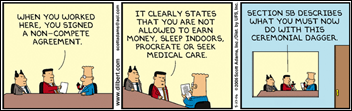
New York’s attorney general forces legal website Law360 to stop requiring employees to sign non-compete agreements unless the employee has insider knowledge of trade secrets. Law360’s terms required all employees, even those fresh out of college, to sit out a year before taking another job in the same industry. The attorney general of Illinois is also upset that the non-compete clause in the employment agreement of sandwich chain Jimmy John’s prohibits employees from taking a job with another sub sandwich company for two years after quitting.


Privacy and Security

image

A former IT employee sues Aspen Valley Hospital (CO) and its privacy officer, claiming that the hospital’s HR director/privacy officer disclosed the employee’s HIV status over cocktails with the hospital’s HR recruiter at a conference after noting a large medical claim for his antiviral medications. The employee filed a complaint with the hospital and then HHS as a HIPAA violation, after which he says he was disciplined, demoted, and then fired after 11 years at the hospital.


Other

image

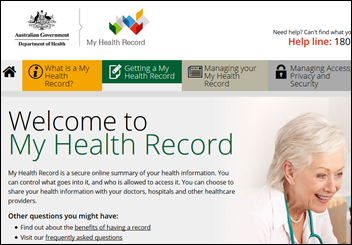
The Australian Medical Association calls for the capability of patients to manage their own medical records to be removed, saying that doctors don’t participate in the national My Health Record data-sharing program because they can’t rely on patient-provided information. The AMA wants patients locked out of making changes to core set of database elements that includes the meds list, allergies, discharge summaries, pathology and imaging results, weight, height, blood pressure, and advance directives. They also want eventual restriction of patient changes to ECG results, blood type, vaccination history, infectious disease status, surgery history, and even the patient’s chosen emergency contact. The AMA says the changes will increase trust and therefore physician usage of the system, which is nearly non-existent.

SNAGHTML20b4650

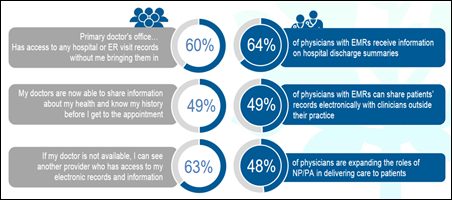
A Nielsen survey finds that 89 percent of PCPs claim they often remind patients about preventive screenings, but only 14 percent of patients say they receive them. Only 5 percent of the two-thirds of Americans who are overweight say their doctors suggested a weight loss program. Half of patients aren’t seeing doctors who can view their history via an EHR. Only one in four patients can contact their doctor by email or patient portal question submission, with older people more likely to avoid use of available technology.

This has a small amount of health IT relevance: the mold-breaking YouTube teen vlog series “lonelygirl15” is being re-launched after 10 years by its creators, which include Miles Beckett, MD, CEO of electronic credentialing vendor Silversheet. I interviewed him in April 2016.

Theranos CEO Elizabeth Holmes will present at the American Association for Clinical Chemistry’s annual conference in August, with her submitted abstract suggesting that her talk will be long on defensive self-promotion and short on offering the definitive clinical validation data that scientists long to see. I’m not clear about why a college dropout should be presenting at a clinical conference or why the education committee would accept a presentation titled “Theranos Science & Technology: the miniaturization of lab testing,” but it will probably be an overflow session. I will be disappointed if the attendees don’t boo her off the stage.

In China, a hospital janitor is arrested hiring friends to direct out-of-towners looking for the hospital to a specific room he had rented inside it, where he delivered ineffective but expensive treatments. The health department has closed the hospital as a result. That type of scam is common in China, where hospitals routinely rent out rooms to anyone willing to pay.


Sponsor Updates

  • InstaMed releases its annual report on trends in healthcare payments.
  • InterSystems, Intelligent Medical Objects, and Meditech will exhibit at AMDIS 2016 June 21-24 in Ojai, CA.
  • Liaison Technologies wins a Stevie Award for Favorite New Product from the American Business Awards.
  • Visage Imaging validates the interoperability capabilities of its Visage 7 Enterprise Imaging Platform at the IHE Connectathon 2016 held in Bochum, Germany.
  • MedData will host a job fair June 22 in Grand Rapids, MI.
  • The HIMSS SIIM Enterprise Imagine Workgroup publishes its second white paper.
  • Validic and Omnicom Health Group will partner to counsel healthcare companies on connected health.
  • Netsmart will exhibit at the Washington Behavioral Health Conference June 22 in Yakima, WA.
  • Nordic receives RightSourcing’s Gold Supplier Award.
  • Qpid Health and Streamline Health will exhibit at AMDIS 2016 June 21-24 in Ojai, CA.
  • The latest KLAS report ranks Sagacious Consultants as the highest-rated firm for revenue-cycle optimization.

Blog Posts


Contacts

Mr. H, Lorre, Jennifer, Dr. Jayne, Lt. Dan.
More news: HIStalk Practice, HIStalk Connect.
Get HIStalk updates.
Send news or rumors.
Contact us.

125x125_2nd_Circle

News 6/15/16

June 14, 2016 News 5 Comments

Top News

American Medical Association EVP/CEO James Madara, MD, speaking at the organization’s annual meeting, lashes out at “digital snake oil” of clinically unproven software and technology products that “impede care, confuse patients, and waste our time,” adding that “interoperability remains a dream.” He says doctors – who mistakenly failed to participate in early digital health projects – need to separate the lame digital tools from the potentially magnificent ones, explaining the present state of “digital dystopia” as:

Direct-to-consumer digital health devices—which only in the fine print say ‘for entertainment purposes only’—to our clunky electronic records, to ICUs that sound like primitive swamps abuzz with a cacophony of  bells, alarms, and whistles.

However, many of the solutions that Madara offers involve products from which AMA benefits – an incubator, an innovation studio, and lobbying efforts.

image

Meanwhile, John Halamka takes the counterpoint to the “digital snake oil” label, saying that more study rather than politician-like hyperbole is needed to understand that “we’ve achieved exactly the results we designed” in striving to simply replace paper charts with their electronic counterparts and to meet various government mandates. He provides examples in interoperability (e-prescribing, public health reporting, and lab reporting); population health (EHR patient panel queries); and consumer engagement (patient portals), all of which laid the foundation for the next generation of tools that will support team-based workflow, lifetime encounter records, care management workflow support, and family engagement tools. Halamka repeats the same advice he offered for Meaningful Use: focus on a small number of achievable outcomes.


Reader Comments

From Pomp and Circumstance: “Re: vendor press releases. Healthcare institutions are increasingly forbidding them to distribute press releases announcing new sales or contracts. This may distort the perception of success of companies that are compliant with the wishes of their customers.” It’s tough for a vendor to tout their successes when the client asks them not to, going beyond just not naming the client specifically, but prohibiting the sale from being mentioned at all. That practice prevents some much-need visibility into who’s buying what, but I agree that there’s no value to the new customer unless the sale can be crafted into a more self-serving announcement.

From Sticky Wicket: “Re: innovation award winners. You didn’t list those from the attached announcement.” I don’t consider press releases of these types worth mentioning since the average health system CIO would have minimal interest in companies whose enterprise readiness is years away at best even if they manage to avoid being among the 95 percent that will never be successful. Thus I’ve stopped running announcements of the following types, preferring to wait for actual customer success:

  • Company funding under $1 million.
  • New accelerators forming or companies joining an accelerator.
  • Tiny companies winning an app contest or submitting an innovative idea.
  • Startups offering a new consumer-facing health app whose outcomes have not been studied.

From Duluth: “Re: Navicure. Sold to Bain.” Unverified. I’ve reached out to the company for a response but haven’t heard back. UPDATE: Navicure confirms that it will receive an undisclosed strategic investment from Bain Capital Private Equity. Founder and CEO Jim Denny and the executive team will remain with the company.

From Gray Sky: “Re: [vendor name omitted]. Has had outages for the past two weeks for all hosted applications. Inside information points to a storage information where customer data has been erased. The company continues to investigate options to restore the data to a reasonable point in time.” Unverified. A company spokesperson responded quickly after hours and is trying to reach one of its executives for a response, so I offered to withhold the company’s name until my next post, which will also include any response the company provides.

image

From DOSsier: “Re: US Department of State. Issued an RFI for an off-the-shelf EHR for diplomatic missions.” The RFI is here, but note that it covers EHR implementation project management services only – it’s not a RFI for an actual EHR. The original plan was for the Department of State to share the Coast Guard’s Epic system, but the Coast Guard has backed away from that project. Before that, the DoS was planning to roll out the DoD’s AHLTA, so perhaps this RFI involves the DoD’s Cerner rollout. I don’t know the source of the DoS’s existing eMED system. The RFI was posted June 3 with a two-week response date.

From Pickle Entry: “Re: ACA insurance. UnitedHealth Group is pulling out of the exchange in my state. I’ve had to change insurance companies every year since Obamacare was rolled out, paying multiples of the premium prices I paid before the ACA.” The administration touts decreasing levels of uninsured citizens. That’s good, but those newly insured people are spending a lot of insurance company money catching up on their deferred health needs while young, healthy citizens are going without insurance because they are unlikely to get a payback. You can’t blame insurance companies who are stuck with a money-losing risk pool of self-selected patients when they stem their financial bleeding by exercising the only option the government gives them – shutting down their exchange plans. You are fine if you have employer-provided insurance, have a low enough income to qualify for endless government insurance subsidies, are old enough for Medicare, have few assets and therefore little financial exposure to expensive uninsured services, or are rich enough to not care. Otherwise, you’re paying more to keep the insurance-funded profits flowing to providers, drug companies, and the endless bureaucracy of middlemen who make up most of the US healthcare non-system and who are happy that ACA gave them newly insured patients to bill without touching the real problems of unjustified prices, fraud, and the financial incentive to create overutilization.

From Dan Blocker: “Re: data blocking. John Halamka says he’s never seen it. I say he needs to look harder.” Lots of people (including ONC) claim  that providers and EHR vendors intentionally block the flow of patient information, but nobody is serving up real-life examples instead of poorly sourced anecdotes. Such proof can only come from patient complaints and those are rare because: (a) patients don’t know that their interoperability expectations should be higher; (b) the moment of need is when they are unwell; and (c) they don’t have the information or incentive to figure out who to complain to. I bet that if you asked 100 people who were in the process of being seen as inpatients or outpatients to ask those providers to retrieve their history from other providers, nearly all of them would be unsuccessful, but turning that into a data blocking complaint against either of the providers or their respective EHR vendors would require a lot of investigatory legwork. Most of what’s wrong with healthcare is due to indifference or ineptitude, not carefully planned evildoing.


HIStalk Announcements and Requests

Listening: reader-recommended Fantastic Negrito, raw Delta blues from the Oakland,CA solo artist who describes his music as “uncut realness and zero concern for pop anything” and whose background is uplifting. Mark my words: all things (especially musical ones) must pass and eventually audiences will tire of shimmery musical junk food crafted by false-prophet celebrity musicians who possess no life experience and whose primary musical instrument is Auto-Tune. 

image image

Ms. Westover says students in her inaugural high school microbiology course in Georgia are making good use of the lab supplies we provided in funding her DonorsChoose grant request, examining bacteria and analyzing water samples in discovering “a whole new microscopic world.” 


Webinars

June 28 (Tuesday) 2:00 ET. “Your Call Is Very Important.” Sponsored by West Healthcare Practice. Presenters: Cyndy Orrys, contact center director, Henry Ford Health System; Brian Cooper, SVP, West Interactive. The contact center is a key hub of patient engagement and a strategic lever for driving competitive advantage. Cyndy will share how her organization’s call center is using technologies and approaches that create effortless patient experiences in connecting them to the right information or resource. Brian will describe five key characteristics of a modern call center and suggest how to get started.

Contact Lorre for webinar services. Past webinars are on our HIStalk webinars YouTube channel.


Acquisitions, Funding, Business, and Stock

image

Hearst acquires a majority stake in MedHOK, which offers health plan software including case management, utilization management, and medication management. MedHOK will be incorporated into Hearst Health, which includes First Databank, Zynx Health, MCG, and Homecare Homebase.

image

A federal court dismisses the patent infringement lawsuit brought by telehealth provider American Well against competitor Teladoc, with the court finding that American Well’s patent is too abstract to be enforceable. Teladoc asked the patent office to invalidate American Well’s patients in 2015, after which American Well sued Teladoc just before Teladoc’s IPO. American Well will of course appeal. TDOC shares have dropped 33 percent in the year since its IPO.

image

Hospital medical device spend management software vendor Procured Health raises $10 million in new funding. The Chicago-based company had raised $5.1 million, with its most recent round being completed in March 2014 with little news since. 

image

Sunquest acquires patient flow technology from The Royal Liverpool and Broadgreen University Hospitals NHS Trust, which it will market to customers of its Integrated Clinical Environment. 

image

Patient access and RCM services vendor MedData will acquire RCM services vendor Cardon Outreach for $400 million.

Microsoft inexplicably pays $26.2 billion to buy LinkedIn in its biggest acquisition ever. Microsoft always seems desperate to grab onto whatever is trendy at the moment, wildly overpaying to acquire companies with higher growth potential that it then runs into the ground in repeated and easily predicted examples of failed synergy. MSFT is paying a 50 percent premium to the share price of LinkedIn, whose luster has faded as its revenue stalled and the platform keeps finding new ways to annoy its users in between their rare bursts of job-seeking and self-promotional activities.


Sales

image

Manati Medical Center (PR) and Mayaguez Medical Center (PR) choose Meditech 6.1, raising the company’s Puerto Rico hospital count to 21. 

Tampa General Hospital (FL) selects records aggregation and referrals management tools from EHealth Technologies.

Mainstreet Health will implement the HealthMedx Vision EHR for its transitional care facilities.


People

image

Justin Barnes (Justin Barnes Advisors) is named partner and chief growth officer of IHealth.

image

Extension Healthcare hires Ben Kanter, MD (Sotera Wireless) as CMIO.

image

Eric Kretzer (Strata Decision Technology) joins SA Ignite as SVP of products.


Announcements and Implementations

image

Boone Hospital Center (MO) lays off 26 transcriptionists following the decision by parent company BJC HealthCare to outsource transcription services to Madison, WI-based Amphion Medical Solutions, which was acquired by Atlanta-based IMedX in January 2016. 

The American Medical Association adopts ethical standards for telehealth and telemedicine at its annual meeting, noting that technology doesn’t change the ethical requirements for physicians to place the patient’s interests first. The guidelines also urges physicians to be cautious in making treatment decisions based on the limited information available in a telemedicine session and suggests that care coordination is essential.


Government and Politics

The SEIU healthcare employee union tries again to convince California to cap total hospital CEO compensation at $450,000, the same salary earned by the President.


Technology

Microsoft’s new XBox console eliminates the dedicated port for its Kinect motion-based controller, leading to speculation that Kinect is being phased out. Kinect is used by several innovative healthcare applications for pain assessment, physical rehabilitation, and patient-provider communication. My speculation would be that Kinect turned out to be less interesting (and less profitable) for consumer use but it will continue with a non-gamer focus.


Other

The former chief nursing officer of Sonoma West Medical Center (CA) sues the hospital and one of its board members, claiming she was fired after raising concerns about problems with the hospital’s new clinical software that was developed by the board member’s company. She says the hospital allowed the board member to use its patients as his EHR guinea pigs because he has donated $9 million to keep the previously closed hospital afloat, with the resulting buggy product mixing up patient records, providing incorrect medication information, and failing to display the code status of patients. The software in question appears to be from E-Health Records International, which claims that its tablet-based HarmoniMD hospital EHR can be brought live in single day. Its only users appear to be Sonoma West and a single hospital in Africa.

image

A Commonwealth Fund-sponsored study finds that only 30 percent of behavioral health providers use EHRs, recommending that SNOMED and LOINC terminology be enhanced to address behavioral needs, incorporating IT costs in setting bundled payment policies, adding behavioral-specific clinical decision support and interoperability capabilities to existing EHRs, and requiring EHR vendors to beef up their security capabilities.

image

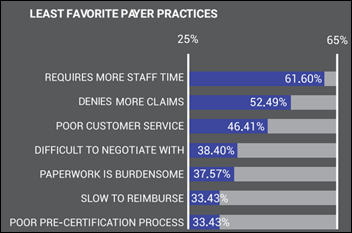
A Peer60 report on payers finds that BCBS and Medicare are the ambulatory provider favorites by far, with UnitedHealthcare trailing the pack. Providers like payers that get them paid more quickly with minimal staff involvement, while their least-favorite attributes are time-wasting practices, denials, and poor customer service.

CMS Acting Administrator Andy Slavitt commits at the AMA conference that CMS will simplify its processes, involve physicians in decisions that affect them, focus on patients, support small physician practices, and make “healthcare technology a tool, not an industry.” Some snippets:

Off-the-shelf tools like Certified EHRs and clinical data registries can provide complete capabilities [for quality reporting], but other options exist as well, including most types of reporting that a physician is doing today. If CMS can get data automatically or through another source, we will do so … [CMS will focus on] putting more pressure on technology vendors and less burden on physicians, so physicians can do simple things like track referrals when a patient sees another specialist or visits a hospital … It’s also time to ask a lot more of the technology and technology vendors. This is particularly true in the area of what many call interoperability … the burden needs to be on the technology, not the user. EHR vendors and hospitals that use them will now be required to open their APIs so data can move in and out of an application safely and securely. This will also serve to help eliminate the ‘desktop lock’ that occurred based on early EHR decisions by allowing technology to more easily plug and play. Today’s data silos are more a function of business practices than technology capability and we cannot tolerate it any longer.

image

Here’s a textbook example of how to write a bad press release. The boring headline contains glaring spelling and capitalization errors, oddly uses the past tense, and reeks of company self-importance in providing a “news item” that would interest no one except the unfortunate author who was charged with getting some company buzz out there despite a lack of buzzworthy events. It randomly capitalizes job titles and other words that are not proper nouns (“EHR Systems”) and uses awkward phrasing that suggests it was crafted by someone whose mother tongue is not English. My mom’s advice remains valid: if you don’t have anything good to say, don’t say anything.

A Virginia hospital blames a misplaced EHR click for sending a sympathy card to the family of a patient who was in fact still alive. Sentara Martha Jefferson Hospital says someone clicked “deceased” instead of “discharged to home” in Epic, triggering the obviously automated condolences. At least the errant checkbox entry didn’t create a medical error that actually killed the patient.

Athenahealth’s Jonathan Bush provides an impassioned video reaction to news that TV host John Oliver formed a fake debt collection company, bought $15 million in overdue medical accounts receivable for $60,000 cash, and then told those patients that he was forgiving their debt. I assume that buying debt at less than a penny on the dollar means it was uncollectible anyway, so it wasn’t really much of a gift.

The Minneapolis newspaper covers the problem in which patient advance directives are not easily located in EHRs. It cites a study in which less than one-third of ED doctors were confident that they could find patient preferences for resuscitation, feeding tubes, or ventilators.

image

Eastern Maine Healthcare System (ME) offers voluntary early retirement to 43 of the 300 employees in its IT department, which is running $3 million over budget.

image

The American Diabetes Association is embarrassed when it allows a drug company to present new, sensitive research data to thousands of doctors attending one of its conferences, warning them to hold the information for one hour until the public announcement and the inevitable stock market reaction. The itchy Twitter finger doctors were already blasting out photos of the presentation’s title slide even before the presentation began, after which they tweeted out the presentation’s data slides and charts despite pleas from the ADA to remove them. Novo Nordisk shares dropped 5.6 percent on the modestly positive news.

Here’s the final physician practice vendor overview from Vince and Elise, which includes tips for product selection.

image

Weird News Andy loves good customer support even if it comes from sophisticated ransomware hackers who now provide live-chat operators to walk victims through the payment process in an effort to differentiate themselves professionally by improving usability. WNA suggests the hacker’s customer support agent be prepared to answer questions such as:

  • How do I buy bitcoins?
  • How do I know you will actually unlock all our data?
  • Do you provide training on how not to click suspicious links?
  • How’s the weather in Romania?

Sponsor Updates

  • Impact Advisors is named as  one of the 500 largest technology integrators in North America.
  • AirWatch announces updates to AirWatch 8.4.
  • Bernoulli CNO Jeanne Venella is featured on RN FM Radio.
  • Carevive Systems will host a tweet chat on the oncology care model on June 21.
  • Cumberland Consulting Group will exhibit at AHIP June 15-17 in Las Vegas.
  • Fast Company features CTG Technical Recruiter Kate Orngard in an article on recruiters.
  • Extension Healthcare will exhibit at the ONL Annual Conference June 16-17 in Newport, RI.
  • FormFast publishes an infographic on the real cost of paper-based informed consent processes.
  • Healthfinch will exhibit at the AMDIS Annual Physician Symposium June 21 in Ojai, CA.

Blog Posts


Contacts

Mr. H, Lorre, Jennifer, Dr. Jayne, Lt. Dan.
More news: HIStalk Practice, HIStalk Connect.
Get HIStalk updates.
Send news or rumors.
Contact us.
125x125_2nd_Circle

Curbside Consult with Dr. Jayne 6/13/16

June 13, 2016 News 4 Comments

image

I spent 38 of the last 72 hours seeing patients. Even the full-time physicians in my practice don’t usually work that much in a short stretch, so I’m not surprised that I found it exhausting. Normally, I find our EHR tolerable, but there were times in the last several days where it was unbearable. I experienced instability like I haven’t experienced since being a beta client for another vendor several years ago. I seemed to find more errors in the physician workflow than my co-workers found in the support staff workflows, and I could feel my attention drifting because I was becoming increasingly annoyed.

At one point, I was managing multiple high-acuity patients when I encountered a string of error messages. The one above nearly put me over the edge. End users should never see error messages like the one above. It’s insulting to the users and, although I’m sure it might mean something to a developer, it doesn’t mean anything to a customer who is trying to care for patients. It’s enough to make one want to wish for even more federal regulations – but only if they require vendors to provide mechanisms for graceful error handling.

As an EHR user, I sometimes feel like I’m a research subject in an experiment that hasn’t been approved by any kind of institutional review board. Everyone thinks that Certified EHR Technology is going to make our world a better place but the jury is still out on whether it’s going to truly be effective. And while we as physicians are having to cope with arduous workflows as a result of the regulations, there are advancements that would really benefit us that remain unaddressed.

Over the last decade, I’ve accumulated a wish list of product “enhancements” that would benefit the people in the trenches. Years later, though, they’re mostly unaddressed:

  • The NCPDP standard for electronic prescribing limits the “SIG” or prescription instructions field to 140 characters. I’ve been told for years that this will be addressed in a future version of the SCRIPT standard, but it remains unaddressed in any production system I’ve ever used. Physicians who have tried to prescribe triptans or other medications that require unstructured SIGs know exactly what I’m talking about. I bet 140 characters made sense at some point, but it’s time for a change. If we can regulate the picklist selections available for marital status, certainly we can regulate this.
  • Standardized lab ordering mechanisms are lacking. One major national reference lab supports electronic directory of services (eDOS) formatting but another doesn’t. This leads to a hodge-podge of strategies for EHR vendors who are trying to manage multiple lab compendia. Some use third parties to try to keep it straight, and others push the work onto the clients. This can result in thousands of physician offices trying to stay in sync with their reference labs, often with a lot of manual work. If we can regulate the use of CPT for lab charges, certainly we can regulate this. (I have to admit that I got a kick out of this reference on eDOS that mentioned that “MU3 proposed rules are anticipated to be published in January 2014 with final rule anticipated to be published in summer 2014.)
  • Requirements for lab vendors and the way they deliver results is lacking. Although physicians are required to use LOINC codes for results to meet various quality measures requirements, there is no requirement that lab vendors send LOINC codes with their results. I’m working with a handful of clients right now who are having to do manual recoding to attach LOINC codes to their results, so that they don’t get dinged on their quality reports. If we can regulate the use of SNOMED, certainly we can regulate this.
  • Interoperability remains elusive. Even when systems communicate, the mechanisms used to reconcile data from disparate systems can be clunky at best and downright unsafe in certain situations. Although some vendors have robust algorithms to identify potential matches and bring data seamlessly into the patient chart, others deliver a greater cognitive load than I experienced in my third semester calculus class. If we can regulative giving lip service to usability through user-centered design, certainly we can make it a reality.

Unfortunately, my list is growing longer rather than getting shorter. We’re forced to gather loads of information that could be put to good use but isn’t. For example, we collect information on race, ethnicity, religious preference, language preference, sexual orientation, and more. In many cases, it’s not used to further clinical care. It would have been great to have a prompt to ask about religious fasting the other night when I was treating a patient with profound dehydration. Although it occurred to me to ask, it didn’t occur to my patient care technician or to the resident I was supervising.

My state doesn’t have a usable database for identifying potential abuse of controlled substances. That’s not a vendor problem but a failure by our legislators to ensure that what they legislated was actually delivered as promised. It’s sad, because I could benefit from that kind of technology every single day. Other states have had it for years but here I am, calling around to try to confirm my suspicions when I’m concerned about a patient.

I know the industry is going through growing pains. There is a tremendous amount of external pressure and we’re trying to use technology to solve the broader healthcare problem rather than addressing the root causes. We can’t expect that to be easy, and I’m hoping we’ll look back on these times someday and chuckle at our relative naivety. Of course, there’s always the chance we’ll look back on these times fondly, because things will have gotten worse. Let’s hope that doesn’t come to pass.

For now, I’d settle for some friendlier error messages. I’d take “I’m sorry Doctor, I’m afraid I can’t do that” rather than hearing about unhandled exceptions or missing widgets. What’s your most annoying error message? Email me.

Email Dr. Jayne

Monday Morning Update 6/13/16

June 12, 2016 News Comments Off on Monday Morning Update 6/13/16

Top News

image

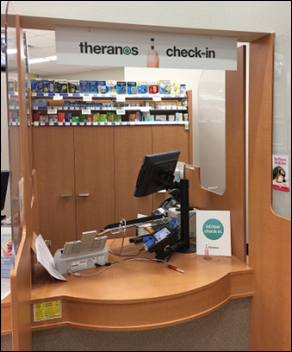
In light of voided test results and potential CMS sanctions, Walgreens ends its relationship with Theranos, closing all 40 of its Theranos Wellness Centers in Arizona. Walgreens will redirect lab testing to third-party companies or to the certified Theranos lab in Phoenix.


Webinar

June 28 (Tuesday) 2:00 ET. “Your Call Is Very Important.” Sponsored by West Healthcare Practice. Presenters: Cyndy Orrys, contact center director, Henry Ford Health System; Brian Cooper, SVP, West Interactive. The contact center is a key hub of patient engagement and a strategic lever for driving competitive advantage. Cyndy will share how her organization’s call center is using technologies and approaches that create effortless patient experiences in connecting them to the right information or resource. Brian will describe five key characteristics of a modern call center and suggest how to get started.

Contact Lorre for webinar services. Past webinars are on our HIStalk webinars YouTube channel.


Last Week’s Most Interesting News

  • McKesson may sell its health IT business unit to focus efforts on its core drug distribution business.
  • Vice President Biden announces formation of the Genomic Data Commons, an open-access cancer database that will help researchers collaborate and share information, as part of the administration’s Cancer Moonshot.
  • Theranos says that less than one percent of its blood test results have been voided or corrected, a clarification on earlier reports that it would need to cancel or amend tens of thousands of results.
  • Practice Fusion settles FTC charges that it misled consumers by soliciting reviews for their doctors without disclosing that the information would be publicly posted on the Internet, leading to patients unknowingly publishing their own sensitive patient information.
  • The House passes the Helping Hospitals Improve Patient Care Act, exempting ambulatory surgical centers from MU and MIPS penalties.

Privacy and Security

image

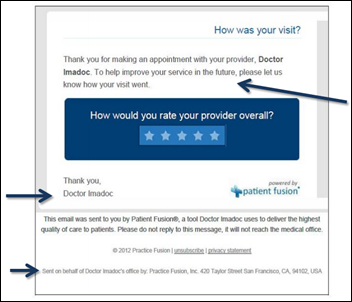
UC San Diego (CA) halts plans to post physician reviews and star ratings on its website after realizing the surveys it sent to patients didn’t disclose that their comments could go public, potentially revealing their identities. The two-hospital system has postponed launching the reviews to redistribute surveys with appropriate disclosure language. While one healthcare executive believes the decision is based on physician pushback in the face of potentially damaging reviews, Practice Fusion’s recent settlement with the FTC over a similar situation lends UCSD’s decision some merit.

image

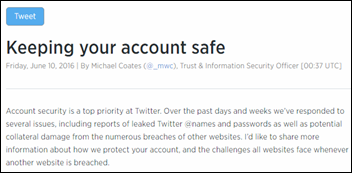
Twitter locks accounts and issues password resets after reports surface that 32 million passwords were leaked on the dark web. The company denies that its servers were hacked, instead attributing the leak to “combining information from other recent breaches, malware on victim machines that are stealing passwords for all sites, or a combination of both.”


People

image

The University of Iowa Health Alliance promotes Jennifer Vermeer to CEO.


Innovation and Research

image

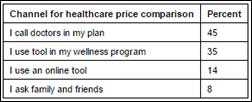
A survey of 750 insured consumers reveals that they aren’t shopping around for healthcare services as much as industry insiders seem to hope they will. Just 30 percent of health plan members comparison shop, and only 30 percent of plans offer comparison-shopping tools. While 42 percent of those surveyed ranked such tools as “very important,” it’s hard to believe that importance would translate to more savvy shopping when a similar percentage believe the "cost is covered by my health plan, so it doesn’t matter."

image

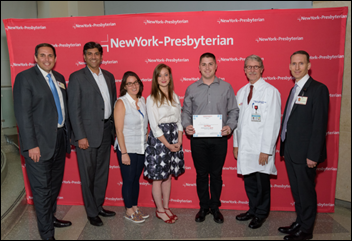
NewYork-Presbyterian Hospital concludes its 10-week long InnovateNYP Pediatric App Challenge, awarding $40,000 to three finalists:

  • FhirStarters pediatric medication administration app, developed by Riley McKenna and Anees Merzi.
  • Teen Screen mental health screening and resource app, developed by Vikas Mandadi.
  • NYP Care Companion patient engagement app, developed by Ekaterina Chernetsova, Roman Makhnenko, Andrew Gluschenko, Dan Piekarz, Alexander Demura, Margarita Olshanskaya, Egor Kobelev, and Allan Wellenstein.

Government and Politics

Illinois-based Boyd Memorial Hospital, HSHS Holy Family Hospital, and Hillsboro Area Hospital will share a $155,000 USDA Learning and Telemedicine grant to expand stroke treatment, neonatal, and pediatric telemedicine programs.


Other

image

Stan Larkin lives for 17 months without a heart by wearing a SynCardia Freedom Portable Driver. Powered by compressed air and worn in a backpack, the artificial heart allowed the 25 year-old – the first patient in Michigan to use the device – to live until he received a successful heart transplant in May.

image

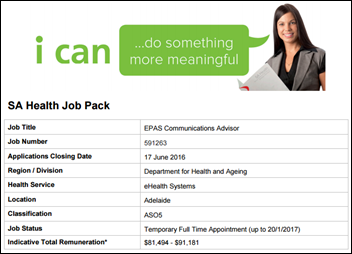
South Australia Health hopes to hire a spin doctor for a six-month stint to convince the public that its highly criticized Enterprise Patient Administration System is worthwhile. The electronic records system is years behind schedule and over budget by over $200 million. Hospital physicians have formally complained that the system cut clinical activity by 50 percent, and have written a letter listing 37 major flaws and pleading for it to be shut down. SA Health named Allscripts as vendor of choice for the 80-hospital, $225 million project in November 2010 and signed the contract a year later.

image

The local paper looks at the hard time physicians often having locating end-of-life directives within EHRs, attributing the problem to a lack of training and/or intuitive field within the EHR. It holds up Gundersen Lutheran Medical Center (WI) as a forward-thinking organization when it comes to advance care planning documents. The hospital made digitizing such documents a priority when it implemented Epic in 2008.


Sponsor Updates

  • Valence Health makes the top 20 of Fastest Growing Companies in 2016 by Crain’s Chicago Business.
  • Verisk Health and ZeOmega will exhibit at AHIP June 15-17 in Las Vegas.
  • Huron Consulting Group will exhibit at Vital 2016 June 15-17 in Boston.
  • Zynx Health will exhibit at the Nurse and Home Care Forum June 15-17 in Foxborough, MA.
  • Black Book names E-MDs the top ambulatory EHR for thoracic and vascular surgery specialties.
  • The Chartis Group Director Jody Cervenak co-authors a chapter in the new second edition of the Oxford Textbook of Critical Care.
  • PokitDok attains Microsoft certification and is inducted into the Microsoft Azure Marketplace.

Blog Posts


Contacts

Mr. H, Lorre, Jennifer, Dr. Jayne, Lt. Dan.
More news: HIStalk Practice, HIStalk Connect.
Get HIStalk updates.
Send news or rumors.
Contact us.

125x125_2nd_Circle

News 6/10/16

June 9, 2016 News Comments Off on News 6/10/16

Top News

image

Practice Fusion settles with the FTC over charges that it misled consumers by asking for reviews of their physicians without adequately disclosing that those reviews would be posted publicly online. The reviews were published in 2012 as part of the company’s efforts to develop a public-facing healthcare provider directory. “Practice Fusion’s actions led consumers to share incredibly sensitive health information without realizing it would be made public,” says FTC Bureau of Consumer Protection Director Jessica Rich. “Companies that collect personal health information must be clear about how they will use it – especially before posting such information publicly on the Internet.” The settlement, which seems to carry no fine, prompted the FTC to publish six privacy pointers, with perhaps the most relevant being, “Disclosures should reach out and grab consumers,” and “Don’t bury key facts in a hard-to-understand privacy policy.”


Reader Comments

From EMR Expert: “Re: Financial trouble in the Middle East. Like many other vendors in various sectors, Cerner, Epic and InterSystems are having tough times collecting their money from existing clients. One of the executives of those companies stated that their Accounts Receivables of the value of more than $15 million is overdue by more than six months. Support contracts are not being renewed and payments for implementation are not honored. It is a catch 22 situation when all their clients were oil rich and now cash strapped governments/government entities.”


HIStalk Announcements and Requests

This week on HIStalk Practice: AMN Healthcare acquires Peak Health Solutions. CancerLinq announces new collaboration and practice sign-up milestones. North Carolina Medicaid reform will include the development of a statewide HIE. South Carolina lawmakers pass telemedicine-friendly legislation. SingleCare partners with American Well. Closed-door meetings in Texas could lead to more telemedicine-friendly legislation. Medfx and Falcon Physician develop software for nephrology practices. FastMed Urgent Care rolls out TouchCare telemedicine services at 57 clinics. Tandigm Health Medical Director Leslie Saltzman, DO shares the hurdles physician groups face when implementing telemedicine tech.


Webinars

June 28 (Tuesday) 2:00 ET. “Your Call Is Very Important.” Sponsored by West Healthcare Practice. Presenters: Cyndy Orrys, contact center director, Henry Ford Health System; Brian Cooper, SVP, West Interactive. The contact center is a key hub of patient engagement and a strategic lever for driving competitive advantage. Cyndy will share how her organization’s call center is using technologies and approaches that create effortless patient experiences in connecting them to the right information or resource. Brian will describe five key characteristics of a modern call center and suggest how to get started.

Contact Lorre for webinar services. Past webinars are on our HIStalk webinars YouTube channel.


Acquisitions, Funding, Business, and Stock

image

Xerox launches Virtual Health Solutions, a new service line that will offer providers telemedicine consulting, interface design and development, and virtual clinic services.

Connecture, a technology company that builds online health insurance marketplaces, acquires ConnectedHealth, a benefits technology platform that helps employers chose health plans. Financial terms were not disclosed.

image

Southcoast Health (MA) reports that its $100 million Epic implementation boosted the local economy by $3 million, mainly through hotel room costs, car rentals, gas, and dining. Nearly a third of the health system’s budget for the project went to costs associated with expenses for Epic staff and consultants.

image

Martin Shkreli jeeringly pleads not guilty to an updated indictment – one that adds a new conspiracy charge to original December allegations that he illegally took stock from a biotechnology firm he launched in 2011 and was fired from three years later. Not surprisingly, the “habitually unavoidable-for-comment Shkreli unloaded as he spoke to customers at a Manhattan Dunkin’ Donuts outlet while live-streaming on Periscope.” In related (and absurd) news, Shkreli blocks presumably reputable reporters from his Twitter stream, and lauds an upcoming satirical musical about his purchase of a $2 million single-copy Wu-Tang Clan album. It will no doubt give Hamilton a run for its money.


Announcements and Implementations

image

Radiology Associates of Macon (GA) extends its RCM agreement with Zotec Partners.

Meditech develops a sepsis management toolkit for select EHR customers.

image

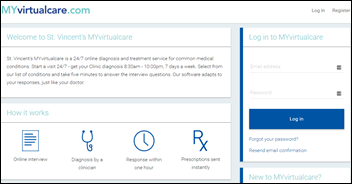
St. Vincent’s Medical Center (CT) rolls out telemedicine services from Zipnosis.

image

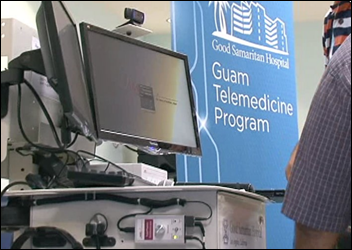
The Guam Dept. of Public Health and Social Services partners with Good Samaritan Hospital in Los Angeles to roll out a specialty care telemedicine program for island residents.


Sales

Houston Methodist (TX), Meadows Regional Medical Center (GA), and Shore Medical Center (NJ) sign on for Unified Provider Management software from Phynd Technologies.


People

image

North Mississippi Medical Center promotes Shannon Fryery to director of telehealth for North Mississippi Health Services.

image

Callie Shaver (Greenville Regional Hospital) joins Jersey Community Hospital as HIM director.

image

Ed Mercado joins Crux Quality Solutions as CEO.


Government and Politics

The VA fires three more administrators within the Phoenix VA Health Care System. Lance Robinson, assistant director at the Carl Hayden VA Medical Center; Brad Curry, chief of health administration service; and Darren Deering, DO the hospital’s chief of staff; were all terminated for “negligent performance of duties and failure to provide effective oversight.” The terminations come more than two years after the exposure of the cover up of a huge backlog in medical appointments that severely impacted veteran care.

image

The House passes the Helping Hospitals Improve Patient Care Act, excluding ambulatory surgical centers from Meaningful Use and MIPS penalties.


Innovation and Research

Cerner launches a one-year pilot study that will help determine whether patient’s genetic data can play a motivating role in promoting behavior change.

A Health Affairs study correlates the use of prescription drug monitoring programs with a 30 percent reduction in the rate of prescribing Schedule II opioids, a change that continued in the second and third years following the launch of the program.

A small Health Catalyst survey of hospital executives finds that 62 percent have between zero and 10 percent of their care tied to the value-based contracts CMS hopes to have hospitals converted to by 2018. Just 3 percent meet the CMS goal of 50 percent value-based reimbursement today, and only 23 percent expect to meet it by 2019.


Technology

image

Avizia adds the patient-facing MyCare app to its AviziaOne telemedicine and secure messaging solution.

image

Experian Health’s Coverage Discovery uncompensated-care alert tool can now integrate with Epic’s EHR.

image

Influence Health develops new digital presence management technologies that include directory listings, reputation, and online provider review ratings tools.


Other

image

Jennifer Lawrence signs on to play Theranos founder Elizabeth Holmes in an Adam McKay-directed drama about the now-infamous blood-testing startup.

image

A mother in Australia uses Siri to call emergency services when she discovers that her sleeping baby had stopped breathing. While the digital assistant may have contributed to saving the girl’s life, it likely had more to do with the mom’s administration of CPR, given that the ambulance took 20 minutes to arrive.


Sponsor Updates

  • Impact Advisors achieves top overall performance score in the KLAS Healthcare IT Advisory Report.
  • InterSystems and PDR will exhibit at AHIP June 15-17 in Las Vegas.
  • LiveProcess will exhibit at the SC Hospital Association Hospital Preparedness Summit June 8 in Columbia, SC.
  • MedData will exhibit at the Southern Coastal Emergency Medicine Conference June 10-11 in Kiawah Island, SC.
  • Medecision signs on as a founding member of the Accountable Care Learning Collaborative.
  • Navicure will exhibit at the Arizona NextGen UGM June 10 in Phoenix.
  • Nordic and Stella Technology will exhibit at the HIMSS New York State meeting June 16 in the Bronx.
  • Millward Brown names NTT Data to its 2016 Brandz Top 100 Most Valuable Global Brands.
  • Obix Perinatal Data System will exhibit at the 2016 AWHONN National Convention June 11-15 in Grapevine, TX.
  • Experian Health will exhibit at the Georgia Society for Managed Care meeting June 12-14 in Jekyll Island.
  • PatientMatters will exhibit at the Ohio Hospital Association Annual Meeting June 13-15 in Columbus.
  • The SSI Group will exhibit at the Gulf States ASC Conference June 15-16 in New Orleans.
  • Catalyze achieves a second HITRUST CSF Certification.

Blog Posts


Contacts

Mr. H, Lorre, Jennifer, Dr. Jayne, Lt. Dan.
More news: HIStalk Practice, HIStalk Connect.
Get HIStalk updates.
Send news or rumors.
Contact us.

125x125_2nd_Circle

EPtalk by Dr. Jayne 6/9/16

June 9, 2016 News Comments Off on EPtalk by Dr. Jayne 6/9/16

image

Thanks to everyone who sent well-wishes about my recent hand injury. I’m happy to report that I’m recovering and have traded out the giant dressing for something more sleek – today I sported a Mickey Mouse themed bandage. I’m seeing patients tomorrow and am a bit nervous about hand hygiene, but our infection control nurse is on board with a plan. I’ll also be running with a scribe, so that will help. Laughter is good medicine and I appreciated one reader’s comment that at least I wouldn’t need to buy a foam finger to cheer my team at the ballpark.

From Florida Orange: “I was reading your post and this sentence jumped out at me: “I know my practice leans heavily towards patient satisfaction scores for determining provider compensation, and the idea that giving patients what they need (rather than what they want) can impact me negatively is always a consideration.” How is satisfaction calculated? HCAHPS scores? Press Ganey? Or Yelp reviews? And what factors make up patient satisfaction?” The methods used vary depending on whether an organization is a hospital or ambulatory group. I’ve actually seen groups use all of the above to assess patient satisfaction, plus other strategies such as anonymous waiting room surveys, online surveys, and more.

In my largely ambulatory world, the factors that come into play include: satisfaction with contacting the office (which may include appointment scheduling and availability); wait time in the office; friendliness and helpfulness of staff; whether patients felt their diagnosis and treatment was explained to their satisfaction; willingness to recommend the office to other patients; and more. My practice uses a third-party survey service that emails a link to the patient and we can see responses via a practice dashboard. They’re not anonymous and we contact anyone who doesn’t give us at least four out of five stars overall or offers narrative comments that are concerning.

Everyone likes getting good reviews, and the percentage of four- and five-star reviews impacts our bonus calculation, as does our ability to care for patients in a timely manner when they arrive. As a member of the executive team, I get an email notification when a patient activates the survey link. Sometimes this happens when I know the patient has to be driving home from the visit, which is amusing. All of our patients are emailed the survey at the time of check-out, even those that we know had less than optimal experiences. The times when we didn’t’ do well are the most important for learning and we really need that feedback.

Different organizations weigh the impact of their results in different ways. I worked with an organization a few years ago that lived and died by their Press Ganey statistics, even when the results didn’t make sense as far as supporting the organization’s overall goals. As organizations evolve along with our changing healthcare system, it’s going to be increasingly important for groups to evaluate their survey strategies on a regular basis. If processes have been improved and responses are flat, maybe it’s time to measure different elements.

Patient engagement is an increasing part of patient satisfaction, and at last week’s ONC Annual Meeting they launched a Patient Engagement Playbook. It’s designed to help organizations improve patient engagement via patient portal usage. The first phase encourages clients through the critical steps of making enrollment easy; activating features that patients want; allowing proxy access for caregivers; and integrating patient-generated health data. Physicians often resist the last item, so if you work with those who might fall into that category, a quick read might be in order.

image

From Jimmy the Greek: “OK, Dr. Jayne, tell me why this patient portal view of lab results is useless. That’s right, campers, there’s no ‘normal range’ displayed.  Just how the hell is a non-clinician supposed to interpret these values?  Should I turn to Dr. Google?  Should I make a follow-up appointment with my doc to talk through the results?  Should I expect a phone call to discuss them? I have loads of data, but no way to turn the data points into useful information.” This goes right along with my recent post about trends in organizational patient portal release policies. The mere fact of releasing labs to patients doesn’t necessarily empower them, and without the right supporting information can lead to patient frustration or worry. I don’t immediately recognize this vendor, so I can’t tell whether there are other features that would help the patient understand their results such as hovering over them, but from other correspondence, Jimmy seems to be a pretty astute IT guy and would likely have picked up on something like that.

image

Aprima is hosting its annual User Conference at the Omni Dallas Hotel August 5-7th. A piece on their blog caught my eye, since it quoted a client from a practice named “Serenity Now Psychiatric and Counseling Services.” That’s probably one of the best practice names I’ve seen in a long time. The write up also caught my eye since they’re offering a service project where attendees can assist with making blankets, gift bags, and other items for patients at Children’s Medical Center in Dallas. I love seeing companies help the community.

Are you a vendor who gives back? Email me.

Email Dr. Jayne

Breaking Down Blockchain’s Healthcare Potential

June 9, 2016 News 2 Comments

HIStalk looks at the evolution of blockchain, barriers to adoption in healthcare, and its potential to truly put patients at the center of care.
By
@JennHIStalk

The blockchain concept, while not new, certainly suffers from a lack of healthcare-related glitz and glam, a dearth of bells and whistles that seems to have kept the wallets of Silicon Valley insiders tucked tightly in their pockets (or pocketbooks). Like its VC funding, healthcare headlines relating to blockchain are few and far between – a good indication that the concept has some ways to go before reaching critical mass.

Many automatically associate the word with bitcoin – that much ballyhooed digital currency that has tried time and again to take the world by storm. Those more in the know equate it to financial markets, where authentication and security are key. A small but growing number of IT insiders see it as an initially humble solution to healthcare’s many problems (cybersecurity, claims delivery, interoperability, etc.) – one that may mature into a more dazzling and potentially game-changing business process down the road.

Its true potential in healthcare and in any number of other industries will only be realized once stakeholders truly understand its nature, barriers to adoption, and potential, including moonshots and more down-to-earth applications.

Understanding What Blockchain is (and isn’t)

Definitions of blockchain abound, and, depending on the resource, can be either fairly easy to understand or almost too abstract to contemplate. Techopedia defines it as “a critical part of the bitcoin peer-to-peer payment system.” Investopedia goes a bit further, defining it as a “public ledger of all bitcoin transactions that have ever been executed. It is constantly growing as ‘completed’ blocks are added to it with a new set of recordings. The blocks are added to the blockchain in a linear, chronological order.” These summaries are, in fact, too narrow, given that a blockchain does not in fact have to be tied to bitcoin.

image

“To begin with, blockchain is not equal to bitcoin,” explains PokitDok Chief Scientist Bryan Smith, who is ushering the healthcare transactions technology company into early blockchain adoption. “A blockchain, at its essence, is a distributed database containing records whose contents, authenticity, and security are guaranteed. It drives efficiency, protects rights through immutable records, and establishes a system of accountability – an imperative in the often murky world of healthcare claims and reimbursement.

“With blockchain,” he adds, “engaged participants could opt in to share information that they want to share. That data could be accessible to authorized parties through a variety of front ends – from a mobile device to a sensitive compartmented information facility. There’s no other database that exists with that kind of functionality.”

image

Smith’s evangelism seems well founded. What provider, patient, or payer wouldn’t want access to a single database that could act as one source of truth for health data? Jerry Cuomo, vice president of blockchain technologies within IBM’s new cloud group, believes blockchain has the potential to consolidate disparate versions of the truth – a concept that would seem to play well with industry efforts around interoperability and a national patient identifier. “In the current world,” Cuomo says, “everyone is keeping their own version of the truth, their own system of record. When something comes in, everyone is working in silos. Each organization has to look at that transaction and determine if it matches their view of the truth. If not, they have to make it match by converting it to their preferred format. Those are all opportunities for things to go wrong. With a blockchain, you’re working across a replicated, encrypted, shared ledger that has an audit trail. It reduces the attack surface because now it’s just one ledger that everyone is sharing.”

Gauging its Potential

image

Brian Behlendorf, executive director of The Linux Foundation’s Hyperledger blockchain project, says. “Blockchain addresses concerns of security, scalability, and privacy of EHRs.”

Cuomo, whose team is working to develop blockchain pilots across a range of industries, envisions several “moonshot” applications for healthcare, including a patient-centered blockchain that would give providers limited access to a patient’s health record during time of service. “Just imagine a patient who is about to go into the hospital for an overnight stay,” he says. “The patient could set up a contract with the hospital, giving it 24-access to their healthcare records via blockchain. After the 24 hours are up, the hospital can’t add or make changes to that record, which reverts back to patient ownership. The patient sets the terms of who sees the record, for how long, and under what conditions. It becomes a truly patient-centered healthcare record that follows that patient from doctor to doctor.”

Cuomo also believes that new business models around healthcare blockchains are bound to spring up. “Imagine having the ability to advertise your healthcare information via your blockchain – to let organizations know that you’re interested in participating in clinical trials. You could proactively shop out your healthcare information to improve healthcare and better mankind. If those trials offer payment, you could theoretically offset the cost of your healthcare premium for the year. There’s no systematic way to do that today because your healthcare information is all over the place. In a blockchain and a corresponding ecosystem built up around that, patients might be able to more easily – and securely – contribute to medical research.”

From Big Ideas to Practical Applications

Moonshots often trump more practical use cases when a technology is just getting off the ground. While big ideas are essential to generating buzz around an up-and-coming innovation (Tricorder, anyone?), it is the less sexy application that ends up being a springboard for future headline-generating products and services. Where healthcare is concerned, blockchain may be poised to have the most immediate impact on the claims process.

“If you look at the healthcare ecosystem,” Smith explains, “there’s the patient, the insurance companies, and the providers. Sitting between each of them is some kind of intermediary. On average, processing a claim accounts for anywhere between 20 and 40 percent of the total bill. Overhead is significant, and it may be three months after a medical visit that you get an annoying bill that is often impossible to understand. Five years from now, we’ll see blockchain foster dramatic gains in economic productivity and authenticity much like the Internet introduced.”

Cuomo sees immediate potential in the area of dispute resolution. “A lot of these healthcare insurance environments are always dealing with disputes, often in the tens of thousands range,” he says. “It could be innocent things stemming from improper documentation. These things get held up in the system. They take time to resolve, and money isn’t flowing. When money isn’t flowing, it’s bad for everyone. You can’t pay your bill, people aren’t getting paid, etc. A blockchain could be used to enrich claims processing by tracking events. Those events could be used and consented on to be a source of truth – maybe not eliminating disputes, but reducing the time it takes to settle them. A great win-win for everyone.”

Behlendorf, who spent several years helping the White House and HHS use open-source software to drive adoption of shared medical records, also sees potential in blockchain’s ability to drive the sharing of patient records. “While we moved the needle substantially in our work on CONNECT and Direct,” he says, “there are still many who view patient data as their proprietary edge, not something that belongs to the patient. This is not just unfortunate and archaic; it is life-threatening when relevant health data isn’t shared.

“But, there are stakeholders who have a much greater interest in seeing a comprehensive record of patient care, and are in a connective position in the ecosystem. Insurers, for instance, will play a large role here, as well as the new wave of ACOs, and, by proxy, Medicare and the VA. Here, patient care and outcomes are comprehensively consulted, and the blockchain can provide not only a history of care (with permissions managed via keys), but it can also provide proof of authenticity for records shared between such organizations.”

Lessons Learned from Interoperability

Obtaining industry consensus on a common set of standards that levels the competitive playing field has historically been hard to achieve in healthcare. While Behlendorf, Cuomo, and Smith are certainly idealists in their take on the technology’s potential, they are also realists when it comes to calling out barriers to adoption.

“The barriers to adoption of information-sharing standards in the healthcare industry are many and difficult,” Behlendorf explains, “and few have to do with inadequate technology, but instead with alignment of incentives. What blockchain technology might do is introduce new players and new incentives to the market, thus potentially changing that landscape. It also introduces new risks, since we’re talking about widely shared data (even if encrypted), so we can’t be in a rush to implement. We’re very eager to work with the healthcare industry to investigate where we might see some early wins. The challenge, as always, is to find a set of stakeholders with enough of a common interest that they are willing to invest and collaborate. I’ve seen that first-hand in the healthcare industry, so I know it’s possible.”

Cuomo emphasizes the “network effect” necessary to get blockchain off the ground in healthcare. “It starts with a group of companies working together,” he says. “I think the network would be sparked by a set of influencers, like a set of major hospitals coming together, with sponsorships from one or more payers, which would motivate patients to come in and manage their health records via blockchain.

“But,” he adds, “therein lies the rub. That social pact has to be made. There has to be benefit for groups to come together. There’s a social side to it that’s probably more important. The technology facilitates businesses working together with less friction, with a heightened sense of trust and accountability, but you’ve got to agree on those things.”

Moving Ahead with Early Adoption

Smith is confident that every healthcare stakeholder – from providers to banks – will soon be evaluating how blockchain will impact their business processes. PokitDok, which itself is in the process of developing a blockchain system that Smith believes will significantly improve the security of sensitive health data while simultaneously making that data more readily accessible to authorized parties in real time. The company has also founded a Healthcare Blockchain Consortium to further evangelize the technology. While not quite ready to share specifics, Smith says that the consortium will “develop collective efforts to truly effect meaningful change in how healthcare is administered, delivered, and consumed worldwide.”

Cuomo and his team at IBM launched cloud-based blockchain services in April for healthcare, government, and financial services, and are working on internal and external proof-of-concept projects (including collaboration with the Linux Foundation’s Hyperledger Project) that he hopes will further escalate healthcare’s interest.

Behlendorf also takes an early-days approach to moving forward with blockchain in healthcare, stressing that the Hyperledger Project is not a standards effort. “We are here to build software,” he says, “and in doing so, lift the blockchain ecosystem as a whole, across all industries. We would be very excited to see new members from the healthcare industry participate so that we can understand their needs, collaborate, and build the core platform. As open-source software communities have shown, those companies that participate end up with an operational advantage in understanding how this technology can transform their business. They also see their staff develop expertise in a domain that is difficult to simply buy or outsource. This is about building an ecosystem and everyone has new roles to play if they recognize that and invest in transformation.”

News 6/8/16

June 7, 2016 News Comments Off on News 6/8/16

Top News

image

Vice President Joe Biden launches the Genomic Data Commons at the University of Chicago with $70 million from the National Cancer Institute. As part of the Cancer Moonshot and Precision Medicine initiatives, the commons will receive, store, and organize clinical and genomic data, and offer it to cancer researchers in user-friendly formats.


Webinars

June 28 (Tuesday) 2:00 ET. “Your Call Is Very Important.” Sponsored by West Healthcare Practice. Presenters: Cyndy Orrys, contact center director, Henry Ford Health System; Brian Cooper, SVP, West Interactive. The contact center is a key hub of patient engagement and a strategic lever for driving competitive advantage. Cyndy will share how her organization’s call center is using technologies and approaches that create effortless patient experiences in connecting them to the right information or resource. Brian will describe five key characteristics of a modern call center and suggest how to get started.

Contact Lorre for webinar services. Past webinars are on our HIStalk webinars YouTube channel.


Acquisitions, Funding, Business, and Stock

image

Cerner President Zane Burke tells the Kansas City Business Journal that CEO Neal Patterson “remains very active and involved” during his treatment for soft tissue cancer, for which he was diagnosed in January. “In many respects, this will help both him and us as he focuses on his next chapter at Cerner and for Cerner. I think … being a consumer of healthcare will have significant impacts as he comes back into the day to day. I think the consumer is going to have a much stronger voice as we move forward.”

image

HCS moves to expanded office space in Wall Township, NJ.

image

Hospital purchasing analytics startup Valify raises $2 million in Series A funding led by Frist Cressey Ventures and Step 5 Capital. The Frisco, TX-based company, which has raised $2.75 million since launching in 2014, will use the funds to hire additional sales reps and developers, and for R&D.

image

Theranos reports that it has voided or corrected less than 1 percent of blood test results, seemingly a far cry from the tens of thousands of results it said it was planning to cancel or change last month. Perhaps the math adds up, though it’s not likely the secretive company will release exact numbers.

Madison, WI-based healthcare API vendor Redox joins the six-month Cisco Entrepreneurs in Residence (Cisco EIR) program in Silicon Valley.

Google’s Verily Life Sciences venture comes under fire as development of its much-hyped cancer-detecting “Tricorder” device, smart contact lens, and Baseline human health study continue to flounder. Several anonymous Verily employees claim that the Tricorder, originally scheduled for launch more than two years ago, has been touted internally more as a buzz generator than as a project capable of true clinical impact.


Sales

image

The California Emergency Medical Services Authority signs a contract with Audacious Inquiry for the ONC-funded development of a Patient Unified Lookup System for Emergencies. The standards-based system will leverage the state’s existing HIE infrastructure when activated during disasters, and ultimately build new connectivity between providers .


People

image

Virginia Mason Medical Center (WA) promotes former CIO and CFO Suzanne Anderson to CEO.

image

Jay Lechtman (Quantros) joins Riskonnect as senior director, market strategy and development.

image

Patrick Flynn (Phytel) joins Aventura as COO.

image

Apple hires Rajiv Kumar away from Lucile Packard Children’s Hospital (CA), presumably to work on healthcare-related activities. Kumar developed a HealthKit-enabled diabetes monitoring system last fall in his role as medical director of clinical informatics.


Announcements and Implementations

image

Cardiology Associates of North Mississippi goes live on MedAptus charge capture software for services provided at North Mississippi Medical Center.

image

Delta Regional Hospital (MS) switches back to Meditech, confirming a late-April reader rumor that the 325-bed acute-care facility was in the process of ripping out Cerner.


Government and Politics

image

CMS issues a nearly 300-page final rule on MSSP ACOs outlining changes to the program’s benchmarking methodology, a new alternative participation option that encourages participants to enter performance-based risk arrangements sooner, and policies for addressing payment corrections.


Technology

Presidiohealth adds T-System’s EDIS software to its new PM technology for freestanding emergency centers.


Other

image

This article highlights the social media fame several plastic surgeons have attained thanks to their love of Snapchat and penchant for posting graphic procedures. Michael Salzhauer, MD (aka Dr. Miami) attempts to put an educational spin on his soap opera-like snaps: “A good percentage [of those watching] are people either in the medical field or interested in pursuing careers in medicine — maybe 30 percent, based on the messages we get. Another 30 to 40 percent are people who are thinking about having surgery, either immediately or sometime in the future.”


Sponsor Updates

  • AirStrip President Matt Patterson will speak at MD&M East June 14-16 in New York City.
  • IDC ranks AirWatch as the largest enterprise mobility management vendor in terms of market share for 2015.
  • Aprima will exhibit at Sleep 2016 June 13-15 in Denver.
  • Audacious Inquiry offers its “Health IT Framework to Support Alternative Payment Models” for download.
  • Besler Consulting releases a new podcast, “How to Fix Common Physician Documentation Mistakes.”
  • CapsuleTech will exhibit at the HIMSS New York State meeting June 16 in the Bronx.
  • Carevive Chief Clinical Officer and co-founder Carrie Stricker, RN will speak at the Biennial Cancer Survivorship Research Conference June 18 in Washington, DC.
  • CitiusTech will exhibit at AHIP June 15-17 in Las Vegas.
  • CoverMyMeds will exhibit at the American Diabetes Association Scientific Sessions June 11-13 in New Orleans.
  • Cumberland Consulting Group Managing Partner Rachel Wixson is featured in the Forbes self-made women issue.
  • Elsevier Clinical Solutions CEO Ron Mobed is featured in STEMconnector’s “100 CEO Leaders in STEM.”
  • Healthwise is honored with a 2016 When Work Works Award for its workplace strategies as part of the national When Work Works project.
  • Spok releases a new infographic highlighting customer success statistics and the ROI of communication technology.
  • Wellcentive will host its annual National Consultant and Analyst Summit June 8-9 in Atlanta.
  • The latest KLAS advisory report recognizes Nordic as a top performer, and The Chartis Group as one of the top five comprehensive firms.

Blog Posts


Contacts

Mr. H, Lorre, Jennifer, Dr. Jayne, Lt. Dan.
More news: HIStalk Practice, HIStalk Connect.
Get HIStalk updates.
Send news or rumors.
Contact us.

125x125_2nd_Circle

Curbside Consult with Dr. Jayne 6/6/16

June 6, 2016 News 3 Comments

image

I’m a little slow on the typing this week, owing to a little craft-related accident. Although I expect to make a full recovery, I’m glad I’m up to date on my tetanus immunizations. I’m also glad I wasn’t crafting alone, so I had someone to drive me to my office so my partners could get a good chuckle about taking care of me. I was selected to receive a patient satisfaction survey and was happy to give them five stars. My crafting buddy got a kick out of seeing what happens when a doctor phones ahead for their own urgent care visit and offered lots of moral support (and only a few snarky comments).

Fortunately, I had finished most of what I needed to do this weekend before the incident, so it was a good excuse to catch up on the Netflix mailers that have been mocking me from across the living room. I also spent some time editing a research article that a friend is working on. It’s around the release of test results (laboratory and radiology/diagnostic) through patient portals and how their use is impacting patient engagement and provider behaviors.

When I first started working on patient portals about eight years or so ago, there was a lot of anxiety about releasing results directly to patients. In particular, my physicians were concerned about being able to review results first and contact patients before they saw them on the portal. Our hospital brought in some “hired guns” to help us achieve clinician buy-in – a couple of CMIOs from hospitals that had done this previously and lived to tell. We ended up setting a pretty significant delay on the release of results to make sure we allowed for plenty of time for physicians to contact patients first.

A lot has changed since then, including physician attitudes. Meaningful Use set the expectation that visit summaries would be available to patients fairly quickly, and physicians were forced to respond. Additionally, organizations are sending full visit notes and other documentation to the patient, not just lab results or summaries. With my trip to the urgent care today, I had my visit note within an hour of arriving home. My colleague surveyed physician leaders at various institutions to obtain data on how they are releasing results. The data is interesting. Most hospitals still have delays, which coincide with the deadlines imposed by Meaningful Use. Some release inpatient labs sooner than outpatient, and some don’t release inpatient labs at all. The majority of respondents said that they don’t release sensitive lab results – sexually transmitted diseases, drug testing, genetic testing, etc.

Organizations were fairly split on the release of pathology results – some don’t release them at all, and others release but on a longer timeline, usually seven to 10 days. Several responded that they release but only based on a manual release process – no automatic triggers. A couple of respondents said they didn’t know what their institution’s release policy was and one respondent said they didn’t think there was a policy in place. One reply discussed the hospital’s plan to completely revamp their release strategy, with plans to immediately release non-sensitive blood testing and plain film radiology as soon as those tests are flagged with a final status.

In talking to my friend about her work trying to round up the results, she had some interesting stories to tell. Although many of the stories are anecdotal, they are interesting nonetheless. One hospital had decided to go to an immediate release policy and then had to go back on it, blocking release of labs from the Emergency Department. It seems that patients were getting their results from the lab before the ED staff had a chance to review and act on them, and there were several incidents of patients becoming aggressive because they knew results were available and hadn’t been addressed.

In addition to changes in how physicians address test results after the fact, the paper notes some changes to ordering behaviors. Respondents stated they were more likely to counsel patients on the potential significance of results at the time of ordering, so that the plan would be in place before the test was ever ordered. This would seem to be a big win for patient engagement, as well as for practice efficiency. I know I tended to do this when I was in traditional primary care practice, because shared decision making is a lot easier in the exam room than over the phone.

Patient portal access for adolescents continues to be a major issue, with some organizations locking out patients from ages 12 to 18. Some allow limited access for parents during the adolescent period, where others allow full parental access but require the adolescent to consent to it. Nearly all respondents grappling with the adolescent issue cited the concern that a chart with blocked information or hidden information would be a patient safety issue, although they acknowledge that there are state laws and other regulatory factors at play that make the situation difficult.

One of the other questions asked in her survey was around the ownership of the decision to release or not to release data, and when. She specifically asked whether that has changed since the institution of the patient portal. Most organizations have made changes to their release strategy and I would bet these strategies continue to evolve. In my opinion, the most significant change has been the addition of patient/family advisory groups to the discussion. We didn’t see that very often in the early days and it’s a welcome addition in my book. I haven’t edited a scholarly article in a while so it was a nice exercise, and hopefully my penmanship wasn’t too atrocious with my stiff index finger. She’ll be submitting it formally in a few weeks and I can’t wait to see it in published form.

For me, though, it’s back to Netflix. What’s your favorite streaming series? Like to binge watch? Email me.

Email Dr. Jayne

Monday Morning Update 6/6/16

June 5, 2016 News 2 Comments

Top News

image

Rumors surface – again – that McKesson is considering selling or merging its McKesson Technology Solutions business unit in the face of drug pricing pressures. (As MCK Auto Pilot commented in March, laid off McKesson employees were already pontificating upon the likelihood of a near-term sell-off.) The Atlanta-based company cut 1,600 jobs – nearly 4 percent of its US workforce – that same month in an effort to cut costs after losing key pharma customers. MTS had $2.9 billion in sales in the last fiscal year, and an operating profit of $519 million. McKesson’s drug business had $188 billion in sales in the fiscal year and a profit of $3.6 billion.


HIStalk Announcements and Requests

image

Welcome to new HIStalk Platinum Sponsor Meditech. The Westwood, MA-based company basically created the healthcare IT industry in the 1960s and continues to provide its customers with "One Patient, One Record, One Bill, One Portal" systems at a sustainable cost. Clinicians designed the company’s shared, mobile, patient-centered Web EHR to deliver usability, with just-in-time relevant information displayed on easy-to-use personalized screens and a fast-track implementation plan that accelerates the time to value. Meditech is used by 250,000 doctors who are safely and effectively treating 100 million patients across all care settings with 100 percent utilization and high levels of productivity, paying attention to their patients rather than to their EHR. Meditech-using health systems have earned awards such as HIMSS EMRAM Stage 7, Magnet, Davies, Baldrige, and various "top hospitals" lists. Thanks to Meditech for supporting HIStalk.


Webinars

June 28 (Tuesday) 2:00 ET. “Your Call Is Very Important.” Sponsored by West Healthcare Practice. Presenters: Cyndy Orrys, contact center director, Henry Ford Health System; Brian Cooper, SVP, West Interactive. The contact center is a key hub of patient engagement and a strategic lever for driving competitive advantage. Cyndy will share how her organization’s call center is using technologies and approaches that create effortless patient experiences in connecting them to the right information or resource. Brian will describe five key characteristics of a modern call center and suggest how to get started.

Contact Lorre for webinar services. Past webinars are on our HIStalk webinars YouTube channel.


Last Week’s Most Interesting News

  • Billionaire Patrick Soon-Shiong, MD takes NantHealth public in a $91 million offering.
  • A federal appeals court rules against Epic, deciding that companies cannot force their employees to sign arbitration agreements that prevent them from filing lawsuits against their employer.
  • ONC reports that 84 percent of US hospitals had adopted a basic EHR by 2015, up from just 9.4 percent in 2008.
  • Forbes lowers its estimate of Theranos founder Elizabeth Holmes’ net worth to zero, down from $4.5 billion.
  • The Washington Redskins confirms that the medical records of thousands of NFL players have been compromised after a laptop belonging to one of the team’s trainers was stolen in April.

Acquisitions, Funding, Business, and Stock

image

TrueVation sells the Canadian rights to PatientPrep to Canadian EHR vendor QHR for $500,000. TrueVation, which has headquarters in the US and Canada, will continue to own and market the patient onboarding software in the US.

Fortune contributor Dan Primack challenges the magazine’s revised estimate of the net worth of Theranos founder Elizabeth Holmes (from $4.5 billion to $0), pointing out that its original estimate was way off the mark. “Like other founders of privately-held startups,” he says, “Holmes did not hold any liquid securities in her company. It’s possible that she sold some shares along the way ― as small secondary transactions alongside broader company fundraises ― to pay the mortgage or buy a car (even a nice car), but the vast majority of her holdings had little more than theoretical value. Elizabeth Holmes has plenty to worry about. Losing $4.5 billion that she never really had shouldn’t be one of them.”


Announcements and Implementations

image

Glendora Community Hospital (CA) implements an e-forms solution from Access in its ER and admissions departments.

image

Validic adds Finland-based Polar wearables to its digital health ecosystem of devices, wearables, and apps for corporate wellness programs and remote monitoring programs.

Intermountain Healthcare (UT), Providence Health & Services (WA), Stanford Cancer Institute (CA), and precision medicine software company Syapse form the Oncology Precision Network to share aggregated cancer genomics data and increase access to clinical trials, particularly for patients in underserved communities.

Cloud solutions and health IT consulting firm CloudWave (fka Park Place International) partners with Commvault to offer Meditech users data backup, archiving, and disaster recovery solutions.

image

St. Luke’s Hospital (MN) implements SIS perioperative IT solutions to complement its Meditech EHR.

RCM vendor Rev-Ignition will offer its clients paperless billing solutions from PatientPay.


People

image

Joel Sangerman (Option Care) joins Zillion Health as vice president of sales, managed markets. (You can read my May 2016 interview with Zillion President Bill Van Wyck here.)

image

Jennifer Dangar (The Weather Company) joins Jackson Healthcare in the new role of chief of corporate operations.


Technology

Rennova Health adds electronic medication management software to its Medical Mime M2Select EHR for substance abuse treatment and behavioral health providers.

image

Baltimore-based ICmed develops software to help families coordinate, document, and share health data and care plans.


Privacy and Security

image

ProMedica Bixby and Herrick hospitals (MI) alert 3,500 patients that their medical records were inappropriately accessed by seven employees – three of whom have been fired. The hospitals have launched an internal investigation into the breach and implemented an auditing program that includes EHR monitoring tools.


Other

image

The universe nearly implodes when Apple’s App store and several other services including ITunes goes down for seven hours on Friday. The company offered no explanation for the outage, leading several message boards to proclaim it had been hacked.


Sponsor Updates

  • First DataBank publishes FDB MedKnowledge Canada in Canadian French.
  • PatientMatters will exhibit at the Illinois Hospital Association Small & Rural Hospitals Annual Meeting June 8-9 in Springfield, IL.
  • Streamline Health and T-System will exhibit at the 2016 CHIA Convention & Exhibit June 5-8 in Long Beach, CA.
  • The local paper profiles the expansion of TierPoint’s data center in Milwaukee.
  • Valence Health will exhibit at the National Bundled Payment Summit June 7-9 in Washington, DC.
  • VitalWare publishes a client success story featuring a Chicago-based health system.
  • Wellsoft will exhibit at the NAFEC Annual Conference June 6-8 in Houston.
  • ZeOmega posts a new video, “The Future of Population Health Management and Value-based Care: The ZeOmega Perspective.”

Blog Posts


Contacts

Mr. H, Lorre, Jennifer, Dr. Jayne, Lt. Dan.
More news: HIStalk Practice, HIStalk Connect.
Get HIStalk updates.
Send news or rumors.
Contact us.

125x125_2nd_Circle

News 6/3/16

June 2, 2016 News 1 Comment

Top News

image

Forbes revises the estimated net worth of Theranos founder Elizabeth Holmes from $4.5 billion to $0. The magazine named her the youngest self-made female billionaire in 2015. (Judy took the number-three spot this year.) Its estimate of her wealth is based on her 50-percent stake in Theranos, which Forbes values at $800 million. As Lorre mentions in her latest HIStalk Connect post, Holmes owns common stock, so there won’t be much left by the time investors cash out on preferred shares of the $724 million they invested.


HIStalk Announcements and Requests

This week on HIStalk Practice: CMS opens up the CPC+ program to eligible primary care practices enrolled in Medicare ACOs. MGMA’s latest physician compensation survey shows continued uptick in primary care pay. ONC develops transparency dashboard to help providers comparison shop for healthcare IT. Care Management Solutions of Louisiana implements EQHealth Solutions population health management tech. Curmudgeonly bookstore owner gives Mr. H a run for his pet peeve money. Direct Urgent Care founder Caesar Djavaherian, MD offers thoughts on price transparency and the benefits of EHR-integrated digital stethoscopes.

This week on HIStalk Connect: Nokia completes its acquisition of Withings. CB Insights reports 2016 is on track for a record year in digital health deals and funding. Lorre reviews Paul Kalanithi’s memoir, “When Breath Becomes Air.” Houlihan Lokey’s Dmitry Krasnik shares his growth predictions for healthcare IT. Proskriptive’s Michael Hollenbeck shares his journey from sales leadership to startup founder.

Here is video from HIStalk Connect’s first meetup, held last week in Pasadena, CA. The event featured Stacy Bamberg, CEO of Veristride, who shared the journey of a young startup in developing a healthcare data analytics platform leveraging IoT via an insole wearable. Email Lorre if you’re interested in having HIStalk Connect sponsor your next meetup.


Webinars

June 28 (Tuesday) 2:00 ET. “Your Call Is Very Important.” Sponsored by West Healthcare Practice. Presenters: Cyndy Orrys, contact center director, Henry Ford Health System; Brian Cooper, SVP, West Interactive. The contact center is a key hub of patient engagement and a strategic lever for driving competitive advantage. Cyndy will share how her organization’s call center is using technologies and approaches that create effortless patient experiences in connecting them to the right information or resource. Brian will describe five key characteristics of a modern call center and suggest how to get started.

Contact Lorre for webinar services. Past webinars are on our HIStalk webinars YouTube channel.


Acquisitions, Funding, Business, and Stock

image

MedAssets-Precyse acquires Salt Lake City-based analytics and consulting firm Equation for an undisclosed sum. MedAssets and Precyse were acquired by Pamplona Capital Management last year; full integration of the companies is expected to wrap up this year.

image

EarlySense secures a $25 million funding round led by Israel-based Bank Hapoalim. The company, which has offices in Israel and Massachusetts, has raised $100 million so far. Its under-the-bed monitoring sensors are used in healthcare settings and as part of consumer health products like Samsung’s SleepSense tracker.

Patient rehab tech firm Moving Analytics raises $1.1 million in funding led by Launchpad Digital Health. The Los Angeles-based company will use the money to further develop its home-based cardiac rehab tool and to develop a complementary COPD product.


Sales

image

Presbyterian Healthcare Services (NM) signs a three-year contract with MedeAnalytics for enterprise analytics services. PHS consists of eight hospitals, a statewide health plan, and multispecialty physician group,


Announcements and Implementations

image

DirectTrust gives consumers secure-messaging access to its network of 58,000 healthcare organizations and 1.2 million email addresses.

image

Texas Tech University Health Sciences Center reports positive results from its Delivery System Reform Incentive Payment (DSRIP) program, which included adoption of population health management software from Enli Health Intelligence. Outcomes included a 60-percent increase in foot exams and a 100-percent increase in Pneumovax screenings over a 12-month period.

image

Medical University of South Carolina deploys Epic’s integration of Vidyo virtual visit software into Hyperspace and MyChart Web and mobile apps.

St. Joseph Medical Center joins the Greater Houston Healthconnect HIE.


People

image

Dave Jansen (Sagacious Consultants) joins The Wilshire Group as senior consultant.

image

Noel Allender (Jacobus Consulting) joins Leidos Health as Epic practice managing director.

image

Bobby Tuli (Healthgrades) joins Geneia as head of product management.


Government and Politics

image

ONC launches a new website focused on improving health IT vendor transparency that gives providers an opportunity to review mandatory cost and system limitation disclosure statements on products in the marketplace.

ONC awards Boston Children’s Hospital $275,000 as part of a $625,000 cooperative agreement announced at HIMSS that will help create a FHIR App Ecosystem. Boston Children’s will be tasked with developing an online app discovery site, which ONC hopes will simplify the process of publishing health IT apps, and the ability to discover and compare them.


Privacy and Security

image

The paper and digital medical records of thousands of NFL players are stolen from a Washington Redskins trainer’s car during an April break-in. The thief absconded with a backpack containing a password-protected but unencrypted laptop that had copies of player medical records and medical exam results for NFL Scouting Combine attendees dating back to 2004. The bag also contained a zip drive and hard copy records of similar documents. According to the NFL, its electronic monitoring system prevented medical records in its EClinicalWorks EHR from being downloaded. No foul play seems to have occurred thus far as a result of the breach.


Innovation and Research

image

CHIME concludes the Concept Blitz Round of its Healthcare Innovation Trust National Patient ID Challenge, and names two winning submissions that will each receive $30,000. The contest will now move on to the final round, which will award a $1 million prize to the winning team.

Researchers at Geisinger Health System (PA) analyze the EHRs of over 2,000 patients admitted to the hospital for overdoses during a 10-year period to look for patterns that may indicate a likelihood of death or complications. Not surprisingly, predictors of the most dire outcomes included higher prescription opioid use, concurrent chronic diseases and mental disorders, and use of other psychotropic medications.


Technology

image

TigerText adds Honeywell scanning and bot technology to its messaging platform, enabling care teams to verify patient identity and pull data directly from the EHR.

Clinical Computer Systems will integrate its Obix Perinatal Data System with Meditech versions 6.15, 6.16, and beyond.

image

Seniorlink develops care coordination and communications technology that connects ACOs, managed care organizations, and providers with caregivers.

Best Computer Systems adds DrFirst’s Backline communication and care collaboration technology to its BestRx pharmacy management system.


Sponsor Updates

  • AirWatch releases the latest episode of its Echo One podcast.
  • Bernoulli publishes a poster on alarm reduction it presented during the annual NPSF Patient Safety Congress last week in Scottsdale, AZ.
  • Besler Consulting renews its HFMA Peer Review designation for its transfer DRG Revenue Recovery service.
  • Bottomline Technologies announces new board members.
  • Crain’s Cleveland Business features Direct Consulting Associates.
  • EClinicalWorks will exhibit at the AAOE 2016 Annual Conference June 9-12 in San Francisco.
  • Extension Healthcare, FormFast, and InterSystems will exhibit at the E-Health Annual Conference June 5-8 in Vancouver.
  • Glytec highlights studies presented at the AACE Annual Scientific and Clinical Congress in Orlando.
  • The HCI Group EVP of Clinical Services Bob Steele is elected to the HIMSS Health IT User Experience Committee.
  • Live Process will exhibit at the AAMI 2016 Conference & Expo June 3-6 in Tampa, FL.
  • MedData will exhibit at the Advanced Institute for Anesthesia Practice Management meeting June 3-4 in Las Vegas.
  • Navicure publishes a new resource guide, “Getting Billing Right.”
  • Nordic will host the Qlik Healthcare Wisconsin Users Group Meeting June 9 in Madison, WI.
  • Obix Perinatal Data Systems adds two new videos to its “Ask the Experts” series.

Blog Posts


Contacts

Mr. H, Lorre, Jennifer, Dr. Jayne, Lt. Dan.
More news: HIStalk Practice, HIStalk Connect.
Get HIStalk updates.
Send news or rumors.
Contact us.
125x125_2nd_Circle

EPtalk by Dr. Jayne 6/2/16

June 2, 2016 News Comments Off on EPtalk by Dr. Jayne 6/2/16

image

I was talking to one of my colleagues today, who reminded me that June 1 was the registration deadline for the Clinical Informatics Board Exam. The so-called “practice pathway” for clinical informaticists who haven’t completed fellowship training closes in 2017. I would encourage anyone who thinks they might want to be Board Certified and who falls under the grandfather provisions to give it a shot. Although we’re past the cutoff, you can still register (although the late fees climb from $400 to $1,600 over the next several months). AMIA is offering their Clinical Informatics Board Review Course live in August and September.

CMS held a webinar on Wednesday to talk about the Quality Performance category, which will account for 50 percent of the MIPS score in the first year of the new program. This will replace the Physician Quality Reporting System (PQRS) for Medicare physicians. The blurb advertising the session talked about the goals for the category of simplifying administrative and reporting burdens for physicians. Frankly, whenever I see anything from CMS talking about so-called “administrative simplification” I have to laugh. The complexity of getting paid in our current environment has just become absurd. I’d like to see those in power truly consider what it would take to create a simple program that actually helps physicians deliver better care rather than creating more hoops to jump through. Whatever it might be, it’s certainly not 800+ pages long.

The ONC Annual Meeting also took place this week. Sessions were to focus on “three core commitments” of improving consumer access to health information, combating information blocking, and implementing national standards. They did live stream the sessions but I decided to instead spend my free time working on a project that actually made me feel fulfilled rather than just generally frustrated. I’ve taken up a new craft and it was great to engage my brain in something completely different from what I do most of the time. In addition to a finished project, I also walked away with some great new ideas for work – powerful evidence that getting away is a good thing.

Most of my Memorial Day weekend was spent seeing patients. I never know what my travel schedule will bring, so I often schedule myself for the holiday weekends so that my clinical work doesn’t interfere with consulting engagements. My partners don’t mind me working the holidays, that’s for sure. I was pleasantly surprised on Monday when our executive responsible for physician satisfaction showed up with barbecue. Although my team definitely appreciated it since we were extremely busy, the real tone of the day was set by the fact that most of my support team members were veterans with fallen comrades on their minds.

For the fifth or sixth time in the last several months, I had a patient ask me what I thought about concierge medicine. This particular patient was in her 80s and said she was tired of “getting the run around” from her doctor’s office and never being able to get in. She has been seeing us fairly often for various acute illnesses, so her care is already a bit fragmented. I know her physician and know that their practice certainly has struggles with staffing and capacity. For patients of means, concierge or other direct care models are definitely attractive. As much as people talk about not wanting to move to a two-tier health system like Canada and the UK, every time I have one of these conversations I feel like we’re moving in that direction.

It was in that frame of mind that I came across this NPR piece in which a young physician longs for the time “when physicians were ‘artisans.’” The interviewer mentions that the physician “must have known at the outset that wasn’t the way medicine worked anymore.” I’m not that much older than the physician in the story, and I can say without a doubt that when I went to medical school, I had no idea that clinical practice looked more like a hamster wheel than anything else. Fast forward and students have tens (if not hundreds) of thousands of dollars in student loans, which makes some students drawn to higher-paying specialties for fear they won’t be able to get by in primary care.

The interviewer likens the pull of concierge or direct practices to the slow food movement. I do enjoy an heirloom tomato, but I think the analogy is a difficult one. The costs and complexity of healthcare have gotten so out of control, it’s nearly impossible for the average patient to be able to choose rationally between providers, facilities, and procedures. I know my practice leans heavily towards patient satisfaction scores for determining provider compensation, and the idea that giving patients what they need (rather than what they want) can impact me negatively is always a consideration. Sometimes we have to send people away unhappy, and I did have one of those situations this weekend. Fortunately, our physician leadership handles patient dissatisfaction with compassion and tries to help the patient understand why we advised a course of care different than what they wanted, but it’s never easy.

What’s your favorite artisanal or heirloom food? Email me.

Morning Headlines 6/2/16

June 1, 2016 News 2 Comments

Judge Finds Michael Dell, Silver Lake Underpaid for Dell in 2013

A Delaware judge rules that Michael Dell underpaid shareholders more than $6 billion when he took the company private in 2013.

Transparency Requirements for Health IT Developers Will Help Providers Know More About Their Products

ONC launches a new website focused on improving health IT vendor transparency that gives providers an opportunity to review mandatory cost and system limitation disclosure statements on products in the marketplace.

National Solution For Accurate Patient Identification Appears Within Reach

CHIME concludes the Concept Blitz Round of its Healthcare Innovation Trust National Patient ID Challenge, and names two winning teams that will each receive $30,000. The contest will now move on to the final round which will award a $1 million prize to the winning team.

It’s Time to Unbreak Healthcare

Athenahealth launches its Unbreak Healthcare marketing campaign, designed to “jolt the industry into experiencing what is broken in healthcare,” through a series of short films, social media conversations, and a new web publication called athenaInsight.

News 6/1/16

May 31, 2016 News 7 Comments

Top News

image

An ONC survey finds that 84 percent of US hospitals were using at least a Basic EHR at the end of 2015, a nine-fold increase since HITECH was adopted in 2009, although adoption by psychiatric and children’s hospitals lags. A Basic EHR must have the capability (even if the physician doesn’t actually use it) of accepting physician orders, recording meds and allergies, documenting encounters, recording problem lists, and viewing lab and imaging results.

Someone tweeted out what an inarguably great thing this is, but for the $31 billion in taxpayer bribes that were required to make providers use the same EHRs they were otherwise avoiding like the plague, maybe we should expect a bit more than just market penetration and instead look at outcomes, access, and data portability. I’m not so sure that I as a patient feel any safer, better cared for, or more appreciated as a customer just because I’ve seen some spotty,  half-hearted technology use amidst the still-mountainous piles of provider paper.


Reader Comments

From Burnt Steak: “Re: Epic’s mandatory employee arbitration clause. Whose side would you take?” I really dislike the idea of mandatory arbitration, especially when it’s buried (as it is with most retail contracts, like for credit cards and cell phone service) in small print. However, a lack of willingness to walk away means those employees or customers accept the terms offered. I have limited respect for employees who complain about their jobs, go on strike, or file employer lawsuits – they should prove their point by finding a better job elsewhere. The market will quickly tell them if they are underappreciated, and if it turns out nobody else is willing to give them more money or benefits, that should be a clue that they are sitting precisely at the intersection of supply and demand for their services and shouldn’t embarrass themselves further by complaining. You’re not going to make yourself look better by griping about the employer (or your spouse or the city that you live in, for that matter) that you freely chose.


HIStalk Announcements and Requests

image image

Mrs. McCullough says her Georgia kindergartners are using the six Kindle Fires we provided in funding her DonorsChoose grant request to engage with reading and math apps and to participate in a weekly learning center, where they listen to stories and play phonics games.

image

It’s hard to accept rampant healthcare inefficiencies and indifference when people in many US cities can place an Amazon order by noon and receive it by bedtime that same day. Although maybe there’s hope from companies like Capsule, a just-launched New York startup that delivers prescriptions by bicycle at no extra charge and that uses technology for refill requests, medication instructions, and patient communication, although the founders wisely decline to label the company as the inevitable “Uber for drugs.”

I finally had my appointment with a new doctor (actually, her PA) last week for my annual physical, following the miscue from a few weeks back where I showed up for my appointment, filled out a mountain of paperwork, and waited for some time before being told that the doctor was out of the office for previously scheduled surgery (they said they tried to call me earlier, but had incorrectly entered my phone number). This time wasn’t perfect, either – all of the paperwork I had completed previously (medical history, insurance information, NPP, etc.) had been mysteriously lost, meaning I had to fill out the clipboard full of forms all over again. To add insult to injury, the PA either didn’t see or didn’t use the information, repeating questions about allergies, meds, smoking status, and other topics that I had already documented minutes before but that hadn’t yet been entered into their Practice Fusion free EHR. At least the EHR wasn’t intrusive during the visit (since she mostly documented on paper) and the e-prescribing worked OK.

My latest linguistic peeve: the use of “unpack” as a synonym for “explain,” which doesn’t save syllables or add nuance and is therefore pointless other than to make self-aware authors feel smugly clever.

Thanks to the following sponsors, new and renewing, that recently support HIStalk, HIStalk Practice, and HIStalk Connect. Click a logo for more information.

image
image
image
image
image
image
image
image
image


Webinars

June 28 (Tuesday) 2:00 ET. “Your Call Is Very Important.” Sponsored by West Healthcare Practice. Presenters: Cyndy Orrys, contact center director, Henry Ford Health System; Brian Cooper, SVP, West Interactive. The contact center is a key hub of patient engagement and a strategic lever for driving competitive advantage. Cyndy will share how her organization’s call center is using technologies and approaches that create effortless patient experiences in connecting them to the right information or resource. Brian will describe five key characteristics of a modern call center and suggest how to get started.

Contact Lorre for webinar services. Past webinars are on our HIStalk webinars YouTube channel.


Acquisitions, Funding, Business, and Stock

image

DrFirst acquires Meditech consulting firm The IN Group, saying the acquisition will allow DrFirst to help its customers make the most of their healthcare IT investments. 


Sales

MD Anderson selects Nuance’s Dragon Medical and PowerScribe 360 for physician documentation as part of its Epic rollout. MDA will also use services from Epic consulting firm Physician Technology Partners, which the announcement says is now owned by Nuance.

image

Pontiac General Hospital (MI) chooses Medsphere’s OpenVistA EHR. The financial turnaround of the hospital, which has filed bankruptcy twice as Doctors Hospital of Michigan, is being led by 25-year-old Sanyam Sharma, whose computer scientist parents started eligibility software vendor Infrahealth and put him on the payroll when he was 14. He’s now EVP of the company and heads up Sant Partners, a company his parents created to buy Pontiac  following his father’s discovery as a consultant that the hospital had extensive revenue cycle problems. 

image

Ohio State University Wexner Medical Center chooses Strata Decision’s StrataJazz for decision support, cost accounting, and contract analytics.


People

image image

Home monitoring technology vendor Sentrian hires Bryan Ness (Wellcentive) as chief revenue officer and Molly Cogan (Wireless Life Sciences Alliance) as VP of marketing and communications.


Announcements and Implementations

Liaison Technologies will launch its Alloy Health cloud-based integration service in Europe.

image

Peer60 publishes “Hottest Trends in Medical Imaging IT (UK).”

UPMC (PA) signs its third agreement with organizations in China, collaborating with for-profit First Chengmei Medical Industry Group to offer clinician training and to advise the hospitals on hospital operations, including IT.

image

Cincinnati Children’s Hospital Medical Center (OH) will use the Curelator Headache app to study the factors that precede migraine headaches in children and adolescents. The study’s 60 participants will use visual data entry tools to document emotional, dietary, physical, and environmental factors in 2-3minutes per day to show them their associated migraine triggers so they can make lifestyle changes. The app is commercially available in a limited-functionality free version and as a $50, six-month subscription that includes trigger tracking.


Government and Politics

A Congressional stalemate forces the CDC to cut emergency public health funding in many cities—including lab services, mosquito control, and disease surveillance — to free up money to address the Zika virus. It’s amazing given the amount of federal money that is wasted on low-quality, unneeded, and sometimes questionably billed hospital care that CDC has to choose which outbreak to fund with a fixed few million dollars.

China’s FDA reverses its push toward making non-prescription drugs available online, ordering e-commerce provider Alibaba to tell its vendors – include drug store chains — to immediately stop selling OTC drugs on its online marketplace.

In other Alibaba news, Hong Kong regulators say the company violated takeover rules in its 2014 investment in pharma data and barcode tracking company CITIC 21CN (now known as Alibaba Health Information Technology) because the deal included buying a medical technology company from a shareholder who was also the brother of the company’s vice chairman, giving the company an unfair advantage. The acquisition raised some eyebrows at the time because Citic 21CN’s small amount of revenue came from sales to the Chinese government and both companies have Communist Party and military leaders as investors. The acquisition and subsequent rise in Alibaba’s share price made Chen Xiaoying, wife of a former general, a billionaire. She bought a $68 million home two days before the deal was announced. 


Privacy and Security

The ED physician staffing service used by two Carondelet hospitals in Arizona notifies 1,000 patients that their information was disclosed when an ED logbook was stolen from the car of one of its doctors.


Technology

USA Today summarizes a report indicating that telehealth usage would increase if it was more affordable to hospitals and if medical studies prove that it works. I think it’s time to separate vendor-provided telehealth (online services that connect cash-paying patients with whatever doctor the vendor has available in the belief that patients think all doctors are equal) versus using the technology to interact with the patient’s trusted ongoing provider in a more convenient way. Some patients and conditions can be treated by a doctor in a speed-dating type of consultation where they don’t know anything about the patient except what they can learn by asking a few quick questions, but few would argue that an encounter of that type will be as successful as having a virtual visit with their regular provider who is armed with their medical records (although “successful” to most patients means, “I got the prescription I wanted.”)


Other

A man presenting to the ED with atrial fibrillation is successfully treated after the team notices his heart rate-recording Fitbit and determines that his AF was triggered by a seizure, therefore making him a candidate for electrical cardioversion. The case was described in a journal article that is mildly entertaining while not being all that medically useful since AF is treated all the time without consulting the patient’s wearable and instead asking them their history.

A London newspaper profiles a hepatitis C patient whose only hope for survival is the new drug Harvoni, which has a 95 percent cure rate at an astonishingly high price. The man finds a doctor in Australia who imports a cheaper version of the drug from India and China, where drug company Gilead Sciences was forced to license the manufacture of local versions since those governments say Harvoni is almost identical to older, cheaper drugs and therefore won’t pay for it. The doctor tests the imported drug’s purity and mails it to patients who pay his consultation fee. Some NHS doctors will work with such “buyer’s club” patients since NHS can’t afford to provide the drug to everyone who needs it and buying prescription drugs from other countries isn’t illegal in England. However, the British pharma trade group says patients who buy drugs offshore are stifling innovation and taking away treatments intended for poor countries. US insurers and governments are struggling to pay for Harvoni, which costs $1,125 per pill and $95,000 per treatment. The same pill in India costs $10.

Here’s a pretty funny “EHR in the exam room” video from Athenahealth that I ran across while looking for something else. 

The Wall Street Journal profiles the use by Northwell Health (NY) of an evidence-based calculator that assesses the likelihood of strep throat, respiratory infection, and deep-vein thrombosis based on physician answers to questions popped up in the EHR and then guides appropriate ordering of medications and tests. A medical school professor overseeing testing of the software in Wisconsin primary care clinics says physician participation in the optional program  is low, however, because “there is a big backlash against clinical decision support.” 

The speaker at a Memorial Day ceremony in Anthem, AZ is Bill Krissoff, MD, a since-retired orthopedic surgeon who shuttered his practice following the 2006 death of his Marine son in Iraq. He joined a Marine Corps medical battalion at age 60, deploying to Iraq and Afghanistan “to finish Nathan’s unfinished tasks” in serving on the resuscitative surgical team as primary or assisting surgeon for 225 serious casualties.

Weird News Andy finds it ironic that “smart” tampons double as a blood collection tool that allows women to track their reproductive health via an iPad (WNA snickers right about there). I can’t decide if this is a great use of technology or the moment where we collectively jumped the quantified-self shark.


Contacts

Mr. H, Lorre, Jennifer, Dr. Jayne, Lt. Dan.
More news: HIStalk Practice, HIStalk Connect.
Get HIStalk updates.
Send news or rumors.
Contact us.
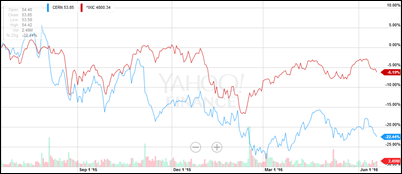
125x125_2nd_Circle

Text Ads


RECENT COMMENTS

  1. Isn't that actually present perfect indicative?
Founding Sponsors


Platinum Sponsors


Gold Sponsors


RSS Webinars

  • An error has occurred, which probably means the feed is down. Try again later.