EPtalk by Dr. Jayne 1/12/17

January 12, 2017 Dr. Jayne 1 Comment

image

The American Board of Preventive Medicine announced the retirement William Greaves, MD, who has been its executive director since 2012. Greaves helped guide the Board’s inclusion of the Clinical Informatics subspecialty. Benson Munger, PhD will serve as interim executive director. Munger was deeply involved in the creation of the AMIA Clinical Informatics Board Review Course and the informatics community is enthusiastic about his role as the ABPM begins its search for a permanent executive director.

Speaking of physicians considering retirement, Massachusetts General Hospital has a 100-year-old physician who is still coming into work after 65 years. Dr. Walter Guralnick spends his time teaching residents rather than seeing patients. With a strong belief in equal access for all, Guralnick led the charge for dental insurance and founded what became Delta Dental.

image

ONC has released the updated Certified Health IT Products List. In addition to the list of products on the “nice” list, there are now two pages for products that are no longer certified and developers who are blocked from certifying health IT products. The “developer ban” page is blank and the “decertified products” page has a lot of 2015 edition software, so it’s hard to know what you’re really looking at.

Lots of reader mail this week.

From Daredevil: “Re: E&M coding. My hospital made an interesting choice to bill facility charges but no professional fees in its busy (hospital-owned) pediatric urgent care. As such, the providers were not burdened with counting elements in their documentation. We could simply document items required for clinical care and/or general risk management. This made it easier to focus on managing the patient, especially during high-volume times. The providers were compensated based on covered hours and procedures performed. The providers were eventually incentivized for throughput and had plenty of opportunities to work extra hours at a reasonable rate, so things seemed generally equitable. I would love to see E&M billing go away. The surgeons have it right with global billing. Their notes — at least in the hospital setting and for post-op visits — while seemingly sparse, stick to the facts. There is no endless scrolling to see what they are thinking.” This flat-fee approach is similar to what many cash practices do and what my urgent care does for self-pay patients. It’s not hugely profitable, but it keeps the lights on and allows the staff to deliver valuable and often much-needed care. It’s an interesting approach and I will be interested to see what some of my local colleagues think.

From End of Shift: “Re: complexity of the patients at the end of a shift. I found more than once that the last patient on a Sunday evening was the most perplexing or complex for the day. The tendency to want to expedite that patient who made it in right before the doors locked was also met was often met with the reality that this patient / family was the one who was home all day debating whether their concerns warranted a visit to the urgent care. I saw more than a few who needed a trip to the emergency department. It doesn’t seem to matter which setting we are practicing medicine in these days, but there seems to be constant pressure to do more in less time. I think we would all be better clinicians with better outcomes if we had the chance to slow things down a bit.” Thinking about patients debating whether their condition is significant enough for a visit certainly puts a different spin on things. We’re also seeing patients holding off on care due to rising copays. Last year, most urgent care copays were at $50 but we’re seeing a lot this year that are $75 and $100, which means their ED copays are probably $150 or $200. The price point alone is going to have an impact in shifting where care is delivered, even if it doesn’t change the nature of the care required.

image

Illinois healthcare organization Presence Health has been fined $475,000 for lack of timely breach notification. The fine centers around an incident in October 2013 where paper operating room schedules went missing from a surgery center. They didn’t notify OCR until January 2014 and the investigation showed that patients were not notified within 60 days of discovery as required. Over 800 patients were affected, so a media notification would also have been required. Details of the investigation reveal similar notification delays from breaches in 2015 and 2016.

The new year seems to be bringing new jobs for many, at least according to my LinkedIn updates. I’m also seeing people update their profiles, potentially in search of new jobs. Pro tip: disable notifications before you start doing a bunch of updates so you don’t look like you’re getting ready to jump ship. I’m helping a client try to expand their EHR support team so I can offer some other job hunting tips based on the resumes I’m seeing:

  • Be sure you meet the minimum qualifications listed in the job posting or explain what equivalent skills you have that make you an attractive candidate. I’ve had more than 40 people apply for a physician informaticist position who are not physicians. My client might consider a nurse or pharmacist, but these folks had literally no clinical credentials. Similarly, if the posting requires five years experience, you might squeak by if you’ve been in the field for four, but if you have never worked in the field, it’s a better idea not to apply and waste people’s time.
  • Spell check your resume and have someone else review it for flow, consistency, and whether it makes sense. One candidate’s “summary” paragraph took up half a page and was a rambling incoherent explanation of why they appeared to job-hop every 18 months. Another’s was riddled with typos. Some include every job the applicant has had since high school, which just adds clutter.
  • Don’t expect clients to relocate you if the posting doesn’t mention relocation assistance. I have an ambulatory client in a small Midwestern city that is looking for a full-time billing office manager. Several people have applied from across the country. Since they were good candidates, we did phone screens, hoping to hear stories about people looking for jobs because they were relocating to be close to family, move with a spouse, etc. At least two of them asked about relocation packages, which is out of character for a 10-doctor practice. Understand your audience and your potential employer.
  • Make sure your contact information is professional. Your email address mustdrinkbeer@domain.com might have seemed like a good idea when you were in college, but it’s a terrible idea when you’re trying to be a professional adult.

What’s your best employee recruiting story? Email me.

Email Dr. Jayne.

HIStalk Interviews Jay Desai, CEO, PatientPing

January 11, 2017 Interviews 2 Comments

Jay Desai, MBA is co-founder and CEO of PatientPing of Boston, MA.

image

Tell me about yourself and the company.

Prior to starting PatientPing, I worked at Medicare at CMMI, the CMS Innovation Center. There I worked with a team to help implement the ACO program, bundled payments, and a lot of the other new payment models coming out of CMMI. The goal was to preserve the PPO model. No prior authorization, no utilization management, no traditional managed care control, no differential co-pays out of network, no PCP as a gatekeeper. Let patients go wherever they want to go. But risk.

Therefore, we needed to come up with an attribution model that was based on alignment, not necessarily membership enrollment. In that model, when a patient goes somewhere to receive care, you don’t really have too much control over them staying in network or even coordinating the care after they finish their episode, because you don’t know about it.

That created a major pain point for providers in this new model. A very basic problem emerged, which was, "Just tell me where my patients are” in real time — when they go to the hospital, ED, SNF, home health agency, or wherever they go. After scanning around the country and looking at the solutions that were available to providers, it felt like there was an important opportunity to build something that was focused and lightweight that could help providers know in real time where their patients are.

It seems as though it should be easy to send ADT notifications. Why wasn’t that happening already and what allowed you to turn that into a significant business?

A big part of the complexity in building this business is in the need for broad market adoption. Let’s say you’re an IPA. You get your list of patients and you want to know where they’re going. There may be 10 hospitals that represent a majority of them, and then there’s a long tail of other hospitals. On top of that, there’s 300 skilled nursing facilities, 200 home health agencies, 50 FQHCs and community health centers, a bunch of LTACs, and a spattering of other community providers. That’s a big list.

Building connectivity to all of those participants requires not only the technical implementation, but engagement and a reason to do this. You need to engage them not just as data senders or data providers. For any of those sites that’s a referral site for an IPA,  you need to engage them as data providers, but also as participants in the community to engage in the coordination of care with those other endpoints. That’s hard to do because it’s easier to sell a technology to one group and not worry about all the other places that they’re going to be a part of.

Our solution is about that. It’s about building the network, building the community for everybody to engage. Designing something that is light enough and gets broad participation and lift very quickly without being intrusive and with organizations that create constituency groups to do it was part of the challenge. How do you create something that’s elegant that still gets buy-in across the continuum of care, where sometimes there’s competitive dynamics that block information sharing, but still break down some of those barriers for folks to work with one another?

Who pays you, what sharing agreements do providers sign, and do they have to get patient consent?

There’s no cost to send the data. We only charge to receive information, what we call it pings. You pay to receive pings. That’s the real-time notifications.

There’s a lot of other bells and whistles to the service that I’m not describing now, but fundamentally that’s how it works from a business model perspective. It’s lightweight, it’s low cost, and it gets everybody in the community connected as both the sender and a receiver. You can join the community as a sender. You don’t necessarily need to receive, and in that world, it would be free.

For patient consent, we adhere to whatever the state rules are. In Vermont, for instance, we have a blacklist of patients who have opted out of data sharing and we will make sure not to share information on them. What we’re sharing isn’t very rich clinical information — we’re not sending lab results or behavioral health information. We provide the notifications. That could be on patients with behavioral health disease. The fact that they’re at the emergency room is what we would tell them, not necessarily that they’re there with a flare-up of a substance abuse issue or anything like that. The fact that they’re in the emergency room is something that we would be able to notify behavioral health providers about.

My point is that it’s a light level of data sharing. We seek consent in any instance where we have to. We have our own strict policies around how long is one considered a covered entity and how long is one considered a provider so that we’re not sharing data with people who aren’t allowed to see it.

As a provider, what’s my workflow when I get a ping?

There’s a lot of variability to how any given end user is going to act on a notification. They’re further variability in terms of the destination of where the patient is receiving care that will determine how they act on it.

For instance, if I’m an ACO care coordinator and I receive a notification that a patient is in the emergency room, a workflow may be in place to call the emergency room provider and call the patient to make sure that emergency room provider is aware of any case management services that may be available for the patient. Just to engage them in care coordination or case management upon discharge. They may also let the emergency room provider know that there are other supports for them in case they don’t want to admit the patient and want to take them out of the emergency room, to the extent that that’s an option for the patient and the emergency room provider feels like that’s the right thing to do.

If the provider receives a notification of a hospital discharge, they may initiate their medication reconciliation workflows or their transitions of care management workflows to get them in for a follow-up visit with a PCP or a specialist. If they get a notification that a patient is in a skilled nursing facility, they may have a regular rounding schedule or a clock that sets the timeline around when they should reach out to manage the length of stay at the SNF, largely to make sure that they’re supported with home care if that’s what’s required after the rehab period at the SNF. Again, that will be a function of the workflows.

They may want to make sure upon discharge that the patient is getting to the right post-acute care facility that’s part of a preferred network or deemed to be a high-quality provider. Another example is that if you’re a skilled nursing facility, your patient leaves your SNF, and you’re paying to receive the service when the patient bounces back to the ED, you would get notified. You may use the notification to call the emergency room to let the emergency room provider know that the patient is eligible to come right back to the SNF without a three-day hospital stay, for instance. That way, the emergency room provider can send them back into the community as opposed to admitting them to the hospital.

I can go through a long list of how our users are acting on the notifications. Home health agencies may go to the patient’s home on Day One to set up home care. They’ll show up on Day Three and nobody’s there because the patient’s caregiver never told the home care provider that they went back to the hospital. So the home health agency may use it to verify that the patient is still at home and that they can continue to deliver services. Or if they go to the emergency room, they can reach out to the emergency room and let them know that the patient has home care if they want to send them back out into the community.

Is it always providers who are at risk that buy your service or would it ever be an insurance company?

There are case management services that are being offered by insurance companies that want to initiate their workflows when their patients show up at the hospital and the emergency room. They may use their prior authorization processes as a data source, but a lot of times the ER data is not readily available on a real-time basis because the billing clerks for the emergency room will batch bill or do them later, so it won’t be as real time as an ADT message. We have some health plan case management services that are receiving the notifications.

In the example I gave you of a home health agency getting a ping, they’re not at risk, necessarily. They are just providing their home care services. Being able to know the patient’s whereabouts allows the home care provider to deliver a high quality of care.

Other groups that are interested in our services are homeless shelters and social service agencies that are providing case management. This is the big reason that I started this company. At CMS, a lot of our work was to bridge the community providers with the acute care setting. I worked a lot on some of the preventative services as well, around getting social supports — whether it’s housing supports or Meals on Wheels — also included within the care coordination workflows. The emergency room is a vulnerable time for the patient and an opportunity to engage them in their follow-up to make sure that they’re getting the right care.

What did Silicon Valley investors see in the company that made them want to invest $40 million?

I’d love to ask them the same question. [laughs] I’d love for you to ask them that question as well.

We are entirely mission-driven. We are maniacally focused on connecting providers to seamlessly coordinate patient care. Patients get care from a lot of providers — seven providers on average for a Medicare patient — and they’re across a lot of unaffiliated and disparate organizations. That results in a lot of cost, a lot of excess use, and redundant procedures. That’s the value of coordination.The work that needs to happen to prevent some of that redundant work is not complicated. It’s straightforward.

What we’ve done is design a solution that meets the provider community where they are, with a straightforward, low-cost, non-intrusive, easy-to-use solution that connects them in a way that they haven’t experienced in the past. We think that the investor community is excited about us bringing our services and spreading our mission to the rest of the country and we’re thrilled to be able to do that.

Of the syndicate that we formed here, Todd Cozzens of Leerink Transformation Partners is extraordinary. The folks at Andreesen Horowitz – Vijay and Jeff Jordan – are just incredible people. What we’re excited about is the opportunity to bring the best of two very different approaches to building healthcare IT businesses. There’s the Silicon Valley approach of hyper growth and product and network effects, which is a big component of what we do, but we are serving the provider community. We don’t make any allusions about the fact that the workflows are complicated. I’m a healthcare person. I’ve worked in the healthcare industry for over a decade. I’m not a Silicon Valley tech outsider coming into this industry.

I’m very familiar with businesses like the ones that Todd has built and the folks at Leerink have built. There’s a certain discipline to focusing hard on delivering a clear ROI to your provider organization customer, being very sensitive to the regulatory environment, and making sure that we are hyper focused on the integrity of our data and patient consent. Not just not trying to hack our way through an industry that is designed the way that it is for good reason. This is patients that we’re talking about. There’s a good reason for the bureaucracy. There’s a good reason for the slower processes and change cycle.

That said, there is some wisdom from the Valley around a product orientation. A real love for creating outstanding user experiences. I just love learning from the folks in Silicon Valley, specifically Andreesen Horowitz. They’re outstanding.

It is bringing together multiple worlds to create what I think is going to be a better company. There’s aspects of Silicon Valley that healthcare can benefit from, and there’s aspects from healthcare that Silicon Valley needs to learn. I think we’re going to be able to bring both of that into this organization.

How do you see the company evolving, especially if interoperability starts to encroach on what you’re doing?

I hope that we are able to see a lot more progress on interoperability. Whether it’s through CommonWell, Carequality, or some of the other efforts happening with the established networks that may exist out there doing a lot more around clinical interoperability. I would be excited if some of that work accelerated because what that means is that there’s a switchboard or a network pulling together all of these disparate systems. Network alone doesn’t solve the problem. It needs to be network plus workflow, a really important transaction that’s delivered in a way that engages the end user uniquely.

Right now, to the extent we can rent another network, we’re certainly more than happy to do that. We partner with a lot of health information exchanges in markets where they are established and stakeholder organizations that have pulled together the data. We’re very good at taking that information and bringing it to life by getting users to adopt and love and tend to lighten the experience of using our application to solve a very important problem. But in the markets where there isn’t any network that’s the chassis, we will build it, and we have done that in many markets.

Both the network and workflow need to exist for this particular problem that we’re solving to be done well. If interoperability were to make a huge amount of progress, then that would be exciting for us, to be able to help realize the vision of the problems we’re trying to solve in healthcare that interoperability will facilitate.

Do you have any final thoughts?

I think the quote is, "I would have written a shorter book if I had more time." Building an elegant solution that seems simple requires a lot of deep understanding of the constituent organizations within the healthcare ecosystem. We’re proud that after three years, we’ve been able get to this place where what we are doing works.

We’re in six states. We have 44 more to go. We’re going to connect the whole country. We’re excited to go as fast as we can and support provider organizations out there to achieve some of the aims that they have for their organizations around improving care and lowering costs.


News 1/11/17

January 10, 2017 News 12 Comments

Top News

image

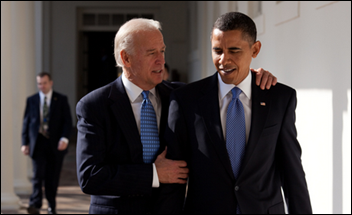
Politico quotes an obviously frustrated Vice-President Biden as saying healthcare industry players are the least-willing of all to share information, leading him to threaten to lock the CEOs of big EHR vendors in a room until they hear his message. “You think I’m joking. I’m deadly earnest and deadly frustrated as a lot of you are.”

Meanwhile his boss, President Obama, also said in an interview this week that EHRs are his biggest Affordable Care Act disappointment, explaining that healthcare still runs on mountains of paperwork, patients are sent bills they don’t understand, and doctors and nurses are wasting time entering data.

The president slipped in referring to “digitize” as “digitalize,” which means to dose patients with the heart drug digoxin.


Reader Comments

From Tabulator: “Re: the HIStalk Decisions section. It would be helpful to know if any of the product switches are due to an acquisition.” I don’t know that Definitive Healthcare has that information from their hospital user conversations, but I expect they’ll start providing it if so since you mentioned it.


HIStalk Announcements and Requests

image

You can still sign up for HIStalkapalooza, but not for much longer. Some comments left by folks who want to come:

  • HIStalkapalooza, Still the place to be seen, The home of the stars, Time for drinking and dancing, and schmoozing with czars.
  • At some point, HIStalk will stop taking applications and IBM Watson Health will just predict who should receive an invitation. Until then, hope to see you soon.
  • Glad it’s back in Orlando. In Vegas, half the crowd left before the end, which is a disgrace to the event and the band. Pretty sure I have been last person out of every HIStalkapalooza ever.
  • What a party! The bash was probably responsible for a few HIMSS blisters — from my dancin’ shoes — but they were welcome ones (nicer than the kind developed from trudging around the exhibit hall).
  • I didn’t attend HIMSS last year and the one thing I missed most was HIStalkapalooza.
  • I only get to dance once a year! After Histalkapalooza, I turn into a pumpkin. Yours, Cinderella.

image image

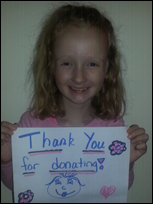
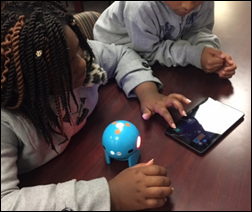
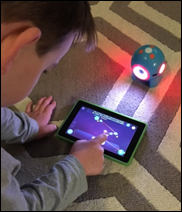
Mrs. P says her Kentucky kindergartners are putting the tablets we provided in funding her DonorsChoose grant request to good use:

My kindergarten students use them in partner activities and individual activities working on letters, letter sounds, rhyming, reading fluency, counting, number identification, shapes, colors, following directions and basic math like addition and subtraction. With these hands on tools my students are becoming more responsible and independent, which is an incredible skill for students to master at a young age … Many have seen these but never had their own opportunities to use them or truly benefit from them … Some of my students have even come to school wanting to share things they found and learned at home using the apps and games I have told the parents about. Again, I couldn’t be more grateful and appreciative of this incredible gift and the sparks of excitement for learning you have helped create!

image

Welcome to new HIStalk Platinum Sponsor Harris Healthcare. The 900-employee company’s health IT brands operate individually but are interoperable, including such names as QuadraMed EMPI indexing and cleanup, QCPR EHR, AcuityPlus staffing, Enterprise Scheduling, Enterprise Self-Service (patient access and engagement), ERP, RCM, TeamNotes clinical team documentation, and specialty solutions for the ED and perioperative suite, practice management, public health and health education, and several that are specific to the Canadian market. Analytics and business intelligence are provided at every level and the company offers professional and technical services. Thanks to Harris Healthcare for supporting HIStalk. 

A clarification on Bibb Medical Center’s (AL) August 2016 go-live on Athenahealth as reported earlier this week in the “Decisions” section. While BMC is a previous Prognosis Innovation Healthcare EHR user, they dropped that system some years ago and went back to paper, so technically Athenahealth didn’t replace Prognosis. 


Webinars

January 18 (Wednesday) 1:00 ET. “Modernizing Quality Improvement Through Clinical Process Measurement.” Sponsored by LogicStream Health. Presenters: Peter Chang, MD, CMIO, Tampa General Hospital; Brita Hansen, MD, CHIO, Hennepin County Medical Center. The presenters will describe how they implemented successful quality governance programs, engaged with their health system stakeholders, and delivered actionable information to clinical leadership and front-line clinicians. Q&A will follow.

January 26 (Thursday) 1:00 ET. “Jump Start Your Care Coordination Program: 6 Strategies for Delivering Efficient, Effective Care.” Sponsored by Healthwise. Presenters: Jim Rogers, RN, RPSGT, director of healthcare solutions, Persistent Systems; Jason Burum, chief client officer, Healthwise. This webinar will explain how to implement a patient-centered care coordination program that will increase quality as well as margins. It will provide real-world examples of how organizations used care coordination to decrease readmission rates, ED visits, and costs.


Acquisitions, Funding, Business, and Stock

image

Telemedicine software vendor SnapMD raises another $3.25 million in its Series A round, increasing its total to $9.15 million.

image

Clinical surveillance software vendor PeraHealth raises $14 million in funding.

image

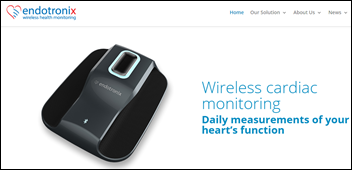
Wireless heart failure monitoring platform vendor Endotronix enters into a $12 million financing agreement. The company has raised $34 million in funding through its July 2016 Series C round. 

image

Accretive Health renames itself R1 RCM, ditching a memorable name (although stench-ridden due to widely publicized data theft, heavy-handed collections practices, and earnings restatement) in favor of something generic and less Google-friendly.


Sales

image

Duncan Regional Hospital (OK) will upgrade to Meditech’s Web EHR.


People

image

Intelligent Medical Objects promotes Eric Rose, MD to VP of terminology management.

image

CHIME and HIMSS name Children’s Health (TX) SVP/CIO Pam Arora as their John E. Gall, Jr. CIO of the Year.

image image image image

CareSync hires Joy Powell, CPA (Healthways) as COO; Mike Hofmeister (Allscripts) as sales SVP; and Allison Guley, JD (All Children’s Hospital) as general counsel. Former COO Amy Gleason, RN has taken a new role as chief of staff.


Announcements and Implementations

Iatric Systems launches FlexButton, which allows users of several EHRs to view relevant patient information stored in other systems as part of their workflow.


Government and Politics

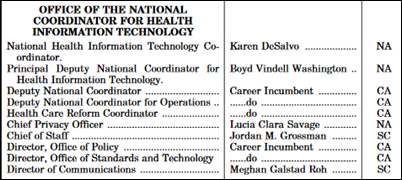
National Coordinator Vindell Washington, MD and FDA Commissioner Rob Califf, MD – both of whom were fairly recently appointed to their government roles and had expressed hope that they would be allowed to stay on – will leave their jobs after failing to convince the Trump administration to retain them.


Privacy and Security

From DataBreaches.net:

  • Presence Health (IL) will pay a $475,000 HIPAA settlement for taking too long to notify 836 affected patients that it lost paper-based OR schedules in October 2013.
  • Security researchers find another unsecured MongoDB healthcare database, with the sleep disorder records of patients at Womack Army Medical Center (NC) exposed to Internet searches.

image

HHS OCR notifies Virginia State Senator Siobhan Dunnavant (who is a nurse and a physician) that she violated HIPAA by sending political emails to her patients during her 2015 campaign, then deleted the information from a campaign computer when she realized that she had violated the privacy of her patients. HHS OCR says she won’t be fined or penalized since she tried to mitigate the damage.

A California Department of Insurance investigation concludes that the 2015 breach of insurer Anthem, which exposed the information of 79 million people, was perpetrated by a hacker hired by an unnamed foreign government. The company will pay $260 million for security improvements and remedial action even though the report says its advance preparation was reasonable and its remediation plan were sufficient to allow its fast, effective response. The breach was caused when an Anthem employee opened a phishing email.

image

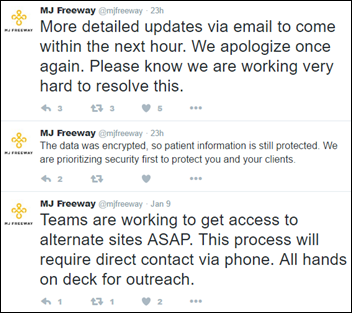
Marijuana dispensaries all over the country delay appointments as “seed to sale” tracking software from MJ Freeway – whose use is mandated by several states — is apparently taken offline by hackers. The site of the vendor whose systems are used by 500 dispensaries is still down.


Technology

A Wall Street Journal article says Apple is not only failing to produce much innovation these days, it has made itself a follower to Amazon, Google, and Microsoft in the all-important rollout of artificial intelligence despite its own groundbreaking rollout of Siri five years ago. The article warns, “AI-powered voice assistants can directly replace interactions with mobile devices. It isn’t that screens will go away completely, but screens unattached to objects that can listen, talk back, and operate with autonomy will rapidly become obsolete.”

image

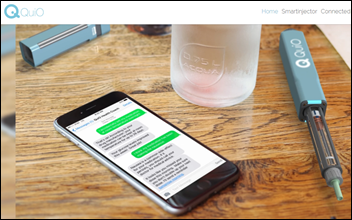
Accenture names its health technology challenge winners:

  • QuiO (smart home injection devices and monitoring)
  • CaptureProof (a medical camera for creating a visual patient narrative)
  • UE Life Sciences (a hand-held breast lesion detection system for health agencies)

Other

image

The New York Times profiles Nuna, a San Francisco-based, 110-employee startup that has combined the Medicaid databases from the disparate systems of individual states into a single cloud-based platform of de-identified data that researchers can use to explore patient behavior. The company has raised $90 million in funding. Co-founder Jini Kim — a former product manager for the failed Google Health and a participant in the fixing of Healthcare.gov – calls the company her “love letter to Medicaid” because her autistic brother’s care is paid for by the program. The article notes that nearly half of the children born in the US receive Medicaid benefits.

image

Video artist ZDoggMD – aka Zubin Damania, MD, founder and CEO of members-only primary care practice Turntable Health – shuts down the so-called Healthcare 3.0 practice following the failure of the Nevada Health Co-Op in 2015 that led to loss of insurance for the practice’s patients. It had also received funding from Zappos CEO Tony Hsieh as part of his downtown Las Vegas revitalization project. Damania says Turntable Health will live on as an “ethos, brand, and movement” without a physical presence, noting that he’ll still be selling company apparel. Its EHR will be used internally by its partner Iora Health.

image.

Twitter suspends the account of pharma bad boy Martin Shkreli after he announces that he has a crush on a Teen Vogue reporter, adding a Photoshopped photo of the woman and her husband in which Shkreli replaced the husband’s head with his own. He said it was innocent fun and that the woman had harassed him previously, then urged her followers to report him to Twitter when he responded. He also invited her to attend the presidential inauguration with him, which she declined by saying that she would rather eat her own organs.

image

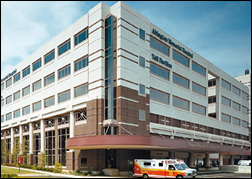
Abington Memorial Hospital (PA) will pay $510,000 to settle a Department of Justice investigation into the theft of 35,000 doses of controlled substances by a now-jailed pharmacist who manipulated the hospital’s electronic drug tracking system. The hospital has also spent $2 million upgrading its drug inventory systems.

image

Research and Markets apparently foresees a very small RTLS market.

image

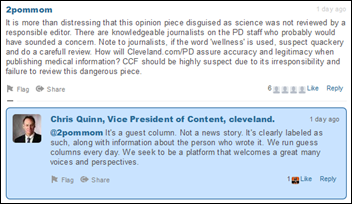
Cleveland.com, the Cleveland Plain Dealer affiliate that ran the firestorm article on vaccine preservatives written by the medical director of Cleveland Clinic’s wellness center, says the Clinic’s corporate communications director electronically published the piece without notifying the site so it could be reviewed, then pulled it down after negative social media reaction, surprising the site’s editor both times. The site has since rescinded the ability of Cleveland Clinic to manage its own content. A reader comment says the Clinic “runs this town and all the media and politicians do as they say” in noting how many former journalists now work for the Clinic and the fact that the site allows some contributors to post content directly. Meanwhile, PCPs are already dreading the amount of time they’ll have to spend explaining vaccines to patients all over again.

image

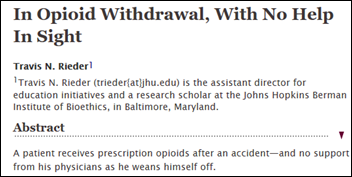
A Johns Hopkins bioethicist describes his opioid addiction that followed several post-accident surgeries, saying physicians are inadequately trained on narcotic prescribing (they receive less pain management training than Canadian veterinary students) and helping their patients wean off the drugs. He says pain management specialists see their jobs as prescribing and not following their patients to manage withdrawal, while the fragmented healthcare system makes it unclear who “owns” a patient at any given time. 

image

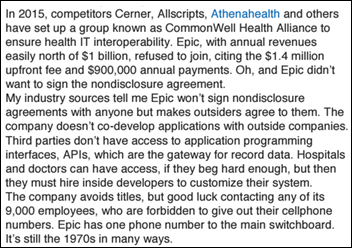
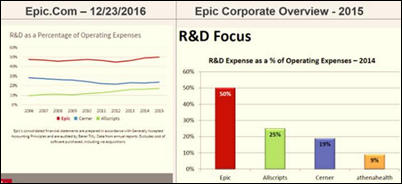
A Wall Street Journal opinion piece written by a former hedge fund operator singles out Epic as being primarily responsible for lack of EHR interoperability, calling the company “chief obfuscator.” He notes a friend’s personal experience in trying and failing to have their hospital records sent from Boston to Miami, Epic’s non-participation in CommonWell, his claim that Epic charges four cents per message sent (“even Apple isn’t that greedy,” he says), and his own failure to retrieve his Epic hospital records in any form other than PDF. He concludes, “Make firms like Epic look at interoperability as an incremental profit center rather than an opening for competitors. The dream of smart machines crunching health info is real. Don’t let the dream walk with paper.” Everything seems simple when you don’t understand them to any degree of detail, so my best and gentlest counterpoint would be this – have any Epic hospitals exchanged information with each other or provided electronic information to patients? If so, then it’s not Epic’s problem that his two anecdotal experiences weren’t positive.

A hospital pharmacist’s letter to the editor of P&T magazine makes mistakes in trying to explain interoperability challenges from the pharmacy department’s perspective:

  • It says the main cause of data siloes is that hospital EHRs use non-relational databases. Not true – plenty of systems use relational databases and that underlying technology is not at all a barrier to interoperability regardless. The pharmacy department wants to extract EHR information to create their own pharmacy-specific applications, which is not what most people think of as interoperability. It would be easy but not necessarily technologically sound to query a live EHR database in real time, which is why HL7 interfaces were developed for systems such as automated dispensing cabinets, pharmacy drug tracking systems, and robotic packaging technology. I understand the frustration in not having easy access to live data, but it’s not because of a sinister vendor plot.
  • The author states, “We prefer to stay with our current EMR to avoid going through the pain of a conversion.” I think his hospital (St. Joseph’s in Irvine, CA) runs Meditech, but I’m not certain, and I’m not sure the hospital’s failure to move to a different system (of similar architecture) is based on conversion avoidance.
  • The author talks about Microsoft Amalga, which was spun off and renamed under Caradigm nearly four years ago and no longer has any Microsoft ownership.

image

Weird News Andy snickers at the story he titles “Hospitals from Mars.” Candy manufacturer Mars is buying publicly VCA – which operates 800 pet hospitals and the Camp Bow Wow doggie day care chain – for $7.7 billion. WNA wonders if acquiring the company, which trades under the symbol WOOF, is a conflict of interest since chocolate is poisonous to dogs. Probably not — I was surprised to learn  that Mars already owns pet brands Banfield Pet Hospital, Eukanuba, Iams, Pedigree, Whiskas, and several others. Banfield is the pet equivalent of a chain of medical practices, employing 4,000 veterinarians (around 9 percent of the total number of US vets who treat pets). Another Mars business offers pet DNA testing. Those of us working in people healthcare can only envy the efficiency, aligned incentives, effectiveness, and patient satisfaction of our animal-treating peers. They are also better EHR users and are better at population health management in a competitive environment.


Sponsor Updates

  • Optimum Healthcare IT posts a white paper titled “Avoiding Common EHR Implementation Mistakes.”
  • PokitDok achieves EHNAC cloud-enabled and outsourced services accreditation for health information exchange.
  • Arcadia Healthcare Solutions hosts its annual users conference in Boston.
  • Besler Consulting releases a new podcast, “A Preview of Healthcare Policy in 2017.”
  • ONS Connect features Carevive Chief Clinical Officer Carrie Stricker, RN.
  • Meditech posts a case study titled “Avera Uses Pharmacogenomics, Meditech EHR to Drive Precision Medicine.”
  • Nashville Medical News include Cumberland Consulting Group CEO Brian Cahill in its list of Nashville healthcare leaders.
  • Dimensional Insight will exhibit at the Muse Executive Institute January 15-17 in Newport Coast, CA.
  • Healthgrades compiles a 2017 industry insider list for hospital marketers.

Blog Posts


Contacts

Mr. H, Lorre, Jennifer, Dr. Jayne, Lt. Dan.
More news: HIStalk Practice, HIStalk Connect.
Get HIStalk updates. Send news or rumors.
Contact us.

125x125_2nd_Circle

Curbside Consult with Dr. Jayne 1/9/17

January 9, 2017 Dr. Jayne 2 Comments

I spent most of this weekend seeing patients and generally being crushed by surging influenza cases. Increasing family togetherness led not only to the spread of infection, but to families coming together to the urgent care for testing and treatment. When multiple groups of three or four are arriving at the front desk at the same time, it makes for a high-pressure work environment. Fortunately my staff rose to the challenge and we were able to call in some reinforcements as well.

My EHR has some fairly decent template features as far as being able to set standard defaults for physical exam findings. In reality, many influenza patients appear clinically similar, so this was a great opportunity to put those features to the test. Tired-appearing male/female in mild distress, normal eye exam, clear to yellow nasal discharge, normal oropharynx, normal ears, etc. The lung exam differs from person to person, but my template was generally accurate throughout the surge.

Unfortunately, at the end of my last shift, I had a surge that templates wouldn’t help. Four people came in within 15 minutes of closing time, all needing lacerations repaired. Every one of those patients has a unique story and unique exam, although I skipped a lot of the documentation at the time so that I could get the wounds repaired, the patients home, and my staff off the clock.

That left me this morning with charts left to complete. Although that usually doesn’t happen, it gave me a chance to reflect on how tedious some of the documentation requirements are. E&M coding requirements have been around a long time, much longer than Meaningful Use or MIPS. In looking at an era of increasing requirements and mandates, it leads one to reflect on where we might be in 10 or 20 years, or if we’ll ever get it right.

Having come out of a couple of fairly conservative training programs that were pretty good about teaching physicians how to control costs and use resources efficiently, the need to document certain exam findings and history elements in order to be paid for my services is aggravating. The requirements are higher for new patients vs. established ones. Although the information can be easy to gather (think patient history questionnaire), the requirements are often clinically irrelevant.

My training programs taught me not to order tests that weren’t going to change the management plan and not to order procedures that weren’t necessary, but E&M coding requires me to collect a host of information that may or may not be relevant. That might make sense in a continuity practice, or in the light of a second opinion consultation where every fact might contribute, but it doesn’t make sense when you are an urgent care physician with a two-year-old in front of you who split his head open on the dresser.

Meaningful Use, MIPS, PQRS, and other federal incentive programs involve data collection on steroids. Providers are so afraid of missing something and being penalized that they try to gather all the information on all the patients, much like we have been doing with E&M coding. We’ve been conditioned to this by decades of regulation, and many physicians can’t afford to say no.

In the situation of the child with the cut on his forehead, I need to know what happened, if he got knocked out, if he’s generally healthy, if he’s allergic to any medicines, if he’s ever had a reaction to local anesthetic, and whether he’s up to date on his tetanus immunization. I don’t need to know his complete family history and whether there are smokers in the home, because there is no information that can be provided that would change whether I stitch him up or not. I’m repairing his wound regardless.

Unfortunately, the EHR is configured out of fear, so this information is required to ensure we don’t miss something. Multiply this times the four patients that came in at the end of shift, and the level of tedium increases. Vendors have been so focused on making sure providers can document the federally required fields that they miss the ones we really need.

I have yet to see an EHR with a checkbox for “smell of alcohol on breath” even though that’s something we see fairly often in the ED and urgent care setting. I had to document it at least twice yesterday, one time being with the gentleman who somehow stabbed a chef’s knife into his palm but couldn’t detail how he actually got hurt. I described the wounds in narrative detail, even though a picture would have been a better way to document. But you don’t get credit for having a picture in your note — you have to have discrete data.

It’s only going to get worse as the programs get more complex. Regarding the flexibility in MIPS, providers are stymied by the large number of activities from which they can choose. Flexibility is a blessing and a curse, with many of my clients asking me to just tell them what they should do. They don’t want to look through a list of 90 different potential selections and make choices — they just want to know the path of least resistance to making sure they don’t get penalized. They want to know how they can check the box with a minimum of cost and minimum of staff effort. And of course, a minimum of risk that they’ll miss something or get penalized.

I’ve had several clients ask me about opting out of Medicare entirely. Although that seems like a solution, it may not be for everyone depending on your volume of Medicare patients. Additionally, many commercial payers follow Medicare’s lead for these sorts of things (including the above mentioned E&M coding) so opting out of Medicare doesn’t guarantee you won’t have to do it anyway.

I’ve had several discussions with clients about moving to a cash-only practice, which is becoming increasingly attractive to physicians. Given the increase in high-deductible plans and narrow networks, more patients are incurring out-of-network costs. Seeing a cash physician is more attractive when you’re paying out of your own pocket than when you’re being insulated from the cost of care by insurance.

In the end, I documented all the checkboxes because I do like being employed and don’t want a nastygram from our billers. Being rebellious and not documenting an office visit code isn’t going to be a positive career move, so I did it. I gave in just like physicians across the country have done with the expanding mess of programs.

I did my charts after I went home, like many physicians have started doing since the advent of electronic documentation and remote access. The patients were all seen, I hit a new personal record for cases in a single shift, and I also tied more stitches than I’ve ever done in a single day. But I still can’t help but wonder about a future state where data isn’t a thorn in my side.

Are you surviving influenza season? Email me.

Email Dr. Jayne.

Monday Morning Update 1/9/17

January 8, 2017 News 2 Comments

Top News

image

President Obama says in a NEJM opinion piece in which he denounces Republican intentions to repeal the Affordable Care Act before offering a solution of their own,

This approach of “repeal first and replace later” is, simply put, irresponsible — and could slowly bleed the healthcare system that all of us depend on. (And, though not my focus here, executive actions could have similar consequential negative effects on our health system.) If a repeal with a delay is enacted, the healthcare system will be standing on the edge of a cliff, resulting in uncertainty and, in some cases, harm beginning immediately. Insurance companies may not want to participate in the Health Insurance Marketplace in 2018 or may significantly increase prices to prepare for changes in the next year or two, partly to try to avoid the blame for any change that is unpopular. Physician practices may stop investing in new approaches to care coordination if Medicare’s Innovation Center is eliminated. Hospitals may have to cut back services and jobs in the short run in anticipation of the surge in uncompensated care that will result from rolling back the Medicaid expansion. Employers may have to reduce raises or delay hiring to plan for faster growth in healthcare costs without the current law’s cost-saving incentives. And people with preexisting conditions may fear losing lifesaving healthcare that may no longer be affordable or accessible. Furthermore, there is no guarantee of getting a second vote to avoid such a cliff, especially on something as difficult as comprehensive healthcare reform.


Reader Comments

From Caraway: “Re: selling software to hospitals. What are the most important factors or strategies?” I’m not a salesperson, but my experience on the other end of the transaction leads me to these conclusions:

  1. Figure out my likely problems without wasting my time probing me to discover them. It’s not my job to tell you what to sell me. Instead, ask what’s in my strategic plan since that’s where the money will be going.
  2. Bring success stories from hospitals like mine.
  3. Tell me tactfully about the weaknesses of competitive products, but don’t slam those companies. Salespeople switch jobs often and it’s embarrassing all around when you show up with a shiny new business card of a company you were trashing six months before.
  4. Figure out who has influence in the hospital. It’s a lot easier to align with an IT director or informatics person who knows the hot buttons and can devote research time, thus earning a recommendation and faster track to the CIO’s office.
  5. Be respectfully persistent without being a pest. The squeaky wheel earns some grease, but only the point that the noise becomes so annoying that it gets replaced.
  6. I might glance at your white papers and other marketing material, but the only thing that will convince me is conversations, preferably with customers.
  7. Don’t expect me to get excited about an offer to be a pilot site for a product under development. Even free systems involve a lot of headaches and the potential for both the vendor and the IT person to take a black eye
  8. Don’t bring a solution that doesn’t address one of my biggest problems or that won’t pay for itself. You are competing with a lot of important projects. Your star fades considerably if a capital investment is required since that’s a long-term, highly competitive budgeting process.
  9. Don’t try to sell around me. Give me the courtesy as an IT person to let me know who you’re talking to so I don’t get blindsided. You can create demand that will end up in my lap, but I still have some degree of technology veto power if you try to box me out.
  10. Don’t be in a hurry. We don’t usually slam-bam in health systems no matter how much your quarterly numbers need a boost.

HIStalk Announcements and Requests

image

HIStalkapalooza sign-ups are open. Some fun comments added by those requesting tickets:

  • HIStalkapalooza 2016 was my favorite evening event HIMSS last year! Skills I can contribute to the event: willing to sample all the food at the buffet to make sure it is tasty; also will get out on the dance floor with some really mediocre moves to make everyone else feel more confident about their dancing.
  • A frigid sales rep from ‘Sconsin, Longed for a ticket to yon sun. He daily read HIStalk, Its insight he unlocked. That his legacy nev’r be undone.
  • I like to dance; I manage HIT interoperability partnerships with 35 partners. HIStalkapolooza is a righteous ton of fun.
  • I read HIStalk every day and it’s an important part of why I’m effective at my job. Basically, I’m a big fan. Another haiku about HIMSS since you liked it last year: Gray suits and gray hair, Your booth’s fireplace is too much, No one wears color.

To answer questions asked in the requests: (a) Party on the Moon will indeed be on stage again; (b) shoe-related activity will abound; and (c) based on response so far, it appears that, as in the last couple of years, I’ll be able to invite everyone who requests a ticket (but if I don’t, providers come first).

Note: the overly large photo above serves as an eye-catcher – every year, people (usually executives or their assistants bristling with self-importance) waste my time in claiming they religiously study every single HIStalk word I write, yet somehow missed the many, many times I mentioned that signups are open and thus didn’t request the ticket they absolutely must have. I’ll just send them a screenshot of the announcements like this. The party is for readers and I feel no obligation to someone who clearly isn’t one. Your life (and certainly mine) won’t be irreparably damaged if you have to find something else to do Monday evening because you weren’t paying attention.

image

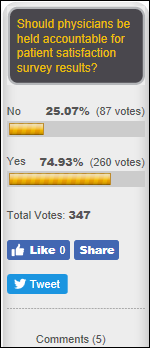
Three-fourths of poll respondents say doctors should be held accountable for patient satisfaction results. A couple of folks question why it’s just physicians and not the front office and billing people who are on the hook, while others think it’s OK to measure and report patient satisfaction but not OK to tie the results to compensation. Others note that patients are subject to the usual maddening human variability (see: Yelp reviews) and will ding the doc because their hospital meals were under-salted or they were told to lose weight. Meltoots gives examples of risking satisfaction survey retribution by doing the right thing – making patients get out of bed and refusing their demand for narcotics, no different for scoring a teacher highly because they never give homework.

New poll to your right or here: When did you last earn a significant promotion or leave for a better job? Some explanation would be nice – click the Comments link after voting.

image

Welcome to new HIStalk Gold Sponsor Sphere3, a Gartner Cool Vendor that offers the Aperum patient experience management platform. It integrates patient perception with nurse call system activity to provide insight into patient satisfaction, caregiver workload management, and patient safety. Nursing administration gains visibility into patient needs, workload, and the voice of the customer. Aperum’s Hot List identifies patients whose behaviors increase their fall risk, while the nursing department enjoys reduced call lights and response times. Clients have reported an 18 percent increase in patient experience domain scores, a 24 percent reduction in call light activity, and a 10 percent increase in HCAHPS response to call light. Check out  their white paper “Reinventing Nurse Call to Enable the Real-Time Health System.” The Kansas City, KS-based company will exhibit in the Startup Area at HIMSS17, where you can meet CEO Kourtney Govro. Thanks to Sphere3 for supporting HIStalk.

image image

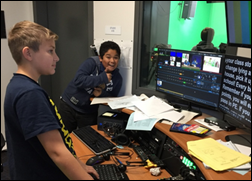
Mrs. M reports that students in her New York media classroom are using the headphones we provided in funding her DonorsChoose grant request for online learning and test-taking.

I was annoyed but unsurprised this week when I needed to send my doctor an insurance form and they said it had to be faxed – they don’t have the ability to accept a scanned document attached to an email. The person’s tone suggested that they are the innovators and I’m the Luddite for not having a fax machine at my eIbow. I pictured them tending their time capsule technology dressed in No Fear shirts, singing along with Right Said Fred, and stroking their Beanie Babies.

Listening: new from The Dogs, an apparently nearly unknown Norway-based punk rock band whose raw, angry sound is reminiscent of the Pixies but with more sonically rich musical hooks, a fantastically growly organ, novella-like lyrics, and a killer stage presence. This is the antidote to lip-synching, fading divas and tedious, Auto-Tuned hip-hopper collaborations. If you don’t see puddles of sweat in front of the singer, you didn’t get your money’s worth. The Dogs earns my highest recommendation and would be amazing headlining my future low-rent version of HIStalkapalooza in a vacant lot with kegs and barbeque. I’m binge listening their whole catalog on Spotify and it’s exhilarating. Judging from their albums and concert video, this has to be one of the best bands in the world.


Last Week’s Most Interesting News

  • The Advisory Board Company announces layoffs and office closures following a post-election slowing of customer activity.
  • CTG says it will counter the slide in post-Meaningful Use EHR work by focusing on optimization and application services.
  • A Black Book consumer survey finds a rapidly growing “digital divide” in which patients don’t trust providers to protect their data, don’t know how to use technology such as patient portals, and withhold information from their doctors due to privacy concerns.
  • Security researchers report a spate of cases in which improperly secured MongoDB analytics databases are being hijacked by hackers who are holding the information for ransom.
  • Senate Republications introduce an aggressive timeline for dismantling the Affordable Care Act without proposing an alternative.

Webinars

January 18 (Wednesday) 1:00 ET. “Modernizing Quality Improvement Through Clinical Process Measurement.” Sponsored by LogicStream Health. Presenters: Peter Chang, MD, CMIO, Tampa General Hospital; Brita Hansen, MD, CHIO, Hennepin County Medical Center. The presenters will describe how they implemented successful quality governance programs, engaged with their health system stakeholders, and delivered actionable information to clinical leadership and front-line clinicians. Q&A will follow.

January 26 (Thursday) 1:00 ET. “Jump Start Your Care Coordination Program: 6 Strategies for Delivering Efficient, Effective Care.” Sponsored by Healthwise. Presenters: Jim Rogers, RN, RPSGT, director of healthcare solutions, Persistent Systems; Jason Burum, chief client officer, Healthwise. This webinar will explain how to implement a patient-centered care coordination program that will increase quality as well as margins. It will provide real-world examples of how organizations used care coordination to decrease readmission rates, ED visits, and costs.


Acquisitions, Funding, Business, and Stock

image

Tax, advisory, and business consulting firm WeiserMazars renames itself Mazars USA.

image

Coding and compliance services vendor Aviacode acquires facility coding outsourced services vendor Revant Solutions.

image

Genetic information company Invitae acquires AltaVoice, which hosts Patient Insights Networks that connect researchers with patients, for $15 million.

image

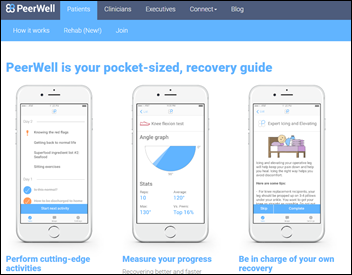
Detroit Lions defensive back Glover Quinn invests in PeerWell, whose app supports physical therapy rehab patients with exercise programs and the ability to perform their own range-of-motion measurements at home. The company has raised $2.1 million in a single November 2016 investment.


Sales

Prime Healthcare chooses Phynd to gather, manage, and share data on its 75,000 providers across 43 hospitals.


Decisions

  • Myrtue Medical Center (IA) will switch from Medhost to Epic in October 2017.
  • Heart Hospital Of Lafayette (LA) will move from Cerner to Epic in September 2017.
  • Bibb Medical Center (AL) migrated from Prognosis to Athenahealth in August 2016 and will go live on its ambulatory EHR in 2017.
  • Nash General (NC) will replace Cerner with Epic in 2018

These provider-reported updates are provided by Definitive Healthcare, which offers powerful intelligence on hospitals, physicians, and healthcare providers.


People

image image image

Huron Consulting Group promotes John Kelly to EVP/CFO and names EVP/COO Mark Hussey as interim healthcare practice leader. Hussey replaces Gordon Mountford, who has left the company. HURN shares are down 17 percent in the past year, valuing the company at $958 million. 

image

Healthgrades hires Eric Jensen (Avia) as EVP of health systems products and strategy.


Announcements and Implementations

ZH Healthcare (never heard of them) launches a “new unified brand” of blue EHR , unleashing a torrent of buzzwords: “enhance the power of world-leading malleable and customizable EHR … The brand stands for stability, strength and trust that clients place in our solution. The color blue speaks to infinite capabilities.” Kudos to whatever marketing firm profitably convinced the company that they ‘re adding value in cooking up this gibberish, although slipping in “malleable” was pretty cool assuming it doesn’t refer to frustrated users beating their PCs with a hammer.


Other

image

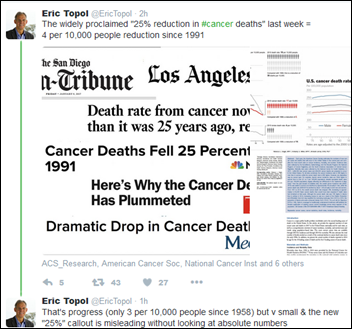
Eric Topol, MD is unhappy with the way reporters hype a tiny decline in cancer deaths over nearly 60 years in hyping a 25 percent decrease since 1991.

image

A rant by the medical director/COO of the Cleveland Clinic Wellness Institute highlights the awkward situation that can result when a traditional, respected medical institution launches a trendy alternative / integrative medicine operation whose beliefs are not only different, but sometimes scientifically sketchy. Daniel Neides, MD says he is “tired of all the nonsense” as government and businesses force us “to live in a toxic soup.” He should have stopped in that weird but safe ground, but then launched into a Jenny McCarthy-like tirade against the preservatives in vaccines, confidently opining that ADHD is a thing not because it has been defined as a disorder and parents encourage overdiagnosis, but because “something(s) are over-burdening our ability to detoxify.” He doesn’t suggest refusing vaccinations, at least, only recommending that parents talk to their doctor about timing of the injections for their children. A predictable firestorm ensued, with Cleveland Clinic issuing a terse statement that Neides won’t be doing interviews and that his opinion piece doesn’t reflect its position.

 image

The Boston Globe profiles Warner Slack, MD, a medical school professor who developed a patient computer questionnaire in Wisconsin in the mid-1960s. One of his students was Epic CEO Judy Faulkner. The article debates whether interoperability will ever be prevalent, quoting Slack as saying he’s disappointed that EHRs aren’t providing more benefits to patients.


Sponsor Updates

  • Validic CEO Drew Schiller presents at CES 2017.
  • ZeOmega releases a white paper, “The Value of an Advanced Predictive Analytics Approach in Population Health Management.”

Blog Posts


Contacts

Mr. H, Lorre, Jennifer, Dr. Jayne, Lt. Dan.
More news: HIStalk Practice, HIStalk Connect.
Get HIStalk updates. Send news or rumors.
Contact us.

125x125_2nd_Circle

News 1/6/17

January 5, 2017 News 3 Comments

Top News

image

image

The Advisory Board Company will restructure its healthcare business, laying off 220 employees and closing four offices. It will exit its businesses of care management workflow, nursing workforce and infection control analytics, and two niche consulting practices.

The company blames its November-December sales slowdown on the election, as health system customers paused to contemplate potential changes under the Trump administration.

ABCO shares didn’t react much on the news, but are down 26 percent in the past year, valuing the company at  $1.4 billion.

Specific products – such as Crimson platform or ABCO’s Clinovations consulting group – were not specifically mentioned. The company says the businesses they’re shedding generated $18 million in 2016 revenue vs. $14.5 million of expense, so they should interest potential acquirers if that’s the company’s plan.


Reader Comments

125x125_2nd_Circle

From Puffer: “Re: your Mr. H avatar. Get rid of the pipe.” Every year since I started writing HIStalk in 2003, a few folks who feel blessed with extra-special insight note (often with smugness) that a site about healthcare shouldn’t feature a smoking doctor (like I somehow didn’t notice the irony until a newbie clued me in). I specifically had the avatar designed with a pipe – right down to describing how I wanted the wafts of smoke to appear – as my version of a pirate’s Jolly Roger warning that this is not the usual health IT pablum written by corporate cheap-seaters. You would be surprised to see how many dignified executives have someone take their picture embracing my happily smoking doc standee at the HIMSS conference. 

From Stud IT Director: “Re: promotion. I’m 42 years old and have been IT director for nine years, seven under the CIO who was brought in not long after I was promoted. How do I know if I should stay or seek greener pastures?” My thoughts:

  • You already failed to be promoted when your boss was hired, so you may be permanently branded as mid-level management material better suited for a corner in the IT cube farm instead of Mahogany Row. Some places just don’t like promoting internal candidates for C-level jobs.
  • Are you the favored child among your peers? If not, forget it and move on.
  • Have you been given any indication that you’re next in line, or for that matter, that the CIO isn’t going to hang around for another 10 years as your window closes? Not many first-time CIOs are in their 50s.
  • Are you sure you’re qualified to be a CIO? If it hasn’t happened by 42, maybe it’s not in the cards or you’re being wasted in the wrong place. It’s common for IT directors to think they can do everything their CIO boss can do, but they miss the point that the most-valued skills aren’t the obvious ones. It’s not technology, but the ability to earn the trust and respect of peers, being able to take the big-picture view beyond bits and bytes, and leading a team). It’s more than checking boxes for education, experience, and results. Maybe your boss is an incompetent doofus,but if he or she is still holding the position, someone important must not think so and maybe you are missing something.
  • Are you willing to bet a lot on your abilities? If so, connect with a recruiter and groom yourself to be hired as a CIO, probably in a struggling hospital or godforsaken part of the country that’s less attractive to better-pedigreed candidates.

HIStalk Announcements and Requests

HIStalkapalooza sign-ups are open. About 400 people have put their names in the “I want to come” hopper so far, many of whom provided a fun bonus in entering witty comments on their forms.

I’ve received around 150 responses to my annual reader survey, the results of which drive most of my agenda for the year. Weigh in here, which will also enter you in the running for a $50 Amazon gift card. I’ll deal with the creative tension cause by the usual polarizing results, such as the “I love rumors” vs. “I hate rumors” responses. I like that a couple of readers say that reading HIStalk is their guilty pleasure, although the “guilty” part means I won’t gain many readers via word of mouth.

image image

Mrs. S from Virginia says her second grade class is using the Osmo math and language apps we provided in funding her DonorsChoose grant request to learn in small groups and to compete as teams, with some students who were behind in math using the tool to catch up.

This week on HIStalk Practice: Private practice MDs in Massachusetts react to new HIE integration law. Duane Reade clinic closures point to market saturation. Kareo’s Lea Chatham explains the ways in which physician independence trumps hospital employment. EarlySense adds American Well consults to its consumer-facing remote-monitoring platform. Trade groups sound off on potential ACA repeal/reform. Carena’s Ralph Derrickson makes telemedicine predictions for 2017. Athenahealth shakes off its layoff doldrums. MDGuidelines’ Joe Guerriero sees steady sailing for the future of value-based care. CompuGroup Medical adds genomic decision-support tools to its EHRs. Drchrono’s Michael Nusimow outlines the ways in which MACRA will impact physician compliance in 2017.


Webinars

January 18 (Wednesday) 1:00 ET. “Modernizing Quality Improvement Through Clinical Process Measurement.” Sponsored by LogicStream Health. Presenters: Peter Chang, MD, CMIO, Tampa General Hospital; Brita Hansen, MD, CHIO, Hennepin County Medical Center. The presenters will describe how they implemented successful quality governance programs, engaged with their health system stakeholders, and delivered actionable information to clinical leadership and front-line clinicians. Q&A will follow.

January 26 (Thursday) 1:00 ET. “Jump Start Your Care Coordination Program: 6 Strategies for Delivering Efficient, Effective Care.” Sponsored by Healthwise. Presenters: Jim Rogers, RN, RPSGT, director of healthcare solutions, Persistent Systems; Charlotte Brien, MBA, solutions consultant, Healthwise. This webinar will explain how to implement a patient-centered care coordination program that will increase quality as well as margins. It will provide real-world examples of how organizations used care coordination to decrease readmission rates, ED visits, and costs.


Acquisitions, Funding, Business, and Stock

McKesson and Change Healthcare announce that the new health IT company they’re creating will be called Change Healthcare, so decided after “a thorough strategic and creative review process.” 

image

Health benefits platform vendor Castlight Health will acquire competitor Jiff. Castlight President/COO John Doyle will become CEO of the new company, Jiff CEO Derek Newell will become president, and Castlight CEO Giovanni Colella will leave the executive suite but remain in the boardroom as executive chair. Jiff is a much smaller company with just $7 million in annual revenue vs. Castlight’s $102 million. Castlight shares dropped sharply on the announcement. They doubled on the company’s IPO day in March 2014,  but have dropped 89 percent since, valuing the company at $443 million.

image

Health data aggregation and analytics technology vendor Arcadia Healthcare Solutions receives a $30 million growth capital investment from Merck Global Health Innovation Fund, GE Ventures, and existing investors. I asked CEO Sean Carroll when I interviewed him in late 2015 where he wanted the company to be in five years:

We’re very dedicated to the notion that clinical data in particular — for the next five years and perhaps beyond — aggregated from electronic health record, is fundamental to an effective data strategy. A data strategy is fundamental to being successful in value-based care. We’re focused on that.  We certainly understand the necessity to deliver on the full outcome, but our focus will remain on solving this important and fundamental challenge that organizations have, which is, "I’ve made huge investments in my electronic health record strategy. I need the information out of all of them. I need it timely. I need to be able to then process it right it away in much broader ways, including looking at the full population that I serve. That’s the only way that I will be effective in executing in any sort of risk model."

image

A letter to shareholders from CTG says that the company’s mandate-fueled EHR work has slacked off, so it will move its focus to high-margin work in optimization, performance improvement, application management, and service desk and will focus its staffing offering on higher-margin work.

image

Athenahealth will double its Atlanta-based workforce to nearly 1,000 by next year in the Ponce City Market. Athenahealth was the first office tenant of the former Sears, Robuck and Co. regional headquarters that then served as City Hall East for 20 years. I’m fascinated by the list of tenants in the Central Food Hall.


Sales

Vancouver Island Health Authority selects Vocera’s smartphone solution for secure text messaging, voice communications, and alerts.

The Department of Defense chooses Vocera for wireless hospital communication in a $14 million contract, the company’s largest ever.

image

Medical Center Health System (TX) engages QuadraMed’s Professional MPI Clean-up Services in preparation for its Cerner go-live in the spring.

image

Piedmont Healthcare (GA) chooses patient-provider matching solutions from Kyruus.

image

Melissa Memorial Hospital (CO) chooses Athenahealth, presumably for ambulatory although the local paper’s recap doesn’t actually say. The chatty story says Cerner was the losing bidder and that annual costs for Athena will be $221,000.

J. D. McCarty Center (OK) chooses CPSI’s Evident EHR.


People

image

AHIMA installs Ann Chenoweth, MBA (3M Health Information Systems) as president and chair of its 2017 board.

image

Dave Miller, MHSA (HCCIO Consulting) joins Access Community Health Network (IL) as CIO.

image

Kelley House (Jackson & Coker) joins Culbert Healthcare Solutions regional sales VP.


Announcements and Implementations

Ingenious Med releases a value-priced edition of its system for organizations whose primary need involves charge capture.

image

CompuGroup Medical US will integrate real-time genomic decision support tools from ActX into its EHR.


Privacy and Security

From DataBreaches.net:

  • A single hacker has hijacked 3,500 unsecured MongoDB databases and is demanding around $200 to release them, one of them apparently belonging to Emory Healthcare.
  • Box.com changes its publicly shared folders after a security researcher finds that information contained in them is visible in Internet searches.
  • Creative ransomware authors add new features: (a) one variety decrypts the files of an infected user who passes the ransomware on to friends; (b) the Jigsaw malware deletes files every hour until the ransom is paid; and (c) Koovola restores encrypted files if the victim agrees to stop downloading unsafe files and reads two suggested ransomware articles.
  • New Hampshire’s health commissioner apologizes not only for breach that exposed the information of 15,000 people, but for upsetting relatives of deceased individuals who received breach notification letters addressed to them. I’m not sure there’s a good answer to this unless it’s possible to reliably cross-reference to Social Security death records. Or, do family members have a right to know anyway?

Technology

image

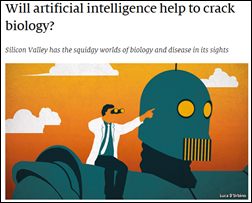
An interesting article in The Economist ponders whether artificial intelligence can “crack biology” and thus help treat or cure disease. A snip:

Pharmaceutical companies are finding it increasingly difficult to make headway in their search for novel products. The conventional approach is to screen large numbers of molecules for signs of pertinent biological effect, and then winnow away the dross in a series of more and more expensive tests and trials, in the hope of coming up with a golden nugget at the end. This way of doing things is, however, declining in productivity and rising in cost … The trouble is that too much new information is being produced to be turned quickly into understanding … This is where AI comes in. Not only can it “ingest” everything from papers to molecular structures to genomic sequences to images, it can also learn, make connections and form hypotheses. It can, in weeks, elucidate salient links and offer new ideas that would take lifetimes of human endeavor to come up with. It can also weigh up the evidence for its hypotheses in an even-handed manner. In this it is unlike human beings, who become unreasonably attached to their own theories and pursue them doggedly.

The health-related products honored with the CES conference’s Innovation Award are:

image

Aipoly Vision — tells blind people what their phone camera is pointed at.

image

EyeQue – home vision testing from which eyeglasses can be ordered.

image

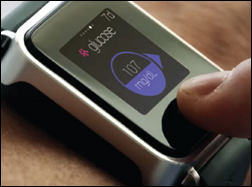
K’Track G – real-time blood glucose monitoring using a skin sensor-powered, wrist-worn device.

image

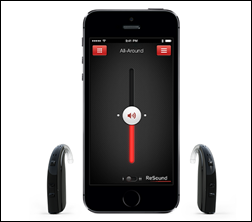
ReSound ENZ02 – a hearing aid whose attributes can be changed from an iPhone.


Other

This article seems to be shocked and appalled that a drug company’s “senior management pressured employees to convince customers to order its key medicine in order to meet financial targets.” Isn’t that what senior management and salespeople are supposed to do? The fact that it’s healthcare is, from a business standpoint, irrelevant. It is surprising to me that people expect profit-driven businesses (drug companies, physician practices, medical device vendors, insurers, supposedly non-profit hospitals, etc.) to voluntarily behave differently only because their particular widget involves sick people. People do what they’re paid to do and our healthcare system richly rewards profit-maximizing behavior.

image

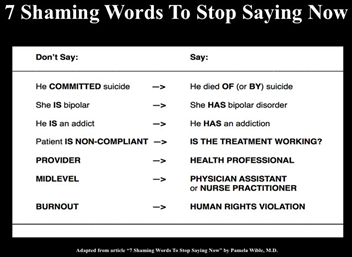
Here are some interesting thoughts by Pamela Wible, MD.

image

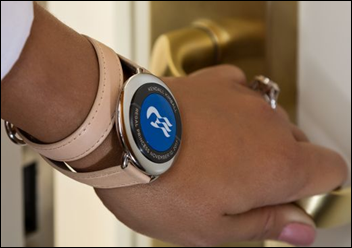
I’m thinking of the healthcare possibilities of the wearable passenger medallion that Carnival Cruise Line is rolling out. The quarter-sized, credit card-linked sensor – carried in a pocket or worn like jewelry – provides touch-free credit for buying high-margin onboard products, opens cabin doors on approach, is tied into the new high-tech casino system. identifies passengers to iPad-carrying waiters and other staff who can then then address them by name, and allows users to tailor their on-board experience to their interests. Carnival will install 7,000 sensors per ship that allow apparently allow it to track passenger movements. It would be pretty cool if a sensor loaded with healthcare and preference information were used to reduce the depersonalization that occurs in healthcare settings. 

image

The Houston paper notes that Ron DePinho, MD, president of “financially ailing” MD Anderson Cancer Center, has been awarded a $208,000 bonus for the year, boosting his total 2016 compensation to $2 million even as the medical center lost $110 million in the last quarter alone. Commendably, he’s donating his bonus back to the institution. One element of his performance review was implementation of Epic, which MDACC says has hurt its short-term bottom line. This is our health system conundrum – executives take a PR beating if their hospital (a) loses a lot of money, or (b) makes a lot of money, with whatever else the institution accomplishes playing secondary importance (maybe because they pay CEOs so much). Meanwhile. MDACC announces that it will lay off up to 900 employees immediately in trying to stop its bleeding.


Sponsor Updates

  • Philips Wellcentive ranks highest in flexibility of meeting customer needs in KLAS’s population health management report.
  • PatientKeeper releases a new video, “Why Billers & Coders Love PatientKeeper Charge Capture.”
  • KLAS rates Health Catalyst the highest among early “preliminary data” population health companies in its new population health management report.

Blog Posts


Contacts

Mr. H, Lorre, Jennifer, Dr. Jayne, Lt. Dan.
More news: HIStalk Practice, HIStalk Connect.
Get HIStalk updates. Send news or rumors.
Contact us.

125x125_2nd_Circle

EPtalk by Dr. Jayne 1/5/17

January 5, 2017 Dr. Jayne Comments Off on EPtalk by Dr. Jayne 1/5/17

Going back to work in 2017 was more difficult than I expected since I’ve been either completely off or working a drastically reduced schedule for more than two weeks. It’s been a good break, spending time with friends, de-cluttering in preparation for the new year, and of course seeing patients.

Cold and flu season has hit with a vengeance, and several of our offices had to call in additional providers to handle the surge. We’re in a good position to deal with situations like that because we have a large number of part-time providers who are willing to work an extra few hours here and there to help move patients through more quickly. We had patients calling from the waiting rooms of other urgent care and hospital facilities asking what our wait time was, which was a new experience for some of our reception staff. Hopefully what’s going around will start waning, because it’s hitting people hard and making them pretty miserable.

Consulting has been busy, with quite a few potential clients calling for Meaningful Use attestation assistance. I’m glad they’re reaching out early in the cycle instead of waiting for the last minute. About half of the people I’ve talked to have their materials largely in order, but the rest of them are trending more towards the train wreck category. If you’re not even sure how to run your quality reports, and haven’t been running them throughout the year, you need a little more than just some attestation help.

For those folks, I’m requiring them to engage for 2017 in a comprehensive way along with the engagement for 2016. We’re happy to help, but I’m not going to enable next year’s fire drill. It may cost me some business, but I’ve reached the point where I’m happy to make less money rather than being part of someone’s disaster.

The rest of the healthcare IT world seems slow, which is typical for this time of year. Vendors are holding their major releases and announcements until closer to HIMSS, which is sad because then they are lost in the hustle and shuffle along with everyone else’s supposedly big news.

I received an email from HIMSS regarding corporate focus groups, which I’ve participated in from time to time. One of the items in the email struck me (and not just because it was in bold font and highlighted in yellow). They’re limiting attendance at each focus group to the first 12 people who show up, even if they’ve invited more than 12 people. I get the fact that they want to manage around no-shows, but it just seems strange. Maybe it will pit potential attendees against each other gladiator style as they wrestle for the last chair left in the room. We can only hope for such entertainment.

I’ve been to some focus groups that have been lackluster, but last year attended one where the presentation team was imploding. Apparently one of their key participants had resigned before HIMSS and was pulled from the trip, without management acknowledging that there was no one else who knew anything about the topic or who was prepared to run a focus group. How do I know this? Because the remaining presenters aired their laundry in front of the group, expressing their frustration as they apologized for the fragmented content. It was painful to watch, and I felt for the survivors, but it would have been more humane to just cancel.

I’m also starting to make preparations for my annual booth crawl traditions with some of my BFFs that I only see once a year. I’m heading to Orlando a day early for some preparatory downtime with a friend who lives on the coast, which will make for a much more relaxed start to HIMSS than last time it was in Orlando. I was delusional enough to run the Disney Princess half-marathon on the opening day of HIMSS, which is a choice I wouldn’t make again. It’s exhausting enough without starting out tired, so I think this year’s plan is much more solid.

A few people have asked what I’m going to be looking at in the exhibit hall and the answer is I’m not sure. What I am sure of though is that there will be plenty of buzzwords such as population health, with everyone using it differently. My favorite part of HIMSS is visiting with the smaller vendors, who often have some real innovation. I’ve got a couple of EHRs that I’ve been following over the years, and I’ll check in with their websites from time to time to see if they’re still around or where they’re focusing.

I was sad to see that one of them recently dropped its multi-specialty focus, but was pleased to learn that they’re focusing on the behavioral health space where good platforms are definitely needed. There are challenges with group visits, enhanced confidentiality, and data sharing that some larger vendors don’t do a great job with. I noticed also that they’re no longer certified, which I’m sure factored in to the change.

There are a couple of changes to the HIMSS agenda. A designated exhibit floor social hour on Monday promotes sampling drinks while touring the exhibit floor. I’m not sure how that’s really different from the booths that historically sponsor happy hours, other than they’re probably paying more for conference-level promotion rather than doing it themselves.

Another special exhibit area is the Population Care Management Knowledge Center, which proposes to help attendees “discover the answers you need to design and implement a successful care coordination and care management programs for your unique populations.” Although most of the session offerings do center around population health, there are some others included that make me wonder if they didn’t have anywhere else to put them: “Helping Patients Find NCI-Supported Cancer Trials” and “Building Consumer Loyalty.” I also noticed one offering that may not be new but I certainly haven’t noticed it before, and that’s registration being offered at the airport. Since I’m staying off the main convention drag, I’m hoping to take advantage.

What are you looking forward to at HIMSS? Email me.

Email Dr. Jayne.

CIO Unplugged 1/4/17

January 4, 2017 Ed Marx 5 Comments

The views and opinions expressed are mine personally and are not necessarily representative of current or former employers.

Presentations Gone Bad

As I look at my leaders’ (and my own) developmental needs, the ability to speak and persuade is an area ripe for improvement. I am leading our organizational internal version of Toastmasters (we call it Bagelmasters) and was thinking of some of my worst moments. Why do we fear presentations more than death? These real-world examples from the last couple of years explain why.

Glitter (2016)

Our new CEO had just started. My team members were experts at ensuring that our monthly governance meeting was effective and conducted without a hitch. The pressure was higher this time, given the change of command and the CEO’s first exposure to our operations.

Before heading to the meeting, I placed a small wrapped Christmas gift from my staff into my man bag. I did not notice the gift’s decorative ribbon, which was generously adorned with glitter. I sat to the right of the CEO and pulled out my laptop.

A minute before the meeting began, staff discreetly asked what was on my face. My deputy came to me and tried to wipe the glitter off of my cheeks and forehead. My oily skin did not want to give up its treasure. With no time left, everyone took their seats and it was show time. The meeting went well, but I had never been so self-conscious.

When the meeting ended, the CMO pulled me aside and said, “Marx, I appreciate your style, but the glitter is over the top.”

Frozen (2015)

One of my pet peeves is being late, so I am careful to set the example when it comes to timeliness. If there is a quorum, I will start meetings no matter who is missing.

When I was late to the IT Steering Committee meeting that I co-chair, I walked in as discreetly as possible. Even though it was obvious I was late, I tried to maintain a low profile and pretended to be invisible. As I sat next to the chairperson, I softly pulled out my laptop and slouched in my seat.

I quickly realized that the room was completely silent, not even a sneeze. I slowly looked up and the entire room was frozen (think mannequin). I started to break into a sweat until they all broke form and started laughing. They turned my propensity for doing practical jokes on unsuspecting victims and punked me big time. My face turned red and we all had long-needed belly laughs. I love our culture, which allows leaders to feel comfortable playing jokes on one another. And I was never late again.

Touched (2013)

When you serve with the same people who take care of you physically, awkward situations are unavoidable. Our top 20 or so executives gathered in preparation of a special board meeting. As I surveyed the room, I counted the number of clinicians around the table, hoping we had a healthy balance of clinicians and administration.

On a level deeper, I began to realize that not only did I have business relationships with all the doctors, but physical ones as well.There was my triathlon teammate doc who spontaneously had me drop my drawers in his office when I expressed concern that my Ironman might be in jeopardy because of a hernia. Turned out to be a groin muscle pull. My primary doc was there – and trust me, he has seen and felt me in places nobody else has. Also in the room was my mountain climbing partner / expedition physician who once prescribed me Viagra when I suffered from high altitude pulmonary edema.

When it was my turn to speak, I could not hit my groove because I kept envisioning scenes from the past. I completely lost my focus. I finally confessed this to my colleagues, who laughed with me, then allowed me to regain my composure so I could finish my talk.

Elevator (2012)

The Joint Commission was in town and I was up after the morning break to describe our organization’s IT journey. It was the opening session for their week-long survey and behind our six evaluators sat our entire officer cohort. Per tradition, I went to grab my pre-speech Frappuccino from the lobby Starbucks 15 stories down. Plenty of time.

With my venti cup of deliciousness in hand, I went back to the elevators. Only one elevator was working. I nervously looked at my watch to evaluate the risk of waiting versus taking the stairs. Down to five minutes, I relented and chose the stairs. I walked in winded as our CEO reconvened the large group. I became self-conscious, as I had broken into a sweat. Then my breathing increased and I became nervous.

I sensed I was losing my audience and lost my normal cadence, so I finally stopped and confessed. TJC was merciful. I took a few deep breaths as people laughed and felt my pain.

Napkins (2008)

I was rehearsing my presentation for my very first board meeting. I got out of the shower and grabbed the box of gauze I had been using to cover and protect my newly minted Ironman tattoo on my right calf. The wound was still fresh and required lotion and covering to keep the red ink and blood from staining my clothes. The box was empty.

I was desperate and certainly did not want to have my tattoo ruin my suit nor risk infection. I frantically searched the bathroom for large Band-Aids or anything that would work. Desperate, I grabbed the only material visible: my wife’s sanitary napkins. I cut one down the middle and splayed it open. In the garage, I found duct tape and strapped my makeshift bandage around my calf. I put on my suit and I was good.

Every time I even considered getting nervous speaking that day, I reminded myself that I had a feminine napkin wrapped around my calf with duct tape. I had to smile the entire speech. When I removed the napkin later that evening, I had a perfectly imprinted Ironman logo on the napkin itself. My wife and I had a good laugh. I have never been short of gauze since that day.

Panel (2010)

I don’t do panels any more. Here is why. I was asked to speak on a panel of a university where I sat on the advisory board. The dean asked for each of the panelists to introduce themselves and share 2-3 key areas of focus for the year. We were allotted five minutes each with the expectation we would then go into traditional panel / audience Q&A mode.

Two of us finished on time and the third panelist pulled out a PowerPoint. After 10 minutes, I began to alternate looks between my watch, the presenter, and the dean. Fifteen minutes later I started a sidebar with the other panelist. After 20 minutes I literally stood up and discreetly walked off the stage and sat in the audience. Finally, at 30 minutes, I left the venue.

I had a couple of less-dramatic but equally frustrating panel experiences, but this event convinced me I should no longer participate in panels. The key to successful panels is a skilled moderator.

Translation (2014)

I was invited to speak to the leadership of all the government-operated hospitals in China. It was an amazing cultural experience I will never forget. I started my presentation, which was simultaneously translated into several Chinese dialects via headsets. My host was forward-thinking, and under each of my PowerPoint bullet points, he had the direct Mandarin translation.

About halfway through, I realized he had inadvertently removed all the English bullets and I was only left with the Mandarin. Since I had pictures or graphs on each slide, I was able to remember the concepts and winged my way through. However, they never invited me back. Now my presentations are almost exclusively pictures. They paint a thousand words in every language.

I am certain I will have more presentations gone bad in the future. While they happen, they are no fun, but in hindsight, I am reminded never to take myself too seriously and to just laugh. If there is one area for any leader to focus on, it is presentations. I have a long way to go.

Ed encourages your interaction by clicking the comments link below. He can be followed on LinkedIn, Facebook, Twitter, or on his web page.

News 1/4/17

January 3, 2017 News 1 Comment

Top News

image

An excellent Black Book survey of 12,000 consumers finds that:

  • 57 percent are skeptical of patient portals, mobile apps, and EHRs because they don’t think providers can protect their information from hackers.
  • Nearly all respondents express concern that information about their prescriptions, mental health, and chronic conditions is being shared with retailers, employers, and the government.
  • A startling 89 percent of respondents withheld information from their providers during their 2016 encounters.
  • The percentage of people who distrust health IT has jumped from 10 percent in 2014 to 70 percent today.
  • 92 percent of patients who are discharged from hospitals under 200 beds don’t understand how to use the patient portals, engagement tools, and monitoring systems that hospitals provide, with 94 percent of nurses in those hospitals saying they don’t have time to add technology literacy to their discharge planning.
  • 94 percent of doctors aren’t interested in reviewing data from patient wearables or fitness and nutrition apps.
  • 82 percent of doctors report that some patients bring so much information from their web searches that they don’t have time to review it during the short time allotted for office visits.
  • Nearly all respondents who use health improvement apps and devices say their PCP ignores their technology, with 24 percent of those respondents saying they may choose a more tech-savvy doctor as a result.
  • 94 percent of providers think the government should pay for patient technology literacy training.

I’m not sure it’s quite the “digital divide” that Black Book calls it, though, since both consumers and providers struggle with technology, aren’t well trained to use it, and worry about breaches (both internal and external). “Divide” suggests some consumers benefit more than others and I’m not sure that’s the case. There’s not a lot of difference between not having the means to use apps vs. not having the interest or confidence to use them.

The most interesting thing about these results is that surveyed consumers nearly always, (a) claim they are in favor of something that sounds innovative, but (b) say their technology fears override everything else (even as they are spewing masses of personal data via Facebook and are willing to provide whatever information companies require to access free games or prizes). In this case, they have nothing positive at all to say about consumer health IT. You would expect similarly low usage of those products, which taxpayers have richly funded.


Reader Comments

image

From Cornichon: “Re: NextGen. Filed an SEC 8-K form giving shares to leadership, many of them vesting only based on the passage of time and not performance. The vesting is accelerated if the company is sold, which has been a topic of speculation for months. The executives also got new change of control benefits for those let go in conjunction with any sale.” CEO Rusty Frantz gets shares worth $850,000 for sticking around for four years plus another potential $472,000 for company performance, plus accelerated vesting if the company sells out. He also gets 150 percent of base salary and bonus, 18 months of health insurance, a pro-rated current year bonus, and outplacement services if he leaves after a sale. The other execs get a similar deal with 100 percent of base salary and bonus. QSII shares have taken a long slide down since mid-2011, now trading at 2005 prices and valuing the company at $840 million. Founder Shelly Razin, who lost his board chair seat in late 2015, holds more than 10 million shares, worth a cool $138 million although that’s a horrifying $358 million less than the same number of shares were worth a handful of years ago.

image

From Retired HIT guy: “Re: Summa Health (OH). It replaced its five-hospital ED staffing on January 1 with a company owned by the husband of Summa’s chief medical officer, with just 36 hours’ notice. Staff wondered how staffing would work given the weeks-long credentialing process and the lack of familiarity with the computer systems used.” The new company apparently realized the challenges facing it since it offered the existing ED  docs a $100,000 incentive bonus and an extra $75 per hour join their company, with no takers. The hospital denies employee reports of long ED wait times and patients leaving without being treated.

image

From Marketing Slick: “Re: CommonWell. Cerner claims it was a founder of Carequality even though it fought it as a CommonWell competitor. All Cerner did was buy Carequality participant Siemens Health Services.”

From Connective Tissue: “Re: Carequality and CommonWell connecting their systems. I agree it’s the golden spike. Some backstory: Epic and McKesson were in a lawsuit over MyChart, as MCK wanted Epic to use RelayHealth. There was also an Epic concern that CommonWell might create a patient portal that would compete with those of providers. Cerner realized that with the VA deal on the table, they needed to get on board because the government supports Carequality. The question was over who charges who – for example, disability and life insurance companies pay the customer because it saves them paperwork. CommonWell wants to charge fees, but Epic wanted Carequality to be free for patient record exchange involving for care coordination. The agreement was for CommonWell to create a record locator service that they can charge for, while Epic agreed to support it for their interested customers (Surescripts offers the only national locator service – the rest are regional ones offered by HIEs). This agreement is like that of cell carriers in that Carequality and CommonWell can charge only their own customers, not those of the other service, and thus Cerner and Epic can’t charge each other. Since multiple participants are involved, rather than calling it a golden spike between two participants, perhaps the agreement could be better described as the linchpin in the nationwide ATM for healthcare.” A few folks who were involved have told me about the April 1, 2016 meeting that was brokered by Micky Tripathi, CEO of the Massachusetts EHealth Collaborative. There’s also that unverified rumor that Cerner is interested in acquiring RelayHealth, but I don’t have a solid source on that even as MCK sheds its other health IT assets and announces no plans for the best one (Relay).

From Unbalanced Sheet: “Re: R&D accounting. I would be surprised if Epic doesn’t use GAAP accounting like most large companies, but it’s never an apples-to-apples comparison. The question is how much R&D is capitalized and thus ends up on the balance sheet vs. expenses that are flushed through P&L. Aggressive companies like Cerner have capitalized 35 percent or more over the years, which allowed it to report higher earnings than more conservative companies. Management has a great deal of discretion over things like that that go toward quality of earnings.” I read somewhere that software companies must now treat R&D as an expense as it is incurred unless they can prove that the investment has a quantifiable future benefit. For software development, I was thinking that the only opportunity to capitalize R&D is the time between technical feasibility and GA, meaning you have to expense a product’s cost once it is released. However, the definition of “product” and “GA” may be squishy.


HIStalk Announcements and Requests

Your chance to weigh in:

image

I applied matching money to Vicki’s donation to my DonorsChoose project to fully fund these teacher grant requests:

  • A math fluency activities bundle for Mrs. M’s elementary school class in Fairfield, OH
  • A document camera and interactive whiteboard system for Mrs. W’s middle school class in Middletown, OH
  • Composition books and math games for Mrs. D’s elementary school class in N. Little Rock, AR.

image image

Mrs. M reports that her Virginia students are surrounded by technology that they don’t always get to use because of economic circumstances, adding that the kids have jumped in to create a plan of how they will use the two tablets we provided in funding her DonorsChoose grant request.


HIStalkapalooza

image

HIStalkapalooza sign-ups are open. The usual rules apply:

  • Everybody who wants to come has to sign up on this form (even me) – nobody gets invited automatically.
  • Each person who wants to come has to sign up separately even if they’re a guest of someone else (because we use an automated check-in system with individually barcoded tickets),
  • Signing up doesn’t guarantee that you’ll get an invitation since that depends on how many people I can invite, which is based on how many sponsors I get. Invitations will be emailed in three weeks or so.
  • We pay per click of the House of Blues turnstile and thus close the doors early in the evening since someone swinging by for a late-evening beer still costs many dozens of dollars. If you can’t attend the whole event, please don’t take up a slot.

Thanks to our HIStalkapalooza sponsors who are graciously making the industry’s most talked-about event possible. I’ll have a write-up on each company leading up to the event, which is less than seven weeks away.

image
image
image
image
image
image
image
image

image

I need another couple of sponsors to hit the break-even point on HIStalkapalooza. Companies that want invitations to give out, recognition, and even to have their CEO welcome guests on the red carpet should contact Lorre. She will get creative in finding something fun — for example, HOB offered the idea of outfitting every server with a tie with a sponsor’s logo. I joked that it should be like Nascar where they wear fire suits plastered with logos, to which our HOB contact responded with a dry, two-syllable ha-ha before moving on to something important like the food options.


Webinars

January 18 (Wednesday) 1:00 ET. “Modernizing Quality Improvement Through Clinical Process Measurement.” Sponsored by LogicStream Health. Presenters: Peter Chang, MD, CMIO, Tampa General Hospital; Brita Hansen, MD, CHIO, Hennepin County Medical Center. The presenters will describe how they implemented successful quality governance programs, engaged with their health system stakeholders, and delivered actionable information to clinical leadership and front-line clinicians. Q&A will follow.

January 26 (Thursday) 1:00 ET. “Jump Start Your Care Coordination Program: 6 Strategies for Delivering Efficient, Effective Care.” Sponsored by Healthwise. Presenters: Jim Rogers, RN, RPSGT, director of healthcare solutions, Persistent Systems; Charlotte Brien, MBA, solutions consultant, Healthwise. This webinar will explain how to implement a patient-centered care coordination program that will increase quality as well as margins. It will provide real-world examples of how organizations used care coordination to decrease readmission rates, ED visits, and costs.


Acquisitions, Funding, Business, and Stock

image

Xerox completes its spinoff of its 93,000-employee business process services company Conduent, whose shares trade on the NYSE as CNDT.

image

Kaufman Hall acquires contract modeling, budgeting, and decision support software vendor KREG Information Systems.

image

Israel-based “smart shirt” company HealthWatch Technologies raises $20 million from a China-based drug company for its 15-lead, hospital-quality sensor garment.


People

image

Vocera hires Ben Kanter, MD (Extension Healthcare) as CMIO.


Announcements and Implementations

image

EHNAC releases 2017 standards for its 18 accreditation programs for electronic healthcare data exchange.

image

University of Vermont Medical Center files a $112 million state certificate of need to extend its Epic implementation.

image

United Healthcare will expand its wearables program to allow employees of some companies for which it provides health insurance to allow their employees to use their own wearables, connected via Qualcomm Life’s 2net connectivity platform. Employees can earn up to $4 day in credits for meeting walking goals involving frequency, intensity, and tenacity.


Government and Politics

Senate Republicans introduce an aggressive timeline for dismantling the Affordable Care Act on their promised first day of the new Congressional session. They are using a budget reconciliation resolution that can be passed with a simple majority vote in the Senate (the GOP has 52 seats) vs. the the usual 60-vote legislation approval level. The resolution was introduced by Senator Mike Enzi (R-WY), who says the ACA caused “skyrocketing premiums and soaring deductibles” while driving insurers out of the market.


Privacy and Security

image

A New York Times op-ed piece on healthcare cybersecurity co-authored by Eric Topol, MD calls for health systems to stop storing and owning patient health data, instead making patients responsible for storing their own information in the cloud or a digital wallet – possibly using blockchain technology – and deciding for themselves who to share it with. He adds,

We cannot leave it to the health record software companies — the Cerners, Epics and Allscripts of the world — to bring about the needed changes. Their business is to sell proprietary information software to health systems to create large centralized databases for such things as insurance reimbursements and patient care. Their success has relied on an old, paternalistic model in medicine in which the data is generated and owned by doctors and hospitals … Patients have shown an overwhelming willingness to share their information for altruistic reasons (which far exceeds the track record of doctors and health systems when it comes to sharing data).

image

US Special Operations Command in Florida is investigating a claim by security researcher Chris Vickery that he was able to breach the database of a company that provides healthcare workers for one of the group’s programs. Vickery has found several hundred unsecured MongoDB installations, at least some of which have been breached by a hacker with their data held for ransom. A security expert recommends blocking access to port 27017 or limit server access using binding local IPs, then restart the database with the –auth option after assigning user access. The no-SQL MongoDB is used to run big data analytics.


Other

image

Eric Topol, MD pans the apparently successful “Pure Genius” TV series in which a young technology billionaire creates a hospital that uses cutting edge technology to treat patients that other hospitals can’t help. He not only notes medical mistakes (calling a stroke a heart attack), but questions the show’s premise:

Patients are cured, their lives are saved, or they have dramatic responses to unproven, otherwise unavailable treatments. And in each case Bell, without any medical training or background, makes the critical clinical decisions: “Best idea wins,” he says at the series’ beginning, and they’re usually his. He meets directly with patients and their families, makes extraordinary promises, dresses in scrubs, and uses technology that has never been applied to human beings. When the amnestic police officer does not respond to what the show calls neurostimulation, Bell blurts out, “I’ve always wanted to reprogram someone’s brain” and administers some form of optogenetic intervention that partially restores his memory. The notion that a medically untrained tech billionaire walking around in casual clothes and flip-flops can make life-and-death decisions for people using far-fetched, unchartered therapies is preposterous.

A life insurance company in Japan replaces 34 of its claims adjusters with IBM Watson Explorer, which will analyze hospital records to determine insurance payouts. The company expects the investment to pay for itself in less than two years in replacing employee salaries with much-lower maintenance fees. The article succumbs to the sensationalistic “rise of the robots,” but it is inevitable that companies will replace expensive human labor with technology (both manufacturing and information), which is great for shareholders, at least until the customer base evaporates due to unemployment.  

A Texas couple sues Apple after a driver distracted by using FaceTime on the highway caused an accident that killed their 5-year-old daughter. The couple says Apple should have warned users not to FaceTime while driving and should electronically prevent them from doing so (it would be interesting to see how Apple could distinguish a driver from a passenger).

image

Weird News Andy titles this story “Pean pain paean” (hint: “pean” is a type of surgical forceps). Surgeons in Vietnam remove surgical forceps left in a man’s stomach for 18 years, ironically in the same hospital that apparently left them there in the first place. The hospital only keeps medical records for 15 years, but says it will try to locate the surgical team even if they have retired to let them know they messed up.


Sponsor Updates

  • CTG employees support the Family Justice Center with donations of food, toiletries, and gift cards.
  • AdvancedMD compiles its most popular e-guides and videos from 2016.
  • Aprima employees donate over nine tons of food to Dallas-area families in need through Metrocrest Services.
  • Besler Consulting releases a new podcast, “A brief history of healthcare reform in America.”
  • CoverMyMeds will sponsor and present at CodeMash January 10-13 in Sandusky, OH.

Blog Posts


Contacts

Mr. H, Lorre, Jennifer, Dr. Jayne, Lt. Dan.
More news: HIStalk Practice, HIStalk Connect.
Get HIStalk updates. Send news or rumors.
Contact us.

125x125_2nd_Circle

Curbside Consult with Dr. Jayne 1/2/17

January 2, 2017 Dr. Jayne 8 Comments

image 

It’s the time of year when many of us are making resolutions around how we want to change things in the coming year. I was struck by a recent Washington Post piece about “busyness” being a new status symbol. It mentions that marketers have picked up on the concept as a hook to push items that promote multi-tasking or help people continue to manage time constraints. One Columbia University profession who researched the issue found that people with leisure time were not perceived as having as high a social status as those who worked more.

I see this playing out in a couple of different ways in my consulting work. One is the way mentioned in the article, where people embellish their busyness as a way of trying to look like they’re working harder or more than their colleagues. I recently had to do a workplace intervention with a client whose employee would repeatedly take vacation time, then work on his vacation, and expect it to be credited back to him. (It still surprises me that they needed a consultant to help with that conversation, let alone a physician consultant, but it does pay the bills.)

The employee had a somewhat misplaced sense of loyalty to his customers, defining his worth by his ability to be at their beck and call. He also exhibited a lack of trust in his peers and also his supervisor, refusing to list anyone on his out-of-office message and therefore forcing himself to be permanently on call. He also had no sense of work-life balance and didn’t understand that the company values people taking time off to recharge and refresh.

As someone who has done a fair amount of employee counseling, I have to say it was a pretty bizarre conversation with this guy. He was certainly at the extreme, but I see all kinds of examples of people on this spectrum. Many people have convinced themselves that they’re the only person who can possibly handle a client. As a student of human (and client) behavior, I would argue that if you have clients that fall into that bucket, there is a certain amount of co-dependency going on and a team approach is going to be helpful for everyone and likely better for the client long term. Others tend to fall more into martyrdom mode, keeping toxic projects, clients, or co-workers on their own radar so that they don’t impact others. Although this kind of busyness seems altruistic, it can be harmful in the end.

Another way I see this playing out is when people really are hyper-busy, mostly due to poor management. I have one client who constantly cranks out executive status reports listing how far off the mark their projects are, but there is never any mitigation. When 60 percent of your teams are not meeting production goals due to resource constraints, it might be a good idea to address those constraints.

I see some groups throwing more bodies at the problem without understanding that sheer numbers might not be the answer. I see other groups who won’t add more personnel because of a perception that it would take too long to ramp up workers who can take on the totality of the stalled tasks. So they choose to do nothing, instead never catching up or sometimes falling farther behind. The morale in the trenches on these teams is abysmal because they’re being constantly told they’re not meeting expectations, but they are largely powerless to create change given their current corporate culture.

With as lean as healthcare organizations are trying to be in the face of constant downward payment pressure and regulatory burdens, I continue to be surprised at the lack of accountability of management in many organizations. If a manager can’t articulate his or her resource constraint along with a request for mitigation, then they don’t need to be managing. As companies reduce head count, I see people given management responsibilities who have no business being there and no support to try to learn how to manage.

Just because you’re the best on a team doesn’t mean you’re cut out to be a manager. And often people thrust into those positions try to continue doing their previous jobs because they’re not comfortable managing, which puts things even farther in the ditch. It’s not the employee’s fault, though – the people above them put them in that position, and that’s where the accountability needs to live.

I see people routinely working 50- and 60-hour weeks because they have to in order to keep up with the demands placed upon them. Given the job market for many workers, employees are not empowered to say no to ongoing demands. I have a good friend who works for a global company and works in multiple time zones, which translates to a 15-hour work day much of the time. His company has had multiple layoffs in the last few years and he’s a single parent to kids approaching college age, so his willingness to say no is directly proportional to his perceived ability to find an equivalent position should he be let go. Especially in healthcare and with companies supporting healthcare, this should not be acceptable.

I also see people working those types of hours because they’re cobbling together multiple part-time jobs to make ends meet. Maybe they’ve had a medical bankruptcy, are dealing with family members impacted by drugs or incarceration, or have other significant challenges. Maybe they lost their job and are trying to stay out of debt while getting their kids through school. There should be no negative thoughts on that level of busyness and the rest of us that aren’t in that situation should consider ways in which we can steer our society to reduce the need for it.

I’ve written before about the work habits in different countries and some of our uniquely American work habits. Interestingly, the Columbia University professor did a similar study looking at the perception of busyness by Italian subjects. They ranked being busy at work as having less status than being able to have leisure time.

Having lived in the stress of a high-productivity physician culture and then in the corporate culture and now in the self-employed culture, I’d definitely rank the ability to have more leisure time as one of the key reasons I left traditional practice. They money I made as an employed physician wasn’t worth the fact that I had no life and was constantly on call. Not everyone has the opportunity or ability to make drastic changes, however, especially at mid-life. But we can support each other in making small changes that enrich our workplace and help each other out.

For those of us that are working crazy hours because we can (not because we have to), let’s not fall into the trap of equating busyness with self-worth. Let’s look at how we can address workplace culture, strengthen management, and raise accountability to improve our working environments. For those who have figured out this workplace equation, let’s see how we can improve our communities and our country to meet the need of our fellow humans. Here’s to a 2017 where we’re not busy just to be busy.

Email Dr. Jayne.

Monday Morning Update 1/2/17

January 1, 2017 News 5 Comments

Top News

image

Eric Topol, MD lists his “10 Tech Advances That Can Change Medicine.”

I have to be a quibbler in suggesting that changing “medicine” is far less important than changing “health” – none of these advances would move the needle on the overall health of the US population very much, although listing magic technology bullets makes for sexier reading than advocating exercise, dietary changes, and the other health determinants that drive 90 percent of health and quality of life.

We don’t really need wearable sensors or increasingly sophisticated diagnostic tools to tell us what people could do to improve their health the most, but Topol’s world view is as a cardiologist, technologist, and geneticist rather than that of a frontlines generalist. Telling people to use their own intelligence instead of being overly enamored of the artificial kind doesn’t earn many grants, procedure payments, or technology board seats.

That said, Topol isn’t the only one with the “I have a hammer, so everything looks like a nail” problem. Hospital people mistake their often clumsy episodic interventions as the most important aspect of health.

In both cases, the fact remains that the most significant health decisions are made when people are far away from their providers and the bustling business of healthcare services delivery, often when they are in fact alone. For that reason, maybe health charge should be led by public health marketing people rather than providers whose education and experience causes them to overestimate their importance to health.


Reader Comments

image

From Lucid Moment: “Re: patient privacy. Patients do not realize that they give up their HIPAA rights when they use an app or system that connects to an EHR via an API. CMS requires providers to send patient information to any application that patients want to use. If a patient clicks ‘I agree’ on the usual multi-page terms of whatever app they’re using, the app vendor will gain access to their data under the FTC’s minimal privacy rules rather than HIPAA’s. Google and Microsoft will benefit because they can read patient data for choosing ads to display. That’s always been the case, but new phone access to data such as through the new Apple services opens the pipe for them.” Interesting. The above is from CMS’s November 2016 update on patient access to health information.

From Spoon Bread: “Re: misused words. This article list some good ones.” Indeed it does. Some good examples that I’ve seen:

  • adverse (harmful) vs. averse (not willing)
  • bemused (bewildered) vs. amused (entertained)
  • disinterested (unbiased) vs. uninterested (not interested)
  • flaunt (show off) vs. flout (disregard)
  • opportunistic (exploiting a situation immorally), confused with taking advantage of an opportunity
  • simplistic (oversimplifying a complex issue to the point of being misleading) vs. simple (an issue that is uncomplicated)
  • tortuous (twisting) vs. torturous (involving physical torture)

HIStalk Announcements and Requests

Thanks to the following companies that recently supported HIStalk. Click a logo for more information.

image
image
image
image
image
image
image
image
image
image
image
image
image
image
image
image
image

image

Poll respondents are slightly negative on using scribes to free doctors up from doing EMR data entry work. Linda is concerned about the wide variability in scribe training and their lack of certification, while Furydelabongo says scribes are like transcriptionists who can create a standardized narrative in the absence of a usable EHR (which he or she says is at least two generations away). Frank says having the most expensive labor unit – doctors – entering data is inefficient, no different than if hospital VPs were required to enter transactions.

New poll to your right or here: Should physicians be held accountable for patient satisfaction survey results? Your thought process would interest the rest of us, so click the Comments link after voting and explain it.

image

Here’s a last chance to participate:

image image

We funded Mr. C’s “Art of Science and Performance” video equipment grant request through DonorsChoose. He checks in from California to say that the class has recorded a school production so that everyone could watch it and will next make a San Jose Tech Challenge film as its keystone project.

I had some final site upgrade work performed over the holiday weekend. Let me know if you see anything that’s not working.


Last Week’s Most Interesting News

  • President-elect Trump meets with the CEOs of several large health systems, with privatizing some aspects of the VA being a rumored topic of discussion.
  • A study reports the benefits of adding EHRs as a topic in a hospital’s daily executive safety huddle.
  • The local paper reviews a patient death at St. Charles Medical Center (OR) in which an IV error was not caught, partly because the hospital had turned off its IV checking system after finding that it wasn’t compatible with its EHR.
  • The New York Times profiles the failure of a North Carolina physician group to move to an ACO model, with physicians who left for higher-paying hospital jobs and a big investment in technology forcing the group to sell out to a large health system.

Webinars

January 18 (Wednesday) 1:00 ET. “Modernizing Quality Improvement Through Clinical Process Measurement.” Sponsored by LogicStream Health. Presenters: Peter Chang, MD, CMIO, Tampa General Hospital; Brita Hansen, MD, CHIO, Hennepin County Medical Center. The presenters will describe how they implemented successful quality governance programs, engaged with their health system stakeholders, and delivered actionable information to clinical leadership and front-line clinicians. Q&A will follow.

January 26 (Thursday) 1:00 ET. “Jump Start Your Care Coordination Program: 6 Strategies for Delivering Efficient, Effective Care.” Sponsored by Healthwise. Presenters: Jim Rogers, RN, RPSGT, director of healthcare solutions, Persistent Systems; Charlotte Brien, MBA, solutions consultant, Healthwise. This webinar will explain how to implement a patient-centered care coordination program that will increase quality as well as margins. It will provide real-world examples of how organizations used care coordination to decrease readmission rates, ED visits, and costs.


Acquisitions, Funding, Business, and Stock

Here’s the 2016 stock performance of some publicly traded health IT companies. It obviously wasn’t a great market year for them, even as the Dow rose 15 percent, the S&P 500 ended up 11 percent, and the Nasdaq increased 10 percent. Cerner shares, for instance, are trading at their March 2013 price, with their longstanding steep climb up having ended in March 2015 even before its July 2015 DoD contract win was announced.

Castlight Health – up 19 percent
Premier – down 14 percent
Aetna – down 14 percent
Cerner – down 19 percent
Quality Systems (NextGen) – down 22 percent
McKesson – down 28 percent
Allscripts – down 29 percent
Athenahealth – down 34 percent
Medical Transcription Billing – down 34 percent
Inovalon – down 39 percent

image

The Philadelphia paper profiles Forerunner Holdings, which offers software that helps hospital pharmacies track prescription drugs through the supply chain to detect counterfeit medications. The company has 50 hospital customers who pay around $5,000 per year to connect with the fulfillment systems of drug wholesalers and manufacturers. The 14-employee company, which is about to launch a $10 million Series A funding round, plans to add a drug shortage warning app and a system to allow hospitals to share access to expensive, rarely used drugs such as antivenin. The company CEO and CTO both came from a Germany-based analytics software vendor and this is their first company.

image

Fortune magazine profiles investors in “fake it till you make it” startups (of which Theranos is provided as an example) who refuse to believe their companies are doing anything unethical to provide the false appearance of growth. The article ponders whether startup culture has changed now that “the Valley looks as crooked and greedy as the rest of the business world.” The magazine proposes a Startup Scandal Scale that rates companies “on a scale of one to Theranos.” It summarizes,

Some founders grow into talented CEOs. Most don’t. That’s an inevitable by-product of Silicon Valley culture, where everybody fetishizes engineers, designers, and inventors while managers get little respect. “We have an epidemic of bad management,” says Phil Libin, a partner at venture firm General Catalyst. “And that makes [bad] behavior more likely, because people are young, inexperienced, and they haven’t seen the patterns before.” So inexperienced people are handed giant piles of money and told to flout traditions, break rules, and employ magical thinking. What could possibly go wrong? “We hope that entrepreneurs bend the rules but don’t break them,” McClure says. “You know the saying ‘There’s a fine line between genius and insanity’? There’s probably a fine line between entrepreneurship and criminality.”


Other

image

Someone tweeted about Crohnology, a “patient-powered research network” in which people with Crohn’s disease are invited to contribute information about treatments they’ve tried so that the collective experience can be shared with all participants. It’s still in beta testing after several years, but it’s a great idea.

image

image

The New York Times profiles the rapidly increasing world of “fake academia,” where shoddily produced but impressive-sounding journals and conferences feed the “publish or perish” needs of academics – many of them from third-world countries – who pay for the privilege of adding substandard articles and presentations to their CVs. An India-based company runs several of its conferences simultaneously from the same hotels in resort destinations; another’s 17 journals are published by one guy sitting in his apartment; and a third company warns prospective authors that its journals don’t accept papers longer than six pages. One journal accepted for publication a professor’s manuscript that contained one sentence: “Get me off your &@$! mailing list.”A company that the FTC has charged with deception offers the 4th International Conference on Biomedical and Health Informatics in Chicago and other informatics conferences, described with sometimes hilariously fractured English and illustrated with badly resized photos.

Bill Gates warns that the misuse of antibiotics has raised the odds of a pandemic spread by resistant bacteria. 

Connecticut home care agencies worry that the January 1 implementation of a Medicaid fraud prevention system will cause claims processing problems. The electronic visit verification system requires home care workers to call a centralized telephone number upon entering and leaving the client’s home. The agencies also complain that the state chose as its single vendor Sandata, requiring interfacing and loss of functionality. One agency already has a similar system in place that’s integrated into its EHR, but the change will require workers to go through the verification steps a second time just for the state’s records. An agency with 1,500 Medicaid clients says it won’t use the state’s system and will stop serving those patients if the state insists.


Contacts

Mr. H, Lorre, Jennifer, Dr. Jayne, Lt. Dan.
More news: HIStalk Practice, HIStalk Connect.
Get HIStalk updates. Send news or rumors.
Contact us.

125x125_2nd_Circle

How My 20 Predictions for 2016 Turned Out

December 30, 2016 News Comments Off on How My 20 Predictions for 2016 Turned Out

Here’s what I predicted on December 28, 2015 and how right or wrong I turned out to be.


Cooled-off funding markets will leave unprofitable startups struggling, IPOs will be postponed, but Health Catalyst will go public.

no

It’s hard to say whether my first two predictions were correct, but I was wrong about Health Catalyst – they weren’t as anxious or as prepared to go public as I expected. I was right in predicting a poor 2016 IPO market as successful companies in all sectors seemed to prefer increasing their private valuations instead of going public. SEC filings suggest that the trend will continue into 2017. I’m guessing many startups are indeed struggling, mostly because of their own shortcomings. Without the Health Catalyst miss I would have given myself a solid checkmark.


Healthcare costs will be a contentious point in the presidential election, provider mergers will continue, and at least one presidential candidate will timidly suggest cost controls.

yes

Seems right to me. Hillary Clinton touched lightly on cost controls and certainly the cost and premium aspects of the Affordable Care Act became a campaign issue.


Consumers will lose interest in fitness trackers.

yes

I’ll give myself a check even though “lose interest” may or may not be broadly accurate (perhaps, to quote Spinal Tap manager Ian Faith, their appeal is just becoming more selective.) The Apple Watch flopped and some fitness tracker companies sold out or shut down.


The CEOs of Epic, Cerner, and Meditech will start to pull back from day-to-day company involvement as they approach retirement.

no

This is a toss-up. Epic’s Judy Faulkner is actively involved but talking more about a succession plan because people keep bugging her about it, Cerner’s Neal Patterson was sidelined temporarily by cancer but plans to come back in a few weeks, and I don’t really know about Meditech’s Howard Messing but he seems to be active. I’ll compromise by giving myself an X despite being “directionally correct.” It’s not like they’re just going to disappear while still holding the title, so only Epic and Meditech insiders would know how actively involved their executives are, unlike the publicly traded Cerner who has to be more transparent about what’s going on and Neal has made it clear he’s phasing himself out. In any case, all three companies are likely be replacing their longstanding top executive (and founder in two of those cases) within a few years, introducing the possibility of change.


ONC and Meaningful Use will become increasingly less relevant and more contested as ONC replaces Karen DeSalvo with a new National Coordinator who lacks her experience and bipartisan support.

yes

Meaningful Use was replaced with MACRA while ONC’s influence is debatable – 21st Century Cures gives it more scope. I could score this one either way. Certainly the “more contested” part is true as healthcare member organizations constantly issued press releases and letters complaining about everything MU-related.


Several mid-tier consulting firms will be downsized or acquired as their implementation and advisory business dries up.

yes

I should know better than to make predictions that are hard to quantify. Some companies certainly did cut back or sell out although obviously their reasons for doing so weren’t publicly announced. Like a vendor’s crafty RFP respondent, since I can’t definitively say “no” I’ll go with “yes” since that’s to my advantage.


At least three big health systems will be breached in exposing the information of 100,000 or more patients. The government and organizations like HIMSS will try to help providers share information.

yes

The 100,000-patient number seemed huge a year ago, but breaches of that size are unfortunately not uncommon these days.


The VA will announce plans to eventually replace VistA with a commercial product.

yes

The VA hasn’t specifically said, “We’re dumping VistA,” but their RFIs and conceptual descriptions – not to mention Congressional pressure — clearly suggest such a direction.


At least one customer each from Epic and Cerner will switch to the other’s product to get a better deal on maintenance fees. Epic will expand its hosting service to better compete with Cerner.

no

I’ve given myself a check on some debatable predictions, so I’ll assign myself an X here even though hospitals have certainly switched both ways between Epic and Cerner and Epic is indeed expanding its hosting services. Most of the swaps were probably related to acquisitions and Soarian customers who were pushed into RFPs that sometimes went Epic’s way, so I don’t have proof that anyone replaced a product just because its ongoing cost was too high.


The terms “telemedicine” and “mobile health” will become antiquated as they simply become another accepted aspect of care delivery. “Information blocking” will also fade away as a hot term when everybody realizes the concept involves speculation without proof.

no

The terms “mobile health” and “mHealth” are getting long in the tooth and irrelevant since everything is mobile to some degree, but “telemedicine” lives on and “information blocking” is still being thrown around indiscriminately to describe unproven shady behavior by EHR vendors and providers. I was quite wrong in thinking the accusations about information blocking would fizzle due to lack of evidence proving intention. I still haven’t seen the evidence, but the accusations are still flying but with no change in the status quo for patients.


IBM Watson will continue to produce mostly hype. No convincing studies will demonstrate its value, but newly announced, high-profile partnerships will keep IBM shareholders hopeful.

yes

I grade it as all hype so far.


The dark horse publicly traded company best positioned to succeed in health IT and related areas without a lot of fanfare will be Premier.

no

I didn’t see much of a health IT splash from Premier and its shares are down on the year.


Athenahealth won’t get much inpatient traction with the former RazorInsights and BIDMC’s WebOMR.

yes

It seems logical in hindsight that Athena would need more than a year to become a significant inpatient player if indeed it ever does, but a lot of post-acquisition hype was flying a year ago and this prediction was bolder than it seems now. ATHN share price has dropped 33 percent in 2016.


McKesson will consider packaging and divesting its many health IT offerings as non-core business.

yes

That’s exactly what is happening as the company prepares to create a new, publicly traded company with Change Healthcare and is shopping its Enterprise (Paragon) business around without any takers so far.


Epic will not join CommonWell, but will leapfrog its competitors in offering APIs and slowly building a carefully controlled third-party ecosystem.

yes

I’ll give myself a check since Epic didn’t join CommonWell, but I’m not so sure that Epic has leapfrogged Cerner in offering APIs.


Software for population health management and analytics will enter Gartner’s Trough of Disillusionment as providers implement it poorly and without a commitment to truly change their profitable business models.

yes

I wasn’t speaking literally about Gartner’s hype cycle and I can’t say if population health management software is on it since I don’t subscribe to Gartner, but I think it’s generally true that providers are struggling to wean themselves off fee-for-service business and haven’t done a whole lot with the many software and analytics products that are being sold. You could make a convincing case that I’m wrong, however.


Cerner and Epic will continue to poach the business of Meditech, CPSI, and best-of-breed vendors whose small-hospital customer bases are being acquired by larger health systems.

yes

This is true, although it wasn’t really a bold prediction since the trend was obvious even a year ago.


“Big data” will support a few meaningful clinical studies performed using only aggregated electronic information, but “little data” will provide more impressive but less-publicized results as doctors design the treatments of individual patients by reviewing the outcomes of similar patients.

no

I’ve given myself some checks for predictions that were partially correct, so I’ll balance it with an X here even though I still believe in the “little data” concept. Certainly some big data-driven studies have turned up some interesting and useful clinical information, so in that regard it probably contributed more than I expected. I could have given myself credit for foreseeing the precision medicine movement that was announced a few weeks after my prediction, but I’m undeserving — that’s really based more on genetic information instead of the “patients like this one” small-scale aggregate data analysis by an individual provider.


Consumer healthcare apps will continue to be plagued by inconsistent use, questionable design, and an unremarkable impact on health or outcomes.

yes

This is another accurate but not especially bold prediction. FDA crackdowns were obviously coming and app vendors rarely bothered to prove that their products influenced patient outcomes.


CHIME and AMIA will follow the HIMSS model of increasing conference attendance and revenue by catering to high-paying vendors willing to buy access to prospects.

no

I’ll give myself an X since I’m not involved with either organization and thus can’t say how much influence vendors are able to buy. I haven’t heard of any egregious behavior by either organization.


News 12/30/16

December 29, 2016 News 2 Comments

Top News

image

President-elect Trump meets with the CEOs of Mayo, Hopkins, Partners, and Cleveland Clinic, with the topic speculated to be changing the VA to allow veterans to seek care at any hospital.

There’s also the strong possibility that the group tried to convince Trump to leave intact those parts of the Affordable Care Act that boosted the profits of big health systems by insuring people to whom they would otherwise be required to treat free.

Cleveland Clinic CEO Toby Cosgrove, MD, who is a Vietnam War veteran, is rumored to be on Trump’s short list to run the VA.

Also among the pod of rich, white males was facial plastic surgeon Bruce Moskowitz, MD (who founded the non-profit Medical Device Registry for reporting problems with surgically implanted devices) and the reclusive CEO of Marvel Entertainment, who had previously donated $50 million to the cancer center of NYU Langone Medical Center that is now unsurprisingly named after him and his wife.


Reader Comments

image

From Meltoots: “Re: readmissions article. It ignored the data showing that hospitals simply shifted readmissions to observation beds. Plus, the CHF death rate actually increased over the past several years as hospitals are penalized less for a death than a re-admit. It’s silly talk that the ACA reduced readmissions.” The readmissions penalty was too specific to have a predictably positive impact on patient care, being a primarily financial, incidentally clinical carrot (like other major payment methods that are driven by the patient’s midnight location). Providers have learned to play the Medicare shell game well, always finding a new way to preserve profits when the government removes one. Here’s one I was involved with at my health system. We quietly bought up some oncology practices, then made their patients come to the hospital to get their chemo infusions because it paid us better and we could milk the government’s 340B program to wildly increase drug margins. The patient, however, had to drive to our hospital (which had the usual stress-inducing lack of parking), pay a co-pay since they were now reclassified as hospital outpatients, deal with our often-indifferent registration people and financial counselors, and endure the bustle created when we funneled all those folks into hastily created infusion rooms that resembled happy ending-type massage rooms rather than places of healing. I would not have liked it as a patient — just being in a hospital would make me feel sicker and less hopeful than getting treatments in a quiet, pleasant doctor’s office. Our execs loved the idea, though, since it swelled our bottom line, which is the biggest ego stroke (other than erecting phallic, lavish buildings) that a C-level hospital executive can get.

image

From The Truth: “Re: Mercy Hospital in Des Moines. Fined over a million dollars for patient safety scores and that doesn’t make HIStalk? C’mon man.” I’m constantly surprised when readers complain that I haven’t mentioned some story that is unrelated to health IT and thus amply covered elsewhere. I guess I should be honored that folks expect or encourage me to write about other topics. The hospital gets three stars from CMS, a D from Leapfrog, and poor patient satisfaction scores, so naturally they announce that all of those measures use flawed data that underreport its medical pre-eminence.

image

From AnonTip: “Re: Deborah Heart and Lung RFP. I worked on it as a vendor. Some of the RFPs ran 800 pages as they demanded extensive screen shots of workflows and details, then required three days of on-site demos and then site visits. [Vendor’s name omitted] bid $40 million for the 89-bed hospital. They ended up choosing Meditech Web Ambulatory and 6.1, so they will probably dump Allscripts Touchworks at some point.” Unverified. They must have hired consultants to lead their search since it seems like overkill for a tiny hospital that has been using Meditech for decades, although maybe the threat of bolting gave them a stronger negotiating position. The hospital’s 2015 financials show patient service revenue of $163 million and expenses of $166 million, so I can understand passing on the one vendor’s $40 million bid.

image

From State-Sponsored Actor: “Re: Joint Commission. They’ve flip-flopped again, now declaring that providers can’t send patient orders via secure messaging.” Joint Commission first banned sending orders via secure text messaging in 2011, then decided in May 2016 that it was OK as long as the messaging system met specific requirements. Since then, Joint Commission met with CMS and now declares, “The use of secure text orders is not permitted at this time” because its impact on patient care is unknown, specifically:

  • How much nurse work is required to transcribe those orders into the EHR.
  • The asynchronous nature of orders sent via text message requires extra steps to clarify and confirm.
  • The transcribing nurse has to deal with any clinical decision support messages and relay them to the ordering provider.

From Kilt-Lifter: “Re: DonorsChoose. Do you personally fund the projects you mention?” Not usually. I mention projects in which readers decide to donate through me to enjoy the collective good will created when I share the stories of how the projects I funded with their money (and matching funds) turned out. There’s nothing in it for me and my personal donations are separate.

From Lookie Here Now: “Re: HIStalk email updates. I’m no longer receiving them.” This happens all the time as companies ramp up their protective defenses against spam and my email system cancels the recipient as “bounced.” Just sign up again since that often works.


HIStalk Announcements and Requests

image

I’ve opened my once-yearly HIStalk Reader Survey. Like last year, I’ll randomly draw respondents for a $50 Amazon gift card. I was surprised in looking over last year’s responses how many reader-suggested changes I have since put in place, although some were just too ambitious for my energy level and capabilities and the #1 response by far is always “don’t change anything.” Some good suggestions from last year and my comments:

  • Improve the site search. That’s always a challenge since Google Site Search doesn’t allow date filters, which would be really cool.
  • Find an inside-the-Beltway anonymous writer. I’m not super-interested in government and politics, but I’m open to the idea if someone is interested.
  • Write less about HIMSS (which is for vendors) and get provider input from AMIA. I don’t really have contacts in AMIA other than I was a member for a while, so I don’t have much to add there except occasionally mentioning something published in JAMIA that someone sends me.
  • Get more input from “small people” like analysts or support desk people. I would love to, but vendor executives are paid to write guest articles and otherwise contribute visibly, while those in the trenches don’t have the time or the approval of their employer to participate. I wish that weren’t the case since I suspect they are at least equally interesting.
  • Get more contributors. As in the item above, it sounds great, but even well-intentioned contributors quickly drop off as they realize the time required. One of my favorite sayings is, “I hate writing, but I love having written.”
  • Do more polls. I will consider that.
  • Send the morning headlines via an email update. I keep thinking I should do some sort of daily email update, perhaps using a separate mailing list so that it doesn’t bug those readers who aren’t interested. Given the previous suggestion, here’s a poll: Would you regularly read a daily email containing expanded HIStalk headlines? Last year, the most-loved HIStalk element was news, but clustered tightly in the next three spots were humor, rumors, and the morning headlines.
  • Cover more conferences like CHIME’s spring and fall forums, ACHE, AMDIS, RSNA, and JP Morgan. Sounds good on paper, but I don’t get invited to these meetings and I don’t really enjoy attending conferences. The only one that’s appealing is JP Morgan and I’m pretty sure my low BS threshold would be overwhelmed by all the besuited money guys running around leaving an olfactory wake of expensive cologne and self-importance.

image

Reader Ed donated generously to my DonorsChoose project, allowing me to fully fund these teacher grant requests with double impact from matching funds provided by my anonymous vendor executive:

  • Two Chromebooks for Mr. B’s middle school class in Phoenix, AZ
  • A Chromebook and supplies for Mrs. I’s high school class in Orangeburg, SC
  • Math kits for Mrs. V’s elementary school class in Norfolk, VA
  • A library of 45 science and environment books for Ms. H’s third grade class in Anchorage, AK
  • Two Chromebooks for the high school health education classes of Mr. S in Bay Shore, NY
  • Two Chromebooks for Mr. B’s middle school class in Phoenix, AZ
  • Shot puts and relay batons for the track team at Mr. H’s middle school in Las Vegas, NV
  • Five sets of headphones, an electric pencil sharpener, and a programmable robot for Ms. S’s second grade class in Gladstone, MO

Ms. S replied this morning to the news that her project was funded with, “Thank you for kicking off our return from break in a great way! I can’t wait to share with the class that, because of generous people like you, we will now have some much-needed tools in our classroom. It is an amazing thing to be supported! It reminds us how valuable we are and impacts student motivation for reaching their unique potential.”

All the recent celebrity deaths made me envious of artists whose work lives on forever and finds new fans year after year, unlike the rest of us charge-leading foot soldiers who are simply replaced by the next warm body when we fall without leaving much of a non-family trace. I suppose the consolation is that it doesn’t really matter anyway once you’re dead.


Webinars

January 18 (Wednesday) 1:00 ET. “Modernizing Quality Improvement Through Clinical Process Measurement.” Sponsored by LogicStream Health. Presenters: Peter Chang, MD, CMIO, Tampa General Hospital; Brita Hansen, MD, CHIO, Hennepin County Medical Center. The presenters will describe how they implemented successful quality governance programs, engaged with their health system stakeholders, and delivered actionable information to clinical leadership and front-line clinicians. Q&A will follow.

January 26 (Thursday) 1:00 ET. “Jump Start Your Care Coordination Program: 6 Strategies for Delivering Efficient, Effective Care.” Sponsored by Healthwise. Presenters: Jim Rogers, RN, RPSGT, director of healthcare solutions, Persistent Systems; Charlotte Brien, MBA, solutions consultant, Healthwise. This webinar will explain how to implement a patient-centered care coordination program that will increase quality as well as margins. It will provide real-world examples of how organizations used care coordination to decrease readmission rates, ED visits, and costs.


Government and Politics

image

@Cascadia notes the existence of the Plum Book, which identifies presidentially appointed federal positions. Those marked NA are non-career appointment, CA is career appointment, and SC is a Schedule C listed appointment. Obviously it’s not quite up to date with correct names despite a December 1 publication date. Former National Coordinator Karen DeSalvo, MD, MPH, MSC is Acting Assistant Secretary for Health, which is noted as a PAS (presidential appointment with Senate confirmation) and she was never confirmed by the Senate, but I haven’t seen her officially say she’ll be leaving by January 20.


Privacy and Security

From DataBreaches.net:

  • Brandywine Pediatrics (DE) is hit by ransomware, but recovers from backups.
  • Desert Care Family & Sports Medicine (AZ) remains down from a ransomware infection that occurred in August.
  • The Dark Overlord hacker who breached several healthcare systems earlier this year penetrates a precast concrete vendor and releases information that includes contracts, a dump of a manager’s cell phone that includes photos of his children, and video of an apparently fatal workplace accident. He or she is demanding extortion payments to leave the remaining information private.
  • A hospitalized psychiatric patient breaches systems run by New Hampshire’s Department of Health and Human Services using a computer in the hospital’s library and posts some information of 15,000 people to social media.
  • A hacker breaches the paging system of Providence Health & Services, posting some of the organization’s pager messages on the hacker’s website.

SNAGHTML2269f415

This ZDNet security editor is trying to contact a New York hospital to tell them that a network-attached storage device is open to public FTP, with no luck so far. Update: Saint Joseph’s Medical Center has taken the device offline, he reports.


Technology

image

A journal article describes how scientists use the workplace messaging tool Slack, which a geneticist user says is better than email that is “disastrous for group communication.” They’re using it to work on research papers, discuss conferences, monitor experiments via device integration plug-ins, create custom apps, award points for collaborative activity, create to-do lists, and train new members. Slack offers a free, endless trial, with regular packages priced at either $7 or $13 per user, per month. There’s also an open source, self-hosted alternative that offers a free team edition or an enterprise version for $20 per user, per year.


Other

image

A JAMIA-published study describes the hospital-reported benefits of adding an EHR topic to daily executive safety huddles. EHR safety issues made up 7 percent of the safety concerns discussed in one year.

image

A study published in JAMA finds that US healthcare and public health spending increased significantly from 1996 to 2013 — now accounting for 17 percent of the economy – with the biggest costs involving diabetes, ischemic heart disease, and low back and neck pain. The biggest spending jumps were in emergency care and prescription drugs. The only injury that made the top 20 spending list was falls. Government public health spending accounted for just 2.8 percent of the total. It’s interesting that females incurred significantly higher expense – sometimes more than double – for all age groups over 15 in 2013, with their extended longevity and thus higher numbers incurring $130 million in the 85-plus age group vs. just $51 billion for males (although per-capita spending in that group was also 29 percent higher for females at $31,000 – maybe due to loneliness?). Overall cost ramps up smoothly until ages 65, which the jumps start to get dramatic and the challenges in funding Medicare in a mostly cost-unconstrained model become obvious, although the cost-benefit ratio of applying all those expensive treatments – not only to longevity, but also quality of life – is decidedly less certain. An accompanying editorial notes that the largest public health expense category is HIV – which kills comparatively few people – but little money is spent to address lifestyle conditions, some of which involve consumer products that are backed by massive advertising campaigns.

image

England’s Secretary of State for Health Jeremy Hunt touts the benefits of barcode-tracking and identifying patients, staff, and equipment that can prevent harm and provide data for studies.

image

A Harvard Business Review article asks, “Are You Solving the Right Problems?” and questions whether frameworks like Six Sigma and Scrum or even root cause analysis and 5 Whys cause people to “overengineer the diagnostic process.” The answer, it observes, is often not a solution to the stated problem, and problem-defining technology or checklists can be “the subtlest of traps.” Sometimes Disney can’t speed up the ride wait, so it just entertains those waiting.

The Watertown, NY town ambulance service blames a computer upgrade for the inability of crews to open its narcotics lock boxes for several days. Ambulances from the next town over were called in when the drugs were needed. They probably could have just asked around since most towns have plenty of people stockpiling opiates.

A social worker fired by Erlanger Health System (TN) for not knowing how to call a Code Blue sues the health system. A nurse trying to revive an inpatient who had hanged himself in his bathroom asked the social worker to call a code. She says she had not been trained to do so and instead rushed to the nurses station, but found only a clinical documentation improvement employee there who didn’t call the code. She finally found five on-duty nurses in the break room, but they didn’t call the code, either. The hospital fired her for failing to call the code, for spreading rumors that the nurses were goofing off, improperly documenting the incident, and missing a meeting in which the incident was reviewed. The social worker claims racial discrimination since everyone who was involved except her is white and nobody else was fired.

image

In Germany, an unimaginative (and, much to my surprise, sober) 22-year-old imitates a viral YouTube video in trying to scare a sleeping friend by thrusting a running chainsaw near his head. The 18-year-old victim might want to find smarter friends – the chainsaw prankster missed that part of the video in which the saw’s chain was removed, leaving his unintended victim with a nearly amputated hand.

Odd: the HR director of home health software vendor Axxess Technology Solutions sues a company called Dicks By Mail (whose founder claims to have made millions from the insult-oriented business), seeking to learn the identity of the anonymous individual who sent her a box of penis-shaped candies. She thinks it may be the same unknown person who keyed her car and posted phony Craigslist ads about her. Ordinarily I would suggest that surely she must already know anyone who hates her that much, but then I remembered that she’s in HR.


Sponsor Updates

Blog Posts


Contacts

Mr. H, Lorre, Jennifer, Dr. Jayne, Lt. Dan.
More news: HIStalk Practice, HIStalk Connect.
Get HIStalk updates. Send news or rumors.
Contact us.

125x125_2nd_Circle

EPtalk by Dr. Jayne 12/29/16

December 29, 2016 Dr. Jayne 3 Comments

I’m happy to report that organizations seem to be getting the message that it’s a bad idea to wait until the end of the year to prepare for quality reporting. I’ve already had nearly a dozen clients sign contracts for assistance with quality reporting and similar initiatives in 2017. That’s a big change from last year, when many of my clients didn’t start getting serious about it until after the end of the first quarter.

One of the barriers in 2016 was lack of vendor readiness. It’s hard to get excited about working on metrics when your vendor hasn’t released their reports yet. Even though the changes are usually small and it’s possible to use the previous year’s reports as a proxy, there seems to be a psychological barrier to doing so. Regardless, most of my clients are on systems whose vendors are already prepared for 2017 reporting, so I’m grateful.

For those clients eager to wrap up 2016, CMS released its attestation worksheets for eligible professionals and eligible hospitals. The attestation system opens January 3 and will be accessible through February 28. If you haven’t started gathering your data, it’s time to start, and the worksheets allow organizations to make sure they have dotted the I’s and crossed the T’s before accessing the online registration system. It’s also a good time to test your logins as well as make sure your registration information is correct.

Even if you don’t plan to complete your attestation until the end of February, fixing issues early is definitely the way to go, although the system will be down this weekend for updates prior to the opening of the attestation period.

Still, many organizations aren’t ready to go quietly into 2017, with the American Hospital Association calling for President-elect Trump to put an end to what is still being referred to as Meaningful Use 3. The organization cites concerns over hospitals spending significant amounts of money to upgrade their systems to the point of compliance. They also requested support in avoiding anti-kickback provisions in the event that providers compensate each other as part of value-based care initiatives. Any modifications to the anti-kickback rules would require Congressional intervention.

The hospital trade association is also seeking a streamlined process for reviewing hospital mergers. The current process has different review criteria for the Federal Trade Commission and the Department of Justice to challenge mergers or acquisitions and there is hope that Trump’s past business deals will set the stage for a relaxed climate in the future.

A friend who works in the process improvement space sent me this LinkedIn article by David Feinberg, president and CEO of Geisinger Health System. It discusses his goal to eliminate waiting rooms in the next two years. It’s a fluffy piece with a lot of discussion of patient-centric care, which aids in getting people on the bandwagon. But as a practicing ED physician, I think it misstates some issues or misses them entirely.

“A waiting room means we’re provider-centered – it means the doctor is the most important person and everyone is on their time. We build up inventory for that doctor – that is, the patients sitting in the waiting room.” Sometimes having a waiting room means that many patients showed up at the same time, or that patients are too sick to be quickly dispositioned. Maybe there just aren’t enough rooms for the patient demand. But the mere status of having a waiting room doesn’t mean we’re not patient-centric.

My current practice situation is the most patient-focused organization I’ve ever been in. Nearly 95 percent of our patients are treated and released in less than an hour, including pharmacy services. Nearly 98 percent of our patients are roomed immediately on arrival. But yes, we have a waiting room, and sometimes it is full. Recent weather events prevented patient travel during a 12-hour ice storm, which led to tremendous volume once the roads became passable. You can’t necessarily design processes around mother nature, but we had some in place. We flexed staffing and worked as quickly as possible with scribes and other supports.

“For starters, treatment will start the moment patients enter the emergency room because remember, it’s an emergency.” This statement is a great emotional appeal, but it’s not the reality of what many of us are seeing in emergency facilities around the country. I would wager that nearly 80 percent of the patients I see do not represent a true medical emergency.

I understand that the nature of an emergency is somewhat in the eye of the beholder, but having the sniffles for one day is not an emergency. Nor is being sunburned while drunk in Cabo San Lucas and then coming to the ED two days later when you arrive back in the States. Also, “I can’t be sick for the holidays because I have 20 people coming over” is not an emergency, either. But it’s the reality for many of us in the trenches. And if you have five people that arrive at the same time, I’m going to treat the one with chest pain or a stroke before I treat the person who cut their finger two days ago and is just now coming for stitches because their mother told them they had to. Yes, my comments are emotional appeals also, but hopefully the point is made.

He goes on to say “our industry is ripe to be disrupted,” which jumps on the overused disruption bandwagon.

Let’s talk about what else the patient care industry needs. First, we need to sink resources into greater patient education and health literacy so patients know what is and is not an emergency. I spent some time in the UK, and they’re really great at this, running ad campaigns to educate patients. They have multiple versions of the same theme and make it clear that people who don’t need to be in Emergency are causing delays for those who do need to be there. We don’t see that in the US because we’ve swung the patient-centric bar too far in some cases as we continue to pursue patient satisfaction scores, sometimes at the expense of quality.

We need more primary care physicians who are compensated at a level where they want to stay in practice and not retire or go part-time or switch to urgent care. We need to incent them to provide after-hours care and keep their patients out of the ED. We need to help them put systems in place that protect them from burnout. We need to reduce the burden of legal-driven care interventions so that physicians can trust in multidisciplinary teams without the constant threat of lawsuits. We need to incent them to deliver low-intervention care when it’s warranted, and help them educate patients away from the “you have to do everything” mentality.

We also need streamlined data exchange so that the ED isn’t in the dark because a rival health system is engaging in information blocking. You know who is responsible for ALL the information blocking in my area? The hospitals and health systems themselves. Not the EHR vendors. Every system in town has great exchange capabilities, but the hospitals put up faux HIPAA blockades around my ability to find out whether the patient has just had labs drawn.

They’re also engaging in care blocking, as I recently learned when they refused to accept the printed labs and CT scan on a CD that I sent with my patient during his transfer, instead requiring everything to be repeated in-house for liability reasons. That is insane and needs governmental regulation more than EHR vendors do. The same hospital also removed a patient’s IV and stuck her again after transfer because they “couldn’t trust the sterility of the original vascular access.” Again, it’s insane to cause a patient discomfort and remove a perfectly viable IV because you’re afraid of the lawyers.

We definitely need change, but it’s more than hiring more doctors or building more exam rooms. We need cultural change that addresses not only patient attitudes, but the reality of resource constraints in the US healthcare system. But “don’t go to the hospital because you are afraid of being sick, but are not in fact sick” is not a sexy, attention-grabbing campaign.

It will be interesting to see where Geisinger is in two years and whether they meet their goals.

What are your organization’s goals for 2017? Email me.

Email Dr. Jayne.

News 12/28/16

December 27, 2016 News 11 Comments

Top News

image

An Oregon district attorney says he was “on the verge of filing criminal charges” against St. Charles Medical Center-Bend (OR) for halting the use of Baxter’s DoseEdge barcode-driven IV checking system, thereby contributing to the death of an inpatient who received a mislabeled and ultimately fatal IV. The DA backed down when the hospital agreed to make safety changes.

The hospital said both McKesson and Baxter promised that Baxter’s DoseEdge system was compatible with its newly purchased McKesson Paragon EHR, but the hospital had to revert to manual medication checks when it found those claims to be untrue.

Hospital employees claim the hospital turned the DoseEdge system off in a cost-saving move and complain that the Paragon equivalent was too slow to be used.

image

The fatality occurred because of the usual “Swiss cheese effect” of having several safety steps break down sequentially:

  • An expert pharmacy technician who had worked at the hospital for 37 years prepared the patient’s IV with the surgery muscle blocker rocuronium instead of the ordered seizure drug fosphenytoin.
  • A pharmacist at the hospital didn’t notice the pharmacy technician’s mistake and approved the IV to be sent to the patient’s room.
  • A nurse hung the bag even though it was clearly labeled with a “neuromuscular blocker” warning  sticker that she says she didn’t understand.
  • The patient was left unmonitored despite her physician’s order for continuous cardiac and pulse oximetry monitoring, which the nurse admitted she ignored.
  • The nurse had to leave the patient’s bedside when a fire drill was called right after the IV was started.

The patient was found unresponsive 42 minutes later and was taken off life support two days after the incident.

The hospital has improved its processes, but it still won’t have a replacement IV checking system until it goes live on Epic in April 2018.


Reader Comments

image

From Ex Epic: “Re: fun with numbers. Epic is replaying the hits related to R&D investment on their site, although they’ve at least left the Google and Apple nonsense out this time. Oddly, the site’s chart doesn’t match the corporate overviews shared across the campus. Epic’s 2014 and 2015 charts showed Allscripts spending more than Cerner, but their 2016 trend line (which includes those years) has Cerner outspending Allscripts. Which is it?” The trend line shows Cerner and Allscripts spending around 22 and 18 percent, respectively, in 2015, while the bar chart shows 19 and 25 percent. I wouldn’t put much faith in the numbers anyway since Epic compares itself with three publicly traded competitors that follow GAAP recognized accounting standards, while privately held Epic is under no such limitation. Companies can also elect to capitalize as R&D such items as allocated indirect costs (such as a portion of expensive office buildings), maintenance costs, support expense, and other gray areas that may provide little customer benefit. The bottom line (no pun intended) is how products perform and are viewed by customers regardless of how the vendor’s accountants book R&D expense, no different than with any other product. McDonald’s supposedly spends a gazillion dollars trying to invent new menu items that never catch on, but that R&D usually earns the company scorn rather than admiration and their food tastes the same regardless.

image

From Publius: “Re: Toby Cosgrove as a potential VA secretary. Since Cleveland Clinic is an Epic shop, does this increase the likelihood that the VA procures Epic as its commercial EMR solution, or is Cerner a foregone conclusion given the DoD project?” That’s a tough one. The VA and DoD have disdainfully declined to work together in advancing interoperability until mandated by Congress (and sometimes not even then), so while Cerner might make more sense, I would expect the VA to choose Epic just to be contrary. I think it’s a done deal that they will replace VistA with one or the other. Epic must still be stinging after losing to Cerner for the DoD’s MHS Genesis, so I assume they are using whatever DC influence they have (see: Paul Ryan) to bag the VA deal.

From Meltoots: “Re: integrating state prescription monitoring program (i.e., doctor-shopper) databases with EHRs. We asked our EHR vendor and the state of Ohio for this integration 14 months ago. Here is the click-type data entry nightmare we do today. Does anyone understand this?” Meltoots lists the required steps to perform the patient lookup in the PMP database, which might provide its own deterrent to opiate prescribing:

  1. Find the PMP’s webpage.
  2. Log in using the user name and password that constantly changes.
  3. Click OK that you understand this is private info.
  4. Click Search.
  5. Click and type in first name and last name (spelled perfectly), date of birth, ZIP code, etc., going back and forth locating the information in different EHR areas and then typing it into the PMP’s web form.
  6. Click and hope to find the patient.
  7. If the patient is listed, download the generated PDF file.
  8. Read the PDF and then print it to prove that you read it.
  9. Scan the PDF and attach it to the EHR chart to prove that you did it.

HIStalk Announcements and Requests

image

It’s a dead heat between Epic and Cerner in the admittedly subjective “who gained the most ground in 2016” category.

New poll to your right or here: is the increasing use of medical scribes good or bad? Polls need to be simple by design, so if you feel boxed in by my default answers, feel free to click the Comments link after voting to explain your position.

image

Fantastically generous donations from Epic Reader, Bucky Badger, Dr. J, Friend at Impact, and Bill – combined with matching money from my anonymous vendor executive and other sources – allowed me to fully fund these DonorsChoose teacher grant requests:

  • 3D pens and printing supplies for Mrs. S’s elementary school class in Oakley, CA
  • Makey Makey circuit kits for Mrs. C’s elementary school class in Walhalla, SC
  • Two Chromebooks for Ms. V’s middle school class in Phoenix, AZ
  • Two Chromebooks for Mr. B’s middle school class in Phoenix, AZ
  • A Chromebook for Mr. S’s second grade class in Buena Park, CA
  • 18 sets of headphones for Mrs. F’s kindergarten class in Hampton, VA
  • Math centers for Ms. R’s kindergarten autism class in Newport News, VA
  • Five Chromebooks for Mr. V’s high school biology class in Lake, MS
  • Four science activity tubs for Mrs. B’s elementary school class in Fayetteville, NC
  • A document camera, projector, laser printer, and other projection supplies for Mrs. A’s middle school class in Oakland, CA
  • 3D printer pens for Mr. C’s robotics competition team in San Jose, CA
  • Five Chromebooks and 15 sets of headphones for Ms. K’s fourth grade class in Detroit, MI
  • Programmable robots for Mrs. O’s elementary school library maker space  in Katy, TX
  • A bamboo building block set for Mrs. B’s kindergarten class in Sumas, WA
  • 30 sets of headphones for Mrs. D’s elementary school class in Sumter, SC
  • $200 toward getting 10 Chromebooks for Mr. P’s 10th-grade class in Plant City, FL

image

Ms. L responded quickly even though Detroit schools were closed Tuesday: “I am beyond excited and grateful for your generous contribution! I can’t begin to explain how much these computers, headphones, and Flocabulary subscription will impact my students. We have been struggling with a lack of technological resources that has made it difficult to use the computer programs that are available to us in a meaningful and effective way. Your donation is helping bring up-to-date, WORKING, technology to our classroom. My students and I can’t say enough thank yous!”

image image

Mrs. E from South Carolina says her students are learning from the programmable robots we provided in funding her DonorsChoose grant request. A snip of her email: “Many of the students come from low-income families that would never have had an opportunity to work with these tools if we didn’t have them at school. One of my students wrote in his thank you letter, ‘I have never in my whole life seen or touched a robot. They do really cool stuff.’ You have made a real difference in the lives of these students, not only by your donation in allowing the purchase of these materials, but also that someone cares enough about them to donate.”

Listening: new from 19-year-old Irish singer Catherine McGrath, who seems to be minimally known even though that should probably change. It’s sort of like pop-oriented US country music sung by Dolores O’Riordan of the Cranberries. Also: new from Columbus, OH-based science fiction-themed hard rockers Starset. One more: the amazing Christian hard rockers Skillet. Check out UK-born drummer-singer Jen Ledger, who plays with hair-flying, thrashing joy that reminds me of a female Keith Moon. Skillet’s tour starts January 28 and includes health IT towns like Madison, Philadelphia, and Indianapolis; they have over 1,000 Ticketmaster reviews with a five-star average and I’m pretty sure they would be entirely worth the $30 or so ticket price.


Last Week’s Most Interesting News

  • The Department of Justice gives anti-trust clearance to the creation of a new health IT company by McKesson and Change Healthcare.
  • CMS indicates that 171,000 Medicare-eligible providers will receive an EHR Incentive Program downward adjustment in 2017.
  • HIMSS announces the retirement of President and CEO Steve Lieber, effective at the end of 2017.
  • A JAMA-published observational study involving Medicare ICU patients finds that those overseen by female intensivists experience better outcomes than those with male doctors.
  • HHS tweaks the Health Insurance Marketplace rules for 2018, with the most significant changes involving risk pools.

Webinars

January 18 (Wednesday) 1:00 ET. “Modernizing Quality Improvement Through Clinical Process Measurement.” Sponsored by LogicStream Health. Presenters: Peter Chang, MD, CMIO, Tampa General Hospital; Brita Hansen, MD, CHIO, Hennepin County Medical Center. The presenters will describe how they implemented successful quality governance programs, engaged with their health system stakeholders, and delivered actionable information to clinical leadership and front-line clinicians. Q&A will follow.

January 26 (Thursday) 1:00 ET. “Jump Start Your Care Coordination Program: 6 Strategies for Delivering Efficient, Effective Care.” Sponsored by Healthwise. Presenters: Jim Rogers, RN, RPSGT, director of healthcare solutions, Persistent Systems; Charlotte Brien, MBA, solutions consultant, Healthwise. This webinar will explain how to implement a patient-centered care coordination program that will increase quality as well as margins. It will provide real-world examples of how organizations used care coordination to decrease readmission rates, ED visits, and costs.


Acquisitions, Funding, Business, and Stock

image

A business site profiles the South Korea-based hospital-vendor partnership behind Bestcare 2.0, a hospital information system deployed in South Korea and Saudi Arabia that the group hopes to expand into the US market.


Decisions

  • Marina Del Rey Hospital (CA) will switch from Cerner Soarian to Epic.
  • Virginia Gay Hospital (IA) moved from CPSI to Epic In November 2016.
  • St. Mary’s Hospital (CT) will replace McKesson Paragon with Epic in July 2017.

These provider-reported updates are provided by Definitive Healthcare, which offers powerful intelligence on hospitals, physicians, and healthcare providers.


Government and Politics

A New York Times opinion piece urges President-elect Trump to follow through on his previously expressed support for universal health insurance, warning him that Republicans in Congress (including his nominee for HHS secretary, Congressman Tom Price, MD) are giving him bad advice in pretending to support such a program while actually pushing “repeal and delay” without any plan of their own to replace the Affordable Care Act and thus driving insurers faced with poor risk pools out of the market. It recommends,

The crucial first step is to avoid repealing the insurance expansion without simultaneously replacing it. The new Congress comes to Washington next week, and its members should know where you stand from the beginning. It won’t work to promise millions of people health insurance on spec. If you avoid this trap, you can then push both parties toward a different version of universal health coverage.

image

FDA issues final guidance on post-market medical device cybersecurity.


Other

image

Lisa “Venture Valkyrie” Suennen posts her annual holiday song lyrics parody “Thriving Here in Venture Fundingland,” sung to the tune of “Walking in a Winter Wonderland.” She just took a job as managing director of GE Ventures.

A Black Book poll of C-suite provider executives predicts these trends for the first half of 2017:

  1. Hospital IT budgets will remain flat while physician practices will cut their technology spending an average of 13 percent from 2016.
  2. Electronic data warehouses will top the list of short-term priorities.
  3. Hospital interest in enterprise resource planning systems will be restored in a value-based care environment.
  4. Most hospitals haven’t budgeted for projects that would increase interoperability.
  5. Large hospital groups fear that cyberattacks will move upstream from the mostly small facilities that were impacted in 2016, expressing concerns about insufficient threat detection systems and the possibility of security alert fatigue.
  6. Hospitals are confident about their cloud application strategies even though most of them haven’t bought cloud-based disaster recovery solutions or don’t understand what they have purchased.
  7. Small-hospital CFOs will revise their RCM strategies and increase their focus on coding and clinical documentation improvement, with many of them considering outsourcing.
  8. Salaries for hard-to-find skills such as healthcare analytics, big data, security, mobile, and cloud technologies will jump as competition heats up and H-1B visa programs could be scaled back.
  9. Providers are interested in precision medicine, but nobody’s really buying systems to address it due to expected implementation difficulty.

image

The New York Times profiles the failed attempt of North Carolina physician group Cornerstone Health Care to transition to an ACO care model. The practice lost a third of its doctors (especially its high-revenue specialists) to higher-paying hospitals such as UNC Health Care; it had to borrow $20 million for capital projects such as new IT systems; and some of its doctors sued it in claiming that their compensation was reduced arbitrarily to cover debts incurred due to mismanagement. The practice ended up selling out to Wake Forest Baptist  Health, which experts say is likely to raise costs as the focus changes from keeping patients healthy to feeding the hospital’s revenue-generating departments.

A CDC survey finds that physicians rarely collaborate with laboratory professionals in the 15 percent of encounters in which they aren’t sure how to order diagnostic tests and the 8 percent in which they received results they don’t understand. The primary barriers are that doctors don’t know who to contact or don’t have the time to do so. Physician respondents suggested adding lab ordering criteria to CPOE systems, publishing mobile clinical decision support apps, and adding lab professionals to multidisciplinary rounding teams.

image

Medical University of South Carolina will open an Apple-sanctioned retail computer store in its library that will offer discounted Apple and Dell products to students and faculty. It’s also considering using the store to provide health-focused technology, such as healthcare apps, to patients.


Sponsor Updates

  • Horses for Sources and its research division cover a patient experience redesign project at Lawrence General Hospital led by  Sutherland Global Services.

Blog Posts


Contacts

Mr. H, Lorre, Jennifer, Dr. Jayne, Lt. Dan.
More news: HIStalk Practice, HIStalk Connect.
Get HIStalk updates. Send news or rumors.
Contact us.

125x125_2nd_Circle

News 12/23/16

December 22, 2016 News 6 Comments

Top News

image

The Department of Justice gives anti-trust clearance to the previously announced creation of a new health IT company by McKesson and Change Healthcare, clearing the way for the deal to go through as planned in the first half of 2017.

McKesson will own 70 percent of the new company, to which it will contribute most of McKesson Technology Solutions.


Reader Comments

image

From CCOW, MUCOW: “Re: Meaningful Use penalties. A CMS document says it will apply a downward payment adjustment to 171,000 EPs in 2017 for failing to demonstrate MU.” I’ve long lost interest in Meaningful Use and its offspring. We as taxpayers have paid $35 billion to bribe doctors to use old, poor-selling EHRs they wouldn’t use voluntarily, which is maybe a first in any industry. I suppose that as a stimulus package, it delivered the expected economic benefit (although it was late to the party by the time the details were worked out), but I’m not seeing much difference in cost or quality so far. Maybe it’s a laying-the-tracks sort of thing that will pay for itself downstream. Meanwhile, I read somewhere that ONC now has 400 employees, reproducing itself like typically virulent federal agencies, departments, and offices.

From Piezo DeVoltaic: “Re: equipment. Other than the Wi-Fi adapter you mentioned, what else do you use to write HIStalk?” I have a Toshiba laptop that I got from Office Depot for less than $300 several years ago and a 27-inch Acer monitor that I think cost around $130. That’s it other than keyboards, which I go through frequently due to the volume of writing I put out – I buy the basic Microsoft wired keyboards three at a time since they’re only around $12. Starting on a new keyboard is like a new beginning because I’m always snacking while working due to lack of time, so the crumb load is significant (shaking my keyboard upside down looks like a snowstorm). On the non-work front, I have an iPad Mini and my beloved Chromebook. I also need to replace my iPhone 5 at some point, I suppose, although I can’t get excited about the iPhone 7 Plus that seems like its logical successor.

image

From LFI Masuka: “Re: article comparing medicine to ‘Moneyball.’ The movie was really about using statistics to better value assets in an environment of limited money to spend on those assets. The vision was not getting the best possible Oakland A’s – it was getting the best Oakland A’s for a reasonable price. The equivalent for medicine would not be best practices – it would be to set up budgeted compensation guidelines to more realistically address those activities that promote long-term health. Getting more bang for our collective bucks. Without the financial aspect, Medicineball is what we used to call ‘science.’” I like that. I would also say that it’s a subtle but important mistake to assume that hospitals are best equipped to do anything more than patch people up and send big bills after they treat ‘em and street ‘em. Somehow everybody just accepts that hospitals are the logical overseers of population health management. I disagree. Most of us see our PCPs a lot more often than we have a hospital encounter, not to mention that hospitals are notoriously bureaucratic and inefficient. Maybe it’s because the doors of medical practices are locked at least 75 percent of the time, sticking hospitals with less-convenient coverage hours but making them the most reliable and accessible provider. I’ve spent most of my career working in hospitals and I would never (a) donate money to them, (b) trust them; or (c) become their inpatient without having someone sitting at the foot of my bed at all times to catch their inevitable mistakes. They’re like universities – too much emphasis on money, overly large employee egos, and an inflated sense of entitlement and global self-importance.


HIStalk Announcements and Requests

image

Donations from three HIStalk readers, paired with matching money from my anonymous vendor executive, allowed me to fund these DonorsChoose projects:

  • An Osmo Wonder Kit for Ms. F’s sixth grade class in Costa Mesa, CA
  • Science, STEM, and weather books Ms. H’s second grade class in Fayetteville, NC
  • Scientific calculators for Ms. H’s seventh grade class in Indianapolis, IN

Ms. H responded quickly to the news that her project was funded. “I am so grateful that you are helping us out. We do not get a lot of science materials in second grade. This is exactly what I needed for my students when we come back from the winter break. I can’t tell you how much this means to me to give my students the best so they can learn. My kids love science and now you are giving us materials for them to really dig in and learn. You are the best.”

image image

Ms. C sent photos from her California middle school showing the daily news show equipment we provided in funding her DonorsChoose grant request (microphones, a $50 camera-equipped drone, iPhone tripods and clips, and accessories).

A TV show is on in the background as I’m writing, in which a limelight-seeking singer is butchering a Christmas carol with overwrought vocal gymnastics in an ill-advised attempt to “make it her own” instead of just singing the damned thing without gimmicking it up. The only worse thing I’ve heard is when a “Nashville recording artist” wearing a laughably misplaced cowboy hat hacks up the National Anthem before a Nascar race, providing 10 bad, rambling notes for every one that was originally written. Even the “artists” who follow the Star-Spangled Banner reasonably well still feel compelled to wing it toward the end, probably in relief for remembering all the words. Apparently they are mistaken in thinking they know better than the composer.

This week on HIStalk Practice: Fallas Family Vision selects RevolutionEHR. Greenwood Genetic Center launches telegenetics program in South Carolina. Michigan will implement Appriss Health’s prescription monitoring program tech. Orthopedic + Fracture Specialists goes with Odoro patient self-scheduling software. MedStar NRH’s John Brickley outlines the challenges PTs face when selecting health IT. Our Children Our Future selects TenEleven Group’s behavioral health EHR. Walgreens looks to Matter for innovation inspiration as it works out Theranos kinks. Palo Alto Networks’ Matt Mellen offers ways to spot spoofing in healthcare emails.

I’m leaning toward taking the weekend off from writing HIStalk, so if indeed I do, have a Merry Christmas or whatever holiday (if any) you celebrate. I don’t gain much wisdom from Facebook, but I liked a quote I saw there: “It’s not what’s under the Christmas tree — it’s who’s around it.”


Webinars

January 18 (Wednesday) 1:00 ET. “Modernizing Quality Improvement Through Clinical Process Measurement.” Sponsored by LogicStream Health. Presenters: Peter Chang, MD, CMIO, Tampa General Hospital; Brita Hansen, MD, CHIO, Hennepin County Medical Center. The presenters will describe how they implemented successful quality governance programs, engaged with their health system stakeholders, and delivered actionable information to clinical leadership and front-line clinicians. Q&A will follow.

January 26 (Thursday) 1:00 ET. “Jump Start Your Care Coordination Program: 6 Strategies for Delivering Efficient, Effective Care.” Sponsored by Healthwise. Presenters: Jim Rogers, RN, RPSGT, director of healthcare solutions, Persistent Systems; Charlotte Brien, MBA, solutions consultant, Healthwise. This webinar will explain how to implement a patient-centered care coordination program that will increase quality as well as margins. It will provide real-world examples of how organizations used care coordination to decrease readmission rates, ED visits, and costs.


Sales

image

In England, Allscripts PAS customer Dudley Group NHS Foundation Trust adds Sunrise and dbMotion.

image

Deborah Heart and Lung Center (NJ) will upgrade to Meditech Web Ambulatory and 6.1.

In England, Imperial College Healthcare NHS Trust will implement Google-owned DeepMind clinical deterioration detection system.


Announcements and Implementations

image

Eight large health systems go live with the Surescripts National Record Locator Service. The company offers EHR vendors free access to the system, which operates under Carequality’s framework, until 2019.


Privacy and Security

From DataBreaches.net:

  • A security firm’s analysis finds that the black market price of a patient’s complete medical record has dropped over several years from $50 to less than $10, which has caused cybercriminals to refocus their efforts on spreading the more profitable ransomware.
  • Fairbanks Hospital (IN) notifies an unspecified number of patients that their information was visible to unauthorized employees for several years, adding that it’s not even sure who viewed the information.
  • Henry County Health Department (OH) alerts 500 of its home health and hospice patients that their information was contained on a nurse’s stolen laptop, adding that it will start encrypting laptops.
  • Community Health Plan of Washington notifies 400,000 current and former members that a security vulnerability in the network of contractor NTT Data exposed their information. 

Innovation and Research

A Geisinger study in which patient genomes were matched to their EHR information finds actionable variants for familial hypercholesterolemia in 3.5 percent of those studied.


Other

The $125 million that UMass Memorial Health Care (MA) borrowed for its Epic implementation reduced its fiscal year operating profit, but it still made $47 million vs. $58 million last year.

Saint Vincent Hospital (PA) is forced by the Equal Employment Opportunity Commission to rehire six former employees it fired in 2013 for refusing to take a flu shot and then providing questionable clergy-signed documentation of their claimed religious beliefs. EEOC says the hospital’s requirement constitutes religious discrimination. The hospital must now accept any excuse an employee offers for declining to be immunized.

image

Denver Health (CO) fires $360,000-per-year pediatric anesthesiologist Michelle Herren, MD for posting Facebook comments about First Lady MIchelle Obama that said, “Doesn’t seem to be speaking too eloquently here, thank god we can’t hear her! Harvard??? That’s a place for ‘entitled’ folks said all the liberals! Monkey face and poor ebonic English!!! There! I feel better and am still not racist!!! Just calling it like it is!" She apologized, saying she didn’t realize “monkey face” might be taken as racist, that her comments were taken out of context,  and that she thinks it’s a double standard that everyone can make fun of Melania Trump but the First Lady is off limits. Unlike Ms. Obama’s degrees from Princeton and Harvard, the exclamation point-shrieking Dr. Herren earned her medical degree from Nebraska’s Creighton University, ranked among the bottom 15 US medical schools.

Weird News Andy offers his Merry Christmas story. New Mexico Department of Health epidemiologists investigate their own agency’s catered holiday lunch after 70 of its employees get sick afterward. I don’t usually worry about catered food, but I’m nervous  about eating at potlucks or picnics, where you can’t verify the food safety standards employed by well-intentioned people who don’t understand that food needs to be refrigerated as soon as it’s cooked and until it’s heated and eaten. Compounding the problem is that hospitals and office buildings don’t always have a real kitchen with big enough refrigerators to hold everybody’s dishes for several hours or a range to heat them up, so there’s always a big line waiting for the cheap, countertop microwave. Think twice before you take leftovers home. Sometimes I think that every American should take a food safety course since it’s surprising how many people leave food out after cooking or after eating, somehow thinking that simply covering it keeps bacteria out.  


Sponsor Updates

Holiday Activities

image

PeriGen and its new acquisition WatchChild hold their first combined team meeting in Cary, NC, with employees also building 10 bicycles for the local Big Brothers, Big Sisters organization, They were surprised afterward to be joined by the children whose bikes they had just built.

image

Xerox Healthcare donates gifts to the Northern Rivers Holiday Giving Campaign.

  • Consulting Magazine awards Impact Advisors VP Jenny McCaskey a Lifetime Achievement Award.
  • Everest Group places NTT Data Services in the Leader quartile for three of the 2016 Peak Matrix Assessments, including the new EHR category.
  • PatientKeeper releases a new video featuring customer reviews of their charge-capture solution.
  • The SSI Group raises money to place over 400 wreaths on the graves of veterans.

Blog Posts


Contacts

Mr. H, Lorre, Jennifer, Dr. Jayne, Lt. Dan.
More news: HIStalk Practice, HIStalk Connect.
Get HIStalk updates. Send news or rumors.
Contact us.

125x125_2nd_Circle

EPtalk by Dr. Jayne 12/22/16

December 22, 2016 Dr. Jayne Comments Off on EPtalk by Dr. Jayne 12/22/16

There has been a lot of information coming out of CMS over the last couple of weeks, and I’m sure some organizations are missing it in the holiday rush. I know I missed some of the announcements when they came out last week. Sometimes I’m not sure whether subscribing to multiple news feeds and aggregators helps me or adds to the issue.

Some of the hottest debate is around changes to the CMS bundled payment programs, including two new mandatory programs for heart attack care and bypass surgery. The other changes are to the hip and knee replacement program. The new programs will qualify as Advanced Alternative Payment Models for the purposes of MACRA. Within the Acute Myocardial Infarction Model and the Coronary Artery Bypass Graft Model, flat fee payments will occur instead of line-item payments for procedure-related services.

These models will launch on July 1, 2017 and run through December 31, 2021. Hospitals from 98 metropolitan areas were selected for participation, which again is mandatory. Any savings during the first two performance years can be kept by the facilities, but starting in the third year, hospitals will be required to repay a portion of the extra costs with a gradual increase in that repayment portion. Bonuses for demonstration of defined quality metrics will be available, starting at 5 percent in the first three years and moving up to 20 percent in the fifth year.

There is also an incentive for providers to refer heart attack patients for rehabilitation under the Cardiac Rehabilitation Incentive Payment Model. Hospitals will receive $25 per service provided to patients post-MI or bypass for up to 11 services per patient. After that, the payment goes up to $175 per service. Cardiac rehabilitation has proven value in the clinical realm, so it’s nice to see CMS putting money in play to incent desired behaviors.

Bundled payments under the Comprehensive Care for Joint Replacement Model are also expanding, adding hip and femur fracture care. The Surgical Hip and Femur Fracture Treatment Model will also count as an Advanced APM under MACRA. CMS webinars are forthcoming and will detail the new payment programs and the hoops that providers must jump through to qualify for bonuses. As is usual for new CMS programs, there will be a flurry of fact sheets and open forums where providers and organizations can ask their questions. Response to the announcement has been mixed, with the American Medical Association in support and the American Hospital Association against, largely due to the fact that participation is mandatory.

Hospitals in the impacted regions have a little over six months to prepare, which isn’t a lot of time when you’re talking about the need to analyze current state and apply interventions to support a new paradigm. Those of us in the consulting space would encourage everyone to start thinking about this, even if you’re not in one of the mandated performance areas, to start making changes as well. It’s highly likely that these programs will expanded and the sooner you prepare, the easier the transition will be.

CMS also announced two new Accountable Care Organizations, one of which is tantalizingly named “Track 1+.” It has less downside risk than the existing tracks in the Medicare Shared Savings Program and is designed to bring smaller practices into the risk-assumption fold. It is set to launch in 2018 and the hope is to bring up to 70,000 providers on board. Smaller or rural hospitals could have less risk than their larger counterparts, which could be attractive to those organizations who are on the fence about being an ACO. Interested groups can submit an intent to apply as soon as May 2017. Whether they’re admitted to the track or not, there is good reason to start preparing now.

The second one, the Medicare-Medicaid ACO Model is designed to address the needs of dual-eligible beneficiaries who are covered under both programs. Although these patients could previously participate in Medicare ACOs, there was no financial accountability for the Medicaid spending for these patients. The new ACO allows for management of both sets of costs. States can submit letters of intent to work with CMS to design the state-specific requirements. Up to six states will be selected with priority given to states with lower Medicare ACO participation. Once states are identified, applications will be released to ACOs and providers.

Regardless of the proliferation of new models, some analysts have suggested that they may not be fully rolled out or may be significantly changed after new leadership hits HHS after the inauguration. That’s exactly the same kind of thinking we’ve seen intermittently over the last decade, where providers wait to take action because they think there’s a chance of change. For some, that has caused a lot of angst when they realized that their watch-and-wait attitude only served to cause a flurry of activity later. I sympathize with their hope that a new administration will come in and wipe the slate clean, but given the continued escalation in healthcare costs and the political pressure to drive them down, it’s not entirely realistic. I still would love to see regulation in the health insurance space but that’s not entirely realistic either.

As of early 2016, nearly 30 percent of Medicare payments were tied to quality and value and the next milestone is to try to tie 50 percent of payments to those parameters by 2018. We’re going to continue to see a proliferation of new programs that can be confusing and maddening. I hope those in the trenches are considering New Years’ Resolutions that promote serenity and relaxation, because it’s going to continue to be a slog.

Have you started thinking about your resolutions yet? Email me.

Email Dr. Jayne.

Text Ads


RECENT COMMENTS

  1. Challenger exploded on lift-off when the O-rings failed. Columbia disintegrated on reentry after one of the heat shield tiles were…

Founding Sponsors


Platinum Sponsors


Gold Sponsors


RSS Webinars

  • An error has occurred, which probably means the feed is down. Try again later.