Monday Morning Update 11/24/25

November 23, 2025 News Comments Off on Monday Morning Update 11/24/25

Top News
image

GE HealthCare will acquire medical imaging company Intelerad for $2.3 billion in cash.

London-based private equity firm Hg Capital, whose healthcare portfolio also includes HHAeXchange and Rhapsody, acquired intelerad in 2020 for a reported $500 million. It then made several acquisitions and increased the company’s revenue by 3.5 times.


Reader Comments

From Former HIMSS Manager: “Re: HIMSS. Hal Wolf held a five-minute call to announce layoffs, ended with ‘be well,’ and hung up. The entire membership team was eliminated. Factors were that HIMSS has missed financial targets for years, doesn’t have much to show from selling the annual conference to Informa, and has experienced constant executive turnover. I can confirm that Hal hired Deloitte to restructure and push analytics. Coincidentally, we were recently ranked among the lowest by the Global Digital Health Partnership. HIStalk, please investigate and share what is happening. Your reporting is one of the few independent voices.” Unverified, except to note that HIMSS indeed didn’t perform well in the September 2025 report that the reader cites. I received an unsigned response to my inquiries from HIMSS, which I greatly appreciate even though I don’t know who sent it from their generic press email address. They (someone) said, and I quote:

  • The number of team members impacted was much less than stated. HIMSS is making changes based on the evolving needs of our 125,000+ members, including the growing demand for our thought leadership and expertise in the areas of analytics solutions, professional development, and media offerings. In response to those needs, we have made thoughtful adjustments to our organization, including the redesign or elimination of certain roles. These decisions were made with the utmost care and respect for the talented colleagues who have contributed to the HIMSS mission.
  • HIMSS does not provide public comment on internal financial matters.
  • HIMSS follows the IRS process and timing for completing and submitting HIMSS 990 forms. We will continue to abide by IRS policy for public disclosure as more recent 990s are completed and filed.

The response confirms that HIMSS hasn’t filed recent 990 forms, but doesn’t say why. It also confirms the reader’s report that analytics will be a focus, although it doesn’t say what kind. HIMSS sold the data portion of the provider analytics business of HIMSS Analytics to Definitive Healthcare in early 2019 while keeping the Adoption Model part of the business.

From Former HIMSS Employee: “Re: HIMSS. I left voluntarily a while back. Here’s what I learned from several people who were terminated this week.” This reader entrusted me with their identity, so I can confirm that this came from a former employee.

  • Deloitte advised on layoffs and reorganizations, resulting in the termination of 40 staff members last week. 
  • Middle management is gone across analytics, media, marketing, engagement, and membership.
  • Marketing and HIMSS Media were significantly downsized.
  • Engagement strategies and membership teams were eliminated.  
  • The 2025 goal was to increase membership, and that was accomplished. Now the membership team has been eliminated. Corporate membership went down after Informa bought the conference since it sells booth space directly to vendors, which was previously available as HIMSS corporate membership perk.
  • HIMSS seems interested in trying to become a consulting firm since it is charging for previously free consulting for the maturity models they sell.
  • A meeting with chapter leaders on Monday confirmed that the focus will be on content, professional development, and the HIMSS Analytics maturity models, advisory services, and validations.

From Sepulchre: “Re: survey. You did a weekly survey in 2019 about which services such as KLAS and Black Book provider decision-makers use when making a buying decision. It’s budget time for 2026 and I’m looking for input on planned investments.” I will run that as next week’s poll.


HIStalk Announcements and Requests

image

Most poll respondents haven’t experienced a provider’s AI chatbot, and three-fourths of those who have say it wasn’t useful.

New poll to your right or here: Who is most responsible for Done’s online Adderall prescribing misconduct? I acknowledge the easy out that an “all of the above” option would offer, but think harder.


Sponsored Events and Resources

None scheduled soon. Contact Lorre to have your resource listed.


Acquisitions, Funding, Business, and Stock

Drug maker Eli Lilly becomes the first healthcare company to be valued at $1 trillion, buoyed by sales of its blockbuster weight loss drug that it sells as Zepbound and Mounjaro. That injection is expected to be the top-selling drug of 2025 as it constantly erodes the market share of Novo Nordisk’s less-effective Ozempic and Wegovy. Lilly is working on an oral version of its products and is testing another possibly better GLP-1. A $10,000 investment in LLY shares when current CEO Dave Ricks took over in early 2017 would be worth $144,000 today.

Memorial Sloan Kettering reports a $62 million loss on $1.2 billion in Q3 operating revenue, which a spokesperson attributes to the budgeted cost of implementing Epic. The hospital spent $169 million on the project in the year’s first three quarters. It began the implementation in 2022 and went live in February 2025.


People

image

Vermont Health Information Exchange, VITL, hires Randy Farmer, MS, MEd (Delaware Health Information Network) as president and CEO.


Announcements and Implementations

Penn Medicine authors describe the organization’s self-developed tool that automates integrating data from inbound faxes into the EHR. They report that it has saved significant staff time and improved staff satisfaction since its rollout in 2002.

image

AMA profiles and interviews Elise Boventer, MD, MPH, medical informatics strategist for Northwell Health. Her comments cover the need for physician informaticists, the importance of female representation in the field, and the value of mentorship. She finishes up with an insightful comment about AI:

It’s been surprising how often I’ll see an idea or an algorithm, either from industry or research, where there clearly wasn’t much thought about how to integrate it into the workflow or the impact it has on physicians. For example, if there is a new generative AI tool that summarizes data, I’d ask: How many pages long is the output that the physicians are now expected to read? When in the care process are they expected to read it and what is the liability if something is missed? And how does reading the output change management?

A Navina study finds that using ambient AI alone to generate clinical documentation for chronic disease management performs poorly compared to approaches that integrate patient-clinician conversations with the patient’s medical history.

Findhelp launches a solution that allows states, payers, and providers to manage new work requirements for Medicaid eligibility within a single workflow.

A study of 26 cancer clinics finds that 88% believe that team-based supportive care model will improve care, versus 25% who favor a technology-first model.

A meta-analysis concludes that most smart watches perform well at detecting atrial fibrillation, with sensitivity and specificity in the 96-99% range, but Google’s Fitbit performed poorly at 66% and 79%. The top performer was Amazfit, model unspecified, with 99% on both. The $65 Amazfit Bip 6 watch provides fitness tracking, AI coaching, 14-day battery life, GPS navigation, and real-time monitoring of heart rate, sleep, blood oxygen, and stress. Amazfit is owned by China-based health technology Zepp Health. Thanks to Paulius Mui, MD for mentioning the article on LinkedIn.


Government and Politics

Vohra Wound Physicians Management will pay $45 million to settle False Claims Act allegations that it billed Medicare for unnecessary surgeries, overtreated patients to increase procedure volume, and submitted claims for non-billable services. Federal investigators say the company pushed physicians to perform debridement at as many visits as possible, then altered its EHR to automatically bill Medicare for higher-paying surgical excisions and generate false supporting documentation. The settlement also requires an independent review of its EHR. Founder Ameet Vohra, MD said recently that the company has 300 physicians and 50 nurse practitioners serving 3,000 skilled nursing facilities.

The VA will implement ambient AI in all of its medical centers in 2026 following a 10-VAMC pilot that started last month. The pilot project vendors are Knowtex and Abridge.

Cancer registries that receive funding from the CDC or the National Cancer Institute will be required by a White House directive to record patient sex only as male, female, or unknown.


Other

image

A Tucson woman who was scheduled to have her tongue and larynx removed because of mouth cancer uses AI to preserve her commonly used phrases for use after she permanently loses her voice. She recorded “Happy birthday,” “I’m proud of you,” and a string of essential curse words. She also recorded a dozen children’s books for future grandchildren. She types messages into the free, open source text-to-speech app Whisper, which speaks them aloud using her AI-generated voice. When insurance refused to cover the $3,000 cost, she said through the app, “Apparently, having a voice is not considered a medical necessity.” Her daughter summarizes, “She got her sass back. When we heard her AI voice, we all cried, my sister, my dad, and I. It’s crazy similar.”


Sponsor Updates

  • Vyne Medical offers a new guide titled “Machine Learning vs. RPA in Healthcare: Finding the Right Automation for Intelligent Data Processing.”
  • Praia Health releases a new case study titled “Platform Results: 3 Years of Impact at Providence.”
  • SmarterDx publishes a new white paper titled “Metrics that matter for AI in RCM.”
  • TrustCommerce, a Sphere company, collaborates with Complete Clinic Software to bring clinics a smarter, more seamless way to manage payments.
  • Waystar offers a new e-book titled “The ROI of AI in healthcare payments: Which metrics matter?”

Blog Posts


Contacts

Mr. H, Lorre, Jenn, Dr. Jayne.
Get HIStalk updates.
Send news or rumors.
Follow on X, Bluesky, and LinkedIn.
Sponsorship information.
Contact us.

News 11/21/25

November 20, 2025 News Comments Off on News 11/21/25

Top News

image

Ruthia He, founder and CEO of ADHD-prescribing site Done, is convicted on federal charges of illegally distributing Adderall, committing healthcare claims fraud, and conspiring to obstruct justice. The company’s clinical president, David Brody, MD, was also convicted on the distribution and fraud counts.

HHS OIG’s deputy inspector general calls it “one of the most egregious abuses of telehealth that we’ve seen.”

Prosecutors say the billion-dollar startup raised investor money by offering frictionless access to 40 million doses of Adderall and other stimulants and spent $40 million on social media ads during the pandemic to target drug seekers and convince people that they had ADHD.

The company required clinicians to rush first visits, paid nurse practitioners up to $60,000 per month to refill prescriptions without patient contact, and barred clinicians from discharging patients even when families reported Adderall-induced psychosis.

The obstruction charge stems from He moving the company’s operations to her home country of China to hinder evidence discovery. Each defendant faces up to 20 years in prison.


Reader Comments

From IT Networker: “Re: HIMSS. Insiders say that layoffs started with managers on Monday and non-management on Wednesday. Entire teams were eliminated in some cases, while others were downsized to minimal staff. Hal reportedly used a top tier consulting firm to make the staff reduction and reorganization decisions, but those who remain still aren’t clear on direction.” Unverified, in the absence of a response to my inquiries from HIMSS. People who are better LinkedIn users than I am could probably find some newly available names. A reader’s notes from the Georgia HIMSS annual meeting last month quoted Hal Wolf as saying that membership has increased 75% over the past eight years. It’s shocking, shocking I say, that the hard-hitting, HIMSS-owned Healthcare IT News has shared no investigative reporting on the topic. Email me if you are an insider who has details and I’ll keep you anonymous.


HIStalk Announcements and Requests

Last chance to sign up as a new or returning HIStalk sponsor to get year-end spiffs. Contact Lorre.

It’s going to be mighty quiet in health tech land starting right about now, so I’ll probably skip some updates between now and New Year’s Day.  


Sponsored Events and Resources

None scheduled soon. Contact Lorre to have your resource listed.


Acquisitions, Funding, Business, and Stock

WellBeam, which facilitates information exchange between the EHRs of acute care providers and those of post-acute care providers, raises $10 million in Series A funding.

Arbiter launches with $52 million to offer AI solutions that automate administrative healthcare tasks like appointment scheduling, follow-up, and referrals.

Ember, an AI-powered denial prevention software startup, announces $4.3 million in seed funding.

image

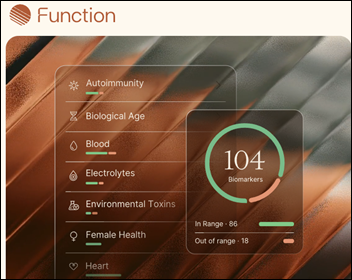
Function, which offers lab test memberships, raises $298 million in a Series B funding round that values the company at $2.5 billion. 


People

image

LiveData hires David Owen (Symplr) as chief product officer.


Announcements and Implementations

image

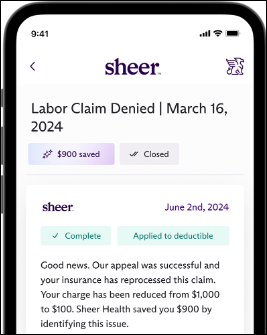
Sheer Health rolls out an app that lets consumers compare their medical bills to their insurance coverage so that they can understand deductibles, co-pays, and benefits. The app uses AI and human reviewers to answer questions, and the company offers billable services to contest denied claims and out-of-network determinations.

image

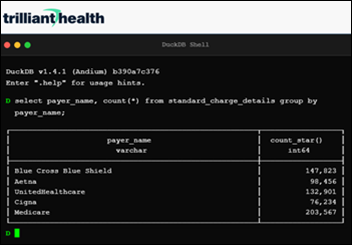
Trilliant Health publishes a machine-readable dataset of the negotiated prices of 5,000 hospitals, which it obtained from hospitals that are required to publish them by the Hospital Price Transparency rule.

The American Medical Association will develop and disseminate AI learning tools for medical schools and provide CME to upskill practitioners.


Privacy and Security

image

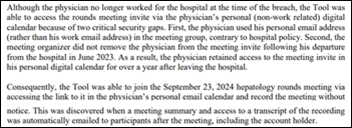
In Ontario, Canada, an AI-powered bot sends confidential patient details from an unnamed hospital’s grand rounds meeting to 65 invitees, 12 of whom no longer worked there. A doctor who had left the hospital a year earlier sent an Otter.ai “meeting agent” to attend the virtual meeting in his place. The tool then emailed the transcript, including full details on seven patients, to everyone on the invitee list.


Sponsor Updates

  • Optimum Healthcare IT will partner with non-profit solution provider Celerate to develop a chatbot for neurosurgeons.
  • Visage Imaging will showcase innovations, including AI, to its Visage 7 Enterprise Imaging Platform at RSNA.
  • Vyne Medical offers a new case study titled “How Automation is Shaping the Future of Document Management at VHC Health.”
  • Artera promotes Michael Jensen to CFO.
  • Altera Digital Health adds Sunrise Thread AI, its new ambient scribe and note generation assistant, to its Sunrise EHR.
  • Kyruus Health publishes a new report titled “”From Crisis to Control: Executive Insights to Transform Care Guidance with Data and AI.”
  • Ellkay offers a new success story featuring West Feliciana Hospital titled “Empowering Rural Healthcare: From Integration to Enterprise Data Management.”
  • Findhelp will host a Washington Social Care Summit December 4 in Seattle.
  • Five9 introduces updates to its Genius AI Suite, introducing AI across routing, quality management, and analytics.
  • Visage Imaging propels AI optimized enterprise imaging at RSNA 2025.
  • Healthcare Growth Partners advises Tonic Health on its sale to Luma Health.
  • InterSystems establishes a public sector subsidiary.
  • AdvancedCare launches Inbox Health’s billing communication and payment technology across its provider network.
  • Health Data Movers releases a new episode of its “Quick HITs” podcast titled “Advancing Community Health Through Innovation with Alex Romillo & Oscar Perez.”
  • Healthmonix welcomes Akira Health of Fresno and Akira Health of Los Angeles as new customers.
  • Infinx releases a new case study titled “How an Academic Health Network Achieved a 70% Revenue Growth & 88% Increase in Charge Volume.”
  • CommonWell Health Alliance completes its technical migration to Ellkay.
  • Linus Health will present new evidence validating its AI-enabled tools for early detection and trial readiness at the Clinical Trials on Alzheimer’s Disease conference December 1-4 in San Diego.

Blog Posts


Contacts

Mr. H, Lorre, Jenn, Dr. Jayne.
Get HIStalk updates.
Send news or rumors.
Follow on X, Bluesky, and LinkedIn.
Sponsorship information.
Contact us.
EPtalk by Dr. Jayne 11/20/25

November 20, 2025 Dr. Jayne 12 Comments

Hot off the presses, the new Oracle Health EHR has received certification for ambulatory use and approval for electronic prescribing of controlled substances.

Oracle claims that the EHR was built independently of the original Cerner platform and that it has AI integrated within the system rather than being an add-on. The tool includes AI-supported information retrieval using voice commands and contains information on diagnoses and lab results that are specific to an individual patient context.

The EHR was certified by the Drummond Group, and details about the certification can be found here. For those who may have seen it, I’m curious how different it is from the current Oracle offerings and how the usability compares. If anyone from Oracle Health is interested in sharing a demo, feel free to reach out.

I recently learned that the AMA Journal of Ethics will cease publication, with the December 2025 issue being its last. The news was unexpected, especially considering that authors and editors were planning issues through 2026 and into 2027.

The journal was unique because of the involvement of students and trainees who worked in partnership with professional editors to create themed issues. Speculation is that the Journal’s demise is largely due to financial issues, since it is open access and generates no advertising revenue.

Many physicians are skeptical about the value of the American Medical Association in today’s healthcare climate, and the Journal could have been viewed as something they funded purely because it was the right thing to do. Eliminating it brings up questions about the direction of the organization and the other factors that might have been at play in the decision.

The Minnesota Department of Health is preparing to include wastewater data in its disease surveillance reporting, although I haven’t seen it appear yet on the department’s website. Wastewater sampling gained widespread attention during the COVID pandemic as a method of detecting potential outbreaks. It has also been used to monitor the spread of influenza and respiratory syncytial virus. Given waning vaccination rates, having passive capabilities for early detection is essential.

Medical students are panicking after the news that an AI tool that is used for residency application review and screening has made errors in the display of student grades. The tool was designed to transfer grades from academic transcripts to a summary page. The vendor did its best to minimize the issue, stating that, “there is no current evidence that applicants’ interview outcomes have been impacted.”

The company plans to form an AI advisory board with student members as well as representatives from medical schools and residency programs. They are also building a portal that will allow students to see how their data is displayed and indicate whether it is accurate. This is slated to be live by the summer of 2026, but I imagine the incident will result in a lack of confidence among users.

For those of us who worked on the front lines during the worst parts of the COVID pandemic, speculation continues about the potential long-term side effects of the virus given its impact on so many tissues and body systems. It may be decades before we know, similar to when researchers discovered that shingles is linked to the chicken pox virus.

Along those lines, a recent article in Science Translational Medicine looks deeper at the evidence that links Epstein-Barr virus and the development of systemic lupus erythematosus. Given the high rates of exposure to the virus and the many different impacts of lupus, this is exciting research.

Speaking of academic pursuits, a research letter in the Journal of the American Medical Association looked at the impact of social media posts on the promotion of certain prescription medications. Social media content is more challenging to regulate than old-school TV or radio commercials since influencers often do not declare the sources of their funding.

The authors looked at a sampling of social media posts from 2023 and found that “drug promotion content is frequently posted by individual creators, lacks essential risk information, and bears the hallmarks of undisclosed marketing.” Physicians are already burned out, and having to educate and counsel patients about the veracity of claims by individual content creators is just one more thing weighing down on them.

Another AMIA Annual Symposium is in the books, and I have to say I’m tired. It was five days of full-throttle clinical informatics presentations, punctuated by ad hoc conversations, sharing ideas, and meeting new people.

I had an unusually chatty Uber driver on my way back to the airport and was surprised to learn that he is a former healthcare executive from one of Atlanta’s larger integrated delivery networks. After 20 years in the business, he decided that he didn’t want to be part of a process that was causing moral injury to physicians and limiting options for patients. He is doing contract work for a medical publishing company, but enjoys occasional Uber trips for the social outlet. I’m not sure if his other fares this week were healthcare-adjacent or not, but it was an interesting conversation.

Although sessions formally concluded midday Wednesday, many of the attendees wrapped it up at the AMIA Dance Party on Tuesday night. As I was catching up on email, I was delighted to see a conversation on the AMIA Connect forum that looked at what kinds of playlists various large language models might generate for such an occasion.

Based on a prompt about attendees ranging from their 20s to their 70s, Gemini 3.0 referred to the multi-generational dance floor as “the Holy Grail of JD scenarios.” Gemini offered commentary on each of the selections (referring to Neil Diamond’s “Sweet Caroline” as “the ultimate drunk uncle song” and offered two “emergency rescue” options should the DJ lose control. It also offered to convert the list into a Spotify-ready format.

ChatGPT 5.1 offered a list to make attendees “happy and mildly dehydrated,” but didn’t offer song-specific commentary. It did offer tips on actually making the mix happen.

Claude Sonnet 4.5 promoted its list by saying it “avoided jarring genre jumps that would empty the dance floor” and had some descriptions with the song list, but they weren’t as expansive as what Gemini offered.

Meta Llama 4 offered an oddly numbered list that had little commentary.

I’m curious if anyone else has done an event playlist using AI and whether it delivered as much fun as you hoped. Will we see AI replacing DJs in the future? Inquiring minds want to know.

What song should no dance party be without? Leave a comment or email me.

Email Dr. Jayne.

Healthcare AI News 11/19/25

November 19, 2025 Healthcare AI News Comments Off on Healthcare AI News 11/19/25

News

Google releases Gemini 3 and Google Antigravity, a new agentic AI development platform.

Microsoft announces Agent 365, which helps enterprises deploy, organize, and govern agents that are developed internally or provided by ecosystem partners.

image

An anecdotal New York Times review of how people are using AI chatbots for medical purposes shows interesting points:

  • A survey from last year shows that one in six adults, and one in four of those under 30, regularly seek medical information from AI bots like ChatGPT.
  • The primary reasons for asking AI are lack of medical system support, excessive wait times, inattentive doctors, and unaffordable bills.
  • Many users say that AI is kinder than their human providers.
  • One woman copied ChatGPT’s responses and sent them to her oncologist to show how their bedside manner could improve.
  • Another patient, frustrated by her PCP’s generic advice in response to her bone density questions, asked ChatGPT the same questions and immediately received specific diet instructions. She emailed her doctor to complain that ChatGPT gave her more information than they did. The patient says she does not not fully trust ChatGPT but is frustrated with the state of corporate medical care.

Business

Arbiter emerges from stealth with $52 million in funding to apply AI to longitudinal patient records to match referrals, automate authorizations, support outreach, and manage scheduling.

image

Ember, which offers AI technology for proactive denial prevention, prior authorizations and appeals, eligibility checks, and charge capture, raises $4.3 million in seed funding.

Medical imaging company Nanox will acquire VasoHealthcare IT, a health IT implementation services provider that will accelerate deployment of Nanox’s AI solutions.

RapidAI earns FDA clearance for its aortic disease assessment and management AI tool.

Medscape transforms searches of its site to an AI tool that can answer questions using its continuously updated content, peer-reviewed medical literature, and medical news.


Research

A Black Book Research survey of hospital leaders finds that hospitals are quickly piloting AI solutions, but lack the governance that is needed to ensure clarity, accountability, and proof of claims. Hospitals often fail to measure success factors during pilots and sign contracts that don’t require re-validation when the vendor makes major updates to its AI model. Three-fourths of respondents say their hospital has experienced at least one AI pilot that didn’t scale, most often because of endpoints that fail to measure clinical or operational impact, lack of performance data, and failure to integrate AI tools into existing workflows.


Contacts

Mr. H, Lorre, Jenn, Dr. Jayne.
Get HIStalk updates.
Send news or rumors.
Follow on X, Bluesky, and LinkedIn.
Sponsorship information.
Contact us.

HIStalk Interviews David Lareau, CEO, Medicomp Systems

November 19, 2025 Interviews Comments Off on HIStalk Interviews David Lareau, CEO, Medicomp Systems

David Lareau is CEO of Medicomp Systems.

image

Tell me about yourself and the company.

I have been with Medicomp for a number of years. Our core competence is that we produce a clinical data engine that we call a Clinical Knowledge Graph. We’ve been building it based on expert input since 1978.

We have been through many technology transitions. Now we’re in the world of AI with clinical applications. We feel that we are well positioned in that area since we have very domain-specific knowledge for training small models to do what we need them to do.  

Will the customer cost of using AI technology that is sold by big tech firms that have to keep investors happy going to inevitably increase?

We think that the Butcher’s Bill is going to come in for these large models that are expensive to use. People already are starting to say, “We are going to use AI to train for specific workflow issues and specific clinical domain issues.” We believe right now that we are well positioned in that space.

We are having great success in terms of performance and lower cost by using a small model rather than a large model. Our engine, and all the power that’s in it, can be run on CPUs rather than GPUs, inside a vendor’s own security environment without going out there. We can do that because we have a target of 400,000 clinical concepts with hundreds of millions of links for diagnostic relevancy and coding relevancy. To be able to do that with a small model is because we have a clinical target that’s been very well-defined over the last 40-some years. 

The vendors that we are working with have seen their costs drop by using a smaller domain-specific model that is trained on our clinical data points that link to our engine. The roadblock to that was the lack of a clear standard for how to communicate between applications using various aspects of AI. The MCP, or Model Context Protocol, developing as a standard has allowed us to expand the number of partners that might be able to take advantage of our unique Clinical Knowledge Graph.

That’s why what’s happening in the industry is an opportunity for us rather than a threat. If I want to know the 250 clinical concepts that might be relevant for somebody with chronic kidney disease, that’s in our engine. The MCP allows us to present a standardized way to request that information from our engine and send it back to the application, whether it’s a language model or somebody else that wants that information. It will be what drives the integration of all these AI agents that people are building.

It was an essential, missing building block for communications between systems that are using AI to do very specific tasks. When Epic, for instance, announces that they’re building hundreds of AI agents, they will be using things like MCP to communicate between various aspects of their system.

Has AI changed your business strategy?

It has. We definitely have had to adapt to it. The conversational AI still captures text. It does a very good job at it. We’re really astonished and pleased at how effective it is at removing the need to enter text into a medical record. But it’s still text.

We have been using AI. We’ve been using language models internally to fine tune our offerings and our tools. We are building a small model, domain-specific, task-specific ways to use our data, extract data from text, and then operate on it to service all the downstream things that you have to do, like quality measures, adequacy of documentation for Medicare’s Hierarchical Condition Categories, that sort of thing. We’ve had to embrace it and figure out how to use it transparently, effectively, and affordably in the clinical domain. 

It is an exciting time as the AI tools have matured, the power has matured, and you have everybody in the industry rowing in the same direction. But they need clinically specific tools to get where they need to to make it affordable and useful at the point of care.

We saw it as more of a threat two or three years ago. A threat being anything that causes people to not need to do business with you today is a competitive threat. When the frenzy over AI started a few years ago and really built lately, it really was a competitive threat to us because it made people sit on the sidelines and wait to let AI figure it out. Now people are realizing that generalized predictive pre-trained transformer is not enough for clinically specific work. That’s where we are hooking it into our Quippe Clinical Knowledge Graph to do very specific things for clinicians. People are realizing the proper uses of AI in clinical medicine and the things that it doesn’t do so well.

We are pleased with the way things have developed over the last 12 months, as the rubber is starting to meet the road with AI in medicine.

Startups and big tech companies might be slow to realize that AI and ambient documentation are table stakes that aren’t much of a business moat. Does your phone ring from companies that have the technology but need help understanding how to integrate it into healthcare workflows?

I get four or five inquiries a week. Most people that call when they hear the specificity of what we’re doing say, “We’re not quite to that point yet. We’re just trying to figure out how to compete with all the other people that are in our space.”

We’re starting to see that people are actually putting these applications into use. Those are the more serious inquiries when calling us. They say, “We’ve got the table stakes working, but now we’re having trouble meeting all the downstream requirements because we just have text, we don’t have data.” They need to get there because when the government puts in very specific requirements for things like quality measures. They are looking for specific data points. That’s what’s in our engine.

They say, “The acquisition of documentation is no longer an issue. Now we need to do something with all the downstream processes that are tied to the information in that text.” When they hit that wall, that’s when they’re calling us.

You wrote something about instafraud, the claim by insurers that some providers are using AI to increase billing, and their intention to use AI to stop it.

We’re in initial conversations with some folks in compliance and regulation. One example where it shows up is in Medicare Advantage, which was supposed to reduce the cost of caring for people people in Medicare. It uses risk adjustment codes, Hierarchical Condition Categories, to identify somebody who has a disease that puts them at risk of poorer outcomes, and then to manage those conditions. But to do that, you have to code a diagnosis to get that risk, and then receive more money put in your risk pool each year. 

AI was algorithms even before AI became a thing. People were using algorithms to say, “This guy has a high creatinine. He probably has chronic kidney disease, so let’s code that.” If you code it and send it, you get a higher risk score, but the documentation has to support it. 

When we published our E&M algorithms when the 1997 guidelines first came out, the most common question we got was, “You guys have all this data that can support a code. Could you use it to tell us the three things we need to do to get a higher level of service to get more money?“ We said that we could, but the government has seen what we’re doing and warned us off and said, “If you do that, we’re going to come after you.” So that feature was disabled. You can’t ask it the minimum you needed to document to get a higher code.

The same thing started to happen about five years ago with risk adjustment. They called it “suspecting.” They wanted to use AI to look at the record and find potential evidence for one of these HCCs that would support a higher code. This would be submitted without necessarily seeing that the documentation supported that the patient actually had that condition.

Suspecting is a valid thing if there is a condition that’s unaddressed and you then address it, but it’s fraud if you look for the possibility that somebody has something and then code that they have it without investigating whether they actually do.

There’s a tug-of-war going on between the payers, the regulators, and the enterprises over the proper handling of patients with chronic conditions in the Medicare Advantage program. The government is starting to pay a lot of attention to that because Medicare Advantage was supposed to cost less per patient than traditional Medicare fee-for-service and that hasn’t turned out to be the case. I think it’s because people are over-coding for risk factors.

How does Epic’s public sharing of its AI roadmap affect innovation?

There are a number of layers to that question. Epic is not the only large vendor that I would call an impediment to innovation just because they’re a dominant in their space. We do quite a bit of business in Asia, and this is not limited to the United States.

Years ago, we had another unnamed vendor in the US, not Epic, whose customers told them, “We really like what this niche vendor is supplying. I want it.“ We had the experience with a different vendor years ago, where they said, “We’re getting a lot of customers that are asking for what you have. We’re probably going to develop that ourselves so we’re not interested, but we are willing to work with you. But since we think of our customers as an asset, you’re going to have to pay us the bulk of your revenue for access to that asset.”

That’s the moment where I realized that dominant vendors, because this vendor was large in the space then, tend to treat their customer as an asset and as turf that they own, not as an obligation to provide a higher level of service. When vendor app store organizations were first set up, the agreement that you had to sign as a niche vendor said, “We need to vet what you have. You need to show it to us. You need to show us your source code so that we can make sure it doesn’t create any vulnerabilities on our system. But if we then decide to do something like that ourselves, you have no recourse to us.”  That scares off the niche vendors.

We’ve also had the situation where a large consulting company that specializes in implementations for the large HISs said, “We have a lot of customers asking for what you have. We have a lot of people asking for the kinds of things that you and other companies like yours provide. But we also have $90 million a year in consulting revenue from this vendor for implementation assistance, and they’ve told us that we’re putting that at risk if we start to introduce these niche best-of-breed vendors into their ecosystem.” So it really does stifle innovation in that sense.

Do companies call you wanting to buy Medicomp rather than try to build complex healthcare technology?

Yes, we get that from investors, private equity, and larger vendors. The issue for us is that we do one thing. We focus on it. We don’t do anything else. Being employee owned, basically, allows us to focus on what we do and not get distracted, and we plan to keep doing that.

As people see how you can leverage our Clinical Knowledge Graph for a very specific thing that has a widespread need, we get a lot of activity. I thank people very politely and explain that we see a model of sustaining what we’re doing for quite a while, even into the next generation of the company.

What will be important to the company’s strategy over the next few years?

We need to make certain that we are using these new AI tools to make ourselves more productive while producing our Clinical Knowledge Graph. With the new Model Context Protocol, MCP, stuff that is coming out, we’ve been API based for a long time. We make it easy and transparent to link to our clinically data specific APIs to accomplish specific tasks. Acquiring documentation, no longer a problem. Acting upon it and doing something with it is the next step.

Our strategy over the next three to four months is that some EHR vendors will start showing the intersection between ambient listening coming in as documentation, then link to our engine that will validate, filter, and present that information and accomplish all the specific things that you have to do with the data, such as getting the right billing codes, meeting the quality measures, and verifying adequacy of documentation for HCCs. Linking our stuff and allowing our engine to be accessed through the MCPs to accomplish specific tasks other than just documentation.

We see great potential in that space. We will have the first few implementations of that hitting the market over the next few months with some specialty-specific EHR vendors.

This Week in Health Tech 11/19/25

November 19, 2025 This Week in Health Tech Comments Off on This Week in Health Tech 11/19/25
LinkedIn weekly 111925 - Copy

Curbside Consult with Dr. Jayne 11/17/25

November 17, 2025 Dr. Jayne Comments Off on Curbside Consult with Dr. Jayne 11/17/25

image 

It’s that time of year when clinical informatics types come together to let their freak flags fly, otherwise known as the AMIA Annual Symposium.

This is one of my favorite conferences, largely because it doesn’t take itself too seriously. This is obvious from the moment you pick up your registration credentials and head over to the stash of wacky badge ribbons. These are a heck of a lot more fun than those from other conferences that say boring things like “delegate” or “speaker.”

Attendees were cracking up at one that said “CEO” since it’s rare to see attendees with that title. The event is in Atlanta this year, so the “this is my southern charm” ribbon was a new addition.

It’s a long conference, with a host of pre-conference workshops on Saturday and Sunday. Monday’s opening keynote then kicks off two and a half days of high-intensity programming.

My favorite so far has been the “Designing and Evaluating Trustworthy AI for Consumer Health: Ethical Considerations Workshop.” The session addressed case studies around AI-driven consumer health tools such as fitness apps and mental health chatbots, with an eye to assessing ethical gaps and the potential for the tools to impact health disparities in a positive or negative way.

As one might imagine, algorithmic bias was a focus. Several speakers addressed the biases that inherently exist in datasets that are drawn from large academic centers and the risks of using that data to train AI tools. Also, that training datasets are inherently “old” as soon as they roll out the door, along with the lack of consistency among consumer health vendors for updating those datasets.

Another concern was that data from EHRs is inherently biased since it is structured to support insurance requirements in addition to purely clinical ones. One of my tablemates and I were having a sidebar conversation about how this might impact platforms that use real-world evidence since it changes constantly.

The conversation shifted to understanding the training data that is used in the AI that underlies consumer-facing tools. The point was made that it’s not just about knowing where the data came from, but understanding that it can be harmful if the training data doesn’t reflect the population that is being served.

An example of that was a behavioral health app that was trained predominantly on data from middle class white patients. That left it unable to recognize cultural differences in how patients might express that they are experiencing distress.

Another discussion involved how individuals aren’t experiencing a true informed consent process when they are asked to give up the rights to their data. People aren’t going to read a 40-page terms and conditions document. They are also unlikely to deny consent when they are in a coercive situation, such as needing medical care. One of the speakers noted that users are being treated as data sources rather than as people to be respected.

A speaker who talked about AI’s ability to replace clinicians noted that in an observational exercise, one-third of physician visits contained documentation that was intended to aid coverage negotiations with an insurer or other entity on behalf of the patient. He posed the question of whether AI will do this.

He also noted that in cases where patient histories are unreliable or incomplete, experienced humans have developed the skills to balance those factors, but it’s not clear if AI can do the same. Another hot topic was whether AI will be able to handle conflicting test results or care plans and to manage situations where different patient-side stakeholders, such as patients and their families, have conflicting care priorities.

This flowed into a discussion of how to train new physicians to use AI. It used a driving analogy to pose a good question about how to address older ways of information seeking: Should we require all new drivers to learn how to drive a stick shift?  I’ve been in plenty of conversations recently about how younger folks versus older ones are embracing AI. This is a good example that I hadn’t seen.

It reminds me of writing term papers back in the olden days, when you were expected to have a stack of 3×5 cards of your notes that you used to create an outline. Only then were you supposed to start writing the paper itself. The arrival of word processing software and laptops made it easier to take notes electronically and to perform multiple parts of that process in parallel rather than linearly. We don’t teach students to write term papers in the old way anymore, so why should other academic endeavors require potentially outdated processes? 

I don’t know if anyone in the room is employed by EHR vendors or other technology companies, but these are “let’s get real” discussions that need to be heard. It feels like vendors don’t get into that level of depth with their stakeholders, or maybe they do and they just aren’t swayed by the conversation. Otherwise, we would see fewer of those lengthy consent forms and more that are like the one-page “truth in lending” forms we see now for certain consumer loans.

During one of the breaks, I had the chance to connect with a friend who was instrumental in my development as an informatics leader, although he always worked more on the practice management and efficiency aspects of healthcare IT. I hadn’t seen him in several years, but it was like we picked up right where we left off. This is a testament to the relationships that were built during the “trial by fire” days when organizations were just starting to go paperless. Although I don’t miss a lot of the things that happened during those days, I treasure the friendships that I’ve made along the way.

The AMIA Annual Symposium is also a great opportunity to connect with the next generation of clinical informatics professionals. In my afternoon session, I was surrounded by residents who are interested in the field, as well as clinical informatics fellows. As we were doing introductions, a few were surprised that I became board certified without completing a fellowship. It hadn’t registered with them that many of us learned our craft largely through on-the-job training when there were fewer opportunities for formal learning. Those of us who fit that description didn’t typically set out to practice clinical informatics. We either fell into it or were gradually pulled in by forces that are not unlike those that are found in a black hole.

I’m sure I’ll appreciate the residents and fellows even more when the AMIA Dance Party happens Tuesday evening. They are more likely to be out on the floor than those of us whose skills lean towards more structured dance forms.

Are you attending the AMIA Annual Symposium, and if so, what is your favorite part? Leave a comment or email me.

Email Dr. Jayne.

Monday Morning Update 11/17/25

November 16, 2025 News Comments Off on Monday Morning Update 11/17/25

Top News

image

House Rx, which provides technology and expertise to support specialty clinics performing in-clinic “medically integrated dispensing” instead of sending prescriptions to specialty pharmacies, raises $55 million in Series B equity.


Reader Comments

From Unicode Bandit: “Re: Dr. Jayne and emojis. If my clinician’s note ends with an 👍emoji instead of ‘signed,’ I’ll know the AI bot finally took over. 👀” 


HIStalk Announcements and Requests

image

Most poll respondents chose one of these two items as cause for health tech sales concern.

New poll to your right or here: Have you seen or used what seems to be an AI chatbot on a provider’s website? I usually try to make those that annoyingly pop up on any website go away immediately, the online equivalent of pressing 0 for a human to escape the time-consuming phone tree that was designed to keep paying customers like me from bothering the company’s cheap overseas call center contractor. Next thing you know that chatbot will ask me to please hold while it transfers me to a more advanced model.

I had an ultrasound at a small local hospital last week. The tech told me the results would hit MyChart quickly and she was right, the alert landed before I even got back to my car. Moments later, my Direct Primary Care doctor emailed me, showing full awareness of my knowledge level and my preference for brevity with a subject line of “Ultrasound,” and body of “Negative.”


Sponsored Events and Resources

None scheduled soon. Contact Lorre to have your resource listed.


Sales

  • Marshall Browning Hospital (IL) will implement Oracle Health CommunityWorks and Oracle Health Clinical AI Agent. The 25-bed hospital appears to be replacing Meditech.

People

image

Jonathan Steinhouse (Strike Health) joins ClearBalance Healthcare as VP of business development.


Announcements and Implementations

image

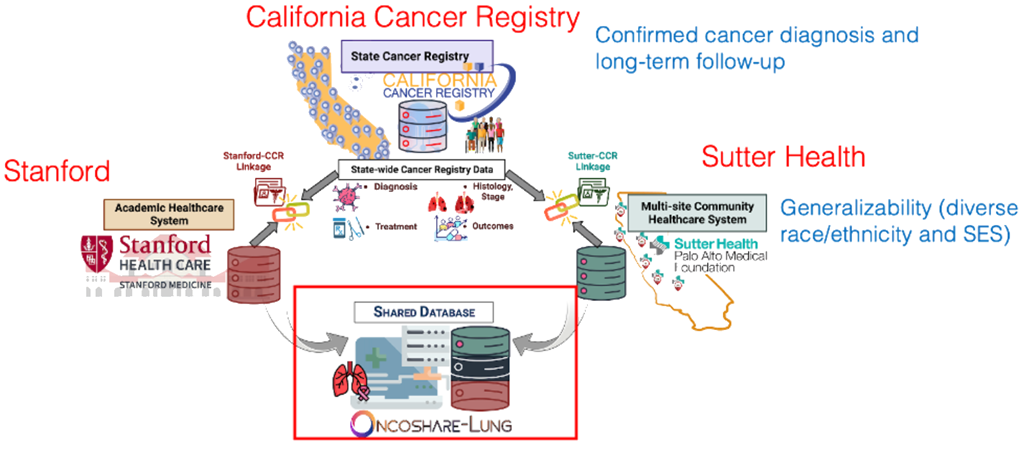
Stanford Cancer Institute describes Oncoshare, a data sharing project that connects EHR data from Stanford and Sutter Health with the California Cancer Registry for research.

image

A new KLAS report finds that 80% of healthcare CIOs plan to maintain or increase their spending on professional services over the next 12 months. Their top targets are EHR optimization, cybersecurity, and AI and automation. Impact Advisors ranks first in mindshare, while Huron, Nordic, and Chartis are frequently mentioned. CIOs choose which firms to invite based on relationships and peer reputation, then score RFPs on confidence and clarity.


Other

image

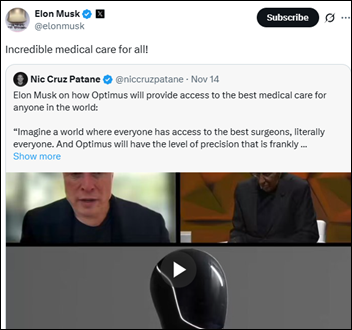
Elon Musk says that robots, more specifically his Optimus Tesla Bot, will transform global healthcare by giving everyone access to “the best surgeons.” He says that great doctors and surgeons do not grow on trees, but will eventually be built in factories. He also claims that Optimus could replace prisons by assigning criminals a robot that “just gonna follow you around and stop you from doing crime.” Optimus was announced in 2021 and targeted for a 2023 release, yet despite reaching Generation 2, it still has not made it to market. Musk drew criticism in October 2024 when he had Optimus mingle with conference attendees and mix drinks without disclosing that it was being operated by a human.


Sponsor Updates

  • WellSky publishes a new report on AI and technology as healthcare recruitment tools titled “Addressing today’s healthcare workforce challenges.”
  • Nordic releases a new “Designing for Health” podcast featuring Eve Cunningham, MD.
  • PerfectServe publishes a new report titled “Clinician Survey: Why Clinician Wellness Starts with Operational Wellness.”

Blog Posts

Sponsor Spotlight

image

Praia Health is the patient experience orchestration platform for health systems. We help health systems attract, engage, and retain patients by supercharging their portals and digital tools with seamless, personalized journeys in one platform. The result is higher retention, lower costs, and measurable ROI. In just three years, Providence has realized over $87M in measurable, attributable ROI from the platform. Click here to explore three years of operational data following deployment at Providence. (Sponsor Spotlight is free for HIStalk Platinum sponsors).


Contacts

Mr. H, Lorre, Jenn, Dr. Jayne.
Get HIStalk updates.
Send news or rumors.
Follow on X, Bluesky, and LinkedIn.
Sponsorship information.
Contact us.
News 11/14/25

November 13, 2025 News 4 Comments

Top News

image

RCM vendor R1 sells Tonic Health to patient access, engagement, and intake technology vendor Luma Health.

Tonic Health offers a mobile patient intake, survey, and payments platform.


Reader Comments

image

From Gaucho Marx: “Re: Adventist Health Portland. After investing $20 million to convert from Cerner to OHSU’s instance of Epic, it will join the enterprise instance in September 2026. This is surprising, since there is a good deal of benefit to AH Portland to remain a part of OHSU Health’s large patient network, such as more negotiating power with payers and the ease of transferring and referring patients. Adventist Health will bring all hospitals except AH Portland live on September 1, 2026 in a $500 million project. Portland was out of scope because of their business agreement involving tens of millions of dollars in loans from OHSU, which has had a tough time with financial losses and layoffs.”


HIStalk Announcements and Requests

Trivia: I asked ChatGPT to name the 10 best US cities to live in, which it calculated from multiple, evidence-based sources. Which was the only state to have two cities on the list? Which city was #1?


Sponsored Events and Resources

None scheduled soon. Contact Lorre to have your resource listed.


Acquisitions, Funding, Business, and Stock

Oracle’s reorganization under co-CEOs has left 64,000 of the company’s employees, or 40% of its workforce, reporting up to CTO, co-founder, and chairman Larry Ellison. Co-CEO Mike Sicilia oversees the largest headcount at 84,000 workers, which includes Oracle Health.


Sales

  • Cigna Healthcare will offer Headspace’s meditation and sleep app at no cost to seven million people who receive behavioral health services through their employer.
  • Smart infant monitoring technology vendor Owlet chooses Rhapsody for EHR integration of its pulse oximeter.

People

image

Marc Probst, MBA (MF Probst Strategic Advisory) rejoins Ellkay as CIO advisor.

image

MRO hires Lidia Bernik, MHS, MBA (Flatiron Health) as president of Curation Solutions.


Announcements and Implementations

image

A PerfectServe survey of 350 clinicians finds that three-fourths spend time dealing with manual aspects of scheduling, more than half say that waiting for calls takes time away from patient care (it was the #1 time-sapping task), and 60% say that existing systems aren’t much help in prioritizing urgency.

image

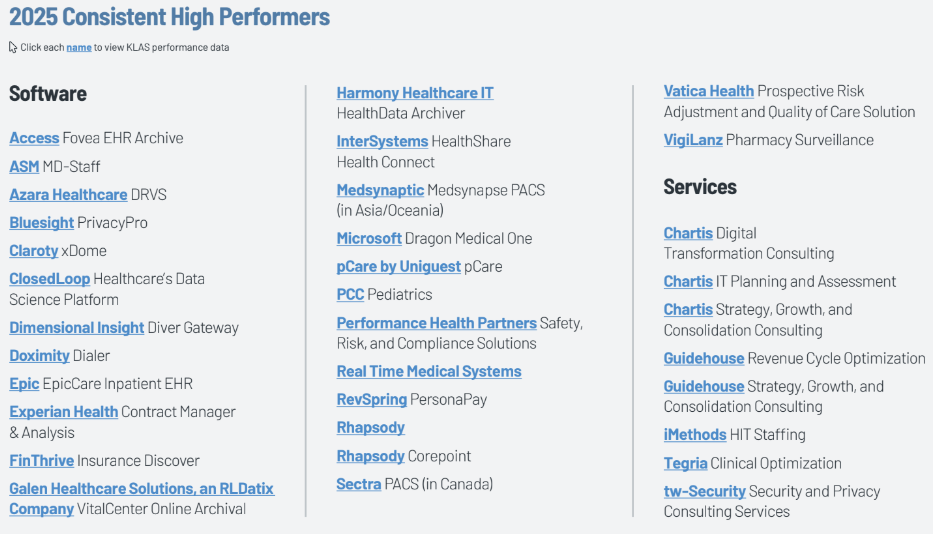
KLAS names its 2025 Consistent High Performers.


Government and Politics

image

The deal to end the federal government shutdown will extend Medicare’s coverage of telehealth through January 30 and will pay providers retroactively for virtual services that they provided since October 1. The Senate package also  provides $3.4 billion to the VA for its Oracle Health rollout work in FY2026, contingent on it providing Congress with a revised timeline and cost estimate. 

The VA awards Accenture Federal Services a six-month, $7.7 million contract to support its Oracle Health implementation, including program management, support, and data integration services, with options to extend the work for four additional one-year periods and one six-month period.


Other

The family of a two-year-old sues University of Florida Health, alleging that a physician’s decimal error caused a fatal tenfold overdose of electrolyte replacement. The lawsuit claims that pharmacists did not catch the error even though their computer system generated a Red Flag dose warning.

image

Caring Brands either just pulled off the biggest capital raise in human history or it needs to hire a more careful headline writer.


Sponsor Updates

  • Netsmart will integrate ScribePT’s documentation system with its TheraOffice PT and rehab EHR/PM.
  • CTG’s parent company Cegeka earns Microsoft Partner of the Year award for Microsoft Dynamics 365 Supply Chain.
  • Arrive Health names Alison Bechtel senior director of marketing.
  • AvaSure announces that its Virtual Care Platform has achieved designation in Epic’s Toolbox for the Inpatient Virtual Care category.
  • Findhelp welcomes new customers Hospital in Your Home, Allied Behavioral Health Solutions, and the Tennessee Department of Veterans Services.
  • HCTec offers a new case study titled “HCTec Technical Managed Services Elevate the End-User Experience.”

Blog Posts


Contacts

Mr. H, Lorre, Jenn, Dr. Jayne.
Get HIStalk updates.
Send news or rumors.
Follow on X, Bluesky, and LinkedIn.
Sponsorship information.
Contact us.
EPtalk by Dr. Jayne 11/13/25

November 13, 2025 Dr. Jayne 1 Comment

image 

NCQA is accepting public comments on the AI standards that it is proposing for its 2027 Health Plan Accreditation and Health Plan Ratings program. Patients, health plan stakeholders, healthcare professionals, state agencies, and others are invited to weigh in as the program is being created. You have until December 5 to share your thoughts on topics such as AI program structure, governance, pre-deployment evaluation, and ongoing monitoring and intervention.

I’ve been through several NCQA recognition processes on the provider side. The staffers I’ve met are genuinely invested in improving healthcare quality and are responsive to organizational feedback.

My hospital is considering the addition of a new C-suite role, partly in response to escalating conflicts and violence against healthcare workers. There is debate around several potential job titles, but no consensus on whether the title should focus on safety or security.

A particularly vivid conversation ensued when the use of “public safety” in the title was brought up, since that mimics some state law enforcement agencies and might indicate the role has more authority than intended. Concern was also expressed that the use of “public” was more focused on patients and visitors rather than employees and caregivers. Future meetings will further discuss the role, so we’ll see where the wordsmiths land.

Earlier this week, Mr. H mentioned the Black Book Research survey on AI governance. I wanted to weigh in from the CMIO chair, although I’m not sure that I should call it a chair anymore because I’m spending more of my time lately in the clinical work areas sitting on a rolling stool that I swiped from an exam room.

One theme of the survey is that hospital budgets are underfunded for AI governance and safety, with a median 4.2% of IT quality and safety budgets devoted to AI oversight for 2026. Although that sounds like a small number, I’m curious as to what other line items are funded either higher or lower.

It’s hard to derive meaning from numbers out of context. Governance is likely a line item that scales better than others because it becomes a sustainable process after creation. It’s not like an implementation line item, which may vary dramatically across facilities or service lines as well as for applications or solutions that are being implemented.

As expected, large health systems with 10 or more facilities have a higher share of spend, but I would bet that’s because of the number and complexity of AI applications rather than the process itself. For those who have dug into the full report, I would be interested to hear your thoughts.

image

PerfectServe recently released a report on “The Rise of Emoji in Healthcare Communication.” From informal research via my texting app, folks from The Silent Generation and Baby Boomers are the most likely to send me messages using standard emoji. It’s hit and miss with my Millennial friends, although they tend to use a lot of GIFs. My Generation Z contacts are most likely to communicate through memes, although I do see a fair amount of photomoji use in that population, which is always entertaining.

The report recaps the use of pictographs and symbols in communication going back to 3000 BC, and highlights the pictographic elements that are already found in healthcare, such as the Wong-Baker FACES Pain Rating Scale.

It shares some interesting data points, such as an estimate of 10 billion emoji being sent every day. It also mentions Adobe data that shows that healthcare workers are losing their hesitancy around including emoji.

I’m glad it mentioned the early emoticons we once used that cobbled together colons and parentheses to look like faces. Younger generations probably find that quaint.

The authors set out to look within the PerfectServe ecosystem to see if they could identify trends in emoji use and if it could be tied to clinicians who are under stress or burned out. They concluded that rather than being potentially unprofessional, emoji were “used to convey politeness and positive intent.”

Other interesting tidbits included the “thumbs up” being the most frequently used symbol in medical communications. Internal medicine clinicians were more likely to use symbols than their peers. Other emoji making the top 10 included the “person facepalming” and the “person shrugging,” which makes me smile.

The authors also looked at explorations of emoji use in the medical literature, namely an article in The Journal of the American Medical Association (JAMA) from 2021 that cites emoji as containing “the power of standardization, universality, and familiarity, and in the hands of physicians and other health care providers could represent a new and highly effective way to communicate pictorially with patients.”

I learned that a lot of my correspondents might be confusing the “tears of joy” emoji with the “cry-laugh” one, which is fairly easy to do depending on the level of zoom in your messaging app.

The paper has a lot of other interesting information, including emoji frequency by subspecialty and day of the week. It will be interesting to see how this evolves over time. I would also like to see information on geographic variations or seasonal trends.

image

I’m always on the lookout for interesting uses of AI. A friend mentioned SessionKeeper, which uses ambient listening capabilities to create session summaries for tabletop role-playing games such as Dungeons & Dragons. In addition to capturing plot points and character details and building a knowledge base, it offers “story insights” that create a podcast-style analysis of play. I got a kick out of learning about the cultural background of trolls and how it can impact conversations, as well as seeing some of the AI-generated artwork.

I was pleased to see a clear data privacy statement in the FAQ, with the company clearly stating, “We’ve made sure companies like Anthropic, Google Cloud AI, and OpenAI can’t use your gaming sessions to train their systems.” 

What creative uses of AI have you seen? What do you find most useful in your non-work life? Leave a comment or email me.

Email Dr. Jayne.

Healthcare AI News 11/12/25

November 12, 2025 Healthcare AI News Comments Off on Healthcare AI News 11/12/25

News

image

The Vatican convenes a Rome conference this week titled “AI and Medicine: The Challenge of Human Dignity,” where a church official warned of the risk of “transforming health and illness into mere numerical data … the ability to personalize treatment remains an irreplaceable medical skill.” In his remarks to participants, Pope Leo XIV urged healthcare professionals to use AI responsibly, emphasizing that healthcare cannot be reduced to problem-solving and that technology must not interfere with the patient–caregiver relationship. He concluded by cautioning that “vast economic interests are often at stake in the fields of medicine and technology, and the subsequent fight for control.”

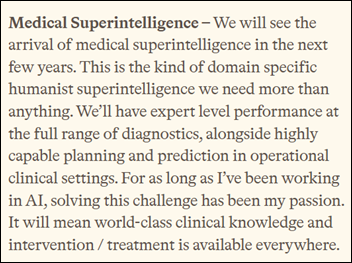
Microsoft forms an MAI Superintelligence Team to develop AI that exceeds human capability, with medical diagnostics being its first focus area.

OpenAI is reportedly considering entering the consumer health market, such as creating a personal health assistant or health data aggregator


Business

image

Sentara Health will implement Andor Health’s agentic AI virtual care software at its 12 hospitals, starting with virtual nursing, virtual sitting, remote consultations, and transactional care management.

InterSystems launches HealthShare AI Assistant, which provides a conversational chat user interface for its HealthShare Unified Care Record.


Research

image

A small study of patients in Africa finds that frontline nurses and community health workers can identify patients who are at risk for reduced ejection fraction heart failure by using Eko Health’s AI-assisted stethoscope.

A Black Book Research survey finds that most US hospitals are underfunding AI governance even as adoption accelerates. Only 22% say they could deliver an auditable AI explanation to regulators or payers within 30 days, citing lack of vendor explainability as the biggest barrier.


Other

image

A TV station’s test finds that while ChatGPT and Gemini answered health questions with disclaimers that they aren’t real people or licensed professionals, AI storytelling platform Character.AI displayed a similar warning but then falsely claimed to be a real doctor, giving the user a fake name with a valid medical license number that belongs to a Los Angeles immunologist. The company says that user-created characters are fictional and for entertainment only, which is why it includes the disclaimer.

The American Nurses Foundation (ANF) partners with Hippocratic AI to fund three nurse-led grants of $10,000 each for experienced frontline nurses to explore AI and innovation in nursing.

image

A healthcare empathy professor says that while AI can generate empathetic-sounding written responses, the real issue is that a broken healthcare system has drained clinicians of empathy through paperwork, burnout, and rigid protocols, effectively turning them into machines. He warns that we are moving toward an ironic world where AI takes over the parts of care humans do best, while humans are left doing tasks that computers should handle. He concludes:

The technology will continue advancing, regardless. The question is whether we’ll use it to support human empathy or substitute for it and whether we’ll fix the system that broke our healthcare workers or simply replace them with machines that were never broken to begin with.

Psychiatrist and political anthropologist Eric Reinhart, MD argues that when AI is installed in “a health sector that prizes efficiency, surveillance, and profit extraction,” it becomes just another tool for commodifying human life. He adds that AI can’t improve medicine by leapfrogging structural change, but it does give policymakers and corporations an excuse to ignore abysmal public health and hospitals a way to squeeze more profitable productivity out of doctors. He says:

We risk entering a perverse loop: machines are supplying the language with which patients relay their suffering, and doctors are using machines to record and respond to that suffering. This cultivates what psychologists call “cognitive miserliness”, or a tendency to default to the most readily available answer rather than engage in critical inquiry or self-reflection. By outsourcing thought, and ultimately the most intimate definitions of ourselves to AI, doctors and patients risk becoming yet further alienated from one another.


Contacts

Mr. H, Lorre, Jenn, Dr. Jayne.
Get HIStalk updates.
Send news or rumors.
Follow on X, Bluesky, and LinkedIn.
Sponsorship information.
Contact us.
This Week in Health Tech 11/12/25

November 12, 2025 This Week in Health Tech Comments Off on This Week in Health Tech 11/12/25
LinkedIn weekly 111225 - Copy

Curbside Consult with Dr. Jayne 11/10/25

November 10, 2025 Dr. Jayne 1 Comment

The hot news around the telehealth virtual water cooler this week was the new CMS billing requirement that telehealth physicians list their actual location rather than an office address. The previous requirements allowed us to avoid using a home address. This not only protected our personal information, but also provided uniformity for our practice organizations.

For those telehealth physicians employed by hospitals or health systems, this could lead to requirements that they physically go to the campus to provide telehealth services. This creates additional load on the hospital, which may not have space for telehealth providers. Allowing them to practice from home, while repurposing clinic space for additional providers, was one of telehealth’s benefits. The CMS rule does not address the needs of physicians like me who work for independent telehealth organizations that don’t have a campus or building in our local area. 

Although CMS claims it will protect the home addresses, I’ve been a victim of data breaches and identity theft enough times that I don’t trust anyone to keep my information private. Plenty of other government agencies don’t have appropriate policies to deal with people who practice from their homes, including the Drug Enforcement Administration and many of the state controlled substance agencies. Their regulations haven’t kept up with the times, but I don’t think anyone is surprised by that.

Also, there is no guarantee that a physician who is not in the office is doing telehealth from their home. I have done it from hotels in at least a dozen states, from the homes of family members, and from a docked ship. I certainly don’t expect my employer’s credentialing organization to keep up with that.

Other conversations around the water cooler continue to revolve around the ongoing government shutdown. Some clinics are seeing higher-than-usual rates of no-shows and cancellations. In lower income areas and the academic faculty clinics, patients are citing financial issues as a barrier to transportation.

Although some of our clinics can provide cab vouchers for patients to get home, it’s more difficult to arrange transportation to the clinic. Now that we’re over a month into the shutdown, we should start to see data on patient prescriptions and fill rates, and whether those have been delayed by all of the issues. I’ve seen data from at least one military facility that showed a clear impact, but I’m not able to access that kind of data for my own facility. It would be an interesting research project, however.

The hot clinical topic of the week was the news that the American College of Cardiology and American Heart Association have updated the hypertension guidelines. The new numbers mean that many more patients will qualify for a hypertension diagnosis. Depending on how much of a focus an organization has placed on the management of hypertension, this could potentially mean a fair amount of work will need to be done in the EHR and elsewhere in clinical applications.

Even if we’re talking about modifications to EHR-based alerts, the lift could be significant if the organization hasn’t standardized the EHR or has created different alerts for different locations, specialties, or types of visits. It can also mean modifying dozens or hundreds of reports, patient outreach campaigns, and patient education materials.

Although these two organizations have reached agreement on the recommendation, a number of other organizations have not endorsed the new guidelines. They include the American Academy of Family Physicians, the American College of Physicians, and the International Society of Hypertension. If your organization follows one of their guidelines, you probably have some time before these groups get on board with the new, lower numbers.

It’s still a good opportunity though to take inventory of your hypertension-related alerts, reports and outreach programs to get ahead. I’ve peered under the hood of a number of the EHRs of large healthcare organizations over the last 20 years and some of you have your work cut out for you.

It will also be interesting to see how long it takes consumer-facing healthcare apps and tools to update to the newer guidelines, or if instead they will just stay where they are. I’ll be keeping a close eye on my wearables to see if there are any changes and will report in when I see them. I only use a couple of apps, so if readers see anything before I mention it, please share.

Regardless of the technical ramifications of updated guidelines, there’s also the real-world clinical practice element related to a change like this. How do we as physicians convince our patients to lose more weight or take another medication to bring them into compliance? Many patients find it impossible to reach the previous goals, so there’s not much of a chance of them meeting the new ones.

It will also be interesting to see if the prior authorization processes for weight management medications follow the new goals right away or whether payers gravitate toward the guidelines with more lenient goals.

One of my informatics colleagues asked a question about how real-world evidence (RWE) fits in a situation like this where the proverbial cheese has been moved. Certain EHR vendors have pressured everyone to get on the RWE bandwagon. I’m no expert in the field, but if you’re looking to see how clinicians treated patients with a blood pressure that used to be normal but now isn’t, they’re not likely to have done many interventions because the blood pressure was viewed as normal. We will see how long it takes for real world evidence to shift and for there to be patterns that align with the new thresholds.

If you’re an expert in real-world evidence, I would love to hear from you, and I’m happy to keep you anonymous. Maybe a fireside chat on the hamster wheel of clinical guidelines is in order? Or just some good old-fashioned ranting about the challenges of practicing medicine in an era where physicians are seen as less knowledgeable than TikTok celebrities?

What do you think of the new clinical guidelines, the ramifications to your health IT systems, and their impact on real-world evidence tools? Leave a comment or email me.

Email Dr. Jayne.

HIStalk Interviews William Cavanaugh, CEO, Concord Technologies

November 10, 2025 Interviews Comments Off on HIStalk Interviews William Cavanaugh, CEO, Concord Technologies

William Cavanaugh, MBA is CEO of Concord Technologies.

image

Tell me about yourself and the company.

I’ve been in technology for over 30 years and health tech for 20. I’ve worn just about every hat there is to wear in a healthcare technology company, from making the coffee, developing the software, taking out the trash, closing the deals, and writing the business.

The high-level mission of Concord Technologies is to advance healthcare through universal exchange and intelligent processing of data. We leverage advanced AI to drive a smarter, faster, and more connected healthcare ecosystem.

What kinds of documents do health systems receive and what challenges do they experience in processing them?

The big challenge in healthcare is the exchange of data between disparate healthcare entities. You have to look at the volume of data. There are 2.3 zettabytes of data generated every year across healthcare. What’s a zettabyte? I can tell you that it’s a billion gigabytes, but that doesn’t really represent the challenge.

If you look at one hospital to paint the picture, one hospital creates 50 petabytes every year. Again, that is difficult to comprehend. Picture yourself in an NFL stadium, in the upper bowl. If you printed the physical equivalent of the annual data from just one average hospital, it would fill 750 NFL stadiums to the brim, and it is growing at 36% a year.

Now you need to share that data. You can’t email it to a doctor because it will go to junk or spam. You need a secure, ubiquitous way of sharing that data. Everyone thinks that the big EHR vendors are going to solve the problem, but there are 500 EHR vendors. They are also not the only player when you add in radiology information, PACS, payers, and pharma. There are thousands of different systems.

On the entity side, the US has 6,000 hospitals, but the number blooms over 200,000 disparate entities and growing when you add in post-acute, outpatient, private practices, urgent cares, specialty practices, et cetera. The problem that we are solving spans 200,000 disparate entities, 1,000 software vendors, 2.3 zettabytes of data growing at 36% a year, and you need to share data.

The space that we play in is documents. Think about documents between your payer, pharmacist, EHR, specialty, and primary. Our very large customers do big volumes. We do about 22 million pages a day through our network. Our big customers do over 50 million documents a month. One of our big EHRs does 90 million a month. We bring that data through an exchange protocol, universal protocol, and then we like to say that we bring it to life. We classify the document, extract key pieces of information, and then insert it into the systems that we’re on.

People might think of interoperability as a FHIR-based data exchange. How does that approach coexist with how documents are managed?

I always say that we’re not in the fax business. But at 10,000 feet, we are a fax company, even though we don’t use paper and fax machines. We use the digital fax protocol to exchange these documents.

FHIR has been around for a long time, plus HL7, integration engines, QHINs, and HIEs are trying to create the structured data exchange. We keep it simple. You have a phone number, and from any EHR, you click “send document.” If MD Anderson wants to send a document to Debbie’s Dermatology in Rice Lake, Minnesota from the EHR, they click “send document” and Debbie’s Dermatology, if she has a fax number, receives a document. Then it automatically sends a response back to the referring physician at MD Anderson that the document was received.

That’s what we do very simply, but we don’t stop there. Your big dermatology clinic gets 5,000 documents in a month. What is this document? We classify it. Then a dermatology clinic is looking for different pieces of information in that 50-page chart that just came across and that a urology clinic would be looking at. We extract the pieces of information, leveraging AI, that are relevant to the receiver of the document. That’s where we bring it to life.

Fax gets a bad rep in the market. I almost didn’t take this job as CEO because I heard we were a fax company, but we’re in the digital exchange business, using a universal protocol.

You asked about FHIR, though. There are instances where FHIR comes into play. We use FHIR to do a lookup to find that patient in Debbie’s Dermatology to match it so we can insert into the system a record. Then we use HL7, which has been around for 15 to 20-plus years as well.

The mental picture of faxing is someone watching thermal paper spool off a fax machine that is covered by taped-on “send” numbers. Is healthcare the only industry where faxing is still a viable way to exchange information?

When you say fax, you think of the curly paper, and if you’re as old as I am, the dial tone. That’s not the business we’re in.

We had a third party do some market research and I’m still surprised by the number of fax machines and paper faxing that is still done in healthcare. Anywhere from at least 10% to 15% of the documents still go through that old-fashioned, corded phone protocol.

Other entities also use fax, both digital and old-fashioned fax. Legal still uses it to fax documents. Payers, the FBI, and the IRS still use it. Other big government entities and institutions, along with mortgage companies, use old-fashioned fax. They’re also migrating to digital fax.

There is still that need when you want a secure ubiquitous protocol to send and receive documents where email doesn’t work, and that fax protocol is still used outside of healthcare. But I would say that around 70% of the digital document exchange via that fax protocol is within healthcare.

How does the process change in moving to digital fax, and what technology criticisms does that eliminate?

The biggest criticism of digital fax is that it’s not structured. By structured, I mean that you are mapping specific data fields from one system to the next. Fax comes in as an unstructured document, such as a PDF, Word document, or chart. It’s not broken down into its discrete fields. 

When that document is received, whether it’s a two-page prior authorization or a 500-page patient chart, it’s just a big PDF. What am I going to do with that big, unstructured document? If you stop just with the digital transmission, even through a cloud-based digital fax protocol, that’s the knock on fax. It doesn’t get me to where I need to be. I still need to scan through the document or read it to figure out what it entails.

With the introduction of large language models, which is the generative AI that is permeating all parts of society, I see the ability to grab unstructured data, pieces of information, from a 500-page patient chart through a large language model that can understand the context as well, which large language models are really good at. They extract the key pieces of information that are needed for the recipient. That will transform how digital fax will have higher quality, lower cost, and better efficiencies for healthcare than try to use things that have been around for a long time. I get to be too geeky, but it’s called CCDAs to structure all these fields in HL7 and FHIR to map all these discrete fields from one system to the other.

Why don’t we just do this mapping and do all this structured data exchange? Again, you just have to look at the volume. Epic has anywhere from 50,000 to 150,000 discrete data elements, based on the configuration, and every configuration of Epic alone is different. Doing that mapping isn’t rocket science, but it takes a lot of one-time work and ongoing effort to keep that up versus just sending the whole document through a secure, ubiquitous protocol that everybody has. You don’t need FHIR, HL7, a QHIN, or HIE. You have a phone number, so you can leverage the telecommunication backbone and security that is already there. Now let technology do the work to bring that unstructured document to life.

That’s relatively new even for our company, and within the overall digital fax industry. But it’s a way to transform interoperability within healthcare.

How much of the information in those documents needs to be integrated into the EHR and other systems?

The unstructured document that comes into the hospital, usually through digital fax protocol, is still probably at least 80% of the transmissions in healthcare. We’re seeing Direct Secure Messaging, and think of that as secure email. Maybe it’s about 10% of the transmissions right now. When you do it through a Direct Secure Message, it comes in through structured, but the challenge is that it doesn’t represent all of the data.

You can’t put an image in there, obviously. You’re not going to structure clinical notes. You still have to provide some unstructured data, which gives context to the recipient, the physician who needs to review the patient who was just imaged at a facility or gone to an emergency room, to get the whole context of the patient.

You call your AI approach “Practical AI.” What does that mean?

We call it Practical AI because it’s exactly what it is. A lot of AI doesn’t add much value. Ours is practical because it’s pretty straightforward and we’re focused on solving real, practical problems. So with 10,000 documents coming into a payer, hospital, or pharmacy, is it a purchase order that goes to finance? Is it a prior authorization with high priority that needs to be responded to within the next 30 minutes because there’s a patient in an ER waiting for that prior authorization? Or is it a claim that needs to be processed in the next 30 days? The first part of our Practical AI is that we’re going to look at this document that just came in and identify its type. 

The other part of the practical side is that in healthcare, nine times out of 10, there’s a patient associated with it, and probably a provider and a record number. We have to extract the patient and identify them by date of birth and address so we can find that patient in the recipient system. That’s a practical use of AI to classify, extract, and then decide what the system needs out of this 50-page document. Sometimes 20 pages and sometimes only three fields. We will make it practical in terms of what’s needed for this incoming transmission for that hospital provider or payer.

How does AI fit into the hype cycle and your company’s business strategy?

It is definitely advancing along the hype cycle and finding some real practical uses. We who use ChatGPT or any of the tools see its ability to digest information in human speech, synthesize information, and create really nice clinical summaries. If the meeting you’re in has three action items, you don’t have to take notes, because it’s going to find it for you. That’s the practical side of how AI is being used.

In our world, we’ve been doing machine learning for over 10 years. It requires a lot of training and use. It gets more challenging and specific with the introduction of large language models. Now you can throw large pieces of information at a large language model, especially when it’s been fine tuned with customized prompts for healthcare, to add real advantages of efficiency, accuracy, and clinical efficacy in the delivery of care.

Monday Morning Update 11/10/25

November 9, 2025 News 1 Comment

Top News

image

Microsoft forms an MAI Superintelligence Team to develop AI that exceeds human capability, with medical diagnostics being its first focus area.

The blog post was written by Mustafa Suleyman, who joined Microsoft as CEO of AI in March 2024 after co-founding DeepMind and Inflection AI.


Reader Comments

From VectorPilot: “Re: ChatGPT. It’s one thing to say ‘see a professional’ when asked for clinical advice. It’s another when it will still give a fully formed management plan if you fool it by saying it’s for an article or screenplay you are writing. Nobody can guardrail everything that AI does. For health systems, this is a governance test since this change doesn’t eliminate liability, it just migrates it to health systems. These are uncredentialed clinicians, not toys.”

From Over Easy: “Re: UnitedHealthcare’s decision to stop paying for most RPM because evidence is lacking. The real question isn’t what will be reimbursed, but rather who will fund the next wave of evidence generation when the payer says, ‘show me value now or vanish.’”


HIStalk Announcements and Requests

image[8][3]

Most poll respondents see a conflict when a health system pitches a product from one of its portfolio companies.

New poll to your right or here: Which recent development will hit health tech sales the hardest?

Listening after YouTube pushed it on me: Netherlands-based Focus. Forget that 1970 musical albatross “Hocus Focus” that wears out the welcome of excellent playing with manic yodeling and fluting and instead enjoy some decent 1970s prog rock, although keyboardist, flute player, and vocal gymnast Thijs van Leer looks like a coked up Dr. Frasier Crane attending to the Hammond B-3 organ. The two remaining original members still make pretty good music for appreciators of the genre, who also number about two.


image

I’m experimenting with Google’s experimental no-code mini-app builder Opal, where you simply describe what you want your app to do and it creates it. I made a little app where I provide a link to a company’s earnings report and it extracts the specific details that I track, retrieves share performance and market cap data from Yahoo Finance, compares results to analyst expectations, and calculates the 12-month share price change. Emboldened by immediate gratification, I build a second app that accepts a company’s website URL and then summarizes what the company does, the name and previous job of the CEO, the three latest news headlines, and the year the company was founded.

image[5][3]

Lastly, I used a sample blog writing app to create an article about OpenAI’s throttling of ChatGPT’s medical advice capability. It did a great job, including generating an Internet-standard cheesy clickbait graphic.


Sponsored Events and Resources

None scheduled soon. Contact Lorre to have your resource listed.


Acquisitions, Funding, Business, and Stock

Cancer diagnostics company Lunit retires the Volpara Health Technologies brand, integrating its AI breast health technology under the Lunit name.


Announcements and Implementations

image

A New York Times article calls around-the-clock fetal monitoring “the worst test in medicine,” saying that it drives unnecessary C-sections despite its inability to reliably predict fetal distress. The article says the use of the technology stems from malpractice fears, hospitals running centralized remote monitoring centers to cut labor costs, and software vendors such as PeriGen that make unsupported claims. One obstetrician concludes, “We may be the only specialty that continues to do major abdominal surgery without a shred of evidence of benefit.”

WellSky launches a patient engagement solution that allows providers to deploy two-way text and chat campaigns for refill assessments, infection services, and onboarding.


Government and Politics

CMS chooses six vendors to participate in the six-year, six-state WISeR pilot program to automate prior authorization with AI: Cohere Health, Genzeon, Humata Health, Inovaccer, Virtix Health, and Zyter.

image

A large health system estimates that it will spend $1 million per year to comply with a new CMS rule that requires telehealth physicians to list their actual location, such as a home address, rather than their office address. The American Telehealth Association warns that hospitals would need to verify hundreds of addresses to stay compliant, and the health system says it may instead require remote clinicians to conduct telehealth sessions from the hospital.

India’s supreme court rules against a hospital that sought to move its lawsuit with a technology vendor into arbitration. The court affirmed earlier findings that although a contract section was titled “Arbitration,” it did not create an arbitration agreement since it required any unresolved disputes to be decided in civil court.


Other

Judy Faulkner says in her latest post in Epic’s “Hey Judy” series that she’s glad she didn’t get an MBA because she would have been taught to court outside investors, plan an IPO, issue impressive job titles, set and follow departmental budgets, and hire via interviews, none of which the company does. The company’s budget policy is “buy it if you need it,” Epic hires mostly based on test results, and she encourages employees who are attending conferences to just make up a job title. I’m curious to hear from anyone who made up an interesting Epic job title.

Police in South Korea charge four doctors and dozens of patients with faking medical records to collect $340,000 in insurance payments. The scheme collapsed when an insurer checked the address of the supposed inpatient facility and found it was a luxury hotel.


Sponsor Updates

  • CereCore joins Oracle’s partner program.
  • Netsmart will exhibit at the 2025 APTA Private Practice Annual Conference November 12-15 in Orlando.
  • Symplr CIO in Residence Theresa Meadows, RN joins the CHIME Foundation board of directors.
  • KLAS highlights Tegria’s Clinical Optimization Services in its “2025 Consistent High Performers Report” for achieving an overall performance score of 95+ for three years in a row.
  • Wolters Kluwer Health will exhibit at the AMIA 2025 Annual Symposium November 15-19 in Atlanta.
  • Censinet will present at AIMed25 November 11 and 12 in San Diego.
  • Altera Digital Health, AvaSure, CereCore, Clearsense, Clearwater, Divurgent, Ellkay, Health Data Movers, InterSystems, Meditech, Nordic, Optimum Healthcare IT, RLDatix, and Symplr will exhibit at the CHIME Fall Forum November 10-13 in San Antonio.

Blog Posts


Contacts

Mr. H, Lorre, Jenn, Dr. Jayne.
Get HIStalk updates.
Send news or rumors.
Follow on X, Bluesky, and LinkedIn.
Sponsorship information.
Contact us.

News 11/7/25

November 6, 2025 News 1 Comment

Top News

image

From Informatics MD: “Re: UnitedHealthcare. Changing its payment policy to eliminate coverage of remote patient monitoring in most emerging uses. This is likely to have an adverse effect on future development and growth of evidence.” The insurer says that starting January 1, 2026, it will cover RPM only for heart failure and hypertensive disorders of pregnancy.

Googling “remote patient monitoring + insurance” lists a lot of RPM companies whose business model of being paid by a cut of increased provider billings just went poof.

The insurer says that evidence is lacking for conditions such as COPD, depression, and diabetes, and with revenue for those services dropping to zero, nobody will spend the money to generate new evidence.

One might also call out providers who were happy to bill for RPM but paid no attention to the alerts it generated, adding zero value except to their wallets. Patients might as well buy a smart watch and monitor themselves.


Reader Comments

image

From Dirk Dongler: “Re: the CarPlay dongle you bought for $16.99. It’s now $29.99. You are driving markets, like NYT Wirecutter or Kim Kardashian!” Tip: ask Amazon’s Rufus AI chatbot on the item’s page to “show price history.” Not only will it provide a graph of the item’s historical pricing from this seller, you can also ask it to compare the item with similar ones, where it will display a table and a summary of “Best Value” and “Most Reviews.”


HIStalk Announcements and Requests

image

Welcome to new HIStalk Platinum Sponsor SlicedHealth. SlicedHealth is a healthcare technology company that is transforming contract management through intelligent automation and hands-on support. Driven by SlicedIQ, our AI-assisted engine equips hospital leadership with the tools they need to model and optimize contract performance, streamline operations without adding additional staff, and maximize revenue recovery. From claim estimation and business intelligence to a robust price transparency module built for compliance, SlicedHealth empowers all hospital leaders to recover revenue lost to denials and underpayments, because revenue you can’t see is revenue you’ll never collect.

image

Speaking of SlicedHealth, the company just announced SlicedIQ, an AI-powered revenue cycle optimization platform for rural hospitals. I noticed from the announcement that industry veteran and pharmacist Reed Liggin, MBA (McKesson, RazorInsights, Athenahealth, and EasyScripts Technology) is co-founder and CEO of the company. 


Sponsored Events and Resources

None scheduled soon. Contact Lorre to have your resource listed.


Acquisitions, Funding, Business, and Stock

Virtual healthcare company LifeMD, which just made headlines for selling its WorkSimpli document management platform, delays its Q3 earnings report as it corrects prior revenue recognition issues.

CareCloud reports Q3 results: revenue up 9%, EPS $0.07 versus –$0.28, meeting earnings expectations and beating on revenue. Shares jumped 20% on the news, valuing the company at $125 million.

Huron acquires the payer consulting services division of Axiom Systems.


Sales

  • Mount Sinai Health System will implement Microsoft’s Dragon Copilot for ambient documentation.

Announcements and Implementations

image

The American Red Cross releases a resuscitation app that provides access to code and reference cards, protocol cards for all of its life support programs, compression and drug timers, and real-time documentation forms.


Other

image

Former health tech executive Chris Klomp tells Politico that he took his current job of running Medicare for CMS because he felt guilty for making a lot of money as a health tech entrepreneur. He adds that even though he founded Collective Medical to coordinate care and then sold it to PointClickCare for $650 million in December 2020, he found when he moved to DC that getting his kids’ medical records to their new pediatrician “involved fax machines and paper releases, and my wife sat and said, ‘Wait a minute, I thought you built a company that, like, fixed this whole interoperability thing.’”


Sponsor Updates

  • Fortified Health Security launches its Incident Response Program Module within its Central Command platform to ensure organizations can access their complete incident response resources directly from mobile devices even when networks are down.
  • Infinx will sponsor, present, and exhibit at the HIMSS Iowa Fall 2025 Conference November 12-13 in Altoona.
  • Navina offers a free, three-day online course on value-based care that begins November 18.

Blog Posts


Contacts

Mr. H, Lorre, Jenn, Dr. Jayne.
Get HIStalk updates.
Send news or rumors.
Follow on X, Bluesky, and LinkedIn.
Sponsorship information.
Contact us.

EPtalk by Dr. Jayne 11/6/25

November 6, 2025 Dr. Jayne Comments Off on EPtalk by Dr. Jayne 11/6/25

image 

Physicians around the virtual water cooler became excited earlier in the week when we heard that ChatGPT was going to start restricting how it manages medical and legal queries. The headlines were great, including gems like “OpenAI Bans ChatGPT From Giving Medical, Legal, or Financial Advice Over Lawsuit Fears.”

OpenAI clarified its position later in the week, explaining that the system will continue to provide general information on those topics, but it will also refer the user to appropriate professionals. The company also stated that users shouldn’t use the tool for “provision of tailored advice that requires a license, such as legal or medical advice, without appropriate involvement by a licensed professional.”

I test drove ChatGPT myself with the above question, along with several others. I was glad to see that it recommended consultation with a healthcare professional.

Looking at its use from the healthcare provider perspective, however, issues remain. I fed ChatGPT a clinical scenario that was chock-full of Protected Health Information (not from a real patient, of course) and asked it to operate from the persona of a medical resident. It didn’t even blink, giving me a list of initial assessments and interventions to perform. It even offered a more detailed management plan and checklists, and when I asked it to generate those, it included the patient’s name in its response.

ChatGPT isn’t Covered Entity, so it isn’t subject to HIPAA regulations. Still, the response tells me that the company doesn’t have many physicians on staff who are guiding its development.

image

Autumn is upon us, and those in the US who partake of Daylight Saving Time have shifted our clocks back to standard time. That means that some of us will endure weeks of people using the wrong convention when discussing options for scheduling meetings because they don’t fully understand the difference between using “EST” versus “EDT” in writing. I tend to take the lazy route and just say Eastern or Mountain for the date in question, which generally helps avoid the issue.

As a side note, given the number of healthcare organizations that operate nationally, include the appropriate time zone when offering meeting times unless you are sure that everyone on the email is in the same one. I wish I had a dollar for every reply I had to send asking, “Are these options Eastern?” rather than being able to simply indicate my availability.

The fall season also brings my annual complaint about the mammogram reminder letters that are sent by the health system where I receive most of my care. Despite spending hundreds of millions of dollars on an upgraded EHR, they still can’t figure out how to run their reminder letters from a report that takes into account whether patients have already scheduled their next study.

In addition to being a waste of money for the health system, it also creates anxiety for patients who wonder if their appointment was scheduled incorrectly, inadvertently canceled, or fell victim to some other IT misadventure. I have to log into my patient portal every year to confirm that my appointment is still there, which doesn’t build trust or confidence in the health system.

Speaking of complaints, one of my neighbors reached out for advice on how to handle a negative interaction that she had at a local medical practice. I won’t generally weigh in on the interaction or the specific clinical issues since I know that every story has multiple sides, but I’m happy to give advice on how to best provide feedback since most patients don’t understand the different practice structures in our area (academic practice, private practice, employed practice owned by a health system, employed practice owned by private equity, etc.)

This one threw me for a loop. Although the patient thought she was at physician-owned private practice, it was actually a private equity situation. The mid-level provider she saw doesn’t have a collaborative relationship with the physician the patient originally asked to see. Even though four physicians were in the office on the day of the visit, the NP’s supervising physician practices in an office 70 miles away and is never physically present at this location.

I’ve seen these kinds of arrangements in rural areas, but not in the city. I recommended feedback to the practice manager and the supervising physician, but the patient still feels like it was a bait-and-switch situation.

I’m familiar with the particular private equity organization that is involved, so I let her know that I’m happy to help when she gets her bill. It will be confusing and sent from a name and location that bears no resemblance to the site where she received care. It’s a sad commentary on the complexity of our healthcare system and how patients regularly find it confusing and unsettling.

From Jimmy the Greek: “Re: employees using AI to create fake receipts for expense reports. Companies are using AI to try to catch the fraudsters.” I hadn’t heard about this particular phenomenon. I quickly went down the search engine rabbit hole to see what kinds of scams people were pulling. We’ve come a long way from the days when taxi drivers gave you a blank paper receipt so you could fill in your own numbers, but dishonesty will always be there. For most of my career, I’ve reported to other physicians, and it has been interesting seeing which ones made a point of commenting on the contents of expense reports. One of my favorite supervisors mentioned on a team call once that too many of us were eating fast food and needed to make some changes to our meal choices.

It sounds like many of the expense report management vendors such as Expensify and Concur are using tools to catch these types of fraud. Coupling those kinds of audits with a company-issued credit card where expenses flow straight to the expense management platform seems like a fairly straightforward way to dramatically reduce the number of incidents.

Traveling employees who like playing the points and miles games don’t like to use a company card, but given the scope of fraud, I can see why organizations might require it. My hospital phased out company credit cards several years ago, but I wouldn’t be surprised if they bring them back based on stories like these. Younger employees missed out on some of the silliness we experienced when filing expense reports, like taping paper receipts to a sheet of copy paper so we could feed them through the fax machine.

From AI Naysayer: Re: attitudes about peer physicians using AI. Did you see the Johns Hopkins article? I can’t say that I’m surprised. Plenty of people at my institution do dumb things with AI that make them look less competent.” The piece explores the tension between clinicians who are pressured to be early adopters of generative AI technologies and those who are skeptical about its benefit. I thought it interesting that the promotional article mentions the underlying study but didn’t have a link, but it’s unclear if this was intentional or just sloppy writing. Either way, the piece leans toward there being a social stigma that may be blocking the growth of AI in healthcare.

It was fairly easy to find the publication in question. It was a small study, with only 276 clinicians participating. They were placed in three groups: one with no AI use, one with AI as the primary decision-making tool, and one using AI for verification only. Participants worked through diabetes care scenarios. The authors found that the verification option helped mitigate negative perceptions, but it didn’t eliminate them completely. They also note that this study was simplistic and that more research is needed, including creating specific measurement instruments and examining behaviors outside of the single participating health system.

Would you be more or less confident in a physician who used generative AI tools to create your plan of care? Leave a comment or email me.

Email Dr. Jayne.

Text Ads


RECENT COMMENTS

  1. Re: A chief health AI transformation officer (CHAITO) I predict a position evolution along the following lines. "We have too…

  2. To take the counterpoint to the "don't just schedule more visits" argument - it depends on if you're looking at…

  3. Aaand, 4th to last graf, 1st sentence, not a distance, so you would go further, not farther.

  4. There's a typo in your Oracle headline where it says "debilitating wave of layoffs."

Founding Sponsors


Platinum Sponsors


Gold Sponsors


RSS Webinars

  • An error has occurred, which probably means the feed is down. Try again later.