


News 7/24/09
From Org Insider: “Re: HIMSS. I was told HIMSS may have exceeded the 20% lobbying limit allowed by Congress and the IRS and is trying to rearrange its financials to satisfy the requirements so its 501(c)3 status won’t be jeopardized.” Unverified, but per the Webex I mentioned below, it doesn’t sound like that’s the case. If anyone has firm information, send it over, but I would be very surprised if this is true.
Inga verified with a spokesperson that Elekta, Sweden-based parent company of IMPAC Software, laid off 100 employees as BadNoodle said earlier this week. She said it happened at the beginning of the fiscal year, which would go back to May or June, I think. They have 3,000 employees and they didn’t say where the cuts fell.

Six-hospital, 1,260-bed Kettering Health Network (OH) will spend over $50 million on its just-announced EMR project, buying from — who else? — Epic.
Electronic drug detailing vendor Physicians Interactive acquires Skyscape, which sells online medical references for portable devices.
Christopher Pike is named VP/CIO of Health Alliance Plan (MI).
The HIMSS Webex for staff about its governmental relations activities didn’t say too much. HIMSS does not employ a registered lobbyist, but estimates that it spends 4-8% of member dues on lobbying. It says it started up its government relations group in 1998 because of member concerns about HIPAA. It began offering government relations services to “sister organizations” in 2008, which seems odd (CHIME? AHIMA? They didn’t say). Mentioned: Institute for e-Health Policy, run from the HIMSS Foundation instead of the main organization.
Two of the seven out-of-cluster NHS trusts stay on with iSoft rather than switching to a local implementation of Cerner Millennium, saying it was too risky and expensive. “The implementations of CM [Cerner Millennium] in London have had a damaging effect on trusts, which has led to the creation of a new deployment model, which has yet to be tested on a deployment.”

And in Australia, Lismore Base Hospital officials claim that Cerner SurgiNet has compromised patient safety such that “negative outcomes, including death, will inevitably result from the continuing use of this system.”
If Epic, the NHS, and bad Australian publicity weren’t problems enough, Cerner has now incurred the wrath of PETA, which is all over it for using glue traps to inhumanely kill mice on its campus. Cerner’s director of properties, PETA says, told its people that “their use of glue traps was no one else’s business but theirs.” You have to figure a disgruntled CERN employee must have turned them in.
eHealth Initiative releases the results of its HIE survey. Conclusions: more HIE initiatives are underway, those actually operational jumped way up, and doctors reported a positive impact on their practices.
From Weird News Andy: a woman gets a call from a hospital’s ED doctor saying her husband had died there from electrocution. She and her sons rush to the hospital, only to get a call from her husband, to whom she replied, “‘Doug, you’re dead. We’re going to the hospital to view your body.” The hospital had called the wrong Doug Wilcox’s family. The hospital refused to talk on camera and hasn’t contacted the woman to apologize, but e-mailed a statement blaming “a breakdown in our communications.” Understandable, but the bunker mentality won’t win it any friends.
Misys announces year-end numbers: revenue up 41%, profits up 43%, helped mightily by the performance of Allscripts.
Microsoft turns in terrible Q4 results Thursday evening: revenue down 17%, EPS $0.34 vs. $0.43. For the year, the company’s revenue fell for the first time since it went public in 1986, falling short of expectations by a mile. Windows revenue tanked a staggering 29%. Shares are down 7% in after hours trading, back to 1996 levels.

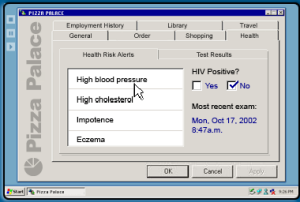
The OMB director isn’t impressed with Aetna’s claim that its software reduced the use of medical services by 6.1% back in 2001. “One cannot reject the hypothesis that the true effect … on outpatient and RX charges is zero.” Aetna’s CMO co-founded the ActiveHealth Management, which developed the software and then sold out to Aetna in 2005. OMB says it didn’t do much except for hospital inpatients. That’s its PHR above, from a pretty cool video on its site.
Credentialing software vendor Medversant files a patient infringement against Morrissey Associates, saying it is “marketing for sale a process that is consistent with our AutoVerifi process.”
A judge in a medical malpractice lawsuit in Canada gives Meditech a nice pitch from her bench, explaining a $5 million ruling against a hospital that had misfiled a patient’s paper-based meningitis diagnostic results for a full year, resulting in his incapacitation. “Despite the UBC Hospital’s acknowledgement of its heavy responsibilities and its knowledge of past failings, it relied exclusively on a manual system with no back-up system in place to manage virtually inevitable employee error. The absence of such a system is particularly unfortunate given that in September 1999, the hospital possessed that capability through the Meditech computer system, which it was using to track films for billing purposes.”
Ann Coulter is a bit of a wack job even to a conservative like me, but this is a fun quote: “The reason seeing a doctor is already more like going to the DMV, and less like going to the Apple ‘Genius Bar,’ is that the government decided health care was too important to be left to the free market .. We already have near-universal health coverage in the form of Medicare, Medicaid, veterans’ hospitals, emergency rooms and tax-deductible employer-provided health care – all government creations … The whole idea of insurance is to insure against catastrophes: You buy insurance in case your house burns down – not so you can force other people in your plan to pay for your maid. You buy car insurance in case you’re in a major accident, not so everyone in the plan shares the cost of gas.”
HR 2630, submitted by Rep. Ron Paul, would give individuals to opt out of any federal EHR system, repeals the act requiring HHS to create a unique patient identifier, requires informed consent for any use of electronic patient information, and prohibits the federal government from requiring providers to participate in an electronic healthcare system. It’s from a few weeks back, but I just ran across it.
Christ Hospital (OH) extends its outsourcing agreement with CareTech Solutions.
I mentioned earlier that for Red Hat VP had started up Axial Exchange, which offers open source healthcare interoperability solutions. She and her startup venture get profiled in the Raleigh paper.

WebMD announces the free Medscape Mobile for the iPhone.
Zynx and eClinicalWorks sign a deal to make the former’s AmbulatoryCare order sets available to eCW customers.
Medicity spinoff Allviant, which will market consumer access tools, announces its advisory board members.
The DoD will expand its PHR pilot that ties its data into HealthVault and Google Health, but it’s also evaluating RelayHealth. DoD required Google and Microsoft to use only US-based servers and to delete all information immediately for an employee who opts out.
Odd lawsuit: a woman who gained 20 pounds during her hospitalization for Crohn’s disease is suing the hospital, saying it overhydrated her with IV fluids. She wants compensatory damages.
HERtalk by Inga
The local paper reports on the status of an Epic installation at Atrium Medical Center, which is one of three Premier Health hospitals now live on on Epic’s EHR. Ambulatory clinics are also getting on board. Officials estimate the implementation will be completed by the end of 2010.
The VA selects Anakram.TFA Two-Factor Authentication as its enterprise authentication tool for remote access to VA systems.
John Muir Health (CA) claims it saved $8.5 million using VHA’s Non-Salary Cost Reduction solution over a two-year period.
St. Joseph Medical Center (PA) selects McKesson’s Revenue Management Solutions to manage its medical billing processes. St. Joseph physicians will deploy McKesson Practice Complete for RMS services, along with Horizon Practice Management software and RelayHealth payor connectivity services.
Tufts Medical Center (MA) places an order for a Carestream Health RIS/PACS system and contracts for Carestream’s eHealth Management Services for remote disaster recovery.
Someone at the University of Michigan Health System clearly listened to his/her mother. UMHS lawyers and doctors are quick to say they’re sorry and admit mistakes up front, finding the policy creates savings in time, money, and feelings. Between 2001 and 2006, malpractice claims fell from 121 to 61 and the average time to process a claim fell from 20 months to eight months. In addition, costs per claim fell 50% and insurance reserves dropped by two-thirds. I like the words of Richard Boothman, the system’s chief risk officer: “What we are doing is common decency.”
The National Institute of Health Clinical Center picks the QuadraMed AcuityPlus platform to ensure interoperability with existing ADT and staff scheduling systems. The NIH facility will use AcuityPlus to make its nurse resource allocation process more efficient.
HIT consulting company Virtelligence is recognized by the Midwest Minority Supplier Development Council as Class II Supplier of the Year. The award is based on such factors as company growth and development and quality of products and services.
Carefx says its Fusionfx clinical workflow solution is now successfully deployed at Fletcher Allen Health Care (VT). My interview with Fletcher Allen CIO Chuck Podesta posted earlier this week. One reader wrote in saying that, based on the interview, they’d work for Mr. Podesta. I concur.
The VC folks seem to think health care companies are worth investing in these days. In the second quarter, health care firms raised $2.2 billion in VC funds, surpassing last year’s $1.89 billion figure. HIT providers are of particular interest as result of growing demand for health care solutions.
Speaking of VC money, MedVentive, a provider of P4P software for evidence-based money, raises $7.25 million in series C funding. Excel Venture Management led the round.
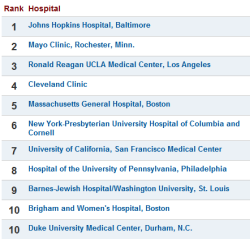
Those choosing an alternative to Mr. H’s DIPSHIT certification program may want to check out Johns Hopkins new master’s degree in health informatics. The one-year program focuses on how to develop IT systems to be used in hospitals, clinics, and public health settings.






































The news about AHRQ is very unfortunate. The AHRQ staff were always excellent to collaborate with. They had an impressive…