


Monday Morning Update 7/27/09
Top Stories
- Enforcement of the Red Flags Rule starts this week. Providers who extend or facilitate customer credit (even doing nothing more than mailing bills after services are rendered, some attorneys have interpreted) are required to check patient ID to prevent identify theft, have a policy on handling questionable patient documents and patient complaints, and check to see that patients who claim insurance have proof.
- Bankrupt OB systems vendor LMS Medical Systems sells its its assets to the Canadian subsidiary of PeriGen for $3.5 million. McKesson bought the IP rights to CALM OB in April, relabeling the product Horizon Perinatal Care, but LMS supposedly kept the rights to support McKesson’s customers and to sell the product outside McKesson’s customer base. Perigen, renamed from E&C Medical Intelligence in April of this year, also sells OB risk reduction software.
- David Blumenthal of ONCHIT says he doesn’t have an opinion on whether health systems should comply with FISMA, the security guidelines for federal computer systems, to share information with federal agencies.
The Top Stories thing above is an experiment that a couple of readers asked for, putting the stories that I think are most important at the top. I like the concept, but I worry that people will infer that everything else is trivial, which it isn’t (I wouldn’t put it on HIStalk if I didn’t think it was important). What do you think, good idea or too enabling of skimmers who will miss important information? I will say that I get e-mails all the time from people who say, “Wow, I just read this and you should put it on HIStalk” even though I have already covered it in detail, so I already worry that some readers are missing good information.

From Dan: “Re: EMR powered by MS Office.” It’s CCHIT-certified gloStream, which we’ve mentioned in HIStalk Practice (in fact, I see that item is listed on the company’s News page, so that’s pretty cool). The user interface is Office-based (which I wouldn’t necessarily find advantageous if it uses Office 2007’s ribbon bar, which I spend way too much time whining about instead of just learning to love it or downloading this free utility to bring back the old menus).
From Otis Miman: “Re: Epic. Meditech hospitals in some areas are getting pressure to upgrade to Epic since physicians are using Epic in their practices. This seems like a tremendous cost burden to healthcare – to throw out a a cost-effective, integrated solution instead of a more expensive, non-complete HCIS and non-integrated solution. Having little or no competition in the marketplace is not a good thing.” Both Meditech and Epic, having sprung from related loins, have the same tendency to not want to play well with others, probably more so than any other HIT vendors. Epic is simply capitalizing on a stagnant HIT market that isn’t putting up much of a fight, although I think hospitals would be hard pressed to get ROI on the cost difference between Meditech and Epic (not many Prius owners are candidates to move to a Cadillac Escalade, not to detract from either system). Every vendor has a showcase site or two that has done great things with their system. They also have some real whiner customers who blame the vendor and vow to buy again from someone else, only to find that their failure cloud follows them. Which category a given site falls into is much more a function of their own abilities than those of their vendors. Anyone who is seriously considering buying Epic who hasn’t been on their current system for at least 6-8 years is demonstrating that they have no idea what they are doing (why didn’t they buy Epic in the first place if that’s what they wanted?) Big-name hospitals choose Epic mostly because all other big hospitals choose Epic, just like they used to buy Cerner and, before that, SMS. Theoretically, the march of the lemmings will eventually end since the market is ripe for new entrants, but so far vendors are just handing their customers over to Epic with heads hung. I don’t blame vendors for selling what customers demand – I blame customers for not demanding better, cheaper, and more open systems (and for being too easily influenced by what everybody else is doing).
From Looking for Answers: “Re: Cerner. I hear the Cerner PETA person wasn’t disgruntled, just looking to score points with his babe — though he does enjoy a good steak! ;-)” Reason enough, I say.
From Eclipsys Watcher: “Re: Eclipsys. I’m hearing rumors of major organizational changes in the next several weeks with more layoffs, etc.” That’s usually a safe bet with most vendors these days, but especially unsurprising since a new Eclipsys CEO was brought in, presumably to make changes. And, while the excuses have changed, company performance hasn’t – shares are worth less now than 10 years ago and its limited clinical product line which, despite having CPOE and documentation that are among the best, still lags way way behind in new sales to Epic, Cerner, and maybe even McKesson. A strong CPOE and documentation system, integrated pharmacy, industry-leading EPSi, and what used to be a strong consulting practice – if none of that translates into sales and then financial results, you have to blame the corner office people. I haven’t been a big fan of most of the company’s management team once Harvey Wilson stopped being actively involved, but most of the folks I knew have been replaced, so maybe the new blood can shake the company out of its doldrums. I can’t decide whether getting into the practice EMR business is a logical extension or a distraction for them.
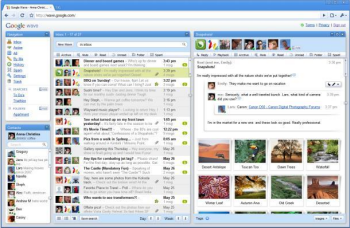
From The PACS Designer: “Re: Google Wave. As a software developer, TPD gets to see new and interesting applications in their early concept development stage. Google has an upcoming release of an advanced collaboration tool that combines e-mail with instant messaging and many other features in an application called Google Wave. It could be use in healthcare to improve communication amongst numerous caregivers and departments.” According to the demo, it was developed by the Google Maps people. Google has so darned many Web tools out there that I bet someone could write some cool hospital apps purely by mash-up. If I were Medsphere trying to get a foothold against legacy vendors, I’d look at that as an inexpensive way to interject some cool factor. An internal messaging app based on Gmail Chat? An Intranet based on Sites? Documentation via Forms? Social networking with Orkut or Wave? Dumping resource-intensive internal e-mail in favor of Gmail? All possible, all useful to customers, and all with a free backbone for vendors to use for their product extensions.
Listening: In This Moment, a female-led metal band now on the Warped Tour.
Jonathan Bush on Fortune, referring to Epic: “The Cleveland Clinic has software that they had to pay $200 million to get. It was written in MUMPS in 1974. There is nobody left alive who can write MUMPS any more. That’s the model … the curve of innovation, the disruptive technology engine in healthcare is broken.”
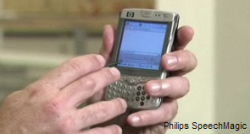
I’m a Tiger Direct junkie, but this deal is stunning even to me: Dragon Naturally Speaking 10 Preferred with a headset for $49.99 (it’s $118 on Amazon). The rebate ends 7/31. Amazon has a lot of reviews, the gist of which seem to suggest that some users will struggle to get it up and running, but those who do find it pretty amazing. It’s heartening to read the reviews of people who can’t type because of nerve disease, wrist problems, etc. for whom DNS is their lifeline. (Note: this version isn’t for use with EMRs – you would want to look at DNS Medical for that.) I keep thinking that maybe I’d enjoy dictating HIStalk, so I may get it. I know some writers who record interviews, then play them back into headphones while repeating what their subject says into Dragon so it can “transcribe”.
AT&T says the $300 subsidy it pays for each new iPhone it sells hurt its most recent quarterly numbers, but will eventually pay off in lower churn for its exclusive service. The carrier activated 2.4 million iPhones in Q2, many of them because of the new 3G S model.
Cardinal Health names Patricia Morrison as CIO after its spinoff of CareFusion and the Friday announcement that CIO Jody Davids was quitting. The new CIO has no healthcare experience, having been CIO at Motorola and Office Depot. That brings up an interesting argument: should hospitals do what Cardinal did and bring in IT leadership from another industry that’s more technologically advanced than healthcare, or is it better to get healthcare experience even though it’s a technologically backward sector? Who would you pick for CIO: a geek doctor who thinks 10-year-old, off-the-rack apps are cool or someone who knows nothing about patients, but who has vast experience with e-commerce, state-of-the-art infrastructure, and self-developed technology as a strategic differentiator? I waffle on that, I admit.
The results of my poll on CHIME’s new CHCIO credential: 9% think it’s a good way for CIOs to demonstrate competency, 13% say it’s a vanity credential, 33% say it has no relationship with competency, and 45% say it’s just another income source for CHIME (so, that’s 91% against). New poll to your right, for HIMSS members: should it devote fewer resources to Government Relations, more, or about the same?
I continue to be impressed with EHRtv. Check out its EMR Matters newcast. I don’t know how they get such dazzling video and audio quality with fast streaming, but I’ve never seen anything like it. There’s also an interview with Allscripts CEO Glen Tullman a few weeks ago that I hadn’t seen. I think it’s brilliant, much more interesting than sticking a $100 camcorder in someone’s face and asking a few trite questions.

Bill Stead of Vanderbilt and Informatics Corporation of America CEO Zegiestowsky talk about interoperability in this article. Here’s what Bill had to say about Vandy’s StarChart, now commercialized by ICA: “The simple idea was to assemble information from any source and to use computational algorithms to turn it into something that can be used. It has no boundaries and it’s analogous to what Google has done. Google answers questions by crawling over any number of sources of information — each of which are used for a single purpose but none having the original purpose of answering your question.” Bill’s the man, I say.
Housekeeping stuff: put your e-mail in the Subscribe to Updates box to your right (like 4,474 of your peers and despised competitors have done) so that you’re among the first to know when I write something new (remember Todd Cozzens of Picis at the HIStalk reception at HIMSS, asking for a show of hands of how many people run to the PC to read it as soon as the e-mail comes? Several CEOs raised theirs). It’s spam-free since I don’t use it for anything else and don’t make it available to vendors even though I get asked all the time. The Search HIStalk box lets you dig through the six-plus years of HIStalk to find whatever tickles your fancy: your name, your employer, or a vendor. Click the disturbingly green box to report a rumor to me, which I always enjoy. The links at the top of the page let you go do HIStalk Discussion, Industry Events (the HIStalk calendar), and also the Archives links to previous articles. You can e-mail me for anything else (interview ideas, guest articles, volunteering to write for HIStalk, etc.) Thanks to you for reading and to HIStalk’s sponsors for bringing it to you.
The HIMSS conference will go back to New Orleans in 2013. I’m surprised since I thought HIMSS was sticking with Orlando, Atlanta, and Las Vegas (which never seemed to pan out, actually). I figured the 2007 conference in New Orleans was strictly a one-time charitable, post-Katrina offering. I didn’t think it was all that great, so I can’t say I’m elated at the news (I miss San Diego and maybe even Dallas, which was at least cheap and had barbeque). Now that we’ve had a snowy conference in Chicago to keep attendees hanging around the exhibit hall, maybe HIMSS should have cut a deal with Detroit, Cleveland, or Pittsburgh, all of which could surely use the economic boost.
Bill Gates, speaking from India, says the American healthcare model is flawed because the government won’t adopt a national identity card, doctors aren’t allowed to share electronic medical records (?), and virtual visits are banned (?) He also predicts that cell phones will be used to test for diseases and that voice recognition will be big (maybe he got the Tiger Direct e-mail too).
The LA coroner’s office is investigating security breaches in which Michael Jackson’s death certificate was viewed “hundreds of times” by employees, some of whom were said to have printed it. They had blocked access to all but the highest-ranking employees, but later found a flaw that could have let others in. The chief coroner investigator says he thinks such violations are only internal policy violations and didn’t break laws, but my understanding that HIPAA is still in effect even when the patient is dead (although maybe coroner’s records don’t count since they become public documents when completed anyway).
HITSP’s Privacy and Security Workgroup wants EMR standards that include encryption, access controls, and audits. Deb Peel isn’t happy with their prioritization of patient consent management, which isn’t scheduled until 2015 and which she calls “foxes designing the hen coops.”
Bad news for hospitals: if CIT Group goes into bankruptcy, that could be one fewer line-of-credit vendor willing to loan money based on receivables.

Australia-based medical device vendor Applied Physiology gets $5 million in financing to launch its Navigator circulation guidance system, which turns information from cardiac monitors into graphical treatment guidance for doctors.
CPSI announces Q2 numbers: revenue up 11.2%, EPS $0.32 vs. $0.28, missing expectations for both.
The City of Los Angeles submits a plan to City Council to replace outdated e-mail technology (“the slowest, most inefficient, crash-prone e-mail system in the history of mankind”) with Google Docs.
Odd lawsuit: an AIDS advocacy group sues the LA County Health Department, alleging that it isn’t doing enough to stop the spread of disease among porn stars.






























Why does the displayed "exam room of the future" still have the classic "clinician has their back to the patient"…