Recent Articles:

HIStalk Interviews Jeff Kao, GM, NCR Healthcare

February 16, 2011 Interviews 3 Comments

Jeffrey Kao is general manager of NCR Healthcare.

2-16-2011 6-54-01 PM

Tell me about yourself and about NCR Healthcare.

I’ve been in the healthcare IT world for quite a while. My career started in 1989. I was an executive inside with GE, went to IDX, and then transferred back to GE with the GE acquisition of IDX. My last assignment was with Hill-Rom, also in the healthcare information and nurse call communication.

NCR is best known as National Cash Register, but in the past 25-30 years, we’ve been best known as a self-service company. We want to empower our customers and patients and everybody associated with helping service the industry, whether it be in ATM, travel, or gaming. 

With all the transactions and all the need inside of healthcare, we’re becoming a bigger and bigger participant inside of healthcare. We’re eager to participate in the category and really empower the patients associated with servicing themselves in a very complex network that’s in need of revamping and modernization.

Most high-volume businesses like airlines, banks, and big box stores have an impressive array of customer-facing self-service technologies. How do hospitals and medical practices stack up and where do you think they’re going to go with it?

We are leading the technology frontier in many categories, but falling behind in others. Healthcare informatics is one of the particular cases. If you think about a high-volume transaction basis in any industry, I can’t think of any other where you can’t schedule an appointment online with physicians to speak of. You can do that in terms of servicing your car at Jiffy Lube today.

We’re still an industry that’s very antiquated and backward in terms of how we communicate with our customer or patients. Very little secure messaging occurs over the network. I can’t think of any other industry in which e-mail, SMS, and text messaging hasn’t transformed in terms of our transactions dealing with anybody. We are an industry dominated in terms of forms, informatics, and payers and all kinds of bureaucracies in which we are still dealing primarily with paper, imaging systems, and document management systems. 

By the nearest estimate — without even prescription drugs and so forth – with provider and hospital dealings every single day, there’s two billion transactions happening in a given year, but very few of them are automated and happen on a consistent basis in which we empower the consumer where the patients actually having to deal with the category of self-service. It’s all still very intensive. That’s why I think we’re prime in terms of automating the space with our expertise in other industries that we can bring some of these practices into healthcare.

You worked at IDX and GE. Do you think traditional vendors are focused on customer self-service or is it going to take a company like NCR to add that on?

It requires a complement of companies working together. In IDX, we were obviously big in terms of the provider space, automated provider workflows. But if you think about it, we really started with the healthcare informatics first. We started with the big customers first. We really didn’t take a perspective associated with what the consumer actually needs.

For example, I’ve relocated to Duluth, Georgia. Like in any relocation, our employees were looking for primary care providers, looking to embed ourselves, ingrain ourselves, and get the kids registered for schools. It was hard finding a primary care provider. It was hard to navigate through the system, We waited in line for six hours to basically get shot records updated for our kids. I think those are the kinds of things that have a predominant role for self-service.

It’s amazing. We moved our headquarters from Dayton, Ohio to Duluth, Georgia. We brought over about a thousand covered lives associated with our entity. Over and over again, the experience associated with providers is they offer little or no tools in terms of registering ourselves, in terms of understanding who our payers are, in terms of being able to register for appointments.

We provide a preventive care benefit to all of our employees, meaning physicals and so forth, are 100% paid for by employees. Yet overall, if you look at our employee experience, not a single provider has ever contacted us to go in and get a physical. With all the electronic medical record adoption, with all of the investments in healthcare IT, something as simple as contacting one of our employees, one of the kids, or one of our spouses to come in for an annual physical doesn’t occur on a regular basis. 

This is a primary role for us in, terms of providing self-service. At eight o’clock at night when I’m clearing my e-mail messages, a reminder that says, “Hey, you’re 40 years old, you really need to come in for a check-up. By the way, click on this link. Go in there and register yourself, provide the necessary demographic information, update your present patient history, and come on in, because I think the care of you and your family is important.”

I think something as simple as that doesn’t exist in our industry or any of the patient populations today. This is what we really need to transform, especially with the advent of healthcare reform and changes. Empowering the consumer to handle the most mundane transactions that we have to do every single day. That’s why we’re so excited about this category.

In most industries, there would be two reasons to use customer-facing technology. One would be for general efficiency, the other would be to give customers what they want. What do you see that healthcare customers want to be able to use that they typically can’t?

I think there are always three things. One is that you’ve got to deliver a service that your customers or your patients want. We all carry computers, we all carry tablets, we all carry smart phones and mobile devices. We want to interact for all the services that we do. Today it’s really naïve to think that any service industry would neglect self-service, whether it be online banking, checking in at an airport, and so forth. I think for the most part, everybody is going to demand technology.

If you think about retail health, take a look at Walgreens. Every Walgreens store offers prescriptions, but they’re going to get into the primary care space and taking care of providers. They’re going to offer online scheduling, they’re going to offer electronic forms, they’re going to offer online check-in. The employee clinics are doing it today at Cisco and so forth. I think consumers are going to drive that demand, first and foremost.

I think the second thing is, with 34 million people coming into the healthcare system, unless we continue with the practice that we have today, we’re going to drive up a huge amount of administrative costs if we don’t adapt a different practice associated with enabling the consumer to self-service themselves to cut the administrative burden. 

Thirdly, I think it’s the central part of the Obama administration in terms of cutting medical errors. What better way to prevent all of the redundant entering and keying in and scanning and documentation and printing and so forth, other than making sure that the person in charge of his own personal information enters it correctly into the system, is adequately documented, adequately categorized, adequately feeding into all the ancillary systems? I think this is where self-service has a primary role in terms of cutting administrative costs, enabling the consumers, and also making sure that it’s more accurate and more up to date, and giving the power back to the patient and providers in terms of time to care for each other.

You mentioned Walgreens. They have a financial interest in interacting in more creative ways with their customers than the average hospital or physician. Do you think that the lack of incentives is the reason that physicians and hospitals have not looked more at engagement-type technologies like Walgreens has?

I think that’s a great question. Engagement technologies …  any time you talk about physicians and hospitals, it’s a little bit different.

I think for the most part that physicians haven’t engaged because there hasn’t been a solution out there that services the way they need to purchase and support the technology. There are 850,000 physicians in the United States. That’s a big number. But primarily, these physicians are still in relatively small, aggregated groups. The last number I’ve seen, they’re still in five doc or less groups. For them to buy their technology the same as a hospital is very challenging. They don’t have a CIO, they don’t have IT space. For the most part, they have found their way onto the Web through some kind of hosting service, but to be able to manage technology the way the big IDNs do is very challenging.

This is where companies like NCR and others need to find a way to support them in their mission for self-service that doesn’t require them to buy millions of dollars of hardware and capital, but rather understands the way they want to practice medicine, the way they want to service their customers, and offer it in a holistic hosted way that doesn’t require them to support all this technology, but supports it for them. In fact, we need to be just more than a technology provider. We need to be a total solution provider.

I think that’s what’s going to enable a 20-doc group to offer a service to their patient population that allows them to self-service, that allows them to smart schedule, that when somebody logs in their system, they’re registering for their five-year old kid or a seven-year-old kid that knows that the patient’s going to prefer a time slot between two-thirty to five o’clock because that’s when they’re out of school. For a person that’s a working professional, they prefer to go in the morning or late at night so they can go before work or after work. For a retired person that has a little bit more schedule flexibility, maybe between the hours of ten and two. For the middle summer when the flu season’s not impacting the patient volume, to draw somebody in for a physical, or two weeks before school starts, to linearize that volume because everybody’s trying to get their physicals to participate in school sports or get their shot records updated so they can participate.

I think the systems are there. The logic is there. Those patterns exist inside the healthcare system, but we don’t provide the providers assistance to systematically manage the way their patients want to be treated. We know there are bottlenecks inside the healthcare system. The week before school starts, the pediatric offices are full because everybody’s trying to get their shot records and physicals done. There’s a way of linearizing that volume. In middle of summer, nobody has the flu — it’s the perfect time to run people through physicals and preventive care. But right now, it’s a lousy time. We’re in the height of the flu season. There are patterns associated with what we can do to help the physician practice associated with participating in self-service that will benefit the patient as well as enable provider their business practices.

When you talk to a hospital about self-service, they probably most often picture the kiosk, which I know you offer. If you look down the road and where kiosks are and where they might ultimately move to, where do you see that developing?

In terms of the hospital segment, the kiosk is an equally important participant, but that’s not the only technology. It has to be a hybrid of three technologies — the portal, the kiosk, and the mobile environment. Here’s why.
Think about our complex setting. I have a friend with breast cancer. If you think about what needs to go through the transaction, many of the forms and the preparation and so forth really need to happen in the comforts of our own homes, associated with basically entering the form, maybe the prep associated with the visit, preparation in terms of somebody to take you there and take you home from the hospital in an ambulatory visit. If you think about it, the visit really happens in terms of the preparation in terms of self-service, making sure of the insurance and demographics and so forth, because it’s a traumatic time already.

Once you update all the things that you can do online, what needs to happen associated with the kiosk is you need to know what happened on the Web so that the same experience continues when you go on the site. When you think about an oncology visit for a typical patient, the first visit may be checking in, just making sure that the hospital or the IDN knows that you are there, followed by a management of your visit for the whole day. It may be a visit to the lab to make sure they draw blood and do a white blood count. After that, you may have to wait for the results.

Depending on the result, then your workflow gets changed. It may be going to imaging, or it may be going to chemotherapy. After that, observation, and finally released to make sure that you are properly cared for and arrive home safely with somebody driving you home.

If you think about that experience as a holistic portal, the in-presence visit management experience requires not just one technology worth thinking about in terms of kiosks, but really managing expectation on the portal, managing forms and so forth so that you can streamline your visit, using the kiosk to basically take you from place to place making sure that your visit happens in a consistent, coherent way and you don’t bypass any of the procedures because the handoffs are very complex in healthcare. And then, finally the discharge and the scheduling of the next visit. 

Along the way, smart alerts can remind you where you need to be and what you need to do, because most of us walk around with a cell phone. I think that’s what our customer service, our self-service experience, inside the hospitals and physician offices, need to be. Many procedures are now outpatient, but the visits in a complex IDN setting are many-modal, many departments, highly complex. All these systems need to be tied together in terms of giving you a holistic view and holistic experience.

What you get in one setting, in one department, you need to carry forward to the next one. It makes no sense for you to do four stops and update your patient records, your demographics, your insurance, and your insurance cards, and everything else four times. That’s the waste inside of our systems and leads to a less than satisfactory and costly experience in terms of what the IDN or hospital or physician actually knows what’s going on with you.

When you look at the Meaningful Use emphasis on use of technology by providers, do you think that will create opportunities to push technology out to patients?

I definitely think so. If you can think about Meaningful Use, a major portion of it is updating the patient associated with the right information. I think EMRs and the traditional hospital information systems offer the foundation in making sure that all the information is electronically stored and compiled in a meaningful way.

But what Meaningful Use sometimes overlooks is that all the information is stored on a server somewhere. How do you intend to interact with your patients to provide the information meaningful to your patients? It does you no good to have the demographic information as well as the results on the computer. Moreover, you have to advise the patients. I think all the Meaningful Use criteria I have seen require a portal or some kind of informatics that gets back to the patient.

I think this is where we have an important role to play. Centered on our self-service strategy at NCR, it is really not how the information is stored or what information or technology the hospital or the physician has, but how do we enable the interaction between the information to the patient so we can empower the patient to have the right information? Allow them to enter the information. Have them manage their own visit. Have them manage their own care in a meaningful way with the technology that’s already embedded in the system.

I think that’s a little bit of a twist in terms of what we’re doing, but we intend to be a very strong participant in making all this electronic medical record and all this electronic data exchange meaningful to the patient.

Any final thoughts?

The moment is ripe in terms of a change in the way that medicine is practiced. I know many people talked about it in the past, but I consider self-service this way. It’s like making soup. We have 34 million people coming into the system, probably driving on the order half a billion additional transactions into the system, with probably declining reimbursement rates. The pressure associated with it is we’ve got to get better, more accurate, faster, and cheaper with how we care for this volume.

If you look at the industry over and over again, whatever segment we’ve looked into, people have gravitated to a self-service model to enable the consumer or the patient to do more, to have more accurate information. Over and over again, what industries have done is gone to the Web, gone to kiosks, and gone to mobile devices.

I think the moment is right for us, over the course of the next three years, to experience something that’s revolutionary in US healthcare associated with Meaningful Use, with adoption of self-service technology, whether it be portal, mobile, or in-presence with a kiosk. I don’t think there’s going to be one winner inside of these three technologies, but it’s going to be a combination of these technologies all working in a coherent way, reaching all the technology on one single platform that allows a unique patient experience. I think this is why it’s so exciting being inside self-service, inside healthcare IT right now. I think the moment is right for that tip.

HIStalk Interviews Janet Dillione and Jon Lindekugel

February 15, 2011 Interviews 5 Comments

Janet Dillione is executive vice president and general manager of the healthcare division of Nuance. Jon Lindekugel is president of 3M Health Information Systems.

2-15-2011 5-27-57 PM 2-15-2011 5-29-55 PM

Nuance and 3M Health Information Systems announced this morning a broad, strategic partnership to deliver ICD-10-ready clinical documentation and coding solutions, starting with Computer-Assisted Physician Documentation, which combines Nuance’s speech recognition technology with 3M’s Clinical Documentation Improvement content.

CAPD allows physicians to dictate encounters in their own words while prompting them for any additional information needed for proper ICD-9 and ICD-10 coding, enabling clinical documentation improvement a the point of dictation. It was designed to accelerate the implementation of ICD-10.

I interviewed Janet Dillione and Jon Lindekugel Tuesday afternoon before the announcement.


Tell me what the announcement means in simple terms.

Janet: Nuance and 3M have decided to partner to go after very deep innovations around clinical documentation, specifically targeted at the physician. Both companies saw the same thing happening with the coming of ICD-10. We had similar ideas of how to blend the strengths of both companies together. We viewed each other’s strengths as very complimentary and several months ago, initiated conversations.

We think with our Computer-Assisted Physician Documentation, we are able to bring an incredible piece of innovation and a really time-saving, ground-breaking change to physicians and the way they will document with ICD-10.

Jon: The partnership combines 3M’s core strengths in coding and Clinical Documentation Improvement with Nuance’s advanced speech recognition and Clinical Language Understanding technology. With the combination, we think we’ll be able to make a step change in helping physicians capture accurate documentation, especially with the coming ICD-10 transition, and do so in a way that will leave the physician more time for patient care. And in the process, help facilities achieve full and appropriate reimbursement, accurate quality reporting, and ultimately, successfully make the transition to ICD-10.

In a nutshell, we’re taking 3M’s industry-leading Clinical Documentation Improvement approach, which a lot of hospitals rely on today in their HIM and documentation improvement departments, and applying all the technology that Nuance brings and its industry-leading technology to deliver that content to the point of care, to the physician.


Describe how Computer-Assisted Physician Documentation works and how it looks to the physician as they’re dictating.

Janet: If you’re a physician in your classic workflow, you can be using Dragon. We have several hundred thousand physicians using Dragon. Physicians like the dictation technical workflow. You’ll be dictating through Dragon and will be able to take both unstructured data from the narrative, apply Clinical Language Understanding to it, as well as bring in any data that may have come in through a template that’s up in that EHR. We will grab that data and pass it into the 3M CDIS clinical knowledge environment, where we will have an environment with Clinical Language Understanding.

Essentially, we will be able to send back out of that engine to the physician, “Did you mean CHF unspecified, or did you mean an acute MI? Did you mean this, or did you intend to say something else?” Really trying to replace what happens today, with manual follow-up, where the next day, hours later, or even post-discharge there’s a lot of manual intervention going on with these charts and people poring through the narrative as well as what’s coming through the templates to try to get accurate documentation, both for the patient quality and the reporting that’s required as well as reimbursement. They’ll be able to automate that entire work flow and do it at the moment that physician is there inside that work flow.

Jon: We believe we’ll be able to drive physician-sensitive prompts, a limited set of prompts, directly to the physician to improve the accuracy of documentation right at the point that documentation is occurring.


Is your sense that there will be an overall time savings for the physician compared to dictation and then follow-up questions?

Jon: Yes.

Janet: Absolutely. There should be time savings for the physician, not to mention the efficiency and savings for the overall delivery system. We should be able to reduce this manual back-end intervention that’s happening now.

Who’s the ideal prospect?

Janet: Any delivery system that needs to deliver patient care with physicians as ICD-10 is being implemented. I guess that means the US delivery system. [laughs]

Jon: Every hospital in the United States healthcare system will significantly benefit from CAPD, be it their physician community through CMIOs who are interested in automated tools to reduce administrative burden on physicians to the financial community, CFOs concerned about receiving accurate and full reimbursement, reducing compliance risk, and getting cost out of the system. From an IT perspective, CIOs who need to ensure accuracy and completeness of the information flowing through the EHR.


ICD-10 has caused people to seek alternatives to manual physician lookup of codes, especially since there will be so many more of them. How do you think this approach will be accepted by the market compared to lookups or other on-screen prompting?

Janet: I think you’re exactly right. That’s what was interesting as we began to talk to each other. The industry to date had been predominantly focused on the back side, trying to help the coders with a lot of tools, and 3M has some fantastic innovation there.

But when you began to really understand what happens with documentation and how that stuff gets clarified, you really find how many queries and pings and e-mails are hitting the physicians, some of which get answered and some of which don’t. That’s where we thought that we could really bring the efficiency and the real breakthrough. We have had the opportunity to validate this. We have shown a mock-up to some physicians and we’re typically getting an a-ha reaction of, “That’s what we needed.”

Jon: On the very specific topic of customer reaction, we were able to show it to seven customers, large delivery systems, last week. The feedback was unanimously positive and they immediately jump into a detailed design mode because, “This is exactly what we need, and here’s the 15 additional things you need to make this do.” It was pretty exciting to see.

The other thing that gets validated as we review it with customers is that the value of this as a passive ICD-10 training tool, frankly. By deploying this long before the actual October 2013 date, physicians, in effect, are being trained on the level of granularity that their documentation needs to include as we move to ICD-10. As we deploy this as an ICD-10 solution, it’s going to drive that education surrounding what’s needed in documentation, framing it in a passive way that isn’t a classroom lecture. It’s a real, live, on-the-job learning exercise for the physicians that will make the transition much smoother when we get to 2013.


For organizations that haven’t given as much thought to ICD-10 as they should have, what are the opportunities that it brings to them, assuming that CAPD makes it easier to capture the codes accurately and quickly?

Janet: ICD-10, because of the sheer scale of it, is forcing just about everybody to question how they do what they do today. There are estimates of almost a 50% reduction in efficiency on the coding side. That’s stunning. Even if you could afford the budget to increment your staff, there isn’t enough talent in the market.

Folks who have not started to look at it, when we make this announcement, I think it will show them a way to not only start to look where they had typically been looking, but also to really look for process innovation. How can we do things differently here? How can we do things more intelligently? How can we bring more of the intelligence up to the front part of the process?

Jon: On the cost side, we view this is as a direct means of driving training and accurate documentation upfront and we will take some cost out of the ICD-10 transition by deploying the solution upfront. On the other side of it, our computer-assisted coding will now be powered by the Nuance Clinical Language Understanding natural language processing module, which will take cost out of the back end for sure, offsetting some of the increased coding resource requirements surrounding ICD-10.

When we lay all that out, we really hope to offset the increased cost during the transition for the provider networks in a way that enables all of the advanced analytic work longer term that should be able to be done from the much more granular view of medical transactions and the delivery of healthcare.


Any concluding thoughts?

Janet: I think the industry will be a little bit surprised to see these two partners coming together. People will see how quickly this came together and how amazingly aligned the vision was with both companies. Jon and I actually met a matter of months ago and we started to see the synergies between these two companies. The teamwork has been fantastic and I can tell you that the organizations — the R&D folks, people who meet with customers every day — are positively pumped to get this out there and get this in front of the customers. We really think we’ve got something unique here.

Jon: It’s really just taking two great brands in the healthcare IT space that deliver great best-of-breed solutions and combining them in a way that really is going to solve some significant client problems and pain points. We’re just thrilled, both companies. Everybody involved is really excited about the opportunity. We just can’t wait to get the announcement out and get going on it.

News 2/16/11

February 15, 2011 News 10 Comments

2-15-2011 7-59-21 PM

From Wombat: “Re: Blumenthal replacement at ONC. Stephen L. Ondra, MD is the frontrunner.” Unverified. He’s a veteran, neurosurgeon, and senior policy advisor for health affairs at the VA. I doubt he’s a heavy EMR user, but I guess at ONC level that will always be the case. Maybe that should be a pre-requisite.

From CIO or CPA: “Re: Allscripts. Am I the only one that wonders about the Allscripts balance sheet? Nearly $1.6B out of a total of $2.4B assets is either intangibles or goodwill. There is also $460M of long term debt. This is a total of about 85 % of total assets. This compares to Cerner’s totals at about 21%. Seems like a large hole. What am I missing?”

From WildcatWell: “Re: Verizon Health Information Exchange. May offer its own MU-certified EMR to physicians who subscribe, use Verizon Business, FiOS, whatever. Info could then be pushed right into a doc’s home. Game changer, baby!”

From PureSpam: “Re: McKesson. Not a rumor – big layoff happening now (Tuesday morning).” Nasty Parts sent this on Monday: “Wholesale slaughter of the McKesson sales force on 2/15. Over 450 folks being let go.” Monday’s rumor from Doolittle specifically named McKesson, although I didn’t until I gave the company time to respond to my inquiry (they didn’t). I don’t have firm confirmation, but one insider places the number at 84% of the sales organization, or about 200 people. Supposedly a consulting firm convinced MCK that the client executive role was not worth keeping. I’ll let you know if they provide a statement.

From IKnowPlenty: “Re: vendor parties. Any insight about what they’re doing for entertainment? Keep up the good work – I enjoy every issue.” I haven’t followed the events too closely since I never have time to go. I think I signed up for the Allscripts party on Tuesday evening at Hard Rock Live with the hopes they’ll have name entertainment just in case I have time to attend, but in Orlando you usually end up with white-bread Disney day-jobbers doing an imitation of a band.

Just a brief note on HIStalkapalooza: it’s more than completely full from those who signed up during the designated period, so I can’t add more folks – sorry. I wish everybody could be there, but we just don’t have the room.

Kaiser’s George Halvorson extols the virtues of its new computerized clinical library in his organization-wide e-mail this week. It’s available everywhere to users, is being used 10,000 times per day, and in addition to references, also includes includes best practices, protocols, and links for using Kaiser services.

2-15-2011 8-36-04 PM

I feel odd mentioning new HIStalk Platinum Sponsor GE Healthcare since I don’t always have nice things to say about the company and they know their sponsorship won’t change that. Still, I was encouraged (and said so) a few weeks back when they were quick to reply honestly to a rumor I asked them about (true, as it turned out) and I admire them for supporting a somewhat loose cannon. Everybody knows GEHC, so let’s talk about what they’ll show you if you head over to that block-long booth they always have (#2401) at HIMSS: Centricity EMR solutions (Advance for small practices, Practice Solution for mid-sized ones, Centricity EMR for the big boys, and Enterprise for hospitals); eHealth Solutions (HIE, image exchange, and community desktop portal); digital pathology from its UPMC partnership; the Qualibria Clinical Knowledge Platform; and other tools (wireless devices, patient monitors, etc.) You can schedule a demo here (if it were me, I’d check out the HIE and Qualibria products since those are new, I think, and I don’t know a thing about either product) or head over to a theater presentation. Thanks to GE Healthcare for supporting an honest and opinionated HIStalk instead of some fawning publication or site.

Allscripts announces Q4 numbers: revenue up 87%, EPS –$0.03 vs. $0.10. The costs of the Eclipsys acquisition took MDRX into the red; otherwise, it would have beaten estimates at $0.20.

Valley Regional Hospital (NH) chooses the HMS hospital information system.

Orlando Health is partnering with Rothman Healthcare to evaluate the Rothman Index as an admissions patient surveillance tool and to enhance the effectiveness of the health system’s Rapid Response Team. I interviewed Michael Rothman in October and it was one of my better ones, if I do say so myself, because it’s an interesting product they’re creating and they’re doing it for passion, not money.

Quite a few of you filled out my reader survey – thanks. I only run it once a year, so this is your last chance to weigh in. I read every response and try to find time to run with a few of the ideas offered every year.

image

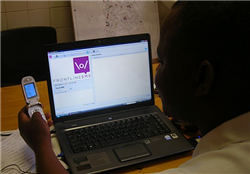
An ABC News piece covers a project by a former Stanford student to improve healthcare in Africa by setting up a telemedicine network based on text messages sent via discarded cell phones. I mentioned it last June when it was called FrontlineSMS:Medic. The new name is Medic Mobile.

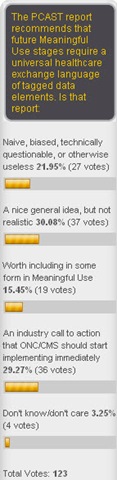
Deborah Peel, MD of Patient Privacy Rights was scheduled to testify Tuesday before the PCAST work group of the HIT Policy Committee and HIT Standards Committee. Her group’s concerns: (a) universal data exchange formats without privacy consideration will make it easy to violate patient privacy; (b) it takes time to build privacy into systems; and (c) de-identification doesn’t really work very well.

University Hospitals (OH) will expand its deployment of the Allscripts EHR and Sunrise Enterprise.

A Boston Globe article covers patient harm caused by alarm fatigue with hospital patient monitors. It mentions a 15-bed unit at Johns Hopkins that averaged 942 critical alarms per day. It also cites a Mass General case in which a patient slowly died while experiencing a fatal heart attach after his cardiac monitor was turned off and staff did not respond to ongoing alarms triggered by his low heart rate. A nurse was quoted: “We have 17 types of alarms that can go off at any time .. It becomes … background.” Studies also found that up to 85% of the alerts are false alarms.

CSC’s big NPfIT contract is in danger of being cancelled over repeated missed implementation dates, some of the go-lives years overdue. NPfIT has gone through many vendors, some of them big, and I don’t know of any that made any money. It probably wouldn’t break CSC’s heart to be shown the door.

2-15-2011 9-21-04 PM

Privacy software developed by a Canadian researcher is being tested by two hospitals. It scores the likelihood of being able to identify a particular patient based on their available information and then selectively de-identifies the records as needed. I see by Googling that he’s already formed a company to sell it.

2-15-2011 9-24-27 PM

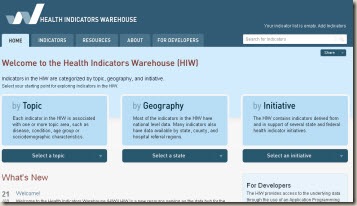
HHS launches the HealthIndicators.gov portal, opening up the HHS health indicators data vault to developers and researchers.

Billionaire Patrick Soon-Shiong makes another healthcare technology investment, this time in UK-based wireless monitoring device vendor Toumaz. The company will start by developing sports sensors, but will then look at wireless healthcare.

A Virginia hospital, hit by Facebook-posted rumors that patients were dying of sepsis contracted there, strikes back by saying “not true” on its own Facebook page. At least it doesn’t cost anything to argue on Facebook.

E-mail me.

HERtalk by Inga

HISTalk_shoes

From Fancy Nancy: “Re: HIStalkapalooza attire. I am so excited about the reception coming up and am wondering how formal people are dressing? I need your guidance and wisdom.” Fancy Nancy, I am so glad you asked. I hope that we see lots of velvet and taffeta and strappy high heels. If you can’t decide whether it’s worth it to pack that special outfit, here is something to consider: the two winners of the Inga Loves My Shoes contest will each receive a $100 gift certificate from Zappo’s, courtesy of Mr. H. Then there is the HIStalk King and Queen event for the the best-dressed attendees. These royal winners each take home iPod Touches (not the cheesy 8GB version, but the new 32GB model, complete with Facetime and HD video recording). Here is a hint, if you want to be in the running: don’t be late. We will have a red carpet entrance, and if you really want to strut your stuff, make sure you take a moment for a photo and chat with our red carpet interviewers. The formal presentation part of the evening will begin at 8:00 p.m. and our finalists will be selected by that time. To give you an idea of how high the bar is set for the shoe contest, our esteemed judge sent me the above photo of what will be adorning her feet. Meanwhile, our head judge for HIStalk King and Queen has been cramming to watch all eight seasons’ worth of “What Not to Wear” and to memorize all of Stacey and Clinton’s rules.

2-15-2011 11-27-18 AM

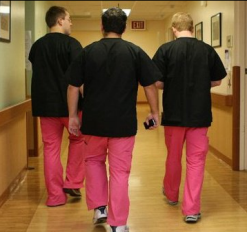
From Pretty in Pink: “Re: Winning party attire. Real men wear pink, so I am hoping that someone from my team will have a shot at HIStalk King.”  While we love you pink-pants-wearing guys, we hope you have time to change before heading to BB King’s. Of course, if you show up in a pink tux, our judges will likely make you a finalist.

A big thank you to everyone who shared with me news of other fun evening events during HIMSS.  Some of the hot parties include Cuba Libre for “music , dancing, food, and fun” and a casino night at one of the big hotels. It seems like I also saw something about an event at the Amway Center with appearances by Orlando Magic players, but I can’t find that e-mail. So much for staying in and ordering room service.

Misys Open Source Solutions will leverage technology from Apixio to improve data search and filter capabilities.

allina

Allina Hospitals & Clinics (MN) deploys Mobility XE, a mobile VPN solution from NetMotion Wireless.

2010 was the second worst year in the last 15 for mass hospital layoffs , affecting a total of 10,490 individuals.

Nuance continues to be the “power player” in the speech recognition market, according to a new KLAS report. Nuance’s eScription was the highest rated back-end system, followed by Dolbey Fusion Speech. Nuance’s PowerScribe and RadWhere led the front-end speech segment, followed by MedQuist’s SpeechQ. KLAS says the speech recognition market is ripe for healthy growth, with only one in four hospitals employing the technology.

GE’s philanthropic organization, the GE Foundation, awards $500,000 to two Erie, PA-based community health centers to support increased access to quality healthcare. Meanwhile, GE Healthcare enters into a joint development and marketing agreement with SAS to use SAS Analytics in GE’s Patient Safety Organization to mine data on patient safety adverse or near-miss events.

2-15-2011 3-22-45 PM

Siemens Healthcare announces that five healthcare systems have contracted for Soarian systems, including Baptist St. Anthony’s Health System (TX), Peconic Bay Medical Center (NY), Children’s Hospital (LA), Touro Infirmary (LA), and MaineGeneral Health.

Ken Graham, the newly unemployed CEO of El Camino Hospital (CA), will receive almost $1 million in severance pay. El Camino’s board of directors fired Graham last week “without cause.” Nothing like a million bucks to ease the pain.

IMG_0339

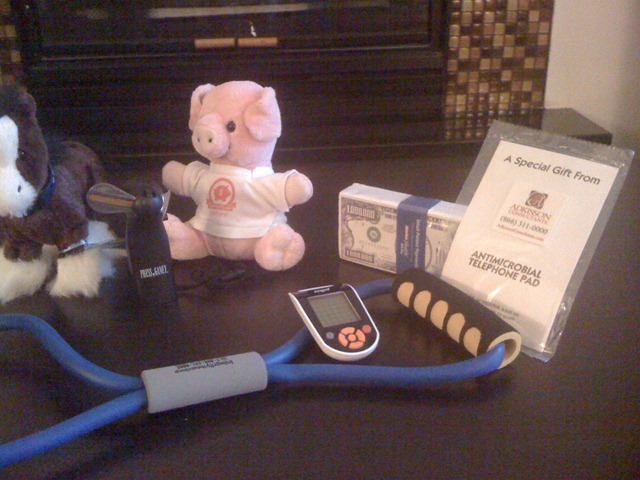
Did you have a chance to look through Mr. H’s Must See Vendors for HIMSS11? Here are two reasons it’s worth your time: 1) you will be amazed at the variety of products and services that encompass the HIT world; and  2) there are some pretty nifty giveaways. I have printed my PDF version so I know which booths to hit. If you are short on time, here are a few tips, starting with the offerings exclusively for HIStalk readers:

  • Vitalize Consulting (3070) – if you connect a “link” on their Chain of Hope, they will donate $5 plus an additional $5 if you say you are a HIStalk reader.
  • Virtelligence (2131), MED3OOO (917), Emdeon (2201), and Cumberland Consulting (6943) are each hosting special HIStalk reader-only drawings for iPads.
  • Iatric Systems (3601) – (3) $50 iTunes gift cards for readers.
  • Enterprise Software Deployment (2777) – special drawing for a Sonos Music System.
  • Billian’s HealthDATA/Porter Research (4579) – snack packs to the first 100 HIStalk readers.
  • API Healthcare (3463) – HIStalk reader-only drawing for a Dell Inspiron Mini Netbook.

017

For the HIStalk-exclusive goodies, you pretty much just need to mention you are a reader – no secret handshakes required. While you are touring the exhibit floor, here are a few other recommended stops:

  • CareTech (1831) – raffling off a $1,000 donation to a recipient’s hospital foundation.
  • Enovate (2738) – iPad giveaway.
  • Enterprise Software Deployment (2777) – in addition to the HIStalk-only drawing, they are giving out cozy flip flops and a chance to win a FLIP camcorder.
  • HT Systems/PatientSecure (218-10) – if you register to meet with them in advance, you have a chance to win an Android-based tablet PC.
  • Keane (1548) – iPad giveaway.
  • MEDecision (2563) – Starbucks coffee (!)
  • Microsoft (3101) – Microsoft Arc Mouse giveaway.
  • NCR (2805) – a singed copy of Paper Kills 2.0 by Next Gingrich to the first 25 people to schedule a booth appointment.
  • NextGen (2163) – chances to win a smart phone or iPad. NextGen will also have “splash” artists creating works that will be given away.
  • Sage (1713) – sign their Red by Sage Wall of Inspiration to commemorate someone’s life that’s been touched by heart disease, then get a chair massage.
  • Wolters Kluwer (6162) – chance to win a trip for four to the US Masters in Augusta.

inga

E-mail Inga.


Sponsor Updates by DigitalBeanCounter

  • Design Clinicals now supports integration with GetWellNework, allowing hospital patients to use the in-room TV to request bedside delivery of prescribed meds.
  • Clairvia says sales of its Care Value Management software grew 85% during the last six months of 2010.
  • MEDecision is launching a mobile application that enables providers to access its Clinical Summaries through smart phones and electronic tablets.
  • GetWellNetwork announces a record number of new contracts, upgrades, and expansions with new hospitals.
  • The Boston Globe cites Nuance’s Dragon Medical software in an article titled, “Writing exactly what they say.”
  • Riverside HealthCare (IL) selects the eClinicalWorks EHR.
  • Five CareTech Solutions clients will share their experiences at HIMSS11.
  • Colleen Hittle, managing partner at Anson Group, will be a featured panelist at Indiana University’s Life Sciences conference on February 25 in Indianapolis. Shout out to DigitalBeanCounter’s alma mater!
  • Imprivata partners with Thales, an information systems security leader, to deliver high level SSO cryptographic security.
  • Stan Cassidy Centre for Rehabilitation (SCCR) chooses Orion Health’s Patient Portal to improve communication between patients and providers.
  • Access will demonstrate the new version of its electronic forms offering at HIMSS, which includes an iPad version.
  • Siemens will conduct on-the-spot interviews of experienced talent  at their HIMSS booth, with a specific interest in candidates for product line management and enterprise services positions.
  • Phelps County Regional Medical (MO) will replace its document management system with Perceptive Software’s ImageNow document management, imaging, and workflow solution, integrated with Meditech.

EPtalk by Dr. Jayne

Barely a week left before HIMSS and I’m still having fun opening the mail every day. However, being in a part of the US that’s been having some weather, I don’t envy my mail carrier dealing with the vendor postcard that was mailed in an 8×10 rigid envelope that required it be carried through the proverbial rain, snow, sleet, and hail to my front porch. Yes, you got my attention with that, but you also could have gotten my attention with a smaller mailing, like the new Rapid Rewards update mailing that Southwest Airlines just sent. The size of a standard CD case, it caught my attention and kept my mail carrier warm and dry in his truck.

Lawson also got my attention (but in a positive way) with their tagline “Top Performers Make the Difficult Look Easy” and photographs of the contortionists they’ll be featuring in their booth. Although fascinating, I have a hard time watching acrobats because it brings back memories of Gross Anatomy class and having to memorize the name of every muscle, bone, and tendon.

Reader Bill, a veteran of the healthcare marketing trenches, emailed Mr. H and me about marketing:

Some folks complain about your HIStalk banner ads; I have embraced them as interesting. Not because I am sold on their offerings – not in the least. But when clustered together and winking at me with their clever little Flash graphics as I scroll, they seem otherworldly, almost anthropomorphic – "look at me!" "No, look at me!”

Mesmerized, I am transported to nearly 100 drab marketing conference rooms where overworked copy and graphic drones are prodded by their regional or national suit to, "Gimme something that ‘pops.’ Stale coffee, half-eaten bagels and doughnuts, pencil sketches, and wads of paper strew the table. Projector images flip through the ridiculous and unrealistic royalty-free stock photos of too-pretty male and female models with stethoscopes posing as healthcare workers. Bright young graphics and PR managers all convinced that they have the next best attention-grabbing gimmick.

With that in mind, my pre-HIMSS Winner of the Week is Aventura, which grabbed my eye with their tag-team Halloween-hued envelopes. The orange envelope held a fairly standard piece, but I enjoyed their promise of fixing all my staff’s roaming profile and VDI issues “in a way that will loosen their hands from your throat.” I’m not so sure though about their promise to “do things that will make clinicians run up and kiss you.” The black envelope held an invite to yet another private hands-on demo where they plan to show “the ultimate technological feat: how to make clinicians think you’re a decent, thoughtful, kind-hearted person.” I give them an A+ for marketing and a gold star for being a vendor that understands my world.

One last thought on marketing: the issue with the RelayHealth Facebook contest to create a welcome gift basket for me has been fixed – it no longer tries to get you to upload a video. I was starting to feel cyber-neglected due to lack of submissions until a reader e-mailed about the issue. The contest ends on February 18th, and if your suggestion gets high votes, you win a prize. Right now the field is wide open, so you’re guaranteed to be a winner! (I did shamelessly seed it with my own entry, though.)

I heard from some readers responding to my challenge to share the one product, add-on, or offering that is indispensable for practice. Several suggested a vendor who is also on Mr. H’s “Must See” list, so I thought I’d share it in advance of HIMSS so those of you who are not familiar can be sure to check them out. Intelligent Medical Objects (also an HIStalk Platinum Sponsor) will be at Booth 3517. I’m already a user and can tell you they saved my sanity as a physician and my life as a CMIO, providing the biggest “win” I’ve ever delivered to my docs. (And no, I’m not on their payroll, before some of you ask. But they did buy me drinks once as my ‘real’ self.)

Enough HIMSS-induced prattle. I have two articles to share this week.

First, from the Journal of Family Practice February 2011 issue, the first published case report in the United States of teenage text-induced tendinitis (although they did get scooped by The Medical Journal of Australia). This fourteen-year-old was texting four hours a day using only one thumb. The authors cite data that shows injury is related to high thumb movement velocities, with females being faster texters than males and thus more symptomatic. Use of a two-thumb style was protective, as was (drum roll) limiting daily texting activities, slowing down, and watching posture.

Second, the Atlanta Journal-Constitution reports that two brand-new members of the Georgia senate have teamed up in an effort to force Medicaid clients (not sure why we can’t call them patients any more) to use an ID card with their photo and PHI on a data chip and to scan their fingerprints at the doctor’s office (at least they didn’t call us providers again).

Although I applaud legitimate efforts to fight fraud, I take issue with this proposed legislation for several reasons. First, doctors are already dealing with the unfunded mandate of Meaningful Use (anyone who believes this is a money-maker, we need to chat) and now you want us scanning fingerprints at $200 a device? Do you two newbie politicians have any idea about health IT or what it would take to implement this?

Second, they want the patient fingerprinted both on arrival and when they leave the office. Have they never heard of efficiency? Is the patient going to be a victim of identity theft while they are being treated? (Maybe our backless paper gowns can steal more than dignity!)

And third, this is going to be another reason why physicians and other providers are going to stop participating in the Medicaid program (as if low payments, administrative burdens, and medically complex patients with multiple socioeconomic factors influencing their care are not reason enough). The estimated program cost is $26 million. Vendors, start your engines!


Have a question about medical informatics, electronic medical records, or what good has ever come of turning your head and coughing? E-mail Dr. Jayne.


Dr. Gregg Goes to HIMSS
By Gregg Alexander

Amidst the din, nay, cacophony of getting-close-to-HIMSS e-mails from marketers (and Marketeers) and the PR firm mouthpieces for all things HIT, it gets pretty difficult to wean the worthwhile from the worthless … and most appear more -less than -while. Filters are running full bore these day as I try to figure out which pre-HIMSS blasts actually contain any real value.

One made it through a few weeks ago, when the cacophony was more hubbub than holler. Several factors, especially the concise descriptors the e-mailer used, allowed it to reach through my mental blockade (which has become quite the barricade these days out of sheer volume overload necessity). I am happy that it did, because it helps me to honestly say that not all the pre-HIMSS hype is just hype. There’s a few who truly deserve to be noticed. Here’s how:

Today, I had a sneak peak demo of a product that will be rolled out at HIMSS which I am actually thrilled to see coming. VitalHealth Software, which is the result of a collaboration between Noaber (pronounced knob-er) Foundation out of the Netherlands and Minnesota-based Mayo Clinic, is rolling out VitalHealth EHR at HIMMS. I truly think it is an EHR that is going to make a lot of people stand up and take notice. It is Web 2.0 for EHRs, human user interface at the fore, stupid simple on the surface while kick-ass smart below decks, easy on the eyes, workflow-savvy. It is what an EHR should look and act like.

If you’re hitting HIMSS, I highly recommend taking a peek. If you’re a provider looking for an EHR tool that has been turned on a really smart lathe, it should almost be mandatory. It is flat-out cool.

——————

Pretty much every talking HIT head has had a chance to spout about David Blumenthal’s announced return to academia. (I can’t wait to hear what the buzz around the HIMSS water coolers will be about his replacement.) Sure, he has to head back to keep his spot on the Harvard starting lineup, but who knows what other thoughts may have traversed his mind as he saw the sands running low in the sabbatical hourglass? Here is one possible scenario that I just loved from an author (I only wish I’d written it) who prefers to remain anonymous:

“I think Dr. Blumenthal sees the writing on the wall. Excerpt from his recent internal dialogue:

Government David: ‘CMS says we gotta make ‘em go CCHIT before they NIST and, after that, make ’em achieve MU, build an HIE, become an ACO, and then get NCQA to issue new PCMH regs.’

Human David: ‘OMG, this is wack. AMF.’ (Adios, Mother ——-s.)”

——————

Another pre-HIMSS marketeering note: maybe it works differently on real reporters, folks who deal with this kind of “Hey, listen to me!” on a regular basis, but in my opinion, the incessant reiteration and second / third / fourth e-mails from PR companies trying to land an interview time for their clients is mostly just off-putting. Especially if the first e-mail blast was poorly drafted, impersonal, insincere, or one of the typical hastily performed cut-n-paste jobs that seem so common. I’ve had a fairly busy inbox for some time, but the pre-HIMSS blasts have probably doubled my Junk…er, Inbox files.

My suggestion: put the effort in the first time and odds would be way better that you won’t need the second, third, fourth, etc.

——————

Most of you may remember the now-defunct TEPR (Towards the Electronic Patient Record.) I remember how helpful and well-attended it was back in Salt Lake City in 2005. What once was a thriving HIT showcase and helpful place for providers looking to learn more and get hands-on product experience died an ignominious death after the poorly attended 2009 exhibition in Palm Springs. Granted, it supposedly morphed into mHealth, but mHealth doesn’t fill the same bill, not by a long shot.

All the pre-HIMSS blasts have prompted me to consider if there is any way that the thriving, almost bursting at the seams HIMSS conference could one day soon go the way of the once grand-ish TEPR. I mean, once the numbers have reversed and 85% of providers are working electronically and, especially, once the Obama-bucks have run dry, will there really be a need for this digital bacchanalia?

Not sure, but I’ll tell you what: I enjoyed TEPR in ’05 and I’ll betcha HIMSS ’11 is gonna be a ball – especially that HIStalk Reception!! Enjoy ‘em while you got ‘em.

E-mail Gregg.

HIStalk Interviews George Schwend, CEO, Health Language

February 14, 2011 Interviews Comments Off on HIStalk Interviews George Schwend, CEO, Health Language

George Schwend is president and CEO of Health Language.

2-14-2011 6-35-22 PM

Give me some background about yourself and about Health Language.

I started in healthcare after college in pharmaceutical sales, which was boring. I moved to clinical laboratory sales, my first introduction to IT. This was back in the 80s when there was Cerner and Sunquest and a company called LabForce that I got involved with and developed an IT system. It just fascinated me. Then I expanded into doing blood banking systems. 

My real excitement came when we got out of the application side and got involved with tools. I was the founder of the company that delivered an integration engine called Cloverleaf. I don’t know if you’re familiar with it.

I am.

We founded that company and delivered it. Cloverleaf has probably had more owners than any other product in healthcare IT over the years [laughs], but it’s a very successful product. It changed the way people integrated systems. 

Healthcare IT started out as islands of information. Everybody bought best-of-breed systems, and then somebody realized one day that they were doing an awful lot of data entry. They started doing point-to-point interfaces, which were ugly and expensive. We came up with the same concept at the same time that STC did with DataGate. We were competing products and that product has gone on.

We went public, went on to another company name. I did what you’re supposed to do at that point — I built a new house on a golf course on a lake [laughs].

As I was realizing I was never going to be a great golfer and I couldn’t catch all the fish, I started thinking about the next horizon. The next horizon came from thinking about what we accomplished with an integration engine and then what the next big problem was going to be. In the final analysis, we had integrated systems and we allowed data to move around, but we never integrated information.

What Health Language is all about is true interoperability. Integration engines move data around. Language Engine, which is our flagship product, actually integrates the data so it’s usable across the enterprise, wherever it goes, wherever it’s needed. Health Language has been a pretty big success and we are growing rapidly.

Tell me what the Language Engine does.

We manage and handle standards and vocabulary across applications. We use consumer-friendly terms. We have physician-friendly terms. 

The problem with communications in healthcare is everybody speaks their own healthcare dialect. Machines to people, to nurses, to doctors, to laboratorians — a lot of stuff can get lost in the translation. If you create a large set of content that embodies all the standards — the financial standards, the clinical standards, the specialty standards — and you put that in a large database and then create some technology that will serve that up to whatever user or to whatever event is happening and tag everything, you get very usable data across the entire enterprise.

How important is terminology to where Meaningful Use is going?

I think it’s hugely important. Technology has been there for a while. We’re doing really neat stuff with technology. The problem is that we haven’t done a whole to improve the data or the information. 

For Meaningful Use, we make the data far more usable. Even in the case of triggering alerts, if the wrong terms might be used and there’s not a database that says those two things are the same, you’re not going to trigger that alert. The efficiency or the effectiveness of the computerization of healthcare is not maximized unless the data is close to 100% readable by everybody that relies on it.

We see ourselves in a very horizontal technology — horizontal across healthcare. If anybody generates or stores or reads data, does statistical or outcomes analysis, clinical trials, or is in the payer sector … if they’re using healthcare data, we can make their current tools better and make the data they’re looking at much more usable.

Are you seeing more interest because interoperability means providers have to talk to each other now, just like systems needing to talk to each other created the need for the integration engine?

A tremendous amount. Interoperability, I’ve kiddingly said, is our middle name. If you take HL7 and what it does — and it’s a very critical piece of the pie — and then take SNOMED and the ICD and all of those and put those and put them in a mapped environment where all of those things are usable, you’ve got your interoperability. You’ve got portable records that can be read anywhere and understood anywhere. I think we play a very significant role in Meaningful Use.

You also offer an alternative to providers for looking up SNOMED and ICD-9 codes to create problem lists and documentation. What’s important about that other than provider satisfaction?

Let me explain our business. We have a large technology group at Health Language. We also have a large medically competent content team. That’s doctors, nurses, laboratorians, all the different regiments within healthcare specialty. They build content and our technology people build tools that automate that and make it easily accessible either sitting on a network or embedded by an application vendor.

In the case of ICD-9 or ICD-10, or in the case of Meaningful Use or Accountable Care Organizations — which, by the way, in my opinion is a new name for an HMO, isn’t it? [laughs] — that content group keeps everything current. It makes problem lists almost a standard product. We allow individual users to create and add to those problem lists or make their own unique problem list. We serve all that up with the Language Engine, making it available to all users across the spectrum.

Who are your competitors?

A number of folks are trying to do a really good job with delivering content, vocabulary, and standards. What differentiates HLI is that we are truly an IT company of equal stature to any IT company out there, as well as a content purveyor. I don’t think anybody comes close to the tools that we provide and a true engine technology to make the delivery and the maintenance reasonably manageable.

Content takes a long time to build, so I would think being the first mover gives you advantage.

We believe it does. We believe that’s why we’ve attracted so many new partnerships from the system integrators out there. There is probably not a major system integrator that we’re not partnering with right now. They make proposals to the insurance side of the industry for handling the transition from ICD-9 to ICD-10. A key component in their service package is that engine itself and then the content we can provide with it.

It was a big deal when government licensed SNOMED for all users and, more recently, Kaiser donated its Convergent Medical Terminology to HHS. How important were those developments?

Kaiser’s a major player. Kaiser was probably the stimulus for our company. A bunch of people from IBM’s Watson Research Center and Kaiser started to attack this terminology communications and vocabulary issue in healthcare. That became some of the core basis for what Kaiser ended up doing. Kaiser Rocky Mountain won the Davies Award for what they did.

When those people were done with that work, they were cut loose. We were just finishing up with Healthcare Communications, which was the Cloverleaf company. I started to think about where we should go next. I hired a whole bunch of those folks and many of them are still with us today. They had a real core expertise on managing vocabulary and standards.

We’ve gone light years from there, but to answer your question specifically, when anyone makes available a good quality content mix like Kaiser had, we applaud it. We were the first to put out a press release to commend them for making that available. Our tools can adopt any standard, any set of content, and manage those in concert with all the others. It just enhances our position and offering.

What are your thoughts on the technical specifications about nomenclature in Meaningful Use?

They’re all practical. They’re saying, “If you’re going to claim this Meaningful Use investment in IT, it’s got to do certain things,” and those things are all logical. I don’t see a problem with any of them and I don’t see why anyone else should. I think they just make medicine and healthcare better.

What’s the state of readiness for the conversion to ICD-10?

I won’t be the first to say I think we’re all behind the curve on it, but a lot of people are gearing up to try to make a very hard run. The sane thing to do would be run parallels on ICD-10 and ICD-9 for literally a year — through all the seasons, through all the types of things that are recorded and charged for, etc. — to make sure you’ve got it right.

We’ve done some really interesting things in putting our technology on a Web portal and allowing customers to manage their own mappings and use our mappings and modify them. Those things are of improving the speed to market of getting ready.

One criticism of ICD-10 is that it’s a huge list of codes that are more granular, but hard to pick from. Do you see that as an improved market for your product?

Yes, definitely. The granularity is a good thing for healthcare. Fifteen thousand to maybe 150,000 — that’s a major paradigm shift. That’s why I believe the tools are absolutely essential right now. And as you know, ICD-11 is not that far behind.

We’ve been doing international ICD-10 business with customers around the world for almost ten years now, so we’re very ICD-10 astute.

And that creates new product opportunities?

Yes. The more you have to juggle and plow through to get it right, the better it is to have tools that help work you through those, that give you logical maps, that make you think through, “Am I making the right connection here? Am I using the right codes"?” And hopefully getting no one in trouble with fraud and abuse issues down the road, almost by accident, because it’s such a complex problem.

Do you see new terminology developments that will be needed for interoperability, such as for genomics?

I don’t see anything on the immediate horizon. I think the real issue is that all of the standards are in constant change and flux. They’re constantly being changed. If you could envision a pile of pick-up sticks and every stick had a different standard on it … we’re managing something close to 180 different standards worldwide right now in our content base. Everybody isn’t using all of them, but people use varying numbers of how many standards they juggle in a given day and those standards can change daily, weekly, monthly, annually. 

Keeping it all mapped together and keeping it all usable so nothing breaks is an art form. That’s the real problem if you don’t approach the situation from an, “I need a solution that will take me long into the future and not a quick fix on how do I get from ICD-9 to ICD-10.” The demand for all kinds of vocabulary requirements and all kinds of different standards is going to get greater, not lesser.

What’s the current state of text analytics and do you think there are additional opportunities to leverage that?

We do a lot of natural language processing-like services. We are talking with a lot of the text, the voice, the natural language processing folks. We have a lot of projects going on. Nobody is, I think, 100% comfortable with where all of that is without some human intervention, but it’s getting closer all the time.

Do you think the PCAST report’s recommendation to turn existing data into discrete document data by tagging it could work?

The problems always come when what’s written is “pneumonia” vs. “no sign of pneumonia,” catching all those little innuendos and not getting into trouble and not just grabbing “pneumonia.” Do I think it’s possible? Yes, I do. I think it’s just a matter of time. I just don’t think we’re there yet.

There are two ways to solve the problem of everybody wanting coded data — either make the providers code the information going in or to try to code it on the back end. There’s not really any easy way to do it except maybe to use products like yours to make it more palatable on the front end.

That’s true, but we also do it on the back end, too. We’ve run historical databases through our Language Engine and gotten a very high turn — not 100%, so I’m always reluctant to hold up some false Holy Grail when somebody will ask me to make it work for them and we just can’t get to 100% — but we can do an awful lot of that today.

For aggregated studies or for public health type uses, it’s probably plenty good. You might not want to make an individual treatment decision from it, but I would assume that if you just had lots of data to plow through, you could make some general inferences that you’d be comfortable with.

I agree with you. That’s an excellent way to state it. You’re right.

Where do you take the business from here?

We see a tremendous amount of growth over the next couple of years. We believe that the need will continue to grow and we’ll continue to be intimately involved with all kinds of standard delivery across the entire spectrum.

We have some development projects that we hope to announce down the road. Right now, we’re very busy taking care of the high demand for ICD-9 to ICD-10 and Meaningful Use standards. 

We work with clinical application vendors. We work with system integrators. We work with individual hospitals like Partners in Boston and Ascension Healthcare. The more the government continues to try to move us into a more common world, the more of a need and the greater the need is going to be for what we do right now.

Any final thoughts?

Healthcare and the initiatives currently going on are the next quantum major step for healthcare and healthcare IT. Everything that’s being done today, everything that’s being required and requested, will move healthcare into truly the next generation. It’s an exciting time to be involved and I’m just glad we’re part of it.

Comments Off on HIStalk Interviews George Schwend, CEO, Health Language

HIStalk Interviews Steve Hau, President and CEO, Shareable Ink

February 13, 2011 Interviews 4 Comments

Stephen S. Hau is president and CEO of Shareable Ink of Nashville, TN.

2-12-2011 5-31-38 PM

Tell me about yourself and about the company.

I’ve had the privilege of starting two very provocative healthcare IT companies. At the age of 25, I dropped out of a PhD program at Harvard to start a company called PatientKeeper. I started that with a physician friend of mine, Dr. Joe Bonventre. We founded that company based on a very simple observation — doctors are highly mobile professionals because they walk about three or four miles a day, they cross different care settings, juggle numerous information systems, and rarely sit in front of a desktop computer.

From that starting point, many people worked together to build a very interesting and valuable company. I spent over 12 years at PatientKeeper. I collaborated with some wonderful people, learned a lot, and formed some strong opinions about the industry that ultimately lead to my next venture.

About two years ago, I left PatientKeeper to start another healthcare IT company called Shareable Ink with another physician friend of mine, Dr. Vernon Huang. This time, the simple observation was twofold. One, healthcare will become more electronic, and I think everyone agrees with that. And two, without a new approach to healthcare IT, that transition to being electronic will be very, very difficult.

During the formation phases of Shareable Ink, I got very excited about the potential of digital pen and paper technology. As you might know, digital pen and paper technology utilizes a special ballpoint pen with a small camera embedded in it that’s capable of recording and transmitting the user’s pen strokes. I felt that if this basic technology could be augmented with the right software, we could deliver a hugely valuable tool for clinicians and healthcare organizations. 

I put the band back together, bringing back some very talented friends, including some amazing engineers. I’m a firm believer that great software is a balance between technology and psychology, I say this a lot. It’s really only when clinicians truly embrace the tools when the tools aren’t cumbersome to them that we can deliver the full potential and the benefits of IT.

Companies either say “Doctor, you have to enter everything, so here’s your keyboard and this is where you’re going to live your life from this point forward,” or they say, “We don’t believe in that. You never have to type anything. Doctors should be consuming data and not creating it.” You’re giving them an alternative.

That’s right. We look at digital pen and paper as an input modality into electronic systems. It’s not really an “either-or”, but a “both.”

We initially set out to explore three clinical settings: emergency departments; operating room, specifically anesthesia; and physician practices. The factoids are that 80% of ED is documented on paper, 93% of anesthesiologists document on paper, and the vast majority of small doctors’ offices document on paper.

In the ED space, we’ve partnered and have had a great success with T-System. Sunny, the CEO you interviewed recently, is a real visionary. T-System has 1,700 emergency departments using its paper templates. That’s almost every other emergency department in the country. Our joint product, DigitalShare, helps those EDs become more electronic and thereby shortens revenue cycles, improves compliance, enhances access to clinical records. We accomplish all this without any change of the physician behavior. The clinician literally doesn’t have to do anything differently. 

We’ve seen similar benefits with anesthesiologists. We recently announced that NorthStar Anesthesia had huge success with our product and decided to expand it to 34 hospitals.

In the coming weeks, you’ll hear an announcement from a very large, well-known, publicly traded EMR vendor. Their customers will now be able to use their current paper documentation templates as an optional input mechanism into EMRs.

In a way, your company exists because EMR usability is at least perceived to not be very good. Do you see your product as a happy medium that lets vendors avoid rewriting their products with usability in mind?

Digital pen and paper can be an option for getting the clinician’s information into those systems. Their analogy is dictation. It’s a longstanding challenge where the entire industry wants the electronic data, but at the same time, we have to be mindful that physicians have very specific workflows that they’re comfortable with. For a period of time – and it looks like this will continue – dictation has been a way for physicians to input information. I think digital pen and paper is another example.

I’m also a fan of tablet computing. We’ll be introducing our take on tablets later this year. I think that might be another physician-friendly input mechanism into the electronic system.

Do you see digital pen and paper competing with tablet PC handwriting recognition or electronic forms completely contained in a tablet? Is that a direction you want to go?

Absolutely. Our business is really about helping healthcare organizations become more electronic. We do that by providing tools that physicians are comfortable with using as a way of capturing information from the physician. Pen and paper may be a way to go, dictation may be a way to go, and tablets might be a way to go as well. We’ll support whatever physicians are comfortable using.

We’ve had a very different take on tablets, at least, in terms of what I’ve seen out there. I’ve seen a lot of vendors take their desktop applications and try to convert it into a tablet application. We take an approach where, frankly, physicians are already comfortable with a way of inputting information, so we will use tablets as a way to mirror current physician workflows. Where they might have been scribbling on a piece of paper, they’ll have a choice to either scribble using a digital pen or scribble with a stylus on a tablet.

People underestimate the importance of the visual cues that you get when you write something in your own handwriting. There’s a whole psychology around how you place it and how bold you write and whether you draw an arrow to it or whether you scribble a drawing along with it. Is that something that physicians miss when they’re forced to type?

Yes. What we hear frequently is that the physician-patient interaction changes quite a bit when you introduce a computer keyboard. What we’ve found is that by utilizing digital pen and paper, physicians get to maintain a workflow they’re accustomed to.

I’ve observed that the documentation process is often interactive. Physicians aren’t court stenographers, where they’re literally just transcribing a predictable stream of words. The documentation process can often be non-linear, where there are surprises and they jump around and make changes during the documentation process.

I can see where patients would perceive a physician writing as they speak to be paying extra close attention and being extra careful, whereas typing almost seems like you’re being ignored.

Right. We’ve heard that before. As a consumer of healthcare, I can appreciate that as well.

Where do you see the role of the digital pen and paper for providers trying to meet Meaningful Use requirements?

Shareable Ink currently supports Meaningful Use in several ways, including the capturing or recording of clinical quality measures required under Meaningful Use. As an example, in the ED setting, we help capture emergency department throughput. In the anesthesia setting, we help capture antibiotic administration prior to surgery, which is just a quality measure.

In broader terms, we support the move to Meaningful Use, because what we’ve observed is the more the hospital becomes electronic, the harder it is to deal with existing paper processes. Shareable Ink takes those paper processes that are difficult to automate and we make them electronic with hardly any impact on the otherwise busy IT department.

If the IT department is the gatekeeper as they sometimes are, what would be your pitch to them about the cost and the technology and the manpower required to implement digital pen and paper?

Shareable Ink has taken a unique approach in terms of how we deploy our technology. All our software is hosted off site. There isn’t software to install on PCs. That obviously shortens the initial installation process, but also the go-forward support. We offer our product as Software as a Service, so it’s very, very easy to get started and also quite reasonable to manage going forward.

The advantage of interacting directly with a computing device is that the programmer can provide edits and completion messages and warning messages as the form is being completed. Do you have those tools available?

Yes. Our software can provide immediate feedback, including decision support, through our companion Web application. In this particular configuration, a USB cradle is connected to a Web-capable computer, and within a few seconds of docking the digital pen into the cradle, the pen strokes are delivered to our remote servers where they’re processed. That feedback is provided to the clinician in a browser window.

You’ve identified anesthesia as a key market. How are they using digital pen and paper?

The anesthesia market is a great example. For decades, there have been these so-called AIMSs – anesthesia information management systems – that have been marketed to anesthesiologists. They have, for the most part, not been very successful. In fact, as I mentioned today, 93% of anesthesiologists document on something called an anesthesia record, which is for the most part a two-page piece of paper.

But with that said, there is a need to go electronic, especially these large anesthesia groups. They’re essentially service organizations that compete with each other on the basis of the quality of their work. But that data is hard to come by. A lot of provider groups hire FTEs to spot-check individual records to make sure they’re being compliant with best practices.

With the Shareable Ink approach, the anesthesiologist continues to do what he or she has done for years, which is documenting on a paper anesthesia record, but that document is converted electronically to data. That data is available to medical records, but that discrete data is also available for compliance checking, for providing anesthesiologists immediate feedback if records aren’t complete or if they’re not being compliant with certain measures, and when the data is aggregated, to provide the provider group an ability to evaluate all of their providers on an objective basis.

It occurred to me as you were saying that in a hospital, the higher the level of acuity or specialty, the more the physicians’ practice becomes less free-form and more form-driven. The ED, ICU, surgery, anesthesia — all of those are more form-driven than general medicine or some of the other broader specialties. Are there others you’ve thought of that are form-centric that would find an easier transition to digital pen and paper than to just say, “Here, start typing.”

That’s a great observation. I would say that so much of healthcare is form-based. I didn’t fully appreciate that until we started Shareable Ink. I’ve been in environments where physicians will bring out their highly customized form … I’ve got a couple of MIT degrees, so when I observed this, I thought, “Well, gosh, that’s not really intellectual property, that’s just lines on a piece of paper.”

With reflection and maybe some maturity in my thought process, what I discovered was that what these physicians are showing us is their most highly customized, specialized tools that they’ve built that simply work for them. Shareable Ink, to some extent, is about taking what works for physicians and turning it into electronic data that the industry and the market requires.

What did you learn from PatientKeeper that you’ve taken to Shareable Ink?

I learned a lot from PatientKeeper, but I think what I appreciate most is the psychology of software design. The reality is, at the end of the day, it’s not about necessarily the robustness of the technology, not necessarily about the level of sophistication of the code or algorithms behind the scenes. Where the rubber meets the road really is, is the tool ultimately physician-friendly? Is the tool something physicians can be very comfortable with and can begin using right out of the box without an instruction manual?

Where do you see the company and the product going out in the next few years?

The great news is that, in a short amount of time, we’ve won a lot of customers. Our focus right now is taking great care of our customers. As an additional benefit, is we’re learning a ton from our customers. Every day I’m being educated about the next generation of applications they would like us develop. Not only is our customer pipeline very strong, our product pipeline is also very, very robust.

Any concluding thoughts?

I appreciate the opportunity to be included in your blog. As I mentioned, everything we’ve learned about healthcare IT has come from candid conversations with customers and other leaders in the industry. The Shareable Ink suggestion box is always open and we’re eager to get candid feedback from the industry.

Monday Morning Update 2/14/11

February 12, 2011 News 32 Comments

2-12-2011 8-32-49 AM

From Neal’s Deal: “Re: Cerner deal. The academic medical center referred to in the Q4 earnings call is USC University Hospital. It is somehow fitting that UCLA picked Epic and USC picked Cerner.” Unverified. It was amusing that Cerner bragged to investment analysts that it beat Epic in one deal. It’s a good win for Cerner, but then again Epic has had many good wins over Cerner lately. Competition is good for everybody.

From Held Hostage: “Re: Meditech. I have heard from multiple sources that they’re telling customers they must buy all modules to meet Meaningful Use under their certification as a Complete EHR. If you use third-party CPOE, for instance, you would have to replace it with Meditech’s because you don’t have the Complete EHR. Any comments or evidence supporting or refuting this theory would be helpful.” I posed your question to a Meditech spokesperson, who provided this official response: “The specific wording of this specific Comment below is not accurate.” Also, this is not likely a question limited to Meditech – the whole “Complete EHR” thing is getting people confused about what it means and whether it makes sense.

From Frank Poggio: “Re: certification. The certification/MU system is extremely biased towards full EHR vendors. Best-of-breed vendors and suite vendors can be left out. If your certified ‘full EHR’ (read: single vendor) generates the MU quality data, you are OK. But if you use other systems, such as a best-of-breed lab, pharmacy, registration, etc, then if that component is going to dump data to your data warehouse and it is used for MU reporting, that best-of-breed system must be certified. If it is not, and you pass the data to your EHR (which is certified), you are OK. Anyone that has been in the business as a best-of-breed vendor knows those big EMR guys just love to cooperate with the little folks! The moral: if you’re a best-of-breed provider, you’d better get certified as an EHR Module.”

2-11-2011 9-03-54 PM 

From Voidal: “Re: El Camino Hospital CEO. Dispenses with the lame ‘spending time with family’ excuse and flat out says he’s leaving because the board said so. He had quite a run: the Eclipsys pharmacy system fiasco, Microsoft snow job, Taj Mahal building project, and fierce local competition.” Ken Graham’s three-sentence announcement says his contract will end without cause at the request of the board.

From Doolittle: “Re: [vendor name omitted]. Obliterating their US sales operations. Their executive leader has been ‘reassigned,’ 20% of the management has elected to leave or been asked to, and a full 50% of the Client Executives (fully responsible for hospital/IDN relationships) are no longer there. Many of the 20-plus year veterans are gone as well. Bigger changes are expected in April. Loss of revenue, non-existent new business sales, the huge [product name omitted] failure … the house of cards is finally tumbling down. As a former employee, I took a new position within the past year when the writing was on the wall …it’s now on billboards in neon!” Unverified. I invited the company to comment; they have not responded so far. I’ll leave their name off for now just in case their response is forthcoming, but surely you can guess who it is. They could be gearing up to unload the operation by cutting costs short-term, but that’s just speculation. Otherwise, whacking the sales operation is eating the seed corn.

From The PACS Designer: “Re: cloud predictions. InformationWeek’s Charles Babcock has cloud predictions for 2011 and what the major players are doing to get a piece of the cloud business. Pioneers Amazon and Google are now facing challenges from the telecoms, mainly AT&T and Verizon, for a share of the cloud offerings to institutions who want to expand communications beyond their data centers.” 

Listening: new from Motorhead, punk metal with a croaking 65-year-old singer who’s even less musically gifted than AC/DC’s Brian Johnson. It still kicks, though. Newly added to the gym iPod: jangle from REM and Gin Blossoms.

Happy Valentine’s Day to everyone. Guys, if you haven’t yet invested in picked-over and overpriced flowers, a sappy card with prose penned by a hack novelist wannabe, and maybe a dinner reservation knowing that even great restaurants will throw quality to the wind in favor of high-margin V-Day turnover, then this is your early warning system to man up. Sure, it’s a Hallmark holiday, but if you could spend that same couple of hundred dollars and get an EMR with an equally impressive ROI, you’d own several. Monday is the lightest HIStalk night where I work only 4-5 hours after coming home from the hospital, so I am prepared with a piece of jewelry, some of Mrs. HIStalk’s favorite dark chocolate covered cherries (the cheap Walgreens kind she likes), and a little heart-wearing stuffed bear (also from Walgreens) that plays I Can’t Help Myself (Sugar Pie, Honey Bunch) by the Temptations when you poke his stomach. Yes, I am quite the catch.

One possible hitch in Monday’s VD plans: a vendor asked me to interview their CEO and that of another vendor as an exclusive prior to a Tuesday morning announcement, which I obviously have to do after I get home from work since the hospital doesn’t pay me to interview CEOs. If you aren’t signed up for e-mail updates, now’s a good time.

2-11-2011 7-42-26 PM

There’s no clear conclusion about the PCAST report, it seems. New poll to your right: I asked you last week to suggest a replacement for David Blumenthal at ONC, so this week’s poll lets you choose from the most-nominated individuals. Click Comments on the poll to bolster your argument. Chances are small that your vote will influence the outcome, but still higher than the zero percent chance inherent with not voting at all. Thanks to those who nominated me. I’ll respectfully decline since I’m anti-HITECH, I don’t trust politicians or the federal government, and Washington traffic is horrendous.

Thanks to everyone who filled out my annual reader survey. Thanks to everyone else for considering clicking the link and doing it now.

It’s always busy around here right before HIMSS, which means I don’t get much sleep for a couple of months. It calms down right after. Until then, please indulge me as I introduce some new sponsors. I don’t solicit sponsors and I don’t want to inundate you with announcements about new ones, but their unsolicited yet appreciated participation is a reflection of you as a reader, a desirable audience they want to reach.

2-11-2011 8-00-20 PM

New Platinum Sponsor Besler Consulting is a consulting firm focusing on healthcare finance and operations. It offers services related to observation management; Medicare / Medicaid appeals and regulatory analysis; cost report preparation; IME/GME analysis; revenue cycle; managed care contract review; physician billing and practice analysis; coding, documentation, and compliance; accreditation and certification readiness; and strategic and operational planning. More specifically on the software side, the company will be rolling out two new solutions this year: BVerified Screening and Verification (automated screening of employees, caregivers, contractors, and vendors against federal and state databases of fraud and abuse convictions) and BVerified Revenue Integrity Auditor (reporting of uncovered revenue opportunities). Thanks to Besler Consulting for supporting HIStalk.

2-11-2011 8-10-55 PM

Intelligent Medical Objects of Northbrook, IL is supporting HIStalk as a Platinum Sponsor. The company’s tagline is “Providing common ground for health vocabularies,” which it does by offering terminology mapping to EMR vendors for their applications (ICD, SNOMED, HCPCS, RxNorm) and vocabulary products for helping healthcare organizations support interoperability. The IMO iHealth Search is a search portal for EHR systems, a sophisticated knowledge search engine that translates clinician terminology to generate superior search results. IMO offers a free, voice-powered iPhone app that allows physicians to find problem and diagnosis codes by speaking clinician-friendly terms into their phones. A customer quote about their similarly clinician-friendly EMR-based lookups: “When we added the IMO diagnosis look-up feature to our templates, the positive response was overwhelming. Many physicians said it was the best thing we ever did for them!” They have some cool demos on their site, but probably some even cooler ones at HIMSS in Booth 3517. I appreciate the support of HIStalk and its readers by Intelligent Medical Objects.

2-11-2011 8-24-48 PM

Stimulus Search (love the name) is a brand new HIStalk Gold Sponsor. If you’re a healthcare software and services company in the hospital, payer, or physician practice markets and are looking for top sales and support people, get in touch with recruiting guru Dan Moriarty down in the New Orleans area. His firm can help vendors find niche talent, such as HIE, EHR, revenue cycle, RFID, PACS, CPOE, and HIM. There’s a long list of testimonials on the site. Dan will even lend his expertise to candidates interested in furthering their career objectives. Take Dan’s six-question survey about recruiting methods that do and don’t work and he will share the results. Thanks to Stimulus Search for its support of HIStalk.

2-12-2011 7-24-51 AM

Joining our august assemblage as a Platinum Sponsor is HT Systems of Tampa, FL, which you may know better as the PatientSecure folks. A couple of months ago, I gave a brief mention of a hospital (I think it was Carolinas HealthCare, but I’m not sure) implementing its palm vein recognition system and I stuck in a small photo. That generated quite a bit of interest among readers, and apparently the company’s interest in HIStalk. PatientSecure identifies people by scanning their palms, with their unique vein patterns being 100 times more accurate than a fingerprint (and free of the “you’re not taking MY fingerprints” stigma that I can say from personal experience is vexing to IT people trying to roll out finger-based biometrics). Registration people don’t need to manually look up patients or hope they’re who they say and not some nice but uninsured neighbor borrowing their insurance card – the patient puts their hand on the scanner and their files are instantly brought up in the registration application. The result is positive patient identification, no more duplicated medical records to be merged later, faster customer service, and integration with existing systems (and across systems – a patient set up at the hospital can be scanned in a physician’s office). Thanks to HT Systems / PatientSecure for supporting HIStalk.

CPSI announces that three of its hospital customers have received HITECH checks. CEO Boyd Douglas says, “There are still hospitals on the fence about doing this, wondering whether they’ll really get the money. This serves as proof that the money is flowing.”

ONC lame duck David Blumenthal is still defending EMRs and bashing critical studies, but he’s maybe getting a little crankier or less PC about it on his way out the door, which I rather like, actually. He reminds an audience that recession-hammered Americans involuntarily chipped in $27 billion to buy technology that providers “could have adopted by themselves but they didn’t. We are handing over tens of thousands of dollars to doctors and millions of dollars to hospitals to do something that you may hear them say is a burden and an obligation and a mandate … If you look at this from the standpoint of the average voter and the taxpayer, this is a big, big subsidy to a profession that on average earns considerably more than the average American.” All good reasons not to have done it, but unless the Republicans get an unlikely long lasso, that horse left the barn long ago with DB whipping its hindquarters.

2-12-2011 1-37-59 PM

TELUS signs agreements with three Canadian EMR vendors to use TELUS Health Space, powered by Microsoft HealthVault, in consumer health pilots that will target six million Canadians. The Canadian telecommunications company also reports Q4 numbers: revenue up 4.4% to $2.55 billion, EPS $0.70 vs. $0.49.

I’m still getting HIMSS spam at work, but here’s another gripe: I keep getting friendly-sounding “invitations” to events that aren’t free. Is it really an “invitation” to have breakfast with some magazine if I have to pay? Why would I want to do that?

Confirmed: the IngaTinis will indeed be flowing at the SIS booth (#5963) at HIMSS, Monday from 4:00 to 5:30 p.m. (“a fun pre-game for the HIStalk reception,” Inga was reminded by a fun SIS’er). I was talking to SIS CEO Ed Daihl today and he joked that he’s sorry they didn’t copyright the name last year, so at least I can give them credit for the idea.

2-11-2011 8-53-54 PM

Authors of a new book on ACOs: Bruce Flareau MD (CMIO, BayCare, FL), Joanne Bohn (founder, Clinical Horizons, Inc.), and Colin Konschak (managing partner, DIVURGENT). Speaking of DIVURGENT, they announce their Activate! activation management services.  

Inga has spend a huge amount of time putting together a couple of pre-HIMSS pieces. She asked our sponsors what they will be doing at HIMSS (the page is here, or a downloadable PDF here). As a bonus, several of them have set aside extra-special giveaways that are only for HIStalk readers (she includes the secret code words). And on HIStalk Practice, she got some fascinating answers in latest installment of her executive question series, where dozens of vendor executives predict the hot topics at the HIMSS conference. That one’s definitely a fun read. Nobody can do this as well as Inga – the quantity and quality of the responses is amazing.

The Columbus paper covers the use of scribes by a company that contracts out ED physician staffing. It also quotes a dermatologist who says his EMR use was interfering with his patient relationships before he hired a scribe. “I’m able to go in and have good eye contact, be empathetic and not have to type. It’s difficult to type and look at moles at the same time.” An interesting and easy study would be to take the same doctors and patients, with and without the doctor interacting with the EMR in the exam room, and measure the patients’ perceptions about the encounter and the doctor. I still say it’s more about technique and physical placement of the computer than anything else.

2-12-2011 10-02-52 AM

IT outsourcer PHNS changes its name to Anthelio. There’s a long and unconvincing explanation about the origins and inspiration behind the lawsuit-unlikely name and the whole “new commitment, new focus” blah blah. Apparently the entire business and vision was being held back by having a pronounceable and simple name like PHNS, forcing a deep dive into the dictionary to turn things around.

An eight-physician primary care practice in Cincinnati says it’s considering joining a hospital system specifically because it needs an EMR that it estimates will cost $250K. “I’m a business owner who needs an electronic medical record. If it were not for EMR, I would not consider it.” That’s an unintended consequence of HITECH – killing off independent practices and letting high-profit hospitals integrate vertically, which doesn’t exactly foster price-lowering competition or provide benefit to the patient-widget (not to mention that it spreads rampant hospital inefficiency and bureaucracy).

Grady Hospital (GA), trying to offset a $25 million reduction in indigent care payments from the state, will cut contractors brought in to implement its $40 million Epic EMR. That might be a portent of healthcare reform: a tanking hospital somehow scrapes up $40 million to buy an EMR, but now can’t even afford the people needed to get it running.

Ness County Hospital (KS) chooses the ChartAccess EHR from Prognosis Health Information Systems.

Sutter and UC Davis will share their electronic health records.

2-12-2011 1-32-41 PM

Microsoft will announce new HealthVault features at HIMSS: a Getting Started wizard, the ability for users to authenticate their account by telephone, a single landing page, integrated Blue Button support to allow users to download their health information from various government sources and then upload it into HealthVault, and the ability for developers to set event notification for changes to an individual’s information.

I got a couple of invitations to some interesting conferences this week, include one to speak to a big group of venture capitalists, private equity people, and corporate types. Folks are so nice to offer and I really appreciate it, although the challenges of finagling time off at work means I always decline. As for speaking, anything interesting or insightful that pops into my head is right here on HIStalk, so I’d just be recycling anyway.

HHS is supposed to be unveiling a new site soon that will put into motion CTO Todd Park’s plan to open up HHS’s extensive healthcare databases to third-party developers to create value-added applications. Todd’s example is usually the government’s trove of real-time weather data, used by a plethora of companies to create new uses for it and make the information more publicly useful. Todd’s in the above video and talks about HealthData.gov at the 1:30 mark, saying it was supposed to launch in December, which apparently didn’t happen.

New York’s Health and Hospitals Corp. admits that the health records of 1.7 million of its patients were stolen in December when unknown thieves took backup tapes from an unlocked van belonging to its medical records vendor, GRM Information Management Services.

E-mail me.

Mr. HIStalk’s Must See Vendors for HIMSS11

February 11, 2011 News Comments Off on Mr. HIStalk’s Must See Vendors for HIMSS11

Download a PDF copy.

Access

Access_EFM_logo

Booth: 2317

Contact:
Kiffer Davis
kiffer.davis@accessefm.com
214.272.0375

Access is the world’s leading electronic forms (e-forms) management, automation and workflow software provider. Our solutions transform any paper-intensive forms process into a paperless, collaborative workflow. Hundreds of hospitals worldwide are using Access solutions to improve patient care and safety, cut costs and enhance electronic health records (EHR), patient safety and downtime registration initiatives. Learn more at www.accessefm.com

Access Says: With Access solutions, you can print e-forms on demand with patient demographics and barcodes that auto index in ECM/EDM systems, paperlessly port clinical device and system output into EHRs, use online forms & electronic workflow to complete physician referrals and back office processes and complete eforms on the fly via mobile devices.


AdvancedMD Software

advanced md

Booth: 1079

Contact:
BStone@advancedmd.com
801.984.9500
www.advancedmd.com

Practices, Hospitals, RECs, ACOS and Billing Services: If you need a technology platform that can interconnect the smaller private practice into the larger, health community – you need to talk with AdvancedMD, booth 1079. Easy-to-implement, integrated EHR+PM technology, with customizable visit templates for the most “particular” physician and strong revenue management tools for the experienced billing professional. No large upfront capital expenditure. No complex IT infrastructure. Pay-as-you-grow model, scales up and down with business fluctuations. Month-to-month contracts. Put your brand on our application. We invest in our business partners with sales and marketing support.

AdvancedMD Software Says: It takes more than technology to successfully migrate the independent physician into the age of interconnected healthcare. It takes a partner like AdvancedMD. Low cost of acquisition. Flexible technology platform. Marketing and sales support programs.


Allscripts

Allscripts_Logo_2011

Booth: 2241

Contact:
Claire Weingarden, Public Relations Specialist
312.447.2442
claire.weingarden@allscripts.com

Allscripts provides innovative solutions that empower all stakeholders across the healthcare continuum to deliver world-class outcomes. The company’s clinical, financial, connectivity and information solutions for hospitals, physicians and post-acute organizations are the essential technologies that enable a connected community of health. To learn more about Allscripts, please visit www.allscripts.com, Twitter, Facebook and YouTube.

Allscripts Says: True care coordination, both inside your organization and throughout your community, requires a single patient record. The new Allscripts, formed by the merger of Allscripts and Eclipsys, has the largest connected provider network in healthcare and provides connectivity for one patient record, on the industry’s first open platform.


API Healthcare

APIHealthcare70x140Web

Booth: 3463

Contact:
Scott Smith, Vice President of Global Sales
262.685.8309
scott.smith@apiheatlhcare.com
www.apihealthcare.com

API Healthcare is a leading provider of fully integrated healthcare-specific workforce management solutions. Full integration equates to a more satisfied, cost-effective workforce that is empowered to provide high quality patient care. Learn how your organization can improve workforce management processes – both in terms of the cost and quality of care delivered.

API Healthcare Says: Delivering the advanced integration capabilities that connect your workforce with your clinical and financial data, API Healthcare Synergy is the future of workforce management. Stop by and see how technology that fosters an alliance of goals between finance and nursing can achieve more positive clinical outcomes and a healthier bottom line.

Special Give-away Just for HIStalk Readers: API Healthcare will have a special drawing just for HIStalk readers for a Dell Inspiron Mini Netbook with an Intel® Atom™ Processor. Stop by booth #3463, mention HIStalk, and we’ll swipe the badge for chance to win.


AsquaredM

asquaredm_logo

Meetings By Request

Contact:
Victor Arnold
www.asquaredm.com
info@asquaredm.com
573.256.1135

We specialize in working with hospitals and their physician partners to better align interest, rewards and operations. We provide game changing services in three areas:

– Finance Operations Advisory Services
– Revenue Cycle Improvement
– Integration with EHR Products

In each of these service areas we have a well defined methodology consisting of assessment, advice and transformation. Our mix of management and healthcare consulting experience helps you to choose a solution that works best for your unique organization to drive up revenue and increase operations efficiency.

AsquaredM Says: We "sat in the seat" of management before we ever became consultants. Therefore we understand what it takes to implement sustainable improvements in complex healthcare environments. Few others can actually make that claim.


Awarepoint

Print

Booth: 1901

Contact:
Valerie Fritz, Senior VP of Marketing
858.345.5009 | 1.888.860.FIND
www.awarepoint.com
www.awarepointblog.com
vfritz@awarepoint.com

Analogous to indoor GPS, RTLS solutions are used in hospitals to locate key equipment and maintain optimal inventory; track patients and personnel (to impact throughput, improve workflows and track exposure to infection); and for condition monitoring to meet regulatory compliance requirements such as in temperature controlling equipment (refrigerators, freezers, warmers).  Today, Awarepoint leads the enterprise-wide RTLS in healthcare industry, with more hospital sites, more assets under management and more square footage of RTLS network coverage.

Awarepoint Says: Effective Hospitals are Aware. Is Yours?  We encourage you to visit Awarepoint at HIMSS Booth #1901 to experience our complete line of RTLS solutions, latest innovations and see a live demonstration to learn more about how hospitals can account for equipment, patient, personnel and processes throughout the enterprise, as well as understand resource status, usage and availability in more depth.  And, Awarepoint’s dedicated ZigBee®-based RTLS eliminates threats of data loss and other IT complications to your Wi-Fi network – because interference, interruption and downtime are not an option. If we miss you at HIMSS, contact us at info@awarepoint.com for your unique RTLS Impact Analysis summarizing projected quality, efficiency and cost savings using your hospital’s specific data and Discover the Awarepoint Difference.


Billian’s HealthDATA/Porter Research

bhdporterlogo

Booth: 4579

Contact:
Jennifer Dennard, Social Marketing Director
678.569.4872
www.BilliansHealthDATA.com/
www.PorterResearch.com
jdennard@billian.com

Billian’s HealthDATA is a provider of comprehensive information on healthcare contacts and facilities across the continuum of care, including healthcare IT, via its Portal online sales prospecting and lead generation tool. Partner Porter Research offers in-depth market research services for the healthcare industry.

Billian’s HealthDATA/Porter Research Says: Looking for accurate, real-time healthcare information on facilities across the United States that is updated daily and accessible anywhere – including via phone? Stop by booth #4579 to view a live demo of how the Billian’s HealthDATA Portal can help your sales team stop wasting time on finding qualified leads and start generating sales. Be sure to ask how partner Porter Research’s market research services can help take BHD data to the next level – whether that be via Bulletin Board Focus Groups for new product development, Win/Loss or Competitive Analysis, or White Paper Development, among many other services.

Special Give-away Just for HIStalk Readers: We’ll be offering Snack Packs to the first 100 people to stop by and mention they are a HIStalk reader.


CapSite

CapSite_NoTag_4C_HighRes

Meetings By Request

Contact:
Leela Hauser
802.922.9961
leela.hauser@capsite.com
www.CapSite.com

CapSite™ is a healthcare technology research and advisory firm. Our mission is to help our healthcare vendor and provider clients make more informed strategic decisions that will enable them to accelerate the growth of their business. The CapSite™ database is the trusted, easy-to-use online resource providing critical knowledge and evidence-based information on healthcare technology purchases. CapSite™ provides detailed transparency on healthcare technology pricing, packaging and positioning.

CapSite Says: Schedule time with us to check out our latest industry research reports (including our Ambulatory EHR & Practice Management Study and Revenue Cycle Management Study) or for a quick demo of the CapSite Database.


CAP STS

CAPLogo_0410

Meetings By Request

Contact:
Joe Schramm, Director, Business Development Services and Operations
224.223.5464
jschramm@cap.org

CAP STS (SNOMED Terminology Solutions™), a division of the College of American Pathologists (CAP), is a professional services provider with a diversified service offering related to health IT strategy and planning; clinical health information management; and health care standards. CAP STS is committed to improving patient care through the advancement of interoperable EHRs and works with provider organizations, hospitals, health IT vendors, health information exchange initiatives, universities, research centers, and government agencies throughout the world. CAP STS’ DIHIT (Diagnostic Intelligence and Health Information Technology) team advances health IT standards, practices, and tools, such as the CAP Diagnostic Work Station initiative; and standardized electronic reporting, including the CAP electronic Cancer Checklists (CAP eCC).

CAP STS Says: CAP STS is committed to improving patient care through the advancement of interoperable EHRs—and helping clients navigate complex issues and meet Meaningful Use and HITECH Act.


Capsule

capsule

Booth: 1931

Contact:
Karen Jimenez
978.482.2340
www.capsuletech.com
karenj@capsuletech.com

For more than 14 years, Capsule has been the world’s leading, award-winning provider of solutions for medical device connectivity. Our leadership is made possible through our 510(k) cleared software and medical grade hardware products, our unique expertise in device protocols and firmware, and our strong partnerships with nearly every major medical device manufacturer and HIS company. Our proven Enterprise Medical Device Connectivity Solution, chosen by over 650 facilities, features a patient-centric, vendor neutral design that allows hospitals to connect virtually any medical device, to any information system, in any unit of the hospital. Featuring the innovative Capsule Neuron™ platform, the solution actually integrates with existing technologies and infrastructures and works within the established or planned caregiver work processes. Furthermore, Capsule’s solution is completely flexible and scalable thereby allowing a hospital to grow as their needs grow to meet their short and long term connectivity, patient care, and safety needs.

Capsule Says: Capsule’s proven Enterprise Medical Device Connectivity Solution, chosen by over 650 facilities worldwide, features a patient-centric, vendor neutral design that allows hospitals to connect virtually any medical device, to any information system, in any unit of the hospital.


Carefx

Carefx_Logo_RegTM

Booth: 4543

Contact:
Amy Ferretti, Vice President of Marketing
480.833.5010 ext. 446
www.carefx.com
aferretti@carefx.com

Carefx is a leading provider of interoperable workflow solutions and supports healthcare organizations in achieving their vision of advancing the quality and safety of patient care delivery. Carefx supports more than 700 hospitals, health systems, regional health information organizations (RHIOs) and health information exchanges (HIEs) across North America and Europe.

Carefx Says: Come by the Carefx booth to learn how customers are responding to industry and regulatory changes—all while achieving High-Performance Healthcare (pick up a copy of our newly released White Paper on the topic).  See Carefx’s new Business Intelligence dashboards (originally developed and implemented at Cleveland Clinic).  Of course, our booth is always good for a little bit of fun, too.


CareTech Solutions

CareTech Logo_RICK_121510

Booth: 1831

Contact:
Anne Santori, Public Relations Manager
248.823.0908
248.312.8385 (M)
anne.santori@caretech.com
www.caretech.com

CareTech Solutions, Inc., an information technology and Web products and services provider for more than 150 U.S. hospitals and health systems, creates value for clients through customized IT solutions that contribute to improving patient care while lowering healthcare costs. From implementing emerging technologies to supporting day-to-day IT operations, CareTech offers clients expert health information management services across the entire patient data lifecycle earning it the 2008, 2009 and 2010 Best in KLAS award for IT Outsourcing (Extensive) as ranked by healthcare executives and professionals in the Top 20 Best in KLAS Awards: Software &  Professional Services report. For more information, please visit www.caretech.com.

CareTech Solutions Says: You could win a $1,000 donation for your hospital foundation when you stop by CareTech Solutions’ booth and enter the raffle drawing that celebrates healthcare’s extraordinary people doing extraordinary things. To learn more visit http://www.caretech.com/HIMSS_Raffle.


Clairvia

clairvia

Booth: 3123

Contact:
Phillip Madden, Vice President, Client Services
919.382.8282 ext.231
pmadden@clairvia.com
info@clairvia.com
www.clairvia.com

Clairvia serves more than 1,200 healthcare organizations, medical facilities, nursing departments, and group practices with advanced software solutions for patient and staff management.  Clairvia Care Value Management (CVM) is a comprehensive software suite that empowers healthcare providers to deliver the right caregivers to each patient – at the right time – to achieve the next, desired level of wellness. In more than 200 successful implementations, Clairvia CVM has driven measurable improvements in quality of care, patient safety, patient throughput and financial performance, as well as patient, staff, and physician satisfaction. The complete Clairvia CVM solution includes the following software products:  Staff Manager  |  Care Cost Manager  |  Demand Manager  |  Patient Progress Manager  |  Outcomes-Driven Patient Acuity  |  Demand-Driven Patient Assignment  |  MobileConnect  |  ShiftAlert Mobile.

Clairvia Says: Clairvia’s Physician Scheduler software automates the demanding, time-intensive task of creating an equitable schedule based on the complex rules of individual physician groups, while ensuring an equitable share of call and adequate coverage.


Culbert Healthcare Solutions

CHSLogoStackedHR

Meetings By Request

Contact:
Brad Boyd, Vice President
Culbert Healthcare Solutions, Inc
781.935.1002 ext 13
bboyd@culberthealth.com
www.CulbertHealth.com

Culbert Healthcare Solutions specializes in assisting healthcare organizations with strategic planning, interim management, revenue cycle, clinical transformation and information technology services.  Our team of experienced healthcare professionals thrives on implementing best practices, optimizing technology and guiding clients through the change management process.


Cumberland Consulting Group

cumberlandcg

Booth: 6943

Contact:
Jim Lewis, Managing Partner
615.373.4470
www.cumberlandcg.com
jim.lewis@cumberlandcg.com

Cumberland Consulting Group is a national technology implementation and project management firm serving ambulatory, acute, and post-acute healthcare providers. Through the implementation of new technologies, Cumberland works with providers to advance the quality of care delivered, and improve business performance. Named one of America’s Best Small Firms to Work For by Consulting Magazine in 2008, 2009 and 2010. Cumberland Consulting Group offers an invigorating, positive work environment and a commitment to superior talent acquisition, development and retention.

Cumberland Consulting Group Says: Make meaningful use of your time at HIMSS 11. Stop by and learn why Cumberland doubled in size in 2010. Cumberland has an excellent delivery record, straightforward implementation methods and lean operating model that delivers big company results at a very attractive price. Be sure to catch partner Dave Vreeland’s presentation on designing EMR programs for Voluntary Medical Staff: Session 223 on Thursday at 11:15.

Special Give-away Just for HIStalk Readers: Mention our listing in the HISTalk HIMSS Guide and be entered for a chance to win the top-of-the-line 64GB WiFi Apple iPad!


CynergisTek
cynergistek-logo-1024x768

Booth: 4118

Contact:
Caroline Kirby, Director of Marketing & Business Development
512.402.8550
caroline.kirby@cynergistek.com
www.cynergistek.com

CynergisTek delivers a powerful combination of information security consulting and proven technologies that enables organizations to efficiently protect their information and comply with regulatory requirements. With decades of experience in the healthcare and IT security industries, the company offers its clients authoritative guidance for practical, data-centric approaches to solving specific security challenges, from fundamental HIPAA compliance to the complex, evolving regulatory requirements associated with the HITECH Act and healthcare reform.


dbMotion
dbMlogo_cmyk

Booth: 2063

Contact:
Kate Kolbrener, Sr. Marketing Mgr, N. America
412-802-2248
www.dbmotion.com
katek@dbmotion.com

dbMotion is an innovative provider of health interoperability solutions for connected healthcare. The dbMotion™ Solution is a proven SOA-based platform that enables healthcare organizations and HIEs to meaningfully integrate and leverage information assets to drive improvements in the quality, safety and efficiency of patient care.

dbMotion Says: You will not want to skip a visit to the dbMotion booth this year at HIMSS! There you will have the chance to speak with our clients who are enjoying the benefits of truly connected healthcare such as genuine care coordination embedded within the caregivers’ workflow, mobility, payor/provider integration, analytics, ACO – all enabled by dbMotion’s technology.


Digital Prospectors Corp

digital prospectors

Booth: 968

Contact:
Chris Roos, Principal
603.772.2700 x201
croos@dpcit.com

DPC provides healthcare organizations with project management, implementation, integration, end user training and legacy systems support.  Over the last eleven years DPC has helped dozens of hospitals achieve their IS goals and stay within their planned budget.  Integrity, reliability and delivery of outstanding results are the key factors for the continued success of DPC’s HIS practice.  Our Consultants are experts in Epic, Siemens, Eclipsys and Quovadx.  Come visit us at Booth #968 and register to win an ipad.

DPC Says: Work with DPC when you need reliable, experienced and certified consulting resources to help manage, implement, customize and support your EHR/EMR and HIS Financial systems.


DIVURGENT

DIVURGENT_logo

Meetings By Request

Contact:
Colin Konschak, Managing Partner
info@divurgent.com
757.213.6875
www.DIVURGENT.com

DIVURGENT, a healthcare consulting firm focused on providing advisory services, revenue cycle management, project management, and clinical transformation services, will be attending the 2011 HIMSS conference Saturday, Feb. 19 – Thursday, Feb. 24.   They look forward to meeting new healthcare industry leaders and sharing insight on trending topics.  DIVURGENT will be presenting at 11:15 am on Thursday the 24th; Presentation # 229.  Reach out to info@DIVURGENT.com if you are interested in meeting.


e-MDs

eMDs_Logo_Tag2

Booth: 5669

Contact:
Mike DeMuth, Executive VP of Sales
512.257.5200
sales@e-mds.com
www.e-mds.com

e-MDs delivers the most highly rated EHR/Practice Management solution in the United States. e-MDs, with over 30,000 users nationwide, offers affordable, easy to use products for small practices and enterprise organizations alike. As a physician informaticist led EHR company, e-MDs is committed to demonstrating how biomedical knowledge, coupled with powerful, simple to configure and customize HIT products, can improve the quality of healthcare. Through the accurate coding and practice optimization tools of e-MDs Solution Series™, many providers realize marked revenue enhancements well in excess of the HITECH incentive payments.

e-MDs Says: Visit us at Booth# 5669 and see why e-MDs IT-friendly integrated solutions received 2010 Best in KLAS in the Ambulatory EMR (2-5 physician) category, and 2010 Best in KLAS for Practice Management (2-5 physician). And get a sneak peek at our Mobile Solutions coming soon!


eClinicalWorks

eClinicalWorks_4c_LRG

Booth: 2311

Contact:
866.888.6929
www.eclinicalworks.com
sales@eclinicalworks.com

eClinicalWorks offers a comprehensive EHR and practice management solution, allowing practices to improve efficiency and enhance patient care. With more than 50,000 providers and 225,000 medical professionals across all 50 states using its technology, customers include physician practices, out-patient departments of hospitals, health centers, departments of health and convenient care clinics.

eClinicalWorks Says: At booth 2311, eClinicalWorks will be showing Version 9 of its Comprehensive Electronic Health Records and Practice Management Solution, along with 100MillionPatients.com and eClinicalWorks P2P, our new integration platform.


EDIMS

EDI_CMYK_logo_2009_08_05

Booth: 2031

Contact:
Jamie Kohl, VP Marketing and Strategy
973.220.9577
www.edims.net
kohlj@edims.net

EDIMS 2.6 is CCHIT and MU certified –an advanced emergency department EHR, fully interoperable and ready to install out of the box with over 1000 evidence based medicine templates and order sets. EDIMS experienced team of ED professionals provides peer-to-peer training and support, optimization, customization and express implementation options. With industry leading clinical decision support, a robust charge capture engine, and the quickest and easiest to use documentation system, EDIMS improves profitability and productivity for every ED.

EDIMS Says: EDIMS will have several of their current clients on hand to discuss lessons learned from implementing and using a best-in-breed EMR. Booth activities will include playing Xbox Kinect, adult beverages, guest speakers, multiple give-aways, including a raffle for a great vacation to view the last shuttle launch, and of course opportunities to demo the product.


Elumin Healthcare Solutions

elumin

Meetings By Request

Contact:
Mark Williams, CEO
866.597.5861 ext. 707
425.369.8211
www.eluminhs.com
mwilliams@eluminhs.com

Elumin Healthcare Solutions is a privately held premier national technology implementation and project management firm serving ambulatory, acute, and post-acute healthcare providers. Our comprehensive range of programs and services includes system implementation, integration, optimization, project management, custom reporting, education and knowledge transfer expertise. We primarily focus on the Allscripts, Cerner, Epic, and Siemens, customer bases.  We strive to successfully establish and maintain long term relationships by providing experienced professionals who consistently exceed their customers’ expectations.  Come out of the dark and let our expert consultants shed light on your projects.  Become Illuminated!!

Elumin Healthcare Solutions Says: Contact us to arrange a personalized meeting where we can focus on you and your organizations projects.  Elumin possess an excellent delivery record, coupled with straightforward implementation methods and a lean operating model offers clients big company results at a very attractive price. Our clients appreciate our business approach and the small firm commitment and personal attention we provide. We’ve been in healthcare IT for 20+ years and are invested in the success of each client.


Emdeon

emdeon_tagline_logo_RGB_HiRes_large

Booth: 2201

Contact:
www.emdeon.com/HIMSS11

Emdeon. Powering Clinical Information Exchange. Emdeon powers the exchange of clinical information. By using Emdeon’s existing independent national health information network hospitals, physicians, labs, pharmacies and other healthcare stakeholders are able to securely and cost-effectively exchange patient-centric information. With Emdeon, customers gain access to tools that help enable accountable care, achieve Meaningful Use and maintain regulatory compliance.

Emdeon Says: Stop by Emdeon booth 2201 at HIMSS in Orlando, February 21-23 to learn more about how Emdeon powers the exchange of clinical information and hear presentations from industry known speakers. 16 iPads® will be given away during Emdeon’s in-booth speaking events!

Special Give-away Just for HIStalk Readers: We are giving away one iPad just for HIStalk readers. Come by the booth for any of our speaking events and write “HIStalk rocks!” on your entry form. You will be entered to win the iPad drawing during the speaking event and again for a HIStalk specific drawing. That’s double the chance to win for each speaking event you attend!


Enovate

Enovate_Grey_Logo

Booth: 2738

Contact:
Tommy Hodge
thodge@enovateit.com
248 655 0548 ex 112
c 734 891 4620
f 847 890 6131

Headquartered in Canton, Michigan, Enovate is a national provider of mobile and wall mounted clinical workstations for the healthcare environment. Enovate provides multiple solutions for medication delivery, computerized physician order entry, clinical documentation, and electronic medical records and services. Enovate – advancing health information technology. For more information, please contact Enovate at (877)258-8030 or visit www.enovateusa.com.

Enovate Says: See our new products including the new e900 series, sign up to win an iPad.


Enterprise Software Deployment
enterprise software deployment

Booth: 2777

Contact:
David Tucker, VP of National Sales
512.350.1735
www.enterprisesoftwaredeployment.com
dtucker@enterprisesoftwaredeployment.com

We assist healthcare organizations implement new EHR technology in the most efficient way possible by preparing organizations for implementation. Through the help of our configuration experts, we train your staff with experienced clinical trainers and stay with you through activation to ensure your go-live runs smoothly. Whether it’s time to implement a whole new system throughout your organization or just a component to one department, we have the experience and resources to both complement your team, and meet your goals.

Enterprise Software Deployment Says: Are your feet aching from walking around the show? Come stop by our booth for a pair of cozy flip flops! Perfect for the Orlando beach, resting your tired conference feet, or for just hanging out in our booth that features an nice grassy floor and some healthy goodies! You can also register for your chance to win a FLIP Handheld Camcorder.

Special Give-away Just for HIStalk Readers: Tired of all of the ARRA rumblings? Well turn up the Sonos, and turn down the stress with a Sonos Music System! ESD will be having a special drawing specifically for HIStalk readers. Sign up at our booth  (#2777) and mention specifically that you are a HIStalk reader to qualify.


FormFast
formfast

Booth: 4963

Contact:
Laura DeVries, Director of Marketing
www.formfast.com
ldevries@formfast.com
800.218.3512

Since 1992, FormFast software has enabled healthcare organizations to achieve significant lean process improvement across the enterprise, supporting HR, contract management, rogue clinical processes, risk management and countless other workflows. A top-ranked provider of electronic workflow solutions, FormFast serves more than 850 hospitals internationally. Our easy-to-use software helps healthcare organizations accelerate their progression from time-consuming manual processes to fully automated workflows.

FormFast Says: Become a lean high performance hospital with FormFast. Stop by booth #4963 to learn how our solutions can help your hospital gain efficiency, improve coordination of tasks, reduce supply costs, and eliminate errors resulting from misdirected routing, mistakes in form completion and delayed delivery.


GetWellNetwork

GWN_logo

Booth: 3635

Contact:
Tony Cook, Vice President Marketing
240.482.3200
www.getwellnetwork.com
info@getwellnetwork.com

GetWellNetwork offers the first digital platform — using the bedside TV in the hospital, TV or Web at home — that entertains, educates and empowers patients to throughout the care continuum, from pre-admission to home. This patient-centered approach enables hospitals to engage patients throughout their journey leading to increased patient activation, higher satisfaction, lower cost per case and better compliance with Meaningful Use Standards. The company is recognized by KLAS® as the leader in the new interactive patient systems category. The GetWellNetwork interactive patient care solution is exclusively endorsed by the American Hospital Association.

GetWellNetworks Says: Expand your hospital’s patient-centered care to the entire patient journey. From pre-admission through post-discharge, empower patients to take a more informed and active role in their care. The results are improved patient satisfaction, clinical quality and enhanced financial operations.


Greenway Medical Technologies

greenway

Booth: 2430

Contact:
Laura Mendenhall, Trade Shows Coordinator
404.309.9326
lauramendenhall@greenwaymedical.com

Greenway Medical Technologies, Inc. provides a fully interoperable EHR and practice management solution PrimeSUITE® 2011 that integrates clinical, financial and administrative tasks to streamline the entire patient encounter. The platform also allows for tight data exchange and application networking to combine the needs of ambulatory and hospital systems. Custom templating currently in use by more than 30 specialist and subspecialty practices also allows for greater flexibility  and long-term results.

Greenway Medical Technologies Says: Having earned 11 KLAS awards in seven years while also staying current on 2011 ambulatory CCHIT certification and the addition of ONC-ATCB Complete Stage 1 2011/2012 Meaningful Use certification, Greenway’s PrimeSUITE® 2011 electronic health record (EHR), practice management and interoperability platform is a successful long-term business solution. See why CCHIT granted PrimeSUITE 2011 a 5-star usability rating. Visit www.meetgreenway.com to hear from our customers.


Hayes Management Consulting

HM_rgb_hires

Meetings By Request

Contact:
Joy Tewksbury-Pabst
Joy@hayesmanagement.com
617.559.0404 ext. 235
www.hayesmanagement.com

Hayes works with healthcare organizations across the country to improve quality, efficiency and the bottom line. Our work ultimately leads to greater clinician, staff and patient satisfaction. Many of Hayes consultants are clinicians, and many have worked in hospitals and physician practices as business and clinical leaders. They are also certified and experienced in premier technologies such as Epic, GE Healthcare, Allscripts and NextGen. On average, our consultants have more than 15 years of experience.
We have been ranked Top Overall Professional Services Firm by KLAS* for four consecutive years (2007-2010). Hayes is 100% focused on healthcare. Seventy-five percent of our annual business is from repeat clients. Hayes’ services include: IT strategic planning, ICD-10, 5010 migration, system implementations, data conversions, revenue cycle management, and interim staff.

Hayes Says: We’re available for networking/coffee/lunch at HIMSS. Please contact Joy Tewksbury-Pabst at Joy@hayesmanagement.com or call her at 617-559-0404 ext. 235 to set something up!


Healthcare Innovative Solutions

Print

Booth: 4023

Contact:
Cody Calapa, BS BME, Vice President, Project Development
800.236.0141
www.CustomizedEHR.com
info@hisorg.com

Founded in 2001, Healthcare Innovative Solutions (HIS) delivers advanced consulting, systems implementation, optimization, and redesign services for any size hospital. Our customers range from large multi-facility health systems to small community hospitals. Several of our customers have received national recognition for EHR and CPOE adoption directly related to our work.

Healthcare Innovative Solutions Says: The HIS Difference is over 20 years of CPOE/EHR consulting expertise. Stop by booth #4023 to learn more about our clinician-focused approach, our team of clinicians and clinical process engineers, and our new CPOE workflow planner software, Pillars.


Holon Solutions

Holon Horizontal with tag

Booth: 2475

Contact:
Sandra Schafer, VP Marketing
678.324,2939
sschafer@holonsolutions.com
www.Holonsolutions.com

Holon’s brings a new way of thinking about interoperability. We convert information from disparate systems into consumable formats, automate routine processes and provide comprehensive workflows to manage all of your information sharing needs. Holon is setting a new standard for delivery of actionable information managing both delivery and viewing preferences and enhancing and extending current systems to deliver information WHEN, WHERE and HOW you need it. For more information please visit us at www.HolonSolutions.com.

Holon Solutions Says: Visit Holon Solutions to see interoperability in action and learn how Holon can deliver tailored, comprehensive services and solutions to help you put meaning into your exchange of healthcare information.


HT Systems / PatientSecure
patient secure

Booth: Innovation Technology Pavilion 218-10

Contact:
Carl Bertrams, SVP, Sales & Marketing
630.464.6002
www.patientsecure.com
cbertrams@patientsecure.com

HT Systems is a healthcare technology leader, providing the latest innovation in patient identity management. PatientSecure™, the company’s flagship Biometric Patient Identification Management System, links the biometric palm vein pattern of the patient to their medical record in any HIS registration, EMPI or EMR system. HT Systems is the first to successfully implement a large scale biometric patient identification system in the nation. PatientSecure is currently installed at over 50 hospitals and hundreds of affiliated clinics and physician practices, with more than 2 million patients enrolled.

HT Systems Says: Come join us to learn from your fellow healthcare systems about their experience with PatientSecure, an award-winning biometric patient identification system. Orlando Healthcare Systems is going to share their story on their successful implementation of PatientSecure at 4:15pm on 2/22 Tuesday at Innovation Technology Pavilion. Register with us in advance and enter the raffle to win an Android-based Tablet PC! Email to marketing@patientsecure.com.


Iatric Systems
Iatric_Logo_RGB_sm

Booth: 3601

Contact:
John Danahey, Vice President, Sales and Marketing
978.805.4153
John.Danahey@iatric.com http://www.iatric.com

Iatric Systems is a leading provider of software applications, interfaces and reporting solutions for healthcare information systems. Our solutions help healthcare professionals optimize patient care while improving clinical, financial and administrative workflow.

Iatric Systems Says, “Interoperability is all about connections – connecting to patients, to providers and to communities. Iatric Systems has the solutions that make these connections and can put your healthcare organization on the forefront of Interoperability.

Special Give-away Just for HIStalk Readers: In recognition of Mr. HIStalk’s appreciation for music, Iatric Systems will be giving away three (3) $50 iTunes Gift cards. Simply stop by the Iatric Systems’ booth and mention HIStalk and we will enter you in the drawing. Three random winners will be chosen at the end of the show and the iTunes gift cards will be mailed to the winners.


ICA

ICA_Logo_Mark_2C

Booth: 2837

Contact:
John Tempesco, Chief Marketing Officer
615.866.1465
john.tempesco@icainformatics.com
www.icainformatics.com

Informatics Corporation of America’s (ICA) health information exchange (HIE) solutions, originally envisioned by practicing physicians at Vanderbilt Medical Center, capture, integrate and provide comprehensive patient data from numerous and disparate installed systems. ICA adapts and deploys this pioneering technology to design and deliver comprehensive HIE solutions to hospitals, IDNs, communities and states generating cost efficiencies and improving patient care and outcomes. ICA’s solutions align with physician workflow empowering caregivers to make informed decisions at the point-of-care with standards-based interoperability to help health care enterprises achieve operational efficiencies across multiple providers and settings. Visit www.icainformatics.com, follow us on Twitter at www.twitter.com/icainformatics, and Facebook at www.facebook.com.

ICA Says: Come preview the most comprehensive and easiest to use portal for the most comprehensive and powerful health information exchange available today. Visit Booth #2837 to see how clinics, hospitals, IDNs, communities and states are exchanging health information easily and quickly, using existing systems, and bringing patient information to the point-of-care and the moment-of-need.


iMDsoft

imdsoft_200dpi

Booth: 1050

Contact:
Steve Sperrazza, Vice President Sales, North America
866.4 iMDsoft
781.449.5567

iMDsoft is a leading provider of Clinical Information Systems for critical and perioperative care. The company’s flagship family of solutions, the MetaVision Suite, was first implemented in 1999. It captures, documents, analyzes, reports and stores the vast amount of patient-related data generated in a hospital. Over 125 hospitals worldwide use MetaVision to support their workflow, and arm their healthcare professionals with timely, accurate, and actionable information. iMDsoft products demonstrate 100% implementation success rate and a 100% customer retention rate.

iMDsoft Says: Come visit our booth to find out why 4 of the top 10 US hospitals have decided that MetaVision is the best choice for improving care quality and financial performance. Learn more about how MetaVision interoperates with the latest technologies, and seamlessly integrates with all standard hospital systems. Hear how Lehigh Valley Health Network reduced mortality by 31% on Wednesday, February 23, at 10:00 AM when Ethan D. Gershon, MD, Chief Medical Informatics Officer, iMDsoft, speaks about “Tele-ICU, Reduced Mortality, and Continuous Improvement.


Imprivata

imp_logo_web

Booth: 3872

Contact:
Jim Whalen, VP Sales – Healthcare
781.674.2700
www.imprivata.com
sales@imprivata.com

Imprivata is the leading authentication and access management solution for simplifying password management and securing user access to patient health information.

Imprivata Says: Stop by Imprivata’s booth # 3872 to see live presentations from CIOs and CMIOs on how Imprivata’s solutions enable faster EMR access for their clinicians at their hospitals – with no clicks, no passwords and no problems. You can also test Imprivata’s #1 KLAS-rated single sign-on and access management solutions for yourself at one of our four live demo stations.


Ingenix

ingenix-logo

Booth: 1163

Contact:
800.765.6713
www.ingenix.com
engage@ingenix.com

Ingenix is a leading provider of health information, technology and consulting services. In an effort to provide health care organizations with an end-to-end capabilities and expertise, we have brought together some of the health care industry’s leading companies, including Picis,  Lynx, Axolotl, Executive Health Resources and A-Life Medical. By combining these services and technology, Ingenix will provide a single vendor solution that helps health care organizations solve their most significant challenges to clinical and financial performance improvement and simplify the administrative complexities of health care. Visit www.ingenix.com for more information.

Ingenix Says: Much is riding on the decisions and actions health care professionals make in 2011. The ICD-10 implementation deadline is just two years away; new health care laws will soon require greater coordination of patient care and the ability to share critical patient and clinical information quickly; and Meaningful Use rules now detail what health care providers must do to receive federal incentives and avoid future penalties. HIMSS attendees will be looking to hear real-world success stories around these topics, plus developing accountable care organizations, establishing health information exchanges and accelerating clinical and financial performance improvement.


Intellect Resources

IRR

Meetings By Request

Contact:
Tiffany Crenshaw, President/CEO
tcrenshaw@intellectresources.com
Anne Sydnor, Manager Client Services
asydnor@intellectresources.com
www.intellectresources.com

Intellect Resources is a search firm specializing in full-time and contract placements in the healthcare It industry, primarily in core HIS implementations. We’ve been working exclusively in the industry since our inception twelve years ago and serve the recruiting needs of both hospitals and consulting firms.

Intellect Resources Says: Finding resources is a current challenge for new and ongoing implementations. Feel free to reach out to our team. We are always happy to provide insight on and discuss the current and future talent pool.


Intelligent Medical Objects
IMO_Hi_Res_Logo

Booth: 3517

Contact:
Melinda Watman, VP of Strategic Relationships
www.e-imo.com
melinda.watman@imo-online.com

Intelligent Medical Objects (IMO®) develops and licenses medical vocabularies that allow clinicians to capture clinical intent when documenting in EHR systems while at the same time attaching the guaranteed billing codes. IMO has market-leading clinical interface terminology products that cross link standardized vocabularies such as SNOMED CT®, ICD-9, CPT®, MeSH, UMLS, and now even ICD-10-CM, that are necessary for healthcare organizations to connect providers with patient records, administrative information, academic references, decision support content and consumer information. This allows healthcare professionals to focus on patient care rather than administrative details. Products include Problem (IT), a vocabulary database allowing clinicians to enter diagnoses into clinical systems using common, familiar and desired terms; Procedure (IT), a powerful master index used to enter procedure terms quickly and easily for charge capture; Medical Necessity, which provides organizations with the tools they need to integrate reimbursement checking and iHealthSearch™, an intelligent search portal for content.

Intelligent Medical Objects Says: IMO’s suite of vocabulary products can go a long way to ease the transition to ICD-10-CM, which you can learn about along with our groundbreaking new Procedure IT solution at our booth (3517). While there, take “The IMO Challenge” to see if you have what it takes to stump our system – if you enter a key vocabulary term that’s not included in our system you’ll receive a gift and your term may be added to our extensive vocabulary database.


iSirona

iSironaLogoGradient

Booth: 6083

Contact:
Peter Witonsky, President
850.303.0575
Peter.witonsky@isirona.com
info@isirona.com

iSirona provides simplified, software-based solutions for medical device integration. By automating the flow of data from devices directly to a hospital’s clinical information system, iSirona helps improve clinician productivity as well as data accuracy and availably. Completely vendor-neutral, this proven solution integrates patient data from any medical device, regardless of manufacturer, into any CIS.

iSirona says: Are your nurses still writing patient device data on paper, only to have to key it in later? Why make them manage the data twice? Stop by our booth (#6083) to hear about how hospitals are saving 30 minutes per nurse per shift using our device integration solution.


Keane

Keane_ExtendedK_A

Booth: 1548

Contact:
Larry Kaiser, Marketing Manager
lkaiser@keane.com
631.824.5318
www.keane.com/hsd

In business since 1975 and based in the United States, Keane’s Healthcare Solutions Division (HSD) offers complete IT solutions to hospitals and long-term care facilities throughout the country. Keane’s proprietary software and services help health organizations increase efficiency, reduce medical errors, meet regulatory requirements, and enhance the revenue cycle. An electronic health record (EHR) solution, the Keane OptimumTM suite of fully integrated certified clinical applications helps hospitals and healthcare facilities reduce medical errors, increase efficiency, and improve the delivery of care.

Keane Says: Your journey towards meaningful use starts when you visit the Keane booth.  Find out how Keane Optimum can help you receive full reimbursement under ARRA and register to win an iPad.


maxIT Healthcare

FinalMaxITLogo

Meetings By Request

Contact:
Mark Fangman, Executive Vice President, Sales & Operations
877.652.4099
www.maxithc.com
mark.fangman@maxithc.com

maxIT Healthcare, the largest privately held healthcare IT consulting firm, has been completely focused on Healthcare Information Technology since our founding in 2001.  With over 525 consultants, maxIT is the trusted technology advisor and partner to healthcare organizations, providing seasoned professionals and expert guidance to maximize quality, safety, and financial performance. maxIT offers implementation, project management, and management consulting expertise in healthcare information systems (HIS), electronic medical record (EMR) systems, enterprise resource planning (ERP) systems, payer systems, and clinical imaging and informatics systems.

maxIT Says: The challenges and multiple priorities that healthcare information technology executives are faced with are well-documented. At maxIT, our focus is on our clients’ success and overcoming these challenges by maximizing IT outcomes. Whether you need help with Meaningful Use assessments and roadmaps, 5010 testing, ICD-10 assessments, ACO strategy, system selection, or HIS/EMR implementation, maxIT has the depth and breadth of experience you need. If you would like to discuss these critical initiatives or any other IT priorities with us at HIMSS, we would greatly appreciate the opportunity to meet with you and discuss your needs.


McKesson

mckesson.

Booth: 6471

Contact:
Joey Nord, Director, Communications
www.mckesson.com/mpt
Joey.Nord@mckesson.com

McKesson Corporation, currently ranked 14th on the FORTUNE 500, is a healthcare services and information technology company dedicated to helping its customers deliver high-quality healthcare by reducing costs, streamlining processes, and improving the quality and safety of patient care.

McKesson Says: McKesson is focused on helping organizations make healthcare better. Our healthcare IT experts will be available in Booth #6471 to demonstrate how our solutions empower organizations to link clinical data, streamline processes, leverage analytics and improve financial performance.


MED3OOO

M3logo_new

Booth: 917

Contact:
Nicole Contardo, Marketing Director
919.794.5881
Nicole_Contardo@MED3000.com
www.MED3000.com

MED3OOO provides products and services that optimize clinical and financial results for healthcare providers. MED3000 solutions bring real meaning to meaningful use by delivering the tools necessary for positive outcomes. Outcomes matter and our 360 degree solution enables hospitals and physicians to operate efficiently and deliver optimal results for their patients.  We provide solutions for: physician practices, community health centers, integrated physician networks, accountable care organizations,    independent hospitals, health systems, labs, billing companies, employers & municipalities, and payers.

MED3OOO Says: Stop by booth #917 to experience MED3OOO’s 360 degree solution. We’re bringing a comprehensive set of solutions to Accountable Care Organizations with our Meaningful Use Certified EHR, PM, RCM, data warehouse and lab outreach products.

Special give-away just for HIStalk readers: We’ll be doing a HIStalk-readers-only drawing on Wednesday at noon for an iPad. Stop by the booth for details.


MedAptus

medaptus

Meetings By Request

Contact:
Jennifer Crowley, Marketing Director
617.896.4030
www.medaptus.com
jcrowley@medaptus.com

MedAptus’ offerings include powerful and easy-to-use Intelligent Charge Capture technologies and high-impact revenue cycle consulting services.  Many of the nation’s most prestigious healthcare organizations rely on MedAptus for financial optimization; additional product benefits include EMR enhancement, manual process re-engineering and substantially improved productivity.

MedAptus Says: MedAptus representatives will be attending HIMSS for networking purposes. Any organizations, particularly provider groups, EMR vendors and/or medical billing companies interested in learning more about our physician charge capture technology and financial benefit should contact us to set-up time to speak.


MEDecision
MEDecision_Logo_(1)

Booth: 2563

Contact:
Eric Demers, Executive Vice President, Chief Strategy Officer, Health and Life Science
610.540.0202
www.MEDecision.com

MEDecision offers collaborative health management solutions that provide a way for payers and providers to harness the power of knowledge to enable the best clinical decisions, engage patients and improve health outcomes. Designed around a patient-aware health management philosophy, MEDecision’s solutions include Alineo®, a health management platform for delivering outcome-driven case, disease, utilization and behavioral health management; InFrame™, a set of tools that facilitate the health and performance management processes for physicians and accountable care organizations; and Nexalign®, MEDecision’s health decision support service that applies analytics to information gathered from multiple sources to foster better business and clinical decisions on a patient’s behalf. For more information, visit www.MEDecision.com.

MEDecision Says: Stop by the MEDecision booth for a complimentary cup of Starbucks coffee! It’s the only Starbucks coffee available on the mile-long show floor. Sip on a hot latte and ask about our comprehensive solutions to support patient-centered medical home and accountable care organizations. We’ll be demonstrating the technology we’re developing to power these important new game-changing models.


Medicity

MDC_logo

Booth: 6749

Contact:
Lilian Myers, SVP of Marketing
801.322.4444
marketing@medicity.com
www.medicity.com

Medicity, the industry standard for health information exchange (HIE), is the leading innovator and largest provider of HIE technology – with more than 750 hospitals, 125,000 physicians and 250,000 end users in its connected ecosystem. Medicity’s solutions empower hospitals, physicians and HIEs with secure access to and exchange of health information – improving the quality and efficiency of patient care locally, regionally and nationally.

Medicity Says: Visit us at HIMSS to see how our certified meaningful use modules run on iNexx – the first open, modular, HIE-native platform for healthcare IT applications – to enable physicians to qualify for stimulus funds. We will also be presenting how our new partnership with ActiveHealth Management enables a turnkey solution for ACO technology and management.


Medicomp Systems

medicomp

Booth: 2231

Contact:
James Atia, Senior Product Manager
703.803.8080
www.medicomp.com
jaita@medicomp.com

Medicomp’s dynamic, as opposed to static template-based, EMR tools provide clinicians immediate access to the total patient picture, based on the way doctors think and work. At the heart of every product is Medicomp’s powerful MEDCIN® Engine, a robust clinical data engine in use throughout the world by a growing number of physicians and hospitals.

Medicomp Says: Come experience our newest innovation, Quippe, that enables clinicians to access and document information in the cloud. We’ll also be rolling out CliniTalk, Medicomp’s voice-enabled, easy-to-use EMR tool. Look for a big HIMSS announcement on HIStalk on Monday evening, February 21.


MediServe
MediServe_Logo

Booth: 5054

Contact:
Ruth Taylor, Corporate Event & Trade Show Coordinator
480.831.7800
www.mediserve.com
medimail@mediserve.com

MediServe delivers software solutions designed to manage the unique workflows associated with providing rehabilitation care. MediServe solutions are fully integrated companions to any EMR.  MediServe works with clients to improve revenue and make compliance easier in the complex environment of rehabilitation care.

MediServe Says: Come see us at booth #5054.


MedPlus, a Quest Diagnostics® Company
MedPlus_Logo_w_Quest

Meetings By Request

Contact:
Steve McDonald, President, Hospital Sales
MedPlus, a Quest Diagnostics Company
800.444.6235, ext. 2792
smcdonald@MedPlus.com

MedPlus, the healthcare information technology subsidiary of Quest Diagnostics, provides clinical connectivity for hospitals/IDNs and physician practices, helping bridge the gap between inpatient and outpatient worlds. Care360™ EHR provides physicians with a step-wise approach to EHR adoption that helps transition key activities from paper to electronic with features like electronic lab order management, clinical messaging, ePrescribing, document management and multi-system interoperability. For more information, visit www.Care360.com.


MEDSEEK

medseek_logo

Booth: 1149

Contact:
Lori Moore
Lori.moore@medseek.com
205.982.5881 office
205.834.5263 cell

Since 1996, MEDSEEK has focused exclusively on creating a 360-degree optimal eHealth experience for patients, clinicians and administrative staff by removing traditional integration and communication barriers, workflow roadblocks and redundant processes. Used by more than 785 hospitals, MEDSEEK solutions enable hospitals to execute enterprise-wide strategic objectives by improving quality of care, uncovering new sources of revenue and generating meaningful loyalty among physicians and patients with a low-risk, high-return investment that leverages existing IT investments and infrastructure. For more information, visit www.medseek.com or call 1.888.MEDSEEK.

MEDSEEK Says: We began this journey in 1996. Now,785 hospitals later, MEDSEEK is happy to mark 15 years in eHealth.  Join us for our 15th anniversary celebration Tuesday, February 22 at 5pm at booth #1149 at HIMSS in Orlando, and hear Apprentice’s Bill Rancic present “Entrepreneurship in Health Care”. Space is limited, so get details and RSVP online today.


MedVentive

medventive

Meetings By Request

Contact:
Info@medventive.com
781.290.2511

MedVentive – in the right place and now the right time. While healthcare was evolving the concept of an accountable care organization, MedVentive was busy operating as one. MedVentive was founded as the PSN in 1997 by the CareGroup Healthcare System, an integrated, at-risk network of 4,500 physicians and eight hospitals that cared for more than 450,000 at risk patients. Our origins as an ACO give MedVentive a deep understanding of provider organizations and the healthcare environment. Having been an at-risk provider network, MedVentive is uniquely qualified to support an organization’s transition from a fee-for-service payment environment to risk-based contracting, and provide the clinical integration/ population management infrastructure necessary to be successful under this new model.

MedVentive Says: Take the opportunity to schedule a one-on-one meeting – breakfast, lunch, dinner or more detailed meeting at our onsite guest suite – with our Executive team to discuss how our history can impact your future in transitioning from managing patients to patient populations (clinical integration and registries) to successfully taking on risk-based contracts.


Merge

image

Booth number: 3348

Contact:
Jennifer Jawor, Marketing Manager
312.565.6825
www.merge.com
jjawor@merge.com

Merge Healthcare develops software solutions that automate healthcare data and diagnostic workflow to create a more comprehensive electronic record. Our products, ranging from standards-based development toolkits to fully integrated clinical applications, have been used by providers, vendors and researchers worldwide for over 20 years. In addition, we provide Interoperability solutions that link systems together and image-enable broader health information exchange.

Merge Says: Hurdle ‘Meaningful Use’ with ease with Merge Healthcare – your partner for diagnostic content and instrument connectivity! Visit booth #3348 to discover Merge iConnect™, our new comprehensive and modular solution suite built to enable interoperable image exchange and management. We’re the guys in orange with a Tesla in our booth. Stop by, check out the car and get a photo!


Microsoft Health Solutions Group

Microsoft

Booth: 3101

Contact:
Nancy Narraway, Senior Industry Marketing Manager
nancyna@microsoft.com

Over the past 13 years, Microsoft has steadily increased its investments in health with a focus on addressing the challenges of health providers, health and social services organizations, payers, consumers and life sciences companies worldwide. Microsoft closely collaborates with a broad ecosystem of partners and delivers its own powerful health solutions, such as Amalga, HealthVault, and a portfolio of identity and access management technologies acquired from Sentillion Inc. in 2010. Together, Microsoft and its industry partners are working to deliver health solutions for the way people aspire to work and live.

Microsoft Says: Come learn more about Microsoft’s health solutions: Amalga™, HealthVault™, HealthVault Community Connect, Vergence™, ProVision™, ExpreSSO™ and Way2Care™ — and check out some cool tablets made by Microsoft partners.  While you’re in the booth, test drive Kinect™ for Xbox 360® and try your luck at the Way2Win kiosk for a chance to win a Microsoft Arc™ Mouse.


MyHealthDIRECT
Print

Booth: 218, Kiosk 11

Contact:
Carol Heideman, Director of Marketing
262.787.3439
www.myhealthdirect.com
cheideman@myhealthdirect.com

MyHealthDIRECT “connects people to providers” through its web-based service solution.  We offer the missing gateway, which enables hospitals/health systems, managed care organizations, HIE and state Medicaid agencies to link patients to the right health professionals offering the right health care services at the right time and location.

MyHealthDIRECT Says: Come see and learn first-hand through a live demo of MyHealthDIRECT on how our SaaS-enabled application links supply-to-demand in the referral and scheduling process by connecting patients to provider appointments in real-time; taking only 1-3 minutes. MyHealthDIRECT analytics and reporting can clearly quantify the outcomes—as well as the real-dollar-results of more efficient care delivery, and access to timely care. Come hear Jay Mason, CEO and president of MyHealthDIRECT speak during HIMSS at the New & Emerging Technology Pavilion (Booth #218), Monday, February 21st (1:30 pm – 2:15 pm).  Marilee Benson, VP Community Alliances will also be speaking on Monday (3:30 pm – 4:15 pm).


NCR

NCR-logo_Pantone[2]

Booth: 2805

Contact:
Jim Dowling, VP of Sales
Jim.dowling@ncr.com

As the #1 provider of patient self-service, NCR can help you manage the anticipated 32+ million new patients entering the healthcare system as a result of Healthcare Reform. Our proven online, mobile and kiosk-based solutions automate routine transactions, allowing patients to pre-register, schedule appointments and pay bills how and when it is most convenient. We have the consulting, industry and consumer expertise to help you improve the patient experience, optimize revenue cycle and streamline workflow.

NCR Healthcare Says: Visit us at Booth 2805 to see the latest, most innovative and widely deployed patient self-service solutions. Free copy of "Paper Kills 2.0: How Health IT Can Help Save Your Life and Your Money", signed by Newt Gingrich, founder of the Center for Health Transformation, to the first 25 people who schedule a booth appointment.


NextGen Healthcare

NG_logo_RGB

Booth: 2163

Contact:
NextGen Healthcare
www.nextgen.com
215.657.7010
Sales@NextGen.com

NextGen Healthcare drives patient-centered, accountable care across the continuum. Ambulatory and inpatient providers of all sizes are leveraging our integrated clinical, financial and connectivity solutions, along with our quality management and consulting services, to improve care coordination within their communities and drive business growth. NextGen Healthcare is proud to share that its product suite was one of the first to be Meaningful Use certified for both eligible professionals and hospitals.

NextGen Healthcare Says: In our booth this year, HIMSS11 attendees will see the vision of collaborative, higher quality care come alive before their eyes, as incredible splash artists embody the characteristics that make world-class products, services, and partnerships on canvas. Don’t miss the chance to see them in action, and then win one of their amazing creations, a new smart phone or an iPad! Also stop by to check out the NextGen Patient Portal, test NextGen Mobile on an iPad, and catch the unveiling of our revolutionary new data capture device.


Nuance
nuance

Booth: 2744

Contact:
Mark Erwich, Senior Director Marketing
781.565.5070
www.nuance.com/healthcare
mark.erwich@nuance.com

Nuance will be exhibiting our full suite of speech-driven clinical documentation and communications solutions including eScription, which will be receiving its 7th consecutive Best-in-KLAS Award at HIMSS this year (an accomplishment of very few HIT software products!) At the booth, also visit our Physician Station, to see hands-on best practices demos of Dragon Medical in the EHR; a Clinical Language Understanding (CLU) Station where we will highlight new technologies for extracting structured data from free-form text, and our VERY COOL Mobility Station where we are previewing a bunch of clinical documentation apps for the iPhone and other devices!

Nuance Says: Stop by our booth too see how Nuance Healthcare is building on its leadership in speech-driven clinical documentation, communication and decision-support systems to capture and transform clinical data into actionable patient information.


Orion Health

Orion

Booth: 5146

Contact:
Michael Burke, VP of Sales
310.526.4030
www.orionhealth.com

Orion Health is the leading Health Information Exchange solution provider with over 15 years of experience in clinical workflow and integration technology for the healthcare sector. Orion Health’s easy to use solutions and applications improve patient care and clinical decision making by enabling the exchange of healthcare information among disparate systems and providing integrated health data in a single, unified view. Our HIE solution also meet the ‘meaningful use’ requirements and the goals of Accountable Care Organizations to improve care coordination, cut cost and provide better quality of care.

Orion Health Says: Come visit the Orion Health booth at HIMSS and hear what other CIOs and IT professionals have to say about using the Orion Health HIE solution including outcomes of a successful statewide implementation, achieving better collaboration between regional physicians in a competitive market, and ROI from an effective regional disease management program. Register for free today.


PatientKeeper

PK_2011_logo

Booths: IO showcase Hall E, booth #7343,  Exhibitor booth #5543

Contact:
Kathy Ruggiero, director of corporate marketing
www.patientkeeper.com
kruggiero@patientkeeper.com
781.373.6433

PatientKeeper® Inc., the leading provider of physician healthcare information systems, enables physicians and hospitals to focus on their patients, not technology, by providing highly intuitive software that streamlines physician workflow to improve productivity and patient care.

PatientKeeper Says: Stop by our booth or visit us at the Interoperability Showcase to learn how PatientKeeper offers customers an alternative path to Meaningful Use to meet the stimulus requirements outlined in the HITECH Act.  See how we’ve designed our CPOE and Physician Documentation software to increase the probability of physician adoption; our new handheld platform to support all the latest mobile devices for many of our applications (Charge Capture, Mobile Clinical Results, etc.); and our HIE solutions to create a longitudinal view of patient health status across a community.


Perceptive Software

PerceptiveSoftware_LexmarkCompany_JPG_300px

Booth: 5163

Contact:
Adam Meloan, Marketing Program Manager – Healthcare
800.941.7460
adam.meloan@perceptivesoftware.com
www.perceptivesoftware.com/healthcare

Perceptive Software creates enterprise content management (ECM) technology that integrates easily with your EMR, EHR and HIS applications to complete the patient record and connect staff with the information they need. With ImageNow document management, imaging and workflow, you can capture, process and collaborate on important documents, protect data integrity throughout its lifecycle and access precise content in the context of your everyday processes.

Perceptive Software Says: Accessing the content you need isn’t brain surgery. Visit us at Booth #5163 and see how ImageNow easily puts patient information and content into the context of your facility’s daily processes. While you’re there, register to win one of three Apple iPad mobile digital devices. Plus, on Tuesday, Feb. 22, we’ll be serving fresh-baked cookies and gourmet coffee starting at 9:30 a.m.


Picis

Picis_Ingenix_logo_PNG

Booth: 1163

Contact:
Mark Blazejewski, Sales Operations Manager
781.557.2271
Mark_Blazejewski@picis.com
www.picis.com

Picis, an Ingenix company, is a global provider of innovative solutions that enable rapid and sustained delivery of clinical documentation, financial and operational results in the emergency departments, surgical suites and intensive care units of more than 2,200 hospitals in 19 countries.

Picis Says: Learn how Picis takes the guesswork out of meaningful use. Stop by our booth to hear how hospital executives are using our solutions to support HIEs, meet CPOE requirements, ease quality reporting and optimize continuity of care.


Quality IT Partners

quality it

Meetings By Request

Bruce A. Werner, Director of Business Development
828.635.6525
828.234.0075
bwerner@qitp.com
www.qitp.com

Quality IT Partners (Quality) is a premier national healthcare consulting firm with an unparalleled reputation of taking good care of their clients and employees.  We provide implementation and support services for healthcare applications such as Epic, Cerner, QuadraMed, Siemens, Eclipsys and McKesson.  Quality also specializes in Meaningful Use, ICD-10, Revenue Cycle Management, Business Continuity & Disaster Recovery Planning, and New Construction IT Infrastructure Planning & Management.

Quality IT Partners Says: Quality is interested in meeting with clients and prospects as well as professionals who may be interested in joining our firm while at HIMSS.  Please contact (Bruce Werner, Director of Business Development, Office: (828) 635-6525, Mobile: (828) 234-0075, or e-mail: bwerner@qitp.com) to schedule a time.


:RATIO, a division of Software Testing Solutions

ratio sts

Booth: 2975

Contact:
Brent Christensen, VP
877.765.0100 ext. 408
bchristensen@ratio.us.com,
www.ratio.us.com

Software Testing Solutions has been the leading provider of true technology-based quality assurance solutions to Primary Acute Care organizations for over a decade. Our dedicated staff of Healthcare and IT professionals leverage over 70 years of experience to deliver state-of-the-art automated testing solutions to hospitals of all sizes throughout North America. Our focus on setting the highest possible standards of testing in the lab, the blood bank, and across a wide spectrum of CPOE offerings brings the flexibility of a customized solution with the ease of use of a turnkey implementation, bridging the gap of patient safety by eliminating the risk of untested applications.

Ratio Says: Learn new ways to make your CPOE application more robust, insure higher levels of quality care, and meet critical standards of “meaningful use” more efficiently and with greater speed. Stop by to discuss options with the experts in the automated testing at booth 2975.


RelayHealth

RelayHealthlogo_compressed

Booth: 1663

Contact:
Lynette Cortez, Solutions Advisor, RelayHealth
888.743.8735
rhinfo@relayhealth.com
www.RelayHealth.com

RelayHealth enables information exchange for all those involved in healthcare – including providers, patients, payers, pharmacies, financial institutions and pharmaceutical manufacturers – to simplify clinical and financial interactions. RelayHealth’s SaaS solutions accelerate quality of care, financial health and workflow efficiencies. The RelayHealth network provides connectivity services to approximately 1,800 payers, 2,000 hospitals, 200,000 physicians, 1.35 million patients and thousands of retail pharmacies across the nation.

RelayHealth Says: RelayHealth’s clinical integration capabilities offer a low-cost, scalable and highly networked SaaS solution that doesn’t require a costly infrastructure and is sustainable. RelayHealth creates a way for hospitals and physicians to facilitate care coordination and take advantage of federal ARRA incentives. Visit RelayHealth at Booth #1663/Hall B and experience Health Connections Brought to Life.


Renaissance Resource Associates
RRA

Meeting By Request

Contact:
Maria McBride, Managing Director
206.949.6011
maria@rraconsulting.com
Laura Noble, CEO
425.241.9210
laura@rraconsulting.com

Renaissance offers over 20 years experience in meeting the challenges of HIT in an ever changing and evolving industry.  We get it right the first time, saving IDNs time and money, and delivering optimized use of technology in a clinical care environment. Meaningful Use, ICD-10, Clinical Informatics, Strategic Planning, Process Redesign, Implementation, Upgrade, Maintenance.

Renaissance Resource Associates Says: We make sure you implement your vendor’s software in a way that will achieve the meaningful use criteria. Buying a certified product will not get you there – we will take you from product to your first payment.  We can get you to ICD10 – mapping, transition, even certified coders until you get up and running!


Sage Healthcare

Sage_green_335_on_white_JPG

Booth: 1713

Contact:
Tony Ryzinski, senior vice president of marketing, Sage Healthcare Division
813.202.5511
www.sagehealth.com
tony.ryzinski@sage.com.

At Sage, our philosophy is simple: We are physician-focused and patient-centric, providing clinical and financial technology solutions for the ambulatory market, serving more than 400,000 healthcare professionals including approximately 80,000 physicians in small, medium and large practices and Community Health Centers. Our products are designed by clinical and technical specialists who focus their skills on developing solutions for key medical specialty areas including primary care, OB/GYN, Pediatrics, Cardiology and Orthopedics. Sage’s certified connected solutions meet the end-to-end technology needs of physician practices from portal to integrated Practice Management and EHR to Revenue Cycle Management and Practice Analytics.

Sage Says: Experience the Sage difference: We are physician-focused, patient-centric. Sage has teamed with the Larry King Cardiac Foundation to highlight the importance of prevention and early detection of heart disease, the leading cause of death in the US. At Sage, we’re putting the “care” back in healthcare technology by providing practices with the technology they need to enable them to take better care of their patients and achieve better outcomes. As such, feel free to come by and sign our Red by Sage Wall of Inspiration to commemorate those you know and love whose lives have been touched by heart disease. Or, just stop by and get some heart health information, and enjoy a complimentary stress reducing chair message.


Salar

salar_logo

Booth: 1141

Contact:
Greg D. Wilson, RVP Sales
860.294.9877
gwilson@salarinc.com
www.salarinc.com

Salar delivers the healthcare industry’s most flexible and physician-centric inpatient documentation and billing solutions. With Salar, physicians and hospitals alike achieve notable productivity, financial and patient safety improvements. Physicians are free to document the way they want, using customized electronic forms that save time and improve collections by automatically transforming physician notes into billing and clinical data.  By integrating with existing health information systems, Salar helps hospitals capture and share this data in real time to achieve a higher-quality, more complete EMR.

Salar Says: If you’re struggling to migrate physicians to an electronic clinical documentation platform, or seeking a better solution than traditional dictation systems and paper processes, let Salar show you a better way.   Actually, let our customers show you. Visit us a booth 1141 and talk directly with several CIOs, CMIOs, and physician champions who have increased physician satisfaction and adoption of the EMR using Salar’s intuitive documentation and charge capture solutions.


Sentry Data Systems

Sentry-Dark

Booth: 1737

Contact:
John Peebles, CIO
john@sentryds.com
Samantha Stevens, Administration Manager
sstevens@sentryds.com
800.411.4566 xt. 2403
www.sentryds.com

Sentry Data Systems offers healthcare business intelligence technology solutions that address a variety of operational, workflow, compliance, and financial challenges found within hospitals and pharmacies. Built upon Datanex™, a healthcare cloud computing platform, they include the pharmacy management product Sentinel RCM™ (Revenue Cycle Manager), pharmacy transaction processing platform Sentrex™, and the healthcare business intelligence platform HealthBIT® (Business Intelligence Technology).

Sentry Data Systems Says: Stop by to learn how healthcare cloud computing can save you time and money while giving you access to incredible processing power.  Watch us securely deploy a server for you in less than a minute.  Access your data with a powerful query engine.  Use application programming interfaces (APIs) to build applications or run advanced analytics on your existing data.  See how you can put hundreds of servers to work running queries on massive data sets without the headache of a large scale data center build-out.


Shareable Ink
SI_logo_RGB

Booth: 623

Contact:
Suzanne Cogan, Vice President, Sales & Marketing
877.572.7423 x802
www.shareableink.com
scogan@shareableink.com

Shareable Ink is the natural approach to electronic health records that complements an organization’s existing IT systems and strategies. Enabling electronic capture of information with no change in workflow, Shareable Ink allows data to be routed to specific modules within an EHR, as if typed with a keyboard. Built-in analytics give hospitals and practices insight into their operations – from a clinical, quality, and efficiency standpoint –previously inaccessible from paper records.

Shareable Ink Says: Visit Shareable Ink at Booth #623 to learn how to achieve 100% physician adoption of electronic documentation without changing workflow or hampering productivity.


SRSsoft

srs soft

Booth: 349

Contact:
Evan Steele,  CEO
www.srssoft.com
esteele@srssoft.com

SRS is the leading provider of productivity-enhancing EHR technology and services for high-performance specialty practices—with a successful adoption rate unparalleled in the industry. Offered via the Unified DesktopTM, the robust EHR, SRS CareTracker PM, and SRS PACS increase speed, free physicians’ time, boost revenue, and heighten patient care and satisfaction.

SRS Says: SRS is all about productivity for high-performance physicians—specialists, in particular. Stop by the SRS booth to see how SRS has cracked the code to productivity-focused meaningful use.


Stimulus Search
stim_logo

Meetings By Request

Contact:
Dan Moriarty, Chief Sales Officer
504.875.5172
www.stimulussearchllc.com
dan@stimulussearchllc.com

Stimulus Search LLC is a national search firm that helps Healthcare Software & Services companies achieve optimum results by attracting, qualifying and delivering high-performing sales and support talent.

Stimulus Search Says: Please contact Dan prior to the show to set a time to meet on Wednesday.


Stockell Healthcare
stockell

Meetings By Request

Contact:
Rich Lewis, Vice President of Sales
800.786.2535, ext. 186 (Office)
314.616.2459 (Cell)
richl@stockell.com

Stockell Healthcare Systems features InsightCS®; our proven Electronic Financial Record (EFR) solution that effectively coexists and interoperates directly with the leading Clinical/EMR systems, and provides end-to-end Patient Access, Patient Accounting, and Revenue Cycle Management solutions to Hospitals, Behavioral Healthcare Providers, Rehabilitation Facilities, and Integrated Health Networks.  With InsightCS®, you get the tools you need to more effectively manage costs via a patient-centric, workflow-driven approach which delegates the right work to the right person at the right time and place.

Stockell Healthcare Says: InsightCS® is the ONLY proven EFR solution that dynamically captures, edits, and manages encounter-based patient care delivery data by converting it into actionable enterprise information.  We invite you to speak with us to learn more about the many benefits of InsightCS® and how it has been successfully deployed with a wide variety of EMR/CPOE systems at hospitals, mental health facilities, and rehabilitation centers across the United States.


Sunquest Information Systems

sunquest

Booth: 6171

Contact:
Chris Fraker, Manager, Marketing Communications
520.570.2302
chris.fraker@sunquestinfo.com
www.sunquestinfo.com

Sunquest Information Systems, Inc. delivers market-leading diagnostic information technology and outreach solutions designed and implemented to fulfill the business objectives of today’s healthcare leaders. Sunquest’s vision is encompassed by a commitment to patient safety, workflow excellence, predictive medicine, and physician & patient affinity. Sunquest serves the global marketplace with reliable laboratory technology required for mission critical applications. Transforming the delivery of healthcare, Sunquest continues to strive for strategic growth through expansion, operational excellence, technological innovation, and industry-leading thought leadership.

Sunquest Says: Solutions from Sunquest are transforming the lab like never before. At our booth, you will find outreach solutions, like Sunquest Outreach Advantage® and Sunquest Physician Portal™, that expand diagnostic services into the community. You will also see how Sunquest Diagnostic Intelligence™ provides laboratories with critical information in real time so they can make data-driven decisions based on meaningful metrics.


Surgical Information Systems

Booth: 5963

Contact:
Kermit Randa, SVP, Sales and Marketing
678.507.1650
www.SISFirst.com
Randa@SISFirst.com

Surgical Information Systems (SIS) offers perioperative information management solutions designed to increase the safety, efficiency and profitability of healthcare providers. As the only healthcare IT company focused exclusively on the complex surgical environment, SIS provides adaptable single-database solutions that integrate easily with other hospital systems.

SIS Says: Stop by booth # 5963 to learn how the SIS solution, a certified modular EHR, fits into your EMR strategy.


Thomson Reuters

Thomson_Reuters_logo

Booth: 5263

Contact:
clinicalxpert@thomsonreuters.com
www.healthcare.thomsonreuters.com/HIMSS2011

The Healthcare & Science business of Thomson Reuters provides intelligent information for healthcare payers and providers to better manage the cost and quality of healthcare.  Our clinical decision support solutions use real-time clinical surveillance and integrated Micromedex® content to help clinicians improve outcomes and reduce costs by making more informed treatment decisions at the point of care.  Our payer solutions help employers and health plans manage healthcare costs, maintain regulatory compliance and identify fraud, waste, and abuse.  With our management decision support capabilities hospital administrators have the benchmarking tools they need to improve clinical, operational and financial performance.

Thomson Reuters Says: Hospital CIOs and IT managers.  Clinicians.  Administrators.  Payers – Thomson Reuters has the intelligent information you need to improve the cost and quality of healthcare.  Stop by booth 5263 to learn more about our clinical intelligence dashboards, our integrated content solutions or our HIE offering.  You can also register to win a Logitech Revue.


T-System
tsystem

Booth: 3323

Contact:
Corinne Tso, Director of Marketing
214.673.4696
www.tsystem.com
ctso@tsystem.com

T-System, Inc. sets the industry standard for clinical, business and IT solutions for emergency departments, with approximately 40% of the nation’s emergency departments using T-System’s products.  To meet the individual needs of hospitals, T-System offers both a paper template and an  emergency department information system (EDIS). These tools help clinicians quickly see information so they can provide better patient care, while improving efficiency and the bottom line.

T-System Says: Welcome to HIMSS11! We are excited to be demonstrating the capabilities of our EDIS at the Interoperability Showcase. Our T SystemEV® was one of the first ED solutions to be certified for Stage 1 Meaningful Use.  To learn more about our presentation and industry-leading ED solutions, please visit us at booth #3323.


Virtelligence

Virtelligence-logo

Booth: 2131

Contact:
Akhtar Chaudhri, President and CEO
952.548.6601
www.virtelligence.com
akhtar@virtelligence.com

Virtelligence is a privately held premier healthcare IT consulting firm that offers solution advisory and healthcare IT consulting services to payor and provider organizations throughout the U.S. Our comprehensive range of services includes system implementation, optimization, reporting, technology integration, and training in the Cerner, Epic, Eclipsys, McKesson, MEDITECH and Siemens. Virtelligence earned recognition as a Top 500 Small Business in America by Diversity Business.com, “Great Places to Work” by Minneapolis-St. Paul Business Journal, Top 100 Healthcare IT Companies (HCI-100) by Healthcare Informatics Magazine and as one the fastest-growing private companies in America for Inc5000 by Inc. Magazine.

Virtelligence Says: Choose the most cost-effective alternative in Healthcare IT. Since 1998, Virtelligence has partnered with clients in a proven record of success. Our efficient operating model allows us to deliver top-quality results at a very competitive price. Our customer loyalty far exceeds industry standards. Virtelligence pairs a solid knowledge of HIT products with true client commitment. Enjoy the benefits that come from access to the best resources available. We keep a national focus but a local commitment.

Special give-away just for HIStalk readers: Virtelligence will give away an iPad during the HIMSS Orlando conference. Stop by booth #2131, mention you are a HIStalk reader, and drop off your business card.


Vitalize Consulting Solutions
VCS Logo

Booth: 3070

Contact:
Cyndi Cahill, Senior Vice President
610.444.1233 Ext. 4103
www.getvitalized.com
ccahill@getvitalized.com

Vitalize Consulting Solutions, Inc. (VCS) draws on the keen insight and proven methodology from its considerable HIT experience to help you fulfill organizational objectives. Our team of healthcare professionals joins your team and provides documented, high quality solutions for each engagement primarily based in Allscriptsä, Cerner, Epic, McKesson, MEDITECH, and Siemens solutions, as well as in the Ambulatory and Project Management practices. We offer the full breadth of consulting services from strategic services, operational improvement, and revenue cycle optimization projects to implementation, staff augmentation, project management, and training and go-live support. Together, through this blend of professional services and packaged solutions, we seek to forge positive outcomes that satisfy clinical, financial, and informational goals, all for a predictable cost.

VCS Says: Stop by booth #3070 at HIMSS ‘11 and help us giveback to the people of central Florida. In an effort to eliminate the need for individuals to choose between paying for healthcare and feeding their family, VCS will donate $5 to Orlando’s Second Harvest Food Bank for every “link” supplied to our Chain of Hope. You can pick up a link at the booth and attach it. Please help us help Second Harvest “fight hunger and feed hope.”

Special give-away just for HIStalk readers: For each HIStalk reader who stops by our booth and connects a link, we will double the $5 Second Harvest Food Bank donation to $10.


Voalte

Envelope

Booths:

Philips: 3845
Rauland-Borg: 3031
Meru: 2979

Contact:
Trey Lauderdale, VP of Innovation
941.312.2830
trey@voalte.com

Voalté provides compelling software solutions for healthcare institutions that solve communication problems at the point-of-care. We believe that better, more efficient communication improves clinical performance, which in turn improves patient care, safety and satisfaction. Our products are designed to be intuitive, high value, mission critical applications running on the latest generation of touch-based smartphones. We provide an exceptional end-to-end user experience. We do it better than anyone else, and we spend our time thinking about ways to improve this experience.


Vocera Communications, Inc.

vocera_line_noR

Booth: 4450

Contact:
salesweb@vocera.com
408.882.5600
www.vocera.com

Vocera Communications, Inc. is the leading provider of communication systems designed to restore the human connection to healthcare. By providing integrated communication solutions for voice, alarm and alert, and text systems, Vocera allows care teams, patients, and loved ones to exchange critical information at the point of care.

Vocera Says: Visit the Vocera booth to learn how hospitals across the country are elevating patient care with a variety of Vocera products. Stop by to hear about new solutions that deliver pages, text messages, and alerts directly to smartphones including iPhone, BlackBerry, and Android devices.


Wellsoft Corporation

wellsoft

Booth: 2230

Contact:
Denise Helfand, VP, Sales & Marketing
800.597.9909
www.wellsoft.com
dhelfand@wellsoft.com

Wellsoft, developer of the industry-leading Wellsoft EDIS (since 1988), is an ONC-ATCB 2011/2012 Certified EHR Module*; is CCHIT® Certified and is consistently ranked the #1 EDIS by KLAS and MD Buyline. Wellsoft EDIS is recognized for providing the most complete functionality, and the most scalable and configurable product in the marketplace. Features offered include patient tracking, clinical documentation, CPOE, Charge Capture, Clinical Decision Support, workflow consulting and more. Wellsoft works with you to analyze patient flow and determine how to support best practices. Wellsoft is EDIS at its Best.

Wellsoft Says: We welcome the opportunity to discuss how Wellsoft can partner with your hospital to achieve Meaningful Use. We invite you to see our newest features and to see why Wellsoft is ED clinicians’ favorite EDIS. Easy to learn and easy to use, Wellsoft is EDIS at its Best.


Wolters Kluwer Health

WK_Health

Booth: 6162

Contact:
Laura Gilbert, Sr. Director, Marketing Communications
612.313.1506
Laura.Gilbert@provationmedical.com
www.pointofcareapplications.com

Wolters Kluwer Health Clinical Solutions delivers intuitive clinical decision support tools designed by and for clinicians to advance the practice of evidence-based medicine and maximize outcomes from EMR/EHR, CPOE and other clinical information systems. These include ProVation® Order Sets, powered by UpToDate® Decision Support, an easily customizable order set authoring and management solution that streamlines the delivery of standardized care and integrates easily into any facility or vendor EMR/CPOE system; Medi-Span® Clinical, a robust CDS platform that delivers CCHIT-compliant medication-related clinical decision support; and UpToDate®, the resource of choice for more than 400,000 clinicians worldwide covering more than 8,300 topics in 17 medical specialties. Other offerings include its flagship drug reference, Facts & Comparisons®; pharmacy’s #1 Software-as-a-Service (SaaS) provider, Pharmacy OneSource; and procedure documentation and coding solutions from ProVation® Medical.

Wolters Kluwer Says: An opportunity to test drive some of the industry’s leading clinical decision support tools, including ProVation Order Sets, Medi-Span Clinical and UpToDate, isn’t the only reason to swing by the Wolters Kluwer Health booth (#6162). You’ll also have the opportunity to register to win a trip for four to the U.S. Masters in Augusta!

Comments Off on Mr. HIStalk’s Must See Vendors for HIMSS11

News 2/11/11

February 10, 2011 News 22 Comments

From HL7RN: “Re: result messages. I’ve submitted two flavors of this question to ONC and received no response – do you think your readers would help me out with their opinions? My hospital interfaces our best-of-breed ancillary systems to our certified EMR. Since the EMR doesn’t rebound the results to outside providers, we use our interface engine to send exact HL7 copies of result messages to a third-party vendor, who then forwards them to physician offices. Does this qualify for sharing electronic data for other providers or do we need to send the data directly from the EMR?” The floor is open.

From Cabana Boy: “Re: penetration testing companies. Who are the top one or two firms in the healthcare market?” 

From DrFeiedFan: “Re: Craig Feied. Calling him a vendor hack just because he works for Microsoft misses the fact that he’s a giant in informatics.” I don’t think HITworker said that; he suggested that people with Microsoft ties were overrepresented on the PCAST committee that recommended a national healthcare architecture that’s darned close to what Microsoft is selling. I think it’s a fair question, just like you’d ask when Wall Street types help draft financial policy. He’s brilliant, no doubt – drag the video timeline above to about the 37:50 mark.

2-10-2011 10-04-46 PM

From Dr. Herzenstube: “Re: Primary Care Home. Making good on their threat, Joint Commission has come out with proposed requirements for their version of the Patient-Centered Medical Home. Getting my attention: (a) practices would have to provide language translation at their own expense; (b) they would have to ‘facilitate access’ to dental care; (c) they would have to use e-prescribing, which doesn’t have much to do with the PCMH model; and (d) they would have to provide 24/7 appointment scheduling, prescription refill requests, and general health information (they probably have online resources in mind, but can you imaging a 3 a.m. page for a Viagra refill or outstanding balance request?) It’s nice to see a truly grassroots movement in health care, proven in multiple controlled trials, getting some recognition. I suppose that some kind of accreditation is necessary  for reimbursement, but I do wonder how much the spirit of the thing will be lost in reductionism into atomic functions that this kind of approach fosters.”

Listening: the just-released first album of The JaneDear Girls. It’s classified as “new country,” meaning it’s radio-friendly, overproduced pop with an occasional hint of banjo or unconvincing Southern accent (one of them’s from Utah, for God’s sake). I’m not a big fan of the genre, but this is pretty good in a Lady Antebellum or Taylor Swift sort of way. They’re young, cute, and chipper, so naturally they’re going to be massively popular except with fans of real country music.

If you haven’t completed my just-once-a-year reader survey, would you mind? It’s all I use to plan HIStalk for the next year.

Is is my imagination, or is HIMSS spamming the heck out of my work e-mail? I’m getting multiple e-mails every day urging me to attend the conference, which would be coming a bit late if I wasn’t already signed up, but thus being pointless since … I’m already signed up. I promise I won’t forget to show up.

2-10-2011 10-07-02 PM

Community Healthcare System (IN) goes live on its $40 million Epic implementation.

2-10-2011 10-08-14 PM

RelayHealth is running a Facebook contest to send Dr. Jayne a welcome basket. You suggest an under-$25 “fun gift to give her to express support for her new role,” and if other Facebookers like your idea, you get a stainless steel mug and other goodies while Jayne gets the gift you suggested. Sure, it’s obviously social network marketing, but I thought it was pretty fun when they e-mailed me about it earlier today.

SCI Solutions is another non-exhibiting HIStalk sponsor who would be happy to meet with folks interested in their solutions for access management. Contact Stuart Hammond to set up a time.

Canada Health Infoway sets up a $380 million fund to co-fund EMRs and invest in peer support networks throughout Canada.

2-10-2011 7-48-20 PM

Thanks to Aspen Advisors for supporting HIStalk as a Platinum Sponsor. I just finished interviewing founder Dan Herman if you need some background. The Pittsburgh-based consulting firm offers services that include strategic planning, system selection, implementation, facility expansion, informatics, physician strategy, healthcare reform planning, infrastructure services, business analytics, IT service management, and Meaningful Use planning. They don’t send out noobs: 75% of their consultants have more than 10 years’ healthcare experience and 40% have more than 20 years. If you’re a non-noob yourself, check out their leadership team and I bet you’ll know at least one of them. Their site has white papers, case studies, and open consulting positions (including clinical informaticists). Thanks to Aspen Advisors for supporting HIStalk.

Here’s the transcript of Cerner’s Tuesday earnings call. Nuggets: (a) they bragged on beating Epic in both inpatient and outpatient in a Q4 academic medical center deal; (b) they signed two outsourcing deals in Q4; (c) non-US sales aren’t doing much; (d) they’re big on Healthe, their cloud-based tool that allows EMR searching and future “microapps”. I always like reading the Q&A since the stock analysts and company people start speaking in financial tongues, asking for “color” on some obscure financial number and continuously saying “sort of” and “kind of” to keep it casual. Neal popped in for his usual 20 seconds at the end. Shares jumped past $100 for a short time, then retreated.

Jobs on the HIStalk Jobs Page: CPOE/EHR Educator, Project Manager, Project Manager – Healthcare Implementation, CMIO. On Healthcare IT Jobs: EMR Systems Analyst, Business Development Manager, VP Business Development, Soarian Clinicals Consultants.

2-10-2011 8-43-20 PM

Christ Hospital (OH) promotes Alex Vaillancourt to CIO.

QNX Software Systems announces an extension to its real-time operating system that could allow FDA-approved devices to connect to the BlackBerry PlayBook tablet.

2-10-2011 10-16-18 PM

Florida Governor Rick Scott (that still just sounds wrong to anyone who remembers Columbia/HCA) wants to shut down the state’s in-progress doctor shopper database even though it won’t cost the state anything to keep tabs on drug seekers. Scott answered a question about it by saying, “That program has not been working,” which is not surprising given that it isn’t even live – bid protests have gone on for more than a year.

Australia’s $56 million JeDHI military health records system (cool name) will be developed by CSC Australia, which will modify a British primary care system from EMIS. Technology from Microsoft and Oracle will be used, while Health Language will provide clinical terminology support.  

2-10-2011 8-03-23 PM

Speaking of Health Language, they are supporting HIStalk as a Platinum Sponsor. The company, with offices in Denver, England, and Spain, has 4,000 installed sites of its HLI Language Engine, a medical terminology management solution. Terminology management has always been important, but is now much more so for two reasons: (a) the ICD-9 to ICD-10 conversion, and (b) the HITECH push toward interoperability and the resulting need to exchange not just bits and bytes, but medical concepts. The HLI Language Engine supports over 100 healthcare code sets (ICD-10, SNOMED, LOINC, RxNorm, MVX, etc.), can prompt clinicians in medical terms to complete problem lists coded in SNOMED and ICD, links lab codes to LOINC, maps proprietary drug terminologies to RxNorm, and creates Consumer Friendly Terminology from medical terms for discharge summaries and patient education. Co-founder George Schwend was an interface engine pioneer as co-founder of Healthcare.com and its predecessor companies and he’s applying those same concepts to terminology management. I appreciate the support of Health Language.

2-10-2011 10-12-53 PM

Children’s Hospital Central California gets a $5 million gift from the foundation of financier Kirk Kerkorian to implement electronic medical records.

The new government in Victoria, Australia kills a hospital trial of 500 iPads, claiming the former government did not provide the necessarily wireless infrastructure. The health minister also wants to end Victoria’s $360 million HealthSmart healthcare IT program, which includes Cerner Millennium.

Nuance reports Q1 numbers: revenue up 11.5%, EPS $0.00 $(0.28 before one-time expenses) vs –$0.02. Analysts were expecting $0.31. Healthcare was called out as a strong performer in the conference call. Chairman and CEO Paul Ricci says Nuance has disrupted the transcription model, causing consolidation among transcription firms, but that works against Nuance in the short term because those companies have dropped prices to survive.

The head of the $76 billion Ohio Public Employees Retirement System will resign to take a job in healthcare consulting with Ingenix.

E-mail me.

HERtalk by Inga

From Practice Consultant: “Re: Meaningful Use costs. One of my clients, a user of Allscripts Professional EHR, was told that even though they have upgraded to MU version 9.2, they need to purchase two Stimulus Sets. Phase 1, needed to run reports for the 15 Core objectives and the 5 menu objectives, costs $200 per MD per year. Phase 2, the Clinical Quality Solution that lets the practice pull numerator and denominator quality numbers, is $185 per provider per month. I guess if the practice doesn’t pay, they won’t be able to pull quality data. This seems unfair.” I shared this information with an Allscripts representative, who provided this official reply:

As you know, not every client is pursuing Meaningful Use. There is a development cost to make the additional functionality beyond the traditional EHR available. Allscripts bundled the necessary capabilities for clients to pursue Stage 1 incentives if they wished. We are not aware of any other vendor bundling and marketing this as an easy, off-the-shelf option. And, naturally, we make certain considerations available to clients to encourage adoption of advanced technology.

Ingatini_Solo

From Louboutin Lover: “Re: IngaTinis. I do remember a certain vendor started the now-infamous cocktail at HIMSS last year and hear they will feature The Original IngaTini at their in-booth happy hour.” Perhaps Surgical Information Systems should have copyrighted the IngaTini name since they did concoct the original drink for HIMSS last year (you can see the SIS logo on the glass above). I do recall sipping a most delightful drink last year and am pleased to hear IngaTinis will be back. I’ll be back sipping, too.

From Gals Wanna Have Fun: “Hot parties. I am wondering what other hot parties (not on Monday, of course) are happening next week. Care to share?” I am amused that at least one person thinks I am privileged enough to be a VIP at all the fun gatherings. Interestingly, I did receive invites for about half a dozen events on Monday, but I don’t think I have seen anything for the other nights. I know HIMSS is having an event Wednesday at Universal’s Islands of Adventure, but that’s  about all I have heard. I suspect that between HIStalkapalooza, education sessions, and the exhibit floor I will be too wiped out to do much more than order room service and write HIStalk updates. (That’s my story, anyway.)

2-10-2011 4-34-32 PM

The Valley Hospital (NJ) begins implementation of Webmedx’s QualityAnalytics solution for clinical documentation. The hospital also deployed Enterprise5, Webmedx’s outsourced transcription services.

Carter BloodCare (TX) licenses Mediware’s KnowledgeTrak software to manage training requirements and improve reporting.

Advocate Health Care (IL) deploys Certify Data System’s HealthDock to provide enterprise health information exchange.

Florida selects open source software provider Mirth Corporation to provide the interoperability platform to power the state’s HIE.

2-10-2011 4-37-04 PM

Butler Health System (PA) will implement GE’s HIE solution.

Coming this weekend: Mr. HIStalk’s Must-See Guide to HIMSS 11. Mr. H will be publishing a list of some of the hottest exhibitors this year, all of whom happen to be faithful HIStalk sponsors. In addition to short summaries of each company, we are giving you the heads up for some of the coolest giveaways, including several just for HIStalk readers. I love trinkets, but some of the goodies are trinkets on steroids, including  iTune gift cards, a Dell netbook, a Sonos Music System, a trip to the Masters, and quite a few iPads. In fact, with the plethora of iPads being offered this year, I will be bummed if I come home iPad-less.

Also for your weekend reading pleasure: several HIT vendor execs share their predictions for the hot topics of HIMSS11. I am happy to report that most participants provided thoughtful and insightful answers that reflect what’s going on in the industry, and not just what will be going on in their exhibit booth. Meaningful Use is the hottest of the hot, of course, but there will be plenty of discussion on other subjects, including ACOs and other health reform implications, interoperability, ICD-10, and mobile health. You’ll want to read up before you head to Orlando. If nothing else, you will sound really smart while drinking your IngaTinis.

More cocktail party fodder, perhaps? Between August 2009 and the end of 2010, there were 225 significant healthcare security breaches that affected six million people. More than half were due to malicious intent.

2-10-2011 4-38-41 PM

Phelps County Regional Medical Center (MO) selects Perceptive Software’s ECM solution to integrate with its Meditech application.

Sequoia Hospital (CA) says it reduced its mortality rate in cardiac surgeries more than 50% through the use of IBM predictive analytics software by reducing risk and offering personalized patient care.

Microsoft continues to expand its healthcare-related offerings with the introduction of its new state Health Insurance Exchange (HIX) solutions.

2-10-2011 3-57-06 PM

Apparently Epic’s existing 5,300 seat auditorium is not big enough, so the company is proposing a new 13,000 seat venue. Epic says it needs the facility for its annual user group meeting, which in recent years has had to use tents for the overflowing crowds. The Verona City Council must approve the project.

2-10-2011 6-12-55 AM

Cold? Going to HIMSS? Here is something to look forward to.

inga

E-mail Inga.


Sponsor Updates

  • The Huntzinger Management Group is hosting a (free) lunch February 21 at HIMSS to discuss the future viability of hospitals. Attendees are automatically entered to win one of five iPads.
  • Southern Ohio Medical Center will deploy Wolters Kluwer Health’s ProVation MD software for cardiology procedure documentation and coding in the hospital’s cath lab.
  • Merge Healthcare announces seven new contracts for its clinical trial solutions.
  • Dan Underberger, MD joins MedVentive as vice president and medical director. He was previously a board-certified anesthesiologist and co-founder of Peminic, a developer of reporting and compliance software.
  • Ridgeview Medical Center’s Two Twelve Medical Plaza (MN) goes live with Wellsoft’s EDIS. It’s Ridgeview’s second ED to implement Wellsoft.
  • NextGen clients have secured nearly $2 million in 2009 PQRI reimbursements leveraging their NextGen Ambulatory EHR and HQM reporting module.
  • Carefx releases a new white paper, “High-Performance Healthcare: Gateway to Accountable Care.” Download here or pick up a copy at Carefx’s HIMSS booth (#4543).
  • DIVURGENT announces ACTIVATE!, a new management service offering to help organizations improve go-live project quality and reduce activation support costs.
  • McKesson’s Horizon Ambulatory Care earns Complete EHR certification from Drummond Group.

EPtalk by Dr. Jayne

I don’t know if any of you are familiar with the book All I Really Need to Know I Learned in Kindergarten, which is a charming collection of essays by Robert Fulghum. After today, I think I’m going to start penning the companion volume, Everything I Needed to Know about Healthcare IT, I Learned Reading HIStalk. I’ve been reading for a couple of years now, and thank goodness for the search feature because I’m always looking for something that I think I read on one of the sites.

Today, I had one of those totally déjà vu experiences where life imitates art, living in a real-world version of the Accountable Care Organization clip that Inga shared on HIStalk Practice back in August.

Although I do distinctly remember sleeping through classes in medical school that had subjects like “101 Obscure Diseases You Will Never Ever See” and “Fungal Delights,” I must have also slept through the parts of CMIO school that covered the following: “Achieving ACO Status Without Physician Buy-In: Just Avoid the Tough Conversations”; “Blind Budgeting”; “Payers Know Best”; and my personal favorite, “How to Not Let Quality Interfere With Arbitrary Deadlines.”

The one class I did not sleep through, however, that the other folks on this hellishly painful half-day conference call apparently did: “Mute Features: Your Friend and Mine.” It’s calls like these that make me envy my friends who work at Critical Access Hospitals, where everyone works in the same building rather than the multi-state madness I cope with. Seriously people, learn how to mute yourself. I do not want to hear you emptying your dishwasher or snoring, both of which I have heard recently. If I cannot trust you with knowing how to mute, I am not going to trust you with a $200K interface project.

You may have noticed that I am a shameless fan of these clips created using Xtranormal. I’d like to issue a challenge to our readers who work the front lines of implementation with real, live users. Create a clip, three minutes or less, of the funniest scenario you’ve ever encountered during training. I’ll feature the best of the best, with the prize being eternal HIStalk bragging rights.

Obviously, the weather has been leading me to spend more time on the Internet than I usually do. I’ve been feeling a bit neglected when I see those Facebook updates that read “Tim Histalk and Inga Histalk are now friends with Joe Reader.” As a charming and sassy CMIO, why do I care if Mr. H and Inga have more friends than I? One snappy literature search later: Social Media: A Great Uncontrolled Experiment on Kids (and shame on MD Consult for trying to charge me for a subscription to read something that’s free on Internal Medicine News. Really.) Being a member of the social media as well as a scientist, I found it interesting.

Dr. Michael Rich, associate professor of pediatrics at Harvard, describes himself as a “Mediatrician” and educates parents about the impacts of social media (Facebook, Twitter, and texting) not only on behavior, but on brain development. His blog discusses the competitive nature of friending on Facebook and the fundamental shift in the concept of friendship that is happening because of these technologies.

Although I sympathize with the maladaptive behaviors that I see in some people due to technology (see comments on the importance of the mute button above), I’m encouraged by the potential for the human brain to adapt to a digital environment. For those of us in IT, if we hold out long enough, perhaps the doctors of the future will be a teensy bit easier to implement. (And if not, we can Tweet about them after class.)

Have a question about medical informatics, electronic medical records, or whether scrubs start to smell after 24 hours of resident on call? E-mail Dr. Jayne.

Dr. Gregg Goes to HIMSS
By Gregg Alexander

First things first: I must offer up my two cents to all the marketing folks who blast out pre-HIMSS emails attempting to engage the press and spread the love for their company.

Ladies, gentlemen, please – put a little effort into it. I realize you may be sending out scores, even hundreds of these e-mails, but that’s no excuse for using sloppy grammar. It’s no excuse for doing a poor job with your copy-n-paste when creating your reach outs. Honestly, with mixed fonts and blatant false personalization that looks as personal as an IRS form, who do you expect to impress? Some of these emails are constructed so poorly it prompted me to coin a term for my own use: “Mickey Marketeers.”

Now if a marketer or PR person puts a little effort in to insure that an e-mail promo: a) looks good; b) reads well; and c) has a little bit of real person, real outreach in it, well, then you’ve got a hook with some bait.

One of the best to hit my inbox was one from a rep who included personal info directed to me (we all want to feel a little important) and told an interesting, though brief, story. She mentioned a few IT biggies who were involved with this start-up: Jeffrey Wilkins, founder of Compuserve and Herb Smaltz, former CIO at THE Ohio State University Medical Center and recent HIMSS board of directors member. Also, the rep noted that the inimitable Ivo Nelson, chairman of Encore Health Services and highly successful 2010 HIStalk reception sponsor, had joined their board.

When Ivo talks, people listen. I did, too. I undertook a pre-HIMSS look into them, Health Care DataWorks, to learn more about what they do. (I had heard of them, but had only a passing familiarity.) What I found was that they aggregate more data than I even care to think exists within hospital systems and then create easily visualized and easily understandable reports, graphs, and drill-down dashboard items which allow for “Actionable Knowledge.” They create true ease of use for this mountain of collected data.

I don’t normally look forward to trickle-down technology from big centers – it usually works horribly in the private practice setting – but this tool appears so end-user useful, it’s one I hope eventually heads our way. (FYI – Incubated at THE Ohio State University, they have abandoned the academic nest to fly capitalistically.)

Another quality outreach came from GE Healthcare regarding Centricity Advance. The initial e-mail was short, but sufficiently descriptive, displayed enough personalization that I could tell the sender actually reads HIStalk/HIStalk Practice, and avoided the too formal business-speak so rampant among Marketeers. This approach enticed me enough to start a pre-HIMSS look at them, too.

Those styles, while less efficient for the sender, seem much more impressive and engaging. (They got me to take a deeper look.) I realize that corporate folks often speak to each other in a more formal fashion, even sending out press releases with the implied “you will want to talk with us” approach. Maybe that works for some, but I find I’m much more likely to want to set aside some HIMSS time (or pre-HIMSS time) looking into those companies whose outreach people come across more as people – and who look at me that way, too.

I know I’m no real HIT “reporter.” But, maybe what works for me might work for real reporters, too.

E-mail Gregg.

HIStalk Interviews Dan Herman, Aspen Advisors

February 9, 2011 Interviews 3 Comments

Dan Herman is founder and managing principal of Aspen Advisors of Pittsburgh, PA.

2-9-2011 6-39-16 PM

Tell me about yourself and about Aspen Advisors.

I’ve been in the business for 30 years this month. I did an internship with Rich Correll of the Detroit Medical Center as a management engineer and I always credit him for getting me in this business. 

I worked in decision support, merging medical record and patient accounting data to come up with an early case mix system that I spoke about at HIMSS in the mid ‘80s. I then got into project management with a large revenue cycle implementation. I worked for consulting in the Big 6, or the Big 8 at the time, and joined a small firm called First Consulting Group back in 1991.

I started Aspen Advisors in 2006. We focus on healthcare, really three things. Helping IT executives with difficult decisions related to IT and strategic decisions with investment and planning. Managing large-scale projects and programs, particularly those on the clinical side, with revenue cycle and technology as well. Third, optimizing and looking at how we use the technology better through informatics, clinical content, and process enhancement.

What really distinguishes one consulting company from another other than the people that they employ?

It’s how they serve their clients and what services they focus in on. We’re organized as a multi-specialty group practice. It’s really practitioner-led and professionally managed and I guess I’m the head doc. I think it’s really having that experience of “been there, done that,” working in operations, working in IT.

It’s also core values, that professional integrity. Doing what’s in the client’s best interest and serving them first. And, making sure the associates share your core values and are continually growing themselves. It’s that understanding of what your client is looking for and doing one project at a time. It might be a small project. It’s developing that relationship over time.

With an apparent talent shortage, what makes consultants want to join a company and stay there?

It’s that challenge. It’s growth. It’s having mentors, people to look up to, people who have been there and can help them grow and guide them in their careers. It’s not “one size fits all.” Everyone has different needs and skill sets.

It’s looking for the talent and stretching people’s capabilities. I can make the analogy, “We’ll throw you out in the water, but you’ll have a life vest and we’ll be looking after you the whole time.” It’s getting individuals who are looking for a challenge, looking to grow their skills, and looking to do new things. You hear of consultants who get stuck at a client for a year, two years, three years. We don’t do that. We really look at what’s best for the client and what’s best for the consultant and make sure there’s that rotation there.

What are the pressing priorities and concerns of your clients and how have those changed over the last couple of years?

Going back 5-10 years, our clients have gotten the IT side. They have better leadership. They’re smarter. A lot of the clients we work with are former consultants. They come from the vendor environment.

What they are really looking for is expertise to fill a particular role for a particular period of time. Structure and discipline, whether it be project management or whether it be educating and working with them on a IT service management program. The third area is what I call the advisory – helping an organization with a decision where it’s difficult to make that decision themselves due to internal politics or various opinions such that you really need that outsider.

With respect to some specific areas, clearly the electronic medical record implementation is a priority. We don’t focus on the analyst, the builder side of things. We focus more on how we work with our clients to use the technology and get value from it. How do we shorten the length of stay? How do we reduce the errors? How do we improve the revenue cycle? It’s about the process and the technology coming together and putting methodologies in place for that.

Hospitals are spending up to hundreds of millions of dollars on clinical systems implementation. Do you think they have a solid plan for obtaining ROI and, given potential reimbursement challenges, can they afford those systems?

It depends on the organization. I’m working for one that has about 600 provider physicians and a financing arm associated with it. They’re very integrated from an organization and they have a very clear business strategy. They’re migrating to service line management and have very clear accountabilities.

They’re struggling right now because their IT environment on the EMR side is very, very fragmented. We worked with that organization to put a strategy together and a total cost of ownership model with respect to staying the course with a best-of-breed strategy compared with an integrated solution. Clearly it was in favor of the integrated solution.

Other organizations we’ll work with really don’t need to throw everything out and start from scratch. I’ve heard of some organizations that have recently thrown out Meditech and gone to another vendor. I just scratch my head sometimes if it’s an organization that doesn’t have a lot of capital and doesn’t have a lot case for change. Why throw out the technology? Why not just use what you currently have, better? It depends on the organization. 

Looking ahead, it might be a land grab right now with respect to “Everybody’s throwing money at healthcare IT, and in particular, EMRs.” I think that’s going to change in the next couple of years. With the reimbursement changes that are coming into play — Medicare and Medicaid cuts, some of the aspects of healthcare reform, or healthcare insurance reform, rather — I think there’s going to be big pressure in margins. It’s going to be time to say, “What can we do with what we have? How do we get value out of what we have already and improve things?”

Some predict that HITECH is pushing software sales that were premature and there will be a second wave of purchases to replace them. How do you see that changing the vendor world?

That’s going to be an interesting one. I’ve been in this industry long enough to see vendors come and go. Those vendors and organizations that are focused solely on healthcare, whether it be one niche or the other, will be able to expand services within that.

Those bigger companies with other lines of business — across healthcare, not only in IT but in supply chain and pharmaceuticals and whatnot — I think they might shift their priorities elsewhere. The question is, what’s going to happen to that vendor in the market as far as the support? They’ll be there, but how much R&D will go into that product?

It’s a niche area there are a lot of new vendors coming in. In the EMR area, there is still a Top Six or so on both sides. There aren’t many more if you’re a big place.

You mentioned system and workflow optimization in hospitals. Is that happening or will it happen eventually?

I think it will. It depends on the life cycle. Organizations that were early on with the EMR like Allina, NorthShore Evanston, and St. Luke’s in Kansas City have been at this a long time. They’re past the stage of the basic EMR, revenue cycle systems, and PACS. They are optimizing what they have, but they are also gathering data, the business intelligence side of it. That will continue to occur, but I think it’s going to take a while.

One of the early projects I worked on was decision support in looking at case mix. Today they call it business intelligence and data warehousing. Unfortunately, the tools have changed and have gotten better, but I think the way we use analytics to change behavior and improve outcomes is still lagging.

Are hospitals that engage your company becoming more data driven?

Yes, some of them clearly are. They’ve gone through implementation and are now saying, “How do we improve? How do we use this to improve medication safety? Particularly in a capitated environment, how do we reduce the length of stay and reduce tests?” I see more organizations doing it, but we’re still not at the tipping point.

Aspen works on Epic implementations. Do you have concerns that Epic has so many balls in the air all of a sudden with so many large implementations going on at once?

It’s Epic more than others because, at the expertise level of the builder, the people that have been there, done that are in short supply. It’s a challenge.

We have a client in Louisiana. One of their biggest concerns on the ambulatory side is where they can get those resources, especially since a couple of other organizations in the region are doing the same. It comes down to having some creative HR recruitment and retention policies. We worked with the University of Colorado and they hired up hired up about 70 people on their team. They’re using consultants in a very limited way and they’re done it with some innovative practices.

There are other organizations that have done things like fixed-term employees, to retain individuals for a period of time and then give them to option to stay or leave the project when it’s done. What it comes down to is how creative your organization is in attracting this talent, as well as what part of the country you’re in. That can render a challenge. I don’t think it’s insurmountable, but you’ve got to get a little creative.

Will Epic’s employees be capable of the clinical transformation and optimization work given that their employees are mostly young and focus on Epic’s applications?

What I’ve seen is that on the vendor’s side, that type of talent was a rarity. I was a project manager, but rarely looked at process. I don’t think you get that from the vendor. Where you get that is either the organization is process oriented or gets outside help to put together an approach and insert some expertise and hope the client can do that because it’s not a one-time thing, it’s continual improvement.

Vendors weren’t big on those resources anyway. They were focused more on getting the system in and the specific knowledge of those products.

IT demand has always outstripped supply in hospitals. Is that still the case, and if so, how are hospitals making the priority decisions?

Yes, that’s a big thing. Demand, especially now, is outstripping supply.

In working with a big organization recently, we talked about if they embarked on this big EMR and revenue cycle project, what would come off the table. You can’t continue to do 15 other projects. This is the big one, not only for IT, but for the overall organization. It’s a constant struggle with IT governance and how it ties into the business.

I recently worked with a Midwest hospital. It was the same exact thing. They wanted to do everything. They had two or three vendors that were doing the same function, patient tracking for example, and they wanted to buy another one. We worked with them to put together a governance process tied into their overall capital and operating budgeting process.

It’s a struggle. Having organizations focus is a struggle. Often, it’s a cultural aspect, and not only with IT.

Are you seeing changes in role of the CIO or the CMIO?

I don’t have a super-technical background. I took one programming course in college and barely got through it. I’ve had people come to me and say, “You should be a CIO.” I said, “I’m not technical enough.”

Executives tell me that that that’s not what they want. They want a business person, someone who really understands their business, understands their culture, and can lead an IT function. Get good leaders underneath them, get it structured, and help them prioritize and make sure they’re putting their effort into the right things and not throwing money out the door.

I see that more. Folks who can sit at the executive table, but if they need to, go deep into their IT organizations and call a bluff with their technical guys. Someone who can work with the management team and the board to help them understand why they can only invest in these three things versus these 15 things, and not get shot for doing that.

Any final thoughts?

We’re going to see less reimbursement and more cost pressure. We’re going to see mergers and acquisitions and consolidation. What’s the priority? It makes no sense to invest in an EHR when your management team knows that down the road a year or two, it will probably not be an independent organization any more.

How do we manage interoperability? Not everybody has the money to throw out to vendors and start from scratch with an integrated vendor such as Epic. How do we make sure systems stay up? We’re depending more on the electronic medical record and clinicians and doctors are using the technology on a daily basis — we can’t have down time. How do we start taking data out and converting it to information on which we can make decisions or hold people accountable?

I’d like to refer to a quote by author Jim Collins. “Information Technology is never the reason for an organization’s success or failure, but can be an accelerator of either.” There’s a lot of attention and funding being directed to healthcare IT. However, IT itself is not the silver bullet riding in on the white horse.

Truth is, few organizations can afford huge IT investments, even with the help of the Meaningful Use incentives. Organizational change is never as easy as investing in the latest technological advancement. 

I remember in 1998 the CEO of my client, an academic medical center, was complaining that test turnaround time hadn’t improved after the implementation of a new radiology information system. He laughed, but understood what I was referring to when I told him that they didn’t buy the cattle prod peripheral to alert the radiologists that it was time to read and dictate their results. IT is only a tool. Engaged leadership, skilled and trained staff, and effective operational processes are key to user adoption and extracting value from expensive IT tools.

Our philosophy at Aspen is to enhance the value of our clients’ IT investments. Whether we are leading an enterprise-wide EMR implementation or coaching the IT leadership team in instilling ITIL service management processes, the goal is always to save our clients money, help them get a return, and transfer expertise so they become self sufficient. Believe it or not, we want to work ourselves out of a job. It’s in the client’s best interest and our associates want to move on to other challenging projects. 

Readers Write 2/9/11

February 9, 2011 Readers Write 5 Comments

Submit your article of up to 500 words in length, subject to editing for clarity and brevity (please note: I run only original articles that have not appeared on any Web site or in any publication and I can’t use anything that looks like a commercial pitch). I’ll use a phony name for you unless you tell me otherwise. Thanks for sharing!

Comments on the PCAST Report
By HITworker

You don’t have to look very far to see evidence of just how much this PCAST report is a sophisticated marketing piece for Microsoft’s ailing Health Solutions Group.

The committee co-chair (note – not just a member, a full co-chair so presumably he had a lot of control over input and direction) is Craig Mundie. The Health Solutions Group was set up by Craig Mundie and the Peter Neupert, who leads the Health Solutions Group and reports to Craig.

Listed under expert input at appendix A are a list of 47 ‘experts’ who contributed to the report. Thirteen of those experts are from vendor companies, the rest coming predominantly from federal departments and health providers. Of the 13 experts, three of them are from Microsoft including:

  • Craig Feied – Microsoft Health Solutions Group’s chief strategy officer, who joined Microsoft after selling the Azyxxi product he built to Microsoft, which later became Amalga UIS (which just happens to be a clinical data aggregation technology – so favored in the PCAST report).
  • Sean Nolan – Microsoft Health Solutions Group’s chief architect, who admits to having no experience in health IT before he led the development team that designed Microsoft HealthVault (which is a personal health record, also so favored in PCAST).
  • Peter Cullen – Microsoft’s chief privacy officer, who has a significant role around advocating in relation to Microsoft’s approach to privacy in cloud computing,  (the third and final favored technology in PCAST).

Then of course, there’s Craig Mundie.

I got to looking into this after reading a blog posting on John Halamka’s blog (Life as a Healthcare CIO), where Sean Nolan of Microsoft illustrated how he believed Microsoft had all the answers for a Universal Exchange Language for health using their products Amalga and HealthVault. This was only a couple of weeks after the PCAST report was published in which he was a named ‘expert’.

So curious, I dove a little deeper into the other 10 ‘experts’ and found that seven of them work for three companies (Ingenix, athena, Sage, and Medicity) who all have partnership relationships with Microsoft.

Now I’m not opposed at all to vendors contributing to these kinds of reports – industry often has expertise and insight that is not readily available within government — but something didn’t seem right. These just aren’t the companies that would leap to mind at all when I think of the leading vendors in health IT with the most expertise and insights to contribute. Something’s amiss.

We’re being asked to believe a committee chaired by someone who runs Microsoft Health Solutions group, independently and without bias sought input from experts, and that three of the 11 experts from industry consulted just happened to work for the chair of the committee within Microsoft. And that these three had direct responsibility for products that just happened to address the three key technologies called out as enablers of the PCAST recommendations. Furthermore, seven of the other industry contributors work for companies that are Microsoft partners.

Something is most definitely wrong with this picture.

Bill Bria for ONC
By Ann Farrell

Note from Mr. H: industry long-timer and consultant Ann Farrell is mounting a campaign to have Bill Bria, MD (CMIO of Shriners Hospitals for Children) considered for David Blumenthal’s replacement at ONC. Her reasons: he’s an industry thought leader, he is regarded for his work with AMDIS, he is not self-promoting, and he recognizes the value of informatics in areas other than those involving physicians. Ann believes that his appointment would unit the industry and signal an HHS commitment to patient-centric, benefits-driven, interdisciplinary, and workflow-friendly technology strategies. Her letter is below.

2-9-2011 4-43-21 PM

Greetings,

I am a career-long champion of EMRs as end-user at first US commercial implementation, EHR vendor VP and now Principal of Strategic HIT consulting firm. The news of Dr. Blumenthal’s departure while not totally surprising is nonetheless of concern with now third hand off of leadership in high impact initiative that is advantaged by continuity.  Nevertheless, this is an opportunity to look carefully at the character, characteristics and capabilities of the new leader so we can align the next set of challenges to the appropriate candidate and perhaps overcome flaws with current approach.

We recognize value of the next leader having directly supported ONC in HITECH initiatives. We also appreciate value of someone who has successfully supported change management with “hands on” experience in implementing EHRs in several diverse organizations who’ve achieved goals of HITECH in real world settings. The person ideally would be universally respected by vendors, hospitals, colleagues and the market – without political baggage and not part of “old boy network”.

In this regard, we think Dr. Bill Bria would make an exceptional candidate. His knowledge, passion and track record well position him for success. Perhaps most importantly, Dr. Bria recognizes that healthcare does not equal “MDs“ alone but requires a care team who execute MD orders as well as plans of care that together drive efficiencies and outcomes.  All caregivers contribute to EHRs and patient care. Till this time, a clear MD-centric bias is reflected in Meaningful Use content, phasing of criteria and messaging.  Ironically, this approach has had unexpected negative consequence for MDs as well as the program.

Dr. Bria has played a critical role in the “visioning” and design of several lead EMR/EHRs since the early days and played key leadership roles at diverse prestigious healthcare organizations and AMDIS. Bill is a hero to those of us who worked with him.  Dr. Blumenthal’s departure provides a chance to “reboot” HITECH – Dr. Bria could bring a new more realistic and a-political, patient-centric, interdisciplinary approach needed to optimize this once on a lifetime opportunity for HIT.  

Regards,

Ann
Ann Farrell
Principal, Farrell Associates
San Francisco , CA 94114


Five Things Hospitals Should Know About Backing Up Virtual Machines
By Charles Mallio

2-9-2011 6-18-11 PM

As more hospitals introduce virtualization to their data centers, they must incorporate virtual machines (VMs) into their backup and recovery strategies. How is backing up VMs in a hospital environment different? There are five things that hospitals should think about as they incorporate VMs into their overall DR program.

  1. Don’t assume agentless backup. One of the most common misconceptions about VMs is that you will be able to perform backups on any machine without an agent. VMware does help in this regard, but it is often the case that you will need a backup client – virtual or physical – especially when you consider how you are going to recover applications.
  2. VMware doesn’t reduce the importance of good DR planning. For example, virtualizing your server environment does not negate the need to fully optimize your backup routines. In every hospital, approximately 20% of data is dynamic (i.e. current, active content that is highly likely to be accessed and or changed), which should be given the highest priority in your DR cycle. Yet, around 80% of a hospital’s data is static (such as DICOM images from PACS, which will never change and are highly unlikely to be recalled again). Whether this static data is in a physical or VM is irrelevant – the fact is, if you don’t move it out of the primary backup stream, you will end up making unnecessary copies of copies, place a considerable, additional burden on your infrastructure and dramatically delay your backup processes.
  3. VM sprawl will require more thorough DR planning. As VMs multiply within the data center, each hospital must align each VM with their overall DR strategy and assign policies for restoring mission-critical applications and data so that business continuity criteria are met.
  4. VMware has produced some new features in vSphere, but these do not provide a DR silver bullet. vStorage APIs for Data Protection (VADP) offers great new facilities, such as changed Block Tracking, that may be applied in a VMware environment to enhance data protection and disaster recovery. These tools are ideal when protecting file and print servers, but you should always ensure they offer adequate facilities to RECOVER applications in your environment.
  5. Choose backup hardware that meets your business needs. Although migrating from physical to VMs will bring new economies to the data center, it does not mean that you are restricted to disk-based backup. VMs can just as easily be protected on more affordable, portable tape media. Hospitals should choose the backup media that best meet their budgets and business processes.

Charles Mallio is vice president of product strategy and business development at BridgeHead Software.


Capitalizing on PQRI’s Financial and Quality Improvement Learning Opportunities
By John Nelson

It is not often that the Centers for Medicare and Medicaid Services (CMS) offers an initiative or mandate that allows doctors to receive extra money, deliver better care, and attract and retain patients without inflicting enormous pain and extra work on a practice. However, after a false start, CMS’s Physician Quality Reporting Initiative (PQRI) has become such a program, enabling us to easily collect a bonus while positioning us to learn what we need to do to further enhance quality and prepare for an era where payments will be based on outcomes rather than visit or procedure volume.

This was not always the case. When the program began in 2007, the Heart Center of North Texas, a nine-doctor cardiology practice in Fort Worth, Texas, found that collecting and reporting PQRI quality measures was so burdensome and expensive that we did not want any part of the program. But we changed our minds in 2009 after CMS, acting on physician complaints and feedback, not only made it easier for doctors to participate in the program but also enabled them to report quality measures through registries.

Another reason we participated in PQRI is that the Texas Medical Association offered a coupon covering nearly the entire cost of the fee we had to pay CMS to register our participating physicians.

It took a clerk only a month to collect the information from our electronic health record and clinicians, which she then forwarded to our registry. Her effort had no impact on clinician workflow but had a huge impact on our bottom line: CMS paid us $87,000 for the 2009 reporting year.

Collecting data for 2010 turned out to be even easier than in 2009 in part because CMS changed the definition of consecutively seen patients. Now, the reporting physician did not have to see 30 patients consecutively which allowed them to go back and gather the data. This plus the fact that we stand to receive another substantial bonus led us to participate in PQRI again. We urge our colleagues follow our example, as they still have plenty of time to meet the March 15, 2011 deadline for the 2010 reporting period.

Another reason to file for 2010 PQRI incentives is that the bonus will be at its highest level. CMS will reduce the 2 percent bonus to 1 percent in 2011. From 2012 through 2014, the bonus will drop to 0.5 percent. In 2015, the carrot changes to a stick: reimbursement for non-participating physicians will drop by 1.5 percent and by 2 percent in 2016. Why pass up the bonus when it’s so easy to participate now?

Additionally, we believe PRQI enables us to identify areas where we are strong and where we can improve, giving us a head-start on accountable care, bundled payment, pay-for-performance and other care models that CMS and other insurers are rolling out. It is my job to ensure my group is clinically, financially and administratively efficient. The bonus, information and electronic reporting help me achieve these goals.

John Nelson is practice administrator of Heart Center of North Texas, a nine-physician cardiology practice in Fort Worth, Texas.

News 2/9/11

February 8, 2011 News 5 Comments

2-8-2011 10-08-15 PM

From DoDer: “Re: McKesson and General Dynamics for DoD’s EHR. I don’t see anyone reporting that they picked their product, only that the companies are collaborating to offer one.” It is indeed an annoyingly vague announcement. The wording (and McKesson’s involvement) suggested that DoD is getting an existing McKesson product (“McKesson’s EHR Solution”), but surely they don’t have anything that would work off the rack for the Defense Department.

From Cohort Certified: “Re: Epic non-compete. They’ll only try to enforce it if they can get away with it. That’s why KP has so many former Epic employees. I’ve also heard that if you mention ‘tortuous interference in employment’ or the NLRB in an exit interview, they’ll drop it down to 90 days, in writing.” Unverified.

From HealthITGuy: “Re: Ingenix. I hear they are continuing their expansion by acquiring HealthTech Holdings, parent company of HMS and MEDHOST.” Unverified.

From Verge: “Re: EMR software for dieticians. Any thoughts?” I’ll ask readers to chime in. That’s a great question given the cost of diet-caused illness in this country, although it wouldn’t seem to require an entirely separate EMR.

From Bobby Orr: “Re: API/Kronos. I can’t see the API clients being very happy with this. API had a number of wins vs. K recently and now the decision to go with API has been overturned. Big win for clients would be to run all healthcare out of API office going forward, but I’m guessing that is highly unlikely.” One reader told me the acquisition gives them hope of better integration between the systems, so that would interest some customers.

I usually wait until right after HIMSS to do my annual reader survey, but the month of SurveyMonkey I paid for runs out soon. Being cheap, I’ll start the survey early. Inga and I would appreciate it if you would fill one out. We always get good ideas, implement some, and appreciate all. Thank you.

It costs megabucks to exhibit at HIMSS and many vendors don’t expect to get much value from it, preferring to invest that money into something more directly related to their core business. With that in mind, we asked our non-exhibiting HIStalk sponsors to tell us if they will be available in Orlando to meet individually with interested folks. Inga assembled a list that you’ll find at the bottom of this post.

2-8-2011 10-11-01 PM

Gary Wright, formerly of Vasanova and Omnicell (no, he didn’t do Dreamweaver as far as I know and I’m sure he’s sick of hearing that) is named president and CEO of Allocade. Their system, which is used at University of Utah and Children’s Boston, creates a dynamic patient itinerary.

2-8-2011 7-00-01 PM

The UnSummit for Bedside Barcoding will be held in Louisville on April 27-29. A trip to a minor league baseball game is included, which is always fun.

Cerner reports Q4 numbers: revenue up 7%, EPS $0.82 vs. $0.71, beating earnings estimates (excluding one-time charges) but missing revenue expectations slightly. Bookings for the year were a record $1.99 billion.

The piece Ed Marx wrote on mentoring drew a huge amount of interest, with more than 75 comments. Ed has updated that post with answers to some of the questions he was asked.

Michael J. Fox is a keynote speaker at HIMSS, although I hate that they stuck him with the Thursday morning time slot when 90% of attendees will either be back to work or heading home (be honest: wouldn’t you rather hear Alex P. Keaton on Monday morning than sit through the standard HITECH stump speeches of Kathleen Sebelius and David Blumenthal ? correction – Monday’s “big” keynoter is economist Robert Reich) Anyway, RelWare is raising money for Team Fox for Parkinson’s Research with a contest offering as a prize a ride in the Back to the Future DeLorean. If you work for a hospital, you can head over to the RelWare booth, make a donation, watch a demo of RelWare’s EHR, and you’re registered.

2-8-2011 7-45-06 PM
Thanks to Concerro, supporting HIStalk as a Platinum Sponsor. The award-winning (Inc. 5000, Red Herring, KLAS, SaaS) San Diego company offers a workforce management system. Specific offerings are  RES-Q (acuity, staffing, scheduling, and productivity management), ShiftSelect (open shift management and scheduling), and CommandAware (incident management for emergency preparedness and response). Benefits: dynamic staffing, improved employee transparency, improved productivity, cost savings, and increase employee satisfaction. Hospitals can calculate their labor waste opportunity online. Thanks to Concerro for supporting HIStalk.

Since I have a short attention span, I’d rather watch a video than read Web pages, so here’s an all-customer one about Concerro that I found on YouTube.

PC World runs an article on iPads in hospitals, doing a good job of explaining that doctors (like most consumers) want to use their iPads at work and caught hospitals off guard with their requests for immediate access, but that hospitals and their vendors aren’t really ready to provide applications securely and efficiently. John McLendon of Adventist Health System says that, unlike PCs, he can’t manage iPads centrally, he can’t lock them down, he can’t install anti-virus software, and he can’t prevent them from storing patient data locally. Doctors really want to run Cerner Millennium on them, he says, but until Cerner comes out with a native iPad client, the Citrix version is a pain to use because the screen is too small and there’s too much clicking. Good article.

2-8-2011 8-05-31 PM

Above is the dapper vision of what an HIT sales guy and man-about-town of yesteryear looked like: a plaid polyester three-piece suit with flared pants, a chest-width tie, rampant hirsutism, impractical platform shoes, and the elegant accessorizing of a watch chain. That’s not Mike Brady or a member of Iron Butterfly headed off for his drug possession trial, but rather Vince Ciotti, looking unfortunately typical of a 1972 businessman, in his case girded for battle as a Shared Medical Systems installation director (note to young readers – they called it “installation” back then instead of “implementation” and the roadies were called “installers”). Vince is doing a retro session on industry history at HIMSS (Wednesday at 1:00 PM) and in deference to the topic, is eschewing PowerPoint for overheads (or “foils” as you Epic employees may have heard them called by your grandfather, the hottest thing to threaten the more conservative slide carousels back then). Vince may let me run some of his foils here, which would be cool. Vince looks and dresses exactly like this today, so make sure to drop by and flash him the peace sign.

2-8-2011 8-50-21 PM

I got a nice e-mail from Paul Roscoe, HIStalk fan (“Insightful, thought-provoking, funny, and a great source of inspiration for my iTunes collection”) and president of Sentillion when Microsoft bought the company just over a year ago. Paul is now CEO of the Crimson business intelligence unit of The Advisory Board Company, which helps hospitals support physician-led quality and cost improvement through performance management analytics. He tells me the company made an acquisition last week, bringing in Cielo MedSolutions, a leading provider of ambulatory population management analytics and patient registry applications (based on technology developed at University of Michigan). ABCO’s Q3 numbers: revenue up 24%, EPS $0.28 vs. $0.27.

2-8-2011 8-59-52 PM

I appreciate the support of Awarepoint, joining HIStalk as a Platinum Sponsor. You can get some good background from the interview of new President and CEO Jay Deady that I just ran, but here’s the CliffsNotes version: real-time location systems (RTLS) used by 88 hospitals; SaaS-based and powered by a little gadget that plugs into a wall outlet and instantly joins the ZigBee network as a node; no WiFi dependency or interference; active tags can track equipment and people in real time; and a per-asset/per-month fee that does not require upfront or hardware costs. If you’re the IT person, all you need to do is give them a rack in your server room. Reported benefits: Thornton Hospital saved $450K per year on IV pumps; UCSF saved 1,600 OR employee hours in three months by not having to send them out to find missing equipment (white papers here). Thanks to Awarepoint for supporting HIStalk.

And of course, my obligatory YouTube safari, which found only this year-old TV piece on Thornton Hospital’s use of Awarepoint.

A Wall Street Journal venture capital article says that last week’s IPO of Epocrates is an indication of how hot the healthcare IT market is. It points out that the company withdrew its IPO in 2008, is growing more slowly than companies like Allscripts and athenahealth, and faces “a nasty bunch of competitors” like McKesson and Allscripts (those don’t sound like Epocrates competitors, but that’s what it says), and yet shares jumped from their original $16 price to $26 by the end of last week (currently at $24, with a market cap of $182 million). The author says HealthPort and Greenway should go public and McKesson should spin off Provider Technologies.

One of the University of Iowa Hospitals & Clinics employees who was fired for inappropriately accessing the electronic medical records of hospitalized Hawkeye football players is protesting, with the assistance of her labor union. She says her computer screen suddenly went black and she went to work on another one, but that someone else recharged the original computer’s batteries and looked at the records while still logged in as her.

Australia’s health department bans the use of the supposedly live national patient identifier, saying the $90 million ID needs more testing to be considered safe.

A small New York hospital doesn’t know whether it made money in 2010, blaming its newly installed computer system for the uncertainty. Said the administrator, “It has helped as far as electronic medical records, but it hasn’t been that adaptable to accounting and finance.”

E-mail me.


HERtalk by Inga

From Stu Wiseman: “Re: the recession has ended. Fashion footwear sales were up 7.2% in 2010 and women boots sales were up 21%. Analysts say the economic recovery is on its way!” A market research firm notes that the fashion footwear market is the last to feel the pain of recession and the first to experience recovery, which is another way of saying that shoe connoisseurs hate to cut back on their shoe investments. This is such excellent news that I may have to go do my part to further stimulate the economy.

2-8-2011 4-28-54 PM

Franciscan Health System (WA) implements the Elysium Image Exchange service, giving HIE participants secure access to diagnostic-quality medical images.

Ebix closes on its purchase of A.D.A.M for $66 million.

Microsoft says that multiple health systems are implementing HealthVault Community Connect, giving patients and referring physicians secure access to hospital-generated records. Microsoft is relying on six organizations to sell, deploy, customize, and support the HealthVault Community Connect product.

This is sort of like one of those mystery shopper set-ups, but in this case the shopper was real. Sumner Regional (TN) CEO Mary Jo Lewis visits the hospital’s ED after experiencing chest pains. The ED staff didn’t realize she was the CEO until halfway through the visit. Lewis was complimentary of the care received, but she concluded that wait times were too long and the same questions were asked multiple times. Lewis is now working with the ED staff to implement changes that will increase efficiencies and decrease wait times.

2-8-2011 4-29-59 PM

Healthagen acquires AppointmentCity.com, a provider of mobile and Web-based scheduling services. Healthagen will integrate AppointmentCity.com technology into its iTriage platform.

MedQuist Holdings completes a $36 million IPO, selling 4.5 million shares of common stock for $8/share. The company was originally seeking to sell 7.8 million shares between $10 and $12 per share.

2-8-2011 4-31-22 PM

The ambulance services company that fired an employee over negative Facebook comments settles with the National Labor Relations Board. American Medical Response fired an EMT who criticized her employer on Facebook. The company’s policy prohibits employees from talking about the company in any way on the Internet without permission. The Labor Board claims the EMT’s comments were protected speech under federal labor laws; the ambulance company claims the EMT was fired because of complaints with work performance. In addition to an undisclosed financial settlement, American Medical Response agreed to change its policy.

Hawaii and Alaska are teaming up on a telehealth initiative to expand coverage in their states. The University of Hawaii at Manoa’s John A. Burns School of Medicine (JABSOM) and the College of Social Sciences and the Alaska Federal Health Care Partnership sign an agreement to cooperate in the development and fielding of telehealth technology throughout the Pacific region.

2-8-2011 2-06-12 PM

The Office of Inspector General posts its first-ever list of of most-wanted health care fugitives. HHS is looking for over 170 individual,s but the top 10 have allegedly defrauded taxpayers of more than $125 million.

Odd: a surgeon rock hound maintains a collection of over 100 stones – all of which have been obtained from the bodies of his patients. The largest rock weighs about 9.5 ounces. Ick.

The US market for virtual reality applications in healthcare reached approximately $670 million in 2010, which represents a compound annual growth rate of over 10% from 2006 to 2010. Market research firm Kalorama Information predicts more accelerated growth through 2015.

Also from Kalorama: lab information systems represented an $800 million market in 2010 and will grow about six percent a year for the next few years. More than two-thirds of labs operate with less than half their instruments interfacing with an LIS.

2-8-2011 3-42-40 PM

Hard to believe no one thought of this before. A female internist starts PROcreation, a company that designs and sells maternity lab coats. Dr. Maria Tranto created the company after not being able to find suitable lab jackets during her pregnancy. She and her partners say the 18-month old company is already profitable.

inga

E-mail Inga.

Sponsor Updates by DigitalBeanCounter

  • The College of American Pathologists (CAP) hires Charles Wagner as VP of its SNOMED Terminology Solutions division. He’s the former managing director of US healthcare operations and global healthcare application delivery at Dell Services and also served as VP of professional services for Eclipsys and EVP at HealthLink.
  • Hayes Management Consulting announces that its MDaudit Hospital software is now preloaded with 150 audits based on regulatory auditors’ criteria.
  • Stockell Healthcare Systems is awarded a US GSA IT Schedule 70 contract. The contract enables local, state, and federal government-managed hospitals and healthcare organizations to obtain fixed and discounted software and services pricing for Stockell’s InsightCS suite of solutions.
  • University Medical Center at Princeton (NJ) will implement GetWellNetwork’s interactive patient care system. The health system will also install the GetWellNetwork system at a new hospital in Plainsboro when it opens in early 2012.
  • KishHealth System (IL) selects Medicity’s HIE solutions, including the Novo Grid, ProAccess Community, and MediTrust Cloud Services.
  • Heartland Regional Medical Center (MO) contracts for Voalte’s iPhone nurse communication solution.
  • Tri-State Memorial Hospital (WA) and Pullman Regional Hospital (WA) select Greenway Medical Technologies’ PrimeSUITE EHR, PM, and interoperability solutions for their hospital-owned clinics.
  • Capsule says that 2010 was one of its most successful years ever, with new installations in over 200 hospitals, an international footprint of more than 30 countries, and connectivity to over 50,000 devices.
  • PatientKeeper experiences record growth in 2010, with a 200% increase in bookings over 2009 and a 73% growth in the number of physician users. The company has also expanded its employee base 21% over the last 15 months.
  • FormFast is making headlines with their workflow tools as they gear up for HIMSS.
  • Video: AllScripts CEO Glen Tullman is featured on FoxNews Business.
  • Iatric Systems’ Clinical Document Exchange server receives ONC-ATCB 2011/2012 certification.

EPTalk by Dr Jayne

The icy blasts of winter are keeping me inside, where it’s toasty warm and I can do some serious pre-HIMSS prep. Luckily, the steady stream of e-mails inviting me to various Breakfast Briefings and Lunch and Learn sessions has kept me amused, as have the postcards and mailings that are appearing daily at Casa Jayne.

This is only my second go-round with HIMSS. Based on the total sensory overload that happened the last time I attended, I decided to try to actually plan in advance what I’ll try to accomplish. Whenever there’s large numbers of semi-repressed IT types in captive populations, there’s always the potential that too many IngaTinis or other libations will lead to less and less critical thinking as the week wears on.

I assume that the marketing people who craft these mailings have access to the job role data we provided when we registered, right? Or maybe wrong. Is it possible that they just decided, “Hey, she’s a CMIO, let’s send her anything and everything in an attempt to dazzle?” The sheer variety of things keeps me eagerly checking the mailbox each evening. I’ll be giving shout-outs to my favorites in coming days.

A few tips to the postcard creators (for those of us that are seriously thinking about the types of products our organizations are seeking to fill key business needs). It helps to say something on your card that explains what you are selling. Bonus points to vendors who make it clear what they are selling and what it does. Clear type and non-distracting graphics are also a plus. Negative points for cheesy doctor-looking models that bear no resemblance to an actual clinician —  these are a turn-off for those of us who work in the trenches on a daily basis. Feel free to use attractive people to get our attention, but don’t pretend they’re actual caregivers.

The winner of the week is Merge Healthcare, whose CEO was interviewed by Mr. H a couple of weeks back. Their postcard is clean, non-distracting, and has a summary statement that reads like the “elevator speech” format that many of us use daily to achieve buy-in on projects. It explains what they have and why you need it. Being from a best-of-breed organization, I’m a sucker for anything that looks like it might help tie it all together nicely with a bow, so I’ll definitely be checking out their offerings. Not to mention that kiosk is the buzzword of the day at my place and I’m frantically checking out as many as I can, theirs included.

The loser of the week (which I’ll leave anonymous, because I believe in public praise and private rebuke) is a consulting company whose ad uses so many stale buzzwords that it’s comical. Anyone ever played office BINGO, where you make a card of all the phrases people habitually use, then mark them off during a meeting? These guys would make us all winners. Maybe it’s intentional — the old axiom that even negative attention is still attention? Or perhaps they should seek out a marketing firm that provides better “expert, solution-driven strategies.” What does that mean, anyway?

I had another candidate for the marketing Hall of Shame but it was a victim of overzealous recycling, so I’ll just have to keep my eye out for more. If you have any personal nominees, do share by e-mailing me.

A challenge to my physician readers: If there is one product, add-on, or offering that you think is indispensable for your practice, send me their names and why you think they’re fabulous. I’ll be checking them out and reporting back on the best of the best.

This is my first time to a HIStalk bash, and even as a member of the team I was excited to open that HIStalkapalooza VIP e-mail. Looking at the pictures from the last event and after talking with Inga, the fashion bar has definitely been raised. Can’t wait to see all of you on the other side of that velvet rope!

Have a question about medical informatics, electronic medical records, or whether doctors share funny stories about naked patients after a couple of drinks? E-mail Dr. Jayne.

Non-Exhibiting HIStalk Sponsors

The following HIStalk sponsors will be attending HIMSS but not exhibiting. All are available to scheduling one-on-one meetings if you are interested in learning more about their offerings. And be sure to thank them for sponsoring HIStalk.

AsquaredM

Contact: Victor Arnold, www.asquaredm.com, info@asquaredm.com, 573.256.1135

We specialize in working with hospitals and their physician partners to better align interest, rewards and operations. We provide game-changing services in three areas: 1) finance operations advisory services, 2) revenue cycle improvement, and 3) integration with EHR products. In each of these service areas, we have a well-defined methodology consisting of assessment, advice, and transformation. Our mix of management and healthcare consulting experience helps you to choose a solution that works best for your unique organization to drive up revenue and increase operations efficiency.

CapSite

Contact: Leela Hauser, 802.922.9961, leela.hauser@capsite.com, www.CapSite.com

CapSite is a healthcare technology research and advisory firm. Our mission is to help our healthcare vendor and provider clients make more informed strategic decisions that will enable them to accelerate the growth of their business. The CapSite database is the trusted, easy-to-use online resource providing critical knowledge and evidence-based information on healthcare technology purchases. CapSite provides detailed transparency on healthcare technology pricing, packaging, and positioning.

CAP STS

Contact: Joe Schramm, Director, Business Development Services and Operations, 224.223.5464, jschramm@cap.org

CAP STS (SNOMED Terminology Solutions), a division of the College of American Pathologists (CAP), is a professional services provider with a diversified service offering related to health IT strategy and planning; clinical health information management; and health care standards. CAP STS is committed to improving patient care through the advancement of interoperable EHRs and works with provider organizations, hospitals, health IT vendors, health information exchange initiatives, universities, research centers, and government agencies throughout the world. CAP STS’ DIHIT (Diagnostic Intelligence and Health Information Technology) team advances health IT standards, practices, and tools, such as the CAP Diagnostic Work Station initiative; and standardized electronic reporting, including the CAP electronic Cancer Checklists (CAP eCC).

Culbert Healthcare Solutions

Contact:  Brad Boyd, Vice President, Culbert Healthcare Solutions, Inc., 781.935.1002 ext 13, bboyd@culberthealth.com, www.CulbertHealth.com

Culbert Healthcare Solutions specializes in assisting healthcare organizations with strategic planning, interim management, revenue cycle, clinical transformation, and information technology services. Our team of experienced healthcare professionals thrives on implementing best practices, optimizing technology, and guiding clients through the change management process.

DIVURGENT

Contact: Colin Konschak, Managing Partner, info@divurgent.com, 757.213.6875, www.DIVURGENT.com

DIVURGENT, a healthcare consulting firm focused on providing advisory services, revenue cycle management, project management, and clinical transformation services, will be attending the 2011 HIMSS conference Saturday, Feb. 19 – Thursday, Feb. 24.  They look forward to meeting new healthcare industry leaders and sharing insight on trending topics. DIVURGENT will be presenting at 11:15 am on Thursday the 24th; Presentation # 229. Reach out to info@DIVURGENT.com if you are interested in meeting.

Elumin Healthcare Solutions

Contact: Mark Williams, CEO, 866.597.5861 ext. 707, 425.369.8211, www.eluminhs.com, mwilliams@eluminhs.com

Elumin Healthcare Solutions is a privately held premier national technology implementation and project management firm serving ambulatory, acute, and post-acute healthcare providers. Our comprehensive range of programs and services includes system implementation, integration, optimization, project management, custom reporting, education, and knowledge transfer expertise. We primarily focus on the Allscripts, Cerner, Epic, and Siemens customer bases. We strive to successfully establish and maintain long term relationships by providing experienced professionals who consistently exceed their customers’ expectations. Come out of the dark and let our expert consultants shed light on your projects. Become Illuminated!!

Hayes Management Consulting

Contact: Joy Tewksbury-Pabst, Joy@hayesmanagement.com, 617.559.0404 ext. 235, www.hayesmanagement.com

Hayes works with healthcare organizations across the country to improve quality, efficiency and the bottom line. Our work ultimately leads to greater clinician, staff and patient satisfaction. Many of Hayes consultants are clinicians, and many have worked in hospitals and physician practices as business and clinical leaders. They are also certified and experienced in premier technologies such as Epic, GE Healthcare, Allscripts, and NextGen. On average, our consultants have more than 15 years of experience. We have been ranked Top Overall Professional Services Firm by KLAS for four consecutive years (2007-2010). Hayes is 100% focused on healthcare. Seventy-five percent of our annual business is from repeat clients. Hayes’ services include: IT strategic planning, ICD-10, 5010 migration, system implementations, data conversions, revenue cycle management, and interim staff.

Intellect Resources

Contact: Tiffany Crenshaw, President/CEO, tcrenshaw@intellectresources.com, Anne Sydnor, Manager Client Services, asydnor@intellectresources.com, www.intellectresources.com

Intellect Resources is a search firm specializing in full-time and contract placements in the healthcare It industry, primarily in core HIS implementations. We’ve been working exclusively in the industry since our inception twelve years ago and serve the recruiting needs of both hospitals and consulting firms.

maxIT Healthcare

Contact: Mark Fangman, Executive Vice President, Sales & Operations, 877.652.4099, www.maxithc.com, mark.fangman@maxithc.com

maxIT Healthcare, the largest privately held healthcare IT consulting firm, has been completely focused on Healthcare Information Technology since our founding in 2001.  With over 525 consultants, maxIT is the trusted technology advisor and partner to healthcare organizations, providing seasoned professionals and expert guidance to maximize quality, safety, and financial performance. maxIT offers implementation, project management, and management consulting expertise in healthcare information systems (HIS), electronic medical record (EMR) systems, enterprise resource planning (ERP) systems, payer systems, and clinical imaging and informatics systems.

MedAptus

Contact: Jennifer Crowley, Marketing Director, 617.896.4030, www.medaptus.com, jcrowley@medaptus.com

MedAptus’ offerings include powerful and easy-to-use Intelligent Charge Capture technologies and high-impact revenue cycle consulting services. Many of the nation’s most prestigious healthcare organizations rely on MedAptus for financial optimization; additional product benefits include EMR enhancement, manual process re-engineering and substantially improved productivity.

MedPlus, a Quest Diagnostics Company

Contact: Steve McDonald, President, Hospital Sales, 800.444.6235, ext. 2792, smcdonald@MedPlus.com

MedPlus, the healthcare information technology subsidiary of Quest Diagnostics, provides clinical connectivity for hospitals/IDNs and physician practices, helping bridge the gap between inpatient and outpatient worlds. Care360 EHR provides physicians with a step-wise approach to EHR adoption that helps transition key activities from paper to electronic with features like electronic lab order management, clinical messaging, ePrescribing, document management and multi-system interoperability. For more information, visit www.Care360.com.

MedVentive

Contact: Info@medventive.com, 781.290.2511

MedVentive – in the right place and now the right time. While healthcare was evolving the concept of an accountable care organization, MedVentive was busy operating as one. MedVentive was founded as the PSN in 1997 by the CareGroup Healthcare System, an integrated, at-risk network of 4,500 physicians and eight hospitals that cared for more than 450,000 at risk patients. Our origins as an ACO give MedVentive a deep understanding of provider organizations and the healthcare environment. Having been an at-risk provider network, MedVentive is uniquely qualified to support an organization’s transition from a fee-for-service payment environment to risk-based contracting, and provide the clinical integration/ population management infrastructure necessary to be successful under this new model.

Quality IT Partners, Bruce A. Werner, Director of Business Development, 828.635.6525, 828.234.0075, bwerner@qitp.com, www.qitp.com

Quality IT Partners (Quality) is a premier national healthcare consulting firm with an unparalleled reputation of taking good care of their clients and employees. We provide implementation and support services for healthcare applications such as Epic, Cerner, QuadraMed, Siemens, Eclipsys and McKesson. Quality also specializes in Meaningful Use, ICD-10, revenue cycle management, business continuity and disaster recovery planning, and new construction IT Infrastructure planning & management.

Renaissance Resource Associates

Contact: Maria McBride, Managing Director, 206.949.6011, maria@rraconsulting.com, Laura Noble, CEO, 425.241.9210, laura@rraconsulting.com

Renaissance offers over 20 years experience in meeting the challenges of HIT in an ever changing and evolving industry. We get it right the first time, saving IDNs time and money, and delivering optimized use of technology in a clinical care environment. Meaningful Use, ICD-10, clinical informatics, strategic planning, processs dedesign, implementation, upgrade, maintenance.

Stimulus Search

Contact: Dan Moriarty, Chief Sales Officer, 504.875.5172, www.stimulussearchllc.com, dan@stimulussearchllc.com

Stimulus Search LLC is a national search firm that helps healthcare software and services companies achieve optimum results by attracting, qualifying, and delivering high-performing sales and support talent.

Stockell Healthcare

Contact: Rich Lewis, Vice President of Sales, 800.786.2535, ext. 186 (Office), 314.616.2459 (Cell), richl@stockell.com

Stockell Healthcare Systems features InsightCS, our proven Electronic Financial Record (EFR) solution that effectively coexists and interoperates directly with the leading clinical/EMR systems, and provides end-to-end patient access, patient accounting, and revenue cycle management solutions to hospitals, behavioral healthcare providers, rehabilitation facilities, and integrated health networks. With InsightCS, you get the tools you need to more effectively manage costs via a patient-centric, workflow-driven approach which delegates the right work to the right person at the right time and place.

HIStalk Interviews Jay Deady, CEO, Awarepoint

February 7, 2011 Interviews 3 Comments

Jay Deady is president and CEO of Awarepoint of San Diego, CA.

2-6-2011 12-26-43 PM 

Tell me about yourself and about Awarepoint.

I’ve been in health IT for over 20 years, most recently at Eclipsys. Post the Eclipsys-Allscripts merger, I opted to take advantage of a few opportunities throughout the marketplace and ultimately selected Awarepoint. I had the opportunity to step up to be a CEO of a growth company and I’m pretty excited about it.

How would you characterize your time at Eclipsys?

I think in some ways, we had a lot of success, and in others … well, I think in the end it will be very good for clients. It was disappointing that we didn’t execute better ourselves.

When a number of us came to Eclipsys a little over five years ago, we had a great CPOE and documentation system with Sunrise. We had a revenue cycle business that had not been invested in. We had a decision support business that really had been ignored for quite a few years, and in fact, had fallen to the bottom of the KLAS rankings even though it was quite large.

When we looked at the clinical business, we filled out pharmacy, medication administration, emergency care, clinical analytics, and came out with ambulatory. Clearly, we didn’t hit the mark on ambulatory. Ultimately, that proved to be post the capability of gifting from acute care institutions out to non-employed physician groups. Once Meaningful Use hit, it was such a focus on ambulatory. We had made progress on ambulatory, but it was nowhere near where some of those other modules were.

Ultimately, for the benefit of our clients as well as to compete in the marketplace, we had to make a strategic move because there wasn’t enough time to market. Allscripts had a significant footprint on the Microsoft platform. We had a great footprint on the acute care side. I think the benefit post-John Gomez pulling together the development teams and the product management teams and pulling integration off … I think it can be a really great value proposition. But I wouldn’t be truthful if didn’t tell you that I wished we had executed better in the ambulatory space over the five years.

RFID solutions have been around for a long time and with mixed success, it seems. What differentiates Awarepoint?

Until I got into this, I didn’t realize that, from an RFID or RTLS perspective, there are about six or seven types of technologies being used to execute in hospitals. That was just on the active RFID side. There are many that are passive, so that essentially until an asset or a person passes a range point, you don’t really know that they attract on an active basis. The tag that’s attached either to a patient or a caregiver or a particular asset is actively pulsing out a signal being captured on a repeated basis.

From that standpoint, there are about six or seven technologies that are different. A number offer just the technology or the hardware. Others that are software players that utilize one of the hardware-only company’s technology.

Awarepoint is one of the few that actually crosses both bridges. We have the technology running on a ZigBee wireless network, which we think gives us an advantage in the marketplace. We combine that with SaaS-delivered software modules and back-end analytics so that we can come to market with a full solution versus just one or the other, or asking a client to patch the two together.

It seems that you’re productizing it a lot more in marketing a solution instead of just, “Here’s some technology that you can figure out what to do with.” Is that something that changed when you came, or was that already underway?

That was underway. There were a lot of software modules already here. I’m a big proponent of that, so we’ve stepped up that investment and also created a solutions group, which is fairly new. 

We have people, for instance, starting to deploy temperature tracking. One of the things we can do besides the active tracking is that we have tags that can monitor the temperature in all the hospital refrigerators. Joint Commission is very interested in that, whether it’s for food or particular types of drugs. 

You have a lot of institutions that are still manually doing that today by somebody walking around and looking at the thermometer and writing it down on a clipboard. If you’re a current client of ours, you can add that in and basically be up and running in less than a day on temp tracking.

But what we found is that causes a change in workflow. We’ve been working with pharmaceutical and biotech manufacturers, and while they recommend standard ranges for storage, they don’t give much guidance on when it’s out of that standard, what’s the shelf life? What should be done with the pharmaceutical or biotechnology agent? We have a number of people on staff that are clinical experts and working with them.

At any rate, we needed to develop the solutions teams to be able to work with clients versus just giving them a piece of software and giving them a piece of technology, but not helping them implement it effectively.

One area that hospitals probably want to talk about most often is asset tracking. What assets are most advantageous for a hospital to track?

Fairly expensive pieces of equipment, items that are leased, and those that are often lost to shrinkage or somebody walking out with them. Smart pumps are the clear winners. Our average hard-cost ROI is four to six months. We go in looking at the low-hanging fruit and where they’re renting equipment. In fact, we have one client who actually rented a smart pump that had been stolen from them previously. [laughs] The CFO didn’t enjoy that too much. 

We’re able to show them the inventory they have. In many cases, they’re contemplating buying more, because they can’t track what they already have, and so they’ll either buy or lease. We can help them right-size that solution pretty quickly and cut out the rentals. In large institutions, that’s a very fast hard ROI of the entire solution just based on that. 

Downstream of the smart pumps, you start to look at wheelchairs. We had one client spending $300,000 – $400,000 per year on wheelchairs because they were being stolen like shopping carts out of a store.

It also helps in terms of discharge planning. For effective discharge, you have to coordinate transport, and in some cases, valet parking at the front door. You need certain equipment to be present, like the wheelchair. So besides the ROI of not losing as many wheelchairs, it effectively helps the discharge process as well.

In the old days you had to wire all the door frames and find all of the dead corners of the hospital where assets might wander outside of the monitored zone. What’s the infrastructure requirement for the Awarepoint solution?

There are a multitude of technologies out there. A number of competitors use standard WiFi. In the US acute care hospital market, it’s only about 12% penetrated today, and of those, many are just a single department solution versus being enterprise-wide. We offer the ZigBee network.

Explain that.

ZigBee networks are used in many homes. They are starting to be deployed by power and gas companies and electric companies to measure flow. In some cases, it’s going inside the house for television and next generation wireless for entertainment within the house. We have a number of patents for using it in healthcare, specifically for using it to track location.

When you plug in our devices, they create a seamless virtual mesh network. They run on a different standard — 802.15 instead of  802.11. It separates from the standard WiFi that’s running in the hospital. It’s pretty efficient. It handles low-volume data, but you can multi-channel it. 

A standard hospital running their Epic or Cerner or Eclipsys enterprise clinical system and then a variety of other personal devices and other applications can start running it … you’re seeing stories about how, on standard WiFi, it’s very difficult to prioritize that data flow and who’s going to have the right of way.

With ZigBee, you can design channels so that specific types of communication protocols are running through each channel much more effectively. It’s low power, so it’s just plugged. It can’t handle the large data loads like an 802.11 standard WiFi can, but for telemetry data and for active RFID data, it’s a great protocol.

Because it’s such low power, our repeaters and access points actually plug into the wall like a Glade air freshener. There’s no big heavy investment required. You don’t have to pull cables, you don’t have to drop down repeaters through the walls, or go through a six- to eight-month implementation. You have OSHA requirements in terms of construction and hospitals and things like that.

With us, you’re literally just plugging them into outlets. Our average hospital install time is about 28 days to start tracking the first class of assets.

Early on, people worried about the use of locating technology to track people. Are hospitals doing that?

On the patient side, that seems to be less than an issue than on the staff side. On the staff side, particularly in a union institution, it becomes more of an exciting conversation to have. 

Instead of just tracking location by asset class, we allow defining caregivers across multiple asset classes, whether it’s a housekeeper, transporter, nurse, RT, PT, or whatever. You can decide by asset class how you’re going to track. We guarantee a 100% service level agreement within the hospital to within two and a half square feet. In some cases, you’ll track assets simply by location. In other cases, you can track caregivers based on interaction with other tags.

What we find is that when you talk to nurses and others, saying, “We’re not going to track you walking around and how long you were in the lunch hall or how long was your break, but instead, just the physical assets you came into contact with and/or what patients you interacted with,” they seem to get more comfortable with that.

From an infection control standpoint, if a patient gets an infection, you can pull that string back very quickly and see exactly what housekeepers, transporters, nurses, other types of staff had contact with that patient. What assets, like vents and pumps, touched that patient as well. Today in most institutions – because again, these systems are only about 12% deployed – that would take a multi-day, very manual effort of pulling charts or looking things up electronically and then trying to track back how you actually interacted across that space. Our clients can do it in a matter of minutes. 

That conversation, quality and infection control versus tracking every caregiver’s whereabouts, is one people are more comfortable with.

One company developed an OR supply cabinet that automatically charged patients as expensive items like implants were withdrawn. Are you doing anything with that or helping surgery coordinate the bringing together of people, equipment, and supplies?

Those were passive RFID tags. When the caregiver wore that and walked up to the cabinet to extract the material, it was only then that they got registered versus their location and broader interactions. Many of those are in place today.

From an OR standpoint for us, where we tend to get deployed is that we have a sterilizable tag. These surgical cases that have $75,000 to $500,000 worth of surgical instruments inside of them — and again, tend to get lost and go missing — you an actually track those cases all the way through the entire sterilization process and track them around the hospital. That’s more where we’re seeing our clients want to invest versus the passive RFID. Many of them have those and that’s fine, but that’s not a space where we play.

You mentioned that the company holds some patents. What do you see developing around the technology?

This year, we will really go upstream to start to affect workflow and process flow more effectively. I’ll give you an example. 

Prior executives here didn’t have a lot of healthcare experience. They were very, very smart technology and wireless folks. One of the things I found was that all of the workflows and tracking points for all the assets from all our clients are stored in the database, because we run SaaS model. 

When a smart pump is pulled out of a patient’s room, it’s considered dirty. It has to be cleaned, versus brought to another patient’s room. But 12 to 15% of the time, it’s brought to the next patient, which is clearly a potential for infection and outside of the protocol of what that hospital would like to see done. We can track that. We can show the client the data of how often it’s happening and where it’s happening.

We have an alert engine and a rules engine similar to EMRs. I asked the question, “If we have that data, the workflows, and a rules engine, can’t we fire an alert as soon as that asset is moved to another patient’s room instead of going back to be cleaned?” If you have the caregiver tagged, you can shoot an alert to that caregiver in real time that they have a dirty pump that needs to be pulled back out and cleaned.

That’s just one example where you start to think about the various assets that we can track as you get near real time in alerting people that their workflows are out of alignment with care standards. That’s where I want to take things. The company is on the way to doing that this year. It’s more than just tracking and driving the ROI, which is great as a starting point, but actually impacting workflows and patient care versus after the fact reporting on it.

Since you know from the active tags where personnel are, you could look at a dispatch model, such as during a code, locating the nearest respiratory therapist.

We’re working with two clients and they’re doing that exact thing with transporters. Those are unassigned resources that you have to get marshaled and deployed, but they flow all over the hospital and need to be directed where to go. I think that’s where we’re going to have the first documented results of that. It could be brought forward into broader care team capabilities. We’re going to need clients to lead us and the best way I know is to listen to clients. As they expand to the broader care teams, the technology wouldn’t be the limiting factor. It would be the desire of the clients to do that.

In the announcement the company made about your hiring, there was a mention of Gartner’s definition of the real-time enterprise. What is that how does it fit into the strategy?

Gartner’s model, after significant hospital adoption of Meaningful Use, sees a replacement of revenue cycle systems as pay-for-performance starts to occur. They see that through both analytics and an RTLS system you get an aware enterprise. Instead of looking at quality standards 90 days after the fact and changing best practices to make a positive impact on future patients, how do you use real-time analytics and real-time awareness and other new technologies to make a difference while the patient’s actually in the bed or in the waiting room to improve the patient outcome and experience?

We started that at Eclipsys with the combination of clinical analytics and looking at our costing analytics with EPSi. I definitely supported that model. We started to drive that integration from an analytics standpoint. Here at Awarepoint, we think we can play the role with the RTLS making those enterprises aware.

However healthcare reform ends up, I think there will be an increase in capacity. I don’t think there will be an increase in reimbursement. Hospitals will be asked to handle an increase in volume without getting additional staff and without getting the dollars for investment. I think there will be a convergence of HIT and analytic systems and RTLS systems.

It’s going to be interesting to see where that convergence comes and how the platform develops. That real-time awareness that Gartner talks about, or that real-time aware enterprise, is one that has as much of the enterprise automated as possible, then using it in near-real time to make decisions and workflows on the fly to optimize outcomes with the patient volumes.

Any concluding thoughts?

I think it’s an exciting space. I’m excited to be here.  We have a good amount of runway for the company to grow. I’m excited about the opportunities.

Kronos To Acquire API Healthcare

February 7, 2011 News 4 Comments

image

Workforce management systems vendor Kronos announced this morning that it has entered into an agreement to acquire competitor API Healthcare from Francisco Partners.

Kronos CEO Aron ain was quoted as saying, “This acquisition is great news for Kronos and API Healthcare customers, as well as the entire healthcare industry. Together we will leverage our complementary strengths to help organizations deliver high-quality patient care while maintaining tight control over their labor costs.”

API Healthcare President and CEO J.P. Fingado said, “This is a great opportunity to join the Kronos team and work together to drive additional value for our customers’ rapidly evolving needs. Kronos is dedicated to our commitment to innovation and customer support, and we look forward to this exciting new chapter for API Healthcare.”

Terms were not disclosed. The announcement states that “key API healthcare employees and resources” will be retained.

Monday Morning Update 2/7/11

February 5, 2011 News 23 Comments

From Secundum Artem: “Re: David Blumenthal. You should do a poll about his replacement.” I’m game. Nominate your recommended replacement here. I’ll put the responses together in a final vote once I get the most-nominated candidates. The result won’t carry any influence whatsoever, but it will be fun while we wait to see who gets the job.

From Asystole: “Re: 100-fold insulin overdose. Sorry, that’s not a function of low pay or working conditions. It’s a function of licensing incompetent people dependent on technology to cover their lack of knowledge. No math skills, can’t calculate a dose without a computer.” I don’t disagree, other than pay does figure into the equation. In many areas, nursing home RN salaries are at bottom of the food chain and, not surprisingly, so are some of their nurses. You have to be really dedicated (or in low demand for clinical or legal reasons) to accept being underpaid while dealing with the number of nursing home patients who are uncooperative, combative, and suffering from dementia. Obviously critical thinking skills were a problem here (“hey, does anybody know where we keep those 10 ml insulin syringes?”) and are no doubt in equally short supply elsewhere in healthcare. And for employees who like having a computer tell them what to do, nursing homes don’t use them much, so that’s another challenge. I don’t hear the technology advocates insisting that LTCs go digital for patient safety and efficiency reasons, probably because the largely for-profit nursing home industry has no money compared to non-profit hospitals (consider the irony).

From Lilliputian: “Re: Epic non-competes. For the folks who say they are illegal, the trick is that Epic swings a big stick with customers and consultants to make sure that folks within their year aren’t hired.” Unverified, but heard often.

From JustBecause: “Re: Ingenix. Charging its customers $25K to stay with them, if you want to upgrade to the claim scrubber version that supports ICD-10.” Unverified, but I’ll leave it to readers to weigh in on the general issue: is it unreasonable for companies to charge existing customers for upgrades necessitated by regulatory changes? Lots of EHR vendors are charging premium dollars for upgrades needed to meet Meaningful Use requirements, but those changes took away development time that could have been spent elsewhere and the timeline was short. I’d guess that most readers agree with me that maintenance fees probably weren’t scaled to cover government-mandated enhancements, but then comes the gray area: what level of surcharge is reasonable?

2-5-2011 4-46-51 PM

I’m in full HIMSS mode, assembling the HIStalkapalooza beauty queen sashes, salvoing e-mails with Inga about the work we need to do to prepare, and setting up all of our recently added sponsors. Someone said they envy me because of all the HIMSS fun, but it’s all work for me. The latest I’ve ever stayed for the HIStalk reception was 9:00 p.m. because I have to stay up half the night writing that day’s HIStalk (I ate nothing but Subway the last time the conference was in Orlando). Above is a picture from that HIStalk reception at the Peabody that year (2008) that I ran across. I never get many reception pictures, so I’m hoping I do this time around.

2-5-2011 5-26-09 AM

I’m happy to hear that so many readers have found work-life balance, with only around 16% saying they work 60 or more hours per week in their primary job. New poll to your right: what’s your take on the PCAST report’s recommendation of a universal healthcare exchange language based on tagged data elements?

A UK male nurse who prosecutors say killed his first wife and tried to kill his second, both times to collect insurance money, told a former lover that being a Cerner contractor in Saudi Arabia gave him a military rank of colonel. 

Maryland hospital is under fire for its delivery room policy banning cameras and cell phones and allowing no baby pictures to be taken until at least five minutes after delivery and only then with the medical team’s permission. The hospital’s stated concern: the privacy of its employees. The unstated concern: hospitals have lost malpractice lawsuits when videos taken by parents captured evidence of improper care. It’s interesting that some businesses record everything on video everything to protect themselves legally, while hospitals and practices are scared to death that cameras will catch them screwing up. Which they would, no doubt: you could do an interesting medication error study by putting a helmet cam on a nurse or a patient. In fact, I’ve just had one of my can’t-miss business ideas: a malpractice law firm could visit hospitalized patients and offer them a free stuffed animal Nanny Cam for their rooms in return for the inevitable lawsuit business that would result from a review of the images.

2-5-2011 6-15-28 AM

Thanks to new HIStalk Platinum Sponsor Merge Healthcare of Chicago, IL. We connected when I interviewed CEO Jeff Surges a couple of weeks ago. Merge is mostly known for RIS/PACS and innovative medical imaging software, but has expanded its product line to include radiology-focused solutions for billing, document management, and operational dashboards; cardiology and cath lab; clinical trials; master patient index; integration tools and services; kiosks; a laboratory information system; MRI; perioperative solutions; and a clinician access portal. Wall Street must like what it sees since the stock price has jumped 45% in the last 30 days. Drop by their booth at HIMSS and they’ll tell you about iConnect, the company’s comprehensive solution for interoperable image exchange and management. Thanks to Merge Healthcare for supporting HIStalk.

The VA announces the first four winners of its innovation competition, which will receive funds to run pilot projects: mVisum (cardiology data on mobile devices), Agilex Technologies (VistA on mobile devices), MedRed (collaboration tools for caregivers of traumatic brain injury patients), and Venture Gain (wearable sensors to detect heart failure).

2-5-2011 7-03-20 AM

Billian’s HealthDATA is supporting HIStalk as a Gold Sponsor, which I appreciate. The Atlanta-based company provides healthcare contact and facility data (hospitals, ambulatory surgery centers, and long-term care facilities, for example). I checked out their hospital information, which includes statistics, affiliated organizations, contact names and titles, e-mails addresses, and financial and quality indicators. Most interesting to me is that they also have information on IT installations and upgrade plans (sample here) that I would love to get my hands on since I’m always needing to know who runs which systems, who’s the IT contact at a given hospital, etc. so I may need to find out what that costs. Thanks to Billian’s for supporting HIStalk.

I found this brand new YouTube video from Billian’s that demonstrates the new version of its portal, which covers over 40,000 healthcare facilities. They’ll be showing it at HIMSS.

DrLyle provided some information on the HIT Geeks Got Talent sessions at HIMSS. On Monday at 12:15, eight contestants (vendor coders, spare bedroom programmers, whoever) will do two-minute demos of their cool software, judged by Jonathan Teich (Elsevier), Erica Drazen (CSC), and Dave Garets (Advisory Board Company) and voted on by the audience using cell phones (apparently non-cell users are disenfranchised). The top four will move to Tuesday afternoon’s finals round, where they’ll do 10-minute demos to pick a winner. DrLyle explained that he got the emcee job not only because he runs a healthcare innovation program, but because “I’m a shorter, darker, and hopefully funnier version of Ryan Seacrest.” I like the idea, especially when considering the non-spontaneous “dark room with monotonic, over-rehearsed people reading from slides” sessions that predominate.

Speaking of overly rehearsed speakers, I just now cracked myself up with memories of peering into the Speaker Ready Room at previous HIMSS conferences. It’s hilarious to watch a roomful of suited-up, badge ribbon-bedecked presenters warming up by reciting their presentations with eyes closed and practicing their histrionic podium gestures in a sparsely furnished room in front of nobody in between bouts of anxiety-induced nausea. Too much practice is why 90% of the sessions are like watching a motorized Abe Lincoln at Disney, with speakers moving and speaking awkwardly while losing the audience’s interest in about two minutes (imagine Audio-Animatronics Abe reading from PowerPoints crammed with bullet lists). PowerPoint encourages formulaic Ben Stein-like recitations, but it does allow audience members to just grab the slide printout and run if they don’t need to have the slides read to them books-on-tape style. In fact, if it wasn’t for going to parties, hanging out with pals, and taking an Orlando vacation on company time, you could probably bag HIMSS completely and just buy the audio proceedings for a few hundred dollars, thereby gaining the audio advantages of “attending” every session plus being able to use the fast-forward button that would be ever so handy in those meeting rooms.

McKesson and General Dynamics sign a deal to create a centralized EHR for DoD. The announcement implies that an existing McKesson solution is involved since it references “the proven capabilities of McKesson’s EHR solution.” I’d be interested in knowing which MCK product was so strong that it was an obvious DoD choice (and what taxpayers are paying General Dynamic for bringing it to the table).

A New York hospital named by the state as an overseer of a failing nursing home files suit against the nursing home’s owner, HCA/Genesis. The hospital claims HCA/Genesis is threatening to pull out all IT equipment and services, not too surprising since the hospital was already planning to build a competing facility when asked to manage theirs for 18 months. 

2-5-2011 4-41-54 PM

Labor management systems vendor Kronos announces Q1 earnings of $37 million on revenues of $176 million. Which reminds me: why does “revenue” require a plural form? Is “revenues” different from “revenue?” I could look it up in “The Free Dictionary,” but the entry above tells me I might not want to trust the result.

2-5-2011 9-37-23 AM

FDA approves the first iPhone/iPad app for viewing medical images, although its 510(k) clearance was qualified in saying it should be used only when workstation access isn’t available (right). Mobile MIM passed FDA’s tests and its review of radiologist usage under variable lighting conditions.

Germany’s big HIT vendor, CompuGroup, reports Q4 numbers: revenue up 9% and net income up 131%. Revenue was lower than expected, primarily due to poor US sales. Its previous US acquisitions include HealthPort, Noteworthy Medical Systems, and Visionary Healthcare Group.

This is unusual: Roundup Memorial Hospital (MT) asks the local clinic to help it run its operations after the hospital ends its contract with a hospital management company. The clinic will help the hospital install electronic medical records. Actually, the clinic already operates a hospital from a 1993 merger, so it’s not exactly just a medical practice. I assume from the hospital’s name that it refers to cowboys, not weed killer.

2-5-2011 10-32-54 AM

University Hospital (UT) apologizes to 700 patients whose statements contained a phantom $2 million charge item. I found this funny: before the hospital implemented its new billing system in December, it mailed out a sample of the new billing format to patients, showing a mocked up bill for phony patient Dora Billings. Several recipients sent in checks for Dora’s bill. The article didn’t say if Medicare was one of them.

Aetna beats estimates with its Q4 earnings of $255 million, up 58% over last year. The insurer says it has a $1.2 billion war chest for acquisitions, with an analyst predicting that Aetna will buy other companies like Medicity, for which it paid $500 million a few weeks back.

Sponsor Updates

  • Orchestrate Healthcare aligns with L-3 Global Security & Engineering Solutions and its Ingia data translation platform to offer an HIE solution.
  • 1450 is named the exclusive North American distributor of Frisbee, a transcription workflow system that routes physician dictation to a transcriptionist and then allows the final Dragon-generated and approved transcription to be sent directly to an EMR. The video demo is here. There’s an iPhone version, too.
  • The Anson Group blog has a post called What The FDA Doesn’t (and Does) Regulate May Surprise You.
  • Emergency department systems vendor EDIMS has a number of position openings: clinical site support specialist, project lead – application systems and data, senior interface analyst, and senior .NET developer..
  • FormFast posts an article called Workflow Automation – Where to Start.
  • MEDecision will showcase ACO and patient-centered medical homes technologies at HIMSS.
  • Holon’s Central Order Entry Pharmacy medication management solution goes live at all facilities of Greenville Hospital System University Medical Center.
  • Sentra Data Systems is attending the 340B Coalition Winter Conference in San Diego this week.
  • Carefx and IBM will provide NHS trusts with a real-time patient portal for clinicians.

E-mail me.

Healthcare IT From the Investor’s Chair 2/4/11

February 4, 2011 News 3 Comments

Ask the Chair


Why does the financial community attend HIMSS?

The tickets are bought, the hotel rooms booked, and the excitement is near. Time to start the HIMSS prep. Inquiring minds want to know – what do members of the financial community do at HIMSS?

Yes, in addition to vendors and healthcare professionals, Orlando will be swarming with a bevy of equity research analysts, both those who follow stocks for money managers and for brokerage firms (aka buy-side and sell-side); investment bankers; venture capitalists (earlier-stage private investors); and private equity investors (later-stage private investors).

One might wonder. Why do they come? What do they do? What do they hope to get out of it? As with most conferences, the goal is a combination of market intelligence, networking, and seeking business opportunities. Let’s take each attendee group in turn.

When I was a sell-side analyst, I started attending HIMSS primarily to learn more about the sector and those who play in it. I still remember the great San Antonio registration system crash, in fact! Any analyst, buy- or sell-side, goes to major conferences to see products, talk to management of the companies they follow and, ideally, actually speak with users / customers to get information about a vendor’s products and prospects beyond what they hear simply from talking to company management.

As the sector got more interesting to investors, a number of companies started having actual analyst briefings at HIMSS where they could parade not only part of the management team, but often a happy customer or two. Several sell-side analysts (often working together) will host day-long tours, leading groups of investors from booth to booth where they can get personalized demos and presentations from management. The best analysts use this time to build relationships with companies and users to help them with later channel checks to see just how well a product or company is performing.

It’s a long day for the sell-side, with 7:00 AM analyst meetings and late-night receptions. Most then publish a research note (known as a FirstCall) to update their buy-side clients on what companies are doing (and how diligent the analyst is in reporting it).

When a company actually releases earnings during HIMSS, it’s particularly challenging to juggle. Some of my best conversations, however, were held in hotel bars in the wee hours with tipsy company employees. I met one high-profile CEO (whose company I later covered) at lunch near the exhibit floor. I had started chatting, thinking he was merely a young sales exec.

Investment bankers use HIMSS primarily to seek out new business. With all the CEOs in the sector in one place, it’s a highly target-rich environment. As I’ve observed about the recently concluded JP Morgan conference, it’s an ideal opportunity to get together, trade gossip, catch up on a company’s recent performance and goals, and brag about your firm’s recent activities. Not to mention hinting about some "big deals” you have in the market in the hopes of eliciting future transaction business (sales or capital raises).

It’s also a time when bankers can arrange meetings between their current clients for sale and potential buyers. At any given time in Orlando, look around and you’ll likely spot one (their Ferragamo, Hermes, or Burberry ties are a giveaway) looking frazzled and hurrying to their next meeting. Several firms (including my former one) actually spend the money for exhibit space. Why? Partially to demonstrate how seriously they take HCIT, but also to give them 24-hour access to the exhibit hall so they can meet whenever they want. It’s actually a huge time saver given that HIMSS (like Christmas) comes but once a year.

Investors, both venture and later stage, come to assess how their current portfolio companies are stacking up against their competitors and to learn more about the sector. More importantly, they come seeking "ideas", that is to say, investment opportunities.

Investors in both stages of companies will spend time on the exhibit floor, wandering around looking for companies with interesting products or prospects in the hopes of finding a quality (and ideally undiscovered) company which might need venture or expansion capital. In many cases they’ve made pre-arrangements to get demos and to chat. In others, they are simply hoping to broaden their network of potential companies and increase their understanding in general. Much like with the vendor / hospital dynamic, few checks get written at HIMSS, but the road to do so is more smoothly paved.

2-4-2011 7-04-44 PM

Ben Rooks is the founder of ST Advisors, a consultancy which has worked with dozens of HCIT companies and investors typically on issues around strategy, financing, and outcomes/exit planning. He has attended HIMSS as an analyst, a banker (albeit with no fancy tie), and on behalf of venture and private equity investors. He also looks forward to seeing everyone in a few weeks!

Blumenthal Resigns ONC Post

February 3, 2011 News 12 Comments

2-3-2011 5-53-42 PM

David Blumenthal, MD MPP has resigned his position as National Coordinator for Health Information Technology for the Department of Health and Human Services. He will leave office sometime in the spring to return to Harvard University.

Prior to his March 2009 appointment, Blumenthal was a practicing physician and Director of the Institute for Health Policy at Massachusetts General Hospital / Partners HealthCare System in Boston. He was also a professor of medicine and health care policy at Harvard Medical School.

News 2/4/11

February 3, 2011 News 13 Comments

From LaBido: “Re: Epic spinoffs. Spinoffs usually involve a better or new way of doing something. EHR vendors typically aren’t innovators of technology. They use someone else’s technology to develop an application. Given the complexity of developing a comprehensive system and the risk in  introducing it into a maturing marketplace, it’s not likely that there will be a lot of new entries in the EHR world. There will be opportunities for new niche systems as long as the major vendors lack the functionality, but I would suggest that most niches have been filled (other than those that don’t have a lot of funding for systems, e.g., home health care and assisted living facilities.)”

From Capezio: “Re: Epic. I recently left Epic. The non-compete prohibits former employees from working with Epic products or competitors for a year. This includes consulting for or working directly with Epic clients as well as for/with clients who use or are implementing Epic’s competing products. Many former Epic employees return to grad school or seek careers entirely different than what Epic offered. After being run into the ground with long hours and hectic travel schedules, the last thing many of us want is more of the same. Epic makes it hard to stay in the game, and hard to want to stay in the game.” Unverified.

2-3-2011 6-57-03 PM

From NomsDePlume261: “Re: Super Bowl ED usage.” Interesting – visits dropped to nearly none while the game was on. I’m sure business was good before and after with accidents caused by drinking, spousal beat-downs, heart attacks, and hot wings-induced choking.

Listening: new rootsy soul from Amos Lee with guests that include Lucinda Williams and Willie Nelson.

Humor me, OK? Drop your e-mail address in the no-spam Subscribe to Updates box to your right so I can tell you about stuff. If you’re a early adopter trying out that little site called Facebook, do some Friending of Inga, Jayne, and me and maybe toss in a Like for HIStalk. Click the nausea-inducing green Rumor Report box to your right and securely and anonymously send me news and rumors. And here’s a thought I had on the sponsor ads to your left: they are fun and cool like Twitter because the enforced brevity of the small rectangle tells you everything important in a quick glance, saving you hours of trying to figure it out from their more verbose Web pages, not to mention that those companies follow HIStalk and therefore share something in common with you and me. Thank you for reading.

I sent the e-mail blast about David Blumenthal’s resignation while thinking the obvious question: who’s going to replace him? I bet the snowed-in HIMSS people will be burning the midnight oil to strategize. TPD had interesting conjecture: Blumenthal’s brother Richard is the new Democratic senator from Connecticut (sworn in just four weeks ago) and maybe having a brother running ONC was going to be a political problem for him. Not to mention that the ONC job is a tough one that doesn’t pay a whole lot (despite handing out billions to everybody else) and draws a constant stream of venomous and mostly partisan criticism from politicians.

On the Sponsor Jobs Page: Healthcare Informatics Specialist, Epic Prelude and Resolute HB Consultants, Project Manager – Michigan. On Healthcare IT Jobs: Integration and Support Specialist, Health IT Manager, Application Services Programmer / Analyst, Epic ADT Consultants / Analysts.

2-3-2011 6-48-31 PM

Paul Merrywell is named VP/CIO of Mountain States Health Alliance (TN). He was formerly VP of IS of Mercy Health System. 

The HIStalkapalooza invitations haven’t been e-mailed yet, but they will be soon. We had a lot of sign-ups and will invite as many people as we can handle given the venue’s capacity. I always like to scan the job titles, which run something like this: 88 VPs, 72 presidents/CEOs, 26 CMIOs/CMOs, and 19 CIOs.

2-3-2011 7-20-53 PM

Speaking of the party, thanks to Medicomp Systems and COO Dave Lareau for not only paying for it, but also sponsoring both HIStalk and HIStalk Practice at the Platinum level. The Chantilly, VA company offers dynamic (non-template based) EMR tools that require minimal clinician training, powered by its MEDCIN clinical data engine, developed by founder Peter S. Goltra going back to the company’s founding in 1978. The company works with academic doctors from big-name hospitals and the DoD to continuously enhance MEDCIN and to develop new EMR offerings. Their product is used by 100,000 clinicians, requires less than four hours of training, handles codes for reimbursement and Meaningful Use, and provides real-time information and clinical decision support. CLINITALK converts voice to data for physician documentation and coding without typing or clicking, using the MEDCIN engine to present and collect patient care information. A new product will be announced sometime before HIMSS. Thanks to Medicomp Systems for sponsoring HIStalkapalooza, HIStalk, and HIStalk Practice. If you come to the event, say hi to Dave and thank him for putting together such a great evening for HIStalk and HIStalk Practice readers.

I said that this week’s statement from eHealth Initiative was predictable in urging House Republicans to not touch HITECH money. eHI sent me a clarification: their concern is that the legislation only goes after Meaningful Use incentive payments since that money isn’t yet committed. Funds for RECs, HIEs, job training, etc. are not being targeted, meaning that the government would have paid for infrastructure without having the carrot needed to get providers to use it for quality improvement.

A reader suggested looking into PCAST documents for evidence that Microsoft Chief Research and Strategy Officer Craig Mundie and other Microsoft-friendly participants may have steered the group to recommendations that favor the company (Amalga, HealthVault). I guess it’s possible, but hard to believe even for a cynic like me. I e-mailed PCAST asking for meeting minutes and got a reply from PCAST Executive Director Deborah Stine, PhD, who sent a link to the webcast page. Those probably won’t help. I don’t have much time or knowledge of government intricacies, so if you do and want to snoop around, let me know.

2-3-2011 8-54-26 PM

It always bugs me that the biggest, least-needy hospitals get throngs of deep-pocket donors. The latest example: Stanford Hospital, spending $2 billion for a new Taj Mahospital, gets $150 million from Apple, eBay, HP, Intuit, Intel, and Oracle. Donations always come with strings attached, at least in my hospital experience, so they’ll probably have to buy iPhones to keep Apple happy since Intel wouldn’t like an all-Mac shop. I still argue that since hospitals can’t distribute their big profits to shareholders since they supposedly have neither, their executives build monuments to themselves like Egyptian boy kings.

Mediware’s Q2 numbers: revenue up 22%, EPS $0.21 vs. $0.10 but $0.06 of that was due to a one-time tax benefit.

2-3-2011 8-58-05 PM

Healthcare billionaire Patrick Soon-Shiong, MD buys Boston-based Vitality, Inc., which developed the wirelessly enabled GlowCap medication reminder system for drugstore pill vials. I went to the mHealth Summit presentation of Vitality CEO David Rose this past November and was impressed enough to mention it on HIStalk.

Sad: a nursing home is banned by emergency order from accepting diabetic patients after killing a patient with a 100-fold overdose of insulin. Employees admitted that they didn’t have a clue how to manage the patient’s insulin pump, so a one-time IV dose of regular insulin 10 units was ordered. The nurse injected the entire 10 ml vial IV. Employees were even confused when reporting the error to the patient’s doctor, explaining that they had given 100 units of insulin instead of 1,000. You might be surprised that a nurse would not find a 10 ml insulin dose unreasonable, but not if you knew the caliber of nurses LTC facilities get given their low pay and bad working conditions.

E-mail me.

HERtalk by Inga

KLAS takes a look at Meditech consulting firms and finds the highest scores come from maxIT Healthcare customers. ACS ranks a close second, followed by Navin, Haffty & Associates, Dell, and CSC. KLAS also notes that Meditech customers are twice as likely to hire Meditech-focused consulting firms than those that advise on multiple vendor brands.

Also from KLAS: the adoption rate for surgery management solutions in hospitals is almost 90%. Hospitals are expanding their use of these systems beyond basic charting and scheduling and don’t necessarily feel pressed to implement a surgery system from their core EMR vendor. Unibased earned the highest customer ratings, followed by Epic and Meditech.

2-3-2011 4-40-10 PM

Ness County Hospital (KS), Tyler-Holmes Memorial Hospital (MS), and Beacham Memorial Hospital (MS) contract for ChartAccess EHR from Prognosis Health Information Systems. Prognosis says its revenues have grown 200% over the last year.

SCIOinspire acquires National Audit, a provider of claims auditing services.

2-3-2011 4-37-45 PM

Community Health Network of Central Florida and Parrish Medical Center implement MDI’s Viewpoint Analytics for data warehousing and healthcare analytics.

Parkview Health (IN) will install Zanett’s Clinical Online Delivery System software for order set management.

Chilmark Research investigates the HIE market in a new report, which includes analysis and rankings of 21 HIE vendors. Lead author and HIStalk friend John Moore forecasts more acquisitions in the HIE space over the next couple of years.

Nash Health Care Systems (NC) partners with TeleHealth Services for TeleHealth’s interaction patient education solution.

Nearly 60% of healthcare executives have HIE plans in the works and another 20% are in the pre-planning stage. Other findings from the same Beacon Partners survey: 1) a mere 5% of healthcare organizations say they have not applied for any federal or local grants; 2) over 40% of healthcare organizations plan to enhance their physician and patient portals; and 3) quality reporting is the top concern in hospitals’ efforts to achieve Meaningful Use.

ui

The University of Iowa Hospitals and Clinics fires three employees after investigating the improper access of electronic medical records of 13 UI football players. Two additional employees will receive five-day unpaid suspensions.

AstraZeneca Pharmaceuticals and WellPoint subsidiary HealthCore are collaborating to determine the most effective and economical treatments for chronic diseases. Findings will be based on de-identified patient data collected from EHRs, WellPoint and BCBS insurance claims, and patient surveys.

On HIStalk Practice this week: physician-specific offerings at HIMSS. A low-cost concierge practice that accepts insurance. NCQA issues new PCMH standards that reinforce Meaningful Use incentives. Doctors want to share clinical data electronically with patients. And while you are visiting HIStalk Practice, be like all the cool kids and sign up for e-mail updates.

Starting salaries for female physicians average almost $17,000 less than those for men and the gap cannot be explained by specialty choice, practice setting, work hours, or other characteristics. One theory: women physicians seek greater flexibility and family-friendly benefits at the expense of a lower starting salary. The authors of this Health Affairs study do not rule out other potential explanations, including gender discrimination and that women are not as skilled as men at negotiating salaries.

inga

E-mail Inga.


Sponsor Updates by DigitalBeanCounter

  • Billian’s HEALTHDATA launches a new version of its Portal healthcare database that includes over 3,000 data points across more than 40,000 healthcare facilities.
  • Design Clinicals releases version 5.0 of MedsTracker, which includes enhanced clinical decision support and meets nearly all Stage 1 criteria for Meaningful Use.
  • Microsoft announces new encrypted e-mail functionality that will allow users of the Quest Diagnostic Care360 EHR to transmit clinical information directly to patients. An encrypted copy of a patient’s clinical data is also automatically saved to  patients’ HealthVault account.
  • University of Washington Medicine chooses Hayes Management Consulting to provide strategic guidance to the organization.
  • Eye Faculty Practice (NY) selects the SRS EHR for its 13-provider practice.
  • Orion Health partners with Health Language, Inc. to imbed HLI’s Language Engine into the Orion Health HIE. The combined offering will facilitate data exchange by mapping data from disparate systems to standardized terminologies.
  • The West Virginia HIT REC names Sage Healthcare a five-star vendor in its EHR Vendor Recognition Program.
  • AT&T & Acuo Technologies announce a strategic alliance to develop vendor-neutral, cloud-based medical imaging storage solutions.
  • NextGen announces that Palm Beach Orthopaedic Institute (PBOI) will leverage its revenue cycle management services.
  • Charlotte Hungerford Hospital (CHH) selects MobileMD for its HIE and EHR.
  • iSirona will participate in the Interoperability Showcase at HIMSS with its software-based medical device integration solution.
  • Cooper Green Mercy Hospital (AL) selects Stockell Healthcare’s InsightCS patient access and revenue cycle management software solution

Dr. Gregg Goes to HIMSS
By Gregg Alexander

Reporting – 0, Blogging – 1

I have been given the unique opportunity of being a regular contributor to one of the components of THE industry standard “Healthcare IT News and Opinion” conglomerate, collectively known far and wide in HIT-dom as HIStalk. It is not a responsibility I take lightly.

On HIStalk Practice, the provider-focused offshoot of Big Daddy HIStalk, I have espoused both opinion and news. But to be honest, the news side of my offerings is miniscule in relation to the opinion side. I could never match the skill and wit which Mr. H and Inga bring to reporting healthcare IT news. “Damn it, I’m a doctor, Jim,” not a reporter.

That said, I am preparing to head off to HIMSS with a press pass courtesy of the inimitable Mr. H. Again, this is a responsibility I don’t take lightly. Thus listed with the HIMSS folks as a reporter (he said, using the term ever so lightly), it has been fascinating to see all of the reach-out from industry folks, mostly marketers, trying to get the word out about their product or about their “big announcement” at HIMSS or about their CEO’s scheduled talks, etc. Most have very much the same boilerplate look and feel as the majority of EHR products these days … and are about as inspiring as phlegm.

However, just as with EHRs, a few do stand out as different, as having something special to offer or a unique approach.(Extormity is not included in this assessment.)

One e-mail that particularly caught my eye recently was from a vendor who wrote, “I know you’ve blogged a lot about new EHR demos you’ve seen recently — all the innovations and disappointments, too — so I’ll try to spare you the hype….” Obviously this is someone who has taken the time to do some homework and/or is a regular HIStalk Practice reader. That is one request to which I wrote back immediately. (I hate hype and greatly appreciated the hype-sparing. Plus, I appreciate those who read the HIStalk sites.)

Another was from a “young company with a BIG story” who is taking on IT industry giants – and winning! As a trench grunt, I appreciate the little guy’s approach. They are another I answered quickly and have found very intriguing as I have begun to research their BIG story.

I’ll be providing more on stories that catch my eye or stimulate my curiosity, but please remember I’m from the opinion side; I’m a blogger, and perhaps most importantly, I look with the eyes of an end user. As an end user, I’m looking for that which gets my juices pumping and that which I think will do the same for my fellow providers. I look at the technology, sure, but perhaps just as important to me is the company behind the technology – the people, their philosophy, and how they interact with me and my fellow provider peeps.

I don’t even pretend to be dispassionate about this stuff. If I appear to show favoritism, well, maybe I do some. But, it is never because of kickbacks or payoffs. (Though I sometimes wish it were!) It is because I’ve met people and technologies who inspire my passion and I try to show that in what I write.

So, if while trying to report from HIMSS, my blogger/opinionator nature shows through, please understand. My roots are what they are.

From the trenches…

“Being a reporter is as much a diagnosis as a job description.” – Anna Quindlen

2-3-2011 7-46-08 PM

E-mail Gregg.

EPtalk by Dr. Jayne

Dear Dr. Jayne,

We’re a five-physician family practice and my doctors are balking at documenting in the room with the patient. My docs find it distracting and say they have to apologize for using the computer. They also spend too much time at the end of the day trying to finish their notes, or don’t finish them at all, which makes them cranky and causes issues with the revenue cycle.

Sincerely,
Kept Visits Seeking Charges

Dear Seeking,

There is an art to using the computer while seeing the patient. The provider’s ‘style’ of practice pre-EHR needs to be considered as they figure out how they are going to document. And the implementation teams and tech people need to be OK with it if not all providers document in the same way.

I tend to think about it this way: if users previously wrote in the paper chart while in the room, I encourage them to keep this workflow with the computer. They need to know their software well, though. If they are hunting through templates or pecking at the keyboard, it’s not going to flow.

If users didn’t write in the chart before, but instead went out into the hall to dictate, it’s easy to replicate that workflow as well, with workstations in a niche or cubby (provided there’s adequate privacy.) They still need hardware with them in the exam room, though, so they can reference the chart.

Seeing the patient with no computer is not OK. Providers who think they can remember everything about the patient without a chart are kidding themselves.

One exception is a situation where the provider talks to the patient first, then the patient changes clothes and the provider returns to do the exam, then the provider talks to the patient again after he/she dresses. It’s OK for the provider to not have access to the EHR during the exam as long as they have it during the rest of the visit. I provide this example for the non-clinical IT people because I said this once, and had a team member say they had a doctor with “dangerous” habits and this is what it turned out to be.

I do encourage everyone to do as much of their visit in the room with the patient as possible. At a minimum, reviewing the patient’s history and entering any prescriptions and patient assessment / plan information while they are face-to-face with the patient. It’s not just a matter of efficiency – it  also ensures that information is documented so that the patient can leave the office with a printed visit summary for those practices that are working to demonstrate Meaningful Use.

Regardless of the approach, providers need coaching on how to interact with the patient and still maintain eye contact and rapport. During implementation, consider using mock patients (a trainer or a staff member can play the role) and practice how they’re going to sit, how they interact with the computer and the patient, etc.

Finally, a word on typing skills. If your EHR requires providers to free-text, or if your providers plan on using a lot of it because they hate clicking, for everyone’s sanity, please go to Amazon.com and purchase a copy of Mavis Beacon Teaches Typing. The Deluxe edition is $17.95 and eligible for free super-saver shipping, for goodness sake. There are few things more painful than watching someone with a post-graduate degree two-finger type. It’s not confidence-inspiring. And for those providers who say they can’t learn, tell them that if they learned the Krebs Cycle they can learn to type.

Dr. Jayne


Dear Dr. Jayne,

We just signed with a vendor, and my docs are trying to figure out what kind of hardware to select. As pediatricians, is it better to go wireless? Desktops seem cheaper.

Sincerely,
Caring for Kiddos

Dear Kiddo,

When I work with offices that are converting from paper to EHR, I spend a lot of time talking the users through the different hardware options and letting them test drive different configurations whenever possible. Keeping technology from interfering isn’t difficult, but does take some thought.

Practices with “traditional” exam rooms are the most challenging – those where even in the paper world, if the physician tried to use the writing surface, they’d be facing away from the patient. Most of these users held the paper charts in their laps. This becomes hard to do if you’re trying to juggle a laptop or tablet, or … ahem, a paper chart and a computer during conversion.

Practices sometimes cite budget as a reason for not reconfiguring exam rooms, although modifications are probably cheaper than a dropped laptop. Modifying the space is also cheaper than neck pain, carpal tunnel, or other consequences of poor exam room design. I encourage people to think outside the box. Pull-down wall units or pull-out trays in cabinetry work great when tablets or laptops are in use.

When I work with new start-up practices, I try to be involved during the design of the office space so that these issues can be addressed early in the process. Unfortunately, a lot of architects are still cranking out the same tired old layouts and have no idea about wall mounted monitors or pop-up keyboard trays on swing arms.

When practices don’t choose to go wireless, I advocate the smallest hardware possible, mounted under a desk or on a wall so it doesn’t interfere with housekeeping or wind up being interfered with by pediatric patients or children accompanying patients. For monitors, go with the largest size that’s practical and affordable. Patients like looking at lab values or imaging studies and it helps reinforce the idea that they are part of their care.

Make sure your docs understand that whatever they decide, they’ll be using it for several years. This helps them focus on the decision if they are glassy-eyed by this part of the process. It also sets the stage for when you have to come back to them in two or three years and ask for budget for a hardware update.

One more thing: make sure that if they test drive hardware that they do it using EHR software they have selected. Solitaire and word processing look great on everything, but when they figure out the wide-aspect laptop they chose makes their EHR look horrid, you’re going to be the one they call.

Dr. Jayne


Have a question about medical informatics, electronic medical records, or what reflector thingies were actually used for? E-mail Dr. Jayne.

Text Ads


RECENT COMMENTS

  1. RE NEJM piece: He shouldn’t future-conditional with “they can retreat, which might mean abdicating medicine’s broad public role, perhaps in…

  2. The sentence was "most people just go to Epic UGM" - that's people going to Epic's annual user conference and…

  3. Merry Christmas and a Happy New Year to the HIStalk crowd. I wish you the joys of the season!

  4. "most people just go to Epic" that's a problem because then EPIC becomes a monopoly in healthcare, if it isn't…

Founding Sponsors


Platinum Sponsors


Gold Sponsors


RSS Webinars

  • An error has occurred, which probably means the feed is down. Try again later.