Recent Articles:

Monday Morning Update 6/20/11

June 18, 2011 News 10 Comments

From Cheesy Politics: “Re: Epic. At least one Wisconsin political blogger sees it as evil. She does have a point: isn’t HITECH about government getting more control over health information to be able to push out mandates?” I read that post when it was published, but like most partisan blogs, it was a bit too hysterical for me to mention here. Not to mention factually incorrect, saying HITECH has set aside “almost $100 million in total” for EHR incentives (oh, if only) and that the Health IT Policy Committee that Judy Faulkner sits on is “the federal Health IT board.” I agree that the government runs healthcare and will continue to expand its influence over it, but that’s to be expected – they’re paying for most of it in the form of redistributed taxpayer money.

From The PACS Designer: “Re: Prezi. In a recent blog post on HIStalk, Will Weider mentioned that he used Prezi as his online presentation software which he preferred over other possible choices. Prezi seems to be more user friendly with its zooming whiteboard concept, and is gaining more popularity because this feature.” It can “Prezify” your PowerPoint slides, I note. Price ranges from free to $159 per year. PC Magazine gave it 3.5 stars in October, mostly because of limited design choices, but said presentations are “an animated visual feast.” I’m not sure that’s enough reason to switch, especially if you aren’t already using PowerPoint’s animation tools (and let’s face it, for most in-person presentations, those “animated visual feasts” would be super annoying, so I’d save them for making videos).

From Former CIO: “Re: corporate proxy reports. Not healthcare related, but amazing.” A corporate governance group highlights corporate proxy disclosures that are bizarre:  one company’s CEO agrees to spend 80% of his “business time” on the company’s affairs, up from the previously agreed on 60%. I have to say I was disappointed – the proxy disclosures are nothing compared to the perks executives get that aren’t disclosed. Even non-profit hospitals and groups are quite generous with the executive bennies: cars, private club dues, travel, and big bonuses. Clueless VPs get fashionable technologies to screw up, meaning they’ll make impatient calls to the CIO to demand that the on-call field support tech be sent over to their summer home to fix the hospital-provided, state-of-the-art laptop that the VP’s teenage son messed up while torrenting porn.

6-18-2011 11-01-26 AM

Several readers have e-mailed over the years saying that they would like to support HIStalk’s sponsors, but can’t easily figure out who offers what products and services from the ads. They suggested an online guide similar to the one that HIMSS puts together for conference exhibitors, where you can look up companies by category. Great idea, so we’re doing an HIStalk Resource Center that does exactly that. You can navigate by company name or category and jump between companies by breadcrumb links. You can also request information by clicking a “send RFI” link that will let you contact a company directly without having to fool around with composing an e-mail or finding the contact form on their site. It’s a work in progress. I’ve added a tiny clickable banner right below the Founding Sponsor ads that will take you there.

When Ricky Roma left his A Few Good Men parody rebuttal to Dr. Jayne’s complaints about IT, I knew it was too good to not promote to the main page of HIStalk instead of leaving it as a comment. Your reactions proved me correct – it’s darned funny and, for those of us who have worked the IT side of the house, a good description of why IT shops don’t always have the budget or labor to support Apple’s latest gizmo. In case you weren’t around or paying attention back in 2009, check out Ricky’s excellent Tales of the Dark Side (a  snip: “Remember, the demo is an illusion. A lunch demo, doubly so. ”) I’ve been pestering him to write more for HIStalk ever since. If I thought an outpouring of support would convince him, I’d start a petition.

6-18-2011 1-49-46 PM

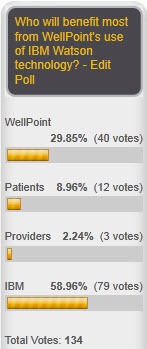
Not good news if you compete with Epic: while survey respondents give differing reasons for its success, combining answers 3, 5, and 6 together suggest that more than 60% believe it’s because Epic’s product is better. New poll to your right: is it OK that an electronic medical record contains scanned documents along with discrete data fields?

Watching: In Plain Sight, my new favorite Netflix series. You could neatly categorize most people by the character they find most attractive: federal marshal Mary Shannon of the Witness Protection Program, her sister Brandi, or her partner Marshall (who I guess would be Marshal Marshall). Brilliant acting and writing, like this quote: “The second revelation came as I sat at the bar in morose solitude, pondering the cantilevered relationship between bartender’s gut and lower extremities. And this is important, so pay attention. Before the big bang, before time itself, before matter, energy, velocity, there existed a single, immeasurable state called yearning. This is the special force that, on a day before there were days, obliterated nothing into everything. It is the unseen strings tying planets to stars. It’s the maddening want we feel from first breath to last light.” And Listening: Yes, The BBC Recordings 1969-70. Truly amazing and polished, complex music played live by guys in their early 20s, one of my favorite bands (through Relayer, anyway). Stupendously good.

Cerner forms a joint venture in Saudi Arabia to offer Millennium to hospitals there, working with a government-owned investment firm and a business development group.

Dr. Jayne is interested in learning more about IBM’s Medical Record Text Analytics solution (a spinoff of Watson), so if you’re an in-the-know IBMer, feel free to contact her. She missed last week’s Webinar on the topic, I assume.

6-18-2011 10-00-25 AM

I see from his Facebook updates that Ed Marx has reached the top of Mount Kilimanjaro, Africa’s tallest peak at over 19,000 feet (that’s an earlier training pic above, just in case you were thinking that it doesn’t really look all that tall). Ed’s an ardent HIStalk supporter: he voluntarily writes for us (very well, I should add); he Likes all of our Facebook posts; and he graciously took time out of his HIMSS schedule to speak at our sponsor lunch in Orlando. Therefore, I quite reasonably conclude that Ed is the man.

My Time Capsule editorial this week from 2006: Before You Buy, Look at the Impact on User Productivity.

6-18-2011 6-17-33 AM

ONC is using some of its tsunami of taxpayer money for publicity: ghost-written blogs, contests, and now advertising. The one above has a new “campaign” that I’m guessing came from an expensive PR firm: "Putting the I in Health IT.”

Weird News Andy summarizes this story as “The government paying more than necessary and offering less than effective options? I’m shocked, shocked to find that is going on here! </casablanca>” UCSF researchers say Medicaid could save a lot of money by paying for drugs that are on WHO’s Essential Medicines List, which is used by 131 of 151 countries surveyed, instead of letting each state make up their own inconsistent lists. If you’re a fan of creeping socialism, you’ll be happy to note that 20% of the country is on Medicaid. Sometimes I get the feeling that those of us who pay taxes to support everyone else are getting to be a tiny minority.

Speaking of Medicaid’s wasting of money (was that redundant?), North Carolina’s project to replace its Medicaid claims processing system is now two years behind schedule and more than $200 million over budget, not to mention that the state will also pay EDS another $110 million to process claims over two years since the new system isn’t ready. The contractor is CSC, the company that’s even more behind and over budget in Britain’s NPfIT boondoggle, also responsible for Medicaid system problems in other states. The state isn’t blaming CSC, though – they say it’s the federal government’s constant Medicaid tinkering that keeps changing the specs. The state is offering to change the five-year, $287 million contract to a seven-year, $495 million one with Uncle Sam picking up 90% of the tab. I have several reactions: (a) never hire CSC to do anything; (b) North Carolina is obviously ignoring my advice since CSC’s punishment for missing budget and deadline is to get more money; (c) as everybody who knows billing is well aware, the government may talk efficiency and modernization, but its arcane Medicare and Medicaid payment requirements ensure that providers can adopt neither; and (d) it’s pathetic that a mid-sized state has to spend $500 million just to manage Medicaid payments (small compared to Medicare) and none of that money does anything to improve population health or patient care – it’s just an administrivia management system created by an unholy alliance of contactors, lobbyists, and government employees (many of those in the latter category planning an eventually profitable exodus to one of the first two.)

6-18-2011 11-33-42 AM

Minnesota Public Radio runs a surprisingly comprehensive and balanced article on electronic medical records in rural hospitals, covering (a) the benefits; (b) the penalties; (c) the shortage of HIT labor for both providers and vendors; and (d) the likelihood that EMR pressures along with healthcare reform will force rural hospitals to sell out to bigger and better-funded organizations or shut down completely. A quote from the CEO of a 14-bed hospital (above): “I’m not sure that even God’s bank has enough money for electronic medical records. Are we working on it? We’re working ourselves crazy. Eighty percent of our capital budget every year goes toward implementing another aspect of EMR.” The article talks a lot about Duluth-based SISU, a non-profit hospital consortium that offers Meditech systems, hosting services, group purchasing, and IT expertise.

Clueless Internetters who probably couldn’t name the Secretary of State or point out Canada on a map focus their limited intellectual capacity on tracking down Haynes Management, a 21-employee real estate company that supposedly fired an employee whose wife was diagnosed with cancer. In their haste to become part of a viral mob reacting emotionally to the one side of the story they read, the nitwits Google over to Hayes Management Consulting (apparently deciding that the N in Haynes is insignificant) and start sending hate e-mail. Hayes issues a press release denying that it’s them. When Inga e-mailed me the press release, I gave an instant reply: “Hayes is brilliant for using this to promote themselves. It’s fun to write about, so I bet it will get picked up.” Which it has. 

6-18-2011 12-14-30 PM

Lehigh Valley Hospital-Cedar Crest (PA) kills a kidney transplant patient, a 51-year-old nun, with insulin when defective blood glucose testing strips erroneously show her as hyperglycemic. Communication problems were also involved: a nurse from the hospital’s remote ICU monitoring station noticed the difference between results from the test strips and from blood draws, but didn’t tell anyone.

Chuck Friedman, ONC’s chief science officer and one-time #2 guy there, is leaving to run an informatics program at University of Michigan. We told you on June 8, courtesy of rumor reporter Roman DeBeers, that he was quitting, although Chuck ignored my e-mail asking for confirmation. ONC’ers sure like those academic appointments.

Here’s Vince’s latest HIStory, for which he credits the help of Bob Haist of SMS/ISD and Bob Pagnotta of MDS/Tymshare.

Dell will spend $80 million on an ad campaign pitching its capabilities beyond selling commodity PC hardware, with one of the four TV ads showing a doctor. 

Strange: the medical school dean of the University of Alberta is demoted to professor after parts of the graduation speech he delivered were found to have been taken verbatim from a similar speech Atul Gawande gave at Stanford last year. Graduates claim they Googled a particular phrase, “velluvial matrix,” on their smart phones as the dean spoke, allowing them to follow along from Gawande’s original speech. It was a giveaway since Gawande made the phrase up, as he explains later in his own speech: “OK, I made that last one up. But the velluvial matrix sounds like something you should know about, doesn’t it? And that’s the problem. I will let you in on a little secret. You never stop wondering if there is a velluvial matrix you should know about.”

University of Florida gets a $500K NIH grant to create EHR alerts using genetic information, which will influence treatment decisions involving an unnamed drug to prevent heart attack and stroke (which I assume is clopidogrel). 

A Maryland infrastructure company gets a $45 million contract to work with a China-based counterpart in developing a cloud computing center to host electronic medical records in that country.

Utah announces Clinical Health Information Exchange (cHIE), a statewide HIE (part of the Utah Health Information Network) with participation from Intermountain, MountainStar, IASIS, and University of Utah. It’s actually been around for a year or so as I recall, so maybe the announcement was related to broader participation.

6-18-2011 12-50-19 PM

Just in case you need something to run on your iPad: Big Fish Games releases the free Hospital Haste, where you “help Nurse Sally work quickly to diagnose, treat, and cure all of her patients.” (obviously they aren’t intimately familiar with what nurses are legally allowed to do).

E-mail Mr H.

Time Capsule: Before You Buy, Look at the Impact on User Productivity

June 17, 2011 Time Capsule 1 Comment

I wrote weekly editorials for a boutique industry newsletter for several years, anxious for both audience and income. I learned a lot about coming up with ideas for the weekly grind, trying to be simultaneously opinionated and entertaining in a few hundred words, and not sleeping much because I was working all the time. They’re fun to read as a look back at what was important then (and often still important now).

I wrote this piece in April 2006.

Before You Buy, Look at The Impact on User Productivity
By Mr. HIStalk

A story often repeated: a big organization executes a high-profile rollout of a clinical system, but caregivers say it takes longer to use. They deliver an ultimatum — either you accept a reduction in productivity or you ditch the system.

The latest subject is the Department of Defense, whose new $1.2 billion AHLTA system (which is actually the renamed old system, CHCS II) is claimed by users to be so slow that they have to reduce their patient schedules by one-third. Patients are being diverted to emergency departments and routine checkups aren’t being done.

Maybe this is telling us that we don’t look hard enough at a system’s impact on user productivity. I don’t recall ever having heard of a health care organization that measured how long it takes to write an order, document care, or write a prescription, comparing times before a system install and after. I’ve never heard of someone choosing a particular system because it’s faster for the caregiver, or in many cases, even giving the caregivers a peek at it before the decision to buy is made.

I’ve also not heard of an organization budgeting additional staff to offset reduced productivity with automation. The reason is there’s not supposed to be any slowdown. Everybody knows that computers improve productivity, right?

If that was the case, all those PCs that hospitals have deployed would have caused huge staff reductions. I haven’t heard of that either. Sales prospects are easily impressed with unrealistic projected staff reductions that never seem to materialize.

It gets worse when users are hard-to-find licensed staff, such as nurses or pharmacists. A system that takes up more of their time, no matter what benefits it provides to someone else, may create a staffing dilemma that directly impacts patient care.

This is a customer problem, not a vendor problem. If customers demanded productivity gains for their users, vendors would respond (or lose business). This goes back to a generally casual regard for usability testing — never a priority in the mainframe days and not improved very much since in health care.

Local configuration options make it hard to evaluate an off-the-shelf vendor system upfront to determine workflow impact. You could ask the vendor’s customers, though. Arrange to time how long it takes to chart a med as given, to create a progress note, or to enter an order set as a physician. Then, compare that with the time required by your current process.

You don’t need the vendor’s help to do this. You might want a management engineer to look over your shoulder for consistency in measurement. Otherwise, all it takes is for hospitals to talk to each other, which they’re usually pretty good about doing.

I don’t know about you, but I’d rather not be in the hot seat to answer this question from clinicians — do you want us to take care of patients or to use your system?

HIStalk Interviews Scott Coons, President and CEO, Perceptive Software

June 17, 2011 Interviews 2 Comments

Scott Coons is president and CEO of Perceptive Software, a Lexmark company, of Kansas City, MO.

6-17-2011 6-55-22 PM

Give me some brief background about yourself and about the company.

I’m an engineer and a computer scientist by education. I’m kind of boring, to be honest. I’m the founder of Perceptive Software. We’re the makers of ImageNow.

We’re in the enterprise content management space. We offer products and solutions around the management of enterprise content across multiple sectors, including healthcare. We’ve got a great team here and lots of happy healthcare customers that are using our product in a lot of different areas.

I was reading Web site write-up on Citizens Memorial Healthcare, an outstanding IT shop in a small hospital. How are they using your technology?

I don’t know all the details in their specific case. However, I’ve spent time with their CIO. They fully endorse our product as a core component to what they’re trying to get done. They really see us as an ECM platform that they can use everywhere in the hospital, from HIM to administration to order management to back office operations as well, including financial operations and human resources.

We preach vendor independence whenever possible. Obviously we try to build software that takes as little professional services as possible. Citizens has really embraced that. They have a strong IT shop and are ideally suited to be able to go in quick, integrate quickly in all the ways that they like to integrate, and then just expand throughout the hospital.

That’s really one of our approaches we take with all of our customers. Obviously we’re there to help them use the technology, configure the technology, optimize the technology any way they want us to. But at the end of the day, we try to build software that is more about the software and less about the professional services that go along with it.

Can you describe the different places in the hospital that your offerings might be found or how they might be used?

In general, it’s all about managing the content, whether that content is derived from paper or some unstructured information that needs to be accessed in support of some clinical process or back office workflow process. Any time you need to manage a workflow around that and have access to that content, we’re used. There isn’t a place in a hospital or acute care facility that our product’s not being used.

How much of your overall business is healthcare?

In terms of new business, it’s our largest industry sector, our fastest growing. I’d estimate at about 35% or so.

The debate continues on the value of the hybrid patient with some scanned components. How do you see scanned documents and workflow built around them fitting in with a completely electronic system creating and using discrete data?

In any enterprise environment, there’s always a collection of data above and beyond paper-based data, scanned-based data that needs to be managed and processed. I think in our case the ImageNow product line can manage any content no matter what its source. Our solution solves the problem of multiple systems needing to speak with each other and needing information for various content stores and various snippets of data. 

We can bridge the gap between disparate systems to do that, environments where they’ve started to centralize on one basic clinical system. There’s always the need to collect and manage a bunch of disparate data in support of that system. It’s more than just dealing with document images — it’s dealing with any type of enterprise content that helps the clinician provide patient care.

With the push toward interoperability, people are always assuming they will need complicated interfaces that may or may not be proprietary. It sounds like you’re saying that documents could be the interface between the systems.

Absolutely, they can be. You’ve got to solve the problem when somebody walks in with a bunch of data you’ve yet to capture into your systems. if it’s a good enterprise content management system, you can just bridge the gap and exchange data between multiple systems.

Interoperability is a big deal for us. We’re fully behind it and participate in various IHE Connectathons.  The engineering team is all over the standards that are emerging.

One of the things that most interested me when I interviewed Denni McColm from Citizens Memorial a couple of years ago was that the only paper they were handling came from outside hospitals that weren’t up to their level of automation. Do you find it interesting that they took that approach to avoid handling someone else’s paper?

It doesn’t surprise me. I think if you do your job and you build software and solutions that are easy to use, then the motivation is to get anything and everything related to the patient in one folder, if you will, so you have access to it. I’m sure they saw the benefit of getting everything into their content store even if it wasn’t originated from their hospital.

The company makes a distinction between not just managing electronic documents, but the information life cycle. Can you describe what that means to you and how it works?

I think that the interesting thing is, from content type to content type, it’s not always about keeping that content around forever. You have to put policies around how long you’re going to keep it, when you destroy it. That’s really the definition of the life cycle from capture to destruction.

It’s a big problem that a lot of the healthcare industry doesn’t always understand … the compliance regulations and whatnot. We have to make sure, based upon content type, that we can manage it completely through its life cycle and put policies around it for destruction. I think that’s a part of just being a solid enterprise content management product.

There are a lot of things that we do outside of healthcare that lend themselves to the healthcare space. The retention policy management suite that we have actually was derived in government and our financial services requirements, so we think it’s something that healthcare space needs. We have a lot of healthcare customers that are using it.

Speaking of that, what lessons that you’ve learned serving other industries that might apply to healthcare? And from what you just said, does that relate to regulatory or audit type capabilities?

It is heavily related to regulatory and audit capabilities. I can come up with hundreds of examples of where what we do and one industry is an advantage to another industry. You’re still building solutions specifically for an industry. You still have to pay close attention to the role of the user. We do a lot with persona-based development. 

But content that’s not closely tied to a core business system — whether it’s a clinical system, CRM, an accounting system, whatever the system might be — managing that content is the same across all industry sectors. It’s really how you put the workflows in place and understanding that role of the user that’s accessing the data needs the data at a moment’s notice. That’s where you really have to customize specifically for the industry, but there’s a lot of overlap. That’s why we service so many various industry sectors.

You mentioned your background as an engineer. It’s uncommon to see an engineer as an entrepreneur leading a company instead of the usual salespeople or suits. What are the advantages of that and how does that fit within Lexmark?

A great question. As you can tell, I don’t give a very good interview. I think that’s one of the disadvantages having an engineer lead the company.

This business is very systematized. Quality is extremely important to us. I think that’s an advantage that comes from being an engineer. Obviously I work very, very closely with the R&D department, being that I was the original R&D department. It’s about building really good software and being able to predict use cases that the customer or the industry can’t predict so that you’re ready for them as they grow into the software, that they leverage the software to serve new processes or new workflows.

But I think that one of the strengths of Perceptive is that we are highly technical. We build a product that’s very scalable, something that we’re proud of that we think is very easy to use. Our mantra is always to put content and context to whatever the problem is that we’re trying to solve.

As it relates to Lexmark, what’s interesting about that is that Lexmark is led by engineers themselves. That was part of the attraction when we first got to know them. I’m an electrical and computer engineering major and their CEO at the time was the electrical engineer. Their current CEO is a mechanical engineer. Their whole executive team is full of engineers. I think that we share a common bond to build really, really good product and to listen very carefully to our customers and have a really closed development cycle on what our customers want and really giving feedback, and then rolling that back into the product line. 

The Lexmark acquisition has been great for us. They understand we’re different. We’re software, they’re hardware. They were public, we were private. They were really big, and we were not as big. They’ve been extremely supportive in where we’re going and what we want to do. They’ve really gotten next to helping us grow and better our product into the markets we serve. They’re a great company and it’s a great fit.

As you were describing the advantages and disadvantages of being an engineer, I couldn’t help but picture you reading Dilbert, and I bet you do…

I do. <Laughs>

Do you have times where you can’t decide whether you’re going to identify with Dilbert or the pointy-haired boss?

<Laughs> I read it everyday, I laugh every day, and yes, I can identify to both characters. It’s a great comic strip.

For a company with an engineering culture, your Kansas City location has a lot of fun employee stuff, like video games and chair massages. How would you characterize the culture there and how does that translate into value for the customers?

I think there’s a passion here that is contagious.  Culture is always a reflection of the people. But is the culture attracted by or created by the people, or are the people attracted to the culture? I think it’s a little bit of both.

We try to hire the best and the brightest, those that have a very inquisitive mind, aren’t afraid to take risks if it means bettering the product for our customer. We really preach innovation. The culture is a reflection of that and they are a reflection of that culture. We have a good time. Our motto is to work hard and play hard. We’re about really building game-changing ECM products that our customers will enjoy, that our customers will put to use, and will have solid things to say about it. Everybody here at Perceptive believes in that mission. We enjoy what we do.

What issues in healthcare do you think will have an impact on how you conduct business in the next three to five years in terms of product development?

The government’s involvement in healthcare is always something that we closely watch. Meaningful Use, all those various topics are things that we have to be aware of. We have to be in tune with what’s going on.

No matter what the trend is in healthcare in the upcoming years, we’re in good shape to be able to handle whatever comes in front of us. As much as an industry might try to exorcise out paper, we have built a system again that can handle any type of content that’s related to the core mission of healthcare. We can manage that content and make it available and put a process around it. 

We feel good about where we are. Obviously you have to continue to work hard and listen to the customer and talk to the customer where they see things are going and what they need. We do a lot of that. We feel pretty good about where we are and where things are going.

Any final thoughts?

I appreciate the time. I think that we have a good story to tell and we appreciate the opportunity to tell it through HIStalk. We’re excited about where we’re going and what we’re doing. We want to thank all of our customers for their support over the last ten-plus years.

News 6/17/11

June 16, 2011 News 13 Comments

Top News

6-16-2011 9-05-22 PM

The California Hospital Association files suit against the state public health department to block a requirement that hospitals report detailed information about surgical site infections starting June 1. CHA says most hospitals don’t have the information available electronically, so they would have to take time away from patient care to dig through records manually.


Reader Comments

6-16-2011 7-13-03 PM

image From Ricky Roma: “Re: Dr. Jayne’s IT comments. Doctor, we live in a world that has networks, and that network has to be guarded by men with decreased budget and staff. Who’s gonna do it? You? The executive staff? We IT guys have a greater responsibility than you could possibly fathom. You weep for your iPad, and you curse IT. You have that luxury. You have the luxury of not knowing what I know. Denying iPhones, while tragic, probably saves PHI. And my existence, while grotesque and incomprehensible to you, saves PHI. You don’t want the truth, because deep down, in places you don’t talk about in the doctors’ lounge, you want me on that network. You need me on that network. We use words like governance, security, encryption. We use these words as the backbone of a career spent defending something. You use them as a punch line. I have neither the time nor the inclination to explain myself to a physician who sees patients under the blanket of the very security that I provide, and then questions the manner in which I provide it. I would rather you just said thank you and went on your way, Otherwise, I suggest you log on to a PC like everyone else. Either way, I don’t give a damn what device you think you are entitled to.” Brilliant as always from one of my favorite (but seldom heard) contributors.

image From Mile High Club: “Re: WSJ article on use of corporate jets. It includes a searchable database, finding that destinations often coincided with the vacation homes of executives. McKesson had 41 flights to Martha’s Vineyard and Laconia, NH (probably someone’s house on Lake Winnipesaukee).”


HIStalk Announcements and Requests

6-15-2011 3-59-55 PM

image This week on HIStalk Practice: additional background on the RWJF report that found diabetics treated by practices with EHRs received significantly better care than those treated at paper-based offices. Turns out the paper-based offices also had almost five times more non-insured or Medicaid patients than the EHR-based practices and twice as many non-white patients. Also: Julie McGovern of Practice Wise shares tips for creating a disaster recovery plan. A new organization is launched to certify medical scribes. Less than one-third of physicians are expected to remain independent by 2013.  Dr. Gregg shares HITECH support woes and wins. If you like the ambulatory world (and who doesn’t?) then you’ll want to make sure to sign up for the HIStalk Practice e-mail updates.

image In almost totally unrelated to HIT news: a couple of girlfriends and I stayed at a upscale hotel recently for a little getaway. All three of us came home with what I have diagnosed to be bed bug bites (you know, I did the Internet research thing and compared my bites to the online photos.) Which leads me to wonder: are bed bugs the latest work hazard for HIT road warriors? It’s a totally disgusting topic, I realize, but it’s an issue I never really worried about in my traveling days. FYI, I complained to the hotel; they checked the room and told me they found no evidence of bed bugs. BFFs and I are thus considering whether we’d be better off visiting a dermatologist or simply seeking a psych consult.

image Listening: Black Joe Lewis & The Honeybears from Austin, TX, recommended by a reader. Here’s what I e-mailed to her: “I’m doing hideously uncoordinated chair-based dance moves to Booty City, thinking I’ve gone back in time to the 60s to listen to Edwin Starr doing 25 Miles from Home. Now I’m going to want to accentuate everything I say with an emotionalHUuaaH’ just like this guy (and James Brown) I’m making that ‘white man trying to be funky’ look by scrunching up my nose, sneering, and and squinting as I bob my head out of time with the music and do some walking bass on the air guitar.”

image On the Jobs Page: Solutions Executive – Virtual Office, Technical Marketing Engineer – Work from Home, Healthcare IT Technical Recruiter. On Healthcare IT Jobs: Allscripts Test Manager and Test Resource, Implementation Consultant, Meditech PCM Implementation Analyst.

image First, do no harm. Once that’s done, (a) sign up for e-mail updates in the box to your upper right (unless your display is set to low resolution, in which case it could be just about anywhere); (b) send me news, rumors, and anything that would tickle my sophomoric humor; (c) find Inga, Dr. Jayne, my sites, and me on your favorite social not-working tool and make the appropriate electronic connections so we can feign mass appeal; (d) accept my personal challenge to randomly inspect five of the admittedly large number of ads to your left and click them, waiting excitedly as in the presence of Monty Hall to see what’s behind Door Number 3 and knowing that you are thereby supporting us keyboard-clackers who work absurd hours after our day jobs; and (e) don’t worry, be happy.

6-16-2011 7-57-55 PM

image Thanks to Bulletin Healthcare, new to both HIStalk and HIStalk Practice as a Platinum Sponsor. The publishing company sends out electronic newsletters to 400,000 doctors every morning by 8:00 a.m., working with two dozen leading medical associations to meet the unique news requirements of their members  as a valued member benefit (American Medical Association’s AMA Morning Rounds, American College of Physician Executives’ ACPE Daily Digest, and American College of Cardiology’s CV News Digest, to name a few.) The Reston-based company is the medical division of Bulletin News, which provides executive news briefings for the President and most of the Cabinet. They’re happy to tell companies about their advertising programs, should yours have an interest. Thanks to Bulletin Healthcare for supporting HIStalk and HIStalk Practice.


Sales

6-16-2011 7-36-17 AM

The Regional Medical Center at Memphis (TN) purchases Carestream Health’s Vue RIS for radiology scheduling and reporting.

The University of Virginia Health System extends its licensing agreement for Streamline Health’s document workflow solutions and adds Streamline’s Correspondence Workflow application.


People

6-16-2011 7-00-57 PM

Press Ganey promotes Robert Draughon from president and CFO to CEO, replacing Richard B. Siegrist, Jr. Siegrist will transition to chief innovation officer and remain on the board. We reported this Monday, courtesy of a rumor report from South Bend Snoop.

6-16-2011 6-39-56 PM

PatientSafe Solutions names Joseph Condurso president and COO. He was a CareFusion VP and also spent time with Cardinal Health.

6-16-2011 4-13-54 PM

EnovateIT president Fred Calero wins Ernest & Young’s Entrepreneur of the Year award for Michigan and Northwest Ohio in the healthcare services category.

6-16-2011 7-34-26 PM

image Vivek Kundra, the nation’s first CIO, will quit in August to take a Harvard fellowship. Like his boss, opinions vary on whether he has accomplished anything of positive significance. Nobody has said much about a possible successor, so I don’t know if Aneesh Chopra has the cred or interest.

6-16-2011 8-20-08 PM

Industry long-timer Rick O’Pry, founder of JR O’Pry Consulting and IntraNexus, launches a consulting company called HIT Strategists.


Announcements and Implementations

6-16-2011 7-31-21 AM

St. Michael’s Hospital (MN) will go live on Meditech on July 1.

image Mayo-Austin (MN) apologizes to patients for long registration delays caused by the EMR it installed in April, saying it “has temporarily slowed down our registration process and phone response time as we check the accuracy of patient information and become more proficient with the system.” They’ve hired more staff. I bet decreased patient satisfaction and increased headcount to do the same work wasn’t in their business plan.

6-16-2011 8-30-48 PM

Omnicell’s OmniRX medication dispensing system wins Best in KLAS for hospitals 200 beds and over.

PDR Secure launches the RxEvent adverse event reporting service, which will allow doctors to report drug problems directly from their EHR. It was developed in conjunction with Greenway, the American Pharmacists Association, and athenahealth.

6-16-2011 9-20-52 PM

UPMC announces its HealthTrak mobile app for iPhones and iPads that allows patients to review their test results, history, meds, and appointments. It’s based on Epic’s MyChart.


Innovation and Research

image Fujitsu works with a hospital in Japan to roll out a patient guidance system based on e-paper. Patients carry an electronic card holder that guides them to diagnostic departments, checks them in, and accepts their payment. They can wander around while waiting since the system calls them when it’s their turn (not that hospitals have anywhere interesting to wander around in anyway, but at least they could distance themselves from Unemployment TV).


Technology

6-16-2011 6-45-45 PM

Ottawa Hospital is deploying mobile technology in a big way, purchasing 2,800 iPads for its 456-bed facility. The CIO notes that its iPad and iTouch users include doctors, nurses, pharmacists, respiratory therapists, and even janitors.

6-16-2011 3-12-45 PM

Online physician networking site QuantiaMD finds that over 30% of physicians use tablet devices, 20% of them in clinical settings.

6-16-2011 7-19-21 PM

Panasonic announces that it will bring out an enterprise-grade, Android-powered Toughbook tablet in the fourth quarter.


Other

Sparrow Health System (MI) hosts a job fair in an attempt to fill 70 to 80 IT job openings. Analysts will support the health system’s $100 million Epic EHR implementation. Starting salaries are $50-80K.

The Missouri Hospital Association estimates that 90% of the state’s hospitals use an EHR for at least one of 24 functions. On average, hospitals use about nine EHR functions, though 44% use at least 13.

6-16-2011 3-13-59 PM

CapSite believes the ambulatory EHR and PM market will exceed $3 billion through 2013, with 63% of physicians replacing their current PM systems for an integrated PM/EHR and 38% upgrading or replacing their current PM. Capsite’s 2011 U.S. Ambulatory EHR and PM Study also predicts that 50% of physician will be investing in ambulatory EHR systems. In terms of current market penetration, Allscripts and Epic each have 16%, followed by eClinicalWorks, NextGen, and GE.

A tornado in Verona, WI left Epic powerless for most of last Thursday, forcing it to run on backup generators.

image A California man is arrested for pretending to be a medical doctor. A patient got suspicious after he told her to treat her kidney disorder by eating watermelon in a hot tub.

image Weird News Andy is speechless about this story: a woman in Sweden with fever, chills, and aches calls four times over four days for an ambulance, but is turned down because she is still able to speak. She dies. But WNA is tittering at this piece about English hospitals warning employees that their uniforms must not expose their midriffs or “excess cleavage” (whatever that means) after patients complained.


Sponsor Updates

6-16-2011 7-05-44 PM

  • SCI Solutions posts a video describing its new Arrival Manager product and a cool flipbook of its annual Innovations in Access Management magazine.
  • MEDSEEK wins the 2011 Frost & Sullivan North American Health Records Technology Leadership award.
  • FormFast and T-System collaborate to integrate the print management portion of FormFast’s workflow software with the T-Sheets documentation system.
  • CareTech Solutions announces that two of its clients won 2011 Aster Awards for their Web sites.
  • AsquaredM is offering a June 23 Webinar on improving revenue cycle performance with Lean Six Sigma.
  • Hanger Orthopedic Group will deploy NextGen Ambulatory EHR and PM at its 675 orthotic and prosthetic patient care centers in 45 states.
  • The Tennessee-headquartered RegionalCare Hospital Partners selects Healthcare Management Services (HMS) to provide clinical and financial applications .
  • McKesson VP and medical director David Nace, MD is speaking about bundled payments at this week’s AHIP conference in San Francisco.
  • A health center customer of TELUS Health Solutions wins an Ingenious Award for using the company’s remote patient monitoring solution to increase nurse productivity, reduce home visits, and save $450 per patient.
  • Humana will offer financial assistance to physicians adopting Allscripts EHR as part of is as part Humana Medical Home EHR Rewards Program.
  • Pinehurst Dermatology (NC) contracts for the SRS EHR.
  • API Healthcare hires Kathy Douglas, RN, MHA as the company’s chief nursing officer. She founded the non-profit On Nursing Excellence.
  • TeleTracking Technologies will preview its new RTLS solution at the 2011 Association for Advancement of Medical Instrumentation conference being held June 25-27 in San Antonio.
  • HHS’s Office of Minority Health and Quest Diagnostics announce a program to  donate 75 MedPlus EHR user licenses and one year’s subscription fees to physicians in small practices serving minority populations in Houston.
  • Perceptive Software names Glenn Cross VP of Marketing.
  • MED3OOO is offering an on-demand Webinar on Why ACOs Should Be Physician Led that features Amit Rastogi MD, president and CEO of PriMed LLC, a 70-provider medical group in Connecticut.

EPtalk by Dr. Jayne

6-16-2011 6-51-10 PM

Mile·stone (noun)

  1. A stone functioning as a milepost.
  2. A significant event or stage in the life, progress, development or the like of a person, nation, etc.

I believe in celebrating milestones. With the rapid pace that many of us run each day, it’s easy to overlook key events. We get used to doing the same tasks each day / week / month / year, falling into the cycle of “lather-rinse-repeat” and losing sight of the work that we are accomplishing.

I encourage my team to remember that, although this may be the 43rd time they’ve trained “E-prescribing 101,” this is the first time the users in their classes are seeing it. I remind them to remember the impact they are having on our end users and that completion of each class is an accomplishment.

We just took our 250th physician live on one of our clinical systems. The go-live wasn’t any different than any other go-live — the physician was aggravated that he had to be there and I was aggravated at having to deal with his surliness towards the IT team. However, calculating the number of times we’ve executed the same process multiplied by the number of people needed to work closely together to successfully get that physician live, it becomes significant. If you would have offered me a bet at the start of the rollout that we’d have this many physicians live on that application at this point, I wouldn’t have taken it.

We tend to take for granted the things that seem to be always present. Maybe we celebrate the beginnings and the ends — the new teammates and the retirements — but we forget to mark the events that happen along the way.

The five-year anniversary of an incredibly challenging project is passing without anyone in our organization other than those of us who were on the team at the beginning noticing. On one hand, maybe it’s good that the tool has become such a part of the organization that it’s not a big deal. But for those of us who still have flashbacks from the go-live (and probably a little post-traumatic stress disorder), it’s amazing.

Celebrating milestones helps us learn what others value and why it matters. Last Wednesday was HIStalk’s eighth birthday. Although Mr. H mentioned it, he tends to be the somewhat shy and retiring type, so it was pretty low key. I’d like to do my part to celebrate HIStalk and reflect on the impact Mr. H and company have had on me.

As a reader, HIStalk provides a reliable, humorous, and entertaining source of information that I could not possibly have uncovered without hours of sifting through the announcements, updates, and studies that come through my inbox and across my desk each week. It gives me tidbits of industry gossip that sometimes hit too close to home.

I’ve learned things about competing health systems that I could not have sleuthed out on my own. I’ve surprised vendor execs by asking them to confirm rumors about their companies that they haven’t even heard themselves. I’ve experienced HIStalkapalooza and the IngaTini.

As a member of the HIStalk team, I’ve had the opportunity to see different sides of vendors as Inga and I cruised the aisles at HIMSS, at one point switching badges to see if it made a difference in how we were received. One of the high points was meeting Mr. H for the first time in the HIStalk limo, changing into our doctor disguises and walking down International Drive with Inga in her amazing boots. We saw our sponsors, many of whom compete directly with each other, breaking bread together at the HIStalk luncheon.

I’ve learned that whether people like a particular piece I’ve written or whether they hate it, I don’t take it too personally either way.

This has been an opportunity to meet amazing people, make new friends, and learn that being anonymous can be a challenge. Using Dr. Jayne’s e-mail address, I’ve emailed people I’ve known for years — and have been ignored. I’ve socialized with key players in government and healthcare and have had to bite my lip to keep from saying, “OMG, if you knew you were talking to Dr. Jayne you would not have just said that.”

I’ve also built necessary career skills – namely the ability to keep coffee from coming out my nose when my co-workers quote HIStalk pieces that I’ve had a hand in.

Best of all, I’ve learned that what may seem like an insignificant event at the time can be a life-changing one. I’d like to thank a certain vendor exec for casually asking, “Do you read HIStalk?” over drinks on a certain day in 2009. At the time, I didn’t. But thanks to that simple question, along with the faith and support of Mr. H and Inga, as well as the camaraderie of Dr. Gregg and Dr. Travis (MD recently conferred!) I’m about to click SEND on Dr. Jayne’s 50th post. Here’s to milestones.

image


Contacts

Mr. H, Inga, Dr. Jayne, Dr. Gregg.

CIO Unplugged 6/15/11

June 15, 2011 Ed Marx 6 Comments

The views and opinions expressed in this blog are mine personally and are not necessarily representative of current or former employers.

To BE Innovative, YOU Must … Be Innovative

No one can avoid the term "innovation." It is the holy grail of the 21st century, the hope for modern-day business. 

In his 2011 "State of the Union" address, the President stated, "… the first step to winning the future is encouraging American innovation." Walk into any bookstore or library and the shelves are stocked with books and magazine articles on how to make innovation happen.

Yet despite the resources available and the attention given, innovation still eludes leaders. According Rick Kash and David Calhoun in their book How Companies Win, one trillion dollars was invested last year in the name of innovation with little return. Why?

As with many companies, ours touted innovation as key to growth and culture, yet the concept remained more of a dream than a reality. Then things started to change. Transformation began with a small group of individuals that discovered in order for their company to be truly innovative, innovation had to start with them. You see, to BE innovative, YOU must be innovative.

This evolution has given us national recognition for innovation. Disruptive business models and clinical discoveries have exponentially increased.

How does innovation begin?

First, come to terms with the fact that innovation does not happen by copying a genius like Steve Jobs or Leonardo da Vinci. Nor does it happen by copying the culture of 3M or Google. These men and companies are outliers. You cannot replicate results by cutting and pasting their experience. Gladwell’s latest work, Outliers, highlights this phenomenon brilliantly.

Innovation is organic and personal. This is why innovation begins with you.

Second, while I believe we are born innovative, the cumulative effects of societal norms have rendered the bulk of us innovatively impotent. To release the innovation inside of us will require significant effort. Start by purposefully casting off the well-meaning restraints put on you from parenting, schooling, and work policies. Retrain yourself to walk in freedom and creativity.

Ninety percent of the fuel required for a trip to the moon is expended at lift-off, as the spacecraft breaks loose of the gravitational chains holding it captive. It’s the same with the innovation journey. Balls to the wall.

Nine methods you can leverage to BE innovative:

  1. Embrace mentoring. Step away from the parental type of mentoring, where you’re paired up with someone reportedly “older and wiser.” Instead, pair up with someone younger, who looks, dresses, and talks in ways that might make you uncomfortable. The more uncomfortable and stretched you are, the better.
  2. Active passion. Passion stokes the fire of innovation. Exactly what brings out your passion doesn’t matter. Just find something that brings you life and energy. Painting, gardening, dancing, big wave surfing, or jujitsu, whatever. Passion provides content and context for innovation mash-ups and convergence.
  3. Leverage technology. Innovation drives technology, so it is critical to play in this area. Taking on technology forces you to become a continuous learner. Studies have shown that the more we push the boundaries of learning, the more our brains neuro-connections increase and retain their elasticity. Nicholas Carr provides an excellent overview in his book The Shallows. The converse is true; not pushing boundaries negatively impacts a person’s ability to exhibit innovation.
  4. Experience > observation. Go and experience the world. IDEO Partner and Stanford Professor Diego Rodriguez says, “Experience the world instead of talking about experiencing the world.” Stop watching "reality TV." Rather, go and make your own reality. Increase your diversity of experience. As with passion, this will increase the content and context for innovation.
  5. Disruption enables innovation. The fainthearted are not capable of innovation. You’ve gotta be courageous and take risks. Baby steps are for babies. Go big. Man or woman up.
  6. Practice exorcism. Time to get rid of the devil’s advocate inside you and inside your organization. Ban the phrase and practice. Dissent is encouraged in the context of collaboration, but self-proclaimed “demons” have no place in your organization or life.
  7. N2 > N. Adopt a systems-like approach to help you manage ambiguity, variation, and change. While the world is increasingly complex, you can cut through it all and maintain clarity. Embrace complexity on your terms and leverage for greater innovation.
  8. Eliminate broken promises. Innovation without execution is a broken promise. As they say in my adopted home of Texas, don’t be “all hat, no cattle.” Failure to follow through zaps your innovation.
  9. Embrace failure. Start celebrating failure, even reward it. In the smoldering ashes of failure, innovation rises. When you fail, be public and positive.

By following these nine steps, we were able to become innovative. Once we became innovative, our organization began to be innovative. No magic formulas or mimicking of other people or cultures will work.

Begin with the person in the mirror — you.

Update 6/28/11

Thanks for your comments, most of which focused on the exorcism of the devil’s advocate. Clearly you must have a culture of encouraging rigorous debate and contrarian opinions. Iron sharpens iron and it is during these times of challenge that ideas get honed or put to appropriately put to death.

What I am talking about is people who are not constructive, but always are the first to shoot down ideas, hiding beneath the “devils advocate” defense without offering anything new.

image

Ed Marx is a CIO currently working for a large integrated health system. Ed encourages your interaction through this blog. Add a comment by clicking the link at the bottom of this post. You can also connect with him directly through his profile pages on social networking sites LinkedIn and Facebook and you can follow him via Twitter — user name marxists.

News 6/15/11

June 14, 2011 News 7 Comments

Top News

6-14-2011 9-49-29 PM

image Three Kentucky healthcare systems will form a single organization with a combined 91 hospitals, clinics, and home health agencies. The new system will include the University of Louisville Hospital, the James Brown Cancer Center, the six-hospital Jewish Hospital & St. Mary’s Healthcare, and the seven-hospital St. Joseph Health System. As part of the deal, Catholic Health Initiatives will make an incremental capital infusion of $320 million to support the system.

image A new Robert Wood Johnson Foundation report finds that 51% of office-treated diabetics in Cleveland received all the care they needed from practices using electronic medical records vs. 7% from paper-based practices. A similar correlation was found for diabetic outcomes. I didn’t see study methodology so I can’t really evaluate it to determine if it adequately proved cause vs. effect, but it’s interesting.


Reader Comments

image From Paula: “Re: Vince’s HSD piece. What about McDonnell-Douglas IHS? It was an innovative system for its time. When McAuto decided to get out of the hospital systems business, it was sold.” Here’s a reply from Vince:

Thanks for reading these dusty old bits of trivia! Yes, IHS (Integrated Health Systems) was one of many turnkey minicomputer systems that the shared giants offered in the 80s – which is going to be the next epoch in HIS-tory covered. McAuto bought IHS in the mid-90s as a DEC-based "total" HIS, to complement their wide array of other turnkey mini offerings, including HDC, MHS, LabCom, RXCom and RadCom. SMS offered a bunch of minis too: ACTIon 400, 700 & 1200, Spirit Choice, and MS4. Ironic the shared giants got into minis so big! Stay tuned for all the details in two weeks."

image From Former TMISer: “Re: Commission on Professional and Hospital Activities (CPHA). Vince might want to do a piece on them since they were maybe the first to computerize healthcare data on a large scale. It was a grant-supported non-profit that collected, processed, and stored abstracted data on more than 50% of hospitals back in 1969, offering three products: Professional Activity Study, Medical Audit Program, and Length of Stay Study. All were paper-based printouts. CPHA was influential in the development of the International Classification of Diseases and its length of stay data contributed materially to the development of DRGs.”

6-14-2011 7-03-23 PM 

image From The PACS Designer: “Re: StartUp Health. In addition to HIStalk giving smaller companies a chance to succeed, the federal government has announced a program called StartUp Health. This new effort will help entrepreneurs create a long-term roadmap for success by providing education, support, and capital to build a health and wellness business.”

6-14-2011 8-30-54 PM

image From augurPharmacist: “Re: American Society of Health-System Pharmacists. The Summer Meeting in Denver has lots of HIT content. Discussions include bar code scanning at each step of the intra-hospital supply chain such that ‘when a drug product changes hands, it gets scanned.’ There’s a growing awareness about the technologies required to enable intended pharmacist practice model change from inside the pharmacies to the patient side. Lots more information available on pharmacy’s professional initiative referred to as PPMI by searching ‘PPMI.’”

6-14-2011 8-12-17 PM

image From J.U. Stice: “Re: nextEMR. Looks like they are the most recent ONC-ATCB certified EHRs to die on the vine. No employees, unpaid bills, empty promises. Classic story of underfunding and no marketing traction. If you build it, they will come? I don’t think so.” I contacted CEO and Founder Alan Faustino MD, who provided this response:

Reports of our demise have been greatly exaggerated. While we have experienced our share of growing pains, like most companies in this economy, we are still offering the same outstanding service and support that has help us survive in this turbulent and confusing HIT period. As a matter of fact, we have been vetted out by several organizations recently from a financial and technology point of view and have been successful in developing strong relations that will sustain this company today and into the future. As an example, we have been chosen as the EMR of choice for the McFarland group to implement and use EMR for research initiatives. We have weekly webinars and look forward to using our technology to better the overall success and increase influenza immunization to the under represented in this country. I can assure you that the NMA and the Cobb institute would no likely involve themselves with a company not in operation. As a matter of fact, we have in conjunction with the McFarland group a webinar tonight and welcome anyone to join and "feel our pulse" Like many businesses, we have had to let go of some employees for financial or performance reasons. However, we wish these people well and hopefully they will find more constructive things to do with their time. However, I do appreciate the "press." Hopefully, HIStalk will allow us to show a different perspective on our company and welcome the opportunity to let the physician community know how nextEMR, along with our partners, are giving physicians the technology to be frankly better physicians today.

image From Chip: “Re: poll on giving patients a list of employees who accessed their electronic medical record. You have to do this to pass ARRA and EHR certification requires it, so vendors must have overcome any technical hurdles.”


HIStalk Announcements and Requests

6-14-2011 9-32-53 PM

image I have to give a shout out to Best Buy for some superior customer service I just received. I bought a new Asus PC from them, but noticed it had integrated graphics rather than the advertised 1 GB ATI graphics card, which was almost certainly an error in the specs Asus gave them (or perhaps an Asus manufacturing mistake). It wasn’t a huge deal and it wasn’t Best Buy’s fault, but I called the local Best Buy store where I had picked it up (I had done ship-to-store) and they told me to bring it over. They gave me a brand new 2 GB card ($100) and for “my inconvenience” (basically, next to none), they had the Geek Squad folks install it while I waited – all at no charge. I felt bad for even calling since the graphics aren’t all that important to me, but Best Buy really came through. The new PC is working great and I’m finally off Vista and WinXP (except at work, of course, where the ten-year-old XP still reigns unchallenged).


Sales

6-14-2011 3-13-34 PM

Norton Healthcare (KY) purchases the Morrisey Concurrent Care Manager application to automate its care management processes


People

James Hauschildt EdD, MA, BSN, RN is named academic dean of Saint Luke’s College of Health Sciences (MO). He was formerly with Dearborn Advisors, Dell, Cerner, and the Air Force nurse corps.


Announcements and Implementations

6-14-2011 12-05-32 PM

Massena Memorial Hospital (NY) goes live on MEDHOST’s EDIS.

6-14-2011 3-12-14 PM

image Shands Healthcare (FL) goes live on its $95 million Epic EMR at three facilities. A fourth facility will be added in September and several faculty practices will go up next year. The same article includes some interesting facts about Epic: the company has 240 customers; one-fourth of the country’s physicians use Epic software; and, 110 million patients (38% of all patients) will be in an Epic system once pending implementations are complete.

The School of Medicine at the University of Alabama-Birmingham starts its EHR implementation, which will be completed in five phases over the next 18 months. Stephen Stair MD, the physician executive sponsor of the project, provides an update above.

6-14-2011 3-10-45 PM

West Tennessee Healthcare System deploys BIO-key International biometric ID software within its Sentillion Vergence solution.

6-14-2011 8-46-21 PM

image A nine-physician internal medicine group in Michigan sells itself to Oakwood Healthcare, saying it passed on aligning with Henry Ford Health System because HFHS couldn’t get its EMR installed quickly enough. HFHS says the EMR wasn’t a priority because they are replacing their McKesson system with a $100 million custom system from RelWare and didn’t see the point in installing a system that will be gone in two years. Oakwood uses NextGen, but signed a contract in April to implement Epic in its hospitals and practices at a cost of $60 million.

Philips will roll out its eICU system in India within a year.


Government and Politics

Maine legislators vote to allow residents to opt out of the state’s HIE database.

image Mark your calendar: July 3 is the last day eligible hospitals and critical access hospitals can begin their 90-day reporting period in fiscal year 2011 for the Medicare EHR incentive program. Eligible Providers have until October 3.

The Boston Globe points out that the state still does business with IBM’s Cognos division even as one of the company’s former salespeople goes on trial for giving kickbacks to the speaker of the house of Massachusetts in return for getting software contracts without going through the required bidding process. Neither IBM or Cognos, which had not been acquired by IBM at the time of the alleged incident, have been charged, but it’s possible the SEC could get involved if evidence suggests that the sale boosted the acquisition value of Cognos.

The UK’s NHS says that even though the country’s “digital by default” policy requires citizens to communicate with government agencies by digital means, that requirement will not be imposed on those seeking health services. Instead, the government will meet whatever demand citizens have, with one of its technical leaders saying, “The idea that we should wait for everyone to agree before offering digital services is ludicrous.”


Innovation and Research

A study finds that implementation of healthcare IT had no effect on outcomes for nursing home patients, other than it seemed to make them more disruptive.


Other

6-14-2011 3-17-14 PM

HIMSS names Hudson River Healthcare (NY) as its single finalist for the Community Health Organization Davies award.

image Mayo Clinic’s chairman of health policy and research says that the clinic won’t be participating in an ACO, at least based on the proposed rule. According to Douglas Wood MD, Mayo’s objections include the use of oversight boards to judge performance, the proposed anti-trust rules, the methods of measuring effectiveness of care, and the way patients would be assigned to ACOs.

maxIT Healthcare celebrates its 10-year anniversary by sending out its executives in an RV with a cool paint job, driving across the country to visit its consultants and clients in the field.

6-14-2011 7-26-36 PM 6-14-2011 7-29-36 PM

image Weird News Andy noodles out a great story about a doctor and a diva (he clarifies they are not one and the same in this particular case). An opera singer (on the left above) shopping at a Manhattan Trader Joe’s gets annoyed at a teenaged boy who blocks her husband from grabbing a frozen Pad Thai dinner. Hubby complains loudly, so the boy’s mom (a doctor, on the right above), bellows out, “Get that pole out of your ass.” The opera singer admits that she then slapped the doctor, but adds that she needed slapping because the doctor was “getting into her personal space.” The opera singer is on trial for attempted assault.  

6-14-2011 9-07-53 PM

image Here’s a great interview and character study of Bill Gates, who talks about global health and how his kids will need to find regular jobs because he’s not giving them much money (“much” meaning quite different things to Bill than to you and me). Trivia: he bristles when the reporter asks if his kids have iPhones, iPads, or iPods, saying, “They have the Windows equivalent … they are not deprived children.” You forget how young he was (21) when he and Paul Allen started Microsoft in 1975 – the photo above is from 1984, well into the company’s growth and the year that Windows was launched. He looks about 12.

I like this well-written and just-sarcastic-enough editorial by a physician and former president of AAPS, whose bio contains this wry observation: “As a life-long dog lover and trainer, she realizes that her dogs have better access to medical care and more medical privacy than she has, and her veterinarians are paid more than physicians in the United States for exactly the same types of surgery.” Among her unhappy but amusing observations (not all of which are correct) about medical practice is this:

Now there’s also “healthcare reform.” That includes the push for the EHR (electronic health record). Physicians are being bribed with $44,000 for installing one that meets the government’s desire to have your formerly private medical record on a government database. With this system, a keystroke can fill your medical record with mistakes, yet a physician can’t write a progress note without learning to navigate a computer program so obsessive that the detail required to order a simple test would do for a moon landing. The former head of CMS (Centers for Medicare and Medicaid Services), Nancy-Ann Min DeParle, made around $2 million dollars working for the company whose program it is, before she became an unaccountable “Czar” in the present regime.

A female visitor trips while walking out of the elevator at Louisiana Medical Center and Heart Hospital. She claims permanent injuries to her arm, shoulder, and neck that cause her pain and suffering, disability and mental anguish, loss of income, loss of earning capacity, and expenses. She’s suing the hospital for $600,000.


Sponsor Updates

  • Highmark selects MEDecision’s collaborative health management solutions to support the management of its 4.8 million members.
  • Practice Fusion hires Edwin Miller as its first VP of product management. He previously worked for Curaspan, Artromick, and athenahealth.
  • Health Language is demonstrating its upgraded version of LEAP I-20 at booth #335 at this week’s AHIP conference in San Francisco.
  • CareTech Solutions and its client, Central Maine Medical Center (ME) are chosen by the Ohio Hospital Association to present an IT security case study, Security Assessments: A Tool to Manage Risks and Achieve HIPAA Compliance, at OHA’s annual meeting this week in Columbus.
  • The 49-bed Monroe County Medical Center (KY) contracts with Healthcare Management Systems for its EHR suite.
  • The City Paper of Nashville and Nashville’s Entrepreneurs’ Organization name ICA president and CEO Gary Zegiestowsky as one of the top ten entrepreneurs in the Nashville area.
  • ZirMed earns a #79 ranking on HCI’s 100 list of top HIT companies.
  • Business Alabama magazine and Best Companies Group name MEDSEEK one of the 2011 Best Companies to Work For in Alabama.
  • PatientKeeper releases its Charge Capture solution for Android.
  • Nebraska Medical Center chooses Voalte’s integrated communication solution.
  • Sage Healthcare Division announces that more than a dozen healthcare facilities have chosen Sage Intergy Meaningful Use Edition.
  • Moses Cone Health System (NC) selects ProVation Order Sets for its five hospitals.
  • Duncan Regional Hospital (OK) will implement T-SystemEV STAT to manage average length of stay in its ED.
  • North Shore-LIJ Health System extends its enterprise agreement with Surgical Information Systems by choosing the SIS Anesthesia documentation solution.
  • The entire recruiting team of Intellect Resources achieves Certified Personnel Consultant certification.
  • NYU Langone Medical Center implements the PatientSecure palm scanning solution for biometric patient identification. A patient commented, “This technology makes you feel like a VIP. You just put your palm on the scanner and you’re done registering at your doctor’s office, no clipboard, no hassle of paperwork to check in, plus, it’s absolutely secure. It’s immediate and instantaneous. Never in my life have I experienced health care like this before. ”

Contacts

Mr. H, Inga, Dr. Jayne, Dr. Gregg.

Curbside Consult with Dr. Jayne 6/13/11

June 13, 2011 Dr. Jayne 10 Comments

A good friend of mine works for a large academic medical center that has restrictive IT policies. Fiercely loyal to certain vendors, the IT gatekeepers restrict hardware choices, from server infrastructure to smart phones. Apple products are largely banned, and the popularity of the iPhone has led many employees to carry multiple handheld devices. Corporate e-mail can only be received on personal phones if the employee knows the “right” people in IT who are willing to bend the rules to make the customer’s life easier.

Although I appreciate that it’s important to discourage employees from playing Angry Birds or from Facebooking on company time, they’ve taken control to extremes. His hospital IT department seems to be missing the point that their prime role is to support staff in the safe and efficient care of patients. Making it more difficult for clinicians to do their jobs isn’t in harmony with that mission, not to mention the cost of the hospital paying for owned handhelds and then reimbursing staff for personal devices.

When I saw a recent article called Doctors Driving IT Development with their Mobile Device Choices, I immediately thought of him. I instant messaged the link to him on both his hospital device and his iPhone to see which one was read first. Of course, it was the iPhone. Surveys estimate that over 80% of physicians are using smart phones, up 11% from 2010. The article states, “Instead of hospitals and vendors telling physicians to adapt to their preferred ways of using technology, physicians are gaining the power to sway hospitals and vendors to their preferred way of using it.”

Albany Medical Center is cited as allowing physician-owned devices on their network to meet physician demand. Administrators created a project to allow physicians to test drive an iPhone, iPad, and BlackBerry over a three-month period. The Apple products were clear leaders. I’ve personally used all three, and each has its strengths and weaknesses depending on the demands placed on them by users.

Everyone talks about usability these days, although in most contexts, it is application usability being discussed. I don’t hear as many discussions about hardware usability as I used to. That’s a tremendous “miss” in my opinion. I hear a lot more discussion of the color choices for carts used in computer on wheels implementations than I do about the computers that will ride on those carts. (And for the record, if I was asked — which I wasn’t — I would have picked colors that would have helped identify which users left their carts abandoned in the hallways for me to weave through on rounds — red for phlebotomy, pink for OB registrars, green for interns, etc.)

Some CIOs I know are quick to blame software vendors for poor usability, failing to realize that hardware often plays as much a role in how usable a clinical application is as does the operation of the application itself. Case in point: an orthopedic surgeon to whom I regularly refer patients cornered me in the doctors’ lounge complaining about his EHR (which happens to be the same one I use in practice). He wanted to know how I stand “all that scrolling you have to do all day long.”

I told him I haven’t had to scroll since taking Version X of the application in 2009 and asked if he was on an older version. No, he said he was on the same version I was. Even though he’s employed by a competitor, as the designated “computer expert,” I wanted to help him. (Plus, he’s a darned good surgeon and always sends me a nice bottle of wine at the holidays.) I asked him to send me a screen shot of his scrolling problem.

After a brief phone call to explain how to do a screen shot, I had his answer. His wide-aspect laptop didn’t allow his workflow to appear without scrolling. His application fell off the bottom of the screen and he had a huge amount of white space on the right. The scope of choice allowed by his IT department is this — Tablet PC (one option) vs. Laptop (one option) vs. Desktop (one option).

For the last two years, he had been blaming the software vendor, when really it was the hardware. I sent him a screen shot of my workflow — the patient’s chart fits neatly on the screen with no problem. Although I’m sure his laptop is great for streaming Netflix, it wasn’t a good choice for his EHR.

I understand that there are a great number of choices in the market today and hospitals can’t be expected to support each and every one. It’s not practical for contracting and procurement, it’s expensive, and it’s a support nightmare. On the other hand, IT departments have a duty to provide hardware that properly displays applications and meets user needs for durability, portability, and speed.

Hardware vendors are savvy and will continue to create new platforms and expand on those already in the marketplace. Users are savvy and will always want the latest and greatest in hopes that it will make their work easier. IT teams who can temper their own needs and wants in favor of those of caregivers and end users will continue to have greater successes than those who don’t.

E-mail Dr. Jayne.

Monday Morning Update 6/13/11

June 11, 2011 News 22 Comments

From South Bend Snoop: “Re: Press Ganey. CEO Rick Siegrist is resigning. There are rumors of a possible sale of the company to GE, J&J, or 3M, which seem farfetched.” Unverified. I didn’t realize that he co-founded TSI, PatientFlow Technology, and HealthShare Technology.

From Mr. Roboto: “Re: Meditech. They’ve always steered clients to JJWild, now Dell. A former Meditech person told me that Meditech was getting financial considerations for every system sold by JJWild. I find it highly unlikely that Dell (like JJ) is doing anything technically proprietary for Meditech except throwing them a fee for each system sold.” Unverified.

From Komodo: “Re: Meditech. Dell and Meditech have a gentleman’s agreement that Dell will supply all 6.x hardware and therefore design consulting, leading to application and conversion consulting. Now that Dell is becoming cozy with Epic, Howard Messing may be re-thinking this position since his customers don’t like the no-choice solution. I hope you can get Howard to respond.”

6-11-2011 1-51-54 PM

Welcome to new HIStalk Platinum Sponsor The Advisory Board Company. I’ve been a fan of the DC-headquartered company for quite awhile since I’ve always liked their super-summarized best practice guides covering big hospital issues such as capacity management and medication errors (I made myself look like a star once by skimming their throughput document and applying its recommendations to my hospital’s particular bed management challenges). Other than best practices research and tools, the company also offers clinical research, leadership development, BI and analytics, and consulting services. The ABCO connection to HIStalk, however, is its Crimson Initiative, a physician performance management analytics solution that gives hospitals (and their physicians) a 360-degree view of physician performance measures such as patient satisfaction, compliance with order sets, and adherence to key quality and utilization metrics. Crimson is used by over 400 hospitals and contains physician analytics and benchmarking information covering 15% of the entire country’s admissions. Paul Roscoe, CEO of the Crimson business unit (and former president of Sentillion and GM of Microsoft Health Solutions Group) e-mailed me awhile back to say that his Sentillion experience with HIStalk was so positive that he asked ABCO’s marketing team to sponsor, saying that HIStalk is “insightful, thought-provoking, funny, and a great source of inspiration for my iTunes collection,” of which the latter is of course the most satisfying to me. You may recall that Advisory Board acquired University of Michigan spinoff Cielo MedSolutions in February 2011, which gives it capabilities in population management analytics and patient registries for physician practices that support risk-based arrangements by making sure patients are current on preventive care and screenings. Thanks to The Advisory Board Company and its Crimson Initiative for supporting HIStalk.

Speaking of Crimson, above is a video from Robert Wood Johnson University Hospital that describes a pilot study that reduced length of stay by 8% and cost per case by $276. Another study by Memorial Hermann found that it saved $358 per patient admission.

Larry Garber MD, medical director of informatics for Fallon Clinic (MA), sent over a press release indicating that as of May 23, Fallon doctors make up more than 10% of those who have successfully attested to Meaningful Use. An amazing 99% of Fallon’s doctors have achieved MU with their use of its Epic system.

Chris Rauber, a reporter for the San Francisco Business Times who I exchange information with fairly often, is writing a story about UCSF’s IT struggles and needs insider sources (anonymous is OK). If you can help him out with details and confirmation, he would appreciate an e-mail.

This week’s e-mail from Kaiser CEO George Halvorson talks about their control of hypertensive patients through use of a care team, proactive interventions, evidence-based medicine, and EMR tracking. The result: Kaiser went from 44% of hypertensive patients controlled to 80% (vs. the national average of less than 50%).

6-11-2011 12-50-16 PM

I’m not sure what to make of these survey results: 40% say it’s a good, technically reasonable idea to give patients a list of all views of their EHR information if they ask, while 32% like the idea but think it’s too challenging technically (which would have been my vote). A solid 28% think it’s just a bad idea in general, which puzzles me a bit since I’m not seeing the downside. New poll to your right, following up on all the discussion generated by Thoughtful CIO’s guest post about “why Epic?”: what factor is most responsible for Epic’s sales success?

My Time Capsule editorial that’s seeing daylight for the first time since April 2006: If You Want Testing For Usability, Reliability and Maintainability, Tell CCHIT. A sample: “CCHIT standards that address data management within the four walls will prepare organizations to feed the data demands that RHIOs will create. As I’ve said before, a RHIO without data-ready members is like TV cable with no programs.”

Vince Ciotti says he has received quite a few e-mails from his fellow memory lane strollers about his HIStory series, so his latest chapter should unleash golden memories from the sunny slopes of long ago: the story of McAuto, once a household word (in HIT-related households, anyway), but largely forgotten today.

Retiring Compuware co-founder and CEO Peter Karmanos Jr. says he has two goals to accomplish before leaving the company in two years: boost annual sales of the application performance management division from $250 million to $2 billion and to get an IPO done for Covisint, whose healthcare offerings include the Covisint ExchangeLink Platform for connectivity among hospitals, practices, and HIEs.

E-mail Mr. H.

Time Capsule: If You Want Testing For Usability, Reliability and Maintainability, Tell CCHIT

June 10, 2011 Time Capsule Comments Off on Time Capsule: If You Want Testing For Usability, Reliability and Maintainability, Tell CCHIT

If You Want Testing For Usability, Reliability and Maintainability, Tell CCHIT
By Mr. HIStalk

I wrote weekly editorials for a boutique industry newsletter for several years, anxious for both audience and income. I learned a lot about coming up with ideas for the weekly grind, trying to be simultaneously opinionated and entertaining in a few hundred words, and not sleeping much because I was working all the time. They’re fun to read as a look back at what was important then (and often still important now).

I wrote this piece in April 2006.

I wrote an Inside Healthcare Computing column in January that lauded the work of the Certification Commission for Healthcare Information Technology (CCHIT). I said then that CCHIT has the clout and objectivity to become the EMR industry’s Consumer Reports. The commission only needs to broaden its emphasis beyond interoperability, functionality, and security to include areas such as patient safety and usability.

The American Hospital Association recently made a similar recommendation, asking CCHIT to evaluate basic EMR product architecture components such as usability, reliability, and maintainability. AHA wants CCHIT to worry less about interoperability between organizations and instead measure how well systems within an organization (clinical ancillary applications, for example) exchange information.

Bravo to AHA on several counts. First, AHA recognizes that CCHIT is the right group at the right time.

Second, AHA understands that RHIOs are like railroad tracks. The best way to crisscross the country is to develop standards and then have teams working from both ends, meeting in the middle twice as fast. CCHIT standards that address data management within the four walls will prepare organizations to feed the data demands that RHIOs will create. As I’ve said before, a RHIO without data-ready members is like TV cable with no programs.

Third, AHA must be listening to its member hospitals, who frankly complain a lot about IT without really helping the situation — buying products with known weaknesses, poorly managing their own implementations, and failing to rally the troops around real workflow changes. AHA is wisely (and maybe contritely) asking for help, making IT a showcase issue.

Lastly, AHA’s request comes at exactly the right time, as litanies of unsuccessful implementations cloud the sunny skies of national electronic hand-holding. Uninformed customers (not necessarily the fault of vendors) play a significant part in this nearly universal failure of products and their users to provide the lofty benefits everyone expects.

CCHIT should be proud of its work so far. This rather amazing de facto endorsement of it as the impartial overseer of a marketplace widely recognized as imperfect is good for both vendors and customers. Vendors can take the money and run today, but an environment in which the highest customer-rated product gets a six or seven on a 10-point scale is not sustainable. The market will either get better, smaller, or both.

If you agree with the recommendation that the certification process for inpatient systems should include tests of a product’s usability, reliability, and maintainability, I urge you to write to CCHIT at info@cchit.org. The more people in the industry that the commissioners hear from, the more likely they’ll take our needs seriously.

I can’t recall a time in health care where any group (government or private) has had so much hope dropped into its lap so quickly. The correct response from the Office of the National Coordinator for Health Information Technology and CCHIT is this: thanks for the vote of confidence, we accept that responsibility. Surely it wouldn’t be that expensive and doesn’t have to take away from the government’s interests.

Comments Off on Time Capsule: If You Want Testing For Usability, Reliability and Maintainability, Tell CCHIT

News 6/10/11

June 9, 2011 News 3 Comments

Top News

6-9-2011 10-08-12 PM

ONC chooses ANSI for a three-year term as the Approved Accreditor (ONC-AA) of its Permanent Certification Program (ONC-ACB) that will replace the ONC-ATCB designation in 2012.


Reader Comments

image From Cabrito: “Re: Meditech. I hear that customers upgrading to 6.0 are required to buy all hardware from Dell, pay Dell an enormous implementation fee, and pay ongoing fees to Dell for maintenance. If they choose not to do so, they have to pay Meditech to certify the hardware. This smells of the East Coast good ol’ boys club. Does 6.0 really require hardware that’s all that different from Dell or any other vendor?” I passed your inquiry along to Meditech and invited them to respond. The company’s response was, “No comment.” That made me think of the old Magic days, when you had to buy specifically programmed (and much more expensive) display terminals because it wouldn’t run on anything else. I would hope that’s not the case here.

6-9-2011 8-18-55 PM

image From William Hanson MD: “Re: my book, Smart Medicine. Thanks for calling it out. I am indeed the CMIO at Penn now. I’m an avid reader of your blogs. Keep up the good work. Thanks, Bill.” I see Amazon has added “Look Inside” for the book and it’s an engaging read – Bill is a really good writer.

From the medical consumer’s standpoint, a generation of patients who grew up with Google, eBay, and Wikipedia will soon have access to comparably comprehensive, current information about medicine and its practitioners. They’ll be able to find best-performing doctors and hospitals in the same way they can now shop for best-buy electronics and credit card rates. The successful practitioner and medical systems of the future will be the ones that adapt best to the new patient, who was raised on universal information and immediate gratification.

image From IT Director: “Re: HIStalk. Your site was instrumental these last few years to help me sort out the different HIS vendors and to see where the industry is now and where it is going. Our C-level has been mystified that I knew so much about the industry, largely thanks to you and Inga. HIStalk has a HUGE impact — don’t change a thing. Happy shoe wishes to Inga.” Thank you.

6-9-2011 8-10-08 PM

image From Saul Revere: “Re: Paul Egerman, founder of eScription. Pretty strong language in claiming Republications are ‘incapable of simple arithmetic’ and ‘I have more money than I could possibly imagine.’ The problem is that his own math is perilously stupid — to plug the current projected deficit over the next five years by taxing those with more than $200K income, tax collections would have to triple.” The conservative site’s article makes a point that I somewhat believe: if a person or group wants everybody’s taxes raised to support some pet cause, why aren’t they voluntarily supporting that cause themselves by sending in their own extra checks to the Treasury? Still, these are liberals with huge incomes, so at least their proposal would hit their own personal bottom line. And Paul’s right: his windfalls from selling IDX to GE and eScription to Nuance have certainly given him all the money he’ll ever need and then some. He says the Bush-era tax cuts saved him over $10 million and he didn’t trickle any of it down, as was the case with most of the mega-millionaires joining him in the proposal. I don’t dislike their idea, but the problem is that politicians from both parties have pushed the country so far into the red that even the few billion dollars it would generate won’t help much, as you noted. I also see that Googling “Paul Egerman” still brings up my 2005 interview with him (one of my favorites) as #1 of 83,600 hits. I asked him about his Democratic politics back then and he gave a good answer (although in the interest of full disclosure, Paul sought me out at HIMSS years ago as Mr. H and he won me over with his friendly manner and by picking up the breakfast tab):

I grew up in a single parent home. We didn’t have a lot of money. In fact, it was before there was welfare, and I got my healthcare at a county hospital. Our family got by as a result of a lot of help from a lot of people, and I’m very fortunate that I’m to be a member of what I call the Winner’s Circle right now. It was a wonderful ride and I’m very fortunate that I’m able to do well. The reason that I have "blue state" political beliefs is that I personally know that I couldn’t have made it without the help of the government and lot of people. I think the Winner’s Circle should be expanded and other people should have that same opportunity that I had. I respect other people’s opinions and I keep politics separate from my business, but my involvement in politics is only because I’m interested in good government.

image A representative from Dell e-mailed that the reader’s comment from Monday stating that Kootenai Medical Center’s Meditech system is hosted by Inland Northwest Health Services was incorrect. She says Dell is hosting that hospital on its MSite Meditech hosting solution, which has brought several hospitals live and has 40 more contracted.

image From HIS Junkie: “Re: webinar. ONC is now competing with HIMSS, charging $100 for a webinar on HIT trends that other firms charge $1,000 for. I guess ONC is doing all they can to reduce the federal deficit. Maybe they should stick to fixing the mess that has been created with all the convoluted new MU regs.” The webinar is through National eHealth Collaborative. Most of their NeHC University offerings are free, but a few cost $100. If I ever leave my day job and free up some time, the first thing I’ll do is run some webinars and industry news and trends analysis. I have endless ideas, but zero time.

6-9-2011 8-55-28 PM

image From Lula: “Re: AHIMA. I didn’t see that you ran the news about Alan Dowling.” I totally forgot since we had already run a solid rumor a week ago that the top AHIMA brass had quit and former CEO Rose Dunn had been brought back in some capacity. That turned out to be correct, as I expected: AHIMA CEO Alan Dowling exits after a little more than a year, along with COO Sandra Fuller. The “some capacity” for Rose Dunn is interim CEO. We heard some rumblings that the new folks had tried to implement some good ideas but stepped on toes in the process. Alan has impeccable credentials: master’s degrees in computer science and healthcare management engineering, an MIT PhD in health management and information systems, consulting experience with E&Y, and 35 years in the Air Force with a rank of colonel. Association work is probably quite a bit different than running a company, so maybe it just wasn’t a good personality fit.


HIStalk Announcements and Requests

image This week on HIStalk Practice: new FAQs from CMS. The Louisiana Care Quality Forum REC designates Greenway’s PrimeSUITE EHR as a supported EHR product. Industry experts tell a Congressional committee that financial and regulatory barriers make EMR adoption difficult for small practices. IPAs could be coming back in vogue, thanks to the emerging ACO model. Take a tour of the HIStalk Practice site and make my day by  signing up for the e-mail updates.

image Listening: new from Black Lips, fiercely independent, ragged Atlanta-based garage punk (think 1965 Rolling Stones with some Pixies and Dandy Warhols elements added). I wouldn’t want to be in the presence of either the band or their die-hard fans since I have a feeling both are seriously psycho, but the new CD is outstanding.

image I mentioned that Mike Cemeno had been promoted from interim CIO to CIO at Waterbury Hospital (CT). That wasn’t the case: while the hospital’s newsletter introduced him with the CIO title, there was a line further down in the article noting that Mike and the executives featured with him were hired as interim management, which I missed. He and I have swapped some chatty e-mails — he hasn’t decided to apply and hasn’t been offered the job.

image Modern Healthcare is running its 100 Most Influential People in Healthcare poll. I keep hoping I’ll at least be nominated one of these days (especially given that Nancy-Ann DeParle is on the list and nobody’s heard of her since she took the supposedly high-profile White House health reform job), but until then, I found some familiar, HIStalk-friendly names that might be worth one of your five votes: Jonathan Bush (athenahealth CEO), John Halamka (CareGroup CIO), James “Kipp” Lassetter (Medicity founder), Ed Marx (Texas Health Resources SVP/CIO and HIStalk contributor), Deborah Peel MD (Patient Privacy Rights founder), Peter Pronovost (Johns Hopkins professor), Sunny Sanyal (T-System CEO), and Glen Tullman (Allscripts CEO). I’m sure I missed other friends of HIStalk in my quick skim down the list, but I’ll add them as I notice. I figure a tiny bit of Ed Marx’s influence can be attributed to his regular and well-received HIStalk posts, so Inga and I will bask in his reflected glory if he wins.

6-9-2011 7-12-29 PM

image Thanks to Elsevier Clinical Decision Support for sponsoring HIStalk at the Gold level. The company is behind some well-known clinical content brands (Clinical Pharmacology, Mosby’s, OnFormulary, CPM Guidelines, and First Consult) and also offers Pinpoint Quality (clinical performance data analysis), Pinpoint Review (clinical surveillance), Clinical Measures (intervention and error documentation), Risk Navigator Clinical (predictive analytics), Risk Navigator Performance (provider care patterns for improved clinical and financial outcomes), Risk Navigator Provider (helps physicians analyze real-time patient information for care and communications), and quite a few more systems. The common thread is point-of-care technology and content that improves quality, safety, and cost-effectiveness. Thanks to Elsevier Clinical Decision Support for helping keep the HIStalk keyboards clacking.

Speaking of Elsevier, they’re accepting nominations for Mosby’s Nursing Superheroes, launched last month during Nurses Week. Four winners will be announced in October. 

On the Jobs Page: Meditech CPOE Consultant, Sales Executive – Medical Device Experience, Regional Sales Executive – NYC, Associate Regional Sales Executive. On Healthcare IT Jobs: Epic Lead Analyst, Ambulatory Clinical Analyst I, Director, Product Management, Clinical Healthcare IT Project Manager.


Acquisitions, Funding, Business, and Stock

Streamline Health reports a net loss of $281,000 ($.03/share) for the first quarter. That compares to a net loss of $1.18 million a year ago. Revenue was up 17% to $4.14 million.

A judge in Australia rules that iSoft will have to pay CSC $2 million US if the struggling company decides to sell to a different suitor. Former iSoft chairman Gary Cohen, who has said he wants to buy iSoft himself, says he is pleased with the judge’s decision.


Sales

LHP Hospital Group (TX) contracts with Conifer Health Solutions to provide patient access and business office services.

6-9-2011 10-53-50 AM

Wishard Health Services (IN) selects MedTouch to design, build, and integrate the health system’s patient portal and RelayHealth into a site. Patients can request appointments, view lab results, communicate with physicians, and access patient education content.


People

6-9-2011 6-16-09 PM

Former AHIMA CEO Linda Kloss joins the Precyse Advisory Council.


Announcements and Implementations

6-9-2011 10-18-35 PM

CliniComp completes a two-year installation of Essentris-EMR at 59 Military Health System inpatient treatment facilities worldwide.


Government and Politics

HHS and ONC introduce the Investing in Innovations (i2) Initiative to spur innovations in HIT. As part of the rollout, CMS awards Health 2.0 and the Capital Consulting Corporation $5 million to fund projects supporting innovations and to encourage HIT development using mechanisms like prizes and challenges.

The VA chooses Systems Made Simple and Technatomy Corporation to provide software development, support, and documentation for several projects of its EVEAH program (Enhance the Veteran Experience and Access to Healthcare).


Innovation and Research

6-9-2011 7-53-09 PM 

6-9-2011 7-54-08 PM

image Above is an interview with Orlando Portale, chief innovation and technology officer of Palomar Pomerado Health (CA), whose self-developed mobile patient information app was named one of 12 finalists in the I Awards for innovation in wireless and mobile healthcare. It’s an impressive app, judging from the screen shots above.


Technology 

6-9-2011 9-44-00 PM

image WebPAX is awarded a patent for technology that allows a Web browser to display medical images stored in multiple geographic locations. The image management company holds several other patents that allow viewing diagnostic-quality images in a Web browser with full PACS capabilities. The Durham, NC company says its solution requires no client software, runs on any browser on either PCs or Macs, and is storing 180 million images online with 1,400 physician users. The technology is also used for clinical trials and physician training. I assume it was either developed for or used by Duke given the duhs.duke.edu address in the screen shot above.


Other

image A report says that 76% of Fortune 50 companies are in healthcare or have health divisions. The same study predicts the health market will account for nearly nearly one-fifth of the GDP by 2019 and (optimistically) forecasts that 58% of small physician practices will roll out EHRs over the next two years. Perhaps more realistic: the mobile health market will grow from $1.4 billion in 2008 to $12.7 billion by 2014.

image Weird News Andy can find no words to describe this story from England: a patient high on drugs and alcohol goes to the hospital ED for treatment. Employees decide he’s just drunk, so they leave him a corridor to sleep it off, with nurses stepping over him frequently. Ten hours later, a nurse finally checks on him and finds him dead. Security cameras captured video of employees dragging his uncovered body away like a sack of fertilizer.  

Nineteen people in western Pennsylvania are charged with high-tech oxycodone trafficking: they obtained doctor names, DEA numbers and license numbers from a Web site; created a computer prescription template; and put their own cell phone numbers on the prescription form so they could verify the prescriptions when pharmacies called.

Pfizer starts the first clinical drug study to be conducted over the Internet, with patient contact performed via Internet questionnaires, video, and Web pages instead of home visits.


Sponsor Updates

6-9-2011 1-36-14 PM

  • Lehigh Valley Health Network (PA) will use T-System’s DigitalShare documentation system to support its on-scene emergency healthcare during this weekend’s 5-Hour Energy 500 event at Pocono Raceway.
  • Siemens partners with Surgical Information Systems to offer the SIS Anesthesia solution to the enterprise healthcare clients of Siemens.
  • Healthcare Informatics ranks MED3OOO 47th on its HCI 100 list of top HIT companies by revenue. Orion comes in at 64 and Capario earns the number 87 spot.
  • Medicity is awarded a second patent on its Novo Grid technology for clinical information exchange.
  • Tucson Medical Center and OptumInsight (Ingenix) announce plans to create a sustainable health community based on the ACO model.
  • Central DuPage Hospital (IL) contracts with iSirona for its medical device connectivity solution.
  • Sage hosts a June 28th webinar on Meaningful Use success, featuring two physicians who have already received incentive checks. Register here.
  • KLAS ranks Encore Health Resources as one of the top two overall performers in the HIT advisory services segment.
  • Nuesoft posts a video on FDA regulation of EHRs.


EPtalk by Dr. Jayne

Government Health IT reports that the Association of Academic Health Centers finds the HIPAA Privacy Rule’s disclosure requirements to be “excessive and burdensome” and requests an exemption for researchers.

Statistic of the week: fewer physicians filed address changes last year, possibly reflecting the impact of the economy on physician decisions to relocate or retire. American Medical News notes economic pressures and the state of the housing market as possible factors. Interestingly, plastic surgeons had the lowest move rate, approximately half that of family physicians. Although I do love medical data and working with it, sometimes working with statistics makes me crazy. It would be more interesting if they did it like baseball: left-hander Dr. Jones is 14 for 15 on successful colon biopsies with the Olympus scope, 15 for 15 with the Pentax. You could even have baseball-like trading cards for your favorite attending physicians.

Legislative Corner

Sometimes I get a little burned out on reading about healthcare legislation, specifically Medicare/Medicaid regulations, reimbursement, Meaningful Use, etc. Although it’s a key part of my job, it just gets a bit depressing. I decided to find out what other health-related activities our lawmakers are pursuing when they’re not trying to tell the IT department how to do our jobs. Here goes:

For my Southern friends, North Carolina lawmakers are debating the Youth Skin Cancer Prevention Act that would require minors to get a physician’s prescription for indoor tanning. It’s coming down to cancer prevention vs. parental rights. Since the pools are now open, what I’ve seen of the outdoor tanning habits of teenagers is extremely concerning. Makes me thankful that my “too much time at the computer” paleness will hopefully keep the wrinkles at bay.

Speaking of wrinkles, New Jersey may require a statement of medical necessity for Botox injections received by patients under age 18. Teens are seeking the injections in an attempt to prevent wrinkles. The issue “took on a new urgency” after reports of the so-called Botox Mom who injected her eight-year-old. Botox is a godsend for certain medical conditions; however, the cosmetic version is a big-time money maker. I’d like to see a requirement that anyone who wants to use Botox for wrinkle prevention has to demonstrate their commitment by slathering on SPF 50 every day (see above).

Not to be outdone by their neighbor, New York is considering a dress code aimed at reducing hospital-acquired infections. Neckties, jewelry, and watches would be banned under a “bare below the elbow” dress code. Although the evidence doesn’t seem to support their approach, I definitely worry about people who are less than great at handwashing because they are worried about getting their cuffs or watch wet. Personally, I’d like to see someone take aim at white coats — I’ve seen some nasty ones out there lately. Makes me want to keep coupons for the 99-cent dry cleaners in my pocket to hand out.

Finally, legislation with an IT twist. Florida’s new law to prevent physicians from asking about gun ownership in certain situations (HB 155) gets a new enemy: The Brady Center to Prevent Gun Violence. A lawsuit was filed this week that states the inability to ask about guns in the home prevents physicians from educating patients. IT staffers beware: even if the physician’s question is relevant to the patient’s care or safety, the law prevents the response from being entered into a database.

image


Contacts

Mr. H, Inga, Dr. Jayne, Dr. Gregg.

Readers Write 6/8/11

June 8, 2011 Readers Write 41 Comments

Submit your article of up to 500 words in length, subject to editing for clarity and brevity (please note: I run only original articles that have not appeared on any Web site or in any publication and I can’t use anything that looks like a commercial pitch). I’ll use a phony name for you unless you tell me otherwise. Thanks for sharing!

Note: today’s first article was written by the CIO of an academic medical center that will move to Epic once the necessary approvals are in place (not yet announced). I suggested drafting some thoughts about why Epic is so successful in that market, even with hospitals that had no plans to replace their existing systems. I thought the perspective of a CIO in the middle of that decision would be interesting since it’s hard for the rest of us to understand how Epic can be so consistently successful, and therefore tend to blame unspecified “Epic Kool-Aid drinking” rather than the real differences between Epic and its competitors.

Why Epic? Why So Many Decisions to Deploy Epic?
By Thoughtful CIO

As a nation of healthcare delivery systems, we seem to be selecting Epic in record numbers. I’m told that nine of every 10 decision-makers are selecting Epic.

It is astounding, but it is also rather obvious. Epic has become the market choice for many of us. And like many market swings, the causes are many.

I’ve given it some thought. I fully expect that many will disagree. This is just one person’s opinion.

In some ways (I hope you can forgive the melodramatic root cause), I think our focus on Epic and the need for tight integration and simplification of our environments might relate to the upcoming 10th anniversary of September 11. We are longing for a return to a simpler time.

It has been ten years since the “world stopped turning.” I think many of us are carefully revisiting where we have been and what we have accomplished since that September day. It might not be deliberate, but I think it is real, nonetheless.

We all refocused on the “main thing” back in 2001. It may have been different for different industries, but in healthcare, we decided we were going to make a difference. And I think we meant it.

Sadly, in spite of much hard work, and many system deployments, we are not yet achieving safe, efficient, and effective healthcare to the degree we all had hoped.

Here is some thinking out loud. 

  1. In a world where healthcare decisions and information flows are growing increasingly complicated and are conflicting, our care providers are overwhelmed with complexity, burdened by too much not-always-relevant information, and are often interrupt-driven as they attempt to make decisions. It feels like chaos because it is. It’s a difficult balancing act. Many of us are longing for a simpler and safer approach to the management of information. We haven’t yet found it, and we worry that it is hurting our patients and making it more difficult to be a care provider.
  2. Patient- and family-centered care is going to become even more critical in the world of individualized health and personalized medicine. This will require improved access to longitudinal patient records. It will necessarily involve and empower the patient to be an active member of the care team. It will soon be the only way to effectively and efficiently manage and allocate scarce resources. Targeted interventions and therapies will be the future of medicine, and information technology will be a critical component of the deal. But we are not yet delivering on the promise, in spite of many millions of dollars of investment.
  3. To deal with this complexity, chaos, and the critical focus on the patient-centeredness, we are focused on minimizing the burden on our care providers and our patients. We want to collect data once, at the source, in the most user-friendly way possible. We want our data collection to be the by-product of care, not an added responsibility. And we want it to be easy to do. We have not yet found a way to achieve these goals in a meaningful way, at least not consistently.
  4. Some current vendor-supplied solutions offer choices and options. They promise to be all things to all people. They rely heavily upon a provider-based organization to make wise decisions and “perfect decisions” in the midst of a very imperfect world. The decisions that must be made expect that there is clarity, when in fact there is not. We are not realizing increased productivity, lower costs, and more efficient care. In fact, many of our healthcare delivery systems are questioning the investments we have made and are not yet able to clearly define the benefits we had hoped to achieve.
  5. Many of us have experienced implementations that over-promised and under-delivered. We trusted our vendor partners and some of them failed us. We then we failed our user partners. The systems didn’t perform well, the vendor was unable to deliver the rich functionality that was promised, the product didn’t scale, the developer didn’t listen, etc. Everyone loses, and we were parties to the losses.
  6. Enter Judy Faulkner and Epic. There is no ambiguity! For more than 30 years, she has been crystal clear about her strategy and the strategy of Epic. The patient is at the center. The business of healthcare is about saving lives and managing information to support life-saving activities. No ambiguity. It’s about the basics, and she gets the basics right! From the beginning, what you see is what you get. No ambiguity.
  7. Judy Faulkner and Carl Dvorak treat everyone the same. No deep discounts, no development partners. We’re all in this together. There is no ambiguity.
  8. Judy and Carl have a healthy optimism about the future. They believe there are many opportunities we can leverage, but they never make a promise they can’t keep. They tell the truth. They do what they say they will do.
  9. Judy doesn’t offer to solve problems she can’t solve. She is completely transparent and tells the truth, both when it is popular and when it isn’t. No pretense. She doesn’t need to be liked. She has a product that works, that scales, and is fully integrated. There is no ambiguity.
  10. Judy also sells a product that works well. She provides the rules for how it must be implemented. Again, she eliminates the ambiguity. Follow the rules and everybody wins.

I’m not sure I’ve captured what I was hoping to capture. In summary, when I think of Epic, I think of a few words:

  • Honesty
  • Integrity
  • Candor
  • Trust
  • Transparency
  • Consistency
  • Focus
  • Commitment
  • Patient-centered

These are words I hope folks will use to describe the work we all do in healthcare IT.


What Providers Need to Know about Patient Engagement
By Donna Scott

6-8-2011 5-49-48 PM

Given all the talk these days about patient-centeredness, is there really change afoot? Will the US healthcare system of the future really be built around the needs of patients? Or is “patient-centered” just another buzzword which won’t quite survive the complexities, the political realities, and the multi-faceted stakeholders in the great healthcare reform debate?

Well, I have been called an “optimist,” so you can probably guess my opinion on the subject. Yes, I believe that we are truly at the crossroads of change in the healthcare system in the United States. In spite of the complexities and difficulties ahead of us, the desire to implement new ways of managing healthcare in this country has never been stronger.

Regardless of what you think about the future success of Accountable Care Organizations or Patient-centered Medical Homes, there appears to be widespread agreement that US healthcare delivery needs to shift from a quantity orientation to quality of care and better outcomes. And better patient outcomes will be enabled by a much higher level of patient engagement across the healthcare industry. This shift toward quality outcomes and patient engagement represents both an opportunity and a challenge for providers.

Because of this shift, a small group of patient engagement enthusiasts and industry pundits were recently asked by The Institute of Technology Transformation to write a paper for providers about the current state of patient engagement. The objective was to offer healthcare providers a summary of the latest research that exists about patient engagement and provide some key points for their consideration as they embark on the healthcare reform journey. The Top Ten Things You Need to Know about Engaging Patients is the result of our efforts. The paper can be accessed here.

In summary: there is a lot of good patient research out there that our group has synthesized into the following key ten considerations for providers:

  1. Providing Patient Education Online
  2. Interactive Online Dialogue
  3. Patient Segmentation
  4. Role of Caregivers
  5. Trust in Physicians
  6. Consumer Mobility
  7. Security and Privacy Concerns
  8. Leveraging Inexpensive Tools
  9. ROI of Patient Engagement
  10. Changing Care Models

In each of these ten areas, we briefly discuss the research and the key learnings which are relevant to providers. In addition, we include four key recommendations for practical action:

  • Walk the talk: set specific patient engagement objectives and measure them
  • Champion your hospital’s social media strategy and assure mobility as a key component
  • Pay attention to caregivers and do your homework on patient demographics
  • Consider HIT solutions that already incorporate patient access and engagement capabilities

For some progressive hospital administrators, this information will simply affirm what they are already doing. For the others, we hope it will spark ideas on how to take their patient engagement strategy to the next level. Because the need for more patient engagement in the U.S. healthcare system will impact all of us, sooner or later.

Donna Scott is leader of the Patient Engagement Action Group for the Institute of Health Technology Transformation and executive director of marketing strategy for RelayHealth.

Twitter, Dogs, and Healthcare
By Ronnie James Dio

I see a lot of dogs out in public these days. They’re everywhere. People bring them to Home Depot and into Starbucks. Sometimes they’re peeking out of purses. 

I love dogs. I’d even go so far as to say I consider most dogs excellent judges of character. But I’m not wild about sharing my coffee and oatmeal at Starbucks with somebody’s dog right next to me. When I go to the grocery store, I don’t want to see a dog riding in the basket of the grocery cart. 

I went to the dentist the other day. Guess who’s hanging out by the reception desk? You got it — a big black Lab. Named Elliot, by the way, which I consider to be a decidedly un-dogly name. The look in his eyes said, “I’m begging you, call me Fetcher.”

I want some boundaries is my point. Just give me a shopping experience without dogs. 

Same goes for ubiquitous talk about social media. More specifically, Twitter. I really don’t care that Anderson Cooper of CNN on-air wants to tell me he’ll be tweeting during the broadcast. (I especially don’t like the word “tweeting,” while we’re coming clean with each other.)

Also, I don’t need software I use in my healthcare IT business to update Twitter with what I’m doing, as a contract management tool I have is dying to do for me. Just sent a contract out! Third one today!

I don’t say this thinking trade secrets could be disclosed. It’s much simpler: I’m just not that interesting.

And now that we have these two things on the table (too many dogs in public; I’m largely boring) I need to cover one more thing. I don’t find Twitter interesting or helpful for healthcare except, I’m sad to say, in a catastrophe such as an earthquake or tornado, where we actually learn things we couldn’t know otherwise. 

When tornadoes strike or a tsunami hits, Twitter can be indispensable. It can become a strikingly important tool for healthcare, if only to inform others where help is needed. When we least expect it, a hula hoop becomes a vital messaging tool.

Otherwise, it’s the dog in Starbucks, the thing I can’t escape that I actually don’t dislike, but I want to pick and choose my interaction with it. 

And just because there’s a tool that lets us share 140 characters of text with the world doesn’t mean it’s valuable. In the real world of healthcare, when things are not catastrophic, I’m arguing that Twitter is rarely helpful, and as parents can attest (via the attestation process) in the breezy “real” world teenagers move in, few have the slightest interest in Twitter. It interferes with their texting.

I have a very high professional focus on healthcare IT, so I typed in “healthcare IT” from the main Twitter screen. This popped up: 

We r letting d Tfare issue overshadow d aim of the damn lunch. It was a forum where issues of light, good healthcare / education were discussed.

Besides the fact that I find the phrase “damn lunch” funny, I have no idea what the post means, but I’ll bet a quarter it’s right at 140 characters. I’m also pretty sure there is no such thing as “light, good healthcare,” and I’m positive that you should be able to find “healthcare IT” in context when using an ever-present tool for social media.

So I put to you a simple question. Outside of emergencies or catastrophes, when does Twitter actually benefit healthcare? Who is helped, and how? 

I’m wide open to learning something here, but please answer in 140 characters or less. I’ll be back in touch after I take my dog to church, then out for a damn lunch.

News 6/8/11

June 7, 2011 News 2 Comments

Top News

6-7-2011 7-27-38 PM

image Merge Healthcare acquires Ophthalmic Imaging Systems (OIS) for approximately $30.3 million in stock. OIS and its subsidiary Abraxas Medical Solutions offer EMR and PM products, as well as digital imaging systems.


Reader Comments

6-7-2011 6-43-57 PM

image From The PACS Designer: “Re: Apple at WWDC. This week, Steve Jobs announced Apple’s next generation of products. The Apple iOS 5 will ship this coming fall and will support iPhone 3GS, and 4, iPad 1 and 2, and iPod touch third and fourth generation. Also of keen interest was Apple’s new LionOS operating system for iMacs, which will sell for $29.99.”

6-7-2011 6-48-58 PM

image From Roman DeBeers: “Re: Chuck Friedman. ONC’s chief scientific officer is leaving in July after four years.” Unverified. I e-mailed him to confirm, but he didn’t respond.

image From Jim: “Re: speeding up HIStalk. I think you gave tips before. I’m a bean counter, so technically deficient. Any ideas? Love this resource!” Here we go: (a) I assume you are an IE user since it’s the most trouble-prone browser by far, so use the infinitely faster and better Firefox or Chrome browser instead, even if just for reading HIStalk; (b) if you can’t dump IE, upgrade it if you can since old versions (anything before IE8) are notoriously buggy and slow; (c) add the extension print to any HIStalk web address to view a bare-bones print layout that doesn’t include graphics, sidebar content, sponsor ads, etc. There are all kinds of browser options that can slow you down, which is another reason to like the non-IE ones – those browsers seem to work better without tweaking. 

image From JC: “Re: Ingenix / Optum. Looks like they will be the winning bidder over GE to acquire HMS/MedHost. I hear it will become their EDIS of choice.” Unverified.


Acquisitions, Funding, Business, and Stock

6-7-2011 7-26-05 PM

image Germany-based surgery software vendor Brainlab acquires Voyant Health, the Israel-headquartered vendor of the TraumaCad, OrthoWeb, and VoyantFlow specialized surgery planning tools for orthopedic surgeons. Voyant has also announced future availability of its VoyantLink cloud-based image exchange network.

image CSC announces the launch of its Global Institute for Emerging Healthcare Practices with the stated mission of “monitoring worldwide trends, conducting regional and multi-country studies, and evaluating emerging operational practices and technologies that have the potential to improve performance of healthcare industries around the world.” I think all that marketing-speak is really just saying that CSC wants to be a bigger player in healthcare and having a name that includes Global Institute sounds very noble. Mr. H’s cynicism is clearly rubbing off.

image Israel-based dbMotion builds up its presence in Australia as the government prepares to bid out big contracts for a new Personally Controlled E-Health Records system, which will allow all Australians to review their meds, immunizations, and lab results electronically. The program, announced a year ago, is a building block for the National Health and Hospitals Network and will cost $500 million US over two years.

6-7-2011 7-49-58 PM

image Intel launches its AppUp hybrid cloud service that offers pre-packaged, subscription-priced applications to small businesses, but allowing those small businesses to store their data on their own local server. Allscripts was listed as a vendor whose applications will soon be added to the catalog.

image McKesson gets sued yet again over claims that it conspired with Hearst Corp. to inflate average wholesale prices of drugs (AWP, also known as Ain’t What’s Paid since it’s a phony number of dubious value). This time, it’s Michigan doing the suing, claiming its Medicaid program overpaid pharmacy claims for eight years because of a secret McKesson-Hearst collusion to inflate AWPs via Hearst’s First DataBank drug database. McKesson has settled several related racketeering lawsuits for several hundred millions of dollars over this same issue, but an early estimate of the company’s exposure was $15 billion. Here’s my analogy: First DataBank published the equivalent of one of those baseball card price books that claim to survey card shops to find out what cards are selling for. Customers used the book for the unintended purpose of pricing their own cards (in theory, there would then be one universal price since all sellers would set the same price from the same book). States and other insurers, lacking a way to determine what drugs really cost but insistent on paying based on any kind of cost, even a totally phony one, latched onto AWP as a lazy substitute even though everybody knows that nobody pays AWP. The plaintiffs are like customers who bought baseball cards at the book price, only to find out that the book didn’t do their surveys very well, causing them to overpay for a Ken Griffey Jr. rookie card. McKesson’s role, if I’m remembering right off the top of my head, was minimal – FDB started surveying only McKesson to get the AWPs it published and McKesson says it was unaware of that fact, not to mention that there was no benefit to McKesson for inflating the prices anyway. My take: stupid buyers who overpay always blame someone else and expect to be reimbursed for their incompetence.


Sales

6-7-2011 7-26-05 AM

Health Management Associates contracts to deploy the MEDHOST ED solutions in 58 hospitals.

In Canada, CGI Group signs a seven-year, $50 million contract with University Health Network of Toronto to develop a shared diagnostic imaging repository.


People

6-7-2011 10-17-23 AM

Former national coordinator David Blumenthal is named chairman of the Commonwealth Fund Commission on a  High Performance Health System.

6-7-2011 7-52-58 PM

Former Yale-New Haven ACIO Michael Cemeno is named CIO of Waterbury Hospital (CT), removing the “interim” portion of his title.

Union Hospital (IN) promotes Kym Pfrank from VP of information systems to the newly created role of SVP and CIO.

6-7-2011 6-51-43 PM

Former WellSpan Health VP/CIO/CTO Buddy Gillespie joins infrastructure and hosting vendor Distributed Systems Services as director of healthcare solutions.

6-7-2011 8-34-20 PM

Dave Roberts, HIMSS VP of government relations and Solana Beach, CA city council member, is appointed to an HHS panel that will advise CMS and HHS on issues such as insurance outreach programs and helping consumers understand health plans.


Announcements and Implementations

Epic names Dell as its first Community Connect Certified Consulting Firm for EMR/PM services. The new designation is designed for service firms implementing Epic for affiliated physician offices and community hospitals on a shared EMR.

6-7-2011 6-37-29 AM

CAP, AHA, and Surescripts are recruiting hospital laboratories and critical access hospitals to participate in the Lab Interoperability Cooperative (LIC). It’s funded by a two-year CDC grant and aims to electronically connect hospital labs with public health agencies. It will be represented at the Healthcare IT Connect summit in Washington June 21-23.

Lee Memorial Health System (FL) goes live on its $70 million Epic system.

6-7-2011 7-20-52 PM

image The use of AirStrip OB at Novant Health (NC) is profiled in an article in the Charlotte newspaper. The article also mentions AirStrip OB’s use in three Presbyterian hospitals in Charlotte, with an interesting angle: doctors are nicer to nurses when called in the middle of the night because they can immediately pull out their iPhones to look at the OB tracing in real time instead of getting impatient as the nurse describes what they’re seeing.


Government and Politics

image Kentucky’s governor announces that two HIT-related companies have set up North American headquarters in Newton and will bring 20 jobs there: Arcron Systems (a Korea-based hospital information system vendor) and Meaningful Use Technologies. Despite the governor’s bragging, I think it’s actually one company with two lines of business. I couldn’t make much sense out of the Web site of the former (“With the help of our experienced professionals and years of reflecting clients’ opinions to our products, Arcron Systems strives to promote public healthcare and to facilitate understanding medical industries”) and the latter seems to be the implementation arm of the former. Arcron itself appears to be connected to the Hyundai Medis medical tourism company and the Hyundai Group conglomerate (shipping containers, securities, elevators, logistics, and other stuff, but not the carmaker, apparently).

6-7-2011 9-58-27 PM

image HHS CTO Todd Park left his big athenahealth cash-out retirement in his 30s for government service because he was promised a role as “entrepreneur-in-residence.” He describes his job: “I have no budget. I have no formal team. I don’t control any government contracts. I don’t control any grants. It’s perfect, because it actually gives you the kind of freedom to maneuver, to really be a change agent.”


Innovation and Research

image The Wall Street Journal covers Project RED (“Re-Engineered Discharge) that prepares inpatients for discharge and uses an animated “virtual discharge advocate” to provide instructions to patients and verify that they understand them. The program was developed at Boston University Medical Center, supported by grants from AHRQ, NIH, and NHBLI. Everything can be downloaded from its site.


Other

image From last week’s e-Health conference in Toronto: the CEO of the Ontario Hospital Association makes waves by suggesting that physicians should be required by law to use EMRs and that paying physicians who don’t is an “unfair and inappropriate use of public money.” Meanwhile, the president and executive director of the Montreal Regional Health and Social Services Agency in Quebec blames poor technology for low EMR adoption rates, noting the systems are of little use to physicians or patients and that “we tried to create monsters and nobody wanted to use them.” Love those Canucks.

6-7-2011 8-46-01 PM

image County-owned Singing River Health System (MS) gets approval to borrow $40 million to buy an EMR and to make unrelated improvements, although one county supervisor questioned why the two-hospital system would take out a 25-year loan for software that might last only ten years. I’m assuming its Epic since the hospital’s LinkedIn profile mentions an Epic project director.

6-7-2011 9-14-31 PM

image A new book by William Hanson, MD of University of Pennsylvania School of Medicine went on sale Tuesday. Smart Medicine: How the Changing Role of Doctors Will Revolutionize Health Care discusses data mining, genomics, electronic medical records, telemedicine, and other technologies. I’m not clear on whether he’s CMIO there since it’s mentioned in some online bios, but not his own or that of Penn Medicine — those show him as professor of anesthesiology, critical care, surgery, and internal medicine.

6-7-2011 9-46-31 PM 6-7-2011 9-50-41 PM

image The sheriff of Winkler County, TX (above left) goes on trial for helping a doctor (right) retaliate against two nurses who expressed anonymous concerns about the doctor’s performance to the Texas Medical Board. The nurses, who had worked at Winkler County Memorial Hospital for a total of 47 years, were fired and charged with felonies after the doctor asked his friend the sheriff to find out who sent the complaint letter about him. The medical board has placed the doctor on probation for four years; the nurses won a $750,000 settlement from the county, the hospital, and sheriff; and lawmakers passed a bill that protects nurses from retaliation when they are advocating for patients. The sheriff faces 10 years in prison if convicted of either of the two felonies with which he has been charged – misuses of official information and retaliation – plus a misdemeanor charge of official oppression. The county attorney and the hospital administrator were also charged and the doctor faces four criminal counts.


Sponsor Updates

  • MEDecision will showcase is new Alineo and InFrame platforms at the 2011 Western EOC conference this week in Chicago and at AHIP June 15-17 in San Francisco.
  • St. Joseph’s Health Center in Toronto selects Intelligent Forms Suite from Access for its electronic forms management system.
  • Twenty-one Texas providers have received Medicaid EHR incentive checks for their meaningful use of the e-MDs EHR.
  • Shareable Ink partners with Waiting Room Solutions to combine its digital pen technology with the EHR from Waiting Room Solutions.
  • T-Systems will donate its T-Sheets documentation solution to the Texas Disaster Medical System, a collaboration of state and local public health agencies and providers that facilitates disaster planning and provides emergency response care.
  • Jason Poteet joins Cumberland Consulting Group as director of business development.
  • Cancer Treatment Centers of America selects Micromedex from Thomson Reuters for evidence-based drug, disease, toxicology, and patient education information.
  • Radiology & Imaging Specialists (FL) contracts with GE for its Centricity OneView solution.
  • Practice Fusion earns full ONC-ATCB certification from the Drummond Group.
  • Ingenix announces that its transition to the OptumInsight name is complete.
  • Wolters Kluwer Health releases a query tool to streamline the collection of quality data for the GI Quality Improvement Consortium benchmarking initiative.
  • Spring Hill Primary Care (WV) contracts with Sage Healthcare Division for the Intergy Meaningful Use Edition.
  • CHRISTUS Health picks MEDSEEK’s eHealth ecoSystem and ecoSmart solutions.
  • UltraLinq Healthcare will donate an ultrasound machine and its UltraLinq solution to benefit Gift of Life International, an organization that coordinates surgeries for children with congenital heart defects. The donation is being made in connection with next week’s American Society of Echocardiography Scientific Sessions in Montreal.
  • AnMed Health (SC) chooses Wellsoft’s EDIS to integrate with its existing McKesson suite of products.
  • Nashville General Hospital will implement MyHealthDirect to connect its patients with appropriate providers.
  • Danbury Orthopedic Associates (CT) chooses the SRS EHR. 
  • Adena Health System (OH) chooses the eClinicalWorks EHR/PM and patient portal for its 150 employed physicians.

Contacts

Mr. H, Inga, Dr. Jayne, Dr. Gregg.

Thomson Reuters to Sell Healthcare Business

June 7, 2011 News 4 Comments

image

News and information provider Thomson Reuters has announced that it will sell its healthcare business, which includes software and data products for clinicians, hospitals, and drug manufacturers. CEO Thomas Glocer said in the announcement that its healthcare business “lacks the integration with and global scale of our other units” and that proceeds from its sale will be reinvested in its core markets of financial, legal, media, and science.

Thomson Reuters is a publicly traded company with annual revenue of $13 billion and market capitalization of $31 billion. The company says the healthcare business generates $450 million in annual revenue, with a profit margin comparable to its consolidated 19.3%. Its products are used by more than 3,000 US hospitals.

Popular Thomson Reuters healthcare products include Micromedex (drug reference), CareNotes (patient education), ClinicalXpert Navigator (mobile patient information), CareDiscovery (benchmarking), CareFocus (clinical surveillance), Ascent (financial management), The 100 Top Hospitals program, and Clinical Performance Solutions (formerly Solucient and Medstat).

The company’s benchmarking database stores information from more than 750 healthcare organizations and is claimed to be the largest in the industry. Its MarketScan data warehouse contains information on more than 40 million unique patients. Thomson Reuters announced on May 25 that it had jointly developed a data and analytics solution with GE Healthcare to support population-based effectiveness and outcomes research.

The company says it expects the sale of the unit to close by the end of the year. Morgan Stanley and Allen & Co are its financial advisors.

We interviewed John Loyack, the company’s director of healthcare product management, in December.

Curbside Consult with Dr. Jayne 6/6/11

June 6, 2011 Dr. Jayne Comments Off on Curbside Consult with Dr. Jayne 6/6/11

clip_image002

Lots of things going on this week, but one that caught my eye was decidedly low tech. The United States Department of Agriculture replaced the time-worn Food Pyramid with My Plate. Fruits and vegetables cover half the plate, with a circular dairy icon that looks a bit like a bird’s eye view of a glass of milk. Desserts don’t show up; neither do fats or oils.

I do think it’s a much more simple visual than the 2005 update to the food pyramid, which took a good idea and made it incredibly confusing and hard to teach to patients. (There have been multiple iterations of the food pyramid since its debut in 1992). The Washington Post notes that the new design “fails to direct consumers away from slathering their vegetables in butter or lard.”

What, you may ask, does this have to do with health IT? Potentially a lot. Look for targeting of obesity and other conditions that can be significantly impacted by lifestyle decisions to continue to be a major factor in healthcare reform, payment initiatives, and during the 2012 Presidential campaign. For the readers at the 20,000-foot level, that may not make a big difference.

But for the IT grunts in the trenches, look for more requests for reports in this area and for dynamic alerts and clinical decision support around these conditions. As more physician groups and health systems dip their toes into the Accountable Care Organization waters, look for “cherry picking” of desirable patients and “lemon dropping” of undesirable patients to increase. American Medical News reported last week on Florida physicians who are refusing to treat patients who weigh more than 200 pounds or whose body mass index indicates obesity.

Last month I talked a little about my support of the syndromic surveillance portion of Meaningful Use. On May 25, the Centers for Disease Control released a pre-solicitation notice that states, “there is a need for practice and technical standards that support syndromic surveillance using primary and inpatient care health data.” They are looking for someone to “identify messaging standards and information exchange architectures.”

The actual solicitation (RFP) will be posted on June 26, 2011 and will be open for thirty days. I suppose the cart went a little before the horse since providers are already going to have to test this to attest to Meaningful Use in 2011 or 2012.

Most of you are already aware that CMS has proposed additional “hardship exemptions” for providers hoping to avoid the 1% Medicare pay cut in 2012. One of these is for providers who may be in the process of adopting certified EHR technology that has delayed their implementation of e-prescribing. They recognized that these delays may have been due to the fact that the list of ONC Certified HIT Products didn’t start appearing until September 2010, whereas the eRx proposal went on public display in June 2010.

It’s always nice when the Feds admit that the right hand didn’t know what the left hand was doing, but it doesn’t give me confidence. Having trouble sleeping? You can read the proposal yourself here.

People who know me know I’m a shameless Netflix addict for a variety of reasons. Although I have several critically acclaimed films lined up for viewing, there is a part of me that likes mindless action flicks. This week’s pick was Unstoppable with Denzel Washington. Although most of the time I can see the plot on action films coming from a mile away, this one had some surprises and made a good diversion from the pile of technical reading I brought home with me this weekend. Have a movie recommendation, favorite ICD-9 code, or juicy CMIO rumor? E-mail me.

E-mail Dr. Jayne.

Comments Off on Curbside Consult with Dr. Jayne 6/6/11

Monday Morning Update 6/6/11

June 4, 2011 News 3 Comments

From Cop Rock: “Re: Meditech 6.0 multi-facility. Steward Health Care was set up by Cerebrus Capital Management to run the six Caritas Christi hospitals it bought from the Archdiocese of Boston. Their Meditech 6.0 implementation will encompass all six hospitals, surely the largest implementation to date of 6.0.”

6-3-2011 9-55-32 PM

Another reader mentioned that the first multi-site 6.0 install may have been Kootenai Medical Center (ID), whose systems, he points out, are hosted by HIStalk sponsor Inland Northwest Health Services. That organization, via its Information Resource Management subsidiary, performs HIT work that includes an HIE, all kinds of Meditech services, and consulting related to ARRA, infrastructure, revenue cycle, and clinical processes. Not to mention the services they provide to physicians throughout the Northwest that include hosted GE Centricity apps, help desk, networking, desktop management, and e-mail services. Their latest newsletter is here. I figured I might as well mention them since I haven’t said too much about them lately and I keep forgetting that they’re doing cool stuff.

6-4-2011 3-40-36 PM

From Portnoy’s Complaint: “Re: Georgetown. Georgetown Memorial / Waccamaw Community Hospital is running Meditech 6.0, now live for one week at two hospital campuses about 30 miles apart. A few minor bugs remain to be ironed out, mostly with running reports from secondary report writers; also old scanned images from MT 5.0 are not viewable, but should be fixed soon. Some one-time patches run to fix problems at go-live with patients not crossing over have unfortunately resulted in those patients still appearing on rounding lists though they’ve already been discharged. No major meltdowns from physician staff during the transition. Meditech support staff were reportedly helpful and senior Meditech administration came on site to learn about the problems with implementation and they seemed genuinely interested in creating a better product. Kudos to CIO Frank Scafidi and his team for managing the transition.” Unverified.

From Mike: “Re: free PDFs from the National Academies Press. Here’s the press release. Everybody can now download their 4,000 reports for free.” Mike, who runs Meaningful Use Rule Consulting, listed some now-free HIT-related titles (the first thing I thought of was using them as texts for online courses):

  • Digital Infrastructure for the Learning Health System: The Foundation for Continuous Improvement in Health and Health Care: Workshop Series Summary (2011) Institute of Medicine (IOM)
  • The Future of Nursing: Leading Change, Advancing Health (2011) , Institute of Medicine (IOM)
  • Innovations in Health Literacy: Workshop Summary (2011)
  • Preliminary Observations on Information Technology Needs and Priorities for the Centers for Medicare and Medicaid Services: An Interim Report (2010)

6-4-2011 5-20-57 PM

From The PACS Designer: “Re: Windows 8. Microsoft has released details of their upcoming introduction of Windows 8, which is rumored to be available in the fall. The Windows Start screen will now be the method to access your most important features by using tile graphics and the touch feature everywhere instead of the icon clicking available currently for your existing applications. Additionally, it looks like Microsoft ported many of the Windows Phone 7 User Interface graphics to this new release to compete with the Apple iPhone.” My take is this: every other Windows release sucks. Think about the dog upgrades people paid good money for, like Windows 98 Second Edition, Windows ME, and Vista. Windows 7 was good, therefore history suggests being wary of Windows 8. I hope MSFT surprises me. I’m finally taking the plunge to Windows 7, replacing my two-year-old desktop PC with a model on sale at Best Buy for a price I couldn’t resist (my current one is a $349 barebones kit that I did myself, adding in the extra parts and Win XP from its predecessor). I hate to replace a relatively new PC, but I’m having odd lockups and the hassle and cost of reformatting to install Win 7 makes the replacement option attractive. I’ll keep the old one as a spare or maybe raid the good parts I added in, like the Thermaltake power supply. 

6-4-2011 9-35-08 PM

6-4-2011 4-21-49 PM

From Todd: “Re: CIO salaries. I remember seeing it on the site, but couldn’t locate it. Can you provide the link or tell me how you found the salaries? Thank you (as always) for your great site. I’m not sure why you keep your day job or how you pull off doing everything you do, but your work is sincerely appreciated wide & far by the HIT industry.” I really like my day job – not only is it interesting and challenging, I get to see what I do have a direct impact on patient care, patient safety, and clinician satisfaction and I would miss that. Plus, I work for a non-profit hospital employer I really admire, not like when I worked for the uber-sleazy for-profit hospital (that didn’t last long) or the clueless vendor (that lasted way too long). In both cases, I wanted to wear a paper bag over my head to work each day so nobody would recognize me. The CIO salary information (old) is here. You can look salaries up by finding the 990 form for a non-profit hospital – I use GuideStar or Foundation Center (sign up for a free account for the former). Search by organization name, choose the most recent 990, and then look under two sections: Part VII (highly compensated employees) or in the appendices. Sometimes the CIO isn’t listed because they aren’t on the highest paid list, or sometimes they’re listed by name and not title, or sometimes they pull a UPMC and form a separate management company to keep the public from knowing what they’re paying. Above is one from WellStar, which I randomly chose (I blurred the names because the CIO in question is an HIStalk reader, so I figure I owe him that). Sometimes you can find how much a hospital paid an IT vendor if that vendor is among their highest paid. In WellStar’s case, McKesson is #1, with $10 million in payments over one year. If a vendor’s 990 isn’t listed, they are required by law to provide you one if you ask (the same goes for HIMSS and any other non-profit).
6-4-2011 5-41-30 PM

Speaking of sticking with healthcare as a profession, two-thirds of survey respondents would. New poll to your right: is a proposed HHS rule that requires EHRs to log all access to patient records and providers to make those logs available to the patient on request a great idea that’s technically reasonable, a great idea that’s technically unreasonable, or just a bad idea?

6-4-2011 4-42-10 PM

Say hello to new HIStalk Gold Sponsor Ignis Systems of the ultra-cool city of Portland, OR. The company’s EMR-Link gives its 4,000 physician users an efficient way to enter lab orders, which is important since docs do that almost constantly. They don’t need to enter orders once in the EMR and again in the lab ordering system. In fact, they don’t need an EMR at all. EMR-Link does medical necessity and insurance checking, prints order sheets, prints ABNs if needed, and routes orders automatically to the correct lab based on insurance and location. Repeat what I just said about radiology orders, since EMR-Link also integrates radiology ordering into the EMR. Meaningful Use is all about interoperability and connectivity, while physician acceptance is about workflow — EMR-Link connects EMRs to lab and rad providers, but also connects orders and results to any HIE. Setup is in hours, not weeks, docs just work like they’ve always worked, and everybody gains efficiency and saves money. I found an excellent and surprisingly unbiased presentation from January on their site that talks about EMR expectations, ARRA, and integration. I was also amused at the fun executive bios (the CEO’s history: “Working for a 600-person company was too big; a one person company was too small. This seems just right.”) Thanks to the folks at Ignis Systems for supporting HIStalk.

My Time Capsule editorial from 2006 for this time around: Small Vendors With Good Ideas Can Carve a Niche In Healthcare. Other than a now-outdated reference to Myspace, here’s an amuse-bouche: “Build something that supports what healthcare users themselves want to do, not what someone else wants them to do. Sounds obvious, but think about CPOE, nursing documentation, and other software that forces change on users who don’t want it, often leading to fierce resistance and vendor acrimony.”

6-4-2011 4-33-10 PM

Reading the long-forgotten word Myspace makes me think of another former technology darling that’s now a head-scratching trivia question: Second Life. Remember when Cerner and all those “visionary” hospitals wasted time, money, and press releases sticking virtual worlds out there with no apparent awareness of how utterly ridiculous that was? Nobody was using the dog-slow Second Life except nerds living in their parents’ basement and pervs hoping for creepy simulated hookups. I criticized Second Life in 2007 and proclaimed it a goner a year ago: “I said in 2007 that I thought Second Life was clunky and pointless despite all the hospitals and webheads raving about how transformative it was going to be for business and consumer commerce. Maybe in a virtual world, but in the real one, Second Life parent Linden Labs is tanking. Predictably, Second Life proved to be as pointless for corporations as it was for everybody else.” I predicted the same outcome for Twitter in that post, so we’ll see if I’m as wrong about that as when I proclaimed Epic as irrelevant back in 2003.

I ran the first of several Innovator Showcase pieces this weekend. My volunteer panel of investment bankers and a provider chose a handful of companies from dozens that applied to be featured, looking at those that were small and innovative. Logical Progression was the first and I’ll follow that format for the others: company info, a quick read about what they do, a pitch video made specifically for the HIStalk Showcase, a customer interview, and an executive interview. It’s like being at a venture fair, but with the ability to research the company and product in a more leisurely fashion. I’ll follow up with Chris from Logical Progression in a few weeks to find out if anything has changed.

HIStalk turns eight years old on Wednesday. It’s hard to believe it’s been that long. I figure I work on HIStalk at least 40 hours per week, so that’s about 16,000 hours (and counting) that I won’t be getting back.

We ran a reader comment about e-prescribing vendors being pushed by practices to get them running by June 30 so they can bang out their 10 Medicare e-prescriptions to avoid a 1% Medicare penalty, while doing 25 electronic prescriptions will earn them a 1% bonus. e Interactive Universe is capitalizing on that rush, offering a system they say can be running in just a few hours, including online training. The company guarantees that the required volume can be met in less than one business day.

Shareable Ink sent over an advance copy of a press release going out next week that announces its partnership with Waiting Room Solutions. Shareable Ink’s digital pen and paper has been paired up with WRS’s ONC-ATCB certified small-practice EHR. Three customers of the package have already received Medicare incentive payments, one of them being Lawrence Gordon MD of ENT Specialty Care, who credits both companies with getting him to MU attestation so quickly (April 20) and with improving the health of his patients.

Here’s the latest HIStory from Vince Ciotti, with a personal history of the biggest name in HIT for decades, Shared Medical Systems (they were cloud before cloud was cool).

The use of AirStrip Cardiology at several Broward County, Florida hospitals is profiled by the local CBS TV station.

6-4-2011 7-11-15 PM

St. Luke’s Episcopal Hospital (TX) implements GE Healthcare’s Patient Care Capacity Management, developed at Mount Sinai in New York. From the announcement, it appears to be a combination of consulting services and the AgileTrac RFID tracking system for employees, patients, and equipment. St. Luke’s expects to save $10 million by using it.

The Institute of Medicine will hold its second health data forum this Thursday, June 9 in Bethesda, MD (it will be simulcast as well). The event will feature 50 companies that are building tools around government databases. Speakers include HHS Secretary Kathleen Sebelius, HHS CTO Todd Park, the CEO of Walgreens, the CTO of the VA, Aneesh Chopra, Tim O’Reilly, and others.

6-4-2011 6-22-14 PM

Rock Health, the cool new accelerator for Web-based and mobile health applications, chooses its inaugural class of 11 startups. Three are in stealth mode, but announced were (a) Brainbot – mental performance; (b) CellScope – home diagnosis; (c) Genomera – personal health collaboration; (d) Health in Reach – procedure marketplace; (e) Omada Health – clinical treatment social networking; (f) Pipette – patient monitoring and education; (g) Skimble – mobile fitness; and (h) WeSprout – connecting health data and community.

Florida Governor Rick Scott changes his mind about the proposed doctor shopper database he promised to kill just a few weeks ago, signing a pain clinic bill that will start it up on October 1. The bill also prohibits doctors from selling meds directly from their offices, calls for an automatic six-month suspension for doctors who overprescribe, and requires pharmacies and drug wholesalers to report suspicious drug usage. Interesting stated fact: 85% of national sales of oxycodone occur in Florida, often bought by middlemen who resell it to drug-stupored Appalachian hillbillies. Right after the bill was signed, federal authorities raided the office of an Orlando doctor who prescribed 303,000 oxycodone doses in one year, more than the entire state of California. Given the rampant Medicare fraud that Florida is also known for, perhaps the feds should just move all of their agents there in an Iraq-like surge.

6-4-2011 7-09-26 PM

Beth Israel Deaconness physician informaticist Shane Reti is conducting a New Zealand trial of the iPad 2 as a kiosk at which patients complete an allergy form and check the accuracy of the clinic’s allergy records. The information is sent to the doctor’s smart phone for review during the visit.

6-4-2011 7-08-35 PM

Citrus Valley Health Partners (CA) hires Paveljit Bindra as CMO/CMIO. He brings impressive credentials: cardiologist, Harvard undergrad and MD, Fulbright scholar at Oxford, Mass General and Penn residencies, and a Wharton MBA in both finance and healthcare management.

Bizarre: a teenager in China sells a kidney to buy an iPad 2 and an iPhone. The hospital in which the illegal surgery was performed said it wasn’t responsible since it had rented out its urology department to the businessman who arranged the transaction.

E-mail me.

Time Capsule: Small Vendors With Good Ideas Can Carve a Niche In Healthcare

June 3, 2011 Time Capsule 4 Comments

I wrote weekly editorials for a boutique industry newsletter for several years, anxious for both audience and income. I learned a lot about coming up with ideas for the weekly grind, trying to be simultaneously opinionated and entertaining in a few hundred words, and not sleeping much because I was working all the time. They’re fun to read as a look back at what was important then (and often still important now).

I wrote this piece in March 2006.

Small Vendors With Good Ideas Can Carve a Niche In Healthcare
By Mr. HIStalk

image 

A just-announced study found that Michigan’s CPOE adoption rate of about 10% is nearly double the national average. I thought about how I would read those results if I were a software vendor unfamiliar with healthcare. Would I see health care as a market ripe for new entrants? Or would I steer clear of what looks like a mature market with low potential for growth due to poor customer acceptance of the 10 or so available CPOE products?

Assuming for a moment that the market is attractive, how would I compete with the big healthcare vendors? I’d need a fast development cycle, reference sites, and leverage from existing technologies. That rules out applications like CPOE, ERP, nursing documentation, surgery, and patient billing. Those are long, ugly slogs for both the vendor and the customer.

Healthcare has a few products that enjoy high acceptance: PACS, laboratory systems, AP/GL, HR information systems, online clinical references, and wireless networking. Those require a lot of domain expertise and development, however, and those markets already have entrenched players. Pass.

As a vendor, I want to make money. Healthcare seems to be one of few industries in which vendors of expensive software still can’t turn a profit in many cases.

So what’s left? My best ally as a little guy is innovation. It’s uncommon in healthcare IT, whose longstanding culture is more mainframe than MySpace. That means I should:

  • Build something that supports what healthcare users themselves want to do, not what someone else wants them to do. Sounds obvious, but think about CPOE, nursing documentation, and other software that forces change on users who don’t want it, often leading to fierce resistance and vendor acrimony.
  • Create a product around off-the-shelf technologies that can be tweaked into a healthcare-specific package. By now we should have seen more healthcare applications built around office suites, voice over IP, Intranets, search engines, knowledge management, and instant messaging.
  • Build something that isn’t stodgy and dead serious. Think Google or Skype instead of Invision or Star. When’s the last time you saw a “cool” healthcare application with devoted admirers?
  • Sell your product shrink-wrapped, or nearly so. The last thing healthcare customers need is another cadre of consultants that cost more than what they’re installing.
  • Price for volume, not the once-a-year home run. Lower prices mean shorter sales cycles and a lower level of approval authority. Market penetration means more opportunities for add-ons and upselling.
  • Provide flexibility without customization or automate areas where processes are consistent. If you can build a system that even 20% of hospitals can use as-is, you’ll have more customers than you can handle.
  • Target your decision-makers. Who has the influence needed to get your product in the door? In hospitals, that’s usually predictable (the nursing vice president — no; the finance vice president — yes). Can you reach them easily and explain your concept in a paragraph or two? Is the number of people affected small enough so that concerns about upheaval are minimized?

The Michigan study tells me to forget CPOE and carve myself a niche. The big vendors are locked in long, messy implementations of aging, high-ticket products, often trying to keep Wall Street and/or conglomerate parents happy rather than delighting customers with fresh thinking. Someone with good ideas and low overhead might be able to build a nice little business from the crumbs they drop.

HIStalk Innovator Showcase – Logical Progression 6/3/11

June 3, 2011 News 1 Comment

6-3-2011 5-47-25 PM

Company name: Logical Progression
Address: 125 Edinburgh Drive, Suite 210, Cary, NC 27511
Web address: www.logicalink.com
Telephone: 919.655.1970
Year founded: 2005
FTEs: 8


Elevator pitch
Logical Ink is a tablet-based documentation software solution that helps healthcare organizations improve their documentation and replace paper-based workflows with interactive, mobile, pen/touch-friendly electronic forms.

Business and product summary
Our core competency is providing healthcare organizations a patient and provider-friendly way to capture documentation in a mobile setting. We’ve been focused on the pains providers are having with the adoption of electronic medical records and the pains hospitals are having with eliminating paper in patient-centric settings such as registration and consents. Traditional approaches such as desktop and Web-based software have a miserable track record of success because of a number of factors. We address this with years of research, guidance from a number of physicians/providers in the industry, and a balance of technologies: our interactive forms platform, digital ink, handwriting/voice recognition, mobile tablet devices and sophisticated integration with existing clinical systems.

We provide a simple, monthly subscription pricing model that is based on the number of forms you submit through our document portal.

Who is your target customer?
Hospitals and medium to large clinics.

What customer problem do you solve?
We help hospitals fill the gaps in their EMR and more easily transition to electronic medical records with a provider- and patient-friendly solution. We eliminate paper forms while introducing eforms intelligence to validate at the point of care, capture clean documentation, feed the completed documents to the enterprise content management (no more manual scanning/indexing) and feed the captured discrete data to the clinical repository.

Who are your competitors?
Topaz SigPad solutions, Digital Pen solutions like Shareable Ink, Salar, Phreesia are all in our space (patient/clinical documentation and patient check-in) and doing good things. But paper and the status quo (traditional approaches to the EMR interface) are our biggest competitors.

Why are you better than your competitors?
In short, our technology, our approach (pen + tablet), and our people. We offer things you can’t do on paper, sig pads or digital pen: interactive forms with video playback, image capture and annotation, colored ink for emphasis, zoom in/out, in-place editing/erasing, drop-down lists, dynamically hidden form sections based on answers (e.g., mark pregnancy question as read-only/hidden if patient is male), dynamic form content (populate informed consent risks based on selected procedure), and popup instructions/tooltips.

Real-time validation at the point of care for missing dates, signatures, and values. We can lock down parts of a document based on security roles. We provide real-time integration with the EMR or clinical repository via HL7/ODBC to keep demographics, vitals, medications, allergies and orders current in the documentation. We’re active in CFR Part 11 compliance because of our work in clinical trials.

We are the only vendor focused on using tablets (Windows, iPad, Android) and pen-based input (along with traditional keyboard and voice). That means no paper and no wires so providers can remain bedside. We have over 30 years combined experience with enterprise eforms and mobile technologies. We’re experts in everything tablet.


Pitch video created specifically for this Showcase


Customer interview (the HIM manager for a large, prestigious academic medical center)

What problems have you solved using the Logical Ink technology and what has been the overall impact on the hospital?

As we were making the move to a fully electronic health record, we did an assessment of all of our documents within the record. We realized that we had several types of documents that our major systems could not support. The documents were in different care settings and completed by different role groups, but they all had a common denominator – they were documents that required a patient signature. Some of those documents were being scanned, but we knew that this was an interim step and were looking for something that could truly move us from a paper to an electronic record. 

We were additionally challenged with a highly decentralized environment where our clinicians have offices in several locations throughout the campus (or the state). When we we made changes to forms based on policy or regulatory requirements, it was very difficult to ensure that we had appropriate version control. Inevitably someone would still be using an old version of a form.

Finally, we wanted to make sure that documents were available when they were needed. Our environment meant that forms were sent via interoffice mail or faxed to the correct office after being completed. This inevitably led to delays in availability which led to bottlenecks in our workflow. 

The initial feedback has been quite positive from both the front end clinicians and the back office staff. The technology is easy to use and mimics paper. The output is crisp, clear, and the patients seem to love it. The decision support has been very helpful in ensuring that documents are completed before they are filed in our repository

If you were talking to a peer from another hospital, what would you say about your experience with Logical Progression?

The Logical Ink team has been great. From the start, they were constantly thinking about solutions to our concerns. We chose the procedure consent as our document to pilot. One of the key issues that we needed to resolve was how to provide our physicians with the flexibility and freedom to complete the document as they felt was appropriate while maintaining structure around document classification and content. Logical Ink worked with us to provide an innovative solution to the issue that made our physicians, our IT department, and HIS happy. They are still developing ways to innovate within our project parameters, the most recent example is embedding a video into a form to assist with patient education.

How would you complete this sentence in summarizing for them: "I would recommend that you take a look at Logical Ink under these circumstances:”

I would recommend that you take a look at Logical Ink if you need a flexible solution to complete your EHR migration which is capable of capturing patient signatures, handwriting, and integrating multimedia.

6-3-2011 6-11-14 PM


An interview with Chris Joyce, founder and president of Logical Progression

6-3-2011 5-56-11 PM

Tell me how your solution is better than digital pens.

We have really embraced a paperless forms platform that’s more interactive than the forms platform that you’d get with digital pen. We do share a lot of the natural user experience with writing your notes in the margins, capturing discrete data, just the familiarity that the physicians and the patients would have immediately when they see the interface. But obviously, when we put our forms on the tablet, we’re paperless, there are no wires attached, so that’s the immediate thing you notice.

Once you’re completing a form, we provide validation at the point of care. The forms platform will highlight required fields that have to be signed or filled out. If you try to save a form and you’ve got incomplete data, it will tell you there at the point of care, “The patient forgot to sign this,” or, “They forgot to date this” and you can correct it on the spot. You’re not having to wait until you’ve docked the pen and you’re receiving an alert after the fact. We think that’s pretty important for just cleaner documentation in general. It really doesn’t disrupt the physicians because they can quickly correct that and move on.

There are some little things like drop-down lists that can be dynamically populated from the clinical repository, pop-up tool tips for help instructions, color ink annotation on diagrams that can be pulled from a static library or even the camera on the tablet. Those are some of the major differences.

I believe overall, as you just get off of paper, the better off you are when it comes to archiving as well. Our electronic form in the source document. I’s the original source and we know when we archive that that we don’t have any extra pieces of information that have to go along with that.

I’ll ask you an investor-type question. Are any parts of your offering patented?

They are not.

You said you compete mostly with paper and traditional EMR interfaces. How hard do you think it will be to get customers to spend money on your product to replace those?

We have had some pushback historically because people expect our user experience to be baked into their EMR solution. Ultimately, that’s one of the reasons why we want greater exposure. I believe that they’re correct in a lot of ways that if you’re going to provide a mobile, physician-friendly module to your EMR, you should have an experience like Logical Ink in your product. We are, however, complimentary to that investment.

In practice, even though hospitals are investing a lot of money in electronic clinical systems, there are a lot of gaps that are left over. Not all physicians are created equally, so some will have weaker areas than others, but particularly in the areas where we’re extending the EMR to the patient in their documentation in intake and registration, in questionnaires — there are big holes there — but in the physician areas of the ED and the clinical documentation and the anesthesia record, those are just areas where the conventional approach is so frustrating and weak for the physicians that it’s a non-starter.

We get calls from ED physicians a lot that are looking at our solution because they’re very concerned about their productivity loss if they were to switch to a traditional-based system. We certainly recognize that we are providing something that a lot of the larger vendors should be providing just as general sensibilities for mobility and user-friendliness.

Do you think it will be hard to convince hospitals to trust a small company to provide and support technology that in many ways could be mission-critical?

We haven’t had that big of a problem there. Historically, IT and healthcare is risk-averse. The same could be said for clinical trials and the life sciences folks. It seems like the consumer tablet market and the Meaningful Use legislation has really reached a critical mass with that sort of forcing them to take greater chances, to get meaningful progress toward electronic records.

I think that the EMR vendors have been around long enough and their traditional approaches have been tried out. It’s not due to lack of money. I’s not due to the lack of not trying. It’s just there are some fundamental problems with their approaches and I think that there are going to be some vendors and some hospitals that will take those risks to go ahead and make progress.

What is the next level for the company and what will it take to get there?

We’ve been fortunate to have an explosion of tablets in the last year and that has obviously forced us to innovate. We were initially supporting Windows tablets only. With the introduction of the iPad and the Android devices, you’re finding that the platforms are very fragmented.

The software development platform is what I’m speaking to. We will continuously support the new, emerging devices and it will force us to also re-think some of our approaches. Traditionally we’ve been looking at a pen-based interface, whereas the new tablets don’t always come with a stylus. In some cases we’ll introduce Digital Ink to those platforms and use third-party styluses or we’ll make the forms platform more flexible for additional types of input, like touch, soft keyboard, that type of thing.

As far as business, what does it take to advance?

Our goal in participating in HIStalk and in this discussion is really to raise awareness. We want to, in the short term, get more hospitals to adopt solutions like ours just to be aware that they exist and just see the benefits of them.

I think ultimately from a business standpoint, we would like to partner with a large EMR vendor that’s ambitious and wants to address the mobility and the user-friendliness of their documentation solutions and integrate Logical Ink into that experience.

Text Ads


RECENT COMMENTS

  1. "...says Epic that is trying.." should read "....says that Epic is trying..."

  2. That startup mentality can be very positive or very negative based on the person. If they're someone who is great…

  3. I want it to triage incoming communication from multiple channels (works and personal email, SMS, Teams). If the message didn't…

Founding Sponsors


Platinum Sponsors


Gold Sponsors


RSS Webinars

  • An error has occurred, which probably means the feed is down. Try again later.