Recent Articles:

News 2/8/13

February 7, 2013 News 8 Comments

Top News

2-7-2013 7-09-40 PM

The VA and Department of Defense give up their contentious, expensive, and multi-year effort to develop a common EMR, deciding instead to keep their existing VistA and AHLTA systems and settle for a common user interface and unstated interoperability. They plan to launch a pilot in the summer of 2013 with a general rollout in 2014. The now-abandoned project, begun in 2011 with the declaration that VistA and AHLTA were outdated and lacking functionality, was supposed to have been completed in 2017. According to Secretary of Defense Leon Panetta:

We recognize that bringing together two large bureaucracies, trying to make those bureaucracies work together to form a seamless support system for all service members and veterans is not an easy challenge … It’s been inefficient for service members to have to hand-deliver records from one system to another when they get out of the military. It doesn’t make a hell of a lot of sense … Our goal had been to complete this effort by 2017 … our worry is, how long is it going to take to get to that goal? And what is going to be the price tag to get to that goal? And how many times is it going to be delayed? …  Rather than building a single integrated system from scratch, we will focus our immediate efforts on integrating VA and DoD health data as quickly as possible, by focusing on interoperability and using existing solutions. This approach is affordable, it’s achievable, and if we refocus our efforts, we believe we can achieve the key goal of a seamless system for health records between VA and DoD on a greatly accelerated schedule. We’re now directing our departments to do just that.

The reaction of Rep. Mike Michaud (D-ME), ranking member of the House veterans committee:

We have just witnessed hundreds of millions of dollars go down the drain. I’m disappointed that our nation’s two largest government agencies – one of which is the world’s foremost developer of high-tech machines and cyber-systems – could not come together on something that would have been so beneficial to those that served.


Reader Comments

From Billy East: “Re: McKesson Provider Technologies. Major re-org, with changes in leadership over Horizon Clinicals and other changes in Analytics and Relay divisions.” Unverified.

From Printgeek: “Re: McKesson. Has rolled its Physician Practice Solutions business into its RCM business along with Medisoft, Lytec, Practice Partner, Practice Choice, and now MED3OOO.” Unverified. The e-mail include the departure of an executive I won’t name at the moment, along with predictions of product sunsetting that are speculation at this point. I’ve seen no announcements, changes in the company’s Web pages, or updates to the LinkedIn profiles of those named.

2-7-2013 6-37-31 PM

From Tar Heal: “Re: UNC Health Care. Rolling out its Epic plan.” Not only did UNC avoid choosing a gimmicky name for its Epic project, they created a project logo that incorporates Epic’s identity along with their own. Go-live is planned for the spring of 2014.

2-7-2013 7-28-00 PM

From Primus: “Re: HIPAA. It’s halfway between sad and embarrassing when folks who lecture on HIPAA spell it incorrectly.” They hedged their bets by sometimes spelling it HIPPA, sometimes HIPAA.


HIStalk Announcements and Requests

2-7-2013 7-53-24 AM

inga_small My BFF Dr. Jayne and I are already working on our HIMSS party calendar. She has tasked me with securing the invites while she works on the logistics of how to attend the most events in a limited amount of time. We are partial to soirees that are open to all HIStalk readers, such as Divurgent’s summHIT Balcony Party on Sunday, March 3. If your organization is sponsoring an event that is open to all of our readers, we are happy to mention it on HIStalk and of course add ourselves to the attendee list.

inga_small A few must-read items from HIStalk Practice from the last week: CAGH launches an EFT enrollment tool that allows providers to enroll with multiple payers through a single online process. The Boston Globe profiles eClinicalWorks and its new patient engagement inititative. The percentage of medical claims filed electronically has nearly doubled between 2002 to 2011. Denial rates for established office visits range from 44 to 65 percent. HIT adoption by FQHCs is associated with significant improvements in care. Brad Boyd of Culbert Healthcare Solutions offers thoughts on practices shifting to a core vendor prior to ICD-10 implementation. Dr. Gregg wonders if Meaningful Use is getting lost in translation. I like to think of myself as a gal who doesn’t require much to keep her smiling: a hot pair of shoes, a nice glass of wine, and a few new HIStalk Practice readers every month. Make me smile. Thanks for reading.

What we like: (a) people who subscribe to our e-mail updates on HIStalk, HIStalk Practice, and HIStalk Connect; (b) connecting with readers via Facebook, LinkedIn, and Twitter; (c) seeing nice stats indicating that readers are interested in the ads of our sponsors and are clicking them for more information, as well as checking out the Resource Center and Consulting RFI Blaster; (d) getting rumors and news online, by e-mail, or on the Rumor Line telephone, with details to your right; and (e) getting support for what we do from readers, contributors, and sponsors. All of us (Inga, Dr. Jayne, Travis, Lt. Dan, Donna, and I) do this part time after work, and that wouldn’t be possible without help of a variety of types, for which we say thanks.

On the Jobs Board: Healthcare Industry Solutions Director, Software Product Development Manager, Senior Applications Engineer, Director of Marketing.
2-7-2013 8-01-34 PM

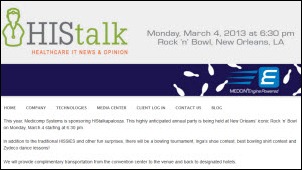
I keep getting e-mails asking for HIStalkapalooza details that I’ve already spelled out on HIStalk twice, so here’s one final notice for the skimmers: registration is still open. Sign up and then read HIStalk and watch your e-mail for details – please don’t e-mail me with questions or requests because I barely have time to sleep as it is (not to mention I would be spending time replying to people who don’t read HIStalk anyway). So far it looks like maybe 100 or so presidents and CEOs have signed up from my quick scan down the list. My favorite attendee title: “CEO Wife/Mistress” (should we hold one spot or two?)  while one (male) attendee volunteered that, “I am willing to wear high heels just to get in.” The event draws the most interesting crowd of anything at HIMSS because not only are HIStalk readers smarter, funnier, and sexier (scientific proof available on request), we get a stimulating mix of internationally known executives, CIOs, CMIOs, trench warriors, consultants, clinicians, investment bankers, sponsor people, and government officials who know their stuff and also know how to have a good time. I’m also happy to report that next year’s HIStalkapalooza in Orlando is already sponsored, as is the 2015 version in Chicago.

HIStalkapalooza sponsor Medicomp Systems will once again host its Quipstar game show in the HIMSS exhibit hall, offering fun competition, tee shirts, prizes, and cold drinks (beer and Ingatinis are mentioned, and I had the former last year). Register to play here. The grand prize is super cool: two business-class airfares to Bangkok, a 10-day stay in Medicomp’s corporate apartment, and two executive physicals at Bumrungrad International Hospital. Thai food is among my favorites and it’s shockingly cheap there, which just might be reason enough to go. Check out a disguised Inga at 0:25 in the video from last year above.


Acquisitions, Funding, Business, and Stock

2-7-2013 8-25-48 PM

Athenahealth reports Q4 results: revenue up 26 percent, EPS $0.29 vs. $0.26, beating earnings estimates by $0.01.

2-7-2013 9-10-31 PM

Analytics vendor Health Data Vision raises $2.8 million in Series A funding.

Nuance reports Q1 results: revenue up 28 percent, EPS –$0.07 vs. $0.03, falling short on revenue and earnings. Shares are down more than 15 percent in after-hours trading. On the earnings call, Chairman and CEO Paul Ricci said reduced transcription volumes due to increased EMR adoption and the company’s own Dragon Medical software will hurt the company’s healthcare growth until business picks up for its computer-aided coding and clinical documentation offerings.

Mobile health technology provider Diversinet Corp. is awarded two US and Canadian patents related to “bring your own device” security .


Sales

2-7-2013 3-15-29 PM

Vancouver-based Fraser Health contracts for dbMotion’s interoperability platform.
2-7-2013 3-17-50 PM

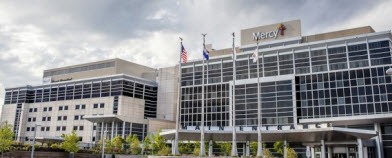
Mercy Health System (MO) selects MModal Fluency for Coding workflow platform for its network of 26 hospitals and clinics.

Huron Valley Physicians Association (MI) chooses e-MDs as a preferred EMR partner for its 700 members.

The OneBlood, Inc. (FL) blood center licenses Mediware’s HCLL Transfusion software.

The HealtheConnections RHIO (NY) selects Mirth’s HIE technology.


People
2-7-2013 6-42-28 PM

Rose Ann Laureto (UNC Health Care) is named CIO of ProMedica (OH).

2-7-2013 3-13-41 PM

Acusis promotes KB Anand to CEO.

2-7-2013 7-23-33 PM

Hearst Media extends the responsibilities of First Databank President Gregory Dorn, MD, MPH to deputy group head of Hearst Media, where he will oversee business-to-business services in the automotive, electronic, and finance industries along with the company’s healthcare brands MCG (the former Milliman Care Guidelines), First Databank, Zynx Health, and Map of Medicine. I interviewed him in September 2012.

2-7-2013 3-09-52 PM

Health Catalyst appoints John Haughom, MD (PeaceHealth) CMO and SVP.

AHIMA hires Deborah Green (LaVie Care) as EVP/COO and promotes Denise Froemming to EVP/CFO.


Announcements and Implementations

QuadraMed will offer Q-Matic’s self-service technology for managing patient flow through its enterprise Access Management suite.
2-6-2013 12-59-45 PM

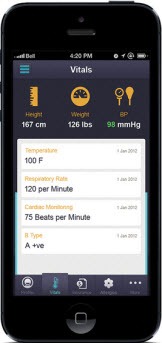
EClinicalWorks will invest $25 million over the next year to enhance and expand its patient engagement tools in its healow business unit.
2-7-2013 3-27-44 PM

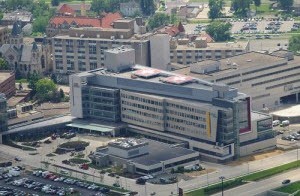
OSF HealthCare System goes live on sharing its seven-hospital Epic information with other participants in the Central Illinois HIE using ICA’s CareAlign exchange platform.

Cogdell Family Clinic (TX) implements scanning technology from EDCO Health Information Solutions to eliminate its paper-based medical records.

Truven Health Analytics launches HIE Advantage Analytics for the analysis of HIE utilization and population management.

ICSA announces a mobile app testing program to help enterprises determine if their supported apps are properly protecting sensitive data.


Government and Politics

CMS will develop a new records systems to facilitate quality reporting for long-term hospital care.

2-7-2013 7-44-38 PM

Good question. Adobe won a VA prize in 2010 for a slick Blue Button project using Adobe Air. It would be fun to revisit old announcements occasionally to see which turned out to be fluff, BS, or wishful thinking.

2-7-2013 8-07-30 PM

CHIME’s comments on ONC’s proposed patient safety plan emphasize that methods of matching patients to their data are inconsistent and a growing problem with HIEs, although it fell short of providing the obvious but politically deadly solution of a national patient identifier. CHIME also expressed concern that patient safety event data collection might take a lot of provider time and urged ONC to turn implementation of the patient safety plan to an organization that isn’t under direct government control.

ONC’s Farzad Mostashari throws down the gauntlet to the minority of EHR vendors that aren’t forthright in their pricing, that write unfair contracts, and that hold customer data hostage to prevent them from moving to another system, warning that if those vendors don’t step up, “We will go back to the regulatory process.”

2-7-2013 8-21-20 PM

Secretary of the Army John McHugh visits the National Center for Telehealth and Technology in Joint Base Lewis-McChord, WA. It offers video chat-based mental health consultations to soldiers in remote locations.

2-7-2013 9-32-21 PM

Senator Robert Menendez (D-NJ), new chair of the Senate Foreign Relations Committee, acknowledges that he tried to intervene in a billing dispute between CMS and his largest political donor, a Florida ophthalmologist who was ordered to replay $8.9 million for overbilling Medicare for an eye drug. The Senator, who also admitted to inappropriately using the doctor’s private jet, tried to convince CMS that the billing rules were confusing.


Other

A national survey finds that the most-hated job in America, as scored by those holding the position, is IT director. Sales and marketing director came in at #2, product manager at #3, senior web develop #4, technical support analyst at #8, and marketing manager rounding out the list at #10. Companies should probably be concerned if their sales and marketing executives are that miserable.

AHRQ and CMS announce a new EHR format for children’s health that includes recommendations for child-specific data elements such as vaccines, prenatal and newborn screening tests, growth data, and child abuse reporting.

A study in Health Affairs finds that care costs averaged $88 less per episode when delivered via an online clinic versus traditional settings, with strong effectiveness indicators and a 98 percent “would recommend” consumer rating.

A county commissioner and Tea Party leader in Michigan casts the lone dissenting vote in considering the health department’s request for new Medicaid billing software, explaining, “My worry is that if it’s part of (electronic health records or EHR)—which is Obamacare. I’d like to make sure our information is not being collected. You’d be selling your health care and your liberty to Big Brother. We should make darn sure this is not part of the EHR system … I feel our records would be better off kept in private hands.” 
2-7-2013 6-06-57 PM

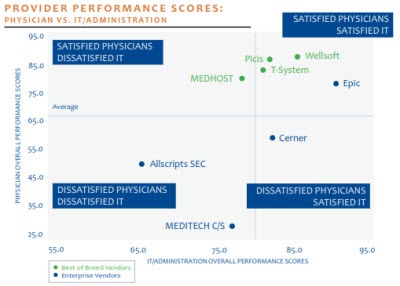
A KLAS report finds that ED physicians believe best-of-breed ED systems offer better clinical decision support, usability, and documentation accuracy compared to enterprise ED systems. The highest-ranked best-of-breed vendors are Wellsoft, Picis, T-System, and Medhost, while Epic takes the top spot among enterprise vendors.

2-7-2013 9-42-01 PM

The ECRI Institute Patient Safety Organization looks at HIT-related safety events, identifying five problem areas:

  • Inadequate data transfer between systems
  • Entering data on the wrong patient
  • Making data entry mistakes
  • HIT system bugs
  • Configuration errors

Security analysts find a vulnerability in Internet-connected devices manufactured by Honeywell that could allow hackers to take control of large-business environmental systems, some of which they identified as belonging to hospitals. Hacking the device could also provide direct access to a hospital’s network since they are often direct connected via Ethernet.

2-7-2013 9-02-36 PM

World-renowned Johns Hopkins neurosurgeon Ben Carson, MD (played by Cuba Gooding Jr. in 2009’s “Gifted Hands: The Ben Carson Story”) makes his fellow presenter President Obama squirm at the National Prayer Breakfast with his suggested alternatives to Obamacare: “We spend a lot of money on health care, twice as much per capita as anyone else in the world, and yet not very efficient. What can we do? Here’s my solution. When a person is born, give them a birth certificate, an electronic medical record, and a health savings account to which money can be contributed pre-tax from the time you’re born to the time you die.” He also said that the government is fiscally irresponsible and needs to place more emphasis on education.

Santa Clara Valley Medical Center (CA) is fined $100,000 after patient dies after going into cardiac arrest without receiving treatment for nine minutes. The patient’s monitor leads had become disconnected and the technician called for a nurse via overhead page at 1:27 a.m., but the nurse said she didn’t hear it. The hospital, thankfully, says it has developed a better way to notify nurses. Google tells me that Vocera’s headquarters building is less than two miles from the hospital in San Jose and the hospital is a Vocera customer, so that’s probably a much better solution than waking patients up with middle-of-the-night overhead pages that could be missed.

Twelve patients file suit against North Shore University Hospital (NY), claiming that medical records face sheets were stolen and their information used to file fraudulent tax returns, charge credit cards, and open cell phone accounts since 2010. The suit claims that a theft ring operated for more than a year, but patients weren’t notified.

The top 10 executives of non-profit Carolinas HealthCare System (NC) each earned more than $1 million in 2012, including $4.76 million for the CEO.

2-7-2013 6-50-03 PM

I was amused that Dr. Jayne uses the word “pop” below in referring to fizzy sugar water, which I know is a regional term since I’m fascinated by stuff like that (calling the midday meal “dinner,” referring to a rubber band as a “gumband,” declaring the side of the road to be a “berm” instead of a curb, etc.) Then I remember that there’s an Internet, meaning someone has devoted their very existence to studying the “pop” phenomenon, so that’s the graphic above. The yellow parts of the country call it “pop,” the blue say “soda,”and the purple refer to it generically as “Coke” (although my favorite is the unlisted variant I always heard from my Southern relatives, “Co-Cola.”)

2-7-2013 9-05-06 PM

Perhaps this OB-GYN shouldn’t have chastised her tardy patient on Facebook. The hospital has reprimanded her and is reviewing her posts after reports that some may have contained patient information. I would add that she should be reprimanded for starting a sentence with “so,” an appallingly lame and unnecessary verbal crutch that seems to be ubiquitous these days.


Sponsor Updates

  • SuccessEHS says it has doubled in size since January 2011 with the hiring of 295 new employees.
  • Surgical Information Systems demonstrates interoperability for each IHE profile at the 2013 IHE Connectathon.
  • Forbes recognizes iSirona, Kareo, and Ping Identity on its list of the country’s most promising privately-held, high-growth companies.
  • Levi, Ray & Shoup opens a branch office in Westchester, IL.
  • Elsevier launches the MEDalternatives database, which gives users access to drug cost savings options through access to information on alternative therapies.
  • Vocera donates its communication technology to MedShare (GA), a non-profit that recovers and redistributes surplus medical supplies and equipment to developing countries.
  • Access hosts a February 12 Webinar profiling Norman Regional Hospital (OK) and its use of Access products to advance paperless initiatives.

EPtalk by Dr. Jayne

HIMSS alert: For those of you who may be out cavorting with vendors or clients in the Big Easy, a recent study shows that mixing alcoholic drinks with diet pop may lead to higher blood alcohol levels than using regular pop. The study was small with only 16 participants and attributes the effect to diet pop moving more quickly through the stomach.

Speaking of vendors, clients, and cocktails: CMS released the final rule on the Sunshine Act this week. Starting March 2014, pharmaceutical and medical device must report payments to providers for consulting fees, honoraria, gifts, food, entertainment, travel, and charitable contributions. There will be a 45-day review period for physicians to ensure the accuracy of any information submitted. The rule is 287 pages long and it’s already been a long day, so anyone who wants to send me highlights is welcome. Instead of stale pickup lines accompanying offers to buy me a drink, I’m sure I can look forward to, “Hey baby, what’s your NPI?”

I’ve received lots of reader comments on my recent piece regarding hospital budget cuts and administrative ridiculousness. Some of my favorites:

  • “I thought it was bad when they stopped emptying our trash daily and told us all food-type trash needed to go to the kitchen and that if any varmints or bugs appear, each department would be charged for pest control.”
  • “They started vacuuming during the day because it is cheaper. So you are on conference calls or any type call and along comes the high-powered vacuuming. Also lights have been dimmed, so you practically need a flashlight.”
  • “My most ridiculous administrative experience occurred smack dab in the middle of the current recession. Senior management felt our product was so critical they decided to raise prices. I could only shake my head in amazement and easily forecast the impending carnage to come… and did it ever come! Our competitors had a field day as clients dropped us like a bad habit!

Keep the stories coming. I really do enjoy reading your comments and knowing that our hospital isn’t the only one that has totally lost its collective mind.

ICD-10 challenge: I had a patient present this morning with eye pain which she attributes to staying up all night reading Fifty Shades of Grey. The best part of the encounter was that my scribe had never heard of it, and watching his face as the patient tried to explain what the book was about was priceless. I guess I’m stuck with a nonspecific code for exposure to other specified factors. Any suggestions?

Print


Contacts

Mr. H, Inga, Dr. Jayne, Dr. Gregg, Lt. Dan, Dr. Travis.

More news: HIStalk Practice, HIStalk Connect.

Morning Headlines 2/7/13

February 7, 2013 Headlines Comments Off on Morning Headlines 2/7/13

Remarks by Secretary Panetta and Secretary Shinseki from the Department of Veterans Affairs

A Department of Defense meeting transcript indicates that the DoD and VA will pursue interoperability and a common user interface rather than creating a single EHR to meet the President’s goal of a joint system. Secretary of Defense Leon Panetta says the VA and DoD have aligned their data elements and will start a pilot project this summer on a common VistA/AHLTA user interface for physicians. He says that project, plus the recently expanded Blue Button initiative, will meet the President’s directive faster and cheaper than creating a single EHR. The departments announced in March 2011 that they would create a common joint EHR platform, saying then that their respective systems were outdated and lacking functionality.

The Advisory Board Company Acquires 360Fresh

360Fresh products use natural language and text processing to analyze information from electronic medical records and other sources, adding real-time predictive analytics capabilities for The Advisory Board Company’s Crimson customers.

Physician Satisfaction with Best-of-Breed EDIS 59% Higher than Enterprise Systems

A new KLAS report on emergency department information systems finds that ED physicians give best-of-breed ED systems higher scores because of clinical decision support, usability, and accuracy of documentation, while enterprise systems provide advantages in interoperability, continuation of care, and communication with other hospital systems.

New Children’s Electronic Health Record Format Announced

AHRQ and CMS release a guide for EHR developers that includes a minimum set of data elements and data standards for children.

Comments Off on Morning Headlines 2/7/13

HIStalk Interviews Lorre Wisham, CEO, Health Technology Training Solutions

February 6, 2013 Interviews Comments Off on HIStalk Interviews Lorre Wisham, CEO, Health Technology Training Solutions

Lorre Wisham is president and CEO of Health Technology Training Solutions of Tucson, AZ.

2-6-2013 7-34-53 PM

Tell me about yourself and the company.

I’ve spent almost two decades in a wide variety of operations leadership roles in healthcare IT. I am a problem solver and a process person. Years in a customer-facing role taught me to look for solutions.

HTTS was the vision of my late husband, Josh Wisham, who had a long and successful career in healthcare IT. Three years ago, he did some research into the most successful HIT solutions and found that training is always a key element. He partnered with McKinnon-Mulherin, a Salt Lake City-based company that focuses on instructional design and training development. Liddy West, a long-time friend and colleague, signed on to lead sales and marketing. HTTS then started to deliver solutions to the challenges of customers — inadequate resources or skills, short deadlines, and customer demands. Those customers loved the result.

After Josh passed away last summer, I stepped in as CEO. We’ve updated our website, added a catalog of services, and sponsored the coolest blog in the industry. [laughs]


What’s have you seen, good and bad, with vendor-developed training?

There is a broad spectrum here. I think some vendors do a great job with their training and others don’t. Generally, I would say the greatest positive is that the person creating the training is a subject matter expert and knows the product inside and out.

At the same time, that very thing can also be the greatest negative. Someone who knows something so well often assumes a level of understanding that customers may not have. And in many cases, vendor training people don’t have instructional design skills or understand how adults learn best.

I’ve said it before and I will say it again. Training is typically not well planned and is often an afterthought or a rush in the eleventh hour before a new release or product has to go out. When that happens, the outcome is somewhat negative because training is just a checkbox or a line-item cost for the client and vendor.

When training is done right, it delivers positive outcomes in many areas, from adoption to satisfaction to reduced call center costs. We know that.


Give me a few examples of how you’ve worked with customers.

HTTS has delivered effective training solutions to a number of healthcare IT companies. We have done everything from evaluating training programs and resources to designing and developing of e-learning modules for a retail pharmacy company.

I think what allows us to create the right solutions is our approach. We do an assessment first to understand the current state and the needs. We can suggest where we can help the most. We want to fill the gap. We don’t want to take over and do what the existing training department is there to do. 

We mentor or supplement or we do it all. It varies so much from one company to the next. Every one of us at HTTS has been on the customer’s end of the conversation in our careers, and we work to make it as easy and impactful as possible.


How would instructional designers with expertise in training technology and adult learning principles approach new version user training differently?

It seems to me that no matter what company you are looking at, training is something that gets put off until the last minute. When product management is thinking about a roadmap for a new release, they might mention training, but it usually isn’t really an active part of the project until the product is almost ready for GA. Everyone on the vendor side is sighing with relief because they’re done and ready to move on to the next thing.

Training is often rushed and incomplete. Because the people creating the training know the content so well, they assume everyone knows as much as they know, so training can miss some of the fundamentals. Or worse, the training is organized according to the way developers designed the product rather than how customers will use it.

When instructional designers look at the product, they don’t assume anything. They aren’t subject matter experts. Instructional designers create the training for people who are seeing the product for the first time. Considering how much staff turnover and system replacements we’re seeing on the client side, the odds are pretty good that they are working with new applications and devices regularly.

Beyond that, instructional designers know how different people learn and how their work and learning environments can impact that. Think about how training needs to be different for a physician in the office versus a nurse in a busy emergency department. IDs are trained to think about those differences and to go beyond a lecture or demo. The result is training that is more engaging, more applicable, and longer lasting.


What metrics can be used to measure the effectiveness of a training program?

Interesting you should ask me that because it is something we are spending a lot of time on so we can quantify ROI. Most learning professionals are fully aware of the steps we need to take to evaluate training effectiveness, but getting the metrics can be a little tough. 

How do you measure customer adoption of software? That is a critical aspect of what we are talking about here. If a customer knows how to use the product and takes full advantage of it, how do you measure the value of that compared with another customer who doesn’t? Satisfaction, probably, but how can you be sure it can be attributed to training? 

The one obvious metric we discovered when working with an imaging company was the reduction in support calls. Luckily, they were already capturing the “How do I?” questions in their CRM. They told us those training-related calls were reduced by 35 percent after HTTS delivered the new version training. For them, that was huge. 

Not all clients are able or willing to provide benchmarks. There is risk in measuring ROI and some benefit in not knowing. It lets you keep doing things the way you’ve always done them. One of our goals is to encourage clients to capture and share benchmark data on adoption, sales, customer satisfaction, and support calls and then compare it to post-training numbers. That way, we can measure not only the effectiveness of training, but also the value that good training delivers.


Can training programs be a competitive differentiator for vendors?

Absolutely. But the trickier question is, does anyone think of it that way? I’m sure many of your readers follow the KLAS reports. Most vendors read the comments their customers wrote about their products. But who focuses on the training comments? Often the implementation manager reads them, but it is probably not his or her area of responsibility.

I can’t think of a customer I have encountered in my career who has said, “Wow, the training was amazing, and I feel so much more prepared to use your software.” Epic customers come the closest to that because Epic forces them to become certified in using and administering their system. It is brilliant. They are happier users and good references because they are able to integrate the system more naturally into their workflows.


How do you see software training evolving over the next few years and how will the company address those changes?

The biggest changes will come in delivery methods. While many in healthcare are just barely getting their minds around Web-based e-learning modules, other industries are already delivering their training on mobile devices. They are taking advantage of social networking to create learning communities where knowledge is shared in faster and more dynamic ways, right when and where the user needs it.

Our job is to help healthcare bridge the gap between where providers and vendors are today and where they can be tomorrow. We know what’s possible with today’s rapidly evolving learning methods and technologies, but we also know the unique needs of the healthcare IT environment. We are going to keep nudging vendors and providers forward so they can benefit from these changes while not losing sight of the real-world complexities they face right now.

Comments Off on HIStalk Interviews Lorre Wisham, CEO, Health Technology Training Solutions

The Advisory Board Company Acquires 360Fresh

February 6, 2013 News 1 Comment

2-1-2013 5-53-35 PM

The Advisory Board Company announced this afternoon that it has acquired clinical analytics vendor 360Fresh of Palo Alto, CA.

360Fresh offers two products. Pulse360 uses text and data mining to extract information from existing systems such as EMRs to answer clinical and quality questions. Track360 is a clinician care coordination and workflow tool that streamlines provider handoffs, provides alerts, and improves patient communications. Both systems are targeted for use by academic medical centers, independent community hospitals, and large-scale ambulatory providers.

We spoke to CEO Paul Roscoe of The Advisory Board Company’s Crimson group ahead of the announcement. He says Crimson provides its members with analytics solutions for retrospective data review, while the additional of 360Fresh’s technology will create the next generation of analytics capable of capturing real-time information for hospitalized patients, including both discrete and free-text EMR data, and then using predictive analytics to identify opportunities to improve outcomes.

2-1-2013 6-28-39 PM

”360Fresh’s technology uses data mining techniques to gain access to the data that exists and in many cases is locked up in the electronic medical record,” he told us. “It performs text analytics and NLP processing, and then adds to that very advanced mathematical and predictive modeling capability that allows you to analyze structured and unstructured clinical data – progress notes, admission records, text results, billing information – and glean from that the salient clues to a patient’s behavior and clinical trajectory to create a comprehensive view of their risk factors for certain negative outcomes.”

Roscoe says Crimson members will be able to use existing rich data sets to identify areas of opportunity, including in accountable care-type models that require the ability to manage population health and chronic diseases. He refers to the new capabilities as “dynamic clinical intelligence,” which he contrasts to clinical decision support in that instead of running fixed rules to identify possible ordering errors, predicts future events such as the likelihood of a post-surgical patient being transferred out of the ICU within eight hours.

J. Sairamesh (Ramesh), PhD, 360Fresh CEO, president, and founder, led business solutions for IBM over 14 years, working on technologies that included Early Warning Systems and Watson. Roscoe says 360Fresh is working with several large medical centers that have not yet been publicly identified. Terms of the acquisition were not disclosed.

Morning Headlines 2/6/13

February 6, 2013 News 2 Comments

Cerner Reports Fourth Quarter 2012 Results

Cerner beats estimates with earnings per share of $0.67 vs. $0.55 a year ago, with revenues up 15 percent.

DOD, VA to Speed Integration of Health Records

The Integrated Electronic Health Record, originally scheduled for a 2018 rollout, is on track for go-live by the end of 2014.

Can computers predict medical problems? VA thinks maybe.

The VA solicits bids for a pilot program that will analyze information in its VistA electronic medical record using natural language processing and machine learning to uncover patterns that can be used to improve outcomes and efficiency.

Health care venture in Leawood plans to generate 200 jobs

Startup eLuminate Health, which offers a consumer site for pricing elective surgeries and choosing providers, says its planned Kansas headquarters will create 200 jobs over the next five

News 2/6/13

February 5, 2013 News 7 Comments

Top News

2-5-2013 6-26-04 PM

Cerner announces Q4 results: revenue up 15 percent, EPS $0.67 vs. $0.55, beating estimates of $0.64. Shares rose five percent in after-hours trading Tuesday. The company’s market cap is $14.3 billion. From the earnings call:

  • Q4 bookings were just over $1 billion, a record
  • System sales were $252 million of the $710 million in revenue
  • Thirty percent of the bookings came from non-Millennium clients
  • The company says it had nearly double the number of new HIMSS EMRAM Stage 6/7 users as its closest competitor, presumably Epic
  • It claims that Epic is pushing back on Meaningful Use Stages 2 and beyond because it will be challenged to meet them
  • EVP Jeff Townsend said the industry needs to step up to the challenges of interoperability, including use of a patient identifier
  • The company says it thinks even Epic clients that have paid a lot of money can be convinced to change systems if their reimbursement is threatened due to quality problems
  • The company signed four deals worth $40 million or more, with the showcase being LA County
  • Neal Patterson said the market is really a choice between two companies, presumably Cerner and Epic
  • The company says 85 percent of its customer base has completed Stage 1 attestation

Reader Comments

2-5-2013 6-14-35 PM

From Mike Tomlin: “Re: Rich Goldberg. He is leaving McKesson/MED3OOO to run marketing for GE reseller Virtual OfficeWare.” Unconfirmed, but the source is good and his departure would not be surprising given McKesson’s recent acquisition of MED3OOO.

From Bean Enumerator: “Re: Brigham and Women’s CIO position. Not filled yet.” A reader reported on January 30 that Joe Schmitt was taking the job, but that was not verified. The opening remains posted.

2-5-2013 7-46-15 PM

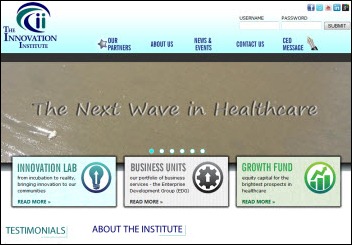
From MedWreck: “Re: Innovation Institute. Color me skeptical.” St. Joseph Health (CA) launches for-profit The Innovation Institute that will include includes an incubator, shared services, and an investment portfolio. The primary motivator seems to be to commercialize the intellectual property of large academic medical centers. The only hospital member named is St. Joseph Health, which provided almost all the institute’s executives, including former St. Joseph Health SVP/CIO Larry Stofko, who will run the Innovation Lab. Larry let me know about the Institute’s formation last summer, at which time I mentioned it and his new job there.

2-5-2013 7-18-05 PM

From Incredulator: “Re: HIMSS e-mail blast. A customer forwarded this e-mail they received from a company pitching their HIMSS booth. Check out the last line.” It’s easy to doctor a forwarded e-mail, so I’ll assume that’s the case since surely the company whose identifiers I’ve blurred wouldn’t be stupid enough to end an otherwise button-down e-mail blast with a puzzling grand finale. Although if they did, I’ll be interested to see if they own up to it as either a horrific faux pas or an overly bold attention-getter.


HIStalk Announcements and Requests

We did a good interview with Vocera Chairman and CEO Bob Zollars on HIStalk Connect.

2-5-2013 10-02-06 PM

Welcome to new HIStalk Platinum Sponsor Cornerstone Advisors Group. The five-year-old Georgetown, CT-based professional services firm, in its own words, “provides high-value consulting, advisory, implementation, and staffing services to the healthcare delivery middle and lower market segments at a fair and reasonable price” around its core principles of partnership, integrity, commitment, and value (remember “value” because it’s coming up again). The company took the #1 spot in “Planning and Assessment” and #2 in “Vendor Selection” in the 2012 Best in KLAS awards, with its customers scoring it with a sweet 98.4 and 96.1, respectively, also giving Cornerstone stellar marks for value with a 9.0 in the all-important “Money’s Worth” score in both categories. Cornerstone’s leaders and associates are former Big Six consultants, CIOs, and physicians, and I notice that President and Founder Keith Ryan has a distinguished industry history on the front lines as VP/CIO of Stamford Health (CT) and Elmhurst Memorial Healthcare (IL) as well as having held executive positions with top consulting firms, not to mention that I notice he is an HIStalk Fan Club member, which carries a lot of weight (with me, anyway). I’ve seen the company’s revenue and FTE numbers by year and it’s a steep curve up, earning it a spot on the Inc. 5000 with 431 percent three-year growth. Some of its clients include HCA, William Backus, Chilton Memorial, and Finger Lakes. If you need help with advisory, implementation, or staffing services, consider giving Cornerstone Advisors Group a chance to earn your business. I appreciate their support.


Acquisitions, Funding, Business, and Stock

Oak Investment Partners invests $40 million in xG Health Solutions, an independently operated venture that will market intellectual property and expertise developed by Geisinger Health System, including healthcare IT optimization, consulting services, population health data analytics, and care management. We announced the news on January 11 when phony-named reader Jerry Aldini forwarded a copy of the internal announcement.

2-5-2013 6-25-23 PM

CTG acquires etrinity, a provider of IT services to the healthcare market in Belgium and the Netherlands.

2-5-2013 6-29-43 PM

Michael Dell will regain control of the fading company he founded as Dell announces plans to be taken private in a $24 billion leveraged buyout that also includes taking a loan from Microsoft. The company plans to move its focus from low-margin and low-demand PCs to enterprise services, which worked for IBM years ago as it moved away from hardware. That same strategy hasn’t done much for HP, which is now discussing breaking the company up in hopes of finding shareholder value hidden somewhere in its diverse offerings. The Dell change could be good for its healthcare consulting folks, most of whom were brought on board with its 2009 Perot acquisition that included the former JJ Wild.

Startup eLuminate Health announces plans to open its headquarters in Leawood, KS and create 200 jobs over the next five years. The company offers a network for imaging and surgical providers to provide transparent pricing, clinical quality, and customer satisfaction ratings for consumers (sounds pretty much like an Angie’s List for elective surgery). CEO Tami Hutchison came from Cerner, which you probably guessed given the company’s location and line of business.

Speech technology vendor Vestec raises $1.5 million in capital from V. Raman Kumar, founder and former CEO of MModal. The company offers a speech recognition engine and a Natural Language Understanding system, with a text-to-speech engine planned. The products seem to be small-vocabulary systems for specific voice commands for use in devices such as TVs, GPSs, and PBX-type setups, although Kumar says he’ll help the company move into healthcare.


Sales

CHRISTUS Continuing Care (TX) selects HEALTHCAREfirst’s homecare, hospice, and CPO solutions.

MDH Radiology chooses Sectra’s Breast Imaging PACS, Merge Healthcare’s CADstream, and other tools to create a national telemammography solution.

2-5-2013 3-17-22 PM

MD Anderson (TX) chooses Oracle Health Sciences applications  and Oracle technology for an organization-wide analytics initiative to develop personalized cancer treatments.

CMS awards Emdeon a contract to define the process for testing new HIPAA and ACA transaction standards.

Kentucky Medical Services Foundation and UK Healthcare sign a five-year agreement for Opportunity AnyWare, the business analytics platform from Streamline Health Solutions.

2-5-2013 3-19-19 PM

Kalispell Regional Medical Center (MT) selects EDCO Health Information Solutions for its day-forward scanning technology and services.

Middletown Community Health Center (NY) chooses EHR, PM, and EDR (dental) solutions from SuccessEHS for nine service locations and two mobile health units, announcing plans to go live within 90 days. 

2-5-2013 10-25-25 PM

Parkview Health (IN) selects ProVation Medical from Wolters Kluwer Health for gastroenterology procedure documentation and coding.


People

2-5-2013 7-04-20 PM

Kasey Fahey joins Direct Recruiters as project coordinator in its healthcare IT practice.


Announcements and Implementations

Covisint launches Covisint Healthcare, an integrated solution for analytics across multiple systems and stakeholders that includes enhanced data capture and reporting, real-time admission and discharge notifications, and patient outreach and scheduling.

2-5-2013 6-41-23 PM

Reading Hospital (PA) goes live on its $150 million Epic implementation.

Four hospitals of Bassett Healthcare Network (NY) go live with Epic.

LHP Hospital Group (TX) implements McKesson Paragon at five hospitals.

Cox Medical Center Branson (MO) completes activation of T-System’s PerformNext Care Continuity solution to facilitate patient transitions and improve communication and access to clinical data.

2-5-2013 6-50-48 PM

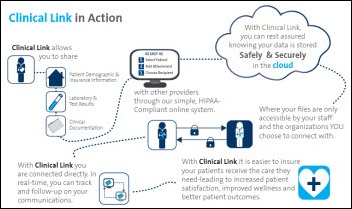
ZirMed launches Clinical Link, a nationwide provider-to-provider information exchange platform.

2-5-2013 6-53-53 PM

Awarepoint Corporation launches Bed and Bay Sensor for precise tracking of mobile equipment and patient and caregiver interactions in locations with tight bed spacing such as the ED and PACU.


Government and Politics

2-5-2013 6-46-11 PM

The VA solicits bids for a pilot program to test how advanced clinical reasoning and prediction systems can use its VistA patient data to improve care, efficiency, and outcomes.

Brian Ahier reports that a new federal law will be published this Friday that will require drug, device, and medical supply managers to publicly disclose gifts given to physicians or teaching hospitals. The Physician Payment Sunshine Act, part of the Affordable Care Act, charges HHS with collecting information about consulting fees, gifts, honoraria, food, entertainment, and travel from companies that are covered by any federal health program.


Innovation and Research

2-5-2013 2-53-03 PM

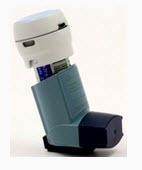
The Washington Post looks at the burgeoning field of geomedicine, which uses geographic information system technology to correlate environmental conditions with health risks. One example is an inhaler device from Asthmapolis that is equipped with Bluetooth to track when and where patients use their inhalers.

2-5-2013 7-28-35 PM

A Germany-based company develops an intelligent armchair that contains health-monitoring technology that constantly measures the health of its occupant, also displaying the user’s historical health measurements via a tablet PC to the TV using Bluetooth. A virtual health assistant uses the information to develop and monitor a personalizes health plan, for which the chair transforms into a rowing machine. The company plans to add mental games to encourage participation and increase alertness.

2-5-2013 8-39-58 PM

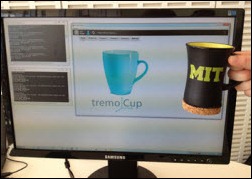
Fast Company covers the just-concluded MIT Health and Wellness Hackathon, which focuses on commercially viable products. Some of the entrants: an app that encourages HIV/AIDS patients to take their meds, a sensor-based home monitor for congestive heart failure, an endometriosis surgery app for patients, home Parkinson’s monitoring tools built into gloves and a coffee cup, a blood pressure pill bottle reminder, and a diet tracker for epileptics.


Other

I don’t see the point of “pass a test, earn some paper” certifications like the ones offered by HIMSS and some for-profit companies, but this one really puzzles me. HIMSS introduces CAHIMS, designed for “emerging professionals” with less than five years’ experience in healthcare IT. I would be doing all I could to try to hide my newbie status on my resume rather than proudly waving around a paid-for certificate that boasts of my relative inexperience.

2-5-2013 8-26-50 PM

Baltimore-based startup Parallax Enterprises, founded by a physician who is also a military pilot and an Air Force major, raises $1 million to develop a heads-up display of surgical checklists. I’m intrigued that Jeff Woolford, MD has booked 1,000 hours in the single-seat, low-level combat A-10 Thunderbolt II tank killer, which is ugly, slow, low-tech, cheap, and scary as heck for the pilot but the most reassuring sight imaginable for ground troops, at least those on the same side. I’ve seen live exhibition flights of just about every modern-era US warplane and the A-10 was the most memorable. Hats off to Dr. Woolford for his service as a Wart Hog driver over Afghanistan.

Former HealthStream executive Luther Cale offers 33 Ways to Reboot Your Life, free on Amazon through midnight Wednesday. Judging from the “Look Inside” feature, you won’t get much out of it if you don’t believe in non-traditional medical techniques like spiritual psychotherapy and healing tonics.

Unverified rumors claim that Cerner and McKesson will open up interoperability between their systems to try to compete with the Epic juggernaut, with a potential announcement planned for the HIMSS conference. I’m skeptical that two large, publicly traded competing companies would agree to such cooperation, so if you have details, please share.

2-5-2013 9-12-13 PM

Seattle-based Carena launches its CareSimple program, offering Webcam-based virtual visits with one of its 15 physicians and nurse practitioners for limited conditions for a cost of $85 or for $5 with a family membership of $35 per month.

Texas Medicaid tries to revise its “pay and chase” policies after a TV station’s investigation finds that taxpayers were charged for $705 million over three years for orthodontics. The state is holding the payments of 91 dentists suspected of fraud.


Sponsor Updates

  • MedAssets pledges support to employees who serve in the National Guard and Army Reserve.
  • Chris Tackaberry, co-founder and CEO of Clinithink, shares details of how Clinithink came about and the challenges along the way in an interview. 
  • SimplifyMD reports that 100 percent of its customers choosing to file for MU attestation have completed the process.
  • The Advisory Board Company hosts senior policy makers on Capitol Hill to discuss efforts to improve care under new Medicare value payment programs.
  • Cerner will integrate Gateway EDI’s claims and remit systems with its PM solutions.

Contacts

Mr. H, Inga, Dr. Jayne, Dr. Gregg, Lt. Dan, Dr. Travis.

More news: HIStalk Practice, HIStalk Connect.

Morning Headlines 2/5/13

February 5, 2013 Headlines Comments Off on Morning Headlines 2/5/13

Geisinger launches xG Health Solutions

Geisinger Health System (PA) forms for-profit xG Health Solutions, backed by $40 million in financing from venture capital firm Oak Investment Partners. The new company will offer healthcare IT optimization, consulting, population health data analytics, care management, and third-party administration services.

ZirMed Launches Clinical Link

ZirMed launches provider-to-provider communication for the 100,000 EMR users connected to its network.

A National Action Plan To Support Consumer Engagement Via E-Health

A HealthAffairs article by Farzad Mostashari and ONC colleagues explains ONC’s “Three As” strategy (access to electronic patient information, apps, and attitudes) to improve consumer e-health.

HIStalk Connect Interviews Bob Zollars, CEO, Vocera

Vocera CEO says being publicly traded “has made us a better company,” the end of the hospital pager is near, and “trying to fight the BYOD movement is like fighting a religious war.”

New technology helps doctors link a patient’s location to illness and treatment

Epidemiologists develop a GPS-equipped inhaler to correlate asthma flare-ups with location. “Place should be a vital sign,” says a spatial epidemiologist in a field now known as geomedicine.

Comments Off on Morning Headlines 2/5/13

The Skeptical Convert 2/4/13

February 4, 2013 Robert D. Lafsky, MD 2 Comments

If you were my patient and I mentioned to you that it wasn’t until recently that I found out that blood circulation was how you get oxygen to your body parts instead of absorbing it from your skin, what would you think of me? I think you’d politely excuse yourself and leave. Because although I specialize in gastroenterology, I as a doctor am supposed to have an understanding of how the whole body works. I’m not supposed to see it as some mysterious black box that I had to learn to deal with by rote.

When I talk to a cardiologist about a case, he may not go as far into physiologic details with me as he would with another heart specialist, but he will refer to general principles that we all learned earlier in our education and training, to orient me to at a reasonable level of understanding about what is going on and what needs to be done.

Right now though this concept doesn’t seem to apply much in the medical computing world.  By way of an example, I direct you to a study and editorial in the January 15 Annals of Internal Medicine. The original study looked at Meaningful Use measurements in practice by going back over the actual records.

The authors documented a statistically “wide measure-by-measure variation in accuracy” that “threatens the validity of electronic reporting.” I know, that’s no big surprise to any regular reader at this site–file it under “Department of Duh.”

The accompanying editorial caught my attention, though.  It was written by a distinguished general internist, trained at top institutions and a university medical faculty member. She wrote very well, and with a knowledgeable authoritative tone, about the problems with getting statistically valid data out of multiple sources, users, and formats.  

Right in a middle paragraph, after a general comment about about how variable use of the EHR by different providers increases “measurement noise”, she noted a striking personal example, and I quote: ”In my own practice, I learned that my lower rates of blood pressure control reflected the fact that I was documenting the patient’s blood pressure in free text rather than using an available structured field.” And then back to the general subject.

Wow. It seems to me that that deserved more discussion. OK, maybe she didn’t know they were tracking blood pressure in the first place. Maybe she assumed the system had the ability to capture that information from a text entry by some sort of NLP process. I’d like to know that, but I’d also like to know if she understood at that point about these things called databases underneath applications — that they store different categories of data, that they treat numeric data differently from text, and how numeric data generally needs to go into structured fields for that to happen.

Because I can tell you, from lots of personal conversations I’ve had, that whether she did understand those basic concepts or not, plenty of other medical practitioners don’t. That was worth discussing at greater length, whichever of those theories or combinations are true or false.

Why? Because if medical practitioners, as users, are going to see HIT as an alien world only approachable by rote training, they’re going to fall into potholes like this all the time, and I see it happening a lot.  There are a lot of lousy EMR designs out there, and a lot of mediocre training, but I can’t help but think that at least some of the problems with usability stem from gaps in basic user comprehension of the bigger picture.

David Brooks said it well the other day. “Change is hard because people don’t only think on the surface level. Deep down, people have mental maps of reality — embedded sets of assumptions, narratives, and terms that organize thinking.”  

That’s what happens when I’m talking to the cardiologist. Deep down, we have a common map of reality in our heads. That’s how we organize things in our minds and how we think. We’re here in the first place because that’s what we’re supposed to be able to do.

I read a lot of naysaying on this site about the computerization of medical practice, written as if it could all go away.  It’s not going to, but what we have right now isn’t working very well. Part of the solution will be for the mental maps of HIT people and physicians to match up better. The physicians do need to accept that their mental maps are going to need some revision. The IT people need to realize that we need explaining to get the training to sink in.  

Robert D. Lafsky, MD is a gastroenterologist and internist in Lansdowne, VA.

Curbside Consult with Dr. Jayne 2/4/13

February 4, 2013 Dr. Jayne Comments Off on Curbside Consult with Dr. Jayne 2/4/13

clip_image002

I wrote a few weeks ago about the ICD-10 planning debacle at our hospital. Our ICD-10 task force had come to a physician staff meeting to discuss the transition plan, which had been created in a silo. I asked betting folks how long they thought it would take until the application team managers were asked to redo the planning. Any of you who guessed four days wins a prize.

The announcement that the IT teams would now own the initiative occurred just before our annual IT planning conference. During most years, we lock ourselves in a room for several days of bad takeout food, worse coffee, and questionable prioritization exercises.

I usually find myself at the end feeling bewildered at some of the initiatives that are given the green light. For example, last year we approved a hideous EHR conversion project for a single practice, but placed a project for hospital charge capture on the back burner even though the charge capture project was cheaper and easier.

If anyone asks, we use a well-known proprietary decision making process to decide which projects are most valuable to the organization. We all had to go through a multi-day course to use this methodology, although at the time it felt like multiple weeks. For those of you whose organizations are into that sort of thing, I salute you as survivors. (I don’t want to get sued using their name, but if you’ve ever dealt with The Red Sweat, you know what I’m talking about.)

For the physicians on the team who are used to assimilating numerous disparate data points and coming up with a diagnosis rapidly, it was pure torture to sit creating grids, weights, and ranks for various decision points. The hospital spent a huge amount of money licensing the program and training all of us, however, so we’re stuck with it.

For each project proposal, we have to create a matrix where we then rank things to hopefully achieve an objective outcome. It’s a completely biased process, however, because most of us know how to game the different measures to up- or down-rank a project. The outcomes remind me of the worst kind of back-room dealing. At least if we agreed up front that the decisions would all be political, we could save a couple of days and a few thousand calories of bad catering.

This year, we really should have skipped it. The results were so skewed it can hardly be called a prioritization process. Every project proposal seemed to earn the highest marks except for ICD-10 and MU-2, which of course shouldn’t have been part of the process since they’d already been labeled as mandatory.

One team member was hell-bent on twisting each of her pet items to associate to a regulatory requirement. It reminded me of Animal Farm, where all animals are equal, but some are more equal than others. By the end of the planning retreat, my fingers were raw from speed-surfing the Web trying to research and contradict her continued demands that we do every single item “because it’s regulatory.”

My current boss is extremely non-confrontational, so this behavior was allowed to continue. We are now left with a list of things to do that would require a team three times our current size. So much for prioritization.

Now it’s up to the managers to get together and cut deals to see they can help each other out and what projects overlap or can share resources so we actually have a shred of hope that we will get them done. There’s certainly no extra money floating around, so we’re going to have to shuffle the pieces on the board and figure out how to deliver the impossible. It’s lining up to be a very interesting year.

Have a great story about your organizational planning strategy? Do you feel like you spend every day in a war room? E-mail me.

Jayne125

E-mail Dr. Jayne.

Comments Off on Curbside Consult with Dr. Jayne 2/4/13

HIStalk Interviews John Howerter, SVP, Levi, Ray & Shoup

February 4, 2013 Interviews Comments Off on HIStalk Interviews John Howerter, SVP, Levi, Ray & Shoup

John Howerter is senior vice president of Levi, Ray & Shoup of Springfield, IL.

2-3-2013 7-39-30 PM

Give me some brief background about yourself and about the company.

I’ve been with LRS for 20 years. I have been involved mostly in the software side of the LRS business.

Before coming here, I was with IBM. I started as a technical guy and then got into sales, then back into systems engineering management and sales management. I left IBM in 1992 and wanted to stay in the central part of Illinois. I really wasn’t interested in moving around the world, so I came to work for Levi, Ray & Shoup, a privately-owned software company, in July of 1992. I saw it was a good place for me to learn some things.

The company is owned by Dick Levi. We continue to stay focused in this niche. It’s been a crazy ride for 20 years, but a lot of fun.


It doesn’t seem that people think of hardcopy printing as mission critical. Do you think that’s the case?

I’d say certainly printing is the last thing that people think about. The fundamental issues about what people think about printing now versus what they thought about it 20 years ago has not changed much. When I came to LRS 20 years ago, before accepting a job here, I asked Dick Levi — who was going to be my ultimate boss — what his biggest concern was at that time. It was that the mainframes would go away. Certainly the role of the mainframe has changed, but people’s attention to the issues surrounding print management haven’t changed at all. People never think about it.

Since I’ve been here, we continually get phone calls and talk to people who say,”I’m going to print less.” They’ll implement the system without regard for even thinking about the printing infrastructure. Then they run into problems. That’s when we get involved. 

Hard copy has never been sexy or at the front of a business process, but in many industries — and particularly in the healthcare industry — things that get printed continue to have an impact on successful and smooth operations.


In healthcare, the end result of the workflow is often a label, wristband, or report. Until you get that, you haven’t accomplished much. Do prospects understand that?

I guess it depends who you ask. [laughs] I think the people doing the work clearly understand that. Our customers have told us that vendors today and over the last 20 years have said, “We’re not going to print any more.” What? You’ve got to put labels on prescription bottles, samples, blood, and patients. People never think about printing until it stops.


It almost seems that companies trying to sell managed print services took away the impact. Paper and toner is so cheap that it was tough, at least in my hospital, to make a business case for consolidating and centralizing printing. 

Certainly people are printing more today than they used to. There are more opportunities to print. People print from Web pages. People today print all kinds of things that they probably shouldn’t be printing in their daily jobs.

We think about printing in a couple of different ways. We think about printing that is a part of the workflow of any line of business application. Then we think about printing that occurs in the Windows office environment. 

I think there’s a continued push for people to move towards managed print services. Certainly the printer vendors are all trying to add value to differentiate their commodity products in some way. Money can be saved in printing, but the things that you try to do in managing and controlling the costs of printing in an office environment are very different than the things that you need to do to control and manage the printing that occurs in a business workflow environment.


Application software printing usually involves an uneasy technical handoff to the underlying operating system, putting the customer in the middle where it’s hard to say for sure that something that was supposed to print really did at the place they expected. The end result can be a workflow nightmare. What’s the value of putting your solution between the vendor software and the operating system?

Seventy percent of our sales in North America in the last couple of years have been in the healthcare market. The reason for that is exactly on the point that you just mentioned. The value that we provide is that we are a reliable place where your output is. Output is either in our print spool or it has printed. There’s no in-between. 

We provide end-to-end visibility. If the Epic system has created the output, we have it or it’s been printed. When somebody walks through a printer and looks for their output and says, “Wow, it’s not here,” with our tools, we can tell you where it is. We can instantly re-route it to another device where you’re standing and we can manage all that. Our value add, quite simply, is we give you end-to-end visibility. Without a subsystem to ensure delivery, it gets lost in the middle, and that happens far too often.


I’ve seen first-hand where patient care was compromised because of delays caused by missing printed documents, often because the print spool service was hung up on the server or a printer was stuck in an error state that nobody knew about. Do people tell you those stories?

That’s exactly what happens. A lot of people cannot foresee that. The technical people foresee it. The people who are buying applications like Epic, Millennium, or Soarian want to believe that those problems are resolved by the application vendors. They’ve got bigger problems. That’s what we hear about constantly.

We commissioned IDC to do a study for us two years ago. Our biggest challenge is convincing people buying and implementing these large line-of-business applications that printing is going to cause enough of a problem for them that it’s worth investing in solving those problems. IDC concluded that after talking to 10 of our customers and analyzing their environments before and after our solution, there is about $51,000 per year per 100 printers managed in savings for customers who have selected our system. About half of that savings comes from improving the productivity of the people in IT who track down printing problems.

Of that half, 60 percent comes from eliminating the tasks required to track down failed print problems. That doesn’t mean the server is down. That might mean the printer is turned off. That might mean there’s no paper in the tray. That might mean the application has sent it, but for some reason, there was a network problem. The hassles and the time that people spend tracking print that didn’t show up where it was supposed to show up –that is the lion’s share of the value that we provide to people.

It’s always frustrating when tracking down printer problems that you can see documents waiting to print, but Windows doesn’t let you see their contents. You can’t tell what’s in the documents the user didn’t receive and you can’t route them to another printer.

That’s real. Here’s what happens. IT organizations deal with that. Those problems are being solved by people. They’re being solved the hard way. 

I  can talk to a CIO in a healthcare organization and say, “How much time do you spend with this?” They say, “Well, I don’t know. I don’t hear that this is a problem.” You don’t hear it because your organization has solved that problem, but they’re solving it in a very inefficient way. They’re solving it with people. 

You’re right. You can’t reroute a job out of a Windows queue. You can’t reprioritize it. You can’t reformat it. You can’t instantly say, “Oh, I see. It’s here. Let me print it on this device over here.”

It was a nice luxury on mainframes and midranges to be able to view the contents of waiting spool files, make a copy, or move them around. Windows doesn’t seem very enterprise strength in that regard.

That’s exactly what we do. As I mentioned, this company started in 1979. Our owner wrote a program to allow access to IBM’s mainframe spool called the JES Spool and route that output to a network-addressable device. We utilized the IBM JES Spool as our spool mechanism, but we took the output from an interface of that spool and allowed people to manipulate it, to translate it from IBM data string formats so it could print on an HP LaserJet, for example.

That’s our heritage. We focus on the enterprise. We are bringing that kind of reliability and manageability to distributed environments. That’s what our primary business is today – giving that kind of flexibility to manage the things in the spool and deliver them. If you don’t do that, you’re flying blind. You have no visibility from the application all the way down to the output device. It’s more complicated than it used to be because everybody does things their own way.


You seem to work a lot with Epic shops.

I talk to people a lot about whether or not they should consider investing.  We have a lot of very large and very successful Epic customers. We fulfill that value proposition for Epic customers as we do some of the others. We have worked with Epic to help us get metadata about output. For example, for every piece of output that we print, you can know the Epic user who initiated the output. We have worked with them to enable our software to get data so we can account for who printed it, where it was printed, and where it came from.

Our Epic customers fall into two categories. They’ve bought Epic, and on the front end of that implementation, recognize that they need a more robust management system for output to avoid inhibiting the workflow. Compared to an investment in Epic, an investment in our software is fairly insignificant. Many of our Epic customers start on the front end and say, “We want to do this right. We want this implementation to go well.”

There’s another category of customers who have been implementing Epic for a few years and had been struggling with the problems that you mentioned — I can’t find my output, it was supposed print and it’s not there, why is it not formatted correctly, who knows what. After a couple of years in an organization that has any scale to it, physicians and caregivers have raised the level of noise in the IT organization so that it’s a problem that needs to be dealt with.

I’m not sure that there’s anything specific about Epic that is different than the others. It’s just that people are not willing to let an Epic implementation suffer, I suppose, at least from my perspective. In lot of cases, we are dealing with enlightened IT people who want to avoid the risk of not providing a stable, hassle-free environment, so we take that pain away. A lot of people don’t realize they’re going to have it until they get into it.


Have you seen any impact from the changing HIPAA requirements and HITECH?

Certainly. We are an infrastructure vendor. We talk a lot about HIPAA. When you say HIPAA to me, it makes me immediately think of securing data and controlling where output can go and accounting for where output can go. Certainly that is in our sweet spot.

We intend to be the single output server for all output in a large organization. We can efficiently route that. That means we can officially keep track of who did what. HIPAA, Sarbanes-Oxley in other industries, and all these regulatory environments that cause people to want to know who did what so they can audit it certainly have been helpful to us.


How do you see the business changing?

We work with all the printer vendors. We are working with a lot of these folks in terms of trying to ensure that when print vendors are engaged in managed print services projects, we’re working together with them to try to create the best possible environment for the customer and allow a customer to buy our software in the way that fits their budgeting and their management systems.

We’re certainly dealing with mobile devices, where our tools allow you to manage output and see output queues, for example, from any smartphone. You can manage print queues, see what’s going on from a mobile device.

We have enabled and provided downtime reporting tools. We allow you to electronically store and view output in a very simple way, interface or output management systems. We’ve provided in Epic environments some very usable and affordable downtime reporting technologies. We’re trying to figure out how the tablets and the iPads integrate into this. We’re working very hard to support virtual desktop environments.

This is all we focus on. We’ve been successful in this niche because this niche that we’re in isn’t big enough for the big guys. The application vendors have more to worry about than just printing. Many times they think you just create a PDF file and you’re good to go. We’re focused on integrating mobile technologies. We’re focused on making sure that we can support all the devices that are there. We’ve always been on the leading edge of supporting all the devices that exist because our large customer base contains lots of different devices.

In terms of development, it has to do with creating an enterprise output management system that serves the needs of a line-of-business applications like Epic and Soarian and Millennium and anything else that’s out there, balancing that with enabling use for office printing technologies. We’re eliminating hundreds and hundreds of Windows print servers. We are enabling pull printing technologies where that makes sense. 

We’re trying to just continue to focus on this niche and all that’s there because that’s what we know. We’ve got a very loyal customer base and a reputation that allows us to compete in these kinds of opportunities.

Comments Off on HIStalk Interviews John Howerter, SVP, Levi, Ray & Shoup

Morning Headlines 2/4/13

February 4, 2013 Headlines 1 Comment

HHS Secretary Sebelius Address National Health Policy Conf.

HHS Secretary Kathleen Sebelius, National Coordinator Farzad Mostashari, MD, Paul Tang, MD of Palo Alto Medical Foundation, and David Blumenthal of The Commonwealth Fund will deliver addresses at the National Health Policy Conference in Washington, DC February 4-5. Portions of the event will be broadcast live on C-SPAN2 beginning at 9:00 a.m. Eastern today.

McKesson Management Discusses Q3 2013 Results – Earnings Call Transcript

Technology Solutions revenue was flat, margins impacted by revenue recognition changes for a UK acquisition. Legacy conversion to Paragon has been better than expected, while the company states that Horizon will support future Meaningful Use stages.

MyMedicalRecords Files Patent Infringement Complaint Against Walgreens

MMR, which has threatened a flurry of lawsuits claiming infringement on patents it recently acquired, files suit against Walgreens. MMR claims that displaying a list of prescriptions to a patient infringes on its intellectual property.

Meditech Files Annual Report

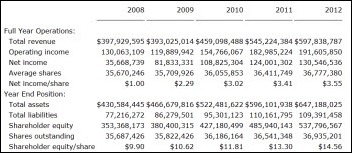
The privately held company reports that revenue increased by 9.7 percent for the year, with earnings per share improving from $3.41 to $3.55.

Monday Morning Update 2/4/13

February 3, 2013 News 10 Comments

2-3-2013 8-45-21 AM

From HIStalk Fan: “Re: HITPC/HITSC testimony of Karen Van Wagner, executive director of North Texas Specialty Physicians. The Pioneer ACO shares results of its community HIE.” She talks about successful efforts to increase EMR usage (eCW, Allscripts, NextGen) and the results of the exchange (Sandlot Solutions), which was launched in 2006. She says traditional healthcare IT isn’t providing cost and quality improvements because it focuses on retrospective data, often from claims databases, and the optimal solution involves both retrospective and current clinical information. They did a discharge transitions project study that exceeded targets for PCP follow-up, having discharge summaries available for the follow-up PCP visit, and readmissions. Her specific recommendations to the government: (a) simplify consent and disclosure rules; (b) expedite adoption of IHE standards; (c) require laboratory diagnoses to delivered by LOINC standards; (d) require hospital EMRs to send a “just admitted” notice to community providers via their own EMRs; and (e) require pharmacy systems to communicate with HIEs and provide their information at no charge.

Hospitalist DZA MD left an insightful comment on my Time Capsule article about doctors getting lost in the barrage of generally useless information cluttering up EMRs. Excerpting:

Anything that is templated has exactly zero clinical information value to me. I don’t care if Osler himself dropped in “dyspnea improved,” “no diarrhea” … If I want to know the validity of that kind of thing, I will look at the narrative part of the nursing note … The only data I look at that actually represents signal is the vital signs and lab data. The rest of the discrete data is noise … The narrative and visual graphics (including graphic displays of lab and vital signs data) are for us (clinicians). The templated stuff is for the suits and insurance grifters. QED.

2-3-2013 9-27-06 AM

From The PACS Designer: “Re: Microsoft Office 365. Microsoft is making a dramatic switch by selling its enhanced Office products in the cloud. They are calling it Office + Office 365, and will be offering a monthly subscription service with pricing based on business size and features selected by the customer. It’s a big gamble on users satisfaction with cloud services which as we know can experience interruptions in service at inappropriate times of the business cycle.” The good thing about Office is that the once-touted Office killers, especially Google Apps, are vastly inferior flops. The bad thing is that home Office users aren’t likely to lock themselves into a $100 ongoing subscription for something they formerly bought or stole once, although it’s a pretty good deal if you have a bunch of PCs since the home license covers up to five (less likely now that everybody’s using iPads and phones instead of extra PCs). And, you can temporarily load and run it to a non-licensed PC. I think it can work – antivirus software moved subscription software for home users to the mainstream, not to mention that Microsoft can just jack up the price of the box version to move people toward the cloud-based offering,  which would also kill the bootleg business (possibly their primary motivation). It won’t help that Office 365 had an outage almost immediately after its launch, allowing the boxed software users to work merrily along while the leasers couldn’t even get to Outlook.

From Godzilla: “Re: [hospital name removed]. Filing suit against [vendor name removed]. Unhappy with the products, implementation, and project management.” A hospital media spokesperson replied on the record to my inquiry, “Nothing could be further from the truth. Inaccurate on all counts.”

From Unbeatable: “Re: [vendor name removed]. Laid off 31 developers and outsourced all work to India and the Ukraine. The Chicago office lost the largest number of staff.” I’ll see what I can find out.

From IndustryBnkr: “Re: OptumHealth. Rick Jelinek is leaving as CEO to pursue another opportunity outside the company, with Larry Renfro taking over.” Unverified, but his former “About Us” page has been deleted. He took the CEO job a year ago.

2-3-2013 9-52-42 AM

From HITEsq: “Re: MMR. Made good on its threats to sue someone for patent infringement in January, going after Walgreens. MMR’s theory is that displaying a list of your prescriptions infringes on its patents. I seem to remember having access on Walgreens before 2005 when the MMR patent was filed.” Patent trolls love the US system because (a) the Patent Office is overwhelmed, they don’t have the knowledge required to understand highly technical patent requests, and will approve just about anything and let the courts sort it out later; and (b) lawyers are so expensive that mounting a legal defense can bankrupt a defendant even when they are clearly right since our legal system requires the winner to pay their own legal costs. Unfortunately lawyers often morph into politicians and are predictably loathe to bite the hands (as inserted into the pockets of others) that once fed them and may again, so we are required to be collectively complacent about the status quo.

Speaking of despicable patent trolls, let us hear from our new hero, Lee Cheng, Newegg chief legal officer and extortionist squasher. 

2-3-2013 12-07-09 PM

In related patent troll news, billionaire bad boy Mark Cuban endows “The Mark Cuban Chair to Eliminate Stupid Patents” at the Electronic Frontier Foundation, which he funded because, “Dumbass patents are crushing small businesses. I have had multiple small companies I am an investor in have to fight or pay trolls for patents that were patently ridiculous.” Mentioned in the article is Acacia Research, which I’ve railed about here many times, which claims to own the process of sending medical images over the Internet.

2-3-2013 8-54-45 AM

Yale-New Haven Hospital (CT) went live with Epic on January 31. Above: Sue Fitzsimons, RN, PhD (SVP, patient services); James Staten (EVP, finance); Marna Borgstrom (CEO); Daniel Barchi (CIO, health system and medical school); Lisa Stump (VP, Epic project); Peter Herbert, MD (chief medical officer); and Richard D’Aquila (president and COO).

2-3-2013 8-59-17 AM

The stock-pickers among us like Cerner and athenahealth just about equally. New poll to your right: did you go to the HIMSS conference last year, and are you going this year?

Speaking of those stocks I listed, I decided to see how they’ve done in the past year: athenahealth (up 40 percent), Allscripts (down 45 percent), Quality Systems (down 57 percent), Cerner (up 34 percent), and Merge (down 49 percent).

Thanks to the following sponsors, new and renewing, that have recently supported HIStalk, HIStalk Connect, and HIStalk Practice. Click a logo for more information.

2-3-2013 12-36-08 PM
2-3-2013 12-51-01 PM
2-3-2013 12-44-50 PM 
2-4-2013 9-14-36 AM
2-3-2013 12-34-22 PM
2-3-2013 12-43-58 PM
2-3-2013 12-35-23 PM
2-3-2013 12-33-24 PM
2-3-2013 12-41-41 PM
2-3-2013 12-46-05 PM
2-3-2013 12-40-49 PM
2-3-2013 12-42-25 PM
2-3-2013 12-48-28 PM
2-3-2013 12-47-03 PM
2-3-2013 12-43-11 PM
2-3-2013 12-54-51 PM
2-3-2013 12-32-32 PM
2-3-2013 12-38-33 PM
2-3-2013 12-49-22 PM
2-3-2013 12-37-45 PM
2-3-2013 12-50-04 PM
2-3-2013 12-47-47 PM
2-3-2013 12-52-38 PM
2-3-2013 12-51-43 PM
2-3-2013 12-53-23 PM
2-3-2013 12-36-57 PM

2-3-2013 10-18-18 AM

Psychology scientists from Brigham and Women’s Hospital perform an interesting study in their research into “inattentional blindness.” Radiologists were asked to examine the CT scans of five patients and click on whichever of the 10 known nodules they could find. The final case included a gorilla image that was 50 times the size of the nodule, which 20 of the 24 radiologists did not notice even though eye-tracking instruments showed they had looked right at it. I don’t see this as necessarily bad – a lot of the work in medicine is tuning out the noise to focus on what you’re looking for. However, it does reinforce the idea that in general it’s good to get a second opinion from someone less focused on the problem at hand, and if you’re a patient or lesser expert, you still might detect the forest that the tree-obsessed people have missed. It may also touch on confirmational bias, where people tend to place higher value on information that matches what they already believe (like brains not containing gorillas).

A New York Times op-ed piece observes a “casual lack of transparency” in that drug and device companies make sure that only positive studies are published, with the trigger being Johnson & Johnson’s recalled artificial hip that was marketed despite known problems that the public wasn’t told about. It observes two attempted fixes that have failed: (a) the FDA requires new clinical trials to have summaries posted on a federal site, but an audit found that 80 percent of the trials ignored the requirement and no fines have been levied; and (b) the medical journal industry promised to publish only pre-registered studies, but an audit found that more than half of published articles involved trials that weren’t registered correctly and one-fourth covered studies that weren’t registered at all.

2-3-2013 12-10-37 PM

Good luck explaining healthcare pricing to the public. A graduate student’s gallbladder removal was billed at $60,000 by an out-of-network provider. His insurance paid what it defined as a reasonable rate: $2,000. The average commercial price is $12,292, while Medicare would have paid $958. An advocacy group stepped in and the surgeon accepted $340. The article says the Affordable Care Act does nothing to limit out-of-network fees, which are almost always a surprise to patients since buildings and white coats don’t come with “I’m in your network” labels. I’ve known people burned by in-network EDs that used out-of-network doctors or lab companies, and of course nobody volunteered that information, not that you really have a choice in the ED anyway. The comments left on the New York Times article are fascinating and often insightful. The graphic above is from a new AHIP report.

A foundation employee of Fairbanks Memorial Hospital (AK) is charged with diverting $12,000 in donations that had been collected online via PayPal.

GE Healthcare is working with the VA to develop surgical robots that can locate, sterilize, and deliver instruments.  

2-3-2013 12-03-36 PM

Meditech files its annual report. For the year, revenue was up 9.7 percent, EPS $3.55 vs. $3.41. Neil Pappalardo owns nearly 39 percent of the company, holding shares worth around $650 million. CEO Howard Messing’s shares are valued at around $18 million. Share values are probably low given that the company is not publicly traded – I just used the most recent per-share acquisition price, but if the company were to be sold or IPO’d, the value would probably be a lot higher.

Nuggets from the McKesson earnings conference call late last week:

  • Technology Solutions revenue was flat
  • Margins of the Technology Solutions numbers was hurt by a required revenue recognition change for the System C UK business McKesson acquired in 2012
  • RelayHealth and the payor software business contributed more than half of the profits of Technology Solutions
  • More legacy customers than expected have either already moved to Paragon or have committed to do so instead of moving to competitor systems
  • The Paragon ED solution is close to being generally available
  • Both Horizon and Paragon will support Meaningful Use Stages 2 and 3

Contacts

Mr. H, Inga, Dr. Jayne, Dr. Gregg, Lt. Dan, Dr. Travis.

More news: HIStalk Practice, HIStalk Connect.
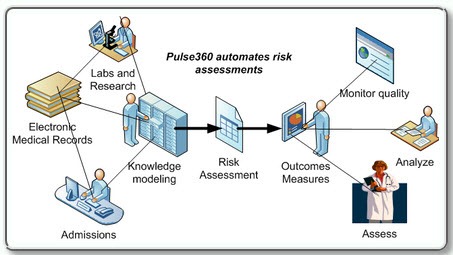
Readers Write: Students in the HIT Spotlight

February 1, 2013 Readers Write Comments Off on Readers Write: Students in the HIT Spotlight

Students in the HIT Spotlight
By Lisa Reichard RN, BSN

2-1-2013 5-28-37 PM

Inspiring! That was the word that ran through my mind when I heard that the HOSA team of Harris County High School, Hamilton, GA had won the second annual Student HIT Innovation Award at the Health IT Leadership Summit for its Type 1 diabetes mobile health app.

As a former pediatric nurse who has worked with children newly diagnosed with diabetes, I was thrilled to see an app that can aid in the education and training of newly diagnosed patients developed by 11th grade high school students. Best of all, right here in my own back yard.

In my experience, this can be an isolating disease with challenging daily management. According to the Center’s for Disease Control (CDC), Type I diabetes has spiked 23 percent among children, with a 21 percent increase in Type II diabetes also reported.

The student team from HCHS rose to the challenge and was chosen from 12 semifinalists followed by a final four selection. HIStalk Connect’s own Travis Good, MD was on the judging panel.

clip_image002

Left to right: Todd Bell, senior VP at Verizon; Brooke Grantham; Aleah Harris; Hank Huckaby, chancellor of the University System of Georgia; Christopher Keough; Brittney Wilkins; and Cheryl Batts, Harris County High School HOSA Advisor

I had a chance to chat with team member Christopher Keough to hear more about the experience.

How does your Type 1 Project app work and how does one download it?

Our Type 1 Project app has several links to choose from that provide general information about Type 1 diabetes, informational videos, a link to our website and Facebook page, and even a link to a carb counter. To download our app, search for “Type 1 Project” in the Google Play store, or to access it on your iPhone, visit type1project.conduitapps.com and just add to your home screen.

How will the app help kids recently diagnosed with diabetes?

We feel that kids would rather use a mobile application than receive information from a doctor or a book because most of them own some form of technology. Children and young adults can relate to how to best calculate the amount of carbs in food on the go with the link that we’ve provided through the app. They can also learn more about their condition through our website and the informational videos that we’ve provided.”

What are the plans for the product?

This mobile application started as a project for the Health IT Leadership Summit award, but we plan to keep it live for a limited time and try to make more users aware of the app through Facebook and other methods. We also plan to make ongoing improvements to the mobile application.

I also had the chance to ask Cheryl Batts, Keough’s advisor, how those of us in the health IT community can encourage students to foster future creativity in application development, and succeed in pursuing future IT careers.

“We can start in our classrooms,” she explained. “Last year, the health IT project was directed toward middle school students. Although an estimated 95 percent of students in my classes have cell phones, and this is where our mobile app can come into play, I believe many students have no idea what healthcare IT is. I know when I mention the number of job openings in Atlanta in my classroom, they all start thinking hard about it.”

“The mobile app we developed had a monetary award for our HOSA organization. HOSA, a national student organization, used to be an acronym for Health Occupations Students of America. However, it now stands for just Future Health Professionals. The chapter is for any student interested in a career in healthcare. The mission of HOSA is to enhance delivery of compassionate, quality healthcare by providing opportunities for knowledge, skill and leadership development of students. HOSA provides competitive events and leadership training at conferences that include knowledge and skill competencies through a program of motivation, awareness and recognition as part of the Health Science Education instructional program. Of course, these conferences cost money, so earning money for the organization helps reduce student expenses. The offering of scholarships is a big help to our students as well.”

Congratulations to Harris County High School on the receipt of this milestone award. Let’s all do what we can to support our local students. Who knows? We may start seeing more students demoing apps at trade shows. The future is looking bright!

Lisa Reichard, RN, BSN is director of business development of Billian’s HealthDATA of Atlanta, GA.

Comments Off on Readers Write: Students in the HIT Spotlight

Readers Write: It’s a Matter of “Over Promise and Under Deliver”

February 1, 2013 Readers Write 2 Comments

It’s a Matter of “Over Promise and Under Deliver”
By Mike Silverstein

2-1-2013 3-28-14 PM

As a recruiter in the healthcare IT industry, I attend HIMSS every year and make it a point to know what vendors are hot and what products and solutions are being purchased by the healthcare community. I am always shocked when I walk into the HIMSS exhibit hall and see massive booths of vendors I have never heard of. Even more shocking is the number of these massive booths that were at HIMSS the previous year but are not at this year’s show. I ask myself, “How does this happen?”

The answer took me to the biggest complaint I hear again and again when talking with hospital executives about their feelings toward vendors. It’s a matter of “over promise and under deliver.”

I am not using the over promise and under deliver adage when it comes to the performance of these seemingly fleeting companies’ products. Frankly, as a recruiter in this business, I have no idea what differentiates a good product from a bad one. The lens I look through is that of a search consultant who on occasion gets a call from one of these startup companies which has just received a considerable round of funding and is looking to recruit the top sales talent in the industry.

Their game plan is often the same: spend a bunch of money to hire salespeople who can go out and sell something, then hope something sticks and figure out the rest later. According to these same salespeople, the problem quickly becomes: (a) the product isn’t ready for prime time; (2) the company can’t implement what they sold; ( 3) they don’t get paid until go-live and it doesn’t look that’s going to happen in the next decade, so Mike, can you help me get out of here?

I recognize that the industry is primed for PE and VC investment. As a guy who makes a living by helping companies hire, I’m not going to complain. That being said, I think that the healthcare community could cut down on wasted IT spending, vendors could maintain better relationships with their customers, and I could cut down on the number of candidate resumes I have on my desk who took a chance on a startup. In fact, in the time it took me to write this piece, I received four more of these resumes in my inbox.

If everyone would more appropriately manage expectations and think about building an infrastructure and not just a sales team, the result would stop the over promising and under delivering circumstances.

Mike Silverstein is director of healthcare IT of Direct Recruiters, Inc.

Time Capsule: Put Down That Computer and Listen: Why Filling Out and Reading EMR Data Screens May Cause Doctors to Shortchange Patients

February 1, 2013 Time Capsule 2 Comments

I wrote weekly editorials for a boutique industry newsletter for several years, anxious for both audience and income. I learned a lot about coming up with ideas for the weekly grind, trying to be simultaneously opinionated and entertaining in a few hundred words, and not sleeping much because I was working all the time. They’re fun to read as a look back at what was important then (and often still important now).

I wrote this piece in May 2008.

Put Down That Computer and Listen: Why Filling Out and Reading EMR Data Screens May Cause Doctors to Shortchange Patients
By Mr. HIStalk

125x125_2nd_Circle

I’m a fan of an interesting learning concept called the Illusion of Knowing. Here’s what it says: you’ve read something carefully, sometimes more than once, so you’re confident you’ve mastered whatever it says. Later, however, when hard-pressed to put the information to good use, you blank out. You didn’t know it after all – you just thought you did because you had passively read it.

(Cue sweat-inducing college final exam dream. You couldn’t find the exam room, and when you finally did, you realized you hadn’t attended any of the classes … you know the rest).

Anyway, some Harvard doctors made me think of that with their recent NEJM report on EMRs. They question whether EMRs really improve care given their emphasis on creating reams of bland and predefined information, but with no capability to encourage fresh, individualized thinking to diagnose and treat patients.

(Note: I’m reading between the lines since the actual lines themselves require a NEJM subscription, which I don’t have because I’m cheap and they use a lot of big words when little ones would do fine).

The authors cite a doctor colleague who said that hunting for useful information in an EMR is like the Where’s Waldo? games of a few years ago. The kicker is this: that colleague is so frustrated with all the meaningless junk in EMRs that he makes index cards to track what’s important.

That’s where I thought of the Illusion of Knowing. A doctor could read all the EMR screens and figure, “Everything I need to know is right there, so if I study it long enough, I’ll figure out how to improve this patient’s life.” That’s EMR Nintendo: recognize and react to some event, which may seem like practicing medicine to a programmer since that’s how logically programming works.

Here’s a problem: doctors don’t have the time to conduct scavenger hunts for vital facts in the handful of minutes per encounter that the benevolent insurance companies and practice managers allow them.

Second problem: EMRs aren’t set up to allow automatic or manual grading of individual factoids, so everything looks potentially important.

Third problem: EMRs try to turn freeform and sometimes tentative thoughts into dropdowns and template-driven generic verbiage that may destroy their original context (that’s what programmers do: impose order and create retrievable database information, so it’s not really their fault).

Another article that was published at about the same time extols the virtues of speech recognition systems. Those create more voluminous and anecdotal information, but the context is perfectly preserved. Unlike discrete data, doctors could re-read a narrative and glean new information after the fact. Programmers hate bunches of text that don’t lend themselves to convenient database structures (although natural language processing can reverse engineer some of it back into data fields).

We in the industry could debate the merits of templates vs. narrative, but that discussion is moot. The real problem is medicine itself. A table of dry patient facts can help support diagnosis and treatment decisions, but even fresh-faced doctors know that patient care isn’t a video game of spotting a symptom and blasting it with drugs or surgery. The first thing they learn in medical school is not how to read charts or write orders, but to go into the patient’s room and look and listen. Sometimes the least-obvious information is the most useful.

Perhaps a redesign of EMRs is in order that takes semantics and metadata into account to better reflect the physician’s thought process and judgment rather than just trying to force those thoughts into a convenient data structure that looks good in a table and uses classification tools that say in black and white what might be better expressed in not just shades of gray, but in rainbows of colors. Or, maybe a well-designed study (not financed by EMR vendors, most likely) would find that chatty paper records lead to better outcomes than terse and categorized electronic ones.

The bottom line is this. EMRs have affected patient outcomes only modestly, if at all. If doctors still have to make index cards, maybe legacy EMR design should be revisited.

Morning Headlines 2/1/13

February 1, 2013 Headlines Comments Off on Morning Headlines 2/1/13

McKesson Q3 Profit Misses Estimate; Cuts FY13 Adj. EPS View

McKesson reports Q3 results: EPS $1.41 compared to last year’s $1.40, missing analyst estimates of $1.63. Revenue was up one percent, ending the quarter at $31.2 billion. The company lowered its guidance for FY 2013 by 20 cents, to $7.10-$7.30. The stock closed down 0.4 percent on the day.

Computer Programs and Systems, Inc. Announces Fourth Quarter and Year-End 2012 Results

CPSI reports year-end results, with revenue up five percent at $183 million. Net income increased 16 percent to $30 million, but EPS missed the $0.88 analyst estimate by $0.05 and shares dropped nearly nine percent in after-hours trading.

Clancy stepping down as AHRQ director

After 10 years on the job, Carolyn Clancy, MD, is stepping down as the director of AHRQ.

Piedmont Newnan transitioning to electronic medical record system

136-bed Piedmont Newnan Hospital goes live on Epic this Friday, the first within the five-hospital Piedmont Healthcare system’s network-wide implementation.

Comments Off on Morning Headlines 2/1/13

News 2/1/13

January 31, 2013 News 9 Comments

Top News

1-31-2013 5-38-58 PM

McKesson announces Q3 results: revenue up one percent, non-GAAP EPS $1.41 vs. $1.40, missing earnings expectations of $1.63 and guiding earnings slightly down for FY2013. Operating costs rose 10 percent, while technology solutions revenues were flat.


Reader Comments

1-31-2013 7-52-02 PM

From AphexTwin: “Re: Allscripts. Laid off five percent of its workforce (350 people) in testing and development roles. All remote development staff are being forced to relocate or be terminated.” An Allscripts spokesperson provided this response:

We internally announced the creation of R&D Centers of Excellence to enable us to better serve our clients, reduce complexity, and save costs. By making this move, we’re aligning with industry best practice and will be more agile in delivering results for our clients. Many team members will have the opportunity to relocate and some to work remotely. Unfortunately, there will be some team members whose positions will be adversely impacted, and they will be offered a severance package. In addition, we anticipate there will be Development jobs created in the North American locations with the majority of those in our Raleigh and Boston locations.

1-31-2013 7-59-22 PM

From The PACS Designer: “Re: iPad with Retina display. Apple keeps making the iPad more brilliant and powerful with the announcement of the iPad with Retina display. This new version also has 128GB of storage and a selling price of $799. The communications options now include both Wi-Fi and iPad with Wi-Fi+ Cellular as added features.”


HIStalk Announcements and Requests

1-31-2013 1-31-00 PM

Highlights from HIStalk Practice this week include: Epic, Allscripts, and eClinicalWorks accounted for 42 percent of all EP MU attestations through October, 2012. iPractice Group confirms that it has ceased operations. AMGA says it now represents 430 group practices and 130,000 FTE physicians. The HIStalk Practice Advisory Panel shares details of their practices’ social media policies and privacy and security measures. As always, thanks for reading.

On the Jobs Board: Director of Marketing, Epic Experienced Providers, Product Marketing Manager.

January, which isn’t quite over yet as I write this, will set an HIStalk record for the most monthly visits ever at 140,000, up 25 percent over January 2012.

1-31-2013 5-58-58 PM

Welcome to new HIStalk Platinum Sponsor VitalWare, a market leader in healthcare intelligence and regulatory compliance. The Yakima, WA company’s offerings include VitalView (ICD-10 planning and status between hospitals and vendors), VitalSigns (supports real-time retrospective coding to ICD-10 for starting efforts now to estimate impact on reimbursement and cash flow), VitalCoder (next-generation coding and revenue cycle resource), the just-announced CDM Navigator (charge master maintenance), and ICD-10 consulting and implementation. The company also offers VitalVendors, a vendor ICD-10 readiness rating system that’s part of the HIMSS ICD-10 Playbook. A guest post by Founder and CEO Kerry Martin provides a sobering update on the stage of vendor readiness for the October 1, 2014 ICD-10 compliance date. Thanks to VitalWare for supporting HIStalk, which thanks to its support will be fully ICD-10 ready.


Acquisitions, Funding, Business, and Stock

CommVault announces Q3 numbers: revenue up 24 percent, non-GAAP EPS $0.39 vs. 0.27.

Aetna announces Q4 numbers: revenue up 16 percent, EPS $0.56 vs. $1.02.

1-31-2013 7-53-01 PM

CPSI announces Q4 results: revenue up 14 percent, EPS $0.83 vs. $0.59, falling short of consensus estimates of $0.88. Shares are down nearly nine percent in after-hours trading.


Sales

1-31-2013 5-09-37 PM

Wenatchee Valley Medical Center (WA) and Central Washington Hospital select NextGate’s EMPI and provider registry systems.

Huron Valley Physicians Association (MI) chooses eClinicalWorks EHR for its 600 providers.


People

1-31-2013 5-11-06 PM

AHRQ Director Carolyn Clancy, MD announces plans to step down.

1-31-2013 5-20-26 PM

API Healthcare expands General Counsel Hayden Creque’s role to include vice president of human resources.


Announcements and Implementations

The VA completes integration and testing between VistA and Authentidate’s Electronic House Call and Interactive Voice Response telehealth systems.

1-31-2013 5-12-14 PM

The 24-bed Melissa Memorial Hospital (CO) completes implementation of its EMR.

1-31-2013 5-14-12 PM

Piedmont Newnan Hospital (GA) goes live this week on Epic.

Welch Allyn will distribute the EarlySense proactive patient care solutions to US hospitals.

1-31-2013 3-28-53 PM

Good Samaritan Hospital (NY) goes live on Epic March 9.

1-31-2013 3-30-19 PM

The University of California at Irvine uses the dbMotion interoperability platform to connect with  the Orange County Partnership RHIO.

Quantum Health integrates the Healthwise Care Management Solution into its Patient Information Virtual Integration Tool to provide real-time healthcare education to its members.

Stellaris Health Network (NY) goes live on PatientKeeper Charge Capture at five of its clinical practices group.


Government and Politics

The VA enhances Blue Button to give patients access to their Continuity of Care Document and the VA’s OpenNotes provider documentation.


Innovation and Research

1-31-2013 7-31-36 PM

A University of Washington graduate student develops FoneAstra, an Android phone app that monitors the pasteurization of donated breast milk. It’s being tested in South Africa. Other versions are used to ensure that vaccines remain refrigerated in developing countries.


Technology

1-31-2013 7-54-51 PM

Lt. Dan summarizes what the BlackBerry10 announcement means for mHealth and healthcare on HIStalk Connect.

University of Missouri-Kansas City’s Innovation Center will launch the partially federally funded Digital Sandbox KC IT accelerator on Friday, with officials from Cerner and other businesses on hand.


Other

Fifty-seven percent of Canada’s primary care physicians are using EMRs, which is almost double 2006’s adoption rate. Almost half routinely e-prescribe compared to 11 percent six years ago.

KLAS and EHI, a UK-based HIT research firm, partner to improve transparency and performance measures for the UK health technology market and to cross-market their research products.

Michael Dell’s family foundation donates $50 million to build Dell Medical School in Austin, TX.

The Minnesota Supreme Court rules that calling a doctor “a real tool” on a doctor rating site is protected speech.

1-31-2013 6-54-01 PM

Here’s an example of how technologically backward healthcare is. A body shop in Canada has been receiving faxed medical information for three years because its fax number is one digit different from that of the local health center. Says the body show owner, “In this day and age, why are they still using fax machines? It seems odd to me.”

I’m fascinated that this happens regularly in India. Twelve angry relatives of a teen who died after a bicycle accident trash the ICU and beat doctors and security guards. Medical residents then go on strike to demand better security and the arrest of the family members, which requires patients to be diverted and surgeries to be cancelled when only 20 doctors remain to care for 300 inpatients.

WNA thinks a hospital parody video makes him wonder whether ACO stands for Abridged Care Organization. Fox Business News says the video “mocks how health reform can make more money for doctors and hospitals” by showing staff blocking the admissions department door, handing out stacks of cash, and giving free laptops to employees. I didn’t see it that way – it looked like fun way to get the ACO idea across to otherwise learning-indifferent employees. The hospital says the video was a contest winner. Fox claims the video was “leaked,” which apparently means “posted to YouTube under the hospital’s name and still there but copied to Fox’s servers and covered with self-promoting graphics to make it look like the result of crack investigative reporting.”


Sponsor Updates

  • ESD joins ANIA as a Gold Level member.
  • dbMotion hosts a February 7 seminar in Dallas on connecting communities through clinical integration.
  • Laura DeBusk from White Plume Technologies will co-present an ICD-10 session at the Becker’s Hospital Review Fourth Annual Meeting in Chicago in May.
  • 2012 highlights for Aspen Advisors include the addition of 26 clients and the development and deployment of a population HIT planning methodology, a data governance maturity model, and an EHR value realization maturity model.
  • DynaMed showcases how Memorial Hermann Healthcare System (TX) utilizes technology to allow physicians to practice evidence-based medicine in a journal article.
  • Emdat Mobile usage has quadrupled from January 2012 with the rapid adoption of smartphones.
  • Lucca Consulting Group posts new client, consultant, and trainer testimonials on it website.
  • Macadamian CEO Frederic Boulanger says he is impressed with the new BlackBerry 10 and the company has developed 10 apps for it.
  • Truven Health Analytics announces that staff members Eboney White and Jillian Thomas have been presented with the unique credential of Accredited Health Care Fraud Investigator.
  • CareTech Solutions added five Service Desk clients in 2012 and experienced a 75 percent uptick in the use of its help desk services overall.

EPtalk by Dr. Jayne

Earlier this month, Virginia Senator Stephen J. Martin introduced SB 1275, “Medical data in an electronic or digital format; limitations on use, storage, sharing, & processing.” As a medical informaticist, all I can ask is what was he thinking? It would prohibit anyone who stores medical data in an electronic or digital format from participating in the Nationwide Health Information Network; performing analysis or statistical processing on medical records for purposes of diagnosis or treatment, including population health management; processing medical data within Virginia where a majority of the patients do not live in Virginia; and storing data on more than 10,000 patients in a single database, It also prevents providers who refuse to implement EHRs from being penalized and prohibits Virginia from authorizing or operating a health information exchange. I’d be interested to hear from anyone in Virginia who can tell us more about what’s really behind this besides anti-ARRA posturing. It’s been sent to committee where it will likely die, but still makes for good cocktail party conversation (at least among HIT folks).

It’s about time: Medicare will look at the facility fees charged by ambulatory medical practices. Many feel that these hospital-owned practices are driving up the cost of health are with this billing practice. Many of the groups in my area are now doing this. It’s not only annoying, but also feels dishonest.

Lots of buzz this week about the HIPAA update and the impending September compliance date. Looking forward to reading hundreds of pages of fun during my free time, whenever that is.

Although I thankfully don’t have any direct reports, before our recent hiring freeze I was often asked to interview potential employees for other managers. I’m going to keep this list of bizarre interview questions tucked away for when administration figures out we’re dangerously short-handed on some of our teams.

clip_image002

Bad news for Inga: an increasing number of young women are having issues with their feet that require surgery. Some blame is being placed on genetics, but the phenomenon is at least partially attributed to high heels and pointy-toed shoes. She’s always telling me I’m too conservative in the shoe department, so maybe for HIStalkapalooza I’ll be more inspired this year.

Print


Contacts

Mr. H, Inga, Dr. Jayne, Dr. Gregg, Lt. Dan, Dr. Travis.

More news: HIStalk Practice, HIStalk Connect.

Text Ads


RECENT COMMENTS

  1. RE the AI GLP1 company, Washington Post has an article today by someone who used one of those compounded products,…

  2. Re: A chief health AI transformation officer (CHAITO) I predict a position evolution along the following lines. "We have too…

  3. To take the counterpoint to the "don't just schedule more visits" argument - it depends on if you're looking at…

  4. Aaand, 4th to last graf, 1st sentence, not a distance, so you would go further, not farther.

Founding Sponsors


Platinum Sponsors


Gold Sponsors


RSS Webinars

  • An error has occurred, which probably means the feed is down. Try again later.