Recent Articles:

Morning Headlines 3/6/14

March 5, 2014 Headlines Comments Off on Morning Headlines 3/6/14

Kaiser Permanente board member quits amid questions over conflicts

Dr. Christine Cassel, chief executive of the National Quality Forum, quits her board positions with Kaiser Permanente and Premier Inc. after ProPublica reported that she was being paid a cumulative $400,000 for her advisory role with the companies.

Defense Health Agency Wants More Money For IT Operations In 2015

The DHA has requested $1.6 billion to support operations and maintenance of its health information management systems in 2015, seven percent more than its 2014 budget.

Obama’s Budget for 2015: 10 Points for Hospitals Know

Becker’s Hospital Review evaluates President Barak Obama’s 2015 budget proposal, highlighting Medicare payment reforms, critical access hospital reimbursement changes, and increased funding for Medicaid/Medicare fraud detection programs.

US health information breaches up 137%

More than seven million health records in the United States were affected by data breaches in 2013, an increase of 137% over the previous year, according to the annual breach report..

Comments Off on Morning Headlines 3/6/14

Readers Write: The Data Problem

March 5, 2014 Readers Write Comments Off on Readers Write: The Data Problem

The Data Problem
By Randy Thomas

image

Dr. Jayne asked important questions in her Curbside Consult about big data, EHR conversions, the “sheer magnitude of bad data out there,” and how best to insure the integrity of health data.

The best way to address the issue of bad data is to follow the old adage,“Begin with the end in mind.” Implementing an enterprise-wide EHR is a massive, complex undertaking. It involves considering the needs of many stakeholders when defining the build requirements. For example, workflow must support ease of use and not interfere in patient care delivery and related work processes. Furthermore, many implementation decisions focus on driving clinician adoption to ensure that both quality and efficiency objectives are met (not to mention regulatory requirements related to Meaningful Use.)

With all the multi-threaded work streams and decision processes involved in planning and executing an EHR implementation, the re-usability of captured data frequently falls out of scope. That leads to the bad data problem.

Re-usability means using data captured in any source system (EHR, ADT  materials management, patient accounting, registration, operating room, emergency department, etc.) for reporting, measurement, and analytics. Re-using the data captured in these source systems accelerates the value realized from implementing such systems and supports a virtuous cycle of performance improvement across an enterprise.

It all relates to, “You can’t manage what you don’t measure.” That is, you can’t measure something if you don’t have the right data. This leads back to the decisions made in implementing EHRs and other systems. You need to start with what data is required to measure and analyze what’s important to the organization and ensure that data can be consistently, reliably, and accurately captured at the point of origin (e.g., at registration or in the care process).

It’s not realistic, however, to expect that every bit of data about a patient should be captured in a discrete form for re-use. What’s required is a balance between supporting ease of use in the appropriate workflows and the availability of data for reusability.

An effective way to strike this balance is to create a list of data elements the organization agrees is necessary for analytics. Some detective work is required: tracing the journey of that data back to the source system and ensuring that each data element is captured as expected in the intended workflow. This requires collaboration across a multi-disciplinary team — one involving experts in quality reporting, data analysis, and clinical (or operational) workflow.

The inventory of data elements can be used to identify where each data element can be captured in the source system (e.g., EHR, ADT, etc.). This is the “data chain of trust.” Team discussion and compromise are required to design workflows that both support ease of use and capture data reliably and consistently.

With a documented inventory of data elements married to how that data will be captured in the source systems, data can start flowing into an analytics environment. Applying sound data governance principles and implementing a data profiling discipline will ensure data consistency and reliability.

Organizations don’t have to begin with a large set of discrete data, but they must recognize that any level of measurement, reporting, and analytics requires consistent, reliable, accurate data starting at the point of capture in the source systems. They should begin with the data most important to each organization and ensure that data can flow from origin to analytics in a chain of trust that is known and transparent.

From there, health systems can incrementally increase the available data as they come to understand why it’s important to capture data discretely and accurately and as more stakeholders benefit from access to that data. With the increasing value realized comes the understanding that, “It’s all about the data.”

Randy Thomas is associate partner of health analytics with Encore Health Resources.

Comments Off on Readers Write: The Data Problem

Lorre’s HIMSS Conference Summary

March 5, 2014 News 4 Comments

2-25-2014 5-30-55 AM

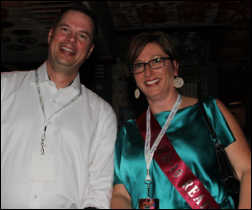
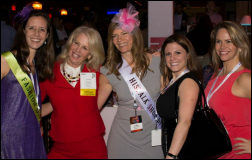
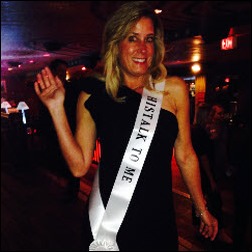
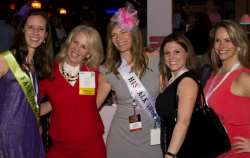
Last week as I was staring into the House of Blues stage lights at HIStalkapalooza wearing a gown, high heels, and a sash reading, “HIStalk To Me,” I was struck by how different it was from any other job I have had. I had to pause for a moment to remember how it all happened. Twenty years ago I was a mining industry accountant and usually wore steel-toed boots and a hard hat. That seems like another lifetime now.

A seemingly random opportunity landed me in healthcare IT, where I have been for 18 years. I worked for vendors in operations leadership and business development. I have an MBA and I am an LSS Black Belt. I thrived on the never-ending challenges, non-stop travel, and endless demands for my time.

Finding myself on stage with this dream job was the culmination of a whirlwind of recent events, too many to list. I love working with the HIStalk team and I know I am in an enviable position.

HIMSS14 started for me at the beginning of September. I had just joined the HIStalk team when I met with Mr. H and Inga to discuss my role. We already agreed I was going to be responsible for the webinar program and HIStalkU, but we knew that I as the only non-anonymous member of the team could do more.

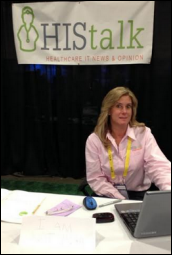
We talked about trade shows in that September meeting, but it wasn’t until the mHealth Summit offered HIStalk a free booth as a media partner that we decided to try it since we had nothing to lose other than time and travel expenses. I have been to HIMSS and AABB many times and worked in the exhibit hall. I showed up at our impressive vendor booth and stood around talking with customers and prospects all day. How hard could it be to create a micro version of that for HIStalk?

12-9-2013 5-06-45 PM

We considered mHealth Summit a trial run for HIMSS and decided to go with the bare minimum. I had never furnished a booth and the logistics are daunting. I learned that nothing comes with the booth. Mr. H and I debated about whether there would be a table at the front of our booth and decided to wait and see. We didn’t have any giveaways.

When I finally found our booth the morning before the exhibit hall opened on a snowy December day outside of Washington, DC, there was only a tiny patch of green carpet holding a chair and a trash can. There was no table or separation wall. Fortunately I was able to rent a table with a skirt and it was delivered in plenty of time. I had amazing booth neighbors who helped me hang our banner and they even let me use one of their power outlets.

There were 400 exhibitors and 5,500 attendees at mHealth. I was pleasantly surprised by how much booth traffic we generated. We weren’t selling anything or giving anything away. I was there to say thank you for reading and thank you for sponsoring, nothing more. There was a steady stream of people each day even though the conference doesn’t draw our core reader demographic. I met writers who later contributed to HIStalk and a few people interested in sponsoring. The best part was how much people just wanted to say hi and express their dedication to HIStalk. I was convinced a booth at HIMSS was a must-do.

HIMSS is a much bigger deal when compared with mHealth with 1,230 exhibitors and 37,000 attendees. It was painful trying to choose one of the available booth locations, all on the fringe and all seemingly uninteresting, but we did. We learned a lot from the mHealth Summit and acted on some great ideas for inexpensive booth signage.

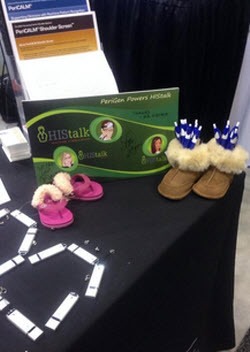
image image image

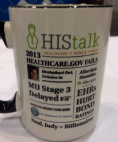
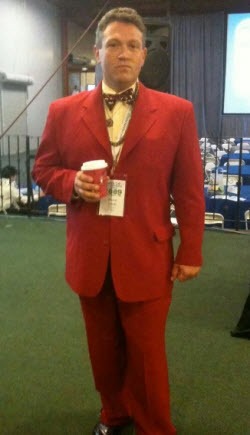
Our giveaways were simple but fun. We designed two lanyard pins, one to commemorate the 10-year anniversary of HIStalk this past June and the other representative of our first HIMSS conference as an exhibitor. We had coffee mugs printed with the top HIT news stories of 2013 according to HIStalk. They turned out to be a hit, and even readers who didn’t attend the conference have asked for the pins and the mugs.

When I visited the exhibit hall Sunday afternoon, I was shocked to find it far from ready for the next day. Some of the giant booths looked only half built, debris was everywhere, and forklifts raced dangerously back and forth. I couldn’t imagine everything being ready in time to open the hall at noon on Monday. I wanted to deliver the HIStalk sponsor booth signs, but the hall was such a mess and the odds of being struck by a forklift were so high that I decided to wait.

I hosted a cocktail reception for our sponsors Sunday evening. It went smoothly and everyone said they had a great time. I met a lot of interesting and energetic people and I was impressed by their obvious affinity for HIStalk. Dr. Gregg was on hand to assist me and Inga and Dr. Jayne spent some time there (anonymously, of course.) Even Mr. H made a quiet appearance, after which he left just as quietly.

Monday morning I arrived at the exhibit hall early and raring to go. I had to hustle to cover every square foot of the exhibit hall, my arms loaded with signs. Thankfully Dr. Gregg was there, too, and when we realized I was running out of time, he helped me get it done. According to my Fitbit, I exceeded my 10,000 steps/five miles goal before 10 a.m.

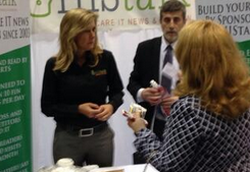
Our little booth was quite a way from the major thoroughfares, so I was surprised by the immediate flow of visitors when the exhibit hall opened. It was consistent throughout the show. Countless readers and sponsors stopped by to say hello and to tell me how much they love HIStalk. We had even heavier traffic when one of our VIP guests (Ed Marx, Vince Ciotti, and Robert Murphy, MD) greeted their fans in our booth.

image

Once again, Dr. Gregg was a life saver. Not only did he help me with the booth setup and delivering the signs, he gave me breaks throughout each day so the non-stop visitors wouldn’t be disappointed to find an empty booth. Mike Cannavo (“The PACSman”) was also a blessing. He covered the booth, brought me lunch, and kept our swag collection current. The number of people visiting our booth was so remarkable that someone in the booth next to ours asked, “What are you selling?” I smiled when I replied that we are selling nothing — we are just saying hello and thank you.

image_thumb66

There was so much fun on and off each day that it would be impossible to mention it all. My top 10 are:

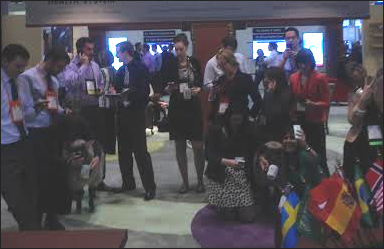
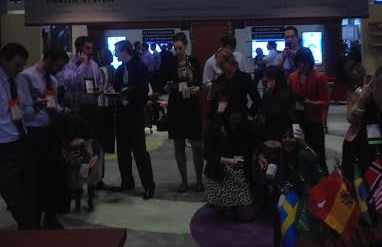
  1. Working with the people in the Epic booth to stage a picture of them looking at their cell phones
  2. Watching people apply temporary tattoos to the strangest places (Ed Marx takes the prize for his lower back tramp stamp)
  3. Arriving at the booth one morning to find a box of warm scones from MedData
  4. Handing out the HIStalk sponsor booth signs and seeing how everyone lit up
  5. Chatting with Ed Marx, Vince, and Dr. Murphy
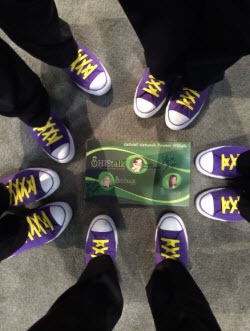
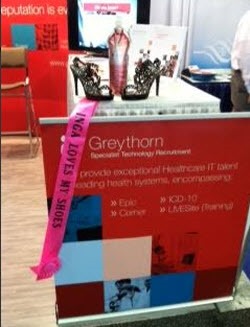
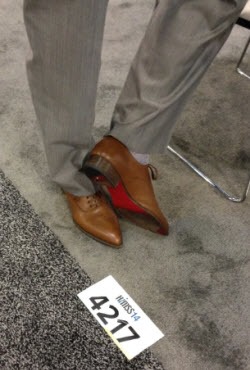
  6. Seeing the women who stopped by to show me their shoes
  7. Having Inga, Dr. Jayne, and even Mr. H stop by the booth without anyone realizing it except me
  8. Receiving my own copy of Struck by Orca
  9. Trying on a Super Bowl ring
  10. Receiving countless comments and compliments and passing them along to the team

I reconnected with many colleagues and customers from the past. I receive e-mails regularly from people who see my LinkedIn profile and wonder if working for HIStalk is a real job. Talking with them wasn’t any different. Yes, it is a real job, although it is fun and exciting and it doesn’t usually feel like work. I love to chat with readers and sponsors and work on webinars. I get a lot of satisfaction from helping them develop and deliver interesting and educational productions.

image

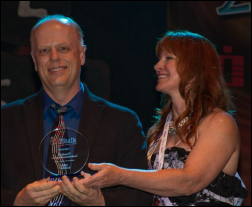
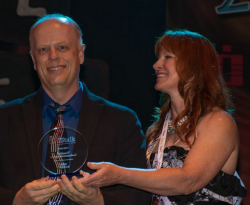
The event that was a personal stretch for me came when Mr. H asked me to accept HIStalk’s “Sunquest Industry Pioneer Award.” In my 16 years working for Sunquest, I received many opportunities to learn and grow and I almost always loved it. The same team presenting the award fired me two years ago. I can almost hear the collective gasp — why would I admit something like that publicly, and in writing no less? Let’s face it — we are all one merger, acquisition, unattainable goal, or difference of opinion away from being redundant or no longer a fit for the position. It isn’t personal. I showed up at the booth and everyone was friendly and warm. The HIStalk team stood within earshot and watched proudly. I thanked Sunquest not only for the award, but for their support and sponsorship of HIStalk. It was closure and it felt good.

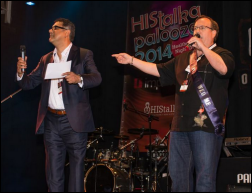
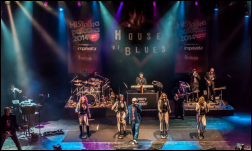
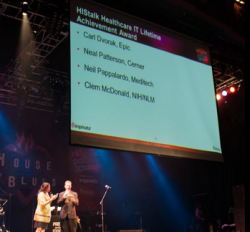
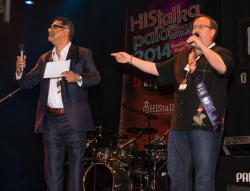
Participating in the planning of an event like HIStalkapalooza was a whole new experience for me. Since the sponsor is responsible for it, it should be easy for the HIStalk team, right? No way! There is constant back and forth interaction and negotiation. It isn’t easy to strike a balance between what our readers and sponsors expect and what the sponsors of the event think they should get out of it. It was both frustrating and fun to be part of it. I learned a lot, along with everyone else, and I’m sure next year will be better because of it. The event itself was a huge success. The HISsies were entertaining and Farzad, Carl, and Ed all made an appearance to accept their awards. The food was terrific and people raved about the band for days afterward. Imprivata and all of the co-sponsors did a great job.

HIMSS14 was great for me. I met a lot of terrific people, I gained a whole new appreciation for those responsible for planning events, and I had fun. I am already thinking about what to do next year in Chicago.

image

Email Lorre or follow her on Twitter.

Morning Headlines 3/5/14

March 5, 2014 Headlines Comments Off on Morning Headlines 3/5/14

FCC Chairman Announces New Connect2Health Task Force

FCC Chairman Tom Wheeler announces the formation of a new task force that will work to accelerate the adoption of health care technologies by leveraging broadband and other communications services.

Association Between Participation in a Multipayer Medical Home Intervention and Changes in Quality, Utilization, and Costs of Care

JAMA publishes a study following the performance of a Patient Centered Medical Home from its launch in 2008 through 2011, and concludes that participation in a PCMH does not directly correlate to reductions in utilization of hospital, emergency department, or ambulatory care services or reductions in total costs of care over three years.

Wake Forest Baptist’s operational revenue rises in second quarter of fiscal 2014

Wake Forest Baptist’s chief financial officer credits reduced expenses related to its Epic implementation in part for its financial turnaround. The medical center reported a loss of $23.5 million, an improvement compared with a loss of $49.8 million for the same period in the previous year.

Castlight Health amends IPO filing, hopes to raises up to $140 million

Castlight Health has updated its February IPO filing to reflect that it plans to sell between 11 million and 12.6 million shares of common stock for  $9 to $11 per share, bringing the total it hopes to raise to $140 million.

Comments Off on Morning Headlines 3/5/14

News 3/5/14

March 4, 2014 News 7 Comments

Top News

image

FCC Chairman Tom Wheeler announces the formation of a task force that will seek ways to increase use of broadband to deliver telehealth, mobile apps, and telemedicine. Heading up CONNECT2HEALTHFCC will be Michele Ellison, a lawyer who runs the agency’s enforcement bureau. Wheeler said in the announcement, “We must leverage all available technologies to ensure that advanced health care solutions are readily accessible to all Americans, from rural and remote areas to underserved inner cities. By identifying regulatory barriers and incentives and building stronger partnerships with stakeholders in the areas of telehealth, mobile applications, and telemedicine, we can expedite this vital shift.”


Reader Comments

From Just Tim: “Re: MU stages beyond stimulus payments. What is the legislative basis to extend the MU program? MU requirements were supposed to run in conjunction with years in which payments were made, not years after penalties kick in. I’d certainly agree that if someone never got to Stage 3, they could reasonably be penalized on an ongoing basis. Otherwise, we’ve just created a large bureaucracy with the power to continue to push unfunded mandates.” Legal scholars and political junkies, the less legislative among us are calling.

From Dim-Sum: “Re: military EHR replacement. Word on the street is that the vendors of choice and partners are as follows. Six service integration (SI) firms will bid Epic. The team that is getting the most news is Leidos/Accenture/Harris. Cerner has a single exclusive SI partner (still doing research to see who that SI is). Allscripts cannot find a partner for their Sunrise. Meditech has the incumbent Northrop Grumman. McKesson walked away from GDIT/Vangent. Siemens has a yet to be named DoD giant. Competitive bids will require an investment by prime and sub software solution firm of about 1.5-2 percent of the total contract value. That means that to win a $5B deal with the DoD, the investment for resources, capabilities, compliance, and regulatory wherewithal (see FISMA, FedRAMP, DIACAP, 508, JITC etc) is $50 million USD. Good Luck beltway bandits and COTS EHR dreamers.” Unverified.

image

From Brenda: “Re: Washington’s insurance exchange. Add it to the list of those having issues. By the way, I’ve recommended HIStalk to countless people and I’m glad our company has been a sponsor for about a year now.” The Healthplanfinder exchange has 15,000 applications that are stuck because the user-entered information can’t be matched to the state’s Medicaid benefits database or contain incomplete information (hello, programmer edits?) I speculate that the state incurred the wrath of the grammatical gods when it combined “health plan finder” into a single word.  

3-4-2014 12-52-43 PM

inga_small From Charger: “Terrific correspondence from Orlando; much appreciated since I could not attend! I’m sure you have been deluged with coffee mug requests and are out of stock, but may I place an order for one upon receipt of any new inventory? I will gladly swap you one of my local Karl Strauss Brewery pint glasses in return.” Thanks for the generous offer, but sadly all the coveted coffee mugs are gone. Lorre and I are trying to convince Mr. H that the timing is perfect for the opening of an online store featuring HIStalk swag. Beauty queen sash, anyone?

image image

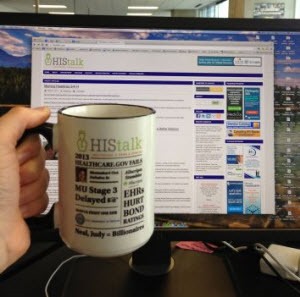
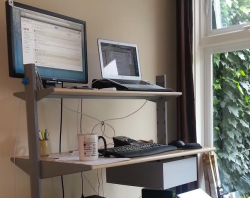
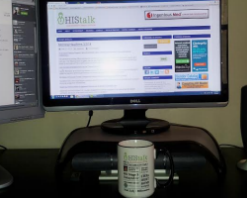
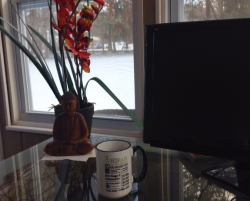
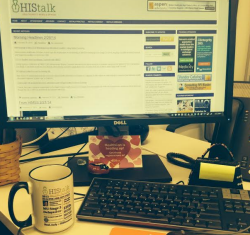
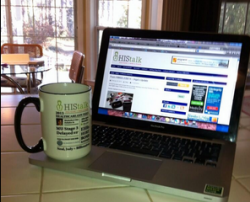
More mug sightings: Investor’s Chair contributor Ben Rooks, who obviously works standing up while looking at green ivy outside his San Francisco office; and Mike Jefferies of Longmont United Hospital, whose Spotify-HIStalk two-monitor setup looks a lot like mine. I still have a few more photos to run next time.

image

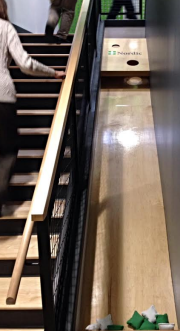
From Dr. Travis: “Re: Nordic’s new office. Thought this was very cool.” I had to clarify with Travis since this is a Midwestern, tailgating, and college thing that much of the country won’t understand: it’s a cornhole platform.  

From Ion Exchanger: “Re: HIMSS booth. You had traffic in your booth back in the hall. You should get another exhibitor to give you space free in return for drawing people.” That idea has come up on occasion, although not usually from people offering space. Our first-time exhibitor experience was good, especially since it was a low-rent, homebrew operation designed solely to give Lorre a way to say hello to interested readers and sponsors. I think I’ve decided to do it again in Chicago.

image

From Dr. Matt: “Re: QlikView. First there’s an Epic partnership and now I find at HIMSS that Health Catalyst offers QlikView on top of their data warehouse. Why are these big players using it?” I’ll let those organizations speak for themselves.

From Doctor N: “Re: HIMSS conference. It was my first one. Only the HIStalk people made me feel valued as a practicing physician. The insults, lack of humility, time away from my clinic, and the lack of vendor understanding of how medicine really works will keep me from returning soon. The sessions could have been done online and the networking conversations were shortened because everyone was in a hurry to get somewhere else. I believe I have seen the American medical industrial complex at its worst. I was surprised at the number of vendor folks who are physicians and how little they know about how we pay for healthcare: SGR (which will worsen matters for providers) and $156 billion being cut from Medicare Advantage plans. They have no clue that I’m not paid for population health and most docs in my community hardly even know the meaning of the term. It is like we are buying the horseshoe, barn, and saddle in the hope that we’ll get a horse for a present. HIStalkapalooza, however, did not disappoint!”

image

From Spelling CMIO: “Re: a tech solution to HIT spelling problems. As technology professionals, we ought to be able to bring our expertise to bear on the current plague of spelling confusion. I suggest we start to use regular expressions, like: HIM*S* and HIP*A* so that all variants can be brought under the welcoming umbrella of mediocrity. Heck, we could even bust out CM*S to obscure the failure to include ‘and Medicaid’ in the name of our favorite bureaucracy. We could even try E[Pp][Ii][Cc] to free the caps-lock crowd from their yoke of humiliation.” Scanning for “HIMMS” news stories turns up 56, which is pretty sloppy.

image

From Frank Poggio: “Re: ONC. Issued new 2015 test criteria while at HIMSS last week. They kept repeating that this new (and extensive at 242 pages) test criteria is ‘voluntary’ for vendors. Here comes another wolf in sheep’s clothing. Do you really think the 2015 Criteria will be ‘voluntary’? How can they generate a revised list of criteria that fixes bugs and not make it required? How can they add something critical to patient safety such as UDI and not make it required? Breaking out CPOE components has been something niche vendors have been asking for since the start. So will those vendors ignore it and stick with 2014 criteria? I have worked through dozens of tests with clients since the inception of ONC and every time they expand or make a test update it soon becomes mandatory by the authorizing testing labs … and with some ATLs sooner than others. I give the 2015 version at most four months before it becomes mandatory.”


HIStalk Announcements and Requests

Listening: new from the all-female, LA-based spacey rock quartet Warpaint, which sounds a bit like Cocteau Twins (and that’s a good thing). I’m also enjoying defunct, brilliant Irish pop band The Thrills.

Some random thoughts I had regarding the HIMSS conference:

  • I was surprised and happy that the vendors of much-hyped analytics and population health management products were restrained in their pitch. Many companies talked about those products, but I didn’t hear a lot of wild claims.
  • The terms “big data” and “cloud” weren’t repeated reverentially and annoyingly to the extent that might have been expected.
  • What is population health management, exactly? It will be whatever payers say it is, no different than “quality.”
  • I’m not impressed with “big data” when healthcare is woefully indifferent to “little data.” We ignore evidence-based medicine, warnings for inappropriate or duplicate tests and drugs, and quality measures. We are sloppy about monitoring our supply chain and controlling our labor and materials costs. We pay little attention to the free exchange of information we hold about patients. We don’t like the idea that patients themselves should see our digital secrets. We should be using the information we have to its fullest before trying to tackle giant databases containing even more insights that we’ll ignore. Speak up if your hospital is different.
  • I’m not sure if patient engagement was just a token HIMSS nod or a real movement. I don’t see stretched providers getting excited about engaging patients unless government or competitive pressures force them to. It was nice to see patient advocates at the podium, even if only sporadically.
  • People are beginning to realize that EHRs aren’t necessarily the center of the universe. Small vendors are creating specific applications that use the EHR, which makes them easier to develop, cheaper, easier to use, and easier to buy since any buyer’s remorse will be several zeroes cheaper than the EHR itself. A question to ask of the dwindling number of EHR vendors might not be what their system does, but what does it allow to have done by other sources? Those companies were in the hall.
  • The government has taken a lot of innovation out of the system with Meaningful Use and ICD-10. I said from the beginning that taking MU money means making the federal government your incessantly nagging partner, but with penalties following rewards it wouldn’t have mattered anyway. I got the sense that attendees were more interested in what HHS and ONC say than what vendors were telling them.
  • Financial uncertainty as well as a big implementation and optimization ramp-up business has increased the willingness of providers to pay a premium to use consultants since they don’t want to get locked into salaried employees for specific short-life tasks. Consulting companies seemed to be generating a lot of interest.
  • Hospitals, like every swollen, inefficient, and political bureaucracy, will do whatever it takes to protect their own interests. They have money and clout and they aren’t just going to happily reduce their profits, headcount, or ambitions to reduce overall healthcare spending. Integrating their acquisitions will be a target market.
  • HIMSS is always like a boat show, but this year I’m not sure many boats were sold.

Acquisitions, Funding, Business, and Stock

image

Telus Health acquires Med Access, a British Columbia-based vendor that claims its EMR is #1 in Canada with 4,000 users.

image

Clinicient, a provider of RCM and clinical solutions for rehabilitation therapy, raises $15 million in Series C funding from Catalyst Investors and names Rick Jung (Medsphere) chairman and CEO.

Castlight’s IPO could raise up to $140 million based on a revised filing made this week.


Sales

image

PatientPoint awards Xerox a $28 million contract to work with hospitals and physician practices to introduce PatientPoint’s digital check-in and population health management software and to provide training and support.

Denver Health selects Besler Consulting to assist in the identification of Medicare and Medicare Advantage Transfer DRG underpayments.

3-4-2014 1-04-18 PM

UCSF Medical Center will implement Oneview Healthcare’s patient empowerment program at three Mission Bay hospitals.

The University of Miami Health System selects Lockheed Martin to manage its healthcare data, develop predictive models for risk identification, and build automated systems to give providers data at the point of care.

Florida International University’s faculty practice chooses PatientKeeper Charge Capture.

Citizens Medical Center (TX) selects MModal for transcription services and front-end speech recognition.

West Florida ACO will implement eClinicalWorks Care Coordination Medical Record.

image

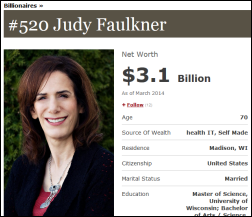
Forbes names Epic’s Judy Faulkner as #520 on its list of “The Richest People on the Planet,” estimating her net worth at $3.1 billion.


People

image

Accretive Health appoints Patrick Funck (Segwick) SVP/CIO.

image image

HCI Group names Bill Bria, MD (Shriners Hospital for Children) as CMIO and Robert Steele (Sterling Healthcare Initiatives) as SVP of delivery operations.

image image

Greater Houston Healthconnect CEO Jim Langabeer, PhD resigns to return to his previous employer UT Health Science Center, with CTO Phil Beckett, MD named acting CEO.

Carolinas HealthCare System hires Nancy Olson, RN-C, MBA, PhD (Providence Health & Services) as its first chief nurse informatics officer.


Announcements and Implementations

inga_small WEDI, in partnership with EHNAC, will create a Practice Management Accreditation Program to review PM vendors in the areas of privacy, security, mandated standards and operating rules, and operational functions. While I am all for having minimum performance standards, is this really the best time to ask vendors to jump through one more hoop to remain competitive in the marketplace? It’s no surprise that we are seeing limited advances in product usability and innovation.

image

The local business journal profiles St. Francis Hospital (CT), which goes live on Epic next month following a two-year, $120 million transition. Above is VP/CIO Linda Shanley.

Summit Health (PA) implements Wellcentive’s population health management solutions and services.

3-4-2014 1-13-58 PM

Ontario’s Group Health Centre goes live on Epic.

Wellmont Health System (TN) transitions to Epic in its physician offices and hospitals.

image

North Oaks Medical Center (LA) goes live with a two-way interface between Epic and the Masimo Patient SafetyNet remote monitoring and clinician notification system.

GetWellNetwork debuts GetWellNetwork Ambulatory, which is available on mobile and stationary devices and integrates with EHRs to provide personalized information, healthcare tools, and patient pathways.

image

CoverMyMeds launches an API that enables providers of EHRs, e-prescribing systems, and PM systems to offer an NCPDP standards-compliant electronic prior authorization solution.

John Gomez launches Sensato, which will offer healthcare privacy and security assessments, guidance, and tools.

image

UC Irvine Health deploys WANdisco and Hortonworks Hadoop data technology to provide real-time information for patient care. They run Allscripts Sunrise, I believe, and an unnamed data warehouse technology described in the announcement as one that “struggles with availability issues as well as the volume and variety of data it can handle.”


Government and Politics

inga_small The FDA is seeking a contractor to monitor social media chatter about drugs, medical devices, and other regulated products in order to track conversation shifts following FDA warnings. I found this move especially interesting in light of the heavy Twitter traffic during HIMSS and my realization of  the potential value of mined Twitter data. Now I’m wondering if anyone has figured out a way to combine data from social media chatter with old-school opinion polls from phone and mail surveys. That could be powerful.

ONC releases additional draft electronic clinical quality measures for review and testing for the possible inclusion in the MU and other federal programs.

image

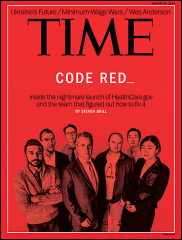
The front-page story of the March 10 issue of Time says that Healthcare.gov had so many problems that the White House was ready to shut it down and start over right after its launch. It says that it’s not clear even now who was supposed to be in charge of the launch and that people knew upfront that the site’s design was flawed.

Speaking of Healthcare.gov, HHS says it will need $1.8 billion in FY2015 to run the federal health insurance exchange.


Other

A three-year study finds that patient-centered medical homes do little to reduce costs, decrease utilization, or improve care, leading researchers to conclude, “Medical home interventions may need further refinement.”

The use of patient portals for secure messaging does not significantly change the frequency of face-to-face visits, according to a Mayo Clinic study. Weakness of the study are that portal messages were studied in a vacuum rather than in the context of all provider communication, it looked only at the number of visits rather than patient outcomes, and most of the study subjects were Mayo Clinic employees.

image

Baylor Regional Medical Center announces that it will not accept the Malcolm Baldridge National Quality Award following allegations that it improperly managed a neurosurgeon who is accused of botching surgeries while under the influence of drugs. An extensive profile in the Dallas Morning News paints a disturbing picture of a physician who was labeled a sociopath and serial killer by colleagues. We featured the story in September 2013 with this summary:

A Dallas news magazine recounts the fascinating tale of a newly licensed MD-PhD neurosurgeon whose incompetence left several patients maimed or dead while the state’s medical board couldn’t stop him from practicing. Colleagues called the doctor the worst they had every seen and said his skill level was no higher than a first-year resident as he kept inadvertently slicing arteries causing patients to bleed to death, and in one case the OR team had to forcibly remove him from the OR to prevent him from killing his patient. His marketing team and his 4.5 star Healthgrades.com rating brought in plenty of new patients to his loftily named practice, Texas Neurosurgical Institute. Surgeon readers will be horrified by this recap by a peer who had to clean up one of his messes: “He had amputated a nerve root. It was just gone. And in its place is where he had placed the fusion. He’d made multiple screw holes on the left everywhere but where he had needed to be. On the right side, there was a screw through a portion of the S1 nerve root. I couldn’t believe a trained surgeon could do this. He just had no recognition of the proper anatomy. He had no idea what he was doing.” The article blames the situation on malpractice caps, laws that hold hospitals liable for damages only if their intentions are provably malicious, and a nearly powerless medical board charged more with keeping licensure records and counting CE hours than watch-guarding patient safety.

image

Mike “PACSMan” Cannavo summarizes HIMSS14 from the imaging perspective in an Aunt Minnie article (simple registration is required.) He tells me that HIMSS rules even though RSNA is a bigger conference because, “The balance of power has definitely shifted from departmental solutions to facility-wide ones and IT and the CIO/CTOs make those decisions here.” Another of his observations:

HIMSS may, and probably will, command the lion’s share of the trade show budgets for VNA and cloud companies from now on. Considering there were more than two dozen vendors playing in this arena alone, plus the majors who showed various central data repository (CDR) solutions, this can affect other trade shows in terms of booth size and revenue. Given that attendance at most radiology-specific shows has been flat or declining and time spent at the shows has declined each year, HIMSS poses even more of a threat.

A group of former senators (Tom Daschle, Trent Lott, John Breaux) forms the noble-sounding Alliance for Connected Care, which will lobby Congress to protect the interests of its big-company members (Verizon, WellPoint, CVS, and Walgreens) as well as patients who benefit from telehealth services. In addition to seeking friendly governmental consideration, the group wants to lift geographic treatment limitations and build the case for telehealth as an effective care delivery mechanism. Surprisingly, HIMSS isn’t among its lengthy list of advisory board organizations. I’m always suspicious of the motivations of retired politicians anxious to make up for the income they lost while holding office, but in this case their announced intentions seem appropriate.

Brian Ahier got a one-on-one interview with National Coordinator Karen DeSalvo at the HIMSS conference. She says everybody has been focused on collecting information via EHRs, but now it’s time to allow patients to participate and acknowledge that “health is more than getting people to a doctor” since only 10-20 percent of outcomes can be attributed to the healthcare system. She clearly has a public health mindset as did her predecessor and she gets a “bravo” for that.

image

The CFO of Wake Forest Baptist Medical Center (NC) lists reduced Epic expenses as one element of its improved financial performance in which six-month operational losses were reduced from $49.8 million to $23.5 million. The hospital still has high expectations for Epic, saying in a bond ratings agency report, “Management believes that future financial performance must be improved from current levels, and continues to aggressively pursue both short- and long-term strategies to drive growth, reduce cost and leverage our investment in Epic.”

In England, a three-year-old cardiac surgery patient dies when the scheduling system of the hospital to which he was transferred fails to generate his follow-up appointments. According to the hospital’s pediatrics manager, “Samuel’s appointment request must have fallen through the cracks between the old and new system. The new system is now up and running as best as it can be, but as long as there is still humans entering the information there will always be room for error.”

Weird News Andy notes that Banner Health didn’t have a banner day when it inadvertently printed subscriber Social Security numbers on its health magazine’s mailing labels.


Sponsor Updates

  • Greenway Medical names Phreesia its Marketplace Partner of the Year.
  • Aprima Medical announces that over 1,500 former Allscripts MyWay customers have migrated to its platform.
  • PerfectServe introduces automatic electronic PHI filtering capabilities that remove ePHI from the body of messages sent to non-secure mobile devices.
  • Lisa Reichard, director of community healthcare relations for Billian’s HealthDATA, writes a fun blog post that includes her top 10 tales and takeaways from HIMSS14.
  • Extension Healthcare will participate in the AONE 2014 Annual Conference in Orlando March 12-15.
  • The Tennessean interviews Cumberland Consulting Group CEO Jim Lewis about the company.
  • Boston Software Systems offers a white paper that examines three steps to a successful migration. 
  • An HCS case study highlights Christian Health Care Center (NJ) and the benefits it realized following the implementation of HCS Interactant.
  • TriZetto Provider Solutions advises customers that it will continue to accept claims in print image, NSF, and legacy formats even after the ICD-10 implementation deadline.
  • E-MDs publishes video testimonials from multiple providers.
  • Clinithink’s VP of solutions Russ Anderson suggests leveraging the use of Clinical Natural Language Processing to control patient leakage.
  • Health Catalyst offers a white paper with keys to a successful data warehouse and analytics implementation.
  • Vital Images experiences significant growth across Europe, the Middle East, and Europe.
  • CommVault achieves certified integration with its Simpana 10 software and the SAP HANA platform.
  • TeleTracking Technologies, Hill-Rom, and GOJO will co-market integrations with the Hill-Rom Hand Hygiene Compliance solution.
  • Cornerstone Advisors reports that its staff has grown to 39, a 25 percent increase in the past year.
  • Divurgent will provide support to Medsphere clients in their MU, ICD-10, and value-based purchasing initiatives.
  • Gartner positions Qlik in the Leaders Quadrant of the 2014 BI and Analytics Platform Magic Quadrant report.
  • HIMSS Analytics names Allscripts its first Certified Educator of the EMR Adoption Model.
  • The Cleveland Clinic and Dell will offer Epic EMR consulting and implementation services to other health systems and practices.

Contacts

Mr. H, Inga, Dr. Jayne, Dr. Gregg, Dr. Travis, Lt. Dan, Lorre.

More news: HIStalk Practice, HIStalk Connect


125x125_2nd_Circle

Morning Headlines 3/4/14

March 3, 2014 Headlines 2 Comments

TELUS Health Acquires British Columbia-Based Electronic Medical Record Provider Med Access Inc.

Vancouver, British Columbia-based TELUS Health acquires Med Access Inc., an ambulatory EHR vendor that services 2,000 physicians across Canada. Financial terms were not disclosed.

Impact of Patient Portal Secure Messages and Electronic Visits on Adult Primary Care Office Visits

A new study published in Telemedicine and e-Health follows 2,357 patients for three years following a patient portal implementation and finds that rolling out secure messaging has no impact on total volume of office visits.

Saudi Arabia is Building a Massive Nationwide eHealth Network

Saudi Arabia publishes a 10-year eHealth strategy that calls for an integrated national-wide health information network that will connect 3,500 healthcare facilities, representing 70,000 beds.

Readers Write: National Patient Identifier: Why Patient-Matching Technology May be a Better Solution

March 3, 2014 Readers Write 4 Comments

National Patient Identifier: Why Patient-Matching Technology May be a Better Solution
By Vicki Wheatley

image

Advances in technology, combined with The Patient Protection and Affordable Care Act, have begun to revive calls in the media for a national patient identifier—similar to the national provider identifier (NPI) assigned to physicians. The HIPAA legislation of 1996 included provisions for such an identifier, but they’ve never been enacted out of concerns for privacy and security.

Despite current law prohibiting the use of national patient identifiers, many proponents say creating such an identifier would make it easier to track patients across the continuum of care, leading to more effective treatments and better outcomes for patients. Others believe existing credentials such as Social Security numbers make a national patient identifier unnecessary. Lost in all the debate, however, are patient identification issues that will always exist—whether a national patient ID does or not.

Although adding a national patient identifier would provide one more data element to help confirm a patient’s identity, it still wouldn’t resolve some key record-matching challenges, nor would it fully enable organizations to use data for analytics, population health management or accountable care.

For a national identifier to work, even in theory, every single potential patient in the country would need to be assigned one—and only one—number and use it consistently. This holds true whether we generate a new identification number or use an existing one, such as a Social Security number.

For the sake of argument, let’s say Social Security numbers were to be used as national patient identifiers. Truth be told, many individuals living in or visiting the US don’t have Social Security numbers, like newborns or foreign visitors. Others may be fraudulently using someone else’s number for employment or other purposes. Additionally, using Social Security numbers as patient identifiers likely would raise security and privacy concerns due to the amount of financial and personal information already tied to them.

Just as the NPI has not been the fix-all for helping healthcare organizations exchange provider information, implementing a national patient identifier or using Social Security numbers will not resolve patient identification issues either. The reason: it won’t address concerns regarding existing information discrepancies or duplicate patient records. Additionally, like any identifier, it can be mis-keyed, transposed, or even stolen. Adding yet another identifier does not solve the patient matching conundrum.

Rather than advocating for a panacea that won’t solve the problem, healthcare organizations should instead focus on strengthening their existing enterprise patient-matching strategies, which can be easily implemented within individual organizations.

In order to provide optimal care, clinicians need to have an accurate view of the individuals they treat. Likewise, organizations as a whole must know who their patients are, what coverage they have, and which payer’s rules they must adhere to in order to receive payment. All of this information is particularly valuable when patient data is being used for analytics, accountable care, or population health management.

Thus, resolving patient identification problems is essential not only for enabling quality care, but also for supporting the financial viability of the healthcare organization. The challenges are further compounded by the fact that patient data resides across disparate systems encompassing the patient’s entire continuum of care. As a result, available patient data must be accurately linked together from within and across multiple organizations.

Unfortunately, however, errors occur. Registration staff may inadvertently transpose numbers, record nicknames instead of legal names, or fail to validate and update key data elements. Patients change addresses, phone numbers, insurance coverage, and names all the time. Data provided and collected is not always complete or accurate. Some patients forget information; others even want to hide it. To err is human, but mistakes introduced into patient records lead to discrepancies and duplicate patient records that complicate the patient identification process.

Patient-matching technology within an enterprise master patient index (EMPI) allows hospitals and health systems to bring together disparate information from various IT systems within or across organizations. This is essential for effectively managing the patient population and preparing for payment reforms. For example, an EMPI that compares patient data using probabilistic matching tools and algorithms can generate a unique enterprise identifier for each patient, eliminating the need to change information in source IT systems and enabling exchange of clinical and financial data. With an EMPI, multiple key data elements such as name, birth date, gender, address, other identifiers, and even biometrics can be used to accurately identify patients, ensuring the data in front of providers matches the patients they’re treating.

It’s a fact: as long as people are involved in providing and entering information, some level of human error remains inevitable. Yet by employing a strong strategy to address underlying identification issues, hospitals and health systems can compensate for some of the human elements that will always complicate patient identification—with or without a national patient identifier in place.

Vicki Wheatley is executive vice president of enterprise master person index solutions of QuadraMed of Reston,VA.

Readers Write: Dr. Gregg’s “HIStalk: The Movie”

March 3, 2014 Readers Write Comments Off on Readers Write: Dr. Gregg’s “HIStalk: The Movie”

HIStalk: The Movie
By Dr. Gregg

dr gregg

It’s Oscar night tonight. I know this because in my house, that’s a pretty big deal; my wife is one of the most star-struck people walking the planet.

And, as it’s a night of glam and glitz and red carpets and such, it seems an appropriate time to announce the upcoming release of the star-studded extravaganza, “HIStalk: The Movie.”

No doubt you’ve heard the rumors… and it’s true! HIStalk is coming to the big screen. Featuring a cast of some of HIT’s biggest stars, including:

The one, the only – MR. H! Nobody tells it like the inimitable, and wholly inscrutable, Mr. HIStalk. Now he tells it like it is in full, glorious Technicolor with thundering DTS surround sound. Hear Mr. H blast the blatantly bland and debunk buffaloing bloggers. See him – fully facially pixelated – tear through HIT hype and tripe. Watch as he snags rumors from the ethers and exposes the raw underbelly of the simmering underworld of HIT.

The perpetually 28 year old party girl – Inga! Nobody glides through the HIMSS exhibition halls with more panache than the sultry Swede. Watch her dance the night away with HIT celebs Farzad, Jonathan, Ivo, and many more meaningfully-used macho men. Sporting in the finest footwear this side of the Champs-Elysées, she’ll dance her way straight to your hard drive.

The ever-running, always stunning – Dr. Jayne! Hear the good doctor call out unscrupulous C-suite commands for harmful cost-cutting. Watch her shoot down ill-considered patient care policies and lambast ludicrous Luddites. She’ll run a marathon of mischief as she bears the banner for CMIOs everywhere.

The million dollar mobile man – Dr. Travis! Once again riding the WiFi waves of justice, Dr. Travis will keep you in mHealth stitches as he exposes new tech that doesn’t deliver and sorts out the portably important from the connectedly comic.

The man – Lt. Dan! Need we say more?

The vivacious new HIStalk vamp – Lorre! Supremely smart and stunningly sassy, this demure little vixen will warm your digital hearts as she becomes HIT’s newest pin-up girl. We’ve no doubt that after the world sees her stunning debut performance that she’ll be adorning screensavers like no one since Farah Fawcett.

You’ll gasp in awe at the beautiful panoramic sets designed and painted by the hand of Regina Holliday.

You’ll be blown away by the homespun humor and heartwarming insights into all things HIT based upon Ed Marx’s award-winning story.

You’ll never forget the effortless flow and seamless style of Dr. Rick’s screen adaptation.

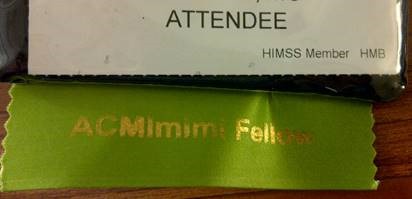
You’ll delight in the scintillating score by the lyrical genious, Dr. HITECH, founder of The American College of Medical Informatimusicology (ACMImimi.) Performed by the entire ensemble of illustrious ACMImimi fellows, you’ll hear health information rock like you’ve never heard it before.

Get out the popcorn and pull up your favorite easy chair for tonight’s Oscars, but get ready really enjoy them next year when “HIStalk: The Movie” will undoubtedly take home all the golden statues setting new standards for both Hollywood and HIT.

From the trenches…

"Never give up. And never, under any circumstances, face the facts.” – Ruth Gordon, Best Supporting Actress, “Rosemary’s Baby”

Dr. Gregg Alexander, a grunt in the trenches pediatrician at Madison Pediatrics, is Chief Medical Officer for Health Nuts Media, an HIT and marketing consultant, and sits on the board of directors of the Ohio Health Information Partnership (OHIP).

Comments Off on Readers Write: Dr. Gregg’s “HIStalk: The Movie”

Curbside Consult with Dr. Jayne 3/3/14

March 3, 2014 Dr. Jayne 1 Comment

HIMSS Wrap Up

Every year at HIMSS there’s too much going on and not enough time to write about it. We try to hit as many booths as possible while attempting to attend some educational sessions as well, but there just aren’t enough hours to do it all. I had several sheets of notes in my bag, so please bear with my somewhat rambling wrap up.

clip_image002 clip_image004

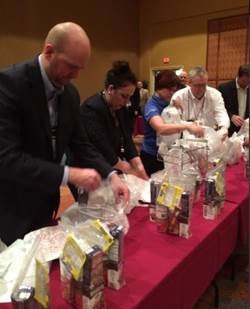
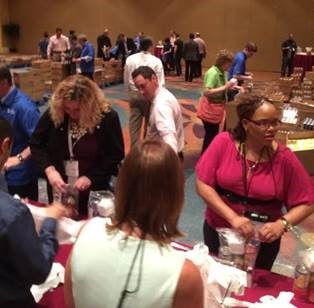
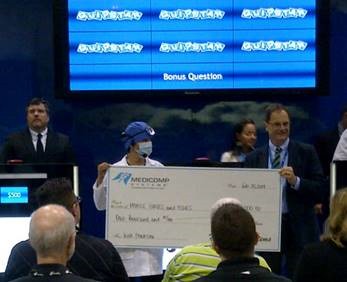
Someone reached out to me over the weekend to follow up and share photos of the Verisk Health service project benefitting the Second Harvest Food Bank. I had mentioned last week about seeing the  woman in the carrot costume at the Phytel booth and didn’t realize that Verisk Health was the main sponsor. They ended up with over 250 HIMSS participants who prepared 4,100 food packs for kids. Thanks to those who turned out to help. They are planning to host similar events at AHIP and NHCAA, so if you’re attending either of those events, keep an eye out for the location and time. Thanks to Verisk Health for sponsoring HIStalk as well – I hope they keep me posted on future events so I can alert our  readers.

Several vendors were showing off their “big data” but weren’t ready to address the “big questions” that come with it. Having dealt with numerous EHR conversions, I’m keenly aware of the sheer magnitude of bad data out there. Those aggregating it tend to assume that the data they’re getting is good. I really pushed one of the major national vendors on how they handle data integrity and the answers were less than satisfactory. I could tell they understood the problem because they provided the example of allergy data where one vendor has separate fields for the allergy and the reaction and another vendor combines them. The rep wasn’t able to explain how they’re handling it even though they were displaying a patient chart that showed allergy data from both sources. I asked for a follow up contact, but I’m not holding my breath.

CHADIS (Child Health & Development Interactive System) is a vendor I wish I’d come across earlier. We have struggled with implementing our patient portal for pediatric patients due to privacy issues, and ultimately our health system placed it on hold. Their product is tailored to the pediatric population with online screening that covers all the Bright Future requirements. They also somehow managed to obtain permission to use most of the popular pediatric developmental screeners. That doesn’t sound like a big deal, but knowing that my vendor has struggled for years to try to obtain permission to use one particular screener, it’s pretty exciting to those of us that see children in practice. CHADIS includes a research database and is interoperable with many EHRs, so I’ll be checking them out in more detail.

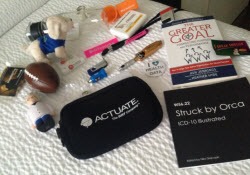
After Mr. H mentioned he was having difficulty finding note pads, I had my eye out for them. I spotted a handy notebook at the Accretive Health booth. The gentlemen manning the booth (which was on the fringes of the exhibit hall) at the end of the day were very engaging. One of them was leadership development author Ken Jennings, who was happy to chat about his book The Greater Goal and send me home with a copy as well. I noticed his Air Force Academy ring and we talked about the difference between a military education and a civilian one. The teenager who mows my lawn wants to attend the Academy and he was kind enough to offer himself as a resource. Those little moments where we can connect as people (and not just as vendor/prospect), especially after a long day, are one of the things I look forward to at meetings.

There were several people I wanted to connect with and missed, including Jonathan Handler, CMIO at MModal. Since he was in the board review course I attended, I was planning to ask his thoughts on what the vendor space thinks about the Clinical Informatics certification. My employer refused to pay for me to take the exam (they barely gave me the day off to sit for it) and I wonder if vendors are more generous. If they have certified informaticists on board and are using that for marketing purposes, they ought to!

I wanted to mention a little more about the educational session I attended on Monday: “Converting Your Legal Medical Record – It’s Both Technology and Process.” I’m glad I arrived early because I had some time to look through the printed HIMSS pocket guide to figure out the lay of the land and do some last-minute exhibit hall planning. I was looking for the location of the press room and noted that HIMSS had a designated “Nursing Room.” I thought that was pretty progressive until I noticed it was in the same location as the designated “Prayer Room.” What were they thinking?

Back to the educational session, the presenters were from Main Line Health (which was converting their hospital system) and Leidos Health, which assisted in the effort. They did a great job with the presentation despite some technical difficulties and had a good sense of humor about it. Having lived through multiple conversion projects, I can say that their advice was spot-on. They admitted they wish they could have started earlier and spent more time documenting the current state and figuring out how that was going to impact the new system.

They talked about building their clinical crosswalk and how they planned to handle the audit trails once the legacy system was decommissioned. They had a great statement about organizational resistance: during early meetings, they spent 50 percent of the time mourning the loss of the old system and the remainder doing actual work. I’ve been to a lot of meetings like that. If only the attendees realized that no amount of begging or pleading is going to bring an old system back once it’s been marked for death, we could be so much more productive.

They shared great examples of what to look out for in system conversions. The legacy system changed physician ID numbers, which created problems with providers showing up as “unknown physician” after the test extraction. Scope creep was a major issue, but many of the expanding requirements involved patient safety or risk elements which had to be considered at some level. They also emphasized the need to have two willing vendors and lamented the lack of an industry best practice in how to approach these projects. They interviewed a variety of consultants prior to the project and received many opinions on the best way to proceed.

One aspect of their conversion is (thankfully) something I haven’t had to experience yet. They found that when the conversion was announced, many of the staff responsible for the legacy system pursued employment elsewhere. There was a tremendous loss of institutional knowledge around the legacy system and they had to add retention bonuses to keep them on board through the knowledge transfer. I can’t imagine what my last two conversions would have been like if I lost key staffers. They also got lucky when their go-live was delayed by another project, which resulted in an extra six months for converting data. They’re still extracting as we speak, but I’m sure that gave them a bit of a cushion. They plan to go live with six years’ worth of hospital data, which is a tremendous amount.

clip_image006

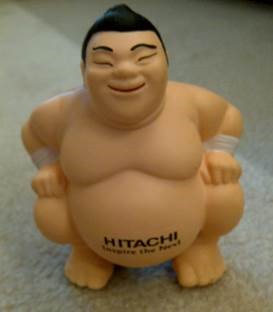
I snuck out during the question and answer period so I could make it to my next meeting (the fact that the audience didn’t want to come to the microphone to ask their questions was definitely a contributing factor) and get the the exhibit hall when it opened. The rest of HIMSS was a blur and I’m still trying to get caught up. I found this politically incorrect squeezy stress thing in my bag when I got back. I saw them at the Hitachi booth but didn’t pick one up, so I suspect one of the folks I was roaming the hall with was trying to be funny. I’m sure if I put it on my desk at work I’d be summoned to HR before you can say “harassment.”

clip_image008

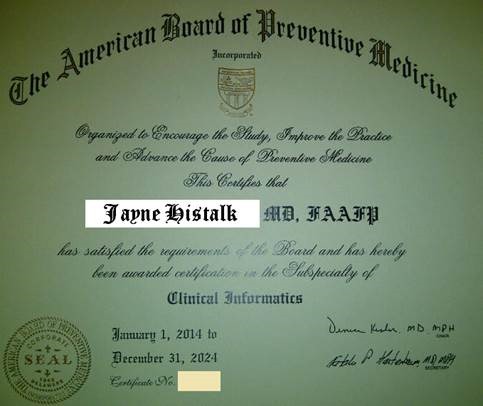
I did have one nice surprise this weekend – my Clinical Informatics certificate has arrived! All my certificates are in matching frames (courtesy of my first employer who actually had a budget for that sort of thing) so I hope I can find something that is close or at least complimentary. On the other hand, maybe I’ll go completely wild and frame it in animal print or something unusual. That would definitely start some conversations when people weave their way through Finance and Compliance to make it to my office.

Email Dr. Jayne.

Morning Headlines 3/3/14

March 2, 2014 Headlines Comments Off on Morning Headlines 3/3/14

VA and DOD Need to Support Cost and Schedule Claims, Develop Interoperability Plans, and Improve Collaboration

The General Accounting Office analyzes the VA/DoD decision to abandon its iEHR development program last February. The resulting report suggests that the departments cancelled the project without ever evaluating the impact it would have on the overall cost and timeline of their interoperability goals.

How the Medical Establishment Got the Treasury’s Keys

Uwe E. Reinhardt, an economics professor at Princeton, dissects the formation of Medicare and the subsequent battles for payment reform fought between the federal government and healthcare providers.

McKesson Announces Further Changes to Corporate Governance and Compensation Practices

McKesson CEO John Hammergren voluntarily reduces his pension’s total value from $159 million to $114 million following outrage from shareholders.

Greenway Extends Patient Engagement Service with Acquisition of PeopleLYNK

Greenway acquires PeopleLYNK, a patient engagement tool that automates the process of sending patient reminders, lab results, prescription notifications, and clinical alerts.

Comments Off on Morning Headlines 3/3/14

Monday Morning Update 3/3/14

March 1, 2014 News 11 Comments

image

From Elizabeth: “Re: HIStalk mug. Thanks so much for the HIMSS coverage this year, as always. It was great that you had a booth because I’m pretty sure others would agree that the HIStalk gang are celebrities, albeit anonymous, in this space. I am sending you a little pic of my coveted HIStalk mug in its new home in snowy, cold NY. I think it fits in very well. It was by far my favorite takeaway from the conference, so much so that I wrapped it in a t-shirt from another vendor so it wouldn’t break on the flight home. I am happy to report that it remained safe and intact.” I can’t explain why I like seeing pictures of reader workspaces, but I do.

image

From Sipper: “Re: HIStalk mug. Big fan of HIStalk for many years, read it every day, loving my new mug!”

From Posit: “Re: HIMSS thoughts. Educational sessions were strayed, put together in silos, and not given by industry leaders but more by committee members trying to get placed on the HIMSS board. Educational content had nothing new. Hillary was dry, useless, and added nothing to the conversation of healthcare. The CIO Forum was the usual boy’s club, mostly just CIO wannabes as the majority of CIOs were out sunning themselves. The attendance count seemed to include anyone walking in the door. The HIMSS14 handbooks had many typos – sloppy work.”

image

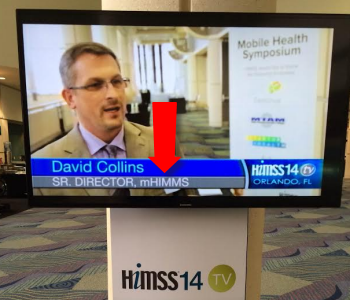
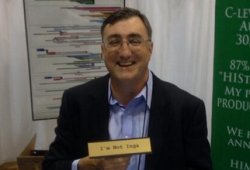
From Dr. Info: “Re: HIMSS video. I saw this gem out of the corner of my eye and then had to endure many painful minutes of this insipid self-promotional video before it came around again for a quick photo for your blog. I’m probably the only person who watched the whole thing, including the producers and editors! Maybe they should just change the acronym already.” You would think HIMSS could spell its own name, especially when it was shilling its HIMSS14 TV informercials (“one-third of air time will be dedicated to our sponsors,” which puts even network TV to shame.)

image

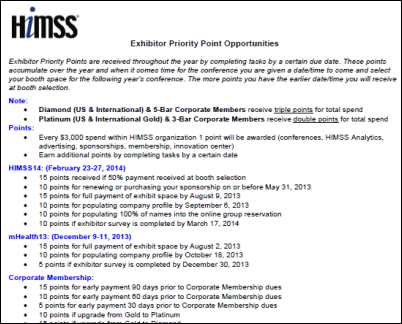
From Eager Cleaver: “Re: cost of exhibiting at HIMSS. You should get someone with a modest-sized booth to anonymously provide all line-item costs to exhibit. Readers would be shocked.” I did this a few years ago and would be happy to do so again if a company would be willing to share. I would do it for the HIStalk booth, but it was tiny and we did everything on the cheap, so it’s not really representative. Meanwhile, money alone won’t buy you prime hall space, as booth selection is driven by HIMSS points, which is like your grocery store loyalty card with a lot more zeroes. The annual conference brought HIMSS $25 million in revenue, half its total take. Dues made up only 18 percent of its total revenue. According to its 2011 tax forms, Steve Lieber was paid $925K, so he’s surely well over the million-dollar mark by now. Also in the footnotes of the form: HIMSS owns 81 percent of MedTech Publishing (book value $8 million), which means if you get your industry news from Healthcare IT News, mHealth News, or Government Health IT, you’re getting it from the vendor-friendly, HIT-cheerleading HIMSS.

From GreenFlamed: “Re: Dragon Medical Network. v12.50.200.089 is not ready for prime time, especially in Virtual Desktop environments. It takes a crazy amount of support to sustain and keep your end users happy. The new service pack is riddled with bugs and the dictation box transparency feature is broken. We are facing a major Dragon buy-in and adoption crisis currently because it keeps crashing. Are there any other Dragon360 Network users out there using Dragon on a Virtual Desktop environment?”

image

Only 20 percent of respondents say their business card titles include a certification. New poll to your right: if you attended the HIMSS conference, how was it overall?

image image

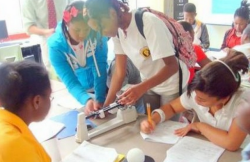
Some of the classrooms we helped via HIStalk’s donation of proceeds from the big ad at the top of the page to DonorsChoose projects are already benefitting. Mr. Delperdang reports (and sends the photo above left) that his Mississippi high school students are using the inexpensive supplies we donated (remanufactured printer cartridges and a file cabinet, which he calls “a blessing”) to print and file assignments and college applications. Ms. Vega’s Illinois second graders have created a reading station from the set of non-fiction books we purchased, which she says is the most popular learning station in the classroom and that “even my students whom were afraid to speak and share ideas are now sharing their background knowledge with us.” Ms. Opatz’s Utah fourth graders have formed reading groups around the books we purchased for them (photo above right.) We funded a bunch of projects from the ad revenue and will be doing more, so stay tuned.

image

Oracle – like its CEO, Larry Ellison – rarely passes on the opportunity to exhibit boorish behavior. The company’s sloppy technical work reportedly assured the failure of Cover Oregon’s health insurance exchange, with the resulting outcry shaming Oracle into making a public promise to fix the problems it caused at no charge beyond the $90 million it was already being paid. The still-dysfunctional site isn’t likely to get better – Oracle has decided without explanation to pull 60 percent of its employees assigned to the project.

image

California’s health insurance exchange, fresh off a five-day system outage, says 14,500 people whose applications were partially completed in the days before the unplanned downtime will need to start over.

image

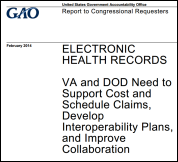
The General Accounting Office reviews the progress of the VA and Department of Defense in deciding to pursue their independent EHR plans and make them interoperable. They aren’t impressed: GAO says those organizations don’t have proof that it will be cheaper to run their separate systems than to create a single one. It also points out that despite the VA’s plan to pilot its system by September 2014 and the DoD’s intention to take its system live by the end of FY2016, neither have said what their systems will consist of, when they will be finished, or what they will cost. The report also says the VA and DoD are still fighting over control, with the federally mandated Interagency Program Office (IPO) having no power over funding and staffing. Both the VA and DoD, strangely enough, agreed with GAO’s recommendations that they perform a cost analysis, justify choosing the more expensive choice if that’s the case, create interoperability plans, and strengthen the control of IPO.

image

McKesson, bowing to shareholder pressure, reduces the pension of Chairman, President, and CEO John Hammergren from $159 million to $114 million, although one analyst says the company’s executive pension plan is still “the richest in corporate America.” Perhaps an earlier announcement of his forced impoverishment would have allowed him to escape the indignity of winning his second consecutive HISsie award last week for “Industry Figure In Whose Face You’d Most Like to Throw a Pie.”

image

It occurred to me while Mark Bertolini was delivering the HIMSS conference’s opening keynote address, his Aetna employees were setting up the company’s booth in the exhibit hall. Somehow that seems wrong. If it weren’t for HIMSS trying desperately (and unsuccessfully) to get people to stick around later into the week, they would have put the second consecutive keynoting Clinton (Chelsea next year?) in that spot as they have done with politicians in the past.

image

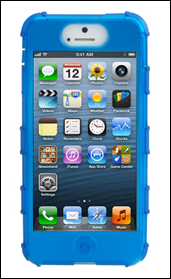
People have asked what my favorite conference giveaway was. I’ll go with the iPhone 5 cover from zCover. I wasn’t initially impressed because they had a tableful of them and they were packaged in plastic bags, to the point I was about to just toss it in the trash when I got home. It’s a really nice case that fits the phone perfectly (including little covers for each port) and a clip-on back that ties the package together. It has its own buttons that cover the ringer volume and home buttons that make them easier and more satisfying to use. I’m really glad I picked it up – it has replaced my rubber bumper cover.

It’s hardly news since Intermountain Healthcare announced that it was choosing Cerner as a partner last fall partly because it wasn’t confident about hitting Meaningful Use dates, but CIO Marc Probst says Intermountain will forego incentives and accept penalties for not being ready for MU2 in 2014.

image

Streamline Health Solutions promotes Richard Nelli to COO.

image

Greenway acquires PeopleLynk, which sends patient relationship messages based on EHR events.

image

Infor signs a letter of intent to acquire assets of GRASP Systems, including patient acuity, workload management, and patient assignment systems.

Ingenious Med launches its patient encounter platform One by Ingenious Med (IM1), providing care coordination and patient management to acute and sub-acute spaces.

Strata Decision Technology announces sales of its StrataJazz financial platform to Yale New Haven Health System (CT), Northwestern Medical Center (VT), and Southern Illinois Healthcare (IL).  

image

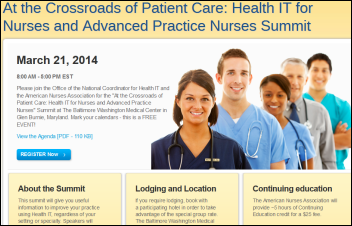
ONC and ANA will present a free one-day summit for nurses on March 21 at The Baltimore Washington Medical Center in Glen Burnie, MD. The agenda includes a keynote by Deputy National Coordinator Judy Murphy, a panel discussion about using health IT to exchange information, afternoon breakout sessions, and a town hall discussion. I recommend as a counterpoint to all of that healthy discussion a side trip to my favorite place in Glen Burnie, Ann’s Dari-Creme.

image

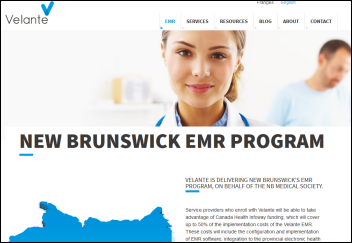
In Canada, New Brunswick doctors question their medical society for striking a deal that allows only one EHR – the one sold by a for-profit company co-owned by the medical society — to access the province’s databases. Only 240 of 950 eligible physicians have signed up ahead of the March 31 deadline to earn a 50 percent government subsidy, with only 34 of those actually using the mandatory Velante software. Doctors question whether the medical society’s motivation is business success rather than patients, while the province’s health minister says it may have to take over the system if too few doctors sign up. A similar situation exists in Nova Scotia, where the province gave Nightingale exclusive rights to provide a subsidized EHR that connects to the government’s information.

The VA creates a development portal that explains how to create mobile apps for its use.

image

CareSync wins the most promising startup contest at the HIMSS conference.

”How the Medical Establishment Got the Treasury’s Keys,” an interesting article by economics professor Uwe Reinhardt, recounts irrational and naturally inflationary creation of Medicare in the 1960s as flawed grand plan to reduce poverty:

To help implement that vision, these proponents reluctantly paid the price the providers of health care extracted in return for accepting the legislation: Congress surrendered to the providers the keys to the United States Treasury, full well knowing that this social contract could have only a short shelf life. One would assume that physicians and hospital leaders knew that as well. In other words, the proponents of Medicare who signed on to the deal were anything but stupid. When confronted by the health care sector with a harsh trade-off between their cherished vision for health care, on the one hand, and a sensible payment policy, on the other, they let their vision override economically sound payment policy. Millions upon millions of America’s senior citizens are indebted to them for a program that remains highly popular to this day.

Weird News Andy wonders, “Does the noise in my head bother you?” in reading of a British tourist hearing scratching noises inside her head that turned out to be a happy family of eight flesh-eating maggots. WNA also likes this story, in which stethoscopes were found to carry more bacteria (especially MRSA) than anything other than the fingertips of doctors. It’s probably not realistic that doctors who can’t be convinced to wash their hands would sterilize their stethoscopes. 


HISsies 2014 Winners


Sponsor Updates from Last Week

  • Sagacious Consultants launches Sagacious Dispatch for Epic customers with short-term projects for optimizing their EMR.
  • Orion Health launches Collaborative Care for ACOs.
  • MEDHOST joins CommonWell Health Alliance.
  • Shore Medical Centers (NJ) selects CareTech Solutions Clinical Service Desk for night, weekend and holiday support.
  • Truven Health Analytics introduces Micromedex Pharmacy Intervention and Micromedex Infection Prevention.
  • CynergisTek expands its collaboration with Iatric Systems to offer support and management of Iatric’s Security Audit Manager.
  • Premier reports 90 percent of respondents experienced at least one drug shortage in the last six months that may have caused a medication safety issue or error in patient care.
  • Aventura releases Roaming Aware Desktop Version 5.0.
  • Kaleida Health (NY) selects Orion Health’s Rhapsody integration engine.
  • Covisint receives full accreditation with the Direct Trusted Agent Accreditation Program from DirectTrust.com and the EHNAC.
  • iMDsoft announces its MetaVision for NICUs will be featured at the 20th annual Cool Topics in Neonatology conference.
  • DrFirst’s controlled substance e-prescribing software will be integrated into Greenway’s EHRs.
  • ADP AdvancedMD offers an ICD-10 transition program with preparation resources, product enhancements, and a revenue cycle financing program.
  • UnitedHealthcare announces that InstaMed’s online bill payment service myClaims Managers has grown to 50,000 participating care providers with $20 million in payments processed since July 2013.
  • Emdeon publishes an ICD-10 transition white paper.
  • API Healthcare, a GE Healthcare Company, launches Patient Classification, which matches provider skills to patients.
  • Nuance announces that eCopy ShareScan is integrated with NextGen Ambulatory EMR.
  • First Databank releases FDB AlertSpace for Siemens Soarian.
  • NextGen Healthcare and Cerner announce bilateral integration.
  • Infor offers a promotion package for eGate customers interested in migrating its Cloverleaf product.
  • Infor introduces PeopleAnswers Talent Science to assist healthcare organization to select, retain, and develop clinicians.
  • DrFirst’s Patient Advisor delivers $21 million in prescription savings opportunities for uninsured patients during its first three months.
  • Imprivata will integrate its two-factor authentication management capabilities with DrFirst’s EPCS Gold solution to securely prescribe controlled substances electronically.
  • Physician First ACO (FL) selects eClinicalWorks Care Coordination Medical Record.
  • ADP AdvancedMD announces general availability of its reporting suite AdvancedInsight for physician practices.
  • Central Valley HIE (CA) joins Inland Empire HIE expanding the reach of the Orion Health Collaborative Care within California to 48 central and southern California organizations.
  • Wolters Kluwer Health announces the beta launch of its integrated clinical decision support and workflow management platform POC Advisor.
  • Northeast Georgia Physicians Group achieves Stage 7 of HIMSS EMRAM with Allscripts TouchWorks.
  • Covisint offers three reasons to physicians to avoid PQRS penalties.
  • Etransmedia expands its RCM services with the acquisition of Medigistics.
  • Intel-GE Care Innovations and Caradigm partner to integrate remote patient monitoring and smart sensor technologies to improve care plans.
  • E-MDs launches a SaaS-based RCM service.
  • AT&T announces plans to expand Digital Life into the healthcare market.
  • Predixion Software announces availability of its predictive analytics software on the Windows Azure cloud platform.
  • Baylor Scott & White Health (TX) expands its use of AtHoc Critical Communications platform for IT outages, emergency preparedness, and clinical alerts.
  • Optum launches Optum One analytics platform.
  • Advocate Health Care (IL) selects PerfectServe as its enterprise-wide clinical communications platform.
  • Healthy Catalyst reports that 76 percent of organizations lack basic analytics for Meaningful Use measures in a recently published white paper.
  • Imprivata will integrate HIT Application Solutions’ Notifi platform with Imprivata Cortext, enabling secure communications for continuum of care.
  • The Health Centers of Family Health Care join The Guideline Advantage, which uses Forward Health Group’s PopulationManager platform.
  • Siemens Healthcare launches CareXcell a subscription based solution for population health management.
  • Memorial Hospital at Gulfport (MS) selects Health Catalyst’s Late-Binding Data Warehouse and Analytics platform to provide a unified view of clinical and performance data from their McKesson and Allscripts EHR applications.
  • Capsule Tech reports a 24 percent increase in revenue for 2013, with 1,650 healthcare facility clients worldwide.
  • University Hospitals (OH) will deploy PeriGen’s PeriCALM at UH MacDonald Women’s Hospital and UH Geauga Medical Center, which will include sending OB content into its Allscripts EHR.
  • NantHealth introduces NantHealth Clinical Operating System, developed after consolidating of several healthcare IT companies including iSirona.
  • Capsule Tech introduces SmartLinx Medical Device Information System for point-of-care data delivery.
  • North Memorial Health Care (MN) is awarded joint second place in the annual Healthcare Informatics Innovator Awards after incorporating Health Catalyst’s EDW platform and analytics solution.
  • EClinicalWorks, Greenway, ICA, InterSystems, Medfusion, Medicity, Optum, and Orion Health found Carequality, which will focus on interoperability between existing and emerging HIE networks.

Contacts

Mr. H, Inga, Dr. Jayne, Dr. Travis, Lt. Dan, Lorre.

More news: HIStalk Practice, HIStalk Connect.

125x125_2nd_Circle

Morning Headlines 2/28/14

February 28, 2014 Headlines 1 Comment

Intermountain to Miss 2014 Meaningful Use Attestation Deadline, Citing Safety Concerns

Intermountain Healthcare CIO Marc Probst says the organization is not planning to attest for meaningful use Stage 2 in 2014, forgoing a sizable incentive payment and triggering penalties in 2016 from CMS.

ICD-10 deadline won’t be delayed, Tavenner tells HIMSS

During a press conference at HIMSS CMS Administrator Marilyn Tavenner announced that there would be no deadline extensions for either ICD-10 or meaningful use Stage 2, but that it would be more flexible with hardship exemption applications from providers that are unable to meet Stage 2 MU on time.

NY startups make the case for funding HIE

New York’s 10 independent and disconnected regional health information exchanges are applying for $65 million in state funding to connect to the Statewide Health Information Network of New York, or SHIN-NY.

Oracle pulls 100 programmers from unfinished Cover Oregon health insurance exchange

Oracle, the main contractor responsible for the failed Oregon health insurance exchange, has reassigned 100 of the 165 programmers working on the project even though the site is still non-operational and plagued with bugs.

From HIMSS 2/27/14

February 27, 2014 News 11 Comments

image

From Spelling Recognition: “Re: ‘documention.’ Is this a misspelling or or marketing gone wrong?” I suspect the former and dread the possibility of the latter.

From Born Free: “Re: HIMSS opening session. It was nice of the HIMSS chair to recognize physicians in the audience, but as soon as the recognized physicians sat down, the speaker then dissed them through sarcasm about their ego and the 6,500 physicians in his organization that think they know best. It was a little uncomfortable and not very wise considering HIMSS’s desire to add physicians to their membership rolls.” I missed the presentation since I was protesting having an insurance company millionaire talking about how healthcare should work. I don’t like having vendors as keynoters.

image

From IT Director: “Re: HIMSS. It was a pleasure to meet Lorre in the booth on Tuesday. If you are going to have a public face I can’t think of a better one! She was engaging and knowledgeable and fun to talk with even if just for a few minutes. I love the fact that you had a booth — that was a cool thing to do.” HIMSS booths are breathtakingly expensive, but it was worth it to be able to meet readers, sponsors, and passers-by (most of them on their way to bathrooms right by our booth given our tiny HIMSS clout and budget). It was great having Lorre there since as the only non-anonymous HIStalk team member since she kept me updated with who dropped by, what they had to say, and what it was like being on the show floor with the other exhibitors. That was all new to me – my only view of HIStalk is sitting alone in front of a PC all day and night. It was cool that other exhibitors brought celebrities to our booth, sent Lorre scones and fun giveaway items, and helped us figure out the exhibit process since we were clueless. I’ve asked Lorre to do a writeup on what it was like for her to meet readers, work the booth, attend the events, and accept our Sunquest Industry Pioneer Award.

From Brian Ahier: “Re: Ed Park of athenahealth at HIMSS. Gave the best presentation at HIMSS.”

image

I’m glad the HIMSS conference is over. I’ll be catching up over the next few HIStalk posts. Your comments about the conference, exhibits, companies, and educational sessions are welcome.

I have to say I’m already dreading going to Chicago for the conference next year. All I remember from last time is snow, surly unionized conference center staff, outdated hotels that cost at least double what they were worth, endless cab lines because of the weather, and wearing winter clothes. I like Chicago as a tourist, but not as a conference attendee. HIMSS loves it, of course, because the travel is easier for their people and they get to deal their home city some payola.

image

Here’s Lorre’s new BFF Bob Murphy, MD, CMIO of Memorial Hermann Healthcare System (TX), meeting people in our booth.

Orlando attendance set a record at an announced 38,828, although I don’t know how that number was derived. I assume all registrations were counted, including exhibitors and press, but I don’t know if HIMSS counted people sitting at home who paid $49 to watch streamed sessions on the Web. I know this: all event promoters like to provide optimistic attendance statistics and there’s no good way to audit their claims.

image

PeriGen was a booth neighbor and CEO Matt Sappern dropped by to say that “HIStalk is the only thing to read each day.”

This week on HIStalk Connect: Epic and Walgreens launch a wide-reaching interoperability partnership to rival CommonWell. HIMSS publishes the findings of its mHealth Technology Survey. Glooko unveils a population health tracker focused on improving care within the diabetic population.

image

Jennifer Dennard (@SmyrnaGirl) tweeted out this photo, saying she’s reading up on HIStalk while sipping from our mug now that she’s home from the conference. Our mug supply is exhausted other than a few we set aside for loyal readers who asked us to mail them one since they weren’t at the conference. I like Jennifer’s photo – if you took a mug home, send a picture of it in its new home.

I didn’t hear much about Hillary’s Wednesday keynote other than (a) it was extremely short; (b) like any skilled politician, she didn’t really say anything other than predictably lauding the work of the crowd that brought her there and kissing up to HIMSS. I would have been mad about waiting an hour or two to squeeze into the huge room for her talk given its lack of substance. Hillary’s rumored minimum speaking fee is $200K plus expenses, so she took home a big paycheck in addition to potentially impressing would-be Presidential voters who were apparently happy just to bask in her celebrity.

Hillary mentioned in her speech that corporations don’t have enough females on their boards. She didn’t define “enough” quantitatively.

HHS confirmed during the conference that neither ICD-10 nor Meaningful Use Stage 2 deadlines will change.

image

Hearst Health’s newly formed venture unit invests in Tonic Health, which offers an iPad-based data collection tool that counts Partners HealthCare and UCLA Health among its customers.


Contacts

Mr. H, Inga, Dr. Jayne, Dr. Travis, Lt. Dan, Lorre.

More news: HIStalk Practice, HIStalk Connect.

125x125_2nd_Circle

From HIMSS 2/27/14 – Inga’s Update

February 27, 2014 News 11 Comments

It’s early afternoon on Thursday and I just returned home. My feet look like little sausages from all the walking and the flight, so I am putting my feet up and getting out a quick summary of random impressions from Wednesday. I’ll provide a wrap-up by the end of the weekend.

2-27-2014 1-54-06 PM

A couple of folks advised me that the guy in the red suit I noticed in the CareCloud booth was not an attendee but Stelle Smith from CareCloud. Maybe it’s the Miami influence? I had a chat with CareCloud CEO Albert Santolo, by the way, and will share more details on that later.

A word of advice: don’t walk around in public, especially at a place like HIMSS, and carry on a cell phone conversation that includes confidential information. As I was walking to the convention center I overheard a gentleman talking about “John Smith” who is over-compensated in his role, especially compared to the hardworking “Joe Brown”. Just so happens I know Joe Brown (who has a much less common name than Joe Brown) so it took me about two minutes to figure out the name of the company and the probable manager who is about to axe poor John.

2-27-2014 1-53-42 PM

I love, love, love this photo that the GetWellHealth folks sent over. I considered asking them if they had an extra  pair in a size 8 but then realized I’d probably never have the right occasion to wear them. Well, maybe they would be fun for Mardi Gras.

As I walked by the Surescripts booth there was a representative standing out in the aisle who looked directly at my badge before saying hello. I was wearing an exhibitor badge and she immediately apologized and said she was told they were really only interested in marketing to providers so she was trying to see where I was from (before she wasted her time engaging me). I proceeded to tell her that that didn’t make much sense since they partnered with vendors (maybe she has never heard of “Surescripts certified products.”) I am pretty sure she was an employee and not a hired gun and she was clearly not some 22 year-old marketing intern. Odd.

2-27-2014 1-53-12 PM

I went 45 minutes early and snagged a seat for Hillary Clinton’s keynote address. I happen to be sitting next to a guy from one of the better known HIT publications and he was telling me about the insanity of the whole “no press allowed” situation. His publisher was also exhibiting so he was able to use an exhibitor badge to get in. I laughed out loud when Clinton mentioned something about the “anti-journalist” mentality in Russia, wondering how many people caught the irony. Aside from that drama, I found Clinton to be very smart and a seasoned speaker. If she was reading from a teleprompter then she concealed it quite well. During the Q&A session she was just as quick on her feet as during her 20 minute prepared speech and she managed to throw in a little humor now and again. While she of course discussed the importance of HIT, I was fascinated with her comments on Russia, Ukraine, and the tracking of Bin Laden.

2-27-2014 1-50-52 PM

Nuance had a huge booth but I thought the lighting was odd. It was as if someone forgot to turn on the lights at the demo stations.

I played Pac Man at the Medseek booth. It took me 15 seconds to lose.

2-27-2014 1-50-04 PM

What was with the dead bushes decorating the NantHealth booth? I just realized that NantHealth is the new name for iSirona, which might explain why I found next to no signage with the company’s name.

I felt sorry for the exhibitors that were in the section past Cerner (7000s and above) because there was definitely less traffic than in the other section of the hall. There are probably a lot of people like me that make a conscious decision to start in the 100s and work their way through the hall, only to be fatigued before completing the journey.

2-27-2014 1-49-34 PM

API Healthcare was proudly displaying its four KLAS trophies.

I met Brian Ahier who is a big Tweeter (@ahier) and HIT writer who often sounds good stuff to Mr. H and me. I get so excited when I get to meet HIT superstars.

2-27-2014 1-49-06 PM

3M’s booth was much larger than I recall in recent years and all the signage was about getting to ICD-10. Strike when the iron is hot, I guess.

Speaking of ICD-10, I saw some Tweets that CMS Administrator Marilyn Tavenner said in her Thursday morning keynote that the ICD-10 transition would not be delayed.

2-27-2014 9-44-31 AM

A few folks that didn’t get an invite to HIStalkapalooza decided to have their own party, which they called “HIStalk-a-Pa-Losers. They tell me they spent at least 10 minutes creating their banner and ended up having a fabulous time.

Several exhibitors told me that they were staying a few miles away from the convention center because there were not enough rooms in walking distance, especially if you wanted a large block of rooms. Unfortunately that’s probably going to be the case again next year in Chicago.

2-27-2014 9-34-51 AM

Holly sent me this picture of the guy I loved from SIS who was aggressively handing out goodies to folks passing by and even to  the people on trams. I incorrectly said he was asking, “Would you like gum, mints, or analytics for your EHR.” Actually SIS offers analytics for the “OR.”

2-27-2014 9-33-14 AM

Dr. Jayne and I passed by the Greythorn booth and actually caressed the winning pair of shoes from the Inga Loves My Shoes contest. Apparently we were not the only ones so I am glad they had fun with the sash.

2-27-2014 9-12-06 AM

Ross Martin, who co-emceed the HISsies and provided some musical entertainment to start the evening, posted the above note on Facebook Sunday. He told me that at least a dozen people had asked him to find them a HIStalkapalooza invite.

2-27-2014 9-03-36 AM

The CareTech Solutions folks wanted to make sure we knew they were proud of their sign.

2-27-2014 8-54-05 AM

The Versus folks put out this Tweet on Tuesday. I definitely took advantage of their hospitality.

2-27-2014 8-51-34 AM

The T-System ladies were decked out in fun red shoes.

2-27-2014 8-47-52 AM

PeriGen had adorable baby Uggs as pen holders and baby flip flops right by their sponsorship sign. They were also giving out USB drives, which they had arranged to create the letters, “OB.” Very clever.

Mr. H had commented that people in the exhibit hall were “zombies” Wednesday and I was definitely one of them. Inga may perpetually be a 28 year-old party girl but unfortunately she has taken residence in body that is a little more mature. I think I’ll spend the rest of my day and evening on my couch wading through 2,000 emails and hoping my feet return to normal.

Inga large

Email Inga.

Morning Headlines 2/27/14

February 27, 2014 Headlines Comments Off on Morning Headlines 2/27/14

Top healthcare groups petition HHS for meaningful-use extensions

50 influential healthcare groups, including the American Medical Association and the American Hospital Association, send a letter to HHS secretary Kathleen Sebelius asking that MU stage 2 be delayed due to a lack of EHR vendors meeting 2014 edition certification standards.

Framework for I.T. Regulation Slated to Reach Congress in March

Representatives of the FDA, ONC and FCC all promise that the now overdue report on a risk-based regulatory framework for health I.T will be published as a draft version by the end of March

Congress wants to kick the FDA out of digital health with this new bill

A new bill has been introduced in Congress that would remove the FDA’s regulatory authority over all but "high risk" digital health technologies.

Health law cybersecurity challenges

An AP report shows that more than two-thirds of state-run health insurance exchanges were rated as having "high risk" security vulnerabilities just after their launch.

Comments Off on Morning Headlines 2/27/14

From HIMSS 2/26/14

February 26, 2014 News 5 Comments

From SoreThroat: “Why did CCHIT leave the ONC Testing & Certification program? Why were they really losing money? What was the ‘exit plan’ and who benefited? Who will be left to turn off the lights on CCHIT once the relationship with HIMSS is consummated? CCHIT rolls down hill: vendors, hospitals and others don’t like the feel or the smell.”

From Soft Skills Are Key: “Re: consultants. When will vendors learn that consultants are not the enemy? We approached the SCC Soft booth at HIMSS, introduced ourselves to the booth sales rep, and asked if we could see a quick glimpse of his product. We explained to him that we we’re consultants and wanted to familiarize ourselves with their product at the interest of our clients. The sales guy’s response, along with the stone-cold stare, was, ‘I don’t see the point,’, and then walked away. Soft Lab, ‘Yes’, but Soft Skills, ‘No.’”

The lessened enthusiasm of the throng of attendees and exhibitors was palpable Wednesday. The coat check stations were full of bags of folks taking flights out Wednesday, the exhibit hall energy level was a fraction of that Monday and Tuesday, and most of the big social events were over.

I started my day noticing that every single men’s restroom on the main level was closed. Two had signs saying the conference center was being improved, while another just had a barrier stuck in front of it.
image

SIS was demoing their analytics application.
image

Health Catalyst had big booth crowds Wednesday morning.
image

Optum had a disturbingly large display that was like being at a drive-in movie with men in suits milling about in front of the screen.

I noticed multiple occurrences of odd grammar usage that’s as common as uptalking in young folks: saying “yeah, no,” usually expressed when agreeing with someone making a negative point.

Someone forwarded me a HIMSS email intended for working press saying that because of the contract HIMSS signed with Hillary Clinton for her keynote, reporters not only couldn’t cover her speech, they weren’t even allowed inside the hall to see it. I verified that HIMSS people were indeed turning away reporters at the door, although checking every badge must have slowed down the entry process. I say “must have” because having arrived early last year to see Bill, I still ended up sitting on the floor in front of a TV monitor and decided I would rather just beat the crowds out the door instead of in, so I left the conference early.

Athenahealth wasted no time in printing up big booth signs proclaiming themselves as the top-rated software vendor in KLAS. A reporter asked Judy directly what she thought of it and she said it was a scoring anomaly that won’t happen again. The reporter followed up with KLAS and found that she is technically correct because KLAS is getting rid of the category.

We’re first-time HIMSS exhibitors working on the cheap, so Lorre got a lot of help from many folks, including our booth neighbors and readers. She would especially like to thank Dr. Gregg and Mike “PACSMan” Cannavo, who covered the booth when she needed to step away, brought her lunch, and otherwise made her day a lot better.
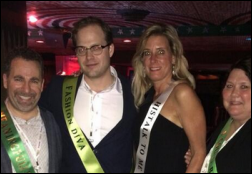
image

Speaking of Lorre, I have received a ton of positive comments about how well she represented HIStalk at our events and in the booth. I had little doubt when I brought her on board, so I’m not surprised. I’m gratified that after spending time at Sunquest and Mediware, she is loving her HIStalk role in running Webinars, supporting our sponsors and readers, and managing all the details that I wasn’t handling well because of time constraints. Above is Dr. Lyle Berkowitz, James Aita, Lorre, and Amy Gleason at HIStalkapalooza.
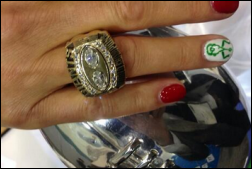
image image

Here’s Lorre wearing the Super Bowl ring of Stephen Baker the Touchdown Maker while he visited our booth, also showing her HIStalk party nail. Note that SB isn’t just trading on his former athletic glories: he is a substitute teacher and supports several charitable causes related to children.
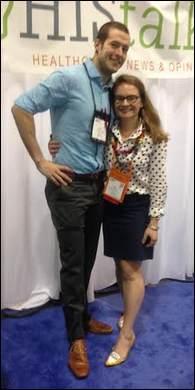
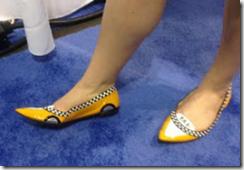
image

image

Lorre and I now know that we have a lot of readers from Epic because several of them dropped by our tiny booth to say hello. Lorre says the taxi-themed shoes were her favorite of the entire conference.
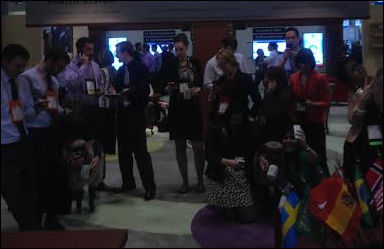
image

Epic people were great about being attentive to their customers and not staring at their phones until we tweeted my desire to capture at least four booth reps doing so at once. They helpfully staged a photo shoot in the Epic booth just for Lorre. They are a fun group.

We have around 1,200 professional photos from HIStalkapalooza. These will provide good memories for those who where there until I can go through the entire set.
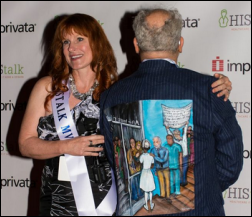
image

image

image

image

image

image

image

image

image

image

image

image

image

image

image

image


Dr. Jayne’s HIMSS Report – Tuesday and Wednesday

More hours in the exhibit hall means more interesting things to see. I must say I like the HIMSS decision to not close the hall during lunch. It may make it more challenging for exhibitors but it made it easier for me to see more booths. Unfortunately, I also forgot to eat on Tuesday, so maybe the forced break was a good thing.
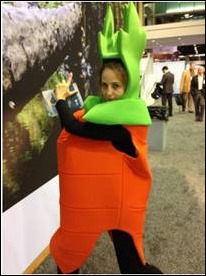
clip_image002

Inga and I spotted this walking carrot earlier in the week but couldn’t catch a photo fast enough. I finally found her at the Phytel booth. She was there to promote their service project where attendees could stuff backpacks with food for Second Harvest, which provides it to children who may not have meals when they’re not able to receive a free or reduced price lunch at school. I wish I had known about it earlier and would have made time on my schedule to participate if I hadn’t already been double-booked.
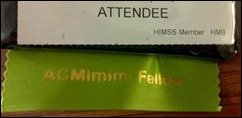
clip_image004

I had the opportunity to cruise the hall Tuesday afternoon with Dr. Ross Martin, who not only sings fabulous songs about HIStalk by night, but is part of the leadership team at AMIA by day. I always like to visit the first-time exhibitors and we were over in the low numbers when the staff of Nobl engaged us with cookies. They were also kind enough to allow Ross to charge his dying cell phone while they showed us their Vigilance product. It’s a proactive nurse rounding program designed to improve patient satisfaction (and therefore HCAHPS scores). They also have the ability to notify family members about the activities of their loved one – whether he or she is sleeping, eating, taking their medications, etc. I’ll be interested to see how they fare over time.

Ross also granted me a provisional degree of Fellow for ACMImimi, the American College of Medical Informatimusicology. He assures me the board will formally approve my candidacy at their next meeting, but I better brush up on the show tunes in case they ask for an audition tape.

I attended a nice presentation at Aventura about their instant-on and roaming solutions. I particularly liked the fact that they had actual clients delivering the presentations rather than sales reps. They were also very interested in feedback from attendees and prospects which was a nice change. The lovely Bonny Roberts also had her HIStalk beauty queen sash on display.
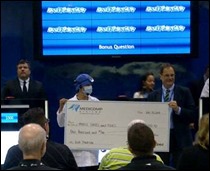
clip_image006

I stopped by to watch Inga play Quipstar at the Medicomp booth. Although she didn’t win, she did score a $1,000 donation to her favorite charity. Thanks to Medicomp for allowing us to be their celebrity contestants and for their support of worthy causes. Of course Inga had her usual security detail – two handsome men in black who made sure Inga’s many admirers kept a safe distance. Although they didn’t have the shoe-cam this year, she was sporting some sassy heels with bows on the toes.

Inga and I sampled some of the Tuesday afternoon cocktail hours including Aventura, FormFast, and Sunquest. Tuesday night I hit a couple of parties including PatientSafe Solutions and the Athena Cloud Party. I had several others on my dance card, but the distance between Universal CityWalk, Downtown Disney, and Pointe Orlando was pretty daunting. Roving reporters let me know that the band at Greenway was good and the NextGen clients were having a great time at Pub Orlando.

clip_image008

Orchard had a large tree in their booth. I liked the crates as well. After so much walking around, I needed a break, so I went back to find the quiet sofa on the fourth floor that I had spotted on Monday. Unfortunately today there were several screens blaring a HIMSS14TV broadcast that no one was watching. It was kind of annoying.
clip_image010

I missed the #HITchicks tweetup, but Lorre brought me some swag from the event, which was much appreciated. I’m a little jealous of her non-anonymity because she’s had some great networking opportunities at the booth. Inga and I stopped by several times over the last few days and there seemed to be a lot of others passing by as well.
clip_image011

Imprivata had various different people presenting in its booth with its realistic care setting. On one pass through the area, they had these folks dressed as care team members. I generally don’t like people trying to act like doctors and nurses even if it is in the name of marketing. At least if you’re going to do it, make it more realistic. Their scrubs should be rumpled, they should have overstuffed pockets, and they should look much more haggard.
clip_image013

Siemens had an awesome presentation using a dynamic array of tablets to display content. One attendee commented that he didn’t know anything about their products but the presentation was amazing.
clip_image015

CMS had a relatively large booth with virtually no one in it. Your tax dollars at work, folks. Speaking of tax dollars, on Tuesday ONC released a new Data Brief reporting results from the 2012 ONC Consumer Survey on Privacy and Security. The data was gathered from a telephone survey of 2,000 adults conducted in 2012. That’s not a tremendous sample size and the writeup makes it look like there were only four questions asked, so I wonder why it took so long to release the data? If anyone has insight, let me know.

Wednesday was a short day for me due to an early flight home. I really wanted to stay through Thursday to hear keynote speaker Erik Weihenmayer, but work responsibilities and the lack of a hotel room for Wednesday night conspired against me. I’ve heard him before, and if you can spare the time, he delivers an extremely compelling story. Although I do enjoy HIMSS it’s just exhausting and I can’t wait to get home to my own bed.


Dr. Gregg’s HIMSS Report

HIMSS this year was a short, fast blur. Well, for me anyway. I made a fairly late decision to go when Lorre wrote to ask if I might be able to help out at the sponsor dinner and the all-new HIStalk HIMSS booth. It’s a tough thing for a solo doc to take time away from practice, so I was thinking of skipping it. But I like being able to connect in live mode with old friends, see the latest HIT tech, hear new and fresh (or sometimes even old and stale) vendor pitches, but mostly I enjoy supporting the HIStalk efforts.

Flying in later Sunday afternoon, I made it in time for the 2014 HIStalk Sponsor Dinner. It was held at the same place as last time HIMSS was in Orlando, Maggiano’s. There’s a good reason for the repeat booking: Maggiano’s does a great job. They have a lovely place and make spectacular dishes. (The stuffed mushroom caps were divine.) Despite Mr. H’s less-than-happy take on the turnout, it was a very enjoyable event.

By the way, Mr. H, I had several vendor folks tell me later that they regretted not making it, but they had legit reasons such as booth set up issues that kept them tied up until the dinner was over or they had out-of-their-hands air travel delays. Lorre did a very nice job arranging the dinner and her HIStalk mugs were a real hit, both there and at the booth.

I hope Mr. H rethinks not holding it. It’s a nice gesture of appreciation for the generous HIStalk sponsors (and saying “thanks” isn’t about getting a “you’re welcome,” right?) Maybe it gets arranged a little differently, perhaps more casually next time, but I’d offer one suggestion more: Mr. H, Inga, and Dr. Jayne should make an appearance as they did last time we were at Maggiano’s. Their anonymous allure is certainly a special draw.

The HIStalk booth was an undeniable hit. For a small, first-time booth back in the uncharted regions of the HIMSS exhibit hall hinterlands, it had a slew of traffic. Lots of folks made a point to hike back just to say “Hi” and “Thanks for what you guys do.” Lorre did such a great job. The HIStalk swag including buttons and mugs and tattoos and magnets were snatched up by many/most who visited. The traffic was so remarkable that nearby vendors eyed the booth covetously. Lorre told me one looked over after a while and said, “Who are you guys? Why do you get such great traffic?” Booth envy.

Speaking of Lorre – what a gem! I had not met her before Sunday’s dinner, but I gotta tell you, she is a real delight. If you haven’t had the honor, you’ve a treat in store. Smart, pleasant, and just plain nice. Her one flaw may be that she’s too humble. (Wait… that’s not a flaw; that’s refreshing!) Mr. H found a real keeper.

As I mentioned, my time was very limited, but I got to know the vendor landscape early on helping Lorre deliver the HIStalk sponsor signs. (Shame on those who neglected to display them!) The exhibits are overwhelming at first. It takes a trip or three before you can really discern wheat from chaff. I can’t honestly say that I saw anything that really knocked my socks off. Lots of (too much) chatter about data analytics and population health. Minimal, if any, Meaningful Use hubbub. (thank goodness.) A dearth of “wow” overall, though there were some cool things to see.

I took another look at CareCloud. Got a great demo (thanks, Brian) and spoke with Brad and John (big CC wigs) about some of the cool stuff they’re developing. I also got a view at the next phase for athenahealth. It’s definitely a good direction for them. Thanks to Pierre and Maria and the nice Athena folks who showed me their new UI (and for the new Kindle!) Jonathan Bush was not around, off in Sochi at last spotting.

I enjoyed a couple of rounds of Quipstar at the Medicomp booth. FYI: Inga was robbed; she actually would have won on total points, but they missed that she had been first to respond on a question. Nevertheless, she and her charity made out. As did all the charities and those participants who walked away with cash or iPads. The illustrious James Aita (no longer with Medicomp having returned to his Canuck roots working at Idea Couture) flew in for a command performance and yet again gave Alex Trebek a run for the money as a game show emcee. Heck, the whole crew, including Cindy and Shannon at Thomas Wright Partners and Patrice of Bzzz Productions, does a really nice job with that event.

Speaking of Medicomp, their CEO, Dave Lareau, walked me over and introduced me to “Marck and Mark” at Clinical Architecture. They do a middleware mapping and a form of NLP (it isn’t really natural language processing, more a “terminology processing”) thing that is simply amazing. They create more connections than eHarmony. Truly awe-inspiring, cool stuff that will undoubtedly have a huge effect on indexing and connecting all this disparate data we’re now digitizing.

I was really lucky running into the guys (Omar, Rufi, and Asad) from Panacea EHR. They are some of my favorite folks – really nice and trying to things for the right reasons. They didn’t opt for a booth and were just taking meetings and checking the floor – a pretty good, more cost-effective idea for a smaller vendor, in my opinion.

I enjoyed seeing lots of good folks, such as Dr. Travis who was there in the Startup Showcase with his new company, Catalyze, and Amy Gleason, Travis Bond, et al, from CareSync, also in the Startup Showcase. (CareSync won the top honors in contest there, but I’m sorry, I don’t remember the contest’s name.) It was great seeing Dr. Lyle who was even more bubbly than usual since his new company, healthfinch and their RefillWizard are performing magically, by all counts.

Of course, my cohorts from Health Nuts Media were roaming the hall, too. It’s weird; for as often as we speak, HIMSS is one of the few times I get to actually see them live and in person.

There’s a laundry list of friendly folks I won’t have time to mention much – such as Jason from Health Care Dataworks, Andrea and Fred from the Ohio Health Information Partnership, Marcy from Fleisher Communications, and more – with whom I really enjoyed getting a little face time.

For anyone I didn’t mention, please know I still really enjoyed connecting. And, for all the folks who took time to stop by the booth or stop me somewhere else to chat or share kind HIStalk words, thanks!

Though I doubt the Twittersphere noticed, I didn’t get to tweet (or take any pix) as my phone’s battery started dying on Sunday and wouldn’t hold a charge well. It was actually sort of nice not being too plugged in for a bit!

Lastly, as I was getting ready to fly out Tuesday night, I got to enjoy a nice dinner and some super conversation when we held little impromptu pediatric geek get together. CMIOs from Ivy League and top-ranked hospitals sharing with trench grunt peds. Thanks to Drs. Andy Spooner and Allen Hsiao for the great time.

HIMSS for the little guy: too big, too fast… and too fun!

From the trenches…

"Everyone is trying to accomplish something big, not realizing that life is made up of little things.” – Frank A. Clark



From HIMSS 2/26/14 – Inga’s Update

February 26, 2014 News 4 Comments

So much to share and not much time nor energy following a very long Tuesday and a very short night’s sleep. Coffee will be my friend today.

Random highlights from my day:

2-26-2014 5-18-20 AM

I did pretty good on the swag front, choosing to only pick up items deemed cool enough to lug home. One of my favorites is the stuffed yellow lab from Sunquest, which I intend to give to a special friend who has one of the real versions. I went to the Sunquest booth and asked to have one but was told they had run out. Lorre then went to their booth and told them Inga wanted one and curiously they found an extra. I also love the autographed copy of  Niko Skievaski’s Struck by Orca.

I played Medicomp’s Quipstar game and came in last place. Oh well, the Medicomp folks still cut an $1,100 check to my favorite charity.

2-26-2014 5-16-57 AM

How about these booth shoes sported by Patrick from Lightbeam?

2-26-2014 5-16-03 AM

Humana was giving away smoothies that were created from a bicycle-powered blender.

2-26-2014 5-15-36 AM

More than 100 vendors had requested desktop signs proclaiming their support of HIStalk. They are a bit of a labor of love to create and I was sad (hmm…annoyed) that a few opted not to display their signs after all. However, many thanks to those that I spotted, including Orchestrate, Summit, Bottomline, Forward Health, Awarepoint, Healthwise, GetWell, Imprivata, Infor, MBA, Versus, TeraMedica, Fujifilm, Netsmart, PatientSafe (their folks were also sporting HIStalk label pins), Greythorn (they had their sign displayed in a sparkly frame), TalkSoft, Health Care Software, Perceptive, and SIS. If you see one, please tell the booth folks that Inga sends her love.

2-26-2014 5-15-00 AM

Stoltenberg Consulting’s booth always reminds me of camping. Maybe that’s the intent. I guess it’s fun.

2-26-2014 5-14-30 AM

I really love most of the art in the Epic booth but this girl was a bit creepy because she looked a little too real.

2-26-2014 5-13-58 AM

This bear was a little more my style.

2-26-2014 5-13-00 AM

I loved the purple sneakers that the GetWellNetwork folks were wearing.
SAP had a big booth but Derek was out in the middle of the aisle trying to engage people in a very friendly and not too pushy way.

2-26-2014 5-12-22 AM

It’s a bit hard to see but this guy getting a demo in CareCloud’s booth was wearing a red suit. Um, you have to be pretty confident or a little color blind to wear a red suit. CareCloud, by the way, has a cool new booth with a balcony.

2-26-2014 5-11-32 AM

I liked the looks of the MedeAnalytics booth. This is actually the backside of it.

Every time I walked by IBM’s booth it was packed, but I could never quite figure out why.

2-26-2014 5-10-58 AM

Some of my favorite guys of the day were from Headspring, which was promoting a mobile nursing application.They were all in cowboy garb (because they are from Texas) and were standing out in the aisle handing out packages of nuts (which I happen to be eating right now for breakfast.)

2-26-2014 5-10-30 AM

TeraRecon has this massive screen as part of their booth. I thought it overpowered their space a bit.

I went by CommonWell and was disappointed that when I asked what they did I was handed a marketing slick that showed the various members but was not given any additional explanation of what they were all about. I let them keep their slick.
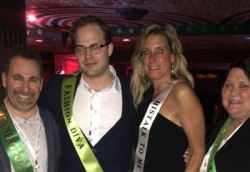
2-26-2014 5-09-41 AM

McKesson’s coffee bar was quite popular. If you are seeking coffee, however, many of the smaller vendors are also happy to give you a cup and most have shorter lines.

Kyle with INUVIO did a great job getting my attention as I walked by and then provided me a nice concise explanation of their card scanning solution.

2-26-2014 5-09-03 AM

I liked the look of ICA’s booth.

Check out the magician at NTT’s booth. He had me intrigued.

2-26-2014 5-07-25 AM

I had mentioned previously that Alere’s booth was one of my favorites and they were getting plenty of people walking through their tunnel.

The ladies at Dirvugent were super sweet and I liked that the company is donating money to a local children’s charity if you spin their wheel (and let them scan your badge.)

2-26-2014 6-26-59 AM

This is an amazing statistic.

Maybe someone can explain why so many people (all men that I observed) were walking around with Google glasses. Late in the evening I tried on a pair and didn’t see enough to make me feel compelled to buy some.

I had the opportunity to chat with Girish Navani of eClinicalWorks. He’s a really nice, down to earth guy and I will later share more details of our conversation, which ranged from eCW’s growth, to Girish’s intent to keep the company private, to his prediction for what HIT topics will be hot over the next couple of years.

I loved the pitch from the SIS guy as I strolled past their booth. He was sporting a red jacket, standing in the aisle, handing out goodies, and asking folks if they cared for mints, gum, or analytics for EHR.

I have another busy day planned and am very excited to see Hillary Clinton’s keynote this afternoon. Hope my feet survive.

Inga large

Email Inga.

Text Ads


RECENT COMMENTS

  1. RE NEJM piece: He shouldn’t future-conditional with “they can retreat, which might mean abdicating medicine’s broad public role, perhaps in…

  2. The sentence was "most people just go to Epic UGM" - that's people going to Epic's annual user conference and…

  3. Merry Christmas and a Happy New Year to the HIStalk crowd. I wish you the joys of the season!

  4. "most people just go to Epic" that's a problem because then EPIC becomes a monopoly in healthcare, if it isn't…

Founding Sponsors


Platinum Sponsors


Gold Sponsors


RSS Webinars

  • An error has occurred, which probably means the feed is down. Try again later.