Recent Articles:

Meditech News

July 19, 2020 News Comments Off on Meditech News

January 2023

Meditech UK chooses CloudWave’s OpSus Cloud Services to deploy its cloud-based Meditech Expanse implementation at two NHS trusts. (1/13/23)

December 2022

A KLAS report on practice management systems for mid-sized and large practices finds Athenahealth and Epic topping the list for large practices — although Meditech Expanse was right on their heels but with an insufficient sample size – while Cerner and EClinicalWorks need improvement. Mid-sized practices are most satisfied with Athenahealth and NextGen Healthcare, while independent practices like NextGen Healthcare. Two-thirds of Oracle Cerner customers report dissatisfaction due to outdated technology, inadequate training, and functionality gaps that require adding third-party products, with many of those having low expectations for the company’s RevElate replacement product because of Cerner’s history of unfulfilled RCM promises. (12/21/23)

Meditech confirms that founder and board chair A. Neil Pappalardo has retired from the company that he started 54 years ago. (12/12/22)

Mater Private Network in Ireland begins its Meditech Expanse implementation. (12/7/22)

Russell Medical Center AL) converts from Meditech Magic to Meditech as a Service with help from CareCloud’s MedSR division. (12/7/22)

November 2022

Floyd County Medical Center (IA) goes live on Meditech Expanse. (11/16/22)

Andrew Burchett, DO (Avera) joins Meditech as executive director of medical informatics. (11/14/22)

Warren General Hospital (PA) will replace its legacy Meditech system and three ambulatory EHRs with Meditech Expanse. (11/11/22)

Thirty-year Meditech customer HCA Healthcare will upgrade its hospitals to Meditech Expanse as its go-forward EHR. (11/9/22)

Nine organizations licensed the cloud-based model of Meditech Expanse in the third quarter, raising the count of Meditech as a Service hospitals to 70. Five of the nine were new to Meditech. (11/4/22)

Meditech will use Health Gorilla’s Health Interoperability Platform for the Traverse Exchange Canada network for sharing data among participating providers. (11/2/22)

Meditech announces Traverse Exchange Canada, a cloud-based interoperability network that supports information flow among participating organizations. (11/2/22)

October 2022

A review finds that Canada’s Newfoundland and Labrador Centre for Health Information was warned that its 40-year-old Meditech Magic system was vulnerable to hackers a year before a fall 2021 ransomware attack exposed patient information and caused treatment delays. NLCHI has been recommending for years that the province issue a tender to replace Magic, with one study projecting that a move to Meditech Expanse would cost $85 million over 10 years, but would more than pay for itself. (10/31/22)

Meditech launches Expanse Population Insight, which uses claims and EHR data from the Innovaccer Data Platform to provide information about risk, care gaps, and utilization at the point of care. (10/21/22)

Campbell County Health (WY) kicks off its year-long, $8 million project to replace Meditech with Epic in an affiliation with UCHealth. An HIStalk search finds several references to the health system – it sent employee W-2s to a hacker who impersonated a hospital executive in 2017, lost $200,000 in Medicaid payments due to billing system failures in its acquisition of a private surgery center in 2018, and went on diversion due to a ransomware attack in 2019. (10/14/22)

Harnett Health (NC) switches from Meditech to Epic as part of its affiliation with Cape Fear Valley Health. (10/5/22)

Box Butte General Hospital (NE) postpones its roll out of Meditech Expanse as it takes into account lessons learned from a mock live event held in late September. (10/10/22)

Meditech adds patient transport workflows, including an app for transport staff, to its Expanse EHR. (10/3/22)

September 2022

Mater Private Network will implement Meditech Expanse across its nine facilities in Ireland by 2024. (9/28/22)

Houlton Regional Hospital (ME) will go live on Meditech Expanse on October 1. (9/14/22)

August 2022

Southern Ohio Medical Center reports a 30% reduction in hospital-acquired C. difficile infections following work with Meditech Professional Services and implementation of Expanse tools. (8/31/22)

Warren General Hospital will implement Meditech Expanse in a $2.3 million project. (8/19/22)

British Columbia’s Fraser Health Authority chooses Picis Preop Manager, Anesthesia Manager, and PACU Manager for 11 acute care hospitals, integrated with Meditech as the health system replaces Client / Server with Expanse in an agreement signed in April 2022. (8/19/22)

Gaylord Specialty Healthcare (CT) selects Meditech Expanse. (8/3/22)

July 2022

Meditech announces Meditech Live, a customer leadership conference that will be held in Foxborough, MA September 20-22. (7/15/22)

In England, two Cheshire NHS trusts will collaborate to replace their paper-based systems with Meditech Expanse. (7/8/22)

In The Bahamas, Doctors Hospital Health System chooses CloudWave to host its new Meditech Expanse EHR on OpSus Healthcare Cloud. (7/8/22)

A new KLAS report on EHRs for practices of 11 or more clinicians finds that Epic and Meditech lead the the pack in finishing a close 1-2. Ease of use and workflow is by far the most pressing concern of practices of that size. Cerner users are frustrated with outpatient workflows and the company’s focus on resolving inpatient problems, while Greenway Health’s customers are an outlier in putting functionality improvements at the top of their list of needs. Allscripts has two of the three bottom-rated products, along with poor ratings for support, relationships, and overselling product capabilities. (7/6/22)

June 2022

Pawnee Valley Community Hospital (KS) transitions its family medicine clinic to Meditech. (6/1/22)

May 2022

Garrett Regional Medical Center (MD) will use $650,000 in federal funding to replace its 20-year-old Meditech EHR with Epic. (5/25/22)

April 2022

KLAS summarizes US hospital EHR market share activity for 2021 (click the graphic to enlarge):

  • Epic gained four new customers representing 28 hospitals and 13,000 beds last year, losing four due to M&A.
  • Meditech Expanse was chosen by 74% of the company’s legacy customers that made a replacement decision in 2021, compared to 38% retention in 2020.
  • Epic has 33% of hospitals and 44% of beds versus Cerner’s 24% and 27%, respectively.
  • Allscripts and CPSI lost ground in 2021.
  • Cerner had the largest net decrease in bed count last year, with half of those hospitals choosing Epic as a replacement and the other half switching to Epic after being acquired.
  • Cerner hasn’t had a net-new large health system sale since 2013. (4/27/22)

Canada’s Newfoundland and Labrador — which is running a 1980s-era Meditech Magic system that is no longer enhanced — hasn’t followed through on recommendations that it upgrade to a new version of Meditech in a $92 million project that auditors say would more than pay for itself. (4/25/22)

Golden Valley Memorial Healthcare (MO) goes live as the first site running Meditech Expanse Genomics. (4/22/22)

Fraser Health will upgrade its Meditech Client/Server system to Expanse. (4/15/22)

March 2022

Newman Regional Health (KS) will connect its Meditech Expanse EHR to nearby Coffey Health System. (3/18/22)

Meditech will pilot the FHIR-enabled integration of Google’s search and summarization capabilities within its Expanse EHR. (3/16/22)

Floyd County Medical Center (IA) hires Cristina Thomas, MBA (The HCI Group) as interim CIO. The hospital is preparing to implement Meditech Expanse in the fall. (3/2/22)

Meditech makes Expanse Ambulatory available to independent and physician-owned practices. (3/2/22)

February 2022

Meditech adds COO to the title of 32-year company veteran EVP Helen Waters. The COO role was previously held by President and CEO Michelle O’Connor before her promotion in early 2021. (2/25/22)

In Australia, cancer center Chris O’Brien Lifehouse goes live on Meditech Expanse. (2/9/22)

Highlights from the just-announced Best in KLAS awards:

  • Epic, Nordic, Galen Healthcare, and The Chartis Group were named as overall best.
  • Epic won Best in KLAS awards in 11 market segments.
  • Most-improved products include Infor ERP and Greenway Intergy Practice Management.
  • Epic was the top-rated physician practice vendor by far, followed by Athenahealth, NextGen Healthcare, Greenway Health Intergy, Allscripts, and EClinicalWorks.
  • Topping the overall software suite rankings was Epic, followed by Meditech Expanse, Cerner, CPSI Evident Thrive, and Allscripts.
  • Nordic led overall IT services firms, followed by Pivot Point Consulting, Bluetree Network, Experis Health, Impact Advisors, Engage, and Cerner. (2/9/22)

January 2022

Meditech will integrate SecureLink’s critical vendor access management software with its systems. (1/12/22)

December 2021

The Massachusetts Supreme Court rules in favor of a former Meditech employee who claims he was fired for exercising his right to file a rebuttal in his personnel file. Terence Meehan says Meditech reorganized its 12-person regional sales department in demoting three sales reps – including Meehan – to the newly created position of “sales specialists,” who sales reps rarely used because they don’t want to share commissions. Meehan says he and the other demoted employees were placed on performance improvement plans in July 2018, and when he sent his supervisor a rebuttal, the president and CEO of Meditech immediately terminated him. He filed a complaint of wrongful discharge and the court agreed with him. (12/20/21)

Sage Memorial Hospital goes live on Meditech-as-a-Service with the assistance of Healthcare Triangle. (12/17/21)

HCA Healthcare will go live on Meditech Expanse at three hospitals in New Hampshire by the end of 2022, with the assistance of CereCore. (12/8/21)

November 2021

Health officials in the Canadian province of Newfoundland and Labrador say health IT systems, including its Meditech EHR, are slowly being brought back online after last week’s cyberattack. (11/10/21)

October 2021

A new KLAS report looks at Meditech implementation services. Tegria-owned Engage scores highest although all validated engagements involved under-100 bed hospitals, while Tegria-owned Navin Haffty, Huron, and MedSR (the merged MedMatica and Santa Rosa Staffing) scored high in broader settings. Meditech’s recently launched implementation services also score above average. (10/29/21)

September 2021

Unity Health (AR) will implement Meditech Expanse across its three hospitals and long-term acute care facility. (9/29/21)

Mile Bluff Medical Center (WI) will convert from NextGen to Meditech Expanse on October 1. (9/29/21)

Meditech will hold its Physician and CIO Forum September 29-30 as both an in-person and virtual event. (9/24/21)

Long-time Meditech executive Roberta Grigg, who retired in 2001, died last month at 79. (9/10/21)

July 2021

A Georgia law firm files an ONC information blocking complaint against Doctors Hospital of Augusta, Meditech, and Ciox Health, claiming that the patient records the firm requested on behalf of its malpractice client were not provided as an OCR-readable PDF file. (7/23/21)

Meditech officially confirms the months-ago promotion of President and COO Michelle O’Connor to president and CEO. She replaces Howard Messing, who remains on the company’s board. (7/14/21)

June 2021

California launches its digital COVID-19 vaccination record system, built on the open source SMART Health Card Framework of VCI, whose members include Cerner, Epic, Meditech, Allscripts, HIMSS, and The Sequoia Project. (6/21/21)

Major Health Partners (IN) goes live with Meditech Expanse Patient Care as an early adopter. (6/18/21)

Meditech announces its upcoming integration with IOS 15’s enhancements to Apple Health, in which providers can launch a web-based dashboard within Expanse to view the information that a patient has shared with them. (6/11/21)

KLAS distills its information on each of the four major health system EHR vendors into individual “Complete Look” reports, which conclude:

  • Allscripts — C- in product, C- in loyalty, 18% of customers report deep interoperability as adoption of DbMotion wanes. Sunrise has 4% of US hospital beds. Sunrise is an integrated, highly customizable platform, but Sunrise Ambulatory Care and Sunrise Financial Manager are not widely used. For transformational technology, significant interface maintenance is required since each system has its own database.
  • Cerner — C in product, C+ in loyalty, 28% of customers report deep interoperability as customers benefit from its CommonWell connection. Millennium has 25% of US hospital beds. Cerner offers a broad Millennium suite that reduces third-party integration and is proven in both large and small organizations, but patient accounting is a weakness and the company’s less-prescriptive implementations lead to variability in customer success.
  • Epic — B+ in product, A in loyalty, 63% of customers report deep interoperability with Care Everywhere and its connection to Carequality. Epic has 42% of US hospital beds. The company’s fully integrated suite has topped all software suites for 11 years running, is proven in big health systems, and offers a widely used patient portal and population health management solution, although it has a high upfront cost and some modules require in-house expertise to build.
  • Meditech — B+ in product, A- in loyalty, 10% of customers report deep interoperability as most customers use point-to-point interfaces or HIEs, although its CommonWell connection is used by some early adopters. Expanse has 4% of US hospital beds. Meditech offers consistent development on Expanse, integrated offerings, and affordability that has made it the leading product for community hospitals, but Expanse costs more than the company’s legacy solutions and larger health systems have been historically hesitant to choose it. (6/9/21)

A new KLAS report on patient privacy monitoring finds that Maize Analytics and Protenus are the standouts, offering strong service and deploying AI-powered monitoring that reduces manual work. Managed privacy services customers of Imprivata’s recently acquired FairWarning report high satisfaction, although non-MPS users of the product are less optimistic about its functionality and development path. Cerner customers often use its low-satisfaction P2 Sentinel but have Imprivata, Maize, and Protenus as alternatives; Epic sites fare best with Maize and Protenus; and Harris-owned Iatric Systems performs best for Meditech sites. (6/4/21)

May 2021

A new KLAS report on EHR market share in US hospitals finds that Epic gained the most in 2020, adding 101 hospitals representing 19,000 beds. Cerner saw its second consecutive year of net market decrease in losing 19 hospitals and 10,000 beds, which KLAS attributes to big-hospital concerns about its revenue cycle functionality. Epic’s market share is 31% of all hospitals and 42% of all beds, while Cerner has 25% and 27%, respectively. All the hospitals that Meditech added in 2020 were under 100 beds and 62% of its legacy customers that made EHR decisions in 2020 moved to other vendors, Epic in almost all cases. (5/21/21)

Six hospitals in Ottawa, Canada develop a version of Meditech’s patient portal for French speakers. (5/21/21)

Nexus Health Systems (TX), Grady Memorial Hospital (OK), and Duncan Regional Hospital (OK) select cloud hosting services for Meditech from Tegria companies Navin Haffty and Engage. (5/5/21)

A new KLAS report finds that non-US EHR activity was strong in 2020, with 135 net new deals and 23 migrations, although 30% less than in 2019. The biggest winners were Epic, Dedalus, InterSystems, and Cerner. Epic’s market share in Canada has grown from three hospitals in 2016 to 146 now, but migration to Meditech Expanse is becoming more common. (5/5/21)

April 2021

CHIME, which recently ended its participation in the HIMSS conference, partners with the HLTH conference to offer Vive, an annual “reimagined health technology event” whose first conference will be held March 6-9, 2022 in Miami Beach. It will offer digital health innovation content, CHIME’s Spring Forum, an exhibit hall, and a matchmaking program that pairs potential buyer attendees with vendors. Some of the 18 title sponsors are also exhibiting at HIMSS21, but notable companies that will be only at Vive, at least according to HIMSS21’s exhibitor list so far, include Allscripts, Cerner, and Meditech. In an interesting adjacency of time and space, Vive will convene eight days before and 230 miles away from HIMSS22 in Orlando. (4/16/21)

Twenty-three hospitals in Northeastern Ontario will implement Meditech Expanse as part of a new record-keeping alliance. (4/14/21)

Meditech announces Expanse Patient Connect, which uses Well Health’s text, phone, email, and chat messaging solution to send patients reminders, instructions, and follow-up instructions that can be accessed from Meditech’s patient portal and app. (4/9/21)

March 2021

Meditech works with Code, Dryrain Technologies, and ACS MediHealth to develop a mobile barcode scanning app that is compatible with its Expanse EHR. (3/24/21)

Meditech adds vaccine eligibility checking to the self-scheduling component of its patient portal. (3/22/21)

Speare Memorial Hospital (NH) will implement Meditech’s Expanse EHR using Meditech as a Service. (3/19/21)

Kingman Regional Medical Center (AZ) works with Meditech Professional Services to redesign workflows based on key performance indicators. (3/17/21)

Meditech launches a genomics solution for its Expanse EHR, which includes the ability to collect and store patient genetic information, connect to reference labs, and enable personalized treatment. Its embedded pharmacogenomic alerts are provided by First Databank. (3/10/21)

Community Hospital (CO) goes live on Meditech Expanse. (3/3/21)

February 2021

Beauregard Health System (LA) goes live on Meditech Expanse with consulting help from Engage. (2/10/21)

Meditech wins “Best in KLAS Software & Services 2021” distinctions in the top software suite, small-hospital acute care EMR, small home health EHR, and small-hospital patient accounting and management categories. (2/3/21)

January 2021

Halifax Health (FL) implements Pure Storage’s FlashArray to ensure the stability of its Meditech system during natural disasters. (1/27/21)

RML Specialty Hospital (IL) selects Engage to provide cloud hosting for its upcoming implementation of Meditech Expanse. (1/27/21)

Eighteen hospitals of Steward Health Care complete their virtual implementation of a regionally shared Meditech Expanse EHR. (1/25/21)

Meditech offers a short-form Quick Vaccination solution that allows hospitals to administer COVID-19 vaccine at high-volume locations and transmit vaccine data to state systems. (1/15/21)

KLAS takes a look at the hospital EHR market in Canada, which in many cases involves group- or province-led collective decisions that are intended to keep costs down. Meditech leads Epic in hospital count, but has lost some market share as 88 big-system hospitals have replaced Meditech with mostly Epic from 2015 to 2019, while 31 legacy Meditech hospitals have upgraded to Expanse. Customers report satisfaction with Expanse, but say they could have used more guidance and best practices before going live and a better idea of the maintenance requirements afterward. Satisfaction with Cerner is stable, but customers say the Citrix-heavy client-server footprint requires a lot of maintenance, although experience with Cerner’s recently introduced remote-hosted option is good. Allscripts hasn’t had a new Sunrise sale in Canada in the past 10 years, Harris Healthcare is rarely considered in new deals, and Telus Health’s Oacis is rarely considered and hasn’t sold since 2015. (1/11/21)


December 2020

A newly updated KLAS report on EHR interoperability finds that “deep interoperability” (access to outside data, easy location of patient records, visibility of outside data within EHR workflow, and positive impact on patient care) has improved considerably since 2017 except in the most important “impact on care” category. Epic is the clear leader in record-sharing, while Cerner is improving significantly and EClinicalWorks is doing well but isn’t proactive. Little progress has been seen for Meditech, Greenway Health, and Allscripts. Cerner has the highest adoption rate of APIs, especially FHIR ones, while Epic is being selective on which vendors it will work with and is less focused on APIs. (12/23/20)

Runnymede Healthcare Centre goes live with Meditech Expanse following an eight-month implementation involving its relationship with Humber River Hospital, North America’s first fully digital hospital. (12/11/20)

Avera Health goes live with Meditech’s Google Cloud-powered High Availability SnapShot to give clinicians access to patient data via a web browser during unexpected downtime. (12/9/20)

Meditech announces a Google Cloud-hosted platform that includes Expanse Now, High Availability SnapShot, and Virtual Care. (12/4/20)

November 2020

A KLAS study of health system connectivity to post-acute care organizations finds that only Epic and Meditech provide solutions in all areas, as Cerner offers long-term and behavioral health modules but resells home health and hospice technology from strong performer MatrixCare. Netsmart has significant market share in standalone organizations that aren’t connected to health systems, having acquired solutions from Allscripts, Change Healthcare, DeVero, and HealthMedx, but customer satisfaction has dropped following post-acquisition lapses in support, development, and integration. PointClickCare is the strongest performer in long-term care, but no vendor consistently meets behavioral health needs. Records-sharing with acute care organizations from which referrals are sent is inconsistent, with Cerner and Epic having a high percentage of customers connected to CommonWell or Carequality, Meditech and Allscripts having low interoperability adoption, and the majority of users of all four systems reporting faxing as the most common method of exchanging information. (11/16/20)

Meditech launches Virtual On Demand Care, which allows patients to choose “see a provider now” from the Expanse patient portal or app to launch a video chat. (11/6/20)

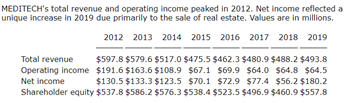
Meditech reports Q3 results: revenue down 5.3%, EPS $0.82 versus $2.44. Product revenue decreased 29.9% due to pandemic-related implementation delays, but service revenue increased 6.3% as more customers went live. (11/4/20)

October 2020

San Luis Valley Health (CO) implements Meditech with consulting help from Engage. (10/7/20)

Meditech will end its status as an SEC public reporting company by running a reverse stock split that will allow it to de-register its shares. Shareholders with fewer than 5,000 shares will be paid out at $45 per share to reduce the shareholder count to under 300, which will allow the company to take itself private. Meditech says that its public reporting status benefits its competitors, incurs costs, and provides little benefit since its shares are not traded on any public market. More than 1,500 current and former shareholders will receive a cash buy-back that ends their company ownership and will trigger capital gains taxes. Neil Pappalardo controls 45% of the company‘s shares, both his own $450 million worth as well as another $308 million worth that he votes as the sole trustee of the company’s profit sharing trust. Shareholders will vote on the proposal, but board members have unanimously approved it and own enough shares to ensure its passage.  (10/5/20)

September 2020

AHIMA will offer Meditech Expanse as part of its online VLab, which offers students access to multiple software programs and corresponding lab lessons. (9/16/20)

Meditech launches Expanse Virtual Assistant, a voice navigation system powered by Nuance that can allows users to perform hands-free actions. (9/11/20)

August 2020

Meditech reports Q2 results: revenue down 3.4%, EPS $0.88 versus $0.44. Product revenue declined 22%, but net income increased to $33 million. (8/3/20)

July 2020

Meditech launches a diabetes prevention toolkit in Expanse. (7/14/20)

June 2020

Remote EHR implementations enable Cayuga Medical Center (NY) and Mt. Graham Regional Medical Center (AZ) to go live on Meditech amid the COVID-19 pandemic. (6/9/20)

Newton Medical Center (KS) creates COVID-19 dashboards within Meditech’s business and clinical analytics to gain insight into bed occupancy, testing, and PPE supply. (6/5/20)

May 2020

Meditech adds Apple Health support to Magic and Client/Server, making the app usable by all of its customers. (5/15/20)

A new KLAS report on US hospital EHR market share finds that Meditech Expanse is drawing new interest from customers outside its usual small-hospital base, with a new 400+ bed health system sale in 2019 giving the market a chance to see how Expanse scales. Meditech won about half the decisions made by its legacy customers in 2019, and half of its losses came from product standardization and provider M&A. Small, standalone hospitals were left with few choices after Athenahealth exited the inpatient market, with Cerner CommunityWorks and Meditech Expanse coming closest to meeting their needs. (5/1/20)

Comments Off on Meditech News

Weekender 7/17/20

July 17, 2020 Weekender Comments Off on Weekender 7/17/20

weekender


Weekly News Recap

  • Congressional Democrats criticize HHS for issuing a no-bid, $10.2 million contract in April for developing a hospital bed and supply tracking database to TeleTracking Technologies, the Pittsburgh-based hospital equipment and bed tracking vendor.
  • Cerner and Epic delay their return to campus.
  • Athenahealth renames its Centricity product line to AthenaIDX.
  • University of California Health uses de-identified patient data from its Epic system to create a database for COVID-19 treatment research.
  • Fax machines are part of a broken data system that is impeding US coronavirus response.
  • Amazon will conduct a health center pilot with primary care service provider Crossover Health.
  • A KLAS report on pediatric practice ambulatory EHRs names PCC as the clear leader.

Best Reader Comments

At Epic, we used to spend 6-8 months documenting current-state workflows and gathering current-state documentation so that the customer could translate into their own system. Again, customers pushed back (well, probably mostly executives who were on the hook for cutting checks) on the amount of time we spent on the early phases of the implementation where little “visible” results were being made. The implementation methodology continued evolving and cutting out more of the customization steps in favor of more expedited and less expensive installs. This gets the system live faster, but with less customization. There are cons to this, but there are actually many pros to this as well. (HITPM)

Being familiar with some of the events and people that encouraged Epic to become the Marine Drill Sergeant, it wasn’t really how Epic wanted to do things, it was initially customer demand (Kaiser made some strong suggestions, and one Kaiser executive in specific had some….issues) and then some pretty drastic personnel mismanagement in response to the 2007-2008 economy. (Guy M. Fay)

[On Athenahealth renaming the former GE Healthcare Centricity products to AthenaIDX] I’m sure the programmers GE laid off really appreciate that homage. (IDXreturns!)

[On HHS changing hospital COVID resource reporting databases] Is this even the problem space that this company is in, with only 15 or 20 positions open how are they able to take this project on? Awarding a 10 million dollar no bid project in April, 75 days ago, and turning it on with 2 days notice is plain and simply not going to work. I don’t even believe it is intended to work. I do believe there is a desire to further politicize data to obfuscate the current state of the epidemic. (AnInteropGuy)

I personally buy “The One Minute Manager” by Ken Blanchard for all of my new managers. The book offers simply and practical advice for managers. The initial version was published in 1982. (Shaun Priest)


Watercooler Talk Tidbits

image

Readers funded the Donors Choose teacher grant request of Ms. C in Kentucky, who asked for LEGOs to help her fourth graders develop science, math, and engineering skills. She reported in February, “Thank you so much for your amazing donation to our classroom. The LEGOs have been and will continue to be utilized in so many ways in our daily instruction. Obviously most of my kiddos love playing with LEGOs so these have allowed me to include a fun and engaging morning “tub” or center to our stations. I have used them and will continue to use them to help students have a better understanding of fractions. We are able to count the circles on the tops and create equivalent fractions. We can also use the pieces to add and subtract fractions as well as see why it is important to have like denominators when adding and subtracting fractions. I have also allowed students to get creative and use them to build things.”

image

Residents of a nursing home in England that is closed to visitors entertain themselves by recreating classic album covers from The Clash, David Bowie, and other musicians. Here’s a cultural teaching point, from me after reading a Twitter comment that surely the residents have never heard of The Clash – “London Calling” was released more than 40 years ago in 1979 and lead guitarist Mick Jones is now 65, so let’s not picture today’s nursing home residents hepping to Cab Calloway.

A 29-year-old mental health counselor in New York City whose household income is $22,500 describes the stress involved with owing nearly $300,000 in student loans as she continues her studies to earn a PhD.

image

Two New York doctors rig app-powered cellular walkie talkies targeted to kids to allow families to speak to isolated patients any time they want without exposing employees who would otherwise be setting up video chats. The app allows multiple people to contact the patient through the single device they have. The hospital developed a disposable casing so the devices can be reused. The devices cost $50 plus $10 per month for cellular service, and for kids, they include real-time GPS tracking, geofencing, playback of missed messages, and voice commands.

image

In Virginia, a physician assistant is fired after a black patient who suffers from anxiety and PTSD asked her about a Confederate flag he saw on her wall during a virtual visit, after which she adjusted her camera, told the patient he was seeing things that weren’t there and was paranoid, and doubled his sedative dose.

In England, Queen Elizabeth II knights Captain Sir Tom Moore, aka World War II veteran Captain Tom, who at 100 years of age hoped to raise $1,000 for NHS by walking laps around his garden in return for the health system saving his life and ended up generating $40 million in donations. Captain Tom holds two Guinness World Records – one for fundraising and another for being the oldest person to chart a #1 song in the UK for “You’ll Never Walk Alone,” performed with singer Michael Ball and the NHS Voices of Care Choir.


In Case You Missed It


Get Involved


125x125_2nd_Circle

Comments Off on Weekender 7/17/20

Morning Headlines 7/17/20

July 16, 2020 Headlines Comments Off on Morning Headlines 7/17/20

‘Sole Source’ Contract for COVID-19 Database Draws Scrutiny from Democrats

Congressional Democrats criticize HHS for issuing a no-bid, $10.2 million contract to TeleTracking Technologies for the development of a hospital bed and supply tracking database, which has become the backbone of the newly mandated HHS Protect COVID-19 reporting system.

Cohere Health raises $10MM in Series A funding to drive adoption of highly collaborative approach with the patient as the focal point

Boston-based care coordination software startup Cohere Health launches with a $10 million Series A funding round.

Cerner won’t reopen its offices for at least several months

Cerner says it will keep employees working from home for at least several more months, pushing back its phased plan to bring up to 50% of employees back to office-based work.

Comments Off on Morning Headlines 7/17/20

News 7/17/20

July 16, 2020 News 6 Comments

Top News

image

Congressional Democrats criticize HHS for issuing a no-bid, $10.2 million contract in April for developing a hospital bed and supply tracking database to TeleTracking Technologies, the Pittsburgh-based hospital equipment and bed tracking vendor.

HHS has ordered hospitals to submit their COVID-related capacity, patient count, and supply information to the TeleTracking system, called HHS Protect, instead of the CDC’s National Healthcare Safety Network (NHSN), starting this past Wednesday. The administration says CDC’s database is outdated and requires manual entry that delays analysis.

CDC Director Robert Redfield, MD said Wednesday that CDC provided input into developing HHS Protect, which previously accepted both data that was submitted directly from hospitals as well as extracts from NHSN. Redfield says that requiring hospitals to send their data directly to HHS Protect will reduce duplicate reporting, help HHS make quick field changes, and allow CDC to focus its system on capturing reports from nursing homes.

Redfield says that CDC and state and local health agencies will have access to HHS Protect, adding that CDC will continue to provide daily updates and dashboards. Several outside sites use CDC’s dashboard for modeling, such as school reopening readiness.

image

Meanwhile, CDC’s hospital capacity dashboard went offline on Wednesday, the final day in which hospitals could submit data to NHSN.

UPDATE: HHS Assistant Secretary of Public Affairs Michael Caputo said Thursday afternoon that HHS has ordered CDC to restore the COVID-19 hospital dashboards that CDC “withdrew from the public Wednesday.” However, the dashboard indicates that information will not be updated after July 14.


Reader Comments

From Data Deliverance: “Re: HHS changing hospital-submitted operational data from CDC to HHS. The new database isn’t publicly visible. Can the public use other dashboards, such as the one from Johns Hopkins?” HHS collects daily hospital reports about beds, ventilators, cases, admissions, ED visits, remdesivir inventory, and details about staff and PPE shortages. Most of this information has minimal overlap with the infection dashboards published by Hopkins and other sites that I assume use data that hospitals have submitted to state health departments.

From Epic Historian: “Re: Kaiser Permanente. Early on they were considering both Cerner and Epic. Cerner offered a complex plan to rebate KP the software cost in the form of Cerner company shares, basically giving them the software for free (UPMC may have fallen for this). KP decided to pick Cerner for inpatient and Epic for outpatient (since it was already being used in some regions), and they asked Judy end Epic to run the integration. She told them to forget it, just use Cerner because one vendor is better than two. KP realized what she was saying and took Epic even though the inpatient system was pretty untested back then.” Unverified, but fascinating. This was in response to an email conversation I had with EH in which I described one instance (there were actually two, but I just now remembered the second) in which we as a big health system seriously pondered whether it would be cheaper to buy our fading vendor of choice as a company instead of their product, or if we did buy the product, whether our contractual demands that they were desperately willing to accept might drive them out of business anyway.

From Kay: “Re: HIStalk. I’ve enjoyed most of the 50-year career I’ve had in health IT and am lucky to have found something I loved. I’m finally retiring and will miss the industry and the wonderful people. You have made a huge difference to me and how I was able to do my job. You are the best. Ever. I want to thank your family for sharing you with us. By the way, I’m not retiring from reading your blog. Stay safe and well and clever and endlessly interesting.” I excerpted some of Kay’s comments, without including personal details, purely to thank her for those thoughts (hold on, got something in my eye here) and to wish her a happy retirement as an industry pioneer, a concept that I hope she celebrates both as the beginning of a fresh chapter as well as a reward for completing the previous one. I’m always uplifted to hear from someone who has enjoyed their career and their simultaneous personal life that raced by while they were pursuing it – it’s a lot easier to continue gratification than to catch up from deferring it.


Webinars

None scheduled soon. Previous webinars are on our YouTube channel. Contact Lorre to present your own.


Acquisitions, Funding, Business, and Stock

image

Digital access and care navigation company Gyant raises $13.6 million in a Series A investment round. The company launched a COVID-19 digital screening tool several months ago with development help from investor Intermountain Healthcare that has since been deployed by 16 healthcare organizations.

image

Boston-based care coordination software startup Cohere Health launches with a $10 million Series A funding round. The company offers care paths, care journey recommendations, and physician behavior change. CEO Siva Namasivayam, MS, MBA was previously CEO of SCIO Health Analytics and an executive with Perot Systems.

Cerner says it will keep employees working from home for at least several more months, pushing back its phased plan to bring up to 50% of employees back to office-based work.

image

The six-month health IT review of Healthcare Growth Partners says that while COVID-19 has accelerated the shift to “hospitals without walls,” M&A transaction activity has slowed a bit and will likely stay that way through the end of this year, although not as much as in other industries. Underlying health IT investment sentiment remains strong among private equity firms. Private equity investors generally see COVID-19 as neutral with regard to valuations. The most common COVID-19 strategies that companies are using include applying for federal government relief (40%), accessing additional capital (30%), and delaying payables (30%). Many of them are furloughing or laying off employees or imposing pay cuts.


Sales

  • Banner Health signs up for Cerner’s revenue cycle system, expanding its Millennium implementation.
  • Boulder Community Health (CO) will implement data and analytics, RCM, and care coordination services from Optum.
  • Virginia Mason Health System (WA) will use supply chain services and cost-management analytics from Premier.
  • Parkview Medical Center (CO) will go live on Epic through a software-sharing arrangement with UCHealth.

People

image

Appriss Health promotes Krishan Sastry, MBA to president and CEO. He replaces Michael Davis, who will remain as executive chair.

Tom Underman (Accuray) joins Loyale Healthcare as VP of enterprise sales.


Announcements and Implementations

Banner Health implements acute-care telemedicine capabilities developed by VeeMed and Intel across its 28 hospitals.

image

Phynd Technologies announces GA of advanced provider search capabilities for patient-facing hospital websites and internal directories.

image

Vanderbilt University Medical Center profiles its Clickbusters campaign to reduce alert fatigue from Epic-generated best practice advisories. The program, operated by Vanderbilt Clinical Informatics Center, has reduced the nearly 500,000 weekly generated alerts by 10% and has set a goal of having users act on the recommendations 30% of the time instead of the current 8%. VUMC has also added a feature to allow clinicians to score their satisfaction with individual alerts and add suggestions for refining them that are sent to a review team.

Urgent care provider Remedy is working on virtual care solutions with Redox, one of 13 virtual care customers Redox has added to its network since March in a 46% increase.

image

A new KLAS report on legacy data archiving finds that Harmony Healthcare IT and MediQuant have a record of satisfying customers that have complex needs, while Triyam and Ellkay customers report getting their projects finished on time and with good communication. Sites that used MediQuant, Galen Healthcare, and Harmony Healthcare IT reported more delays, but some of those customers say it was their own lack of planning and expectation-setting that extended their timelines.

Athenahealth renames its Centricity product line to AthenaIDX, which includes Centricity Business (AthenaIDX), Centricity EDI Services (AthenaEDI), and Centricity Group Management (AthenaIDX). The product line has a long but tortuous history — the former IDX developed and sold the systems for years, GE Healthcare acquired IDX for $1.2 billion in 2005, GE Healthcare sold part of that business to private equity firm Veritas Capital in mid-2018 for $1.05 billion, Veritas named the acquisition Virence Health Technologies a few weeks later, and Veritas acquired Athenahealth for $5.7 billion a few months later and combined it with the Virence product line under the Athenahealth brand.


Government and Politics

image

An HHS OIG audit finds that CMS Administrator Seema Verma inappropriately spent millions of taxpayer dollars on contractors — some of them connected to Republican loyalists — who she engaged to polish her public image. CMS had paid more than $5 million to the contractors at above-market rates – up to $380 per hour — before halting the program following Politico’s investigation. CMS has 235 FTEs in its Office of Communications. Politico previously reported that Verma had directed contractors to craft her speeches, book her media appearances, obtain invitations for galas, and work to get her included on “Power Women” lists. HHS accepted the inspector general’s recommendations, but Verma disputed the findings and scolded OIG for investigating her when CMS is dealing with coronavirus. HHS Assistant Secretary for Public Affairs Michael Caputo, an advisor to President Trump, responded that the White House has confidence in Verma, but not his own department’s inspector general. Note: that acting inspector general is Principal Deputy Inspector Christi Grimm, who drew the White House’s ire and the nomination for her replacement in April after HHS OIG published results of a 300-hospital survey that indicated widespread shortages of PPE.


COVID-19

image

image

Oklahoma Governor Kevin Stitt, who was among the majority of attendees of President Trump’s June 20 rally in Tulsa who refused to wear masks, becomes the first state governor to test positive for COVID-19. He attended state meetings unmasked after being tested while awaiting results, forcing state and local officials who were exposed to him to begin their own testing and self-isolating.

New research using EHR data finds that, contrary to previous speculation, blood type has little impact on COVID-19 susceptibility or outcomes.

University of California Health uses de-identified patient data from its Epic system to create a database for COVID-19 treatment research.

The UK’s cybersecurity center warns that a Russian hacking group is targeting COVID-19 vaccine research and development organizations in the US, UK, and Canada to steal their intellectual property.

White House Press Secretary Kayleigh McEnany says in a press briefing on school reopenings that “the science should not stand in the way of this.”

image

In Bangladesh, a hospital owner is arrested for selling migrant workers certificates that they tested negative for COVID-19 without actually testing them. He sold 10,000 of the $59 certificates that allowed his untested customers to work in Europe as restaurant workers and grocery store clerks. The hospital owner, who sports a long criminal record, was arrested while trying to cross the border into India dressed as a woman.  Two other doctors were previously arrested in Bangladesh for issuing thousands of phony certificates.


Other

image

A small survey of health systems by The Chartis Group finds that 40% expect it to take at least a year to return to pre-pandemic patient volumes, and that 45% will reduce expenses by at least 10% during that time.

Weird News Andy acknowledges that stories like this are hard to swallow. Japanese doctors resolve a woman’s throat irritation by removing a sashimi-transmitted parasitic worm from her tonsils. You’re welcome for me not showing you the photo.


Sponsor Updates

  • Frost & Sullivan recognizes Wolters Kluwer Health as a Frost Radar global leader in AI for healthcare IT.
  • Healthwise names Cydni Waldner (Hawley Troxell Ennis & Hawley) general counsel.
  • Hyland Healthcare partners with Life Image to optimize data and imaging access between providers and patients.
  • The Philadelphia Business Journal honors InstaMed CFO Frank McAnally with its CFO of the Year Award.
  • Black Book ranks Imprivata as the top company for client satisfaction for identity governance solutions.
  • Redox has increased its roster of virtual care customers by 46% over the last several months.
  • Loyale Healthcare parent company RevSpring integrates Loyale’s payment facilitator program with its Merchant Services offering.
  • PMD adds a Web-based telemedicine option for patients who lack access to or don’t feel comfortable using mobile devices.

Blog Posts


Contacts

Mr. H, Lorre, Jenn, Dr. Jayne.
Get HIStalk updates.
Send news or rumors.
Contact us.

125x125_2nd_Circle

EPtalk by Dr. Jayne 7/16/20

July 16, 2020 Dr. Jayne Comments Off on EPtalk by Dr. Jayne 7/16/20

I was glad to have had some time off from the clinic recently. I’m tired of dealing with patients who have unrealistic expectations.

We’ve been running out of testing swabs for COVID-19 tests nearly every day. Patients absolutely lose their minds when our receptionists tell them we’re out. For everyone who ever said we can’t reform healthcare because it would lead to rationing, guess what? We’ve been here a long time and the fact that we can’t manufacture enough glorified Q-tips to help slay the monster isn’t very reassuring.

Speaking of the monster, I strongly recommend that people read this Twitter thread by Sayed Tabatabai, MD. Although I’m not working in the ICU, my friends who are agree with his depiction. It should be required reading for the PA in my practice who keeps posting selfies from bars, often hugging on someone who doesn’t live in her household. I think I’m going to start calling her Typhoid Mary the next time I see her.

clip_image001

I enjoyed this JAMIA piece on “User reactions to COVID-19 screening chatbots from reputable providers.” The authors recruited 371 people to watch a two-minute video of a staged chat between a user and a COVID-19 screening hotline. Participants were told that the video was either a real person or a chatbot, although the same video was used either way. The study found that perception of the agent’s ability was the primary driver of user response, noting the need to help users better understand that chatbots can use the same knowledge base as humans and can have the same quality outcomes as a human-human interaction.

The whole idea of “what is a chatbot” is somewhat debatable. The ones I’ve seen vary from using simple responses to suggest an outcome, to much more complex interactions. An example of the former is the CDC’s COVID-19 symptom checker, which basically uses data points such as age, location, medical conditions, and recent exposures to suggest whether you need a test or not. I wouldn’t consider it a true chatbot per se since it’s not truly interactive and users are just selecting items from a menu.

I’m working with a health system right now that is trying to create a chatbot, but it really isn’t interactive. Although the prompts are written in a conversational style and it tries to have a certain tone and vibe, it’s really no different than a person with a clipboard peppering you with questions. Needless to say, it has a high abandonment rate when patients try to use it, so we’re trying to walk the fine line between gathering the data they want and keeping patients from dropping out.

Other chatbot solutions parse the language in the user’s responses to make it a more interactive experience compared to selecting from a list and reorder the prompts based on information it receives. The most sophisticated ones also incorporate AI and machine learning to become “smarter” as they go, detecting new patterns and being able to identify elements such as regional variation in content.

I find some website-based chatbots annoying, especially if they keep popping up on the screen asking you if you need help even after you’ve already tried to minimize or close them. It will be interesting to see where chatbot technology goes in the next few years.

clip_image002

The American Academy of Family Physicians is talking up its new website that is set to launch on August 17. Among the changes is a replacement of unique user names by one comprised of the user’s email address. AAFP warns practices that use shared email addresses that it might be a good idea for physicians to have their own. I wonder how many physicians share email accounts at this point?

Other changes include “expandable mega-menus,” which sounds kind of scary. I hope they didn’t include a bunch of hidden controls. I’ve experienced other recent redesigns (including some Windows and Office elements) and am sick to death of controls being hidden until I mouse over them. It’s distracting and often requires a decree of precision that my tired hands and eyes don’t have at the end of the day. If you have the real estate, show the controls already.

clip_image003

I’m still wildly optimistic about the Telehealth Innovation Forum that is scheduled for next week, sponsored by the folks at Teladoc Health. They recently released their agenda and I love the calendaring portion of the process. It allows you go to through the agenda and select the sessions you’re interested in and creates a personal calendar for you. Once you’re done, you can select to have the whole thing set up for you in your calendar program of choice. In Outlook, it adds the appointments as a separate calendar that you can turn on and off, which is especially cool for those of us managing multiple calendars. I don’t have to have it cluttering up my screen until it’s time.

Much better than other conference platforms that create a calendar for you but require you to be in their app or logged into their website to see it. I’m also geeking out about the inclusion of a Mixology course on Tuesday afternoon where I can expand my martini skills. Wednesday afternoon is the volunteer activity. I’m still waiting for my backpack decorating kit to arrive, but I’ll have my fabric markers at the ready.

I’ve been away from patient care for a while but have to head back into the trenches on Friday. My boss has coined a new word – we are not short-staffed, we are apparently “overpatiented.” And the patients are becoming increasingly frustrated by our long wait times and lack of COVID testing supplies.

Despite seeing more patients in June than I’ve seen since I worked there, I received a very small productivity bonus due to low patient satisfaction scores. I’ve never been below 98% and this month I was apparently at 92%. The entire company’s scores were down, but it doesn’t make me feel less annoyed, especially since my employer received a nice chunk of Paycheck Protection Program funds. Seems like this would have been a good time to change the bonus formula to take into account the extenuating circumstances and properly compensate the team for working their tails off.

Not only have we been challenged by the high volumes, but nearly every patient is upset and cranky by the time we see them. I’m told that we should be glad to be employed, since our hospital colleagues are taking pay cuts. I guess we’re going to start going the way of many industries and join the race to the bottom.

Has your patient satisfaction suffered in the era of COVID-19? Leave a comment or email me.

Email Dr. Jayne.

Comments Off on EPtalk by Dr. Jayne 7/16/20

Morning Headlines 7/16/20

July 15, 2020 Headlines Comments Off on Morning Headlines 7/16/20

Noteworth Secures $5 Million in Funding to Fuel Expansion of Digital Medicine Technology

Care coordination, management, and remote monitoring vendor Noteworth raises $5 million in seed funding.

GYANT Closes $13.6 Million Series A Funding Round Led by Wing Venture Capital

Digital access and care navigation company Gyant raises $13.6 million in a Series A investment round.

Liberty Fox Technologies Joins GPMF Holdings Family Of Companies

GPMF Holdings acquires health IT-focused software developer and consulting firm Liberty Fox Technologies for an undisclosed sum.

Comments Off on Morning Headlines 7/16/20

Morning Headlines 7/15/20

July 14, 2020 Headlines 1 Comment

Amazon Makes Health Care Access Even Easier for Employees with Launch of New Third-Party Health Centers

Amazon will conduct a health center pilot with primary care service provider Crossover Health, which will operate 20 Neighborhood Health Centers in five cities that will serve Amazon employees and their families.

Bottleneck for U.S. Coronavirus Response: The Fax Machine

The New York Times reports that a broken data system — which often includes fax machines as a primary means of communication — is hampering US COVID-19 response.

EConsult Solution Company AristaMD Adds Ascension Ventures and .406 Ventures to Investment Syndicate, Completing Its $24 Million Series B Financing

AristaMD adds $6 million to its Series B investment round with additional funding from Ascension Ventures and .406 Ventures.

Athenahealth Rebrands Centricity Business to athenaIDX, Reflecting Continued Strategic Focus on Helping Health Systems, Hospitals, Billing Services, and Large Practices Optimize Financial Performance

Athenahealth rebrands its Centricity products, acquired from GE Healthcare through a series of acquisitions and mergers, to AthenaIDX in homage to original developer IDX Systems.

News 7/15/20

July 14, 2020 News 8 Comments

Top News

image

A New York Times article says that a broken data system — which often includes fax machines as a primary means of communication — is hampering US COVID-19 response.

The article notes that:

  • Nearly all lab results were reported digitally to public health departments before the pandemic, but a shortage of testing capacity and high payments brought in new lab companies that aren’t set up for public health reporting and they insist on using fax.
  • Washington State’s health department brought in 25 National Guard members to perform manual entry of information that is not being sent electronically.
  • The public health department of infection hotbed Harris County, TX was overwhelmed when its fax machine was “just shooting out paper” when a lab faxed hundreds of pages of test results all at once.
  • Information that is sent outside of data feeds – by phone, email, snail mail, and fax – is often duplicated, sent to the wrong recipient, or missing important patient information. Nationally, 80% of test results are missing demographic information and half don’t have addresses. New federal guidelines, which recommend but don’t require that senders include such information, don’t take effect until August.
  • Reporting test results in Austin, TX requires reviewing 1,000 faxes per day that arrive on average 11 days after the test was taken, making the results worthless for contact tracing. The health department is telling people who are experiencing symptoms to just assume that they are positive.

In related news, the White House is considering asking governors to send the National Guard into hospitals to help them collect daily COVID-19 information about patients, supplies, and capacity. The American Hospital Association is not happy with this news, saying that hospitals have cooperated with “evolving data requests” and suggesting that the Guard’s expertise could be better used elsewhere.


Reader Comments

From Livongo vs. Allscripts: “Re: CEOs. Tullman’s big mistake was keeping his existing executive team with the Eclipsys acquisition, and they didn’t understand the acute market. Black’s dbMotion acquisition was a disaster since it sold only to existing customers and many of them have dumped the whole thing for Epic. Black also purchased garbage products from NantHealth right after its owner bought Sunrise for his Verity hospital chain, after which Allscripts sunset the products and Verity filed bankruptcy and bagged out of the contract. The Healthgrid acquisition was good, but the McKesson acquisition was a disaster, sending the Paragon customers who could afford to switch to competitors. The Practice Fusion acquisition fueled Veradigm, which has done well, but it cost them $160 million in DOJ fines plus legal fees. I haven’t seen any announcement of new Sunrise or TouchWorks sales for a long time. Bottom line is that the industry seems to trust Tullman more than Black and somehow the board has for some reason allowed Black to remain after seven-plus years as the stock dropped 50%.”

From Gerald Aldini: “Re: management. I’ve been offered a promotion that would place me over my co-workers. Good idea or not?” Becoming the boss of your peers is certainly awkward, but more importantly, are you a builder or a leader? Which makes you prouder, sequestering yourself to create something amazing or being in charge of people who do so under your guidance? Rules-breaking artists won’t likely be happy taking a rules-enforcing job supervising other artists, regardless of the expanded authority, office, and paycheck that comes with that responsibility. I’ve had quite a few conversations with management peers over the years in which we secretly expressed a longing to return to our happy days of headphones-on programming, where our cubicles were a secret doorway to a universe of our own creation and we left our work problems behind when we headed home. Take the management job if you get that same satisfaction from convincing or coercing people to do what you want instead of what they want and love conference room arm-wrestling with peers over resources and priorities. One more piece of advice, which I took myself when I begrudgingly accepted a health system promotion from doing what I loved to taking a promotion doing something I didn’t even like — a co-worker will probably take the job if you don’t, so reporting to a former peer may be more distasteful than the other way around even if you don’t really relish the new job.


HIStalk Announcements and Requests

image

Welcome to new HIStalk Platinum Sponsor Jvion. The Suwanee, GA-based company delivers clinical AI solutions that allow providers and payers to manage unforeseen health risks, improve health outcomes through personalized recommendations, improve patient and member engagement, and reduce costs. These go beyond simple predictive analytics and machine learning to identify at-risk patients who are likely to benefit from specific interventions. The company’s product has been deployed by 300 hospitals across 50 health systems that report an average 30% reduction in preventable harm and annual savings of nearly $14 million. Specific use cases include hospital-acquired conditions, healthcare-associated infections, readmissions, bedside patient rescue, discharge optimization, patient experience, oncology care, and behavioral health. The company just released its solution suite for payers, which includes population health, cost and utilization management, behavioral health, and member activation and engagement. The company was recently featured in a New York Times article for its COVID-19 employer recovery package that predicts exposure and infection risk. Industry long-timer Jay Deady is CEO, so thanks to Jay and to Jvion for supporting HIStalk.

I found this recent YouTube video in which Duke University Health System’s chief analytics officer describes how the health system uses Jvion to manage falls and allocate resources.

Listening: new from Everybody Loves an Outlaw, a Texas duo who can crank out Janis Joplin-like blues. I’m not a fan of slide guitar and handclapping bar songs so I pass on those, but their moodier songs hit the spot. I’m fascinated that Taylor kept laying down tasty guitar licks as Bonnie practically mounted him lustily on camera at the 2:20 mark before she redirected her passion back to the song “I See Red,” which describes killing a philandering lover.


Webinars

None scheduled soon. Previous webinars are on our YouTube channel. Contact Lorre to present your own.


Sales

  • FDA licenses access to the TriNetX global health research network for its Sentinel Program, which will give it access to de-identified, real-world data for monitoring the use and potential shortages of critical COVID-19 drugs.
  • In England, the National Institute of Health and Care Excellence and Flatiron Health will study real-world evidence from Flatiron Health’s EHR database starting with a comparison of predicted versus actual survival outcomes. NICE produces evidence-based guidance for the National Health Service.

People

image

Chris Belmont, MBA (The HCI Group) joins Memorial Hospital at Gulfport as VP/CIO.

image image

Direct Recruiters, Inc. promotes Kasey Kaiser and Josh Olgin to partner.

image

Apervita hires industry long-timer Miya Gray, MS (BrainScope) as SVP of customer success.

image

Meta Healthcare IT Solutions founder and CEO Sal Barcia, RPh, MS announces on LinkedIn that he is leaving the company after 29 years.


Announcements and Implementations

Surescripts announces that 21 healthcare organizations are live on its Clinical Direct Messaging service for transmitting Electronic Case Reporting of COVID-19, with another 18 sites in progress.

image

Amazon will conduct a health center pilot with primary care service provider Crossover Health, which will operate 20 Neighborhood Health Centers in five cities that will serve Amazon employees and their families. The first center will open in Las Colinas, TX and will offer extended hours to accommodate employee work schedules.


COVID-19

image

The White House orders hospitals to bypass CDC in their COVID patient data submissions, telling them to send their daily Excel files instead to CDC’s parent HHS to track hospital capacity, resources, and PPE availability. People sometimes forget that the sprawling HHS bureaucracy includes the alphabet soup of OCR, ONC, AHRQ, CDC, CMS, FDA, and NIH.

A CDC editorial in Tuesday’s JAMA Network calls for universal wearing of masks, saying that “the public needs consistent, clear, and appealing messaging that normalizes community masking” as a civic duty.

Quest Diagnostics admits that its average turnaround time for COVID-19 results has increased from 4-5 days two weeks ago to more than seven days now. The company also warned investors that Q2 revenue will be 6% lower because it is performing fewer more lucrative tests during the pandemic.

In one city in India, COVID-19 patients will be required to use city-issued electronic token to be admitted to private hospitals, whose beds the city wants to reserve for patients who have symptoms. Private IT firms developed the technology that an around-the-clock city team will use to assign tokens that contain a specific bed number.

In what could be a preview of sending kids back to school, a New York mom who kept bringing her child to an in-home daycare while waiting to receive her own COVID-19 test results spreads the infection to at least 16 people in four families, including six children, a sibling, seven parents, and two grandmothers. The mom was tested on a Tuesday and continued to bring her child to daycare every day until she received her results on Friday. She apologized for ignoring the quarantine, saying she had nobody else to care for her child, who also tested positive.

image

The public health department of Catawba County, NC does an amazing job of contact tracing in showing how a 20-person, mask-free family gathering led to 14 infections, with those symptom-free folks then spreading COVID to at least 41 people over just 16 days, including a bunch of co-workers, some beach trip companions, an 85-year-old neighbor, and some children. It’s probably safe to assume that the spread has gone further since.

Four former CDC directors say in a Washington Post op-ed piece that public health faces two opponents – COVID-19 as well as political leaders who are determined to undermine CDC’s work. They particularly dislike the White House’s threat to weaken CDC’s return-to-school guidelines, saying that “the only valid reason to change released guidelines is new information and new science, not politics” and observing that disdain for policies and practices that worked all over the world has led the US to have 4.4% of the world’s population but nearly 25% of its coronavirus infections.

Israel reports that 47% of the people who were diagnosed with COVID-19 last month were infected in schools, following a sudden decision to reopen them.

In Florida, Sunday’s huge jump to 15,300 new COVID-19 cases on Sunday may be due to Florida Department of Health data reporting backlogs. A Virginia lab that performs 10,000 to 13,000 tests every day for Florida residents says it can’t explain how state data showed 52,000 results from it on Sunday, of which 7,000 were positive, both numbers representing around half of the state’s total. Still, 16% of the state’s tests were positive, which indicates an increasing infection spread.

image

The Texas Tribune reports that hospitals are turning away COVID-19 patients and holding up ambulances for up to 10 hours at their EDs due to a lack of capacity.

A CNBC article describes why Israel was so successful in the initial phase of the pandemic before fanning a viral resurgence by opening too soon:

  • Universal healthcare coverage is offered, sold by four competing non-profit insurers, They all use the same technology, making public health surveillance easy.
  • The country created a predictive model to identify high-risk people, then sent them SMS and phone messages and doctors to offer them telemedicine and home care.
  • The largest of the insurers sent daily symptom questionnaires to members to identify potential hot spots early.

Other

Two people file a class action lawsuit against Teladoc Health, claiming that telehealth company hired a marketing firm to make robocalls that pitched Teladoc’s $30 monthly membership plan, which in their case involved dozens of calls made to their numbers that they had listed on the Do Not Call registry.

image

An observational and interview study of IT-involved people in nine healthcare organizations characterizes in broad terms how they see the relationship they have — or want to have — with their EHR vendor, with these categories:

  • Marine drill sergeant. Healthcare organizations with limited knowledge or discipline expect their EHR vendor to force them to follow a standard implementation or configuration, especially if they have struggled previously with a heavily customized system that reflected illogical workflows.
  • Mentor. The client wants the vendor to make non-binding recommendations based on their experience with other customers.
  • Development partner. An organization that sees itself as an innovator chooses an EHR vendor that can develop new features to support their experimentation.
  • Seller. The customer just wants to buy a system with minimal ongoing vendor contact.
  • Parasite. A vendor with one dominant customer neglects its other customers to the detriment of both the vendor and the singularly important customer.

My take on this: the above EHR vendor categories highlight the industry’s change in which early (and mostly failed) inpatient EHR vendors encouraged customers to make programming demands to support their often illogical processes in the “we are special” heyday. It’s pretty remarkable that Epic has made the “marine drill sergeant” vendor role not only acceptable, but desirable (although Meditech arguably developed that role). Nobody would have predicted that young, healthcare-inexperienced EHR vendor employees could convince C-level executives with decades on the job to re-examine their processes that were often in place only because the hospital’s managers had never worked elsewhere and didn’t know any better. Epic’s brilliance is bribing clients (in the form of rebates) to follow best practices, applying pressure at the CEO/CFO level where those big checks made out to Epic are signed, and gaining buy-in for massive organizational changes using go-live pressure that keeps the customer from noticing that their long-protected Band-Aid is being ripped off.

Epic publishes yet another press release, which makes me wonder what’s changing in Verona since they had never run any until recently.

image

Tweet of the day.


Sponsor Updates

Blog Posts


Contacts

Mr. H, Lorre, Jenn, Dr. Jayne.
Get HIStalk updates.
Send news or rumors.
Contact us.

125x125_2nd_Circle

Morning Headlines 7/14/20

July 13, 2020 Headlines Comments Off on Morning Headlines 7/14/20

Allscripts and Microsoft Extend Strategic Alliance to Transform Cloud-Based Health IT Solutions

Allscripts will offer an Azure cloud-based version of its Sunrise EHR as part of a five-year extended agreement with Microsoft.

VA’s Post-Pandemic Plan: Expand Health Care Services at Walmarts

VA Secretary Robert Wilkie says the agency will add more Walmart-based telehealth sites once the pandemic winds down.

Kidney diagnostics developer Renalytix AI sets terms for $78 million US IPO

UK-based Renalytix AI, which has developed a predictive algorithm using data culled from EHRs, hopes to raise $78 million in an IPO this week.

Comments Off on Morning Headlines 7/14/20

Curbside Consult with Dr. Jayne 7/13/20

July 13, 2020 Dr. Jayne 2 Comments

HIPAA has been a thing for most of my medical career. Although the Health Insurance Portability and Accountability Act was actually enacted on August 21, 1996, it didn’t actually begin to go into effect until April 14, 2003 when the HIPAA Privacy Rule was required. Of the sub-parts of HIPAA, this is the one that most people know the most about.

It is also frequently used to create an inappropriate barrier to information sharing. I can’t count the number of times that hospitals have told me they can’t tell me the status of a patient who I have referred to their emergency department “due to HIPAA.” Apparently they think that HIPAA is a magical force field, and if you’re not part of the hospital’s medical staff, you can’t be allowed in.

Despite the Privacy Rule being in place more than 17 years, I’m working with an IT organization that isn’t doing very well from a Privacy Rule standpoint. They are a mature user of their EHR, having been on the system for at least a decade. However, their use of its features hasn’t kept pace with the evolution of the tool, and they find themselves in a bit of a legal pickle.

I enjoy working on projects like these. It gives me a chance to dust off my database skills and help a group understand its vulnerabilities and how it can improve. Some of these items spill over into the HIPAA Security Rule, circa 2005, with its emphasis on technical safeguards for protecting patient information. In the spirit of sharing some free consulting, I offer you the lessons learned from my client’s situation.

First, have a documented policy and procedure on access to electronic health record systems and other ancillary applications, such as laboratory information systems, radiology information systems, and any other systems where Protected Health Information is stored. These are part of the administrative safeguards in the Security Rule, but beyond that, you can’t claim employees didn’t do the right thing when you never spelled out what actions were right and what actions were wrong. The policy should include a mention of educational resources to be sure that staffers understand the terminology of HIPAA and understand how those elements fit the systems they access.

I remember the health system I was working for when the Privacy Rule went into effect made a series of videos that were themed somewhere in the vicinity of gangsters a la Al Capone, and the fact that they’ve stuck with me this many years later shows that they were memorable. The video linked back to written content that we had to review along with an acknowledgement we had to sign in order to continue being employed. The organization I’m working with at present has an outdated employee handbook with little mention of HIPAA and the obligations of staff to do the right thing.

Second, be sure you have clearly documented job descriptions as well as roles and responsibilities. When you find out that someone administrative was trolling around in EHR charts that have nothing to do with their role in the billing department, you don’t want them to explain that they were “helping Dr. X that day” or that someone was out so they were doing “other duties as assigned” with no way to prove or disprove that what they were doing in the EHR was inappropriate. For those situations where people do have to cross cover, make sure they know where their boundaries are. As an example, someone covering telephone messages for refill requests probably doesn’t need to be accessing the alcohol and tobacco history in patient charts.

Third, make sure you are keeping up with the security features of your EHR. If it allows you to restrict security by job role, make sure you have this set at the most granular level appropriate for the job roles in your organization. Purely clinical employees shouldn’t have access to the billing side of the system, and non-clinical employees who might have to reference clinical information should have their access appropriately controlled. If a billing team member often has to provide copies of office visit notes or test results, give them access to those parts of the system. Do not give them access to document on clinical visit templates or to order medications.

I’ve seen unfettered access more times than I care to recall. If your system allows use of inclusion/exclusion lists to further secure subgroups of patients (such as employees, or professional sports teams, or VIPS) consider using those features.

Fourth, make sure you understand the audit functionalities of your system and that you have a policy in place for regular auditing, even if it is just spot auditing. Of course, if you see high-profile or celebrity patients, you might need to have a more active audit program, but many organizations can get away with spot audits to make sure employees are doing the right thing.

One of the issues facing my client right now is that they didn’t have the right pieces of the audit tool enabled. Although they were tracking access to clinical data, they weren’t properly tracking whether that data was updated, printed, exported, or simply viewed.

Finally, make sure you have a policy that addresses access of patients’ own charts or those of their family members. Even if a staff member is legally permitted access to a patient’s information, whether by being a parent / guardian or through a signed release, it’s probably not a good idea to allow them to access those charts on their own. In my practice, if I want to print a copy of my own lab results for my personal records, I have to work with one of our clinical staff to request the document and have them generate it for me, just like any other patient would. The only difference is that I’m making my request in person rather than over the phone. Our process keeps everyone honest and reduces the risk of inappropriate access.

These are simple things, and you would think organizations would have figured them out by now. Unfortunately, quite a few haven’t.

How does your organization handle similar issues? What’s the wildest HIPAA violation you’ve seen? Leave a message or email me.

Email Dr. Jayne.

Morning Headlines 7/13/20

July 12, 2020 Headlines Comments Off on Morning Headlines 7/13/20

Top supplier of electronic medical records to pay $2.55M for cybersecurity firm

In Canada, clinic operator and EHR vendor Well Health Technologies will acquire the cybersecurity division of Cycura.

Former Gwinnett healthcare executive pleads guilty to sabotaging medical shipments

A former VP of finance for a medical device packaging company in Atlanta pleads guilty to trashing the company’s computer systems after being fired.

Ahead, a platform that connects psychiatrists with patients, raises $9 million

Mental healthcare startup Ahead raises $9 million in a funding round led by online B2B pharmacy company Truepill.

Comments Off on Morning Headlines 7/13/20

Monday Morning Update 7/13/20

July 12, 2020 News 1 Comment

Top News

SNAGHTML99e353

A KLAS report on pediatric practice ambulatory EHRs names PCC as the clear leader.

PCC and Athenahealth scored well in product robustness and value.

image

The report says that PCC significantly outperforms other vendors in relationships with its personal approach, proactive support, and hands-on executive involvement.


Reader Comments

From Livongo and Prosper: “Re: CEOs. In 7.5 years as CEO of Allscripts, Paul Black has taken the stock from $13 to $6.50 per share with a $1B market cap. In one year, Glenn Tullman has Livongo’s stock at $108 with a market cap of $10B. Black helped push Tullman out and now Tullman is laughing all the way to the bank. How does Black still have a job?” I’ll offer these points in resisting the urge to oversimplify the situation:

  • Tullman had Allscripts in a complete mess during the last few years of his tenure, including making questionable acquisitions, infighting with Eclipsys loyalists after buying that company, taking a snake oil sales approach to milking the Meaningful Use cow, fumbling clownishly over the MyWay EHR, claiming that the company’s science fair of acquired old products were integrated by definition since they all ran Microsoft SQL, and desperate suing its own customers and prospects that had chosen competing products.
  • Black’s performance has been more measured, but not very inspiring or visionary. He, too, was at the helm during some major corporate gaffes, such as making a deal with equally desperate NantHealth, announcing but never actually selling the Avenel EHR, and buying Practice Fusion with the full knowledge that it was waiting for the DOJ hammer to fall for helping drug companies push opioids inappropriately. He’s made some potentially good decisions that have taken the company outside its core EHR business in hoping to avoid getting squashed by the Epic juggernaut and strong ambulatory competitors, but I can’t recall hearing anything all that exciting about TouchWorks and its stablemates in years.
  • Livongo is surfing on a sea of employee health hype that it’s hard to see lasting forever, especially given the failure of similar companies to prove their value via unbiased outcomes studies. Tullman has deep experience in working the stock market, having taken Allscripts through a Series J funding round or something like that before going public, so he’s in his element as Livongo board chair.
  • Black is better than Tullman was in always announcing something new that makes it hard to judge apples-to-apples quarterly company performance, usually an acquisition that promises fresh opportunities in some hot sector.
  • Allscripts wasn’t much of an innovative development shop under either CEO and has exhibited little in the way of vision or passion.
  • Tullman mostly stuck to EHRs and related technology during his Allscripts days, while Black favors buying distressed health IT merchandise to wring out a few drops of profit while hoping to sell the customer base something else.
  • We don’t know how much of either company’s success is due to its highest-ranking executive. Neither Tullman nor Black were board chair of Allscripts while serving as CEO. Tullman is board chair at Livongo but not CEO. Nor do we know that Allscripts would perform any better under a different CEO who doesn’t control the board. You can do only so much while investors are staring you down quarter by quarter and most of your products are in mature markets that have strong competitors.
  • My conclusion is that only some degree of a publicly traded company’s performance can be attributed to the CEO. Tullman was damaged goods after the board put the company out of its misery by firing him, but he has certainly made a better name for himself after founding Livongo, which surprised me.

HIStalk Announcements and Requests

image

It’s 55-45 on my poll asking whether it’s OK for an employer to fire someone for off-work action or social media posts that don’t result in legal charges. Commenters point out that free speech protection in the First Amendment applies only from the actions of government, not employers, and employers are free to send an employee packing for nearly any reason that doesn’t violate Equal Employment Opportunity requirements. My definition of “OK” was intentionally fuzzy since company reasons for termination can be equally so, but the bottom line is that people lose their livelihoods every day for reasons that may have little to do with job performance.

New poll to your right or here: Which of these activities have you performed on a mobile device in the past year?


Webinars

None scheduled soon. Previous webinars are on our YouTube channel. Contact Lorre to present your own.


People

image

Mick Brown (Change Healthcare) joins post-acute telehealth provider Third Eye Health as VP of strategy for health systems and ACOs.


COVID-19

The US has nearly 52,000 people hospitalized with COVID-19, approaching April’s peak of 60,000 and nearly doubling the June 15 count. Texas has 10,000, California 8,000, and Florida 7,000. Florida reported 15,300 new cases on Sunday. Deaths have finally taken a national upturn as expected from the case and hospitalization counts, now standing at 134,000. Nursing homes are once again being hit hard, with some reporting dozens of deaths and residents making up 40% of the COVID-19 deaths in Texas.

America’s push to get students back in school will be a global experiment since no other country has every tried to institute a return to campus during raging coronavirus outbreaks.

The White House reportedly canceled the scheduled media appearances this week of Anthony Fauci, MD after he disputed President Trump’s assertion that a lower death rate shows US progress, which Fauci he called a “false narrative” that could lead to complacency. Fauci says he hasn’t spoken to the President since early June.

image

Morgues in parts of Texas and Arizona are full and refrigerated trucks are being set up there.

The federal government sends an Army medical task force and HHS disaster response team to Houston.

Atlanta will reactivate a 200-bed COVID-19 field hospital at the Georgia World Congress Center after closing it in May after it had treated just 17 patients. The state has also contracted with Piedmont Healthcare to add 100 ICU and surgical beds to deal with the COVID-surge. Both actions came after health system CEOs urged the governor to help them continue their profitable elective surgeries. 

More than two dozen Mississippi state senators, its lieutenant governor, and its House speaker test positive for coronavirus after weeks of close-quarters meetings in which most or all of them ignored mask recommendations.

image

Intensivist Nick Mark, MD describes the problems with using the benign term “ICU capacity”:

  • Critically ill patients go to the nearest hospital, so statewide figures mean little if the nearest available ICU beds are hundreds of miles away.
  • Higher ICU census is associated with worse outcomes.
  • ED boarding of patients waiting for ICU beds have an increased risk of death because EDs don’t have the staffing ratios and facilities needed for long-term patient care.
  • COVID-19 patients need much longer stays than the ICU average of around three days, tying up beds for a long time and more likely to need ventilator support.
  • ICU capacity is often calculated across all types of beds (medical, surgical, cardiac, burn, trauma, and even pediatric) and in some cases count PACU beds as ICU.
  • Not all ICUs can provide interventions such as negative pressure rooms, dialysis, and ECMO and other interventions for acute respiratory distress syndrome.
  • Step-down rooms can be “upleveled” into an ICU, but skilled staff will be in short supply. ICU staffing is based on an expected occupancy of around 60%.
  • Burnout, PPE shortages, and healthcare worker infection are likely with expanded ICUs.

SNAGHTMLe52fe0

I missed this earlier: hospitalist and CMIO Dirk Stanley, MD, MPH lays out how to determine COVID-19 status from a patient’s EHR. Thanks to @CraigJoseph for tweeting the link.


Other

image

A former VP of finance for an Atlanta medical device packaging company pleads guilty to trashing the company’s computer systems after being fired, which he accomplished by using a phony logon that he had created beforehand. The company distributes PPE, shipments of which were delayed due to deleted data from its ordering and fulfillment systems.


Sponsor Updates

  • Selling Power includes Nuance as a “Best Company to Sell for” on its annual list.
  • PatientPing publishes a new e-book, “CMS’s E-Notifications CoP: The Route to Compliance.”
  • Black Book Research publishes a new report, “Exploring Physicians’ Perspectives on How COVID-19 Changes Care.”
  • Pure Storage publishes a case study, “St. Joseph’s Health achieves speed and reliability with Pure Storage.”
  • Redox releases a new podcast, “The Digital Episode of Care with Bronwyn Spira of Force Therapeutics.”
  • The Journal of Psychopharmacology publishes an article on a study of comparative rates of delirium of various types of AHTs that used real-world data from TriNetX.
  • Vocera releases a new Caring Greatly Podcast, “Physician Suicide and the Impact of COVID-19 – Pamela Wible, MD.”


Blog Posts


Contacts

Mr. H, Lorre, Jenn, Dr. Jayne.
Get HIStalk updates.
Send news or rumors.
Contact us.

125x125_2nd_Circle

Weekender 7/10/20

July 11, 2020 Weekender Comments Off on Weekender 7/10/20

weekender 


Weekly News Recap

  • Health Catalyst will acquire Healthfinch for $40 million in shares and cash.
  • A Health Affairs blog post calls for ONC to start measuring the impact of the interoperability requirements of the 21st Century Cures Act.
  • VA seeks robotic process automation to import patient documents from external providers into VistA and Cerner.
  • Walgreens will spend $1 billion over the next five years to open VillageMD primary care clinics in up to 700 of its stores.
  • Informatics pioneer Octo Barnett, MD dies at 89.

Best Reader Comments

The new interoperability regulations that were promulgated in March are like any other regulations, they are only as good as the enforcement actions that will be taken. Thus, while it is fine to have a wish list of those things ONC should track, more importantly is simply enforcing the regs as they stand. Of course, putting on my cynic hat, I see this article from academics as a lead up to a research grant from ONC to support an academic endeavor to measure these metrics. (John)

Those proposed metrics are a bit confusing to me. Measuring things that aren’t in the rule as a way of implicitly adding the things we all wish were actually in the rule (but aren’t) doesn’t seem right. (Brendan)

The main barrier to telehealth is financial. I work for providers who are using telehealth extensively for med refills and wellness visits, and it has been working well. They and their patients want to continue using it, but the insurers continue to waffle on payment policies and suggest that they will only pay for online visits during the pandemic. Of course practices are preparing to bring patients back in whenever possible under those conditions. (Amanda B)

I work in mental health and much of what we do can be delivered quite well by telehealth and often by phone for patients without the ability or devices to do telehealth. The vast majority of our patients do not want to come into the office and the vast majority of our clinicians do not want to sit in a small poorly ventilated office where there is a risk of COVID transmission. However, our organization is strongly encouraging us to see more patients in person because the rates for phone calls are less than telehealth or face-to-face and because the insurers are already jerking us around on reimbursement with the likelihood of additional payment-related travails from insurers and CMS down the road. (RightOn)

Unfortunately, your assessment of telemedicine is spot on. Absent a significant change in healthcare and healthcare delivery in this country, profits ($) will continue to drive behavior, despite the fact that we have the worst outcomes on a number of measures of health and healthcare in the world (including our management, or lack thereof, of COVID-19. (Michael J. McCoy, MD)

Dr. Jayne, I am so embarrassed and ashamed of our healthcare system as I read what you are experiencing in the trenches. We are about four months into this Coronavirus pandemic. I was a little more forgiving (but not much) in March since supposedly this virus caught us off guard. But now? Really? After working in healthcare since the 1970s, I have no words anymore. Just tears. (JT)

Two ways to do something, the right way and again. Allscripts has showed a willingness to take the second option as a standard practice. So, until that stops, they will lose customers. Remember the business model is to buy startups and then promise to integrate them, while not requiring them to integrate. (AnInteropGuy)


Watercooler Talk Tidbits

image

Army veteran Richard Rose III of Port Clinton, OH died July 4 of COVID-19 at 37, with his previous Facebook posts in which he disdained wearing masks and checked in at crowded bars and parties now forming his obituary. He said just before he died that he probably caught the virus at the party on the upper right. Meanwhile a 30-year-old man who intentionally exposed himself to the virus by attending a COVID-19 infection party dies of it, telling his hospital nurse, “I think I made a mistake. I thought this was a hoax.”

image

A Vice article describes how biomedical technicians are buying non-working, 20-year-old ventilators on Ebay, then using a handmade dongle to program around manufacturer protections so they can fix them. They can then sell the repaired device to US hospitals to meet COVID-19 demand. Newer models validate the identity of the repair tech to make sure they’ve paid the manufacturers’ $10,000 to $15,000 fee that allows them to bypass the anti-repair technology, so the market is in older machines that don’t have that protection. Ventilator manufacturers say their machines are complex and they need to limit who can work on them, while hospitals say it’s their own liability if their highly trained technicians make a mistake, which has apparently never resulted in a manufacturer lawsuit. Hospitals also note that manufacturers wouldn’t sent techs onsite in the early days of COVID, so they were stuck with machines they needed that were awaiting repair.

image

A Nebraska ED nurse renders aid at a two-car accident that she encountered on her way to her daughter’s wedding.


In Case You Missed It


Get Involved


125x125_2nd_Circle

Comments Off on Weekender 7/10/20

Morning Headlines 7/10/20

July 9, 2020 Headlines Comments Off on Morning Headlines 7/10/20

Health Catalyst Announces Agreement to Acquire healthfinch, a Healthcare IT Company that has Helped Define the Clinical Workflow Optimization Space with its Award-Winning Software

Health Catalyst will acquire Healthfinch, a clinical workflow optimization technology vendor headquartered in Madison, WI, for $40 million in cash and shares.

VA Wants to Automate Digitization of its 5-Mile-High Electronic Health Record Backlog

The VA seeks solutions for automating the digitization of old and new patient health records and ensuring they are linked to the correct patients.

Measure The Impact Of The ONC’s New Interoperability Rules Now

Health policy experts call for ONC to start measuring the impact of the interoperability requirements of the 21st Century Cures Act using six initial metrics.

Kindbody Raises $32 Million in Series B Funding to Grow Employer Benefits Solution and Fuel U.S. Expansion

Technology-enabled women’s care company Kindbody raises $32 million in a Series B round led by Perceptive Advisors.

Comments Off on Morning Headlines 7/10/20

News 7/10/20

July 9, 2020 News 7 Comments

Top News

image

A Health Affairs blog post calls for ONC to start measuring the impact of the interoperability requirements of the 21st Century Cures Act, using these initial metrics:

  • The percentage of patients that can gain timely access to their common clinical data set information via an API.
  • Whether a given EHR vendor allows patients to write their personally generated data to their systems via an API, as well as the percentage of their provider customers that have enabled at least one of those APIs.
  • The percentage of care transitions and referrals in which a summary-of-care record was exchanged via API.
  • The number of third-party apps that can connect to each EHR, along with the number of apps that are actually being used by patients and providers.
  • The EHR vendor’s availability and provider’s use of an API that supports bulk data transfer.
  • The number of information blocking reports on ONC’s website by actor as well as the resulting determination of each complaint

Reader Comments

From Tele Say What?: “Re: telemedicine. The number of visits are dropping, which does not make sense after everyone said COVID experience would make it the standard.” It’s a good time to cynically remind everyone to follow the money since healthcare is not a consumer-driven or even a clinician-driven industry. Stacking up patients in a long hall of always-filled exam rooms is not only more efficient for the provider, it supports upselling opportunities that can’t happen over a video connection. Patients also feel shortchanged if their visit doesn’t result in a prescription or an order for lab or imaging, which presents telehealth with the classic last-mile problem. Yet another issue is that while coronavirus may have temporarily forced bricks-and-mortar providers to send patients to national telemedicine practices who have their own doctors, those providers aren’t about to permanently give up their brand identity and the recurring revenue stream that each patient represents. Buildings, people, and human contact are differentiators that keep patients happy and profitably captive. The pandemic has proven that healthcare, education, and work life can be temporarily shifted online out of necessity, but it has not proven that the virtual alternative is ideal or likely to be sustained.


HIStalk Announcements and Requests

image

Welcome to new HIStalk Platinum Sponsor eSolutions. The Overland Park, KS company offers best-in-class Medicare and Multi-Payer revenue cycle management, workflow automation, and analytics that help providers get paid quickly and accurately. Its 1,000-plus hospital and health system customers see a 20% reduction in problematic claims in the first 30 days and a 22% reduction of days in A/R within six months. The company processes 164 million claims annually, connects directly to 5,500 payers, and completes 500 million eligibility transactions annually with the fastest response time. It has racked up a 95% customer retention rate over in its 20-year history. ESolutions just announced that its Medicare electronic submission of documentation tool supports CMS’s new requirement for obtaining prior authorization for five types of surgery in hospital outpatient departments. CEO Gerry McCarthy’s first job out of college was in health IT and he’s still here nearly 30 years later with an impressive track record of leadership and company success. Thanks to eSolutions for supporting HIStalk.

I asked some folks to help me put together a media kit for companies that are interested in sponsoring HIStalk and probably think twice after seeing the primitive one I unskillfully cobbled together years ago. There’s a link on the top menu.


Webinars

None scheduled soon. Previous webinars are on our YouTube channel. Contact Lorre to present your own.


Acquisitions, Funding, Business, and Stock

image

Analytics vendor Health Catalyst will acquire Healthfinch, which automates physician EHR workflow. SEC filings indicate a purchase price of $40 million in cash and shares.

image

Doctor on Demand raises $75 million in a Series D investment round that brings its total funding to $236 million.

image

Truepill a $25 million funding round and the launch of an integrated telemedicine service that will leverage the company’s in-house EHR. The B2B online pharmacy powers fulfillment for brands like GoodRx, Nurx, and Hers.

image

For-profit Cancer Treatment Centers of America, which operates five hospitals and five outpatient centers, is evaluating buyers who appear willing to acquire the company at a valuation exceeding $1 billion. Six potential bidders are involved, insiders say, and two of them are private equity firms that are teaming up with huge, not-for-profit health systems (that is certainly interesting). The company started out in 1988 by embracing an out-of-network model for out-of-state residents, but has moved to an in-network model with health system partnerships.

Scotland-based charge master and cost management systems vendor Craneware reports $71 million in annual sales, the same as last year even though revenue took a Q4 hit due to COVID-19’s effect on its US customers. EBITDA for the year was up $500,000 to $24.5 million.


Sales

  • Peninsula Regional Medical Center (MD) will implement tele-neurology software and services from SOC Telemed.
  • SCL Health (CO) selects patient access and provider data management software from Kyruus.
  • Philips signs a 10-year, $100 million contract with the VA to expand development of its Tele-Critical Care Program.

People

image

Silver Cross Hospital (IL) promotes Teresa Andrea, MSHA, RN to VP/CIO.

image

Bryan Humbarger (AliveCor) joins digital health vendor Eko as SVP, commercial.

image

Appriss promotes Krishnan Sastry to president and CEO.

image

The Chartis Group promotes Shawna Schueller to VP of practice operations.

image

Michele Morton, MS, RN (SCIO Health Analytics) joins HealthMyne as chief marketing officer.

image

Reimbursement software vendor Alpha II hires Todd Doze, MBA (TransUnion) as CEO.


Announcements and Implementations

The VA launches the Veterans Data Integration and Federation Enterprise Platform using HealthShare data aggregation software from InterSystems.

image

After a pandemic-induced two-month delay, University Health System in San Antonio will go live on its $170 million Epic project this weekend.

Henry Schein Medical integrates its VisualDx clinical decision support system with Medpod’s telemedicine solutions, for which it is the exclusive distributor.

image

KLAS looks at bidirectional interoperability between smart IV pumps sold by BD and ICU Medical and EHRs from Cerner and Epic. ICU has 26 organizations live on interoperability and offers strong project guidance, while BD’s 104 live organizations benefit from standardized implementation but don’t always get help with non-standard problems. Epic and Cerner users wish they would make smart pump interoperability a priority with more timely updates, better documentation and verification workflows, and actionable reports, with the sites that are happiest being those who use their own employees to drive improvements and write reports.


Government and Politics

image

The VA issues an RFI for a robotic process automation tool that can help import external patient documents into its EHRs (both VistA now and Cerner later). The VA has suffered from a huge backlog of external documents since 2014, when veterans were allowed to seek care outside the VA and those external providers often provided only paper copies of the resulting patient records. The VA is looking for a system that can handle internal folders, email, fax, paper, electronic exchange, and API access to its referral management system.


COVID-19

It’s like COVID déjà vu from March, as the country’s many hotspots are one again reporting PPE shortages, lack of testing supplies, long delays in receiving test results, and lack of available ICU beds.

Arizona reported 4,000 cases and a shocking 35% test positivity rate as the US reported more than 60,000 new cases on Wednesday. Florida reported 9,000 new cases, a 19% test positivity rate, and 120 new deaths. Hospitalizations have more than doubled over the past four weeks in several states, including Texas with 4.8 times the previous number and excluding Florida, which does not report hospitalizations. Mississippi says five of the state’s largest hospitals, including University of Mississippi Medical Center, have no available ICU beds.

PPE shortages are forcing neurologists, cardiologists, and oncologists to leave their offices closed and their patients without care. AMA President Susan Bailey urges the White House to invoke the Defense Production Act for PPE and to develop a coordinated national strategy. Caregivers are being ordered to see COVID-19 patients even though no N-95 masks are available and a Houston hospital has told its doctors to reuse single-use masks for up to 15 days.

Sacramento County, CA closes five COVID-19 testing sites because they can’t get basic test supplies. They’ve asked Quest Diagnostics for help, but the company says it is already at capacity. The county says that’s OK anyway since it’s taking 8-9 days to get results back from tests that are perform several days into the suspected illness, making testing pointless – someone with a known positive result would be quarantined for just 14 days, meaning they would complete their isolation (assuming they do it) before seeing their results.

Vice-President Pence says CDC it will soften its just-published school opening guidelines after President Trump scolded CDC on Twitter for being too tough, then threatened to cut off funding for schools that don’t reopen by fall. CDC Director Robert Redfield, MD later clarified, however, that CDC won’t change the recommendations, but instead will provide additional guidance.


Other

image

We should do this in the US. Volunteers at Glasgow, Scotland’s 50-year-old, donation-supported charity Hospital Broadcasting Service work from home 24 hours per day playing music, offering friendly talk, and dedicating songs to patients that they or their love ones have requested by text message or email. Listen live and you might hear some surprisingly contemporary music as I did. On-demand video streaming, podcasts, and generic satellite radio leave me feeling disconnected with the world, which is nice sometimes but not always, and it must be worse when confined alone in a hospital bed with too much time to assume the worst.


Sponsor Updates

  • Arcadia’s population health platform earns HITRUST CSF Certification for data security.
  • MobileHelp adds MDLive’s telemedicine service to its personal emergency response system for home-based patients.
  • Healthfinch publishes a new case study, “Increasing Centralized Capacity for Prescription Renewal Requests.”
  • Swedish software and services vendor TietoEvry extends its collaboration with Hyland Healthcare for a best-in-class solution for digital pathology.
  • CareSignal publishes a new case study, “How STRIDE FQHC Increased Engagement and Chronic Condition Self-Management Among Medicaid Patients to Prepare for Value-Based Care.”
  • Kyruus obtains recognition from Avia for its enterprise-wide patient access platform.
  • Wolters Kluwer Health announces that Clinical Effectiveness CEO Denise Basow, MD has been ranked among the Top 25 Women Leaders in Healthcare Software of 2020.

Blog Posts


Contacts

Mr. H, Lorre, Jenn, Dr. Jayne.
Get HIStalk updates.
Send news or rumors.
Contact us.

125x125_2nd_Circle

EPtalk by Dr. Jayne 7/9/20

July 9, 2020 Dr. Jayne 2 Comments

CMS never misses an opportunity to make its incentive programs more complicated, so they recently posted guidance on how telehealth encounters will fit in for Eligible Professional and Eligible Clinician electronic Clinical Quality Measures for the 2020 and 2021 performance periods. This includes the Quality Payment Program with its Merit-based Incentive Payment System and Advanced Alternative Payment Models (APMs); Comprehensive Primary Care Plus; Primary Care First; and Medicaid Promoting Interoperability Program for Eligible Professionals. Honestly, at this point I’m not sure many of us care any more. My brain is too fatigued at this point to even try to understand this:

There are 42 telehealth-eligible eCQMs for the 2020 performance period. When reviewing this list of eCQMs, please note there may be instances where the quality action cannot be completed during the telehealth encounter by eligible professionals and eligible clinicians. Specifically, telehealth-eligible CPT and HCPCS codes may be included in value sets where the required quality action in the numerator cannot be completed via telehealth. Therefore, it is the eligible professionals’ and eligible clinicians’ responsibility to make sure they can meet all other aspects of the quality action within the measure specification, including other quality actions that cannot be completed by telehealth.

I’m personally going to blame my foggy-headedness on having to wear a mask all the time, since my patients have been telling me they trap carbon dioxide and need work notes so they don’t have to wear masks. As someone who grew up watching M*A*S*H and idolizing Hawkeye Pierce, masks are cool, and I’m not about to make you miss out on the pleasure of wearing one. In all seriousness, there are a couple of good health-related reasons why people shouldn’t wear masks, but I have yet to have a patient request a note for one of those reasons.

clip_image001

I’ve been down on conferences lately, especially after being burned by the HIMSS hotel debacl, the non-event that was HIMSS Digital, the American Telemedicine Association’s sad attempt at a virtual conference. With that in mind, I want to give props to people who are doing it right. The Telehealth Innovation Forum’s initial communications caught my eye, so I signed up. They provided plenty of lead time to allow people to block their schedules for July 21-22, and have been transparent about the sessions.

They sent out an attendee update last week, and I have to say they’re about as close to pulling off the feel of a real conference in a virtual format as I imagine you can get. First, they’re mailing some kind of swag kit to those who request it. Second, they’ve got a volunteer activity with the World Telehealth Initiative. Participants will receive materials to decorate backpacks that will be filled with school supplies and donated to children in need. I’m eagerly awaiting my backpack and have some bedazzling supplies at the ready. I always enjoyed the vendors who had similar activities at HIMSS. Last, they’re offering a virtual “lunch together” with digital GrubHub gift cards sponsored by NTT Data for use on July 21. Kudos to the team at InTouch Health (now part of Teladoc Health) for getting the plan right.

One of our physician assistants called me today to vent about life in the patient care trenches. I feel for her, because she’s early in her career and hasn’t been through a truly terrible flu season yet. As such, she hasn’t learned how to “embrace the suck” or figure out how to arrange her own personal psychology to make it through the crazy practice environment we’re currently in.

Apparently patients were lined up in lawn chairs outside the office today before the clinical team even arrived, and everyone was expecting to be tested. While another provider focused on handling the in-person visits, she had the unenviable task of calling patients whose lab results have finally returned after 10 days (thank you, Quest Diagnostics!) and most of them have already ended their quarantines based on CDC’s time-based strategy. It’s absolutely surreal that professional athletes are getting daily COVID tests and the average person in our city may have to wait more than a week to get results back.

The big hospitals are adding to the problem because they are refusing to test patients unless they are referred to the testing sites by physicians who are on their medical staff. Funny, they were happy to run lab orders and profit on radiology studies from independent physicians previously.

Since Quest Diagnostics and LabCorp understandably won’t perform COVID swabs in the patient service centers, the patients have descended on the urgent cares, where the lab backlogs are crippling. It’s not like we could all work together and serve the community – I guess it’s much better for them to protect their fiefdoms.

clip_image003

For those of you in the trenches, you’ll recognize the four Abbott ID NOW machines in the photo above. We have more than 100 of them at our sites, but we can’t use them because we can’t get supplies. Apparently you don’t get testing supplies unless you’re a hot spot, even though the only way to avoid being a hot spot is to have testing supplies so you can give solid advice to patients other than “everyone just stay home,” which isn’t happening.

I was able to talk my colleague to a semi-happy place, but it’s a shame that providers have been put in this position by ineffective and uncoordinated response over the last four months. It’s bad across the country, not just here. One friend of mine in California told me about how bad things are at local hospitals and having dubious honor of being tied for the most saturated ICU.

Another friend of mine in the Midwest who was furloughed for two months  — unpaid and without the option to use PTO or vacation time because he’s part time and doesn’t have those benefits — learned through a news story that his clinic received more than $5 million in Paycheck Protection Program funds. It’s not like they only furloughed the docs since nearly 50% of their workforce was off without pay. He’s wondering what happened to those funds and why they weren’t used to protect paychecks as intended. Unfortunately, in the current environment with physicians being downsized across the country, he’s reluctant to speak up about it.

Did your organization get PPP funds and how did it use them? Leave a comment or email me.

Email Dr. Jayne.

Morning Headlines 7/9/20

July 8, 2020 Headlines Comments Off on Morning Headlines 7/9/20

Doctor On Demand Announces $75M in Series D Financing Led by General Atlantic to Expand Comprehensive Virtual Care

Doctor on Demand raises $75 million in a Series D investment round that brings its total funding to $235.7 million.

Walgreens and VillageMD to Open 500 to 700 Full-Service Doctor Offices within Next Five Years in a Major Industry First

Walgreens will invest $1 billion to open primary care clinics run by VillageMD in 500 to 700 of its stores over the next five years, with the bulk of the investment going towards opening the clinics and combining technologies.

B2B online pharmacy Truepill uses a $25 million funding round to launch an integrated telemedicine service.

VA Selects Philips to Create World’s Largest Tele-Critical Care System, Further Integrating TeleHealth and Delivering Quality Care for Veterans

The VA signs a 10-year, $100 million contract with Philips to expand development of its Tele-Critical Care Program.

Comments Off on Morning Headlines 7/9/20

Text Ads


RECENT COMMENTS

  1. I see a lot of people dislike what I said. I assume some don't like it because what I said…

  2. I have a hard time believing that Ken "unconvicted felon" Paxton does anything in good faith. Daily reminder that during…

  3. Epic's EDI (interoperability) R&D spend is probably more than the total R&D spend of any other competitor. Epic invests millions…

  4. As a former long time EHR salesperson for a competitor of Epic all I can say about the lawsuit is…

  5. The orthopedic and PT strain is 100% accurate. Had a knee injury in the family and the doc had to…

Founding Sponsors


Platinum Sponsors


Gold Sponsors


RSS Industry Events

  • An error has occurred, which probably means the feed is down. Try again later.

RSS Webinars

  • An error has occurred, which probably means the feed is down. Try again later.