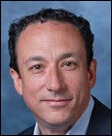
HIStalk Interviews Robert Kahn, MD, Faculty Lead for Population Health, Cincinnati Children’s Hospital

April 4, 2014 Interviews 1 Comment

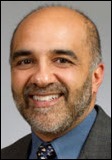
Robert Kahn, MD, MPH is professor of pediatrics, associate director of the Division of General and Community Pediatrics, and faculty lead for population health at Cincinnati Children’s Hospital of Cincinnati, OH.

image

Tell me about yourself and the program.

I’m a professor of pediatrics at University of Cincinnati and the Cincinnati Children’s Hospital. I’m a general pediatrician, but also with a degree in public health. 

My interests have always been with the broader circles of influence on kids. Not just are they getting the right shots and the right medicine, but obviously kids live in families, families live in communities, and there are a whole lot of other influences that determine how well a child is doing and how they are in their development. 

To that end, in 2010 the hospital developed four county-wide health goals around asthma, injury, infant mortality, and obesity. Because of my interests, they asked me to help co-lead that effort, thinking how does a quaternary care hospital begin to engage more deeply in achieving population health goals? That’s the background to some of these projects that then involve through electronic health record and helping bridge between what a physician would normally do in a day-to-day clinic filled with patients to begin thinking about community and population health.


Can you give a brief background on population health management, particularly that involving the public health issues in children that you mentioned?

Population health management refers typically in two different ways. One is, how is my total panel of patients doing? How can I get a high-level overview of everyone I’ve seen? How are all my patients with obesity or with asthma doing? How should I shift my overall care and allocation of resources?

What we’re doing here in addition to that is thinking, what about all the children we’re not seeing who have asthma? How should we think differently about improving their outcomes, even if they aren’t going to walk in our door? For us in Hamilton County in southwest Ohio, with 180,000 kids zero to 17, we wanted to begin a journey to say, what would it take to improve the health of all kids?

I would say we’re very early in that effort. We started in just a couple of neighborhoods to think about population health outcomes for that neighborhood. For example, in the city of Norwood, which is nested within Cincinnati, we know there are about 800 households with children under four. We wanted to think about what would it take to reduce injuries in homes with those kids. Our head of trauma surgery, who typically spends all his time in the operating room or in the emergency room helping these kids, has helped lead a team to think in a population way about injuries in the city of Norwood.


Do you feel vindicated in a way that you were early on in something that now everyone wants to figure out?

[Laughs] I’m not sure I feel vindicated. I’m excited that more and more people are interested. I’m really excited to think that maybe payment mechanisms and healthcare reform will start bringing financial incentives to do the prevention-oriented work that could help out in the community.


You mentioned that some of your work involves targeting neighborhoods and subsections of neighborhoods. Describe how you use geocoding.

There’s two ways we’ve used geocoding. We use electronic health records and part of that is geocoding. One is around clinical care and one is around population health management. 

In clinical care, we’ve used the electronic health record to help drive key questions about these other influences. We have one of the largest training programs for pediatricians in the country. If we set in front of them a series of questions in electronic health record about the quality of the housing, what school does the child go to and how are they doing there, are they able to make ends meet, what we can do is drive the discussion to these determinants that are outside of the typical exam room or outside of the typical physiology of an individual child. That then leads everyone to say, hey, where does this child live? What is his address? What other resources in the neighborhood we can get to the child? That’s at the clinical level.

At the population health management level, what we can do is take every single asthma admission in the past year. We know the minute they register. We have their address. We can then link that address to a latitude and a longitude, or what people typically call geocoding. We can say hey, that means they live in this census tract or this neighborhood. Then you can begin to look for patterns of where the asthma is particularly high, or patterns of where the injury or prematurity is high. 

The minute you put a dot on a map, it shifts the center of gravity away from just in the exam room in that moment to, my goodness, I didn’t realize I had 15 kids admitted from a 10-block radius, or a 20-block radius. What’s going on there that might lead to such high admissions rates for asthma or a high emergency room visits for injury? Now we’ve gotten to the point where literally on a monthly basis we can chart injury rates, prematurity rates, and asthma admission rates from each of the 70 to 80 neighborhoods in Hamilton County.


How do you draw a box around how far you can go being a hospital-based project? Do you put people on the street or link up with social agencies?

That’s a fantastic, very insightful question. People are really excited about it, but the right question is, where does our mission end and another person’s mission or another organization’s mission start?

This is a frontier time. On the journey, we’re out there trying to figure out what is it we can do, and then how do we catalyze new relationships, new missions, shared missions. 

As an example, I do not see my job as improving housing for children, even if they have asthma. I see my job is to know that mold, cockroaches, water damage, or a negligent landlord are important in exacerbating this child’s asthma. But then I really need to find the agency in the community that has a mission to improve that housing. So to me, it’s about building new partnerships. Staying true to my mission about improving health and delivering healthcare, but doing it in a way that engages other people with complementary missions. 

We work very closely with the Legal Aid Society of Greater Cincinnati. One of the great cases we had is a child with asthma, middle of the summer. The mother came to the doctor with the child. The doctor said, tell me about the child’s housing. The mother said, well, I’ve wanted to put an air conditioner in, it’s 100 degrees outside in Cincinnati in mid-summer, but the landlord told me I’d be evicted if I put an air conditioner in my apartment. It turned out we had had three other cases with the exact same story in the past week, all with different doctors. Because of our relationship with Legal Aid, they asked the really simple question I don’t need to ask, which is, who’s this landlord?

It turned out this landlord owned 19 buildings and was in foreclosure doing no upkeep on any of these buildings. Almost 700 units were going into disrepair. Legal Aid took it on, developed tenant associations, started to work with Fannie Mae and the property management, and ended up with hundreds of thousands of dollars in repairs and new roofs on these buildings. 

To me, the boxes fit together neatly. We did our job about saying this isn’t just about the kid’s lungs, it’s about where he’s living. They took it on to improve the conditions in where they’re living. But it was only because we had tracking systems through the electronic health record to know who these kids were and what their addresses were that then Legal Aid could go ahead and really understand what the pattern of the housing was and what the problem was.


What struck me as admirable in your model is that the hospital didn’t have any way to make money from this and hospitals a lot of times are guided by where the revenue comes from. How do you think hospitals can create a business case for these kinds of public health projects?

Luckily I’m in a place where very senior leadership at the very top has supported this notion and the board itself had endorsed these community-based goals. As our CEO says, our mission is to improve health, not to improve healthcare, or to simply deliver healthcare. It’s to improve health. If this is what it takes, this is what we need to do.

In an era of accountable care organizations in which there would be a global annual payment or a per-member, per-month payment to keep a child healthy, certainly then there’s a financial incentive to move out into the community and figure it out. Then every emergency room visit or an ICU admission for asthma becomes a loss. In that scenario, really beginning to go to the next step where you would say, what would it take? Would it take community health workers on the ground? Would it take hiring paralegals, or simply contracting with these other types of organization that could be effective in the community?

We also have a great collaboration with the Cincinnati public school nurses, who are really trying to think, how do we work hand in glove to help manage these kids? Again, to the extent there’s a huge financial incentive on a per-member, per-month basis to prevent illness, it becomes more and more feasible and desirable to build these relationships.


Where do you see information technology fitting in?

I’d say our approach has been relatively rudimentary. We work off the back end of our electronic health records system. There is a huge challenge because the school system or the pharmacies or the Legal Aid Society all have different technologies. It is not seamless right now and I’m sure it will take a while for it to be seamless, to figure out, how do we have shared responsibility for the patient? How do we share consents and get through some of the privacy issues? How can we track over time? 

My sense is, I haven’t seen that kind of technology developed, certainly between hospitals. There’s a lot more health information exchanges that work between hospitals. There’s a few folks, I think Nemours in Delaware, who have figured out how to get electronic health record look capability to the school nurses. But I think we’re a long way from true interoperability between everyone who might be touching a child or a family in terms of health.

I sometimes compare it to FedEx. If we were FedEx, I would know exactly when the patient showed up at the pharmacy, what time they checked in at school, how the lungs were doing there, and when they were going to come back to me. That level of tracking and monitoring to help the family with the family’s permission would be great to try to get to in the future.


Have you seen tools or thought about tools that would help what you’d like to do?

I’d like to say yes. [laughs] I’m intrigued by some of the new self-monitoring biosensors that are linked to, say, phones and then back to management software. Propeller Health is one example of a company that’s trying to think, how do you move the information from where the family is, where the child is, and bring it back to a central management point? That notion is a pretty huge advance. 

It’s still a long way off from saying, I’m co-managing these patients with the pharmacy, with the school nurse, with the community development corporation who’s thinking about green space in parks for the kids. We’re moving in the right direction, but there’s a lot of integration and a lot of issues to overcome. With the geocoding software, we’ve only scratched the surface, and even that’s not something hospitals typically use in their health analytics.


How would the average academic medical center or their physician practice organization create a model similar to yours?

I would think a health analytics group five years now, whether they’re working in a hospital or they’re working in an accountable care organization infrastructure, would have a geospatial group working with them. With that, they would be understanding where their patients live, what are the key local and regional determinants of health in that region, and then beginning to deploy healthcare resources differently. Being able to almost predict when there would be problems. Even knowing pollution and pollen patterns might be the kind of information that could be brought in, and then more anticipatorily, trying to get medicine out to the community if they know there’s going to be a surge in asthma morbidity.


Will be hard to get hospitals to do more public health outreach work instead of comfortably treating people who show up within their four walls with a complaint?

It’s going to take some time. It’s out of the comfort zone of where most hospitals are right now. Schools of public health and public health departments around the country could help healthcare a lot in trying to move the ball further faster. But I think until there’s a real financial incentive where there’s a big loss involved unless we’re preventing illness, it will be relatively slow-going.

The other caveat would be until we truly demonstrate a significant return on investment by thinking this way, it may also keep the work moving slowly. That’s our goal — to demonstrate we can actually reduce morbidity and cost by developing this kind of a platform.


Is there existing literature of where that’s been done, or are you finding that what you’re doing so far is promising?

We’re working really hard right now thinking about how to prevent prematurity with this kind of an approach. Every time a baby is born at 24 weeks gestation, it’s a $300,000 to $500,000  immediate cost and probably millions over their lifetime. If we can use a place-based strategy to prevent prematurity, we’ll have a much better argument for deploying the resources necessary, like community health workers, to get the job done.

There are various models of community health workers or home remediation, but I don’t think there’s been an integrated set of interventions put together that would really make the argument at the level of a hospital or an insurance company to push this strategy.


Do you have any final thoughts?

I’m excited to keep trying to push the boundaries. I see the electronic health record and geocoding is a way to break down the walls. 

I would just add, I have found tremendous, capable, and highly interested partners in the community who are really excited to have these kinds of partnerships, whether it’s the school nurses or the pharmacies or even Legal Aid. We’re now 10 percent of all Legal Aid’s cases in southwest Ohio because of this progress. It’s almost always a win- win-win — a win for the hospital, a win for the organization, and then a win for families that we can break down these barriers using electronic records and geocoding.

News 4/4/14

April 3, 2014 News 4 Comments

Top News

image

HHS releases a draft report from its FDASIA work group that includes a proposed strategy and recommendations for an HIT framework for maintaining appropriate patient protections and avoiding regulatory duplication. It reaffirms FDA’s position that its regulation is appropriate only for medical devices and not clinical software (including clinical decision support tools.) The report ponders the question of how a conformity assessment program (product testing, certification, and accreditation) might work and whether the government should play a role. It also recommends creating the Health IT Safety Center, seeking input on how it should be operated to share incidents, lessons learned, and user experience, also suggesting that third-party tests or reviews might play a role. The report describes three categories of health IT products:

  • Products for admin HIT functions, such as software for billing, scheduling, and claims management  that pose little patient risk. No FDA regulation is proposed.
  • Clinical software for health information and data management, medication management, physician order entry, electronic access to clinical results, and most clinical decision support software. No FDA regulation is proposed.
  • Products with medical device functionality, such as computer-aided detection software, software for beside monitor alarms, and radiation treatment software. FDA would continue to regulate products falling into this category.


Reader Comments

From Harry-O: “Re: NTT Data-supported Indy car. I’m pleased that we are no longer a client. While I understand that vendors need to market their products, those of us in the trenches are struggling to survive and pay their (for the most part) exorbitant support fees. Wouldn’t it be nice if they could find a way to market and reduce costs at the same time? What a waste, paid for by a hospital near you.”

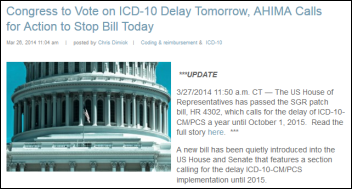
inga_small From Perky: “Re: ICD-10 delay. Does anyone have an inkling as to how things are going to proceed with such things as CQM reports and MU 2 demonstration/certification with the delay of the ICD-10?  As I try to think this through, my head sort of explodes. If they are going to continue to require ICD-10 codes for the CQM, PCMH, and MU 2 reports, then how are the codes going to get entered if we are not using them for billing? If they decide to stick with the ICD-9 for CQM, PCMH, and MU 2 reports, what happens with the certification process? If we are not allowed to use ICD-10 until after October 1, 2015, what happens with all of the products that are already certified to use ICD-10? Are they expected to rewrite their reports using ICD-9? Do they then need to go through the certification process again?” Unfortunately Perky just hits the tip of the iceberg with his list of questions and CMS may not have enough disk storage to adequately address all the new FAQs. CMS has been been oddly silent on the whole issue all week, suggesting that  no one at the agency saw the delay coming. One of the first steps towards clarity will be the issuance of a final rule for the new ICD-10 deadline. If anyone wants to stab at Perky’s questions, please share.


HIStalk Announcements and Requests

8 million

Assuming this isn’t your first time reading HIStalk, you contributed to the 8 million visit milestone. Thanks.

inga_small A few highlights from HIStalk Practice this week include: AMA remains tight-lipped about the ICD-10 delay. Physicians in academic settings report higher compensation when more time is spent seeing patients versus performing research. Specialists who are late in adopting EHRs may struggle to meet Stage 2 patient portal requirements. European Union GPs report that interoperability issues, a lack of regulatory framework, and inadequate resources are the biggest barriers to adopting ehealth tools. The GAO recommends CMS expand its benchmarks for assessing Medicare physicians. Dr. Gregg contends that HIT’s next big role is to motivate change in consumers that will drive transformation in providers. Thanks for reading.
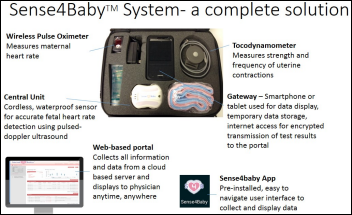
This week on HIStalk Connect: IBM partners with the New York Genome Center to research genetics-driven brain cancer treatments with Watson. Rock Health’s digital health funding report recaps a record-breaking $700 million in funding in Q1, its strongest investment quarter to date. Airstrip acquires San Diego, CA-based Sense4Baby, a startup from the West Health Institute that markets wireless fetal monitors.


Upcoming Webinars

April 9 (Wednesday) 1:00 p.m. ET. Think Beyond EDW: Using Your Data to Transform, Part 1 – Avoiding Analysis Paralysis. Sponsored by Premier. Presenters: Kristy Drollinger, senior director of population health analytics, Fairview Health Services; J.D. Whitlock, corporate director of clinical and business intelligence, Catholic Health Partners; Sean Cassidy, general manager of information technology services emerging business unit, Premier, Inc. Are you ready to invest in an integrated data platform? Do you have a strategy to make the information accessible and actionable? How will enterprise data warehousing transform care delivery? There’s more to data analytics than simply deploying an EDW. Learn what goes into becoming an information-driven enterprise in the first webinar in this series.

April 16 (Wednesday) 11:00 a.m. ET. Panel Discussion: Documents, EMRs, and Healthcare Processes. Sponsored by Levi, Ray & Shoup. Presenters: Charles Harris, senior technical lead, Duke University Health System; Ron Peel, technical advisor, LRS; and John Howerter, SVP of enterprise output management, LRS. IT department in hospitals implementing EMRs often overlook the role of document-driven workflows. Prescriptions, specimen labels, and discharge orders, and other critical documents must be reliably delivered with minimal impact on IT and clinical staff. This panel discussion will discuss the evolving use of documents in the “paperless/less-paper” environment.


Acquisitions, Funding, Business, and Stock

image

GE Healthcare will acquire CHCA Computer Systems, the Canada-based developer of the Opera software application for OR management and analytics, of which GEHC Is a distributor.

image

MModal reaches an agreement with the majority of its bankruptcy creditors to cut its debt by over 55 percent, which is about $350 million. Investor’s Chair sitter Ben Rooks provides some financial perspective about the company in answering a reader’s question in his “Health IT from the Investor’s Chair”.

image

IMS Health Holdings, which sells de-identified patient prescription information, goes public in an IPO that values the company at over $6 billion.

image

Practice software vendor edgeMED acquires revenue cycle management company Physician’s Billing Alternative.

ZirMed acquires the payment processing, patient eligibility, and patient estimation business owned by TransEngen.

image

Pharmacy automation vendor Aesynt, which operated as McKesson Automation until its November acquisition by Francisco Partners, acquires Italy-based pharmacy IV technology vendor Health Robotics.

4-3-2014 1-28-54 PM

TreeHouse Health makes a six-figure cash investment in LogicStream, a provider of clinical decision support tools.


Sales

A healthcare quality collaborative headed by San Jose Clinic (TX) selects CompuGroup Medical’s CGM Enterprise suite for community health practice management.

Memorial Health Care System (TN) and St. Vincent Health System (AR) select MedAptus Professional Charge Capture for automated coding and billing.

Visiting Nurse Service of New York chooses Crescendo from Delta Health Technologies for homecare business management.

VNA of Albany and Visiting Nurses Home Care (NY) choose Homecare Homebase.

image

Oconee Medical Center (SC) adopts PeraHealth’s PeraTrend platform as its real-time clinical decision support tool.

The Center for Diagnostic Imaging (NJ) will implement Healthec’s HIE platform.

Craneware signs multi-year contracts with two unnamed hospitals in the Eastern US for about $6.9 million.


People

4-1-2014 7-09-34 AM

PatientSafe Solutions names Cheryl D. Parker chief nursing informatics officer.

image

Nextech appoints Ron Kozlin (Pilgrim Software) CFO.

4-2-2014 4-50-14 PM

CareCloud names Lee Horner (Eliza Corporation) chief sales officer.

4-3-2014 1-39-53 PM

Baylor Scott & White Health appoints 11 new members to its senior leadership team, including Matthew Chambers (Scott & White Healthcare) as CIO.

4-3-2014 1-48-52 PM

Aaron Karjala, CIO of the troubled Cover Oregon online marketplace, becomes the fourth top manager to resign his post.


Announcements and Implementations

Cherokee Regional Medical Center (IA) goes live on its $2 million Epic system.

4-3-2014 8-29-21 AM 

Qatar’s Al Khor Hospital and Al Daayan Health Centre go live on Cerner.

image

Hudson Valley Hospital Center launches its MyHVHC patient portal.

Emory Healthcare and Grady Health System join the Georgia HIN.

The Spanish Catholic Center (DC) implements Forward Health Group’s PopulationManager and The Guideline Advantage. 


Government and Politics

4-3-2014 6-39-02 AM

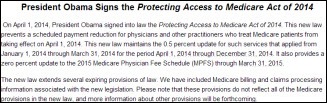
CMS issues a Daily Digest Bulletin that summarizes the newly passed Protecting Access to Medicare Act of 2014, Noticeably absent is any mention of the ICD-10 delay. The Bulletin notes that “more information about other provisions will be forthcoming.”


Innovation and Research

The New York eHealth Collaborative and the Partnership Fund for NYC call for applications for the second class of the New York Digital Health Accelerator, a program that will give up to 10 early- and growth-stage companies $100,000 each to advance their digital health technology efforts.

Children’s Memorial Hermann Hospital (TX) offers patients a chance to virtually visit the Houston Zoo, located across the street from the hospital, from their hospital beds using Google Glass.


Other

4-2-2014 7-16-11 PM

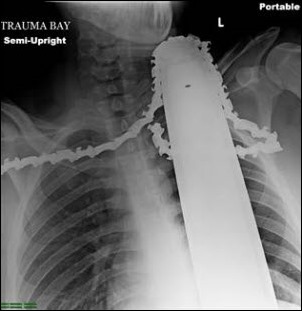
inga_small I suppose this constitutes a bad day at the office, at least if you are the tree trimmer who is recovering after the chainsaw he was operating kicked back into his neck.

The local paper covers the plight of a 25-bed critical access hospital in Arkansas, whose February computer fees of $63,000 contributed to a loss of $142,000. Administrators expect a $1.2 million EHR incentive check in May, but those funds will be used to pay off  EHR vendor Healthland, which did not require the hospital to pay until it received its MU check.

Mercy Technology Services, the information backbone of the Mercy healthcare system, will market its services to other Epic users as the first provider accredited in the Epic Connect program.

image

A KLAS report on ICD-10 consulting services (with the unfortunately timed subtitle “Who Can Help in the Eleventh Hour”) ranks The Advisory Board highest for overall ICD-10 consulting performance, followed by Aspen Advisors. Optum and 3M earned the highest scores for on-site training.
The majority of health organizations participating in a HIMSS Analytics survey report having a formalized EHR governance structure in place with a structure that involves a cross-functional, multi-disciplinary advisory board or committee. The biggest EHR governance challenges are physician engagement and adoption.


Sponsor Updates

  • 3M completes its acquisition of Treo Solutions, a provider of data analytics and business intelligence to providers and payers.
  • Analyst firm IDC names Covisint a “major player” in worldwide federated identity management and single sign-on.
  • Medworxx Solutions and Leidos Health will offer providers help with patient flow performance and analytics.
  • Allscripts recognizes its customer Citrus Valley Health Partners (CA) for being one of the first organizations in the country to meet the 2014 MU Stage 2 requirement for electronic transitions of care, which it accomplished using Allscripts dbMotion.
  • Wellcentive will demonstrate is population health management platform at this week’s AMGA meeting in Grapevine, TX.
  • Biztech profiles ICSA Labs and its work certifying security products.
  • The Health Catalyst team explains how population health management solutions lead to overall better health care.
  • MedAssets president and CEO John Bardis headlines the SEMDA 2014 Conference as the Gala speaker May 7-8 in Atlanta.
  • A local paper interviews Summit Healthcare founder and CEO Ted Rossi, who shares details of the company’s history and growth.
  • A KLAS report on HIEs finds that 100 percent of InterSystems HealthShare customers have made HealthShare part of their long-term plans and say they would purchase HealthShare again.
  • Craneware conducts its annual Executive Industry Leadership Survey to measure revenue integrity priorities.
  • ADP AdvancedMD, Intelligent Medical Objects , The SSI Group and NextGen issue statements following the passage of the ICD-10 delay legislation.
  • Kit Check adds Medi-span integration to its Trusted Pharmacist Medication Checks software.

EPtalk by Dr. Jayne

clip_image002

I seem to be rounding up lots of federal issues this week. Monday opened with an extremely heated discussion involving a hospital laboratory director, our medical group operations VP, and me. To make a long story short, one of our hospitals is refusing to play nicely in bringing a bidirectional interface live for our employed physicians. Although many of our physicians use a large national reference laboratory (mostly due to payer requirements) we have a handful of physicians who are being held captive because they are located in the hospital medical office building. The terms of their lease prohibit external vendors from picking up samples at the office after hours, which basically locks them out of the market. Since the practice specializes in OB/GYN and has a high volume of office-collected specimens, they’re stuck using the hospital’s lab and pathology services.


Although the hospital initially agreed to a bidirectional interface so the practice could meet its requirements for both structured data and CPOE, it is now balking under the excuse that a bi-directional interface isn’t “required” for Meaningful Use. They want the practice to figure out some way to create magic with electronic ordering that prints to paper requisitions and an unsolicited results interface. The orders can’t match up automatically, which makes a mess of all the numerators and denominators unless staff manually matches the results. I explained to the lab director in my best primary care voice that a bi-directional interface isn’t entirely about MU, but rather actually has a great deal to do with patient safety.

He didn’t seem to care that it would help close the loop on orders, making sure results were received and catching misses through electronic reporting. He actually suggested providers should use an accordion file and duplicate copies of the requisition. What century is this person living in? I understand competing priorities and limited budgets, but these are our employed physicians that we placed in the hospital building in good faith.

I thought at one point I was going to have to perform a stroke assessment on the operations VP. He made some threats about calling the hospital CEO to discuss breaking the lease and the lab guy still didn’t flinch. It was brinksmanship like I haven’t seen in a long time. I know the hospital CEO well and would love to be a fly on the wall when he calls the lab director and tells him to get it in gear. The bigger picture includes hundreds of newborn deliveries and even more GYN surgeries. Given the practice’s revenue boost to the hospital, I would bet money that the lab director will be singing a different tune by next week.

I’ve also been wrangling entirely too many consultants and administrators regarding the now-approved ICD-10 delay. We’re breathing a sigh of relief on the inpatient side because our hospital vendor still hasn’t delivered decent software. On the ambulatory side, I’m just aggravated, though. Our vendor worked extremely hard to deliver solid product and we’re upgrading very soon. I think of all the “real” enhancements they could have done to the software with the development dollars that they pumped into getting ICD-10 ready and out to the client base with ample time for everyone to upgrade.

Speaking of the legislation, did anyone read the whole thing? I did read the “Protecting Access to Medicare Act of 2014” and there were a couple of other gems that snuck in under the cover of the SGR patch. I love the fact that the Government Printing Office uses an old-school type face for the header on legislation. Check out Section 111, which gives hospitals some relief from the so-called “two-midnight rule” through March 2015. Of course “evidence of systematic gaming, fraud, abuse, or delays in the provision of care by a provider” can trigger an audit regardless.

Sections 205 and 206 include abstinence education and funding for the PREP personal responsibility education program. I know there are some sassy seniors out there, but I fail to see how throwing this in with the “Protecting Access to Medicare Act” makes logical sense. They should have called it the “Protecting Medicare, Serving Special Interests, and Tidying Up Odds and Ends Act.”

Fifteen million dollars for pediatric quality measures is in section 210. One of my favorite add-ons is section 216, “Improving Medicare policies for clinical diagnostic laboratory tests.” It requires laboratories to report their private payer contractual rates and test volumes to assist in establishing Medicare rates. So much for a free market (although we knew that was long gone with Medicare already.)

Another favorite (which I almost missed because of the mind-numbing and sleep-inducing effects of federal legislation) is section 218, which promotes evidence-based care by requiring physicians to use clinical decision support before they order certain radiology imaging studies. CDS modules can be part of certified EHR technology or independent. Eventually outlier physicians will require prior authorization before they can order studies. Just when you thought it was safe to go back into the water after MU2, there are more sharks circling. I hope the EHR vendors can code fast enough to keep them at bay.

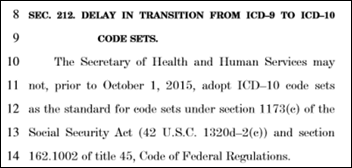
The ICD-10 delay is in section 212, if anyone is interested. I gave up after page 31. A reader gave me my laugh of the day about the delay:

Dear Dr. Jayne,

I have three young boys and one of them is always winding up in the ER. This year alone we’ve already had boy vs. coffee table, boy vs. Evel Knievel bicycle jump, and boy vs. monkey bars. Every time our insurance pends the claim and sends me a letter asking for verification that the injury was not work-related or due to a motor vehicle accident. I wish they could figure out that if the boys are 4, 7, and 10 they’re probably not on the job. A quick skim of the ER note would give them the rest of the information. I was looking forward to ICD-10 because maybe the more specific codes would give the insurance company what it wanted in the first place. I guess I’ll have to wait another year to find out. Hopefully we’ll be less accident prone by then.

Those descriptions remind me of Struck by Orca and I’m thinking maybe a companion volume is in order. What’s your reaction to the ICD-10 delay? Email me.


Contacts

Mr. H, Inga, Dr. Jayne, Dr. Gregg, Lt. Dan, Dr. Travis, Lorre.

More news: HIStalk Practice, HIStalk Connect.

125x125_2nd_Circle


Health IT from the Investor’s Chair 4/3/14

M*Modal from $1.1 billion to Chapter 11 – What Were They Thinking?

"Mr H, can you get Ben Rooks to opine on how smart Wall Street types could pay $1B for a $450M transcription company? Greater fool theory or something sinister?"

Sitting here in the Investor’s Chair, few things make me happier than a thoughtful question. I’m wondering what sinister theory you have in mind (and I’d love to hear it), but my view is emphatically one of the Greater Fool Theory. To support my thesis, let’s enter Mr. Peabody’s WABAC Machine and take a look at the events as they unfolded.

Long-time industry watchers will recall MedQuist (the predecessor company) from the 90s, when its growth was in large part driven by acquiring various transcription companies. As so often happened, earnings were ultimately missed, shareholder lawsuits appeared, and in this case, allegations of fraud emerged based on how MedQuist had been calculating its transcription billing rates. The company emerged from that peccadillo with a new management team. and one assumes, a new outlook on life.

Flash forward to July, 2011, when MedQuist acquired cloud-based natural language processing company, M*Modal (the * is presumably silent) for the fairly princely sum of $130 million in cash and stock. Princely in that it was over five times M*Modal’s run rate revenues, and the multiples of last 12 months revenues paid for medical transcription or HCIT companies were (using data from M*Modal’s later Fairness Opinion) 1.7x and 2.2x respectively. Hmm, interesting choice [valuation].

Back into the WABAC and skip forward to January 2012. Our next noteworthy event was six months later, when the company renamed itself M*Modal, according to its then CEO, “Illustrating our progression from a services-focused business to a provider of technology-enabled services and commercialized proprietary technology solutions.” Corporate brand identity is not part of the Investor’s Chair purview in this instance, but it seemed (even at the time) analogous to buying new carpeting and updating the landscaping prior to putting one’s house on the market.

In actuality, SEC filings show that even in October 2011, One Equity Partners had begun discussions with M*Modal’s management about acquiring the business in a Take-Private Transaction. Readers can review my previous post on how these work here.

Meanwhile, over the next few months, the company was approached by a number of other financial sponsors and a competitor referred to in the proxy as “Party A” (which I would guess was Nuance.) M*Modal went on to retain an investment banker, and by March, 19 private equity firms were invited to participate in the auction, of which 16 signed non-disclosure agreements.

As an aside, the value of NDAs is suspect at best, because over the next 10 days, representatives of five additional financial sponsors, having learned of the process from “unidentified sources,” separately contacted the Company’s financial advisors to indicate their interest in participating in the process and were subsequently invited to participate (because in auctions, the more, the merrier – as long as they can write checks — is usually a good rule). Bids were due April 26 and seven PE firms submitted.

Well, one would think that if financial buyers are attractive, strategic buyers should be more so, because they can bring various cost and revenue synergies to bear. That being the case, the bankers contacted five unnamed strategic players in late May, of which three immediately said, “Thanks, but no thanks” and two others said, “Sure, send us some materials.” Tellingly, neither of those submitted a bid.

Hindsight is generally pretty close to perfect, but this to me is the clearest evidence of the Greater Fool Theory in action. ST Advisors has on several occasions advised private equity investors on potential acquisitions. One of our questions to them invariably is, “OK, if you win this auction, you’ve just outbid all the strategic buyers. What will be different when you try to sell in a few years?” One can only wonder what One Equity’s thesis was. From the outside looking in, it appears to be a case of investors with little to no HCIT market insight believing their financial engineering skills could offset the risk of catching the falling knife that is transcription.

Over the course of the next few weeks as due diligence continued, some of the potential financial buyers notified the bankers that “they were withdrawing from the process, citing concerns about the ongoing profitability of the Company’s core transcription business, the nascent stage of the Company’s emerging healthcare technology business, and execution risks involved in the Company transitioning to a high-growth healthcare technology business.” Again, with the benefit of hindsight, good choice.

Party A was brought back in, but due to various concerns — especially relating to potential anti-trust issues — ultimately did not win the auction, leaving One Equity and M*Modal to announce on July 2 that it was acquiring M*Modal for $1.1 billion (a 19 percent premium over 180-day trading average and an 8.3 percent premium over the prior day’s close.)

Wow. $1.1 billion (2.4x LTM revenues) for a transcription vendor, albeit one with some spiffy speech rec, though Nuance certainly seemed to have that as well. Readers of this blog (or anyone not living under a rock) should realize that the ARRA-driven growth in EMR adoption is (very) likely to shrink demand for transcription. Based on the market dynamics, transcription pricing has been declining for several years. And other methods of data capture are becoming both more prevalent and easier to use. And other NLP vendors (Coderyte and A-Life Medical) were out there, again, wow. Over a billion seems like a lot here.

But did One Equity really spend over a billion dollars? Well, they did and they didn’t. Recall that the “L” in LBO stands for leveraged. A quick perusal of the data suggests that of the money paid:

  • $425 million was a term loan due in 2019
  • $250 million was a corporate bond due in 2020
  • $75 million was the company’s line of credit

leaving about 25 percent (or $250 million) in cash paid by One Equity and its investors. This left the rest to be borrowed from a syndicate of banks and investors (Fidelity was the largest debt holder, by the way).

Because there was a public market for these corporate bonds, we can track investor sentiment over the subsequent months. The bonds issued that summer at par value (meaning, you pay $100 for the bond for which the company has committed to pay you the $100 back, along with the agreed-upon interest). Shortly after Labor Day, approximately 90 days after the transaction was announced, the bloom began coming off the rose as the bonds started trading in the resale market at the mid-80s, showing that investors were beginning to get a tad skittish about the relative safety of this investment.

The bonds seemed to stabilize for some time, though in April 2013 the debt ratings were downgraded by Moody’s to “Outlook Negative.” Perhaps as a result, in June 2013, a new chairman and CEO were announced – Graham King and Duncan James, respectively – two industry executives with strong pedigrees and track records of creating shareholder value (disclosure: Duncan was QuadraMed’s CEO when it was a client of ST Advisors).

Despite this change, bond investors apparently continued to have misgivings, because by October 29, 2013, the bonds were trading at $60. A month later, they dropped from $58 to $45, indicating investors thought there was little likelihood the company would deliver on its financial commitments. On January 14, 2014, the bonds were trading at $37, and on March 20 of this year, in announcing its bankruptcy filing, M*Modal’s CEO made the understatement of the year (this being the biggest healthcare-related bankruptcy filing of the year so far): “When M*Modal was taken private in 2012, the acquisition was financed with a capital structure aligned with a specific set of assumptions that are no longer relevant.”

It’s hard to point the finger at anything sinister. I’m not privy to One Equity’s Investment Committee’s report or findings, but it definitely appears to be one of two components.

First, there’s sum-of-the-parts: (1) transcription – admittedly not a great business (and, in fact, worse than expected), but one generating cash, which can both cover some debt and fund some development; (2) technology (aka the original M*Modal), whose voice recognition and NLP solutions could be used for things such as data analytics, coding (hello ICD-10) and other sexier (read: high growth / margin / high multiple) businesses.

These two issues, together with a healthy (or perhaps unhealthy) dose of the aforementioned Greater Fool Theory likely drove the valuation discussion. In addition, its competitor Nuance was performing well, the company had a fairly attractive client base, and the new investors ultimately brought in a very talented CEO in Duncan James.

Still, weighing the fundamentals, it’s hard to imagine why One Equity thought this was a company worth over $1 billion or that it could support the debt service that a billion-dollar valuation required. As a result, their equity has likely been wiped out and the debt holders have been both crammed down and converted to a new equity.

This likely raises a follow-up question. Hey Ben, if the original M*Modal business was the gem here, why didn’t a PE firm just buy that? Recall that M*Modal at the time was a technology vendor with less than $25 million in revenues. That’s just not the kind of business that a PE firm can acquire as a platform acquisition, as it can neither be leveraged nor can it be big enough to generate the associated fees that drive the PE business model.

On the subject of transcription in general, I’ll close with a quote from arguably the world’s best (and wittiest) investor, Warren Buffett:

“Should you find yourself in a chronically leaking boat, energy devoted to changing vessels is likely to be more productive than energy devoted to patching leaks.”

Thanks again for your questions and keep them coming!

image

Ben Rooks spent a decade as an equity analyst and six years as an investment banker, where he worked on transactions such as this. Five years ago he formed ST Advisors to work with companies on issues that don’t solely involve transactions. He lives in San Francisco and absolutely loves e-mail.


Readers Write: Advanced Interoperability: Leveraging Technology to Improve Patient Lives and Provider Workflows

April 2, 2014 Readers Write 1 Comment

Advanced Interoperability: Leveraging Technology to Improve Patient Lives and Provider Workflows
By Justin Dearborn

image

There’s an increasing need for all of healthcare to be integrated in its approach to accessing, sharing, and storing information. It’s not just patients who could stand to benefit from more advanced interoperability. It’s also healthcare providers who want to meet legislative requirements such as Meaningful Use Stage 2 and Stage 3, as well as reduce costs and improve care quality.

Consider what typically happens in today’s medical imaging environment—often partway between a traditional manual environment and a fully interoperable one—when a patient presents to his primary care physician (PCP) complaining of shoulder pain, for example:

After receiving a comprehensive clinical exam, a patient named Dave heads home with a hand-scribbled order for a shoulder MRI. Before the exam can take place, however, the imaging center must get the order pre-certified by Dave’s health insurer. After receiving the insurer’s faxed approval days later, the imaging center schedules the patient for his exam. Days after that, the radiologist faxes his report to the PCP, who then calls Dave to set another appointment to discuss his torn rotator cuff. Once the decision to seek surgical treatment is made, Dave is asked to bring a CD of his radiology images to the orthopedic specialist.

If this process sounds cumbersome, time consuming, and inefficient, that’s because it is. It’s also the rule with respect to today’s medical imaging processes.

While it’s true that anywhere between 10 to 20 percent of imaging orders issued today are processed electronically, that still means the vast majority are processed manually via paper and/or fax. According to the Centers for the Disease Controls and Prevention (CDC), approximately 12 percent of all PCP visits alone result in a referral for diagnostic imaging—some 44 million imaging exams each year—which equates to a lot of wasted time and paper, not to mention money.

The payer-approval process only adds to that burden. Roughly 122 million imaging exams are processed manually by radiology benefits management companies each year, at a cost of about $75 per exam. That adds up to nearly $8 billion of waste a year.

So the question is this: What would happen in an environment of advanced interoperability, where existing electronic health records (EHR) and other technologies are fully leveraged? Take Dave’s scenario again:

After receiving a comprehensive clinical exam, Dave’s PCP electronically orders a shoulder MRI and schedules an imaging appointment for later in the day. Before the exam takes place, the imaging center receives electronic pre-certification. Once the MRI is complete, the PCP automatically is alerted that an image-enabled report is available. Before he leaves his office for the evening, the PCP calls Dave to discuss his torn rotator cuff and to electronically refer him to an orthopedic specialist who already has secure automated access to the image-enabled radiology report.

As this simple scenario illustrates, the entire patient-imaging process can be streamlined by enabling five key services: 1) electronic referrals and ordering; 2) automated pre-certification and approval using clinical decision support; 3) electronic patient navigation and scheduling; 4) image-enabled reporting; and 5) analytics.

Such advanced interoperability provides Dave, his PCP, and his orthopedic specialist with near-instantaneous exam ordering, approval, and scheduling. Ease of access to reports, results, and images is dramatically increased.

By creatively leveraging EHRs and other technologies, healthcare organizations can maximize their interoperability with internal and external providers. All these services, moreover, can be provided without costly point-to-point HL7 interfaces.

With payment reform, it is clear that the days of disjointed, manual image processing are numbered. Indeed, advanced interoperability like that described here not only addresses the challenges that impact physicians, but also pays handsome dividends for patient care.

Justin Dearborn is CEO of Merge Healthcare of Chicago, IL

Readers Write: Competing for Talent in Healthcare IT – Remember, Candidates are Interviewing You, Too

April 2, 2014 Readers Write Comments Off on Readers Write: Competing for Talent in Healthcare IT – Remember, Candidates are Interviewing You, Too

Competing for Talent in Healthcare IT – Remember, Candidates are Interviewing You Too
By Mike Silverstein

image

The healthcare IT market is as hot and competitive as ever and the battle for the industry’s top talent is on. If your firm has gone through any recent hiring waves, I probably don’t have to tell you that the buyer’s market of 2008-2012 is over. Strong candidates, regardless of specialty, who have good work records, great performance reviews, and above-average soft skills are being flooded with lucrative and enticing opportunities as soon as they dip their toe in the market.

These concrete, actionable items can help win over a candidate who is evaluating offers from multiple firms.


Tighten Up the Recruitment Process

Companies are making decisions and hiring faster than I have experienced in the past five years. In order to be competitive, make sure your process is swift and efficient and that the proper decision makers are involved. Nothing kills the chances of landing a great candidate faster than not being able to schedule something on a hiring manager’s calendar for a delayed period of time. Talent is the lifeblood of an organization. Make sure managers block off the appropriate time on their calendars so they do not become the bottleneck that kills the process.

Also, make sure there is a good rhythm between calls with the candidate. If the last phone interview was two weeks ago, don’t expect the candidate to be as excited about your job as they were 12 hours after their initial call.


Make Sure Messaging is Consistent

Nothing spooks a candidate more than hearing different things about a position from different people. Make sure everyone involved in the recruitment process understands the reason you are hiring for the position, who it reports to, what the expectations are, what the time frame is, and what is expected from this individual. If anyone is going to bring up the compensation associated with the position, make sure it’s consistent with what your HR team and your recruiter is saying.


Present the Company in the Best Light

From a convenient travel itinerary (even if it costs a few extra bucks) to having a “Welcome Joe Smith” sign on the door, it is important to pay attention to the details. Have a well-organized itinerary of meetings with the hiring team. Schedule a meeting with those same executives within 48 hours to make a go/no-go decision. 

Be to produce a succinct written offer within 24 hours after that decision, including a comprehensive benefits summary, explanation of compensation including (competitive) salary, bonus, and equity. Include a breakdown of how to earn 100 percent of the bonus.

Virtually none of this advice will cost you any more money. It is all about making the candidate recruitment experience more attractive and enjoyable. 

Mike Silverstein is partner and director of healthcare IT of DIrect Consulting Associates of Solon, OH.

Readers Write: Below the Waterline: Is Your Network Population-Health Ready?

April 2, 2014 Readers Write Comments Off on Readers Write: Below the Waterline: Is Your Network Population-Health Ready?

Below the Waterline: Is Your Network Population-Health Ready?
By Nancy Ham

4-2-2014 3-42-44 PM

Historically, health information exchange (HIE) implied the tactical, the plumbing and pipes that enable movement of health-related information among organizations according to national standards. Today an HIE network is a strategic asset vital to population health management.

Health organizations must supply more than bricks and mortar as our industry moves from what was once a conceptual model of healthcare to reality. They must provide a network solution for powering appropriate population health management capabilities.

HIE capabilities are evolving. Existing competencies are being coupled with workflow and care management processes, essential for analyzing and managing populations of patients − a shift from the traditional retrospective version of care to real-time, preventive care. Today’s care management needs to be informed and powered by high-quality, real-time discrete data from myriad sources across the continuum of care.

To affect population health, the entire healthcare ecosystem from acute to ambulatory to long-term and beyond needs to be connected, moving beyond the traditional reach and capabilities that current health information exchanges offer.

We’re all familiar with the phrase “the tip of the iceberg.” The tip of the iceberg is visible. It glints and shines. This iceberg principle applies nicely to many population health management solutions with flashy dashboards and snazzy visualization methods. They look really good on the surface, but what is imperative is what lies beneath the waterline. Is the foundation − the data asset from which the analysis is conducted − a solid one?

Before adding population health visualizations, ensure that your foundation is complete. Ask yourself:

  • Are your patient records correctly and accurately matched?
  • Do you have a sophisticated privacy and security infrastructure?
  • Do you have pointers established to access clinical data regardless of where it exists?
  • Can you manage granular patient consent?
  • Do you have a sophisticated mechanism for driving role-based access, including new network participants such as payers?
  • Is your solution able to scale to bring more and more participants into your network?
  • Does your system represent the entire healthcare community across care settings?
  • Are your referrals managed and communicated among providers?
  • Do you have alerts to notify providers when a patient experiences a health event so they can make informed and timely decisions for that patient’s care?
  • Are your EHR interfaces bi-directional?
  • Do you have patient engagement tools such as patient portals and personal health information?
  • Can you aggregate claims and billing data in conjunction with clinical data?
  • Are you using data standardization methods to furnish mineable data?
  • Can you share patient care plans?

Your HIE should do all of this. Your HIE partner should have a track record of linking hospitals with the entire community of providers.

When you have a sophisticated HIE network to enable clinicians to manage their patient population, you have a scalable foundation for improving the quality and cost of care. The foundation is key. From there you can snap on population health analytics solutions, whether from your HIE vendor or from one or more third-party vendors. Now you have evolved your HIE to a strategic network, curating the data flowing through the network to provide contextual, real-time information that engages both clinicians and patients.

Nancy Ham is CEO of Medicity of Salt Lake City, UT.

CIO Unplugged 4/2/14

April 2, 2014 Ed Marx Comments Off on CIO Unplugged 4/2/14

The views and opinions expressed in this blog are mine personally and are not necessarily representative of current or former employers.

Accelerating Workplace Relationships

I inherited the party bug from my parents. I recall that during their parties, Mom and Dad would march us seven kids in to play our instruments and sing. I think we each earned a quarter in exchange for those performances. Not bad for a non-union, late-60s era gig, I suppose.

image

My parents had many guests over between parties as well. Sometimes my dad’s co-workers, other times just small socials and mixers made up of Mom’s and Dad’s extensive friend network. We had no dull moments growing up!

When an HIStalk reader asked me to comment on how to accelerate work relationships and break down silos, partying was the first thing that came to mind. I’ve carried this tradition into work and home. While Julie is more into hospitality as I am into entertainment, parties and fun times with friends reside in our blood. Hardly a weekend night passes where we are not out dancing or hosting some sort of get-together.

image

Clearly, there are many techniques to building work relationships. Since you can download a book and get routine ideas, I will focus on methods less talked about yet in my wheelhouse, because I love to party. Yes, I party with my work peers and subordinates. I can hear the naysayers and I respect you. I can assure you from personal experience over the years, partying has made a positive difference in business outcomes as well as employee engagement. Plus, it’s fun. Life is too short to work with dull people!

Here are some ideas. I’d love to hear yours. Please comment below so we can all benefit. Not all will be applicable, but we won’t know if something works unless we try it. Be brave!

  • Monthly after-work socials. Who: managers and above. One Thursday per month, we hit a city (rotate) in our sprawling metroplex and get to know one another in a relaxed setting. Typically, we visit 2-3 venues and the first round is on me. Everyone knows the rules. People are responsible for their behavior during this voluntary social and getting wasted is discouraged. We are so hurried at the office that there’s little time for informal chitchat; this relaxed venue allows for real engagement.
  • Annual cheese, wine, and chocolate party. Who: directors and their significant others. Dress code: a step above casual. We’ve hosted six of these parties at our home. This fellowship has a two objectives, one social and one training. Some of our directors have officer-level career ambitions. This offers exposure to a new culture and a safe environment in which to practice new skills.
  • Annual Christmas party (non-office setting). Who: direct reports with their families. We host this event in our home as a gift to those who serve me directly. December is way too busy, so we schedule this for the first weekend in January. Our white elephant gift exchange has produced some interesting and memorable … stuff.
  • Annual leaders’ family barbeque and swim. We rotate the location of this summertime event at one of our director’s homes. Kids and significant others are the focus. We eat lots of food and chill while the kids—and a few brave adults—frolic in the pool. You want to engage your team? Engage their kids!
  • Sports (all unofficial due to liability.) Soccer teams, Ironman triathlon teams, mountain climbing teams, etc. Not everyone participates, of course. These are simply additional examples of outside-the-office party opportunities. After every adventure race, we have a line for our guest shower before the celebrations begin.
  • Manager and director thank you party. We did our first one of these in January. A gift from Julie and me, it is an opportunity to say thank you to my entire leadership team and their significant others. Email is OK and I love thank you cards, but having everyone over and showering them with love is yet another way to engage at a deep level. My success is largely attributable to their leadership so we are quick to have everyone over and splurge.
  • Special events. As needed. Last year, we won the Davies Award, so we hosted a professionally catered dinner for everyone who made this happen (including significant others.) Additionally, we invited the president of the EHR software company we used to come reinforce the magnitude of the achievement.
  • Personal parties. We have several parties throughout the year and we often include many from work (peers, staff, etc.). These include birthday parties, game nights, and theme parties. We have “The Great Gatsby” coming up next week. I suspect that 25 percent of our guests at personal parties are from the workplace.
  • Recognition events. Directors have access to our home to use as a party venue for their teams. Some of them use our home for team-building events, some use it for parties, and others for special recognition for projects well done. While many of the examples above stress managers and directors, over 50 percent of my entire department has been to my home at least once for some sort of party.
  • Exercise parties. Yes, my entire staff is invited to any of my daily workouts! Sometimes I will hold “office hours” in our treadmill or spin-cycle conference rooms. For some reason, these seem to be the least popular of all the parties …
  • Dallas City Lights. This monthly event involves friends in all of my circles, but again includes about 25 percent from the workplace. I choose a different location each month and we all meet up. February we went country and March we hit the Glass Cactus, where part of the dance floor was reserved for our group. We danced to ‘70s music until they turned the lights off at 2 a.m. In May we hit an infamous ‘80s-only venue. Dancing takes center stage at many of these gatherings.
  • Other peoples’ parties. I accept most the invitations I receive.

image

Many traditionalists suggest maintaining a big border between work and play. Leaders should not engage or otherwise be transparent with the teams they lead. I disagree. I found great success by being transparent and opening up my heart and home to those I lead.

Together, we have accomplished tremendous things, and I attribute a large part of this because of the level of engagement we have achieved. We know one another deeply. We know spouses. We know children. We know our joys and our hurts. When we know deeply, we care deeply. When one of us is injured or needs help, my joy is seeing many rush to walk with them, even carry them if needed. I’m thankful for the times they carried me.

And yes, when our kids were younger, we marched them out to entertain our guests. There was Brandon the Magician and Tali the singer. Memories!

Ed Marx is a CIO currently working for a large integrated health system. Ed encourages your interaction through this blog. Add a comment by clicking the link at the bottom of this post. You can also connect with him directly through his profile pages on social networking sites LinkedIn and Facebook and you can follow him via Twitter — user name marxists.

News 4/2/14

April 1, 2014 News 7 Comments

Top News

image

Implementation of ICD-10 will be delayed until at least October 1, 2015 (it’s up to HHS to set the exact date, apparently) as the Senate approves (64 to 35, with 60 votes required) a hastily assembled bill intended to once again delay the SGR-mandated 24 percent physician pay cut for another year, the 17th time it has been delayed rather than repealed and replaced. Nobody claims to know how the one-sentence ICD-10 language ended up in the otherwise unrelated bill. Sen. Jeff Sessions (R-AL) declares that the “doc fix” violates the just-passed Bipartisan Budget Act since there’s no money to pay for it. The patches have cost taxpayers an estimated $150 billion. The President signed the bill Tuesday. Several organizations expressed disappointment that ICD-10 was delayed and the AMA says it is “deeply disappointed” that the Senate kicked the can down the road again rather than repealing SGR instead of addressing Medicare physician payment reform. HIMSS didn’t announce a position on the delay, but CHIME said it wasn’t happy about the industry’s wasted efforts and the unknown aspects of the delay. A few sages predicted this could happen: the HHS big wheels declaring at the HIMSS conference that ICD-10 would not be delayed further are civil servants, not legislation-making members of Congress.


Reader Comments

image

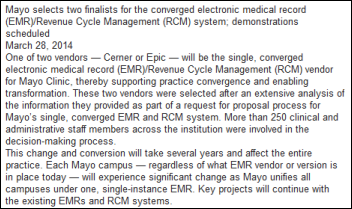
From Minnesotan at Heart: “Re: Mayo Clinic in MN, AZ, and FL. Looks like they are looking at Epic and Cerner from this article in the employee newsletter.” According to the March 28 newsletter, Mayo will implement a single-instance EMR at all campuses and has narrowed the field to Cerner and Epic for demos.

image

From Vince Ciotti: “Re: Indy Car Grand Prix in St. Petersburg, FL. I took this picture of the NTT DATA car.” Many readers would have been jealous of the obviously great weather in Florida had spring not finally kicked off in some places.

image

From Todd Hatton: “Re: Saint Luke’s Health System. We have gone live on Epic inpatient clinical applications on March 28 at our seven metropolitan hospitals in a big-bang fashion. Applications implemented are ClinDoc, Stork, Rover, Haiku, Cantu, Orders, ASAP, Willow, Radiant, OpTime / Anesthesia. SLHS implemented on the Linux database platform. New wrap-around applications are Perceptive Software integrated document imaging, Nuance eScription partial dictation integration, Perigen fetal strip integration, and iSirona medical device integration for anesthesia, ventilators, and bedside monitors in ED, surgery, ICU, and NICU. Things are going well.” Congratulations to the Kansas City area SLHS, where Todd is associate CIO and is no doubt proud of the team that made it happen. A seven-hospital big bang Epic go-live is quite an accomplishment.

image

From Plausibility: “Re: Meditech. We are looking a vendor-agnostic solution that pulls contextual information from the patient’s record. I am concerned that Meditech will block access to its data. Has anyone used a solution like this without having Meditech block the information or have advice on encouraging them not to?”

image

From The PACS Designer: “Re: iPhone 6. Rumor has it there will be two designs, a 4.7-inch phone and a 5.7-inch phablet.”


HIStalk Announcements and Requests

image

Welcome to new HIStalk Platinum Sponsor Navicure. The Duluth, GA-based company offers worry-free clearinghouse and payment solutions built for physician practices, supporting expanding health systems by accelerating and protecting practice cash flow, decreasing A/R days, providing enhanced eligibility verification, improving staff productivity, and giving patients tools to manage online statements and payments. The company serves over 50,000 providers, offering them a “3-Ring Policy” guaranteeing that support calls will be answered within three rings. Thanks to Navicure for supporting HIStalk.

I found this YouTube video overview of Navicure. 

image image

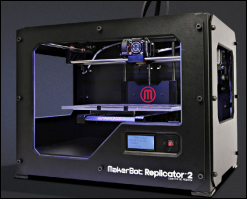
I sent $50 Amazon gift cards to three randomly chosen readers who responded to my annual survey, but Lorre noticed that two other readers had written in that if they happened to win (they didn’t), they wanted their prize donated to my favorite charity, DonorsChoose. I was touched, so this is for you, Andrew Gelman of PDR Network and Pam Landis of Carolinas HealthCare. I funded an amazing DonorsChoose project with your $100. I found a grant program underwritten by Autodesk that helps pay most of the cost for certain classroom equipment, and your $100 bought – you won’t believe it – a $2,669 MakerBot 3D printer, supplies, and support package for Mr. Fraustro’s architecture, engineering, and construction classes at high-poverty John A. Rowland High School in Rowland Heights, CA.


Upcoming Webinars

April 2 (Wednesday) 1:00 p.m. ET. A Landmark 12-Point Review of Population Health Management Companies. Sponsored by Health Catalyst. Presenter: Dale Sanders, SVP, Health Catalyst. Learn the 12 criteria that a health system should use to evaluate population health vendors and to plot its internal strategy, then see the results of grading seven top PHM vendors against these criteria. No single vendor can meet all PHM needs. The most important of the 12 criteria over the next three years will be precise patient registries, patient-provider attribution, and precise numerators in patient registries.

April 9 (Wednesday) 1:00 p.m. ET. Think Beyond EDW: Using Your Data to Transform, Part 1 – Avoiding Analysis Paralysis. Sponsored by Premier. Presenters: Kristy Drollinger, senior director of population health analytics, Fairview Health Services; J.D. Whitlock, corporate director of clinical and business intelligence, Catholic Health Partners; Sean Cassidy, general manager of information technology services emerging business unit, Premier, Inc. Are you ready to invest in an integrated data platform? Do you have a strategy to make the information accessible and actionable? How will enterprise data warehousing transform care delivery? There’s more to data analytics than simply deploying an EDW. Learn what goes into becoming an information-driven enterprise in the first webinar in this series.

April 16 (Wednesday) 11:00 a.m. ET. Panel Discussion: Documents, EMRs, and Healthcare Processes. Sponsored by Levi, Ray & Shoup. Presenters: Charles Harris, senior technical lead, Duke University Health System; Ron Peel, technical advisor, LRS; and John Howerter, SVP of enterprise output management, LRS. IT department in hospitals implementing EMRs often overlook the role of document-driven workflows. Prescriptions, specimen labels, and discharge orders, and other critical documents must be reliably delivered with minimal impact on IT and clinical staff. This panel discussion will discuss the evolving use of documents in the “paperless/less-paper” environment.


Acquisitions, Funding, Business, and Stock

image

Imprivata files for a $115 million IPO, planning to list its shares on the NYSE. According to the SEC filing, the company lost $5.5 million on revenue of $71 million for the year ended December 31, 2013, with 83 percent of its revenue driven by the OneSign single sign-on product that has 2.6 million licensed healthcare users and another 740,000 outside of healthcare. The S-1 registration statement also notes that the company uses a development firm in Ukraine with obvious exposure as Russia threatens. The fine print notes that BIDMC CIO John Halamka was given options worth $140,700 as a company director.


Sales

image

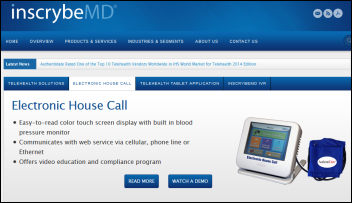
Florida Hospital Memorial Medical Center (FL) chooses Authentidate’s InscrybeMD telehealth solution to manage chronic disease patients in a partnership with Bethune-Cookman University.

ViaQuest’s Clinical Services Division (OH) will use Netsmart CareManager for its planned Health Home.

Ministry Health Care (WI) selects Besler Consulting to assist in the identification of Medicare Transfer DRG underpayments.


People

image

Patty Griffin Kellicker (Humedica) joins Hayes management Consulting as VP of marketing and communications.


Announcements and Implementations

St. Francis Hospital’s (CT) use of ReadyDock’s storage, charging, and disinfecting system for mobile devices gets coverage on the local TV station.

image

Brigham and Women’s Hospital (MA) will expand its use of scribes to operate its EMR, at least until that system is replaced. According to CMIO for Health Innovation and Integration Adam Landman, MD, MS, MIS, MHS, “It lets me sit next to the patient and focus 100 percent of my attention on the patient. There are a few patients who don’t want the scribe involved in their care, and then I ask the scribe to leave.”

image

TigerText says it will cover up to $1 million in fines if its customers are charged with violating HIPAA secure messaging requirements.


Government and Politics

image

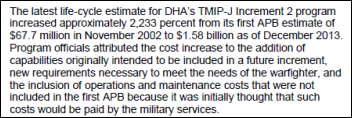
A GAO audit finds that Department of Defense is lousy at estimating long-term system costs, with its TMIP-J battlefield EHR (which includes the frontline portions of the AHLTA, CHCS, and DMLSS systems) being by far the most wildly underestimated. DoD estimated its cost at $68 million in 2002, but they’ve spent $1.58 billion on it so far.

image

Indiana’s professional licensing agency asks the state’s ethics commission to review a Board of Pharmacy decision that allows Walgreens pharmacists to use workstations that aren’t located behind counters in its “Well Experience” program. The pharmacy board’s president at the time the request was approved was a Walgreens manager. Consumer groups expressed concerns that pharmacists might leave the area and expose confidential computer or label information to customers.


Technology

image

Retired Akron, OH cardiologist Terry Gordon, who advocated placing automated external defibrillators in public areas, is working on a scavenger hunt-type game app that would encourage high school students to locate and report the AED locations to a central database so emergency responders can direct 911 callers to them in a cardiac emergency.


Other

image

In New Brunswick, the government’s $16,000 subsidy of the $24,000 Velante EMR sold by a for-profit venture of the New Brunswick Medical Society ended Monday. Expected physician enrollment was running well behind expectations through the end of February. The medical society partnered with a vendor who then contracted out system development to a New Zealand company.

image

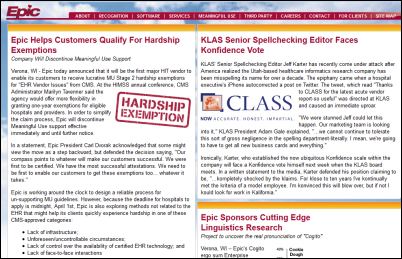
Epic offers its usual April 1 merriment, declaring that it will immediately discontinue Meaningful Use support to allow clients to claim Stage 2 hardship exemptions, KLAS realizing that it has always spelled CLASS incorrectly, and Epic funding research into how to pronounce the name of its business intelligence suite Cogito but advising to just call it “ree-POR-ting” for now.

image

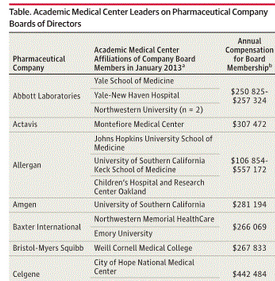
A new JAMA-published study finds that 19 of the 50 largest drug companies have at least one academic medical center leader on their boards, paying them an average of $313,000.

The chairman of an England-based CMIO-type organization says his organization can’t say anything negative about their software systems because vendors will sue them. “Our pockets are not deep enough to confront the legal departments of the suppliers,” he says, suggesting that instead trusts contact each other before buying.  

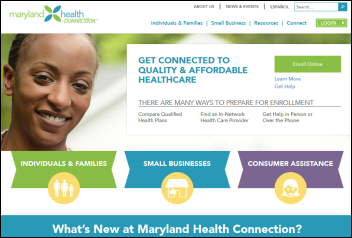
Weird News Andy titles this story “To Make You Feel Better.” Hearing-impaired California consumers who called the listed 800 number to receive help signing up for health insurance are surprised to hear, “Welcome to America’s hottest talk line.” The site’s incorrectly listed number was for a sex chat line. A Covered California spokesperson denied that its site listed the wrong number despite the local TV station’s screenshot clearly showing it. A Sacramento newspaper had made the same mistake previously, running a number that was one digit off and sending prospective subscribers to the same service.


Sponsor Updates

  • Brad Levin, GM of Visage Imaging, contributes an AuntMinnie.com post titled “The Time is Now for Deconstructed PACS.”
  • SyTrue is selected to present at the Healthcare Documentation Integrity Conference in Las Vegas, NV July 23-26, offering “Your ‘Hitchhiker’s Guide’ to Medicine’s ‘Tower of Babel.’”
  • PerfectServe discusses clinician exhaustion and offers three steps to eliminate the problem.
  • Harris Corporation’s FusionFX Patient Portal earns 2014 Edition Modular Ambulatory and Inpatient Certification from ICSA Labs.
  • Health Care Software posts its event calendar through October.
  • ESD celebrates 24 years in healthcare IT.
  • Etransmedia Technology’s Direct Care Coordinator receives ONC-ACB certification.
  • DrFirst and Insight Software partner to offer e-prescribing to eye care providers.
  • First Databank will summarize research findings on drug pricing benchmarks at two pharmaceutical conferences in April and May.
  • WebInterstate Inc partners with Liaison Healthcare to integrate its MediMatrix mobile imaging solution to multiple EMRs.
  • MedAssets continues to support clients in preparation of ICD-10, saying the transition is “when” rather than “if.”
  • Deloitte Analytics senior advisor Tom Davenport expounds on the findings of the strategic planning required for big data to be of use.
  • Wellcentive will demonstrate its population health management platform during the AMGA conference in Dallas, TX April 3-5.
  • Perceptive Software creates a blog to recap Inspire 2014 in Las Vegas April 4-9.

Contacts

Mr. H, Inga, Dr. Jayne, Dr. Gregg, Lt. Dan, Dr. Travis, Lorre.

More news: HIStalk Practice, HIStalk Connect.

125x125_2nd_Circle

Readers Write: Doctor’s Day and HIMSS

March 31, 2014 Readers Write 5 Comments

Doctor’s Day and HIMSS
By Dr. Wellbeing

On Doctor’s Day, I am reflecting on the morale of my profession. I hope to get away with being the kid who says, "The emperor has no clothes."

I looked long and hard for inspirational writings about doctors, particularly on this day, and there were none. Maybe the closest to a worthy read was Malcolm Gladwell’s article in Forbes about the state of American healthcare, followed by his interview called, "Tell People What It’s Really Like to Be a Doctor." It came as a surprise considering he is not an insider, but he is one of the most insightful thinkers out there. As such, I was happy to see a voice in defense of doctors.

Alas he is the exception that proves the rule. Because it seems doctors are blamed for everything that is wrong with the healthcare system these days.

CMS is making physician payment data public. Insurance companies are placing doctors in straightjackets and requiring pages of paperwork just to get one medication approved. Patients have unrealistic expectations of, "I can hardly wait to chat with my doctor at my leisure online."

No wonder the morale of doctors is at an all-time low. It is the equivalent of a big bully chasing the weak kid around on the playground because he is small and cannot fend for himself. Physicians historically have not been well organized, and their representatives – such as AMA — abandoned them a long time ago.

I just returned from my first HIMSS conference, where everybody was busy giving advice on how practices should get ready for ACOs, MU, ICD-10, PCMH, population health etc. I am thinking that maybe the ones who should have their data made public are the HIMSS folks themselves, since just to exhibit there for one week costs more than my salary for a year.

I am not returning anytime soon. Even though I was warned by close friends that HIMSS is physician-unfriendly, I was not prepared for the CEO and chairman to start the conference with an insult to physicians after asking them to stand up in a full room. One IT person who is equally disenchanted with HIMSS and vows to not return suggested that we should invite "60 Minutes " to one of those conferences. Or maybe some patients, for that matter.

The healthcare IT industry has become a bit like the tail that wags the dog. It has lost its sense of purpose and meaning. One of my favorite lines ever is from “Jurassic Park,” which is, “Just because we could does not mean we should.”

One vendor was shocked to find out that I am not paid for “population health.” Another one dressed in a white lab coat could not explain to me who makes the ultimate decision in telemedicine (one genie that left the bottle) when the patient with congestive heart failure whom we try to keep out of the hospital cannot breathe. Who calls 911 — the patient, his doctor, or the “doc in the box?” Nor could he answer whose liability that is. I have yet to see a tele-intubation.

If we are to have some foresight, then maybe we should have some hindsight as well and understand how we got here in the first place. The sickest patients, the elderly, the chronically ill, and nursing home residents are not technology savvy. Nursing homes have been beaten by litigation to the point that the fear of being sued is so ingrained into their psyche that they cannot even give a Tylenol or a laxative without a doctor’s approval. Hence, why every decision in healthcare goes through a doctor’s office whether we like it or not. It is why my inbox is full every day and I have endless hours of mind-numbing work.

Another EMR vendor could not articulate why a hospital should buy its care coordination solution when hospitals are not being paid for care coordination. Little do they know that very few actually participate in ACOs, nor do they plan to do so. As such, their solutions are based on assumptions that we will all be in an ACO one day, an experiment that has yet to show results, also ignoring the fact that 60 percent of doctors have expressed no desire to join one.

The whole premise of the HIMSS technology offerings relies very heavily on the Assume a Can Opener theory. It has very little understanding of how healthcare is being delivered and paid for, which I particularly found very disturbing.

The shortage of physicians and the burnout is real. On this day, let us all remember that in reality what we are paying docs to do is to make decisions. That is far more complex than any of the human endeavors or societal activities, and yet it is the most-intruded upon, most-regulated and most-distrusted of them all. In Greek mythology, Hydra grew two heads each time one was cut off, just as healthcare grows more complex by the day. Yet the ones who should be consulted first seem to be the last.

It seems the harder we try to fix the "broken American healthcare system," the farther we are from fixing it. The recent proof is the ineptitude of Congress, who is not capable  to understand the complexity of what  they are voting on, always approving short-term fixes to long-term problems. The sad part is not that the fee-for-service is broken or that the HMO / capitation / ACO is better, nor that they kicked the  can down the road regarding SGR for the umpteenth time, but that we are forced to practice in a a dual, ambivalent environment where both are equally approved.

While hospitals are paid by DRG, doctors are paid per day. In Medicare Advantage Plans, the Primary Care gets paid capitation, while the specialists get paid fee-for-service. We have created a de facto "divide and conquer" system.

Too often the term "physician alignment" is used along with "patient engagement " and "accountable care." How about if for one day a year  – March 30 — we use "patient alignment and patient accountability“ and "physicians’ engagement?” Because returning from HIMSS, my EMR inbox was full of messages like, "Can the doctor write me a note for early dinner sitting on my cruise since I am a diabetic?" or “Can the doctor write me a note for the airline to allow me to take my dog with me on the plane since I suffer from anxiety?" or "What kind of fiber should I take?"

I do believe strongly that patients should have access to their records and that healthcare records should be digitized, but  I do not subscribe to the assumption that it will resolve our healthcare woes or that it will lower healthcare costs. Just giving patients their data does not mean that they will know what to do with it, nor that they will make wiser decisions. Giving them an app does not mean that they will start eating spinach.

The same is true of physicians. Inundating them with data does not mean they will make better decisions, either. We are in essence data-rich but information-poor.

While I enjoyed networking and meeting people, it was difficult to separate the signal from the noise. I saw what billionaires look like, from Judy Faulkner to Dr. Patrick Soon-Shiong, who was gracious and took a picture with me so I can show my kids that the richest man in LA is a physician and not a movie mogul. But I cannot ignore the fact that not all hospitals can afford Epic and that so many had their credit ratings downgraded due to Epic implementations budget overruns, nor the fact that the orange-clad NantHealth staffers had no idea what their company was about. I also had the opportunity to explain to some why social media for many physicians is a legal minefield and many MDs shy away and don’t want to live in the town where they practice.

One economist said that when the barn is on fire, the farmer by instinct goes inside and saves the cat, the dog, and the livestock and leaves the rest behind. I believe it is time for healthcare IT industry to do the same. If healthcare is on the verge of a cliff, then healthcare IT can either throw us a rope or give us the final push. 

I keep hoping that someday the pendulum will swing back to doctors being respected and trusted and that they themselves rediscover the meaning and calling of their profession amid all the chaos. I should have faith because Mr. H told me so.

Curbside Consult with Dr. Jayne 3/31/14

March 31, 2014 Dr. Jayne 2 Comments

clip_image002

I wrote earlier this month about our hospital nickel and diming staff who wanted an actual paper card to confirm their life support certification. There was an outpouring of reader correspondence about hospital policies that are designed to cut costs but that seem to have backfired.

Many of us are pinching pennies to buy larger more powerful servers because we’ve outgrown our current ones faster than anticipated or are juggling implementation budgets to ensure providers get the go-live support they need. With that focus, we tend to forget how much our organizations spend on day-to-day operational costs. We’re not the only ones who have to keep an eye on the bottom line. One reader knows acutely just how deep the budget slashing has gone.

Dr. Jayne, I enjoyed your column about penny wise and pound foolish. Our hospital replaced a fairly decent paper towel with a very cheap brown one. These towels don’t absorb much, so you end up using five times the paper towels that you did with the previous rolls. Our department runs out of paper towels frequently and I have to run down to housekeeping to pick up more rolls. As it happens, housekeeping has trouble keeping paper towels in stock (maybe because the whole hospital is using the cheaper rolls much faster – go figure).

Many times I am unable to pick up paper towels the first time I run down to the supply department. When I pointed out the inefficiency of the paper towel situation (particularly with the FTEs spent running around trying to keep them in stock) in a cost savings committee meeting, the environmental services rep said, “You wouldn’t believe how cheap they are.” Hello? Did anybody hear me? It’s been a couple of years. We still have the same blasted paper towels. And let’s not forget – it takes FOREVER to dry your hands, but they want to encourage hand washing.

We’ve had a similar situation in the office building where our ambulatory EHR office is located. To save money, instead of having housekeeping staff check the bathrooms multiple times each day, they only service ours once a day. We don’t have rolled towels but those old-school folded ones. In order to keep the towels from running out, the housekeepers cram as many towels as possible into the dispensers. They’re packed so tightly that if you try to pull a single towel, it rips, so there are constantly scraps of paper on the floor.

The only way to get towels out is to hook them on the end and pull a big stack of them out. This leads to dozens of towels being dumped in the trash. Another tactic is for the housekeepers to leave a stack of towels on top of the dispenser, which leads to either all of them falling into the trash (or on the floor) or being ruined when someone drips wet hands on the stack. Ditto with leaving a pile of spare towels on the sink.

Additionally, because after-hours housekeeping is more expensive than having it done on the day shift, our floor is now serviced during the noon hour when lots of people are trying to get in and out. Some housekeepers will work around the staff’s needs, but a few of them barricade the door. In the best-case scenario, our staff wastes a little bit of time going to another floor. In the worst-case scenario they stand around and wait for the housekeeper to finish.

I’m pretty sure the productivity cost from either scenario would cover the shift differential so our facilities could be serviced before or after office hours. Either way the staff is left with the feeling that saving money is more important than their needs, which isn’t exactly a morale builder.

Another reader recently relocated and finally landed a position with a health system after a lot of looking. It was more of an entry-level position than he had when he worked for a large vendor. He expressed concern at the waste he’s seeing from a personnel standpoint:

I’ve worked with hospitals, but never for one directly. I didn’t want to miss out on ICD-10 and Meaningful Use 2 and there aren’t many vendors out here. I was blown away by the size of the IT department. There are more manager-types than doers. Everyone is a consultant and no one gives a hoot. There is a ton of turnover and no accountability. The consultants are riding out the sunset of their careers and take it out on the energetic ones. The SMEs have skills that no one wants and the six tiers of management exist solely to waste time and overcomplicate things. People vanish for hours a day and the place is empty by 3:15. What do I do now that I’ve taken a job and am surrounded by such inefficiency and waste when I really wanted to DO something?

Unfortunately, I don’t have good advice for him other than encouraging him to stick with it long enough to either move up or find something better in his new home town. I’ve worked with a handful of analysts that think it’s OK to arrive at the office late, Facebook all day (pausing only for a long lunch), and duck out early. I suspect that with that many layers of management they may not have a handle on what’s going on right under their noses.

With all the regulatory events on the horizon, though, most organizations have more work to go around than anyone can handle. Our analysts work their tails off, and if they have a spare moment of time, they’re looking ahead trying to anticipate ways that they can make processes more efficient or help our users. They’re a self-policing team and if there was a slacker in their midst, they’d make his life miserable. Unfortunately if the entire team has those tendencies, it’s much trickier.

Have any advice for this reader? Any other great stories of cost cutting that saves dimes at the expense of dollars? Email me.

Email Dr. Jayne.

HIStalk Interviews Michael Doyle, CEO, QPID Health

March 31, 2014 Interviews 1 Comment

Mike Doyle is president and CEO of QPID Health of Boston, MA.

image

Tell me about yourself and the company.

This is my fifth company as president and CEO. I was attracted to this opportunity because we understand the clinical frustration that physicians, nurses, and clinicians of all types are having accessing data in the electronic health record. 

QPID can read both structured and unstructured data. We’ve built a very extensive medical vocabulary and medical ontology that enables physicians and nurses at the appropriate point of the clinical workflow to have access to both structured as well as unstructured clinical data. It solves a major pain point that exists today.


What’s wrong with EHRs and what gets better when you install QPID?

First of all, I’m not here to knock EHRs. We partner with a number of EHRs. I think EHRs are necessary, but not sufficient. 

Part of the issue is the way that most of them evolved. They are billing applications that evolved into clinical applications over time. The way the data is organized in the EHR is very, very different from the way a physician practices. As a result, there’s a disconnect with serving up appropriate information at an appropriate point in the care delivery model that exists today in the United States. 

EHRs are forms of data repositories with a transactional chassis built into them. I believe that most EHRs, if not all EHRs, would greatly benefit from applications like QPID that allow easy retrieval of the really important data that exists and resides in the EHRs.


Give me two or three examples of what an EHR user can do with QPID that they can’t do without it.

Three-quarters of the record is generally text. It’s almost impossible to report out in any sort of a systemized way textual information and deliver at a point of care that makes sense. As a result, physicians generally look at two or three notes, see a patient, and then either make a diagnosis or do a particular procedure. A lot of information is contained in the record that is never used to render an opinion. You have a tremendous amount of overutilization, duplicate testing, that sort of thing.

Think of QPID as Google plus CliffsNotes, delivered at an appropriate point in the clinical workflow. It allows the physician or the nurse to have relevant and complete information about the patient to render a better medical decision. 

As an example — and this happens all across the country — you go in for a colonoscopy. You go through the awful bowel prep for that. As much as 20 percent of the time, you show up to the GI doc for your procedure and you realize that you have either sleep apnea or you’re on blood thinners or five or six other risk factors that are in your record, but no one chose to look at that information in your record prior to showing up for that particular procedure. As a result, the procedure gets cancelled because the patient would be in undue or unnecessary risk at that particular day.

QPID, two weeks before the procedure, goes into the record and looks for risk factors associated with a colonoscopy. They could be either in structured fields or they could be in free text. To the extent it finds that information, it alerts the nurse administrator or the physician’s office that Mike Doyle is on blood thinners, and then the nurse can call Mike Doyle and say, “Hey, please discontinue your blood thinner, because to the extent we find a polyp, we’re going to want to remove it. We don’t want to have excess bleeding.” 

That’s one small example. Every patient, for example, at Mass General, the Brigham and Women’s Hospital … if they come through the ED and they’re going to have an MRI, QPID goes into the record and looks for any evidence of metal in the body anywhere. To the extent it finds it, it alerts the person doing the procedure that this MRI is likely to cause harm to the patient, so we probably shouldn’t do an MRI.


Some might say it sounds like data warehousing or analytics, but those don’t provide real-time clinician feedback. 

Yes, we can actually do it prospectively.

The other thing that is really interesting that we’re doing is we’re eliminating the need for prior authorization of procedures. If you’re a cardiologist at Mass General and you use one of the major health plans in the Boston area, if you use QPID, you do not have to call an insurance company to do a particular cardiology procedure. This is a big deal, because MGPO — the physician’s organization at Mass General – employs 300 people who do nothing but call insurance companies for prior authorization for a particular procedures. The insurance companies have an equal army of people that answer the phone and either accept or deny a particular procedure.

We’re automating that entire process by loading in the national guidelines for how to care for a particular cardiology procedure. QPID is intelligent enough to know the relative risk factors and the health status of the patient, compares it to national guidelines, and recommends or suggests data that will allow a physician to do a particular type of procedure. Ultimately, it’s the physician’s choice if he decides to follow those guidelines, those recommendations, but the insurance companies are finding this compelling enough that they’re starting to eliminate the need for them to physically or audibly speak to the patient, the physician themselves. 

We built up cardiology. We’re now building out a whole series of orthopedic procedures, abdominal procedures. The idea is that over time, Mass General will be able to redeploy those resources that were spent calling insurance companies to get prior authorization elsewhere in the organization, which obviously saves a tremendous amount of time and money and increases throughput of procedures. We think using the power of a natural language processing engine with clinical intelligence and guidelines is the future of medicine. We’ve taken this now to various other parts of the country and talking to other payers as well as providers and it’s resonating with them.


Is it used everywhere within Partners?

On an official basis, no. On an unofficial basis, yes. It’s used in eight different hospitals in Partners, including the Brigham, now officially. But Dana-Farber, the Faulkner, Newton Wellesley, North Shore, Spaulding … it’s used in all the hospitals across the spectrum. I’ve never seen a piece of software where doctors have sold it to other doctors. 

We’re doing our Series B fundraising right now. We’ve had a bunch of VCs talking to physicians from Partners hospitals and they have said that it’s the only piece of software they have seen that actually helps them do their job. The validation for that is that we’ve got close to 9,000 registered physicians and nurses using this in the Partners system, all without any sales, marketing, or support dollars associated with that adoption across the different hospitals.


Partners developed and is commercializing QPID. How much of its use is mandatory?

Zero mandatory use of it. It’s all voluntary.


If Partners developed it and it’s so useful, why don’t they mandate its use?

I don’t think they had to mandate it. It’s done it itself. What’s happening now, though, because insurance and payers are starting to take note of this and are offering essentially an incentive to use it because you don’t have to call in an insurance company, it’s going to have any greater official adoption, probably mandatory adoption among physicians, surgeons, and folks who do procedures. But it’s not mandated right now.


How many other hospitals outside of Partners use it?

We’ve sold two, which is what we said we would do last year. We sold it to two hospitals outside of Partners. One, it’s going to be deployed via the cloud, the other one’s going to be behind a firewall. I’m not at liberty at to say who they are right now, but one has a major EHR which is used predominantly in academic medical centers. The other one is an EHR which is the most widely deployed in the world.


Neither of those are live yet?

They are not. They will be soon.


Was it hard to take that custom built product and then do the translations and all the ontology and the metadata needed to turn a commercial EHR’s information into what you need in QPID?

First of all, Partners is a federation. It’s a combination of well-known EHRs as well as homegrown EHRs. I think we pull data from nine different databases, financial as well as clinical databases. We’ve had to build virtually a whole bunch of different sort of interfaces to be able to enable that to happen.

The medical ontology is very similar by specialty across the United States. We’ve got a vast library of thousands and thousands of hours of ontology that we’ve built. There are some regional differences, but if you’re an internist, you’re interested in certain things which may be different than if you’re a GI doc or an ED doc or a cardiologist or whatever you may be, but very, very similar vocabulary across the country. 

That has not been difficult at all. We’ve got interface experts from most of the major EHRs on our staff, or consultants for the company, so we know how to do that. I ran an EHR company before this, Medsphere. We did a whole bunch of integration work there with lots and lots of different systems, so we know how to do it.


Having worked both for an EHR vendor and now for a company offering an EHR add-on, will EHRs will continue to be the center of the healthcare IT universe?

I think for the foreseeable future. They serve a very useful purpose of amalgamating data. I think it’s going to be interesting to see what happens with the big data warehouses as well as the HIEs. 

One of the things we’re finding is that in partnering with HIEs, we could create a business model that’s sustainable for HIEs. That’s kind of interesting. I think we could also partner with clinical data warehouses and provide functionality to them as well. 

EHRs are here to stay for at least the next 10 or 15 years. I think they’ve got to morph their business model to some extent and I think they have to partner with companies like ours that add usability and functionality to the user experience.


Despite the “big data” buzz, information that’s already available from inside the four walls isn’t always used to make decisions. Is that your selling point when you go in with QPID?

Yes, completely. First of all, if you actually look at how hospitals are built, there’s generally different systems, inpatient and outpatient systems. Those systems generally don’t talk to each other. There’s also a number of IDNs that may have the same inpatient and outpatient system, but they don’t talk from hospital to hospital together. What QPID does today is it bridge between inpatient and outpatient systems and pull data from both systems and present a unified view of the patient. We can do that across hospitals or across different systems when we do that today. 

The real issue, and the interesting thing that’s going to happen in the not so distant future, to your point, is there’s a tremendous amount of useful information in the electronic health record that is either dormant or buried and won’t see the light of day. But it’s extremely useful. You can see a scenario down the road where, this litigation, because something goes wrong with a patient, and the information was contained in the record but the physician never saw the information, didn’t bother to look for the information, or the information was buried or filed in the wrong clinical drawer, so to speak. The physician looked in that drawer, didn’t find anything, but yet the information was there, was just misfiled. 

This idea that there’s important information in the record that never sees the light of day is a big issue. Unless we come to grips with that and use applications like QPID that can read both structured and unstructured data and find that information no matter where it is buried or stored … the only way patient safety is going to improve when information is included in the record and can’t be accessed is with applications like QPID.


Is QPID a listener-type application that’s working in the background or do you have to interact with it to receive its alerts?

It’s not an alert system, but if there’s information about the patient, then there’s a little blue Q that lights up during the clinical workflow of the physician. You’re alerted to the fact that there’s information there. You just click on QPID and then the information is presented to you the way you want to see it. 

If you’re an internist, we do 300 simultaneous queries of information. If you’re an admitting physician at Mass General, before you admit the patient, look at 300 different things organized around organ systems. If there’s information in those various boxes of those 300 things we’re looking at, it’ll blacken the area. If there’s new information, it’ll gray out. You can just hover over that information and see exactly what QPID is alerting you to take a look at.


Do you log the information the software presented and then track how many times it was acted upon or judged useful?

Yes. It’s all logged, every interaction and every patient encounter. We had 2.96 million clinical encounters last year that the Partners system has logged.


The log itself should be useful, either from a product standpoint in knowing how often it provides value or to check the near-misses that QPID caught for root cause analysis.

We’ve looked at it, but Partners also looks at it all the time. One of the things they want to do is look for those near-misses and then change process to prevent them going forward. A number of hospital systems out there are talking to us because of that issue where there’s a bunch of near-misses that are unreported or they’re reported in the EHR but no one sees them. They’re really concerned from a risk compliance standpoint that that information is there but no one’s doing anything with it. QPID can sit out on top of all of this information and it knows what a near-miss is. On a nightly basis, it can report and show them to compliance and they can look at the log files and figure out what happened.


What capability has Partners found most useful?

If you ask the CFO, he’ll tell you that we’ve brought in millions of dollars in the area of coding, because the clinical documentation doesn’t support a rejected code. We’ve automated the process by which to the extent that a claim is rejected, QPID automatically knows what that code is and then knows what clinical documentation supports that code and goes into the record to see if there is supporting clinical documentation around that code and attaches it if it finds it. Then the claim gets resubmitted. We’ve brought in millions and millions of dollars for Mass General in particular doing that, as one example.

We’ve taken out tremendous labor through the idea of eliminating prior authorization. Through our Q-Guides application, we’ve increased patient safety by discovering metal in a patient before they go into an MRI machine. We’ve reduced cancellations of procedures because we find risk factors before the patient shows up. We’ve decreased malpractice rates and malpractice claims because we’ve increased patient safety. We’ve proven all that.

We’ve increased clinical throughput and workflow, because it takes about 10 minutes on average for physicians to look at a patient’s record and often it’s incomplete, look at it before a patient shows up for a visit. The time to discover what’s going on with a patient is less than two minutes at Mass General and it’s complete information because we serve it up the way they want to see it, the type of information they want to see. We’ve validated that. We’ve decreased the time it takes to inboard a radiology patient by tenfold. It used to take about 20 minutes, it’s like two to three minutes now because QPID does all the work behind the scenes, it gets all the information they need.

We’ve automated the pre-population of anesthesia forms, which is a laborious process. We’ve got a registry product — it costs about $80 to $200 to populate a registry and it’s all manual labor, nursing and doctor time. Out of the box, QPID can pre-populate about 85 percent of it, so we can reduce the cost of compliance and registry, make it much less expensive and much quicker. It’s a whole bunch of different things that we do today.


What are the goals for the next three or four years?

The goal is in the next three or four years to have 20 integrated delivery networks and academic medical centers. We want to complete our Series B, which we’re in the process of doing right now. We’ve got one term sheet and we’re about to get another one today. We’ll have probably at the end of the day three term sheets. We’ll have a West Coast office as well as an East Coast. We’re headquartered in Boston; we’ll also have a San Diego office. We’ll have a sales organization, a marketing organization, which we’re building right now.

All this has been done with Mike Zalis, the founder; myself; and Rick Toren, who is the founder of CodeRyte and Active Health. We met with 30 IDNs and academic medical centers to understand what their needs were. We’ll really change and improve patient safety and healthcare across the country. We’ll actually generate a return on investment on hospitals’ EHRs, which I would argue they’re not getting today. At the end of the day, we’ll be pleased because we’ll have made a difference in a lot of people’s lives for the better.

Monday Morning Update 3/31/14

March 29, 2014 News 7 Comments

Top News

image

The Washington Post reports that Maryland has such little hope that its $126 million health insurance exchange will ever work that it will be shut down permanently and replaced by Connecticut’s system. Nobody’s willing to talk about what the new system will cost, especially the politicians who botched the first one that crashed minutes after it was turned on. The only refreshing aspect about Maryland’s folly is that it was Noridian Healthcare Solutions that it had to fire instead of CGI and it’s also the first state to admit defeat and start over. Connecticut’s system was developed by Deloitte, which seems to be the only company that consistently delivered for those states that decided they couldn’t use the federal exchange.


Reader Comments

image

From Bruce Kee: “Re: patient privacy case. It’s a sticky situation.” Wisconsin Governor Scott Walker, while a county executive running for governor in 2010, received and shared information about a patient who was sexually assaulted at a county mental health facility as he and his political consultants tried to deflect criticism of four deaths that had occurred there. The attorney hired by the county explained in the draft response why the patient’s information should not be released to the newspaper, saying, “They and I are bound by laws and regulations governing, among other things, the confidentiality of certain information. What should we do? Should we disregard the rights of patients? The legal and ethical obligations imposed upon us? Please — please consult with someone familiar with the laws and regulations governing the disclosure of the information you seek.”  

From Vas DeFerence: “Re: cloud EHR vendors. A know of a practice that wants to switch systems ASAP, but can’t get their data even though their contract gives the practice ownership of it. The SaaS-based vendor won’t provide it or give the practice access, so the practice is actually thinking about manually printing out 80,000 charts to PDF. How are other practices and vendors dealing with SaaS-based database lock-in?” The obvious answer would be to sue the vendor, but that takes time and money the practice probably doesn’t have. The second would be to call the vendor out publicly and hope the possibility of negative publicity action heightens their data export enthusiasm. I’ll offer to be the intermediary if the practice wants to give me details on the record so I can get the company’s response. My pessimistic expectation is that the vendor doesn’t really know how to deliver on its promise and has little incentive to figure it out until the seat it occupies gets a bit hotter. Mass export capability should be part of certification given ONC’s push for interoperability, the practice’s equivalent of Blue Button that allows them to move to a new system without endangering patients by losing their information.


HIStalk Announcements and Requests

image

The huge amount of taxpayer money spent on dysfunctional health insurance exchanges is more the fault of bureaucrats rather than of contractors such as CGI, poll respondents said 51 percent to 29. New poll to your right: have you seen personal benefit from an HIE as a patient / consumer? I understand that maybe you wouldn’t necessarily know, but even then that’s the marketing challenge of HIEs.

My latest grammar peeve: specifying times as “EST,” which is wrong through November 2. Just say “Eastern” or “ET” year-round if you don’t want to be bothered with the seasonal intricacies of “EDT.” The only “standard time” in the summer is in Arizona, which confusingly but sensibly doesn’t observe Daylight Saving Time and therefore remains on MST all year.

Listening: ReVamp, operatic metal from the Netherlands featuring my favorite female singer, Floor Jansen (After Forever, Nightwish).


Upcoming Webinars

April 2 (Wednesday) 1:00 p.m. ET. A Landmark 12-Point Review of Population Health Management Companies. Sponsored by Health Catalyst. Presenter: Dale Sanders, SVP, Health Catalyst. Learn the 12 criteria that a health system should use to evaluate population health vendors and to plot its internal strategy, then see the results of grading seven top PHM vendors against these criteria. No single vendor can meet all PHM needs. The most important of the 12 criteria over the next three years will be precise patient registries, patient-provider attribution, and precise numerators in patient registries.

April 16 (Wednesday) 11:00 a.m. ET. Panel Discussion: Documents, EMRs, and Healthcare Processes. Sponsored by Levi, Ray & Shoup. Presenters: Charles Harris, senior technical lead, Duke University Health System; Ron Peel, technical advisor, LRS; and John Howerter, SVP of enterprise output management, LRS. IT department in hospitals implementing EMRs often overlook the role of document-driven workflows. Prescriptions, specimen labels, and discharge orders, and other critical documents must be reliably delivered with minimal impact on IT and clinical staff. This panel discussion will discuss the evolving use of documents in the “paperless/less-paper” environment.


Acquisitions, Funding, Business, and Stock

Morgan Stanley places Cerner on its list of 44 companies whose stock fundamentals make them attractive for being acquired. 

image

TrueVault, which offers a programming API allowing software developers to store and use patient information in a HIPAA-compliant manner, raises $2.5 million in seed funding. The Mountain View, CA-based company charges $0.01 per programming call to its service. 


Government and Politics

image

A consultant hired to review Vermont’s insurance exchange lists problems that include changing federal expectations, inexperienced consultants provided by CGI, and putting political cronies in charge. It’s a well done and easily understood report, although I suspect that engaging a consulting firm to evaluate even a successfully executed project would result in a similar list.

A proposed California referendum that would increase the state’s $250,000 limit on non-economic malpractice awards adds two unrelated items added to make it more enticing to voters based on focus group response: requiring stringent drug testing of hospital-based doctors and mandatory use of a doctor shopping database that is already available but that nobody uses because it’s clunky. The special interests will be out in force: trial lawyers love the prospect of higher awards that will encourage them to represent injured patients instead of just turning them down as not being worth the effort, hospitals say the change will cost billions, and the guy pushing the database nobody uses was upset that he got only $250,000 when a doctor-shopping drug abuser ran over and killed his two children.

image

Check out C-Span video of the doc fix/ICD-10 delay being approved by voice vote, suspending the House’s own rules and skipping the recorded vote that would indicate who voted yes and no. The “no” votes sounded louder than the “yes” votes to me but the Chair gets to decide, not to mention that voice votes require legislators to be physically present, which isn’t common, and are usually used only for non-controversial issues for which support is nearly unanimous. The voice vote means the two-thirds majority wasn’t required, leading experts to say that both parties feared it wouldn’t pass otherwise by the April 1 deadline, the day after Monday’s Senate vote. Since the one-sentence ICD-10 delay got tacked on for some reason, it also passed without any kind of discussion or thoughtful process. An example of the political motivations comes from Minority Leader Nancy Pelosi (D-CA), who explained her support as, “The Republicans will say this is because of the Affordable Care Act, and I just don’t want to give them another opportunity to misrepresent what this is about.” Democrats want the SGR repealed, but Republicans say they haven’t offered a proposal on how the country will pay for it, leading in the regular “patches” that have prevented what would have been $160 billion in taxpayer savings over the past 10 years as the law requires.

image

HHS releases a security risk assessment tool for small to medium physician practices. It’s available for the desktop, iPad, or as Word documents.


Innovation and Research

image

Doctors in the Netherlands save the life of a 22-year-old woman by replacing most of her skull with a plastic one they created using 3-D printer. It’s refreshing that among all of the wildly overhyped technologies, 3-D printing has come out of nowhere and is solving big problems cost effectively.


Other

image

I thought this subject line of the promotional email from Next Wave Connect described either late-breaking news or fresh emanations from their in-house psychic related to Monday’s scheduled Senate vote (who also irrationally capitalized “Delayed”). Nope, it was just “click here’ bait for people who require assistance in comprehending what a one-year delay would mean to them (is it really that hard to figure out?)

image

Northern Berkshire Healthcare (MA), which operates 36-bed, 129-year-old North Adams Regional Hospital and its affiliates (visiting nurse service, hospice, and three practices) files Chapter 7 bankruptcy and shuts down the hospital due to declining revenue. The state’s attorney general, who is from the same town, has announced an investigation of the hospital’s board. Protestors showed up at the empty building, seemingly more interested in the loss of union jobs than any immediate danger to public health triggered by closing a facility short on patients. A court ordered competitor Berkshire Medical Center to take over the ED on Friday, but shortages of supplies and staff led it to delay the ED re-opening until Monday. The CEO of the state hospital association summarized the situation as, “Changes are taking place both in how care is paid for, and also how care is delivered. Not all hospitals will continue to operate as they used to. Possible solutions for this could include redefining what a hospital is to maintain basic services for a community, or cross-subsidization within a larger health system.” He didn’t mention the more Darwinian solution that needs to be on the table given healthcare costs: if you’re not providing a service the market demands or someone else is doing it better, shut down.

image

I saw a few mysteriously belated tweets about a 2013 Accenture study (complete with the usual cartoonish infographs for people too busy to actually read words) of what patients expect of drug companies, which concluded that: (a) patients want to hear directly from drug companies, preferably as they begin taking a new drug; (b) they want free stuff, like discounts or rewards; (c) two-thirds are willing to trade their personal information to get the aforementioned free stuff. The conclusion is that pharma has not met expectations for more actively engaging with its customers. What’s wrong with the study: (a) it was an online survey that is by definition skewed toward heavy online users who don’t have anything better to do than fill out surveys; (b) Accenture didn’t include the actual survey questions, which I expect were heavily suggestive of demonstrating unmet demand since Accenture sells consulting services to drug companies panicking that their Facebook page isn’t clever enough; (c) it didn’t compare non-online communication options (telephone or mail, for example) but instead just asked respondents to choose from several online technologies;  and (d) surveyed consumers almost always express an interest in something that’s free that they end up ignoring completely when it’s actually made available in response to questionable survey results (see: personal health records). My unscientific conclusion of what consumers want from drug companies: (a) discounts; (b) notice of any new information about the drugs they take; and (c) follow-up information about use, side effects, warnings, etc. a few weeks after starting a new chronic medication. They don’t want drug companies bugging them on Facebook and Twitter.

Sunday, March 30 is National Doctor’s Day, which means that hospitalists and ED docs will be about the only ones who get thanked directly since their peers won’t be working.

A Financial Times article warns that the concept of “big data” has consultants, entrepreneurs, and governments drooling, but Google Flu Trends is a good example of putting too much faith in easily collected data of unknown meaning. Everybody focuses on correlation rather than causation — just because people with the flu Google the word “flu” more often doesn’t mean that everyone who Googles “flu” has it. It also points out a common misperception: bigger data sets of uncertain selection bias aren’t as predictive as smaller data sets that are free of sampling bias, with an example being the prediction that Landon would convincingly defeat Roosevelt for President in 1936, which was based on 2.4 million mailed survey responses that turned out to be wildly wrong compared to 3,000-respondent survey that was more carefully designed. The article concludes that giant databases have people clamoring for information that statistical methods can’t always deliver.

image

Two ED registrars at Jamaica Hospital Medical Center (NY) are arrested for selling information from electronic patient files to rehab centers and personal injury attorneys, with one patient receiving a call from an ambulance-chasing lawyer while still sitting in the ED.

The founder of sexually transmitted disease testing app Hula says he won’t change the company’s name despite protests from Hawaiians, but he now understands the cultural insensitivity of company marketing materials that refer to “getting lei’d.”


Contacts

Mr. H, Inga, Dr. Jayne, Dr. Gregg, Lt. Dan, Dr. Travis, Lorre.

More news: HIStalk Practice, HIStalk Connect

125x125_2nd_Circle

News 3/28/14

March 27, 2014 News 12 Comments

Top News

image

image

The House of Representatives approves, by an unusual voice vote, a hurriedly presented bill that would delay the mandatory implementation of ICD-10 until at least October 1, 2015. The bill, presented Wednesday and approved Thursday, primarily addresses a Sustainable Growth Rate fix that would prevent the 24 percent reduction in physician Medicare payments that will otherwise occur on April 1. The ICD-10 date change was contained in a single sentence in the bill, which will become law if it’s approved by the Senate on Monday and then signed by the President. HHS has been insisting the deadline wouldn’t change after two previous delays, providers and vendors should have been ready given the generous lead time and remaining six months, and most organizations agreed that it was time to rip the Band-Aid off and just do it. Now a delay gets snuck into an unrelated bill and pushed to approval in less than 24 hours, most likely by politicians who didn’t have a clue about what they were voting for. The bill proves how ineffective Congress can be – they can’t figure out how pay for fixing SGR, so they delay its implementation, and despite HHS claims that ICD-10 is vital, it’s easier to keep delaying it than to reach an actual decision about its merit.


Reader Comments

3-27-2014 11-22-52 AM

From The Reverend: “Re: another MU question. Thanks for posting question about the exemption letter. I’m also confused by the statement at the top of the exemption form that, ‘If you successfully met Meaningful Use in 2013, you will be excluded from the payment adjustment and do not need to submit a Hardship Exception Application for Payment Year 2015.’ I betcha this is a brilliant tactic to bring costs for the program under control. Providers current with MU will see an opening to ignore this year’s reporting period since the one percent penalty is off the table and ultimately fewer providers will get that final year payment.” I’m not sure what CMS’s intentions were with its handling of the exemption process, but I bet plenty of providers will take advantage of the reprieve.From Seymour Bush:

“Re: Atlantic article series on EHRs. This gentleman’s comments are a fun counter to industry hype.” According to Nebraska-based family practice doc Creed Wait, MD:

The saying is, “Build a better mousetrap and the world will beat a path to your door.“ The saying is not, “Build a different mousetrap, pay out 19 billion dollars in incentives to use the mousetrap, mandate its use by law and punish those who fail to adopt it. Then shove the world kicking and screaming against their will through your door” … For the federal government to mandate the use of EMRs by every physician out there just because it works at the VA would be like telling the entire world, “OK, we made it to the moon. Now it is your turn. Any country that has not put a man on the moon within the next five years will be bombed. Every country that complies with this mandate will get a check for $1B. For those countries who fail to comply with this mandate, shelling will begin at 1:00 a.m, five years from today.” …The EMR had become the primary influence in the interview. The dynamic had changed. The patient and I were now both in the room to feed the hunger of the software … Physicians used to write their orders and clerks would enter these data into the computer. Under the new mandates, the physician is now a data entry clerk. What’s next? Is each hospital CEO going to be required to spend two hours a day manning the switchboard?

From Dim-Sum: “Re: DoD EHR. DoD looked at Judith’s big Kaiser win, calculated additional funds for development of a down range medicinal solution, and added a chunk for COTS vendors to certify their teams for Tier 1,2 & 3 support. That figure, for all practical purposes, is $5.5 billion USD. The SI prime wants 40 percent of the pie. COTS EHR vendors will want $1.8 billion USD . Does anyone see the math does not add up? To add to the confusion and muffled numbers is the fact that a CMMI 3 firm will come in and state that COTS can’t create or engineer a down range solution, so they will want $500M – are we seeing a trend here? COTS EHR vendors cannot fathom Agile Scrum, let alone CMMI 3 mediocre results, Everyone forgets that software vendors in the US usually charge 16-20 percent of original software list for ongoing annual support — those numbers are included, so the hopes and dreams of the average EHR vendor is shattered. They will have to come down by $0.5 billion, round down their fee so they can recoup recurring revenue of 20 percent ($200 million a year) of the leftover amount to secure a more realistic number of $800 million. Your SI buddies want COTS vendors to be realistic, stop your silly dreams – you never heard of SPAWAR (Latin meaning “Beltway ONLY.”) SIs deserve the cash because they have no idea how to develop competitive software, so they want your knowledge on the cheap, they are program managers, they are the conduit in to the psyche of the DoD. The DoD does not value software, they value stability and sustainability and salute predictability. That is why it is so hard for COTS vendors to believe that the DoD blew $10+ billion USD for the monstrosity they have today and are hoping COTS EHR vendors can save the day.”

From Bill O’Sayle: “Re: FDA recalling McKesson’s anesthesia software. Both Cerner and Epic (for example) now have products to consume medical device data straight into their EMRs (i.e. Cerner iBus). Do you think this means then that EMRs with such capability are now at risk of such a recall? I can’t see Cerner putting their PowerChart install base at risk of a recall just so they (Cerner) can claim medical device integration. But if this is the logic of the FDA, then that seems to be the case, no?” The lab software model is that the instrument interface requires FDA’s approval, but the system that uses its information doesn’t (except for blood banking systems). I’m speculating, without knowing the details, that McKesson’s anesthesia product may have medical device integration built in, which puts the whole product within FDA’s purview. But given my “without knowing the details” disclaimer, I’d be interested to hear from someone who knows more than I.

image

From HIMSS EHR Association: “Re: EHR Developer Code of Conduct. A correction to Mr. H’s thoughts on the McKesson/FDA matter. The EHRA  strongly recommends that all vendors developing EHR products, regardless of membership in the EHRA, adopt the Code of Conduct. However, it is not a condition of membership in the EHRA. The 17 vendors that  adopted the Code of Conduct as of February were recognized at HIMSS14. Since then, three additional vendors have adopted the Code. The EHRA is hosting a webcast on Friday, March 28 to educate more vendors on the elements included in the EHR Developer Code of Conduct and the benefits of adoption.”


HIStalk Announcements and Requests

inga_small Highlights from HIStalk Practice this week include: Dr. Gregg asks if being OK is OK and notes that the hard part isn’t achieving perfection but learning to be OK with OK. CMS warns EPs of possible system delays as providers submit MU attestation data by the March 31 deadline. The American Academy of Ophthalmology launches IRIS Registry, a centralized data repository that aggregates outpatient clinical data from EHRs. Epic, eClinicalWorks, and Allscripts claim the biggest shares of the ambulatory EHR market. Naval Branch Health Clinic Albany (FL) offers secure messaging services through RelayHealth. AHIMA warns that the use of copy and paste functionality in EHRs should be permitted only in the presence of strong technical and admin controls. While checking out these stories, why not sign up for the spam-free email updates so you won’t miss something important? Thanks for reading.

This week on HIStalk Connect: Six senators send a letter to the FDA seeking clarification over medical app regulation. Beth Israel Deaconess Medical Center will expand the use of Google Glass by ED clinicians after finishing a successful three-month trial. Reflexion Health raises $7.5 million to expand development of a Microsoft Kinect-based platform designed to support physical therapists and their patients.

I had some site problems over the weekend through Wednesday, which caused some downtime and the temporary disappearance of some posts and comments. Hopefully it’s all fixed now. Geek details: the webhost monitors web traffic and noticed IP traffic containing HIStalk’s server password, leading them to discover a root trojan that would have allowed its creator to take control of the server. That required building a new virtual server and migrating all the settings and large MySQL databases over to an environment containing fresh installs of PHP and Litespeed, which often brings up odd permissions and database problems. It’s been quite a pain – I watched the site and the open support ticket for 15 hours on Saturday alone and slept only a couple of hours, but problems delayed the actual migration until Tuesday evening.


Upcoming Webinars

April 2 (Wednesday) 1:00 p.m. ET. A Landmark 12-Point Review of Population Health Management Companies. Sponsored by Health Catalyst. Presenter: Dale Sanders, SVP, Health Catalyst. Learn the 12 criteria that a health system should use to evaluate population health vendors and to plot its internal strategy, then see the results of grading seven top PHM vendors against these criteria. No single vendor can meet all PHM needs. The most important of the 12 criteria over the next three years will be precise patient registries, patient-provider attribution, and precise numerators in patient registries.

April 16 (Wednesday) 11:00 a.m. ET. Panel Discussion: Documents, EMRs, and Healthcare Processes. Sponsored by Levi, Ray & Shoup. Presenters: Charles Harris, senior technical lead, Duke University Health System; Ron Peel, technical advisor, LRS; and John Howerter, SVP of enterprise output management, LRS. IT department in hospitals implementing EMRs often overlook the role of document-driven workflows. Prescriptions, specimen labels, and discharge orders, and other critical documents must be reliably delivered with minimal impact on IT and clinical staff. This panel discussion will discuss the evolving use of documents in the “paperless/less-paper” environment.


Acquisitions, Funding, Business, and Stock

image

AirStrip acquires the assets of wireless fetal/maternal monitoring provider Sense4Baby and licenses the technology from the Gary and Mary West Health Institute.


Sales

3-27-2014 10-15-05 AM

Southern Illinois Healthcare selects CPM CarePoints, ExitCare, Mosby’s Nursing Consult, and Mosby’s Skills from Elsevier.

Gracepoint Management (FL) will implement the Plexus Revenue Cycle Management service from Netsmart across its network of 48 behavioral health and drug and alcohol treatment centers.


People

3-27-2014 12-42-12 PM

TeleTracking Technologies hires Susan Whitehurst (Joint Commission Resources) as managing director of consulting services.

image

Innovative Consulting Group names David Kissinger (Leidos Health) regional VP.

image

Wellspring hires Matthew Joyce (Stout Risius Ross) as SVP of sales.


Announcements and Implementations

3-27-2014 8-34-30 AM

Bradley Healthcare and Rehabilitation Center (TN) begins transitioning to PointClickCare EMR.

image

Henry Ford Health System (MI) joins the Michigan Health Connect HIE.


Government and Politics

3-27-2014 1-49-32 PM

The HHS OIG finds that a federal database for tracking Medicaid fraud isn’t working as intended, with 17 states and the District of Columbia failing to provide information on providers banned from billing Medicaid. The database also contains missing National Provider ID numbers and  names of “terminated” providers who are actually dead.


Technology

Medicity earns a patent for its technology for connecting referral networks and another for its technology to centralize communications between providers and patients using cloud-based mobile technology.


Other

image

Continua Health Alliance announces availability of its 2014 Design Guidelines.

The eHealth Initiative launches its 2020 Roadmap to guide the transformation of the nation’s healthcare system by 2020. The roadmap will focus on recommendations tied to Meaningful Use, system interoperability, care delivery transformation, and a balance of innovation and privacy.

image

Online second opinion service Best Doctors launches the Medting medical exchange.

Weird News Andy calls this story “dueling paramedics.” A woman being transported by ambulance for possible stroke gets out of the ambulance after the two paramedics started arguing bitterly about a personal issue. WNA also observes the skyrocketing healthcare salaries in Cuba, where huge percentage boosts will give nurses an income of $25 per month, while physician specialists will earn $67 per month, up from $26.


Sponsor Updates

  • HealthMEDX hosts its user group meeting next week in Branson, MO.
  • CommVault publishes a white paper highlighting findings of a nationwide survey of healthcare IT managers, which suggest that healthcare data from a variety of sources could overwhelm the healthcare delivery system.
  • HCS announces that all of its Interactant modules meet ICD-10 standards.
  • Craneware hosts a series of one-day user group meetings in advance of its October Revenue Integrity Summit in Las Vegas.
  • PDS provides details of its 2014 Tech Conference October 22-23 in Madison, WI.
  • Nordic Consulting CEO Mark Bakken will deliver the keynote address at Madison’s startup incubator Gener8tor’s winter premiere night on April 3.
  • Wolters Kluwer Health enhances its UpToDate App for the Android mobile platform.
  • Kareo CEO Dan Rodrigues discusses his company and the power of cloud computing for small- to medium-sized practices.


EPtalk by Dr. Jayne

Everyone at the hospital is buzzing about the possibility that ICD-10 will be delayed as part of the legislation addressing the Medicare physician payment cut. Both CHIME and AHIMA have come out against the ICD-10 provision, stating that delaying it would negatively impact innovation and health care spending.

Athenahealth’s VP of government affairs, Dan Haley, quickly blogged about it in response. His main assertion is that a delay would only reward vendors who didn’t work hard enough to meet deadlines which have been published well in advance. His secondary point is that for the legislature to delay ICD-10 after the head of CMS has said multiple times that there will be no further delays is akin to a child receiving dessert after his parent had previously told him no.

As much as I’d hate to see my colleagues and their employers suffer when their vendors are not ready, it may take something this dramatic to really thin out the vendor herd. We’ve known this deadline was coming for a very long time and for vendors to still be unable to meet it is inexcusable. We can blame it on MU and the fact that we have a perfect storm of governmental requirements massing to hit us all at once. We can blame it on all kinds of things but the bottom line is that many vendors have delivered despite all those factors.

I don’t have a crystal ball to see how this is going to morph as it works its way through Congress, but it just goes to show that there’s never a dull moment in health IT. Many of my colleagues are already using it as an excuse to stop working on ICD-10 even though the legislation hasn’t been signed. In the words of Julia Roberts as Vivian Ward: “Big mistake. Big. Huge.”

Speaking of mistakes, several readers have written about the issues mentioned in Monday’s Curbside Consult. One of the problems I encountered was an issue with having multiple aliases in a hospital’s patient portal. A reader pointed out that issues like this are not only patient safety issues, but can also play into national safety:

I’m sure you’ve seen the articles about the so-called “Boston Bomber” entering the US undetected because he spelled his name differently than what was on the official watch list (Tsarnayev v. Tsarnaev). Seriously? The CIA was confounded by the unexpected insertion of the letter “y” into a person’s name … a person on a monitored watch list?  Seems incredible. If the CIA can’t figure out how to address probable name variances, then I’m not so surprised that your large academic medical center can’t figure out how to fix an alias name in its EMPI.

Other readers sent their own stories of IT systems run amok not only in healthcare, but in other industries as well. The pace of change is so great that little things like accuracy and completeness can’t seem to keep up. As long as the majority of people think technology is the solution to everything, I don’t see things slowing down.

I haven’t mentioned shoes or wine in a while, so I was excited to find this piece about a way to remove the cork from a wine bottle using only a man’s dress shoe.  The article contains an engineering explanation of the fluid dynamics responsible for it working. Unfortunately ladies’ heels don’t work well due to the angle of the sole, so Inga and I are out of luck. If you’re looking for a few good laughs, however, make sure you check out the comments section.


Contacts

Mr. H, Inga, Dr. Jayne, Dr. Gregg, Lt. Dan, Dr. Travis, Lorre.

More news: HIStalk Practice, HIStalk Connect

125x125_2nd_Circle

Health IT from the CIO’s Chair 3/26/14

March 26, 2014 Darren Dworkin 6 Comments

The views and opinions expressed in this article are mine personally and are not necessarily representative of current or former employers. Objects in the mirror may be closer than they appear. MSRP excludes tax. Starting at price refers to the base model, a more expensive model may be shown.

Writing a Blog – HIStalk Style

I like Monday morning headlines as they keep me informed about a range of things with a relatively quick glance. I thought I would try to emulate and see if I could round up some interesting information from around the Web.

clip_image002

On March 21, the CMS Medicare Shared Savings Program sent out a warning email to each participating MSSP ACO that they only had two business days left to submit complete and accurate reporting or risk losing incentive payments. They included the statistics above, which leaves you to wonder how many might have missed the reporting deadline.

clip_image004

Despite lots of rumors from Apple around wearables, Google beats Apple to the punch with an announcement around Android Wear. While Apple got a quick start in healthcare, it looks to be Android’s game as enterprise customers struggle with their love/hate relationship with Apple.

Google CEO Larry Page says his billions should go to Elon Musk. On the one hand, this could be seen as quite odd given all the worthwhile causes out there and the many great problems to solve. But on the other hand, perhaps this should be taken as a statement that we really need to invest in innovation. This makes me think that solving our healthcare problems won’t be just about reducing costs (which we certainly need to do) but also about innovating our way out.

Healthcare.gov quietly drops the online chat customer service function. You can check out the old link at this cached page that shows the now-obsolete chat window. Seems like a really odd move given all the problems, but maybe someone was trying to improve their help desk statistics.

clip_image006

Windows XP support is officially ending on April 8. I bet lots of hospitals will need to make alternate plans. There has been a lot of press around ATM machines struck in time on XP. The same will be true for some medical devices.

clip_image008

Remembering passwords is a problem in many settings and it is especially challenging in healthcare. Check out www.pingrid.org and its approach to getting us to remember a pattern instead of a complex traditional password. If you were good at Simon, this might be for you.

clip_image010

Stanford’s James Cybulski, James Clements, and Manu Prakash have invented a microscope that costs 50 cents that is capable of magnifying up to 2,000 times and helps medical professionals in developing countries diagnose diseases like malaria. Check it out at www.foldscope.com

The headlines read that Facebook has bought a virtual reality company. But the real news is that Facebook has now entered the hardware business with its $2 billion acquisition of Oculus. (On a related note: best fake headline related to this news … “Yahoo! Buys Viewmaster.”)

When IBM’s Watson beat Ken Jennings at Jeopardy in 2011, it was big news and propelled the journey of artificial intelligence in healthcare. The latest news is that a Lego robot has set the world record in solving Rubik’s cube. I’m not really sure what this means for healthcare, but I’ve always been impressed when someone (or something) solved the cube.

The top 100 CIOs to follow on Twitter are available here, with about half a dozen healthcare folks on the list. I’m not really sure why I’m not on the list; I’ve tweeted over 10 times in the past two years.

Many lessons from the Target data security breach, two of them for me are: first, it is unlikely we have a clear picture of what has happened by following the news reports. With the intense pressure on Target IT teams, I’m sure there is more relevant detail and nuance to be shared, but PR crisis folks are heavily involved in trying to manage the story. The second and most important is that people and process are as important as technology.

clip_image012

Google has announced significant drops in both cloud storage and cloud computing. This will likely move the market as others will follow. While large health systems still have a way to go before this will have an impact due to the current architecture of many HIT systems, the pressure is mounting.

1-29-2014 12-54-46 PM

Darren Dworkin is chief information officer at Cedars-Sinai Health System in Los Angeles, CA. You can reach Darren on LinkedIn or follow him on Twitter.

News 3/26/14

March 26, 2014 News 3 Comments

Top News

325201482012AM3

The GAO looks at HIE efforts in four states and  finds a lack of sufficient health data standards, variations in privacy rules across states, difficulties matching patient records,  and concerns over covering exchange costs. GAO recommends that CMS and the ONC develop and prioritize specific actions to advance HIE and develop milestones with time frames to gauge progress.


Reader Comments

From The Reverend: “Exemption letter. A little mentioned part of the exemption that was offered up as “Vendor Certification Issues” for Meaningful Use 2 is that it requires the vendor to provide the EP with a letter. There is no guidance on what the letter must contain, who it needs to come from (vendor CEO, sales person, tier I tech support), or how to attach it to the exemption itself, but it a required (marked with a *) part of the exemption. The exemption also requires the EP to list the exact version they are currently running…which is obviously not the 2014 certified version (*because if it was, we wouldn’t be applying for the extension.) I am quite certain I am not the only concerned/confused person about this. It sure seems like it may be hard to extract this ‘letter of shame’ from the vendor. Can you help me?” If anyone can offer The Reverend some advice, please share.


HIStalk Announcements and Requests

inga3 Mr. H is taking the night off, hopefully doing something fun, meaning I’m flying solo. Thanks for reading.


Upcoming Webinars

April 2 (Wednesday) 1:00 ET. A Landmark 12-Point Review of Population Health Management Companies. Sponsored by Health Catalyst. Presenter: Dale Sanders, SVP, Health Catalyst. Learn the 12 criteria that a health system should use to evaluate population health vendors and to plot its internal strategy, then see the results of grading seven top PHM vendors against these criteria. No single vendor can meet all PHM needs. The most important of the 12 criteria over the next three years will be precise patient registries, patient-provider attribution, and precise numerators in patient registries. 


Acquisitions, Funding, Business, and Stock

325201421121PM3

Healthcare data analytics firm IMS Health expects to set its IPO price at $18 to $21 a share, giving the company a valuation of up to $6.97 billion.

325201421218PM3

Cloud storage provider Box looks to raise $250 million in an IPO. For the year ending January 31 Box reported revenue of $124.2 million with losses of $168.6 million. 


Sales

3252014124723PM3

Prime Healthcare Services’ Roxborough Memorial Hospital (PA) selects Wellsoft EDIS.

Baptist Health Care (FL) signs a multi-year agreement with MedAssets for multiple cost management and operational efficiency solutions.


People

3252014124402PM3

Physician connectivity platform provider Updox hires Pat Bickley (Health Care DataWorks) to lead product management.

3252014124522PM3

Xerox names Robert Zapfel (IBM) president of Xerox Services, replacing the retiring Lynn Blodgett.

3252014124623PM3

Marc Krellenstein (Relay Technology Management) joins Decision Resources Group as SVP/CTO.

3252014124221PM3

Health Revenue Assurance Holdings appoints Dennis Veasman (MModal) SVP of business development and sales.


Announcements and Implementations

Aprima Medical and Etransmedia announce an upgrade program for Etransmedia customers using the Allscripts MyWay platform. Etransmedia customers, which include providers that purchased MyWay through Costco, have the option to become an Aprima client, or, to use the Aprima system but remain a hosted client of Etransmedia. Both options provide current Etransmedia customers with one free Aprima licenses for each existing MyWay license.

325201421601PM3

ProHealth (WI) utilizes consulting services from Perficient to become the first healthcare system to produce reports and data out of Epic’s Cogito data warehouse in a production environment.

324201494843AM3

St. Francis Health System (OK) will go live across its 70 physician offices in May and at its hospitals in June.

324201415935PM_thumb

The Robert Wood Johnson Foundation launches Flip The Clinic, an initiative meant to transform the average doctor visit to be more satisfying. The idea is to have the Flip The Clinic website serve as a hub for patients, providers, and other stakeholders to share ideas for improving the physician visit experience so that it’s more satisfying for patients and optimizes physician expertise. After reading Dr. Jayne’s latest Curbside Consult I’m hoping she will evaluate the site and share her opinions.

3252014111302AM3

The South West Alliance of Rural Health’s Portland Hospital (AU) implements TrakCare Medication Management from InterSystems.


Government and Politics

Provider uncertainty is slowing implementation of the Designated Test EHR Program according to a representative from Meditech, which is one of three companies serving as test vendors. The ONC admits receiving a “decent amount” of questions on the program and says documentation is being developed to guide providers. Meanwhile, John Valutkevich, Meditech’s manager of interoperability initiatives notes that the ONC information already exists but many physicians and staff “don’t even know where to start.” I did a quick surf of the both the CMS and HealthIT.gov websites and I wasn’t able to locate relevant details, so I’m not surprised that providers are confused. Not for the first time I’m left to conclude that CMS and the ONC have plenty of “opportunities” to improve navigation on their sites.

3252014120440PM3

HHS announces it strategic plan for 2014-2018 which includes an objective to meaningfully use HIT to improve healthcare and population health. Some of the noted HHS-supported initiatives include the promotion of HIT and standards through the MU programs; support for remote patient monitoring and telemedicine technologies; and promotion for programs such as Blue Button to engage and empower patients.

325201411241PM3

Massachusetts eHealth Collaborative CEO Micky Tripathi tells participants at a Federal Trade Commission workshop that HIT and HIE are “beginning to take off” now that the market is better rewarded for their adoption. He also warns that the industry is now seeing “a lot of tension” over the appropriate role of government in Stage 2 and Stage 3. I don’t know the full context of Tripathi’s statement but it seems the “tension” is less about the government’s role and more about what objectives and measures should be included and what tweaks should be made to the timing of the program. After all, doesn’t the government’s “role” include “owner” of the MU program?


Innovation and Research

325201414647PM3

Analysis by West Health Institute finds that widespread medical device interoperability could eliminate $36 billion in waste in the health care system and increase clinician efficiencies. Direct cost savings could be driven by avoiding redundant testing and reducing adverse events.


Other

EHR usage in small physician offices has helped spur overall EHR adoption to 61 percent, according to an SK&A report on physician office EHR use.

3242014124524PM_thumb

Disturbing: a Topeka, KS man opens a dumpster in his office complex and finds discarded medical records, complete with patient names and social security numbers. Perhaps not coincidentally a document scanning service also has an office in the same complex. The state attorney general’s office have removed the charts for further investigation.

The Federation of State Medical Boards consider a telemedicine policy that would require physicians to be licensed in the state where the patient is located and would require the same standards of care for both virtual and face-to-face encounters. Opponents of the proposal believe the licensing requirement creates an unnecessary barrier to telehealth expansion and adoption.

Scientists from Johns Hopkins University (MD) and George Washington University (DC) claim their flu tracking method using Twitter was 93 percent accurate during the last flu season when compared to CDC-collected data. Google’s Flu Trend tool was recently criticized for overestimating flu prevalence by more than 50 percent.
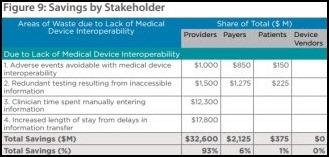
325201420007PM3

Some features of EMRs are unintentionally contributing to patient harm according to the recently released Maryland Hospital Patient Safety Program Annual Report. The report notes that the Office of Health Care Quality “received numerous reports of adverse events in which IT system omissions or glitches contributed to adverse events.”


Sponsor Updates

  • Healthx will add InstaMed Member Payments to its member portal solution.
  • Madison Magazine names Vonlay to its list of best places to work in technology for employers with over 100 employees.
  • CareVia will integrate its remote patient monitoring capability with the Harris FusionRX healthcare integration platform.
  • Surescripts awards e-MDs its White Coat of Quality award for applying best practices to the use of e-prescribing technology.
  • PatientPoint will deliver its population health management solutions with HealthTronics IT solutions for urologists.
  • Consulting Magazine names Akhila Skiftenes of Aspen Advisors and Ryan Uteg of Impact Advisors to its list of 35 Rising Star consultants under the age of 35.
  • Vecna, a provider of patient self-service solutions, will add Fujitsu’s PalmSecure technology to Vecna’s On-Site Registration solution.
  • TriZetto recommends that organizations identify the top ICD-9 codes used in their highest dollar claims to reduce claim rejections after the ICD-10 transition.
  • Health Catalyst profiles Texas Children’s Hospital and how the organization used Health Catalyst’s late-binding Enterprise Data Warehouse and analytics apps in its Pediatric Radiology department to improve patient care and achieve $400,000 in savings.
  • Health Catalyst hosts a two-day Healthcare Analytics Summit September 24-25 in Salt Lake City.
  • Dallas Business Journal names MedAssets to its list of 2014 Healthiest Employers.
  • CareTech Solutions serves as a technology sponsor for IABC Detroit’s Renaissance Awards, which honor the best in business communication in Southeast Michigan.

Contacts

Mr. H, Inga, Dr. Jayne, Dr. Gregg, Lt. Dan, Dr. Travis, Lorre

More news: HIStalk Practice, HIStalk Connect.

smokingdoc3

Curbside Consult with Dr. Jayne 3/24/14

March 24, 2014 Dr. Jayne 10 Comments

Mr. H posted some comments from the annual reader survey last week and one of the areas that people wanted to read more about was the patient experience of IT. As he mentioned, it’s difficult to get patients involved since they probably don’t read HIStalk, but the good thing is that all of us on the team are patients ourselves. I’ve had several recent adventures in patient engagement involving IT over the last few weeks.

Fail #1: I had mentioned before my ongoing issues with a large academic center and their patient portal. It’s a solid product, but I don’t think it’s being implemented or managed particularly well. I had an issue right after I signed up to use it where my last name was spelled wrong. It had been correct on the patient information sheet at the office, but was wrong on the portal. When I inquired about it via secure email, I was told I had “aliases” in the system and it couldn’t be corrected. A few weeks ago I made an appointment for my annual eye exam, and when the appointment confirmation came, I noticed my name was now spelled wrong in two different ways. Additionally, there is incorrect allergy information now posted.

There’s no way for me to fix it from within the patient record at the moment. However, it’s unclear if the product will allow that and they don’t have that functionality live or whether the product is that way by design. I called about getting it corrected and was told again that there are multiple “alias” accounts for me and that they can’t correct it. I have a serious problem with there being multiple accounts, especially since I’m only seen in one practice at the health system. Did someone create a duplicate chart? What’s going on? And why can’t they be merged if it’s a simple duplicate issue?

I brought up the fact that now I have incorrect health information present and specifically used the phrase “patient safety risk” multiple times. I asked them what the process is to correct the erroneous records and the answer from the portal team was “talk to your doctor.” I called the physician office and confirmed that my records are accurate in the source system. How can the physician be expected to clean up an erroneous allergy that she can’t even see?

I called the portal team back and told them that the source chart is accurate and asked them again for a process to correct it. They confirmed they have none. I then asked if I could withdraw consent for participation in the portal because I don’t want the erroneous information (how much else is there that I might not be able to see?) associated with my records or populated to another physician I might see in the future. Of course they have no way of closing my account. At this point it’s more an exercise in frustration rather than engagement. I don’t have hours to spend pursuing it, so I guess I will just let it go and continue to make sure the charts my physicians are using are accurate.

The bottom line is that systems (both the actual software and the policy/procedure associated with it) need mechanisms to handle issues like duplicate patient accounts, demographic errors, and especially medical errors. I’m floored that a major institution would be so clueless. After all, they have wait time billboards for the emergency department and sponsor the local sports teams, so they must be good, right?

Fail #2: This one is wrong on multiple levels. I went to a new physician for a fairly uncomplicated skin condition last December. Although I could have treated it myself, I’m not comfortable with calling out my own scripts and figured it would be good to establish myself as a patient in case I ever really need to be seen. This was in December. Last week I got a bill from the reference lab for the same date of service as my visit but for a surgical pathology charge. I called the ordering physician’s office and explained the bill and had them look in the chart.

Sure enough, there were results on my chart, but no record that I had been notified. Had they bothered to inform me of the results attributed to me, I could have told them that there had been an error. The staffer informed me that “it was benign, so we don’t call” and I let her know that “no news is good news” went out decades ago. She went on to look through the chart and saw that the lab had faxed (who still faxes these days?) a name discrepancy report. Apparently the name on the barcoded sample and the name on the electronic order the lab received were different, but the office corrected it incorrectly. I requested a call back from the physician, which I’m still waiting for.
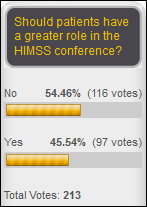
I don’t want to get sent to collections for a bill I shouldn’t have received, so I called the lab. While on hold for 40 minutes, I had plenty of time to think not only about the potential source of the error (human error NOS, multiple episodes, probably staff had two patient charts open at the same time) but also about why it took 90 days to get the claim adjudicated and a bill to the patient. If we had real-time adjudication at the point of care, I could have handled the entire problem at the check-out desk and the sample would have gone out correctly. When a person finally took my call, I told them that I didn’t have a skin biopsy and wasn’t going to pay for it. They were nice about it and said they’d place a call to the ordering physician and get it taken care of.

My hospital is self-insured, although we do have a benefit administrator who processes the claims. I’m sensitive to the fact that the physician compensation model (small-business “eat what you kill”) has providers directly paying for the insurance premiums of their office staff because I used to pay those premiums myself. I wasn’t about to let $300 in erroneous payments go by, so I called the benefit administrator. The representative I spoke to told me that the physician performed a biopsy on me during my visit and I must just not have been aware.

Seriously? I guess I not only slept through the biopsy, but also the informed consent process and the actual consent form itself. It took me a full five minutes to convince her that I did not have a biopsy. I also told her that the office was aware of the problem and had admitted it, that I was just letting the insurance team know so they could recoup the payment since we’re self-insured and with the rising cost of health care, etc. She then helpfully let me know that they actually paid over $600 because there was another claim for a second biopsy I wasn’t aware of. Since it was paid in full, I didn’t receive a bill.

She admitted there would be no way to know it wasn’t accurate since it was the same date of service as my actual visit. I told her that’s why I was calling, to make sure that the payment was disputed so that the money would go back into the insurance pool because otherwise they’d be unaware of the problem. That’s when it got even more ridiculous. She told me that basically it was my word against the physician’s claim, and that unless I wanted to pursue written documentation of the error, there wasn’t anything they could do. She couldn’t provide a form or documentation of the actual information she needed – she was basically saying that there is no way for a patient to easily dispute a claim.

I reminded her (since she works for the benefit administrator and probably isn’t aware) that we are self-insured and I was trying to do the right thing getting the money rightfully returned. I let her know that the lab had already reversed my portion of the charge and at this point the easiest thing for me to do as the patient was to walk away. After all, it’s not MY $600 that was paid out (although at some level it is) and I had already spent over an hour trying to pursue this and now she was asking me to pursue undefined documentation that they’d probably reject anyway. I asked if there was any mechanism for them to reach out to the physician (after all the insurance fund was the one that was wronged) and she said I’d have to provide the phone number and she’d try to call if she could. I was surprised by that (they should have the phone number since the provider is in network) and interpreted it as her attempt to just get the patient off the phone and move on. I doubt she’ll ever call.

What’s my point here? The patient experience still stinks and it’s not all due to technology. Although my first tale of woe has a distinct odor of an IT nature, people are unwilling to address it. Heck, they didn’t even try to play a “known issue with the vendor, blah blah blah” card — they just said there was no way to fix it. The second scenario is strictly human error. The office put the wrong name on the requisition and filled out the name discrepancy form incorrectly. But because all the technology components were met (CPT, ICD, DOB, MRN, insurance information) the failure wasn’t detected.

It could have been mitigated by IT, however, with the use of real-time claim adjudication and the immediate collection of the patient balance. On the other hand it could have also been mitigated by a direct pay method of funding healthcare, where I would have been presented with a bill to review at checkout and then either paid it or disputed it rather than sending it to insurance. That’s the way medicine used to work.

To put the onus on the patient to correct either of these errors is wrong. We should be bending over backward to make sure patient information is correct and that there are processes to handle incidents like these. We’re all patients, and someday that could be us on the other end of the phone. There are other elements here, too. What if that biopsy was melanoma? Then that information would be in my claims data and that would be another nightmare entirely to try to correct.

At the end of the day, patients want physicians and other health professionals to be accessible. They want them to listen. They want the office staff, hospital employees, and anyone else they have to interface with (insurance, lab, etc.) to take care of their needs without acting like they’re in a hurry or pushing back. They want to be treated fairly and have accurate records. All the technology and the bells and whistles are nice, but they’re secondary for the most part. Many of us would trade it all for a physician who had more than six minutes of time to address our needs and an office staff that was pushing for us rather than pushing paper or the electronic equivalent.

Email Dr. Jayne.

Monday Morning Update 3/24/14

March 22, 2014 News 11 Comments

Top News

image

Three Detroit hospital systems – Beaumont, Oakwood, and Botsford – announce plans to merge into an eight-hospital, $3.8 billion system, citing shared electronic medical records as one of their four goals.


Reader Comments

image

From Tom: “Re: McKesson’s FDA Class 1 recall. The description of their product Anesthesia Care could generically be applied to almost any EMR/EHR/CIS vendor’s AIMS product and yet the FDA’s decision-making clearly does not apply to vendors equally. Also I wonder how the regulation of CDS would affect a hospital who develops their own CDS?” FDA’s highest-level recall of McKesson Anesthesia Care may be sending a message that the agency considers even software-only clinical decision support to be high risk. McKesson defines its product as an anesthesia information management system, which it also calls an “anesthesia EMR.” McKesson sought and received FDA premarket clearance apparently because the system collects data from physiologic monitors. McKesson did a voluntary recall of its product in March 2013 after a customer reported that the software pulled up the wrong patient’s information, with two other customers reporting later that it had lost medical history comments and misconnected to a physiologic monitor, affecting one patient in each instance. Some thoughts:

  • McKesson Anesthesia Care is a software-only system that does not control medical devices. It collects and uses information from patient monitors. Other than that, it’s like any other high-acuity, unregulated EHR (surgery, ICU, ED, etc.)
  • FDA would not have been involved if the patient monitor connection hadn’t pushed the product into its regulatory arena. FDA regulates software that makes independent patient decisions or connects to regulated devices, with the idea being that those systems are devices working on their own rather than simply providing guidance to users.
  • Software vendors usually hide contractually behind the “professional judgment” test that says even if their software gives incorrect information or bad advice that harms patients, the clinical professional who uses the system makes the final decision and is solely responsible for the result.
  • The danger to patients is the same as for any other clinical decision support or even EHR software. Mixing up information between patients could be disastrous any time software is presented information or recommending actions. However, high-acuity systems give users less time to make important decisions, so that probably should be a consideration in determining patient risk.
  • McKesson planned to announced a Class II recall (meaning the problem wasn’t likely to cause patient harm) but FDA overrode that proposal and initiated a Class I recall indicating that patients could be harmed.
  • McKesson notified users almost immediately when the first problem was reported in March 2013, but FDA’s recall didn’t go out until a year later.
  • It’s not clear what users of the system should do as an alternative, or what action they may have taken since the original McKesson notification last year.
  • Vendors of systems that perform equally critical functions that aren’t connected to medical devices can take whatever action they want if they are faced with the same problem since their software isn’t regulated by FDA. Other than to avoid legal exposure, they could arguably not inform customers at all.
  • McKesson is a member of the HIMSS Electronic Health Record Association, a trade group that requires them to sign the EHR Developer Code of Conduct asserting, “We will notify our customers should we identify or become aware of a software issue that could materially affect patient safety, and offer solutions.” The other inpatient EHR vendor members are Allscripts, Cerner, Epic, GE, NextGen, and Siemens.
  • McKesson backed legislation introduced last month (along with athenahealth, IBM, and trade groups) that would reduce “unnecessary regulatory burdens” by limiting FDA’s oversight of “low-risk health IT, including mobile wellness apps, scheduling software, and electronic health records.” 
  • FDA is running late in producing a report that it says will explain its position on regulation of clinical decision support systems.

From LochnessMonster: “Re: McKesson. Reduction in force 3/20/14, roughly 300 under Pat Blake organization (uncertain number).” Unverified, but reported by multiple readers, one of them saying that the targeted areas were Horizon and Paragon.

From Bootay: “Re: vendor-convened panels. You should participate or report the results.” I don’t think so. I’ve seen many times where properly objective people turned into fawning, attention-starved glad-handers just because some company tries to buy their love by inviting them to be a speaker or advisor. It makes my skin crawl to see the obvious mutual sucking up as mutually expectant backs wait to be scratched.


HIStalk Announcements and Requests

image

A slight majority of respondents don’t think patients should have a greater role in the HIMSS conference. New poll to your right: who’s most responsible for the problems with health insurance exchanges?

image

Welcome to new HIStalk Platinum Sponsor ScImage (pronounced sye-image). The Los Altos, CA-based imaging and informatics company offers solutions that include enterprise imaging, radiology, cardiology, Echo PACS, ECG, cloud PACSEMR content management, vendor-neutral archive, and a Web-based DICOM exchange. Case studies include Missouri Baptist Medical Center’s cardiology PACS, Blessing Hospital’s enterprise PACS, and US Air Force’s cardiology consultation program. The privately held, employee-owned, debt-free company says it has never sunsetted a product or required a forklift upgrade. According to a physician at Cedars Sinai Heart Institute, the company’s products are the “ultimate value proposition” to its cardiology practice. Thanks to ScImage for supporting HIStalk.

Here’s ScImage PACS consolidation overview I found on YouTube.

image

Teach for America teacher Ms. A sent pictures of her students using the Chromebook that we as HIStalk readers provided to her first grade classroom in Maryland via DonorsChoose. They’re using it to access online reading and math programs.


Upcoming Webinars

April 2 (Wednesday) 1:00 ET. A Landmark 12-Point Review of Population Health Management Companies. Sponsored by Health Catalyst. Presenter: Dale Sanders, SVP, Health Catalyst. Learn the 12 criteria that a health system should use to evaluate population health vendors and to plot its internal strategy, then see the results of grading seven top PHM vendors against these criteria. No single vendor can meet all PHM needs. The most important of the 12 criteria over the next three years will be precise patient registries, patient-provider attribution, and precise numerators in patient registries.


Acquisitions, Funding, Business, and Stock

image

WelVU, which offers a personalized patient education application, raises $1.25 million in an initial seed round.


People

image

Effingham Health System (GA) promotes Mary Pizzino to CIO.

image

CHIME promotes Keith Fraidenburg to EVP/chief strategy officer.


Announcements and Implementations

image

Physicians at Jupiter Medical Center (FL) are piloting the use of email alerts and status updates when their ACO patients are seen in the ED or urgent care center. The press release is poorly written and the product has a confusing name: MicroBloggingMD. I saw their booth at HIMSS and thought it was yet another doctor writing a blog.


Government and Politics

image

Connecticut officials say Massachusetts owes the state $10 million of the $45 million in federal money it received to build its struggling Massachusetts Health Connector. The original grant called for Massachusetts to share its technology plans with other New England states, but those other states realized they could get their own federal money for building exchanges and went their own way, with Connecticut receiving $140 million, Rhode Island $113 million, Vermont $168 million, and Massachusetts a total of $179 million. Massachusetts says the money wasn’t intended for the other states – they were added on to the grant application at the last minute after pressure from the White House and Governor Deval Patrick to make Massachusetts a model for the rest of the country. Access Health CT’s CEO says that unlike the dysfunctional, CGI-built Massachusetts exchange, their Deloitte-created one works fine, adding, “Some states were trying to build a Maserati. We built a Ford Focus. It might not be as glamorous, but it runs. It can get you to the store.”


Technology

image

Google is a bit touchy over Google Glass, having previously urged its users to avoid the “Glasshole” label by not being “creepy or rude.” Now it shares “The Top 10 Google Glass Myths,” the one above being notable considering that people (some of them Glassholes, no doubt) are already using it in patient care. Google published the statement on Google Plus, which means almost nobody other than its own employees will see it.


Other

image

Duke University Health System (NC) will pay $1 million to settle charges that it overbilled the government by unbundling claims and billing for PA services in heart surgery. Duke says its mistake wasn’t intentional, but instead “resulted from an undetected software problem and through possible misapplication of certain technical billing requirements.” A former Duke employee had filed the whistleblower lawsuit.

image

In England, the local newspaper reviews the 2012 Meditech go-live at Rotherham NHS Foundation Trust that caused delays in cancer treatment, lost appointments, and cost the hospital $2 million in revenue. It mentions the project review, which found that delivery targets weren’t specific, penalties clauses were vague, and the 18-month timetable was unrealistic given that the system had never been implemented in the UK. Taxpayers got stuck with $17 million in cost overruns on top of the budgeted cost of $49 million.

A two-doctor cardiology practice in Texas will pay $3.9 million to settle Medicare fraud charges for conducting unneeded procedures. Authorities requested data from 100 nuclear tests that had been performed, but the doctors provided only 37, saying their computer had crashed and the other results were lost. The investigators found that 19 of the 37 tests had been interpreted incorrectly and 75 percent of them were performed wrong. The same foreign-born doctors were part of a group that settled for $27 million in a 2009 Medicare fraud case.

image

Stanford Hospital & Clinics and its former collections agency are expected to pay $4.1 million to settle charges that the information of 20,000 ED patients was posted online for nearly a year. Stanford says it encrypted the information sent to the agency, but that company forwarded it to get help creating a graph and the worksheet ended up on a student homework site.

A Motley Fool review of mobile health in China, which a Brookings Institution report says will be worth $2 billion per year by 2017,  says the three publicly traded companies that will benefit most are IBM, Microsoft, and Lenovo. It says the market won’t behave as it does here because Chinese medicine has different workflows, the language is hard, cloud-based security is a tough sell, and Apple’s mobile devices are much less popular than Android ones. It misses some facts: (a) most mHealth companies aren’t publicly traded; (b) those three companies are so large that whatever happens with mHealth in China isn’t going to move the share price; (c) it touts Microsoft as having implemented “a single, cloud-based system” that turns out to be the nearly forgotten HealthVault; (d) it predicts Lenovo’s success because it makes hybrid devices (laptop/tablet) that run Windows 8 and because it bought Motorola and found itself owning 11.8 percent of the smartphone market in China, although the article fails to mention Lenovo’s huge benefit: it’s a Chinese company.  


Sponsor Updates

  • Health Data Specialists will exhibit at the Cerner Southeast Regional Users Group March 30 – April 4 at the Sheraton Sand Key in Clearwater Beach, FL.

Exhibitor Costs at the HIMSS Conference

image

Readers had asked for details on what it costs a company to exhibit at the HIMSS conference. I greatly appreciate the vendor executive (let’s call him “Larry,” just to keep things anonymous) who provided complete information from last month.

Booth construction: $132,000
Booth space (20×40): $26,000
Booth power and connectivity: $20,000
Breakfast briefing: $11,000
Hospitality suite: $15,000
Printing: $6,000
Giveaways: $4,000
Booth graphics: $2,500
Buying the attendee list: $1,800

Including some other smaller costs, the company’s total expense was $222,000. That doesn’t include employee salaries or travel costs.

Larry says he’s happy with the outcome. The company had 400 people visit the booth for meetings or to see a demo. About half of those had been scheduled in advance, which is an efficient way to meet with prospects, and the other 200 were walk-ups who might become prospects. He also sees value in the employee bonding experience and being able to learn from attendees.

It’s the same as for attendees, in other words: HIMSS benefits from putting interesting people in the same place at the same time. The attendees derive their value from each other.


Contacts

Mr. H, Inga, Dr. Jayne, Dr. Gregg, Lt. Dan, Dr. Travis, Lorre.

More news: HIStalk Practice, HIStalk Connect.

125x125_2nd_Circle

Text Ads


RECENT COMMENTS

  1. Re: Deliberately Faked Academic Papers in Nature See, this doesn't surprise me at all. Of course AI quotes these bogus…

  2. Challenger exploded on lift-off when the O-rings failed. Columbia disintegrated on reentry after one of the heat shield tiles were…

Founding Sponsors


Platinum Sponsors


Gold Sponsors


RSS Webinars

  • An error has occurred, which probably means the feed is down. Try again later.