Health information technology (HIT) has made significant advances over the last two decades. While adoption is not necessarily a good marker for successful EHR usage, adoption of office-based physicians with EHR has gone from about 20 percent to over 80 percent and more that 95 percent of all non-federal acute care hospitals possess certified health IT. HIT implementation has led to improvements in quality and patient safety.
However, many of the goals of increased HIT implementation have been stymied by social and technical roadblocks. A “one type fits all” approach may help reduce training and configuration costs, but there are many approaches to patient care and unique workflows between specialties and among individual users.
Most EHRs are burdened with three major legacy issues:
Technology. Present EHR systems are mostly built on what would now be considered old technology. Some of the ambulatory products and small acute care products have moved onto cloud-based architecture, but most are client-server. While hosting instances of a product reduces the technical expertise needed by the client and can lead to better standardization of implementation, it does not necessarily deliver the advantages of a native, cloud-based architecture.
Encounter-based. EHRs have been built on the concept that interactions with patients (or members or clients) are associated with a specific encounter. This functions well for face-to-face visits and for specific events, but is limiting where longitudinal care is required.
User experience. The user experience has for the most part taken a back seat to functionality in HIT software development. A quick view of most HIT systems shows the interface to be cluttered and does not draw the user’s attention to the areas that need the most attention. Most users access only a small percentage of the functionality that is present within the system, but vendors continue to add functionality rather than clean up the interface.
Platforms have revolutionized the way business is conducted in many industries. Numerous examples have made household names out of companies like Airbnb, Uber, Facebook, YouTube, Amazon and many more. A platform is not just a technology, but also “a new business model that uses technology to connect people, organization, and resources in an interactive ecosystem.”
There is a need for a HIT platform that would support the multitude of components necessary to move the delivery of HIT into the next generation. The future health solution needs to use contemporary technology that will have the flexibility to adapt to ever-changing requirements and use cases of modern healthcare. Some of the characteristics of the future health solution are:
Open. One of the biggest complaints of users and regulators is the closed nature of many HIT systems. The future health solution needs to be built as a platform that is able to share and access not only data, but also workflows and functionality through APIs
Apps and modules. A modular structure will enable components to be reused in different workflows and encourage innovation and specialization.
True, cloud-based architecture. Cloud computing delivers high performance, scalability, and accessibility. Upfront costs are reduced or eliminated and minimizes the technical resources needed by the client. Management, administration, and upgrading of solutions can be centralized and standardized.
Multi-platform. Users expect access to workflows on their smartphones and tablets. Any solution must develop primary workflows for the mobile worker and ensure that the user interface supports these devices
Scalable (up and down). To meet the needs of small and large organizations, the future health solutin will need to scale to accommodate changes in client volumes.
Analytics, reporting, and big data. HIT systems have collected massive amount of data. The challenge is not just mining that data, but presenting the information in a way that can be quickly absorbed by the individual user.
Searchable at the point of use. All the data that is being collected needs to be readily accessible. Using universal search capabilities and the ability to filter and sort on the fly will facilitate the easy access to information at the point of care.
Privacy and security. The core platform will need to be primarily responsible for the security and privacy of the data. The other modules built on the platform will need to comply to the platform security and privacy practices, but will not need to primarily manage these issues.
Interoperable. Need to adopt all present and future (FHIR) standards of data sharing. The open nature of the platform will facilitate access to data.
Internationalization and localization. Internationalization ensures that the system is structured in such a way that supports different languages, keyboards, alphabets, and data entry requirements. Localization uses these technical underpinnings to ensure that the cultural and scientific regional differences are addressed to help with implementation and adoption.
Workflow engine. Best practices can change and can be affected by national and regional differences. An easy-to-use workflow engine will be a necessity to help make changes to the workflow as needed by the clients.
Task management. Every user has tasks that need to be identified, prioritized, and addressed. Therefore, a task management tool that extends beyond a single module or workflow will be needed.
Clinical decision support. Increasingly sophisticated decision support needs to be supported, including CDS, artificial intelligence, and diagnostic decision support. These capabilities need to be embraced by the platform, allowing external decision support engines to interface easily with the other modules.
Adaptable on the fly by the end user. Allowing the end user with proper security to make changes to templates and workflows would help improve adoption.
User experience. Probably the most significant barrier to adoption of HIT is the user experience. Other industries are way ahead of healthcare in the adoption of clean, easy-to-use interfaces. It is vital that a team of user experience experts be integrally involved in the development process. All user-facing interactions, screens, and workflows need to be evaluated by user experience experts who can recommend innovative ways the user interacts with the system and how information is displayed.
The HIT industry has hit a wall that is preventing it from developing innovative products that use the newest technology and have an exemplary user experience. A new platform has the potential to support a robust, flexible, and innovative series of products that can adapt to meet the needs of the various healthcare markets globally. Such a project would have to build slowly over time, as does any disruptive technology. The legacy systems and other HIT systems that exist do not have to be excluded, but rather can be integrated into this new platform.
Identifying technology that, at its core, has the privacy, security, data management, and open structure could lead to the next generation of healthcare management systems. While some of these characteristics are obvious to developers and users alike, it is the sum of the parts that is important. Integrating most if not all of these characteristics into a single model is what can lead to enhancing the value of HIT and the delivery of care.
Toby Samo, MD is chief medical officer of Excelicare of Raleigh, NC.
OxyContin manufacturer Purdue Pharma will give the State of Virginia a $3.1 million grant to integrate its doctor-shopper prescription drug monitoring database with provider EHRs.
The state will use the PMP Gateway of its Appriss Health NarxCare system, which uses two years of prescription data to visually represent a patient’s usage patterns and to present a calculated risk score. Beyond claims and EHR data, it can incorporate information from EMS and criminal justice systems.
NarxCare offers prescribers a Medication-Assisted Treatment locator map and patient information handouts.
The 450-employee, Louisville-based Appriss Health says its systems process 25 million database inquiries each year. It also offers law enforcement, public safety, and Medicaid fraud detection apps.
Reader Comments
From Firing Line: “Re: HIStalk. I have followed you since I worked at a big health IT vendor, where it was a fireable offense to read your blog back in the early days.” I’ve heard that about a few companies, which encourages me since I must be doing something right if they want to ban employees from reading what I write. I also enjoy hearing from readers who apologize for not evangelizing HIStalk because they consider the information they gain to be a personal competitive advantage.
From Spatial Orientation: “Re: [EHR vendor name omitted]. Has informed users that they are able to supply QRDA III reports but not QRDA I reports, meaning they are in violation of ONC’s certification requirements.” Unverified. I’ve invited the company to respond but haven’t heard back. I’ll repeat this item including their name in Thursday’s post if they don’t respond.
HIStalkapalooza Sponsor Profile
Spok, Inc., a wholly owned subsidiary of Spok Holdings, Inc. (NASDAQ: SPOK), headquartered in Springfield, VA., is proud to be the global leader in healthcare communications. We deliver clinical information to care teams when and where it matters most to improve patient outcomes. Top hospitals rely on the Spok Care Connect platform to enhance workflows for clinicians, support administrative compliance, and provide a better experience for patients. Our customers send over 100 million messages each month through their Spok solutions. When seconds count, count on Spok. For more information, visit spok.com or follow @spoktweets on Twitter.
HIStalk Announcements and Requests
I’m getting swamped with HIStalkapalooza emails from people who don’t appreciate the fact that I have around 50,000 readers and I have maybe 1.5 FTEs total other than me to do everything HIStalk-related, of which party planning represents about 0.01 FTE. My plea is this: come if you received an invitation, don’t come if you didn’t, and don’t email us either way because it’s the busiest time of year for us and throwing a free party isn’t our most pressing priority. To summarize the oft-stated rules: (a) don’t ask if I have extra tickets since I’m already turning people away who signed up due to a shortfall in sponsorship funds, so I certainly won’t be inviting someone who didn’t even register; (b) you’ll need to complete your registration online from the email link and bring your barcoded invitation to the event; (c) I can’t help you fix your company’s spam filter that didn’t let your invitation through; (d) you can’t bring a guest if you didn’t register them; and (e) wear whatever you want, but go big if you want to have a shot for the “best shoes” and best dressed” awards. There’s an exception to (a): get your company to sign on as a sponsor of the event and your CEO can come after all — it’s nearly always CEOs who neglect to sign up and then dispatch an underling to demand an exception, usually from vendor companies that don’t support HIStalk in any way.
Dear HIMSS-owned publication: hi, it’s me again. Thanks for fixing the story you ran over the weekend that I called out, in which you mistook a January 2016 press release for January 2017 and splashed it out as breaking news. I won’t quibble with the fact that you just changed the story to hide your mistake without acknowledging it. On that topic, please note that there’s no such company as “Optum Healthcare IT” that you reference in your list of KLAS winners. What you meant to say was “Optimum Healthcare IT.” At least your HIMSS peer at Healthcare Finance also screwed up the same name, calling it “Optimum IT.” Don’t worry, I don’t read your site, so I won’t be catching your mistakes regularly (but hopefully your readers will!)
We provided strategic thinking and economics games along with general supplies for Ms. D’s middle school class in Arkansas in funding her DonorsChoose grant request. She reports, “My students have played rounds of critical thinking games every week since we have received the package. This is their favorite time of the week and can’t wait to figure out what new game we are playing. After learning about Milton Bradley and Henry Ford, the students have started creating their own strategy games.”
Webinars
February 1 (Wednesday) 1:00 ET. “Get your data ready for MACRA: Leveraging technology to achieve PHM goals.” Sponsored by Medicity. Presenters: Brian Ahier, director of standards and government affairs, Medicity; Eric Crawford, project manager, Medicity; Adam Bell, RN, senior clinical consultant, Medicity. Earning performance incentives under MACRA/MIPS requires a rich, complete data asset. Use the 2017 transition year to identify technology tools that can address gaps in care, transform data into actionable information, and support population health goals and prepare your organization for 2018 reporting requirements.
February 8 (Wednesday) 1:00 ET. “Machine Learning Using Healthcare.ai: a Hands-on Learning Session.” Sponsored by Health Catalyst. Presenter: Levi Thatcher, director of data science, Health Catalyst. This webinar offers a tour of Healthcare.ai, a free predictive analytics platform for healthcare, with a live demo of using it to implement a healthcare-specific machine learning model from data source to patient impact. The presenter will go through a hands-on coding example while sharing his insights on the value of predictive analytics, the best path towards implementation, and avoiding common pitfalls.
Previous webinars are on our YouTube channel. Contact Lorre for information on webinar services.
Acquisitions, Funding, Business, and Stock
Thoma Bravo is soliciting bids to buy its supply chain management company Global Health Exchange for up to $1.3 billion, Reuters reports. Thoma Bravo bought GHX in 2014.
A private equity news site says health information exchange platform vendor Vyne has hired a merchant bank to explore a sale of the company.
Big Massachusetts providers Beth Israel Deaconess Medical Center and Lahey Clinic announce plans to merge to better compete with the huge (and hugely expensive) Partners HealthCare, which also recently announced its own plan to acquire the Massachusetts Eye and Ear specialty hospital.
Sales
Geisinger Health System (PA) will implement Stanson Health’s clinical decision support and analytics to add real-time, patient-specific intelligence to its EHR.
In England, King’s College Hospital NHS Foundation Trust chooses Cerner Millennium EHR and revenue cycle for the 100-bed hospital it will build in Dubai.
MedEvolve hires Jenny O’Pry (MedSynergies) as SVP of RCM and Matt Seefeld (NantHealth) as SVP of business development.
Announcements and Implementations
Healthcare Growth Partners publishes its amply-researched and well-written HIT Market Review, which includes M&A, valuation, the year in review, and thoughts about the impact of the new administration.
A new Black Book report finds that population health management technology is a fast-growing sector even though providers are forging ahead using only stopgap tools from their EHR vendor, they’re dealing with community HIEs that offer poor population health modeling data, and they have limited data availability beyond their own EHR’s health snapshots. Hospitals report that they will need new PHM and IT talent, but shortages may limit availability. The top three best-of-breed vendors were IBM Watson Health, Evolent Health, and The Advisory Board Company, while the top three PHM and value-based care consultants were Premier, The Advisory Board Company, and Evolent Health.
Government and Politics
Vox reports that President Trump has abandoned his campaign promise to reduce drug costs by allowing Medicare to negotiate prices, changing his mind after meeting with pharma lobbyists to now favor drug company tax reductions and deregulation.
Privacy and Security
I’ve seen several recent articles on Cambridge Analytica, the “behavioral microtargeting” analytics firm that was involved (to an arguable degree) with both the Brexit and Donald Trump wins that pollsters failed to predict. The company’s work is relevant to healthcare because: (a) it sounds a lot like how HIMSS describes its new service that will target vendor sales prospects using their personal information; and (b) it could be more positively used for public health in areas such as depression. Either way, lax US personal data laws are making us all targets of companies that train their analytical firepower to profitably sway our decisions. Cambridge Analytica, of which White House advisor Steve Bannon is apparently a board member, mines Facebook data via those mindless quizzes that bored people inexplicably take, thus giving the company access to their Facebook profiles. The company’s technology supposedly requires just 68 of a user’s “likes” to accurately predict their skin color, sexual orientation, political party affiliation, and use of drugs, alcohol, and cigarettes, while it just 10 “likes” allow researchers to “know” a Facebook user better than their work colleagues. The company combined that information with commercially sold personal information databases to develop psychological profiles on every American. It then buys Facebook ads that it micro-targets to individual personality types, which some experts say was the key to the unexpected and lesser-funded campaign victories of Donald Trump and Brexit:
On the day of the third presidential debate between Trump and Clinton, Trump’s team tested 175,000 different ad variations for his arguments, in order to find the right versions above all via Facebook. The messages differed for the most part only in microscopic details, in order to target the recipients in the optimal psychological way: different headings, colors, captions, with a photo or video. This fine-tuning reaches all the way down to the smallest groups … In the Miami district of Little Haiti, for instance, Trump’s campaign provided inhabitants with news about the failure of the Clinton Foundation following the earthquake in Haiti, in order to keep them from voting for Hillary Clinton … These “dark posts”—sponsored news-feed-style ads in Facebook timelines that can only be seen by users with specific profiles—included videos aimed at African-Americans in which Hillary Clinton refers to black men as predators, for example.
The St. Louis Cardinals will give the Houston Astros $2 million and their two top draft picks as cybercrime compensation. The former director of baseball development for the Cardinals was sentenced to 46 months in prison and a lifetime MLB ban for accessing the scouting reports, contract information, and internal emails of the Astros using passwords he had guessed.
Officials in Missouri, the only state that doesn’t have a doctor-shopper prescription drug monitoring database, are still arguing over privacy requirements and which state agency should oversee it.
Other
Sites are slinging around news headlines saying that medical residents spend half of their time working on the computer, but they fail to note the deal-breaking limitations of the just-published study they reference: it was performed in Switzerland with unknown applicability to the US and it was an observational study (which has unavoidable bias) of only 36 internal medicine residents in a single hospital. There’s probably also the fact that residents are often expected to remain in the hospital outside of normal working hours, so it’s questionable whether EHR usage required extra time or whether they were stuck in the hospital without much else to do anway.
A TransUnion Healthcare consumer survey finds that three-fourths of respondents would look more favorably on a provider who provides upfront cost estimates, but 43 percent said it was hard to get cost information and another 21 percent said they haven’t even bothered trying.
Authors of a JAMA opinion piece say it’s too expensive for patients to get copies of their medical records since providers widely ignore a 2016 federal law that allows them to charge only direct labor and postage costs associated with creating the paper copy. Only Kentucky requires providers to give patients the first copy of their records at no cost.
Small drug company Kaleo, which makes a recently approved naloxone injector for opioid overdoses, has raised the price of its consumer-usable package of the nearly 50-year-old drug from $690 in 2014 to $4,500 now. The company is donating the product to first responders and drug treatment programs, covering co-pays for buyers with private insurance, and selling it to the VA (which is allowed to negotiate drug prices) at a significant discount, but sticking insurance companies and taxpayers with the bulk of its profits.
In England, a report finds that human error contributed to the failure of the 1980s-era pathology system that delayed surgeries at Leeds Teaching Hospitals NHS Trust. Most of the system’s experienced support employees have left and newer analysts didn’t notice that system backups had grown so large that they were being corrupted.
OB-GYN doctors and nurses at a hospital in Macedonia are fined when a nurse posts Facebook photos of their in-hospital New Year’s celebration that show alcohol, cigarettes, and cupcakes iced to look like vaginas. Photos of the latter item indicate that though their social media judgment is suspect, their eye for anatomical detail is admirable.
January 30, 2017Dr. JayneComments Off on Curbside Consult with Dr. Jayne 1/30/17
I’ve finally started getting excited about HIMSS. On Friday, my MagicBand arrived, personalized and ready for Disney to start transferring cash directly to their coffers. After learning hard lessons in the past about the need to book hotel rooms early, I was able to get a room at my hotel of choice. I planned to spend most of HIMSS with a good friend, but she tried to book a couple of days after me and wasn’t able to get a room. She does, however, have connections at Disney, where we were able to get significantly more posh accommodations for a fraction of what we would have paid at the official HIMSS hotels. Sure, we’ll have to deal with parking and traffic, but I’m looking forward to spending time with friends and getting away from the craziness of the show each night.
I was also excited to get my HIStalkapalooza ticket. Even though I’m guaranteed an invitation, I do have to register for a ticket just like everyone else and it’s always exciting when that email arrives. Now I have to figure out what I’m going to wear and of course find the right shoes, so that will be on my to-do list for the next couple of weeks. It’s nice to have a project to work on that doesn’t involve federal regulations, frustrated healthcare organizations, burned out physicians, or medical practices struggling to survive.
Things have also started to slow down at my clinical practice, with the near-epidemic of influenza finally easing up. Our fiscal year runs with the calendar year. Even though we monitor the numbers closely throughout the year, once we close the books, it triggers detailed accounting reviews and the beginning of discussions on our strategy for managed care and occupational health contracting negotiations. That dovetails with planning exercises and review of our recent growth and whether we should continue with our plans for opening new locations or whether we need to re-evaluate. Fortunately, our price transparency and the boom in high-deductible insurance plans continues to support our planned expansions. We have nearly triple the locations we had when I started, with several hundred employees.
I had an opportunity to sit down with our chief operating officer this week. Part of the meeting was a review of my personal metrics. It’s nice to work at an organization that understands the role of metrics and how to use them drive organizational goals. It’s a bit if a luxury to be able to set our own metrics and not be stuck with what CMS and other governmental bodies think we should use, regardless of whether they impact our internal or community-based goals.
We look at a variety of metrics that impact patient satisfaction, such as wait time, treatment time, appropriate referral for advanced imaging, procedural complications, survey results, and response to clinical follow-up outreach. Those metrics vary month to month, and in this cycle we saw a pretty significant impact due to the rate of influenza, norovirus, and other infectious diseases. At one point in December, we were seeing 50 percent more patients on a daily basis than we had ever seen, so it’s not surprising that patients would be a little less satisfied about wait times or congestion in the office.
We also look at quite a few financial metrics, including charges per encounter and the distribution of E&M codes among providers. As you would expect, most of our visits fall under a subset of codes, but there are some outliers that occasionally over- or under-code, so we have to decide how to deal with them. Is it just a blip or part of a larger pattern? Does it increase our risk for audit? Is someone trying to game the system by getting their charges up without appropriate justification?
We know that the cost of care at our facility is about one-eighth that of care at the area’s emergency departments, so it might be tempting for some providers to upcode. We also look at what the EHR suggested the code be, vs. what the provider or scribe actually clicked, vs. what the internal coders think. There is always some wiggle room depending on whether documentation elements were captured as free text or discrete elements, and our visits occasionally move up or down the E&M code spectrum after coding review.
Not surprisingly, I tend to fall at the lower end of the pack as far as charges per encounter, which makes sense with my primary care roots and all of the managed care red tape I’ve had to deal with. I tend to be less free with prescriptions as well, which is understandable given the risks of polypharmacy with patients you don’t know well. It was interesting to see the comparative data and what some of my colleagues are doing though – I average 0.64 prescriptions per patient encounter, where some of my colleagues are in the 1.6 and 1.7 range. Most of our group is in the 0.85 range, so I’m not that far off the mark. Given the range, though, I recommended that next month we slice that data a little differently and look specifically at newer vs. established colleagues, moonlighting residents vs. midlevel providers vs. supervising physicians, full vs. part-time provider status, and distribution by location.
We look at a lot of our data in aggregate, which makes it interesting when you know you have outlier data. Since we have our own in-house ultrasound and CT scanners, we look at the timeliness of referral for those modalities. Since I only work part time, any fluctuations in my practice patterns show up a bit more acutely than my peers who see many more patients each reporting period. My “timely referral for diagnostics” metric was significantly off from last month, and the COO got a kick out of the fact that I could recite the clinical situations of the patients whose visits drove the numbers. I had a flurry of cases that had to be transferred to the emergency department for higher acuity care (and in two cases had to go straight to the operating room) and let me tell you, those are the shifts you don’t forget.
The urgent care keeps trying to lure me into a full-time role, and it’s getting more difficult to resist its call. We agreed to talk again in a few months. In the meantime, we’ll have to see if HIMSS brings any new and exciting opportunities to light my informatics fire.
If you could have any job in the world, what would it be? Email me.
VoteStand vote fraud reporting app developer Gregg Phillips, who President Trump credits with convincing him that 3 million people voted illegally in the November election (all of them for Hillary Clinton), has a healthcare IT connection – he’s the chairman of AutoGov, a Medicaid eligibility decision support tool vendor. The product’s description suggest that it works similarly to his vote fraud analysis methods, merging databases together to provide a full eligibility picture of Medicaid applicants.
.
AutoGov markets its big data-powered system to providers as, “You will be able to decide whether or not to admit a Medicaid patient with just a touch of a button.” It is powered by scoring algorithms that use data from 30 million cases.
Phillips, a former Texas Deputy HHS commissioner, says he augmented a 180 million-row voter registration database with other databases and geocoding data, giving him the ability to verify identity, residency, and citizenship status, although others have questioned his claim. He said in a CNN interview Friday he won’t be able to release specifics for several months given the analysis required and the demands of his day job.
A post-election tweet by Phillips claiming that non-citizens voted was picked up by the then-President-elect, after which an apparently puzzled Phillips told a reporter, “Is a tweet really news? Isn’t everything on Twitter fake?”
Reader Comments
From Is This Even Still a Thing? “Re: booth babes. I just got this pitch.” An Orlando modeling agency warns HIMSS17 exhibitors of the peril of hiring “below-average young women” to draw traffic, introduce products, and generate leads. I think I should run a honeypot sting operation to focus on the demand instead of the supply, setting up a fake HIMSS booth staffed by an “above-average young woman” from this agency. Each time our booth babe lures a gawking attendee into the booth, I would emerge with microphone in hand like that solemn-voiced talking head Chris Hansen in “To Catch a Predator,” inviting the now-squirming attendee to have a seat and explain to my on-camera audience (and to their colleagues and families) what they hoped to gain.
From Research Expert: “Re: HIStalk. I read it every day and find it extremely valuable. Good thing it’s not more organized or it could put many of the advisory firms out of business. 🙂” Thanks. I’m more of a real-time fire hose since I don’t like to recycle old news just to earn reader clicks while insulting their intelligence, but I could probably get someone to repackage the already-vetted information stream into something that could be useful in a different way. However, my inherent laziness makes that unlikely.
HIStalkapalooza
HIStalkapalooza invitations will be emailed by Monday. Every year we invite people who claim we didn’t, as our email was apparently blocked by their overly aggressive spam filters (the invitation will come from eventbrite.com). Important: you MUST click the link on the email invitation link called “Attend Event” to complete your signup, otherwise the check-in system won’t recognize you at the House of Blues and you’ll be slinking away crestfallen to the sounds of the link-clickers inside slurping down drinks, loading up plates, and performing their pre-dance stretching.
A shortfall in sponsor money means I can’t invite everyone who asked to attend, unfortunately. The pecking order is providers first, then two people from each HIStalk Platinum sponsor, then I just try to choose a good mix of job titles and companies until we hit the number I can afford (since I’m paying thousands out of my own pocket). I’ll ignore emails asking for exceptions, explanations, or anything else event related – it’s just a party and nobody will suffer from starvation, dehydration, or dance deprivation for lack of attendance that Monday evening. Like a concert or sporting event, each person must have an individual ticket that will be scanned at the door.
HIStalkapalooza Sponsor Profile
Cumberland Consulting Group is a leading healthcare consulting firm that helps some of the nation’s largest payer, provider, and life sciences organizations implement and optimize technologies to maximize operational efficiency. Cumberland delivers comprehensive consulting services with a focus on strategic advisory, implementation, optimization, and outsourcing. The firm excels at system selection and planning, implementation project management, system optimization, and performance improvement. In addition, Cumberland offers high-quality, certified resources to support your most complex IT projects. For more information on Cumberland’s services, visit their site.
HIStalk Announcements and Requests
Dear HIMSS-owned publication: apparently you failed to notice that the press release you used as the sole, uncredited source for your just-published breaking news article was dated January 6, 2016. You already reworded that press release in calling it news on January 8, 2016 (although even then your sub-headline made no sense). Could you perhaps apologize to the 400 folks who have shared your “news” so far this week since you’ve made them look stupid in mistaking a year-old announcement for something new? Thank you.
About half of poll respondents reacted negatively to the announcement that HIMSS is starting a conference and media group that will cater to vendor members targeting provider members, while 17 percent like the idea and 31 percent don’t care either way. HIS Junkie sagely comments that if HIMSS were truly member-driven, it would set up a division and conference to teach providers how to negotiate with vendors and to get better contracts, but as he notes, there’s no money in that.
New poll to your right or here: why are you going to the HIMSS conference? (a question I ask myself every year about this time).
Ms. H asked for financial help via DonorsChoose to continue her New York high school’s “Guest Writers” series, which we provided. She says students have enjoyed getting a behind-the-scenes look of how books are written, edited, and published as described by award-winning authors who visit with the students.
Iatric Systems donated $500 to my DonorsChoose project, which with matching funds applied (from my anonymous vendor executive and other sources) fully funded these teacher grant requests:
Two laptops, computer accessories and cases, a document camera, and supplies as requested by high school senior Julie for her Camden, NJ pre-calculus class
An Amazon Fire tablet for Ms. D’s elementary school class in Los Angeles, CA
A Chromebook for Mr. D’s elementary school class in Wichita, KS
STEAM literature for Ms. M’s fourth-grade class in Minneapolis, MN
An activities table for Ms. A’s first-grade class in Manning, SC
Hands-on manipulatives and family interactive learning technologies for Ms. A’s elementary school class in Chicago, IL
Ms. A from Chicago emailed soon after I made the donation to say, “This is beyond heart-warming! I am tearing up and smiling at the same time! The education crisis in my state is threatening more teacher layoffs, furlough days, and shortening the school year. Your donation has uplifted my spirit and brought great joy as finding innovative ways to educate my students and their families is a passion that, I learned today, I do not share alone. ”
Last Week’s Most Interesting News
McKesson announces that it will acquire CoverMyMeds for up to $1.4 billion.
A federal judge rules against the proposed merger of Aetna and Humana, citing anti-competitive concerns.
GetWellNetwork acquires Seamless Medical Systems.
Former National Coordinator Karen DeSalvo, MD, MPH joins her fellow HHS political appointees in leaving government service with the administration change.
Webinars
February 1 (Wednesday) 1:00 ET. “Get your data ready for MACRA: Leveraging technology to achieve PHM goals.” Sponsored by Medicity. Presenters: Brian Ahier, director of standards and government affairs, Medicity; Eric Crawford, project manager, Medicity; Adam Bell, RN, senior clinical consultant, Medicity. Earning performance incentives under MACRA/MIPS requires a rich, complete data asset. Use the 2017 transition year to identify technology tools that can address gaps in care, transform data into actionable information, and support population health goals and prepare your organization for 2018 reporting requirements.
Acquisitions, Funding, Business, and Stock
Harris Corporation will sell its government IT services business to Veritas Capital for $690 million in cash, which doesn’t sound like much for a division that’s generating $1 billion in annual revenue.
Hospital staffing firm Jackson Healthcare will build a $100 million, 306,000-square-foot expansion to its Alpharetta, GA headquarters that will house 1,400 new employees. It will include a 39,000-square-foot amenities building modeled after the Colosseum in Rome that will house a gym, pool, restaurant, hair salon, dry cleaner, spray-tanning studio, chiropractor, masseuse, and barber. The company took in $800 million in revenue last year.
Sales
University of Virginia Medical Center (VA) chooses clinical process measurement solutions from LogicStream Health, which it will use to drive evidence-based best practices in managing and improving its EHR’s decision support tools.
Children’s Healthcare of Atlanta selects Voalte Platform for care team communication and alert notification.
CHI Franciscan Health chooses Clearsense analytics to aggregate and organize patient data for clinical decision-making.
Decisions
Memorial Hospital Of Carbondale (IL) will switch from Meditech to Epic in June 2017.
Trinity Rock Island (IL) will replace BD Pyxis MedStation with Omnicell in summer 2017.
Centura Health – Porter Adventist Hospital (CO) replaced Meditech with Epic in October 2016.
Elmhurst Memorial Hospital (IL) went live with Epic in October 2016.
These provider-reported updates are provided by Definitive Healthcare, which offers powerful intelligence on hospitals, physicians, and healthcare providers.
People
Will Plourde (HealthcareSource) joins LiveData as VP of engineering.
Announcements and Implementations
McKesson’s IKnowMed tops Black Book’s oncology-hematology EHR satisfaction ratings for the sixth straight year.
Privacy and Security
An employee of Campbell County Health (WY) sends the W-2 information of 1,400 employees to a hacker impersonating a hospital executive who asked for all forms for 2016.
Other
A Johns Hopkins Medicine study finds that, not surprisingly, clinic doctors who are running behind schedule unintentionally shortchange patients in trying to catch up.
A woman sues Cone Health (NC) for trying to collect the unpaid medical bills of her deceased husband, seeking class action status under a clause in the state’s constitution that says the property of a woman can’t be attached to pay for the debts of her husband.
ACA architect Ezekiel Emanuel, MD, PhD scoffs at the idea that technology can replace doctors and that wearables can improve health, arguing that the tech sector is missing the point that resolving a technology-identified problem still requires a face-to-face doctor-patient encounter. He says technologists should focus on solving health problems like heart disease and obesity instead of obsessing about new monitoring tools, saying that even a cure for cancer would have a minor impact on life expectancy compared to reducing smoking and high blood pressure.
An Ohio man is charged with arson and insurance fraud after police get a search warrant to review his pacemaker data and find no evidence of heavy exertion at the time he claimed he was quickly packing and lugging heavy belongings out of the house as the fire spread.
A Hauppauge, NY doctor is convicted of selling opioid prescriptions by instructing his assistant to set up phony EHR exam and treatment records for anyone willing to pony up $120 in cash, all while he spent most of his days out of the office playing hockey.
Sponsor Updates
Arcadia Healthcare Solutions wins top honors from Frost & Sullivan for its clinical and claims analytics platform.
PeriGen publishes slides from its presentation on “The New Labor Guidelines: Benefit or Harm” presentation at the Steamboat Perinatal Conference.
Phynd will exhibit at the North Carolina Epic User Group Meeting February 8-9 in Greensboro.
Red Hat technologies support TransUnion’s migration to a new IT environment.
Wharton Research Data Services adds SK&A healthcare data.
McKesson will acquire privately held prescription electronic prior authorization vendor CoverMyMeds for $1.1 billion plus another $300 million if the company hits performance targets.
McKesson will operate the Columbus, OH-based company as an independent business unit. Francisco Partners must have made a fortune from its November 2014 investment in the company.
I interviewed co-founder Matt Scantland a couple of years ago, where he explained that drug companies pay for CoverMyMed’s services to avoid unfilled prescriptions. He also agreed then with my assessment that the company was flying under the radar in an obscure niche with $19 million in revenue. That figure jumped to $50 million the same year and $100 million the next.
McKesson also announces Q3 results: revenue up 4.7 percent, EPS $3.03 vs. $3.18, meeting earnings expectations but falling slightly short on revenue. Shares dropped 8.3 percent Thursday on the news.
Reader Comments
From Build That Well: “Re: Becker’s. Changed their story on Erlanger’s loss.” Becker’s focuses on clickbait “10 things to know” listicles written mostly by new liberal arts grads for lazy readers. In this case, they tried to hype Epic as causing Erlanger’s reported loss, but the article they rewrote from the local newspaper didn’t say that at all. Above is the headline before and after. The non-alternative fact, according to Erlanger’s CFO, is that the loss was caused by overtime expense, employee insurance payouts, and drug costs, although he did mention almost as an afterthought that some overtime expense was incurred due to covering employees assigned to the Epic project. Erlanger’s CEO says in another newspaper’s article he’s happy that the hospital is hitting its year-to-date net income targets given that it amortized its $100 million Epic cost over just three years. Erlanger also notes that high-deductible insurance plans and its 33 percent self-pay rate means it can’t collect a lot of what patients owe.
From Clustered: “Re: Epic. I’m not bothered about their position on investment. How many times have there been things truly beautiful, streamlined, and elegant that were designed by committee? Investors are exactly that, collectively — a committee. They dilute decision-making in exchange for access to money and it sounds like Epic already has enough money of its own. Sure, there are things I wish Epic did differently, but I’m not sure inviting a bunch of MBAs and money folks onboard would improve things. Viva la Judy! (disclosure: I don’t work for or with Epic and never have).” Committees are like well-diversified mutual funds – they reduce the chance of both great failure and great success, at least if you’re willing to accept bland mediocrity. The best lessons I’ve learned in writing HIStalk are: (a) people can convey their strong opinion in believing that they represent the majority when in fact they could be dead wrong; and (b) instead of letting a committee tell me what to avoid doing wrong, I would rather just do what I want to do and let readers either come back or move on.
From Silicon Valley Geek: “Re: Stanford Health Care. Since the new CEO arrived in July, the former CIO (who was promoted to chief digital officer last April) is leaving along with the associate CIO. The bloated 700-employee IT department serving a 600-bed hospital and ambulatory network has been seeing layoffs as the organizational struggles to manage operational costs, new construction, and integration of the newly acquired ValleyCare. IT lost over 50 people yesterday as the CEO announced a $100 million savings target for which non-labor cutbacks weren’t enough. Michael Sauk is now interim CIO – he used to work with the CEO at City of Hope and UW.” Unverified, except the part about Mike Sauk since it’s on his LinkedIn.
HIStalkapalooza
I’ve closed signups, so hopefully if you wanted to attend you either (a) got your name on the list in time, or (b) will be sent an invitation from one of the sponsors of the event, who get to invite a certain number of guests.
I’m happy that our Industry Figure of the Year (one of the four nominees above) has confirmed attendance at the event, as has our “when ___ talks, people listen” recipient. I’m trying without success so far to get our “person you’d most like to see on stage” and Lifetime Achievement Award winners to stop by, but you never know.
Thanks to our newly participating HIStalkapalooza sponsors:
HIStalkapalooza Sponsor Profile
PatientSafe Solutions obsesses over the experience of care to help care teams communicate and work together reliably and efficiently. PatientSafe delivers measurable safety and quality improvements through a mobile platform that extends an organization’s EMR, clinical, and communication infrastructure and fits seamlessly into care team workflows. The company’s context-driven PatientTouch platform unifies communication with workflow by consolidating text, talk, alerts, EMR data, clinical workflows, and customizable care interventions, all in one mobile app, on one device. For more than a decade, PatientTouch has helped clinicians both in and outside the hospital streamline care delivery, increase quality, and lower costs.
HIStalk Announcements and Requests
Ms. M in Houston sent photos of her students using the listening center and wipe boards we provided in funding her DonorsChoose grant request.
Welcome to new HIStalk Platinum Sponsor Clearsense. The Jacksonville, FL-based data science company offers a cloud-based analytics solution that works with any data source and can be rolled out in a fraction of the time required for a traditional data warehouse. Its real-time, cloud-based, subscription-priced, scalable system helps healthcare organizations respond to the pressure to use data to make better and faster decisions. Examples: reducing adverse events, improving patient flow, hitting quality and patient satisfaction targets, driving research, and managing cost and payment. Thanks to Clearsense for supporting HIStalk.
I found this excellent YouTube video featuring Clearsense Chief Innovation Officer Charles Boicey MS, RN speaking at the most recent HIMSS SoCal Clinical Informatics Summit.
Readers have been asking for years to be able to search HIStalk articles with a company name and date range and I finally figured out how to do that in an admittedly inelegant but somewhat effective way. The date range search box allows specifying a search word (it works best with a single word) and an optional “from” and “to” date range, then shows the results in context. It’s not perfect, but it’s good if you want to see when I mentioned Cerner, let’s say, in just the second half of 2016.
We like to have cool people hang out at our HIMSS booth since we don’t have anything to sell and are otherwise sitting alone in our microscopic, unadorned space. Contact Lorre if you would like to entertain, amuse, or otherwise engage HIStalk readers for an hour or so – we tend to like people who are funny and don’t take themselves too seriously, which is harder to find in health than you might expect.
Does ICD-10 have a code for repetitive stress injury caused by anxiously checking three news sites every 10 minutes, drawn by a combination of fascination and dread?
This week on HIStalk Practice: Northwest Vein & Aesthetic Center rolls out Oncomfort’s anxiety-reducing VR technology. Employee clinic company OurHealth signs on with Athenahealth. Pediatricians take aim at wearables for infants. Eye Care Leaders adds OptimizeRx to partner EHRs. Winners Circle series launches with MTBC winner and Practice Manager Baqar Naqvi. Stakeholders band together to encourage renewed value-based payment reform efforts. Compulink adds Weave’s patient scheduling tech. Sue Kressly, MD advocates for pediatric-specific functionality in EHRs. Sign up for physician practice health IT news.
Listening: the now-defunct After Forever, since Floor Jansen is in my opinion the best singer (of either gender) in the world and the band was crazy talented, as are many of those in the “Beauty and the Beast” metal genre. Now she sings for NIghtwish, where she’s equally good although with less-demanding material. Floor singing “Leaden Legacy” with AF is about as good as it gets.
Webinars
February 1 (Wednesday) 1:00 ET. “Get your data ready for MACRA: Leveraging technology to achieve PHM goals.” Sponsored by Medicity. Presenters: Brian Ahier, director of standards and government affairs, Medicity; Eric Crawford, project manager, Medicity; Adam Bell, RN, senior clinical consultant, Medicity. Earning performance incentives under MACRA/MIPS requires a rich, complete data asset. Use the 2017 transition year to identify technology tools that can address gaps in care, transform data into actionable information, and support population health goals and prepare your organization for 2018 reporting requirements.
Here’s the recording of Wednesday’s webinar, “Jump Start Your Care Coordination Program: 6 Strategies for Delivering Efficient, Effective Care.”
Acquisitions, Funding, Business, and Stock
Quality Systems (NextGen) reports Q3 results: revenue up 9 percent, adjusted EPS $0.23 vs. $0.16, beating analyst expectations for both.
Specialty EHR vendor SRSsoft renames itself to SRS Health, unleashing a fury of highfalutin’ buzzwords in which the marketing people congratulate themselves on wresting control of the company’s strategy by turning an orange circle into marketing art whose description will sail right over the heads of customers who squint thoughtfully and say, “I dunno, it just looks like an orange circle to me.” Companies somehow never learn to just make these changes without over-describing them, insisting on involving customers in their contrived logic and convoluted explanation that elicit guffaws instead of praise:
A brand’s logo is its face to the world. Our new orb-shaped visual identity represents the continuum of how we help our clients engage their patients before, during, and after visits. It signifies the perfect balance of improved efficiency with proven outcomes. And it symbolizes the unending dedication of our team to remain in motion as we continue to pioneer the HCIT solutions of the future. The fiery color of our logo was chosen specifically to depict the passion and commitment to client satisfaction of the people who make up the SRS Health team.
Sales
Children’s National Health System (DC) adds Millennium Revenue Cycle to its Cerner EHR.
Local governments in Finland choose Optimum Healthcare IT to staff the 29-hospital Epic implementation of their $615 million Apotti project.
People
Former HHS Secretary Sylvia Burwell is hired as president of American University in Washington, DC. I wondered about her advanced degree and it turns out she doesn’t have one.
Investment banker Jefferies hires Dmitry Krasnik (Houlihan Lokey) to lead its coverage of healthcare IT.
Announcements and Implementations
InterSystems and Clinical Architecture develop a “clinigraphic” graphical representation of a patient’s most pertinent information contained in medication lists, comorbidities, and test results.
The Gates Foundation donates $279 million to University of Washington’s Institute for Health Metrics and Evaluation, which publishes evidence and trends for global population health that includes the annual Global Burden of Disease report.
Grady Health System (GA) goes live on Glytec’s eGlycemic Management System of personalized insulin dosing, blood glucose alerts, and analytics integrated with Epic as well as glucose surveillance integrated with Grady’s laboratory information system.
Government and Politics
A small survey of PCPs published in NEJM finds that only 15 percent think the ACA should be repealed entirely, with three-quarters of them saying it just needs tweaked (some of their suggestions are above). The doctors mirror the general public in supporting existing policies such as prohibiting consideration of pre-existing conditions, allowing parents to keep their children on their insurance through age 26, offering taxpayer-funded small business tax credits and individual subsidies, and expanding Medicaid. Fewer than half support requiring people to carry insurance, however, thus again raising the all-important question of how insurance companies can create cost-effective risk pools among only self-selectors.
Massachusetts Governor Charlie Baker – a former CEO of insurer Harvard Pilgrim Health Care — defends his call for employers to pay the state $2,000 for each employee who either isn’t offered health insurance or who declines to buy it. The state’s MassHealth program is spending $1 billion per year to subsidize health insurance for low-income, full-time employees who could buy employer-offered plans but instead sign up for MassHealth to take advantage of premium subsidies, which the state says is an ACA loophole. Baker is also calling for limiting provider rate increases, with price hikes of the most expensive hospitals capped at the same level as their Medicare increases. MassHealth’s annual cost of $16 billion accounts for 40 percent of the just-released 2018 state budget.
President Trump says in a TV interview that his replacement for the “disaster” of the Affordable Care Act will offer “a better plan, much better healthcare, much better service treatment, a plan where you can have access to the doctor that you want and the plan that you want. We’re gonna have a much better healthcare plan at much less money.” He also says that he expects everyone insured through the exchange to keep insurance coverage.
Privacy and Security
President Trump’s deportation executive order instructs federal agencies to exclude illegal aliens from the Privacy Act, which prohibits the the disclosure of a person’s federal government-held information without their consent. The Act covered only citizens anyway, from what I can tell, and I’m not sure this order has any direct impact on healthcare. Perhaps the significant result is that agencies would need to know (and therefore ask) about immigration status and systems might have to be modified to record it.
Other
A Wired article notes that improvements in graphics and artificial intelligence technology may render obsolete those doctors who look at an image and then decide what it is, warning that pathologists, radiologists, and dermatologists are at risk of being replaced by machines. It cites the just-published study in which neural networks trained on previous images performed as well as 21 board-certified dermatologists in recognizing cancerous growths.
The Wall Street Journal profiles McKesson Specialty Health’s Practice Insights analytics platform for oncology practices, which extracts EHR information for clinical insight and matches patients with clinical trials.
A patient of a family practice owned by Carolinas HealthCare (NC) complains after noticing that her problem list included “lesbianism.” The health system said the observation was listed there to avoid offending her, but offered to move it to the notes section of her chart. The patient questions why the health system needs to record her sexual orientation at all. I’m not sure I agree since I assume she told them and thus felt they should know, but perhaps the term “problem list” casts an unintended aspersion. This could be a challenge for the OpenNotes movement – recording patient-reported or observed information in a way that patients don’t take as offensive, although this example is less of a challenge than accurately identifying someone as obese, alcoholic, or depressed.
Sponsor Updates
Sutherland Healthcare Solutions publishes a video describing its SmartHealthSolutions analytics platform.
ECG Management Consultants will exhibit at the Summit on Bundled Payment January 25-26 in Atlanta.
The Chartis Group publishes a white paper titled “What does the Trump Presidency Mean for Providers?”
January 26, 2017Dr. JayneComments Off on EPtalk by Dr. Jayne 1/26/17
CMS rolls out the MIPS red carpet for small, rural, and underserved practices with a webinar on February 1. CMS will be discussing eligibility, 2017 participation, data submission, performance categories, scoring, and resources available to practices falling into these categories. Figuring out a MIPS strategy is hard enough for large practices who have relatively greater resources, so I can’t imagine how a small independent rural practice might struggle. I’ve done some engagements with that demographic and many of them can’t even figure out how to afford a reasonably priced consultant given their payer mix (lots of Medicaid) and the challenges of treating the medically underserved.
Whether you’re a cash-strapped practice or not, CMS has also given some confusing messages when discussing the Medicare volume threshold for excluding practices from MIPS. There have been questions about whether providers have to meet the charge threshold AND the volume threshold, or whether it should be an OR function. The answer is that it depends on how you ask the question. If you’re asking who is excluded, it’s providers who Medicare Part B allowed charges are less than or equal to $30K OR if they see fewer than 100 Medicare Part B patients annually. If you’re asking who is eligible, it’s providers who meet the charge threshold AND see more than 100 patients. For those who think proper sentence construction is antiquated: case in point.
I just took a long-term assignment with a client whose basic business processes are in total disarray. They haven’t been looking at their staffing or expenses for months and have dug themselves into a deep hole. Originally, they thought there was some kind of embezzling or theft, but after a thorough investigation, it points to a total lack of management.
Looking at the “at your fingertips” reports available in their online payroll system, I identified a handful of employees who have been logging overtime daily for more than a year. In interviewing the employees and their direct managers, no one has ever noticed it, let alone discussed it or taken steps to mitigate it. When assessing one employee’s daily assignments, it turns out she has been doing various tasks that belong to three other employees and that has been eating up a good chunk of her time. It never occurred to her to discuss this with her manager, which is one issue, but the manager’s failure to notice the overtime is another. And accounting’s failure to notice a significant budget variance is a miss as well as practice leadership failing to notice that accounting didn’t call it out.
We discussed sitting down with the employees and working through their daily tasks to find out what was generating the overtime, but they were uncomfortable leading the discussion. I agreed to work with them, taking the “watch one, do one, teach one” approach to get them to a point where they were at least minimally capable of managing their own resources. It was a painful few days of discussions, coaching, reviewing, role-playing, and revisiting, but we at least stopped the bleeding with a new policy to prevent employees from logging overtime without a direct manager approval that is documented in writing. Although many of the overtime-inducing tasks were administrative, several of them were clinical in nature and we had to make plans to ensure that work didn’t fall through the cracks.
The bigger point here is that if a practice can’t handle Office Management 101, how are they going to handle the increasing data-gathering and reporting demands required as healthcare evolves? And if they can’t figure out how to resource current tasks or how to eliminate non-value-added processes, will the patients suffer? How will they create processes for team-based care, increased coordination with external providers, management of transfers of care, and more? There are plenty of vendors out there pushing technology solutions that will only automate bad processes and it’s challenging to have these hard conversations with organizations about how they do business. If they’re not managing their human resource overhead, they may not be managing their supply overhead, either. And it’s a safe bet that if they’re not on a cloud-based EHR, they’re not managing their servers and hardware, either.
Ultimately some of these practices aren’t going to be financially viable. My primary care physician’s practice recently disbanded. The partners had very different ideas about what “productive” looked like, which resulted in one partner carrying the lion’s share of the overhead. Over time this became untenable, and his aging partners weren’t willing to work harder or longer hours.
My PCP grew increasingly disillusioned and his partners couldn’t afford to buy him out, so they agreed to close. It’s been a culture shock as he moves into the ranks of employed physicians. Fortunately, he didn’t have to join a big health system group, but became an employee of a small independent practice. Based on all the things he no longer worries about, he has more time for patient care, but it’s been an adjustment. We’ve been friends for a long time, so I did a therapeutic intervention and used some of his free time for dinner and a movie. I think we’ll be able to get him through this.
It was interesting watching the wind-down from the patient perspective, however, since I had gotten used to having access to the practice’s patient portal for all my needs. I was glad to see that my records still remain on the vendor portal. They didn’t disable all the features, though, so it still allowed me to send an appointment request, a refill request, and a message to the physician, but I know for a fact that no one is monitoring it because the practice’s servers have been decommissioned and are in a box in his basement. I found the notification that the practice was closed and where patients should contact the physicians, but it was buried three screens deep in an “about our practice” area of the site.
I had taken advantage of their personal health record download functionality after my last visit so I already had what I needed, but it was good to know my records live on with the vendor. My new physician uses the same vendor, so hopefully it will all connect and be good to go.
How portable has your PHI been with system migrations and practice mergers? Email me.
January 25, 2017NewsComments Off on McKesson Will Acquire CoverMyMeds for $1.1 Billion
McKesson announced Wednesday that it will acquire Columbus, OH-based prescription electronic prior authorization platform vendor CoverMyMeds for $1.1 billion plus a potential additional $300 million based on performance.
McKesson announced the acquisition as part of its quarterly earnings report in which it beat earnings estimates but fell short on revenue.
CoverMyMeds is a RelayHealth Pharmacy partner. It will remain an independent McKesson business unit with co-founders Matt Scantland and Sam Rajan staying on.
A federal judge sides with the Department of Justice in ruling that the proposed merger of insurers Aetna and Humana should not be allowed because it would reduce competition.
The judge also scolded Aetna for falsely claiming it exited Affordable Care Act marketplaces because of financial losses, noting that the company’s executives followed through on their threats to punish the market if their merger request was denied. Aetna says that wasn’t a threat, just a reflection of market realities. The companies are considering appealing the ruling.
The “smoking gun” document outlining Aetna’s threat to pull out of even profitable ACA markets came from Aetna Chairman and CEO Mark Bertolini, whom HIMSS invited to give the opening keynote address at HIMSS14, where he talked about integrity and the importance of the ACA marketplace that he predicted would sell insurance to 75 million people.
Reader Comments
From Norma Rae: “Re: AHIMA. A server problem from December 30 is still not resolved, as members paid for CEU quizzes that still aren’t available. AHIMA is not answering messages and the phone wait time is nearly two hours.” AHIMA’s website says it has extended the CEU reporting deadline from December 31, 2016 to March 31, 2017 due to the unspecified technical difficulties of an unnamed outside technology vendor.
From Two Dull Dew: “Re: Capricorn Healthcare’s Epic stake. The private equity firm acquired a very small number of shares from an outside shareholder several years ago. It’s not a significant investment even though they list it on their portfolio page.” Several readers provided the same explanation, with one adding the obvious fact that if Capricorn had somehow loaded up on Epic shares, they would be crowing more demonstratively than just quietly listing Epic’s logo on their portfolio list.
From Deck Pitcher: “Re: Theranos. Here is its first pitch deck.” The 2006 slides feature an amateurish logo and the company’s focus on drug companies as a customer base, where Theranos promised to increase drug sales by improving dose customization and monitoring that it hoped would reduce the need for FDA black box warnings. Theranos said it expected to make $50 million per clinical trial by charging $7,500 for each patient enrolled, which it said is up to 30 percent less than drug companies spend in offering testing in physician offices. The company listed as one of its “drivers for success” its management and culture, which we now know were so toxic that they should have had an FDA (or perhaps SEC) black box warning of their own. Thank goodness Theranos pivoted away from convincing drug companies to let it help monitor toxic drugs using its now-discredited lab tests.
From Peace Out: “Re: HIStalk. You have helped me do my job better. I can chit-chat with a CIO and they perk up if I mention that I read something in HIStalk – we can then carry on a well-informed conversation. I have noticed that folks can tell if one reads HIStalk. I mention your site at least three times when I’m at a client site. Your donor-matching program for kids makes my heart sing.” Thanks – you made my day as I do my empty room/empty screen thing.
From PM_From_Haities: “Re: poor customer service in physician practices. At the end of the day, the clinics rates are fixed by their customers who pay via insurance. Why should the clinic change if improving results in almost no change to their compensation? This is why socialism, communism , etc. don’t really work and capitalism with its market functions does. Capitalism has an efficient pricing function that works vis-à-vis the free market. With no real pricing function, guess what? The have no incentive to change. Make that clinic self pay only and I guarantee they would either they find a bigger waiting room or they’d have less patients.” Well said. It is folly to expect people and organizations (even those involving sick people) to behave in any way that decreases their personal benefit. People and companies do what they are paid to do, and in the healthcare system we’ve designed, they are financially encouraged to pack the waiting rooms, overbill, overtreat, and otherwise milk the maximum profit possible from the healthcare abattoir (“immoral” isn’t nearly as much of a motivator as “illegal”). Blame those who designed the game, not those who play it skillfully. As PM notes, your insurance company is the practice’s customer, not you, and you can threaten to seek alternatives to either to see how little they care. Insurers and providers are well aware of how privately lucky you feel you are to have insurance and to get an appointment. There’s plenty more customers where you came from since healthcare creates its own demand.
From Edumacation: “Re: Betsy DeVos. She invested $1 million in Theranos, according to disclosure paperwork.” Education secretary nominee Ms. DeVos, whose family billions came from creating the Amway pyramid scheme of selling crappy beauty and nutrition products, perhaps earned an education of her own in sinking a micro-chunk of her family fortune in Theranos.
HIStalkapalooza Sponsor Profile
Since 1975, the Healthwise mission has been to help people make better health decisions. That mission, combined with our innovative spirit, results in health education, technology, and services that make every moment in care matter. By integrating our solutions into your existing workflows, we help you engage patients with consistent, evidence-based health information for improved outcomes, increased satisfaction, and lower costs. Visit us at HIMSS in booth #1523 and check out our demo stations for Point of Care, Care Coordination, Digital & Web Experiences, and Care Transformation. Find out more or schedule a one-on-one meeting at HIMSS at healthwise.org/himss17.
HIStalk Announcements and Requests
Thanks to the several readers who asked about offer of a free pass to the Healthcare IT Marketing and PR Conference in Las Vegas April 5-7. The quick-on-the-trigger CEO who asked about it first got the pass and promises to follow up with a write-up afterward. I had just the one pass to offer for free, but others can at least save $300 by registering using promo code “histalk.” Many of my sponsors came on board due to the efforts of PR and marketing advocates and I appreciate their support.
I’ve been reclaiming my online life by muting Facebook and Twitter connections who just can’t stop spouting political bitterness or extending unsolicited political opinion despite not having any obvious qualifications commensurate with their partisan zeal. I’m also tuning out folks who repeatedly link to biased or sensationalistic news sources, which I define as pretty much all of them other than the New York Times, Washington Post, NPR, The Wall Street Journal, ABC/CBS/NBC, and the news wires. We have happily and indulgently cocooned ourselves off from civic responsibility with niche TV channels, Netflix, and Facebook and thus are collectively not really capable any longer of courteous, informed discussion. The American formula of offsetting a shortage of factual knowledge with an excess of emotional conviction doesn’t generally work (notable exceptions exist). Calling someone stupid or evil just because they have different opinions seems pretty stupid and evil.
Webinars
January 26 (Thursday) 1:00 ET. “Jump Start Your Care Coordination Program: 6 Strategies for Delivering Efficient, Effective Care.” Sponsored by Healthwise. Presenters: Jim Rogers, RN, RPSGT, director of healthcare solutions, Persistent Systems; Jason Burum, chief client officer, Healthwise. This webinar will explain how to implement a patient-centered care coordination program that will increase quality as well as margins. It will provide real-world examples of how organizations used care coordination to decrease readmission rates, ED visits, and costs.
February 1 (Wednesday) 1:00 ET. “Get your data ready for MACRA: Leveraging technology to achieve PHM goals.” Sponsored by Medicity. Presenters: Brian Ahier, director of standards and government affairs, Medicity; Eric Crawford, project manager, Medicity; Adam Bell, RN, senior clinical consultant, Medicity. Earning performance incentives under MACRA/MIPS requires a rich, complete data asset. Use the 2017 transition year to identify technology tools that can address gaps in care, transform data into actionable information, and support population health goals and prepare your organization for 2018 reporting requirements.
Acquisitions, Funding, Business, and Stock
GetWellNetwork acquires Seamless Medical Systems, which offers a patient check-in and waiting room solution.
Integration technology vendor Redox raises $9 million in a Series B funding round, increasing its total to $13 million.
The drug industry’s trade group launches a multi-million dollar, feel-good ad campaign in trying to position itself as a responsible contributor to societal health following a series of embarrassing price-gouging news stories, most recently involving Mylan’s EpiPen. The group’s CEO makes reference to, “less hoodie, more lab coats” in trying to distance itself from non-member companies and former Turing Pharmaceuticals CEO Martin Shkreli, who in response quickly created a “Pharma Skeletons” web page to highlight the pricing misdeeds and tax-dodging “relocations” to Ireland of some of the trade group’s members.
The Advisory Board Company returns responsibility for the maintenance and marketing of its Quality Compass infection surveillance and antimicrobial stewardship software to its original developer, Vecna Patient Solutions. Vecna offers patient access software but is probably best known for its VGo Telepresence robot. The Advisory Board Company announced the restructuring of its healthcare business three weeks ago, when it said that it will exit its still-profitable businesses of care management workflow, nursing workforce, and infection control analytics.
The Chan Zuckerberg Initiative will acquire Meta, an artificial intelligence-powered search engine for medical journal articles. The charity, founded by Facebook CEO Mark Zuckerberg and his wife Priscilla Chan, MD, will give researchers free access.
Sales
In Canada, 656-bed Humber River Hospital will upgrade to Meditech’s Web EHR.
Ballinger Memorial Hospital (TX) chooses CPSI’s Evident EHR.
Announcements and Implementations
Ability Network announces its FHIR-based API program that allows partners (clearinghouses, payers, RCM companies, and EHR vendors) to connect to its platform for eligibility lookups, claim submission, and acknowledgement and remittance download.
DirectTrust says that 98 million Direct messages were exchanged in 2016, with the number of Direct-issued addresses increasing 24 percent in the year.
Government and Politics
Former Acting CMS Administrator Andy Slavitt warns that replacement plans for the ACA often label condition exclusions as “patient choice,” highlighting this just-passed Minnesota proposal that allows insurers to sell policies that exclude coverage for cancer, emergency services, diabetes, and outpatient services. Sponsor Rep. Steve Drazkowski (R-Mazeppa) says the plan he championed is “a cure for the regulatory disease” that allows insurers to offer a la carte coverage that doesn’t include all 68 federal mandates. Critics ask the logical question – what crystal ball should consumers consult in buying plans that don’t cover yet-unknown but horrendously expensive conditions? Long-timers will recall when well-intentioned patients would present “insurance cards” pretty much like these policies — they covered basically nothing since they were ridiculous voluntary discount membership cards they bought from late-night TV infomercials in confusing them with being insured.
Here’s something to ponder – if marketplace plans go away, a lot of solo creative people who contribute to the economy (authors, musicians, entrepreneurs who are building companies) will either go back to being uninsured or will have to return to full-time jobs to earn the privilege of paying for health insurance. The ACA isn’t perfect, but making insurance available only to the employees of companies seems to discourage entrepreneurial pursuits that hold a lot more economic promise than chasing long-gone assembly line jobs. It’s a step backward if people have to remain underemployed because seeking better fortunes would preclude them from getting insurance that covers their existing medical conditions. I still recall the anguish of having to lay off a long-time hospital employee who had stuck with her not-so-great job only because she was uninsurable elsewhere because of breast cancer, and I still curse the name of the new VP who was so anxious to earn suck-up points with his executive peers that he got fooled into taking on her entire transferred team without a corresponding budget, thus getting the executioner duties turfed off on him by far more skilled but equally gutless players. He of course wasn’t available when security and I walked them off the property.
The Congressional Budget Office says the federal budget deficit and tepid economic growth will run the national debt up another $10 trillion in the next 10 years, much of that driven by healthcare and Social Security entitlement programs. CBO still says the economy is solid and job growth is imminent. The national debt stands at around $20 trillion, most of it held by investors. These numbers don’t take into account the $1 trillion infrastructure investment and tax cuts planned by the administration.
Technology
Health services in Norway are planning to move from Microsoft’s Windows Phone to Android because of high cost and low availability.
Cedars-Sinai chooses eight startups for the next class of its accelerator boot camp:
Cerebro Solutions (labor management)
Enso
FIGS (medical apparel e-commerce sales)
Frame Health (identifying non-adherent patients via personality analysis)
Healthcare TTU (cash flow and AR analytics)
HealthTensor (artificial intelligence)
Noteworth (device interoperability)
ReferralMD (referrals)
Other
In England, ongoing delays in implementing Cerner Millennium at Calderdale and Huddersfield NHS Foundation Trust have increased the expected cost from $6 million to $15 million. The overrun is due to the cost of backfilling the positions of clinicians assigned to the project and a harder-than-expected data migration from legacy systems.
In Australia, someone accidentally leaves a backup generator’s switch turned off, with its eventual failure during a power outage causing a hospital blackout that required evacuating ICU patients and that also destroyed its fertility center’s 50 frozen embryos.
NIST publishes results of a perception and experience study on EHR copy-and-paste, but I’m not going to describe it since it involved a ridiculously small sample size (five nurses and four doctors), all of them using the military’s AHLTA system that’s already being replaced with Cerner. Basically the study supports previous recommendations that (a) text that has been copied and pasted should be clearly identified, and (b) EHRs should display the “chain of custody” of the information when the user wants to see it. As most studies fail to address, it doesn’t question why the EHR requires or desires information to be stored multiple times. My guess is that someone worries that it will be missed, so I’ll fall back to my usual recommendation that EHRs should allow every user to flag individual text as being important in their care decisions rather than just dumping massive amounts of text that must be mined by each clinician for anything relevant. I like the idea of a chart being treated like a long paper document where I could use a highlighter to mark just the important sections, then date and initial them for later lookup by me or by someone else (maybe I just want to see which parts the cardiologist found useful). EHRs were designed to force users to input discrete data elements, but that’s for the convenience of non-clinicians.
I’m fascinated that one of the hottest hospital-related debates in England has always been that hospitals charge for parking. A parking app vendor files a Freedom of Information request to determine that hospital visitors were fined $17 million in a single year. Thus evolved my latest can’t-miss money-making scheme: an independent offsite parking operation that shuttles visitors back and forth directly to hospital campus locations like an airport shuttle. I would never park in an airport garage – it’s silly to pay 3-4 times the cost of an offsite shuttle that will drop me and my bags directly at the gate instead of leaving me to drag my stuff through a poorly lit garage where I have to remember where I parked. I would be equally unlikely to choose hospital garage or valet parking given a low-friction alternative.
Sponsor Updates
Obix by Clinical Computer Systems posts a video covering its implementation at Yoakum Community Hospital (TX).
Besler Consulting releases a new podcast, “The Future of MACRA in 2017.”
Biz Journals includes Caradigm President and CEO Neil Singh in its list of “New Seattle-area CEOs of 2016.”
CenterX will exhibit at the NCPDP Workgroup Meeting February 1-3 in San Antonio.
I wrote last week about a real-world curbside consult from my IT colleague, Jimmy the Greek. As promised, here is the second installment of Dr. Jayne’s Journal Club, where we will continue with our patient case presentation.
When we last left Jimmy, he had been referred from the physiatrist to an orthopedic surgeon. I didn’t go into detail about insurance or how much this has been costing him, but since it’s a new year, I’m betting he’s facing a new (and most likely daunting) deductible. When I was a CMIO at Big Health System, we always saw a dip in business during the first month of the year, but things picked up in February as people met their deductibles. I don’t have access to that kind of performance data any more, but I wonder what those curves look like given the expansion of high deductible plans.
At the end of my last piece, I had just made an appointment to review my MRI results with Dr. Professional himself. I arrived at the appointed time (15 minutes prior to the appointed time, actually) and after I explained why I was there, I received a terse “ID and insurance card” along with the outstretched hand of the front desk attendant (who, for reasons unbeknownst to this author, was the only one in the office wearing scrubs.)
After a considerable wait, I was shown to an exam room, where I met a physical terrorist … err, therapist. She took down the same history I had provided the doctor in previous visits, so either my records weren’t updated or she didn’t bother to read them. Finally, the doc comes in and pulls me out into the hall, where he has my MRI results pulled up. Yep, in the hallway, where anyone walking by can take a look. So much for HIPAA.
Dr. Professional explains that he sees some osteoarthritis and he wants me to consult with an orthopedic surgeon to see about laparoscopic surgery. I’m given a referral and sent on my merry way.
A friend of mine is an orthopedic surgical nurse at Big Hospital System, so I asked her about the guy who might shove soda straws into my hip joint (Yes, I watched the YouTube video. Yes, I now know I should not have done that.) She asks around and comes back with a consensus from the docs she asked: “He’s competent.” Not exactly a ringing endorsement, but I’m planning on a second opinion anyway, so I set up an appointment to see Dr. Competent.
Being a savvy healthcare consumer, I obtained Dr. Competent’s new patient forms from his practice website, printed them, and filled them out ahead of time. Confidential to all of you CMIOs and practice managers out there – fillable PDFs are a thing now, and if you don’t have them available for patients, you should. If you can’t figure out how to do it, I’ll do it for you – contact me through Dr. Jayne. I promise my rates are as reasonable as the amount of time I spend in your waiting rooms.
Upon arrival at Dr. Competent’s MegaOrthoMart Practice, I handed in my homework, forked over my ID and insurance card, and was promptly handed two additional forms to fill out, which requested much of the same information that I had provided on the phone when making the appointment and on the forms I filled out ahead of time. Then I got to wait until a registrar became available, and she more or less walked through the forms and asked me if each line item was correct. It’s now 35 minutes past my 8 a.m. appointment time and I’m still stuck in the lobby.
Someone finally comes to get me and the first thing they want to do is take x-rays. Remember the last installment? I’ve had x-rays and an MRI. Despite the fact that I brought the imagery with me, MegaOrtho insisted on doing their own because they “can’t be certain of the technique used to obtain [my] existing films.” I tend to believe the real reason they wanted to take more x-rays was more along the lines of, “This way we can bill your insurance company for more services.” When I get my explanation of benefits, I’m sure I’ll see an office visit from Dr. Competent, a facility fee from MegaOrtho, and imaging fees from MegaRadiology. At least MegaOrtho is independent and not part of Big Hospital System or they would be after their piece of the pie, too.
At 9:15 AM (a full 75 minutes past my appointment time), I finally get to see Dr. Competent in all of his frat-boy glory. Without introducing himself (what is it with doctors just assuming you know who they are?), he proceeds to explain what’s wrong, explains that surgery is an option, but a cortisone shot and physical would be a better first step. I’m all set to get the cortisone done, but he explains that he doesn’t do that for Dr. Professional’s patients. So now I get to make another appointment with him for an ultrasound-guided cortisone injection.
At this rate, I’m going to need to take a second job just to fund my co-pay habit (see “fillable PDF” offer above). The cynical part of me can’t help thinking that this is just a scheme to extract as much money from me and my poor, innocent insurance company as possible. I don’t begrudge anyone the ability to make a living, but this just seems excessive. (For those of you keeping track at home, we’re up to three appointments with Dr. Professional now.)
The one bright spot in this adventure has been the staff at the physical therapy place. Everyone there is friendly and efficient. Here’s to a speedy recovery and success in physical therapy. If I have to have the hip scoped it, it’s a longer recovery than I’d like, so keep those patient information forms coming my way; I’ll apparently have lots of time on my hands to create fillable PDFs.
Looking at this entire saga through my CMIO lens, the element of the story that strikes me most is the fact that we’ve spent billions of dollars trying to make healthcare better and we still haven’t solved the basic problems that patients face. Let’s look at customer service. In some situations, customer services has gotten worse as front desk staff are under increased pressure to ensure collections. Staff members are also encouraged to maximize throughput even if it doesn’t make sense and patients are filling out duplicative information. We haven’t mastered basic technology such as fillable online forms and practices are often reluctant to fully leverage patient portals, especially to collect information on new patients.
We still have clinicians who are too busy to read (or don’t trust) the history in front of them, so they ask redundant questions. We haven’t spent money transforming our office spaces to increase patient privacy or comfort and still show images in the hallway. Despite the advent of provider ratings and online reviews, patients still have limited information to judge a physician’s competency. We’ve also pushed providers and health organizations to the edge of financial viability, leading to increased reliance on provider-based billing and facility fees to get as much money out of the system as possible.
Despite the ability to exchange data or having images on CD in front of us, we repeat testing because we don’t trust our peers or are too pressed for time to look at the films before we decide whether the outside radiology group’s technique was adequate. Or maybe we’re just after the money. We have handshake professional agreements where a consultant doesn’t provide a service to a patient when he could, and instead sends the patient for another visit to the referring provider (and another co-pay and another day off work). I hope our patient’s cortisone injection and physical therapy does the trick because I would hate to see him panhandling for contract PDF work outside the next medical staff meeting.
Unfortunately, the continued push for more use of EHR technology and more metrics and more data points isn’t going to change human behavior. It seems like it’s getting harder to find organizations willing to spend money on the so-called “soft skills” or on truly transforming healthcare. They’re too busy trying to figure out how not to be penalized or worrying about when their vendor is going to release the next version of Certified EHR Technology.
What’s the answer to making healthcare something we can be proud of? Email me.
President Trump follows through on his promise to begin dismantling the Affordable Care Act on his first day in office by signing an executive order Friday that directs HHS and other federal agencies to “ease the burden” in doing whatever they legally can to hamstring the ACA.
Executive orders are more of a policy-signaling device rather than an unchallenged change to laws, but HHS discretion and its choice of which ACA issues to defend in court could affect key ACA elements in halting the payment of insurance subsidies (which were never approved by Congress but are being paid by HHS anyway) and tinkering with hardship waiver requirements to effectively end the “individual mandate” that at least theoretically requires people to carry health insurance.
The executive order happens before “repeal and replace” begins in earnest, before a Trump-appointed HHS secretary is installed, and in the absence of a replacement plan for the program that insures 20 million people.
Reader Comments
From Herd Tracker: “Re: HIMSS and overly intrusive marketing with their new Media Lab. Remember a couple of years ago when you wrote about how they were going to track the movement of conference attendees via a badge-implanted chip?” I remember clearly, although I assume HIMSS quietly backed away from that plan. HIMSS10 featured tracking of attendees via RFID badge so that exhibitors could “derive a more accurate score of a visitor’s buying potential,” logging attendee movements that included which booths they visited and for how long. I was obviously upset back then as a dues-paying member:
The conference keeps getting more similar to a cattle-butchering operation: you’re herded into a holding pen (the exhibit hall) since the token educational offerings (getting less useful every year) intentionally go dark during major booth hours. You’re fed and watered in the exhibit hall with vendor snacks until it’s your turn with the the high-paying exhibitors. Now you’ll be tracked like livestock throughout the process … I can imagine what was going through the minds of the HIMSS dim bulbs who approved this — hey, we can charge vendors even more by selling them the personal information of attendees … and HIMSS can justify its exorbitant exhibiting costs by showing who dropped by. People seemed to be resigned to letting HIMSS do whatever it wants in the name of picking the pockets of its vendor members … Being tracked as nothing more than a roving sales prospect is just insulting. HIMSS apparently doesn’t extend its claimed interest in patient privacy to its own paying customers in the Ladies Drink Free model in which it pimps access to low-paying providers to high-paying vendors.
From Privately Held: “Re: Epic. A private equity group called Capricorn Healthcare lists Epic as one of its holdings, which is surprising given Judy’s repeated statements about being employee-owned and not being acquired.” The PE firm lists Epic as a current holding, but doesn’t specify when or how much it invested.
HIStalk Announcements and Requests
One-third of poll respondents say their employer has cut expenses or reduced expectations due to ACA uncertainty.
New poll to your right or here: What is your reaction to HIMSS creating a conference and a division to help vendors sell to providers?
We funded the DonorsChoose grant request of Ms. R in New York, who asked for math manipulatives.
I like to root for the little guy, so when HIMSS announced its marketing conference last week, I immediately thought of the HITMC conference that John Lynn and Shahid Shah have been putting on for a few years and wanted to help them out (unlike HIMSS, not only do they have no conflict of interest, they also came up with the idea first). HITMC17 is the networking and educational event for those in healthcare marketing and PR, featuring 30 presenters who will cover topics such as social media, brand advocates, online reputation, marketing automation, email marketing, branding, SEO, and content strategy. HITMC will be held at the SLS Las Vegas April 5-7, 2017 and promo code “histalk” will save you $300 on registration. I may ask Lorre or Jenn attend to help us understand how health IT marketing works (I’m a fan of marketing done the right way, but I confess that delight when it’s done hilariously badly). We’ll probably use only one of the two passes John has graciously offered us, so if you want to attend and are willing to write up what you liked and learned afterward in a short HIStalk article, email me and I might give you a free pass.
Listening: One OK Rock, a Tokyo-based foursome of 20-somethings that play hard if not terribly original alt-rock. It’s a bit intentionally boy-bandy at times, but at least it’s different than most of the chart junk.
Last Week’s Most Interesting News
The Wall Street Journal discovers that a Theranos lab had failed a surprise CMS inspection right before the company announced that it would exit the testing business.
The Coordinated Care Oklahoma HIE announces that it will shut down.
HIMSS announces a healthcare IT marketing conference and a new arm that will use the HIMSS database to more aggressively market the offerings of paying vendors.
Surgeon-author Atul Gawande, MD admits in a New Yorker article that he has undervalued the health contributions of PCPs that he calls “incrementalists” compared to the decisively curative but less-impactful work of surgeons.
The Supreme Court agrees to review the use of arbitration agreements to prevent employees from filing labor-related class action lawsuits, with Epic Systems being one of the handful of companies asking for a definitive ruling.
Webinars
January 26 (Thursday) 1:00 ET. “Jump Start Your Care Coordination Program: 6 Strategies for Delivering Efficient, Effective Care.” Sponsored by Healthwise. Presenters: Jim Rogers, RN, RPSGT, director of healthcare solutions, Persistent Systems; Jason Burum, chief client officer, Healthwise. This webinar will explain how to implement a patient-centered care coordination program that will increase quality as well as margins. It will provide real-world examples of how organizations used care coordination to decrease readmission rates, ED visits, and costs.
February 1 (Wednesday) 1:00 ET. “Get your data ready for MACRA: Leveraging technology to achieve PHM goals.” Sponsored by Medicity. Presenters: Brian Ahier, director of standards and government affairs, Medicity; Eric Crawford, project manager, Medicity; Adam Bell, RN, senior clinical consultant, Medicity. Earning performance incentives under MACRA/MIPS requires a rich, complete data asset. Use the 2017 transition year to identify technology tools that can address gaps in care, transform data into actionable information, and support population health goals and prepare your organization for 2018 reporting requirements.
Decisions
Long Island Jewish Valley Stream (NY) went live with Kit Check medication tracking in December 2016.
These provider-reported updates are provided by Definitive Healthcare, which offers powerful intelligence on hospitals, physicians, and healthcare providers.
Government and Politics
As I expected but haven’t seen mentioned anywhere, HHS Acting Assistant Secretary for Health and former National Coordinator Karen DeSalvo, MD, MPH has apparently left her role with the administration change based on updated HHS web pages. Principal Deputy Assistant Secretary for Health Jewell Mullen, MD, MPH, MPA is listed as having taken over the Acting Assistant Secretary role. DeSalvo, who stepped down as National Coordinator in August 2016, hasn’t mentioned her departure or plans on Twitter.
TriHealth (OH) blames a software problem for sending the information of 1,126 patients to their previous address.
An appeals court rules that people whose information was stored on a stolen laptop can sue Horizon BCBS for violations of the Fair Credit Reporting Act even though they suffered no negative consequences.
Other
Billboard profiles our amazing HIStalkapalooza band Party on the Moon and its longstanding New Year’s Eve gig playing for now-President Donald Trump. It describes their first time playing the Mar-a-Lago event, where they were noodling through harmless dinner music like “The Girl from Ipanema,” when the boss’s assistant passed along his request: “Mr. Trump would like you to stop playing this crap and play something more upbeat.” I was skeptical about hiring a cover band for HIStalkapalooza, but it’s hard to describe their stage-filling show – they play with remarkable skill and enthusiasm. the music never stops for a second, and they literally from their first note pack the dance floor with HIStalk readers who admit that they never dance otherwise.
Theranos announced in October 2016 that it would close all of its testing labs, but the Wall Street Journal finds that Theranos didn’t mention at that time that its Arizona lab had failed an unannounced CMS inspection several days earlier.
Meanwhile, Theranos investor and friend of CEO Elizabeth Holmes Tim Draper still maintains that Holmes is a victim of a Wall Street Journal vendetta, claiming that, “the guy is getting $4 million to continue this charade,” referring to the book and movie deal signed by WSJ reporter John Carreyrou, who Draper calls a “mouthpiece” for Theranos competitors.
Draper says big lab companies, drug companies, and insurers don’t like the idea of people taking control of their health and competing with a company selling tests for less. He adds that even though Theranos admitted that some of its lab results were unreliable, “I like that they’re self-policing.”
Reader Comments
From I See Light: “Re: HIStalkapalooza. HIMSS … what a freak show of excessive marketing budgets. At least there is HIStalkapalooza to set one’s mind right! Listening suggestion: Pet Clinic, from my adopted hometown of Pittsburgh.” I’m listening to Pet Clinic on Spotify now and am struck by how much they sound like Frank Black and the Catholics at times, especially the singer’s phrasing. I’m also reminded of how much I like the Dirty O’s fries, although it’s hard to understand why their hundreds of available beers don’t include Iron City, often pronounced “Ahrn City” in the ‘Burgh, at least by those who still care now that its blue collar heyday is long past and it has moved out of town.
HIStalk Announcements and Requests
We funded the DonorsChoose grant request of Ms. L from Michigan, who asked for a portable PA system so the class could easily hear her and students who are presenting their work. I was touched by her description of the impact made by a few dozen of our donation dollars:
Just today a student told me that he loves it when I wear the microphone because then he knows I am about to "say something important" and he can shift to listening mode. Another student wanted to write and perform a rap song for you but I did not have a way to upload video so he settled on writing a poem. You’ll see it in the pictures. He hopes you enjoy it. But surely my favorite was when one student saw and heard the mic for the first time and declared, "Ms. Lab, you’re crispy." You’ve made the impossible happen: fifty-eight years old and crispy! Kudos! This technology has allowed me to speak to my students and be assured that every student has an opportunity to hear instruction. Another benefit: I no longer leave work at night with a strained voice!
This week on HIStalk Practice: MDlive ups its employer offerings. UnitedAg expands relationship with Teladoc. Essex County Mental Health Services goes with TenEleven HIT. United Medical Laboratories connects to physician EHRs. AccentHealth’s Sara Johnston advocates for digital point-of-care education during flu season. Aprima acquires Healthcare Data Solutions. Oculus Health raises funds for further CCM, CPC+ offerings. Modernizing Medicine’s Mandy Long attempts to make MIPS a little less fear-inducing.
Webinars
January 26 (Thursday) 1:00 ET. “Jump Start Your Care Coordination Program: 6 Strategies for Delivering Efficient, Effective Care.” Sponsored by Healthwise. Presenters: Jim Rogers, RN, RPSGT, director of healthcare solutions, Persistent Systems; Jason Burum, chief client officer, Healthwise. This webinar will explain how to implement a patient-centered care coordination program that will increase quality as well as margins. It will provide real-world examples of how organizations used care coordination to decrease readmission rates, ED visits, and costs.
February 1 (Wednesday) 1:00 ET. “Get your data ready for MACRA: Leveraging technology to achieve PHM goals.” Sponsored by Medicity. Presenters: Brian Ahier, director of standards and government affairs, Medicity; Eric Crawford, project manager, Medicity; Adam Bell, RN, senior clinical consultant, Medicity. Earning performance incentives under MACRA/MIPS requires a rich, complete data asset. Use the 2017 transition year to identify technology tools that can address gaps in care, transform data into actionable information, and support population health goals and prepare your organization for 2018 reporting requirements.
Acquisitions, Funding, Business, and Stock
Aprima acquires Coral Gables, FL-based EHR/PM reseller Healthcare Data Solutions.
Spok will add 60 positions at its Eden Prairie, MN office.
Athenahealth’s accelerator invests an unspecified amount in The Right Place, which helps hospitals place patients in SNF beds. The company had previously raised $2 million in a single October 2015 seed round.
Sales
Phelps Memorial Health Center (NE) selects Parallon Technology Solutions as implementation partner for its Meditech 6.1 upgrade and expansion.
BJC HealthCare (MO) chooses MModal for speech recognition and clinical documentation improvement as it transitions from NextGen and Allscripts to Epic.
People
Philips hires Roy Smythe, MD (Valence Health, HX360) as chief medical officer for health informatics.
Allscripts hires Lisa Khorey (EY) for the newly created position of EVP/chief client delivery officer and Alan Fowles (Nuance) as president of Allscripts International.
Next Wave Health Advisors, a Huntzinger Management Group company, hires Greg Walton (El Camino Hospital) as an advisor.
Announcements and Implementations
Coordinated Care Oklahoma will shut down following the requirement of an unnamed payer that providers submit their data to a competing HIE. CCO announced in June 2016 that it was the first Cerner-powered HIE to connect to the DoD. We interviewed CCO Chief Administrator Brian Yeaman, MD a couple of months ago, who gave no hint that the wind-down was imminent.
Government and Politics
A Backchannel article profiles the successes and uncertain future of the US Digital Service, created by tech-savvy President Obama, spearheaded by Todd Park, and enlisted to save Healthcare.gov but now wondering whether the Trump administration will keep the program. It’s a good article, although obvious election results bitterness makes it less effective (referring to the incoming President by last name only, slipping in smug put-downs, and ending with “God help us all” make it clear that the author doesn’t mind turning a nice feature into yet another ugly personal editorial). Here’s a snip of the less-whiny part:
Then came October 2013, when technology — once supposed to be an Obama strength — almost took down his administration. The signature legislation of his presidency, the Affordable Care Act, depended on a website that matched individuals to health insurers. It was a thermonuclear failure. When Park swooped into the situation with some of his PIF team, he realized that the only solution was to tap outside talent. Drawing on connections to the Obama campaign’s digital warriors and Silicon Valley companies, Park tapped a very small group of great coders and developers to rebuild in weeks, on the fly, what $500 million worth of contractors and government employees couldn’t do. In fact, an expensive, mishandled disaster was almost routine for government IT, where overpaid contractors with little oversight used outdated processes to work with jaded government workers. But this time the lifers had to cooperate. “The message that they got loud and clear from the White House was, This is bad enough that none of you is getting out of this alive,” Mikey Dickerson, a former Google engineer who led the team, later recalls. “Your only way out is if you get your act together and make the site work.”
CMS gives hospitals a couple of extra weeks to submit their eCQM data for the FY2018 EHR incentive program, extending the reporting deadline to March 13, 2017.
A Health Affairs blog addresses the Congressional Budget Office’s estimates of the effects of ACA repeal, noting that House rules implemented on January 3, 2017 specifically prohibit CBO from talking about the effects of ACA changes. The article says, “Congress has thus placed itself in the position of appearing to prefer no information at all to information that might conflict with its political objectives.” Recent CBO estimates that ACA repeal would cause 32 million more citizens to lose insurance and that premiums will jump 25 percent in the first year were based on a study that was performed before the ban.
Maryland-based Evergreen Health Cooperative – one of the last ACA-authorized, CMS-funded insurance co-ops that hasn’t gone belly up – converts itself to a for-profit, investor-owned insurance company.
Massachusetts plans to cap provider price growth rates and charge employers who don’t offer health insurance $2,000 per full-time employee. The state’s budget is getting hit hard by Medicaid enrollment that will grow to nearly 2 million in 2017 as full-time workers skip employer-provided coverage to take advantage of federal subsidies. The state’s previous universal coverage plan required employers to offer insurance and prohibited insurance-eligible employees from buying MassHealth coverage, but both requirements were eliminated with passage of the ACA.
CMS Chief Medical Officer Patrick Conway, MD of the CMS Innovation Center will serve as acting CMS administrator with the administration change starting January 20 pending the Senate’s approval of Seema Verma. He replaces Andy Slavitt.
Privacy and Security
MAPFRE Life Insurance Company of Puerto Rico pays $2.2 million to settle HIPAA charges involving the 2011 theft of an unencrypted flash drive from its IT department that stored the information of 2,209 customers. MAPFRE also failed to follow through on correct measures assigned by OCR. The HHS announcement suggests that it scaled the settlement to the size of the multi-national company rather than the extent of disclosed information, which is an interesting way to assess penalties.
The daughter-in-law of a man who died 2014 says she was billed for new surgical procedures in the fall of 2016 by a specialty practice owned by Sentara, which recently announced that 5,400 of its patient records were exposed in a breach of one of its contractors.
Innovation and Research
An interesting New York Times article notes the startling finding by The Johns Hopkins Hospital that fewer female patients were receiving blood clot prevention treatment than male patients, leading the hospital to develop a computerized decision support system that collects information at admission and recommends treatment, taking human bias and subjectivity out of the equation.
Other
What a difference a domain makes: insurance shopping site Healthcare.com connected 2 million people with insurance brokers in 2016, all of whom confused it with the official Healthcare.gov.
A study with a ton of flaws (old data, small sample size, lack of analysis to determine the appropriateness of ordering, failing to account for the demographic difference in non-EHR practices) suggests that doctors who use EHRs order more diagnostic imaging and laboratory tests than those who don’t.
Drug maker Mallinckrodt will pay a $100 million Federal Trade Commission fine for jacking up the price of H.P. Acthar Gel from $40 per vial to $34,000 and for blocking competition by outbidding another drug company for a similar drug. The company’s predecessor was an early dodger of US taxes in taking an Ireland tax address instead of St. Louis, reducing its taxes by more than half. Most its actions, however unsavory, were legal.
A medical resident’s New York Times opinion piece warns that the volunteer army of people who care for their older relatives is stretched too thin due to longer life expectancy, more complex medical care, smaller family sizes, and greater geographic separation. The current ratio of seven potential family caregivers for each person over 80 will drop to three-to-one by 2050 with the resulting loss of income as they either leave their jobs or work fewer paid hours to focus on attending to their family member’s needs. The author suggests that doctors list family caregivers in the medical record, include them in decision-making, and train them to perform medical tasks.
HIMSS finally acknowledges creation of its Media Lab that will “leverage the HIMSS database of over one million health and technology experts as our laboratory” to “lift audience engagement and revenue.” The Media Lab will use your personal information to “identify the emotional and business triggers” that will help it sell advertising-driven webinars, videos, and conferences to vendors. ”We know what information they [meaning you] consume,” HIMSS brags in describing members like a scientist talking about lab rats and highlighting that whatever “news” it produces should be taken with a grain of salt. The announcement adds, “Many healthcare IT vendors are struggling,” failing to mention that maybe the failing ones could use better products or leadership instead of more aggressive marketing. Every time I think HIMSS can’t possibly do anything more commercial or member-intruding in chasing vendor dollars, they prove me wrong (imagine the Salvation Army or Doctors Without Borders selling marketing advice and leads). As you might expect, the lengthy roster of the Media Lab people includes basically nobody with any education or background in healthcare or technology – their life’s work is to push whatever widgets they’re paid to promote. HIMSS Media runs the Privacy & Security Forum, so perhaps that’s a good venue in which to consider the privacy implications of selling member data to advertiser-stalkers. I wish I had Photoshop skills so I could superimpose Steve Lieber’s head onto that of Alec “Always Be Closing” Baldwin in the “Glengarry Glen Ross” shots above featuring “the good leads,” as HIMSS envisions those of us who pay dues and conference registrations.
West Virginia Public Radio notes that the one bright spot in a state ravaged by drugs and unemployment is WVU Medicine, which thanks to the Affordable Care Act’s $12 million boost to its bottom line has been able to build new buildings and hire more than 2,000 people last year. The health system is the state’s largest employer and its flagship hospital runs at 98 percent capacity, with the CEO saying, “There’s almost an insatiable appetite for everything we do.” That’s good news for everyone except us federal taxpayers footing most of the bill. The health system’s 15,000 employees mean that nearly 1 percent of the state’s declining population works there.
A study finds that around-the-clock hospital chaos can cause and accelerate dementia in elderly patients that can ultimately kill them.
Sponsor Updates
Kyruus adds two physicians to its clinical advisory board.
Ivenix will demonstrate the integration of its Infusion Management System with EHRs and alarm management systems at the HIMSS17 Interoperability Showcase.
The Red Hot Healthcare podcast features Medicity’s Brian Ahier.
Optimum Healthcare IT publishes a new case study, “Security Remediation at a Large Academic Medical Center.”
NCQA certifies ZeOmega’s Jiva for five HEDIS 2017 measures.
Fortune ranks Health Catalyst one of the 30 best workplaces in the US technology industry.
January 19, 2017Dr. JayneComments Off on EPtalk by Dr. Jayne 1/19/17
CMS announced today that over 359,000 providers are confirmed for four CMS Alternative Payment Models in 2017. This includes over 2,800 primary care practices participating in the Comprehensive Primary Care Plus initiative.
Although CMS is celebrating this as a victory for improved quality and reduced costs, there are a couple of things to note about the numbers. First, CPC+ was originally opened for up to 5,000 practices and CMS recently expanded that to 5,500. The cohort is barely over half full, which could mean a couple of things.
First, it could mean that practices aren’t exactly clamoring to participate in these models, which require more documentation and increased compliance requirements in exchange for higher payments. Practices might be nervous that they can’t recover the increased outlay needed to participate. Second, it could mean that practices applied but weren’t qualified to move forward, which would be a sad commentary on the state of value-based care transformation. One would expect that at this stage in the game they’d be able to do better than half capacity.
The Medicare and Medicaid EHR Incentive Program attestation website is open for business. Participants have until the end of the day February 28 to attest to Medicare 2016 program requirements. State deadlines for Medicaid programs vary. There are plenty of resources out there and a handy dandy Attestation User Guide that I wish more of my prospective clients would read before they call me. It outlines the process in gory detail with lots of screenshots and answers a good number of the questions I frequently receive.
Lots of chatter around the physician lounge about Atul Gawande’s recent piece. His premise, that the US health system rewards “heroic” care at the expense “incremental” care is an issue that I’ve written about in the past. We’re always looking for the newest, most high-tech interventions, but we neglect to really advocate for (or fully fund) things like public health, disease prevention, cancer screening, and more. It’s not glamorous to sit in an exam room and have the same discussions over and over with patients about weight loss, smoking cessation, moderation in diet, and increased activity.
Gawande lays it out like it is: “As an American surgeon, I have a battalion of people and millions of dollars of equipment on hand when I arrive in my operating room. Incrementalists are lucky if they can hire a nurse.” That’s the unfortunate reality for many primary care and non-procedural specialists in our healthcare system. Technology and incentive programs are supposed to help us better manage patients and level the playing field, but for some physicians, it’s too little, too late. Two more of my favorite physicians retired at the end of the year and I think we’re going to continue to see attrition in the generalist ranks.
The biggest chatter, though, has of course been about the upcoming inauguration and the pending repeal of the Affordable Care Act. One rumor making the rounds is that MACRA will also be repealed, which is an entirely different situation. It doesn’t help that plenty of people don’t understand the difference between the two, which adds to the confusion. Patients are also extremely worried about the potential loss of insurance coverage and increased premiums, regardless of whether their coverage is through employers or individual purchase.
The HIMSS17 invitations have started rolling in, but I happened across the Salesforce Trailblazer Party at BB King’s Blues Club on Tuesday night. I’m guessing I might be out of touch with some pop culture phenomenon, but I’m not following what is going on with the character in scrubs with mittens and an animal suit. There are also plenty of one-off marketing emails coming in. Pro tip: please make liberal use of spell check and grammar check. The plural of customer is “customers” not “customer’s.” Don’t just say you’re revolutionary – tell me why and what you do.
An informatics colleague handed me an article about the new Forward clinic in San Francisco. They’re advertising “AI and doctors working together to better manage your health.” Billing it as a “Health membership” they charge $1,800 a year, which they cleverly market as “$149/month billed annually.” Although they say they have a world-class medical staff, I didn’t see any names listed on the website. They do have a body scanner to give a “rapid picture of overall health.” One article about the practice has some interesting premises. It talks about the ability to re-engineer the user experience at the physician office. One example is a “hidden alcove for urine samples in the bathroom, and no need for an embarrassing walk down the hall.” Many physician offices (especially those that perform a lot of urine testing) already had those, so not revolutionary.
It also mentions the body scanner: “a machine that takes a few cents of electricity to run replaces the traditional 20-minute examination for blood pressure, heart rate, and other vital signs.” I hate to tell the Silicon Valley folks, but if 20 minutes was their baseline, that’s terrible. Very few primary care physicians (at least those of us working on the hamster wheel) would tolerate a staffer that took 20 minutes to perform basic patient intake. The efficiency nut has already been cracked by vital signs monitors that integrate to the EHR and smart beds that perform weight when the patient sits down. The article does include a comment from a physician and former venture capitalist who notes that the complexity of the healthcare market is often underestimated and I would tend to agree.
Another article mentions that “people with longer term issues such as obesity, high blood pressure, or skin problems will go home with sensors that can transmit data back to Forward.” I get the obesity and blood pressure hook, but skin problems? What are they sensing? And is it evidence-based? Has it been peer reviewed or approved by the FDA? Or is it digital snake oil? Health policy expert Paul Ginsberg is cited in the piece and notes the risk of unnecessary tests being triggered by use of sensors: “The notion of scanning people who don’t have a problem has been very solidly dismissed by the medical profession for a while.”
The views and opinions expressed are mine personally and are not necessarily representative of current or former employers.
Baking with Oma
Oma — my mom and the grandmother of my kids — was dying a slow death at the hands of ovarian cancer. While cruel, it allowed us four years to say goodbye. Often life ends suddenly and you never get a chance to say goodbye. We had a long farewell. I wrote extensively about Oma’s influence on my career in 2010.
Growing up, Oma used November to bake. She baked thousands of German Christmas cookies for family and select friends. Under the cover of darkness (or so it seemed), Oma carefully placed the treasure of spitzbuben, haselnussmakronen, and weihnachtsplätzchen in large tins in the cool, dry utility room. They were sealed until the first advent of Christmas.
Through the Advent season, we sang carols, read scripture, and lit the candles on the Advent wreath. With the spice of mulled cider in the air, Oma distributed plates full of cookies to each of us kids, and to Opa — if he behaved. Christmastime was near, which also meant it was time for cookie trading. Cookies displaced dollars as currency during the holidays.
When Oma took ill, something nudged me to carry on the German Christmas cookie-baking tradition to honor her and keep our heritage alive.
The Christmas before her death, we flew Oma and Opa for a visit – and to bake. Oma baked from scratch and out of love, following secret family recipes that had been handed down through generations. With my kids, we dutifully watched and practiced the art of German Christmas cookie-baking with Oma.
Today, despite careful translation, calculations, and experimentation, our creations are not as tasty as Oma’s, but we remain determined. One of my sisters also continues the tradition and we now have annual cookie-tasting contests to see whose baking finesse is closest to Oma’s.
I cherished the times we baked with Oma and I know she loved to teach her kids and grandkids. I still can see our flour-covered aprons, smell the sugar and cinnamon melting in the oven, and hear the retelling of stories about previous generations and their baking escapades. Rat Pack Christmas records would play in the background and texts and phone calls would not interrupt us. We relished in the pure joy of togetherness and enjoyed laughter, silliness, and I confess, raw cookie dough.
This year, our baking tradition grew to include my two daughters plus the girlfriends of our youngest boys. There I was, like Oma years before, converting grams to ounces and reminiscing. Oldest daughter Talitha is now the baking matriarch and organized our novice bakers. Seven hours later, we had baked a dozen dozen German Christmas cookies. We even managed to bake some gluten-free cookies since we wanted to be politically correct.
Lessons learned baking with Oma:
If you want to know people, you have to spend time with people. That’s pretty obvious, but ask yourself how many hours you spend with family or direct reports really getting to know them. My relationship with Oma grew exponentially after I left home because of the uninterrupted hours we were able to spend together being silly, doing things like baking cookies.
Magic happens when you create together. Watching movies is fun and taking walks enables conversation and touch. But when you create together, it takes relationships to another dimension. While certain deliverables may take longer to create, I am increasingly amicable to working with others to develop presentations and other work products.
Learning stimulates creativity. I am not averse to the kitchen, but I have never really enjoyed cooking. However, baking with Oma stimulated my creativity by forcing me to learn new things, such as how the mixture of various ingredients and the addition of heat can bring about change. I now recognize that there are many parallels between baking and many work activities that can lead to transformation and innovation.
There is joy in cooking. It’s not so much the cooking that brings the joy, but the uninterrupted time spent with the ones you love. There is no joy in multitasking. I continue to struggle, but I am getting better at putting my phone away.
Serving is good for the soul. Many of us don’t take the opportunity to serve enough. Baking cookies and sharing them is a simple act of service (though arguably it matters whether or not they taste good.) Delivering cookies you baked to friends and families is powerful. It reflects the money, time, and energy you poured into creating something for the benefit of others.
Understand the workflow. There is no substitute for being there and walking the walk. Had Oma sent emails that we followed ingredient by ingredient, line by line, our cookies would have been OK. It was not until she was with us and we watched and emulated her, however, that we really understood. Understanding the workflow turned out to be the ultimate secret ingredient.
Create memories that lead to legacies. Oma was absolutely the queen of cookie baking! The memories that my siblings and kids have of Oma are forever etched in our minds and we fondly retell our stories of German Christmas cookie-baking hundreds of times. Memories and legacies matter, as evidenced by my own family’s commitment to annual bake-offs to see whose cookies most closely emulate Oma’s. Consider what you are best known for in the workplace and decide if it’s the legacy you want to create.
I could continue with lessons learned, but these are the ones that quickly come to mind as I reflect on this past holiday season. The pictures and videos don’t do justice to the bonding that takes place when you take time to be in the moment and create with family, friends, and co-workers. Look for such opportunities in your daily life. I promise you won’t regret the time spent creating new memories.
Cookie, please.
Ed encourages your interaction by clicking the comments link below. He can be followed on LinkedIn, Facebook, Twitter, or on his web page.
Are You Ready for the Quality Payment Program? By Kory Mertz
With the start of the New Year, the first performance period for the Quality Payment Program (QPP) has officially started. The QPP, part of the MACRA legislation, was passed with strong bipartisan support in Congress and sends a clear signal of the federal government’s accelerating effort to move to value-based payments.
QPP creates two new tracks for Eligible Clinicians (ECs), as program participants are called: the Merit-based Incentive Payment System (MIPS) and the Alternative Payment Models Incentive Program.
MIPS
MIPS consolidates and sunsets three programs focused on ambulatory providers: the Physician Quality Reporting Program, the Value-Based Payment Modifier, and the Medicare EHR Incentive Program for eligible professionals. In 2017, ECs can receive a maximum payment adjustment of plus or minus 4 percent based on their performance in four categories. ECs who are new to Medicare or who bill less than $30,000 or see fewer than 100 Medicare beneficiaries during a year will be exempt from MIPS.
In response to significant feedback from the provider community, the Centers for Medicare and Medicaid Services (CMS) has simplified the requirements and made 2017 a transition year to help ECs get used to participating in MIPS. Providers have three general approaches they can take:
Alternative Payment Models Incentive Program
The second track of QPP is focused on increasing EC participation in Alternative Payment Models (APM) (i.e. Accountable Care Organizations, bundled payments, etc.) by offering a 5 percent bonus and exemption from MIPS for ECs who participate in an Advanced APM and meet certain participation thresholds. In 2017, ECs must have at least 25 percent of their Medicare payments or 20 percent of their Medicare patient panel in a CMS Advanced APM to receive the bonus and MIPS exemption. ECs who meet lower payment or patient thresholds have the option to be exempt from MIPS. CMS maintains the list of qualifying Advanced APMs here.
Moving Forward
The overarching framework created in the legislation and initial rulemaking completed by the Obama Administration will continue unchanged in 2017. The Trump Administration will have a chance to put its own twist on the QPP in 2017 by filling in the program implementation details through sub-regulatory guidance (much like CMS has done with the Meaningful Use program) and in 2018 and beyond through rulemaking to establish future program requirements. If Representative Tom Price is confirmed as the Secretary of the Department of Health and Human Services, he may accelerate efforts to reduce provider burden and simplify the QPP.
As providers prepare to participate in the first year of QPP and HIOs prepare to support providers’ success, they should keep the following in mind.
While APMs have gained significant attention in recent years, CMS anticipates that the vast majority of providers will participate in MIPS in the early years of the QPP.
Providers just beginning to think about the QPP requirements should generate reports to determine which providers are likely to be an EC during the performance period and which will fall under the low volume exclusion; map out the existing TIN/NPI structure of the organization to help support decision making around group versus individual reporting; and undertake a scan across the organization to determine existing Advanced APM participation by ECs. If an organization participates in an Advanced APM, a report should be generated based on all participating providers to determine if participants will qualify for a bonus and MIPS exemption under the APM track.
HIOs have the opportunity to position themselves to support providers’ success in QPP. HIOs should ensure they have functionality that aligns with program requirements, including:
Implement certified tools to collect and submit electronic quality measures to CMS to support ECs and help them achieve bonus points for the quality performance category.
Support ECs success with a variety of ACI measures including HIE (send and receive); view, download and transmit; and submitting information to public health and clinical data registries. A key consideration in determining which measures to support include the existing exchange environment the HIO operates in, if certified technology is required to meet the measure, whether the HIO’s technology meets the requirements (i.e. providing machine readable C-CDAs), and the ability to provide ECs necessary audit documentation.
Support improvement activities. For example, “Ensure that there is bilateral exchange of necessary patient information to guide patient care that could include one or more of the following: Participate in a Health Information Exchange if available; and/or use structured referral notes.” A key consideration for supporting improvement activities is whether the HIO has the ability to provide ECs with necessary audit documentation.
The Congressional Budget Office says that repealing the Affordable Care Act will cause the number of uninsured Americans to jump by 18 million in the first year, swelling their numbers to 32 million in 10 years.
CBO predicts that Insurance premiums for individual policy-holders will increase by 25 percent in the first year following repeal and will double within 10 years.
Reader Comments
From James Jones: “Re: Merge Healthcare. The big story is Nancy Koenig leaving, but the positive news is that the reorg relates to growth, not downsizing, and that the first cognitive product will be releases in Q2 2017. Here’s the internal email sent to the team on January 10.” The internal email says that the first cognitive solution release under IBM Watson Health will address aortic stenosis.
From Pilsner: “Re: Santa Rosa Consulting. Deleted all its past tweets.” I contacted the company, who says they cleaned up their Twitter account following the departure of one of their internal marketing folks. The Twitter account will be put into use again following an upcoming rebranding.
From Willie Slicker: “Re: HIStalkapalooza. You should keep doing them – it’s great for HIStalk branding.” I don’t pay much attention to HIStalk branding, but as it stands, what I am paying attention to is the check I’ll have to write to cover the event’s cost beyond what sponsors are graciously underwriting. That has understandably dampened my enthusiasm from throwing further free parties since I have to ante up nearly double what I paid for my last new car a couple of years ago.
HIStalk Announcements and Requests
Thanks to our two new HIStalkapalooza sponsors. Lucro offers a digital platform that helps health systems make better, faster, less-risky purchasing decisions. Physician’s Computer Company (PCC) provides EHR/PM for pediatricians that consistently out-KLASses all competitors with a 95.1 overall score.
We helped Ms. L from Missouri in funding her DonorsChoose grant request for STEM learning materials. Her fourth graders are building the example electronic circuits and will then move on to creating their own designs.
Listening: new from Kvelertak, face-melting heavy metal from Norway that requires all of my limbs for desk drumming, complete with showy flourishes of my imaginary sticks. Face-melting isn’t for everyone, so there’s this: new from Khalid, a stunningly expressive 18-year-old singer and musical newcomer from El Paso, TX who blends R&B with old-school soul. Mark your calendars for six months from now – Khalid is going to be big.
Webinars
January 18 (Wednesday) 1:00 ET. “Modernizing Quality Improvement Through Clinical Process Measurement.” Sponsored by LogicStream Health. Presenters: Peter Chang, MD, CMIO, Tampa General Hospital; Brita Hansen, MD, CHIO, Hennepin County Medical Center. The presenters will describe how they implemented successful quality governance programs, engaged with their health system stakeholders, and delivered actionable information to clinical leadership and front-line clinicians. Q&A will follow.
January 26 (Thursday) 1:00 ET. “Jump Start Your Care Coordination Program: 6 Strategies for Delivering Efficient, Effective Care.” Sponsored by Healthwise. Presenters: Jim Rogers, RN, RPSGT, director of healthcare solutions, Persistent Systems; Jason Burum, chief client officer, Healthwise. This webinar will explain how to implement a patient-centered care coordination program that will increase quality as well as margins. It will provide real-world examples of how organizations used care coordination to decrease readmission rates, ED visits, and costs.
February 1 (Wednesday) 1:00 ET. “Get your data ready for MACRA: Leveraging technology to achieve PHM goals.” Sponsored by Medicity. Presenters: Brian Ahier, director of standards and government affairs, Medicity; Eric Crawford, project manager, Medicity; Adam Bell, RN, senior clinical consultant, Medicity. Earning performance incentives under MACRA/MIPS requires a rich, complete data asset. Use the 2017 transition year to identify technology tools that can address gaps in care, transform data into actionable information, and support population health goals and prepare your organization for 2018 reporting requirements.
Acquisitions, Funding, Business, and Stock
Document solutions vendor Auxilio acquires healthcare security solutions vendor CynergisTek for $34 million in cash and shares. CynergisTek generated $15 million in revenue and $5 million in EBITDA in 2016.
Dear Auxilio, you forgot to change your site’s title in WordPress, so it looks really amateurish in Google searches and on the browser tab. Please correct this at your earliest convenience. Yours, Mr. H(TML), who also wonders whether “at your earliest convenience” really means something since it sounds more like something a non-native English speaker would say. At least don’t make “at my earliest convenience” part of your voicemail greeting because what that means is that you’ll call back whenever you feel like it regardless of your caller’s needs.
Forbes profiles the just-launched Forward, a San Francisco primary care practice started by a serial entrepreneur who sold his artificial intelligence company to Google. Forward describes itself as looking more like an Apple Store than a doctor’s office. Members who pay $1,800 per year are tested on an AI-powered body scanner, are given a wearable device that the practice says it will monitor, and are sold branded nutritional supplements. We’ll have to take their word on having doctors with “world-class backgrounds” since the company is too enamored with its architecture and apps to say who’s actually delivering the care it offers (maybe it’s just a bunch of hipster docs sitting at a Genius Bar). The track record of millennial-pandering “startups” like this is pretty abysmal, both in terms of financial viability as well as making much of a difference in population health. I’ll be shocked if it’s still around two years from now.
Formativ Health – formed last week by Northwell Health and Pamplona Capital Management – acquires EHR/PM/RCM vendor Etransmedia. It’s probably not relevant, but Northwell – the former North Shore-LIJ – uses Allscripts, which in 2014 lost a $10 million deceptive business practices case to Etransmedia, who bought a bunch of Allscripts MyWay licenses for resale only to get stuck with them when Allscripts abandoned the product. Etransmedia developed and sells the Connect2Care EHR/PM.
Sales
John Muir Health (CA) chooses Sectra’s cloud-based image archive and universal viewer.
People
CTG hires Hamish Stewart-Smith (Encore Health Resources) as managing director of healthcare sales for North America. He is a United States Air Force Academy graduate who spent 11 years as an officer.
Announcements and Implementations
HIMSS further blurs the barely visible line it draws between providers and vendors in launching a marketing summit in Las Vegas, with Steve Lieber saying, “We specialize in supporting organizations who market tech solutions to HIT customers.” At least he’s honest in admitting that what HIMSS does best (and most profitably) is to help HIMSS vendor members sell stuff to HIMSS provider members. Another aspect of that blatantly commercial offering is the apparently new HIMSS Media Lab (referenced but not mentioned in the announcement), whose primary objective seems to be selling ad space in HIMSS publications and relentlessly targeting the provider audience in being “obsessed with getting under their skin, on their mind, into their hearts” as they “study professionals in their natural habitat.” It’s interesting that HIMSS is launching a conference targeting marketing professionals while simultaneously trying to take away their business. Provider-siders who feel like lab rats being studied as they attempt to avoid predators now understand that they’re in the HIMSS version of “The Twilight Zone,” where the seemingly normal small town is not as it seems. We are all just paying acolytes in the HIMSS Church of the Generated Lead.
McKesson offers a cloud-based option for InterQual Criteria.
Government and Politics
FDA announces IMEDS, which will give patient safety researchers access to privacy-protected drug and medical device safety reports.
I found the ethics disclosure form of HHS Secretary nominee Tom Price, MD, who reports holding shares in Athenahealth and McKesson. Meanwhile, Sen. Al Franken and two colleagues ask to have Price’s confirmation hearing postponed pending an ethics investigation after reports that he traded shares of healthcare companies while sponsoring legislation that could have affected their share prices to his benefit.
McKesson will pay $150 million to settle federal charges that it violated the Controlled Substances Act by failing to report pharmacy customers that ordered suspiciously large quantities of oxycodone and hydrocodone. The company will also stop filling controlled substances orders from its distribution centers in four states.
Sentara Healthcare (VA) notifies 5,000 patients that their information was exposed in a breach involving an unnamed Sentara vendor.
Little Red Door Cancer Services of East Central Indiana is hit with ransomware, with hacker The Dark Overlord demanding a $43,000 payment that the non-profit agency declined to make since it was able to restore from a cloud-based backup.
In Canada, a pediatrician who had been accused by several parents of falsely claiming they had abused their children kills himself after sending a media outlet a USB drive with patient information that apparently supports his abuse claims.
Reuters covers the ways insurance companies are using technology to measure customer behavior and potentially to set premium rates accordingly. Examples: a Bluetooth-enabled toothbrush that phones home to a dental insurance company, car monitoring devices that record driving habits, and fitness trackers whose information is reported back to insurers. Those in favor say the information can change behavior positively, while critics are concerned that the information will be used to charge some customers more or to cherry-pick only lower-risk consumers.
Other
A review of the Orphan Drug Act concludes that drug companies have hijacked the law’s noble intentions (encouraging them to develop drugs for rare conditions) by invoking orphan drug status for mass-marketed drugs to get seven more years exclusive marketing rights. The skyrocketing number of orphan drug approvals includes such bestsellers as Crestor, Ability, Herceptin, and the Humira (the world’s best-selling drug) as companies repeatedly file for protection using new rare conditions. Seven of the 10 best-selling drugs were so-called orphan drugs that earned rare disease approval after the fact. Drug companies are being coached on the process by former FDA officials who have hung out consulting shingles for fees that can approach $100,000, suggesting that the companies employ approaches such as trying out their existing drugs for treating unusual diseases in Africa.
A Johns Hopkins study finds that privately insured patients get stuck with the high bills of out-of-network doctors hired by in-network hospitals, noting that the doctors with the highest markup (defined as the multiple they charge private patients vs. their Medicare rates) are those the patient doesn’t choose. Anesthesiologists, ED doctors, pathologists, and radiologists charge four times the rate Medicare pays them. Anesthesiologists in 10 cities made up the top 2.5 percent.
Surgeon-author Atul Gawande, MD admits in a New Yorker article that he has failed to appreciate the role of the primary care physician whose impact on health is less immediately decisive but no less important than the stroke of his well-aimed scalpel. He notes that his OR is equipped with a battalion of people and millions of dollars worth of equipment, while “incrementalists” are lucky to afford a nurse. Some snips:
We will increasingly be able to use smartphones and wearables to continuously monitor our heart rhythm, breathing, sleep, and activity, registering signs of illness as well as the effectiveness and the side effects of treatments. Engineers have proposed bathtub scanners that could track your internal organs for minute changes over time. We can decode our entire genome for less than the cost of an iPad and, increasingly, tune our care to the exact makeup we were born with. Our healthcare system is not designed for this future—or, indeed, for this present. We built it at a time when such capabilities were virtually nonexistent. When illness was experienced as a random catastrophe, and medical discoveries focused on rescue, insurance for unanticipated, episodic needs was what we needed. Hospitals and heroic interventions got the large investments; incrementalists were scanted …But the more capacity we develop to monitor the body and the brain for signs of future breakdown and to correct course along the way—to deliver “precision medicine,” as the lingo goes—the greater the difference health care can make in people’s lives, as well as in reducing future costs. This potential for incremental medicine to improve and save lives, however, is dramatically at odds with our system’s allocation of rewards.
Sponsor Updates
HBI Solutions produces a video titled “Spotlight Data Solution Overview.”
Agfa Healthcare publishes a new white paper, “How Enterprise Imaging Aligns with Value-Based Care.”
Besler Consulting releases a new podcast, “A closer look at patient reported outcomes.”
EClinicalWorks will exhibit at the NHMI Annual Orthopaedic Winter Meeting January 20-21 in Stowe, VT.
Healthgrades announces the recipients of its 2017 Distinguished Hospital Award for Clinical Excellence.
January 16, 2017Dr. JayneComments Off on Curbside Consult with Dr. Jayne 1/16/17
In the hospital, a curbside consult is an informal consultation between physicians that avoids the sometimes cumbersome request and documentation requirements for a “real” consultation. Of course, without the request and documentation piece, it also avoids the billing and payment piece, so it’s essentially a freebie given between colleagues.
Most of the time you never know who the patient is. It just starts out along the lines of, “I wanted to pick your brain about this guy…” Doctors get curbsided by their friends and family members as well, usually about a test result or a visit to the doctor. Most of the time the requests I get from friends are easy to answer. This week though, my IT colleague Jimmy the Greek asked me to translate his MRI and I was digging deep to find anything in my memory about a “pistol grip deformity” of the hip.
Thank goodness for eOrthopod, who was able to quickly answer my question so I could talk intelligently about his situation, which I had been following tangentially over the last few months. As we go boldly where no one has gone before with a new president and the impending repeal of the Affordable Care Act, I thought it was worthy of sharing and discussion. So get your popcorn, wine, tequila, or other beverage of choice and sit back for the first installment of Dr. Jayne’s Journal Club, where we will review a patient case presentation.
A year ago, I injured my hip in martial arts class participating in kicking-for-height competition with a 15-year-old whose flexibility would make Gumby green(er) with envy. I’ll have your loyal readers know that I won that contest, despite the fact that I seem to have lost the war, and have now been set adrift in the murky waters of consumer-driven healthcare. For months, my hip would hurt, so I’d rest it, but then go take another martial arts class, where I’d aggravate the injury again. I finally quit taking lessons in August and I assumed that without the thrice-weekly strain I was putting on the injury, it would heal quickly. Finally, in October, I couldn’t take it anymore and went to see my chiropractor. (Being a savvy consumer of healthcare services, I didn’t want to go see my orthopedist right off, as that’s like asking my barber if I need a haircut).
After a few weeks of adjustments, home exercise, and K-Tape, my chiropractor referred me to a physiatrist. I was warned ahead of time that, “He and his office staff are . . . a bit quirky.” My first impression of this highly-regarded doctor was formed when he blasted the exam room door open, pointed at me, motioned toward the hallway, and said “You – come out here.” While his bedside manner (and as I learned later, professionalism) left quite a bit to be desired, he seemed knowledgeable and capable, and really, that’s what’s important.
I was sent for an x-ray to rule out anything skeletal and told that the office would receive the results electronically and call me to discuss next steps. After completing the x-ray, I left a voice mail in the practice’s general mailbox to let them know. The outgoing message admonished me to wait at least 48 hours for a reply and not to call back before then, as doing so would drop me to the end of the line. I waited a whopping four days for a call back and finally decided to risk my place in line. The not-so-cheery voice on the other end of the phone told me that no, I would not get a call, and no, I did not need an appointment. All I had to do was show up on the practice’s doorstep, imagery in hand, and the doctor would see me immediately. I agreed to come in the next week, as I was on vacation from work.
Fast forward to Monday morning, when I darkened the aforementioned doorstep with my presence. Sadly, that’s all I could darken because the door was locked. It seems that this paragon of all that is good and right with the practice of medicine decided to take Monday off. The desk staff was working, however, and when I bent their collective ear about better communication with patients, I was (quite literally) screamed at for my trouble. For those of you keeping track at home, I had already been given two conflicting pieces of information about how to get my test results, neither of which I would later find out was correct. Dr. Professional reviewed my x-ray early the next morning and decided I was in need of an MRI with contrast agent.
This morning, I dutifully arrived 15 minutes early for the procedure so I could fill out the exact same paperwork I had filled out before the x-ray, despite the fact that I was merely at a different location of the same imaging firm run by the same hospital system. I was told by the technician who was getting me prepped for the procedure that the radiologist performing the arthrogram is notoriously late. When she finally arrived (15 minutes after her scheduled start time), she approached me with a needle that looked like a cross between a whaling harpoon and the drill bits that arctic researchers use to take core samples. Once the lidocaine kicked in, though, it didn’t matter. The staff tried valiantly to get me to use the standard MRI machine, but in the immortal words of Clint Eastwood, a man’s gotta know his limitations. Mine happen to include enclosed spaces. Off we went to the “open” machine, which, much to my chagrin, is about as open as Internet access in North Korea. I only required one break from my incarceration in the evil machine.
Instead of going straight home, I decided to drop in on Dr. Wonderful (CD in hand) to get his take on my MRI. While en route, I called the office to make sure he was there. It only took me three tries to get through to a human. When I told her why I was calling, she was astonished that I would ever think to just drop in, because as everyone knows, an appointment is required to review imaging results with the doctor. So now I wait until next week.
I am familiar with the physician in question, but hadn’t had any patients in common for nearly a decade, so decided to do some Google stalking. He’s on staff at Big Medical Center, so would have access to the clinical data repository at a minimum and most likely would have direct access to the PACS due to his specialty. He’s been recognized multiple times by his peers as one of the community’s “Best Doctors in Town” which can be confusing since patients don’t understand how those honors are usually bestowed. Our city’s magazine that runs the feature every year solicits feedback from other physicians, but many of us think it’s a joke because one colleague had moved away three years prior but continued to be on the “best doctors” honor list.
He’s got four stars on Healthgrades with 28 reviews and no disciplinary actions by the board of healing arts. But it sounds like his practice is disorganized and doesn’t take advantage of patient-friendly technology solutions like a patient portal or secure messaging, even though they have a portal link on the practice website. There’s no information on the website about the processes and procedures that didn’t work so well in this case, so a patient looking to do things the “right way” would have trouble confirming.
Of course, in consumer-driven healthcare, the patient’s main recourse is to vote with his feet, which is sometimes challenging to do when you’re partway into a course of treatment or into a diagnostic process with another provider. Fortunately, our patient has his imaging studies in hand, which sadly not every patient has. Our patient is also a well-educated IT guy with the flexibility to make time during the day to call offices and run down results, and many patients don’t have the ability to do those things, making their diagnostic and treatment course even more fragmented.
When I hear about situations like this, I think about whether technology would have made anything better. There were definitely some opportunities here, but the real issue isn’t something that the current focus of regulation or rulemaking is going to address, other than patient satisfaction scores, which I hope were appropriately low in this case, if they were even solicited.
Our patient has since been referred to an orthopedic surgeon, so we’ll have to check in with him down the line to see if the brave new world of high tech healthcare has done any better for him. As a consultant, I see these situations all the time, and typically the physician is resistant to change as are the members of the office team, who seem to be part of the problem here. The worst cases are often the hardest to fix.
The US Supreme Court approves the request of Epic and other companies that asked the court to rule on the use of arbitration clauses in employment agreements to prevent employees from filing labor-related class action lawsuits.
Two federal appeals courts have ruled that the National Labor Relations Act protects the right of employees to engage in “concerted activities,” while a third court has rejected that argument in saying that the arbitration clause prohibits employees from suing their employer as a class.
Epic wants to the court to set a standard by which such arbitration clauses will or won’t be consistently enforced.
Reader Comments
From Pappadum: “Re: MD Anderson’s losses and layoffs. Encore ran the selection process and made $48 million, while third parties were paid hundreds of millions of dollars more. The larger story is how companies stand to benefit from an Epic selection (selling services afterward) and Epic’s inability to control the cost of their projects given their third party dependencies. You would think a system as notable and healthy as MDA would generate more discussion in the risk/reward of implementing Epic.” Unverified. I don’t have a lot to say about how consulting firms steer clients toward systems and then sell them more services, or that Epic projects are nearly always eye-poppingly expensive. However, MDA signed every agreement (apparently without a gun to its head) and is responsible for its own implementation no matter who it hired to help or at what price it elected to pay. It has a track record of underperforming EHR implementations, all the way through the homegrown ClinicStation system that Epic replaced, so perhaps the outcome was predictable. Certainly the entire industry could learn from MDA’s experience, but I don’t expect they are anxious to share. Also, to be fair, it’s early in their implementation when a lot of Epic projects look bleak before improving, not to mention that many if not most of MDA’s problems don’t have anything to do with Epic even though it’s an easy target.
Perhaps this is a good time to refer folks to my report on Epic from almost a year ago, in which I obtained insight directly from Epic-using health systems (22 CEOs, 13 CFOs, 96 CIOs, 39 chief medical officers, and 32 chief nursing officers). All of those CFOs say they would choose Epic again, and even though project cost was Epic’s lowest score by far in my report, only 15 percent of CFOs said their projects ran over budget. The CFOs scored Epic at 7.4 on a 10-point scale on the all-important question of whether Epic’s benefits were worth its initial and ongoing costs.
From Spiritus Frumenti: “Re: Zynx, Has essentially laid off their entire executive team.” It’s apparently a bit lonely at the top, as the company’s executive page lists only President Kevin Daly and SVP Jim Connolly. Having been expunged in the past six weeks are the other two executive team members, Bertina Yen and Victor Lee, both of them physician VPs who, according to LinkedIn, left in December 2016 (Yen does not list a current employer, while Lee is now VP of clinical informatics at Clinical Architecture). Going back a year ago finds eight executives listed, all of them now missing except for Jim Connolly. Daly was promoted to president from another Hearst company, MCG, in January 2016.
From Cheesy Goodness: “Re: Epic’s Community Connect program, as at UIHC. It’s a stroke of genius since it takes Epic out of the picture for selling and servicing small community organizations (which Epic is not built for), it creates additional ties with the reselling large provider organization and thus increases barriers to their replacing Epic, and it hits hard at competitors such as Athenahealth and EClinicalWorks.”
From Porkpie Hat: “Re: Merge Healthcare. Lots of major reorgs going on under IBM Watson Health.” Unverified.
From Man About Town: “Re: WSJ article claiming Epic is hindering interoperability. This doesn’t bode well. The majority of Judy’s employees very publicly supported Democrat candidates, which served the company well when they were in power, but now could lead to repercussions.” The article was poorly done and full of inexpert opinions more suited for a crappy LinkedIn vanity piece than WSJ, but it did get exposure it didn’t deserve. I don’t think rather modest political donations will have much of an impact either way. I’m also certain Epic’s lobbying firm, Card & Associates (which had strong connections to the George W. Bush White House) is – like all other DC lobbying firms – working overtime to understand the new administration and start whispering to it the messages of its clients. I assume Epic also has a friend in House Speaker Paul Ryan (R-WI).
HIStalk Announcements and Requests
HIStalkapalooza signups are winding down, both for this year and forever since it’s the last one. We’re at around 900 requests, so it’s about time to call it.
About a fourth of poll respondents either left for a better job or were promoted in the past year. Desperado expresses appreciation to the less-competent salespeople who allowed him to get promoted last week, while Paragon(e) and J3 lost their jobs to offshoring and acquisition, respectively. Frank’s advice for those who want a real promotion is to do your own thing, where you can focus on what’s important to you and be paid commensurate with your abilities, as hanging out your own shingle is “the last promotion you’ll ever need.”
New poll to your right or here: Has your employer cut expenses or reduced future expectations because of ACA uncertainty? I would be happy to get your poll vote and elated to read your comment explaining it.
Welcome to new HIStalk Platinum Sponsor Parallon Technology Solutions. The Nashville-based company’s 400 professionals have implemented EHRs in 300 facilities and offer staffing and remote support services for all major acute care and ambulatory EHRs (Meditech, McKesson, Epic, Allscripts, etc.) and related applications. Its services include EHR implementation, help desk, application support, managed services, hosting, technical staffing, and strategic IT consulting services. It can help optimize Meditech investments, being certified to deliver READY Levels 1-3 and Pathway implementations for 6.x. Its Tier 1 Help Desk service alleviates challenges with hold times and first-call resolution rates, freeing up internal resources to work on priority projects and providing legacy system support. Technical services include data extraction and archive, reporting, wireless network installation and support, voice communications, and integration. The company also outsources hard-to-find talent such as application developers, product analysts, DBAs, and network engineers. President and CEO Curtis Watkins is an industry long-timer with executive IT experience at HCA, St. David’s HealthCare, and Community Health Systems. Thanks to Parallon Technology Solutions for supporting HIStalk.
We funded the DonorsChoose grant request of Ms. L on the west side of Chicago, who asked for math center materials for her kindergarten class. She is using the games during 25-minute math station rotation, putting out two or three of the games for students to learn from even as they’re having fun. She says they always rush to the Unlock It! game pictured above.
Last Week’s Most Interesting News
Two California HIE announce plans to merge.
President-elect Trump nominates David Shulkin, MD for the post of Secretary of Veterans Affairs.
Congress quickly begins dismantling the Affordable Care Act.
IBM Watson Health and the FDA announce plans to study the use of blockchain technology to exchange information between study participants and researchers.
President Obama and Vice-President Biden express frustration with lack of healthcare data exchange, with the President saying EHRs are his biggest disappointment of the Affordable Care Act.
A Wall Street Journal opinion piece calls Epic the “chief obfuscator” in being primarily responsible for the lack of EHR interoperability.
Webinars
January 18 (Wednesday) 1:00 ET. “Modernizing Quality Improvement Through Clinical Process Measurement.” Sponsored by LogicStream Health. Presenters: Peter Chang, MD, CMIO, Tampa General Hospital; Brita Hansen, MD, CHIO, Hennepin County Medical Center. The presenters will describe how they implemented successful quality governance programs, engaged with their health system stakeholders, and delivered actionable information to clinical leadership and front-line clinicians. Q&A will follow.
January 26 (Thursday) 1:00 ET. “Jump Start Your Care Coordination Program: 6 Strategies for Delivering Efficient, Effective Care.” Sponsored by Healthwise. Presenters: Jim Rogers, RN, RPSGT, director of healthcare solutions, Persistent Systems; Jason Burum, chief client officer, Healthwise. This webinar will explain how to implement a patient-centered care coordination program that will increase quality as well as margins. It will provide real-world examples of how organizations used care coordination to decrease readmission rates, ED visits, and costs.
February 1 (Wednesday) 1:00 ET. “Get your data ready for MACRA: Leveraging technology to achieve PHM goals.” Sponsored by Medicity. Presenters: Brian Ahier, director of standards and government affairs, Medicity; Eric Crawford, project manager, Medicity; Adam Bell, RN, senior clinical consultant, Medicity. Earning performance incentives under MACRA/MIPS requires a rich, complete data asset. Use the 2017 transition year to identify technology tools that can address gaps in care, transform data into actionable information, and support population health goals and prepare your organization for 2018 reporting requirements.
Sales
Southern New Hampshire Medical Center (NH) chooses the Voalte Platform for smartphone-based secure communication and alert notification.
Decisions
Sycamore Medical Center (OH) with switch from BD to Omnicell automated dispensing cabinets in 2017.
Optim Medical Center (GA) will switch From Metro MedDispense to BD Pyxis MedStation automated dispensing cabinets in March 2017.
Baton Rouge General Medical Center – Bluebonnet (LA) will go live with Omnicell automated dispensing cabinets in 2017.
These provider-reported updates are provided by Definitive Healthcare, which offers powerful intelligence on hospitals, physicians, and healthcare providers.
Government and Politics
In Scotland, 18 clinician organizations respond to the government’s call for input on its digital health strategy, urging the government to increase information-sharing capabilities among clinicians.
The New York Times speculates on the effect of proposed legislation that would dismantle the Affordable Care Act:
Eliminating insurance subsidies will cause 22.5 million people to drop their coverage, driving up prices for everyone as fewer healthy people sign up.
Eliminating the federal Medicaid expansion will leave 12.9 million people without coverage.
Consumer protections such as those involving pre-existing conditions, lifetime limits, and insuring adult children can’t be changed using the budget reconciliation process, so those will remain in place.
Eliminating the requirement that people carry insurance and that employers offer it will reduce the incentive of healthy people who can’t get employer-provided insurance to insure themselves.
Taxes on high incomes, prescription drugs, medical devices, and health insurance could be rolled back to pre-ACA numbers.
Value-based care models and other Medicare payment experiments will likely continue.
Privacy and Security
In England, Barts Health NHS Trust shuts down some of its systems (but not Cerner Millennium) after an unspecified cyberattack that it says wasn’t ransomware.
Other
Cleveland Clinic tries to distance itself from the somewhat anti-vaccine comments made by its wellness center medical director, although it draws Twitter wrath for: (a) promoting other “bogus treatments;” (b) not pulling the original article down; (c) downplaying “a series of bad decisions flying in the face of evidence” in calling it “confusion;” and (d) running a wellness center in the first place. There must be tension given that CC is a medical and research powerhouse on the one hand, while on the other the wellness center’s online store offers trendy detox kits, meditation DVDs, and bags of quinoa. Surely patients must be confused as the clinic outsources to them the responsibility to reconcile the separate-but-equal parts of the organization that may or may not offer evidence-based care.
A study in Israel finds that rude patients get their doctors worked up to the point they deviate from practice standards. Teams of NICU doctors and nurses who were scolded by an actress playing an angry mother fell short for the rest of the day in all 11 performance measures reviewed in the study. The researchers then tried two possible solutions. Having the clinicians write about their experience afterward made the situation worse, but assigning them a behavioral modification game raised their rudeness thresholds to the point that their performance was identical to that of the control group, in effect providing them with rudeness resistance. The bad news for patients is that even if you don’t get nasty yourself, you are equally disadvantaged when following another patient who did (and we all know there’s plenty of them out there).
Sponsor Updates
Santa Rosa Consulting migrates Memorial Health System (OH) to Meditech 6.15 Ambulatory.
ZeOmega publishes a new case study explaining how its clinical and technology assessment team helped MDwise improve operational efficiencies and increase ROI.
The Red Hot Healthcare podcast features Conduent (formerly Xerox Healthcare) VP of Health Strategy Rohan Kulkarni.




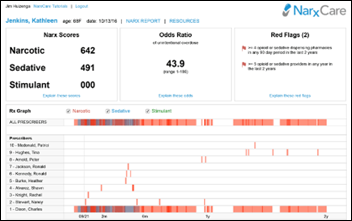

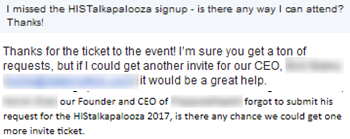

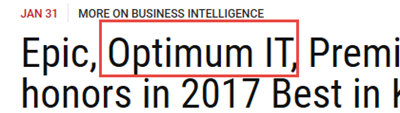






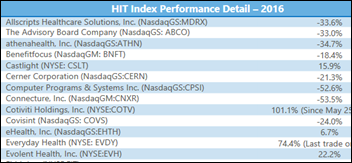
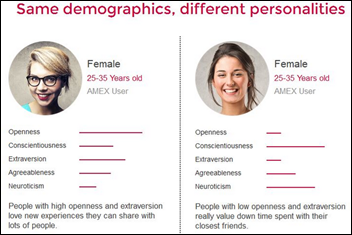
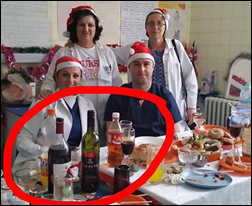

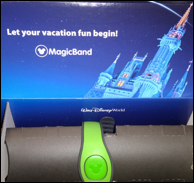

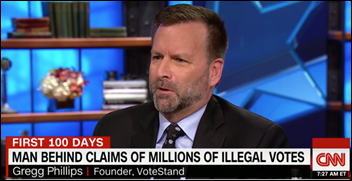





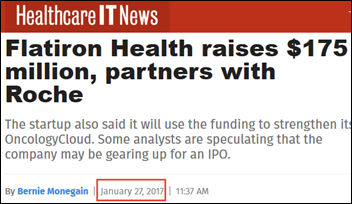
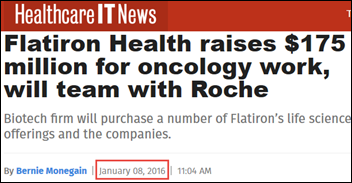
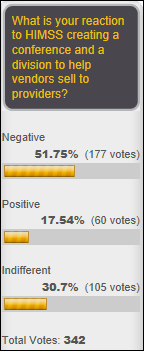








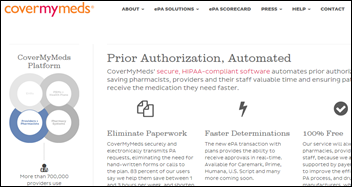



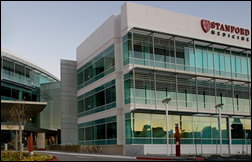









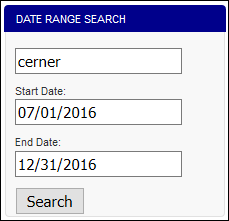




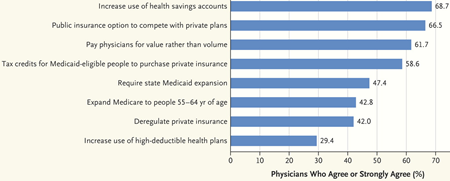
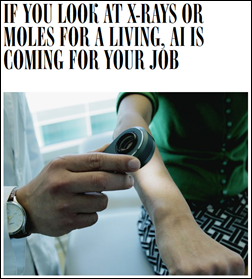




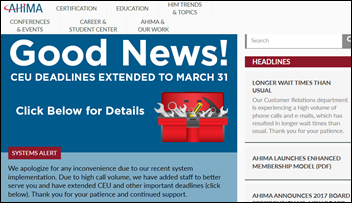
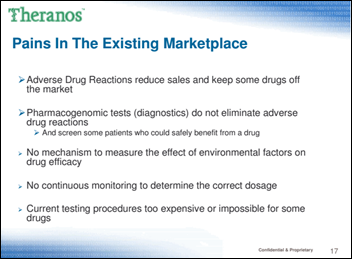

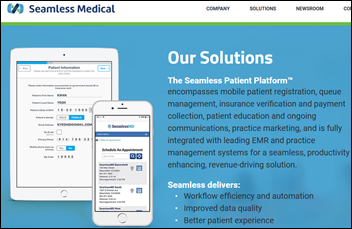

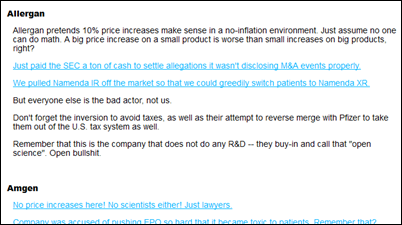


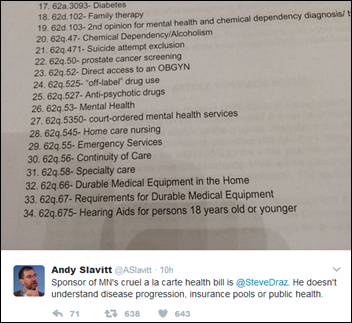
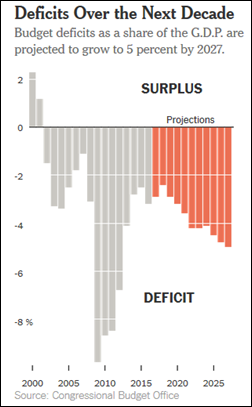
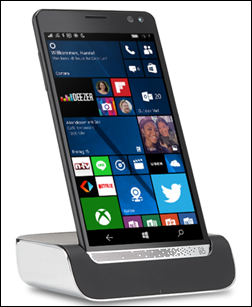
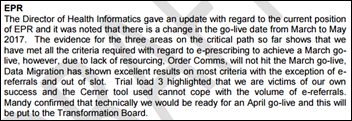

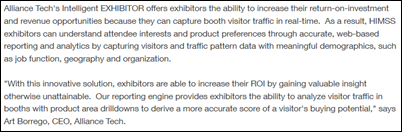
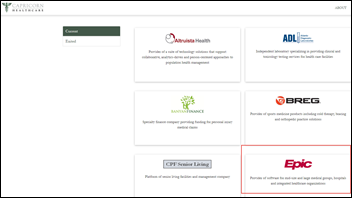
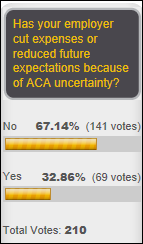



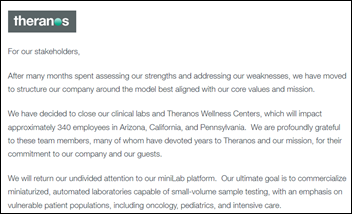










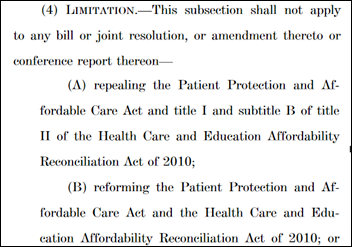









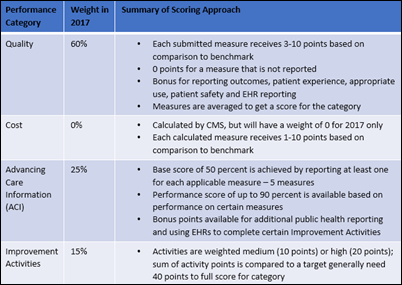
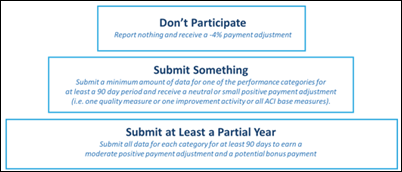
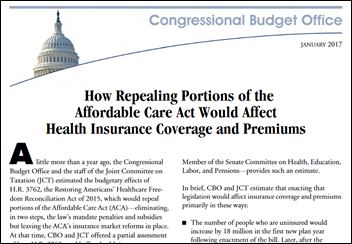





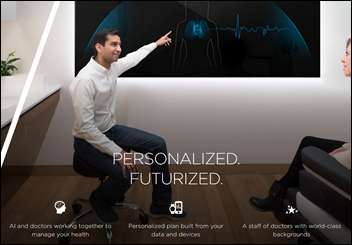


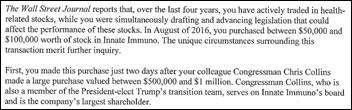

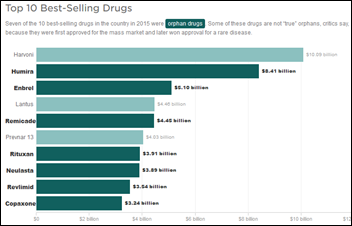

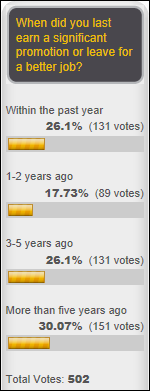


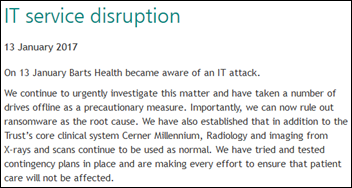
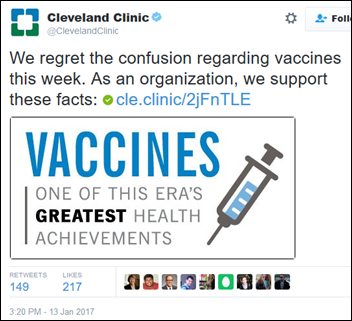

Re: Deliberately Faked Academic Papers in Nature See, this doesn't surprise me at all. Of course AI quotes these bogus…