CIO Unplugged 11/20/17

November 20, 2017 Ed Marx 10 Comments

The views and opinions expressed are mine personally and are not necessarily representative of current or former employers.

New York, New York

I woke up and the sun was glistening off the glass and steel skyscrapers that had become my GPS. Between them, just across the water, there she was, tall and beautiful — Lady Liberty greeting me each morning. A faithful companion reminding me of my roots and our great country. My belongings had shipped the day before, so there would be no run on the Highline today.

I showered, dressed, and began my familiar walk up Church, giving respects to Hamilton, left down Broadway, turning up Wall Street, dancing with tourists marveling at sacred Federal Hall and the Exchange. A final right on Broad where the cobblestone street forced a jump in my step, leading up to 55 Water, where I took my seat alongside my team in our shared space.

A beautiful high-rise vista, we shared views of the East River with its gorgeous bridges connecting us to Brooklyn through the harbor at its edges. We arguably had the best vantage point to observe security logistics whenever dignitaries made their way into Manhattan via heliport. We waved to presidents and popes.

Today was different. This would be my last walk through hallowed grounds of our founding fathers and fellowshipping with my team.

Shy of three years, I was the leader of our team that carried our broken division. If you observed us and knew our outcomes, you think we had been together for decades. Our bonds grew quick and deep. The urgency of our mission, our passion, and the significant time spent huddling after hours hastened our bonds.

image

Our team included spouses and children who knew one another well. None of us native to this country, we were the perfect mix serving the NYC melting pot. Easily the most painful part in my decision to leave NYC was departing our team. Against all odds, our team did what others failed to do, what many said was an impossible task.

I rarely reference the organizations I serve, but NYC Health & Hospitals was special. I knew I was called here for a season of life and how it all came to pass implied providence. Public health is vital to the greater good and I was honored to make a contribution, however small in the bigger picture.

Reporting to the CEO, the experience opened my eyes to the critical role of public health in our society. The specific NYC mission fills many gaps in caring for everyone regardless of status or ability to pay. We had routine meetings with City Hall to ensure alignment and accountability with municipal leaders. Each time at City Hall I would sneak off and spend time in the rooms set aside to pay homage to our founding fathers. It was sacred ground that reaffirmed my calling to healthcare service.

I grew as a leader during my tenure. Many blogs and ideas were inspired by the experience. The exposure to political nuances was both awe-inspiring and an insightful awakening. I gained appreciation for the inner workings of government and the challenges of balancing the needs and welfare of arguably the greatest city on earth. Frustrating at times, I loved her.

Serving in public health also fulfilled one of the remaining aspects of my career strategic plan that I developed with my 2004 mentor, Mr. Zenty, the CEO of University Hospitals. I intentionally served in academic medical centers, community-based hospitals, integrated delivery systems, faith-based systems, and in for-profit and not-for-profit organizations. I served in a mix of ambulatory and acute care environments. Armed with this experience, I knew without a doubt that my greatest affinity centered on academic medicine. When the opportunity came about to serve as a senior leader of perhaps the greatest health delivery system on Earth, I did not hesitate. Except for my team.

image

In fact, it has taken me 70 days to express myself via this blog. I am thankful to have visited with my NYC squad several times since leaving as our friendships remain strong. We learned so much on our journey, but perhaps purposefully, enjoying the moment was the most profound. We all tend to rush here and there and mindfulness gets lost in the stress and adrenalin of crisis and deadlines.

We took deliberate time in each meeting to reflect. We took time weekly to be social. We planned time monthly to bring together families and play. Almost quarterly we gathered somewhere around the country to celebrate life. We cried. We laughed. We jumped into frigid oceans. We ate foods that made us cringe. We lifted each other. We saw sports. We saw Broadway. We made mistakes. We shopped. We served. We saw comedy. We saw stars. We danced. We cooked. We walked. We ran. We held hands. We prayed. We screamed. We talked deeply. We consoled. We counseled. We encouraged. We learned. We challenged. We conquered. We played tricks. We accomplished. We smiled. We won.

If you can make it there, you can make it anywhere.

edmarx

Ed encourages your interaction by clicking the comments link below. He can be followed on LinkedIn, Facebook, and Twitter.

Monday Morning Update 11/20/17

November 19, 2017 News 3 Comments

Top News

SNAGHTML177be597

The VA is considering merging its Choice program – which allows veterans who can’t get timely VA appointments to see private doctors — with the military’s Tricare, which offers health insurance to active service members.

A VA statement says that work on the planned VA-DoD single EHR platform led VA Secretary David Shulkin to have conversations with the White House about merging the programs to “provide better care for veterans at a lower cost to taxpayers.”

 image

Some large veteran groups immediately expressed concern with the plan, fearing that it could turn the VA’s direct care model into a DoD Tricare-like insurance program in which private providers deliver services and insured members pay premiums, deductibles, and co-pays.

image

Shulkin said in a May 2017 White House briefing:

In terms of our Choice Program, we still today only have three Department of Defense facilities that participate in the Choice network. We need to get the Department of Defense and VA to make all their facilities and our facilities open to veterans and to active service members. We certainly have to work with Congress and our veteran service organizations to redesign this Choice Program. It will expire essentially at the end of the year, and we need new legislation — this Congress — to make sure that veterans don’t go back to waiting longer than they need to wait to get care in the community. So we have to pass legislation this year.


Reader Comments

image

From Logic Pretzel: “Re: MHS Genesis. Deployment can’t continue beyond the four completed pilot sites until an independent assessment of cost and suitability is performed, which may not be finished until a year or more from now. That piles more risk on the VA’s piggyback decision and undercuts the credibility of their rationale that there’s no time to do a proper competitive search.” The DoD says the review will continue through late 2018, meaning that the VA is rushing into its no-bid contract with Cerner without even knowing whether DoD will continue its own Cerner rollout.

From Short Attn: “Re: HIStalk. It’s too long for me to read. I’m glad you at least run headlines to save me time.” I spend many hours each week extracting the health IT news and information that I think is most relevant and interesting, condensing it massively and dividing it into categories for easy skipping. You are free to consume as little or as much of what I write, but someone out there is poring over every word to gain an edge to allow them to steal your job or your customer. It’s good to have all the knowledge you can get when you’re a knowledge worker.

image

From Chalky Aftertaste: “Re: patient-preferred by whom? Check out this bizarre vanity press release.” A horribly written announcement published on a free press release service – I’d bet a stack of non-American currency that it wasn’t written by a native English speaker – lauds the medical accomplishments of an Indiana neurosurgeon, indisputably proven by a single fawning Facebook quote from an alleged patient and a short list of educational qualifications that includes “CMS Meaningful Use Stage 1 Certification from Epic Care Ambulatory EMR” (has he tapped into an unmet consumer demand for Epic-certified neurosurgeons?) The conferrer of the award is Patient Preferred Physicians and Practitioners, an “exclusive medical society” whose corporate address is a Boca Raton mail drop. Most of its honorees seem to be in late in their careers and I’m guessing their modest social media skills misled them into thinking that buying a vanity award would make them seem hipper.

From Pernicious: “Re: diagnostic apps and sites. Don’t you think these will revolutionize healthcare and that you should mention them more often?” No. Non-clinicians think patients are undiagnosed or misdiagnosed a lot more than happens in real life. We don’t have a diagnosis problem – we’re getting killed (literally) by conditions that have been perfectly diagnosed but are either untreated or expensively held in check at best. From a public health perspective, the last thing we need is wiring up millions of Americans, testing their genes, or poring over images of their innards to detect theoretical problems. That’s why experienced doctors roll their eyes at greenhorns who order tons of lab and imaging studies, with the near-certainty of finding something out of range requiring Whac-A-Mole action that’s not good for anyone except the companies making money off unnecessary tests and treatments. Western culture and medicine looks at illness and death much differently than most of the world, and our fascination with gadgetry and medical heroics that prop up the comforting illusion of immortality instead of taking on less-decisive public health issues has left us with a society that’s #1 by far in healthcare costs, but that barely beats Cuba in WHO’s health rankings.

image

From IA Taxpayer: “Re: University of Iowa Hospitals and Clinics. Shutting down its Epic Community Connect program. Team members were told on Friday, November 17. The business unit will be integrated into UIHC IT, UIHC is not seeking new Community Connect business, services to existing clients will be cut off, and layoff of 50 percent of the staff (more than 30 FTEs) will happen by July 1, 2018. The message is that the program has a financially flawed business model that provides only a fraction of the ongoing revenue needed to support existing staff. UIHC has negative margins, but within increased focus on patient-centered care, referral patterns from those hospitals that joined the program will be negatively impacted.” Unverified. I’ve emailed a contact there for a comment.


HIStalk Announcements and Requests

image

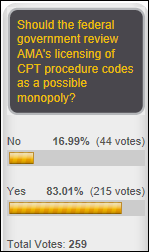
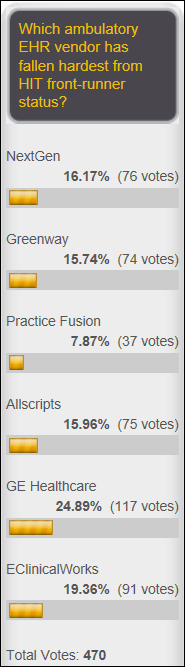
The vast majority of poll respondents think the federal government should review whether the AMA-owned CPT procedure code system constitutes a monopoly. An anonymous reader says rather insightfully that it’s not illegal to BE a monopoly, but rather to ACT like one, while John recalls an early copyright misuse claim in which the ruling was that while the federal government may have created a monopoly by mandating the use of CPT codes, AMA didn’t seek that monopoly. Another anonymous reader wonders whether AMA perpetuates the use of E&M codes, which he or she blames on note bloat and lack of usability of clinical documentation functions.

New poll to your right or here: will Cerner’s EHR allow the VA to exchange electronic information with non-VA providers?

image

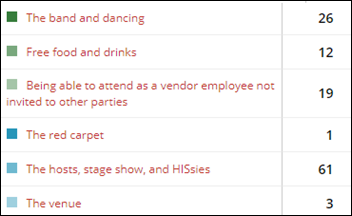
I’m fascinated by the small number responses to my poll in which I asked HIStalkapalooza attendees what aspects drew them to the event. #1 by far was the hosts, stage show, and HISsies, which is surprising because the in-person feedback is usually that they couldn’t hear or didn’t care. Only 10 percent of respondents ranked “free food and drinks” as their motivator. Based on that, the ideal event would be open to everyone, feature a less-expensive dance band, let everyone buy their own food and drinks, and carry on the stage show as always. The only aspect I’ll miss (since I’m still not inclined to do it again) is the interesting roster of attendees, which as far as I know is unmatched since it included providers, vendors, professors, government officials, equities analysts, and even people from competing websites and publications.

It seems as though many members of the Greatest Musical generation of the 1960s and 1970s are dying lately as that cohort starts to hit the mortality wall. The latest: AC/DC co-founder, guitarist, and songwriter Malcolm Young, who died of dementia this weekend at 64 in leaving the band with one original member, his schoolboy-uniformed brother Angus Young. A third brother, AC/DC producer George Young, died last month at 70. Meanwhile, David Cassidy (aka Keith Partridge) is apparently also close to death from dementia and organ failure. Life is a (hopefully) long line to the cliff where it will eventually be your turn to be pushed off.


This Week in Health IT History

One year ago:

  • The Gates Foundation issues a grant to create a blockchain-powered medical record.
  • HIMSS and CHIME create an international group to manage programs outside of North America.
  • HHS Secretary Sylvia Burwell warns that a “repeal and replace” approach to the ACA will cause the program to collapse due to insurers pulling out because of uncertainty, leaving 20 million more people uninsured.

Five years ago:

  • HP writes down $9 billion after finding that its recent acquisition Autonomy misstated earnings.
  • The CEO of Quest Diagnostics says the company is “redirecting” its EHR business (ChartMaxx, Care360) to work with enterprise EHR vendors like Cerner, Epic, and McKesson.
  • The National Football League signs a contract with EClinicalWorks to provide an EHR that can support the research and treatment of player head injuries.
  • New sales were announced by Acuo, Merge, 3M, and Humedica.

Ten years ago:

  • A UK survey finds that GP support for the NPfIT project is down to 23 percent.
  • Sunquest, fresh off its acquisition by Vista Equity Partners, announces that it will increase investment in its radiology information system and begin actively marketing it again.
  • Wheaton Franciscan Healthcare VP of IT Tim Belec is shot by a 17-year-old robber in the organization’s parking lot as he leaves work.
  • Dennis Quaid’s newborn twins are given a heparin overdose at Cedars Sinai due to improper stocking of a medication dispensing cabinet.

Last Week’s Most Interesting News

  • VA Secretary David Shulkin asks a House appropriations subcommittee to approve using $782 million of the VA’s budget to kick off its Cerner project while sidestepping member questions about how Cerner will exchange information with community-based providers.
  • A multi-day system downtime leaves CVS Pharmacy unable to fill prescriptions.
  • Meditech announces a cloud-based, subscription-priced version of its EHR.
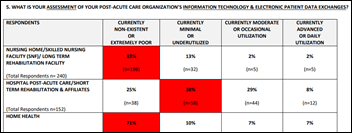
  • A Black Book survey finds that only 19 percent of post-acute care providers have any degree of EHR capability and that 90 percent of long-term care providers don’t exchange information with referring doctors or hospitals.
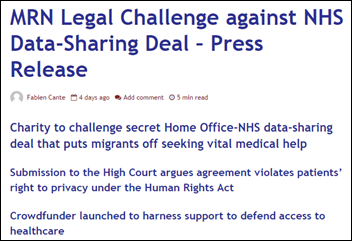
  • In England, a migrant rights group challenges an agreement by which NHS makes patient data available to the Home Office for immigration enforcement.

Webinars

November 30 (Thursday) 1:00 ET. “Making Clinical Communications Work in Your Complex Environment.” Sponsored by: PatientSafe Solutions. Presenters: Steve Shirley, VP/CIO, Parkview Medical Center; Richard Cruthirds, CIO, Peterson Health. Selecting, implementing, and managing a mobile clinical communications platform is a complex and sometimes painful undertaking. With multiple technologies, stakeholders, and disciplines involved, a comprehensive approach is required to ensure success. Hear two hospital CIOs share their first-hand experience, lessons learned, and demonstrated results from deploying an enterprise-wide mobile clinical communications solution.

December 5 (Tuesday) 2:00 ET. “Cornerstones of Order Set Optimization: Trusted Evidence.” Sponsored by: Wolters Kluwer. Updating order sets with new medical evidence is crucial to improving outcomes, but coordinating maintenance for hundreds of order sets with dozens of stakeholders is a huge logistical challenge. For most hospitals, managing order set content is labor intensive and the internal processes supporting it are far too inefficient. Evidence-based order sets are only as good as their content, which is why regular review and updates are essential. This webinar explores the relationship between clinical content and patient care with an eye toward building trust among the clinical staff. Plus, we will demonstrate a new evidence alignment tool that can easily incorporate the most current medical content into your order sets, regardless of format, including Cerner Power Plans and Epic SmartSets.

Previous webinars are on our YouTube channel. Contact Lorre for information.


Acquisitions, Funding, Business, and Stock

image

Drug company Roche will acquire laboratory-focused health analytics technology vendor Viewics. Roche Diagnostics offers laboratory analyzers, inventory software, and middleware and will deploy the Viewics solution to help labs improve profitability and care.

image

Madison, WI-based image sharing app vendor ImageMoverMD separates from its CEO, hires a former drug rep as president, and brings on a COO (who comes from Epic) and a sales director in hopes of boosting sales. The two physician co-founders are UW radiologists who are also board-certified in clinical informatics.

image

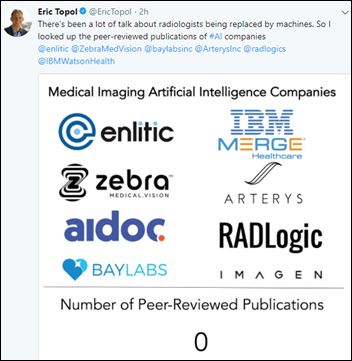
Eric Topol apparently isn’t convinced that radiologists will be replaced by artificial intelligence, based on the lack of peer-reviewed publications of the companies that offer imaging AI.

image

Advisory Board closes the sale of its healthcare business to Optum, with CEO Robert Musslewhite staying on.


People

image

Glenn Galloway (Children’s Health Network) joins Center for Diagnostic Imaging as CIO. He previously worked as CIO of Children’s Hospitals and Clinics of Minnesota and co-founded Healthia Consulting in 1998, spending several years as SVP of Ingenix Consulting after it acquired Healthia in 2007. Long-time readers will recall that Healthia (and thus Glenn) sponsored the first-ever HIStalkapalooza at HIMSS08 in Orlando, a two-hour cocktail party for around 200 attendees at what was then the Peabody Hotel.

SNAGHTML137b253a image

ZappRx hires Rich Cramer (Upfront Healthcare Services) as VP of commercial operations and names James Cornicelli (UCB) as VP of corporate strategy. 


Announcements and Implementations

image

Sunquest will integrate its Mitogen laboratory information management system for molecular diagnostics and precision medicine with oncology molecular decision support technology vendor N-of-One. Private pathology lab CellNetix will be the first customer.

image

South Georgia Medical Center (GA) goes live on Epic, saying that within the first two weeks it had exchanged information with 20 or more facilities.


Government and Politics

image

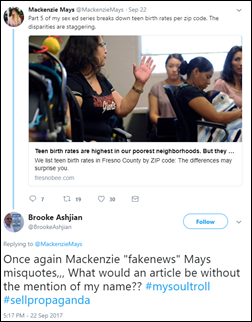
The controversial president of the Fresno, CA school board attacks a Center for Health Journalism writer for her newspaper series on sex education and high birth rates. He launches a Twitter tirade, compares her on talk radio to a “child sex predator,” and publishes her work phone number on Facebook in urging others to contact her.

image

A California state judge rules that Sutter Health intentionally destroyed 192 boxes of documents that were being sought by employers and labor unions who had charged Sutter with market power abuse and charging inflated prices.

image

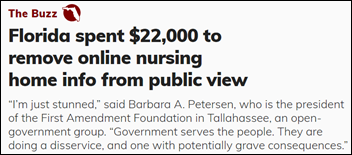
Florida’s Agency for Healthcare Administration takes the next step after heavily redacting nursing home inspection records in claiming threats to the privacy of residents – removing the records from its website completely. Florida newspapers mentioned the censored inspection reports in their coverage of the deaths of 13 seniors in a rehabilitation center after September’s Hurricane Irma, after which the AHCA took all nursing home records offline without notice. Some South Florida counties have also refused to release the emergency management plans they approved for nursing homes – including the all-important sections of how they would keep residents comfortable during power outages –even though they had previously said they were public record.


Other

image

The local paper says patient appointments at Banner Health’s Tucson hospitals and clinics are being delayed due to its October 1 go-live of Cerner, with Banner’s chief clinical officer admitting that it has been a “painful period.” The health system expects the situation to be resolved by December 31. The Arizona Department of Health Services is investigating complaints about the impact of the new system but won’t provide details. Banner acquired the former money-losing University of Arizona Health Network in 2015, which had  gone live (and well over budget) with its $115 million Epic project less than a year before. Banner’s corporate standard is Cerner.

A JAMA research letter questions whether hospitals are gaming the federal government’s Hospital Readmission Reduction Program in avoiding financial penalties by upcoding severity of illness instead of actually improving care.

image

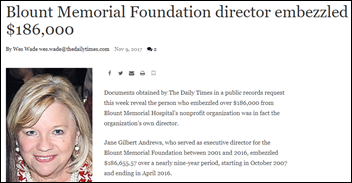
County officials question the auditor and CEO of Blount Memorial Hospital (TN) about why they weren’t told that the hospital foundation’s since-fired executive director had embezzled $187,000 over nine years. The employee issued checks to herself using QuickBooks accounting software, then modified the QuickBooks entry to make it appear that the payee was a foundation business partner. The foundation did not require checks to bear a second signature and did not conduct yearly audits. 

image

In England, a man who proposed to his girlfriend last New Year’s Eve —  the day before he suffered from sepsis-induced brain damage that nearly killed him — proposes again from the rehab hospital, using eye-tracking technology to communicate. His girlfriend said “yes” a second and his therapists and caregivers prepared him to make his way down the aisle in a wheelchair and to place the ring on her finger. The eye-tracking technology is from Eye Gaze, which offers assistive technology and eye tracking human cognition research.


Sponsor Updates

  • Medicity publishes a new report, “HIE Preparedness: Learning from Recent Health Care Disasters.”
  • MedData and Experian Health will exhibit at the Illinois AAHAM Annual State Institute November 29-December 1 in East Peoria.
  • Meditech will exhibit at the West Virginia HIMSS 2017 Fall Event November 30-December 1 in Morgantown.
  • PatientPing announces that its ACO customers achieved $120 million in cost savings in 2016.
  • Navicure will exhibit at HFMA Maine’s Revenue Cycle Workshop November 30-December 1 in Portland.
  • A large health plan upgrades to ZeOmega’s Jiva 6.1 population health management solution.
  • The Technology Association of Georgia recognizes Patientco’s Jason Kuo as 2017 TAG Product Manager of the Year.
  • TransUnion partners with Mercy Home for Boys & Girls to launch the Friends First mentoring program.
  • Verscend Technologies publishes a new white paper, “Thinking inside the box with a provider decision quadrant.”
  • Visage Imaging previews its Visage 7 Enterprise Imaging Platform in a new video.
  • Vocera Communications will present at the Piper Jaffray Healthcare Conference November 28 in November 28.

Blog Posts


Contacts

Mr. H, Lorre, Jenn, Dr. Jayne, Lt. Dan.
Get HIStalk updates. Send news or rumors.
Contact us.

125x125_2nd_Circle

News 11/17/17

November 16, 2017 News 5 Comments

Top News

image

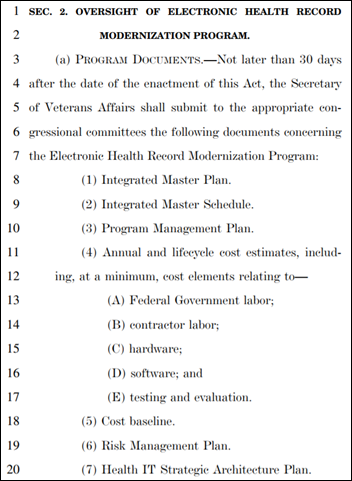
VA Secretary David Shulkin, MD asks Congress to move $782 million from its 2018 appropriations to get its Cerner implementation underway, starting with an immediate $374 million in reprogramming since that’s the maximum that can be moved in the short term.

image

Committee chair Charlie Dent (R-PA) and ranking member Deborah Wasserman Schultz (D-FL) opened the session by expressing their frustration with previous VA-DoD interoperability efforts, the failure of the VA and DoD to follow the previous directives of Congress to create a single system, and their skepticism that the Cerner project will run as smoothly as the VA is assuring.

Some comments from Wednesday’s session:

  • The committee declined to discuss cost issues in the open session because the Cerner contract has not been signed and the VA is worried about bid protests. Cost was discussed Wednesday in a closed session that followed the public one.
  • Shulkin said that modernizing VistA would have cost $19 billion and would only say that the Cerner project will cost billions less.
  • The VA said it will save 5 percent of the project’s cost if the money is approved quickly so that the VA can align its project with the DoD’s.
  • Wasserman Schultz referred to the VA’s EHR history as, “The unbelievably lengthy process this has been, even for government,“ adding that, “This issue could have and should have been resolved years ago,” and, “It’s no wonder our constituents get incredibly frustrated with the insanity of the bureaucracy of many federal agencies. This is a textbook case.”
  • Wasserman Schultz called the DoD’s selection of Cerner as “problematic” with regard to VA-DoD interoperability given that the VA had committed to modernizing VistA, adding that “the patchwork of the Joint Legacy Viewer has left much to be desired.”
  • Wasserman Schultz said, “I was not thrilled at getting a $782 million reprogramming at the end of October that needed to be acted on by November with no real details. I’m also concerned about how this new system will work with the private sector providers .. I’m concerned that the VA’s foot-dragging and missteps have become our emergency because DoD has gone forward and jumped ahead to what we should have been doing in parallel … that’s not really the fiscally responsible way to do things.”
  • Shulkin reminded the committee that VistA is not a single system, but rather 130 separate systems that cannot continue to function. Those will be shut down one at a time as the Cerner implementation progresses over eight years.
  • Shulkin admitted that previous VA IT projects have not been delivered on time and on cost, but said the Cerner project will be overseen directly by the deputy secretary and the DoD’s lessons learned will be invaluable.
  • Shulkin said, “We’re taking advantage of the private sector CIOs. Mr. Blackburn’s going to be on a call with five of the leading CIOs in the country, getting their advice, asking what mistakes are likely to happen, and essentially using private sector input. I’ve been a private sector CEO. I’ve done EHR implementations.” Specifically named as being consulted in response to a later question were the CIOs of Mayo Clinic, Partners, Johns Hopkins, and Kaiser Permanente, all of which interestingly use Epic rather than the VA’s no-bid choice of Cerner.
  • Shulkin talked up what seems to be CommonWell along with HIEs in response to a committee question about community interoperability, a subject brought up several times by committee members. He added that the VA has just issued an RFI for the Digital Health Platform that will address that issue.
  • The VA’s EHR modernization executive director, John Windom, guaranteed 100 percent interoperability with the DoD in response to a committee member’s rather pointed question.

Reader Comments

image

From Winter Rye: “Re: Medent sale. I’ve never understood its reach despite the apparently success of its family and 8,000 reported deployments. The resignation of the son-of-the-father CEO may be telling that other family members want to sell after the father / founder died earlier this year. Potential buyers?” The family seems to be angrily split on selling the 260-employee EHR/PM vendor, which is based in Auburn, NY. It claims 8,000 physician users, with ONC placing it at #13 on the Medicare EHR Incentive Program most-attested vendor list with just under 4,000 EPs. It’s not the best environment to be selling an ambulatory EHR vendor given that segment’s consolidation, but it’s all about the asking price and the acquirer’s confidence of either maintaining the revenue stream or converting users to their own product (the former is much more likely than the latter). The worst thing that could happen is that the family members can’t agree whether to sell and the product languishes amidst the bickering.

image

From Allscripts Curious: “Re: the new Allscripts ambulatory EHR showcased at MGMA. Anyone seen it and have feedback? It claims to offer cloud hosting, usability, interoperability, mobility, and embedded AI, but management was short on details.” I’m interested as well. I assume this is the Allscripts Care Otter project, which after I mentioned it via a reader’s tip in August wondering why it wasn’t ready to be shown at ACE, all online traces of the project were immediately taken down. This reminds me of why I’m skeptical when vendors suddenly claim to have embedded the oh-so-trendy AI in their products, leading me to wonder exactly what that means beyond the usual hard-coded programming logic (the real definition of AI is that the system simulates human intelligence in applying what it learns to complete new tasks, which sounds kind of unlikely for an EHR).

From Nice Hat: “Re: patient access technology. What does that mean, exactly?” It’s less noble than it sounds, usually referring to technology that increases the number of profitable patients that can be cranked through the system.


HIStalk Announcements and Requests

image

Thanks to Healthfinch, which has upgraded its HIStalk sponsorship to Platinum level.

At least 50 percent of the usage of the possessive “its” that I’ve seen lately incorrectly spelled the word as “it’s,” raising the near-certain likelihood that dictionaries will start listing the misspelling as acceptable in their self-assigned role of being descriptive rather than prescriptive.

This week on HIStalk Practice: CDC announces Million Hearts Hypertension Control Challenge winners. GE CEO John Flannery announces major restructuring. Mynd Analytics makes telepsychiatry acquisition. Nomad Health adds telemedicine to healthcare jobs marketplace. Pacifica Labs adds therapist directory to popular mental health app. Forward brings high-tech primary care to LA. The Iowa Clinic embarks on population health management with help from Lightbeam Health. PRM Pro Jim Higgins outlines how PRM tools can help physicians treat the person inside the patient.


Webinars

November 30 (Thursday) 1:00 ET. “Making Clinical Communications Work in Your Complex Environment.” Sponsored by: PatientSafe Solutions. Presenters: Steve Shirley, VP/CIO, Parkview Medical Center; Richard Cruthirds, CIO, Peterson Health. Selecting, implementing, and managing a mobile clinical communications platform is a complex and sometimes painful undertaking. With multiple technologies, stakeholders, and disciplines involved, a comprehensive approach is required to ensure success. Hear two hospital CIOs share their first-hand experience, lessons learned, and demonstrated results from deploying an enterprise-wide mobile clinical communications solution.

December 5 (Tuesday) 2:00 ET. “Cornerstones of Order Set Optimization: Trusted Evidence.” Sponsored by: Wolters Kluwer. Updating order sets with new medical evidence is crucial to improving outcomes, but coordinating maintenance for hundreds of order sets with dozens of stakeholders is a huge logistical challenge. For most hospitals, managing order set content is labor intensive and the internal processes supporting it are far too inefficient. Evidence-based order sets are only as good as their content, which is why regular review and updates are essential. This webinar explores the relationship between clinical content and patient care with an eye toward building trust among the clinical staff. Plus, we will demonstrate a new evidence alignment tool that can easily incorporate the most current medical content into your order sets, regardless of format, including Cerner Power Plans and Epic SmartSets.

Previous webinars are on our YouTube channel. Contact Lorre for information.


Here’s the video recording of this week’s webinar titled “How Hospitals and Practices Can Respond to Consumerism by Better Engaging Patients Through Price Transparency and Payment Options.”


Acquisitions, Funding, Business, and Stock

image

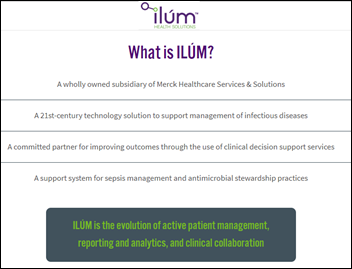
Merck-owned Ilum Health Solutions acquires Teqqa — a partner organization that offers analytics for infectious disease analytics — to enhance its antibiotic stewardship offerings with point-of-prescribing decision support.

image

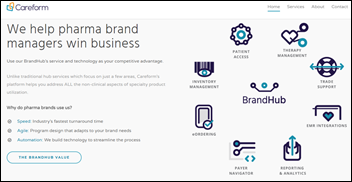
Patient adherence message vendor ConnectiveRx acquires Pittsburgh-based Careform, which offers technology for specialty drug access.

image

Hospital and infusion center scheduling system vendor LeanTaaS raises $26 million in a Series B funding round, increasing its total to $39 million.

image

Banyan Software acquires Atlanta-based student health EHR vendor Medicat. I was puzzled why the company that developed the Vines networking system would buy an EHR vendor, not realizing that Banyan Systems has been defunct for nearly 20 years.

image

Fast Company profiles Remedy, a shuttered startup that used technology and human billing experts to help people get their incorrect medical bills fixed. The company says hospitals, practices, and insurers wouldn’t cooperate by giving it access to the billing records of their customers, saying in its goodbye message, “Until the industry begins respecting the rights people have to their own information, it will remain difficult for individuals and their agents to be vigilant against baseless medical bill overcharges.” The article acknowledges that perhaps the company should have done more due diligence before placing investor bets on external data access, but adds that the company’s billing subcontractors were buried in paperwork as hospitals and practices required completing manual forms, lost the submitted forms so they had to be completed again, and incorrectly told them that HIPAA made it illegal to work with the company.

image

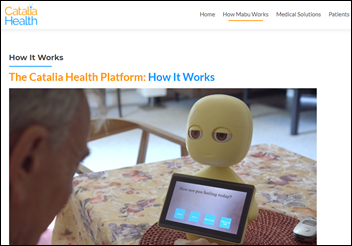
AI-powered patient engagement platform vendor Catalia Health raises $4 million in a pre-Series A round, increasing its total to $7.75 million. The company offers Mabu, a supposedly human-like conversational companion whose robotic voice is about as un-human as it can be, making that a good place to spend some of the new windfall.


Sales

image

Jefferson Health (PA) chooses KyruusOne and ProviderMatch for Access Centers to create and manage a central provider directory that provides visibility into network-wide clinical coverage and provider expertise.

image

Griffin Hospital (CT) will implement FormFast’s electronic form and workflow technology along with check printing.

image

In Australia, Royal Adelaide Health chooses the anesthesia information system of Florida-based IProcedures as part of its Allscripts contract.

SNAGHTML863285d

Allegiance Health Management (LA) selects Medhost’s clinical and financial solutions, EDIS, and YourCareCommunity patient and provider portal for eight of its facilities.

image

Banner Health will implement Health Catalyst’s Data Operating System for its outcomes improvement program.


People

image image

A UCSD announcement of the go-live of UCI Health on a shared instance of UCSD Health’s Epic system quotes UCSD Health CIO Christopher Longhurst, MD, MS and UCI Health CIO Chuck Podesta.

image

Protenus hires Megan Emhoff (Curiosity Media) as VP of people operations.


Announcements and Implementations

image

Apple co-founder Steve Wozniak will headline InstaMed’s 2018 User Conference April 9-11 in Philadelphia.

image

The Iowa Clinic (IA) goes live on the population health management platform of Lightbeam Health Solutions.

image

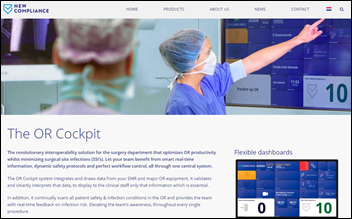
The local paper covers the first US deployment of Netherlands-developed, infection prevention-focused OR Cockpit at Ocean Springs Hospital (MS).

Philips and Nuance will bring AI-based image interpretation and reporting capabilities to radiologists in integrating their respective Illumeo and PowerScribe 360 products.

NextGen adds the IMO Problem IT Terminology diagnosis entry tool by Intelligent Medical Objects to the mobile workflow solution that was part of NextGen’s acquisition of Entrada earlier this year.

Image Stream Medical offers HIStalk readers “Surgery is a Team Sport,” a three-part educational series on improving teamwork, increasing care quality, and expanding efficiency.

In Canada, Canada Health Infoway and OntarioMD will align the privacy and security components of their respective EHR certification programs.


Other

image

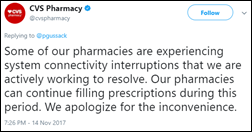
An “internal network infrastructure issue” leaves CVS Pharmacy unable to process prescription refills. Annoyed Twitter users dispute the company’s claim that new prescriptions are being filled normally, saying that the multi-day outage has disrupted all CVS prescription activity and has caused store personnel to suggest they head over to Walgreens.

image

CHIME suspends its highly publicized, $1 million prize National Patient ID Challenge after two years, saying “a new approach is warranted” with no good solutions found and admitting that “we cannot do this alone.” CHIME President and CEO Russ Branzell also notes that Congress may soften its stance on prohibiting HHS from creating a national patient identifier. CHIME says it will bring together key stakeholders to find a national solution that identifies people with 100 percent accuracy (its million dollars would be safe there for sure).

A woman sues EClinicalWorks for $999 million, hoping to attain class action status in claiming that her husband died because ECW’s EHR left him “unable to determine reliably when his first symptoms of cancer appeared in that his medical records failed to accurately display his medical history on progress notes” without really describing what happened. The complaint cites the certification issues that were listed in ECW’s settlement with the Department of Justice.

SNAGHTML935cb75

In England, a physician’s op-ed piece complains that a private telemedicine provider is advertising itself as a replacement for seeing GPs while excluding more complex patients, thus cherry-picking the easiest ones and threatening GP practices that are paid a fixed $200 per patient per year in which the healthy subsidize the sick. The yearly fees are transferred to telemedicine provider Babylon when a patient signs up for an online visit. The author says his practice can’t provide services to truly ill patients if telemedicine providers skim off the profitable ones:

But while anyone can join its service, the website says it may not be suitable for “complex mental health problems or complex physical, psychological or social needs.” Or if you’re pregnant or older and frail, and as long as you don’t have dementia or learning difficulties or safeguarding issues … We cannot refuse to register patients or advise them to register elsewhere based on age, gender, or disability. If my surgery put a list on its website telling the most ill people in our catchment area we weren’t suitable for them, NHS England would serve us a breach of contract notice and could close us down.

image image

I mentioned that Thursday night’s “Grey’s Anatomy” winter finale involves a hospital cyberattack, with a sneak preview showing that it’s ransomware. It’s a pretty realistic EHR screen and “Tim from IT” gets a fun line before his day is wrecked in cutting off the nurse’s description of the problem by asking her if she’s tried turning the computer off and back on. Hollywood loves playing sounds when text displays on a screen like a teletype and did so here, which might be desirable for ransomware but not otherwise. The hacker appears to be demanding 4,932 bitcoin, making the ransom at bit steep at $38 million.


Sponsor Updates

  • Elsevier adds an Opioid Epidemic Resource Center to its Connect website.
  • Salesforce offers an e-book titled “How a Mobile CRM Makes You More Successful” and a guided tour of Community Cloud Lightning.
  • Datica CTO Adam Leko and Methodist Le Bonheur Healthcare analytics director David Deas will present a session on eliminating HIPAA compliance as a development barrier at the Amazon Web Services AWS re:Invent conference on November 27 in Las Vegas.  
  • Brava Magazine profiles Healthfinch VP of Finance and Operations Leah Roe.
  • Healthgrades partners with Code.org to bring Hour of Code to schools in Atlanta, Denver, Madison, and Raleigh.
  • Healthwise will exhibit at the Next Generation Patient Experience November 28 in San Diego.
  • Iatric Systems releases a preview of its forthcoming Security Audit Manager.
  • Imprivata customer support wins the 2017 TSIA Star Award.
  • The HCI Group partners with the Dubai Health Authority for the DHA Transformation Forum.
  • Consulting Magazine includes Impact Advisors in its list of fastest-growing firms for 2017.

Blog Posts


Contacts

Mr. H, Lorre, Jenn, Dr. Jayne, Lt. Dan.
Get HIStalk updates. Send news or rumors.
Contact us.

125x125_2nd_Circle

EPtalk by Dr. Jayne 11/16/17

November 16, 2017 Dr. Jayne 2 Comments

clip_image002 

Not healthcare IT, but providers will probably have to document conversations on this in the EHR. The US Environmental Protection Agency has approved the release of so-called “weaponized” mosquitoes in parts of the US. They’re officially classified as a “biopesticide” and their creator, MosquitoMate, will be licensed to sell them for five years. The lab-grown male mosquitoes are infected with a bacteria; females mating with them will produce eggs that don’t hatch. The goal is to reduce the spread of diseases such as yellow fever, dengue, and Zika. The modified mosquitos don’t bite and will be on sale to municipalities and individuals. The US isn’t the leader here, with lab-grown mosquitoes already in use in China and Brazil.

clip_image004

I struggle with articles that overly-simplify the challenges we face in healthcare and this one on HealthcareDIVE is a prime example. Trumpeting the headline of, “The healthcare of tomorrow will move away from hospitals,” it tries to boil down discussion from the US News & World Report Healthcare of Tomorrow conference into a few sound bites. First, it states that “locating services in a patient’s home or somewhere close by and easily accessible is more convenient for patients, but also produces more comprehensive and effective care.” This is a gross oversimplification and doesn’t take into account that some of the most convenient sites of care (retail clinics) are also the least comprehensive, as they are sometimes staffed by mid-level providers with limited scope of practice. I see dozens of patients each month who are referred to urgent care because their conditions are out of scope of the retail clinic, resulting in two visits and two charges for the patient.

This also doesn’t take into effect the proven concept that for some situations, regional or specialty centers provide better outcomes than local or community facilities. Complex procedures like cardiac surgery, neurosurgery, high-risk pregnancy, and other similar conditions fall into this bucket. This isn’t supported by their sound bite of, “If you have to go to the hospital, we have failed you.”

As a patient / consumer who has recently faced difficult decisions in this area, it’s not a simple choice. Should I keep going to the local physician-owned imaging center for my mammograms, where they are high quality but lower cost, or move to the hospital because it has a high-risk surveillance protocol and better track record for finding early breast cancer through combined mammography and MRI, but with a higher cost and a higher hassle-factor? I honestly went back and forth on this decision for a couple of months before I decided to go with the hospital option. Should the day come where something is found, however, I’ll be ditching that hospital’s cancer care team for the one at the academic medical center, which has an equivalent track record for finding cancer, but better outcomes in treatment. If these decisions are difficult for a physician, they’re doubly challenging for the average patient.

I agree with the statements that telemedicine needs to become more commonplace – and that means being reimbursed in the same way that we reimburse for face-to-face visits. Whether we’re living in a fee-for-service world or one of value-based care, somehow the physician, mid-level provider, or other caregiver’s time needs to be paid for. I agree that consumers are going to drive many healthcare shifts over the next few years – I look at the growth of my own practice (from five locations to 15+ in a little over two years) as an example that patients are voting with their feet and their co-pays for convenience along with the more full-service experience that we offer. Essentially, we function as a cross between a primary care office and an ED and provide all the services in between plus pharmacy for a fraction of the cost of the ED. We’re not cheaper than primary care and don’t quarterback a patient’s comprehensive care, but if you need to be rehydrated during your gastroenteritis, we’re the hip place to be.

Patients are willing to pay the larger urgent care co-pay in order to not have to wait to get in to see a primary physician (assuming they have a primary physician, which many do not due to the relative primary physician shortage in our area). It’s telling that most of our new staff physicians are former PCPs who have found the urgent care lifestyle more conducive to their humanity as compared to being a primary care doc. We’ve been accused of poaching primary care physicians and making the PCP shortage worse, but this is market economics at work. The idea that a physician is “called” to work long hours for low pay as a PCP has become antiquated as providers vote with their wallets and their free time to work 160 hours a month for the same pay as they were previously working 200 or 240 hours, with less stress.

When you look at it, urgent care provides a similar case mix to what many of us trained for during family medicine residency: acute care, chronic care, and procedures, the latter of which is missing in many primary care practices now that physicians are asked to do more high-level work and less of the procedural work that we found enjoyable regardless of the fact that it could be done by mid-level providers. Of course, we don’t have the continuity of care that originally sought as PCPs, but we have more continuity with our families and our personal lives. The playing field has changed as third-party forces have transformed healthcare from a calling to a job.

I do appreciate the comments from Jason Spangler, MD, MPH, a quality and medical policy director at Amgen. He calls for the industry to “pay and incentivize patients toward high-value care and disincentivize them against low-value care.” Modifying patient behavior is extremely challenging, as anyone who has ever tried to convince a patient to change their lifestyle vs. just taking a pill once a day for high blood pressure knows. I’m sure there was a broader and richer discussion at the conference, but the coverage provided is problematic. Those who try to boil these complexities down to sound bites aren’t doing much to help the situation.

clip_image005

My condolences to the family, friends, and close colleagues of Uwe Reinhardt, healthcare economist and Princeton University professor. He was a master at dissecting the US healthcare system and showing how it defies logic. I once had the chance to meet him as we were assigned to share a car to the airport following a conference where we spoke on separate healthcare panels. He could easily have used the time to check email or catch up on phone calls, but instead he wanted to learn more about me and my thoughts on the US healthcare system from the primary care and CMIO trenches. He was kind, thoughtful, and a good listener, which are qualities we don’t always see among some of the loudest voices in healthcare. If you’re not familiar with his writings, they’re definitely worth a read.

Email Dr. Jayne.

Readers Write: How Hard Is It?

November 15, 2017 Readers Write Comments Off on Readers Write: How Hard Is It?

How Hard Is It?
By Frank Poggio

image

Frank Poggio is president and CEO of The Kelzon Group.

In the October 28, 2017 issue of HIStalk, Mr. H made this critical observation and raised an important question. He wrote (finishing with tongue in cheek):

For those with short memories or short healthcare IT careers, it’s time to relearn the oft-repeated lesson that big companies dip their toes into and out of the healthcare IT waters all the time with little loyalty to anyone except shareholders. McKesson bailed out this year and now GE is apparently mulling its exit after wrecking a slew of acquisitions over many years. Siemens is long gone. Nothing good ever comes from conglomerates licking their chops at what they naively think is easy money and higher growth than their other verticals (see also: Misys and Sage). How hard could this healthcare thing be?

GE of course isn’t alone, but they may hold the prize for most kicks at the can. This will be their third time since 1970 — three tries and billons later and nothing to show for it. Ironically, GE has had great success in medical devices, so one could assume they know more about the healthcare business than a Revlon, Apple, IBM, NCR, Martin Marietta, Lockheed, Oracle, SAP, Microsoft, et al.

After some 45 years working in the healthcare IT arena, I believe I have the answer to Mr. H’s query. My qualifications in support of my response are:

  • Over four decades, I was a hospital CFO and CIO at a major teaching hospital.
  • I spent two intermittent decades as an industry consultant working with healthcare providers and system vendors of all sizes.
  • In the middle of my career, after my CIO stint, I founded a HIT startup that built both clinical and administrative systems, went public, and was later acquired by one of today’s major vendors.
  • Most importantly, I have designed clinical and administrative software systems, led installations, and written more than my share of program code.

To summarize, I have seen it from all four sides; buyer, builder, advisor, and patient.

There are four reasons that make healthcare IT hard, really hard.


Organizational Structure

Many people new to the healthcare readily compare it to commercial industry. Why can’t hospitals do as banks, or airlines, or Google, or…?

One reason is they are not organized like these entities. What other industry has as its primary customer the same person that sells and then performs the core services? That same person also defines the product and further determines how it is delivered and implemented. That person is the doctor. The PhDs at GE do not make the final decision on how to make a jet engine or how to deliver it. GE is run by a CEO and the buck stops there. Hospitals are run by a troika (or committee) of the board, the administrative CEO, and the chief medical officer.

In 1974, Professor William Dowling, University of Washington, published the book “Prospective Reimbursement for Hospitals,” which did research on hospital operations. His studies showed that the CEO of a typical community hospital directly controls only 25 percent of the resources and operations. The other 75 percent is controlled by the doctors. They decide what tests to run, when to run them, and what happens next. The fastest way for a CEO to lose his job is to directly challenge the medical staff.

What other industry is organized like this? If you are in the business trying to build and sell million-dollar systems, you had better understand this organizational dynamic and accept the fact it will take years to generate an acceptable return on investment.

Regulatory Quagmire

All businesses are struggling with regulation. I submit that healthcare far exceeds all others.

Case in point: in what other industry does the payer define the structure and content of the bill down to the very last data element? One that comes closest is the defense industry, and many of its idiosyncrasies are incorporated in healthcare regulations. In 1999, Price Waterhouse CPAs completed an analysis of how many pages in the federal register addressed income tax laws. They compared income tax against the number of regulatory pages need to create a payable UB bill for all payers in a given state. The results were 11,000 pages of regulations for taxes and over 50,000 for a hospital bill.

A further complication is the person receiving the care is not the one paying the bill. Sometimes the patient never sees the full bill, and when they do, they are inevitably confused.

Training, Structure, and Definition

Computer systems thrive on definition and structure. The easiest applications to develop are those where the target domain has a history and library of definition and structure. Lack of definition and structure are a programmer’s nightmare. Today there are many tools to help address gray areas, such a fuzzy logic and neural networks, yet learning and applying these tools significantly raises the complexity of the system, thereby increasing development time and costs.

A doctor’s adherence to medical terminology and structure is highly dependent on which medical school they attended. As an example, a study at the Milken Institute SPH at George Washington University found that physicians whose residencies were in higher-spending regions spent 29 percent more on average than their peers who had trained in lower-spending areas of the country. Different protocols for different regions based on training. The federal government spent $30 billion on EMRs and yet we still have wide gaps in medical lexicons, protocols, and the structure and content of EMRs.

Moving Targets

In IT, this is classically called a rolling design, again a developer’s nightmare. But the delivery of healthcare and the practice of medicine are rife with this burden. Medicine is in constant change, with new protocols, test procedures, quality measures, etc. presented every week. Old protocols are challenged on a routine basis, e.g., mammography screening, PSA testing, knee replacements, tonsillectomies, and more.

What if you were assigned to develop a production management system for an auto manufacturer and every month the manufacturing engineers told you that process A — which we coded last month — has now changed to process B? The solution in commercial industry is to freeze the design by freezing the process. Can’t do that in medicine — freeze your protocol and tomorrow it could be the basis of a malpractice suit.

Medicine has always been in constant change, and with personalized medicine around the corner, variation and complexity will grow by leaps and bounds. Scientists have been trying to reverse engineer the human body since the first autopsy a thousand years ago. If only when you were born your mother gave you a 5,000-page human spec sheet with schematics and diagrams, a user’s manual, a troubleshooting guide, and a 1-800 number to call when all else fails. They exist for every car, dishwasher, plane, and other device and sure make software development a lot easier.

When I was a CIO at the end of a difficult IT implementation, the dean of our medical school said to me, “There is a reason we called it the practice of medicine. If we practice long and hard enough, someday we’ll get it right.”


Many of these issues exist in other industries and disciplines. I submit that the depth and interaction to which they exist in medicine and healthcare is what makes IT development hard, very, very hard. All those big companies (and many small) that came into the healthcare industry failed because they did not allow for the depth and interaction of these challenges, and hence they did not prepare for them, lost patience and millions, then chose to cut their losses and run.

From the outside looking in, healthcare is twenty percent of the gross national product, which could support a very attractive business opportunity. It’s a beguiling number which has proved to be siren song for many a big and small firm.

Readers Write: Six Myths Debunked: The True Significance of Social Determinants of Health

November 15, 2017 Readers Write Comments Off on Readers Write: Six Myths Debunked: The True Significance of Social Determinants of Health

Six Myths Debunked: The True Significance of Social Determinants of Health
By Erin Benson

image

Erin Benson is director of market planning with LexisNexis Health Care of Alpharetta, GA.

Predicting future health risks has always been important, but the ongoing move toward value-based care and the emphasis placed on health outcomes is driving the need for greater prognostic accuracy.

At least 25 cents of every healthcare dollar goes toward the treatment of diseases or disabilities that result from potentially changeable behavior. If you can identify risk factors in patients, you can potentially intervene and initiate change. That’s where social determinants of health come in, but first it’s important to separate the myths from the truth.


Myth #1: Adding socioeconomic data to the patient file causes information overload and makes it difficult for providers to zero in on what’s important and relevant.

Medical care determines only 20 percent of overall health, while social, economic, and environmental factors determine 50 percent, making them too significant to ignore. The National Quality Forum, Centers for Disease Control, and World Health Organization have all acknowledged the importance of socioeconomic data.

Incorporating the data into existing workflows and integrating it with electronic health record (EHR) systems makes risk assessment more efficient, not time-consuming. A Socioeconomic Health Score, for example, can provide an immediate picture of unforeseen and avoidable risks. It can then drive informed decisions regarding that patient’s care, as well as offer opportunities for patient-provider discussions about lifestyle.

Myth #2: Social determinants of health include everything related to a person’s lifestyle, environment, situation, and behaviors.

Only certain types of data have been clinically validated to predict health outcomes. Even when attributes are clinically validated, they may correlate to different outcomes with different accuracy strengths.

Improving predictive ability is not just a matter of adding more data. It is a science to determine which datasets enhance predictive power and how they should be weighted in drawing insights about a patient.

Myth #3: A patient’s socioeconomic attributes considered individually allow you to make accurate predictions about a patient’s overall health risk.

Any attribute examined on its own is not adequate to develop an accurate risk score understanding. A combination of relevant attributes—ranging from social and community circumstances to economic stability and education, to neighborhood and built environment—provide context and are critical to developing a complete, holistic picture of the patient.

Myth #4: Socioeconomic data comes from demographic data or must be gathered through the use of surveys.

Demographic data may be too limiting and census data tends to get outdated quickly. Survey data, too, can become outdated. Furthermore, the value of survey data depends on the accuracy of the patient supplying the information and on the staff member who manually enters the results into the system.

Research has shown that public records are a better source of socioeconomic data. Those records are vast, comprehensive, and reliable. Clinically validated information on social determinants of health can be extracted from these records to paint a picture of a patient’s social, environmental, and economic situation and predict future health outcomes.

For healthcare providers who have traditionally relied only on medical and pharmacy data, socioeconomic data can now help fill gaps in understanding the patient and provide actionable insights that can be used to improve patient care.

Myth #5: To personalize care for a patient, you can rely on aggregated data at the ZIP code or census level.

Aggregated levels of data can be useful for expanding a health system’s market share or determining resource allocation. They are not, however, suitable for predicting a patient’s individual health risk.

Within a single ZIP code can be a wide variety of income levels, crime rates, and other factors that are critical components of social determinants of health. An individual’s actual address allows for the collection of social determinants that are more accurate indicators. However, even address data alone are not effective predictive tools. They ignore the influences of education, economic stability, social context, and other important variables that impact health.

Myth #6: Socioeconomic data must be used in combination with clinical data and is not an effective risk predictor on its own.

Even in the absence of clinical data, using socioeconomic data has proven to more accurately predict risk based on total cost than traditional age/gender predictions alone. Small increases in accuracy of as little as a percent or two can have a substantial impact and should not be ignored.

Because higher-risk patients account for the majority of healthcare costs, using socioeconomic scores to more accurately identify them gives providers an opportunity to proactively address their care. The result can be a 10-20 percent savings over traditional age/gender model risk stratification alone.


Healthcare is on the brink of a significant transformation largely driven by the availability of vast amounts of socioeconomic data and advanced analytics. Now that we’ve separated fact from fiction, it should be apparent social determinants of health have great value as a reliable predictor of healthcare risk.

The truth is we’ve only scratched the surface of what can be learned and how the insights gained can be applied. What is clear now is that organizations that embrace using social determinants of health will be better able to understand and manage health risk in their patients, resulting in improved outcomes and reduced healthcare costs.

Readers Write: Why Healthcare Organizations Take So Long to Make Buying Decisions and How We Can Fix It (Part 4 of 4)

November 15, 2017 Readers Write Comments Off on Readers Write: Why Healthcare Organizations Take So Long to Make Buying Decisions and How We Can Fix It (Part 4 of 4)

Why Healthcare Organizations Take So Long to Make Buying Decisions and How We Can Fix It (Part 4 of 4)
By Bruce Brandes

image

Bruce Brandes is founder and CEO of Lucro of Nashville, TN.

We have previously discussed the impact of organizational misalignment and lack of trust on slowing the buying cycle in healthcare. Once you decide which projects are worth tackling and you streamline getting the scoop from your trusted network, now you must challenge and simplify the deeply-rooted, legacy workflow to make a decision.

Let’s illustrate two examples of antiquated steps in most every vendor selection process in healthcare and discuss potential solutions.

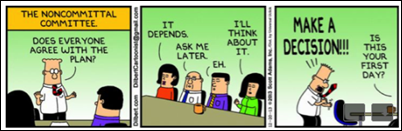
Meetings about Meetings

image

For projects that require alignment and collaboration across many key stakeholders, unnecessary, unproductive meetings complicate and delay making a decision.

Politics and mistrust may artificially swell the number of required participants (healthcare is more than a catered buffet away from adopting Amazon’s two-pizza rule). Something as simple as setting a date for a meeting when everyone is available can push a process out by weeks, if not months. Inevitably, some important contributors will have a last-minute conflict. The original meeting agenda often devolves into a pontification session with distracted participants checking emails on their phones and little advancement toward a decision.

How can we ensure fewer meetings, using our precious time together to be true decision-making events to advance a project? The most common answer to date has been an untenable volume of fragmented emails, spreadsheets, SharePoint files (people really still use this!?), and other databases that do not spur action.

A better solution is to enable a more efficient platform for asynchronous collaboration among key contributors. Ideas, comments, and assessments can be solicited and shared at the availability of each stakeholder and captured in context of the problem statement, current solutions, or potential solutions being considered. Project owners control the appropriate balance of privacy and transparency to minimize duplication of effort across the organization.

Better asynchronous collaboration can ensure fewer people physically attend fewer meetings and calls,  and when they do, key information and opinions will be understood in advance, reserving meeting time to make decisions that more rapidly advance a project. Let’s stop having meetings about meetings that don’t offer any action items or decisions and ensure everyone’s time is spent more efficiently.

RFIs / RFPs

image

In an effort to de-risk a decision, get a fair price, and discern truth amid vendor marketing claims, we in healthcare add months to a procurement process with a request for proposal.

The greatest advance in the healthcare RFP process over the last 15 years is replacing FedEx’ing boxes of binders with emailing word documents and spreadsheets. Not exactly disruptive innovation on the most universally dreaded, antiquated step in the buying process (drawing disdain from both healthcare organizations and vendors alike).

Every RFI or RFP is created and sent as if it were being done for the first time and yet rarely is an original question asked. Just ask the vendors who jump through clerical hoops to nuance their library of prepared answers to meet the requirements and format of each set of questions, always wondering if they are wasting resources on a CYA exercise for a decision that has already been made.

Further, manual effort for project owners to cut and paste siloed answers among Word documents, spreadsheets, and PowerPoint to score, assess, and present results amplifies frustration.

How can health systems ensure the diligence and risk mitigation benefits of an RFP without the exorbitant time, resources, and costs associated with their current methodology?

A network of engaged healthcare organizations that share common challenges and opportunities can collectively engage with vendor partners in a new way that is more efficient and effective for all involved. Common questions and answers can be crowdsourced to minimize unnecessary duplication.

The future state of an RFI can be little more than an appropriate search and application of filters to instantly identify a relevant shortlist. For a deeper dive, posing general RFP-like questions in a common platform (with appropriate privacy controls) can help buyers ensure a more comprehensive question set while helping vendors avoid answering the same topic more than once. Enhanced by automatic comparison, simplified assessments and flexible analysis of results, the expectation is we can minimize decision-making risk for more vendor selections being made without the formal RFP we know today.

By reimagining meetings and RFPs, the healthcare industry can simplify and antiquated process and enable decisions to be made with significantly fewer resources, less elapsed time, and lower costs.

News 11/15/17

November 14, 2017 News 7 Comments

Top News

image

American Medical Association EVP/CEO James Madara, MD pitches AMA’s recently announced Integrated Health Model Initiative at the organization’s Interim Meeting. He criticized the poor organization of clinical data sets; the lack of clinical usefulness of EHRs; the need for meaningful interoperability; and “oceans of data, but only puddles of clinical meaning.” His overriding message was that useful information is scattered throughout the EHR, it lacks context, and its needs to include patient-reported data and perceptions.

image

Meanwhile, AMA President David Barbe, MD cites AMA’s major wins at the same conference in which he urges attendees to recruit new AMA members. “We successfully fought to postpone a mandate for physicians to upgrade their EHRs … We are fighting to prevent IT vendors from blocking information or making it expensive for physicians to share data, and we are making progress. We are fighting physician burnout and the time crunch by working to improve EHRs, mobile devices, and interoperability, and again, those efforts are showing signs of success.”

image

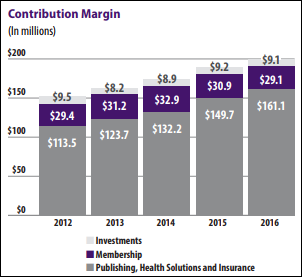
AMA is protective of its membership count – omitting the actual number from its otherwise detailed annual report — but admits that its small growth in the past few years is due to offering low-dues options to groups and for partial-year trial memberships. Some observers estimate that the percentage of American physicians who are members has dropped from 75 percent in the 1960s to as low as 15 percent today. Most of AMA’s $324 million in annual income is from publishing, selling databases such as CPT codes, and profits from its insurance agency.


Reader Comments

image

From LinkedOut: “Re: LinkedIn. You said it’s inexcusable not to have a LinkedIn profile. I have found it useful only for networking, primarily to land your next job. Most profiles are outdated. I’m happy in my current position and don’t have a profile. I prefer anonymity and a quiet inbox. If you are in a long-term relationship with someone with an updated EHarmony profile, you’ve got a surprise coming.” I dislike LinkedIn for many reasons: endless spam; slow page load time; user-written vanity pieces; and preening profiles full of questionably accurate credentials. All that aside, I look people up there all the time there for both work and non-work reasons (where did my cousin John Smith ever end up?) My comments specifically referred to executives, where not making a bio and headshot available there is a bad PR move. I also believe that everybody should be open to employment inquiries, which they are free to accept or reject as a business decision unrelated to receiving them in the first place. It’s a lot harder to desperately market yourself after your once-beloved employer has escorted you off their property and your current LinkedIn headline turns into “seeking the next great HIT opportunity” or you declare yourself a first-time, self-employed consultant because nobody’s hiring you. Anonymity and a quiet inbox are great until the paychecks stop, and trust me when I say that your employer’s EHarmony profile is always current even if yours isn’t. 

image

From Smoove B: “Re: HIStalkapalooza. Since you aren’t doing it at HIMSS18, you can put your name on our company’s event and we’ll give you some invitations to use.” I don’t really see any point to that, but it reminds me of something I’ve always wondered just in case I ever consider doing it again: why did people attend HIStalkapalooza? If you were there, complete this one-answer poll about why and I’ll report back. So far I’m not feeling nostalgia for the massive personal financial risk, the never-ending search for sponsors to help cover the cost, and the ugliness of the self-impressed who insist that their party presence is mandatory. HIMSS has plenty of parties, so mine shouldn’t be missed much.

image

From Hinrika: “Re: UAE. Thought you would be amused at what happened when I tried to read HIStalk in Dubai this morning.” I’m always happy to be blocked, although it’s best when a paranoid vendor tries to hide unflattering news and opinions from their employees. That usually has the opposite effect — they simply read from home or on their phones out of curiosity to see what their employer wishes they wouldn’t. I don’t know what I wrote that got me banned in the UAE, but I’m probably proud of it.

From GoLiveSupport: “Re: [health system name omitted]. [consulting company name omitted] was chosen to help with its Epic go-live and brought in buses of foreign resources who could not speak English. The health system was so unhappy with the inexperienced resources that they made all of them take an assessment and then immediately walked off all 300 of them off the property and kicked the company off the project entirely.” Unverified and likely to stay that way since neither the health system nor the vendor is likely to confirm, so I’ve expunged the names.

From Timothy: “Re: SOAPware. It’s not new news that the EHR vendor is shutting down effective February 2018, but they’ve sent clients a memo suggesting they transition to Athenahealth. Apparently they had established a marketing agreement that I’m sure Athena paid some good $$ for.”


Webinars

November 15 (Wednesday) 1:00 ET. “How Hospitals and Practices Can Respond to Consumerism by Better Engaging Patients Through Price Transparency and Payment Options.” Sponsored by: Change Healthcare. Presenters: Kathy Moore, president, Moore Martini Medical; Linda Glidewell, VP of business development, consumer payment solutions, Change Healthcare. Healthcare consumerism and high-deductible health plans require providers to offer upfront estimates and payment options throughout all points of service. In his webinar, we’ll discuss consumerism as a critical area of opportunity in revenue cycle management and review numerous areas across the revenue cycle where your staff interacts with patients and leaves lasting impressions. From your first interaction with patients on the phone to discuss financial responsibility; to collecting payments at all points of service; to offering payment plans and various payment options — these are all areas that can be game-changing. With the right approach to consumerism, you can improve patient collections and optimize revenue from the start while also improving the overall patient experience.

November 30 (Thursday) 1:00 ET. “Making Clinical Communications Work in Your Complex Environment.” Sponsored by: PatientSafe Solutions. Presenters: Steve Shirley, VP/CIO, Parkview Medical Center; Richard Cruthirds, CIO, Peterson Health. Selecting, implementing, and managing a mobile clinical communications platform is a complex and sometimes painful undertaking. With multiple technologies, stakeholders, and disciplines involved, a comprehensive approach is required to ensure success. Hear two hospital CIOs share their first-hand experience, lessons learned, and demonstrated results from deploying an enterprise-wide mobile clinical communications solution.

December 5 (Tuesday) 2:00 ET. “Cornerstones of Order Set Optimization: Trusted Evidence.” Sponsored by: Wolters Kluwer. Updating order sets with new medical evidence is crucial to improving outcomes, but coordinating maintenance for hundreds of order sets with dozens of stakeholders is a huge logistical challenge. For most hospitals, managing order set content is labor intensive and the internal processes supporting it are far too inefficient. Evidence-based order sets are only as good as their content, which is why regular review and updates are essential. This webinar explores the relationship between clinical content and patient care with an eye toward building trust among the clinical staff. Plus, we will demonstrate a new evidence alignment tool that can easily incorporate the most current medical content into your order sets, regardless of format, including Cerner Power Plans and Epic SmartSets.

Previous webinars are on our YouTube channel. Contact Lorre for information.


Acquisitions, Funding, Business, and Stock

image

ED notification technology vendor Collective Medical raises $47.5 million in a Series A funding round. The Salt Lake City company, founded in 2006 by a couple of BYU computer science graduates, is now run by a Bain Capital private equity guy (and BYU grad) in his first CEO job.

SNAGHTMLad34cabc

Syapse, which offers an oncology precision medicine and data sharing platform, raises $30 million in Series D financing, increasing its total to $70 million.

image

Israel-based Medigate, which offers a cybersecurity platform to inventory and protect connected medical devices, raises $5.4 million in a seed funding round. The three co-founders were all officers in the Israeli Defense Forces Intelligence Corps.

image

Coding and compliance services vendor Aviacode acquires an unnamed, India-based medical coding company to extend its coding staff and available hours.

image

A state judge denies a request from investors in Outcome Health who had asked the court to freeze $225 million that was due to be paid to the company’s founders. The investors’ lawsuit claims that the doctor waiting room advertising technology company, whose valuation rose to more than $5 billion, defrauded them by falsifying advertiser metrics. The complaint was amended Sunday to note that 22 high-level executives have left Outcome or have been placed on leave so far this year, with the investors also noting that they are receiving Justice Department subpoenas and expect the SEC to get involved. 


People

image

Healthcare economist Uwe Reinhardt of Princeton University died Monday at 80. His seminal Health Affairs article, “It’s the prices, stupid: why the United States is so different from other countries” pointed out way back in 2003 that we spend more than any other country on healthcare only because healthcare goods and services cost a lot more here, an issue that remains unaddressed by policy-makers fixated with cutting insurance benefits and reducing the number of people able to buy plans (guess who’s got more lobbyists?) 

image

Humana appoints former National Coordinator Karen DeSalvo, MD, MPH, MSc to its board.


Announcements and Implementations

image

Meditech announces a cloud-based subscription version of its Web EHR that targets critical access hospitals. The company says hospitals can go live within six months of signing.

image

A Black Book survey finds that only 19 percent of inpatient post-acute providers have any kind of EHR capability, with 91 percent of administrators reporting that they have no money budgeted for technology acquisitions and improvements. Nearly 90 percent of long-term care providers are not exchanging information with referring hospitals, doctors, or home health providers, while only three percent of them have analytics capability. Netsmart is Black Book’s top-performing post-acute care technology vendor based on user satisfaction.

image

Casenet releases TruCare ProAuth, which allows providers to process prior authorization requests.

image

A Change Healthcare study finds that at least 40 states are pursuing value-based payment programs.

UPMC touts its kidney failure detection EHR alert that monitors serum creatinine trends, although the big-picture mortality improvement has been modest.

Mediware adds billing capability to its MediLinks rehab EHR.


Government and Politics

image

CliniComp offers to drop the appeal of its dismissed lawsuit against the VA – for choosing Cerner in a no-bid contract — if the VA agrees to test its product head to head with Cerner and let the non-partisan General Services Administration judge which system performs best against existing VistA-to-DoD interoperability benchmarks. They don’t have a chance in this political climate, but its offer throws some justified shade on the VA for declaring that it’s in the best interest of taxpayers to sling no-bid billions at Cerner instead of looking at competitors, of which Epic would be a lot stronger than CliniComp despite the former’s lack of success implementing the Coast Guard and bidding for the DoD.  

SNAGHTMLad9b1f06

The DoD’s MHS Genesis will celebrate completion of the initial deployment of Cerner in a Facebook Live event from Madigan Army Medical Center (WA) Wednesday at noon ET.

The VA issues a $158 million contract to CSRA to convert the paper health records of 7 million veterans to digital form as part of its conversion to electronic claims.


Technology

image

FDA approves the Proteus “digital pill,” a skin patch that will report to doctors when a patient takes a digitally enabled dose of the psychiatric drug Abilify. The system may improve adherence, although no studies have proven that, and it may prevent psychotic episodes if the patient is historically forgetful rather than deliberate in skipping doses. Still, some experts note the irony of giving a “biomedical Big Brother” to delusional patients as well bringing up the privacy implications of being monitored (although patients can opt out). An alternative is already available – once-monthly injectable aripiprazole. 

A London scientist develops a camera that highlights temperature hot spots on the feet of diabetics, allowing early detection of foot ulcers.


Other

image

A Boing Boing article that contains no new research (but admirable snark) calls IBM Watson for Oncology “a human-driven engine masquerading as an artificial intelligence” that simply relays the results of a manual case review by Sloan Kettering experts. It notes that IBM hasn’t allowed an independent study of how Watson for Oncology works; its misleads doctors into thinking they will get a data-driven, global recommendation instead of the opinion of a handful of peers; it can’t accurately import patient records; and its outcomes haven’t been studied to see if its recommendations are any good.

SNAGHTMLada88cf4

A research article concludes that “psychological mass persuasion” — using an individual’s digital footprints such as Facebook likes or Twitter activity to target social media advertising that pushes their specific hot buttons — is effective in altering their behavior, measurably influencing their purchasing and voting behaviors. That confirms (to me, anyway) that stories about social media influencing elections miss the most important point – that Americans aren’t smart enough to realize when they are being manipulated, are too lazy or too embracing of information that matches their beliefs to vet their information sources, and are too quick to launch personal attacks at anyone whose opinion (or especially factual information) contradicts what they want to hear. American adults of today sometimes seem like American children of yesteryear – self-indulgently watching cartoons, playing with toys, enviously watching what their friends are doing, and throwing temper tantrums, except now it’s all online. Let’s hope we don’t get invaded since the only resistance will be people getting in the way by holding up phones hoping to post the first Facebook selfies.

An interesting public health issue: Colombian “soda cartels” threaten and attack consumer advocates who support a 20 percent tax on sugary drinks that are cheaper than water, convincing the government to threaten supporters with fines. Colombia’s obesity rate has tripled since 1980. 

A hacker breaches the hospital’s computer system in this Thursday’s “Grey’s Anatomy,” forcing the TV doctors “to get creative in their methods to treat the patients.” I’m certain it will be far from realistic, even omitting the standard hospital executive post-incident assurance that the system that was expensively purchased with claims that it would improve patient care puzzlingly didn’t negatively impact that same care when it tanked.


Sponsor Updates

  • PokitDok earns HITRUST CSF certification and accreditation for OSAP-HIE and CEAP.
  • Kern Health Systems (CA) goes live on ZeOmega Jiva 6.1.
  • LogicStream Health moves into a larger Minneapolis office after doubling its FTE count since 2015.
  • Definitive Healthcare is included in Deloitte’s Technology Fast 500 list.
  • Meditech celebrates Canada’s Digital Health Week.
  • Agfa Healthcare publishes a new white paper, “Augmented Intelligence – The Next Frontier.”
  • Black Book’s latest survey ranks Netsmart as the top-rated HIT platform across post-acute settings for the third consecutive year.
  • Arcadia Healthcare Solutions and Cumberland Consulting Group will exhibit at the 2017 HPA Clinical Informatics Value Visit November 15-17 in Kissimmee, FL.
  • Besler Consulting releases a new podcast, “Healthgrades 2018 Report to the Nation.”
  • Carevive will present at the Navigation & Survivorship Conference November 16-19 in Orlando.
  • CoverMyMeds will exhibit at the Norcal HIMSS Annual CXO Summit November 16 in Santa Clara, CA.
  • Diameter Health President John D’Amore presents the the 2017 Digital Quality Summit.

Blog Posts


Contacts

Mr. H, Lorre, Jenn, Dr. Jayne, Lt. Dan.
Get HIStalk updates. Send news or rumors.
Contact us.

125x125_2nd_Circle

Curbside Consult with Dr. Jayne 11/13/17

November 13, 2017 Dr. Jayne Comments Off on Curbside Consult with Dr. Jayne 11/13/17

Since I work with so many different healthcare organizations, I have a variety of behind-the-scenes views into various non-clinical applications. When we think about healthcare IT, most of our brains automatically jump to systems like EHR, laboratory information systems, PACS, etc. But there’s a lot more to keeping healthcare organizations and IT vendors on their feet – systems like scheduling, payroll, client management, accounting, and more.

One of the things that is often surprising to me is the variability with which various systems have been implemented, often to the detriment of their users. I’ll be working with a group that complains bitterly about how they have to log their hours, only to run across a different group happily using the same system.

One of the major pitfalls I see when comparing disparate installations of the same system is the level of customization or configurability available during implementation. Just as we see with clinical systems, those making the decisions on business systems often jump right to customization before even going live. Rather than using the implementation of a new system as an opportunity to refine work streams and reassess processes, I see organizations simply move their old data over and create more modern versions of the same old messes. Although we often see this with patient accounting systems when clients want to move their old accounts receivable to the new system so that they can decommission the legacy system more quickly, I recently saw it with a general ledger conversion, where the health system wanted to bring more than 15 years of accounting records into the new system.

The engineers involved were struggling with data integrity concerns about moving data that had been converted previously, as the organization was on its fourth accounting system in 20 years. They also had concerns about system performance and the size of some of the data tables. I asked about the business case for bringing that data across rather than archiving it, since most businesses don’t keep records in their current system longer than required by the law or generally accepted accounting principles. The engineers didn’t believe that there was a compelling business case since the old system was going to be archived, but were forced to go along with the project as scoped. The project also has other issues, such as being more than a year behind schedule, but that is a topic for another day.

I also see process improvement opportunities with respect to time-keeping software. Many of the time clock solutions out there are straightforward, but when you get to the point of having engineers and analysts log time against multiple concurrent projects, I’ve seen some messy systems. The most efficient systems seem to be those that can cross reference standard work streams against multiple clients or projects. The worst are those that require a subset of work streams be created under each client or project, resulting in potential errors in item creation and challenges for people trying to find the item where they need to enter their time. I saw that recently when a work item was misnamed when creating it under a new project and no one could find where to log their time because they were searching for “Requirements Creation” rather than “Create Requirements.” At a minimum, organizations need documented procedures and job aids for creating these types of entries so they don’t cause chaos for downstream resources.

One of my favorite vendors to hear people talk about is SAP. First, people don’t realize that SAP has multiple products. They also don’t realize that each product can be implemented in different ways. Corporate policy can also influence how a product is used and what level of access different users have. These types of policy differences can result in a graceful process to follow when mistakes are made or one that is arduous. They can result in empowerment for end users or multiple layers of control. It’s not just SAP, though – I hear the same types of comments about Kronos, Oracle, and pretty much anything that comes from IBM. Like many of our clinical and billing systems, there are significant dependencies on how these systems are implemented and how they are managed.

When I work with healthcare organizations, most of my billing is done through work orders, against which I document the hours my team renders based on assigned projects. Some organizations want third parties to work directly in their systems, logging hours as we go just like their employees do. This is where it gets interesting since they usually require a Social Security Number to set up an employee and there’s not a compelling reason for a third-party employee to necessarily provide that information. Once we get through the setup phase, the real fun starts, as we try to figure out project hierarchies and how to work through what can be less-than-straightforward instructions. As much as we champion role-based training for clinical and practice management systems, I don’t see it as much on the business / financial / management side. I’ve had to sit through trainings on parts of project management and time entry that I will never use. Although they’re not a great use of their time, it is sometimes fun to see what goes on in different kinds of organizations.

The other challenge I see in the behind-the-scenes world is having multiple systems in which employees have to work. There may be a payroll system, a time and attendance system, a credential management system for clinical employees, an internal help desk ticketing system, an expense reimbursement system, and a travel management system. Other organizations also add project management systems, customer relationship management software, external help desk systems, secure messaging, collaboration platforms, and more. And of course, there are the requisite email and calendaring systems that most of us use, along with instant messenger and other communications tools.

Sometimes we don’t think a lot about these systems, but they should be on the list when we think about competing priorities that our healthcare partners may have when they’re trying to perform major EHR upgrades, implementing new features, or other projects. I wouldn’t want to do an EHR go-live at the same time as a new time and attendance system. And if I was doing a new practice management system, I’d want to make sure other accounting systems are stable.

At one health system where I worked, the IT organization supported over 900 systems. The average user had permissions for between 15 and 20 of these. I’m curious how many systems an end user has to access in other organizations.

Are you taking steps to simplify and consolidate these functions, or just soldiering through? Leave a comment or email me.

Email Dr. Jayne.

HIStalk Interviews Zoë Barry, CEO, ZappRx

November 13, 2017 Interviews 4 Comments

Zoë Barry is founder and CEO of ZappRx of Boston, MA.

image

Tell me about yourself and the company.

I founded ZappRx in 2012. I came at it from the patient perspective. My youngest brother was diagnosed with severe epilepsy and couldn’t get on medication for almost a year and a half. This led to him to have a stutter, a learning disability, short-term memory loss, and he couldn’t remember what happened the day before. It was absolutely devastating as a family.

I was working on Wall Street at the time and had some familiarity with what was going on in healthcare technology. I guess you could say I became prescription obsessed. I started diligencing all of the problems with prescriptions, the different types of prescriptions, and tools that could be used to prescribe these medications. Ultimately, I found that there was no real product in the marketplace.

I jumped into founding ZappRx in 2012. I have made it my mission and the company’s mission to make it better, faster, and more transparent for high-risk patients to access lifesaving medications.

Why was such obvious inefficiency overlooked by other companies that might have tackled the problem?

I think it’s because the volume is so low for specialty drugs. When Meaningful Use came out, the first order of priority was to get doctors using EHRs. The second order of priority was to tackle prescriptions. E-prescribing came to the market and focused on the high-volume transactions. If you look at the drug market, there are 3.7 billion prescriptions written annually. E-prescribing focused on the ones that are spent at retail pharmacies that are covered by pharmacy benefit. That’s the bulk of the prescription volume in the United States.

Specialty drugs are only 2 percent of the volume, about 70 million prescriptions total, although they make up about 40 percent of the drug spend. You need a very different software and product that handles specialty prescriptions and you need a very different business model for something that accommodates only 2 percent of the market.

If I had to pick a comparable company, I might say CoverMyMeds, which brilliantly improved clinician efficiency and patient access while getting drug companies to pay for its product. Is is still reasonable to create a business that assumes drug companies will provide revenue?

CoverMyMeds is very smart. My understanding is that they have two customer channels, pharma and payers. Those are the two stakeholders that have skin in the game in terms of getting patients on certain therapies and getting them on as quickly and as efficiently as possible. If you look at the other two stakeholders that are users of CoverMyMeds — doctors and pharmacies — it doesn’t make a lot of sense to have doctors or pharmacies pay for prior authorization. It makes more sense for the pharma companies and the payers to do that.

That’s a great analogy, because we look at it very similarly. Our software connects specialists with specialty pharmacies, but our business model focuses — similar to CoverMyMeds – on pharmaceutical companies and payers.

How do you get your message in front of that small percentage of specialty drug prescribers that your product is good for them, they don’t have to pay for it, and it’s easily implemented?

We raised venture money in order to build the company. I had very little money. Even though obviously it sounds like a lot when you raise a couple of million dollars, it goes really fast. I focused our Series A funding on getting the product right and getting the top key opinion leaders using the product. I focused on a couple of the highest-volume prescribers at the top institutions and I was able to get them on board. 

It’s sort of a waterfall effect. You start at the top and those doctors and their staff became incredibly vocal about how amazing our product was, how much time it was saving for the nurses who were managing all of this paperwork, and how much faster patients were getting onto therapy. Therefore, how much healthier the patients were. Even though it was a small subset, those doctors were able to underscore their experience. 

We ended up hiring a director of sales to then take those early adopters and go out and seed more of the market. Then something really amazing happened, which we did not expect at all. As more doctors adopted, they started going to pharma ad boards and saying, “I will never want to write a prescription any other way other than via ZappRx ever again.” It’s that huge moment you have to pinch yourself when you’re a founder, you had this crazy vision, and you dropped everything and put all of your time and effort — blood, sweat, and tears — into building a company. When a doctor who is a new user who signed up r on their own says that to a pharma customer, it is just amazing.

We just closed our Series B funding. In our life as a startup, our Series A funding was focused on getting the product right — the right feature set, the technology, and the core partnership. Our Series B is now focused on growth. We’ve hired our own sales team. We’re striking more partnerships. We’re going to grow from that more organic growth to much more at scale nationwide.

Technology companies often mistakenly think that a lack of technology usage in healthcare means it’s an easy target for disruption. What lessons have you learned in trying to breach the healthcare fortress?

It’s definitely hard. I’ve often joked in the startup ecosystem that if you’re going to be a healthcare entrepreneur, you have to raise enough money to not go bankrupt while you’re iterating on your idea and getting that first user. If anyone had told me it would take two and a half years from when I founded ZappRx to getting that first prescription out the door, I would’ve said you’re crazy. But it really did take that long.

Healthcare is reactive, not proactive. The amazing thing is, if you can survive that valley of death and you can get your foot in the door, you can be much stickier. It’s hard to kick you out once you get in. There are pros and cons to that. In the tech ecosystem, if you have a consumer model, it’s much more fickle. You get users really quickly, but you lose them just as fast.

What are the good and bad aspects of finding investors, working with them as mentors, and getting them involved in the company’s decisions?

Not all money is equal shades of green. There are investors that will come in that will add a huge amount of value. They’ll be thought partners with you. They’ll mentor you. They’ll coach you. Our board functions much more as a board that says, where are you blocked? What’s going badly? What’s going wrong? Where are you stalled? How can we help?

We needed to bring in more tech talent and we hired a bunch of engineers out of Google — we just got backed by Google. If it’s iterating on biopharma, we have access through GSK as one of our investors to speak with pretty much anybody on the biopharma side, any disease areas that we want to brainstorm. What’s the pain point? Is our product scaled immediately from pulmonology to rheumatology, or are there some extra features we may add to accommodate a new therapeutic category?

Conversely, a lot of startup companies have some bad experiences with investors that are just not thought partners. They come in only looking for an ROI. They’re investors that will not roll up their sleeves and actually do the work to help a company mature and grow and de-risk. That’s where you start seeing so much of these horror stories in the news or on blogs or companies that seem to be doing really well and then all of a sudden implode.

Some experts say founders shouldn’t dilute their equity by bringing investors in early, but on the other hand, their companies don’t get access to the expertise, contacts, and credibility those investors might bring to the table. If a founder doesn’t want to give equity but instead likes the idea of bootstrapping, what options does he or she have?

I’ve seen that with other companies that are tackling areas of specialty. What they’ve done is a more transaction-based business model. They’ll go out and say, I’m going to solve one small problem. They find the customer that would pay them to solve that problem. They have more of a bootstrapped approach, where they go the customers directly.

There’s pros and cons to that. You can pull in some money, you can pull in a customer, and you can iterate off the product, but you’re also bound by only that perspective of the customer. It’s unlikely that you’ll have a massively disruptive technology or business. It’s more likely that you’ll cover your costs and you’ll solve a small problem. It’s not something that’s going to fundamentally change the way healthcare operates today because you can’t build it agnostically.

We’re agnostic to all drugs. We’re agnostic to all specialty pharmacies. We’re agnostic to all payers. We strive to have all the drugs, all the steps, and every stakeholder connected to ZappRx. If I had taken money only from pharma early on, then I would be perhaps at odds with other pharma companies that compete in the same space, or other stakeholders that have competing interests to biopharma.

How does a first-time entrepreneur with a cool idea decide whether to just slowly build a stable, profitable business versus rolling the dice by taking investor money and thus being pushed to either succeed or fail quickly?

There are a couple of things, and they may not be immediately obvious. One of them is that you have to be in an environment where you have access to capital that is a thought partner. There are reasons there are hotbeds where startups are birthing these incredibly disruptive technology plays, whatever industry it is. Those typically tend to be Boston, San Francisco, and New York. There are other areas of innovation that are spawning throughout the country.

But if you’re in some small area in the backwaters of Florida, it’s probably unlikely that you’re going to be able to build a very disruptive play and think outside of the box. You just won’t have access to the intellectual capital that you need to think differently. You’re going to be more likely to surround yourself with people who are thinking, I don’t have a lot of money. I don’t have a huge nest egg or savings. I don’t have access to angel investors who can even just help me cover legal bills to incorporate the company, so I’d better find a customer really fast. That’s where you wind up with the bootstrapped mentality. Which, by the way, there’s always a place for every type of company.

You’ve said that accelerators are a farce. Why do you think that?

I did not go through any accelerators or incubators. I did one program that was remote coaching and focused on women, which is something I’m very passionate about enabling. That program is called Springboard and they did it very well.

I have a vendetta against these incubators that are only three or four months long. They take 7 percent equity as the typical amount for three to four months of “coaching.” Let me tell you, there is nothing that happens in three to four months that is worth 7 percent equity in a company. You just cannot change that much. Usually the grant that they give you is $100,000. You have to be a three- or four-person team to even apply. You’re not at ideation stage. It’s just unrealistic, and candidly, greedy.

Furthermore, I believe that there are a lot of entrepreneurs who have to go through the experience of building the company. Accelerators often enable entrepreneurs who can’t. They take these premiums and then they spew out some mediocre ideas that suck up the capital or bandwidth for companies that have true potential.

Everybody and his brother runs an accelerator or incubator and has to fill their classes. Does that encourage questionable startups to think they’ll be successful just because they got in?

I would agree with that. There’s a reality that some startups aren’t aware of yet. If you go into an accelerator or an incubator, you get to demo day, and you wind up with no term sheets afterward, you are screwed. Because other investors are going to look at that and say, wow, you got into one of these fancy accelerator incubators. You sent us the investor weekly update. You’ve been sharing all this progress that you were supposedly making — which was really probably just a distraction — and now all the investors that I look to to make qualified decisions have passed on this investment. What are they seeing that I don’t see? Obviously I’m not going to invest also. Then your startup is dead.

I know several companies that went through that. They were not well-structured accelerators. It wound up being a three- to four-month distraction. Nobody gave them a term sheet. It was the kiss of death. They couldn’t raise money after that. They would have been so much better off just bootstrapping themselves or tinkering themselves and getting some of their own angel money for three to four months, focusing on where they were seeing traction and validation in the marketplace and then eventually raising money from an investor versus this silly accelerator.

Successful startups have to figure out what’s next, trying to balance board member interest or maybe even replacing the passionate founder with someone who has experience taking companies to the next level. How do you see growth changing ZappRx?

We focused initially on growing up. The lowest-hanging fruit was some of the most critical, focusing on culture and what your values are. We had been in a WeWork for the last two years. It’s one of these Uber or Airbnb type multi-billion dollar value cap companies. They take over office buildings and turn them into co-working spaces. A company can get one office, they can get 10 offices. We had a third of a floor at one of their locations. It enables you as a small company to have only a month-to-month lease. You can grow or shrink the number of offices as your company grows or shrinks, like happens in startup land.

They have conference rooms, kitchens, and all this stuff. You get to appear as though you are much further along than maybe you actually are. You have a doorman, more security, sign in, all of that stuff. It’s a lot of fun. They play music in the kitchen and they have kegs on every floor, ping pong tables, and all that startupy stuff. It’ great when you’re in ideation phase. You’re working crazy long hours, you’re throwing stuff at the wall and seeing what sticks, you’re pivoting, and you’re iterating. You need that fun, happy-go-lucky mindset.

But then once something sticks, you need to very quickly transition into focus and execution. I’m going to wash, rinse, and repeat. I am going to be laser-focused on making this the best that it possibly can be. Product, customer experience, pulling in the revenues, etc.

We moved offices and now have our own office, our own culture, and it’s 9,000 square feet. We’re really proud of it. Still legitimate security and all of that. But that’s where the maturation process starts. People are laser-focused and they’re not throwing ideas at the wall and iterating. They’re now tweaking and refining. You put your head down and you march forward. Your investors can sense that, too. They know when you’re in ideation phase — when it’s hopes and dreams — and they know when you’re in execution phase. They will come with you.

There are lots of growing pains. There are people who don’t make that transition. There are early-stage people, mid-stage people, and late-stage people. Every time I raise money, I look in the mirror and say, are you still fit to be CEO? I am the second-largest shareholder in the company after our largest investor, so I have the most incentive to either do well or find someone else who can do better than me. So far as the CEO of the company, I’ve done very well in that role, executing beyond what we’ve set out to do. We set some lofty goals and it’s kind of crazy to look back on that, but I haven’t done it alone. I’ve hired an amazing team. I’ve been working with a CEO coach. I work with my board. I have a whole group of mentors. I have outside resources, like a CEO group,that I lean on. But I focus on it a lot. When I do that, I see my team doing it as well.

Do you have any final thoughts?

Something that doesn’t get highlighted a lot that I’m really, really proud of is our gender balance at ZappRx and how many women leaders we have on the team. We are 50 percent women, which for tech companies in general is an astounding statistic. Even if you look forward at where I hope we’re growing — which is the Fortune 500 list — there are not a lot of women CEOs or management teams that are a chock-full of women. So I’m really proud to be 50 percent women. I mentioned that we are executing above and beyond. I think there’s something to do with that having a gender-balanced team, and a very diverse team at that.


Monday Morning Update 11/13/17

November 12, 2017 News Comments Off on Monday Morning Update 11/13/17

Top News

image

In England, the Migrants’ Rights Network challenges a January 2017 NHS data-sharing agreement that allows the Home Office’s immigration enforcement teams to access confidential patient information.

The Home Office has made 8,000 data requests so far this year, using NHS patient information to target 6,000 people.

New regulations also require hospitals to check a patient’s ID and to verify their ability to pay for services.

Migrants’ Rights Network says the data-sharing agreement violates privacy guaranteed by the Human Rights Act, does not justify breaching the doctor-patient relationship, leaves migrants too scared to access healthcare services, and discriminates against non-citizens. Their challenge is supported by Kingsley Manning, former chair of NHS Digital.


Reader Comments

image

From Jonathan Baran: “Re: Epic. This past week in Madison, Epic held its first App Orchard Conference and it was a great start to the program. The audience was approximately 300 people, split between  health systems and third-party app companies. Epic has been criticized for being ‘closed,’ but based on my experience this past week, Epic was the opposite. As an app company on the App Orchard, we had access to developers, our own technical service representative to answer any questions (similar to customers), and their roadmap spoke to us getting continued support.” Jonathan is co-founder and CEO of Healthfinch. Another reader who provided the graphic above said Epic announced an “FHIR First” strategy.

From LobbyWin: “Re: UnitedHealth Group. Lobbyists may have convinced the Department of Justice to drop the whistle-blower lawsuit claiming that it bilked Medicare of billions. Their DC team was able to score a similar victory with the previous administration’s DOJ.” A federal judge dismissed the Justice Department’s lawsuit in mid-October and the DOJ has elected not to re-file its complaint, which involved up-coding Medicare Advantage claims.

From Informatician: “Re: Craig Venter’s Human Longevity. Didn’t see this on HIStalk (or anywhere else), but on November 1 the company laid off its chief medical officer and his entire department of at least 15, which includes physician informaticists. The chief scientific officer is leaving as well (voluntarily?) The Health Nucleus thing is in trouble.” Unverified. The San Diego company, which has raised $300 million, offers Health Nucleus X, which collects data from whole genome sequencing, MRI, microbiome sequencing, and other tests that claim to allow consumers to “stay ahead of aging and illness.” The bio page of Chief Medical Officer Brad Perkins has been removed from the company’s website although his LinkedIn profile remains unchanged. The cached version of the executive webpage from June 2017 shows that eight of the 18 names listed aren’t included on the current version of the page.


HIStalk Announcements and Requests

image

Around half of poll respondents have donated money to a hospital or health system.

New poll to your right or here: should the federal government review AMA’s licensing of CPT procedure codes as a possible monopoly? Vote and then click the poll’s Comments link to weigh in.


This Week in Health IT History

One year ago:

  • Cerner CEO Neal Patterson makes a surprise appearance at the Cerner Health Conference, expressing his frustration with the healthcare system from his experience as a cancer patient.
  • UCSF and GE Healthcare announce plans to work together to develop clinical diagnosis and management algorithms.
  • Cerner says in its earnings call that it expects that its DoD win will give the company a strong competitive advantage if and when the VA decides to replace VistA.
  • NTT Data completes its $3.1 billion acquisition of Dell Services.

Five years ago:

  • Allscripts CEO Glen Tullman admits in the company’s earnings call that its drastically reduced quarterly earnings were caused by rumors that the company is trying to sell itself.
  • PCP usage of EHRs increases to 69 percent.
  • WellStar Health System pays $20,000 for the intellectual property of the bankrupt Center for Health Transformation, the for-profit think tank started by Newt Gingrich.

Ten years ago:

  • Google releases the Android operating system for mobile devices.
  • Mediware retools the company by hiring a new CEO, restructuring, retiring products, and laying off employees.
  • Three Medquist board members quit over concerns about the company’s potential sale.
  • Sutter Health says its Epic project will cost at least $500 million vs. the initial estimate of $150 million.
  • AMIA announces an initiative to establish clinical informatics as a medical specialty.
  • IBM acquires Cognos for $4.9 billion in cash.

Last Week’s Most Interesting News

  • Insiders say the VA will sign its contract with Cerner this month at a total cost of $10 billion, much less than originally estimated.
  • Major investors in Outcome Health sue the company, claiming fraud.
  • Saint Anthony Hospital (IL) sues the Leapfrog Group, saying that the quality organization lowered its patient safety grade based on incorrect data.
  • UPMC (PA) announces plans to spend $2 billion to build three technology-focused specialty hospitals in Pittsburgh.
  • A former employee of WakeMed (NC) files a whistleblower False Claims Act lawsuit claiming that Epic’s software defaults to double billing for anesthesia.

Webinars

November 15 (Wednesday) 1:00 ET. “How Hospitals and Practices Can Respond to Consumerism by Better Engaging Patients Through Price Transparency and Payment Options.” Sponsored by: Change Healthcare. Presenters: Kathy Moore, president, Moore Martini Medical; Linda Glidewell, VP of business development, consumer payment solutions, Change Healthcare. Healthcare consumerism and high-deductible health plans require providers to offer upfront estimates and payment options throughout all points of service. In his webinar, we’ll discuss consumerism as a critical area of opportunity in revenue cycle management and review numerous areas across the revenue cycle where your staff interacts with patients and leaves lasting impressions. From your first interaction with patients on the phone to discuss financial responsibility; to collecting payments at all points of service; to offering payment plans and various payment options — these are all areas that can be game-changing. With the right approach to consumerism, you can improve patient collections and optimize revenue from the start while also improving the overall patient experience.

November 30 (Thursday) 1:00 ET. “Making Clinical Communications Work in Your Complex Environment.” Sponsored by: PatientSafe Solutions. Presenters: Steve Shirley, VP/CIO, Parkview Medical Center; Richard Cruthirds, CIO, Peterson Health. Selecting, implementing, and managing a mobile clinical communications platform is a complex and sometimes painful undertaking. With multiple technologies, stakeholders, and disciplines involved, a comprehensive approach is required to ensure success. Hear two hospital CIOs share their first-hand experience, lessons learned, and demonstrated results from deploying an enterprise-wide mobile clinical communications solution.

December 5 (Tuesday) 2:00 ET. “Cornerstones of Order Set Optimization: Trusted Evidence.” Sponsored by: Wolters Kluwer. Updating order sets with new medical evidence is crucial to improving outcomes, but coordinating maintenance for hundreds of order sets with dozens of stakeholders is a huge logistical challenge. For most hospitals, managing order set content is labor intensive and the internal processes supporting it are far too inefficient. Evidence-based order sets are only as good as their content, which is why regular review and updates are essential. This webinar explores the relationship between clinical content and patient care with an eye toward building trust among the clinical staff. Plus, we will demonstrate a new evidence alignment tool that can easily incorporate the most current medical content into your order sets, regardless of format, including Cerner Power Plans and Epic SmartSets.

Previous webinars are on our YouTube channel. Contact Lorre for information.


Acquisitions, Funding, Business, and Stock

image

NantHealth announces Q3 results: revenue up 5 percent, EPS –$0.20 vs. –$0.22, beating earnings expectations but falling short on revenue. The company said in the earnings call that its previous sale of its provider / patient engagement solutions to Allscripts will reduce annual operating losses by $50 million.


Sales

image

Memorial Sloan Kettering Cancer Center (NY) chooses Cota to create optimized clinical and genomic datasets from anonymized patient data, allowing it to map EHR data into a structure that can be used for analytics and precision medicine.


People

image

Great River Health Systems (IA) names Matt Wenzel (St. Luke’s Health System) as president and CEO. He’s a former Cerner marketing manager with master’s degrees in health administration and healthcare informatics.


Other

In India, a government hospital suspends a doctor who posted on Facebook that the hospital is overwhelmed with dengue fever cases, an outbreak the government has downplayed. The opposition party says the government has asked doctors not to indicate dengue as a cause of death. The 62-year-old doctor says it’s unfortunate that he was suspended since he would have retired at 60 had the government not extended the retirement age of doctors.

image

St. Vincent Hospital (IN) will use high-tech, vehicle-mounted cameras to match license plate numbers of cars parked in visitor spots with an employee database to enforce visitor-only parking rules, hoping to improve its patient satisfaction scores.


Sponsor Updates

image

  • T-System employees pack over 27,000 meals for North Texas residents while helping out at the North Texas Food Bank.
  • Ernest Health implements Cantata Health’s Optimum Referral Portal to standardize the intake process at 18 of its 25 post-acute care facilities.
  • Cumberland Consulting Group is named to Consulting magazine’s list of fastest-growing firms.
  • TriNetX achieves ISO 27001:2013 certification.
  • Verscend Technologies will exhibit at the NHCAA Annual Training Conference November 14-17 in Orlando.
  • Vocera publishes new research on clinician burnout and care team resilience.
  • ZappRx will exhibit at the Comprehensive Lung and Breathing Summit November 16-18 in Colorado Springs, CO.
  • MDwise upgrades to ZeOmega’s Jiva 6.1 population health management platform.

Blog Posts


Contacts

Mr. H, Lorre, Jenn, Dr. Jayne, Lt. Dan.
Get HIStalk updates. Send news or rumors.
Contact us.

125x125_2nd_Circle

News 11/10/17

November 9, 2017 News 4 Comments

Top News

image

An FCW source says Cerner and the VA have agreed on a rough price of $10 billion for implementing Cerner, with the contract still on track to be signed sometime this month. The price is lower than previously suggested. VA Secretary David Shulkin is reportedly lining up Congressional funding this week.

The initial VA launch, planned for mid-2019, will take place at sites in Oregon, Washington, Idaho, and Alaska.

image

A federal judge who previously dismissed CliniComp’s lawsuit in which the company claimed it was unfairly eliminated from consideration to replace VistA claims in newly unsealed documents that CliniComp would not have been a credible bidder because it lacks experience with projects of the VA’s scope. CliniComp says it will appeal while seeking an injunction to stop the project.

image

The judged also noted that she sees no evidence to support the VA’s no-bid choice of Cerner. Other bidders can protest once the Cerner-VA contract is signed.


Reader Comments

image

From Nordic Employee: “Re: Nordic. Laid off over 10 percent of the home office staff yesterday.” Unverified. Another reader reports that around 15-17 employees were escorted out. I asked Nordic and received this response from CEO Bruce Cerullo:

On Tuesday, Nordic initiated its 2018 growth plan, which includes the further expansion of our Managed Services division, a formal move into non-Epic legacy support, a further investment in our revenue cycle and data and analytics capabilities, and the launch of an ERP practice. As part of this plan, we took the difficult step of restructuring our home office. This included the displacement or redeployment of 17 employees. We recently posted 20 new positions and plan to add up to 150 new employees over the next nine months.

image

From SoCal Girl: “Re: UC Irvine Medical Center. Went live on Epic on 11/4. Possibly the first site to run out of another’s data center (UCSD) and using a lot of their build. UCI started with TDS in 1983 and stayed through the incarnations (Alltel, Eclipsys, Allscripts) with their own data center until now. Haven’t heard how it’s going.”

From Skippy Trip: “Re: photos. Why do some items in the ‘People’ section not include photos?” I’m always surprised in this day and age how many photo faux pas I see every day when scouting the Internet for headshots since you would think people would want to make it easy to get exposure. Some executives don’t have any Internet-discoverable photos, making me wonder if they have appearance issues or fears of being judged (which they will be anyway, as in, “what’s with the lack of a photo?”) What I sometimes find when I look for headshots:

  • People who don’t have a LinkedIn profile, which is inexcusable.
  • LinkedIn profiles that don’t include a photo, which is bizarre for someone who works in a people-facing role (you must be a crappy salesperson if your LinkedIn doesn’t include a photo so people can find acknowledge that it’s you).
  • Poorly resized LinkedIn photos that are low-resolution or too small, making the pixelated mess unusable even at a small size. LinkedIn shrinks to thumbnails, so there’s no need to downsize the original to their displayed image size.
  • Trying to repurpose a vacation photo or family picture in which the grainy subject is surrounded by the shoulders of cropped-out others; is so far from the camera as to be unrecognizable; is wearing a tuxedo, Santa suit, or a bike helmet; or is proudly displaying something alcoholic.

HIStalk Announcements and Requests

I’ve noticed that Twitterers who were dull, clueless, or eye-rollingly self-promoting in their allotted 140 characters are now four times more so with the limit doubled to 280.

This week on HIStalk Practice: Georgia Partnership for Telehealth achieves school-based milestone. Family Christian Health Center selects Visualutions billing software. State-based physician health programs help addicted doctors recover – successfully. Consumers still prefer phone-based appointment scheduling. The Federation of State Medical Boards tests blockchain for the medical licensure process. Alpine Investors takes over behavioral health EHR vendor. Physician pirate Jay Saux, MD brings healing and whimsy to cancer care. Navicure’s Kermit Randa offers practical steps for practices looking to offer digital payment options.

Listening: new from Chicago throwback indie band Twin Peaks. Then it was off to very Canadian jangle rockers Alvvays with the amazing singer-songwriter Molly Rankin (who kind of looks like Veronica Mars), the best thing I’ve heard lately, with extra points for the bass player rocking a Hofner violin end everybody seeming to be delightfully nerdy. I can’t take my eyes or ears off them. “Archie, Marry Me” is one of the best pop songs ever and their live version is flawless (warning: I couldn’t get it out of my head and have listened to it 25 times today).


Webinars

November 15 (Wednesday) 1:00 ET. “How Hospitals and Practices Can Respond to Consumerism by Better Engaging Patients Through Price Transparency and Payment Options.” Sponsored by: Change Healthcare. Presenters: Kathy Moore, president, Moore Martini Medical; Linda Glidewell, VP of business development, consumer payment solutions, Change Healthcare. Healthcare consumerism and high-deductible health plans require providers to offer upfront estimates and payment options throughout all points of service. In his webinar, we’ll discuss consumerism as a critical area of opportunity in revenue cycle management and review numerous areas across the revenue cycle where your staff interacts with patients and leaves lasting impressions. From your first interaction with patients on the phone to discuss financial responsibility; to collecting payments at all points of service; to offering payment plans and various payment options — these are all areas that can be game-changing. With the right approach to consumerism, you can improve patient collections and optimize revenue from the start while also improving the overall patient experience.

November 30 (Thursday) 1:00 ET. “Making Clinical Communications Work in Your Complex Environment.” Sponsored by: PatientSafe Solutions. Presenters: Steve Shirley, VP/CIO, Parkview Medical Center; Richard Cruthirds, CIO, Peterson Health. Selecting, implementing, and managing a mobile clinical communications platform is a complex and sometimes painful undertaking. With multiple technologies, stakeholders, and disciplines involved, a comprehensive approach is required to ensure success. Hear two hospital CIOs share their first-hand experience, lessons learned, and demonstrated results from deploying an enterprise-wide mobile clinical communications solution.

December 5 (Tuesday) 2:00 ET. “Cornerstones of Order Set Optimization: Trusted Evidence.” Sponsored by: Wolters Kluwer. Updating order sets with new medical evidence is crucial to improving outcomes, but coordinating maintenance for hundreds of order sets with dozens of stakeholders is a huge logistical challenge. For most hospitals, managing order set content is labor intensive and the internal processes supporting it are far too inefficient. Evidence-based order sets are only as good as their content, which is why regular review and updates are essential. This webinar explores the relationship between clinical content and patient care with an eye toward building trust among the clinical staff. Plus, we will demonstrate a new evidence alignment tool that can easily incorporate the most current medical content into your order sets, regardless of format, including Cerner Power Plans and Epic SmartSets.

Previous webinars are on our YouTube channel. Contact Lorre for information.

Here’s the recording of this week’s webinar titled “How Clinically Integrated Networks Can Overcome the Technical Challenges to Data-Sharing.”


Acquisitions, Funding, Business, and Stock

image

Investors that include heavyweights like Goldman Sachs and Google sue waiting room advertising company Outcome Health, claiming that the company committed fraud in obtaining $500 million in funding by providing false information. The lawsuit was driven by a Wall Street Journal investigation from last month that concluded that the company was inflating the number of video screens it had installed in practices, allowing it to overcharge drug companies, its primary advertisers. Outcome Health calls the lawsuit “irresponsible” and a “money grab,” which is an interesting approach to investor relations.


Sales

image

Goshen Health (IN) chooses CloudWave’s OpSus Live infrastructure-as-a-service to host its Meditech 6.16 system.

image

The board of Ector County Hospital (TX) approves implementation of IllumiCare’s EHR-agnostic Smart Ribbon to encourage the appropriate use of tests and drugs. 

image

WellStar Health System (GA) chooses Agfa HealthCare Enterprise Imaging.


Announcements and Implementations

image

A small study finds that hospitals that use Glytec’s Hospital-to-Home discharge insulin program for poorly-controlled diabetics had zero diabetes-related readmissions or urgent care/ED visits within the first 30 days after discharge.

image

Marshall Medical Center (CA) goes live on Epic via a Community Connect agreement with UC Davis Health. The local paper’s article notes that all area health systems use Epic other than Cerner customer Dignity Health.

image

Humana sponsors an innovation challenge to make the digital health records of Medicare recipients more useful to those patients, their caregivers, and their doctors. California-based individuals and early-stage startups will assemble Humana-provided complex data sets (claims data, hospital records, and health program participation information) into a solution that targets either providers or patients in improving quality or reducing cost. The winner gets $10,000.

image

A West survey finds that more than half of Americans delay paying their medical bills, with the top reason being high insurance deductibles. Other reasons include forgetting to pay, confusion about what charges insurance will cover, and receiving bills for services they don’t think they should have to pay for. Three-quarters of respondents say high deductibles affect how often they see their provider or seek care. Less than 25 percent of providers discuss affordability in advance, send payment reminders, or provide messages explaining what portion of their bill is covered by insurance.

image

An Anthem study finds that total joint replacement patients enrolled in HealthLoop’s guidance and monitoring platform cost $656 less and had about half the rate of 90-day surgical complications and readmissions.


Government and Politics

image

The federal government awards Apprio a contract to transition the DoD’s MHS Genesis system to the Defense Health Agency’s long-term sustainment office.

An editorial in the St. Louis paper rips into the state’s government for refusing to confirm that its cobbled-together prescription drug monitoring program is actually running. Missouri – the only state without a PDMP – created an odd version of its own that relies on claims data to allow government officials to identify “pill mills” but without allowing prescribers to see individual patient data. The governor said in July that the program would be operational in weeks, but the state hasn’t even signed a contract to create it.

image

HHS announces advance care planning technology vendor Vynca as winner of its Patient Matching Algorithm Challenge, with data integration vendor Pic-Sure earning second place along with wins in the “Best Recall” and “Best Precision” categories.

President Trump’s “Putting Our Veterans First” announcement includes technology references:

  • Criminal investigations of the VA’s previous manipulation of wait time data.
  • Expansion of the VA’s telemedicine program to span geographic areas.
  • Greater adoption of VA Video Connect mobile app.
  • Rollout of the VA’s Online Scheduling Tool.
  • The move to Cerner for both the VA and DoD.
  • Launch of an online wait time tool.

Other

SNAGHTML93467623

A former employee of Kansas City, MO-based Healthy Plus LLC – run by two locally prominent sports figures – says employees went weeks without pay as the company issued bad checks and closed its accounts. One of those executives previously ran VC Medical, which is the subject of a lawsuit over an unpaid loan. The company is a pilot member of Athenahealth’s More Disruption Please program, offering solutions for chronic care management and Medicare Annual Wellness Visit reminders. A Healthy Plus press release says the business was launched in April 2017.

SNAGHTML801bb971

An Axios article questions UPMC’s plan to spend $2 billion to build three specialty hospitals without adding new bed count, noting from experts that:

  • Non-profit hospitals spend big money to erect impressive buildings that entrench their market position, often using tax-exempt debt for buildings on which no property tax is paid.
  • The kind of new treatments UPMC aims to discover are revenue-maximizing.
  • UPMC is investing in inpatient bricks and mortar instead of what the market is demanding: community-based care, primary care, and home care.
  • Pittsburgh residents and federal taxpayers will foot the bill in the form of higher premiums for private insurance, Medicare, and Medicaid.
  • Moving patients into a specialty-specific hospital ignores their other conditions and impedes care coordination.

image

This is a great graphic from Gartner that shows the level of analytic maturity.

image

AnMed Health (SC) lays off 94 employees and eliminates 65 open positions, citing losses due to lower payments, reduced volumes, and the cost of its $85 million Epic implementation.

Here’s rare video snippet of Epic’s Judy Faulkner speaking, this time at a Geisinger symposium. The moderator didn’t ask great questions or press her for deeper answers, eliciting basically that she likes AI and telehealth. Hopefully the conversation was better than this excerpt.

image

Pope Francis expresses frustration with people who screw around with their phones when he is celebrating Mass, suggesting they life their hearts instead of their devices. He wrote in 2015, “When media and the digital world become omnipresent, their influence can stop people from learning how to live wisely, to think deeply, and to love generously. In this context, the great sages of the past run the risk of going unheard amid the noise and distractions of an information overload.”


Sponsor Updates

  • MModal supports the migration of FHN (IL) to Meditech’s Web EHR with its Fluency Direct speech recognition solution.
  • MedData’s Pulse intranet wins the EHealthcare Internet Award for Best Intranet.
  • Meditech will present at the Value-Based Care Summit November 16-17 in Boston.
  • Medicomp Systems releases a new e-book, “Clinical Conundrum: Too much data, not enough meaning.”
  • The Metro Atlanta Chamber of Commerce honors Navicure with its Phoenix Award for Emerging Company of the Year.
  • Nordic’s 800 employees and 200 customers are poised for significant growth in 2018.
  • Consulting Magazine names Impact Advisors to its list of fastest-growing firms.
  • Clinical Computer Systems, developer of the Obix Perinatal Data System, will exhibit at the Northwest AHEC conference November 14-15 in Hickory, NC.
  • Experian Health will exhibit at HFMA Southern IL November 16-17 in O’Fallon.
  • Vocera earns Authority to Operate from the DoD.
  • The Tech Tribune includes PatientSafe Solutions in its top 10 list of best tech startups in San Diego.

Blog Posts


Contacts

Mr. H, Lorre, Jenn, Dr. Jayne, Lt. Dan.
Get HIStalk updates. Send news or rumors.
Contact us.

125x125_2nd_Circle

EPtalk by Dr. Jayne 11/9/17

November 9, 2017 Dr. Jayne Comments Off on EPtalk by Dr. Jayne 11/9/17

I’ve been trying to digest the recently-released CMS final rules. Overall, much of the flexibility we expected for the Quality Payment Program is now final, including the ability for providers to use 2014 Edition or 2015 Edition Certified Electronic Health Record Technology (CEHRT) for the Advancing Care Information category. Although many organizations are breathing a sigh of relief over this, there is a bonus for using only 2015 CEHRT and those organizations that kept the pedal to the floor may get at least a little reward for their efforts.

Additional items in the Final Rule include relief for providers impacted by Hurricanes Harvey, Irma, and Maria by automatically weighting the Quality, Advancing Care Information, and Improvement Activities performance categories at 0 percent of the MIPS final score. Small practices can get five bonus points to the MIPS final score, as can those practices that treat complex patients.

Although CMS continues to crow about their success related to the “goals of regulatory relief, program simplification, and state and local flexibility in the creation of innovative approaches to healthcare delivery” I know there are a lot of us that think any rule that requires 1,600+ pages to explain cannot possibly be simple. I’d personally like to see the “QPP for Dummies” edition to make sure I fully understand everything that’s in there. Even the Executive Summary is 21 pages long.

Last Monday CMS administrator Seema Verma also announced the “Meaningful Measures” initiative which CMS claims will help streamline quality measures that providers are trying to meet. Although this sounds like a welcome change, this isn’t the first time we’re heard about proposed program simplification. Although some payers follow the lead of CMS on quality measures, others put their own little twists on the measures clinicians need to report, requiring them to create custom reporting that mimics CMS requirements in a “missed it by that much” manner. If payers can’t agree on the most meaningful measures for patient outcomes, that doesn’t give those of us in the trenches confidence.

For many of us, the constant changing of measures and requirements just seems to highlight the idea that we’re all part of some uncontrolled experiment with no defined endpoint. The sheer number of hours spent by organizations on regulatory compliance is staggering. At least a couple of times a year, I have conversations with medical students who are questioning their career choices and who are trying to figure out if they want to go to business school, law school, or residency. I know it’s anecdotal, but I feel like we’re having a lot more of these conversations than we did in the era before Meaningful Use.

I haven’t had admitting privileges at my hospital for a long time, but I’ve been able to keep an adjunct status that lets me participate in continuing education sessions, attend Grand Rounds, and hang out in the physician lounge, which gives me a place to meet with students and residents to talk about career planning or mentoring. It’s been worth the small fee I pay every year to have a central place to have those conversations, since my “office” is in my house and sometimes meeting at a restaurant or coffee shop can be noisy.

We have a new hospital administrator who spoke at a recent medical staff gathering. I was struck by a several things. First by his youthful exuberance but relative lack of experience and second by his amazingly full command of what I can only describe as an executive word salad. Seriously, if he told me how much we were going to synergize around results-oriented outcomes one more time, I was going to burst out laughing. I am going to have to break out the Buzzword Bingo cards if I ever go to an event where he will be speaking again. I miss the camaraderie of the hospital, and the hilarity of the whole thing made me glad I took the time to attend.

While I was chatting with some of my colleagues, I heard some complaining about changes to how the AMA is calculating the need for licensing for CPT codes. Rather than counting actual end users, AMA is moving to a “User Proxy Method” that approximates the number of CPT code users in an ambulatory billing or clinical system based on the number of full-time equivalent providers in the practice. These counts are multiplied by industry data. In the case of an ambulatory clinical system with or without a billing system, the multiplier is four. The discussion at the hospital included overall unhappiness with AMA’s monopoly on coding, with one provider questioning whether the RICO act should be used to counter its grip on providers. In researching the issue, I noticed AMA still uses the “EMR” verbiage, which highlights how behind the times they are.

When I returned home from the hospital, I was glad to find an email from the last of my friends in Puerto Rico that I have been waiting to hear from. He and his family are safe, but were without power for more than a month and are still having difficulty obtaining supplies. Although stores are restocking, his community has returned to a cash economy. It sounds like there continue to be many health system challenges that won’t be resolved anytime soon.

AMIA2017 has been in full swing this week, with National Library of Medicine Director Patti Brennan presenting at Monday’s Sunrise Session and National Coordinator Don Rucker presenting on Tuesday. I didn’t make it this year because of a conflict, but hopefully next year’s calendar will be more forgiving. Looking at a schedule of available conferences for the next year, I’m going to have to choose carefully, especially since I need to fit in a board review course to prepare for recertification. Since I haven’t practiced traditional primary care in a number of years, I’m dreading the exam but given our need to comply with Board Certification in order to be credentialed by payers, I don’t have much of a choice. Not to mention, we have to maintain a primary board certification to keep our clinical informatics certifications, so letting mine lapse would be a double-whammy.

Have any good board exam prep tips? Email me.

Email Dr. Jayne.

News 11/8/17

November 7, 2017 News 1 Comment

Top News

image

Saint Anthony Hospital (IL) sues The Leapfrog Group for defamation after the quality rating organization lowers the hospital’s patient safety score from its previous A grade to a C.

The hospital says Leapfrog gave it a low score for underusing electronic prescribing even though the information it submitted showed that doctors order medications electronically 95 percent of the time.

image

Saint Anthony is demanding a temporary restraining order to keep Leapfrog from publishing its score. Leapfrog’s fall 2017 report that was released October 31 does not include the hospital.


Reader Comments

SNAGHTML802789eb

From CIO Reader: “Re: Citrix maintenance price hikes. I don’t have the details, but our maintenance fees will increase nearly 30 percent.” My rule of thumb for companies selling to hospitals has always been that you shouldn’t raise your prices beyond the average Medicare reimbursement increase, although bigger, richer non-profit health systems spending millions and billions to erect monuments to themselves has converted me to being OK with vendors sticking it to them just like any other business. Hospitals will always find a way to increase volume or reimbursement to cover their ever-swelling expenses.

image

From Grammar Guru: “Re: the HIMSS-owned rag. Needs some help with plural vs. possessive.” Apparently the Healthcare IT New’s editor’s have problem’s with apostrophe’s gone astray.

From Bruce Brandes: “Re: Graysky’s comments about Lucro’s ownership interest and my Readers Write articles. Our company is owned by Martin Ventures, HCA, and Heritage Group. The first priority of the health systems in our network is to reduce costs and inefficiencies to find, evaluate, and choose solutions. While our investors are excited for their portfolio companies to leverage Lucro as a targeted, effective alternative to traditional sales and marketing tactics, their companies have no greater advantage over any other company in Lucro beyond the merits of their own value proposition. There is no cost for any vendor or health system to engage in Lucro and premium services are optional.  Our goal is to level the playing field by democratizing access to relevant buying decisions and there is no Lucro-sponsored opinion or recommendation of one company over any other. We provide a platform for the market to make those assessments on their own, with private support from their invited network of trusted peers. Of the 1,200+ vendors currently engaged with Lucro, about 20 are backed by our investors.”

image

From Broadcom Insider: “Re: Broadcom’s $130 billion offer to acquire Qualcomm. Last week Broadcom’s CEO promised Trump he would move its headquarters from Singapore to the US. This is an easy way to accomplish that – San Diego, here we come! I wonder what will happen with Qualcomm’s Capsule Tech? Will Broadcom want to get into the healthcare market or remain narrowly focused on semiconductors and chip sets? Attached is a teardown of the new Apple Watch, which contains mostly Broadcom and Qualcomm chips. Clearly the deal makes a great deal of sense.” Experts say the biggest challenge with the blockbuster deal will come from China, which, like the US, looks closely at proposed deals that could shift technology sales offshore. It’s always interesting when a smaller company (Broadcom, $18 billion in annual sales) bids on a larger one (Qualcomm with $22 billion). Qualcomm Life includes Capsule medical device integration (acquired in September 2015 for an undisclosed price) and 2net remote monitoring. Qualcomm Life previously acquired HealthyCircles for data sharing, but that seems to have been either killed off or rolled into 2net. If the acquisition goes through, it would seem both easy and advisable for Broadcom to sell the Qualcomm Life business to a company more focused on healthcare, perhaps Philips or even Nokia.


HIStalk Announcements and Requests

Lorre is running her year-end special for new HIStalk sponsors – avoid the pre-HIMSS rush, sign up now, and get the rest of this year free. She’ll also offer a deal to wayward former sponsors who want to return to the fold.

Listening: new from Kesha, who has matured individually as a singer-songwriter at 30 (even removing the “$” in her name) and, more importantly, musically, with less Auto-Tuned dance pop and more pure rock in her first release since 2013. Her latest album features tracks with Eagles of Death Metal, the horn section of the Dap-Kings, and Dolly Parton, which is a pretty eclectic group.


Webinars

November 8 (Wednesday) 1:00 ET. “How Clinically Integrated Networks Can Overcome the Technical Challenges to Data-Sharing.” Sponsored by: Liaison Technologies. Presenters: Dominick Mack, MD, executive medical director, Georgia Health Information Technology Extension Center and Georgia Health Connect, director, National Center for Primary Care, and associate professor, Morehouse School of Medicine;  Gary Palgon, VP of  healthcare and life sciences solutions, Liaison Technologies. This webinar will describe how Georgia Heath Connect connects clinically integrated networks to hospitals and small and rural practices, helping providers in medically underserved communities meet MACRA requirements by providing technology, technology support, and education that accelerates regulatory compliance and improves outcomes.

November 15 (Wednesday) 1:00 ET. “How Hospitals and Practices Can Respond to Consumerism by Better Engaging Patients Through Price Transparency and Payment Options.” Sponsored by: Change Healthcare. Presenters: Kathy Moore, president, Moore Martini Medical; Linda Glidewell, VP of business development, consumer payment solutions, Change Healthcare. Healthcare consumerism and high-deductible health plans require providers to offer upfront estimates and payment options throughout all points of service. In his webinar, we’ll discuss consumerism as a critical area of opportunity in revenue cycle management and review numerous areas across the revenue cycle where your staff interacts with patients and leaves lasting impressions. From your first interaction with patients on the phone to discuss financial responsibility; to collecting payments at all points of service; to offering payment plans and various payment options — these are all areas that can be game-changing. With the right approach to consumerism, you can improve patient collections and optimize revenue from the start while also improving the overall patient experience.

Previous webinars are on our YouTube channel. Contact Lorre for information.


Acquisitions, Funding, Business, and Stock

image

Clinical Architecture will expand its 52-employee Carmel, IN headquarters, more than doubling its square footage and adding 40 jobs by 2021.

image

CoverMyMeds will hire “hundreds” of support team employees immediately for its Columbus and Cleveland offices. The 500-employee company, which has annual revenue of more than $100 million, was acquired by McKesson in January for $1.1 billion.

image

Salesforce and Google will integrate Google’s analytics and office software with Saleforce’s platform and Salesforce will use Google’s cloud infrastructure for some of its new services. 

image

Cardinal Health fires CEO George Barrett after a poor quarterly report due to lower generic drug prices and the Amazon threat, promoting the CFO to the top chair.

image

CVS Health, fearing competition from Amazon, announces plans to offer free, next-day prescription delivery nationwide next year, with same-day service available in some urban areas.

image

Roman, which offers online diagnosis and treatment of erectile dysfunction, raises $3.1 million in a seed funding round. Customers choose their preferred drug if desired, pay $15 for a five-minute online visit, then receive home delivery of their med. The company serves men in California, Florida, New York, and Pennsylvania. Drug prices range from $2 for a 20 mg generic Viagra tablet to $63 per tablet for brand-name Viagra.

image

Kaiser Health News profiles Comprehensive Pain Specialists, a 54-clinic pain treatment practice headquartered in Tennessee that raked in $11 million from Medicare alone in 2014 for urine drug screening. The article notes that Medicare pays tens of millions of dollars for tests that detect drugs that have minimal abuse potential and for screening street drugs that are rarely found in the urine of pain patients. Analysis found that 31 pain practitioners earned 80 percent or more of their Medicare payments just from urine testing, which the government sees as a red flag that perhaps testing is overused, especially as labs increased revenue by moving testing to more expensive machines that earned higher CMS payments. It notes a company that was exposed in a 2011 whistleblower lawsuit as earning $166 million from Medicare for urine screening in a single year, with reps earning up to $700,000 to convince doctors that “drug testing is not about medicine, but about making money.”


Sales

SNAGHTML8a3b2e2a

In Australia, publicly funded health service Gippsland Health Alliance chooses Allscripts Sunrise.

image

In the UK, Princess Alexandra Hospital selects Agfa HealthCare’s enterprise imaging platform.

image

Amita Health (IL) will implement PerfectServe’s enterprise clinical communication and collaboration system.

image

Non-profit health plan AlohaCare (HI) chooses Health Catalyst for population health, accountable care, financial decision support, and operational performance improvement.


People

image

Erik Smith (UnitedHealth Group) joins Stanson Health as RVP of sales.

image

Former Rent-A-Center CIO Angela Yochem joins Novant Health (NC) in the newly created position of chief digital officer, where she will report to the president and CEO.

image

Huntzinger Management Group hires David Tucker (ESD) as VP of business development.

image

Richard Walsh (Continuum Health) joins HealthHusk as managing partner.

BetterDoctor hires John Steinhouse (Box) as VP.


Announcements and Implementations

image

Surescripts will offer real-time, patient-specific prescription pricing and benefit information to users of EHRs from Allscripts, Aprima, Cerner, Epic, GE Healthcare, and Practice Fusion for patients whose prescription benefits are managed by CVS Health or Express Scripts. Prescribers will also receive therapeutic alternative suggestions within their EHR workflow and can complete any needed prior authorization during the patient’s visit. Surescripts got its start in 2001 as RxHub, formed by three pharmacy benefits managers (Caremark, Express Scripts, and Medco Health) that ended up as CVS and Express Scripts.

image

The Tiger Institute Health Alliance HIE (MO) joins the Sequoia Project EHealth Exchange, allowing University of Missouri Health Care to exchange information with St. Louis-based SSM Health. 

image

A Kyruus survey finds interesting facts about consumer provider preference:

  • While most consumers search for providers on the Internet, they would rather schedule appointments by telephone.
  • 90 percent of people look up providers to whom they have been referred before scheduling their appointment, most of them preferring to use generic Internet searches rather than checking health system websites.
  • Among the most important factors in choosing a provider are insurance accepted, clinical expertise, and appointment availability.
  • Over 60 percent of consumers will choose a different provider if they can’t get a timely appointment with their first choice.
  • 40 percent of people say they trust online reviews.
  • Millennials are most willing to choose a different provider because of availability and to schedule their appointments online.

image

AMIA announces its unspecified collaboration with the OpenNotes initiative.


Government and Politics

image

University of Vermont Health Network (VT) files a state certificate of need to spend $150 million to implement Epic. The health system says it would save money because Epic would replace systems that would cost $200 million to maintain over several years. CIO Adam Buckley, MD, MBA says Epic is a good choice because it is widely installed and it completes its projects on-time and on-budget 87 percent of the time, while the health system’s choice of project management firm, Cumberland Consulting Group, has a 100 percent success rate.

The VA retools its provider inbox to strip out low-value clinical alerts and trains its doctors to process their messages optimally, with the changes saving clinicians 90 minutes per week.

image

CMS Administrator Seema Verma says the federal government will “reset the federal-state relationship” in proposing Medicaid reforms that allow states to set some rules of their own and to waive the requirement that states report the health outcomes of such changes. The statement’s wording suggests that CMS is happy to consider state-mandated employment, drug testing, and lifetime coverage limits for recipients. Verma said in her prepared remarks that Medicaid consumes 29 percent of state budgets at a cost of $558 billion; that one-third of doctors won’t see Medicaid patients; and that ACA expensively moved many less-vulnerable people – some of them able-bodied and working – into the program, leading to problems with access and quality, adding that “we shouldn’t just celebrate an increase in rolls or more Medicaid cards handed out.” She said the days of a “tragic example of the soft bigotry of low expectations” are over. Verma used the term “able-bodied” four times in her remarks. 

image

The owner of a Florida compounding pharmacy pleads guilty to earning $100 million by fraudulently billing insurers $633 million, mostly for pain and scar creams prescribed by doctors who were given kickbacks. The government recovered $7.6 million by seizing the owner’s antique car collection and a 50-foot racing boat. The FBI arrested eight Florida residents in mid-2016 for their role in the scheme.

image

NIH buys 10,000 Fitbits — hopefully at a significant quantity discount — for participants in its All of Us project that will gather anonymous health information from up to 1 million Americans.


Other

image

The South Australian government spends $38 million to upgrade its Allscripts-powered EPAS system, raising the total cost of the project to $361 million vs. the originally budgeted $312 million.

image

IBM proposes that the government of British Columbia use a blockchain system to protect consumers by monitoring the legal distribution of cannabis from seed to sale.

SNAGHTML89716b39

The American Psychological Association’s “Stress in America” survey finds that more than half of respondents – even those who remember World War II, the Vietnam War, and the September 11 terrorist attacks – say the US is at “the lowest point in our nation’s history.” The #1 stressor by a considerable margin is healthcare. APA says a key problem is that people check news sites and social media nearly constantly even though they don’t trust the media and aren’t encouraged by what they see. Perhaps this directly contradicts the “broadband as a social determinant of health” technology fanboys.

image

A JAMA report creates a healthcare “Affordability Index” that divides the mean cost of an employer-provided family insurance plan by the median household income, which finds that families spend nearly one-third of their income just to pay health insurance premiums. The situation is likely far worse since the income used in the index appears to be pre-tax, high deductibles mean that total healthcare expense is a lot higher, the index looks only at people who buy employer-sponsored insurance, and many people don’t even bother buying insurance since they can’t afford the premiums or deductibles. I remember doing a similar calculation in predicting that the housing bubble had to burst – more homes were being sold (mostly on speculation, as it turned out) than there were people to live in them and the average cost was many multiples of the average household income in the areas that were experiencing the biggest construction boom, strongly suggesting that the music would eventually stop and somebody would be left holding the bill (taxpayers, as it nearly always turns out).

image

Several hospitals in drug-ravaged West Virginia file a class action lawsuit against the Joint Commission, claiming that its “fifth vital sign” pain management standards downplayed addiction risk and were biased because opioid-selling drug companies helped create them and also supported the Joint Commission financially.

image

A digital health report reviews the “evidence and impact” of digital health tools, but looks at questionable metrics such as the number of available apps, app store ratings, and the number of downloads. More relevantly, it notes that 571 studies have proved some degree of clinical evidence, 860 clinical trials that use digital health tools are underway, and emphasis is shifting to chronic condition management. It attempts some faith-leaping extrapolation in throwing out a potential $46 billion US cost savings figure if apps were used more widely. The study’s publisher is IQVia, the newly renamed (as of Monday) QuintilesIMS. 

image

Ambulatory EHR vendor DrChrono enables its app to use the iPhone X’s Face ID facial recognition technology for user log-on.


Sponsor Updates

  • AdvancedMD will exhibit at the American Academy of Ophthalmology conference November 11-14 in New Orleans.
  • Arcadia Healthcare Solutions will exhibit at the Millennium Alliance Summit November 13-14 in Dallas.
  • Besler Consulting releases a new podcast, “Enterprise risk management during healthcare change.”
  • Hyland Healthcare — fresh off its acquisition of Lexmark’s Perceptive VNA, content management, and imaging business — will demonstrate its PACS, VNA, diagnostic imaging viewer, and unstructured data viewer at RSNA.
  • CoverMyMeds will exhibit at the NG Healthcare Summit November 8-10 in Braselton, GA.
  • Forward Health Group founder and CEO Michael Barbouche will present “What Technology means to the BioHealth and Healthcare Industry in Wisconsin and Beyond”at the HHS SMIR/STTR conference in Milwaukee, WI on November 9.
  • Visage Imaging will demonstrate its enterprise imaging platform at RSNA.
  • Dimensional Insight will exhibit at the HIMSS NE Northern Maine Day Conference November 9 in Brewer.
  • Elsevier Clinical Solutions nursing executive Tiffany Mccauley, RN discusses the role of technology in the patient experience during the US News Healthcare of Tomorrow conference in Washington, DC.
  • EClinicalWorks will exhibit at the Kentucky Primary Care Association Conference November 8-10 in Lexington.
  • The HCI Group becomes a CHIME Global Partner.
  • HealthCast will exhibit at the Idaho Chapter HIMSS Conference November 13 in Boise.
  • Madison Magazine recognizes Healthfinch as a trailblazer in the field of healthcare innovation.
  • InterSystems will exhibit at the Millenium Healthcare Providers Transformation conference November 13-14 in Dallas.
  • ConnectiveRx publishes a new white paper, “Optimizing brand access strategies with wrap-around prescriber messaging.”

Blog Posts


Contacts

Mr. H, Lorre, Jenn, Dr. Jayne, Lt. Dan.
Get HIStalk updates. Send news or rumors.
Contact us.

125x125_2nd_Circle

Curbside Consult with Dr. Jayne 11/6/17

November 6, 2017 Dr. Jayne Comments Off on Curbside Consult with Dr. Jayne 11/6/17

I did some work earlier this year with a small hospital that was having trouble recruiting and retaining physicians. Smaller facilities can have challenges, depending on geography and community demographics. This particular organization is a little over an hour drive from a major metropolitan area that has plenty of universities, professional sports, and cultural attractions. Depending on your willingness to commute, it would be entirely possible to live in the city or its suburbs and drive to work. There is also plenty of desirable housing in the growing semi-rural community, so the hospital leadership has been somewhat stumped at why they are having so much difficulty with recruiting and retention. I was initially brought in to do an analysis of their physician compensation strategy.

Looking at the physician salary piece is fairly straightforward. There’s good data available from practice management organizations along with specialty societies and various independent analysts. They were paying a little less than I would have expected, with some student loan repayments being offered that are largely irrelevant to mid-career physicians. Their benefits were a little below average, with relocation allowances and healthcare benefits on the less-generous end of the spectrum. They did offer a couple of more unusual benefits such as pet insurance, and disability coverage was solid. In presenting my findings, I asked if they had done any exit interviews with departing physicians and was surprised to learn that they had not. I offered to broaden my work with them to dig into this and they agreed.

I’ve not done many exit interviews as such. In my past life, our human resources department handled them and simply presented data and summaries to the hiring manager when an employee departed. However, I’ve done many stakeholder analysis projects and decided to use that approach when reaching out to physicians and other providers who had departed over the last year.

For those readers who may not be familiar with a stakeholder analysis, it’s in the realm of qualitative research. Participants are interviewed using a standard set of questions, with their narrative responses recorded and analyzed. Since everyone is asked about the same issues in the same way, response trends can be used to identify areas where an organization may have some work to do. Although some consultants will have a second observer attend the interview and assist with analysis of the responses to reduce potential bias, I’m usually a one-consultant show, so I record the interviews with permission. The results are transcribed and then I can more easily perform the analysis and group parallel responses to create the final anonymized summary.

Several interviewees referenced concerns about the commute after deciding to live closer to the metropolitan area for access to what they felt were better schools. Others wanted to live closer to the city to be closer to religious institutions that weren’t present in the community around the hospital. There were some common themes around the hospital not seeming to value diversity and physicians having difficulty fitting in, with several respondents referring to an “old boys’ network.” As people are interviewed, they tend to be more reserved with their responses, then become a little more free as they begin to trust the interviewer. These interviews kept that pattern, with people becoming less guarded as we chatted. I was glad that I was recording the discussions because some of them were pretty entertaining.

One leader was specifically cited multiple times as being a challenge to work with, largely because of what interviewees described as an obsessive focus on sports. It seems most of his conversations contained sports analogies that may not have been fully understood by colleagues who were not of a semi-rural American background. Attempts to gain market share were discussed as playing offense and defense, with plenty of stories about his time coaching his children’s various sports teams. There were also some perceived sexist remarks, with stories about fathers helping coach the teams and mothers being there to bring the Popsicles.

Others described a culture where medical staff meetings felt like a Three Stooges movie, with slapstick antics and inside jokes. Another described departmental meetings which habitually started late, with the pre-meeting downtime being filled by stories of colleagues going together on hunting and fishing trips, which was not only boorish behavior towards those who weren’t part of the trips, but also offensive to those who had religious or personal beliefs around those pastimes. A few alluded to some potentially offensive remarks around ethnic or racial backgrounds, but weren’t comfortable providing specifics because of concerns they might be individually identified.

As the interviewer, you have to stay objective and not indicate that you’ve heard those comments before. It would have been great to be able to say, “No worries, this is about the tenth time I’ve heard this, so you’re not going to be identified,” but you can’t. Stakeholder analysis is challenging, because when you hear about a specific individual multiple times, it’s hard not to start developing a mental picture of that person that can impact future interactions. Sometimes people start to sound like someone you’d want to sit and have a drink with, where others begin to feel like someone you’d never want to be stuck next to at a meeting.

After the interviews were done and I sat reviewing the transcripts, I couldn’t help but reflecting on some of the common themes. Unfortunately, they weren’t unique to this hospital or part of the country, but are things I see more often than I’d like during my travels. I have a habit of capturing some of the more bizarre things I hear in meetings, using a specific phrase in my notes to make them searchable. I looked back at some calls I’ve been on over the last year and found many of the same concepts cited by my exit interview participants. In addition, there were analogies about gambling in general, betting on horse races, and the Vietnam War, which I’m sure weren’t well received by their respective audiences. (Pro tip: probably not a great idea to use gambling analogies when you’re speaking to a group at a faith-based health system that isn’t on board with it.) Other stories in my files included a rambling speech from an executive who took more than a month off to follow a European sports competition, which probably didn’t resonate well with the hourly employees he was speaking to who will never have that luxury.

As I prepared my report, I did some serious thinking about how much to summarize the results vs. how many specifics to include. It’s hard to make meaningful change when you don’t have specific examples to use when coaching people and over-generalizations aren’t helpful. But I had a genuine sense that the people who were the most inappropriate during some of these physician interactions weren’t intentionally trying to offend, but that they didn’t seem to know better ways to interact with their colleagues or that they were creating a culture where people felt unwelcome. As leaders in the organization, I knew they woul’d receive my report and would see themselves, which would be difficult. They would also face challenges in trying to understand how much the cultural factors cited in the stakeholder interviews could be modified given the current state of the organization and its leadership.

I delivered the executive summary of the report in person, then walked through it in detail for a core group of leaders. Fortunately, they received the report in the intended spirit, which was to help identify factors that could impact physician retention and recruiting. There was some good-natured ribbing during the discussion, as leaders identified themselves and their hobbies from the report. They seemed willing to want to understand how to better work with colleagues from different backgrounds along with strategies to reduce misunderstandings when using personal stories and analogies in conversations. I referred them to a colleague who is much more adept at that kind of work and hope that the individuals most cited in the interviews can learn more about themselves and how they interact with others. I also made some recommendations on salary and benefits that I hope make a difference.

One of the reasons I enjoy working in healthcare IT is the great diversity of people with whom I interact. We have an increasingly mobile workforce and it’s a tremendous opportunity to learn about cultural practices from across the country and around the world. It’s also a challenge to think about ways that we can be more inclusive in how we conduct ourselves and in working with colleagues from different backgrounds. It’s also an opportunity for organizations to empower their members to speak up when inappropriate remarks or behavior occur. This organization not only lost some great physicians, but the turnover they experienced had a negative financial impact as they re-recruited for the same positions multiple times.

During the executive briefing, one of the physician leaders asked me about guidelines to determine when someone is crossing the line. I told them my general rule of thinking whether they’d want to say the same thing in front of their supervisor, spouse / partner, or their mother. If it doesn’t pass those tests, it’s probably better left unsaid or for a non-business conversation. I also put in a plug for effective meetings, because when you have an agenda, start on time, and stick to published topics, you’re less likely to go astray.

I recently ran into the leadership and cultural competency consultant that I had recommended to them and was pleased to hear that they’ve been working together for some time. It sounds like they’re progressing and have not only made some strides with a more welcoming environment, but also have seen a decline in physician turnover. It’s hard to know whether those elements are related, but I was glad to hear that the organization is doing well.

What strategies does your organization use to embrace diversity? Leave a comment or email me.

Email Dr. Jayne.

Monday Morning Update 11/6/17

November 5, 2017 News 5 Comments

Top News

SNAGHTML801bb971

UPMC will spend $2 billion to build three new Pittsburgh specialty hospitals for heart and transplant, cancer, and vision restoration and rehabilitation.

UPMC calls the new facilities “digitally-based specialty hospitals.” Microsoft is also working on the project in an unstated capacity, with a goal of changing “what today is often a disjointed and needlessly complex experience for patients and clinicians.”

UPMC says it will reallocate existing beds to the new facilities. The Pittsburgh market has an excess of inpatient beds.

UPMC declared itself as “the global destination for outstanding healthcare” in its announcement, in which it also states its aspiration to become “the Amazon of healthcare.” The 39-hospital, 80,000-employee UPMC also predicts it will double in size within five years. Its annual revenue is $17 billion.


Reader Comments

image

From Jingle Pockets: “Re: the JP Morgan Healthcare Investor Conference in January in SF. What are the best digital health parties?” I’ve never been invited or attended that conference since it’s for JP Morgan clients only as I understand it, so I can’t help. However, I’m sure some readers have been there and might offer suggestions.

SNAGHTML802789eb 

From Skilly Litigator: “Re: Citrix. Do you think most hospitals are aware of the software pieces-parts on which they rely daily or do they believe vendor claims that they wrote everything in-house? Do contracts require the big vendors to disclose the third parties whose solution their products require? Do customers ask for specific details about their rights as a sub-licensee? At least one vendor had their reliance on previously undisclosed third-party components disclosed in a lawsuit relating to sublicensing agreements. What happens if the parties go their separate ways or if a once-removed sublicensor retires their product?” Most clients would be aware of expensive third-party components like Citrix, Cache, or drug databases, but probably less so of free and possibly invisible components. Vendor developers use a lot of tools that could be sunsetted, while products that run on servers (web or otherwise) assume that the components they require will be around forever. Perhaps readers would be interested in a webinar on the topic – I’m open to suggestions. I don’t want to be an alarmist if few problems have cropped up related to third-party software components, but maybe it’s a bigger exposure than I assume. I haven’t received confirmation that Citrix hiked their license fees significantly as one hospital executive reported here previously. 

image

From Graysky: “Re: Lucro. Consider asking Bruce to disclose ownership interests to your readers when he’s publishing Readers Write articles. Several of the Nashville hospital operators have direct equity in Lucro, which is nothing more than a way for these hospital operator executives to advertise vendors that they have a personal ownership interest in through Lucro. CHS and Lifepoint contribute to the Heritage Innovation Fund, which provides VC funding to many of the vendors that advertise on Lucro. Lucro has already raised a round of funding with Heritage.”

From Cherokee People: “Re: Columbus Regional Health Physicians (IN). Went live on Epic at most of its affiliated and owned physicians offices Wednesday. The hospital is a Cerner shop and has been for a few years now. I’m not aware of any practices affiliated with or owned by Columbus Regional Health that implemented Cerner’s ambulatory solutions.”


HIStalk Announcements and Requests

image

Poll respondents say GE Healthcare has taken the biggest ambulatory EHR fall, although the other vendors listed aren’t far behind.

New poll to your right or here: Have you ever donated money to a hospital or health system without being pressured and without expecting a personal benefit? Those of us with health system management experience know that feeling of dread when the calendar invitation arrives for the upbeat meeting in which we will be collectively pressured to donate to hospital projects or to the United Way, with the clear but carefully unstated hint that our strong-armed magnanimity could affect the “team player” portion of our performance reviews. I would rather flush money down the toilet literally than to give it to hospitals to flush figuratively, but that’s just jaded and cynical me.

Thanks to the following companies that recently supported HIStalk. Click a logo for more information.

image
image
image
image
image
image
image
image
image
image
SNAGHTML798ebd66
image


image

We provided STEM activity kits for Ms. P’s elementary school class in Florida in funding her DonorsChoose teacher grant request. She convenes STEM creation periods 2-3 times per week in which the students choose which materials they want to use, concluding, “The creativity and collaboration going on at this time is priceless. I also love watching how they take each other’s ideas into consideration and work together to make the best end result possible.”


This Week in Health IT History

One year ago:

  • An MD Anderson Cancer Center internal report warns that the organization will lose $450 million in FY17, with the cost of its Epic implementation named as one of the four contributing factors.
  • McKesson lays off 60 employees of its Enterprise Information Solutions business.
  • Walgreens files a $140 million lawsuit against former partner Theranos.
  • Siemens announces that it will take its Healthineers division public.

Five years ago:

  • Hearst acquires Milliman Care Guidelines.
  • Kaiser Permanente promotes President and COO Bernard Tyson to chairman and CEO, replacing George Halvorson.
  • Allscripts CEO Glen Tullman confirms reports that the company is seeking strategic alternatives.

Ten years ago:

  • CCHIT announces the first six inpatient EHRs to earn its permanent or conditional certification: CPSI, Eclipsys, Epic, HMS, Prognosis Health, and Siemens Soarian.
  • A House bill supports independent health record trusts.
  • Cerner says KU hospital let Kansas City down by choosing Epic, leading the hospital CIO to counter that it was happy to pay more for Epic than Cerner because its doctors like it a lot better.
  • Cerner wins a nine-year contract to install PathNet in the VA.

Last Week’s Most Interesting News

  • Allscripts turns in decent quarterly results.
  • Documents filed with the state of Georgia indicate that Athenahealth will close its Atlanta support center and lay off 61 employees the week before Christmas.
  • Meditech announces a big quarterly product revenue jump even as earnings slid 31 percent.
  • Cerner blames its quarterly revenue and earnings expectation shortfall on big deals that didn’t close and less-than-expected performance from its IT outsourcing business.

Webinars

November 8 (Wednesday) 1:00 ET. “How Clinically Integrated Networks Can Overcome the Technical Challenges to Data-Sharing.” Sponsored by: Liaison Technologies. Presenters: Dominick Mack, MD, executive medical director, Georgia Health Information Technology Extension Center and Georgia Health Connect, director, National Center for Primary Care, and associate professor, Morehouse School of Medicine;  Gary Palgon, VP of  healthcare and life sciences solutions, Liaison Technologies. This webinar will describe how Georgia Heath Connect connects clinically integrated networks to hospitals and small and rural practices, helping providers in medically underserved communities meet MACRA requirements by providing technology, technology support, and education that accelerates regulatory compliance and improves outcomes.

November 15 (Wednesday) 1:00 ET. “How Hospitals and Practices Can Respond to Consumerism by Better Engaging Patients Through Price Transparency and Payment Options.” Sponsored by: Change Healthcare. Presenters: Kathy Moore, president, Moore Martini Medical; Linda Glidewell, VP of business development, consumer payment solutions, Change Healthcare. Healthcare consumerism and high-deductible health plans require providers to offer upfront estimates and payment options throughout all points of service. In his webinar, we’ll discuss consumerism as a critical area of opportunity in revenue cycle management and review numerous areas across the revenue cycle where your staff interacts with patients and leaves lasting impressions. From your first interaction with patients on the phone to discuss financial responsibility; to collecting payments at all points of service; to offering payment plans and various payment options — these are all areas that can be game-changing. With the right approach to consumerism, you can improve patient collections and optimize revenue from the start while also improving the overall patient experience.

Previous webinars are on our YouTube channel. Contact Lorre for information.


Acquisitions, Funding, Business, and Stock

image

From the Allscripts earnings call:

  • The company says it is approaching $2 billion in annual revenue, making it the second-largest publicly traded pure health IT vendor.
  • Allscripts will continue to support the former McKesson Star and HealthQuest revenue cycle solutions.
  • The company confirmed that it cut headcount among the former McKesson employees almost immediately after the acquisition and did the same within the Allscripts group in Q3. It also shut down an Allscripts office in Atlanta in consolidating employees into the former McKesson office in Alpharetta.
  • Allscripts plans to quickly integrate the former McKesson EIS into its operations, eliminating its separate identity within two quarters.
  • The move of Horizon Clinicals into discontinued operations will be complete by Q1 of next year. As McKesson had previously announced, Horizon support will end in March 2018, although the company suggests that outside companies may provide some level of customer support.
  • The company says it has not yet obtained customer feedback on McKesson’s laboratory information system but is interested in doing that.

  • Allscripts plans to GA its new, cloud-based ambulatory EHR next year, touting its strengths as usability, interoperability, mobility, and inclusion of embedded AI tools.

image

Politico reports that Patrick Soon-Shiong publicly bragged to investors about sales of NantHealth’s GPS Cancer genetic test to hospitals without telling them that some of the ordering doctors are or were on his payroll as consultants.


People

image

Medical second opinion vendor More Health hires Jeffrey Lasker, MD, MMM (Vision Healthcare Consulting) as chief physician officer.

image

Heather Haugen, PhD, MS (Xerox) joins Atos as chief science officer.

image

Press Ganey hires Jason Erdell (Change Healthcare) as president and chief client officer.


Announcements and Implementations

image

Southeastern Health (NC) will go live on Epic this month under its shared services agreement with Carolinas HealthCare.


Government and Politics

image

image

A former compliance team member of Epic customer WakeMed (NC) files a whistleblower False Claims Act lawsuit claiming that Epic defaults its software to bill both anesthesia base units and procure time in surgical cases, resulting in double billing that totals hundreds of millions of dollars across all Epic clients. Epic says the whistle-blower apparently doesn’t understand how claims software works and notes that the Department of Justice has already declined to get involved.

image

Four members of Congress who serve on the House Committee on Veterans Affairs introduce legislation that would compel VA Secretary David Shulkin to provide the committee with documents covering timelines and costs of its planned Cerner implementation.

New FDA guidance tells medical device vendors that it’s OK to share the information that those devices collect directly with the patients using them with seeking additional FDA marketing approval, as long as those manufacturers provide no further interpretation than they already offer to physicians. FDA also acknowledges that some devices don’t collect information in a patient-friendly or shareable format and suggests that manufacturers tell patients to contact their doctors with any questions.  


Other

image

Craig Joseph, MD notes the awkward signage required to tout Epic as an AMIA 2017 sponsor despite the absence of a company Twitter account.

Drug overdose deaths jumped 21 percent last year, a bigger increase than that of the previous four years combined. Gun-related deaths also took a turn upward from 9,600 to 11,000, with two-thirds of the total involving suicide. The biggest killers – cancer and heart disease – are on the decline, although drugs and guns more than offset those as the death rate actually increased.

image

An apparently intoxicated cardiologist in Russia takes sick leave after being captured on video rambling incoherently and trying unsuccessfully to enter his computer password.


Sponsor Updates

  • QuadraMed, a Harris Healthcare company, will exhibit at HealthAchieve November 6-7 in Toronto.
  • Salesforce will host its annual Dreamforce conference November 6-9 in San Francisco.
  • Surescripts will exhibit at the 2017 NextGen One User Group Meeting November 5-9 in Las Vegas.
  • Huron will exhibit at Salesforce’s Dreamforce event November 6-9 in San Francisco.

Blog Posts


Contacts

Mr. H, Lorre, Jenn, Dr. Jayne, Lt. Dan.


Get HIStalk updates. Send news or rumors.
Contact us.

125x125_2nd_Circle

News 11/3/17

November 2, 2017 News 9 Comments

Top News

image

Allscripts announces Q3 results: revenue up 15 percent, adjusted EPS $0.16 vs. $0.14, beating revenue expectations and meeting on earnings. Share price was unchanged in early after-hours trading.

The company raised its 2017 financial outlook. It also reiterated its expectation to spend $50 million in severance and transaction costs starting in Q4 related to its acquisition of McKesson’s Enterprise Information Solutions business.


Reader Comments

image

From Desperado: “Re: Verity Health (fka Daughters of Charity). As expected and reported on HIStalk, they are implementing Allscripts enterprise-wide. It will be interesting to see how the organization uses consultants, as the new owner Patrick Soon-Shiong is already rapidly cutting consultants.” Unverified. It was obvious that Verity was the client when Allscripts announced a new six-hospital Sunrise sale in August without naming its customer. Verity is rumored to have scrapped a year’s worth of product evaluations in being forced to choose non-frontrunner Allscripts as part of a deal between Soon-Shiong and Allscripts, which lost $150 million from buying since-devalued NantHealth shares as Soon-Shiong took a $100 million position in Allscripts stock that also went down. I’m sure Allscripts is happy to get a new Sunrise sale and the chance to earn back some of the losses that resulted from its ill-advised dealings with Soon-Shiong, but shotgun implementations by financially struggling health systems don’t always go well.

image

From Who Is Infoblocking: “Re: Sutter Health’s patient portal. Apparently early adopters of Epic’s portal have taken a big step backward when it comes to the ability of patients to download their health records, making it unreasonable for providers to attest unless the problem is addressed. See the attached error message, which appears nine times out of 10 when trying to download visit summaries. Not clear if this is a generic Epic issue or specific to the Sutter implementation.” Unverified, but odd if it sometimes works and sometimes doesn’t.

image

From This One Goes To 11: “Re: Athenahealth. Seems worried about a takeover of the company based on a recently filed 8-K.” Athenahealth’s October 23 change-in-control filing protects its top executives from acquisition-related termination by guaranteeing them a one-year severance, a 100 percent expected bonus payout, 12 to 18 months of continued medical and dental coverage based on position, immediately vested stock options, and a $10,000 outplacement grant.

image

From Albacore: “Re: Athenahealth. I’m surprised by its layoffs in Atlanta, which includes closure of its entire client service center, 61 jobs in total. Affected job titles as reported to the state are a far cry from sales and marketing. RazorInsights was headquartered near Atlanta. Wonder how many of these people are supporting the inpatient platform and if this is early recognition of Athena pulling back from the inpatient market?” Unverified. Scheduling a layoff to start one week before Christmas is pretty cold. 


HIStalk Announcements and Requests

I mentioned the excellent book “Misbehaving: The Making of Behavioral Economics” by newly minted Nobel winner Richard Thaler. Here’s an example of a brilliant observation from it. The CEOs of companies nearly universally seek high-risk but potentially high-reward startup acquisition deals, knowing that while most of the companies will fail, one or two will hit a home run and make the process profitable (the same theory venture capitalists apply). However, the decisions of which acquisitions to pursue rests in the hands of VPs, whose perception is that their personal upside to a successful acquisition is minimal (maybe a small bonus or promotion), while their downside risk is getting fired for choosing an unsuccessful one. That means CEOs will never know about deals that would interest them and potentially be in the best interest of the company and its shareholders. Thaler suggests that a single VP be held responsible for the overall performance of a package of acquisitions instead of being personally tied to just one. It is fascinating to me how corporate strategies and execution can be derailed by people whose biggest fear is being fired and who act accordingly. I’ve seen some ugly internal fights even in non-profit health systems, where mid-level executives destructively wage guerilla warfare against each other in trying to increase their influence or future job prospects. Patients were incidental to the infighting, of course. Organizational Behavior was one of my favorite MBA courses.

This week on HIStalk Practice: CMS Administrator Seema Verma announces “Meaningful Measures” effort. Performance Solutions launches orthopedic practice transformation service. Health2047 invests $12 million in new business. AMA President David Barbe, MD shares frustrations with his home state’s lack of a PDMP. Heal expedites house-call access to lactation consultants, PTs. Teladoc creates new executive role, reports on Q3. The Missouri State Medical Association works on members-only HIE. Impact Healthcare implements opioid addiction treatment app.


Webinars

November 8 (Wednesday) 1:00 ET. “How Clinically Integrated Networks Can Overcome the Technical Challenges to Data-Sharing.” Sponsored by: Liaison Technologies. Presenters: Dominick Mack, MD, executive medical director, Georgia Health Information Technology Extension Center and Georgia Health Connect, director, National Center for Primary Care, and associate professor, Morehouse School of Medicine;  Gary Palgon, VP of  healthcare and life sciences solutions, Liaison Technologies. This webinar will describe how Georgia Heath Connect connects clinically integrated networks to hospitals and small and rural practices, helping providers in medically underserved communities meet MACRA requirements by providing technology, technology support, and education that accelerates regulatory compliance and improves outcomes.

November 15 (Wednesday) 1:00 ET. “How Hospitals and Practices Can Respond to Consumerism by Better Engaging Patients Through Price Transparency and Payment Options.” Sponsored by: Change Healthcare. Presenters: Kathy Moore, president, Moore Martini Medical; Linda Glidewell, VP of business development, consumer payment solutions, Change Healthcare. Healthcare consumerism and high-deductible health plans require providers to offer upfront estimates and payment options throughout all points of service. In his webinar, we’ll discuss consumerism as a critical area of opportunity in revenue cycle management and review numerous areas across the revenue cycle where your staff interacts with patients and leaves lasting impressions. From your first interaction with patients on the phone to discuss financial responsibility; to collecting payments at all points of service; to offering payment plans and various payment options — these are all areas that can be game-changing. With the right approach to consumerism, you can improve patient collections and optimize revenue from the start while also improving the overall patient experience.

Previous webinars are on our YouTube channel. Contact Lorre for information.


Acquisitions, Funding, Business, and Stock

image

Arrhythmia diagnosis technology vendor IRhythm Technologies reports Q3 results: revenue up 49 percent, EPS –$0.28 vs. –$2.80, beating analyst expectations for both and raising revenue guidance. Shares are up 117 percent in the past year, valuing the company at just over $1 billion.

image

LabCorp makes an unspecified equity investment in MC10, which offers wearable sensors for clinical trials participants. The company had previously raised $72 million.

image

Leidos announces Q3 results: revenue up 34 percent, adjusted EPS $0.95 vs. $1.25, beating earnings expectations but falling short on revenue.

image

Philips predicts that its health technology focus will increase sales 4-6 percent in the next three years.

image

Apple reports Q4 results: revenue up 12 percent, adjusted EPS $2.07 vs. $1.67, beating analyst expectations for both with strong contributions from the iPhone 8 and 8 Plus. Shares rose nearly 5 percent in early after-hours trading as Apple closes in on becoming the first $1 trillion market cap company.


Sales

image

In Thailand, Bangpakok 9 International Hospital chooses Medicomp’s Quippe Basic for point-of-care electronic documentation. 

image

Cayuga Medical Center (NY) chooses Summit Healthcare’s Exchange platform to exchange CCDs, taking advantage of an integrated HISP, API extendibility, and a customization mapper to support future standards-based integration initiatives. 

image

Two former CPSI community hospital customers return in choosing Evident’s Thrive EHR – Seiling Municipal Hospital (OK) and El Campo Memorial Hospital (TX). Both hospitals have new operators who reversed previous decisions to move to the systems of unnamed CPSI competitors. Ironically, Athenahealth showcased Seiling in a splashy announcement just two weeks ago, with the hospital’s CEO bragging on how its system helped with the its financial turnaround and criticizing “our previous vendor” that has apparently shed the “previous” part of the title under a new management company.

image

In Australia, the Chris O’Brien Lifehouse cancer hospital will implement Meditech 6.x modules for oncology, pharmacy, materials management, and patient portal.

image

Edward-Elmhurst Health (IL) selects Outcome Health’s waiting room advertising system.


People

image

Clinical documentation system vendor ChartWise Medical Systems names Steven Mason (MedeAnalytics) as president and COO.

image

Oncology benefits management company Oncology Analytics hires Rick Dean (UnitedHealth Group) as CEO and board member. He replaces founder Marc Fishman, who will serve as executive chairman.


Announcements and Implementations

image

Clinical Computer Systems, Inc. completes integration of its Obix Perinatal Data System with Medhost at Cibola General Hospital (NM).

image

Healthwise launches shared decision-making programs orthopedics, cardiology, urology, primary care, and end-of-life, with the patient-expressed preferences saved back to the the patient record via HL7 connectivity.

image

Prescription affordability and adherence solutions vendor ConnectiveRx announces that it has worked with analytics vendor EagleForce Health to screen 12 million prescriptions in support of the federal anti-kickback statute, in which government health plan prescriptions are reviewed in real time to make sure that no pharma co-pay cards or patient savings cards are used.

image

Washington, DC rolls out PulsePoint Respond, a free phone app that 911 operators can use to notify CPR-trained users of nearby cardiac arrests. The app also displays the location of nearby automatic external defibrillators.

Google’s AI-focused startup incubator announces four companies for its first class, all of them working in health IT. The chosen startups get training, mentorship, equity-free support, and access to hardware and software.

  • Augmedix (Google Glass-power remote scribing)
  • BrainQ (brain wave analysis following neurological disorders)
  • Byteflies (wearable vital sign monitoring)
  • Cytovale (ED sepsis detection)

image

University of Miami Health System (FL) goes live on Epic and renames its hospital-based facilities to University of Miami Hospital and Clinics as it transitions to an academic teaching hospital. 


Government and Politics

image

The AHA and two other hospital lobbying groups sue CMS in trying to stop reduction in payments under the 340B Medicaid drug rebate program that was originally intended to help underfinanced hospitals procure drugs for indigent patients. Hospitals make a small fortune (and have raised pharma’s ire) since the law doesn’t require them to limit the use of discounted drugs use to indigent patients or to pass along their savings to consumers or insurers, directly boosting their bottom lines but reducing those of drug manufacturers. An earlier analysis found that a single oncologist could boost a hospital’s profits by $1 million in ordering the discounted chemo drugs for patients with commercial insurance.


Innovation and Research

A “liquid biopsy” blood test detects changes in a patient’s BRCA1 or BRCA2 breast cancer genes that require switching chemotherapy drugs, an application of precision medicine that allows tailoring drug therapy as tumors become resistant.

image

A study finds that the symptoms and exertion tolerance of non-emergency chest pain patients don’t improve after having a cardiac stent implanted. The study surprisingly involved performing phony stent implants on half the study patients, then compared the outcomes to those who received real stents. It will be interesting to see how this affects the hundreds of thousands of stents implanted each year, given that: (a) providers get paid richly for installing stents; (b) patients are always looking for a quick solution to their problems and have grown used to the idea that stents are a cure-all; and (c) doctors will likely be reluctant to reduce their stent use for fear of being sued for malpractice.


Other

The local paper profiles an Oregon-based union employee of Legacy Health who says her hospital-provided health insurance –issued by an insurer acquired by the health system for a reported $247 million — “hardly covers anything” in her lymphoma care. The paper notes that the hospital is taking the employee to collections even as it booked a $126 million profit last year and paid its CEO $2.3 million.

image

A McKinsey report on digitization of the banking industry likely has healthcare implications. New digital competitors like Amazon, Alibaba, and Google are threatening the bottom lines of banks, but those banks that embrace technology and improve their marketing and analytics will reap huge profits through upselling, optimizing their branch formats, enhancing sales productivity through tablet-based digital tools, industrializing operations with automation and artificial intelligence, and adopting APIs to allow working around legacy systems. McKinsey coins the “four horsemen of the e-pocalypse” to describe threats from digital players:

  • Disintermediation, as customers move to other technologies to borrow money, send money, or buy low-cost goods without using a debit card.
  • Unbundling, where non-bank companies like PayPal cherry pick profitable banking services that leave banks running money-losing services such as checking accounts.
  • Commoditization, where undifferentiated banks fail to create brand loyalty.
  • Invisibility, where customers can buy unbranded services without knowing or caring which bank provides them, with banks suffering from a loss in the customer relationship.

image

Alex Wubbels — the Salt Lake City hospital nurse who was manhandled by a since-fired city detective for following hospital policy in refusing to allow blood to be drawn from an unconscious patient — will receive a $500,000 payment even though she didn’t file a lawsuit. Salt Lake City and the University of Utah will each pay $250,000. Wubbels says she will use part of the money to help people obtain police body camera footage to prove their claims. She will also donate to the Utah Nurses Association and lead the ANA’s #EndNurseAbuse campaign.


Sponsor Updates

clip_image001

  • LogicStream Health employees pack food boxes for The Food Group.
  • Medicomp Systems showcases the capabilities of its Quippe Clinical Data Engine on its updated website.
  • Netsmart will work with nursing facility operator Cantex Continuing Care Network to develop a smart referral management solution.
  • LifeImage joins Google Cloud as a technology partner.
  • Imprivata is named Cerner’s 2017 Partner of the Year.
  • Two Meditech-using hospitals in Maryland earn HIMSS EMRAM Stage 7.
  • Sonifi Health will offer evidence-based health education from Healthwise to customers of its interactive patient engagement system.
  • EClinicalWorks will exhibit at the National Conference on Correctional Health Care November 4-8 in Chicago.
  • FormFast, Healthwise, and Kyruus will exhibit at Salesforce’s Dreamforce conference November 6-9 in San Francisco.
  • Imprivata will exhibit at HealthAchieve November 6-9 in Toronto.
  • Intelligent Medical Objects Chairman, Founder, and CEO Frank Naeymi-Rad receives AMIA’s Leadership Award.
  • Healthcare Growth Partners advises Ascend Learning in its acquisition of health simulation vendor Kognito.
  • Liaison Technologies embeds cloud-friendly ECS integration capabilities into its Alloy Edge solution.
  • MedData and Experian Health will exhibit at the HFMA Region 9 Annual Conference November 5-7 in New Orleans.
  • Medecision customer Christiana Care Health System earns the John M. Eisenberg Patient Safety and Quality Award.
  • Navicure will exhibit at the NextGen One Conference November 5-8 in Las Vegas.
  • Netsmart will exhibit at the American Public Health Association Annual Meeting & Expo November 4 in Atlanta.
  • NTT Data Services will present and exhibit at Salesforce’s Dreamforce conference November 6-8 in San Diego.
  • Clinical Computer Systems, developer of the Obix Perinatal Data System, will exhibit at the NOHIMSS Fall Conference November 10 in Cleveland.
  • PatientKeeper will exhibit at HealthAchieve November 6-7 in Toronto.

Blog Posts


Contacts

Mr. H, Lorre, Jenn, Dr. Jayne, Lt. Dan.
Get HIStalk updates. Send news or rumors.
Contact us.

125x125_2nd_Circle

Text Ads


RECENT COMMENTS

  1. The news about AHRQ is very unfortunate. The AHRQ staff were always excellent to collaborate with. They had an impressive…

  2. Re: Deliberately Faked Academic Papers in Nature See, this doesn't surprise me at all. Of course AI quotes these bogus…

Founding Sponsors


Platinum Sponsors


Gold Sponsors


RSS Webinars

  • An error has occurred, which probably means the feed is down. Try again later.