Curbside Consult with Dr. Jayne 2/26/18

February 26, 2018 Dr. Jayne 1 Comment

I spent a good part of last week trying to help a client sort out their strategy for Patient-Centered Medical Home. The client is a mid- to large-sized multispecialty group, which started as a mostly primary care group that was forced to take on specialists as it acquired smaller multispecialty groups. They didn’t really think much about having to integrate the specialist documentation with the primary care documentation until they decided to enter into some risk-sharing contracts. They’re also trying to attest for just about every incentive program out there, including smaller, payer-centric contract bonuses, and trying to navigate from the older NCQA Patient-Centered Medical Home requirements to the redesigned program and are really struggling.

Their EHR vendor supports both primary care and specialty workflows, which are often siloed because of how the content was developed. For example, there’s a completely separate “urgent care module” that some of the primary care physicians have taken to using for the half days when they are assigned to see only acute patients. They like the separate module because the documentation is faster and easier than what they typically do for “regular” primary care patients, but the problem is that the data doesn’t always flow to the same tables used by the rest of the documentation screens. This is creating a problem with their Patient-Centered Medical Home reports, which were custom built by a third party that didn’t know the application and so only designed them to use data from a single workflow.

This isn’t the first EHR I’ve seen that works like this, with different pieces being built at different times and not being fully integrated with the rest of the application. In addition to the urgent care workflow, there are separate streams for documenting OB/GYN and GI procedures that account for integration with different ultrasound and imaging devices. This is frustrating to the client as well, since of course the supported devices aren’t the ones they use in their clinic. When they talked to the vendor about it, they were told that the specialty flows were built as contractual requirements for specific clients. When vendors enter into those kinds of agreements, it’s more likely to result in workflows that don’t necessarily meet the needs of the entire client base, but work well for a unique client.

As we began to dig deeper into the needs for Patient-Centered Medical Home, it became evident that the client had entered into some agreements that were going to cause challenges for designing an ideal documentation path. They recently agreed to work with embedded care managers from insurance companies, who will be documenting in two separate systems depending on the insurance coverage of patients selected for the care coordination program. The IT team decided that they would bring the documentation from those systems back into the client EHR as a PDF, which would then be inserted into the document management system. Of course, that means no discrete data and no availability for the Patient-Centered Medical Home reports to make use of the information that represents the work that has been performed.

Situations like this always lead to discussions of governance and a need for greater understanding of how this client’s situation evolved to put them in this place. The chief medical officer is apparently the one pushing the Patient-Centered Medical Home agenda, but the director of nursing lobbied the group to engage in the embedded care management programs. The nursing side of the house saw participation in the program as a way to get some flex on staffing since they were struggling with care management services, but didn’t understand the ramifications of having those coordinators documenting outside the EHR. To their credit, nursing worked with the IT team to make sure the patient contacts made through that program were represented in the EHR and IT found a relatively easy solution, but neither of those groups understood the impact on PCMH.

The CMO didn’t do a great job helping the rest of the team understand what was going on with Patient-Centered Medical Home and its requirements or that they were having customized reports created to meet those needs. IT wasn’t involved with the creation of the reports since the CMO outsourced them at a time when he perceived the IT team to be too busy implementing newly-acquired practices. And while the third party that built the reports did a great job creating really nice reports, they didn’t understand how the different specialties work together and just built what the CMO had described in a broad-strokes overview. It’s one of those situations where they built exactly what was requested but didn’t know that the request wasn’t completely formulated. As a result, IT is doing a lot of finger-pointing at the third party, which is defensive and doesn’t understand why their beautiful reports are being questioned.

The other wild card here is the group’s understanding of the redesigned Patient-Centered Medical Home program. They’re trying to make the transition from being at a low level of recognition under the previous program to being more robust participants in the new program, but haven’t identified sufficient resources to learn the new requirements and figure out how to mesh them together with what the group needs. They brought me in specifically to deal with the new requirements, but as is common with organizations like this that are trying to dive into many different pools at the same time, we’re peeling back the layers and finding out there are many more issues that need to be addressed.

My task for this week is to bring together the administrators and to lay out the various initiatives and how they interact and/or compete. The goal is to get them to prioritize which programs they want to lead with, along with getting them to all start moving in the same direction. No one has infinite resources and they’re not likely to be successful if they continue to try to do all of this at the same time and all of it in a way that is under-resourced and doesn’t really fit in with a long-term strategy.

Although it sounds easy to lock everyone in a room and lay things out, I’ll be particularly challenged by the fact that this group just came out of their annual strategic planning retreat and thinks they have a master plan and a strategy. Either these items weren’t discussed at the retreat (which I’d say makes it less than strategic) or they weren’t discussed in a way that had meaning for everyone and led to actionable decisions.

Sometimes these conversations can turn towards the consultant with a bit of hostility or there can be a lot of finger-pointing, so I’m readying my strategies to try to wrangle this meeting. I haven’t been working with them long enough to know if they’re open to some give and take, or it’s going to be a turf battle, or I’ll end up the bad guy. Consulting is like a box of chocolates – you never know what you’re going to get.

How does your organization prioritize initiatives? Leave a comment or email me.

Email Dr. Jayne.

HIStalk Interviews Tom Borzilleri, CEO, InteliSys Health

February 26, 2018 Interviews Comments Off on HIStalk Interviews Tom Borzilleri, CEO, InteliSys Health

Tom Borzilleri is CEO of InteliSys Health of San Diego, CA.

image

Tell me about yourself and the company.

I spent many years in the finance business. My first dive into the healthcare space was back in the late 1990s, having founded and operated the second-largest patient finance company in the country. As I progressed on through the years and had a successful exit of that company, I then moved into the PBM space in the mid-2000s. I spent five years founding and operating a pharmacy benefit management company, where I learned and deployed many of the processes and tricks of the PBM industry.

I realized that there had to be a better way to be able to address the market and deliver value, savings, and benefits to patients and companies across the board. I set out to create a solution that would disrupt what had become the status quo of that industry, or for a better description, the profiteering by the PBM industry, to specifically deliver the ability of true price transparency and ultimately deliver the absolute lowest drug cost for all patients, consumers, and at-risk stakeholders.

How do PBMs make money?

PBMs are exactly what they’re described as — pharmacy benefit managers. They manage the pharmacy benefit, or the prescription benefit, on behalf of plans, payers, insurance carriers, ACOs, and self-insured employers. Those functions include setting up a formulary and creating a network of pharmacies in which members can acquire their prescriptions through the plan.

PBMs negotiate the price of a drug with the manufacturer and then negotiate a contract rate with the pharmacy. They profit by creating an ingredient spread, the difference between the acquisition cost to what they are charging their clients or customers, which would be those clients, payers, ACOs, and insurance carriers.

Why are insurance companies willing to overpay for the PBM’s services instead of pressuring manufacturers to give them lower prices?

Their contracts are convoluted. Most insurance carriers really don’t understand or have an ability through the language in those contracts to determine what the actual acquisition cost is. There’s a lot of functions that the PBM fulfills, especially with regard to patient management and formulary management. The role of the PBM is as a buffer between the pharmaceutical manufacturers and doctors.

Pharma manufacturers used to send their reps into doctors’ offices, bringing in lunch or other compensation to doctors. That got them to prescribe their medication or their brand. PBMs took over the role of managing which drugs are included in that formulary. They acted as a buffer to eliminate what was called steerage, where it was illegal to compensate a doctor to prescribe a specific brand over another. It’s kind of like payola in the radio industry for playing songs on the radio many years ago.

PBMs acted as the intermediary, but at the same time, it also opened the door for them to set their profitability in acting as pseudo wholesaler, buyer, and then reseller of those prescriptions or drugs to the insurance carriers insuring those members.

How can technology help doctors answer the deceivingly simple patient question of, “How much is this drug going to cost me?”

We have brought together all the necessary components to offer true price transparency. First off, we have created our own network of pharmacies. We operate on what is called the no-spread model. Whatever the acquisition cost is of that drug, that’s what is being charged to the patient or insurance carrier at the end of the day.

A great deal of price disparity exists between pharmacy chains as well. You can go to a CVS or Walgreens and expect to pay anywhere from 30 percent to 75 percent more than you would pay at a local independent or even a grocery store pharmacy. It’s really amazing the price disparity that exists.

Consumers assume that the large chains buy in volume and therefore get the best pricing on drug ingredients, but that is far from the truth. Because they maintain such a significant footprint, they can command that price. Patients ultimately don’t know and they don’t have the time nor the resources — and that includes doctors as well — to do the research to find out find which chain or which store — which may be even a store closer to my home — has a price that’s 50 percent less than what they’re paying.

That goes for the insurance carriers as well. Insurance carriers are looking for convenience for their members. They’re forced to enter into these contracts to provide access to pharmacies so that when the patient arrives, they only pay their co-pay and then the insurance carrier will reimburse that pharmacy for whatever remains on the cost of that ingredient.

How do free consumer coupon programs like GoodRx work?

In my PBM, I administered what were called DDCs, or drug discount card programs. In the GoodRx model, they are signed up with multiple PBMs. Their mobile application searches out the lowest-cost drug discount card programs to provide the best discount to the patient.

But there are ingredient spreads that the PBMs have built into those prices, as well as very high admin fees. The patient who is uninsured or underinsured will save money, but until you strip out those admin fees and that ingredient spread, they’re not saving as much as they could.

DDC products, because they’re sponsored by the largest PBMs in the country using their networks, pricing spreads, and admin fees, generate $5 billion in annual profit for PBMs and programs like GoodRx.

Did you say $5 billion? Wow.

Between 60 and 100 companies are marketing these drug discount cards under a plethora of names. In some instances, it’s the same PBM and the same program. There are basically only five PBMs in the market today — following our exit four years ago — that still sponsor and administer these drug discount card programs.

So GoodRx isn’t some kind of disruptive organization demonstrating transparency, but rather just another way for PBMs to make money by working with consumers directly instead of through an insurance company?

That’s correct. GoodRx gives comparison prices across different pharmacy chains. I mentioned that there is price disparity across the pharmacy chains, but there is also price disparity across the PBMs that administer the drug discount card programs. PBM A will have a different price on an ingredient versus PBM B.

The GoodRx model looks at the discount card program pricing across multiple PBMs to give the lowest price — of those inflated prices — that all the PBMs are charging. It is a form of transparency, but it’s really not true price transparency because it is not providing the actual cost to the PBM on that drug.

Our model strips out all the ingredient spread. We strip out all the administrative fees that are built into these prices. It’s delivering the price that the PBM is paying themselves to the pharmacy down directly to the consumer. We’re undercutting and disrupting that entire drug discount card market with our tool.

Why did you decide to work with prescribers rather than consumers?

The primary objective of physicians is to get their patient on therapy, get them well, and create a better health outcome. They have a dog in the hunt because essentially their scores will increase based on their ability to get that patient well and have a positive outcome.

Physicians prescribe a drug based on a familiarity of the condition. Physicians have no idea whatsoever what the cost of the medication is. They leave that up to the patient to find out at the pharmacy. In many instances, the patient is hit with sticker shock.

In addition to that, patients may either not have insurance or they have insurance with high co-pays or high out-of-pocket minimums. There is such vast variety of insurance coverage currently on the market that patients don’t know what is going to be covered, if it’s on formulary, or if they’ve met their minimum. They know they have prescription coverage, but they don’t know what it’s going to cost until they get to the pharmacy.

Our software analyzes the patient’s plan information. We’re conducting a real-time benefit check on that patient, so we know what their co-pay will be based on the drug that the doctor has chosen. They will know at that time if the co-pay is inflated, meaning that there could be a cash price that is less than their co-pay, which eliminates a claim being processed through the insurance carrier and gives a lower cost to the patient.

It also looks at the drug that the doctor has chosen. As I said, doctors prescribe based on familiarity of a drug with the condition. That may not be necessarily the cheapest drug for the insurance carrier that’s going to pay them that claim. Our software analyzes the formulary of the plan and identifies, if one exists, a clinically and therapeutically equivalent alternative drug to what the doctor has chosen that will cost the insurance carrier the least amount of money.

Insurance carriers today have no idea what the doctor is prescribing. They only know what they have paid on after the claim has already been submitted and adjudicated. They’re in a very awkward position, a disadvantage, because they can’t control or they have no input and ability to be able to help that doctor choose the most cost-effective and most therapeutically-effective drug because they don’t find out until after the fact.

Our software brings that price transparency. The patient can see the drug price before it’s sent to the pharmacy, eliminating sticker shock. When they get hit with sticker shock, one of three things happen. They’re on the phone with the doctor, creating a second encounter that disrupts the workflow and takes staff time and the doctor’s time to re-prescribe because they just found out that their insurance company is not going to cover the drug or they’re going to have to pay a ridiculous amount of money out of pocket. Or if the doctor chose a brand drug when there was an available generic that could have been prescribed instead at a fraction of a cost and the pharmacist is on the phone with the doctor doing the same thing. Worst-case scenario, the patient abandons at pharmacy and never gets on therapy, which opens up the issue of financial risk on the part of the insurance carrier and obviously health risk on the part of the patient for never getting on therapy.

We can eliminate this in the encounter as we’re sitting in the exam room with that patient, providing actionable, beneficial, and valuable data to the patient and their doctor before that prescription is sent out. That is the most efficient method for addressing these problems.

What impact will the CVS – Aetna merger have?

It’s not going to be of any benefit to the patient. I think it’s going to reduce options and locations in which patients will be able to get their prescriptions filled.

Number two, I believe that they will try to herd patients into CVS to create pull-through revenue. Pharmacies don’t make their money in the pharmacy in the back of the store. Their profits are generated through products sold in the front of the store.

This is a mechanism in which that they may incentivize patients to go to CVS rather than going to Walmart or their local independent or grocery chain to get their prescriptions filled, to be able to pull patients out of other chains and herd them directly into theirs.

I think it’s going to eliminate options for patients. It may in turn increase cost for patients, because they’ll have fewer choices. Ultimately it will probably be a very profitable opportunity and enterprise for CVS and Aetna.

Do you have any final thoughts?

With our software and our technology today, we are addressing price transparency as well as price and drug affordability, which will benefit the patient, the payers, and somewhat the doctors. We will be introducing in the coming weeks a new product, which is a e-prescribe solution that was specifically developed and designed to address affordability for the doctors themselves, to help them save money and have positive and financial impact on them.

What’s so unusual about this solution is that there are over 400 EHR systems in the country that use third-party e-prescribing tools. Those doctors are forced to have to pay anywhere from $15 to $150 a month to be able to prescribe.

Our product will be 100 percent free to every doctor who uses it and every EHR system that integrates it. It will also create an alternative revenue center for the EHR company. We hope those profits will turn into savings and reduction on the rest of the subscription fees that these doctors have to pay to have access to an EHR system.

Our objective is to lower cost and bring benefit and value to the entire healthcare value chain across the board. That’s the focus of InteliSys Health.

Monday Morning Update 2/26/18

February 25, 2018 News 3 Comments

Top News

image

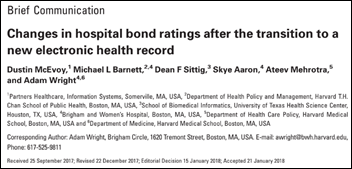
Researchers looking at how hospital bond ratings fared after implementing a new EHR find that of the 32 health systems studied (with a focus on Epic), seven had their bonds downgraded, seven had them upgraded, and 18 had no changes. They concluded that it’s tough to prove any relationship between EHR implementation and the macro financial picture provided by bond ratings, even though ratings announcements often reference either the cost or the financial benefit of a new EHR.

As is nearly always the case, it’s not what you buy, but how you implement it and what you do with it afterward that counts.

Epic’s touting of post-implementation hospital financial improvement was likely the genesis of the article since it focused on Epic.


Reader Comments

image

From Brian: “Re: vendor clueless marketing. So the HIMSS conference has been around for only 18 years? Didn’t anyone edit this press release before editing it?” I’m omitting the vendor’s name because the marketing person who wrote the release has a long health IT background, so I’m sure it was just one of those embarrassing synapse-jumps that we all have rather than a lack of knowledge. While the conference is indeed HIMSS18, this is the 57th iteration since HIMSS62 in Baltimore, when there was no such thing as healthcare IT, no exhibit hall, and just two dozen skinny-tied hospital management engineers having about as much crazy convention fun as you would expect.

From Go-Live Concerned: “Re: Epic. Has at least eight go-lives in March, some of which are multi-facility big bang. Epic has to support them and most customers also share the same third-party vendors, who are stretched to the max. Document imaging and coding vendors, for example, have to staff up to deal with the increased support volume. Epic’s remote-hosted data center will see a 4-5x increase in live systems in just a few days. If the lights dim in Madison, we’ll know why.”


HIStalk Announcements and Requests

image

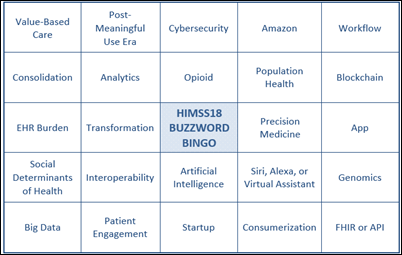
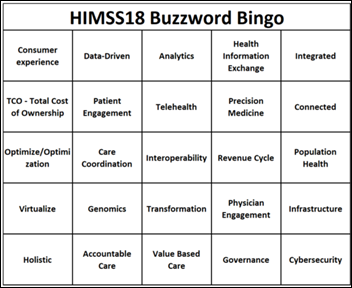
Dr. Jayne’s HIMSS18 Buzzword Bingo inspired me to create my own version. See if you can you call bingo (horizontal, vertical, or diagonal) during the opening session, during the first 30 minutes in the exhibit hall, or in a single vendor’s quick pitch. If you need an added difficulty factor – which you probably will since it will be a target-rich environment – then see if you can get bingo purely using only overhead-dangling booth signage. Or, see if you can fill out the whole card from a single vendor. I arranged the options randomly, but I’d bet money that the easiest bingo would be from the lower left corner diagonally up. Regardless, you’re gonna need a bigger stack of cards.

image

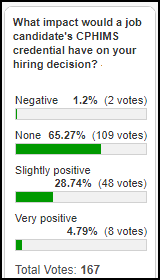
Poll respondents say their hiring decisions wouldn’t be swayed much by a candidate’s CPHIMS credential. My conclusion has always been that if two candidates were exactly equally desirable (which basically never happens if you’ve done due diligence), then maybe it would offer a tiny edge as evidence of personal drive. A lot of the folks I know with CPHIMS hoped that earning it would offset their lack of experience or get them into the field as newcomers, neither of which seems likely.

New poll to your right or here, repeating one I ran awhile back: Have you experienced unwanted sexual overtures or comments during a HIMSS conference that made you uncomfortable?

image

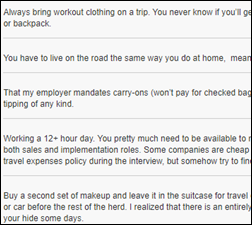
Responses to “What I Wish I’d Known Before … Taking a Travel-Heavy Job” range from the practical to the heart-wrenching. When I worked for a vendor for a short time, business travel seemed exotic and carefree to those of us shoehorning like astronauts into our cubicles every day under management’s clueless but ever-watchful eye. Still, I noticed that the road warriors who I was occasionally sent out to support seemed unusually world-weary, cynical, and quick to hit the hotel bar. They avoided the sometimes miserable office conditions, but also didn’t really even seem part of the same company (except to our customers) since most of us hardly every saw them. They also rarely got promoted or taken off the road since replacement roadies were hard to find. Reading the responses makes me glad that I only traveled heavily for a few months when I worked for a large, regional health system, where I had it pretty easy in visiting the same handful of rural hospitals for just a few days at a time as a colleague instead of a vendor. Remember these comments the next time someone from several states away shows up bright and and outwardly cheery on Monday.

image

Next up and anxiously awaiting your response:  What I Wish I’d Known Before I Quit My Job to Go to Work for Myself. I’m interested in what you have to say even if you eventually ended back up as someone else’s employee. People always fantasize about becoming part of the gig economy, so help them out with good or bad firsthand experience.

image

Iatric invited me to get on a short conference call with their HIMSS booth staff to review some of my “Tips for HIMSS Exhibitors,” something I don’t ever do except Iatric was smart in offering up front to make a significant donation to DonorsChoose in return for a few minutes of my time. Their donation, paired with matching funds from my anonymous vendor executive and other matching sources, funded every penny of these teacher grant requests:

  • Supplies for creating posters for Women’s History Month for Ms. F’s middle school class in Greensboro, AL
  • Hear Myself sound phones and reading highlighting strips for Mrs. M’s first grade class in Durham, NC
  • Action cameras and photo storage for Ms. F’s STEM charter school class in Naples, FL
  • Floor seats and craft materials for the Winter Olympics after-school STEM club project of Mrs. M in Robbinsville, NC
  • Programmable robots for Mrs. J’s second grade class in Springdale, AR
  • Simple machines building kits for Mrs. H’s fifth grade class in Loachapoka, AL
  • An Amazon Echo for Mrs. M’s kindergarten class in Benton, LA
  • STEM creative building materials for the “I’ve been in America for less than a year” elementary school class of Ms. J in Kansas City, MO
  • Math games for Mrs. J’s elementary school class in West Newbury, MA

Several of the teachers emailed me within a couple of hours, one of them Ms. F, who said, “Thank you so much for funding my students in their efforts to learn more about the women who changed history. This package was funded in such a timely manner in that Women’s History Month is in a few days. We are so grateful for your support. It is because of donors like you that we can take learning to a whole new level.”

image

Welcome to new HIStalk Platinum Sponsor Loopback Analytics. The Dallas-based company is a leader in population health analytics with its EpisideInsights, a cloud-based platform that allows health systems to identify at-risk populations, match those patients with appropriate resources, and evaluate how interventions affected outcomes. It allows provider organizations to selectively share data with network partners across all care settings in participating in value-based care initiatives. Specific focus areas include specialty pharmacy, behavioral health high utilizers, and bundled payments. Organizations use EpisodeInsights to assess bundled payment opportunities, reduce clinical variation, drive change management with physician-level benchmarking, benchmark against market competitors, identify network partners, and support real-time data exchange including patient alerting. I interviewed Founder and CEO Neil Smiley – who also founded Phytel and sold it to IBM Watson Health – last week. Thanks to Loopback Analytics for supporting HIStalk.

image

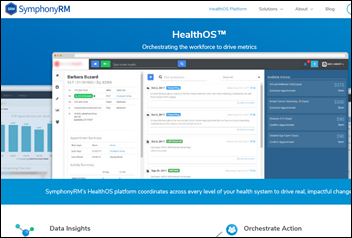
Welcome to new HIStalk Platinum Sponsor SymphonyRM. The Palo Alto, CA-based company offers HealthOS, healthcare’s only customer relationship management platform that identifies and orchestrates “next best actions” for consumer and provider engagement, helping to increase patient acquisition, close care gaps, increase provider utilization, and improve referral capture. HealthOS – whose tagline is “orchestrating the workforce to drive metrics” — is used by call centers to conduct outreach; marketing departments to generate and manage prospect marketing; provider outreach teams to manage activities; and front office teams to guide real-time intervention opportunities for clinical, population health, and marketing opportunities. The company’s goal is to transform healthcare providers into member-focused enterprises, using the experience of its executive team in building three data science and CRM companies that generated $5 billion of value for leading consumer service brands. Thanks to SymphonyRM for supporting HIStalk.


Webinars

None scheduled soon. Previous webinars are on our YouTube channel. Contact Lorre for information.


Sales

image

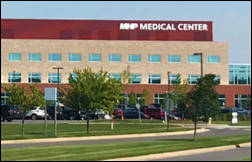
Major Health Partners Medical Center (IN) chooses CloudWave’s OpSus Healthcare Cloud to host its Meditech EHR.


Decisions

  • Winchester Hospital (MA) will go live on Epic in 2018.
  • Amita Health St. Alexius Medical Center (IL) will go live on Cerner next month.
  • Amita Health Alexian Brothers Medical Center (IL) went live on Cerner this month.
  • Weston County Health Services (WY) will switch from Cerner to Epic.

These provider-reported updates are supplied by Definitive Healthcare, which offers a free trial of its powerful intelligence on hospitals, physicians, and healthcare providers.


Announcements and Implementations

image

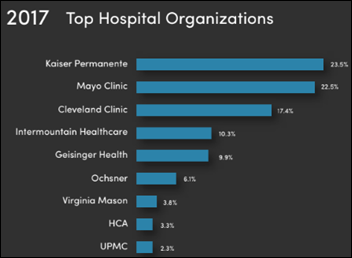
A new Reaction Data survey of health system leaders finds that the most-named health systems for innovation, thought leadership, and providing quality care at a sustainable cost are Kaiser Permanente, Mayo Clinic, Cleveland Clinic, Intermountain Healthcare, and Geisinger Health. KP led by far in recognition for providing high-quality, cost-effective services. It’s interesting that other than KP, those highly regarded systems haven’t shown a lot of interest in expanding beyond their own regions as opposed to less-regarded but ambitious players such as Ascension, Trinity, and Adventist. I think most of us would love to have one of the top three systems add a hospital near where we live.

Dolbey launches Fusion Narrate, a cloud-based speech recognition product that allows providers to dictate into any application without integration. The underlying technology was provided by NVoq and its SayIt speech recognition platform.

V3 Health Strategy launches its blockchain private placement Initial Coin Offering solution.


Government and Politics

Politico reports that the VA could sign its Cerner mega-deal as early as this week. Both parties have agreed to 50 minor contract changes that were recommended in Mitre’s interoperability evaluation.


Technology

For Bitcoin fans: analysts speculate that a single low-profile startup in China that sells bitcoin creation hardware is raking in up to $4 billion per year in profit.

image

Indiana-based VoCare develops a self-contained home care device that measures blood pressure, blood glucose, pulse, oximetry, temperature, and ECG, running on Android to connect via WiFi, Bluetooth, and 4G LTE in uploading readings automatically to a cloud storage system. The only peripheral needed is the supplied blood pressure cuff. It has a provider mode and also an option to be used for remote patient monitoring.


Other

A JAMA opinion piece observes the stress that opioid reduction programs have had on PCPs: having to confront patients to reduce their opioid use; kicking them out of their practice after implementing a no-opioids policy; trying to migrate patients to alternative pain drugs without a lot of knowledge or patient enthusiasm; trying to stay on top of increasingly complicated drug plan prescribing rules; and dealing with insurers that are willing to pay only for more addictive opioids because they are older and therefore cheaper. The article says the opioid crisis is due to inadequate chronic pain control and recommends further education, including telementoring clinics offered by Project ECHO (where two of the authors work).

Martin Shkreli must be rolling over in his cell. Rare-disease patients treated with a 1960s drug whose price was jacked up from $650 to $21,000 in just eight years became excited that a generic was coming out, but only until they saw the price: $18,000, still 28 times what it cost in 2010. Experts note that despite FDA’s call for competition, it’s tough to bring a drug’s price down from stratospheric levels when the Wall Street-pandering newcomer recognizes that the market will bear a slight-lower price, especially when the manufacturer covers the co-pay of patients and leaves insurers stuck with most of the tab. To make it even weirder, the original manufacturer, faced with this slight competition, rolled out its own generic priced at $19,000.

In other pharma news, states are acting to restrict pharmacy benefit management companies from inserting gag clauses in their contracts with pharmacies that prohibit pharmacists from telling customers that paying cash for their prescription would be cheaper than using their insurance. Pharmacists complained that PBMs pocket the difference from the patient’s overpayment. The drug lobby has filed suit to block a North Dakota law that bans such gag orders, saying it requires PBMs to disclose “proprietary trade secrets.”

SNAGHTML31698558

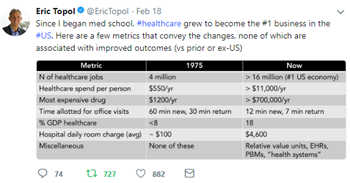
A academic medical center study published in JAMA finds that it costs $20 to perform the billing and insurance activities required for a primary care visit and $215 for an inpatient surgical procedure, representing 3-25 percent of professional revenue. Eric Topol’s tweet says it all.

image

A medical resident’s New York Times op-ed piece describes treating the eminently influential 96-year-old doctor and Nobel Peace Prize winner who in 1996 wrote a book that not only warned against overuse of technology and excessive drug prescribing, but also observed that “healing is replaced with treating, caring is supplanted by managing, and the art of listening is taken over by technical procedures.” Hospitalized in a system even more impersonal than he could have imagined 22 years ago, he wasn’t happy with the lack of progress:

Each day, one person on the medical team would say one thing in the morning, and by the afternoon the plan had changed. I always was the last to know what exactly was going on, and my opinion hardly mattered … Doctors of conscience have to resist the industrialization of their profession.


Sponsor Updates

  • ACOs using population health management software and services from Lightbeam Health Solutions have generated $300 million in savings.
  • National Decision Support Co. and Mayo Clinic will expand clinical guidance for NDSC’s CareSelect Lab solution.
  • Obix Perinatal Data System of Clinical Computer Systems will exhibit at Kaleidoscope 2018 February 26-27 in Stafford, TX.
  • The SSI Group and PatientPay partner to offer end-to-end payment services.
  • Huron and The Joint Commission will host the first in a new series of hospital-focused safety and quality care workshops April 11 in Minneapolis.

Blog Posts


Contacts

Mr. H, Lorre, Jenn, Dr. Jayne.
Get HIStalk updates. Send news or rumors.
Contact us.

125x125_2nd_Circle

What I Wish I’d Known Before … Taking a Travel-Heavy Job

I wish I’d been aware of the social isolation and pressure to get things done in my limited time at home. There are friends I used to see regularly that I haven’t been in touch with for years now. With weekends really being my only time at home, I spend the majority of that time doing things that need to get done around the house, running errands, going to the doctor. It doesn’t leave much time for a social life or even seeing family.


Whatever your lifestyle health-wise, it will just be amplified by the travel. Work out regularly now? You’ll have an even better schedule to accommodate it. Not great about getting to the gym? Don’t romanticize that travel is going to help with a gym in every hotel. It only makes it harder and you’re eating restaurant food more than ever.


Choose your credit cards wisely to maximize perks.


The importance of inflatable lumbar support pillows. And how difficult it is to do any meaningful work on flights — neither the environment nor the ergonomics are conducive to productivity.


How much I would miss my family.


I wish I’d known I wasn’t as adventurous as I thought I was. Turns out I don’t like exploring new cities by myself.


I wish I’d known how much of my weekend time would be spent playing catch-up: dry-cleaning, laundry, cleaning, friends, family. All the little stuff that gets spread out through a normal week is condensed into two far-too-brief days.


I wish I’d bought shoes that were more comfortable.


How much I would miss my son. I originally thought that early mornings to the airport, overnight stays, and getting home late at night would impact my ability to get things done, find time to exercise, eat well, etc. However, I was quickly able to adapt and those areas of my life were not impacted. The hours from my son was the toughest part. I no longer weighed the time traveling with the time or more productive time in the office. I now weighed that time with the time a way from him. I’ve since left that job and started my own company where I can control my time based on its REAL value.


How it can strain a marriage. After doing it for 5+ years, we had not much in common. Weekends were spent catching up on chores and then getting ready to leave on Sunday or early Monday. We have no children, so we made the decision for him to spend several weekends with me at my long-term location to give us a common talking point, which did help. I gave the job up after six years and the marriage is still going strong at 41 years. The good part about the travel was the friends I met and have kept across the country and the experiences I would have never otherwise have had. I’ve been sailing in Long Island Sound and also experienced Fleet Week on a house boat in San Francisco Bay.


That the clients were actually interested in applying best practices vs. creating more layers of status quo.


Always bring workout clothing on a trip. You never know if you’ll get the chance to hit a great gym or run even if you’re not in the mood while packing. Always keep a charger, a pair of socks, and some cash in your briefcase or backpack.


You have to live on the road the same way you do at home, meaning that you must have the discipline to maintain your diet and exercise routines and not succumb to overeating and drinking.


That my employer mandates carry-ons (won’t pay for checked bags), requires adults who have never met to share rooms, believes that $45 per day will cover three square meals in major cities, and refuses to reimburse tipping of any kind.


Working a 12+ hour day. You pretty much need to be available to meet with the customers during THEIR 8-5 day job, but you also have to prepare for those meetings, etc. after the normal workday is over. I’ve seen this in both sales and implementation roles. Some companies are cheap and insist that you stay at low-end hotels (think Ramada Inn with outside doors) and have all kinds of budgetary constraints. It’s kind of hard to ask for the travel expenses policy during the interview, but somehow try to find those things out. 


Buy a second set of makeup and leave it in the suitcase for travel days. Get the back-office phone numbers for airlines and rental cars and call them as soon as you realize your plane is delayed and you need to book a hotel or car before the rest of the herd. I realized that there is an entirely other population of people on this earth who are “travel people” and they know a LOT of stuff. Talk to them as you wait to board your plane. They can save your hide some days.


When you do the math after you divide the number of real hours worked into the salary you accepted, you really only earn $2.50 an hour.


If I had one thing to do over, it would be to somehow add a day (on my own dime) and explore the city I had traveled to. Easier said than done, as most days I just wanted to get home, but sounds good anyway.


That regardless of travel schedules, colleagues still expect you to respond in a timely manner, which means working at night to catch up on all the day’s missed emails and phone calls.


How I would always be tired and spend my weekends doing expense reports, laundry, and sleeping.


While during my interview process I was asked if I would be willing to travel for my job, I didn’t think much of it, given the position description stated 5-15 percent of my time would be on the road. That’s not much, right? I should have known something was up when, on my first day, I was asked if I had a valid passport. Nineteen months later and more than 300K air miles logged from monthly trips to Europe, Asia, and plenty of domestic trips, I left after I couldn’t sleep for more than 90 minutes at a time. I could never get my body clock adjusted to all those changing time zones. Some people are cut out for it, but I learned I definitely was not one of those people.


Wish I’d known how agreeable it would be to the way I like to work. Depart, immerse, get it done, then go home. Rinse, repeat. And when I am home, I mean I am HOME.


Get a credit card that offers lounge access. Sure, it’s good to have a quiet place to work, but I also really need a place to get drunk after a flight delay at the end of a long work week.


You will lose all track of time and the seasons of life. I remember once sitting in a boarding lounge and a family was sitting in the row behind me and they were taking their son or daughter to college and it was an emotional discussion. I was touched by it, but was so consumed by my conference schedule that I didn’t even realize that the seasons of life was going on all around me while I was going from the Javits Center to the McCormick Place to Moscone Center and so on.


If you are single, your friends will stop inviting you to events because, well, you are just never home.


Flying sucks. It is exhausting for your wife who has to keep the family ship and the sailors (the kids) on course while you are gone. Eating out all the time is tough on trying to stay in good shape. As I have gotten older, the three-hour time change from West to East Coast has become a bigger impact on the sleep pattern. At least there is Uber and Lyft now so I don’t have to hassle with rental cars as often (those guys must be having a major negative impact in the revenues of Hertz, Avis, etc.)


How much weight I’d gain if I did anything other than maintaining a disciplined diet and exercise regimen.


That there is no benefit to letting the corporate office handle travel plans. Make sure to negotiate the ability to control your own travel, get a good travel-specific credit card, invoice for your expenses, and then reap the rewards. It took me a full year on a job (three weeks of travel a month) before someone let me know they asked and corporate agreed. Within the next six months of travel, I had upgraded status on all of my flights and hotels and had enough points to take my entire family on a vacation we’d normally never afford.


Unless you are going to or coming from a meeting in which specific attire is required, always fly in specific travel clothes. When you get to your destination, put all of the clothes in a bag (they are covered in whatever grossness wasn’t cleaned on your flight) and don’t touch them until it is time to fly home. This way you limit your (and your clothes’) exposure to travel-related disgustingness to just one outfit. I have sat on broken airplane seats and ruined suit pants, I have had people miss the emesis bag and get it all over a nice dress shirt, I have seen and smelt unthinkable things. But luckily I am now forever wearing clothes that I don’t worry about when it all happens. When you get home, toss them in the wash on “kill everything” cycle of the washer by themselves and you’ll feel like you are keeping germs and stink (relatively) at bay.


Try not to take travel-heavy jobs. Honestly, they are just not worth it. The novelty wears off, the lack of life balance is endemic to those you’ll meet, and in the end, you’ll be grateful you decided to find something closer to home. Unless it is a once-in-a-lifetime opportunity, keep looking instead of being a road warrior. Very few people who have retired from travel-heavy jobs have ever told me they really enjoyed it. If you can, try NOT to take the position.


Clinical depression is highly likely. You’ll become almost obsessed with maxing out loyalty programs. Wal-Mart becomes a source of “healthy” food in rural areas. Too many people have pre-check. Too few airports have dedicated pre-check lanes. Getting squishy/soft/fat is almost inevitable. Vented car seats are heavenly. Podcasts are your best friend.


How much time would be wasted from flight connections when your home airport isn’t a major one.


The impact to your family is huge. You have to have a good support structure, and if you have kids, you have to have backup plans in place for the inevitable sickness or childcare issue. You also need to really understand your company’s policy up front about scheduling your travel and the ability to dictate some home weeks when needed.


That US companies do not consider travel time as work (contrary to labour laws where I live).


The importance of willpower and honoring your commitments. It’s too easy to cheat, in every aspect, when you’re on the road.


I wish I’d  had access to a company handbook to verify printed policies. The manager I was hired under explained that we travel Monday and Friday and are on site with clients the rest of the week. If we needed to travel on a weekend, we’d receive comp time. He retired and was replaced by a manager who felt that as salaried employees, we didn’t deserve comp time, so there were many go-live weeks where we worked seven days or even back-to-back weeks that formed 14-day hits without a break and with no comp time. When we investigated, it turns out the company handbook is mute on the subject and it’s up to manager discretion. This would have been different if we were consultants or if we were bonused on billable hours, but we weren’t. Needless to say, there was a fair amount of turnover under the new manager (me included).


The negative impact it would have on my health. Too much airport food and booze and not enough sleep or exercise.


How a travel-heavy job would negatively impact my health. The inability to exercise on a sustained and regular basis, sleep deprivation, constant exposure to sick people on airplanes and buses, and constantly being expected to lavishly entertain clients with lots of alcohol all contributed to a pretty rapid decline in overall health and fitness.


Join an airlines club like American Admiral. if your employer won’t pay for it, you can usually use miles. When your flights get scrambled, the club staff will get you re-routed faster and with preference.


It makes it very hard to have a normal social life in your home town. When you travel all week, you tend to want to stay home on the weekends. If you don’t have a strong local social circle, this can make it tough to meet local friends. It also makes it hard to participate in community events or take weeknight classes (i.e. personal enrichment classes). I left a strong social circle in my 30s and moved to a new town on the opposite coast just when I started traveling full time for work, and 10 years later, I have thousands of frequent flyer points (and some fabulous global travels) but not one new friend in my new town. Something to think about.


As a business traveler, the last thing I want to do on weekends is travel some more. It has affected my desire to do weekend getaways, camping trips, and weekends away with the guys way more than I would have ever expected.


A travel-heavy job really reduces your ability to be involved in the community, be it board involvement, local government, or coaching a kids’ sports team. Getting involved is a lot easier if you are home every night of the week.


Sometimes an existing job you took without much travel can later turn into a job with heavy travel expectations, so apparently flexibility is just expected if you want to keep your job.


The travel T&E policy, in detail. Preferred vendors. Expectations about traveling on Sundays and holidays. Coverage for airplane WiFi. Will I be carting executives around with me all the time? Can I get executives or experts to come with me when I need them?


How tough it is on your body as you age. Back problems waiting to happen.


When I was in my 20s and fresh out of graduate school, I took a travel-heavy IT healthcare job that was exciting, challenging, and fulfilling. It was at the inception of the healthcare IT industry in the 1970s and everything we did was new. This lifestyle did not promote the ability to carry out personal relationships in an ideal manner. I was focused on my career and did not consider the long-term ramifications of not having met “Mr. Right.” Eventually I did meet and marry the right person, but by this time I was in my 40s and not able to start a family. We have been happily together now for 25 years and I recently retired from the healthcare IT industry. During this entire time, I continued weekly travel with the exception of a few positions I held as a direct employee of a healthcare system. The travel takes its toll, but the chance to work with many different organizations and people throughout the USA and Canada was very rewarding. My husband used my weekly Monday through Thursday absences as an opportunity to complete his PhD and he continues to work as a professor for a well-known online university.


Weekender 2/23/18

February 23, 2018 Weekender Comments Off on Weekender 2/23/18

weekender


Weekly News Recap

  • Duke Health earns the first Stage 7 analytics recognition from HIMSS Analytics.
  • Practice Fusion, which is being acquired by Allscripts, abandons its ad-supported free EHR program, announcing that it will start charging each physician user $100 per month.
  • A leaked Nokia memo says that the company sees no way for its digital health business to become significant, less than two years after creating the business by acquiring France-based Withings for $190 million.
  • A JAMA editorial calls for CMS to release Medicare Advantage encounter data.
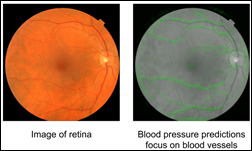
  • Google researchers publish their work in which they applied deep learning to eye photos to accurately identify cardiac risk factors such as age, gender, smoking status, blood pressure, and likelihood of having a heart attack.
  • Siemens announces that it will take its Siemens Healthineers medical technology business public in the next few months.
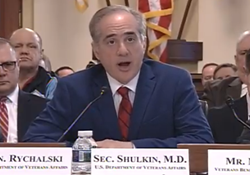
  • The House Committee on Veterans’ Affairs grills VA Secretary David Shulkin on the VA’s FY2019 budget request, questioning the project cost and interoperability capabilities of the Cerner system the VA wants to buy.

Best Reader Comments

I’ve been able to really get in and do more work as the CMIO once I understood the company’s mission, vision, and yearly metrics, i.e. executive dashboard. Are they focusing on telehealth this year, pop health, decrease CAUTI, CLABSI, readmissions, etc.? Which one is the darkest red? Be sure to focus some time there. This gets you immediate cred with the execs and the docs if you can deliver something to them into their live environment sooner than later that is easy to use, intuitive, and aligns to the execs’ dashboard. (David Butler)

I’d like to hear more from Ed about his perspective on the current state of professional organizations in terms of their true value and the ability for execs to truly benefit from participating. Beyond local chapters – which by their very nature are limited in breadth of participants – there aren’t many intimate opportunities available. Everything seems to be centered around and in bed with HIMSS. It’s just getting too big and too overtly commercial. Do execs really benefit from these mammoth organizations and infrequent – sometimes only once a year – opportunities for networking and thought leadership development? (SteveS)

Partners will find the savings from their cuts of coders as fool’s gold. There are a lot of hidden costs running an outsourcing development organization. (BeenThere)


Watercooler Talk Tidbits

image image

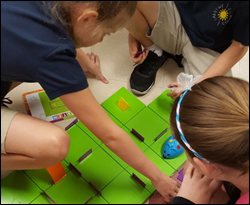
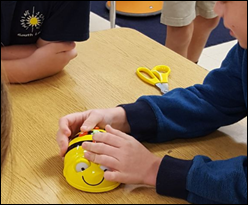
Readers funded the DonorsChoose teacher grant request of Ms. M in Florida, who asked for programmable Bee-Bots and a robot mouse for her K-5 STEM classes. She reports, “My kids love these little bees and mouse. Bee-Bot is fun for all ages, but it’s a great introduction to younger kids for learning how to code. That is what the coding mouse does as well. Both of them are very similar but have the same effect and are a lot of fun for the kids to play with and learn from. Thank you so much for supporting our classroom, believing in STEM education, helping us teachers, and giving the students a hands-on education.”

CNBC notes that Amazon has launched a lineup of 50 private labeled over-the-counter drugs that it calls Basic Care, potentially drawing foot traffic away from drug chains that make most of their money from walk-ins. Amazon sells a 500-table bottle of ibuprofen 200 mg for $7, about the same as Walmart but nearly half off the price charged by CVS, Walgreens, and Rite Aid. Costco’s Kirkland brand – also sold via Amazon as well as in its stores – has the best price I’ve seen at just $10 for 1,000 tablets.

SNAGHTML2b77c114

A review of “Grey’s Anatomy” by trauma surgeons finds that it gives trauma patients an unrealistic expectation of what their stay might look like. TV trauma patients died three times more often than in real life, most went straight from the ED to the OR vs. 25 percent of actual cases, and only a small number of patients transferred to a long-term care facility vs. the real 22 percent. Half of patients left the hospital within a week of serious injury vs. the real-life 20 percent and OR surgeons are often shown not wearing masks and protective eyewear to allow the audience to recognize them. The authors worry that unrealistic patient expectations, fueled by the listing of a medical advisor in the credits, may affect hospital satisfaction scores.They summarize,

American television medical dramas tend to rely on storylines that feature rare diseases, odd presentations of common diseases, fantastic and/or quirky injuries, and mass casualty events, all framed within a ‘realistic’ representation of a typical US hospital. In addition, the dramatic construct of a television serial lend to deviations from reality or accuracy in an effort to preserve the ability to communicate a story within the constraints of a one-hour show.

Maine debates whether veterinarians should be exempt from the state’s prescription monitoring program.

image

A reader forwarded this mail-merged bulk email from the marketing person at a cloud services company who forgot to the add personalization to her HIMSS pitch. Not only did she recover brilliantly with a witty follow-up email, I’m impressed with her credentials – she has a PhD in neuroscience and co-founded a company that makes a line of bold-flavored organic sauerkraut (Lemon Ginger, Moroccan Fusion, Vindaloo Curry, and Green Chile). They’re offering Colorado beer (hopefully not Coors) at their HIMSS booth happy hour, although the sauerkraut sounds a lot more interesting.

image

The HIMSS conference is just over a week away. The weather in Las Vegas should be OK, with daytime highs in the mid-60s and nighttime lows in the mid-40s with some clouds and little chance of rain. I was happy to find that even though MGM-owned hotels all charge for parking now, the Venetian-Palazzo complex still doesn’t and that even includes valet (which I used every day last time). Lyft is a good alternative – I’ve had better luck with it in Las Vegas than Uber.

image

You may recall that after HIMSS18, it’s two straight years in Orlando since HIMSS moved HIMSS19 from Chicago to there, the second time it cancelled McCormick Place (the first time over expensive but indifferent union labor, the second over hotel room rates).

image

Since there’s no HIStalkapalooza this year, here’s a nostalgia-inducing video from what’s probably my favorite one of all time, the 2012 version in Las Vegas that was sponsored by ESD. I recognize a bunch of folks in the video. The Palazzo restaurant we held it in closed a year later. What you probably don’t know (I just now remembered myself) is that it was originally booked for a Mexican restaurant also in the Palazzo called Dos Caminos that closed without warning on November 15, 2011 following a rent dispute, but the amazing ESD folks had First Food & Bar locked down just a few days later. I seem to recall that their pear-ginger martini was a hit.


In Case You Missed It


Get Involved


125x125_2nd_Circle

EPtalk by Dr. Jayne 2/22/18

February 22, 2018 Dr. Jayne 2 Comments

The pre-HIMSS madness has started, with companies starting to churn out press releases that try to act very important but don’t actually say much. More than a few vendors save up even the smallest tidbits to try to release them for HIMSS, but miss the fact that their news is just going to get lost in the shuffle. The buzz words are out in full force, so for those of you playing along at home I offer up a HIMSS18 Buzzword Bingo card for your enjoyment:

image

Some vendors are sending out sneak peeks of what will be in their booths, but quite a few others are sending cold-call type emails that are sometimes registering as spam. One arrived today thanking me for my interest in a particular company and asking me to click to verify my email address. It was a mainstream vendor, so I didn’t think a lot about it, but on the other hand, it sounded more like phishing so I decided to take a pass. Vendors need to think twice about the wording in their messaging (or hire public relations people who will think about it) if they want to truly get attention and not be accused of spamming people.

clip_image004

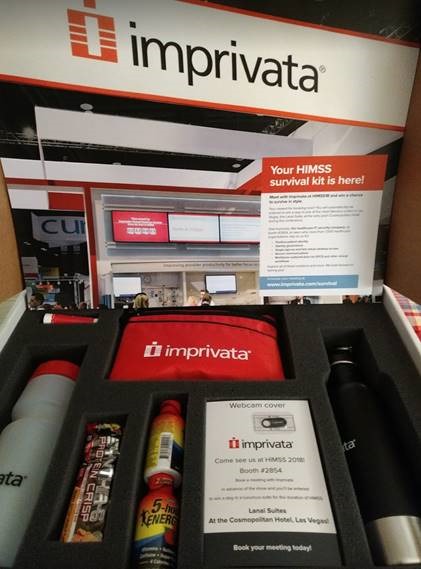
Other vendors are going for the “wow factor,” with Imprivata shipping this HIMSS survival kit. In addition to protein bars and 5-hour energy shots, it has both plastic and metal water bottles, along with lip balm. The red survival kit has tissues, hand sanitizer, vitamin C supplements, and lollipops. The cutest part is the little black trinket stuck above the Imprivata logo – it’s a camera cover for your laptop, that slides to cover or reveal the lens depending on your needs. Usually I keep a piece of tape over my camera, but I’m going to test drive their slider and see how it does. I had some accidental camera exposure on a call several weeks ago, when I had to switch laptops at the last moment. It was one of those “crazy ponytail” days with an unmade hotel bed in the background, and the person I was talking to wondered why I covered my camera abruptly.

CMS announced its Annual Call for Measures for Eligible Hospitals and Critical Access Hospitals participating in Medicare EHR incentive programs. They’re looking for measures to be included for rules that are made during 2019 and would be optional in 2020 and required starting in 2021. CMS is looking for measures that build on Certified EHR Technology and increase interoperability, along with those that might improve program efficiency, effectiveness, and flexibility. Last on their list (although most clinicians might say it should be first) are measures that address patient outcomes and emphasize patient safety.
Much as there is increasing research into distracted driving, I’d like to propose some evaluation in the latter two categories that would look at distracted practicing. It’s increasingly hard to focus on the patient when you’re busy with data gathering, finding the right fields for documentation, and fielding clinical decision support popups. As systems become more sophisticated, I sometimes feel like I’m in the cockpit of a fighter jet rather than trying to care for patients.

CMS is also eager to find measures that would reduce reporting burden, avoid duplication of previous measures, and include an “emerging certified health IT functionality or capability.” It’s sexy to focus on new features, but how about allowing physicians to focus on the technology they already have and learn to use it well? I see numerous physicians who are underusing features such as order sets and clinical decision support, which should be able to drive clinical outcomes, reduce inappropriate ordering, and improve efficiency. They also tend to under use features that would make them not only more efficient but more satisfied with their systems, such as personalization features and individual preferences. Those features take time to set up on the front end but pay dividends on the back end, Shortsighted physicians who skip the pre-work wind up with many more clicks down the road.


Speaking of CMS programs, physicians continue to vote with their feet, not only opting out of the incentive programs, but by opting out of Medicare altogether. Based on data from the Provider Enrollment, Chain and Ownership System (PECOS) as of the end of the year, more than 16,000 physicians have filed affidavits to opt out of Medicare. The number was down in 2017 from a peak of more then 7,000 in 2016, but the overall trend is concerning. I recently received my letter from the Department of Health and Human Services detailing the penalty I’ll be taking this year. Since I’m in an employed situation and my practice isn’t participating in the incentive programs, there’s not much to be done. But if I were back in private practice, I might start thinking twice about CMS participation vs. moving to a practice that doesn’t have a payer-based compensation system. Nearly 40 percent of my residency class is now in practices that are either retainer-based or offer substantial savings through cash-only services.

clip_image008

I’m in a no-travel zone leading up to HIMSS, which I desperately need after my most recent travel experience. After a flight that included some turbulence that felt a bit like the prelude to astronaut training, I made it to my hotel and found this little guy in my bed. Fortunately I spied him (or her) right when I came through the door and not after I had gotten settled in. I’m not sure what it is (it seemed too large to be a bed bug and not quite the right shape), but I am waiting to hear back from an entomologist friend. Although the hotel was apologetic (and moved me to a top floor corner suite), it’s unsettling. I’m hoping the only living thing in my room at the Venetian is a CMIO with tired feet, although a plant would be OK too.

What’s the weirdest thing you’ve found in a hotel room? Email me.

Email Dr. Jayne.

HIStalk Interviews Neil Smiley, CEO, Loopback Analytics

February 22, 2018 Interviews Comments Off on HIStalk Interviews Neil Smiley, CEO, Loopback Analytics

Neil Smiley is founder and CEO of Loopback Analytics of Dallas, TX.

image

Tell me about yourself and the company.

My wife and I live in Dallas. We have three children, all grown with now kids of their own. I have a computer science degree from Dartmouth and spent the first 15 years of my career in management consulting, first with Accenture and then EY. Then in 1997, I got the entrepreneurial bug and decided to leave consulting and start a company called Phytel. It is a software as a service platform company that, over a number of years, we grew to serve about 30 million patients. Phytel, along with another company called Explorys, was acquired by IBM as part of their launch of the Watson Health platform in 2015.

Loopback Analytics, where I serve as CEO, spun off that effort in 2009. The company provides a cloud-based platform we call EpisodeInsights. It enables health systems to proactively identify at-risk populations, match those patients with the appropriate services, and then evaluate the impact of those interventions on outcomes. The platform allows provider organizations to selectively and securely share data with network partners across care settings to coordinate care beyond their own walls, certainly outside of facilities they own. The key there is protecting data that should not be shared and sharing data that should.

How do you differentiate the company in a crowded population health management and analytics market?

We don’t go to market as just an analytics play. Instead, we’ve focused around specific solution areas where we feel like we can have a meaningful impact. Then, we’ve developed the specific competency within those verticals — specialty pharmacy, behavioral health and high utilizers, and then this area of bundled payments. When we go to market, it’s typically not to sell, “Here’s some analytics. Why don’t you go plug it in and see what it can do?” We come as a value proposition built around our return on investment, specifically around one of those verticals.

How do you address specialty drug use as a significant driver of cost?

There’s an interesting trend that’s happening. Our primary customers are large health systems. For a long time, they have been banned from managing limited distribution specialty pharmacy, which is the leading edge of innovation. Folks are concerned about how much these new meds cost and whether they’re worth the money. We equip health systems with a framework so they can establish real-world evidence around what they do and leverage the fact that they have a much better opportunity to coordinate all aspects of the patient’s care — particularly a complex patient who’s on some specialty therapy — and differentiate how well they can do that relative to potentially other distribution channels.

We see big pharma as being under increasing pressure to provide real evidence that there’s value. Pharma would like to do that, but struggles. How do you set up a measurement framework that you can believe in and all the parties can agree upon? This is where our company is going — providing a foundation for managing value-based care reimbursement models.

Some drug companies are hinting that they are willing to go at risk in getting paid only if their drug delivers the desired outcome for a specific patient. Are those companies showing interest in using provider data to monitor the process?

There’s a couple of problems to solve. One is that absent some kind of independent arbitrator, our role is as a data custodian. We can pull in data from a number of different sources that’s needed to complete that picture, but not be beholden to any one aspect — pharma, the health system, or in some cases, drug distribution centers. How do you provide a degree of independence so that as we’re looking at the efficacy of an intervention, it can be evaluated objectively? It’s interesting.

We’re seeing something similar with medical devices. Manufacturers are interested in engaging with health systems, potentially going at risk and getting into the clinical outcomes business rather than selling a widget and saying, good luck with that. It’s a requirement that for them to continue to defend their margins, they have to be able to point to the value that they’re creating.

We take data availability for granted these days, but these conversations couldn’t have happened five or 10 years ago

That’s absolutely right. Even today, how to share that data is a sensitive topic. People are obviously and appropriately sensitive about sharing protected health information, because if there’s a breach, that’s not good for anyone. The key role that we play is not to put all the data together and share it indiscriminately like it’s in one big pot. Instead, we very selectively share data around populations that individuals or stakeholders have in common, but then be able to protect the data that doesn’t need to be shared. If you don’t have that sort of governance structure, all the technology in the world isn’t going to help you.

Hospitals and skilled nursing facilities have mostly ignored each other and didn’t share data. What benefits are they seeing when they work from a common pool of data?

It’s a relatively recent phenomenon. Until there are financial incentives for these parties to come together, there’s just not a business reason to do so. It’s really the emergence of ACOs. We’re intrigued with this relaunch of bundled payments with the BPCI Advanced that CMS announced a few weeks ago. These provide the financial incentives for stakeholders to get together. Previously, they’ve each done their own thing, leaving a patient to be their own general contractor.

We see a tremendous role for us to come alongside the health system that wants to form a network with the best quality providers and hold them accountable for quality of care, but also the economics of the care that they’re providing with aligned financial incentives. If you’re doing a great job, you stand to profit from it, but if you’re not doing a good job, then it’s going to cost you. I’m excited about the emergence of these new models. They are going to pave the way to a higher degree of care coordination than has existed in the past.

Is that kind of vertical interoperability going to be more important than expecting competing health systems to share patient information?

Folks are increasingly aware that the social determinants of care play a significant role in terms of patient risk factors. Clinicians, for the most part, have ignored these characteristics.

We’re doing an intriguing project in North Texas. We have the largest health systems, many of which are competitors, getting together with the criminal justice system, jails, and the outpatient mental health services. They are knitted together through our platform to impact a difficult problem, which is unmanaged behavioral health issues with high utilizers who, up until now, were bouncing between the jail and the emergency departments in a way that is unsatisfactory, both for them and also for the community. With these kinds of formerly intractable problems, there’s a real opportunity, with the right kind of precise data sharing, to begin to make an impact that just wasn’t possible before.

What lessons did you learn from Phytel that you can apply to Loopback Analytics?

One of the things that allowed Phytel to take off was providing a return on investment guarantee. We basically said, we have the data flowing through the platform. We can ensure that a physician who’s now being held to pay-for-performance or trying to manage their practice more effectively by using targeted analytics and getting patients the care they need can benefit via to their bottom line. It was doing well by doing good. You have to connect the dots. It helped, of course, that we were doing all this at a time when population health was becoming more mainstream, so we rode that wind as well.

This continues to be one of the key challenges of anyone who is trying to innovate in healthcare. We still have a predominance of the fee-for-service reimbursement model, which often pays people to do things that aren’t helpful to patients. We have to pick around the edges still, finding those intersections where we can provide better outcomes, make providers more money, and reduce cost. If we can’t do all three of those things, then we have to stand down until reimbursement models change.

Your hit a home run with your first swing of your entrepreneurial bat with Phytel. How would you assess today’s health IT business climate with regard to innovation?

I don’t have a crystal ball, but I will say that if you’re trying to launch a health IT initiative on soft dollar benefits, it’s a lot harder. If you can find the intersection where there’s a compelling return on investment, those are the kinds of initiatives that I would get more excited about. Healthcare is entrenched and isn’t as nimble as a lot of other industries that I worked with in my consulting days. You have to have something compelling to interrupt somebody from their current set of priorities. Typically, it has to make financial sense for them to change.

Do you have any final thoughts?

Healthcare is in the middle of historic transition from volume-based to value-based care. The pace of change is uneven and messy. I don’t have a completely rosy picture that it will all be up and to the right. Perverse incentives still work against the goals of better outcomes and lower cost. Thankfully, what started out as this small niche play a few years ago is steadily expanding as value-based reimbursement models become more pervasive.

We’re particularly excited about the relaunch of bundled payments by CMS as BPCI Advanced. Initiatives like that provide an opportunity for providers to make more money by doing the right thing and improving the care system. It’s a rare opportunity to get visibility, specifically data of full episode claims, to inform their network design and prepare for broader adoption of value-based payment models. I would certainly encourage health systems and physician group practices that have an opportunity to at least apply and get their data. We’re putting a lot of effort into that.

CIO Unplugged 2/21/18

February 21, 2018 Ed Marx 2 Comments

The views and opinions expressed are mine personally and are not necessarily representative of current or former employers.

First Days

This is the last in a four-part series on key considerations and action items during your first 120 days in a new job.

They say the typical executive will switch positions 5-7 times during his or her career. How can you ensure a smooth and effective transition? This series is intended to compliment what others have written over the years with some fresh perspective. This post will begin where the last left. A shout out to several peers whose ideas are reflected below.

A summary of the posts in this series.

30 Days Prior. After you have celebrated your new role with friends and family, you have to get to work. This is a challenging transition time as you must first honor your commitments and obligations to your current employer while also carving out time to focus on your pending role. Your primary commitment and loyalty remains with your current employer. If you can find some time to invest in your pending gig, it will pay dividends.

Day 1-30. Your first 30 days on the job are the most critical. The first day can be nerve-racking. You typically head straight for orientation or to your new office and meet your manager. Whatever the circumstance, dress the part and take a deep breath! Remember your first day of school?

Day 31-60. By this time, you no longer need a GPS to find your way around campus. You are becoming familiar with the organizational culture and building foundations of trust with key leaders and team. You are working hard but eating right and getting in rest.

Now we are at Day 60-90. The actions you take from this point forward establish the DNA of your organization. It is challenging to change trajectory as you lead from the base you established in your first 90 days. Final adjustments should be made during this time.

You are mastering many of the basics. You are learning culture, establishing relationships, converting quick wins, and building your team. There will be many nuances depending on your organization and the state of your division, but the following are generally solid areas to focus on.

90-Day Plan

Create and publish a second 90-day plan. This will buy you more time to develop your strategy and complete your onboarding. You have to visibly be moving things forward even while learning your new job. If you have no published plan, colleagues may assume the worse or others may attempt to fill a suspected void. It is best to showcase continuous action. The additional plan contents will also continue to keep your organization focused on getting things done, not waiting for some magical master plan. See next!

Strategy

Simply put, there are three broad categories of IT strategy: non-existent, aligned, and converged. Your objective should be to reach strategic convergence, as explained below. If there is no strategy, you must create one. If there is an aligned strategy, you should set the stage for convergence.

  • Non-existent. Many organizations have no defined IT strategy. This may be one of the reasons you were recruited. Before you seek to collaborate and create a strategy, make sure that other foundations are firm or else you’ll be building on shifting sand. Ensure governance is in place, as well as a functional project management office. Double down on key peer relationships to ensure the developed strategy sticks. There are many resources and examples available online. Someone once said, “If there is no plan, people will wander.” They will.
  • Aligned. Some organizations have a strategy that is aligned with the business. The fundamentals are popping and much care is given to ensure the IT strategy is in place to support the overall organizational strategy. Super. Make sure you have the right people on the IT governance team and aim to have your CEO co-chair with you. Include a patient for their unique perspective. Publish your plan and report on related metrics. Now focus on getting out of the IT strategy business and setting your eyes on convergence.
  • Converged. When the IT strategy is embedded as part of the overall organizational strategy, it’s organizational nirvana. IT is woven throughout, much as a thread within a tapestry. There are no defined boundaries; IT is just part of the business. There is little reason to call out IT because it is at the same level of all other key organizational functions. It is hard state to achieve and remain, but worth working towards.

Accountability

It is good to be brutally honest about IT and identify any gaps. Transparency is key. Share openly when things go wrong. Your customers know there are gaps and they know before you do when things are not working well. Go ahead and be proactive, own up, and take action. In addition to highlighting IT-related metrics, show all failures, along with the root cause analysis. It is old school, but there’s nothing wrong with adding one of those “X Days since…our last accident” reminders to keep the importance of high reliability front and center. You are what you measure.

Partnerships

You won’t succeed on your own, so be extremely diligent in pursuing relationships. Not everyone will be warm and welcoming, so it is up to you. It is not that your peers are uncaring; more likely, they are plain busy. It is your responsibility to develop high quality partnerships with your peers.

Vendor Management

I recommend developing a vendor management office and look to segment vendors in order to better manage your time. One method is to divide vendors into strategic, tactical, neutral, and emerging categories. Don’t get fixated on my descriptors as much as the concepts. Your time is precious and you will run out of resources if you try to meet with everyone. I stick with 3-4 strategic partners and 2-3 emerging vendors while my team handles the balance. You should invest time with key suppliers, as they can accelerate your strategy and success.

Professional Organizations

These are your lifeline. Do not ignore. Organizations like CHIME and HIMSS offer so much support through all of their programs and services. I would not be where I am today without them. By all means, give back to the broader community, especially local chapters.

Community CIOs

Another lifeline is your area peers, inside and outside of healthcare. In NYC and Dallas, I made it a point to try to bring peers together. In Cleveland, all area healthcare CIOs are meeting for dinner. I also encourage reaching out to the non-healthcare CIO community as part of onboarding. They can provide valuable insights and direct you to community resources. Asking for help is a sign of confidence and strength.

Leadership

I’m not sure I can overemphasize this. You must have the right people on your team. We all know this intellectually, but it is a challenge to pull off. Do you keep everyone? Individually, are there issues with competency? Character flaws? Does he or she embrace your vision? Is she or he better then you? (hopefully yes!) Your team alone may not lead to your success or demise, but will be the accelerator of either.

Opportunity

What an amazing opportunity you have as the new leader on board. You have been chosen for a reason and now you have to exceed your end of the employment agreement. To optimize your success, I encourage you to complete a written 90-day plan. Take posts like this and other resources to give you some ideas. Reach out to mentors and others who have gone before you. Write it out and execute.

Feedback

What other considerations and action items should leaders consider in their first 90 days that I haven’t covered in the First Days series?

edmarx

Ed encourages your interaction by clicking the comments link below. He can be followed on LinkedIn, Facebook, and Twitter.

HIStalk Interviews Kamal Patel, CIO, Ellkay

February 21, 2018 Interviews Comments Off on HIStalk Interviews Kamal Patel, CIO, Ellkay

Kamal Patel is co-founder and CIO of Ellkay of Elmwood Park, NJ.

image

Tell me about yourself and the company.

I am one of the co-founders of Ellkay, along with Lior Hod. We started the business in 2002 in his basement. Both of us are developers. We learned about business along the way.

We are now close to 200 people. When we started the business, our first client happened to be Quest Diagnostics, which was fantastic. We started with New York and New Jersey and then we expanded across the whole country with demographic connectivity.

We are known as the healthcare data plumbers in the industry. We solve key problems around all kinds of interoperability. Any data, any system. We assist in migrating data from all the legacy systems within a healthcare environment and ambulatory environment.

How would you describe the current and future state of interoperability from a technology perspective?

When you look at the lab environment, that is where you run into a lot of point-to-point interfaces, where you are connecting the ambulatory locations or reference lab locations for sharing lab orders and results back and forth. There’s a great need for interoperability in technology to streamline this process.

When we started the business, we started doing demographic interfaces. We were doing it across the country, most of them with point-to-point interfaces across all the various systems. We focused on building a platform that allows for all kinds of interoperability.

The way the industry is headed, some form of normalization or structure is required. But in the current state, the problems that everyone is having around interoperability is that it’s not necessarily standard, which is what everybody seems to focus on. There is no single platform that offers speed of deployment, cost effectiveness, and full monitoring of everything that is happening. Whether the data is going to APIs, HL7, FHIR, or sharing CCDs, any of those forms.

Do you see a lot of problems related more to the non-technical aspects of exchanging information related to individual system rules of how data is edited and stored?

When these systems were designed, they used the best available way to store that data. When you have two different systems, they are obviously going to have different ways of storing that data.

There are two parts to normalizing that data. One is the ability to take data from one system — it could be a database or CCD share — and standardize the data in a simple form. This is what everybody is talking about. Standardization will allow for easy viewing of data at the point of care.

The second part within standardization takes it to a different level with cross-reference mappings. Medications might be stored in one system using the RxNorm format, while another system uses some other format. These mappings need to occur around medications, problems, allergies, immunizations, and document types for analytics engines to work and to build machine learning pieces and so on.

These are some of the challenges the industry is solving. We are doing our part, but there is still a lot of work to be done.

What advice would you give a practice that is considering migrating to another EHR and wondering what data can be moved over?

Don’t be afraid. Today, when you ask a practice which data they want to move, they’re scared. Our approach has been that we’ll take everything you have and migrate it over. Whatever went into the old EHR, we will put it into the new EHR. We will map each destination in the EHR, medication to medication, and so forth. When they start using the system on Day 1, all the pieces are there.

Anything that can’t be migrated, we will move it into an archive, a repository where we are managing it. We will link those patients back to the existing EHR via a single sign-on. When they open a patient’s chart in the new EHR, they can simply click on the archive link and it will pull in all the historical data.

It’s a completely different world in health systems. They have all these legacy systems where we get the data, but we also get the same patient records from their ambulatory locations that they may want to archive. We consolidate these patients and link them to their primary EHR, whether it is Epic, Cerner, or others. We get the patient IDs from the primary EHR and then match it with the legacy systems, then we match it with the ambulatory patient IDs. When they open the patient record in their health system EHR, they see a consolidated, longitudinal view. Not only from the legacy system, but also from all the ambulatory practices that the health system may have acquired over time.

The company is of significant size with 200 employees. What created the growth and where will the company go in the future?

We’ve been growing on both sides because of the problems in the market that we can solve. We’ve been growing our connectivity and interoperability sites with labs, clinical data feeds, and scheduling interfaces. In solving all these different challenges, we have tremendous growth opportunities.

On the archiving side, when Meaningful Use Stage 2 was going on, we were doing a lot of data migrations for newly purchased EHRs. Now we’re doing a lot of health system migrations on really large scales. If a health system has 200 practices and 20 legacy systems that they’re constantly paying maintenance on, our goal is to help them reduce that maintenance and streamline all the data in a central, secure repository. We keep all that data discrete and still have it available at the point of care.

On the interoperability side, there are a lot of different types of challenges. We don’t believe that any form of standardization is going to solve all these things. We partner with a lot of EHR vendors. We partner with a lot of labs. We partner with ACOs. Everybody has different needs.

We recently moved from 13,000 square feet to a 74,000-square-foot building that we purchased. We are on a significant hiring spree. We are super excited about the growth and the direction of the company.

How would you describe the company’s culture?

The company is awesome. We focus on culture. We very rarely have people leave us.

In our office, the environment is amazing. We have had free lunch every single day since we started in 2002  — we even wrote a software program for handling the lunch orders and processes around it. We have bees on the roof and we make our own honey. All the beekeeping is done by Ellkay employees and our president even goes on the roof.

We are involved in two specific charities that we are tied to as an organization. One is for kids on the autism spectrum, Alpine Learning Group, where we assist them in fundraising and bike events. Our next event is rappelling from our building for this charity. We are also involved with Embrace Kids Foundation that helps families that have kids with cancer. They can use the money to take the kids to Disney or use it for whatever expenses they may have.

When we hire people, we’re looking at, are you going be a lifer at this company? The interview process is intense, but once they come through, it’s an amazing family environment. As we grow, we may struggle to maintain that, but so far, it’s been fantastic.

Do you have any final thoughts?

Our strengths are customer service, speed, reduced cost, and our platform.

We put great emphasis on the fact that it all starts with the customer and the service we provide. Even though we like to think about delivering products, platforms, and speed, the fact that our customers are extremely satisfied with what we do is critical. Everything we do is transparent. Our customers can see, through our online portal, every single phone call that our service reps have made and the amount of time they spend working on their projects.

We believe our interface interoperability platform, LKTransfer, is a completely new way of thinking about interfaces. In traditional thinking, health systems purchased an interface engine and scaled by hiring more resources. Our thought process is that interfaces in a health system should be done by just one person, and instead of taking weeks and months, it should be done in hours and minutes.

We are extremely focused on innovation and we have a dedicated R&D team that is focused on solving the new challenges in the healthcare industry. We are super excited about what we have been doing and where we are headed.

News 2/21/18

February 20, 2018 News Comments Off on News 2/21/18

Top News

image

A JAMA editorial calls for CMS to release Medicare Advantage encounter data to allow taxpayers to see how their money is being spent on its growing number of beneficiaries. The article concludes that if the data is good enough to pay providers from, it’s good enough for the public to see. 


Reader Comments

image

From Jagged Pill: “Re: Orlando Health’s CIO position. It’s interesting to compare the stated job requirements with the credentials of the chosen candidate.” The job description doesn’t contain the requirement that the new VP/CIO have experience in an organization of similar size ($3.4 billion), but some might be surprised that new CIO Novlet Mattis got the job with just four years of CIO experience, all of that accrued in one-hospital, $954 million Rex Healthcare (NC). She came from Ascension Information Services, so maybe there’s a consulting connection there. The job description also says that Orlando Health will be choosing a new EHR and replacing its best-of-breed systems, which will be a huge loss for Allscripts (Orlando Health paid them $5.1 million in FY2016, according to tax filings) and a big win for Cerner or Epic. A local announcement says the IT department’s annual budget is $145 million. According to those same tax filings, retired CIO Rick Schooler was making $785K per year. Another interesting tidbit is that Orlando Health’s VP/CIO position reports to the CFO, which is almost unheard of except in small hospitals where the primary objective is controlling cost.

From Jack Anape: “Re: Mitre’s report on Cerner interoperability. Will the VA make it available to the public?” I haven’t heard what’s in the report, but I would bet the VA won’t release it publicly, especially since it looks like there’s about an 80 percent chance that VA Secretary David Shulkin will be shown the door after ending up on the wrong end of White House infighting. What the report says is anyone’s guess, but given that its emphasis was on how Cerner would interoperate seamlessly with whatever EHRs are being used by community-based providers that might treat a veteran, it doesn’t seem likely that the report will provide a ringing endorsement. There’s also the chance the White House-pushed, no-bid contract Cerner signing could be put on hold or the EHR decision process restarted if Shulkin isn’t there to promise Congress that this time, the VA really, really, really won’t blow through taxpayer IT billions without much to show for it.


HIStalk Announcements and Requests

I’m enjoying the responses to “What I Wish I’d Known Before … Taking a Travel-Heavy Job.” Add yours and you’ll see it in this weekend’s write-up.

image

Welcome to new HIStalk Platinum Sponsor WebPT, the most-trusted, industry-leading rehab therapy software platform. The Phoenix, AZ-based company’s robust, Web-based solution – created by a therapist for therapists — offers EMR, scheduling, documentation, billing, outcomes tracking, business reporting, patient engagement tools, and system integration in enhancing patient care and driving business growth regardless of staff size, facility type, or number of specialties. The company has a  99 percent customer retention rate, 99.99 percent uptime, 10,000 clinic customers, and 79,000 member users. The company announced last week its acquisition of BMS Practice Solutions, the largest rehab therapy RCM company. WebPT offers video testimonials and case studies that explain why more therapy professionals rely on WebPT than any other software. Industry long-timer Nancy Ham is CEO and board member. Thanks to WebPT for supporting HIStalk.

Here’s a physical therapy practice’s WebPT testimonial that I found on YouTube.

image

Welcome to new HIStalk Platinum Sponsor Philips Wellcentive. The Alpharetta, GA-based company has since 2005 driven quality improvement, revenue growth, and business transformation for healthcare organizations that are transitioning to value-based care. The company’s population health management solution boosts clinical, financial, and human outcomes and has been recognized as a PHM leader by KLAS, IDC, and Chilmark. Philips Wellcentive helps its customers provide care management for nearly 50 million people, using intelligence gained from 2.5 billion data points each month to earn $700 million each year in value-based revenue through improved outcomes. I interviewed PHM Business Leader Niki Buchanan a couple of weeks ago. Thanks to Philips Wellcentive for supporting HIStalk.


Webinars

None scheduled soon. Previous webinars are on our YouTube channel. Contact Lorre for information.


Acquisitions, Funding, Business, and Stock

image

Inovalon reports Q4 results: revenue up 19 percent, adjusted EPS $0.06 vs. $0.05. Shares rose 9 percent in the past year vs. the Nasdaq’s gain of 23 percent. 


Sales

image

The Sac Valley Medshare HIE chooses Diameter Health for clinical data normalization and standardization services.


People

image

Datica hires Christopher Gerg (Gauntlet Consulting) as CTO/CSO.

image image image

Ciox Health hires Florian Quarre (Deloitte) as chief digital officer, David Dyke (Change Healthcare) as VP of product management, and Paula Lawlor (Accuity Delivery Systems) as EVP of provider solutions.

image

Sumit Nagpal (LumiraDX) joins Accenture as managing director and global lead for digital health strategy.


Government and Politics

image

A perceptive New York Times article says that a widening gap between Americans who pay full price for their ACA marketplace health insurance and those who get free or heavily subsidized coverage causes some of the resentment against social programs that middle-class citizens pay for. It concludes that the only universally liked social programs are Social Security and Medicare because everybody benefits from them.

image

Researchers create a live tracking website to call out organizations and individuals that aren’t complying with a new law that requires that all completed or abandoned FDA-registered clinical trials to publish their results, good or bad. Interestingly, the FDA itself has no plans to do tracking of its own. Clicking an organization’s name shows every clinical trial that it has underway, which then links to the ClinicalTrials.gov site for full study details. 

image

HHS issues a proposed rule that will allow insurers to sell short-term health insurance plans that don’t meet ACA requirements. CMS says lower premiums will allow people to buy insurance who otherwise can’t afford it, although it doesn’t mention that bare-bones plans historically have barely resembled real health insurance with a long list of excluded services and no coverage of pre-existing conditions. Not to mention that they will likely destroy what’s left of the marketplace risk pool. I looked at some of the plans offered and they have deductibles as high as $12,500, 40 percent co-insurance up to a maximum of $10,000 annual out of pocket, no coverage for conditions that have been treated in the preceding 24 months, and a lifetime maximum of $600,000 (your cancer and stroke crystal ball had better be accurate). HHS Secretary Alex Azar said in a tweet that the change will offer people “quality, affordable healthcare that works for them,” although he didn’t mention whether he or members of Congress who are covered by generous, taxpayer-paid plans with ACA-mandated coverage are planning to trade theirs in.


Privacy and Security

California Attorney General Xavier Becerra says he won’t sign off on mandatory physician use of its CURES prescription drug monitoring program until its security has been certified.


Other

image

A KLAS report on clinical mobility finds that few hospitals are keeping late-model iPhones for employee use like they did before the iPhone 6, with some of them instead moving to Zebra phones because of the iPhone’s shortcomings (lack of ruggedization, poor WiFi connectivity, and lack of swappable batteries). The iPhone is still the first choice for executives and doctors who get a hospital-provided phone to keep. BYOD strategies include paying employees a stipend for using their own phones for work, providing secure texting apps, securing the device remotely via mobile device management, offering remote system log-in as a value-added option, allowing employees to disconnect while not on call, and blacklisting apps if necessary.

image

Google researchers apply deep learning to images of the eye (specifically the retinal fundus) to accurately determine cardiac risk factors, such as a patient’s age, gender, smoking status, blood pressure, and likelihood of having a heart attack. They hope to expand their work with a larger dataset in which more cardiovascular events occurred and to fine tune their risk prediction by looking at lifestyle changes or medications.

image

Eric Topol notes that healthcare has morphed from a small industry to the country’s largest without improving outcomes.

A tiny physician survey finds that three-quarters use mobile health in their practice, but mostly only for internal messaging or for quick EHR lookups on their phones. Almost no practices offer telemedicine visits, although that doesn’t necessarily mean their patients aren’t using it – maybe they’re just getting them elsewhere. Few practices accept information from patient wearables, most commonly because the data doesn’t flow into their EHR , although I would bet the real reason is they aren’t being paid to review the information and are afraid of being sued if they miss something.

A medical resident’ s opinion piece ponders whether “the academic arms race” gunner competition among medical school applicants creates better doctors or perhaps instead burns them out. It made me think – are intelligence, drive, and competitiveness the best predictors of being a caring doctor?

Experts warn that the US military’s planned surge will struggle since three-fourths of Americans aged 17-24 are ineligible to serve because of obesity, other health conditions, criminal backgrounds, or lack of education. From the non-military viewpoint, that means employers will either have to hire them warts and all or they’ll be unemployed and thus supported by taxpayers.

In Australia, the Royal Australasian College of Physicians goes back to paper for its medical trainee exam after its first attempt at using a computer-based system locks users out five hours into their test. Test-takers who were planning to leave immediately afterward for vacation or to curl fetally in the corner from panic attacks over their future now have to prepare for the paper re-test that will be administered on March 2.


Sponsor Updates

  • Hands On Technology will integrate Ability Network’s RCM application into its rehab EMR/PM.
  • PatientKeeper and its owner HCA are awarded a patent for the way its software displays the most relevant patient information based on the user’s specialty and preference.
  • SSI launches an analytic product for ambulatory surgery centers.
  • Audacious Inquiry delivers more than 5 million clinical event alerts per month via its Encounter Notification Service.
  • The Tech Tribune includes CareSync in its list of the top 10 best tech startups in Tampa, FL.
  • CTG acquires Paris-based consulting and digital services business Soft Company.

Blog Posts


Contacts

Mr. H, Lorre, Jenn, Dr. Jayne.
Get HIStalk updates. Send news or rumors.
Contact us.

125x125_2nd_Circle

HIStalk Interviews Tom Skelton, CEO, Surescripts

February 20, 2018 Interviews Comments Off on HIStalk Interviews Tom Skelton, CEO, Surescripts

Tom Skelton is CEO of Surescripts of Arlington, VA.

image

Tell me about yourself and the company.

I’ve been in technology for 30 years. I’ve been doing this a long time. I still find it challenging and interesting and I hope that all this technology that we’re all deploying is making a big difference out there.

Most people probably think of Surescripts in terms of electronic prescribing, which is now widely implemented and in some cases mandated. The next wave involves add-on capabilities, such as prescription price transparency and automating prior authorization. What is the status of those efforts within the industry and within Surescripts?

I think you are absolutely right. There’s a lot of information going back and forth. Prescriptions, eligibility, and some of the core things have made huge strides.

Price transparency is a big thing and we as an industry need to rise to the occasion. We’re now able to provide, at the point of care, information about co-pay and therapeutic alternatives. These are extremely helpful for consumers and fit very well into a consumer-driven world.

I would say it’s early stages here. It took 14 or 15 years to get 90 percent of prescriptions on the network. Electronic prescribing for controlled substances was introduced in 2011 and at the end of 2016, the number was up to 14 percent. The transparency piece is going to take a little while, but we expect a very big year in that regard for 2018. We have a lot of rollouts going on and physicians and patients will start to benefit from that very quickly.

Will the model follow e-prescribing, where the initial effort involved standalone applications that were rarely used that were then integrated into physician workflow?

Yes. Physician workflow is one of the absolute keys here. We’re in a market where physician burnout is rampant. Pressure on their time is just absolutely amazing.

Since its founding, Surescripts has been focused on partnering with electronic healthcare records vendors and other technology providers to make sure that physicians and pharmacists don’t need to step out of their workflow to do what needs to be done for a patient. If you’re looking at price transparency, the issue goes just beyond pricing and the alternatives. It’s a lot deeper than that. It sets the stage for whether or not a patient adheres to the treatment regimen that the physician has prescribed. That’s one of the key things that gets lost. That co-pay differential — $10 here, $20 there — makes a big difference in adherence levels.

That’s a huge issue for the industry. It’s a huge issue for the country. You move into the world of electronic prior authorization. All of this ties together when you look at what’s going on in the market. This front door of understanding what the patient’s benefits really provide them. Also, understanding whether or not that prior auth is really necessary. Making that as easy as possible is key.

When you look at adherence, the introduction of prior auth alone causes adherence scores to fall substantially. They approach a 40 percent decline in some cases. Not just prescriptions — when I was running a radiology company, we saw 25 percent declines in utilization as soon we sent letters saying that we were introducing prior auth for MRIs. This is something the healthcare system has to get good at.

That’s also true when you look at specialty drugs. You’re seeing a huge increase in utilization and cost of specialty drugs across the system. That’s also driving prior authorization work, and that’s important as well. When you’ve got $500 billion worth of specialty pharmacy spend, you want to make sure that very sick people get access to the drugs that they are required to take.

Is it a challenge for EHR vendors now that many other software vendors want to connect to them and it’s hard to determine whether a given company is a partner or a competitor?

Absolutely. I don’t think there’s any question that the EHR vendors have a tremendous challenge in dealing with all of the requests that are made of them and in meeting those requests. We’re coming out an era where government mandates drove a lot of the innovation and pushed a lot of the coding towards the EHRs. As that era recedes into the past a bit, they’ve got tough choices to make about what innovation they code first.

Our job is to make it as easy for them as possible. We’ve built tools that help do that. We have accelerators that make it easy for them to do that integration, taking advantage of standards that exist in the market, both technical standards in the information provided and the standards around how that’s formatted. They’ve certainly got a lot of work that they need to do. They are the front door, in many cases, to these hospitals and physician offices.

FDA and drug companies are interesting in using provider EHR information for market surveillance. Do you see Surescripts as having a role in provider-FDA data exchange?

As our role in the industry has grown and changed, we’ve tried to support certain key initiatives, whether they’re government initiatives, research initiatives, etc. We’ve been pretty selective about that, but we try to help out where we can. When they are looking for a comprehensive story, going to the EHR is the natural place for them.

Should we be optimistic about the current and future state of interoperability?

It has changed and improved substantially. I worked at a company in Raleigh, NC where we had a huge team of people doing nothing but HL7 work. It was unbelievable the time, energy, and resources we put into that. The industry has moved so far beyond that now.

One of the challenges that the industry has is that we’ve not done a great job setting the bar for success. Like many industries that don’t have great data to support a position, we end up living on anecdote. I can tell you 10 stories about my mother and elderly relatives and what they encounter in the healthcare system with interoperability. Those anecdotes are going to rule the day until we as an industry come together to help explain what the interoperability journey looks like and help provide criteria upon which we can be judged.

What role do you see for pharma in using healthcare data?

You’re asking specifically about data, but I’ll tell you one of our learnings. We just had some folks come back from JPMorgan. Emerging firms, smaller innovative firms, are being founded to fulfill a specific niche need. Pharma and life sciences are being viewed as important to their business models. Whether that’s a good thing or a bad thing is probably less the point than the fact that these are large, healthy firms that are seeking to foster innovation and further their interest. A lot of these smaller startups are looking to them as key components of their business model.

How much of the success of Walgreens and CVS was due to innovative IT work and what can providers learn from that as the market consolidates?

The key word obviously is consolidation. Whether it’s horizontal or vertical, the entire healthcare ecosystem is undergoing another wave of consolidation.

As you pointed out at the beginning, when you and I used to talk 15 years ago, there were 800 EHR vendors. That number is down substantially. If you look at the market share on the hospital side, you’ve really got three key firms. If you think about the fact that firms like Walgreens and CVS have historically been innovative, both in technology and in evolving their business model, I don’t think that’s a surprise. That would also be true of groups like United Healthcare and others. There are a lot of large firms that have been innovative in terms of what they’ve done to evolve both their model and the infrastructure that they’ve built to support that new model.

Where do you see the future direction of Surescripts?

You highlighted a couple of these things that we would talk about. We would certainly talk about price transparency. The other thing that we would talk about is that there’s a lot of commentary and interest in how interoperable the system is. The second piece of that is you have to peel back the onion a little bit. The information that’s being moved — how actionable is it when it arrives? How accurate is it? We’ve made a huge investment there over the last few years.

The introduction of Sentinel was an important moment for us as an organization. It moves us beyond just talking about how data is formatted to how actionable it is when it arrives. It puts us in a situation where, instead of having one in 10 prescriptions requiring some type of phone call or human intervention, we can work with our EHR partners to help identify areas where those prescriptions might benefit from different work up front to make those scripts more actionable when they arrive. We think that’s a important.

We’re going to scan 2 billion prescriptions this year and eliminate 50 million instances where somebody’s got to do something. That 50 million is a monthly number, not an annual number, so 50 million times a month we’re saving a pharmacist, physician, pharmacy tech, or a physician assistant a lot of time trying to sort through these. That’s what technology is all about. We’re proud to be moving down that path.

The ability to get information at the point of care is still an aspiration. Forty-eight percent of all diagnostic errors are still due to a lack of access to the appropriate information at critical points in the care process. We’re doing work around medication history. Delivering that information in a natural workflow for the physician is an important piece of what we do. A lot of folks do those things, but they do it with information that has lags in it or information that’s incomplete. But we’ve got big and deep coverage there and we’re providing a billion medication histories annually.

When you’re looking at informing care decisions, it is still a heterogeneous world. Health systems still rely on information from other medical practices and other healthcare institutions. The ability to locate a record for a patient in this heterogeneous healthcare system is an important piece of what we do. We can help people locate records, and once they’ve located them, there are a number of mechanisms for moving them and we have offerings in that area. You have to be able to know where that patient was and we think we can help.

Those are the types of things that we’re working on today. You can see additional intelligence coming to bear with us helping physicians and pharmacists through clinical alerting based on rules and engines that they help configure. We see all of that as natural for us and part of the prescription and medication ecosystem.

We haven’t even discussed opioids yet. Certainly from our standpoint, that is a huge situation that needs to be dealt with. We certainly respect, understand, and applaud all of the attention and the scrutiny, but there’s still a lot of work that needs to be done to make that real.

Our medication history offering is a big part of that solution. Doctors are allowed to see a lot of that information in most states. That’s important. I just saw some data the other day that shows that following the I-STOP implementation in New York, they’re approaching 90 percent penetration. When nationally you’re at 14 and New York is at 90, you can see the digitization that has occurred.

Digitizing those prescriptions is an important part of allowing people to do the analysis they need to do. If society as a whole decides that we need to do more behavioral work to support those patients, or whatever it is that we decide to do to treat them, the sooner we can help recognize it, the better. This problem is not going away without some type of intervention.

Do you have any final thoughts?

You asked a great question. Where are we on the road to interoperability? Should we be positive about it? Should we be concerned? What I would say is that there’s a huge amount of work to do, There needs to be an appropriate amount of focus on that work. There’s also a huge amount of progress that has been made, and will be made in the future.

I continue to be optimistic that with the combination of private entities partnering, and then private entities partnering with the public interest at the state and federal level, you’re going to see continued progress and acceleration over the course of the next few years. It’s not a panacea, but I think it’s going to be very positive and will have a huge impact. Patients and all of us US citizens are going to benefit enormously.

Curbside Consult with Dr. Jayne 2/19/18

February 19, 2018 Dr. Jayne 2 Comments

From time to time, I contemplate heading back into the CMIO trenches full time. Although I do a lot of CMIO work in my consulting practice, it’s usually episodic and I miss seeing projects come full circle. I also miss being part of the strategic planning team, helping lay out the vision for an organization and how it plans to support patients and providers.

When I serve as an interim CMIO, I’m usually charged with keeping the ship afloat rather than deciding where the ship is going or what kind of cargo it will be carrying. Or perhaps I’m brought in as a consultant, tackling projects that the CMIO should be doing but doesn’t have the bandwidth to handle. There are some times where maybe the CMIO wants to do the project, but it’s politically charged and leadership feels having third-party assistance will help steer them through a rocky course. Those are challenging but often fun, although they can be stressful.

As I’ve talked to recruiters and looked at various job postings, I’m seeing some trends in CMIO job descriptions that I’m not sure I’m fond of. It might be a function of the duration clients have been using clinical systems, but I’m seeing more “maintenance” type job responsibilities and fewer “leadership” elements. Organizations are recruiting CMIOs to manage systems and data and people, but not necessarily for the ability to shape mission or to help architect strategies for delivering care in increasingly complex environments.

It feels like the role is being diminished somewhat, and the salaries are commensurate with that change. Of course, I have to remind myself that the positions I am looking at are sometimes in organizations that have struggled with even having a CMIO, let alone keeping one. If they were a great place to work and had found the right person, they wouldn’t have a vacancy.

Regardless of the situation, though, and the reason for the vacancy, it’s difficult to look at positions that are less C-suite and more director level, regardless of the title. Usually those positions have a salary range that is also less C-suite and more middle management. I recently spoke with a recruiter about a position with a salary range that was closer to that of a new graduate fresh out of residency than to an executive-level position, and certainly far less than one could earn in clinical practice. When asked about how they see the range as being supportive of the position, they mentioned that it was less than they pay their staff physicians “because it doesn’t have all the stress that comes with clinical medicine.”

When you hear comments like that, you know immediately that a position isn’t going to be a good fit. I would argue that anyone who thinks that being a CMIO is less stressful than other physician roles probably doesn’t understand what typically falls under a CMIO’s responsibility. I also didn’t like the fact that they were comparing the roles like that, because frankly being a physician is stressful and being an executive is stressful, but in different ways on different days. I don’t think that comparing stress levels across the organization as a means to justify salary shows that an organization is very progressive. It also highlights the risk that they might be in the habit of pitting various constituencies against each other in the hospital, which again is not a good sign.

I’m also struck by the lack of diversity in some organizations’ leadership profiles. At one organization, a large community health center that sees a very diverse population, the entire leadership team was composed of Caucasian males over age 55. I try to judge a potential job based on the job, but given the fact that I didn’t feel welcome during the interview, I didn’t think I’d feel welcome on the leadership team. Having grown up around many hunters and fishers and being fairly outdoorsy, I can talk hunting and fishing in a passable fashion, but it was nearly impossible to steer them away from conversations about who had the better deer lease and whether the wives would be coming to hunting camp this year or not. There were also conversations about how much money their stay-at-home spouses spent that were entirely inappropriate for an interview situation and made me concerned about how my potential peers viewed women in the workplace since none of the wives discussed work outside the home.

Another organization had an interviewer that asked me directly whether I had children. Although it was offered in a folksy tone under the banner of “help us get to know you,” it’s irrelevant to the job and role and was an immediate turn-off. It also said that this is an employer who doesn’t even understand the basics of employment law. As a seasoned people manager, that’s not something I want to sign up for. Given the desire of employees to have work-life balance along with the challenges of a graying society, rather than asking those kinds of questions, potential employers should be trumpeting whatever provisions they have in place to allow people to have children, build families, and participate in the care of aging family members.

Other organizations have been much more welcoming and have been proud to showcase provisions they have in place to keep their workforce healthy and productive. I’ve seen some fairly generous sick leave policies and concepts such as floating holidays to ensure that employees get time off on days that are significant to them and to their families. Vacation tends to still be a bit of a sticking point, though. Although I understand having people “earn” multiple weeks of vacation as they build tenure with a company, offering a senior-level applicant two weeks of vacation with the option to have a whopping three weeks of vacation after five years of service is a bit of a non-starter. We know the US lags behind the rest of the world with vacation days, and as a potential applicant who’s well established in the workforce, it’s a concern.

The issues I describe aren’t unique to finding CMIO positions and they apply to many other situations I see in the workplace. Potential employees want to feel valued and they want to feel like they’re moving to something better that offers more opportunity and/or rewards than their current situation. They don’t want to feel like they’re making a lateral move, let alone a downward move. I’ll be meeting up with some of my CMIO colleagues at HIMSS and will be interested to see how they feel about where they are in their careers or what the future holds. Until then, I’m off to the airport on my next adventure.

Email Dr. Jayne.

HIStalk Interviews Jim Causon, CIO, Memorial Hospital

February 19, 2018 Interviews 3 Comments

Jim Causon, CPA is CIO of Memorial Hospital in Stilwell, OK.

image

Tell me about yourself and the hospital.

Memorial Hospital is a 50-bed acute care hospital. It has a 10-bed geriatric psych unit and a physicians’ clinic that has anywhere from 12 to 16 physicians, depending on who comes and goes at any given time. It’s in rural Oklahoma in Adair County.

The clinic sees about 3,000 patients a month. The total population for the county is 3,000. [laughs] You know everybody. We draw a lot of people through the clinic. We see a lot of frequent flyers. It’s a nice little facility. It’s about an hour or hour and a half from the next-largest facility.

I am a partner in an accounting firm, Causon & Westhoff CPAs. We provide the CIO function for the hospital.

What technologies does the hospital use?

It terms of patient care, billing, and admission, discharge, and transfer, we use Medsphere OpenVista CareVue in conjunction with Stockell Insight CS. We just bought the clinic live on the EMR in August. We bought the hospital up first, got everybody comfortable with it, and then brought it into the clinic.

How has Medsphere worked out?

It has worked out well. That was a big concern up front when we were looking for a product. We were probably a little later to the ball game in selecting a vendor, mostly because we wanted to see how other implementations went at other sites with different vendors.

Then, of course, cost was a big factor. The government didn’t do anybody any favors by publishing what they were going to pay. Everybody was at the top of that rate for what they wanted for their product, which left little for implementation, hardware support, and that kind of stuff. We were fortunate to find Medsphere. The pricing worked out well for our small hospital and we were able to get it up and running easily. It was really an easy process, or as easy as going from paper to electronic can be. The technology part was easy compared to the people transition.

I assume your doctors are community based. Did you get good buy-in for physician order entry and other direct physician use of Medsphere?

We did. We have one doctor who probably does three times the volume of anybody else. He was a big concern for us in terms of being able to keep up. Are we going to have to hire additional staff to support him?

He was the silent champion when we came online. He picked it up real quick, didn’t have any problem with it, didn’t really get behind significantly in the beginning. He does well with it. We’ve got a couple of doctors that see a third of the patients that he does who still struggle with it a little bit.

When we went live in August with the clinic, for probably the first four weeks following go-live, we had a dip in the number of people we saw and charges going out. But by Month 2, we were back up to where we normally are. We saw very little decrease in productivity when we brought the clinic live.

You had no unexpected impact on revenue or accounts receivable?

Our days in AR went up a little bit when we first went live in the hospital. It really wasn’t significant. We did it sort of backwards. Most people bring in their ADT, billing, admit-discharge software first. We didn’t. We started with the clinical side. We kept all of our old billing software in place, and once we were up and running on the clinical side, we brought the admit, discharge, billing in on top of it. We kind of did it in a backwards order, but it worked out well for us.

When you look at hospitals paying huge maintenance costs for Epic or Cerner even as they’re trying to cut costs, are you glad you chose a less-expensive product?

It was more about, we have to get this right, because if we don’t, we can close the doors on the hospital. There is not a lot of big budget in there for getting it wrong. [laughs] We were very careful in our choice and the way we implemented it to protect the revenue streams as we brought it online to make sure we didn’t get a very big drop at the beginning.

What kind of technology staff do you have?

Until we implemented Medsphere in the hospital, I was the only IT person for the facility. We had a maintenance person that had some computer experience that I would recruit to restart this machine, fix that printer, run this cable, that kind of thing. I was it. Probably a year after we were on CareVue, we brought Insight up and added a fair number of new machines. We decided it was time to bring a person in house. We hired a person to be in house to take care of user issues. I maintain the servers and all of the larger issues. That’s the way we’ve run it since then. Really, it’s just the two of us.

Does it scare you reading about malware and having just two people to protect the systems?

Scares the pants off me. [laughs] Our biggest risk is what that end user is going to click on in their e-mail that’s going to cause us problems. We have had one laptop that was infected with ransomware, but it was a non-critical machine. It was identified almost immediately and we dropped its connection within a couple of minutes. We didn’t have any problems with the rest of the system, but that’s a worry every day. What is going to pop up that you’re not protected for that you don’t know about yet?

We do as much as we can in terms of firewalls, monitoring, protection, filtering, and education, but you never know. Our people are getting better. They send me e-mails that say, “Hey, this doesn’t look legit. Is it?” Most of the time, it isn’t.

We are getting ready to implement a process where we send fake e-mails to employees to see if they click on it or not. A lot of other people are doing that. That is our weakest area, the end user. Plan for the worst and hope for the best, is that how it goes?

Do you have other systems you would like to implement but can’t justify financially?

With current market, everybody is holding onto their dollars the best they can. Medsphere and Stockell have been very good to work with. If we need something or want something, they will help us figure out a way to do it at a relatively low cost, or a lot of times, at no cost at all. If it’s something someone else has, something they were going to do anyway, or something that would be a nice feature for some other hospital, they will help us get it done.

Stockell Insight CS has a large user group. They donate a certain number of hours every year to the user group. We meet in June every year to recommend the enhancements. They tally up the number of hours the enhancements that were submitted will require and they do as many as they can. We vote as a group on which ones we want. We have taken a large delegation this year and just about every year. Almost everything we’ve requested, they’ve been able to provide for us. I really can’t complain with the additional expenditures to get us what we want and what we need.

What opportunities and challenges do you see in using technology to align more closely with patients?

The biggest challenge for us is the consumer. We are in a small, rural community. It is primarily a Cherokee Indian population. A lot of people don’t have cell phones, don’t have computers. As we started rolling out our patient portal and trying to meet Meaningful Use by getting people to sign up, they’re like, I don’t have an e-mail. I don’t have a cell phone. OK, what do we do? [laughs]

Even down to our employees. When we tried to implement direct deposit for paychecks or self-service for payroll, where you can print your own W-2 and stuff they, didn’t have a computer. Some didn’t even have a bank account. Those are the kinds of issues that we face, more so than people saying, why can’t I do this online? It’s more like, please, will you try this online? [laughs]

Do you have any final thoughts?

I saw other hospitals is that were picking a vendor for pharmacy, picking a vendor for lab, and then trying to integrate all these vendors through interfaces. When something didn’t work, these guys were pointing at those guys who were pointing at somebody else. Getting it fixed and reconciled is almost impossible because everybody is pointing fingers at each other.

When we selected this system, all of those departments were integrated. We don’t have 10 different software products that are trying to do this work. Pharmacy, lab, and radiology are all in one software. The only interface we have is the interface from Medsphere to Stockell, and since they’re under the same umbrella, we have one throat to choke if things don’t work.

Their support for both sides is first class. They are very professional and quick to respond. If something is not working and we’re concerned about it, then they’re concerned about it. With other facilities and some other products, I don’t get that feeling. We’ve had a good working relationship with their support teams. There are times where we lean on them more than a large facility might because we don’t have the IT staff on site to do it. I can’t say enough good things about the support coming out of these guys.

We have been happy with our choice. Irv Lichtenwald is top dog at Medsphere. He has a monthly call with each client, so we talk to him directly at least once a month. If we have problems or concerns, 30 minutes after the call, someone is calling me back to say, heard you talked to Irv today. Yes, where are we on this? You don’t feel like you’re just a number. When I call and say who I am, they don’t ask me for my client number and have to look me up. They know who we are. That’s nice. That says something.

Monday Morning Update 2/19/18

February 18, 2018 News 4 Comments

Top News

image

Thursday’s meeting of the House Committee on Veterans’ Affairs covered the VA’s FY2019 budget request. Health IT-related topics:

  • Committee members fretted about the appearance of privatizing of the VA in giving veterans an option to turn to community providers for timely care, the VA’s cost of which has risen dramatically with higher usage.
  • Rep. Phil Roe, MD (R-TN) said the value of the Cerner contract alone in the VA’s EHR project will be $10 billion, not including infrastructure and VistA maintenance costs.
  • Rep. Roe questioned whether it will ever be possible to turn VistA off. He thinks it will need to run for many years for looking up information that can’t be converted to Cerner.
  • Rep. Roe said, “It is unthinkable that the VA could potentially spend billions of dollars on a project that doesn’t substantially increase the department’s ability to share information with DoD or community providers.”
  • VA Secretary David Shulkin said the VA doesn’t have an EHR, it has VistA, which he says is instead “130 electronic records,” referring to the “different parts of VistA.”
  • Sec. Shulkin said he paused the project to make sure that the VA can exchange information with community providers, as 36 percent of veterans are getting care in the community. He said the American healthcare system hasn’t yet figured out interoperability, but the VA can lead the way.
  • Rep. Jim Banks (R-IN) questioned the rollout of a scheduling system given that the pending Cerner project has “run into trouble.” Sec. Shulkin said the VA’s Epic scheduling project (MASS) pilot will go live in Columbus, OH in March and the VA is looking forward to seeing how it works. Commercial scheduling products are being tested at three other sites.

Reader Comments

From Ticklish: “Re: opioid crisis. This article says it’s caused by a lack of interoperability. Think so?” Of course not. Short-sighted healthcare people forget that prescribed, FDA-approved opioid drugs make up just part of the available smorgasbord of narcotics, and in fact, their higher cost and reduced availability is pushing users to cheaper, more easily obtained forms that doctors and hospitals don’t control. I’m not convinced that anything can stop the use of drugs by determined people, but if there is a magic bullet, I’m certain it isn’t prescription databases, cracking down on supply, or mass incarceration. And while everybody was focusing on Oxycontin, crystal meth usage has returned with a vengeance lately with purer, cheaper product available everywhere, so now there’s that massive scourge to deal with again. Our real problem is that a huge chunk of our society (one in seven, according to the Surgeon General) finds living in an un-medicated state intolerable, apparently not really caring whether their minds are altered by depressants (including alcohol), stimulants, or both. That massive demand and the associated profit will assure a steady supply that can’t be stopped, even by admirably trying to contain opiate over-prescribing.


HIStalk Announcements and Requests

image

Digital health apps already have challenges with proving their worth, but here’s another problem: half of poll respondents – presumably most of them being health IT experts — wouldn’t be happy at having an app prescribed instead of a medication. Maybe the unstated problem is that the mental picture of a “digital health app” is a patient portal, activity tracker, or record-keeping system instead of an FDA-approved treatment that delivers proven outcomes.

New poll to your right or here, as suggested by a reader: What impact would a job candidate’s CPHIMS credential have on your hiring decision? Long-time readers may remember that I asked this same poll question way back in 2009 and 2010.

image

Readers weighed in on “What I Wish I’d Known Before … Going to my First HIMSS Conference as an Exhibitor.” This week’s question: what do you wish you’d known before taking a travel-heavy job?

image

Welcome to new HIStalk Platinum Sponsor Wolters Kluwer Health. Every health professional knows their medical evidence and technology brands – Lippincott, Ovid, UpToDate, Medi-Span, Health Language, PharmacyOne Source, and Emmi. Those products deliver clarity when and where it’s needed most, driving better care decisions and consistent outcomes across the care continuum. Its “Eyes Wide Open” report provides practical ways to improve healthcare delivery and outcomes. Thanks to Wolters Kluwer Health for supporting HIStalk.

Listening: new from Superchunk, angry protest poetry cloaked in masterfully crafted indie punk-pop. The Chapel Hill, NC band has never lost its relevance or fierce independence, and to my ears, has never sounded better. I saw their frenetic but somehow simultaneously laid back show live awhile back and was most struck by a fan’s shouted request for some non-Superchunk song, with the laughing reply of guitarist Jim Wilbur being, “Mac [McCaughan] won’t sing any lyrics he didn’t write, so that’s not going to happen.” That’s admirable.


Webinars

None scheduled soon. Previous webinars are on our YouTube channel. Contact Lorre for information.


Acquisitions, Funding, Business, and Stock

image

From the Allscripts earnings call following mostly good results that were marred by much lighter bookings than analysts expected, sending shares down 7 percent Friday:

  • President Rick Poulton touted the company’s acquisition of McKesson’s EIS business and Practice Fusion, saying that they give the company hundreds of new client relationships; fill several EHR portfolio gaps; create a large, actionable patient data set that life sciences and payer companies will pay for as they did under Practice Fusion; and add $300 million in annual recurring revenue, all for a net investment of $50 million.
  • The sales cycle is lengthening and customers are looking harder at return on investment.
  • End-of-life of the former McKesson Horizon Clinicals and Series 2000 product lines is March 31.
  • The company is pitching its DbMotion to the VA as it transitions over several years to Cerner or whatever vendor it chooses.
  • Allscripts declined to say how much Hyland Software is paying for the former McKesson OneContent content management business, but the Allscripts SEC filing seems to indicate $260 million plus assumption of certain liabilities minus other financial adjustments.

image

FDA approves the marketing of Viz.AI’s AI-powered CT scan analysis to notify providers quickly of a possible patient stroke for direct intervention.

Adventist Health hospitals in California will shift 1,200 IT and revenue cycle employees to Cerner, according to layoff notices filed with the state.


Sales

Presence Health (IL) chooses R1 for RCM services and will transfer 1,000 of its employees to the company.


Decisions

  • St. Charles Prineville Hospital (OR) will go live on Epic in April 2018.
  • Lake Forest Hospital (IL) will go live on Epic on March 3, 2018.
  • McLaren Oakland (MI) will go live on Cerner in late 2018 or early 2019.

These provider-reported updates are supplied by Definitive Healthcare, which offers a free trial of its powerful intelligence on hospitals, physicians, and healthcare providers.


People

image

Orlando Health (FL) hires Novlet Mattis (Ascension Information Services) as CIO. She replaces Rick Schooler, who retired in September 2017.


Announcements and Implementations

image

Hartford HealthCare (CT) reports that its use of Stanson Health’s clinical decision support prevented 250 unnecessary transfusions in 45 days, providing an annualized $1 million in savings.

Columbia Basin Health Association (WA) goes live on Versus Advantages RTLS patient flow solution in its new outpatient clinic.

Research network TriNetX develops an algorithm that can deduce the line of chemotherapy treatment a patient is undergoing, helping biopharmaceutical researchers develop new therapies. 


Privacy and Security

image

A security researcher reports a SQL injection vulnerability in Epic’s MyChart, also noting that Epic was “quick to respond to contact and patch the vulnerability.” That’s commendable – software vendors rarely behave nicely (and often threateningly) toward strangers who are nice enough to warn them of security flaws in their products. I don’t know how Epic notifies customers and distributes the patch, but I assume it will be quick now that any interested hacker could theoretically exploit it. For non-techies, SQL injection is an old hacker’s method in which they paste an SQL statement into a web page input field – such as name or city – that the web page then executes, giving the hacker access to the underlying database (read, update, delete) without having to pass through the site’s authentication.


Other

image

The CEO of Medical Center Health (TX) tells the board that its Cerner implementation is one of the organization’s most pressing issues, explaining, “This was an attempt to find an ideal system. That is not a possibility. There is no ideal electronic medical system.” He says he’s worked at hospitals that use Meditech and Epic and those products have the same problems. He says Cerner blamed hospital clinicians and administrators – “pretty much everyone except themselves” – for not implementing the system correctly, but says the hospital and vendor are now working together and Cerner is providing consultants at no charge. The hospital expects the implementation to come in at $47 million, $7 million under budget.

image

The financially struggling, 47-bed Holy Cross Hospital (NM) says its problems are due to a problematic software rollout, its conversion to a critical access fee structure, Medicaid payment delays, and a lawsuit judgment that raised its malpractice insurance by $600,000. The hospital didn’t name the system, but they started conversion from Meditech Magic to CPSI Evident last fall. The CEO said in his presentation to county commissioners last week that he should have delayed the October 1 go-live, but realized that many of the 100 on-site vendor support staff would be unavailable for a later date. He also says he regrets conducting the critical access switch and EMR conversion nearly simultaneously, but the hospital’s underlying financial problems were in place long before either.

A Miami pediatric surgeon is charged with unlawfully accessing a computer when his former girlfriend finds out that, while they were dating, he logged in thousands of times to the streaming video feed from her in-home security cameras using hospital computers. He says she gave him the password, he was just checking into her well-being, the two cameras were not the bedroom, and she didn’t complain until they broke up and he declined to pay her the $400,000 she demanded.

I like seeing a rare non-stuffy, HIMSS-related vendor press release. Cybersecurity services provider Lunarline says it is “planning for a wild HIMSS 2018,” explaining that, “Our sales team somehow convinced the conference organizers to let us serve beer at our booth. Because, you know, there is never enough alcohol in Vegas.” The company’s website is mostly dry and unremarkable, but a few glimmers of wit shine through.


Sponsor Updates

Blog Posts


Contacts

Mr. H, Lorre, Jenn, Dr. Jayne.
Get HIStalk updates. Send news or rumors.
Contact us.

125x125_2nd_Circle

What I Wish I’d Known Before … Going to my First HIMSS Conference as an Exhibitor

February 17, 2018 News, What I Wish I'd Known Before Comments Off on What I Wish I’d Known Before … Going to my First HIMSS Conference as an Exhibitor

I knew HIMSS was a big conference, but I didn’t realize that the impact would be that it is just hard to move around and accomplish a lot. You never really get to see the whole exhibit floor or do a lot of things because it just take so long to get there. Food lines are long, there’s no place to sit. It’s a complete workout. The startup pavilion has some of the more interesting companies and the big vendor booths are very impersonal. Then, when it is all over, you wonder what you really accomplished or learned and if it was worth all the trouble.


Wear really, truly comfortable shoes.


That my exhibitor badge gets me into educational sessions as well. Someone more experienced at these events helped guide me in finding helpful sessions for my area of expertise.


Very long hours on your feet. I have a pair of super supportive shoes I call “my HIMSS shoes” and I am never without them.


HIMSS is all about making and strengthening business relationships. But on the floor, you literally have about 30 seconds to get someone’s attention and earn the right to have a meaningful conversation.


As an exhibitor, it can devolve into a party atmosphere, quickly. Pace yourself.


Wear comfortable, not necessarily stylish, shoes.


Wear comfortable shoes!


The exhibit hall is like the Caribbean, full of ports (booths) and buyers are like cruise ship passengers. The enthusiasm doesn’t always stick once they get home and visitors will confuse ports/vendors. Give them something memorable (in good way) and be prepared to present again after HIMSS if you want them to truly remember anything you showed them.


Be careful about scheduling meetings first thing in the morning after the first day. Last day first or last are the worst times for any real business to happen.


Stop at two drinks. Period. It’s possible, even likely, that key people in the industry are around you at all times, even 1 a.m. in the hotel bar. Remember that this is your career and you’re making an impression even after exhibit hours are done.

Make reservations for every anticipated meal, even if for two people, as everything will be packed. And, if invited to a meal by a vendor, verify that that vendor has a reservation inclusive of all invited attendees. I attended a breakfast at a previous HIMSS with a vendor where the rep from the vendor did not make reservations for an intolerably crowded joint and eight executives huddled around a bar-height bistro table for two in the hallway of the casino discussing the strategic direction of our partnership.


How your message gets lost in the noise and the value proposition is questionable, unless you are one of the larger vendors.


The amount of time you will be on your feet. I have HIMSS shoes, comfortable, dressy shoes half a size too big with the most cushioning insoles I could find and hiking socks.


Establish scheduled meetings before or during HIMSS if you are looking to sell (vs. touch current customers, develop business development relationships, or perpetuate your brand). It is not worth pulling anyone off the floor to learn about your product anymore since, unlike in the early days, most of the folks walking the floor are fellow vendors.


HIMSS is in a conference that companies in the healthcare information technology industry must attend even, if the value for doing so is minimal. Pulling out is a public red flag that there is a problem or at least a big change in the company. So we go and represent with minimal expectation of value, but it can be fun for the team selected to the representing.


Weekender 2/16/18

February 16, 2018 Weekender 1 Comment


weekender


Weekly News Recap

  • Drug maker Roche pays $1.9 billion to acquire oncology EHR and precision medicine vendor Flatiron Health, started just a few years ago by two guys in their 20s who were backed by Google Ventures (now Alphabet).
  • Nokia will conduct a strategic review of its digital health business, which it formed just two years ago by acquiring connected health hardware vendor for $212 million, after which it wrote down most of the cost.
  • Fitbit acquires app-powered health coaching vendor Twine Health with intentions of moving into chronic care management.
  • HHS’s budget request would cut ONC’s budget from $60 million to $38 million, while HHS OCR would see its budget reduced by 20 percent.
  • The White House’s proposed budget would give the VA an initial $1.2 billion to implement Cerner.
  • The VA says Cerner passed an external interoperability review, with contract signing expected by the end of February.
  • American Academy of Family Physicians gives HHS and ONC a list of specific actions it would like to see to reduce the health IT burdens of clinicians.
  • CPSI takes a $28 million impairment charge due to poor revenue and high development costs of its acquired American HealthTech post-acute care product.

Best Reader Comments

A price comparison tool that is integrated with an e-prescribing tool, ideally within an EHR sounds easy enough, but when I think of the frequent changes of PBM pricing and insurance formularies being integrated and updated in the EHRs, not to mention try to envision the extra time this would take the providers (doctors and/or nurses) to review that and discuss with the patient, I just see more time spent in the visit, not less. I’m trying to imagine my aging parent having that conversation with the doctor. (My Two Cents)

Doctors didn’t spend six years in medical school to learn how to help their patients find the cheapest pharmacy. Of course there should be transparency in pricing. But let’s not waste physicians’ time by putting more administrative work on their plates. (Debtor)

This approach – company running its own health programs — has been tried a dozen times before going back to the 1940s. They’ve even run their own clinics, hired own docs, etc. Doesn’t change much. The real irony is that the problem started when companies gave health care as a fringe bene to avoid wage increases and kept expanding benes year after year. Came back to bite’m hard. The only way a company today can really reduce health care costs is to deny expensive procedures to their employees (using whatever excuse they can come up with…same way HMOs do it). And based on 50 years of experience, I doubt they have the fortitude to do that. (HIS Junkie)

it is much easier for the President/CEO/Board to make high level, structural changes to an organization. Moves like M&A or even divestitures. Those organizational changes can be done over a timeframe of months. Restructuring the internal support systems to reflect the new organizational structure typically takes several years. Not that I’m complaining! Those C-level org changes give you a clear mandate and direction for where your business IT systems need to go. And there’s a deep well of work to be fulfilled in order to get there. However this also means that IT can fall far behind the curve of what the organization needs. (Brian Too)


Watercooler Talk Tidbits

image image

Readers funded the DonorsChoose teacher grant request of Mrs. N in New York, who asked for STEM books, supplies, and take-home lab kits for her middle schoolers. She reports, “My students’ faces lit up when I showed them the materials and they could not believe that they would be able to take them home! They wanted to use the materials immediately and could not put the books down. Since the kits are in such high demand, I use a raffle system to distribute them every Friday. Students can keep the kits from Friday to Friday and they will also be used in class on Friday afternoons. This way, more students can benefit from the resources, At the end of the day each Friday, the kits will go home with different students. Thank you for supporting science education outside of the classroom. My students and I are extremely grateful and fortunate to receive funding for our Mobile Science Labs.”

I’ve been overwhelmed with LinkedIn-powered cognitive dissonance lately as I try to reconcile self-stroking descriptions of prior job performance with associated short tenures. Could a person really have driven a gazillion dollars’ worth of new sales, massively improved a product or service, or masterminded the creation of endless synergies, all in a short time? And if so, how did their former employer not collapse completely after the devastating loss of such a key employee? I’m extra suspicious when the follow-up to their lustrous performance was either extended unemployment or independent, non-specific “consulting,” suggesting that their claims aren’t surviving close examination by prospective employers.

This is smart: Wisconsin biohealth industry advocate BioForward awards seven “scholarships” that will help selected Wisconsin health IT companies cover the cost of attending HIMSS18 to make business connections. The winners are Yahara Software, Ancilla Partners, Healthio, Alithias, Spaulding Medical, Wellbe, and Physician Compass.

image

A reader ran across a year-old AMIA promotional video, which he or she describes as, “nothing but stock video clips string together almost at random, like it was made by an intern or new graduate hired right into the marketing department who knows nothing about the field of informatics.” It’s tough to try to explain informatics with a video, but this one is really puzzling – watch it with sound off and try to figure out why clips of someone staring at a mountain, flipping book pages in a meeting, and hugging a returning soldier in the airport would add value to the narrative that describes informatics. I blame the ever-increasing tendency of lazy readers to require pictures – even obviously irrelevant or gratuitous ones – before they will begrudgingly read or listen to a few words. Your local TV news is a good example, featuring meaningless video recycled from old stories and talking heads who were hired for looks instead of brains talking “on the scene” in front of a darkened building where a crime occurred 12 hours before.

image

Athenahealth’s investor presentation from this week includes a photo of company leadership, raising the obvious question: where de women at? It looks a fraternity’s yearbook photo. They have two females on their 11-member board, but otherwise, it’s all testosterone-powered. Allscripts has one woman on its seven-member executive team and zero of nine on its board. EClinicalWorks doesn’t list its executives. Cerner has two female executives of 10 and two of 10 on its board. Meditech has five females among its 12 executives, clearly a frontrunner in declining to create a no-girls-allowed treehouse. 

The Houston newspaper covers a Walmart program that sends employees who have specific, serious conditions to hospitals such as Memorial Hermann and Johns Hopkins for treatment that the company pays for entirely as a single, bundled payment. Interestingly, 40 percent of those sent to Memorial Hermann turn out to not need the surgery they were told by their local doctor or hospital that they had to have, raising the possibility of widespread inaccurate diagnosis or overtreatment.

.image

This is exciting and seemingly mostly overlooked. SpaceX’s Falcon 9 launch Saturday will carry two satellites that will allow the company to test the feasibility of offering Starlink global, satellite-powered broadband service. The satellites will be placed in a 300-mile low Earth orbit that allow offering gigabit-level service with latency of only 25 milliseconds vs. the long round trip (600 milliseconds) and thus slow service provided by current Hughes satellites orbiting at 22,000 miles. The Starlink plan, which calls for nearly 12,000 connected satellites, was approved by the FCC this week. Ponder both the business and societal benefit of fast, globally available, and cheap broadband service. It’s especially important, now that the FCC has killed net neutrality, to give consumers broadband alternatives that don’t involve digging up streets to lay cable. 


In Case You Missed It


Get Involved


125x125_2nd_Circle

EPtalk by Dr. Jayne 2/15/18

February 15, 2018 Dr. Jayne 2 Comments

Lots of people are catching Olympic Fever. I’d much rather see that in the community than influenza. I’ve been catching some figure skating and snowboarding on the TVs in the patient rooms, which I much prefer to the omnipresent HGTV.

This Winter Games marks the debut of GE’s Athlete Management Solution, which sounds like a cross between an EHR and a clinical data repository with a side of SNOMED. GE Healthcare’s CTO noted, “Olympians train for many years to represent their nations at the games. Their Herculean efforts must be matched with superhuman clinical speed and quality.” I’d like to see some superhuman clinical speed in my own EHR, but would settle for seeing what GE has in store for both these games and those upcoming in Tokyo in 2020. If any readers are at GE, let me know if you can refer your favorite anonymous blogger for a demo.

clip_image002

Gallup and Sharecare recently released the “2017 State Well-Being” rankings. I’m not surprised that well-being is on the decline given the political turmoil we’re exposed to on a daily basis along with the pressures of social media and an unpredictable economy. No states showed a statistically significant improvement in the score, and 21 states experienced decreased well-being. The declines were driven by decreased numbers in social well-being and purpose along with the mental health aspects of physical well-being. The highest score was South Dakota with a 64.1 out of 100, followed by Vermont at 64.09. Louisiana and West Virginia rounded out the bottom. I’ll be taking a trip to the latter next summer and will let you know if the beauty of the New River Gorge improves my wellness and sense of purpose.

A reader asked me to further clarify my recent Curbside Consult comments regarding information blocking. In my travels, I frequently encounter major health systems that are guilty of information blocking, throwing up barriers in the way of patients who want to share their information. Examples include telling patients that outside physicians aren’t in the EHR directory for sharing records, refusing to send records by Direct protocol, citing HIPAA as a reason for not sending records to a consulting physician, failing to release specifically requested portions of the record, and downplaying the known interoperability features of their respective systems. Unaffiliated (read independent) providers are blocked from accessing clinical data repositories unless they sign cross-marketing agreements.

People are quick to blame EHR vendors for so-called information blocking, but in my experience, there are plenty of tools available but too many policies and procedures that discourage their use. I guess the theory is that if you make it harder for an independent consulting physician to receive your patient’s data, maybe the patient will be frustrated and choose an employed physician who documents on the shared hospital EHR, therefore solidifying the hospital’s market share.

Failing to accept labs sent from “outside providers” because of perceived compatibility issues and forcing patients to endure duplicate tests is also something I’m seeing more and more of as well. I’m proud to be an independent provider, but given my history in the world of big healthcare, I wish we could all just get along and put the patient at the center of what we do.

clip_image004

The Medicare Quality Payment Program attestation season is in full swing, with practices starting to realize that perhaps they weren’t as prepared as they thought. Organizations have until March 31 to submit their data for the 2017 calendar year reporting period. I’ve already gotten a couple of calls from organizations asking me to do the EHR equivalent of cooking the books, claiming that providers had the right information but just documented it in the wrong place in the EHR or maybe documented it incompletely. We’re 45 days into the new calendar year and I’m not about to manipulate someone’s database regardless of how well-intentioned they act or how much they beg.

The bottom line is that practices need to be monitoring their providers and their respective documentation habits (or lack thereof) throughout the year and catching problems early enough so that a mitigation plan can make a difference. I’ve had a couple of practices complain that their vendor didn’t have their 2017 measures packages ready at the beginning of the year, so they had nothing to run. I remind them that they could have kept running the 2016 packages to at least get an idea of the numbers since some of the measures didn’t change much, or that they can always create their own reports or use a third party to create interim reports. I know there are consultants out there that will help these clients massage their data, but I’m not eager to become one of them.

clip_image006

I spent Valentine’s Day with the good folks at the Marriott, but at least I had some time to read #healthpolicyvalentines and feel the love. This one from California ACEP is my favorite. I also want to give a shout out to Alexander Gaffney @AlecGaffney for sharing the best FDA labeling letter ever:

Misbranded Food:

  • Your Nashoba Granola and Whole Wheat Bread (wholesale and retail) products are misbranded within the meaning of section 403(i)(2) of the Act [21 U.S.C. § 343(i)(2)] because they are fabricated from two or more ingredients, but the labels fail to bear a complete list of all the ingredients by common or usual name in descending order of predominance by weight as well as all sub-ingredients, as required by 21 CFR 101.4. For example,
  • Your Nashoba Granola label lists ingredient “Love.” Ingredients required to be declared on the label or labeling of food must be listed by their common or usual name [21 CFR 101.4(a)(1). “Love” is not a common or usual name of an ingredient, and is considered to be intervening material because it is not part of the common or usual name of the ingredient.

There you have it, folks. Beware of foodstuffs made with love! In other news, chocolate is under scrutiny for its purported health benefits, with critics alleging bias through industry-funded studies. I see their point, but I do know that dark chocolate makes me smile, so I’m counting on it to help raise my personal well-being index.

Email Dr. Jayne.

Text Ads


RECENT COMMENTS

  1. Challenger exploded on lift-off when the O-rings failed. Columbia disintegrated on reentry after one of the heat shield tiles were…

Founding Sponsors


Platinum Sponsors


Gold Sponsors


RSS Webinars

  • An error has occurred, which probably means the feed is down. Try again later.