Recent Articles:

CIO Unplugged 6/11/10

June 11, 2010 Ed Marx 5 Comments

The views and opinions expressed in this blog are mine personally, and are not necessarily representative of Texas Health Resources or its subsidiaries. 

The Staff Retreat: Boon or Boondoggle?

image

The staff retreat. I love getting away with my staff or peers to kindle enthusiasm for the upcoming year. I thrive on the challenge of a ropes course and then reminiscing the near falls while feasting that night. Call me sentimental, but I get warm fuzzies singing Kumbaya. I’ll soak up the euphoria through to the end, and by the final night, the world seems good.

But then Monday hits.

Think about it. How many retreats have you attended about which you could later declare, “That was time and resource well invested”? If we evaluate the staff retreat ROI the same way we do personal investments, would we eliminate them? Do the qualitative intangibles carry sufficient weight to support the expense? Let’s be intellectually honest about this.

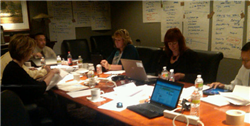
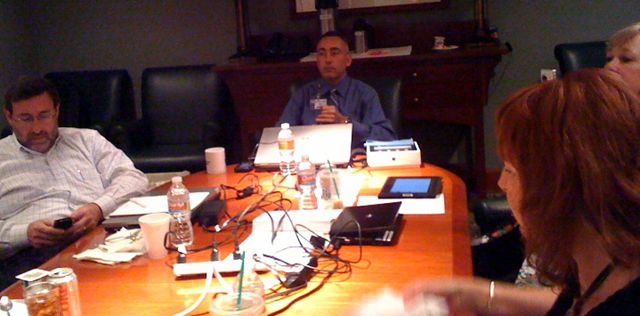
During my first two years at Texas Health Resources, I reorganized my staff, and then we got our strategy, tactics, and operations under control. After all the hard work, which paid off in great advancements, my team and I were ready to go deeper. This year, we opted for a new approach. What transpired during our two days alone was worth the time, money, and emotion. (You can see video of the retreat here.)

I asked our IT training leader to coordinate and facilitate our retreat. He spent six months participating in my direct report leadership meetings, observing and interviewing.

Thanks to his facilitation, the self-revelation and discovery proved transformational. After he led us to the point of openness and honesty, we called out every elephant in the room, banning any sacred cows. No unmentionables were allowed and no secrets, which was rough.

r4

As we let it all hang out, emotions ranged from anger to peace. We cried and laughed — executive therapy unsurpassed and revolutionary. Gestalt. My team told me some tough things like ‘make more clear decisions’, ‘appreciate diversity of styles,’ ‘have more respect for those in operations,’ and ‘tone down expectations.’

I needed to hear this. When I came home, my wife corroborated each one.

r5

Learning that we all struggled with similar issues helped us build trust and respect. To avoid slipping back into old patterns, we created new team operating principles. We redesigned our meeting structure and reworked our communications. And we agreed to have our facilitator regularly check up on us to ensure accountability and make refinements. We left exhausted, but balanced by hope.

When and why should you conduct a retreat? They say that a key differentiator between a good team and a great team is the quality of professional relationships connecting members. A retreat can help with this, especially as you first form a team, or when you feel the team’s effectiveness has plateaued. Every team has a dysfunction (or two) so you will never be short on content.

I’ve set out to do an annual retreat if for no other reason than to keep us from going backwards. A retreat, done right, can be the catalyst for pushing the team to the next level of effectiveness faster. If you focus on prescriptive methods that target specific areas for improvement, you can reengage on what is most important. Artfully creating a transparent atmosphere leads to discussing difficult issues and even to broaching the unmentionables. Ideally, you’ll find a cleansing of the souls, and people will focus on what’s important rather than personal agendas.

r1

These are the keys to success within the leader’s control.

Situational Leadership
Understand the fine line between running the retreat and contributing as a participant. At certain times, I expanded on ideas and offered opinions and feedback. On other occasions, I sat back and observed, allowing the team to speak and interact freely. A pre-session discussion with the facilitator taught me when to contribute and when to back off so the participants wouldn’t shut down. To aid the process, he facilitated the meeting, soliciting responses and redirecting discussion.

High Tolerance for Ambiguity and Patience
in order to uncover and discuss the significant issues on a progressively deeper level, the facilitator follows a certain process. As CIO, I had to have faith in this process and patience for it to unfold in an appropriate manner. Occasionally, I wanted the retreat process to move faster especially during the initial topics. The participants, however, had to be brought to deeper levels systematically; otherwise, they would not be transparent enough in the latter part of the agenda. I had to exhibit positive behavioral attention and body language to demonstrate my approval of the process.

Humility
This was tough. I had to exhibit a willingness to draw out and hear feedback, both positive and critical. Success depended upon my authentic desire for improvement. This behavior cannot be forced. It’s either within the CIOs behavioral acuity or it’s not. If not, other objectives will need to be identified for the retreat to prevent further damage that can occur at the team level.

Transparency
A higher degree of transparency will bring a higher degree of retreat success. Although the CIO does not (and should not) become a completely "open book" during this session, the more sharing of his work, priorities, strategy, and thought processes, the better the outcome.

Trust
A CIO must exhibit a strong level of confidence in his direct reports and faith in their skills and abilities. Recognize their willingness to improve and keep in mind that all people learn and improve at different paces. And believe that the retreat process will make a difference if completed well.

Continuing Commitment to Growth
The CIO must understand and embrace the reality that improvement on an individual and team level is a continuing process. A retreat alone will not create a lasting behavioral change, so commit to on-going professional development.

Expectations Identified 
Make your expectations clear. That is, the purpose of the retreat is to help move the team to the next level of performance (or whatever objectives the CIO has identified). Leave no doubt in the participants’ minds about what the retreat is to accomplish, how success will be measured, and what the subsequent steps will be. 

Of course, in all these steps, success is equally dependent upon the skill and experience of the facilitator. The more experience the facilitator has, the higher the level of success. Michael Cholette served us brilliantly and was a key contributor to the content of this post.

Do you have what it takes? Got courage? You’ll need it if you want to see a revolution happen from the inside out at work. So step out of the box and try something new. Redefine your retreat. Boon times ahead!

Update 6/17/10

The retreat was held specifically for my leadership cloud. Save for requisite HR stick-and-box org charts, we use more of a protean organizational structure that allows for greater flexibility and agility. In this case it was my CMIO, CTO, and leaders representing applications, value realization, and our hospital IT clouds. So to Dr. Stein’s point, we did have the only MD engaged that is in my cloud.

My strategy was to begin with my cloud first. If we could nail it and get results, we would extend outward. Early returns are strong. As pointed out, we are blessed with an IT training manager who was an executive coach prior to joining our organization. Remember, he spent six months (!) with us observing before we had the retreat. That familiarity and comfort was a key to success.

Ed Marx is senior vice president and CIO at Texas Health Resources in Dallas-Fort Worth, TX. Ed encourages your interaction through this blog. Add a comment by clicking the link at the bottom of this post. You can also connect with him directly through his profile pages on social networking sites LinkedIn and Facebook, and you can follow him via Twitter – User Name “marxists.”

News 6/11/10

June 10, 2010 News 6 Comments

helios

From Vic Damone: “Re: Eclipsys Helios. I think that this is a capital idea. No company today can meet all needs of the enterprise. Look at all of the Microsoft-based products out there or, perhaps even more similar, look at all the add-on products for an iPhone. Even in the Epic world there has been a lot of custom development, either by Epic or sometimes by the client. There was none in the Eclipsys world, at least on the Sunrise side.” Agreed. It’s cool. Cerner has something similar, giving clients access to the code hooks to customize and extend their apps. As a customer, you definitely want that.

From CPAhole: “Re: Allscripts. Over $650 million of Goodwill and Intangibles, most of which should be written off as the products are abandoned. That does not include at least $50 million in acquisition costs associated with the Medinotes/Bond acquisition. There will be many past sins buried in the Eclipsys reorganization costs.”

merge

From PACSman: “Re: Allscripts. Glen Tullman was the mentor to Michael Ferro in Merge Healthcare’s takeover bid of AMICAS. IMHO, Merge will be the next Allscripts acquisition IF they can stay alive for the next 6-12 months.”

From Lederhosen: “Re: Eclipsys and HIEs. HIE strategy eludes me totally on both vendor and client side. Is it really sustainable? Why do two or more competing health delivery organizations want to participate? How many interfaces need to be supported? We’re still struggling just to get EHRs up or just trying to get a provider to use a PC.”

From Wildcat Well: “Re: Philadephia. Why was an EMR/PHR guy called up for a fourth presentation to Comcast’s top brass?”

From Fan # 2333787: “Re: eClinical Works. Has Sam’s Club quietly discontinued their partnership with eClinicalWorks? The link that they originally publicized is now redirected to their main page and a search brings up nothing relevant.” eCW will provide an official response to your question, but advises in the meantime that some of the Sam’s Club health offerings have been moved under Walmart Health and Wellness. More to follow.

dalesanders

From GoGreen: “Re: Dale Sanders. You were interested in how Northwestern University’s school of medicine CIO Dale Sanders ended up in the Cayman Islands. Please send Inga there to get a first-hand report. Many thanks for your excellent site!” I’ve been to the Caymans several times and I’m pretty sure I remember seeing telephones there, so instead, Inga could call him from home while she stands in a sandbox wearing a bikini just to get the island flavor. I’ll pay for her braids. 

stockell

Inga and I appreciate the support of Stockell Healthcare Systems of Chesterfield, MO, a brand new HIStalk Platinum Sponsor. The company’s tagline is The Revenue Cycle Information System Company, including its InsightCS suite that streamlines patient access, reduces payment delays and denials, manages payer rules upfront, and submits cleaner claims with better point-of-service collection. Specific solutions include revenue cycle management, patient access, patient accounting, order management, reporting, worklists, and business intelligence, all built on the .NET framework and using scalable Microsoft technologies such as SQL Server and Reporting Services that lower the cost of ownership. We thank the folks at Stockell for supporting HIStalk.

hilo

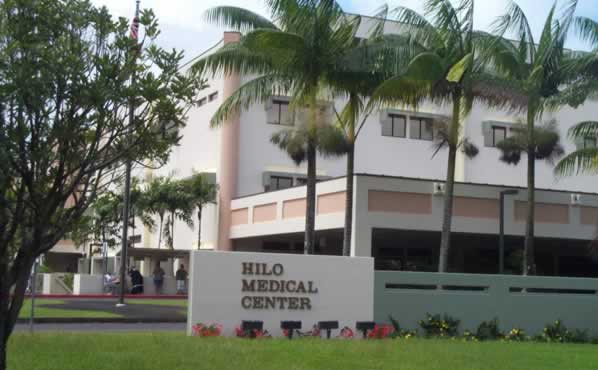
This is a fun idea: Hilo Medical Center (HI), which converted from paper to Meditech in May in a project it calls Health Connect, names its Health Connect Baby, the first newborn brought into the world using its new EMR.

I said in 2007 that I thought Second Life was clunky and pointless despite all the hospitals and webheads raving about how transformative it was going to be for business and consumer commerce. Maybe in a virtual world, but in the real one, Second Life parent Linden Labs is tanking. Predictably, Second Life proved to be as pointless for corporations as it was for everybody else, although the article mentions that Children’s Memorial Hospital (IL) is doing something that doesn’t sound all that useful on it. My words from 2007: “I tried Second Life once and was bored after a few minutes of fumbling around, but apparently it’s quite the hit, especially for nerds whose First Life isn’t what they’d hoped.” Twitter will be next, I predict, like any other tech fad that’s overrun with spammers, corporate marketers, and creeps.

HIMSS promotes John Hoyt to EVP, Organizational Services, which apparently includes running HIMSS Analytics since Dave and Mike bailed bailed for greener ($$) pastures. I know John from his Martha Jefferson Hospital CIO days. Hospitals considering Cerner knew to call him about the rampant performance issues Millennium was having back then in his little hospital. On site visits, I thought the hourglass was a screensaver.

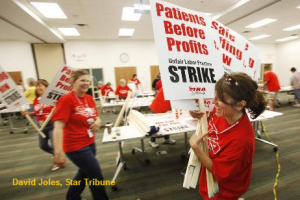
The Minnesota nurse strike happened Thursday, with 12,000 of them walking off the job at 14 hospitals. The planned sympathy strike in California was blocked by a judge. Agencies charged up to $2,000 and more to provide replacement nurses for the day, including an extra day of orientation. Want to bet that some of the strikers came back as agency nurses for the day, covering a different hospital to avoid detection? Seems suspicious that the strike was supposedly over the nursing shortage, yet replacements were found.

Now I’m really glad I moved HIStalk to a new server last week. The Allscripts-Eclipsys news sent traffic through the roof, with over 8,200 visitors on Wednesday alone. Without the new hardware, you’d have been looking at the same hourglass as those early Millennium clients. Of course, HIStalk reported it first, thanks to Inga being up and about in the middle of the night on Twitter and Facebook (insomnia, she claims) and readers who e-mailed me from Europe and elsewhere, allowing me to send out the blast well before 7 a.m. Eastern. A reader comment: “Thanks for the excellent coverage that HIStalk provides. I got a call from an investor advisory company asking me to do a conference call about the merger. Not having seen the news, I was blindsided, so while the person was talking, I quickly turned to HIStalk, got the general info, and sounded completely informed and up to date!”

I always urge readers to put their e-mail addresses in the Subscribe to Updates box to the right. Signups were heavy Wednesday, so I’m guessing my dire warnings were accurate: know-it-alls who got the Eclipsys news before daylight Wednesday because they’re on the list must have started contacting colleagues to smugly tell them the news. That’s what I would have done.

holon 

Holon gets a double welcome: one as a new Platinum Sponsor of HIStalk, but a second as a new entrant into healthcare IT. The Atlanta-based Holon (from the Greek holos, or “whole”) offers its Holon Process Adaptability Interoperability Framework, an enterprise application integration (EAI) platform that supports interoperability, data exchange and translation, workflow, a rules engine, and document management capabilities. The hardware- and software-agnostic solution lets hospitals extend and enhance their existing systems without resorting to point-to-point connections, thereby easing the transition to CPOE and challenges with Meaningful Use. Obviously there’s a lot of interesting detail on their site, particularly on the downloads page. The company is new to healthcare, but its parent and executives have a long history of providing tools to accelerate workflow and enhance business processes (not to mention that some of its execs have deep healthcare roots). Thanks to Holon for choosing HIStalk to get the word out.

Our own Dr. Gregg Alexander uses Eclipsys PeakPractice in his practice. His thoughts on the Allscripts acquisition are on HIStalk Practice.

Texas Medical Institute of Technology is offering a free Webinar on bar coding solutions from pharmacy to bedside, with speakers that include Charles Denham, David Bates, Eric Poon, and some other high-profile presenters. It’s next Thursday, June 17, at 1:00 p.m. Eastern.

TPD is updating his iPhone Apps List, so let him know (through me) if you’ve seen something interesting.

Jobs: Ambulatory EMR Administrator, Clinical Process Consultant, Soarian Clinicals – Plan of Care, Soarian Pharmacy and MAK.

A New York Time article says rural Iowa clinics are the first in the US to use telemedicine and telepharmacy to remotely dispense abortion pills.

An employee of Phoenix Health Systems, contract IT services provider to Salem Hospital (OR), is arrested for allegedly causing $200,000 worth of damage to a hospital administration building by stuffing a drain with paper towels and leaving the water running. I guess he wasn’t clever enough to be a hacker.

The VA announces an $80 million technology competition for solutions to its biggest problems, targeting areas such as telehealth and clinical applications that integrate with VA systems.

welch

I really like this article: librarians at the William H. Welch Library serving the medical school, public health school, and hospital at Johns Hopkins University are transforming themselves into “informationists” who work side-by-side with researchers and students to help them find the information they need. The goal is to shut down the central library, which is scarcely used in an electronic information age, and to make “the library be wherever you are.” I’ve always said librarians and HIM people should be the stars of the healthcare information age, except nearly all of those I’ve known are quiet and passive. I’m not judging — IT and finance people are often like that, too since that’s what draws them to those fields instead of being salespeople or entrepreneurs.

A strange new medical research finding: almost 8% of people studied had sexsomnia, a propensity to have sex while sleeping. It was three times as prevalent in men (insert your own punch line here).

E-mail me.

HERtalk by Inga

From Joe: “Re: EMR warning, in response to Suzy RN. Although you make some great points, I believe you are directing your ire in the wrong direction. It would be Dr. Blumenthal’s evangelism that is creating plenty of angst and running our patient care quality and integrity of our physicians off a cliff, But, this is not a message he invented. He is, like a good soldier, merely working hard to promote the message from the White House and with the WH’s CTO breathing down his back and insuring he stays on message. Our industry must take our messages of caution and slowdown to Secretary Sebelius and 1600 Pennsylvania Ave.”

eclp

Like unsavory ambulance chasers, several law firms commence investigations into “possible breaches of fiduciary duty” and other violations associated with the Allscripts/Eclipsys acquisition. Must we?

wakemed

WakeMed Health and Hospitals adopts Clinical Xpert Billing, a charge capture solution from Ingenious Med and Thomson Reuters.

mPay Gateway announces the general availability of its Advance Payment Plan, an enhancement to its point-of-care product that allows physician offices to establish patient payment plans.

I’ve spent the last couple days talking to all sorts of people about the Allscripts and Eclipsys. In general, people tell me they believe it’s a good move and especially beneficial to Eclipsys. Allscripts brings a strong management team with a proven track record of merging companies and products. Allscripts also has one of the strongest marketing machines in HIT. Allscripts has a strong ambulatory EHR solution (or three or five) which will appeal to many health systems in Eclipsys’ sweet spot. Meanwhile, Allscripts increase its chances selling EHR to more of these large health systems. Of course there are many unknowns and uncertainties (what products, management structure, integration, company cultures etc.) but I don’t see the move as some disaster waiting to happen. In fact, it might actually work out pretty well on several fronts. It will be fun watching it unfold over the coming months.

Emdeon taps Franklin Baumann, MD as chief medical officer to provide clinical oversight and strategic planning for Emdeon’s Interactive Care Management suite. He has served in clinical leadership positions at UnitedHealthcare, Dreyer Medical Clinic, and Rush-Copley Medical Center.

Colorado Casualty Insurance files a federal lawsuit that contends it’s not liable for reimbursing the University of Utah for $3.3 million in costs associated with a 2008 data breach in its hospital. The case is related to the theft of backup tapes containing PHI for 1.7 million patients, which were stolen from a private vehicle belonging to an employee of a secure storage company. This may be a case to watch.

RealMed signs a multi-year claims processing agreement with UHealth, University of Miami Health System, and the UM Miller School of Medicine.

popovich

Henry Ford Hospital (MI) names Dr. John Popovich its new CEO and president. Popovich, a pulmonary disease and critical care medical specialist, has been with Ford since 1975.

Siemens Healthcare enters an agreement with SSI Group to resell SSI’s ClickOn LinX technology for claims editing and transmission.

Start-up company Healthrageous secures $6 million in Series A financing for its personalized health technology platform. The solution was developed with Partners Healthcare Investors’ Center for Connected Health.

stellaris

Dell continues to make hay in healthcare, inking a deal with Stellaris Health Network (NY) for hosting of its Meditech system, disaster recovery, and network and application support.

I was fascinated by this article that highlight the success of electronic health records in a small town in Spain. They informed citizens via radio announcements that they could electronically schedule appointments and renew prescriptions. Patients asked doctors if they could use it, which led physicians to adopt it. Doctors and pharmacists are encouraged to manage drug costs. Not sure how much of the Spanish approach could be translated to the US, but perhaps there are a few gems there worth stealing.

A few sponsor updates to round out your week:

  • Mary Staley-Sirois joins DIVURGENT as a principal responsible for leading the company’s clinical transformation practice.
  • Rich Fishback, formerly with Thomson Reuters and MercuryMD, has joined Salar, Inc. as RVP of sales for the Southeast, where he’ll lead sales efforts for the company’s electronic documentation and charge capture solutions for hospitals. 
  • North County Health Services (CA) selects Sage Intergy’s EHR, practice management and community health center modules for its 53-provider practice.
  • Ingenix completes a system-wide rollout of enhancements to its CareTracker EHR, providing physicians the capability to demonstrate Meaningful Use.
  • Caritas Christi Health Care (MA) deploys MedAptus’s Intelligent Charge Capture suite.
  • MED3OOO signs a multi-year agreement with RealMed to provide claims processing.
  • maxIT Healthcare announces creation of a new healthcare management consulting division, led by former Dearborn Advisors SVP/Partner Reese Gomez.

inga

E-mail Inga.

Industry Reaction – Allscripts To Acquire Eclipsys

June 9, 2010 News 13 Comments

We have industry reaction to today’s announcement. Let’s start with some random thoughts from Mr. H and Inga.

eclp 

mdrxeclp

Some thoughts about Eclipsys

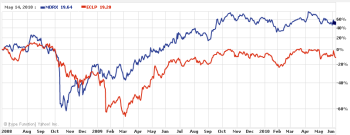
  • Above are the two-year share price graphs, with Eclipsys in red and Allscripts in blue. ECLP shares are trading at about half their 1999 price.
  • Phil Pead’s background is selling companies, which Eclipsys has desperately been trying to do for many years with no takers (allegedly). He’s been with Eclipsys for almost exactly one year and surely gets the credit for finally finding a buyer.
  • Eclipsys started with a relatively small number of big academic medical center clients on the old TDS platform and has struggled to convince them to upgrade to Sunrise (a product it acquired) instead of choosing a new vendor.
  • Despite the arguably superior CPOE and clinical documentation capabilities of Sunrise, it has competed poorly against Epic and Cerner.
  • Nearly 40% of ECLP revenue supposedly comes from about 20 big customers, with one of those contributing about 10% of the company’s revenue. That one big Eclipsys customer is supposedly North Shore – Long Island Jewish, subject of a September announcement involving its $400 million effort to connect its 7,000 doctors and 13 hospitals with … wait for it … Allscripts. Surely that customer and its Eclipsys relationship had a large impact on the Allscripts acquisition interest. Obviously Allscripts needs to keep NSLIJ very, very happy.
  • Eclipsys most likely paid big money for its recent acquisitions, buying the former Medinotes/Bond practice EMR products, EPSi financial management, and Premise throughput management as it desperately sought to diversify away from its at-risk Sunrise user base. Those acquisitions didn’t seem to do much for the company’s performance.
  • Eclipsys ran through a long line of executives whose tenures there were unremarkable.

    allscriptslogo

Some thoughts about Allscripts

  • Some of the announcements referred to the deal as a “merger” and some Eclipsys communications implied that Eclipsys was the acquirer, but that’s spin: this is an outright Allscripts buy.
  • The new company will have a large footprint, but that’s usually more about sales than it is product performance, integration, or customer satisfaction.
  • Glen Tullman is a more competent executive than anyone who has ever run Eclipsys. As was the case with the Misys merger, he gets operational control.
  • It’s late in the HITECH land grab to try to integrate companies and products in the hopes that enough hospitals are left that haven’t locked into their vendor partners to prepare for Meaningful Use. This would have been a much better deal a year ago. Companies should be focusing on execution in the heat of HITECH, not trying to bolt two companies together.
  • Allscripts will have an even larger roster of competing practice EMR products. Surely they will not all be go-forward products, especially the Allscripts version of MyWay that Aprima (formerly iMedica) sold them while keeping their own rights to it, then vastly improving it to sell under their own name.
  • A minimally appreciated benefit of the deal is that Misys, always a stiff and awkward US healthcare IT player that didn’t seem to have its heart in anything but UK banking software, is out of the picture. That should be greatly beneficial to Allscripts.
  • We checked the registration date of the new site OneAllscriptsEclipsys.com. It was May 6, two days after Eclipsys announced results.

Thoughts about today’s conference call

  • It was touted that both companies run on Microsoft platforms, but the key is whether Allscripts is good at integrating products.
  • Glen Tullman says there is little product overlap, but they company will have four PM/EMR products plus Tiger, which is already being retired.
  • Sunrise Ambulatory wasn’t on the slides of the combined solution set that we noticed.
  • Assuming Peak Practice and MyWay are similar and PeakPractice is the sexier one, will they retire MyWay? It’s sold through the reseller channel, which will make some folks unhappy if so.
  • Allscripts needs top-line growth, so the (theoretical) combined market gives it a way to (theoretically) grow.
  • Dumping Misys allows Allscripts to control its own destiny, including investing in technology to a degree that Misys was unwilling to do.
  • The combined company will enjoy an 8-10% growth rate, the company says, which doesn’t sound impressive if we really are starting the “single fastest transformation in HIT.”
  • Helios was mentioned more than once as a go-forward product. It’s the recently announced Eclipsys capability to open up Sunrise to independent developers.
  • The usual synergies were proclaimed (firing redundant managers and back-office employees, cutting the cost of running two publicly traded companies, streamlining sales and marketing).
  • Allscripts shares were down nearly 10% today. Misys shares were way up on the news it was cashing out. Eclipsys shares were up around 3%. Investors don’t seem to like the deal so far.

Unanswered questions

  • What will the go-forward ambulatory products be?
  • How will key Sunrise customers react to having their vendor absorbed into a larger entity that has historically had less focus on hospitals?
  • What’s the HIE strategy — Medicity, dbMotion, MOSS, something else?
  • Will Allscripts EHR clients with IDX financials be a big target for Sunrise?
  • What happens to the arguably most valuable Eclipsys executive – John Gomez?
  • What’s the benefit of the acquisition to Eclipsys and its customers?
  • What happens to sales of both companies now that the merger has been announced, yet won’t be consummated for months? Prospects hate uncertainty and HITECH forces them to decide somewhat quickly.

We hand-picked some of our readers with deep expertise to provide their analysis, some of which we agreed to run anonymously.

Jeffery Daigrepont, SVP, The Coker Group

jd

It’s an interesting merger, but not a surprising development in that Eclipsys and Allscripts were the few remaining vendors without an alignment strategy to the opposite side of the coin. This announcement comes not long after NextGen acquired Opus and Cerner’s more aggressive move into ambulatory. 

Vendors are clearly getting prepared for hospitals getting back into physician employment and their desire to have a single vendor solution. Therefore the market is wanting to have “one throat to choke” when it comes to selecting a vendor for all of its integration needs. I also think Epic is dominating the inpatient space because they have been so far ahead in offering a true integrated solution for several years now. The other inpatient vendors are having to play catch up and it’s faster to merge than try to build. 

The market should expect some clunky workflow for several years while they try to blend together their platforms, although I am sure the spin machine will sell this as one patient record harmonizing seamlessly across every location of care. The press release is already indicating ONE unified record. I just wonder which of the eight EMRs will emerge as the system for housing the ONE record.

It’s also worth pointing out that both vendors have made past unsuccessful attempts in crossing over own their own. Eclipsys acquired Bond Medical a couple of years ago and has not been successful getting it off the ground. Allscripts tried the same with some inpatient technology as well. Neither could penetrate this market.

It’s also going to be interesting to see how the company operates in terms of where and how they focus their attention. For example, Meditech, Cerner, HealthLand, etc. can offer both inpatient and outpatient technology, but no one will ever accuse these of being ambulatory vendors. Vendors will generally tilt in one direction and will also focus their time and efforts accordingly.  

As for the market’s reaction, it’s going to be interesting to see how this ONE new company can manage so many overlapping products and solutions in this new age of certification and system compliance standards. The timing of this merger is interesting because it comes on the heels of Meaningful Use. Does anyone really believe they will keep all of their overlapping systems up to certification? I suspect they will start commercially discontinuing products that are not considered modern, such as all of the Misys baggage on the Allscripts side. 

After this merger, the new company will be trying to support eight EMRs systems and five practice management solutions with a sprinkling of inpatient technology. I could be wrong with this count, but it’s fair to say they have a boat load of duplication, the most of any vendor in the market. Customers buying from this new company should seek protection from their system being discontinued in the next couple of years as they move to their dream of ONE record.

Hospital CIO and Eclipsys Customer

Sounds like Glen Tullman pulled another fast one. This is the same type deal he architected with Misys. Glen controls the management suite, where all the real decisions are made, and the other company controls the board room. 

Non-Competing Vendor CEO

This is an Allscripts response to the NextGen inpatient deal. Allscripts was probably feeling pressure to have a complete solution for the bundled payment/ACO market. They were probably feeling they couldn’t live up to market expectations. This will provide enough accounting confusion for the next several quarters to hide any shortfall in organic performance.

Bill O’Toole, O’Toole Law Group

This is a great move for both companies. Allscripts has proven itself in the ambulatory world. Physicians on a selection team for an HIS at their associated hospitals will look favorably on the new combined company based on their prior experience with Allscripts. Eclipsys gets a new image, sort of like your father’s Oldsmobile being merged with the Corvette. No offense intended to Eclipsys, but in my days at Meditech I was surprised if they were up against us as a finalist. I believe the growth of the combined company will greatly exceed the individual growth expectations of the separate companies.

Investment Banker

The combined business looks great on paper with little overlap in capabilities (PeakPractice being the biggest one) and a substantially bigger platform. The challenge will be integration, of which this will be the largest attempted in this industry for a while. Even though they have a highly talented team, the challenges will be significant.

I would ask why two companies that have strong growth opportunities on their own (as they have constantly communicated to investors) would see the need to take on massive integration risk in a market that presents once in a lifetime growth opportunities.

Eclipsys Physician Practice Customer

I don’t think this’ll have a major impact on my little neck of the trenches for the foreseeable future. These acquisitions / mergers aren’t shocking given that we all know they’re going to happen in this period. I’m guessing bigger ones are in the works even as we type.

Though their press release really doesn’t address it (nor does it address the plans for the “Helios” platform which I hope continues), I know that they’ve recently sold millions of dollars of PeakPractice (originally, Bond Technologies’ “Clinician”) to some large companies and I was told the PeakPractice development team would be receiving even greater resources now. Of course, things do change, including corporate direction, but personally, I’m not worried about my software yet.

Todd Cozzens, CEO, Picis

todd

There is an increasing trend for general practitioners to be employed by hospitals, but an opposing trend that specialist areas like emergency and anesthesia are outsourcing physician services.  So net/net, though on the surface it makes sense to combine the two areas, there is no real market force pushing for an end-to-end hospital-to-physician EHR. To the contrary, the one thing that really is taking off with lightning speed from ARRA is interoperability within and outside the hospital enterprise.

I can cite 10-15 real examples of systems already pushing CCDs among disparate EHRs, for example. Hospitals just aren’t in a position for wholesales swapouts of their IT systems across the board — it’s too disruptive and expensive. The new interoperability mandates will allow more modular approaches to building out EHRs.

With regard to the high acuity market, the merged entity will have an ED product from Allscripts, an ICU product from Eclipsys, and I assume they will acquire an OR product. So they will look like a company that’s serious about high acuity, which I think is good because it endorses our long-held belief that hospitals are becoming big high acuity care centers as the population ages and needs these services more and less acute services move out.

That’s where it stops. Our high acuity suite has been integrated and developed now for seven continuous years, has much deeper functionality, and is much more intuitive than a loose patchwork of independent applications. Our investment in analytics and interoperability with the big EHRs is starting to really pay off as well as we are the go-to, embedded high acuity enterprise suite for a growing number of IDNs. The proof? Tell me which HCIT other than us has taken on over 100 net new hospital customers in the last two years. Not even Epic has done that.

Is it too late in the HITECH game to be making a major acquisition? No, I think they’re trying to build a sort “shadow” Epic and it does make sense, as I said, on the surface. This deal definitely helps Eclipsys a ton more than Allscripts, however. And don’t forget the last time a physician-focused system company took over an in-hospital EMR vendor — IDX taking over Phamis and the subsequent sale of that mess to GE. That was a Harvard business case on how not to execute post-merger.

What happened there is that selling small ticket items to docs is totally different than mega-systems to mega IDNs — it’s kind of like Cessna buying Boeing. And then you have all these legacy technologies and systems — Allscripts with 3-4 legacy physician systems and all the legacy technology still embedded in Eclipsys. Any customer that thinks some sort of new, singular, integrated, magical, cloud-based, miracle hospital / physician solution is going to suddenly appear on the market in the next 5-7 years from this entity will be seriously misguided. Huge execution risk here. Good time to be a duct tape and bailing wire salesman, however.

All the market dynamics are in place for further consolidation. ARRA HITECH and healthcare reform — the perfect storm. I don’t subscribe to the idea that it’ll be Google or Oracle or Microsoft that will drive the consolidation. I think it’s more than just a technology convergence. I see much grayer lines between payors and providers and enabling technology providers that make the system much more transparent for the three P’s – payors, providers, and patients. 

Margin pressures are already forcing payors and providers to both to think very differently. The two things that healthcare reform were supposed to fix — cost and quality — aren’t going to improve at all for the vast majority of patients, providers, and payors. Something has got to give, or else healthcare passes 50% of our GDP by mid-century. If you look at other industries that had this pressure, it was things like supply-chain integration and other forms of co-opetition among former adversaries that drove change and finding ways for all to make money. It’s actually a time of huge opportunity. 

Allscripts to Acquire Eclipsys for $1.3 Billion, Misys to Sell Its Stake

June 9, 2010 News 25 Comments

image

Allscripts announced this morning that it will acquire Eclipsys for $1.3 billion in an all-stock transaction. Misys PLC, the 55% owner of Allscripts, also announced that it will sell most of its interest in the company to allow the acquisition to proceed, reducing its holdings to less than 10% of the merged companies.

The proposed transaction values Eclipsys at $1.3 billion, a 19% premium to Tuesday’s closing share price.

Allscripts CEO Glen Tullman will serve as CEO of the new company, while Eclipsys CEO Phil Pead was named as its chairman.

Tullman was quoted in the announcement as saying,

We are at the beginning of what we believe will be the single fastest transformation of any industry in US history,and the combination of the Allscripts Electronic Health Record portfolio in the physician office and leadership in the post-acute care market, with Eclipsys’s market-leading hospital enterprise solution creates the one company uniquely positioned to execute on this significant opportunity. Our vision and the vision behind ARRA is to leverage information technology to create collaboration between providers in all care settings, helping to improve the quality and lower the cost of care. The merger of Allscripts and Eclipsys creates one company with the scale, breadth of applications and client footprint to bring that vision to life by connecting providers in hospitals, physician practices and post-acute organizations across the country.

The deal is expected to close in 4-6 months.

The companies will hold a webcast at 8:00 this morning Eastern time, open to all here or by telephone at (877) 666-7021.

Rumor of the merger was reported on HIStalk on April 12 by Thad.

image

Update: the company has created a new site about the merger that includes a FAQ, merger benefits, and facts about the combined companies (warning: PDF).

News 6/9/10

June 8, 2010 News 12 Comments

From Mandy Manilow: “Re: HIEs. I am trying to determine whether HIEs are eligible for Meaningful Use reimbursement from ARRA.” I don’t think so, but comments are welcome. HITECH funds HIEs through (a) money for individual states to distribute as HIE grants, and (b) the Beacon Community program. Neither are specifically related to Meaningful Use as far as I know since that’s for providers. Some of the presumptive MU requirements for those providers involve sharing data via HIEs, but that’s to qualify for their own ARRA money.

From The PACS Designer: “Re: iPhone 4 arrives. The iPhone 4 is announced, with dual cameras which Apple calls FaceTime video calling. Also in the new iPhone 4 you’ll find 960-by-640 resolution, multitasking, and HD video recording. The case is a new ultra-durable glass, scratch-resistant and virtually unbreakable.” Steve Jobs repeatedly urged the 570 audience members using WiFi during his demo to get off since he couldn’t connect (video above). All the Apple fanboys have to breathlessly Tweet the conference in real time to their home-bound peers, of course.

From MaxPayneUK: “Re: iSoft apologizes. The question is whether iSoft’s shareholders are being served well by its UK division’s management.” iSoft formally apologizes for blaming its revenue shortfall on the UK’s political climate, which the company originally said had hurt its revenue by slowing down NPfIT. Shares are down to $0.28, even after a successful, much-delayed go live at Morecambe Bay, dropping the market cap to $290 million (I assume that’s in Australian dollars, each worth about 83 cents US). If it wasn’t for the company’s UK exposure, you’d think a US company would grab it.

Listening: reader-recommended Paper Tongues from Charlotte, NC, an amalgam of positive hip-hop and rock that’s hard to characterize, but eminently listenable (to me, it’s Flo Rida meets Muse with a soupcon of Beastie Boys, an admittedly odd admixture). They’re at Bonnaroo this weekend, then touring all over the place.

gary

The local paper writes up the Epic implementation at Methodist Hospitals of Gary, Indiana (or Gary Methodist as we used to call it when I worked for a vendor).

Cedars-Sinai CIO Darren Dworkin is quoted in a USA Today article about the iPad:

It won’t magically solve all our issues, because medical data-entry will still require a computer (and keyboard), but the iPad could be the next evolution in sharing information with patients. We’re eager to make the evolutionary step from doctors entering information with their backs to patients to holding a screen that they can then turn around and share. It’s early stages yet, but there’s great potential.

This just in from the Weird News Andy breaking news center … hundreds of patients in Australia in need of surgery, some for painful conditions or cancer, are ignored for up to a year after a hiring freeze prevents assigning someone to re-key information from their paper forms into the computer. WNA also notes that 11,000 unionized University of California nurses plan to walk off the job Thursday in sympathy with their colleagues from Minnesota who are protesting what they claim are unsafe hospital staffing levels. If a judge denies UC’s request to stop the strike, it will be the largest medical strike in US history.

Our super-CIO blogger Ed Marx has updated his Office Without Walls piece with answers to reader questions and added some pictures.

capzule

Webahn announces that its Capzule PHR is available for the iPad for $5.99.

St. Francis Hospital & Health Centers (IN) names David Mandelbaum, MD as physician champion for its Epic implementation.

celltrak

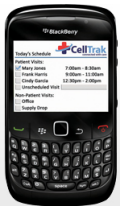
In Canada, Saint Elizabeth Health Care rolls out the CellTrak GPS-powered homecare system on BlackBerry devices.

GE Healthcare previews Centricity Dashboard at the SIIM conference that just ended in Minneapolis.

Anesthesiologists at New York Presbyterian Hospital report positive study findings in their use of an electronic system to hand off patients from the cardiothoracic OR to the ICU. It lets ICU employees monitor the patient’s surgical progress, reducing the time from closure to transfer.

Varian announces that its Aria oncology EMR has received Surescripts e-prescribing certification.

A former computer tech at North General Hospital (NY) is arrested for hacking into the hospital’s network after he was fired, when he allegedly logged in as a doctor and e-mailed employees that CIO Michele Prisco was a racist for firing him.

E-mail me.

HERtalk by Inga

One of these days, I hope to make it to an AHIP conference, which runs this week in Las Vegas. I’m sorry that I’ll miss MEDecision’s big bash on Wednesday, which features Natasha Bedingfield and adult beverages. My kind of party.

In addition to (or perhaps in spite of) throwing big parties, MEDecision apparently does a good job of keeping its employees healthy. The Philadelphia Business Journal awards the company a Healthy Workplace Award for encouraging physical activity and positive health choices among its staff.

Enterprise Software Deployment becomes a certified consulting partner of Eclipsys to provide implementation services for Sunrise Enterprise.

HIE provider Halfpenny Technologies acquires Laboratory Management Services, which specializes in clinical data acquisition and reporting for health plans and clinical labs.

mark laret

UCSF CEO Mark Laret joins the Nuance Communications board of directors.

Tri-City Medical Center (CA) will fire five employees who discussed patients on Facebook. Thee hospital did not provide details about the posts, but the CEO says the information did not include patient names, photographs, or similarly identifying information. Regardless of any potential wrongdoing on the part of the nurses, look for health systems to tighten up their social media policies.

Not that social media and healthcare can’t co-exist.The CIO of Children’s Hospital Los Angeles claims his hospital’s social networking presence has helped steer patients to its online portal, which is responsible for $3 million in revenue since 2008. Other CIOs claim social media has helped with patient recruitment and retention, as well as enhanced patient satisfaction.

West Georgia Health goes live on Hospital BPM, a analytics solution from Integrated Revenue Management.

NaviNet and MEDecision align to provide MEDecision’s Patient Clinical Summaries to any provider enrolled in the NaviNet Network.

Maimonides Medical Center (NY) implements Allscripts Care Management Solution, following up on its deployment of the Allscripts ED solution earlier this year.

Speaking of Allscripts, the company selects RemitDATA to broaden its revenue cycle solution offering for physician groups.

red bull stadium

Soccer fans are notoriously rowdy, but New Jersey’s new Red Bull Arena will be ready to address medical emergencies. The soccer stadium signs up Clara Maass Medical Center to provide EMS services at its event. The EMS staff will connect remotely to the medical center ED and its EDIMS system.

If you missed yesterday’s HIStalk Practice, then you won’t be able to steal my brilliant idea for an iPhone app. Not to mention you missed my musings on consultants and ambulatory EMR vendors and the latest recommendations from an HHS advisory workgroup.

Cook Children’s Medical Center (TX) selects Patient Care Technology Systems’ Amelior Tracker to track medical equipment.

Which reminds me: just this morning a friend was sharing that her teenage son got a summer job as a security specialist with a hospital. Turns out he is not some sort of patient bouncer, but will actually be helping perform inventory tracking.

seemyradiology1

Orlando Health will implement Accelarad’s SeeMyRadiology.com to exchange diagnostic imaging information, giving clinicians the ability to review medical image information via the Web or with mobile devices.

The University of South Alabama Health System engages MEDSEEK to develop a consumer Web site.

Streamline Health announces a first quarter loss of $1.2 million, compared to last year’s net earnings of $16,000. Revenues fell from $3.8 million to $3.5 million while expenses grew from $3.7 million to $4.7 million. Not the prettiest results, to say the least.

Susan Steele joins Precyse Solutions as director of marketing communications. She was previously with Siemens Health Services.

jwit

SCIOinspire introduces Just InTime Wellness, which uses predictive modeling  tools and clinical algorithms from health claims to provide patients with targeted health messages. Health plans or hospitals can use the system to send patient-specific messages about gaps in care or the need for prevention services. From a patient standpoint, it sort of sounds like Big Brother is watching over your medical record. On the other hand, who doesn’t appreciate a reminder every now and then?

Delta Air Lines will be the first US company to use OptumHealth NowClinic, a virtual clinic option offered through UnitedHealth Group. For $10, a patient can spend 10 minutes with a physician using a webcam and live computer chat.

Edward Hospital & Health Services (IL) goes live on CPM Marketing Group’s Instant CRM system, which uses behavioral targeting technology much like when Amazon recommends books based on your searching and purchasing habits. CPM’s president and CEO says the tools allow hospitals to create “up-selling and cross-selling opportunities.” Something like, “Would you like a rhinoplasty with that septoplasty?”

inga

E-mail Inga.

HIStalk Interviews John Holton

June 7, 2010 Interviews 4 Comments

John Holton is president and CEO of SCI Solutions.

john

It’s been a year since we’ve talked. What’s new with you and the company?

We’re doing well, especially given the economic challenges that the country’s gone through. Our revenues were up about 15% last year and we added about 62 new customers, so we’re over 400 now.

We’re seeing hospital clients starting to do a second generation of buying. They understand that access management is more than just scheduling and pre-registration, that it really focuses on taking a look at customer service for the physicians and the patients and starting the revenue cycle as early as possible, ideally in the physician’s office or better yet, in the patient’s home.

They’ve really been receptive to our ideas. We’ve been focusing a lot on self-service ideas over the years, looking at other industries and how they use self-service tools, either over the Web or things like kiosks, to offer a much better customer experience to their clients. We’ve been trying to apply a lot of these to the healthcare or the hospital environment.

What about patient scheduling? That’s your forte.

Some of the first things we’ve done are self-scheduling.  By self-scheduling, I don’t mean requests, I mean actually like an airline reservation, typing in the information, your appointment preferences and automatically, within seconds, getting back appointment choices so you can decide when to have the service. We’ve got hospitals where the physician’s offices do self-scheduling, as well as the patients in their homes self-scheduling various procedures.

At one SCI client, more than 40% of their outpatient volume is self-scheduled. We’re starting to see some real progress made in those areas. A lot of the hospitals are in competitive situations and understand that it’s so important to tie physicians and patients through the service end; but the good part about it is it also starts a revenue cycle out in the physician’s office as well, or in the patient’s home. We’re starting to see those two ideas really catch on in the industry.

The new stuff that we’re really excited about is kiosks for the patient encounter and for check-in. We think, just like in the airline industry where they’ve been a huge success, or in the banking industry where they’ve been a huge success for the ATM machines, that there are a lot of possibilities and benefits that can be applied to hospitals in really improving their patient flow and the check-in and making a better patient experience.

The other thing that I’m really excited about is our ordering product now connects directly to the physician’s EMRs, and the EMR integration that seamlessly initiates the scheduling and revenue cycle activities right from the physician’s exam room. You know there’s a lot of effort underway with the stimulus money to get physicians and hospitals to use EMRs and then to integrate those and pass information. This is really a first step.

What are the advantages?

Our ordering product, Order Facilitator, automates the orders from the community physicians to the hospitals and then coordinates referrals among the primary MDs to specialists. The purpose of the programs is really to track every order and make sure that they’re not lost and that they’re legible. We provide that information and eliminate lost orders.

The doctor’s office doesn’t get interrupted, patients don’t have to wait around when they come in because the order’s been lost and they have to call the physician. The revenue cycle for medical necessity and for authorizations gets started in the physician’s office, while they’re still fresh in his or her mind.

I think one big benefit is that patient care is actually improved now because we can track every order the physician makes, and every appointment that’s made by the patient, and give the physician feedback as to which patients are following through on their orders.

I was pretty surprised at an article that appeared in The Journal of American Medical Association that said that up to 40% of orders written by physicians don’t get followed through by patients. That really doesn’t help much for their physical well-being. We’re excited that even a product that’s as administratively focused as getting orders into the hospital is able to also affect patient care positively.

Order Facilitator, the original version enabled, you to enter the orders — usually by the staff or the physician — through a portal or you could fax them over and they would be automatically entered into the system and then passed on to the correct departments and worked through a revenue cycle tool to make sure that they were preregistered successfully.

But now, with our new version, we are connecting directly to the physicians’ EMRs. Rather than receive a fax out of the EMR, we’re actually getting a structured record which eliminates the need for entering the order by the medical staff or trying to index a fax. We’re really excited about this. This may seem kind of ho-hum, that everyone has order entry systems, but in fact, when you look into it, it’s a very challenging problem.

As the Meaningful Use criteria get put into play, we’re going to have to, as an industry, deal with a lot of the challenges and quirks that we uncover and find solutions to them. It’s a Meaningful Use criterion to get the physicians to enter in the orders into the EMR. I think in Stage 2, sending it to the receiving provider will be required as well.

The challenge lies in the fact that the hospital systems that are in place today require an order message to have a medical record number, and often an account number. The physician’s EMR doesn’t know either one of these numbers and the hospital account number hasn’t been generated yet. If you have employed physicians and you’re all on a single system, you might be able to solve this challenge because you can generate an account number; but you probably don’t want to because you’d be generating a lot of accounts that may not get acted on.

With community physicians on all different types of EMR solutions, you have a real problem on your hands. SCI designed our orders product, now in the new release, to make sure that it’s architected in a way that it doesn’t require either a hospital medical record number or an account number. Through the process of ordering directly out of the EMR, it leads a scheduler and the registration folks through a process that gets the right medical record number on the patient as well as the physician’s EMR number. We’ve been able to cross-reference these electronically, and pretty easily. Then we pass those on to the various systems within the various hospitals.

Really, what we’re trying to do here is much like the way the integration engines standardized interfaces between proprietary systems back in the ‘90s, maybe even a little earlier. We are now integrating the orders between physicians’ EMRs and various hospital systems that need those orders without having to require the legacy vendors to go back and make a lot of programming changes to their system. These are not trivial changes.

You mentioned your business is up. Do you think having this inordinate focus on electronic medical records will take away from your business or will it help it?

No, I don’t think it will take away from our business. Our business is up because we solve real problems with real benefits to hospitals. We can make a huge difference to their bottom line very, very quickly; and we have a business model which is subscription-based. 

For a very small amount of money on a monthly basis, you can get our software and our systems with our technical model of the Software as a Service. It deploys very fast relative to other large enterprise systems. Your return on investment, which is just a monthly fee — say it takes you four or five months to get this in. You’ve got five months of a subscription fee versus millions of dollars you may have paid under the license model.

Hospitals reap more benefits. The ratio of benefits to cost is so extreme that it’s a no-brainer in terms of doing this. What we found over the last year and a half or so is that when hospitals had capital equipment fees is where license vendors and others were having difficult hard time. The hospitals wanted to continue doing something and wanted to continue making improvements. They looked to vendors with these models that were easy to get started with and didn’t cost a lot to get in, but you could still make real gain.

I think that’s why we’ve been successful. I think the only gotcha, maybe, is that IT staffs have only so much bandwidth, so they may be focused on EMRs rather than other aspects. We’ve tried to address that by requiring almost no involvement by the IT staff, given that we host everything and do the interfacing and the stuff to run efficiently.

Do you think the HITECH Act will encourage innovation or will it discourage it?

I don’t know if it will encourage innovation. I think it will encourage better practices by some of the larger vendors. I think there may be a move towards more certification. The vendors will be more responsible for putting out better software and getting that software installed. We’re continuing to see some very bad software being offered to the industry.

One vendor that I won’t name recently introduced a product in our area of expertise. Instead of putting the time and effort into developing a rules engine and being able to implement fairly complex rules, they did nothing more than stick Visio flowcharts in their product. You could click on it if you needed to know the rules and a Visio flowchart would pop up in front of the telephone staff who were answering the phone. They had to go through and figure the scheduling process themselves.

Last time we talked, you were pretty pessimistic about uninsured patients, credit markets, bad debt, and self-pay. In the meantime, we’ve had healthcare reform. How do you think that will change the situation?

Healthcare reform, despite all the naysayers, is going to be a benefit to hospitals. We have 18% more Americans of the total population who will have insurance, so there should be more money in the system. Obviously there’s going to be more scrutiny through Medicare and cost-shifting.

The thing that worries me the most was not the government-supplied insurance, but it was the new high-deductible plans that are sweeping the nation now; the high-deductible plans where a person may pay the first $1,500 or the first $5,000 for the family. What happens is because there’s little price transparency — and we’re trained from our old system not to even ask about these things — a patient will come in and get a procedure not knowing the cost. It could be something as simple as an MRI after they’ve twisted their knee playing softball over the weekend and its $2-3,000. That’s significant money to lots of folks. If the insurance company isn’t paying that, then you have a real problem on your hands.

The research that I’ve read says that if you don’t collect self-pay money before the procedure’s done, you have less than a 40% chance of collecting it afterwards. It doesn’t matter what socioeconomic class the person belongs to — people just pay their healthcare bills last. What I’m concerned about, and what I’m seeing more and more with our clients, is bad debt being incurred in the self-pay portion of these patients’ bills. I still think that it’s a big problem that’s sitting on the horizon that our hospitals are going to have to deal with.

I always like to finish with your predictions since you’ve been pretty well on the money there. Tell me what you foresee for healthcare IT for the next three to five years.

I think the next three to five years is going to be a heads-down focus on these clinical products; getting those in and getting them going. I think we’re going to see a bit of a shakeout in the industry. This is really going to tell, among the big vendors, who are going to be successful.

I think companies like ours, which are focused on niches — but really big niches if you could call the revenue cycle a niche — are going to be very successful. I think you’re going to see the emergence of companies that are not today thought of as major financial players in the industry. Financial system providers in the industry will come to the forefront and you’ll see some new companies.

If we’re talking in five years, I think you’re going to see some new companies that are leading those areas. I think there’ll be a much clearer delineation between companies that provide financial systems for the hospitals versus those that provide clinical systems.

The third thing is that I’ve always been a big believer that large, outsourced business offices are going to have to be the way of the future. There are huge economies of scale that are available starting from orders, scheduling, and pre-registration functions, all the way through to denial claims management and collection agencies. That whole process can be done on a very large scale much more effectively and save a lot of money for the hospitals.

I would liken most hospitals to mom-and-pop shops in terms of their expertise and ability to do these things. I think that what we’re going to see is even more. The for-profit chains have been at the forefront of developing these large regional business office systems, but I think you’re going to see private companies coming in offering those services and more and more hospitals taking those up.

Monday Morning Update 6/7/10

June 5, 2010 News 21 Comments

strike

From Aldous Snow: “Re: possible Twin Cities nurses’ strike. If it happens, it will be interesting to see how the out-of-state nurses being hired will deal with the EMRs.” The nurses’ union threatens a one-day walkout Thursday over staffing concerns and benefit cuts, news of which flooded the Board of Nursing with out-of-state applicants willing to replace them temporarily. You are right — how do you get thousands of one-day replacement nurses trained on software? If the strike really happens, someone should document how many help desk calls result, how many patient incidents occur, how much information is recorded on paper until the A-team comes back the next day, etc. Since we’re talking a lot about software usability lately, this might be the ultimate test of it.

nuance

From Dr. Daneeka: “Re: Nuance’s physician-only weekend. I went last year as the lead for my employer and found the experience worthwhile. I think it would be good for those who support doctors as well. I think early reg was extended to July. Disclosure: I own a few hundred shares of Nuance stock, but it’s because I like the product.” Nuance’s healthcare user group meeting will be held in Boston November 7-10, with the physician-only part starting the Saturday afternoon before. Thinking ahead, if the Red Sox were to win the World Series that could end the week before, you’d be right in the middle of a big party like I was one year when I went there for recreational purposes. This wasn’t an anonymous post, by the way – it’s from a real doctor and friend of HIStalk (not a Nuance PR plant, in other words).

From The PACS Designer: “Re: 4G wireless. We’re going to be seeing and reading more about fourth-generation (4G) wireless in the near future. As a refresher, it all started in 1981 with analog wireless (1G), then advanced to digital wireless (2G) in 1992, and finally in 2002 we got spread spectrum transmission wireless with multi-media support (3G). Some early 4G wireless applications over the last few years where mobile WiMAX and long-term evolution (LTE). The new 4G wireless brings all-IP packet-switched networks, mobile ultra-broadband (gigabit speed) access, and multi-carrier transmission. A 4G system will provide for a secure all-IP (Internet Protocol) based solution that features IP telephony, ultra-broadband Internet access, gaming services, and streamed multimedia for users.”

From Parker Selfridge: “Re: HIT purchasing decisions. Who makes them in private practices and in hospitals? I can’t find anything that says specifically. Is it doctors and nurses?” I don’t have any physician practice experience, but in all the hospitals I’ve worked in, doctor and nurse selection team members had little say beyond expressing a preference that was overridden in every case. The clinician demo score sheets, site visit notes, and architecture reviews were weighted minimally compared to CIO/CFO gut feeling about non-clinical vendor factors such as business performance, industry word of mouth, alleged product integration, perceived risk, and an anecdotal review of what other hospitals (of the “informal benchmark” category) were buying at that moment. There was also strong resistance to buying what the cross-town competitor used because that would appear imitative (interoperability advantages notwithstanding). Certain vendors relied on the urge of C-levelers to override the white coats, knowing their poorly designed products would play better in PowerPoint in a plush conference room instead of in the uncarpeted hospital areas. Predictably, the clinicians resented the time they had wasted in providing ignored guidance and were therefore lukewarm in their adoption of the also-ran.

From V.B. Shadow: “Re: e-mail update. I read most of my e-mail by iPhone and prefer content that is viewable directly instead of sent as a link.” My experience with HTML e-mail isn’t so good – spam filters kick them out a lot and readers get a huge file instead of a text link. But I’m sensitive to vox populi – who would rather see the full post in the e-mail instead of just the link?

From Stanford Blatch: “Re: usability. I agree that usability is a goal, that some systems are more usable than others, and that you can make measurements that are objective. I think the BlackBerry is more usable than the iPhone, but others think the opposite. You can’t ignore the subjective user in usability.” See below – usability does not imply an overarching summary of all possible user preferences, only that they can efficiently complete  a set of defined tasks, i.e. order a lab or review active meds. Products with identical usability ratings aren’t necessarily interchangeable to individual users, and the entire user experience includes more than the specific task definition. And even then, I might prefer a lower-usability product for logical reasons.

drlyle

From DrLyle: “Re: usability. Thanks for pointing out the very real science of Usability. I too thought that ‘usability’ was too subjective to actually be used in evaluation, but have since gotten involved with the HIMSS EMR Usability Task Force and learned how very real the study and reporting of Usability can be. This task force put out a great white paper on this subject of Defining and Testing EMR Usability (warning: PDF) last year.” Also check DrLyle’s blog post and his podcast interview with a usability expert (Episode #17). This is a really good overview paper, with content that’s fresh, concise, and doesn’t kiss up to vendors. Some of its conclusions:

  • Usability may be the key reason that EMRs haven’t been more widely adopted.
  • Usability is directly related to clinical productivity, errors, user fatigue, and user satisfaction.
  • EMR usability is important because clinicians are mobile, doing distractive cognitive work while using the application, and not following a predictably linear progression of system use.
  • Usability principles include simplicity, naturalness, consistency, minimizing cognitive load, efficient interactions, forgiveness and feedback, effective use of language, effective information presentation (density, color, readability), and preservation of context.
  • Methods of evaluating usability of completed products include expert review, performance testing, risk assessment, and one-on-one testing.

poll060510

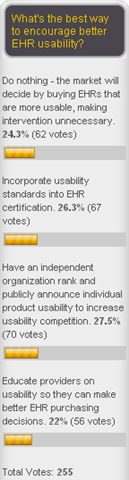
That a good segue to the results of my last poll, which are far from conclusive. You said the best way to encourage usability (but only by a microscopic margin) is to publish independent usability reviews. CCHIT has promised (warning: PDF) to do this at some point, but in a manner that’s pretty much worthless (asking a panel of usability experts to rate product usability after watching a vendor’s remote Webex demo, all without clinician involvement). Also, will their standards be absolute or relative? i.e., if all products are bad, does the best of the bad ones get a perfect score?

New poll to your right: from Parker Selfridge’s question, which group carries the most weight when hospitals buy clinical systems? Note that I’ve opened up an “add your own answer” field in case I missed one.

Thanks to Inga for capably covering for me while I took a little break. It’s nice having someone I trust to keep HIStalk going so I don’t have to worry about it. Before my break, I noticed that HIStalk was coming up a bit slowly on weekday mornings when hundred of readers hit the site at once, so I had it moved to a bigger server. Hopefully you’ll notice a positive difference. For my fellow nerds, it’s now running on a virtualized server with dual Xeon processors, 1.5GB of dedicated RAM, and hot-swap RAID-10 drives.

If you know mobile healthcare computing, are an excellent writer (a geeky medical resident would be cool!), and are interested in paid gig (part-time, permanent, fun, flexible) let me know.

Listening: Silversun Pickups, fresh, LA-based alternative rock. I’d call them Breeders meets Nirvana with some Red Hot Chili Peppers thrown in. Like it lots.

invisblebracelet

A Fort Worth ambulance service is testing a service called Invisible Bracelet, in which people carry a uniquely numbered ID card or driver’s license sticker that allows paramedics to access their health history and emergency contacts. Enrollees pay $5 per year and complete an online questionnaire with the needed information. It’s a registry service of the American Ambulance Association.

Sponsor news:

  • New York eHealth Collaborative, a Regional Extension Center, chooses Sage Intergy EHR as a preferred product
  • Picis has chosen Clinical Architecture’s Symedical product, a terminology mapping system, to enable new medication decision support capabilities for the Picis CareSuite high-acuity product line.
  • I should have noticed this sooner: the Web site of healthcare IT consulting firm Quality IT Partners linked to HIStalk and included these nice comments: “Keeping up to date on healthcare news is key for all of us here at Quality, and we are very impressed with the content, contributions, and delivery of the information HIStalk provides.” Thanks!
  • MedMatica Consulting Associates has posted a series of one-page MedMatica Minutes that contain concise overviews of individual topics, with the latest one being on recruiting candidates.
  • EDCO Group is offering a June 29 Webinar on reducing the cost of scanning and indexing documents, which it says averages 20 cents per page.
  • Red Hat announces availability of Fedora 13, the latest upgrade to its free operating system. The company will have a significant presence at the 2010 Red Hat Summit and JBoss World in Boston on June 22-25.
  • asquaredm offers its assessment services with a typical completion timeframe of 30 days.
  • 3M Health Information Systems releases a breach notification tool as part of its ChartRelease and DisclosureTrac applications. It automates the process of notifying patients about data breaches.
  • Stratus Technologies announces (warning: PDF) its Avance 2.0 software, which configures itself to perform hardware and host-level software monitoring, perform fault detection, and resolve 150 critical operating system situations.
  • Philips has demonstrated a prototype of its pathology slide scanner and image management system for digital pathology.
  • Intellect Resources is posting some of it hot jobs on Facebook.

The city of Cincinnati, whose declining sales tax revenue leaves it unable to make payments on the two riverfront stadiums it built in the 1990s to prevent the horror of having its pro sports teams bolt for greener artificial pastures, gets an out-of-the-box solution proposal from a county commissioner: chop by nearly 50% the funds the city pays to its big hospitals, University Hospital and Cincinnati Children’s, for trauma and safety net services to the indigent.

Motorola spinoff Freescale announces Intelligent Hospital, a kiosk for homes or public areas that allows sending a variety of instrument-captured vital signs to a doctor or hospital: height, weight, temp, BP, pulse, a one-lead EKG, pulse ox, blood glucose, and spirometry. It was developed in Mexico.

Surgeons in Japan are using the iPad as a display during surgery.

Houskeeping: put your e-mail in the Subscribe to Updates box to your right to get instant updates. The new Search box digs through seven years’ of HIStalk plus HIStalk Mobile and HIStalk Practice, so feel free to see what we’ve said about companies and people. Sponsors post jobs free on the jobs page. If you find Inga and me likeable, feel free to say so by clicking the Like option on our Facebook widget to your right (the one with reader pics, each of them extremely attractive, if I may say). The HIStalk Calendar has many cool events listed and you can add your event for free. I’m always on the prowl for Readers Write articles (500 words, no commercial pitches, provider submissions preferred). Lastly, please take a moment to scour and click the sponsor ads to your left since those companies took the ultimate leap of faith in sponsoring an anonymous, caustic blogger who might take a swipe at them every now and then if they deserve it. Thanks to every reader and sponsor — you have no idea how important you are to me.

Jobs: Business Systems Analyst, Product Marketing Manager, Allscripts Consultant, Remittance Product Manager.

A Weird News Andy find: a Sydney, Australia hospital runs out of food, so the nurses tell an inpatient with a staph infection and IV line to try nearby restaurants for something to eat. He heads out in the rain without an umbrella and walks nearly a half mile to a kebab shop, then returns to the hospital drenched. The hospital says staff didn’t follow policies on obtaining after-hours meals for patients.

ONCHIT announces a new enrollment subcommittee of the HIT Policy Committee that will recommend standards for electronic enrollment of patients in federal and state insurance programs.

A Florida Board of Medicine member wants the board to issue a statewide warning about EMRs, following an incident in which an OB-GYN missed an abnormal Pap smear and blamed the EMR. The OB-GYN punished the EMR by replacing it, while the Board of Medicine punished the OB-GYN with a $20,000 fine, a risk management review, and 100 hours of community service. The board member, a dermatologist, said “"I think the Department of Health needs to put out a warning to physicians that they need to look at their programs’ default settings. This year we have seen as many if not more medical records violations from electronic medical records as we saw from hand-written records violations.”

More executive turnover at athenahealth: COO David Robinson and corporate development SVP Nancy Brown will leave the company, replaced by CTO Ed Park and SVP Derek Hedges, respectively. Market reaction was negative, with shares dropping nearly 9% and closing barely above their 52-week low. Stock price has retreated nearly 50% in five months.

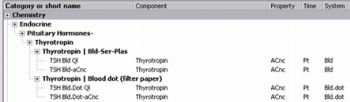
loinc

Regenstrief will release its new version of the LOINC medical vocabulary today (Monday). The free download page is here.

Everybody who’s worked in a academic medical center will be surprised that this is newsworthy: the worst month to be hospitalized is July, when the fresh crop of medical residents starts making their newbie mistakes. At our place, it’s full alert month as residents starting ordering non-existent drugs and tests, make major diagnostic errors, and fumble their way through their first cases. No wonder the attendings have gray hair.

dell

Free EMR vendor Practice Fusion will partner with Dell to offer hardware, software, and services to physician practices. A package for 3-4 users (PCs, scanners, printers, and connectivity hardware) will cost around $3,000. The press release notes that the company has doubled headcount to 41 since fall. 

Federal CTO Aneesh Chopra writes a Huffington Post editorial, talking up the Community Health Data Initiative and a competition for apps that encourage children to eat healthily. The CHDI work page has downloadable data sets in case you want to build something yourself. I really like that idea, especially after reading this result: “Recently a retired telecom employee in rural New Hampshire won $30,000 by proposing a new, scientific approach to helping forecast solar activity – solving the problem faster than NASA could have by itself and with a novel approach the agency had not considered.”

iSoft says its expected 2010 profit will fall short by half because its UK payments have been delayed over its missed go-live dates and political uncertainty.

Strange: Cannabis Medical Solutions announces its medical marijuana prepaid card, which includes a loyalty reward system.

E-mail me.

News 6/4/10

June 3, 2010 News 2 Comments

HERtalk by Inga

I’m flying solo today as Mr. H takes a well-deserved long weekend. However, before he headed out, he forwarded this note regarding AT&T’s just introduced data plans, which aim to make mobile Internet use more affordable for the masses.

Here’s my opinion – I don’t use an iPhone, but with a $15 data plan that would probably be plenty for me, I may well get one. That’s the same price as the old MediaNet subscription from AT&T.

Why I think it’s smart: few users will pay more, but AT&T will grab more subscribers like me who will create a nice revenue stream of $15 per month for consuming minimal bandwidth (and get those folks sending more of the high-profit text messages).

I think the headlines are wrong — the news isn’t the end of all-you-can-eat data plans, it’s the beginning of an inexpensive way for average users to get the benefits of an iPhone for half the price. And if Apple does offer Verizon as an option, Verizon will have to decide whether to market to the heavy users at the $30 price or match AT&T’s pricing to attract average users.

On the downside, this change doesn’t help the issue of overall system capacity for all that bandwidth. It may even make it worse since the power users probably won’t change their habits and the newcomers will create a new demand.

200mb

And here’s my two cents. Remember the old days, before unlimited voice minutes and unlimited text messaging?  I recall once thinking I would never exceed 60 minutes of airtime a month, especially since extra minutes were $.25 each. Or that I’d never use 200 text messages a month (extra messages cost $.10 each.) Today I have unlimited everything because I’ve become dependent on these tools, as have the people I communicate with. I predict that a lot of newbie smartphone users will quickly discover that 200MB doesn’t go too far if you are using e-mail, trading photos, and uploading Youtube videos.

A US District Court judge throws out the securities fraud convictions of two former Medical Manager execs, saying the case exceed the five-year statute of limitations. In March, former president John Kang and former VP and COO John Sessions were found guilty of conspiracy to commit mail, wire, and securities fraud for fraudulently inflating and reporting WebMD’s earnings and revenues by $16.8 million over a six year period. The judge also criticized the government’s prosecution of what he called “probably the most expensive case in the history of the world.”

monahrq

AHRQ introduces free software designed to make it easier and faster for a state, hospital, or other healthcare organization analyze and post healthcare quality data. The new “My Own Network powered by AHRQ” or MONAHRQ can be downloaded here.

Streamline Health and MRO Corp. sign a mutual referral marketing agreement. Both will market their integrated solution that facilitates document workflow and provides release-of-information processing.

Five critical access hospitals sign on to implement NextGen Inpatient Clinicals (the old Opus Healthcare product.) Several of the clients already use NextGen Inpatient Financials (developed by the former Sphere Health Systems.)_ In other words, NextGen seems to be getting traction from its two recent acquisitions.

hilo

Hilo Medical Center (HI) goes live with Phase I of its MEDITECH 6.0 EMR implementation. Healthcare Informatics Associates provided technical assistance to the 264-bed facility.

Healthcare consulting firm ChangeScape forms ChangeScape Technologies, a new subsidiary focused on helping physicians and hospitals implement EMRs.

The State of Minnesota awards a contract to MEDecision to provide PHR technology to the state’s employees and their dependents.

HIMSS says that 10 regional extension centers have joined the organization since launching HIMSS’s complimentary affiliate program for RECs. HIMSS also announces six finalists for the 2010 HIMSS Davies Ambulatory Care and Public Health Awards of Excellence. Winners to be named in September.

McKesson releases its 7.1 version of Connect-Rx software, which includes improved functionality for AcuDose-Rx medication dispensing cabinets and Anesthesia-Rx medication carts.

contra costa

Contra Costa Regional Medical Center (CA) converts from Mediware to Unibased ForSite2020 Surgery Management software. Contra Costa will interface the new application to its Keane and MEDITECH systems.

HHS awards another $83.9 million in grants to help networks of health centers adopt EHR and other HIT systems. The 45 grants target safety-net providers serving low-income and uninsured patients.

IBM joins the Eastern versus Western Medicine debate, introducing a new tool to analyze medical records at South China’s largest traditional hospital. IBM’s Healthcare Information Warehouse system will be used to investigate the effectiveness of Eastern and Western approaches for treating chronic kidney disease. The warehousing system will store and synthesize EMR data that may ultimately determine if particular combinations of Eastern and Western treatments are most effective.

Eight pediatric hospitals top US News Media Group’s rankings of Best Children’s Hospitals. The rankings were based on reputation, medical outcomes, and care-related indicators of quality.

Orion Health and Vangent form a partnership to offer a combined HIE solution. The companies will leverage Orion’s HIE architecture with Vangent’s HIT services expertise.

htp 0603

What you missed if you didn’t read yesterday’s HIStalk Practice: highlights from a profile on MED3OOO founder Pat Hampson; Ohio’s plan to pay a big chunk of HIT costs for practices willing to serve as training centers for patient-medical homes; and, Manatt Health Solutions exams the status of HITECH (they conclude it’s going to be tough for a lot of small practices to qualify for MU and RECs may find it challenging to maintain long-term sustainability.)

Harris Corp. wins a $10.9 million, eight-month contract to help the VA migrate its HIPAA 4010 standards to HIPAA 5010 standards.

I realize a lot of readers don’t feel their weekend is complete until they see Mr. H’s Monday Morning Update. I really don’t know if Mrs. H is going to allow Mr. H to get on the computer this weekend, so I’m hoping you die-hards will be able to figure out an alternative form of entertainment.

inga

E-mail Inga for weekend entertainment suggestions.

HIStalk Interviews Jay Mason

June 2, 2010 Interviews 1 Comment

Jay Mason is CEO and chairman of My Health Direct of Brookfield, WI.

jaymason

Tell me about My Health Direct.

We’re a SaaS access management platform that broadly and seamlessly connects patients to healthcare appointments throughout either an entire community or an entire network. Think of it as OpenTable for healthcare.

It’s utilized by hospitals, the managed care plans, and state health initiatives to reduce unnecessary ER visits, to improve continuity of care with patients, and to correspondingly improve access to care for the patients. Those patients are primarily uninsured or covered by Medicaid or maybe one of their other public program counterparts.

Access management systems often do eligibility checking and other revenue cycle functions. Is that different than My Health Direct?

Yes. We take the term ‘access’ literally. We’re talking about access to health appointments and access to care versus access in a broader sense like revenue cycle management programs.

Talk about the ED overcrowding issue.

Two big articles just came out, one in USA Today and the other in The Washington Post. They coincidentally came out on the same day and speak to the same issue: there’s a tremendous amount of overcrowding in the ERs today.

People believe that’s principally due to uninsured patients. Studies show that’s not the case. Unfortunately, uninsured patients avoid care until it’s really bad. They get it when it’s absolutely necessary.

The drivers in overuse of emergency departments within the urban setting is patients who don’t have the knowledge and the skills and the resources to know what their options are to get care like you and I, who may be commercially insured. Not knowing what their options are, they’re going to the ER. The majority of times, it’s for for non-emergency conditions. They’re using it as a clinic.

We aggregate the appointment availability in the entire community with the community clinics and other participating physicians on a real-time basis. We make it available via a search engine through My Health Direct’s Web site for those people who are interacting with the patient. 

A discharge planner or a nurse or physician in the ER who’s interacting might say, “We put a cast on your arm, but we need to get that thing taken off in four weeks. Instead of you coming back to the ER to take it off, let me find you an appointment in your neighborhood and schedule that appointment now so we can get your cast off.”

It’s amazing how many appointments show up to do things just like that — to get a script filled or a cast taken off or sutures removed. We all know the right setting for that stuff is an ambulatory setting, hopefully a low-cost one or at least one with a lower cost than the hospital ER.

Practices never seem to be open during convenient hours, with nobody staying open past 5:00 or 6:00 p.m. Is there really enough capacity in the system to handle patients who don’t have the luxury of going during normal working hours?

You would be amazed how much capacity there is in a community. When we first started this thing four years ago, we really thought the problem is probably there are just not enough appointments.

What we found is there’s a ton of locations and they’re not very efficient as far as their model is concerned. We find a lot of unused and inefficient capacity in a community where we’re able to collect it, aggregate it, and drive volume to it and maximize the efficiency of what might be smaller community clinics or free clinics or independent docs.

The advantage to the clinic is that our system allows them to really operate. My Health Direct is a front-end revenue cycle management tool. A clinic might say, “Gee, I really need about 45% of my practice to be Medicaid. I’m willing to take 15% charity and the rest has to be cash.” They can load that into our system and we actually deliver that payer mix according to what their requirements are. It allows a doc to manage their portfolio of community-based care and know they’re not going to be inundated with something that they don’t want.

Specialists stopped taking ED call because they couldn’t get any paying patients. Do specialists and imaging centers really want to compete for ED referrals?

Their fear is that they’re going to get too much bad business. I don’t want to be inundated, as a PCP or a specialist, with too many charity patients. I’m willing to take my fair share, but don’t give me more than I think is reasonable.

That’s the problem is a lot of physicians, a lot of centers, elect not to participate because of either that experience or that fear. So, we said, “What a minute. If there’s a way to do a load-leveling or logistics management here and spread it widely and appropriately and allow the physician to have control.”

Who pays for your service?

We’re a community-based solution ultimately. Our clients are made up of hospitals, managed care plans, and then various public access programs or the initiatives. Those are all customers, currently, that pay for services with My Health Direct.

Who recruits the providers who will take the referrals?

We have provider relations folks who go out in concert with our clients. A hospital ER might say, “Look, there are six clinics within two miles of here.” They identify them and they work with us to get in front of those clinics and we can put them on a managed care plan. Then they say, “Yes, these are contracted facilities. We’d like to get these 37 clinic locations on.”

They identify, we work with them. We go together and we get them on the system. It’s a SaaS model, so this is a pretty easy implementation process for clinics.

Does your system go out in real time and poll the locations for open scheduling slots? How does that work?

We’ve got two methodologies to gather that information. Low-tech and high-tech, for lack of better terms.

The low-tech solution is there are, unfortunately, still a fair number of practices that are operating either on paper or an Excel database. We give those clinics our SaaS scheduling module that they can use to run their practice. It’s a nice improvement for them. It’s not a full PM system. It’s not intended to be, but for small practices who really are struggling to get to that next step, it’s a nice tool. We can maximize the throughput even though they may be a small clinic.

Or, for a higher-tech solution, we’ve built spiders into the major practice management systems. We can drop those in and, on a real-time basis, read the calendars of those major practice management systems.

How do you assure that they won’t be double-booked, once in your system and again on paper?

A lot of the low-tech practices actually do most of their business via walk-in. They don’t do a lot of appointment making, probably because they don’t have a practice management system to schedule it. A lot of the FQHCs — the Federally Qualified Health Centers — probably 80% of their business is walk-in, so we’re not running into scheduling conflicts on the low-tech solution because generally speaking, as I said, they’re working on a first-come, first-served basis.

Some people might not want to be seen by a doctor who’s so available that he or she will take automatically scheduled ED patients. Who makes the quality decision on the providers?

The hospitals, when they’re the client. They’re controlling what clinics are on the system and what clinics they want to interact with. Similarly, the managed care plans are doing that. We don’t have a quality assurance process to make the determination what clinics are in or not. It’s our partners, really, that are directing that.

Is there feedback? Let’s say it’s a hospital ED that makes the appointment. Do they know or care that the person actually kept the appointment?

Oh, yes, absolutely. It’s critically important. We really designed this thing on the floor of the ER with the help of a lot of overworked, underpaid nurses. Some of the feedback we got was that they want to increase the show rate. They want to make sure that people are showing for these appointments.

We’ve been able to document that we’ve increased the show rate tenfold from the old system — the old system being the nurse hands you a piece of paper with a couple of clinic names on it and says, “You need to go to one of these.” About 5-8% of the time, patients will actually follow up. The other, they’re not doing anything, and unfortunately, they show up back at the ER with complications to their conditions.

We confirm appointments with each clinic. At the end of every week, we ask the clinic, “Hey, here are the 42 patients we sent you. Please click this box and let us know if they showed, if they didn’t show, or if they rescheduled.” We aggregate all that data and feed it back to the hospitals and the health plans.

Why would they be more likely to show through your system? Because they’ve already got a confirmed appointment versus “Go make yourself an appointment?”

To a degree. Some of the criteria we use to find an appointment are obviously pair-typed. If this is a Medicaid patient, we need to find a physician who’s taking not only Medicaid in general, but who’s contracted with the plan that they’re in. That’s the first cut.

Then we look at the neighborhood they’re in. We want to get in close proximity to their home. We look at provider language. Many times that’s a barrier, so we add that. If public transportation is needed, we make sure that the provider offices that we’re selecting are on a bus or a light rail route. We have other criteria such as provider gender or religion, if that’s a preference for the patient.

You take all those things combined, much like OpenTable does. You find a provider that’s most culturally competent to what the patient’s needs are. That, and getting a confirmed appointment that’s printed off in the consumer’s language are the game-changers that allow us to find the right location. That’s why we’re getting the show rates that we are.

Unlike OpenTable, just so I’m clear, the patient themselves is not interacting with your system. Is that correct?

Not today. We are in Beta with a couple of clients and we’re opening up a direct-to-consumer tool as well. Not for Medicaid patients, but actually for commercially insured patients.

If you did that, would you follow the OpenTable model of allowing people to rate their satisfaction?

Yes. We’ve got a feedback loop built in.

With OpenTable, you see reviews and the price range and all the other factors that made their experience whatever it was. That would be interesting, where you didn’t have just anonymous reviewers, but those who actually confirmed their appointments just as someone made the OpenTable reservation.

That’s where we’re going. That’s kind of the future for the second half of this year is we want to be able to use it in an advocate model like we are today. Someone using it on behalf of a patient, be it an ER staff member or a managed care caseworker.

Ultimately, we want to get this into the consumer’s hands. It’s an easy to use tool that, for a hospital or health system, can help move market share. For the consumer, is a great differentiator in the market. I mean, everybody always complains, “Gee, it’s easier for me to order a book on Amazon or order tickets for a movie than it is for me to communicate in any way with my doctor. Why can’t I just get the appointment that I need?” That’s really where we’re heading with the next phase of our evolution.

You had a CMS contract with the State of Connecticut to reduce inappropriate ED visits. What was the result of that?

CMS provided some grants to states a couple of years ago. We were working with the State of Connecticut to write their grant and they were fortunate enough to get that.

We’re working with the state, the primary care association, the hospital association. We’ve picked about eight clinics and six hospitals throughout the state that were in desperate need of what we do, and it’s worked out great. We’ve been able to move those non-emergent patients — either if they’re triaged, or for follow-up care — to community clinics. We’ve got a tremendous show rate. It’s worked particularly well. It’s one of the more successful CMS-funded initiatives.

If you were going to use that, or other experience as a selling point, what are the numbers that would get someone’s attention to the strategic use of My Health Direct?

On a visceral basis, the ER staff knows what the problem is. They know they’re overcrowded. They know they have non-emergent patients. They know these people aren’t showing where they should show. Just intuitively, what we do makes sense. I think that’s one of the reasons why we’ve been as successful as we are is we’re a pretty simple tool that’s very effective.

But we have done studies with our clients and have found that there is a hard ROI, and that we’ve been able to, because of moving those patients, reduce subsequent ER visits. Additionally, we’ve been able to reduce inpatient confinements because we’ve got those people connected to what we’ll refer to as a Medical Home.

There’s got to be some quality impact as well. Obviously, if the no-show rate goes down when you make an appointment right in front of someone, that whole compliance issue then comes into play. Not just for what it costs or where they go; but whether they get treated at all.

Absolutely. There are clinical aspects along with operational efficiency aspects and financial aspects to what we’re able to do.

How do you think the whole ED visit and referral pattern will change with whatever healthcare reform changes?

Unfortunately, that is the elephant in the room. There have been a lot of studies. I mentioned the studies that were referenced by the two articles this week, but Medicaid patients are four times as likely to use the ER than a commercially insured patient. They’re using it for a majority of their visits for non-emergent care.

If they reduce Medicaid reimbursement, the result of that is fewer physicians are going to participate in those contracts. If you’re going to increase the rolls of Medicaid recipients by 30 million-plus, you are equally going to see a substantial increase in ER visits. You’re going to have a much bigger gap of supply and demand than we do today.

Today, it’s really significant. I think that’s the unintended consequence of reform is that we’re going to see our ER visits, which last year was 121 million ER visits in the country – it  could easily hit 150-160 million visits.

The other trend that’s occurring is that urban hospitals are closing at an alarming rate and so are their ERs. Not only have we seen a substantial increase in ER visits, but we’ve seen a corresponding decrease in the number of ERs. Compounding that with reform and what is going to happen with Medicaid usage, it’s a big issue, a very big issue.

More patients will have insurance, so I assume more providers will accept their referrals. However, it might be a golden opportunity to educate patients about how to properly use healthcare resources since they’re suddenly more desirable with insurance.

If they’re privately or commercially insured, the studies are indicating that those people are connecting with much higher frequency to their primary care physician. It’s the Medicaid population that we really need to think outside of the box and try to find ways to fully engage them in their care and trying to do that early and often.

I think that’s going to be our biggest challenge is the economy and the country. You have to try to engage those people so they’re not using the ER inappropriately and they are getting the care that they need.

News 6/2/10

June 1, 2010 News 14 Comments

saintpeters

From Rebecca Bloomwood: “Re: New Jersey hospitals. Big bucks coming and going for EMRs.” A New Jersey paper runs some interesting hospital EMR numbers. Saint Peter’s University Hospital spent $50 million for McKesson Horizon Clinicals, but expects to get $40 million back in ARRA money. Hunterdon Medical Center went with NextGen (for a practice-based EMR, I assume) and expects to get $30 million from federal taxpayers.

From Donna Reed: “Re: consulting. I was a consultant, but took an FTE position due to family circumstances. I want to get back into consulting, but am running into a brick wall with Epic’s partners. Should clients sign these contracts? Should this type of partnership even be entertained?” I’ve never understood Epic’s firm stance on who partners and customers can hire (not to mention which companies former employees can work for). I doubt any of the agreements would be enforceable if legally challenged, but Judy’s got a lot more lawyer money than the average job seeker.

Monday’s post drew a lot of reader comments, some of them heavier on emotion than facts. I’ll be quicker to delete those comments in the future since they just waste everybody’s time. I doubt that will be necessary since I know some/most of the commenters from their previous posts and they have always been passionate, but with sound reasoning and respectful demeanor. I’ll write this one off as a post-holiday, back-to-work-dammit aberration.

A clarification about “usability” – it is not a feel-good, generic term for just asking users how they like an application. It’s an objective science that measures everything from eye movements to keystroke times as users interact with software in a lab setting, also including tests of how well and how quickly users perform specific task assignments. I’m no expert, but I’ve attended a couple of workshops offered by a usability professional organization, so I would differ with anyone who says software usability is subjective, lacks rigor, or favors one application over another. I was hoping to get a usability expert to write an article on that very topic, but I haven’t worked that out yet.

Listening: Sonata Arctica, more of that sweeping, operatic Finnish progressive metal that I love. It might be time for me to visit Helsinki again.

mu

University of Missouri gets a $6.8 million ONCHIT grant to fund the Missouri Health Information Technology Assistance Center, but stresses that despite overlaps with its Tiger Institute partnership with Cerner, the Regional Extension Center won’t favor Cerner when it recommends EMR vendors to physician practices. 

gcarr 

Speaking of MU Health Care, its former CIO George Carr (above) is named CIO of BryanLGH Health System (NE). Hospital operator HMA names Ken Chatfield as CIO. And in Abu Dhabi, former Karmanos Cancer Institute (MI) CIO George Yacoub is named CIO of Hopkins-managed Corniche Hospital.

Point-of-care communications technology vendor Voalté is named as an Up and Coming healthcare IT company by Healthcare Informatics.

For the reader obsessively charting HIStalk’s stats: the summer slowdown always starts in May, so the numbers dropped a little with 79,537 visits and 110,111 page views. That’s still 16% higher than May 2009. The verified e-mail subscriber list is at 5,574. Thanks for being one of the readers who made those numbers possible – I really appreciate it.

jimmelt

Speaking in Japan, GE CEO Jeff Immelt urges that country to “dominate healthcare information technology and home healthcare devices.” You’d think their taxpayers had bailed out GE Capital instead of us. He was also unusually frank in saying that “more money has been wasted on [healthcare] information technology than has been saved by using it.” He didn’t say, but much of that waste no doubt involved the elephant’s graveyard of once-good HIT applications that have withered under GE’s smothering bureaucracy. ADDENDUM: per a GE spokesperson, the company did not take TARP funding, although some of its debt was guaranteed by the federal government. I always refer to this Washington Post article, How a Loophole Benefits GE in Bank Rescue, which describes the special treatment GE received using what the article calls a loophole in the Temporary Liquidity Guarantee Program.

MEDecision will launch its Alineo 3.0 care management platform, which includes a new behavioral health utilization model, at AHIP next week.  

Our friends at ONCHIT are looking for someone who’s smart, creative, and knows HIT (especially emerging technologies) to lead its innovation programs. I’m encouraged by all the folks who have taken pay cuts to work in federal service, so if you’ve ever thought about it, this sounds like a pretty cool job.

UPMC paid its CEO more than $5 million last year, but CIO Dan Drawbaugh did OK too, taking home $1.335 million. Surely that’s an all-time record for any non-profit’s CIO, not just in healthcare.

Australia’s Medicare program, one month away from mandatory implementation of a national patient identifier, has yet to sign a contract with a vendor to create connectivity between EMRs and the identifier service. They have a pretty good excuse: the bill hasn’t been passed yet and debate doesn’t even start for two weeks.

Emdeon announces a free Emdeon Office solution that allows providers to electronically submit workers’ compensation and related attachments.

Just the kind of headlines Harlem Hospital didn’t need after its “unread echocardiograms” fiasco: a unconscious woman being treated in its ED after being slipped a date rape drug claims she awakened to find a medical intern groping her. She confronts him afterward, at which time he admits pawing her but then asks her out on a date, not realizing that she is secretly recording their conversation. He’s been suspended with pay while awaiting sex abuse charges.

E-mail me.

HERtalk by Inga

From Evelyn Castle: “Re: eHealth Nigeria. I read the short article you posted about me and eHealth Nigeria. I wanted to thank you for the publicity. If you wish to keep updated on the project, you can sign up for our mailing list on our Web site. We will also be blogging throughout the trip. Thanks for your interest.” Evelyn is a UC Santa Cruz college student who helped create Nigeria’s first EMR and is heading back to the county later this year automate several hospitals and clinics. As Mr. H pointed out, she’s my new hero even if she did shame me with her selfless accomplishments.

Emdeon submits formal comments to the DEA to support e-prescribing of controlled substances, but cautions that it will take the industry time to make the necessary software modifications.

iknowmed

US Oncology announces its new iKnowMed platform for community oncologists. US Oncology purchased the company iKnowMed in 2004, developers of an oncology-specific EHR, and has added RCM and inventory management components.

TELUS announces that its health space is now available for licensing by healthcare organizations. I didn’t understand the term “health space”, so I did a bit of surfing on the TELUS site (they are a sponsor, so I figured I really should understand what they do). TELUS Health Solutions is a Canadian company that offers a number of software applications, including EHR, claims management, and scheduling, plus the health space PHR.

Healthcare South (MA) selects Allscripts EHR/PM for its nine pediatric and family practice offices.

trinity mus

Trinity Muscatine (IA) takes its ED live on electronic medical records as part of the hospital’s $4.7 million EMR initiative.

In an article that calls Dell the “biggest player” in HIT, industry analysts and Dell execs discuss the company’s market approach to the industry. After acquiring Perot, Dell leaned on Perot’s expertise to develop ways to reduce HIE costs and to sell its technology to a broader segment of the market. Dell is now seeing increased success marketing to small and mid-size hospitals and their network of affiliated doctors implementing EMRs.

Apple says it has sold a whopping 2 million iPads since its launch two months ago. Impressive, especially when you consider that just last week it began selling the units in Canada, Japan, Europe, and Australia. In January, analysts estimated Apple would sell between 178,000 and 778,000 iPads monthly.

Emerging Healthcare Solutions is developing a new iPhone app that will automatically call users at the precise time they need to take medications, targeting seniors. I love the idea and think it could be a big hit, but, I suspect many seniors will need help from a tech-savvy friend or relative to set it up. And if the patient is not interested in using the iPhone for any of its other sexy apps, the $10 a month on top of AT&T’s monthly data fee ($30?) may be a bit too steep for the fixed income crowd.

A jury rules in favor of NYU Langone Medical Center in the case involving the male transplant patient who died of uterine cancer after a kidney transplant. During the medical malpractice trial, it was revealed that the donor’s cancer was not detected until after her autopsy. Furthermore, the hospital argued that their male patient actually developed a form of immune-system cancer as a result of the transplant, and did not die of uterine cancer.

A study finds that a telehealth system combining remote patient monitoring with education support tools reduced hospitalization time and improved the quality of life of patients with severe heart failure.

Here’s a lawsuit that’s right up that with McDonalds serving its coffee hot. A California woman sues Google for giving her poor walking directions from Google Maps. The woman pulled up the directions on her BlackBerry and was directed to walk on a route without sidewalks and with cars moving at high speeds. She was hit by a car and is suing Google for over $100,000 in medical expenses for its “careless, reckless and negligent providing of unsafe directions.”

inga

E-mail Inga.

Monday Morning Update 5/31/10

May 29, 2010 News 51 Comments

From Tabula Rosa: “Re: EMR usability. At one of the ONC Policy Committee meetings, Judy Faulkner of Epic supposedly declared that ‘usability would be part of certification over her dead body.’ I wonder if she has similar sentiments about making software accessible to people with disabilities?” Unverified. This inspired my new poll question – keep reading below. 

cconn

From ExXeroid: “Re: The Hospital of Central Connecticut. The Cerner staff is down to a skeleton crew. The IT people are leaving in droves. Cerner KC is the ACS takeover, but there’s hardly anyone left to support internally after the ACS disaster.” Unverified.

appledex

From The PACS Designer: “Re: Apple’s OS 4.0. Apple’s iPhone OS 4.0 will be available for the iPhone this summer and for the iPad this fall. While we are waiting, we get the opportunity to see some of the features that are coming. Also, Apple has a developer’s Web site to aid those who want to venture into application development for the OS 4.0.”

mri

HIStalk readers donated generously to Sumter Regional Hospital (GA) after it was destroyed by a tornado in March 2007 (we collectively donated $11,264). The hospital, now Phoebe Sumter Medical Center and still being rebuilt, later received what appeared to be the highest vote total in a Siemens-sponsored contest to win an $800K Magneton Essenza MRI scanner, but somehow lost to another facility. Siemens decided to donate a machine to Sumter anyway. It has arrived and is already being used, with the picture above being one of the hospital’s first patients to benefit from it last week. The ribbon cutting will be this Friday, June 4 at 10 a.m. Former President Jimmy Carter, a Sumter County resident, may attend.

poll052910 

A whopping 79% of HIStalk readers say they would worry about the confidentiality of their electronic information if they had a psychiatric illness and their providers were sharing information electronically. That’s not to say that they are specifically concerned about electronic security, only that they would worry about having their information exposed in some unspecified way. New poll to your right: what’s the best way to raise the level of EHR usability in the marketplace?

I figured it was time to cruise around the sites of some of HIStalk’s sponsors and see what’s new with them.

  • Rockingham Memorial Hospital (VA) says its use of Nuance’s Dragon Medical and eScription speech recognition products will save it $600K this year alone.
  • A BridgeHead Software survey (warning: PDF) finds that hospital data storage needs are increasing dramatically, primarily because of PACS images, electronic medical records files, and scanned documents.
  • Virtelligence will be exhibiting at MUSE this week.
  • Lakeridge Health Network (ON) selects Access Intelligence Forms Suite to get forms into Meditech scanning and archiving without manual indexing. Access will exhibit at MUSE this week.
  • Registration for the e-MDs user conference in Austin July 22-24 is open. It sells out every year.
  • Ingenix Consulting SVP Joel Hoffman is named a “Top 25 Consultant” by Consulting magazine for his work in assessing financial outcomes of care management.
  • Renaissance Resource Consulting has open positions for Epic installers and IDX/GE application and technical consultants.
  • A native iPad version of PatientKeeper Mobile Clinical Results is now available.
  • CynergisTek CEO Mac MacMillan is quoted in a new article called OCR Building HIPAA Audit Plan With Outside Help.
  • Going to AHIP Institute in Las Vegas next week? MEDecision is hosting a party at PURE in Caesar’s Palace. You know from HIMSS that they throw a good one.
  • O’Toole Law Group is offering (warning: PDF) contract assistance for Meditech 6.0 upgrades.
  • Universal American Corp., a provider of Medicare Advantage and Part D prescription drug plans, chooses (warning: PDF) MedVentive’s care collaboration tools for members and providers, including real-time care and drug substitution recommendations.
  • Charge capture automation vendor MedAptus will exhibit at HFMA’s Annual National Institute later this month in Nashville.
  • Surgical Information Systems will exhibit at MUSE and HFMA this month.
  • ACHE will publish a book on how consumer behavior is changing medicine by Lindsey Jarrell and Colin Konschak, partners of DIVURGENT Healthcare Advisors.
  • Dentrix Enterprise is offering a free Webinar on the features and benefits of its Electronic Dental Record solution, the leading EDR in community health centers.
  • Sunquest will exhibit this month at G2 Lab Outreach in Baltimore and Smart Health in London.
  • Sentry Data Systems releases two case studies on using its Sentinel RCM 340B solutions, one from Alegent Health and the other from Saint Barnabas. They’ll be at HFMA and ASHP this month.
  • Software Testing Solutions introduces its automated testing solution for Eclipsys Sunrise order entry that saves staff time and documents testing of procedure ordering, billing, interfaces, and validation of new releases.
  • MED3OOO has June 3 and 17 Webinars on Assessing Readiness for Meaningful Use, presented by CMIO Jay Anders, MD.
  • EHRScope has gone live with its EMR review site, where EMR users can read and write reviews and rate their product.
  • Vitalize Consulting Solutions is #2 on the KLAS list of consulting firms that providers are considering.

Ed Meagher, former VA deputy CIO, CTO, and chair of the committee that prepared the VistA report that I mentioned last week, took exception to my comments about those committee members with ties to federal contractors. He said, “The [HIStalk] level of cynicism is almost toxic. I can tell you that the personnel who participated in the report did so as IT industry experts, veterans, and citizens and not as representatives of their companies.” I wasn’t doubting their integrity or lack of good intentions, but rather the inevitable and often subconscious world view that any company’s employee would bring to the table. He’s right that the real to-do is to review the report and suggest improvements. Feel free to e-mail your comments and I’ll publish them. Assume that the VA is correct in its assessment that VistA has become technologically obsolete, hard to enhance, and hard to support — do the committee’s recommendations make sense? (although we’re missing a big piece of the puzzle – the inevitably large price tag. The VA is huge, although I can’t readily find its total inpatient bed count.)

I also got some feedback on the AHRQ report on practice EMR usability that I mentioned. I said it was nice work, just limited in applicability because only eight EMR vendors were interviewed and most of the big ones weren’t on the list. From my source, apparently many more EMR vendors were asked to participate, but declined.

toddp

HHS CTO and athenahealth co-founder Todd Park is named as one of Fast Company’s 100 Most Creative People. He was recognized for making public health data more readily available. “It’s insufficient to just put data out there. We want to market them to people who can turn them into supercool apps.” Maybe he earned bonus points for correctly using “data” as plural. Cleveland Clinic CIO Martin Harris was #12. Both lost out to #1, Lady Gaga, but I’m sure she’ll sell more magazine copies, at least outside of healthcare.

Sevocity offers regional extension centers and educational organizations free access to its Internet-based EHR, set up as a demo clinic for up to 20 users and requiring them to have nothing more than PC with Internet access.

Inga has the latest in her series of questions for vendor executives: what advice do they have for David Blumenthal? She got some surprisingly frank and diverse answers, ranging from “start an EMR Lemon Law” to “stay the course.”

TELUS Health Solutions will announce this week that it is offering pre-built interface tools from Iatric Systems for quicker, cheaper interfacing of its Oacis EHR to Meditech. Offerings from TELUS include the Oacis Unified Patient Record (a Web-based clinical portal with longitudinal information), Oacis CDR, Oacis HIE, a data warehouse, and capabilities such as CPOE, clinical documentation, and ED tracking. TELUS will exhibit at MUSE this week. Frank Clark, CIO of Medical University of South Carolina, has told me several times that TELUS Oacis is a key part of his organization’s clinical systems strategy, particularly its physician portal.

I did some cleanup of the HIStalk e-mail update mailing list. Spam blockers (not on my end) were keeping some users from receiving their updates, so if you aren’t getting yours, you should now be able to sign up again at the upper right of the page.

toolbar

I’ve been working on an HIStalk Toolbar for Firefox and IE (not for Chrome since it doesn’t support toolbars, unfortunately). I included some cool features: a search box that allows searching the Web as usual or HIStalk specifically (click the dropdown beside the Go button to choose); a Links dropdown with one-click access to all HIStalk sites; RSS feeds; an e-mail checker that will notify you when new mail comes to your online account (Hotmail, Yahoo, Gmail, etc.); a really cool radio player that I preloaded with some indie rock stations (you can choose any others easily); and a local weather widget. You can customize any or all of this easily. I’ve been using it at work and it’s really handy, especially the e-mail checker and radio player. It uninstalls easily in case you change your mind. I’m listening to the Indie Rock station on it right now and sounds super.

Cerner’s Neal Patterson still wants insurance companies to die (go, Neal!) but also says Cerner will become a healthcare company, not just a healthcare IT company.

dell

Dell announces its Healthcare Print Station, which offers one-touch options to route orders from hospital nursing stations to the pharmacy, a “Scan to EMR” button, a forms-on-demand option, and card copy for scanning both sides of patient ID cards to a single sheet of paper. The $599 add-on is available for Dell’s Java-capable multifunction printers (3333dn, 3335dn, and 5535dn).

NextGen parent Quality Systems reports Q4 numbers: revenue up 19%, EPS $0.45 vs. $0.40, falling short of consensus earnings expectations of $0.49. 

Happy Memorial Day! Except for you non-US readers, who I confess I wasn’t thinking about when I talked about the holiday last week. Thanks to the reader from Canada who reminded me. According to my stats, the leading countries for HIStalk readers other than the US are Canada, Australia, UK, and India, with a significant drop-off before the next group from Ukraine, China, Israel, and France. As the programmers say, Hello World.

E-mail me.

News 5/28/10

May 27, 2010 News 10 Comments

From Uncle Arnold: “Re: Cal eConnect. The state-sponsored HIE is interviewing CEO candidates this week. They are on a tight timeline and want to make an announcement within two weeks. The usual suspects are finalists: Roberts at HIMSS, Portale at Palomar, etc.” Unverified.

pnm

From Ms. Jones: “Re: Presbyterian Albuquerque. VMware installation caused two major network outages within 48 hours. The clinical system (McKesson) is still trying to recover: interfaces and prod down, pharmacy handhelds all needed hard booting, runaway processes triggered, unable to pull PACS studies, etc. Affected all eight facilities across the state.” Unverified. I also note that I still can’t spell Albuquerque in fewer than three attempts.

From Alan: “Re: hospital and TV reporter. A reporter is repeatedly touched by a hospital communications director. Hilarity ensues.” Bizarre. A TV talking head tries nicely to interview a Laguna Honda Hospital (CA) official about a reported misuse of patient gift funds. She’s on her way to a meeting, so she politely declines. The hospital’s creepy communications director gets in the reporter’s face and starts touching and patting him repeatedly, introducing himself about a hundred times (“Hello, my name is Mark Slavin”) as the TV guy warns him he’ll call the police if the guy doesn’t get his hands off him. Be glad they didn’t actually fight since I think it might have been embarrassing to humans everywhere.

A reader asked me to share the VA committee’s recommendations on the future of VistA. Nothing on it says its private, so I’ve posted it here. Your analysis is welcome. I notice that the working group included employees of companies that stand to benefit from an expensive rewrite (Lockheed Martin, Microsoft, IBM, HP, Deloitte, Northrop Grumman, etc.) so I might take their recommendations with a grain of salt. I also noticed one tiny recommendation that the VA shouldn’t build any software it can buy, provided the application meets standards.

fbchart

A reader sent over the graphic above now that we’re all on Facebook. He thought it was funny. I agree, but Inga and I still love it when you friend us or click our “Like” button because we are insecure.

Weird News Andy notes that in the UK, lots of people can’t get the surgery they want, but at least one patient is getting surgery against their wishes. A judge’s ruling grants doctors permission to forcibly sedate a woman with uterine cancer and bring her to the hospital for a hysterectomy, claiming she is of unsound mind and the surgery is “plainly in her interests to have.” They’d better hope it goes well.

acummings

Allana Cummings, former SVP/CIO of Children’s Omaha, is named CIO at Northeast Georgia Health System. I think we probably mentioned that before, but now we’ve got a pic.

Listening: Fastball, one of my favorite guitar-and-harmonies indie pop bands.

A UCSD trend study says healthcare IT is the “hottest career option” for new grads.

Three Midwest hospitals that run McKesson’s Paragon sign up for its Practice Partner PM/EHR.

Allscripts will integrate IntelliDose chemo dosing into its products.

AHRQ releases a report on practice-based EMR usability, although only eight vendors were interviewed and big players like Epic, eClinicalWorks, Sage, Allscripts, etc. were not among them. Nice work, just a bit limited in scope to draw meaningful conclusions. Key points:

  • All vendors interview claimed a “deep commitment” to making their products usable.
  • Despite that, few (none?) of them said they do formal usability testing, follow user-centered design principles, or get real usability experts involved in their design.
  • Vendor processes to address reported usability-related patient safety issues are inconsistent.
  • Most vendors do not publicly share known usability-related incidents or enhancement requests.
  • No vendor admitted to contractually prohibiting users from disclosing product-related patient safety incidents.
  • “Many” vendors expressed interest in having an independent body develop EMR usability standards (great idea, since they also said that competitive pressure keeps them from collaborating on usability standards).

McKesson raises its quarterly share dividend from $0.12 to $0.18.

NPR reports on an interesting use of clinical decision support: analyzing the potential value of each individual outpatient radiology order based on patient condition and requiring the doctor to personally sign off on questionable ones. The iffy orders dropped from 5.4% of the total to 1.9%.

Drug company Wyeth, worried about being caught pitching drugs to doctors for unapproved indications, apparently modified its Salesworks software to prevent its sales reps from documenting their conversations with doctors, preventing future legal discovery. The company is also alleged to have dressed up salespeople in white coats, sending them on doctor rounds and into the OR during transplant surgeries.

aapl

The market cap of Microsoft at today’s market close: $227.9 billion. Of Apple: $230.5 billion. The five-year stock price chart is above (Apple is the green high-flyer, Microsoft is the blue dead money). The torch has been passed.

Speaking of Apple, the Chinese company that makes parts of the iPad, iPhone, and other consumer electronic devices urges workers not to kill themselves after 11 employees leap off buildings so far this year, with nine of them dying. The latest death was an employee who had been grilled over a missing iPhone prototype. Employees are now required to agree to let the company send them to a mental hospital if their behavior is “abnormal.” Safety nets have been installed around employee dormitories. Note to self: don’t take a job with a company that provides a dormitory or otherwise makes it obvious that you won’t have any free time.

HIStalk sponsor jobs: Clinical Informatics Professional, Sales Executive, Proposal Developer. Sponsors post their jobs free. On Healthcare IT Jobs: HIE Analyst, Instructional Design Manager, EMR Project Manager.

harlemhospital

Harlem Hospital (NY) admits that it allowed 4,000 echocardiograms to be read by techs instead of doctors. Cardiologists are reviewing them and have found several patients with undiagnosed cardiac problems.

Here’s a nasty anti-business surprise buried in the healthcare reform bill, slipped in by Democratic politicians to help pay for it: every business must report on 1099 forms payments to any company that total more than $600 in one year. Right now, that’s required only for payments to non-incorporated entities. So if you buy Dell computers, Sam’s Club paper towels, or Fedex shipments, you’ll have to get a W9 form from them (for their particular in-state business identity) and send them a 1099 every year. That’s an estimated 12x increase in paperwork. Who is John Galt?

memorialday

I’ll probably do the usual Monday Morning Update this weekend even though it’s a holiday and few of you will read it Monday (but I might slip in some really good stuff to reward the loyalists). Have a wonderful holiday, flying that flag if you’re so inclined.

E-mail me.

HERtalk by Inga

ONC announces that another $30.3 million in awards is available to fund two additional Beacon Communities. Letters of intent are due June 9 and we’ll find out the lucky winners in mid-August.

The tiny Guadalupe County Hospital in Santa Rosa, NM plans to add Medsphere Systems’ OpenVista EHR. Phoenix Health Systems will provide implementation and support expertise for the 10-bed hospital.

RCM service provider Zotec Partners aligns with Medical Business Services (MBS) to offer RCM tools to MBS’s hospital-based physician clients.

Zix Corporation launches ZixGateway Inbound, a new tool to help provider organizations identify unsecured PHI in incoming email.

EMRs cut the average treatment time for sexually transmitted infections from 11.5 days to 3.5 days, according to a UK study. The percentage of patients getting treatment within two weeks of diagnosis jumped from 38% to 94%. Doctors attribute the difference to faster patient notification of positive test results. Add that stat to your sales tool bag.

surescripts

Surescripts bestows Gold certification status to eight physician software vendors.

HCA appoints Dr. Thomas L. Garthwaite to COO of the Clinical Services Group, charged with improving quality of care, patient safety, and clinical performance. He’s a former EVP and CMO for Catholic Health East and spent eight years with the VA, including a stint as Under Secretary for Health where he helped with the VA’s  transition to EHR.

squawkbox

Humana and BCBS-RI top the 2010 PayerView Rankings, an annual report that examines how well health insurers are paying physicians. Insurance companies as a whole seem to be paying an average of seven days faster than last year and are denying 12-18% fewer claims.Full list here. Or if you prefer, watch athenahealth’s Jonathan Bush and Humana’s Bruce Perkins discussing the rankings with CNBC.

Some generally positive Cerner news out of the UK, at least from one NHS Trust administrator. Kate Grimes, the chief executive of Kingston Hospital NHS Trust says its implementation of Millennium has gone remarkably well after a big-bang go-live. She acknowledges the platform will help improve quality of care, but also notes that Millennium needs further work to be more intuitive and forgiving of mistakes.

evelyn castle

A couple of weeks ago, Mr. H shared the story about Brigid O’Gorman, a college junior who is working to implement EMR in rural Uganda. Here’s the story of Evelyn Castle, a college junior from UC Santa Cruz and clearly another extraordinary young lady. She received a $10,000 scholarship to support her efforts to improve health care in Nigeria. She leads eHealth Nigeria, an organization focused on improving maternal and child health through the implementation of reliable health information systems. Last year, she helped create the country’s first EMR system. This year, she’s going back to Nigeria to set up seven hospitals and five primary care clinics with eHealth Nigeria’s “Instant EMR” program. I wouldn’t say I was ignoring the world and its needs while I was in college, but I think I was more focused on creating sexy togas for frat parties then I was impacting the quality of life for millions. I’m humbled and inspired.

inga

E-mail Inga.

CIO Unplugged 5/26/10

May 26, 2010 Ed Marx 15 Comments

The views and opinions expressed in this blog are mine personally, and are not necessarily representative of Texas Health Resources or its subsidiaries.

Office Without Walls

I remember looking out the window of my 1,500 square foot, extraordinary office in Cleveland, Ohio and thinking, This is the life. To the north, I beheld Lake Erie. To the east, our vast academic medical center campus — a doubly breathtaking view. Behind me was an expansive work area, ample space for my wall of self-adoration, and a private conference room. But more crucial for a workout fanatic like me, I had a full bath. These luxuries helped take the edge off the intolerable winters.

I’ve arrived! So I thought.

My soul couldn’t reconcile with the setting. On one hand, I loved it. On the other hand, I hated it. Too remote. Pathetically rich. Overindulgent. Excessively comfortable. I found myself increasingly disconnected from those whom I had pledged to serve. It is not about you.

While serving as an army combat engineer officer, I learned that the best place to command on the battle pitch was wherever my people were fighting — the front lines, on the flank, from the rear, or from the air. But never could I lead troops from some corporate office. Lessons learned from this experience transferred to my civilian career.

A resolve to lead by example, coupled with the advances in collaborative technologies, I adopted the borderless office. This is not a new concept to those outside of healthcare providers. Many progressive companies embrace this concept, and telework has taken off. Study after study has proved the plethora of benefits generated by this approach despite its manageable downsides. Interestingly, most who disparage teleworking have actually never teleworked.

Two years ago, I sacrificed my office phone. I haven’t had an office in eighteen months — and the view still rocks. I’ve traveled the DFW Metroplex and beyond, yet don’t waste my organization’s funds by requiring or demanding multiple offices. I’ve typed e-mails from cubicles at one of our fourteen facilities.

I’ve met with hospital presidents on their turf and often surprised the local IT staff with a personalized word of encouragement. Clinicians share their gratitude when I engage with them i2i. I’ve set up conference calls in Panera and taken calls on the road. And occasionally, my wife lets me set up shop in her kitchen where the coffee is free. (Thanks, honey!)

How is this accomplished? My office is my laptop. It goes where I go. A soft phone, video, and built-in wireless network have liberated me from the confines of four walls. With fourteen hospitals to serve, I embrace mobility. If it makes sense for me to begin or end my day at home or at Starbucks, I do so.

Some of my direct reports have followed my lead and done the same. We do have a collaboration center, which we use for vendor meetings and team meetings when face-to-face interaction is necessary.

As of May 2010, well over 50% of our IT team telework a minimum of four days per week. They may be at a hospital or their home — anywhere they can best serve the customer. I expect this number to rise to 80% as more people choose to this option. The vacated space will generate material revenue for our health system, which can be reinvested into patient care, not cube farms.

For the past three years, we’ve been recognized in the Computerworld 100 Best Places to Work. (Actually, in the top 50.) I firmly believe our office-without-walls approach to operations was a key factor in this recognition. And I perceive a direct line between this award and the external recognition and accolades we receive as a healthcare system for the quality of care delivered. To boot, the borderless office helps us recruit and retain top talent.

Sadly, healthcare provider organizations in particular struggle with this concept; hence the low adoption levels. We acknowledge that we must change and transform, and yet when opportunity presents, we resist and find reasons not to embrace. We deem telework OK for the analyst but not the manager since they need to be visible. Visible to whom? Their analysts are all virtual. This is one example of the false perceptions yet to overcome before we see widespread adoption.

After experiencing the value it adds to our customers and ultimately our patients, I’ll continue evangelizing this work style and its benefits. With the pace of today’s society, if you’re not moving forward, you’re moving backwards. I’ll never go backwards.

And I’ll take the view from my virtual office over a lake or artifact any day.

Update 6/5/10

edkitchen
My typical spot at home, close to coffee, food, and bathroom.

brando

Explaining the BlackBerry functions to Marlon Brando. It was a casual day for me.

I appreciate the comments, pro and con, on “office without walls”. A few answers/comments.

Managing remote workers is fundamentally a leadership question. If you need to physically see employees to manage them, than your leadership approach might need tweaking or you have the wrong employee. With knowledge workers, I believe a leaders job is to set the vision and then allow the expert employee to figure out the best way to get there. You can help by removing obstacles and then staying out of the way. We do have a policy around remote working and it includes an “agreement” completed by employee and manager to set expectations.

We have deployed VPN and other similar solutions that provide secure tunneling on remote networks. I can’t share specifics lest someone tries to hack me. LOL. Seriously, we believe our tools and policies meet or exceed industry standards for responsible computing.

Dr. Know, it is lame that this concept would be considered provocative. It is a sad reality. If we do not write about it and lead by example, nothing would change. We are behind. We need courageous leaders in medicine, healthcare, IT, medical staff, etc. Encourage, don’t discourage, and we will get there faster.

As Lacey pointed out, you can have an office and be transparent, and at the same time, you can have a borderless office yet be hidden. That said, these are not mutually exclusive. You can have the best of both worlds, being transparent and out there with your customers. That is certainly my objective, albeit I have work to do.

Ed Marx is senior vice president and CIO at Texas Health Resources in Dallas-Fort Worth, TX. Ed encourages your interaction through this blog. Add a comment by clicking the link at the bottom of this post. You can also connect with him directly through his profile pages on social networking sites LinkedIn and Facebook, and you can follow him via Twitter – User Name “marxists.”

News 5/26/10

May 25, 2010 News 27 Comments

cdsa

From The PACS Designer: “Re: Microsoft’s CDSA. The Clinical Documentation Solution Accelerator (CDSA) for Microsoft Office helps you create clinical document workflow by using Microsoft Office SharePoint Server 2010. CDSA is good for linking EMRs to other systems and also populating PHRs and CCRs.”

From Alan: “Re: Vermont Information Technology Leaders. It announces four more preferred partners.” They are athenahealth for revenue cycle, Concordant for consulting, MBA HealthGroup for implementation, and the University of Vermont’s Technical Services Partnership for services.

From LeBron Kydis: “Re: stats. I was charting the number of HIStalk visitors from day to day (I know, it’s a little neurotic) and realized the number of subscribers could be more interesting to watch as it climbs. Any chance you might include that number with the number of visitors?” Wow, that is compulsive. Bad news on the subscriber list, though: unlike the visitor count, there’s no widget to display it automatically. This will get you started: the confirmed count as of this minute is 5,565.

tampageneral

From FLgal: “Re: Epic. Tampa General (affiliated with USF) is implementing Epic. Shands (affiliated with UF) is also implementing Epic. Supposedly those two are collaborating with University of Alabama (not sure of the hospital name) to create a southeastern arc of Epic hospitals. Combine that with all the hospitals in Atlanta that are implementing (or thinking of doing so) Epic, and you’re got quite a nice chunk of the US covered by Epic.”

From A Family Affair: “Re: UPMC. A highly wired hospital with a highly connected leadership family.” UPMC paid $10 million last year to companies with ties to its directors and executive management. Relatives of the CEO, who himself made $5.16 million in 2009, received more than $3 million in payments, including his $265K daughter who was a contractor and is now executive director of UPMC’s technology development center. The CEO’s former son-in-law made $260K (until his wife divorced him and thus went his job) and his brother raked in $2.48 million for advertising. They didn’t ‘fess up until hearings convened by my hero, Senator Chuck Grassley.

Fletcher Allen Health Care lays off 23 transcriptionists who were rendered obsolete by technology such as EMRs and speech recognition. I feel bad for them, but that’s a nice plug for the cost saving potential of Nuance’s eScription, which I believe FAHC uses.

kwame

It was just over a year ago when Compuware inexplicably hired disgraced former Detroit mayor Kwame Kilpatrick to sell healthcare software, giving him a cushy six-figure job barely a week out of prison (what the hell were they thinking?) Well, today they got to fire him: he’s going back to the slammer for violating the terms of his probation. He tried the sorrowful apology route yet again, but the judge wasn’t buying it this time: he’s going away for at least 18 months and possibly up to five years. You can read up on his checkered background, but get comfy first because it will take awhile. Please hold for a job offer on Line 2, Mr. Blagojevich.

Michael from Bitwork offered an explanation of the article I mentioned that said a Hawaii clinic was saving 55 hours a month through some unspecified change. They were manually assembling quality measure information using standard reports offered by their EMR, he says. The change was to implement Bitwork’s solution, which collects the information in the background and presents it as a scorecard.

Stung by the defection of HIMSS and other conferences because of absurd costs, the governor of Illinois is considering signing a bill that would limit union shenanigans at McCormick Place. Naturally being Illinois there’s all kinds of dirty politics, union wheeling and dealing, and favoritism involved, not to mention that attendees will get stuck with newly increased bus and taxi fees to generate funds for marketing the convention center.

Weird News Andy labels this story as, “I’ve heard of dropping a transmission in a car before, but not a baby.” A Minnesota woman who is feeling labor pains drives off for the hospital, stopping to pick up the baby’s father, who can’t drive because he has epilepsy. Her water breaks while driving, she yells for him to take the wheel, and she shucks off her pants and delivers an eight-pound baby boy right in the driver’s seat. She summarizes, “I was just sitting on the seat and he just slid out.”

Some Epic youth filmed a video of the famous on-campus treehouse. I’m beginning to think I need one of those for philosophical reflection or something like that since I’ve always wanted one.

Inga and I have jumped on the Facebook bandwagon because so many of HIStalk’s readers are active there. I’ve made a site change that puts a little blue Facebook icon at the top right of every post. Click it and you can easily and quickly publish the article link with your comment to your Facebook feed.

Connecticut Attorney General and US Senate candidate Richard Blumenthal apologizes for not being “clear and precise” in claiming Marines service in Vietnam that he really spent stateside. That’s newsworthy here only because he’s the brother of national coordinator David Blumenthal, which I happened to see in one of the newspaper articles after thinking they sure look alike. You would think serving honorably in the Marines in any location would be enough without having to embellish, which hopefully he’s realizing.

Speaking of David Blumenthal, he was the commencement speaker at the University of Florida College of Medicine’s graduation this past Saturday. He told them most of what they had learned would be obsolete shortly, a sad but true fact and another reason to use technology to support pushing current best practices to the bedside.

unc

The Raleigh, NC newspaper takes heat from UNC Health System employees after publishing the organization’s salary database online, including employee names and ages.

Tri-City Medical Center (CA) looks into alleged privacy disclosures involving employees and Facebook, denying a rumor that 26 employees have been disciplined. One conclusion is that hospitals need a social networking policy. Policies don’t usually work, of course, but at least you have grounds to fire violators.

Federal CTO Aneesh Chopra, speaking at the American Telemedicine Association conference, calls for great healthcare technology ideas and recites some examples: Voxiva’s Text4Baby (I interviewed head guy Paul Meyer in November), a Case Western Reserve telehealth project, American Well (which I just mentioned), and Project Echo (I interviewed Director Sanjeev Arora in October).

Speaking of innovation, I’ve had some conversations about scouting out more of those in HIStalk (I’m non-disclosed to say who those conversations were with, but you would probably be impressed) It could be as simple as doing interviews like those above, or it could be evaluating products with potential to benefit the healthcare system as a whole (not necessarily for their business potential, which others are doing already). If you have ideas of how to do this or want to help in some way, let me know. I was thinking of offering companies or developers the chance to pitch their wares and have them evaluated by a panel of expert HIStalk readers, but I always have high-falutin’ ideas that I don’t have time to execute properly because I’m working two full-time jobs already. In any case, if you know of cool, innovative technology that’s delivering results but not getting much attention (preferably as a user and not a company pitch person), let me know.

Monday is Memorial Day, set aside to honor men and women who have lost their lives in military service involving conflicts both popular and not. Flags are cheap, easy to find, and fun to hang (and I’m reminding you way ahead of time). And unfortunately, they stand out nicely in most neighborhoods since everybody’s too wrapped up in picnics and car races to think about dead service members and their families on the one day per year set aside to pay those respects. So if you’d like to be a rebellious contrarian like me, hoist Old Glory on Monday. End of good-natured soapboxing. 


The VA’s VistA Modernization Report

A reader sent over a copy of “VistA Modernization Report”, the work product of a committee that was convened to advise the VA about modernizing VistA. Its recommendations:

  • Stabilize VistA by freezing the code to some degree, releasing only enhancements needed for patient safety or mandates.
  • Contract with a research group to develop tech specs for a new open source VistA replacement.
  • Contract creation of a prototype.
  • Contract development of a foundation to manage the new, open source VistA.
  • Get more widespread VistA deployment outside of the VA by creating an easier delivery model.
  • Replace VistA’s functionality screen by screen.
  • “Harvest everything of value” from VistA.
  • Use commercial software where needed to complement VistA’s core functionality.

My reaction: big government contractors are wetting themselves at the prospect of getting a chunk of what is sure to be a massive cost. Remember VistA’s history: it was mostly developed by skunkworks programmers defying management orders and working directly with end users. It was not developed under an open source model and wasn’t cheap to build – it just happens to be free because taxpayers paid for it, which makes it available under the Freedom of Information act.

Software rewrites have ruined even nimble organizations who didn’t have to deal with bureaucrats and fat cat contractors. And let us not forget the $450 million taxpayer-raping by BearingPoint’s CoreFLS ERP system, overseen by an apparently napping VA IT management and mercy-killed during its beta testing when it nearly shut down Bay Pines Hospital in Florida.

All of this sounds like the usual feel-good consultantese, soothing and logical in a perfect world, dangerous when you’re dealing with the federal government and its cadre of trough-lappers. And who cares if VistA adoption is minimal outside of the VA? That wasn’t the point of writing it.

Software rewrites are usually a really, really bad idea, advocated by techies and mid-level managers who see the fun of working on something new instead of the gaping black strategic hole beneath them. The VA was lucky that VistA turned out as well as it did, but it’s a one-trick pony not likely to be repeated.

Open source or not, wanna bet this will be a billion-dollar project if it gets approved? Heck, HP got $784 million back in 2004 just to support VistA going for ten years, so imagine a stimulus-happy administration getting to announce this grand vision in front of veterans and former civil servants turned contractor lobbyists. Most vendors (including the ones that would provide commercial systems to the VA where needed) are selling systems that are just as clunky and outdated as VistA. Most of the time, they work just fine, especially if the whole package was built by the same company instead of being acquired from failing vendors anxious to sell out.

Maybe the VA should just do what everybody else seems to be doing if they really think VistA is on its last legs — buy Epic and install it using the Kaiser model. I wouldn’t want VistA replaced for the wrong reasons, but if it’s really necessary, then I’d rather see them writing Judy a huge check for a known quantity instead of a series of never-ending ones to the usual government contractors who have stars (and stripes) in their eyes.

That’s my uninformed opinion. What’s yours?

HERtalk by Inga

Baptist Health System (AL) selects Compuware’s EHR Service Delivery Solution to monitor performance and availability of its EHR.

All Children’s Hospital (FL) expands its relationship with Mediware, adding BloodSafe Tx for patient and blood verification.

pioneer

The 107-bed Pioneers Memorial Healthcare District (CA) will replace its QuadraMed Affinity Clinicals with QuadraMedCPR.

Walmart cuts the price of the iPhone to $97, AT&T raises its early termination fee from $175 to $325, and rumors swirl that Verizon will soon offer service for the iPhone. Must be almost time for Apple’s Worldwide Developers Conference. June 7th is the date we’ll likely hear more about Apple’s 4G version (with video-chat, perhaps?)  plus maybe news of a Verizon deal.

Maybe one of our marketing genius readers could explain why a company would even bother to create and distribute a press release like this? Mr. H puts it on the short list for stupidest press release ever written. The company is obviously trying to raise money for programmers and designers. If they are successful, I suggest they put a few dollars aside for marketing.

iscore

If you are an HIT purist, mosey on to the next news item. A woman is denied entrance to Yankee Stadium because she is carrying an iPad. Seems the Yankees have a “no laptop” policy and a security guard placed the iPad in that category. Not be deterred, the woman put the iPad under her jacket and went in another gate. I gotta say I like this lady because she likes her technology, likes her baseball, and is willing to be a bit sneaky to get her way. Anyone who has ever scored a baseball game has to love the the idea of using an iPad to run the cool-looking iScore app.

A former University of Washington Medical Center patient complains to the local press when a hospital representative called his unlisted number to solicit donations. Turns out that HIPAA specifically allows medical centers to use patient information for fundraising activities. UWMC offers an opt-out alternative, but it requires patients write a letter to the hospital’s privacy office. I’m all for fundraising, but shame on any hospital using such tactics. At least make it easier to opt out on the front end.

hcpea

Forty private equity firms form the non-profit Healthcare Private Equity Association to support the healthcare PE community. The association’s members represent about 500 healthcare portfolio companies and combined revenues of $200 billion.

Speaking of private equity investments, Phreesia announces the close of $16 million in Series D funding, led by Ascension Health Ventures. Phreesia’s technology platform automates patient check-in in physician offices and urgent care centers.

Coming soon to HIStalk Practice: a new question in our HIT Vendor Executive series (sign up for e-mail updates so you don’t miss it!) This month’s question is, “If you could give David Blumenthal one piece of advice, what would it be?”

A few quick updates:

  • MEDecision names Eric Demers as SVP of life sciences.
  • Three new hospitals select McKesson’s Practice Partner EHR and PM for their employed and affiliated physicians.
  • Wolters Kluwer Health promotes Susan Driscoll from EVP to president and CEO of the company’s Health’s Professional & Education Business Unit. She takes over for Gordon Macomber.
  • Pomona Valley Hospital Medical Center (CA) implements the Access e-Forms Repository, providing direct access to users from its Siemens Soarian portal.
  • The Johns Hopkins Hospital goes live with iMDsoft’s  MetaVision AIMS in 39 operating rooms.
  • St. Elizabeth Regional Health (IN) contracts with TeleHealth Services for interactive patient education systems.
  • Healthcare Management Systems names F. Bradley Meyers its director of integration and Interoperability and Neal Reizer as chief architect.
  • MEDSEEK awards Spectrum Health (MI) its 2010 eHealth Excellence Award for its use of eHealth technology.
  • Halfpenny Technologies’ ITF-GoDoc solution now includes a new critical value alerting feature that allows hospitals or labs to send  results to physicians’ smartphones.
  • Integrating the Healthcare Enterprise International names the College of American Pathologists as the primary sponsoring organization of the IHE Laboratory Domain.

inga

E-mail Inga.

HIStalk Interviews Bob Murphy

May 24, 2010 Interviews 6 Comments

Robert Murphy, MD is chief medical informatics officer at Memorial Hermann Healthcare System of Houston, TX.

Tell me about your priorities at Memorial Hermann.

I’m the system CMIO at Memorial Hermann. The organizational priorities really continue to be the same. We’re trying to drive quality, creating the best experience for our patients and our physicians.

The Meaningful Use thing that just came out has helped stimulate or augment the priorities, but really, they were things we were doing already. It may be helping us accelerate in some areas faster than others, but we already had CPOE planned across the enterprise. We already had CDS [clinical decision support] in a pretty deep fashion.

We’ll probably add a little bit more in the documentation and maybe getting more effort on the ability to exchange information with our physician practices. We had all of these elements in place even before the stimulus plan was announced.

What’s your reporting structure?

I report directly to Dr. Mike Shabot, who is the chief medical officer, and dual-report to David Bradshaw, the system chief information officer.

How about underneath you?

I have the area of medical informatics — CPOE and clinical decision support. I have the groups that do the order sets and support the CDS. Also, some pharmacist informaticists and some outcomes folks who work on my team.

What are your thoughts about the value of CPOE in outcomes and patient safety based on recent studies? You’ve done this in more than one place.

You know the history of the literature. You know some of the things that have come out with potential unintended consequences, and I guess I’ve been a consumer of whatever research and practices and articles that come out to learn from whatever those experiences are. I think there are certain things that, as a physician, clearly you see the benefit of simple things like handwriting. Having practiced for over 10 years, I saw quickly that handwriting is a contributor in many ways.

In addition, you start to see the benefits of what clinical decision support can do. That’s probably the area that I feel is the most valuable in all of this.

On the flip side, seeing the potential for unintended consequences has made me very thoughtful and exhaustive in preparation to make sure that we do everything we can to prepare the medical staff, prepare the clinical operation staff, and to be very dynamic in responding to issues that come up.

It’s clear to me that well-implemented physician order entry with decision support can make improvements in quality of care. Internally, certainly we are seeing some demonstrable quality outcomes from that. We’ve gone a slower approach than many, so our implementation, our first two hospitals, went service line by service line over a month. It took us almost two years to get to 75%.

That was really by design and slow and purposeful, but now as we’re bringing in additional campuses and departments online, I think we’ll be able to accelerate. I think the initial focus on careful, slow attention has been beneficial.

Are you a Cerner shop there?

We are.

Everything that you have on the clinical side is Cerner?

Everything but our OB department. That’s the only major clinical area that’s still not Cerner.

How should hospitals approach the clinical decision support requirements of the proposed Meaningful Use criteria?

You really start to see several buckets of where clinical decision support is important. The first is there’s just simple check objectives — do you have drug-drug interactions, drug formulary, drug-allergy checking? I would say that’s often the most rudimentary type of decision support.

In fact, the more and more we evaluate it, the more we are refining that from the simple tool that the vendors supply. For instance, the major pharmacy databases — First DataBank and Multum — come packaged with these drug-drug interactions. The longer we’ve gone, the more we’ve customized and turned off the alerts that are not that helpful clinically. To sites that are just going live, I think it’s some thoughtful caution and what level you set any of those settings. That’s the first big bucket of those simple ones.

Then you get into the current proposed objective that says you must have five CDS rules and those must be related to the quality measures. I think that was in advance from the original draft, and I think it’s one of which most of us embrace and are happy to see.

That gets into the more complicated type of decision support of workflow and how you’re going to capture these patients. What’s the correct trigger? What’s the correct notification to what user at what time? Folks here knew those quality measures.

If folks are just getting started, they need to keep it as simple and straightforward as they can. Simple things like on an order set for an acute MI — make sure the aspirin is checked or contraindication is documented. The one thing for some advanced hospitals is, if I look at that one — aspirin in acute MI — most of our hospitals are 100%, and have been so for the last six months.

Is that helpful for us to put a rule in place for something we’re already 100% for? For us, probably not. But for hospitals that aren’t 100% and need something simple to get in, those are thing kind of things I think you’ll see them focus on.

The third element is what clinical decision support can maybe bring as you continue to advance the tools that you have. One that we’re investigating right now is how do you correctly populate a problem list? For a large organization, on the inpatient hospital side, managing a problem has become very, very difficult with so many users — physicians, consultants, nursing, and others.

What is the most valuable part of a problem list? From a CDS perspective, we may, in fact, try to focus on identification of certain conditions — diabetes, high blood pressure, heart failure — that we can identify with good specificity and maybe add those as part of our CDS portfolio. You start to see, again, from the rudimentary to the more advanced organizations, will have to progress. I think most places will have several years to get there, but it’s still going to be a big challenge for small hospitals, I think.

Most clinical decision support isn’t guidance, but rather non-personalized canned warning messages that are either turned on or turned off for everyone. What about being able to tailor specific types of warnings to specific practitioners or types of practitioners?

We have those features in place and I would say most large vendors’ sophisticated CDS engines will have those capabilities. The problem is the work that requires for that customization. It takes an analysis of workflow and even certain elements of credentialing — which user can or cannot respond and answer to a request to initiate an order? Can it be a nurse or pharmacist or a mid-level provider, or must it be a physician? At certain places, is it the resident or the attending?

It gets into such role-based specificity it really is a challenge, even with the tools that are available. They often allow that flexibility. It’s a real burden for organizations how to effectively analyze, plan, monitor, and continue to improve those sorts of tools.

But in general, it seems there’s a gap between what outsiders who are setting these things up think physicians should need to see or want to see, versus those that the real practicing doctors actually find useful. How do you address that gap?

That, again, shows you the scale from the rudimentary — the drug-drug interactions. For instance, we’re a large organization, so we’re doing the specific work. We will turn off the Multum pharmacy formulary drug-drug interaction. We will most likely build a custom alert that will be able to analyze several parameters of that drug-drug interaction, not just this patient falls into a generic category, but your patient is this age, this weight, on these other medications all at the same time; you may want to consider X, Y, and Z. That’s the complexity that it’s going to be there for.

I do worry a little bit about the industry just trying to put in drug-drug interactions from a generic platform across large organizations or large populations. I think you’re going to see more and more refinement, and hopefully, tools for which we can all share that information.

You’re starting to hear discussion on how are we going to build these repositories of CDS knowledge through perhaps the AHRQ or other groups who could help us catalog that information that could then be more easily implementable. Right now, that’s the most basic, core format — things like drug-drug interactions that have very low utility.

The average hospital subscribes to First DataBank or Multum or whoever and then just selectively turns things on and off because that’s all the time and resources they have. How much of the value of decision support are they really getting by just looking at those warnings versus real guidance that let doctors make the right decisions instead of telling them when it looks like they didn’t?

I can share our internal experience once we began looking at specific drug-drug-based pairs. When I started five years ago, we had a large population of drug-drug interactions that were overridden 100% of the time. We had pairs that were 98-99% of the time. You start to see the incredible burden that has. That may lead to alert fatigue.

I think we need to continue to study alert fatigue. There may be a critical CDS rule or intervention that is very specific and very sensitive and very important to be addressed. If, however, that’s firing in a constant bombardment of 10 or 20 interactions and interventions, the truth is, you will begin to ignore the most important interventions.

Our attention in the last several years has been to turn off the generic, non-specific items and build more and more custom. I think it really does create some challenges for smaller organizations to address that. I just have to hope to continue to see the industry and some of the specialty societies in informatics and AHRQ who can then help us come up with more specific proposals for effectiveness in the CDS space.

The announcement just came about of the three big hospital systems that licensed their order set content to Zynx. That didn’t work so well when Eclipsys paid a fortune for Brigham’s BICS rules back in the ‘90s. Do you think that the rules that one facility creates are useful to others?

There again, you get into some of the local details that need to be built, as opposed to the medical evidence that needs to be somewhat codified. That’s where I look.

I know the AHRQ has a project underway to look at screening recommendations. Those are pretty straightforward on the evidence, but once again, that information is very helpful for us to share. Even our experience on the effectiveness of a certain rule may be useful. But as far as sharing the actual codified rule, even among Cerner clients, that’s often just a template to get started, but it often takes the customized work from the local environment.

I can give a couple of examples. What is the correct value of a potassium warning? Is it 5.0, 5.5, 6.0? You can look at it a lot of different ways, but often the sensitivity and specificity is inversely related as those levels go up. Somebody at some point must make an objective decision what it’s going to be. Is it going to be 5.5, 5, or 6? Most often, you’re going to need a local decision on governance to see what your final flag might be set at.

Isn’t that kind of a conundrum, though? All these rules that are very black-and-white specific, yet every hospital says, “I don’t like the way those come.” Is medicine really scientific enough that a rule ever fits?

You can continue to imagine, with a large amount of data points, to make them more and more specific. Like I mentioned earlier, the more specificity you can have on a patient’s age and weight and previous medications and previous problems, they give you more data elements to make the rules and interventions more specific. But once again, you’re looking at large computing power. You’re looking at ways to not negatively impact response time, for instance.

It remains, I think, one of the big challenges in the field is to have things that have a very high positive predictive value — that when an alert fires, it changes behavior. I guess the ideal state would be that’s the only kind of intervention that would fire is when it changed a behavior. Most groups think well, if you can get above 50%, you’re probably doing a pretty good job, but approaching 100% will be very difficult. If you can get above 50%, most of your users are finding things more helpful than annoying. That’s probably a reasonable goal for most interventions.

You can measure that. Are you shutting off those that don’t change behaviors?

Absolutely, and that is another component of the work required to have effective CDS is that monitoring. As I mentioned, we do analyze response to alerts. We look at the clinical outcomes, not just the response to the alert.

Another interesting fact we’re discovering is there are times in which the alert is overridden, yet later, the correct behavior is changed. At first thought you say, “Well, they overrode the alert; therefore, it was useless.” But it turns out, in certain situations, you’ve at least prompted them to think about things. You notice as you analyze more data that they actually did make a positive response.

Certain elements such as warfarin dosing with an elevated INR — that’s been a classic example where we’re seeing that those alerts are helpful even when they override the initial alert. They can maybe dose it more correctly later in the stay and during the days of administrations. It’s a component of correct design and monitoring and continuous feedback to make them better and better for the users.

I think people miss the fact that CPOE itself is clinical decision support even without all the warnings and alerts because it presents only the most common orders and the preformatted doses. Would you agree?

I absolutely agree. I think that’s what you find in the folks that do this work longer and longer. You realize that clinical decision support is really a comprehensive approach that includes how you structure your data. How you present information is even a form of decision support.

Then, the computer-based logic is only one component, but how you build the order sets, the choices you give for selections, are often — we use the phrase, “You want to make the right thing the easy thing.” You want to make the right thing in the information you present them; the right thing in the orders and the sequence of the orders, the choices that are most available; and the right thing in a clinical decision support rule that may help catch things that were missed at first. All of those elements together help you have that comprehensive approach that’s necessary, I believe.

You’ve done some work with mobile devices.

That’s been an interesting journey as well. We were a very early adopter, six or seven years ago, at Memorial Hermann. At that point, I think there were some big technology barriers — large devices, heavy batteries, needing an internal wireless network connection — that were a struggle.

Now we’ve advanced into more the iPhone-enabled group. Once again, it’s the right device with the right information at the right moment. The big one we’ve seen a huge success on is the AirStrip OB product, which allows fetal monitoring to be seen by our obstetricians. They can talk directly to the nurse about what patterns they’re seeing. It’s had a large and growing usage with our obstetricians. It’s wonderful to hear from the nurses that they feel so much more connected to the physician in being able to review strips remotely together and then making a good decision. That particular product has been very well received.

We’ve not really gone into clinical systems on our mobile platforms. We have a trial coming up this summer of one we’ve internally developed for the iPhone, and it’ll just be a snapshot of patient data. The great thing about iPhones and web development is that those things can be pretty straightforward to produce, and so we’ll be trialing our own internal version of that later this summer. We’ll continue to see.

We’ve understood vendors are out there with CPOE Lite products, but at a certain point … I’m not sure. It might be a nice bridge to help physicians though it, but for a large enterprise, I’m not sure it’s going to be the kind of solution that they’re looking for.

You mentioned that you’re pretty comfortable, or had an early start at least, on Meaningful Use. Based on the proposed criteria, how prepared is Memorial Hermann and what to-dos do you think you need to accomplish to be ready?

I guess the biggest one is going to CPOE at what percentage at our hospital. We have 11 hospitals. Our first two hospitals came live with CPOE.

We clearly had the strategy. The hospital would come up and we’d get the hospital totally up to a 75% or higher physician ordering usage. Once we had that, we quickly realized at that point, that was the inpatient ordering, and we then realized that it was critical to have our ER on the same system. So, we actually took a pause and we have installed the Cerner FirstNet product while that was going forward. With that, all of our ERs are going CPOE, so that’s really the first unit in all of the other hospitals that will go live with CPOE.

Well, Meaningful Use came out and said there’s a 10% threshold. We thought, well that’s great, because the ER would cover that 10%. Then, to find out they’ve actually excluded the ER from that calculus at present.

Once again though, we’re not going to alter our strategy. We’re going to finish our first wave of rollouts. Then this fall, we’ll have additional hospitals coming up. But we still believe that we need to have a hospital-wide approach. We don’t want to get on a partial 10% of every hospital just to get the number. Some of our hospitals will be delayed. 

That’s probably the most challenging of the measures to hit. Most of the other measures we have good plans for and projects in place. I think we should be able to meet the other objectives pretty straightforwardly.

Any concluding thoughts?

As a physician, I got into this field of medical informatics, you know, you want to make a big difference for an organization and for patient care.

The longer I’m in this, you start see that people, process, technology triangle that defines medical informatics. I think it continues to be in that order — the people, the process, and then the technology. I’m finding that with the right amount of money and the right engineering and support staff, you can get the technology right.

The people and process of healthcare are challenging in the nature of healthcare. Often they’re just challenging from being the cottage industry that we are. That individual autonomy is such a strong current. But you hope and you start to see that by providing tools that provide consistency and standardization and provide value that you can help drive hospitals and populations to improve care.

I think that’s what I continue to focus on, really — the people, process, and technology. If we can keep focused on that, hopefully we’ll continue to do good work.


Monday Morning Update 5/24/10

May 22, 2010 News 12 Comments

From Healthcare Idiot Savant: “Re: Allscripts. They are supposedly near to announcing their acquisition of the Centricity software, the old IDX suite, from GE. Timing?” I’ll guess June 1.

From Lady of Spain: “Re: editorial. Tell me what you think about this editorial. Incredibly uninformed, right?” Too many wordsmiths claim to be HIT pundits just because they’ve churned out a few articles or interviewed people from the sidelines instead of actually working in healthcare or IT. All in all, this one isn’t the worst I’ve seen, though, just not very insightful.

office2010 
I’m running an old (legal) copy of Office XP at home since I don’t use it much, but I figured it was time to upgrade. I’ve been running the Office 2010 beta and I like it just fine, so I’ve been watching for deals on the licensed version, due out this summer. Here’s one that I just bought this morning: Amazon has Office Home and Student 2007 for $99.99, free shipping, and a free upgrade to Office 2010 when it comes out. Plus, that package includes three licenses that can be used by members of the same immediate family, so you’re down to as little as $33 per user. If you don’t need Access or Outlook, this is a great way to get the 2010 versions of Word, Excel, PowerPoint, and the underappreciated OneNote cheap. It’s a strong clue as to why Microsoft is struggling — remember when Office cost something like $400?

Speaking of Microsoft, who can resist watching an overweight, red-faced Steve Ballmer nearly stroking out on stage as he hysterically professes his undying love for everything Microsoft? I feel cheated that he didn’t freak out equally at HIMSS a couple of years ago.

poll052210 

According to my last poll, around 58% of HIStalk readers think a single-vendor strategy is a good idea for hospitals, primarily because integration and support are theoretically better. Those who like a best-of-breed strategy instead most often cite weaknesses in individual applications as a good reason not to give one vendor all the business. New poll to your right: if you were diagnosed with a psychiatric illness and your doctor or hospital shared your electronic information with other providers, would you be comfortable that it would remain private or would you worry about that?

Dell spent $760K lobbying the federal government in Q1, with an unnamed but apparently significant part of that amount going toward influencing decisions about HITECH money. Microsoft spent $1.72 million during the same period, also hitting HITECH.  

Flush with taxpayer cash, ONCHIT is hiring.

A retired Cincinnati cardiologist will get $23.5 million for his role as whistleblower in a DOJ lawsuit against the Health Alliance of Greater Cincinnati and Christ Hospital, accused of preferentially scheduling cardiologists based on the number of referrals they generated.

americanwell

Doctors at a Minnesota hospital are beta testing technology from American Well that allows them to communicate with patients via videoconferencing, IM, and VoIP. I think I’d love that, either as a patient or a doctor. The problem has always been that few people using desktop PCs had webcams or microphones, but now that most PC sales involve laptops, those are usually standard. That’s a significant yet seldom observed development when it comes to online collaboration.

I ran a reader’s question about whether Jefferson Regional Medical Center of Pine Bluff, AR could really have upgraded Eclipsys Sunrise to 5.5 in 30 days. JRMC CIO Patrick Neece was nice to provide this summary:

JRMC and Eclipsys finalized the implementation plans at the end of March 2010. The upgrade steps began the first of April 2010 and took approximately 30 days. The implementation encompassed all of the Sunrise Clinical Manager components we have implemented in the hospital including house-wide clinical documentation and core functionality for med/surg and sub-acute areas, critical care, 12 ambulatory clinics, emergency department, labor and delivery, Sunrise Pharmacy, Knowledge-Based Medication Administration, Device Integration and other related components. It also included installation of additional hardware, Microsoft software upgrades, configuration changes, report changes, testing, and training for the technical staff and end users. As with any upgrade, there were problems that had to be worked through, but we were highly confident in the JRMC and Eclipsys team who preformed the upgrade and that we would have a successful implementation.

hcdw

Former HIMSS Analytics CEO Dave Garets, now with The Advisory Board Company, joins the board of Health Care Data Works, a Ohio State spinoff led by former OSUMC CIO Herb Smaltz that sells a data warehouse solution. The company offers a pre-built Meaningful Use dashboard (above). 

A Hawaii clinic’s inconsistent and time-consuming EMR data reporting process is improved after a local technology company’s change. The article doesn’t name the EMR vendor or describe the change that was made, but it says one report that took 55 hours to run now takes less than a minute. It sounds to me like they added database indexes.

Listening: brand new (actually not even released yet) Stone Temple Pilots. Billboard has the entire album up for free streaming. Sounds pretty good. Also, The Rural Alberta Advantage, Canadian indie-electrofolk.

Some Indiana hospitals divulge what their electronic medical records projects will cost: Community Health of Munster, $40 million for three hospitals and doctors. Porter Health System, $11 million for upgrades. Methodist Hospitals, $30 million for Epic. Sisters of St. Francis Health Services, $125 million.

shands

The University of Florida Health Science Center and Shands HealthCare announce a $580 million, five-year collaboration that includes implementing Epic across the system.

Now that I’ve got a Facebook page, I see that I should wish my new FB friend John Halamka a happy birthday this Sunday, with John Glaser’s coming up on June 2. Thanks to all who have friended me and who have clicked “like” on the HIStalk widget to your right. Social networking is exactly like high school, including the competitive aspects, so public displays of even virtual-only camaraderie are important to one’s standing.

E-mail me.

News 5/21/10

May 20, 2010 News 17 Comments

advance

From Skinny Little B: “Re: Advance for Health Information Executives. It’s officially dead, even though the staff were told not to tell readers or advertisers that the May issue was the last one.” Former editor Bob Mitchell is a good guy; his last day there was a couple of weeks ago. Maybe not admitting defeat is like hanging a “remodeling” sign on an obviously closed restaurant — a Hail Mary that somebody will buy it before word gets around that it’s defunct (like among the advertisers). They may try to salvage the non-print parts of the business like they did for the HIM magazine. I can only imagine what a disaster it would have been if I’d been running it, considering that I use a $5 invoicing program, I refuse to do anything to encourage prospective sponsors except e-mail a crude information sheet if they ask, and I keep turning down all kinds of brilliant money-making ideas because I don’t really care about money all that much and I’m lazy. So I give them credit for hanging in there for what must be at least a dozen years. I used to read it and like it.

From Hans Solo: “Re: Colorado RHIO. A big win for Medicity, beating out incumbent Axolotl.” Colorado RHIO chooses Medicity’s platform for its statewide HIE. The organization plans to cover 85% of the state’s providers and hospitals within five years.

jrmc

From Nancy: “Re: Jefferson Regional Medical Center. The press release on Eclipsys 5.5 says they did the upgrade in 30 days. Is that really possible?” The headline also claims that unnamed users declared it “blazing fast and fun to use,” but doesn’t provide details anywhere in the actual writeup. Maybe a reader from JRMC will chime in with details.

From Limber Lob: “Re: MUMPS and Cache’. MUMPS takes hits because it’s still around after 30 years and many of the ancient MUMPSters are coding the way they did 30 years ago. Old COBOL, RPG, and Pascal programmers have all passed on instead.” I like that analysis and will extend it: companies like Epic and Meditech hire trainloads of noobs and train them on a language they’ve surely never heard of even if they majored in computer science. Since it’s more of an apprenticeship, they can also train them to follow their own internal programming standards and utilities, which are arguably more important than the choice of programming language anyway. It may be true that only in healthcare would a robust market still exist for applications written in something that quirky and old (or “industry-specific” and “time-tested” if you’re a glass-half-full type). Bottom line: it works, the vendors can support it, and customers shouldn’t (and apparently don’t) care about the invisible underpinnings.

From Epic Cleans Up: “Re: Atlanta. Epic will own the Atlanta market, having won the business at CHOA, Grady, and Emory (soon to be announced). It’s not surprising given the superior software, services, and support of Judy and her team. However, it should be a wake-up call to local companies that failed, including Eclipsys, McKesson, and Philips.” Unverified, but I will say that being local isn’t really much of an advantage. And, that those companies you mentioned are surely wide awake and well aware of exactly what they’re up against. I’ve been a customer of all three of those local outfits (well, Philips is from the Netherlands, but I’ll allow it). One of them was excellent, one was very good, and one I wouldn’t wish on my worst enemy.

Jobs from the sponsor job board, where sponsors post free just because we are really nice: Implementation Consultant, Cerner Ambulatory Consultant, Regional Solutions Consultant, Healthcare Market Research Manager. On Healthcare IT Jobs: EMR Project Manager, Ambulatory Technology Trainer, Cerner Orders Consultant, Clinical Director of Field Marketing.

childrensdetroit

The health minister of Saudi Arabia is visiting Children’s Hospital of Michigan to check out its Cerner electronic medical records system. I’m not sure why since they’re already running Cerner in Saudi Arabia, but maybe they need fresh ideas.

Dell’s Q1 numbers: revenue up 21%, EPS $0.22 vs. $0.15. The former Perot was a bright spot, while PC margins weren’t.

I decided I needed a Facebook page so I won’t have to keep using Inga’s login to add to the HIStalk page (man, that’s confusing). Anyway, if you want to friend me, just search for HIStalk and I’ll pop up in all my smoking doc glory. I’m helping that obnoxious kid who started Facebook add to his several billion dollars so he doesn’t have to lifeguard this summer.

Weird News Andy and I agree: this story is sad. An admittedly inebriated woman in England falls in a bathroom, embedding a six-inch toilet brush handle in her pelvis. She tells doctors what happened, she shows them the bleeding wound, they take an x-ray, and they still can’t find the problem, so they send her home on pain meds. After two years of constant pain, she finally convinces them, but dies of massive blood loss in a 10-hour surgery to remove it, the hospital’s third attempt. Her husband summarizes, “I think it was probably down to the hospitals trying to save money and doing things as cheaply as possible … I’m sure she would have got better treatment in foreign countries.”

annam

Miss Russia 1998, who was a physician back in the Motherland, is charged in New York with forging a Vicodin prescription using a prescription pad stolen from her psychiatrist’s office. She was already on trial for a nearly identical case. I will make a flimsy argument about illustrating the benefits of e-prescribing in order to justify running her picture.

Listening: reader-recommended Jonathan Tyler and the Northern Lights, bluesy straight-ahead rock. From the look and sound, I thought I’d traveled back in time to see Grand Funk Railroad, which isn’t necessarily a bad thing.

navicure 

Inga and I appreciate our new HIStalk Platinum Sponsor, Navicure of Duluth, GA. They’re a medical claims clearinghouse, meaning they help their 20,000 physician customers get paid (eligibility, claims, remittance, recovery, productivity). The company is on several “fastest growing” lists and – get this – they GUARANTEE that every call is picked up in three rings or fewer, which as they say, is because their client services area is “purposefully overstaffed.” They also have a 90%-plus “would recommend” rating from clients (video testimonials are here). Check out their blog, The Daily Practice. You may also remember that CEO Jim Denny wrote a Readers Write piece in October the value of clearinghouses. Thanks much to the folks at Navicure for supporting HIStalk.

Nurses in Australia picket a local hospital over incorrect pay caused by a new payroll system, a problem still unresolved after five pay cycles.

bend

The CEO of Bend Medical Clinic (OR) writes a good blog post that explains to patients what an electronic medical record is and why they use them.

A group of Florida hospitals is using a BCBS grant to track employee reports related to infections and and surgical outcomes, rather than the usual billing data. They hope to convince CMS that billing data is worthless in trying to monitor clinical results.

Greenway’s PrimeSuite EHR for the iPhone and iPad.

Baptist Health cranks up Philips VISICU eICU in its five San Antonio hospitals, where a critical care team monitors their 134 ICU beds from an office building.

Yet another sobering malpractice verdict: a six months pregnant woman is turned away by the local trauma center, whose NICU doc says his facility can’t handle a preemie that small. They call an ambulance to take her to another hospital an hour away. She delivers in the ambulance, but the baby suffers brain damage and cerebral palsy. The malpractice jury returns a $10 million verdict against the county’s non-profit ambulance service. The hospitals had already settled for $1.4 million.

North Adams Regional Hospital (MA) fights with its nursing union, with ergonomics being a key union bargaining issue. Said a union rep, “We’ve had two instances where a computer station on wheels has fallen on a nurse.”

E-mail me.

HERtalk by Inga

maxIT Healthcare and Ingenuity Solutions Group enter into an agreement to combine as maxIT Healthcare. The merger expands maxIT’s expertise with Lawson ERP solutions. Ingenuity President and CEO Phil Summer will now be maxIT’s National Practice Director.

PatientKeeper announces the availability of Mobile Clinical Results on the iPad.

Hoag Memorial Hospital Presbyterian selects Patient Care Technology Systems’ Amelior EDTracker solution for its new emergency department opening in Irving, CA later this year.

DigitalPersona, the provider of U.are.U fingerprint biometrics, will integrate its product into ScriptRX’s products. ScriptRX provides touchscreen EMR and discharge systems for ERs and urgent care centers.

For all our readers who are 7th grade boys (or 7th grade boys at heart), here’s an opportunity to come up with all sorts of tasteless jokes. HP Labs calculates that a hypothetical farm of 10,000 dairy cows could produce enough energy to power 1,000 servers.

Greenville Hospital Systems (SC) selects MedAssets for revenue cycle software and services.

RCM provider Accretive Health offers 10 million shares in an IPO that raised $120 million. The $12 per share price was well below the proposed $14 to $16/share.

inga

E-mail Inga.

Text Ads


RECENT COMMENTS

  1. That startup mentality can be very positive or very negative based on the person. If they're someone who is great…

  2. I want it to triage incoming communication from multiple channels (works and personal email, SMS, Teams). If the message didn't…

Founding Sponsors


Platinum Sponsors


Gold Sponsors


RSS Webinars

  • An error has occurred, which probably means the feed is down. Try again later.