Recent Articles:

HIStalk Interviews Larissa Lucas MD, Senior Deputy Editor, DynaMed

September 5, 2012 Interviews 1 Comment

Larissa Lucas MD is senior deputy editor of DynaMed of Ipswich, MA.

9-3-2012 9-47-55 AM

Tell me about yourself and the company.

I’m a general internist. I trained at Cambridge City Hospital. I practiced there in primary care after my training. 

I joined DynaMed and EBSCO Publishing about five years ago. DynaMed is a point-of-care reference tool to help clinicians answer questions in an evidence-based way while they’re with their patients. EBSCO Publishing is a larger publishing company that provides information through databases and eBooks and other technology to libraries around the world.


You called DynaMed a point-of-care reference company, which I assume is a somewhat different model than the company had when you started with them. How important is it to push the information out where it can be used?

It’s very important. Physicians are challenged today with so many changes in the healthcare system — needing to use electronic health records, communicating to patients through e-mail, and the volume of evidence that is published. It’s nearly impossible to keep up with all that information. It’s critical for physicians to have that information at their fingertips where and when they need it.


If you were to pull 1,000 patient charts and compare that to the evidence that you have on record in your product, how much compliance do you think you’d find?

What a great question. That would be an interesting study to do. For my colleagues, they’re probably pretty good. I think physicians in general do the best they can to stay current with the evidence and follow practice guidelines. Using electronic health records and  clinical decision support tools certainly has made that easier. I would say a chart review in the last five years would probably reveal a lot more compliance than a chart review 10 or 20 years ago.


Physicians presumably don’t know what they don’t know rather than ignore solid medical evidence. Do you find them to be receptive to being presented with the evidence and then changing their practice?

I think they’re receptive. It’s a matter of time balance. There’s a lot to cover in that 15 minutes. Clearly we want to spend as much time of that 15-minute visit addressing what the patient needs. A lot of the documentation and investigation of the questions that come up needs to happen usually at the end of day, before the day begins, and during lunch.  

The problem we’re trying to solve is to integrate that back into patient care, the face-to-face, point-of-care decision point. That’s where you should have the information.

The issue of information needs at the point of care has been studied by a few folks, such as our friends over at InfoPOEMs, Allen Shaughnessy’s group. Many physicians finish their clinical day with five to 10 unanswered questions. That could be disturbing from a consumer point of view, but it can also be disheartening for the physician who probably feels like they just can’t get to all of it in the same day. Creating tools that make that easier is really what we’re trying to do.


Academic medical centers have rounding teams, which you would assume probe the evidence more thoroughly than in the ambulatory setting, where it may be seen as undesirable to leave the patient to look something up. Where do you think the evidence is most heavily used and most lightly used in terms of practice setting?

The scenarios are quite different. Even in an academic setting, you have the team that’s rounding that is really also the education unit. It’s got students and residents in it and hopefully a teaching faculty that’s at the bedside engaging those residents, teaching them what questions to even ask.

There’s a lot more richer learning there, but there’s been a change in the way patients are treated in a hospital now. They’re not in the hospital for very long. A lot of those problems either get solved quickly by an intervention or they’re discharged from the hospital and those problems have to then be resolved outside the hospital.

Even that academic, rigorous learning experience has changed dramatically in the last 10 years so. You don’t necessarily have the opportunity to do the rich investigation at that time.


Studies have attempted to prove that physicians deviate further from the evidence the longer they’ve been out of medical school, which then roughly correlates a patient’s mortality risk to the age of their physician. I notice that DynaMed was recently voted by Harvard Medical School students as one of their top five favorite apps, so I was thinking that maybe having residents fresh out of school using apps like yours would influence the attending more than if that same doctor was out on their own in a non-academic setting.

Oh, absolutely. I agree with that. It’s very important to have the students and residents around. They’re asking those key questions and they challenge us to answer the “why.” Products like DynaMed also challenge the users. 

People define evidence-based medicine in different ways. I like to see it as understanding why we make our medical decisions, not just which medical decisions we should make. Many guidelines, many decision support tools, will put a patient on a protocol that doesn’t actually require a lot of thought. Sometimes that’s more efficient, sometimes not. 

From an academic standpoint, I prefer we as educators, life-long learners, and physicians think about, “Why are we doing it this way?” instead of, “What should I be doing next?” Investigating the evidence and synthesizing it around that clinical question helps answer the “why.” Certainly students and medical students and residents challenge us to do that.


Do you think having reference material available on an iPhone or an iPad has changed the willingness of physicians to use information at the point of care than when it existed only as a book they had to go find?

Definitely. Having it at the fingertips makes it a lot easier. Even as a busy clinician, you can integrate it more easily into your workflow, because now it actually seems realistic that you could achieve that steady state of having some tool that you can constantly look things up on and stay current. Before, it was such a daunting exercise that I would think it was overwhelming to physicians to think, “How could I ever look everything up that I don’t know?“ Now it’s much easier to do that.


The ideal point of inflection would be the EMR, where you have patient-specific information available on the same platform from which the treatment decision will be created. What’s the level of integration of your product within applications from vendors like Epic, Cerner, and Meditech?

DynaMed integrates very well with electronic health records. Our structure is very templated and volatized. You can see the answer to your question very quickly and you can launch different sections depending on whether you’re interested in diagnosis or treatment.

In Epic, it can integrate all the way down into the problem list. It seems to be more of a limitation on the EMR side than on our side. One of the challenges of the EMR is that each one is so different it’s hard for all of that technology to talk to each other. But we integrate very well, and with order sets, too.

We collaborate with Zynx order sets to support some of their evidence.  Users can link right to DynaMed or the Zynx evidence. That’s really where we need to be, because that’s now where physicians are interacting with their patient, and they’re interacting with their own question and intellectual curiosity.


Obviously DynaMed will continue to research the literature, but is it a different mission to work with these vendors to turn your information into more useful forms? You have more incentive than they do to accomplish that.

Yes. I think that’s on the technology side, not so much for us editorially. Editorially, our prime objective and vision stays the same. We certainly have enhanced our interface quite a bit in the last year, but more in response to our user feedback and also a need in the market for a tool that both sends out alerts and is a searching tool. We added that alerting feature as well. That doesn’t interact with the EMRs, but we are modifying the way that we’re producing the content a little bit to answer some of those demands from the market.


Do you have examples of how customers are using the information at the point of care?

We have people using it on iPads and iPhones, obviously, and we have quite a few customers using it integrated within Epic and within Meditech. I’ve seen it in Epic, either in just the InfoButton, the information drop-down menu at the top where an institution may have links to multiple resources that they subscribe to, all the way to an InfoButton right next to the problem list so that you could click on the diabetes in the patient’s problem list and launch the topic in DynaMed that would about diabetes.


Is the InfoButton the least common denominator, or is the look-up function even more standard?

All EMRs have the look-up function, usually in their top menu where institutions can put links to external web sites that have information. That’s the most basic integration that anybody can do.


The InfoButton is still somewhat unusual for a vendor to enable?

Yes. It just takes a little bit more technology.


Do you have significant usage by nurses or other clinical users who aren’t physicians?

Absolutely. DynaMed is part of a suite of point-of-care medical products that use the same evidence-based methodology and literature. We have one for nursing — that’s Nursing Reference Center. We have Rehabilitation Reference Center for physical therapists, Patient Education Reference Center for patients. 

If a hospital subscribes to all those products, they’re fully integrated within one search engine. We also provide full-text data bases to Cochrane reviews and other journals in Medline. Subscribing to the whole suite of medical products gives you information across different disciplines. We have quite a few users that go between products, so nurses will look something up in Nursing Reference Center, but then they also jump over to DynaMed and use that as well.


How is DynaMed differentiated from its competitors?

We’re all very different. DynaMed is based on the critical appraisal of the literature. Then the rest of the content is built around that, but it’s synthesized around the evidence in presenting the limitations and the strengths of the research that support our decision-making.

The other products in the market – UpToDate, ACP PIER, BMJ Point-of-Care — many are published still in a traditional textbook publishing model. The whole chapter is written by the author and then updated and kept current with the literature. It’s just a very different model. They’re all very good. I think we’re all very good at what we do.

How we’re set aside from the competition is that we are very focused on the critical appraisal piece of the evidence and providing the information to support the medical decisions so that physicians are more informed about why they’re deciding to go down a certain pathway.


You have folks on the front line that are contributing their expertise as well, right?

Yes, all over the world.


Is that hard to coordinate?

It’s very challenging.  We have sought experts from around the world. Sometimes time differences are challenging to deal with, but we try to be global.

We have a team of very experienced medical writers from varied scientific backgrounds. They’re very good at what they do, objectively evaluating the evidence. The collaboration with clinicians happens very smoothly and very naturally to make sure that relevance piece is part of what we do. With validity, anybody can follow a protocol in how to critically appraise and assess the validity of a trial, but the relevance needs to happen from the physician level. We’re always engaging with other physicians to get that input.


Do you know how your products are being used and being received by frontline physicians?

Every page has a “send comment to editor” button. That e-mail goes to myself, the editor-in-chief, and our support team. We get a lot of feedback from customers who are using it right at the point of care. That’s very helpful. It helps us drive our editorial priorities as well when we hear directly from customers.

We also work closely with many residency programs and get their ongoing feedback for how it’s used in their practices, in their education, and in their workflows. Our peer reviewers are also always giving us feedback. We definitely solicit feedback and we get it passively from our users. We love it. We’re dynamic. That’s why we have that name.


I once suggested to one of your competitors that it would be interesting to analyze the lookups of a reference product to infer information about prevalence of disease or outbreaks, like people who are always trying to use Twitter or Google searches to spot epidemics early.

That would be interesting. I’ve seen some of that research. Certainly our influenza topics had huge usage when we had the outbreak of H1N1, but typically our usage logs are consistent with what is seen in most general practices. Our top-hit topics are asthma, diabetes, pneumonia, sepsis, heart attacks, and urinary tract infections. 

It’s interesting to me, because you’d think some of the more common diseases that we see in practice, we wouldn’t have to look up answers to questions because you see it so often. You should be comfortable with it. But I like seeing that data, because it tells me my colleagues are constantly striving to see if there’s anything new. I’ve treated 50 UTIs this month, but is there anything new I can learn? In that sense, it’s very rewarding to see those usage logs are hitting some of the major topics.


Any final thoughts?

The challenges facing physicians are so complex. I really enjoy being part of this tool that’s hopefully going to make practicing medicine easier for physicians and make physicians feel more comfortable as they have to make quick decisions in their patient care. It’s definitely going to improve quality. It’s definitely going to improve patient outcomes. Those studies are yet to be determined, but I’m hopeful that all of this technology is going to to make it easier to practice medicine.


News 9/5/12

September 4, 2012 News 9 Comments

Top News

9-4-2012 8-42-16 PM

HL7 will make its standards and other intellectual property available to all healthcare stakeholders at no charge by the first quarter of 2013. The company says it hopes to increase private and governmental use by eliminating licensing fees, thereby improving care and reducing costs.


Reader Comments

9-4-2012 8-46-11 PM

From Mandrake: “Re: NuPhysicia. I’m looking for information from healthcare systems that have worked with them, but I’m not having any success and I see they haven’t been mentioned on HIStalk even though they’ve been around for several years.” I couldn’t find anything either, but I snooped around and found that the company – which has offices in Houston, Brazil, and Malaysia – shares its Houston address with medical staffing company eCareGroup and is apparently the same operation even though they never actually say so (NuPhysicia also offers telemedicine services under the name InPlace Medical Solutions). NuPhysicia is selling a commercialized version of telemedicine software developed at UTMB, best known for its use in prisons, but also used in retail clinics and on oil drilling rigs.


HIStalk Announcements and Requests

9-4-2012 5-42-54 PM

Welcome to new HIStalk Platinum Sponsor Vonlay. Given their location in the epicenter of Madison, WI, you might cleverly guess that Vonlay is an Epic consulting firm and a successful one at that, with 30 clients in more than 20 states. It deploys some of the industry’s best EHR consultants individually or on teams, working at your site when you need them there or via Vonlay’s Remote Services program, which offers big savings to its customers. If your Epic go-live is impending or completed, Vonlay’s remote experts can help work down your open tickets, pitch in on applying upgrades and SUs, and help you phase out more expensive on-site consulting services. The company also provides application mentorship and management-level strategy consulting on how to design, build, and roll out EHR projects, including technical assistance with system builds, Cache programming, interfaces, Web services, and portals. You’ll be in their neighborhood if you’re going to next week’s Epic UGM, so keep an eye out for their folks. Thanks to Vonlay for supporting HIStalk.

Here’s a fun Vonlay video I found, Attack of the Issues List.


Acquisitions, Funding, Business, and Stock

9-4-2012 8-47-18 PM

Net Health Systems, which offers an EHR for wound care, acquires competitor Wound Care Strategies.

Data analytics startup Predilytics raises $6 million in its first round of VC funding.


Sales

Geisinger Health System (PA) selects TeleTracking’s RTLS technology to track mobile medical equipment at two of its six hospitals.

Saint Vincent Health System (PA) contracts with onFocus Healthcare for its enterprise performance management software.

St. Vincent Hospital (WI) will implement Merge Healthcare’s complete cardiology solution across its enterprise.

9-4-2012 8-48-16 PM

Rex Healthcare (NC) will use Passport’s eCare NEXT solution for eligibility checking, demographic verification, precertification, and estimation of patient payment.


People

9-4-2012 5-11-34 PM

Virtual Radiologic names John Way (UnitedHealth Group) CFO.

9-4-2012 5-37-59 PM

John Gomez of JGo Labs is interviewed at Apple’s WWDC.


Announcements and Implementations

9-4-2012 8-49-49 PM

South Lyon Medical Center (NV) will complete transition to CPSI’s clinical applications by the end of the year. 


Government and Politics

The VA says that over one million patients have registered to download their health information via Blue Button.

The FDA issues a warning letter to Merge Healthcare, saying the company isn’t manufacturing its blood pressure monitoring kiosks within FDA’s guidelines.


Other

9-4-2012 6-12-49 PM

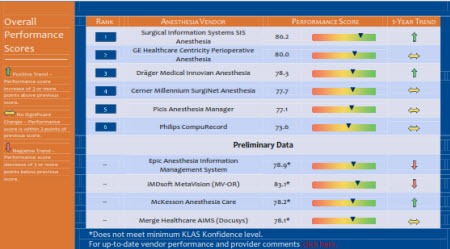
Picis, Epic, and GE own the largest share of the anesthesia information system market, according to KLAS. The survey found that customer satisfaction is highest when AIMS purchasing decisions are handled cooperatively between the hospital and OR/anesthesia department rather than either entity making the decision alone.

ZirMed will undertake a $5.1 million expansion project that is expected to create 85 jobs over the next two years at its Louisville, KY headquarters. The state is offering $2 million in incentives for up to 10 years.

9-4-2012 5-27-11 PM

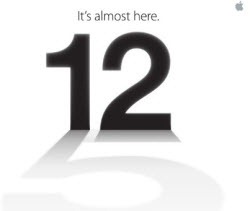
Apple announces a September 12 event that is likely to include its announcement of the iPhone 5 (note the shadow in the picture. )

Scotland-based Craneware says demand for its hospital revenue products has returned to high levels after a slow first half caused by US hospitals focusing on EHRs.

The government of China will invest $63 billion in its healthcare system over the next seven years, with part of the money going toward creation of an electronic health information network.

Technology investor and Sun Microsystems co-founder Vinod Khosla says computers will eventually replace 80% of doctors because computers are cheaper, more accurate, and objective, while healthcare is “witchcraft … based on tradition.” He also says that it will take outsiders to fix healthcare rather than those working within it. He has a knack for throwing out outrageous sound bites that earn him exposure, such as saying that hybrid cars offer no environmental advantage – they just make their owners feel better about themselves.

Highly regarded UCSF physician Bob Wachter, MD (chief of medicine, invented the term “hospitalist,” author) says UCSF’s new Epic system generates an impressive-looking progress note from fragments of manually entered information, but the “monkeys and typewriters” approach not only violates the legendary teachings of SOAP note inventor Larry Weed MD (in the 1971 video above that everybody who designs physician documentation systems should study regularly), it’s not as useful as the old fashioned written note. However, he also offers a solution: ditch the use of Epic’s Smart Text and offer a “Big Picture” field where physicians are encouraged to tell the patient’s story as of that moment (although he wonders whether natural language processing will make that unnecessary at some point). Wachter describes the current state as:

Why did Epic and our UCSF IT gurus structure things this way? The primary virtue is that this charting-by-problem approach allows the patient to be followed longitudinally, since one can track problems such as “hypertension” or “ovarian cancer” over years, seeing how they have been managed and observing the response to therapy. It isn’t a bad conceit, and it probably makes tons of sense when described in a fishbone diagram on an informatics seminar whiteboard. But the effect I witnessed on patient care and education was less positive. When I was on clinical service in July and read the notes written by our interns and residents, I often had no idea whether the patient was getting better or worse, whether our plan was or was not working, whether we need to rethink our whole approach or stay the course. In other words, I couldn’t figure out what was going on with the patient.

9-4-2012 8-01-15 PM

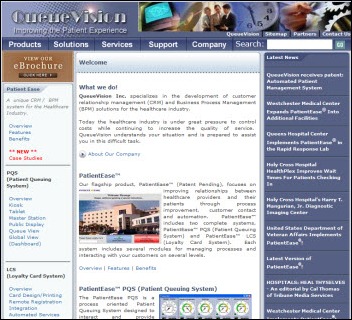
Small software vendor QueueVision says the Tampa VA hospital is refusing to pay for its medication tracking software despite using it since 2006. The company says the purchase was approved by the hospital’s pharmacy administration, but the VA won’t cough up the $214K it owes. Says a partner in the company, “We were suckers. They took us. I figured the veterans were so happy, the staff was so happy, everybody loved it. So we thought they would pay. We never fathomed that they would lie to us.”

In England, small blood-tracking systems vendor MSoft eSolutions is expanding after winning eight of eight RFPs last year. Its Bloodhound system provides positive ID of employees and patients throughout the blood transfusion process.

I liked this Facebook article by disgraced investor / interesting author Henry Blodget, in which he says publicly traded companies destroy their own value by trying to appease impatient investors and venture capitalists. He explains why nobody should be surprised at the fall in Facebook’s share price (May IPO price $38, Tuesday’s closing price $17.73) given the clear message that CEO Mark Zuckerberg has sent all along that he’s focusing on the customer experience and long-term value as Amazon has always done rather than next quarter’s share price. A snip of Blodget’s paraphrasing of a section of Zuckerberg’s pre-IPO shareholder letter:

Let me remind you that I own 57% of the voting stock of Facebook, which means I have complete control over it. I organized the company this way many years ago, with the very deliberate intention of maintaining complete control over it. I did this so I wouldn’t get overruled and canned by venture capitalists, a fate that unfortunately befalls many entrepreneurs. I also did it so in the event that we ever had to go public—which we unfortunately have to do now—I would never have to pay attention to whiny short-term public shareholders. Those whiny short-term public shareholders have destroyed many great companies by making management obsess about absurd near-term financial targets … Maximizing near-term profits" often means under-investing in future innovation, customers, and employees. And although it sometimes temporarily boosts stock prices, it often guts companies and clobbers their value over the long haul.

The Florida teenager accused of impersonating a PA and practicing medicine without a license is found guilty by a Florida jury and could go to prison for up to 10 years.


Sponsor Updates

9-4-2012 8-53-18 PM

  • Aetna will offer eviti’s oncology decision support tool on its Medicity iNexx platform.
  • The Surgical Information Systems anesthesia information management system earns the highest client satisfaction scores in KLAS’s anesthesia specialty report.
  • MED3OOO CMO Paul McLeod, MD discusses the challenges of controlling ER visits in a blog post.

Contacts

Mr. H, Inga, Dr. Jayne, Dr. Gregg.

More news: HIStalk Practice, HIStalk Mobile.

Curbside Consult with Dr. Jayne 9/3/12

September 3, 2012 Dr. Jayne 4 Comments

clip_image002

This weekend on HIStalk Practice, Dr. Gregg wrote about the possibility that the “infamous tricorder from Star Trek” is about to become reality. A company called Scanadu has a prototype handheld diagnostic device that (at least according to their website) will debut in a little over a week. Although I agree with Dr. Gregg that it has huge potential to empower consumers with auto-diagnosis tools, I really have to wonder about the entire premise.

Their trailer video is quite engaging. They walk through a parent diagnosing their child’s rash, a mom receiving a warning about a whooping cough outbreak and the fact that her daughter needs an additional immunization, and parents diagnosing their sick child with a potential urinary tract infection and being sent to an urgent care facility. The voiceover states, “We’re building a way for people to check their bodies as often as they check their e-mail.”

Like so much today, some technology is surrounded by a lot of hype. While I don’t doubt that this is going to be a very cool and potentially powerful technology, I have some concerns with it. It feeds into the idea that we just have to embrace technology and we will live happier, more fulfilled lives.

I’m betting most Americans will hope that at the end of the diagnostic algorithm, it suggests a single pill that can fix everything. Just a few seconds of scanning a day will convince us that everything is OK.

Guess what? It’s not OK. Americans are fatter and more unhealthy than ever. We don’t need any miracle technology to tell us this. There are simple things we can do every day for our health that we are simply unwilling to do because they’re not sexy or high tech. They’re hard work and involve difficult choices and possibly sweat.

Physicians and other health providers have been preaching these things for years, yet people do not follow these recommendations. Will it make a difference if the recommendation comes from an impersonal device? I doubt it. I’m willing to keep an open mind, though, if there is even a small chance it will make a difference.

I’d like to live in an age where people are as obsessed about their body mass index as they are about finding out what Snooki named her baby. An age where people sit around the pub comparing their best fitness data instead of the statistics of their fantasy football teams. An age where I never have to diagnose another child with diabetes.

The folks at Scanadu have a great tagline: We are the last generation to know so little about our health. I really don’t think that’s true. I think we know a lot about our health. We’re just unwilling to do anything about it.

I look at my thousands of co-workers at Big Hospital. We all have to check our biometrics every year in order to get the best discount on our health insurance premiums. But looking at our population as a whole, having this information hasn’t led to a tremendous cost savings or healthier employees. People know their numbers, but they simply don’t care. They don’t want to give up habits or behaviors they find pleasurable. They haven’t come to grips with the fact that in the end, it’s a zero-sum game. Unless you’ve won the genetic lottery, each of us has to pay for our dietary and exercise indiscretions.

Being a physician doesn’t make me any better than the next guy. I have weak spots for chocolate and martinis. Those who know me really well know that I also have a thing for Buffalo chicken wings and all things fried. I love to watch bad TV and once became nearly vegetative watching a marathon of Deadliest Catch.

At the opposite end of the spectrum, I work with residency faculty members whose most indulgent meal is a baked potato with some olive oil and spices. They may get by on that, but I know that ultimately I am going to make less than perfect food choices and I’m going to have to balance it out with healthier meals at other times and also with daily exercise. I don’t take my health for granted – none of us should.

Technology can be a great motivator to help people track their health. I love reading HIStalk Mobile and seeing all the cool trackers and apps that Dr. Travis finds. I’ve even tried some of them. Recently a community group I’m part of decided to take part in the Presidential Active Lifestyle Award challenge. We created a group where we could log our activity and track some group goals as a motivator. As a community group that mentors youth, the adults have a vested interest in making healthier lifestyle choices so we can serve as role models.

After two months on the challenge, we have exactly four people who are willing to go online and log their activity, and only two of them are actually active. It’s a sad commentary. (I have to think we’d have better participation if The President’s Challenge had a mobile app, but alas, they do not.) Today I can’t even log in. We can put a man on the moon, but we can’t handle our exceptions, apparently.

I’m looking forward to seeing what Scanadu has in store for us. Having served on the sidelines for youth sports teams, I’d love a hand-held scanner that can help me determine the prognosis for a concussion or whether that student with mononucleosis really has an enlarged speen and needs to sit on the bench. As someone who cares for children, I’d love something that can reassure a parent when their toddlers slip in the tub and hit their heads. I’d be thrilled with any handheld device that can actually get people excited about their health and convince them of the need to eat less junk and move their bodies regularly. Unfortunately, I’m just a little bit skeptical at the moment.

Print

E-mail Dr. Jayne.

Readers Write 9/3/12

September 3, 2012 Readers Write 1 Comment

Submit your article of up to 500 words in length, subject to editing for clarity and brevity (please note: I run only original articles that have not appeared on any Web site or in any publication and I can’t use anything that looks like a commercial pitch). I’ll use a phony name for you unless you tell me otherwise. Thanks for sharing!

Note: the views and opinions expressed are those of the authors personally and are not necessarily representative of their current or former employers.


Routine Killer
By Bill Rieger

9-3-2012 4-52-31 PM

I was at a conference recently. Before I left, I was looking forward to getting away and enjoying the sights, sounds, and energy of Chicago. The first few days were awesome, filled with several miles on foot experiencing the Magnificent Mile, Navy Pier, Lake Michigan waterfront, and several good restaurants. 

By the third day, I started to feel “it.” I wasn’t sure what "it" was, but I knew it was uncomfortable and it was starting to impact my trip. By Friday, I was drop-dead ready to return home. You know that feeling. Tired, "problems" because of way too much restaurant food (OK, maybe that’s too much information, but it’s true), and sorely missing my wife and kids. 

The weekend was great and very busy. The weekend before the first day back to school is always crazy, but compound that with the fact that I had been gone all week and still hadn’t resolved what "it" was, I could have been a better husband and father.  

I got up Monday at 5:00, hit the shower, made the coffee, read for 30 minutes, prayed, got the kids up, made breakfast, got dressed, and walked out the door headed to my drive (which always includes a podcast of something educational or uplifting). It hit me. I figured out what "it" was. My routine had got way out of whack.  

As I started to consider this more, books I have read that speak to the significance of routine started running through my squirrel cage.  Podcasts I listened to and personal conversations I have had that reinforced purposefully creating a schedule started reverberating through my head.

One of the best books I have ever read relating to personal growth and development is The Compound Effect by Darren Hardy. He reveals a formula that I have adopted as a way to manage my own growth: 

Choice + Behavior + Habit + Compounded (over time) = Goals

The funny thing about this formula is that if you remove one of the addends, the sum could be reduced dramatically. The lack of routine in my trip, I believe, decreased my effectiveness on the trip. As a result, I didn’t get as much out of it or pour as much into it as I could have.  

As I continued to reflect on this, I started looking around me at who I influence: my wife, my kids, my co-workers, my team. The trip I took, at least to some degree or another, impacted their ability to achieve those goals that I’m helping them with. I am not saying here that the world revolves around me (or any one of us specifically), but we do have an impact on those around us. Even if you cancel the weekly meeting ahead of time, the routine is broken when you aren’t there. According to the formula, there is an impact.

This reflection has been a good one for me. The next time I travel, I will develop a schedule and routine for the trip. The next time I have to cancel a standing meeting with a staff member, I will try to think about how that is impacting the routine that is built into that relationship.

Routines and habits make up who you are. Our lives are defined by how we spend out time, talents, and treasures, I want to be as responsible and accountable as possible for all of these areas of life.

The takeaway: Routines have impact.  If you do not have habits or routines, take the time to make up daily routines and you will experience growth. The people around you will benefit immensely. I have a schedule I use as a template that I would be glad to share. E-mail me at bieger@gmail.com.

Bill Rieger is CIO of Flagler Hospital of St. Augustine, FL.


It Doesn’t Matter if Allscripts is “Open” – Their API is a Game-Changer
By Jonathan Baran

9-3-2012 5-06-11 PM

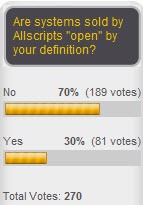
More and more vendors are thinking about going "open" — turning their EMR into a platform for third-party application developers. Allscripts is the first major EMR vendor to the party. Because of it, they are taking criticism for whether they are truly "open."

I’m here to say that it doesn’t matter if you call Allscripts open or not. Their API will create an ecosystem of innovation that will both solve provider needs and increase vendor revenue.

My company has first-hand experience with their API. This is what we’ve learned:

The Allscripts API removes the burden of integration away from the health system IT staff

For an EMR app to be truly useful, it will require data. In a pre-API world, you can use HL7 or a Web client to get some data, but what does it cost? It seems like regardless of how simple the project is, it will take three months of IT time. When tacked onto a list that is already 12 months long, there is a lot of waiting for an innovation to reach the light of day.

Compare this with an Allscripts world. Want to get an application integrated? Call your Allscripts sales rep and the app will be integrated that afternoon. The integration has been completed once with Allscripts API, which means it can scale to all their users on that single product. This simple elimination of IT time could have a profound impact on the pace of new technology adoption.

By using an API, applications can work in the background, minimizing the training and go-live time

Now that you have gotten the application integrated, it’s time to train the users. But of course that will not be easy, because HL7/Web client are a good source of clinical data, but demand a disjointed experience for the user. This requires awkward steps like seeing websites “embedded” in the EMR, having to click a button to transfer data, requiring users to copy and paste text, or needing to have a completely separate application. Even the simplest process becomes difficult when you’re asking users to take these pseudo-integration steps. I know this because we did it. Ugly.

Compare that with Allscripts. Everything can be done in the background. Want to pull tasks out of a task list and read the patient’s medication list? Want to have everything happen automatically in the background with no clicks? Done. It is easy to see how this could impact training and go-live. In the first example, every staff member in the organization needs to be trained on the "new system.” In the second, they don’t even need to know it is happening.

API level access means that your product can fit within the end users existing workflows

Workflow change is hard – really hard. The only easy way to change a workflow is to get rid of it. Eliminate steps. Remove clicks. How can you do this when by definition you are adding something? The answer is "addition by subtraction.” By getting deeper levels of integration, workflows can actually be made better.

This is only a small sample of the benefits that come to mind. Others include piloting (“Dr. CMIO, would you like to try the solution out this afternoon?”) and the App Store (find new apps in a single marketplace).

Jonathan Baran is co-founder and CEO of Healthfinch of Madison, WI.


EHR Donation and Accountable Care
By Jed Batchelder

9-3-2012 5-12-47 PM

I’m working with a healthcare system that is in the process of developing an EHR subsidy for the independent affiliated physicians in their community. They’ve just made a large IT investment, including EHR and HIE, and have started building a platform to help deliver accountable care.

Right now the challenge is how to structure the subsidy so it is attractive enough to entice physician adoption while remaining fiscally responsible for the sponsoring entity.

Much of industry is still living in the fee-for-service world, which is perfectly understandable given that’s how we get paid today. But we need to imagine and prepare for how that is all going to change in the coming years and make the right decisions now to prepare for it. We have the unenviable task of having to live and pay the bills in the fee-for-service world while investing in an infrastructure for the next value-based world.

Imagine you own a large retail store in the year 1997 and are trying to decide how much money to spend on web sites, computers, e-commerce solutions, and Internet connectivity. You can already hear the disagreement in the budget meetings and smell the fear in the room. You can’t yet see how the web is going to transform how you conduct your business, how sales transactions will occur, and how you’ll get paid.  

All of your revenue comes from customers who walk in the door of your stores, but you keep hearing about this thing called the World Wide Web and e-commerce that is supposed to be the next big thing. You could take a wait and see approach, possibly allowing a disruptive innovator like Amazon or Zappos to take your market share. Or you could pause and notice the ways that the world is already changing. (Best Buy just reported a 90% drop in earnings last quarter.) In a bricks and mortar retail model, large IT investments can initially look reckless, but once that new world arrives, you’re relieved that you took the risk.

When viewed solely from the view of the numbers, the EHR subsidy doesn’t make a ton of sense in the fee-for-service model. In fact, it looks more like a charity. But what happens when you look at it through a value-based ACO model, where providers will be compensated based on how well they jointly take care of patients, how well they coordinate the care, and how healthy their patients are? Just as it was difficult to predict the extent that the Internet would transform commerce, it is difficult to imagine what care will look like in a post fee-for-service world.

These points support both the idea that the hospital should take on more of the cost and the idea that independent docs should put more skin in the game, lessening the financial burden on the sponsoring hospital system. How far should we move the slider? How much skin should both sides put in? Who is more at risk by not having the connectivity and common platform? Who stands to gain the most and lose the most? These are perhaps the most pressing questions.

Jed Batchelder is an independent healthcare IT consultant.

Monday Morning Update 9/3/12

September 1, 2012 News 19 Comments

9-1-2012 8-34-08 AM

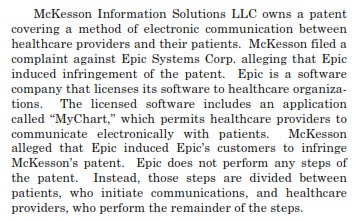
From HITEsq: “Re: McKesson. Won its appeal against Epic for patent infringement. The Federal Circuit, en banc (i.e., before all the court of appeals judges), overturned existing law to find in favor of McKesson. The case is remanded to the lower court to decide if Epic really does infringe.” It’s a complex issue, and since I covered it when McKesson lost the original appeal in April 2011, I’ll recap from there. McKesson said Epic’s MyChart violates a McKesson patent for a method of placing visit-specific patient information on a Web page so that patients can schedule appointments and request prescription refills. The original  “joint infringement” decision (about which the three-judge panel argued a lot) was that Epic wasn’t liable since it doesn’t directly offer those capabilities, but rather allows individual patients to request MyChart access subject to the approval of their physician. Since no single party violated McKesson’s patent, the original court said Epic wasn’t liable. Legal experts are troubled with this latest decision, which appears to make “inducing infringement” actionable even if no infringement has been proven. All of this is way over the heads of mere non-lawyer mortals like myself who can’t resist snickering while repeating phrases from the document like “joint tort feasor” in humorous voices because it’s just so weird and funny, so if any legal beagles wish to expound pro bono, here is your electronic lectern.


From Lex Luther  Van Dam: “Re: Epic’s patent for a patient-controlled, patient-generated health record. This is bizarre. Much of this was already on the market when the patent was filed, so either Epic didn’t know or forged ahead anyway, and either is not good. Epic has seemed indifferent to patients controlling their own information, to the point that they don’t even talk about Lucy, their own PHR solution, and they certainly don’t cooperate with anyone else offering a PHR solution.” My guess is that this patent either covered Lucy when it was first being developed or was simply a legal stake in the ground to prevent further legal incidents like the McKesson one above. I also don’t know that Epic’s customers, being turf-protecting and somewhat patient-paternalistic academic medical centers, have a heartfelt interest in empowering their patients via PHRs from Epic or anyone else. Or for that matter, avoiding the “walled gardens” between proprietary EMRs that Farzad was railing against given that Epic-to-Epic direct data exchange has displaced the interest in a vendor-neutral exchange in some areas where most of the major players run Epic.

From MU Nick: “Re: worksheet. Has anyone created a worksheet for MU2 for the EP and EH requirements (as opposed to a PDF?)” If you’ve put something together and are willing to share, let me know.

9-1-2012 2-43-22 PM

From DanburyWhaler: “Re: Western Connecticut Health Network. Hired Steve Laskarzewski, Waterbury’s former CIO, as clinical applications director. Looks like they’re grooming him for the top spot when Kathy DeMatteo steps down later this year.” Steve’s LinkedIn profile says he started in June. He’s one of the 2,716 members of the HIStalk Fan Club that reader Dann started years ago, so he gets a shout out.

From Douglas: “Re: Mr. HIStalk. Why do you use that name?” I needed an e-mail address when I started HIStalk back in 2003, and being in a minimally creative mood at that moment, the best I could come up with was mr_histalk (the name HIStalk itself was equally lame, with the HIS standing for Hospital Information System, which was in vogue at the time). I had zero readers and minimal expectation of gaining any, so I didn’t give it much thought. I don’t recall having actually called myself that at any point, but readers did over time, and then Inga at some point shortened it to Mr. H. It feels odd since I have never even once referred to myself as Mr. Anything in real life since I’m not too impressed with titles in general. My latest pet peeve: family members of dead doctors who stick “Dr.” in the title of their obituary listing instead of just their name like everybody else does, apparently hoping that like Egyptian boy kings, their most valued earthly possession will carry over into the afterlife. Putting “MD” after your name is perfectly fine on your office door, as is “Doctor” in front of your name is for professional encounters. A doctor who is so deficient in self-esteem as to demand the use of those titles in social situations when nobody else is calling themselves Mr. or Ms. is, in my opinion and experience, an arrogant ass. Lots of people earn doctorates, many of them requiring more education than a medical degree, and yet it’s most often an MD (or, in the case of male MDs, their wife) who insists on cramming their title down everybody’s throat at the auto repair place or at school meetings (my theory: that’s why hospital administrators enjoy putting physicians in their place). So, to complete my circular logic, the Mr. HIStalk thing is not indicative of a superiority complex since if anything, my tendency is the opposite.

It’s Labor Day, so I am appropriately laboring (in the non-obstetrical sense). I hope your holiday is – or was, depending on when you’re reading – delightful.

9-1-2012 7-36-19 AM

We are collectively fatigued with the endless Meaningful Use palavering, apparently, as 46% of respondents say they are indifferent to release of the Stage 2 rules. Of those who cared, reaction was split between positive and negative. New poll to your right: if the presidential election were being held today, who would you vote for? An online issues quiz says that I’m exactly evenly split between the two major candidates with a 63% alignment with my beliefs for each, but both are far dwarfed by my 91% match with Libertarian candidate Gary Johnson, who I’d never heard of until I took the quiz. That leaves the same options I had in the last presidential election: vote for either of two candidates that I would dread seeing take office or vote for one I’d like to see win who doesn’t have a chance.

9-1-2012 7-53-33 AM

Surescripts acquires Kryptiq, of which it previously owned a 21% share. Surescripts uses Kryptiq’s secure messaging technology for its network. Other healthcare IT vendors are also among its customers (GE Healthcare and Vitera), and its other offerings include clinical messaging, a patient portal, and electronic prescribing. Kryptiq announced earlier this year that its revenue grew 60% and its user count exceeded 40,000.

Cambridge Health Alliance chooses EDCO’s Solcom electronic document management system for managing historical paper records and paper documents originating outside of CHA. It will integrate that information with its Meditech and Epic systems to eliminate the file room and hybrid record environment.

9-1-2012 3-48-26 PM

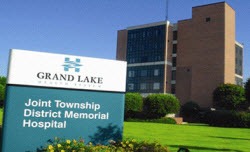
Joint Township District Memorial Hospital (OH) chooses the Optimum general accounting suite from NTT Data. The company also announces that its NetSolutions Point-of-Care clinical and billing system for long-term care facilities will now send care data toAssured Proactive Analytics to optimize payment.

9-1-2012 8-04-52 AM

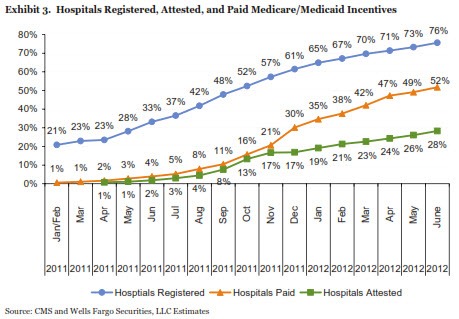
A Wells Fargo Securities report sent over by a couple of readers says that hospital users of Meditech, Cerner, and CPSI lead the pack in total number of Meaningful Use attestations through June 30. On the ambulatory EHR side, it’s Epic, Allscripts, and eClinical Works, although Epic would drop to third if it didn’t have 10,000 Kaiser doctors of its 15,000 attestations. Of new attestations, it’s Cerner and CPSI leading for hospitals (those same two vendors also led in the overall percentage of client base attesting) and athenahealth and Practice Fusion for EPs. A reader, however, notes that the numbers suggest that Epic has 650 hospital customers, which seems awfully high, so there’s always the question of what’s behind the data.

9-1-2012 7-04-01 AM

CoCentrix hires Clayton Ramsey (Elsevier) as SVP of delivery.

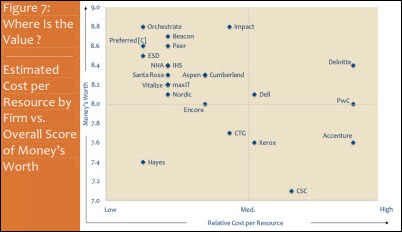
I chose this graphic in mentioning the new KLAS evaluation of Meaningful Use consulting firms a few days ago and regretted it the next day when I had more time to ruminate on it. I’m unhappy with how KLAS presented the graphic since they committed the cardinal sin of not setting the Y-axis of the graph to zero. That’s usually a red flag indicating that someone is trying to make an overly dramatic point that their data points don’t support. In this case, the actual range of consulting firm “money’s worth” scores was 7.1 to 8.8, which are pretty good numbers within a fairly narrow spread. The KLAS graph only shows the range of 7.0 to 9.0, making it appear that huge gaps separate the firms, which is absolutely not the case. This doesn’t give me a lot of confidence that the behind-the-scenes work at KLAS is statistically rigorous, a often-made but never-answered charge. I would also question whether this graphic means anything at all considering that the Y-axis is customer-reported value, while the X-axis is “relative cost per resource,” whatever that means. Should we infer that a company with a high per-resource cost can’t be worth it no matter how satisfied their customers are? My main gripes with KLAS (and the Most Wired surveys and HIMSS Analytics and so on ) is their tendency to take a modest amount of data and over-extend it to lofty conclusions using a black box that nobody’s allowed to peer into. I like what they do, but as we healthcare types say, “In God we trust – everybody else bring data.”

9-1-2012 3-07-15 PM

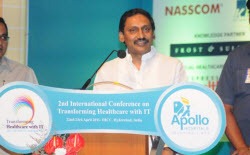
Among the speakers at this past weekend’s health IT conference in Hyderabad, India were Lee Shapiro (Allscripts president) and Marc Probst (Intermountain Healthcare CIO).

9-1-2012 3-50-53 PM

TeraRecon launches its iNtuition Review, iNtuition Enterprise Medical Viewer, and iNtuition SHARE at the AOCR/RANZCR radiology conference in Sydney, Australia. The products provide multi-modality review and the capability to distribute images throughout the enterprise via a browser-based viewer.

9-1-2012 3-17-16 PM

Cancer Care Group (IN) announces that medical information of 55,000 patients and the organization’s own employees was exposed when server backups were stolen from an employee’s locked car. The announcement leads off with, “Patient confidentiality is a top priority,” which is apparently now a bit closer to the truth since they’re suddenly considering encrypting backups and mobile devices. It’s an immutable rule that nobody encrypts anything until they are publicly embarrassed for not having done so, and then they can’t jump on board fast enough.

9-1-2012 3-27-55 PM

Novant Health (NC) rolls out a screensaver featuring former UNC star Michael Jordan to remind employees of its zero-tolerance handwashing program, launched in 2005 after three premature babies died in one of its hospitals from MRSA infection. The source was tracked back to staff who hadn’t washed their hands, which Novant found was common with a compliance rate of only 49%. They’re at 98% now.

In Australia, a hospital CEO sues a nurse who he says disparaged him in her Facebook comments that were brought on by a labor dispute. One of her comments: “We don’t take kindly to misinformation by well-paid fat cats who only visit the hospital wards for photo opportunities.”

9-1-2012 3-30-56 PM

Surgeon and best-selling author Atul Gawande, one of the most visible and respected people in healthcare, apparently is sold on the use of analytics but  isn’t a fan of using technology in his own practice. Some snips from a recent interview:

  • I do use the iPad here and there, but it’s not readily part of the way I can manage the clinic. I would have to put in a lot of effort for me to make it actually useful in my clinic. For example, I need to be able to switch between radiology scans and past records … I haven’t found a better way than paper, honestly. I can flip between screens on my iPad, but it’s too slow and distracting, and it doesn’t let me talk to the patient.
  • I think that information technology is a tool in that, but fundamentally you’re talking about making teams that can go from being disconnected cowboys in care to pit crews that actually work together toward solving a problem.
  • I worry the most about a disconnect between the people who have to use the information and technology and tools, and the people who make them. We see this in the consumer world. Fundamentally, there is not a single [health] application that is remotely like my iPod, which is instantly usable … In many of the companies that have some of the dominant systems out there, I don’t see signs that that’s necessarily going to get any better.
  • The reason [data analytics] works well for the police is not just because you have a bunch of data geeks who are poking at the data and finding interesting things. It’s because they’re paired with people who are responsible for responding to crime, and above all, reducing crime … That’s what’s been missing in health care. We have not married the people who have the data with people who feel responsible for achieving better results at lower costs.
  • Timeliness, I think, is one of the under-recognized but fundamentally powerful aspects because we sometimes over prioritize the comprehensiveness of data and then it’s a year old, which doesn’t make it all that useful. Having data that tells you something that happened this week, that’s transformative.

More on Keane’s HIS-tory this week from Vince.

E-mail Mr. H.

Time Capsule: The Incentive Misalignment Between IT Leaders and IT Projects: Why CIOs Set Unreasonable Expectations

August 31, 2012 Time Capsule 3 Comments

I wrote weekly editorials for a boutique industry newsletter for several years, anxious for both audience and income. I learned a lot about coming up with ideas for the weekly grind, trying to be simultaneously opinionated and entertaining in a few hundred words, and not sleeping much because I was working all the time. They’re fun to read as a look back at what was important then (and often still important now).

I wrote this piece in October 2007.

The Incentive Misalignment Between IT Leaders and IT Projects: Why CIOs Set Unreasonable Expectations
By Mr. HIStalk

mrhmedium

Spoiler: because projects would never get done otherwise.

A recent Canadian report provides a good overview of the how clinical information systems are (or more precisely, aren’t) improving patient safety. As simple as it sounds, one recommendation struck me as being profound: “Expectations for EHRs and patient safety must be realistic.”

Why that’s interesting: big clinical system projects would never get done unless the CIO takes an internal salesperson role, not much different than the salesperson who sold the hospital on the (unrealistic) system benefits in the first place. In other words, CIOs have to set false hopes to get projects going. If users knew what was coming, they’d opt out.

Users (played by Tom Cruise): “I want the truth.”

CIO (played by Jack Nicholson): “You can’t handle the truth!”

Maybe that’s why system users become disillusioned, vendors feel customer heat, and CIOs get fired. Everybody has an incentive to overstate the likely benefits, right down to the point where those benefits don’t materialize. Then, let the finger-pointing begin.

Systems have gaps of various sizes between what customers expect and what they actually get in the form of real, working software that they’ll use optimally. How big the gap is depends on two things: (a) the product, and (b) the customer. The money’s been spent, though, and the higher powers want to see the results that everyone agreed to in that innocent, long-ago moment of pre-purchase euphoria.

The result: disappointments and delays must be glossed over. IT types huddle behind closed doors with the same fervor as vendor marketing departments, carefully crafting the message, singling out project friends and enemies, and enlisting shills to vouch for inevitable wonderfulness of it all. The IT department knows the ugly underbelly of what’s ahead, but a grin-frozen face must be presented so users won’t panic. IT and its users have become uneasy enemies.

Beyond even that irrational exuberance, CIOs are sometimes create further damage. They push automation as a great way to implement organizational change because that’s what IT cheerleaders are supposed to do. They override popular voting for which system to buy. They overestimate the capabilities of their own stretched department to implement and support new applications. And worst of all, they sometimes unwisely let themselves be cast as project champion or owner.

You don’t want to own something you can’t control. You’ll be constantly begging everybody else to donate their resources to what has suddenly become your project. Executive supporters suddenly can’t spare their own folks to get it done. Before you know it, it’s CIO Giant Sucking Sound 2.0.

Hospital operational executives can’t control clinicians day to day. It’s CIO hubris to think that a tiny, stretched IT department can lead organizational change from the cheap seats. That’s never happened and it never will.

The project champion must be an operational leader who’s responsible for most of the affected areas and who can deliver the expected results. That person, along with a team of stakeholders, should define the need for automation, lead the selection process, oversee implementation, and set and measure benefits and outcomes. They should also weigh the inevitable (and often justified) objections of clinicians worried about patient safety.

It’s a shame that the only way to convince users and departments to change is to paint a falsely rosy picture of the likely result. If organizations had more willpower and focus, the need to deceive them to get projects done would be greatly reduced.

News 8/31/12

August 30, 2012 News 20 Comments

Top News

8-30-2012 6-12-56 PM

SAIC announces Q2 results: revenue up 8%, EPS $0.32 vs. $0.32, beating expectations on revenue and meeting on earnings. The company announced plans to split itself into two independent, publicly traded companies, one offering technical services and the other delivering solutions. Healthcare will be part of the solutions business. Shares are up 10% in after hours trading. SAIC acquired Vitalize Consulting Solutions in August 2011 and maxIT Healthcare in August 2012.


Reader Comments

From Klinger: “Re: Epic support. I always heard it was second to none, but what I’m getting is lacking. Have other people noticed, or is it just the TSs that I have?”

8-30-2012 8-37-31 PM

From Palmetto Jack: “Re: Palmetto Health. Not an affiliate of USC.” Thanks for the correction. Wikipedia says Palmetto Health Richland is affiliated with University of South Carolina and Palmetto Health’s graduate medical education page says the USC School of Medicine is a “partner and close affiliate,” so it’s one kind of affiliate but not another. I don’t really claim to know the difference.

From Honey Badger: “Re: Cerner. Heard a rumor that they will switch to Greenway’s ambulatory clinic EHR product.” Unverified.


HIStalk Announcements and Requests

inga_small This week’s top picks from HIStalk Practice: Consumer Reports publishes ratings on over 500 Minnesota practices. Practice administrators at large groups see a rise in median compensation, while their small practice peers experience a decline. AMA urges CMS to delay the move to ICD-10 by at least two years. Is HealthTap’s model viable in the long term? Physicians give high scores to Amazing Charts, Epic, and the VA’s ambulatory EMR. Practice Wise CEO Julie McGovern advises practices to avoid tackling other projects in the midst of an EMR implementation. We don’t have a Like button for our posts, so the next best thing is to sign up for the e-mail updates on HIStalk Practice. Thanks for reading.
Listening: new from Dispatch, their first new material since disbanding in 2002. The indie band hoped to draw 10,000 people to its free final concert in its home town of Boston in 2004, but instead became record-holders as the largest independent music concert in history when 166,000 fans came to say goodbye. The band’s mostly Northeastern tour starts in three weeks.

8-30-2012 7-07-46 PM

Welcome to new HIStalk Platinum Sponsor Health IT Quality Solutions, a certification program offered by Quest Diagnostics to vendors of ambulatory EHR products that support Quest’s DEX lab orders and results network. The program’s goal is to maximize lab data quality and enhance interoperability for the 500,000 patients per day that use Quest’s testing services. Three certification tiers are available based on solution capabilities, implementation processes, and participation in mutually beneficial activities. The entire program is free for vendors who qualify, with benefits that include customer satisfaction, solution visibility, faster interface approval, and priority access to Quest’s IT staff. Download a brochure and take a look at the several vendors that have already earned certification. Thanks to Quest Diagnostics and Health IT Quality Solutions for supporting HIStalk.


Acquisitions, Funding, Business, and Stock

8-30-2012 5-59-31 PM

Greenway announces Q4 results: revenue up 24%, EPS $0.07 vs. –$1.09, missing on earnings expectations. The company also projected lower than expected earnings for FY2013. Shares fell 7.1% on the announcement, making GWAY the biggest percentage loser of the day on the New York Stock Exchange. Shares priced at $10 in its February IPO are at $15.27.


Sales

The 300-provider Cornerstone Health Care (NC) selects MedAptus Pro Charge Capture solution for coding and billing.


People

8-30-2012 5-16-57 PM 8-30-2012 5-18-06 PM

HealthTech Holdings hires Stan Gilbreath (Allscripts) as VP of client services for its HMS and Medhost divisions and Eric Anderton (Jackson Key Practice Solutions) as VP of new account sales for HMS.

8-30-2012 5-21-29 PM

Joe Miccio (maxIT Healthcare) joins Divurgent as client services VP.

8-30-2012 7-46-11 PM

In Canada, Nancy Martin-Ronson RN, who joined Peterborough Regional Health Centre three months ago as CIO, will also take on the role of chief nursing officer.

Arkansas Governor Mike Beebe names Ancil Lea, executive director of HITArkansas, as coordinator for the Arkansas Office of Health Information Technology.


Announcements and Implementations

8-30-2012 8-34-38 PM

The Karmanos Cancer Institute (MI) implements Versus Advantages RTLS in once of its clinics to monitor patient location, track throughput, and manage workflow.

McKesson will offer NovoPath’s anatomic pathology solution to its LIS customers.

Craneware earns CMS’s Electronic Submission of Medical Documentation certification, allowing it to offer customers the ability to electronically submit medical records to review contractors.


Government and Politics

ONC names CCHIT, the Drummond Group, ICSA Labs, InfoGard Laboratories, and Orion Register as certification bodies under the Stage 2 certification program.

Farzad Mostashari says that ONC will not allow EHR vendors to drag their feet in supporting data exchange with competing EHRs.


Other

8-30-2012 5-34-30 PM

KLAS names its top-rated Meaningful Use consulting firms in three categories: Impact Advisors (enterprise implementation leadership and advisory); Cumberland Consulting (team implementation leadership and advisory); and Navin, Haffty, & Associates (team implementation leadership and staffing). Of the 51 firms identified, more than half achieved satisfaction scores of 89 or above out of 100.

SCI Solutions announces record growth for the first six months of 2012, with 82 hospitals choosing its solutions for care coordination, referral management, and scheduling.

Queens Health Network (NY) honors Congressman Joe Crowley for supporting ARRA, which will pay the hospitals and clinics of New York City Health and Hospitals Corporation up to $200 million.

Madison Memorial Hospital (ID) unblocks access to Facebook from its wireless network after patient complaints. One employee said it was “stupid” that as a patient, she couldn’t post photos of her newborn baby on Facebook. A newspaper reader was more rational: “What an inconvenience when we have to go to a hospital and we can’t get on Facebook. I guess most of us in this day and age feel entitled to more than that what we get.”

Real estate sources say that Meditech is finalizing a deal to acquire 200,000 square feet of office space in Foxborough, MA. The company abandoned plans for a Freetown, MA campus earlier this year after running into a mountain of red tape triggered by the discovery of native American artifacts on the property.

8-29-2012 8-31-32 AM

Epic not only submitted MU Stage 2 comments to ONC, it even helpfully distributed them to their customers so they could submit the same comments under their own names. David Clunie noticed this and lists the hospitals who sent in the boilerplate, including University of Miami, which submitted the same comments five times without noticing the “Remove Before Submitting” headline that prefaced Epic’s explanation of why its customers should share its opinions with Uncle Sam.

In Kenya, the country’s hospital insurance fund won’t issue insurance to a man who claims to be 128 years old because its computer system can’t handle birth years before 1890. His family says they don’t appreciate the implication that he should be dead, and until the issue is sorted out, he’s relying on the insurance of his youthful wife of 89.

Odd: a 29-year-old man sues the maker of the sexual enhancement supplement VirilisPro, claiming that the ensuing sex with his partner in a Scottish Inn damaged his manhood to the point that blood was squirting out onto the walls. A physician expert says the man’s story is “the most absurd thing I have heard of in my life,” explaining that men often arrive embarrassed in the ED with damaged sex organs and make up elaborate stories to explain their predicament. He says, “The most common one told is they walked into an ironing board.”


Sponsor Updates

  • Billian offers its fellow HIStalk sponsors discounts on first-time purchases of its programs for vendors, including the HealthDATA database and prospecting portal and Porter Research market analysis.
  • NextGen will integrate the TRUEresult blood glucose monitoring system from Nipro Diagnostics into NextGen Ambulatory EHR.
  • Velocity Data Centers hosts an open house at its Ann Arbor, MI facility on October 25.
  • T-System offers two September 5t webinars on attesting to MU with T SystemEV.
  • HealthStream expands its suite of products with the addition of NurseCompetency’s exams and skills checklists.
  • Cumberland Consulting Group promotes Christopher Miller to principal and Jennifer Vesole to executive consultant.
  • Emdeon expands its Clinical Exchange solution to include e-prescription routing, lab orders and results exchange, care alerts, medication history, and clinical messaging.
  • Worldwide Clinical Trials selects Merge Healthcare’s eClinical OS solution for data capture, processing, and reporting on clinical trials.
  • ICSA Labs hosts two September webinars to help EHR technology developers understand the 2014 Edition certification criteria and testing requirements.
  • A CareTech Solutions white paper offers customer insights on achieving Meaningful Use Stage 1 for the 82% of hospitals that haven’t completed it yet.
  • Kareo updates its website and branding to reflect its commitment to small practices and billing services.
  • TeleTracking invites hospitals to visit its new Enteprise Solution Center in Raleigh, NC to try its capacity management solutions hands on without the time challenges of a site visit.
  • An informatica blog post covers Hadoop and big data.

EPtalk by Dr. Jayne

I often wonder how Mr. HIStalk does it all, balancing his day job with his HIStalk duties. He’s done an amazing job for just short of a decade, so when I run across a bit of writer’s block, I know I have no reason to complain.

The last few days have been bereft of ideas. Maybe it’s the weather (I hope all of you in storm-tossed areas are safe) or maybe it’s just the end-of-summer doldrums. I was particularly pleased, though, when an idea squeezed its way into my mind this morning (pun intended, keep reading).

clip_image002


Why All the IT in the World Will Not Fix Health Care

Like many women, I go every year for a certain radiologic screening test. This year’s adventure was a prime example of why technology is not necessarily the answer. There was a fair amount of hassle in my attempts to complete this testing, and it largely revolved around people failing to look at the monitors right in front of them.

First, I had to schedule. As in previous years, I scheduled over the phone. I have my films done at an independent imaging facility, which is funny being the CMIO of a pretty good-sized hospital. Frankly, despite all the HIPAA training, I don’t trust the hospital staff to not discuss employees who are patients. The imaging center also charges half the amount the hospital does, which makes sense with my insurance coverage limits. Plus, I don’t want to have to disrobe for people who I might have to later “counsel” about their bad EHR habits.

The first annoyance was when I was asked (after the staffer pulled up my account) whether I’d been there before. I chalked it up to someone just following a script without thinking about what they were asking. Knowing the billing and scheduling system they use, she should have been able to see the date of my last visit on the patient information screen.

Due to family history, I’m being screened at an age much younger than the standard recommendation. Because of this, I know exactly what my insurer will and will not cover. Luckily, I have a “pseudo health savings account” type of coverage which allows me a lump sum (no pun intended) for preventive services. I can use it as I see fit — exams, labs, tests, etc. — as long as they’re preventive in nature.

The staffer proceeded to argue with me about needing a physician order for the screening test, citing, “Your insurance won’t cover it without an order.” Being a doc (and a savvy patient), I know what they cover and how they cover it. I reminded the scheduler that I’ve never needed an order in the past (especially since my state allows women to have screening mammograms without an order).

She was insistent, so off I went to call a physician. I was tempted to just write my own order, but that would have been too sassy even for me. I just shook my head at the barriers to care that were being placed in front of a paying patient with a valid medical need.

Even though I regularly drink martinis and hang out with my personal physician, I didn’t want to abuse our friendship with something so clearly silly, so I called the office. They unfortunately are pretty early in their EHR transformation and do not yet have a patient portal (which would have been ideal for something like this – e-mail the request, get the order electronically, and be done with it). I survived phone tree hell and reached a nurse (they didn’t have a choice for “Press 3 if you need an order that you don’t really need, but it’s totally not urgent, requires no clinical skill, and you’re embarrassed to even have to ask for it.”) Luckily it was a nurse I know, who laughed with me and agreed to mail the order.

It was with my order in hand that I dutifully arrived 15 minutes early this morning. No one asked for it. After a few minutes of deliberation (while filling out the same information on a paper clipboard that I fill out every year), I decided to proffer the order. The receptionist handed it back to me kindly, telling me they already have my physician’s information on file and don’t need orders for screening tests.

For the actual testing, the imaging center has an excellent facility, caring staff, and “on demand” results, which is another key reason I go there. Who wants to wait to get results in the mail (or even from a patient portal) if you can get them directly from the radiologist while you wait? Especially for cancer-related screenings. If it’s not normal, I want to know right away, so I value the service they provide.

The technician didn’t bother to look at my record, instead asking me if this was my first screening, and if not, how many films have I had and where were they done. At this point, I was ready for a mint julep or perhaps some smelling salts.

Fortunately, the radiologist did take the time to look at the previous films and determine there was no change (which was good, because sometimes I have to have additional views and was spared that particular fun) and came in to chat. He knows I work for Big Hospital and usually has something funny to say about my not using their radiology department. I in turn tease him about the candy-colored kiosks from Merge Healthcare that I tried to get them to purchase a few years ago to spice up their lobby.

I decided to gently broach the details of my experience and my concerns about barriers introduced that might have been important to less-savvy patients. He’s an owner of the facility, so he has a significant interest in the amount of money spent on technology. He seemed genuinely frustrated that employees are using old paper-based processes rather than new ones supported by the technology at hand.

He pulled up my record and showed me that I am clearly flagged as high risk, an existing patient, and as a VIP (although apparently my VIP status is funny to his partners since I’m an exec at the competitor — it seems I’m not the only one.) He plans to address the workflow at the weekly staff meeting, which I appreciate.

Still, as a physician, patient, and payer (aren’t we all payers these days?) I find it striking how difficult it is to achieve ideal healthcare. In my dream world, patients are only asked information once (unless they’re asked to validate their existing information) and the staff uses the information at their fingertips to provide high-quality, expedited care. Even in a facility with a very favorable payer mix, well-paid staff who don’t appear overworked, engaged owners and managers, and a huge IT budget, they’re still part of the healthcare problem, and technology just isn’t going to fix it. Until we start addressing process, procedure, and performance, we’re just throwing money and technology at the problem.

clip_image004

On a lighter (but still feminine) note, an old friend of mine made my week by sending an article about the new Bic pens “for Her.” Of course, I had to go to the actual Amazon UK website and read the reviews for myself. In the words of one of yesterday’s reviewers, “If they made Bic for Her keyboards, I could write this so much easier! Darn my silly lady hands …”

Print


Contacts

Mr. H, Inga, Dr. Jayne, Dr. Gregg.

More news: HIStalk Practice, HIStalk Mobile.

HIStalk Interviews Joe Frassica, MD, CMIO, Philips Healthcare

August 29, 2012 Interviews 2 Comments

Joseph Frassica, MD is VP and chief medical informatics officer of Philips Healthcare and a senior consultant at Massachusetts General Hospital.

8-29-2012 7-55-35 PM

Tell me about yourself and the company.

I am a physician and I serve as chief medical informatics Officer for Philips Healthcare’s Patient Care and Clinical Informatics Business Group. Patient Care and Clinical Informatics is one of three major divisions within Philips Healthcare: radiology imaging systems; home health, devices, and services around the care of patients in the home; and everything else we do, which includes clinical informatics, decision support, monitoring, therapeutic devices, defibrillators, ventilators, and a special division that’s very close to our hearts called Maternal and Child Care, a business unit that focuses on the care of infants, children, and mothers.


How does that all roll up into an approach that’s different from software-only vendors?

From my perspective, Philips is in a bit of a better position. Sort of like Apple, in that we make hardware and software. Our hardware is a large part of the business, which includes our monitoring devices and therapeutic devices. From the insight we gain from creating the hardware, we have become experts in the part of informatics that’s related to the hardware, how clinicians use it, and how it fits into the workflow and the data that’s derived from it.


Software vendors are really antsy about crossing over into the FDA-approved side of the business. They probably won’t encroach much on your turf, but you may encroach on theirs. What’s the grand plan for Philips and informatics?

That’s a tough question to answer because there are so many facets to it.  I can tell you that we feel our core competence is in the use of near patient information – the high resolution, near patient information — incorporating that with information from the rest of the informatics universe within the healthcare system to create knowledge for clinicians at the point of care. It is definitely our sweet spot.


Clinical content such as evidence-based guidelines, data warehouses and analytics, and the constant stream of real-time information from biomedical devices have suddenly drawn a lot of interest and challenged what the universe of the electronic medical record looks like. Do you as a physician see that changing how medicine is practiced?

I think there’s great potential to utilize that information to effect outcomes for patients. In the past, this high-resolution information that streams from our devices and streams from the patient reflecting their physiology … we used to throw it on the floor and then throw it out. We would take little snippets of it. We would take an hourly blood pressure, let’s say, and commit it to the record. The rest of the information that was hidden deep within the signals we would dispose of. We didn’t really have any way to process or use it within the EMR environment. Or within the paper environment, for that matter.

Now with the advent of cheaper storage and better interoperability for the kind of information that we deliver from patients, we believe that that information can be harnessed to improve care in ways that we haven’t anticipated when we started to collect information in transactional systems like the EMR.


I read an article about patient condition warning systems and Philips IntelliVue Guardian showed clear benefit in the ICU in the Melbourne study. Not coincidentally, hospitals have gotten in trouble for failing to act on patient device alarms. Can technology help filter out the nuisance alarms and send to clinicians only those patient alerts that are useful?


Absolutely. IntelliVue Guardian is a solution that we designed to work in the lower-acuity setting. We know that when you apply an ICU monitoring solution to the lower-acuity setting, users face a number of challenges.

One of the challenges that they face is that the monitoring that’s designed for the ICU is often tuned for patients who have a high likelihood of a problem developing. Patients in the sub-acute setting are different. They don’t have a high likelihood of deteriorating, but they do have a possibility of deteriorating. You need a different kind of approach to monitoring those patients so that you don’t create a lot of false positives,  but you create a safety net. If they start to fall, if they start to deteriorate, you catch them before the crisis happens or before they need significant resuscitation and more expensive and more serious care.

I think having solutions that are designed for different patient population makes sense. It will help improve the landscape of noise and advisories that are happening within the hospital and help make them more relevant for particular patients.


The nurse has discretion about alarms, and when you’ve heard the same alarm 100 times, confirmation bias makes it hard to catch that hundredth time where it’s critical. Are hospitals seeing benefits and getting to the point of being able to prove the benefits of smarter alarms?

Absolutely. I am part of the Healthcare Technology Safety Institute’s alarms group. It’s a group of folks from academia, from the industry, from the research community, and from agencies that have an interest in regulation of medical devices. We’re trying to come up with the appropriate research imperative to help us improve the alarm landscape, as well as what can be done immediately to help improve it.

On the public front, we’re actively involved in the effort of the Association for the Advancement of Medical Instrumentation to improve the alarm landscape. In addition, we have a large number of folks who sit on standards committees which actually help to create the rules around the delivery of these vigilance alarms. Internally within Philips, we have a very large group that I lead of researchers, clinicians, research and development folks from around the world, as well as marketing and consultancy teams, that are working internally to help us make our alarms as smart as we can make them.

There are tools that we already have built into our products that can help to improve the current landscape that you see talked about in the newspaper. We can help healthcare organizations improve based on our current tools, but we’re also looking to the future to make alarms smarter and more likely to signal clinically significant events than standard, single-parameter alarms are today.


That’s similar to the path followed by clinical decision support, where it first didn’t do much of anything, and then it did everything to the point that physicians got lost in the noise. Now investments are being made to make it smarter with fewer alerts. Is the alarm paradigm that you should eliminate the ones that aren’t useful, but also escalate when appropriate?

Yes. There are significant rules around how you deliver alarms and what we are required to do. Generally, I look at it like just exactly as you described CDS. We’ve created very sensitive tools that have created an environment where sometimes the noise is more than the signal.

In the CDS world, I remember when we implemented our EMR in my last organization and we turned on the drug-drug interactions, we looked back and we saw that 98% of drug interactions — even the significant ones — the clinicians just ignored. Completely ignored. That’s consistent with what everyone else has found as well.

The reason was, I think, that drug-drug interaction information didn’t present information that the clinician thought was consistently helpful. It didn’t present information that the clinician felt would help them make the right decision, rather than telling them that they were making the wrong decision.

There are two sides to it. You have to not only help the clinician know when they’re going to make the wrong decision, but guide them to the correct decision as well. Drug-drug interaction information, that kind of basic clinical decision support, was always presented at the wrong time. When the clinician is most pressured, it’s pushed in front of the clinician when they wanted to finish the order. They typically would just blow through it.

We think of alarms as potentially decision support as well. They need to be tuned so that they provide significant information to the clinician — actionable information — and they need to be tuned to the workflow of the clinician. When you said should they be escalated, for sure there should be paradigms where alarms can escalate. That’s outside of the part of the regulated space where we deliver vigilance alarms today, but there’s no question that escalating alarms that are unanswered can be helpful to be sure that no alarm that significant goes unanswered.

The trick, though, is if you escalate every alarm that’s unanswered, then you create more alarms. It’s a challenge not to take a situation that’s difficult and make it worse by creating alarms that now ring on everybody’s pager.


Philips is active in home monitoring. Is that more of a challenge because there’s nobody paid to sit around to stare at incoming data signals for all these folks that are being wired up with all kinds of sensors at home?

Alarms around home monitoring are regulated differently. We have different latitude to deal with them. You wouldn’t want to create a lot of false positives in the home, and patients in the home are less likely to have events. If you monitor them in a traditional fashion like you would a patient in the ICU, you’ll get a huge number of false positives.

There has to be a different paradigm in the home, like there has to be a different paradigm in the sub-acute setting, where we monitor for subtle changes and trends that then alert the clinicians to go and care for the patients before they deteriorate significantly. In the ICU, if the heart rate changes above a certain limit, the alarm goes off. In the home or in the sub-acute setting, the heart rate is one factor in determining whether the patient needs an intervention. Combining these things into something like the early warning score like we do with Guardian helps the clinicians focus their care on the patients that need it most at the right time.


The eICU concept is one of those Gartner Hype Cycle things that got everybody excited, then it went quiet, and now it’s almost a given that it’s out there and working. What are hospitals doing with eICU and what success have they seen?

The eICU is a solution that fits a lot of healthcare organizations’ needs. Over the past couple of years, there have been proof points that have been published. One in particular showed a 20% decrease in mortality among the patients in ICUs that were cared for within the eICU setting. Savings in length of stay and adherence to guidelines are also part of that publication and others that have come out recently. We know that an eICU that’s highly functional and that’s really well implemented can affect outcomes in a very positive way.


I just read a fascinating article that talked about the people side of sticking a camera in an ICU with an expert peering over the shoulder of ICU clinicians. You would think that an eICU is just an intensivist who happens to be sitting off site, but in reality there is a lot of human dynamics in making sure the on-site clinicians feel part of the care team and not like they’re being Big Brothered.

Exactly. One of the secrets to success is building a collaboration between the remote clinicians and the bedside caregivers. The most successful telemedicine ICUs or eICUs have a tight linkage between the bedside and the remote clinician. They come to depend on each other’s judgment and on each other’s expertise by sharing respect and by sharing their insights over time. 

The other side of it is collaboration between the ICU physicians and the intensivists or other physicians that care for patients in person in the ICU. Both sides need collaboration.

One of the keys to VISICU’s success and for the continued success within Philips has been that they provide the clinical transformation services, the consulting that’s necessary to implement the service. It’s not just technology. A lot of it is people, as you said, and the people part is sometimes the most complex and needs that support that VISICU provides.


Interoperability is everybody’s buzzword at the moment. Tell me what IntelliBridge does and what people are doing with it.

IntelliBridge Bedside connects the data from multi-vendor point-of-care devices to the Philips monitoring solution. Then we have the next level up, which is IntelliBridge System, which connects up, again, multi-vendor devices from Philips and other vendors as well to our IntelliSpace clinical, critical care, and anesthesia solution, as well as with EMRs. The third level is Enterprise, which is between all of Philips’ products using one pipe to all of the enterprise systems — your hospital information system, your EMR, your CPOE, your lab, your ADT, or anything else, like a research database.

Our goal with IntelliBridge Enterprise is for healthcare organizations to be able to simplify their architecture, if they work with Philips, to create one point of contact with Philips systems through IntelliBridge Enterprise so that they create one ADT interface, one lab interface, one pharmacy interface, etc. We handle on the back end communication from IBE to our systems. That would simplify that spider diagram that we all have in the healthcare IT world of our IT architecture.

I know at my last organization, we had a diagram that had 85 individual point-to-point interfaces from our EMR. When we purchased an EMR, the purpose was to have a single data source. But when you looked at the architecture, it really in fact was 80 interfaces, and one of the data sources was the EMR. 

We know that that’s the reality. We as an organization want to not contribute to the complexity of the healthcare IT environment. We’d like to help simplify it. Creating one point for an interface to Philips systems is the goal of IntelliBridge Enterprise. When we update our systems, we take care of the back end. We take responsibility for what we do with our systems and there’s one interface to the hospital IT system.


Any final thoughts?

I appreciate the time to talk with you, and to let you know that what we feel is the next thing that needs to be done in the healthcare IT world is to bring near patient information into the architecture so that clinicians can make better decisions at the point of care. In addition, to free the information up that is stored within our hospital IT systems, including ours, to free it so that clinicians can utilize it to make good decisions for individual patients and for populations.

That’s our goal. We think that’s within our reach. We’d like to contribute to the advancement of those goals.

News 8/29/12

August 28, 2012 News 7 Comments

Top News

8-28-2012 8-19-03 PM

Johns Hopkins will use a newly received $8.9 million grant to improve coordination in the ICU. Peter Pronovost MD, PhD, who leads the Johns Hopkins Armstrong Institute for Patient Safety and Quality, says he’ll be looking for ways to integrate new technologies into ICUs that he says “look the same as they did 30 years ago.” Part of that effort will be to develop software that allows medical devices to communicate with each other and with the EMR. The money comes from the Gordon and Betty Moore Foundation as part of a 10-year, $500 million Patient Care Program that was announced this week. Gordon Moore is the 83-year-old founder of Intel who in 1965 postulated Moore’s Law, which says that the power of computing circuitry doubles every two years.


Reader Comments

8-28-2012 9-02-27 PM

inga_small From Marketing Gal: “Re: HIMSS. Would you suggest participating in the Exhibitor Spotlight for a product launch?” Vendor readers, feel free to weigh in on whether the Exhibitor Spotlight would be a good way to make a big splash amidst a sea of 1,000 vendors trying to make big splashes. It costs $950 for corporate members.

inga_small From Lost in the Woods” “Re: Patient portals. Do you have any idea how and what vendors charge, especially those for practices?” I think it would make sense to just ask them, but readers, please leave a comment if you can help.

From Former MCK Employee: “Re: Practice Partner Seattle office. Developers and QA are leaving as MCK shifts its focus to the new SaaS application.” Unverified.

8-28-2012 9-04-52 PM

From Crook County Doctor: “Re: U Chicago Medical Center. Several days of Citrix logon misidentification troubles affecting all physicians. The help desk recording warns doctors to beware when logging on to Epic.” Unverified.

From The PACS Designer: “Re: ONC. Wimps out on image sharing. TPD is disappointed and angry that ONC has allowed vendors to intimidate the comment group when it comes to image sharing among practitioners. The overall comments were positive about the subject, but the powerful had the upper hand and made sure that image sharing was excluded from the next phase of Meaningful Use. David Clunie, a highly respected blogger on DICOM, did some sleuthing and points the finger at the Good Enuff participants. I can see why they wouldn’t want the image sharing, as it would reduce the need for more imaging at the next treatment facility and lower their chances to sell more imaging equipment.”


HIStalk Announcements and Requests

Here’s the latest musical production of The American College of Medical Informatimusicology, “Gimme My DaM Data,” featuring HIT notables Ross Martin MD (founder and HIStalkapalooza Elvis tribute artist), Harry Greenspun MD, e-Patient Dave, Todd Park, and “a cast of dozens.”

HIStalk sponsors with executives on Modern Healthcare’s 2012 100 Most Influential People in Healthcare list include Aetna (Mark Bertolini), McKesson (John Hammergren), and MedAssets (John Bardis).

This isn’t a pitch, just a recap. A relative saddled me with selling her 16 GB AT&T iPhone 4 after she upgraded, and it became obvious that messing around with Craigslist and eBay scammers and fools was going to be a big waste of my time. I ran across TriPhonia. Their online form took a few seconds to complete and I got an instant e-mail offer of $175 for my stated condition of “excellent.” They shipped a prepaid Fedex mailer and e-mailed a couple of days later saying it had a few scratches and wasn’t quite “excellent,” but said they’d still offer $158. I accepted, and within about two minutes I had the balance in my Amazon account. Maybe I could have held out for a few extra dollars elsewhere, but it was well worth it to just sell it and move on, plus they guarantee they’ll wipe the phone clean before reselling it. Do your own due diligence (almost all of the similar services have terrible reviews), but it might be worth a look.


Acquisitions, Funding, Business, and Stock

8-28-2012 7-45-10 PM

WellPoint Chairman and CEO Angela Braly resigns over criticism that the company is underperforming. Above is the five-year stock price chart for WellPoint, which was voted by hospital executives last week as the worst insurance company in the country.

8-28-2012 8-03-35 PM

Dell signs a deal to provide computer kiosks for SoloHealth, whose interactive healthcare kiosks provide free health screenings from retail locations. CoinStar (aka Redbox) and WellPoint are investors.


Sales

8-28-2012 9-08-38 PM

Lexington Medical Center (SC) selects Patient Access and Payment Certainty solutions from Passport Health Communications to integrate with Epic.

8-28-2012 9-09-31 PM

Erie County Medical Center (NY) contracts for Omnicell’s G4 automated medical management system.

OCHIN will deploy Caradigm’s Amalga solution.


People

8-28-2012 6-16-49 PM

TeleTracking Technologies promotes Mike Gallup from VP/COO to president/COO.

8-28-2012 6-19-01 PM

Business intelligence vendor Agilum Healthcare hires Winnie Fritz (Carondelet St. Mary’s Hospital)  to lead its healthcare performance improvement consulting service.

8-28-2012 6-19-45 PM

Caradigm names Rich Berner (Cerner) SVP of client services and support.


Announcements and Implementations

Memorial Health Systems (FL) nears completion of its two-year, $150 million Cerner implementation.

HealthHIE Nevada goes live on eHealth Image Exchange, allowing HIE participants to share diagnostic quality images.

The Pennsylvania eHealth Collaborative awards grants of $1.5 million each to four organizations to promote regional and statewide electronic information exchange.

8-28-2012 9-13-07 PM

Implementation draws to a close at two Missoula, MT, hospitals: St. Patrick Hospital (above) will go live in January on Epic, while Community Medical Center is on target for a November live with Cerner. Each hospital’s ambulatory clinics have begun their migrations (St. Patrick to Epic and Community to NextGen).

St. Mark’s Medical Center (TX) replaces Meditech with McKesson Paragon.

Virtua (NJ) initiates CPOE across four hospitals using Siemens Soarian.

PerfectServe launches a new version of its clinical communications app for iPhone and Android.

OnShift announces new acuity-based staffing capabilities for its long-term care scheduling and shift management software.


Government and Politics

HHS launches a competition for developers to create apps for reducing cancer among women of color. The top three developers will split $100,000 in prize money.


Here’s a Meaningful Use Stage 2 overview by Justin Barnes of Greenway.


Innovation and Research

IBM expects to market its Watson computer beyond healthcare to consumer uses, with plans to turn it into a Siri-like voice-activated analytics tool. IBM says the next version will work on tablets and smart phones, but they’re still working to add functionality such as speech recognition and the ability to understand images. Apparently IBM’s vision of its value for patients doesn’t necessarily include the participation of physicians – according to its VP of innovation, it will eventually so good at answering patient questions and making diagnoses that “you don’t need any intermediary.”


Other

8-28-2012 7-12-37 PM

Most healthcare providers still can’t justify the expense of infection control systems, though new incentive programs may spur adoption, according to a KLAS report. The market is dominated by best-of-breed solutions, with CareFusion taking top scores in product training and ease of use. Hospira led in interface capabilities and mandated reporting.

Allstate Insurance Company sues a Florida rehab hospital that it claims falsified medical records to bill it for $7.6 million in unnecessary medical services. Allstate says the hospital markets heavily in Michigan, which does not cap no-fault auto insurance payouts. The state is also investigating the hospital for alleged patient abuse.

A man reviewing the contents of a storage unit he bought at auction finds human brains, hearts, and lungs preserved in soda cups and plastic food containers. The unit was once used by a former Florida medical examiner who had been fired in 2003 for not completing autopsy reports.


Sponsor Updates

8-28-2012 6-29-16 PM

  • AT&T CMIO Geeta Nayyar discusses early successes and high participant engagement rates in AT&T’s DiabetesManager pilot.
  • SimplifyMD adds billing software provider Healthpac as a reseller for its EHR.
  • Greenway will offer Isabel Healthcare’s medical diagnosis tool with its PrimeSUITE EHR.
  • ICA’s chief marketing officer John Tempesco speaks at this week’s AlliedHIE-sponsored workshop on Direct healthcare communication.
  • The Pittsburgh Technology Council includes TeleTracking Technologies as a finalist for its Tech 50 Awards in the tech titan category.
  • iSirona is named the 82nd fastest growing company in America in the Inc. 500.
  • The Achievers names Impact Advisors to its list of 50 Most Engaged Workplaces.
  • AirStrip Technologies incorporates a real-time Meaningful Use tracker in its mHealth platform.
  • Imprivata customers share best practices in workflow, securing patient data, and enhancing patient care during this week’s VMworld 2012.
  • UpToDate by Wolters Kluwer Health adds psychiatry as its 20th specialty. The company also announces a partnership with the Altos Group to develop a sepsis mortality reduction program.
  • IDC MarketScape ranks Medicity as a leader of packaged HIE solutions.  
  • Billians adds 7,400 hospital social media links to its Portal healthcare sales and marketing database.

Contacts

Mr. H, Inga, Dr. Jayne, Dr. Gregg.

More news: HIStalk Practice, HIStalk Mobile.

Curbside Consult with Dr. Jayne 8/27/12

August 27, 2012 Dr. Jayne 2 Comments

clip_image002

One of my personal heroes passed away on August 25. Neil Armstrong’s death was marked in a way that matched the way he lived – quietly and with little fanfare. By commanding the Apollo 11 mission and being the first person to walk on the moon, he had earned the right to be celebrated.

The amazing part of his story, however, is what happened after July 20, 1969. He didn’t dance in the end zone or become tabloid fodder. He went back to work and back to his roots. I’m touched by a quote from an article marking his passing. In an interview in February 2000, he said:

I am, and ever will be, a white socks, pocket protector, nerdy engineer. And I take a substantial amount of pride in the accomplishments of my profession.

We should all take a substantial amount of pride in the accomplishments of his profession. Not to take anything away from the astronauts, but I’m talking about the engineers. NASA’s steely eyed missile men sent people to the moon using chalk boards and slide rules. They didn’t have anywhere near the technology that most of us carry in our pockets today, but they changed the world.

Those of us working in healthcare IT today are up to our eyeballs in technology. It feels like things are moving so fast we will never catch up. As hospital leaders, we are challenged to deploy the latest “thing” regardless of quality or outcomes.

I have many friends in the medical software industry, ranging from developers to CEOs. The aggregate of their skills and creativity could propel us into a new era of patient care. Instead we seem mired between the twin terrors of governmental compliance and simply improving yesterday’s products. I want to see the software equivalent of the space race, where vendors are competing for the best designers and engineers and working to deliver a superior product.

Rather than the challenge of getting a man to the moon and returning him safely, the goal should be to deliver patients safely through the health care experience while we collect all the telemetry data needed to make the next trip with even better safety and quality. Another challenge – it’s easy to forget that as broken as our health care delivery system is, it is still better than what is available in some parts of the world. Let’s figure out how to make those leaps for all mankind.

Print

E-mail Dr. Jayne.

A 2012 Campaign Primer 8/28/12

August 27, 2012 News 3 Comments

Campaign 2012 arrives at a formal down select today with supplier presentations in Tampa and Charlotte over the next two weeks. Like most selections, people involved are bemoaning the available options and questioning who designed the process in the first place.

The current preference gap is razor thin. The Real Clear Politics number, a blended average of major nonpartisan polls, has President Obama at 47% and former Massachusetts Governor Romney at 45.5%. It remains — for all the Fear, Uncertainty, and Doubt of the last several months — well within the margin of error.

Of course, as we were reminded in Campaign 2000, the popular vote doesn’t determine the President. The Electoral College does. And despite all the noise this summer, it too is a largely unchanged landscape since June.

The dirty Election 2012 secret is that 40 or so states are largely irrelevant, residing squarely in one camp or the other. Only about nine states, as of now, are being heavily contested: Florida, North Carolina, Virginia, New Hampshire, Ohio, Iowa, Colorado, Nevada, and now Wisconsin. And if you live in one of these states, you are being bombarded with micro-targeted messaging almost to the point of affliction. “Hello 9-1-1. It’s me again.”

The expansion of what the pros call the “map within the map” to include Wisconsin is a function of native son Paul Ryan joining the GOP ticket earlier this month. At 42, Congressman Ryan is the third youngest vice presidential nominee in the post-WW II period. He is, both sides agree, a serious policy thinker. He also brings a detailed plan, Path to Prosperity, to the national conversation.

The healthcare provisions within the Ryan policy sketch have of late been a focal point of the nightly shouting matches on cable news. Brookings Institute’s Henry Aaron and Robert Resischauer may have originated the term “premium support.”* Senator Ron Wyden (D-OR) may have embraced it last December. But Romney and Ryan now own it as the campaigns fight for seniors in Florida, Iowa, and rust belt states like Ohio.

The aggressiveness of the debate is a reminder that the modern presidential campaign sadly does not lend itself to deep educative efforts, particularly in the last 90 days. As the former DNC Chair Howard Dean said last Sunday, “I have always told people that campaigns are not for educating” and much of the last several weeks validates that near term view.

Romney and Ryan, of course, know how the game is played. And thus as we start the Republican National Convention this morning, the U.S. economy will be front and center. Q2 GDP (advanced) was middling at just 1.5%. Median household income has had its worst 10-year stretch since the Great Depression. U-3 unemployment remains above 8%. It is a tough narrative for any incumbent, even for the personally well-liked Barack Obama.

These Hurricane Isaac-quality headwinds, in turn, all but ensure a close race through November 6. For believers in Surowiecki’s Wisdom of Crowds, the online betting market Intrade currently favors Obama to win by 57.3% to 42%. That collective sentiment feels qualitatively right, with the caveat that even a week can be an eternity in modern politics.

Beyond the electoral outcome, it also is worth asking the larger question: what realistically can be accomplished in the coming Congress? The down ballot House and Senate terrain looks poised to deliver two closely divided chambers, including a U.S. Senate where Joe Biden or Paul Ryan may well cast the tie-breaking vote. Absent a fiscal crisis, and in the wake of an ugly campaign, it may make the current Congress look comparatively productive.

It will be a tough environment for either man. Selection is, of course, always easier than the change management required to make something work. And while some surely will bemoan the process, the blame in a democracy actually has to begin with us.

*Premium support, in simple terms, would provide Medicare recipients with an annual payment from the federal government to enroll in the health plan of their choice. It is a serious policy idea that has champions and critics alike. A primer can be found here. Beyond that, we will leave the debate around approach to the myriad sites focused on health policy and politics.

Donald Trigg, along with his long history in healthcare IT, spent a decade in the public policy space, including his work on the 2000 Bush for President campaign in Austin, Texas.

Monday Morning Update 8/27/12

August 25, 2012 News 12 Comments

8-24-2012 7-42-36 PM

From Siemens Surfer Dude: “Re: Mark Zielazinski, CIO of Alameda County Medical Center. An e-mail was distributed to ACMC staff last week saying he’s leaving with no details. They’re in the middle of an Invision to Soarian implementation scheduled for go-live on CPOE this fall.” Verified. Mark says he’s moving on to Marin General Hospital to rejoin his old El Camino Hospital boss Lee Domanico, who is now CEO at MGH. They’re building a replacement hospital and Mark will have some related additional responsibilities beyond IT, telecomm, HIM, and biomed. As far as ACMC goes, Mark says the Siemens / NextGen rollout is going fine and ACMC is getting its ARRA money. Both organizations will make announcements about his new job sometime this week.

We would expect that an EHR technology developer could satisfy § 170.523(k)(1)(iii) by disclosing: 1) the type(s) of additional cost; and 2) to what the cost is attributed. In reference to the first example above, an EHR technology might state that “an additional ongoing fee may apply to implement XYZ online patient service.” In situations where the same types of cost apply to different services, listing each as part of one sentence would be acceptable, such as “a one-time fee is required to establish interfaces for reporting to immunization registries, cancer registries, and public health agencies.

From Frank Poggio: “Re: MU Stage 2 zinger. Buried back on Page 405 is a real ditty, Price Transparency. Looks like in spite of all the flaming comments ONC received from vendors on the draft of this idea, they are moving ahead with it. ONC backed off requiring vendors to publish a specific price list, but now mandates that they list out all component, install, training, interface, third party and other costs. At this rate, I predict in Stage 3 they will ask for the numbers. Also, in the new certification rules, ONC estimates that it will cost vendors $195 million. If you take the 816 vendors certified under Stage 1 and then reduce the $195 million by ONC’s $60 million annual budget, that means each vendor will spend $165,000 to revise and certify their software for Stage 2. Who will eventually pay, and would that money be better spent elsewhere?”

From Sagacity: “Re: MU Stage 2. For the pleasure of your readers, the bookmarked and cross-linked versions of the Stage 2 and Certification Criteria rules. Save to the same folder with the original names and the cross-linking will work.” Thanks for that.

From Luminosity: “Re: authors. You should get more people to write instead of just giving space to a few guest authors.” Everybody is welcome to submit Readers Write articles as long as they meet my requirements for length, quality, and non-promotional topics. Being invited as an ongoing contributor to HIStalk is another matter – I’m not desperate for content, so I would expect folks to be way better than average. Regulars like Ed Marx, Dr. Rick, and others have an interesting and credible perspective, state it well, are entertaining as well as informative, and are diligent enough to keep it up month after month. Writing is like teaching – everybody thinks they could do it perfectly because really talented folks make it look easy. Anyone who thinks they have the right stuff and can send me a sample article along with ideas for their ongoing series and we’ll see where it goes. That’s the limiting factor on whose articles you’ll see here, not my unwillingness to give someone else a platform.

8-24-2012 7-20-59 PM

Welcome to new HIStalk Platinum Sponsor Sandlot Solutions. The Fort Worth, TX company, which is uniquely jointly owned by Santa Rosa Consulting and North Texas Specialty Physicians (NTSP), offers a platform that turns data into information. NTSP is a pioneer ACO (one of only 32, also named one of eight ACOs to watch including its use of Sandlot Solutions by Information Week) with 2.5 million patients. They know how to connect providers with critical information. Sandlot Solutions offers a next generation HIE and analytics system that uses low-cost cloud computing to connect physicians across all care settings and practice locations to improve care and reduce costs. The underlying products include Connect (HIE and master patient index); Dimensions (data warehouse); Metrix (analytics); and Care Manager (caregiver workflow driven by near real-time clinical and claims data). If you’re in the market for HIE software, check their no-nonsense evaluation checklist. The company’s leadership team has some familiar names, including that of our own “From the Investor’s Chair” Ben Rooks as an advisor. Thanks to Sandlot Solutions for supporting my work.

Now that I’ve talked about Sandlot Solutions, let’s have a short demo (which I found by cruising YouTube).

8-24-2012 6-32-44 PM

Allscripts says its systems are open, but 70% of poll respondents say really aren’t, at least by their definition of the term (the thoughtful comments are worth reading). New poll to your right: is your reaction to the announcement of the Meaningful Use Stage 2 rules positive, negative, or indifferent? Once you’ve voted, click on the Comments link in the survey box (or click here) and explain your opinion.

From that last poll, a comment by Limber Lob was particularly thoughtful given his obvious knowledge of several vendor EMR products:

Whether Allscripts is "open" centers on the definition of the term "open." "Open" conjures up notions of "open source" or at least multiple read/write APIs for a system, but it also reminds us of the important related concept of "extensible systems." An extensible software system is one that can be "extended" by someone other than the original developer AND in the programming language in which the system was written. It isn’t widely realized that three of the four successful long-lived integrated EHRs (with single patient database) are extensible by this definition. The VA VistA’s programming Standards & Conventions (SACs) allowed the extension of VistA over the years by VA sites nationwide, with — for example — the Puget Sound VA developing VistA’s Provider Order Entry (POE) system, and the Topeka VA writing VistA’s Bar Code Medication Administration (BCMA) module. VistA’s extensibility under the VA’s Decentralized Hospital Computer Program (DHCP) of the 1980s and 1990s is a principal reason why VistA now has more than 100 major sub-systems and an estimated 125,000 function points. Cerner’s EHR can be extended using Cerner Command Language (CCL), which is a proprietary "scripting language" in which as much as a quarter of the Cerner EHR’s logic is written. Many Cerner sites employ multiple CCL programmers, and books on CCL are available from Amazon. And perhaps surprising to many, Epic’s EHR is also extensible by Epic customers, as Epic makes source code and documentation available so that customer organizations can develop name-spaced code and data structures that extend Epic’s functionality in a manner similar to Epic’s customizations of their system for their clients. Epic encourages customers to use the other mechanisms for enhancing the functionality of the Epic EHR, but they also support what they term "free range programmers" in their customers’ organizations. Meditech, the fourth of the long-lived integrated EHR systems, has a closed code base. Finally, Allscripts’ supports extension of their Sunrise environment using a package called ObjectsPlus that has a reputation for being hard to use, and requires highly skilled and expensive programmers — which makes it an impractical proposition for many Sunrise customers.

I must have received half a dozen breathless “Breaking News” e-mails at work Friday screaming that HHS had delayed ICD-10 implementation until 2014. I’m not sure why this news was earth-shattering given that HHS itself proposed the extension in early April. Were the rags expecting some other outcome, or did they just forget that this is old news?

8-24-2012 7-05-43 PM 8-24-2012 7-08-49 PM

Here’s a new book on healthcare business intelligence. The folks involved sent me a Kindle copy, but I haven’t had time for more than a quick skim so far. Amazon has the Look Inside! feature turned on, so you can peruse the table of contents and quite a few sample pages. The author is Laura B. Madsen, who works for BI vendor Lancet Software.

In England, Lewisham Healthcare NHS Trust chooses Cerner Millennium for electronic patient records, its first UK win since it jointly bid to Royal Berkshire along with UPMC in 2009. InterSystems and Cambio were the other finalists and iSoft is the incumbent.

8-25-2012 4-52-47 PM

Also in England, Buckinghamshire Healthcare NHS Trust  admits that a software problem prevented the parents of some children from receiving their follow-up vaccination notices. The trust took over the vaccination program a year ago, but some parents were sent multiple reminder letters while others received none. A trust spokesperson said other customers of the unnamed software may also have been affected.

In another item from England, the county of Herefordshire, trying to determine why only 3% of its residents received an invitation to be checked for serious disease vs. the 20% target set by the government, find that a software problem may be responsible. A doctor tells them that the screening software only works with the Google Chrome browser, while the county-side medical system is not compatible with Chrome, forcing doctors to print out their entries and then re-enter them manually on two dedicated computers.

8-24-2012 7-57-04 PM

The Meaningful Use Stage 2 Webinar offered by NeHC and ONC on Friday filled up quickly. They’ve added sessions for Tuesday and Thursday at 12 noon Eastern, or you can view Friday’s recorded session or download the slides.

Researchers working with data from hospitalized HIV patient create a predictive model to estimate the chances of readmission within 30 days and death, using only EMR information from the first two days of their admission.

8-25-2012 4-54-24 PM

Keynote speakers at New York eHealth Collaborative’s October 15-16 conference at Pier Sixty in New York City: David Brailer, chairman of Health Evolution Partners, and Stephen Dubner, author of Freakonomics. Several dozen other speakers will grace the lectern. Receiving career achievement awards in health IT at the event’s gala will be Jeff Immelt of GE and Sam Palmisano of IBM. General registration is $395, licensed healthcare professionals and government employees get a $195 rate, and students get in for $100. The gala runs an extra $750. Rooms at the Hilton New York Fashion District are $319. HIStalk sponsors who are sponsoring this event include Optum, Emdeon, NextGen, and Nuance.

8-25-2012 4-10-37 PM

Tom Carson, founder and former president CEO of MD-IT until January of this year, is named CEO of Axion Health, which sells employee and occupational health software.

ZirMed names Kenneth Willman (WellPoint) as VP of payer solutions and strategy.

8-25-2012 4-56-14 PM

The University of Toledo Medical Center announced last week that it had temporarily suspended its live donor program and suspended two nurses after unspecified human error forced surgeons to abort a planned transplant while both patients (a male donor and his sister, who was the intended recipient) were in the OR. The university provided more information Saturday: the human error was that a nurse put the donor’s kidney in the trash, ruining it.

Doctors in Ontario complain in a town hall meeting about changes in their fee codes, intended to reduce costs by $340 million but making it impossible for physicians to bill for certain services. An interventional cardiologist says doctors are now paid only $2.50 for reviewing an ECG, with the rationale being that computers are doing all the work, leading her to say, “I’d like to think I’m better than a computer. I feel disrespected and disillusioned.”

Vince takes a short HIS-tory break to memorialize industry long-timer Dick Schopp, who died earlier this month.

E-mail Mr. H.

HIStalk Interviews Tom Ferry, CEO, Curaspan Health Group

August 24, 2012 Interviews 1 Comment

Thomas R. Ferry is president and CEO of Curaspan Health Group of Newton, MA.

8-24-2012 5-27-16 PM

Tell me about yourself and the company.

You’ve probably heard this before, but I think we’re a very unique company and do something that no one else does. At a high level, we try to solve problems and not sell solutions. We look for really simple problems that can provide some value to our clients and build on that incrementally. 

We’ve been connecting providers to share information electronically since 1999. We do it across a platform that we call Synchronized Patient Management that has multiple uses across many related organizations. Since 1999, we’ve grown to about 4,400 providers in 41 states and continue to see good growth throughout the year and good adoption of our technology.


Since you didn’t dwell on your own biography, I’ll throw something out there. You went to Harvard Business School. What did that teach you that you use every day?

I think the interactions that we get in a classroom and talking to people from a variety of different backgrounds really gives you a broad and good perspective on different approaches to solving gnarly problems. I think you can put that in your toolset to be able to address different situations as they arise.


I’m sure you spend a fair amount of time there analyzing business processes and figuring out where the bottlenecks are. Curaspan is heavily involved with the discharge process, which seems so simple to people outside of healthcare, but those of us on the inside know what a disaster it is. What’s wrong with the discharge process and what’s changing with new expectations as far as how discharges work?

I’m glad you asked that question. That was favorite course and probably the most useful out of HBS. I really enjoyed looking at bottlenecks and driving efficiency.

When you look at the discharge process, the tools that are utilized are paper, phone, and fax when there’s technology readily available. It really detracts from those valuable resources to clinicians that are supposed to provide counseling and support the patient in their choices and direct them to the right resources. When they’re consumed with redundant administrative tasks in pushing paper around, they can’t spend that time in that more value-added situation.

We’ve identified workflow automation tools and a communication platform to eliminate those redundancies and put more time in the hands of the clinicians so they can do what they were trained to do, which is providing that clinical information and that direction to the patient and family.


What will organizations look for now the discharges and readmissions are becoming more important?

I think everyone is looking for more information to make better decisions. When you provide tools to your organization in order to share clinical information and to see the interactions between the different parties that are communicating over a patient, where they should be treated, and seeing how that interaction and relationship works, that data can help drive best practices. That data can be utilized to make better decisions in the moment. 

We continue to aggregate that information and provide it in a useful manner so that people can make better decisions at the time of intervention, at the moments of working with that patient and making those critical decisions on what treatment should take place and ultimately where that patient should end up.


A free market requires free information. Both sides win on a referral from a hospital to a skilled nursing facility. Hospitals need to move the patient out, skilled nursing needs to move the patient in. It sounds like what you’re doing is just making the information available so that they can connect with each other.

That’s exactly right.  That’s the underlying premise to our organization as a whole. We look for those interactions, those transactions between disparate parties and where they need to share information for a better outcome. When you find that there’s not efficiency  — there’s paper, phone ,and fax around that interaction — by driving the efficiency, by driving utility to those users, you’re going to provide the data that allows them to behave in a better relationship.

Historically, the hospitals didn’t trust their post-acute care provider partners and the post-acute care providers didn’t trust the hospitals because of the absence of the information on how that interaction worked. By providing the data on the types of referrals that are being sent out, the types of patients that are available, and then ultimately understanding the outcomes of when that patient gets placed and ultimately where they end up – hopefully not in the readmission – that begins to built trust among those two disparate organizations and allows them to behave in a more equitable manner. That’s what we try and do.

We’ve expanded that capability, driven predominantly by our customers, into the case management department. Now we’re driving a better communication and interaction between hospitals and the insurance companies. In particular, we have a pilot going on with Amerigroup and some of our hospitals.

When you look at the function of concurrent review, it has very similar characteristics to the discharge planning function. Again, paper, phone,and fax; a lot of clinical information; and inherent mistrust between the hospital or acute care setting and the payer setting. By allowing them to communicate electronically in more real time, you’re driving efficiency within the hospital setting and you’re getting better response time and intervention from the payer, because they’re getting information — time of admission, the necessary clinical information, discharge summary — all in real time. They want to have a better relationship with that organization. They have more of a willingness to interact in a more equitable manner.


There are companies that offer products to help schedule schedule available community-based practice appointments for ED patients. The underlying message seems to be that the healthcare system has more capacity than it seems, it’s just not visible and therefore not used. The key for both examples is building a network to connect those parties. Do you see yourself as being in that network-building business?

Absolutely. You have 20-30% of patients that are high-risk patients, and so those community case management tools that can address that patient population is something that we’re looking to build upon. We are exploring opportunities because there are some interesting companies out there that have some interesting tools that can allow you to address that issue without pouring in too much human resources and using and leveraging technology to a certain extent. We look at that as an extension upon the foundation that we’ve started to build.


What’s your sense of how diligent hospitals are about evaluating skilled nursing facilities that could accept their referrals for on such criteria as, “Are we going to get that patient back as a readmission?” or “Are we going to transfer someone to a place where they’re going to be very unhappy and it’s going reflect back on us negatively?”

In the absence of technology and the data on how your community providers are behaving, if you don’t have the technology in place and you can’t quickly review whether they’re contributing to your higher readmission rate, then it’s hard to make good decisions and assess whether they’re good community partners.

Our clients have used that information. They run monthly scorecards on the performance of their post-acute care community and run quarterly meetings to share that information with them and set certain expectations, goals, and guidelines. It only enhances that relationship, and ultimately it leads to better clinical outcomes. They can highlight those outliers that are not participating at appropriate level. To your earlier comment about free-market society, those that don’t perform at a certain level ultimately won’t be in business, and probably shouldn’t be in business.


Other than hospitals doing it inefficiently and manually, do you see yourself as having competition?

You’re always worried about when you have a good idea and success that people are going to come into the marketplace We’re always diligently looking at potential competition.

Our current and biggest competition is complacency and doing nothing. There’s always the challenge that CIOs and the decision-makers are looking for the big ideas to boil the ocean and  solve every problem because it’s new and sexy. Unfortunately, those tend to take away a lot of resources from the executable ideas.

We’re out there trying to continue to convince people. Start incrementally. Go for the low-hanging fruit. Solve some problems. Get credibility. Drive some good, positive financial outcomes. Then incrementally build off that platform. That’s our biggest competition.


Even for those hospitals that haven’t figured out how important transfers out are, it’s been called out specifically for them in various forms. Are you getting a lot more calls now that readmissions are what everybody is looking at?

Definitely. It’s moved up the rank of priorities. When you think about building an accountable care organization or if you’re going to participate in a bundled payment pilot, you have to understand the outcomes in the post-acute care community. The patients that you’re trying to manage are going to be placed out into those community resources. You need the insight and transparency into what’s taking place within that organization and what the outcomes are going to be.

Unless you’re connected and have the access to that information, you really can’t participate in either one of those models. We provide that platform access and information to better manage one of those types of new potential models.


Hospitals used to get paid for readmissions, so the people in the hospital who cared about them were worried only about overall bed capacity. Now there’s a direct financial hit for readmissions. That should have got other hospital departments interested.

I would agree with that, but it’s also interesting in that in some markets you have over-capacity on the acute care side. They’d rather take a reduced reimbursement just to fill up the bed…


Wow. That’s your Harvard Business School again, looking at marginal revenue versus marginal cost and figuring that readmissions can be profitable even if there’s a penalty involved. Like yield management on Southwest Airlines, where filling a seat with a low fare is better than flying with an empty seat.

You got it. I hate to say it, but unfortunately the way our healthcare exists today, it still supports it. Those models are not good for the long term, but there are still organizations that think that way.


Give me a couple of examples of how customers are using DischargeCentral and what benefits they’ve seen.

The most obvious, and the one that you initially focused on, was from a throughput standpoint. If you start to hit your geometric length of stay, ultimately you add more capacity to the hospital. In many cases, we’ve seen up to 30% of additional capacity. If you’ve got the patient flow, that’s going to be increased revenue.

From a readmissions standpoint, our hospitals can identify the pain points in readmission, whether it’s internally the staff doing incorrect assessments and sending them to the wrong level of care, or community providers that are unable to handle certain types of patients. By zeroing in on those root causes, they’re able to help solve those problems and reduce their readmissions rather significantly.

We also have found that organizations are starting to leverage downstream assets and acquire skilled nursing facilities, LTACs, rehabs, home care agencies. Outcomes tend to be better when a patient stays within a particular care setting because of the better handoff of information and physicians can follow that patient through the system. Our hospitals have been able to use the technology to, while offering choice, keep patients within their own networks.

And then of course there’s still a nursing shortage. Hospitals are continuing to look for clinicians. If we’re able to give their staff more time to do what they were trained to do and less time doing the administrative tasks, they can reallocate staff into more productive and fulfilling areas.


You’re doing what a lot of companies have done, starting as somewhat of a niche offering and then rounding that out with content and other services, in your case such as providing a patient transport applications. What will your emphasis be over the next five years?

As I mentioned earlier, we’ve expanded in bringing payers online to communicate with our acute care hospitals. Our payer organizations have expressed strong interest in starting to communicate with our post-acute care providers as well, so providing a connected platform. We’ll leverage the information that we’re able to collect on the patient to be able to share through various conduits with their primary care physician as well.

We’ll also look to expand in the areas that you were talking about, from not only a community case management standpoint, but also from a consumer – I wouldn’t say consumer is the right word, but maybe the overall caregiver – and provide the tools and resources and content that we’ve developed for the professional organizations. We would make those resources available for the caregiver as well.


Any final thoughts?

As we talk to various professionals in the industry, they don’t necessarily look for best in breed. They don’t necessarily look for simple, executable solutions. They tend to look for the much broader ideas — the EMRs, the HIEs – that will solve every problem. It’s refreshing to hear someone ask more penetrating questions and more detailed questions about solutions that can be executed upon and then create a platform that you can continue to grow and expand and deliver value. I appreciate that.

Time Capsule: Where Good Products Go to Die: The Elephant’s Graveyard of Conglomerate-Acquired Products

August 24, 2012 Time Capsule Comments Off on Time Capsule: Where Good Products Go to Die: The Elephant’s Graveyard of Conglomerate-Acquired Products

I wrote weekly editorials for a boutique industry newsletter for several years, anxious for both audience and income. I learned a lot about coming up with ideas for the weekly grind, trying to be simultaneously opinionated and entertaining in a few hundred words, and not sleeping much because I was working all the time. They’re fun to read as a look back at what was important then (and often still important now).

I wrote this piece in October 2007.

Where Good Products Go to Die: The Elephant’s Graveyard of Conglomerate-Acquired Products
By Mr. HIStalk

mrhmedium

Some people were surprised by last week’s announcement that GE Healthcare had acquired Dynamic Imaging, a well-regarded vendor of Web-based radiology and PACS systems. If you’ve ever been a customer of the clunky Centricity PACS product as I have, you might not be quite so shocked.

What happens next (at least if the past is a reasonable predictor of the future) is that Dynamic Imaging as a product and vendor will be quickly assimilated into GE. That’s a nice way of saying that the innovation and non-bureaucratic sales and support that attracted customers in the first place is about to be sucked out of it, much like an Army recruit who’s given a humbling crew cut to strip away his individuality.

The problem is more widespread than this example, even though GE has a disproportionate share of the elephant’s graveyard of formerly well-regarded products. The “first to worst in KLAS” phenomenon has struck before, nearly always at the hand of large conglomerates. The least-positive news you can get as the happy user of a focused, niche software application (short of company bankruptcy, anyway) is that its vendor has been bought out by some multi-national corporate behemoth.

Conspiracy theorists might blame the big company for executing a strategy of buying and burying its more nimble competitors. More often, though, I think it’s the big boys overestimating their capabilities. If they were that good, how did a little company beat them in the first place?

Another argument is that, if you have the money, you can let someone else blaze the trails, then just buy whomever’s left standing. Wall Street apparently loves the cheap nameplating of software instead of the R&D intensive building of it, although searing a once-proud application with the corporate branding iron often has the same effect as splashing holy water on a vampire.

If you’re a prospective customer of a recently acquired product, remember that KLAS is a lagging indicator. The damage won’t be obvious for years. What, then, are the danger signs?

  • The product’s name is quickly changed in a Soviet-like revisionism to provide the illusion of integration.
  • The new owner decides to keep selling overlapping products despite certain market confusion and cannibalization.
  • Full and synergistic integration is quickly proclaimed after a superficial bolting-on to other applications the vendor sells (at least enough to keep salespeople from giggling out loud when they talk about an integrated suite).
  • The people brought over from the old company leave, surprised to find that even a big paycheck isn’t enough to put up with endless corporate nonsense. They’re replaced by well-traveled and interchangeable corporate managers who thrive in such an environment, i.e. people that provider-siders are guaranteed to dislike and distrust intensely.
  • Development timelines are extended, functionality promises are increasingly vague, and technical innovation takes a back burner. The idea of having bought for the future seems hopelessly naïve.
  • Longstanding customers are bewildered when attending the first post-acquisition user conference and realizing that the main objective has changed to “keep them minimally happy so we don’t threaten the maintenance revenue stream until we can sell them something else.”

Companies with a “buy” instead of “build” strategy should succeed, at least on paper. Their financial and organizational strength should theoretically take a promising upstart and turn it into an industry leader. That sometimes happens with well-run technical companies like Microsoft, Cisco, and Google.

Unfortunately, that’s the exception rather than the rule in healthcare IT. The hot little company’s spirit is usually wrung out in the smothering embrace of the massive corporate bosom. Nobody’s left smiling except the founders who took the money and ran.

Comments Off on Time Capsule: Where Good Products Go to Die: The Elephant’s Graveyard of Conglomerate-Acquired Products

News 8/24/12

August 23, 2012 News 11 Comments

Top News

Meaningful Use Stage 2 regulations are approved.

National eHealth Collaborative will present a free Webinar Friday afternoon, August 24, from 1:00 to 2:30 p.m. Eastern time called How to Play by the (Final) Rules: An Overview of Meaningful Use State 2 and the Standards and Certification Criteria Final Rules. CMS and ONC presenters will go over the rule and answer questions.


Reader Comments

8-23-2012 6-39-41 PM

From Limber Lob: “Re: Massachusetts healthcare law. Note the quote by Governor Dev Patrick.” In summarizing the bill that he says will save the state $200 billion over 15 years, Patrick said, “We are ushering in the end of the fee-for-service care system in Massachusetts in favor of better care at lower cost.”

From Concerned in Texas: “Re: Epic. I work for a Epic hospital and haven’t signed any kind of agreement. I’ve heard from two sources that if my hospital wants to block another hospital from hiring me, my hospital can call Epic and they’ll tell the other hospital not to hire me. Is that true?” Recent discussion on that topic here brought out lots of folks with firsthand experience, so I’ll defer to them.

From Kara: “Re: managing population health and overall analytics. I would love to know who is having tangible, positive ROI-type success in this area. Not a vendor white paper, but real-world experience measuring financial impact done by someone who would be willing to talk about it.” I told Kara that the payment model isn’t very far along to have allowed anybody to demonstrate ROI on managing population health, but that’s probably a hospital-centric answer that doesn’t include other kinds of programs. She would really appreciate your comment if you can help.


HIStalk Announcements and Requests

inga_small Do the dog days of summer leave you wishing for cool reading material? If so, here are a few HIStalk Practice highlights from the last week: physicians are more likely to suffer job burnout than other professionals. Happtique introduces prescribe-able apps. Epocrates offers its Essentials reference product free to medical students. The number of retail clinic visits increased fourfold between 2007 and 2009. Student loan repayment is the top source of stress for physicians. Attorney Jessica Shenfield offers advice for physicians to stay HIPAA compliant in the age of mobile devices. Dr. Gregg shares the “gray lining” of the cloud. While you’re catching up on your HIStalk Practice news, click on a few sponsor ads and see if there are any ambulatory HIT goods or services that might make your life more complete. Thanks for reading.

I don’t like being scooped, so I was pleased to put a reader’s rumor that Inga forwarded to me on Twitter early Thursday morning saying that Meaningful Use Stage 2 would hit the Federal Register Thursday afternoon (which it obviously did). I tweet only stuff I think is important, so you won’t get bombarded following @histalk, but you might share my scoopage on occasion.  While you’re in that interoperating mood, you might as well follow Inga too, and follow that with a LinkedIn and Facebook chaser of connecting with any or all of our various personas since we are free with our Internet love. We don’t really solicit sponsors or hold their hands if they’re considering it, so marvel at how many of them have exhibited the resourcefulness to become one anyway and perhaps click on their ads to your left in a primitive form of the Like button. You can dig around in more detail in the Resource Center, and if you want to summon offers of consulting help while sitting regally on your throne and beaming benevolently at your hushed minions, simply fill out the Consulting RFI in maybe 60 seconds and dispatch it to several willing providers with one click of your royal scepter and wait for your e-mail to light up. You have surely noted that HIStalk is a contact sport – we minimize the usual pontificating and self-indulgent journalism and give readers the floor whenever they’ll take it – so feel free if not morally obligated to send us your news, rumors, and anything we would find interesting. It’s delightful having you as a reader.

On the Jobs Board: Services Implementation Project Manager, Account Executive Northeast, Services Implementation Consultant.

8-23-2012 5-44-52 PM

Welcome to new HIStalk Gold Sponsor Velocity Data Centers. The Chelsea, MI company offers economical, quick-to-build modularly constructed data centers installed on site. They’re bulletproof, hurricane tested, suitable for any climate, and less expensive than building from scratch or using valuable hospital square footage for data center space. If you’re worried about cloud security or service levels, you can build your own private cloud instead of renting someone else’s. if you’re struggling with technology expansion, obsolete disaster recovery capabilities, or need space for big data storage or research computing, you can get the data center capability you need for less money and time. Thanks to Velocity Data Centers for supporting HIStalk.

I found this really cool time-lapse YouTube video of a Velocity Data Center being built in 90 days.


Acquisitions, Funding, Business, and Stock

8-23-2012 5-08-05 PM

Two of the Quality Systems directors who were nominated by dissident board member Ahmed Hussein in a proxy fight have been elected, along with seven of the company’s eight nominees. Names have not yet been released pending certification of the results. The company also announced that Scott Decker, president of its NextGen subsidiary, has resigned effective September 7 to take another job with an unnamed healthcare IT vendor that the company says is not a Quality Systems competitor. QSII shares dropped another 4.5% Thursday to $17.39, above their 52-week low of $15.04, but down 66% from their 52-week high of $50.70.

8-23-2012 5-08-47 PM

Data analysis tools vendor Apixio raises $5.8 million of its $7.8 million goal from at least 10 private investors.

Michael Kluger, an Allscripts board member since 1994, resigns because of what the 8-K form says is, “His desire to spend time on his professional responsibilities.”

8-23-2012 9-07-28 PM

Roper Industries completes its previously announced $1.4 billion acquisition of Sunquest.

8-23-2012 7-13-44 PM

HP reports the biggest loss in its 73-year history, writing down a mind-boggling $8 billion of its $13 billion acquisition of Electronic Data Systems from GM in 2008 (GM had bought it from Ross Perot for $2.5 billion in 1984). Excluding one-time charges, the company’s revenue dropped 5% and earnings declined by 13% as its PC, printer, and notebook sales all dropped by double-digit figures. CEO Meg Whitman says she’s confident of a turnaround, but analysts are looking warily at the company’s $30 billion debt load. Above is the five-year HP share price (blue) compared to Microsoft (green) and the S&P 500 (red). Shares are at $17.64 after dropping more than 8% Thursday on the news, 41% off their 52-week high of $30.00.


Sales

8-23-2012 9-10-00 PM

Union General Hospital (LA) selects the Healthcare Management Systems EHR and EDIS.

Walgreens will deploy its WellHealth EHR, built on Greenway’s PrimeSuite, to 8,000 locations, allowing pharmacy employees to view the immunization and health testing history of patients.

EHealth Saskatchewan awards SAIC Canada a three-year, $16 million contract to provide implementation and maintenance technology services in support of the province’s EHR.

8-23-2012 9-12-09 PM

West Virginia Health Information Network launches its statewide HIE, with Truven Health Analytics (the former healthcare business of Thomson Reuters) as its technology provider.

Mountain States Health Alliance selects the Siemens perioperative management solution by Surgical Information Systems for its 13 hospitals in Tennessee and Virginia.

Franciscan Alliance (IN, IL) selects Merge Healthcare’s iConnect imaging solution. Children’s Hospital & Research Center (CA) also contracts with Merge for its iConnect Access and Share solutions.

8-23-2012 9-11-25 PM

Rochester General Health System (NY) selects Wolters Kluwer’s ProVation Order Sets powered by UpToDate Decision Support for its eight affiliate hospitals.


People

8-23-2012 5-10-25 PM

The University of Michigan Health System names long-time Brigham and Women’s Hospital CIO Sue Schade as its new CIO, effective November 1.

8-23-2012 5-11-46 PM

Physician networking site QuantiaMD appoints Mike Coyne (Verisk Health) as president.

8-23-2012 5-27-43 PM

Hayes Management Consulting names Shawn DeWane (Emdat) as EVP of business development.

8-23-2012 5-36-05 PM

Cumberland Consulting Group names Jeffrey Sturman (Memorial Healthcare System) as partner.


Announcements and Implementations

Hospitalist management company Cogent HMG will extend its use of athenahealth’s athenaCollector.

8-23-2012 9-13-40 PM

The University of South Carolina School of Medicine completes its implementation of Cerner Ambulatory EHR for 143 providers and 1,200 users. Affiliate Palmetto Health will bring another 153 providers live over the next 13 weeks.

The local paper mentions that Providence Medford Medical Center (OR) has implemented a Modified Early Warning System that scores vital signs entered into the EMR and pages the charge nurse if the score indicates possible problems. The article doesn’t give specifics, but it may be Caradigm Amalga that they’re using.


Government and Politics

CMS selects 500 primary care practices across seven regions to participate in the Comprehensive Primary Care initiative, which will pay primary care practices a care management fee of $20 per month per beneficiary to support enhanced coordinated services on behalf of Medicare FFS beneficiaries.

Open health and VistA advocate Matt McCall was honored Thursday by the White House as a Presidential Innovation Fellow. He’s working on the Blue Button initiative, the HealthME PHR, and formerly the VA’s OSEHRA VistA community.

In England, the Department of Health is reportedly pursuing the replacement of Cerner Millennium for its Choose and Book scheduling system, hoping to eliminate its dependency on commercial software products to reduce costs. It hopes to own the intellectual property outright.

8-23-2012 7-57-44 PM

The US Army creates an open encounters report for its MC4 battlefield EMR in Afghanistan using a Business Objects query that finds open encounters that are more than three days old. The weekly reports, along with toughened policies, reduced open encounters by 72% in the first month, which it says will allow better care because encounters not closed per policy by the original physician were being cleaned up afterward by someone else.


Other

8-23-2012 6-47-59 PM

Greenway has put out a summary of the Meaningful Use Stage 2 rules for EPs.

8-23-2012 6-59-12 PM
8-23-2012 6-57-47 PM

Microsoft unveils a new company logo, its first in 25 years. According to the company, the font is Segoe, while the symbol conveys the company’s diverse product portfolio. The video is running 3,530 likes to 670 dislikes so far. Personally, I like it.

Epic is awarded a patent for, “A system for facilitating patient ownership of his or her medical data through the use of third-party health repositories that preserves the maximum information content of the medical records by displaying information relevant to the authority of the medical data as reflected by its source and types of modification as it has moved between institutions, as well as the data itself. In this way, improved use of this data is made possible.”

8-23-2012 9-15-05 PM

United Memorial Medical Center (NY) eliminates five transcriptionist jobs, blaming its financial losses and electronic medical record as good reasons to outsource the function. Two of them complained to the local paper, saying it “added insult to injury” that Intivia, the company chosen to take over the function, offshores some work to India.

8-23-2012 9-17-30 PM

In Malaysia, the University of Malaya Specialist Centre is developing clinical and imaging systems for its new campus that will scale up from the current 100 concurrent users to 4,000. The CIO estimates that 80% of Malaysian hospitals are still paper-based and the remainder keep their electronic information in silos. He’s using VMware products to virtualize servers and desktops, including thin-client touchscreens for the OR that have washable mice and keyboards. He says desktop PCs are “irrelevant” with triple the three-year cost of a terminal, plus they support the “bring your own device” movement. The hospital is spending 4% of its annual revenue on IT.

Dan Mandy from Winthrop Resources tells me that CMS has changed its rules that previously required critical access hospitals to purchase hardware to be eligible for the Meaningful Use incentive. CMS apparently announced in July that a capital lease will meet the “purchase” requirement.

8-23-2012 8-27-10 PM

An Arkansas nursing home installs a telemedicine station that allows residents to be evaluated by a physician quickly instead of in several weeks. They’re using a digital stethoscope and cameras, while the vendor (IntegrateMD) will also offer wireless stethoscopes and iPad access.

The city of Alpharetta, Georgia forms a commission to attract and retain technology companies, hoping to brand itself as the “Technology City of the South.” The commission’s members include executives representing several companies that sell healthcare technology.

Grady Hospital in Atlanta suspects that a a married couple holding senior financial positions (payroll director and budget director) stole $500,000 from the hospital. They had been laid off and then sued the hospital for discrimination.

A fired account representative of a Chicago-area psychiatric hospital admits that she stole copies of patient files and used the information to send harassing letters to the hospital’s patients, which the police said included “vulgar comments, references to confidential medical information and psychiatric treatment received by these patients.” She also threatened to expose the information to the friends and families of the patients.

The State of Missouri will provide $4.6 million in incentives to Sporting Innovations, which will hire 120 people and spend $20 million renovating a Kansas City, MO building for building smartphone sports apps. The company is an offshoot of Kansas City’s professional soccer team, which has as two of its five owners Neal Patterson and Cliff Illig of Cerner. The soccer team famously chose Kansas City, KS for its stadium and a new Cerner complex after Kansas outbid Missouri with $230 million in “border wars” incentives. Illig says Sporting Innovations will deliver the same technology improvements to sports as Cerner has done for hospitals, allowing fans to view multiple video feeds of sports events and to scan QR codes on stadium seats to order team apparel. According to Illig, “What we see in sports is similar to health care. You have stadiums with 30 different technologies that don’t talk to each other. This will enhance the fan experience and be a platform for innovation.”

Strange: a male porn star named Mr. Marcus admits that he convinced a medical testing service to omit the positive result of his syphilis test, which he calls “the Scarlet Letter,” so he could continue working. The company denies his claim, saying their software does not allow employees to omit specific test results. Nine cases of syphilis have been documented in investigating an outbreak, with one trade group urging a temporary national moratorium on the production of adult films until all performers have been tested. I was highly entertained by the performer testimonials (especially their hilarious phony names) on the testing company’s site, including one enthusiastic Ms. Bailey Brooks, who said, “I have such a hectic life between kids, college, and travelling to shoot that I LOVE TTS!!!”

8-23-2012 9-26-16 PM

Hospital district officials checking up on complaints about taxpayer-funded 269-bed Salinas Valley Memorial Hospital (CA), best known for the $5 million retirement package it gave to its CEO last year followed by extensive layoffs and losses, say they have no problem with the hospital’s interim CEO turning in $4,000 in receipts from “Airport Town Car” since his contract guarantees him a car service. The driver providing the service: his daughter. They’re also happy to pay his commuting expenses from Seattle, his rounds of golf, and the candy bars he buys at the airport.


Sponsor Updates

8-23-2012 7-47-41 PM

  • Attendees at the all-employee annual meeting of Ignis Systems on August 9-10 pitched in at the Oregon Food Bank, repackaging two tons of bulk pasta for distribution to families in need.
  • Santa Rosa Consulting reviews the 2012 impact of the CMS hospital readmission reduction program in a blog post.
  • The State of Florida awards iSirona $530,000 in grant and tax incentives to create jobs in the Bay County, FL area.
  • Greenway Medical VP Justin Barnes reflects on the eight-year journey to accountable care in a blog post.
  • Wolters Kluwer Health’s Sentri7 Patient Surveillance software earns high marks in two recent KLAS reports.
  • Intelligent InSites offers a free August 29 webinar titled How to Better Manage Consumable Medical Assets with RTLS/RFID Solutions.
  • Medicomp Systems CEO Dave Lareau discusses the need to make clinical data usable in order to enhance patient outcomes in a guest article.
  • Nearly 200 volunteers from GE Healthcare helped prepare Milwaukee-area school buildings for the new school year on Wednesday.
  • eClinicalWorks expands its Westborough, MA headquarters with the purchase of a 61,000-square-foot building in the same complex.
  • Medical billing technology vendor Healthpac will offer products and services from simplifyMD to its customers.

Inga’s Quick Skim of Meaningful Use State 2


Inga came up with this after a quick skim of the rule as published. She and many others will be poring over the rule in more detail, so please leave a comment (as will Inga) with anything interesting you find.

  • A special three-month reporting period rather than one year of reporting for providers attesting to either Stage 1 or 2 in 2014.
  • A delay in the Stage 2 timeline probably is the most important to EPs. In the Stage 1 final rule, CMS established that any provider who first attested to Stage 1 criteria in 2011 would begin using Stage 2 criteria in 2013. This final rule delays the onset of those Stage 2 criteria until 2014, “Which we believe provides the needed time for vendors to develop certified EHR technology [CEHRT].”
  • For 2014 only, providers that are beyond the first year of demonstrating MU will have a three-month quarter reporting period to allow up to nine additional months to upgrade certified EHR technology to the 2014 edition.
  • Nearly all of the Stage 1 core and menu objectives included in the proposed rule are being finalized for Stage 2.
  • Adds “outpatient lab reporting” to the menu for hospitals and “recording clinical notes” as a menu objective for both EP and hospitals.
  • There will be 20 measures for EPs (17 core and 3 of 6 menu) and 19 measures for eligible hospitals and CAHs (16 core and 3 of 6 menu).
  • New core measure for EPs: use of secure electronic messaging to communicate with patients on relevant health information.
  • New core measure for EH/CAH: automatic tracking of medications from order to administration using assistive technologies in conjunction with an eMAR.
  • Ability to use a batch reporting process for MU, which will allow groups to submit attestation information for all of their individual EPs in one file.
  • CMS is requiring providers to send a summary of care record for 50% of its patients rather than more than 65%.
  • Providers electronically transmit a summary of care for more than 10% of transitions of care and referrals, but eliminated the requirement that the summary of care be electronically sent to a provider with no organizational or vendor affiliation.
  • Lab reporting for hospitals as a menu objective.
  • EPs who can demonstrate that they fund the acquisitions, implementation, and maintenance of CEHRT, including supporting hardware and interfaces needed for MU, without reimbursement from an eligible hospital or CAH —and use such CEHRT at a hospital, in lieu of using the hospital’s CEHRT—can be determined non-hospital based and receive an incentive payment. Determination will be made through an application process.
  • EPs must report on nine out of 64 total clinical quality measures (CQMs).
  • Eligible hospitals and CAHs must report on 16 out of 29 total CQMs.
  • All providers must select CQMs from at least three of the six key health care policy domains from the HHS’ National Quality Strategy: Patient and Family Engagement, Patient Safety, Care Coordination, Population and Public Health, Efficient Use of Healthcare Resources, Clinical Processes and Effectiveness.
  • Beginning in 2014, all Medicare providers that are beyond the first year of demonstrating MU must electronically report their CQM data to CMS.
  • Added four categories of exceptions for EPs to avoid Medicare pay adjustments: in a geographic area without sufficient Internet access; new EPs; unforeseen circumstances, such as a natural disaster; and, specialist/provider type, such as those that lack direct patient contact of follow-up needs with patients.
  • Made 12 additional children’s hospitals eligible to participate in Medicaid incentive program, despite not having a CMS certification number since they don’t bill Medicare.

EPtalk by Dr. Jayne

clip_image002

The Food and Drug Administration approves the Ingestion Event Marker, or so called “smart pill,” for marketing as a medical device. The sensor is embedded in a pill and is activated by contact with fluid in the stomach. A signal is sent to a wearable water-resistant patch that wirelessly transmits the data to a smart phone or computer. Manufacturer Proteus Digital Health Inc. will begin direct-to-consumer marketing in the United Kingdom with the sensor embedded in a placebo taken at the same time as the patient’s regular medication. The company hopes to gain FDA approval to embed it in therapeutic medications by 2014.

The Archives of Internal Medicine publishes a study that not surprisingly shows that burnout is more common among physicians than other types of workers in the US. Frontline specialties such as internal medicine, family medicine, and emergency medicine are at greatest risk. I’d be interested to see how healthcare IT workers fared on the same screening instrument.

HIStalk reader Evan Steele blogs about the “arduous task” of having hundreds of EHR vendors each programming more than 100 clinical quality measures. Software companies are spending their time jumping through hoops rather than advancing usability and innovation.

Hi tech, low tech: Dallas County declares an emergency with the recent outbreak of West Nile virus. Aerial spraying crews are deploying synthetic pyrethroids (chrysanthemum extract) to combat mosquitoes. If you’re going to be outside at dusk, it’s not a bad idea to break out the insect repellent.

Weird but true: Molecular geneticists translate an entire book into 55,000 strands of DNA, then convert it back to text. Researchers propose that “a device the size of your thumb could store as much information as the whole Internet.” The text used in the project was a book on genomic engineering. There are several other fun facts in the article, including discussion of sequencing Disney’s most annoying song, “It’s a Small World,” into a micro-organism.

Weird News Andy wannabe: This wasn’t from him, but it’s worthy of his name. The FDA recalls surgical bone putty that can ignite during surgery.

Medicare announces the completion of updates to its website. The list of accomplishments includes better design, increased compatibility with smart phones, and improved access to key parts of the site.

I had the privilege of hanging out with one of my favorite CMIOs as he was passing through town this week, and I’m especially pleased that he noticed my shoes. That’s the mark of a true Renaissance man, if you ask me.

Print


Contacts

Mr. H, Inga, Dr. Jayne, Dr. Gregg.

More news: HIStalk Practice, HIStalk Mobile.

CMS Releases EHR Incentive Program Stage 2 Rule

August 23, 2012 News 2 Comments

CMS publishes its 672-page Stage 2 Final rule in the Federal Register. A statement from HHS Secretary Kathleen Sebelius also notes:

  • Stage 2 will begin as early as 2014. No providers will be required to follow the Stage 2 requirements outlined before 2014.
  • The announced requirements include certification criteria for the certification of EHR technology.
  • The certification program has been modified to cut red tape and make the certification process more efficient.
  • Current “2011 Edition Certified EHR Technology” can be used until 2014.

CIO Unplugged 8/22/12

August 22, 2012 Ed Marx 5 Comments

The views and opinions expressed in this blog are mine personally and are not necessarily representative of current or former employers.

Elevation (Part 1 of 2)

Leaders elevate to reach summits. As slope rises, so must leadership.

I soaked in the view from six peaks in 14 months. Some were well-marked, long trails that were more hike than climb (Pikes Peak, 26 miles). Some stood tall, surpassing 19,000 feet (Kilimanjaro). And others involved steep alpine terrain that required technical equipment (Rainier). Each one spawns cherished memories and a bit of bravado.

But here is the truth. In every climb, there came a point I wanted to quit.

8-22-2012 7-00-37 PM

At the start of each ascent, I have a good attitude, ready to lead teams to the top. Easy street. Gear is not an issue and my body is fueled and rested. The terrain is normally flat and the weather agreeable.

But invariably, the pitch steepens and the pace slows. Breathing becomes intentional, and team chatter dissipates. Enthusiasm wanes as fatigue sets in. Uncontrollable variables heighten the challenge. Snow, rain, wind, and freezing temperatures bore through my clothes. Covered crevasses, possible avalanches, and wildlife prey on my senses. Equipment failures attack when I least expect it. And when I need strength the most, I don’t feel like eating or drinking. Negative self-talk creeps in. If no one could find me out, I‘d stop and turn back.

8-22-2012 7-03-16 PM

On August 7, we left Muir base camp just after midnight. We awoke to howling winds blowing ice and sand into our faces. We immediately threw on ski masks and added insulating layers. Despite fresh batteries, my head lamp failed. This was going to be one tough climb to the top of Rainier. And so we began.

After crossing the Muir snowfield, we had our first break at 2 a.m. I was already thinking, “What the heck did I get myself into?” Guides checked on their teams and warned that the most difficult sections were still to come.

Some turned back to Muir. If I turned, would my team give up as well? If I continued without inspiration, would I put my team in danger?

The unwritten covenant of leading people: To be the leader I aspire to be, I must elevate to match the slope before me.

8-22-2012 7-02-08 PM

Settle the mental gymnastics before you even get in the situation. That’s what saved me on Disappointment Cleaver. When I became discouraged, I fell back on the truth. It is imperative that leaders have bedrock beneath them for times such as these. Climbing mountains figuratively or otherwise requires self-assurance. Here are some techniques to ensure truth and sure footing when your toe nails turn black and your feet get sore and blistered.

  • You will rise to your level of training. Conquer smaller mountains in preparation. Listen intently to your instructors and learn how to self- and team- arrest in the event of a fall. Be ready for anything.
  • Extreme endurance. You’ve trained hours per day for years. Despite your screaming hamstrings, know that you have the physical endurance to succeed. Be fit to lead.
  • Mind over matter. Climbing is 75% mental. Win the battle of the mind first and know you can handle the stress of difficult situations.
  • Zero defects. Invest in the tools and clothes required to handle variation in weather and terrain. Cut no corners, and pursue only perfection.
  • Fanatical self-discipline. From proper planning to mimicking our climbing guides’ every move, radical discipline separates the boys from the men.

  • Care of self. Even if you lose your appetite or feel the pressure to meet a deadline, eat, drink, and rest at breaks. I can only take care of others after taking care of myself.
  • What can stop you from elevation? Nothing except yourself.
  • Dig deep for the strength within, and continued your march across the glaciers of MU and up steep snowfields of CPOE. Resist the wind and cold of opposition, and crest the summit with elation. And don’t forget to celebrate.
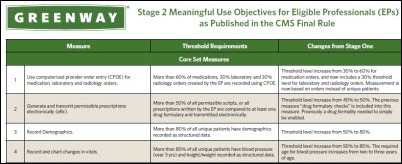
8-22-2012 7-04-14 PM

With all these summits you face, you’ll learn more about yourself and your leadership abilities. Learn to elevate as the slope rises. Make it an unspoken covenant with those you lead.

Climb on!

Elevation Part 2 will contain 20+ key actions to help you move from base camp to summit.

Ed Marx is a CIO currently working for a large integrated health system. Ed encourages your interaction through this blog. Add a comment by clicking the link at the bottom of this post. You can also connect with him directly through his profile pages on social networking sites LinkedIn and Facebook and you can follow him via Twitter — user name marxists.

Text Ads


RECENT COMMENTS

  1. That startup mentality can be very positive or very negative based on the person. If they're someone who is great…

  2. I want it to triage incoming communication from multiple channels (works and personal email, SMS, Teams). If the message didn't…

Founding Sponsors


Platinum Sponsors


Gold Sponsors


RSS Webinars

  • An error has occurred, which probably means the feed is down. Try again later.