Recent Articles:

McKesson To Acquire NZ-Based Emendo

November 6, 2012 News Comments Off on McKesson To Acquire NZ-Based Emendo

11-6-2012 12-08-29 PM

Mckesson announced this afternoon that it will acquire Emendo Ltd., the New Zealand-based vendor of the CapPlan hospital capacity planning solution. Its customers are in New Zealand, Australia, the UK, and Canada, with some US hospitals signed since it began marketing here through partners in 2010.

Comments Off on McKesson To Acquire NZ-Based Emendo

Curbside Consult with Dr. Jayne 11/5/12

November 5, 2012 Dr. Jayne 2 Comments

I’ve written before about the difficulty I sometimes have reconciling the high-tech tools I’m responsible for with the low-tech situations that physicians deal with on a regular basis. Many of us are confident we live in a wondrous age where innovation and technology are both the means and the end. Stories coming out of areas devastated by Hurricane Sandy, however, tell a different tale.

In New York City, the decision was made (based on storm predictions) to evacuate several hospitals prior to the storm, but not all. I don’t doubt that there was a lot of deliberation involved and careful weighing of the risks of evacuation vs. sheltering in place. New York has experience from Hurricane Irene and used that knowledge to inform its decision. Sometimes even the best plans go awry, as detailed in a New York Times article about the hospital situation.

As a physician (and as a first responder before medical school) I’ve been through my share of disaster drills. We don’t have hurricanes where I live, but we do have more than our fair share of fires, tornadoes, earthquakes, and floods. (Last year we even had locusts, but I digress.) I know in the event of an emergency what I’m supposed to do. I also count on hospital administrators and others to make good decisions.

Despite significant preparation, there were some misses in Bellevue’s disaster plan:

  • Although fuel pumps were in flood-resistant housings, they were in the basement, which flooded. Residents, nurses, and administrators ferried fuel up 13 flights of stairs to the backup generators.
  • Electrical control systems were also in the basement.
  • Elevator, oxygen supply, and water systems failed.
  • Disaster drills did not include actual practice of the scenario of carrying patients down the stairs to evacuate.

I cannot even fathom the conditions that caregivers and patients endured this week. And it wasn’t just at Bellevue. Speaking with some of my colleagues, conditions at several facilities were horrendous, with sanitation issues, sewage problems, and more. When evacuations were finally ordered, patients were carried or dragged down 10-15 flights of stairs, often with someone manually ventilating those patients who could not breathe on their own.

The Times article details the conditions at other hospitals. Patients were given minimal dialysis because private dialysis centers were closed. Facilities were only prepared to be on backup power for days rather than for a week or more. Food supplies ran low. Communication plans failed.

Due to a quirk of scheduling, I happened to be in the New York area this weekend. I am shocked by not only the devastation, but by the disparities across the region. New Yorkers are being urged to return to business as usual even though hundreds of thousands of people are without power and bodies are still being recovered. The devastation that occurred is a life-altering event for those affected. Psychologically, people need to grieve and come to terms with the past week rather than launch back into “business as usual.”

Not all of New York City was affected equally. Staten Island was hard hit, yet parts of Manhattan were relatively unscathed. A controversial decision was made by Mayor Michael Bloomberg to go ahead with the New York Marathon. Community advocates worried that emergency workers were already stressed by evacuations, fires, and rescues and that their efforts should be focused on rescue and recovery rather than recreation. Residents were furious that generators (albeit privately funded ones) were powering media tents when nearly half a million people were without power. Ultimately, Bloomberg responded to criticism by canceling the race Friday evening.

When this decision was announced, I was on a flight with a mix of marathoners and people who were returning home to the devastation. Conversation topics included everything from “what kind of generator should I buy for next time?” to lamentations of the race cancellation. I was surprised by the lack of empathy from runners/tourists who felt that New Yorkers had bullied the mayor into canceling. I hope their tone changed when they left the airport, because what I saw when I hit the roads was dramatic. Lines at gas stations were two to three hours long with significant power outages, lack of traffic signals, and many people who are still in shock.

It’s not over yet, however. This weather event and the subsequent tragedies will add to the healthcare burden not only in exacerbation of existing illness, but in a short term surge of respiratory, gastrointestinal, and other infectious complaints. In addition, there will be longer-term cases of post-traumatic stress disorder, anxiety, and depression.

Regional health authorities, hospitals, and disaster preparedness experts need to carefully learn from the events of this week and prepare their teams with careful planning and practice. Plenty of people were touting the benefits of HIEs to assist with natural disasters this week, but an HIE doesn’t do you a lot of good when you lack food, water, and basic sanitation. Does it really matter if the servers fail over gracefully if generator failure causes a hard stop a few hours later?

It seems that despite all our technology, people have become less prepared for events like this, as well as less resilient when they occur. In our post-Katrina world, people need to be ready to help themselves and not rely on government agencies. I urge each of you to use this as an opportunity to revisit your own personal disaster plans as well as those for your workplace. Emergency preparedness isn’t just for doomsday preppers, but should be for all of us.

No matter where you live, make an effort to have a week’s supply of food and water on hand (if nothing else, invest in some energy bars and a case of bottled water) and have a plan for where to go if you’re displaced from your home. You don’t have to be a secret agent to keep a “go bag” with a few clothes and essentials packed and in the closet or under the bed. Be aware of chronically ill or elderly relatives and neighbors. Ask them what their plans are and know whether you are willing to assist if the time comes. Know what your role would be if you are at work and disaster strikes. Be willing, be able, and be prepared.

Print

E-mail Dr. Jayne.

Guest Article: Hurricane Sandy Report from a Disaster Recovery Firm

November 5, 2012 News Comments Off on Guest Article: Hurricane Sandy Report from a Disaster Recovery Firm

Note: I offered to run an article from a disaster recovery vendor because I thought their perspective on Hurricane Sandy would be interesting. This is not an endorsement of that company, but I appreciate their article.

11-5-2012 6-45-46 PM

Extreme power outages and widespread flooding may wind up making Superstorm Sandy the second most expensive storm in US history, according to the forecasting firm Eqecat. Losses from the storm could total up to $50 billion, and according to Moody Analytics, an estimated $30 billion will come from physical storm damage split evenly among households, businesses, and public infrastructure. The remaining loss comes from lost business activity.

In addition to the financial challenges, several hospitals, nursing homes, and assisted living facilities failed a fundamental test of preparedness during Superstorm Sandy: they lost power. Their backup generators failed or proved inadequate, forcing thousands of patients to evacuate. Doctors, nurses, and medical practitioners were unable to access electronic health records and communication lines were down with no backup plan in place to redirect or re-establish phone lines.

Days after the storm, many businesses were up and running despite infrastructure failures because of disaster recovery and business continuity plans provided by Agility Recovery. Agility Recovery, a former division of General Electric that has been rescuing businesses impacted by disasters for over 23 years, offers a disaster recovery solution endorsed by the American Hospital Association.

11-5-2012 6-43-44 PM

In the aftermath of Sandy, Agility is responding to over 1,300 businesses, including several healthcare organizations. Agility is currently delivering assets to 95 businesses. Another 1,210 businesses are on alert, meaning Agility is pulling down assets, waiting for the go-ahead from the business to ship them.

The main Sandy-related response activities include:

  • Power loss. The company has shipped out generators to dozens of members and provided electricians to connect the generators and fuel to keep them running.
  • Downed phone lines. We have conducted over a dozen telephone and voice mail redirects so businesses can continue to communicate with employees and clients.
  • Computer or server failure. Agility has shipped out computers and servers to several clients who have experienced damage to their existing technology or need extra technology for employees working from alternate locations.
  • Structural damage. We have completed several full office recoveries, shipping out a mobile office, a generator to power the office, satellite to establish phone and Internet connectivity, phones, computers, servers, printers and faxes, desks, and chairs.

11-5-2012 6-44-59 PM

Although significant gains have been made in healthcare industry with regards to preparedness post 9/11, Georges Benjamin, executive director of the American Public Health Association, warns that austerity budgeting threatens these gains. “People presume that we have greater capacity than we have. When we get the big ones, we throw everything at it. We need to make sure we have the same capacity on the shelf at all times,” Benjamin continued, "I remain worried about the infrastructure.”

Most Common Recovery Plan Vulnerabilities

  • Access to generators in the absence of a predefined relationship.
  • Failure of backup generators due to poor location or lack of testing.
  • Access to generator fuel.
  • Establishing communications, as employees and clients left in the lurch as they receive busy signals.
  • Incomplete planning for alternate facilities, where those locations are either impacted by the same disaster or have inadequate technology.
  • Inadequate business insurance coverage. Of the estimated $50 billion in Hurricane Sandy damage, $10-20 billion is predicted to be insured losses.

Having a flexible and executable plan that accounts for many eventualities is critical to resuming operations following a disaster. Of course, revenue is an issue. A healthcare industry study found that one in 20 hospitals is unprepared for power disruptions, and a power outage may result in more than $1 million in lost revenue and other costs. Another study of a 16-hour power failure in New York in 2003 found that of 120 hospitals impacted, one was forced into bankruptcy and 10 others suffered significant revenue loss.

But more importantly beyond revenue is the need to provide high quality, continuous patient care. Patient safety is always the biggest concern hospitals and healthcare organizations face. Following the high-profile failure of several hospitals hit by Sandy, it is time for everyone to take another look at their disaster response and recovery plans.

11-5-2012 6-41-27 PM

Bob Boyd is CEO of Agility Recovery of Charlotte, NC.

Comments Off on Guest Article: Hurricane Sandy Report from a Disaster Recovery Firm

Humana Acquires Certify Data Systems

November 5, 2012 News Comments Off on Humana Acquires Certify Data Systems

image

Health insurer Humana Inc. announced this morning that it has acquired HIE technology vendor Certify Data Systems. The San Jose, CA company, which offers the HealthLogix HIE platform, will operate as a subsidiary of Humana.

Humana VP/CIO Brian LeClaire was quoted in the announcement as saying, “Humana remains focused on leveraging the power of technology to provide a more coordinated patient experience for our members that will enable quality, affordable health care. With the health information exchange platform from Certify we can move closer to creating a virtual integrated delivery health care system that can help us deliver this value-added, simplistic [sic] experience to our members.”

Terms of the transaction were not disclosed.

I interviewed Certify CEO Marc Willard in February 2012. He reported at that time that the company had 70 health system customers.

Comments Off on Humana Acquires Certify Data Systems

HIStalk Advisory Panel: How Do You Use Information from KLAS?

November 4, 2012 Advisory Panel 2 Comments

The HIStalk Advisory Panel is a group of hospital CIOs, hospital CMIOs, practicing physicians, and a few vendor executives who have volunteered to provide their thoughts on topical industry issues. I’ll seek their input every month or so on an important news developments and also ask the non-vendor members about their recent experience with vendors. E-mail me to suggest an issue for their consideration.

If you work for a hospital or practice, you are welcome to join the panel. I am grateful to the HIStalk Advisory Panel members for their help in making HIStalk better.

This month’s question: How do you use KLAS reports or scores to choose and monitor your vendors?


Generally Negative Comments

  • I place almost no value in the KLAS scores. Years ago I took a class on research methods and the professor used them as an example of bad methodology. What is great about them is they know all the products from all the vendors, so when I’m looking for that niche departmental system, I can go to them for a list of vendors.
  • (from a vendor employee) I believe that KLAS has a very flawed system, which has been brought to their attention time and time again with no changes. There is inaccurate information, and when brought to their attention, no changes are made. We are a vendor, and the information they continue to have on us is actually so inaccurate that it’s ridiculous. They list us as "small volumes" and every company but two on the list that is ranked (we are not because of this "small volumes" designation) is much smaller than we are. They will not correct it, so we have decided that it is not worth the hassle to continue to correct them, only to have them continue on as previous. On speaking with customers, we have been told that they have run into the same things in all categories and no longer give any weight to the rankings. A few even think that it is possible to pay for your ranking and rating.
  • We use KLAS reports (if available) to supplement MAJOR capital purchases. Most of the reports are too expensive to justify unless the expected purchase is one in which we have no experience and is a major capital purchase.
  • I review KLAS reports, but I do not have a clear sense of the validity of their review or ethics of their process.
  • Sometimes KLAS is helpful for decision makers who know nothing about the vendor/product landscape. Otherwise, I never use it.
  • I rarely if ever use it.


Generally Positive Comments

  • We use KLAS as a data point in selecting a new vendor, but it is not the primary driver unless there are a significant number of negative comments or scores. We also monitor our current vendors to ensure they are keeping up with the market.
  • I am using KLAS with a grain of salt and not as a gospel. For lack of a better reference frame, we all go to it, but I would not make decisions on KLAS alone. It is pretty much like the board certification for physicians: we all know that it may not reflect the best quality in a physician, but we all look it up and diligently go and take it to stay current.
  • I view KLAS as just being one gauge on a dashboard when evaluating vendors.  For new vendor selections, KLAS is used to populate the initial list of potential vendors. Through the selection process, their rankings are used as a single data point, primarily as a reflection of market penetration, customer service, and overall satisfaction. I have to admit that I rarely refer to KLAS for vendor products we’ve implemented unless we’re experiencing issues or entertaining a product switch.
  • I have used KLAS as a data point when evaluating vendors. For me, it represents a general standing in the marketplace and the comments are valuable in identifying areas to question.
  • I view KLAS as a consolidated reference check. I provide feedback to KLAS on products and services once or twice a year and I know that how I replay can vary depending upon the most recent encounter with the vendor in question. As with any reference check, you get a good picture of how one or many are currently viewing the company. KLAS will never be the final word, but is a good place to go to get a consolidated view of how customers are feeling about the vendor.
  • We use the KLAS scores as a starting place. We also use them as a resource to understand what other hospitals are doing. Adam Gale and his team are great about answering questions. They obviously have a great network of contacts and can often point us to other organizations who have addressed similar challenges.
  • When private physician practices contact me for advice on EMR vendors that they are reviewing, I share with them the publically available KLAS reports as well as other industry reports on EMR metrics. I also use these reports to see if there is correlation between what is being reported and what is said in private and on HIStalk about the vendors.
  • We incorporate the results as part of our customer communication and status updates. Specifically, we ask the leaders of our IS teams over each area (e.g., surgical services) to routinely incorporate market feedback from KLAS during their standing customer meetings. This is typically only done twice per year, not at each monthly discussion. It also helps us confirm/deny trends that we may or may not be seeing locally at our organization.
  • I’ve used KLAS to identify competing products in a space if we are looking to meet a need. We’ve referenced some of the reports when going through vendor selection, but it has not been the deciding factor. I’ve also found the reports to be an encouragement that we’re in the same boat as others.
  • I routinely review KLAS reports on all current vendors and ones we are looking at. It’s helpful to get updated information. Because I participate in KLAS reviews, I am able to get detailed reports related to vendors and trends. I’m usually looking for details on satisfaction with implementation and ongoing support. Love their question: would you buy from this vendor again?
  • I review KLAS findings and typically drill down into the individual comments from other users to find information or concerns that I use with the vendors in order to get more specific information. For example, if a number of users complain about some aspect, then I may spend more time than I might otherwise have done drilling the vendor about that aspect. I can also occasionally find out what the vendor has problems with, and if I’m convinced it won’t be a problem for us (and that we want to go forward with them), I can occasionally use that to negotiate a better deal.
  • I use KLAS primarily in the selection process for software and services and in that regard I find them very valuable, especially the user comments both pro and con. They give me some good direction in term of things I make sure I follow up on in the selection process. Recently they have also created some additional functionality around the creation of affinity group and other functional that gives me a platform to share directly with other organizations who have similar products or are similar to me in structure (academic, for example) that I have found some good utility in.
  • (from a vendor employee) As a vendor, we do yearly, in-depth, anonymous, customer surveys to see how we truly stand in all areas of our solution, service, and support. That said, KLAS is incredibly helpful for us to get even further information on our performance. I find KLAS gets better executive level feedback than we get on our own (our surveys usually get more responses from managers/directors/end-users). It’s a great way for vendors to see objectively where they’re doing well and where they might have opportunities for improvement. I always tell folks, I love hearing all the great stuff about our company and solution but I’d much rather hear the “tough” stuff as that’s the gold that helps you become better and better.
  • I use the KLAS reports to come up with a short list of vendors before the application/service search. The reports provide information that I use to educate my customers as to what is available, what others use in similar markets (e.g. practice EMR pool is different for 1-6 providers as compared to a practice of over 100 providers), as well as what applications others are moving from (always good to show there are no perfect vendors). I do peruse the vendor alerts as they come in but to this point I’ve not seen anything that was news to me.
  • I use KLAS for independent ambulatory physicians who are looking for a system — it is excellent for them and they often do not know it exists. I also use it to go to battle when an operations person wants to buy a niche vendor system that I don’t want. (of course that only works if the KLAS scores are bad). Occasionally use it for our own purchases that I am trying to investigate, but unfortunately many of the systems we are looking to buy are not rated in KLAS (population health, analytics etc.)
  • Used as one of the tools as part of vendor and system selection or standardization efforts. Also use Gartner info such as magic quadrant and we now ask IT vendors to register on VendorMate and pull reports on financial and sanction info from that resource and use Gartner for contract negotiation market analysis.
  • I use KLAS infrequently, but it has served as a way to educate and inform our leadership about specific vendor offerings and their comparative value to the market. 
  • KLAS scores and reports are critically important to me in my decision making process. They are my single most influential source of external advice and insight, followed by The Advisory Board and Gartner. KLAS’s integrity is unshakeable and their influence on the industry is invaluable.
  • I review KLAS to identify top vendors meriting consideration and to yield additional insights into strengths and weaknesses when selecting vendors.
  • Flawed, but extremely valuable given there’s no better alternatives in many cases. We used it a year ago to help determine whether we should go with a particular vendor on the outpatient side (we didn’t as their product was rated in the bottom of the rankings). The one area where KLAS is lacking is in specialty-specific EMR evaluations, as the niche products that are great don’t show up on the KLAS radar because of lower volumes. 
  • I participate in KLAS surveys because the lady who calls used to work for me and I like her style and that of the company. I find the reports insightful and they help confirm our assessments and sometimes point out weaknesses. I am aware of some of the criticisms of KLAS and certainly recognize their limitations. It is also helpful in working with the senior team, who may see only the glitz. It helps when I show our own vendor’s ratings, with which they usually agree, as a means to establish a level of credibility in KLAS reports.
  • I don’t have real decision-making power (e.g., authority, monetary control) over HIT purchases. However, as a physician end-user and member of our institutional EHR committees, I have used the KLAS reports as a "reality check" when my personal impression of a particular product is dramatically different from the party line that’s being perpetuated by our hospital IT group and C-suite. They say "This software’s perfectly reasonable, but the doctors are being resistant." It’s nice to be able to say, "I don’t think it’s just our doctors who view this software as having problems…." I would say that the KLAS reports are helpful in encouraging greater honesty and reality checking when too many folks are drinking a LOT of Kool-Aid.
  • Use it on a limited basis for specialty systems and needs. Good reference point to check and confirm which vendors we should consider for a selection


Key Themes

  • KLAS uses questionable and non-transparent methodology.
  • KLAS is far from perfect, but has little competition.
  • The negative comments and scores are more meaningful than the positive ones.
  • It’s good for a quick check on what customers think.
  • KLAS reports can help determine if a trend you’re seeing locally is broad.
  • It’s a good starting point for researching a vendor or product type, but is not the deciding factor.
  • New service to allow members to contact each other is useful.
  • Use KLAS reports to identify available products of a particular type.
  • Review the scores of IT-recommended systems to make sure they are being considered on merit and not IT department convenience.
  • Use the reports to educate and influence users involved in selection.
  • Show negative reports to users who are convinced that they want a particular system or to remind users that all systems have negatives and that implementing them is hard work.

Monday Morning Update 11/5/12

November 3, 2012 News 17 Comments

11-3-2012 7-06-00 PM

From The PACS Designer: “Re: iPad Mini. TPD told you about the iPad Mini awhile ago, but didn’’t expect its arrival until early next year. Now that it’s here, you will see a rapid deployment in the healthcare field. Healthcare IT departments need to be on alert as the expansion of iPad mini users will could quickly overload already busy networks.”  

11-3-2012 6-47-14 AM

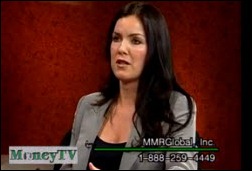
From Japandroid: “Re: MMRGlobal. I spent 30 minutes reading their press releases after your item and was floored. They crank out what seems like one per day, like the one mentioning that they shipped 25 more PHR licenses to a reseller (congratulations!) Check out their YouTube video – the company’s spokesperson is a former Playboy model, soft porn movie star, TV producer, and the trophy wife of company founder Robert Lorsch, who has a long list of business and philanthropic accomplishments.” Looks aside, Kira Reed is polished and engaging in the video, although not enough to make PHRs interesting (she says PHRs are “exploding,” which I would agree by my definition of “exploding.”) Vendors: is anybody planning to reward the company’s patent trolling by licensing its EHR-related intellectual property, which will be celebrating its one-week birthday in just a few days?

11-3-2012 6-59-03 PM

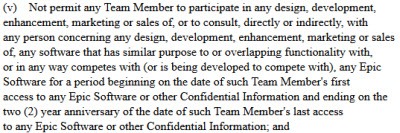
From Epic Pawn: “Re: Epic. The contract they sent me for the privilege of consulting with one of their clients will require me to end my HIT career!” Interesting points:

  • Apparently a hospital can’t hire a consultant to help with Epic until that person signs a lengthy contract with Epic.
  • If the consultant develops any kind of enhancement to Epic software and doesn’t sign over the rights to the hospital, the enhancement is automatically owned by Epic.
  • You are obligated to report anyone you know who has accessed anything related to Epic without authorization, even if you didn’t have anything to do with their access.
  • You can’t hire or contract with a former Epic employee until they’ve sat out a one-year waiting period.
  • You can hire an Epic customer’s project team employee only if you don’t assign them any Epic-related work for two years, and they are considered to be a project team employee until three months after go-live.
  • Your employees can’t perform any activities that compete with Epic – design, sales, consulting — for two years after they leave your employment.
  • You agree that Epic is a third-party beneficiary of the agreement your employees must sign, which gives Epic a right to enforce the agreement even though those people don’t work for Epic.
  • You agree that any legal actions will be heard in Wisconsin courts.
  • I’m sure there’s more, but it’s a long read and I’m getting numb.

From Lambrusco: “Re: Allscripts. I think they’ll get a private equity deal announced by the earnings announcement on Thursday. Otherwise, they will have to put out an ‘exploring strategic alternatives’ addendum to the announcement if they miss on revenue or earnings (which is likely) to cushion any fall. Worse than allowing word of the PE deal to leak out was the MyWay announcement, which clued every potential PE buyer to dig more closely into attrition rates, which are sure to rise. They could have waited a month or two before putting a bullet in MyWay. The company is incredibly inefficient and the CEO was given carte blanche by the board to do M&A himself to buy his way out of trouble after avoiding tough product decisions in 2008 and 2010, so the cash flow and margins are probably understated and the PE guys can put in a management team that can execute. This week will be interesting.” Indeed it will.

From Coolmaker: “Re: vaccine refrigeration. They can make a zeer pot refrigerator that only requires water to function.” That might be an interesting project – a couple of flower pots and some sand and you can make a rudimentary refrigerator, although I don’t know if it will get cool enough to keep vaccines.

11-3-2012 11-31-23 AM

From Tarheel Ingenue: “Re: UNC Health Care CIO. Leaving.” Verified, apparently, based on an internal e-mail sent my way. Rose Ann Laureto, who’s been on the North Carolina job just a year, is moving to Promedica as CIO of the 11-hospital system that’s closer to her original home.

11-3-2012 6-23-30 AM

It’s pretty much all KLAS when providers use paid information sources to evaluate vendors according to my poll, although Gartner and “none of the above” had minimally respectable showings. New poll to your right: how much will patient empowerment and mobile apps change the healthcare system? After you’ve voted, click the Comments link on the poll to try to sway the undecided voters.

Instead of doing a “Listening” recommendation, Lt. Dan of HIStalk Mobile and I put together a Spotify playlist with some new and old stuff we’ve been following (our musical tastes overlap quite a bit). Spotify offers high-quality free streaming, so download it and you can play through the 39 tracks and three hours. Examples: new Neil Young, Wild Belle, Seapony, and older stuff from Frank Black, the BellRays, Public Enemy, and Operator. Feel free to create your own playlist and send me the link – if I like it, I’ll run it. If anyone seems to care, I’ll put out a new playlist every week or two, maybe focusing on specific genres.

Thanks to the following sponsors, new and renewing, that have recently supported HIStalk, HIStalk Mobile, and HIStalk Practice. Click a logo for more information.

11-2-2012 9-40-57 PM
11-2-2012 9-37-04 PM
11-2-2012 9-47-27 PM
11-2-2012 9-48-21 PM
11-2-2012 9-58-05 PM
11-2-2012 9-51-00 PM
11-2-2012 9-56-12 PM
11-2-2012 9-40-11 PM
11-2-2012 9-45-49 PM
11-2-2012 9-44-54 PM
11-2-2012 9-52-41 PM
11-2-2012 9-42-18 PM
11-2-2012 9-55-05 PM
11-2-2012 9-57-00 PM
11-2-2012 9-38-10 PM
11-2-2012 9-39-13 PM
11-2-2012 9-53-30 PM
11-2-2012 9-43-56 PM
11-2-2012 9-51-41 PM
11-2-2012 9-50-03 PM

Hutcheson Medical Center (GA) chooses the Health Management Systems (HMS) EHR.

11-3-2012 6-56-38 AM

SCI Solutions founder and industry long-timer John Holton retires from the company,  although I’m betting (and hoping) he will pop back up in a healthcare-related role shortly since he’s a lifer who’s a bit young for the rocking chair. SCI’s remaining managing partners are Joel French (CEO) and Jeff Anderson (chief sales officer).

A reader-recommended TEDx talk (video above) by Brian Goldman, MD urges clinicians to talk openly about mistakes they’ve made, comparing their performance to the batting averages of baseball players. He also holds hope for the surgical equivalent of an aircraft’s black box recorder for post-incident analysis and quotes former airline pilot and current patient safety consultant Sully Sullenberger, who urges creation of a national patient safety investigation agency patterned after the National Transportation Safety Board. The article generated a lot of comments, some of which are insightful.

11-3-2012 10-17-19 AM

NYU Fertility Center, located in the evacuated building whose generator building that was evacuated after basement flooding shorted out the power to the generator’s fuel pump, saves its embryos and the carefully timed fertility cycles of its patients by running five-gallon cans of diesel fuel to the rooftop generator to buy time until the embryos could be moved to liquid nitrogen storage.

11-3-2012 8-39-27 PM

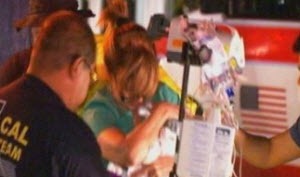
Here are the NYU nurses who bagged the NICU respirator babies while walking them down nine dark flights of stairs to ambulances waiting to take them to other hospitals, interviewed on 20/20 with some of the parents.

11-3-2012 10-52-33 AM

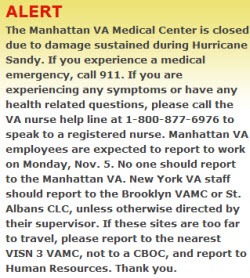
Another New York hospital closed indefinitely: the Manhattan VA Medical Center. NYU will open its practices Monday although some will be at different locations, while Bellevue says it will be down for at least two weeks. NYU has also shut down its medical school for the week and cancelled its applicant interviews.

A funny editorial in the St. Louis newspaper called “Talkin’ Colons with a Computer” observes that insurance companies use automated telemarketing for health reminders and asking health questions of their members. A sample:

A colonoscopy is not only an unpleasant procedure — a fact the voice failed to mention — but an expensive one. Hospitals don’t list their prices — no, that would make way too much sense — but independent cost-comparison websites suggest you can count on paying an average of $2,025 for a colonoscopy in St. Louis. The anesthesiologist will bill you separately. Why? Because he can. The facility may bill you separately. Why? Because it can. Also, if the colonoscopy actually finds a polyp or some other anomaly, it becomes a “diagnostic” procedure and not a “screening” procedure and it will cost you more. Why? Because it can. That $2,025 price applies if you have insurance. The voice was happy to suggest a colonoscopy because (a) voices don’t have colons to be scoped and (b) the insurance company would rather pay its share of the discounted price of the procedure than pay out hundreds of thousands of dollars for colon cancer treatment. Insurance companies have many faults, but stupidity is not one of them.

11-3-2012 11-12-38 AM

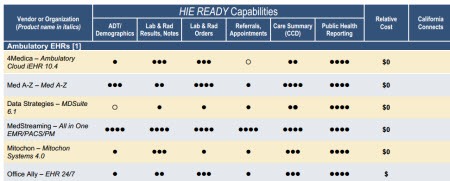
California state HIE overseer UC Davis releases HIE Ready, a buyer’s guide for providers interested in the interoperability capabilities of EHRs they are considering. It’s mostly a set of technical specs and an invitation for companies to participate.

Former shareholders of critical test reporting system vendor Vocada file suit against Nuance, which acquired the company and its Veriphy product in 2007, claiming Nuance has failed to make $7 million in earned payments. The shareholders say an arbitration panel has already unanimously ruled that Nuance fraudulently induced Vocada’s board and shareholders to agree to an acquisition whose terms included $20 million in cash or stock for shareholders, $4 million in cash or stock for employee retention and management bonuses, and $21 million in earnout consideration contingent on three-year revenue targets. An earlier Nuance SEC filing states that the financial targets were not met.


An Epocrates survey finds that one in three physicians plan to buy an iPad mini since it fits into a lab coat pocket.

The Raleigh, NC newspaper covers local EHR efforts. Tidbits:

  • A local doctor who took the Allscripts MyWay plunge two years ago is not happy that it won’t be further enhanced. “We bought what we bought thinking it was a stable company and it was their newest package. You spend all this time transitioning to a program, and they come back and say, ‘Sorry guys, we’re not going to do this after Jan. 1.’” Allscripts has 1,200 employees in Raleigh, the home of the former Misys that it acquired.
  • About 50 percent of NC doctors surveyed said EHRs haven’t improved care or aren’t worth the cost.
  • WakeMed will spend $100 million on its EHR, while Duke’s Epic implementation will cost $500-700 million and will earn $50 million in HITECH incentive payments. UNC will choose a vendor this month to replace several hundred applications.

Time Capsule: Cerner Layoffs In Review: Why Marching People Out Makes Sense, But Sickouts Don’t

November 2, 2012 Time Capsule 2 Comments

I wrote weekly editorials for a boutique industry newsletter for several years, anxious for both audience and income. I learned a lot about coming up with ideas for the weekly grind, trying to be simultaneously opinionated and entertaining in a few hundred words, and not sleeping much because I was working all the time. They’re fun to read as a look back at what was important then (and often still important now).

I wrote this piece in January 2008.

Cerner Layoffs In Review: Why Marching People Out Makes Sense, But Sickouts Don’t
By Mr. HIStalk

mrhmedium

Cerner laid off a bunch of people last week. Since I’m a typical 401K investor (not in Cerner stock) but also a wage slave, I can’t decide whether I’m a bourgeois capitalist pig or an oppressed member of the unpropertied proletariat. So, I’m waffling on how I feel about it.

It was only 97 people out of 7,800 employees worldwide (sorry, “associates” as Cerner calls them, although that feel-good term rings a bit hollow after hearing them admit to canning a bunch). That’s just over one percent of the workforce, probably a few weeks’ worth of resignations. Rumors put the real number much higher, and I believe them since I’m a conspiracy theorist when it comes to big corporations.

On the other hand, Cerner came clean by announcing it voluntarily. Antsy investors smelling “growth slowdown” leapt from their Google Alerts to their online brokerage accounts to dump the stock, sending share prices down eight percent. It wasn’t quite as bad as the aftermath of Neal Patterson’s infamous “tick, tock” e-mail of 2001, which dropped CERN nearly 25 percent, but was the opposite reaction than you might have expected given that shareholders usually love cost-cutting announcements.

Here are the gripes I’ve heard from current and former associates:

  • Cerner marched the former employees out after giving them news. Of course they did, and rightly so. How many workplace killings involve separated employees who seemed normal until they cracked? There’s no way to forcefully end the employer-employee relationship that doesn’t involve loss of dignity. March them out while they’re still in the first stage (denial) before they hit the second (anger). It’s cold, but responsible.
  • Cerner targeted management and older workers. Layoffs are about bang for the buck, which means going after expensive and often marginally value-adding middle management. Lots of those folks are mid- to late-career. Voluntary demotions take too much time and energy. It’s easier to cut the cord. Cerner is smart enough to have had HR test the list to make sure federal discrimination laws weren’t broken.
  • The Chief People Officer betrayed employees. Only the hopelessly naïve would mistake an HR person to be an employee advocate. Cerner is guilty of using the trendy, stupid, and overly chummy Chief People Officer title that may have misled some slow learners, but make no mistake: the CPO is a top-ranking company executive, not a friend of the working man or woman. Workers, by definition, are oppressed to some degree.
  • Management kept people who were well-connected, including obvious incompetents, while marching out good employees. Painting targets on backs is an inexact science. Managers are told how many casualties to create and then quickly make a list. Fairness isn’t guaranteed, even when it’s sought.
  • The company was hiring at the same time it was marching people out. Companies want quick contributors, which means hiring for very specific experience (which is probably how most employees got their jobs in the first place). That’s sad, but reality. The door revolves.
  • Unaffected employees should have a protest sickout to bring Cerner to its senses. That seems rather stupid given that the company just axed a bunch of people. Those paper tigers are just as terrified of losing their Cerner paychecks as those laid off were. An effective protest would be to leave Cerner and go to work for a competitor.
  • Clueless VPs who are exactly like Dilbert’s point-haired boss are the problem. No news there.
  • Customers will rise in protest at the cuts. That’s a comforting myth often expressed by those canned as they huddle in awkward and temporary support groups. It never happens, but the thought keeps people sane until they finally realize that they aren’t going to be returning to Cerner and should instead look for wonderful opportunities that will make them glad they got axed (which for some strange reason is often exactly what happens.)

Personally, I’m blaming Meditech. They’ve dominated the industry for 40 years by hiring cheap, obedient new grads and giving them skills with minimal market value elsewhere. More directly related to Cerner, Epic Systems does the same thing. Cerner is getting heavy competition from both, so that strategy appears to be working.

Perhaps Cerner is simply rebalancing its people portfolio to allow it to compete effectively, shooting for some predetermined kids-to-gray-hairs ratio that seems to work elsewhere. As a bourgeois capitalist pig, I don’t blame them, as painful as it unfortunately is to those affected.

News 11/2/12

November 1, 2012 News 6 Comments

Top News

11-1-2012 11-27-36 PM

AHA and four hospital systems file suit against HHS, claiming Medicare isn’t paying for reasonable and necessary care as required by the Medicare Act. The issue: Recovery Audit Contractors are second-guessing physicians long after an inpatient stay, claiming that patients should have been treated as outpatients and demanding that payment be returned. The RAC gets a nice bounty for denying the hospital’s payment, the hospital gets next to nothing.


Reader Comments
11-1-2012 10-30-43 PM

From Lee Shapiro’s Shoe Lifts: “Re: Allscripts General Counsel Jackie Studer. Has she left? Her pic and bio are gone.” She’s gone, sources tell me. Unrelated to her departure, the company announces results next week, and I have this feeling that they’re trying hard to get a PE deal ready to announce before then for reasons you might speculate.

From Michael: “Re: RazorInsights. Thanks for the mention. I wanted to confirm our customer attestation numbers – 83 percent have achieved Stage 1 Meaningful Use as of today and several outstanding filings are being finished up by clients.”

From Bucket Head: “Re: Sandy. We have about 50 clients in private practices on the East Coast without power and/or Internet. In our world, the big deal for them was finding a safe home for vaccines. If you have $50K (or more!) of stock in your fridge, it’s not like the milk. A couple of our customers will be without power for five to 10 days at least, so we’re expecting to turn on virtual servers in our offices for them to access. We have three or four customers on the Jersey shore from whom we’ve heard nothing and haven’t returned a call, text, or e-mail.”
11-1-2012 2-51-36 PM

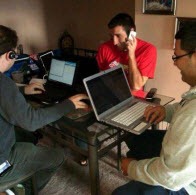
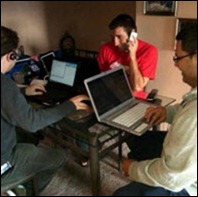
From Evan Steele: “Re: Temporary command center, post-Sandy. We are settled into our ‘MCC’ (Marriott Control Center) and everyone not at the MCC is working virtually from home, a friend or relative’s house, or office with Internet access. We have 42 servers (physical and virtual) in a co-location facility, so everything is available and every SRS’er with an Internet connection has access. We are doing a great job keeping pace with support requests considering our less than ideal circumstances.” Evan, who is CEO of the Montvale, NJ-based SRS, reports that his company’s headquarters remains without power. Access to remote servers and a cloud-based phone system has enabled staff to continue working, either from a local Marriott hotel conference room or from home. Thumbs up to technology and adaptability.

From Millerbarber: “Re: Infinitt. The NJ-based PACS vendor has been down for two days.” Unverified.

From Lead Sinker: “Re: NYU. Servers are down, basically underwater. We have an enormous go-live scheduled for 12/2 – not sure how this will affect that date.”
11-1-2012 11-25-24 PM

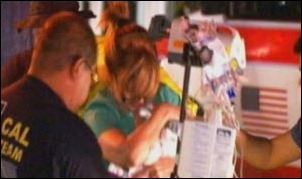
From Capo Crusader: “Re: NYU Langone admitting that its generator was old and poorly located. I hope everyone is OK, but I smell lawsuits with this admission. With all that has been written about Katrina, how can a hospital this size not be better prepared?” The hospital says it spent millions of dollars after Hurricane Irene on backup power improvements that included a flood-resistant pump house, sealed fuel tanks, and rooftop generators, but they apparently overlooked the fact that the electronic system driving it is located in the basement that flooded. At least the staff behaved admirably: four NICU respirator babies were carried down a nine-flight stairwell in the dark while a nurse manually bagged them to keep them breathing as volunteers and medical students lit their way with flashlights.
11-1-2012 10-44-38 PM

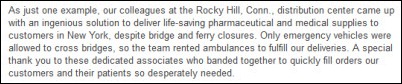
From Ex-McK: “Re: McKesson. Moral compass broken at the top. We highlight to the company that employees are breaking the law to ensure that the bottom line is met, renting ambulances to ensure we can sneak our profits through.” A purported e-mail from McKesson Chairman and CEO John Hammergren lauds employees of one of the company’s distribution centers for renting ambulances to make deliveries to New York, which prohibited non-emergency vehicles from using bridges.


HIStalk Announcements and Requests

Wondering what you may have missed on HIStalk Practice over the last week? Highlights: an AHIMA-published article suggests that cloud-based computing and smart mobile platforms are making ambulatory EHRs more affordable and attractive to physicians. CMS names 24 qualified vendors for the 2013 PQRS program year. Digichart’s founder and CEO assumes title of chairman emeritus. An Impact Advisors consultant provides recommendations to measure EHR success. NYeC Executive Director David Whitlinger gives an overview of his organization, its goals, and current success. Dr. Gregg (and his dog) fantasize what the world would be like if HIT had started with a grand plan. All I have to say is that if you aren’t reading HIStalk Practice, your HIT news world is incomplete. Thanks for reading.
11-1-2012 7-37-52 PM

We have a new contributor on HIStalk Mobile who I’m calling Lt. Dan since he (like me) works full time in the industry and probably wouldn’t find his employer to be receptive to the idea of his writing potentially controversial material under his own name. Lt. Dan is and industry pro who will be posting several news items each day, adding to the excellent analysis and commentary from Dr. Travis. We’ll also be revamping the site’s design shortly with a more modern look, and most likely renaming it to indicate broader coverage than I originally anticipated (we’re now writing about telehealth, startups, consumer health, and social media). In addition to the expanded coverage, Travis will be on the ground at the mHealth Summit December 3-5 in the DC area, of which HIStalk Mobile is a media partner, so you can expect lots of information from there. How you can get involved with HIStalk Mobile: subscribe to the spam-free e-mail updates, follow our tweets, write a guest post, and tell us who we should interview. Most of all, read HIStalk Mobile and participate by sending us interesting news and rumors.

11-1-2012 7-43-28 PM

Speaking of HIStalk Mobile, thanks to new Founding Sponsor Imprivata, which offers Cortext, an easy-to-use mobile app that replaces outdated texting and paging with HIPAA-compliant messaging for smartphones (Android and iOS) and PCs. Imprivata now supports both HIStalk and HIStalk Mobile at the highest levels that I had available, which I appreciate.

On the Jobs Board: Senior Certified Epic Analyst, Healthcare Analyst – Security Tester, Community Health Center Sales Executive, System Software Engineer.

A lot of readers dropped by in October, in fact more than in any month in the almost 10 years HIStalk has been around, for reasons unknown: HIStalk had 130,254 visitors and 241,599 page views.

The weather’s cooling down, leading to the bane of the cubicle dweller: where are you supposed to hang your coat?


Acquisitions, Funding, Business, and Stock

11-1-2012 11-32-59 PM

Merge Healthcare announces Q2 results: revenue up five percent, EPS $0.01 vs. $0.06 a year ago, missing analyst estimates by $0.02.

11-1-2012 6-11-46 PM

Carestream Health acquires Genesis Digital Imaging, a developer of software for diagnostic imaging systems.

11-1-2012 11-34-57 PM

Meditech’s Q3 numbers: revenue up 7.8 percent, net income up 4.6 percent.

11-1-2012 11-34-00 PM

Greenway announces Q1 results: revenue up 28 percent, EPS $0.00.


Sales

Intermountain Healthcare (ID) selects SA Ignite’s MU Assistant for EP Meaningful Use automate attestation of EPs using Intermountain’s proprietary EHR.

Medical Mutual of Ohio chooses the mobile application development platform and Mobile Health Plan application from Kony Solutions to provide members with account management, access to physicians, electronic ID cards, and claims information.

Health Fidelity will use the terminology solution of Intelligent Medical Objects in its Reveal natural language processing service for extracting data from unstructured medical narrative information. IMO will use Reveal for its solutions.

Alameda County Medical Center (CA) engages MedAssets to oversee several cost reduction projects involving physician preference items, supply and services sourcing, and workforce management.


People
11-1-2012 12-08-50 PM
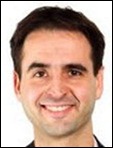
Cerner appoints Justin Whatling, MBBS (BT Health) senior director of strategic consulting for its European advisory practice.

11-1-2012 1-17-55 PM

The US Chamber of Commerce names Peter Tippett, MD, CMO of Verizon and VP of its incubator, as the recipient of its first Leadership in Health Care Award for his efforts to advance health HIT innovation.
10-31-2012 11-42-29 AM  10-31-2012 11-43-26 AM

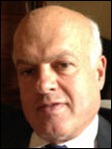
As a reader leaked to us a couple weeks ago, Pulse Systems co-founders and brothers Basil and Alif Hourani resign their posts as CEO and CTO, respectively. CFO Jeff Burton takes over as president and CEO. The French technology company Cegedim purchased the company two years ago for $61 million.
11-1-2012 6-41-25 PM

PerfectServe names Cary Smith (Allscripts) as VP of sales for the western region.
11-1-2012 10-14-18 PM

Avalere Health names Protima Advani (The Advisory Board Company) as VP of its healthcare networks practice.
11-1-2012 7-06-37 PM

CHIME President and CEO Rich Correll will move to a COO role with the organization, saying CHIME’s board worked with him to develop an operational management role required by its growth. They’re seeking an experienced CIO to replace Correll as “ambassador to the industry.”


Announcements and Implementations

UPMC expands its telemedicine services to rural hospitals.

11-1-2012 11-38-34 PM

Sparrow Hospital (MI) rolls out Epic’s MyChart for patient use on mobile devices.

Wellcentive announces the release of Proactive Data Quality, which allows healthcare organizations using its population health management system to detect data delivery and mapping issues.

Siemens Healthcare expands its relationship with TIBCO Software, which provides the business process management technology used by Soarian. Siemens says it will use TIBCO’s next-generation technology to provide Soarian customers with on-the-fly analysis of current and historical data to allow them to become what TIBCO calls the Event-Enabled Enterprise.

Brown & Tolan Physicians (CA), a Medicare Pioneer ACO, goes live with Humedica’s MinedShare analytics platform.
11-1-2012 11-03-22 PM

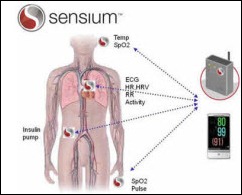
UK sensor vendor Toumaz starts the first US pilot of its disposable, continuous wireless vital signs sensor at St. John’s Health Center (CA). Patients in any location can be monitored with the Sensium system, eliminating the need for them to be kept immobile in the ICU.

11-1-2012 11-41-49 PM

In Michigan, Beaumont Health System and Henry Ford Health System announced months ago that they expected to merge in some fashion. They’ve signed the papers to start discussions on the merger details, which would create an organization with $6.4 billion in annual revenue and 42,000 employees. Both use Epic.

MMRGlobal, which always puts out bizarre press releases that make it sound like a big company instead of a minimally known PHR vendor, decides that lawsuits pay better than trying to sell a personal health record. The company was awarded a vague patent for a method of giving patients access to their electronic medical records. That was on Wednesday. By Thursday, the company was sending threatening letters to hundreds of EHR vendors, demanding that they start paying licensing fees.


Innovation and Research

MIT researchers develop a system for disambiguating the senses of words used in physicians’ freeform notes in EHRs. The researchers say their method, which identifies relationships between words while also drawing correlations between words and syntax, is 75 percent accurate and thus markedly better than previous methods.

A study in Ireland finds that 40 percent of handwritten ICU orders contain an error, although “error” was loosely defined to include missing pager numbers and illegible signatures. Articles like this always alarm laypeople who can’t distinguish between “preventing an error” vs. “preventing patient harm.” It’s like saying that 99 percent of drivers make at least one error per day while intentionally not mentioning that most of those are of no consequence whatsoever and are thus not worth a prevention effort.


Technology
11-1-2012 12-58-41 PM

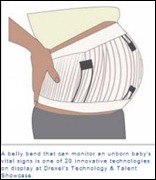
inga_small Researchers from the engineering and media arts schools of Drexel University design the Belly Band, which contains an antenna that allows remote monitoring of pregnant patients. The band, which does not require batteries or electricity, transmits radio signals to indicate changes in the shape of the uterus and can be picked up with an ultrasound. Maybe once they complete work on all the functional aspects Dr. Jayne and I can advise on the fashion design.


Other

The National Health Information Sharing and Analysis Center (NH-ISAC) activates a 24/7 emergency response system to support healthcare critical infrastructure protection, mitigation, response, and recovery. The response system is intended to address situational awareness, facilitate information system, and provide incident response support.

Lake Health (OH) performs a routine EMR audit and subsequently fires several employees for inappropriately accessing a patient’s health information.

11-1-2012 3-12-27 PM

Cleveland Clinic and GE Healthcare join 25 companies that have committed to lease space at Cleveland Medical Mart, raising the building’s committed tenancy to 50,000 of its 95,000 leasable square feet.
11-1-2012 11-43-22 PM

Exeter Hospital (NH) is denied a court order that would have prevented the state HHS from accessing the hospital’s electronic medical records as part of an investigation into a hepatitis C outbreak. The hospital argued that such access would violate state and federal laws, but the court said the state proved its need to review the records and has proven it will do so in a professional manner. The cause of the outbreak is suspected to be a contract radiology technician who is accused of stealing fentanyl syringes and replacing them with ones contaminated with his blood. After being fired from UPMC for exactly that offense, he went on to work in 10 hospitals, including Exeter, since UPMC didn’t report him for fear of not being able to prove he did it even though they had caught him red-handed.

Bellevue Hospital Center (NY) evacuated about 500 patients Wednesday after fuel pumps for its backup generators failed. Despite pumping out 17 million gallons of water, the basement remained covered in two and a half feet of water.

British Medical Journal institutes a new policy that require researchers and drug companies who submit drug clinical trials articles to make all patient-specific data used in the study available to individual researchers on request. Drug companies are notorious for shining the most favorable light possible on questionable data, so this change will allow independent researchers to double-check their conclusions. BMJ hopes other journals follow suit.

Weird News Andy captions this article as “Starving for Cash.” Two-thirds of NHS hospitals in the UK have earned bonuses for following the Liverpool Care Pathway, which can require them to stop providing food and water to terminally ill patients. The Department of Health says the protocol ensures that dying patients are treated with dignity, while opponents say the practice is “euthanasia by the back door” that is sometimes employed without involving the patient’s doctor or family.


Sponsor Updates

  • Allscripts CMO Toby Samo, MD discusses improving public health with EHRs in a blog post.
  • East Bay Eye Specialists (CA) will implement the SRS EHR.
  • ICSA Labs seeks qualified candidates to help pilot test the test procedures and test tools for the 2014 Edition Certification.
  • Greater Baltimore Medical Center (MD) creates a paperless admission and consent process using Access e-Signature and signature tablets.
  • Huron Consulting Group releases a case study that highlights how it helped the University of Arizona Health Network improve its RCM operations.
  • OTTR Chronic Care Solutions will participate in the National Marrow Donor Program Council Meeting next week in Minneapolis.
  • The Nashville Technology Council recognizes Passport Health Communications as Technology Company of the Year for 2012.
  • MedVentive hosts a November 15 Webinar on critical technology needed to support ACOs.
  • Intelligent InSites will host the InSites Build 2012 conference on November 14-15 in Fargo, ND. Speakers include President and CEO Margaret Laub and AMIA President Kevin Fickenscher, MD,

EPtalk by Dr. Jayne

clip_image002

The HIMSS/AMDIS Physician Community issues a call for posters for the 3rd annual Physicians’ IT Symposium to be held Sunday, March 3, 2013 at HIMSS in New Orleans. The deadline is November 30. Selected presenters must also submit a 5-7 page technical paper after the conference.

CMS offers a second chance to physicians who missed the June 30 deadline to file for a Medicare ePrescribing hardship exemption to avoid the 2013 penalty. They will now have until January 31, 2013.

I’m always having issues with Medicare patients who don’t want their insurance information on lab requisitions and other key paperwork because CMS still uses the Social Security number as its patient identifier. CMS is seeking provider input on new Medicare ID cards that would remove the SSN to reduce the risk of identity theft. Its survey will be available until November 7.

Nashville-based Entrada raises $1M in new equity. Its products, which integrate with a variety of EHR platforms, allow dictation into the EHR through synchronization to the appointment list. I heard some buzz at MGMA that they also have a fax-related product, but I haven’t seen it yet (hint, hint).

Physician Edward Pullen MD shares his frustration with the Washington State Electronic Death Registry System.

clip_image004

Dr. Travis from HIStalk Mobile shared this story about Walmart boosting domestic medical tourism. As of the New Year, its employees will have access to heart and spine surgeries at health systems like Cleveland Clinic, Geisinger Medical Center, Mayo Clinic, and others. Additional companies that are negotiating bundled rates for employees include Boeing Co., PepsiCo, Lowe’s Companies, and HCR ManorCare. Personally I’d like my employer to negotiate a deal here.


Contacts

Mr. H, Inga, Dr. Jayne, Dr. Gregg.

More news: HIStalk Practice, HIStalk Mobile.

News 10/31/12

October 30, 2012 News 5 Comments

Top News

10-30-2012 8-08-07 PM

From Velveteen Rabbit: “Re: NYU Langone and Sandy. My cousin is a neuro fellow at NYU Langone. Was in the middle of surgery when all power flickers and then goes out. Closed via flashlight and then patient was transferred to another hospital.” Sounds like an episode of MASH. A backup generator failed at the height of the hurricane, forcing NYU Langone Medical Center to evacuate at least 215 patients to other hospitals. Other facilities forced with forced evacuations include Coney Island Hospital (NY) and Palisades Medical Center (NJ). Numerous hospitals relied on backup generators and many facilities reverted to paper systems when EHR access was lost. Billionaire and Home Depot co-founder Kenneth Langone was an inpatient in the hospital bearing his name (courtesy of his $200 million gift) at the time and had to be evacuated with everybody else. A board member says the hospital knew its generators were old and poorly located; they’re planning to spend $3 billion to upgrade the facility.


Reader Comments

From Halsey A. Fredrick: “Re: Allscripts. The Mountain Lakes data center attempted and failed to move to generator power Monday evening. Approximately 50 Sunrise customers were down for at least seven hours, including those hosted at the company’s other data center in New Jersey. Some reportedly came back up overnight, some were still down as of Tuesday morning.” Unverified, but HAF forwarded a purported company e-mail update indicating that power was being restored. As any of us who have run IT during a weather disaster can vouch, backup generators work maybe 50 percent of the time, and that’s assuming you’ve been diligent to test the cutover regularly and have stockpiled an adequate supply of diesel fuel.

From Inspired but Concerned: “Re: Connected Health Symposium in Boston last week. I listened to great speakers and met people with truly great ideas, but few will address the elephants not in the room (i.e., Epic and Cerner). Conferences focusing on eHealth and connected health have a grassroots feel of empowering patients and consumers, but I rarely see big vendors participating unless it’s incognito to get new ideas. Providers are increasingly becoming part of IDNs and ACOs that use those large vendors and their non-open, non-easily integrated systems. Will consumer-based healthcare IT and their innovators suffer against these big vendors and providers?” My cynicism is predictable, but I’ve always said that these conferences and their self-selecting, charged-up evangelists are buying the illusion that patient empowerment is increasing when it’s really not. Few examples exist where customers have convinced big businesses to change their ways, especially when those changes threaten their profits, and I can’t think of even one where it happened when those customers had little buying power discretion and in fact aren’t even paying with their own money. It’s going to take a lot more than some feel-good conferences attended by the same familiar faces and featuring demos of the latest cool app to change healthcare, if in fact it can be changed at all. Healthcare reform may end up making it worse, as the massive consolidation it has triggered means a lot more physicians are now just another cog in a faceless corporate wheel whose bargaining power just went up several notches through market-dominating mergers (Partners Healthcare, which puts on the conference you attended, is a good example of using size and brand name to command high prices). In that regard, their choice of IT systems is way down on my list of concerns.

From BK: “Re: hospice-specific EMRs. What’s a good source of information? Most seem to be focused on the in-home aspect and we’re a 50-bed inpatient unit not affiliated with any major hospital or health system.” I know the names of a few companies that offer hospice EMRs but I’m not familiar with any of them, so I’ll ask readers to jump in.


Acquisitions, Funding, Business, and Stock

10-30-2012 5-13-42 PM

Online physician communication platform vendor QuantiaMD closes a $12 million expansion round.

10-30-2012 5-14-31 PM

Hospice and home health software provider Homecare Homebase lands a $75 million senior secured credit facility to refinance debt and fund a dividend payment to shareholders.

10-30-2012 3-53-57 PM

Deloitte Consulting acquires Recombinant Data Corp., a provider of data warehousing and clinical intelligence solutions.

10-30-2012 3-54-47 PM

CommVault Systems reports Q2 results: revenue up 21 percent, EPS $0.29 vs. $0.17.

McKesson announces Q2 numbers: revenue up

10-30-2012 3-56-33 PM

Relexion Health, developer of interactive software that uses Microsoft’s Kinect system to help physical therapy patients, raises $4.25 million in seed funding.

10-30-2012 6-03-50 PM
McKesson says in its earnings conference call that Technology Solutions had flat revenue in Q2, but performed a bit better than expected. The MedVentive acquisition provides a technology asset that will bring other McKesson products together to manage populations, the company says, while its MED3OOO acquisition will allow the company to add capabilities to its market-leading revenue cycle management business. CEO John Hammergren hinted that McKesson might work with athenahealth given that a third recent McKesson acquisition, PSS World Medical, sells athenahealth’s products and appears to still hold some portion of the $96 million worth of ATHN IPO shares (at today’s price) that it acquired in 2007 and partially sold in 2008-2009. Hammergren also said that McKesson has experienced some attrition of its Horizon customers who declined to migrate to Paragon because of functionality shortfalls, but the company is on track to deliver the ambulatory capabilities Paragon users need.


Sales

The American Association of Endocrine Surgeons selects ArborMetrix to provide clinical performance analytics for its national clinical outcomes registry.

10-30-2012 5-18-08 PM

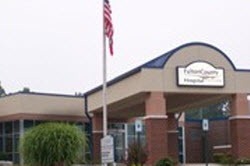
The hospital board of governors for Fulton County Hospital (MO) approves a $1 million contract for Healthland’s EMR.

Eastern Connecticut Health Network signs a multi-year agreement with MedAssets for its RCM solutions and process improvement consulting services. Also contracting with MedAssets is Sharp HealthCare, which will implement its Spend and Clinical Resource Management solutions, including group purchasing services.

Mountain States Health Alliance (TN) selects Streamline Health Solutions and its OpportunityAnyWare solution for business analytics and automated workflow.

Resurgens Orthopaedics (GA) chooses Merge Honeycomb as its patient image archiving and long-term disaster recovery solution.

The Ohio State University Wexner Medical Center chooses lifeIMAGE for medical imaging sharing.


People

10-30-2012 3-42-10 PM

InTouch Health, an acute care telemedicine provider, elects Siemens Healthcare exec John Glaser to its board.

10-30-2012 11-31-58 AM 10-30-2012 11-33-22 AM

AirStrip Technologies adds Todd Cozzens (Sequoia Capital, Picis) and Keith Pitts (Vanguard Health Systems) to its board, with Cozzens named as chairman.

10-30-2012 3-46-10 PM

CommVault Systems promotes Brian Carolan to VP/CFO. He replaces Louis Meceli, who was named SVP of finance.

10-30-2012 3-47-25 PM

The Dallas Business Journal names T-System CFO Steven J. Armond as CFO of the Year in the technology segment.

10-30-2012 3-14-15 PM

SPi Healthcare appoints Brian Mitchell (GE Healthcare) as SVP of sales.


Announcements and Implementations

The Asian Centre for Liver Diseases & Transplantation announces an agreement with UPMC to develop a transplant center in Singapore. The facilities already share medical and technological expertise, including telemedicine and EMR.

10-30-2012 8-17-44 PM

Saint Agnes Medical Center (CA) goes live on Cerner.

Document Storage Systems and GetWellNetwork bring two VA hospitals live on GetWellNetwork’s interactive patient system integrated with the VA’s VistA.

IBM partners with the Cleveland Clinic (OH) to enhance the medical knowledge of its Watson supercomputer.


Government and Politics

The Indian Health Service is building a PHR populated with data from existing IHS clinical, administrative, and billing systems.

10-30-2012 3-35-23 PM

CMS publishes the final 2014 clinical quality measures for MU reporting.

10-30-2012 7-00-18 PM

AHRQ will conduct a 14-month, $800,000 observational study at six Vanderbilt University Medical Center clinics to look at how EHRs affect workflow at various phases of implementation. The work might have had more applicability had AHRQ chosen a more typical site than Vanderbilt, which developed its own ambulatory care model and EHR.

10-30-2012 7-23-31 PM

Wells Fargo Securities has updated its list of hospital EHR attestations by vendor. Small-hospital vendors CPSI and Healthland, along with Cerner, top the list of attestations as a percentage of customers. Trailing the pack are GE Healthcare, QuadraMed, NextGen, and McKesson (interestingly, three of those four are publicly traded companies, and QuadraMed was too until it was taken private in 2009). Also interesting: we’ve talked recently about upstart RazorInsights and I see they’re right in mid-pack with 30 percent.


Innovation and Research

A study finds that whole-genome sequencing will cost the US healthcare system $25 billion annually by 2021 even with steadily dropping prices, with the virtual certainty that the cost of those tests and the patient demand for treatment of conditions they suggest will dwarf the relatively small savings they create from earlier treatment of a few specific conditions.


Other

10-30-2012 6-13-07 PM

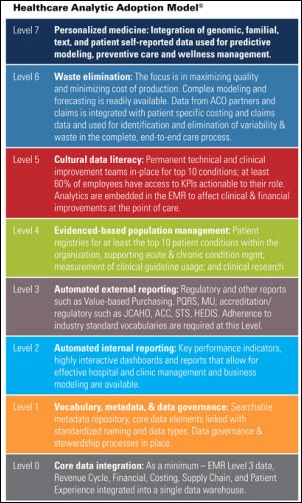
Dale Sanders (SVP of Healthcare Quality Catalyst and also holding senior roles with The Advisory Board Company and Cayman Islands National Health System) develops a HIMSS EMRAM-type model for measuring a hospital’s analytics capabilities. The Healthcare Analytic Adoption Model, he says, is the key to delivering value from the country’s big EMR investments.

Robert Schwab, MD, chief quality officer for two Texas Health Resources hospitals, adds a new Meaningful Use-related verse to his “Go-Live Ballad,” recorded live at the National CXO Summit last week in Dallas.

Cerner CEO Neal Patterson and his wife celebrate his company’s record quarter by buying the $100,000 grand champion market steer at the Junior Premium Livestock Auction in Kansas City.

A Colorado hospital’s lawsuit claims that it hired WebMD Health to evaluate its wellness programs, only to find that the company used its confidential information to launch a competing service.

inga_small A Texas woman is charged with aggravated assault with a deadly weapon after striking a man in the eye with her high-heeled shoe in a fight among 17 female employees of the Hot Body strip club. The man may lose his eye; the deadly weapon’s condition is unknown.


Sponsor Updates

10-30-2012 2-35-30 PM

  • Steven Waldren, MD MS, director of the AAFP Center for Health, explores the HIT environment during Care360’s Nov. 14 webinar.
  • Access releases case study videos featuring employees from Texas Regional Medical Center (TX) and Henry Mayo Newhall Hospital (CA).
  • Billian’s HealthDATA introduces its healthcare sales and marketing portal, which includes over 3,900 data points on more than 40,000 US healthcare facilities.
  • Emdeon launches its EDGE solution to detect inaccurate healthcare claims and prevent inaccurate payments.
  • TELUS Health Solutions reviews the financial and strategic implications of attestation timing for Stage 2 MU in its fall newsletter.
  • The Phoenix Business Journal profiles Desert Ridge Family Practice (AZ) and its effective use of NextGen’s EHR.
  • InterSystems recognizes 3M Health Information Systems with its Breakthrough Applications award for the 3M 360 Encompass system.
  • Kony Solutions announces that its KonyOne mobile application development platform now supports Microsoft’s Windows 8 operating system.
  • CIC Advisory launches its new website.
  • T-System CEO Sunny Sanyal discusses overcoding and upcoding in the ED in a guest article in a Dallas healthcare publication.

Contacts

Mr. H, Inga, Dr. Jayne, Dr. Gregg.

More news: HIStalk Practice, HIStalk Mobile.

Readers Write 10/29/12

October 29, 2012 Readers Write 2 Comments

Submit your article of up to 500 words in length, subject to editing for clarity and brevity (please note: I run only original articles that have not appeared on any Web site or in any publication and I can’t use anything that looks like a commercial pitch). I’ll use a phony name for you unless you tell me otherwise. Thanks for sharing!

Note: the views and opinions expressed are those of the authors personally and are not necessarily representative of their current or former employers.


It’s Only One Extra Click
By Jonathan A. Handler, MD

10-29-2012 7-02-39 PM

Clinicians swear an oath to put patients first, so why is it so difficult to get them to adopt new processes and technologies designed to improve care? Perhaps my experience during the SARS outbreak can provide some insights.

In the middle of the SARS outbreak, I was the director of emergency medicine informatics at a large hospital in the heart of a major city. A tourist with SARS would likely come to our ED. SARS disproportionately affects caregivers, and our ED nurses serve as our first line of defense when working in triage. Since I had written our ED’s tracking system, they begged me to add a SARS screening tool. I refused, saying it would add work and they wouldn’t use it.

Persistent, they mounted a campaign to convince me. The screening required only a few questions. Only the first question needed to be answered if the patient had no fever. I could build it right into their existing workflow. It might save patient and caregiver lives. A compelling argument.

So I did it. We added just a single click to the workflow in the vast majority of cases.

Of the thousands of patients triaged the next week, on what percentage did the nurses do the single click needed to answer that first question on fever? One percent. What was the click rate for patients with a chief complaint of fever? Zero.

In a world of increasing patient volumes and decreasing staffing, time spent on health information technology (HIT) is largely an “unfunded mandate.” Many caregivers are overwhelmed, with literally not a second left to spare. Each second spent on an additional click must be stolen from something else. Faced with the choice of clicking a button to note that the current patient does not have a rare disease versus triaging the next acutely ill patient, the extra click loses almost every time. And rightly so.

Early HIT efforts (e.g. digital labs and EKGs, PACS) dramatically improved care and saved time for caregivers. More recent HIT (e.g. electronic documentation) has largely stolen time from caregivers without improving outcomes. Our hubris has been our belief that all HIT offers enough value to justify encroaching on direct care activities such as talking to patients, administering medications, and performing life-saving procedures.

Despite clearly proven benefit, for 150 years we’ve been unable to get clinicians to consistently wash their hands. Now we take away fast and easy paper and dictation, replace them with electronic health records (EHRs) driven by slow and clunky keyboard and mouse, ask clinicians to document more than ever, and we expect rapid adoption?

Not going to happen. When asked, clinicians will agree to anything that might improve care. When time is short, they will prioritize tasks in order of perceived importance. Care will supersede documentation and quality initiatives that are not relevant to the immediate need.

One therapeutic prescription: things that save time for clinicians – such as badge and biometric login, single sign-on, context management, transcription services, speech recognition with natural language understanding, analytics, mobile access, and seamless integration with the local health information exchange – must be considered “mandatory pre-requisites.”

Right now, most consider these “nice to have some day.” The issue is much more than clinician resistance: patients are suffering from delays in care due to EHRs, and too often the promise of HIT is not being realized. When we recognize that one extra click is nearly always one too many, we (and our patients!) will have taken the first step on the road to recovery.

Jonathan Handler, MD is chief medical information officer at MModal.


Prepare Now for More Patient Requests for Medicare’s Annual Wellness Visit
By Averel B. Snyder, MD

10-29-2012 6-52-27 PM

Medicare records show that less than seven percent of people aged 65 and older have taken advantage of the Medicare Annual Wellness Visit (AWV). While it’s surprising that so few patients are receiving this important benefit, what’s even more alarming is that many seniors don’t know the AWV is even available. In fact, another study conducted by the John A. Hartford Foundation found only 32 percent of seniors are even aware of the benefit.

As more seniors become aware of the AWV and its benefits, these statistics will undoubtedly rise—and quickly. There’s no better time to prepare than now, as Medicare’s Open Enrollment period is now underway, and more than 49 million Medicare beneficiaries are being inundated with literature about all Medicare benefits, including the AWV. Physicians must be prepared not only to answer patient questions about the AWV, but also to provide the service efficiently and effectively.

The AWV includes specific components that address all aspects of a senior’s health status—physical and mental. A comprehensive AWV involves not only a review of a patient’s medical history and medications, but also a conversation about his or her functional ability and lifestyle issues that impact health. A list of risk factors, conditions, and treatment options must be established. Cognitive function must be assessed, and a 5-10 year preventive screening schedule created.

Until now, many physicians have been hesitant to offer the time-intensive AWV. That’s certainly understandable, given the challenge the hour-long visit poses to physicians who have limited time to visit with patients, especially when ongoing acute care visits are a priority. Fortunately, there are steps that can be taken now to get ready to accommodate a growing number of patient requests for this benefit.

  • Step 1: Use a non-physician practitioner (NPP) to conduct the AWV. The Affordable Care Act allows NPPs to deliver the service—which in turn enables physicians to focus on problem-oriented visits.
  • Step 2: Automate the process as much as possible with an electronic solution that identifies age- and gender-appropriate health screenings based on the patient’s health risk assessment (HRA). This solution can also dynamically generate a personalized prevention plan, order screenings or tests indicated during the AWV and make necessary referrals. If you have an electronic medical record (EHR) system, the solution should be integrated. This reduces documentation time, ensures an accurate patient health record, and prompts physicians to ask questions at follow-up visits based on the wellness visit recommendations.

Because a key component of the AWV is a personalized preventive health plan that’s updated each year, it’s also important to use a solution that provides recommendations for areas such as nutrition and exercise that are based on accepted guidelines and protocols. That way, you don’t have to have a number of staff members on hand who are trained to address those specialty areas.

Every year, the government spends $500 billion to treat Medicare patients impacted by chronic conditions. Many of the most costly chronic conditions — including heart failure, coronary heart disease, and diabetes — can be easily prevented with routine screening, which is what the AWV is designed to ensure. NPPs and technology can help physician practices offer this valuable benefit to patients in an efficient and cost-effective manner, and as a result, improve the quality of patient care and the level of patient satisfaction.

Averel B. Snyder, MD is co-founder and chief medical officer of Senior Wellness Solutions


Throw MU Out the Window!
By Darius LaGrippe

I don’t watch the presidential debates because they are irrelevant. I already know who I am voting for, and I’m certain the adorable concerns of swing voters are of no interest to me.

On the other hand, I sure do like to start a debate from time to time. Like right now.

It could be argued that the introduction of MU has destroyed more jobs than it has created. MU might be the cause of incredible amounts of lost patient information. MU might even be taking technology backwards.

Let’s face it. Smaller vendors with tighter budgets don’t have the free cash flow like that of larger corporations for development and marketing expenses, which denies startups and small vendors competitive resources for meeting the newest regulatory mandates, not to mention the Meaningless Use requirements that reimburse physicians for adopting electronic health records.

Unfortunately, those small, down-to-earth, client-focused private vendors ultimately dissolve or are absorbed. In my opinion, the products being acquired often are better than the larger companies’ product offerings, but when you answer to the stockholders, the
clients are there for your benefit. So who cares about the product?

Adopting electronic health records is very costly. Especially when the chief benefactors are ultimately the larger EHR vendors sucking up the stimulus milk shake through the government straw. With all these EHR products on the outs, who is responsible for maintaining that software and database you paid eleventy-thousand dollars for three years ago?

Not the vendor, because they are off the hook when your maintenance agreement expires, and they are not offering a renewal for your product. What kind of crappy loophole is this? During this realization, you might scream out loud like me, exclaiming, “This should be unlawful!”

The vendors are bound by the same HIPAA requirements as doctors and can be held accountable for HIPAA breaches. Last I knew, HIPAA had a six-year retention requirement, which follows federal statute for limitations for civil penalties(42 CFR Part 1003). If the physicians are required to maintain those records, shouldn’t the vendors be held to the same standard? Of course they should. Vendors should be required to either support and maintain those records for six years from when the product is shelved during “end of life cycle” or provide a comprehensive migration path for those clients at very little cost.

However, being a victim of an acquisition shouldn’t automatically force the physicians into a product they don’t want. The physicians shouldn’t be pigeonholed into a downgrade, upgrade, or migration. They should have the option to refuse the new product and seek a new one. Physicians should be able to demand their patients’ data from the vendor in a reasonable amount of time. Vendors should relinquish ownership of the patient data to the clients so they can at least explore their own migration path.

We’re talking about people’s health. Their lives. The records shouldn’t suffer the same attrition as the employees of the acquisitions, and the demise of the EHR shouldn’t be an albatross around physicians’ necks.

If the intentions of the HIT stimulus were to engage patients in their healthcare, provide physicians means to better electronic systems, and possibly even boost the economy, they are doing it wrong. That $19 billion should have been invested into the smaller companies to help produce better, cheaper technology at a faster pace and to keep the industry competitive. Instead we see attrition, poorly integrated products with no better standards than we had four years ago, and innumerable amounts of lost patient records.


Curbside Consult with Dr. Jayne 10/29/12

October 29, 2012 Dr. Jayne Comments Off on Curbside Consult with Dr. Jayne 10/29/12

clip_image001

Trick or Treat.

I’m not sure if it’s a trick or a treat, but there’s no question that we’re seeing some interesting cooperative partnerships among hospitals and health systems. Last fall Sentara Healthcare, Novant Health, and MedStar Health united to form MNS Supply Chain Network, LLC. Although the groups are in reasonably close geographic proximity (Maryland, the Carolinas, Virginia) they’re not in significant competition in their respective markets.

The press release highlights the purchase of more than $3 billion in supplies and services across the new organization as motivation. Even the name indicates a focus on supply chain efficiency and volume-based contracting. On the face, this would seem to make sense in almost any industry, particularly one with decreasing margins and increasing regulation.

The announcement in June of a similar collaboration in Iowa had a slightly different tone – a healthcare alliance to advance care in addition to group purchasing power. The addition of buzzwords in the coverage such as “clinical integration” and “streamlined and coordinated care” put a different spin on things, although the groups were clear to state their plans to maintain their independence.

This makes a bit more sense since all the member organizations are located in a single state, particularly one that has a reputation for close-knit communities and a stable population. Over 70 percent of Iowa residents were born in Iowa. Anecdotally, my med school friends from Iowa assure me that there is some kind of force field that only allows them to leave for four years before they are pulled back to the heartland. Given the growth in Medicaid rolls across the country, this could be a very strategic move.

The Iowa plan specifically calls out plans to share “expertise and operational costs associated with development of ‘accountable care’ initiatives.” It also mentions “sharing the high costs of the information systems and experts needed to analyze clinical data and convert it into information that can be used by physicians and others to improve care and better manage populations of patients with chronic diseases.”

That surprised me a little, especially since at least one of the four organizations is part of a larger multi-state health system. Although a larger group would certainly be able to negotiate better deals on hardware, I’m not sure what the implications are for software.

Buying software isn’t like replacing a fleet of PCs or negotiating a better deal on linens. Especially when you’re dealing with health systems that are already the result of multiple mergers, there are tons of legacy systems to deal with. Looking at their histories and missions, these groups are not likely to be flush with cash or ready to rip and replace.

I hadn’t thought about these cooperatives much until this week when a colleague sent me notice of a deal in the Midwest that seems to be a hybrid of the previous two approaches. Four hospital systems in Missouri and Illinois have announced formation of The BJC Collaborative LLC. Participants include BJC HealthCare (St. Louis), St. Luke’s Health System (Kansas City), CoxHealth (Springfield, MO), and Memorial Health System (Springfield, IL). One system’s CEO explained the somewhat geographically disjointed arrangement: “It’s hard to do that with systems in your own community because they’re each working for their own advantages.”

There could be more to this partnership as well. St. Luke’s competitor Ascension Health is negotiating to sell two hospitals in Kansas City to HCA Midwest. BJC competitor Mercy is making some interesting moves in Missouri and Arkansas, one of which is to sell St. Joseph’s Mercy in Hot Springs to Capella Healthcare. Perhaps the collaboration is an attempt to shore up the walls against a for-profit incursion.

They’re clear to say it won’t impact how hospitals deal with insurance companies (no one likes to be accused of collusion or restraint of trade). Talking points again included supply chain, but information technology was also called out – there is a mix of Epic, Cerner, Allscripts, and McKesson in play among the participants.

One CEO stated that “backup servers, data warehousing, and disaster recovery systems” could potentially be shared. I’d love to see the architecture schematic of a backup data center for an organization like that, but I wouldn’t want to see the legal fees for the governance documentation it would take to make it a reality.

The increasing frequency and size of these arrangements certainly counts as a trend in my book. If you have information on who might be next, you know how much Mr. H, Inga, and I adore rumors and juicy tidbits. If you’re an insider at one of these collaboratives and want to share your thoughts, we’ll keep you anonymous. If you’re an outsider, what do you think? Are these arrangements good, bad, or indifferent? E-mail me.

Print

E-mail Dr. Jayne.

Comments Off on Curbside Consult with Dr. Jayne 10/29/12

Monday Morning Update 10/29/12

October 28, 2012 News 11 Comments

10-28-2012 9-57-56 AM

From The PACS Designer: “Re: iPod’s 11th anniversary on November 10. The four versions of iPod are Shuffle, Nano, Classic, and Touch. While primarily a storage device for music, they can be used as a storage device for other data elements. Can there be a use in healthcare for the iPod? Let’s have some discussion on the subject.” My Touch is like an iPhone without the calling capability provided you’re in WiFi range, so I would say yes. You would think that a hospital might look at the Touch as a pager replacement for nurses for in-hospital use – it’s cheap and portable, it doesn’t require a cell contract since it works on WiFi, it comes with a camera and Facetime, and it runs most iPhone apps.

10-28-2012 2-32-03 PM

From Fertile Imagination: “Re: clinical raffles. I’m speechless that providers would turn this into a contest.” A New York in vitro fertilization clinic runs a contest offering IVF free services to contestants who submit the winning emotional or entertaining essay or video explaining why they deserve the prize. One winner was notified on the day after Labor Day in a scene worthy of a Publisher’s Clearing House commercial: a doctor carrying balloons knocked on her door. Another winner earned her prize by running in a 5K race, where each registration came with one raffle entry. CDC says 1 percent of American-born babies are conceived by IVF. A Harvard Medical School ethics professor concludes, “I think it’s a good parody of the unfair system in which important medical services are only available to those who can afford them. Nevertheless, sometimes these raffles exploit the despair of couples or their misunderstanding of statistics to extract money from them.”

10-28-2012 11-36-59 AM

From HITEsq: “Re: Craneware. Being sued by the American Hospital Association for copyright infringement regarding its unlicensed use of the UB-04 codes. My personal take: none of these codes, as codes, should be the subject of copyright, especially when they are used only for functional purposes for which they were created which the AHA helpfully explains in paragraph 7. What’s more, they go on about all the work in maintaining them. Of course, in copyright law, ‘sweat of brow’ does not make something copyrightable.”

Listening: Real Estate, gentle and summery pop music featuring jangly, liquid guitars with a lot of nice vocals and instrumental work hiding behind the obvious hooks so that you can play it repeatedly without getting tired of it.

10-28-2012 8-36-58 AM

Only one survey respondent reported that his or her PCP uses Twitter for medical purposes. New poll to your right, for providers: which sources do you find valuable when evaluating vendors? Feel free to choose more than one or check “none” of you don’t find any of them useful. Your comments are welcome as well – after you vote, you’ll see a Comments link.

I’m healthy and fortunately get few chances to evaluate healthcare IT as a patient, but my annual physical last week provided an opportunity. Thinking about it afterward, I was surprised at how many positive technology elements have crept in. I had changed my appointment online a couple of times using the practice’s online portal instead of wasting time on the telephone. I pre-paid my co-pay online and printed a barcoded itinerary. I scanned that paper at the kiosk when I arrived and didn’t need to wait in line since that checked me in. My doc pulled up the EMR screen after the usual chit-chat (the practice just switched to Epic a few months ago) and noticed my weight was the lowest in the seven years I’ve been going to him, so the EMR information allowed him to reinforce that behavior effectively. He did medication reconciliation and reviewed my history over the past year while we looked at the EMR’s screen together. My one and only maintenance med (hydrochlorothiazide, since I used to have high blood pressure) went out to the pharmacy by e-prescribing. I received an e-mail this weekend saying my lab results were available on the practice’s portal, where I could review them in printable PDF format along with a reassuring note from my doc (“Wow, these all look great!”) Also on the portal was a printable visit summary for future reference. We IT types may argue incessantly about the clinical value value of technology in care delivery, but as a patient, I’m sold on the convenience factor. Not to mention that my doctor knows exactly how to use technology to support the way he practices medicine instead of allowing it to dominate either the encounter or our relationship.

10-28-2012 9-28-29 AM

I don’t know of many hospitals that developed their own clinical systems, and the cost and torrid development pace required to keep up with Meaningful Use and changing care models have led most of those to cry uncle and replace their old stuff with commercial products. Vanderbilt is apparently hanging in there according to an article in the VUMC newsletter that says they’ve made some nursing documentation enhancements to StarChart/StarPanel, VUMC’s clinical data repository that holds electronic and scanned paper patient documentation. Vandy offsets some of the expense by licensing its creations to vendors: McKesson bought WizOrders (relabeled as the marginally successful but dying Horizon Expert Orders) and Informatics Corporation of America commercialized StarChart/StarPanel.

I’ve read several articles lately about the rapidly increasing cost of the bipartisan-supported, pseudo-socialist American government in which fewer and fewer workers subsidize those who aren’t contributing (either because they can’t or because they choose not to). I don’t always agree with George Will, but his editorial on disability payments mirrors what I’ve read elsewhere. Disability payments are now going to 8.6 million people, more than half of them claiming unprovable mood disorders or back pain. The ratio of workers to those receiving government disability checks has gone from 134:1 in 1960 to 16:1 today even as the number of physically strenuous jobs dropped significantly. The healthcare connection, according to George: “The radiating corruption of this entitlement involves the collaboration of doctors and health care professionals who certify dubious disability claims. The judicial system, too, is compromised in the process of setting disability standards that enable all this.” I’ll take a broader societal view: there’s no longer any shame or embarrassment involved in cashing the many forms of automated government checks that career politicians and indifferent bureaucrats dole out like vote-seeking lollipops, so the only thing standing between unmotivated or unprepared Americans and the government food trough is ever-dwindling personal responsibility. Check the federal deficit and entitlement spending if you want to see how that’s working for us.

10-28-2012 2-33-18 PM

Cerner shares jumped 13 percent on Friday following a good earnings report. The company said in the earnings call that its clients acquired 75 hospitals in the past 18 months, potentially expanding Cerner’s customer base with minimal effort required. They also predict an “acceleration in the displacement market” (i.e. replacements of Epic) over 5-7 years as organizations look at “the horse they bet on and make a decision to go in a different direction.” Neal Patterson dropped by at the end to say that Cerner has “reinstated a boldness around here” and declared the company to be “the most significant innovator in healthcare.”

The Detroit business paper says that Henry Ford Health System may be acquiring Beaumont Health System.

10-28-2012 11-42-07 AM

Mark Clark (Poudre Valley Health Care) is named CIO of Great Plains Regional Medical Center (NE).

10-28-2012 2-34-08 PM

Quality Systems (NextGen) announces Q2 results: revenue up 8 percent, EPS $0.26 vs. $0.35, missing consensus estimates on both. Shares closed Friday at $17.19, down 3 percent and now 60 percent off from their price in April. System sales revenue was down by 15 percent, but was partially offset by implementation revenue (warning sign: reduced sales now means less implementation revenue down the road). The usual obvious reactionary steps were announced: restructure the sales organization and consolidate development efforts (always begging the equally obvious question: if it’s such a good idea, why wasn’t it done before?)  The hospital division sold to six new hospitals, but still lost money. The company will continue paying dividends to shareholders but won’t institute a share buy-back program, saying they would rather use the money to fund possible acquisitions of several companies they’re talking to (they hinted at revenue cycle, hospital products, and ACO-type service offerings). They also say that they expect many of the 462 Stage 1 EHR vendors to fail at achieving Stage 2, leading to a big replacement market. NextGen won’t issue guidance this fiscal year, citing rapidly changing market conditions and the proxy fight it recently endured.

10-28-2012 12-05-45 PM

Here’s the five-year Quality Systems share price vs. the Nasdaq in red. QSII was on a nice run, but all that’s been wiped out to the point that performance would have been just as good buying a Nasdaq index fund (“just as good” being relative – you would have done little better than break even either way).

CPSI’s Q3 numbers: revenue up 8 percent, EPS $0.63 vs. $0.54.

10-28-2012 2-34-52 PM

A Senate investigation finds that medical device manufacturer Medtronic paid millions to surgeons who put their name as authors on journal articles that were actually written by the company’s marketing team. Medtronic paid $210 million to doctors over 15 years related to its Infuse spine surgery product, including $34 million to University of Wisconsin orthopedic surgeon Thomas Zdeblick (who is himself the editor of a medical journal, Journal of Spinal Disorders & Techniques). Medtronic hired Yale University to review Infuse and his comments don’t sound nearly as pro-Medtronic as the allegedly shilled articles: “This sounds eerily familiar to many of the transgressions we’ve read about from the pharmaceutical industry. It paints a picture of a company very heavily involved in the science; marketing contaminating the science; and the medical profession and researchers being complicit. It’s no wonder the public has lost confidence in the drug and device industries.” My question, as always: Medtronic’s annual sales are $16 billion and its market cap is $42 billion, so how big of a fine would be needed to send a clear message if indeed they’re guilty? I’m thinking $5 billion and some jail time for the scumbag executives who were involved, but that’s just me. And for that matter, why not hit some of those greedy docs with some mega-fines and maybe suspend their medical licenses for producing phony medical research? This business of Uncle Sam settling out of court with mega-corporations for a financial slap on the wrist needs to stop. Medtronic paid a measly $24 million a few months ago to get DOJ off its back over paying kickbacks to doctors and $85 million to settle shareholder suits claiming it made misleading statements about Infuse.

Another argument that paying providers for quality doesn’t really work: the rate of catheter-related infections didn’t go down when Medicare stopped paying for them. That’s great news if you’re a fan of well-intentioned incompetence.

10-28-2012 1-22-34 PM

eClinicalWorks held its user group meeting this past weekend at the Gaylord National Hotel and Convention Center in the DC area, with 4,500 attendees and keynote speakers Surgeon General Regina Benjamin, MD and former eCW customer National Coordinator Farzad Mostashari, MD (who used eClinicalWorks, Epic, and NextGen when he worked for NYC’s Department of Health).

Weird News Andy must be brewing over missing this sad story, sent over by a worthy competitor. A new student nurse in Brazil accidentally kills an 80-year-old woman by somehow hooking up her IV to a cup of coffee. She explained on national TV: “As they were next to each other, anyone can get confused. I injected the coffee and I put it in the wrong place."

The Florida office of HHS’s Office of Inspector General says that thieves are stealing claims data from companies that administer Medicare claims. Scammers prefer Medicare records because CMS has balked at the effort required to change its identifier from Social Security number like everybody else has done, which allows the thieves to file fraudulent tax returns and collect refunds since IRS, like CMS, pays first and ask questions later (or never). In other words, one federal agency’s electronic data is used to create another agency’s electronic data for larcenous purposes, like interoperability for crooks. Did you ever get the feeling that government is the only organization where the more technology it uses, the more vulnerable it becomes to fraud because of poor oversight?

10-28-2012 2-20-44 PM

Athenahealth is negotiating with Harvard University for the purchase of Arsenal on the Charles, an 11-building office campus and former US Army arsenal in Watertown, MA that includes athena’s headquarters. The company seeks 1 million square feet, while the Arsenal property, estimated to cost about $200 million, has 765,000 square feet.

Vince checks in from Europe with good news about John Sacco (founder of JS Data) and sad news about Ed Meehan (Keane/NTT Data). As always, if you have memories, photos, or ephemera from healthcare IT companies of old (from before 1990 or so, let’s say) then Vince would enjoy hearing from you, especially if you have e-mail addresses or phone numbers for some of the long-lost folks who ran them.


Contacts

Mr. H, Inga, Dr. Jayne, Dr. Gregg.

More news: HIStalk Practice, HIStalk Mobile.

Time Capsule: RHIOs 2.0 Dying Uglier Deaths than 1.0, but Hardy Survivors Guarantee Another Round

October 28, 2012 Time Capsule 2 Comments

I wrote weekly editorials for a boutique industry newsletter for several years, anxious for both audience and income. I learned a lot about coming up with ideas for the weekly grind, trying to be simultaneously opinionated and entertaining in a few hundred words, and not sleeping much because I was working all the time. They’re fun to read as a look back at what was important then (and often still important now).

I wrote this piece in January 2008.

RHIOs 2.0 Dying Uglier Deaths than 1.0, but Hardy Survivors Guarantee Another Round
By Mr. HIStalk

mrhmedium

I’m a contrarian. When everybody ignored reality and jumped on the RHIO bandwagon, I enjoyed being the bubble-bursting cynic who loudly predicted that they would all go up in flames. Yet another dumb idea, I said, slyly orchestrated by stake-in-the-game consultants, member organizations, and ad-happy magazines instead of market realities.

Some folks wanted to argue with me. I bet a few wanted to punch me. I was a real buzz-kill, raining rational thinking onto the frenetic, obedient parade of RHIO trough-lappers.

Instead of basking, I’ll continue my contrarian ways with another shocking, out-of-the-box prediction: some RHIOs will succeed, thereby embarrassing everyone.

RHIOs typified what is most wrong with healthcare IT: money and energy wasted by naïve providers easily led astray by slick salespeople touting an illogical but personally profitable pipe dream. I’m not proud of predicting the demise of RHIOs because it was just too easy, like shooting fish in a barrel or observing that most doctors won’t use CPOE unless you pay them or require it by law.

Not all RHIOs are created equal, though. Funding and governance differ. So does architecture. National trends aside, RHIOs are a purely local effort, connected to national trends only to the extent that they followed their simultaneous, ill-conceived creation.

If you’ve seen one RHIO, you’ve seen about 90 percent of them. That still leaves 10 percent that could mutate into a survivable form.

It stands to reason that some RHIOs will eventually exchange data, find ongoing operational funds, settle bitter turf disputes, and actually improve patient outcomes. It won’t be many of them, but even if it’s just one, we’ll finally have a living laboratory.

A living, breathing RHIO? That’s quite a leap from what started this whole mess: worshipful jawing about how wonderful David Brailer’s Santa Barbara project was, right up until the time it self-destructed without benefiting anybody at all except David Brailer.

Once we have a working RHIO, then what do we do? The bar will have been raised, making it obvious that the RHIO concept itself wasn’t the problem — it was the shortcomings of those running them.

Who wouldn’t want interoperability? The technical challenges are demonstrably solvable. Insurance companies want data sharing. Government wants it. Patients want it. Having one working example means everybody else needs to come back to the table and try again, no matter how embarrassing the whole RHIO 2.0 thing has been (I consider CHINs to be RHIOs 1.0).

Healthcare IT often chases fleeting dreams, then moves on to something else and never looks back once the going gets tough. There’s always low-hanging fruit elsewhere that needs picking, especially if you’re scared of heights.

Lack of real, working interoperability is inexcusable. For that reason, it’s a given — there will be a Round 3. Maybe it’s a Nationwide Health Information Network or a takeover of the RHIO concept by insurance companies. Regardless of what form it takes, you haven’t heard the last of interoperability.

Somewhere out there, right now, some HIMSS committee or consultant is trying to come up with a new name that will distance Round 3 from those embarrassing first two, mostly by calling it something different and hoping for new operating concepts driven by experience and Darwinism. Better technology, smarter governance, more clearcut operating parameters. Mark my words: RHIO Redux is coming soon.

News 10/26/12

October 25, 2012 News 2 Comments

Top News

image

Cerner reports an 18 percent increase in Q3 revenues from a year ago, with EPS of $0.56 versus 2011’s $0.45. Net earnings grew 25 percent and the company’s $769.9 million in third quarter bookings represent an 18 percent jump over last year.


Reader Comments

10-24-2012 3-43-36 PM

 inga_small From Weird News Andy: “Re: MGMA write-ups. This is too good a post not to have a comment.” WNA is referring to one of the four updates posted to HIStalk Practice this week covering the MGMA meeting in San Antonio. If you are interested getting the scoop on the conference, check out the writeups from  Monday, Tuesday morning, Tuesday evening, and Wednesday. I covered an assortment of topics including educational sessions, exhibit hall happenings, and parties. Other publications may offer a more in-depth look at some of the specific sessions, but I bet none published a photo of mariachis with Ronald McDonald.

10-25-2012 3-53-17 PM

From Junior Birdman: “Re: MGMA. The athena rep told me that two-thirds of the demos they were doing were for current Allscripts and GE customers.” Unverified.

From Empire Statesman: “Re: Allscripts. A totally unverified rumor is that they filed the HHC protest just in case a New York-based private equity company turns out to be their buyer and can then exert local influence on HHC to change its mind. The slim hope they will prevail may also delay the market’s reaction long enough to get them sold before the decision is announced.” Unverified. Another reader’s unverified rumor is that Allscripts had a big meeting with a PE firm on Thursday.

From CIO Reader: “Re: CIOs reading HIStalk. You’ve taken a good first step in running the excellent work of Ed Marx and Bill Rieger. Perhaps include other writing from insightful and innovate CIOs and/or CMIOs?” I’m happy to do that. If you’re both interested and interesting, there’s a place for you here.

image

From King Biscuit: “Re: RazorInsights. I’m telling you, these guys are going to leapfrog everyone … so cool!  Best engineered software, by far.  Blows Epic and Cerner away.” Unverified, but KB is a non-anonymous expert whose name you’d instantly recognize and who has no horse in this particular race, so I respect that opinion. Some company communication I intercepted says they are #2 in KLAS (behind Epic) and #1 in the community hospitals category, with 64 hospitals in the pipeline.

image

From HITesq: “Re: Allscripts. You can confirm the unhappy Allscripts issue. Allscripts sued Aprima in the Northern District of Illinois.  Complaint attached. Alleges trademark infringement and unfair competition.” Allscripts demands that Aprima stop using the MyWay name in its advertising and stop insinuating that Allscripts is sunsetting the product. I’ll side with Allscripts. I’m not a lawyer like HITesq, but I assume Aprima can continue to target its advertising to MyWay customers as long as it doesn’t imply that Allscripts is forcing those customers to change and perhaps adds the common disclaimer that MyWay is an Allscripts trademark and product. Kudos, by the way, to HITesq for always finding these interesting legal nuggets from sources the rest us don’t have access to.

From AnotherOneBitesTheDust: “Re: GE. Will be sunsetting it Oracle-based Centricity product – the old Logician – after upgrading it for MU 2 next year.” Unverified. 


HIStalk Announcements and Requests

I get several e-mails each week imploring me to take advantage of the many ways I could make more money from HIStalk (recent ones: drastically raise the admittedly low sponsorship costs, rent the mailing list, make it a pay site, sell consulting services to vendors). I’ll be honest in saying that I have no plans for any of those since I do it for fun, not money, and the more it would become a real business, the less I’d like it. All I need is the satisfaction, and that’s where you come in: (a) sign up for the e-mail updates since Inga loves seeing that number increase; (b) connect with us on Facebook, Twitter, LinkedIn, and Dann’s 2,821-member HIStalk Fan Club; (c) cruise the ads of our loyal sponsors, check out their listings in the Resource Center, and shoot out your consulting RFIs to several companies at once via the RFI Blaster; (d) send us news, rumors, guest posts, or ideas of how we can help the industry and patients; and (e) tell your colleagues you read here since the only way we get new readers is via word of mouth and Google. Thank you for spending time with us.


Acquisitions, Funding, Business, and Stock

McKesson will acquire PSS World Medicine Inc. for about $2.1 billion. PSS is primarily a medical products distributor, but is also an athenahealth reseller. Analysts estimate that PSS’s athenahealth sales represent less than five percent of athena’s new customers per year.

AdvantEdge Healthcare Solutions, a provider of billing, practice management, and coding services for specialty physicians and hospitals, acquires Medrium, a Delaware-based billing and PM company.

10-25-2012 2-05-22 PM

HIT raised $194 million in VC funds from 37 deals during the third quarter, according to Mercom Capital Group.

Compuware reports fiscal year 2013 Q2 financials: revenues down 15.4 percent, net income down 53.3 percent, and EPS of $0.05 versus $0.10. Analysts were expecting $0.06/share. Compuware’s Covisint division reported a 17 percent increase in revenues from a year ago.


Sales

In Australia, Queensland Health expands its use of iMDsoft’s MetaVision ICU system by purchasing a statewide enterprise license.

10-25-2012 3-57-31 PM

University Physicians Group (NY) will implement the PatientPoint Care Coordination platform and its electronic Check-In/Check out process.

Johns Hopkins Medicine expands its relationship with MModal by rolling out its Natural Language Understanding to all facilities.

10-25-2012 4-01-27 PM

Hi-Desert Medical Center (CA) selects iDoc from CareTech Solutions for document imaging and management with Meditech’s EHR and health information management systems.

Partners Healthcare (MA) renews its contract with Omnicell for pharmacy automation.

10-25-2012 4-02-52 PM

MedVirginia signs a multi-year contract extension with Alere Wellogic, the creator of the HIE’s technology infrastructure.

The Defense Health Services Systems awards an $11 million prime contract to SAIC for support of the TRICARE Online system and expansion of Blue Button capability.

Holston Medical Group (TN/VA) selects Performance Clinical Systems and the Symphony platform for care coordination.

10-25-2012 4-04-57 PM

Queens Long Island Medical Group (NY) chooses MU Assistant from SA Ignite to automate MU reporting and enable one-click electronic attestation to CMS.

Rochester General Health System (NY) purchases Carestream Vue for Cardiology PACS.

Prime Healthcare Services (CA) selects FairWarning Patient Privacy Monitoring for privacy auditing with its Meditech system.


People

10-25-2012 4-11-43 PM

Phreesia appoints Ralph Gonzales, MD (UC San Francisco) as chief medical advisor.

10-25-2012 4-13-06 PM

Convergent Revenue Cycle Management names Mark Schanck (HBCS) SVP of sales and marketing.

10-25-2012 4-14-06 PM

David Bates, MD, the SVP for quality and safety at Brigham and Women’s Hospital, joins the EarlySense medical advisory board.


Announcements and Implementations

Family Healthcare (ND/MN) goes live with RTLS from Intelligent InSites to track patients, staff, and equipment.

10-25-2012 2-55-53 PM

Van Buren County Hospital, an affiliate of Iowa Hospital and Clinics,  goes live on Epic.


Government and Politics

OIG says in the video above that among its planned 2013 work is to “identify fraud and abuse vulnerabilities in electronic health records (EHR) systems.” I assume the HHS/OIG survey I ran earlier this week was the first step in that effort.

The VA announces plans to get its VistA system Meaningful Use certified, but says that probably won’t be completed until 2014.

CMS publishes a document containing minor corrections to the Stage 2 MU Final Rule.


Innovation and Research

10-25-2012 4-32-53 PM

KLAS finds that 70 percent of providers are using mobile devices to access clinical applications. Physicians using McKesson and Epic applications are more likely to view data on a mobile device than providers running other EMRs. Providers and healthcare organizations say their biggest concerns with mobile devices are preserving the security of patient data and managing and tracking devices.


Other

Most healthcare data breaches occur in facilities with less than 100 employees, according to a Verizon study. The majority of attacks on healthcare systems are financially motivated and target personal and payment data.

The Australian federal government terminates a $23 million contract with IBM to build the National Authentication Service for Health, citing missed deadlines and delays.


Sponsor Updates

  • Informatica introduces PowerCenter Big Data Edition, which allows organizations to leverage data for advanced analytics.
  • Eugene Gastroenterology Consultants (OR) selects ProVation MD for GI from Wolters Kluwer Health.
  • Surgical Information Systems renews its HFMA Peer Reviewed designation for its rules-based charging product.
  • Tigermed Consulting Co selects Merge eClinical’s CTMS solution to streamline clinical trial management.
  • ROI is not the primary measurement used by organizations to gauge the success of their EMR systems, according to a Beacon Partners survey. The report also finds that quality management and IT departments are the ones most often responsible for EMR performance measures. Beacon also hosts a Webinar featuring a discussion of navigating unknown risk in a practice.

EPtalk by Dr. Jayne

clip_image002

Inga and I are back from MGMA. She is drowning in e-mails I am drowning in the sea of humanity that is a double shift in the ER. I recently started watching Doc Martin on Netflix and sometimes wish I could channel his bedside manner to those folks that think that every ER visit comes with a meal tray and a complimentary can of Sierra Mist.

Like Inga, I was underwhelmed by the lack of buzz both in the meetings and in the exhibit hall. I’m chalking it up to the fact that practices are simply beaten down. Those that have already gone to EHR have spent their available cash and are focused on optimizing what they have. It might have been a good sales opportunity for consulting groups to peddle their skills.

I only saw a handful with booths, but I did run into several consultant colleagues who were there as attendees. There were a lot of complaints about sessions being too full and one Central Business Office Director told me she was skimping on the exhibit hall to make sure she had a seat in sessions.

clip_image004

As you can see, Inga and I were not the only celebrities in town.

clip_image006

San Antonio Banderas responded to my comment about the bottles and trash I saw on the Riverwalk during my morning jog. “I have attended many conventions in San Antonio in my last career, and always referred to the Riverwalk as the Sewerwalk. And Inga said she was walking barefoot back to the hotel? Ick! Have you experienced having a snack or drink at one of the nasty riverside restaurants or bars and have the pigeons land on your table, only to shed feathers and dander all over you when you shooed them away? Ick, ick!” Luckily I haven’t had the pigeon experience, and I’m happy to relay that most of Inga’s shoeless wandering was in hotel lobbies and the occasional restaurant. As her personal physician, I do try to look after her health and welfare, offering the above cowboy-style galoshes as a potential solution.

clip_image007

I wanted to get a better photo of these guys and their sassy purple paisley pants, but I could never find their booth. I assume they were exhibitors rather than two friends who share a stylist. The “Cushiest Carpet” award goes to Pulse. Although they wouldn’t give Inga a pair of green sneakers, they did try to buy our love with coffee at a time when we sorely needed a pick-me-up.

We spent some time cruising the hall together. I admit that I still have to stifle a giggle every time I see my signature on the HIStalk placards. I had the chance to get to know some of our sponsors better and to hear more about the plans for the upcoming HIStalkapalooza. Let me just say it’s going to be something to remember, and based on the theme, I have the perfect wardrobe for the event.

clip_image009

I’m looking forward to next year’s MGMA in San Diego and hope to be joined by Bianca Biller for even better perspective. I seriously doubt, however, that I will find any pastry in the shape of California in 2013. God Bless Texas!


Contacts

Mr. H, Inga, Dr. Jayne, Dr. Gregg.

More news: HIStalk Practice, HIStalk Mobile.
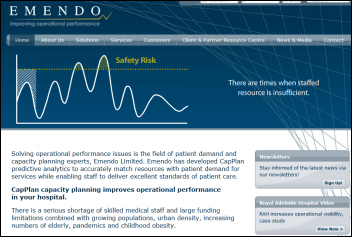
CIO Unplugged 10/24/12

October 24, 2012 Ed Marx 3 Comments

The views and opinions expressed in this blog are mine personally and are not necessarily representative of current or former employers.

CIO, Wake Up and Lead

Alexander the Great, one of the greatest military generals who ever lived, conquered almost the entire known world with his vast army. As the story goes, one night during a campaign, he couldn’t sleep. He left his tent to walk the campgrounds.

He came across a soldier asleep on guard duty – a serious offense. The penalty for sleeping on guard duty was, in most cases, death.

The soldier began to wake up as Alexander the Great approached. Recognizing who stood before him, the young man feared for his life.

Alexander the Great looked down at the soldier. “Do you know what the penalty is for sleeping on guard duty?”

“Yes, sir.” The young man’s voice quivered.

His features hardened, and Alexander the Great put a hand on his hilt. “What’s your name, soldier?”

“Alexander, sir.”

Alexander the Great studied the young man with a searing gaze. “What is your name?”

“My name is Alexander, sir.” The soldier’s knees shook.

A third time, Alexander the Great demanded with force, “What is your name?”

Breathing heavily, the young man replied, “My name is Alexander, sir.”

Alexander the Great then came face to face with an intense look. “Soldier, either change your name or change your conduct.”

True or not, the story brings out the point that it’s our duty to walk in the authority of our calling. As CIOs, we continually lobby for our voice at the table. We want to be seen and treated as a peer by our C-suite counterparts.

After interviewing several CEOs and CIOs, I wrote a post for Modern Healthcare last summer about this precise dilemma. In our quest to be recognized by the first letters of our title – typically VP (vice president) or SVP  (senior vice president) — we ultimately back down when opportunity presents itself.

A few notable exceptions exist. We all know CIOs who lead business areas of their organizations such as human resources, strategy, finance (yes, finance), and construction, or have gone on to become CEOs. But these are absolute rarities.

Here is a quick pulse check to figure out which one you are:

  • Are you presently leading something outside of IT?
  • Do you speak as a business person or a techie?
  • Do you routinely showcase the business value of IT investments?
  • Are you known to resolve challenges or do you run for cover?
  • Do you frequently say, “There is no such thing as an IT project” and punt responsibility?
  • Do you tell people you “lead from behind?”

Let’s take an example many can relate to. Most CIOs are already on an EHR journey or preparing to embark on one. What an opportunity to lead! Certainly you are not to lead alone, but nor should you abdicate your leadership on this one. And here lies the irony. The majority of troubled EHR initiatives were not led by CIOs, yet the CIO was often the first to go.

Don’t get caught up in my specific example, but rather the heart of the situation described. You might as well take the lead whenever available, because one way or another — despite your best attempt to disassociate — the CIO is integral to almost every action taken by the business. You will take the fall! I advocate that you lead alongside, not in front or behind.

What factors position you so that the coach puts you in the game?

  • Excellence. Ensure your credibility is rock solid based on the operational performance of your team. The trains must run on time.
  • Intentionality. Have a routine in place where you are getting face time with your peer suite. Throw in a mix of one-on-one time.
  • Transparency. Operate and conduct your interactions as openly as possible. Build your own site where peers can get self-help information on what’s taking place in your areas. Publish your budget and show the costs for supporting each business unit down to the application level. Give no one reason to accuse you of hiding anything.
  • Knowledge. Success is predicated upon continuous learning. Read the materials popular with your C-suite peers, not just IT.
  • Potted or planted. Are you and your directs potted in the organization or planted? When planted, it is hard to tell IT from any other business unit because of the purposeful integration. I want the business units to think my directs work for them. If potted, not planted, the plant does not take root, and eventually withers and dies.
  • CEO agenda. Know the agenda of your CEO and your peers and you will start connecting the dots between business strategy and IT. You will become a trusted advisor.

How can you turn to broaden your insights?

  • Networking. Continuous interactions with other business leaders, inside and outside of healthcare.
  • External connections. Leverage other influences by serving on advisory boards and universities. We bring my team together with IT leadership from a non-healthcare organization annually (see a previous post). i.e. Last month we compared notes with Kimberly-Clark.
  • Partnerships. Leverage your organizations partnerships with other companies and vendors. We bring our strategic partners together routinely to learn and grow.

We are all set to lead. Here are some critical success factors to consider:

  • Passion. It is contagious. No passion = no energy, and nobody wants to follow a lifeless leader.
  • Visibility. Be seen and heard. We rotate our leadership meetings inside of all of our business units. Each time, business and clinical leaders are our special guests, and they are excited to see us on their turf.
  • Trust. You know the old adage: do what you say you will do. It’s tough to build trust, yet that trust so easily falls when we stray from the truth.
  • Boldness. Being a CIO is not for the faint of heart. Based on advice from my new team, I stopped an EHR implementation so we could regroup before the project went south. This timeout paved the way for a very successful implementation and enabled the kind of returns we had originally hoped for.

Let me close by asking you: what is your name? Or better yet, what is your title? If you are not leading, then downgrade your title. Either start acting like a vice president or senior vice president or give someone else the opportunity. Healthcare is desperate for strong leaders, especially CIOs.

Ed Marx is a CIO currently working for a large integrated health system. Ed encourages your interaction through this blog. Add a comment by clicking the link at the bottom of this post. You can also connect with him directly through his profile pages on social networking sites LinkedIn and Facebook and you can follow him via Twitter — user name marxists.

News 10/24/12

October 23, 2012 News 9 Comments

Top News

10-23-2012 7-08-18 PM

Pam McNutt, SVP/CIO of Methodist Health System of Dallas, tells me that she has received a detailed fraud survey from OIG that covers a lot of territory. She will send it over if the hospital’s legal department gives the OK, but in the mean time, she provided a summary of what’s on OIG’s mind:

  • Computer-assisted coding
  • HIPAA security practices related to access to the EHR, both remote and internal
  • Numerous questions on practices and protections involving allowing patients and non-employees to access EHR data
  • Seventeen questions about audit log capabilities and how audit logs are monitored
  • Thirteen questions on clinician progress notes, whether cut/paste/copy is allowed, and how record changes are performed
  • General HIPAA privacy compliance questions

OIG Survey

UPDATE: Thanks to another reader who provided a copy of the survey, which is specific to hospitals. I found Question #44 involving patient access to their EHR data to be the most interesting given that this is a fraud questionnaire. Not only is allowing patients to see information about them a good thing in general, they can be on the lookout for questionable billing for services on their behalf. Click here for larger, printable version of the survey from my original upload.


Reader Comments

10-23-2012 8-56-40 PM

From THB: “Re: Sherman Health in Chicago. I’ll bet a dollar to your favorite charity that they join Cadence since it’s an Epic shop.” Drop a buck into a Salvation Army kettle: Sherman chooses the other suitor, Advocate.

From Back from CHIME: “Re: HIStalk. As a long-time HIStalk follower, I think everyone should know about it for keeping current. Few of my peer group seem to. How can that gap be bridged?” Let’s crowdsource some reader ideas: what should I do to make HIStalk imperative CIO reading or make them more aware of its existence?

10-23-2012 7-32-36 PM

From Michael: “Re: EHRs in the NFL. I thought HIStalk would appreciate this.” Indeed I did. A New York Times article talks about NFL teams that use technology to maintain the health of their expensive biological assets (players). Among them: electronic medical records, concussion evaluation apps, sideline video replays so trainers and doctors can quickly figure out the source of a player’s injury, and iPads for viewing player X-rays. The league hopes to move all teams to a cloud-based EHR system soon so that prospects won’t need to be X-rayed by every team that’s considering their services. According to the SVP of medical services for the New York Giants, “Electronic medical records league wide would save a player from a lot of unnecessary radiation. All of this helps on so many levels from before the game to during the game to after the game. It all just makes it easier to help the players stay healthy.” ”


HIStalk Announcements and Requests

Inga and Dr. Jayne are having quite a time for themselves at MGMA, apparently. Inga’s posts (with lots of pictures since she’s determined to wave her iPhone 5 around at every opportunity) are up from MondayTuesday, and Tuesday Part 2. Inga is #4 on the list of Twitter influencers using the #mgma12 hashtag, she told me proudly.

On the Jobs Board: Systems Implementation Engineer, Billing Services Manager, Database Administrator (Oracle).

10-23-2012 9-00-26 PM

Welcome to new HIStalk Platinum Sponsor Craneware. The company is all about revenue integrity: charge master management solutions, business intelligence, and revenue cycle management. I was startled to see its growth from the days long ago when my hospital signed up as an early adopter, and now I see that 25 percent of US hospitals are its customers for a variety of products: Chargemaster ToolkitBill Analyzer, Physician Revenue Toolkit, InSight Medical Necessity, Patient Charge Estimator, Pricing Analyzer, and even more solutions for supply management, denials, audits, payment variance analysis, and a broad line of professional services. Thanks to Craneware for supporting HIStalk.


Acquisitions, Funding, Business, and Stock

10-23-2012 9-26-24 PM

Health education systems vendor HealthStream acquires provider enrollment and credentialing system vendor Sy.Med Development. Both companies are located in the Nashville area. HealthStream also announces Q3 results: revenue up 28 percent, EPS $0.08 vs. $0.08. 

Perceptive Software saw a 78 percent revenue increase in Q3, according to filings by parent company Lexmark.

Vocera shares were the biggest percentage decliner on the New York Stock Exchange Friday, down 6.7 percent. They regained 2.32 percent Tuesday amidst a big market selloff, however.


Sales

Memorial Hospital (CO) will deploy SIS Analytics across its three facilities.

10-23-2012 9-13-13 PM

Beaufort Memorial Hospital (SC) selects Wolters Kluwer Health’s ProVation Order Sets.

Vanguard Health Systems (TN) will deploy AirStrip’s complete mHealth platform throughout its 28 hospitals.

10-23-2012 9-29-47 PM

Samaritan Health Services (OR) will use Passport Health’s Patient Access and Payment Certainty solutions throughout its enterprise.

Huntington Medical Foundation (CA) selects Allscripts RCM for its 50 providers to integrate with its Allscripts EMR.

HealthEast Care System (MN) chooses the Wellcentive Advance Outcomes Manager population health management solution.

Carroll County Memorial Hospital (KY) chooses OfficeEMR from iSALUS.


Announcements and Implementations

10-23-2012 9-31-01 PM

eClinicalWorks launches an all-inclusive RCM service at MGMA that includes its PM/EHR and services for 2.9 percent of monthly revenue collections.

10-23-2012 9-14-40 PM

Vitera announces Intergy Stat, a pre-configured subscription- and cloud-based PM/EHR system for independent physicians. Also announced: Vitera Intergy Mobile, an iPad app that provides mobile providers with read-only access to Vitera Intergy v8.00.

Oncology solutions vendor Prowess will incorporate tools for e-prescribing, medication adherence, and communications from DrFirst.


Government and Politics

Northern Ireland’s health minister is attending a Boston conference to urge healthcare vendors to test their products in his country, touting its single integrated health and social care system. Among the American speakers at the EU-US eHealth Markeplace are Anand Basu (ONC), David Seltz (Massachusetts governor’s office), Dave Whitlinger (New York eHealth Collaborative), Doug Fridsma (ONC), Farzad Mostashari (ONC), Joy Pritts (ONC), Judy Murphy (ONC), Katherine Luzuriaga (UMass), Laura Raimondo (UPMC Italy), and Bill Hersh (OHSU).

10-23-2012 9-39-45 PM

The VA hasn’t made much progress on encrypting its computers since a high-profile 2006 data breach, a report investigating an anonymous tip finds. The agency bought 400,000 encryption licenses for almost $6 million, but has installed the software on only 65,000 devices. The VA’s technology office says they had compatibility problems with older computers and stopped the encryption program until the computers were upgraded. The OIG report says they don’t even know if the software meets the VA’s needs and blames poor planning and project management for the outcome.


Technology

10-23-2012 7-58-07 PM

Apple announces the slightly smaller iPad mini, pricing it surprisingly high at $329 for a Wi-Fi only model. Concerns are that it still can’t compete with the $199 Kindle Fire (subsidized by the Amazon product sales it generates) or the $199 Google Nexus (sold at cost.) It could, however, take away from sales of its $499 big brother. Also announced: yet another generation of the iPad to make the one(s) you already have obsolete, thinner MacBook Pro laptops featuring the Retina display, and upgrades to the iMac and Mac Mini. Apple shares closed down 3.26 percent.

10-23-2012 9-46-17 PM

Diagnotes wins an Indiana innovation contest for its On Call program that connects hospital staff to offsite physicians who can view medical records on their smart phones and send orders back via secure messaging. The company’s CEO is Dave Wortman, who I interviewed many years ago when he was running Mezzia,  the healthcare budgeting company he formed in 1999. It was sold to VFA in 2006.


Other

A University of Wisconsin-Madison biochemistry professor whose research involves the flowering of plants is arrested after police find that the specimens in his lab are actually marijuana. My first reaction: sounds like “Breaking Bad” since I’m watching that on Netflix.

In England, a hospital blames an unspecified technical issue in apologizing to 120 breast cancer patients whose incorrect estrogen receptor biopsy results caused them to miss potentially needed hormonal therapy. The hospital is also on shaky financial ground, saying it could run out of cash in January.

An internist’s Wall Street Journal opinion piece on electronic medical records concludes:

At first I thought EMR sounded like a good idea. Then our practice started using one … checking patients into the office is an odyssey involving scanners and the collection of demographic data—their race, their preferred language, and so much more—required by Medicare to prove that we are achieving "meaningful use" of our EMR … it seems as if this is all about taking care of the chart, as opposed to taking care of the patient … With all the data entry the electronic system requires, my laptop presents a barrier between my patient and me, both physically and metaphorically. It’s hard to be both stenographer and empathetic listener at the same time.

Life Sciences Angel Network will present a November 20 conference, “Healthcare Information Technology: Change, Outlook, and Opportunity,” at Beth Israel Medical Center in New York. Investor Esther Dyson will deliver the keynote; program panelists include representatives from Aetna, Nike, Continuum Health Partners, Castlight Health, and the FDA. Registration is $120.

10-23-2012 8-31-17 PM

Medical students from Johns Hopkins University and the University of Maryland who volunteer at Baltimore Rescue Mission develop an EMR system for the free clinic using open source software. They plan to expand it to similar organizations and connect it to Maryland’s CRISP HIE. They’ve formed an organization called Networking Health.

Here’s a music video from the recent CHIME conference. I recognize quite a few of the stars.


Sponsor Updates

  • Imprivata announces the agenda of its first annual user conference in Boston.
  • Gartner positions Informatica in the leaders quadrant in its 2012 Magic Quadrant for Master Data Management of Customer Data Integration report.
  • GetWellNetwork experiences a 125 percent growth surge year over year as patient engagement becomes an imperative component for MU reimbursements.
  • First Databank releases its enhanced drug knowledge to support interoperable medication management.
  • Iatric Systems receives ONC-ATCB 2011/2012 Certification for its PtAccess V1.0.11.
  • QlikView expands its mobile access with QlikView for iOS, available for the iPad.
  • NextGate signs 15 new clients during its third quarter for its EMPI and Provider Registry solutions.
  • Park Place International introduces its Sustaining Healthcare IT blog to assist Meditech hospitals in achieving sustainability.
  • Anesthesia Healthcare Partners chooses to McKesson Revenue Management Services for 30 locations across eight states.
  • AdvancedMD releases its survey results at MGMA indicating that only 26 percent of physicians feel they are in control of their finances, while more than half expect their patient load to increase because of the Affordable Care Act.

Contacts


Mr. H, Inga, Dr. Jayne, Dr. Gregg.

More news: HIStalk Practice, HIStalk Mobile.

Curbside Consult with Dr. Jayne 10/22/12

October 22, 2012 Dr. Jayne Comments Off on Curbside Consult with Dr. Jayne 10/22/12

clip_image002

I mentioned last week that I was hoping to find a way to attend MGMA. In a stroke of good luck for me, one of our revenue cycle staff had a situation crop up that prevented her attendance, so I promptly agreed to fill in for her.

I actually enjoy dealing with practice management and revenue cycle issues and knowing more about those topics has been helpful in my work as a CMIO. Not to mention, I like San Antonio and needed a warm getaway after several weeks of chilly rainy weather in my hometown.

Today’s attendance wasn’t as high as I anticipated. That might be due to pre-conference socializing, however. I was surprised that in the years since I last visited, San Antonio’s Riverwalk has become somewhat of a Tex-Mex version of the French Quarter. The revelry going on below my hotel went well into the wee hours of the morning, and I couldn’t believe the amount of bottles and trash I saw on the Riverwalk during my morning jog. (Seriously people, there are recycling containers all over the place here – use them.)

Today featured a variety of specialty-specific preconference activities as well as the exhibit hall, which held a “tailgate party” event with food and drink served in the aisles which made it fun and casual (although I’m sure the booth staffers wish they could have shared in the drinks part). My favorite booth of the day was VaxServe, which was giving out free flu shots to willing takers.

As the industry consolidates, there are so many people moving around. I saw several vendor reps who are now with different companies than they were with just a few months ago at HIMSS. There’s quite a focus on ICD-10 and lots of people in the booths asking pointed questions about when vendors will be ready.

There are some good panels and education sessions scheduled and I hope to attend as many as possible. Hopefully I will run into Inga and catch some sponsor get-togethers as well. Be sure to follow us on Twitter @IngaHIStalk and @JayneHIStalkMD for the play by play.

What do you think about MGMA this year? E-mail me.
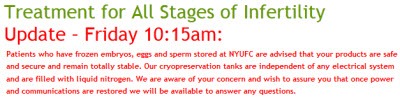
Print

E-mail Dr. Jayne.

Comments Off on Curbside Consult with Dr. Jayne 10/22/12

Text Ads


RECENT COMMENTS

  1. The sentence was "most people just go to Epic UGM" - that's people going to Epic's annual user conference and…

  2. Merry Christmas and a Happy New Year to the HIStalk crowd. I wish you the joys of the season!

  3. "most people just go to Epic" that's a problem because then EPIC becomes a monopoly in healthcare, if it isn't…

  4. Only if CEO can post 'bail' which nowadays stands at 1B$ paid directly to the orange president or his family…

Founding Sponsors


Platinum Sponsors


Gold Sponsors


RSS Webinars

  • An error has occurred, which probably means the feed is down. Try again later.