


Monday Morning Update 2/4/13

From HIStalk Fan: “Re: HITPC/HITSC testimony of Karen Van Wagner, executive director of North Texas Specialty Physicians. The Pioneer ACO shares results of its community HIE.” She talks about successful efforts to increase EMR usage (eCW, Allscripts, NextGen) and the results of the exchange (Sandlot Solutions), which was launched in 2006. She says traditional healthcare IT isn’t providing cost and quality improvements because it focuses on retrospective data, often from claims databases, and the optimal solution involves both retrospective and current clinical information. They did a discharge transitions project study that exceeded targets for PCP follow-up, having discharge summaries available for the follow-up PCP visit, and readmissions. Her specific recommendations to the government: (a) simplify consent and disclosure rules; (b) expedite adoption of IHE standards; (c) require laboratory diagnoses to delivered by LOINC standards; (d) require hospital EMRs to send a “just admitted” notice to community providers via their own EMRs; and (e) require pharmacy systems to communicate with HIEs and provide their information at no charge.
Hospitalist DZA MD left an insightful comment on my Time Capsule article about doctors getting lost in the barrage of generally useless information cluttering up EMRs. Excerpting:
Anything that is templated has exactly zero clinical information value to me. I don’t care if Osler himself dropped in “dyspnea improved,” “no diarrhea” … If I want to know the validity of that kind of thing, I will look at the narrative part of the nursing note … The only data I look at that actually represents signal is the vital signs and lab data. The rest of the discrete data is noise … The narrative and visual graphics (including graphic displays of lab and vital signs data) are for us (clinicians). The templated stuff is for the suits and insurance grifters. QED.

From The PACS Designer: “Re: Microsoft Office 365. Microsoft is making a dramatic switch by selling its enhanced Office products in the cloud. They are calling it Office + Office 365, and will be offering a monthly subscription service with pricing based on business size and features selected by the customer. It’s a big gamble on users satisfaction with cloud services which as we know can experience interruptions in service at inappropriate times of the business cycle.” The good thing about Office is that the once-touted Office killers, especially Google Apps, are vastly inferior flops. The bad thing is that home Office users aren’t likely to lock themselves into a $100 ongoing subscription for something they formerly bought or stole once, although it’s a pretty good deal if you have a bunch of PCs since the home license covers up to five (less likely now that everybody’s using iPads and phones instead of extra PCs). And, you can temporarily load and run it to a non-licensed PC. I think it can work – antivirus software moved subscription software for home users to the mainstream, not to mention that Microsoft can just jack up the price of the box version to move people toward the cloud-based offering, which would also kill the bootleg business (possibly their primary motivation). It won’t help that Office 365 had an outage almost immediately after its launch, allowing the boxed software users to work merrily along while the leasers couldn’t even get to Outlook.
From Godzilla: “Re: [hospital name removed]. Filing suit against [vendor name removed]. Unhappy with the products, implementation, and project management.” A hospital media spokesperson replied on the record to my inquiry, “Nothing could be further from the truth. Inaccurate on all counts.”
From Unbeatable: “Re: [vendor name removed]. Laid off 31 developers and outsourced all work to India and the Ukraine. The Chicago office lost the largest number of staff.” I’ll see what I can find out.
From IndustryBnkr: “Re: OptumHealth. Rick Jelinek is leaving as CEO to pursue another opportunity outside the company, with Larry Renfro taking over.” Unverified, but his former “About Us” page has been deleted. He took the CEO job a year ago.
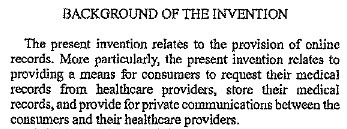
From HITEsq: “Re: MMR. Made good on its threats to sue someone for patent infringement in January, going after Walgreens. MMR’s theory is that displaying a list of your prescriptions infringes on its patents. I seem to remember having access on Walgreens before 2005 when the MMR patent was filed.” Patent trolls love the US system because (a) the Patent Office is overwhelmed, they don’t have the knowledge required to understand highly technical patent requests, and will approve just about anything and let the courts sort it out later; and (b) lawyers are so expensive that mounting a legal defense can bankrupt a defendant even when they are clearly right since our legal system requires the winner to pay their own legal costs. Unfortunately lawyers often morph into politicians and are predictably loathe to bite the hands (as inserted into the pockets of others) that once fed them and may again, so we are required to be collectively complacent about the status quo.

Speaking of despicable patent trolls, let us hear from our new hero, Lee Cheng, Newegg chief legal officer and extortionist squasher.
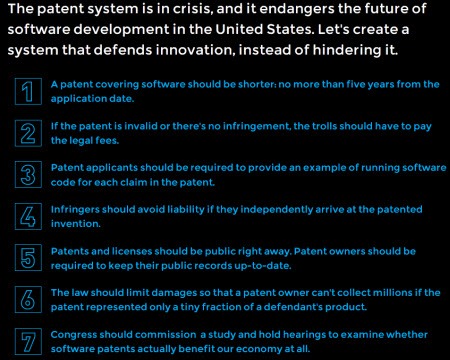
In related patent troll news, billionaire bad boy Mark Cuban endows “The Mark Cuban Chair to Eliminate Stupid Patents” at the Electronic Frontier Foundation, which he funded because, “Dumbass patents are crushing small businesses. I have had multiple small companies I am an investor in have to fight or pay trolls for patents that were patently ridiculous.” Mentioned in the article is Acacia Research, which I’ve railed about here many times, which claims to own the process of sending medical images over the Internet.
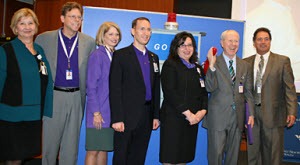
Yale-New Haven Hospital (CT) went live with Epic on January 31. Above: Sue Fitzsimons, RN, PhD (SVP, patient services); James Staten (EVP, finance); Marna Borgstrom (CEO); Daniel Barchi (CIO, health system and medical school); Lisa Stump (VP, Epic project); Peter Herbert, MD (chief medical officer); and Richard D’Aquila (president and COO).
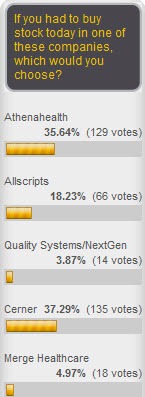
The stock-pickers among us like Cerner and athenahealth just about equally. New poll to your right: did you go to the HIMSS conference last year, and are you going this year?
Speaking of those stocks I listed, I decided to see how they’ve done in the past year: athenahealth (up 40 percent), Allscripts (down 45 percent), Quality Systems (down 57 percent), Cerner (up 34 percent), and Merge (down 49 percent).
Thanks to the following sponsors, new and renewing, that have recently supported HIStalk, HIStalk Connect, and HIStalk Practice. Click a logo for more information.



























Psychology scientists from Brigham and Women’s Hospital perform an interesting study in their research into “inattentional blindness.” Radiologists were asked to examine the CT scans of five patients and click on whichever of the 10 known nodules they could find. The final case included a gorilla image that was 50 times the size of the nodule, which 20 of the 24 radiologists did not notice even though eye-tracking instruments showed they had looked right at it. I don’t see this as necessarily bad – a lot of the work in medicine is tuning out the noise to focus on what you’re looking for. However, it does reinforce the idea that in general it’s good to get a second opinion from someone less focused on the problem at hand, and if you’re a patient or lesser expert, you still might detect the forest that the tree-obsessed people have missed. It may also touch on confirmational bias, where people tend to place higher value on information that matches what they already believe (like brains not containing gorillas).
A New York Times op-ed piece observes a “casual lack of transparency” in that drug and device companies make sure that only positive studies are published, with the trigger being Johnson & Johnson’s recalled artificial hip that was marketed despite known problems that the public wasn’t told about. It observes two attempted fixes that have failed: (a) the FDA requires new clinical trials to have summaries posted on a federal site, but an audit found that 80 percent of the trials ignored the requirement and no fines have been levied; and (b) the medical journal industry promised to publish only pre-registered studies, but an audit found that more than half of published articles involved trials that weren’t registered correctly and one-fourth covered studies that weren’t registered at all.
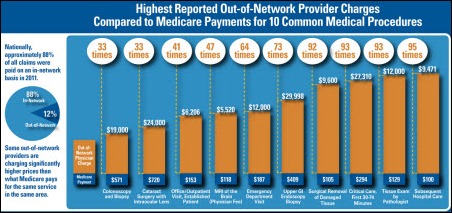
Good luck explaining healthcare pricing to the public. A graduate student’s gallbladder removal was billed at $60,000 by an out-of-network provider. His insurance paid what it defined as a reasonable rate: $2,000. The average commercial price is $12,292, while Medicare would have paid $958. An advocacy group stepped in and the surgeon accepted $340. The article says the Affordable Care Act does nothing to limit out-of-network fees, which are almost always a surprise to patients since buildings and white coats don’t come with “I’m in your network” labels. I’ve known people burned by in-network EDs that used out-of-network doctors or lab companies, and of course nobody volunteered that information, not that you really have a choice in the ED anyway. The comments left on the New York Times article are fascinating and often insightful. The graphic above is from a new AHIP report.
A foundation employee of Fairbanks Memorial Hospital (AK) is charged with diverting $12,000 in donations that had been collected online via PayPal.
GE Healthcare is working with the VA to develop surgical robots that can locate, sterilize, and deliver instruments.
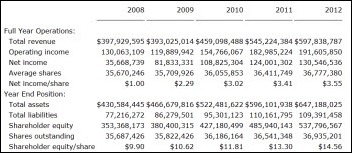
Meditech files its annual report. For the year, revenue was up 9.7 percent, EPS $3.55 vs. $3.41. Neil Pappalardo owns nearly 39 percent of the company, holding shares worth around $650 million. CEO Howard Messing’s shares are valued at around $18 million. Share values are probably low given that the company is not publicly traded – I just used the most recent per-share acquisition price, but if the company were to be sold or IPO’d, the value would probably be a lot higher.
Nuggets from the McKesson earnings conference call late last week:
- Technology Solutions revenue was flat
- Margins of the Technology Solutions numbers was hurt by a required revenue recognition change for the System C UK business McKesson acquired in 2012
- RelayHealth and the payor software business contributed more than half of the profits of Technology Solutions
- More legacy customers than expected have either already moved to Paragon or have committed to do so instead of moving to competitor systems
- The Paragon ED solution is close to being generally available
- Both Horizon and Paragon will support Meaningful Use Stages 2 and 3
Contacts
Mr. H, Inga, Dr. Jayne, Dr. Gregg, Lt. Dan, Dr. Travis.
More news: HIStalk Practice, HIStalk Connect.



























































The sentence was "most people just go to Epic UGM" - that's people going to Epic's annual user conference and…